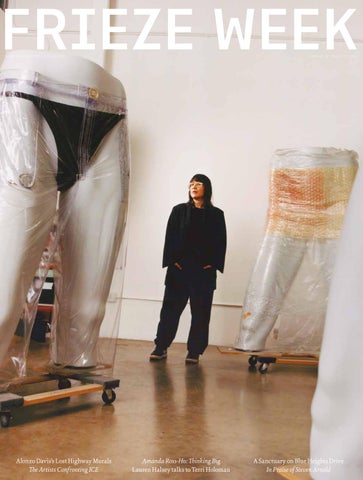
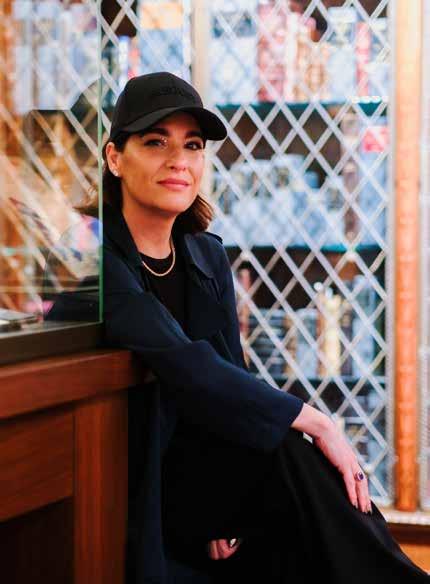
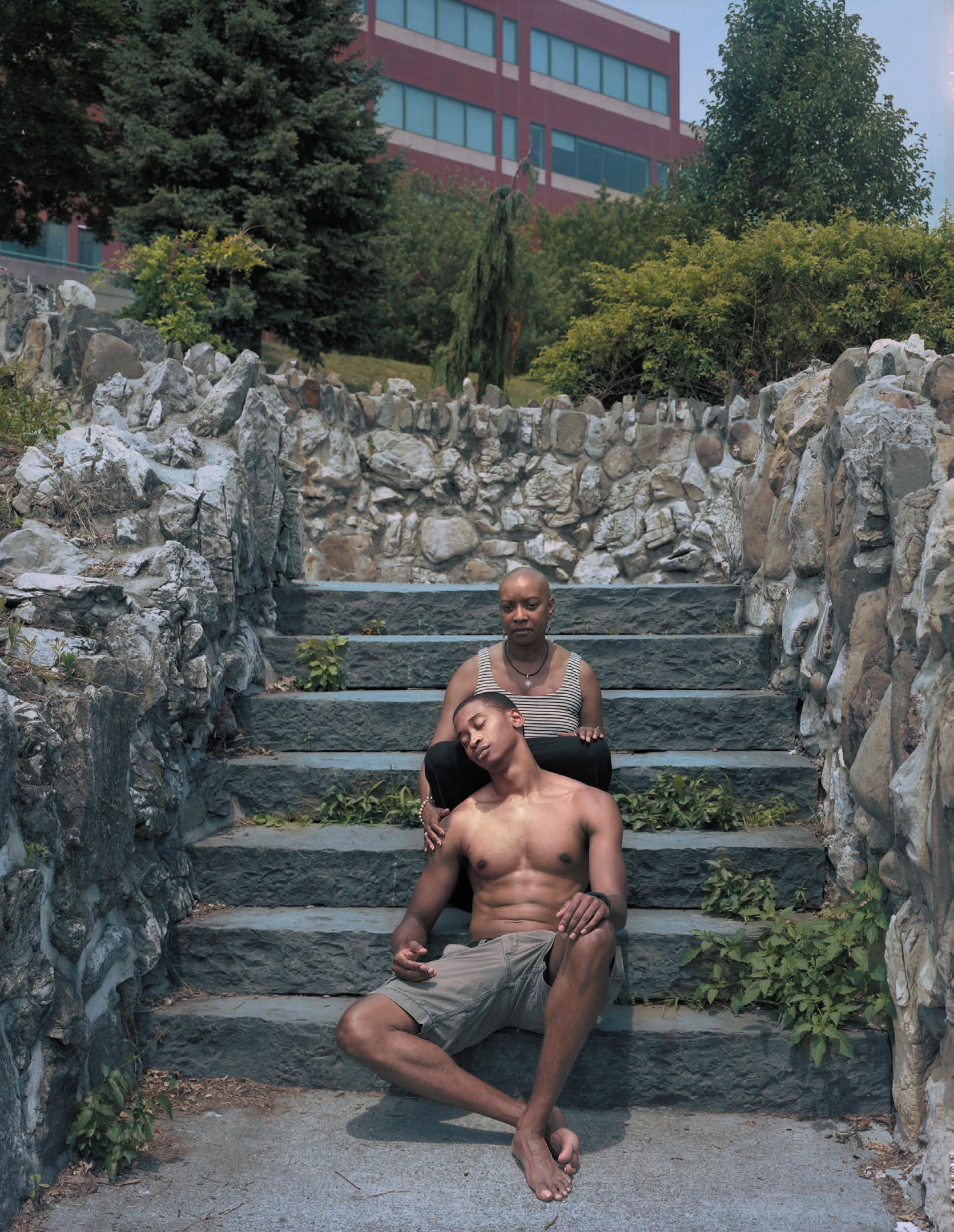
Amanda Ross-Ho: Thinking Big Lauren Halsey talks to Terri Holoman
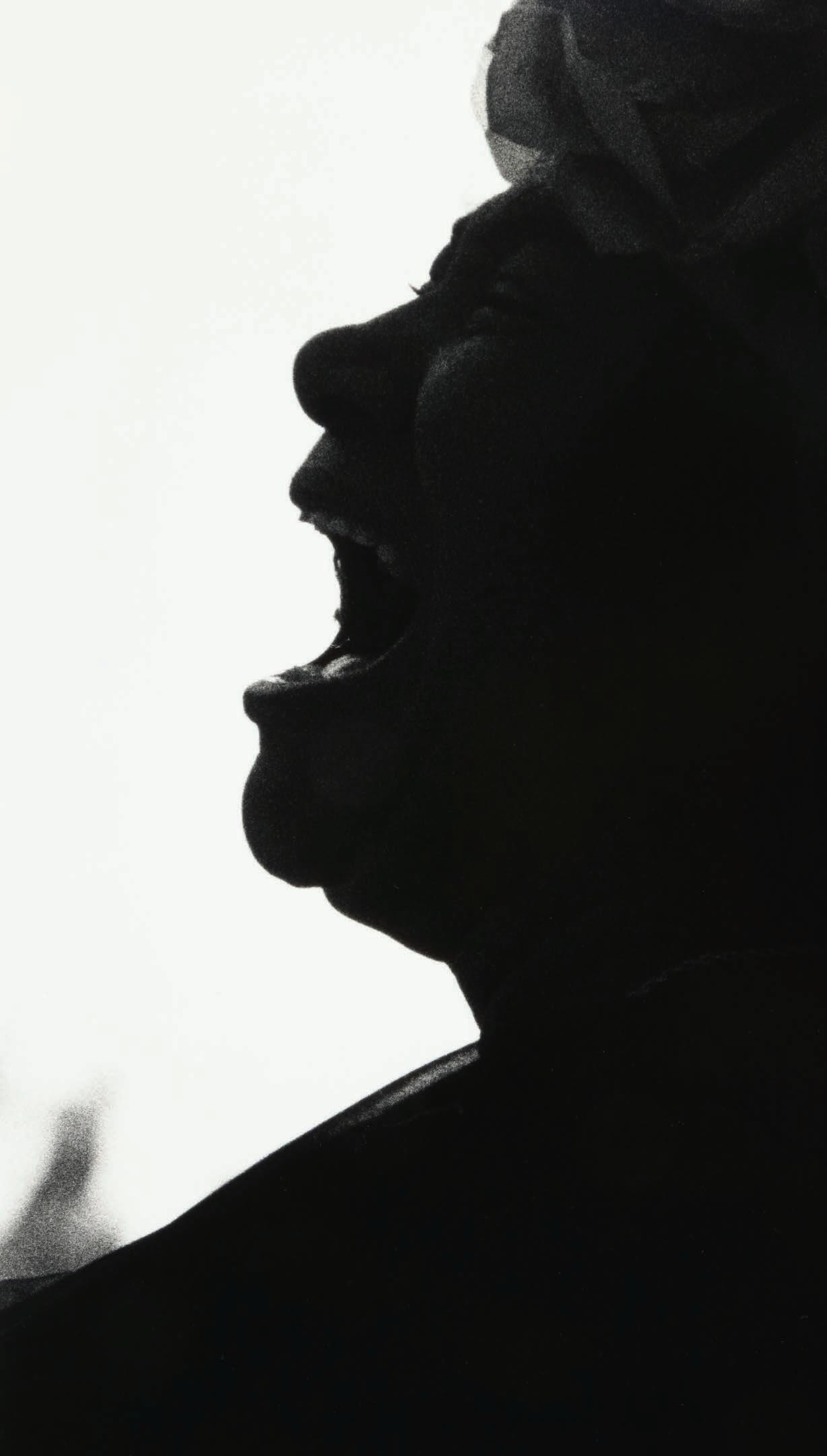
A Sanctuary on Blue Heights Drive In Praise of Steven Arnold
SANTA MONICA AIRPORT, LOS ANGELES
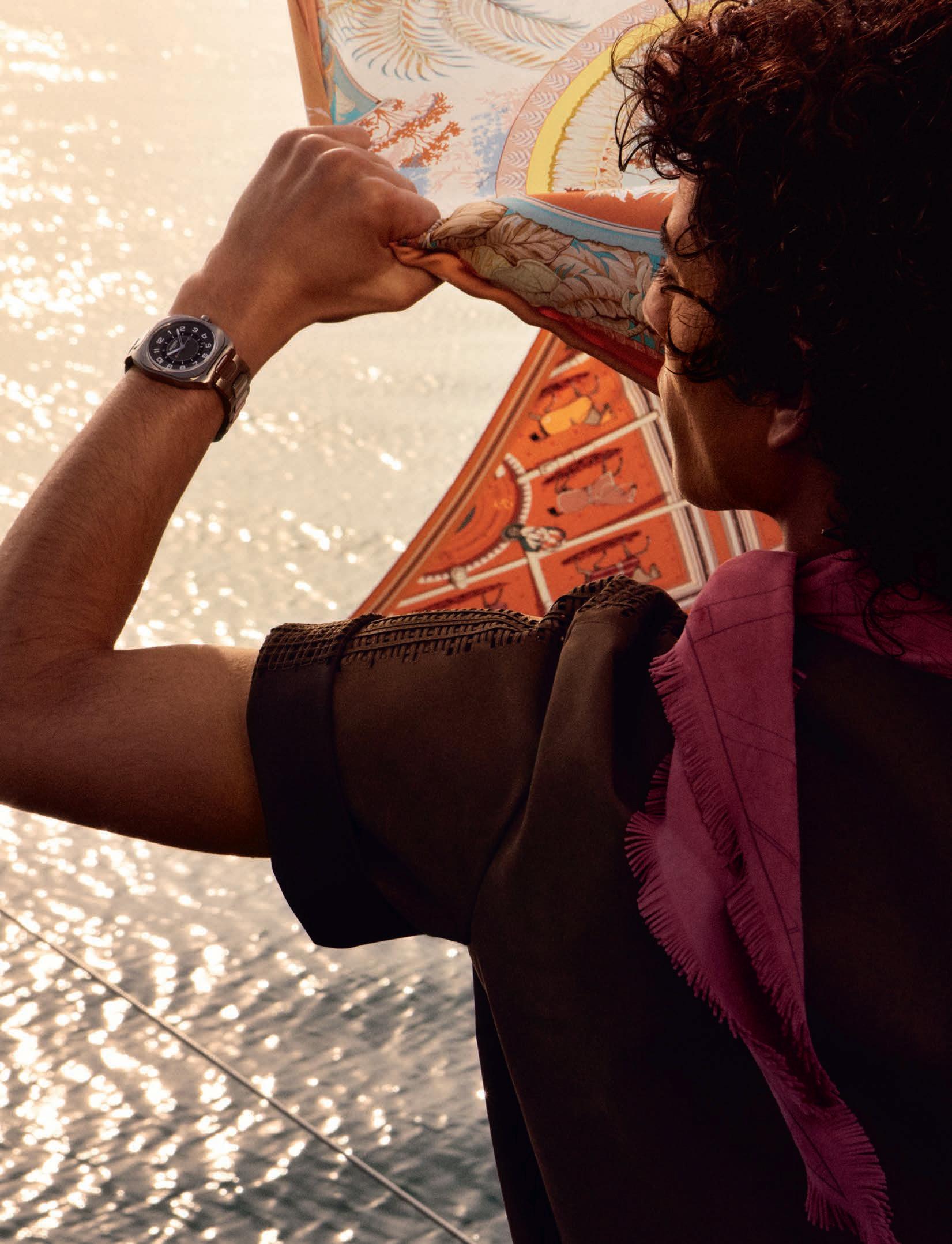
PARTICIPANT
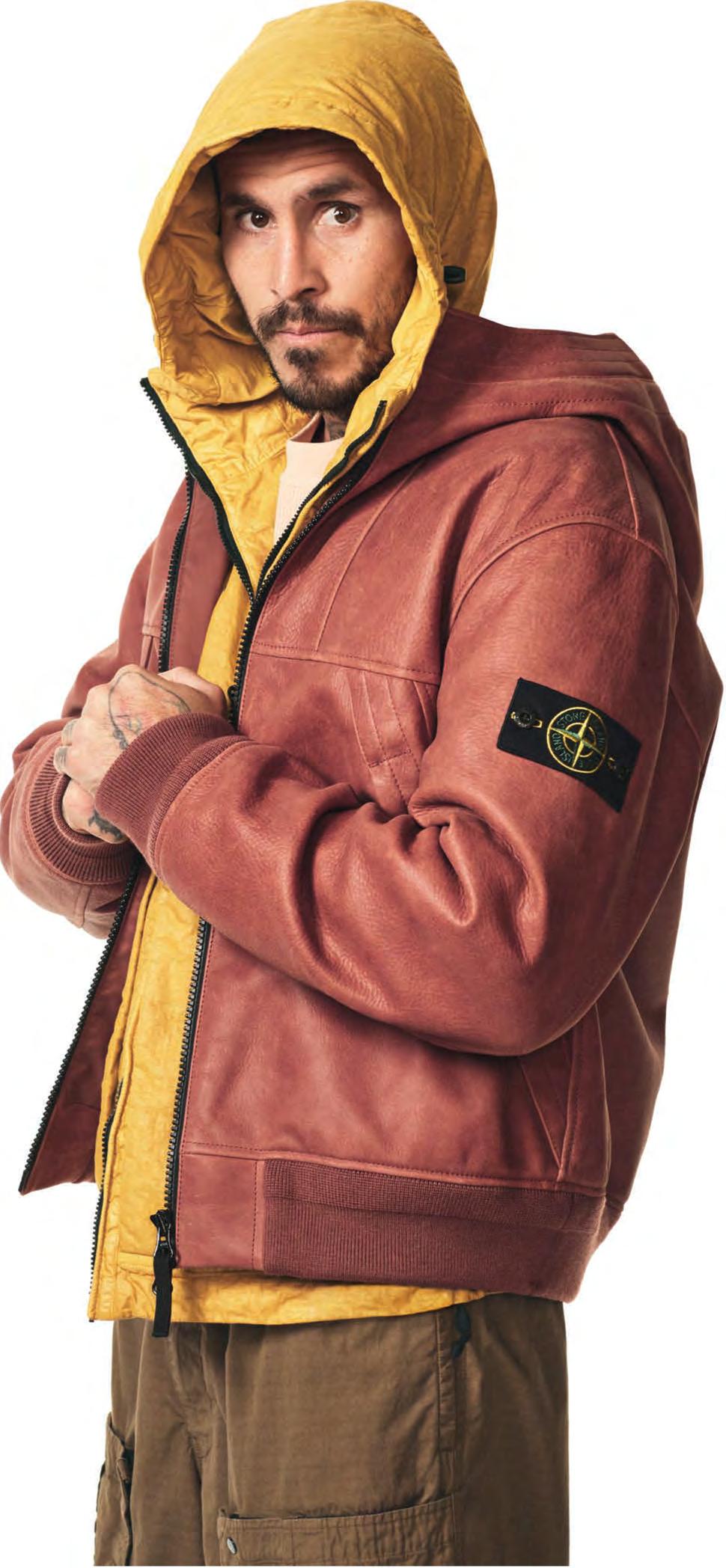
Chito Vera
WEARING
0100004Textured Leathe
LOCATION
Santa Monica Califo rnia 340119*N 1184916*W
QUESTION 03 OF 100
ARE THERE ANY QUOTES YOU LIVE BY? "IMMIGRANT MENTALITY." IT PUSHES ME TOWARDS A BETTER AND BRIGHTER FUTURE, ALWAYS.
QUESTION 06 OF 100
WHAT COULDN 'T YOU LIVE WITHOUT? FAMILY IS THE MOTOR THAT KEEPS IT ALL GOING.
QUESTION 16 OF 100
WHAT ACHIEVEMENTS O YOURS ARE YOU ESPECIALLY PROUD OF? WHEN I WAS ABLE TO GET MY DAUGHTER SURGERY SO SHE CAN HAVE A BETTER LIFE. THAT WAS MY LIFE CHAMPIONSHI�
QUESTION 38 OF 100
DO YOU PREFER THE DESERT, FOREST, MOUNTAIN OR BEACH?
IN A PER F ECT WORLD I'M ON A MOUNTAIN WITH AN OCEAN VIEW.
QUESTION 40 OF 100
WHAT'S THE BEST ADVICE YOU EVER RECEIVED?
JON JONES TOLD ME YOU ALWAYS HAVE TO INVEST IN YOUR CAREER.
QUESTION 56 OF 100
WHAT'S THE BEST WAY TO GO BEYOND FEAR?
IF YOU DON'T GIVE YOURSELF A CHANCE TO GO THROUGH THE FIRE YOU WILL NEVER KNOW HOW GOOD YOU CAN BE.
QUESTION 80 OF 100
WHAT ARE YOU GRATEFUL FOR? JUST BEING ABLE TO BREATHE ANOTHER DAY.
QUESTION 87 OF 100
DO YOU HAVE ANY HOBBIES? I LOVE TO SURF. THAT'S ACTUALLY MY FAVORITE SPORT.
Los Angeles is an expansive and ever-evolving landscape. The city is home to a thriving community of artists, filmmakers, musicians and many others across intersecting creative industries. LA’s art world balances the global and local, with established institutions and international galleries presenting artists operating in the upper echelons of the market, and forward-thinking emerging spaces introducing fresh and excitingly disruptive voices.
Since last year’s Frieze Los Angeles, the city’s arts community has come together to support the artists, gallerists and art workers who lost homes, studios and work in the wildfires of January 2025. Frieze was a founding partner of the LA Arts Community Fire Relief Fund, which has now distributed more than $16 million to 1,689 artists and art workers. The resilience and imagination of the LA arts community have deepened, evolved and thrived.
For the seventh edition of Frieze Los Angeles, we are reinforcing our commitment to this city, its artists, galleries and patrons. We commissioned renowned Los Angeles-based artist Patrick Martinez to create imagery for our campaign: a neon sign installed in a storefront window with text from James Baldwin: “If I love you I have to make you conscious of the things you don’t see.” A new installation of neons situated at the entrance to the fair offers a poetic response to the devastating ICE raids across Los Angeles.
Outside, surrounding the fair tent, we continue our collaboration with the non-profit Art Production Fund: “Body and Soul” is a program of site-specific sculptural commissions, performances and educational activations that, as always, serves as an essential way of bringing public art to the fair.
I also hope you’ll discover the unexpected. This year, galleries are realizing ambitious and exciting presentations, from John Baldessari at Sprüth Magers to Alicja Kwade at 303. Works including Larry Sultan’s California photo series “The Valley” at Casemore Gallery, Alabama artist Yvonne Wells’s quilted icons at Fort Gansevoort and Alexis Smith’s 1980 Hello Hollywood installation at Garth Greenan offer unique representations of Los Angeles.
I’m honored that we can once again provide a platform for the work of underrecognized artists through the Frieze Impact Prize, this year in partnership with arts nonprofit NXTHVN and WME Impact. The 2026 Impact Prize has been awarded to Napoles Marty, whose solo presentation at the fair is curated by LACMA’s Diana Nawi. Outside the fair, you can see landmark exhibitions such as “Made in LA” at the Hammer, “MONUMENTS” at
MOCA and the Brick, and “Bruce Conner/Recording Angel” at the Marciano Art Foundation, alongside one-of-a-kind displays, including Steven Arnold at Del Vaz Projects in Santa Monica and a photographic history of the Black Arts Movement at the Getty Center. This activity is testament to LA’s place on the global stage. During Frieze Week, conversations and encounters will take place across the city at openings, talks and dinners, on picnic benches over pizza or a glass of champagne, in the aisles and on the stands of the fair, in car rides and shared taxis. It’s what we all need right now. When “business as usual” happens in a city as dynamic, resilient and imaginative as Los Angeles, it makes for a truly energizing experience.
Christine Messineo Frieze Director of Americas
Left Christine Messineo Photograph: Brendon Cook/BFA
A year ago, an expat friend in Culver City told me over brunch that her daughter’s school was educating pupils and staff about their rights in relation to ICE officers. A day later, protests against ICE and deportations shut down the 101. As I write this, the actions of federal forces under the Trump administration have become global news and sparked a nationwide debate.
It sometimes seems like this city has a special connection with what’s to come: that the future is somehow made in LA. That’s one reason why the eponymous Hammer Museum biennial will be a key stop for me during Frieze Week, and why several artists included in that show feature in this issue of Frieze Week: from Amanda Ross-Ho, whose new performance will be a highlight of Frieze Projects, to Peter Tomka and the late Alonzo Davis. “You may not grasp all of what’s happening at one time,” Davis said of his freeway murals in a 1990 interview, but “you would comprehend more and more each time.” For me, LA is like that too.
Matthew McLean, Editor, Frieze Week
A rtists Against ICE LA steps up
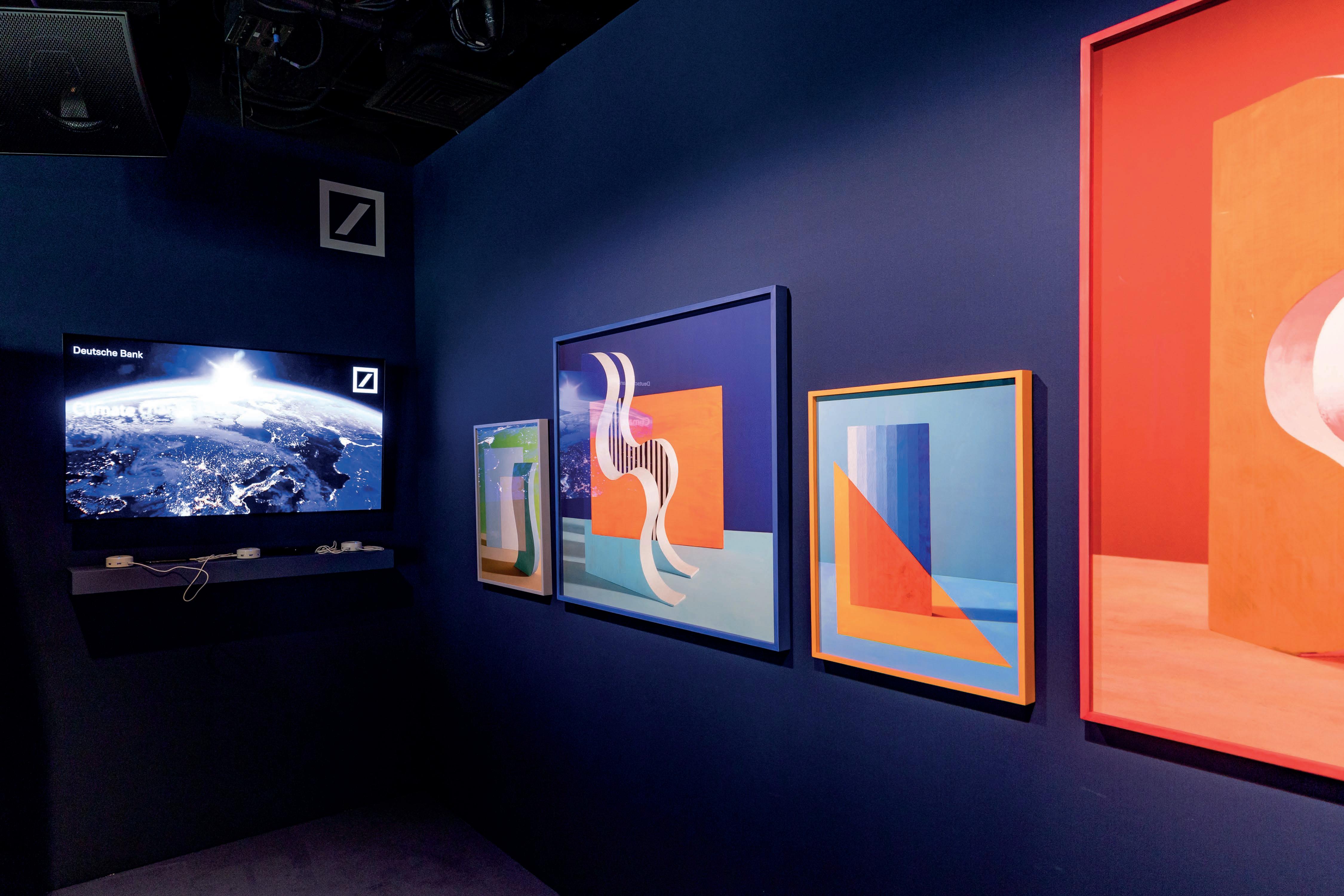
Earth Time Amanda Ross-Ho’s project for Frieze Los Angeles
A Wider Impact Napoles Marty
A Sanctuary in the City Blue Heights
& Culture
Extramural
Davis’s Olympic art
To Follow the Stars Peter Tomka on Larry Sultan 40 “ My Process Is Patience” Lauren Halsey meets Terri Holoman
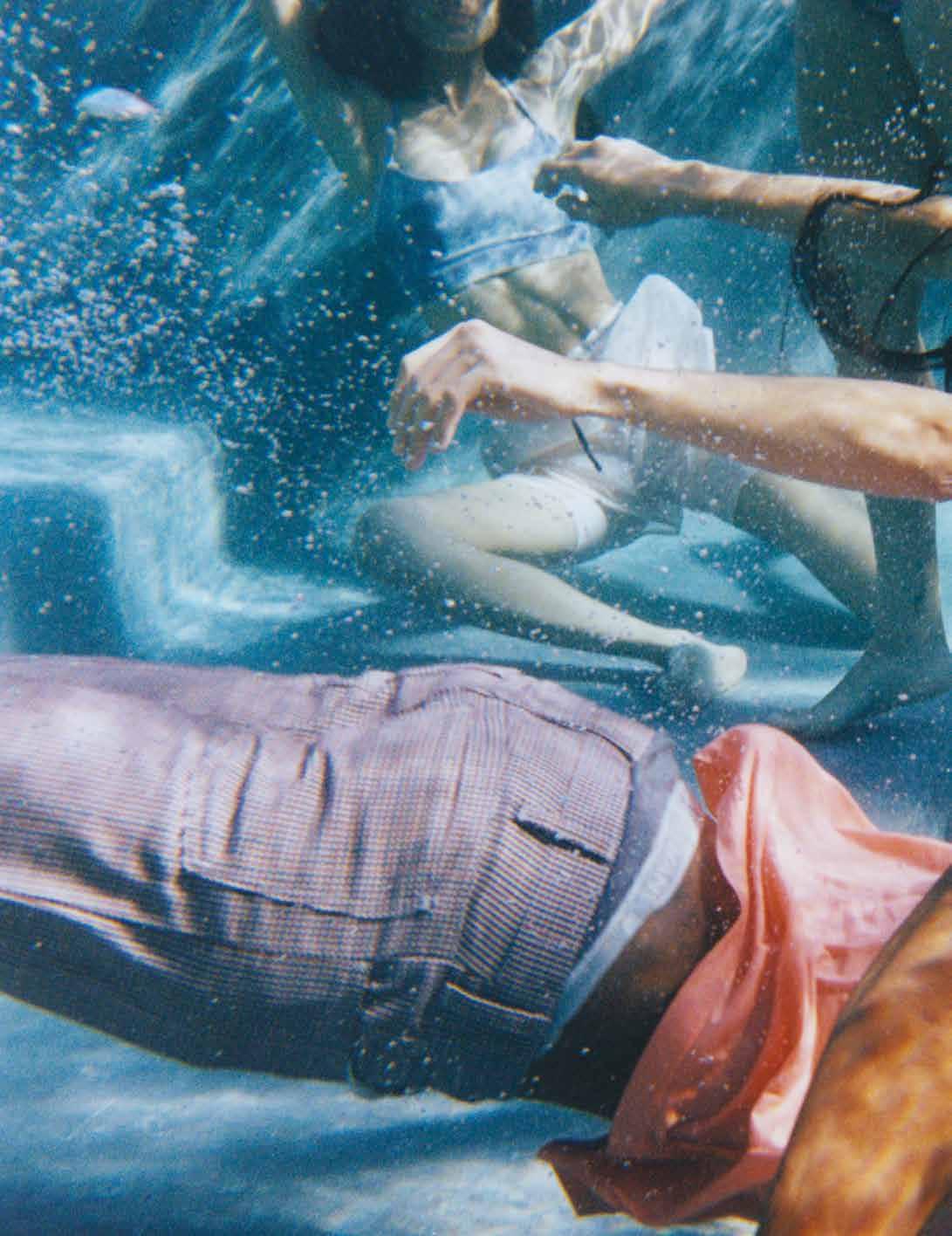
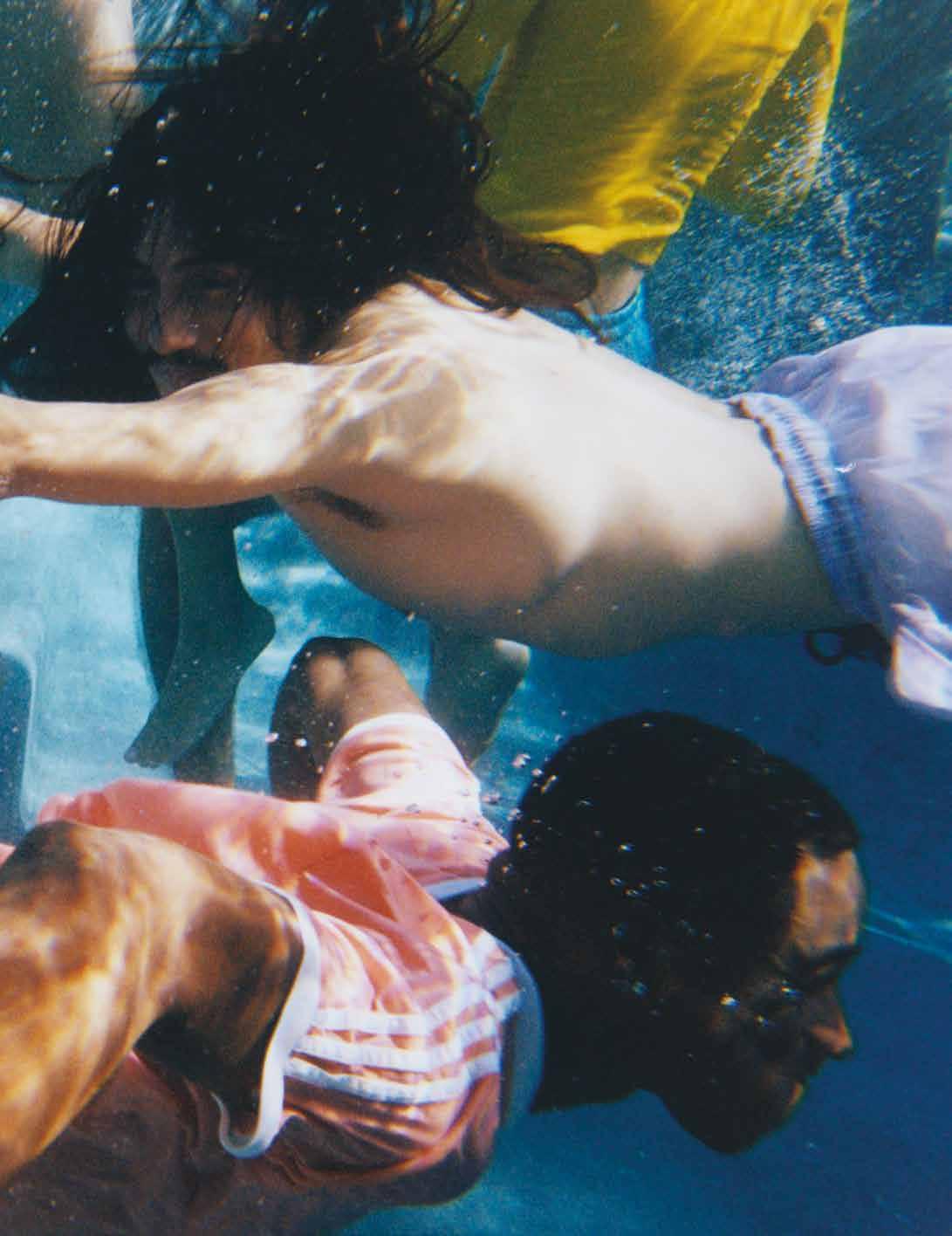
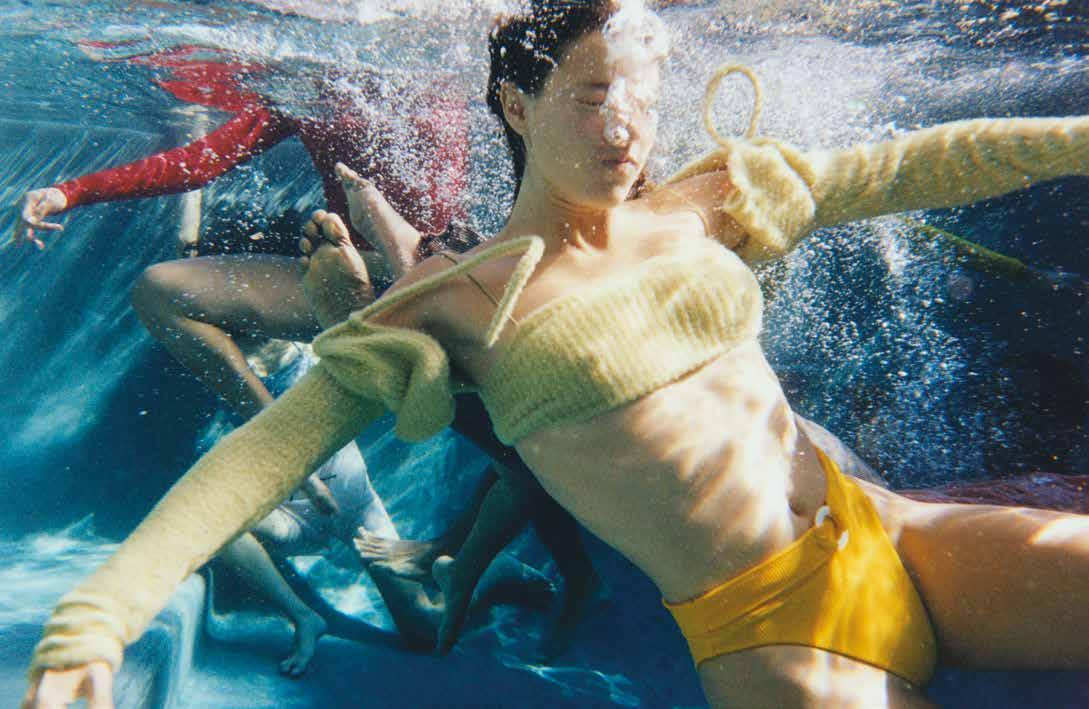
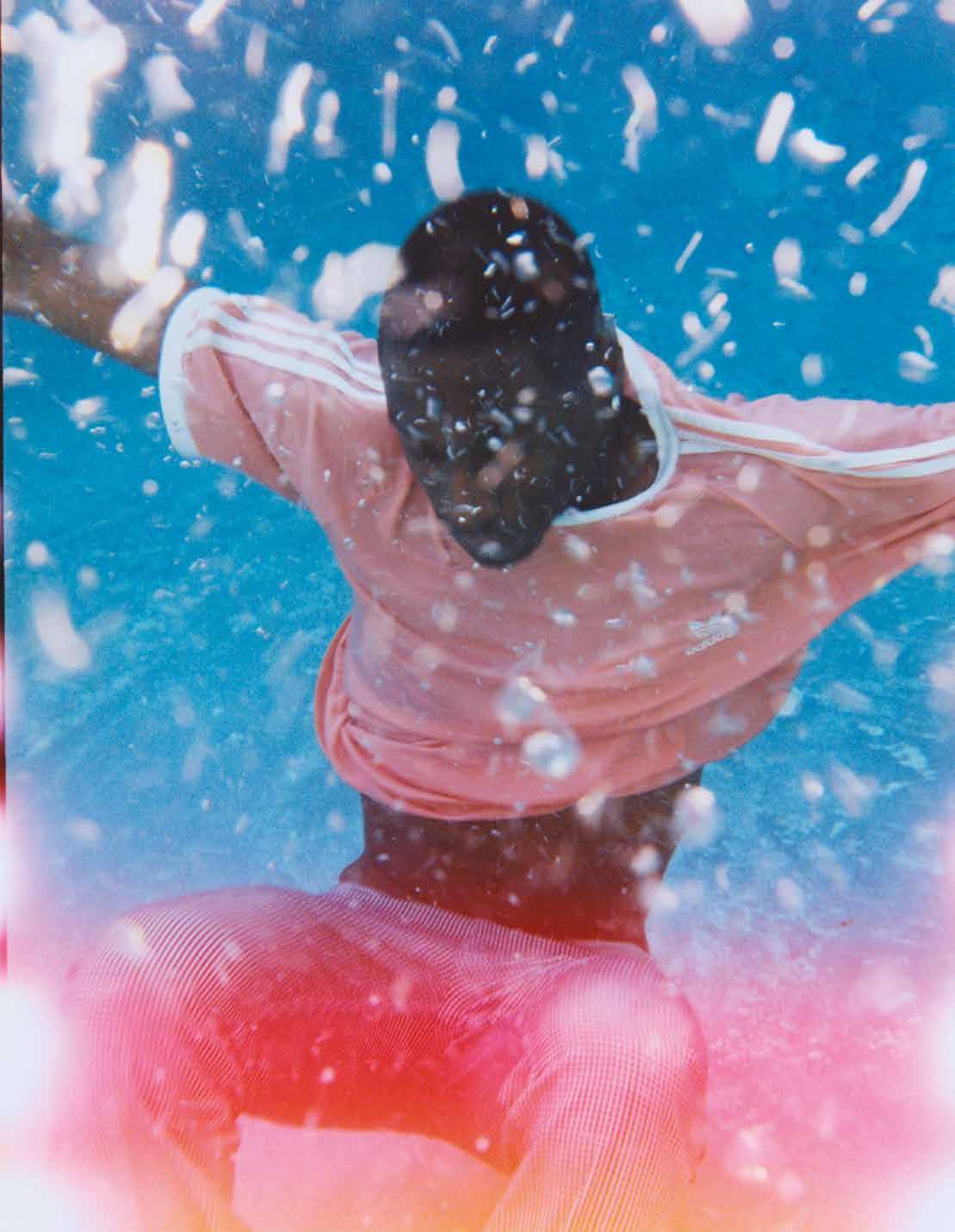
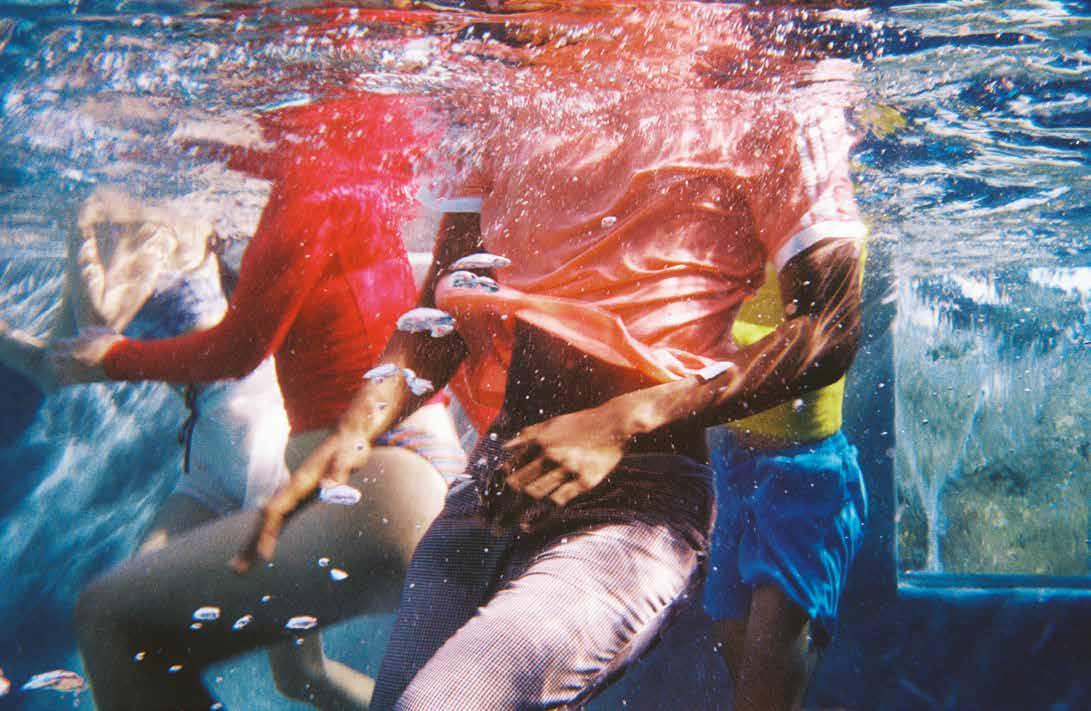
Good Counsel A history of the art advisor 48 Splash Zone A visual essay inspired by LA artists’ love of pools
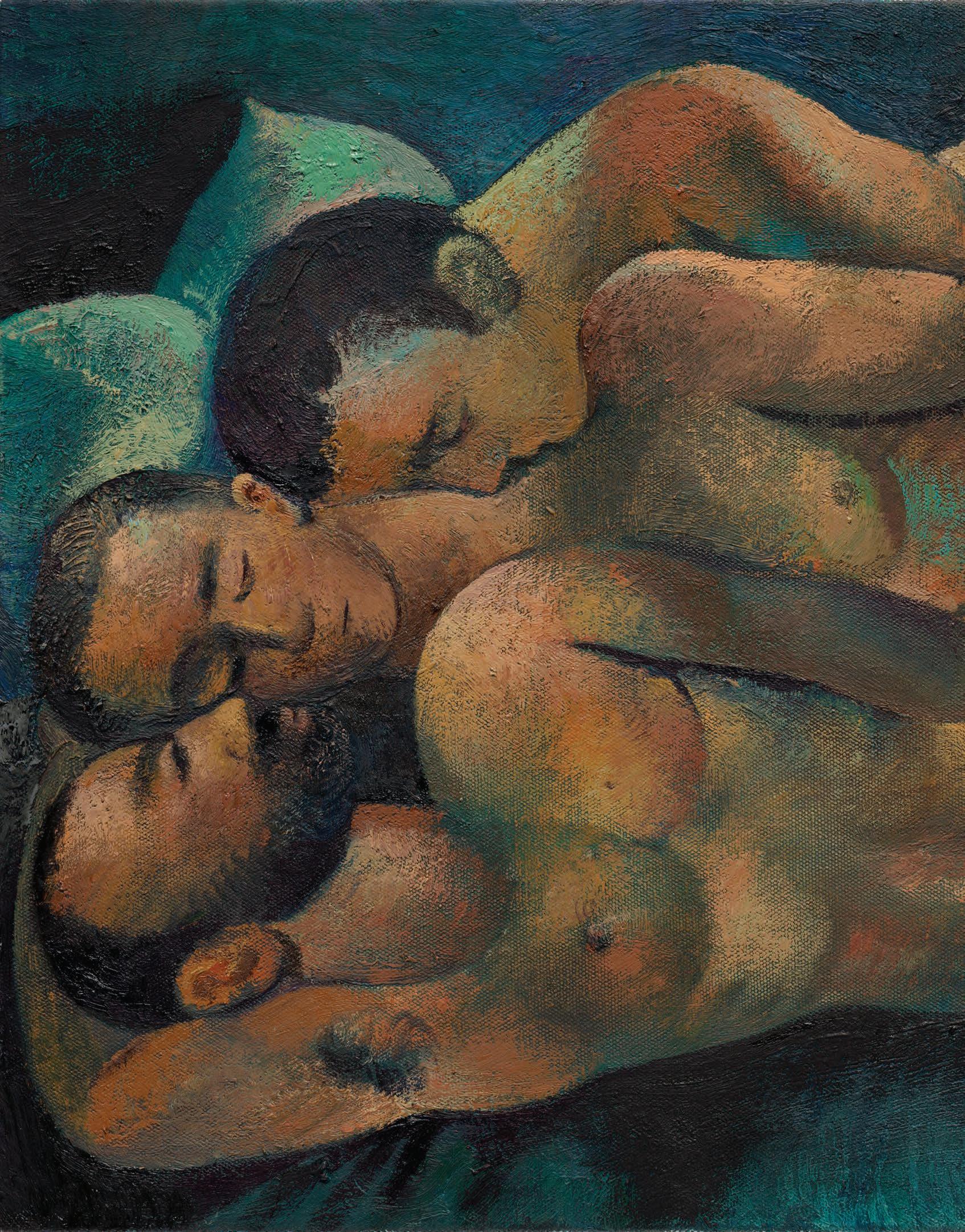
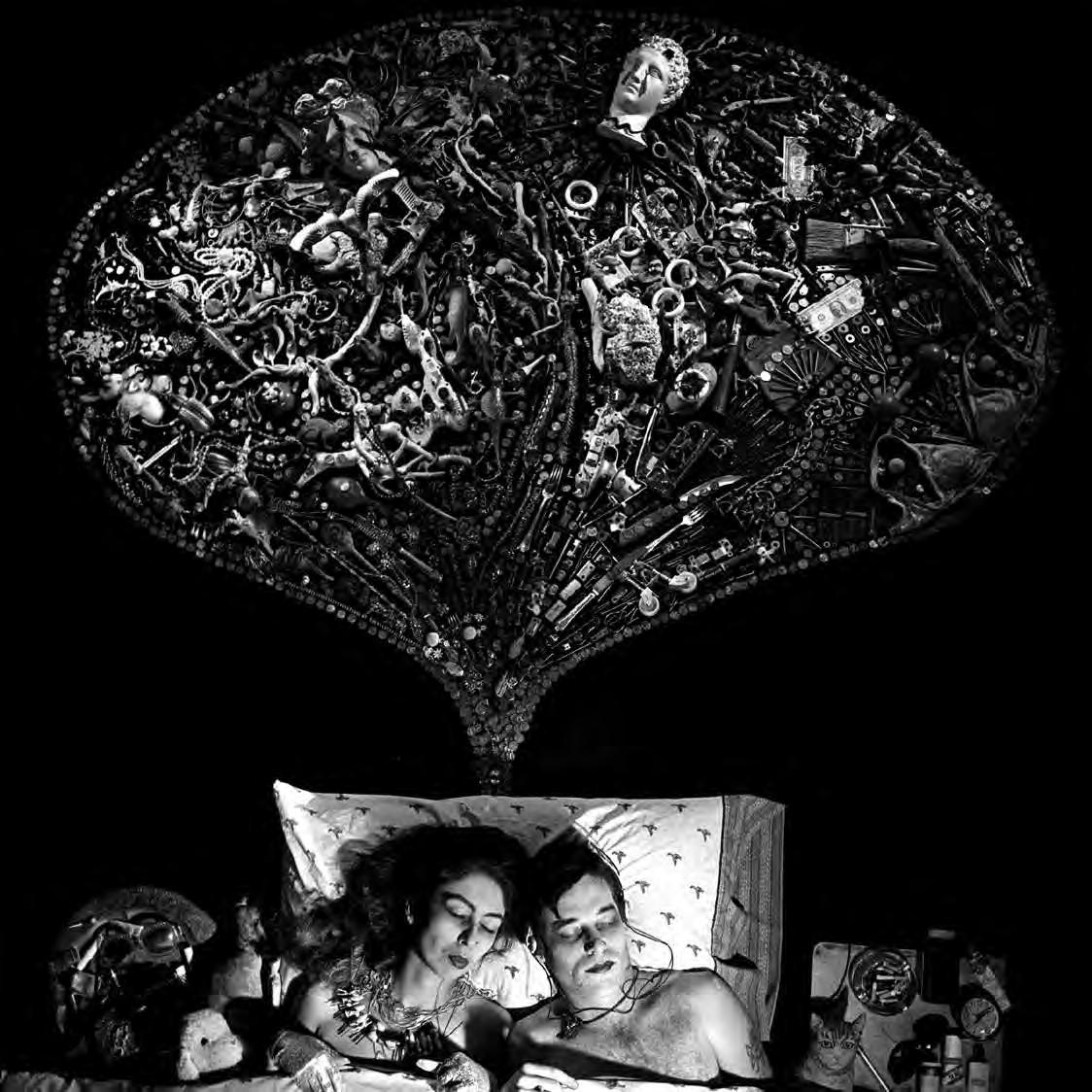
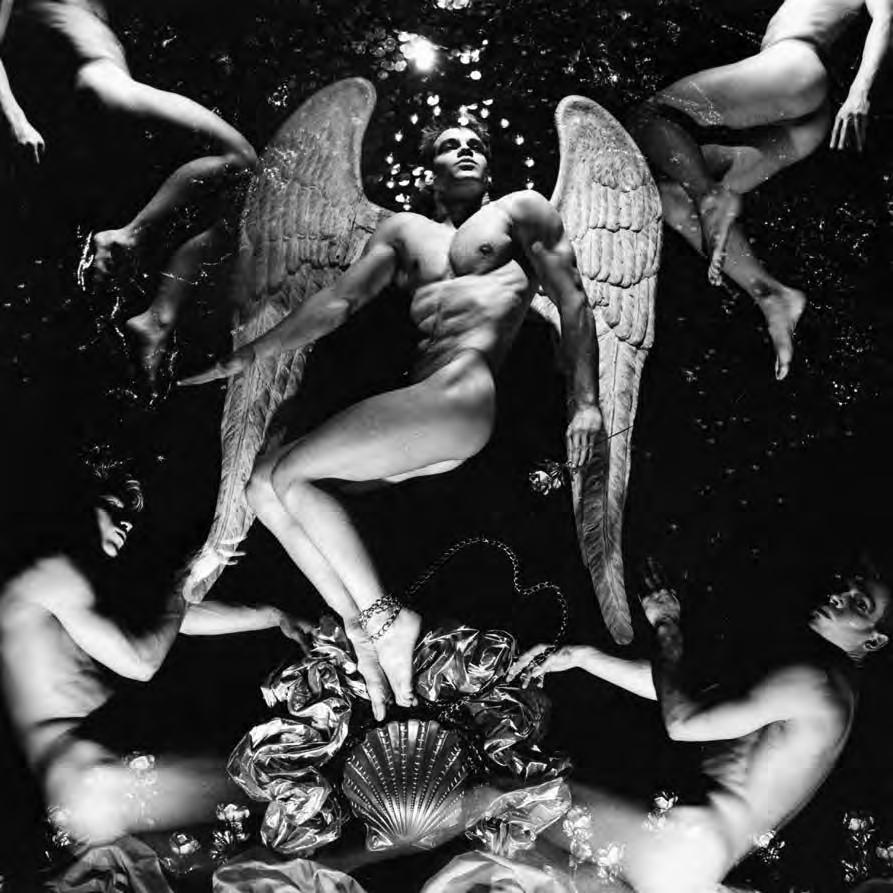
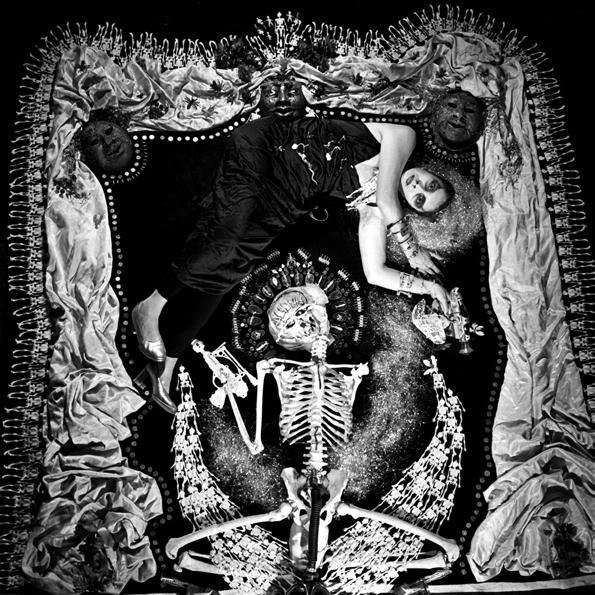
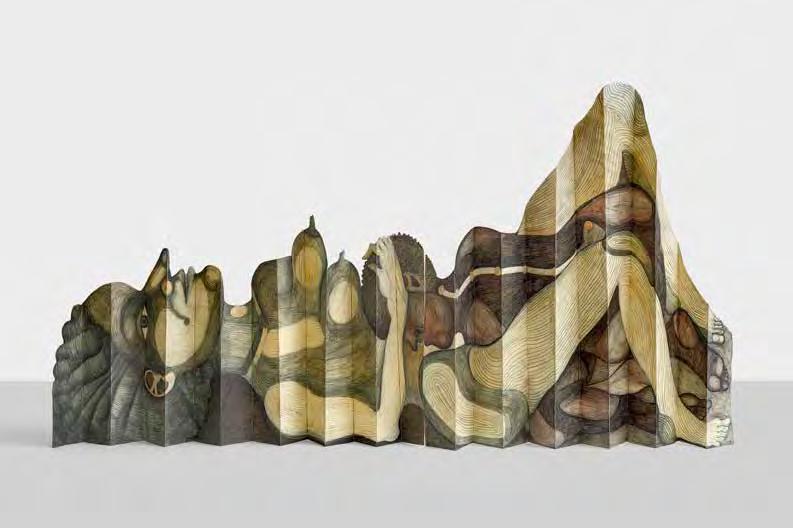
Dream Lover Steven Arnold’s nightmares
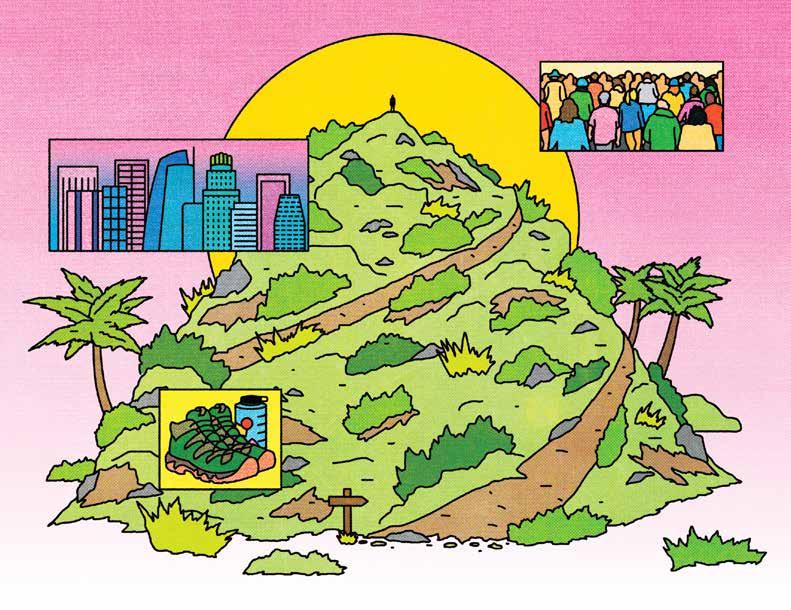
Why Angelenos Hike
Four to See
Coming Up
Back Page Poet Jeanetta Rich on Paul R. Williams
As the Trump administration’s targeting of migrants has seen violent raids and occupation by paramilitary force across Los Angeles, local artists continue to be part of the fight back
ARTISTS AGAINST ICE
In the early 2000s, the artist Anabel Juárez moved from the Mexican state of Michoacán, where she was born, to Los Angeles County. Then 15 years old, she reeled from the cultural changes accompanying her new life. “I didn’t speak the language right into high school,” she tells me in a recent conversation. “I had to adapt to a new place, to a new language, to new everything.” During that fraught time, Juárez found some solace in seeing “a lot of familiar faces in terms of other people who were also migrants at school, around the neighborhood.”
When Juárez later began working with ceramics, she felt drawn to crafting intricate leaves and buds in her works. She molded huge slabs of clay into spindly, bright sunflowers; her flowerpots brimmed with a confluence of native Californian plants and migrant varietals that had taken root and flourished. Culling from stories told by her father, a lifelong gardener, Juárez reflected on how the natural life cycle of plants related to her own experience as a migrant, specifically in “what it means to adopt a new land.” Her floral pieces are sometimes interspersed with objects, like a single gardening glove, symbolic of the oft-invisible migrant labor that goes into maintaining the elaborate floral displays and immaculate lawns of Southern California: “I would see flower vendors showing up for work in the morning,” she says, “and I would go home late at night and they would still be out working.”
Juárez has been making ceramic pots and flowers for many years, some of which she exhibited at Anat Ebgi in 2025; she will be showing again at Frieze this year. Yet her works, along with those of other LA artists who have long dealt with topics of migration and labor, have taken on a weightier significance following brutal crackdowns by the Immigration and Customs Enforcement (ICE) ramping up this past summer across the city. ICE raids have resulted in thousands of people—many of them migrants from Central America—being imprisoned in detention centers; a recent ProPublica report found that ICE had detained nearly 200 US citizens in raids. The detainment and deportation of some immigrants have been so shrouded in secrecy that neither their family members nor their attorneys even know where they are, let alone how to reach them.
In response, Angelenos took to Downtown streets in protest. During these demonstrations, one particular sign became a familiar sight and a rallying cry: an image of a teal-and-white neon sign spelling out “DEPORT ICE.” The LA-based artist Patrick Martinez created the sign back in 2018, but during the protests this past summer, he began making and selling prints of it, with proceeds going to organizations that help protect immigrant rights. “I’m consistently putting these messages out there,” he says when we speak. “People are getting deported in large numbers now. The brutality of what’s happening on the streets of Los Angeles and other places in America is overt, and it’s here to send a message.” Martinez considers his neon protest works as “warning signs” to cut “through the fog and the haze of all this confusion.”
Martinez, whose work is featured in the marketing campaign for this year’s fair, considers himself both a landscape
painter and an archivist; he has been threading documentation of recent ICE raids into his ongoing “Pee-Chee” series. Previously, he has immortalized the victims of police brutality in his riff on the school stationery staple; now, the LAPD officers have been replaced by ICE agents in these works. “I want to cement these happenings, because the images get lost in the news reports or social media,” says Martinez. Like Juárez, Martinez has long spotlighted immigrant rights in his work. “This is the type of work that I’ve been making, and I’ve been pretty urgent about it,” he explains. “It’s just more amplified now.”
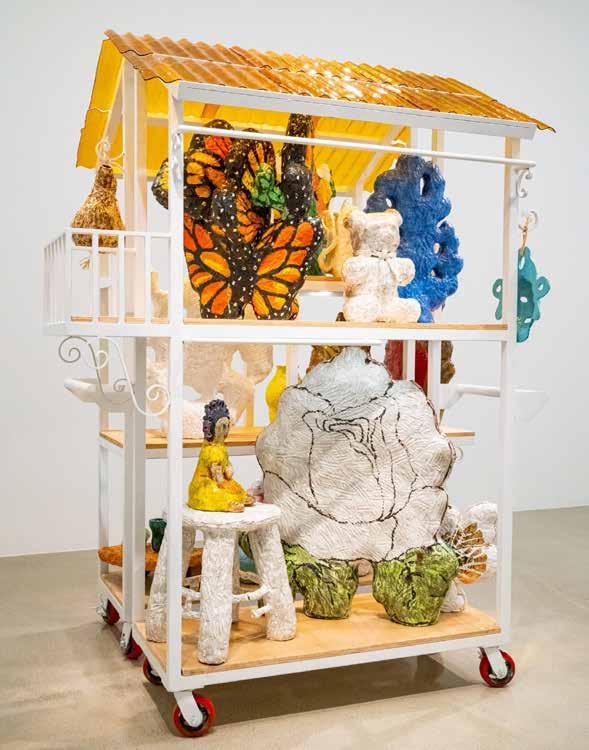
Since early summer, constellations of local communities, individual artists and collectives have sprung into action to help protect immigrants, with groups including Art Made Between Opposite Sides (AMBOS), which fosters advocacy on both sides of the US-Mexico border through art initiatives, and has created activations at Frieze in the past, distributing crucial materials with mutual aid networks. Others have organized rotating “ICE watch groups” to keep an eye on locations where raids tend to happen, such as restaurants and Home Depot parking lots. Longstanding institutions like Self-Help Graphics & Art have printed “Know Your Rights” notecards to distribute. In July, photographer Thalía Gochez organized an exhibition, “The Land Will Always Remember Us,” at MidCity’s Amato Studio that showed Latino artists’ work and bouquets made by Doña Sylvia, Gochez’s flower vendor, who had stopped working out of fear. When Jorge Cruz—a fruit vendor who often made the rounds of gallery openings and who participated in Ruben Ochoa’s project at Frieze LA in 2023, where he sold fruit from a custom designed cart—was at risk of deportation in the fall, the art community rallied around him.
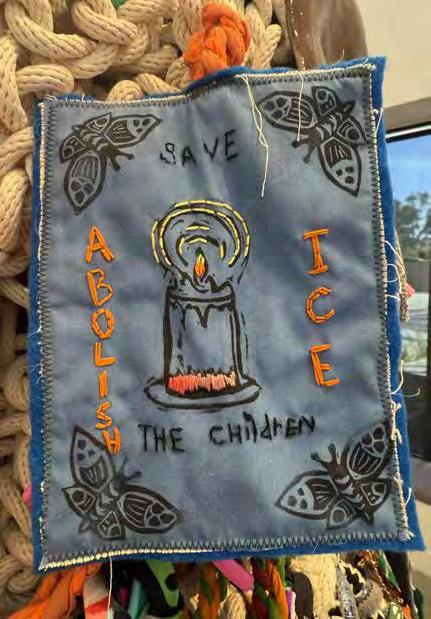
With this heightened attention, some artists have had to adjust their traditional modes for disseminating work. Tanya Aguiñiga, the founder of AMBOS, says that the organization has been shifting its operations in response to the ICE clampdown. “We have to be more discreet about stuff and sadly just more distrusting of opening things up to everybody,” she tells me. “We have to make sure that we can protect the most vulnerable communities.” Even the way some artists’ work is received has changed: earlier this year, an AMBOS installation created with migrants at the Frederick R. Weisman Museum of Art at Pepperdine University in Malibu, which included a fabric strip with the words “Abolish ICE” and “Save the Children,” was censored. Without an explanation to the artists, the piece of fabric was hidden from public view, says fellow AMBOS member Natalie M. Godinez. She points out that the same piece was commissioned by the Hammer Museum for the 2023 “Made in LA” biennial, an exhibition that seems like a lifetime ago, considering “how different the political landscape is from then to now,” she says.
In Godinez’s view, more can be done beyond vital grassroots mutual-aid work and individual actions, especially from local institutions capable of accommodating sanctuary spaces. “I wish some of the bigger museums would have responded in that way, just because they have the resources and the space,” she says during our recent conversation. “There’s always
more that we could do,” Martinez adds. “But, having said that, I think that the current administration has done its job of scaring people, and art is the same. Everything’s in peril right now. I think that museums are in the same position, where they are probably scared of getting attacked, so I understand. But we have to find a middle ground.”
Amid the uncertainty, artists like Juárez are continuing to make work as they always have with the same goal in mind: to honor immigrants. “When I
began making these works, it wasn’t really as a response to the current environment and atmosphere,” she says. “It’s really me reflecting on migration and resilience, and it comes from my own lived experiences as someone who migrated, as someone who is living in this community, and these people being afraid. But also—in spite of being afraid—still showing up to work. Because we have to, right?”
Paula Mejía is a writer and editor. She lives in Los Angeles, USA.
Left AMBOS, Con Nuestros Manos Construimos Deidades (With Our Hands We Build Deities), detail, 2023. Photo: Henry Adams. Courtesy: Pepperdine Graphic
Below
Protester holding Patrick Martinez, Deport ICE, 2018. Photo: Ani Yapundzhyan. Courtesy: the artist and Broadway, New York
Opposite page
Anabel Juárez, Recuerdos (Memories), 2022. Installation view at Carolyn Campagna Kleefeld Contemporary Art Museum, California State University. Photo: Tatiana Mata. Courtesy: the artist and Anat Ebgi, Los Angeles and New York
Anabel Juárez is presented at Frieze Los Angeles by Anat Ebgi (Stand D14). AMBOS has a display adjacent to Sprüth Magers (Stand C06). Patrick Martinez presents a new installation at the fair entrance and, in a special collaboration with Orange Barrel Media, a series of public billboards and digital screens throughout the city during Frieze Week.
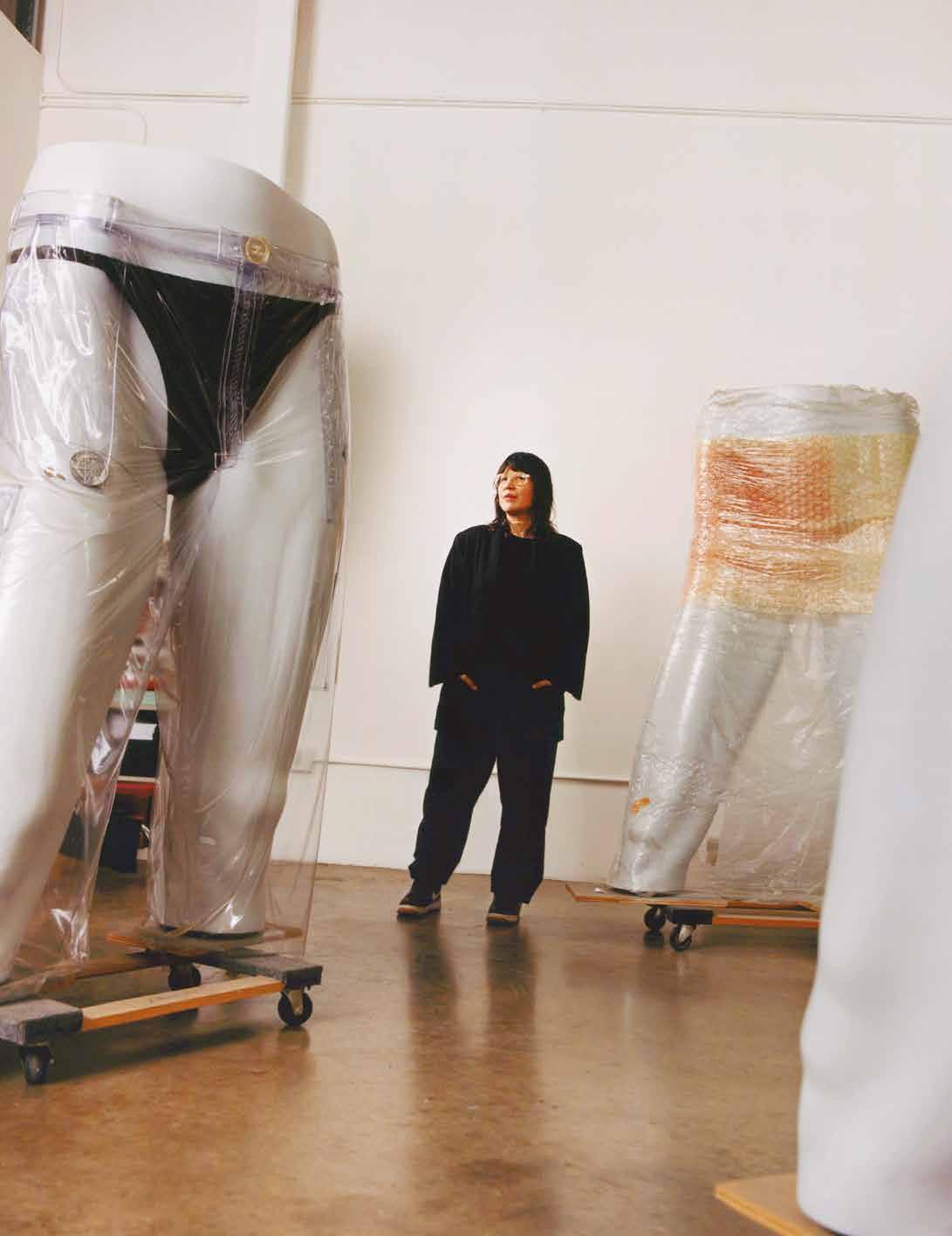
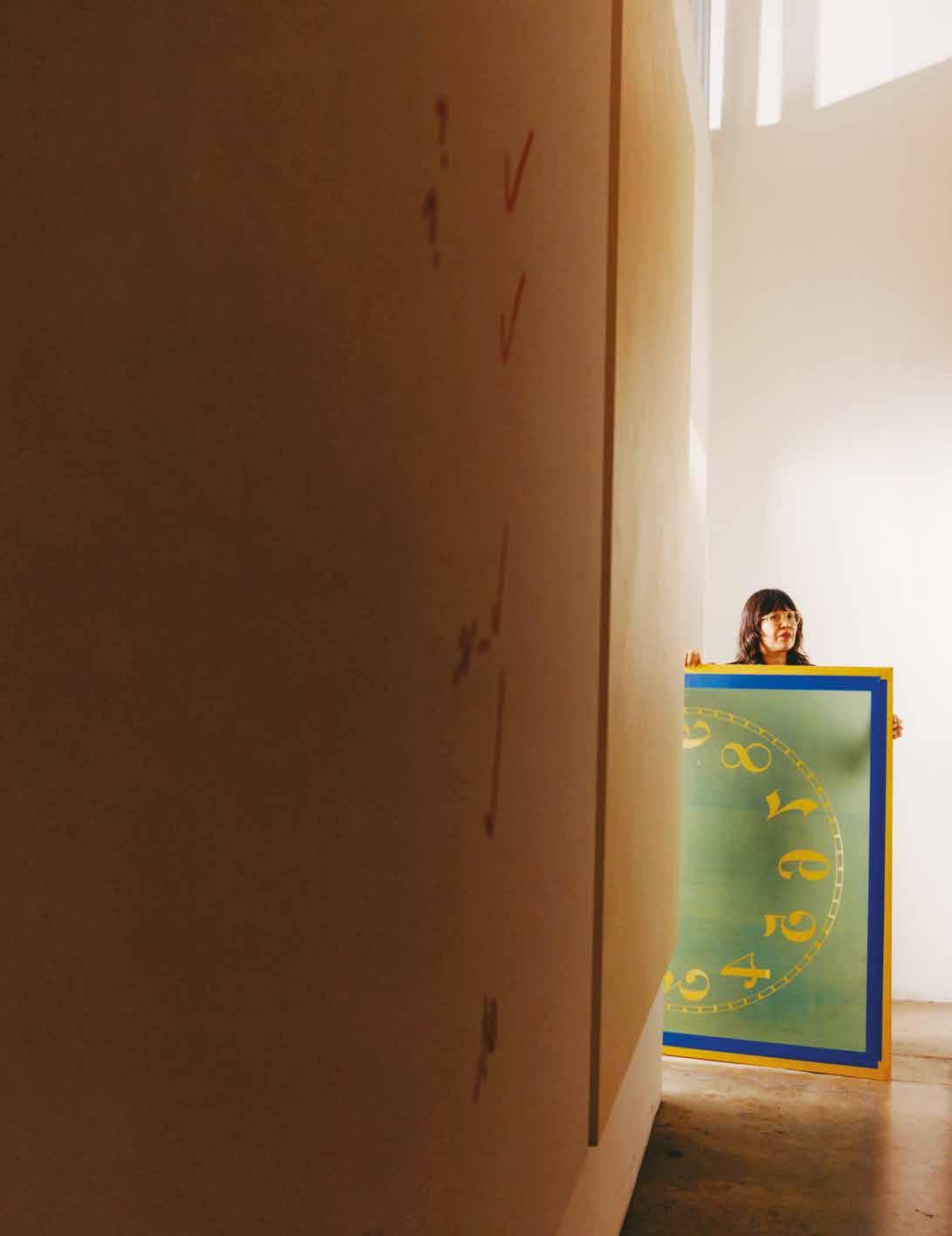
Commissioned for Frieze Projects, Amanda Ross-Ho’s longest performance to date sees her roll a giant inflatable Earth around the site’s soccer field. Here, she outlines the multiple references and meanings of this Sisyphean task. As told to Essence Harden. Photography by Jack Bool
EARTH TIME
This might come as a surprise—because typically I’m an object-maker—but for a long time, I’ve been thinking about how, although I usually make sculptural forms, it is mostly the concerns of other mediums that inform it. One is photography—a relationship with the lens or the camera is a constant in everything I make—and the other is performance. I’ve only recently come to recognize how important performance is as a key impulse in my work.
To some extent, in whatever form it takes, my work is a type of performative embodiment. Typically, I’m not literally performing in front of people when I make things, but I’m thinking about performance in terms of the choreography and the intimate rituals and processes of production. I’m bringing forms into the world in a very particular way by getting inside them, taking them apart, understanding them, replicating them and, on some level, becoming them, like a method actor. I’m also interested in labor-intensive production, which results in an inscription of muscle memory and is intimate and devotional. Whether it is witnessed or not, this approach is performative. But in my case, it is usually relegated to the privacy of the studio.
Which is why, when invited to develop a special project for Frieze Los Angeles, I surprised myself and proposed a performance. Like, a performance performance.
The art fair structure is a defined temporal container and demands a particular kind of attention span because there’s so much happening simultaneously. I was asked to consider producing a work for a remarkable site: three massive, consecutive soccer fields. My first thought was,
“Oh, I don’t know if that’s particularly my lane.” But then I thought more about the extraordinary scale and the specific conditions of that outdoor space, and it became very interesting to me. People associate me with making big things. How could I create something on a huge scale that is not an object? Something really big—as big as three soccer fields? How could I possibly do that? It was also an interesting assignment, coming off making the piece for “Made in LA” at the Hammer, having made so much with my hands and with fabricators; this was a different type of production, but still one that closely considered scale.
I think about all my work as being somewhat site-specific to existing contexts and conditions. Soccer fields are built for spectatorship; they establish a frame or a stage where a viewer is directed to look. Play, sport and organized activity— these things were all bumping around in my head as expectations already baked into the site.
I always reach back into my own language as a source. Callbacks are a way to establish a type of vocabulary through repetition. I realized that one of the things that I’ve been working with for a really long time as a motif are NASA images of the Earth. I went back into my archive and pulled a bunch of work that I’d made over the years where I used one of the first ones from 1972. I’ve used it in lots of different works. I’m drawn to the bombast of it as an establishing shot: the absurd notion of it as, “A picture of everything.” The idea came to me pretty quickly— almost instantaneously—as an image. I was thinking about the huge green site
of the soccer fields and imagined pushing the Earth around the perimeter of it, manually controlling its orbit. This was the way to make a really big thing. The solution was to use the mediums of time and gesture, which are not limited by material constraint.
There are these really large inflatable Earth balloons that are made for parades, protests and demonstrations, printed with the NASA image. My proposal is to do an endurance performance of this manual orbit for all the open hours of the four-day duration of the fair. The idea is to literally push this giant (but ultimately miniature) facsimile of the Earth around the perimeter of the field as a metric of time and labor. My great loves (and nemeses) are time and scale; those are the two things that I rub up against each other in the making of my work. This performance will be the ultimate version of that.
I’m of course thinking about Sisyphus pushing the stone up the mountain, or Atlas holding up the Earth, making some kind of correlation between this mythology, and the heroics and labor of the artist. The idea of having to manually make the world go round is this very selfaggrandizing, martyring thing, which has interesting implications in the context of art labor and even just labor-labor—the labor it takes to just keep things going all the time. In some basic way I think I’m interested in just elaborately reminding people that time is passing. The piece is a clock. So, this will be an absurdist and comedic performance, but also an athletic one. Oddly, I have athletics in my background: I trained as a competitive figure
skater throughout my childhood. I did a durational performance in 2023 where I returned to the ice after 30 years and skated a figure eight, dressed in a skeleton outfit. It was an image of mortality, ageing and infinity. This performance will be a little bit like a follow-up to that piece.
I’m still figuring out some of the rules of engagement. Do I get to take a lunch break? Do I go to the bathroom? Am I getting an understudy? We’re still trying to figure out the biggest globe that I can actually push.
There will be a pedestrian, incremental view of the work, which I hope lends to its comedic timing. You will see me as you enter the fair and, as you leave, I will still be there, pushing the Earth around. You might see me at a particular moment in that day’s orbit, and get one impression of it. You could walk by at the end of the day, and I might be going really slowly because I’m exhausted, or who knows? There are a lot of question marks about what the piece is going to be like visually. There will be a little bit of humor and slapstick and ridiculousness. For those who know my work well, there’ll be something that is familiar in the grand gesture. It’ll also offer a glimpse of me as a character—or a caricature, even. It will be surreal. I’m curious about what will happen and I’m very excited.
Organized for the first time in partnership with Titus Kaphar’s NXTHVN, this year’s Frieze Impact Prize has been awarded to Cuba-born artist Napoles Marty
A WIDER IMPACT
The Frieze Impact Prize recognizes an early-career artist through a partnership with a non-profit organization focused on social impact. NXTHVN, the New Haven, Connecticut-based arts incubator, founded in 2019 by artist Titus Kaphar and investor Jason Price, seems like a natural fit for the prize’s fifth iteration. As Kaphar explains to me, the prize’s mandate is “in many ways a restated version of NXTHVN’s mission.” “Our mission is to help advance the careers of artists and curators of color through access and education,” he says. “And so, every year, we give studio space, housing, a stipend and a curriculum designed by me and my co-founder based on the business of art.”
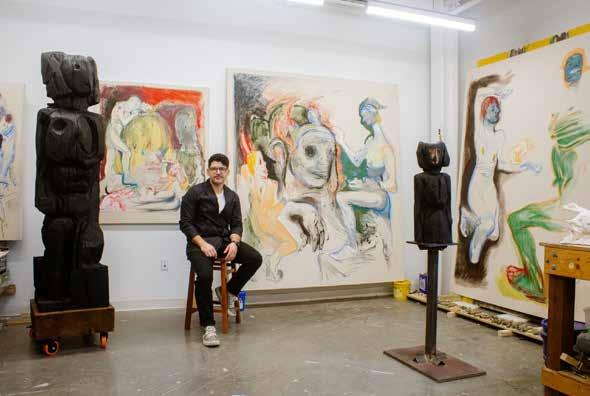
The recipient of the 2026 Frieze Los Angeles Impact Prize is Napoles Marty. The Cuban-born sculptor and painter creates talisman-like objects and figures that operate as spiritual protectors straddling the gulf between reality and the mythic realm. His practice centers on the human form as a vessel for exploring transformation, endurance and cultural memory. Marty’s large-scale sculptures, paintings and drawings using materials
such as wood, clay and oil stick are guided by ritualistic processes in a dance that conjures both power and surrender, making the pieces as much divine offerings as works of art.
Marty, who was a member of NXTHVN’s sixth cohort, will receive $25,000 as part of the Impact Prize, while curator Diana Nawi will guide his selection of works for a solo presentation at Frieze Los Angeles 2026.
“Marty is an incredibly unique artist,” says Kaphar. “One of the things I loved about watching him develop is just how committed he is to his practice. He is constantly, constantly working. And because his work is rooted in sculpture and traditional wood-carving, it’s a very laborious practice, very physically intensive.”
NXTHVN draws an international pool of applicants each year. It offers a paid ten-month fellowship program fueled by mentorship and professional development for studio artists and curators. It supports emerging talent in the art world and also creates opportunities for community engagement through its paid apprenticeship program for high-school students. Africanus Okokon, a graduate
of its third cohort of fellows, now teaches at Rhode Island School of Design. He says the opportunity to be involved with students as a mentor through NXTHVN was a major draw for him, along with the level of critique and feedback (both from advisors and his peers) that the program offers artists following matriculation from school, when the opportunity for this type of studio crit-style engagement with work decreases precipitously.
“I was trying a lot of things for the first time at NXTHVN,” says Okokon, who is showing with Ochi in the Focus section at this year’s LA fair. Though he received his MFA in painting from Yale University in 2020 (and already called New Haven home prior to joining the program in 2021), he considers himself first and foremost a moving-image artist, with a background in film, animation and video. His show with Ochi is mostly paintings and prints, and the only work that is not new is a revisited version of a video he made in his NXTHVN studio.
“It is in some ways like a full circle with the work I was making at NXTHVN and where I am now,” he says. “It makes sense for these works to be in contact
with one another and to share the same space. I think that’s a testament to the work I was able to make and the kind of support I had when I was there. It’s a super-rigorous program, and it’s pretty high-intensity, but I think it pushes you to make things that you didn’t even know you were capable of making.”
“NXTHVN is a unique program,” agrees Kaphar. “We really help artists engage the professional part of their career and sell their work, but we don’t take a cut of their sales. We really want to make sure that the benefit primarily goes back to the artists, and that this is another accelerator toward the pinnacle of their success.”
For many artists, art fairs play a fundamental role in the financial aspect of their practice. “Art fairs are a part of our business,” Kaphar says. “What I appreciate about what Frieze is doing is that it’s trying to make it about more than just the commerce … For me, the Frieze Impact Prize is really about the artists.”
Brown
Above Napoles Marty in his studio, 2025. Photograph: Napoles Marty Studio
Napoles Marty is presented at the fair in the Frieze Impact Prize, located in the Focus section. Africanus Okokon is presented at the fair by Ochi (Stand F08).
What do acquisitions at the fair, through initiatives like the Frieze Arts Alliance, reveal about the priorities of US art institutions today?
AFFIRMATIONAL ACTS
which visualizes the exploitation of the most in-demand resources and the devastation caused by their extraction around the globe. Caycedo’s piece went on view almost immediately in a display titled “Dwelling,” alongside Mel Chin’s Revival Field Diorama (2015), another recent acquisition, which commemorates ecological restoration at a site contaminated by heavy metals.
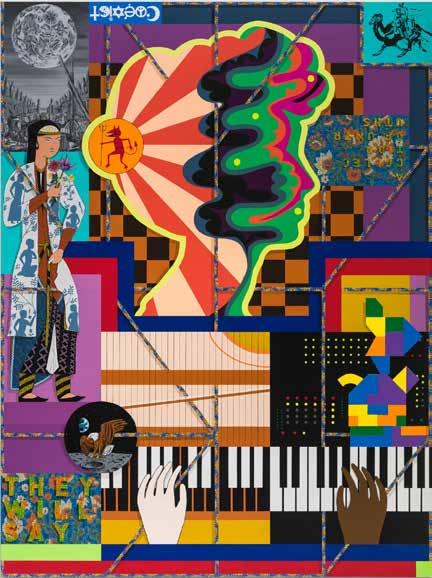
While providing direct support for the Los Angeles region, the efforts of the FAA ultimately also fostered dialog between art scenes across the US. Wisconsin’s Madison Museum of Contemporary Art, for instance, acquired They Will Say a Collection of Untruths (2022), a large painting by LA-based Iranian artist Amir Fallah via fair exhibitor Nazarian/Curcio, in partnership with New York’s DIMIN gallery. Paul Baker Prindle, the museum’s Gabriele Haberland Director, says the acquisition expands the museum’s representation of artists with roots in the Islamic world, responding to Wisconsin’s growing communities of MENA and South Asian descent, and in line with the museum’s commitment to being “a place of welcome, curiosity and exchange.” Fallah’s work also echoes the aesthetic sensibilities and interests in cultural hybridity found in the museum’s holdings of artists associated with Chicago imagism, from Jim Nutt to Suellen Rocca to Ray Yoshida.
Beauty) (1988–91), two works by the late, New York-based artist Darrel Ellis. There is a renewed attention for Ellis’s pioneering practice, represented by Hoffman Donahue gallery, which was cut tragically short by the AIDS crisis. Moving between painting and photography, Ellis drew on images from his late father’s portraitstudio practice and his family and community life in Harlem and the South Bronx. The acquisition deepens CAAM’s commitment to documenting African American cultural histories in California and beyond.
The Frieze Arts Alliance is far from the only example of institutions collecting at Frieze Los Angeles, however. In partnership with the fair, CAAM led an acquisition fund at the 2024 edition, made possible through the support of Todd Hawkins, Terri Holoman and V. Joy Simmons, acquiring Mustafa Ali Clayton’s ceramic sculpture Natural (2024), from Dominique Gallery. Works by artists based in Southern California have been selected by a jury since 2023 to join the City of Santa Monica’s Art Bank collection, including pieces from Edgar Ramirez presented by Chris Sharp Gallery, and Frieze Impact Prize-winner Gary Tyler. Marking collector Jarl Mohn’s donation of more than 350 artworks to be shared by the “MAC3 collective” of the Hammer Museum, LACMA and MOCA, in 2025 Jarl and Pamela Mohn and Frieze contributed $75,000 to an acquisition fund for works reflecting creative energy and dynamism: pieces by Edgar Arceneaux and Shaniqwa Jarvis were added to the joint collection.
The works acquired at Frieze Los Angeles 2025 through the Frieze Arts Alliance (FAA) provide an insight into the art practices which museums across the US currently consider critical. Established as an act of institutional solidarity in response to the wildfires that devastated Los Angeles at the start of last year, the FAA assembled museums—from the Studio Museum in Harlem, New York, to the Institute of Contemporary Art in Miami, to the Berkeley Art Museum and Pacific Film Archive—to direct their acquisition funds toward LA galleries and artists at the fair. “The art world is an ecosystem,” says Veronica Roberts, John and Jill Freidenrich Director of the Cantor Arts Center at Stanford University, one of the first institutions to make an acquisition through the scheme. “Supporting our local and state artists and galleries is crucial to the health of our arts community.”
For Roberts, the FAA allowed the Cantor to acquire works that address urgent local and global concerns, advancing its mission as a teaching institution to put “art to work.” From Koreatown-based Commonwealth and Council, the museum acquired the expansive drawing Lead Intensive (2025) by LA-based Colombian artist Carolina Caycedo. The work is part of Caycedo’s “Mineral Intensive” series,
Another connection between LA and the Chicago area art scenes was made by the Eli and Edythe Broad Art Museum at Michigan State University. Through the gift of donors Alan and Rebecca Ross, the museum acquired Mutiny of the Sable Venus (2024), an empowering image by LA-based Alison Saar, acquired from L.A. Louver at Frieze Los Angeles. Complementing another woodcut by Saar already in the collection, Mutiny of the Sable Venus enters the collection into an intergenerational dialog with Black Venus (1957) by Margaret Burroughs, founder of Chicago’s DuSable Museum of African American History: together these works address how Black women artists across the country rewrite historical narratives.
Also emphasizing connections between the East and West Coasts, the California African American Museum (CAAM) acquired Untitled (Bathing Beauty) (1987–89) and Untitled (Bathing
With its specific mission and call to action to support the wider Los Angeles ecosystem, the Frieze Arts Alliance brought into focus the role that museums and their communities can play in fostering art-world solidarity across the US. Such initiatives, says Baker Prindle, “acknowledge something museums sometimes leave unsaid: that acquisitions are also affirmational acts.”
Left Amir H. Fallah, They Will Say a Collection of Untruths, 2022. Collection of Madison Museum of Contemporary Art. Courtesy: the artist, Nazarian/Curcio, Los Angeles, and DIMIN, New York Funds at Frieze Los Angeles 2026 include the Santa Monica Art Bank Acquisition Fund, supporting Los Angeles-based artists by acquiring works from the fair to expand the city’s public collection; MAC3 collective, comprising the Hammer Museum, LACMA and MOCA, supporting emerging or underrecognized LA-based artists through an acquisition fund supported by Jarl and Pamela Mohn and Frieze; and the California African American Museum Acquisition Fund, which dedicates $25,000 to acquire a work by a Black American artist with strong ties to California. For more information on all funds and awards at the fair, visit: frieze.com. Emily Butler is a curator, writer and editor. She lives
ARTISTS:
DAVID ALEKHUOGIE
BLACK HOUSE RADIO / MICHAEL DONTE
GREG BREDA
WIDLINE CADET
CARL CHENG
ALONZO DAVIS
ALI EYAL
HOOD CENTURY / JERALD COOPER
HANNA HUR
JOHN KNIGHT
KRISTY LUCK
PATRICK MARTINEZ
BEAUX MENDES
NA MIRA
NEW THEATER HOLLYWOOD / CALLA HENKEL AND MAX PITEGOFF
PAT O’NEILL WILL RAWLS
BRIAN ROCHEFORT
AMANDA ROSS-HO
GABRIELA RUIZ
ALAKE SHILLING
NICOLE-ANTONIA SPAGNOLA
MIKE STOLTZ
PETER TOMKA
FREDDY VILLALOBOS
KELLY WALL
LEILAH WEINRAUB
BRUCE YONEMOTO
Title Sponsor: Wayne L. Prim Foundation Lead Sponsors: The Andy Warhol Foundation for the Visual Arts, Thomas Lee Bottom, Sandy Raffealli | Bill Pearce Motors, Teiger Foundation Major Sponsors: The Bretzlaff Foundation, Judy and Dave Collins, Barbara and Tad Danz, Friends of Nevada Museum of Art, Cathy and Larry Spector Sponsors: Sallie and Bob Armstrong, Kathie Bartlett, Dan Brower and Raquel Guardia, Kellie Campbell | Southwestern Properties Corp., Chica Charitable Gift Fund, Susan and Bubba Crutchfield, Helen Frankenthaler Foundation, Jacques and Natasha Gelman Foundation, Pamela Joyner and Fred Giuffrida, Jackie and Steve Kane, Debra Marko and Bill Franklin, Maureen Mullarkey and Steve Miller, Yvonne Murphy and Murray Mackenzie, Linda and Alvaro Pascotto, Peter E. Pool, Melanie Rudnick, Phil and Jennifer Satre, Gayle and Cliff Scheffel, Gordon and Roswitha Kima Smale, PhD, Earl Tarble, Betsy and Henry Thumann, Christine and Scott Tusher, Kavitha and Tuhin Verma Supporting Sponsors: Betsy Burgess and Tim Bailey, Caviness Family, CEJohnson Foundation, Maria and Mark Denzler, Nancy and Harvey Fennell, Dr. Michael D. Lewis and Linda L. Tate, Lurieland Foundation at CFNN, Viki Matica and Doug Brewer, Charlotte McConnell, Keith McWilliams | Evercore Wealth & Trust, Darby and David Walker, Marietta Wu and Thomas Yamamoto Additional Support: Martha Hesse Dolan and Robert E. Dolan, Mimi Ellis-Hogan, Furthermore: a program of the J. M. Kaplan Fund; Katie and Matt Paige
E. L. Wiegand Galleries Donald W. Reynolds Center for the Visual Arts
160 West Liberty Street, Reno, Nevada 89501
Second Take:
In their shorts, the 2026 Deutsche Bank Frieze Los Angeles Film Award Fellows reflect on the theme of “renewal”
The annual Deutsche Bank Frieze Los Angeles Film Award offers financial support and mentorship to emerging, LA-based filmmakers, aged 18–34, through a four-month Ghetto Film School Fellowship.
Maximus Jupiter Corona [The Body Snatchers—After moving out, an anxious young man finds his new life bizarrely terrifying, as people seemingly go missing with no explanation.]
“Renewal is always an opportunity for good but, as we have seen recently in this country, it is not always used to that end. The focus on immigration enforcement has proven disastrous for our communities, creating a terrifying reality.”
Xochilt Garcia [Rooted—a young woman becoming increasingly filthy.]
“Renewal is an attempt at preservation: the hope is that something new will manage to take root.”
Devin O’Guinn [Julian—A rising bodybuilder’s dreams are shattered by an unexpected diagnosis, forcing him to discover a new purpose beyond the stage.]
“To me, a lotus flower symbolizes renewal through its daily cycle of rising from dark, murky waters to bloom afresh in the sun. It shows that individuals can rise above hardship and blossom into something beautiful and revitalized.”
Alaine Farin [horse!—A girl with a phone addiction meets the boy from her recurring dreams.]
“One of my actors said to me recently that renewal also includes one’s failure to renew.”
Joey Bueno Breese [El Rio Nuestro—The story of a young man who follows the Los Angeles River from the mountains to the sea, discovering the city’s forgotten histories and his place within them.]
“The ocean has always been a symbol of renewal to me—swells traveling hundreds of miles, tides rising and falling, the water constantly changing.”
Ziyao Liu [Temporary Detective—To uncover the truth of her husband’s disappearance, a 60-year-old woman spies on her daughter on the streets of LA’s Chinatown.]
“Some cultures view mental illness as a blessing. I believe it’s a shift in perspective that allows us to still engage with the world, which symbolizes renewal.”
Below Maximus Jupiter Corona, The Bodysnatchers, 2025 Fellow of the Deutsche Bank Frieze Los Angeles Film Award 2026. Courtesy: the artist and Frieze.
Visit frieze.com to watch the short films by this year’s Fellows and discover the winners of the Deutsche Bank Frieze Los Angeles Film Award 2026, judged this year by a panel including Golden Globe-nominated actress Connie Britton; Academy Awardwinning documentarian Orlando von Einsiedel; and Jorge Villon, founder of Academy Award-winning documentary house Grace Labs.
Right Ziyao Liu, Temporary Detective 2025. Fellow of the Deutsche Bank Frieze Los Angeles Film Award 2026. Courtesy: the artist and Frieze.
Built for 1930s émigré art lover Galka Scheyer, this Richard Neutra masterpiece in the Hollywood Hills has been reborn as a haven for artists. Its first artist-in-residence? One displaced by the wild fires
A SANCTUARY IN THE CITY
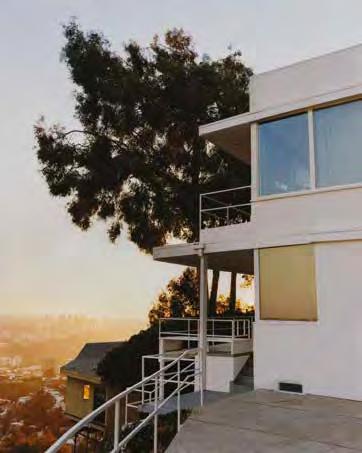
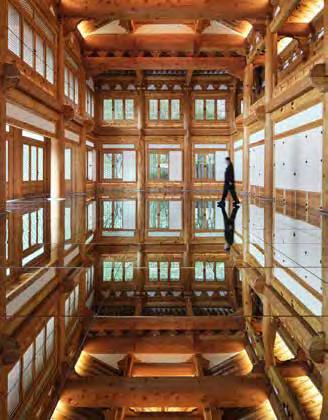
In 1933, the German-Jewish artist, art collector, art dealer and educator Galka Scheyer commissioned architect Richard Neutra to build her a gallery and residence in the Hollywood Hills. Here, she envisioned creating a place where artists could gather and collaborate.
Scheyer had moved from Europe to the US almost a decade earlier with the intention of introducing European modern art to a North American audience, championing an influential group of artists called Die Blaue Vier (the Blue Four)—Lyonel Feininger, Alexej von Jawlensky, Wassily Kandinsky and Paul Klee. After pursuing a career as a painter and sculptor herself, she decided to devote her life to promoting the art of these four artists. She originally moved to New York in 1924, where she organized the first US exhibition of work by the Blue Four at the Charles Daniel Gallery in 1925, before moving the following year to the West Coast, initially settling in San Francisco, and continuing to
champion their work. In 1933, Scheyer decided to join her friend, the architect Rudolph Schindler, in Los Angeles, where she purchased a plot of land in the Hollywood Hills for $150. Scheyer lived temporarily in Schindler’s iconic Kings Road House, where she was introduced to its former tenants: Richard and Dione Neutra.
Scheyer commissioned Richard Neutra to design her home. She wanted a truly “modern house” that would serve as a residence and gallery for the art she promoted and collected. The planning phase, however, was not without tension: Scheyer demanded sufficient wall space for hanging her art collection, while Neutra wanted picture windows and open spaces to flood the house with natural Californian light.
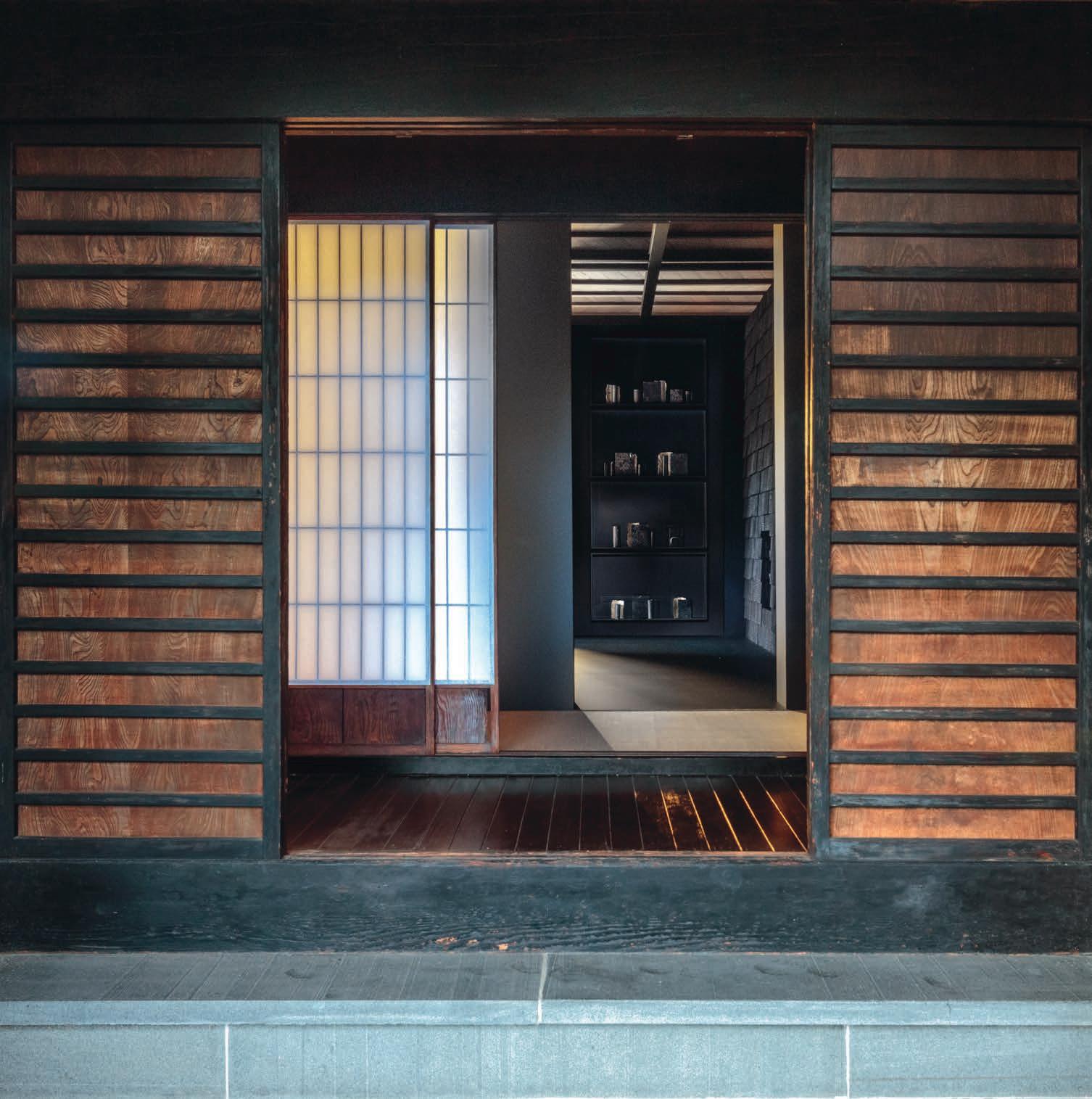
At once austere and luminous, the home reflects Scheyer’s cosmopolitan vision—an experimental outpost for modern art, architecture and ideas. It also
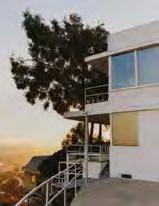
anticipated Neutra’s lifelong interest in architecture as a tool for psychological, social and environmental connection. A steel-frame modernist residence defined by flat roofs, ribbon windows and cantilevered terraces, its open plan and expansive glazing blur interior and exterior, orienting daily life toward light, landscape and sweeping views of Los Angeles.
Scheyer moved into the house in February 1934 and, as the first resident of the newly paved street, got to choose its name: “Blue Heights Drive.” Archival images show Scheyer sweeping the entrance steps, giving lectures on modern art, and hosting avant-garde filmmaker Maya Deren as well as composers Arnold Schoenberg and John Cage, to name a few—the list of artists who visited the house is endless. The determined art dealer curated exhibitions of the Blue Four, including at the Los Angeles County Museum of Art and the University of
California, Los Angeles, and she gradually managed to convince more and more local collectors to invest in their work.
In 1937, she commissioned Gregory Ain to build a first-story addition, which was supposed to serve as a bedroom for visiting artists and friends. Among the first to stay was László Moholy-Nagy, director of the New Bauhaus in Chicago. Scheyer died aged 56 in 1945 before she could finish the second-story bedroom and artist residency space in what she called “the airship in the clouds.”
Leaping forward 100 years from Scheyer’s arrival in LA, the property went on the market in 2024, after decades as a private residence. It caught the eye of Benno Herz, program director at the Thomas Mann House in Pacific Palisades, whose research focuses on the history of German-speaking exiles in 1940s LA. Herz published an article about the storied walls of the house, Scheyer’s achievements and her relationship
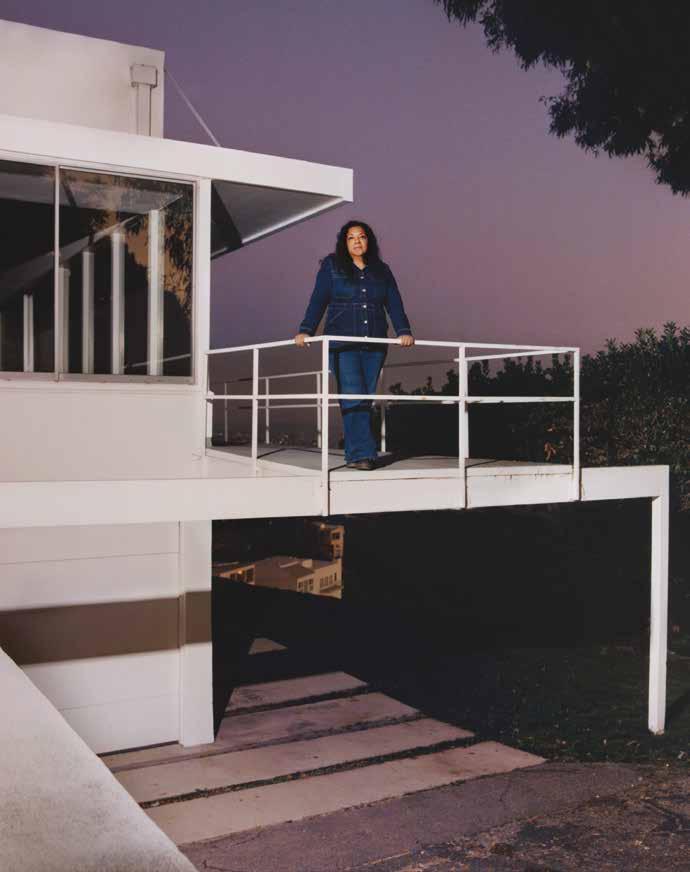
Above The Galka Scheyer House (also known as Blue Heights House), 2025 Photography Jack Bool
with Schindler and Neutra, which was compelling enough to convince German art collector Max Grimminger to buy the property, and preserve it as a site for culture and the arts.
When we speak, Herz explains, “Scheyer became part of a bigger community of refugees from Germany who often worked in film, visual arts and literature.” He adds, though, that after her death in 1945, “her house was sort of forgotten.” Her entire Blue Four collection, some of it smuggled out of Nazi Germany, is housed at the Norton Simon Museum in Pasadena, along with other ephemera from her life.
Today, Blue Heights Drive where the house is situated is typical of the Hills: winding and caked in mud after rainstorms, lined with the trucks of construction and service workers and the occasional speeding sports car. But on a clear day—especially after rare heavy rain—you can see the entire city of Los Angeles stretching to the horizon. Facing southwest, the view from the balcony is spectacular, extending from the foothills to the Pacific Ocean, all the way to the Palisades. Near the foothills, the ribbon of Sunset Boulevard at dusk is electric with peak traffic, with the checkerboard of city lights and the valleys behind it.
El Salvador-born, LA-based artist Beatriz Cortez, the first Blue Heights resident from February to August 2025, tells me that, before her residency in the Hills, she had rarely seen the city from this vantage point: “There’s a certain type of silence up here that is very beautiful and allowed me to do so much work,” she says. It also afforded Cortez the opportunity to take a beat after her home in Altadena was destroyed in the Eaton Fires of January 2025. For weeks, she hopped from guest rooms to friends’ couches—a kind of “forced migration” as Cortez put it, scuttling from place to place like a crab with only its shell.
Scheyer’s spirit of collaboration and hospitality, as well as her house’s extraordinary views of the city, inspired Cortez, whose stay culminated in a group exhibition called “Temporary Home”—an ode to refuge and her community. As if by fate, Cortez found a copy of a book containing Scheyer’s letters in a pile of donations at an event for fire survivors. In a letter dated August 2, 1933, Scheyer writes: “You drive from the boulevard up a slowly climbing, serpentine route where views suddenly open up that can only be compared to the French Riviera and the higher you go, the more your soul is at ease, and when you are on top, you are in the kingdom of the gods.”
Cortez imagined what the view of the city looked like in 1934, when Scheyer and her artist friends looked out from the balcony at dinner parties and exhibition openings. Though the city’s landscape and architecture have changed dramatically since then, the particular challenges LA poses for immigrant communities and newcomers have not. “I felt so connected to the way that she wrote about the city,” explains Cortez. “She would look at the view and dream of a time when artists would come and spend time at this house. I was also dreaming of a time when members of my community—like the housekeepers and landscapers working in the Hills—would be able to own homes like this.”
In June 2025, when “Temporary Home” opened, Immigration and Customs Enforcement (ICE) raids exploded across the country and continued to intensify. Cortez’s community was under attack and the act of gathering together at the Scheyer House took on deeper significance. Artwork was installed throughout
the property. On the bedroom windows, Maria Maea recorded the dates, locations and details of several ICE abductions in Then They Came (2025). In brown ink, Maea pointed to sites where these kidnappings happened, crowded together in a chaotic timeline on a living aerial map of the city below. On a patch of grass outside, Sarah Espinoza set her sculpture Regalos del fuego (Gifts of Fire, 2025), made of ceramic and found objects from the land her home stood on before it burned in the fires. Although it was eventually sited in the fireplace, rafa esparza initially placed his sculpture Hyperspace: simultaneous τ (stop time) (2025), a replica of an ancient Olmec head, on the balcony, where Scheyer’s collection of Balinese sculptures once sat, watching over the city—as an ode to his Latiné ancestors. The Palisades Fire also impacted the German artist residency Villa Aurora, located in the former home of exiled German-Jewish writer Lion Feuchtwanger.
When the renowned artist residency had to close its doors for extensive fire remediation work, Blue Heights stepped in again to fill the void, offering PolishGerman poet Saskia Warzecha a base. Next, the artist Rita McBride will present the show “Wunderkammer” in the pre-renovation stage of this mid-century icon, opening February 14, just ahead of Frieze Week. Her presentation, realized in collaboration with Okey Dokey Konrad Fischer, Del Vaz Projects and Blue Heights Arts & Culture, culminates in an immersive installation celebrating the important legacy of art patronage and global culture. The exhibition will run through March 8.
Nearly 80 years after her death, Scheyer’s vision of a living artists’ house above the clouds of Los Angeles is at last being realized. Under the name Blue Heights Arts & Culture, her house is now intended, after the completion of the restoration work, to serve in the long term
as a residency for artists and scholars. Similar to Villa Aurora and the Thomas Mann House, another piece in the mosaic of the German-speaking exile community and architectural modernism in Los Angeles is being preserved for posterity. With this new chapter, the Galka Scheyer House will not only be a monument to California’s architectural and cultural history, but a place of inspiration and sanctuary for future generations of artists and intellectuals.
Angella d’Avignon is a writer and a publicist. She lives in Los Angeles, USA.
Additional research and material by Benno Herz, Program Director at Thomas Mann House, Los Angeles.
Above Beatriz Cortez, resident artist and curator at Blue Heights Arts & Culture, 2025
“Rita McBride: wunderkammer” is presented by Del Vaz Projects and Okey Dokey Konrad Fischer at Blue Heights Arts & Culture, Los Angeles, February 14 – March 8, 2026
HIKMAH
MARCH 21 −JUNE 30, 2026 TASHKENT, UZBEKISTAN
NADIA KAABI-LINKE
MUHANNAD SHONO
KIMSOOJA
SHOKHRUKH RAKHIMOV
NARI WARD ALI CHERRI
TARIK KISWANSON
VLADIMIR PAN
DARIBAY SAIPOV
BAKHTIYAR SAIPOV
Remembering a legacy of the 1984 Olympic Games and the late Alonzo Davis: vibrant public murals painted along the Hollywood Freeway
EXTRAMURAL
There’s a section of the Hollywood Freeway known in Caltrans parlance as “The Slot,” where the lanes dip below street level, and the 101 South ends to merge with the 5. I know it well. It is the crawl of traffic just north of Downtown Los Angeles, where it feels like 20 lanes bunched together like the stems of a bouquet. Though I grew up between my grandparents’ houses in Hawaiian Gardens and Boyle Heights, I came of age in the suburbs of south Whitter, and spent weekends trudging westward in borrowed beaters piled five teens deep, armed with fake IDs and tragic makeup. The 5 North opening to the 101 signaled arrival to a Los Angeles full of clubs and bars and possibility. Even as a child, “The Slot” stood out to me in no small part owing to the gauntlet of murals that once adorned the brutalist swabs of concrete, rising on either side of the cars like the parted Red Sea, done in hard gray. I remember hanging out the side of the family’s bottle-green Volvo, a 1980s beater that often broke down before we
could reach the exit for my grandfather’s mechanic shop on Fourth Street. I’d study Frank Romero’s Going to the 1984 Olympics—a cartoonish depiction of bubbly oversize cars, palm trees and big lacy hearts in hard-candy colors of purple, red and blue. Romero painted it with a broom, which gave the mural its impressionistic look. It was supposed to be a happy image of families traveling from different parts of the city to watch the Olympic Games. But, at times, it felt like the static cars were mocking the oft-motionless cars stuck beneath them. In 2007, it was painted over by Caltrans under the pretense of “protecting” it from graffiti until restoration funds could be secured. They never were.
Romero was one of ten artists invited to contribute murals by the 1984 Olympic Arts Festival, a civic body headed by Robert Fitzpatrick, then president of the California Institute of the Arts. Though the festival was initially mainly concerned with bringing international performance
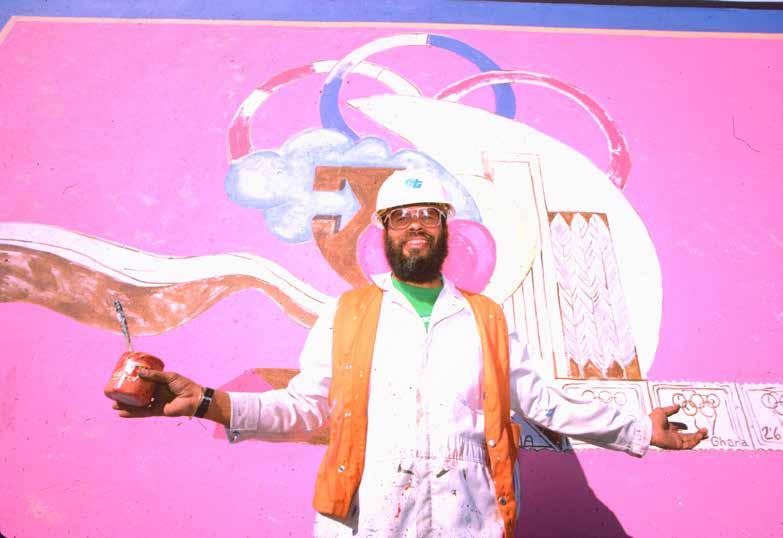
artists to LA, Alonzo Davis—the late interdisciplinary artist and organizer, who founded one of the first Black-owned galleries in the US—asked Fitzpatrick “How come we’re not doing any murals?” Davis was fresh off a round of bureaucratic frustrations from trying to commission a mural for the city’s 1982 bicentennial. In 1983, Fitzpatrick tasked him with commissioning murals by himself and nine other artists. They were to become the most visible and lasting aspect of the festival.
Glenna Boltuch Avila’s LA Freeway Kids flanks the wall opposite John Wehrle’s Galileo, Jupiter, Apollo and Romero’s mural. In a 2016 interview with Brooklyn & Boyle, Avila said she wasn’t interested in doing anything directly related to the Olympics. Instead, she was interested in how kids weren’t really a part of the Olympics, so depicted seven of them ranging in height from 18 to 22 feet, engaged in the kind of solo, freeform play not associated with sport. The final child,
a toddler in a Bruins T-shirt clutching a basketball, bore an uncanny resemblance to my older brother when he was little and, as we inched past, my mom would always point and say, “There’s Mikey!” Kent Twitchell’s 7th Street Altarpiece a pair of giant closeups of the artists Lita Albuquerque and Jim Morphesis— remains tucked under the 7th Street overpass. Avila’s kids are covered in graffiti. Wehrle’s Apollo has been painted over in gray. I wonder if Romero was aware of the irony of his brush-broom, pointing not only to the tensions of artwashing involved with preparing a city for the Olympics, but also the irony of public art itself, subject as it is to the sweeping whims of Caltrans.
Above Alonzo Davis working on Eye on ’84, 1984. Courtesy: Alonzo Davis Studio and parrasch heijnen, Los Angeles.
A recreation of Alonzo Davis’s Eye on ’84 (1984) is featured in “Made in L.A. 2025,” on view at the Hammer Museum, Los Angeles, until March 1, 2026
Christina Catherine Martinez is a recipient of
Louis Fratino
David Zwirner
Frieze Los Angeles
Artist Peter Tomka pens a letter to the late Californian photographer Larry Sultan about his iconic series ‘The Valley’, exhibited at this year’s Frieze Los Angeles
TO FOLLOW THE STARS
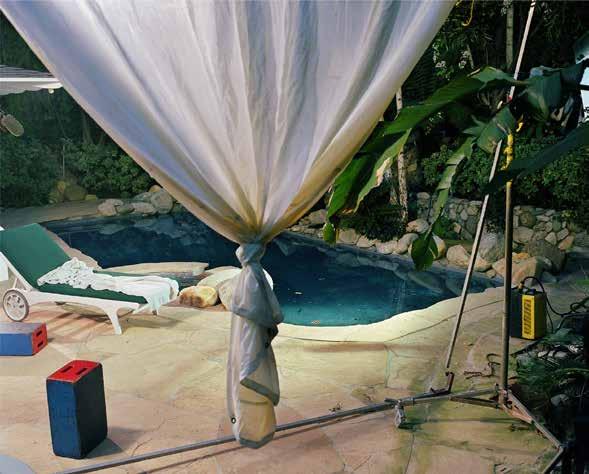
Distinguished Professor Sultan, I spoke to your gallery, when they were in Paris for a fair showing one of your works from “The Valley” (1998–2003). I tried to stare at it for as long as possible before closing my eyes to dedicate it to memory. I spoke to some of your former students; they all mentioned your daily method of taking a break for 20 minutes— what you coined “study hall.” I spoke with the editor and the explicit picture is a no-go. I went with my first inclination, Backyard Roscomare (2003): even though no one is in the frame, I like the era it evokes. I tried to track down a clipping of the assignment you were given for Maxim that originally brought you to this activity and was given a copy of your new book of selected writings by MACK instead. After five years of photographic investigations on site watching pornographic
scenarios, you eventually wound up in this backyard. Roscomare runs parallel to the 405; it marks a geographic outlier in the series because it is not actually in the Valley. The entirely residential street runs north to south, shooting up toward Mulholland Drive if you’re driving from UCLA, making its own valley coming down from the crests of the Santa Monica Mountains.
I return to the technology of that time. A mediation of digital and analog practices, before complete high-speed online ubiquity. The content filmed during these visits ended up as DVDs for mail-order catalogs, debuted on hotel pay-per-view menus, shelved at adult stores by genre. In your intention to follow the stars of that scene, you ended up with this composition that kept the graphic nature of the sex industry out of the frame. Without prior
knowledge, it seems to be a typical set. The lounge chair likely came with the rental. I see the dangers of a power bank close to the water, a rumpled towel but no proof of pool use, a clipped boom mic without an operator, a knotted scrim. These things moved around just as easily as you did, while both teams picked up their respective shots.
The pretend grotto is modest; it looks more like a pond than a pool. The overgrown hedges work for privacy but it is not the best place to catch the sun. The photograph borrows its light from the continuous source that production used to light the scene. That day, the actual pool boy did not show up but maybe someone acted out his role. A storyline worth improvising, as these rental houses were taken over by the crew. I imagine the financial stress or the get-rich-quick
schemes that prompted the takeovers. Larry, you went from shadowing your parents to watching how babies were made, how babies were deferred. A different type of homecoming, a peek behind the curtain, pictures from someone else’s home. Your eye refined what you took in. It was no longer about chance encounters and, instead of residue, it was a silence you wanted to visually illustrate. The loudness of pornography recorded its own evidence of making. These were photographs you found while on location, trusting that your instincts would tell you when to call it a wrap.
Yours truly, Peter Tomka
Above Larry Sultan, Backyard Roscomare, 2003. Courtesy: Casemore Gallery, San Francisco, and Yancey Richardson Gallery, New York
Larry Sultan is the subject of a solo presentation at Frieze Los Angeles shared by Casemore and Yancey Richardson (Stand A27)
Greg Gorman & Ed Ruscha
Opening Reception: Wednesday, February 25 2:00PM to 6:00PM
Exhibition on view through Saturday, February 28 daily 10:00AM to 6:00PM
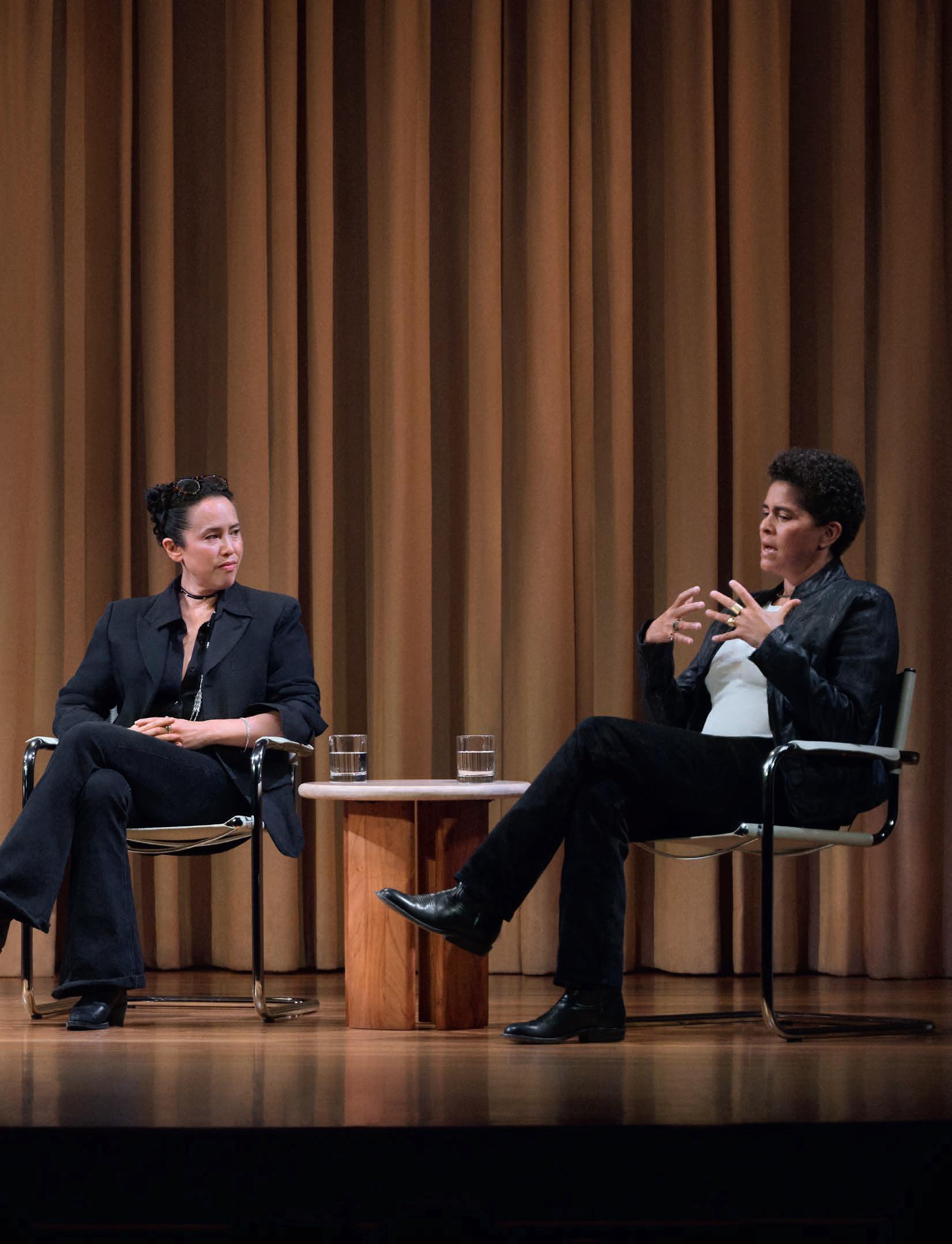
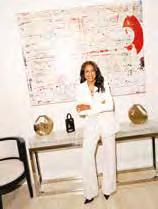
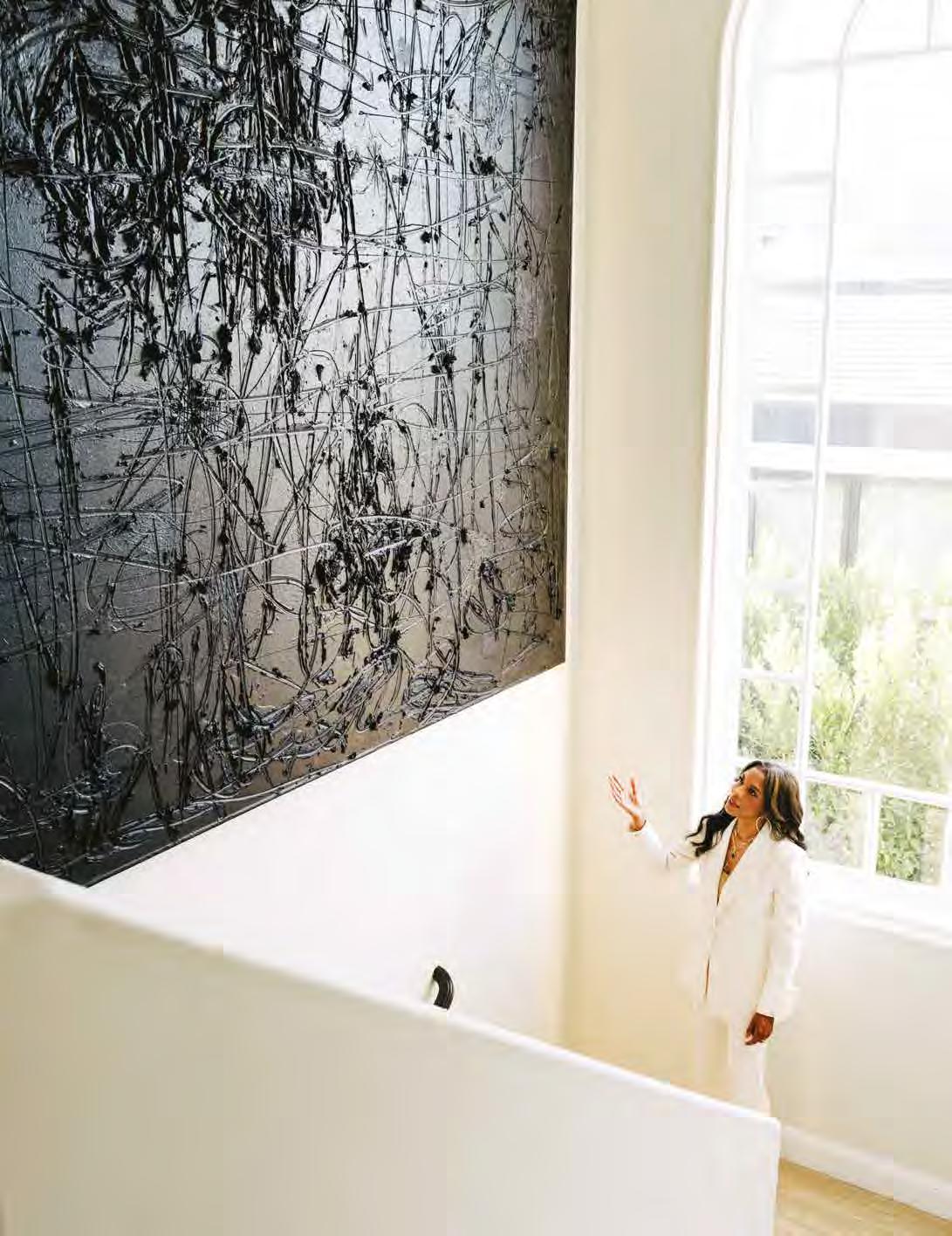
Being appointed by the Governor to the State Board of the California African American Museum in 2016 galvanized Terri Holoman’s engagement with contemporary art. But, as Holoman explains to artist Lauren Halsey – whose “sister dreamer” sculpture park nears completion after two decades of development –she still sees the value in taking her time. Photography by Daniel Dorsa
“MY PROCESS IS PATIENCE”
LAUREN HALSEY
I didn’t grow up going to galleries or museums. I grew up with prints, birthday cards and art calendars at home. There was an artist, Ramsess, in Leimert Park who made quilts and pins. [He had a show in 2019 at Art + Practice.] He made gorgeous accessible artworks that allowed all types of folks to collect his work. What were your first memories of experiencing art?
TERRI HOLOMAN
I don’t have early memories of exposure to art, but I know that I had an artsy vibe. I remember making art with stamps. Even as a young mother, I used to make really creative party invitations that were hand-cut, hand-stamped and embossed. I’m clearly not an artist, but I feel like I have an artist’s soul.
LH And you grew up being creative?
TH Well, in high school I designed my own jeans! I had a friend who could sew and she would make patchwork jeans. You would bring her your denim and she’d cut it up and sew it back together and you’d have these beautiful, unique bell-bottom jeans.
LH How did you get started as a collector?
TH I’d made sporadic purchases, but my interest in collecting intensified after joining the CAAM [California African American Museum] board in 2016. Visiting the museum so often exposed me to amazing works of art, artists and curators.
LH What prompted you to join the board?
TH I was appointed by the governor. It is a state museum, so it’s a state board. It’s a long process that takes up to a year, or even more, involving interviews and vetting. What this museum does
to support and pay homage to African American artists is so important. They do it in a way that nobody else can.
LH It’s holistic, all-encompassing. Even the programming. Do you think that set the tone for how you collect and your selection process?
TH Definitely. My engagement with art and artists on a regular basis helped me hone my purpose. But I think my selection process is unchanged. I’m, first-off, drawn to the artistry and usually there’s an emotional connection.
LH Intuition is so important.
TH When I see my experiences, my culture and my ancestry in art form, that forms the connection. Later, it became apparent to me that our history was being erased. First, from the education curriculum, then from national institutions, so I felt compelled to do whatever I could to preserve as much as I could.
LH Collectors have different styles of collecting. Some want to get to know artists: they request a studio visit, a coffee or a dinner hang. Sometimes people work with an advisor, sometimes through a dealer. I know that you’re cool with one of my heroes, Mark Bradford, who I learned about before even knowing what an art world was. When I was in my fifth year at El Camino Community College, an art teacher, Paul Gellman, gave me a book of his and said he thought I would be inspired by him and that I should check out CalArts. So, I was thrilled to see some heavyweight Bradfords in your collection. How did you get to know him?
TH I think my process is patience.
I don’t know if it’s common, but I tend to take my time. I’m very strategic about what I buy. I’m never pressured. I feel
like I could always wait for the piece that’s for me. Maybe I miss out sometimes but that’s the instinct part that we were talking about. You can love the artist but you want the piece that’s for you. My first acquisition of Mark’s work helped form my collection and it made me more intentional. I don’t recall exactly when we met, but I love Mark’s personality and the way he talks about his work. It feels so familiar to me. And I think I got my hair done in the salon where his mother worked, where he swept up the end papers!
LH And you have one of those endpaper works.
TH It’s one of my pride and joys. Mark is also one of those artists that supports the community and I think it’s important to support artists who are engaged with the community. Like you with Summaeverythang and sister dreamer
LH Absolutely. I’m sure I get the cue from Mark and learning about him very early on. I don’t want to just be in the vacuum of my studio making art objects. As well as Mark, the same is true of Theaster Gates and Julie Mehretu. If you’re going to make ambitious work that extracts from a community, you have a responsibility to tangibly recycle those resources back to communities that could benefit. Your collection nods to that same sort of activist spirit because you’re supporting an entire ecosystem that benefits on a macro scale. It’s also formally beautiful. It’s all the things. I think that’s what makes a good collector.
TH Thank you.
LH What advice would you give an up-and-coming collector in LA? I say LA because, of course, we have a geographical spread here, unlike New York.
How would you help someone figure out how to orient themselves around the ecosystem of the gallery, the museum, the studio?
TH New collectors should get out and see as much as they can to figure out what they like and what they’d like to live with. Museums and gallery visits, both in your home town and on your travels, help you establish your taste. Go to art fairs, because that exposure helps you to establish what you like. There’s such a variety there that a pattern starts to evolve: going back to instinct, you start to feel the types of work you are drawn to.
Like I said, I take my time. A good advisor can help guide your collecting path, handle the processes and bureaucracy of the art world, and facilitate those meetings and studio visits. And, last but not least, you need to build relationships with artists.
LH Bingo!
TH Do studio visits. I went to Kenturah Davis’s studio two years before I actually bought a piece of art by her. It doesn’t necessarily happen in that moment. You don’t go in the door and walk out with art. You build a relationship over time.
LH A real relationship that has depth, which is important to an artist, I think.
TH Of course. I’ve also visited McArthur Binion, Kohshin Finley, Charles Gaines, Todd Gray, Chaz Guest, Titus Kaphar, Michael Massenburg, Tavares Strachan—and, of course, you—in the last couple of years. It’s enlightening to be in your creative spaces. It’s a privilege to follow an artist’s progression.
LH And you believe in it.
TH Exactly.
LH Listen, all you collectors out there: meet the artists, spend deep time,
Left Terri Holoman at her
Los Angeles house with Rashid Johnson’s Cosmic Slop “Front Row Seats”, 2012
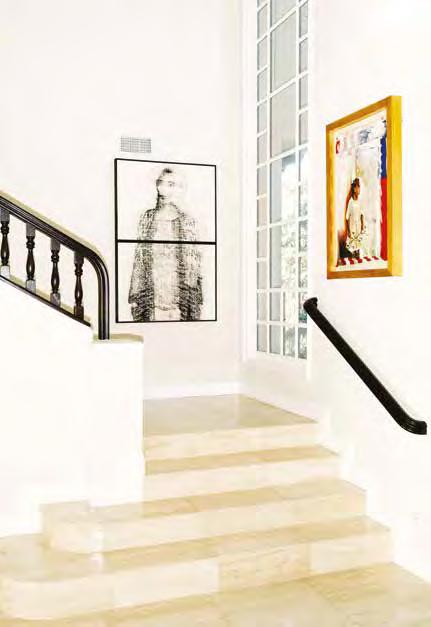
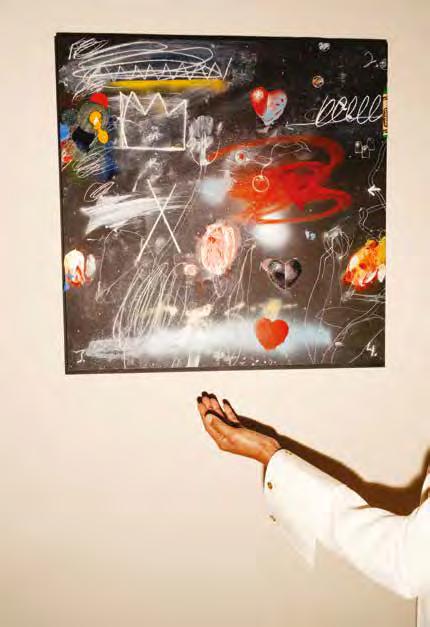
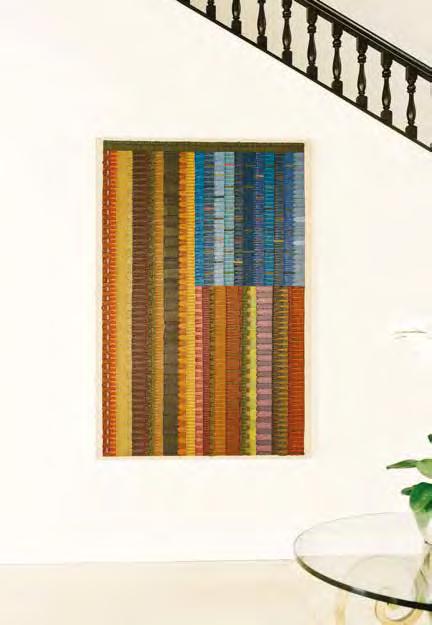
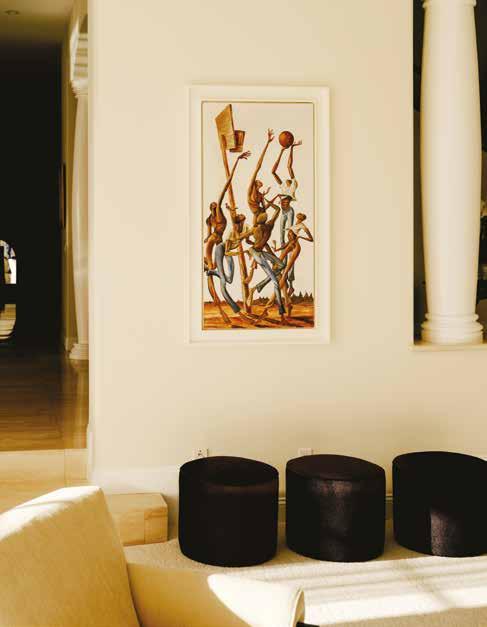
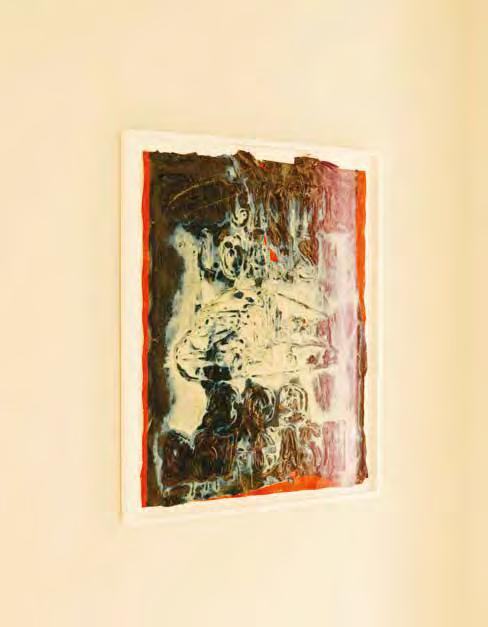
Clockwise from top left On the staircase: Kenturah Davis, The Presence of a Long Past, 2019. Right: Chaz Guest, American Girl Flag, 2019
Raymond Saunders, Untitled 1993
June Edmonds, Claudette Calvin Flag, 2019
Simone Leigh, Untitled 2023
advocate for the artists you know. That’s the etiquette.
TH I think museum groups are also important. There are so many different kinds of art groups to join. For me, besides being on the board of CAAM, I’m part of the BTA [Black Trustee Alliance].
LH Tell me more about that.
TH It’s a national organization that equips Black trustees with the resources to bring meaningful and lasting changes to their institutions. We are a visible and influential part of the museum sector. It’s a good place to collaborate, share ideas and be introduced to artists.
LH It’s an entire ecosystem.
TH It is. There’s an annual convening. The first year I joined, we were in Chicago and this past year, it was in LA. It’s a great opportunity for people from across the country to see what people are doing in different museums. During Frieze, they also do studio visits.
LH You stopped by sister dreamer a month or two ago. I was knee-deep in installing the pavers. It was a construction site.
TH Yes, we were walking around with our hard hats on.
LH I’ve been working on this for 16 or 17 years using museum presentations to test things out and now, finally, it’s coming back home. You spent deep time in the install with the compositions and you called out the Holoman’s Black Achievers sign—you made the connection that the original source photo was from your husband Eric Holoman’s family archive. I thought that was so cool because the entire conceit of my project is to present a non-linear portrait of Black and Brown South Central LA that shows a differ-
ent cadence of images to those we’re used to digesting about the area in the media. And you caught that, which I thought was wonderful, and you ended up acquiring that moment in the work. That meant so much to me to have the work recycled back to the actual family: you.
TH While I was a huge fan of an earlier version of this work, exhibited on the roof top at the Met in New York, this piece is deeply personal. It references my family’s publication Holoman’s Black Achievers, which was a monthly newspaper that focused on Black success stories. To see them represented in this fashion is incomparable. My husband was truly moved by this piece.
LH So you guys are coming during Frieze?
TH Yes, and I will also be there with the BTA group. Will the construction be done?
LH Yeah, it’ll be done. I had some alignment issues with the pavers, so I had the contractors get it right because the grid is one of the most important things. We’re working towards installing the fountains, so by the time you come in February, we should be almost done with it all. It opens on March 14. But back to Frieze: I learned that a few of your acquisitions came from Frieze art fairs in London, LA, New York, Seoul. There are a lot of art fairs but I was wondering what it is about Frieze—the atmosphere, the curation— that resonates with you. I’ve seen you and our other cousin, Pam Moon, walking around there a few times.
TH I think I’ve probably been to more Frieze art fairs than any other. There’s always a large selection of galleries and
great events, in fabulous cities. But, aside from fairs, there are also a lot of local galleries that you can get to know. You can go in often, see different shows, and see artists that may not be at an art fair, but their work is fabulous. Galleries don’t bring the same artist to every fair, and some don’t participate at all.
LH I love that. Some of my favorite artists are those around the corner practising right now. They’re some of the best artists in the world, but for obvious reasons they’re not a part of the art world that I’m a part of, but they’re in this really wonderful world of artists who are making work that is masterful and is equally, if not more, powerful than things that I see in the galleries from time to time. So, I love that you have a more free-spirited approach and confidence in your taste that means it’s not just “blue chip only.”
TH Yes, I think what you love is what’s valuable.
LH Do you hang everything?
TH Yes. I have the honor to sit with my art. How could it be anything but a privilege to spend time with works by amazing artists, some of whom are instantly recognizable, while others draw inquiries from admiring visitors. I feel very fortunate that I have at least three pieces that were held back by the gallery on the direction of the artist to go to a Black collection, and they had to approve who the pieces went to. I feel such luck to be a caretaker of their stories.
LH As an artist, I approve all sales and there are certain works that are for Black collectors only, certain works that are for Black institutions only, and then there are works that are openended. For me to streamline access back
to the subject, the context, the community that inspires and energizes my work is important to me. I love it when that happens. So, I love that there are some artists out there that also hold that standard and you benefited from it. It’s very important as an artist to get to have a little bit of a say, if not a lot of a say, in how our work lives and who it lives with after it leaves the studio.
What’s also interesting about your collection is that it’s not just one thing: it’s abstract, there’s figuration, it’s an ark. Blackness isn’t monotonous—it’s all of these things. So, to see a collection like yours, and for it to really be all of it, is wonderful.
TH There’s a common thread in my collection. It celebrates our culture, our ancestral ties, our rich heritage and our resilence. I think this art is a beautiful and powerful expression of Black identity. That’s why your work fits perfectly in my collection. I am so proud to archive this meaningful and important narrative.
Above left Ernie Barnes, The Shootout, 1972 Above right Mark Bradford, Ghost Ship, 2022
Overleaf
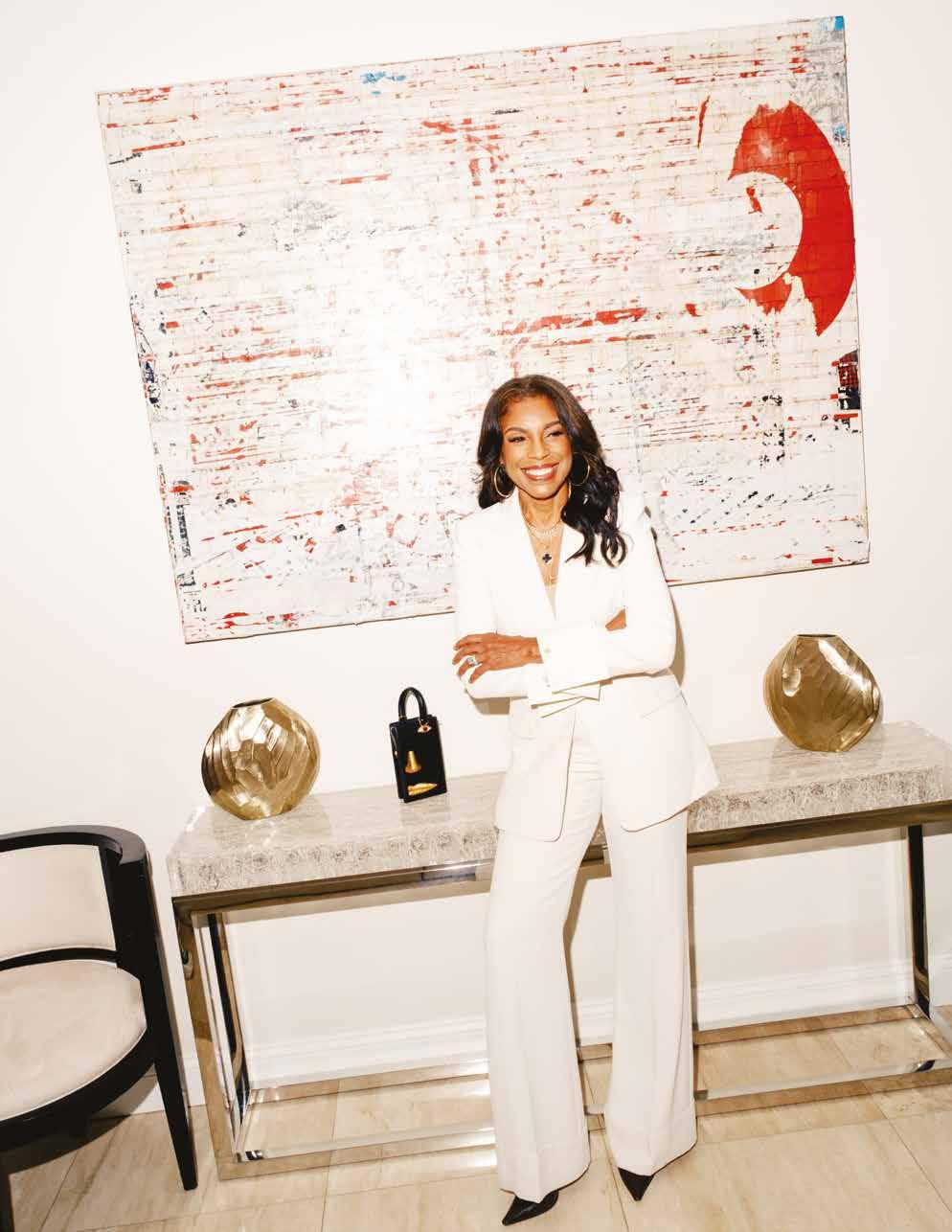
Terri Holoman in front of Mark Bradford, When We Ride, 2006
Lauren Halsey’s sister dreamer is on view March 14, 2026 –September 12, 2027. For more details, visit: nomadicdivision.org
Lauren Halsey is an artist. She lives in Los Angeles, USA. Terri Holoman is a collector. She lives in Los Angeles, USA.
February 20–April 18, 2026
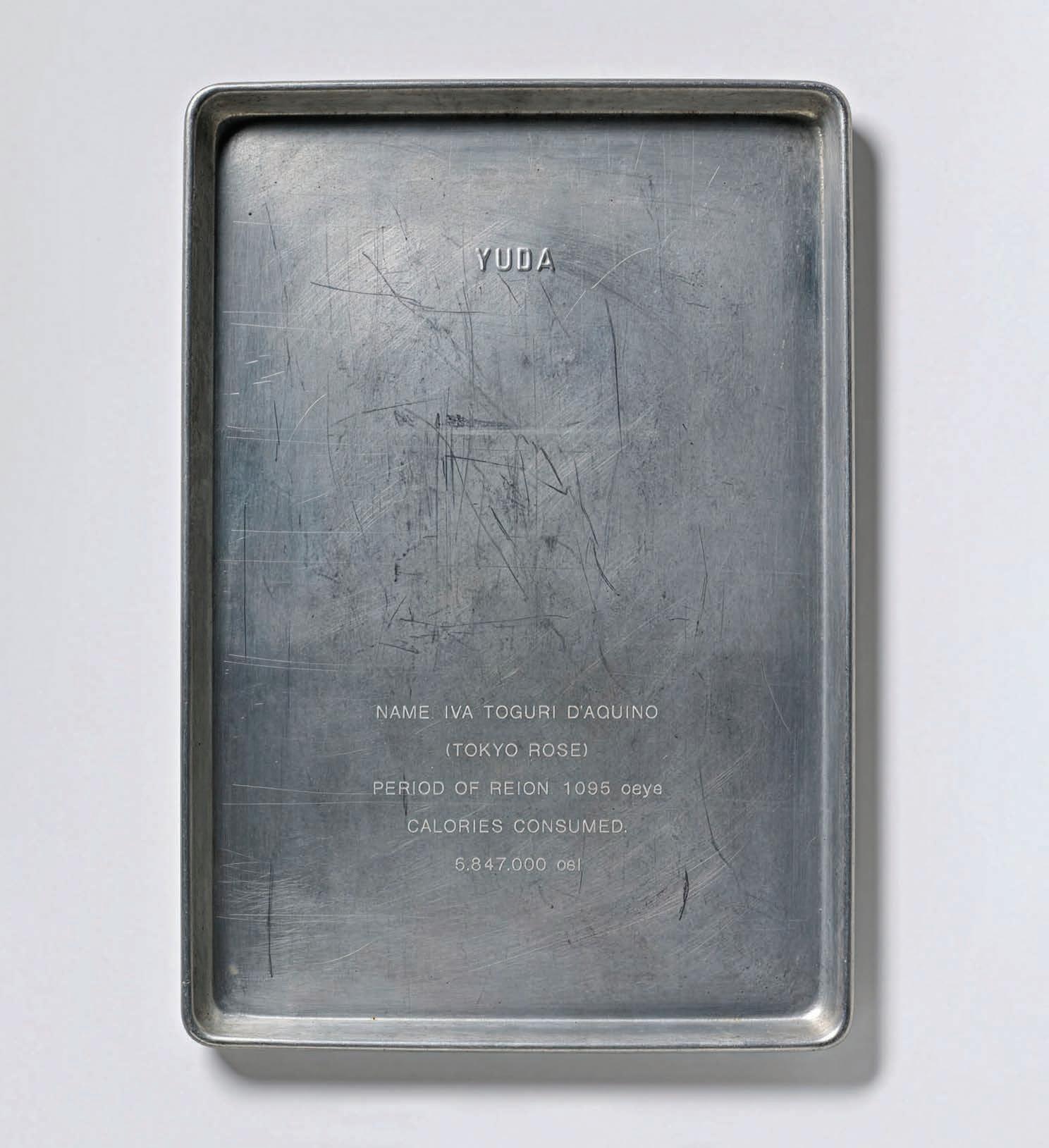
Michael Joo, Saltiness of Greatness (detail), 1992, compressed salt blocks, engraved aluminum trays, steel, wood, polyethylene, synthetic sweat, 156 × 96 × 48 in. Private Collection. Photo: Tim Lloyd
The story of the art advisor – and three firms to look out for during Frieze Week
GOOD COUNSEL
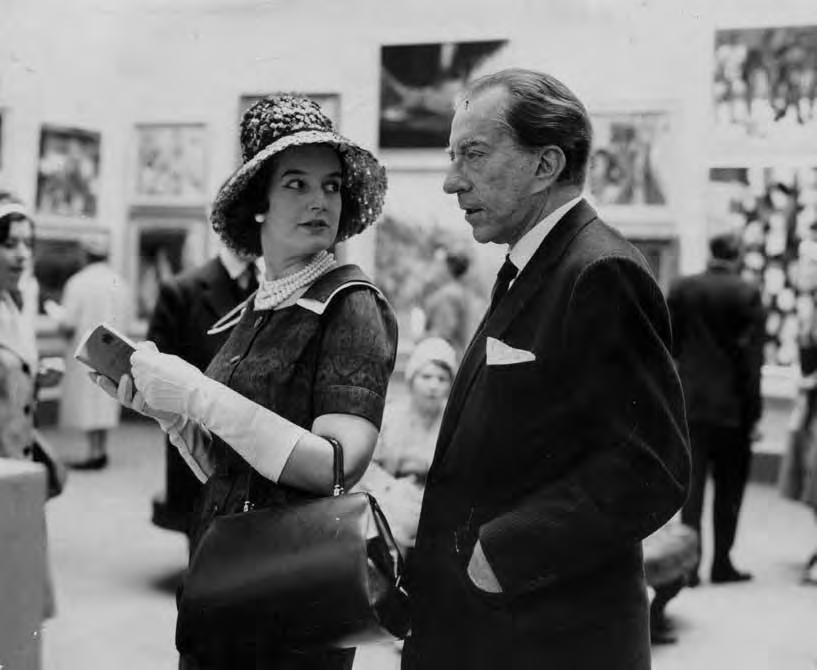
If we imagine the art sector as an orchestra, the many players come through at different volumes. The art advisor is perhaps the harp, whose echo is often less palpable—a behindthescenes contributor, influencing the dynamics with gentle yet impactful gestures. Art advisors may not match the volume of curators or dealers, but often it is through the determined counsel of an insightful expert that an acquisition reaches its crescendo. Knowledge is their capital: they study the composition and deliver their strain. Seeing an advisor as a “market whisperer” is to overlook their impact, both today and within art history. A long trajectory of sharp eyes proves their influence on the ways patrons have collected and championed genuine talent. Herbert Read and Howard Putzel were early advisors to Peggy Guggenheim; it was Joseph Duveen who played a critical role in the acquisitions of Henry Clay Frick, Andrew W. Mellon and J.P. Morgan; and Spencer Samuels was instrumental
in J. Paul Getty’s oldmaster collection. Many institutions established by such patrons under the guidance of an informed righthand advisor still stand as determinants of Western art history as we know it today.
Art advising is a profession learned and honed on the job, meaning anyone curious can give it a go. But it was Thea Westreich who truly modernized the role of art advisor. She showed that the profession benefits from visibility and that once this is achieved an advisor can have an impact on a par with that of a dealer or curator. Westreich stood alongside her clients rather than behind them, openly offering her advice and opinions, her services formalized into a business. Today, collectives such as New Perspective Partners and Art Intelligence Global offer fully fledged services encompassing logistics, finances and preservation. The boutique firms of Nancy Gamboa and Joe Sheftel cultivate a dialog with their clients based on
intimacy and familiarity. “Today there is a higher level of professionalism required of the field,” says Suzanne Modica, who runs New Yorkbased firm Modica Carr Art Advisory with Ashley Carr. “But, on the downside, there can be less discretion, particularly now that almost everything is posted to social media.” After two decades in the business, Modica says that she and her partner have seen “many permutations, both positive and negative.”
There is no one model of advising in the art world. Some advisors assume the role of confidante, others become mentors. Not unlike a friend, they listen and must remain agile, allowing the relationship to develop, mirroring changes in collectors’ circumstances. “We have seen clients get married, separate, have children, build houses and, sadly, pass on,” says Modica. “It’s all part of life.”
Trust binds a patron and their advisor in an industry that can appear opaque from the outside (and even from
within). If doors, emails and waitlists stand between a collector and an object of desire, the advisor can provide the key. “Our clients rely on us to sift through previews,” says Modica, “alert them to compelling shows and artists, provide an assessment of the art market, and advise on undervalued opportunities.”
The contemporary art scene has continued to grow on a global scale, with the number of fairs and biennials challenging most collectors’ schedules. Kaeli Deane, a senior director at Lisson Gallery’s Los Angeles outpost, agrees on the importance of advisors’ ceaseless globetrotting to filter what suits the collectors they work with. “I don’t know that advisors have fundamentally changed the gallery model,” she says, “but they have become increasingly important clients.” Believing that “firsthand engagement is irreplaceable,” she adds with regard to their role in the LA market in particular: “Foot traffic will always be lower here than in a city
Above J. Paul Getty and his advisor, Robina Lund, at the Royal Academy Summer Exhibition, London, 1961. Photo: Terry Disney. Courtesy: Central Press/Getty Images
like New York, so we really appreciate the work that advisors do in spreading the word about our exhibitions and artists, ultimately guiding more collectors to engage with the work in person.”
Art Firm Advisor
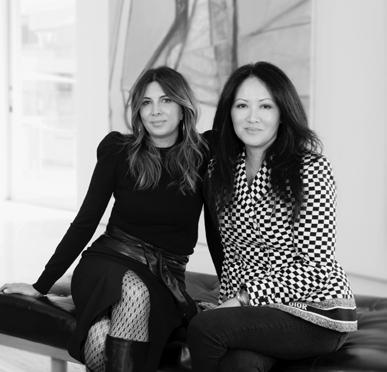
The origin story for Art Firm Advisor exemplifies the powerful bond between advisor and collector. The firm’s founders, Julie Miyoshi and Nathalie Marciano, first met in 2012 when the former advised the latter on the acquisition of a Mark Bradford painting. After its debut at the Gwangju Biennial, the tenfootwide work was immediately available through his former dealer Brent Sikkema who offered it to Miyoshi to place within 24 hours. “I called Nathalie, who was my client at the time, from London at 3am,” remembers Miyoshi, “to tell her she had to have this Bradford before he switched to White Cube.” Marciano was immediately convinced about the purchase but perhaps her biggest take from this interaction was Miyoshi’s “integrity,” which she experienced firsthand. The collector didn’t waste any time in offering the consultant a partnership to expand her advisory practice, which eventually led to the launch of their joint firm.
The Los Angelesbased duo still say that the friendships they build with their clients are fundamental but, “There is always a line between understanding their motivations and becoming too intimate,” says Marciano. In the last decade, Miyoshi has continued to advise Marciano, while, as partners, they have compiled an impressive roster of clients, many from the entertainment sector.
Miyoshi considers their philosophy to be “holistic,” and together the two advisors agree on transparency as their golden rule. And when it comes to a dream client, they are clear: “We’d love to work with a philanthropist like Mackenzie Scott who is actively changing the world,” says Miyoshi.
Nancy Gamboa
Nancy Gamboa believes in the power of objective information. For the Los Angelesbased consultant, a good advisor takes an “outlier” position in the art
ecosystem to help create an “aesthetic and emotional landscape within a client’s home.” Gamboa believes that collections are built from the inside out.
For Gamboa, the traditional role of advisor has changed from that of cultural interpreter to a heftier one which also spans financial advisory, strategic partnership and estate management.
Embracing this multifaceted position, however, doesn’t alter what she considers her primary task, of “being the eyes and ears” of a client. “We make visible for our clients what is culturally urgent in a particular moment,” she says, “and help them proceed with conviction even before markets and institutions recognize an artist.” Gamboa thus acknowledges the part that advisors have to play in “shaping and accelerating careers.”
Gamboa takes pride in her client
Jarl Mohn’s 2024 donation of more than 250 artworks to three LA museums.
“This type of move not only changes the cultural landscape of a city but raises the bar on personal philanthropy,” she says, adding that Mohn’s further commitment to underwrite the storage of the works he donated reminds the public about the burden that museums face at a logistical level.
Gamboa currently has her eyes on the late Aboriginal Australian painter Emily Kam Kngwarray, who was recently the subject of a major exhibition at London’s Tate Modern, noting that she has “both institutional and market momentum.”
Chinese artist Evelyn Taocheng Wang, the recent winner of the Wolfgang Hahn Prize, is also on her radar.
Joe Sheftel
After working as an attorney and running his own gallery, Joe Sheftel now pursues similar priorities as an art advisor.
“My role is always to put the clients’ and artists’ vision first and help refine and make it happen,” he says. The New Yorkbased consultant recognizes the trust implicit in being given access to people’s personal spaces.
He also acknowledges the growing logistical demands of his job. “I’ve noticed over the past few years how the advisory business is not just about taste and access,” he says, “but also the nuts and bolts of asset protection, risk management and logistical prowess.”
If a client has museumlevel holdings, the consultant feels compelled to provide a compatible response that includes “service with registrar, conservation and insurance.”
Sheftel, who has consulted for showbusiness figures such as Ryan Murphy and Greg Berlanti, cherishes the memory
of his teenage visits to Boston’s Isabella Stewart Gardner Museum, where he first witnessed the formative dialog between an art patron and her consultant. “Gardner built her collection at a moment that in some ways mirrors our own,” he says, “when a new generation of industrialists was shaping its cultural legacy.” He considers her advisor Bernard Berenson as a visionary who “brought extraordinary depth of knowledge to their relationship and, through his scholarship, helped shape the very discipline of art history.”
Working bicoastally, Sheftel admits he feels “energized” by placing work in architecturally significant spaces and cites installing art at a California home designed by Richard Neutra as a recent thrill. “Projects that bring together architecture, design and art in such a holistic way feel uniquely rewarding,” he says. Sheftel considers honesty to be key to his operation, even when this means delivering an unpopular opinion to a client. “My job is to share what I truly believe,” he says. “Not what I think they want to hear.”
Left Nathalie Marciano and Julie Miyoshi, cofounders of Art Firm Advisor, 2020. Photo: May Charters
Right Joe Scheftel, 2023. Photo: Stephen Kent Johnson
Below Nancy Gamboa, 2025. Photo: Matthew Xavier Praley
SPLASH ZONE
From Ed Ruscha to David Hockney to Calida Rawles, the swimming pool is a fixture of Los Angeles art – and for Italian-born, LA-based photographer Arianna Lago, it’s an enduring symbol of the city. How else to celebrate her adopted hometown for “Frieze Week” but with a pool party?
Clockwise from back left
1. Blue crop top: Acne; Purple shorts: Adidas by Stella McCartney
2. Yellow, long-sleeve top: Eckhaus Latta; blue shorts: Our Legacy
3. Purple shorts: Acne
4. Checked trousers: vintage from Squaresville, Los Angeles; pink T-shirt: Adidas
Opposite page above, from left
1. Red top and swim bottoms: Eres
2. Yellow cardigan and crop top: vintage from James Veloria; yellow bottoms: Eres
Opposite page below, from left 1. Yellow bikini: Eres
2. Yellow, long-sleeve top: Eckhaus Latta; blue shorts: Our Legacy
This page
Checked trousers: vintage from Squaresville, Los Angeles; pink T-shirt: Adidas
Styling Camilla Pole | Clothes Squaresville Los Angeles | Casting Erika Angel & Jade Johnston | Photo assistant Manon Achard
1. Red plastic jacket: Squaresville, Los Angeles; purple shorts: Acne
2. Yellow ribbed top: Kiko Kostadinov; dark green ribbed merino shorts: Acne
Diarmuid Hester on the tantalizing imagery of Los Angeles’s “queer mystic” Steven Arnold, subject of a new exhibition at Del Vaz Projects
DREAM LOVER
The photographs of Steven Arnold keep me awake at night. In the dark, flat on my back, his images come to me: clowns and oracles, ghosts and glories, demons with fat cocks and angels with enormous wings, spread wide.
Like the mystical art of some religion that’s yet to be discovered or even created—a queer cult to come, maybe— the symbolism of Arnold’s tableaux is tantalizing but impossible to parse. A naked, sleepwalking attendant transports a crown of dreams. A bride drifts in a sea of skeletons. Meaning just sprawls in every direction, with a sensuality that drives sleep away.
Where did they come from, these monochrome visions of death and wonder? The films of Georges Méliès come to mind, so too the sculptures of Gian Lorenzo Bernini—influences that Arnold encountered during his time at the Art Institute in San Francisco and the École des BeauxArts in Paris. His film Luminous Procuress (1970) became an underground sensation and led to an introduction to Salvador Dalí, who loved it and became Arnold’s friend and mentor. Dalí’s influence is all over Arnold’s stuff.
But as I lie in bed, my lover asleep beside me and the clock pushing midnight, the associations proliferate, turning more fanciful and queerer. A preponderance of angel wings in Arnold’s work reminds me of Tessa Boffin, the lesbian BDSMer who made similarly sexy, classically influenced black and white photographs of her London set in the 1980s. His stagey, homemade forays into the esoteric conjure up the self-portraits of Claude Cahun, who also queered a homo-shy surrealism, decades before.
And when I think about Arnold’s Intercourse of Dreams (1985), I think about Walt Whitman; “The Sleepers” (1871), specifically—a poem in which the great gay poet of democracy turns creeping Sandman. Unseen, he wanders through the bedrooms of America: “Bending with open eyes over the shut eyes of the sleepers / […] / Pausing, gazing, bending, and stopping.”
Man, woman, child, immigrant and exile, the dying and the newborn: he watches them silently as they sleep. How vulnerable they all are; how peaceful and heartbreakingly innocent. Out of such sleepers is a nation made.
When, with the open eye of his camera, Arnold bends over the shut eyes of his sleepers, their dreams are revealed to him. A miraculous event, we might say, but, alas, here’s no great matter: coins and rings and children’s toys in repetitive arrangements; banknotes, cutlery and paintbrushes. Dreams of domesticity and the detritus of the American century. Jack Smith, the notorious underground filmmaker and Arnold’s contemporary, might have ridiculed them as hetero-insipid and “pasty-normal,” but Arnold’s perspective is less jaundiced and dismissive.
The dream is full of junk, sure, but isn’t it interesting all the same? Doesn’t it attract our attention and draw us in, even if ultimately it means little to us? Attentive and compassionate, even Whitmanesque, Arnold’s gaze takes in the scene of these two lovers and their clichéd little dream, and finds them beautiful. “I swear they are all beautiful, / Every one that sleeps is beautiful, everything in the dim light is beautiful, / The wildest and bloodiest is over, and all is peace.”
Opposite page Steven Arnold, Intercourse of Dreams, 1985. All images courtesy: ONE Archives at USC and Del Vaz Projects, Los Angeles
This page, from top Steven Arnold, Heal-a-zation Swathe a la Glob Ba, 1985
Steven Arnold, Grotto of Madame La Mort, 1982
“Steven Arnold: Cocktails in Heaven” is on view at Del Vaz Projects, Los Angeles, February 25 – April 24, 2026
Diarmuid Hester is a cultural historian. He lives in Kent, UK.
WIDEN YOUR
WORLD
WORLD
WHY ANGELENOS HIKE
Los Angeles is famously not a walking city. You could go days without setting foot on a pavement if you wanted to. “Don’t tell me we’re going to have to walk from the car to the house—my feet haven’t touched pavement since I reached Los Angeles,” quips Woody Allen’s character in the LA section of Annie Hall (1977). Travel time is spent on freeways. If you want to walk for a significant distance without being next to traffic, in one of many paradoxes of the city, you usually have to drive somewhere to do it. You drive to the base of the hill and walk up it, or you drive to the lake and walk around it in a circle. Rarely are you already at the point from where you start your walk; usually, the first step of hiking is getting into a car.
“Hike?” is a text I occasionally receive, although those who know me well should know better than to ask this. I regularly decline invitations to hike with others. Hiking functions for some as an alternative to coffee or lunch or a drink. People might take a meeting on a hike or go hiking with
a date. That way you kill two birds with one stone; you can exercise while you socialize or work. It’s like being on a treadmill while at your desktop.
In 1893, a local doctor told the LA Times, “Every woman who does not have active occupation should walk from three to five miles each day.” It’s advice that seems to still be obeyed today. As hiking tends to be a daytime activity, many women (and men) without “active occupations” can be found on the trails. You’ll overhear them, talking through personal problems, looking down or straight ahead, hands waving, nodding to each other in emphatic agreement.
Sometimes people do both a hike and a lunch. This is how people get away with constant athleisure in public. They’re always either returning from a hike or heading to one. You’ll see people at restaurants lightly glowing with sweat in leggings and baseball caps fresh from Runyon Canyon Park, a trail so dense with people, tourists and influencers it might as well be a paved promenade.
The paths around the Silver Lake Reservoir or the Hollywood “Lake” are also good spots for people-watching. Or being watched. People check each other out—it’s like Vienna’s Ringstrasse or Paris’s Boulevard Saint Germain in the 1890s. Sometimes paparazzi are at the base of the hills, capturing unawares the celebrities in high-end Spandex. I discuss this LA phenomenon with the writer Jack Bankowsky, who has a regular hiking appointment with the artist Charles Ray, the subject of a book he is working on. They meet at 6.30 am on the West Side at Ray’s studio and begin an urban hike, with Bankowsky interviewing him as they go. “When I get to the studio, we normally take off immediately,” Bankowsky tells me over the phone. “The first stop is a bagel place. I’m always interviewing him along the way and, of course, my interviews include the sound of feet and gravel dragging along the roadside. We tend to talk the whole time, which makes me less alert to the local
color than I might be. I kind of tune in and out and I suddenly look up and, nine times out of ten, I really don’t know where I am. His walks are very urban as opposed to picturesque. We cover a lot of ground and, usually, we end up by the ocean.”
The artist, writer and avid hiker Juliana Halpert tells me via email: “I still prefer to hike alone—it’s the only way I can straighten out my breath and my brain without having to make idle conversation. I like hiking with Chris Kraus, though, because we both just like to shut up.” I, too, prefer to hike alone or with a silent companion. It feels better that way, to fully indulge this strange feeling of suddenly being surrounded by nature in the middle of this sprawling city. It’s the perfect escape—whenever I’m feeling weird, I drive to the hills whichever are closest, and walk from there.
Above Illustration by George Wylesol, 2026
Gracie Hadland
Top picks for unmissable institutional shows taking place during this year’s Frieze Week. For more recommendations, and our Critic’s Guide to museum and gallery exhibitions, visit: frieze.com
FOUR TO SEE
“Photography and the Black Arts Movement, 1955–1985” | Getty Center | February 24–June 14, 2026
The symbolic values of black and white and color have never felt more charged than in the United States in the mid-20th century, when photography’s growing acceptance as a bona fide art form was accompanied by its media use as a tool of stereotyping what Black America looked like, often—to use another photographic term—“negatively.” The show at the Getty Center presents 150 works by African American and AfroAtlantic diaspora artists who, over three decades, strove to expand both social boundaries and the scope of photography. It includes artists who document the Black experience, such as Roy DeCarava and Gordon Parks, and those who use the medium to investigate how Black identity itself is visually conceived, including Ming Smith, Carrie Mae Weems and the lesser-known photographic works of Barkley L. Hendricks.
“Sandra Vásquez de la Horra: The Awake Volcanoes” | ICA Los Angeles | Until March 1, 2026
In Chile, the volcano is a symbol of sacred power. It repeatedly occurs in the work of Chile-born artist Sandra Vásquez de la Horra as a totem of the country from which she was exiled and a vision of the dormant power of the human body. For four decades, Vásquez de la Horra has engaged with themes of mortality, trauma, ritual and ecology, mainly through drawing—from lush vegetal explosions eliding humans and plants, through Yellow Submarine-style psychedelia, to obsessive cartographies reminiscent of outsider art. Having survived the Pinochet regime, Vásquez de la Horra emigrated to Germany in the mid-1990s, studying with Jannis Kounellis and Rosemarie Trockel, and discovering the Afro-Cuban tradition of Santería. Following her inclusion in the 2024 Venice Biennale, “The Awake Volcanoes” is her first solo exhibition in the US, and a powerful introduction to her singular cosmology.
“Robert Therrien: This Is a Story” | The Broad | Until April 5, 2026
Like the giant Stay-Puft Marshmallow Man in Ghostbusters (1984), the oversized works of the late LA artist Robert Therrien are both delightful and terrifying. His towering recreations of everyday objects—folding chairs, kitchen tables, stacks of pans—have a subtle monumentality: they’re just there, forcing the viewer to accommodate their otherness with an uncanny thrill of relinquished control. The largest museum exhibition to date dedicated to Therrien is a chance to encounter his most iconic works in full effect, and explore his range. There are undersized pans, too, a cupboard containing only red objects and a cloud of analog telephones, their curly flexes entangled in a seething mass. It is as if by fixing on one dimension of a thing and emphasizing or distorting it, Therrien calls into question the thing itself.
“Tavares Strachan: The Day Tomorrow Began” | LACMA | Until March 29, 2026
Given the cinematic quality of much of his work, it’s surprising that “The Day Tomorrow Began” is Tavares Strachan’s first museum exhibition in Los Angeles. Strachan’s works are often ambitious and polished productions, and here he presents rooms of rice grass surrounding the totemic figures of Rita Marley, Nina Simone and Andrea Crabtree (the first Black female deep-sea diver in the US army), with a 2,500-page Encyclopedia of Invisibility, which documents the unsung Black pioneers of science and exploration. Strachan’s allusive art is packed with ideas, visual metaphors and unexpected conjunctions and, like the title of this show, feels like history crashing in waves on to the shore of the present, one after another.
The first edition under the directorship of Kate Sierzputowski, EXPO Chicago 2026 features a partnership with the soon-to-open Obama Presidential Center Museum, whose director, Dr. Louise Bernard, curates two initiatives spotlighting the Museum’s commissioned artists and archives. Essence Harden collaborates for the first time on programming and a new section, while a reimagined Focus section is led by Katie A. Pfohl of the Detroit Institute of Arts. Beyond the Navy Pier, Chicago boasts some of North America’s most important institutions, enhanced by major bequests like the Edlis | Neeson collection to the Art Institute and the Daskalopoulos gift to the MCA.
Stay: Chicago Athletic Association drips gothic character
Eat: Grant Achatz’s influential molecular gastronomy at Alinea is on many a gourmand’s bucket list
See: “Matisse’s Jazz: Rhythms in Color” at the Art Institute of Chicago showcases one of the artist’s best-loved series in its entirety
Frieze New York May 13–17, 2026
Frieze New York caps one of the most important art weeks in the city. Chelsea’s gallery district comes alive and, at the Shed, a select edit of galleries provides an overview of market currents, from the city’s most important blue-chips to the innovative Focus section. In 2026, experience the renovated Studio Museum in Harlem, the expanded New Museum, the Whitney Biennial and PS1’s “Greater New York.”
Stay: The Ned NoMad’s art collection includes works by Glenn Ligon, Marilyn Minter and Issy Wood
Eat: Vijay Kumar’s Tamil Nadu-inspired Semma recently topped The New York Times’s 100 Best Restaurants
See: “Marcel Duchamp” at MoMA brings together 300 objects for the artist’s first US retrospective in 50 years
Frieze Seoul September 2–5, 2026
Drawing the art world to Asia’s new cultural capital, the fifth Frieze Seoul brings Korean and Asian art into a global dialog. From the kick-off Paradise Art Night to bustling neighborhood evenings across the city, Korea’s dynamic and welcoming art scene is on full display through the week. This year, discover the brand new Pompidou Seoul, journey to the 2026 Gwangju and Busan biennales—or do a spot of tax-free shopping in one of Asia’s most sophisticated luxury scenes.
Stay: Perched on the slopes of Namsam, the Grand Hyatt Seoul offers some of the best views in the city—and an outstanding spa
Eat: Near the fair, Kang Mingoo’s threeMichelin-starred Mingles is a masterclass in refinement
See: Pompidou Seoul’s opening exhibitions focus on masterpieces of cubism, expressionism and surrealism
The Armory Show September 24–27, 2026
The week that New York returns to business. The Armory Show, in its third year since acquisition by Frieze and the second led by director Kyla McMillan, is a galvanizing moment for the center of the global art market. Explore a wealth of galleries in the airy Javits Center, where guest-curated sections and themed presentations celebrate the heritage of New York’s gallery community, and seize
the chance to catch up on major exhibitions like Agnes Martin at Dia.
Stay: Minimalist and understated, The Moore is walking distance to the Javits Center and Chelsea
Eat: At Lincoln Centre, Kwame Onwuachi’s Tatiana brings AfroCaribbean influences to the Upper West Side
See: “Guggenheim Pop” featuring heavyweights Maurizio Cattelan and Roy Lichtenstein alongside lesserknown figures like Greek-American Chryssa
Frieze London and Frieze Masters
October 14–18, 2026
With two leading fairs a gentle walk from each other through the stunning fall foliage of The Regent’s Park, who can say “no” to Frieze Week in London? While Frieze London showcases contemporary art—including the unique, artist-selected Artist-to-Artist section—Frieze Masters offers historical art, from old-master paintings to ancient sculpture, decorative work and underrecognized 20th-century positions in Spotlight. London’s young gallery scene and institutions—bolstered by the soon-to-be-unveiled V&A East— are unrivalled in Europe but, for those looking to extend their trip, the Continent happens to be only a short flight or Eurostar away.
Stay: For the last word in old-world British elegance, Claridge’s Eat: All eyes are on the 150-year-old Simpson’s in The Strand and its reinvention by Jeremy King, of The Wolseley fame
See: The side-by-side retrospectives of Frida Kahlo and Ana Mendieta at Tate Modern
Frieze Abu Dhabi November 18–22, 2026
A cornerstone of the local cultural landscape for 17 years, Abu Dhabi Art evolves in 2026 into Frieze Abu Dhabi, bringing a spirit of discovery, dialog and global perspectives to the home of the Gulf’s most established art ecosystem. Plans for the fair remain under wraps, but with hotly anticipated new museums— like the soaring Norman Foster + Partners Zayed National Museum and the longawaited Guggenheim Abu Dhabi—plus the lure of 80°F and 11 hours of sunshine a day in November, the first Frieze Abu Dhabi is sure to draw a lively audience.
Stay: The Ritz-Carlton offers 57 acres of lush gardens and a private beach, with stunning views
Eat: In the city’s oldest stone building, the Michelin-starred Erth serves up golden lentil soup and spiced quail
See: Is the chlorite and calcite “Bactrian Princess” statuette (c. 2,300–1,700 BCE) in the Louvre Abu Dhabi worth the trip alone? Quite possibly (MM)
From top Collectors’ Dinner at Frieze London, 2025. Photo: Max Cisotti/Dave Benett/Getty Images for Frieze
Rendering of the expanded New Museum at 235 Bowery, New York, 2025. Courtesy: OMA/ bloomimages.de Kimsooja, “To Breathe –Sunhyewon,” 2025. Installation view at PODO Museum, Seoul. Courtesy: the artist and PODO Museum
CULTIVATE HARMONY
Ahead of a multi-venue retrospective of Californian architect Paul R. Williams, poet Jeanetta Rich responds to the archive of his Pueblo del Rio housing project (1940–42)
Left Leonard Nadel, Exterior view of Pueblo del Rio, 1948. Courtesy: the Leonard Nadel Archive/ J. Paul Getty Trust/The Getty Research Institute
Right Leonard Nadel, Scan of Envelope A-452, Negro Interiors (Pueblo), Photographs of Pueblo del Rio, 1947–48. Courtesy: the Leonard Nadel Archive/J. Paul Getty Trust/The Getty Research Institute
Below Leonard Nadel, Talent Show, Pueblo del Rio, 1948. Courtesy: the Leonard Nadel Archive/ J. Paul Getty Trust/The Getty Research Institute
The Paul R. Williams Archive is the subject of three contemporaneous exhibitions at USC Fisher Museum of Art (August 17, 2026 –March 13, 2027), LACMA (November 15, 2026 – May 2027) and Getty Center (December 15, 2026 – July 18, 2027)
“MORE THAN A BOX”
Context: Paul R. Williams recalls the redetermination interview for the funding of Pueblo del Rio. This is during the late 1940s at the inception of McCarthyism in LA.
“Negro Interiors”
Negros need housing? Yes. It’s only a box Within a box Within a box And of that box They make smiles and fine clothing Clean Neat Kitchens Bedrooms Toilets—
Negro health? They are salutary. They have healthy babies with good minds, in the box.
Negro politics? They gather to discuss their future in the box, it’s a miracle.
Negros go to church? Yes, in droves. And within that box God? No, worship. After the war? Yes. After every war, each day they return to the boxes and they worship. They dance.
Negros have talent? Yes. They dance and sing in the sun.
Gee Gosh Golly, Negros are fantastic! You think they need more than a box? No.