Uzbekistan in Venice
The Aural Sea
In Uzbekistan today, an abandoned fleet of fishing trawlers rusting in the sand is among the last reminders that the ailing town of Moynaq was once a thriving port on the Aral Sea. Unfolding over the course of 50 years, the sea’s slow annihilation is precisely what the literary and cultural critic Rob Nixon calls ‘slow violence’: ‘a violence of delayed destruction that is dispersed across time and space’.1 Before the 1960s, the Aral was the fourth-largest inland sea in the world. Its waters stretched nearly 70,000 square kilometres2 – more than twice the size of Belgium – and it provided a livelihood for nearly 30,000 people3 in the fishing industry. By 2007, the sea had lost 90 percent of its mass4 as the result of a Soviet agricultural policy that diverted waters from the Syr Darya and Amu Darya to irrigate vast cotton and wheat plantations on the Uzbek Steppe. The hypersalinisation that resulted from the Aral’s receding waters decimated the local ecosystem. While the rusting trawlers now provide a striking vision of the sea’s fate, what such an image cannot convey is the attritional violence accumulated over time by the region’s human and non-human
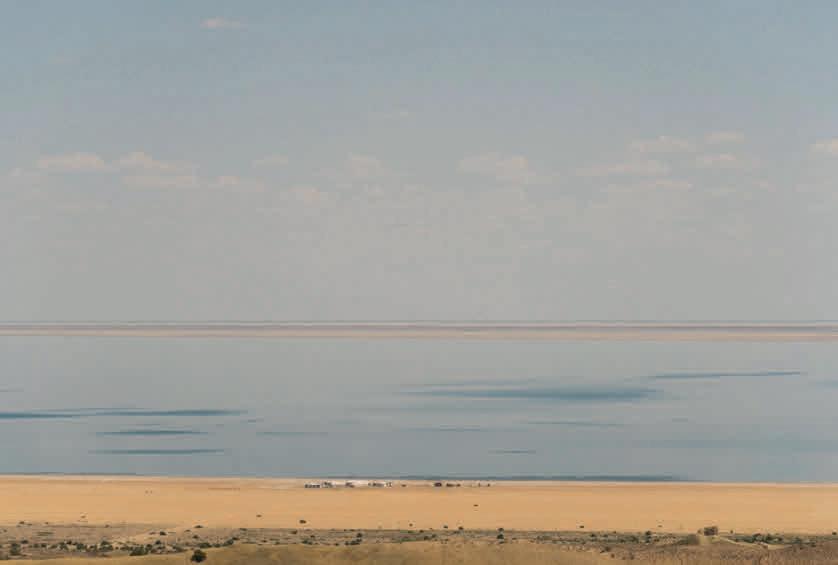
Aral Sea, August 2023. Courtesy of ACDF
inhabitants: the loss of jobs, traditions and species diversity; spiking cancer rates due to the inhalation of toxic sands; and the erasure of a landscape that once anchored daily life, memory and belonging.
Despite the magnitude of this environmental disaster, the diminishing Aral Sea has not become a sustained subject of literary and humanistic inquiry in the same way that other ravished landscapes, like the Amazon or the American West, have. As Nixon argues in Slow Violence and the Environmentalism of the Poor, slow-acting forms of violence such as those faced in the Aral region ‘pose formidable imaginative difficulties for writers and activists alike’.5 Uzbekistan’s pavilion at the 2026 Venice Biennale begins to bridge this gap by adopting a speculative, narrative approach to exhibition-making that engages the crisis through imagination rather than statistics. Collectively curated by five young international curators, including two from Uzbekistan, ‘The Aural Sea’ is the closing project for the inaugural cohort of the Bukhara Biennial Curatorial School and is commissioned by Gayane Umerova. ‘The Aural Sea’ grew out of a close, collective study of the material cultures of the Karakalpak people of northwestern Uzbekistan, who in the 18th century settled on the shores of the Aral Sea. Traditions such as the ‘epic tale’ sparked the curators’
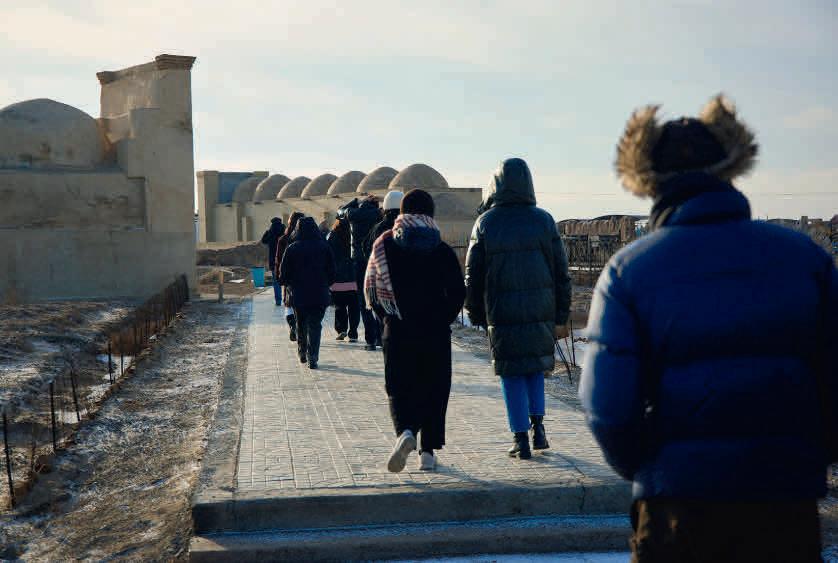
Field trip to the Aral Sea, February 2026
interest in alternative forms of knowledge production and transmission. Accordingly, the exhibition takes inspiration from the work of the young Karakalpak author Allayar Darmenov, who began writing about the Aral Sea in 2015, drawing upon the realms of fabulation and myth-making to imagine possible futures rather than chronicling environmental devastation. Their encounters
with his writing nurtured an approach driven by the transformative power of ‘fictioning’, myth and collective world-building. As Aziza Izamova – who is part of the curatorial team – noted in our recent conversation, ‘fiction is a way to redirect the gaze and shift the perspective’.6
Largely working with artists of their own generation, the curators have assembled a constellation of practices that span installation, interactive work and painting. Pavilion artists approach the Aral Sea not as a problem to be solved, but as a site of knowledge. Zi Kakhramonova’s interactive Lost Form Archive (2026) presents a crystallized salt labyrinth embedded with creatures of the Aral Sea, while sculptural works by Nguyễn Phương Linh and Xin Liu adopt a poly-temporal approach to landscape and its afterimage. Mythologically-inflected paintings by Aygul Sarsen reimagine the metamorphosis of Aral creatures and symbolic elements of the sea. In Zulfiya Spowart’s
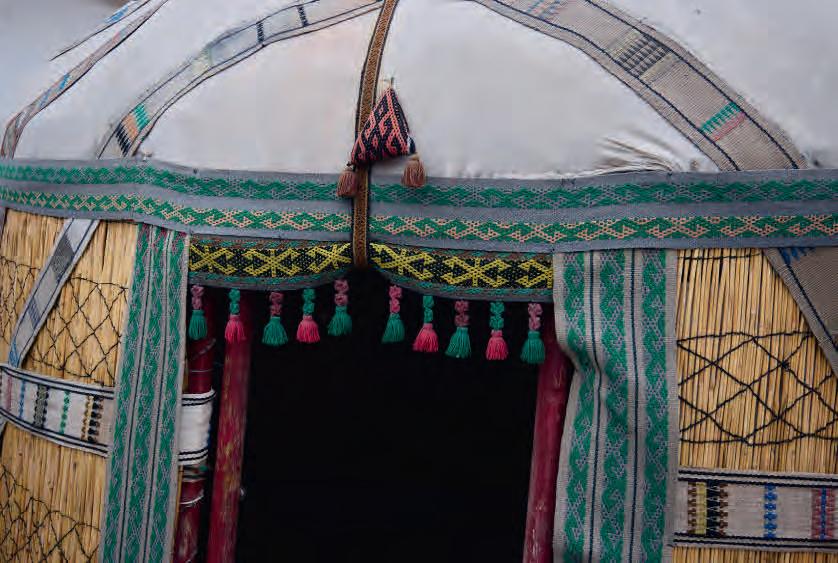
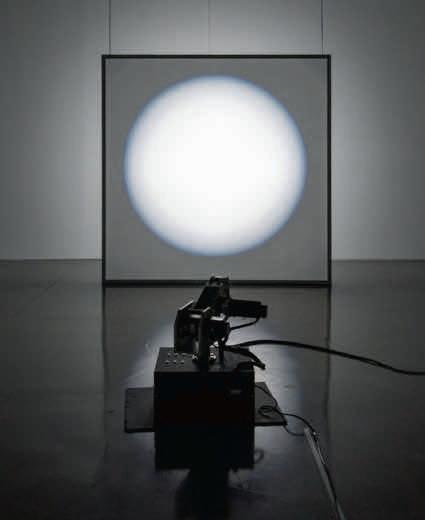
immersive installation Untitled (The Cradle) (2026), wood carvings, textile sculptures, and a beshik cradle echo local myths related to motherhood. Algorithmic shell patterns native to the region form the basis of a large-scale textile work by A.A.Murakami, while an abstract painting of light by Jahongir Bobokulov, titled The Orb (2026) with its hazy layers of yellows, oranges and grey imparts the sense of a smoggy eclipse. Through opening aesthetic spaces that allow seepage between geological pasts and futures, while also melding the legacies of local folklore and future-oriented myth-making, the pavilion’s artists propose a form of witnessing and listening that enables varying timescales, bodies of knowledge and sensory worlds to come together.
All photographs: courtesy of ACDF; © Amir Melikov
Following Nixon, their confrontations with ‘slow violence’ allow ‘formless threats’ to come to the surface, embodying ‘amorphous calamities’ 7 while nonetheless setting their sights towards rewriting the future through the fantastical, speculative space of myth.
In a cultural moment where sensationalistic images and narratives of singular, dramatic events momentarily bombard our fractured attention before giving way to the next crisis, might the more amorphous, processual qualities of myth and storytelling provide a different model of speed – a form of slowness that activates imagination, community, lost pasts and new futures? While Amitav Ghosh has argued in The Great Derangement that surreal or magical approaches risk obscuring that the uncanniness of climate catastrophe is in fact very much real, such a position may underestimate the recuperative force of myths.8 If the climate crisis is also a crisis of culture, then symbolic and speculative modes of storytelling are not evasions of reality, but tools for reorienting perception and agency.
Myth-making has long functioned as a cultural technology for metabolising ecological rupture. The tales of floods found across Mesopotamian, biblical, Hindu and Indigenous traditions, for instance, likely encode collective memory of cataclysmic events. Their persistence suggests that narrative does not merely embellish environmental change – it preserves, processes and transmits it across generations. The retelling of such tales becomes a way of binding past catastrophes to future possibilities. ‘In “The Aural Sea”, mythmaking and storytelling become ways of coping with environmental change and imagining futures beyond what is immediately visible’, reads the curatorial team’s statement.9 Imagination is therefore not understood as escape, ‘but as agency, one that allows artists to work through transformation and possibility’. Such imaginative and narrative practices cultivate a mode of attention attuned not only to human experience but also to the more-than-human world. This reflects the exhibition’s ethos of relational listening – a stance poetically echoed in the Uzbek saying: ‘tell your dreams to the water’. This saying implies a two-way relationship: not only are you listening to nature, but the sea, in turn, is also listening to you.
JESI KHADIVI is a curator and writer. She lives in Berlin, Germany.
1 Rob Nixon, Slow Violence and the Environmentalism of the Poor, 2011, Harvard University Press, Cambridge, USA, p. 2
2 Fangdi Sun & Ronghua Ma, ‘Hydrologic changes of Aral Sea: A reveal by the combination of radar altimeter data and optical images’, 14 June 2019, https://www.tandfonline.com/doi/ full/10.1080/19475683.2019.1626909#abstract
3 Dene-Hern Chen, ‘The country that brought a sea back to life’, 23 July 2018, https://www.bbc. co.uk/future/article/20180719-how-kazakhstanbrought-the-aral-sea-back-to-life
4 Sun & Ma, 2019
5 Nixon, 2011, p. 10
6 Aziza Izamova, conversation with the author, 27 February 2026.
7 Nixon, 2011, p. 10
8 Amitav Ghosh, The Great Derangement, 2016, The University of Chicago Press, Chicago, USA, p. 27
9 Curatorial statement quoted in the press release for the Uzbekistan National Pavilion at the 61st International Art Exhibition – La Biennale di Venezia, 2026
Participating Artists
JAHONGIR BOBOKULOV (b. 1996 in Bukhara, Uzbekistan; lives and works in Tashkent, Uzbekistan)
Jahongir Bobokulov explores the interplay of space and air. After years of experimenting with materials and techniques, he alighted on the use of polyurethane foam in place of canvas. Applying colour with an airbrush, Bobokulov creates ethereal compositions that reflect his perception of spatial depth and atmosphere. While much of his work is abstract, he has also developed a series inspired by the vernacular architecture of his native Bukhara, capturing the sun-drenched textures of its ancient alleyways. Of showing in Venice, Bobokulov explains, ‘The city has long been a meeting point for cultures, histories and artistic ideas. Presenting my work here, alongside artists from many parts of the world, is an opportunity to share my perspective while becoming part of a wider dialogue about art and our time’.
ZI KAKHRAMONOVA (b. 2001 in Tashkent, Uzbekistan; lives and works in Tashkent)
Zi Kakhramonova is a multidisciplinary artist and theatre designer. Informed by a deep interest in mythology, feminist perspectives and embodied experience, her practice spans performance, puppetry, digital animation, textiles and set design, and examines taboos surrounding the body. Kakhramonova draws on Central and East Asian ornament, traditional techniques such as woodblock printing on textiles, as well as urban research in order to create visual narratives that merge folklore and contemporary life. Kakhramonova’s work for the pavilion is an interactive project, in which, she explains, ‘Salt becomes the primary medium of engagement. It is transformed into a building material, whereby visitors can use ceramic moulds to create the shapes of extinct endemic species from the Aral Sea out of salt. In this act, biological memory meets mineral inevitability and salt acts not as a symbol of loss, but as an active agent – a substance in a state of cyclical movement, of constant crystallisation, formation and decay’.
XIN LIU (b. 1991 in Xinjiang, China; lives and works in London, United Kingdom)
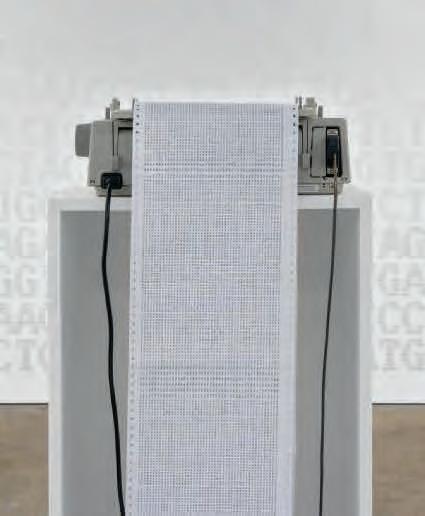
Xin Liu is a London-based artist working across art, science and engineering. Her practice explores the material and entropic aftermath of scientific and technological developments, examining rocket debris, cryogenic preservation, genomic code and self-obsolescing satellites. Liu describes her continuing research as ‘Cosmic Metabolism’. In Venice she presents a work from her ongoing series ‘The Permanent and the Insatiable.’ Of the pavilion’s theme she observes, ‘The Aral Sea resonates with questions that have been central to my work for a long time: how materials, technologies and environments are pushed to their limits through human ambition. Growing up in a resource-dependent city shaped how I think about places whose futures feel like a kind of countdown. The Aral Sea becomes a powerful site through which to think about the life cycles of materials and the feedback loops between human systems and ecological change.’
A.A.MURAKAMI (Alexander Groves: b. 1983 in London, United Kingdom; Azusa Murakami: b. 1984 in Gifu, Japan; both based in Hayama, Japan)
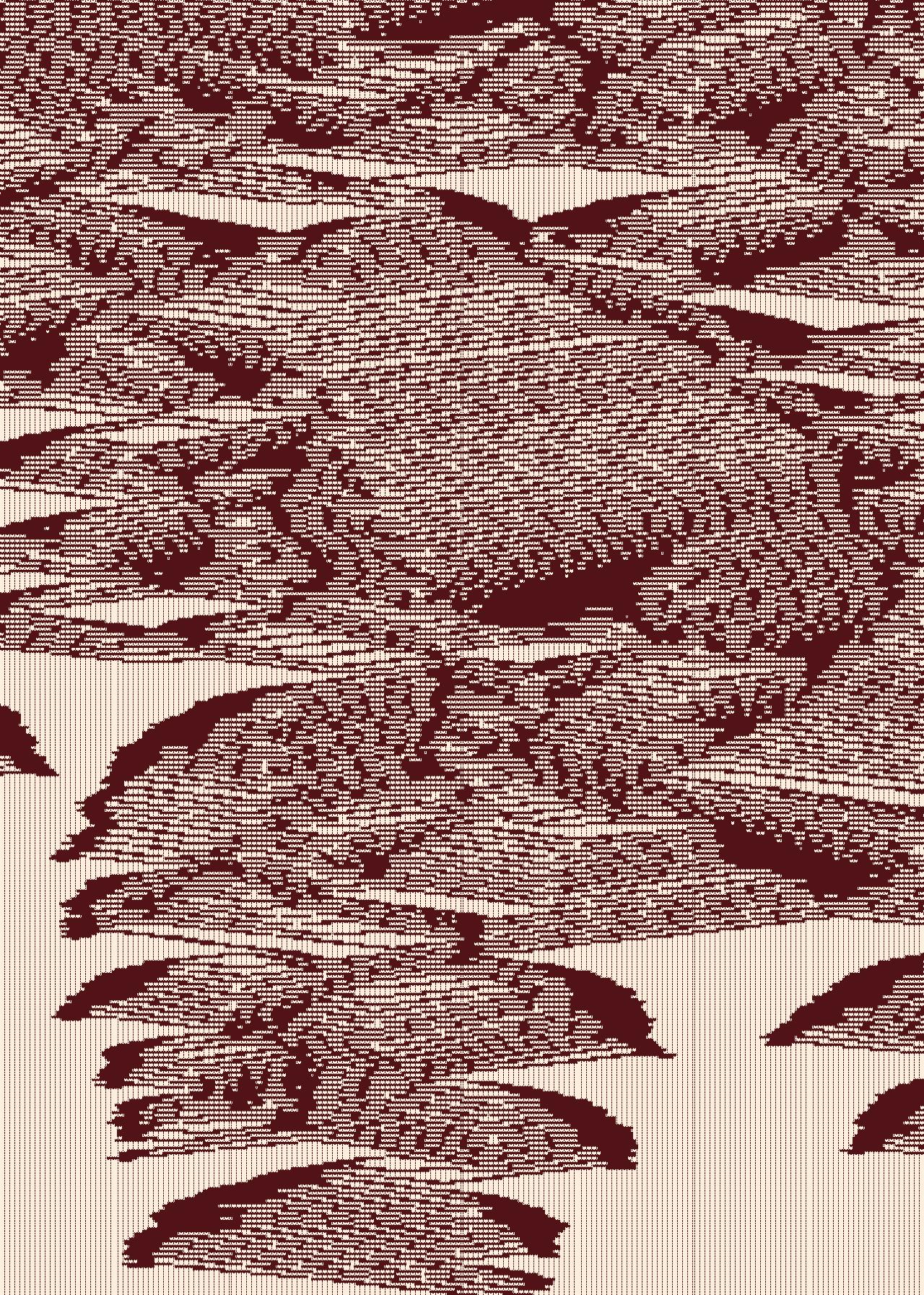
Since 2020, the artist duo A.A.Murakami has created immersive installations that fuse art and science in the ongoing ‘Ephemeral Tech’ series. Merging their own invented technologies with ephemeral materials, they produce multisensory experiences that conjure unnatural phenomena, inviting audiences into poetic encounters with time, nature and perception. Much of their work explores the fleeting phenomena of the natural world and, in Venice, they are showing a large tapestry whose pattern is taken from shells found on the seabed of what was once the Aral Sea. As they explain, ‘The pattern was generated through a process that echoes the way these markings emerge in nature, hovering between order and chaos. In this sense the work reflects on how natural systems record time through pattern, leaving behind traces of life long after the environment that produced them has disappeared’.
NGUYỄN PHƯƠNG LINH (b. 1985 in Hanoi, Vietnam; lives and works in Hanoi)
For Nguyễn Phương Linh, ‘Showing in Venice means sharing my roots, my personal story from Vietnam, while also engaging with the concerns of artists from around the world in our present time. I feel deeply moved to be able to share my contemplation on the human condition as someone belonging to a generation born after the war in Vietnam, yet one that has never fully lived in peace, still carrying inherited traumas’. On her travels Linh collects artefacts, subsequently transforming them in order to explore alternative interpretations of ambiguous and fragmented histories, memories and personal narratives. Her new work for the Uzbekistan pavilion was inspired by the landscape of the Aral Sea, which she describes as ‘once a vast body of water, now a young desert.’ Linh adds, ‘For me, landscape is never neutral; it bears the marks of time, geopolitics and power’.
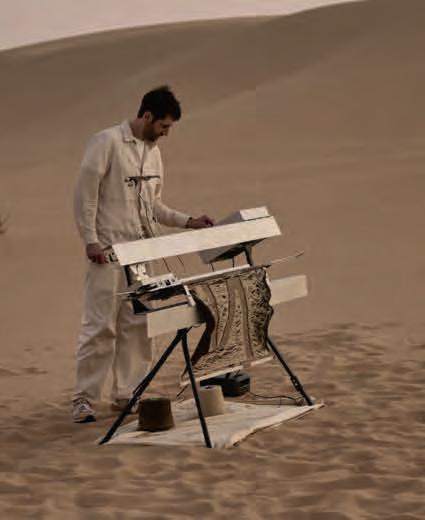
Clockwise from top right: Xin Liu, Book of Mine, 2025
A.A.Murakami, A Thousand Layers of Stomach, 2025 Photograph: PETR&Co. (Adam Jirat / Adam Kovar); Supported by TRAME
Nguyễn Phương Linh & Trương Quế Chi, Sourceless Water: Whip. Knife, MoCA Busan, Busan Biennial, 2024
Zi Kakhramonova, Fairy Tale Project (detail), 2024
Jahongir Bobokulov, Untitled (detail), 2021–24
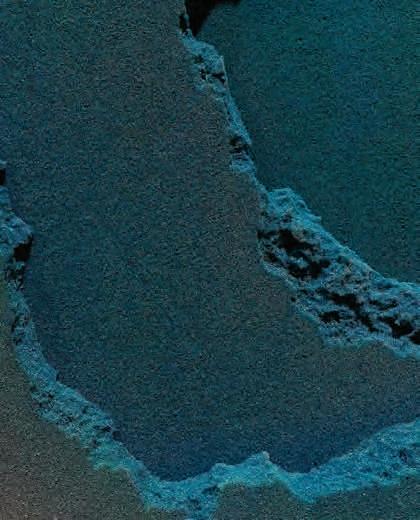
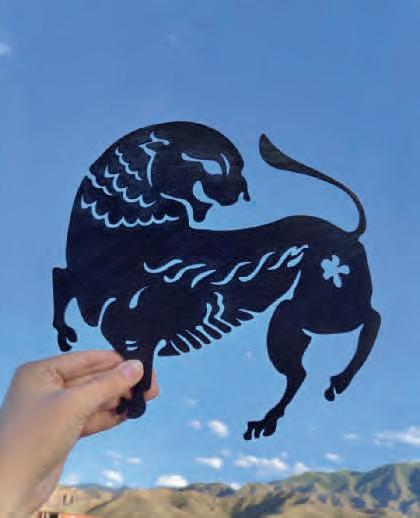
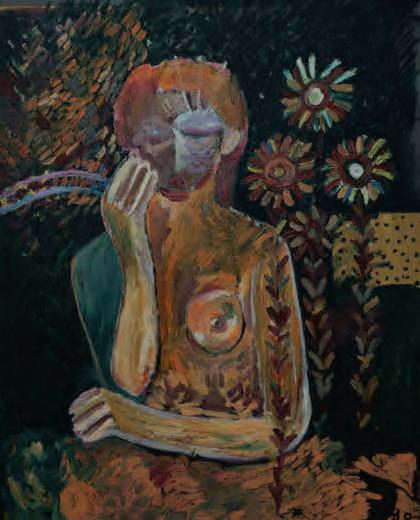
Above: Aygul Sarsen, Untitled, 2026
Right: Zulfiya Spowart, Beshik, 2024 Photograph: B J Deakin Photography
AYGUL SARSEN (b. 2005 in Nukus, Karakalpakstan; lives and works in Nukus)
Aygul Sarsen is a painter and third-year student in the Faculty of Applied Decorative Arts at Karakalpak State University. In her multimedia installations, she embraces form, colour and fluidity. Her painting explores inner freedom and the desire to expand familial boundaries, seeking to elicit an emotional response from viewers. Her approach to painting has evolved as she has prepared for this presentation in Venice; on the advice of the curators, she has begun to incorporate preliminary sketches into her process. Considering the theme of the pavilion, Sarsen observes, ‘The drying of the Aral Sea is deeply disappointing and painful for everyone in our region. In my painting, the central figure is a woman sitting and looking at her hands in a gesture of helplessness. And yet the flowers symbolise hope – the hope that the Aral Sea might one day return’.
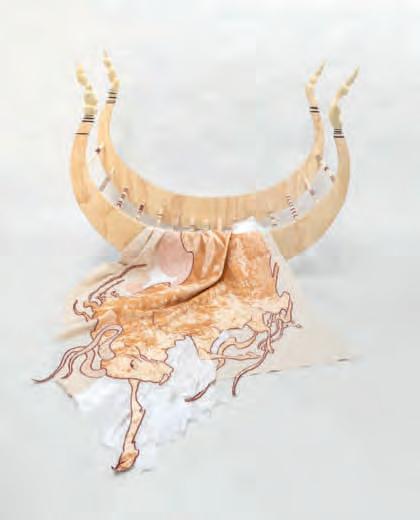
ZULFIYA SPOWART (b. 1991 in Tashkent, Uzbek istan; lives and works in London, United Kingdom)
Rooted in the reinterpretation of mural techniques, Zulfiya Spowart’s multidisciplinary practice expands to include naturally dyed textiles, wood carving, watercolour and digital art. Discussing the focus of the pavilion, Spowart asserts, ‘The ecological crisis is often perceived as an abstract phenomenon, yet the desiccation of the Aral Sea is reflected in everyday life – the disappearance of water profoundly affects local communities. In my practice, I explore the relationship between macro-history and personal narratives connected to motherhood – an experience which inevitably shifts one’s perspective toward the future and the question of what kind of world we will leave to the next generation. The Aral Sea may never be restored to its former state, and therefore attention shifts from the idea of restoration to the search for alternative forms of coexistence with a transformed landscape, and to ways of sustaining life in the region’.
Participating Curators
This year’s Uzbekistan Pavilion has been curated by five women selected from the inaugural cohort from the Bukhara Biennial Curatorial School (BBBB). The school was held during the first BBBB, which was staged across the city’s historic sites in September–November 2025. Led by BBBB Artistic Director Diana Campbell in collaboration with Aaron Cezar of the Delfina Foundation, its goal was to provide the next generation of curators – from Uzbekistan and Asia – with an opportunity to collaborate, engage in critical debate and forge professional relationships with their peers. International faculty members included Carolyn ChristovBakargiev, Sunjung Kim, Eungie Jo and Beatrix Ruf, among others. Having undertaken a field trip to the Aral Sea in February this year, the chosen group worked together with six invited artists to stage this year’s presentation, ‘The Aural Sea’.
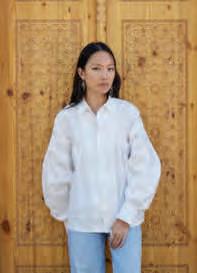
THÁI HÀ (b. 1996 in Hanoi, Vietnam; lives and works in Ho Chi Minh City, Vietnam and Tokyo, Japan)
Thái Hà explores speculative world-building, post-apocalyptic aesthetics and what emerges from
colonial and capitalist ruins. A curator, writer and translator, she has presented her work at museums and biennials including the Barbican Centre, London (2018) and the 58th Carnegie International, Pittsburgh (2021). Hà has participated in a residency at Cittadellarte–Fondazione Pistoletto, Biella, Italy (2024) and the 12th Berlin Biennale Curator’s Workshop (2022) and has held curatorial roles at Nguyễn Art Foundation and Galerie Quynh, both in Ho Chi Minh City.
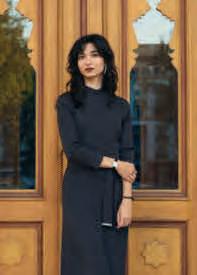
AZIZA IZAMOVA (b. 1997 in Tashkent, Uzbekistan; lives and works in Tashkent and Boston, USA)
Art historian Aziza Izamova focuses on modern art in Europe and Soviet Central Asia; her dissertation ‘Handmade Modernity: Textile Production and Artistic Labor in Soviet Uzbekistan’ examines the institutionalisation of textile craft in early Soviet Uzbekistan. Izamova’s research has been supported by the Mellon/ACLS Dissertation Innovation Fellowship, the Frederick Sheldon Traveling Fellowship, the Aga Khan Program for Islamic Architecture, and the Davis Center for Russian and Eurasian Studies.
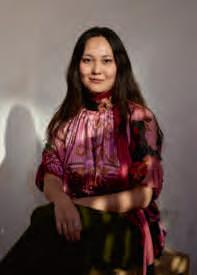
SOPHIE MAYUKO ARNI
(b. 1995 in Geneva, Switzerland; lives and works in Tokyo, Japan and Abu Dhabi, UAE) An advocate for East-meetsEast dialogues, most of Sophie Mayuko Arni’s curatorial work has connected the Arabian Gulf and Japan with new visions of heritage, architecture, ecology and technology. She has worked with Startbahn’s SRR Project Space, Tokyo; Pico International, Dubai; Noor Riyadh, the world’s largest light art festival; The Third Line, Dubai; and Louvre Abu Dhabi. Mayuko Arni is also the founding editor of Global Art Daily, a digital publication born in Abu Dhabi archiving the Gulf’s contemporary art scenes in a global context.
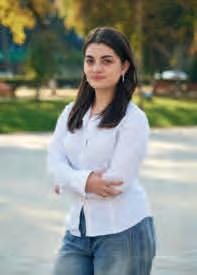
KAMILA MUKHITDINOVA
(b. 2003 in Tashkent, Uzbekistan; lives and works in Tashkent)
Kamila Mukhitdinova’s architectural background has shaped her interest in space as a social and cultural medium that structures everyday life and social interaction. She approaches curating as a way to address social
questions through space and art, and to create platforms for dialogue and collective exchange. Her practice is situated at the intersection of architecture, contemporary art and social research, with a focus on space as a site where identities and collective experience are shaped and negotiated.
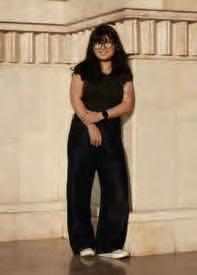
NICO SUN (孙晓彤 )
(b. 1998 in Ürümqi, China; lives and works in Shanghai, China and Ürümqi)
Nico Sun is a curator and producer focusing on how traditional cultural practices in Central Asia, including music and storytelling, can be reactivated and reimagined within contemporary artistic contexts. Working within a range of settings including art spaces, theatre and large-scale events, her projects often engage interdisciplinary collaborations between artists, artisans and local communities, spanning performance, textiles and photography. Interested in long-term, collaborative and process-oriented approaches, Sun’s projects examine the continuous negotiations between cultural memory, identity and embodied knowledge.
Vyacheslav Akhunov
There are artists who shaped their era in silence, unseen by the institutions that were shaped by them. Vyacheslav Akhunov is one of the great ones. At the heart of our foundation’s mission is a simple conviction: that geography should never determine legacy. Akhunov spent decades creating in isolation, denied the international stage his work demanded – yet his practice remains urgent, subversive and luminously human. To bring ‘Instruments of the Mind’ to Palazzo Franchetti, in the very city that twice displayed his art without him, is an act of restitution as much as celebration. Venice is the world’s most discerning stage, and this exhibition arrives on it not as a discovery, but as a long-overdue recognition of a master who was always already here.
GAYANE UMEROVA Commissioner of Vyacheslav Akhunov’s ‘Instruments of the Mind’ and Chairperson of the Uzbekistan Art and Culture Development Foundation (ACDF)
Over a cheap reproduction of an oil painting depicting the Moscow skyline, ‘The victory of communism is inevitable’ is written in red, slanted scrawl, filling the entire image. It’s one of a series of tongue-in-cheek détournements of Soviet-produced printed material by Vyacheslav Akhunov on display in his exhibition ‘Instruments of the Mind’, organized by the Centre for Contemporary Arts Tashkent at Palazzo Franchetti in Venice. Spanning 50 years of the pioneering Uzbek artist’s practice, the show seeks to affirm Akhunov’s status as the founding father of conceptual art in the region.
‘There really hasn’t been anyone like him,’ says co-curator of the exhibition Dr. Sara Raza, who explains that while many of his contemporaries – such as Russian conceptual artists Vitaly Komar and Erik Bulatov – were able to travel legitimately, Akhunov remained behind the Iron Curtain for much of his life. Even after the dissolution of the USSR, he was not permitted to see his work presented at major international exhibitions, including Documenta 13 (2012) in Kassel, Germany, and the 55th Venice Biennale (2013).
Many of the pieces in the show speak to these life circumstances. Alongside his ‘Mantra’ series from the 1970s and 1980s, several never-beforerealised works developed from Akhunov’s sketchbooks – often his only way of creating art during the Soviet era due to fear of persecution – will be presented for the first time. The Slit (Light at the End of the Path) (1982), for instance, comprises a dark, narrow passageway leading towards an intense beam of light that viewers observe from above. Referring to the saying ‘light at the end of the tunnel’, the installation can be seen to reflect the artist’s geographical and intellectual isolation throughout his life while hinting at better times to come.
Despite the obvious limitations and frustrations of living under Communist rule, Akhunov’s practice is suffused with absurdist humour. Another installation realized for the exhibition, Triumphal Arch, conceived in 1979–80, pokes fun at the Soviet-era love of ribbon cutting ceremonies – a state ritual celebrating the completion of new infrastructure projects. Here, a four-metretall arch is studded with scissors, poised and ready to puncture the inflated egos behind such pageantry while also highlighting the dangers of propaganda writ large.
Ultimately, in an age of creeping authoritarianism and increased threats to free speech, ‘Instruments of the Mind’ offers a case study in quiet resistance and perseverance. As the artist himself explained in a statement: ‘“Instruments of the Mind” is not about the past – it is about how thought survives.’
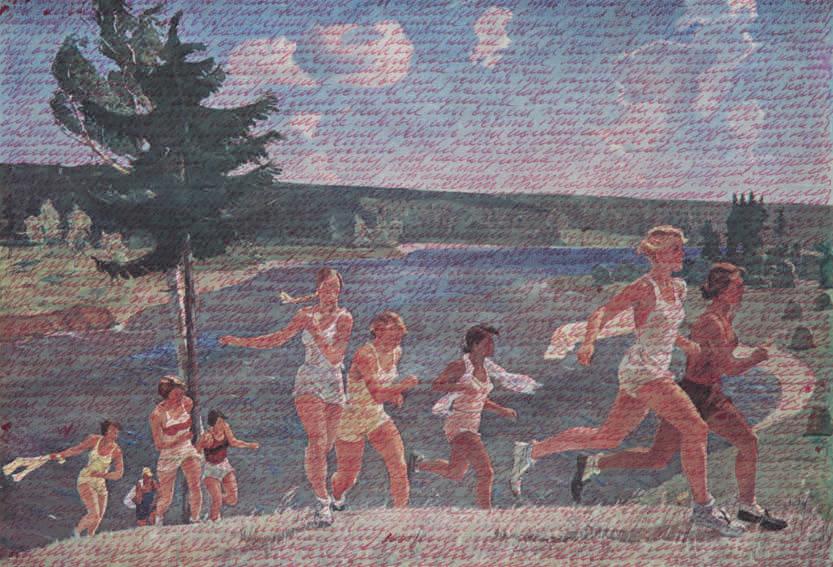
Vyacheslav Akhunov, We live under communism, 1978
CHLOE STEAD is associate editor of frieze. She lives in Berlin, Germany.
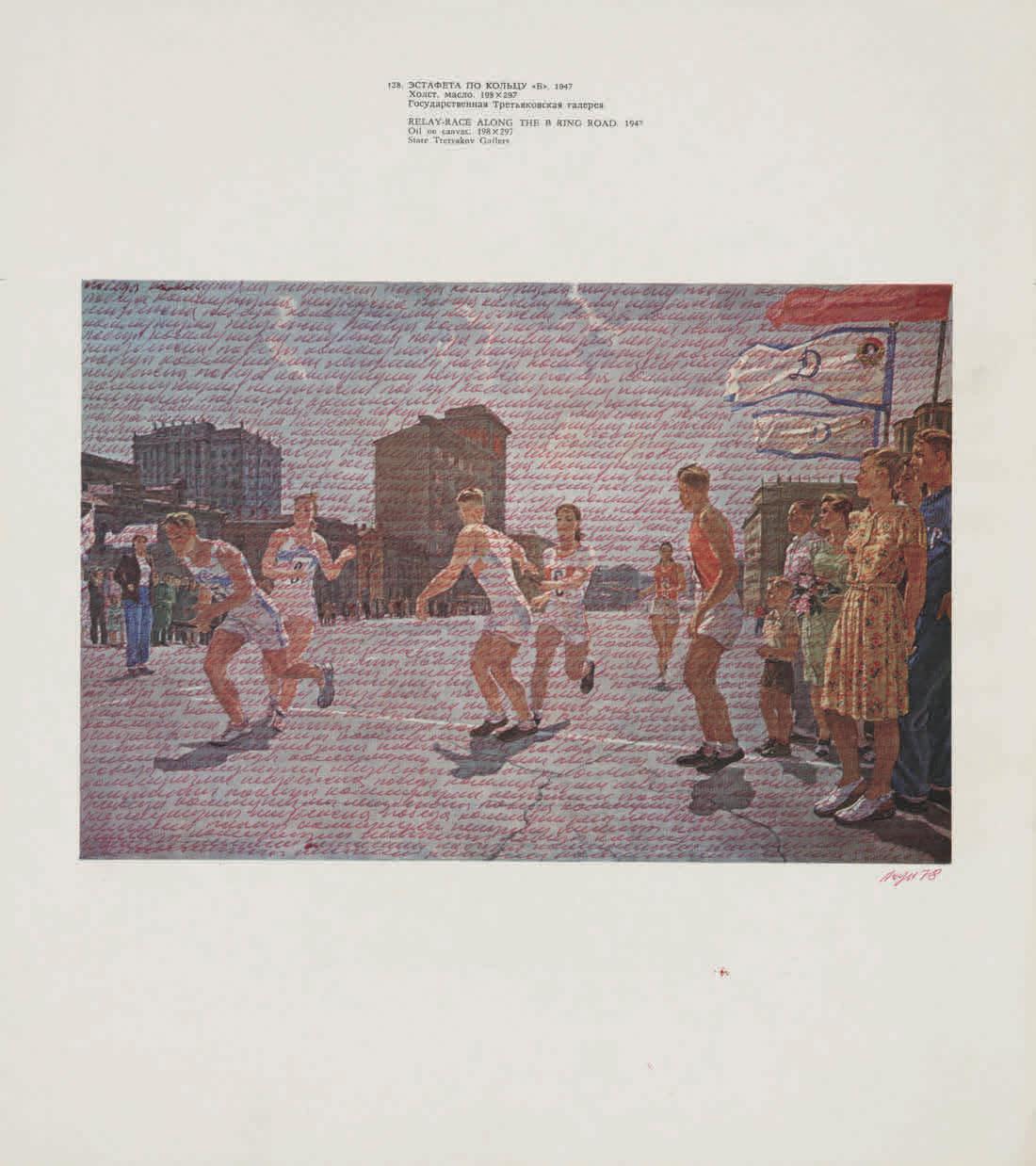
Vyacheslav Akhunov, The victory of communism is inevitable, 1978
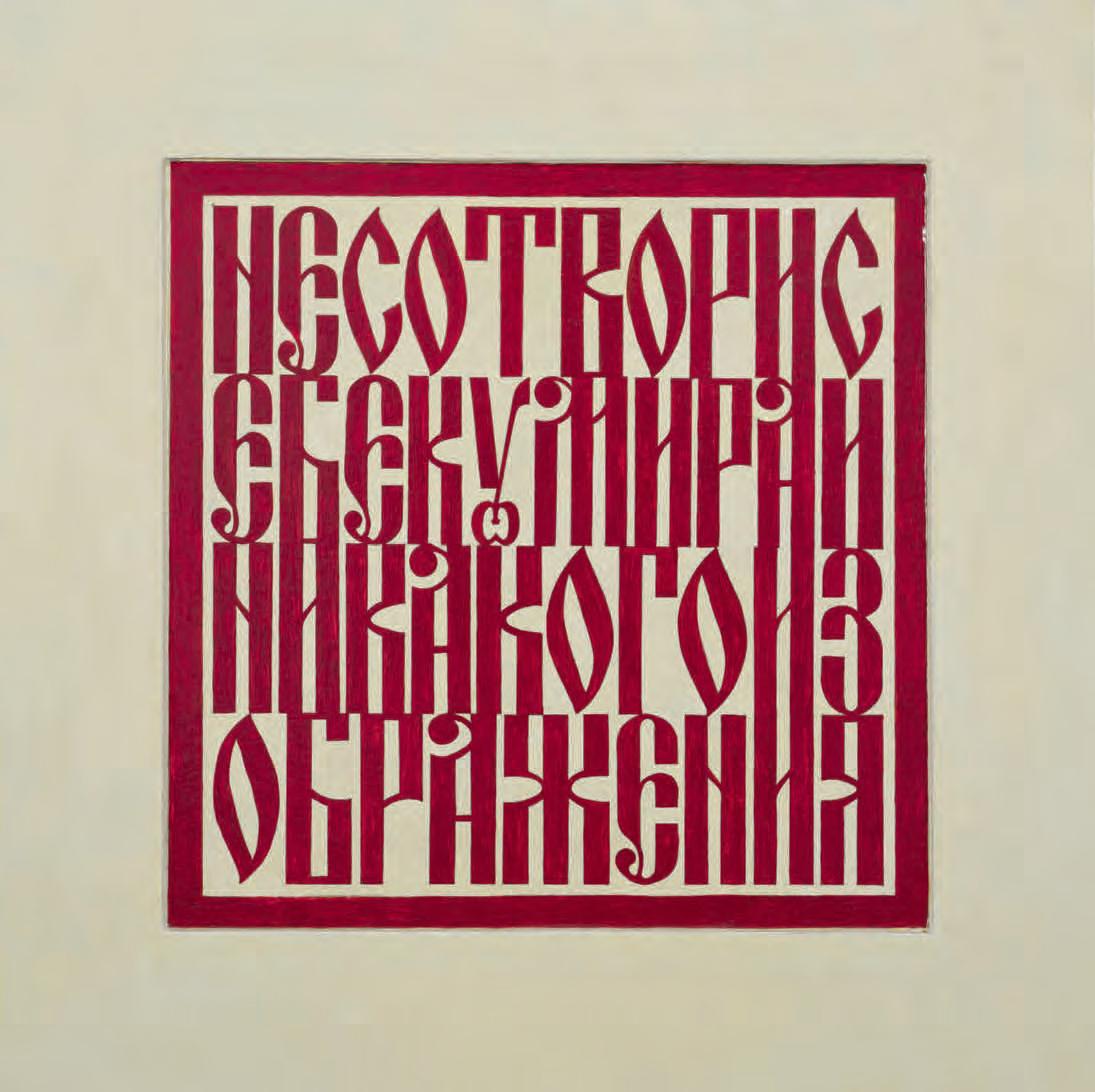
Vyacheslav Akhunov, Thou shalt not make unto thee any graven image, 1974
All photographs: courtesy Uzbekistan ACDF; © Vyacheslav Akhunov
INTERVIEW Gayane Umerova
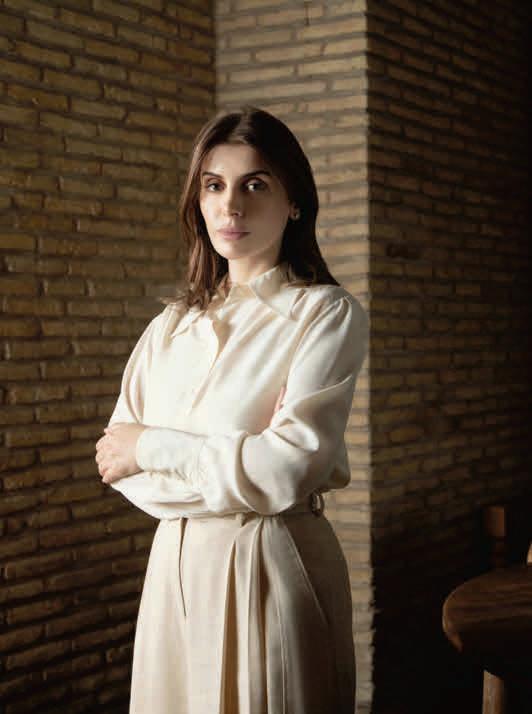
Our foundation has been circling these questions for years – building, slowly and with intention, a body of work that holds together ecology, memory and creative practice. The Aral Culture Summit, which convenes in Nukus, has brought artists, researchers and craftspeople into conversation around what is being lost and what, against all odds, endures. We have published; we have run workshops with young people in the region. We have tried, in every way available to us, to make culture the language through which an ecological catastrophe might be understood –and perhaps, eventually, transformed.
The Aral Sea and the Karakalpakstan region have been living a disaster for decades. What was once one of the world’s great lakes has become a spectre of what it once was – and the communities around it have been left to carry that grief largely in silence. Our ambition, through the arts and through craft, has been to restore a sense of agency to the young generation there; to offer ecological education not as a lecture, but as an invitation. That is how the Aral School came into being – an interdisciplinary programme rooted in place, in making, in asking difficult questions together.
It was a natural progression, then, that this work should find its way to Venice. ‘The Aural Sea’ is our attempt to open that world to a global audience: to bring its societal weight, its emotional textures, its collective memory and mythology into a space where they might truly be felt. When Koyo Kouoh spoke of sensory and emotional experience as the animating force of this Biennale, I felt immediately that we were aligned. This is not an exhibition about data or policy. It is about what it means to lose something irreplaceable – and to refuse, nonetheless, to stop imagining.
cp Can you expand a little on the disasters this region is facing?
gu The Aral Sea was the lifeblood of the region – food, water, employment, identity. Its decline was set in motion during the Soviet period, when the rivers feeding it were diverted to sustain vast cotton monocultures. Uzbekistan is, in many ways, a country of extraordinary natural abundance – mountains, orchards, rich agricultural land – but it is also landlocked and water-scarce. The Soviet logic of maximising cotton yield placed enormous strain on that fragility.
CASSIE PACKARD I’d love to hear about how you arrived at ‘The Aural Sea’ theme for the national pavilion, and how it relates to the overarching subject of this year’s biennial.
GAYANE UMEROVA Venice has always been, for us, something more than an exhibition opportunity. It is a moment of genuine responsibility – each time we ask ourselves the same questions: What do we truly wish to say about where Uzbekistan stands? What is it grieving and what is it reaching towards? This year, the answer came with a certain urgency. It had to be the Aral Sea.
What remains today is both haunting and strangely beautiful. Ships sit marooned in the sand – a graveyard of a former world. There have been ecosystem restoration efforts, and they are not without meaning, but no one speaks seriously of returning the sea to what it was. What concerns me more immediately is the exodus of the young. When a place loses its ecological identity, it loses its gravitational pull. We need to give people a reason – and a feeling – of belonging again. That is the core of what we are trying to do.
cp Tell me about the Bukhara Biennial Curatorial School, whose current cohort is curating the pavilion.
Photograph: courtesy Nafisa Parpieva and Uzbekistan ACDF
gu During the inaugural Bukhara Biennial, we were very deliberate about not simply producing an event – we wanted to build a generation. The curatorial school emerged from that impulse: a structured programme, developed in partnership with Diana Campbell and the Delfina Foundation in London, designed to give young curators a real professional framework, not just exposure. From that cohort, we identified five extraordinary women to lead the Venice pavilion: Sophie Mayuko Arni, Kamila Mukhitdinova, Nico Sun, Thái Hà, and Aziza Izamova. They come from Uzbekistan, Vietnam, China and Japan. Their differences – in emphasis, in sensibility, in the questions they bring – are not incidental. They are the point. The curatorial intelligence of this pavilion is genuinely plural, and I find that thrilling.
cp And how were the artists selected?
gu We held firm to a number of convictions. We wanted to give meaningful presence to emerging artists from the region – Jahongir Bobokulov, Zi Kakhramonova, Aygul Sarsen, Zulfiya Spowart – artists whose relationships to these landscapes and histories are lived rather than observed. At the same time, we opened the selection internationally to include A.A.Murakami, Nguyễn Phương Linh and Xin Liu – in part to mirror our curatorial team, and in part because the ecological questions we are raising belong to no single geography. Some works were pre-existing, resonant with what we were building; others were commissioned. The spatial presentation itself was entrusted to young Uzbek architects, working alongside Grace Studio from Milan – collaborators who curated the presentation of the Uzbekistan Pavilion at the last Architecture Biennale, and with whom we share a long research partnership through ‘Tashkent Modernism XX/XXI’.
cp As you’ve mentioned, the curatorial team for the Uzbekistan pavilion came out of an initiative associated with the inaugural Bukhara Biennial. Can you tell me more about how that biennial went?
gu I am genuinely proud of what it became. We drew close to two million visitors – local and international – and it was the local audience that moved me most. Uzbekistan’s contemporary scene is still in formation; to inspire something in the order of a million people from across the country to travel to an arts event felt, to me, like evidence of a real hunger. People are ready. They want this.
The biennial was woven into residential districts of the city, not cordoned off from them. We needed the people of Bukhara to feel it was theirs – and I believe they did. The pairing of artists with artisans was, I think, the most generative thing we did. It changed how the artisans saw their own practice. That kind of shift doesn’t announce itself; it just settles in, and eventually, it changes everything.
cp How do both the Bukhara Biennial and the Venice Biennale fit into your long-term vision for culture in Uzbekistan?
gu At the deepest level, it is about empowerment – giving young people genuine choices, genuine futures. I want Uzbekistan to be a place where a young person can build a life in the arts, in curatorial practice, in craft, in architecture, without having to leave to do it. That requires infrastructure – museums, institutions, platforms – but it also requires something less tangible: the belief that your culture is worth preserving, worth contributing to, worth sharing with the world. We are asking people to be proud without being insular. To protect their heritage while remaining curious and open. That is a delicate balance, and culture – more than anything else I know – is the space where it can actually be held.
cp You also have another off-site project planned at Palazzo Franchetti.
gu Yes – and this one is especially close to my heart. We will be presenting the first exhibition outside Uzbekistan for Vyacheslav Akhunov, whose most vital and productive period spans the 1970s and 1980s. That work has waited long enough for the recognition it deserves. Venice felt like the right moment, and the right audience. And then there is something else – something I have been waiting four years to say. The Centre for Contemporary Arts Tashkent will finally open this year. It occupies a building from 1912, a former diesel station and tram depot, in the heart of the city’s university quarter. We have been working with Paris-based Studio KO on its transformation. It is state-owned, and it is the first centre for contemporary art in Uzbekistan. The inaugural exhibition, ‘Hikmah’ – an Arabic word meaning wisdom – brings together artists from Europe, Korea, Saudi Arabia and Uzbekistan in a conversation across cultures.
This is not simply another opening. It is, for our foundation and for Uzbekistan’s cultural life, a genuine turning point and the culmination of years of work.
CASSIE PACKARD is a writer and assistant editor of frieze. She lives in New York, USA.
GAYANE UMEROVA is Chairperson of the Uzbekistan Art and Culture Development Foundation.
Uzbekistan National Pavilion: The Aural Sea
9 May–22 November 2026
Arsenale: Quarto Tesa, Castello 30122
Entrance via Ramo della Tana
@uzbekistan_national_pavilion
@acdfuz
Vyacheslav Akhunov: Instruments of the Mind
7 May–22 November 2026
Palazzo Cavalli Franchetti, San Marco 2842
Entrance via Campo San Vidal
@cca_tashkent
This publication was commissioned by the Uzbekistan Art and Culture Development Foundation (ACDF)
Chairperson
Gayane Umerova
Produced by Frieze Studios
Editor & Creative Director, Frieze Studios
Matthew McLean
Project Editor
Sara Harrison
Graphic Designer
Chris Lacy
Content Operations Manager
Rosalind Furness
Publisher Lisa Gersdorf
Director, Frieze Studios
Francesca Girelli
Special thanks to the ACDF team, including: Zarif Kulmatov, Nadira Siddikova, Anastasia Sinitsyna and Cyril Zammit
Cover image: A.A.Murakami, The Sun sets in a shell (detail), 2026