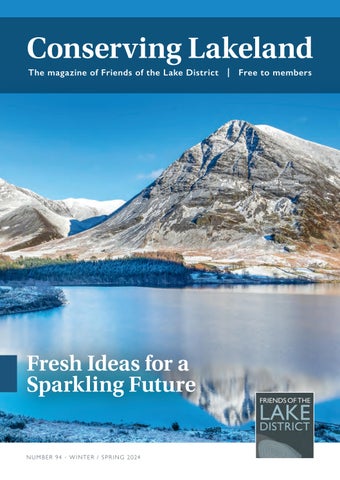
Conserving Lakeland The magazine of Friends of the Lake District | Free to members
Fresh Ideas for a Sparkling Future N U M B E R 94 - W I N T E R / S P R I N G 2 0 24
Conserving Lakeland
02
Contents 03 From the Chief Executive 04 Buttermere Fell Care Day Nurtured by Nature Project Update
04
05
Power Lines Undergrounded Across Cumbrian Protected Landscapes 06 Planning News Round-Up 07 Our Good Lighting Guide Wins National Awards 08 National Park Societies Annual Conference Kirby Lecture 2023: Fresh Ideas for a Sparkling Future
06
09 Chair’s Comment 10 Policy Update 12 Westmorland Dales Scheme Update 14 Land Manager’s Report 16 Dark Skies Cumbria 18 Transformational Volunteering
12
14
17
20
19 Book Review 20 Where is it? Photo Competition Dates for your Diary
The magazine of Friends of the Lake District, Murley Moss, Kendal, LA9 7SS Tel: 01539 720788 | Email: info@fld.org.uk Website: www.friendsofthelakedistrict.org.uk
Edited by Chris James Designed by Kuzio Creative | www.kuziocreative.co.uk Cover photo: ‘Crummock Valley’ by John Macfarlane Charity Number: 1100759 | Company Number: 4878364
03
Winter / Spring 2024
From the Chief Executive Welcome to a New Year, and a new edition of Conserving Lakeland. Change is in the air – there’ll be a General Election this year, and it could lead to interesting policy movements which will affect the Cumbrian landscapes we love. Look out for our election manifesto over coming months, containing some key messages for the politicians seeking our votes. You’ll also notice changes beginning to take effect, as the new Friends of the Lake District strategy kicks in. We’ve based it on the feedback you sent us a few months ago, via the questionnaire circulated to our thousands of members and supporters. You told us how much you value our responses to planning applications and policies which affect the landscape – especially when inappropriate developments are proposed (like the ones at Elterwater Quarry and Roanhead, where we’ve had some recent wins). Planning is already an area where we’re respected for our knowledge and expertise, and we intend to build on that in 2024. You also said you'd like us to return to our campaigning roots, so you’ll see us getting organised around
Friends of the Lake District is dedicated to protecting and enhancing Cumbria’s landscapes. We also represent CPRE – The Countryside Charity and are the CPRE representative in Cumbria.
themes like climate, biodiversity, water, and nature-friendly farming – all critical to the future of the Lake District’s landscapes. You’ll see the first evidence of those themes in the supplement which accompanies this edition. We’ve decided to showcase some of the climate and biodiversity work we do in this special section, and it’s great to see all that work pulled together in one place. We’re still a landscape charity and we always will be – but climate change and biodiversity collapse are putting the Lake District under almost unbearable pressure, so we need to address that. Another thing you’ll notice in 2024 is a new energy around our volunteering, membership, fundraising and engagement activities. These are all critical to our success as a landscape conservation charity because, at heart, landscapes are valued, protected and enhanced by people who share a passion for place, and who want to act for its future.
we are very grateful for your support. Enjoy this edition of our magazine, and here’s to a New Year full of possibility and progress.
Michael Hill Chief Executive
Whether you can wield a spade on our land, stuff envelopes in our office, or help by being a member and donating whatever you can afford –
Conserving Lakeland is your magazine – tell us what you’d like to see in it! Send comments to the address above or email info@fld.org.uk An online version of Conserving Lakeland edition 94 can be viewed here: www.friendsofthelakedistrict.org.uk/conserving-lakeland-edition-94-2343 Views expressed in this magazine are not necessarily those of the Executive Committee.
Love the Lake District? Want to see it enhanced and protected? For more information visit www.friendsofthelakedistrict.org.uk
Become a member and join thousands of like-minded people in looking after this unique and beautiful place. Visit www.friendsofthelakedistrict.org.uk/join-us or alternatively, contact info@fld.org.uk | 01539 720788
Conserving Lakeland
04
Buttermere Fell Care Day Our annual mass volunteering event welcomed 60 volunteers, task leaders and Friends of the Lake District staff to sites around Buttermere valley, carrying out a wide range of conservation tasks in November. A fine day, teamwork and plenty of cake to fuel the workforce proved a winning combination once again, with wonderful volunteers from across the county delivering some remarkable results: • 7 metres of dry stone wall rebuilt at High Nook, Loweswater, led by the National Trust. • 7.5 metres of hedge laid at Watergate Farm, Loweswater, led by the National Trust. Our hedgerows are a vital network for wildlife. They sequester carbon and help prevent flooding, as well as making the field stock-proof for the farmer. • Hemlock regeneration removed from Lanthwaite Wood, Loweswater, led by the National Trust. Hemlock trees were removed from the woods 12 years ago but some regeneration had come through. Hemlock is a non-native species and can dominate woodlands; stopping other species from growing. Removing the Hemlock will allow native tree species in the woodland to develop.
Fleetwith Pike fell path Rivers Trust. The removal of scrub creates space for a wider variety of plant species to grow and will improve the health of the wetland. • 12km walked maintaining the Fleetwith Pike fell path with Fix the Fells. Path maintenance is essential for keeping our upland paths in good working order, and helps identify and mitigate erosion issues before they become a bigger problem. • 300 hours of work completed.
“Hemlock is a non-native species and can dominate woodlands. Removing the Hemlock will allow native tree species in the woodland to develop.” • 400 tree shelters and stakes extended and redundant shelters removed from trees planted in the Hobcarton Valley, led by Forestry England. • Scrub cleared across a two-acre area of wetland with West Cumbria
Nurtured by Nature We’ve had a very busy year of Nurtured by Nature project events with a total of 22 held from February to November in 2023. Activities varied from guided walks and navigation training days to sound bathing, wild swimming and alpaca walking. Through this project we are able to offer free opportunities for key workers and others to get involved
• 80 pieces of cake eaten. Kay Andrews, our Landscape Engagement Officer said, “The enthusiasm and hard work volunteers put into helping to care for our landscape is always inspiring to see. Our Fell Care Days bring together both local communities and visitors from across the country to have fun whilst carrying out incredibly important conservation work. We had a fantastic day, the sun shone and there were smiles all round. Thank you to everyone who got involved.”
Wild swimming at High Dam
Winter / Spring 2024
in different well-being activities, whether to just take a break from the stresses of everyday life, get out with like-minded people or to build the skills and confidence to continue to get out in nature in their own time. With this in mind, we will continue to deliver a range of well-being events in 2024 alongside our other landscape engagement activities.
“We are delighted to announce that Friends of the Lake District is supporting the work of ‘Mind Over Mountains’, a charity providing professional mental health support by bringing together walking in nature and mindfulness.” We are delighted to announce that Friends of the Lake District is supporting the work of ‘Mind Over Mountains’, a charity providing professional mental health support by bringing together walking in nature and mindfulness. We’re funding two of their Lake District well-being walks in 2024, designed to give people the time and space to breathe, refresh, and receive help from qualified coaches and counsellors in small, friendly groups of like-minded people.
05
Power Lines Undergrounded Across Cumbria's Protected Landscapes A major investment has been made to remove over 2.8km of overhead electricity cables in Cumbria. Electricity North West has carried out the work at Clesketts in North Pennines Area of Outstanding Natural Beauty (AONB) and at Helsington Church and Aughertree, near Caldbeck, both sites falling within the Lake District National Park.
Our Overhead Wires Officer Amanda McCleery said: “It has been fantastic to see wire clutter removed from different locations across the county, not just in the Lake District National Park but also in the North Pennines NL. We campaigned heavily to Ofgem for the undergrounding allowance to be introduced back in the early 2000s and are thrilled that, thanks in part to our persistence, it now continues into a third decade as there are still more lines to remove in order to improve the visual amenity of our precious landscapes.”
Helsington – before The firm, which operates the region’s power network, has spent more than £700,000 to remove these overhead electricity cables and then underground them. These were the final two projects in an eight-year undergrounding programme focussed on protected landscapes in the north west region. In total, over £7 million has now been invested in Cumbria, undergrounding 35km of overhead wires and poles. The investment was provided by a national undergrounding allowance provided by the Government energy regulator, Ofgem. The good news is that a new five-year programme has now been agreed and put in place to continue undergrounding work to enhance the landscapes of National Parks and Areas of Outstanding Natural Beauty, with a budget of £6 million allocated to the north west region.
Helsington – during Tracey Cuthbertson, who oversees undergrounding schemes for Electricity North West in Cumbria, said: “With funding for a further five years, we are able to continue to work with the Lake District National Park Authority to identify additional areas which may benefit from seeing overhead lines removed and undergrounded.”
Helsington – after
Planning News Round-Up It’s been nice to end the year with some celebrations. In the closing months of 2023, we were relieved to hear that the proposals for a 450-lodge holiday park at Roanhead had been withdrawn. As many of you will be aware, the proposal threatened a sensitive stretch of coastline on the Furness peninsula that has long been a much-valued haven for local people. We organised a demonstration there earlier in the year and submitted a detailed planning response opposing the development, including a specialist rebuttal of the applicant’s landscape impact assessment. Whilst we expect revised plans might be submitted in time, this is nevertheless a positive outcome and testament to the strength of opposition expressed not just by us, but many other organisations and local residents.
Telecommunication Mast We received more good news about mast proposals at Caldbeck Common, Cat Crag (Ennerdale) and Patterdale which were all withdrawn or refused in recognition of the fact that increased connectivity needs
to be delivered in ways that respect the landscape. We were also pleased to learn that two new zip wires at Whinlatter, separate from the existing rope courses and stretching right across the valley, above the tree line, have been withdrawn from plans. We have had the pleasure too of launching our award-winning Good Lighting Technical Advice Note (TAN) – detailed opposite. Since the last issue, a lot of our planning work has involved telecommunications masts and revised proposals for applications we have previously commented on. With the launch of the TAN, we have also been able to make responses to several applications where lighting hadn’t been given appropriate attention. These included proposals for visitor access improvements at Hodbarrow Nature Reserve near Millom, a spa extension at Low Wood, near Ambleside, and a lodge development at Boaterby Quarry, south east of Carlisle. Changes to national planning policy and legislation continue, and in September we responded to a consultation proposing changes that would allow, amongst other things, the conversion of agricultural barns to homes without the need for a full planning application. This would remove the opportunity for proper scrutiny of the impacts of barn conversions, including their effects on local character and light pollution. Whilst the proposals involved a welcome exemption to this for most of the Lake District by virtue of it being a World Heritage Site, this seemed almost accidental and would leave huge areas of the countryside,
Roanhead dunes and beach © Claire Gould
06
including the Yorkshire Dales National Park and Cumbria’s National Landscapes (formerly AONBs) at risk. Hosting the National Park Societies annual conference in October gave us a special opportunity to highlight the role of the Sandford Principle in planning in national parks as well as in decision-making for national parks more generally. The Sandford Principle requires that conservation and enhancement of natural beauty, wildlife and cultural heritage is given greater weight than the public enjoyment of these aspects, if there is a conflict between these two national park purposes. There are many interpretations of what this actually means in reality, so it’s not always applied consistently or as it should be. We used real-life case studies as part of what turned out to be a popular session at the conference to help National Park Society representatives understand these issues and explore how they might be addressed. As we move into 2024, it looks as though planning work is going to keep us as busy as ever. We’re led to believe that revised applications could be submitted for zip wires at Honister and lodges at Roanhead. In addition, revised plans for a visitor attraction at Elterwater Quarry may well emerge along with earlystage consultations on local plans (planning policies and allocations of land for development) for the two new unitary authority areas, Cumberland and Westmorland and Furness. Further consultations are expected on changes to national planning policies too.
Winter / Spring 2024
Our ‘Good Lighting Guide for Cumbria’ Wins National Awards We are really pleased to announce the launch of our Good Lighting Technical Advice Note: Designing out light pollution in Cumbria, the Yorkshire Dales National Park and the Arnside and Silverdale AONB or ‘TAN’ for short. This is another really positive step towards achieving a net reduction in light pollution across Cumbria as part of our Dark Skies Cumbria project. We produced the TAN with Kerem Asfuroglu of Dark Source Lighting Design and we’re proud to say it has already won two national awards. This is especially exciting as it is the first time Friends of the Lake District has led on producing a planning guidance document. It provides technical lighting guidance to planners and planning applicants, and is also designed to help any individual, organisation or community installing new or replacing existing lighting to make good lighting choices. To support a net reduction in light pollution in those areas most affected, as well as the continued protection of areas that already enjoy dark skies, it was important that the TAN would apply across Cumbria, the whole of the Yorkshire Dales National Park and the whole of the Arnside and Silverdale National Landscape (formerly AONB).
07
We prepared the document with and on behalf of several planning authorities (Lake District and Yorkshire Dales National Park Authorities and Westmorland and Furness, Cumberland, and Lancaster City councils). It has been endorsed by them and many other organisations, including CPRE – The Countryside Charity and the Campaign for National Parks, as well as those representing the lighting industry, wildlife, dark skies campaigners and astronomy groups. It will help the authorities to implement local and national planning policies relating to light pollution and design. Increasing artificial light at night is resulting in more and more light pollution and the erosion of dark skies. This not only prevents people from enjoying the wonders of the night sky, but has significant impacts on our landscapes and wildlife, as well as our health. 62% of Cumbria’s night skies are in the darkest category, and largely free from light pollution, but areas impacted by light pollution are increasing. The TAN seeks to achieve a net reduction in light pollution, helping to protect the darkest areas and reduce light pollution in those areas already affected. The TAN was the recipient of Platinum and Green Build Back Better awards in recognition of its innovation, creativity, environmental leadership and social purpose. These national
awards are designed to celebrate and reward technologies and initiatives that will help put the country on a path to a better future following the pandemic.
As well as being impressed by the graphics, the judges unanimously agreed that the Good Lighting TAN sets a new benchmark by covering a whole region, rather than just a Dark Sky Reserve; having a policy goal of a net reduction in light pollution; being adopted by a wide range of endorsing organisations and authorities; containing bespoke visuals to convey good lighting principles and best practice, and by addressing the downfalls of mainstream lighting standards. Previously, many planning applications did not include any information about the lighting that would be part of the proposed development, but we are already seeing an increase in the number of applications that include lighting information and are dealing with lighting more thoughtfully. You can read either the full document or a summary on our website. There is also a leaflet demonstrating the eight basic good lighting principles.
Can you help? It will be important to monitor the impact of the TAN. We will use different methods to do this, including monitoring planning applications and using publicly-available satellite data. We know Cumbria’s dark skies are important to you, and it would be great to have your help. 1. Please use the eight basic lighting principles in the TAN when installing new or replacing existing lighting, and share your experiences and examples with us, including before-and-after pictures if possible! 2. Take some light meter readings to help us record light pollution levels in the county. If you can help, get in touch with Jack (Dark Skies Officer) jack-ellerby@fld.org.uk or Helen (Volunteer Coordinator) helen-h@fld.org.uk
Conserving Lakeland
08
National Park Societies Annual Conference
Friends of the Lake District co-hosts the National Park Societies Annual Conference Representatives from the UK’s 15 national parks societies, Government and partner organisations gathered in Kendal in October for the 2023 National Park Societies Annual Conference co-hosted by Friends of the Lake District and Campaign for National Parks. The first national parks in the UK were founded in response to a time of great national need following two world wars. The conference offers key policy- and decision-makers an opportunity to address the vital role that our national parks, as national assets, should play in continuing to support the health and well-being of the nation. Friends of the Lake District was delighted to welcome the good people of the UK national parks movement to Kendal to discuss topics relating to the landscapes we all love. Key topics on the agenda included politics and policy-making, and how they affect the running of a national park, a debate about the real-world application of the Sandford Principle and a panel session on campaigning, passion, and principle. Michael Hill, Chief Executive, Friends of the Lake District said: "It is heartening to know that our love of the landscape is shared by so many across the United Kingdom, and reassuring that there are so many well-informed and hard-working advocates for our protected landscapes.” We received some wonderful feedback from delegates who had travelled from across the UK to join us in Kendal for the conference, including one recipient of the bursaries on offer to encourage younger delegates to join the debates. “Thanks to you and your team. What an outstanding conference! We really enjoyed it. I felt it had such energy and lots of people commented to me as such. I saw a Tweet about it being ‘radical’ so I am pleased about that!” “I just wanted to say ‘thank you’ for putting me forward for the bursary spot! I went in pretty much completely blind to the work of National Park Societies but I found the experience really fascinating and invigorating. I feel like I'll be processing it for a long time.”
KIRBY LECTURE 2023:
Fresh Ideas for a Sparkling Future It was a full house at Kendal Town Hall in October for our Kirby Lecture. We invited a panel of experts drawn from environmental, utilities and farming sectors to share their opinions and participate in a Q&A with the audience around the questions:
• How do we see our rivers and lakes in the future? • What do we want? • In an ideal world, what would be the blueprint for a system to deliver 100% freshwater purity?
Experts joined us from West Cumbria Rivers Trust, Freshwater Biological Association, United Utilities, Brackenburgh Home Farms and Hutchinson Environmental Solutions. A recording of the event is available on the news section of our website.
Winter / Spring 2024
09
Chair’s Comment The curse of being a trustee for a charity is that thoughts about charitable work strike at inopportune moments. So it was that I found myself considering the world of campaigning during a London gig by County Galway folk-rockers, The Sawdoctors. It was the band’s great anthem to the underdog, ‘To Win Just Once’, that did it. A 5,000-strong crowd raised their hands and voices to sing: “To win just once against the odds And once be smiled on by the gods, To race with speed along the track Break the tape and not look back. “To never have considered losing As if to win is your own choosing… To win just once, That would be enough.” From an exuberant Hammersmith I was transported back to Kendal, and the annual gathering of National Park Friends societies hosted by Friends of the Lake District two months previous. One of the keynote sessions was dedicated to campaigning, and it featured four campaigning superstars. A lot came from that session. Certainly energy – not least from Save Windermere’s brilliant Matt Staniek. And creative inspiration from Right to Roam activist and The Flow author Amy-Jane Beer (it’s a beautiful, powerful and entirely recommended book). There was a reminder that, even after a lifetime of campaigning, there
is always work to be done from the indefatigable Kate Ashbrook. But there was also recognition that campaigning is not always about placards, banners and petitions. Lee Schofield – of Wild Fell fame – showed you can campaign by doing; by planting trees, changing grazing regimes, ‘re-wiggling’ becks and re-introducing missing species into landscapes. Brilliant campaigners all, who have not chosen the easy life. The hardship of campaigning, as The Sawdoctors note, is that wins are few and far between. And to win just once is rarely enough. It’s thankless work, too. None of our four guests were seeking appreciation – or even much in the way of recognition – for their work; ending pollution, opening access to the countryside and nurturing healthy landscapes is simply, to them, work that needs doing. And defeat is not an option; these campaigners never consider losing, which makes them the toughest of opponents. That nonnegotiable commitment to winning is what finds Matt sitting on a portable toilet in the snow outside United Utilities’ Windermere Information Centre at his weekly ‘Strike Against Sewage’. It’s what has driven Mark Hatton to push and push – again at UU – to reopen the Thirlmere west road. Friends has notched up several wins in 2023. Our Save Roanhead campaign against a major new holiday park
A panel of inspiring campaigners. From left to right: Chaired by Dave Felton, with Amy-Jane Beer, Lee Schofield, Matt Staniek and Kate Ashbrook
Dave Felton Chair on the sensitive Furness coast – a case study in community and partner engagement – was vindicated on 29th November when the applicant withdrew their proposal. Two months earlier, a National Park committee rejected Holker’s plans to turn their quarry site above Elterwater into an adventure-style visitor attraction. If those have been shoutier campaigns, there have been gentler wins elsewhere – the adoption of our Dark Skies Technical Advice Note (TAN) on light pollution by several councils, the launch of our ‘multiple capital’ model for assessing the true value of landscapes, and – echoing Lee’s reminder that sometimes showing is campaigning – we have continued quietly planting up trees and wildflowers, mending paths, removing litter and concluding project work on the hugely successful Westmorland Dales Landscape Scheme. When I asked Mike how the team would be celebrating our Elterwater win, he replied: “Tea and a slice of cake”… which is the Friends way. In 2024 our campaigning work will not rest. We suspect Holker will resubmit plans for the Elterwater Quarry, and it is likely Roanhead will see a new proposal. Vigilance will be required to ensure United Utilities reopens the west road at Thirlmere. And sewage will no doubt continue to flow – sometimes unrecorded – into our lakes. But the family at Friends – staff, management, trustees – is ready and eager to win not just once, but as many times as we need to with our eyes fixed on our deeply-loved Cumbrian landscapes. With all best wishes for 2024.
Conserving Lakeland
10
Policy Update Glover Landscape Review At the end of November, the Government quietly published its response to the Glover Landscapes Review consultation it carried out last year. The consultation followed the publication of the Glover Landscape Review in 2019, which comprehensively reviewed our National Parks and National Landscapes, and provided the opportunity to create a new chapter for our protected landscapes. We responded to the consultation in April 2022 and an analysis of the 15,112 responses has now been published along with the Government’s response and action plan for protected landscapes. We have waited a long time for the response which we view as extremely disappointing, and not the transformational reform we had hoped for and that Julian Glover proposed. The statutory purposes will not be strengthened and will not be reviewed to include nature recovery and climate change. There is no mention of the Sandford Principle, which we had stressed needed to be reviewed and guidance provided as to when and how it should be applied. The Glover Landscapes Review as published in 2019 was exciting and ambitious. However, with no dedicated legislation or review of the statutory purposes, this has been a lost opportunity to bring about significant changes that would have put protected landscapes at the centre of climate change solutions, nature recovery and the health and well-being of the nation.
Recreational Driving on Green Lanes At the beginning of 2022, the Government consultation also asked about the issue of recreational driving on unsealed roads or green lanes, and if there should be legislation to ban the activity
either everywhere or in protected landscapes. Following the consultation, we are frustrated that there will be no legislative changes to address the issue. We understand that Defra has instead set up a working group between National Parks and the recreational driving community to develop a criteria for unsuitable routes. We hope to be able to feed into this process, to ensure all user groups’ views are represented.
“National Landscapes is the new name for Areas of Outstanding Natural Beauty (AONBs). This is a welcome outcome from the Glover Landscapes Review, which suggested the name change.”
National Landscapes National Landscapes is the new name for Areas of Outstanding Natural Beauty (AONBs). This is a welcome outcome from the Glover Landscapes Review, which suggested the name change. We have three National Landscapes in Cumbria: Arnside and Silverdale, North Pennines and Solway Coast, with which we work to conserve some of our most significant landscapes. We are proud of the work the teams achieve and their recognition as National Landscapes is well deserved.
A66 In November, the Minister for Transport delayed the decision on whether or not to give the A66 upgrade the go-ahead until March 2024, due to there being unanswered questions around the amount of damage that the new road would do to the internationally protected peat bogs in the North Pennine
Moors Special Area of Conservation (SAC), along with how the carbon emissions from the new road will be accounted for in the national carbon budget. By delaying the decision, the Secretary of State has brought the decision-making process under the new Duty in the Levelling Up and Regeneration 2023 Act to ‘further’ the purposes of designated landscapes rather than just ‘having regard to’ them. This means that the decision on the A66 will need to be reviewed in light of this new wording because of the impacts that it will have on both the North Pennines National Landscape and, indirectly, through increased traffic flows, on the Lake District National Park. None of the damage the road will cause in any way ‘furthers’ the purposes of either protected landscape and we consider that the entire scheme will need to be reconsidered in light of the Duty to further the purposes of the North Pennines National Landscape and Lake District National Park.
“Transport has been identified as one of the largest emitting sectors in Cumbria, equating to around 4.2 million tonnes of CO2 per year. These emissions need to be reduced by more than 85% by 2037 in order to meet Cumbria’s Net Zero target.”
ZCCP Transport Group Friends of the Lake District is part of the Zero Carbon Cumbria Transport Sector Group, along with 20+ representatives from other organisations in the county such as the Local Authorities, Lake District
Winter / Spring 2024
National Park, Cumbria Tourism, Transport for the North, other NGOs and various community groups. Transport has been identified as one of the largest emitting sectors in Cumbria, equating to around 4.2 million tonnes of CO2 per year. These emissions need to be reduced by more than 85% by 2037 in order to meet Cumbria’s Net Zero target. For the last nine months the group has been working on developing an Emissions Reduction Action Plan (ERAP) for the county. The ERAP sets out ways to deliver a net-zero/zero carbon transport and mobility system that encourages sustainable connectivity and supports the diverse communities of the county, as well as businesses and visitors, whilst protecting the environment. The aim is to improve travel around Cumbria for everyone, whilst reducing carbon emissions. The draft Transport ERAP will be included in a combined Emissions Reduction Action Plan for the County which will be launched in March 2024.
Agriculture With the Basic Payment Scheme reducing next year (and disappearing altogether by 2027), many farmers are facing a halving of their income and grappling with which of the 23 replacement schemes to apply for. There are now a greater range of options available under the Sustainable Farming Incentive but few are available to farmers that are already in Higher Tier Countryside Stewardship. Farmers are still interested in applying for Countryside Stewardship but it can be a long process of up to two years before payment. For these reasons, it is felt that a decent agri-environment scheme for the uplands is still needed. Some landowners are considering woodland creation or peatland restoration as part of a drive to Net Zero and as a way of bringing additional income into their business. We commented on a peatland
11
restoration project at Wasdale Head, near Shap. We were supportive of the biodiversity, carbon and water quality benefits of the proposal but wanted more information on its impact on landscape, heritage features and open access land. Other farmers are looking at regenerative farming, which emphasises the importance of soil health as a starting point and has lower input costs on feed, fertiliser and fuel.
Water It was encouraging to hear that the north west regional water company is now looking at the Lake Annecy project as a possible model going forward. The water company is also looking at water collection systems in new homes at least, so that rainwater can be captured and ‘grey water’ recycled and then used for flushing toilets, for example. Such appliances will also need to become more water-efficient; just one way of reducing our demand for water. Education and awareness-raising also play an important role in that demand reduction, so that water is properly valued and we all understand that turning on the tap, potentially in another county or even region, directly affects both water supplies and the landscape in Cumbria. As part of environmental protection for designated species and water being piped to West Cumbria from Thirlmere, United Utilities is developing plans to decommission a series of redundant reservoirs in the North and West Lakes, starting with planning applications for Crummock Water, Over Water and Chapelhouse. As a conservation charity, we are broadly supportive of the removal of man-made infrastructure in the landscape but reserve our judgement until more detail is received in 2024.
Common Land We are disappointed that there is still nothing specific for common land within the new, entry-level
agri-environment scheme of Sustainable Farming Incentive, in view of the fact that they cover over one sixth of Cumbria and all the multiple benefits they bring (as shown by the multiple capital project on Friends of the Lake District's land at Little Asby Common). The economic viability of commoning is being sorely tested with the phasing out of the Basic Payment Scheme. Indeed there are serious threats that could impact on the future of these traditional management and practices, including hefted flocks of native sheep, communal gathers and shepherds’ meets. In the absence of common-specific funding, owners and commoners are investigating funding, under the Countryside Stewardship Scheme, for the creation of scrub or wood pasture or the restoration of peat, all of which we are supportive of in principle. Such projects invariably require fencing, and often cages for saplings, in order to exclude livestock. In our responses, we are encouraged that recent s.38 applications to the Secretary of State are largely proposing fence lines below ridge tops to avoid sky lines and gates (rather than stiles) to maintain public access. Also, we often request that applications consider the impact of their project on archaeological and cultural heritage and how it will be evaluated for successful tree or sphagnum establishment at the end of the 10 years or more. As we are always keen to avoid man-made obstructions on the commons, we have been trying to learn lessons from habitat creation and restoration projects in Cumbria without fencing. There are many examples of successful peatland restoration in the North Pennines AONB where fencing is never used. GPS no-fence collars on cows are also working well on RSPB reserves, such as Geltsdale, and now they are trialling them on sheep to see if they can work with their thick fleeces and different behaviour.
Conserving Lakeland
12
Westmorland Dales Scheme Update David Evans Scheme Manager As the Scheme draws to a close it’s perhaps fitting to highlight that much of its success is down to the fantastic team that I’ve been able to work with to coordinate and deliver the programme; Amanda Walters, Chris James, Hannah Kingsbury, Nicola Estill and Penny McMullen. Although Hannah, our cultural heritage officer, left us in July to work on developing a similar project with Dartmoor National Park, she has continued to work with us in her spare time to complete several of our projects! The final report on the Little Asby through the Keyhole project, undertaken largely in 2021 and 2022 and involving 59 volunteers, has now been produced by Oxford Archaeology North and a summary produced by Hannah. To mark the end of the project, Andy Phelps from OAN presented a webinar at the beginning of October. A line too was drawn under the Traditional Farm Buildings survey project in July, with 223 buildings surveyed by volunteers, although surveys of additional areas are ongoing, and a report and summary report produced. As a final celebration, Hannah organised a Traditional Farm Buildings conference in late September, linking up with the national Historic Farm Buildings Group. Hannah has also produced final reports on the 10 settlements surveyed as part of the small-scale heritage features surveys. Copies of the reports and the webinar recording are available on the Scheme's website. Nicola, our community engagement officer who has been with us since April 2017, left us at the end of October, with a flurry of activity in her final few months.
Kendal College students learn the art of dry stone walling As part of our dry stone wall project, Nicola organised two weeks of training in September for 50 agricultural students from Kendal College. The students worked with local experts Josh Shields, Stephen Lord and David Law, to rebuild a 135m stretch of wall on land owned by Kirkby Stephen United Charities at Three Milestone Quarry on the A683 near Ravenstonedale. Two weeks later, Nicola organised one of our most successful events, the Singing Drumlin at Bowber Head farm in association with Cumbrian sound artist Dan Fox, voile artist Jill Brown and Cumbria Wildlife Trust. Over three days, more than 450 people came along to enjoy the sights and sounds of a selection of Dan’s aeolian sound sculptures, strategically located on a drumlin to capture the wind from whichever direction it blew and with stunning views of the Howgills and Wild Boar Fell. A group even turned up in bare feet to maximise the experience! Amanda, our interpretation officer, is busy pulling together the final leaflets, interpretation panels and
other interpretation to round off the Scheme and to make sure that we can do as much as possible to help people understand and appreciate the rich heritage of the area, whether they are local residents or visitors from further afield. One particular success has been the Our Common Heritage project; recording the oral histories and memories of those who have farmed the land in the past, including the area’s extensive commons. This has been celebrated in a travelling exhibition which has been enjoyed by hundreds of people at Shap, Appleby and Rheged. We’re hoping it will find a permanent home in Kirkby Stephen. The importance of farming in shaping our landscape is also highlighted in the ‘Farming Landscape of the Westmorland Dales’ booklet – one of four in our ‘Take Time to Delve into the Westmorland Dales Landscape’ pack, with the other booklets on churches, geology, and legends. Copies will be available to purchase at local tourist information centres. One of Amanda’s final projects will be a series of map boards in local
Winter / Spring 2024
13
villages, revealing the heritage to be found there. Penny, our admin and finance officer, has been vital in making everything run smoothly, including our major celebration event at Shap Wells hotel in September and supporting Hannah and Nicola with organising their events and activities. More recently she’s been helping Amanda with transporting and installing the exhibition at Rheged and ensuring that our packs of booklets and other interpretation gets out to where they’re needed. And Penny is taking the lead on sorting things out at Tebay, as we wind down there and vacate the premises. Then there is the no small matter of the final claims and reports to be submitted to the National Lottery Heritage Fund, whose support and funding has been so integral to what we’ve achieved.
mind, Chris and I will be concentrating on the website as the go-to place for what the Scheme has achieved, with a summary of all the projects delivered and links to the reports and resources that have been developed.
Amanda and Penny finish officially at the end of December, although both may continue to help out in the New Year in a more limited way. Chris has assisted on the communications side on a weekly basis with updates to the website, press releases, newsletters and other publicity. With legacy in
We’ll talk more about the legacy of the Scheme in the spring edition of Conserving Lakeland but projects are still being completed as I write. Final restoration is being undertaken on a number of dry stone walls at Pendragon Castle and Raisbeck, and potentially at Asby, linked to the
‘Re-wiggling’ Scandal Beck barn restoration projects completed there earlier in the programme. And although the focus in this article has been on the Westmorland Dales team, many of our projects have been delivered by partners. One of the highlights has been the river restoration project on the Scandal Beck at Bowber Head, delivered by Eden Rivers Trust working closely with Cumbria Wildlife Trust the site owners, and Natural England and the Yorkshire Dales National Park Authority to ensure that the area’s natural and cultural heritage is protected. Despite the challenges of a very wet summer and a limited window to complete the in-channel work, the canalised beck has been successfully ‘re-wiggled’. It looks far more natural again, picking out an old river course, and will enhance the riverine habitats as well as help mitigate against flooding downstream. Further works being undertaken over the winter include the creation of ponds and scrapes, and the planting of a kested hedgerow (hedgerow planted on a small embankment), all to enhance the project further. It will be a fantastic site to return to in the future as the improvements settle in and mature, amidst the setting of Bowber Head and its magnificent hay meadows. It's a fine project to mark the end of a successful Scheme.
Our Common Heritage Exhibition at Rheged, near Penrith
Conserving Lakeland
14
Land Manager’s Report It’s has been another busy year managing the 12 areas of land that we own around the county. During 2023 we ran 37 workparties, totalling 1,400 volunteer hours. These have covered everything from dry stone walling, tree tube removal, hedge checking, plug planting, tree planting, fencing enclosures, gorse management, coppicing and watergate repair, to dealing with issues in the tarn on the Helm. As well as new and regular volunteers, we have welcomed groups from the Zurich group, Rohan, Natwest, Principia College in Canada and Sedbergh School, plus lots of other people on conservation days and ‘giveback’ days offered by their employers.
Over the summer we carried out ecological surveys on five properties: Mazonwath, Mike’s Wood, Hows Wood, High Borrowdale and Sweden Wood. This will help shape the work we do next and will feed into our ongoing Management Plans for the
Butterfly Identification Training on the Helm, near Kendal benefits natural capital assessments miss out, and that led to the multiple capital work. When complete, it will be interesting to see, in figures, just how much our land does for carbon sequestration, biodiversity, water quality, etc.
Rohan team volunteering at High Borrowdale Over the summer months we ran a training programme for anyone interested in helping us out in future with survey work on our land. We ran five events on our land, covering upland hay meadow plants, birds, veteran trees, lichen, and butterfly and moth identification. The hope is that those trained will go out on our land next year and record what they have seen to help us find out more.
land. It is important to us that we can monitor the impact of any changes we make.
Alongside our workparties, we held 52 events on our land in 2023 – including some organised by the Westmorland Dales Scheme, and a range of activities for our Nurtured by Nature project.
Parallel to this, we have been working with Natural Capital Solutions to produce a natural capital assessment of all of our land. It was this work that demonstrated how many other
In October we launched our groundbreaking work on assessing all the public benefits or capitals that Little Asby Common provides for us. The report was the first of its kind and has been really well received. You can watch the recording of the webinar on our website if you missed it.
“In October we launched our ground-breaking work on assessing all the public benefits or capitals that Little Asby Common provides for us. The report was the first of its kind and has been really well received.” We have been working hard on producing more virtual tours for you to enjoy from home. We launched the High Borrowdale one earlier this year and had an awesome response. We will shortly be releasing five new ones, covering Little Asby Common, Mazonwath, Mike’s Wood, Sweden Wood and Greenbank Wood. It has been incredibly challenging work. Trying to show 464ha of land at Little Asby Common in a video or series of videos plus other information is a
Our Land: High Borrowdale
15
big ask! As with the High Borrowdale tour, we will be transferring some of the tour content for download on site via NFC and QR codes. These allow people to access more information when on the land, but with the benefit of not being intrusive in the countryside or subject to weathering and decay or vandalism which often happens with traditional information boards.
“Our 2024 calendar of conservation workparties is available on our website. Volunteers of all ages are welcome, you don’t need any skills or equipment.”
information about it either at home or on site; be able to view and download a property guide, and also have a set of relevant themed guides to look at features in more detail. Our 2024 calendar of conservation workparties is available on our website. Volunteers of all ages are welcome, you don’t need any skills or equipment. There are a range of tasks and each property has one or more workparty, so plenty of choice! We will be running more volunteer training events in the summer. Subjects have not been decided on yet but could include bees and insects, funghi, wildlife tracks and signs,
and archaeology in woodlands. The virtual tours and property information mentioned here will be available early this year so keep an eye on the website or our monthly Postcard From the Lakes for more information. And do take a moment to read our ‘Land Manager’s Diary’ available on our website. Regular blog posts will give you an insight into our work throughout the year, the changing seasons, the challenges and our successes. It will also give you an indication of how much work our volunteers put in to help us care for our land and achieve our ambitions.
Alongside the tours, we are also working to produce a property guide for each piece of land, with accompanying themed guides giving more information regarding what flora and fauna can be found at each site. We have been piloting the style and content with a High Borrowdale property guide and a themed guide to upland hay meadow flowers at High Borrowdale and Mazonwath. The aim is to roll this out across all our land over the next couple of years. Ultimately we’d like people to have the facility to view every piece of our land via a tour and learn more
Autumn fruits – Rosehips at Dam Mire Wood, Threlkeld
Conserving Lakeland
16
Dark Skies Cumbria Working jointly with a growing group of partners, Dark Skies events are becoming a valued part of Cumbria’s activities, both during the festival period and throughout the autumn-winter months. The 2023 festival ran from 28th October to 18th November and offered a huge range of events which took place across the county. There were dark sky walks, canoeing, dark skies photography, moon bathing, talks, and much more. All of the events were designed to connect people with our dark skies landscape whilst raising awareness about the impact of light pollution. A particular highlight for Jack Ellerby, our Dark Skies project officer, was a Moonwatch with 28 Kirkbie Kendal School pupils and 22 of their parents getting involved. Given the right weather conditions, a star-filled night sky gives us a free display of arguably the most important natural wonder humans can experience. That's one of the reasons why we are passionate to protect Cumbria’s Dark Sky environment for our future generations.
Beaver Moon Walk
Kirkbie Kendal School learning about Dark Skies
Winter / Spring 2024
17
Jack Ellerby (second from left) with Gillian Kelly (to his right) from Ambleside Action for a Future, at the 2022 ‘Big Switch-Off’
The Big Switch-Off 2024 Light pollution is growing at a rate of 2% each year – twice the rate of population growth. The benefits of darkness are well documented, increasing human well-being and supporting ecological systems to thrive. Scientists warn that pollution caused by excessive lighting is altering the night cycle of people, animals and plants and preventing sky observation. We need to take immediate action. To promote and highlight our dark skies and the impacts of lighting, we’ll be running our ‘Big Switch-Off’ event again, this year taking place in two locations. Thursday 8th February in the Crow Park area of Keswick and once again in Ambleside and Grasmere on Friday 9th February.
Building on the success of three previous events, street lights will be turned off and we expect more businesses and residents than ever to play an active part and turn their own lights off. We’d welcome all of you to come along and join in with the Big Switch-Off and enjoy the evening experience. Gillian Kelly, of Ambleside Action for a Future (AAFAF), said: “The annual Big Switch-Off is about encouraging all of us to reduce the wasteful use of energy, to ask ourselves, do we really need so many lights on all through the night? Seeing lots of lights is a highly visible way of getting the broader messages across to safeguard climate stability and help to reverse the severe decline of our threatened wildlife. Lots of individual
small actions add up to make a collective improvement for people and the planet.” We must say a huge thanks to Westmorland and Furness Council and Cumberland Council lighting teams for their support at our Big Switch-Off events and making them such a success by switching off road and footway lights, plus AAFAF, Grasmere Village Society, Lakes Parish Council and South Lakeland District Council, Keswick Town Council and Keswick Tourism Association, who’ve all worked together with Friends of the Lake District on the Dark Skies initiative. For more information about Friends of the Lake District’s work, the Dark Skies Cumbria project and festival, see: www.darkskiescumbria.org.uk
As part of the Dark Skies Project, we have prepared a Good Lighting Technical Advice Note (TAN), to help ensure good lighting choices are made when planning new development or installing new or replacement lighting. Only just launched, the document is the first of its kind and has already won two national awards! Find out more in the article on P7.
Conserving Lakeland
18
Transformational Volunteering Many people give their time and talents to support our work. Anyone who has spent time on our land can see the impacts our volunteers have made. Whether that is in the new trees planted, the dry stone walls which have been mended, or just a general sense of a land that is cared for. We couldn’t do the work we do without the thousands of hours that have been given to support us. One of the most remarkable people to have supported our work with her time and talents is the late Jean Savage, who unfortunately passed away in 2023. She volunteered over 5,000 hours in the last 15 years alone
Jean Savage (and many more before we started recording!). Her time was spent on so many different projects and she will be hugely missed by all – both across our staff team and the many
volunteers she worked alongside. To mark the contribution she made over many years, we will soon be launching a new volunteer award in Jean's name. In addition, 2024 will see us host our first volunteer ‘thank you’ event since 2019. In April, we will gather with all those who have volunteered their time throughout 2023 to celebrate their achievements. This celebration of volunteering has been made possible by the legacy gift left by John and Judith Sugdon. We will also be launching our new volunteer voucher scheme which will see all our volunteers who have given more than 30 hours of their time (in a calendar year) receive a ‘thank you’ voucher for £30. We hope the voucher scheme will help encourage volunteering throughout the year. Volunteering with us isn’t just transformational to the landscape, but also for those donating time and effort in support of our charity.
Mary and Tony walling at High Borrowdale An updated volunteer section on our website features new video interviews asking people what they gain from their time with us and why they are so generous in their support. It is lovely to hear that they “like the physical activity and the people that [they] meet”, the sense of “putting something back and helping the environment” and the “sense of satisfaction in preserving a rural craft and contributing to something that makes the unique landscape of Cumbria”.
New Volunteering Opportunities for 2024 As we move forward into a new year we are committed to investing in our volunteers and looking to find new ways for people to use their time and talents to support our work. Workparty volunteering will continue to be critical to our work – with an ever-increasing portfolio of our own land to manage, we still need more regular conservation volunteers to help with our workparties. The 2024 workparty dates are all now online and no previous experience is required to join. For those who would prefer some less physically demanding volunteering there are lots of other options. If you love speaking to people and have a passion for our work then you might like to be part of our Volunteer Ambassador team. Ambassadors work alongside staff members to represent Friends of the Lake District at a range of public events from April to October. Full training will be given. We’d also love to hear from anyone who has experience working with children and young people as we look to explore how we can expand our landscape engagement work with children and families. Equally, if you live near to (or frequently visit) any of our land and you are happy to keep a watchful eye on it, we would love for you to join us as a ‘property watcher’! All this involves is walking the land from time to time and reporting back on any issues. Whatever your skills and experience, please contact our volunteering coordinator, Helen, by emailing helen-h@fld.org.uk to explore if there is a role that might suit you. Joining our volunteer team can be a rewarding and enjoyable experience, filled with opportunities to meet like-minded people, make new friends, learn new skills and make a real difference to helping protect and enhance the spectacular landscapes of the Lake District and Cumbria.
Winter / Spring 2024
19
Book Review The Gathering Tide Author: Karen Lloyd The author takes an inspiring journey around the ever-changing landscapes and seascapes of Morecambe Bay, telling the stories of the places, people, wildlife and history of this little known and frequently understated coastal area. Some of the walks were familiar to me, others new, but always her keen, observational skills and evocative nature-writing brought the scenes to life. Into this, she wove both social history and reflections on current issues, such as modern-day slavery, to create a fascinating adventure of this land of shifting sands. It is all there in her detailed descriptions, from the stunning views across to the coastal hills and more distant fells and the multitude of birds feeding out on the bay at low tide, to the light dancing on the water in the transient channels and storm clouds scudding across the wide sky.
Mesolithic period in the caves at Kirkhead and the limestone headland of Humphrey Head is surrounded by saltmarsh. Above Ulverston, she visits Birkrigg’s stone circle and Hoad Hill’s lighthouse, nowhere near the sea. She highlights the terns struggling to breed on the shingle bank of Foulney, with their nests vulnerable to storm tides. Finally, her travels around captivating Morecambe Bay conclude on Walney Island, looking over to monastic Piel Island. It was important to her ‘to venture out’ and ‘explore new ground’; something many of us value too. If you need any more convincing to pick up this treasure of prose on a dark winter’s night and think of summer, then it’s not often you read a book that mentions one of Friends of the Lake District’s properties.
She talks of going to Mike’s Wood in Staveley, ‘frequently to take in the evening magic’ of it, ‘the low sunlight slanting into the woods.’ Kindly reviewed by: Amanda McCleery Publisher: Saraband ISBN (paperback): ISBN-13 978-1910192191 RRP: From £12.99
Stay in touch Do we have all your correct contact details? Please let us know your email address, phone and mobile numbers. Email info@fld.org.uk or call us on 01539 720788.
“Lloyd talks of going to Mike’s Wood in Staveley, ‘frequently to take in the evening magic’ of it, ‘the low sunlight slanting into the woods.’” Drawing on her own memories of the Bay, her pilgrimage starts at Sunderland Point, south of Lancaster, and first journeys through Heysham Head and Silverdale in Lancashire. Once in Cumbria, she explores peat bog restoration at Foulshaw Moss and the charcoal industry past of Roudsea Woods. She discovers that there were human bones from the
£35
Bat Gift Your gift will provide a safe home for bats in one of our woodlands. Bats are an important part of our ecosystem and help to control insect populations. We will put up a selection of boxes in our woodlands to ensure diversity of bat species.
20
Conserving Lakeland
Where is it? Competition Do you recognise this Lake District fell? If you do, write it on a postcard and send it to the editor marked ‘Where is it competition’. Or email info@fld.org.uk. One winning entry will receive a copy of ‘The Gathering Tide’ reviewed overleaf. Closing date Friday 26th April 2024.
The photograph of the mystery view in the last issue was of Rydal Water, kindly provided by Jeremy Pugh. The winner was Rachel Nutman who wins a copy of ‘Common Land’ and ‘Landlines’. Thank you to all who took the time to enter. Send a photo for our competition of not-too-easily-recognisable Lake District views to info@fld.org.uk.
Dates for your Diary Volunteer Workparty Days 2024 If you’d like to join us on a workparty for some tree planting, wall building, pruning or any number of activities on our land, please do visit the workparty page on our website where you’ll be able to check out our 2024 calendar of events and information on how to book.
Hedge Laying Competition | Saturday 3rd February This year it’s an all style competition, taking place on Low Sizergh Farm land, near the Strickland Arms, Kendal. To raise awareness of this important skill, maintain relationships with local community and hedge laying association.
Big Switch-Off, Keswick | Thursday 8th February To raise awareness of light pollution and its negative impact on wildlife, the ability to see the stars and our well-being.
Big Switch-Off, Ambleside and Grasmere | Friday 9th February To raise awareness of light pollution and its negative impact on wildlife, the ability to see the stars and our well-being.
Great Cumbrian Litter Pick | Friday 22nd and Saturday 23rd March To raise awareness of the impact of single-use pollution, spark conversation and engage people in solutions.