

Democrats Retake House; Lose Ground in Senate
By Ryan Jokelson
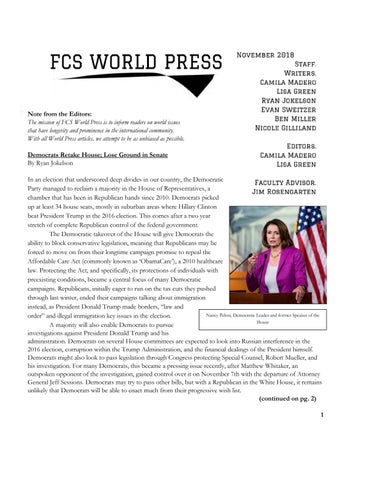
In an election that underscored deep divides in our country, the Democratic Party managed to reclaim a majority in the House of Representatives, a chamber that has been in Republican hands since 2010. Democrats picked up at least 34 house seats, mostly in suburban areas where Hillary Clinton beat President Trump in the 2016 election. This comes after a two year stretch of complete Republican control of the federal government.
The Democratic takeover of the House will give Democrats the ability to block conservative legislation, meaning that Republicans may be forced to move on from their longtime campaign promise to repeal the Affordable Care Act (commonly known as ‘ObamaCare’), a 2010 healthcare law. Protecting the Act, and specifically, its protections of individuals with preexisting conditions, became a central focus of many Democratic campaigns. Republicans, initially eager to run on the tax cuts they pushed through last winter, ended their campaigns talking about immigration instead, as President Donald Trump made borders, “law and order” and illegal immigration key issues in the election.

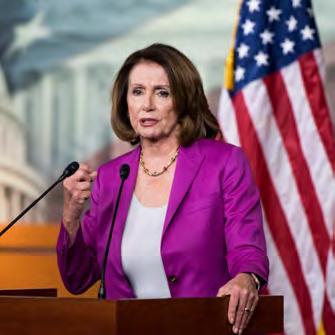

A majority will also enable Democrats to pursue investigations against President Donald Trump and his administration. Democrats on several House committees are expected to look into Russian interference in the 2016 election, corruption within the Trump Administration, and the financial dealings of the President himself. Democrats might also look to pass legislation through Congress protecting Special Counsel, Robert Mueller, and his investigation. For many Democrats, this became a pressing issue recently, after Matthew Whitaker, an outspoken opponent of the investigation, gained control over it on November 7th with the departure of Attorney General Jeff Sessions. Democrats may try to pass other bills, but with a Republican in the White House, it remains unlikely that Democrats will be able to enact much from their progressive wish list.
(continued on pg. 2)
While Democrats were swept into power in the House, Republicans, almost certainly picked up seats in the Senate. Going into the election, Republicans held a slim 51 - 49 majority in the Senate, but, after the elections, with three races still uncalled, Republicans lead Democrats 51 - 47. A race in Florida is still too close to call, but the Republican, Rick Scott is leading and it appears that even with more ballots to be counted, incumbent Bill Nelson will be unable to bridge the gap. In Mississippi, the Senate race is headed to a runoff where incumbent Republican, Cindy Hyde-Smith, is heavily favored to beat Democrat Mike Espy. Regardless of the outcome of these two races, Republicans will hang onto their Senate majority. The continued, if not, expanded Republican majority should make it easier for President Trump to get nominees to key judicial and executive posts through the confirmation process. Democrats were hopeful about the possibility of winning a Senate majority, especially after they picked up a seat in deeply red Alabama last December, but ultimately it proved to be too steep of a climb. Democratic incumbents in at least three states won by Trump in 2016 lost their bids for reelection as the power of partisanship overwhelmed the advantages of incumbency. Democrats did, however, manage to pick up two seats, one in Nevada, where Rep. Jacky Rosen defeated incumbent Dean Heller, and in Arizona where Rep. Kyrsten Sinema edged out Rep. Martha McSally in a bid to fill retiring Senator Jeff Flake’s seat. Democrats were forced to defend twenty-six Senate seats in this election cycle, while Republicans were defending only nine.
The election also brought several changes, across the country, on the state level. With two gubernatorial elections still uncalled, one in Georgia and the other in Florida, Democrats won gubernatorial races in at least seven states that had Republican governors prior to the election. These wins came in several traditionally blue states, but also, and perhaps most surprisingly, in Kansas, where a moderate Democrat beat the controversial Kansas Secretary of State, Kris Kobach. Democrats also flipped six state legislative chambers from red to blue on election night. Statewide results are important locally, for residents of the states affected by these changes, but they will also impact the political balance of power nationally; after the 2020 census, states will redraw their congressional districts, which will affect the partisan makeup of Congress for the next decade. After the 2010 census, Republican-held state legislatures and governors drew district lines that favored Republicans, resulting in easier paths to victory in the House of Representatives for the GOP over the past eight years. Democrats were able to overcome these gerrymandered district lines by winning the national congressional vote by a 7-point margin this year.
Here in Pennsylvania, Incumbent Democrats, Governor Tom Wolf, and Senator Bob Casey Jr. both won reelection by healthy double-digit margins. Due to the newly redrawn map of Pennsylvania congressional districts, Democrats were able to pick up four additional seats here in the commonwealth. Notably, however, incumbent Republican Brian Fitzpatrick held onto his closely contested Bucks County House seat, narrowly avoiding a loss to the challenger, Scott Wallace.
This election cycle was not the “blue wave” that Democrats had been hoping for —Democrats fell just short in a couple dozen elections that the progressive base had been excited about— but the party still managed to pick itself up off of the mat and out of the political wilderness. In many ways, this election demonstrated just how polarized the country has become, with voters in several states tossing out well-liked incumbents because of their party affiliation or their relationship with the President. The maxim “all politics is local” seems to be dead in this hyper-partisan age, where all elections have been nationalized.
Sources:
https://fivethirtyeight.com/live-blog/2018-election-results-coverage/ https://www.theguardian.com/commentisfree/2018/nov/12/what-did-the-midterms-reveal-a-divided-america 2
Bolsonaro Declared Brazil’s Next President
By Evan Sweitzer
On October 28, 2018, fiery far-right candidate Jair Bolsonaro captured the Brazilian presidency, winning in a runoff election against leftist Fernando Haddad by ten percentage points, 55% to 45%. Bolsonaro, a seven-term congressman in Brazil’s Chamber of Deputies, also won the preliminary round of the presidential election on October 7, 2018. Bolsonaro’s rise to the presidency, propelled by a strong anti-establishment sentiment among Brazilians, is in keeping with other recent world events, like Brexit and the election of U.S. President Donald Trump.
Bolsonaro has made many incendiary statements about women, racial minorities, LGBT people, and his political dissidents throughout his three decades as a congressman, as well as during his presidential campaign. According to the New York Times, “Bolsonaro told Playboy magazine in 2011 that he’d rather his son die in a car accident than be gay.” The Times also reported that while Bolsonaro was still a congressman in 2003, “he shoved a leftist colleague, Maria do Rosário Nunes, on camera and told her she was not worthy of being raped.”
Bolsonaro’s most convincing showing on Election Day was, not unexpectedly, in Brazil’s rural areas, which links to his anti-environmental stance.These rural areas are home to many landowning farmers. These people would benefit from even more deforestation of the Amazon Rainforest, which would open up land for them to raise more cattle and grow more crops, like soybeans. The Amazon, according to Jonathan Watts in The Guardian, is crucial to combating the effects of humans’ CO2 emissions. By indicating that he plans to lift restrictions on deforestation in the Amazon, Bolsonaro has prioritized “agribusiness” and political gain over environmental protection. In addition to his conservative stances on social issues and the environment, Bolsonaro is a former army captain who has championed anti-corruption and pro-gun stances since before the start of his political career in 1988. For Brazil, Bolsonaro’s win represents a massive shift to the political right, upending three consecutive terms that the liberal Workers’ Party has been in control. During these past three administrations, Brazil’s economy has been extremely lethargic, with crime and homicide rates skyrocketing. In addition, corruption has dogged the Workers’ Party during this time, and Brazilians showed that they wanted a change. Vast numbers of Brazilians looked to Bolsonaro as a tough leader who would crack down on Government corruption and violent crime, while also stimulating Brazil’s economy and improving their quality of life.


(for sources, see top of pg. 4)
Sources:
https://www.theatlantic.com/international/archive/2018/10/brazil-election-democracy-jair-bolsonaro-lul a-haddad/572470/
https://www.nytimes.com/2018/10/29/world/americas/jair-bolsonaro-brazil-profile.html
https://www.americasquarterly.org/content/system-failure-behind-rise-jair-bolsonaro
https://www.theguardian.com/commentisfree/2018/oct/24/planet-populists-brazil-jair-bolsonaro-enviro nment
https://www.theguardian.com/world/2018/oct/28/jair-bolsonaro-wins-brazil-presidential-election
Major Climate Report Presents Great Risks at Stake for our World as Early as 2040
By Camila Madero
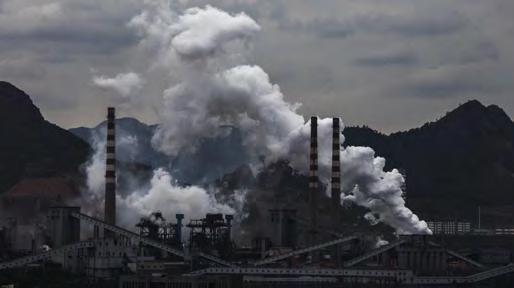
The first scientific report pertaining to climate change was presented last month by the Intergovernmental Panel on Climate Change. This group of 91 scientists from 41 countries was commissioned by the United Nations to guide world leaders, an initiative that stems from the 2015 meeting in Paris to combat global warming. The report speaks of the critical time component at stake, highlighting the dangerous pace at which climate change will occur if immediate modification to world economies does not take place. Disastrous effects as early as 2040 could likely including devastating food shortages and wildfires, a mass die-off of coral reef, and consequential changes to shore lines brought on by higher than predicted atmospheric temperature changes, which will likely intensify droughts and poverty. The latter, believed to be brought on by increasing greenhouse gas emissions, are of significance as they are largely human created. To avoid such damage, the commission concluded that major economic transformation must take place on a global scale, something that may be possible on a technical level, but not likely on a political one. They went on to point out that making significant changes to how carbon dioxide emissions are priced or taxed could alleviate some of the problems. However, given President Trump’s open criticism of the Paris Agreement and his general disbelief of human-produced climate change, the United States, one of the world’s strongest economies and the largest greenhouse gas emitter after China, is unlikely to make the needed changes. Since his presidency began, Trump has vowed to increase the burning of coal and pull out of the Paris Agreement. The report, however, makes it very clear that there is no way to decrease the harm of climate change without getting rid of coal as a major energy source. According to the report, the use of coal as an electricity fuel must drop from nearly 40 percent today to between 1 and 7 percent by 2050. Renewable energy, including wind and solar power, must increase dramatically from 20 percent to 67 percent. Greenhouse pollution must be reduced by 45 percent from 2010 levels by 2030 and 100 percent by 2050. The dangers predicted at the Paris Agreement had been estimated as 3.6 degrees warming several decades from now, has now been lowered to 2.7 degrees, and according to the report is likely to happen without aggressive action taken.
Despite the controversial policy of the US on these matters, a US State Department delegation joined 180 countries in accepting the report’s summary. However, what this means in terms of US policy on these issues remains to be seen, as the White House continues to voice Trump’s rejection of climate science and climate policy. According to the report, the US is not the only country needing to make sweeping changes; most countries at the Paris Agreement have not estimated the changes needed.
The report also found that in the event that world governments fail to avert the 2.7 degrees of warming, they could allow the warming to get to 3.6 degrees, and then through a combination of lowering emissions and deploying carbon capture technology, bring the temperature down below the 2.7 threshold. However, this would not be without irreversible consequences to our Earth’s oceans. In December 2018, climate experts from around the world will meet in Katowice, Poland for a new round of international climate negotiations.
Sources:
https://www.theguardian.com/environment/2018/oct/08/global-warming-must-not-s-landmark-un-reportexceed15c-warn
https://www.nytimes.com/2018/10/09/climate/climate-change-report.html
https://www.nytimes.com/2018/10/07/climate/ipcc-climate-report-2040.html
2018 Midterms in Pennsylvania
By Lisa Green
On Tuesday, November 6th, millions of Pennsylvania residents casted their votes for Governor, Lieutenant Governor, US Senate, US Representatives, State Senate, and State Representatives. While the exact number of voters from each precinct is still unclear, the turnout was a record high for Midterm Elections. Incumbent Democratic Senator Bob Casey ran against Pa-11 Republican Congressman Lou Barletta and won by receiving 55.6% of the votes. Similarly, Incumbent Democratic Governor Tom Wolf ran against former Pa-28 Republican State Senator Scott Wagner and won by receiving 57.7% of the votes. In the primaries, Wolf’s former running mate and former Lieutenant Governor, Mike Stack, conceded to John Fetterman, the current Lieutenant Governor-elect.
In February of 2018, Congressional district gerrymandering cases were brought to the Pennsylvania Supreme Court and declared unconstitutional. Consequently, the lines were redrawn, which helped Democrats assume seats that Republicans would have easily won in previous years. As a result, nine House districts will be represented by Democrats and the other nine House districts will be represented by Republicans. In addition, four female Democratic candidates-- Madeleine Dean, Mary Gay Scanlon, Chrissy Houlahan, and Susan Wild made history by winning their elections, ensuring a record number of Congresswomen serving from Pennsylvania at the same time and almost doubling the total number of Congresswomen in Pennsylvanian history.
A number of Pennsylvania Congressional races drew a significant amount of attention, including the 1st District, 5th District, 17th District, and 18th District elections.
The 1st District election was between Incumbent Republican Rep Brian Fitzpatrick, former FBI agent, and Democratic challenger Scott Wallace, co-chairman of the Wallace Global Fund. Before the redistricting, Fitzpatrick succeeded his brother, Mike Fitzpatrick, in representing the Conservative 8th district.
After the redistricting, that district became the more moderate and competitive 1st district. In fact, both candidates raised a combined total of over twenty five million dollars, making this Pennsylvania’s most expensive Congressional race. Ultimately, Fitzpatrick retained his seat by receiving 51.3% of the vote.
Prior to the redistricting, the 7th district was represented by Republican Pat Meehan, who resigned amidst sexual assault allegations a few weeks before the redistricting. Therefore, it was decided that a special election would take place to decide a representative to complete Meehan’s term in the old 7th district, in addition to the election in the newly drawn 5th district. After competitive primaries, Democrat Mary Gay Scanlon and Republican Pearl Kim, defeated sixteen and nine opponents, respectively, and became the nominees for both elections. In the end, Scanlon won the special election by acquiring 53% of the votes and also won the 5th district race by earning 65% of the votes.
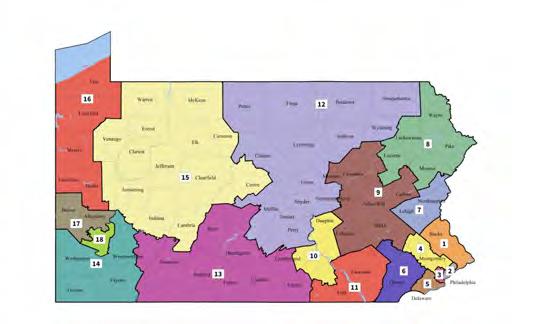

Earlier this year, Democrat Connor Lamb made headlines by winning the 18th district special election by just 755 votes. After the redistricting, he filed to run in the 17th district against 12th district Republican incumbent Keith Rothfus, which made it the only congressional race in Pennsylvania to be composed of two incumbents. Lamb was declared victorious when he received 56% of the votes.
The newly drawn 18th District race also amassed national attention when it was reported that former Republican pro-life Rep Tim Murphy resigned amidst an affair in which he insisted that his mistress terminate her pregnancy. Consequently, District 14’s incumbent Democrat Michael Doyle ran unopposed to fill the seat. Previously, Republicans controlled both chambers of the State Legislature by wide margins. While they still are in control of both chambers, Democrats picked up a few seats in each. Out of the twenty five state Senate seats that were on the ballot, Democrats secured twelve and Republicans secured thirteen. Furthermore, ninety three State House seats will be assumed by Democrats, while one hundred and ten will be assumed by Republicans.
Sources:
https://www.npr.org/2018/11/09/665845153/what-2018-elections-could-tell-us-about-the-2020-presidential-map https://www.nytimes.com/interactive/2018/11/06/us/elections/results-pennsylvania-elections.html https://philadelphia.cbslocal.com/2018/11/06/brian-fitzpatrick-wins-pennsylvanias-1st-congressional-district-scot t-wallace-concedes/ https://whyy.org/articles/race-in-pa-1st-congressional-district-more-expensive-than-u-s-senate-contest/
‘Racially Biased’ Death Penalty Banned by Washington Supreme Court
By Ben Miller
After a 5-4 ruling by the State’s Supreme Court on October 11th, Washington became the 20th state to end the death penalty. The State Supreme Court deemed the enforcement of capital punishment as ‘unconstitutional.’ However, it was not the death penalty itself that was considered inherently wrong. Instead, the Court concluded that the law “is invalid because it is imposed in an arbitrary and racially biased manner.” The Court’s ruling means that the eight men now waiting on death row with convictions of aggravated-murder will have their sentences commuted to life in prison.
Writing on behalf of the Court’s majority, Chief Justice Mary Fairhurst said that Washington’s capital punishment “lacks fundamental fairness.” This statement references a recent study that analyzed the likelihood of a defendant receiving the death penalty from county to county. The study, which examined the role of race in convictions from the years 1981-2014, was carried out by researchers at the University of Washington. This statistical study showed that in the state of Washington, a black offender is four times more likely to be placed on death row than one who is white. The Chief Justice wrote “the death penalty is unequally applied — sometimes by where the crime took place, or the county of residence, or the available budgetary resources at any given point in time, or the race of the defendant.”
Since the reinstatement of the death penalty in 1976 as a result of the Supreme Court case ‘Gregg vs Georgia,’ 20 states and Washington DC have abolished the punishment. This means that since 1976, these states rewrote their death penalty statutes to eliminate the problems cited in Furman (which were deemed unconstitutional), the case which abolished the death penalty in 1972. Since 2009, four states other than Washington State have abolished capital punishment. While 30 states still have the ability to sentence offenders to death row, according to the Pew Research Center, 11 states have not exercised their right of execution in over a decade.
Internationally, approximately 55% (105) of countries have outlawed the death penalty, and 29 countries have not practiced their right in at least a decade. In the past 27 years, the number of countries which had abolished the death penalty increased by almost 120%, 48 countries in 1991, to 105 countries today. China carries out the most executions per-year (1000+), with Iran, Saudi Arabia, Iraq and Pakistan following behind. Whether or not the death penalty is allowed to be enforced or not, this issue has been questioned throughout the history of mankind, and is still argued about today.
Sources: https://www.washingtonpost.com/news/post-nation/wp/2018/10/11/washington-supreme-court-strikes-dow n-states-death-penalty-saying-it-is-arbitrary-and-racially-biased/ https://www.nytimes.com/2018/10/11/us/death-penalty-ruling-washington-state.html https://www.bbc.com/news/world-45835584
http://www.pewresearch.org/fact-tank/2018/08/10/11-states-that-have-the-death-penalty-havent-used-it-in-mo re-than-a-decade/