
The Venezuela of 2014
By Lindsay Saligman

Venezuela has been paralyzed by violence and protests both opposing and supporting the government for nearly 2 months, and there is no end in sight…
Note to reader: The purpose of this article is to inform not only about what is happening in Venezuela, but also to explain in basic terms the opinions of Venezuelan supporters of the current government (los chavistas) and protesters against the current government (la oposición).1 This article will explore two of the biggest problems that prompted the surge of protests in Venezuela, and then explain what people on both sides have to say on these issues. When it comes down to it, there are many problems that are at the root of the current protests in Venezuela, ranging from economic crisis and oil mismanagement to classism and corruption. To go into them all, one would presumably need a book. For the sake of being readable, this article will go into the two issues, violence and lack of products, that seem to predominate.
Problem of Violence
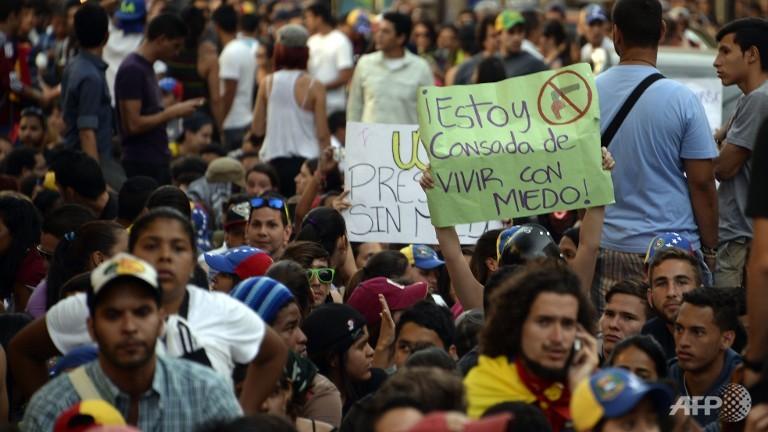
Venezuela is without a doubt one of the most violent countries in the world. According to the United Nations, in 2013 Venezuela had a murder rate of 45 per 100,000 people. To get an idea of scale, this is about twice the murder rate in Brazil (21.8) and more than eight times the murder rate in the US (4.8). Both the opposition (anti government) and the chavistas (pro government) agree that violence is perhaps Venezuela’s largest problem, and not surprisingly, they blame each other for it.
la oposición’s take: The opposition cites incidents such as a prominent actress being murdered in a car robbery in front of her five year old daughter and a university student suffering an attempted rape on
campus in broad daylight as proof that violence has made Venezuela completely unlivable. The opposition has taken to the streets because they feel that their government is not only failing to stop the violence in Venezuela, but also in some cases, encouraging it. The opposition blames the government directly for the recent explosion of violence, citing that the current murder rate in Venezuela is 500% higher than it was in 1998, right before current government took power. Additionally, 90% of murders in the country go completely unpunished and without trial. The opposition claims the reason for this has its roots in Hugo Chavez’s support of paramilitary (civilians acting as an army) groups in the country’s poorer neighborhoods.
los chavistas’ take: Those in favor of the current government often bring up the fact that violence in Venezuela was a problem long before the current democratic socialist government of Hugo Chavez (now of his successor Nicolas Maduro) came into power in the late 1990s.
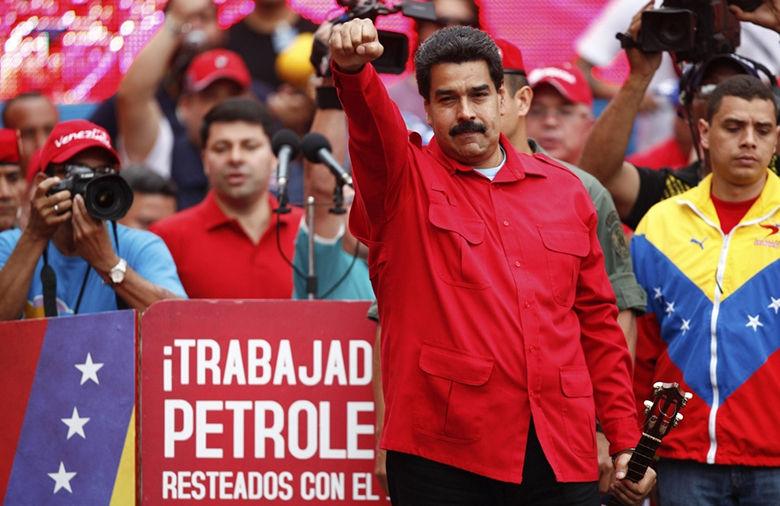
They argue that while the regime was perhaps too lax initially regarding violence, the government is now ardently trying to fix problems. The chavistas feel that the opposition’s protests are only making violence more prevalent in that they are paralyzing roads and distracting policemen and the army from trying to reestablish safety and justice. At the end of March, Venezuelan president Nicolas Maduro issued an appeal to the opposition, asking them to ‘sit at the table’ and talk about what is happening in order to put an end to the violence. The opposition however continues to protest with their slogan él que se cansa, pierde (the one who gets tired is the one who loses).
Lack of Products
If you go to a supermarket in Venezuela, you will most likely be astounded by two things: the lack of everyday products and their expensive costs. To buy items as essential as rice and toothpaste, Venezuelans of all social classes must wait in lines for hours each day, often to find that the supermarket is out of the food that they needed, or has very little of it at a high price. The only alternative is the black market, which sells these products for even higher prices than the supermarkets. Though at first glance this problem may seem insignificant, the effect it has had on daily life is immeasurable: everyone needs to eat, and in Venezuela, having food to eat means spending a large portion of your day on the increasingly volatile streets going from supermarket to supermarket in search of basic necessities that are increasingly
unavailable and expensive. Just as was the case with violence, on the issue of the lack of products, the opposing sides blame each other.
La oposición’s take: In the simplest of terms: the opposition blames the government for the lack of food because they feel the government made Venezuela dependent on foreign imports, and later destroyed the Venezuelan economy which made such imports difficult and expensive. Although Venezuela was a country whose economy was based on agriculture a few decades ago, it currently imports about eighty percent of its food products. Venezuela began heavily importing in the middle of Hugo Chavez’s presidency as part of a solidarity movement among Latin American countries. The idea was simple: Venezuela supplies Latin America with cheap oil, Latin America supplies Venezuela with cheap imports. According to the opposition, this measure completely backfired on Venezuela however, when Chavez’s government chose to devalue Venezuela’s currency which falsified their economy and essentially made the imports the country now relies on expensive and logistically challenging. The opposition believes that because importing has become such a costly challenge, less of it is happening, hence scarcity of products.
Las chavistas’ take: Those in favor of the government vehemently oppose accusations that the lack of products is the government’s fault. The chavistas bring up the point that in Venezuela, supermarkets are private enterprises as are their suppliers, and blame the scarcity on big business as opposed to foreign policy mistakes. The government points out that many of the suppliers of the black market are the very same big business people that control the supermarkets. They claim that these corrupted businesspeople prefer the black market because it is tax free, and claim that they control the imports and make products scarce in order to sell them at the highest prices possible. The chavistas insist that the government cannot be responsible for a fault in an industry that it does not control, and they consider the opposition’s justification to be an example of the opposition trying to pin the country’s problems on the government rather than on those who they consider to be truly responsible.
Is There Hope?
In preparation for this article, I interviewed two Venezuelan people: one supports the opposition while the other supports the government. I have used the information from these two interviews as well as a variety of different news sources to compile the information in this article. What struck me about my interviews was of course the extreme difference in opinion, but also the nagging sensation that both sides, though they contradict each other, have reasoning and justification that make a reasonable amount of sense. I wrote this article to show that despite the comparisons being made, Venezuela is no Egypt. There is not, as far as I can tell, the classic situation of the oppressor and the oppressed: it is far more complicated than that. Venezuela is a country divided and paralyzed by class and opinion and unfortunately, the only uniting factor appears to be suffering. The opposition refuses to ‘sit down and talk’ with the government, and to be honest, I don’t blame them. With opinions so radically different, I fear there can be no constructive dialogue and no quick resolution. Useless as it may sound, I urge you to hold Venezuela in the light.
Endnotes
1- It is important to note that opinions of the people of Venezuela are not two sided. There are many different shades of opposition and progovernment opinion in Venezuela, and there are also people with opinions on neither side. The reader of this article is encouraged to interpret the points of view expressed in this article not as a complete summary of what Venezuelans as a whole believe, but rather as an introduction to two opposing sides in basic terms.
2- Hugo Chavez is the recently deceased past president of Venezuela, who led the country for from 1999 -2013. Sources http://www.nytimes.com/2010/08/23/world/americas/23venez.html?pagewanted=all&_r=1& http://www.nbcnews.com/storyline/venezuela-crisis/seven-things-know-about-venezuela-crisis-n38556 http://www.nytimes.com/2010/08/23/world/americas/23venez.html?pagewanted=all&_r=1& United Nations Office on Drugs and Crime “Global Study on Homicide”, 2013 -Interviews with Maria Alejandra Socorro, (FCS Spanish teacher), and Ronald Sarcos, (friend of Ms. Socorro) both born and raised in Venezuela
World Military Spending
By Kyle Tuverson
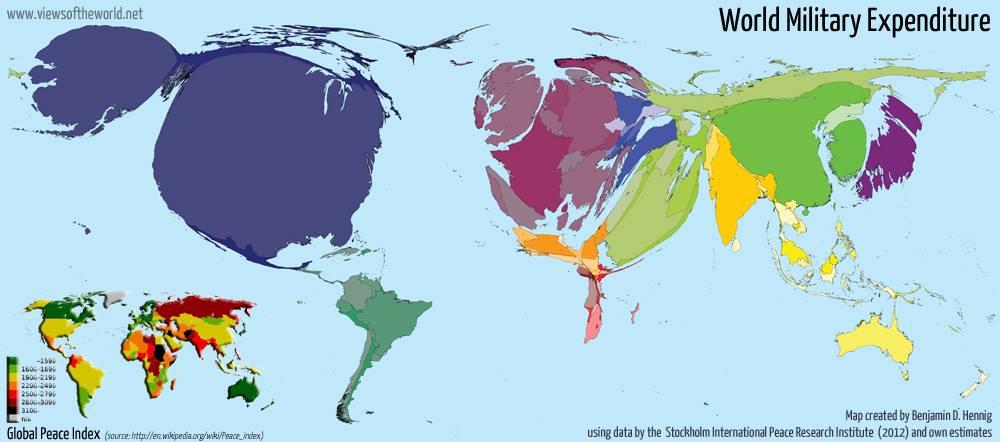
It is safe to say that military spending around the globe is out of control. The universal community spends close to $1.8 trillion1 on military expenses, and the U.S. makes up 39% of that cost. That’s right, in 2012, the U.S. alone spent $682 billion on its armed forces. This number is over four times greater than number two on this list, China, who spent $166 billion. To put that into perspective, the military spending makes up 18% of the federal budget and is more money than the combined total of the military spending of the following 11 countries on the list2. You may think that this extreme spending is because the U.S. has one of the largest militaries in the world, right? In terms of total members of the Armed Forces (those on active duty, reserves, and paramilitary), no, the U.S. is ninth in military size, behind North Korea, China, Vietnam, South Korea, India, Bangladesh, Russia, and Iran. However, if we look solely at standing armies, the U.S. is only second to China. A standing army is the country’s professional military force, trained and ready to go to war whenever the country needs it, as opposed to reserves and paramilitary which are citizens ready to fight, but untrained. So, how do we explain why the U.S. spends so much more than every other country in the world? Well, since 2001, the U.S. has been fighting the ‘War on Terror’ and has spent around $1.5 trillion on war efforts
This incredible amount of money demarcated for military costs came as a result of poor spending and because Congress continued to raise the amount of money allotted to the military instead of cutting that unnecessary spending. Even during the recent global financial crisis global
military spending continued to increase, though the U.S. did manage to lower their spending over the past couple of years.
It is important to note the differences between spending in the U.S. on education and military. Military spending was $682 billion in 2013 compared to the $138 billion spent on education in 2013. It is easy to look at this spending as out of control, but the American Military is seen around the world as a regulating and powerful force. The combination of economic power and military force makes the U.S. a difficult entity to cross, which can be good for peacekeeping efforts around the world. A strong military helps protect the country from invasion and allows other, smaller countries to feel safe against regimes that pose a threat. In the end, it is up to you to decide whether or not to support the politicians who are pro-military or those who wish to see that money going to other government programs.
Sources:
http://www.globalissues.org/article/75/world-military-spending http://en.wikipedia.org/wiki/List_of_countries_by_military_expenditures
The Minimum Wage Debate
By Stefan Sultan
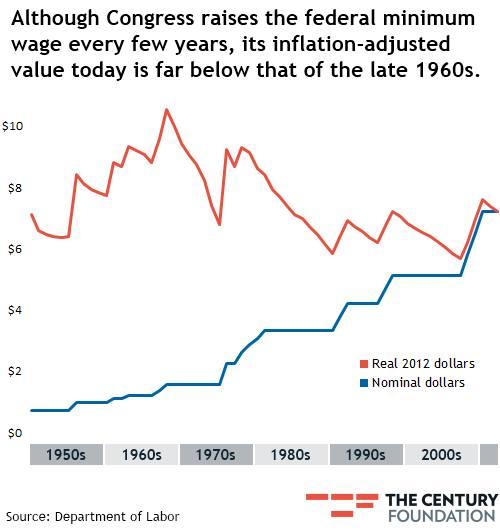
Recently many prominent politicians have been talking about the minimum wage, pressing Congress to raise it from the current $7.25 an hour. They often point to the fact that today the minimum wage is, when adjusted for inflation, $14.50 less than it was in 1960(1). They say that the value of the minimum wage has gotten so low that it is no longer considered to be a livable wage. This means that someone working a full time job for minimum wage would not make enough money to buy essentials such as housing and food. It is because of this that lawmakers such as Elizabeth Warren and Barack Obama, and economist, Paul Krugman are advocating so vocally for a change. However these politicians aren’t the only ones. In fact, according to a Gallup poll from December, 71% of Americans and 54% of conservatives support a raise in the minimum wage (2). One possible reason for this is because the current minimum wage is considered to be a starvation wage. With the minimum wage at today’s levels, even two full time jobs is not enough for someone to support themselves. Most minimum wage workers are on some form of government assistance, such as food stamps or Medicare. This means that the taxpayers are the ones who end up paying minimum wage employees because they have to pay for the social programs that minimum wage employees rely on to live.
In fact, studies have shown that each Wal-Mart store costs taxpayers about one million dollars every year due to their low pay. Yet, this does not mean minimum wage has no opposition. A majority of Republican lawmakers, such as Marco Rubio, Chris Christie, Rand Paul, and Paul Ryan, oppose a minimum wage increase, saying that a raise in the minimum wage would destroy jobs since it would increase the cost of running a business: more pay to employees would mean less money to the business.
In rebuttal to this point, proponents of a minimum wage increase often point to countries like Australia and the Netherlands or states like Vermont who have minimum wages of around $15.30, $13.75, and $8.75 with unemployment rates at 5.1%, 6.2%, and 3.7% respectively. In comparison, the United States has a minimum wage of $7.25 and an unemployment rate at 6.7%. They say that this shows that just because a country or state has a high minimum wage doesn’t mean it will have high unemployment, in fact it can mean just the opposite. Another argument often made by opponents of the law is that a minimum wage increase would hurt consumers since it would increase prices. Countering this idea, a recent study conducted by U.C. Berkeley said that opponents tend to exaggerate the extent of this effect. According to this recent study, if the minimum wage were to be raised to $12 an hour and 100% of this increase was placed on consumers , meaning that the money for these increased wages was raised from price increases, the price of an average shopper’s trip to Wal-Mart would only be 1.1% or 46¢ higher than before.(4) Despite the good points made by both sides it is highly unlikely that Congress will act on this issue anytime soon due to the gridlock that has consumed it in recent years.
Sources
1 http://www.huffingtonpost.com/2013/02/13/minimum-wage-productivity_n_2680639.html
2 http://www.gallup.com/poll/160913/back-raising-minimum-wage.aspx
http://www.tcf.org/blog/detail/graph-how-inflation-erodes-the-minimum-wage-and-why-its-time-to-raise-it
Death Penalty
By Chris Levy
It seems that few topics spark such endless debate as does capital punishment in the U.S. While a majority of nations (100) have completely abolished it and many more use it rarely, according to Amnesty International, the United States ranks fifth in the world in terms of most state-executed citizens, in between Iraq ranking fourth and Pakistan ranking sixth. There are currently thirty-two U.S. states with the death penalty. Last May, Maryland became the eighteenth state in the union to abolish the death penalty.
Opponents of the death penalty often cite moral and/or political arguments. Some argue that no matter what one does to others his/her own right to life must not be infringed upon; murder is always wrong, they believe. Proponents often counter that a punishment must fit the crime, and executing a proven-murderer illustrates principles of justice. Supporters also frequently argue that the death penalty is a deterrent against committing murders, while opponents are quick to show statistics that the murder rates in non-death penalty states are significantly lower than the murder rates in states with the death penalty. As many criminologists explain, murderers typically do not plan on getting caught, and thus, do not weigh the options of death or life in prison before committing a murder.
Within this debate, there is also the question of “humane” execution versus an “inhumane” killing. What constitutes a humane murder? What doesn’t? While France abolished the death penalty in 1981, up until that point the guillotine (the device used for beheadings) was the official method of execution by the French Government, having been considered by many to be humane because of its swiftness and painlessness. In
Saudi Arabia, crucifixion is still one of the methods of execution. Proponents of lethal injection (for execution) argue that it is a more humane, painless execution than methods like electrocution. However, in 2005 scientists were able determine that lethal injection is still quite painful in ninety percent of people, and that forty percent of them were still conscious at the time of their deaths. While arguments rage about the effectiveness (or lack thereof), costliness and usefulness of the death penalty, perhaps the ultimate question in this debate boils down to whether or not it is ever justifiable to kill another human being.
To Ukraine and Beyond:
By Olivia Backal-Balik
While you may remember from our previous issue a little bit about the Ukraine Revolutions, conflicts surrounding the Ukrainian revolution have certainly not stopped. Just as a recap, in simple terms, hundreds of thousands of Ukrainians were unhappy with their current president Viktor Yanukovych which sparked widespread conflict, government intervention and consequently, violence. As a result of the activism by the Ukrainian people, a new interim government, the Yatsenyuk Government, was created and President Yanukovych was impeached by the Ukrainian Parliament, setting new elections for May 25th. Based on this, it would be easy to think that things in Ukraine are coming to a close. However, sadly, this is not true. I’m sure you’ve heard about Russia’s recent invasion. Let me lay out a little more clearly to you what has been going on.
Despite what happened, when the Yatsenyuk Government came to power, the Russian government refused to recognize the interim government as valid because it was not elected constitutionally. Russia did not accept the impeachment of President Yanukovych as legitimate, and Russian President Vladimir Putin has publicly stated multiple times that he still considers Ukraine's current leader to be Yanukovych. Putin expressed concern about the “radicals” of the revolution saying that his “major concern is the ... nationalists and radical extremists that are rampant on the streets of Kiev." While Putin primarily had expressed concerns for the safety of the Ukrainian people because of the revolutionaries, he then went on to express concern about fellow Russians in the Crimean Peninsula.
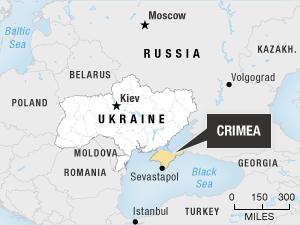
The Crimean Peninsula is a region of southern Ukraine that has been recognized as the ‘Autonomous Republic of Crimea’ within Ukraine. Crimea is populated by a majority of people who identify themselves as ethnically Russian and speak Russian and a minority of Ukrainians. On February 26th, pro-Russian forces began occupying areas of the Crimean Peninsula and by the end of March, the Russian adversaries occupied all of Ukraine’s military bases in Crimea, forcing Ukraine’s armed forces to secede from the Crimean Peninsula. After the Russian occupation was successful, the Crimean parliament passed a referendum (a vote), with an overwhelming 97% majority, stating they were to secede from Ukraine and
join the Russian Federation. There are probably two main reasons Crimea decided to willingly join the forces that had occupied them: 1. the majority of citizens in Crimea are ethnically Russian, and 2. over 70% of Crimeans voted for Yanukovych in the initial elections and considered his impeachment to be something more like a coup d’etat.
Sources.
http://en.wikipedia.org/wiki/Crimean_status_referendum.com
http://www.businessinsider.com/putin-what-happened-in-kiev-was-an-unconstitutional-overthrow-and-yanukovych-is-still-president-2014-3#ixzz2xsYXEocb
http://time.com/10571/ukraine-says-russian-military-blocking-airports-and-roads/ http://www.bbc.com/news/world-europe-26367786
http://euobserver.com/opinion/123496
Commerical Whaling
By Madeleine Henry `
Whales throughout the world are endangered due to the practice of commercial whaling. Commercial Whaling is the hunting of whales for profit. Commercial whaling started in the 1600’s when fishermen began using sailboats and hand thrown harpoons to hunt the whales they could find near shore. Some products made from whales throughout the last four hundred years include everyday items such as makeup, candles, perfume, cooking oil, margarine, animal food and tobacco. After this small scale start, commercial whaling has progressed rapidly through the years. The advancement of technology helped increase this trade to the point where the survival of whales were threatened. This new technology made commercial whaling efficient and easy.
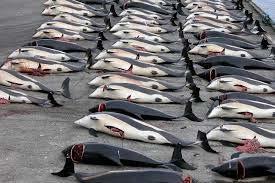
As public awareness grew on this maritime massacre, an anti-whaling sentiment emerged, inspiring the creation of the International Whaling Commission (IWC). The IWC is a global coalition dedicated to the conservation and management of whaling. They put in place a moratorium halting commercial whaling and setting a zero catch limit, a limit that is only followed by 89 member countries who are all a part of the IWC. This still leaves commercial whaling rampant among countries who refuse to join the IWC such as Japan, Iceland and Norway. Countries such as these, refuse to acknowledge the moratorium and have killed over 70,000 whales since 1986, with reports accompanying, stating that most of these whales had long and painful deaths. The endangerment or extinction of whales would be catastrophic for the ocean’s ecosystem. This would cause an overpopulation of the fish and plankton that the whales eat. In addition whales help pull 400,000 tons of carbon dioxide from the air by feeding phytoplankton.
Sources
http://www.whalefacts.org/wh y-are-whales-important/