

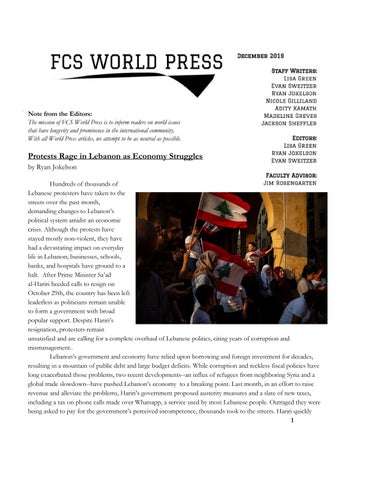
by Ryan Jokelson
Hundreds of thousands of Lebanese protesters have taken to the streets over the past month, demanding changes to Lebanon’s political system amidst an economic crisis. Although the protests have stayed mostly non-violent, they have had a devastating impact on everyday life in Lebanon; businesses, schools, banks, and hospitals have ground to a halt After Prime Minister Sa’ad al-Hariri heeded calls to resign on October 29th, the country has been left leaderless as politicians remain unable to form a government with broad popular support Despite Hariri’s resignation, protesters remain unsatisfied and are calling for a complete overhaul of Lebanese politics, citing years of corruption and mismanagement..


Lebanon’s government and economy have relied upon borrowing and foreign investment for decades, resulting in a mountain of public debt and large budget deficits. While corruption and reckless fiscal policies have long exacerbated those problems, two recent developments--an influx of refugees from neighboring Syria and a global trade slowdown--have pushed Lebanon’s economy to a breaking point. Last month, in an effort to raise revenue and alleviate the problems, Hariri’s government proposed austerity measures and a slate of new taxes, including a tax on phone calls made over Whatsapp, a service used by most Lebanese people. Outraged they were being asked to pay for the government’s perceived incompetence, thousands took to the streets Hariri quickly 1
withdrew the Whatsapp tax proposal, but protests continued to grow as protesters demanded a new government. These protests represent a remarkable turning point for Lebanon, which has historically been divided along religious and ethnic lines, most notably during a bloody fifteen-year-long civil war Since the Lebanese Civil War ended in 1990, the country has been led by a constitutionally mandated multi-sectarian government with the hope of preventing future conflict by distributing political and military power among several ethnic and religious groups Lebanon has managed to avoid large-scale violence in the years since, but the country’s elite, composed mainly of powerful families and businesspeople, have become their own political class Angry protesters accuse the wealthy and powerful of reaching across sectarian lines to enrich themselves to the detriment of everyday Lebanese people Now, Sunni, Shia, and Christian protesters alike are demanding change
Sources:
https://www nytimes com/2019/10/23/world/middleeast/lebanon-protests html
https://www aljazeera com/news/2019/11/month-hope-defiance-lebanon-protests-persist-191117082420709 html
https://www cnn com/2019/10/21/middleeast/lebanon-protests-explainer-intl/index html
By Lisa Green
Off Year Local Elections Typically low turnout, uneventful, and result in incumbents retaining their positions 2019 has completely reversed this trend Voters turned out in droves and as a result, the blue wave that began in 2018 stormed the beaches of Pennsylvania, Kentucky, and Virginia among others
For the first time in over two centuries, the majority of Delaware County’s local elected officials are Democrats Further making history, Nusrat Rashid has become woman of color elected judge in Delaware County’s Court of Common Pleas In addition, Democrat Jack Stollsteimer defeated Republican incumbent Kat Copeland, making him Delaware county’s first elected Democratic District Attorney
Major shifts of power took place in Virginia Democrats took control of the Virginia State House of Delegates and Virginia State Senate, gaining full control of Virginia's government for the first time since the 1990s Loudoun County, formerly a majority red farm town, displayed the statewide trend on a local level Here, reliable Republican voters disappointed with their current representatives’ policy positions on issues like gun control assisted in electing Democrats who formerly wouldn’t have had a chance Among them was newly elected member of the Loudoun County Board of Supervisors, Juli Briskman Two years ago, Briskman lost her position as a marketing analyst after she directed an obscene gesture at President Trump’s motorcade Last week, Briskman defeated Republican incumbent Suzanne Volpe.
In conservative Kentucky, moderate Democrat Steve Beshear defeated Matt Bevin, the unpopular Republican incumbent governor. In 2018, the state legislature passed a bill that would slash school districts’ budgets, reduce teachers’ pensions, and decrease the health benefits they would receive. In response, thousands of teachers called in sick to work in protest. These efforts were met with callous remarks from Republican Governor Matt Bevin such as “If you happen to be a teacher who would walk out on your classroom in order to serve what’s in your own personal best interest at the expense of your children, you probably should retire.” His opponent, Democrat Andy Beshear, was an advocate for policies like raising the minimum wage for teachers by $2000. Beshear defeated Bevin by a slim margin of under 5000 votes.
Most recently, Incumbent Democratic Governor, John Bel Edwards, won re-election in Conservative Louisiana during a runoff election, despite a contentious race with Republican opponent, Eddie Rispone President Trump repeatedly supported and championed Rispone to no avail. This result could be attributed to especially high voter turnout from the more urban areas of the state, as well as strong support for the incumbent.
Sources:
https://www.cnn.com/interactive/2019/09/politics/whistleblower-complaint-annotated/ https://www.nytimes.com/2019/09/24/us/politics/democrats-impeachment-trump.html https://www.nytimes.com/2019/09/24/us/politics/impeachment-trump-explained.html https://www.usatoday.com/story/opinion/2019/10/11/trump-white-house-lawyer-cant-argue-facts-law-impeach ment-column/3935235002/
by Evan Sweitzer
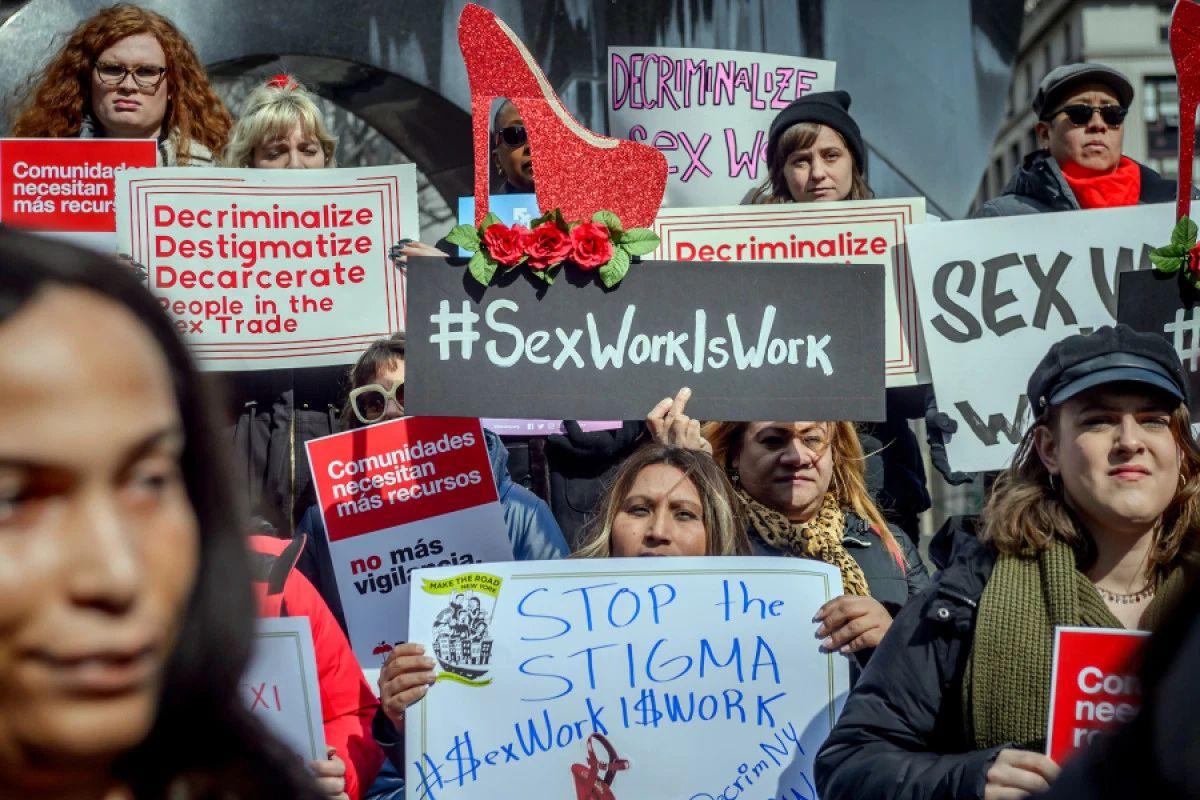
Sex workers’ rights advocates gather in New York City in 2018
Sex work is known, somewhat euphemistically, as “the oldest profession,” and has ignited moral, political, and societal debate for centuries In Victor Hugo’s 1862 novel Les Miserables, Fantine turns to prostitution to provide for her sick daughter, Cosette, and is subsequently shunned by women and men alike. More than 150 years later, in present-day America, sex work is illegal outside of a few counties in Nevada, and many of the powerful negative stereotypes sex workers face are still in the public consciousness. In the latter half of the twentieth century, some decriminalization advocacy groups formed, but it’s only recently that the debate has moved into the mainstream. 3
In 2015, the human rights organization Amnesty International called for all countries to decriminalize sex work, arguing that criminalization makes sex workers less able to report mistreatment and denies them basic rights like medical care. The organization cites studies showing that sex workers are safer under decriminalized conditions. New Zealand and parts of Southeast Australia are the only places where sex work is fully decriminalized, while a handful of countries, most in Western South America, have laws that legalize sex work. It’s important here to distinguish between full decriminalization and legalization, in which sex work is legal but regulated by state or local authorities. Many sex workers prefer full decriminalization, because it treats sex work like any other profession, and thus gives workers the power to operate without any government interference.
It’s also important to note that the decriminalization of sex work only pertains to acts between consenting adults, while sex trafficking and abuse would remain illegal. However, many anti-decriminalization activists argue that decriminalization would actually augment non-consensual and abusive behaviors, and create a higher demand for casual, unregulated sex. This would in turn expose more women to abuse and disease, making the problem even worse Many opponents of full decriminalization have rallied behind the so-called “Nordic model,” first implemented in Sweden in 1999, and recently adopted by Norway, Canada, and Israel, among other countries Under this policy, sex workers are exempt from punishment, and in some cases even provided with social services like basic healthcare Buying sex, however, is illegal under the Nordic model--customers and third parties can be fined or imprisoned This policy has several high-profile supporters worldwide, such as feminist author Gloria Steinem, as well as the support of a fair amount of sex workers’ rights activists
Advocates of the Nordic model say that it’s important to criminalize the “pimps” who take advantage of sex workers, and that this approach would increase worker safety However, many sex workers themselves aren’t in favor of this approach, as they believe it doesn’t remedy the underlying problem: the black-market, stigmatized nature of the industry Many workers feel they cannot report violence against them to law enforcement because the problem will not be taken seriously They argue that this indifferent attitude on the part of law enforcement comes from the perception that sex work is a less valid form of employment Lifting punishments for workers themselves while punishing their customers, opponents of the Nordic model contend, still criminalizes and marginalizes the activity, and does nothing to restore trust between sex workers and law enforcement. As long as there is a stigma around sex work, they say, workers cannot advocate for themselves, which in turn leads to more trafficking and abuse. Critics of the Nordic model also point to the policy’s ineffectiveness in Sweden, where the Government was “unable to confirm a reduction in sex trafficking” and other malicious behaviors the Nordic model was designed to prevent.
Over the past three years, activism has led to the beginnings of progressive legal action on the issue in America. The debate between supporters of full decriminalization, the more moderate Nordic model, and full criminalization is as vociferous as ever. Bills aimed at full decriminalization have been introduced in New York and Washington, D. C., and partial decriminalization bills in Massachusetts, Maine, and Rhode Island.
Supporters of these bills recognize the need to take the long view--a decriminalization bill died in the Maine Senate in May, and another went nowhere in the D. C. Legislature in 2017--and acknowledge that measurable change on the legislative front would take a while. Many sex workers themselves, however, are happy that their activism is now a part of mainstream political discourse, and feel that the increased visibility could help solve the problem by eliminating the stigma around sex work
The issue has also seeped into the 2020 Democratic Primary discussion, another example of the recent spotlighting of the industry However, conversations with candidates have shown that the issue is not considered a central policy, and a possible view that the issue is too politically risky to engage with fully. Former Colorado Governor John Hickenlooper has spoken on the need for some kind of decriminalization, but has not specified his views. Vermont Senator Bernie Sanders has said that he does not have a view on the subject, while California Senator Kamala Harris has stated that she supports decriminalization, although this contrasts with her record as California Attorney General. The debate over decriminalizing sex work is a fascinating one about bodily autonomy, feminism, safety, and community relationships with law enforcement and politicians. While it’s unlikely that any sweeping changes will happen in the near future, it’s certainly something worth monitoring.
Sources:
https://www nytimes com/2019/06/11/nyregion/prostitution-legal-ny html
https://www nytimes com/2019/05/31/nyregion/presidential-candidates-prostitution html https://www vox com/2019/8/2/20692327/sex-work-decriminalization-prostitution-new-york-dc https://www nationalreview com/magazine/2019/08/26/dont-legalize-prostitution/ https://thefederalist com/2019/08/15/if-we-want-to-help-women-we-should-decriminalize-prostitution/
by Adity Kamath
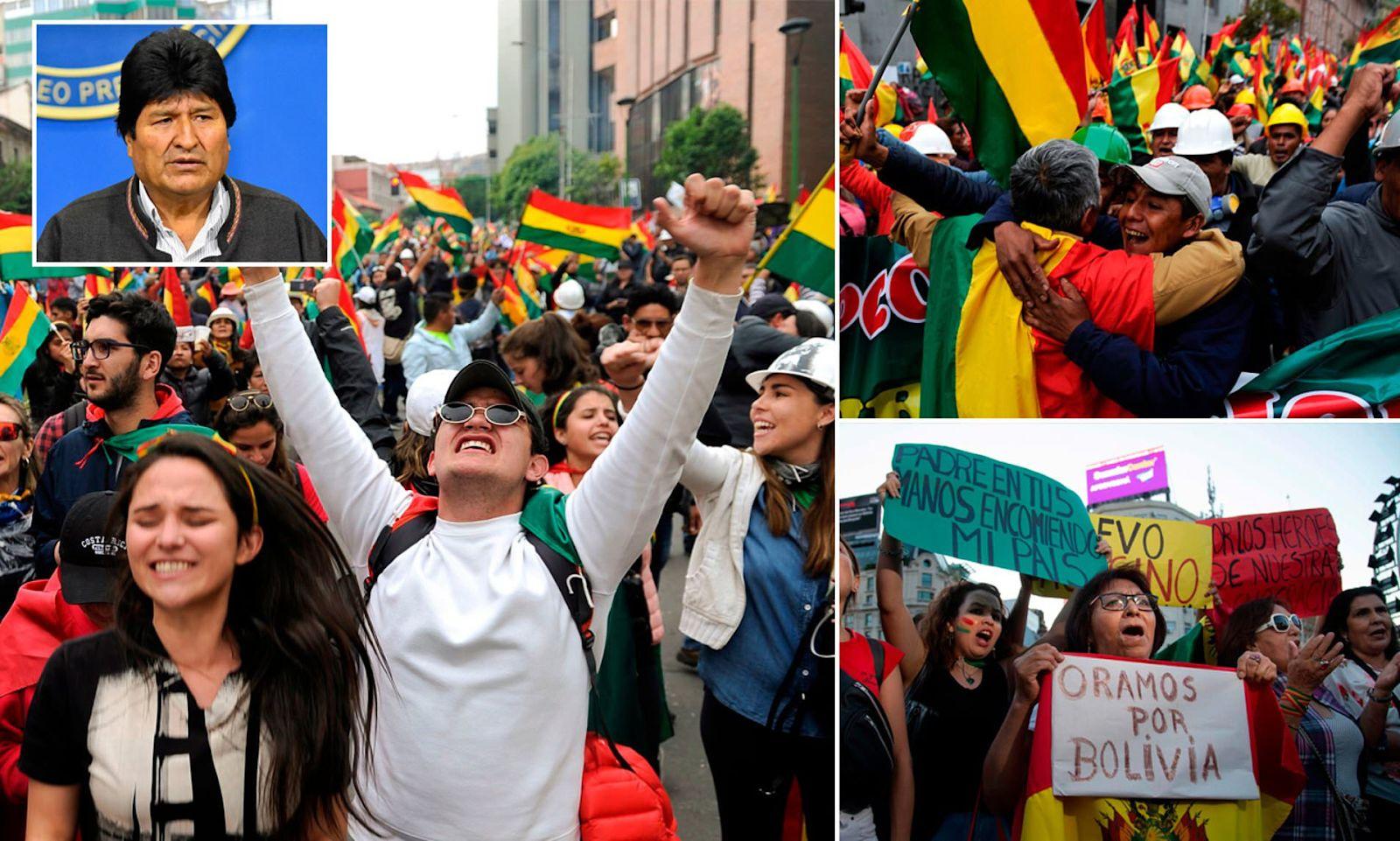
On October 20, 2019, presidential and parliamentary elections were held in Bolivia. Evo Morales had won the majority of the votes, but he was accused of fabricating the results. There were serious allegations of fraud against him which soon resulted in Morales resigning from his post and seeking asylum in Mexico.
Unfortunately, the 2019 election results led to some controversy which left the nation unsettled. On election day, Bolivians were observing the results intently, but all of a sudden the officials stopped releasing the results. The last result revealed that Morales had bested the eight other candidates but he didn’t have enough votes to steer clear of a runoff vote. For some time, it appeared that Morales would end up in a runoff vote against former president, Carlos Mesa. It seemed as if Carlos Mesa stood a chance in defeating Morales in a runoff. A runoff election is a voting system that is used to select a single winner. It is a two round voting system in which only two candidates continue from the first round to the second round. Despite the possibility for a runoff, Morales declared himself the winner of the election telling the people that the uncounted votes would be enough to declare him the winner. The ending result including the uncounted votes, showed Morales’s close first round victory. Mesa and other rivals accused Morales of fabricating the results. Evo Morales strongly denies all allegations of electoral fraud.
Since the election, there have been many conflicts between Morales supporters and government supporters. Many country-wide protests were launched against Morales and his presidential candidacy. As time went on, the protests became more and more violent causing the deaths of many people. Fire was opened on the Morales supporters resulting in the death or injury of numerous people. This crisis caused Bolivia’s military chief to ask Evo Morales to step down from office. Morales, who was once Bolivia’s beloved and transformative leader has officially been forced out of office. Not only was Morales the first indigenous person to be elected as president, he was also Bolivia’s longest serving president. Many in Bolivia began celebrating Morales’s fall from power, but thoughts quickly turned to the fact that Bolivia was left polarized and leaderless. After formally resigning from his post, Morales fled to Mexico where he received asylum. Jeanine Añez Chavez, a lawyer and politician, declared herself interim president of Bolivia. Chavez is a conservative, or in other words, anti-Morales. As of now it is unclear whether Chavez’s declaration will steer the country away from conflict, or headlong into it.
Sources:
https://www.washingtonpost.com/world/the_americas/ap-explains-why-is-evo-morales-facing-protests-i n-bolivia/2019/11/08/480e752a-01e5-11ea-8341-cc3dce52e7de_story.html
https://apnews.com/e4e1977c3e48426f927ce900d2818b4f
https://www.nytimes.com/2019/11/12/world/americas/bolivia-evo-morales-coup.html?action=click& module=News&pgtype=Homepage
https://www.bbc.com/news/world-latin-america-50441867
http://cepr.net/images/stories/reports/bolivia-elections-2019-11.pdf?v=2
by Nicole Gilliland

On October 22th, the Preventing Animal Cruelty and Torture Act (PACT Act) was passed by the U S House of Representatives to ensure that animal cruelty offences will now be prosecuted as felonies On November 5th, the Senate approved the bill Since then, the bill has been presented to the President The votes for this bill were unanimous and people are confident that it will be signed into law Animal abuse cases are more common than one would expect Cases concerning animal neglect, abuse, and cruelty are constantly occurring Reported or not, this is a major concern for the animal community and this bill is a step in the right direction
This bill is an expansion on the previous ‘The Animal Crush Video Prohibition Act of 2010’ which focuses on preventing the action and videotaping of “crushing”. This is a form of animal cruelty where one crushes small animals for the sake of a “crushing fetish”. Now someone who performs this act will likely be fined or imprisoned for up to 7 years.
The general definition of animal cruelty includes any act of violence or neglect towards animals. Animal cruelty covers a wide range of cases, from hording animals to physical abuse to mistreatment. One of the major problems regarding animal cruelty is that criminals are not penalized and essentially get away with their actions. Most cases of animal abuse go unreported, meaning abusers often are not prosecuted And even when cases are reported and prosecuted, the abuse is classified as a misdemeanor at best rather than a felony This means the few abusers who face punishments receive relatively light ones
Another reason to pay attention to animal abuse is that there have been studies to point to the stong correlations between animal cruelty and domestic violence There are alarming statistics to support this idea Statistics from the Humane Society stated that 71% of domestic violence victims reported their abuser also targeted animals Additionally, in a study that was observing childabuse in families, found that out of those same families 88% of them abused animals While animal cruelty is overlooked, undercharged, and misunderstood, the attention to this bill will hopefully discourage abuse to animals and ensure that the abusers are prosecuted and treated appropriately.
Sources:
https://www.congress.gov/bill/116th-congress/house-bill/724
https://www.humanesociety.org/resources/animal-cruelty-and-neglect-faq#victims
https://aldf.org/project/the-animal-cruelty-violence-intervention-act/
by Maddie Grieves
On November 10, 2019, Spain had a general election to elect the fourteenth Cortes Generales The Cortes Generales, Spain’s legislature, is made up of two chambers, the Congress of Deputies and the Senate. All 350 seats in the Congress of Deputies and 208 out of 265 seats in the Senate were up for election.
The Socialist Party (PSOE), led by Prime Minister Pedro Sanchez, won the most seats, 120, in the Congress of Deputies but did not end up with an absolute majority. The conservative Popular Party (PP) ended up winning 87 seats. The party that gained the most seats, though, was Vox, a far-right group going from 24 seats from April to 54.
Vox, led by Santiago Abascal, is a recently formed political party known for being anti-immigration, anti-feminism, and anti-Catalonian independence. Catalan, an area in northern Spain with a distinct culture and language, has been trying to become independent from Spain since 2017. Vox’s rhetoric and policies have drawn comparisons to General Fransico Franco, the nationalist dictator who ruled over Spain from 1936 to 1975. Following the election, nationalists from across Europe, including Italy’s Matteo Salvini and France’s Marine Le Pen, congratulated Vox.
Since 2015, no party has held a stable majority in Spain’s legislature, forcing the country to hold four elections in the span of only four years Now, with the Socialists again falling short of a majority, Spain’s future is uncertain Now the Socialist Party will have to gather a coalition of multiple political parties to join Sanchez or face a fifth election
Sources:
https://elpais com/elpais/2019/11/10/inenglish/1573407794 574125 html
https://www cnbc com/2019/04/25/spains-far-right-vox-party-in-profile html
https://www nytimes com/2019/11/13/opinion/spain-election-vox html
https://time com/5723678/spain-elections-vox/
https://www nytimes com/2019/11/09/world/europe/spain-election html
Thank you for reading FCS World Press!
If you are interested in hearing more from FCS World Press, listen to our podcast which you can find at…
http://blogs.friendscentral.org/worldpress/