Editor: Marilyn Lager, Director, Friends’ Central’s Blackburn
Email: mlager@friendscentral.org
Asst. to Editor: Deborah Fedder, Middle School Language Skills Teacher
F O R U M
F o r u m i s o u r c o m m u n i t y’s e d u c a t i o n a l j o u r n a l
Faculty, alumni, board members, parents and students are encouraged to contribute opinions, ideas, innovations and observations about any aspect of their lives relating to educational experiences.
Marilyn Lager Editor, Forum
R E A D E R S ’ R E F L E C T I O N S
When I get Forum, I usually set it aside to read when I wake up in the middle of the night, as I have time then, and it can be savored. I haven’t been an active alumna but love your publication.
Your article, “Some Say that Life’s the Thing, But I Prefer Reading,” in the recent Fall/Winter issue, was the first one I read, and An American Tragedy was a page gripper for me, too, in high school I think I read it from beginning to end in one or two sittings. My major memory was the tipped-over boat in the lake (isn’t that where he did her in?) and the fact that the men detached, washed and starched their collars. And, of course, that we are all not as stuck in the positions that we were born into as those characters were I also liked the graduation speech by Ginger Fifer. It reminded me that I have to start being kinder. I went to FCS for my last three years of high school. I am not a Quaker and really have no religion. But I do remember the work camps that we went to in Philadelphia and the emphasis on doing for others. Some of it stuck.
And the sabbatical pieces are very interesting. Anyway, just wanted to tell you that your work is appreciated by at least one person (and probably many more).
Rebecca Lyford ’67
What a wonderful, magical journal Forum is! I just wanted to share how appreciative I am and how proud to be a part of the Friends’ Central experience. I was so moved by Mrs. Fifer ’ s commencement address; it touched me very deeply. My daughters (Claudia ’87 and Jessica ’89) were moved as well, and we shared some very special moments talking about the address as well as the other articles. Very special for me and us. Thanks!
Richard A. Melaragni
A Journey Home, Through Music and Pain
By Carlton Bradley
Carl has been teaching instrumental music to Middle and Upper School students for sixteen years. He was awarded a sabbatical in 2009.
After sixteen years of teaching jazz band and orchestra at Friends’ Central, I felt that it was time to explore the roots of what brought me to this place and time in my life: the roots of my relationship with music as a form of personal, cultural and spiritual expression, the roots of my role as a teacher of music, and perhaps most importantly, the roots of my identity as an African-American musician.
My search for roots began with my family. Through long conversations with my mother, who lives in Memphis and who has collected some family information, and scouring through online census documents, I was able to trace my family tree back several generations, but
After sixteen years of teaching jazz band and orchestra at Friends’ Central, I felt that it was time to explore the roots of what brought me to this place and time in my life...
beyond a certain point, the trail ran dry. Having heard about DNA databases that could locate the specific village in Africa where one ’ s family line descended from, I eagerly sent off swabs of my DNA to the National Geographic Genome Project in DC, only to receive generic maps showing patterns of migration dating back to the first human beings! This was devastating. I had placed so much confidence in the idea that this new technology would connect me with a lineage that had been violently destroyed by the slave trade. When it became apparent that this was not to be, I immersed myself in literature about what actually happened to my African ancestors.
Books by several writers, particularly Toni Morrison’s Beloved and her recent A Mercy, The Souls of Black Folk by W.E.B. DuBois, and specifically, The Slave Ship by Marcus Rediker, which contained detail
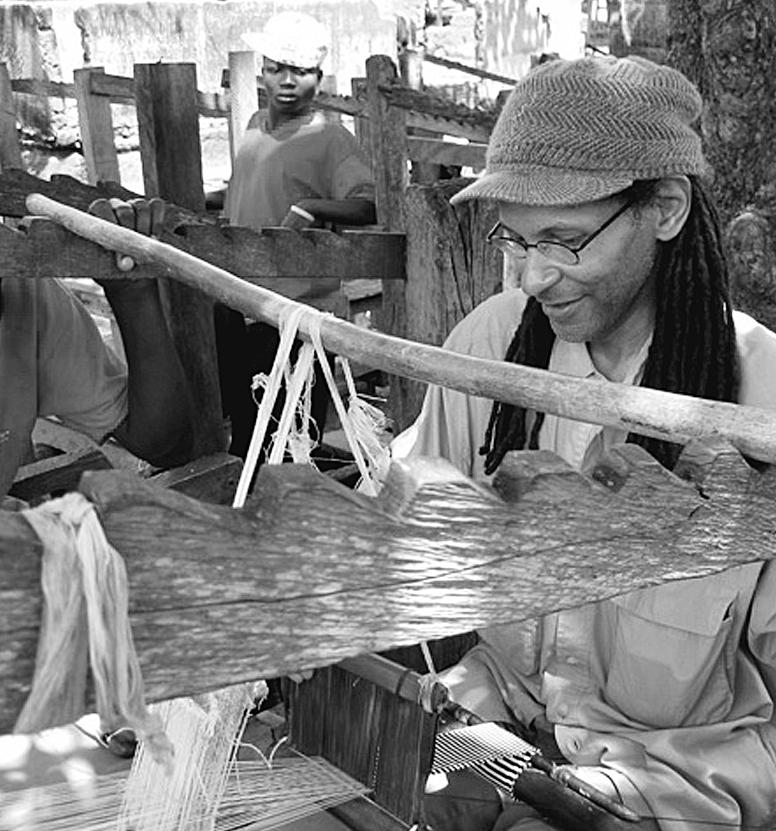
weaving.
about the building of slave ships and the actual loading of the slaves, tracing the journeys, were revelations and helped give me d i re c t i o n . I d e c i d e d t o f o c u s m y a t t e n t i o n o n G h a n a , i n We s t A f r i c a , from where most Africans bound for the US originated and where many of the sites I had read about h a d b e e n t u r n e d i n t o museums recording the a t ro c i t i e s o f t h a t t i m e .
Before going to Africa, I had several meetings and conversations with Steve Coleman, a world famous jazz musician who has searched for African influences in his music, about incorporating this kind of journey into the music I was writing at the time. My aim was to create a suite, a collection of pieces on a central theme, one that reflected each step of my journey.
So in the fall of 2008, I set out for Accra, Ghana. Nothing could have prepared me for the astonishing jolt of being in Africa, the birthplace of the world: the cacophony of sounds, of language, of music, of color, of dress, of beautiful greenery. As I traveled around and met musicians and teachers and their students, I noticed that I was beginning to feel lost and confused. The mythology of Africa and the reality of touching chains worn by a captured African, of walking around dungeons and inhabiting spaces where there was such physical and emotional misery, made all that I had learned and read about my past seem remote and empty.
...the reality of touching chains worn by a captured African, of walking around dungeons and inhabiting spaces where there was such physical and emotional misery, made all that I had learned and read about my past seem remote and empty.
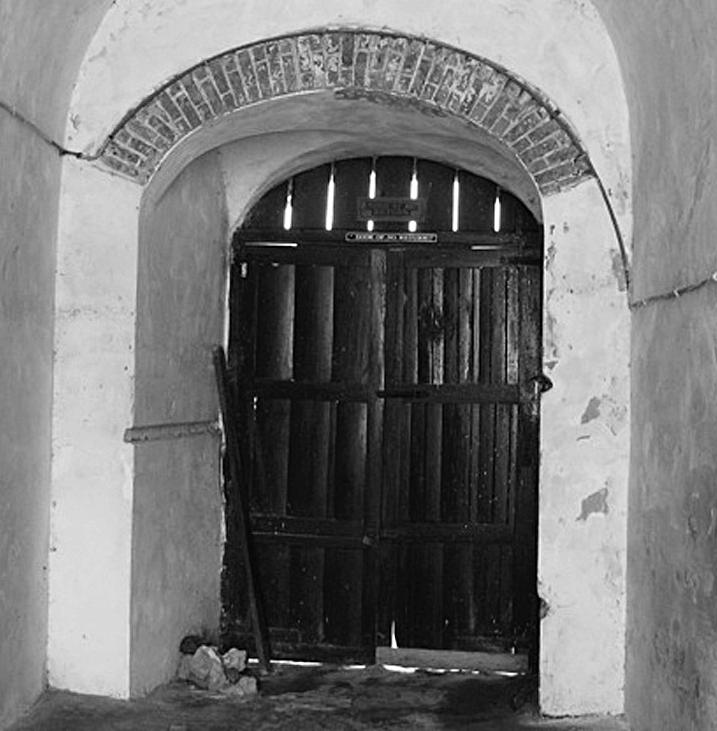
As we toured the castles that the Europeans built for the slave trade, Cape Coast and El Mina for me were far and away more horrific than it is rightful to contemplate. In El Mina my guide saw me standing in bewilderment before the infamous “Door of No Return,” and he
Carl, with Ashanti
t o u c h e d m y s h o u l d e r and asked if I was ok. And, if I was able, he wanted me to honor my a n c e s t o r s b y w a l k i n g t h ro u g h t h i s w o o d e n door and then to return through it, so I could bring their spirits home.
Amid tears of thankfulness, keeping in mind the blues of America, that music of pain and joy, the music that linked the past with the present, I walked toward the ocean, and then back toward that door and felt the release of the weight of being an African-American. Near El Mina, a meditation area offered a place to think about the brutality and to honor two former slaves whose remains were brought back to Africa.
Some experiences are so powerful that only music can represent them.
Some experiences are so powerful that only music can represent them. In my journal I wrote of each day’s experience, and I also kept a musical journal. When I returned home I took these notes and fashioned a suite of pieces which took me from conversations with my mother to my triumphant return home. I will be performing these works with Peter Angevine, class of 2002, a drummer, later this year.
Looking back on the original goal for my sabbatical, I see the naiveté in my hope of tracing my family’s lineage back to a specific location in Africa, for what DNA test could ever undo the erasure of the Middle Passage?* Indeed some pieces of the past can never be recovered. And yet, as I was leaving Ghana, and all the kind people who had honored my journey to Africa, I felt I had finally, finally made peace with my ancestral Homeland.
* The period when slaves entered the ships until they arrived on the shores
The Door of No Return.
It’s All About Shakespeare
By Terry Guerin
Terry has been director of Upper School drama for twenty-two years and also teaches eighth grade drama. This year, in addition, she has been teaching ninth grade English.
I think there is no better way to demonstrate the power of the English language than by teaching Shakespeare to students from kindergarten on up. Students will quickly overcome their distaste for the “archaic” language when they are encouraged to physicalize the narrative. In my fantasy school, Shakespeare would be used as the primary source for teaching English. I often think about the almost infinite number of lesson plans one could develop just using the
I often think about the almost infinite number of lesson plans one could develop just using the [Shakespearean] canon.
canon. For instance, tell a group of five year-olds the story of The Comedy or Errors, one of Shakespeare’s earlier plays. The humor erupts from the mistaken identities of two sets of twins, so give them one line from Shakespeare: “I to the world am like a drop of water/That in the ocean seeks another drop.” This is spoken by one twin who is seeking his brother, a perfect example of how one can use a metaphor to express a relationship. With this simple sentiment, the students could explore the vastness of the ocean and the simple need for kinship. They would see how those two things can relate to one another, using ideas expressed in our language.
A book, Coined by Shakespeare, by Jeff McQuain, Stan Malless and R.O. Blechman, gives us the unbelievably rich vocabulary that was used first in his plays. What a vehicle for teaching vocabulary to students on all levels. I only recently got a chance to look at this interesting book and noticed that the abundance of words invented by Shakespeare are a reflection of his careful study of Latin and English
in grammar school. He and his classmates spent eight hours a day, six days a week studying, reciting and writing our language. In fact, his teachers insisted on daily writing in what was called a “ commonplace” book It contained ideas and images that occurred to the students, and their record of them became “commonplace.” There is evidence of an assignment asking Stratford school boys to imagine themselves a tablecloth after a large feast, then to write their observations and experiences.
...his teachers insisted on daily writing in what was called a “commonplace” book. It contained ideas and images that occurred to the students, and their record of them became “commonplace.”
In 1980, I was performing in Henry IV part I, and although it was not my first experience performing Shakespeare, playing Mistress Quickly was a defining moment in my developing love of Shakespeare's work. Because I was in a repertory company, I was able to be a part of several ensembles, but something about that group of actors working on the tavern scene made me realize the power of physically connecting language with character. We rehearsed as a group of mates carousing at the local pub. The gentleman playing Falstaff was the perfect combination of mischief and wit, and with him at the helm, we experienced the power of tight ensemble performing. During the rehearsal process we told stories to one another, role-played and laughed together in the same way Hal and his buddies do We depicted the co-dependent relationship of Falstaff and Hal while they played at being father and son, and we did it as an ensemble. I realized that this was the essence of Shakespeare: sharing stories.
During the rehearsal process we told stories to one another, role-played and laughed together in the same way Hal and his buddies do.
One of the first lessons in my Shakespeare class for Upper Schoolers involves analyzing and presenting the Act IV prologue in Henry V. I am so moved by how beautifully the scene is set by Shakespeare; he allows us to step onto the threshold of the battle of Agincourt. I ask the students to approach the piece using all five of their senses, then infuse the spoken word with that experience. Shakespeare offers incredible opportunities to actors. Since he was an actor first and worked in collaboration with other actors, he honors what an actor
an bring to these words. It is imperative to engage physically with the images so beautifully suggested by his words.
Terry.
One of the things I tell my students is to pretend every word is in onomatopoeia: become the word as you are uttering it. Using our selves to embody our words is how we share our humanity with one another. The most potent way of doing that is to approach story telling with a commitm e n t t o p h y s i c a l i z i n g t h e s p o k e n word. Training to perform Shakespeare could enhance anyone ’ s ability to communicate, utilizing our language’s fullest potential. Being a part of the Shakespeare company, I was hooked, but when I started directing Shakespeare plays with high school students, I fully realized how enriching an ensemble approach to Shakespeare could be.
My classical drama class spends two trimesters studying Shakespeare through analysis and performance. One year I wanted to try letting the class, as an ensemble, develop a performance piece based on Hamlet. I anticipated each student taking on the role of Hamlet at any moment they were moved to enter into the action, and the ensemble would support by portraying the other roles. I cut the play down but wanted to “physicalize” the missing text in ensemble. I supposed that, through exercises, thoughtful reading and scene work, we could realize a presentation of Hamlet that would begin with Fortinbras’ line, “Take up the bodies.”
While the idea is not bad, my students were not in a place in their understanding of the play or of themselves as performers to create the play out of mere meditation.
While the idea is not bad, my students were not in a place in their understanding of the play or of themselves as performers to create the play out of mere meditation. They were certainly capable of recognizing the brilliance of the narrative but in order for the students to digest the numerous insights in the play, it needed to be taken in smaller doses. I discovered through the process that it would have been much more advisable to delve into perhaps one act of Hamlet and investigate it thoroughly with the students’ understanding of the
language and intent as a priority. It was a case of biting off more than we could chew The first step must be complete understanding of the text, and students need to accomplish that before the story can live in their bodies.
Anticipating a more successful result, I decided to present Twelfth Night as if Count Orsino were one of the young lads who, in 18th century England, was sent to India to help with his father ’ s tea plantation. I had read that men often sent wayward (or perhaps overly romantic?) sons to South Asia when they were too much of a nuisance at home. I imagined Olivia as an Indian princess. This allowed us to explore the Indian culture and have Sir Toby, Feste, Fabian and Sir Andrew don various degrees of Indian dress while Maria and Malvolio maintained their British look. With recorded music from Ravi Shankar, we produced a delightful treatment of the play, and because both Viola and Sebastian wore identical turbans, their mistaken identity was that much more credible.
Even more exciting than the romantic look of the show was the rehearsal process; we had the opportunity to study the colonization of the Indian continent while making wonderful use of the ethos and mystery of a culture and time different from our own. The students learned Indian dancing which was liberating for them and allowed
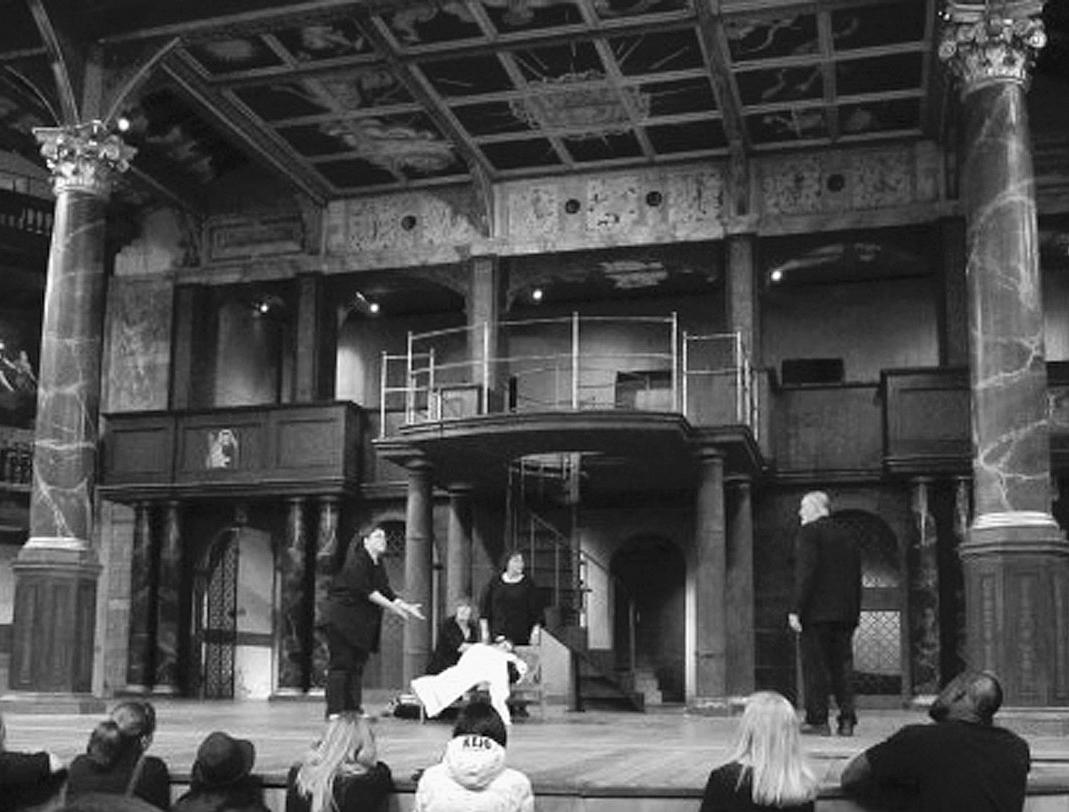
Terry, left, on stage at the Globe Theater
them to physically explore the play’s celebratory poetry. This was ambitious, but I was careful to bring the students along in the process and made certain all of our choices were supported by the text. There
This was ambitious, but I was careful to bring the students along in the process and made certain all of our choices were supported by the text.
is an elegant dramatic sweep to Twelfth Night, and the music of the sitar captured and enhanced it for us. Because the play is about exile and identity, considering how a young British man may feel alienated but attracted to the Indian culture became the launching pad for our production. This concept was not simply laid on the play; it was a “ way in” that enjoyed a great deal more success than my overly-ambitious approach to Hamlet.
Last summer, I had the privilege to join eighteen other American English and drama teachers at the Globe Theatre in London. For three weeks, we attended classes, lectures and rehearsed day and night.
Our course culminated with our performance on the Globe stage for a “midnight matinee.”
Our course culminated with our performance on the Globe stage for a “midnight matinee.” I got a chance to play Friar Lawrence in Romeo and Juliet as directed by one of the Globe directors We also studied Shakespeare's boyhood curriculum. We became very close and had intense discussions about the plays, the characters, the world of Elizabethan London along with playing “ name that quote” over a pint after a long day of classes. Each time I approach one of the plays to teach or to direct, I find something new to learn and explore And that is the essence of a Shakespeare curriculum.
Mister C, or Just Call Him Mike
By Marilyn Lager
Marilyn is director of the Middle and Upper School Library and has edited this journal since its inception, twenty-two years ago.
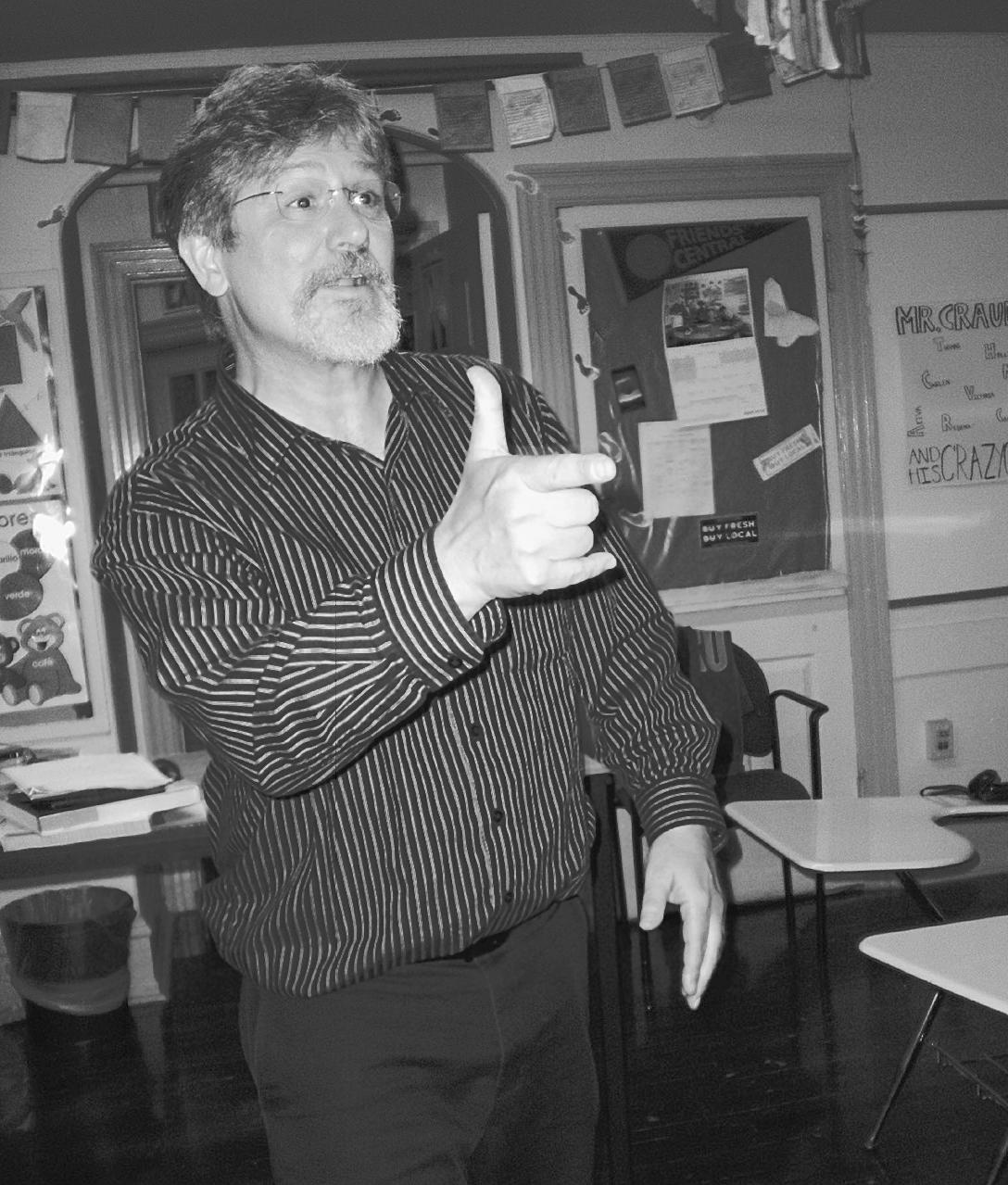
It’s a clear, brisk March day. In fact, it is the last period before spring vacation begins, and Mike Crauderueff is working hard He wants to keep his young Quakerism students fully engaged and participatory as they get ready to embrace their time off. In his small classroom, on the third floor of the Wood Building, where a poster of Afghani girls is at home next to one of the Dalai Lama, Mike is energetic, cheerful and full of entertaining information on Quakers Talk ranges from their assignment: to discover what makes a Quaker school different from other private schools (the hope to develop “ eyes for invisibles,” to develop a student who has the courage to follow the inward argument where it leads, and the centrality of Meeting for Worship) to talking animatedly about Quaker stereotypes. “Quakers are easy to stereotype,” he says ruefully. He flashes on the screen a website advertising all things Quaker: Quaker coffee?? Quaker Chemical Company?? Quaker delicatessen?? The students are amused and critical… and soon, ready to leave. Mike’s parting words: “Promise you will do something special for you this vacation!” And they are gone.
...Mike, as he wishes the children to call him, is about to finish his thirtieth year of teaching at Friends’ Central this June.
And Mike, as he wishes the children to call him, is about to finish his thirtieth year of teaching at Friends’ Central this June. He grew up in Elkhart, Indiana, and attended Beloit College, in Wisconsin, where, in his senior year, he embraced Quakerism. He recalls a snowy, winter morning, when a Quaker philosophy professor held a small Meeting for Worship, in his living room, with a warm fire glowing. Mike had been aware of his parents’ leaving the Methodist Church because the
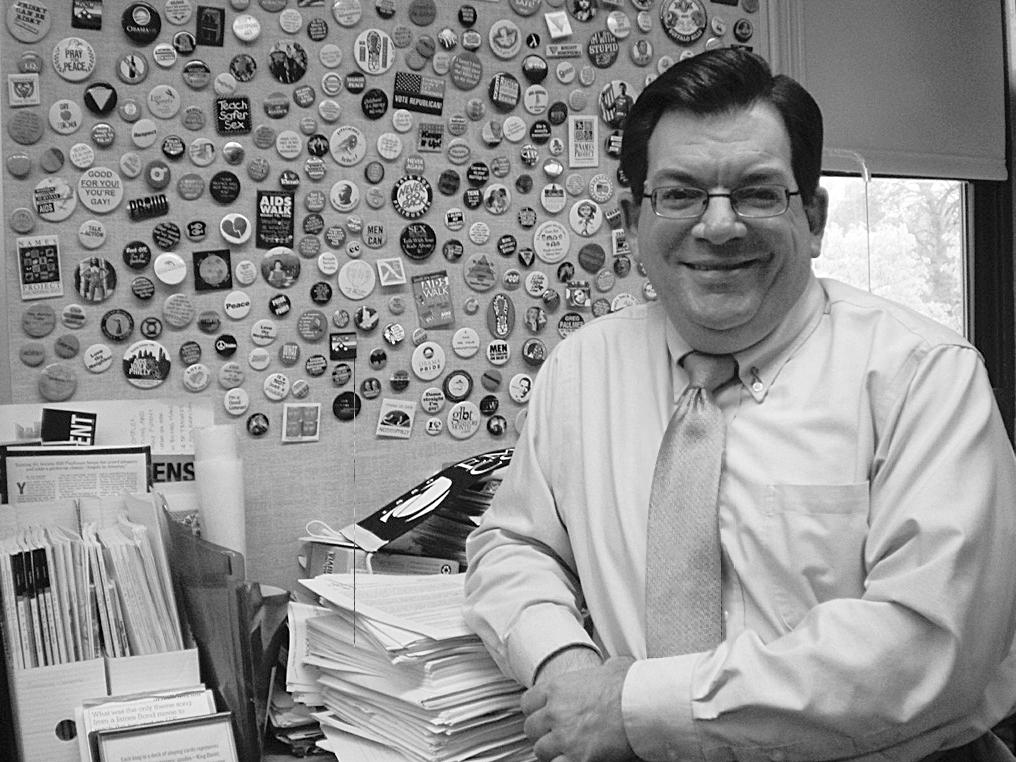
Mike, in his classroom.
Church would not admit African-Americans, and he now began to read everything he could about Quakerism. After graduating and teaching French (with which he had become enamored after high school trips to Guadaloupe and Quebec and a college year in France) for two years at Lake Forest C o u n t r y D a y S c h o o l , Mike met his wife Elaine. Elaine was part of an organization called “New Call to Peacekeeping,” where she spoke and preached about peace topics. Theirs was a quick courtship: they married in July 1980, merging their last names, hers (Crauder), his (Rueff), becoming the Crauderueffs. They soon moved to Philadelphia, which they had identified as a bastion of Quakerism, and with some experience at the Quaker center Pendle Hill in Wallingford, he was hired to teach French to Middle Schoolers at FCS. In the fall of 1980, he joined a Middle School faculty, half of whom were Quaker, and soon was working on a French certification and a master ’ s degree in education at nearby St. Joseph’s University.
Mike’s professional life, teaching, connected him with his two parents who were long-time teachers. He often had tutored slower classmates, those who were scapegoated and ill-treated. His parents had shown him a way of life that was inclusive, taking active umbrage against racism. In Elkhart, they had seen crosses burned by the KKK, and Mike remembers a race riot in high school. Indeed, he was ostracized for his liberal views. In landing at FCS, he found the perfect union of values: education and the respect for the light within each human life. “It is our job as teachers to help it glow brighter,” he smiles.
In landing at FCS, he found the perfect union of values: education and the respect for the light within each human life. “It is our job as teachers to help it glow brighter,” he smiles.
His language skills bloomed at FCS, and after some years, he was learning and studying the Spanish language, encouraged by summer stipends that took him to Guatemala, Mexico and Spain. (He had lived for a time early in his marriage with his Puerto Rican brother-inlaw and his family.) Middle School did not have Spanish in the curriculum, and Mike introduced it, and it grew incrementally, year by year. It was not simply the acquisition of a second language that intrigued him, but the social problems and injustices of migration and the border issues. These took him to Texas for part of a 1991 sabbatical and also brought him a second master ’ s, this time in bilingual and bicultural Spanish studies from La Salle University. And in 1993, he joined the language department of the Upper School. Jackie Gowen-Tolcott, department head, appreciates his qualities, saying, “I greatly value Mike’s professional advice on teaching methods and strategies. But more, his message of compassion towards the students guides us to make the right decisions.”
“
...his message of compassion towards the students guides us to make the right decisions.”
Mike’s world was expanding. Elaine came to teach Quakerism at FCS for twelve years and was the Quakerism coordinator of all three divisions. She currently works at the Friends General Conference, nurturing meetings all over the United States. Their children, Rob ’01 and Mary ’03 were educated at FCS. Rob, after graduating from Columbia and working at an organization called “Sustainable South Bronx,” is currently in a master ’ s program at MIT in urban planning.
Mary, an Earlham graduate with a master ’ s in library science, is working in the archival department of the Smithsonian, which has included traveling to the Panama Research Institute.
His sense that FCS needs to maintain a Quaker identity, while still being an academically excellent institution is keen...
When Elaine left FCS in 2002 to develop a writing career, Mike stepped in to teach Quakerism to Upper Schoolers. His sense that FCS needs to maintain a Quaker identity, while still being an academically excellent institution is keen, and in an article published in the school newspaper Focus, editor Arielle Fogel wrote that Mike tries “to foster a learning community that can slow down and notice what is in front of us, ” despite our necessary emphasis on achievement and academics. Arielle also wrote that she was grateful that there was no intent to convert anyone, that in her Quakerism class, Mike hoped that a student would become “ a better Jew, Muslim, Hindu, Christian, Buddhist or… Quaker,” valuing his/her own religious beliefs. Kendall Bedford, a current student in Quakerism, likes that “it’s not all about history; it’s reality based.” And Adam Bolotsky says, “He makes Quakerism interesting and fun.” Mike also teaches courses in Comparative Religion and Peace Studies to juniors and seniors, investigating non-violent responses in history and contemporary life to conflicts in the world.
Mike is a questioner, a seeker of the truth. His mind is always turning over such issues as what is the aim of education or what defines spirituality...
Mike is a questioner, a seeker of the truth. His mind is always turning over such issues as what is the aim of education (to be transformative) or what defines spirituality, above and beyond the aspects of a Quaker education. He is a frequent speaker at Upper School Meeting for Worship, never hesitating to reveal the personal and soulsearching questions that are meant to stimulate adolescent growth and development. Says Gary Nicolai, history teacher and long-time colleague, “I’ve always admired Mike’s ability to walk the walk; he speaks his mind, even about controversial subjects that may have unpopular outcomes. He is not at all afraid to stand apart from the crowd.”
Mike continues to be an eager learner, and he is always ready for new life experiences He left FCS for a year to join a charter school in Camden, New Jersey, as language department head. He wanted to offer his professional expertise to children with many challenges in their lives. He returned to FCS, appreciating its openness and the freedom he has to teach his subjects, while modeling Quaker values. Last year, he suffered from a severe pulmonary disorder, having to take a leave of absence and was able to look deeply into what is important to him. He now “appreciates each day as it comes. ”
Sports have always played a big part in his life, from pick-up games on summer nights in Indiana to coaching baseball and softball for some years at FCS, telling his teams that “If we win the championship and don’t love one another or connect fully with one another,
“If we win the championship and don’t love one another or connect fully with one another, then we have lost.”
then we have lost.” At the school lunch table, he often will uncap a treat that he has cooked himself: pulled pork, vegetarian chili or panseared chicken with lemon, and as Upper School secretary Diane DeVan says, “You haven’t had Italian homemade bread until you taste Mike’s!” He is a passionate watcher of cooking shows and an eager student of opera and classical music
And so Mike’s thirty years at Friends’ Central have been rich and varied. He is never content with the status quo, with teaching only one subject, with thinking about a problem in only one way. As Beth Johnson, co-principal and dean of students says, “He is an artful teacher, and he genuinely connects with people the connections are extraordinarily warm and genuine and cross all boundaries of race, culture, ethnicity, sexual orientation, age and socio-economic status. He is thoughtful and deeply moved by global, national, state, local and personal tragedies…moved to do something and always moved to help.” He is Friends’ Central’s gadfly, a peacemaker and a peacekeeper.
Philadelphia Sports Phever
By Jason Polykoff ’02
Jason teaches seventh and eighth grade math. He is also the sports information co-director and coaches both Middle School and Upper School athletic teams. This March he helped create the “Philadelphia Sports” course as part of the annual Middle School mini-course curriculum.
There were two outs in the top of the ninth inning in game five of the 2008 World Series when the Tampa Bay Rays’ Eric Hinske stepped up to the plate. Unable to sit down due to nerves and adrenaline, I found myself standing in front of my Lazyboy recliner in my Bryn Mawr apartment with my hands on my knees nervously anticipating the impending result (incidentally with two indifferent baseball fans). The Phillies closer, Brad Lidge, was one out away from claiming the first World Series championship for the Philadelphia Phillies in almost thirty years. Pitch one, foul ball. I began hopping up and down uncontrollably, a huge smile imprinted on my face. The Phillies were two strikes away from becoming the first professional Philadelphia sports team to win a championship since 1983 when the Philadelphia 76ers won an NBA title; it was the year I was born. Pitch two, check swing, strike two. I jumped three feet in the air and belted out, “One more! One more!”
At age twenty-five, I had never seen a Philadelphia sports team win a championship, a dream of mine since I was a little kid.
At age twenty-five, I had never seen a Philadelphia sports team win a championship, a dream of mine since I was a little kid. As the catcher Carlos Ruiz ran to the mound to have a mini-conference with Lidge, I could not help but think about all the time, energy and emotion I had given to the local sports teams in anticipation of this pinnacle moment. I was going to remember this for the rest of my life.
With Ruiz back behind the plate, Lidge set, wound up, and fired a pitch towards h o m e p l a t e S w i n g a n d a miss, strike three. I fell to my knees with my hands raised in the air. I had no words, and tears filled my eyes.
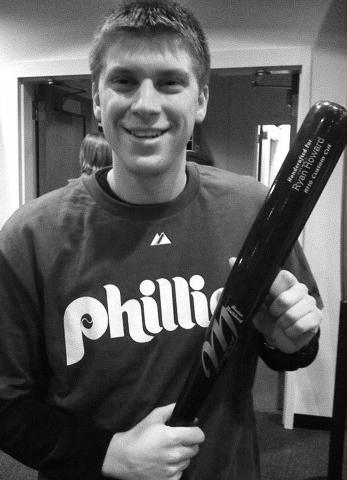
a friend.
A t h l e t i c s h a v e a l w a y s been a large part of my life. My father signed me up for recreational sports teams by the time I was four years old, and I continued to play a variety of sports, often on the varsity level, throughout my time at Friends’ Central (I was a lifer) and at Haverford College, where I played b a s k e t b a l l . To d a y, I c o a c h three different sports teams a n d c o n t i n u e t o p l a y a s much as possible. I have followed teams, attended events and chatted about sports to any and everyone who would listen. Even some of my earliest memories as a kid were of sitting with my father in the living room watching the local sports teams play on television When the Phillies won the World Series in 2008, it felt as if it had been the culmination of all the passion I had given to Philadelphia sports teams throughout my life.
When the Phillies won the World Series in 2008, it felt as if it had been the culmination of all the passion I had given to Philadelphia sports teams throughout my life.
I have been a Philadelphia sports fanatic since my father, the original Philadelphia sports fan, introduced me to the wonderful world of athletics when I was a child. We lived and breathed Philadelphia sports every day.
You can only imagine my excitement when Middle School teacher Alex McDonnell announced that this year ’ s mini-course theme was to be “Philadelphia.” Teachers were asked to come up with concepts related to the city of Philadelphia that they would teach to the stu-
Jason, with
dents over a three-day period preceding Spring Break. As the letter home to Middle School parents declared, “[Mini-course] is an alternative curriculum in which students will continue to refine their academic and social skills through new and very different learning experiences.” The idea was to stray from the everyday class curricu-
“[Mini-course] is an alternative curriculum in which students will continue to refine their academic and social skills through new and very
different learning experiences.”
lum and give the teachers a chance to teach about another subject they were interested in and passionate about. Teachers came up with ideas like popular Philadelphia foods, influential Philadelphia females and the Philadelphia music scene. While all of the ideas were great, there was only one topic I could think of to spend three days teaching: Philadelphia Sports.
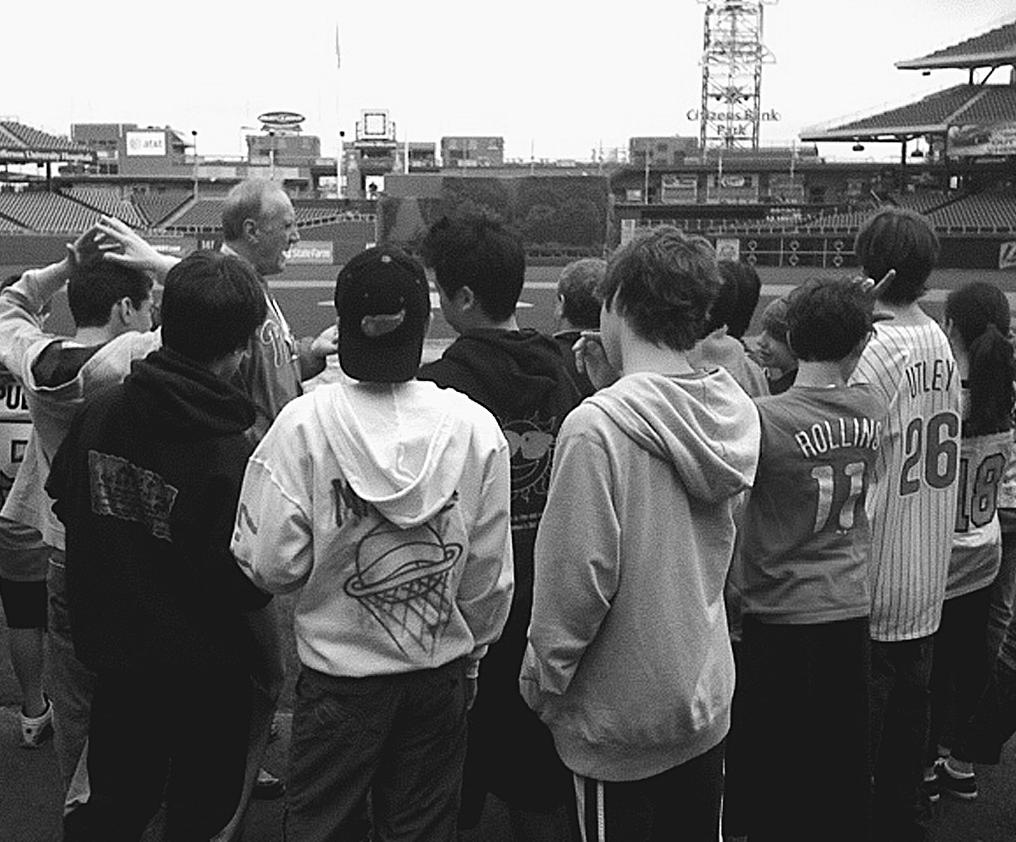
FCS students on tour of Citizens Bank Park.
When the students entered Room 10 of the Middle School on day one of mini-course, there was a quiet excitement in the room. It was filled forty-eight deep with students decked out in Philadelphia sports attire, a requirement that had been laid out by the teachers: Keino Terrell, Lauren Betz, Sharon Morsa and me. I could sense the students quietly anticipating the days ahead. After all, besides getting a chance to hear Don Dissinger (father of Peter Dissinger ’14) give a presentation on Citizens Bank Park, a stadium he helped design and build, they were going to take an all-access tour of the stadium the following day, as well as a trip to the world renowned Palestra to meet University of Pennsylvania head basketball coach Jerome Allen and Friends’ Central father of Jerome, Jr., ’14 and Taylor ’14. In addition, they were going to get a chance to do some research and give a presentation of their own on a famous Philadelphia sports figure. It truly was going to be an exciting few days.
When I watched Don give his PowerPoint presentation on the design of Citizens Bank Park on day one, one could see all the hard work and manpower that went into creating this beautiful stadium. He showed slides of the demolition of the old Veterans Stadium, the beginning stages of construction of the new stadium, the erection of the beams and poles, and finally the finished product. I was in awe of the whole process and realized how lucky I was to be given the inside information into the birth of the Phillies stadium, and it was a perfect introduction to the tour we were set to take the following day.
I was in awe of the whole process and realized how lucky I was to be given the inside information into the birth of the Phillies stadium...
Day two of Philadelphia Sports mini-course was bound to be the most exciting The students gathered outside Shallcross Hall in a swarming sea of red, awaiting their bus ride to Citizens Bank Park to get their private tour of the stadium they had learned so much about the previous day. When we arrived at the stadium in South Philadelphia, we were immediately greeted by Phillies personnel and escorted into the stadium. I watched as the wide-eyed students walked sideby-side with their classmates, sharing stories of games they have attended. After watching a brief video on the inauguration of Citizens Bank Park in 2004, featuring Friends’ Central’s Nathan Willis ’13, the students and teachers split into two groups to begin their tours.
The Phillies tour guides showed us the Diamond Club, the press box, the batting cages, the locker room and finally the field. You could almost smell the Tony Luke’s cheese steak stand out in center field. It
was hard to imagine, as I stepped out from the dugout onto the emerald green Sprinturf field, that I was standing on the very field that just two years ago was the site of one of the greatest thrills of my life. As I stood behind home plate, I tried to visualize Brad Lidge’s final pitch that won the Phillies the World Series. I peeked over to first base and saw Ryan Howard hurling himself towards the pitcher's mound to tackle Lidge and Carlos Ruiz as they embraced I looked up and saw Shane Victorino sprinting in from center field to his teammates, with the Philadelphia skyline in the background. And I looked back in the dugout and saw the manager, Charlie Manuel, sharing his excitement with his fellow coaches. It was a moving moment for me, as I am sure it was for the students.
The rest of the week went smoothly. After the Phillies tour we stopped and had lunch at McFadden’s under the stadium before heading off to the Palestra to meet Jerome Allen. Coach Allen was kind enough to provide Penn basketball t-shirts to all of the students. The following day the kids had a chance to present on a popular Philadelphia sports figure whom they had been researching throughout the week, figures like soccer star Heather Mitts, former Flyer Keith Primeau, Hall of Famer Reggie White, legendary sports
It was remarkable to see how many of the students share the same passion for Philadelphia sports with me.
announcer Harry Kalas and Friends’ Central’s own basketball great Hakim Warrick. It was remarkable to see how many of the students share the same passion for Philadelphia sports with me. I could not help but see myself in most of them I can only hope they do not have to wait another twenty-five years to see another Philadelphia sports championship.
Gun Control or Not: A Summer of Understanding
by Jordan Taffet ’12
Jordan spent the summer of 2009 as a participant in a program called Etgar 36 (which means “challenge” in Hebrew). He spent over a month traveling with about forty students from all over the country. Etgar exposes students to diverse views of social and political issues such as abortion, immigration and the environment.
Just because it was summertime, and the school year was over, it didn’t mean that I stopped learning. No, in fact, I found that during my experience traveling around the country with Etgar 36—a teen tour that takes students across the USA and delves into many social issues, stopping at cultural, musical, and historical landmarks my fellow campers and I gained knowledge and a social conscience that spanned many different subjects and ideas.
We learned about the pros and cons that politicians and activists try to present to the public on a range of social issues.
We learned about the pros and cons that politicians and activists try to present to the public on a range of social issues. We learned to survive on Holiday Express biscuits and Denny’s Grand Slam breakfasts. We learned how to deal with and accept the drama of forty teenagers looking to get to know one another. We learned many different things, all of which had a useful (if not profound) lesson for each of us.
We started out in Alabama, at the Rosa Parks Museum and the Southern Poverty Law Center, learning about the Civil Rights Movement and meeting with preachers who actually walked alongside Martin Luther King, Jr on some of his marches We moved on to Tennessee, checking out Beale Street at night, seeing the culture of rhythm and blues and the roots of rock. Later on, we moved west to San Francisco, and while there, we roamed through Haight Ashbury, observing
the hippie and Beatnick cultures that still exist within the community. (Stores devoted to a marijuana lifestyle were flourishing) Still, along with seeing the sights and exploring each community we visited, most of the trip concentrated on exposing us to diametrically opposing beliefs and arguments. In particular, as we moved back east to New York and Washington DC, we came across many different political groups, each with unique perspectives. For example, as we went into New York, we explored the pros and cons of gentrification, focussing on old neighborhoods like Harlem, where multi-generational traditions were being transformed into more upscale communities, lacking the color and vibes of the original. While in DC, we made
...most of the trip concentrated on exposing us to diametrically opposing beliefs and arguments.
sure to not only explore the mechanics of our government around the Mall, but we also gave ourselves a chance to talk to NORML (National Organization to Reform Marijuana Laws), to gain a different understanding of the issue. All of these sights and groups that we were visiting led to one ultimate outcome, and for me, that was the ability to understand.
Now, the idea of understanding, whether it is appreciating the people who surround you or embracing customs and traditions that seem foreign and frightening, was not a concept I had ever truly considered or thought about before this trip. I guess this was because I
I had lived in an accepting community ( . . . close to FCS), and I had always considered myself understanding by nature.
had lived in an accepting community (Lower Merion, which is close to FCS), and I had always considered myself understanding by nature. But it wasn’t until this summer trip that I realized that I wasn’t as understanding as I once thought I was. Because the entire curriculum of Etgar ’ s trip was based on meeting people who had opposite per22
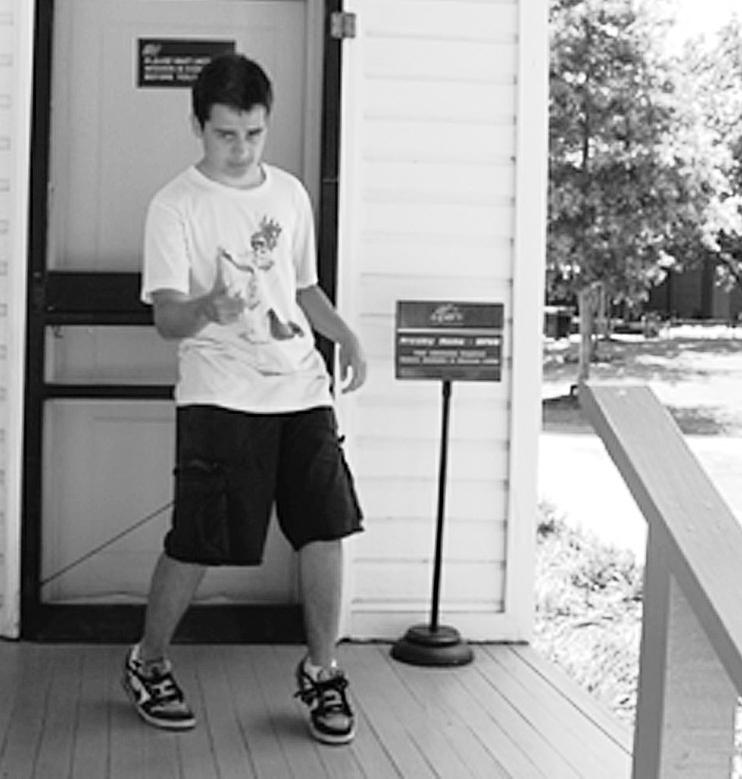
Jordan, dancing on the porch of Elvis’ birth home in Tupelo, Mississippi.
spectives about certain social issues (abortion, gun control, immigration, gay marriage, labor, homelessness, war on drugs and illiteracy), I had to constantly question what I thought and felt.
One day while in Denver, our group listened to the father of Columbine victim, Daniel Mauser, talk about the day of the shooting, his depression over his loss, and his strong views on gun control. While fighting through his tears, he told us he was wearing the shoes his son was wearing the day he was murdered, a particularly heartbreaking moment for all of us. The very next day, we debated with an NRA lobbyist Clark Aposhian at a shooting range in Utah on the validity of the Second Amendment, the right to bear arms. In order to actively and appropriately participate in these conversations, each of us had to be at least willing to listen to both “sides” of each political issue. At the beginning of the tour, I had thought I was listening well, but I realized during my conversation at the range that I wasn’t.
The point of these debates were for us, the students on this tour, to listen and take in all of the information we could and then do what we would like with that information. I felt that in order to do this, I would need to debate with the many kinds of individuals who were supporting all of these causes. My method of debating at the time, though, wasn’t as much debating as it was insisting that the other person was wrong.
My method of debating at the time, though, wasn’t as much debating as it was insisting that the other person was wrong.
I believed that others had a right to think what they would like, but that they were wrong. With this idea in mind, I went on to mindlessly oppose the positions I disagreed with rather than understand them I did not bother to understand opposing points of view at all, and this was the reason for my closed mindedness. For example, while in Texas, we sat in a church with a group of pro-lifers who explained their points of views to us. I unfortunately did not care so much about what they had to say as I did about convincing them that they were wrong.
Had I listened to what these activists had to say about their given field when I was debating with them, I could have used their information in two different ways:
1. I could use their information against them in my own arguments.
2. I could use their information on the subject to gain some insight as to what my views were on the given issue
Now, the first option would have been helpful in making myself look like less of a jerk, and maybe even put me in a good light. But option number two, to listen to the person on the opposing side of the debate and consider what he/she was saying (so that I could determine my own views on the subject) seemed to be the more powerful option. It was a fascinating concept to me listening to someone ’ s views (that I may have initially found to be crazy) and later on adopting some of their views after listening to them. It was not something I had done before. I had only listened to the lessons my parents and my community had taught me, and I had stuck with them!
As a result of listening and understanding, I learned more about myself and other people whom I may have deemed “ignorant.” The ones whom I had considered ignorant the ones who were pro-life for example were not necessarily wrong but had a different way of looking at things than I did. While I am still unsure of my position on the issue of abortion, I had learned to understand and accept some of their arguments as to why abortion should be illegal. What I had realized about all of the different people I had been debating with was that all of them, the NRA lobbyist, the pro-lifers, the anti-gay marriage activists, wanted overall happiness for everybody. Each of them were good people; they had just done their research and gained different viewpoints from it. That was exactly what I needed to do do my research, listen to other people and gain a perspective once I had enough information.
That was exactly what I needed to do— do my research, listen to other people and gain a perspective once I had enough information.
Once I understood their viewpoints and took my stance, and vice versa, we were actually one step closer towards agreement I realized that there is no way for two opposite sides to agree immediately on a certain issue, but if both acknowledge the validity of each other ’ s arguments, they will slowly and surely reach a middle ground that both will be comfortable with. This listening, understanding and talking is debate at its finest, and as I grow and learn, I will continue to practice these traits at FCS and in the wider world.
“Queer Words: ”
Incorporating LGBT Material into the English/ Language Arts Classroom
By Al Vernacchio
Al is completing his thirteenth year at Friends’ Central. He is the chair of the Upper School English department and is the Upper School sexuality educator. For two consecutive years, Al has presented a workshop on incorporating LGBT material into the English / Language Arts classroom as part of the Multicultural Resource Center ’ s “Teachers Teaching Teachers” event.
Bringing material about LGBT (lesbian, gay, bisexual and transgender) individuals into the classroom is essential to any school committed to diversity. This can be accomplished by bringing new texts into the curriculum or applying a queer sensibility to existing texts; neither is as scary as they might first appear.
“Queering” the curriculum begins with a recognition of the heterosexism that exists in, and can dominate, classrooms. Heterosexism, the assumption that everyone is or should be heterosexual and the conscious or unconscious exclusion of non-heterosexuals from one ’ s reality, is often the default position in classrooms. Teachers and administrators may fear that broaching LGBT-related topics will be seen as controversial, or as a moral or political statement, or that it isn’t an “age-appropriate” topic for students. This sets up what Larry Gross, professor at the University of Pennsylvania’s Annenberg School of Communication, calls “symbolic annihilation”—the obvious absence of LGBT models suggests that these individuals either do
Countering heterosexism also entails recognizing the heterosexual privilege that exists in most educational materials.
not exist or are not worth noting in the classroom. Countering heterosexism also entails recognizing the heterosexual privilege that exists in most educational materials. Works of literature at every level in the English/Language Arts classroom highlight various models of hetero-
sexuality: fairy tales end with a prince and princess marrying and living “happily ever after;” beginning readers offer stories centered on heterosexual families; young adult literature is thick with the first yearnings of boy-girl attraction; and many of the canonical texts in the high school classroom are built around heterosexual couples. Yet seldom does anyone worry about the influence of these blatant displays of heterosexuality on the impressionable young minds of our children.
Bringing LGBT-inclusive material into the classroom is not about diminishing the visibility of heterosexuality in the classroom.
Bringing LGBT-inclusive material into the classroom is not about diminishing the visibility of heterosexuality in the classroom. “Integration, not isolation” is the idea that must guide us here. Rather than carving out a separate place for LGBT literature, such material must be seamlessly integrated into the larger fabric of the course content. It isn’t about having a “special” gay story or a “token” example. The goal must be increasing the visibility and understanding of LGBTrelated people and seeing this experience as another aspect of being human, rather than as another minority experience to stand along all the “others ” Terrific materials already exist to accomplish this at every grade level; no wheels need to be reinvented, only recognized and utilized. For example, in lower school, ABC A Family Alphabet Book by Bobbie Combs, is a standard ”learn your letters” book which includes a wide variety of family structures including LGBT-inclusive families The same-gender couples are not a focus of the book; they are just one kind of family among many shown.
In the lower school classroom, sexuality educator Danny Horn offers three especially helpful focal points one can use when integrating LGBT-related materials: romantic love, family and fairness. In my work I have added my own twist to each of these. Romantic love is hardly a foreign subject in lower school—take any Disney movie or fairy tale as an example. Falling in love is seen as a natural and healthy part of aging, and even very young children are asked (one might say prompted) whom they might “ marry ” when they grow up. Further, what little boy hasn’t been asked by some adult whether a girl playmate might be his “little girlfriend” or whether he “likes” her? A simple adjustment of language here, using the word “sweetheart” as a universal term for the object of romantic love, can easily create a more equitable approach. Two boys, two girls, or a boy and a girl can be sweethearts, and sweetheart love can easily be distinguished from parent-child love or friendship with
simple age-appropriate, non-sexual explanations. A great book to use here is King & King by L De Haan & S Nijland which tells the story of Prince Bertie’s search for his perfect match. Many princesses are presented to him, but Bertie finds his sweetheart in another boy named Lee whom he marries and lives with happily ever after.
...sweetheart love can easily be distinguished from parent-child love or friendship with simple age-appropriate, non-sexual explanations.
Another option is The Duke Who Outlawed Jellybeans, and Other Stories by Johnny Valentine and Lynette Schmidt. This collection contains newly crafted fairy tales, some with feminist themes and many include same-gender and other-gender sweethearts in the stories. It is an easy step to move from an inclusive definition of romantic love to an inclusive definition of family by expanding the idea of sweetheart to “sweethearts are two people who love each other and want to make a family together.” Learning about diverse family structures is almost universal to lower school curricula today, and by simply expanding that definition to include families with two moms or two dads, we create a more inclusive classroom. Again, the point is not that some “special” families have two moms or dads, but that this is just one of the many types of families that exist in our world Who’s in a Family by Robert Skutch provides a wide variety of family structures including same-gender couples raising children. Heather Has Two Mommies by Lesléa Newman and Diana Souza and Daddy's Roommate and Daddy’s Wedding by Michael Willhoite are other excellent options. Finally, discussions of fairness must include messages that we do not tease someone because of whom their sweetheart is, what their family structure is, or how the person may act. Oliver Button Is A Sissy by Tomie dePaola, The Sissy Duckling by Harvey Fierstein, and The Boy Who Cried Fabulous by Lesléa Newman and Peter Ferguson are all stories that not only show it is wrong to tease but give the hero role to the “sissy” characters.
Building on the foundation laid in lower school, the middle school English classroom is the place to bring more complexity into the discussion of the LGBT experience.
Building on the foundation laid in lower school, the middle school Language Arts classroom is the place to bring more complex-
ity into the discussion of the LGBT experience. As first crushes and attractions come along with the onset of puberty, including stories that involve same-gender crushes and attractions are essential, as is the message that it is normal to experience both same-gender and other-gender crushes at this time and that it does not need to lead to a definitive statement about one ’ s sexual orientation. Lucky by Eddie De Oliveira is the story of Sam, who is attracted to both boys and girls
Lucky by Eddie De Oliveira is the story of Sam, who is attracted to both boys and girls.
He meets Toby, who has the same likes and attractions. The story shows that “there is more to life than labels, and more to love than a simple definition.” Annie on My Mind by Nancy Garden is a young adult novel that centers on two girls discovering their romantic feelings for each other, and Alex Sanchez’s Rainbow Boys and Rainbow High are centered around three very different young gay men, as they deal w i t h “
, activism, parental/peer reactions and even Internet predators” all “hot topics” for any adolescent today. Teaching about different per-
spectives, including the idea that being LGBT affects how one sees the world and how one is seen by the world, is an appropriate lesson for middle school. Two short story collections, Am I Blue: Coming Out of the Silence edited by Marion Dane Bauer and Beck Underwood and Not The Only One: Lesbian and Gay Fiction for Teens edited by Jane Summer offer a variety of stories that make clear there is not one standard LGBT-experience, but that the process of coming out and learning to live in the world as an LGBT individual necessarily involves seeing the world with a different set of eyes. Finally, when using nonfiction books to cover the topic of civil rights in middle school, integrating the LGBT community into that story of the fight for civil rights, and showing how this movement took its lead from the African-American civil rights movement is an important connection to make. The Harvey Milk Story by Kari Krakow and David Gardner is an excellent resource for this unit.
In upper school where “coming of age ” is a common theme of so many ninth and tenth grade books, folding the coming out experience into the coming of age discussion is an easy way to integrate the LGBT experience.
Julie Anne Peters’ Luna is one of the few novels centered on a young person coming out as transgender and adds a unique, new voice to the chorus of coming of age stories. It is especially good in that it also incorporates the need of Luna’s family to come out as well about their child/sibling’s gender identity. Some of the most famous authors frequently studied in upper school—Emily Dickinson, Walt Whitman, Alice Walker, Thornton Wilder, Tennessee Williams, Tony K u s h n e r, L o rd B y ro n , Wi l l a C a t h e r, L a n g s t o n H u g h e s , C a r s o n McCullers, Virginia Woolf, just to name a few were members of the LGBT community. Addressing this in the classroom and discussing how their sexual orientation may have impacted their work can bring a richness and complexity to the study of their writings.
Addressing this in the classroom and discussing how their sexual orientation may have impacted their work can bring a richness and complexity to the study of their writings.
Finally, introducing “Queer Theory” as a school of literary criticism in the later years of Upper School can enrich the discussion of many books already in the curriculum. Developing a “ queer sensibility” when reading texts involves focusing on: the experience of being an outsider (solo or as a member of an outsider group), a sense of having been oppressed and judged as not “normal,” an interest in the
aesthetic (in beauty, in the physical, in sensation), and interpreting the world in a radical way that challenges norms. A queer reading of canonical texts such as The Great Gatsby, The Catcher in the Rye or any of Shakespeare’s plays offers interesting and insightful new views of these works. Again, the point here is not to discuss LGBT content to the exclusion of more standard heterosexual readings, but to integrate this way of viewing texts into a larger whole.
Bringing LGBT-inclusive materials into the English/Language Arts classroom is largely an act of recognizing what is already there. LGBT authors and experiences already exist in our curriculum, just as LGBT students are part of our classrooms whether we know it or not.
Creating a LGBT-inclusive classroom is done by acknowledging and bringing light to the LGBT experience in a way that does not stereotype, marginalize, or make a special case out of them.
Creating a LGBT-inclusive classroom is done by acknowledging and bringing light to the LGBT experience in a way that does not stereotype, marginalize, or make a special case out of them. With integration of LGBT material rather than specialization as the goal, any teacher can ensure that queer words are spoken in their classroom.
Something’s HappeNING at FCS
By Regina Ziffer and Susan DiFulvio Kirk
Regina has been the Lower School librarian for fourteen years. Sue has been technology coordinator at Lower School for twenty-three years.
“Smile at me if you can see the news article on the white board. Give me a thumbs down if you can’t see it.” About 100 smiley faces (and a few thumbs down) flash in the upper left hand corner of the online screen next to the names of the course participants who have joined our Powerful Learning Practices class or PLP Webinar, as they respond to the moderator ’ s request. To the right of the screen is the virtual white board featuring the news article that the moderator, Will Richardson, has posted about 21st century learning. As he explains and brilliantly reflects on the contents of the article, we glance at the chat box to the middle left of the screen where a number of participants are actively engaged in commentary on the topic. Surprisingly, we notice that the moderator is simultaneously participating in that conversation as well. . . while he is speaking! Back in the upper left, raised hands are flashing next to people’s names. Will calls on one. A microphone on the lower left of the screen flashes, and we hear the voice of a participant posing a question that can be
Welcome to the 21st century, where learning is no longer linear, but a distributed process where you listen, watch, read and have conversations all at the same time...
answered by Will, or any other course participant. Welcome to the 21st century, where learning is no longer linear, but a distributed process where you listen, watch, read and have conversations all at the same time, a process that our students have grown up with and that many of us, as teachers, have yet to embrace.
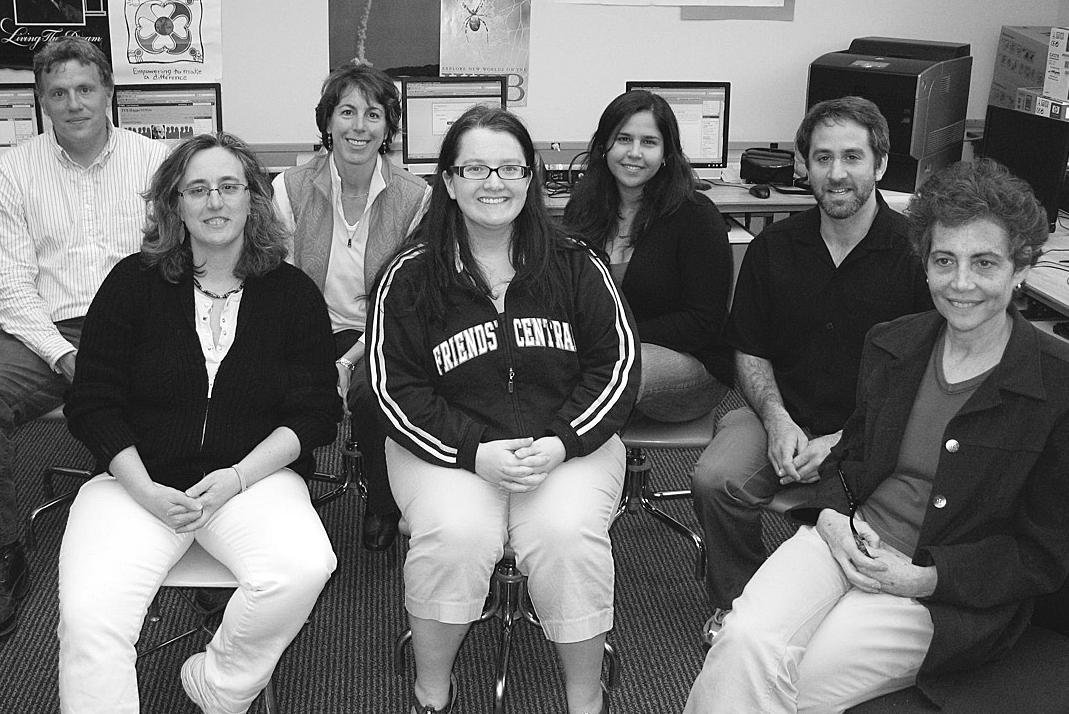
PLP participants: from left to right: Rear, Alex Mc Donnell, Deb Fedder, Alejandra Socorro, Dov Campbell Front: Sue Kirk, Mary Fran Torpey, Regina Ziffer
This year, seven FCS faculty members participated in a ten-month course called Powerful Learning Practices (PLP) which included five mandatory online webinars and many face-to-face meetings on campus. As part of a cohort of about 100 educators from twenty different independent schools in our area, a mix of Lower, Middle and Upper School faculty members from different subject areas, Dov Campbell, Deb Fedder, Mary Fran Torpey, Alejandra Socorro, Alex McDonnell, Sue Kirk and Regina Ziffer bravely immersed themselves as learners in a Virtual Learning Community, using a platform similar to Facebook called NING.
“The most important thing we can do as teachers is to play in the world our students play in,” says Dov, Middle School Computer Technology Coordinator. “Educators will not truly dive into using technology with their students until they learn why it is important to
“Educators will not truly dive into using technology with their students until they learn why it is important to do so.” [said Dov Campbell]
do so. ” Dov’s words echo the philosophy of the course: That it’s important to use social networking technologies ourselves to under-
stand the true learning potential offered. So we participated in NING by chatting online with other educators, asking questions, discussing best educational practices, embracing global learning, and using Web 2 0 and 21st century tools We took part in and initiated discussions that interested us, interacting online as learners ourselves. As we began to experience the power of learning using current web technologies to connect and collaborate with others, we began to make a shift in our thinking.
“I am more apt now to consider social networks and new collaborative tools to acquire information rather than do a static search on Google,” says Deb, Middle School Language Skills teacher. “When I was trying to get the inside scoop on some colleges for my son, I joined the conversation at a site called CollegeConfidential.com to learn and share some thoughts with other parents and students. It provided me with meaningful feedback from people with shared interests, alternate perspectives and current knowledge.”
Becoming more comfortable in an interconnected environment made it possible to recognize the paradigm shifts in education occurring in the 21st century...
Becoming more comfortable in an interconnected environment made it possible to recognize the paradigm shifts in education occurring in the 21st century:
. FROM Place and Time learning TO Anywhere/ Anytime learning—You can learn anywhere/anytime using a laptop or even a cell phone.
. FROM Individual learning TO Networked Group Learning There are online learning communities with people around the globe for almost any topic.
. FROM Private TO Public—More and more of what we do is public. Our students are writing and sharing ideas out there with a larger audience.
. FROM Paper TO Digital Information in digital format makes it easy to copy, share, publish and remix.
. FROM Linear TO Distributed—listening, reading, speaking almost all at once, gaining information from a variety of sources.
. FROM Standards-based learning TO Passion-based learning People learn more easily when they are passionate about what they are learning.
At FCS, our approach to education already incorporates many of the best practices suggested for the 21st century. “In many ways, the course has been reaffirming of many of my beliefs about education,” said Alex, Middle School Social Studies teacher “Passion-based learning, service learning, progressive education are rooted in the idea that kids actively make their own meaning. These online learning communities allow for meaningful and authentic learning. John Dewey
These online learning communities allow for meaningful and authentic learning.
was talking about experiential learning almost a century ago. It isn’t really that new. What is different are the tools.” Alex recently engaged students by having them create Facebook profiles for characters from Art Spiegelman’s graphic novel, Maus. Students had to understand character traits but now had to synthesize what they read in order to create a profile that a character might have written on Facebook; it is the same sound pedagogy in a 21st century framework.
Online social networking technology permits a radical departure, however, from traditional experiential learning. It expands experien-
Online social networking technology permits a radical departure, however, from traditional experiential learning.
tial learning in ways that Dewey could never have imagined and redefines what a classroom could be. It permits a level of interconnectedness with the world in real time that has never been part of education before The challenge is for students and teachers to really embrace and be challenged by the promise of all this. At the Lower School, twenty fourth-graders recently had a Skype session with Mary Amato, an author, in Washington DC after they all read one of her books. Interacting with the author, asking her questions and receiving answers gave them a deeper, richer, more meaningful understanding of the book. When the idea was originally announced, a few kids seemed puzzled. “What’s Skype?” a girl asked. “It’s video chat,” answered a student. “Oh, video chat. I do that everyday!” she said.
The final step of our PLP coursework was to create a project for our school. After realizing the power of collective learning and the benefits of online social networking, we decided to give the faculty at FCS the opportunity to experience what we have learned. What better way than to create our own FCS NING for faculty? This NING, appropriately called FCS HappeNINGs, will be a way for teachers from all
three divisions to gather around a virtual water cooler and connect with their colleagues. It will be a place to share great teaching practices as a Professional Learning Community. Teachers can create content,
This NING, appropriately called FCS HappeNINGs, will be a way for teachers from all three divisions to gather around a virtual water cooler and connect with their colleagues.
participate in conversations, and share ideas, successes and passions. Click on “Faculty Lounge” to ask questions, engage in discussions, and find links to magazine articles. Click on “Interest Groups” to talk about cooking in Epicures Unite, then head over to Great Reads for a discussion of books. Or you can create your own interest group. Alejandra has created an interest group called Foreign Language Classroom, a place where language teachers can gather for discussions. We hope teachers will participate on our school NING so we can make the shifts needed to help our students safely and intelligently participate in their world of online learning. Stay tuned for its unveiling. Back at our online PLP Webinar, Mary Fran, Middle/Upper School librarian, clicks on her hand icon to speak to the group. Our moderator, Will, says, “Mary Fran, go ahead.” Speaking into her headset from her Blackburn library computer, she offers, “As teachers, I believe we have to do our best to prepare our students for, not just college, but for the workplace. In the future, our students will be called upon to communicate, create and collaborate with others using tools and standards that we can prepare them for now. If we ’ re not helping them to become literate in the new media landscape, we ’ re not preparing them to be citizens in this century.” Several smiley faces appear on the screen as participants express agreement, while
The world is changing, and our experience has taught us that we need to adapt, to prepare our students for life in the interconnected, technology-rich environment of the 21st century.
hand icons light up so that others can weigh in on the discussion. The world is changing, and our experience has taught us that we need to adapt, to prepare our students for life in the interconnected, technologyrich environment of the 21st century.
GLOSSARY:
Ning—An online platform (similar to Facebook) that enables people to create a social network around specific interests or passions i e Friends Council has a Ning for faculty and staff of Friends Schools to stay informed and to collaborate: http:// www.friendscouncil.net/
Social Networking A means of communicating and sharing information between two or more individuals in an online community 21st Century Learning Pedagogy empowered by digital technology Web 2.0—Internet applications that facilitate interactive informationsharing and collaboration on the World Wide Web, including webbased communities, social-networking sites, video-sharing, wikis, and blogs. A Web 2.0 site allows its users to interact with others or to change website content (from Wikipedia)
Webinar—Short for Web-based seminar, a presentation, lecture, workshop or seminar that is transmitted over the Internet A key feature of a Webinar is its interactive ability to give, receive and discuss information. (from Webopedia)