Intricate Song: Exploring Two Poets from Friends’Central School
My Sabbatical: or Trying to Ruin My Children
Fishing in Mongolian Waters: FCS Teacher Survives Scientific Expedition
An education isn’t about how much you have committed to memory...it’s being able to differentiate between what you know and what you don’t know.
—Anatole France, 1844–1924
Editor: Marilyn Lager, Director, Friends’ Central’s Blackburn Library
Email: mlager@friendscentral.org
Assistant to the Editor: Deborah Fedder ’79, Middle School English Teacher
FORUM
Forum is our community’s educational journal. Faculty, alumni, board members, parents and students areencouraged to contribute opinions, ideas, innovations and observations about any aspect of their lives relating to educational experiences.
Marilyn Lager Editor, Forum
READERS’REFLECTIONS
As alumuni/ae of FCS, I believe we all receive the publication entitled Friends’ Central Forum. The articles, talks and speeches are extremely well written. We received the Fall/Winter 20062007 edition last January, and it struck a chord with me. Reading the reflections of various teachers at FCS reminded me of their dedication to instill curiosity and to teach critical thinking skills to their students.
In reading through it, I found one talk that was given by an alumnus of the class of 1980 that struck me as the reason that the roots and ties of the Class of 1955, in particular, make us so close and interested in each other’s lives.
This talk, written up in Forum, was given to the faculty at the Merion Meeting House on September 6, 2006. It is by Victor Freeman and is a MUST READ. Victor Freeman’s talk is entitled “Today is a Wonderful Day—To be Among Family.” It is a very insightful observation about what Quaker Meeting meant to him. I can only speak for myself, but that forty minutes each week turned out to have a profound effect upon my life. To this day (although not at a Quaker Meeting), I make it a point to have quiet time to reflect on my life, both personal and business, past and future. I just retired this past December, but I have planned for my future life, so as to be certain that it is active, full, meaningful and giving.
Don’t miss this article. I believe Victor is right about the impact that Meeting for Worship for all in this country could have on political and religious arenas. I hope you enjoyed/enjoy reading this well thought out piece.
Warm regards to all, George “Toby” Walters ’55
(For copies, contact Editor Marilyn Lager, at mlager@friendscentral.org or by calling the School.)
Adventures of an Amateur Archaeologist
By Sara Callaghan
Sara has been teaching Foundations of Scientific Knowledge and chemistry to Upper Schoolers for five years.
Each winter, as the deadline for FCS summer stipend applications approaches, I begin to think about what I’d like to accomplish during those precious three months away from school. In 2005, after three years of teaching, I decided that I was ready for an adventure. My previous summers were spent taking a biology class and teaching summer school: productive, but not particularly exciting. I had heard good things about the Earthwatch Institute expeditions and decided to apply for “France’s Stone Age,” an archaeological project taking place in Southwest France. I was fortunate to receive a Fannie Cox Hendrie stipend to cover travel and the cost of the expedition.
...I decided that I was ready for an adventure.
The project involved the re-excavation of Roc de Marsal, a cave that had been excavated in the 1960’s by an amateur French archaeologist named Jean Lafille (who also happened to be a professional school teacher). The site was appealing to the current researchers for several reasons. First, Lafille had discovered the remains of a Neanderthal child in the rear of the cave, which was an extremely important find—the arrangement of the skeleton had suggested an intentional burial. Second, Lafille had dug a trench down the center but left a relatively large area of the cave floor intact on either side of the trench, so there was a good chance that there were still interesting discoveries to be made in those areas of the cave.
I had never before been outside of North America
My proposal for the stipend involved participation in the two-week Earthwatch program, as well as some traveling on either end of the expedition. I had never before been outside of North America, and the idea of
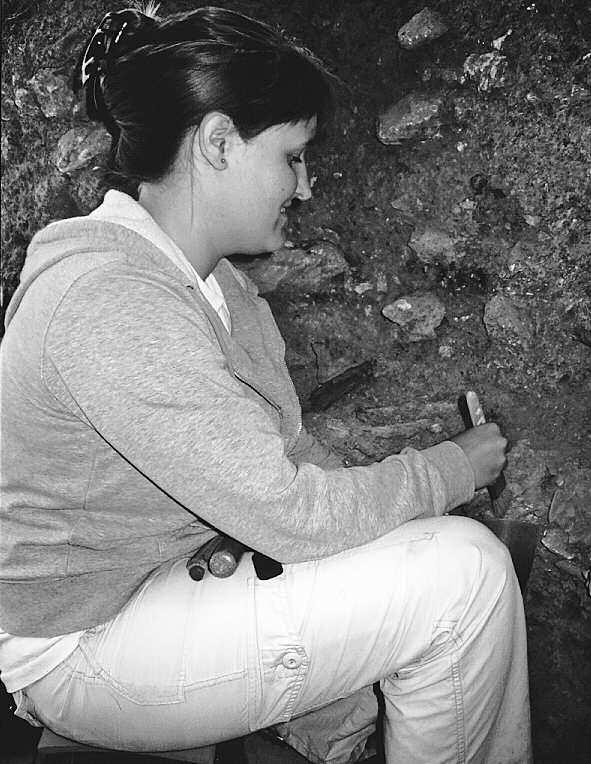
Sara, working at Roc de Marsal.
traveling to Europe by myself was rather daunting. I did my best to recruit a travel companion, but in the end, I went alone. When booking my plane tickets, I decided to fly to Paris a few days before the project started and to fly home a week after the project ended.
I arrived in Paris on a hot July day via an overnight flight, and after a train ride into the city followed by a long, hot, confusing trek to my hotel, I was beginning to wonder what I had been thinking when I decided to undertake this trip by myself. I had fully intended to learn some French before the trip, but I hadn’t gotten much farther than “Je ne parle pas Francais.” Too late now! At the hotel I called my mother, had a good cry, a nap and a shower, and thankfully, began to feel better after a dinner out and a good night’s sleep. I spent the next two days touring Paris by double-decker bus. I managed to see most of the major sights, at least from the outside (Arc de Triomphe, Notre Dame). I climbed up to the second tier of the Eiffel Tower and spent several hours in the Louvre and the Musee d’Orsay. I’d always heard that Paris was beautiful, but I was totally unprepared for how gorgeous it really is—I shot four rolls of film in that one weekend. Thankfully I also discovered that the Parisians were mostly sympathetic and helpful to non-French-speaking solo travelers.
I’d always heard that Paris was beautiful, but I was totally unprepared for how gorgeous it really is...
Afew days later, I took a train down to Bordeaux and then another train east to Sarlat, where I met up with the other members of my Earthwatch team. Two representatives from the research group met us and drove us to “Camp Carsac,” where Earthwatch has a farmhouse in the village of Carsac. Everyone except the professors sleep in tents in the backyard. There were about thirty of us camping there, and we all shared
two toilets and two showers that had been installed in the barn. The primary investigator on the project, Dr. Harold Dibble, is a professor at University of Pennsylvania, so many of the people there were from Philadelphia—I immediately felt at home! There was also a definite international feel to the group, with people from all over Europe and even a student from Japan.
...we split up each day into two groups: one would go to the field and excavate in the cave, and the other would stay at camp and work in the lab.
Because it was such a large team, we split up each day into two groups: one would go to the field and excavate in the cave, and the other would stay at camp and work in the lab. I was able to go to the field four days and work in the lab five days. The remaining four days were spent touring the local sights with fellow Earthwatch members.
Fieldwork involved a forty-five-minute scenic drive to the site and then carrying equipment and our lunch down to the cave. Once there, we would each take a small area and begin our excavation. The site was extremely rich with pieces of bone and lithic tools or tool fragments. The most interesting thing that I personally excavated was a horse anklebone that was 80,000 years old. The area we were excavating was hypothesized to be the garbage heap—the Neanderthals seemed to have thrown all of their waste (bones from animal kills, pieces of stone tools) into this corner of the cave.
The most interesting thing that I personally excavated was a horse anklebone that was 80,000 years old.
Professor Dibble has pioneered the use of surveying equipment in archaeology, using lasers and prisms to “shoot in” the precise location of objects before removing them for processing. Each artifact is then bagged and given a bar code sticker for identification. Each person mostly works in one or two areas of the “grid”—the entire site is divided into squares that measure one meter by one meter. In one direction, they are labeled with letters, and in the other direction they are labeled by number. Attention is also given to the depth at which artifacts are found, as this gives the best idea of the age of the object. Care is taken to keep the surface of the square level, so that objects are removed one layer at a time. Even the buckets of dirt we removed had to be recorded and transported
back to the lab for processing, where the computers could show a 3-D plot of the site and the points where different types of objects (bone or lithic) had been found.
Even the buckets of dirt we removed had to be recorded and transported back to the lab for processing...
Lab work involved washing, sorting and labeling artifacts that had been brought back from the field. This was a neat job, because we got to see all the things that were collected the day before: pieces of antler, a mouse skull, stone scrapers and hominid teeth, to name a few. We would carefully wash each artifact with a toothbrush and warm water to remove the sediment, then lay them out to dry in the sun. Once dry, the artifacts were labeled by ID number in India ink and logged into the computer.
...we got to see all the things that were collected the day before: pieces of antler, a mouse skull, stone scrapers and hominid teeth...
Touring the local sights involved visits to other prehistorically important places: Lascaux with the famous cave paintings; Cap Blanc with bas relief sculptures carved into the cave walls. Quite appropriately, my first field trip was to Les Eyzies. The Neanderthal skeleton excavated from Roc de Marsal is on display there in the National Museum of Prehistory. We also visited several chateaux and ate some excellent local cuisine.
After the project wrapped up on August 1, I still had several days before flying home, and I took the train down to Bayonne, in the heart of French Basque country. The town is famous for its chocolate, so I felt obliged to eat quite a bit of it in the two days I was there! After leaving Bayonne, I traveled back north to Fontainebleau, where I spent three days touring the chateau and its grounds, as well as hiking in the surrounding forest.
I kept a diary during my trip to record not only what I did and where I went each day, but ideas about how chemistry was at work in the places I visited.
I kept a diary during my trip to record not only what I did and where I went each day, but ideas about how chemistry was at work in the places I visited. Associated with the dig are dating techniques for the artifacts,
as well as the use of lasers in the mapping of the site. And of course, the cave itself is made of limestone, so there’s the chemistry associated with cave formation and erosion. In the caves at Lascaux, I thought about what compounds were used as pigments for the paintings and what their natural sources might have been. I’m always fascinated to discover new ways that science is at work in the world, and I love to share those examples with my students.
Overall, I had an amazing time learning about archaeology and prehistory and picking up a tiny bit of French language and culture along the way. I think the best part, though, was the self-confidence I gained by traveling alone for several weeks in a foreign place.
The Divine Ms. DeVan
By Marilyn Lager
Marilyn, who has been editor of this journal since its inception in 1988, is Director of the Middle/Upper School Library.
She’s been called “the Divine Ms. DeVan,” “Lady Di” and “Divine Diane.” Her grace and style are legendary, and as one sophomore puts it, “she’s the ‘freshest’ woman at Friends’ Central; she wears high heels every day and looks great.” Seniors have dedicated the yearbook to her three times, calling her, among other things, “a friend and confidant,”(’87), “serene and unflappable,” (’96) and “a style icon,” (’06). She’s been at her job as secretary to the Upper School principal(s) for twentyfive years. And according to Diane DeVan, they have been “twenty-five years of positivity, working with considerate and caring adults and respectful children. I feel blessed.”
...“twenty-five years of positivity, working with considerate and caring adults and respectful children. I feel blessed.”
Diane spends her days recording attendance, keeping the schedules of the two co-principals, Beth Johnson and Bill Kennedy, answering parent phone calls, sending out reports and keeping students on task as they check in and out during the school day. She is surrounded not only by the current FCS folk but by memories and pictures of faculty and students from years gone by. Photographs of radiant girls in prom dresses, proud young men in black tuxes, graduates in mortarboards, smiling babies, postcards from faraway places and snapshots of faculty long gone provide a backdrop at Diane’s desk, where, she points out, she now works mainly on the computer. There are no schedule books or paper attendance records: she's mastered the transition smoothly, crediting the help of Dan Crowley, head of the technology department. She calls it “a delightful office,” and her principals find her delightful, too, as Bill Kennedy says, “the bright light of the office, always positive and kind.” Beth Johnson adds, “She makes all of us, teachers, parents and students, feel cared for and welcome…with an incredible smile, great warmth… and the best shoes!”
Diane’s job, however, is far more than secretarial, because of her unusual skills in reaching out to people. “She has touched more students than anyone else in the FCS community,” relates former principal Mary-
“She has touched more students than anyone else in the FCS community,”
ellen Schwartz. “She knows about them, their lives in and out of School, and she listens to them with sensitivity and interest. She is the mother of the School.” And the work she does behind the scenes for graduation seals that reputation. “I have such great pleasure in pinning on the boys’ boutonnieres and handing the girls long-stem roses,” smiles Diane. “Graduation is the culmination of the rich year we've all had.”
She is the real-life mother of daughter Jean Wells, who works for the government in Washington, D.C. and the doting grandmother of twelve-year-old Shayna. They spend weekends with her, as Jean is active in her Presbyterian church in Wynnefield, and Shayna shops and reads companionably with her grandmother When Shayna was younger, Diane became her Brownie troop leader, working with children seven to eight years old in Bryn Mawr. She’s continued this long after Shayna graduated, leading them in activities such as visiting a senior center, where they talk to “adopted” grandparents, iceskating and a recent trip to “Blacks in Wax,” a museum in Baltimore which highlights black history.
Diane’s own childhood and adolescence was shaped by a dream—and a talent— to become a ballet dancer.
Diane’s own childhood and adolescence was shaped by a dream— and a talent—to become a ballet dancer. She studied ballet in Harrisburg for fifteen years, but the school closed precipitously. When she applied at the only other dance school in Harrisburg, she was told that blacks were not allowed, and she would have to continue privately. She was “devastated” as her dream fell apart.*
She entered Penn State, finishing her associate’s degree two years later. She worked for Governor Milton Shapp’s office, then married and moved to Philadelphia in in 1973. She completed a bachelor’s degree in business
* Unfortunately today’s headlines indicate there has been no change. (“Where Are All the Black Swans? American Ballet Companies have a Diversity Problem, One That is Especially Acute for Black Women.” —New York Times, Section 2, May 6, 2007.
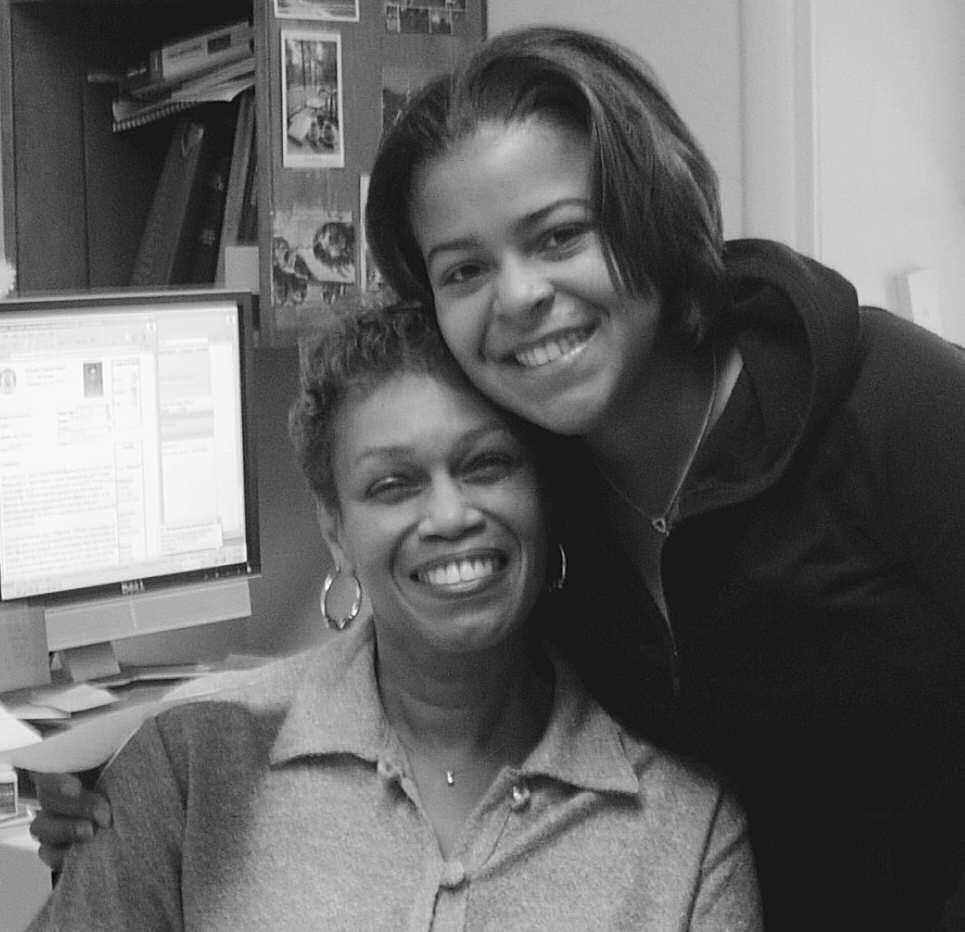
Diane, with Jona Shreeves-Taylor ’09.
administration in 1996 at Temple, and continuing there, she earned a master’s degree in bereavement counseling. Her family, back in Harrisburg, comprised of twelve maternal uncles and their large extended families, own a mortuary business, and she expects to use her experience in grief counseling when she leaves FCS.
While her work with students is more upbeat and cheerful, she is beloved for that ability to listen compassionately. Latifah McMullin ’99, and a member of the Alumni Board, notes that “Ms. DeVan (and I still call her that even though she begs me to call her Diane) is a woman I have always admired and respected. She is so full of wisdom. Over the years, I’ve learned that there is nothing I cannot talk to her about.” Another former FCS student, Erica Taxin Bleznak ’86, concurs. “There was nothing more comforting or uplifting than to see Ms. DeVan's smiling face every school morning. She always had time to share a kind word and warm smile. I visit her every year…she had such a positive impact on my FCS experience.”
Diane credits her ability to connect with people so positively, so compassionately, to the influence of her mother...
Diane credits her ability to connect with people so positively, so compassionately, to the influence of her mother, the oldest of thirteen, and the
only girl. She naturally became the caretaker to those twelve younger brothers, who adored her. She was “a loving and accepting person, one who never looked down on anyone, no matter what his or her color, sexual orientation or status in life.” Her father, “also exceptional,” who golfs and plays tennis at age eighty-six, spends part of the year in his cottage in Barbados.
Diane looks back on those years when she was going to school and working full-time as difficult and recalls how she was helped by her “best friend and mentor,” English teacher John McCollum who died in 1996. Her deep respect for him left a hole in her life when he died. Her relationships with people at FCS have been deep and ongoing. Latin teacher Erika Harnett, music teacher Jim Davis, library assistant Judy Bradley, language department chair Jackie Gowen-Tolcott and physics teacher Keith Buckingham are part of an informal “Twenty-five Years Plus” club,
...[there is] an informal “Twenty-five Years Plus” club, Diane’s long-time loyal friends.
Diane’s long-time loyal friends. Erika remembers Diane’s first day on the job, when she rearranged the furniture so she faced everyone entering the office. “I saw a new person smiling warmly at me from the desk. I liked her instantly! We became the best of friends…and our friendship has been a great blessing in my life.” Faculty who have been gone many years, like language teachers Sheila Horine and Penny Weinstein, chemistry teacher Pam Nix, (away from FCS for eight years and who, by chance, walked into the office during this interview, after a two-year hiatus, to a vibrant and excited greeting from Diane) and former Upper School principals, Bob Hallett and Jon Harris, are still counted as good friends.
At this writing, Diane has just returned from a second spring vacation working in New Orleans. Along with church members, she has been part of the restoration of a day care center, where they painted and disinfected, contributing supplies and bedding. Returning this March, she was dismayed to see so little change. “Habitat for Humanity is constructing more than our government. It is a tragedy to see the American people forgotten,” muses Diane.
Diane has seen the diversification of the student body, and she is gratified by the “rainbow” of students on campus, showing leadership.
Diane has seen the diversification of the student body, and she is gratified by the “rainbow” of students on campus, showing leadership. “They are excelling, laughing all together…it’s not a black or white
thing,” she smiles. She encourages the students of color when they come to her, urging them to talk to their teachers, talk to their parents or meet with the principals when it is called for. Acurrent student, Morgan Gunter ’09, says, “She gives good advice…she understands no matter what the problem is.” Her ability to touch a wide variety of FCS folk is reflected in the words of Ryan Pesin ’96: “I speak not only for myself but for some of my closest friends when I say that she has a very special way of making a positive impact on people’s lives.”
Intricate Song: Exploring Two Poets from Friends' Central School
By Esther M. Leiper ’65
Esther Leiper, who lives in Jefferson, New Hampshire, has been a working poet for many years. She has been the winner of over 1000 poetry prizes in local, state and national contests. She was chosen Poet Laureate of the White Mountains Region in 2006 and is the author of a book Win! Poetry Contests, with the Patterns and Forms to Get You There.
Every poet wants to think that his or her development is unique, and that no one has observed or recorded in the same way before. If the poet is a great one, this is possibly true. Remarkable poems last, and their authors cast a glow on the pages of the ages. Yet these poets had influences on them and had role models. All poets come from particular backgrounds and locales. To please themselves or impress a mentor—whether early efforts are kept hidden or flaunted—literary ambitions flourish. Some youngsters discover that the urge to combine words starts early.
...these poets had influences on them and had role models.
My mother remembers me, a preschooler, holding a book of nursery rhymes (known by heart) so singers, hidden in my record player, could see the words I feared they'd forget! Soon, reading for myself, I discovered A.A. Milne, Walter de la Mare, Dr. Seuss and myriad others. Poetry took me places: it told stories, and I claimed it for my province. My own writing in those early years attempted to capture the pleasure. When I came to Friends’ Central in 1963 as a teen, I learned that the celebrated Imagist poet, H.D., or Hilda Doolittle, had graduated from FCS sixty years before in the class of 1905. Her career, as it became known to me, offered inspiration. How, I pondered, had she utilized Quaker philosophy? Did she feel the inner spirit when she sat in Meeting? Did she mull over lines for poems during silent reflection? Did she ever just think of lunch?
Reading H.D. in those days, I learned to appreciate similarities and differences between her and the poet I would become. After leaving Bryn Mawr College for health reasons, H.D. immersed herself in Greek culture while embracing the growing Imagist movement. Becoming established in England, she soon
Reading H.D. in those days, I learned to appreciate similarities and differences between her and the poet I would become.
married Richard Aldington, a fellow Imagist. Her poetry began to explore particular feminine concerns. She determined that the time was overdue for women to proclaim candid, valid feelings. (The divine spark of Quakerism?) If poetic honesty could be painful, if her vivid free verse lacks end-rhyme or special adornment, then her details compel readers through a stark delicacy. In Sea Garden, (1916), this early feminist laments both herself and a visited garden as being harmfully over-protected:
I have had enough. I gasp for breath. I have had enough Border pinks, clove-pinks, wax lilies, Herbs, sweet-cress.
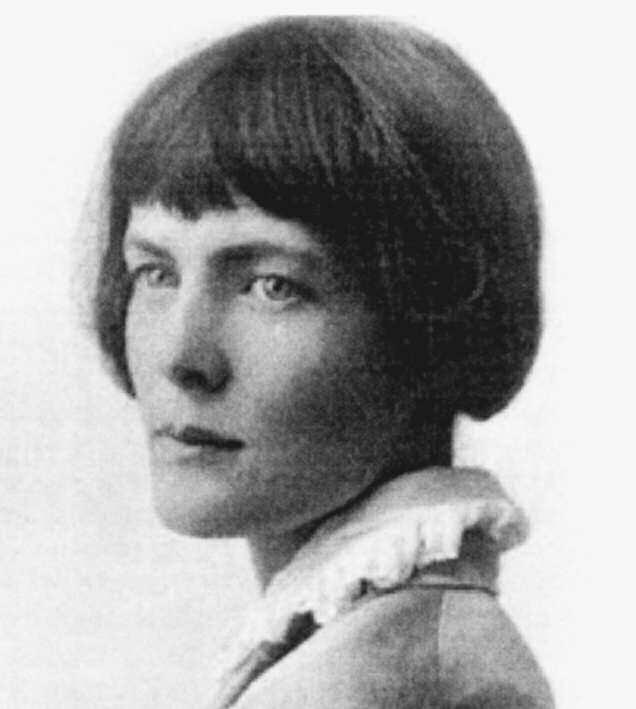
H.D. (above).
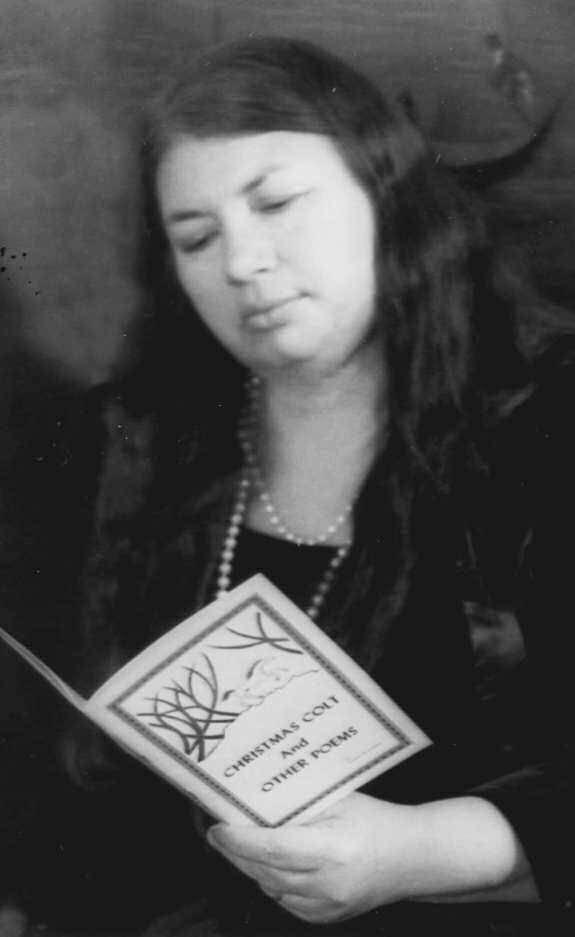
Esther Leiper (left).
She craves not cloying plants, but aromatic, astringent ones, and ends:
O to blot out this garden
To forget, to find a new beauty
In some terrible Wind-tortured place.
Acritic, Susan Stanford Friedman, concludes that the piece is no nature poem, but a passionate reaction to “encoded statements of female vulnerability.” She points out typical H.D. themes of understanding the roots of violence and hoping for renewal and peace; the historical and personal as they interact with her stance as a woman; her sense of the sacred in male and female forms; and her exploration of language as something that women can use as a vision for the cosmos.
Indeed concepts of beauty, purity and Attic grace consumed H.D.
Indeed concepts of beauty, purity and Attic grace consumed H.D. She actually invented a Grecian persona for herself, as if marble had come to life, as if she were Galatea. Like all Imagists, H.D. scorned Victorian and turn-of-the-century sentiment, imbued with cloying rhymes or lachrymose piety. Her early pieces were written in the exhilarating pre-World War I milieu of avant garde society. Yet by 1940, and past World War II, H.D. wrote epic poems, between her autobiographical novels and increasingly viewed herself as a prophet. She'd lived through the London fire-bombing, gave birth to a still-born child and had a breakdown. Following this, a Freudian analysis helped her tame the contradictory forces driving her. While Friedman notes that H.D. can be “taught in the context of religious poetry,” students should also compare her femalecentered vision with the art she practiced of transformation: her heroines were evolving aspects of herself. She was today’s idea of a liberated female proud of the “sculptural power” of her lines.
H.D. had her era; I have mine.
H.D. had her era; I have mine. Do our personalities or poetry share common traits? Interesting speculation! We were each raised in eastern Pennsylvania and graduated from Friends’ Central. I’ve traveled, but hers was with an international literati circle. H.D. was highly social and outspoken. She was involved in friendships with T.S. Eliot, D.H. Lawrence and had an engagement to Ezra Pound. She was seen as beautiful and charismatic, becoming a legend in European circles. On the other hand, my husband Peter Estabrooks and I have lived for thirty years in northern New Hampshire, farther north than even Robert Frost
settled. Children, gardening and varied freelance deadlines anchor, if not define me. But still, she stands as a major inspiration to me.
In 1961, H.D. published her epic, Helen in Egypt, as a counterpoint to Pound’s Cantos. The tale is carried forward by tercets and interestingly employs cinematic techniques, a legacy from her brief acting career. While I write free verse, I too chose a mythic background and formal structure for my epic, The Book of Lilith, which has a strong theme involving time, immortality and eternity. The story features the first wife of Adam, in Jewish mythology, who later became demonized. Like H.D., I examine feminism, rebellion and independence. However, Lilith never
Like H.D., I examine feminism, rebellion and independence.
tastes the forbidden apple; rather she quarrels with Adam and leaves Eden by free choice. What happens next details her journey from innocence to experience to regret in Spenserian stanzas, in a different style than H.D.’s.
Lilith did not look back. Ahead, the world
Was luring her with blooming briar sprays
And tangled paths—though warring feelings skirled
Within her brain: The end of endless days
Spent hearing Adam bragging phrase on phrase.
Oh, could it welcome her, this wilderness?
Already brimming sun with cordial rays
Was spreading warm content to soothe duress
And she felt like a panther, fetterless!
But Lilith knew so little! She chewed thorns
And wept they did not fill her belly up.
Soon she resented in the sullen morns
To see pink dawn spill like a burning cup
Of wine not poured for her. Then, frugal sup Was dreary lacking friend with whom to share.
—Still, Adam once had kicked her like a pup
To cuff or scuff on whim-when he could spare
His precious time at all to overbear!
So, better her lonely liberty: To sing
And thus forget this restless lust for spouse!
Aripple’s round had been her wedding ring
Which moments more dissolved. Tight prison-house
She'd never tolerate: far better rouse
New passion in her heart so as to brave
This eastern outpost here, nor would she souse
Her questing soul with piteous tears, or rave
For long-lost moments which she could not save!
While our techniques differ widely, I feel that H.D. and I both address feminine ambition, pride, beauty and the social aspects of navigating a complex world. From different sides of the water, and while acknowledging obvious differences, still I conclude our concerns are similar. We each have striven to allow the Spirit unimpeded action—both by outward witness and via texts wherein our heroines' actions inevitably reflect personal convictions.
My mentor, my inspiration lies buried in Bethlehem, PA...
My mentor, my inspiration lies buried in Bethlehem, PA, where fans (including new generations in the women's movement) bring tributes of shells to honor her love of the sea. Her poem, Epitaph, marks her grave:
So you may say, Greek flower, Greek ecstacy Reclaims forever One who died Following intricate song’s Lost measure.
Friedman, Susan Stanford. Penelope’s Web: Gender. Modernity, H.D.’s Fiction. Cambridge: Cambridge University Press, 1991.
My Sabbatical: or Trying to Ruin My Children
By Alex McDonnell ’87
Alex has been teaching social studies in the Middle School for sixteen years. He was awarded a sabbatical last fall.
The reason I wanted a sabbatical was to be able to live for an extended amount of time abroad, and for me, the obvious destination was Ireland. I have, literally, hundreds of relations there. The closest include my father’s brother, one remaining great aunt and a first cousin who moved there from Havertown five years ago. The Irish once had very large families: my dad alone has more than sixty-five first cousins still alive in Ireland! In addition, I love Ireland for many reasons: for its beauty and because of how Ireland loves its history—that’s what I teach—and it is what intellectually interests me the most.
History has shallow roots here in America...
History has shallow roots here in America, and, for most people, what happened before living memory doesn't seem to interest them. We like “new.” We value new houses, built on new streets in new neighborhoods, and we fill them with new furniture. All is disposable; all seems replaceable. Ireland holds onto its past a little more, and I like that. Part of being Irish, or for me being Irish in America, is having a relationship with history both great and small. As one wag put it, “The Irish rarely forgive and never forget.”
I love Ireland, and that explains where we went, but not why we did it.
Why live abroad?
Why live abroad? I did it partly for me, because after teaching at FCS for sixteen years, I very much needed a change of pace. But my wife Dawn and I also did it for our family, which includes Grace, an FCS fourth grader, three first graders, Amelia, Alex and Rose, and Kieran, who will enter Pre-K in the fall. Let me digress a bit, so I can explain what I was hoping to give my family, and then I will come back to my point.
I once took a graduate class with a Jesuit seminarian who had formerly been a Marine. He quipped that becoming a Jesuit made becoming a Marine look easy. The Jesuits are an order of Catholic Priests who are known for their intellect and collective brilliance. They are, in many respects, an elite group. Well, that’s what their friends would say. Others perhaps would say they are shrewd and cunning. The definition of the word Jesuitical means “One given to subtle casuistry” and is used as a
The Jesuits are an order of Catholic Priests who are known for their intellect... Others perhaps would say they are shrewd and cunning.
pejorative. I mention this because the Jesuits have an organization called the Jesuit Volunteer Corps, basically, a domestic Catholic version of the Peace Corps or perhaps the City Year program. The JVC, as it is com-
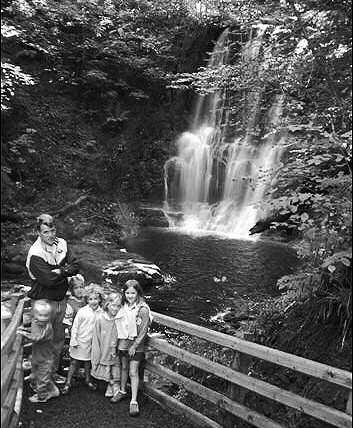
Alex, with his children in the heart of the Glens of Antrim, N. Ireland.
monly called, asks young college graduates, both men and women, to live simply on a small stipend and to serve in the poorest communities of the United States for one year. The Jesuits’ motto for this program is pure Jesuit. It asks volunteers to give one year—but “Be Ruined for Life.” The idea is that alumni of the corps will live successfully in our modern culture but not be of our modern culture again; they will know that success is more broadly defined than just by material life style.
I like that phrase… Be Ruined for Life.
And it is through that lens of “being ruined for life” that I viewed my sabbatical but also our work here at Friends’ Central. Let me explain.
We certainly want our students to be fully prepared to achieve their hopes and dreams and to achieve success as our society defines it. But we also want them to take into the wider world some of the values we hold so dearly at Friends’ Central. We want them to embrace the testimonies of the Friends: simplicity, peace, integrity, community and equality. What we hope for our graduates does not conform exactly to how the broader culture defines success. We want to ruin them. I heard our Headmaster David Felsen once mention that schools like ours are “a last bastion…a last bastion…” He let the phrase trail off, but it resonated with me. We want our students to do good for others just as much as or even more than we want them to do well for themselves. In other words, we really want to give them additional ways to define success.
We want our students to do good for others just as much as or even more than we want them to do well for themselves... we really want to give them additional ways to define success.
Traveling and living in another country I hoped would allow my children to know that there is a much larger world out there, that American culture with its many glories and some faults is only one of many cultures. I wanted to ruin them for life. (I thank the Lower School for gloriously ruining my children every day they attend school.) But I wanted to wreck them even more…so we went abroad.
We spent ten weeks in Ireland, renting a cottage in the north, in the town of Ballycastle, from my cousin Mary Theresa. My grandparents had grown up a half hour from there. I will always cherish the wonderful time I had. We built forts for leprechauns and hunted for faeries in the woods; we climbed a mountain in St. Patrick’s footsteps and clambered around the ruins of a spectacular ancient castle that was once the stronghold of the Clan McDonnell. We met countless cousins. And we met many other folks as we lived our everyday life there. We spent a morning in classes with children in a four-student school on Rathlin, a
small island off the coast. On a brilliant sunny morning, we crossed a swinging rope bridge dangling a hundred feet above the North Atlantic Ocean.
On a brilliant sunny morning, we crossed a swinging rope bridge...
After Ireland, we flew to Spain for two more weeks, where, among other things, we lived in a cave for a week; we gaped at cathedrals, and saw the glorious Islamic art that is the Alhambra in Granada. Swimming in the Mediterranean in November, and seeing Gaudi’s fanciful art, not unlike Dr. Seuss’, in Barcelona, impressed my children. Our travels were awesome. And perhaps, but hopefully not, it was the trip of our lifetimes. I hope—and think—that by broadening my family’s horizons, I further wrecked what FCS was already ruining. I hope I have brought some of what I experienced—a refreshed upbeat attitude—back into my Middle School classroom.
Fishing in Mongolian Waters: FCS Teacher Survives Scientific Expedition
By Cristina Sabaj Perez
Cristina has been teaching Spanish and French to Upper Schoolers for ten years. In August of 2006, she joined her husband Mark, and colleague, David Neely, on an expedition to Mongolia. Mark is an ichthyologist at the Academy of Natural Sciences in Philadelphia and is currently working on a National Science Foundation project whose goal it is to discover, identify and catalog every species of catfish in the world. The following are excerpts from a diary she kept during the trip.
August 14, 2006, Beijing Airport
I’m really excited to be here. Working hard to be in the right mindset. For the past few days I’ve been freaked out about this trip—went to the doctor and got stocked up: Amoxicillin, Cipro and enough Deet to wipe out a fleet of mutton. Three weeks in the middle of the steppes or wherever we’re going to be seems a bit daunting, to put it mildly. And to make matters worse, our Mongolian colleague Mendee says it’s cold and wet, and I don’t know how I’m going to hold up under those conditions. Plus Mark says we probably won’t get much food, so I bought a ton of Zone bars. Cold, wetness and hunger, as well as sleeping on cold hard ground, and infrequent showers…hmm..
Anyway, we’ll see. I’d like to think of myself as the kind of person who can do this kind of trip, but I really don’t know. I’m terrified that I’m going to just go mental or fall apart or get sick or something and ruin the trip for everyone. NOT an option…
August 16, 2006 8:30 am, Ulaan Bataar
Mongolian tea: a white, milky broth that doesn’t resemble tea in any way—my cup yesterday came with a sheep’s tail in it…
Mongolian tea: a white, milky broth that doesn’t resemble tea in any way—my cup yesterday came with a sheep’s tail in it…
Sunday, August 20, in the field somewhere…
This has been spectacular so far. We left on Thursday and unfortunately had bad luck with both vehicles right away. The Russian Beast developed a gas pump issue as we hit the first hill, and then a little while later, the little van just stopped. Our driver ended up fixing the carburetor by patching it with a piece of chewing gum until we could get to a town. That night was exhausting, and the bumpiness of the “road” rattled my head.
Tuesday, August 22, 2006, at a tourist campsite somewhere on the bumpy road to somewhere else… Stopped for good luck at a tall pile of rocks. Walked around it three times and sprinkled it with vodka. Mendee explained the colors: blue flags on the rocks represent the sky. Mongolia is the country of big sky. So I guess blue is the “everything god” color. The occasional yellow flag is the color that one gives to a teacher to acknowledge wisdom. And the occasional white flag represents mother, as in milk.
We arrived at a beautiful small river and ended up spending a long time. Used the electro-shocker for the first time. Caught crayfish, which was quite exciting and also caught our first bunch of sculpin. But the amazing thing is that I’m doing a lot more of the work. I mean, I’m tagging the fish, and I’m taking tissue samples. The greatest discovery so far
...I’m tagging the fish, and I’m taking tissue samples.
for me has actually been David’s use of clove oil. He puts a few drops in a bucket of water, and when you drop a fish in there, it gets anaesthetized. So, when I tag them and tissue them, they’re peaceful—not squirming around, which I hate. And, frankly, it makes it a lot easier because these little guys are slippery and small, and I don’t have the dexterity to poke around in them with scissors if they’re writhing.
Wednesday, August 23, 2006, 8:00 pm, waiting for dinner in someone’s ger*
Today we traveled thirty miles in six hours. The van got stuck in the mud twice and had to be pulled out with the Beast. It also blew a tire. And it also had to be dragged across a river. I am so sick of getting thrown around the back of that thing…now we’re waiting for dinner at some folks’ ger no idea who they are. Two local fishermen are supposed to show up and take us to a place six miles away where the locals catch catfish.
August 24, 2006, 3:15 pm, somewhere near Binder
Last night turned out to be hell. For me, anyway. That two-hour long dinner while we waited for the fishermen to arrive delivered no fisher-
* ger: transportable Mongolian dwelling.
men, and just more noodles with little chunks of mutton and potatoes. Then it was 9:30, and we were supposed to be six miles away from a good place for catfish. I thought: maybe enough light to get there and start setting up trout lines and gill nets. But two and a half hours later, we still had not arrived and were completely lost. I thought I was going to die in the back of the van. It turns out (I was told this; I was in too much of a stupor to be aware of anything) that we happened to run into a pair of locals on a motorcycle who knew a bit about fishing in the area and guided us to our current spot, site 10.
We were freezing. I staggered to put up our tent, and, thankfully, Mark told me to just crawl into the sleeping bag, which I promptly did. But he and Dave were out setting trout lines for another two hours! Happily, today has been awesome. As of midafternoon, I have yet to set myself down on any part of that van. We got up around 8:30 and did some collecting with the electro-shocker which was a lot of fun. We picked up more baby catfish and a few other things. And since then, we’ve just been photographing and tissuing stuff. It’s an absolutely gorgeous day. The flying ants died down after breakfast. I think the sun has scorched me, though. But the idea is that we’ll camp again here tonight. Yay! I was able to bathe in the river, wash my hair and even wash all of my clothes.
...we’ve just been photographing and tissuing stuff. It’s an absolutely gorgeous day.
August 26, 2006 10:00 am, Choybalsan
Yesterday was the most awful day imaginable. We left our camp near Binder at 11:30 am and didn’t get here until 2 am. At that hour we had to sit around and wait for Mendee to pull strings at this hotel, because supposedly all the rooms were full. Anyway, after fifteen hours in that van, with the Mongolians belting out Mongolian songs the whole time, I thought I was going to kill somebody. And we were on really dusty roads, so by the time we pulled into Choybalsan, my nostrils were caked with dirt, my eyeballs were watery with dirt, my throat was scratchy with dirt and my skin was covered with a thin layer of… dirt. Plus the scoliosis rod in my back had been getting pummeled for hours.
Along the way, the Beast broke down twice. It overheated, so we had to wait hours for the repairs. And the last meal we ate had been lunch at 2 pm, so we were starving by the time we got here. I’m amazed by the drivers who had to stay focused and drive for fifteen hours, twelve of those with no food, no electric lights, no coffee…
The hotel we slept in was kind of seedy, though as far as I could tell, the sheets were clean. And the shower room was disgusting, but the water was not, and it was on the warm side of tepid, so I was psyched about that. I watched little rivulets of grime make their way down my
body…and my hair is clean! I put moisturizer on my face and deodorant under my arms! Glory to God.
Unfortunately, we have another 200 miles to cover today. At best, that’s four hours. At best. That’s in order to get out to the lake near China that Mark really wants to sample. Now he’s saying that unless we do that, the trip’s a bust. I love the way the parameters for success just keep changing…
Sunday, August 27, 2006 8:00 pm, close to China
Getting here was supposed to be “a half day’s ride” to this easternmost part—some new river system Mark really wanted to see. Everything went wrong. The van started overheating. We had two hundred miles ahead of us when we left, and by 10:30 at night, the van was overheating every two miles, and we still had eighty miles left to go. In the middle of the night, Mendee and the driver got lost and ended up arguing with guards at the Chinese border. We have two GPS units! How is it that two vehicles filled with field scientists can’t navigate due east?! We arrived at our destination at five in the morning.
There’s not much new here. And I better see the Lochness Monster considering what we’ve gone through to get here. Alocal guide just took us to another nearby site. Amazing gale along the way. Which kicked up the millions of mosquitoes that feasted on us when we got to site 13. Which was a bog that I could barely pull my legs out of. Still haven’t caught a catfish out here.
Monday, August 28, 2006 8:00 am, some fish camp
This morning Mark decided to extend the trip another day. That means we get into the capital on Wednesday now. After he and Dave walked out of the van, I just lost it and started crying. I am done. I’ve had it. I’m tired of driving, of the mutton and noodles, of stepping on cow and horse manure all the time, of not having a shower or a toilet, of constantly setting up and taking down camp, of tissue sampling, of my hands being
I’m tired of driving, of the mutton and noodles, of stepping on cow and horse manure all the time, of not having a shower or a toilet...
covered with fish slime and scales, of carrying the buckets in the mud, of not having easy access to my toothbrush, of mosquito-infested bushes, of my hair being stiff with dust, of the waders that are way too hot and of listening to Mongolian all day.
Wednesday, August 30, 2006 9:00 am, Choybalsan
We ended up staying at that fish camp we’d pulled into on Monday morning. It was run by an old Mongolian couple. That morning, they gave us milk tea and some yellow stuff that looked like eggs with cream
on it, but Dave realized the whole thing was cream—the harder yellow stuff was the hardened top of the cream that they just skimmed off and put on a plate. So if you had a few strips with your bread, it’s like having a whole stick of butter.
Anyway, after that tea/breakfast, we went to the river that’s connected to the lake, and we fished around there for a while. Not many fish, but it was an adventure, because at one point, as I was walking along the shallows, the bottom just dropped out, and I sank in up to my head. My waders instantly filled with water, and the current started pulling me way downstream. The water in the waders sank me fast! Luckily, the current
My waders instantly filled with water, and the current started pulling me way downstream.
swept me into a shallow pool, and I was able to stand. I was also focused on not letting go of the nalgene bottle filled with specimens. (I should get an ichthyologist medal for that). The “adventure” only lasted a few seconds, but it was surprising how quickly things can happen. An hour later, the same thing happened to Mark as he was walking towards shore to get out—just fell right in. But he was so close to shore at that point that he didn’t get swept downstream; he just grabbed on to an overhanging branch. Luckily, neither one of us was holding the bucket with live specimens when this happened, or all of those fish would have been lost. After the river, we went to the lake. It was spectacular. The sun was setting over the water. The lake is so big that you can’t see the other side.
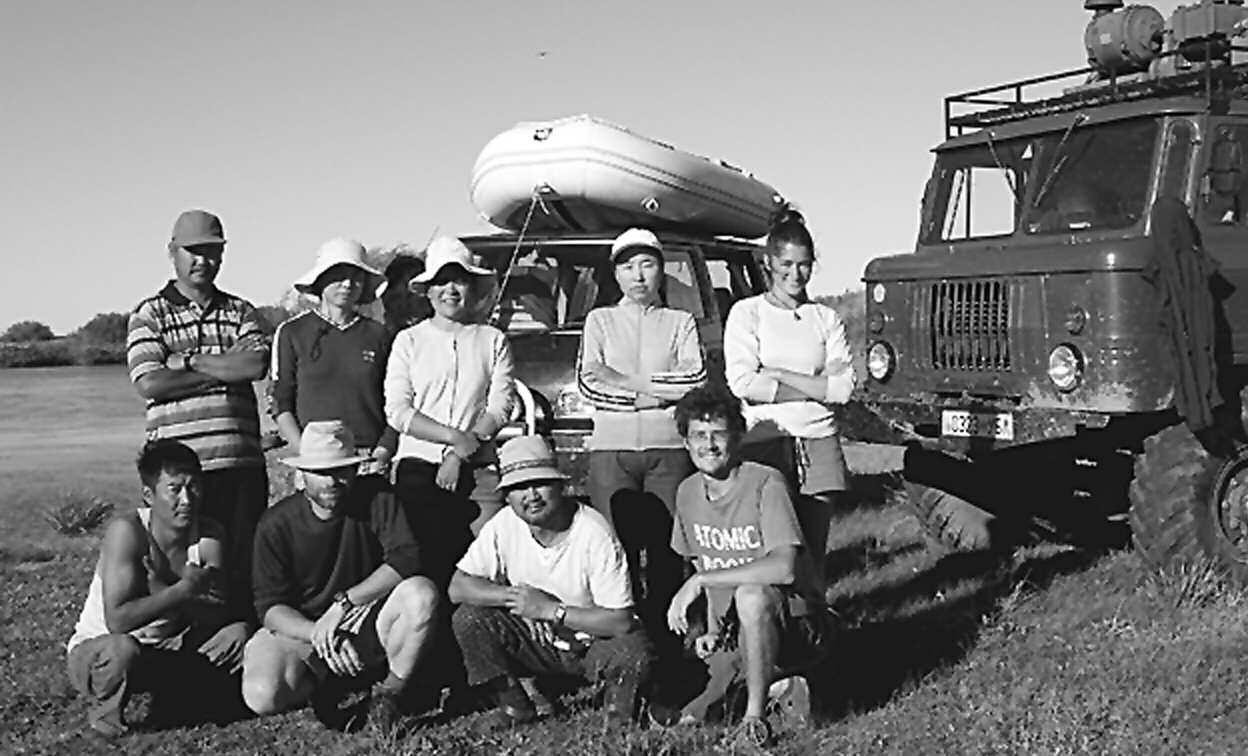
Mongolian Expedition Crew: Cristina and Mark, first and second row, right.
And we fished for hours. It was so beautiful. The sun set while we worked, and a beautiful crescent moon shone super bright and then also set. I’d never seen a moon set like that before! The lake was about three feet deep forever, so working it was really serene. Unfortunately, we didn’t catch much—and the best part was, Mark kicked over the live bucket at one point! How glad am I that that wasn’t I???!!!
After a few hours at the lake, at around ten, we headed back for dinner. The old couple had slaughtered a sheep! We ate in the ger, and what a feast! Ahuge metal tub of boiled mutton came out, in pretty recognizable chunks, which our Mongolian friends just went at with bare hands. Bones the size of my tibia, covered with boiled mutton meat. The whole little ger just shimmered with mutton grease. And then, then the massive tub of the innards: the stomach, the intestines, the liver…devoured with the same gusto.
September 2, 2006 11:22 pm, Ulaan Baatar Airport
We are here!!! Our flight to Beijing, which was supposed to leave ten hours ago, isn’t even in Mongolia yet. As it is, the soonest we’re getting back is Monday morning. Rumor around here has it that this delay is China punishing Mongolia because the Dalai Lama just came to visit here and did not go to China. Whatever—after last night’s Mongolian karaoke in the capital, I’m happy to practice my Mongolian lyrics on Mark and sit quietly and eat airport candy that doesn’t taste anything like mutton!!
Mark’s note: The expedition was a great success! We collected a lot of interesting specimens of fishes and aquatic insects, plus additional specimens of freshwater clams, crayfishes, and even a road kill pit-viper that will greatly benefit research on Mongolian biodiversity. All in all, we preserved 12,302 fishes representing about thirty-three species, a portion of which was returned to Mongolia to help Mongolian ichthyologists identify their fish fauna. Although we did not discover any new species of catfishes, we did collect some valuable specimens that will help determine whether there are one or two species of catfish in Mongolian waters.
I Am Black History
By Keino Terrell
Keino has taught Language Arts to Middle Schoolers for ten years. He is also the Lower/Middle School Diversity Coordinator. He wrote this poem to celebrate Black History Month.
I am the courage that led Nat Turner to rebel, I am the hug that comforted an enslaved woman being separated from her child, I am the dampened basement of a house sheltering those traveling the Underground Railroad, I am the luke-warm water that soothed the slashed fingers of Mississippi’s cotton pickers, I am Black History
I am the chest that hid Booker T’s forbidden books, I am the sharpened pencil that wrote out the words “I have a Dream,”
I am the seat that Rosa Parks clinched and refused to give up, I am the fact that separate does not always mean equal, I am Black History
I am the glove that clothed the fist of protest on the Olympic stand, I am the first whispered hello in the ears of the Little Rock Nine, I am the headline that announced Jackie Robinson Brooklyn Dodger, I am the letter X that replaced the last name Little, I am Black History
I am the secret behind why the caged bird sings, I am the joy in Merlie Evers’ heart when justice was finally served, I am the fuzzy video that brought police brutality to light, I am the rhyming couplet that led to the hook that turned into hip-hop, I am Black History
I am the pride on the brown face of a little girl when she does a report on Oprah, I am the spiritual sermon touching the souls of black folk every Sunday morning, I am the awkwardly torn envelopes proclaiming Halle and Denzel as Oscar winners, I am the hope of a people waiting with bated breath for November 2008
I am I am I am Black history.
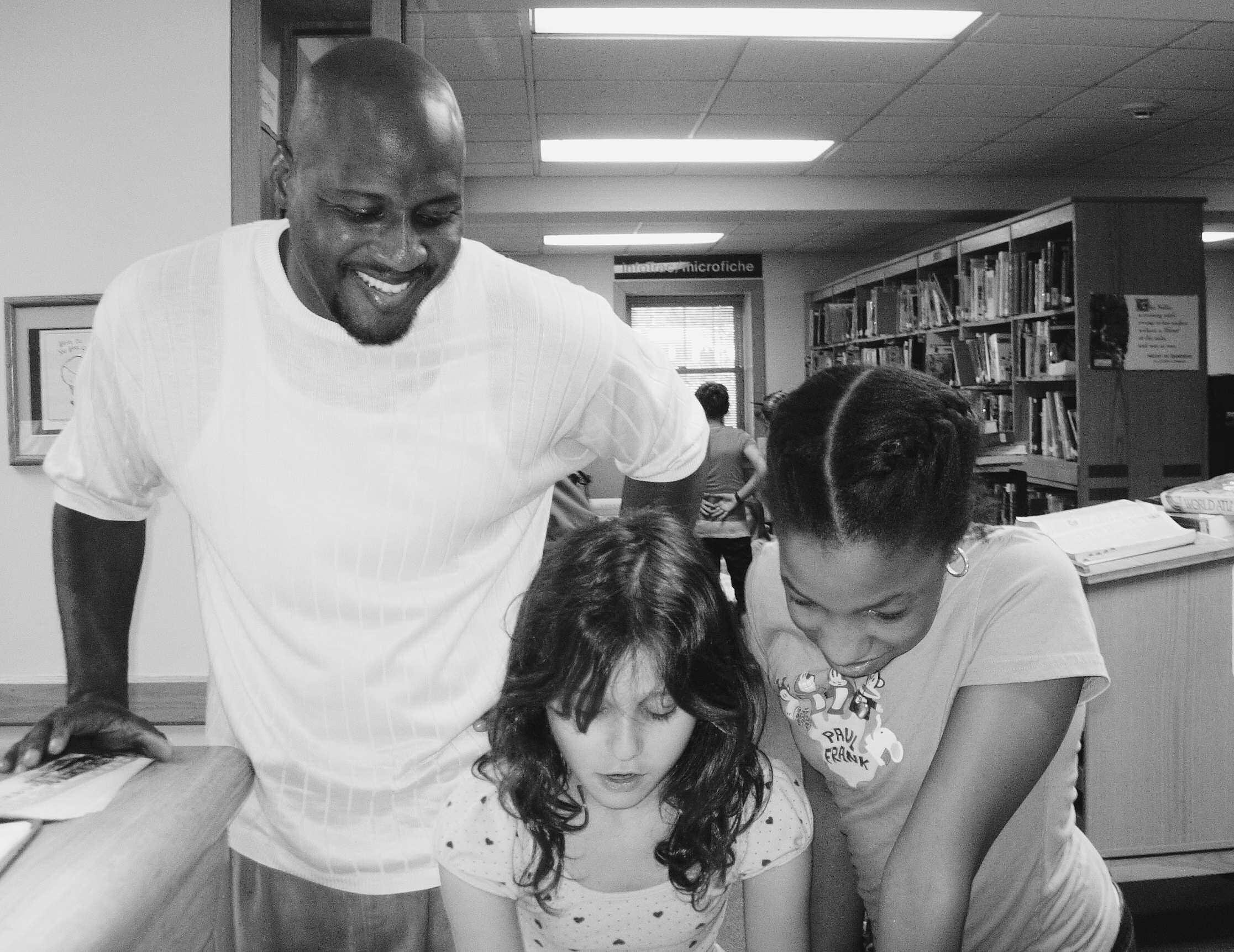
Keino, with fifth graders.
Having “The Talks”—Without Fear
Al Vernacchio
Al has completed his ninth year at Friends’Central, teaching ninth and eleventh grade Literature and Sexuality and Society, a twelfth grade elective course. In October, 2006, Al presented “Having ’The Talk’: How to Talk to Kids-at any age-About Healthy Sexuality” as part of the Fannie Cox Hendrie Lecture Series. An excerpt from that talk is presented below.
“The Talk” is not a welcome guest in many families. No matter what the age of the child (or the parent), “The Talk” can produce feelings of anxiety, guilt, fear and embarrassment for all involved. How sad. Our culture bombards us with unhealthy messages and images about sexuality at every turn. If we do not feel empowered and eager to talk with young people about these messages, and counter them with others that are healthier, it’s the unhealthy messages that hold sway. In a society that assumes sex and talking about sex are dangerous, I contend that not talking is infinitely more dangerous to the physical, emotional, psychological and spiritual health of the young people we love. Given the proper framing, discussions about healthy sexuality with young people can be empowering, exciting and enjoyable. We must also note that “The Talk” is a misnomer. The available data on effective sexuality education calls for repeated, ongoing dialogue rather than one momentous “talk.” To ensure the healthiest sexual development for our children, it’s “The Talks” that need to happen.
Given the proper framing, discussions about healthy sexuality with young people can be empowering, exciting and enjoyable.
To approach “The Talks” in the best way, we must first consider our own values about human sexuality and sexual activity. Any established pattern of “shame and blame” from our own negative beliefs or experiences must be addressed before a successful talk with young people can be launched. We must move into these conversations with a core belief that human sexuality is a fundamentally good and healthy force in our
lives. The guidelines below can help to establish a dialogue that focuses on achieving the best in our lives as sexual people rather than simply avoiding the worst.
1)Keep the long-term goal in mind: The phrase “educate for tomorrow” is important in having “The Talks.” We must ask ourselves, “What is the long-term goal we want for our children in life?” In the Sexuality and Society class, I want to help educate students who can establish loving, romantic, intimate, pleasurable, committed sexual relationships. I want them to be able to fall deeply in love with someone, feel comfortable expressing that love both physically and emotionally and understand the responsibilities and the rewards of decisions they make about themselves as sexual beings. The long term goal is ultimately a positive one that cannot be approached through negative means. If all kids hear is, “Be careful!,” or “Sex is dangerous!,” or “Unwanted pregnancy will happen if you have sex!,” how can they develop a positive vision of their future as sexual beings? Just as bad, if they hear, “Sex isn’t a big deal,” “Play around when you’re young because it ends when you get married,” or “Sex is just a tool for getting what you want,” how can they hope to see sex as anything valuable? After spending years telling young people either the negative consequences about sex or giving sex no value at all, how will they ever be able to forget all that and develop a healthy view of themselves and of sexuality that will lead to successful relationships? Perhaps so many of us have trouble in our own relationships because we were never encouraged to link what we did as young people to what we wanted in the future? I am not advising that we adults paint an unrealistically rosy picture either. Every decision about sex can bring
Every decision about sex can bring good as well as bad results.
good as well as bad results. Put simply, if we want kids to form loving, safe and committed relationships, we need to make sure what we say to them opens that possibility and shows the way to it. We need to educate towards our hopes, not our fears.
2) Don’t be sex-negative: This point is linked to the one above, but is more about the specific content rather than the overall goal of the discussion. Another way to state this point is “Give a yes for every no.” It’s easy to rack up a long list of things we don’t want our kids to be doing
“Give a yes for every no.”
as they explore their lives as sexual beings, but that’s only one side of the coin. What are the options open to them? Given that the process of
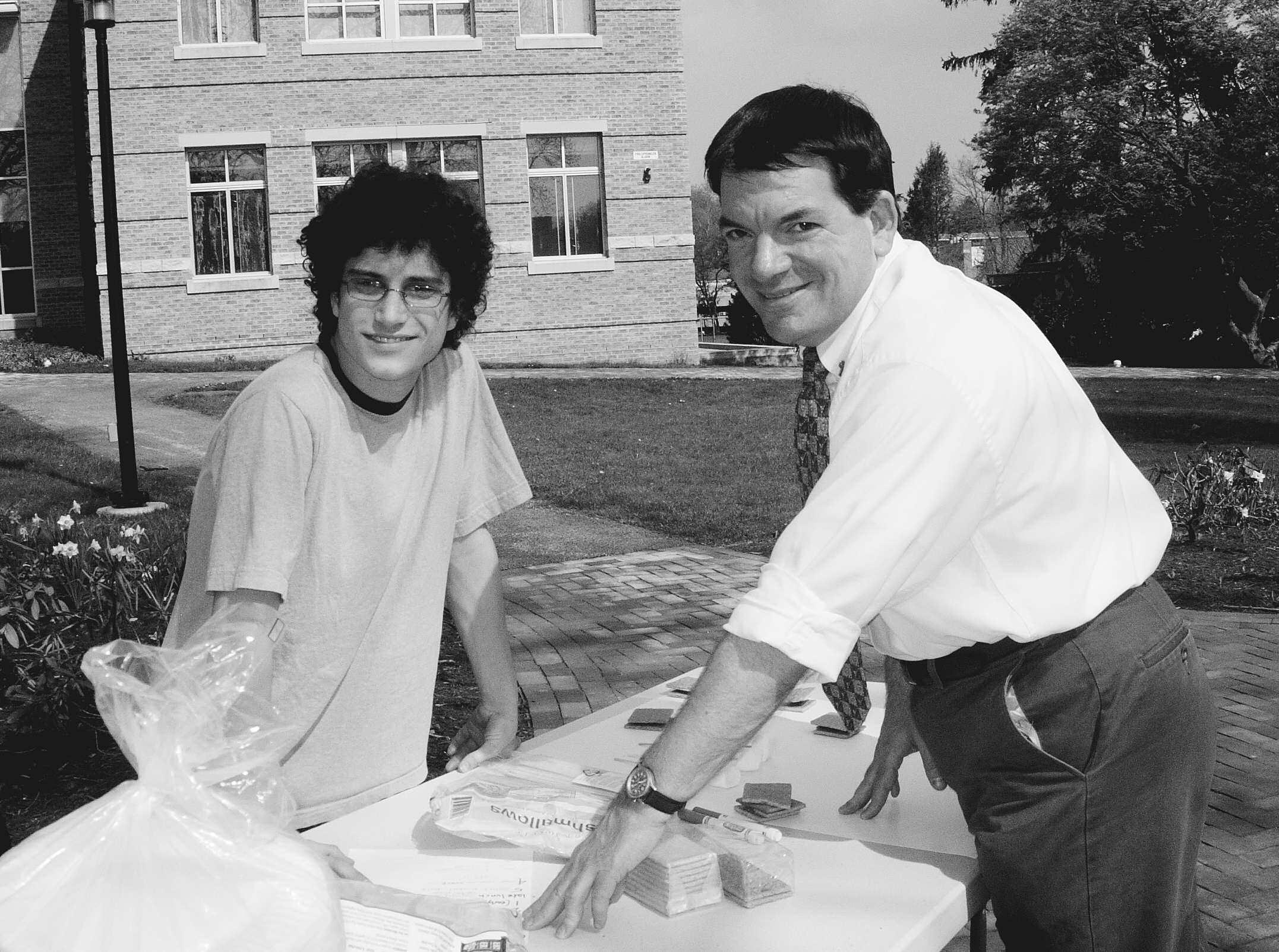
Al, with Jeremy Slovak ’08, at the “Spring S’mores Sale.”
becoming a sexual person demands experimentation, what actions would we hope they’d take? I have heard from too many kids that they initiated sexual intercourse early because they simply didn’t know what else to do. No one had ever talked with them about how to achieve intimate, romantic, pleasurable experiences without intercourse—or even that such a thing was possible. We need to be clear with kids that there are ways to be loving and romantic that don’t involve high risk for pregnancy or disease. We must also work against the idea that sexual activity
We need to be clear with kids that there are ways to be loving and romantic that don’t involve high risk for pregnancy or disease.
is a linear progression only successful if it ends with intercourse and orgasm. Nothing can be further from the truth. Kissing can be an end in itself, and a wonderfully romantic and pleasurable one. Have you ever told your child the story of your favorite kiss? Have you ever talked about how pleasant it can be just to hold someone or be held by someone without it progressing any further than that? If we don’t want kids participating in genital sexual activity, then we have to help them learn that there are other parts of their bodies that are just as sensitive to pleasure and that there are other experiences besides sexual activity that can produce intimacy, connection and romance. Probably some of your most romantic and intimate experiences didn’t involve sexual activity at all.
Those stories are essential to share with our kids. The best sexual technique can only take someone so far, but knowing how to woo and be wooed in ways that reach beyond the sexual and the genital makes for a lifetime of good feelings and good experiences.
...knowing how to woo and be wooed in ways that reach beyond the sexual and the genital makes for a lifetime of good feelings and good experiences.
3) Share your values and experiences: Despite the eye rolls, grimaces, and sudden deafness that seem to appear when we try to talk to young people about sex, they really do want to hear what we have to say. Every year in my class, students report that hearing how people they love and respect have navigated opportunities, challenges and decisions about sex is helpful in their growth as sexual people, and they often name their parents as people they’d like to hear more from. Sharing our values
...they often name their parents as people they’d like to hear more from.
and experiences doesn’t mean moralizing, nor does it mean blurring boundaries between being an adult and a peer. It means helping to normalize the experiences our kids are having by expressing to them that we faced similar things. We’ve all had broken hearts, unrequited attractions, ecstatic moments with a beloved and questions about whether or not to continue a relationship. Those are the very experiences that would be helpful to share. What is the decision you’re most proud of when you think of your life as young sexual people? Wouldn’t that be important to share? We are often too eager to share our mistakes but not our successes.
We are often too eager to share our mistakes but not our successes.
Besides sharing our experiences, it’s also important (and I would argue, essential) to make our own values explicit and to set guidelines for our kids. Saying, “I don’t want you to have sexual intercourse at this point in your life,” is a fine message. Reminding our kids that, “Anyone who wants to use your body without wanting to know what’s on your mind isn’t worth your time” can be just the nudge a kid needs to make a healthy decision. Urging them to adopt the mantra, “If you can’t talk to your partner about it, you shouldn’t be doing it with him/her,” provides
kids with a practical yardstick they can use when their own yardsticks fail them. Young people may not act like they appreciate the guidelines we suggest to them, but they do; they hear them, and it helps them know they have options.
Young people may not act like they appreciate the guidelines we suggest to them, but they do; they hear them, and it helps them know they have options.
4)Talk with kids and not at them: Dialogue is a two-way street. Listening is essential. Understanding a question is the best way to begin to answer it. Talking about sex can create so much background noise in our heads that we forget these simple rules for good communication. Parents can be so bowled over that their kids have actually asked a question that they leap to a response, fearful that any hesitation will destroy the moment. We must resist the urge to pounce and assess the situation. First, we must be sure we know what the real question is. Asecond grader came into the kitchen and asked, “Mom, where did I come from?” Seizing the moment, mom launched into a flurry of birds, bees, seeds, eggs, etc. The youngster stared at her, puzzled, and said, “Oh, ’cause Amanda said she came from a hospital. Did I come from a hospital too?” It turns out “Where did I come from” was really the question, “Where was I born?” The question, “Can you get pregnant in a swimming pool?” might be about sex in public places, or about the spermicidal properties of chlorine, or a more general question about how pregnancy happens. Unless we know for sure, we risk losing an opportunity to model positive communication about sexuality. Once we understand the question, answering what’s asked is imperative. Kids know how much information
Once we understand the question, answering what’s asked is imperative.
they want from us and are easily frustrated when they get too little or too much. Not every question needs to lead to a sit-down, serious discussion. A casual question deserves a casual answer; a specific question deserves a specific answer. Finally, eliciting feedback by asking open-ended questions is the best way to continue dialogue and to assess the interaction. I guarantee, the question, “Do you understand?” will only elicit a monosyllabic grunt. But saying, “I’d like to know what you think about that,” or “Tell me if I answered your entire question,” might have better results.
5) Talk about skills, not just behaviors: Healthy sexual behaviors result from mastering certain skills. Telling a young person, “Don’t have
sex until you’re in love” has no skill instruction in it. Nor does, “If you’re going to drink, don’t get sexual with people.” Asking, “How do you figure out whether or not you’re in love?” or “What are some things you can do to make sure if you have too much to drink you don’t get into an unwanted sexual situation?” are discussions that entail talking about skills. My problem with the “Just say ’No!’” approach to sexuality education is that I don’t see any of the materials talking about how to say no. Saying yes or no is about practicing skills of decision making, communication, and reading situations. While role-playing and practicing discussions can help young people find the words to use, they don’t always show how to apply those words in different situations. One of the assignments in the Sexuality and Society class is to have students write their own “Safer Sex Philosophies.” In these documents, students talk about values that guide their decision-making about safer sex and the skills needed to make those decisions stick. If one of their values is “I won’t have genital sex in situations where I drink too much alcohol,” they must also talk about their strategies for making decisions for balancing drinking alcohol and sexual activity, and about fail-safe measures if they no longer feel able to make those decisions. Identifying and practicing skills is the only way to improve our command of behaviors.
Identifying
and practicing skills is the only way to improve our command of behaviors.
Without the knowledge of what skills are needed to perform desired behaviors, we are left with a destination on the road map but no hint of a plan for getting there.
Talking with young people about healthy sexuality is possible. We must be willing to give up our negative assumptions about sex and about young people’s ability to make good decisions about it. Yes, the life of a young person often entails making mistakes, but it is also about learning to avoid mistakes and making healthy and helpful decisions. Going into
...the life of a young person often entails making mistakes, but it is also about learning to avoid mistakes and making healthy and helpful decisions.
these decisions with a positive outlook, a sense of the overall goal, and a willingness to engage in listening and sharing will help to produce interactions that are trusting, loving and mutually satisfying—the perfect model of healthy sexuality.
SOME GOOD RESOURCES FOR FURTHER INFORMATION:
BOOKS:
Roffman, Deborah M. Sex and Sensibility: The Thinking Parent’s Guide to Talking Sense About Sex. Perseus Publishing , ISBN: 0738205206
Haffner, Debra W. Beyond the Big Talk: Every Parent’s Guide to Raising Sexually Healthy Teens From Middle School to High School and Beyond. Newmarket Press, ISBN: 1557045178
WEB SITES:
Go Ask Alice: http://www.goaskalice.columbia.edu/ Outproud: http://www.outproud.org/
Sex Ed Mom: http://www.oxygen.com/sexarchive/
SEX ETC.: http://www.sxetc.org/
F R I E N D S ’ C E N T R A L S C H O O L 1 1 0 1 C i t y A v e n u e W y n n e w o o d , P A 1 9 0 9 6 N O N P R O F I T O R G U . S . P O S T A G E P A I