FORUM
Table of Contents
—Derek Bok
Editor: Marilyn Lager, Director, Friends’ Central’s Blackburn Library
Email: mlager@friendscentral.org
Assistant to the Editor: Deborah Fedder, Middle School English Teacher

—Derek Bok
Editor: Marilyn Lager, Director, Friends’ Central’s Blackburn Library
Email: mlager@friendscentral.org
Assistant to the Editor: Deborah Fedder, Middle School English Teacher
Forum is our community’s educational journal. Faculty, alumni, board members, parents and students areencouraged to contribute opinions, ideas, innovations and observations about any aspect of their lives relating to educational experiences.
Marilyn Lager Editor, Forum

About every ten years, Friends’ Central participates in an accreditation process through the Pennsylvania Association of Private Academic Schools (PAPAS). This process involves an exhaustive self-study of every aspect of the School’s functioning. Faculty examines curricula; administration looks at admissions, development and business practices. Health and safety procedures, school life, from athletics to the arts, from endowment size to classroom size are scrutinized internally and then finally by an outside team of educational professionals.
In preparation for this almost two-year-long process, which will culminate with an on-site visit in Fall 2007, we begin by revising our School philosophy. This year, a trio, Lou DelSoldo, assistant principal of Lower School, Mark Fifer, Middle School administrative advisor and Marilyn Lager, director of the Middle and Upper School Library and editor of this journal, began a process which included discussions with the three divisions of the faculty, the principals’ advisory and the admission, development and business departments. Meetings were held with the School Life committee of the Board, the Student Council leaders, the Alumni Board, members of the physical plant division and finally, the full Board of Directors. Folks from all these constituencies were asked for key words and concepts that make a Friends’ Central education distinctive, in order to produce a lofty blueprint for what we are and what we want to be.
We are not unique in 2006 in our examination of our mission. In fact, our first Philosophy of the School, according to Clayton L. Farraday’s History of Friends’Central School 1845-1984, was written in 1931. Some of the ideas, albeit with dated pronoun choices, we still can find relevant today in this short excerpt.
“Our philosophy at Friends’Central is to maintain a happy educational environment. We aim to stimulate a thinking attitude in the individual and to build a cultural and physical background which will help him to adjust himself to present and future conditions….We make an effort to develop a child in accordance with his individual capacities, in preparation for higher grade standards, so that he may become an understanding, creative and resourceful individual, able to meet his responsibilities, with self respect and consideration for other people; in other words, to enable the child to develop a rich, intellectual, emotional, physical and spiritual life, and to become a cooperative member of his social group, happy and successful in what he does.” (1931)
In a real sense, the philosophy is a living record of our mission here at School. But it is never final; it will evolve through our continuing conversations and practices over the years. Our 2006 revision is on the facing page.
Since its establishment in 1845 by the Religious Society of Friends, Friends’Central School, a coeducational, college preparatory day school for pre-kindergarten through 12th grades, has been guided by Quaker testimonies of simplicity, peace, integrity, community, and equality. Underlying all facets of School life is the belief that “there is that of God in every one.“ Meeting for Worship is central, providing time for connections among members of the community and between individuals and their spiritual sources. Peaceful resolution of conflicts, seeking truth, and collaborative process are key aspects of a Friends’Central education.
Friends’Central offers rigorous and varied educational experiences in academics, the arts, and athletics, helping our students realize their potentials and achieve on the highest levels possible. We encourage trial and error, critical thinking and questioning, and intellectual courage in all areas of our curriculum. We strive to balance competence in using sophisticated technology with the richness of a humanistic education. Students’individual interests are encouraged and supported while essential skills are carefully honed.
We intentionally seek a wide spectrum of diversity in our School community. We respect unreservedly that diversity and strive to enhance and support it. Diversity influences how we teach, learn and communicate. It enriches the community and furthers understanding that each human life is intrinsically valuable and interrelated, one with another.
We realize that our students have instant access to world events, and we help them generate a social conscience in their actions within the community as well as in the wider world. We want them to develop compassion for fellow human beings across national boundaries and to value the environment. Accordingly, there are many opportunities for service, where experiential learning provides us with the awareness that we, to whom much has been given, can make a difference both locally and globally.
We believe that a friendly, nurturing, and kind school environment fosters true scholarship and helps students develop strong ethical values. In a well-ordered community, adults model behavior for students and encourage inner discipline. In such an environment, it is our strong belief that students will grow into contributing, optimistic members of society who will have a positive impact on human life.

By Kathryn Daniels
Katie has been teaching FCS fifth grade language arts for four years. Last summer she was awarded a Clayton Farraday summer stipend to travel to Mexico.
After work one day in April 2005, I walked through the door of my apartment complex, checked my mailbox and got in the elevator. I sorted through the usual junk mail, and at the bottom of the pile, I found a letter from Friends’ Central marked “Confidential.“ I already knew what it was and opened it before I even got in the door. Elated that I had been chosen as a recipient of a Clayton Farraday summer stipend, I could now really begin the planning process for a learning trip to Mexico.
The decision to take the trip to Mexico had been reached when I added a new book to the fifth grade language arts curriculum, Esperanza Rising, by Pam Muñoz Ryan.
The decision to take the trip to Mexico had been reached when I added a new book to the fifth grade language arts curriculum, Esperanza Rising, by Pam Muñoz Ryan. It is a splendid children’s book that is set in both Mexico and the United States. It is a story of a young girl growing up on a vineyard in Aguacalientes near Mexico City. There is much use of the Spanish language and customs, such as the coming of age ceremony for Mexican girls. On the eve of her twelfth birthday, Esperanza’s father is murdered. It became apparent to me in the midst of teaching this book that I really should try to venture to Mexico to see the country that inspired this book. I knew that Mexico was a country rich in culture and tradition, and I wanted to see that first hand so I could share it with my students. Four months after receiving the letter, I found myself, accompanied by my fiancé Brian, at the Philadelphia International Airport at four o’clock in the morning, checking in for a six A.M.flight. The flight was full of vacationers heading to Cancun for the all-inclusive beachfront resort scene, but I was hoping to avoid that and to have a more meaningful adventure. I certainly got what I wanted! The plane landed at ten A.M.,
and we were through Immigration and Customs by 11 o’clock and checked into our hotel, located at the very edge of turquoise water and white beaches, soon after.
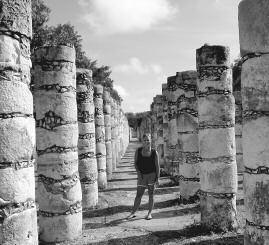
The next day, we drove west through torrential rains to Chichen Itza to explore the ancient Mayan ruins. Unable to see much because of the weather, we found a hotel and asked for some information about the site. The hotel staff was very helpful, and my How to Learn to Speak Spanish audiotapes proved to be quite handy at this point in the journey. The next morning we were able to get to the site, and, luckily, we got to be first in line and set off on “discovery.“
...my How to Learn to Speak Spanish audiotapes proved to be quite handy at this point in the journey.
El Castillo, Spanish for “the castle,“ was the first stop, a beautiful structure, with ninety-one steps on each side, and with a platform at the top. It was designed with the calendar year in mind, a step for each day of the year, adding up to 365 steps, counting the platform, and at the spring and fall equinox, the shadows cast by the setting sun resemble
very closely the pattern of a snake’s skin. It is no accident or coincidence that these shadows appear on these two special days of the year. The Mayans were great astronomers and put much thought into their architecture, taking into account not only the purpose, but also the aesthetics. Another wonderful feature of Chichen Itza was the Sacred Cenote, which is a naturally occurring, wide, deep fresh water well with smooth sides of limestone. Cenotes are unique to the Yucatan Peninsula, and the Mayans used them for different purposes. On this particular day, it was 94 degrees at 8:00 A M., in this, the rainy season of the Yucatan jungle, and the humidity was also quite high. The cenote must have supplied the Mayans of Chichen Itza with much of the water they needed for survival, as it is thought that over 20,000 Mayans once inhabited this place. However, the Sacred Cenote was also used for a very different purpose: that of human sacrifice to appease the gods. There is still much speculation about this practice, but it was found, in the 1920’s, by Harvard Professor Earnest A. Hooten, that this must have been the case. Upon visiting Chichen Itza, he discovered that in the Sacred Cenote there were bones of adults and children as well as valuable jewelry and pottery.
However, the Sacred Cenote was also used for a very different purpose: that of human sacrifice to appease the gods.
Two days were spent scouring the ruins of Chichen Itza, learning as much of the Mayan culture and history as is known. Unfortunately for historians, much of the Mayan history was lost when the Spanish conquistadors explored the Yucatan and burned much of the Mayan literature. This leaves us with only speculation of Mayan life, religion and customs; yet this mystery adds to the marvel of and fascination with the ruins that remain.
The next day brought us to Tulum, located along the Caribbean coast, about 100 miles south of Cancun. The journey seemed risky, as we traveled roads that were in complete disrepair in a car that was not at all equipped for this type of terrain. We endured a flat tire, but luckily there was a spare for which we had some help from local young men in changing. The rest of the journey to Tulum was spent not in enjoying the scenery, but instead in my identifying each of the monstrous potholes in the road so Brian could swerve to avoid them. After about three hours, we made it to Tulum, a remote town where the people seem to value a rustic, simple lifestyle complete with lots of books, conversation and beautiful scenery. We stayed at a hotel that consisted of bungalows that were owned by a couple from San Francisco, where we met many people from all over the world. Because the bungalows traded in television for a
gorgeous rock bluff view of the ocean, Internet for hammocks and telephones for friendly patrons, it was by far my favorite stop of the trip.
Because the bungalows traded in television for a gorgeous rock bluff view of the ocean, Internet for hammocks and telephones for friendly patrons, it was by far my favorite stop of the trip.
The ruins of Tulum were not nearly as vast or impressive as those of Chichen Itza; however, they were still quite attractive. The Temple of the Wind seemed to me to be the most beautiful ruin, because it is situated high on a cliff overlooking the turquoise waters of the Caribbean Sea. Admission to the ruins of Tulum was quite a journey, much different than Chichen Itza. First, we parked the car, then walked about a half a mile through an outdoor marketplace and then stood in line for an hour before we could enter. The ruins of Tulum are completely surrounded by a stone wall about five or six feet tall, and below, there was a beautiful playa (beach) entrance. The ruins have not been cared for or restored as has the Chichen Itza site; however, the location was stunning.
Our time in Tulum was only two days, and when it was over, I did not want to leave. However, I was eager to go to our final destination, Playa del Carmen. In July, much of the Yucatan coast and other regions of the Caribbean had been destroyed by Hurricane Emily, so some places we wanted to visit such as Akumal and Cozumel were scratched from the trip. Playa del Carmen was able to withstand much damage from Emily, and it was another absolutely beautiful place. Here we met many more people from all over the world, ate Mexican meals, (with the focus less on spices and more on authentic flavors) and even scuba dived.
My visit to Mexico has added much enthusiasm and joy to my teaching experience at Friends’ Central.
I was tremendously inspired by this opportunity and eager to pass this experience on to my students. We’ve talked about the Mayan language, the Mayan calendar, and they’ve held in their hands masks and carvings we brought back. My visit to Mexico has added much enthusiasm and joy to my teaching experience at Friends’ Central.

Alexa, who has a B.A. from Oberlin College, returned to Friends’Central in 2002 as a substitute teacher. She has been a full-time teacher of seventh grade language arts for the last three years.
Last summer I was awarded a summer stipend to continue work on my master’s degree from Middlebury College’s Bread Loaf School of English. Though the original campus is in Vermont, hence the program being named after one of the Green Mountains, there are now four satellite campuses. I chose to leave the East Coast and use my stipend to attend classes in Santa Fe, New Mexico.
Arriving in Santa Fe, I was immediately struck by the colors and textures of the Southwest.
Arriving in Santa Fe, I was immediately struck by the colors and textures of the Southwest. Santa Fe is spread out in the valley between the Sangre de Cristo (Blood of Christ) and Jemez Mountains. Middlebury uses the campus of St. John’s College, which is nestled in the brown hills above Santa Fe and offers a magnificent view of the city. On a walk or drive around one of its neighborhoods, one notices the famous turquoise blue that adorns the local doors and window sashes. The turquoise contrasts with the sun-dried adobe brown of many buildings and the rough timbers of coyote fences. Piñon and juniper trees adorn the hills, and the heat of the midday sun releases the sweet smell of the sage bushes that grow above the arroyos.
I enrolled in two classes: United States Latino/a Literature and Literary Theory for Fun and Profit. Literary theory can be as unforgiving and dry as the Southwestern climate, but, as the title suggests, our class was designed to help us discover ways of incorporating theory into the classroom. We spent the first half of the summer reading theorists like Saussure, Lacan, Barthes, Bakhtin and Cixous, among others. After reading and discussing different schools of literary theory, Professor Bruce
Smith required us to declareour personal methodology for approaching, interpreting and, possibly, deconstructing a text in a critical manifesto. Then we put our knowledge of theory into action in the classroom. We each chose a text and created lesson plans to try our ideas out with our classmates. In my manifesto, I suggested, “The process of considering multiple, possibly interdependent [theoretical] approaches together can create
a more fluid, dynamic understanding of the text.“ I designed a lesson plan on “How to Tell a True War Story,“ a chapter from Tim O’Brien’s The Things They Carried, which would incorporate formalism, cultural studies and phenomenology.
I designed a lesson plan on “How to Tell a True War Story,“ a chapter from Tim O’Brien’s The Things They Carried, which would incorporate formalism, cultural studies and phenomenology.
In U.S. Latino/a Literature, we read novels, poetry, autobiographies and historical documents in an effort to understand a part of America’s literary tradition that is often overlooked. My professor, Gabriel Melendez, encouraged us to treat Santa Fe as a living laboratory and to use our daily lives to learn about the Latino/aexperience in New Mexico. The fact that I can recount the details of a piñon tree or a coyote fence is due, in large part, to the journal that I kept for his class. His charge made me notice and question my surroundings. It made me talk to strangers; it made the literature come alive.
I learned that Santa Fe owes its character to the mixing, or mestizaje, of many cultures and traditions. Over time, Santa Fe has been home to Mexicans, Spaniards, Native Americans, Anglo-Americans and many others. Once you take the time to notice the way that these cultures have interacted and fused, it is difficult to stop. Building codes require local strip malls to resemble the famous flat-roof adobe dwellings of nearby pueblos. At a local park, murals incorporate the iconography of Aztec gods, Spanish conquistadors, the United Farm Workers of America and the Virgin of Guadalupe.
The meaning behind the mestizaje began to crystallize when my professor suggested that I read Gloria Anzaldúa’s Borderlands/La Frontera: The New Mestiza for my independent research project. Anzaldúa’s description of border culture and border identity begins with this explanation: The actual physical borderland that I’m dealing with in this book is the Texas-U.S. Southwest/Mexican border. The psychological borderlands, the sexual borderlands and the spiritual borderlands are not particular to the Southwest. In fact, the Borderlands are physically present wherever two or more cultures edge each other, where people of different races occupy the same territory, where under, lower, middle and upper classes touch, where the space between two individuals shrinks with intimacy. (Preface)
Yes, I thought, this is what I was feeling and seeing in Santa Fe. Anzaldúa goes on to explain how people can overcome the pain and confusion of a borderlands existence. When two cultures edge each other, how does one form an undivided identity? How does one learn to sustain the contradictions of such a place? Her answer is that we must “[develop] a tolerance for contradictions, a tolerance for ambiguity“ (101).
Even as the summer ended and the school year began, I continued to think about all of the borders in our lives and the strife and ambiguity they create.
...I continued to think about all of the borders in our lives and the strife and ambiguity they create.
I teach seventh grade, which is when most students turn thirteen. When I tell people that I teach seventh grade, they invariably roll their eyes and remark on the difficulty of the age. Seventh grade is the year of bar and bat mitzvahs; it is an age of many transitions. What if we apply Anzaldúa’s words to the lives of seventh graders? Like a border on a map, the number thirteen is a somewhat unnatural boundary. It’s when biology and society say that it is time to grow up. The process of transforming from a child to an adult, as we all know, involves a great deal of confusion and contradictions. It is not easy to live with teenagers, and it
is certainly not always easy to be their teacher, but we should marvel at the way that they embrace such chaos and tolerate the ambiguity of this time in their lives.
...we should marvel at the way that they embrace such chaos and tolerate the ambiguity of this time in their lives.
Reading Anzaldúa’s work enriched my study of literature, my time in Santa Fe, and it reminded me that being thirteen feels like living on the frontier. The summer stipend made my voyage, both literal and figurative, possible. It reminded me to listen to the words of Marcel Proust that have been displayed on a poster in my classroom for three years: “The real voyage of discovery consists not in seeking new landscapes but in having new eyes.“
Anzaldúa, Gloria. Borderlands/La Frontera: The New Mestiza. San Francisco, CA: Aunt Lute Books, 1999.
by Deborah Goldader
Deb has been teaching physics to Upper Schoolers for four years. Before that she spent eight years teaching college astronomy.
Telescopes and eyepieces in our household (both my husband Jeff and I are physics teachers) have given way to cribs and highchairs in recent years. When was the last time I read an issue of Sky and Telescope cover to cover? I can’t remember, but I can definitely update you on the latest tips about “What makes a toddler tick,“ according to Parenting Magazine. For a fleeting moment last June, though, I was able to indulge in astronomical paradise.
As a physics teacher, I covertly sneak astronomy into my lessons now and then.
As a physics teacher, I covertly sneak astronomy into my lessons now and then. Adiscussion of gravity, for example, can pretty easily meander into the development of Kepler ’s 3rd law and orbits (“Hey, kids, ever seen Jupiter’s moons through a telescope?“). Projectile motion and escape velocity calculations inevitably lead to discussions of black holes (“Let’s take a look at a few double star systems—sometimes the companions are unseen!“). Last summer, though, I had the opportunity to present astronomy—wholesale and unashamed—in its most basic form to eight high school students, (seven from FCS, one from The Baldwin School), through the FCS Summer Science Academy.
We began with an intense week on the FCS campus. meeting in the Fannie Cox Center for Science and Technology for lectures and interactive workshops in the afternoon, observing on a few evenings. The daytime sessions focused on material relevant to the program goal of interacting galaxy research: learning the mechanics of navigating the celestial sphere and telescope hardware and practicing measurements of galaxy spectra,
stellar magnitudes and the like. To get the students accustomed to the telescope setup, I also included a daylight session of solar observing. While our first night session was held behind the FCC on the track, our second was in a much more remote, dark location: Camp Onas, a Quaker camp in the Philadelphia suburb of Willow Grove. When we arrived on site, our students were instantly stunned at the contrast between the heavens spilling with stars and the emptiness of the nearPhiladelphia sky. Still this was only a foretaste of what was to come soon: this week-long astro boot camp was all for the purpose of preparing them to observe from truly dark sites in Arizona through research-grade equipment.
...our students were instantly stunned at the contrast between the heavens spilling with stars and the emptiness of the near-Philadelphia sky.
We touched down in Phoenix on a scorching July day and drove straight to Tucson. Our first night of observing wasn’t all that it could have been. Though I had sent our telescope power supply ahead by UPS, our Tucson contact was…out of contact. That was okay—we just plugged the scope into one of the rented mini-vans (although the prospect of sucking the car battery dry in the middle of the desert did rattle me). My students didn’t quite understand the concept that they should rest in the afternoon for an all-night observing jaunt, either. Instead, they walked about three miles in the heat of the day in search of a Radio Shack to buy an adapter in order to plug their DVD player into the room TV! Our dinner that night ran late, so by the time we were exiting the yummy TexMex eatery Guillermo’s, sunset’s splendor was being upstaged by the spectacular sight of Mercury and Venus in conjunction with Saturn nearby We all passed the binoculars around the parking lot to see it and then piled into the vans for a half hour jaunt southeast of Tucson to our chosen site—a site used by the Tucson Astronomy Club.
The site is up a short “dirt“ road (hardly recognizable as a road in the dark) which rises steeply. As I crested the top of the hill, I swear I felt as if I were driving off the edge of Earth into a bath of stars; it was that dark out there. My students were so busy looking up as they got out of the vans that one stepped into a giant hill of fire ants. This made for difficult equipment setup and a rather jumpy evening under the stars (“Hey-HEYsomething’s crawling on my neck-aaaaaacckk!Oh it’s just the binocular strap…“). The sky was crystal clear, and the seeing was stable—barely a breeze, and the temperature had cooled off pleasantly. Tucson, which has a strict light pollution ordinance, was visible to the northwest, and there was some faint sky glow from Phoenix in the distance. Even in the early
evening, the Andromeda Galaxy and deep sky objects just rising to the north were very easy to spot without a telescope. Naked eye targets were
Even in the early evening, the Andromeda Galaxy and deep sky objects just rising to the north were very easy to spot without a telescope.
popping out all over. Coma and Virgo (both clusters of galaxies) were “averted vision“ eyecatchers. Binocular views were spectacular. The band of the Milky Way and our Galactic Center to the southeast were delectable—nebulae and star clusters like the Lagoon Nebula, M6, M7— wowee!! We set up our Meade ETX but couldn’t get it polar aligned and pointing properly. Tired from the long trip, and after fighting with the telescope for hours, we finally gave up, concluding that it probably just wasn’t level. So, we “surfed“ the sky for a while and lingered on some familiar targets like the famous Ring Nebula (it sure looks different out there!) and Albirieo, a lovely blue and gold double-star in the constellation Cygnus.
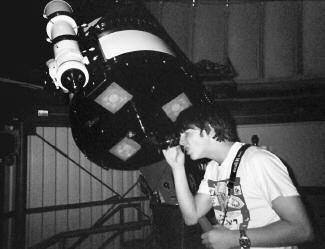
On our second night, I split the group in two: half would remain in Tucson chaperoned graciously by FCS English teacher Liza Ewen. and the other half would travel to the summit of Kitt Peak with me for the night to participate in the Advanced Observer Program (AOP). Through this program, anyone can buy time on either the twenty-inch or sixteeninch telescopes (or both, as we did), equipped with a variety of instruments and eyepieces. As I drove to the summit, I had butterflies in my stomach. Previous trips to Kitt Peak had been work: either my observing runs or someone else’s. But this time, I was going for fun, and I would actually be able to use an eyepiece to look through a telescope. Night fell, and the experience did not disappoint!
Night fell, and the experience did not disappoint!
To kick things off, we snatched looks at Saturn, Venus and Mercury (still close) at sunset. Our guide reviewed our target list with us during dusk as the regular visitor’s program used the telescopes (a terrific option for those who either don’t want to spend the entire night at the summit or who do not want to run the telescope themselves). Once we were given the green light, we set up the twenty-inch telescope with its CCD camera to image one of the several interacting systems I’m interested in. Since we were doing long exposures (six of them, ten minutes each), we were able to leave the telescope doing its thing while we walked over to the sixteeninch scope. This one wasn’t quite so easy to set up. Somehow, it had gotten out of collimation. Once we got that right, we couldn’t get it pointing or tracking well enough to do imaging. After about an hour had passed, one of my students pointed out that this telescope happened to be another fussy Meade product!
Upon this realization, and on the recommendation of our guide, we decided to abandon imaging on this scope and just take a look around. This was a fabulous decision! The telescope also had a 3.5-inch Televue piggybacked to it (used as a finder), so we were able to look at wide-field targets as well as highly-magnified, hard to resolve objects. The AOP spared no expense acquiring eyepieces; the 9 mm Nagler on the 16-inch was amazing! Even though we were fighting a gusty wind, our seeing
I had never seen that through a large telescope before.
was just about 1.2 arcseconds that night. Most striking were the nebulous objects, especially the Lagoon. I had never seen that through a large telescope before. It reminded me of the way that the Orion nebula looked
through Penn’s Flower and Cook Observatory 28.5-inch telescope on some clear winter night—practically three-dimensional. We looked at several globular clusters in the southern sky. They were so highly resolved—even at high air masses! Open clusters like M6 and M7 were fantastic through the Televue. By the time the night was over, we had looked through a telescope at every “planet“ with the exception of Pluto (ok…and Earth!). Meanwhile, we could remotely control most of what
By the time the night was over, we had looked through a telescope at every “planet“ with the exception of Pluto (ok…and Earth!).
the twenty-inch was doing from the sixteen-inch dome (although we did walk back now and then). Ahighlight for the kids was watching for an iridium flare near dawn. The great part of using both telescopes simultaneously is that we had the benefit of take-home, printable CCD “souvenirs,“ plus the memories of an unparalled evening under the stars. Adam, our guide, was patient with both groups of my students, showing them how to reduce the images once acquired (using a combination of Maxim DL, Mira and Photoshop) and even his N-body code for cluster simulations. I got the sense he was having a good time, too; if he wasn’t, then it was a convincing act! He even ordered clear weather for us both nights. That kind of skill must come in handy. Unfortunately, I got an altitude migraine around 10:30 on the night my second group came to the summit, so I couldn’t enjoy sky-surfing with them. Adam got to have all the fun. When I heard the kids enter the dorm laughing at dawn, only to grab their cameras and run out the door again for another hour, I knew that they just had the same kind of addicting, magical experience which I had had the night before.
For more information about the Kitt Peak Advanced Observing Program, go to http://www.noao.edu/outreach/aop/
To participate in the Summer Science Institute in Observational Astronomy at Friends’Central School in 2007, please contact Deborah Goldader, 610-645-5107.
By Christopher Guides
Chris has been teaching science and math to Middle Schoolers for six years.
The Friends’ Central Arboretum has only had official status since 1995, but it captured the interest of the faculty, staff, students, parents and friends many years before then. Our Arboretum has a remarkable variety of trees, and many have important associated stories. (In fact, last year a Kousa dogwood was planted on the campus green in memory of Clayton L. Farraday.) These trees, which include, for example, eight different varieties of oaks, various specimens of ornamental dogwood, the “parking lot” gingko and the historic bur oak which generations of students remember fondly, are used as a tool for learning about biology and history, in both the Upper and Middle School curricula. They are also enjoyed simply for their beauty
However, some of the questions that have been asked are: How many trees do we currently have on our campus?* How many different varieties are there? What are the diameters of the trunks of some of the oldest trees? What is the approximate height of the tallest tree on the City Avenue campus? This is some of the information that we have collected and can now start to answer using the technology called Geographic Information Systems or GI S.
What are the diameters of the trunks of some of the oldest trees? What is the approximate height of the tallest tree on the City Avenue campus? This is some of the information that we have collected and can now start to answer using the technology called Geographic Information Systems or GIS.
According to the Government of British Columbia’s Ministry of Forest, GIS is “a computer system designed to allow users to collect, manage and analyze large volumes of spatially referenced information and associated attribute data.“ We now have, at this writing, a digital map of
the campus with reference data such as buildings, paths and parking. In addition we have a point on the map that represents each tree on the twenty-two acres of the City Avenue campus. Using GIS, we can add information in the form of a database to each of the points that represents a tree. We are collecting a great deal of information about all of the trees in order to develop our database. Once complete, we will be able to analyze and manage the tree information on the campus.
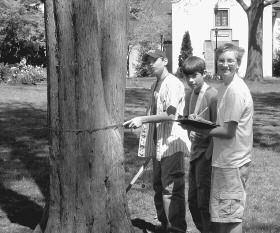
Much of the collection and inputting of the data is done as a Middle School service project in the fall and spring trimesters. With the help of fifth to eighth graders, staff and other faculty, we verify the locations of the trees, identify trees by their common and botanical names, measure the diameters and approximate heights, take a picture of each tree, and then we may add additional information such as if the tree was planted in memory of someone or if it was grown from seed. Before this current GIS project, collecting information about our trees had been done by many people.
...we verify the locations of the trees, identify trees by their common and botanical names, measure the diameters, approximate heights, take a picture of each tree...
According to Doug Linton, the groundskeeper at the City Avenue campus, a database of trees was started many years ago by an Upper School student using a Macintosh computer and “many diskettes.“ Over ten years ago, Emily Miller, Business Manager, led a group of Middle School students, who created a binder of information about the trees. The binder included stories of people once associated with Friends’ Central, such as former Headmaster Barclay Jones, who planted an acorn that he picked up on the banks of the Delaware at the tree where William Penn shook hands with a group of Indians. Planted in our parking lot, one acorn gave life to the English oak now growing in front of Shallcross. Members of the community who left or passed away have been memorialized either by naming a tree in their honor or planting one in their name. Though we have used this information, the idea of using GIS for our Arboretum occurred when I was a student teacher in the spring of 1999. At that time, Dave Thomas and Dan Crowley, science and computer teachers respectively, were using Filemaker Pro (a database) and scanned pictures of a map of the campus. The campus was divided into sections based on a grid, and Dan hyperlinked each section to a database that contained tree information that Dave Thomas’ fifth grade classes collected about particular trees. When I had left the environmental consulting field in 1998, I was very intrigued by GIS but had never used the software. However, what Dave and Dan were attempting to execute was exactly
the reason GIS was created. They were looking to combine the usefulness of a map with the information potential of a database. Though I wanted to continue what Dave and Dan had begun, I didn’t know where to start. Could I reasonably have my students work with software that even I wasn’t comfortable working with? Would using the software be engaging for a majority of the sixth grade students that I would be teaching? First I needed to get the software and learn how to use it. I chose the software developer called ESRI because they were willing to work with a teacher who lacked understanding of the program—and
First I needed to get the software and learn how to use it.
more importantly they were interested in getting their products to educators cheaply. By the spring of 2003, we were trying unsuccessfully to use the software to map the locations of invasive species of plants in Morris Park, which is located across the street from the City Avenue campus. However, with the help of a Fannie Cox summer stipend, I was able to attend a conference for educators who use GIS in their classrooms. In the fall of 2003, I created a new service project called FCS Tree Mapping. With all of the construction on the campus for the Fannie Cox
Center for Science, Math and Technology and redevelopment of the inner campus green, our service group was able to obtain a computer file with the locations of some trees in addition to the paths, parking and buildings. This was a tremendous help to our group, since we did not have very expensive GPS (Global Positioning System) hardware/software to determine the relative locations of the trees.
The service group that year consisted mostly of very active boys and was difficult to coordinate. Sending the students out in pairs tended to produce better results, and rotating their responsibilities also helped. We were getting great data, but the tedious nature of inputting the information proved to be even more than the most patient Middle School student could handle. However, in the spring of 2004, a Middle School math class
...in the spring of 2004, a Middle School math class used trigonometry to determine the approximate heights of all of the trees on the inner campus green.
used trigonometry to determine the approximate heights of all of the trees on the inner campus green. The tallest tree? The tulip poplar at the Graduation Terrace which is approximately 114 feet. This was not only a great application of trigonometry, but provided a relatively accurate way of gathering tree height information for our database.
Since the spring of 2004, we have made significant progress. We upgraded to a more advanced GIS program, made major corrections in our data identification, located every tree on campus, gave most a common if not botanical name, took pictures and hyperlinked each tree point so that a picture would open when selected. However, it was not until the summer of 2005 when I became aware of what we are accomplishing. During a visit to local arboretums in the area, including Winterthur, Scott, Tyler and Morris, I found that only one, Scott Arboretum, was at a similar juncture in the collecting stage as we are at FCS.
...it was not until the summer of 2005 when I became aware of what we are accomplishing.
In the summer of 2005, I attended the ESRI Educators User Conference with the intention of learning how to share our tree information with our community. When I showed other teachers what our Middle School students had accomplished thus far they were exceedingly impressed. Not only were they impressed with the information, but they
were amazed that we accumulated the information during the one hour that we meet per week in the spring and fall. During the conference I learned that software is available to make our data accessible to anyone with an Internet browser. Students could access our tree information from home to complete an assignment, or we could make our Arboretum accessible for people to visit remotely our beautiful campus.
...we could make our Arboretum accessible for people to visit remotely our beautiful campus.
If we can verify all of our tree information by this summer, we could possibly make our tree mapping project available to the public by the fall of 2006. (By the way, the answer to the first question in the second paragraph is approximately 350 trees!) However, we hope you will be able to find the rest of the answers on the Internet this fall. What a long process…but for everyone involved, it has been a process that was well worth all of the work.
In the fall of 2005, Terry Guerin, FCS drama teacher, directed the student-acted play, “The Miracle Worker,“ about Helen Keller and her teacher, Annie Sullivan. She asked FCS teachers to think about the teachers who had had unique influences on their education and future lives. As Terry wrote in the program, “Our elegant production of The Miracle Worker is dedicated to the wonderful teachers who have nurtured and inspired us. To those who believed in our gifts before we even knew how to, we salute you.“ The following reflections were printed in the program for the play.
Going into graduate school, I knew I really loved theatre. I also loved how I felt being in the spotlight. Dr. James J. Christy taught me the true power of theatre and its value as a form of expression. He encouraged me to realize that although the spotlight was a nice place in which to be, it was even better to be part of a strong ensemble, collaborating to build an elegant production and to love the art in myself, not myself in the art…Terry Guerin, Drama Teacher . . .
Virginia Hoffman and Holly Martine were the influential teachers in my life. Both of them were college professors of mine in my senior year at Wittenberg University Ms. Hoffman was one of my education teachers, and for the first time in all my years of school, I really enjoyed reading a book. I wish I could think of its title, but the cover, with a man on a dogsled, stands out in my mind. Virginia just brought the book to life and opened my eyes to…possibly becoming a teacher. Mrs. Martin was my college advisor’s wife who taught me my classes—in the swimming pool. This woman was always full of energy! With her teaching techniques, I improved all my strokes, learned what it takes to be a good quality lifeguard and swimming teacher and improved my stamina in the pool. I believe because of this exposure, I love to swim, whether it’s to work out, relieve stress or just to show my own students/athletes the appreciation of being able to do something good for your heart and soul…Lisa Mansure, Upper School Health Teacher and Athletics Coach
. . .
Simon Belasco, a linguistics professor in my graduate program at Penn State, inspired me to become a teacher. It is he who taught me how to teach. Head of the Linguistics Department, as well as the Graduate Teaching Fellow Program, Simon, who became one of my closest friends, challenged his students in every learning situation; for him, every moment of each day offered a learning situation! Never satisfied with the simply correct answer, he insisted on a full explanation of the “how“ and “why.“ One would never arrive at his class unprepared; our respect for him was too great; our desire to learn from him all that we could imbued us with a sense of urgency to comprehend the intricacies of phonetics, structural semantics and syntax. Searching for the deep structure became an integral part of my life. Simon died six years ago, leaving a teaching legacy that will never end; surely he is with me in each class that I teach. And even now, six years since his passing, I continue to try to reach his teaching standard in each interchange I have with my students…Rochelle Ostroff-Weinberg, Upper School Language Teacher
“An education is not something you complete. An education is something you keep with you and use all the time…“ This was a thrillingly insightful comment to read on Bryson’s application to the University of Chicago. To me, such enthusiasm for one’s own education seemed truly inspired. Inspired, in this case, by dedicated teachers. When I visited Bryson’s high school several weeks later, he told me about a former English teacher who had taught him to take responsibility for his education and “own“ it.
As an admissions counselor at the University of Chicago, I met hundreds of high school students inspired by the nation’s most dedicated teachers. I got to visit high schools around the country, where I saw a cross section of the nation’s education system. I visited wealthy private schools and underfunded inner-city schools. Though the high schools and their students were worlds apart, I noticed that the majority of students I spoke with valued learning and ideas for their own sake and not simply as the means to a lucrative career. All of these students, whom I admired for their passion for education, had teachers who inspired and encouraged that passion. I learned from the students I met that the best teachers convey knowledge in a clear yet provocative manner; they encourage actual understanding. Their teaching goes beyond textbooks. It probes. It questions. It excites. In the classrooms of the best teachers, rote memorization does not suffice.
In college and graduate school, my most rewarding classes were with professors whose enthusiasm and knowledge guided the class to an understanding of the many sides of complicated issues. I did not often experience this kind of teaching in the high school, but it was high school
students’ recollections of their own teachers that inspired me to become a teacher…Joel Dankoff, Upper School History Teacher . . .
I remember my seventh and eighth grade English/history/homeroom teacher, Mr. Johnson (aka “DJ“ or “The Flash“ and, sometimes, “King Crab“). It would take me days to write about this remarkable guy. As a scientist, I didn’t get hooked easily on English or history. Yet, he made these subjects come alive, and everything I know about teaching “methods,“ I learned from him. I’ll never forget the day he jumped into the classroom sink to illustrate how Native Americans were crowded out of their homelands by westward expansion, or how he animatedly narrated the Battle of Gettysburg. DJ challenged me in many ways to reach beyond my comfort zone. He would give me random facts to look up (in the days before the Internet)—to find out about the “Prague Spring“ or to learn about “Occam’s Razor,“ when he sensed I was bored with our curriculum. I felt special to be nicknamed “Maz“ by him (my maiden name was Maraziti) and to be guided by his frank criticism of papers. He taught me so many things—to avoid needless words (I can still see “ANW“ in red ink on my papers…), NOT to split my infinitives, never
Deb Goldader, ten years after her eighth grade graduation, with her favorite teacher, “DJ,” at the Battle of Gettysburg site.
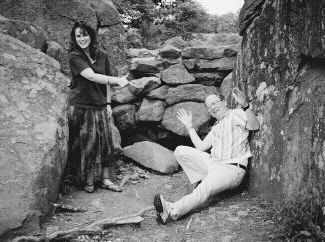
say “very“ unique. DJ helped me write graduation speeches for graduation from both eighth grade and high school and even attended my college graduation (my parents surprised me with that most wonderful gift!). I still get a Christmas card every year from DJ. His interest in students reached way beyond expectations. He cared/es for us in the way parents do. I always wish I had nominated him for some kind of teaching award. Probably too late to do that, but not too late to let others know that extraordinary actions of this teacher made a huge impression on me and will last a lifetime…Deb Goldader, Upper School Science Teacher
When I was in ninth and tenth grades, my passion for sports (soccer, basketball and baseball) was in full bloom, and I was fortunate that Ray Brown took an interest in me. He stayed after soccer practice and kicked hundreds of balls at this aspiring goalkeeper. One day he broke my hand, but it never occurred to me to complain nor did my mother sue! In basketball, he thought it was important to expose me to higher levels of competition, and I was the beneficiary of the arrangement he made to put me in competition against older and more advanced athletes. Perhaps all that time he spent with me meant just that much more because my father had died when I was nine. This last September, Ray and his wife visited Friends’ Central, and you can imagine what a great pleasure it was for me to give them a grand tour of the campus and introduce them to my colleagues. I have told Ray many times how grateful I am that he was there as I grew up, helping me develop self-confidence….David Felsen, Headmaster
My mom, Edythe Thomas, never let me settle for doing less than I was capable of doing. My high school science teacher, Carl Brehmer, also never let me settle for doing less than I was capable of doing. Both of these wonderful teachers helped me learn the value of hard work and a job well done…Dave Thomas, Middle School Science Teacher
There were many teachers who made a difference in my life, and many of them are still here at Friends’ Central. However, one who is no longer here is Leif Gustavson, my eighth grade Language Arts teacher. The best way for me to explain the way that he affected my life is to paraphrase author Julia Alvarez. I heard her speak…and she told a wonderful story about the teacher who gave her the confidence to be a writer. She said that the best teachers are those who can hear something in you that is coming but has not yet arrived. They can tell you what you are not yet writing. Leif made me feel like I was a writer, even at the age of thirteen. He helped me to hear what was already inside of me… Alexa Dunnington ’98, Middle School Language Arts Teacher
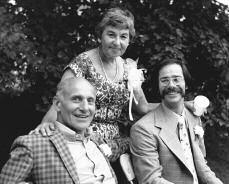
Steve, with parents, Rose and Abe in 1976.
Both my parents were longtime teachers in Philadelphia inner city schools. My father taught machine shop, and my mother was a kindergarten aide. Dad would also work to find industrial jobs for his more motivated and capable seniors. Mom was notoriously able to take the young “troublemakers” under her wing, and provide loving structure and skills work. At home, I found our dinner conversations fascinating! I surmised that good teachers needed to have empathy, clear expectations and a willingness to thoughtfully confront the students or the parents or the administration or other teachers when needed. It seemed that teaching was an artful passion, complemented by artful techniques. My many fond memories of my parents continue to guide and drive my own teaching...Steve Ruzansky, Middle School Social Studies Teacher
My family moved from the suburbs of Chicago to Bucks County the summer before I entered fourth grade. I remember coming away from that first terrifying visit to my new school with one glimmer of hope— Leslie McDonnell, the music teacher. (Just in case there is any doubt as to how small a world this is, her husband, John McDonnell, was Jim Davis’ college roommate!) Mrs. McDonnell inspired me in every way possible. She was the first teacher to really encourage my love of music and singing and recognize that I had potential. Under her direction, I had my first experience singing in a chorus, and at the end of the school day, I ran all the way home to share the experience with my mother. I had memorized every note we’d learned in that first rehearsal and taught my mom one part so that I could sing the other part in harmony with her. Not only did Mrs. McDonnell inspire me as a singer and musician, but she gave a
painfully shy, awkward and overweight kid a place to fit in. It is no accident that many (many!) years later, I am in a place in which I hope to inspire children and help them find their voices…Brian Ramsey, Middle School Music Teacher . . .
When you are in fifth grade and you see your teacher having a really fun time and you decide that’s what you’re going to do when you grow up, now that’s a teacher having an impact on your life! Mr. Kilmer was my physical education teacher at Cold Spring Elementary School, and my class was playing kickball. I was standing on first base (not sure why I couldn’t have stretched the kick into a double!!), but I remember turning and seeing how much fun Mr. Kilmer was having. In that moment, I decided to pursue a life in sports and have never strayed from that intention. I guess you could call it my “wa wa“ moment! How lucky I was that Mr. Kilmer was standing there and having a good day!!…Linda
McConnell, Girls’Athletic Director
When I think of my life and those who have been special teachers to me, I am fortunate to have a myriad of memories—faces and experiences— upon which to reflect. Music, language arts, math, science, history, foreign language teachers, band/orchestra directors, coaches, pastors, students, friends, family, grandparent, parents, spouse and colleagues...all of them so formative and instructive in my personal development as I continue to open my life to learning and instructive moments from those teachers we come across each day. When I think of my special teachers, I am reminded of a quote by Scottish theologian John Baille, “When I think of my own upbringing, the love and care that were lavished on me in my youth, the kind of home into which I was born, the community in which I was reared, the gracious influences that were brought to bear on me, the examples that were held up before me, the kind of teaching I was given, the signposts that awaited me at every turn of the road, the fences that were set to keep me from wandering from the way, the warnings that were given me against every pitfall, the words in season so often spoken to me—when I think of all of these things, and in spite of my shame for having so little profited from them, I must indeed prostrate myself in gratitude before the memory of my parents, my teachers, my wonderful friends, and those who wrote the books I was given to read, who rendered me this inestimable service.“… Mark Fifer, Middle School Administrator and Teacher
To this day my dearest teacher has been a weaver I met as I was nearing the end of my college experience. I responded to her posted note in search of a weaving apprentice to work in her studio. Lucretia Davie,
now nearly eighty, is a role model and strong inspiration for me. She is a breast cancer survivor, mother of seven children including a Down Syndrome Special Olympic wrestling champ and is still weaving and exhibiting! She taught me a lot in the fibers field as well as lessons in life, and I am very grateful for her continued mentoring, friendship and laughter!…Caroline Maw-Deis, Middle School Art Teacher . . .
I had the privilege of having the same great teacher for French all four years at Swarthmore High School. Her name is Nancy Gable, and we ended up dedicating the yearbook to her in my senior year. Sadly the school is gone, replaced by Strath Haven High School, but my memory of it and Mrs. Gable remains very bright…Brad Morris, Upper School Math Teacher
By Jon Kean ’85
Jon has been living in Los Angeles since 1990, working in theatre, film and television as an actor, writer, producer and director, frequently at the same time. His film, Swimming in Auschwitz, which focuses on six women who survived the notorious concentration camp, is due to be completed this summer.
While researching a film about laughter and other forms of spiritual resistance in the Holocaust, I had the opportunity to talk with Simon Wiesenthal in Vienna. After his liberation from Mauthausen concentration camp, Mr. Wiesenthal spent the next sixty years aiding in the capture of Nazi war criminals, including Adolph Eichmann. He swore that when he met his fallen comrades from the Holocaust after he died, he would be able to say, “I did not forget you.“ Mr. Wiesenthal passed away in 2005.
Asingle tear fell from the eyes that captured Eichmann. Asingle tear fell from the eyes that spent four-and-a-half years in Nazi concentration camps. A single tear fell from the eyes that found the proof to convict 1100 Nazi war criminals. The eyes have been diminished by age, as has the man himself, but the tear travels a familiar path. The same hand that has wiped away an ocean of tears in this man’s ninety-four years, pauses and allows this one to linger. After a moment, the hand completes its wellrehearsed act, and the tear is a memory.
The same hand that has wiped away an ocean of tears in this man’s ninety-four years, pauses and allows this one to linger.
I met Simon Wiesenthal six months before the greatest love of his life died. This tear was for her. And he was in no hurry to wipe it away. In March of 2003, I spent sixty-eight minutes with Mr. Wiesenthal. I was only supposed to have an hour of his time, but his secretary must
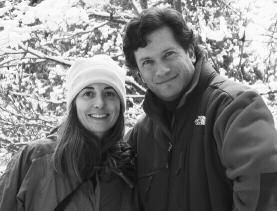
Jon, with wife Beth.
have been feeling generous. Even at ninety-three, his time was in great demand, and he was feeling, no doubt, a little worn down from dealing with his wife’s illness.
I had wanted to meet Simon Wiesenthal for some time. As a boy, or soon to be man, depending on your religious beliefs, I wrote my Bar Mitzvah speech about him and the hunt for Nazi war criminals. Years later, while researching a film about Holocaust survivors, Rabbi Marvin Hier of his namesake Simon Wiesenthal Center suggested I meet with him, as the topic would be of particular interest. He offered to facilitate a meeting. That was in 1995. In 2003, my wife was at dinner with a few friends, describing the film, now in pre-production, when a woman at the table said that this sounded like something her uncle would like.
Her Uncle Simon.
...this sounded like something her uncle would like....Her Uncle Simon.
Armed with a fax number and the name of his secretary, I tried to secure a meeting. I received no guarantees. On a business trip to Paris, I booked a ticket to Vienna, figuring I was never going to be closer to his home. He had been away from the office that previous week as his wife had become ill. I was told on Friday that maybe he would see me on Monday—if he came to the office at all. I should call that morning. I flew
to Vienna on Sunday and called the next morning. I was told to come to the office in two hours.
I walked down a nondescript street in a working class area of Vienna looking for his office. I found it between a video store and an electronics store. An armed guard sitting in a chair by the stairwell was the only giveaway to the occupant. Mr. Wiesenthal’s secretary welcomed me to the waiting area, a narrow hallway by the door. I noticed, in no particular order, a picture of Mauthausen, a framed certificate for the Medal of Honor and a few random letters of praise and thanks. There was also a large coat rack, which obscured some of these items. I heard German being spoken in his office.
After a short wait, I was led into a room that was heavily furnished with books. In a sitting area, drinking hot tea, was Simon Wiesenthal. We spoke in English, although I think he would have preferred German. I asked him questions that would help elucidate my film, but it was clear that he was going to tell me what he wanted to tell me. Most of that was about his life after the war.
After liberation from Mauthausen in 1945, Simon was one of the few prisoners who could speak to the American liberators.
After liberation from Mauthausen in 1945, Simon was one of the few prisoners who could speak to the American liberators. This afforded him a small bit of status, and as soon as his health had recovered to some degree, he went to work for the Americans helping them find Nazi war criminals. His work soon garnered attention in newspapers, and people in Poland heard of this Jew who was helping to capture Nazis. His wife, who thought he was dead, found one of these articles. She sent word through a messenger that she was alive. People could still not move freely around Europe at that time, and as she was in Poland, and he in Austria, a message was her only recourse.*
This messenger came to Simon, who was recuperating in a hospital from a leg injury. He told Simon that perhaps he had found his wife, this woman who had been living as a gentile in Poland. The two of them arranged papers to bring her to the hospital under a new assumed name. Simon feared that if this were his wife, his enemies would become her enemies.
* Mr. Wiesenthal told me that he was in Russia when he was reunited with his wife, but I can find no evidence to support that contention. Perhaps I made a mistake in my chronology or perhaps there was a language barrier at that moment. Either way, it does not diminish the reunion, which is well documented.
In time, the man returned to Simon’s hospital room. He entered and said, “If she’s not your wife, I’m going to marry her.“ Simon saw the woman and said, “You need to find another wife.“
The two of them, who had met more than twenty years earlier, who had feared the other dead after three years apart, would spend the next fifty-eight years at each other’s side.
The two of them, who had met more than twenty years earlier, who had feared the other dead after three years apart, would spend the next fifty-eight years at each other’s side.
It was now that the tear fell, the one that he allowed to linger. Many times during our talk, his eyes would mist or water. Every time, the hand instinctually rose to his eyes. This tear was different.
He went on to talk about how he felt that reparations to Jewish families were becoming more pressing than his past work searching for war criminals. He spoke of his disappointment in the Americans as they turned their attention to ferreting out Communists and not the Nazi perpetrators. He spoke very sparingly in answer to my questions. He was obviously tired, and his heart was somewhere else. When I was told that my time was up, I shook his hand and thanked him. As I opened the door to leave, I could already hear him on his next call.
I left his office on that rainy Viennese morning and walked by the odd mix of pre- and post-war buildings of that city. His final tear stayed with me. Suddenly his achievements listed on his biography became secondary. The Bar Mitzvah speech was in need of a new theme. The legacy of this man, known world wide as the “Nazi Hunter,” will never be measured in the number of men captured or awards bestowed. To me, his legacy, his greatest achievement, will always be that single tear. A
To me, his legacy, his greatest achievement, will always be that single tear.
love that spanned eight decades, a love that survived the Holocaust, a love that spawned a new family and new generations and new hope was alive in that tear.
Maybe that’s why he let it linger.
Megan Taylor ’08
I am from ivory skin
Full lips and brown eyes
My hair can go from kinky knots
To braids and then a perm
All in one day.
I smile at the sight of hand-me-downs
And the thought of a room that I don’t have to share.
Everyday is an adventure, Putting on a fake smile
When hidden deep down are the tears of a young woman.
So with an attitude that’s all my own I strut through with my head held high
Just like my parents and grandparents before me.
I am from fried chicken, neck bones and Kool-Aid, From secret recipes passed down from generation to generation.
I am from a plate for here and one to go
From grandmom’s house with breakfast, lunch and dinner
Along with tea time in between. You think that’s it, you think that’s all You think you know me and my heritage
Oh, there’s so much more.
I am from African-American poetry
Black poets
Langston Hughes, Nikki Giovanni and Grimes, G. Brooks, Eloise Greenfield, Emanuel, Dunbar, Clifton and Evans, Their words goin’ through my head
Makin’ my thoughts cloudy
Wantin’ to make a ten-year-old repeat after them “I can, and I want to.”
I am from a Raisin in the Sun, From great poets tellin’ me
Things will get easier I am from fighters like MLK and Malcolm X
Not knowing exactly what to do I hold a peace sign in one hand And black power in the other
I am from
Do what you're told or pay the price, From hair so thick the comb breaks. From a lump on your head
Caused by the heavy impact
From the wooden handle of a brush
Because you wouldn't sit still.
I am from WBET
You think you know, but you have no idea.