—Plato
Editor: Marilyn Lager, Director, Friends’ Central’s Blackburn Library
Email: mlager@friendscentral.org
Asst. to Editor: Deborah Fedder, Middle School Language Skills Teacher

—Plato
Editor: Marilyn Lager, Director, Friends’ Central’s Blackburn Library
Email: mlager@friendscentral.org
Asst. to Editor: Deborah Fedder, Middle School Language Skills Teacher
Forum is our community’s educational journal. Faculty, alumni, board members, parents and students are encouraged to contribute opinions, ideas, innovations and observations about any aspect of their lives relating to educational experiences.
Marilyn Lager Editor, Forum
Soon after receiving the last issue of Forum, I read EVERY article and thought each was outstanding. As a writer (at FCS, class of ’53, editor of Literary Mag., etc.) and as a newspaper columnist, an editor and a budding Pulitzer Prize winner, I think that each of your contributors, including you, did a great job.
Liza Ewen made me want to renew my limited association with Virginia Woolf (I feel less guilty now, because I too got much of my knowledge from Michael Cunningham’s The Hours).
Julie Gordon struck a nerve since my fifty-year-old son told me he had recently re-read Huckleberry Finn and realized how great it was.
Lance Jones wrote poignantly and realistically. Sad to say, I now DO live in Florida! He would have been horrified (perhaps not) at the goings on prior to last year’s Presidential election.
I don’t know Lou DelSoldo, but your lovely article made me wish I did.
Gwendolyn Lewis wrote most vividly about her experiences. I too commuted by public transportation to FCS. I became good friends with the first black student to ever graduate from FCS, Sylvia Hill. We traveled together a lot, and we used to laugh when we saw people looking at us “funny.”
Steven Patterson brought tears to my eyes. As someone who has been blessed with the longevity of both parents, I have not had to go through what he did—and I’m still hoping my Mom will live forever! My favorite English teacher at FCS was Richard Burgess, and we read The Scarlet Letter in his class. Until I re-read it about twenty years later and realized its power, I thought it was the most melodramatic book one could ever be forced to read!
Your efforts, and those of your teachers and students, are not in vain. Thanks to this issue of Forum, I have had a very good day. Thank you.
Sincerely, Dottie
(Lieberman)
Grant ’53
By Ginger Fifer
Ginger has taught at Lower School for twenty-two years, in kindergarten, third grade, and for the last seventeen years as fourth grade teacher. Her daughter Libby is part of the class of 2009, and Mark and Megan were in the class of 1996.
Good morning everyone. It is a privilege to be standing before you today, my fellow parents, teachers and friends of this community, but really I am most honored to be standing before the accomplished Class of 2009; this is your moment, and we are all here to recognize and celebrate you, the ninety-three individuals sitting on the terrace behind me. When I told my children I had been asked to be the graduation speaker, the response was, “No worries, Mom—no one really will remember what you say,” which I suppose is reassuring. For the past seventeen years, my work during the winter term with my fourth grade class has focused on a broad-stroke look at the Civil War, its causes and the aftermath. In an attempt to understand more clearly the life of the young soldier,we each hand-sew a soldier’s pouch, the primary purpose of which was to hold a needle and thread necessary for repairs of one’s uniform. Tucked inside the jacket over the heart, the pouch became much more: a receptacle for items which brought comfort and a connection with loved ones far away. In conjunction with the making of these by each child, we gather together at Devotions (a community-building, daily block of time in each Lower School classroom) and share our pouches, now brimming with items each of us holds dear: photographs, pins, special rocks
Our conversation then moves beyond the functional purpose of the pouch to its symbolic nature; the soldier carries the intangible in that pouch...He carries his “heart” in that pouch and all that is in his heart.
and a variety of amulets and trinkets. Our conversation then moves beyond the functional purpose of the pouch to its symbolic nature; the
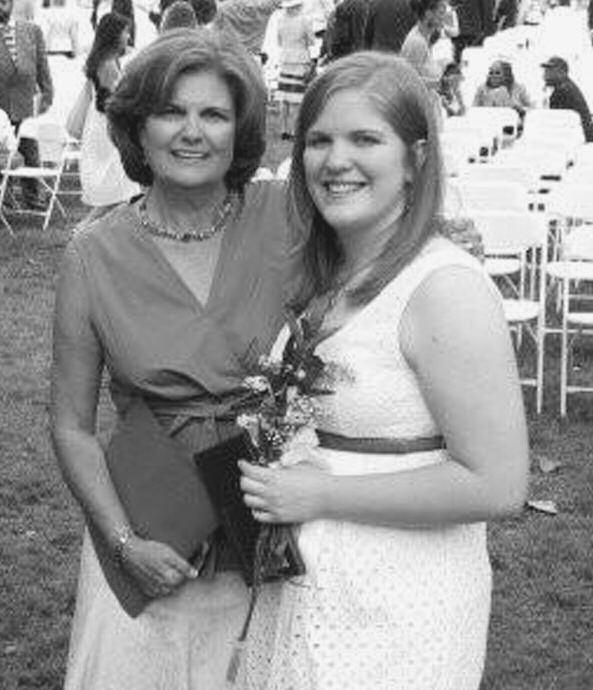
Ginger, with daughter Libby.
soldier carries the intangible in that pouch, his love for his sweetheart, his connection to home, his courage, his motivation to survive. He carries his “heart” in that pouch and all that is in his heart.
Whenever I do this exercise with my class, I am reminded of a line from an e.e. cummings poem, which begins: “I carry your heart with me; I carry it in my heart, I am never without it,” a line that echoes my feelings this morning as well. I sense that many hearts are being carried here—the hearts of children being carried by their families; the hearts of students and teachers being carried by each other; the hearts of friends being carried by friends. I can only imagine what is being carried by each of you today in this place: pride in your accomplishments, appreciation for where you are right now (and not in junior year, or December or April, waiting on college news); nostalgia about a new chapter in your life about to begin, meaning another is closing; relief—(phew! I made it, and I am so ready to move on;) and joy, being in this moment together with the people who know you well and love you best. The questions I have for you to consider this morning is: what lessons will you carry in your hearts from this place and what difference will these lessons make in your lives?
...what
lessons will you carry in your hearts from this place and what difference will these lessons make in your lives?
Being a Lower School teacher for over three decades may seem to many a crazy way to spend one’s time. Actually it is crazy a lot of the time, but I’ve always found children amusing in their unpredictability, refreshing in their honesty and surprisingly profound in their thinking. I get a kick out of them and, the truth of the matter is, being around
them has kept me hopeful about the world despite all of its very real woes. Here at Friends’ Central my Lower School colleagues and I teach academic skills and guide socialization all within a framework of Quaker values; in other words, we nurture a view of the world where respect for individual difference is of primary importance. The focus on examining different cultures, even at the age of five, promotes the notion that I’m “different from,” not “better than…” And then within the difference, young children are able to also find the commonality; you know, “I bet that little girl in the picture with hardly any clothes on, living in that hut on stilts along the Amazon River, loves that dog there just like I love mine.” Pretty basic stuff? Pretty important stuff when you’re building a foundation of perception. Through the wonder years of middle school—wonder as in “I wonder how anyone in their right mind can choose to teach that age?”—at a time when issues of identity and self-centeredness are paramount, within the framework of academics and building study skills, weekly service opportunities present themselves, over and over again for four years. To extend oneself beyond oneself—now that’s a novel concept at this age!—stretches a person to interact with the broader world and experience difference and diversity firsthand. “I’m going to walk that older blind man around the track three times and talk to him while we walk?” “With my friend?” “Just me?” The goal through these early teenage years is to be reminded of the importance of seeing yourself in others.
By the time you reach the upper grades, we all share the hope that you have a sense of what’s been going on since pre-kindergarten (or whenever you came to the school) and what’s important here, in tandem with the honing of your academic, artistic and athletic skills to their fullest potential, is: possessing an awareness of the differences
...what’s important here, in tandem with the honing of your academic, artistic and athletic skills to their fullest potential, is: possessing an awareness of the differences among people, respecting those differences (remember not “better than” but “different from”), and recognizing that what you say and do can have an impact on other people’s lives...
among people, respecting those differences (remember not “better than” but “different from”), and recognizing that what you say and do can have an impact on other people’s lives, even when it’s the smallest of acts or a few simple words. Have you ever been seen for less than what you are? Even worse, treated as if you are invisible?
Think of the opposite…someone has noticed you. Someone has seen your worth. Someone has seen that you exist. This is “to respect” from the Latin respicere—to look back, to regard, to consider. I believe those small moments, whether in families, in school, with friends or just acquaintances, or in the broader world, those small moments of people
...those small moments of people treating each other with decency and empathy really do matter and can have a lasting, positive effect on both the giver and the receiver.
treating each other with decency and empathy really do matter and can have a lasting, positive effect on both the giver and the receiver. That’s one of those truths of which I spoke: “I carry it in my heart—I am never without it.”
Having just completed your time in the Upper School, I would suggest you have witnessed respicere on a daily basis in interchanges with your teachers. I have marveled, through three children over a span of seventeen years, how, despite the tremendous academic rigor you experience, deep relationships are forged between you and your teachers. It goes so beyond, “I’m the teacher, you’re the student, so learn from me.” What I sense in the interaction is friendship and a partnership, where what everyone thinks makes a difference and as students, you are challenged to see the possibilities within yourselves. “Education is not a pail to be filled but a fire to be ignited.” Someone noteworthy said it; I believe at Friends’ Central you have had the opportunity to experience it.
During your senior year, the world has experienced significant events, from the inspiring election of our first African American President to the trials of terrible economic uncertainty, and continuing violence and war.
During your senior year, the world has experienced significant events, from the inspiring election of our first African American President to the trials of terrible economic uncertainty, and continuing violence and war. Reading the news on any given day, one can be struck by the amount of unresolved resentment on earth. I guess that is why the second truth I carry, the mantra of my beloved grandmother, “Be ye kind, one to another,” echoes in my mind so often. Living in a three-generation home with her, resulted in my always
having a thing about kindness. Interestingly enough, when asked to describe the Class of 2009, both your principals, who said you were talented, involved, bright, fun-loving, cohesive, and spirited but notout-of-hand, included “kind”—I knew I liked you!
There are those people who believe they owe nothing to anyone. But the truth is we live in continuous exchange with each other, both positive and negative. Yes, around us there is rudeness, arrogance and pretention; you know the pretentious person—someone selfimpressed but lacking in self-awareness. It gets to that “better than/different from” thing. But in this continuous exchange there are also big and small actions which have the capacity to make another human being feel better as well as yourself.
If we’re paying attention. Here’s a recent fourth grade snapshot: I’m sitting in the lunchroom with the multitudes, their voices rising to a headache-producing pitch, and Sam is suddenly by my side, speaking in a low voice, “Mrs. Fifer, may I have permission to change tables (normally a rule break) because Amy is over there,”—he points—“sitting alone, and, well, I’d like to change tables.” Are these two friends? Not that I’ve noticed, and how, in the cacophony, did Sam notice? “Friends carrying friends.” In that moment, Sam’s generosity of spirit transformed his friend’s experience from one of isolation to one of belonging and connection. And it is transformative not only to receive but to bring this connection, too. The work of psychologist Piero Ferrucci
...the
has shown that the kindest people are the most likely to thrive, to enable others to thrive, and to slowly but steadily turn our world away from self-centeredness, and narcissism, and toward love. Kindness empowers us by giving us the belief that our individual efforts make a difference, increasing our sense of self-worth and happiness.
Kindness empowers us by giving us the belief that our individual efforts make a difference, increasing our sense of self-worth and happiness.
The great English writer Aldous Huxley was a pioneer in the study of developing human potential. In a lecture near the end of his life he said, “People often ask me what is the most effective technique for transforming their life. It is a little embarrassing that after years and years of research and experimentation, I have to say that the best answer is—just be a little kinder.”
And so let us return to the heart of the matter on this June morning. While those of us who work at the school value many moments and memories with you graduates, I believe that it is the lessons you carry
...a love of learning, a striving for excellence, a respect for the differences in people, a generosity of spirit and a kind heart—these are the things which can make a difference in your own lives and in the lives of others...
from here—a love of learning, a striving for excellence, a respect for the differences in people, a generosity of spirit and a kind heart— these are the things which can make a difference in your own lives and in the lives of others, and they will serve you well throughout your days, wherever you are and whatever you do. As the Class of 2009, you have distinguished yourself in so many ways. We are proud of you and are grateful for all you have given to us, your parents and families, your teachers and your friends.
Let us conclude by picking up where we began, with one of e.e. cumming’s truths: here is the deepest secret nobody knows (here is the root of the root and the bud of the bud and the sky of the sky of a tree called life; which grows higher than the soul can hope or mind can hide) and this is the wonder that’s keeping the stars apart. I carry your heart (I carry it in my heart).
Today, graduates, we carry your hearts (we carry them in our hearts). Congratulations…now carry on.
By Keith Bradburd
Keith has been working at FCS for thirty-one years, first as a teacher of physical education, then as director of boys’athletics for the last twenty-seven. He was awarded a sabbatical, his second, in winter 2009. This essay was presented as a talk to the faculty and staff at the opening of the 2009-2010 school year.
There were many parts to my sabbatical, including traveling to Scotland, taking a digital photography course, getting certified in SCUBA, watching my daughters, Rachel ’05 and Sarah ’08, participate in collegiate lacrosse, teaching a few classes at Widener University and compiling an athletic, sports-specific, commissioners’ handbook for the Friends School League.
My photography course was extremely confusing for someone with a limited knowledge of Photoshop. I was advised by the course instructor to take an advanced class, and although I felt I knew something about photography (I had taken classes before), I soon realized that digital photography was as much, if not more, about computers and “fixing” images through technology than about capturing and composing images through the lens and printing them. I was, however,
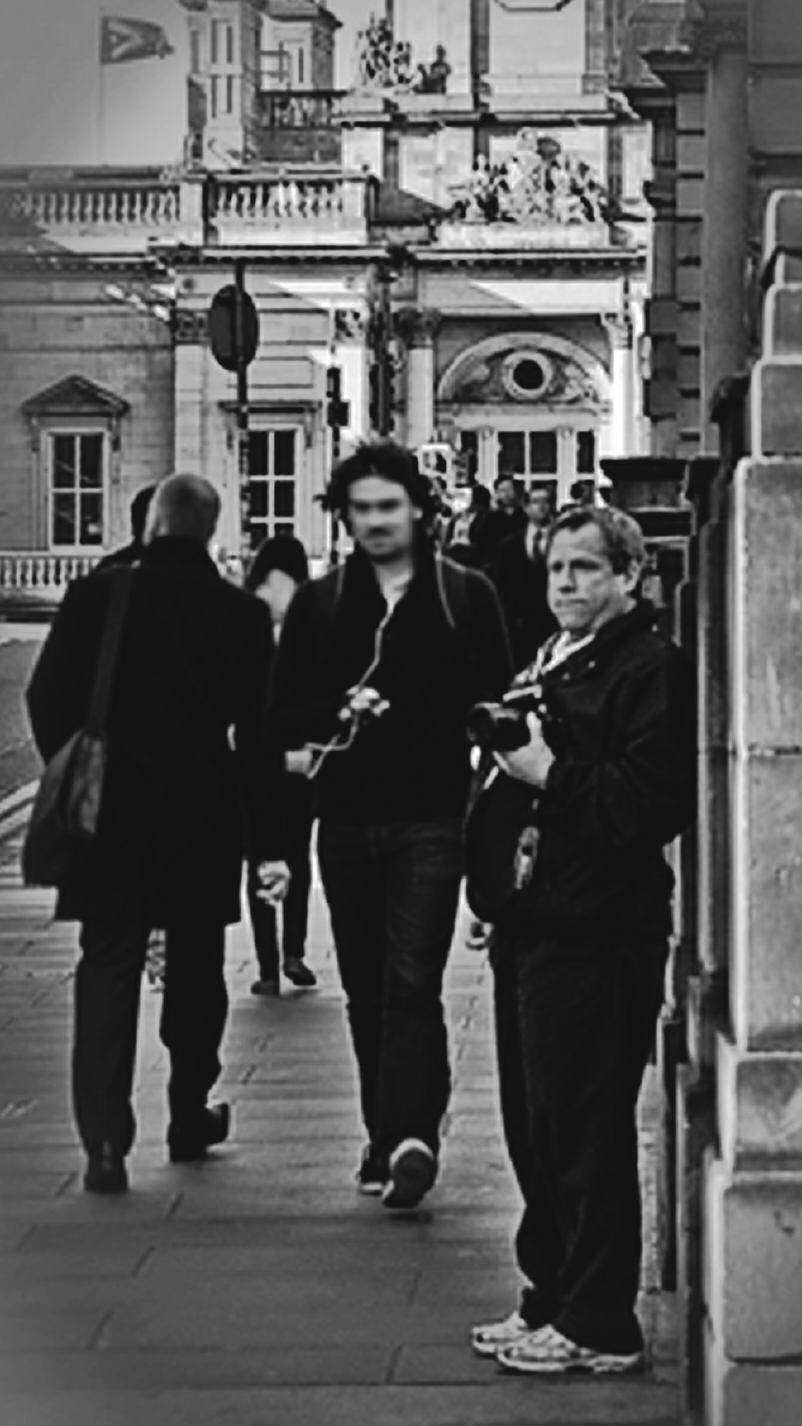
I was, however, able to utilize some of my newly acquired technical skills, while taking and editing photographs, during an early spring trip to Scotland.
able to utilize some of my newly acquired technical skills, while taking and editing photographs, during an early spring trip to Scotland. (At this time, I have over 200 photographs I will be showing you...).
I traveled there in March with my brother, a retired drama teacher, and visited the bustling and sandstone-brown Glasgow, (where my niece is a student). Then we traveled to Edinburgh, the quaint, very wet fishing village of Oban, and then by ferry to the outer islands of Mull and Iona. I enjoyed the physical beauty of the Scottish highlands, the blue lochs, and the old farmhouses—and also
the friendly people I met, not only in the major cities, but in the small villages and on a train through the highlands, where we encountered a group of nine elderly men returning from their yearly walking tour. Stories and refreshments poured forth! Moreover, every time I travel and no matter how far away I go, I never really seem to leave the FCS community behind: I was surprised by two FCS families, the first on the Royal Mile in Edinburgh, the second, about two hours later, in St. Gilles Cathedral. It is always nice to say hello to students and parents from school, wherever in the world we may be.
In early spring, I had the opportunity to guest-instruct classes in athletic administration and organization at Widener University. I enjoyed my interactions with the undergraduate students, most of whom were preparing to coach in public schools. Based on reactions from a number of students, they gained a new insight into the world of independent schools, where coaches are particularly instructed to be aware of parental sensitivity, to foster sportsmanship and to become part of
the (FCS) school community. Teaching at Widener fulfilled some of my desire to be involved in teaching and coaching at the collegiate level. It was a positive and enriching experience for me.
Last spring I finally decided to act on my long-standing interest to become certified in SCUBA. I have been thinking of doing so for many years, and it seemed like a wonderful time to dive right in! I took an open water Professional Association Dive Instructors’ (PADI) certification course. This fantastic experience culminated in August in four open water dives at Dutch Spring Quarry, near Bethlehem, PA. I dove as deep as fifty feet in water as cold as fifty degrees. I am looking forward to continuing diving, improving my skills perhaps by taking a trip or two to the Caribbean.
The most enjoyable part of my sabbatical was to be able to watch my daughters, Rachel in her senior season at Dickinson College, and Sarah in her freshman season at Guilford, participate in their lacrosse programs at their respective schools. I truly appreciated this new opportunity to just watch them play, a different perspective than when I watched them during their playing days at FCS. I was able to
As many us of know, there are not many experiences that are as enjoyable as watching your children participate in something that they
enjoy...
be just their fan without worrying about the duties of being an athletic director. As many us of know, there are not many experiences that are as enjoyable as watching your children participate in something that they enjoy and are successful in pursuing. I also realized from watching multiple high school and college teams play, that at FCS, even when not 100% effective, our program approaches athletics in the right way: we want to win, but we want the students to respect each other and the traditions of the games.
...our program approaches athletics in the right way: we want to win, but we want the students to respect each other and the traditions of the games.
The Friends Schools League Commissioner Handbook is still a work in progress, while I wait for additional information from other athletic directors. When done, the handbook will include not only the general guidelines for the FSL, but sport specific rules for the nineteen varsity sports that the league offers for varsity championships.
On a lighter note, I spent some time trying to teach myself to ride a unicycle; unfortunately this task was much more difficult than I expected. However, my inability has worked in your favor. Had I succeeded, I would have made this presentation balancing on my uni-
cycle, with my camera in hand, wearing my SCUBAgear while showing you hundreds of photographs. That, I’m sure, is a sight you do not want to see.
There are two things that stood out in regard to the sabbatical itself, the first being that people who are outside the world of education do not quite understand what a sabbatical is. I cannot tell you how many times, when I explained that I was on sabbatical, I was asked, “Are you sick? Did you get fired?” So if you are granted a sabbatical, be prepared to explain that a sabbatical is a gift, which, to me, seems beyond a doubt the most appropriate way to answer those questions.
My final thought about being on sabbatical is that no matter how much I was able to relax, to teach, to travel or to spend time with my friends and family, I truly missed the sense of community that I find while I am here at Friends’ Central...
I am grateful that after thirty-one years, I was able to have these experiences and now share them with you. My final thought about being on sabbatical is that no matter how much I was able to relax, to teach, to travel or to spend time with my friends and family, I truly missed the sense of community that I find while I am here at Friends’ Central and am glad to be back.
by Lou DelSoldo
Lou has been working at Lower School for thirty-one years. He is currently Assistant Principal in the Lower School. He also teaches psychology to Upper Schoolers. He has been a member of the Friends’Central Book Discussion Group since its inception in 1988.
Wikipedia defines a book club as “a group of people who meet to discuss a book or books that they have read and to express their opinions, likes and dislikes.” Public book clubs in the United States began in 1726 when Benjamin Franklin organized a group of readers called “the Junto.” There are basically two types of book clubs. A single-title club is one in which people discuss a particular title that every person in the group has agreed to read at the same time. The characteristics of a multi-title club are such that each member may be reading different titles at any given time, and each takes a turn describing the book he or she is reading. The popular novel, The Guernsey Literary and Potato Peel Pie Society (Mary Ann Shaffer and Annie Barrows) depicts a multi-title club on the English island of Guernsey during the German occupation.
The spread of the Internet has fostered the growth of special types of book clubs. With busy schedules and the prevalence of blogs, online book clubs have become popular. Broadcast book clubs are sponsored by television or radio shows, such as the very popular Oprah’s Book Club. There are book clubs for the homeless, book clubs
There are book clubs for the homeless, book clubs in prisons and book clubs for the blind.
in prisons and book clubs for the blind. And lastly, many organizations choose a book for the year. For example “One Book, One Philadelphia,” is a program which encourages reading of a specific title and then sponsors book clubs to discuss it. This year, Philadelphia is reading The Complete Persepolis, by Marjane Satrapi, a graphic novel about modern Iran.
The Friends’ Central School Book Club is a single-title club that began in 1988. The previous year, the Friends’ Central School Board, in search of more green space, had made a daring decision to move the Lower School to an eighteen-acre site in Wynnewood, five miles from the City Avenue campus. The news was met with much excitement, but also with some concern that our friendly school community would be fragmented. A“linkage committee” was formed and charged with the responsibility for coming up with ideas to bridge the two campuses. The book club was one such idea.
A“linkage committee” was formed and charged with the responsibility for coming up with ideas to bridge the two campuses. The book club was one such idea.
The “club” started with just a few teachers and administrators from each campus. New people have come into the group throughout the years, and others have left. Approximately fifty people have participated over time, including Jon Harris, (former Upper School principal), Joe Ludwig (Lower School Principal/Associate Headmaster), Caroline Maw-Deis, (Middle School art teacher), John Ricci (Upper School teacher, retired), Laurie Novo (Upper School teacher), Lylee Van Pelt (Middle School teacher) and Jackie Gowen Tolcott (Upper School language teacher). Marilyn Lager, (Director of the Blackburn Library) is clerk. She organizes the group and presides over
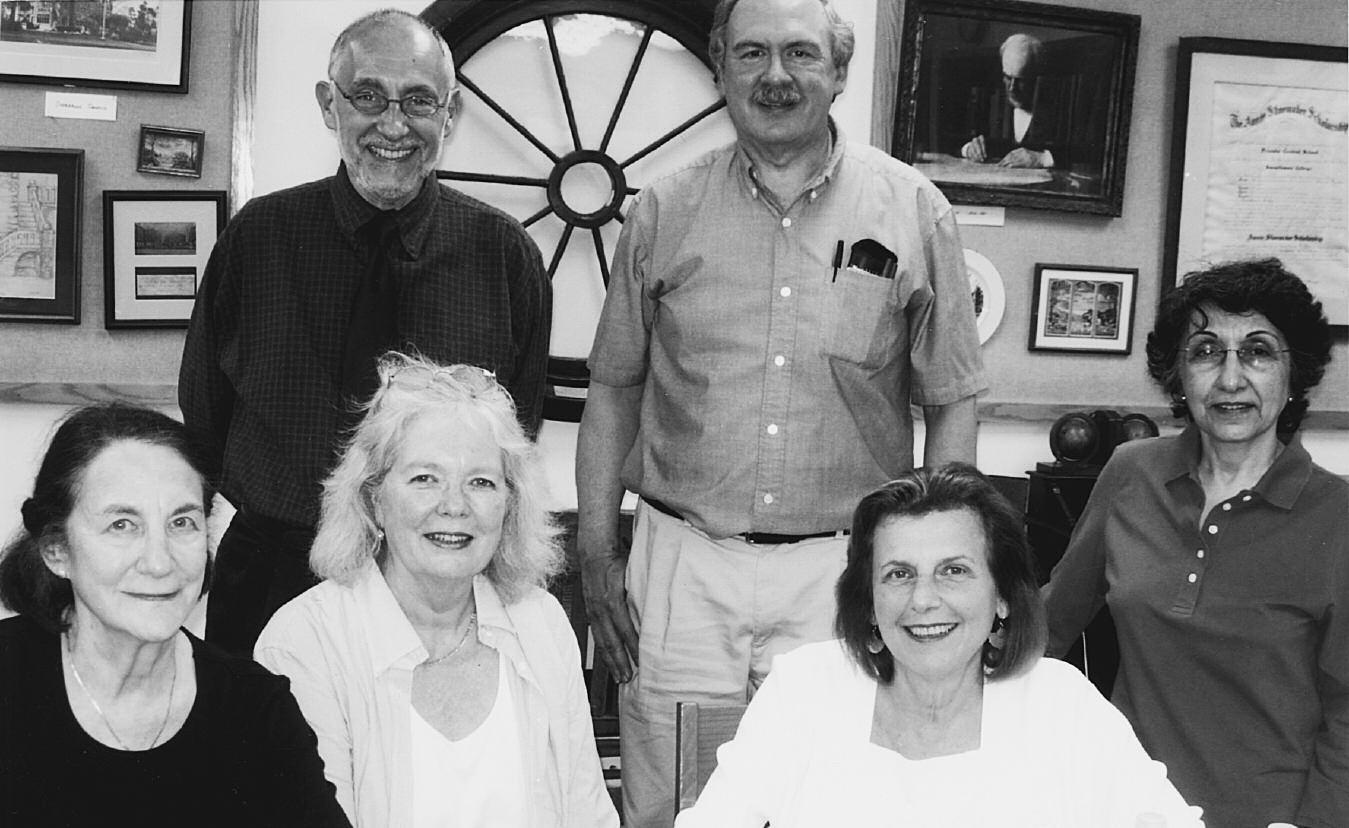
the meeting, often contributing a critical review of what we are reading. Asolid core of people has been there from the beginning. Michi Tashjian (Lower School Principal and Director of Diversity, retired), Marcia Slade (Lower School art teacher, retired), Penny Weinstein (Upper School French teacher, retired ), former parent Shanaz Keykhah, current parent Hao-Li Loh and this author are regulars. Some of the first books we read were Libra by Don DiLillo, Jane Eyre by Charlotte Bronte and Yellow Raft in Blue Water by Michael Dorris. More recently Willa Cather’s My Antonia and Doris Lessing’s The Grass is Singing were discussed. The group has continued to meet approximately six times a year and is proud and amazed to calculate that it is in its twenty-first year!
The group has continued to meet approximately six times a year and is proud and amazed to calculate that it is in its twenty-first year!
Over the course of the years, we have settled into a pattern of alternating classics (James Joyce, Portrait of the Artist as a Young Man; Jane Austen, Emma; Gustave Flaubert, Madame Bovary) with harrowing tales of the wretched of the earth (T.C. Boyle, Tortilla Curtain; Rohinton Mistry, AFine Balance; Chinua Achebe, Things Fall Apart). We had several forays into play reading, including Athol Fugard’s Master Harold ... and the boys and Aristophanes’ Lysistrata. We made several attempts to discuss nonfiction such as The Lexus and the Olive Tree by Thomas Friedman, but the conversation is livelier when we discuss a novel or play!
At times, the discussion veers off to anecdotal conversation stimulated by events or characters in the novels. This often leads to lively discussion and sharing of deeply personal events in our lives, such as relationships to children, personal ethics and family stories.
At times, the discussion veers off to anecdotal conversation stimulated by events or characters in the novels. This often leads to lively discussion and sharing of deeply personal events in our lives, such as relationships to children, personal ethics and family stories. One snowy afternoon when the club was scheduled to meet at the Lower School Library (we alternate between the two campuses), only Marilyn Lager, Marcia Slade and I were present. The conversation meandered from our book, The Road from Coorain, about a difficult
childhood on a sheep farm in Australia, by Jill Ker Conway, to our own lives. Abridge was crossed, and our professional selves merged with our personal selves. We became friends! This is what I most enjoy about book club.
Others have different reasons for participating. Jack Briggs says, “I never read fiction, except for book club, and I enjoy it!” Penny Weinstein, who retired from FCS in 2000, says, “The book club has been a perfect way to continue contact with Friends’ Central, and the discussions are always interesting. It’s a chance to see friends and exchange ideas, and now that I actually have time to read, it’s great to be able to contribute possible titles.” And for Regina Ziffer, Lower School librarian, “It’s all about the choice of books—always interesting and timely.”
“It’s all about the choice of books— always interesting and timely.”
One outcome of the book club has been Headmaster David Felsen’s summer reading program. Each spring the book club solicits titles from the community, and a book is chosen and distributed to the faculty for summer reading. Meetings are held the following fall to discuss the readings. Sometimes biographies are chosen (Greg Mortenson and David Oliver Relin’s Three Cups of Tea), sometimes works of pedagogy (Lisa Delpit’s Other People’s Children ), sometimes tales of inspiration (Tracy Kidder’s Mountains Beyond Mountains about a Harvard doctor who worked in Haiti) and sometimes even current novels (Khalid Hosseini’s The Kite Runner).
Conversing about literature is vital to any school’s pedagogy. At Friends’Central, we encourage it; we teach our students how to do it, and it is important that we model it for them.
Conversing about literature is vital to any school’s pedagogy. At Friends’ Central, we encourage it; we teach our students how to do it, and it is important that we model it for them. By engaging in our own discussions, we hone our skills and help to create a rich intellectual environment which not only enhances communication but helps to build a vital school community.
“Some Say that Life’s the Thing, but I Prefer Reading”*
By Marilyn Lager
Marilyn has been director of the Middle and Upper School Blackburn Library and has been editor of this journal since its inception in 1988.
At a wedding I attended last spring, the best man, Todd, stood up to toast the groom. “When I first got to know Matt, a bunch of guys were wrestling in the basement. We looked over and saw him, nose in a book, reading.” Todd lowered his voice confidentially and said, “We began chanting ‘Matt is a reader, Matt is a reader.’” Pausing for emphasis, Todd told us how Matt cried sadly, ‘I’m not a reader, I’m not a reader.’” Todd lifted his glass and said, “But we knew.”
In a flash, I saw myself, also an eleven-year-old avid reader, lying on the brown couch in our steamy Bronx apartment, reading through the hours of a hot summer night. Like licking chocolate icing off my fingers, I turned the pages of my first grown-up book, An American Tragedy by Theodore Dreiser. The hero, Clyde Griffiths, has fallen in love with the unattainable Sondra Finchley. Meanwhile, his workingclass girlfriend Roberta is pregnant with his baby. My world hung on the edge of these serious adult concerns that filled every page.
My world hung on the edge of these serious adult concerns that filled every page.
I turned the last page of the book with a deep, satisfied sigh. “…And a youth making his way through a dark, uninhabited wood…” I shifted my position and shivered with pleasure...but I had reached the end of Book Two, Volume One. I curled up on the sofa that Saturday night, in sullen disbelief. The library, where Volume Two waited, was closed until Monday.
* L. P. Smith
I looked around at the cream-colored walls, decorated with a faded reproduction of Van Gogh’s sunflowers and down at the worn carpet. There I was, in prepubescent limbo, waiting until I could return to the library. I longed to be in Lycurgus, upstate New York, with Clyde, Sondra and Roberta. However sordid and wasted their world was, their romantic state differed from my reality of neatly bricked apartment houses and green playgrounds, of sisters who demanded parents’ attention. I wanted that second volume containing forbidden passion and adult love gone wrong. That hot summer night, I experienced how a book could open a world of danger, pain and romance—all while I remained safely at home.
That hot summer night, I experienced how a book could open a world of danger, pain and romance—all while I remained safely at home.
Under my high school yearbook picture, I listed my interests as “Psychology and Reading.” My face also appeared in the drama club, on the yearbook staff and in the honor society. Despite those activities, my main interest was reading. I did much of that before graduating. The poignant, the realistic, the historical, the gritty, the classic, the trash—from Dickens to du Maurier—I ate it like candy. Just as Anna Quindlen said about herself, I too could have been “diagnosed with hyperactive literacy.”
In college, I didn’t pursue my intended major, psychology. Instead, I majored in English and spent long, leafy, New England afternoons sitting under a tree, reading War and Peace. On icy, white frigid days, I sat in the warm library reading The Heart of Darkness. When the apple trees bloomed, I spent time lying in my dorm room
The universal struggles between good and evil, love and hate played out for me in those great books.
reading Crime and Punishment. The universal struggles between good and evil, love and hate played out for me in those great books. All the psychology I needed was contained within those classic works.
My first job after college was not in publishing, as I had hoped, but working with chronic alcoholics in a social work department of a hospital. I had trouble concentrating on professional journals. Instead, with a delicious fervor, I read, into the wee hours, novels about alcoholism: The Lost Weekend, Under the Volcano and Islands in
the Stream. I had no trouble finishing them. Life may be “the thing,” but I certainly preferred reading about it. I left my social work job with a sense of defeat.
When my children came, Dr. Seuss replaced Dr. Johnson; I read Charlotte’s Web instead of Charlotte Bronte. I realized that the best children’s stories also have themes concerning the pain of alienation, fears about not being loved and conflicts about doing right and challenging wrong.
...the best children’s stories also have themes concerning the pain of alienation, fears about not being loved and conflicts about doing right and challenging wrong.
Eventually, I became a school librarian, first at the Miquon School, and since 1986, at Friends’ Central. For over twenty years, I have spent every day reveling in words, among the books that wait, patient sentinels, yet to be discovered. I enjoy encouraging and supporting young people as they develop their interests in literature and read books of their choosing, in their limited time and in whatever format they enjoy—ebooks on the Kindle, on the iPhone or in print.
And when Angie, a ninth grader, came to me one Monday morning, complaining of fatigue from staying up all night reading Betty Smith’s ATree Grows in Brooklyn, which I had recommended, I knew I had followed my heart and found that special place where reading and real life come together.
By Katie Schogol Pidot
Katie has been teaching FCS Middle School Prima Lingua and Spanish for four years. She was awarded a stipend to study and travel in Peru this past summer
I looked up. That’s the first thing I did when I got off the train at the Peruvian town of Aguas Calientes. I looked up at the vast mountains and sunlight pouring through crevices in the landscape. I was at the base of my journey to Machu Picchu, eyes scaling the heights that the packed tourist bus would climb at 7:00 a.m. to get to the entrance of the Inca ruins.
This was the adventure I had been looking forward to since first reading about the history of Peru at Villanova University, where I recently obtained my masters in Hispanic Studies. While there, I was fortunate to read Peruvian authors Mario Vargas Llosa and seventeenth century chronicler Guaman Poma de Ayala, authors who gave me insight into the complex history and diverse cultures of Peru. My hope was to visit this country and experience the natural beauty of the
My hope was to visit this country and experience the natural beauty of the Sacred Valley and Machu Picchu while immersing myself in the Spanish language.
Sacred Valley and Machu Picchu while immersing myself in the Spanish language. I therefore researched and found the fantastic program Máximo Nivel, which I highly recommend! (I had been planning to travel with my husband Seth, who is a French language teacher at Merion Mercy Academy, but he was unable to go at this time.)
I must admit that I felt overwhelmed when we landed in Cusco, a city close to Machu Picchu. At first all I saw were swarms of taxi drivers clamoring to take me where I wanted to go. I knew that I would be taking classes and living in a home called “Family House” (a home, as it turned out, owned by a family living in Cusco but rented to students of Máximo Nivel), but I did not know who was picking me up or where we would go from the airport. But beyond the crowds
were the breathtaking mountains surrounding the valley in which Cusco is located. From practically anywhere in the city, one can look up and see “Viva Perú” etched, perhaps mowed, into browning hills. I remembered why I had come to Perú and forged ahead. As I stepped outside and smelled the rich odor of burning wood, I saw a sign with my name on it. Step 1 was complete; I found my ride. We drove to the Máximo Nivel office where I was offered my first hot cup of mate de coca. Mate de coca is most famous for soothing symptoms of altitude sickness, helping one adjust to the altitude in general and curing all small-scale ailments. I made it a staple in my diet. We then hailed a cab on the busy Avenida de Sol, and before I knew it we were climbing bumpy, cobblestone roads to Arco Patas, the street where I would be staying.
11,000 feet above sea level, though, did make it more difficult than I had imagined to walk around the beautiful city. I don’t mean to say that I was so out of shape that walking for a mile from my residence to my class was all that difficult. But at that altitude, I was definitely panting, ready to drink the famous mate de coca before collapsing into a siesta!
But at that altitude, I was definitely panting, ready to drink the famous mate de coca before collapsing into a siesta!
I signed up for a conversation class with an outstanding teacher named Danitza, a petite young woman with very long hair. We spent two hours each day talking about topics ranging from gun control and terrorism to marriage customs to believing in extraterrestrial beings. Her kindness and enthusiasm inspired me to talk about subjects I had not addressed while speaking in Spanish. She would also gently guide me toward a term more commonly used in Peru if I happened to say a word most commonly used in Spain, where I had continued my studies in Spanish during college. I hope to bring the spirit of those conversations to my own classrooms, where the students are speaking primarily in Spanish. Every day I discovered something that I adored about the city and something that overwhelmed me with grief. I stumbled into a weaving exhibit on Avenida del Sol and saw two women, speaking Quechua to one another, weaving the most beautiful table cloths with hand dyed alpaca hair. They let me observe, even take pictures, while they expertly wove together the beautiful textiles being sold at the “Taller.” That same day I would see small children dressed in dirty but colorful clothing, their faces chapped by sun and wind, begging, along with their parents. I remember smiling at a little girl who began to
walk by my side, and as I looked down to say hello, she looked up innocently with her hand held out.
I also noticed how the city was rife with cultural clashes from the Spanish conquest of the Inca.
I also noticed how the city was rife with cultural clashes from the Spanish conquest of the Inca. Each day I walked by an enormous garden surrounded by what looked like a cross between a palace and a convent. I found out that it was called Qoriqancha and had once been an Inca palace. The Spanish converted it into a convent with interesting combinations of Inca stone architecture and Spanish columns and courtyards.
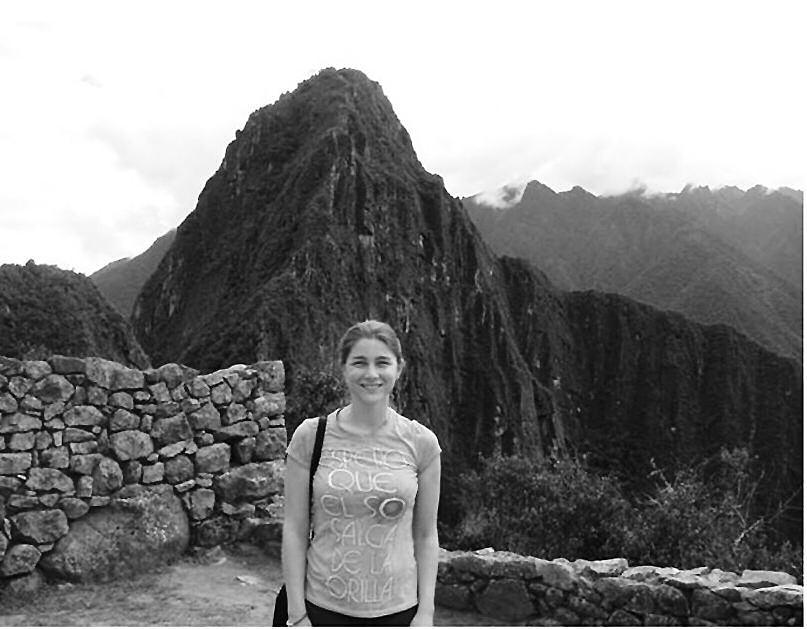
I felt so blessed to squeeze in possibly the fastest trip to Machu Picchu anyone has ever managed. Traveling alone, I took a train to Ollantaytambo, a beautiful town in the Sacred Valley, where I then caught another train to Aguas Calientes. After the train stopped in Aguas Calientes, I took one of the most incredible bus rides up the mountain, through lush green landscape, to the historical park and
I felt so small in this setting of towering mountains.
ruins of Machu Picchu. I felt so small in this setting of towering mountains. I began to recall reading a poem by Percy Shelley called 22
“Mont Blanc: Lines Written in the Vale of Chamouni:”
I look on high; Has some unknown omnipotence unfurl’d
The veil of life and death?
Or do I lie in dream…
Machu Picchu looked like a secret preserved in time. The Inca city spread out before me with plazas, homes and the beautiful and sacred Intihuatana stone, or “Hitching Post of the Sun.” What do I appreciate more, the Incan city or the awe-inspiring views from the city? Mountains overwhelming me, hikes leaving me breathless, learning about the importance of the sun stone and how on the summer solstice it does not produce a shadow, smelling the beautiful orchids and learning about how the Inca made such crops grow when the climate was not ideal for them—all these impressions and more contributed to a powerful experience. I felt lucky to be there, fearless to have traveled there by myself and proud to overcome various obstacles to do it.
The train ride from Aguas Calientes back to Ollantaytambo was like a gift. I lay back in my chair and looked up. The ceiling of the train was made of glass so that the passengers could appreciate the sweeping mountains overhead as well as the intricate cloud formations that crept into view while the train zipped through the countryside. I look forward to returning next summer, this time joined by Seth and Aunt Mary, my two good travel buddies.
I look forward to returning next summer, this time joined by Seth and Aunt Mary, my two good travel buddies.
By Melanie Yulman
Melanie has been a Lower School teacher since 1990, working mainly with pre-kindergarten classes, and then these last three years, with first graders. She was awarded a stipend this past summer.
Last summer I took weekly lessons in Japanese calligraphy. I sat stock still for two hours or more every Saturday morning in my teacher’s home in Philadelphia, carefully copying, in block style, kanji, the Chinese characters that are one of the four character sets used in modern Japanese writing.
My initial interest in calligraphy came about through my assignment to teach first grade. 1-B, my class, has concentrated on Japan for the past twenty years as part of first grade’s annual study of Asia. Japanese calligraphy is part of this unit, and I thought that I would learn both to read more characters and to learn the hows of calligraphy—how to hold the brush, how to make ink and form characters. I did, in fact, learn much about these things that will be useful in my teaching, but the lessons also gave much that I did not expect.
One lesson was an appreciation of the art of calligraphy. Though I’m pretty good with my hands, I was surprised to learn how hard it is to make brush strokes powerful, graceful and beautiful, to create balanced and well proportioned characters, and simply to control the brush. Each character is formed through carefully sequenced and
Each
character
is formed through carefully sequenced and gracefully flowing brush strokes.
gracefully flowing brush strokes. Although a single brush is used, the strokes of each kanji vary considerably, so this one brush must form many kinds of lines: wide, thin, straight, curving, heavy and bold, delicate or evaporating into wisps.
My wonderful teacher, Mayumi Tomii, an artist and sculptor, made the bristles of a brush come alive. Her home is filled with books on calligraphy, including the copy book she used as a child, and the many scrolls she collects—one so long we could study it only by unrolling it on a table in sections of about three feet at a time. Guided by her hand, the bristles formed a sharp point to initiate a stroke at a 45-degree angle of entry, fanned to form dots or other rounded shapes, rose quickly in a movement she calls a kick to end certain lines, twisted and spread to gradually broaden a line, did what she calls tiptoe to change direction at a corner, lifted and sat again to smooth the end of a line, or swept dramatically to finish a bold stroke.
In my hand, the brush was not so agile, but Mayumi patiently and insightfully guided me to become better.
In my hand, the brush was not so agile, but Mayumi patiently and insightfully guided me to become better. Frequently we held the brush together so that I could feel the movement and the pace of the character she was making.
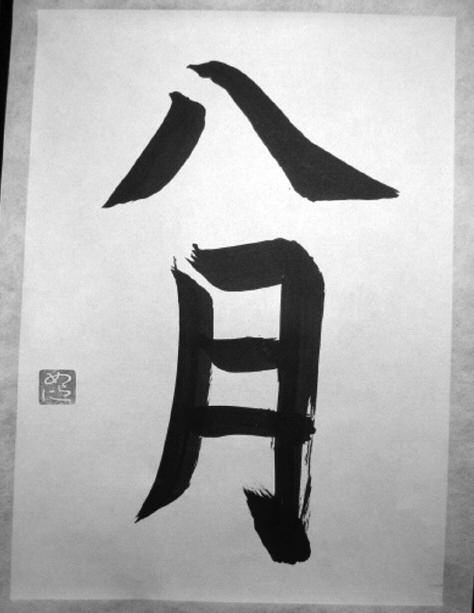
Sometimes I worked on a single stroke over and over again. Other times I practiced a complete character or two characters that work together For example, hachi—the number eight—with gatsu moon, means August. This beautifully logical way of naming months can be extended to the other months of the year: ichi—the number one—with gatsu means January, etc. My first graders always learn to count in Japanese; they can, therefore, also quickly learn all of the months of the year
I have asked myself why the repetitive, precise practice required is so rewarding. I think a big part of it is the focus it demands. I stop doing or thinking anything else and immerse myself in a single goal
I stop doing or thinking anything else and immerse myself in a single goal of creating a beautiful character with my brush.
of creating a beautiful character with my brush. One moves through a character stroke by stroke. Although the pace varies—some strokes are done faster than others, and one must stop briefly within some characters before continuing—the flow of movement must be maintained. A mistake cannot be removed, nor does one evaluate a character midstream. Every now and then I’m especially rewarded when my brush seems to dance through a character, and I realize I am
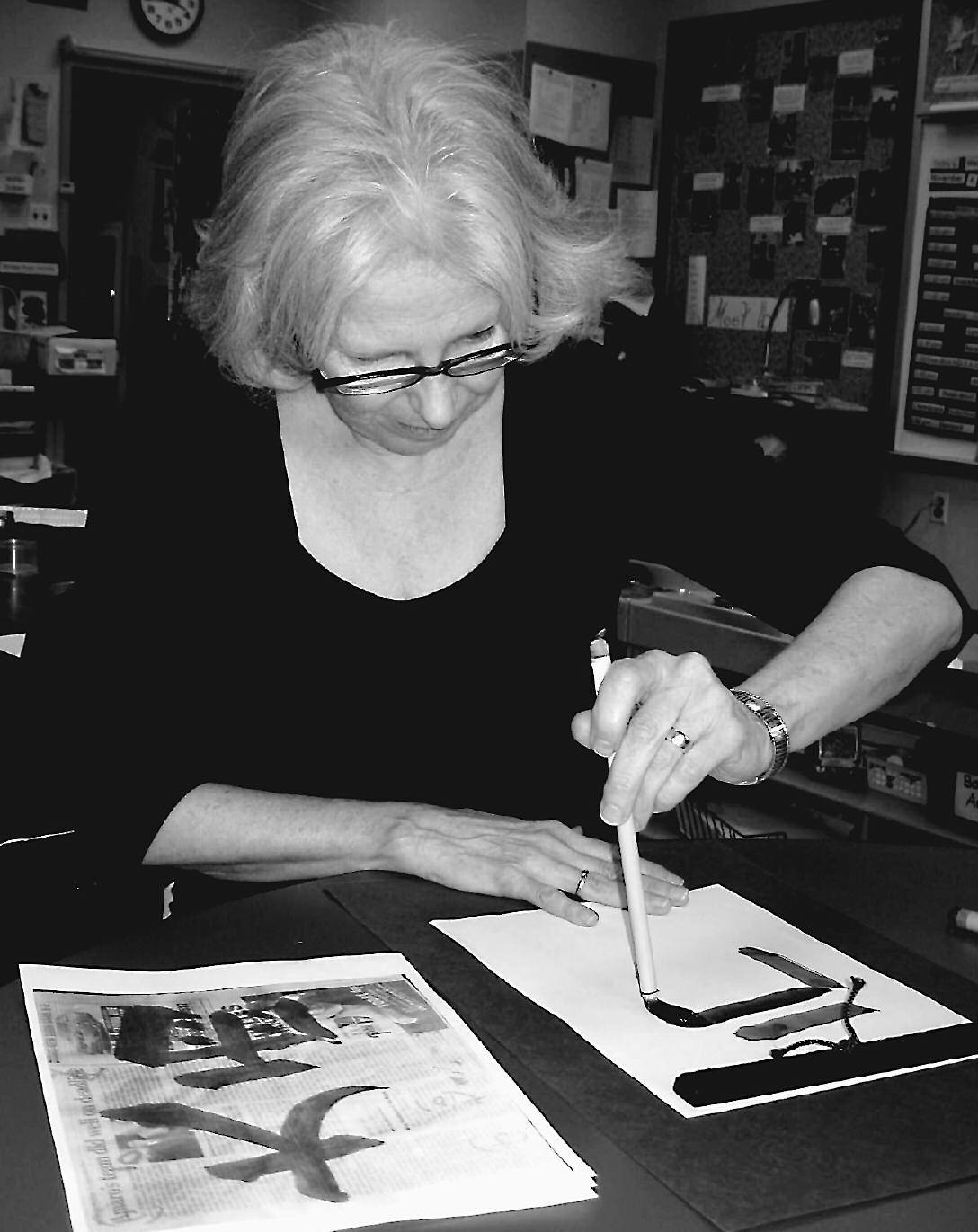
working more by feel than by thought. At these times my practice seems almost meditative. I don’t even mind it when Mayumi tells me that I’ll get a particular stroke right after I’ve done it a hundred times. I’m getting better at knowing when a character is balanced and likewise seeing what is making some of my characters unbalanced.
From the beginning, Mayumi has repeated the same instructions, most frequently:
Slow down and take your time; don’t rush, but don’t lose the spirit of the character; don’t think about it too much, just do it; and trust your brush—instructions that I am understanding only incrementally. She tells me that the best calligraphers wait to begin, gathering their energy, deciding exactly what they want to write and how they will place each character on the page. They finally put brush to paper only when they are ready in mind and body. She tells me where in
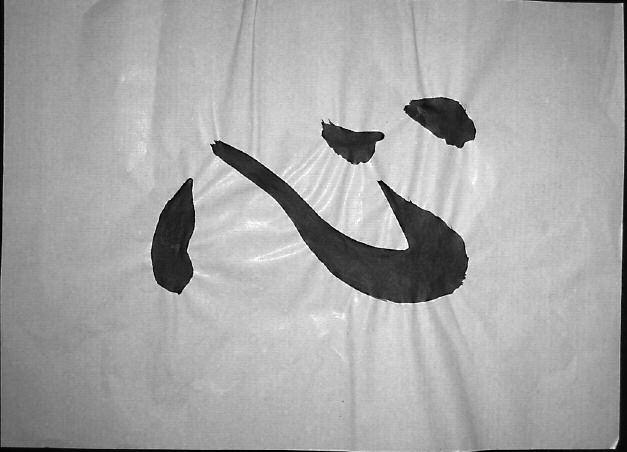
each stroke to move, where to stop, how long to wait before going again. Mayumi speaks of maintaining the flow and spirit of a character—words that only confused me initially but now make sense.
Mayumi speaks of maintaining the flow and spirit of a character—words that only confused me initially but now make sense.
I have also learned about life in Japan from conversations with Mayumi. She told me about her family, including her father, a sign painter who painted signs in English and was quick to stop into shops to let them know of mistakes he observed in their English signs. When I asked why she studied calligraphy as a child, she explained the two circumstances that led to that choice. Apiano— her first choice for after-school lessons—was too expensive, and her family happened to live near a very talented calligrapher and teacher. I learned technique both from watching Mayumi and from discussing strokes with her, and she gave me lots of tips—how to rotate the brush at a particular point to broaden a stroke, when to slow down, when to lift the brush or to press it. However, she told me she was not taught this way, because her teacher rarely spoke. She said she had to figure out these things by watching him, once working on a difficult and dramatic swoop for four years before she finally understood how her teacher was manipulating the brush. When Mayumi shows me her books of calligraphy done by masters, I see how individual the work of each is within a shared tradition. I have certainly learned more about patience and practice in learning a skill.
Copying kanji while moving in a proscribed pattern, pace and flow may seem the antithesis of art or creativity. But the discipline that comes from practicing a technique, learning a process and studying one’s work carefully can lay the foundation and give the freedom for creativity.
But the discipline that comes from practicing a technique, learning a process and studying one’s work carefully can lay the foundation and give the freedom for creativity.
There was so much to learn. I know I will never be an accomplished calligrapher, and I know that I will never really be able to read more than a very few kanji. Still, these lessons have been very important to me—much more so than I expected them to be. While practicing the same stroke over and over again might sound tedious and repetitive, this practice has, in fact, been tremendously satisfying and enriching to me.
So we will do calligraphy in 1-B this year. I don’t expect that I’ll be able to slow everyone down or get anyone to practice the same stroke a hundred times, but we’ll talk about the way calligraphy has
I
don’t expect that I’ll be able to slow everyone down or get anyone to practice the same stroke a hundred times...
been taught in Japan for hundreds of years. We’ll grind ink, rubbing an ink stick made of pine soot against a slate inkstone, hold our brushes upright and learn to read and brush some kanji. Everyone will learn something, have fun, and I am guessing that at some point in their lives—perhaps even at six years old—a few will find that the spirit of this practice speaks to them as it does to me.