—Charlotte Bronte
Editor: Marilyn Lager, Director, Friends’ Central’s Blackburn Library
Email: mlager@friendscentral.org
Asst. to Editor: Deborah Fedder, Middle School Language Skills Teacher


—Charlotte Bronte
Editor: Marilyn Lager, Director, Friends’ Central’s Blackburn Library
Email: mlager@friendscentral.org
Asst. to Editor: Deborah Fedder, Middle School Language Skills Teacher
Dear Friends,
This is the twentieth anniversary of the publication of Forum, and it is only appropriate that we celebrate this biannual slender volume, which has included contributions from Friends’ Central faculty, students, administrators, trustees, alumni/ae and other friends of the School.
I am very grateful to Marilyn Lager for proposing Forum over twenty years ago and for her care and attention to everything involved in its publication. Deb Fedder has been her able and enthusiastic assistant in this endeavor.
The Friends’ Central community continues to be excited by Forum The breadth and content of the thoughtful articles help convey the life and spirit of our unique community. I am grateful for the opportunity it offers for expression and look forward to more volumes full of articles from the Friends’ Central family.
Sincerely,
David M. Felsen Headmaster

I have just finished reading the last two issues of Forum. They are so “Quaker idealistic” that they bring tears to my eyes. Since retiring from private dental practice ten years ago, I have been a full time volunteer at a Philadelphia public high school. The contrast between the atmosphere at FCS and ____ is extreme. The relationship between students and teachers at FCS is warm and supporting. At ____, there is almost an adversarial relationship. FCS teachers love their work and are dedicated to their students’ advancement. In the public school system, no matter how much idealism they start with, many teachers burn out quickly.
Why is this so? The home environment of each group of students is different. Most FCS students have supportive parents. Fewer than ten per cent of _____students have such support from home. Many public school students are there because they are required to be. Many high school students are ill prepared for ninth grade. They may not know their multiplication tables and are unable to compose correct English sentences. Unfortunately, many still graduate lacking basic skills.
At FCS, art, culture, music, public service and religious idealism are part of the curriculum. Travel with teacher-led groups enhances maturity. All too many public school students have never had these cultural opportunities. It is not unusual for a northeast Philadelphia student never to have been to Center City or anywhere further than “down the shore.”
In the public schools, there is the same bell-shaped curve of innate talent as there is at FCS. The difference is how this potential is nurtured and developed. There are many excellent, devoted teachers who give their all and are appreciated by the students. However, many of the students are not prepared to take advantage of what is offered.
Finding answers is difficult; even experts are at a loss. The Forum shows that there are people devoted to education in order to better the world.
--Jim Dannenberg ’43
By Brad Morris
Brad, chairman of the Upper School mathematics department, has been teaching math since 1985. Brad’s speech was excerpted in the Summer issue of Directions.
Welcome parents, teachers, administrators, staff, family and friends. Welcome especially to Friends’ Central School’s class of 2008. I would like to dedicate my remarks this morning to the memory of John McCollum, a beloved English teacher deceased in 1997, who took me under his wing from the moment I first stepped on campus as a new teacher, and to the math department in the Upper School who make teaching a joy for me every day, and finally to my parents, wife, daughter and son Samuel Morris, class of ’08.
I found out that I was to be the graduation speaker on my fiftythird birthday last month. Anice present, I thought to myself, as I had hoped for the opportunity to speak at this graduation ever since my daughter Katie graduated from Friends’ Central School four years ago. When I mentioned to my son Sam that I was to be the graduation speaker, he gave me a kind and thoughtful response: “How could they do this to me??!!” That was not exactly the reaction I was hoping for, but I really can’t say I was surprised.
“How could they do this to me??!!”
It was a Friday morning four years ago, and Sam was new to the freshman class at FCS, having graduated from the Philadelphia School the previous June. He was seated with some new classmates at the assembly when his jaw dropped in sheer horror. The stage curtain had just opened to the strains of Pink Floyd’s “We Don't Need No Education” and marching through the curtain, in time with the music, preparing to do a faculty lip synch, was his dad. Me. Sam was mortified. Well, can you blame him? Here was his father, a grown man in
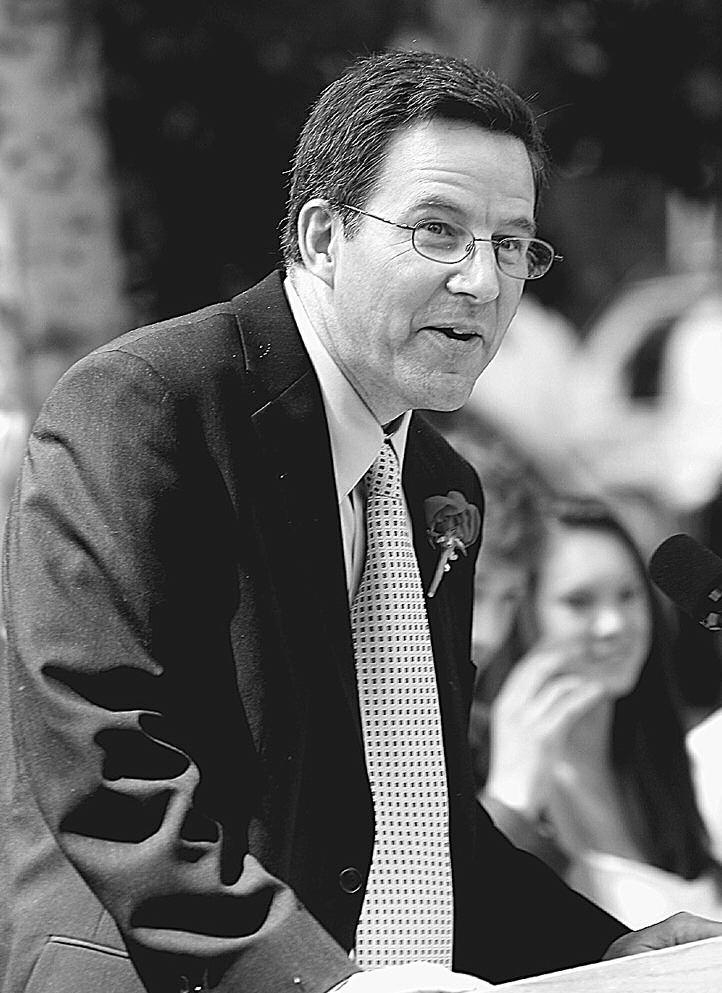
Brad Morris.
his late forties, jumping around on stage in front of everyone, like an imbecile, mouthing the words “Teacher, leave those kids alone.” Oh, my goodness. Still I’d probably do it all over again just to see Latin teacher Doc Harnett’s cameo on air guitar at the end of the song. She brought the house down. I’m sure the graduates sitting behind me will remember that for years to come.
That day Sam made me promise to never get on stage again or ever speak in Meeting for Worship or even set foot on campus again, for that matter. Well, I kept the first promise at least.
So today I stand before you, the class of 2008, for the first time since Pink Floyd, and Sam, I will do my best to keep your jaw where it belongs.
To prove to the skeptics that one can actually make use of a liberal arts degree, I will be basing my address this morning on the BAin Philosophy I received in 1977 from Dickinson College. Let’s begin. Although Spinoza, Leibnitz and Kant have all articulated the central paradox of man’s existence as a state of being at once both bounded and liberated, it was Heidegger who first posited the transcendent duality of this paradox………… On second thought, maybe now is not the time to put that Philosophy degree to use.
So instead of delivering a philosophical treatise, let me simply reflect on your Friends’ Central education and the world of limitless possibility that awaits you. I hope you agree that Friends’ Central School has served you well. You have benefited greatly from a group
The School has given you a vast array of opportunities both inside the classroom and beyond, on the athletic fields, the stage, and in FCS’ many extracurricular clubs and programs.
of highly talented, highly dedicated teachers who have taken a deep and personal interest in your well being and achievement. In my
opinion, they are the finest K-12 faculty in the Philadelphia area, although I admit my frame of reference is limited. The School has given you a vast array of opportunities both inside the classroom and beyond, on the athletic fields, the stage, and in FCS’ many extracurricular clubs and programs.
You have been exposed to, and I hope you have absorbed, the School’s Quaker values and testimonies as well as its culture and philosophy which include peace, integrity, equality, service to others both on campus and off campus, and an unreserved respect for diversity in all of its hues and orientations. Friends’ Central has provided you as well with a deep sense of being an integral member of a spirited, close-knit community. It is our hope that Friends’ Central has prepared you for the road that lies ahead. But what does that road look like?
In his book Side Effects, Woody Allen addresses that question by saying, “More than at any other time in history, mankind faces a crossroads. One path leads to despair and utter hopelessness. The other, to total extinction. Let us pray we have the wisdom to choose correctly.”
The Chairman of the Board, Frank Sinatra, sounded a more positive note when he said, “The best is yet to come, and babe, won’t it be fine.” And for many of you, the next four years could very well be the best which is yet to come. Certainly the odds are very good. In the
...the next four years could very well be the best which is yet to come.
next four years, you will get to lead what could be called a Utopian existence. You will be away from home, on your own with close friends living all around you and no real responsibilities other than trying not to flunk out. If it’s anything like my four years at Dickinson College, you are in for a real treat. So savor every moment because you will never have that kind of life again. Let me repeat that. Savor every moment, and take advantage of every opportunity, both the academic and the social, because the Utopia known as college will not come your way again.
Here’s what you will have: Gas bills, rent bills, tax bills and phone bills. Dirty dishes and dirty diapers and the agonizing cacaphony of Chuck E. Cheese. While your Parisian counterparts wile away endless hours discussing modes of alienation in sidewalk cafes, you will be downing a burrito from Taco Bell in your cubicle over a laptop. While your Spanish and Italian counterparts are taking their daily siestas, you will still be at the office, missing your kid’s little league game, in the hopes of getting that big promotion. But while you're thinking of
that big promotion, your boss is thinking of downsizing you and shipping your job to off to Bombay.
Now I know what you’re thinking. You’re thinking, “What kind of a graduation pep talk is this?” Well, don’t worry. I’m not here to talk about doom and gloom. I’m here to scare the heck out of you so that you will not waste the great opportunities that lie on the road ahead.
I’m here to scare the heck out of you so that you will not waste the great opportunities that lie on the road ahead.
So, to repeat my question, what does that road look like? Perhaps not what you think. In the book AWhole New Mind, which incidentally the faculty will be reading this summer, Daniel Pink argues that we are at the dawn of a brand new age in America, which he calls The Conceptual Age. Our current age, often called the Information Age, with its reliance on computer technology and its linear, analytic approach to problem solving, has and will continue to serve us well. The efficiencies brought about by widespread application of information technology, like the robots on the automobile assembly line and EZ Pass, just to name two, have led to the unprecedented economic growth of the last twenty-five years (current downturn notwithstanding).
The information age is an age of left brain thinking dominated by linear, deductive reasoning, the kind of reasoning you need, for example, to do well in math class or on the SAT test. Engineers, lawyers, accountants and programmers have all flourished in this era. But in the new global economy these tasks, Pink argues, are increasingly being outsourced to equally talented professionals in developing countries like India for a fraction of the salaries paid to American workers. With white collar jobs now being outsourced the way blue collar jobs were outsourced in the past, a new class of skills and talents will be needed in addition to the left brain style of reasoning of the
In the new conceptual age, it is the non-linear right brain that will finally be in the spotlight and be the ticket to future success for today’s graduates.
information age. In the new conceptual age, it is the non-linear right brain that will finally be in the spotlight and be the ticket to future success for today’s graduates.
In the Conceptual Age, the right brain’s capacity to “detect patterns and opportunities, to create artistic and emotional beauty, to
craft a satisfying narrative and to combine seemingly unrelated ideas into something new” will serve as the cornerstone of modern society’s new economic model. The architects of the information age were superb at seeing the trees, but in the Conceptual Age, it will be those who also see the forest who will thrive. In the Conceptual Age, the MFAis the new MBA. And perhaps in this new era, a degree in Philosophy actually does make sense after all.
You, the class of 2008, are already prepared for the Conceptual Age because a Friends’ Central education is a right brain education.
And here is the good news. You, the class of 2008, are already prepared for the Conceptual Age because a Friends’ Central education is a right brain education. Friends’ Central is not a college preparatory high school. I know it says so in the literature, but college preparation is really only a lovely by-product of a Friends’ Central education. Friends’ Central, with its wholehearted respect for the individual, its commitment to community well being, its profoundly strong student faculty relationships and its Quaker values is a life preparatory school. Aright brain preparatory school, if you will. Yes, you study co-valent bonds and allegory and quadratic functions and primary sources and imperfect tenses, but what you learn is how to work together in small groups with an appreciation for different points of view, how to synthesize material into a coherent presentation, how to write persuasively, how to express yourself artistically and creatively, how to give of yourself for the benefit of those around you, what the meaning of “team” really is, and what kind of person you hope to be in this world. What you learn at Friends’ Central is how to develop a whole new mind. Aright brain mind. Amind completely unrelated to anything on the SATs.
What you learn at Friends’Central is how to develop a whole new mind.
Class of 2008, you are entering a brand new brave new world. This is a great time to be going to college. There is a blank canvas that lies before you, and you will need to be bold and daring with the palette you select to paint it with. The opportunities that await you will be unlike those that have come before. Seize your moment with imagination, creativity and vision. And seize it as well with empathy, thoughtfulness and compassion.
In closing allow me to give you some very brief messages of advice, a few text messages from my right brain cell phone to yours:
. See the glass as half full; nothing correlates stronger with longevity than optimism
. Laugh at yourself
. Take Introduction to Philosophy
. Listen to Miles Davis’ Kind of Blue, preferably on the 200 gram vinyl reissue
. Take your sibling to a Phillies game
. Attend that lecture by that famous person whose name you saw on the poster in the dining hall
. Give the pizza delivery guy a big tip
. Don’t hold a grudge
. See Casablanca
. Be interested, not interesting
. Thank a teacher
. Sit on the beach after 5pm
. Forgive yourself
. Accept sadness as natural, but don’t wallow in it
. Be a disc jockey for your college radio station
. Savor the journey, not the destination
. Acknowledge the sincere efforts of others
. Take art history
. Be dependable to your friends
. Choose what’s right over what’s popular
. Sing Karaoke
. Favor love over truth
. Ask a friend if everything is all right
. Tell a friend they look good
. Tell your parents you love them
Thank you.

By Grant Calder
Grant, who is co-director of college counseling, also teaches history to FCS Upper Schoolers. He has been at FCS for seventeen years. This essay, in edited form, appeared in the Philadelphia Inquirer, October 17, 2008.
In the mid-1700s, a German named Gottlieb Mittelberger settled in Pennsylvania. After only a few years here, he returned to Germany and wrote a book* about his experiences and impressions. By and large, they were not happy ones, and he hoped to discourage his fellow countrymen from emigrating to the colonies. “How wretchedly so many thousand German families have fared,” he wrote. Many “die miserably and are thrown into the water” during “the long and tedious journey” to the New World. Those who survive the crossing often endure “great poverty.” Families are often forced to “separate and are sold far away from each other,” as indentured servants, to pay the cost of their trip.
...Mittelberger hoped to discourage his fellow countrymen from emigrating to the colonies.
My students have recently read sections of Mittelberger’s book as part of their study of the colonial era. Ironically, many of the characteristics of Pennsylvania society he found deeply disturbing, they see as strengths. “Every one may carry on whatever business he will or can, and if any one could or would carry on ten trades, no one would have a right to prevent him,” he wrote. “If a lad, as an apprentice,
* Gottlieb Mittelberger ’s Journey to Pennsylvania in the Year 1750 and Return to Germany in the Year 1754, Containing not only a Description of the Country According to its Present Condition. Translated from the German by Carl Theo. Eben, member of the German Society of Pennsylvania. Philadelphia: John Jos. McVey, 1898.
learns his trade in six months, he can pass for a master!” Mittelberger was also taken aback by the relative lack of social structures and the higher status enjoyed by women. Either party may “repent an engagement,” he noted, and “it occurs oftener that a bride leaves her bridegroom together with the wedding guests in the church, which causes cruel laughter among said guests.” By Mittelberger’s fairly typical eighteenth-century European standards, Pennsylvania was chaotic, unstructured and unregulated. But it was also freer. For a variety of reasons most immigrants stayed, and their legacy lives on in my students who, at least at this point in their lives, are generally willing to embrace the openness of American society.
By Mittelberger’s fairly typical eighteenth-century European standards, Pennsylvania was chaotic, unstructured and unregulated. But it was also freer.
Despite his misgivings, Mittelberger was clearly awed by certain elements of American colonial society. He wrote, “Liberty in Pennsylvania extends so far that every one is free from all molestation and taxation on his property, business, house and estates. On a hundred acres of land a tax of no more than an English shilling is paid annually.” In 2008, both presidential candidates claimed that, if elected, they would somehow ease tax burdens for most Americans. This, despite the fact that Congress, in October, passed an amended version of the Bush administration’s $700 billion (or more) “bailout plan.” We still seem to equate liberty with freedom from taxes, but we also want protection from the natural boom and bust cycle.
My students see very clearly that as a country we continue to face exactly the same fundamental questions we did 260 years ago.
My students see very clearly that as a country we continue to face exactly the same fundamental questions we did 260 years ago. How much structure is enough? How much is too much? What is our tol-
erance for chaos? And what are we willing to pay for the promise of economic stability? In comparison with those in Europe, our financial system has remained, even in the 21st century, relatively unregulated. Mittelberger’s reaction to the subprime crisis and current debate over “the bailout” would probably be a knowing shake of the head, but many of his contemporaries in Pennsylvania accepted the reality that with freedom comes risk. To paraphrase Benjamin Franklin, a great fan of American society and certainly a realist, people tend to believe they can give up some of their liberty in return for greater security, but they inevitably end up with less of both. This is a message perhaps we should heed as we enter this new phase in our history.
By James Davis
Jim, chair of the arts department, has been teaching music and directing the FCS choral program for thirty-seven years.
The phrase “gift of time” is a common description for sabbaticals and while that is true, they are, at their best, much, much more than mere “time.” Gifts of learning, gifts of heightened awareness, gifts of assumptions challenged, gifts of giving—all these I received in my sabbatical time last year.
In addition to some composing (stay tuned for the Christmas Concert!) and learning how to use music-writing software so that singers can actually read my notations, it will come as little surprise to some that I needed to be involved in some way with furthering Gay/Lesbian/Bisexual/Transgender (GLBT) rights—particularly for kids. With the rise of the religious right, conservative politicians and pastors have felt ever freer to fuel the current backlash against GLBT people.
...I needed to be involved in some way with furthering Gay / Lesbian/Bisexual/Transgender (GLBT) rights—particularly for kids.
Discrimination is being enshrined in state constitutions which threaten not only marriage but all kinds of domestic partner benefits programs; hate crimes continue unchecked by legislative protections; the military, under its Don’t Ask, Don’t Tell policy, dismisses gay/ lesbian personnel while welcoming those with a prison record; a majority of states allow employers to fire gays and lesbians at will while non-discrimination legislation is blocked; and the myth of deficient parenting by same-sex couples is kept alive by the biased “research” of agenda-driven factions recognized by no reputable social scientist. All this makes me angry enough. But I worry about our kids.
So I called Equality Advocates of Pennsylvania, or EA, the only statewide legal resource organization which serves the GLBT community.I fully expected a polite “our volunteer training is on Tuesdays” kind of response and wondered how I could face envelope stuffing and manning phone banks. I wasn’t really looking to be a kind of gay telemarketer! When I apologized for not being a lawyer (something I thought I would never do), but a teacher, there was silence on the line and then an invitation to come in for an interview the next week. Their work, in addition to advocacy and education, offers legal counsel to youth and adults who face some kind of discrimination, such as being bullied at school, kicked out of their home or lost in the foster care system, so I was puzzled by their receptivity to a teacher. As it happens, they had been looking to establish relationships with clubs in schools which are designed to support gay and lesbian students, typically called Gay/Straight Alliances.
But they didn’t really know how to go about this (they’re all lawyers, you see), and the plan was, to date, unrealized. They had been hoping to find someone who had experience in schools (me), knew something about talking to administrators, teachers and kids (me, again) and someone with experience in GSAformation and development. (I am co-advisor of FCS’ Gay/Straight Alliance.) It all seemed so timely. So, I went back to school—to all kinds of schools, including private schools, both Quaker and non-Quaker, and public schools, city and suburban. All in all, I visited about fifteen schools, meeting with advisors, students and administrators.
I experienced many examples of heightened awareness about the variety of GSAs and how they function in their schools.
I experienced many examples of heightened awareness about the variety of GSAs and how they function in their schools. I went with questions. What kinds of variance would I see among the clubs in these schools? How did kids feel about the treatment and acceptance of the school toward their club? Toward them? Did they see their GSA as an escape from the school at large or did they see their GSAas a force for change? Why is there such a wide variance in the number of “out” kids in these schools? Why the disparity in gender makeup? (More girls are members of GSAs than boys.) Some groups are very activist and enjoy a high-profile presence. They busily plan bulletin boards, Days of Silence, film nights and trips. Others are clandestine and can barely conceive of taking on any role other than survival for their members.
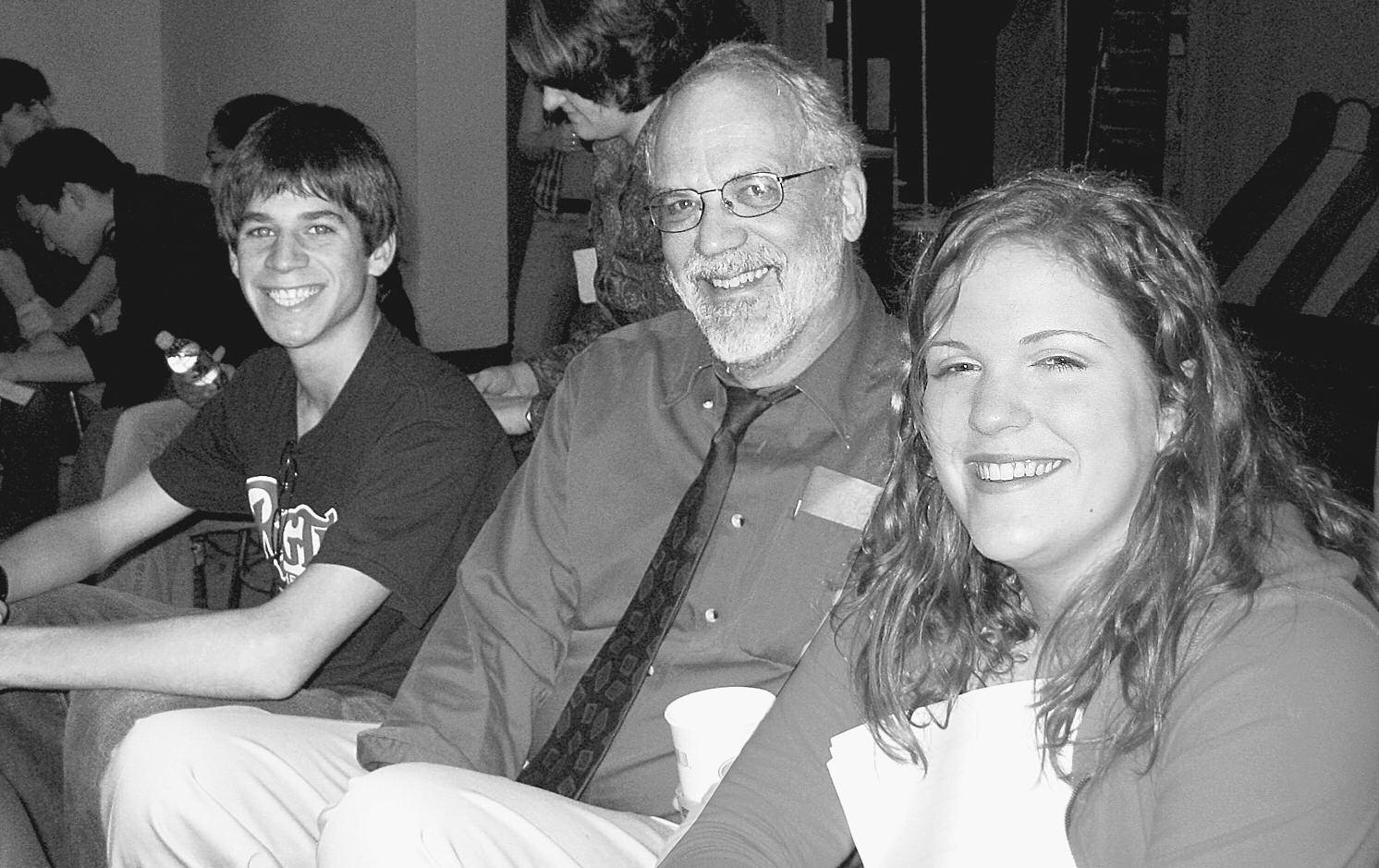
Jim, planning a GSAassembly, with Jason Kirschner and Libby Fifer, both FCS seniors.
One typical topic of conversation I encountered was about “out” teachers and the level of comfort and discomfort on the part of faculty and students. In many of the schools visited, there was silence on the part of teachers and puzzlement on the part of the students. In one
One typical topic of conversation I encountered was about “out” teachers and the level of comfort and discomfort on the part of faculty and students.
meeting at an inner city public school, students asked me if I were gay. When I said “yes,” they registered shock at my candor. I told them that I didn’t mean to make them uncomfortable. They responded that a teacher had never been so direct with them about being openly gay. I also found that there were some schools where GSAs will never happen, a source of frustration to some teachers. In Philadelphia’s public school system, however, a school, by law, must make provision for a club that students request. The story is not the same in the suburbs or in some private schools. This leads to FCS. I was—and am—proud to represent our school as co-advisor of our GSA. We have many, many reasons to feel a sense of accomplishment and growth in the area of GLBT awareness. But I must ask questions of us as well. Why do we have so few “out” kids? Why do so many of our kids wait until college to come out? Why do
we have so few boys in our GSA? (Aschool nearby—public!—has a GSAof all boys.)
My partner Joe and I just returned from a trip abroad. When we were asked on the customs form to indicate how many family members were traveling together, I was struck again that my answer had to be zero. Even though we were on this trip to celebrate our twenty-five years together, according to many people in America, we are not a family. I resent this mightily. But I am an adult, and so it doesn’t undermine my sense of self or my pride in my relationship with Joe. But my time with high schoolers makes me fear that they are vulnerable in ways I am not. One school had some members in its GSA who saw military service as the only way to get out of their tough environment. They asked for a meeting, which I was able to arrange, with a rep from Servicemembers Legal Defense Network to come talk with them as they worried about the effects of the Don’t Ask, Don’t Tell policy.
But my time with high schoolers makes me fear that they are vulnerable in ways I am not.
The visits were only, I trust, the beginning. Now comes the hard part. No matter the diversity of the groups and the schools and the leadership skills of the advisors, they all, in addition to being gracious and welcoming, were also curious about other schools, other clubs, their programs and in opening communication with them. With the technology department’s help, I’m excited to create forms of networking to link us all together. As one leader said, “We should not be doing this in a vacuum.” We may comfort ourselves with the lie that in a post-Will and Grace and Ellen-world, life is infinitely easier for gay kids now. But that world also includes tragedies where a boy identified as gay is killed in his school, where a gunman enters a church service and opens fire because he thought the congregation was too welcoming for gays and lesbians and states continue to pass anti-gay marriage amendments. My experience is that although identifying as gay/lesbian may come more readily for many teenagers now, the life they have to figure out is still not so simple. Achallenge for all of us is to work to make that life better.
By Frank Fisher
Frank has been teaching history to Upper Schoolers for two years.
My family spent July travelling in Egypt and Ethiopia. Our trip encompassed two ends of the Nile and gave us an opportunity to explore cultural and religious traditions in the lush highlands of Ethiopia, where the Blue Nile starts, and the dry lowlands of Egypt. We had been planning this trip for some time. My wife and I are both historians and have long been interested in Ancient and Islamic Egypt. However, the driving focus of our trip was Ethiopia. As one of two African countries to have escaped colonization, Ethiopia has a distinct national legacy. As the birthplace of our son and the daughter we hope soon to bring home, Ethiopia also has special significance for our family.
As the birthplace of our son and the daughter we hope soon to bring home, Ethiopia also has special significance for our family.
Cairo, where we began our trip, is a city of more than 20 million people. The sidewalks are full, and the streets are packed with cars that stop for nothing. Although there are posted speed limits, lines painted on the roads, stop signs and traffic lights, all these are just hypothetical suggestions that no one follows! Pedestrians cross the streets at their own peril. Five times a day the normal sounds of the city are broken by competing amplified muezzins calling faithful Muslims to prayer. Everywhere there are reminders of Egypt’s history. Monuments, symbols and traditions all flow together casually in the daily routine of the city. Remnants of ancient monuments, Roman-era walls, minarets, Coptic churches and Arab markets all intersect. This diverse legacy makes possible Coptic churches decorated with Islamic-style
mosaics and Arabic calligraphy and helps explain casual references to Egyptian President Mubarak as “Pharaoh.” In addition to this complex internal dialog, it was also striking to hear how clearly Egyptians identified themselves as Africans.
The pace of life was fast, but we found the people kind. Merchants smiled and did their best to engage us in bargaining and conversation in the Sayida Zeinab neighborhood of Cairo. Amerchant jokingly offered me a thousand camels for my son, but I rejected the offer. (I suspect I may have the chance to remind my son of this missed opportunity several times over the course of his adolescence.)
Travelling as a family has many advantages; my son, a curious eleven-year-old, seemed to open doors and invite conversations as he stopped to watch people work or paused to glance longingly in a bakery window. Cairenes frequently assured us how much they liked Americans, while noting that they disagreed with American policies. An awkward conversation at best, but in each instance it was intended as a message of welcome. We found people eager to tell us about local mosques, and we were invited to visit several in addition to our own expeditions to major sites, such as the Al-Azhar and the Al Hussein Mosques.
The Egyptian Revolution of 1952 brought about social and political change. It also opened up free education, through college, for all citizens. Still, we were struck by the disparities in Egyptian society. One of the most glaring examples of the tensions in this “ownership society” was the fact that most parks were private or required admission fees. This sparked some great conversations as my son looked through fences at beautiful playgrounds that were closed to us.
...my son looked through fences at beautiful playgrounds that were closed to us.
The contrasts between Ethiopia and Egypt were dramatic. Compared to Cairo, Addis Ababa is a sleepy city of 4 million. With an elevation of about 8,000 feet, the air of “Addis” was clear and cool much of the time. Though not comparable to Cairo, there was often heavy pedestrian traffic, and the city has its own intense character. There were often herds of goats and sheep as well as the occasional cow on the roads. Addis is home to the largest market in Africa, an area of continuous stalls that is nearly six blocks square where you can purchase anything from hand woven baskets and fabrics, to cell phones, to a blue 1972 vintage Romanian Lada sedan.
In northern Ethiopia, we watched for hippos in Lake Tana near where the Blue Nile begins its trip north, and we hiked to the Blue
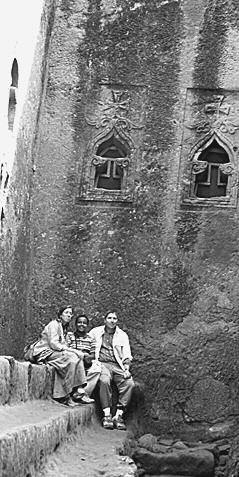
Nile falls. Further north, we visited Lalibela, a United Nations World Heritage site and the ancient heart of the Ethiopian Orthodox Church. Lalibela is the site of more than a dozen churches carved directly out of stone over the course of the twelfth and the thirteenth centuries. Two things were remarkable: the first was the scale of the work; the second was the fact that these churches have been in continuous use since their construction. We were casually shown artifacts and manuscripts that were 800 to 1,000 years old. Everywhere we went in Ethiopia, we encountered real hospitality. Although we were somewhat off the beaten path, we always found people eager to practice their English. Because of education reforms in the mid 1990s, younger Ethiopians speak English with a good deal of fluency. We depended on young people to translate as we shared several wonderful meals in the homes of friends and family members.
We stuck out everywhere, but we also came to feel a sense of comfort and welcome.
As a family we joked about how well we blended into the landscape, but we were under no illusions. We stuck out everywhere, but we also came to feel a sense of comfort and welcome. I have read and 18
taught extensively about many cultures, but here we had the chance to really see and feel what life was like for people whose lives have been shaped by different traditions and circumstances. Much of what I remember best involves fragmentary conversations we had with people who reached out graciously to give us directions on the street, to give advice and explain customs.
...this trip was a profound experience for us.
Travel always has the potential of being transformative, and this trip was a profound experience for us. We spent a great deal of time as a family in tight quarters, being aware of one another and the world around us in new ways, and constantly sharing interpretations of what we saw. My son noticed children at play and often found ways to join games; my wife wrestled with different implications of the hijab as we watched modestly veiled Egyptian women ruthlessly force their way to the front of long lines at ticket counters. Our constant dialog and the range of our interactions left us with a strong sense of both culture and landscape.
This trip helped me frame questions and gain an understanding that I simply could never have gotten from reading historical texts or travel books about these places.
By Christine Ramsey
Chris has been teaching in Lower School for seventeen years, most of them in first grade. Two years ago, she began teaching fourth grade.
In Costa Rica, they say Pura Vida. They say it in greetings. They say it in farewells. Pura Vida literally means ‘pure life,’ and it is something of a Costa Rican motto. When you ask someone,”Como esta?”— “How are you?,” the typical Costa Rican answer is “Pura Vida!” This signifies “I’m great; everything’s good.” In daily conversation, people say “Pura Vida” to one another as an expression of their well being, a way of describing a standard of what it is to be living a good and pure life. I find this idea deeply appealing, and my recent visit to Costa Rica was indeed an experience of many aspects of Pura Vida. I received a Clayton Farraday stipend last summer to take a trip to Costa Rica, and my husband Andy joined me on a wonderful adventure. We studied Spanish for a week at a language school in Monteverde. We stayed in the home of a man and woman, Ana Patricia and Tomás, who greeted us as though we were their longlost family members. They were warm, welcoming, generous and so much fun. We knew we were adding a dimension to our trip when we decided to do a homestay, but we couldn’t have known that we
We knew we were adding a dimension to our trip when we decided to do a homestay...
would experience first-hand that quality of Pura Vida in their simple, warm, friendly home. Tomás was a retired builder who had a knack for sewing. He made wonderful frog hand puppets for a local crafts cooperative. I bought three of these colorful puppets to share with the Lower School. I will never forget the last night we were there, Andy and Ana Patricia were manipulating their frog puppets, hav-
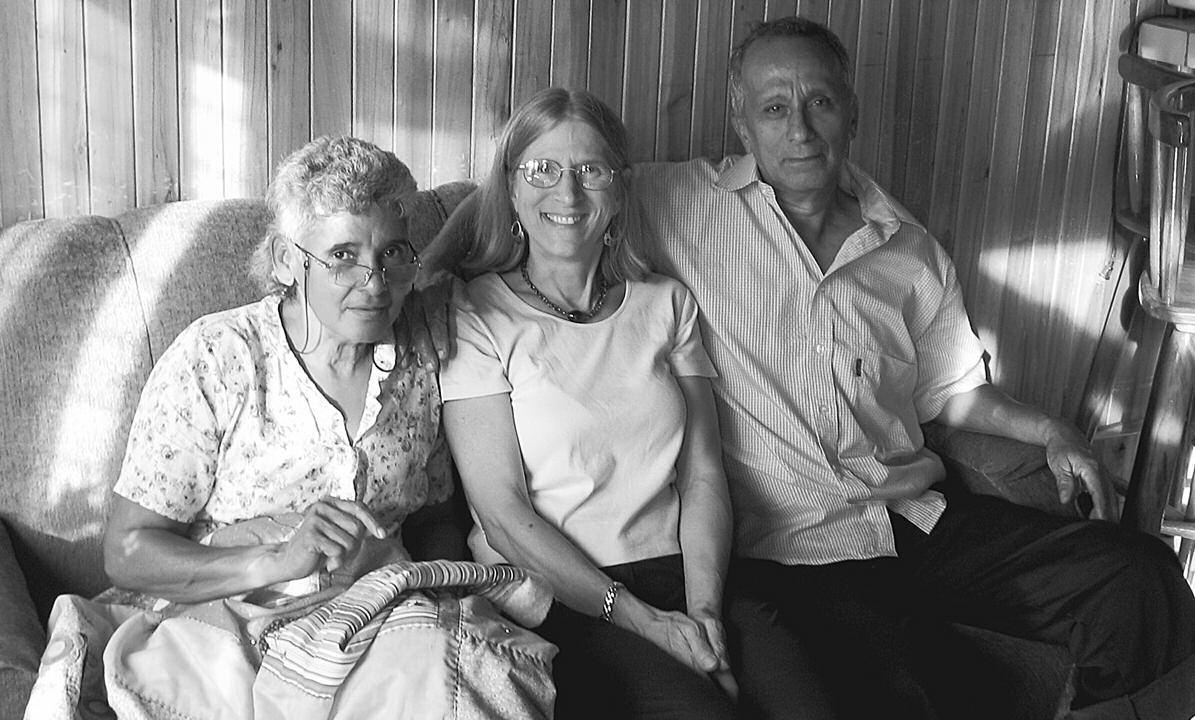
ing a frog-puppet conversation in Spanish! Living with this wonderful couple was a great benefit and a lasting memory of Costa Rican hospitality.
Monteverde, Costa Rica, is on the continental divide, at 5,600 feet elevation and is a cloud forest with more than 100 species of mammals and over 400 species of birds including thirty kinds of hummingbirds. It was established by a group of Quakers who left the United States in 1951 because of their resistance to the draft and their desire to extricate themselves entirely from a war economy. They were considering various places when they discovered that Costa Rica had disbanded its army in 1949. This, and the potential for a good farming life, brought them to Monteverde. In time, they founded a Meeting, a school, a dairy plant, a cheese factory, a power plant, a phone system, a community library, a cloud forest reserve—and
Monteverde is an accomplishment of vision and strength, as well as a testimony to community and the strong spiritual values and convictions of some Friends.
much more. Monteverde is an accomplishment of vision and strength, as well as a testimony to community and the strong spiritual values and convictions of some Friends. In addition to enjoying the beauties of the cloud forest and the Monteverde Cloud Forest Reserve, we visited the Friends School there, though it was not in session. It is a
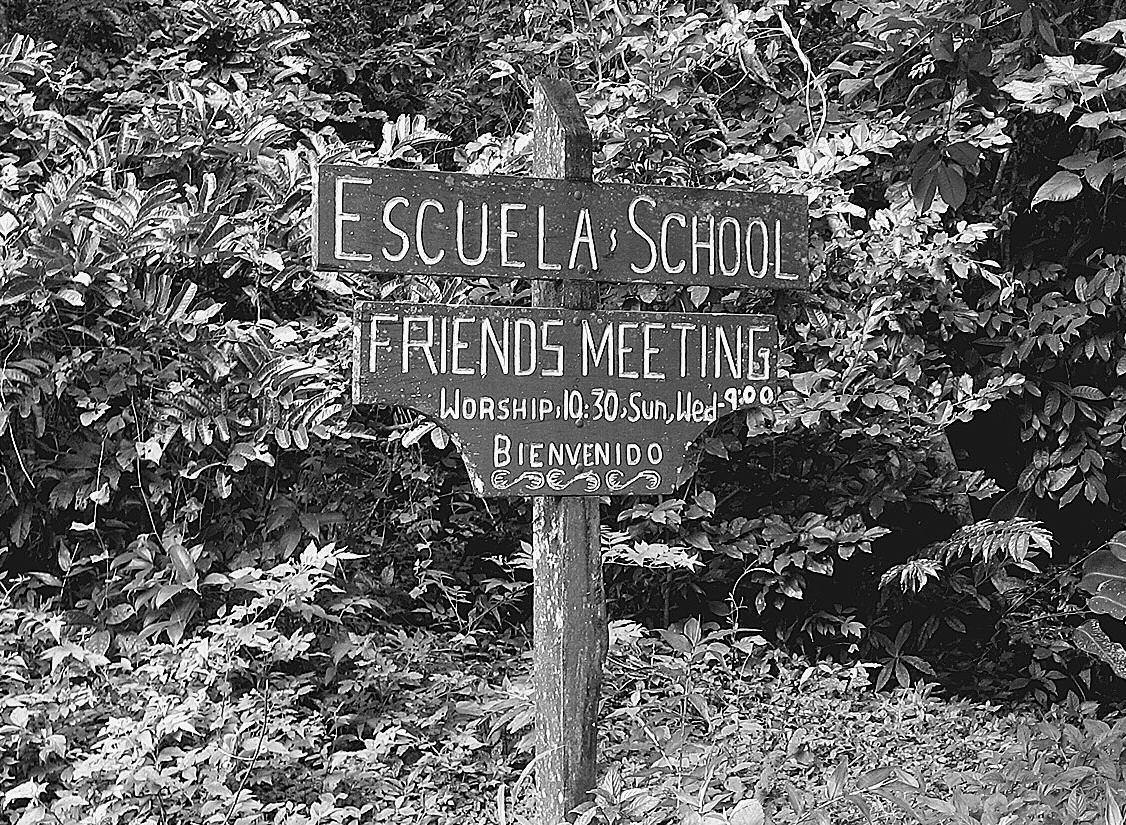
beautiful place in a most extraordinary setting, and we dream of returning one day, perhaps to help them out. Monteverde is certainly a Quaker expression of Pura Vida.
A distinctly different part of the trip was my attendance at the International Reading Association’s World Congress on Reading, called “Reading in a Diverse World,” held in San Jose, the capital of Costa Rica. There were 1500 teachers and professors from 137 countries in attendance. The range of workshops and presentations was staggering. A sampling of workshops were: best practices for teacher training and education; specific problems of spelling in English; challenges facing educators teaching English as a second language; programs designed to help develop reading skills for African-American teenagers in urban areas; challenges educating females in certain African nations; a USAID teacher training program in Pakistan; the use of literature circles; methods of evaluating bias in multicultural books; adult literacy programs, and many, many more.
While I often consider my place in the Friends’ Central community of educators, here was a time when I could see that I am part of a group of people in the world whose job it is to educate and empower. It was inspiring to meet and listen to others doing this work from many different places and perspectives. In this conference, in this small country, so many educators joined to examine and share infor22
mation about teaching and the lifelong learning process of literacy in the world. It was a new perspective for me, in the land of Pura Vida, to slip into a circle of educators as a member of the teaching family in our big, complex but increasingly smaller world.
It was a new perspective for me, in the land of Pura Vida, to slip into a circle of educators as a member of the teaching family...
We took the opportunities that we could to visit a range of different environments, and every day that we were there we were struck by the complex, diverse beauty of Costa Rica’s flora, fauna and landscapes. We swam in the Pacific Ocean; we walked through cloud forests and rain forests. We watched sunsets over the ocean and in the mountains. We saw a magnificent grey fox, sloths, monkeys, frogs, butterflies, crocodiles, iguanas, a tarantula, snakes, orchids, bromeliads, toucans and a beautiful range of birds including a whole group of quetzals, birds sacred to the Mayan and the Aztec civilizations. When we would report our sightings from a day’s walk, people would invariably say, “You were lucky.” We were certainly lucky, and knew it, and every day, we were grateful for the opportunity to experience and witness the beauty of this magical place, this Costa Rican Pura Vida.
By Douglas Ross
Doug has been teaching science to Middle Schoolers at FCS for twenty-nine years.
Last February I noticed an e-mail from John Gruber, Upper School science teacher and department chair, recommending the Integral Education Conference to be held in August 2008 on Whidbey Island near Seattle where he would be one of the conference faculty. I didn’t know much about integral education, but the term “integral” resonated with my life-long goal of creating learning environments that engage all aspects of a student’s experience and personality.
...the term “integral” resonated with my life-long goal of creating learning environments that engage all aspects of a student’s experience and personality.
More importantly, when former students come back to reminisce, those taught by John describe life-changing experiences they had with him. Who wouldn’t want to hang out with John and enjoy his magic? John said the conference, which he attended a couple of years ago, was transforming, providing a model for teaching that is “inclusive …of all of the elements of human experience,” (see Forum, Fall/ Winter 2007–2008), and that was good enough for me. I was able to arrange for support for my attendance from the Fannie Cox Hendrie stipend program.
So this past August, I made my first trip to the beautiful city of Seattle. I arrived early to visit some college classmates, get acclimated to Pacific Coast Time and tour the city on my friend’s bike. The day of the conference, one of my buddies decided to take a morning off to drive me to the northern end of Whidbey Island where there is a bridge connection and a nice place to hike overlooking the bay. After lunch he dropped me off at a remote location on the southern end of
the island, the locale of the conference, where I received a warm reception from John and the other staff.
The next morning I scrambled to keep up with my younger roommate as we hiked up the steep half-mile hill between our Japanese style guest house and the conference buildings. I felt like I was at summer camp for teachers since I had my choice of three pre-break
I felt like I was at summer camp for teachers...
fast activities. I chose the Feldencrais movement workshop led by the amazing juggler and dancer, Thomas Arthur, who had entertained us after dinner the night before. I chose him, because I could see in the fluid and graceful way Thomas moved that he had something to teach this old wrestling coach about movement and ways of being. My usual approach could be described as “Let’s bull through this situation,” an attitude that has generally worked for me but has scarred my body with injuries. I made a good choice, and it turned out to be a nice warm-up for the meditative forest walk the next morning with John, which he led for participants, asking us to open our senses, then talk about our experiences.
After breakfast and some delightful singing, we jumped right into the cognitive content. I soon realized that integral education encompassed more than integrating skills and subjects, although that is a likely outcome of an integral classroom. The first speaker immersed us in advanced concepts of integral philosophy based on the groundbreaking work of Ken Wilber whose work not only considers the full spectrum of human development (emotional, intellectual, spiritual and physical), but challenges educators to respect the learners by including them in the process of producing meaningful and useful knowledge.
First, it became clear to me that an integral approach to education, concerned with all aspects of human development, could be characterized as having a Constructivist approach because of the emphasis
We at FCS are blessed that teaching the whole child has always been valued...
on the individual’s participation in his or her own development. I was impressed to find that Ken Wilber has proposed a most comprehensive model describing aspects of human development. We at FCS are blessed that teaching the whole child has always been valued, so this model is quite relevant to our work. Unlike many schools, we are
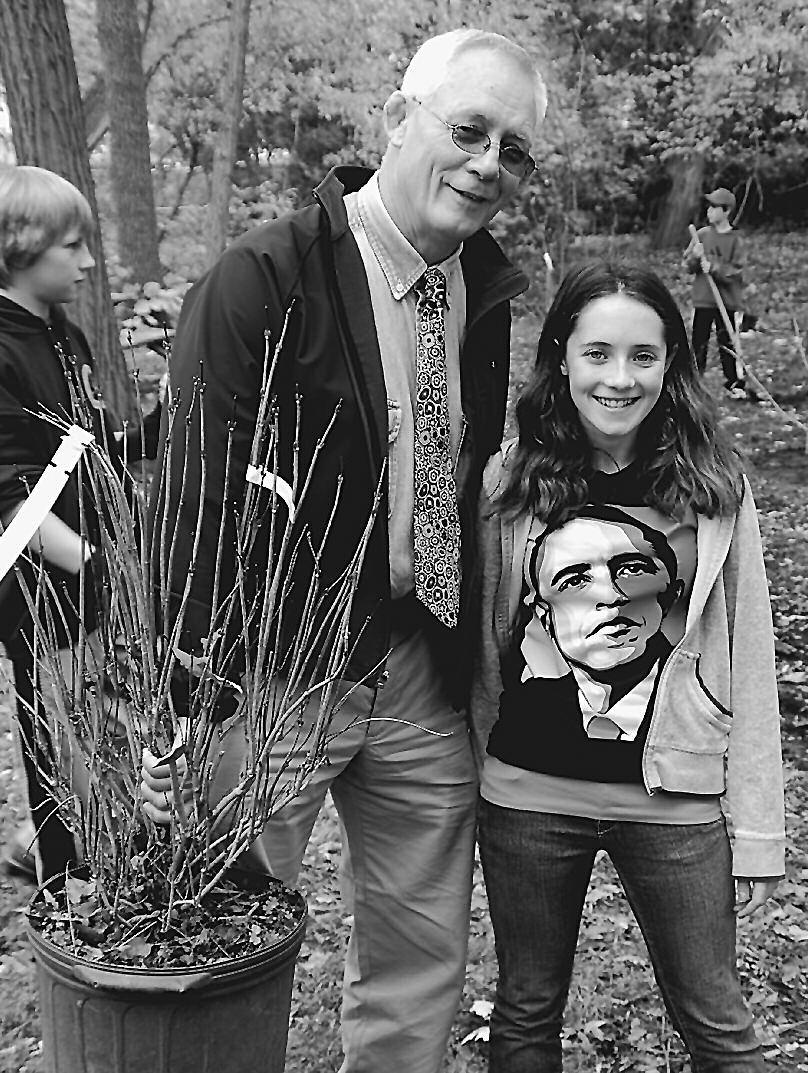
Doug, with Earth Force* student.
(*An environmental service learning group.)
unabashed in speaking of the spiritual and emotional development of our students and have structures such as our weekly Meeting for Worship, our advisor system and our explicit focus on Life Skills to support these elements.
Secondly, development is an on-going process that continues through adulthood. Furthermore, children who are taught and parented by adults who are actively engaged in their own development tend to progress with more depth and breadth. I believe the children “stand on our shoulders,” so it is up to us to be as tall as possible.
...children who are taught and parented by adults who are actively engaged in their own development tend to progress with more depth and breadth.
Thirdly, development can be accelerated by viewing events and problems from varied perspectives. Wilber does this explicitly with a number of models, the simplest one being to look at the same situation from the point of view of the individual (the ego-centered “I”),
from a group perspective (the “We”) or from a third person or purely objective point of view (the “It”). Growth and understanding are likely to occur as we move from one perspective to another. In fact, we can even develop the capacity to hold multiple perspectives simultaneously.
My participation in the Integral Education Conference is a good example of these points in action. Regarding the first, the FCS philosophy promotes a broad approach to growth for our students, and our practices support these values. As for the second point, the encouragement I received to attend this conference is characteristic of the remarkable commitment the School makes for faculty development, as expressed through the Clayton Farraday Mastership Program, the Cox/Hendrie funds for science, math and technology, as well as generous support for masters degrees and faculty conferences. Our curricula encourage multiple perspectives, and our school schedule builds in the weekly Meeting for Worship for individual and corporate reflection where we can emerge with deeper and broader perspectives (point three).
How was I to incorporate my conference experience into my teaching when I returned in the fall? First of all, I had been refreshed by the nourishment received from master educators in an exquisite natural setting. I was to try out new means of expression and enjoy being in the roles of student, listener and observer. Considering the full range of my students’ development and the importance of explicitly guiding them through multiple perspectives was to strengthen my teaching.
In the fall when I first take my students to our outside lab at Indian Creek East in Morris Park, I usually allow them to explore the area before we begin our water monitoring. This fall, I added a wonderful activity that brings all three perspectives of I, We and It together. The
The students silently examined and passed natural objects across a circle as a means of eliciting a sense of connection within our class while inspiring awareness, awe and appreciation for our natural world.
students silently examined and passed natural objects across a circle as a means of eliciting a sense of connection within our class while inspiring awareness, awe and appreciation for our natural world.
The summer week went by quickly, and before long I found myself taking the beautiful ferry ride across the bay back to Seattle. I was refreshed and stimulated, ready for a new group of eighth graders. I have memories, teaching ideas in a powerful framework, and the inspiration of fellow educators. The last evening one of these educators recited lines from a poem that reminded me of my sacred role as a teacher in helping humanity over the next evolutionary hurdle. We are all assisting the next generations in getting over this hurdle together, working in partnership with each other and our students, exploring the spiritual reality of the natural world of which we are part. It is the only way we can succeed.
The rising hills, the slopes, of statistics lie before us. the steep climb of everything going up, up, as we all go down.
In the next century or the one beyond that, they say, are valleys, pastures, we can meet there in peace if we make it.
To climb these coming crests one word to you, to you and your children: stay together learn the flowers go light
Gary Snyder from Turtle Island*
* Turtle Island, the title of Snyder ’s book of poems, was a Native American reference to North America
By Megan Schumacher
Megan has been teaching English to Upper Schoolers for six years.
Children are impressionable. I do not speak as a teacher here, but from my own personal experience of having been a child once. Ever since I can remember, I have loved music. As a child, I can remember playing my 45s on my record player for endless hours. I had some great songs in my collection, too, including “I’m a Little Teapot” and a song that was all about spinning in circles. That’s what I would do as the song played, spin and spin until I was going to be sick and could stand no longer, and when the song was over, I would play it again. I loved music so much that on my first “date,” when I was all of seven years old, I made the boy whom I had invited over to my house listen to the entire soundtrack of Mary Poppins…the poor fellow. I can still remember turning to him while listening to “Feed the Birds” and explaining to him that it was the best song on the album because it made me cry.
With a love of music at such a young age, it should come as no surprise that music class was a subject I always looked forward to...
With a love of music at such a young age, it should come as no surprise that music class was a subject I always looked forward to, but it was a bittersweet love affair. There was this cloud that always hung over my head dating back to my early years of elementary school. It all began in first grade, when I found myself sitting between two boys, Nick and Mike. Nick and Mike were perfectly lovely boys, and sitting between the two of them wouldn’t have fazed me, but sadly I had discovered the reason behind my seating arrangement. It turned out I did not have a particularly pretty singing voice for a six-year-old girl, but surprise, surprise, Nick and Mike had beautiful soprano
voices. The hope was, I am sure, that their pretty voices would transform my ugly singing voice into something more acceptable. It had quite a different effect, however. I don’t know that my voice became prettier, but it did become quieter.
As I grew older, my voice improved. I was fine in a crowd of singers, like a choral ensemble, but shy and self-conscious when asked to sing alone. I can still remember Sister Pat, my high school chorus teacher, telling me to sing louder when I sang solo in order for her to establish what section I should be placed into for chorus. I can also remember another music instructor saying the same thing when I took a musical theater singing course at a local theater. I was haunted by this quiet voice for over thirty years before I finally decided to do something about it.
I was haunted by this quiet voice for over thirty years before I finally decided to do something about it.
It was a mere accident that I found myself facing my demon. I was on an airplane about a year-and-a-half ago, reading the in-flight magazine, when I happened upon a short article discussing a ladies rock and roll camp, called the Willie Mae Ladies Rock Camp,* in New York City. Initially, when I first read the article, I thought back to my dream of being in a rock band and thought about how cool it would be to be in a band. When I finally went to register for the camp and had to determine my instrument of choice, I realized that my dream of being in a rock band involved me fronting the band, singing like some outof-this-world lead singer in the same realm as Chrissie Hynde or Pat Benatar. It was then and there that I found myself deciding it was time to conquer this demon once and for all and find my inner Chrissie Hynde, but boy, was I scared.
It was then and there that I found myself deciding it was time to conquer this demon once and for all...
Thankfully, Willie Mae Rock Camp was swamped with supportive women, both counselors and campers, who believed in the power of positive reinforcement. There was nothing I couldn’t accomplish,
*Willie Mae “Big Mama” Thornton, 1926–1984, was a blues and rock performer and songwriter, the first woman to play music that came to be known as rock and roll.
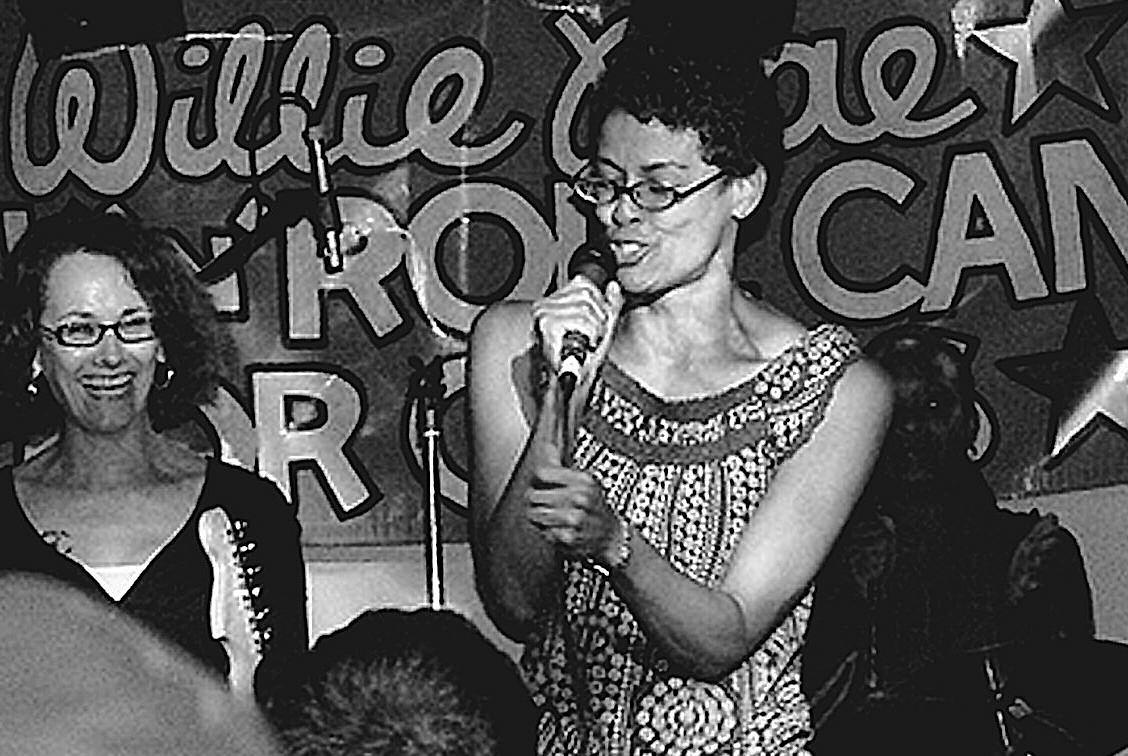
Megan, front and center.
and even if I messed up or sang horribly, I still rocked. That was the camp motto: I rock. And I did rock, too, after three days of intensive rock-n-roll fun. The final night, when my rock band performed at Studio B, a club in the Williamsburg section of Brooklyn, I stood front and center with my band backing me, as I sang a little blues rock song we had written. It was a lot of fun, but only the beginning of my journey to recovery.
I stood front and center with my band backing me, as I sang a little blues rock song we had written. It was a lot of fun, but only the beginning of my journey to recovery.
The next stage involved working as a counselor the following summer for Girls Rock Philly (GRP), a local week-long rock-n-roll camp for girls, ages nine to seventeen, held at Girard College in North Philadelphia. My experience with GRPwas one of the most rewarding experiences I have had. It was wonderful to bring the spirit of positive reinforcement I had received while at Ladies Rock Camp in New York back to Philadelphia and into the lives of twenty-one girls in 2007 and another forty-five girls in 2008, many of whom had felt the sting of being told that girls don’t rock and many of whom had been told to behave like little ladies.
I can still recall the first day when we arranged ourselves into one gigantic circle, and the girls were told to give their best rock-n-roll scream. One might have thought the girls had just been asked to jump off a building. Of the forty-five campers in the summer of 2008, maybe seven belted out a major headbangin’ yell. The rest managed to squeak like mice. It took three go-arounds before we had some serious yelling from a majority of the girls, and by the end of a fun-filled week of instrument lessons, workshops and band practice, we had forty-five potential future rock stars, or at least forty-five girls with a serious boost of confidence.
After two rewarding years of finding my voice and “rocking” with some incredible women and girls, I look forward to continuing my journey. I have been taking voice lessons and spent the past summer at a songwriting retreat in British Columbia, Canada. The retreat was a wonderful experience I was able to draw from as I worked as a volunteer band coach at GRPthis past summer. I hope to work on the skills I was taught during the retreat, to write my own songs some day, and perform them, with courage, for family, friends and others. Hopefully, as well, I will be able to bring this courage to the girls at GRP, guiding them with encouragement, love and support as they, too, celebrate their love for music.
1999–2008
Bacik, Kathleen..................F99/W00“Spicing Up” the Spanish Curriculum Bergen, Lisa McInally.......F03/W04.......An Awesome Adventure: Rocky Mountain High Bowker, Janet and Clough, Susan................SO8/S08.......Making the Renaissance Real Brodsky, Carrie..................S05/S05.........“Duck, Duck, Goose” in Malawi Broker, Josh ’86..................F04/W05.......In Gratitude: Clayton Farraday Remembered Calder, Grant.....................F99/W00.......On the Souls of Women and an Approach to the Study of History Calder, Grant.....................F08/W09.......The Past and the Present: Mittelberger and “The Bailout” Callaghan, Sara.................S07/S07.........Adventures of an Amateur Archaeologist Callaghan, Sara and Goldader, Deborah........S08/S08.........Long Nights and the Northern Lights Chagan, Jebb......................F06/W07.......On the Road with American History Connor, Dyann and Grace, Leslie Marie........S08/S08.........Peace Through Understanding Crauderueff, Michael.......S99/S99.........On Being Led Toward Mindfulness Crauderueff, Michael.......F01/W02.......Kashoompah! FCS Graduation Address 2001 Crowley, Dan.....................F05/W06.......Pushing the Pause Button Crowley, Michelle and Alex ’87 ....................S03/S03 .........Spring Fling Daniels, Kathryn S06/S06 The Yucatan Peninsula Dankoff, Joel......................F04/W05.......Conveying History Through Architecture Daves, John........................F99/W00.......Stranger in the Village Davis, James......................F01/W02.......Summer with the Gods Davis, James......................F08/W09.......Advocating for Equality: Visits to High School Gay/Straight Alliances Dawson, Catherine M......F01/W02.......Four Corners of My Life
Del Soldo, Lou and Lager, Marilyn ................S02/S02 .........A Book is Like a Garden Carried in the Pocket: Books Published by Friends’ Central Authors Denton, Don......................S02/S02.........Tom Wood, Friend and Mentor Denton, Don......................S03/S03.........Marhaba Means Welcome DeSabato, Ray...................F02/W03.......“Let Your Lives Speak:” FCS Graduation Address 2002
Donaldson, Nancy Fitts ...F00/W01.......AGlimpse of Friends' Central History Dunn, Alexa Klein............S05/S05.........The Teacher as Writer: Taking Risks, Reaping Rewards
Dunnington, Alexa ’98.....S06/S06.........Lessons from the Borderlands Dunnington, Alexa ’98.....F07/W08.......Shakespeare Revisited: Mastering Oxford University Evans, Louise.....................S99/S99.........Why Costa Rica? Evans, Louise.....................F03/W04.......My Santa Fe Trail Evans, Louise .....................F05/W06.......Toolin’ Around with Nick: Travels in Eastern Europe Ewen, Liza..........................F04/W05.......Careful Measures Farraday, et al, David & Ted...................S05/S05.........For Clayton L. Farraday
Fedder, Deborah Peltz ’79...........................F05/W06.......ATime to Nurture Fisher, Frank......................F08/W09.......What? Only a Thousand Camels? Fifer, Ginger.......................F03/W04.......“Whole Hours Ahead:” The Minutes of My Sabbatical Forman, Laura ’91.............S99/S99.........Fire and Ice Freeman, Victor ’80...........F06/W07.......“Today is a Wonderful Day— To be Among ‘Family’” Friends’ Central Faculty..S06/S06.........Teachers Thanking Teachers: The Influence of Good Pedagogy Gallagher, Phyllis..............S08/S08.........Chatauqua: The Best Camp for Adults Goldader, Deborah...........S06/S06.........What’s in a Name? Beginners Enjoy the Advanced Observer Program at Kitt Peak Goldader, Deborah and Callaghan, Sara ..............S08/S08.........Long Nights and the Northern Lights Grace, Leslie Marie and Connor, Dyann.......S08/S08.........Peace Through Understanding Graham, Kelley.................S05/S05.........Random Facts and Trained Turkeys: The Hazards of Knowing Too Much History Gregg, Mary.......................F06/W07.......Chasing Moorish Ghosts and Other Spanish Adventures Groff, Rhoni.......................F02/W03.......Mind, Body and Spirit: ASummer for Renewal Grove, Peter .......................F99/W00.......Interventions Gruber, John.......................S03/S03.........“Living Time” Gruber, John.......................F07/W08.......Integral Education: Exploring the Leading Edge of Educational Theory and Practice Guerin, Terry.....................S08/S08.........Pig Iron Theatre: Where Playing is the Thing Guides, Christopher.........S06/S06.........AVirtual Tour of Friends’ Central Arboretum Harnett, Erika ....................F02/W03.......Conventiculum Latinum: Speaking Latin in Bluegrass Country Hudgins, Heather.............S03/S03.........Monhegan Magic
Johns, Michelle F03/W04 Making a Record of Ourselves
Johnson, Beth Davis ’77 ...F03/W04.......It’s All About the People: FCS Graduation Address 2003
Kean, Jon ’85......................S06/S06.........My Hour with Simon Keane, Laura......................F00/W01.......Connections
Kinney, Donna ...................S02/S02.........AReturn to Teaching
Lager, Marilyn...................S99/S99.........Keith Buckingham: ATeacher of Science and the Soul
Lager, Marilyn ...................F00/W01.......A Sabbatical Story
Lager, Marilyn S01/S01.........Missing Michi
Lager, Marilyn...................S02/S02.........Thirty Years of Enduring Work: Bob Emory’s Tenure at FCS
Lager, Marilyn and DelSoldo, Lou.................S02/S02.........ABook is Like a Garden Carried in the Pocket: Books Published by Friends’ Central Authors
Lager, Marilyn...................S03/S03.........The Grande Dames of Lower School
Lager, Marilyn...................S04/S04.........Two Masters of Lower School
Lager, Marilyn...................S05/S05.........The “Loyal Hound:” Joe Ludwig and FCS
Lager, Marilyn...................S06/S06.........The Friends’ Central School Philosophy
Lager, Marilyn...................S07/S07.........The Divine Ms. DeVan
Lager, Marilyn...................S08/S08.........Steve Ruzansky: Master of the Classroom, Master of the Stage
Leiper, Esther M. ’65.........S07/S07.........Intricate Song: Exploring Two Poets from Friends’ Central School
Lightsey, Chesley Ann.....S02/S02.........The Public Power of Private Disclosure
Ludwig, Joseph ’69...........F99/W00.......The Words of a School Principal: FCS Graduation Address, 1999 Lutz, Cindy A....................F00/W01.......What’s in a Name Marshall, Ed.......................F07/W08.......Silence in the Teachable Moment Matthews, Sara..................S02/S02.........Leave No Child Unsuccessful? Maw-Deis, Caroline..........F05/W06.......APair of Deis in Paradise McCarty, Margaret............S03/S03.........Indigenous: From Shallcross to Chiapas, and Back Again McConnell, Linda Kent....F04/W05.......“Now What?” McDonnell, Alex ’87.........S07/S07.........My Sabbatical: or Trying to Ruin My Children McDonnell, Alex ’87 and Crowley, Michelle..........S03/S03.........Spring Fling McNemar, Galen...............S02/S02.........Estudiando Espanol: An Exploration of Diverse Cultures
Morris, Brad .......................F05/W06.......The Merry Month of Math Morris, Brad.......................F08/W09.......FCS and Your Whole New Brain: FCS Graduation Address 2008 Morrison, Suzanne............F01/W02.......We Are Both Poet and Poem Novo, Laura.......................F02/W03.......Out in the World Novo, Laura.......................F06/W07.......The Truth of this Community: FCS Graduation Address 2006 Ostroff-Weinberg, Rochelle ...........................F02/W03.......Vouloir c'est pouvoir or How to Develop an Exchange Program through E-mail and Couscous Ostroff-Weinberg, Rochelle...........................F04/W05.......Greece: Through the Eyes and Soul of the Poet Ovalle, Julian.....................S04/S04.........My Story Ovalle, Dawn .....................S04/S04.........Guatemala: ALearning Experience Parris, Kim.........................F06/W07.......Our Southwestern Journey Patterson, Steve.................F01/W02.......To Edinburgh, for Film Studies and the Fringe Festival
Pepino, Carmella...............F01/W02.......Chapter Two in a Roman Journey
Perez, Maria Cristina Sabaj.................................S07/S07.........Fishing in Mongolian Waters: FCS Teacher Survives Scientific Expedition
Perez, Maria Cristina ........S99/S99.........Study and Travel in France
Perez, Maria Cristina........S01/S01.........ALittle Medicine and a Lot of Faith Pryor, Emily.......................F07/W08.......Un Reencuentro con Chile (AReturn to Chile) Raina, Joan .........................F99/W00.......“I Will Come Back as a Cloud Some Day” Raina, Joan F03/W04.......AJourney of Transformation: The Mask Ramchandani, Tara ’00.....S99/S99.........Past Voices
Ramsey, Christine S01/S01 Personal and Professional Nourishment: ASabbatical Experience
Ramsey, Christine.............F03/W04.......AMix of Color and Language in Mexico
Ramsey, Christine.............F08/W09.......Pura Vida: Living Well in Costa Rica
Ratinoff, Loren...................F01/W02.......ASabbatical for Taking Risks
Ricci, John..........................S99/S99.........Westtown ’98: The Power of the Group Richmond, Robyn.............F06/W07.......“First One Must Have the Quiet:” Meeting for Worship at FCS
Roberts, Margaret Somerville ’83.................F04/W05.......Computer Assisted Language Learning Rosenberg, Jessica ’00 F00/W01 Our Spiritual Wardrobe Rosengarten, James...........F06/W07.......The Ethic of Service Ross, Anne ’94 ...................S03/S03.........Teachers, Leadership and Power: A Case Study at FCS
Ross, Doug.........................F08/W09.......Intergrating Integral Education into Teaching at FCS
Ruzansky, Beth ’96............F99/W00.......AJourney Around the World in Order to Return Home
Ruzansky, Stephen............F05/W06.......I Pick, Therefore I Grin
Schumacher, Megan.........F08/W09.......Girls Rock
Schwartz, Maryellen.........F04/W05.......Lifelong Learning: FCS Graduation Address 2004
Seidel, Peter.......................S04/S04.........AStroll in the Park: Some Musings on Romanticism and Classicism
Sharp, Toni.........................F01/W02.......Teaching About Africa
Sheldon, Mary Ann..........F00/W01.......AStylus, Two Bone Hairpins and Roman Glass: Digging for Earthwatch
Singer, Paula......................F05/W06.......Our Mother-Daughter Book Club
Sternberg, Juliet.................F07/W08.......Telling Tough Truths (Middle School Bullying Survey)
Sullivan, Maureen.............S05/S05.........Pay It Forward: ASabbatical of Gratitude
Swimmer, Todd ’81...........S04/S04.........Bagamoyo, Tanzania: ASecond Look
Tashjian, Michi..................S01/S01.........Reflections
Taylor, Megan ’08..............S06/S06.........These Words Are My Words
Terrell, Keino.....................S01/S01.........I’m Cool Like That: Students of Culture
Terrell, Keino.....................F02/W03.......Sometimes I Wonder Terrell, Keino .....................S07/S07.........I Am Black History
Valle, Angelo......................F02/W03.......Five-Eighths of the Way Around the World--and Back
Valle, Angelo......................F07/W08.......Did You Hear What They Said?: FCS Graduation Address 2007
Van Pelt, Lylee...................F99/W00.......IGLES: Science Learning for Young Women Vernacchio, Al....................S01/S01.........Many Gifts—Sexuality Included Vernacchio, Al....................F02/W03.......Victims, Perpetrators, Rescuers and Bystanders Vernacchio, Al....................S07/S07.........Having “The Talks”—Without Fear Waldman, David F00/W01 Under the “Dreaming Spires:” Summer Study at Oxford Weinstein, Elizabeth P......F00/W01.......All of It is Real: FCS Graduation Address, 2000 Wilson, Peter......................S04/S04.........The Harare Drill Team Wright, Jim .........................F03/W04.......Quaker Education and the Dictates of Inner Truth
Yin, Melinda......................S04/S04.........AQuaker(ly) View of Science: Education and Practice
KEY:COVERCOLOR
S99/S99 – CRANBERRYS03/S03 – LIME GREENS06/S06 – FUSCHIA
F99/W00 – OLIVEF03/W04 – MANGOF06/W07 – STEELGREEN
F00/W01 – PINKS04/S04 – REDS07/S07 – YELLOW
S01/S01 – LAVENDERF04/W05 – SKYBLUEF07/W08 – APRICOT
F01/W02 – ORANGES05/S05 – LIGHTGREENS08/S08 – PURPLE
S02/S02 – TURQUOISEF05/W06 – CHOCOLATEF08/W09 – GREEN
F02/W03 – KHAKI