
FORUM
FALL/ WINTER 2007-2008
Table of
Did You Hear What They Said?: FCS Graduation Address
Contents
Un Reencuentro con Chile (AReturn to Chile)
Telling Tough Truths (Middle School Bullying
Education is about one human being talking to another human being about what it means to be human.
—Cyril Harvey Friends’ Central teacher, 1937–1957
(as quoted by Bruce Stewart, headmaster of Sidwell Friends and head of PAISVisiting Evaluation Team, October 24, 2007)
Editor: Marilyn Lager, Director, Friends’ Central’s Blackburn Library
Email: mlager@friendscentral.org
Assistant to the Editor: Deborah Fedder ’79, Middle School English Teacher

FORUM
Forum is our community’s educational journal. Faculty, alumni, board members, parents and students areencouraged to contribute opinions, ideas, innovations and observations about any aspect of their lives relating to educational experiences.
Marilyn Lager Editor, Forum

Did You Hear What They Said?
Friends’Central Commencement Address, 2—007
By Angelo Valle
Angelo taught science to Middle Schoolers for ten years, becoming computer technology coordinator for Middle School for the last five. He left FCS this past June, marrying and moving to New Jersey where he works as a Middle School science teacher and community service coordinator at the Princeton Day School.
Good morning and welcome everyone, especially to the Board of Trustees, administration, colleagues, staff, parents, families, friends and, last, but certainly not least, Friends’ Central Class of 2 double 07. It is a great honor to stand before you today. I ask that you forgive me, though, if I seem a bit out of my element. As a computer teacher and technology coordinator and, recognizing that many of you students are visual learners like I am, my preferred modus operandi is to have a tablet PC and projector in front of me and a screen on which to project a captivating and informative visual aid—usually a PowerPoint presentation. As you can see, I have none of those tools here. However, I do have behind me ninety-seven living, breathing and eye-catching bullet points about why we celebrate Friends’ Central today.
I found it a bit ironic that the Class of 2—007 is the only class to come through our Middle School during my Friends’Central career whom I never taught.
I found it a bit ironic that the Class of 2—007 is the only class to come through our Middle School during my Friends’ Central career whom I never taught. Instead, my chances to affect this class have come outside of the classroom. Class of 2—007, while you were in Lower School, I worked for extra cash on weekends as a birthday party host and game coordinator in the gym and on the fields of Lower School, coaxing you to scream at the top of your lungs, “What time is it, Mr. Fox?” And as you got older, your favorite games became Doctor Ball and soccer. I also remember a handful of you as campers when I was a counselor in my first few summers here In Middle School, I was able to coach some of you, 2
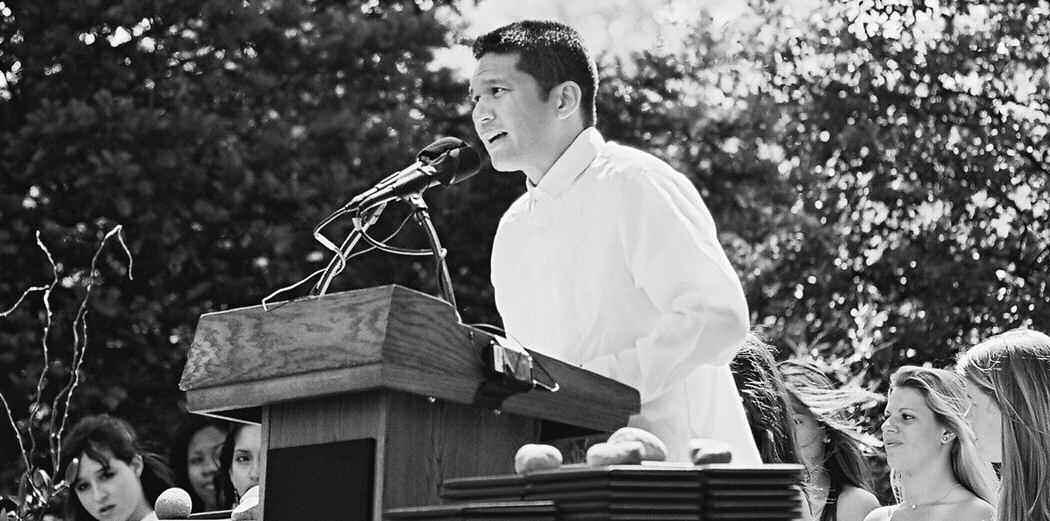
Angelo, addressing the students of 2007.
while others of you worked with developmentally delayed youngsters in my service project at the Early Intervention Program. And only a few weeks after 9/11, I spent a week with you and East Harlem students at Echo Hill. Throughout your Middle School years, I saw your performances, including your eighth grade showcase celebrating the music of Walt Disney, which was the last time we saw you collaborate as the entire Class of 2—007.
Then, apart from being able to watch you in the athletic arena throughout the years, I didn’t get to see you much. But I know that you continued to apply your talents to your academic and artistic pursuits as well and that you have taken service projects to a new level, helping many in need locally and more globally.
Now here we are, and I realize that when I was in your seats, but graduating from the Friends School of Baltimore back in 1988, most of you members of the Class of 2—007 were just waiting to be born. So, in the year following my graduation date, I started my post-Friends education, and you started your lives. Now, as you are on the verge of commencing your post-Friends’ Central education, I am on the verge of commencing a new life, since I, too, am leaving. Here we are together facing our futures.
...I realize that lessons don’t always get learned the first time or that lessons get forgotten ...
One of the many things I did in preparation for today was to recall the people whom I represent: the faculty. They have shared so many nuggets of wisdom with us over the years, and I know you appreciate them. Since I realize that lessons don’t always get learned the first time or that lessons get forgotten, I wanted to try, at least, to send you off with the essence of some simple messages that I have heard over the years that I will take with me from Friends’ Central, and I hope that they will be of some use to you.
First, “The difference between ordeal and adventure is attitude.” Fifth grade teacher Steve Ruzansky shared this message in Meeting for Worship earlier this year, and it stuck with me. In fact, I referred to it in the seventh grade’s preparation for this year’s week-long trip to Echo Hill Outdoor School. For those of you who didn’t have such a great time on your Echo Hill trip, perhaps it would have been helpful had you heard that before. I probably said something along those lines back then, but perhaps you weren’t yet ready to receive the advice. For others, you seized the opportunities on that trip and reaped the rewards.
As we step forward into our next chapter, we can choose to put a positive spin on things. Certainly there will be aspects of life that we can’t control and will have to accept. What we can control, then, we must, in order to make the best of any situation. It may take some practice if you’re not used to it, but you can choose what perspective to take.
Second, “Count your blessings.” Ray DeSabato, Middle School Principal, often reminded me that I should do that—and I do. Remember that no matter what your situation—yes, there’s always someone who is better off, but—there’s always someone who is worse off. Also, I find that being thankful for what I have allows me more freedom to be at peace.
We are more prone to notice things when they go wrong, rather than be thankful every time things go right.
We are more prone to notice things when they go wrong, rather than be thankful every time things go right. When I joined the Technology Department, I found that an overwhelming majority of calls that I received were about something being busted, and I started noticing my mood was changing for the worse. Rarely did I get a call when things were working properly. I had to get used to that and realized, “Hey, that means that there are people using the technology…which means, I still have a job!”
Third is S.P.I.C.E.S.—S-P-I-C-E-S—Remember that acronym? I have Quakerism teacher Linda Hensel to thank for that mnemonic to remember six of the Quaker testimonies that guide education here at Friends’ Central.
Simplicity — Live simply that others may simply live.
Peace — Non-violence
Integrity — Be honest in everything you do, even when no one is around to see you; be true to yourself.
Community — This goes along with the Golden Rule: “Do unto others as you would have them do unto you.”
Equality — We are all children of God. Each individual has worth and dignity. Respect each individual for there is that of God in everyone. Service — As others help us we should share our gifts and blessings to help others.
You may not be Quaker, but you come from a Quaker school. Know from where it is you come.
Fourth, in the 2004 Commencement Address, Maryellen Schwartz, former computer and math teacher, Dean of Students and Co-Principal shared the following: “I hope that many of you take advantage of the opportunity to take a semester abroad during college.”
Before Friends’ Central, I chose to focus on the pre-med route and never took the opportunity to study abroad. In hindsight, my vision of where my future was going was too narrow for most of my college years. I broadened my search or considered other possibilities a bit late. I think I should have taken more cultural anthropology classes or languages. So, I went into into the next phase of life after college dead set on a pre-professional route. Of course, what is it they say about hindsight? Be careful and patient about your choices, and let things develop. And, remember, there can be multiple routes that lead to your goal.
...there can be multiple routes that lead to your goal.
Along the same lines is the advice to take a “gap year” if you really need to do so, which I understand some of you are doing. I often think that I should have taken time off from my studies at some point, perhaps even between Friends and Penn. I think I would have been more passionate about my studies after gaining clarity and gotten more from the tuition. Of course, the danger is that you'd become too comfortable not being in school and never get to college. For me, clarity came after trying other things, in particular teaching. I found I was passionate about working with children, not medicine. And when one is passionate about one’s work, it doesn’t really feel like work.
...when one is passionate about one’s work, it doesn’t really feel like work.
In a more general sense, this speaks to taking advantage of opportunities. Here at Friends’ Central you had a tremendous number of opportunities in which to participate, academically, artistically, athletically and through service. I hope you took advantage of them. If you didn’t, college is another chance to do so.
The final quote I have to remind you of is this: “This is a place where one builds relationships with teachers, coaches, staff members and, of course, peers…. Friends’Central is about the people.” Beth Johnson ’77, Co-Principal/Dean of Students shared this in her 2003 Commencement Address.
My thoughts on this one really crystallized this past Wednesday in the final seventh grade Meeting for Worship. Students thoughtfully
reflected upon not only this past year, but upon their experiences thus far at Friends’ Central. Many sentiments revolved around class cohesion and their appreciation for their teachers and, Class of 2—007, I know that you are a very cohesive bunch and can identify with them. Essentially, various members of the Class of 2012 said that they felt that Friends’ Central is like a home, and that Friends’ Central folk are a second family to them. Parent Paul Lile echoed this sentiment in the Baccalaureate Meeting for Worship last night, saying that Friends’ Central is more than a school. I believe that comes out of the relationships that develop in this community at all levels.
I think we all agree that this is a wonderfully supportive place in which we can thrive.
I think we all agree that this is a wonderfully supportive place in which we can thrive. That has to do with the faith we give each other. I can’t tell you how many people in the past weeks said to me, “You’ll be fine,” or “I can’t wait to hear you speak.” The faith people showed comforted me immensely. Teachers have faith in the students, sometimes even when students don’t have faith in themselves. The teachers and staff genuinely care, and students, I believe you can tell that.
Faith in the School’s mission must also come from the parents and families. It’s not just the students, teachers, coaches and staff members, but also the parents and families who put faith and tr ust in this community. We do not always agree with each other, but we value each others’ opinions, by and large, and we do our best to create an atmosphere where we all feel safe. You can help create this type of community where you go next. You cannot duplicate it, because you simply won’t have the same unique individuals, but you can take the same principles with you.
As you go forth, remember, that real life is more about relationships —how you interact with others—and not about working by yourself. Sure, you will still have tests to take on your own in the formal school setting, but more and more, you’ll see that life is about collaboration. This
...real life is more about relationships— how you interact with others— and not about working by yourself.
School has prepared you for that. The diplomas in front signify that you have built all types of relationships here with people possessing diverse perspectives and that you have taken some of their perspectives with you. You all have helped to maintain this wonderful community for me, and I hope I have been able to contribute to your lives in some way
As we leave this place, let us, as Doug Ross, eighth grade science teacher, said in his 1994 Commencement speech, “Join in creating a compassionate world where people are conscious of the delicate balance of nature and our interdependence upon each other.”
And finally, as Middle School Assistant Principal Mark Fifer would say, “Good luck. Play hard. Have fun.”
Thank you, and God bless!

Headmaster David Felsen is known for his warm and personal remarks at Commencement. These thoughts were delivered to welcome parents, trustees, faculty, seniors and guests.
Several weeks ago, I received a phone call from my daughter Kate who lives a very intense life in New York City with her husband Luca and their two children, Isabella, nine and Ian, six. She said, “Daddy, I am in the midst of making summer plans for the children—trips to the Adirondacks and Italy, piano lessons, soccer camp…” And then she asked, “Daddy, what are you doing the week of June 25th? I was wondering if the kids could hang out with you in Philadelphia that week. Maybe you could just do with them the simple things you used to do with Davey (her brother) and me?” And of course I said, “I’d love to have them come—I’ll look forward to it.” And ever since, I’ve been scratching my head trying to remember what those “simple things” were that I did with Kate and Davey nearly thirty years ago and which I might do with Isabella and Ian now. Here’s a partial list:
1. Teach them to use one of the few remaining rotary telephones in Philadelphia.
2. Play catch with them on Stafford Street, Ian with his baseball glove, Isabella with her lacrosse stick. Teach them the art of getting out of the street quickly when a car comes.
3. Plant a few flowers with them. Let them run through the sprinkler to cool off.
4. Put the kettle on and make them a real cup of tea the way I used to make it for their mother and the way my mother used to make it for me.
5. At night, before bed, read The Odyssey to them, my favorite story of that hero Odysseus, who overcame every obstacle imaginable to find his way home. How far can we get on that journey in a week?
6. Tell them stories; kiss them good night; say “Sweet Dreams.”
Shakespeare Revisited: Mastering Oxford
University
By Alexa Dunnington ’98
Alexa graduated from Oberlin College after leaving Friends’Central and has been a seventh grade Language Arts teacher at FCS for four years.
For the past four summers, I have taken classes to earn my Master’s degree in English from Middlebury College. Middlebury’s unique program, which uses college campuses around the country and abroad, has allowed me to study in Alaska (University of Southeast Alaska), New Mexico (St. John’s College) and Vermont (Middlebury College). For my final summer, I knew that I could not pass up the opportunity to study at Oxford University Because of the program cost and the terrible exchange rate, I was unsure if I would be able to go to England, and I was happy to receive a generous Clayton Farraday stipend, enabling me to have this once in a lifetime experience.
Oxford University is comprised of thirty-nine self-governing colleges that are scattered around the city. I arrived in England in June with my friend Kate, also an English teacher, and we made our way to Oxford’s Turl Street. This is where we, like many before us, found the entrance to Lincoln College. Lincoln was founded in 1427 and is the least altered of all the colleges in Oxford. Its famous alumni range from John Wesley, who founded Methodism, to Theodore Geisel, well known as Dr. Seuss. Like most of the colleges in Oxford, Lincoln is set up as a group of quads that are hidden from the street. We entered through the porter’s lodge and, thankfully, the porters took mercy on two weary travelers and helped us move our bags up the steep, winding staircase. My room overlooked the main quad on one side and the chapel quad on the other.
Almost every day of the summer, I would climb up onto my desk and into the windowsill to read.
Almost every day of the summer, I would climb up onto my desk and into the windowsill to read. It offered a beautiful view of the chapel tower and the manicured grass below. I often watched the college gardener
mow the grass into a perfect plaid, carefully replacing the “Do Not Walk on the Grass” signs before he finished. It was also my perch for watching the filming of a new movie based on Evelyn Waugh’s Brideshead Revisited. On a whim, Kate submitted our names, and we won the opportunity to sit with the director, producer and screenwriter of the film at the “high table” for one of Lincoln’s formal dinners. It was wonderful to talk with the screenwriter, Jeremy Brock, (The Last King of Scotland, Mrs. Brown) about his craft and experience adapting novels for film, but we also enjoyed talking about his thirteen-year-old son since that is the age of the students I teach.
My primary focus while in Oxford was on my final graduate course, a class called “Material Shakespeare”...
My primary focus while in Oxford was on my final graduate course, a class called “Material Shakespeare” with Dr. Emma Smith. Emma is a professor at Hertford College, which is located near Lincoln. In the past several years, Emma has written The Cambridge Introduction to Shakespeare and edited the three Blackwell’s Guide to Criticism volumes on Shakespeare’s comedies, tragedies and histories. I was fortunate that Emma is not only a brilliant scholar and teacher, but she is also funny, genuine and humble. Our class had only five people in it and, true to the traditional tutorial system of Oxford, we were expected to meet with Emma regularly to discuss our work and intellectual pursuits. The course focused on:
…the ways in which the circumstances of their production and transmission are integral to our readings [of the plays]. Alongside the transcendent poetic genius of Shakespeare remembered by literary history emerges a commercial writer affected by audiences, fellow writers, and the circumstances of print. Returning Shakespeare to the precise conditions of composition and reception reinvigorates the plays with the shock of the old, and reinstates actors, audiences, and printers as co-authors of the works. (Emma Smith, course description)
The result of taking the class was falling in love with Shakespeare all over again. Though the reading list had fewer books than some of my other Middlebury classes, Emma expected us to direct our own learning. She expected us to read the plays in which we were interested to do research, to follow leads from footnotes, to go where our reading took us, and to find what we might incorporate into our teaching. Although I
I became fascinated with Henry V...
teach AMidsummer Night’s Dream, I became fascinated with Henry V and spent a considerable amount of time investigating the first quarto, the production history of the play, and several film versions (Olivier and
Branagh). My final paper focused on the figure of the Chorus in Henry V. Having stumbled upon Brecht’s idea of the alienation effect in theater, I became interested in how the Chorus repeatedly draws the audience’s attention to both the material experience of the theatre and to the historical events being depicted, imploring the audience to be active participants. Since there has been so much debate about the tone of the play and its characterization of Henry, I examined how the Chorus, as a dramatic and structural apparatus, does as much to make the audience critical of Henry as do his own words and actions.
The Bodleian library, Oxford’s main research library, was an ideal place in which to do my research.
The Bodleian library, Oxford’s main research library, was an ideal place in which to do my research. The library holds approximately 8.5 million volumes, but, having run out of space to house its collection, many of the holdings are now stored in an abandoned salt mine outside of Oxford. Since its inception when Thomas Bodley donated funds in 1603, the Bodleian has been a non-lending library. Indeed, on the day I arrived in Oxford and went to the library to pick up my card, I was required to take an oath promising that I would “undertake not to remove from the Library, nor to mark, deface, or injure in any way, any volume, document or other object belonging to it or in its custody; not to bring into the Library, or kindle therein, any fire or flame.” Every day I walked down a narrow street and into the Bodleian courtyard past the tourists on my way to one of the reading rooms. I also spent a great deal of time in the Radcliffe Camera, the undergraduate library, because of its Shakespeare section and the magnificence of the building.
My stipend also allowed me to travel to London and Stratford.
My stipend also allowed me to travel to London and Stratford. I visited the reconstructed Globe Theater and took a guided tour. As we walked around the empty theater, the actors came out on stage and began to warm up for Othello Before the show began, I spent a great deal of time (and money) in the Globe’s gift shop. I bought DVDs, books, posters, mugs, a Shakespeare action figure (with removable book and pen!) and, my favorite, an eraser imprinted with the quote “Out, damned spot!” For the first half of the play, Kate and I sat up in the middle balcony and for the second half we stood amongst the other groundlings. I took dozens of photos in the Globe alone and have compiled an album that I will show to my students when we begin AMidsummer Night’s Dream in the spring. Most of these materials are already being used by several Lower School teachers for the thematic project on the Renaissance.
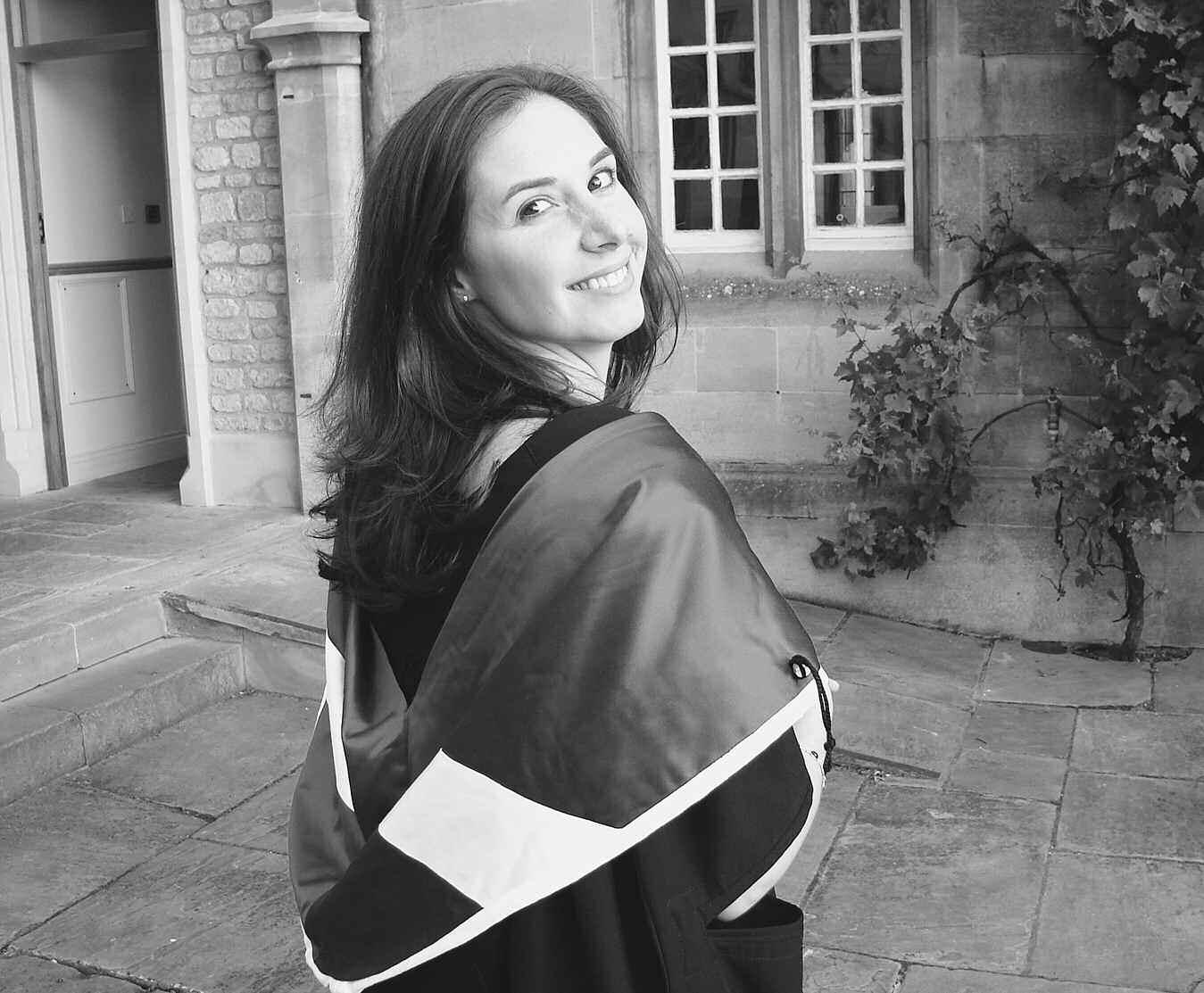
Alexa, at graduation.
Finally, I traveled to Stratford-upon-Avon twice. The first time I saw Henry IV, PART 1 at the Royal Shakespeare Company’s Courtyard theater. The second time I spent the entire day doing what felt like the Shakespeare home and garden tour. I visited Shakespeare’s birthplace, the homes of his relatives and the church where he was baptized and buried. It is difficult to avoid Shakespeare in Stratford, which can feel like a Shakespearean Disney World at times: the As You Like It café, Iago Jewelers, rentable rowboats named for female characters and bronze sculptures in the park, including Hamlet striking a contemplative pose.
Of course, the culminating event of the summer for me was my graduation.
Of course, the culminating event of the summer for me was my graduation. I was fortunate to have my mother, father and my maternal grandparents fly over to see me graduate. It was a beautiful ceremony in the college chapel, which has not been changed since the 1680s. The chapel organ accompanied our procession, and my professor gave an incredible speech on the importance of always pursuing more knowledge
—and of always knowing that there is a great deal we do not know. And although I would have felt the joy and relief of this accomplishment in any location, it was particularly special and memorable to graduate in Oxford. Newly bestowed with our blue master’s hoods, the graduates were allowed to walk on the quad grass (without shoes, of course) and were treated to a five-course meal in the college’s dining hall.
It was a summer of literary, architectural and natural beauty, and of feeling my place in the great continuum of time...
It was a summer of literary, architectural and natural beauty, and of feeling my place in the great continuum of time and all the people before me who have gone to Oxford to pursue their intellectual passions. I have many fresh ideas for teaching A Midsummer Night’s Dream and plan to use what I learned to give my students new and alternative ways in which to access the text. Although I saw an all-male punk rock production of The Taming of the Shrew, lived through the wettest July on record in Oxford and visited several locations used for the Harry Potter films, it
...it
was the magical quality of my time in Oxford that will stay with me.
was the magical quality of my time in Oxford that will stay with me. It is a sense of magic that cannot be explained, but I feel that Evelyn Waugh comes very close in his famous lines from Brideshead Revisted:
I was in search of love in those days and I went full of curiosity and the faint, unrecognized apprehension that, here at last, I should find that low door in the wall, which others, I knew, had found before me, which opened on an enclosed and enchanted garden, which was somewhere not overlooked by any window, in the heart of that grey city.
Integral Education: Exploring the Leading Edge of Educational Theory and Practice
by John Gruber
John Gruber currently serves as Chair of the Upper School Science Department. He is in his seventeenth year at Friends’ Central and has been teaching ninth grade Foundations of Science and twelfth grade Botany for the last several years. He is the parent of current students Hayden ’14 and Julien ’18.
In August, 2007, I had the opportunity to take part in the first seminar devoted entirely to integral education, a comprehensive approach to teaching and learning based on the integral framework elucidated by philosopher Ken Wilber(1). The seminar took place at the Whidbey Institute, a retreat center near Langley, Washington, on Whidbey Island. Before describing the seminar in more detail, I should first give a fuller account of the meaning of integral education and the common ground it shares in many ways with Friends education. Integral models work to be
Integral models work to be as inclusive as possible of all of the elements of human experience, integrating mind, body and spirit in both their individual and collective aspects.
as inclusive as possible of all of the elements of human experience, integrating mind, body and spirit in both their individual and collective aspects. Integral approaches are based on five major elements(2) that together account for both the breadth and depth of any endeavor, while giving considerable attention to awareness, consciousness and the many different perspectives that can be held at any moment.
(1) See, for example, Ken Wilber’s The Integral Vision: AVery Short Introduction to the Revolutionary Integral Approach to Life, God, the Universe, and Everything. Other Wilber books include ABrief History of Everything; Sex, Ecology and Spirituality; One Taste; Eye of Spirit; Quantum Questions; or his most recent text, Integral Spirituality—these give more background on the integral framework and underlying philosophy.
(2) The integral elements are often abbreviated as AQAL(ah-kwul), shorthand notation for “all quadrants, all levels, all lines, all states and all types.”
When describing integral education to anyone for the first time, I often ask a question to try to give some sense of the territory and the intentions of an integral approach: If you were to imagine the most complete, inspiring, effective and transformative approach that could ever be created to fully embrace human potential, one that would leave nothing out and engage every aspect of experience, what would it look like? How would it proceed as an educational approach? In its broadest context, integral education includes integral parenting, integral teaching, and integral learning in the full developmental span across all ages.
...integral education includes integral parenting, integral teaching, and integral learning in the full developmental span across all ages.
I have spent considerable time in the past three years working closely with a core team of educators developing a model of integral education in both theory and practice. Our work together takes place as part of the education branch of Next Step Integral, a Canadian non-profit organization dedicated to integral approaches in several different areas. Over these last few years, I have been involved in weekly conference calls and two core team retreats in 2005 and 2006 that took place in Colorado and British Columbia. After these many months of discussion, reading, writing and reflection, it was a particularly rewarding experience this year to help plan and present the first public seminar to focus specifically on integral approaches in education. I know well why I was drawn to integral education as an especially useful framework for my own teaching practice. For me, it was because the integral model works to leave nothing out; it includes all the different dimensions of what takes place in that incredible relationship between student, teacher and subject, between subjective and objective, between self and other. When asked, “What is the most important thing in the process of creating an exceptional educational experience?” my answer
What questions are allowed in the scope of inquiry? In the sciences, we commonly focus on truth: What is it like? How does it work? Why does it behave that way? As we expand the approach to embrace a more integral perspective, it is important that we not let go of those important questions and the models of inquiry that support them. But at the same time, we can begin to add on other questions that increase the depth and breadth of the knowing: How is this connected to other things? What makes this meaningful? Why is this important? How do the ideas and concepts inspire me? With these kinds of questions we add to investigations of truth those additional queries about what is good and what is beautiful.
has always been “Everything.” Everything counts, everything plays a part in the process. And the more we actively and deliberately pay attention to this when designing an educational framework, the more complete and whole the result will be.
“What is the most important thing in the process of creating an exceptional educational experience?” my answer has always been “Everything.”
I sometimes wonder where the next generation of inspiring teachers will come from and what will lead them into the field of education in an era that is full of social and environmental challenges, rapidly developing technologies and an unprecedented connection among individuals and organizations in a globally linked network of communication and information sharing. I was inspired to meet seminar participants from all over the world, from under twenty years old to over sixty, traveling to the Puget Sound to contribute to the development of a vision for integral education. People came from Mexico and Finland, from Japan and Australia, from Brazil and all across Canada as well as from all sections of the US, from California to New Jersey, Alaska to Texas, Florida to Pennsylvania. And everyone was inspired by the possibility inherent in education, as well as its central importance in meeting the challenges that we face as a human family in the next century and beyond.
With a full program and a very intentional focus on creating a close and connected community in the gathered group of seminar participants, it wasn’t long before the meeting evolved from a collection of newly introduced and thoughtful educators to a genuinely connected family of explorers, sharing deep inquiry into possible collaborations, different methods and approaches, ideas and experiences from various educational settings. We were supported in our work by the extraordinarily beautiful setting, with inspiring spaces for meeting, winding trails through an old
We were supported in our work by the extraordinarily beautiful setting ...
growth forest of Pacific Northwest cedar and spruce trees, cozy cabins for sleeping and an outstanding daily menu of local organic food that represented well the regional ecology in the different meals we shared.
The seminar program included experiential components as well as curricular presentations to develop ideas and understanding, put questions before the group, and create a context for envisioning the possibilities inherent in integral education. Clint Fuhs from Integral Institute in Boulder, Colorado, offered an opening dialogue on integral theory, outlining and exploring each of the major elements of the integral framework. Diane Musho Hamilton from the Kanzeon Zen Center in
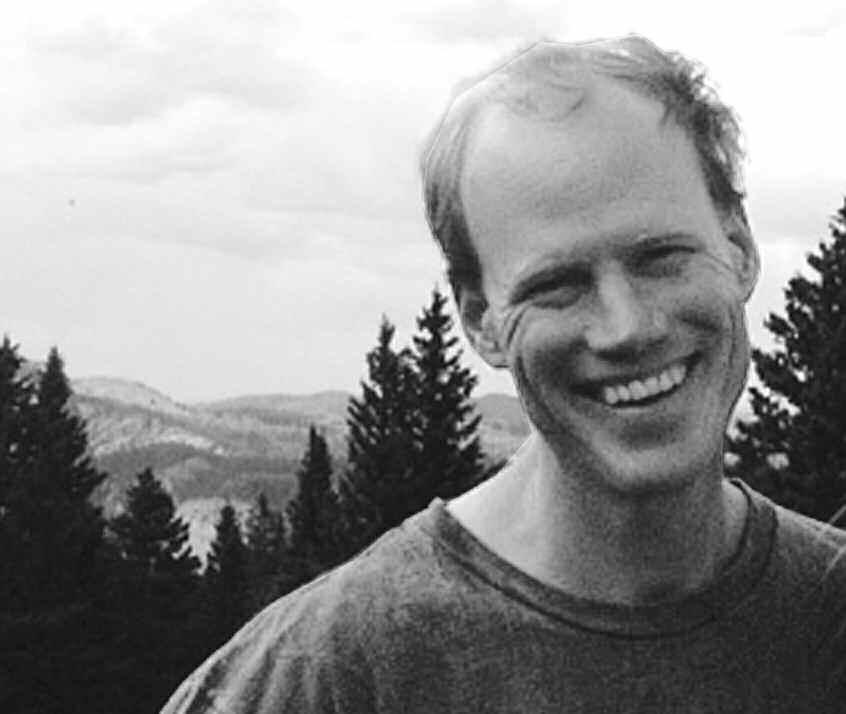
John
Utah led workshops on the first and second days, and provided a deeply meditative and reflective context for the work that followed. Diane offered a taste of the Big Mind process, a very focused practice developed by Genpo Roshi (Dennis Merzel) as a way of studying the nature of the self and experiencing directly the interior ground of quiet, centered insight. The following days included presentations on mature human growthand development captured in Suzanne Cook-Greuter’s leadership maturity framework, integral approaches to parenting in early childhood years, integral models of assessment, and many other aspects of an integral approach to teaching and learning. Avariety of case studies were also presented, and these offered helpful pictures of integrally informed approaches at work in different settings.
As both a participant and a faculty member, I had the enviable position of getting to take part in all the workshops and discussions, while also contributing a presentation of my own to the group, on awareness and connectedness for educators, examining the ways we can be attentive to all the different dimensions of what is taking place in our classrooms,
...I examined the nature of connectedness, both in terms of the interconnected nature of all subject matter, and the connectedness between our own awareness and the energy and exchange that can take place in a learning space.
in our presence, in our practice as teachers. At the same time, I examined the nature of connectedness, both in terms of the interconnected nature of all subject matter, and the connectedness between our own awareness and the energy and exchange that can take place in a learning space.
I used several examples from our Foundations class and from my own approach to our botany course to illustrate some of the ideas of connectedness in the design of an integral curriculum. For example, in our senior botany course, we spend considerable time investigating systematics and nomenclature, plant tissues and the biochemical pathways of photosynthesis. At the same time, we are deeply interested in the historical and ethical dimensions of preserving biological diversity, in the questions around values reflected in our choices of what we eat and how it is produced, and in the aesthetics and symbolism of garden design and landscape architecture. Taken as a more integral whole, this creates a course in plant sciences that is rich in both detail and meaning and has been a very satisfying experience for students and teacher for many years.
The seminar was a tremendous success. Feedback from participants was glowing and enthusiastic and reflected the ways that an integral approach works to include all the different elements of our experience as teachers and learners. Among the comments offered by participants in their written evaluations were remarks like these:
“I have never attended an event with so many gifted teachers…”
“I have never had an experience that attended to so many aspects of life like this did (of course, it's integral!)”
“There is a new wave of intelligence, excellence and illumination coming to the world of education. There is no better place to encounter it, contribute to it and meet its embodiment than the i-ED seminar.”
I was inspired by the seminar to continue to examine how the courses I teach could be as integrally informed as possible, how they might work to embody all of the different possibilities inherent in education. I was also reminded of how important it can be to approach our teaching as a personal practice, one that continually offers us opportunities to continue our own growth and evolution individually even as we work in dedicated service to the development of understanding and possibility in the communities where we teach.
Silence in the Teachable Moment
By Ed Marshall
Ed, a member of the Friends’Central Board of Trustees, attended Friends’Central from 1962-1965. After teaching for a number of years in Friends schools, (including teaching David Felsen’s children at Germantown Friends), Ed became the Head of Greene Street Friends School, where he is now in his thirteenth year. This talk, excerpted here, was given to the faculty at the opening of school in September 2007.
When Headmaster David Felsen asked me to speak with you today, I said “yes,” but, even with all my positive memories, I immediately remembered that the last time I had been in the headmaster’s office was under different circumstances: a long conversation with Merrill Bush (Headmaster 1952-70) about my behavior in music class. At this moment, my title as Board Member is counterbalancing a bit precariously with my worry that one or two of you in the audience may remember me from my student days!
My start at Friends’ Central began forty-five years ago, a breathtaking amount of time, particularly for a twelve-year-old. At that age, I could not think, even briefly about what I might be doing now, after the turn of the millennium. This avoidance of topic was connected with the decrepitude that I could see in the elderly FCS faculty, people perhaps in their thirties. My horizons were confined to whether I was running out of lunch money, my place in the social life of the class, and for the first time, whether I was achieving my academic and athletic goals. I had come from a small Friends school, but upon arriving at FCS, I found something
...but upon arriving at FCS, I found something new—expectations of what it meant to be an educated person.
new—expectations of what it meant to be an educated person. Among the twenty-five or so teachers, administrators and coaches I knew, there was a passion, a commitment expressed by all, one that centered around learning and achievement—the importance of effort and understanding for every assignment and for whatever material was put before me.
In the classroom at FCS, I learned that there was a difference between having a glib understanding of a subject versus wielding the tools needed to solve problems and arrive at new understandings. If the teachers had been a basketball team, I would describe their strategy as the full court press. And I was caught up in the tempo, getting to school at 7:20 A.M., taking five subjects, playing three sports a year, going home around 6 P.M. I loved it, and I thrived. Although I was neither the top scholar nor the best athlete, I was caught by the adults’ passions for their subjects. I date my own intellectual industriousness and practicing for accomplishment to my years at Friends’ Central.
I’d like to offer some thoughts on silence this morning, since our relationship with it is one of the characteristics of Quaker education, one that sets us apart from other schools. At Friends schools, we tend to think of silence as meditation, chiefly practiced in Meeting for Worship. I want to tell two stories of silence that are a little outside of the box, outside of Meeting for Worship practice.
...two stories of silencethat are...outside of Meeting for Worship practice.
The first story is set in Haverford, on a fine snowy day in January, and the cast is composed of a legendary Friends School Haverford science teacher, Mr. Joseph Cadbury, in about his thirtieth year of teaching and ten sixth grade boys, whom he has taken on a nature walk through the Haverford College campus. There is a fine arboretum, with woods, a stream and a pond…and lots of opportunity for mischief. It was the only time and place where a student could run in a given direction, without stopping, for several minutes. And we tended to do a lot of that that afternoon.
On that particularly wintry day, we hurtled down the path toward the College. As we crossed the iron bridge over Railroad Avenue, one of us decided to test Newton’s Second Law of motion by dropping a large cake of snow onto the road below. True to the limited perspective of twelve-year-old boys, he had neglected to look in both directions before dropping the snow onto the road below. There was a sound of a muffled blow as the snow impacted the hood of a large car under the bridge. The driver slammed on the brakes and skidded to a stop. Knowing the level of moral awareness of sixth grade boys in a group, it will not come as a
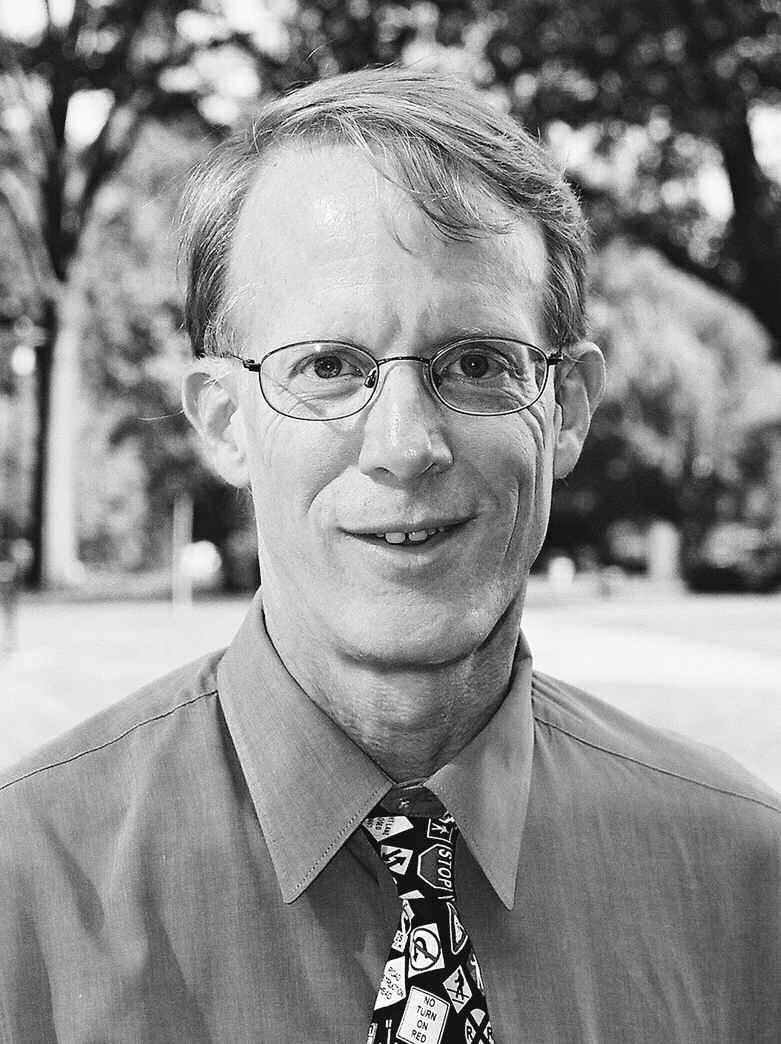
Ed
surprise to educators that some of us began the preliminaries of escape. But Mr. Cadbury held up his hand and wordlessly led us back to the bridge. The driver, a large and angry man shouted at us, as he inspected the hood of his car. We were very glad that he was down on the road, and we were up on the bridge.
Mr. Cadbury held up his hand and wordlessly led us back to the bridge.
Mr. Cadbury asked him if we had damaged the car. The man ran his hand over the hood, which appeared to be undamaged. With great sincerity and with his wisest and most pedagogical of voices, Mr. Cadbury apologized to the man on our behalf. With a final epithet, the driver got back in his car and drove slowly away. And there we stood, stunned twelveyear-olds, frightened by the foolishness of our own making. We looked at Mr. Cadbury. He stood there in complete silence for what seemed like an hour. Finally, he looked obliquely in the direction of the bombardier, and with his wisest voice, said, “I think that man didn’t like that.” There was no berating, and there was no snow thrown on the way back to school. Thirty years later, when I recalled this story with our class president, he revealed to me that it was he who had dropped the snow, and we shared how the experience of Mr. Cadbury’s total silence had affected us.
...the experience of Mr. Cadbury’s total silence had affected us.
The second story of silence began in Ann Whitcraft’s classroom, above the headmaster ’s office. Miss Whitcraft, my eighth grade English teacher, expected a few relatively simple tasks from us: bring our books and homework to class! She used a vocabulary text that is well known to FCS alumni of that era: Word Wealth. Early in the school year, when Miss Whitcraft quizzed me for perhaps the third time about why I kept forgetting my copy of Word Wealth, I lamely said I couldn’t find it, which was at best technically true. Miss Whitcraft was one of the few people besides my grandmother who used my full name when speaking to me. “Edward,” she said, or rather whispered, because she always spoke in a high whisper “Edward, come with me.”
“Edward, come with me.”
Now my homeroom desk was in the old junior high building (gone now), a considerable distance across campus from the second floor of the Wood Building where our class was meeting. (In retrospect, I’m amazed that Miss Whitcraft left her class to pursue this teachable moment with 20
me, but this was clearly part of her brilliance.) With me in tow, she raced silently across the campus and through the door of my homeroom where Mr. Richard Burgess was teaching English to older students. Her only words were, “Where is your desk?” I showed her, and she went right to it, got down on her knees and began to pull out all of my disorganized clutter, until finally she reached the very back, where her hand grasped— my copy of Word Wealth. To make the moment teachable for the whole room, Miss Whitcraft pulled the book out and held it up before me, Mr. Burgess and the Upper School men and women. There was silence. Miss Whitcraft wordlessly led me back to class, and she went right back to the vocabulary lesson. The full-court press. I’m a little better at remembering things now, and much better at not making lame excuses. In any event, silence is not always passive.
...silence is not always passive.
Thank you, David, for inviting me to return to share these thoughts with you. And faculty and staff, know that the skills and insights you give students have effects and leave grateful memories that linger and strengthen us long after we and you are no longer in your classes. Indeed this is the very best kind of immortality.
Un Reencuentro
con Chile (AReturn to Chile)
By Emily Pryor
Emily began teaching Spanish in the Middle School last year and was awarded a Clayton Farraday summer stipend to travel to Chile where she had been a guest student during her high school and college years.
The rush at the end of school in June sent me literally flying off to the “end of the world,” the long and narrow country I call my second home: Chile. I call it my second home because I lived there for two different periods, first with the American Field Services program when I was seventeen, and the other, when I was a student at Earlham College. When we began our descent onto the tarmac, with the snow capped Andes mountains in view, my mind began to turn to how my mouth would produce the words to communicate with Chileans, who speak Spanish. Their accent is unique, with the s’s asperated, the ends of the words dropped off, and the d’s overlooked. They speak at a fast pace, with many chileanísmos...words that are commonly used in colloquial speech in Chile, but nowhere else in South America. Avery different experience than classroom Spanish, let me tell you!
I get a funny feeling every time I arrive in Chile. Each encounter is vivid, and I am fully present in every activity...
I get a funny feeling every time I arrive in Chile. Each encounter is vivid, and I am fully present in every activity I involve myself in. Everything in Chile fascinates me: the people, who never cease to amaze me with their hospitality and concern for my wellbeing; the centuries old traditions that are undying and vibrant in every day culture; and the superstitious beliefs that were once so prominent, but with the generations changing, the stories start, “I remember your grandmother, on New Year’s...”
Arriving this June, things had changed: I was no longer a student who was staying for an extended period. I carried with me the title of teacher, one who would explore the nooks and crannies of the country so that I
could return to my students with vivid stories and pictures. I was not used to being a tourist in a place which always had been my second home!
From the airport, where I had taken a moment to put on my layers of fleece, (it was winter), I took a “transfer” to my Chilean sister’s apartment, where I was greeted with breakfast on the table and two welcome cards from each of my twin sisters, Bárbara and Constanza, twenty-twoyears old. Each has a year to go before graduating from university, Bárbara as a dentist and Constanza as an elementary school teacher. It had been three years since we had seen each other, but time is irrelevant for sisters of the heart! We constantly laugh and disagree all the time, but at the end of the day, we feel blessed to call one another family. We had many good conversations catching up on our lives, discussing the current affairs of Chile and the US, and remembering old times when I was an exchange student, and we all wore uniforms to high school. I told them stories of my life, and they corrected my grammar. They told me stories of their lives, and I wish that so many miles did not separate us so that I could be more present in their lives.
After a brief stay in Santiago with my sisters, I boarded a bus that took me to the principal port city, Valparaiso, the Pacific’s jewel and the city of interminable stairs, hills and elevators. Valpo is where I spent my year abroad in college. My face was glued to the window of the bus as we
Valpo is where I spent my year abroad in college.
drove down Avenida Argentina, the main thoroughfare. Familiar streets, familiar places, familiar faces?! I sat in the park for a moment to allow myself to sink into the reality that I had returned to “old stomping grounds.” Old men sat on the bench together and watched the young hustle on by. Vendors pushed grocery carts laden with hot coffee or tea, and municipal workers swept the trash under our feet. Trollies and micros passed by; people got on and off carrying briefcases or canvas bags filled with purchases from the market.
From the park I made my way to the largest hill, Playa Ancha, where my host family from college lived. Welcome hugs awaited me, and my host mom and I sat on the couch, drinking tea and catching up on the past three years. The next several days were spent walking around the city, up and down hills, in and out of stores, eating fresh bread, surprising old friends who are still working in the same places and just allowing myself time to remember being there.
During my stay, I went salsa dancing four days a week, and I had several tango lessons with a friend who is known in Valpo as the “tango guru.” I went to numerous Cueca festivals and re-learned how to dance so as to teach my students here at FCS. Cueca is the Chilean national dance and is danced with a partner, forming various formations such as half and full circles and figure eights. It includes much coquetry, smiling
and stomping of the feet. Traditionally children grow up performing this dance for special school occasions and for Chile’s Independence day. La Cueca, for the majority of Chileans, holds a special symbolism that links them all to a shared cultural identity.
La Cueca, for the majority of Chileans, holds a special symbolism that links them all to a shared cultural identity.
Another stop was the bread store, la Panadería, where I interned for five months. Chile is the third largest bread-consuming country in the world. Bread making is considered an artist’s trade, and those who desire to become bread bakers study under a master. I studied under the best of the best, José Moya, a quiet, sweet man who shared stories with me, who invited me to have Sunday dinner with his family and who always stuffed my backpack full of hot bread at the end of each day. Crossing my fingers that he would still be working at the same place, I entered la Panadería and asked if José still worked there.
The vendors looked quizzically at me and sent someone to the back to get him. From under the bread baskets, I saw his floury powdered shoes walk out to greet me. He invited me to come to the back where the long wooden counter stood, and the large wood-fed oven heated the place. Wicker baskets waited to be filled with piping hot bread, and 100pound flour bags were stacked high. José handed me the long, wooden, flat stick that you slide into the oven to remove all the bread pans. I found out that I hadn’t lost my touch, and the pans came out one by one, filling the bread baskets. Before I left, I was invited to share lunch with his family the next weekend.
The following Sunday, I was welcomed into José’s house where his family and I sat down to a threecourse meal and shared story after story.
The following Sunday, I was welcomed into José’s house where his family and I sat down to a three-course meal and shared story after story. The topics varied, but mainly they were about the old traditions and superstitions that used to be so prominent in Chile. On New Year’s, for example, one would pack up a suitcase and walk around the house for a year of good travel; if one is married, one would take off the wedding ring and place it in a full cup of whatever was being drunk. The drink would be consumed, and the wedding ring would go back on, for good luck in marriage. Alock of hair was cut for good hair growth. Another night of superstitions is La Noche de San Juan, the longest night of the year Some people would place three potatoes underneath their bed, one completely peeled, one partly peeled and one with its skin still on.
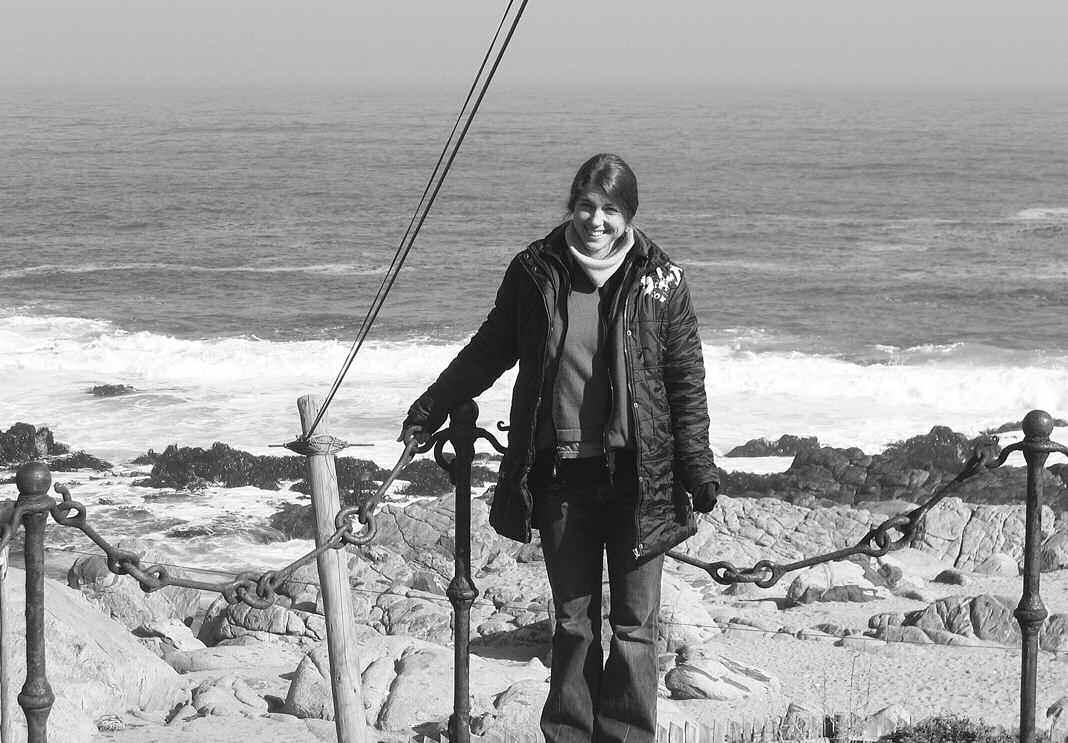
Emily, visiting Pablo Neruda’s home on the Pacific coast.
Whichever potato was pulled out the next morning dictated the luck for the next year. José’s family’s hospitality overwhelmed me, as the stories continued until Ileft at dusk. Yet again, they filled me with so much love for Chileans and their care and concern for others.
Avisit to the house of 1971 Nobel prize winner, Pablo Neruda, refreshed me with the mix of tales told of his quirky whims and his love of Chile. This particular house, la Isla Negra, is located right on the Pacific shore, as Neruda found it most advantageous for the writing of his poetry to have a view of the ocean. For the love of the sea and Chile, his house is built with small doorways and creaky floor boards to give the effect of being on a boat, and he designed the structure of the house to be long and narrow, just like Chile.
...[Neruda] designed the structure of the house to be long and narrow, just like Chile.
Neruda’s house is filled with collections from all over the world, including, but certainly not limited to, large beetles, ships’ figureheads and china sets. It is very clear that Neruda wanted to be the captain of his own boat. Ironically enough, the only time he was ever in a boat, he hated it. He, in fact, said it was better to be dizzied by alcohol than to be seasick! Towards the end of the month, it was time to head south to Llanquihue, a small town near Puerto Montt, where my high school host
family had recently moved. By this time I was traveling with a dear friend from college, and we both boarded the fourteen-hour bus trip with liters of water and provisions. My Papá was waiting for us at the bus station. He whisked us away to their house that overlooks Llanquihue Lake and has a view of five volcanoes. I was home!
The next two weeks were filled with catching up on stories from the past three years, visits to my Mamá and youngest sister’s school, visits to nearby cities to take pictures and eat fresh seafood and a spectacular hike up a snow-capped volcano. At home, my little sister and I played cards and board games; I learned new Chilean dances; my Mamá taught me new songs on the guitar, and we shared hours of conversation and laughter after meals, still sitting at the table in our pajamas.
I
feel incredibly blessed to have had the opportunity to return to a place where I love and am loved by so many people...
I feel incredibly blessed to have had the opportunity to return to a place where I love and am loved by so many people, and to have had the opportunity to polish up my Spanish and my knowledge of Chilean culture. I returned to FCS, brimming with the excitement of travel and new experiences to share with my students. Muchísimas gracias!
Telling Tough Truths: Our Middle School Surveys its Students about Bullying—and Responds
By Juliet Sternberg
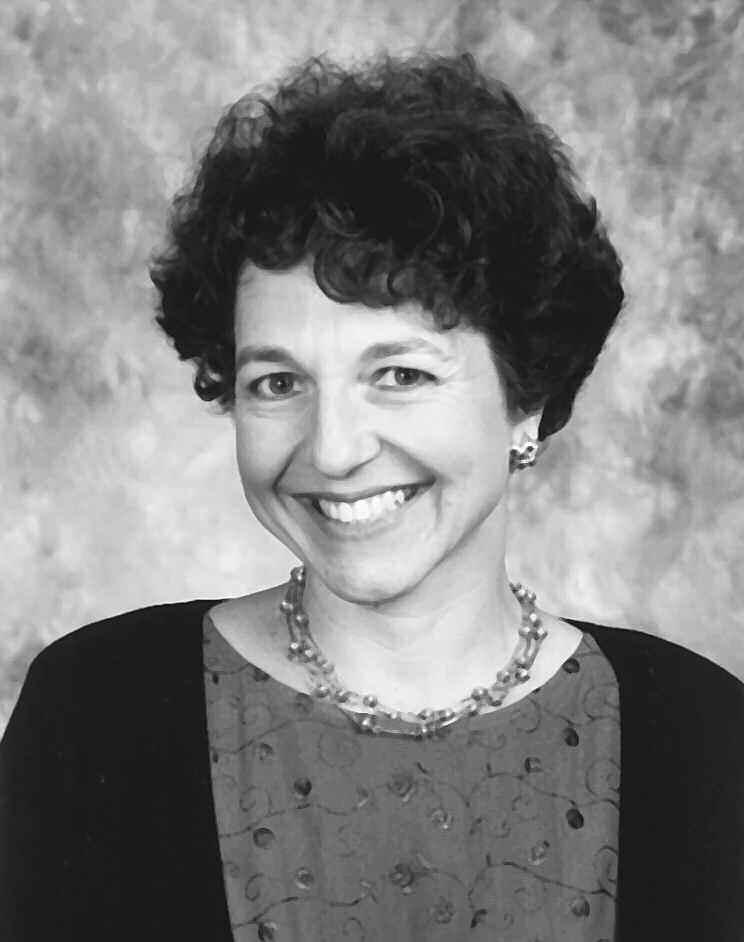
Juliet Sternberg is a clinical and school psychologist who has been consulting at FCSMiddle and Upper Schools for four years.
[A more detailed discussion of this work, including a list of references to the empirical and theoretical literature in which it’s rooted, will appear in the Summer 2008 issue of National Association of Independent Schools’ magazine Independent School.]
THE LARGER CONTEXT
· Middle School Hardships
When I give talks to the parents of Middle School children, I often share with them a section of Operating Instructions, Anne Lamott’s funny, poignant memoir of her first year of parenthood. In it, she writes about the fears she faced as she contemplated the prospect of raising a child. She recounts her desperate worry that the baby might not emerge from her belly physically intact; the frightening thought that she would run out of the money she needed to raise him; and her terror envisioning him later on, riding in fast cars full of teenagers. However, worse than all her other fears, she writes, was the “agonizing issue of how on earth anyone can bring a child into this world knowing full well that he or she is eventually going to have to go through the seventh and eighth grades.” No period in her own life, she explains, involved more “meanness, chaos… hurt and aloneness.” (pp. 10-11)
The years of pre-adolescence and early adolescence are full of challenges.
The years of pre-adolescence and early adolescence are full of challenges. There is the virtual impossibility of making peace with a body that is in intense physical, hormonal and cognitive flux. There is the emotional vulnerability that comes from wanting so desperately to feel
competent and to belong. And there is the start of that complicated task of figuring out who one is as a budding adult, amidst a culture that sends a muddled mix of messages about manhood and womanhood, ethnicity, race and sexuality.
Some of the hardship of the middle school years, however, is due to the uncanny capacity of youngsters this age to act in ways that can make each others’ lives a misery. “Bullying” —the use of words or actions to intentionally hurt others—peaks and occurs in epidemic proportions during youngsters’ middle school years. Recent multi-school research in the U.S. and abroad found that during a single school term, three out of four middle school students had been bullied and half of all students had bullied others. In the Kaiser Family Foundation’s nationwide survey of youngsters in 2001, 55% of 8-11 year olds and 68% of 12-15 year olds reported that bullying is a “big problem” at their school.
Recent multi-school research in the U.S. and abroad found that during a single school term, three out of four middle school students had been bullied and half of all students had bullied others.
At Friends’ Central Middle School, the past year has been a time of increased reflection by faculty, staff and administrators on the ways in which bullying touches our students’ lives. What follows is an overview of our current thinking and practice as we strive to understand and address these troublesome behaviors in a way that weaves together our community's wisdom with the teachings of the latest scholarship.
· ASocietal
Change in Understanding and Approach
“Bullying” (also known as “relational aggression”) is no longer a term reserved for the most egregious instances of social cruelty. It is an entire continuum—ranging from mild to extreme—of behavior intended to injure another, either physically or emotionally. Whether the meanness occurs repeatedly or only once, directly (to a person) or indirectly (about a person), the most recent literature regards it as bullying.
In the era when we were junior high school students, we likely dealt with these trying situations with little adult guidance. Many grown-ups
Juliet
viewed it as an unfortunate rite of passage best left for young people to work out on their own. In contrast, social scientists, clinicians, and a growing number of educators now strongly advocate adult involvement.
...social scientists, clinicians, and a growing number of educators now strongly advocate adult involvement.
When instances of relational aggression are actively addressed by school communities, they can be transformed from anxiety-provoking hardships into opportunities to build students’ social and emotional intelligence and capacity for responsible citizenship. Furthermore, when students learn better strategies for managing social dilemmas, not only does less bullying take place, but there is also growth in students’ overall psychological resilience and wellbeing. As a result, youngsters have more inner resources to devote to academic tasks. With this knowledge in hand, the U.S. Department of Health and Human Services launched a multiyear, national public awareness campaign to promote anti-bullying efforts in schools in 2003.
· Our Longstanding Efforts to Create a Humane Community
As a Quaker Middle School, we have always considered it part of our mission to maintain a supportive learning environment and to nourish students’ capacities for moral thinking, compassion and mutual respect.
...we have always considered it part of our mission to maintain a supportive learning environment and to nourish students’ capacities for moral thinking, compassion and mutual respect.
Practices designed to eliminate words or actions that violate the rights of others and curricula that promote empathy, respect for differences, and non-violent conflict resolution have been an easy fit for us. Our teachers’ most explicit work on these issues has occurred in a variety of contexts including Life Skills and Quakerism classes; relevant queries during Meetings for Worship; discussions of ethics and justice issues in social studies and literature courses; cooperative learning experiences in all subject areas; facilitation of interpersonal feedback groups; off-campus service projects; and thoughtful individual and small group conversations with faculty, parents and administrators when disrespectful behavior occurs. As far back as our collective memory takes us, we have been working steadily to build as humane a community as possible.
THE RATIONALE FOR OUR SURVEY
As part of this enduring commitment, in December 2006, we developed and administered an anonymous computer-based survey to our Middle School students to learn more about their experiences with relational aggression. Since much of the bullying that occurs among young people goes undetected by teachers and parents, we hoped to understand
...much of the bullying that occurs among young people goes undetected by teachers and parents...
more fully the nature and extent of such behavior in their lives. As we explained to the students at the time, their keen observations and their wisdom —the “expertise” they have developed through living and learning together day in and day out—are essential for adults to hear to be of help. With added insight from the students, we hoped to be able to tailor our prevention and intervention efforts more specifically. Furthermore, we expected that the process of answering the survey questions, in and of itself, would have a positive impact: It would raise student consciousness about these troublesome behaviors and open up lines of communication between teachers and students.
... the survey...would raise student consciousness about these troublesome behaviors and open up lines of communication between teachers and students.
When students took the survey, they were given a definition of bullying and its various forms and asked about their experiences while at our Middle School—being bullied, witnessing others being bullied and participating in bullying behavior. They were asked where, when and what happened; what, if anything, they did to intervene; and whether adults were asked for help. The survey also assessed students’ overall feeling of safety at school, the extent to which they view bullying at school as a problem and their ideas about how to best respond.
RESULTS OF THE SURVEY
· ATopic That Matters
Thanks to parents’ resounding willingness to permit their sons and daughters to take part, as well as our efforts to be as inclusive as possible, we obtained a 99% participation rate across all grades (5th –8th). As we analyzed the results, we were struck by students’ eagerness to share their struggles, hopes and opinions about this sensitive topic, and by their dili-
gence in addressing the questions put before them. This thoughtful, forthcoming response suggested that bullying is of great import to them, and that they are ready to trust us to help them with these tough
...we have been inspired to fashion an even more intentional approach to our work on this issue.
situations. Feeling privileged and equipped by this deeper understanding of our students, we have been inspired to fashion an even more intentional approach to our work on this issue.
· An Overview of Bullying at Our School
Although our students face far less bullying than is typical in the literature, we were humbled by its frequency in our students’ lives. While in Middle School, two out of three of our students have been bullied, almost all have witnessed some form of relational aggression, and, by the middle of 8th grade, about half have bullied another student. Moreover,
While in Middle School, two out of three of our students have been bullied, almost all have witnessed some form of relational aggression, and, by the middle of 8th grade, about half have bullied another student.
these instances are not infrequent. Within the month before we did our survey, one out of every two students had received some form of bullying. As is true in the most recent large-scale studies, our results challenge the notion that youngsters can be rigidly categorized as bullies, bystanders or victims.
· Types of Bullying Among Our Students
Consistent with recent large studies of middle school students in the U.S. and abroad, our survey indicated that most of the “meanness” in our students’ lives is embodied in words spoken and heard. Sadly, degrading
... most of the “meanness” in our students’ lives is embodied in words spoken and heard.
and hurtful remarks such as “stupid midget—get a life,” “fat cow—moo, moo,” “fag-bag, crying to your mommy,” and “dumb ho,” are hurled into the air many of our students breathe: 80% reported having witnessed such verbal bullying; 57% reported having received it; and 31% acknowledged that they themselves have bullied another child with words.
The second most common forms of bullying reported by our students were physical and emotional. Approximately one third of our students said that they have been physically bullied (e.g. shoved, poked, slapped, kicked, tripped), and one third reported that they have been
The second most common forms of bullying reported by our students were physical and emotional.
emotionally bullied (e.g. overtly excluded from a lunch table; taunted by the public disclosure of a secret crush; ranked/rated according to perceived characteristics such as “hotness” or “weirdness”). Whereas 9% of our 5th graders acknowledged having physically bullied someone during Middle School, that fraction doubled by 8th grade. Across all grade levels, twice as many boys as girls reported physically bullying another student.
We found that the experience of being cyber bullied is rare in our younger students’ lives (affecting only 5% of 5th graders) but becomes more common with each grade of middle school (ultimately affecting 21% of 8th graders). However, despite all the media attention it has received, only 2-3% of our Middle School’s student body said that they have used electronic media to bully another person (e.g. sent nasty or threatening text messages or email, or posted disparaging rumors on websites). Two to three times more girls than boys reported involvement. These differences across gender and age may reflect the finding that girls and adolescents make greater use of the Internet and cell phones for all kinds of communication.
Finally, of the five forms that bullying can take, sexual bullying was the least common in our Middle School. Rates of having received unwanted sexual comments, gestures or touching ranged from 1% (5th graders) to 14% (8th graders). With all grades included, only 1-2% of all of our students stated that they have sexually bullied another person.
OUR RESPONSE TO THE FINDINGS
· Adopting a “Best Practices” Approach
Despite the tendency for bullying to occur at high rates during the middle school years, our teachers and administrators have been energized by the convincing evidence that anti-bullying efforts can be effective
...anti-bullying efforts can be effective.
Since our data became available, faculty have been apprised of the current “best practices” for school-based bullying prevention and intervention and are in the process of weaving together the various strands of such a
sustained, multilevel, division-wide approach. In the messages we send to our students, we are consistently conveying the idea that relational aggression is not okay, is not just “kids being kids,” and is worthy of concerted effort towards change.
· Empowering Bystanders to Act
Our survey revealed that being a “bystander” (rather than bullying or being bullied) is the most frequent way that relational aggression touches our students’ lives. This situation is not unique to our School and helps us understand why the most successful anti-bullying programs are those that acknowledge the dilemmas faced by bystanders and empower bystanders to take action.
With this in mind, it is extremely encouraging to us that more than half of our students reported that when they have seen bullying they have been able to help it stop. Furthermore, when asked what they have
...more than half of
our
students reported that when they have seen bullying they have been able to help it stop.
done to lend a hand, our students articulated many sound strategies: telling the person who is bullying to stop; asking a teacher for help; countering the bullying remarks; affirming the person being bullied; stating that the bullying behavior is not right; and refusing to join in the behavior. Our goal is to enlarge even further the number of our students who feel empowered to help and to equip them with a variety of strategies they can call upon in such situations.
· Supervising “Hot Spots” and Embedding Anti-Bullying Themes Throughout the Curricula
Our survey identified that while on campus, students feel most susceptible to being bullied in the hallways, locker rooms, cafeteria and playground. Because adult oversight reduces bullying, our faculty, administrators and staff have immediately increased their presence in these locations.
However, our long term goal is for students to develop behavioral ethics and competencies that will lead them to treat each other better
...teachers have been coordinating approaches to intervention ...
even in the absence of adults. Therefore, teachers have been coordinating approaches to intervention and developing concrete, specific plans to expand the presence of anti-bullying lessons and themes across subject areas.
· Recognizing Appropriate and Inappropriate Behavior
Through an increased number of focused discussions with our students, we are enhancing clarity and publicity about which behaviors are unacceptable and instituting consequences when infractions occur. We are also working harder to encourage prosocial alternatives, for example standing up for a classmate who is being teased, inviting an isolated peer to join in an activity, expressing one’s feelings in a respectful manner, and demonstrating honesty, accountability and empathy in the face of one's own interpersonal mistakes and missteps.
· Helping Students Speak Out
Our survey informed us that, when faced with disrespectful behavior, our younger students are much more inclined than our older students to involve adults. Yet we know that students’ reluctance to tell grown-ups about troubling incidents they observe is one of the biggest
...students’reluctance to tell grown-ups about troubling incidents they observe is one of the biggest hurdles schools face in working to improve children’s relations with one another.
hurdles schools face in working to improve children’s relations with one another. To this end, we are helping students distinguish between “ratting” on a peer (where the goal is to get another in trouble), and “reporting” (where the goal is to protect oneself or others), and we are encouraging the latter. Furthermore, we are trying to create a climate in which taking courageous steps on behalf of oneself or one’s peers is rewarded and valued. In other words, we want it not to be just “okay to tell” but “a responsibility to tell.” While we appreciate older students’ drive to cope with problems more independently, we convey that speaking out to adults about bullying is not childlike, but mature, and a component of the “Concern for Community” that we strive to foster. Whatever their age, students are told that all instances of bullying that
... students are told that all instances of bullying that are brought to the School’s attention will be taken seriously and investigated thoughtfully.
are brought to the School’s attention will be taken seriously and investigated thoughtfully. In our work with those youngsters who come forward, we do what we can to take into account any fear or reluctance they might experience and to protect their confidentiality when needed.
· Understanding Service and Activism as Antidotes to Bullying
Recent scholarship examining relational aggression among girls suggests that young people who are standing together to address societal ills and injustices are less likely to mistreat one another. The theory is that much bullying is, at root, a maladaptive way of coping with larger societal pressures and oppressive expectations and practices. For example, when youngsters police each other’s appearance and behavior, they are displacing onto peers their own anxieties and frustrations about navigating the cultural dictates that bombard them, such as unattainable physical ideals and/or narrow definitions of girlhood and boyhood. Therefore, if students can become more aware of the challenges they and others share in contending with these forces, they are able to join together in addressing them, rather than targeting one another. Again, this work
...this work meshes comfortably with our existing Quaker educational practices...
meshes comfortably with our existing Quaker educational practices, in which students are encouraged to think critically, to learn about the impact their group memberships and identities have on their experiences, attitudes and degree of privilege; and to work collaboratively for social justice in the world at large.
· Working Towards a Culture Where Kindness is “Cool”
What’s the difference between getting to choose your friends and excluding people? Is teasing okay if it’s done to fool around? What do I do if I see someone being bullied but I’m scared too? If I report something I see to a teacher, how do I know it won’t make the situation worse? How can I be a part of a group if I don’t like doing what the other kids are doing? These are some of the fabulous questions that our girls and boys have been raising and grappling with in our recent discussions. We find that most students are eager to reflect
Partnering with Parents
The most effective anti-bullying programs engageparents as collaborators. To this end, we shared our survey results and framework for action with all current middle school families. We also asked parents to help in the following ways:
· Keep us informed.
· Serve as a “consultant” to your child around his/her social challenges.
· Model the interpersonal behaviors you would like your child to exhibit.
· Convey the importance of treating others with respect and dignity.
· Reach out for help when you need it.
upon their own social behavior, relieved to hear that they are not the only ones struggling and grateful to learn some ways of taking action safely. All in all, the results of our recent survey have guided us to renew our commitment and refresh our practices as we strive to create a community where all forms of social cruelty are unacceptable. While we are very aware that some young people use repeated instances of bullying to create and maintain social power and status, we know that many of our students feel pulled into mean behavior because their strong desire to “fit in” at a given moment wins out over their deep knowledge that such behavior is unkind. Those schools that take a strong, explicit and consistent stand against bullying empower children facing these internal
Those schools that take a strong, explicit and consistent stand against bullying empower children facing these internal dilemmas to choose acts of kindness rather than meanness.
dilemmas to choose acts of kindness rather than meanness. When we have created a school culture in which bullying is “uncool” and actions that help to prevent and lessen bullying behaviors are “cool,” we will feel our efforts have been successful.
F R I E N D S ’ C E N T R A L S C H O O L 1 1 0 1 C i t y A v e n u e W y n n e w o o d , P A 1 9 0 9 6 N O N P R O F I T O R G U . S . P O S T A G E P A I D P H I L A D E L P H I A , P A P E R M I T N O . 6 7 0 2