FORUM
Table of Contents
Editor: Marilyn Lager, Director, Friends’ Central’s Blackburn Library
Email: mlager@friendscentral.org
Assistant to the Editor: Deborah Fedder ’79, Middle School English Teacher

Editor: Marilyn Lager, Director, Friends’ Central’s Blackburn Library
Email: mlager@friendscentral.org
Assistant to the Editor: Deborah Fedder ’79, Middle School English Teacher
Forum is our community’s educational journal. Faculty, alumni, board members, parents and students are encouraged to contribute opinions, ideas, innovations and observations about any aspect of their lives relating to educational experiences.
Marilyn Lager Editor, Forum

(We welcome letters and comments and will print them when there is space in future issues.)
Dear Marilyn Lager,
Thanks so much for keeping me on the mailing list of Forum. Although I haven’t taught at Friends’ Central for fourteen (yikes!) years, I have fond memories of the wonderful people whom I met. It is fascinating to read their stories and learn more about them— so many gifted writers! FCS holds a special place in my heart, and I appreciate being reminded why through your publication.
Gratefully, Anne (Shillingford) Mackin Former kindergarten teacher
Dear Marilyn Lager,
I am writing in response to the last issue of Forum, which is one of the most meaningful and thoughtful issues that I can remember. I greatly enjoyed For Clayton L. Farraday, hearing points of view about him that were so special and private. I also learned new things about Joe Ludwig and his work at Lower School. In addition, I was reminded about the courage and convictions the teachers at Friends’ Central have, as I read about Maureen Sullivan’s sabbatical during the fall of 2004. As a bike tour coordinator and a participant in the American Cancer Society’s Bike-a-thon, I really understand the feat she accomplished under challenging circumstances.
I am also writing to inform you about an error in the article about Mr. Ludwig. It is mentioned that Joey Pozzuolo was a graduate of the Class of 1999. In fact, Joey was part of the Class of 1998.
Thank you again for continuing to publish Forum, and I can’t wait for the next issue.
Sincerely,
Jeffrey Brody ’98
Bob Emory, who retired after almost thirty-five years of teaching woodshop, photography and theater design to FCS students, was the commencement speaker for the class of 2005 this past June. His picture and notes about his long tenure appeared in the Fall issue of Directions, rather than, as is tradition, in Forum.
By Dan Crowley
Dan has been teaching at FCS for fourteen years, first math to Middle Schoolers, then computer technology to Upper Schoolers. He is currently head of the technology department. This talk was delivered to the faculty and staff at the September opening dinner.
This is my fourteenth “Back to School” dinner. While preparing this speech, I reflected on the thirteen other evenings and the speeches that were delivered by my colleagues. Many contained inspiring stories of community service or exotic tales of world travel. So I am clearly feeling some pressure to validate my time off. But as I set down this morning to prepare my speech and summarize what I had done, it felt eerily like I was writing a Seinfeld episode.
Was this truly the sabbatical about nothing??
Too often I (and I suppose this is true of us all) spend too much time thinking about the past and worrying about the future and forget to live in the present. (I have always marveled at my colleague Middle School science teacher Doug Ross, and his ability to live his life in the moment.) During my sabbatical, I made a commitment to live a quieter life, to turn down the voice inside of me that is constantly looking to analyze what
During my sabbatical, I made a commitment to live a quieter life, to turn down the voice inside of me that is constantly looking to analyze what has already happened or preparing for what might lie ahead.
has already happened or preparing for what might lie ahead. My sabbatical was an opportunity to hit the pause button in a world that seems to be stuck in fast forward. I intentionally did not plan out a detailed schedule: no to do list, no meetings to attend, no work to be graded, no phone calls to be made. This was an official time-out. Achance to step back, see where I’ve been, where I want to go. To gain perspective. I did not mislead the committee—not intentionally anyway. I have checked my proposal, and I did indeed complete the items that I had listed.
1. Visit area schools: Check
I did use some of my time away from FCS to visit other private schools. Specifically, I looked at their use of technology in the classrooms. I am pleased to report that FCS is leading the way when it comes to technology integration. This is no surprise: FCS teachers have always searched for new and better ways to educate students. For example, our teachers use individual web pages with links to class work, homework, texts and additional web based resources. While I had hoped that these visits would supply some innovative ideas that had somehow eluded us, more often than not, it was the school that I was visiting that benefited most from the exchange of ideas.
2. Take graduate classes: Check
I took two more graduate classes, making me twelve credits shy of my Master’s degree in Educational Technology at Penn State’s Great Valley Campus. My classmates were in awe whenever I described the technologies that are available at FCS and how the teachers are making use of them: LCD projectors in every classroom, document cameras, a
...I
usually found myself in the role of a teacher...
gigabit speed network and customized Intranet with home pages and folders for every class. While I did occasionally learn from the other students and the professors, I usually found myself in the role of teacher there as well.
3. Play Golf: Check.
Yes, it was listed on my proposal. I almost removed it this year, thinking that it might have been the reason for my previous proposals being rejected, but knowing our headmaster David Felsen’s predilection for the royal and ancient sport, it may well have been the strongest component of my proposal.
But how did my time off compare to sabbaticals past? I am not sure that they can or even should be ranked in this manner. But when I am asked, “How was your sabbatical?,” the question is rather easily answered. In fact, the only difficulty is finding just the right superlative. I actually called Middle School principal Ray DeSabato this morning to see if his word of the year would fit the bill, but “ecstatic” falls short, although it does describe how I feel about returning to FCS. No, the word that best describes my sabbatical is “blessing.” This was truly a gift of time.
. Time to spend with my wife Michelle (who was on maternity leave from her job as Middle School teacher). Real time…not hustling and bustling the kids (Morgan’18 and Abby’15) to and from activities and school work... but real time, time to just be together. The time off gave me the opportunity to get to know and fall in love with her all over again.

Dan with Michelle and children.
. Time to spend with my newborn third daughter Colleen. I appreciated and valued just holding her, walking her, comforting her and watching her sleep.
. Time to take long walks.
As I walked with Colleen in the stroller, I would think about her future, filled with endless possibilities and potential. This would often lead to thoughts and reflections about my own life: who I am and what I want to be when I grow up!
When spring arrived, those morning walks were supplemented with an afternoon variety in which the stroller was replaced by my golf clubs. The good walk spoiled! More often than not, I played alone, the entire golf course virtually to myself. It was my meeting house. Searching through high grass, the woods and creeks for golf balls provides one with humility
More often than not, I played alone, the entire golf course virtually to myself. It was my meeting house.
and certainly ample time for reflection. It has been said that you can learn a lot about a person on a golf course. You can also learn a lot about yourself. If you wish to hide your character, do not play golf, said a wise person.
Spring also meant the return of baseball, another of my passions. I loved coaching FCS baseball where I had some great seasons and coached some wonderful players (Matt Murphy’97 now a colleague in technology and Ross Trachtenberg’98, in the admission department, among them). But it was when I returned in the spring to Haverford College as an assistant coach, where I had played some fifteen years ago, that I discovered how much I love coaching the game. This time around, I was able to dedicate much more of my focus and energy to the program on the green Haverford campus, and I’d like to think that this extra time played some part in the team’s winning the most games in its history and also making the play-offs for the first time.
Being away from FCS made me realize just how wonderful a place this is. FCS fosters, encourages and even demands growth—obviously of its students— but also of its faculty.
Being away from FCS made me realize just how wonderful a place this is. FCS fosters, encourages and even demands growth—obviously of its students—but also of its faculty. It challenges teachers to get outside their comfort zones and try new teaching methods and curricula. I realized how lucky I’ve been, and I am so grateful that my road led to FCS. It seems that I somehow blinked, and thirteen years passed. And now I stand here still shaking my head. I hear myself saying “thirteen years,” and I can’t believe that it’s been that long. It seems like just yesterday that Carl Bradley (music teacher) and Angelo Valle (Middle School technology coordinator) and I were serenading the Middle School faculty as The Rookies of the Year at Ray’s end-of-year party. In the end, all of the time that I spent reflecting on my life has led to one conclusion, one realization: FCS has had a tremendous impact on my life. My wife, my children and my best friends are all part of the FCS community. I return from my sabbatical with renewed energy and a sense of purpose ready to take on the new challenge of being the head of the technology department, and I return with a new goal: To make as positive an impact on the FCS community as it and all of you have had on me.

By Louise Evans
Louise has been the Director of Lower School music for nineteen years.
“Who is Nick?” you may ask. “Weren’t you traveling with Harold?” Yes, my husband, Harold, is still my favored travel companion, but for ten glorious days, our tour escort, Nick, ran a close second. Harold and I have always enjoyed the freedom to plan our own itinerary and find our way without the help of guided tours. All of our travels in the past, however, have been in countries where we could negotiate the languages. Traveling to Eastern Europe would be very different—we weren’t about to learn Czech or, for sure, Hungarian (where are the cognates?). So with the support of a generous grant from the Clayton Farraday summer stipend program, we made reservations for a ten-day tour of Prague, Budapest and Vienna, (a city we had visited before on our own). The tour left our afternoons and many evenings free, so we expected to find the best of both worlds—guided excursions to major sites and time to explore on our own. What we did not expect to find was Nick.
...we expected to find the best of both worlds—guided excursions to major sites and time to explore on our own. What we did not expect to find was Nick
Born in Budapest in 1948, Nick Jakabffy lived much of his life under Communism and had a flair for telling stories that brought those years to life. He also had quite a knowledge of music, having played violin as a youth, and he carefully chose cds to play for us in the van: Smetana’s Moldau and Dvorak’s New World Symphony as we journeyed around Prague; Mozart symphonies and Strauss waltzes on our way to Vienna; and the Hungarian Dances of Brahms and Dvorak as we followed the Danube to Budapest. And quite often this music formed the background for Nick’s stories.
Even before the tour’s official beginning, Nick’s expertise was helpful. Harold and I had arrived in Prague the day before the tour started
and found our way to our hotel. After a much-needed nap, we set out to explore. Lured by musical strains, we found a brass quartet playing from the balcony of a beautiful, small theater. We had happened upon the Estates Theater, where Mozart had conducted the premier of Don Giovanni. This was high on our list of sights to see in Prague, and here it was, just blocks from our hotel! We hoped to see the interior and inquired about a tour. Finding none available, we checked the performance schedule. There was a performance of Don Giovanni, but it was the same evening that our tour group had tickets to see La Traviata at another theater. With Nick’s guidance we were able to buy standing room tickets for Don Giovanni. On the appointed evening we went to the Estates Theater early to see and photograph the interior, stayed for most of Act I, rushed in the rain to the metro and arrived at the second theater in time to see the last two acts of Traviata
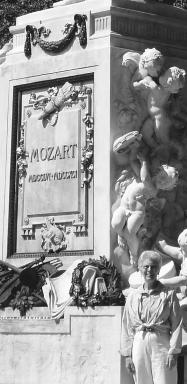
Music was the thread that wove itself through our days...
Music was the thread that wove itself through our days and seemed to guide our footsteps. During that first day’s wanderings, we stumbled upon the Rudolfinum, home of the Czech Philharmonic. Its roof is lined with statues of famous composers, and among Nick’s stories, we would learn later, was this account: German troops, ordered to destroy the statue of the Jewish composer, Felix Mendelssohn, erroneously removed the statue of Richard Wagner,
Hitler’s favorite composer. Wagner was hastily rebuilt, and Mendelssohn continues to stand to this day. Another musical find was the Smetana Museum, positioned on the banks of the Vltava, the river that dominates Prague and was made famous by Smetana in his tone poem, The Moldau (the river’s name in German). With more intent, we spent another afternoon touring the Dvorak Museum and locating the National Theatre, home of opera in Prague.
The drives from city to city might have been quite tedious, but because Nick never shed his tour-guide hat, they were anything but. Even on the long drive to Vienna, he shared his wealth of knowledge. We learned that in the Czech Republic, fly-overs planted with shrubs and grasses are built over highways to provide wildlife on one side of the highway, access to rivers on the other side. Imagine that… overpasses built solely for wildlife! Along this route, detours seemed to be the norm, but Nick made the most of these. He amended our lunch plans and stopped in the charming town of Telc where we enjoyed a leisurely meal and Nick’s folksy stories about the history and architecture of the town.
Vienna holds fond memories for Harold and me...
Vienna holds fond memories for Harold and me, so of course, we had to revisit many favorite sites: the Musikverein, home of the Vienna Philharmonic and their famous New Year’s Day concerts; the Stats Oper, where we toured once again the beautiful interior; the Stephansdom, where Mozart was both married and eulogized; the Vienna Woods, which inspired both Beethoven and Strauss; and finally the amusement park in the Prater, where we again enjoyed a ride on the Riesenrad, one of the world’s largest ferris wheels. No, this did not break our musical theme—many a composer walked the grounds of this large, beautiful park. As part of the tour itinerary we attended a light-hearted concert of Viennese music and dance. But quite frankly, the balalaika and accordion trio we had heard earlier on the street played with more artistry and Viennese charm. We tipped them well.
The highway to Budapest follows the Danube, and as Nick drove us toward his home city, his stories became more poignant. In flawless English, he would say, “And on your right side you can see the beautiful buildings built by the great and glorious, freedom-bringing Soviet Red Army.” His words were those that all school children had to use in speaking about the country that had “liberated” them, and his description was of the numerous, box-like, cement buildings built by the Soviets to replace those lost in the war. Another story told of his father losing his white-collar job for not attending a May Day celebration due to illness. And then there was the warning his father received: In order to show that he and his family were loyal, happy citizens, he had to stop taking them to church. In “compliance” his father instead took the family hiking on
Sunday mornings. They would walk to a small town away from the eyes of the government and attend church there.
Budapest greeted us with clear skies and cool temperatures, so we dressed warmly for the outdoor concert that first evening. What a beautiful setting! In the courtyard of a castle that illustrated the many architectural styles in Hungary, we sat listening to a very well played Beethoven concert. This was appropriate, we learned, for Beethoven had served as court musician for the Hungarian Brunswick dynasty at the turn of the 19th century. Indeed, “Für Elise” was written here, and Nick shared a local legend claiming that the original manuscript had serious damage to its title and should read “Für Terese,” who was his lover at the time.
...[we] again spent our free time visiting music venues and museums.
As had become our custom, Harold and I again spent our free time visiting music venues and museums. We located the Franz Liszt Academy the first afternoon but found it closed for the summer. This had been the training ground for conductors Eugene Ormandy, Sir Georg Solti and Georg Széll and also our son’s cello teacher, Janos Starker. It was worthwhile just seeing the exterior and taking pictures. Our last afternoon found us on Andrássy út, Budapest’s Champs-Élysées, where we located the Zoltán Kodály Museum in the rooms in which he had lived. Kodály is known worldwide for revolutionizing the teaching of music to children, and I have been using many of his ideas, including his hand signs, since they hit the states in the 60’s. He based his ideas on the folk music of Hungary, and it was interesting to see from his furnishings that he had an appreciation for Hungarian folk art of all kinds. We moved on to tour the Hungarian State Opera, which Hungarians admit is onethird the size of the Vienna State Opera but is, of course, three times as beautiful.
...I had tossed a penny in Budapest’s version of the Trevi Fountain!
We left for home with promises to return. After all, I had tossed a penny in Budapest’s version of the Trevi Fountain! And I am grateful for our new friend, Nick, who provided us with an insightful perspective on his “neck of the woods.”
By Deborah Peltz Fedder’79
Deb has been associated with FCS since she came as a fifth grader in 1971. She started as Assistant Director of Admission in 1984, taught Middle School math in the 1980’s and 90’s and has been teaching language skills to Middle Schoolers for the last twelve years. Sons Daniel’08, Matt’11 and husband Michael, a member of the technology department, have joined her on the City Avenue campus. She was awarded a sabbatical for 2005.
On the weekend before my sabbatical began, I bought an orchid. It was beautiful in its simplicity, for this indoor plant had only three tall shoots with a few white blooms and several buds awaiting their turn to open. Six broad, shiny leaves draped the brim of its terra cotta container, and the instruction tab read, “Water generously once every week. Do not over water.” Now this is my kind of plant; it didn’t seem like I could possibly kill it, so I brought it home and sat it on my kitchen counter. Afew weeks later, now enjoying my new sabbatical life, I connected with this plant. I observed that in giving it some attention, some nurturing and some sustenance, it thrived. Sounds like a metaphor for my time on sabbatical…more on that later…

So after reveling for a week or two in my life of leisure marked by mornings drinking coffee from a ceramic mug and not a travel mug, watching Good Morning America in its entirety and, yes, even Regis and Kelly, I set out to achieve my various goals: spending time with my family, connecting with my mom, pursuing my passion for tennis and learning Hebrew and the Torah for my son Matt’s Bar Mitzvah.
When sabbatical started, I became “just mom...”
When sabbatical started, I became “just mom,” and I loved it! I enjoyed cheering on my kids in their many league activities but particularly at their FCS contests. In fact, it would have seemed to many that
I had never left for sabbatical. I appreciated being in the solo role of parent, my stomach tightening and churning on each occasion when either Matt was twisted up on a wrestling mat, was staring down a pitch on a 3-2 count, or when Daniel was tossing a second serve to go up 4-3 in the final set of a tennis match. And one of the bonuses for my children was that they were fed a nourishing, hearty meal as soon as they got home, as I had had all day to put one together.
Let me digress for a moment and tell you that discovering exciting recipes that the entire family would enjoy was another goal of mine during this time. Bourbon Glazed Salmon served with wild rice pilaf and roasted Brussels sprouts…mmm…it all looked and smelled great…and was a complete flop. The salmon wasn’t as flavorful as the recipe suggested, and Brussels sprouts? …what was I thinking? At least the chocolatedipped strawberries for dessert were a hit! As of this writing, I have not made a dish that is a winner all around.
Being on sabbatical also allowed me to simply be present for my family. I noticed how available I was in the evenings. No longer at that time of day was I doing laundry, paying bills, straightening up or making a quick run to the grocery store. One day I even had Matt play hooky so we could take in the historical sites of Philly, and what a great day we shared as tourists in our own town! Once I set up camp on Matt’s floor for the night. Adding to these indulgences, I bought a nice face cream for myself, taking time for some personal care. One evening, as I tucked in Matt for the night and gave him a big hug and kiss, he said “You don’t smell like mom but like some other lady.” Hmmm…take care of myself, and I become an alien to my son. Go figure!
Hmmm…take care of myself, and I become an alien to my son.
Naturally, I also spent a good deal of time with my husband Michael, and we had a chance to regroup and redefine our goals. On some mornings when he was able to observe the benefits of a sabbatical, he liked the idea so much that he said, “I gotta get me one of these,” and here he is— employed at FCS! He and I are delighted with this move—Matt thinks it’s really cool, and although Daniel thought he was finally out from under a parent’s watchful eye, having left me behind in the Middle School, he is coming around!
Time with my family was a blessing, as was the time I had to connect with my mother, in spirit and in person. My parents are both retired, and recently they started going to Florida in the winter. The day my sabbatical began was also the day they headed south. Though the timing wasn’t ideal, my mom’s departure gave me the opportunity to cover her responsibilities at the Philadelphia Ronald McDonald House every Wednesday through the winter. I have always maintained my connections with the House, a “home-away-from-home” for families of seriously ill children
being treated at local hospitals, whether running the “Read for Ronald” program in the Middle School, arranging faculty prepared dinners or covering shifts in the summer. This time, as a “regular” at the House, I was reminded again of the painful lives families with sick children endure and, in contrast, of the healthy lives so many of us are blessed to have.
...as a “regular” at the House, I was reminded again of the painful lives families with sick children endure...
I will always recall one particular morning there this winter. The House was full, and the phones were ringing off the hook with parents arriving in town that day, hoping to get one of the forty-six rooms. Some had to be referred to area hotels, and giving that disappointing news was difficult. I knew what the families would miss: relief from expense, emotional support from parents in similar crises, substantial meals, shuttle service and familiar faces. Further, on that same morning, a father staying at the House spoke with me about his inability to pay his bill. He was worried about that, and yet his child had died the night before…how terribly, terribly sad. Now flip the coin of fate—that same morning, another dad was going home with his now well child. “Take your time checking me out,” he offered, “I’ve got all the time in the world.” Every day of service at the House is different, but every day is unvaryingly a sobering
reminder of life’s preciousness. It’s one reason I firmly believe in celebrating what’s good in life, and doing it as often as possible. And that’s why time with my mother is important to me.
It’s one reason I firmly believe in celebrating what’s good in life, and doing it as often as possible.
Upon receiving word of a sabbatical, my mother and I planned a special trip together to tour Italy. For more years than I can remember, I have had little time alone with her. However, another heart ailment threatened my father’s health and jeopardized our travel, but my Dad was lucky, and with his health intact, we headed abroad in April. My mom and I made excellent travel and rooming partners, and it was a gift to have time with her and experience the Italian culture together—laughing, learning, playing, touring and tasting.
Upon my return from Italy, the spring and my orchid were both in full bloom. It had grown another stalk, which I staked and tied for support. The tennis season had also arrived. Playing tennis has always been a tremendous passion of mine, and I was committed to using part of my
Playing tennis has always been a tremendous passion of mine...
sabbatical for competition. I began playing on four tennis teams, either on hard, red clay or on grass-carpeted courts, and I am pleased that all teams fared quite well. Of course, clinching victories and leading the leagues as much as we did was rewarding, but it was much more than that for me. I have coached Middle School tennis players for years, but being a coach is quite different than being a competitor, as many of us know.
I had consciously squelched the fierce competitor in me to be the mentor, the cheer leader—the coach. In fact, since becoming a parent, I’ve put my competitiveness on simmer—it’s not about me—it’s about my kids, your kids, all kids and their successes. I had so effectively turned down this competitive spirit that I had a hard time retrieving it! I became the student again, attempting to raise the bar on my game through drilling, technique refinement, strategy development and positive thinking. It was at times an emotional battle for me to see myself as a formidable player in the face of so many other formidable players. Was I really as capable? Why do I not see myself as others see me?
Happily, though, I did raise the level of my all-around game, but interestingly, tennis competition itself became the conduit for something unanticipated: recapturing inner strength and self confidence. This experience, which is not limited to a tennis court and which is one many
people repeat in middle adulthood, will enhance the empathy I share with my kids and those here at FCS as they seek personal strength, whether we’re in a classroom, on the courts or at a picnic table by the bur oak.
Tennis wasn’t the only venue in which I found myself to be an adult learner. I challenged myself to learn Hebrew and how to read Torah. Matt was becoming a Bar Mitzvah in September after several years of study. There were times during these years when he was completely disenchanted with religious education. Never having studied any Judaism
...I found myself to be an adult learner. I challenged myself to learn Hebrew and how to read Torah.
myself, I felt a need to support him through this process and learn Hebrew as well. So last summer, I worked with a tutor to learn the Hebrew alphabet and some vocabulary, and in February, I began the tutoring once more, this time to hone my sight reading skills, understand traditional Hebrew prayers and learn a Torah portion to read at the Bar Mitzvah. It was a good deal of work, and like Matt, and Daniel before him, I feel a great sense of accomplishment and pride. Matt and I enjoyed the learning process together, and his Bar Mitzvah was indeed a time for celebrating another of life’s milestones.
As sabbatical came to an official end in early June, so did the blooming season for my orchid. It was all too fitting. Notes from my journal read as follow: ‘The orchid’s blooms are dying, folding in upon themselves, as it’s time for them to do. At some point, they fall from their stems, landing on the counter where they are camouflaged with the mottled pattern of the granite. It’s just so perfect they should be falling as the school year draws to a close, as does my sabbatical.’ June 25th, 2005, entry: ‘Now the orchid is fully dormant. I’ve cut back the shoots and
I’ve cut back the shoots and placed the plant on the stairway landing shelf to rest...
placed the plant on the stairway landing shelf to rest amid the broken rays of sunlight, awaiting another season in which to grow again. In the meantime, I’ll continue to mind it, nurture it, care for it, as I will me and all that is important to me.’
By Caroline Maw-Deis
Caroline has taught art to Middle Schoolers for eight years. She traveled to Hawaii with her husband, Ishaq Deis, this past summer on a Clayton Farraday summer stipend.
“You have been awarded a grant to travel to Kaua’i, Hawai’i, to acquire knowledge from local craftspeople and fiber artists.”
Such was my intention when I applied for a summer stipend last spring, and although I had no contacts to specific artists, I was filled with a deep conviction that my husband, also a teaching artist, and I would encounter fellow artists and learn lessons on the beautiful Garden Island, known as Kaua’i. My goals were to meet basket weavers and fiber artists, to record visual images as inspiration for my creative work and then to distill the experiences into projects for my students. And as our two-anda half week journey began to unfold and to reveal not only the natural beauty of this geographically furthest-away Hawaiian island, life experiences quickly produced inner growth.
...life experiences quickly produced inner growth.
I work in several media, but I am most notably a basket weaver, having crafted almost 800 baskets over the years. Though I began weaving baskets with more traditional materials and forms, I most enjoy the challenge of using unusual components in my finished baskets. Recyclable discards and scavenged elements from nature have found their way into my woven forms. My travels provide inspiration, and I was excited to incorporate into my designs shells or pieces of coral that I knew I’d find on the island.
Our first stop was on the eastern side of Kaua’i, where our cottage was owned, serendipitously, by a pair of artists, Kiyo and Tomás. Kiyo, a petite and vibrant woman, bubbled with pride as she gave us a tour of her ceramics studio. We walked across the raised wooden plank pathway, amid lush foliage and chirping birds, passed under the expansive monkeypod trees and came to her creative haven, filled with clay pieces in various stages of completion. Her clever sculptures of the human form
and her masks were expressive and meticulously crafted, some illustrating political issues, others the emotions of human experience. Fired in a raku kiln that uses a low-temp, fast firing Japanese technique which translates to “ease, pleasure and enjoyment,” all of Kiyo’s pieces reflected these characteristics. Our cottage was graced by her twenty-inch tall Hawaiian mermaid figurine glazed in seafoam greens and natural tones. Tomás had been apprenticed at a young age to a master woodcarver in Spain which influenced his carving style and gave him a passion for Flamenco guitar. One evening, he and Ishaq on the guitar and his surfer son on the ukulele (oo-kah-lay-lay) gave us an improvisational musical interlude, with the crickets and geckos on percussion. Featured in an issue of ArchitecturalDigest, his Spanish Baroque carving skills and love of the tactile quality of exotic woods were reflected in the chairs, chests and tables in his home. Tomás generously gave us a lesson on carving the local wood, as we worked in his studio filled with sample carvings and hand-turned spindles. As we departed, he let us know that he respected our mission of working creatively with today’s youth in our art classes.
...he let us know that he respected our mission of working creatively with today’s youth in our art classes.
Next assignment: to find ninety-two-year old Auntie Esther, acknowledged by the islanders and the Smithsonian Institute as a “Living Legend.” We learned about her at the local museum in Lihue, where we saw a DVD acknowledging her contributions and accomplishments in preserving an indigenous art form of basket weaving. Her specialty is weaving the local lauhala leaves into tightly woven, exquisite hats. She learned the craft as a young child, and it became a way to earn money for food and necessities. Her goal over the years was to share the craft with others, and she volunteers and demonstrates every Wednesday at the museum. Unfortunately, she was ill the Wednesday we sought her out, but fortunately, the docent mentioned, “You could just go to her house and talk story!” We discovered her humble home in the foothills of beautiful Waimea Canyon (on the western side of the island) the next day.
We sat on her front porch surrounded by coconut, banana and papaya trees... talking story and sharing art projects.
What ensued was more than I could have imagined. We sat on her front porch surrounded by coconut, banana and papaya trees with her daughter Hannah, eating freshly cut mangos and pineapples, talking story
and sharing art projects. Though Hannah is also very skilled at weaving, her personal interest lies in designing and sewing traditional Hawaiian patchwork quilts which she joyfully unfolded to show us. Flora and fauna motifs are popular imagery depicted on these symmetrically stitched patches of fabric. I showed them a coil basket I was weaving on the top of a drilled coconut shell, and they complimented me on the techniques I was incorporating into yet a different basketry style.
Auntie Esther played “show and tell,” modeling each of her hats, and we took turns trying them on. She was most eager to show us the process of weaving them, and her nimble fingers manipulated the thin leaf splints with dexterity. Her hats sell for hundreds of dollars, and she gleefully exclaimed that she wanted each one “to go to heaven with her.” Esther and Hannah were excited to meet teachers invested in learning their craft, and they invited us back for dinner.
As we drove “off the beaten trail” the next day, we chanced upon the Kamokila Hawaiian village, which I initially judged to be a hokey, tourist spot. As I was noticing the green palm leaf baskets displayed at the gate, the guide told us to go watch “Weaver” over at his grass hut along the river’s edge. “Weaver,” a stocky guy, was quite passionate about his weaving talents and climbed a tree and “cut the leaf” that he quickly wove with great deftness for my personal demo. Before our eyes, the long palm
Before our eyes, the long palm leaf was transformed into a sturdy basket with a square base and a round rim.
leaf was transformed into a sturdy basket with a square base and a round rim. I captured the step-by-step procedure on the digital camera to share with my classes, and Weaver was eager for students to learn of his skills. As he worked, he shared his story:
“…at sixteen, I left my mother’s home in Manhattan to visit my father in Puerto Rico; when he didn’t allow me to stay with him, I went to the streets, and there I met a man weaving palm leaves. I learned from him how to do it and have been ‘weaving leaf’ever since. It is a dying art form, and I want to keep it alive. It is important to teach it, especially to the young people. I was labeled as a Special Ed student in school. My favorite class was art, and it was my art teacher who ‘saved me.’I am happy to be able to teach how to ‘weave leaf’to others. I have traveled all over Asia learning about basketry and sharing my work.”
Weaver was a kind-hearted soul, and we had a lengthy conversation sharing viewpoints and talking story. Two weeks after we came home, he sent me a videotape of himself climbing a forty-foot-tall palm tree which I am now sharing with my art students.
Hours before our departing flight, I found out that a local weaver would have her hand-woven articles displayed for sale at a nearby hotel.
We squeezed in the time to visit before heading to the airport. I walked around the vast array of baskets, mats and leis (flower necklaces), with a bit of a tourist attitude: same-stuff-I’ve-seen-before. I went over to the artist, Sia, as she sat patiently describing her work to others in the hopes of making a sale. As I listened, some of my skeptical attitude began to melt, and I saw her intention to make an honest living. I sat down on the floor in front of her, watching as she transformed splints of lauhala leaves into a two-toned woven bracelet. Noticing that I was interested in how she manipulated the natural materials, she was excited by the fact that I was a teacher, and sensing my earnestness, she began to talk story. As has been my experience, once creative souls meet through an art exchange, the sharing just happens, and there is kinship with another soul.
As has been my experience, once creative souls meet through an art exchange, the sharing just happens, and there is kinship with another soul.
“I arrived from Samoa to Kaua’i with my husband years ago. His recent death… has been a hardship on me. Raising four children without him has not been easy. My children see how hard I work, weaving the baskets and making the tapa cloth, and sometimes they help. Spending the day displaying at the hotel is a way for me to get my hand-crafted work to the public and to earn money to support my family. I am not paid for my travel or time here at the hotel lobby, only by my sales.”
Sia’s vast display of items—mats, jewelry, bags, and albums, also crafted by her sister and mother—is evidence of her hard effort, but more importantly, I saw her integrity. I expressed my disappointment that I had not met her sooner, as I would have gladly welcomed the opportunity to visit her at her home and put time into working with her as my teacher. Grateful for our quick friendship, she generously wanted to give me a handcrafted basket. I slipped cash into her satchel when she turned away.
Traveling all over Kaua’i taught me life lessons as well as art lessons. I have learned not to be so judgmental of others and of situations. I have experienced the joy in making the time and effort to talk story, for in sharing our experiences, we recognize our common threads. I have gained confidence in myself and have an even deeper understanding of my passion for creating and for nurturing the creative potential of others.
Kaua’i added a new dimension to my visual vocabulary as well:
Line = of the sturdy coconut tree trunks reaching upwards…..
Texture = of Mother Nature’s woven fibers in the coconut sheaths that dangle from the palm trees….
Color = of the bright blue rudraksha berries in the sacred forest….
Shape = of trees silhouetted against the colorful sunset ….
Form = of palm fronds after being manipulated by the weavers’ hands….
Space = the atmospheric layers of mist across the curvaceous Na Pali coast….
Value = the many tints and tones of the ocean blues along the sandy shore….
Pattern = of the corkscrew spiraled trunk of the lauhala tree….
“Mahalo,” or thank you…for my memories of Kaua’i that have enhanced my imagination and will continue to inspire my next fiber creations as well as inspiring my students.
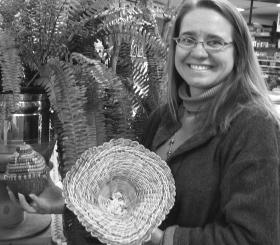
Since Kaua’i, Caroline has woven these baskets, one (l) with fibers coiled on top of a coconut, and one (r) with a piece of coral as its base.
By Brad Morris
Brad, who has been teaching math to FCS Upper Schoolers for twenty years, is also chairman of the department.
For the past five years, the English department has offered electives to juniors and seniors in the third trimester of the school year as a way of broadening the curriculum and offering some choices for students in their study. It has also afforded faculty the opportunity to teach a topic within the discipline of particular interest to them. We, in the math department, took a look at this model and its success and decided that it was time for us to give it a try as well.
Last May, the Math department offered a selected set of four-week mini-courses in mathematics tied to the particular interests of three of our faculty...
Last May, the Math department offered a selected set of four-week mini-courses in mathematics tied to the particular interests of three of our faculty members, John Ricci, Julie Plunkett and Alex Bockman. These mini-courses were offered at the end of the school year when seniors were away on Senior Project, to tenth graders currently taking Algebra II. Logistically this scenario was perfect for the department, because Alex Bockman teaches all three sections of Algebra II. He retained one of those sections. Julie Plunkett and John Ricci each picked up one section of the remaining two without too much additional strain on their load since they were no longer teaching their senior sections during Senior Project. And it just so happened that each was free during one of Alex Bockman’s Algebra II blocks. The stars seemed to line up in our favor to make this happen…but more about the stars later.
…but more about the stars later.
The first question that arose was, “What about the material they were supposed to cover in Algebra II?” Not to worry. First of all, these courses
were taught in the last four weeks of school, historically not a high content period. Wrap-ups, review and projects are more the norm. Secondly, our curriculum in mathematics at Friends’ Central, and most other schools for that matter, is spiral based. That is, topics and content get repeated over the years at increasing levels of sophistication. So any topic that might have been covered during this four-week window is scheduled to be repeated the following year in Precalculus. Students did not miss important content needed for future courses or standardized tests. What they gained were exciting new challenges, in two cases even a new teacher, at a time when the school year was drawing to a close and such a change would no doubt be most welcome. Our new courses were:
In this course, John explored the mathematics involved in societal constructs, specifically decision-making. John planned to explore conventional and weighted voting systems and to look at problems of fair division--how should objects be divided up so that everyone gets a fair
John explored the mathematics involved in societal constructs, specifically decision-making.
share. In these contexts, where some individuals favor one item over another, dividing everything equally ends up being less fair than methods that incorporate the different values that individuals place on the objects. Intriguing mathematical methods would be used to sort it all out so that everyone would feel like winners. But in fact, the students in John’s course were so intrigued by questions such as why can’t majority rule be used when there are three or more candidates, as in most elections, that the whole four weeks were spent investigating voting systems.
John—Our initial discussion of two-alternative systems was almost trivial (majority rule is the optimal system; there’s even a theorem that says so). The students quickly discovered that when there are three or more alternatives from which to choose, the answer is not so easy. We looked at several voting systems that seemed reasonable to use to choose among several alternatives. Upon closer examination, each system was exposed as having a serious flaw. Several students were intrigued by the fact that some of the systems could be manipulated by strategic or insincere voting. That is, a particular voter may alter the results of an election (to suit his or her wishes) by actually ranking candidates in an order that does not reflect true preference. This discovery prompted one student to comment, “Wow, when someone asks me what I learned in math class today, I can say that we learned how to fix an election.” I commented that this would be all the more surprising to the listener given that the lesson was learned in a Quaker school!
We proceeded to examine weighted voting systems, such as those used by the stockholders of a corporation. Again, results were surprising to the students. For instance in a system where three shareholders have 49%, 49%, and 2% of the stock (and thus voting weight), the three actually have exactly the same amount of power. We then talked about voting power being the ability to influence a decision and learned how to calculate an index that is a reflection of this ability.
Yes, this course is related to the signs of the Zodiac, but it was taught from a scientific and mathematics perspective. Planetary orbits, celestial angles calculated in degrees, minutes and seconds, geometric arcs and arc lengths, triangulation and trigonometric relationships provided the
...this course is related to the signs of the Zodiac, but it was taught from a scientific and mathematics perspective.
scientific and mathematical underpinning of this course. Students used all of this and more in their analyses of astronomical and astronomological objects. Each student’s work culminated in a numerically based and sophisticated Natal Chart.
Julie—Students learned how to calculate probabilities, including the likelihood of shared birthdays among random samples of people. They went on to look at some basic astronomy and circle geometry. For exam-
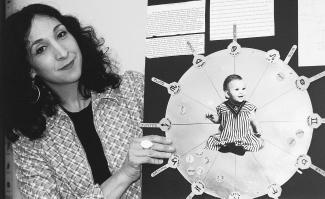
ple, a “ horoscope” or Natal Chart, is in the form of a circle. Each of the twelve houses occupies a thirty degree sector (imagine a pizza cut into twelve equal slices), and the angle relationships between houses, such as trines (thirty degrees) and squares (forty-five degrees) are of great significance in the chart. Also, because the horoscope is a wheel of 360 degrees, each passing day is approximated, albeit crudely, as a one degree rotation counterclockwise.
The final—and most exciting—piece of the course was the calculation and interpretation of a Natal or Birth Chart for each individual. The students were so interested in learning about themselves (and others), and there was enough meaningful calculation, so that I was comfortable with the venture. While I had no personal stake in this, it was interesting to hear how many students found that some of the information rang true. One set of twins, for example, born an hour apart had two different ascendant signs. They related to the characteristics, or persona, of their “rising” signs, and while both are Cancerians, the twin with Virgo on the ascendant was more organized and shyer than the twin with Leo rising.
I enjoyed Max’s comment, “Seriously, Mrs. P., this is the most fun I ever had in a math class!” I was thrilled to learn that the interest in calculating sun signs and first houses had even spread out to the community. In fact, word has it that families sat together in the evening working out their charts!
The Mathematics of Animation—Alex Bockman
As you may be aware, the traditional hand-drawn animation techniques developed by the Walt Disney Studio are rapidly becoming extinct in favor of the increasingly spectacular computer animations of, for example, the Pixar Studios and others. Animators and programmers work together to create animation environments in which actions, camera angles, lighting and effects may be explored prior to commitment to film. These environments are complicated mathematical constructs of polygons, linear and non-linear gradients, trigonometric manipulations, and, believe it or not, some even use objects and operations from calculus, such as splines. How do these computers generate such remarkably lifelike three-dimensional images? For that matter, how do computers get objects to move at all!
How do these computers generate such remarkably lifelike three-dimensional images?
Alex—”The goal in teaching this course was to give students a sense of how incredible The Incredibles really is!” They explored the mathematics within computer codes that generate computer animation by learning how to animate simple geometric objects, basic polygons for example,
using matrices, linear algebra and their graphing, programmable TI–83 calculators. Students learned how to “draw” polygons on their calculators (mini-computers) and then “matricized” them by converting the coordinates of vertices to elements in a matrix. The students learned some elementary programming skills that will allow them to animate geometrical objects. To dream, to imagine even the most complex sequence of images comes naturally to us, but ask a machine, no matter how powerful, and it must be instructed at each stage, how to string together nodes of thought.
Put simply, my mini-course students and I spent a solid four weeks utterly frustrated! We were attempting to construct electronic flip books and to write programs in our Texas Instruments calculators that could draw each successive stage of a character’s motion for us, so that over time, it would appear to move. Caroline’s acrobat on a trampoline, doing tricks in midair with each jump, had trouble keeping it together. “When I move the arm, it pulls away from the body.” Andrew’s skateboarding robot on a half-pipe had rotational difficulties. “My figure keeps exploding.”
We learned a little patience and developed a sense for the comical aspects of error; what else could we do? Calculators were crashing all the time. Programs that worked one day died the next. But by month’s end, we each had a working demonstration of a story; through the pain, we guaranteed that our personal vision found lasting form. We may not have convinced our calculators to understand us, but we had made them see as we do.
Mathematics, by its very nature, is an abstract discipline in the analysis of real number variables. While students accept this notion of mathematics, they also are quite interested in how the abstraction inherent in mathematical constructs can be applied concretely to the world around them. In these three mini-courses, students got a front row seat in three radically different applications of mathematics and a deeper appreciation of the idea that mathematics is all around us when we take the time to look.
by Stephen Ruzansky
Steve has been teaching at Friends’Central since 1977, first in the Lower School, and since 1987, to fifth graders in the Middle School.
At the beginning of each school year, I ask my students to identify and display one of their current passions. In the process, we discuss just what a passion is - what makes it a passion and how pursuing some kind of intense interest can make for a more productive and fulfilling life. And, after all, isn’t seeking a productive and fulfilling life what an education should be about?
I openly share with my students the journey of my own passions.
You can’t teach what you don’t know. I openly share with my students the journey of my own passions. They know of my love/hate relationship with golf, my pure joy in being a new grandfather (just call me “Pops”) and how I am facing my fears toward white-knuckle smallboat sailing. More recently, I shared the enormous personal challenge of learning to play bluegrass banjo. Empathy for learning hard things abounds from my students and for my students.
Earlier this summer, I drove to NashCamp, a bluegrass-oriented adult camp just outside of Nashville, Tennessee. For five days, I joined forty-four other amateur bluegrass musicians from all corners of our nation (including Alaska, New Mexico, Maine, Florida, New York and many of the more predictable states). We had workshops in vocal harmony instruction, care and maintenance of instruments, daily instruction on our chosen instrument (besides banjo, there were players of the bass, fiddle, dobro, mandolin, guitar and voice). We learned about informal jamming as well as how to play in the more formal bluegrass band mode. Sad to say, my particular banjo teacher, while a world-class banjo player, was not a particularly effective instructor. I offer the adage that “those who can do, don’t necessarily know how to teach.” Nevertheless, our banjo group—several of whom were also classroom teachers like me— worked to coach our instructor on how to teach more effectively, while we also shared techniques amongst ourselves.
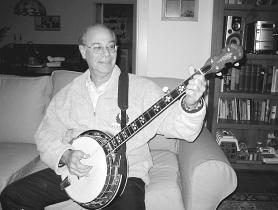
Many of you have only a passing, and not necessarily positive, impression of bluegrass. Perhaps the sound tracks of the movies, Bonnie and Clyde and Deliverance, along with memories of that infamous television show, The Beverly Hillbillies, have shaped—and distorted—your perceptions. To tell the truth, I almost always have had a favorable response from people about my banjo playing, with the notable exception of my mother-in-law. My wife and I had her over to the house for a small barbecue, and I thought that she would enjoy a little banjo concert on our backyard deck. So I played all sorts of tunes as she leaned back with a smile on her face. Usually a very cantankerous woman, she seemed to be truly enjoying this special offering of mine. After about forty-five minutes, I put down my banjo to do some grilling, at which point my mother-in-law got up, went into the kitchen and snarled to my wife, “If I had to listen to that music all day, I’d kill myself!”
Needless to say, I am planning a number of future concerts for her.
Bluegrass, the music, has a certain social resemblance to jazz, in that they both have roots in the South and, more to the point, in the personal expression of the lesser enfranchised folk of America, and where each player may do improvisational solos that are part of a larger playing
group. I have also referred to bluegrass as “Appalachian Klezmer” (klezmer is a Yiddish musical band style that is also full of cultural exuberance and expression, mainly through clarinet, violin, trumpet and drums).
Main Line sensitivities tend to put a bluegrass lover in a sociopolitical box, full of assumptions and biases, just as many people in those “fly-over” states do to us. And, indeed, a few of those assumptions—but definitely not most—have some basis. Nevertheless, regional music of all kinds is becoming universal and creating bonds across cultural and political affiliations. Asignificant number of my fellow campers were teachers; most, however, were doctors, architects, nurses and engineers.
...regional music of all kinds is becoming universal and creating bonds across cultural and political affiliations.
Very few were the stereotypical rednecks. One bass player was also a Quaker. Ayoung mandolin player was a classical violinist who had played professionally for years in an orchestra in Austria, and one of my banjo buddies was a classically trained guitarist. And all of us loved the earthy and inclusive style of the bluegrass genre.
To be able to immerse myself in music for a week, practicing for hours as though I were a student at the Curtis or Julliard Institutes was an energizing and very special experience! In our benefits booklet, it says
“You can bet the farm on that one!”
that the Clayton Farraday stipend program is meant to provide Friends’ Central’s teachers with the opportunity to do something different from what they ordinarily do in the summer, to have a “regenerating experience.” I declare, “You can bet the farm on that one!”
By Paula Singer
Paula, mother of Justine and Isabelle Singer-Kaufold, Class of 2012, works with adolescent girls in public schools to develop leadership skills.
As the mother of twin daughters, I had been intrigued by the idea of starting a mother-daughter book club ever since I discovered The MotherDaughter Book Club: How 10 Busy Mothers and Daughters Came Together to Talk, Laugh and Learn Through Their Love of Reading, by Shireen Dodson. I first read this book when my daughters, Justi and Izzy, were about eight years old. Reading together had been one of our favorite pastimes since the girls were infants, and cuddling up with a book was a sacrosanct bedtime ritual. I cherished my close relationship with my daughters and our shared love of books. Was it possible to move into the next stage of their development—separation and individuation—and remain connected through our passion for literature?
I cherished my close relationship with my daughters and our shared love of books.
As a social worker who counsels adolescents and their families, I knew how the relationship, particularly between mothers and daughters, is tested beginning in the preteen years. Girls put increasing distance between themselves and their moms in their journey toward independence. Now, as I neared the threshold of my own daughters’ adolescence, I was looking for ways to stay close, despite their developmental need for independence.
Fortunately, young adult literature today addresses many themes and issues that are important to teens, but are often awkward for them to discuss with a parent. Moving beyond the standard coming-of-age books that were the mainstay of youth literature when I was growing up, today’s novels delve unabashedly into tales of divorce, blended families, multicultural and gender identity, loss, violence, risk-taking and experimentation.
Yet sometimes the frankness and graphic descriptions in some of these books take my breath away. So I try to screen books for my daughters the same way I evaluate the content-appropriateness of movies and television shows. But I also know from my work that kids are drawn to many of these books for giving voice to experiences and that can make them
Yet sometimes the frankness and graphic descriptions in some of these books take my breath away.
feel alone and isolated. Reading a book can be like confiding in a trusted friend: “Someone else feels the way you do,” it reassures them.
One of the guiding principles in The Mother-Daughter Book Club book is that it’s often easier for girls to talk about a difficult subject or a character’s dilemma that occur in a novel, in the company of their peers, as well as with women besides their mothers. So the idea of meeting with other moms and daughters to discuss books intrigued me—perhaps my girls would be able to speak more freely about some of the themes and ideas in the stories with others than with just me alone.
“By talking about the impersonal—plots, characters and author’s choices—we’ve heard the girls’ candid thoughts on important issues like death and illness, friendship and marriage, family relationships and school and social issues,” says Shireen Dodson, who founded the MotherDaughter Book Club that was the inspiration for her book.
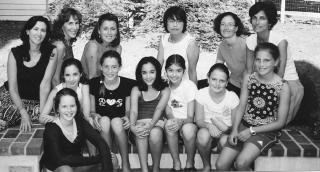
(left to right) bottom row: Keira Sultan ‘12, second row: Justi Singer-Kaufold ‘12, Claudia Rizzo ‘12, Izzy Singer-Kaufold ‘12, Paula Burkhardt ‘12, Emily Castelbaum, Becca Dahle ‘12. top row, the mothers: Helena Sultan (Keira), Paula Singer (Justi and Izzy), Barbara Matteucci (Claudia), Ihnsouk Guim (Paula), Debra Castelbaum (Emily), Beth Dahle (Becca).
“Some of the issues in the books have been a little delicate,” recalls another mother who belonged to Dodson’s book club, “ but who do we want the girls to talk about sensitive issues with, if not us?”
According to Daughters, a newsletter for parents that focuses on strengthening relationships with adolescent daughters, all-girls book clubs also can boost young women’s confidence by giving them an equal chance to exercise leadership in an environment that’s free of the social pressures that can arise in the presence of boys.
In the fall of 2004, I launched our Mother-Daughter Book Club, along with seven other moms and their ten- and eleven-year-old daughters. Some of the girls were friends in the fifth grade class at Friends’ Central; the rest were their friends who attended other schools.
All of the women shared a love of literature and the desire to read and discuss books with their daughters for as long as possible.
All of the women shared a love of literature and the desire to read and discuss books with their daughters for as long as possible. The mechanics of the club were simple. Each mother-daughter pair chose a book for everyone to read and then hosted the group at their house a month later. Some of the moms read the book with their daughters, others separately. Izzy, Justi and I mostly listened to the books on tape in the car as we did our errands.
Although there are few guidelines in The Mother-Daughter Book Club book, one is paramount: Let the girls lead the discussion, not the moms. “When you start to see your daughter expressing herself confidently, asking thought-provoking questions, listening carefully to others and encouraging others to speak and be heard, the sound is a joyful noise,” says Shireen Dodson in her book. “If we want our girls to learn about leadership, we have to step back from the role of expert and let them practice it.”
“If we want our girls to learn about leadership, we have to step back from the role of expert and let them practice it.”
On the appointed Sunday in the fall, everyone gathered at our hosts’ house, smiling and chatting in anticipation of our first meeting to talk about Shadow Spinner, by Susan Fletcher. This novel is about a young girl with a crippled foot, who rescues Shaharazad, the story teller, from a cruel harem. Once everyone had arrived, we arranged ourselves in a comfortable circle, and the host daughter began the discussion. The girls become quickly engrossed in debating the power and politics of a Sultan’s harem. They proceeded to make Auntie Chava’s haircomb, a