President's Address
FRIENDS :-The class of '93 g~eets yon. The first class in the history of this grand and glorious school that has not been ruled by the young lady portion of it. And do you wonder that we feel proud, when you observe that to every oue of our number are to be found three of the young ladies ? As discretion is the better part of valor, I deem it advisable to say no more upon the subject , for the reason that the youug ladies have the last word, as usual. The class of ' 93 is no,Y a thing of the past , and yet its memory will, I am sure, live always in the hearts of its members Yes, we are to leave the old school where we haYe grown up together; and glad as we are to enter upon a new era of life, we cannot but help looking back upon that part of our existence which is bound to shape our after-lives Years after, we will think of the sound advice of our instructors ; of the many little incidents that at the time seemed unjust , but which, I am sure, were clone for our good only. I am certain. then, that I am but echoing th e s
-sentiments of each individual of our number, when I thank, more than I can give expression to, the members of om Faculty for taking so great an interest in us as to overlook our misdemeanors as unthoughtful and impetuous. As an old writer once expressed it, "How much is done for us, in this world, by our friend ! Let us learn to make much of them ; for they are like our Mil ton s, Shakespeares and our Homers, we cannot read them too often, and we find something in them to suit all our moods.''
Did it ever occur to yon that the President of a class is nearly al ways the worst boy in it? It really seems proverbially so to me. I do not feel that I can stand here before you, and look solemn and stern, and say, ''Don't do this,'' and ''Don't do that;'' because I am not used to it, and you would say that I should practice what I preach. Why did you not select some good, perfect fellow ; some orator, who might stand here to-clay and let the words of wisdom fall like music from his lips : and when he had finished, we might all rise up and exclaim, in the language of our everremembered ipstructor, Wm. Walker, "Hear him, gentlemen, hear him!" And then again, when you are older and perhaps married (and I might say that in our estimat ion , marriage is not a failure-to make yourse lf foolish), yon could look back and think of what the President of your class had said on '' Class Day," and then, soli loqui zing, see how far you had been from following bis learned words. But ,vith me
all is different; I cannot be an orator; then, what can I tell yon and not act the hypocrite? I can tell you not to believe because some old, worn -out philosopher has said, that your school -days are the only happy days ot your lives. I know that you can make every hour of your existence just as happy and as interesting as-asArithmetic class. I can tell you some little events , the memory of which yon will carry with you all your lives. Think, for instance, when you are old men of eighty, how yon will chuckle when you think of Howson manipulating Anderson's hair; when you think of Read and his wise sayings, accompanied by that little shake of the head and "Ah! friend, little dost thou know the perversity of fate! '' Don't yon remember that young lady in Class I\leeting who said that she thought that the boys ' votes should count three. Poor , unsuspecting soul, little did she suspect the depth oi our black liearts ! And won ' t you come with me to Room 7 and see Prof. Maris striding up and clown, reciting some story about Galusha Jones , Joshua Fussell and Old Bill Tawney; aud I am sure there are many other incidents which you will never forget . I think it was Chauncey Depew who said, ' ' In a man's life there are four interesting e,·ents; namely , his birth , graduation Jrom school, his marriage, and his death.'' Gentlemen, we have successfully passed two of these ; one we are told is inevitable , and may we be saved from the other ! Well, the graduate is just the age when he imagines that it i • absolutel),
impossible to instruct him t1pon any st1bject whatsoever. There is au old story going t h e rounds about one of our number, which, though old indeed, I feel sho11ld be mentioned in this connection. It nms tht1s: Jupiter, as you are no doubt aware, was the king of the gods and resided upon Mount Olympus. "\Vell, this very same Jupiter conceived the rather grand idea of dividing the Earth into many equal _parts, and of giving to each man a like part. One day, while seated on his throne, distributing fa,·ors, he noticed a tall, lanky, rather di ·tingnished-looking individual come stalking up. Ile had long, wavy hair, and said "sech' and "winder" aud "idear'' and a few other peculiar expressions. The stranger said, '' How are you, Mr. Jupiter," and upon the god's nod of appro,·al began, '' I understand that yon are dividing up the Earth, and giving to every man a portion of it.'' "Yes, I am so doing," replied Jupiter. "Well, I didn't get any," said the stranger. "You," said Jupiter, "why who are you?" "Me," said the stranger, "why I am a member of the class of '93, Friends' Central School." " Then," said Jupiter, '' yon come right up and sit next to me.'' And that is the way we feel, friends; we are graduates. Yesterday ,ve could ha\'e been instructed upon fourteen different branches ( and we would have missed half the questions), hut to-day, we cau be instrncted 11po11 absolutely nothing. Moral: (And the advice is also for me) Gentlemen, don't let us be too wise to learn,
-0r we will only find out too late in life that we are ignorant.
I feel that I have said quite enough, and yet not exactly what I wish to. It is bard for a fellow to say good-bye to those with whom he has been brought up. We have seen much fun, boys, but our Jiyes have not been all sunshine. I should like to tell 011.e more story. I'd make it sad if I could. Once upon a time, away up in Maine, there lived a man who had a great reputation for profanity. He w<;mld swear in the morning, at dinner and at night. In fact, 'be had such a reputation for profanity that whenever he would go into any public place, many sensitive people would get up a1.1d go out, and then again, there were others who had come miles for 110 other purpose than to simply bear him swear .\,\Tell, it happened that a neighbor, living at the top of a high hill bought a cartload of apples from the man from Maine, who harnessed his {:1onkey, put the apples in the cart, and started on bis journey. All went well until he came to that hill, where the donkey needed no little persuasion to attempt the ascent. He coaxed him half way up and then, leaving the donkey to rest, our friend walked slowly to the top of the hill : when happeuing to look around he noticed that the board at the back of the cart bad fallen out, and he saw the apples falling one by one clown the hill. And then the sensitive people got out of the way, and tho. e who had come to hear him swear flocked about him. Then be paused, and look-

ing about him, instead of saying-a-a-wh~t they expected him to say, he remarked in his uneducated manner, "Gentlemen, words is inadequate." And so, gentlemen of the class of '93, I would say to you, words are indeed inadequate.
G. PLANTOC MIDDLETON.
lff LILLIAN KENNED\'.
June, r 888, i , famous for a great event in the world's history--the Migration of the Nations. Some authors place it earlier, but the best authorities have settled on '88 as being the authentic date.
The fresh hordes swept down on tbe peaceful Quaker Settlement at 15th and Race Streets and destroyed much property.
As the barbaric tribes marched into the Assembly Hall of the Ancients, otherwise the .Lecture Room, and seated tbemseh-es on the long benche , fear, hitherto unknown , almost overcame them . Then Aarou stood up-not in front of a golden calf, but in front of a whole drove of calves which he made and turned loose, and shuffled cards as though he were used to it. They were delighted with his original remarks and expressive gestures , and the next fall , when they r.+
-entered 011 the Siege of Rome, they observed this commander more closely. Prof. Aaron I vius was certainly famous. As he himself informed them he bad taught all the "jidges and great men' ' from time immemorial. There was no doubt either about his strong point being mathematics.
"Now , 27 times 596 is r6092-and the next young lad) ! which is the greater, 8 qts . or c pk.? Next! Xext! Xext! Next! Bo/Ii //, e same.'" "Your best friend!--," said he, laying his band on the shoulder of one of the barbarians , " your best friends are those who tell you of your faults. "
"Too much levity, young ladies ," he would say, :--baking his head. They ·were rather leYitous during the siege of F. C. S . Knowing that Aaron objected most emphatically to peppermint, they organized an expedition to the store one day and laid in a supply. The windows were closed , the desks opened , 3:nd the rooms were perfumed with peppermint for three weeks, hut-"he neYer came back ."
Now the peaceful inhabitants of F. C. S . could not meet the savage hordes and conquer them in a body , so they resorted to strategy. They diYided the barbarians into four parties and by means of v.·alls separated them.
Speaking in a general way the di\'isions were: EI . the bright girls; EIJ, the bad girl-; ; EIII, the girls who sat staring at the blackboard; and Er\', the girls up tairs .
The tribes were not all friends and kinsmen, and many were the glances cast up and down those long rows, and many the guesses as to which were the most warlike members.
When they bad conquered Friends ' Central, and taken possession, many missionaries came from afar to convert the heathens. The first missionary labored long and faithfully.
Then the girls were too young to" Yell , Cornell.'' but they did yell '' Miss Jennie' ' till she was nearly distracted, and sometimes could scarcely read her chapter in the mornings.
What most interested the E girls was the time they spent in Room 20. They grew very fond of specimens, and the long names fascinated them. No E girl would ever think of saying- " We had fried oysters for supper' ' -Fried Lamellibra1tciata e was the thing to say-and they said it.
Never was an E girl beard to speak of bugs, unless she meant Heruiptera. Their devoted families gained quite a scholarly idea of Diptera, Arthropoda, Protozoa, Porifera, Crustacea, Echoniderm and the like.
Miss Mary Shively, now 'gone but not forgotten, ' instructed them in this science. She drew beautiful little diagrams on the board, told the girls all she knew about that particular animal, and then said : "You may note, then, " which reminds us of Capt. Cuttle ' s "Aud when found make a note on.''
16
Now, Miss Mary, when she telt like laughing, which she did quite frequently, would turn her back to the class and shake, meanwhile sketching vigorously on the board. I suppose she never knew till this day that the class noted t!tat also.
And then the definitions-one of the girls has become famous for her reply t0 Miss Mary's question as to what was the difference between an alligator and a crocodile. Her distinction was, that one was terrestial and the other celestial.
The girls enjoyed dissecting oysters and kittens. Bats and dead mice as specimens were frequently put in Miss Mary's desk.
But when the pickled centipedes and preserved spiders were handed around, and all the legs of a hundred !egger wriggled at once, five girls were seen simultaneously to make for the door.
And there is the clog-" Bingo was his name .' ' The girls feel him with ginger snaps and ham sandwiche , and dressed him up in red ribbons and paper bonnet-;. They did not nse to have that kind ot a dog where they came from. Toucl1 his tail and it would wriggle for half an hour afterward. One day Addie Hall received two demerits , and was sent to Miss Annie because she touched the tail, and-to the horror of the class-it dropped off.
The R eign of T error began in Arithmetic and Composition periods.
The principal amusement 111 these classes, when
the admiring pupils were neither sketching their instructor nor taking down her remarks in a little twocent note uook, kept expressly for that purpose, was that of starting from the back bench and gradually changing their location till they arrived on the fro11t bench, and then reversing the process.
The progress ol the girls so employed was watched with great interest by the rest of the class, but woe unto them if they were caught, for the ineYitable apology was demanded.
The barbarians, tired ot constaut apologies and of so much humble pie.-though later they grew quite fond of other kinds-vowed they would gi,·e no more apologies.
From that time forth there was war. The marks on the compositions grew lower as their excellence progressed. To prove their instructor's undisputed impartiality , some six or eight of the girls formed what is known in history as the •·c mpo Conspiracy" and left their names off their essays. \Vhen the compositions were returned the marks were unusually appropriate, for in putting the names of the supposed authors on the essays not one had been correctly labelled.
Tho ·e naughty girls enjoyed a prominent position in front of the blackboard, and each one was requested to state why- she had left off her name. \Vhen an apology had been demanded from each separate girl, and two demerits apiece admi1iistered, the end girl r8
seized her essay, and, tearing it in bits, cast it on tlte floor. First one girl and then another followed suit until there was a little mound of white paper on the floor-"Like a shattered lilly drifting to and fro.''
The names on the next essay,.; handed in occupied a full page of foolscap.
And Arithmetic!
Always a favorite study, it proved doubly entertaining then .
When ~Iis 1\lary Taylor gaye to the girls for com po ition the fertile subject of "My Favorite Animal," the Feathered Son.i;rslcr League was formed, and nineteen essays were handed iu on the Ta_v lor Bird
One incident therein might perhaps be noted. Emma Roth, ( waving her hand frantically )-" Miss 11ary. what is a LiYerpool Ierchant?" Miss Mary , -' '\\"ell what does thee suppose?" Emma-"Why, one that sells liver.''
·'I demand an apology.' ' But so tender hearted did these semi-civilized tribes become under this proscription, that one girl was found weeping in the midst of au aritbwetic rey1ew.
\Vhen her sympathizing teacher asked her the cause she sobbed, "I-am-so s-s-orry-becausetbat-man in the last question-loi;t all his money! "
There is no need to state this tender hearted maiden's name . We all remember that Anna C . Holmes was "The Tenor of class E."
Dictation was enjoyed that year as well as Physics the following, but alas, not under Proffessor Haines.
Unfortunately our iustructor conld not pronounce the words in Dictation, and it was Clara \Varren's chief delight to look over the book and kindly pronounce the words for her teacher, having by thi,; means a slight advantage over the rest of the class, as Miss Olive used to say when Bertram kept his History book opeu during a redew.
The Dictation books of that year have been sent to the ,vorld 's Fair. They are marvels of their kind . The Dic ·ation was written in any spare space between the notes and sketches and memoranda. They were never collected.
The ·'Monkey" of the class and her devoted followers were wont to prove their origin aod consequent agility by leaving foot -priuts on the ceiling of the gymnasium. New comers could never guess how those little black patches came there, but methinks the early settlers well remember those halcyion days.
"In the spring time
The only pretty ring time."
The !c'tudy of Physic ' quite fascinated these semicivilized tribes-especially the phenomena.
And the girls just revelled in molecules and atom and could recite mournfully the tragedy of the two little balls dropped from a height.
During the famine, occasioned by the scarcity of provisions in the I,unch Room, one of the girls brought to class a little silk pincushion in the form of a soda 20
cracker bearing the stamp of a well known cracker firm. Out of this the girls took huge bites, (leaving the cracker intact) and clwwed vigorously on air, till, by the time h;ilf the class were chewing on that one soda cracker, Miss Anna's attention was attracted. She pranced wildly around the room according to her custom when excited, repeating at every new jump, "Put that edible in th~ desk 1 Pul that tdible in the desk!"
'' It isn't an edible, Miss Anna," piped out the owner, and the cla•s stopped chewing to laugh, "It isn't an edible, it's a pincus/1ion."
It was not long before Miss Olly Davis was at the head of affairs in Rome. Under her vigorous rule , her pointer. and her sarcasm, the girls were soon re-· duced to a semi-ciYilized state.
It was under her rule that they learned to take notes as well as write them, and the girls went around with their little four -ce nt note books, and with their pencils stuck behind their ears, muttering to themselves:" Con11ptio11 if tlze Clrnrc/1,'' A. ''In Doctrine."
B. ''In l,ifc. ''
It is to Miss Olly's credit that she managed to instil into tlv~ir brains one fact-which they remember even now. It is this : '' The Doctrine of the Stuarts was the divine right of kings."
Let us visit one of the class room a few moments.
Of course they did not :tucly until on the way to cla~s, where they strove to grasp a few of the lead-
.•ing facls under constant fire of "Girls, all close your . , books on the way to class! ''
Miss Olly, with a playful smile tapping a girl on the head with a blackboard pointer.
"\,Vhat comes next? "'
Girl rising, "A battle! "
' ' Next girl, tell about the battle.''
Next girl, rising confidently , never having h<"ard of such a battle, '' Why y--''
Miss Olly, parenthetically , " Don ' t begin with ' Why'.'
Fair pupil, continuing , ' 'Why-they had large armies and the generals gathered a great many men on . both sides, aud they went out and fought-and-and -had a battle, aud there was a great deal of bravery displayed on both sides , and the rivers ran blood-and -the English (looking inquiringly at Miss Olly-a slight motion of Miss Olly's head- ) Oh, I mean the French won! "
Miss Olly ( shaking her pointer) , " Girls , don't whisper. Very good. Next girl, what became of the general?''
" He-he-died ."
'' Who)ucceeded the French King?' '
"Oh! his sou ."
Nearly every member of this learned body used to ·receive a hundred for daily recitations, but the reviews! Generally the marks ranged from eleven to twenty-five.
One day when Laura Livingston swallowed a hat 22
pin and the class was thrown into great consternatiou, :\1iss Olly said: • ' Laurn. thy remarks should be yery p o inted now . "
\Ve adored l\Iiss Olly , however, for when she finished the lesson she told the girls stories of Wellesley, and how she went to \Vashi1wton 's reception and wore green glo\'es. She even told us of her mortification in tripping over a mat and falling ignominiously. The author, especially, can appreciate this little incid e nt.
Religious controversies O\' e r the union of Church and School began early in E , for the tribes had to go to meeting .
Solemnly they would file in , solemnly they would seat themseh es , Hut who knows what went on behind those high backed l ,e11ches in the ga11ery . Candy was dropped from bench to bench, bonbonniers slipped from hand to hand, watches marking the length of the speeches dexterously concealed in handkt>rchief!., , 11hich were also used to stuff the owners' months upon occasions wheu there was too much levity floating around . Two demerits for disorder in meeting was an event of frequent occurrence. The girls were always interested in the story of Washington and his little hatchet-especially Em--, which was repeated every meeting throughout that entire year. It was a new experience to some to attend Quaker Meeting and they did not realize the solemnity of the occassion until they had reacb~d mature years .
The early development of class spirit began in E. They were Ceutralites, 15th and Racers, Es-with what pride did they write that fifth letter of the alphabet, symboli7.ing the five years they had ytt to spend in F. C. S. Even then they had a class song which they sang to the tune of ''There is a Boarding House.''
Class E closed as it had begun-vigorou ly-and though several beloved members dropped out and new ones were admitted yet the class lost none of its identity and originality for which it has since become famous .
\Vheu the class foun<l. themselves actually D girls , a curious transformation took plrce, and for several weeks little peacocks were seen strutting through the halls of F. C . S. scornfully eyeing the little E girls . Somehow those peacocks made a great deal of noise, but it was not until they had climbed to a still di z zier height that their bircl , like \'Oices were properly trained . \Vhen they began Latin , however, they regained their former appearance and wore the same distressed and solemn expr.cssion that you may now discern upon their faces. ( " Please observe. ' ' )
They had taken possesion of F. C. S. and were prepared to resist all further attempts at reform and they resisted them.
Mary \Vood tried the effect of two minute narrations ; Benajmin Akins of making them write page after page of moral truths-but to no avail. They still remained but semi-civilized until Prof. Truman took
them in hand. He taught them Sanskrit and Hebrew and for every German word gave them the equivalent in nine different languages.
Is it any wonder that when they emerged from D they were sadder and wiser girls?
Latin was the language of the day. Miss Mary divided the whole class to suit her Latin.
Those whom she considered worthy were put in D 1. Though one member, bound not to desert her chum in this time of trial, although informed by Miss ~lary that she was too stupid for D 1, begged that she might be allowed to stay and comfort her friend. The request was granted, though to thi day she has never been able to conjugate the passive voice of a1110.
The doors all over the school had to be closed when Miss Mary was teaching for she could be heard from here to Broad Street Station.
Indeed, on warm days f.ome of the girls used to go out and sit on the cnrbstone, attenti,·ely listening to her instructions all the while.
The prominent artist of this period was somewhat like Prof. Ivins in that she had no cruples in telling the girls their faults. If a girl was the youngest in the family, there was no doubt about her being a spoiled c:iild. If not, there were other titles equally appropriate.
'' Those are not pretty shoes, ·' said she, pausing before a pair of dainty s,ippers brought as a model.
25
·'Schoolgirl rest, thy studies o'er, Sleep the sleep that knows no breaking-, Dream of Latin bard no more; Days of study, nights of waking.
'Neath thy bed's enchanted sheets No more German verbs are stewing, Fairy strains of music fallEvery sense in slumber brewing. School girl rest thy studies o'er Dream of Lunch Room buns no more."
The Art of Writing made rapid progress in thisera under Prof. Akins. The writing periods were well employed, for one day at the close of the period he smiled benignly on two girls ,vho had been talking the whole period and remarked, ''You fellows have been ha\·ing a good talk.''
"Now all who have recei\'ed a mark of over ninety," he would say, ''may write faster than this. Fine books! Eighth line!''
Once, in marking a pile of copy books, he valued several pages of his own writing at 78. This is the on.ly example of masculine modesty in the annals of F. C. , a11d, therefore, it is recorded.
And so tbe days passed away until they found themselves ready to begin their A, B, C's, backwards of conrse, and they were fully launched as C girls.
It was at the beginning of this epoch that the class was again torn with internal dissensions. Some wished to pursue the study of the classics, others pre-
ferred a more thorough knowledge of science, while others again would delve deeply into literary lore and apply themselves assiduously to its pur,-uit. Civil war ensued, but as the furious outbursts became less frequent, they lapsed into a lethargic state of indolence and indifference, known in history as the Period oi ::gnorance.
The accessions of Atrox Juno put an end to this state of affairs. She won the class by unusual kindness and mercy, and by assigning short and easy lessons gave them plenty of time for other duties. Unlike many other reformers, she never believed in difficult courses of training, or in the study of the classics for mental discipline . If a girl had a chance to play lawn tennis the afternoon before, or wished to finish a new story, Miss Julia always readily excused her from recitation, and translated the lesson for her after class. The class ~ame out from under her mild rule very different from what they had been when they first took up their Ca:sars , and with glad hearts and playful air had tripped lightly into 24. She often used to tell them not to bother over the hard parts, twenty minutes was quite sufficient for the preparation of the next day 's lesson. Do those girls remember the sky blue Mondays caused by Elisha Jones' Latin Prose Composition? They could never forget such happy clays. One Monday when Atrox was unusually pleased with the class. she gave them Jones for a week. Papers covered with blue lines, and bearing enco.uraging marks of "4, "
"2," "r," were the sole reward of many hours of labor. We were interested to learn that "Conditional clauses with elsi, etiamsi, quasi, quamvis, licet, u/, ne, cum and the relative qui take the subjunctive.
"It was such a pleasing statement. During that week the girls grew stout and robust, and it was only when this result was obtained that Juno, dea eerie, gave them once more their C::esar, and by ea-y stages of ten chapters a day guided them gently through the four books.
Ob, Elisha Jones ! Can we ever forget thee? Do we not treasure thee as one of the pleasant memories of our happy school days !
Oh, Jones!!!
Descending from the queen of the gods, they came under the influence of tbe modest violet which blooms in Gaul. In fact, modesty influenced everything Mlle. Clave did. She had taught many celebrated persons, and her patronesses were as many as the sands of the seashore. But it would never do for her to say so, so she had little cards printed with the e facts upon them, which she freely di~tributecl to the admiring populace, while one was tied securely to her chair with a little piok ribbon. These cards bore the names of l\Irs. George \V. Childs, the Princess Eulalie, one or two Russian Counts, Baby Ruth, and Annie Shoemaker Haines. The French people have a strong tendency to romance, and Mlle. Clave proved no exception to the rule. Earl y in life she had conceived
a passion for a jeweller 's son, a youth of the tender age of sixty. The undercurrent of her devotion found expression in her choice of text-books, for they were love stories, thickly sprinkled with nice little swear words. \Vhen he was not so devoted as he might be, Mlle. would read page after page of '· Blankety Blanks,'' as one of the ''little sinntrs' • suggested calling certain-well-idioms.
She took up half of each period by making U>i Parlez-1.•011s, when we did11 't know a word of French. "If you wish to ask a word say, 'Qu'esLcequc book,' or to walk, but do not speak 011<.: little \YOrd of young ladies."
In strict accordance with her co111111a11cl to Parle=1.•ous we would chatter away, "Qu'est-ce que, are yon going down town after school? Qu'est-ce que No, wasn't that Algebra awful?" "Qn'est-ce que I clidn 't make 20.'' 1lle .· 1ooking suspicious would ask "C'est Francais, Miles?'' ''O h, oui, Francais, · · responded the "petik llfec/1a11/. ••
She modestly iuformed us that she was the F. C. S. French teacher,-every one knew that,-and they only had to get l\1lle. Franconi, becau e size couldn't teach all the classes. She hadn't time. Her list of patronesses was too long. It was her firm belief that the whole class cheated, and in examinations she would give a different question to each girl that they might not copy certainly an original way of managing 30
the affair. Every month the girls changed places according to averages.
The year before, she rewarded the number one girl with two chocolate caramels, but during our year she was too poor, for she was saving up for a new pair of ear-rings from Caldwell 's.
In these periods there were many political and religious controversies, for, after the ringing of the second bell, and after the return of the girl who had been sent up stairs to see if the clock was right, Madruoiselle, having ascertained that the next class waiting to come had been safely locked out, would discourse on Napoleon and the Catholics, until the second bell of the next period had "tolled the kneli of parting day. ' ·
Compliments were fairly showered on Mlle. but, naturally of a retiring and unassuming disposition , she never took compliments personally. Ah, my classmates, this kind of modesty may be termed the modesty of g-au!.
It is during this period that we first hear of the afterwards fame us C. C. C. Mary Roland Hansell , long may she wave, was elected president of this honorable association , and under her competent leadership the Classicals arrived at that perfection in which you now observe them. Once a month they met at each others ' houses for a season of fasting and prayer. There will ever remain with them the memory of those afternoons when they learned to know each other better, and forgot for a while the routine of school work. Proudly
they wore the sign of their calling, the little silver oar. Some said the meaning of the design was that they wished they were "o'er" their studies~ and the man in the book-store wanted to know if their motto was "Paddle Your Own Canoe," but l\Iiss l\Iary Hilborn struck it, for she said it meant that they oar to do many things they dicln 't. Those petites, taken in honor of their president, were things of beauty and joy forever, but they scarcely did justice to the girls of C . C . C., F. C. S.,'93.
The last Classical sociable of that year was a picnic at Bartram ·s Gardens. The chaperone mis--e<l the train, but the C. C. C. 's endeavored to enjoy the occasion in spite of the blight cast upon the clay. The spirit of their motto has since pervaded the class, 1or '93 certainly can practice as well as preach, Ile on/{inal. As for the scientifics, Oliver Gol•lsmith has well said, '' Science was their forte and gingham aprons tlle,r foible.'' When they donned their aprons and descended to the Lower Regions, if it had not been for the fumes of sulphur wbich arose, they would have felt as though they were goiug to wash dishes. For the first few weeks, the Scientifics talked about the Lal-ioratory work with feelings ot pride, and tore little pieces out of the book-covers, so that the word '·Chemistry'' might be distinctly read on the back-. of their books.
The remainder of the class were literary-very literary. They knew the latest receipe for getting ink out of pink silk; they knew that the pens from the 32
Friends' Book Association wouldn't write, and they could give you the complete analysis of the most popular novel. But to the Literary's we owe the greatest debt of gratitude, for it was from their number that, the following year, we chose our well-beloved president. These three great clans fell under the complete sway and jurisdiction of Alice F. White. But the duties of this competent reformer were not limited to '93. She held an important military post in the ball, and she bravely fulfilled the duties of this station.
''For she loved at t.hc girls to call'Oh, carefully, girls,' and 'Quietly girls,' Aud 'Single file through the hall !"
Miss Alice's favorite s11bjectin Physical Geography was Ocean Currents. We observed that she always kept her book open during recitations on this subject, but unfortunately, as the class didn't, the currents didn't tend to make raisin's in our marks. ("Is there anyone who doesn't understand that?" "I don't." "Well it's the truth and thee'll have to meet it.")
In Literature the girls grew very fond of Lowell's "Garden Acquaintance," and nearly learned the "Legend of the Sleepy Hollow" by heart.
"Ichabod must have been a very awkward, ungainly sort of a person," remarked Miss Alice on one occasiou,--"Will thee hand me that book, Ichabod?" she continued turning -to one of the girls, "Oh, my! what have I done!'' covering her face with her hands 33
and peeping between her fingers,-' 'Thee isn't offended, is thee?''
It was about this time that our famous debate came off.-' 'Resolved: That country life is more conducive to all round development than city life." Of course we won, being unconvinced even by Geneva-Geneyera-Genevieve's faded blue ribbon argument.
A most interesting study of this period was a mixture of Hygiene and Vowel markings varied once a month or so by a little voice culture, Prof. (leaping on a chair that he might add a cubit unto his statt1re).
''Now."-
Admiring class (with dilated eyes)-
"Ye mighty forms, how proud you are! How high you lift your heads into the sky! How huge you are, how mighty and how free :"
It was with regret that the girls laid aside their books when June came round, for they had grown so fond of study that they hated to leave it, but, worst of all , they must leave C, and come back next year to be Busy B's!
At the end of vacation they came back to Friend ' Central ready for good, earnest work in applying tliemselves to the preparation and recitation of their studies, prepared by the Summer's vacation for the duties of the Winter, earnestly trying to do justice to themselves and to their teachers, in all that they undertook, and 34
spending the time that would otherwise hang heavily on their hands in writing '' good, solid articles '' for Th e Nautilus. The B's had suddenly awakened to the fact that there was a school paper , and, seized with a feeling of patriotism, they industriously contributed articles to ( the waste basket of ) Tile Nautilus. It was ' 'good, solid articles '' the editors wanted. Once there was a joke in Th e Nautilus, and the whole school was thrown into a state of intense excitement. That joke was copied by all the leading humorous papers in the country. It came out in 1- ~/t and Puck and Judgc( some months previously ). All the teachers saw it and smiled fondly. '92 was so good, so mindful of the good order of the school, so thoughtful of the teachers setting such a good example to the other classes,-and not lacking in a proper sense of Jmmor either,-for did not the joke bear witness? The '92 ' s themselves were exceediugly proud of that joke , hut it didn ·t begin to equal the '93 ''Bodine. "
The sole object of life on the part of the '93 's, during the entire ·winter, was to shock the ' 92's . \Vhene,·er they got an extra 1mmber of demerits they told it in great glee; whenever a uew prank was engaged in, they related it in a wild and reckless manner to a group of shocked and mortified '92's . Indeed many of the famous B scrapes were engaged in for the sole and only purpose of shocking the A ' s. The Seniors declared that they would never be seen (? ) or beard to
do such thing , and prophesied expulsion and execution if the Juniors did not pause in their reckless career.
It was enough to drive the B's desperate to' always have those "Angelic A's·• held up to them as an example, and to be told that the preceding class had accomplished so much work, and bad done thus and so. It is a fact often observed that it is not well to have such a model class in the school, for, in order to be original, the next clas: is forced to go to the other extreme. Hence it is a positive wrong in any class to be good. Q. E. D. (I think you will agree with me that that is perfectly mathematical and correct.)
A stanza from one of the poems of the day will show the spirit in which the "Bad B's" pursued their course:
" How doth the little busy B Improve each shining minute? By having fun in F. C. S. As long as she is in it How skillfully she doth translate Cicero's orations, Though Howard Truman often makes Some little alterations."
Or, as he would say, '' a few little points." The class often wondered how Professor could stand their ignorance. They had a great respect for his learning and could listen for hours at a time to lii • discourse on Sanskrit and Hebrew. There were many disputes in this class as to which was the greater orator, Cicero or Prof. Truman; for when, his eyes shining, his whole
heart in what he was reading, he rendered that fourth oration against Catiline , the class hung on his words , as the Romans of old on the words of Cicero.
According to the time honored custom of classes, -questions were frequently asked for reasons , not herein to be stated . Professor, wishing them to have a " scholarly idea' ' of what thev were reading, would answer at some length , gi.Ying the fine shades to an atom .
Professor, ( tapping his pencil on the desk ) "What was the political and moral condition of Rome in the time of Cicero? ''
Rows of girls , all smiling amiably, continue th eir previous occupations.
Petite hurri e dly looks up the words for the next paragraph; Irene lean s against the wall and meditates ; Jess giggles ; Mae thinks of Mr . , but "what's in a name? '' Em drums listlessly on the desk ; Pen and Grace are discussing Miss Florence in a ceaseless chatter ; the Deuce combs her hair with her natural comb , but Carrie ! With a dazzling smile she tells it all, and Professor is enchanted . Then, with the little black book open before him, Prof. runs his pencil clown the page and remarks slowly-" Thee may go on , then- "
Girls in mortal terror-- Petite, in a stage whisper, "Girls , I haven ' t looked at this, oh, Cresar !" and the pages fly faster than eYer.
Pen-" He ' ll call on you , Ken !"
"Oh, horrors! I can't do a word. It's all up with me. I'll have to take the exam. sure/" Irene greases the wall paper in silent despair. Bertha gers Pe11 to translat the whole thing for her. Hm stares meditati\·ely at the 35th line; "It's my turn next,-but he called on me last time and I lmven 't looked at it. '' All tremble.
Prof. (looking up )-'' Marion Gilbert!·' 11ae-"Oh, that was the only part I knew I·'
This experience was repeated daily.
As has been mentioned before in this dissertation
Prof. Haines brought out the argumentatiYe qualities of the class. Assuming a graceful pose, which after practise he could assume readily, one foot on the bench in front of him, one hand t\\'irling his mustache, the other swinging his ruler, he would remark, " Humhum-Some people can ·t seem to take a hint 1 Thee may give the theorisru , construction, and demonstration, if thee pleases, l\Iary Ayre 1"
"A short line is the straightest distance between two points.''
Mary would begin with ''Ayres'' grace. At which Professor would promptly send her from the room without further remark .
""\Vhat have I been saying?'' said Professor, turning suddenly to a pupil who hadn't stopped talking since she entered the room.
Fair Maiden, thinking he referred to her conversation: "Oh-- Not/ting much.''
It is an honor to be able to give little Annie Shoemaker Haines a place in the history. But how sacriligious it must sound to say, '' Annie Shoemaker, take thy fingers out of the sugar bowl!''
Is it possible that she ever throws pennies to organ grinders which her father so assiduously drives away? I should be mortified to think it.
Greek History was another exciting study. Smith was the anthor, no relation to the Jones who wrote those Latin books. Magnifying glasses were in great demand, for the print was something like Professor's ' 1 fine shade '' and the length of the lessons like the line to the lnnch store on meeting days.
~Iiss Alice nsed to sit in one of those big chairs and read to us from a huge volume, generally conversations between Plato and Socrates, which reminded us forcibly of the articles in Tlie Nautilus.
''Now," she would say, ·' what have I been reading?" We always depended on Evelyn to tell, for the rest of us ne,·er knew.
11 Give a brief sketch of Thernistibiacles,'' would be the next question.
Pen, sotto voice, "\Vho under the sun was he?" Rising, "Biistothernales,-I can't pronounce his name -was a great Greek statesman who lived at Athens in -in-the time of Pericles. He pursued the study of oratory and swayed the people by his eloquence. But -ahem-ahem-having displeased the-the--fickle mob-he was-finally ostracised ! ''
'' That is true,' ' our instructress would conclude neatly.
The class developed remarkable precocity in revising an edition of the geography, spelling phonetically and locating the Greek cities in Africa and the Sandwich Islands.
One girl even placed Ancient Athens in the eastern part of Canada on the Black Sea.
The study of French was pursued under Mlle. Frassoni . The voyage of M. Pesrichon was read in so philosophical ways. The opinion of masculine conceit being the more firmly fixed by the reading of thi classic .
" Now, '' Mlle. would say when we talked too much, " I think I ' ll have to get a long stick. "
There was only a thin partition between that room and 22, where Mlle . Julie Arner was . We subs ided , wishing that Mlle. would sing on a lower key. Once , wishing to vary the monotony of the period and also to practise her newly acquired accomplishment , one of the girls started at the top of the flight of stairs , leading to 24, and tumbled down them, arriving in the room quite unexpectedly both to teacher and pupils. The excitement was intense but Anna merely said that she had come down to say that she coulcln ' t go to French that day as she had to take Geometry.
The B's adopted Topsy as their patron saint, who gloried in being '' so awful wicked nobody couldn't do nothing with her . "
" I am sorry to relate the fact," wrote one girl in her diary, "that Miss Jennie said to-day she saw some improvement in Grace and me. However, it is comforting to know that it was only because she was in a better hul)lor, and quite unintentional on ot1r part, as Grace informed her. ''
It was an apple that got Eve into trouble, an apple that caused the siege of Troy, and an apple that was nearly the death of u s. In the midst of '' Wilhelm. Tell '' an incident occurred which no one would tell. There was danger that that apple would make trouble for Eve'n us, for in that well remembered 34 the apple fell to the ground without the aid of an arrow.
The Classical Sociables were enjoyed to their fullest extent. The girls revelled in original schemes for entertaining their friends, and the Drawing Class, the Doughnut Party, the Package Sociable, the Box Party, the Candy Pull, the Five O'Clock Tea, and the Peanut Party, were eYents not soon forgotten. The picnic crowning these sociab les was an affair befitting the spirit and natural ardor of the B's.
The Tennis Club of the C. B. C's proved excellent training, for although the woman with whom they left their belongings raised a racq11et and left, they learned to cut grass with scissors, to break window panes, and climb ladders with great dexterity. They practised their newly acquired art Quaker week, when, bag and baggage, they departed for the country and spent a ·week of fun and frolic. Once freed from the tyranny
of the lunch-room, they fairly revelled in fried potatoes and pie. The were filled with enthusiasm for their class and their school. They set the people wild-and their yell to music-and returned, feeling that it was worth while to be B's.
It was in B that they eujoyecl that famous lecture, "Among the Masses," by Col. Bains. The class appreciated a joke themselves and took pleasure in explaining any little points to members of the Faculty present. Prof. Rogers, also, pleased us with his vivid descriptions of Egyptian mummies,-but these were not all the lectures we had.
Grace Heisler was ottr pride and joy in U. S. History. Miss Mary used to use her as an example to us, and Grace would begin long before the Missouri Compromise ancl give the dates all the way through to Cleveland's second administration.
But Miss Mary was not so well pleased with all her pupils. Indeed, she tolcl one girl her review papers were not worth the time it took to read them, and I guess she was right.
The practice of ptrnning in U. S. History rose to a tremendous height. It was strange that the girls were never reprimanded, with reference to them. Always during these History periods, numerous little black marks would appear on Petite's tablet at short intervals, and one day, when, at the close of the period, the addition of these mysterious little marks was performed, they were found to amount to 19 "with references to it," and 34 "Well, my dears.''
The B's had their first joint class meeting that year, memorable for the election of the editorial staff of the BLUE AND GRAY, and for the feelings of awe which came over them as, for the first time, they were face to face with the spirits from the world above.
The B's could not refrain from attending ' 92 's Commencement and Class Day-just to see what they would look like next year. It was with solemn thoughts that they filed out from the Commencement exercises, but at Class Day they were not possessed by any such feelings, but, inspired with thoughts of their true worth, they out-yelled the '92's, and long into the Summer some of them still beard the echo of that last stirring.
"M. D. C. C. C., F. C. S. ' 93 ! ! !"
When September came again the A's began to realize that theywere actually ' 93's and they entered on their duties with according zeal.
'' Class A is asked to a Joint Class Meeting in the lecture room." read Miss Je1mie, soon after their return.
When the B's :heard this notice read they grew green with envy but afterwards turned Black and Blue.
With important faces the A's filed solemnly out as if to execution, and slowly entered the lecture room for the first Joint Class Meeting this year. There
"The great seraphic 101:_d and cherubim Tn close n:cess and secret conclave sat, Seventeen demigods on wooden seats Frequent and full (-) after short silence then, And summons read, the great consult began."
In this, and other meetings of like faith and order, the '93 ' s showed their calm and resolute character. Sue Dixon and Petite Hansell have become famou for remarks which will go ringing down the centuries of time.
Several of the boys are noted for their cool, deliberate method of arguing.
The boys voted as one man. But the girls-well , the girls didn ' t .
After that first Class Meeting the members of the BLUE AND GRAY staff, wbo had all the introductions to give, were so hoarse that they had to purchase from the Lunch Store all the penny cinnamon buns left over , that the mucilage on them might soothe their throats . Does anyone doubt that the BLUE AND GRA ¥ staff throughout the year humbly tried to do its duty? They certainly endeavored to fitly represent the noble body which elected them to their office.
It was ' 93 that changed the name of the school paper from the Nautilus to the BLUE AND GRAY-the Friends ' Central colors. They really could not see just what the Naughty Lass had to do with the school paper, and then '93 had to show her colors-so this, be it known, is the reason for the great transformation.
It would not do for us to enlarge on the Yirtues of the paper; but, by the way, the paper itself was enlarged, or to speak of the pleasing literature printed therein.
However, I may say, "in passing," that it's well known that when the printer received the manuscript for the first number he was so delighted with it that he could not, for a long while, be induced to give it up, and it was only after continued remonstrances that the first number of the" BLUE AND GRAY'' appeared one mont/i after date.
The editors were decidedly new to the business and once, when --, but it would be too bad to tell that .
During the entire year manuscript was literally showered upon them. Love stories, sensational romances, burglar and ghost stories, metaphysical, and met-a pretty-girl stories , old and new compositions, descriptions of the Lunch Room and of the World's Fair, invectives against the marking system and the Russian Government, essays on flirting and religion, poems on meteors and cows, jokes on everything under the sun were read and--relnrned " with thanks."
The editors used to say they really enjoyed returning manuscript.
The remarks overheard in the yards, during the circumnavigation of the grass plot, the day after the BLUE AND GRAY came out were many and various.
The BLUE AND GR.\ vs, together with other textbooks, would come out in foll force in Voice Culture periods and simultaneously disappeared under the benches at the entrance of Miss Annie.
Then there was the amusement committee, whose
chief object in life at the sociables was to amuse the "dude that didn't dance."
After an extended inten·al of peace , the entire class was plunged into the Social \Var . \Vhen and where and what and how they should have the ociables-these were the momentous questions .
Petite really did not see hO\Y the girl. could get to tl1e sociables if they did not know the boys , hut somehow Miss Han ell was generally there .
The first sociable was at the home of our president who lives out of town , we know she lives out of town because she always had to "catch a train. ·•
' 93 began to get acquainted that evening Outsiders might ha\'e been led to believe that they were already acquainted by the buzz of c-011versation which arose.
At the next sociable everyone was artistic and proved conclusively their ability in imaginative art . But the Leap Year Sociable at Merchantville! The boys wanted that sociable, the girls dicln 't-but the boys having a slightly advantageous method of Yoting, -as Sue l1ad kindly suggested they have three votes to our one-we felt so sorry for the poor little se,·enteen. The boys had their way and we had the Leap Year Party.
Mary Roland Hansell, when ·he goes to housekeeping next fall is going to have her house furnished throughout with electric toves.
Anyone visiting those parts may be interested in viewio-g a spot near the New Jersey shore. At Quebec, the place where Montgomery fdl, there is a marble tablet commemorating his fall, and the Camden ferryhouse is similarly marked. 'But we caug!tt t!te boat! '
Then there was the Progressive Novelty Party, the Art Gallery, and the Gypsy Camp, all of which names recall to our mind memories of some of the pleasantest e,·eniugs of the winter.
The Observation Party and the Cabinet Sociable closed the seTies of the delightful events.
Memories of th e ' 'amusements '' and the dancing yet lingers with me.
Dance? Of course we did. Why eYen the Facuity do not object to dancing .
It was only the other day that one of them was heard to remark , brandishing a pair of compasses, ' ' I place one of my legs here and with the other leg I describe a quadrant.' '
Thanksgiving Day was celebrated this year for the first time at F. C S. because of the presence in the school of the graduating Class of ' 93. We also celebrated Columbus Day by singing "America ." Some people were rather surprised as the patriotic strains ascended from No_ 6 , bnt then it was only Voice Culture.
Stady was much enjoyed this winter. The class was delighted to find in Paradise Lost that charming little bit of description of F. C . S- in winter!-
As they
"Feel by turn the biller change
Of fierce extreme by change more fierce, From beds of raging fire, to starve iu ice Their soft ethereal warmth, and there to pine Inmovahle, unfix'cl and frozen round, Penida of time, thence hurried back to fire."
(" Now Mary, if thee will refrain from laughing I will esteem it no more than I have a right to demand from thee.")
'93 enjoyed their trip to Washington with Mrs. Alice and Miss Horams.
There they visited the burial place of \Vashington, and Grace, especially, was interested in the Treasury Dept. with an under-ground railroad to Canada.
''Hump ! '' said one old gentleman, as the clas pa sed down the Avenue "Sweet Girl Graduates!" "Kindergarten, don't-cher know!" murmured a superior \Vashington dude.
''Oh! ·' said a motherly old lady as she passed them, '' They are from that most excellent i11stitution in Norristow11 ! "
Year1y Meeting \Veek ,va spent by the Classicals at Kennett Square. Here they were studious, sober and sedate, properly conscious of their responsible positions. They talked Latin, and thought in German, and their spare time was spent in reviewing their Algebra, and their leisure moments in looking over the Rules of Prosody.
The Sports were a great event in the history of ' 93; the class has cause to be proud of its members in an athletic as well as an intellectual way.
Class and School spirit seemed to increase as the time drew near, and as each new point was won, the yell of the successful class floated on the gentle breezes and when the last victory was won high above all rose tlie triumphant.
"lit.
D. C. C. C.
F. C. s. '93/"
Friends Central is advancing in every way and the teachers are always ready to help on the progress.
Miss Julia Arner has taken an especial interest in the class and they wish her to accept their love and thanks for all she has clone for them.
To Miss Annie we are exceedingly grateful for her effort to make our Class-Day a success and assure her of our appreciation of her kindness.
The History of this part of school life is nearly finished, some of the girls are looking forward to entering a higher institution of learning, but F. C. S. can never be forgotten-nor the CLASS OF '93.
• The class of ' 93, Friends' Central School: Magic Words!
All the year they have incited us to greater effort; All the year they have made the teacher hope that a better class would graduate from F. C. S. than ever before, able to do better and larger work in the world.
Will they be disappointed? We hope not. For although the work has been mingled with fun and frolic, and pranks have been played, and jokes on the Faculty laughed over, yet, we have appreciated the effort made by those nuder whose care we have been to open our eyes to the things about us, and to train both mind and character.
Now that we are about to leave Friends' Central forever, we would leave behind us pleasant memories for we both love and respect those who have so faithfully labored with us these five years.
We would have them forget our follies and remember us kindly and lovingly. We feel sure that, however widely we may scatter, Mi s Annie ·will always think of us as "/zer girls."
So remembering the many days spent together, the days of study passed working shoulrler to shoulder, the intervals of recreation and fun, let us go forth into the larger school of life keeping even our Pansies for thoughts of all that is good and true ; keeping ever our watchword, spurring us on:-
' 'IN MAJUS."
BY CHARLES HOWSON.
Three weary strangers, one winter evening cold, So rnns the story you have oft heard told, A poet and a minstrel and a wit, Each seeking some adventure, chanced to hit Upon a country inn . All there sought rest Within the cozy parlor, and confesserl The object of their journeying so late To be the seeking of a wondrous tale
Thus far their efforts were of 110 avail
But all rejoiced that they had chanced to meet And each then prayed bis comrades to repeat Their best adventures. The first turn fell 'l'o the aged minstrel; mark him well.
His harp he tuned, employing greatest care, And then before his hearers were aware
The room was filletl with nrnsic, soft aud low, And gentle as the urnrner breezes blow. But soon the notes grew clearer and the sound Increased in Yolume. The minstrel silent stand The harp seuds forth this tale of foreign lands.
Far in the \Yest, in its wealth and greatnes.~ Lies there a city, named from brother-love.
Here dwells the Quaker in his goodness and sedateness: Here worship they the God above.
Everywhere are heard light-hearted chihlrcu Bound as their custom is for different schools; Come let us follow, we also need wisdom Come let us learn ane" forgotten rules
Loud sounds the bell : from street to school-room, Like a great army, march the eager boys. How this brings back to us our childhood's hours. \Vell we recall our sorrows and joys, 'Gp the teacher rises, what a look of learning Shines from his eyes and rests on bis brow. Soon shall we see him in Class-room with his pupils; Come, let us hither, we',·e been taught ere now.
Class A in seven, we hear the sentence Issue from the lips of this great man. Long must we ponder the hidden saying Ere we its secret meaning scan.
::S-ow file the boys with looks so eager Taking each his place upon his seat And now the work begins, both boys and teacher
Converse in words with hidden gems replete.
,vhat mean those signs, the queer shape pi, and cir, The square, the awful segment, and the sphere? We never heard, ·in boy-hood's sunny hours, Such awe-inspiring terms as now we hear.
The turn goes round, the pupils scarcely heeding The chornses arising from below ; The teacher is bent upon instructing Those healthy youthful minds, to make them grow.
But soon there echoes through the open window A sound of many voices, loud and free. The air is filled with chorus after chorus ; The burden of the song is "Ninety-Three."
Up start the boys no longer feeling Need for an axiom, nor for any rule, For from the depths belo~ that sound is pealing Which represents the leader of the school.
But soon the sessionls over. The happy boys Once more homeward their handsome faces turn. This shows us how in lands beyond the ocean, The children love to study and to learn.
The music ceased. The minstrel took his seat. His comrades thought in silence as was meet, But ere the echoes scarce had died away The would-be wit arose his debt to pay, Aud in a clear and powerful voice began His wonder tale. List how the story ran. * * * *
A graduating class of honest boys Appointed to their sorrow not their joys, A student old, the oldest in the class To write about his comrades in a mass.
*
How well he did it yon can well surmise Since for bad rhyme he took the leading prize. The gift of poetry cannot be his, But listen to the story; here it is.
The youth sitting there with a smile on his face Whose hair can be scarcely kept just iu its place, The one with the keen maU1e111atical look , Though his pie is not in the Geometry book, He is our A number 1 and indeed, Though in foe mile walk he did not take the lead We feel he is worthy to be at our head Ancl ifit is true as we oft have heard said, That through life ' s stony road he intends to survey, \,\ ' e wish him success on this happy day. There's one over yonder, whose height is not small For his head is six feet from the terrestrial ball ; Perhaps that's the reason his hair, which is dark, You can see on his lip in a regular mark, Forgetting his great longitudinal space Instead of his head came out on his face. He is the A 17 of our class And if down the line your eye. hould pass You 'cl notice and probably think it is queer T_hat the head man is such a good friend of the rear. There with his month Ji."etl as though he would sing " Did yon kill my pony? " or some other such thing Sits a young man from Rosemont . On his face there 's a smile
And that's nothing strange for almost all the while When he's 11ot at meeting, anrl there cannot grin , That's the very position his face is fixed in. Some of his comrades have nicknamed him" sheep," \Vby, I know not, for the meaning is Jeep.
Perhaps it 's because of his persuading voice
That the auctioneers trade is one of his choice.
Xot far to the left, with his !lair smoothly bruslled, (His lips are now closed and his pleadings are hushed)
Sits our treasurer ; no more is he able
To devise cunning story, im·ention or fable, In order to win from us all we are worth. In our class, of money there's long heen a dearth
But at last we've escaped from the toils of his net, Though there 's a pleading look 011 his face yet. What e'er we remember of our Ninety-Three I'm sure that among them will be good John E. In onr class there is one, an apothecary, Who will doctor folks up, so we won't have to bury Each man who complains of the least little ill, But we'll send him to Morgan's and get him a pill. Some boys are born bright, and, in our small class, There 's one who in this line all others surpass; In the final inAlgehra, he got" 87," And if it were possible he \1 got eleven \\'h ere the rest of the boys would be thankful for ten. Hut come let us pass to the rest of the men.
That one over there with the athletic look, Who in the sprints all others forsook, .\nd that one there with th e '• pompadore ' hair
Whose upper lip is by no means so bare
As when he was younger ; thcge need no word • To sound forth their praises , for few ha,·e not heard, From beginning to end, the marvellous things That each can accomplish. The true poet sings Of the common affairs that happen each day So let us leave them and pass on our way.
There's Marter, and Fussell and our little Joe, In the battle for wisdom they've conquered the foe.
There's Boyer and Biddle and Roberts and Pray And G. Norwood Comly. (Some peop l e say That once in a t ime, Oil a nice day in June, Some one of these boys was awakened too soon And ever since thell when he's not on his 110rse It takes a remarkable degree of force To open his eyes. Perhaps he does try To make up for lost sleep . He'll succeed by and by
Now this is the inventory which I have made May its lessons ne'er more from you memories fade. This story done, the next turn chanced to fall Upon the poet. His tale out -ranked all
Ready to be launched, a vessel Built from timbers strong and stalwart, Built with storm and wind to wrestle Now prepares its course to start.
First , a keel of oak was laid, The best and strongest ever made 'Mid the inter-mingled sounds Always heard within the bounds Of busy ship-yards. The worthy master Bade the ship-wrights faster, faster, And each performed with skillful hands At the master's loud commands The work that was assigned to him. Day by day the vessel grew The timbers fashioned strong and true Till the frame was finished. The work remaining now diminished, And soon aloft the enormous hulk J 1oomed sublime in its great bulk.
Al the bows an image stood By an artist carved in wood, ·with robes of color gray and blue, Quaker gray and navy blue. On its head a crown was placed A crown of gold, and ne'er defaced By common hands. Upon this gold In letter3 clear of finest mold The motto leading tb success Our efforts may it ever bless Was placed ''In Majus:" Round it twined, Nodrling gently in the wind, The lovely pansy. Now the ship Ready to leave the slip Down it plunges to the sea.
"0 Ocean old, centuries old, As strong as youth and as uncontrolled," Receh·e thy bride, and kindly be To this new vessel " '93."
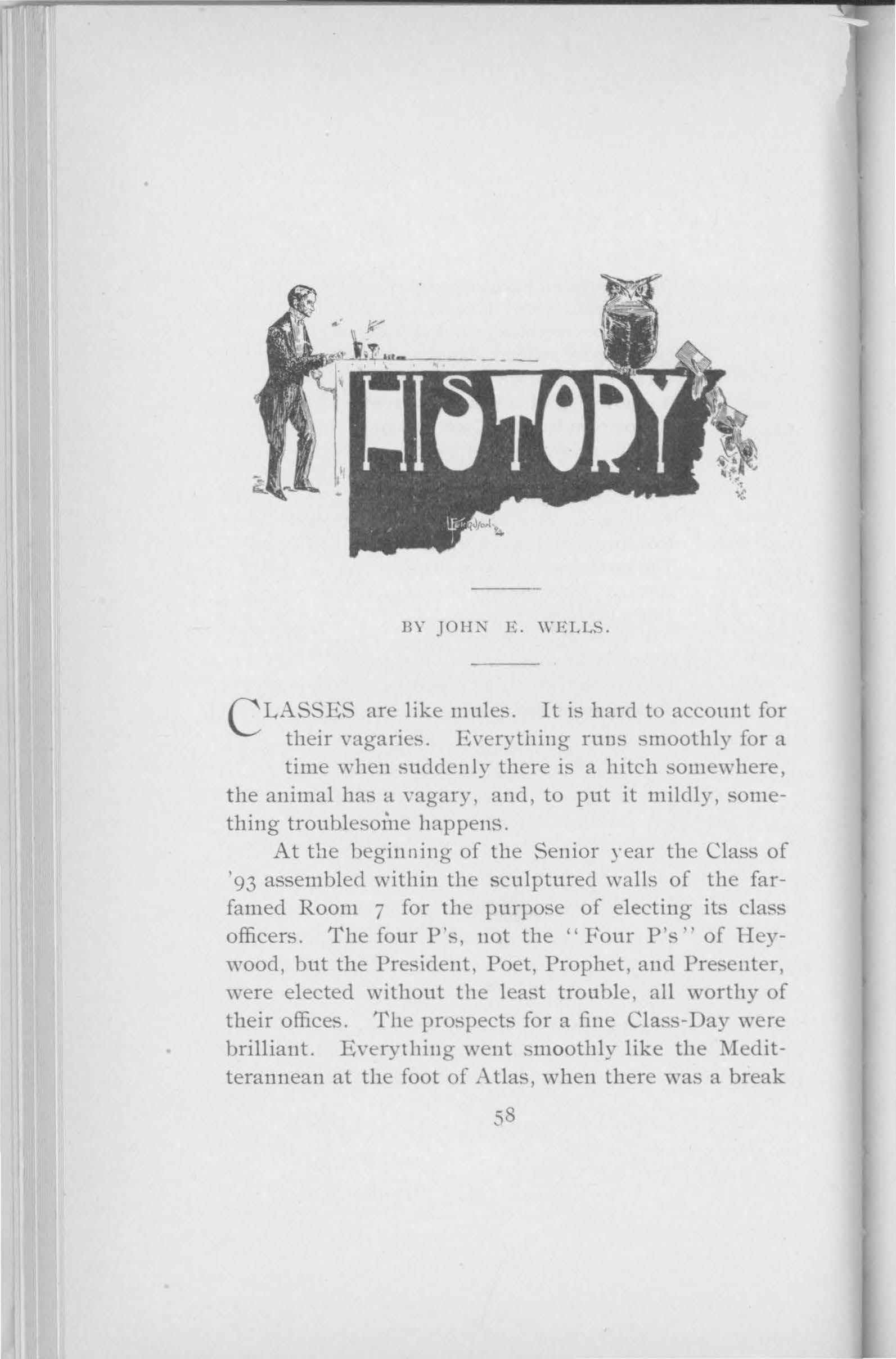
BY JOUN E. \\.ELL'.
CLASSES are 1ike 111 ule , . It is hard to accon11 t for their \'agaries. Everything mu , smoothly for a time when suddenly there is a hitch somewhere, the animal has a \'agary, and, to put it mildly, something troubleso1i1e happens.
At the begi11ni11g of the Se11ior year the Class of ' 93 assembled within the sculptured walls of the farfamed Room 7 for the purpose of electing its class officers. The four P's, not the "Four P's" of Heywood, but the President, Poet, Prophet, a11cl Presenter, were elected without the least trouble, all worthy of their offices. The prospects for a fine Class-Day ,vere brillia11t. Everything went smoothly like the Meditterannean at the foot of Atlas, when there was a break
somewhere, the class showed its mulishnes and its historian was chosen.
I offered to sell out to the highest bidder and my auditors were silent. I proposed to present the office to anyone who would take it, and as a special inducement to give along with it a "C. and S." Vergil, a Wentworth 's Algebra, and a "William Tell " with all the nice quotations neatly marked, and immediately I found myself alone. In despair I sat me down to meditate. Winding my bands in my hair I was e:xhattsting the forcible vocabulary of the German book when I saw the grinning skull of Marter stick out of one of the windows. Now that was exasperating and I was making a dive to once more put his bead through a dollar pane of glass when I heard the following very apt quotation issue from the lips of our learned friend, Mr . Charles Henry Howson:-
'' He shook his fist and he tore his hair ' Till I really felt arraid; For I couldn't help thinking The man had been --"
I desisted from my pursuit, for Miss Carrie Gaston had resurrected a rule to the effect that it was wrong to look of the window, and she had accordingly demanded that Marter immediately withdraw, thereby saving the class the expense of a broken pane. Howson and I had a long consultation that afternoon. I told him that one who could write such smashing editorials, especially that one on the World's Fair,
ought to be able to make his mark in the history line. After much persuasion, as he was fond of Latin and very anxious to gain command of those choice phrases in ''Tell,'' he agreed to show me how to write a history and supply me with classic similes and metaphors, and attend to the general rhetoric if I would only get him a "Noah" biscuit and a chocolate ice drop, for they don't keep these specimens of Egyptian cookery at the store in Wayne. I at once drew two cents from the class treasury and bought the fossils at the lunchroom at a discount of twenty per cent. and the contract was concluded.
In consideration of these explanations I hope you will regard these pages as the fruits of the joint labor of the Latin class.
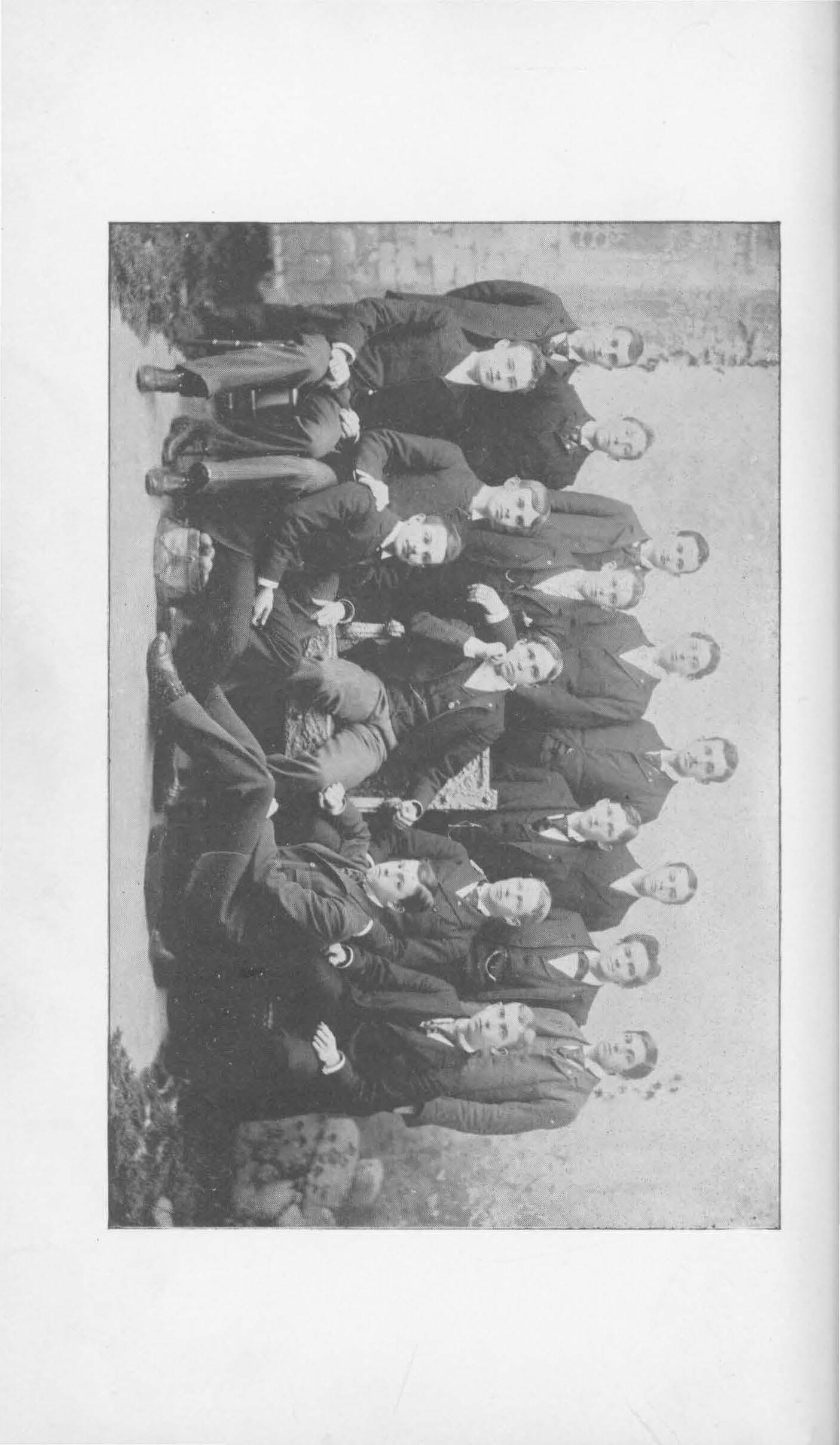
In September of 1882, on the second floor of that delightful building jnst across the yard, there assembled the little band of ladies and gentlemen who formed the nucleus of the remarkable class which is here to-day . Three years the classes held daily joint meetings, meetings over which Unity and Mutual Confidence hung screaming and flapping their wings like the Harpies over the tables of Phinens. The cause of this was that the gentlemen were almost as uumerotts as the ladies and the ladies had not yet had an opportunity to appreciate the value of superior numbers.
Well can we understand the feelings of the poets when they sing of the happy days of childhood. Friends 60

of that long ago, think of the delightful games of '' prisoner's base'' over the cobblestones ! Think o± the way in which we used to squabble over some contested decision ! Think of the beautiful songs we used to sing under the leadership of Prof. Bachellor, often to an accompaniment of a stray hand-organ! Do you remember those nice, moist rot111d balls of modelling clay with which we saluted the unsuspicious sculptor? But, alas, it is vain to dtll upon you ! The parting and seven long years of separation from the fair sex has reduced our number to a lone two. As year after year passed with but an occasional glimpse of "the Girls' Department," as hope of a joint-class meeting gradually died out in your disturbed breasts, slowly you pined away and vanished into other spheres, leaving memories which will always be kept green in our hearts. Would that we had departed with you, with the recollection of those happy times undisturbed by the strife and distrust which have been characteristic of the meetings which have at last rewarded(?) us patient survivors! Separated from the influence of the fair ones, the class began to give evidence of a sterner nature. Quickly it learned to dislike all other classes and to resent every encroachment on its rights. In order to the better do this a society called the '' R. L. A.'' was formed for mutual protection. No one to this day, not even its members, knows what these letters meant. Some envious outsiders asserted that it was "Rats, Lizards and Alligators,'' but this may be put _clown as the effect of 6r
a diseased brain. The society bound all its members to take part in the defense of any fellow in distress and most bitter were the feelings betwee11 it and a rival association of '92. Two spies were kept in the enemy's camp, who, in alleys and out of the way places on Cherry and Vine Streets after school, reported the doings of the hostile forces.
The formation of this society is mentioned that the truly remarkable character of the class may be understood. No other body of boys would ha\Te thought of doing such a thing.
But it must not be t110ugllt that in the hurry and heat of angry passions the softer arts were forgotten. Two fragments of poetry, the one a beautiful pastoral, the other a doggeral satire, have been found among the possessions of one of these ancients. We shall not make public exhibition of these int'!resting relics from the fact that the first is too long and that in the second the worth and the appearance of the hair and whiskers of an unfortunate instructor are too brilliantly reflected upon by the angered satirist. We feel sure that Chalkley will not hold any ill-will toward us for mentioning these reflections on his bright appearance, and that his opinion that we were the'' worst boys in the school" has been softened by five long years of separation. But men are ungrateful and historians are blamed where - they should be praised.
[ Anticipating such I have deposited with my colleague, Mr. Howson, all the relics, manuscripts and works 62
of fiction consulted in the compilation of this volume, and after my demise, private examination will be -granted all who wish to view them. I say after my demise, because a person who is always nervous, natur-a1Jy becomes more so when he thinks of beetle-browed villains hired to lay in wait for him up dark alleys when, in the shades of the night, he goes to procure yeast for the family bread. All this just because he says something about "ants," or "colts," or "suckers," or "facial adornments."
Away base fear! Away thou breeder of iniquity! Like Cicero at the battle of Marathon, let me forget all personal feeling in my love of the public welfare!]
Before we arrived at the Central School we had learned one of the great necessaries for a successful dass, namely, to assiduously encourage the slightest propensity in a teacher to talk.
In the first year of the course at the Central School we had that great fund of conceit which might be expected after bulldozing a school for two years, but this soon disappeared. Four classes were above us and we were the" kids." \Vith what awe and reverence did we approach the Seniors!
Soon \Ve became aware of the fact that throwing papers in the yard cost two demerits, running anywhere from one to five, and a pane .of eight by twelve window glass, ornamented with beautiful iridiscent bubbles, one dollar, with componncl interest for a life-time. One of
Prof. Birdsall'sremarks, " Spend a dollar -and you always spend its compound interest for a life-time." [If you ,vant to calculate that, just go and see Conard and get him to do it by logarithms, sometime when he bas finished calculating how many rounds it will take him to finish off Roberts, or vice versa, when they get at it in earnest.]
The Zoology room invariably is the centre of attraction in the E Class. That dog which our sister scribe bas mentioned was the subject of much meditation. It was suggested that it was the identicalcanine that Rip Van Winkle had in the dense vvilcls of the California forests. This theory was received with derision. A few clays previously Prof. Birdsall had taken that same clog from its happy repose at our feet in Room 13, and hadn't we heard him howling down stairs as he was murdered? Of course we had, and since we caused his death we were bound to care for him. The girls feel him, so the boys saw that he had some of the lnxuries of life, cigarettes, a pipe, and occasionally, alcohol from the jars of specimens. It is said that at one time he became so inebriated that he was heard to hie-cough aud seen to stagger all over the table. But he braced up like a man, I mean a dog, and has ever since preserved that grace of form and grandeur of silence which has been the wonder of all beholders.
As the infant class we were introduced for the first timetoElishaJones' "LatinBook''withHarkness ' "Latin
Grammar,'' under the care of a certain noted instructor who has since left us. But somehow he and the Latin didn't agree with us, and duck eggs pattered about us as if we were bad actors. It was said that this teacher was the rightful owner of the zoological dog and that, being a Prohibitionist, his sour expression was caused by sorrow at the clepraYed habits of the beast. But this was questioned by others who a.<sserted that if the dog had been his he would have contended with Prof. Birdsall for its possession. But these latter do not bring forward auy theory for the teacher's appearance and we are reluctantly compelled to acknowledge the truth of the former account. Much may be said upon both sides. It is a subject worthy of weighty consideration and long argument.*
Perhaps Anna Jackson will be remembered. Do you recollect those bottles of creosote kindly supplied by Boericke and Tafel, which were mashed on the floor of 14, and how the innocent instructress ordered both the windows and the door to be closed in order to '' keep those disagreeable odors from the laboratory out of the room"? Do you remember how whole paragraphs were recited to her in answer to questions? Do you know how that was done? Do you recollect how
*If any one should wish to follow the ,•arious trains of thought brought forward iu heated discussion, held se,eral years ago, we refer him to the pantphlet entitled, •• The Physioguo111y of a Learned Pedagogue, Being a True and Exact Report of a Debate between l\'.lessrs. Scot and King, of F. C. 8 11 and with an Appendix Containing an Account by Rounds of the Resulting ConflictY This interesting paper is among the archives in l\1r. Ilowson's possession.
demerits would fly around when she and a certain other person upstairs would have a "Yagary ?' ' No, we didn't suppose you did.
Perhaps you forget when Prof. Shields first allowed his brilliancy to shine upon us. It was during the first year. Then be began that everlasting stuff about '' Never write on a hard desk with a single sheet of paper." "Legibility and rapidity are the chief essentials to a successful career as a clerk." He was alway:,; telling us yarns about merchants who had come to his office '' only last week'' to get a young mun for office work and that he had recommended a certain youth just because he could ,vrite well. . \ccording to the number of these tales he must have kept about 25 ' , of all the merchants in the city supplied with boys during our course at school.
In later years if one of us would wait a quarter of an hour, on a rainy clay, looking for him to come around, and then ask him if he clid11 't think we were having fine weather, he would burst out with, '' If thee don't get to work at once, thee may take two demerits for idleness!'' And the poor, innocent pupil \Youlcl fall to thinking whether he said "thee" and " thou' ' at the other schools in which he taught. Professor always was a queer sort of a man. That was his way.
\Vhy one year we ga,·e him the same specimen of writing every month and he actually gave us a higher mark each time and complimented us upon our improvement. When he was informed of the fact, at the 66
encl of the year, he wanted to know how we expected him to know about it, and ever after held such a kindly interest in lris informant that he always presented him with a front seat and kept a watchful eye and ready tongue for him, and we really believe that he was glad when pressing duties in the Latin line called the youth from his class.
Arithmetic is one of the most interesting of useful studies. Under the rnle of \Villiam \Valker it was particularly interesting. Tbe agility with which he pranced around the room was trnly wonderfnl in a man of his weight. His endurance was remarkable. He would go twenty times around a class of thirty boys in three quarters of nn hour with his questions, and come in fresh with enough time in between to q11iz each fellow on some one of his peculiarities, and take the account afterwards without a mistake. Before bis questions boys rolled down like ten-pius to the accompaniment of "Away be goes!" ''The Old Man!" "The Next Disciple!" "The R·epresentatiYefrom Rosemont!" "Come,WakeUp,Old Mau!" "Ifthehonorablemember from New Jersey would stop thinking· how a stumptailed cow is going to get along in fly-time, perhaps he might do better!'' etc. Then at a correct answer, after half the class had been bowled O\'er, " Hear him now! Come, stand up and let them see thee." If a fellow had a very doubtfnl answer,\Villiam would say, "Have a care, friend, that the tail-bolt don't giYe way.'' Then he would tell how two gentlemen went hunting wild-
boars. They Jound the den of one of these animals and one of the hunters crept in head first to kill the young. Just then the mother came back so quickly as to prevent his comrade from firing and only leaving time to grasp the tail as she vanished within. There they were strnggling, \Yhen the man inside. hearing the noise, wanted to know \\'hat was the matter. \\'hereupon the other replied, '' Thee '11 soon find ont what is the matter, friend, if the tail-holt giYes way." If a fellow would answer a question after it had passed him \\'illiam would tell the chicken joke. An Irishman was fond of raw eggs. One day he was getting away with one, when just as he swallowed it, the chicken peeped. "Ah, friend,'' said the Hibernian," thee peeped too late." \Ye heard that joke on an average of once a month for three years.
One of the worst things a teacher can do is to inform his pupils that he kno,vs about all there is to k1ww. A certain instructress came among us and upon the first day had a prelimiuary understanding "·ith us, as she called it, by informing us that there were no tricks that boys played that ~he didn't know all about. \Vith sorrow we record that she knew several more and had had a chance to review all the others before the end of the term. \Var was instantly declared. That class was always in a state of chaos. (I know Harrison wants to say that it was in the State of Pennsylvania, but he is always wanting to say something or other.) More chalk was used there in one day than was consumed by 68
the whole school in a week. It wasn't used on the black-boards either. Soon it was found to be advisable to have the class in Room 1, under the watchful eye of another teacher, in order that this learned teacher might hear a lesson. It is a significant fact that few had to take the examiuation in English history that year, and the next term there was another person in charge of that branch.
About this time Professor Frost first appeared at the bead of the class with his well-preserved and carefully labelled stock of "jokes." We judge that Professor acts upon the supposition that after one of these '' jokes'' has been heard several times, the hearer is better able to appreciate it, because he alwa:y:s knows what is coming next and when to laugh. About the first he ever got off on us was that antique, worm-eaten combination of words commonly termed '' The FrostBitten Potato Jok e." In order that the beauty of this ancient specimen of Pnritan liumor may be within the reach of all we would do well to preserve it. Professor declared that he was unable to keep potatoes in his cellar on account of frost. Well, he evidently thought a great deal of that joke for he sprung it on us until it became monotonous and was greeted with groans of anguish. He had been getting it off long before we encountered him, and we heard the other day that he was still springing it on the class of '96.
It soon became evident that Professor wanted us to laugh at all his attempts at humor, and there we had
sweet revenge. When he got off a joke it was received in a dull, sad silence. Every countenance assumed an expression which wonldhave passed muster at a funeral. Professor stopped for the customary applause and got none. He repeated the joke and three boys yawned and stretched their arms. The lesson was continued, but Professor was rather sarcasti~ the rest of the day.
\Ve liked to hear him tell how he used, witll the aid of a shingle, to persuade his son to come ove~· to his opinion, and we liked to ask questions for general information. It was awfully interesting. Why sometimes we would take up a whole period that ,vay. We • didn ' t do it to get out of tlie lesson though. Of conrse not.
'' Comment, please. " "I think that it, a-a-that it is one of the most beautiful passages I have e,·er read. It-a-a-it shows remarkable~and-a-ait shows remarkable ability and great loYe of Nature.
A-a-I can't exactly express myself, Miss Carrie.'' "Well, when was the author born?" "Will you please repeat the question, Miss Carrie?'' "vVhen was the author of this passage born? Come, sit back, John Jones. I don't want to have to suspect any one of wrong doing. You should avoid all appearance of communication. Come, James Brown, when was the anthor born?'' "On the 23rd of April, 183+." " Right. Thee got it at last. Better late than never." Brown thought so too, as he took his seat, but he wanted to know why Jones was so long about it and Jones said
that he lost the place. Opposite Brown ' s uame there was a mark of ro and Ju: held his hand under the desk while Jones recited in turn.
This is what occnred in the '' sky parlor ' ' in some of the classes in C Literature but, of conrse, it never happened in onrs.
In our earlier years, the laboratory was looked upon as the chamber of mysteries, and Prof. Frost was r e garded as the presiding genie, a man to be approached with fear and trembling. Everyone was eager to possess a desk in the place and to learn how to make the rest of the school uncomfortable with those interestiog odors. But, mirabile dictu ! however anxious one might be to get in, he ·was doubly anxious to get out.
Professor wanted to make a profound impression upon us new recruits. He had a base -ball bat for which he would howl like tt Zulu when a fellow did sometliing wrong. Then 11e would yell at the delinquent to ' ' come up and be killed. '' Really he dicln ' t know what a spectacle lie made of himself, "don't you know,'' so the bat was quietly appropriated for the use of the school team.
Professor used to act as if he would be a good subject for space in '' that excelle11t institution at Norristown. " He talked so much about" guyascnti" and "nix-conier -ausen," and performed such queer actions that that little quotation which, in the early part of this history, I have attributed to Mr. Howson,
was often very applicable. I mean the one beginning, '' He shook his fist and he tore his hair," etc., etc. There was a big bottle of alcohol on the shelf, but we understand that Professor is a Prohibitionist and that his vote doesn't count.
Did he ever return or replace those test-tubes he borrowed from Pray ? Did he collect those books he was al ways going to collect and mark? No, he didn't, and we knew he wouldn ' t. You want to know why? Well, we ' ll just say this. We gave in some papers in November, and Professor had them marked by Yearly Meeting week. If he had collected those books the funerals of all of us would haYe been celebrated before they were examined. But, as Professor was saying the other day , he is so very modest that he doesn't get credit for half bis good qualities and his modesty is buried out of sight.
We won't ask Comly how he obtained eight metals from distilled water, and we won't ask Conard how he turned a blue filtrate to a red one when he found that a red was required. Ob , no! We won ' t say anything about it, but it was very " sheepy, " friends, very '' sbeepy. ''
Before we leave Professor we would like to ask him if he has used the hydrogen pistol since it went off while he was looking in it, and whether he still makes ''Joseph cut the phosphorus!''
About this time Scot took another "t" to himself and came out strong in the poetical line with verses to 72
fair maidens from heart-broken swains. Queer cabalistic characters began to appear at the head of his algebra and arithmetic papers. They were like this :
He became moody and abstracted. No longer did he join in our mirthfttl laughter. All his time was spent in meditation varied by an occasional game of "bull-in-the-ring." It was with infinite gladness, therefore, that we welcomed the appearance of his '' jews-harp.'' We were so pleased that we escorted him, playing, in a triumphal march around the grassplot, clapping our hands with joy, like the neriads around the car of watery Neptune . Suddei1ly Wm. Walker descended upon us and commanded that daily concerts be given by the musician in Room r r, after school for two weeks. Eagerly during that fortnight did we crowd, an appreciative audience, to applaud the efforts of our unfortunate brother. William made a trial on the instrument but his ability wasn't in the "jews- harp " line and he gave it up in disgust. [ A programme of these concerts is among the archives in the possession of Mr. Howson].
After this our friend became more gloomy and seemed to be busied at some great undertaking, for we would often surprise him writing vigorousiy in some out of the way place, whereupon he would snatch up
the paper and hastily conceal it. Soon the myi-.tery was explai11ed. One day he produced from a large box a play writle11 on ro lhs. of fools-cap. Like lhe tapemeasure in the box of the sun-eying instrument, the only attraction of this specimen of literature was its length. It would be well to say here that it was neYer reacl.
That autumn the foot-ball craze attacked the class. Opposmg teams of fonr or fiye wonld contend on the bricks in front uf the meeting-house for the possession of a paper foot-hall. l\fany were the brnised limbs, flowing noses, a11d torn coals mirsecl iu silence lest the game Rhould he prohibited. In this game the class was agai11 remarkable. It formulatecl a set of rules and made an entirely 11ew game, the chief entl of which was to get as hot and tear as much clothing as was posRible in twenly-fo·e minutes. .:\t the e11d of the :-,chool year we were informed thal it "·otild he well to haYe a joint class meeting for the election of staff officers for lbe paper called the '· .i\'a"li/11s." \Vi th a shout of glaclnei-.s the idea was welcomed hy those two disciples, who had been waiting for that thing for se\·en year::;.
The meeting took place where all joint-meetings are always held, in Room 12. and there was elected the editorial staff which has made Ruch a clisti11guishecl success of what in former years had been a grand failnre.
That meeting, althottgh not condttcted according to parlime11tary practice, was, nevertheless, of a kind which might have well been copied after during the past year. Peace and good-will reigned, like the hail-stones on that hottse in Vergil. \Vhat those meetings of the last term might have been, had the ladies only conducted themselves differently, it is vain to conjecture. Once more do we bow to the sage who has declared that Ital/ of lhe trouble in the world is caused by woman.
It would be well to speak here of the Latin class. In E and D the entire class, as we have intimated, were taught how lo try to read Jones' Latin Book, to compare the price of stationery at Friends' Book Store with that charged elsewhere. to decli11e ni11i/ (noteveu demerits), and to conjugate !tam sandwich with sum in that form of the subjunctive which sig11ifies "it might have been.''
After having mastered these di!Iicttlt branches of the subject we encountered Ca~sar and Prof. Maris' anecdotes. But we'll presen:e these anecdotes for "future reference.'' After ba ving heard Prof. translate three books of Ca.~ar, some of the boys began to inquire what was the use of I,atin anyway, and the term ended.
Only eleven disciples turned up lo help Prof. scan the Aeneid. Some one said that it was because the others hadn't gotten over those anecdotes of the year before, but we and Prof. received the assertion with 75
the contempt which it deserved. You have heard of that rhyme of how
Nine little blackbirds sat upon a gate, One departed from this life And then there were hut eight.
Well, our Vergil class might be described in this way:
Ele,·en little B hoy~, ten lines eas'ly do, Lessons le11gthen fifty more Aud then there are but two.
[Don't imagine that Howson is the author of that just because he is going to read a poem to-day. That verse is the product of my own genius. Like the boy of C, whom I have mentioned, I think that it "shows remarkable ability and lo\·e of Nature,'' but ''doctors differ."]
We have heard it said that during the last term that Latin class was '' a snap,'' just because we had thirteen study periods a week. \Vhy we had a Latin lesson every day at the commencement of the year which took three hours ( Now, Howson, keep quiet, ) for preparation.
But we must explain for the benefit of teachers and future pupils a little plan devised for studying only half the lesson in a class of two. You will be able to judge of its worth before band when we tell you that this scheme was taught us by the " beep.''
By some accident only one member of the class would turn up at the beginning of the period, and ot
course he would begin the lesson. About :five minutes after, the other disciple would put in an appearance, having been " unfortunately detained by an irregularity in the order of exercises." The clay before, these students hacl decided which should take the first and which the second part of the lesson.
Seventeen members of the class responded upon the r 2th of last September. There was Anderson, with the flowing locks; an olcl friend who had left us for a while and now again returned, Biddle; Boyer, who uses the mandolin and curling iron; Comly, who is going to make presentations to-clay; Conard, who is said to have chosen a career in the prize ring; Fussell, who is going to write a history of Joshua Fussell, with the help of Prof. Maris; Harrison, who is going on the stump and to button -hole the "free ancl i ndepenclent voters'' of his district; Howson, who is noted for his extreme youth and the poem which he will read presently; Read, we won't talk about '' Read,'' we'll say "sheep;" Marter, with that everlasting grin; Morgan,we'll talk to Morgan about "suckers;" Pray,wbo is so fond of political parades at night; Roberts, who don't like to see his name in print; Taylor, the little one, who acts as if he carried on all the business of the class and wears '' two for fives '' and a facial adornment ; " Wells, who has the swollen head of the class and who was, therefore, made general utility man ; Williams, the " giant" who keeps Wells from falling off the encl of the bench.
Three days after school bega11, that meeting took place in Room 7, in which the class had that "vagary" we haye spoken of, and upon the same day Prof. Frost got off a new joke, as follows : Prof.-'' Middleton, did thee know that :\faud is 'on the outs' with Nancy Hanks." ~rid.-" Xo, sir."
Prof.-"Ves, she don't keep company "·ith her any more. Xancy's too fast."
Great anxiety was e.·pressed as to what paper contained this joke. Search was at once made and hundreds of suggestio11s given, :me! it was finally found on the second page of the '' Police Gazette,'' and also in au obscure corner of the "Sunday School ·e\,s, and the next clay he sprung the '' potato joke ' That same ,wek we had the first of that delightful series of Joint Class 11eetings. For ten minutes the boys on one side of the room, the girls on the other, sat and starecl at each other. Theu in the still silence was heard the low, ft.:ehle Yoice of a member of the "mens''' department nw.king- a motion that the girls' president take the chair. The president was found concealed in the hall-way and produced. In that meeting it was clecicled that we should han! a class pin. Immediately all who had any interest in the class went to work to get the finest clesign to be obtained, and the boys got it. \\"e had a class meeting and 1Iiddleton was in the chair. One of the young ladies, looking around the class, discoYered that there were
about three girls to one boy. Therefore, moved by her kindness of heart, she made a motion that each boy be given three ,·otes to each girl's one. The motion was seconded and carried, and of course, when the vote for the selection of the design for the class pin was taken, the one that the boys had selected was chosen. Immediateiy "there was weeping and wailing and gnashing of teeth." Each individual girl fell to biting her nails and calling down maledictions upon the heads of those '' meau boys.'' From that day class meetings were pitched battles, at which the girls generally won by force of superior numbers, but not the goodness of their cause.
At the first joint class meeting it was decided that we have class sociables, and most enjoyable ones tbey turned out to be. A committee was appointed from each class to provide entertainment for those who ,,;,ere unacquainted with the terpsichorian art. It is unnecessary to say that this committee was never thanked for its year of hard labor.
Interesting meetings were held in the '' Blue and Gray'' room. The prices of cards and ribbon were eagerly discussed; eyery sort of amusement from " mumbly-peg" to "bacaret ,' was proposed. Unfortunately the boys had lost their knive::; and the clacs could not buy new ones, because it was "saving up for class day,'' so we were unable to have the former of these interesting games, and the latter was prohibited by the fond parents of our fait hostesses.
We have ofteu beeu questioned about those" Box Parties.'' We will simply say that they were given about once a week at the various leading theatres in the city. The first of these assemblies took place on October r rth , and in all else regarding them we will be silent . We don ' t like to crow over other classes too much. Like Professor Frost, we are modest. We are always pleased to see a youth interested in politics and that is the reason we hold Pray in such high esteem. Why he has enough political enthusiasm for the whole class. One night, dnring that vigorotts campaign over in Jersey, he stood applauding the long coltmrns of Repnblican stalwarts, shonting himself hoarse, when he happened to catch sight of Sam Roberts on his ' ' colt,'' heading a detachment of ' ' tried men and true ' ' from over at Hartford. Overcome by his joy at so beholding his comrade, our friend forgot that he was in a precarious position and in bis ecstasies danced off the wharf into the water and mud of the rippling Delaware. Bystanders say that be spoke very rapidly in some foreign language, and we have been informed, by one who was near, that he used German words, whence we infer that he was reciting selections from '' William Tell. ' '
A week after that Anderson had his hair cut. 'Somebody said that it was because it bad such a bad effect upon that picture of the staff, and because the dancing class was being formed, and that hair wa.'3 too bad to take into ladies' society.
That dancing class will probably be remembered for the number of things which disappeared and were found. One member has a whole barrelfttl of "pocketed " articles which he has been t1nable to return, as he does not know the owners. These things, with the barrel, are on exhibition in the "sky-parlor." Things not claimed to-clay will be knocked clown to the highest bidder and the proceeds tnrned over as salary to the class treasurer.
On December 2nd the class was overcome by grief and the superior ability of the class of '94 on the football field. The next day, nine men of '93 and '94 went to Burlington and played a remarkable game, not only remarkable for the way in which the weighty J erseyites were blocked, but also for the fact that oue of the class was praised more than usual for doing what the other fellows did.
We shall begin the new year with several little anecdotes of various classes.
ASTRONOMY CLASS.
Professor gives a question to Smith, Smith hesitates and Jones prompts him. Smith still hesitates, and the question passes. Professor asks why he failed, and he says, " I couldn't hear very well, Professor."
GEOME'rRY CLASS.
Professor-'' What is a regular polygon?" Robertc;-" A regular polygon must have an exact number of sides."
TRIGONOMETRY CLASS.
Prof. Hibberd-" If Rider Haggard had been Lew Wallace, what would "She' ' have been?''
[Class gives it up.]
Prof.-" Ben Hur.''
ARITHMETIC CLASS.
Prof. Baker-'' What is the value of '' pi. ' ' Pupil-" Five, when the fellow who goes out don't charge a commission.''
Prof. Maris ' history clas:; was the most interesting of tbe term. Prof. would tell us all kinds ot anecdotes. Some said that his personal stories were sometimes old stock ones rehashed. That one aboL1t Henry Ward Beecher was rather shady.
Prof. said that during the Summer he had called on Beecher and had seen him. He made him a proposition in regard to something or other, and Beecher , waving his hand on high , refused to ha,·e anything to do with it, saying, "My time is mine and my Lord 's. "
This is very much like that anecdote of Cardinal Wolsey in "Arnold's Latin Prose Composition " and the '' Spectator.''
Do you remember how Prof. used to tell us about Galusha Grow, Jawshua Fussell , Judge Ta-a,v-ney, and Bill Hickman ?
Soon after this Roberts and Conard began that series of pugiJistic contests, which has won for them the plaudits of the school world. It is wonderful what 82
endurance those fellows have. They have kept it up for six months.
In April, the ammal trip to Washington was taken. Some yarns have been told of that trip very bard to swallow. Unfortunately the historian was not with the class and is, therefore, unable to judge of the truth of these stories. Ask Roberts about the view from \1/ashington Monument. Inquire of Harrison why he paid for those sheets. Ask Read about that blackmail yarn. Be very tender in regard to that oyster story of our President. It's fishy, friends, very fishy. By-the-way, Morgan knows about fish. We ,Youlrl like to be informed of the size of that '' st1cker '' that he was trying to catch when he sank to his knees in the mud and water of the gurgling Wissahickon while on that geological excursion.
Upon the 31st of March our beloved principal, Prof. Maris, left us to devote himself to the organization of the George ~chool. Vainly have we endeavored to express the respect, the esteem, the love with which we regard Professor Maris, a friend as well as an instructor, endearing himself to us by his constant kindness, gentleness, and cordial goodness. Rarely favored art thou, oh George School !
When Prof. Birdsall was present~d to the school as principal, a certain gentlemen, with whom all Friends hereabout are well acquainted, arose from his chair on the platform and proceeded to deliver to us a really fine address. But unfortunately he got into the state in
which part of our representation will be to-morrow and begged that we would "do nothing which the midnight sun might not shine upon.'' The effect of the rest of the speech was spoiled.
The la t day before Yearly Meeting \Veek, four of us encountered four of the class of '9-J- in a debate ; '9-J- debated while we looked on and it was decided that '' success is more likely to be attained by poverty than by wealth."
At recess the Professors in Room r 2 often wondered who brought those "pies" up before school. We wondered too. \Ve thought that somebody ''sneaked" at recess and got them at that clean-looking establishment at r5th and Filbert. I say we thought so. Perhaps we were mistaken. Nearly every one liked mince, we suppose because there was more variety for the money. \Vhy, it was a regular lottery. You would get anything from a ten-penny nail to a chair-leg. B~t after a while this hunting between bites became monotonous and we went back to the ham-less sandwiches and chocolate ice-drops.
Soon we began to hear vague reports about "sports." Did we have them! \Vell, I should think we did. How were they gotten up? By the Class of '93. \Vhy were they a success? Because '93 was there to see that they were. And who won them? Of course the Class of '93.
Five successive senior classes had not thought of such things as "sports." They were looked upon a
impossible, for how would the committee regard such a thing? But when '93 came into power it favored originality, as it has done in all matters, even in ordering two sets of commencement invitations.
The sports were prepared for and then the committee was informed, and there was success beyond all expectation. It was proven to sneering outsiders that there was as good talent hidden in the sober bearing of F. C. S. as could be found in any school hereabout. No longer need any supporter of the Gray and Blue be timid about bragging over school athletics. F. C. S. has records to be proud of.
The clay before the sports three of the class got sick. Great anxiety was expressed least they should be unable to compete the next clay. There were queer antics being performed at that little station at Melrose.
We knew that Middleton danced but you should have seen him while we were waiting for the train. The ballet "wasn't in it." The exclamations to which he gave utterance beat "W. Tell" all hollow. We imagined that he was crazy, and were about to flee, when we found out what was the trouble. It was all caused by a little insignificant ant crawling along the ground six feet away from him. This poor little insect drove him from the cool shade under the trees to a bench in the sun with a temperature of 92°.
Ever since, the mention of an ant makes him shiver and turn pale. A real neat little verse, descriptive of this event, has been written in a moment of inspiration.
The cool breeze blows by the sweet Melrose, As lhe anl crawls here and there, When up Mid jumps while his heart hard thumps, For he thinks one's in his hair.
Shall we speak of the "Blue and Gray?" There is nothing our feeble efforts can add to it It i far ahead of all periodicals of its class. No other school in the land has a paper equal to it in general excellence. You may think that we say this because it is the organ of F. C. S. [\Ve know that l\Iorgan thinks that "antoharp '' is a better word than ''organ, ' ' but his j udgment is sometimes incorrect, as it was when he thought that he could catch that "sncker. "] But, laying joking aside, if you will look over files of excha11ges from all parts of the United States your impartial opinion will justify what we liaYe said.
Just as we had gotten the history written this far yesterday afternoon, Howson looked. at his wo11clerful ,,·atch, and declared that he would have to leave iu order to mt Ilic ,£:rnss on the paternal lawn at \Va) ue and finish the last three lines of his poem. I regret to say that much of interest in this history has been omitted.
There was Anderson 's comb and looking-glass in the "Blue and Gray " storage room; the public blacking brush in Room 12; Joseph's toweis and sink in Room 40, and that clothes brush. I would haYe recorded how the'' facial adornment'' and the yard-wide ·• two-
for-five'' trousers were too great a weight for the little form of Taylor and th~refore caused him to fall into the mortar-bed.
I wouldn't have forgotten to tell all about Sam's colt, Comly's bottle, Boyer 's snakes, Fray ' s boils, Fussell ' s ancestry, and Harrison's likeness to mucillage. Oh, no. I shonld have them fully developed but for the desertion of Howson.
Although I thought that some of them that _ have appeared in this history were a little ' ' off '' in application, I was relying upon his classic similes to help me out at making a grand finale . But alas for the designs of mortal man!
I shall be forced to lay aside the elegance of diction with which I hoped to delight you, and come down to a hard, bare apology, unadorned with the tendrils of our friend 's poetic imagination.
I as k pardon of the class for the incompleteness and hurried preparation, of its history and acknowledge that its lack of brilliancy is caused by my want of ability _to cope with a subject so stupendous.
BY l\IARY R. HAXSELL.
CLASS of 1893 1 we graduate in the Ninteenth Century. All thought of difficulty in prophesying for my beloved school-mates vanished like the wind when I thought that all things are possible in this age. The benefactor of the race lives in this era. Edison illumines the world with his intellect as well as with his incandescent lamps. Predous to this year I have always regarded '' The \Vizard'' as a most obliging individual. His inventions benefit mankind. \Ve light with electricity, we ride by means of it, we read by it, and I don't hesitate in stating that in the next te11 or twenty years ,ve will eat, drink and walk by it. A delightful state of affairs it "·ould be, indeed, in the case of our friends who say too much, since we could simply press the button and stop the current at will.
But let me say tliat now more than ever I honor and respect Mr. Edison. When the girls in the class appointed me prophet I immediately determined to write to Mr. Edison and ask him to assist me. Then I waited long and patiently and my w'aiting was only rewarded two· weeks ago. Strolling down town one fine afternoon, I was much surprised to see the wild excitement visible on Chestnut Street.
People were tearing t1p and down at lightning speed; policemen were alternately shouting and clubbing men and small children, and dogs were howling and getting in every one's way. I stopped several people and politely inquired what the commotion was about but they were so breathless that I received no reply. Finally I managed to grab a small boy and said, "Will you have the goodness, young gentleman, to please tell me what is the matter?" "Well, you're slow," he elegantly responded, half out of breath. "Edison's latest j t1st out, the 'prophesying machine'." The boy was off before I could say when, how, or where, but I did manage to gasp out, "Edison, you dear creatnre, you are, oh, Edison, you really are, you know you are !"
It clicln 't take me long either to get into the hottest part of the crowd and discover that a nickel was necessary before one could examine the wonders of the machine. I went home as quickly as possible, tore in the front door, rushed up stairs and called out, "Give me two dollars and sixty cents quick and let me go to
the mint and get fifty-two nickels.'' Neither did it take me l ong to accomplish a ll t h is uor to get b ack in line waiting for my turn to examine the extraordinary ma c hine.
So wildly excited I was that I didn't notice the details of the i11strume11t, but only know it was a boxlike arrangement with an electric battery attached. I dropped my first nickel in the slot, said the name of the person whose future I wished revealed, pres eel the button, and gazed through a small glass aperture into the dark interior of the box.
Soon a little gleam of light was visible a11d I smv a picture so real I wanted to speak to it. It was Anna Holmes-can you belie,·e it? There sbe sat 011 a little rou~1cl ;;tool, in a quaint little shop . On all the counters were curious rolls of paper: in little apartment:; marked A, B, C, D, E, etc., were more manuscripts. In her hand was one dud piled up in the corner ,vere other rolls of writing.
At length a sign abo,·e the door met my eyes which explaim:cl all, '' Poetry Shop " Then I ki1ew that Anna was at her old employment and made jokes and wrote poetry for all classes of people. The A, B, C, D, E, re:-;pecti\'ely indicated, Jokes for the Aged, Bald, Cranky, Deaf, and Jokes for the Editors. Then I noticed a telegraph instrument ticking away in the corner and I saw a young clerk busily engaged in writing messages, which he received by telegraph and which he signed" L. K. '' Ah, I see now, Lillian and Anna 90
still assist each other in the pun-making business. Good! good! may they prosper! May their jokes be brighter and wittier than any others ! The light grew dim and the picture faded away.
I dropped in my second nickel and mentioned a name. The machine clicked but didn't work. I dropped in another but still it stuck fast. I kept on until finally seven were gone. "\Vell, if this continues,'' I thought, '' Edison won't benefit me much after all. In fact, I shall be inclined to think he is a swindler. I will try one more though,'' I decided, and accordingly dropped it in.
This time my patience was again rewarded. I looked through the glass opening and saw a goodly company. '' The Long and Short Brigade.'·' Big, tall Annette and short Evelyn, small Florence Jones and tall Helen \\'est, large Lillian Teasdale and little Lillie Snmmers, and still another couple, Tillie Yarrow and 11ay Buckman. But what in the world are they doing? I can't understand this picture. Snch were my thoughts until I sa\v a sign in front of a large house where the girls were busily employed, "The Inn of the Eight Associated Sisters.'' Then my perceptions were awakened and I understood. In order to make a livelihood the girls had devised the plan of keeping an Inn. Annette, Helen, Lillian and Tillie, (the tall girls,) scrubbed and attended to the ceilings, while Evelyn, Florence, Lillie and May, (the little people,) industriously swept the floors. The intermediate work they
distributed evenly. '' Fine, honorable employment,'' I mused, "\Vonclerful house-keepers, too. May this band long continue , this league of women!'' But even as I spoke, I saw eigbt men trooping in at the door and the light again grew dim and the picture pa'-sed away. I dropped in another nickel and this time I did see the funniest picture. No other person than Lillian Kennedy, herself, silting in a very pretty room writing. She had 011 an inky apron and behind each ear a lead pencil was calmly perched. Above the writing-desk hung a huge diploma, on which was printed in extremely large letters, " "\'assar." But the things which most attracted my attention and made me laugh aloud were the pictures around the room. They were all of one person. Jo other picture was considered of any importance but his. There were large photographs, small ones, tintypes, pictures of this man in groups, pictures 011 easels, every·where the same face.
Then, Lillian's actions, too, were very peculiar. I was afraid she had lately escaped from '' that excellent institution at Norristown, young ladies, that excellent institution . " She wrote a few words and then looked up at the garlanded face above her ( for she had a spray of ivy twined about his countenance ) smiled, seemed to gain fresh inspiration and then ·wrote on. Then I left her , for the picture faded away. And now I know you all are anxious to know who the fortunate person was, aren't you? Well, I am just as anxious to tell you but--\Vell you know Lillian is a
very rash little girl and I think I will spare her feelings this time. However, if you will come to me privately, Lillian, I will tell you all about it.
But let me continue my story and tell you the fruits of the next nickel. It disclosed a very sad and mournful picture. Could that be our beloved ''Penny" who sat in the arm chair there poring over a Sanskrit Grammar and writing essays on Greek and Latin authorship in the Middle Ages. At her feet were ten diplomas and in her hand was a certificate stating that she was the first and best Latin, French, German, Greek, Hebrew, and Sanskrit scholar in the land. "So young," I murmured, and the light died out.
The next picture was a remarkable one-most remarkable. By mistake I dropped two nickels at once and two persons were shown together, Grace Heisler and Irene Eavenson. I had always declared that these two friends of mine would come to a dire encl, but never did I believe it would be anything equal to this. My refined hearers, do not be shocked. These girls were being exhibited at the ''Dime Museum," Grace as the Champion Fat Girl and Irene as the Prize Giggler. Irene was in a glass case and had an electric wire connected with the back of her head. A tall, good-looking man (a Baltimorean, I believe,) managed the battery and gave her the electric shocks at proper intervals. When she received the shock, the effect was wonderful. She opened her mouth, closed her eyes and giggled for hours at a time . Grace was placed
upon a large revoh-i ng table which slowly, very slowly, swung round a11d rouud and exhibited her to an admiring crowd. These two girls were great centres of attraction. Never did I look upon more interesting studies but the light iu the aperture grew dim, I shed bitter tears. It was touching to think that a '93 graduate should come to such an encl as this. For my part, now before it is too late, I shall do all that I can to prevent it. I recommend Yinegar for Grace and persimmons for Irene. Take my ad,·ice, dear girls, and grow thin and quiet respectively.
I dropped my fourteenth nickel iu the box after my violent fit of weeping had ended, and saw au a nm.zing picture. '' Clara Sailer,'' she wa. dressed in a gown of plain dark brown, befitting her station in life. She had a little basket on her arm filled with sandwiches and cold potatoes . Ou either side of her were two dirty little urchins who were beg-ging for something to eat . And just as she reached down to gi,·e them each a cold potato, her husband , the parish minister, came out of a little cottage, which was about the size of our famed lunch-room. Clara flew to meet him, threw both arms about him and--, but I clidn 't see the rest for the light went out.
I was so astonished al this picture and my mouth was so exte11cled that I came near dropping the uext piece of money into the aforementioned aperture instead of the proper one. But after a little difficulty it fell into the box with a clang and disclosed a most fasci-
9-1-
nating vision. Edith Ogelsby, attired in a gown of white and yellow, with a hnge bunch of white carnations in one hand and a very flirtatious fan in the other. She was ensconsed in a comfortable arm-chair, with her feet stretched out on a stool. But on his knees, along side of her, was a most demure man individual. He was pleading for her hand and heart, but Edith told him her hands were both occupied and her heart-well she said Mamma thought she was most too young to think about such things, but Mamma said that she might be a sister to him. This prophetic vision amused me greatly and I thought it was a very good joke on Edith for I recognized the man as one whom I thonght used to have Edith's heart entirely. Nickel number sixteen fell with a ringing sound into the box, the machinery clicked and I saw Sue Dixon. She was at the Stationery Department down at \iVic1,namaker's and spent her time in selling commencement invitations. But the young ladies who went there behaved so badly and obeyed her so little, that she fainted, they say, from ten to twenty times a day, and her constitution was so weak that in summer time she actually had to stand on a cake of ice all the time. "Poor Stte," I thought, "I do hope she succeeds in getting those invitations distributed properly. She deserves great credit for her perseverance anyhow, and I hope, in a few more years, the banking business will be so flourishing that she can lay aside her weary labors."
Two more nickel:; revealed to sight Lillie Dougherty and Florence Sower. I saw them talking to each other. They were both leaning against a fence which separated the yards belonging to two houses, made precisely alike. There was a doctor's sign on the • house in which Lillie lived and on Florence's house was a sign which read, Funeral Director's Office. "Excellent idea," I thought, "excellent idea." These girls must indeed be living in the straignt-fonvard Twentieth Century, not in the false-pretending ineteenth. Now in our day, e,·e11 if a doctor and funeral director ought to be in partnership, they never were. Mrs. Florence's husband obligingly attends to all the patients which Mrs. Dr. Lillie's better-half can't cure. The progre5s of the age pleased me exceedingly. After these pictures had passed from view, three more nickels were necessary before the next one could be seen. And the sight upon which I gazed was worth three times three five cent pieces. I saw our musical trio, Alice Boner, Grace Morris, and Emmy Himmelsbach. Alice and Grace were playing a mixed duet before a large and elegant audience, while Em, near by, with spectacles on nose, chaperoned the two giddy girls. Alice was executing Mendelssohn ·s '' Chop-sticks,'' and Grace was pathetically tuning her fingers to Beethoven' " Ta-ra-ra- Boom-de-ay." As soon as I read the titles of the music, I knew that no one but Emmy could have chosen it. Em never did have a taste for common music. In fact there was nothing common about the
playing either for such discord never existed before, but then it ,vas classical yon know and that made it all right.
One nickel more fell into the box and showed to my wondering gaze a pretty little rural picture. Lillian Butterworth was the prominent figure. Dressed in a dainty white gardening gown, with a pretty white sunshade on her head, she was busily engaged in hoeing and digging in a little garden which was filled with two beautiful varieties of sweet Williams. She tended them with eqL1al care at first aud then, seeming to grow tired of one variety, she dropped her garden mitten on it and devoted her whole attention to the other.
Three more nickels again and I saw another trio, Minnie Loeb, Genevieve Stackhouse, and Ethel Paxson. They were professors, or rather "ptofessorinnens," as Emmy would say, in the \Vorld's College at Boston, Mass., U. S. Ethel trained the young ladies and gentlemen (for co-education existed in the Twentieth Century) how to elegantly express themselves in polite French, German and such gibberish. Genevieve showed and explained to their youthful minds the mazes and intricacies of biology, physiology, conchology, psychology, geology, omishology, and a half dozen others of the same kind. Truly the patience of that woman was remarkable. But the teacher who exceedingly tickled my fancy was Mlle. De Loeb. Talmage thought at school that Minnie used to just about know it all, ~ut in my prophetic vision, her brain had
expanded to such an abnormial size that no hat in Boston would fir her. And the way she lectured on all subjects under the snn to admiring classes of students was a caution. "F. C. S." should be proud of her-I am glad to own her as a class-mate," I said. "Florence Lukens," I said softly, and as my nickel descended to the lower regions (of the box) and I looked through my little glass window, I saw Miss Lukens, at least I saw the pretty brown locks of Miss Lukens and a small portion of the face of :Miss Lukens was visible from the midst of the brown locks of Miss Lukens. She was a "Sutherland Si~ter's Hair Restorer" advertiser, and in a glass case obediently combed her locks to the delight of ten little ragamuffins without. "Well, there's one consolation about this vision," I thought. "She is certainly the best looking Sutherland sister I ever saw, but I guess that is because she is not a Sutherlander at all but a Lukens.'' In went my twenty-eighth nickel and the next picture was the loYeliest of them all. I saw a little cottage, covered with the sweet blossoms of the honeysuckle. In front of the house a little bed of heartsease bloomed and a sweet, blue-eyed maiden. "·ith hearts-ease on her bosom and hearts-ease in her heart, sat on the porch and idly rocked to and fro. The wind played with her light hair and a little ray of sunlight stole through the branches of the locust tree near by to rest upon it. A bird sang a sweet song as he alighted for a moment on the rose bush near the gate.
But he was scared away by the click of the little brown gate as three small children rushed in and run up the gravel walk to kiss the sweet dreamer on the porch. '' It is Lizette,'' I said, '' and she is happy but no more so than our dear Heart' s-ea.5e de8en·es.' ' I half hated to whisper another name and destroy the charm of the lovely sight which was fast fading away, but I did and saw our little Jessica. She was drilling a class in oratory and, upon my word, she talked so loud and drilled them so well that several of them had to shout at her, '' A little lower, if you please, teacher.'' '' \1/hat one of the grand phenomena of nature has brought about this change?'' thought I.
"Why, when I went to school with Jessie, I used to shout 'a little louder,' at her so much that my fond relatives at home obliged me to take bronchial lozenges to school for fear my sound-pipe would crack.''
The next person I saw was Evelyn Witmer. Evelyn always did have a good appetite. Country air at Kennett agreed with her. And so I was not much surprised when I saw that she kept a pie-shop and sold little penny-pies to all who would buy. But one strange thing about this shop was, that after a customer went there once, he never '' came back any more.'' I presume the pies were so light and flaky that people thought they did't get their money's worth. However, I don't know. Evelyn, herself, ate all she couldn't sell. Her doctor's bill must have been enormous.
Nickel number thirty-one and Mae, light and 99
airy, our '93 fairy, appeared on the scenes. She was standing in front of a matronly lady and was evidently hotly disputing with her. I was much surprised, for Mae, at school, didn't come far short of having a saintlike disposition. The matronly lady had at her side two sons and Mae said, "Well, have_ y~u decided what son you 're going to give me?" I didn't bear what the lady said but Mae seemed satisfied and grew calm and quiet.
My next nickel showed a wild and savage scenea base-ball game of the Twentieth Century. Of course, I looked around to see whom I knew, and the first person who attracted my attention was the umpire. It was Grace Laudell (for of course women umpired in that age). She was so wild with excitement that I was afraid she couldn't judge properly but it didn't seem to make much difference for she always decided in favor of the best man, and he was a fine specimen. I tell you, Grace seemed to think so, too, for she showered medals and honors upon him. At this game I noticed also several of our old friends, our would-be BrynMawrer, Florence Vickers, and others too numerous to mention.
" Good," said I, "I am glad class spirit still exists and they take an interest in each other's welfare. May it never cease.''
I still had a good snpply of money and kept dropping my five cent pieces in, and whom do you.think I saw next? Why, Clara Warren. It was such a peculiar
IOO
thing, to be sure, to see Clara, but to see her employing her time in such a way was what astonished me. Now Clara had, when at school, a dear, dear girl friend. Clara vowed she would do anything for her and she had certainly kept her vow-for she and her friend were making their living by grinding au organ at the corner of Fifteenth and Race Streets, principally on fourth day morning, between the hours of ten and ele,0 en. Clara's friend grotmd forth many a wailing, quivering, shivering note while Clara herself, taught the monkey to dance the ''light fantastic.'' Many a time those poor, dear creatures were driven away from their favorite position and many a bitter tear they shed as they heard some stern voiced individual, located in the building of F. C. S. sharply say:-'' Friend, thee will please remove thy parlor piano to a more remote spot since thee knows meeting is being held here just now.''
The next picture I saw was one that needs a slight explanation. For the benefit of those friends, who are not acquainted with the '93's (I pity them for they don't know what they've missed) let me tell you that we have in our class a menagerie, and even a gentleman, or rather lady of color to attend to it. A Holstein Cow, a Campbell, and a Coon, as "chief cook and bottle washer" comprise the show, but it is a very fine one, nevertheless. let me assure you. My three nickels had shown to me these three people engaged in their old trade. They were performing before a large
IOI
and excited crowd of people on the Sandwich Islands. I don't remember which Sandwich they were on, butit was one of them. However, the natives were so delighted with their antics and became so demonstrative that the Coon had considerable difficulty in guarding the two treasures, for unfortunately the Sandwichers have no policemen. Cooney had commendably succeeded in checking the crowd, though, before her honorable countenance faded from sight. After I had recovered from. my vision of Cociu, Holstein and Campbell, I quickly said, as I dropped my money in the accustomed place: ''Show me the little Bulls." No sooner said than executed. Behold, the little Bulls appeared. Clara was managing a large shoe store in front of which was a sign which read thus: ''The Early Bird Catches the worm.'' Be Early, be Early, and if you can't be Early, be as Early as you can. Come right in and see our latest importations in gray suede . brown rnssian leather, black i;atent leather, etc., etc.'' I smiled but didn ' t say anything. I only hoped the customers would be early, and let me tell you just here that I was not surprised to see that the clac:s of '93 were still under the influence of a shoemaker. I don't mean by this to compare our worthy principal to a maker of boots bnt simpiy to tell her, friends, and you also, that her influence with us, and our respect and love for her will 1 : e,er cease. Our sweet little poetess, Bertha, was not engaged in the same business as her sister was, but she spent her time 102
in a most honorable way. Bertha did· look too cute for anything when I saw her first. She always bad such gentle ways and now I saw her in a position which just suited her. She was a nurse and, although busily employed in the hospital, she always found ample time to say some kind word to the little girl, lying half dead with suffering there on the pillow, to smooth the weary head of some anxious woman and to smile brightly at some unh~ppy father. Thus our little poetess spent her time and instead of writing poetry of thought she lived the poetry of action and love.
Only fourteen more pieces of money were left to me now and still I was as eager as ever to learn the fate of the remaining girls. Two more nickels very willingly, therefore, left my hands and, falling into the box, disclosed to me the public street of a small town. I looked at the various signs ou the various · buildings and the first one that arrested my attention was a huge bill which read thus:
1 ''vVonderfulPerfonnanc'=' this evening-Latest novelty-MagnificeutTalent-Mdlle JosephyneWhetstone lately imported from Paris will make audible the birdlike qualities of her clear soprano. Walk right in. Tickets free to all good looking people . Others will pay $10. Reserved seats 25 cents. Come right along. Dqn ' t be bashfol. Also Miss Alice Brown, the recent product of the German Empire will assist in the performance. Her oratorical powers and dramatic effects
IOJ
are unrivalled. Behold and read what the Queen of England has said of this unexcelled genius. 'To the American people: I hereby certify that I have employed Miss Alice Brown for many years and have found her a very satisfactory article. She assists ,·ery materially in the spring house ·cleaning of the Palace :,;ince :-;he employs her voice to scare the rats away.'
Yours truly, Q. of E.''
After I had read this sign I looked :-;till farther along the street and saw this alarming poster. "M. H. Griffith, County Lawyer." "Too bad! too bad!" I said, "has it come to this? l\Iary used to be a truthful girl at school but I see she has gotten bravely over it.'· Still another sign which was equally astonishing I beheld on the same avenue, "Hartley & Fogg, Doll Store.'' "\Vell, '' thought I, ''dear little things, it n•a:-; a shame! wouldu 't their mammas buy the little girl· enough dollies? \Veil it was too bad and so they had to go into the business and sell little flaxen-haired dollies that look just like their own little selws. Poor little sings!''
• This was the last thing I saw on the street which interested me and when the picture had vanished I dropped some more nickels in the box and waited for the next disclosure.
This time I saw the interior of a huge store which even excelled Johnny \Vauamaker's. The firm's name was "lfall, Hallowell, Donnell, Shriner, BurIO-J.
gess Sisters," and in a tew minutes I saw "Hall, Hallowell, Donnell, Shriner, Burgess Sisters" appear, but strange to say, each was in her accustomed attitude and carried some touching memento of F. C. S. times. Hall had two tablets in her hand and was wisely advising a clerk to sell them at five cents apiece. ''Why they sell them for ten cents up at the Friends' Book Association, and that is the cheapest store in town. V/e must go ahead of them." I thought competition was a good thing and wished all large firms would approve of it. Bnt then I glanced at the other four members of the firm and saw they were each munching something which they held in their hands.
Bess Shri11er had a small banana about the size of a shoe needle, (sold at "F. C. S." lunch room for three cents, worth exactly one-fourth of a penny) which she was slowly consuming. Joanna wildly waved a pretzel which she was trying to break with a sledge hammer and Carrie Hallowell had in her hand a piece of sponge cake, upon which she was seeking, with a magnifying glass, for icingbnt failed to find any. Margie, however, was the funniest sight of all. She had two round shiny buns in one haud and a little sponge in the other.
7 ith the sponge she carefully washed away the mucilage from the top of the buns, then, seeming·satisfied, she calmly demolished them. All these things reminded me of our Alma Mater time and I was inclined to think that the members of the firm had purchased their lunch that day from within her friendly walls. I
was much interested in this store and only wished to see more of it, but the pleasure was denied me.
Very slowly I dropped in the box my next nickel and slowly appeared before my eyes, Edith Collins-our class friend-truest of the true. I must say that Edith is the most obliging girl I ever did see. You can always depend upon her. Down at Washington she even was willing to assist in an amateur theatrical entertainment which was held on the :first night of our arrival in the room occupied by the four. You all remember the entertainment which Edith and Alice Coon gave you, ' t you, girls? Well now I saw Edith at work. She was sewing on shoe buttons at one cent per button, for girls who never had time to do it themselves and she made lots of money too. You see she was so good to the girls she was ever willing to do this. "Hurrah for E. Co1llns!" I screamed, but some rude old person of the masculine gencler pushed me and of course I bad to bustle.
But I dropped in another nickel and saw Mary Talbot. The sight in which this ' 93er figured was certainly charming. Attired in the white gowu of a bride, Mamie was slowly walking up the aisle of the brilliantly lighted church. The wedding march pealed forth from the grand old organ and the little flower girls scattered flowertl at the bride ' s feet. "This sight certainly will be verified," I said, "for last year the ' 92 prophet saw the same vision of Mamie. And two people are not likely to be so badly mistaken." I
reached down to pick up another nickel and saw only two were left.
Mary ""\Vhite was next on the scene. Now there's one thing I must tell you about Mary. Her pretty brown hair never looks disarranged, no matter if the wind does blow, no matter if it is wet weather and curling irons won ' t work well, no matter if other people's hair does tumble down ten times a day and exactly fifty hair pins are necessary to keep it in place. Mary D. White ' s top-knot never looked anything but tranquil and serene. And so now when I saw Mary she kept a hair dressing establishment and was initiating other young ladies into the mysteries of her art. I took up my fifty-second nickel and dropped it into the box. "The last one, " I said, "but it will disclose not the least, but the greatest. " I spoke the name of our beloved president. The machinery in the box clicked quite loudly as if to disclose an unusal vision and then Mabel came to view-or rather Mabel's face. I saw a large bunch of pansies. The one in the centre was unusnally pure, sweet, and serene. It was Mabel's face. Around it were fifty-one other pansy faces, all of the same kind but of different sizes and different styles of lovliness and goodness. They all bent their little heads before the central figure and they all seemed to say, as Mabel lifted her eyes upward,-
' 'IN MAJUS,-TO SOMETHING GREATER."