

College Admission Scandal 2019
By Lisa Green

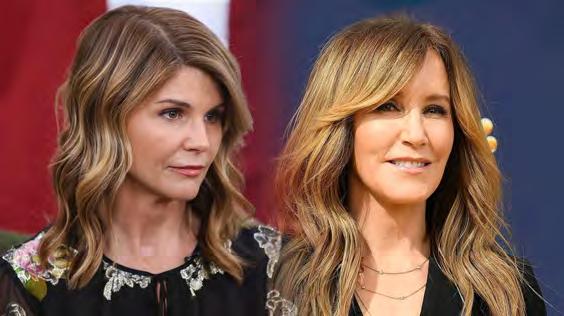
For years, wealthy parents have made generous donations to prestigious colleges and universities to ensure their children’s acceptance. Furthermore, there are countless ways in which having any degree of wealth can tip the scales in a child’s favor. These include having a family member attend the College or University of interest, which would grant the applicant a legacy status, hiring private tutors to assist in preparing for standardized testing, and paying tuition for a child to attend an esteemed private high school. Nothing about any of that is illegal, though some believe it is unfair to receive advantages based solely on the socioeconomic class to which one belongs. However, on March 12, 2019, news broke that about 50 parents were charged with using illegal methods to get their children into several prestigious colleges and universities throughout the United States. This scandal has been called the “largest College admissions scam ever prosecuted by the Department of Justice.” Among those charged parents were actress Lori Loughlin, her husband, fashion designer Mossimo Giannulli, as well as actress Felicity Huffman.

The cheating was carried out in a myriad of ways. First of all, many parents paid thousands of dollars for high scores on standardized tests, extra time given to children who were not in need, and having someone else take the test or correct for one of the students in question. Many of the children in question insist they did not know this had taken place at the time. (continued on pg. 2)
1
In addition, many coaches and administrators were paid to reserve spots, as well as athletic scholarships for students who had either never played a sport blatantly or whose faces were photoshopped to make it appear as if they were athletes.
The center of the scandal appears to be with William Singer, who had previously worked in college admissions for decades. Singer plead guilty to assisting wealthy parents secure spots for their children and in the process, bribing test monitors, coaches, and administrators, as well as making up fake biographies, achievements, and scores to put on applications. Mr. Singer was released after posting a $500,000 bail, and his sentencing will take place on June 19.


As a result of this scandal, lives have been shaken. While there are no students who have been charged, many universities and colleges have said that they intend to punish those involved. For example, pending an investigation, the University of Southern California, the school alleged to have taken the most bribes, has already blocked certain students from course registrations. Meanwhile, the parents who have been charged are currently out on bail, but when they face trials and if they are convicted, their sentencing will be in accordance with how much they paid.
Furthermore, many coaches, including the sailing coach at Stanford, the U.C.L.A. men’s soccer coach, the Wake Forest women’s volleyball coach, and the men’s tennis coach at the University of Texas have been either temporarily or permanently asked to leave.
This scandal has revealed the college acceptance system to be broken, unjust, and biased.
Sources:
1. https://www.nytimes.com/2019/03/14/us/college-admissions-scandal-questions.html
2. https://www.cnn.com/2019/03/14/us/college-admission-cheating-universities-react/index.html
3. https://www.nydailynews.com/news/ny-college-admissions-scandal-lori-loughlin-felicity-huffman-201904 03-buhdosd6qvgb7ei2zntoegr64u-photogallery.html
4. https://www.actionnewsnow.com/content/national/507061252.html
Thailand’s 2019 Elections
By Maddie Greves
On March 24, Thailand had its first general election since the military took control of the government in 2014. This was the twelfth military coup in the country since 1930, which was also the same year the absolute monarch ended. The former Prime Minister, Thaksin Shinawatra, was a billionaire businessman who rose to power in 2001 by having the poorer areas feel important by having them feel like they matter and they are not forgotten. His time as Prime Minister lasted until 2006 when he was ousted by a military coup. Shortly after, his sister, Yingluck Shinawatra, became Prime Minister but just like her brother, was ousted by a military coup in 2014. The coup-appointed Prayut Chan-o-cha to Prime Minister and he is currently in this position.
In Thailand’s parliament, there is a total of 750 seats. Thailand’s electorates vote for the 500 seats in the lower house, 250 seats of the upper house are voted on by the military, and combined votes from both houses select the Prime Minister. This election was to determine whether Thailand would become a democracy or stay under military control. Thailand is politically split among the poorer and rural areas, the urban upper class and elites, and the military supporters. If the results of the election go well for the Military, current Prime Minister Prayuth Chan-o-cha will stay in control and will be backed with a political majority. If the results do not go well for the military, Chan-o-cha will be left with his political party as the minority and will face political gridlock.
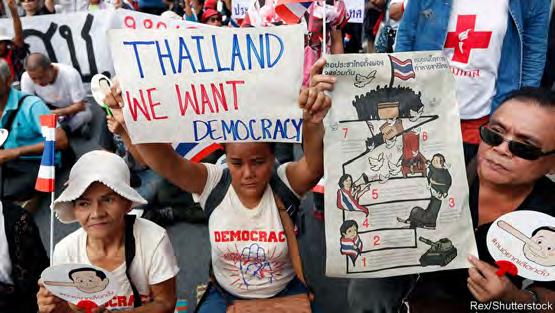
Early in the election process, Princess Ubolratana Rajakanya announced she would run for prime minister for the Thai Raksa Chart Party, the same party as former Prime Minister, Thaksin Shinawatra. Her brother, King Maha Vajiralongkorn disapproved, saying it was “extremely inappropriate”. Ultimately, he disqualified her from running in the election and said, “monarchy must remain above politics.”

Although the election already happened, the results have not been announced and will not be expected to until May.
Sources
1. https://www.cnn.com/2019/02/08/asia/thailand-election-princess-candidate-intl/index.html
2. https://www.cnn.com/2019/02/11/asia/thailand-election-princess-disqualified-intl/index.html
3. https://www.bbc.com/news/world-asia-47040001?intlink_from_url=https://www.bbc.com/news/topi cs/c4l37mgp4q4t/thailand-election-2019&link_location=live-reporting-story
What is Happening to the Chinese Economy?
By Adity Kamath
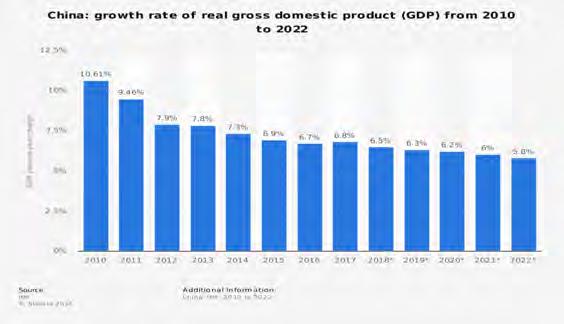
For years, China’s economy has been the fastest growing economy in the world, but its progress has recently decreased. According to the National Bureau of Statistics, China’s growth rate decelerated from 6.8% to 6.6% in the span of a year. It slowed down to 6.4% during the last three months of 2018. The consequences of these turn of events include increased unemployment rates, reducing sales, factories struggling to keep their workers, and consumers losing faith in their economy. In the middle of 2018, President Trump declared a trade war with China. This means the U.S has inflicted tariffs on select exports, and in return, China has put its own fees on imports. Trump put tariffs on aluminum and steel to “protect” those businesses in America. Since then, China and the U.S have been going back and forth placing tariffs on their imports and exports. Trump has claimed that we are not in the midst of a trade war with China, but his actions show otherwise. These events have significantly impacted China’s economy. (See on pg. 4)
People are struggling to find jobs and make money because many industries are unable to function without consistent trade. Luckily, this “war” isn’t affecting the U.S very much, but it is taking a toll on the people of China. Xi Jinping, the president of China is facing a big challenge due to the trade war; he has many difficult choices to make that could improve everything and fix the economic growth, but it could also increase China’s debt. Jinping could lower fees and modify trading, or they could continue to raise fees and make trading incredibly difficult for both countries. He could also initiate a truce between both countries, and could find a way to give everyone what they want. The choice he makes could either make or break their economy. China’s economy could positively impact the U.S. Trump views China’s current status as an advantage for America. The trade war could lower China’s economic growth by a lot, increasing America’s. That would make the U.S the fastest growing economy in the world. However, as time goes on, it could possibly be similar to China’s. Putting tariffs on our exports and having fees put on our imports is not working very well for the U.S or China. It makes it harder for China to buy American products, which is clearly hurting their country and subtly hurting ours. Not only does it make things harder for China, but also, it makes finding certain commodities harder for American businesses as well. They are finding it difficult to sell or receive their products, lowering their income and adding to unemployment rates. Industries are struggling to profit, and soon the U.S could be riding in the same boat as China. As of now, the trade war is at a halt, and it appears that it will stay that way for some time.

Sources:
1. https://www.washingtonpost.com/world/chinese-economy-slows-to-lowest-growth-rate-in-28-years/2019 /01/21/c3fccbf0-1d66-11e9-bda9-d6efefc397e8_story.html?noredirect=on&utm_term=.e6c5e022d699
2. https://www.nytimes.com/2018/12/14/business/china-economy-xi-jinping.html
3. https://www.nytimes.com/2019/01/20/business/china-economy-gdp-fourth-quarter.html
4. https://www.nytimes.com/2019/03/04/us/politics/trump-china-tariffs-trade-deal.html
5. https://www.usatoday.com/story/money/nation-now/2018/04/06/trade-war-trump-us-china-tariffs/492 616002/
6. https://www.forbes.com/sites/kenrapoza/2019/03/10/china-trade-war-update-does-anybody-know-what s-going-on/#74c115c97b33
7. https://www.forbes.com/sites/panosmourdoukoutas/2019/03/10/us-china-trade-war-china-wont-acceptan-unfair-and-unequal-deal/
Paul Manafort’s 47 Month Sentence
By Camila Madero
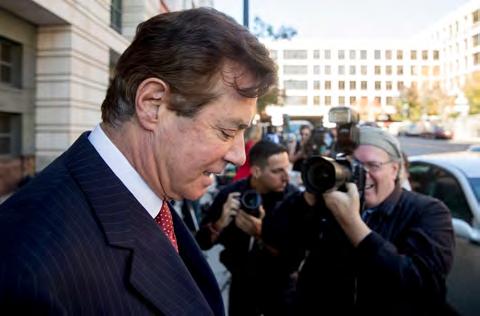

On March 7, 2019, Paul Manafort, an American lobbyist, political consultant, and former campaign manager of President Donald Trump, was given his criminal sentence, after being arrested in 2018 for bank and tax fraud. His arrest is among many in Trump’s orbit who have been charged as a result of Special Counsel Robert Muller’s investigation into the Russian interference and cooperation with the Trump Campaign in the 2016 election. Judge T.S Ellis imposed a sentence of 47 months in prison, counting his prior nine months in jail as part of this period of time, significantly less than the expected sentence of above ten years. The Judge claims that Manafort has committed, “serious, very serious crimes, but he had otherwise lived a blameless life and earned the admiration of many.” Despite Prosecutor, Greg Andre’s, assertions that alluded to Manafort’s role in Russia interfering with the 2016 election, the Judge stated before giving his sentence that it “is not before the Court on anything having to do with collusion with the Russian government.” In addition to Manafort’s prison time, Ellis mandated Manafort to pay a $50,000 fine, approximately $24 million as restitution of his fraud, and an additional three years on federal supervision. Yet, Ellis' decision is not the end for Manafort. He will be sentenced within the next week by a different Judge in a related case where he faces an additional 10 years in prison after pleading guilty to conspiracy charges for failing to report his lobbying work in Ukraine and tampering with witnesses.
Manafort’s 47 month sentence has been estimated as being surprisingly low considering the severity of his crime. Several politicians have stressed their opinions to the public including 2020 candidate and senator Elizabeth Warren, who resorted to twitter saying, “Trump's campaign manager, Paul Manafort, commits bank and tax fraud and gets 47 months. A homeless man, Fate Winslow, helped sell $20 of pot and got life in prison. The words above the Supreme Court say "Equal Justice Under Law"—when will we start acting like it?” More voices from the public also spoke out against Manafort's sentence. Scott Hechinger, a Public Defender and Senior Staff Attorney/ Director of Policy at Brooklyn Defender Services tweeted, “For context on Manafort’s 47 months in prison, my client yesterday was offered 36-72 months in prison for stealing $100 worth of quarters from a residential laundry room.”
Marc Mauer, who oversees The Sentencing Project and is an expert in policy, race, and criminal justice, had a different perspective on the issue, claiming Mr. Manafort’s sentence wasn’t too light but “the guidelines are overly harsh.” In an interview with The New York Times, he mentioned cases of extreme sentences and pointed out out the fact that not only does the U.S have the highest population of incarcerated people but, “In a lot of countries you’d have to kill somebody to get anywhere close to that (19-24 years), yet we hand out 20-year sentences for drug crimes every day of the week.”
(see top of pg. 6)
5
Others commented on the issue of race and socio-economic biases playing a role in the ultimate sentence process. John Pfaff, a law professor at at Fordham University, said “every defendant should be treated like a rich white man.” Clearly Manafort’s sentence has left many in the legal and political world raising their eyebrows in disbelief, but also seeming unsurprised that a wealthy white male has yet again been given preferential treatment in a justice system that proclaims equality under the law.
Update: A federal judge, Amy Berman Jackson, doubled the prison sentence of Manafort to seven and a half years on March 13, 2019. She denounced Manafort as being a man who “spent a significant portion of his career gaming the system.” After Manafort’s new state of indictment, the Manhattan district attorney filed a raft of state criminal charges and ensured that Mr. Manafort would have to stay in prison even if the president were to pardon his crimes.
Sources:
1. https://www.npr.org/2019/03/13/702743703/paul-manafort-to-serve-total-of-more-than-7-years-followi ng-d-c-guilty-plea
2. https://www.cnn.com/2019/03/07/politics/paul-manafort-sentencing-virginia-case-russia-investigation/i ndex.html
3. https://www.npr.org/2019/03/12/702606542/paul-manafort-after-receiving-47-month-sentence-to-learnpunishment-in-d-c-case
With Election Nearing, Netanyahu Faces Indictment
By Ryan Jokelson
On February 28th, Israeli Attorney General, Avichai Mandelblit, announced plans to indict Prime Minister Benjamin Netanyahu on three separate charges of corruption. The announced charges conclude a two-year-long investigation into Netanyahu and complicate his bid for a fifth term as Prime Minister.
In one case, Netanyahu is charged with accepting over $280,000 worth in gifts from foreign businessmen in exchange for advancing tax breaks that would have benefited them. In another case, Netanyahu has been charged with promising to curtail the circulation of a newspaper, Israel Hayom, in exchange for more favorable coverage in Yedioth Ahronoth, Israel Hayom’s top competitor and one of the largest papers in Israel. In the third case, the Prime Minister is accused of pushing for regulatory benefits designed to net the telecommunications firm Bezeq over $280 million. Bezeq is owned by Shaul Elovitch, a friend of Netanyahu’s.
The announcement came fewer than six weeks prior to the scheduled April 9th nationwide election for the Knesset, Israel’s legislature. The elections would have been held in November, but Netanyahu himself decided to call the election seven months early after his governing coalition in the 120-member Knesset shrunk to only 61. The Attorney General has said that he will wait until after the elections conclude to file the official indictments.
Rather than running from the accusations of corruption, Netanyahu has fought them head on and even turned them into a campaign issue. Framing the charges as “fabricated”, the Prime Minister has launched a vigorous campaign to brand the investigators as partisan tools of his political rivals. Other campaign themes include Israeli security and Jewish identity. Netanyahu portrays himself as a strong leader who will fight to protect Israel and its Jewish heritage. Critics argue that Netanyahu is fear-mongering in an attempt to stay in power.
Currently, Netanyahu’s conservative Likud party holds a 30 seat plurality in the 120-member Knesset and leads what, prior to the dissolution of the Knesset, had been a slim governing coalition. Polls show Likud holding steady and winning between 28 and 31 seats in the upcoming election despite the charges against Netanyahu. The election, however, is still expected to be a close one. A new, center-left, group, dubbed ‘Blue and White’, has been consistently winning more than 30 seats in polls, threatening Likud’s chances of leading the government going forward. (continue on pg. 7) 6
The Likud-led governing coalition has shifted further to the right in recent years, prompting a strong relationship between Netanyahu and American President Donald Trump. Israel has pushed for foreign countries to recognize the contested city of Jerusalem as its capital, a request that the United States agreed to last year. Increasingly hardline policies in Israel and a stronger pro-Israel stance from the US have contributed to talks between Israeli and Palestinian leaders stalling.
The April 9th election and the legal future of Netanyahu will both have significant consequences for Israel and Israeli-American relations. Prime Minister Netanyahu has led the Israeli government since 2009 and an electoral win by the Blue and White alliance would represent a big shift away from the status quo for Israel.
Update: Netanyahu and his Likud party won 35 seats in the election. While the Blue and White alliance also secured 35 seats, the right wing parties that compose Mr. Netanyahu’s governing coalition won a total of 65, a majority that will enable Netanyahu to serve another term as Prime Minister. There has not been any further legal action against Mr. Netanyahu but indictments are expected in coming months.
Sources:
1. https://www.cnn.com/2019/02/28/middleeast/israel-benjamin-netanyahu-indictment-intl/index.html
2. https://www.cnn.com/2019/04/04/middleeast/israel-election-explainer-intl/index.html
3. https://www.newyorker.com/news/daily-comment/netanyahu-gantz-and-five-scenarios-for-the-israeli-el ection
4. https://www.nytimes.com/2019/04/11/world/middleeast/final-israeli-election-results-bolster-netanyahu s-lead.html
Brexit Update
By Nicole Gilliland
Prior to the original deadline of March 29th, Great Britain was readily anticipating a “no deal” or “hard Brexit” outcome. This would have meant that Brexit would occur without established plans in place regarding trade, currency, and other issues with the European Union. Since this date has passed, Great Britain and Theresa May have struggled to create a logical outcome that could appease those in favor of Brexit. Previously, Great Britain was hoping to leave the EU on the 29th of March (this date was determined several years ago). However, on the 12th of March, the MPs (members of parliament) voted against this date and decided to delay the separation. As of now, Great Britain is planning on leaving on April 12, 2019. If or when Brexit occurs, it will create a number of complications. Not only between Great Britain and other countries who are still a part of the EU, but also will create internal conflicts within the country. Theresa May has requested another extension to this delay and has asked for the separation to occur June 30th to have time to create concrete deals and ensure a smooth transition. On April 10th, the EU summit will meet to consider this extension, until then Brexit is still an ongoing and pressing topic.
Sources:
https://www.bbc.com/news/uk-politics-46393399
https://www.nytimes.com/interactive/2019/world/europe/what-is-brexit.html https://www.lexology.com/library/detail.aspx?g=3fe10fdd-0e67-498e-8ff8-ff02c92bb3a3