
1J1orsan rt qarr oltm mrminissr iubabit.
(!tla11.a of Nturtrru iiuuhrrh auh wmrlu.r Jr rt.rubs 1 (11.rutral ~rqool Jqtlahrlpqta
1J1orsan rt qarr oltm mrminissr iubabit.
(!tla11.a of Nturtrru iiuuhrrh auh wmrlu.r Jr rt.rubs 1 (11.rutral ~rqool Jqtlahrlpqta
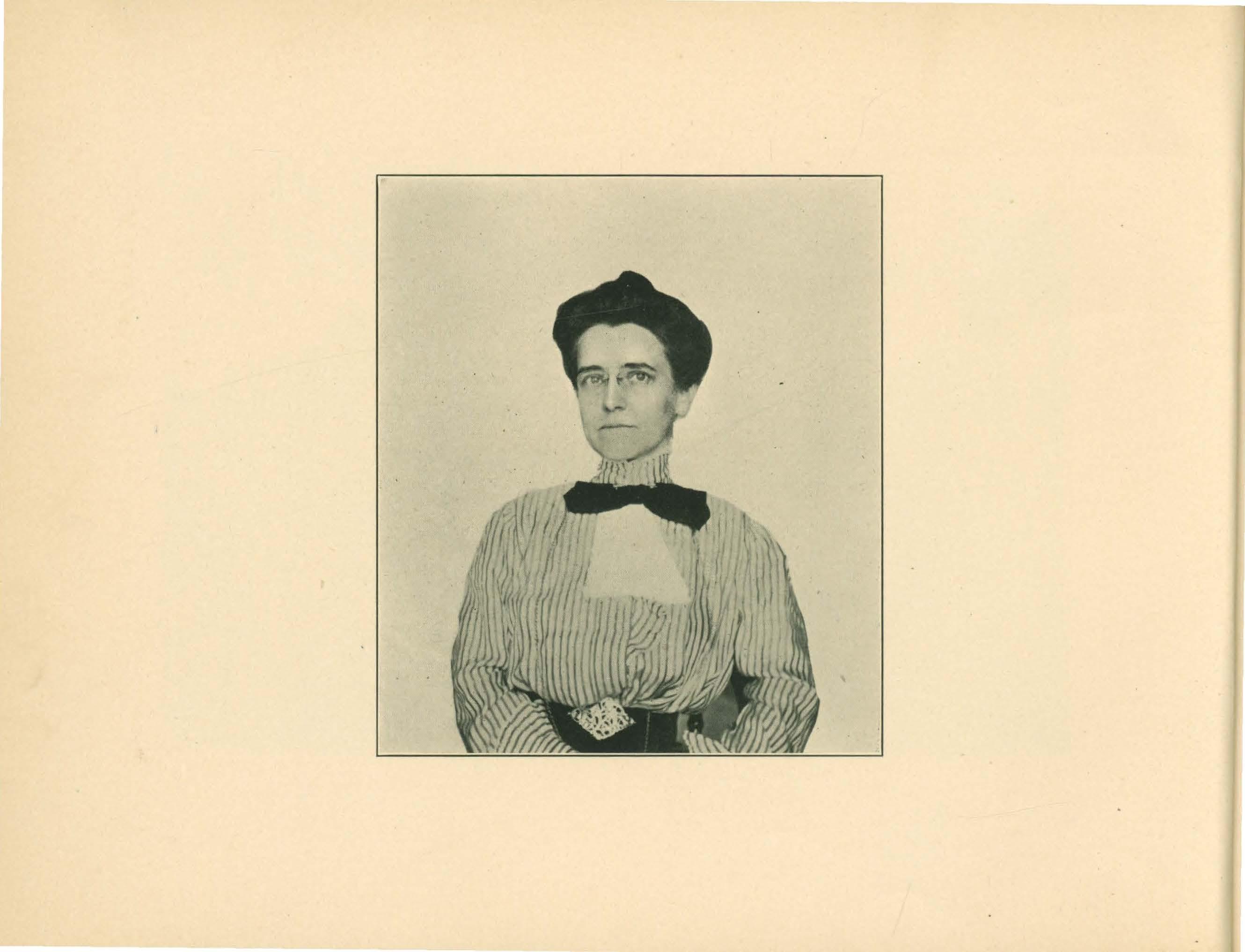
whose helpful instruction and wise discipline have won the respect and admiration of us all, we, the Class of Nineteen Hundred and Twelve, dedicate this book.
0 anyone but a member of the Class of Nineteen Twelve, this book may seem useless and uncalled for; but for every true "Twelver" it possesses a value which cannot be estimated in money or expressed in mere words. If there be anyone who cannot enter into the spirit in which this book is published, we ask him at least to tolerate that which he cannot appreciate.
As our school life draws to a close, each important event in it, and each name and face of our classmates is fresh and clear in our minds. But, as the years advance, other thoughts and other interests will crowd the once-vivid remembrances of our school days from our memories, and we shall forget our former classmates, our scholastic achievements, and our good times at school. However, we have no desire to forget these things, for we believe that it will "please us to remember them at some time," and, therefore, we take this opportunity of providing a reminder of the many delightful days we have spent together at Friends' Central.
We sincerely hope that this book will fulfil its mission, and we shall count our work as not in vain, if, at some time in the future, it gives someone an hour or two of solid enjoyment while he or she, with its help, once more lives over the happy school days spent at Friends' Central.
THE EDITORS.
Jritttiµal
W. ELMER BARRETT, M.Sc.
1\miiataut Jrhtriµal
BERTHA L. BROOMELL, B.S., Swarthmore (Columbia University).
1Wlatqrmatin,
GEORGE L. McCRACKEN, A.B., Cornell University.
EUGENE ANDERS, PH.B., Lafayette (University of Pennsylvania).
ALICE FUSSELL (University of Pennsylvania) (University of Indiana).
BELLEW. HANNUM (University of Pennsylvania).
ADA E. MAULE, West Chester State Normal School.
1Englh1q
CHARLES F. LAWSON, M.A., Columbia University.
ABIGAIL EVANS, A.B., Swarthmore.
10
ALICE W. PITMAN. ALICE F. WHITE, M.E., West Chester State Normal School.
MARY H. WHITSON, M.E., Millersville State N o rm a 1 School; B.I., Neff College of Oratory.
BURRITT M. HIATT, A.B., Wilmington; A.M., • Harvard.
ANNE N. PEARSON, A.B., • Swarthmore College.
1Uati11
SARAH HALL STIRLING, A.M., Swarthmore (Harvard) (University of Pennsylvania).
HELEN PRICE, A.B., Swarthmore.
LAURA E. W. TYLER, A.B., Bryn Mawr.
"erman
CHESTER A. SITTIG, A.M., Hamilton.
KATHERINE GRIEST, A.B., Swarthmore.
3Jirrttrl)
ANNA B. EISENHOWER, A.B., Swarthmore; A.M., Radcliffe (Universite de Grenoble, France).
MARY R. SA WYER, Graduate of Salem (Mass.)
Normal School (University of Zurich, Switzerland) (Sorbonne, Paris).
ifi.atory
PER CIVAL TAYLOR REX, B.S., University of Pennsylvania.
A. JENNIE CORNELL (Swarthmore) (Harvard University).
§;rt.ettr.e
GUY WILBUR CHIPMAN, A.B., Colby College (University of Pennsylvania) (Harvard University).
MARY TYLER DUTTON (Swarthmore) (University of Pennsylvania) (Woman's Medical College).
EDITH M. DOUGLASS, A.B., Swarthmore College.
<!Lmumerrial 1!ilrattrl)r.!i attil Jettmattsl)ip
HIRAM W. POPE, Rochester Business Institute; Zanerian Art College.
Art
SARAH C. PENNYPA CKER , School of Design, Philadelphia; Two years in Paris.
CHARLES w. WHITE, Drexel Institute; School of Industrial Art.
Jl)y.airnl <!Lultur.e
HENRY L. CHADWI CK, Polyclinic Hospital.
JOHN F. JACOBY, JR. (University of Pennsylvania).
KATHERINE FETZER, Goucher College (Harvard University) ; Philadelphia Normal School of Physical Training.
VIOLET W. MANGE.
CARRIE w. CHAMBERS, Secretary.
MARGARET E. CHANDLER, Assistant Secretary.
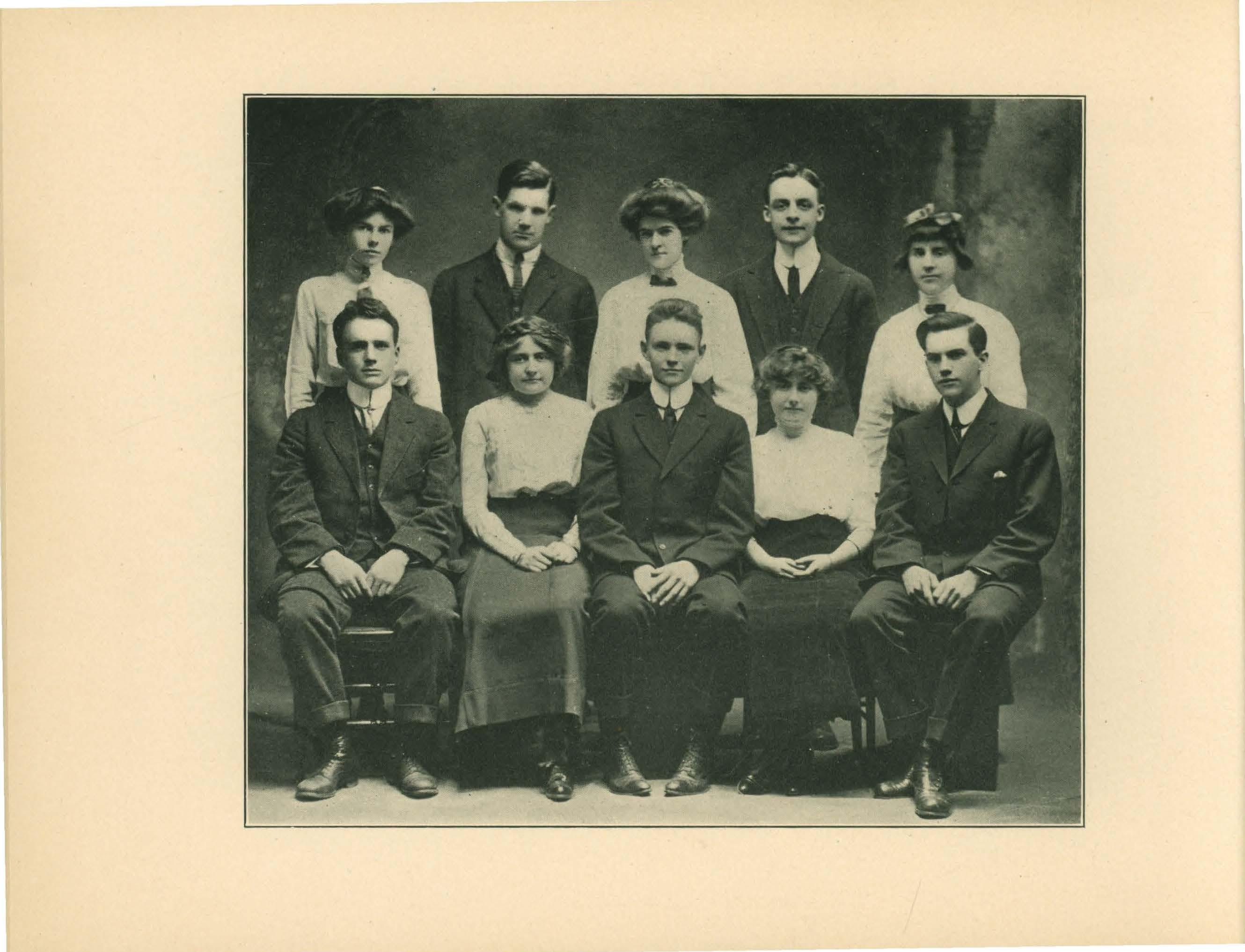
MURRAY S. CHISM, Editor-in-Chief.
MARYE. VOGDES, Assistant Editor.
MARION COYNE, MANETTE STAUDT,' HOMER B. HEACOCK,
HENRY C. PICKERING, Business Manager.
FRANCES P . WRIGHT, Assistant Business Manager.
Edito?'S: 13
ELSIE LEA, MAITLAND BOTTO MS, RAYMOND F . PERROTT.
FRANCES P. WRIGHT, President .
MANETTE STAUDT, Vice President.
KATHERINE HUNSICKER, !Secretary .
ELIZABETH J. SHOEMAKER, LTreasiwer.
FRANCES P. WRIGHT, Salutatorian.
MARY E. V0GDES, Prophet.
KATHERINE HUNSICKER, Historian .
ELSIE LEA, Statistician.
ELIZABETH J. SHOEMAKER, Presenter.
RAYMOND F. PERROTT, President.
MURRAY S. CHISM, Vice President.
G. RUGAN NEFF, Secretary.
HOMER B . HEACOCK, Treasurer.
RAYMOND F. PERROTT, Valedictorian.
G. RUGAN NEFF, Historian.
ALBEN T. EAVENSON, Statistician.
MURRAY s. CHISM, Prophet.
MAITLAND BOTTOMS, Presenter.
GRACE ELIZABETH BOUGHTON, 4424 Larchwood Ave., "Curly." Phila., Pa.
"He is a fool who thinks by force or skill To turn the current of a woman's will."
Entered C. Scientific Course; Ring Committee; President of Literary Society; Cast of Literary Society Play; . I ~- J.
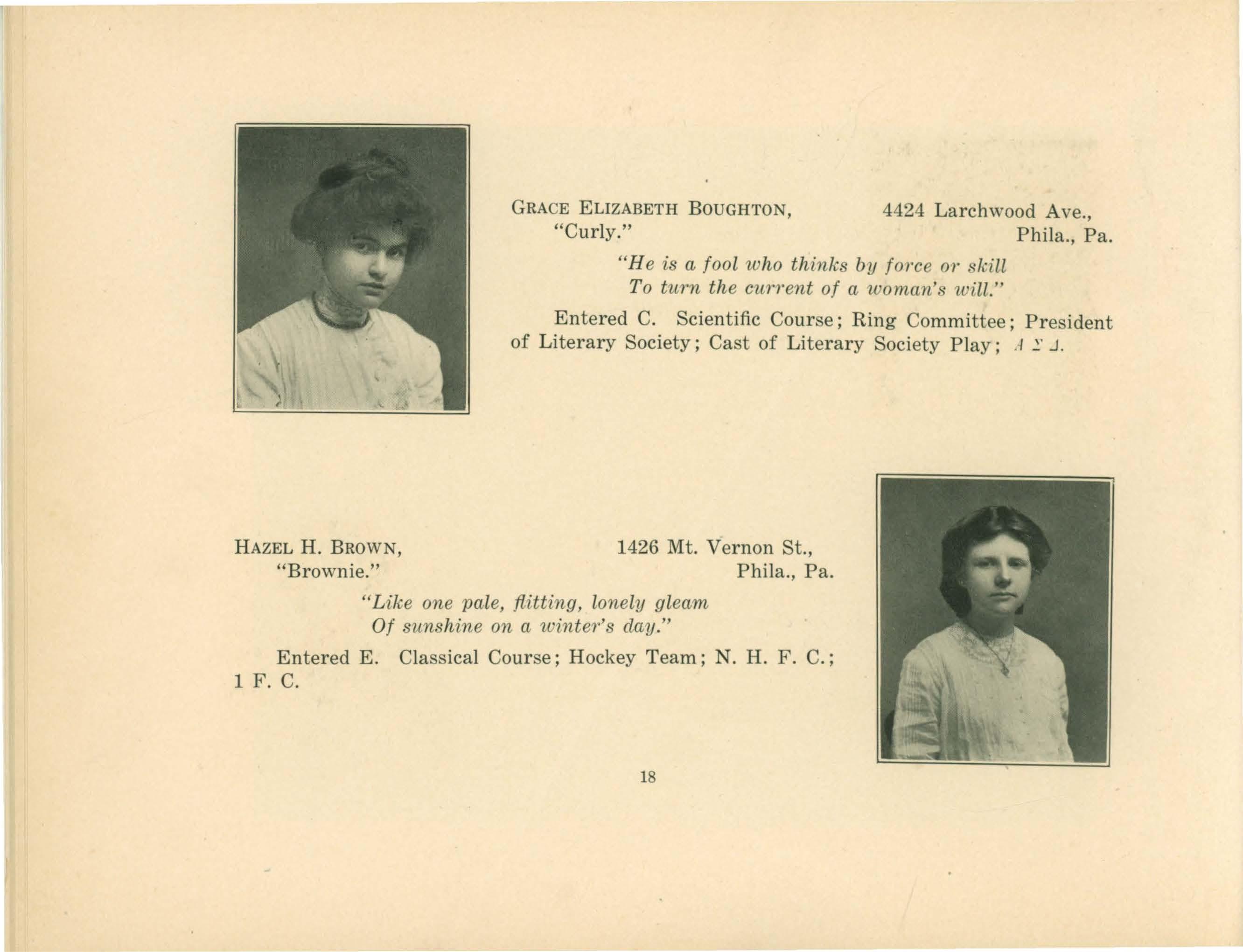
HAZEL H. BROWN, "Brownie."
1426 Mt. Vernon St., Phila., Pa.
"Like one pale, flitting, lonely gleam Of sunshine on a winter' day."
Entered E. Cla sical Course; Hockey Team; N. H. F. C.; 1 F. C.
MARION F. COYNE, "Coinski."
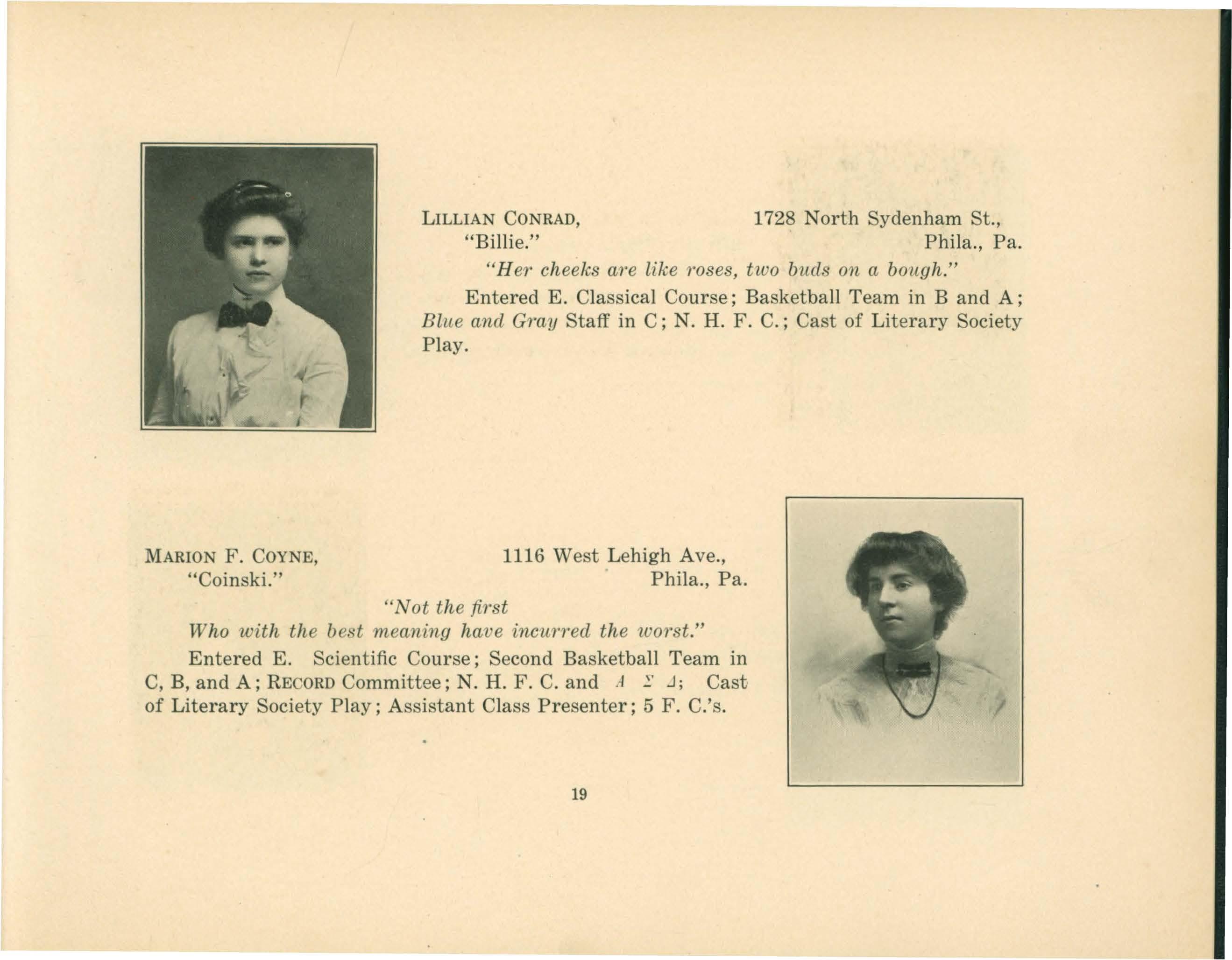
LILLIAN CONRAD, "Billie."
1728 North Sydenham St., Phila., Pa.
"Her cheeks are like roses, two bucls on a bough ."
Entered E. Clas ical Course; Basketball Team in B and A; Blue and Gray Staff in C; N. H . F . C.; Cast of Literary Society Play.
1116 West Lehigh Ave., Phila., Pa.
"Not the first Who with the best meaning have incurred the worst."
Entered E. Scientific Cour e; Second Basketball Team in C, B, and A ; RECORD Committee; N. H. F. C. and A ~: J; Cast of Literary Society Play; Assistant Class Presenter; 5 F. C.'s.
ALICE T. FLEISHER, "Twinnie."
EDYTHE TYSON DEWEES, "Dewey."
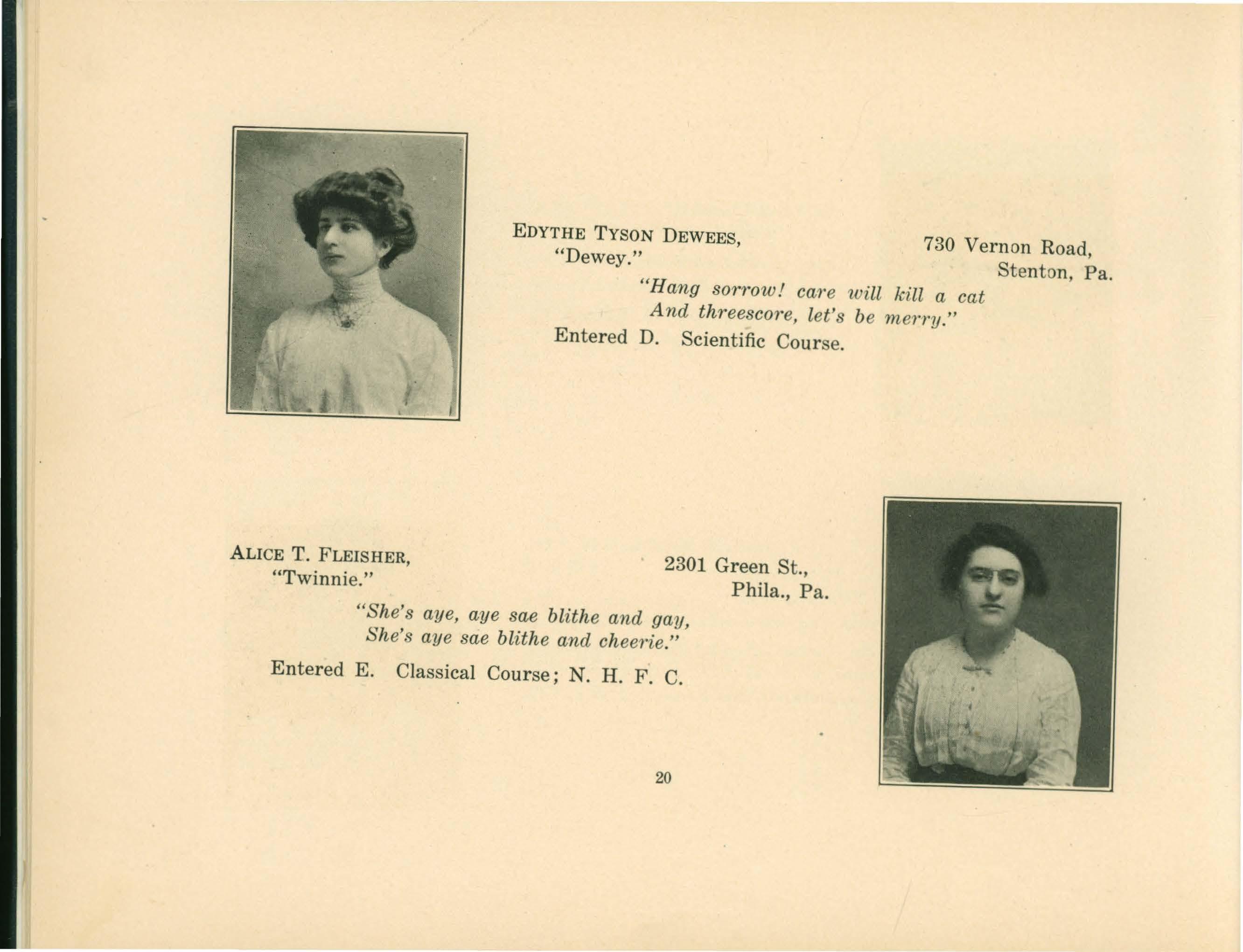
730 Vernon Road,
Stenton, Pa.
"Hang sorrow! care will kill a cat And threescore, let's be mer,·y."
Entered D. Scientific Course.
2301 Green St., Phila., Pa.
"She's aye, aye sae blithe and gay, She's aye sae blithe and cheerie."
Entered E. Classical Course; N. H. F. C.
HELEN HARRIE,,
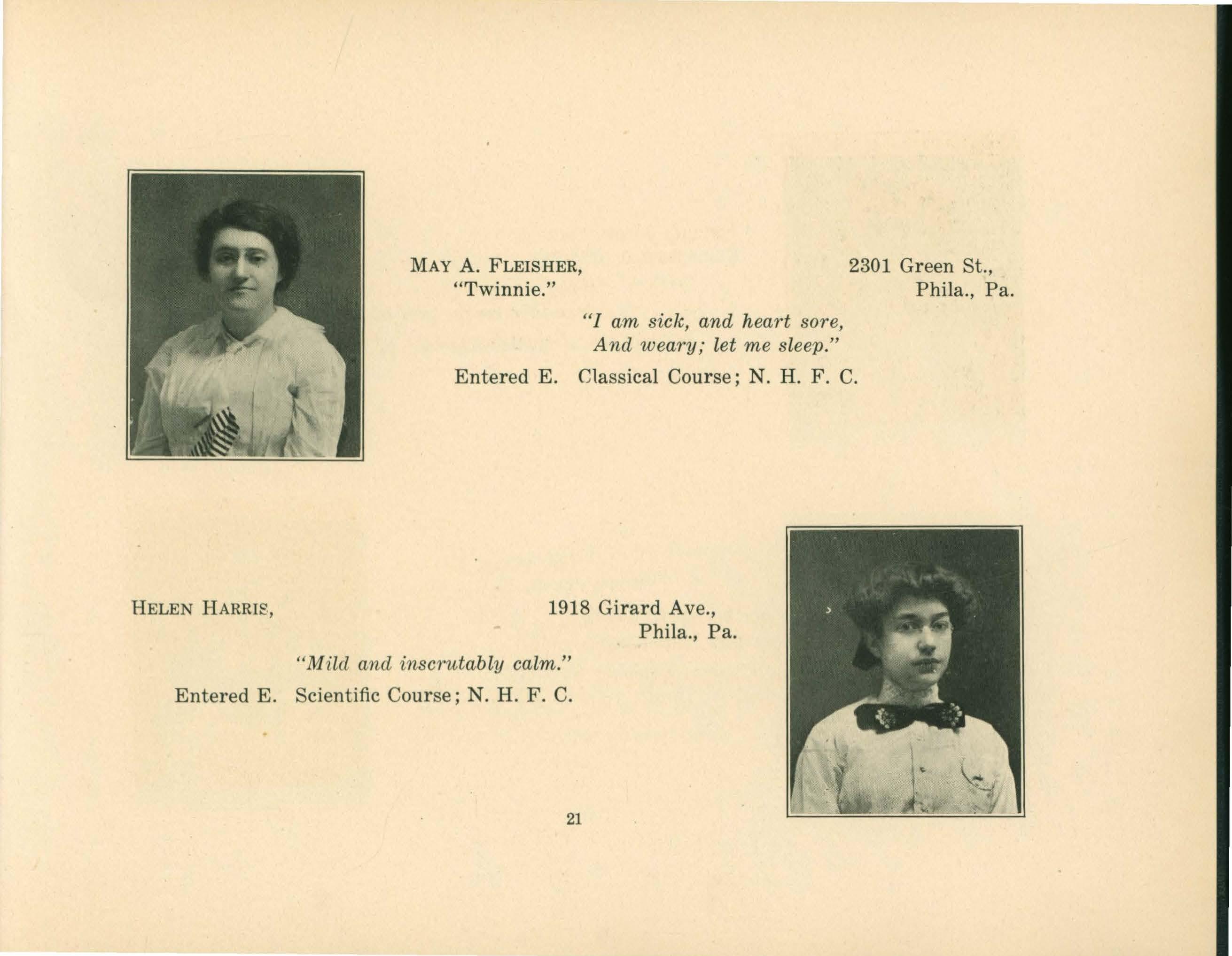
MAY A. FLEISHER, "Twinnie."
"I
am sick, and heart sore, And weary; let me sleep."
2301 Green St., Phila., Pa.
Entered E. Classical Course; N. H. F. C.
1918 Girard Ave., Phila., Pa.
"Mild and inscrutably calm."
Entered E. Scientific Course; N. H. F. C.
ELIZABETH A. HOLMES, "Lizzie."
"Your candor makes you all more sweet."
Entered A. Scientific Course; E. M. E.
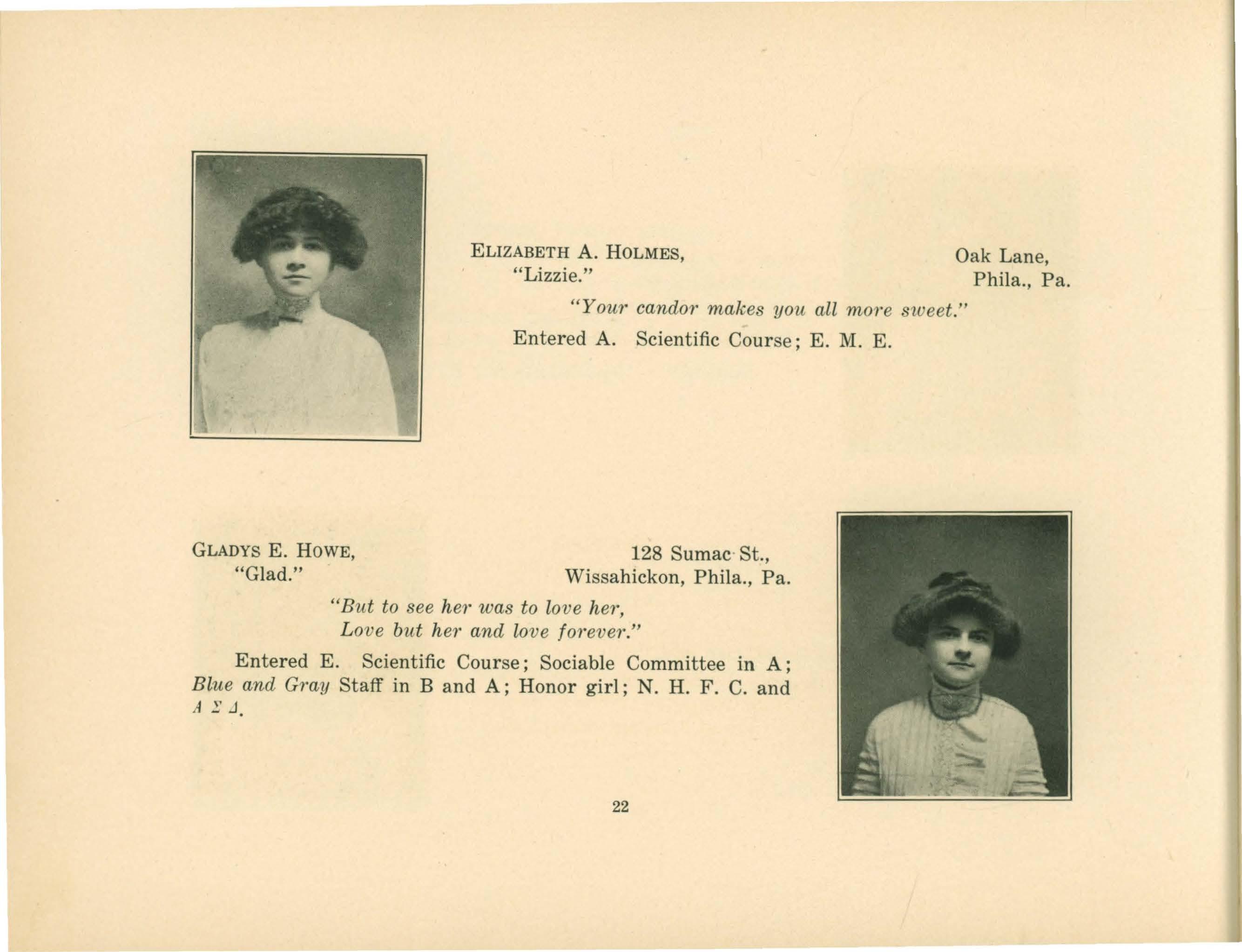
GLADYS E. HOWE, "Glad."
128 Sumac · St., Wissahickon, Phila., Pa.
" B u t to see h er was to lo ve h er, Lo ve bu t h er and lo ve for ever ."
Entered E. Scientific Course; Sociable Committee in A; Blue and Gray Staff in B and A; Honor girl; N. H. F. C. and A 1: J
MARGARET HOWSON, "Mog."
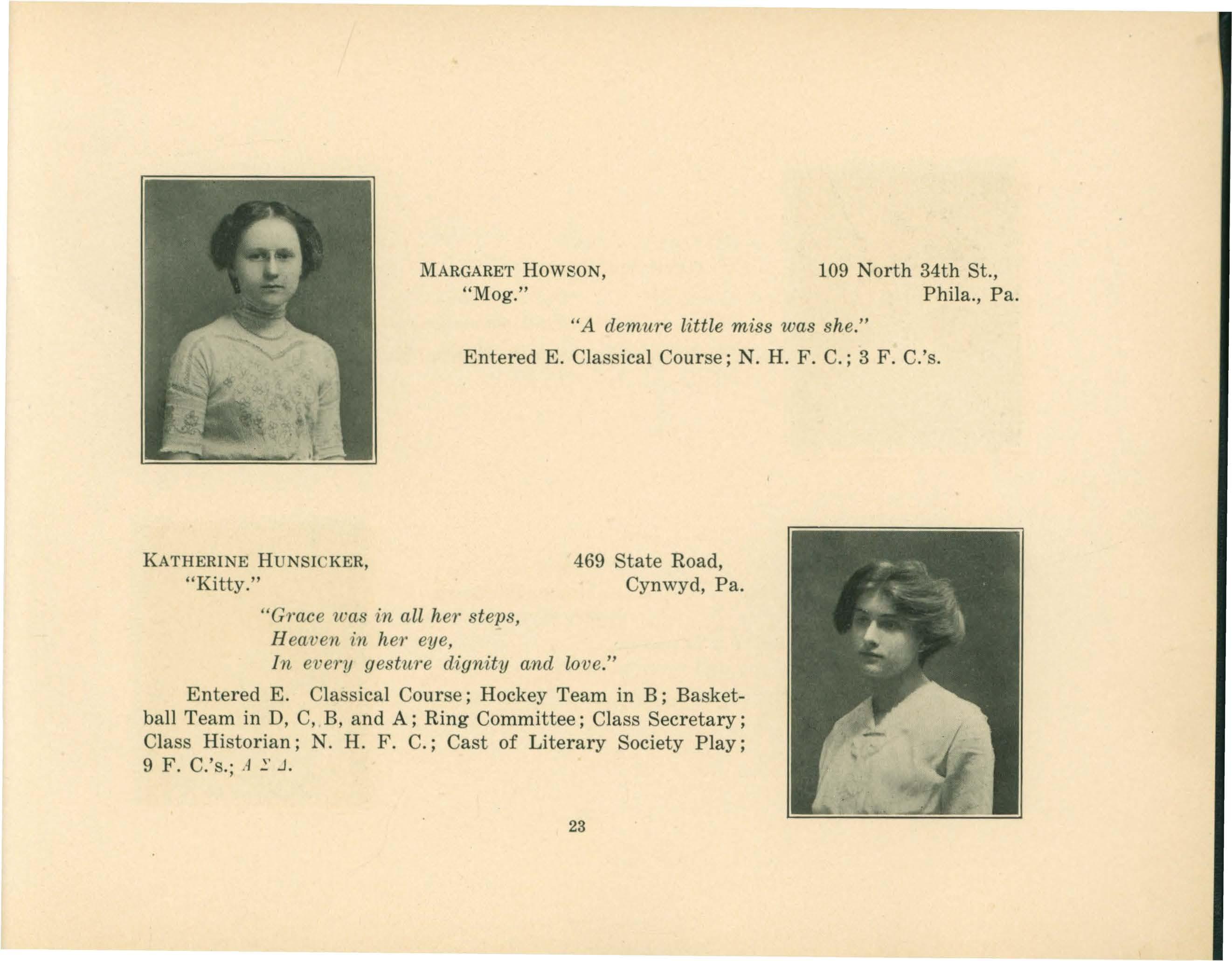
109 North 34th St., Phila., Pa.
"A demure little miss was she."
Entered E. Classical Course; N. H. F. C.; 3 F. C.'s.
KATHERI E HUNS! KER, "Kitty."
"Grace ii:as in all her steps, Heaven in her eye,
469 State Road, Cynwyd, Pa. In every gesture dignity and love."
Entered E. Cla sical Course; Hockey Team in B; Basketball Team in D, C, B, and A; Ring Committee; Class Secretary; Cla s Historian; N. H. F. C.; Cast of Literary Society Play; 9 F. C.'s.; A ~- J.
FRAN CES C. JONES, 225 Fifth A venue., Conshohocken , Pa. "F. Jones."
" H er lo ve liness I never k new Un t i l s h e s mil ed on one ."
Entered B. Classical Course; Ba s ketball Team in B and A; 1 F. C.
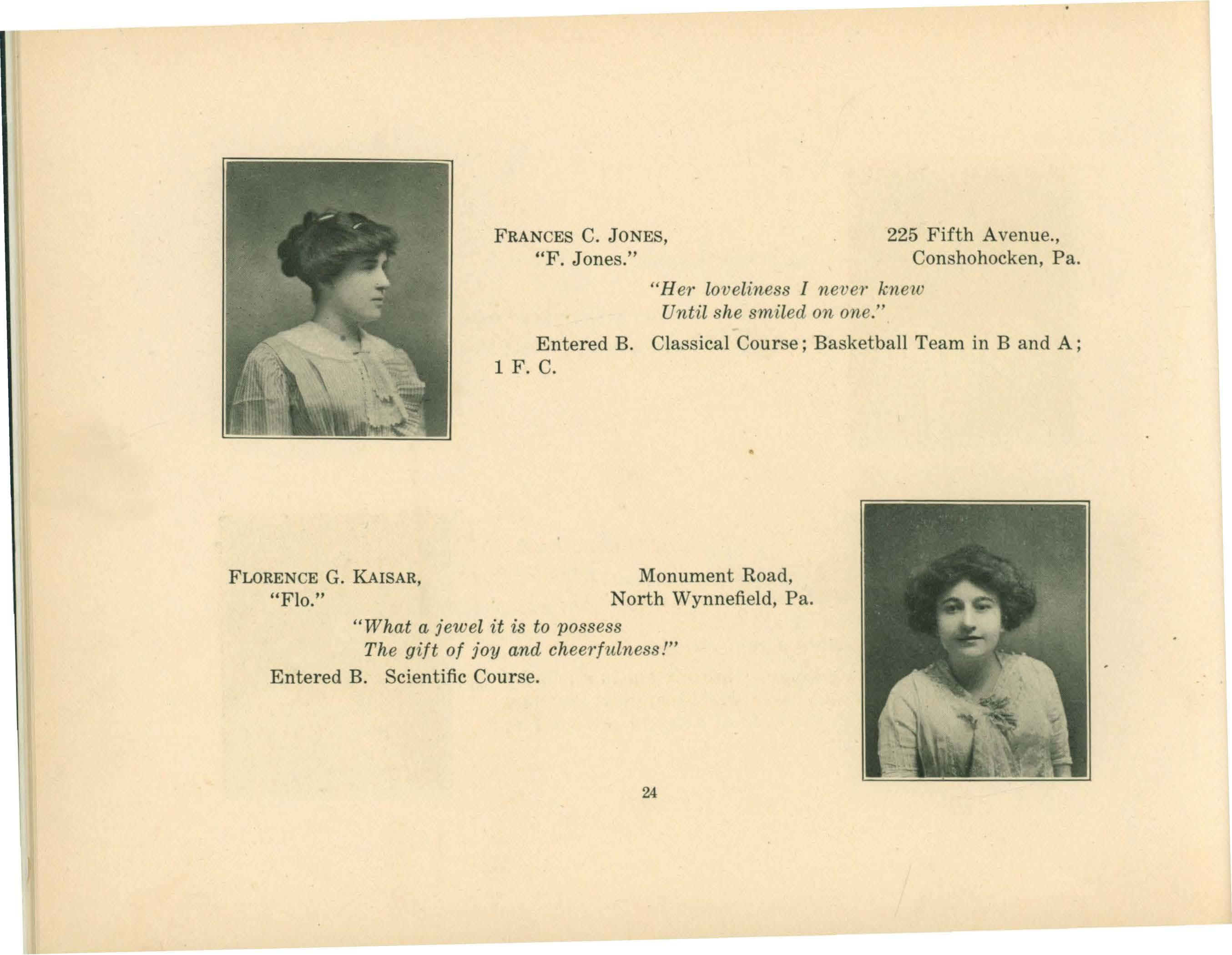
FLORENCE G. KAISAR, Monument Road , North Wynnefield, Pa . "Flo."
"What a j ew el it i s to poss es s Th e gi ft of joy and ch ee rfu lnes s!"
Entered B. Scientific Course.
LILLIAN T. KERNS, "Chubby."
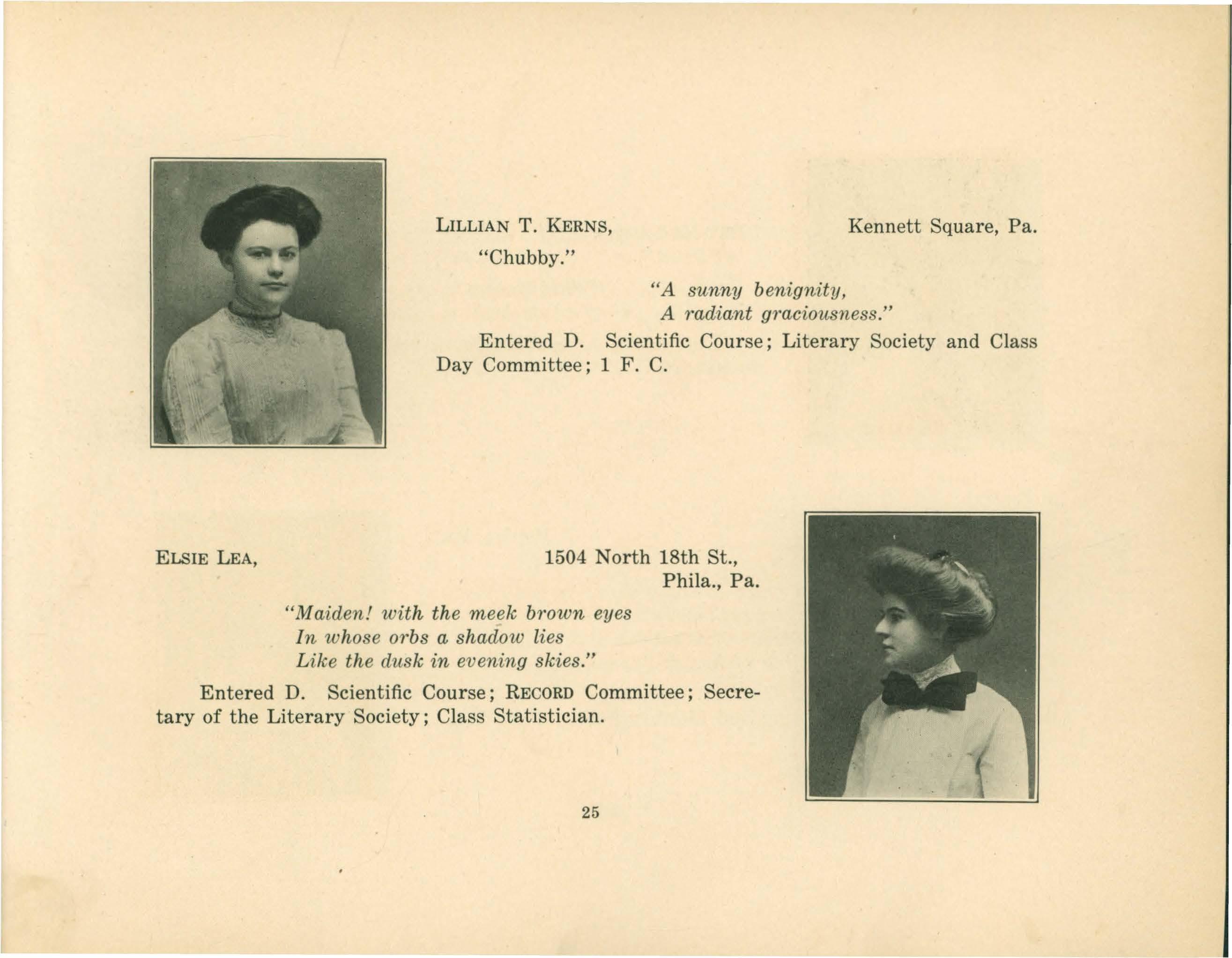
"A sunny benignity, Kennett Square, Pa. A radiant graciousness."
Entered D. Scientific Course; Literary Society and Class Day Committee; 1 F. C.
1504 North 18th St., Phila., Pa.
"Maiden! with the meek brown eyes In whose orbs a shadow lies Like the dusk in evening skies."
Entered D. Scientific Course; RECORD Committee; Secretary of the Literary Society; Class Statistician.
MARY MCINTIRE, "Mac."
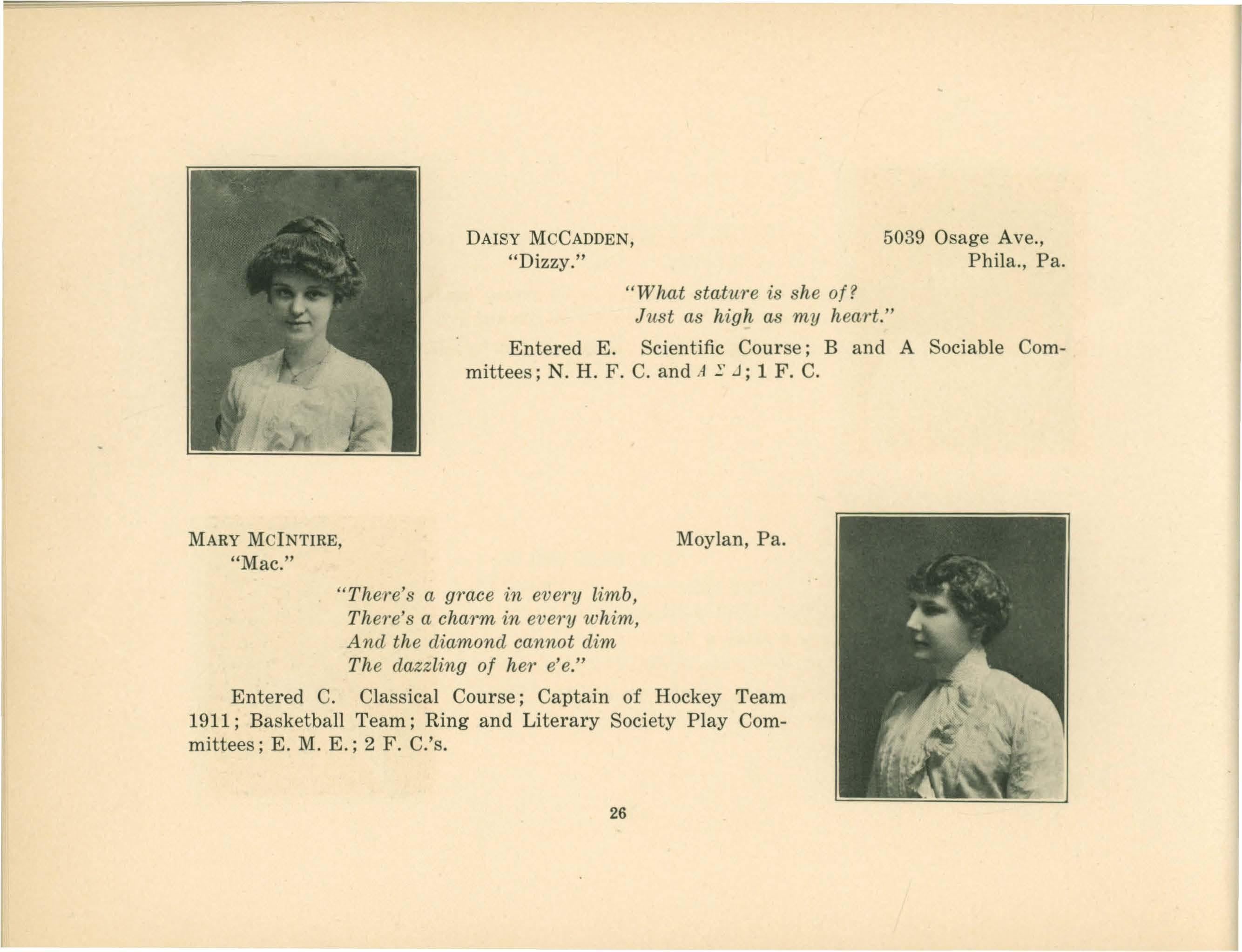
MCCADDEN, "Dizzy."
"What stature is she of?
5039 Osage Ave., Phila., Pa.
Just as high as my heart."
Entered E. Scientific Course; B and A Sociable Committees; N. H.F. C. and A ~: J; 1 F. C.
Moylan, Pa.
"There's a grace in every limb, There's a charm in every whim, And the diamond cannot dim The dazzling of her e'e."
Entered C. Classical Course; Captain of Hockey Team 1911; Basketball Team; Ring and Literary Society Play Committees; E. M. E.; 2 F. C.'s.
MARIAN ADELE MITCHELL, "Mike."
ELIZABETH GERTRUDE MILLER, "Gert."
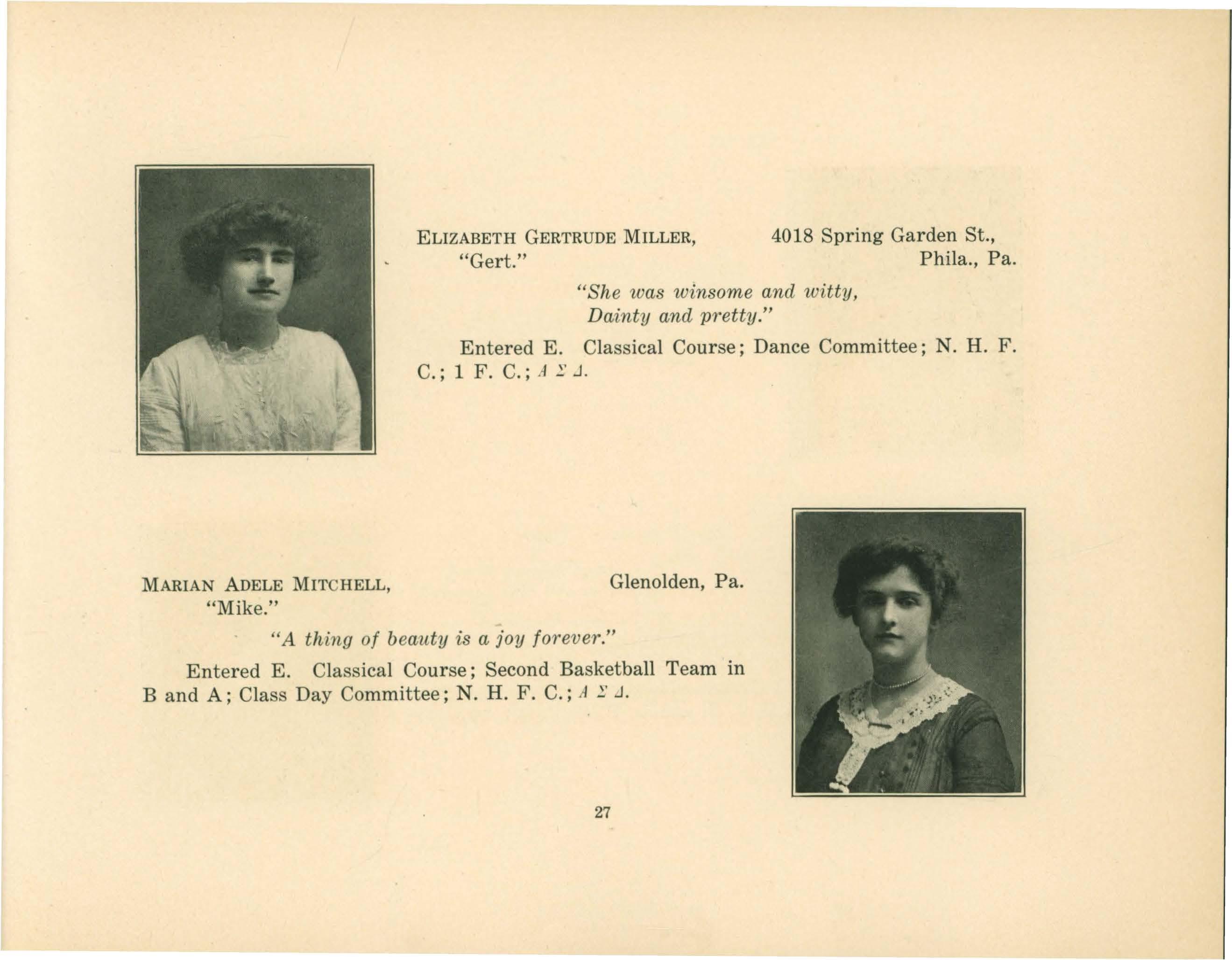
4018 Spring Garden St., Phila., Pa.
"She was winsome and witty, Dainty and pretty."
Entered E. Cla sical Course; Dance Committee; N. H. F. C.; 1 F. C.; rl ~- J.
Glenolden, Pa.
"A thing of beauty is a joy forever."
Entered E. Classical Course; Second Basketball Team in B and A; Clas Day Committee; N. H. F. C.; A s J.
LURENA C. MINER, "Lura."
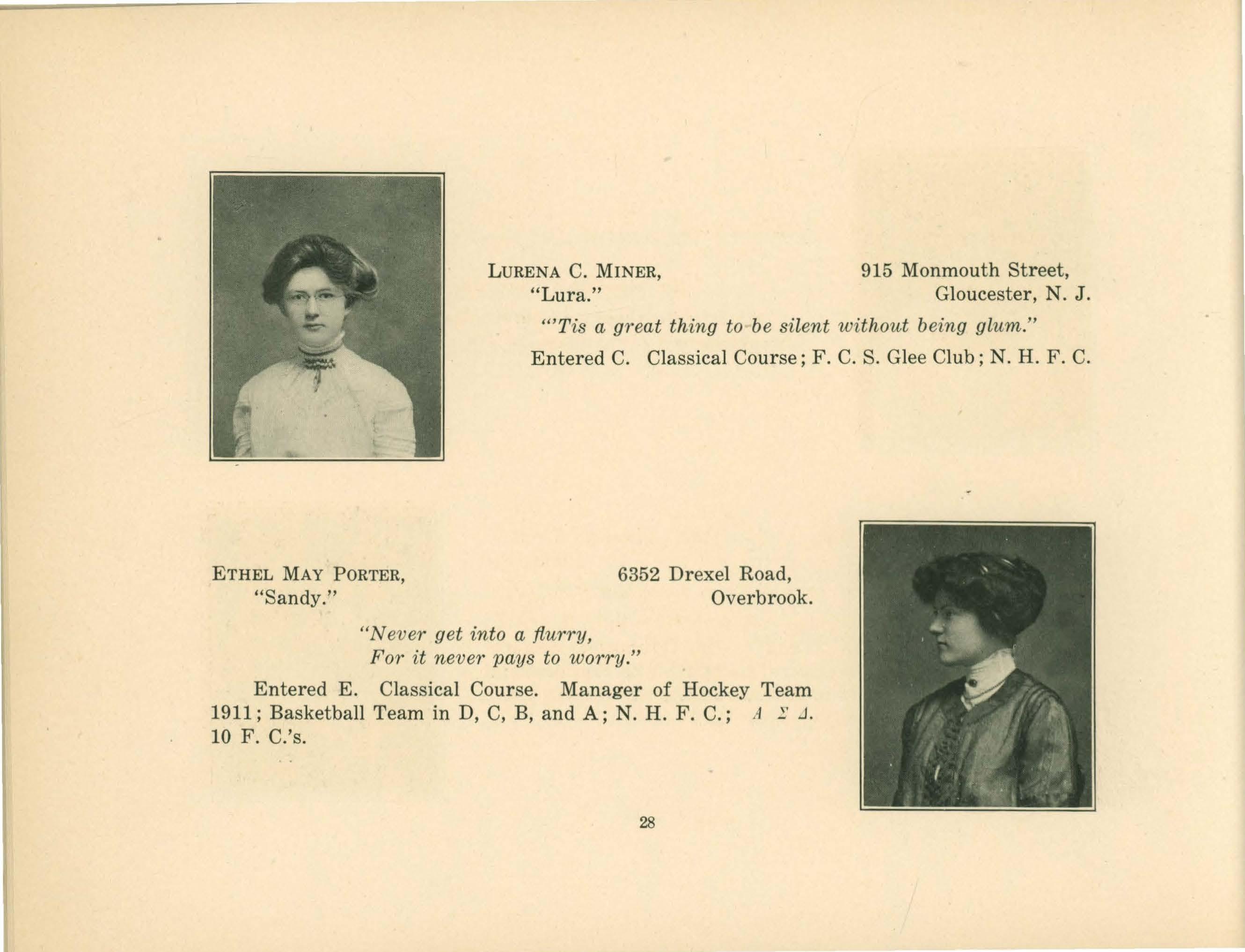
915 Monmouth Street, Gloucester, N. J.
"'Tis a great thing to be silent without being glum."
Entered C. Classical Course; F. C. S. Glee Club; N. H. F. C.
ETHEL MAY PORTER, "Sandy."
"Ne v er get into a flurry, 6352 Drexel Road, Overbrook. For it never pays to worry."
Entered E. Classical Course. Manager of Hockey Team 1911; Basketball Team in D, C, B, and A; N. H. F. C.; A :.: J. 10 F. C.'s.
ELIZABETH JACK SHOEMAKER, "Bee."
JOANNA Ross, "Jo."
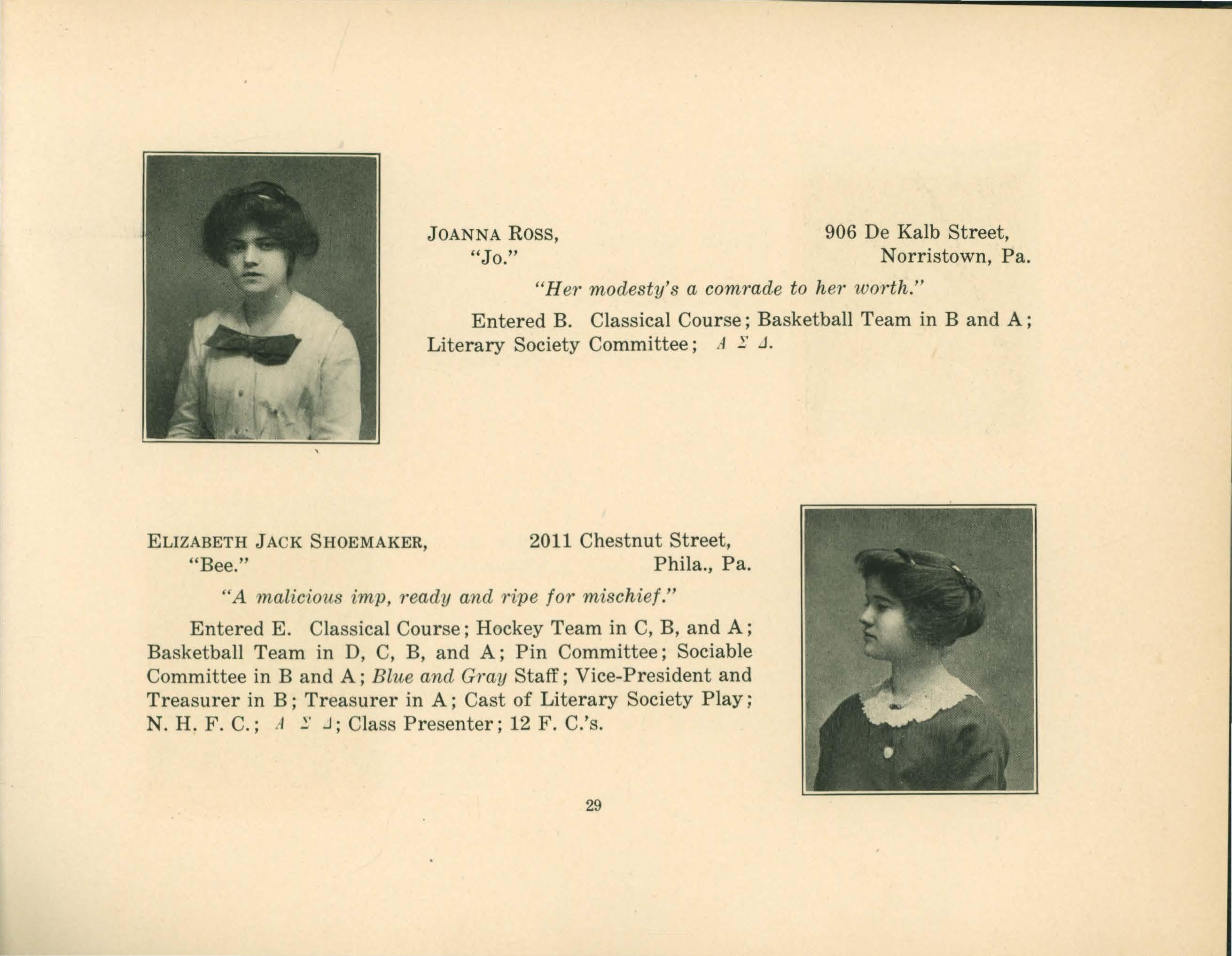
906 De Kalb Street, Norristown, Pa.
"Her modesty's a comrade to her worth."
Entered B. Classical Course; Basketball Team in B and A; Literary Society Committee; A 2· J.
2011 Chestnut Street, Phila., Pa.
"A maliciou imp, ready and ripe for mischief."
Entered E. Classical Course; Hockey Team in C, B, and A; Basketball Team in D, C, B, and A; Pin Committee; Sociable Committee in B and A; Blue and Gray Staff; Vice-President and Treasurer in B ; Trea urer in A; Cast of Literary Society Play; N. H. F. C.; A ~· J; Class Presenter; 12 F. C.'s.
ETHEL W. STALEY, 116 West Atlantic Avenue, "Eddy." Haddon Heights, N. J.
"She's with the maiority and has the courage of her opinions."
Entered E. Classical Course; N. H.F. C.
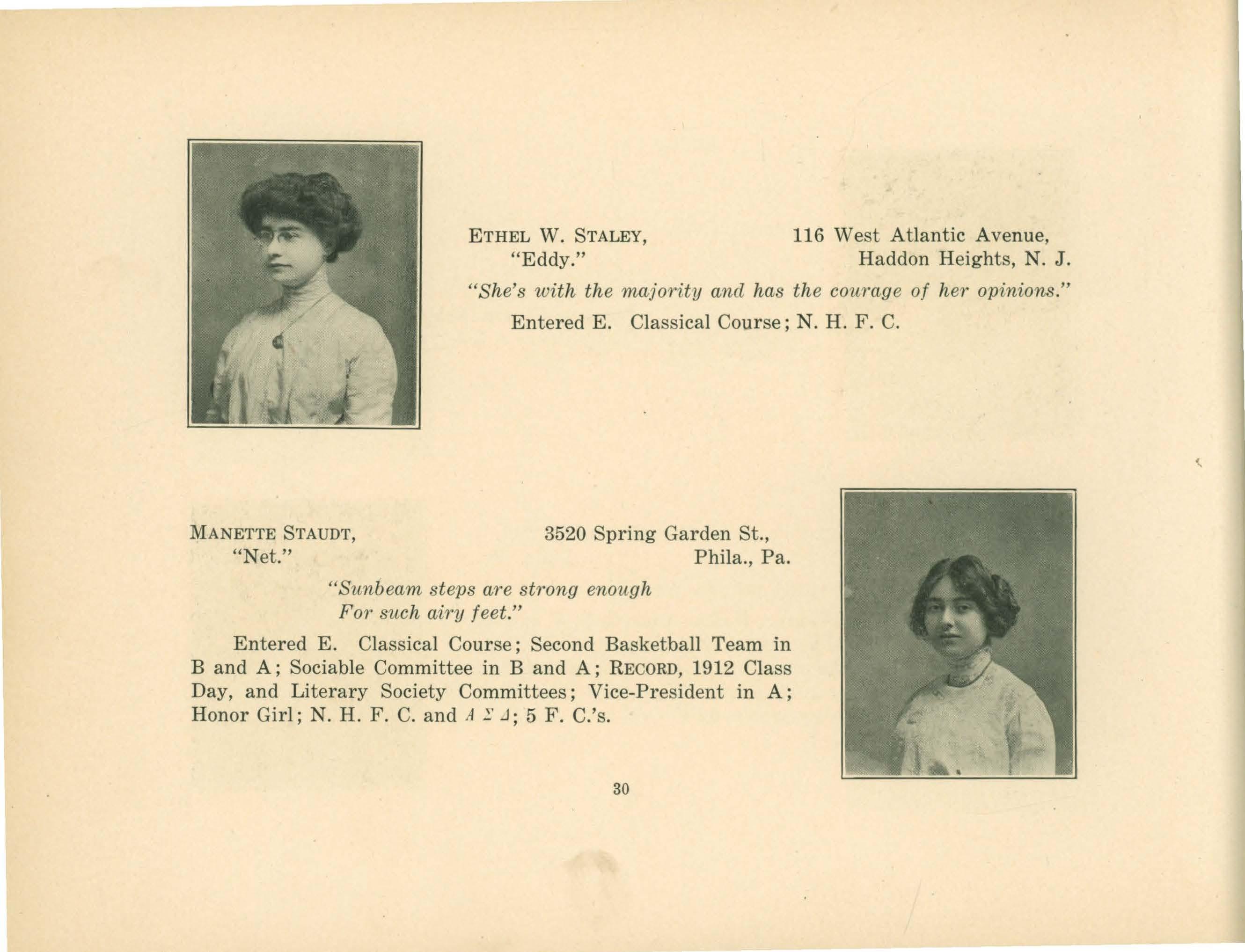
MANETTE STAUDT, "Net."
3520 Spring Garden St., Phila., Pa.
"Sunbeam steps are strong enough For such airy feet."
Entered E. Classical Course; Second Basketball Team in B and A; Sociable Committee in B and A; RECORD, 1912 Class Day, and Literary Society Committees; Vice-President in A; Honor Girl; N. H. F. C. and A ~· J; 5 F. C.'s.
EDITH LUKENS STEWART, "Stewart," "Jeff ."
"Ye gods! what a noise! Langhorne, Pa. And from what small source."
Entered E. Scientific Course; N. H. F. C.; E. M. E.
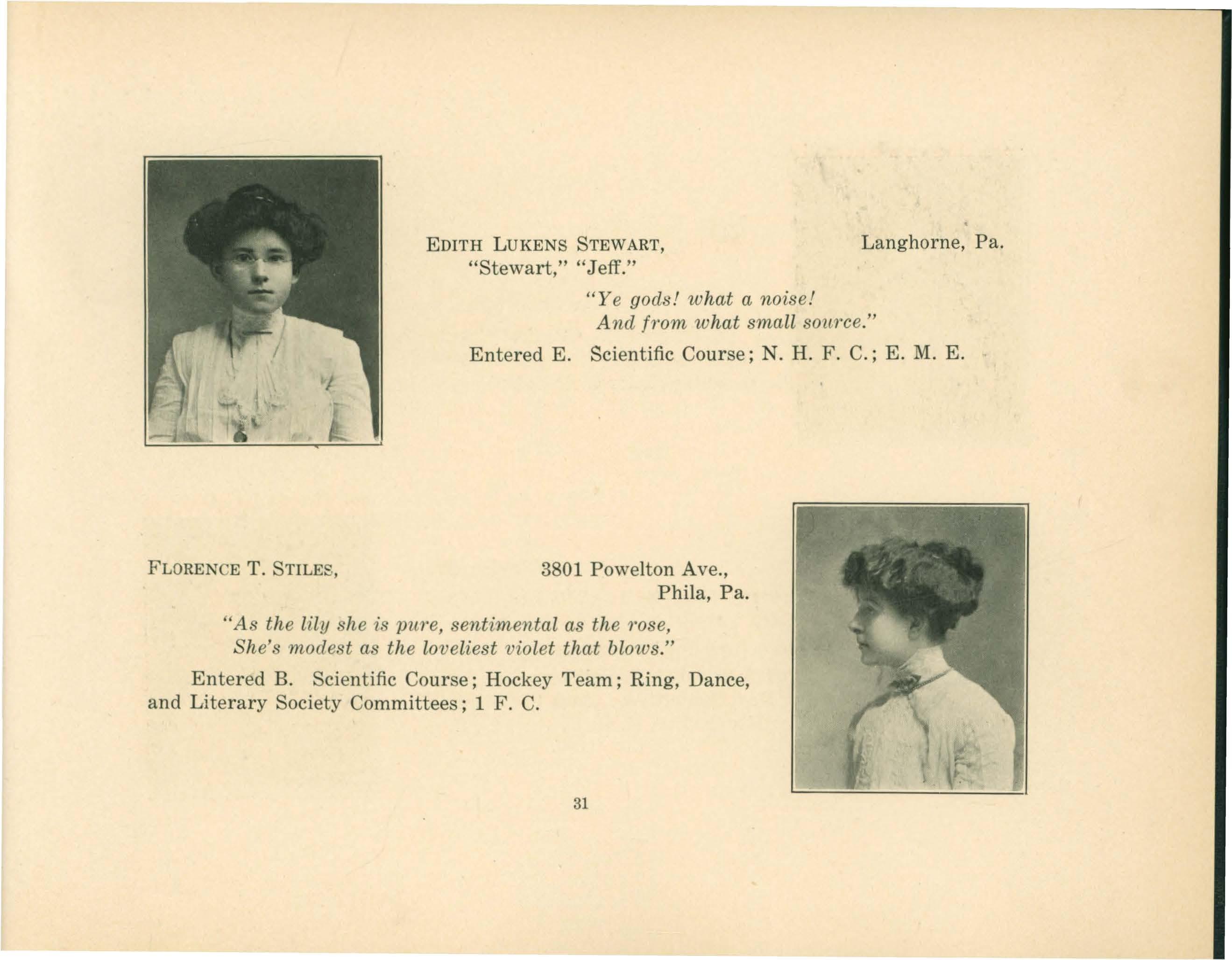
FLORENCE T. STILE"',
3801 Powelton Ave., Phila, Pa.
"As the lily she is pure, sentimental as the rose, She's modest as the loveliest violet that blows."
Entered B. Scientific Cour e; Hockey Team; Ring, Dance, and Literary Society Committees; 1 F. C.
FRANCES PALMER WRIGHT,
MARYE. VO@ES, "Voggy." "Ridgeland," Fairmount Park, Phila., Pa.
"A form more fair, a face more sweet Ne' er hath it been my lot to meet."
Entered E. Classical Course; B Sociable Committee; RECORD Committee; Blue and Gray Staff; Vice-President of Literary Society; Honor Girl; Class Prophet; N. H. F. C.; A ~· J.
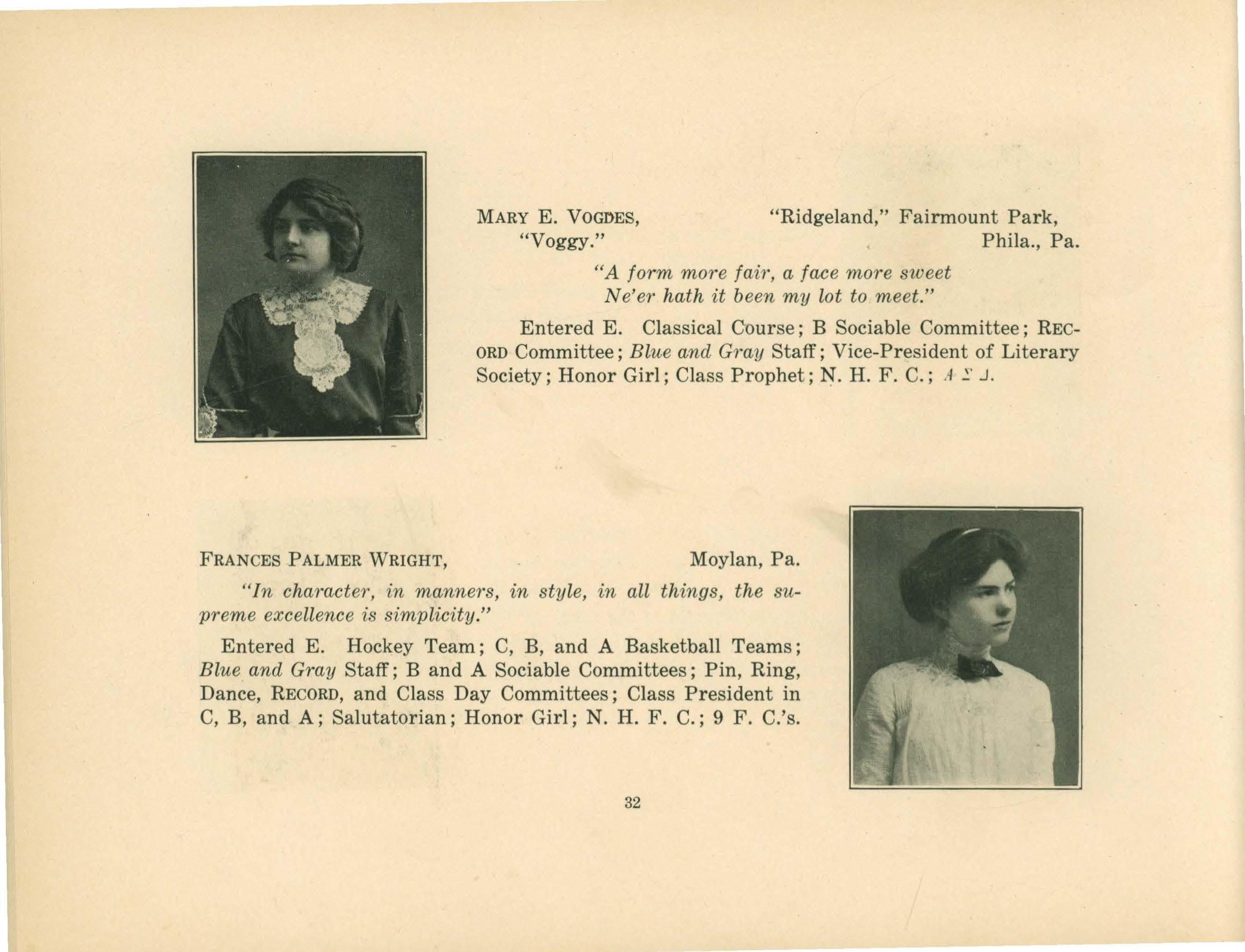
Moylan, Pa.
"In character, in manners, in style, in all things, the supreme excellence is simplicity."
Entered E. Hockey Team; C, B, and A Basketball Teams; Blue and Gray Staff; B and A Sociable Committees; Pin, Ring, Dance, RECORD, and Class Day Committees; Class President in C, B, and A; Salutatorian; Honor Girl; N. H. F. C.; 9 F. C.'s.
MURRAY IMMONS CHISM, "Murray S ."
MAITLAND BOTTOMS, 221 South 37th St., "Mait." Phila., Pa.
" Ent a won de rf u l twinkl e shone in his ey e ."
Scientific Course
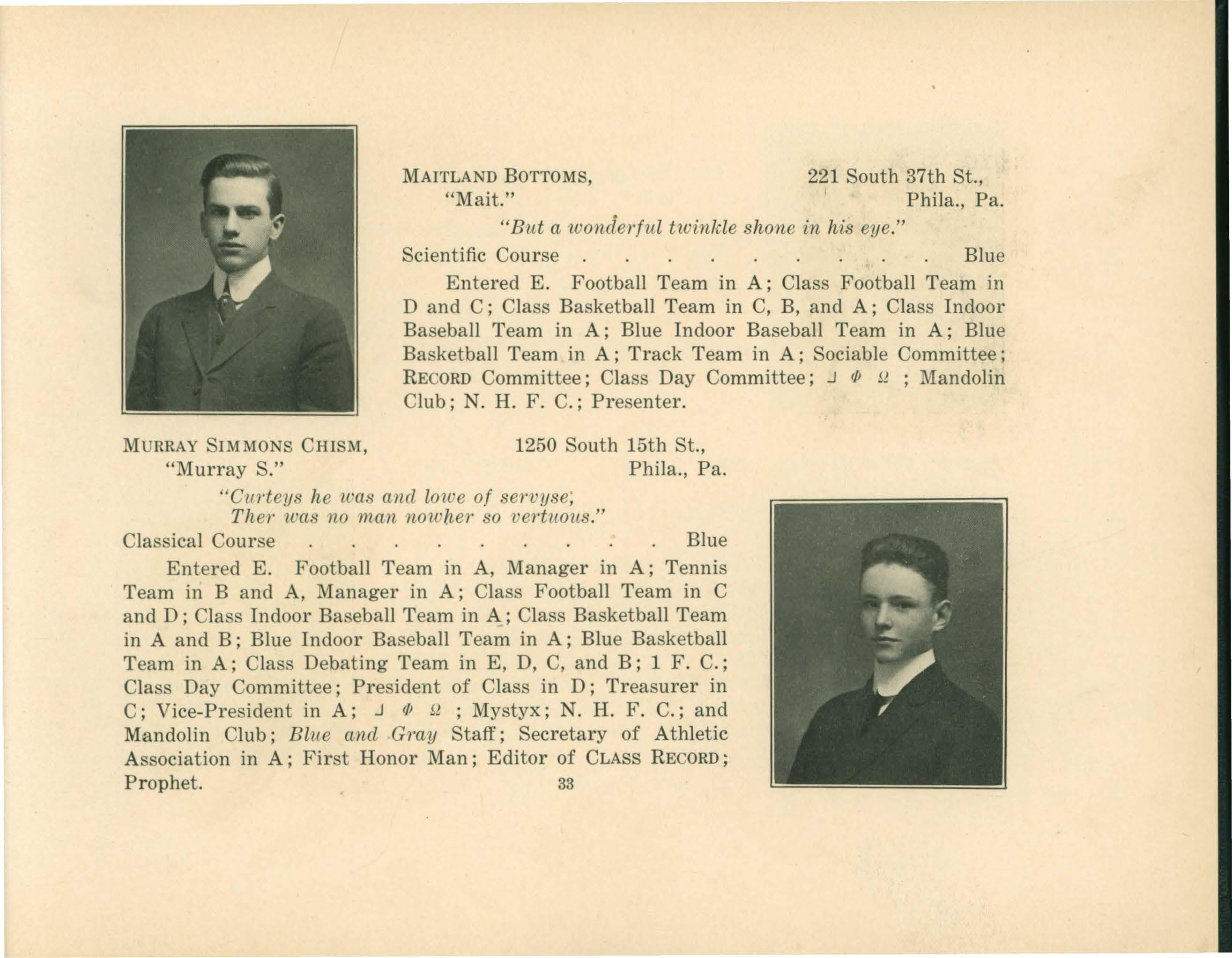
Blue
Entered E. Football Team in A; Class Football Team in D and C; Class Basketball Team in C, B, and A; Class Indoor Ba eball Team in A; Blue Indoor Baseball Team in A; Blue Basketball Team in A; Track Team in A; Sociable Committee; RE CORD Committee; Class Day Committee; J </J f! ; Mandolin Club; N . H . F. C.; Presenter.
1250 South 15th St ., Phila., Pa.
" Cu rt e y s h e wa s an d lowe o f s e 1· v y se , Th e r wa s no m a n now h, e r so z•e rt zwus ."
Cla sical Course
Blue
Entered E. Football T eam in A, Manager in A; Tennis Team in B and A, Manager in A; Class Football Team in C and D ; Cla s Indoor Ba eball Team in A; Clas s Basketball Team in A and B; Blue Indoor Baseball Team in A; Blue Ba ketball Team in A; Class Debating Team in E, D, C, and B; 1 F. C.; Class Day Committee; President of Class in D; Treasurer in C; Vice-President in A; J <11 !! ; Mystyx; N. H. F . C. ; and Mandolin Club; Blu e and Gray Staff; Secretary of Athletic A ociation in A; Fir t Honor Man; Editor of CLASS RE CORD; Prophet. 33
CLEM HARRIS CONGDON, "Bill," "Whitey."
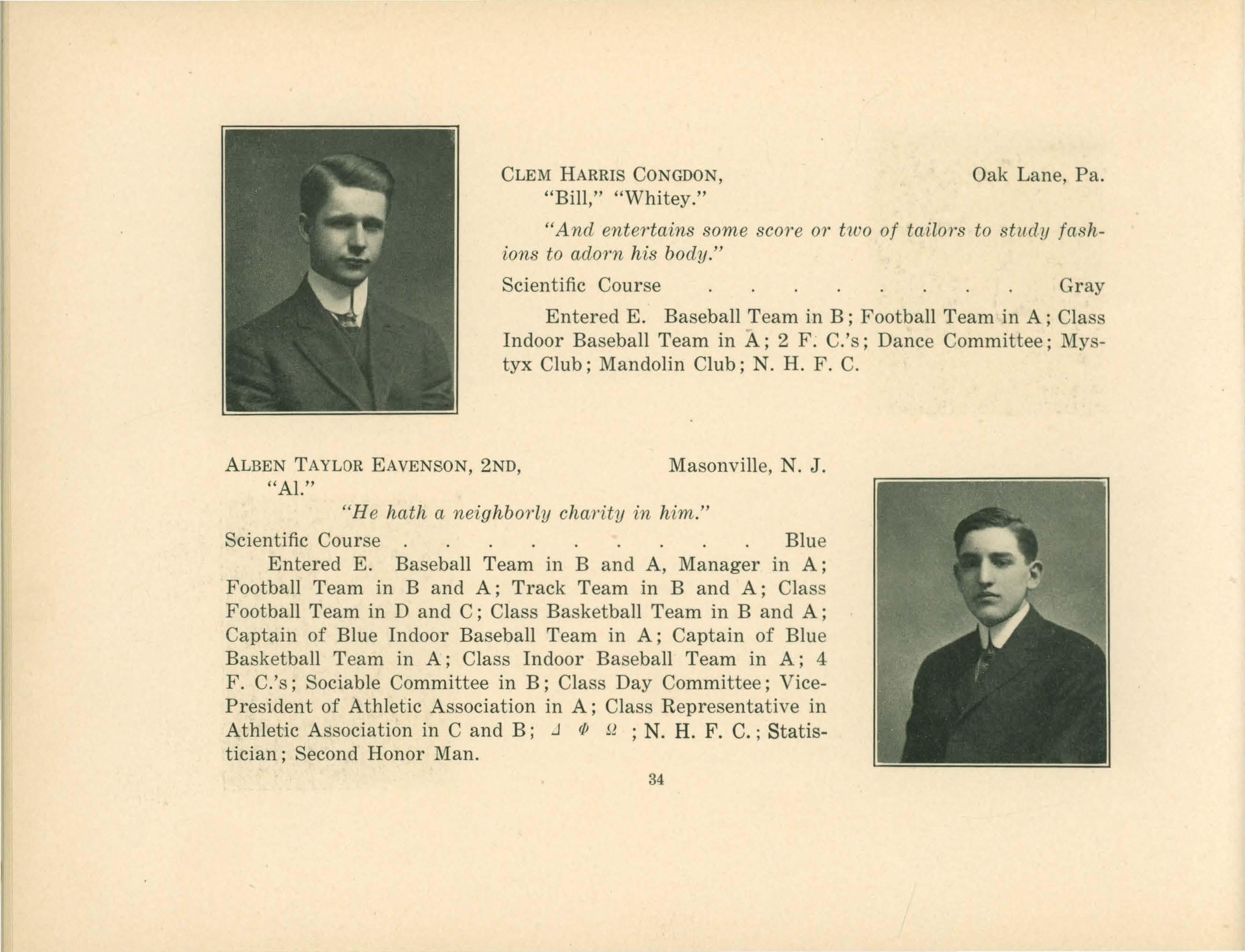
Oak Lane, Pa.
"And entertains some score or two of tailors to study fashions to adorn his body."
Scientific Course Gray
Entered E. Baseball Team in B; Football Team in A; Class Indoor Baseball Team in A; 2 F. C.'s; Dance Committee; Mystyx Club; Mandolin Club; N. H. F. C.
ALBEN TAYLOR EAVENSON, 2ND, "Al.''
Masonville, N. J.
"He hath a neighborly cha1·ity in him."
Scientific Course Blue
Entered E. Baseball Team in B and A, Manager in A; Football Team in B and A; Track Team in B and A; Class Football Team in D and C ; Class Basketball Team in B and A; Captain of Blue Indoor Baseball Team in A; Captain of Blue Basketball Team in A; Class Indoor Baseball Team in A; 4 F. C.'s; Sociable Committee in B; Class Day Committee; VicePresident of Athletic Association in A; Class Representative in Athletic Association in C and B; J ([} a ; N. H. F. C.; Statistician; Second Honor Man. 34
GEORGE WEBSTER GRIM, "Grimmy," "Emma."
JAMES ALLISON EYSTER, "Jimmie."
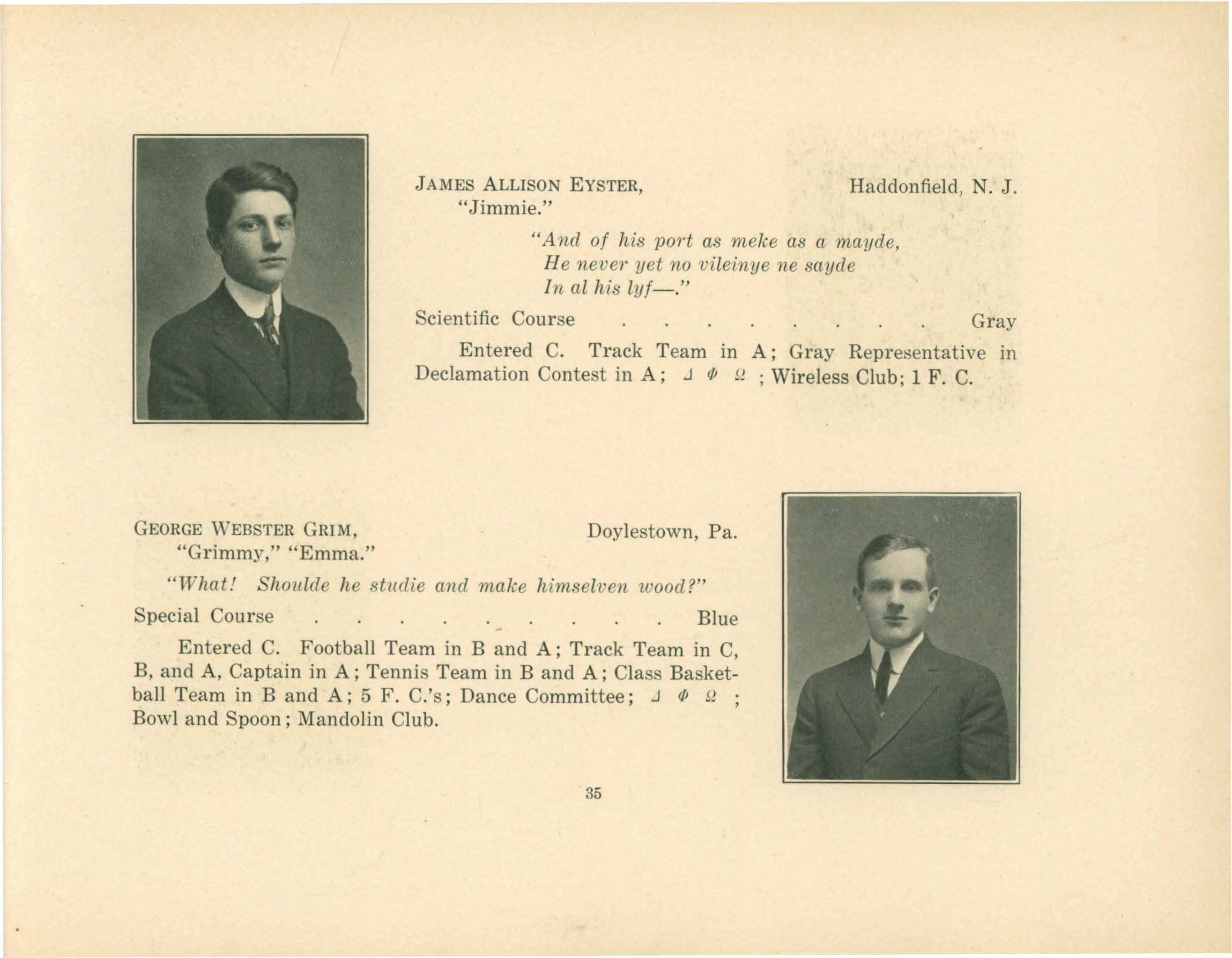
Haddonfield, N. J.
"Ancl of his port as meke as a mayde, I-I e never yet no vileinye ne sayde
In al his lyf-."
Scientific Course Gray
Entered C. Track Team in A; Gray Representative in Declamation Conte tin A; J ({J St ; Wireless Club; 1 F. C.
Doylestown, Pa.
"What! Should he tudie and make himselven wood?"
pecial Course
Blue
Entered C. Football Team in B and A; Track Team in C, B, and A, Captain in A; Tennis Team in B and A; Class Basketball Team in B and A; 5 F. C.'s; Dance Committee; J ({J ~J Bowl and Spoon; Mandolin Club.
HOMER BARCLAY HEACOCK, "Bud."
FRANK CURRY HAMILTON, "Yank," "Ham."
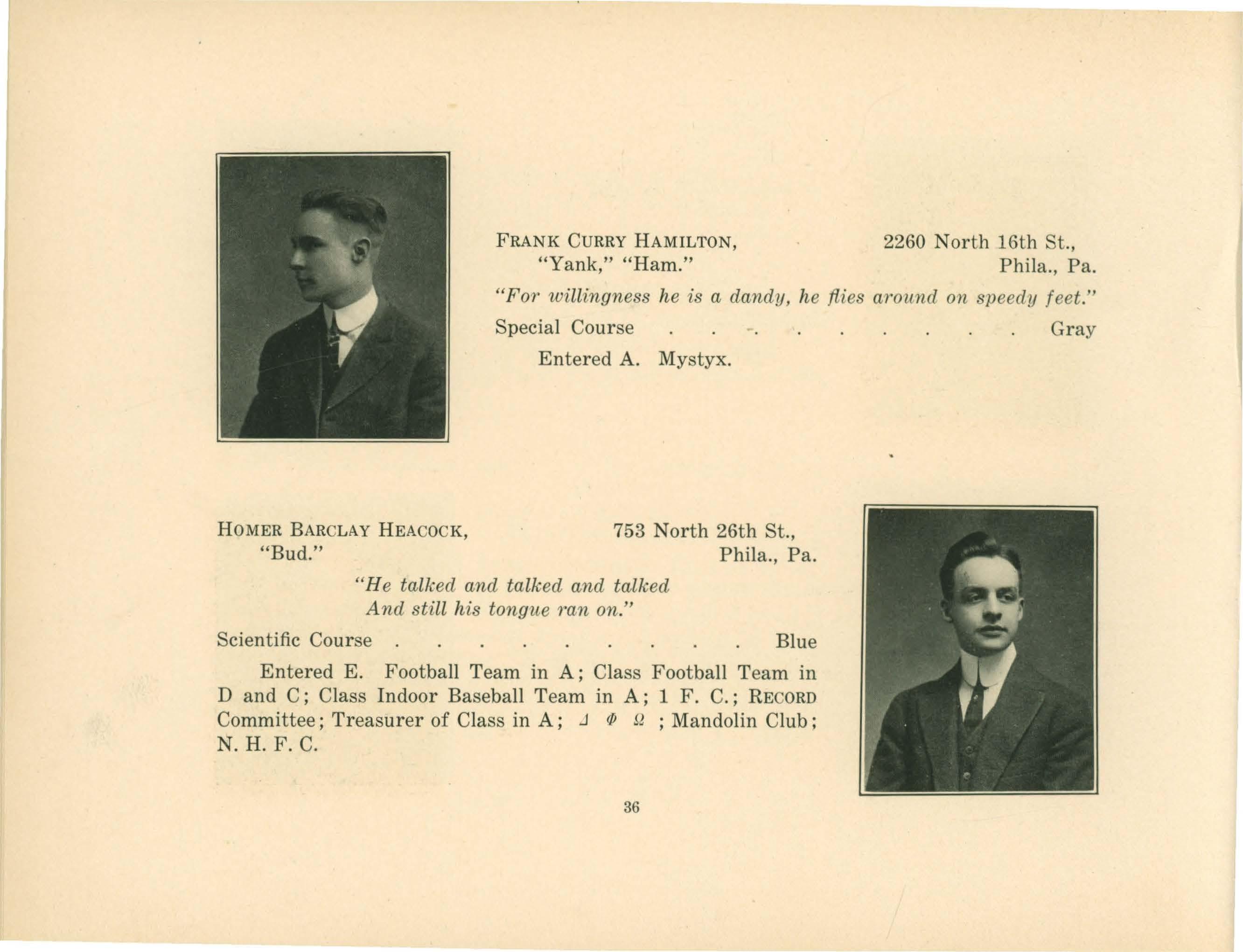
2260 North 16th t., Phila., Pa.
"For willingne s he is a dandy, h e flies around on speedy f et ."
Special Cour e Gray Entered A. Mystyx.
753 North 26th St., Phila., Pa.
"He talked and talked and talked And still his tongue ran on."
Scientific Course Blue
Entered E. Football Team in A; Class Football Team in D and C ; Class Indoor Baseball Team in A; 1 F. C. ; RE CORD Committee; Treasurer of Class in A; J ifi Sl ; Mandolin Club; N.H.F.C. 36
LEWIS MATLACK LINDAUER, "Louie."
"O my faithful friend, 736 North 20th St., Phila ., Pa.
0 ea1·ly cho en, ever found the same."
Scientific Course Blue
Entered E. Cla s Basketball Team in B; Class Football Team in D and C ; Class Indoor Baseball Team in A; Sociable Committee in A; J (Ji !l ; Bowl and Spoon; Mandolin Club; N.H.F.C.
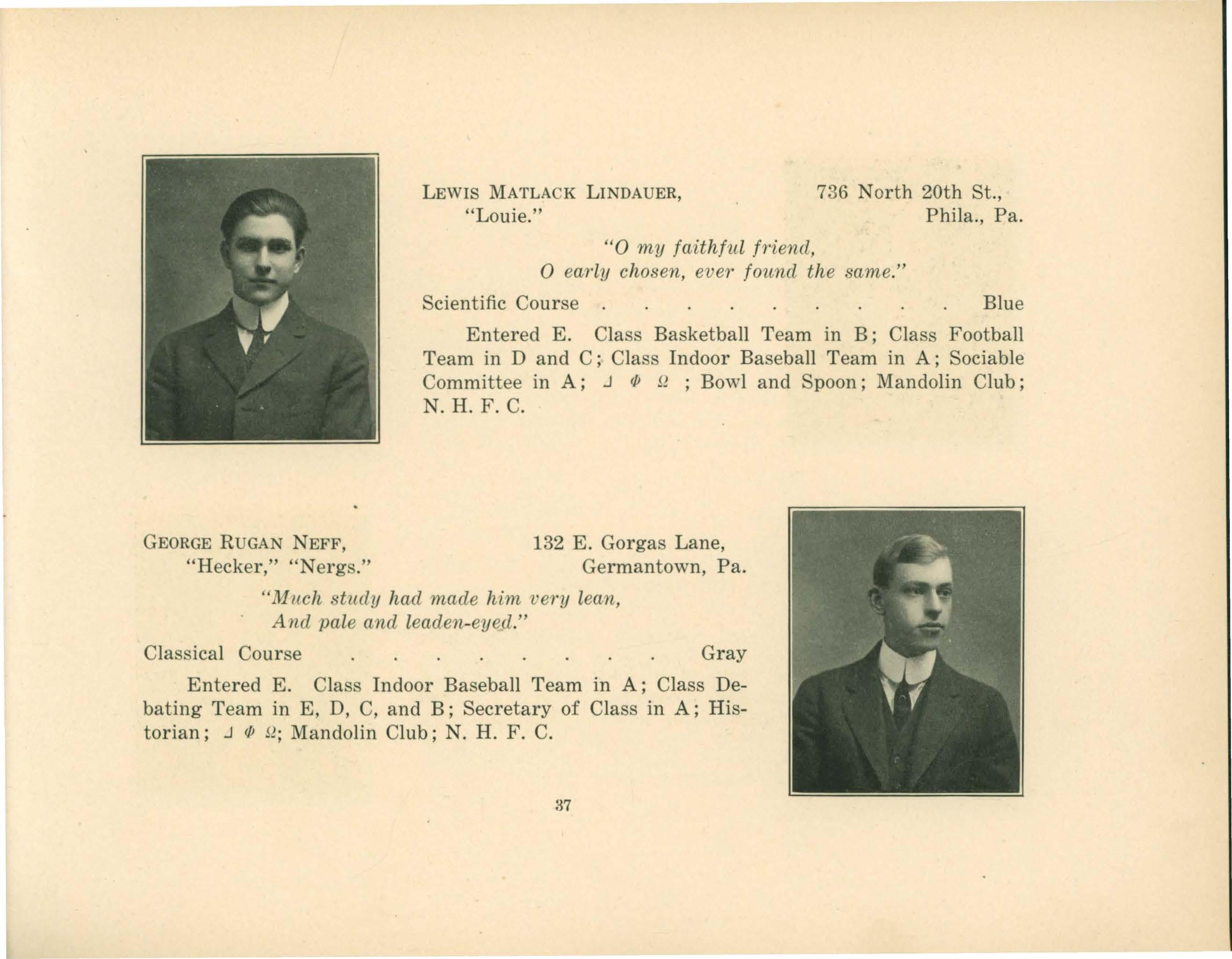
GEORGE RUGAN NEFF,
132 E . Gorgas Lane, "Hecker," "N erg ." Germantown, Pa.
"Much study had made him very lean, Ancl pale and leaden-eyed."
Classical Course Gray
Entered E. Class Indoor Baseball Team in A; Class Debating Team in E, D, C, and B; Secretary of Class in A; Historian; J (fJ a; Mandolin Club; N. H. F. C. :-!7
WILLIAM TOWNSEND PANCOAST, "Panny."
1932 Mt. Vernon St., Phila., Pa.
"And certainly h e was a good fellow."
Scientific Course Gray
Entered E. Class Indoor Ba eball Team in A; J <P St Mandolin Club; Wireless Club; N. H. F. C.
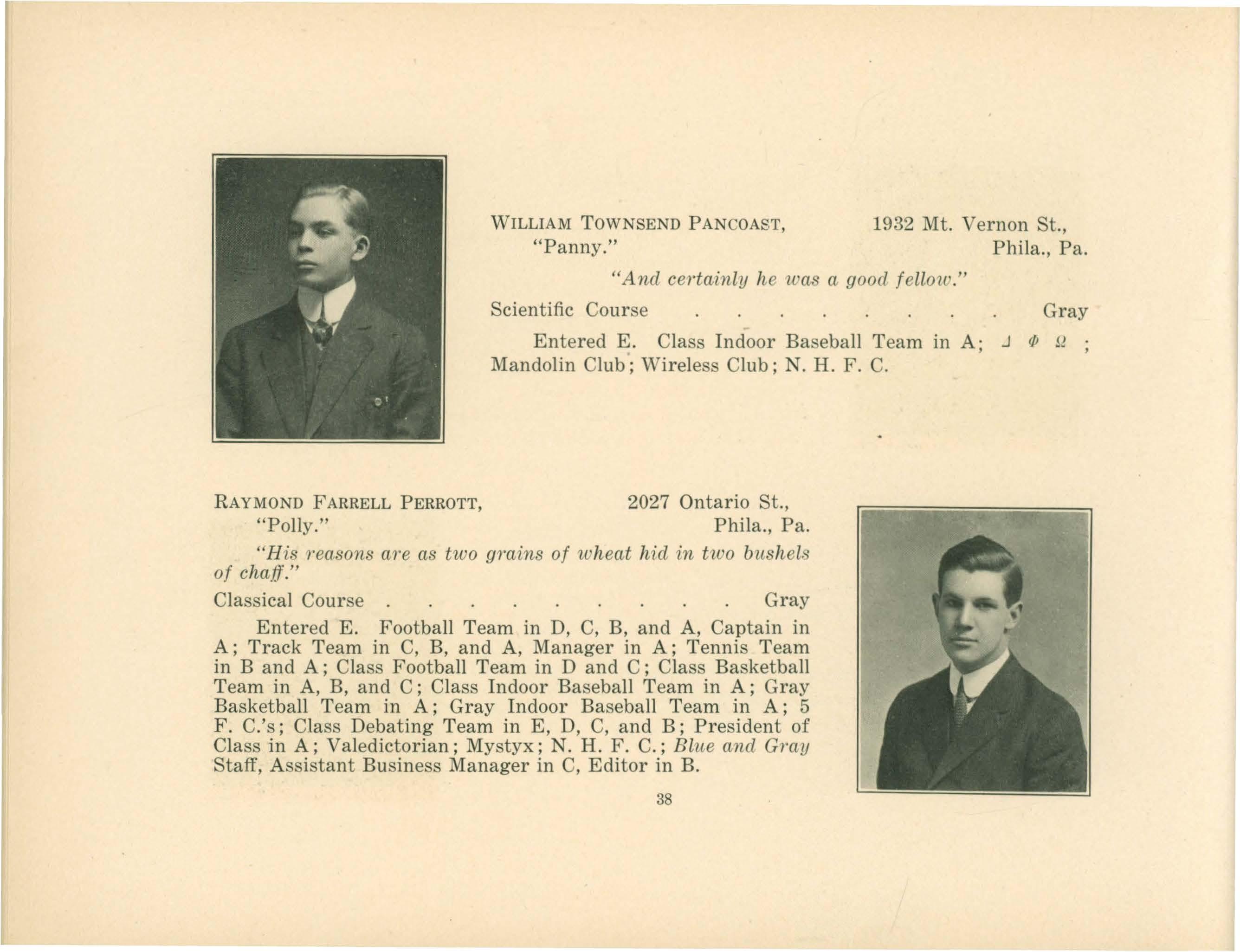
RAYMOND FARRELL PERROTT, 2027 Ontario St., "Polly." Phila., Pa.
"His reasons a1·e as two grains of whecit hid in two bush els of chaff."
Classical Course Gray
Entered E. Football Team in D, C, B, and A, Captain in A; Track Team in C, B, and A, Manager in A; Tennis Team in B and A; Class Football Team in D and C ; Class Basketball Team in A, B, and C; Class Indoor Baseball Team in A; Gray Basketball Team in A; Gray Indoor Baseball Team in A; 5 F . C.'s; Class Debating Team in E, D, C, and B; President of Class in A; Valedictorian; Mystyx; N. H. F . C.; Blue and Grny Staff, Assistant Business Manager in C, Editor in B.
HENRY COMLY PICKERING, "Pickles."
"This youth had sense and spirit But yet with all his sense Excessive diffidence Obscured his me1·it."
Woodbourne, Pa.
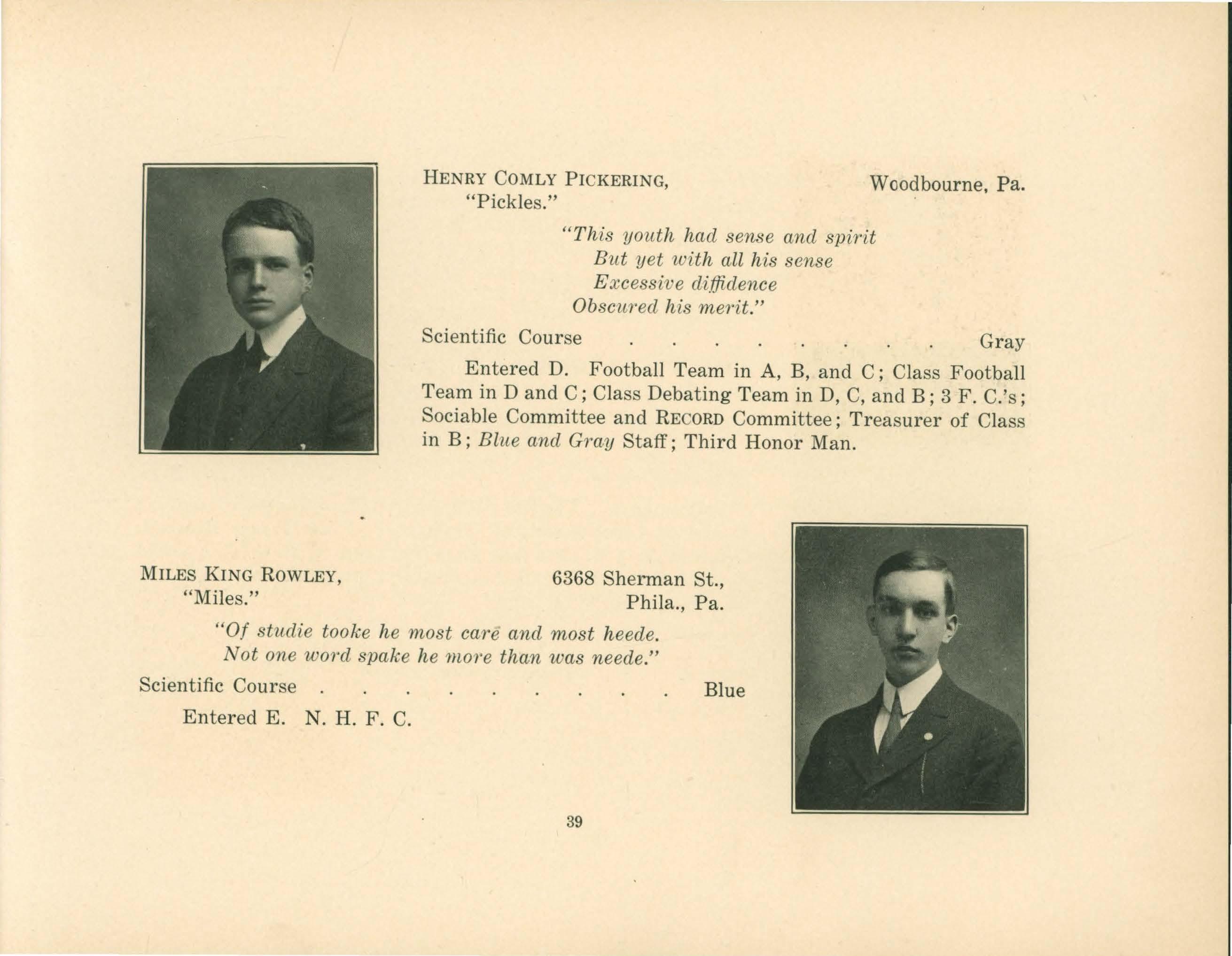
MILES KING ROWLEY, "Miles."
Scientific Course Gray
Entered D. Football Team in A, B, and C; Class Football Team in D and C; Class Debating Team in D, C, and B; 3 F. C.'s; Sociable Committee and RECORD Committee; Treasurer of Class in B; Blue and Gray Staff; Third Honor Man.
6368 Sherman St., Phila., Pa.
"Of studie tooke he most care and most heede. Not one word spake he more than was neede.''
Scientific Course Blue
Entered E. N. H. F. C.
WILLIAM SIMMONS, "J."
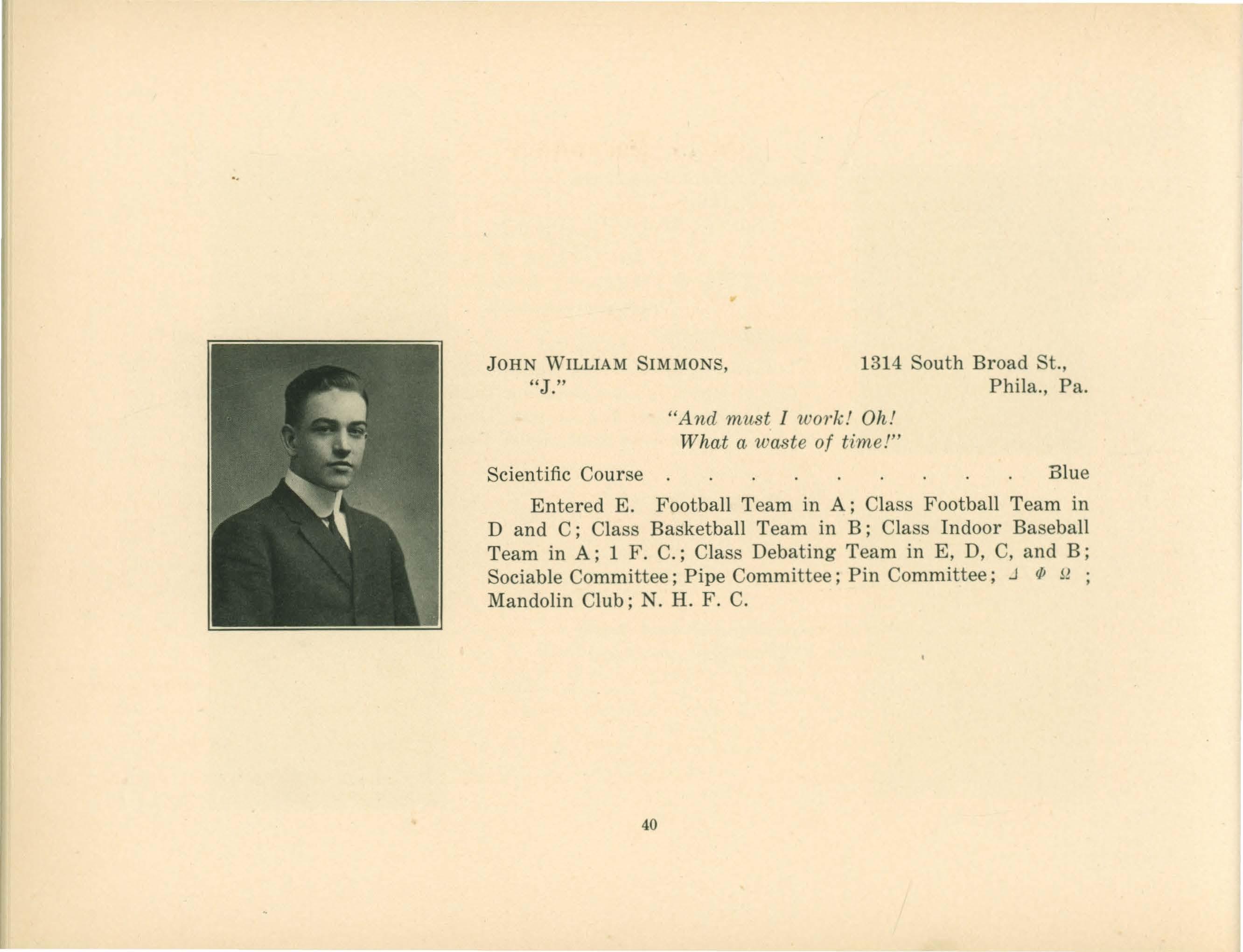
1314 South Broad t., Phila., Pa.
"And mu,st I work! Oh! What a waste of time!"
Scientific Course Blue Entered E. Football Team in A; Class Football Team in D and C ; Class Basketball Team in B ; Class Indoor Baseball Team in A; 1 F. C.; Class Debating Team in E, D, C, and B; Sociable Committee; Pipe Committee; Pin Committee; J <1, !l Mandolin Club; N. H. F. C.
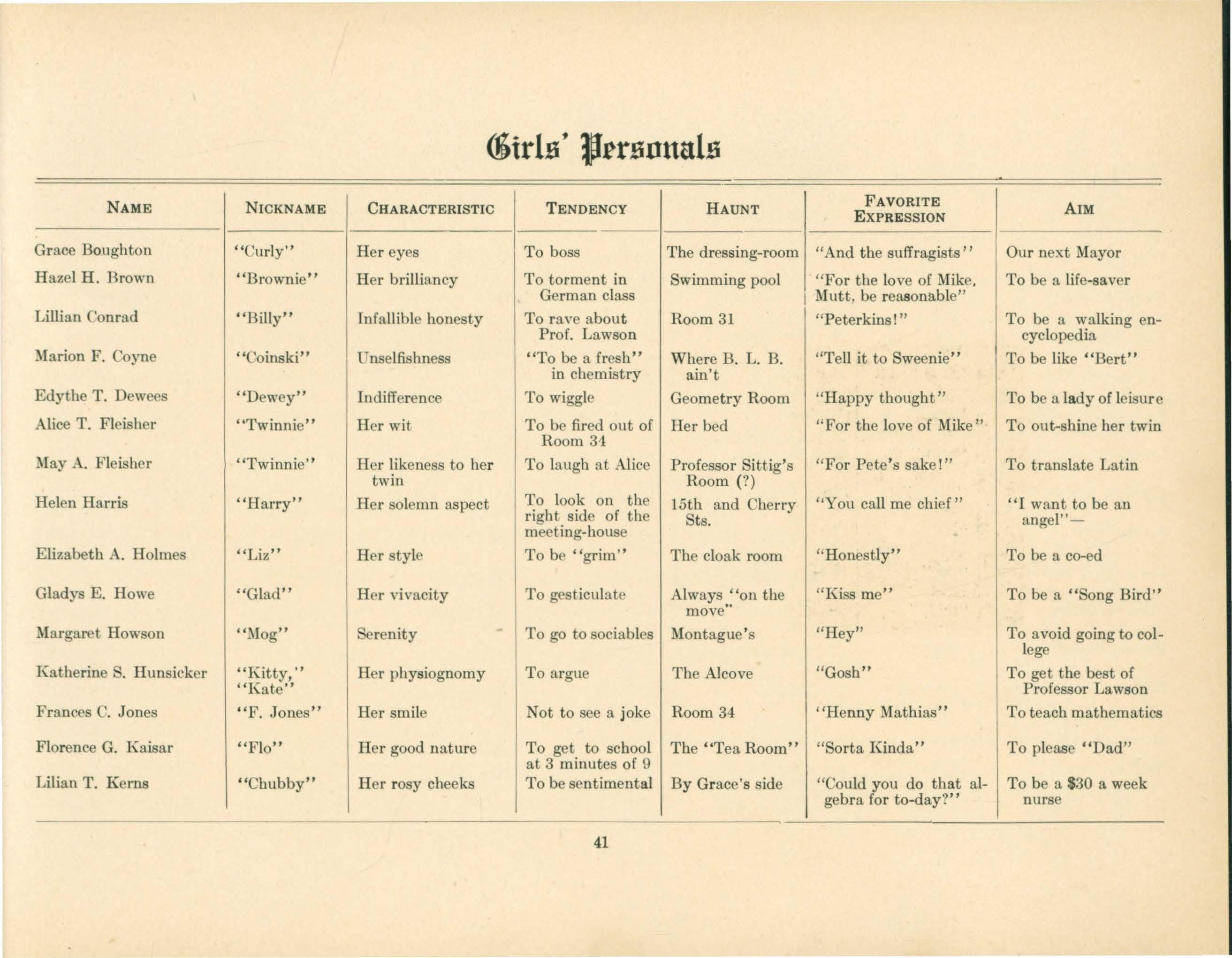
NAME NICKNAME
Grace Boughton '' Cur ly'' Her eyes To boss The dressing-room "And the suffragists" Our next Mayor
Hazel H. Brown "Brownie" Her brilliancy To torment in Swimming pool "For the love of Mike, To be a li fe -sav er German class Mutt , be r easonab le"
Lillian Conrad "Bill y" Infallible honesty To rave abou t Room 31 "Pete r kins!" To be a walking enProf. Lawson cyclopedia
Marion F. Coyne "Coinski" Unselfishness "To be a fresh" Where B. L. B. "Te ll it to Sweenie'' To be like "Bert" in chemistry ain't
Edythe T. Dewce "Dewey" Indifference To wiggl e Geometry Room " Happy thought" To be a lady of leisure
Alice T. Fleisher "Twinnie" Her wit To be fired out of Her bed "For the love of Mike" To out-shine her twin Room 31
May A. Fleisher "Twinnie" Her likeness to he r To laugh at Alice Professor Sittig's "For Pete's sake!" To translate Latin twin Room (?)
Helen Harris "Harry" Her solemn aspect To look on the 15th and Cherry "You call me chief" "I want to be an right side of the Sts. angel"- meeting-house
Elizabeth A. Holmes ''Liz'' Her style To be ''grim'' The cloak room "Hone tly" To be a co-ed
Gladys E . Howe "Glad" Her vivacity To gesticulat e Always.'. 'on the "Kiss me" To be a "Song Bird'' move
largaret Howson "Mog" erenity To go to sociab les Montague's "Hey" To avo id going to colLege
Katherine . Hunsicker "Kitty,'' "Kate" Her physiognomy To argue The Alcove "Gosh" To get the best of Professor Lawson
Frances C. Jon es "F. Jones " Her smi le Not to see a joke Room 34 "Henny Mathias" To teach mathematics
Florence G. Kais ar "Flo" Her good nature To get to school at 3 minutes of 9 The ''T ea Room" "So rta Kinda" To please "Dad"
Lilian T. Kerns "Chubby" Her rosy cheeks To be sentiment al By Grace's side "Could you do that al- To be a $30 a week gebra for to-day?" nurse
NAME NICKNAME CHARACTERISTIC TENDENCY HAUNT
Elsie Lea "Long Dis- Her arched brows Toward corpu- A crowded 15th a nce'' !enc y Street car
D a isy McCadd e n "Dizzy" A look "the" artist To talk about him At the tC'lephone likes
Mary McIntire "Mac" Perpetual motion To love all men Halls, before nine and after two
E. Gertrude Miller "Gert" Her laugh To come apart Huylers ' with -
Marian A. Mitchell "Mike" Flirting To <lo the "Tur- Matinee key Trot"
Lurena C. Miner ''Lura'' Her sympathy To giggle German class
Ethel M. Porter ''Sandy'' Her stubborness To jump at con- ''Gym'' clusions
Joanna Ross "Jo" Her modesty To pass examina- Broad St. Station tions
Elizabeth J. Shoemaker "Bee" Her gymnastic ability To prink "Gym" or Montague's
Ethel W. Staley "Eddy" To feel the cold Not to pay class Professor Sit.tig's dues room
Manette Staudt "Net" Her good disposition To make puns The office
Edith Lukens Stewart "Steward," Her hands To accidently (?) Where she ought "Jeff" leave her French not to be book home
Florence S. Stiles ••Stilezy'' Her chatter To blush Car No. 204
Mary E. Vogdes "Voggie'' Her good taste and To be a coquette Wanamaker's judgement
Frances P. Wright "Frank" Always to be right To shock Prof. Blue and Gray Sittig Room
FAV0RIT E ON EXPRESS!
"For goodness s ake I"
" Squeery dear"
" My dear you' ll nevn know!"
"I like it, I lik e it, I like it!'.'
"Ain't she awfu I?"
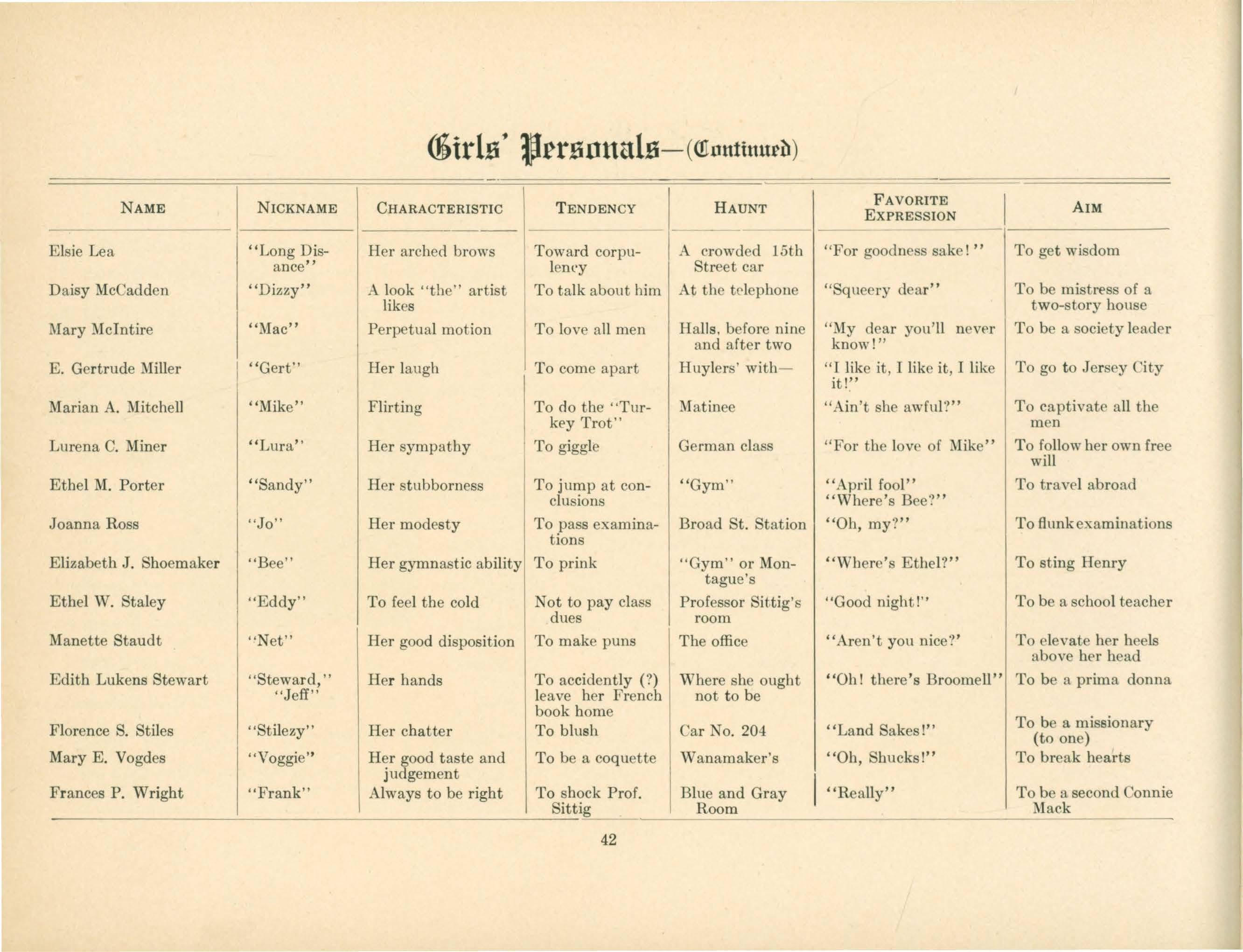
AIM
To get wisdom
To be mistress of a two- tory house
To b e a society leade r
To go to Jersey City
To captivate all the men
"For the love o f Mike" To follow her own free
will
"April fool" "Where's Bee?'
"Oh, my?"
"Where's Ethel ?"
"Good night!"
"Aren't you nic e?'
To travel abroad
To flunk examinations To sting Henry To be a school teacher
To elevate her heels above her head
"Oh! there's B roomell" To be a prin1a donna
"Land Sakes!"
"Oh, Shucks!"
"Really"
I
To be a missionary (to one) To break hearts
To be a second Connie Mack
NAME
.'.\Iaitland Bottoms
;\Iurray S. Chism
Clem II. Congdon
Alben T. E:wenson , 2nd
Jame A. Eystrr
George W. Grim
Frank C. J l amilton
Homer B. Heacock
Lewi l\l. Lindauer
G. Rugan cff
\Y. Town end Pancoast
Raymond F. Perrott
H nry . Pickering
Miles K. Rowley
J. William Simmons
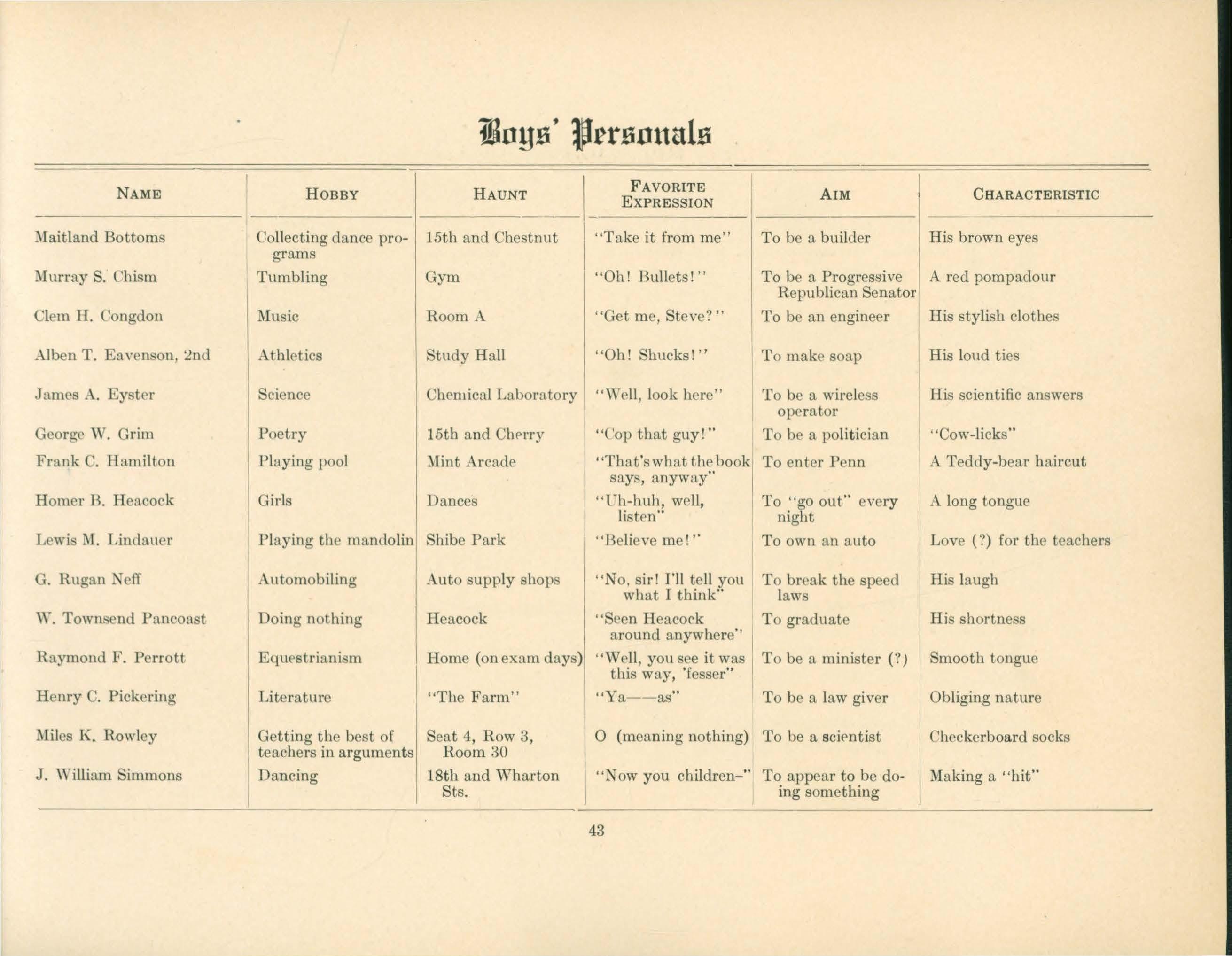
HOBBY
Co ll ecting dance program
Tumbling
Music
Athletics
Science
Poetry
Playing p ol
Girls
HAUNT
15th and Chestnut
Gym
Room A
Study Hall
Chemical Laboratory
15th and Chrrry
Mint Arcade
Dances
Playing the mandolin Shibe Park
Automobiling
Doin" nothing
EquC'striani'm
Literature
Getting the best of teachers in arguments
Dancing
Auto supp ly shops
Heacock
FAVORITE EXPRESSION
"Take it from me"
"Oh! Bullets!"
"Get me, Steve?"
"Oh! Shucks!"
"\\'ell, look here"
"('op that guy!"
"That's what th~. book / say, , a nyw ay
"LTh -huh , wrll, li sten "
To be a builder
To be a Progressive Republican Senator
To be an engineer
To make soap
To be a wireless operator
To be a I olitician
To enter I'enn
To "go out" every night
CHARACTERISTIC
His brown eyes
A red pompadour
His stylish clothes
His loud tics
His scientific answers
"Cow-licks"
A Teddy-bear h aircut
A long tongue
"Be li ev me!•· To own an auto Love ( ?) for the teachers
"No, s ir! I'll tell you what I think"
" een Heacock around anywhe r e ''
To break the speed laws
To graduate
His l augh
Hi shortne s
Home (on exam day ) " \V II , you see it was To be a minister (? J Smooth tongue this way, 'fc ser "
"The Fann"
Seat 4, Row 3, Room :30
18th and Wharton Sts.
"Ya- -as " To b a 1:.iw giver
0 (m ea nin g nothing) To be a sci rnt ist
" ow you children-" To appear to be doing something 43
Obliging nature
Checke rboard socks
Ma king a " hit"
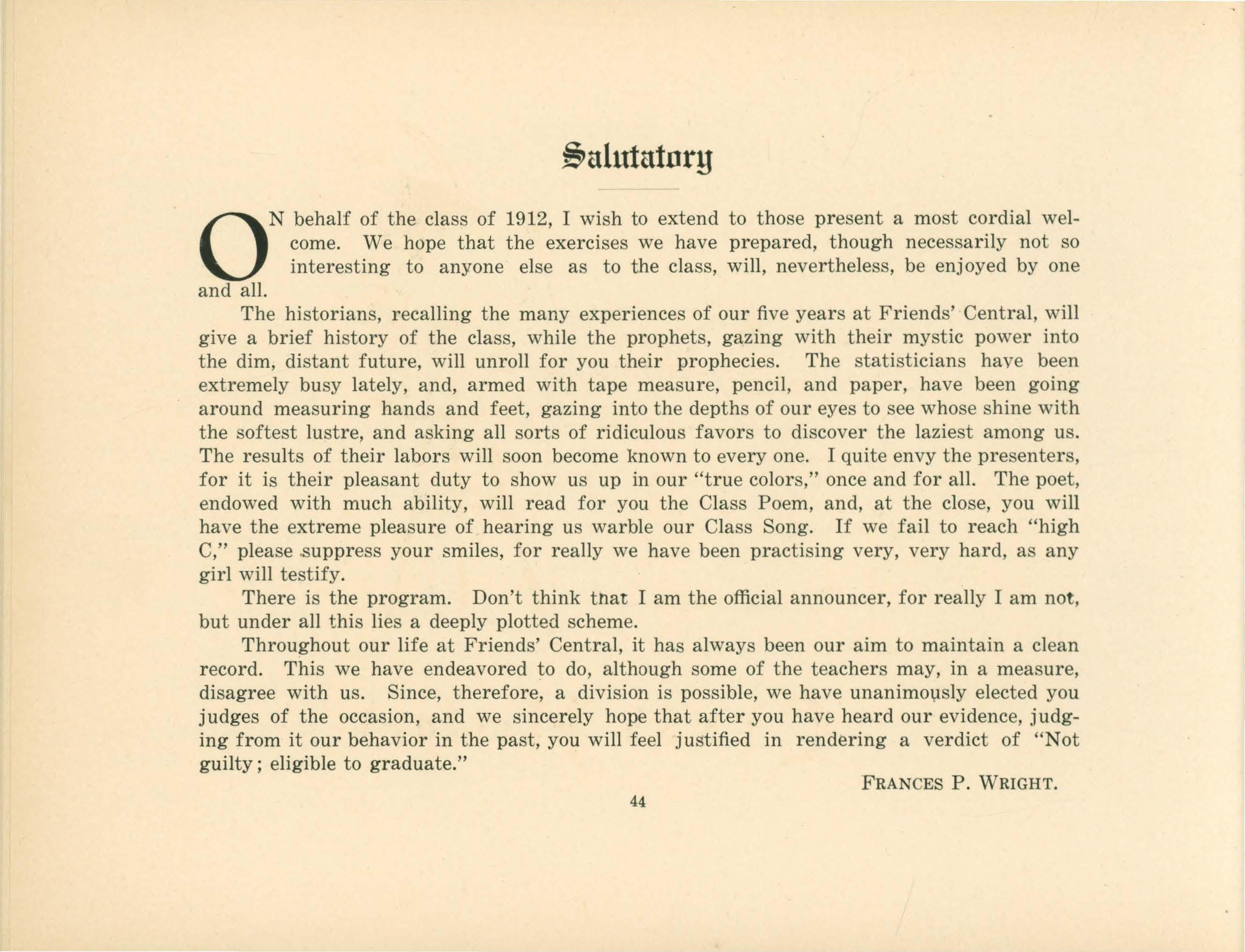
ON behalf of the class of 1912, I wish to extend to those present a most cordial welcome. We hope that the exercises we have prepared, though necessarily not so interesting to anyone else as to the class, will, nevertheless, be enjoyed by one and all.
The historians, recalling the many experiences of our five years at Friends' Central, will give a brief history of the class, while the prophets, gazing with their mystic power into the dim, distant future, will unroll for you their prophecies. The statisticians have been extremely busy lately, and, armed with tape measure, pencil, and paper, have been going around measuring hands and feet, gazing into the depths of our eyes to see whose shine with the softest lustre, and asking all sorts of ridiculous favors to discover the laziest among us. The results of their labors will soon become known to every one. I quite envy the presenters, for it is their pleasant duty to show us up in our "true colors," once and for all. The poet, endowed with much ability, will read for you the Class Poem, and, at the close, you will have the extreme pleasure of hearing us warble our Class Song. If we fail to reach "high C," please .suppress your smiles, for really we have been practising very, very hard, as any girl will testify.
There is the program. Don't think tnat I am the official announcer, for really I am not, but under all this lies a deeply plotted scheme.
Throughout our life at Friends' Central, it has always been our aim to maintain a clean record. This we have endeavored to do, although some of the teachers may, in a measure, disagree with us. Since, therefore, a division is possible, we have unanimoµsly elected you judges of the occasion, and we sincerely hope that after you have heard our evidence, judging from it our behavior in the past, you will feel justified in rendering a verdict of "Not guilty; eligible to graduate ."
FRANCES P. WRIGHT.
HE history of the Class of 1912 is quit e important, or at least it seems so to us, and I hope you will be patient while it is being told. From the time that we first began to learn the three R's, . reading, 'riting, and 'rithmetic, we always looked forward to the year when we should enter high school, that goal of every youthful scholar. When that time did arrive, and we had really entered Class E, you may be sure that we were quite puffed up and proud of ourselves. But, at first, the building seemed so large and we would get lost o often, in going from classroom to classroom, that some of that pride was taken away. And then, the condescending smiles and looks of the seniors quite humbled our spirits, and we decided that we were not so important after all. Amid the hubbub and disorder of our fir st class meeting, Jean Inglis was elected president.
We were all initiated by Mrs. Dutton into the mysteries of the Natural History Field Club. Under her guidance we made our first debut upon the public platform and were, indeed, quite proud of the eries of concerts that we gave.
Then the excitement of the Gymnasium Exhibition and Contest claimed our attention. Four girls were chosen to represent the class , and they won fifth place in the Contest, which was quite as much as could be expected.
Now, we enter Class D. This year, we felt a little more sure of ourselves and could afford to patronize the E's, for we had really entered upon our high school life. We now sat in the "big room," as we called it, and would watch and criticize what the "older girls" did or said. Jean Inglis was again elected president of the class; her main duty was to keep the unruly class meetings in order. Our first feast was held in Miss Hannum's room, and the way we gorged ourselves with pickles, etc., is sad to relate.
This year, the classical section first had Mrs . Stirling, whom we all soon grew to love and respect. How we quaked when we entered her room! We were immediately told not to "go off into Dreamland," and to "stop destroying her parlor furniture," commands which were trictly enforced and obeyed.
In this, our fir t year of basket -ball, Elizabeth Shoemaker was elected captain. In the Gymnasium Contest, all were elated over our winning third place.
The next year, in Class C, we woke up and made things a little livelier. Frances Wright was elected president, and successfully smoothed over and quelled the squabbles which were alway arising. The grave question of choosing a class pin arose. Finally, after much conultation with the masculine portion of the cla s, it was settled.
At this time the new gymnasium was completed, where we were to spend so many good times. Daring to hope that we might win the basket-ball cup, we practiced diligently, but, of course, our hope did not amount to anything. But in gymnastic work we met with better success. The unheard of thing, that a girl in C should surpass the seniors and juniors, happened; and Elizabeth Shoemaker was presented with the personal cup. Quite a record for the little C's! In hockey, also, we were well represented, having four girls on the team.
The following year we entered Class B, thinking ourselves almost as important as the seniors, although I am sure no one else did. Frances Wright was again elected president. Being impatient for our class rings, we decided not to wait until A, but to get them this year. After many meetings and much discussion, we finally found one that seemed to suit everyone, which is, you may be sure, a very hard matter.
Elizabeth Shoemaker was courageous enough to have the first sociable . It was such a uccess that all became quite enthusiastic and, for a time, sociables were all the rage. At first everyone was very prompt in paying the sociable dues, even the boys, and we all regret that they did not keep up the good work.
This year the management of the hockey team came into our hands and Mary McIntire was elected captain, with Ethel Porter as manager. In gymnastics we again met with success. The class cup was presented to us, and Elizabeth Shoemaker won the personal cup. Do you wonder we were pleased?
* * * * * * * * * *
And now, we come to the year that all have looked forward to so longingly, the year when we could really call ourselves "seniors." Frances Wright was elected president for the third time.
Our "Literary Society," under the leadership of Grace Boughton, its president, was most interesting, and the meetings were always enjoyed. At the Christmas meeting, we entertained the school with a play called "The Sleeping Car," and it proved quite a success. Our only regret was that the boys were not allowed to be present to see our theatrical attempts.
Then there are the times spent together when we have had o much fun-sociables, feasts and dances. The best of all was, of course, the Class Dance at the Rittenhouse, for who can help having a good time at one's own class dance?
And then come the athletics, where we have had such ucce s . This year, Lillian Conrad won the personal cup, while the class, gaining fir s t place in the Gymnastic Conte t, won the class cup and three blue ribbons. The one disappointment, however, was the loss of the basket-ball cup, which we tried to take good-naturedly. Still the thought of the other cups that we had won quite cheered us up-one in C, two in B, and two in A,-five in all. Now i s n't that something to be proud of?
* * * * * * * * * *
Our history seems to be told. There is nothing very remarkable or unusual in it, nothing s tartling to remember. Still it holds for us all the memories of our chool life, and the times that we shall always want to think of as most pleasant.
KATHERINE S. HUNSI C KER.
OHE task for which I have been chosen is a very weighty one indeed, as it is evident when you but glance at the subject : the History of the Class of Nineteen Hundred and Twelve . After graduation, when we shall all be engaged in different pursuits and pastimes, it will be a pleasure to be able to rehearse our old school days. In this rehearsal, many happenings which we should like to recall would be confused and probably altogether blotted from our minds. Furthermore, the doings of any great body of men who have really benefited their fellow-men in any respect, have always been recorded in some form. It is therefore, only right that an example of their conduct should be brought forth for their comrades to view, in order that they may be inspired to better and nobler actions through the ucces achieved by their predecessors . Realizing how selfish we should be if we did not give at lea t a glimpse of our actions during our school life, and in remembrance of old times, we take up our pen and proceed to place before you a minute account of the actions by which the Class of Nineteen Hundred and Twelve has obtained its fame .
Those of us who have travelled up from the Intermediate will recall the great rivalry that existed in the class; everyone was striving to gain the position as number one. All our energies and eff~rts were centered on one great object; namely, to oust a certain boy by the name of Murray Chism from his seat at the head of the class . We might as well have tried to move the Rock of Gibraltar, for Murray stuck to that seat like a fly to fly paper.
How well we remember those "History Talks," given under the instruction of Chalkey Matlack! How we prized the essay when it was returned to us all done up in ribbon, with a printed critici m attached! In connection with these "Talks," we might mention the painting and decorating instructions given by Miss Kahler. It was necessary for us to draw a uitable design for the cover of the work, and greatly were we aided by these lessons. _Even
to this day, no one noting the numerals 1912 carved in the desks, benches, etc., can help realizing how well we have mastered this branch of our studies.
During our stay in the Intermediate, we grasped everything so easily that it finally became necessary to engage a whole set of new teachers to impart to us something we did not already know. It is needless to say that we soon conquered all that was presented to us, and that this new group of instructors were at their wits' ends how to keep us busy the rest of the term . Some one hit upon a scheme of going to Harrisburg to see the new capitol, for, they said, it would be very instructive to see how much money really could be spent in constructing one building. So one morning we boarded the eight-forty for that renowned city. With the help of several guides, we were able to see all the structure in one day. It proved a very enjoyable pilgrimage, and well worth our time. Our rapid studies brought us into Class E, where we began a career worthy of ourselves.
Returning the following September, the class had swollen to enormous proportions owing to the fact that we were reinforced by the pupils from the Girard and Lancaster Avenue schools. The magnitude of the enrolment made it necessary to divide the class into two sections.
This year we received the last manual training lessons given to us by Professor White, and we availed ourselves of every opportunity to gain the final instructions in thi cour e. Many schemes were devised by which we were able to lengthen the period alloted to this study; and frequently Professor White's clock itself entered into the spirit of the enterprise and ran behind time to accommodate us .
A new and very interesting study now entered our course of instruction: the study of zoology became a part of the program. Under the care of Mrs. Dutton, we progressed rapidly. A club was organized to promote the study, and was known as the "Natural History Field Club." It was a very select organization, and it is almost needless to state that we all applied for admission, and were received with much rejoicing . One worthy object of our accomplishment in this society, which has been handed down from generation to generation, 50
was the selection of the pin by which all members are known. The tact and skill we exhibited in this selection won for us great commendation, and we look upon the pins worn by the succeeding classes with great pride. At Christmas time the N. H. F. C. entertained its friends with a sketch entitled, "The Evening School." It turned out to be quite a success under the able management of Clem Congdon; for it to have been otherwise would not have been charteristic of our undertakings.
Another noble attainment was the winning of the interclass debate. The shock to the upper classes must have been severe, because they were more than a week recovering their proper attitude towards us. This point was the crisis in our career, instead of being looked down upon we were, from henceforth, reverenced with an attitude befitting our position. Not only did we capture the debate, but our showing in the interclass football contests was phenomenal, and we were prevented from getting the cup only by Class B. The success achieved in athletics and debates did not dampen our interest in studies, and at the end of the term we all passed a creditable examination. A record was hung up for the work done in Class E which would be hard to equal.
Upon coming back the next session, the number of pupils had somewhat diminished; but, nevertheless, the class could still be considered large. This year a division was made, not according to alphabet, but according to the classical and scientific students. The term up to Christmas was passed in an orderly fashion. A lecture was given in the meeting house on Labrador, by the well-known arctic explorer, Doctor Grenfell. .
Anyone strolling about the building on March 17th, St. Patrick's Day, would have seen an array of piccadilly collars set off by green ties of most exquisite hues. This custom was inaugurated by our class during the D year. Up to this very day the custom is observed by all, and we love to think that although this year will be our last, we are leaving behind us habits by which we will always be remembered.
Debate time came again, and for the second time our numerals were inscribed in the cup, indicating that we were again victorious.
We are returning from a summer's vacation, and find ourselves in Class C. The change from E to D is not very great, but when once in Class C we began to realize that something worthy of our reputation was expected from us. The marvelous study of geometry was introduced into the course, and how much we enjoyed it is best shown by the fact that no one would ever be found guilty of not taking his book home. This habit lasted throughout our school life.
During the C year it was deemed wise to elect a president and a treasurer to carry on the affairs of the class. The duty of the president was to call together the members of the class to discuss matters pertaining to our welfare; to the treasurer was assigned the duty of collecting class dues. A man capable of filling this position is very hard to find. He must have great patience, be a good talker, strictly honest, have the ability to sway men's opinions, and also be capable of exerting physical force when his good common sense deems it fit and proper so to do.
An important issue presented itself this year: were we or were we not going to have class sociables?
A class meeting was called and the verdict was in favor of holding the gatherings. The decision had no sooner been handed down, and a date arranged for the affair, than trouble commenced. It appears some parents objected to their sons being out so late at night-at our age-just to think of it !-as they did not desire to be bothered with bringing and taking them home again. For this reason an objection was raised against our sociable . The opposition was sent to the principal in the form of an appeal to prohibit these sociables , but, of course, he immediately saw through the absolute absurdity of such a request, and therefore granted it. We will not discuss the matter further as we are going to tell you later about the grand time we had at the first meeting held during our B year.
Very frequently while we were roaming about the school premises, some one would address us, and in all probability mistake us as belonging to some other class. Not desiring to be confused with some one else in this manner, we found it necessary to purchase class
pins. After careful deliberation and many compromises with the other sex-for they seemed to think if a choice was made by us it would show our superiority, and we thought a choice by them was a significant proof of their superiority-a selection was made which was suitable for representing the class. Who proposed the pin is not known, and no doubt ignorance in this case was the cause of its success. The matter of the pins was soon forgotten, as we again ran away with the debate for the third successive time, a feat never before accomplished, and one which still remains to be equaled.
Four months passed, and we found ourselves members of Class B. We soon discovered that, if we had any inclination to graduate, we must buckle down to real hard study; however, enough spare time was allowed for other duties.
The football team went through a highly successful season, as the majority of the members of team were fellows from Class B. Much time was given over to athletics, and the matter of holding a sociable was, for the time, overlooked. Finally we came to our right senses, and arranged to hold the first meeting at the home of Elizabeth Shoemaker. It certainly must have taken a great deal of courage for her to have consented to allow us to assemble within her doors, but consent she did, and there we first gathered. The early part of the evening was spent in a most delightful manner; the girls in one room, the boys in another. At last, as the evening wore on, we were called to the dining-room, and there is where our first sociable really began; all we needed was something to bring us together, and nothing could have accomplished its purpose better than those "eats." Ever since then, the word "eats," has been a sacred word with us, and it is, till this day, murmured at our different gatherings . After "eats," we got together and played numerous games; and, upon departing, we all concluded that we had had a delightful time, and thought what a rare treat it was to be able to hold a class sociable. Not a month passes now but that we hold a sociable; this in itself shows that the girls also appreciate the company of a class like ours.
One day a class meeting was called, on the quiet, to decide about class pipes. The vote was almost unanimous. Everybody then bought a pipe, for which we were charged the
abominable price of three and a half. Whether the pipes cost that much is difficult to say, but three and a half we paid for them.
Among our number, we have a certain musician, and it was through his honest efforts, with able assistance, that Friends' Central obtained her wide-heralded mandolin club. The members were all from the Class of Nineteen Hundred and Twelve, with the exception of one or two. Many days were spent in careful rehearsal, till, finally, one evening we made our appearance at the Old Pupils' Reunion; we took the show by storm . After that one performance, we booked enough dates to fill out the year. This appreciation fully repaid us for the time we had spent in practice. Some one has stated that a man without music in his soul is not worth much; how significant i~ the fact that almost all the musicians were from our class.
There will always be a cause for much rejoicing among us in the way we sent off the Class of Nineteen Hundred and Eleven at their class day celebration. We did everything in our power to make their show a success; even going as far as to furnish their programs for them, an act which we fear they did not fully appreciate. When the audience did not at once recognize the merit of their essays, we were the first to proclaim our approval and make up for the lack of applause among the audience.
The race is now almost run, and the contestants for the prize are entering upon the last lap, which we hope will lead to victory for all.
The senior dance was held at the Hotel Rittenhouse. It proved a grand affair, being successful both socially and financially. Many persons attended, both old pupils and present scholars. The financial success was emphasized by the profits received.
Much time was devoted to studies this term, consequently not much time remained for other matters. The football team met with partial success, the baseball team completed an exceedingly victorious career. A few track events were scheduled, the most notable being held at Haverford. The Blue and Gray contest came off in great style, the Gray adherents coming out victorious, and the Class A contestants aiding materially in gaining the much-
prized victory. The declamation contest was held during the absence of our class, but we are sure the affair must have been enjoyed by all.
Just before Easter it has been the custom for the senior class to take a trip to Washington to see how the affairs of the country are being managed. In order to make this trip possible, a certain number of boys must consent to go . For various reasons, many found that it would be impossible for them to take a vacation at this time . The result was that a party containing the required number could not be collected. Thus we forfeited our trip . Although we lost this opportunity to see Washington, a vacation of two days was added to the usual Easter holiday.
The matter of taking our pictures now came up, and we finally decided, on account of the enormous discount, to have them taken at Broadbent's . These photographs are taken in order that our pictures may fill up the many vacant places in the CLASS RECORD, and make it appear to be a book of average size. Much delay and inconvenience was experienced during this process . One time a plate was. spoiled by the photographer, a second time one of our group failed to appear, but the third time-acording to tradition-we succeeded in havmg ourselves photographed. The different committees, fraternities, and the individual sittings had to be attended to also.
All these arrangements reminded us that soon we were to withdraw from that course of life which we had been following all through our school career. Soon a change would be wrought in the routine of our lives: some would pursue a study in college, and some would enter business. But whatever may be our occupation, we will still endeavor to shape it in such a fashion that it will conform with the methods taught us during our school life, each one endeavoring to make for himself a career well worthy of his former training.
G. RUGAN NEFF.
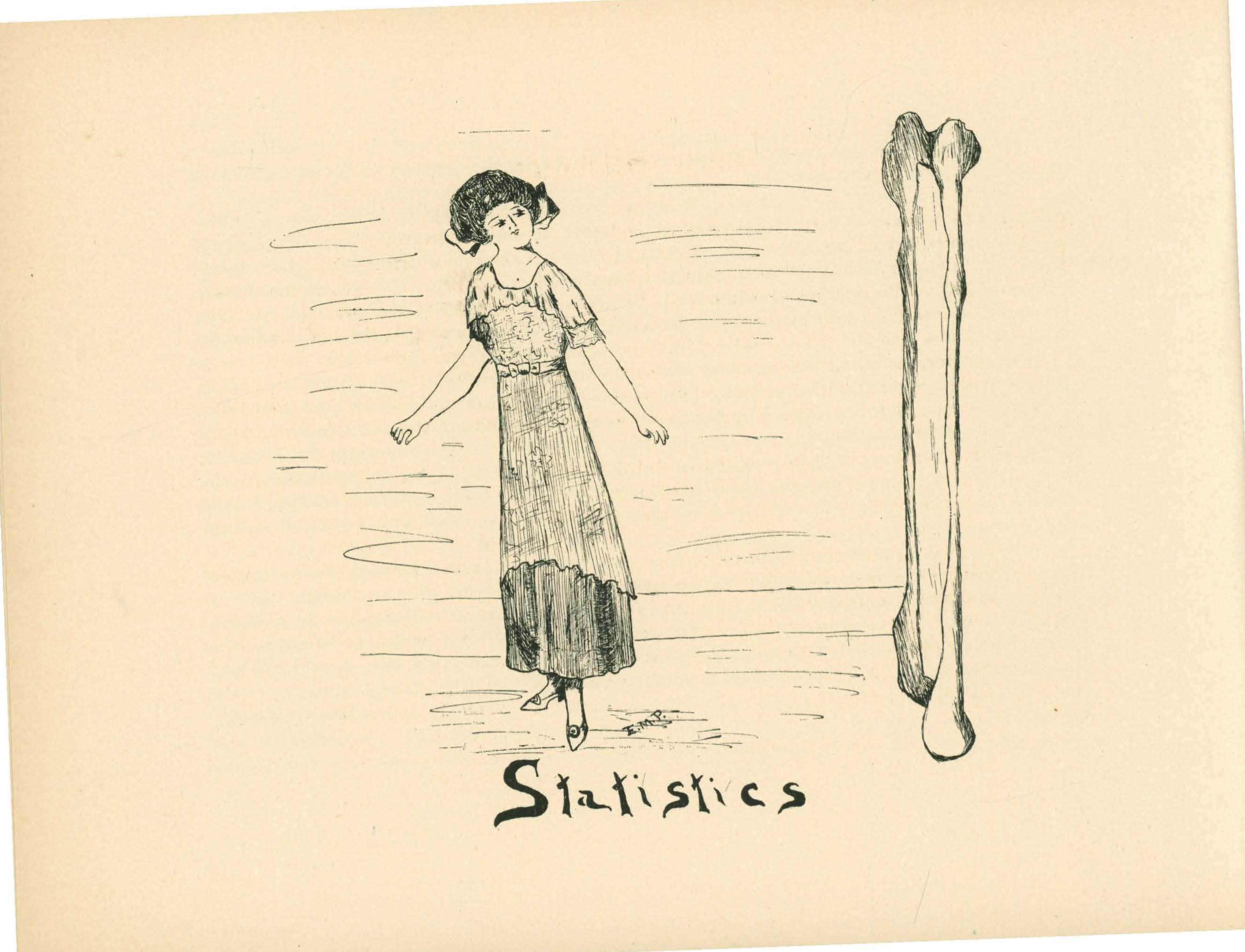
BOR four years we have been together, and now comes the time for us to scatter. It is also time to take account of stock, and here are some plain truths about our class.
Out of a class of thirty girls, whose average weight is 114 pounds and whose average height is 5 feet, Marian Mitchell is the prettiest. Edith Stewart and Joanna Ross are the neatest and the daintiest girls . Frances Wright, our president, is the most energetic, while the laziest girl is Ethel Staley. Lillian Conrad is the class chatterbox, but Grace Boughton, although the most sarcastic, is the most interesting talker .
The jolliest girl is Edith Dewees, while Marion Coyne, the wittiest, is the class imp.
Mary McIntire is the noisiest girl, while her direct opposite, Lurena Miner, only speaks when she is spoken to.
Mary McIntire is the most stylish member of our class, while of all the pretty clothes worn by the girls, Mary Vogdes's clothes are the prettiest .
Gladys Howe is the cutest girl in the class, but take warning-Gertrude Miller is very coy.
For the nerviest, Katherine Hunsicker received the most votes, while, strange to say, Mary McIntire and Grace Boughton are the most conceited.
The ideal girl would be one who had Ethel Porter's hair, Grace Boughton's eyes, Florence Stiles's complexion, Manette Staudt's dainty feet and grace, Edith Stewart's small hands, Joanna Ross's voice, and France Wright's sweet disposition.
Miss Douglass was voted the most popular teacher.
The four most popular girls in the class are Frances Wright, Gladys Howe, Manette Staudt, and Mary Vogdes.
The best looking and most popular boy is Murray Chism.
ELSIE LEA.
XN a recent class meeting it so happened that I was chosen to write the stati s tic s of the class. It seems that they had nobody else to do it and the few members of the class who were there, were my enemies. No wonder I got it!
The next job was to do a little arithmetic and find out the averages of the class. Knowing that it would be too much for me, I went to our brightest fellow, Chism. In a very few minutes, he said that our average weight was 141 pounds, with Perrott the heaviest at 170, and Rowley the lightest at 110. He furthermore said our average height was 5 feet 81/ 2 inches. On this, the extremes were Perrott, who is 5 feet 11 ½ inches, and Pancoast who is 5 feet 5 inches.
The next thing to decide was who had the biggest feet. Ther e were of course only two to consider, and these were Pickering and Perrott. We found when we came to count the votes that it was a tie. So we went to a certain teacher, who said Perrott undoubtedly had the largest.
The baby of the class, or the youngest member, is Eyster, who is 161/2 years, while Bottoms is the oldest, being 19 years of age. I found that our class average is 17 ½ years.
Perrott is considered our strongest fellow. If anybody doubts it, meet him outside and see for yourself.
After this I received the votes for the best looking fellow, and Congdon got it by a large majority.
Pickering is our most studious member, and also our biggest grind. Grim, Pickering and myself, tied for being the biggest grouch, and the queerest part of it is that none of us are jealous of each other for not getting it exclusively.
Our biggest fusser is Bottoms. Although he won, he has been hard pushed by Perrott all season.
Perrott thinks he is the biggest fusser, or at least that is what the class says.
The wittiest and nerviest was a cinch to decide. Neff has never had any real opposition since his connection with our class for tbe last five years.
The name of Perrott again comes in, he being voted our most conceited member, having over two-thirds of the votes cast.
Our favorite teacher was another hard thing to decide, but Professor Lawson got it, with Professor Chipman second, and Professor McCracken third . However, we do not wish to draw comparisons from this, but like them all.
The title of best sport was given to Congdon, because he brought a clean collar to wear when he found he was going to be in the presence of girls at a joint committee meeting, recently.
I was considered the best athlete, but what are you going to do when they put a lot of names in a hat and, as luck will have it, my name was the first drawn out?
The gentlemen of our class are Chism and Congdon.
Perrott is our biggest bluffer, and I wish to ay he surely does deserve the title. Grim, our laziest fellow, pushed Perrott hard in bluffing chemistry, but Perrott has never yet studied a chemistry lesson and Grim did once.
Pancoast is considered to have the best disposition: this couldn't help but go to him, for I haven't heard a cross word yet from him.
Our most popular girl is Marian Mitchell, with Grace Boughton our prettiest.
The honor men, as elected by the class, are Chism, bowl man; Eavenson, pipe man; and Pickering, cane man.
ALBEN T. EAVENSON, 2ND.
The work is done. At last our royal ship, With bow built firm to meet the billows dark, Rides anchored in the port before our trip, This crowning day of all, when we embark.
We linger while we take our last farewell, And pause to scan our course ere we depart. A slow l y stealing sadness seems to quell Our former joyous eagernes to start .
But ripp les break upon our ship's broad side; The tide of time no longer washes in ; The bonds that held us suddenly divide, And we are off to sea, to lose or win.
We say farewell to dear old F . C. S.; Our noble hip must now be under way; And as it sails through glory or distress May it ever bo ldl y fly the Blue and Gray.
The harbor of our Childhood fades behind; The Ship of Life is in our hands to keep, Its steady course across the sea to find, And lead triumphant o'er the rolling deep.
We know not what the future holds in store: How much of love or bitterness to drink; How many times the storms at sea will roar, And threaten our adventurous bark to sink.
We do not know that we shall reach the bay Where stands the wide majestic Hall of Fame, The sands revealing on her royal way The footsteps of the men she's proud to claim.
We only know that all looks bright ahead; That Heaven bears a smiling face above; That over all the happy world is spread Her me sage full of melody and love.
And in this flowery June we start the trip, Well manned to sail the wild, wide ocean free; What seemed before great shoals to wreck the ship Were only mists upon the angry sea.
The faint horizon shows no cloud of dread; The ~ves that splash upon the ship in sport, Although we cannot see them surge ahead, Must some time bring us safely into port.
And though the rolling years lead on through life, And though, with each, new prospects are revealed, Deep in our hearts, ' mid pleasure and 'mid strife, Perpetual love for 1912 is sealed.
LILLIAN CONRAD.
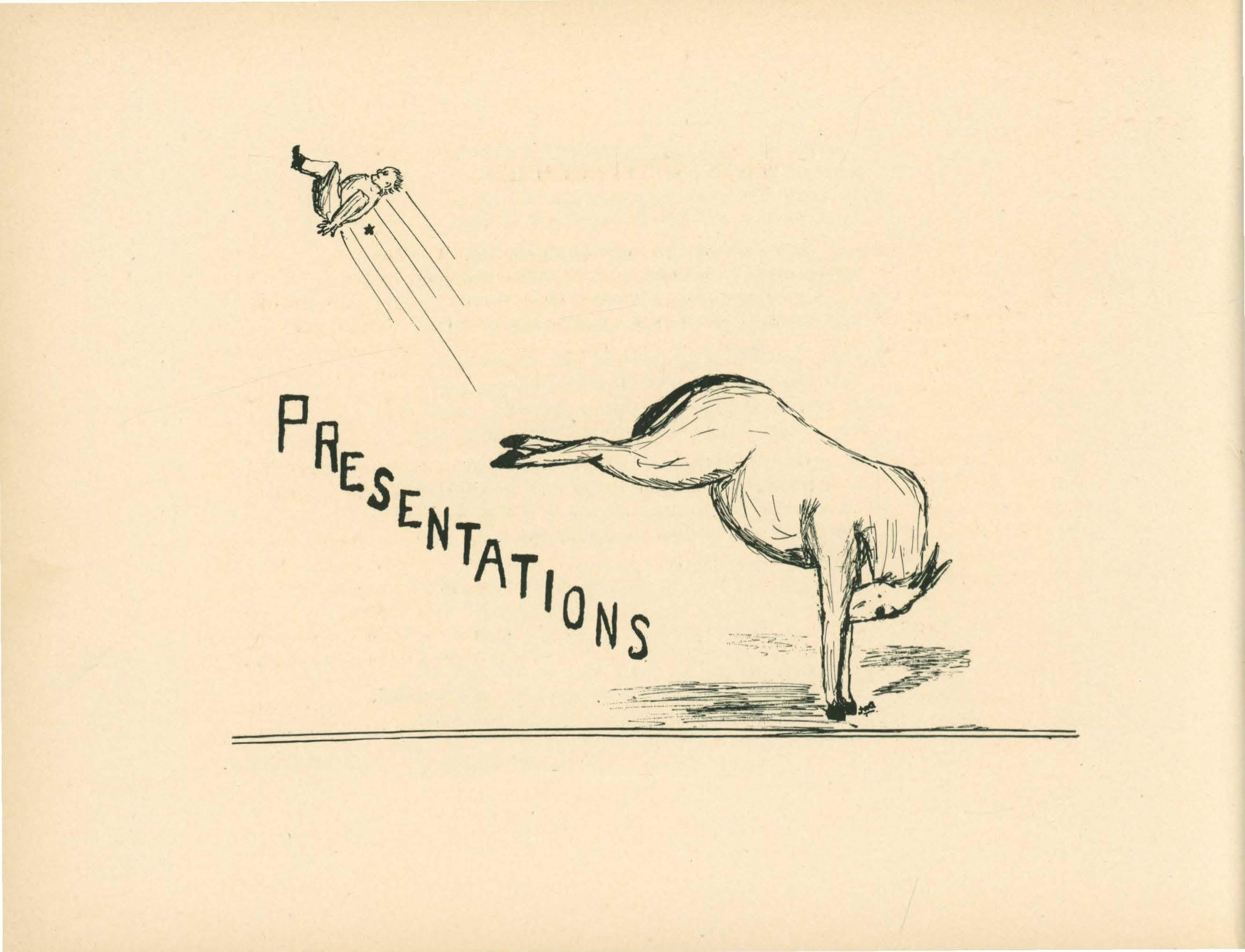
XT is my purpo se to give each one of my classmates a little something which will bring to view what eems to be one of her most marked characteristics. Of course, everything is given in the s pirit of fun and must be taken in the same spirit.
GRA CE BOUGHTON: If I should ask Grace to give a speech on woman's suffrage, she could do so, this very minute, without the least hesitation. In fact, she would do anything to help the cau e. Now, Grace, I think it would add weight and dignity to your general bearing if you would carry this large n ot i c e around with you and wave it in the air as you talk. Otherwise, people might never guess how strongly you advocate "Votes for Women."
HAZEL BROWN: Hazel is our swimmer. She has even been known to save lives in the course of her swimming career. But, as you all know, the best swimmers are often the most daring . Now, Hazel, having carefully considered the matter, I arrived at the conclusion that your life is quite worth pre erving . This li f e-p1· ese r ve r will probably be useful.
LILLIAN CONRAD: Without any unnecessary remarks, Lillian, which might also prove embarrassing, I am going to make you a present of this little hobby-hors e upon which you may ride your hobby to your heart's desire. But be careful not to go too fast, as you will find this pony quite lawless.
MARION COYNE : Marion makes breaks . To be sure, they are the most harmless breaks imaginable; nevertheless, they can be called nothing but breaks. So, Marion, I am going to provide you with a large amount of glue .
EDYTHE DEWEES: Since he goes to Cornell and his name is Cornell, it would really, be quite neglectful of me if I didn't give you a Cornell flag. It's a pretty flag, Edythe, and you can hang it in your room.
ALICE AND MAY FLEISHER: The Twins are our class jesters. I don't know what we should have done sometimes if we hadn't had them to giggle with, or laugh at. So, now, Twins, we have here two little funnel-shaped caps which are supposed to show our appreciatio of your cheery dispositions. No offense, girls!
HELEN HARRIS: Helen needs a little something to keep her awake. She will generally wake up in the morning like the rest of us, but there always seems to be danger of her falling asleep during the day. Now, Helen, this policeman's rattle, which really makes an alarming noise, might come in handy.
ELIZABETH HOLMES: Elizabeth, I am going to give you this Billiken Man at the sight of which you can't help smiling. We are anxious to see you smile, because we have noticed that you would generally like to be grim.
GLADYS HOWE: Have you ever noticed how Gladys flits about? She likes better than anything else just to live and be happy. She is content to be blown about by every breeze that comes in her direction. So, Gladys, I have here a pretty butterfly as a companion for you. I hope you'll be h.appy together.
MARGARET HOWSON: It will be an interesting experiment to see if we could make Margaret look very "flossy" just for once. I bought a large object used to make the hair tand up, some curling irons, and also some false curls and puffs. Margaret, some day we will dress your hair up in these things just for fun. Why, the people won't know you!
KATHARINE HUNSICKER: Have you heard Kitty's sneeze? Well you don't want to. She has given her classmates many shocks by the suddenness and violence of this same sneeze, which penetrates into the inmost recesses of your ears. Kitty, I present you with this muffier, which I hope you'll make use of, in the future, for the good of humanity in general.
FRANCES JONES: It has always been a source of worry to me that Frances has a dimple in one cheek and not in the other. She doesn't seem quite complete. Now is my chance to fix her up beautifully, and I am not going to let it slip by. Frances, here is some poison, and I sincerely hope it will see your finish.
FLORENCE KAISAR: Florence is forever losing her property! At Washington, she lost nearly everything that could be lost except herself. Florence, I am going to give you an anchor to prevent yourself from drifting away and getting lost. We should be dreadfully sorry to lose you.
LILLIAN KERNS: Lillian is sentimentally inclined. She likes romantic situations and such things. Lillian, we did our best to get you what you want. We have a dark knight (night) which will help some towards the making of a romance. You must do the rest for yourself.
ELSIE LEA: Elsie is a pillar of her church. Elsie, for fear that you will become tired of having such a responsibility, I am going to give you this pole which you could substitute for yourself at any time. But this is not all we have for you. Here is a comb to help you to take the part of any character in any play for the benefit of the church.
DAISY MCCADDEN: Daisy, as you can plainly see, is smaller than the average daisy. The only apparent reason for this is that she has not had enough sun and showers to make her grow. Every flower needs an abundance of both. I am going to supply you, Daisy, with a wate'ring can and a sun. Now, I should like to see you spring to large dimensions.
MARY McINTIRE: Those who know "Mac" also know one of her peculiar habits, the use of many strange and seemingly unnecessary gestures. It would seem that some of this excess energy should be used; so with that in mind, Mac, I bought these boxing gloves. Aim your blows in the right direction and I am sure they will be effective.
GERTRUDE MILLER: Poor Gert has the worst time seeing a joke! This is not on account of the lack of a sense of humor. About thirty-three minutes from the time she has heard a joke, she will laugh as heartily as anyone. But it must be uncomfortable not to be able to laugh at the proper time, Gertrude, so I have very thoughtfully procured this little lantern to help you along.
MARIAN MITCHELL: I have been worrying for some years, Mike, for fear the string upon which you keep your heart-sick victims should give out. Now that I have such an excellent
chance, I am going to supply you with yards and yards of it. I hope this will last you the whole of your single life.
LURENA MINER : It is quite evident that Lurena's place is in the home. She is so quiet and seems so unlike those suffragettes who throw bricks, that of course her place must be in the home. So, Lurena, we have purchased a few articles which will be useful in keeping your house as it should be. This broorn and these other things will do you more good than the ballot.
ETHEL PORTER: Ethel is subject to fits of excitement. Ethel, I am going to give you a fan, which can be used to keep you cool in the future . I have something else for you, Ethel. I want it to be known that Ethel scored in every hockey game that Friends' Central played this year. Here is a medal awarded for your bravery in saving the reputation of the school on the hockey field.
JOANNA Ross : Jo has the cutest little nose! But it is a little doubtful whether it can even be classified as a nose or not. Now, Jo I don't think it is exactly fair for you not to have your share of the smelling organ, so here is one that can be seen. Please wear it.
ETHEL STALEY: One day Ethel expressed a desire for an "F. C." Ethel, I want you to understand, is a fine girl in some ways, but she didn't help her class in athletics quite enough to win her F. C. However, nothing prevents me from giving you one now, Ethel, so here it is.
MANETTE STAUDT : There are lots of things I could have given you, Manette, and I had a hard time deciding which one it should be. It's not going to be a piano, a pair of green ballet slippers, a "Votes for Women" banner, or any of those thingR, which would have suited. But here is a garne of chess and I think that, by perseverance, you will be able to check-mate (Mait).
EDITH STUART: Edith has a fine singing voice. But as you know, Edith, there is always room for improvement. Now what do you suppose we have here for you? Why nothing else but a hoe and a rake that you can use in the cultivation of your voice. 66
FLORENCE STILES: Can any one guess why I'm going to give Florence this oil can? Of course, you won't be able to, so I shall have to tell you . The oil inside of it is to be used to prevent her switch from getting rusty .
MARY VOGDES: Poor Mary has a dreadful time in this world! She is continually breaking the hearts of the unfortunate admirers who flock around her, but just as often having her own heart badly fractured by someone outside of the flock. It is truly pathetic. Mary, here is an abundance of fresh untouched hearts. With these you can make every thing all right.
FRANCES WRIGHT : Frances has been the trusty captain of our ship, the ship of 1912, for three years. She has taken us through storms safe and sound into port at last. Here is a ship, an emblem of our class. This you may keep always, Frances, to remember our pleasant trips through school life.
ELIZABETH J . SHOEMAKER.
DRESENTATION allows one to "knock" his classmates on some particular trait or fault. All these "knocks" are given in a spirit of fun and good fellowship, and I trust that every "knock" will be a "boost . "
MURRAY S. CHISM: "Murray S," now don't blush, but step hither quickly. Thi s i s only school after all, not a sociab l e or a dance. To be sure the members of the fairer sex are here gathered all around you, and, knowing how your inmost feelings must quake, I present you with this bottle of n e1·ve ton i c. Drink it all, my boy, as prescrib e d on the label, and wh en y ou have drained the contents, have the prescription refilled and take daily until a complete remedy is effected.
GEORGE GRIM: "Emma," come forward and receive this token of our recognition of your worth and ability. Of course, you're the big noise around this place, even as you are in the N. G. P., which is graced by your dignified presence in camp. I therefore feel it my duty to help along a good cause by presenting you this g u n. Now, one, two, three-load, r eady, aim , fire!
LEWIS M. LINDAUER: "Louie," you're the fellow that always raised the most racket around here; in fact, you raised so much that when you were away the place was a s quiet a s a "meeting-house"; so I think you had better take thi s tennis racke t and make a s much noi s e as you want to, and nobody will tell you to "cut it."
RUGAN NEFF: Next comes the farmer of the clas s . Come on, Heck er, and we ' ll ee what we can do for you. Yes, you always were fond of cribs, even when you were a baby ,
68
I suppo e; so let me present you with this sample crib. May your slumbers be undisturbed. Remember Masonville ! !
HOMER HEACOCK: Come hither, little rose "Bud." Now wear your most becoming smile, affect your daintiest pose, and give the girls a treat, for behold you can be for a moment that which delights you most, the center of attraction. Look, Bud! there are girls all around; girls, girls, girls; and I know you are happy, simply thrilled with unspeakable joy at seeing all these pretty faces gazing at you with admiring eyes. What's that you say? Oh, you're sorry there are so many people here? You can't get a chance to talk to the girls, you say? Well, well, that's too bad. But I can readily imagine how you feel, so I'll just give you this little doll baby on the sly. Take her and "fuss" her all you want; nobody']] be the wiser.
FRANK HAMILTON: "Yank," I have noticed your fondness for inanimate objects which you can stroke and pet. Now I don't like to see you wasting your loving caresses on inanimate objects, so I present you with this kitten. Pet it as much as you like, but beware: never be cruel to it for this Kitten has claws and paws, and can jump further than a handkerchief tied into a knot.
ALBEN EAVENSON: Well, Al, how's your heart to-day? Still got that strange feeling have you, but can't diagnose the trouble? Well, although I'm not a physician, perhaps I can a . ist you.- It's simply this, my friend, that's all. (Suitcase.)
J. W. SIMMONS: Now, "J," it's your turn to trot up here while I open my Pandora box. Wpat' this I see before me? Is it an animal or a bird? Why, behold it is a turkey. Let there be thanksgiving, for now at last you can satisfy your irrepressible propensity for that graceful and rhythmic walk known as the "Turkey Trot."
MILES ROWLEY: "Miles," you above anyone else in my estimation deserve this medal. For to think! That you are the only boy who, in the entire history of our class, has escaped being excused from class on account of talking. Why, the rest of us fellows were constantly being "fired" out of class for our many misdemeanors and much talking; but Miles, well, he really doesn't have to say a word for his socks are so loud that they speak in his place.
TOWNSEND PANCOAST: Now here is "Pannie." "Pannie," · you are one of the fellows who bears out the old adage, "still water runs deep." While you have not made as much noise as some of us in this school, yet I feel the world will hear a racket from you later on. Take this rattle, and start something.
CLEM CONGDON: "Bill" you were the conductor of the great and well known Friends' Central Mandolin Club. The Club was composed, with several exceptions, of fellows who had talent for music, but this talent was never developed because of the scarcity of a piano. Many rehearsals were called off because no piano could be had for you to accompany these mus1e1ans on. For fear that, in some of the future clubs which you will without doubt organize, some talented player cannot be developed on account of not having a piano, thereby depriving the public of a great musician, I herewith present you with this piano. Also take this and never lose the key.
HENRY PICKERING: Now, Pick, old scout, in presenting you this mzo1·, I feel it my duty to explain that I am casting no reflection whatever on your home raising, but simply supplying you with one of the necessary evils of society.
RAYMOND PERROTT: Step forward, noble president, and make us a little speech. Now don't decline, for we all know how you can extemporize, and how the silver words of knowledge and wisdom drop from your lips like the ripples of the smoothly flowing brook. So that you may never loose this precious gift of smooth oratory, I present to you in the name of the class, this bottle of oil.
JAMES EYSTER: And last, but not least, is "Jimmie." "Jimmie" is our wireless operator down here, you know. He's always drumming a message on the desks and on every other available object, trying to transmit his thoughts in this strange manner, rather than by word of mouth. So here, Jimmie, is my contribution to you. Take this drum and "beat it."
My friends, I am sorry that I have had to "knock" you, but it was as you willed. To counter-balance these "knocks," it gives me great pleasure to present the pipe, bowl and the cane to the honor men.
MURRAY S. CHISM: First Honor Man. In the name of the class, I take the greatest pleasure in presenting this bo w l, as an emblem of the highest esteem in which one may be held by his fellow classmates.
ALBEN T. EAVENSON: Second Honor Man. It also affords me great pleasure to present you this p i p e as an emblem of the high regard which we hold for you.
HENRY PI CKERING: Third Honor Man. I am no less pleased to present you this cane a s a sign of the estimation and regard in which you are held by your fellow classmates.
MAITLAND BOITOMS.
XT was a glorious summer afternoon in June that I went to a tea given by Mary McIntire, an old classmate of mine. It had been twelve years since I had seen Mary, in fact since I had seen any of my old friends, and I was excited with the idea of seeing them again .
Mary was giving the tea at her summer home, and was receiving on the lawn. Here it was that I met her. We exchanged a few words, and then I was abandoned while my hostess continued her receiving.
It eemed as if I were absolutely alone among all these people. Wasn't there a soul whom I knew? I began to search for a familiar face. At last, among a group of well-dressed women, I saw one very beautiful face which none of us will ever forget. It was Marian Mitchell's. I drew nearer to the group and heard Marian gossiping. At first I was a little shocked, but I soon remembered that Marian had been our class gossip. She came to me when she saw me alone and burst upon me in a storm of questions. I led her to a summer house, where we were alone.
"Now, Marian, tell me what has happened to all the girls in 1912," I began, "you have kept up with them while I've been away. What is Grace Boughton doing now?"
"Oh, it was the funniest thing about Grace. She married."
"What!" I exclaimed, "Grace?"
"Yes, honestly, and her husband didn't approve of woman's suffrage, and she had to give up all her plans about reforming the world, but Elsie Lea is a suffragette. You know Grace converted her. She does a lot of good, but nobody ever knows it. She never let anybody else appreciate her, even when she was at school.
"Oh, there goes Edith Stewart and Elizabeth Holmes!" Marian suddenly cried. "They are both very prominent in society now. You will read their names in the papers 'most any time. Elizabeth spends a great deal of her time in Paris now. Edith has quite a fine voice. She sings a good deal at private performances."
"What happened to Katherine Hunsicker?" I asked.
"Don't you know? She is the most celebrated of all our class. She studied law after she left school, and was admitted to the bar. You remember how she used to like to argue with Professor Lawson."
"Yes, I remember," I laughed, "Go on, please, tell me about the rest."
"Hazel Brown," Marian replied, "is captain of the 'Women's Life Saving Crew' at Atlantic City. She is a wonderful swimmer. Lillian Conrad visits her very often. Lillian still writes poetry. Sometimes she writes satires for the Fl eish er T i uin s' W ee kly. They edit a magazine something like Lif e, only it is much better. They both had the largest senses of humor in the class.
"Marion Coyne is a scientific farmer. She has a very handsome country hou e, where she entertains extensively. Her chief source of pleasure is in giving private theatricals in which she takes the men's parts. Edythe Dewees always comes to these entertainments and laughs heartily at Marion. In fact Edythe hasn't stopped laughing since she graduated.
"Frances Jones is a great mathematician now. She is head of the mathematical department at Smith. People come from all over the world to consult with her.
"Ethel Staley is now teaching school in Ecuador. The climate here was entirely too frigid for her. She was always sitting in a draught, and there was never enough heat in the radiator for her.
"Daisy McCadden has a large dressmaking and millinery establishment, and is very prosperous."
"Really," I interrupted, "I never thought that Daisy would go into business."
74
"Helen Harris," Marian continued, not noticing my interruption, "is not at all like we thought she would be. She has an automobile which she runs herself, and she is continually being arrested for speeding.
"Margaret Howson is a church worker. She is president of the 'Women's Auxiliary' and about a hundred other clubs connected with her church. Florence Stiles often helps her, but she spends most of her time at the children's missi'on.
"Lilian Kerns is living with Grace, and teaching her how to keep house.
"Florence Kaisar is still a loving daughter. She talks about her dad more than ever. It certainly is fine to hear anyone talk about her father the way she does."
"There's Gertrude Miller!" I suddenly exclaimed, interrupting again.
"Yes, she came with me this afternoon," Marian went on. "College surely did change Gert. There for a while, you know, she had a strong liking for Philadelphia, but after she went to college for a year, she went back to Jer ey City again.
"Let's see," Marian said, "Who is next? Lurena Miner, I guess. You remember how ympathetic she used to be?"
"Oh, yes, indeed, perfectly," I answered.
"Well, she is a trained nurse now, and she is so gentle that we all have her whenever we get sick.
"Jo Ross graduated from Bryn Mawr with all sorts of honors, but she didn't care a bit about them. She is planning a new system of education for children now.
"Bee Shoemaker was a trapeze performer for several years with Barnum and Bailey, after she left, college, but she gave that up as she couldn't have Ethel Porter travelling around with her. Ethel plays the organ in one of the large cathedrals somewhere in Europe. I forget just where it is. Bee is living with her and attends every service so that she may hear Ethel play.
"Gladys Howe makes a great hit as a chorus girl, because she has such blue eyes and such large dimples. She has been the leader of the chorus in numerous musical comedies.
"Manette Staudt is a wonderful ballet dancer. She beats the Russian dancers all hollow. She is going to dance in her own city some night next winter . We must go to see her.
"Frances Wright is still president of everything she undertakes. That girl was a born leader. She is at the head of all kinds of charitable institutions and schools. One of the greatest things that she has done is her 'Home for Aged Baseball Players.' Anybody who has ever played baseball, and is willing to talk about it all the time to Frances is eligible for the home.''
Marian stopped talking and looked over the lawn at Mary, who was still receiving.
"Mary is quite a society woman, isn't she?" I said.
"Yes, she is a very well-known club woman."
"What have you been doing, Marian?" I asked.
"You see, I have been going so much that I haven't been able to do anything yet," she explained. "I simply must go now," she added suddenly, "Gertrude is waiting for me."
So she left me, and I sat thinking of the strange things that had happened to the members of the illustrious Class of 1912.
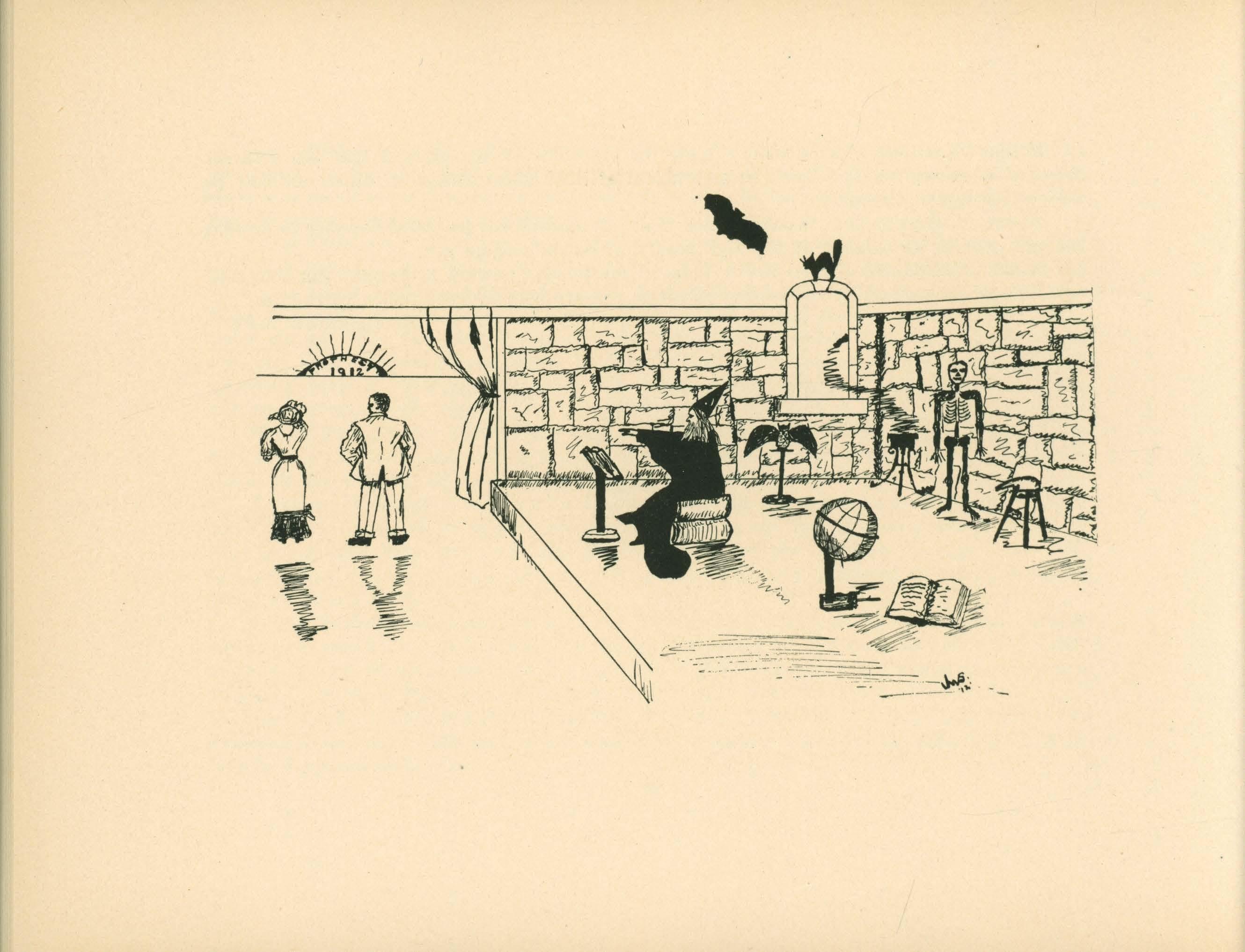
BMONG the many duties of every graduating class is that of electing one of its number to look into the future and tell his classmates what the fates have in store for them. Among the mistakes which every graduating class is likely to make is that of electing the wrong person to do the prophesying. This mistake our class made when it elected me to be the Prophet. Why I was elected to fill such an office I cannot guess, for I was never interested in the occult sciences and possess an imagination which could go no farther than to imagine a blissful state of existence where no lessons had to be studied for the next day. However, the office was mine and I determined to discharge its duties to the best of my ability.
At one time I had been very intimate with a man who had become interested in spiritualism and psychomancy, and who was now a successful medium. Although I did not believe in his doctrines, I decided to consult him and try to find some way out of my difficulty. Accordingly, I hunted my friend up, and stated my troubles to him in a few words. He immediately offered to go into a trance for me, and to find out all I wanted to know; but I at once objected, and told him that, since it was my misfortune, I should be the one to go into the trance. After much hesitation and a long consultation with the "spirits," my friend con ented to my wish.
The first thing my friend did in preparing me for my trance was to place me in a large, easy chair in a small, dark room hung with heavy curtains and other decorations which gave it a gloomy, mystical aspect. When I was comfortably seated and properly instructed, the medium lighted a very clear, bright light at the far end of the room and told me to keep gazing into it, and to think of nothing but that light. I did exactly as I was told, but for a long time nothing happened; then, all at once, thing went blank and I was conscious of .nothing.
After a while, the "blank" ended, and I was once more aware of what was happening. I found myself in a well-furnished modern business office, and, since I was in the spirit form, I could observe things without being seen. At the desk in the office sat my former classmate, Maitland Bottoms, but now he was busier than any man I had ever seen before. On his desk, a little to the right, there was a typewriter which he kept going at top speed with his right hand. To his left, there was another typewriter, which his left hand operated with no less celerity; before him was a telephone over which he was talking to someone. The receiver of the 'phone was fastened to his left ear, and, with his other, he listened to his secretary read the morning mail. Each eye was glued on a typewriter. From looking over the great pile of mail on his desk, I learned that "Mait" was the biggest builder in the country, and that he had just finished a contract for remodeling and rebuilding New York City. The reason for his present great activity was the fact that he was about to start on a contract for building a bridge across the Atlantic Ocean.
My "spirit" had given my mind enough information from the business office, and forthwith went on another quest . The next scene upon which my "spirit" arrived was indeed a strange one: A man was driving a turtle fitted up exactly like an automobile along a uburban road. Crowds of people lined both sides of the road and curiou ly watched the driver of this strange "machine." I had already recognized the chauffeur as Rugan Neff, but, desiring more information, my "spirit" assumed a material form, as the ancient gods used to do, and addressed one of the crowd with these words:
"Why is that man driving a turtle instead of an automobile?"
"Oh," said the man, "that's Neff. He has discovered that he can get around quicker on his trained tirtle than in his 'Ford' car. He has just made a run from Philadelphia to Mt. Airy in .ten hours and three minutes, which beats all his former records."
"Well," I mused, "I never thought 'Nergs' would go back on his Ford. I wonder why he didn't train a snail instead of a turtle?"
My spirit next went to an immense lecture room which was filled with people, all of
whom belonged to the American Scientific Society. A man, whom I immediately knew as Miles Rowley, had just finished a lecture which must have pleased his hearers greatly, for they were applauding him to the echo. From posters advertising the lecture I learned that Miles was now "Professor Miles King Rowley, the eminent physicist, scientist, and astronomer, who has discovered fourteen new elements, and proved conclusively that Mars is inhabited by a race of three-legged bipeds. Professor Rowley is the greatest reasoner the world has ever known."
I was much pleased when I learned of Miles's great success, and could not help ejaculating, "Well, Miles deserves a whole lot of credit for all those things. But then I am not surprised, he always had an extremely scientific mind, and often perplexed the 'profs' with hi unan werable arguments founded on hard, scientific facts."
After having seen Rowley's triumphs, my spirit scaled a high wall and beheld Perrott sitting on the ground moving his right arm rhythmically. My spirit was grieved at the lack of tyle shown by "Ray," for he wore a suit the stripes of which ran around the body instead of up and down as was the fashion. More than this, my spirit was puzzled by his occupation, but, on discerning three letters of the name on the wall, all perplexities were ended. The letters were P-E-N, and the spirit's conclusion was that this was a penmanship school and that Perrott was taking writing lessons here. My other self was about to depart with this information, when it recognized the familiar form of Grim, and, taking material shape once more, advanced and spoke to him.
"Hello, Grimmy," I said, "what are you doing here?"
"Oh," said "Emma," "I am a guard in this place. I was going to enter the army, you know, but I was riding my pony last June when it threw me. I fell flat, and couldn't do anything for a long time. I am just recovering and am doing this work until I get all right again."
"I hope that will be soon," I replied. "What kind of a place is this anyway? I thought it was a penmanship school."
"No, you're wrong there, Murray," "Grimmy" answered. • "It's a jail."
"A jail!" I cried in horror . "What's Perrott doing here then? He was always honest. I never even knew him to steal a base in a baseball game."
"Why, didn't you know about that?" said Grim with his strange smile. "He was sent up for cruelty to animals. He gets out soon though ."
"It's a good thing," said I. "I think it's a crime to put him in here. Well, bye, bye, George. i hope you'll be all right soon," I said, and vanished with his "So-long, Murray," ringing in my ears.
The next of my classmates whom my spirit saw was James Eyster. James was found attending a business meeting of the Executive Committee of the International Wireless Company. The object of the meeting was to consider an invention in Wireless Telegraphy which Eyster had made. By means of this invention, it was possible to send freight from one place to another by wireless. When my spirit arrived, the meeting had just adjourned, after unanimously accepting Eyster's invention and giving him $5,000,000 for the privilege of using it. James was now the most famous man on five continents, and I knew that his success was well deserved, because he had always been deeply interested in scientific inventions, and especially in wireless.
My spirit was now tired of so many city scenes, and went into the country to visit Pickering, the farmer-author, about whom everybody was talking at that time. Pickering was found content and happy with his scientifically operated farm, his books, and, above all, his Ideal. After wondering at all the marvelous appliances on this most scientific of all scientific farms, my spirit returned with report that all was well with "Pick," and that he was the best farmer in his section of the country. I was greatly pleased with this encouraging report, and sent my spirit off on another search.
On this quest my faithful spirit arrived at a large music hall, where a concert was being given by the orchestra led by Clem Congdon, the famous pianist, composer, and conductor of orchestras. Since my spirit could slip past the ticket collector without being seen, I entered 80
the hall and listened to a delightful program. "Bill" was the same energetic leader as he was when he led the Mandolin Club, only he had gained in experience and now had an "intelligent" group of musicians to lead; hence his wonderful success and world-wide fame.
After listening to the liquid strains of Clem's Orchestra, my spirit was loath to return to worldly things again, but it was finally persuaded to do so, and renewed its labors by finding my old classmate, Alben Eavenson, and by discovering what enterprise was taking up the greater part of his energies. It must be understood that at this time the sun had been noticed by scientists to be decreasing in brightness. My spirit found "Al" in the midst of the greatest enterprise ever undertaken by any man. He was fitting out an expedition to go to the sun and remove the black spots on it by using his matchless soap. "Al" had already been very successful as a soapmaker, and was merely taking up this enterprise as a side issue. This expedition to the sun was being discussed the world over and Eavenson was everywhere being proclaimed the greatest benefactor of the human race that the world had ever known. I was highly delighted over the philanthropic spirit of my old friend Eavenson, and wanted to speak to him, through the medium of my spirit, but he was too busy to give me any time.
After my spirit had watched preparations for the "Sun Expedition," as it was called, it left Camden, the scene of activities, and went back to civilization (meaning Philadelphia). There, on one of the principal business streets, I found a large store bearing the familiar name of "Pancoast." After again assuming material form, my spirit entered the store and inquired for the president of the firm. I (that is, my other self in material form) was shown into the office, and greeted my old classmate "Townie." Townsend had been very successful in business, and was now among the first business men of the city. I asked him to what he attributed his success, and he unhesitatingly replied, "To Heacock. He is the best salesman I have. A customer may come in here for only a box of tacks, but, if Homer talks to him for three minutes, he becomes convinced that he needs at least half of our stoc~ and orders accordingly."
"Homer here!" I exclaimed, "I must see him!" and, after bidding good-bye to Pancoast I left him, and went to find Heacock. I soon found him and we had no sooner exchanged greetings, than he wanted to sell me a bottle of mucilage, an automobile horn, three yards of pink ribbon, and a frying pan. I began to relent under the influence of his speech, but caught myself in time and said, "Nay, nay, Homer, I'm in a hurry," and rushed out of the store after saying a hasty farewell.
The next of my classmates which my spirit obligingly visited for my benefit was J. Simmons . J . was now a prosperous real estate broker with a fortune numbered with s even figures. My spirit found him seated in his large, comfortable, well-furnished business office in South Philadelphia with "nothing to do till to-morrow," and accordingly assumed human form and asked him how he had attained his success.
"Well, you see," said J., "with the business experience which I gained while 'you children' were at school, I soon forged to the front in the business world and earned a steady income. I made most of my money, however, when I purchased some unimproved land down in the 'Neck,' graded it, divided it into building lots, and put it up for sale. Well, there is my car waiting to take me home; won't you come along with me?"
"No, thank you, J.," I replied, "I am afraid I must go," and I left him about to enter his 1932 Model Lozier car .
From South Philadelphia, my "other self" went uptown to the offices of the AmericoEuropean Railroad Company, for which Bottoms was building the bridge aero s the Atlantic Ocean. In the president's chair was found my old classmate, Lindauer, who was now the most powerful railroad magnate on the continent. "Louie" was famous the world over for his knowledge of the railroad business, but everyone wondered how he was able to conduct his great operations and still keep within the strict corporation laws then in force. While my spirit lingered invisible in the office, the door opened and in walked Hamilton, another former classmate . Lindauer and Hamilton seemed to be on very intimate business terms, for they immediately entered into an earnest consultation. From the conversation
which my spirit overheard, and from what it later found out, it learned that Hamilton was the lawyer for the Americo-European Railroad Company, and advised the company what course to pursue. Hamilton was the best consulting lawyer in the States, and all the other railroad companies envied the Americo-European which had his marvelously keen intellect and shrewd insight into judicial affairs at its disposal.
When my spirit had learned the futures of all my classmates, it came back to me from its wanderings, and, for a short while, I again was conscious of nothing whatever. Then there was a loud bang! and I sat bolt upright in my chair, and opened my eyes to find that my feet had slipped off the table on which I had previously placed them, and that the noise of their fall had roused me from my trance. As soon as my friend, the medium, perceived that I had returned from the land of spirits, he asked me if I had learned all that I wished to know. I was enthusiastic over the success of my first trance, and turned joyfully to my friend and replied, "Well, I certainly did learn all I wanted to know, and more, too, if that were possible. I want to thank you a whole lot, old man, for helping me out of that beastly hole I was in. Just let me know if I can do anything for you at any time, and I will be only too glad to return the favor. I wish I could ask you to take dinner with me, but I must write this prophecy up for the CLASS RE CORD, and it is due to-morrow morning. Once again, let me thank you a thousand times for helping me out."
With these words, I left my kind friend, and hurried home to write down the fates of my classmates before I should forget what my spirit had found out about the future.
MURRAY S. CHISM.
0-DA Y and to-morrow we stand before our friends for the last time as the Class of Nineteen Hundred and Twelve of Friends' Central School. Some of us have been members of the class for long years; others for only a few short months, and yet all of us have a feeling of depression at the tho ught of disbanding to -morrow forever. Many of the friendsh i ps we have formed here will be eterna l , and each member of our class cannot but feel friendly toward every other, yet never again, perhaps, shall we all come together with the same feelings of good fellowship which are ours now. Never again shall we be so closely bound together as we are on this, our last day as students of Friends' Central.
To -day you have heard the stories of our lives; you have been told about our peculiarities, and have listened to the recounting of our victories and defeats. And yet you have not heard one-ha lf, nor one-tenth, of the things which have occurred to bind us so closely together. The thousand little happenings of the classroom, of the gymnasium, all leave their impressions; the trifling ups and downs of school life, the rejoicing over victory, the sorrow over defeat, have made us all the most intimate of companions. With this in mind, you can well see how hard it is for us to say farewell to our classmates, to the teachers who have guided us, and to the friendly old rooms that have been the scenes of our school lives
From the teachers, whose lives we have made so unbearable at times, we must part with a deep note of thanks in our voices for the guidance and friendsh i p they have given us. Now, if never before, we realize and are duly grateful for their splendid influence over our lives.
To you, classmates, as individuals, it is the hardest to say farewell. Four long years we have marched forward, step by step, to this, our goal. Now in our triumph, with sad• . dened hearts, we must part. But never shall we forget the years spent at Friends' Central; never shall we forget their joys and sorrows, and never, let u s pray, shall we fail to support the old school with as true and loyal hearts as heretofore .
To you, friends and comrades, I say farewell, with the hope that our friendship may be eternal.
To you, schoolmates, friends and teachers, we, the Class of Nineteen Twelve, say farewell, with this expression of our loyalty to the ol d school and our class.
RAYMOND F. PERROTT.
Words by ETHEL M. PORTER , 19 12. Mu sic by MART IN US Va n GELDER. Allegr-o.
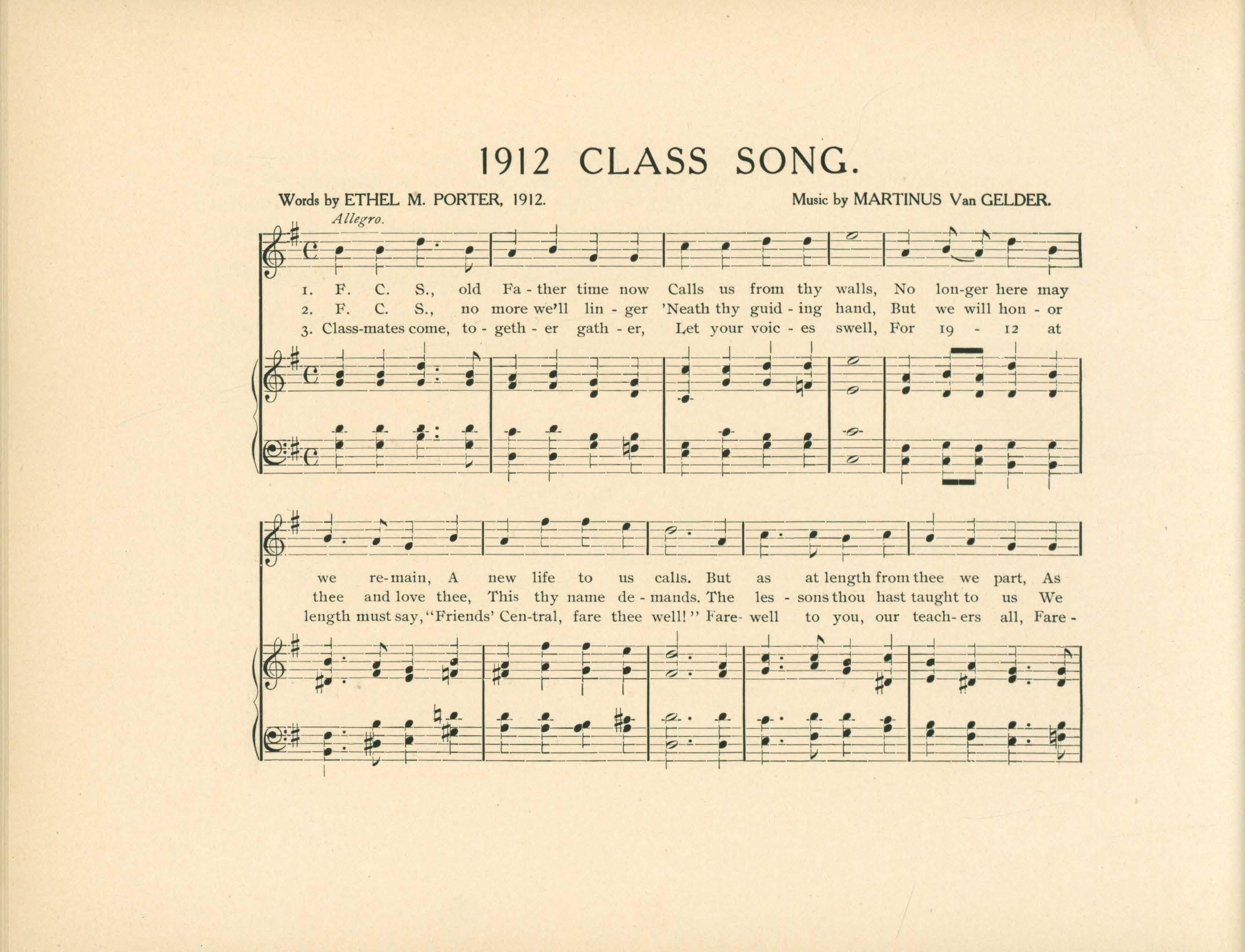
I. F C. S., old Fa - ther time now Calls us from thy walls, No lon-ger here may 2 F. C. S., no more we ' ll Jin - ger 'Neath thy guid - ing hand, But we will hon - or 3. Class-mates come, to - geth - er gath - er, Let your voic - es swell, For 19 12 at
we re-ma i n, A new life to us calls . But as at length from the e we part, As thee and love thee, This thy name de - mands. The Jes - sons thou hast taught to us We length must say, "Friends' Cen-tral, fare thee well!" }<are · well to you, our teach- ers all, Fare
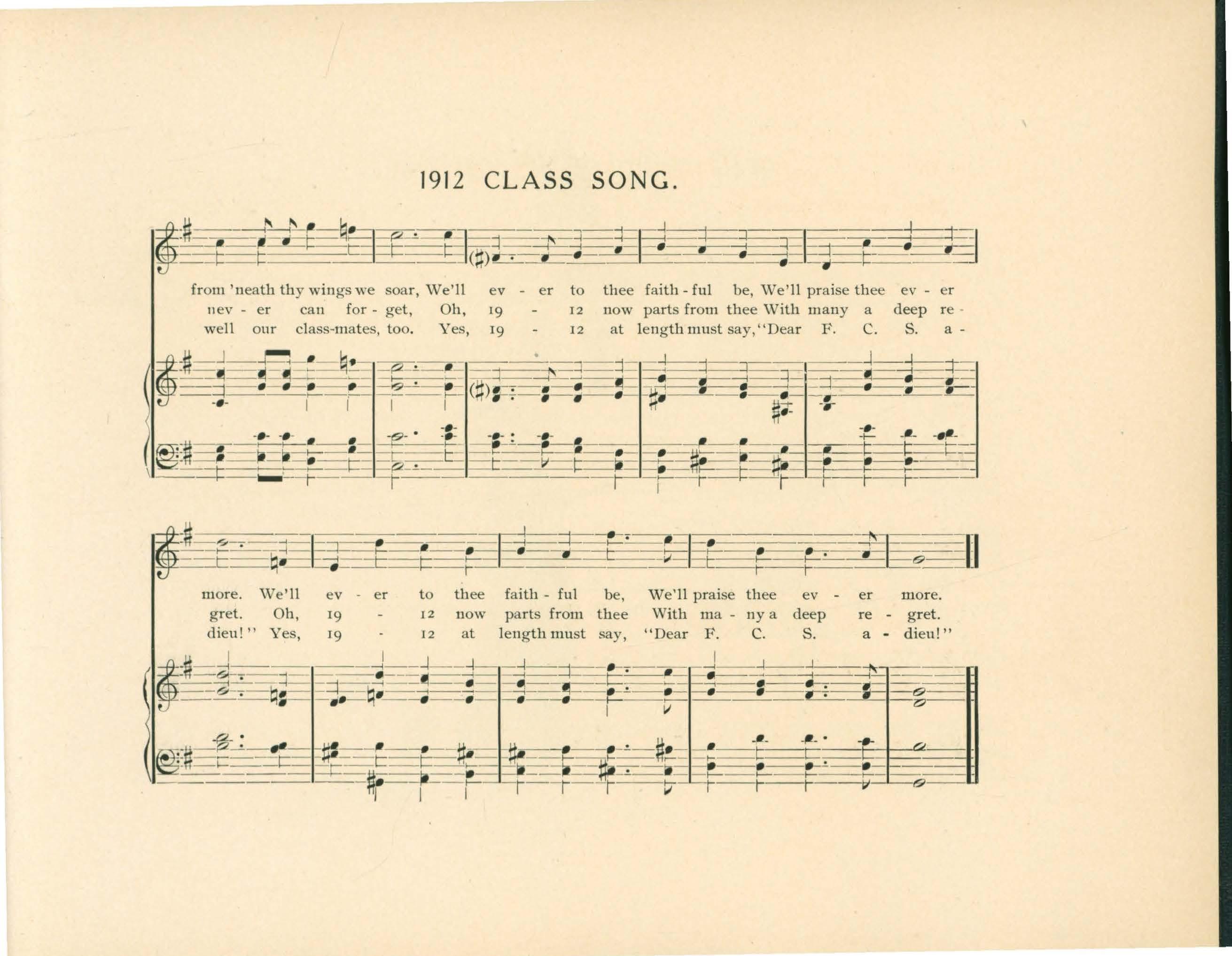
from 'neath thy wings we soar, \\Te'll uev - er can for - get, Oh, well our class-mates, too. Yes, ev - er to 19 12 19 12 thee faitli - ful be, We'll praise the e now parts from thee With many a at length must say, " Dear F. C.
more \\Te'II ev er to thee faith - ful be, ·we'll praise thee ev - er gret. Oh, 19 12 now pa r ts from thee With ma - ny a deep redieu! " Yes, 19 12 at length must say, "Dear F. C. S. a . ev - er deep reS . a -
more. gret. dieu!"
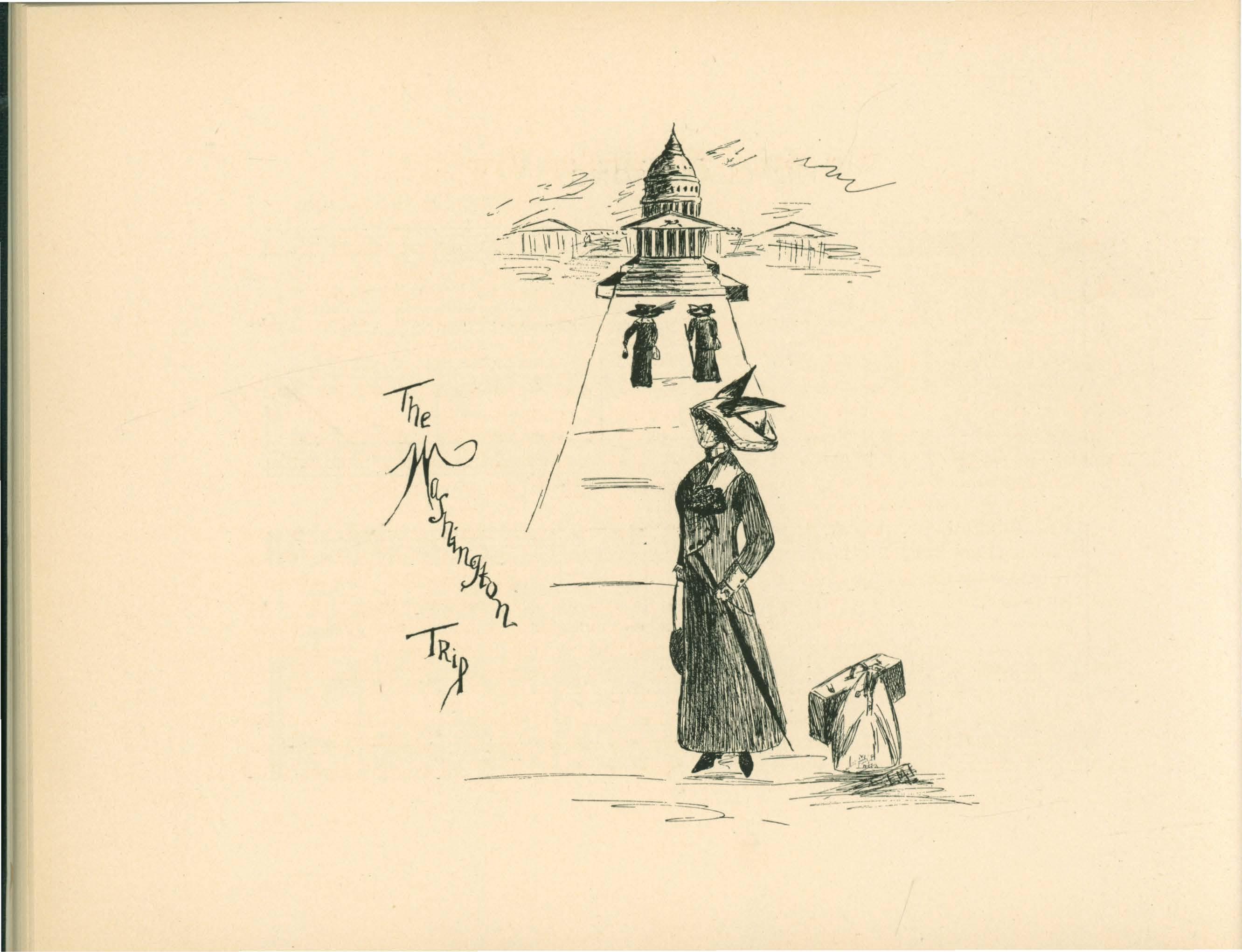
HE seventeenth of April dawned, not bright and sunny, as we had hoped, but dark and dreary. This was the day of days toward which we had been looking forward for five whole years: the day when we, the class of 1912, should traverse in a body the one hundred miles that lay between Philadelphia and our nation's capitol. That day such a murmur of excitement spread over the class that even the condition of the weather could not dampen our spirits.
Promptly at 3.30, our special car pulled out of Broad Street Station amid the waving handkerchiefs and flying words of friends and classmates who were left behind. Our party wa comprised of twenty-two girls; our two chaperons, Miss Price and Miss Douglas; our guide, Mr. Lawser; and "Tubby," last, but not least by any means. "Tubby" was our mascot, you know, and he had such a delightful squeak, when he was pressed for conversation, and such an intelligent expression at all times!
Very promptly at 6.45, we pulled into Union Station. From there, we immediately took a car to the Hotel Gordon, which, true to its advertisement, "occupies an unparalleled location directly opposite the White House." What we did next is easily imagined. We ate. I'll pass rather lightly over the meals, for I think we had all tasted better. But if you could have had a peep at the numerous big boxes and hampers that we had stored in our rooms, you would not have thought that we need fear starvation. The lower classes were certainly more than good to us, and the A boys were surprisingly generous, too. We appreciated their special delivery letter more than they will ever realize.
Wednesday night, we went to the Congressional Library, where we remained until the lights were put out and the doors locked. Even then two of the girls remained for just one more look, thereby causing the others to fear that they would have to get out a searching
party for the missing ones . On the way home (for the Gordon House had already become such to us), we strove to play a tune with the street-car bells by all ringing them simultaneously, but we soon arrested our efforts when Miss Price told us that we were not in the least original,-that every class did that when they went to Washington.
After we came back to the hotel, we had a feast accompanied by ghost stories of the weirdest variety . For further information ask Mary Vogdes. Edgar Allan Poe isn't in it with her .
Being a little fatigued, we retired at a very early hour; viz ., twelve o'clock; and knew nothing until the buzzing of the telephone bell warned us that it was time to ri e. At nine o'clock, being duly counted by Miss Price to see that none was missing, we boarded a car for the Capitol. Such an interesting morning was never before spent, I verily believe. We had a nice, fat, jolly, little guide who could beat a Chicago flyer when it came to talking, and who knew more dates than the History Book.
Since Thursday was showery, we decided not to go to Mt . Vernon until Friday . Instead, we visited the Senate, the House, and the Supreme Court. Many of us, especially those who expect some day to - be voters, became so interested in the debate concerning the parcels post that we stayed unti l we could no longer stand the eternal "yeas" and "nays ." On our way l?,ome, we unanimously decided that our class meetings weren't so bad after all in comparison to the House of Representatives. The others, who tired of the business of the country more quickly, took a sight-seeing automobile and rode about the residential section of Washington.
Thursday night we had a dance in the hotel. No Turkey -trotting or Bunny-hugging allowed, of course!! Horrors! Who could think of such things!
Most of us went to s leep at a very respectable hour that night, knowing, as we did, that we had a very big day ahead of us. In the morning, we went to the Bureau of Engraving and Printing, where we saw dollar bills turned out in sheets. Now, wasn't it cruel to take us to such a place? Then we went t~ the New National Museum, where we beheld wonder-
ful birds and animals of every description, along with other things of interest. From there, we went to call upon the inhabitants of the seas. We visited the Fisheries. We never realized that fish were so human before. Why, you should have seen one of them flirt with Marion Coyne, and she didn't encourage it at all, either!
Then, after a hasty luncheon, we started for the boat for Mt. Vernon. Never was there such a day-so bright, so smiling, and so windy ! This last we discovered as soon as we had mounted to the topmost deck of the ship and were fairly started. Mt. Vernon gleamed forth in all its simple grandeur that day, set peacefully amid the most beautiful scenery of Virginia. Lilacs and violets were all in bloom, leaves were on all the trees, and the birds sang their sweetest songs to welcome us. When we had been through the house and gardens and were waiting for the return whistle to sound, May Fleisher suddenly exclaimed, "Oh look! isn't that dear?" Of course, everyone looked, and, sure enough, it was deer; a lot of the pretty creatures were lying there on the grass. That was a signal for cameras to get busy and now nearly everyone has a "deer" picture of Mt. Vernon. Most of us took the return trip more quietly, for we were looking forward to the theater for that evening's entertainment. We went to see Frank McIntire in "Snobs," which was being played at the New National Theater. Of course, Frank made us think of Mary, as he was just about her size. Please don't be offended, Mary, because he had many other admirable points of resemblance besides his "avoir du pois." The play was very good and brought a hearty laugh from all. We especially admired the "coyness" of one of the maidens, and looked to Gertrude, our coy one, for corroboration.
When we arrived at the Gordon House once more, we decided that it was entirely too early to seek our downy couches, so we had a really-truly party in our rooms, when everyone entertained by doing that in which she excelled. And we are a talented class, you know. It was finally on·e o'clock when we ended our performances and bade good-night to our guests, but it was very far into the wee hours of the morning that we lay and discussed matters, as "Bee" says.
On Saturday morning, we rose a trifle later than usual, with the distinct feeling somewhere that it was our last day in Washington and that we were very, very sad on account of this. But we saved our tears until later, and, after a scant and hasty breakfast, hurried off to the Washington Monument. No one attempted to walk up, but half a dozen very brave girls did walk down, and felt extremely proud of themselves for accomplishing this feat. From there, we went to the White House, but we were all very much disappointed because President Taft could spare us no time. Since then we are all "Rooseveltonians." The rest of the morning was spent at the Corcoran Art Gallery and the Bureau of American Republics, after which we beat a hasty retreat to the land of suit-cases-yet-to-be-packed. With what neatness this was done, I should not like to say, but "tempus fugit," and 3.30 found us once more in Union Station, this time with our faces turned toward home. During the first part of the journey, we appeared to be a pretty sad and sleepy bunch, but, as the train drew nearer Philadelphia, our spirits rose again, and we parted with joyful words and yells for Washington, Class A, Friends' Central, and the chaperons.
MANETTE STAUDT.
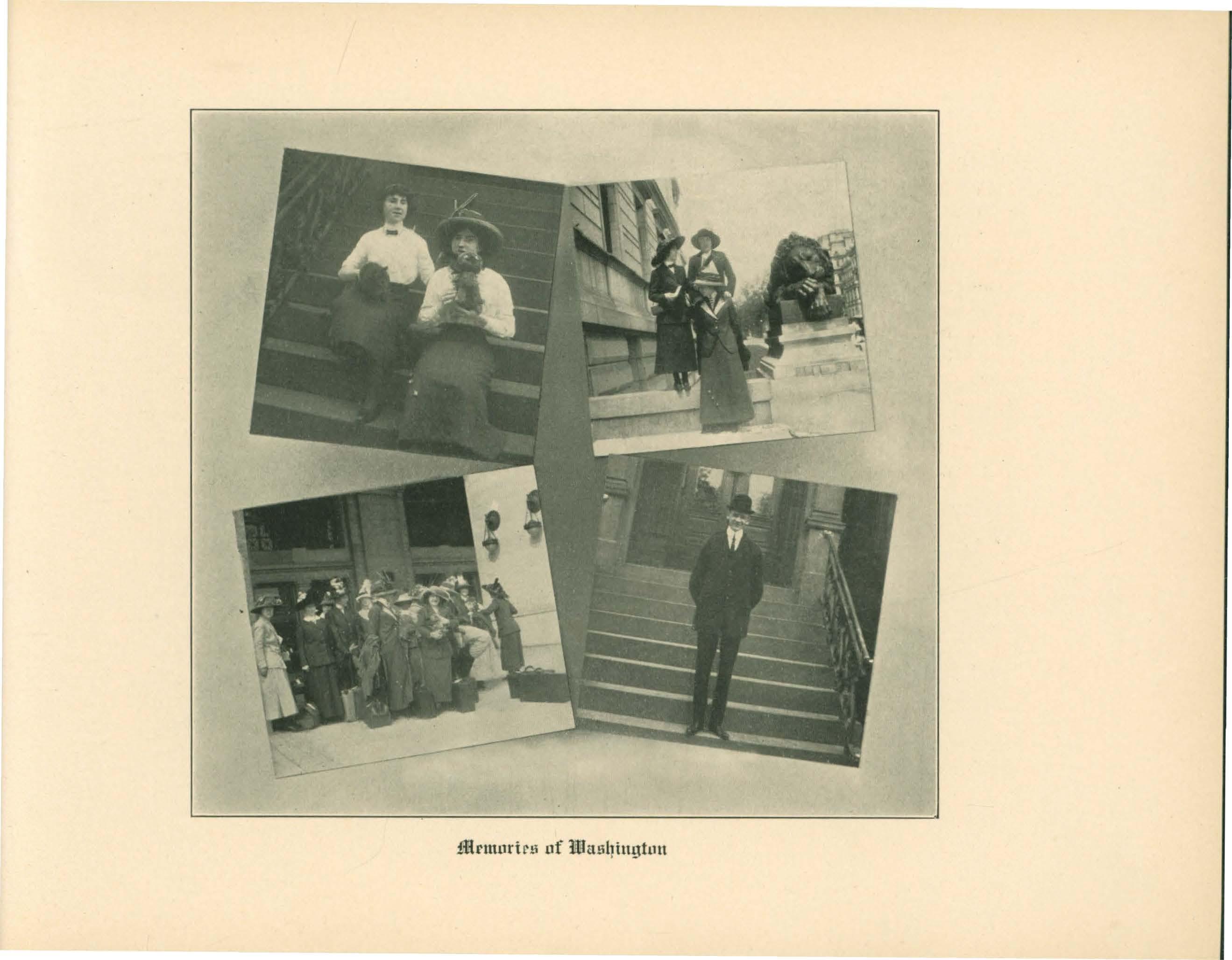
fltemorirl'l of l'Oasl1iugtun
BLTHOUGH we are a very studious class, we have found various opportunities for social engagements. We began our social careers, with Mrs. Dutton's ass i stance, when we were litt le E's. Banded under the name of the Natural History Field Club, with our pins, the pride of our hearts, we used to give r eal entertainments every month. And once, just once, we had a joint entertainment .
All during our D year, the desire for a class pin kept growing, b u t of course it would be absurd for such youngsters to have these adornments . Finally, in Class C, we could wait no longer, and a committee for the purpose was chosen . Great discussions followed, and indeed we had no less than three joint-clas meetings in the lecture room . It was intimated that we were all sorry when at last a pin was decided upon .
With B came the novelty of sociable ! We cho e a very efficient committee, and every one looked forward to our first "dress-up" occasion. Elizabeth Shoemaker courageously began the chain of sociab les . The rainy night of our initia l sociable will always be stamped indelibly on our mind . The rain fai led to dampen our spirits, however, and we parted that evening very much pleased with the anticipation of one s u ch night every month . Mary Vogdes, Margaret Howson, Manette Staudt, Ethel Porter, and Clem Congdon followed Elizabeth' example, and many enjoyable evenings were spent at their homes .
Unlike other clas es, we did not wait until our senior year to buy our rings . A committee was appointed, and a ring satisfactory to all the girls ( our boys did not get them) wa cho en .
Our senior year! And with it, expectations of many more social events than ever before. Another committee ju t as good as that of the previo u s year was chosen, and we were first
entertained at a Hallowe'en sociable at Daisy McCadden's. The weirdly fascinating cellar with its shadows and apparitions was a special feature. The committee arranged many more delightful evenings at the homes of Manette Staudt, Gertrude Miller, Mary McIntire, The Fleisher Twins, and Frances Wright. This year we were all better acquainted with one another and the sociables were even better than before.
And then came our senior dance! Weeks in advance the committee prepared for this wonderful event. It took place at the Rittenhouse on February 10th. This was truly the crisis of our social career. The other pleasures seemed tiny in comparison with this great affair.
About a month later, some of our girls and a few juniors entertained the football squad at a small dance at Regent Hall.
On May 24th, we were entertained at Old York Road Country Club by the Alumni at a banquet and dance. We spent a most enjoyable evening and we wish to give the hosts ana hostesses a unanimous vote of thanks.
Then came the all important and exciting occasion. Class Day filled the thoughts of everyone now. A committee to choose invitations and look after decorations was appointed, and, on June 6th, the lecture room, abundantly attired in daisies, greeted our guests and friends .
All of the anticipated excitement was over, and on June 7th we said "adieu" to our high school life to take up our summer plans. We fully appreciate the untiring efforts of the various committees, and we congratulate ourselves on our choice of the said committees. Committees for the senior year were as follows:
Sociable:
MANETTE STAUDT, ELIZABETH SHOEMAKER, HENRY PICKERING, LEWIS LINDAUER, FRANCES WRIGHT, FLORENCE STILES, CLEM CONGDON,
DAISY MCCADDEN, GLADYS HOWE, J . W. SIMMONS, MAITLAND BOTTOMS.
Danc e :
GERTRUDE MILLER, RAYMOND PERROTT, GEORGE GRIM .
Record:
FRANCES WRIGHT, MANETTE STAUDT,
ELSIE LEA, MAITLAND BOTTOMS, HOMER REA O K, FRANCES WRIGHT, LILIAN KERNS, MARIAN MITCHELL, MURRAY CHISM,
MARY VOGDE~ , MARION COYNE, RAYMOND PERROTT, MURRAY CHISM, HENRY PI CKERING.
Class Day:
MANETTE STAUDT, GLADYS HOWE, RAYMOND PERROTT, MAITLAND BOTTOMS, ALBEN EAVENSON.
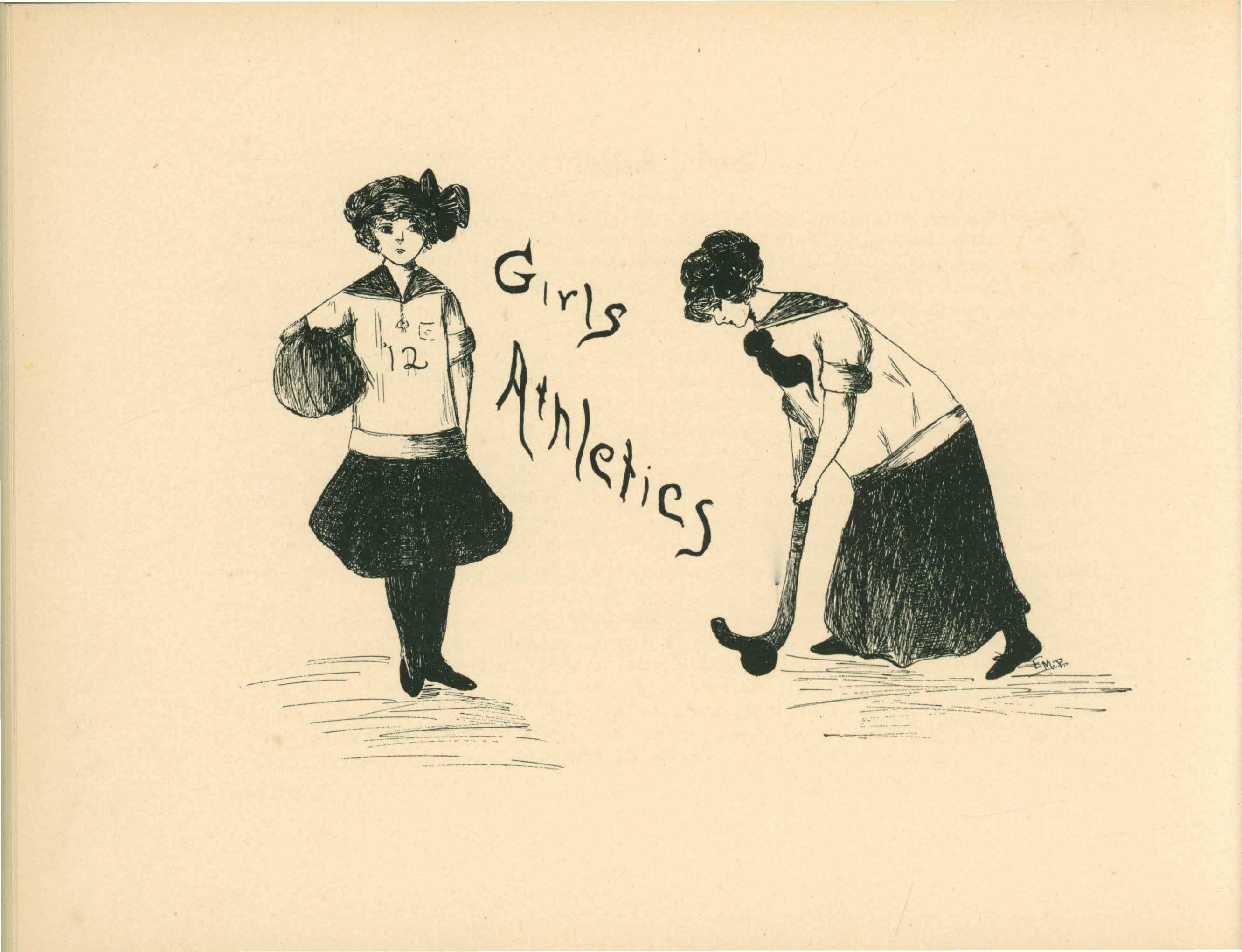
(?HE Class of Nineteen Twelve started its gymnastic career in E. A great number of girls appeared in the gymnasium to compete with the other classes, but, although each girl worked hard, nothing wonderful was accomplished.
In Class D, the Basketball Team was organized. Here, again, the class worked faithfully, but gained no remarkable honors.
But "try, try again" was our motto, and, in Class C, we were at length rewarded for the patient efforts of previous years: Elizabeth Shoemaker carried off the "Individual Cup."
Junior year: we were no longer insignificant in the school world of athletics. Now we felt ourselves able to compete with the seniors. We made up our minds that, being in Class B, we had a very fair chance of attaining the "Class Cup." With this end in view, we struggled courageously to gain the much-sought-for prize. This year we had fewer girls working in the "gym" than in previous years; but, nevertheless, there was good material, which the judges didn't fail to see, for they declared us winners of the cup, which is awarded to the class which does the best all-round work. Elizabeth Shoemaker again took the "Individual Cup," and Lillian Conrad received third honor, a blue ribbon. We felt very much elated over the fact that we had won two cups, but a little disappointed that the "Basketball Cup" was lost by only two points.
Our senior year found us rather disheartened for two reasons. First, Marian Harris , one of our good athletes, failed to return to school. Secondly, we were told that no girl could hold the "Individual Cup" for more than two years. However, we struggled on with our faithful few and came out victorious in the end. Once more we were presented with the "Class Cup." Lillian Conrad received the "Individual Cup," and Katharine Hunsicker, Marian Coyne, and Ethel Porter were awarded blue ribbons. Nineteen Twelve closed its athletic career in Friends' Central by a final display of its work in the Exhibition, which was held toward the end of its senior year.
ETHEL M. PORTER.
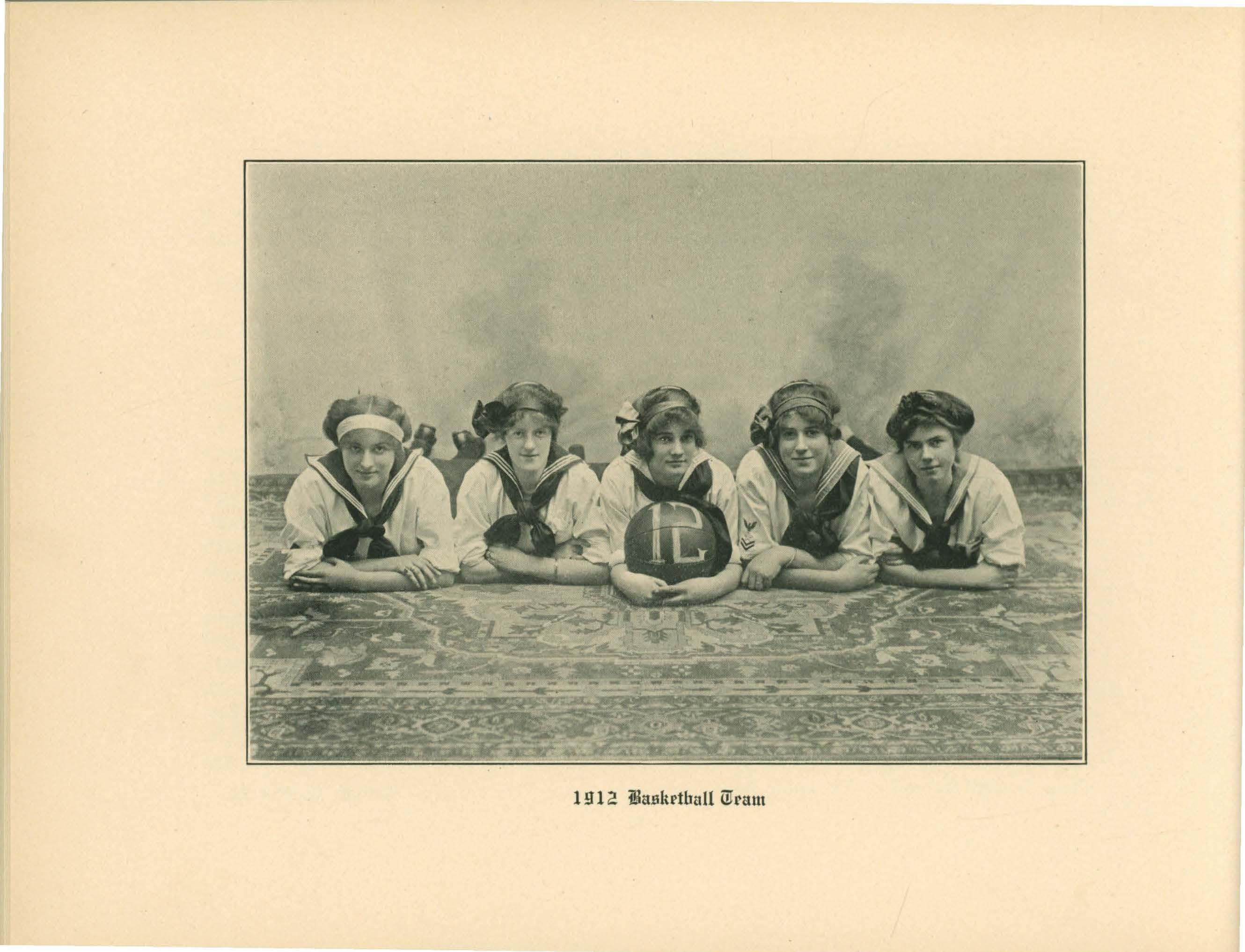
XN CLASS C, Nineteen Twelve made quite a racket on the Hockey Field, and, just to keep them quiet, the captain and coach gave three girls positions on the first team. These girls were Frances Wright, Elizabeth Shoemaker, and Marian Harris. For our first attempt we were very fortunate.
When we came back the next year, just to prove that 1912 had some real, true hockey players, six girls made the team. The girls who were awarded their F. C. S . H. were Katherine Hunsicker, Frances Wright, Ethel Porter, Marian Harris, E l izabeth Shoemaker, and Mary McIntire.
When the management came into our hand, Mary McIntire was elected captain, and Ethel Porter manager. The team was rather good considering the fact that we had practically no help from the junior class. Although not a championship team, we succeeded in winning a game from our deadly "enemies," the Swarthmore Freshmen. Miss Mange awarded letters to the following girls: Hazel Brown, Florence Stiles, Elizabeth Shoemaker, Ethel Porter, Frances Wright, and Mary McIntire.
MARY McINTIRE.
OHE Class of Ninteen Twelve has always been interested in the athletic life of the school, and has always done its part in helping the school to turn out the best teams possible. During the first year or two of our stay at Friends' Central, we were too "young and inexperienced" to hope to compete against the upper classes, but, when we arrived in Class C, we began to make ourselves heard by giving the juniors a hard tussle for the "Football Cup." From this time on, we supplied the school football team with a number of its best players, and in our senior year there were nine players of a squad of ixteen from our clas . Among these were both the captain and the manager .
In the intercla conte t , we have always managed to do creditable work, showing up e pecially well in track meets and in the gymnastic contests. In our junior year we lost the basketball championship to the seniors, and in our senior year we lost to the juniors, after a very close and exciting struggle. Our Indoor Baseball Team failed to secure first honor in the championship series, but our track men easily walked away with first place in the Indoor Track Meet. As a class of gymnasts, we have always shown up well. We contributed several stars to the gymnastic exhibitions, and also won the "Pawling Gymnastic Trophy" in our senior year.
The baseball, tenni , and outdoor track teams have all claimed the services of some of the members of 1912, both as players or runners, and as captains and managers, for the past two or three years. In the Blue and Gray contests, also, 1912 athletes have always played a prominent part. In fact, there is not a branch of ath letics in which 1912 has not had a representative. This, since the class is so small, means that almost every member does athletic work of some kind.
This record of our athletic prowess merely shows that, as a class, we believe in giving athletics a prominent place in school activities, and that we have always done our very best to raise the athletic standard of the school by giving strong, hearty support to all the teams .
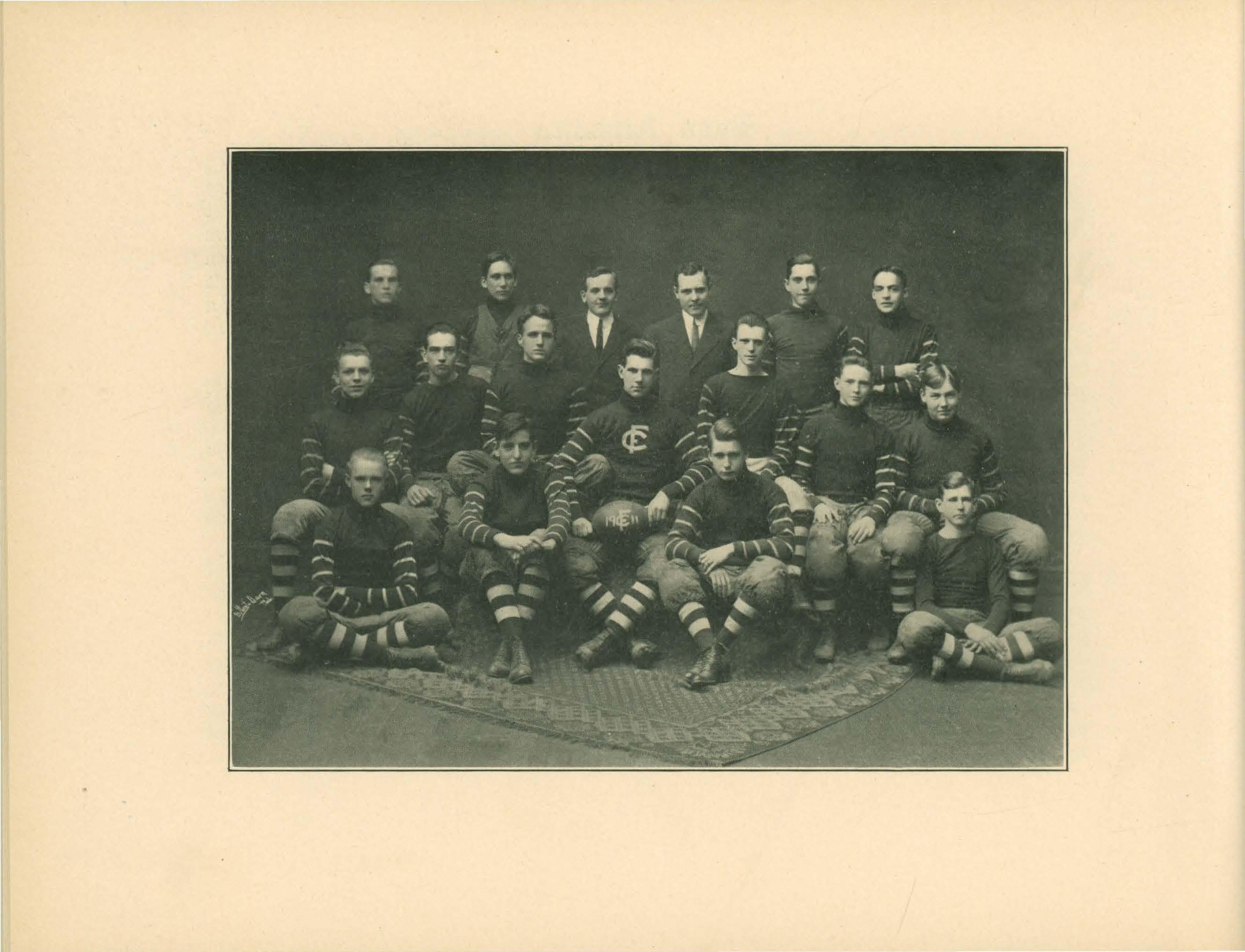
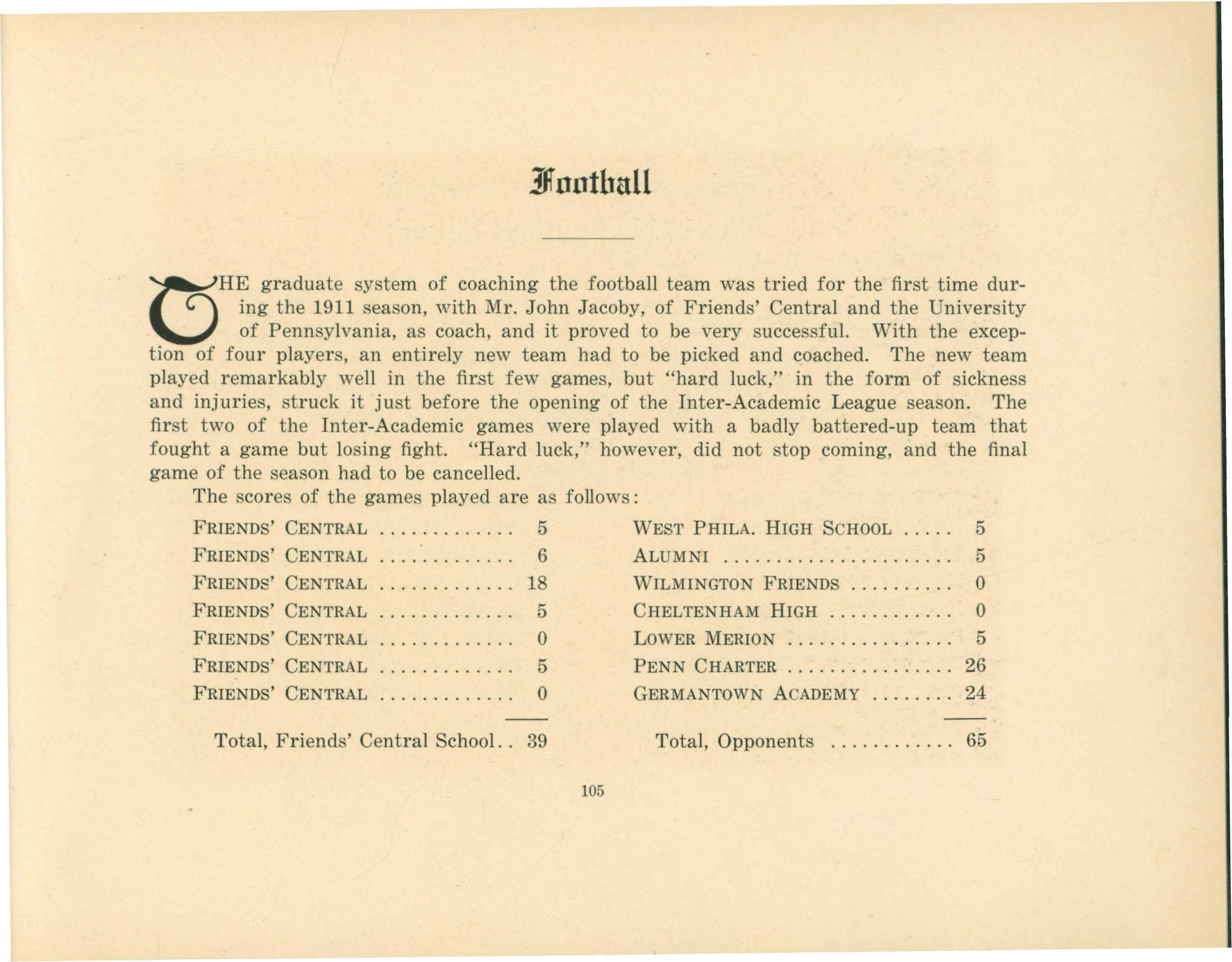
OHE graduate system of coaching the football team was tried for the first time during the 1911 season, with Mr . John Jacoby, of Friends' Central and the University of Pennsylvania, as coach, and it proved to be very successful. With the exception of four players, an entirely new team had to be picked and coached. The new team played remarkably well in the fir.st few games, but "hard luck," in the form of sickness and injuries, struck it just before the opening of the Inter-Academic League season. The fir t two of the Inter-Academic games were played with a badly battered-up team that fought a game but losing fight. "Hard luck," however, did not stop coming, and the final game of the season had to be cancelled.
The scores of the games played are as follows:
RAYMOND F. PERROTT, 1912, Cavtain. MURRAY s. CHISM, 1912, Manager.
GEORGE H . SUTTERLEY, JR., 1913, Assistant Manager.
JOHN F. JACOBY, JR . , F. C. S. '05, and U. of P., Coach.
DR. HENRY L. CHADWICK, Polyclinic Ho pita!, Trainer.
SIMMONS, 1912, Left End.
DICK, 1913, Left Guard.
PICKERING, 1912, Center.
MOFFETT, 1913, Right Gua1·d.
EAVENSON, 1912, Right End.
SUTTERLEY, 1913, Quarterback.
BOTTOMS, 1912, Left Halfback.
GRIM, 1912, Right Halfback.
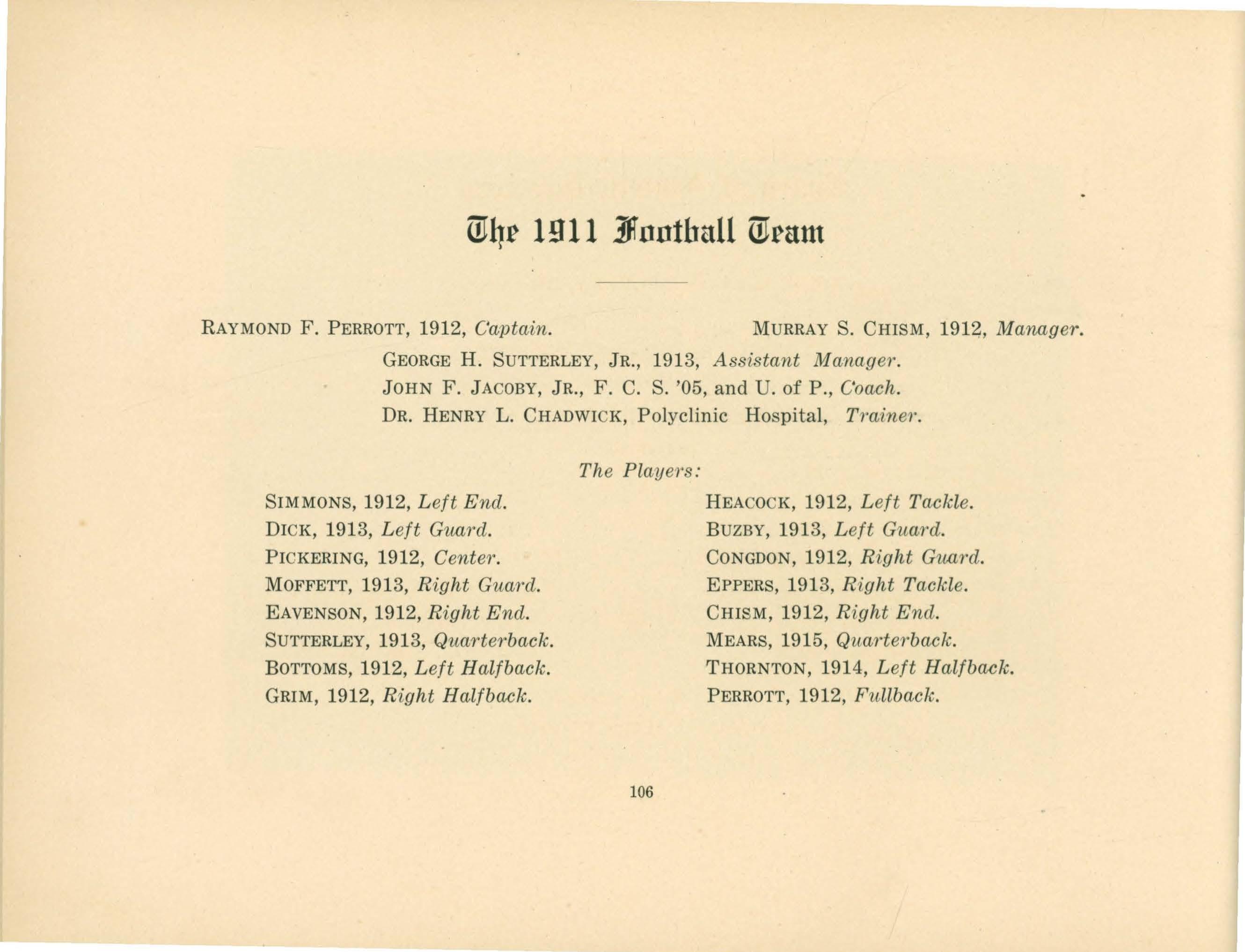
The Players:
HEACOCK, 1912, Left Tackle.
BUZBY, 1913, Left Guard.
CONGDON, 1912, Right Guard.
EPPERS, 1913, Right Tackle.
CHISM, 1912, Right End.
MEARS, 1915, Quarterback.
THORNTON, 1914, Left Halfback.
PERROTT, 1912, Fiillbaclc.
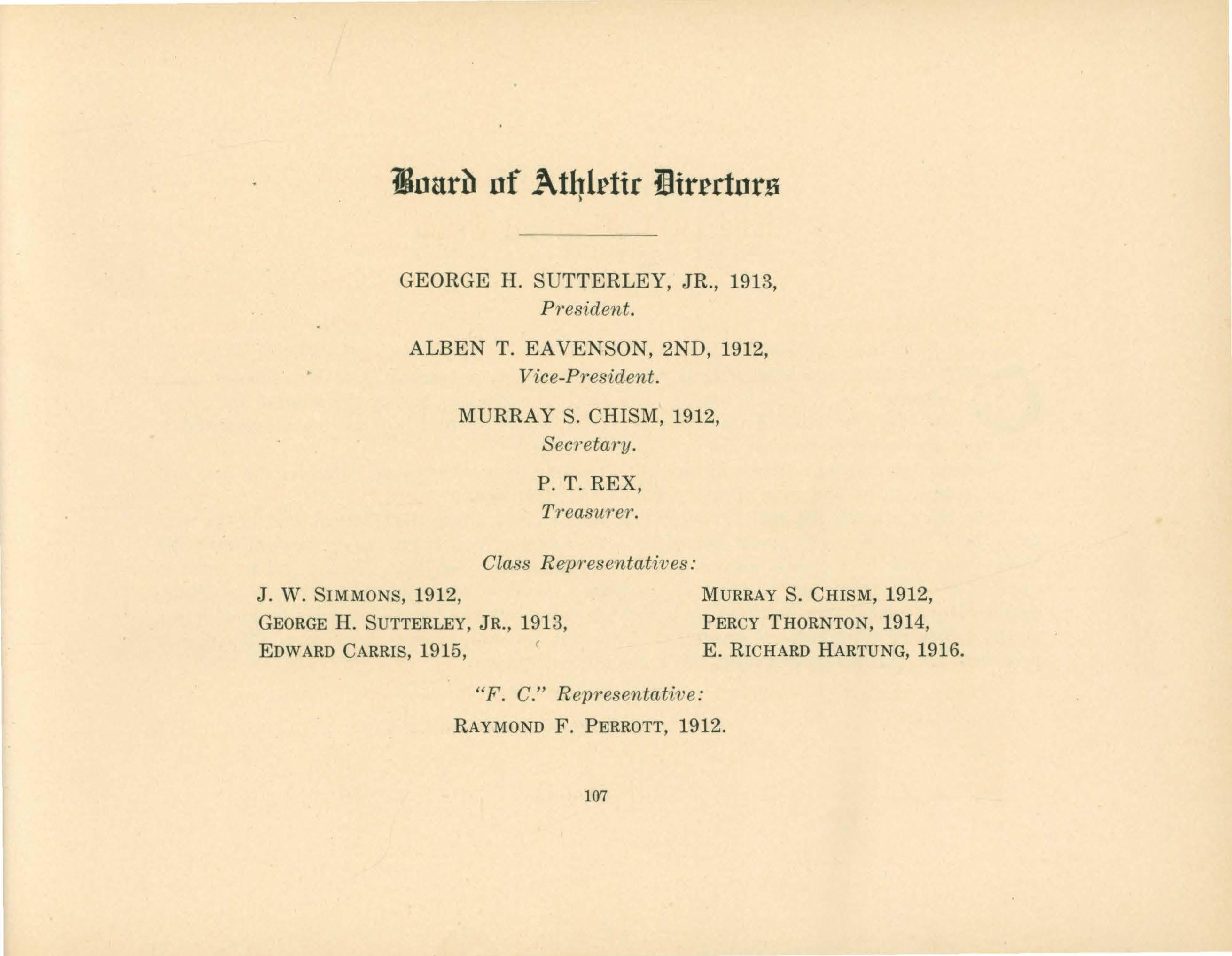
GEORGE H. SUTTERLEY, JR., 1913, P re siden t.
ALBEN T. EA VENSON, 2ND, 1912, V ice -President .
MURRAY S. CHISM, 1912, S ecretary .
P. T. REX , T reasurer .
Class R epresentatives :
J. W. SIMMONS, 1912,
M URRAY S. CHISM, 1912, G EORGE H . S UTTERLEY , JR. , 1913 , EDWARD CARRIS, 1915 ,
PERCY THORNTON, 1914, E. RI CHARD HARTUNG, 1916.
" F. C ." R epresen t at ive : RAYMOND F. PERROTT, 1912. 107
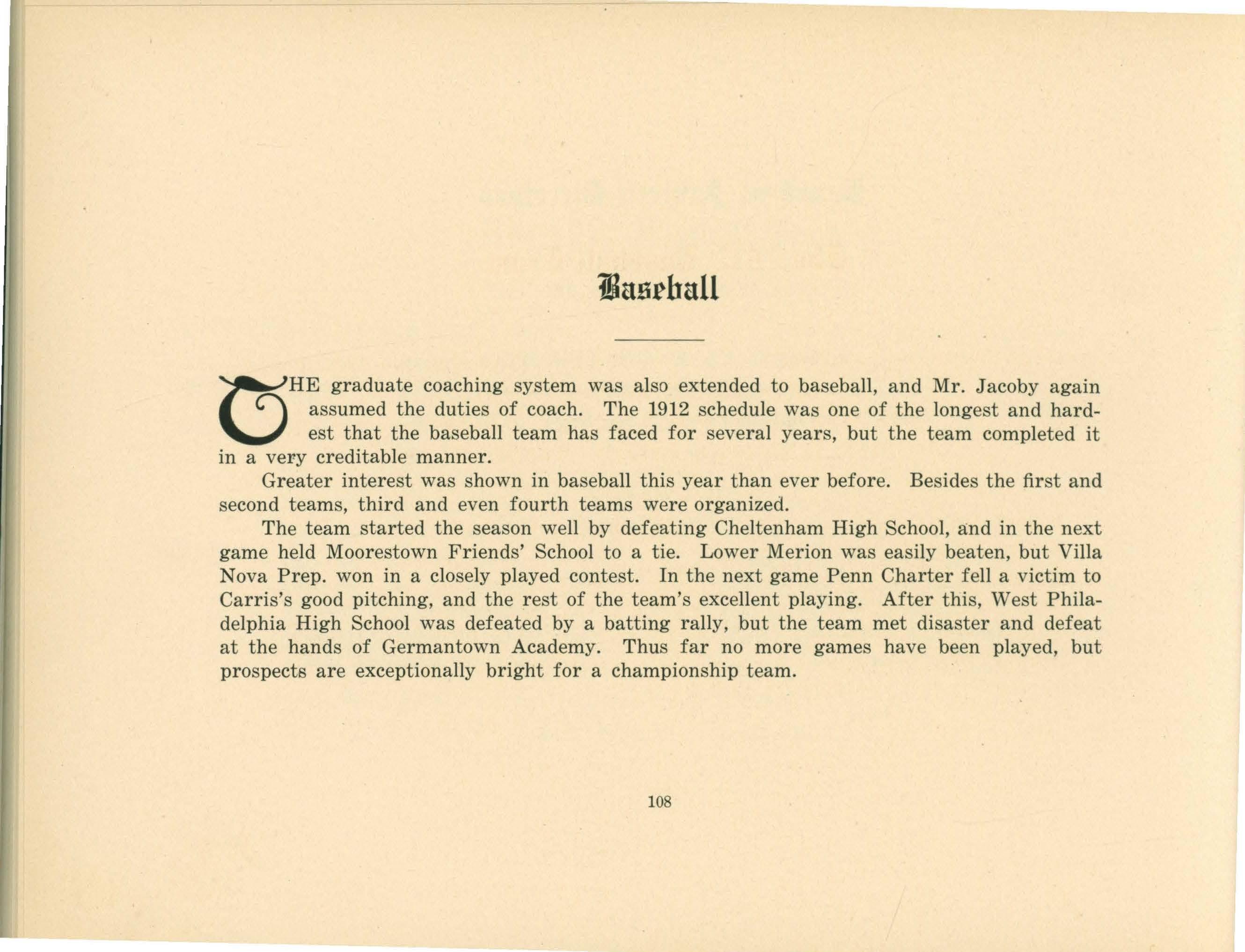
HE graduate coaching system was also extended to baseball, and Mr. Jacoby again assumed the duties of coach. The 1912 schedule was one of the longest and hardest that the baseball team has faced for several years, but the team completed it in a vel'y creditable manner.
Greater interest was shown in baseball this year than ever before. Besides the first and second teams, third and even fourth teams were organized.
The team started the season well by defeating Cheltenham High School, and in the next game held Moorestown Friends' School to a tie. Lower Merion was easily beaten, but Villa Nova Prep. won in a closely played contest. In the next game Penn Charter fell a victim to Carris's good pitching, and the rest of the team's excellent playing. After this, West Philadelphia High School was defeated by a batting rally, but the team met disaster and defeat at the hands of Germantown Academy . Thus far no more games have been played, but prospects are exceptionally bright for a championship team.
CHANDLER BURPEE, 1913, Captain. ALBEN T. EAVENSON, 2ND, 1912, Manager.
EDWARD CARRIS, 1915, Assistant Manager.
JOHN F. JACOBY, JR., F. C. s. '05, and u. of P., Coach.
DR. HENRY L. CHADWICK, Polyclinic Hospital, Tra iner.
The Players:
BURPEE, 1913, Catcher.
EPPERS, 1913, First Base.
PINE, 1913, Second Base.
BYLES, 1913, Third Base.
DUNHAM, 1913, Short Stop.
BARNES, 1915, Sho rt Stop.
EAVENSON, 1912, Catcher.
COLEMAN, 1913, Center Field.
CARRIS, 1915, Pitcher and Outfielder.
DARBY, 1914, Pitcher.
GILBERT, 1914, Pitcher and Outfielder.
CHISM , 1912, Left Field.
PERROTT, 1912, Right Field.
OHE Track season opened with the Pennsylvania Relay Race s at Franklin Field, and, from that time on, many meets were participated in. Among these were the Swarthmore Meet, the Ocean City Meet, and the Glen Mills Meet. The annual Blue and Gray Meet was one of the most important and successful on the schedule. The Interscholastic Championships marked the end of the Track season. wl1r l!ll2 wrarlt wram
GEORGE w. GRIM, 1912, Captain.
RAYMOND F. PERROTT, 1912, Manag er. JOSEPH O'DONNELL, u. of P., Coach.
DR. HENRY L. CHADWI CK, Polyclinic Hospital, T r a iner .
STANLEY BYLES, 1913, HERBERT BARTHOLOMEW, 1914, ALBEN T. EAVENSON, 2D, 1912, EARLE DUNHAM, 1915,
Th e R unners . 110
JAMES EYSTER, 1912, GEORGE GRIM, 1912, RAYMOND F. PERROTT, 1912, GEORGE BUNTING, 1914.
OWING to the fact that Friends' Central had to face an unusually active season of spring athletics, it was decided to resign from the Inter-Scholastic Tennis Association and play in the Inter-Academic Association only. This was done, and two matches were played with each of the other Inter-Academic League members.
A s soon as the weather permitted, a tournament was held and the team was chosen from the successful contestants . Great improvement over last year's work was evident, and the team is looking forward to a successful season.
wl1e 1912 wmuis WNUlt
Th e Play ers .
BURDELL MOFFETT , 1913,
GEORGE W. GRIM, 1912, RAYMOND F. PERROTT, 1912, GEORGE BUNTING, 1914, MURRAY s. CHISM, 1912, Manag er ,
PER CY THORNTON, 1914, ALBERT CONRAD, 1913, C. GRANISS BONNER, 1913, HENRY L. SOMERS, 1913, WEIMER BIRKINBINE, 1913.
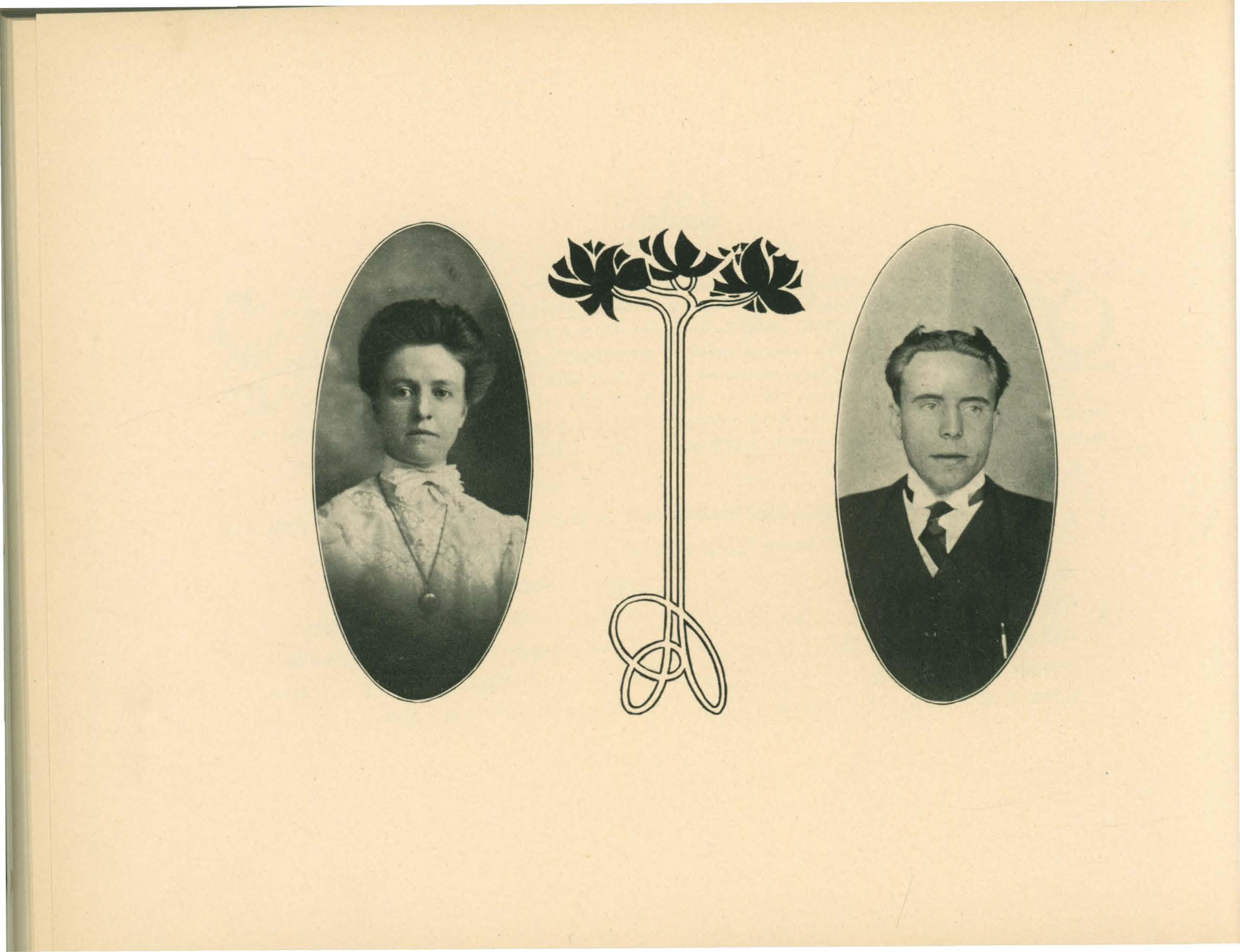
Edith M. Douglass and Charles F. Lawson our most popular teachers.
GRACE E . BOUGHTON, Pr esident . MANETTE STAUDT, S ecretary .
DAISY C. M CADDEN, GLADYS E. HOWE, MARYE. VOGDES, GERTRUDE MILLER,
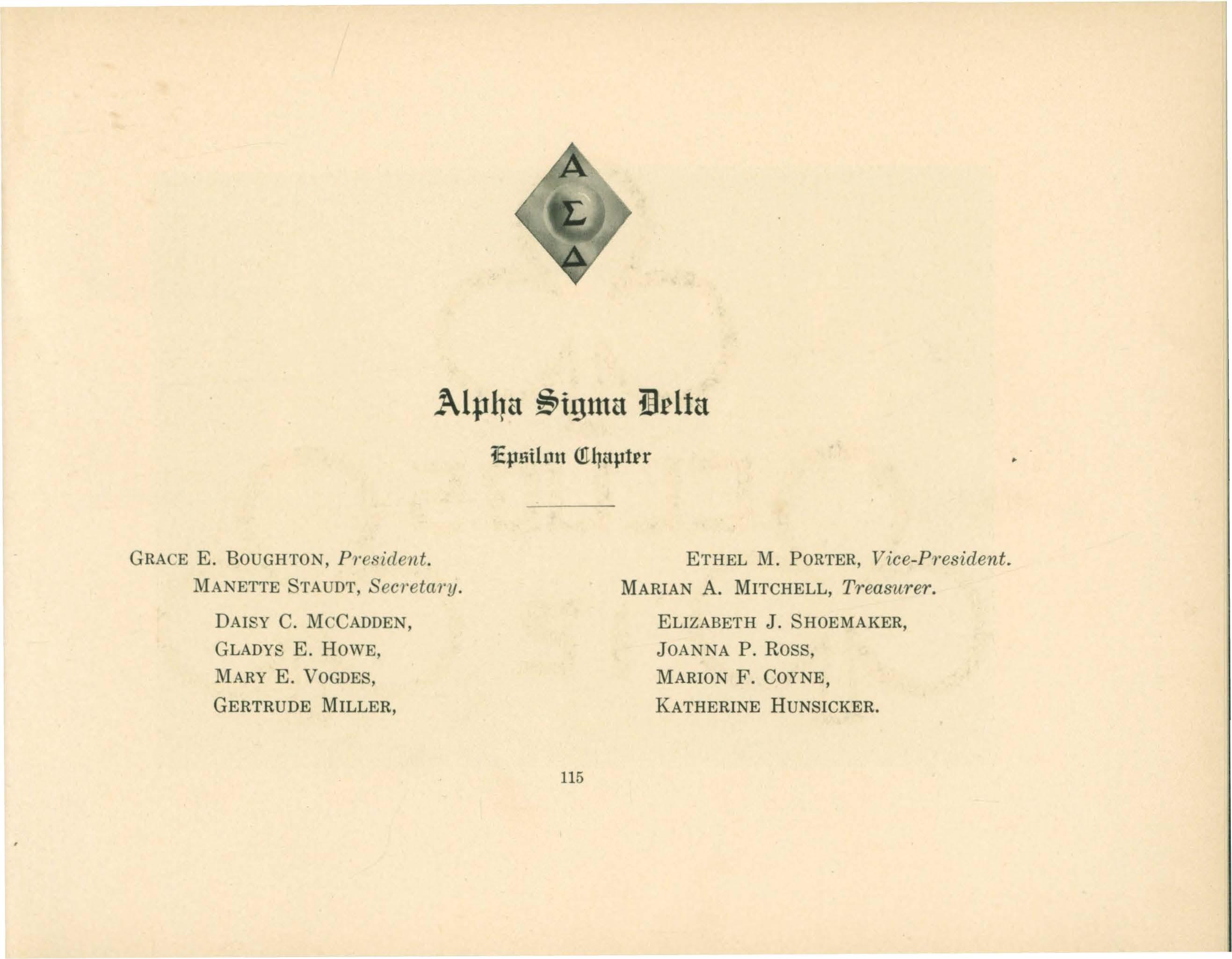
ETHEL M . PORTER, Vice - President.
MARIAN A. MITCHELL, Treasu,rer.
ELIZABETH J . SHOEMAKER, JOANNA P. Ross, MARION F. COYNE, KATHE RI NE H UNSICKER.
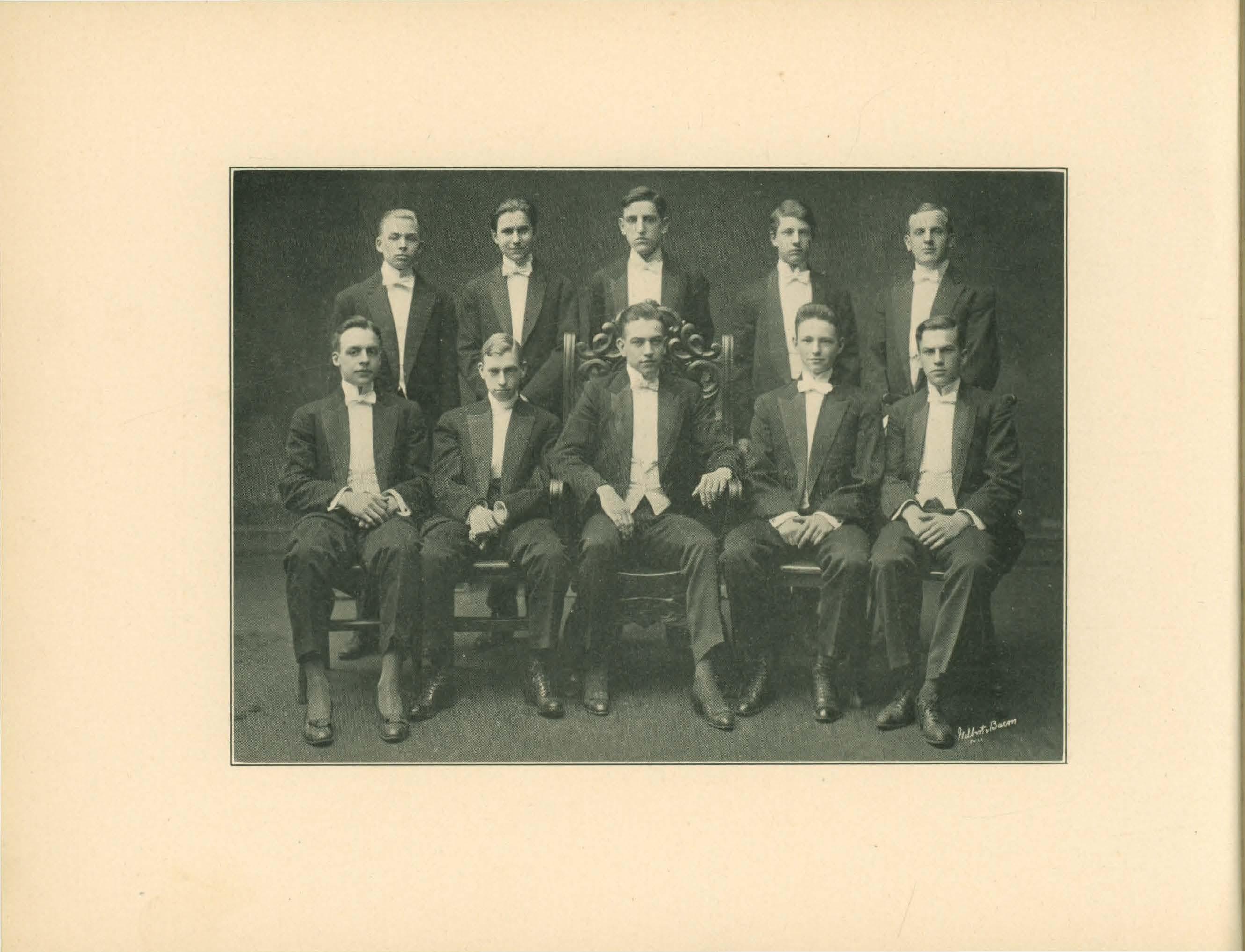
Iarta <!r qaptrr
J. WILLIAM SIMMONS, Pr esi dent.
G . RUGAN NEFF,
Vice -P resi d en t and S ecr et ar y .
ALBEN T. EAVENSON, 2ND, JAMES A. EYSTER, MAITLAND BOTTOMS,
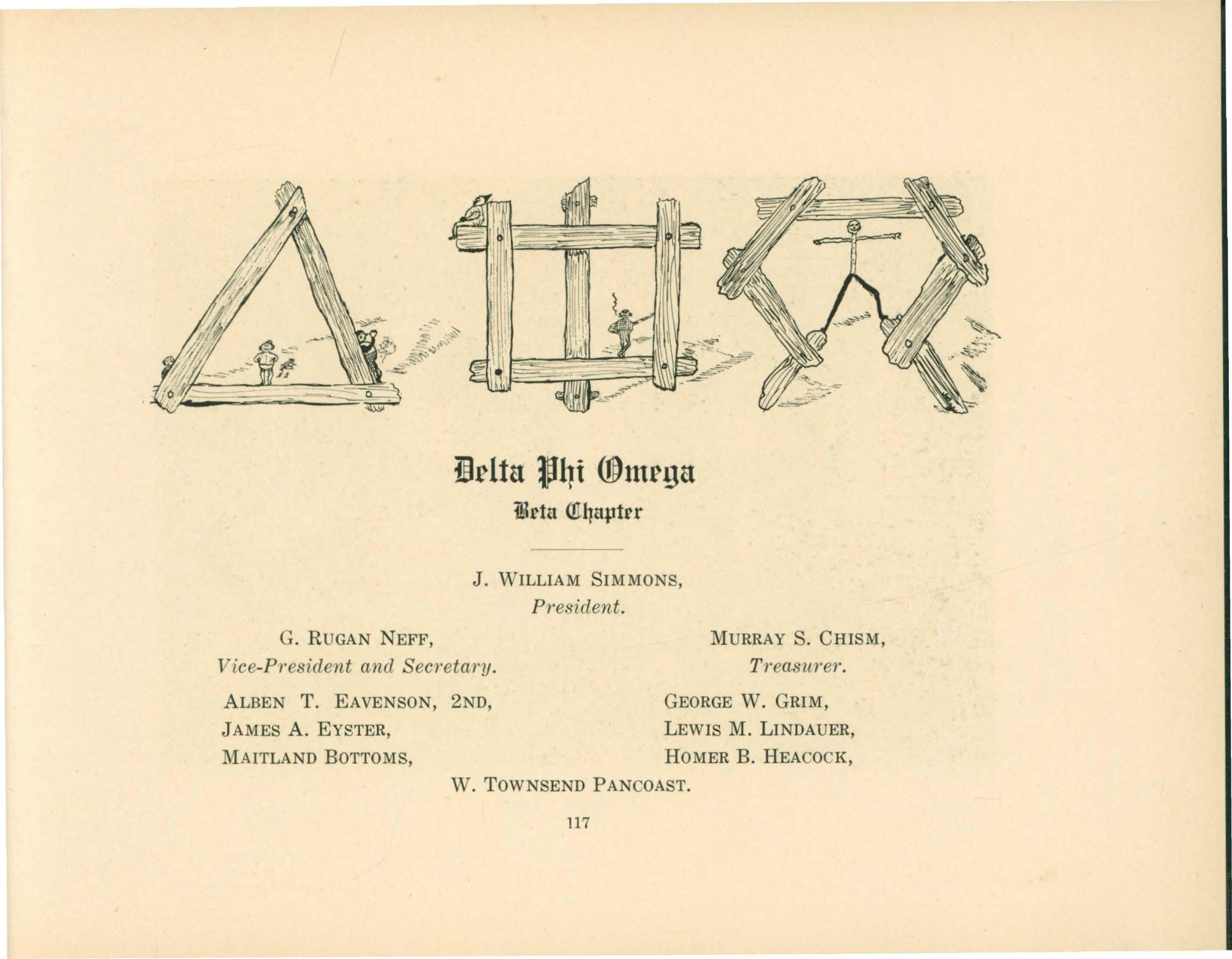
MURRAY S. CHISM, T re as ur er.
GEORGE W. GRIM, LEWIS M. LINDAUER, HOMER B . HEA COCK, W. TOWNSEND PAN COAST.
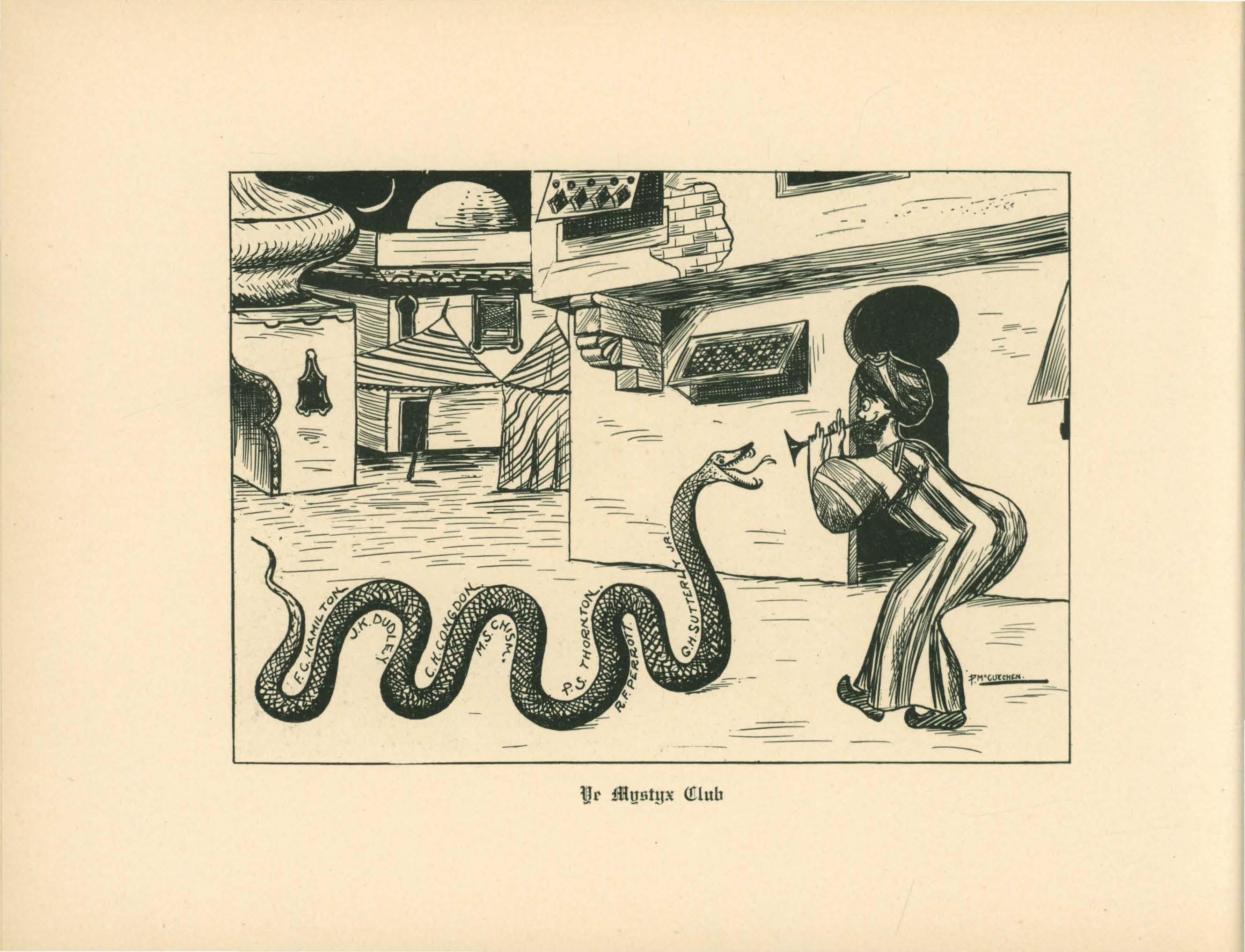
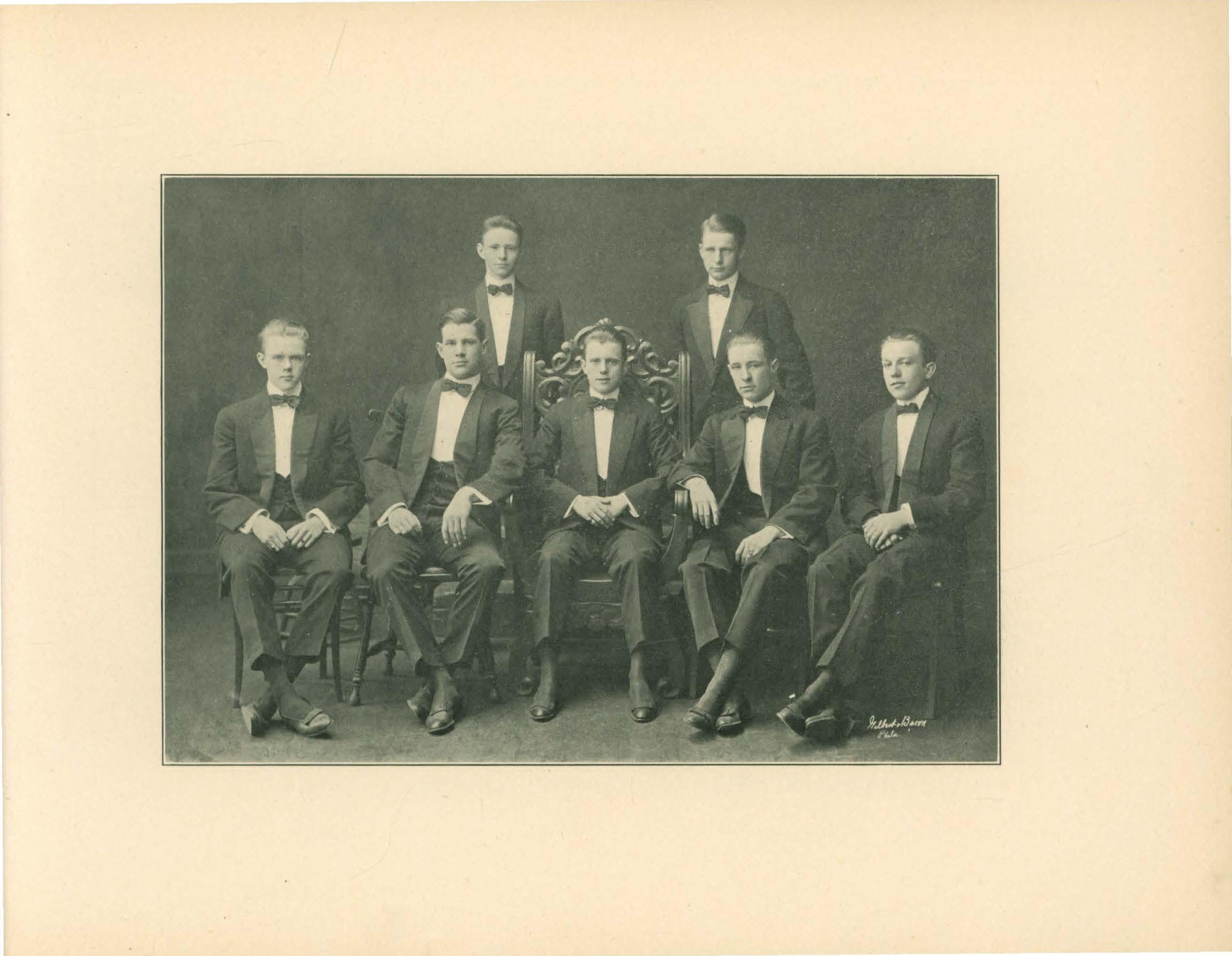
It was largely by means of the following advertisements that the publication of this book was made possible. We therefore request our readers to patronize the advertisers whenever it is possible, and kindly to mention the '' 1912 Class Record of Friends' Central School " when so doing.
George Vaux , Jr.
Gustavus Remak , Jr.
Clarence E Porter
Jos e ph S. Frelinghuys e n
$3,710,952
' Surplus , $1,239,770
Percy H. Clark
W . W . Curtin
Richard L Austin
Charles Fearon
DIRECTORS :
Clinton V. Meserol e
J. Henry Scattergood
John M. Shrigley
Henry S . Jeanes
Lawrence T . Paul C. E. Morgan, 3d Laurens R. Bowden
CLARENCE E PORTER, President w AITE BLIVEN, Vice-President J. H. SCATTERGOOD, Vice-Pr esid~nt
GUSTAVUS REMAK, JR., Vice-President and General Counsel
EDWARD L. GOFF, Secretary J. J. P. RODGERS, Treasurer SAMUEL P. RODGERS, Asst. Secretary
Offers a carefully g raded co urse from
Kindernarten to Collene under t_h e ::, • ::, guarded 1 nfluence for which the Society of Friends has always stood. Recognizing that thorough scholarship attains its highest usefulness in a sound body, the Committee has built
A Larne Gymnasium For the better ::, physical developme n t of the pupils.
The Athletic Field at Parkside furnishes excellent opportunity for recreation and legitimate sports for the Boys' School , while the grounds of the Lansdowne Country Club provide ample opportunity for the Hockey T eams of the Girls' School.
l Sth and Ra ce Sts., F RANCES HAINE S, P rinci pal
17t h St . an d Girard Ave., - EMMA BARNES WALLACE, P rinci pa l
35th St. an d Lanca ste r Ave., - ELSIE OA KFORD , P rinci pal
Each of t hese schools is pr ovided with a we ll- equ ipped Gymnasium under the care of a tra ined P hysica l Director.
Fur Catalogue of any of these school-S, address the Principals or W. E. BARRETT , Superintendent 15th and Race Streets
~HE choice of a printer should be governed by several considerations. There are the factors of \...) accessibilty of the plant, quality of workmanship , promptness in deliveries, courtesy in service , and fairness in prices. We solicit your orders and feel confident that we can make good on each one of these counts.
Located at 10 l 0 Cherry Street , in the heart of Philadelphia, our building is easily reached from every quarter. We have comfortable offices on the ground floor, with a full line of samples of work of many kinds. We are glad to show these at any time, and to quote prices, aid with suggestions, and help the prospective buyer of printing in every possible way.
EDWARD T BIDDLE , Pre s ident and Trea s urer
SOME OF THE BUILDINGS LATELY COMPLETED :
Belmar High School , . .................... Belmar , N . J .
Bel mont Pumping Station , . . .
Mayflower School,
Police, Fire and Patrol Station, .
High School ,
. . . Philadelphia , Pa. . . New Rochelle , N . Y. . . . . Philadelphia, Pa . . . . Bradley Beach , N . J .
Church, 52nd and Baltimore Ave. , ...... . .. Philadelphia , Pa.
Washington School, . . . East Orange, N . J .
High School, .
. . Leonardo , N . J .
Bo nd s and Guaranteed Sto cks
333 Chestnut Street
PHILADELPHIA
Telephones - Lombard 1112, 1113
All that you have planned with respect to the support and education of your children may be frustrated by your death. Life insurance provides the only safe and certain means of creating an estate for the Protection of one's family.
during the life of your wife or child a certain definite income can be arranged to be paid them as regularly as Time itself.
This new financial service will be assumed for their benefit by
Philadelphia
Send date of birth of self and wife or child for complete information.
Broad and Chestnut Sts., Philadelphia
J. R . McALLISTER. President J. A . HARRIS, Jr., Vice President
E . p . PASSMORE, Ca shi er
J. WM. HARDT, Asst Cashier J. C. FRANKLAND, Asst . Cashier
WILLIAM WRIGHT, Manager
Invites the Accounts of Banks, Bankers, Corporations, Mercantile Firms and Individuals
JOSEPH
SWAIN , M. S., L. L. D. , President
A small college of high rank. High standards of admission, instruction and graduation. Every room in the dormitories occupied in 1911-1912, with a long waiting list.
A four-year course of study leading to the degree of Bachelor of Arts, including certain prescribed studies and numerous electiv es. Courses off e red in seventeen departments.
Excellent Courses in Civil, Mechanical, Electrical and Chemical Engineering. Laboratories and shops are of recent construction, and are fully equipped with modern apparatus.
A faculty noted for sound scholarship, broad training and wide experience.
Excellent equipme nts and varied courses of study in all departments.
Substantial endowments, unsurpassed rural surroundings, large campus, commodius and beautiful buildings.
A new Heating and Lighting Plant.
For catalogue and other descriptive literature, address : W. A. ALEXA NDER, Registrar
We cordially invite an e xamination of our Safe Deposit Department by those going out of town for the summer and desiring a place for the safe keeping of their valuables.
Our va u lt is strictly modern in every particular and we have boxes for rent in a great variety of sizes-a limited number for Three Dollars a year.
This Department is open from 8.30 in the morning until 4.30 in the afternoon.
ROWLAND COMLY
Presi
d e n t
WILLIAM BRADWAY Treasurer
ESTABLISHED 1 860 MARGARET W . MERR 111EW LAURA MERR111EW
Portraiture in all it's branches Also Commercial Photography.
LUMBER YARDS:
68th and Woodland Ave. Primos. Del Co. , Pa. Nashville, Tenn
SAW MILLS:
Alexander, W. Va. Jasper, Va. Montgomery, Va .
has taught us which are the favorite Chocolates and Confections. We offer these assortments in a new-idea box called the SAMPLER. In it are packed lots from ten of our mostpraised packages, all labelled and kept separate. It's a Practical guide to the best. The SAMPLER costs a dollar.