NEWS | SUMMER 2023
MESSAGE FROM THE CHAIR The year has been busy for Friends of the National Library and I hope you have been able to take advantage of some of the Friends offerings. In all, we hosted 11 events on varying topics. These ranged from a Zoom session with author Dervla McTiernan to the annual White Gloves event, ‘Food and Drinks with Friends’. Event planning for 2024 is well underway and details will be in the online Weekly News. The 2023 Creative Arts Fellow, cartoonist Sam Wallman, completed his research at the Library on Green and Pink Bans and gave a presentation before the AGM on 30 November. The Friends 2024 Creative Arts Fellow is Celia Craig, a musician from South Australia, who will explore the Library’s collections for her research topic ‘Complete Accord: Miriam Hyde’. Celia will examine Hyde’s original manuscripts and create new performances with her Tarrawatta Trio. Do you have a favourite item or collection among the Library’s vast collections? Have you researched a topic and found the Library’s collections helpful? Articles by members for inclusion in the quarterly newsletter would be very welcome. Please consider writing a short article (up to 600 words) to describe your interest. The Friends Committee will help put it together if that is preferred. Please be aware that any submission will be under editorial control. You will have read in the online Weekly News the results of the election held at the AGM for the 2024 Friends Committee. As I write, there are vacant positions but we can co-opt Friends members to the Committee. If you are interested in contributing to the support of the Library, please contact the Friends Office. This is my last Chair’s message. I take the opportunity to thank you for being part of the community of Friends and wish you well over the holiday period and for 2024. Margaret Nichols | Chair
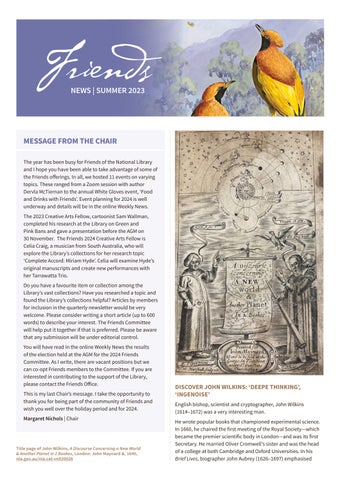
Title page of John Wilkins, A Discourse Concerning a New World & Another Planet in 2 Bookes, London: John Maynard &, 1640, nla.gov.au/nla.cat-vn920026
DISCOVER JOHN WILKINS: ‘DEEPE THINKING’, ‘INGENOISE’ English bishop, scientist and cryptographer, John Wilkins (1614–1672) was a very interesting man. He wrote popular books that championed experimental science. In 1660, he chaired the first meeting of the Royal Society—which became the premier scientific body in London—and was its first Secretary. He married Oliver Cromwell’s sister and was the head of a college at both Cambridge and Oxford Universities. In his Brief Lives, biographer John Aubrey (1626–1697) emphasised
Wilkins’ mechanical, practical mind: ‘He was no great read man; but one of much and deepe thinking, and of a working head; and a prudent man as well as ingenoise.’ He described him as ‘lustie, strong growne, well sett, broad-shouldered person, cheerfull, and hospitable’. Born in the reign of James I, Wilkins lived through the execution of Charles I, the Commonwealth and died during the reign of Charles II. His lifetime spanned a time of great change and instability, ending with the greater cultural and scientific flourishing of the Restoration. Wilkins was Bishop of Chester when he died. Generous donors recently gave the National Library the second edition of Wilkins’ book on cryptography—the art of writing in secret characters—joining the first edition already held. The Library now holds a representative sample of Wilkins’ work, among its rich rare books collections. This article looks at some of our seven seventeenth-century rare books written by Wilkins and asks what they tell us about his work. They range in date from 1640 to 1694, and feature four separate titles.
The book is in two parts. The first is organised by detailed ‘propositions’, each argued in turn. The first is: ‘That the Moone may be a World’, meaning that it could be a sphere or globe and able to support life. He reasons: ‘That the strangenesse of this opinion is no sufficient reason why it should be rejected, because other certaine truths have been formerly esteemed ridiculous, and great absurdities entertained by common consent.’ His last ‘proposition’ is ‘That tis possible for some of our posteritie, to find out a conveyance to this other world; and if there be inhabitants there, to have commerce with them.’ Yes it only took 329 years, but unfortunately, there were no inhabitants to trade with. In 1641, Wilkins published a book with a most intriguing title: Mercury, or the Secret and Swift Messenger: Shewing, How a Man May with Privacy and Speed Communicate his Thoughts to a Friend at any distance, 1641. It comes from a large collection—mostly dictionaries—which belonged to the English bibliographer Robin Alston. Wilkins lays out multiple ways of communicating secretly. The book—of which the Library holds both the first edition and an edition of 1694, makes use of engraving and different fonts and scripts, for its argument, no doubt a challenge for the printers.
The earliest has the most interesting title page of our holdings. It was engraved by the prolific William Marshall (c.1617–1649), best known for his frontispiece to Eikon Basilike (1649), a book purported to have been written by Charles I himself. It was being printed when Charles I was executed. Wilkins’ book published nine years earlier is A Discourse Concerning a New World & Another Planet (1640). In it, Wilkins supports the views of the great European cosmographic thinkers of an earlier generation.
We hold three copies of Wilkins’ major work: An Essay Towards a Real Character and a Philosophical Language (1668), published under the imprimatur of the Royal Society. It is an attempt at creating a universal language. Towards the beginning of the book he tells how most of the first print run and ‘a great part of the unprinted Original’ (the manuscript) were destroyed during the Great Fire of London in 1666. He calls it ‘the late dreadfull Fire’.
Copernicus, Galileo and Kepler stand on either side of a banner. Each is named and has a speech bubble or ribbon (technically called a phylactery). Copernicus points to a depiction of a heliocentric universe asking ‘Quid si sic?’ meaning ‘What if it were thus?’; Galileo holds his telescope, representing practical observation; Kepler, at his shoulder, represents theory.
Dr Susannah Helman I Rare Books and Music Curator
This gives just a taste of our rare books holdings, which you can view in the Special Collections Reading Room. Sign up for a Library Card today!
Two editions of John Wilkins, Mercury, or the Secret and Swift Messenger, London: 1694 (left) and 1641 (right) nla.gov.au/ nla.cat-vn717979 (Collection of Jamie and Michael Kassler)
SERENDIPITY: GEORGE HAYDON’S LOST JOURNAL, FOUND One of the best-known accounts of European exploration of colonial Victoria was penned by George Henry Haydon (1822–1891), an English-born architect who emigrated to the Port Phillip District (as Victoria was then known) in 1840, returning home in 1845. His books Five Years Experience in Australia Felix (1846) and The Australian Emigrant (1854) describe his experiences and observations of the young colony. Back in England, Haydon lectured widely on emigration to Australia and from 1853 served as a steward of psychiatric institutions in Devon and London until his retirement in 1889. Haydon is particularly remembered for his numerous expeditions into then little-explored Gippsland. In 1843–1844, he spent six months on French Island, in Western Port Bay, with his colleague William Ker. Haydon prepared an illustrated journal of his experiences which is apparently still held by his descendants in England. The National Library holds a microfilm copy of the journal and a copy of a sketchbook of his French Island sojourn, likely drawn from memory, around 1860. However, it was through sheer serendipity that the journal survived for posterity, having fallen from the back of a dray in 1844. It was lost for some years until found by a certain Thomas Bury who, for many years, had prospected in Gippsland, including Western Port Bay, and had travelled at times with Haydon. In 1868, Bury sent the journal to Haydon, then living in London, explaining that ‘during my wanderings I have come across this old journal of yours, and “measuring your corn by my bushel”, I thought you would like to have it’. Bury had been in possession of the journal ‘for some years’, carrying it around with him ‘when far far away in the wilds’. He had enjoyed Haydon’s humorous and anecdotal account of his experiences in the bush, which prompted ‘many a laugh, ay, and many a cry too’. The journal abounds with references to the vicissitudes of life in the wilderness, of which this is typical: March 26. Rain in the morning, managed to protect the rems of Saturdays fire from the wet. Dismal weather and as usual trouble with blue devils. Afraid, I think of Exeter too much but can’t help it. I must manage to pay it a visit before long. I am rather afraid from my present rig I might be mistaken for a vagrant … I am not different to the generality of my fellow colonists–must grin + bear it. Fished by torch–bad sport. The text is accompanied by clever, supportive sketches, including one of a rat trap, ‘a sheet of bark with a little flour on it’, and another of his little bush shack, ‘Home Sweet Home, Marine Villa, designed, drawn, and executed by GHH, architect’. Haydon had a good relationship with and was well regarded by First Nations people he encountered in his travels. As his biographer notes:
Haydon was concerned about Aboriginals; he stoutly defended them against the prejudices of the colonists, studied their George Henry Haydon, Sketchbook of George Henry Haydon’s Experiences on French Island, Victoria, c. 1860, nla.gov.au/nla.cat-vn3044648
language and customs, and earned their respect ... To Haydon the protectorate system was ‘a pack of humbug’ and harmful to the welfare of the Aboriginals. Knowing of Haydon’s interest in Australia’s First Peoples, in the letter forwarding the journal, Bury relayed news of local people Haydon had known. Haydon was no doubt delighted that the errant journal had found its way back to him. It was naturally in a poor condition and he made a ‘fair copy’, in which he pasted several sketches from the original and added some new ones. This copy remained with Haydon’s family until approximately 90 years ago, when it came into the hands of an Australian family. The National Library purchased the copy at an auction in 2009, along with other associated Haydon ephemera, including several letters from Ker to Hayden in the 1860s. Gary Kent I Friends Committee Deputy Chair
YOUR FRIENDS MEMBERSHIP HELPS THE NATIONAL LIBRARY Friends members are part of a community of passionate National Library supporters and advocates. Friends benefit from on-site and online events and presentations that promote our cultural heritage and scholarship. Friends support fellowship programs, digitisation projects and have gifted art to the Library. When reminded, please renew online and encourage others to join.
THE ‘IDEA’ OF A LIBRARY: THE LINTEL SCULPTURE ‘We teach you to see, not merely to look’—the words of sculptor Tom Bass when he founded his Sculpture Studio School in 1974. Words he had been putting into practice in his works for more than 25 years and especially apposite for his Lintel Sculpture for the National Library. The vision of the Library’s principal architect Walter Bunning demanded art works for the building to be ‘large and powerful’. And he chose Tom Bass as the sculptor who had ‘executed more large-scale work in association with architecture than any sculptor in this generation’. As you mount the podium to the Library entrance, look at the Lintel Sculpture, a three-dimensional bas-relief in beaten copper. Bass wanted his sculpture to be seen and ‘physically experienced’. He sought to represent in symbolic form the ‘idea’ of the Library. Drawing on the early civilisations of the Sumerians and Akkadians and the origins of the written word around 3,000 BCE, Bass’ inspiration was the cylindrical seals of their cultures, used to authenticate cuneiform writing, the wedge-shaped (Latin: cuneus) impressions on clay tablets. In the centre is ‘ultimate or absolute truth’ portrayed as a winged sun, the Sumerian image of the Deity, and aiming ‘to project the immense power and revelation of inspired truth’. To the right, the branches of a tree ‘to express the growth of knowledge generated by truth’. And to the left, ‘the ark’ where Bass depicted conservation ‘like a honeycomb, heavy with the nectar of our cultural residues’. The massive work was fabricated at his property at Minto, New South Wales—three steel frames, then three tonnes of 16-gauge copper with a hammered finish. Bass estimated he needed three months to prepare the working model and 52 weeks of intensive work to complete the full-scale work, at a cost of $40,500. The creative freedom afforded Bass was not without constraints— government authorities, time pressures, maquettes and on-site inspections. He was clearly mindful of the bureaucratic hurdles, having written to Bunning in April 1967 ‘[I] wish you good luck with the desk old boys in Canberra’. Nevertheless, he met the deadline and within budget. Three trucks delivered the 70 feet (21.25 metres) long, 7 feet (2.14 metres) high and 6 feet (1.86 metres) deep completed work to the Library site ahead of the official opening in August 1968. However, installation was a major logistical exercise. Cranes lifted the parts into place, they were welded together onsite, and the length turned out to be 70 feet one inch! If you look at the bottom right-hand corner of the installation, there is a small recess cut out of the wall to accommodate the sculpture. Thomas Dwyer Bass AM (1916–2010) was born in Lithgow, New South Wales. But it was in Gundagai in 1925 that ‘the spark of a lifetime’s artistic journey was lit’ for young Tom, wrote Malcolm Brown in his obituary of Bass published in the Sydney Morning Herald. Tom became fascinated with a blacksmith’s shop and the pile of old ‘totem-like’ horseshoes he saw there. Bass was forced to follow itinerant work during the Great Depression but in 1937 he enrolled at Dattilo Rubbo’s atelier Sydney, to study drawing. War service followed but the
Commonwealth Reconstruction Training Scheme enabled him to study at the National Art School, Sydney. During his final year in 1948, he obtained his first commission. Over 25 years, Bass created more than 60 major sculptures for universities, government organisations, churches, corporations and schools—continuing his philosophy of totemic forms and creating works meaningful to the communities they served. He was made a Member of the Order of Australia in 1989 and awarded an honorary degree by the University of Sydney in 2009. Recognition of his seminal role in shaping the face of public art continues posthumously with the establishment in 2016, the centenary of his birth, of the biennial Tom Bass Prize for figurative sculpture. Where close to the Library can we see Bass’ work? You will find his Coat of Arms on the Treasury Building, and works at the Royal Military College, Duntroon; Trinity Catholic College, Goulburn; and St Augustine’s Church, Yass. And of course, Ethos, the winged female figure in front of the ACT Legislative Assembly building that celebrates the ‘spirit of the community’. There is one work that we see in everyday life: the logo designed by Bass after Vatican II in the 1960s to replace the century-old logo of the St Vincent de Paul Society, Australia. Kerry Blackburn I Newsletter editor, Library volunteer
Tom Bass, Lintel Sculpture, 1968, above the Library entrance
SPOTLIGHT ON COFFS HARBOUR Why are a L’Oreal ad and a new library similar? ‘Because we’re worth it.’ On 16 September 2023, Yarrila Place, Coffs Harbour’s new cultural and civic centre was opened by Prime Minister Anthony Albanese. It houses the state-of-the-art Harry Bailey Memorial Library and the Yarrila Arts and Museum (YAM) as well as community and essential services. The project has been many years in the making. The landmark building was designed by BVN architect Matthew Blair, who was born and raised in Coffs Harbour. A key focus of the design was connecting the building with Gumbaynggirr country and showcasing local Aboriginal culture and art. The building curves around a majestic fig tree, under which is a shaded meeting space and cafe. The library is sited over three floors (a seven-fold increase in floor space) with six staffed service points: the previous library could be comfortably managed by two staff members. The ground floor library space contains our main, automated returns room, a magazine and reading area as well as Rapid Reads (popular recently released books with short loan periods) and reservations. The children’s area is co-located here and includes the Story Space, a versatile, tiered auditorium which holds the picture book collection and a giant screen, and hosts activities from story time to movie sessions. The YAM is located on the opposite side of the atrium.
The general vibe for Yarrila Place since opening has been that of a town square. People are meeting under the fig tree, queuing to enter the library (and join up), using the atrium as a walkway, catching up for coffee at the 2D Coffee House and wandering the building and admiring the architecture and vistas beyond. Local Mayor, Paul Amos, describes it as ‘a hub for lifelong learning, a beacon for arts and a place where creativity, commerce and community initiatives can thrive for years to come’. So, why does the L’Oreal ad resonate? Because the community is worth it. The new Harry Bailey Memorial Library is a space to encourage a sense of wonder and discovery in our community. It is full of delightful and unexpected spaces and collections for our community to enjoy. Board games, STEAM kits, cake tins and outdoor games are some of our popular new borrowable collections for members to borrow. It is a gift to the community. We would love you to visit us when you’re in Coffs Harbour. Karen Rowe-Nurse I Service Leader Libraries, Coffs Harbour Libraries
The main floor of the library is on level 2 and not only holds our adult collections but also has areas for quiet study, group learning and local history research, with comfy chairs for relaxed reading. Level 1 contains the Young Adult Library and The Deck which hold our young adult collections, study spaces and a PlayStation 5. It is an attractive space to enjoy a game on The Deck or to meet up for group study. The Make Space and Digital Studio are also located on this level allowing younger and older community members to explore new skills and share their expertise. These spaces will allow activities from podcasting to making jewellery and everything in between; all fully equipped with resources to allow our community to learn and create. This beautiful building is full of light and open spaces, opening creative opportunities and a wide range of programming and activities to be implemented—from Friday morning dress-ups in the Story Space to art workshops, recording sessions, dance choreography, author talks and creative50 fun in the Make Space and Learning Lab. Statistics since the opening are exciting: over 2,100 new and returning members with 6,750 visits to the new library each week. All the Arts and Library programs running across the Learning Lab, Workshop, Make Space and Digital Studio have been packed. Every study nook is filled with HSC and university students with the white board walls covered by incomprehensible formulae and HSC talking points! This is a welcome new cohort for the library and proves the adage ‘build it and they will come’. Our young adults feel that the City of Coffs Harbour has created a welcoming space for them, and they have responded by coming to the library in large numbers.
Images by Jay Black. Top: Yarrila Place: home of the Harry Bailey Memorial Library and Yarrila Arts and Museum; Bottom: The atrium on opening day of the Harry Bailey Memorial Library and Yarrila Arts and Museum (detail).
CARING FOR THE COLLECTION Have you ever wondered how the National Library manages to care for and preserve the 11 million items in the entire physical collection: nearly 4 million books, 800,000 paper maps, the vast manuscript collection, photographs, paintings, sound recordings, ephemera and realia? The Collection Care section assumes this vital role. A key function of the Library outlined in the National Library Act 1960 is to preserve and conserve items of Australia’s documentary heritage in its care. The Library’s physical collection is constantly used and requires specialist care to ensure that it remains safe and accessible. Collection Care is responsible for monitoring the condition of the Library’s physical collection and the environment in which it is kept; identifies and develops strategies to mitigate risks to collections; assists more broadly through the strategic preventive program; and provides treatments for collection items. Collection Care, Digital Preservation and Audio-Visual Preservation work together to ensure support for all formats for access now and into the future. The Library has a team of specialist conservators. Many have Masters’ degrees from the University of Melbourne, and others have undergraduate degrees from the University of Canberra, plus a range of additional diplomas. Some conservators have studied at international institutions offering specialist conservation training. Collection Care staff have returned to their original laboratory after two and a half years in temporary quarters. The level 4 laboratory includes a range of specialist equipment such as a suction table, automated box cutters, sinks for washing large objects and fume hoods when chemicals are used. Team members are predominantly book and paper conservators. This broad speciality includes photography; artworks on paper; large flat works such as maps, plans and posters; books and bound volumes; and documents. The Library’s collection, however, contains more than paper-based material. Though highly specialised, the conservators are adaptable, and have a broad knowledge of other material types including paintings, textiles and three-dimensional objects. Materials are assessed and treated for a range of activities, including in-house exhibitions, outgoing loans, new acquisitions and digitisation projects. To undertake conservation treatments, conservators use a range of tools. Fine brushes, scalpels and bone folders are favourites, as well as tools adapted from other professions such as dentistry and bookbinding. One collection being treated recently was that of Bobby Le Brun, an Australian vaudeville actor and comedian. After thorough scoping and planning, the collection was moved into the laboratory to be stabilised for safe digitisation. Stabilisation in this context includes flattening creases that obscure text and repairing tears on paper and bound volumes, with the result that all the information can be captured during digitisation and none of the pages will be damaged. Once this treatment is completed, the items are passed to the Digitisation team for digital capture.
If you attended this year’s White Gloves event, ‘Food and Drinks with Friends’, you will have seen some of the work of Collection Care. Some 40 rarely-seen items were on display, selected from a list of possible items that had been assessed by Collection Care for their stability and treated where required, and advice sought on the best method of display. Margaret Nichols I Friends Committee Chair and Nicki Smith I Assistant Director, Collection Care
CORRECTION We apologise for an error in the article on Rosemary Dobson in the Spring edition of the newsletter. Rosemary was born in 1920 and died in 2012. The Library holds a wonderful range of Rosemary Dobson material in its collections—go online to learn more.
Some of the tools used by the Collection Care team in their work.
WILLIAM YANG: COLLECTION-IN-FOCUS I’ve finally figured out what Mardi Gras is. It’s the re-enactment of a ritual. A ritual we have worked out over the years as defining and celebrating a gay, lesbian, bisexual, transgender and intersex culture. William Yang, Friends of Dorothy (2014) For over 55 years William Yang has documented his life through the lens of his camera, through the writing on his photographs, and through his autobiographical monologues, invariably accompanied by his images. In doing so he also reveals the lives of others; his family, his friends and the communities of which he is a part. The National Library holds over 250 photographs by Yang. Among them are series relating to artists, writers and actors, celebrities, friends, Chinese Australians, intimate dinners, boisterous parties, and the Sydney Gay and Lesbian Mardi Gras. What makes his photographs so compelling is the glimpses of change within his subjects captured by his repeated photographing of people and spaces over extended periods of time. Through this repetition, Yang’s work escapes the confines of a single moment captured in time. His subjects become familiar as they grow, change and, sometimes, die. Born in Mareeba, North Queensland in 1943, Yang grew up in the small, rural town of Dimbulah in the Atherton Tablelands. The grandchild of immigrants from southern China, Yang recalls how keen his family was for he and his siblings to fit in with European Australians: ‘My mother wanted us to be more Australian than the Australians.’ His mother spoke Cantonese, his father spoke Hakka; mutually unintelligible languages and subsequently they spoke English to each other. Yang and his siblings were taught neither language. Yang began photographing in earnest as a young man studying at Queensland University, taking photos of buildings and architectural details, theatre shows that he directed and, sometimes, fellow handsome young men, though only occasionally for fear that someone would guess he was gay. It wasn’t until Yang moved to Sydney in 1969 that he would be ‘swept out’ of the closet by the wave of the gay liberation movement. It was later still, in his mid-30s, that Yang would begin to explore his heritage, and ‘come out’ as Chinese. Themes of sexuality and race permeate Yang’s photographs and performances. Like other bodies of Yang’s work, his photographs of Mardi Gras parades highlight this process of tracing lives through time. Just as Yang has documented the life trajectories of his family and friends, he has also documented the emergence and transformation of the Mardi Gras parade, from its roots in the gay liberation protests of 1978, the introduction of art and the rise of Mardi Gras as a cultural event, through the years of grief and loss the queer community suffered at the height of the HIV/AIDS epidemic, to the parade in its current position as an internationally renowned annual event.
William Yang, [Silence = Death; Action = Life Written on the Chests of Two Males], Sydney Gay & Lesbian Mardi Gras, 1993, nla.gov.au/nla.obj136858844; William Yang, Asian Lesbian and Gay Pride group at Mardi Gras, Sydney Gay & Lesbian Mardi Gras, 1993, nla.gov.au/nla.obj-146597233
William Yang’s Mardi Gras is parading into the Collection-in-Focus area of the Treasures Gallery from Wednesday 6 December. We invite you to visit as we lay bare William Yang’s Mardi Gras, a celebration of queer life. Allister Mills I Coordinator, Curatorial
NEWSLETTER EDITOR OPPORTUNITY Would you like to be our newsletter editor? It is a great opportunity to contribute more to the Friends. You don’t need editor experience—simply ideas on what will be of interest Friends, an appreciation of the Library’s collections, and an enjoyment of writing. The newsletter is published quarterly, and the editor proposes story ideas, writes articles, seeks input from other contributors, and takes editorial responsibility. The editor is supported by the Friends Executive Officer and the Friends Communications sub-committee. The role could also be shared between two people. For more information, contact Lauren Conron, the Executive Officer, on 02 6262 1551 or at friends@nla.gov.au.
THE BEAUTY OF WILLIAM COOPER’S BIRD ART
FRIENDS EVENTS
Do you take joy from our beautiful birds? Do you have a favourite bird?
For more details, dates and bookings for Friends-exclusive events, see the Friends Weekly News emailed to members or search ‘What’s on’ on the Library’s website.
Artist William T Cooper AO (1934–2015) was described by Sir David Attenborough as ‘the best ornithological illustrator alive’. In The Bird Art of William T Cooper, the author, Cooper’s widow Wendy Cooper, invites you to enjoy Cooper’s works that so impressed Sir David and continue to delight today. The book is beautifully illustrated, with nearly 350 pages of paintings and drawings. There are brief descriptions of each bird, diary excerpts, botanical details, sketches of habitats and even notes on the birds’ behaviours or fates. His Chowchilla (Orthonyx spaldingii) male was pictured ‘“blasting’” out calls’ while sadly, the Brown Thornbill (Acanthiza pusilla) was ‘Killed by cat – 5th March, 1971’. Cooper would spend lengthy periods in the field, in Australia and overseas, sketching and doing detailed drawings of a bird’s eyes, claws and feathers. He told Sir David: ‘The most difficult thing drawing a live bird is the fact that it is jumping all over.’ It was only when he had made numerous sketches of the bird in different postures that he was ‘starting to know’ it. We see in the book how his paintings evolve from simple sketches to stunning avian subjects, and his ability to combine scientific accuracy with beauty. Australian birds and birds from Africa, India and Southeast Asia, New Guinea and the Americas are depicted. Cooper was born in Newcastle, New South Wales, and grew up in impoverished circumstances. He left school to become an apprentice taxidermist. After discovering the works of John Gould, he became a self-taught landscape painter and, from the 1960s, a renowned painter of birds. In 1990, Cooper became the first (and only) Australian to receive the prestigious gold medal from the American Academy of Natural Sciences, Philadelphia, USA. In 1994, he was awarded the Order of Australia for his contribution to art and ornithology. The National Library is among the galleries, government institutions and private collections throughout the world that hold Cooper’s works. The author, Wendy Cooper (b.1953), is a highly respected botanist and author whose botanical expertise forms an important piece of our botanical heritage. She often travelled with her husband; in remote areas of North Queensland’s tropical rain forests, collecting and researching. And she co-authored with him two books on the fruits of Australian rain forests.
February 16: Love Trove? ANU Professor Katherine Bode will give a talk, ‘Tales from Trove: Discovering Australia’s Lost Literary History’. Join us at 6pm in the Library’s Theatre or online via Zoom. Book tickets. March: Anthropologist, nature nerd and author of A Canberra Nature Journal, Dr Fiona Boxall, will talk about ‘Nature Journalling’ and, weather permitting, take us outside the building for this hands-on workshop. May: Hear our panellists discuss ‘Provocations: Arguing about History’ in the Library’s Theatre or online via Zoom. Friends are welcome at events conducted by the Library. Check the Library website for details. You can also visit the Grit & Gold: Tales from a Sporting Nation exhibition until Sunday 28 January and the Treasures Gallery which is open seven days a week.
NATIONAL LIBRARY BOOKSHOP SPECIAL OFFER FOR FRIENDS Friends will receive a 20% discount on copies of The Bird Art of William Cooper by Wendy Cooper when purchased between 1 December 2023 and 29 February 2024, online and in-store. To claim your 20% discount on The Bird Art of William Cooper use the promotional code COOPER at checkout. You can also use this code to apply the usual Friends 15% discount* to other eligible online purchases. * Discount does not apply to limited-edition prints, discounted and remaindered stock, newspapers, stamps, copy cards, magazines or vouchers.
And what was William Cooper’s favourite bird? Wendy said the rifle bird—which they fed every morning at their home on the Atherton Tablelands, North Queensland—birds of paradise and the red-tailed black cockatoo but ‘he loved all birds’. Kerry Blackburn I Newsletter editor, Library volunteer
The Friends of the National Library of Australia acknowledges Australia’s First Nations Peoples—the First Australians—as the Traditional Owners and Custodians of this land and gives respect to the Elders—past and present— and through them to all Australian Aboriginal and Torres Strait Islander people.
Friends of the National Library of Australia Inc. National Library of Australia Canberra ACT 2600 Telephone: 02 6262 1698 Email: friends@nla.gov.au