
FRENSHAM JOURNAL OF ACTION RESEARCH
ISSUE ONE - JUNE 2026

ISSUE ONE - JUNE 2026

How can we continue to live by our values and ethos whilst also forging our own identity in a world where schools are increasingly homogenised?
At the heart of Frensham Heights is something uniquely beautiful but also uniquely challenging. Everybody associated with the school throughout its hundred year history, be they alumni, employee, student or parent, feels a strong sense of ownership of the institution; they feel that, in some way, the school is a part of them and they are a part of it. Yet, for each one of these individuals, the attachment which exists between them and the school will be unique to themselves: a myriad set of deeply personal and individual relationships. Everyone who knows and loves the school talks in almost mystic terms about its ethos yet, when describing that ethos everyone has a subtly different version of what it is and what it means. Herein lies the central Frensham paradox: where every individual wants something slightly different from the institution, and accepting that we cannot be all things to all people, how can we continue to live by our values and ethos whilst also forging our own identity in a world where schools are increasingly homogenised?
This challenge is further compounded by one of the core values which is central to the Frensham approach: creativity. An organisation which champions creativity in all of its forms will naturally become a mecca for creative minds and creative minds like nothing more than throwing new ideas and approaches into the mix. Whilst this can be invigorating in the moment, it can also be at odds with the smooth running of an organisation which, in order to thrive, also needs to be safe, compliant, calm and orderly. As a school, we are designedly “different” but doing things “differently” cannot be the goal in its own right.
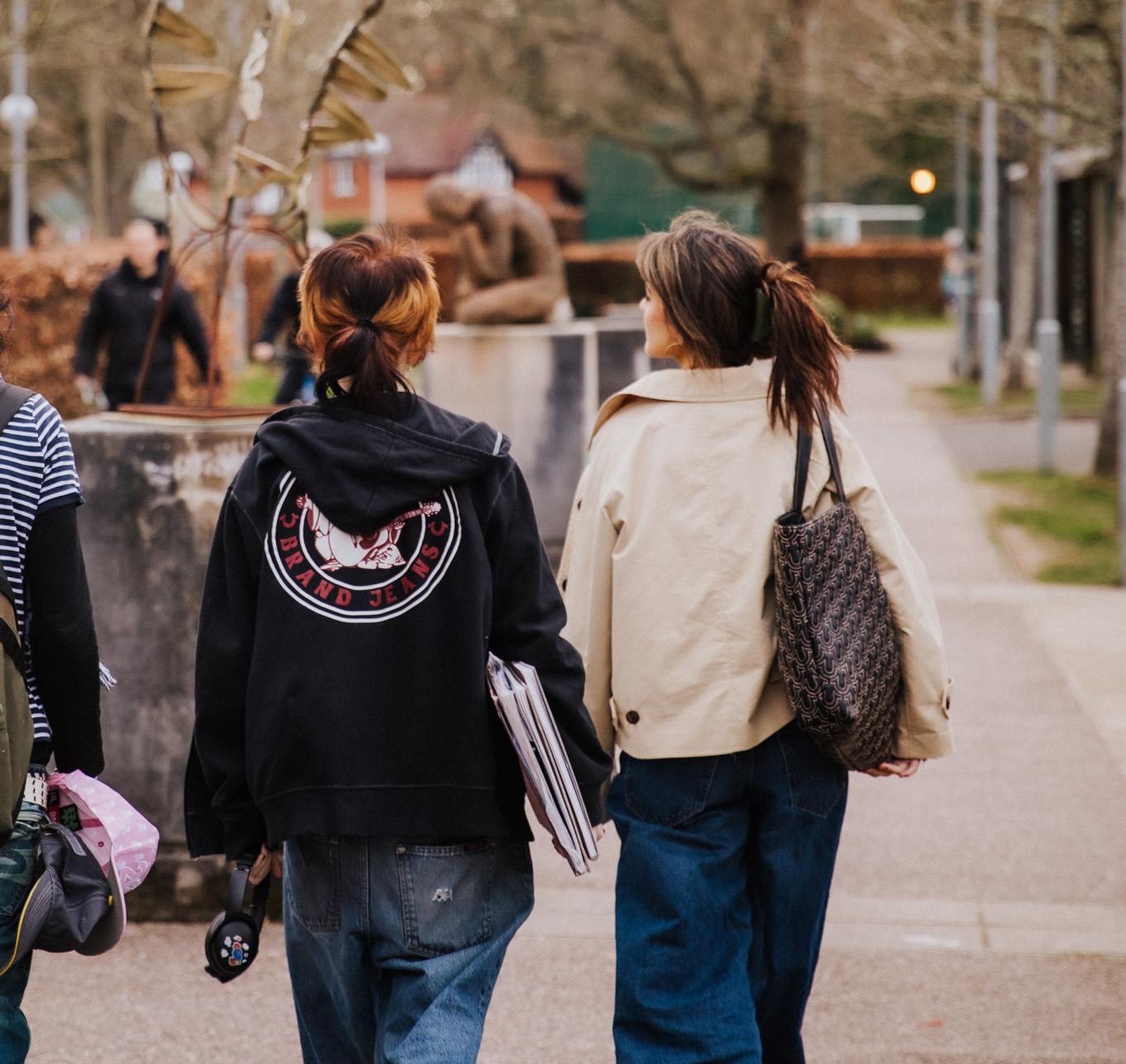
An organisation which champions creativity in all of its forms will naturally become a mecca for creative minds.
This is the backdrop against which Frensham ARCH comes into being. The Academic Research and Collaboration Hub (ARCH) is a sandbox for creative experimentation. It is a space for stakeholders to safely explore ways to enhance the learning, wellbeing and mindset of our students; aligned with our values and ethos, but rooted in evidential practice. It is a space for liberated thinking grounded in research. It is a space which will be at the forefront of the school’s strategic development in years to come and a space which will help to democratise the thought behind this strategic direction. What could be more Frensham?!
The iconic Flottage Arch has been the portal to learning for generations of Frenshamians. Students pass through it as a point of entry to discovery and learning and it therefore feels fitting that our ARCH takes its name from this. It is a structure which is both strong and elegant, rooted in careful design and able to carry weight because each part supports the whole.
Action research bridges the gap between educational theory and actual classroom activity. It invites teachers to focus on an area of their practice, to draw on evidence to try our new methods, and to reflect on the impact of their action or intervention on students.
By embedding it within our practice at Frensham Heights, we will achieve a virtuous cycle in which colleagues find evidencebased means to improve the education of our students and are able to proliferate and share these amongst the staff team more widely. This engages more colleagues in the process of action research and further enhances the experiences of our students. Over time, this will allow Frensham Heights to take up its natural place as a thought leader within the education sector, both within the UK and beyond. Crucially though, we won’t be doing “different” because it’s different, we’ll be doing it because it works.
I have to confess that, on first hearing about the use of action research in an educational setting, I approached with caution. Anyone who has been in teaching for a length of time will have seen cycles of school- or government-led initiatives: some purposeful and effective, even gamechanging, and some rather less so.
Ultimately, we all want our students to have learning experiences that engage and inspire them, and that give them the framework they need to progress, flourish and grow in independence. That depends not only on what we teach, but on continually deepening our understanding of how students learn best. The hope of any academic leader is to foster an embedded culture of professional enquiry, where professional learning is part of the everyday life of the school.
Teachers are naturally reflective and open to new ideas, but they are also time poor. Continuous Professional Development and learning is essential to this process, but to stick, it must be purposeful and targeted. Over the years, I’ve tried to find that elusive combination that genuinely enthuses staff and engages them in meaningful training that meets their needs. Of course, as with teaching, there is no one size fits all.
The real strength of the action research model is that professional development stops being generic and becomes rooted in context: shaped not only by the needs of a particular school, but typically by a specific year group, subject cohort or individual class. Action research is about combining what researchers have discovered within their own classroom context, trying something different and carefully evaluating its impact. What has been most striking in working with our pioneering ARCH projects has been the way it has shifted professional development from something delivered to staff into something generated by staff. When teachers are given the space and structure to undertake their own action research, their professional curiosity is reignited. They begin by investigating a question rooted in their own classroom practice, but the impact rarely stays confined to the page or the formal presentation. Instead, it starts to surface anecdotally in the staff room, in corridor conversations, and in the informal sharing of ideas, reflections and small successes. In many ways, allowing that conversation to continue is the most valuable outcome of all. That, in turn, creates the conditions for authentic professional learning, often leading to training opportunities delivered by colleagues whose expertise has grown through enquiry rooted in practice, rather than external prescription.
so that it can be developed, deepened and drawn upon by others. Giving the ARCH a dedicated home in the Main House Billiard Room, alongside external support from Bill Lucas, has helped lay the foundations for this work and establish a central, managed hub where innovative practices already flourishing at Frensham can be brought together, supported, revisited and developed over time. That foundation is strengthened further by a dedicated member of staff supporting each cohort of teacherresearchers, a regular journal and space for reading, study and reflection. Together, these help make professional enquiry more visible, shared and sustainable across the school. In this way, professional learning becomes something that is built collectively and sustained over time.
The real strength of the action research model is that professional development stops being generic and becomes rooted in context: shaped
not only by the needs of
a particular
school,
but
typically by a specific year group, subject cohort or individual class.
For our students, the ARCH is not simply a research facility; it also gives us a way of thinking more deliberately about the six Frensham Skills and how they are developed over time. As you’ll discover in this journal, the Frensham Skills are the hooks on which all of our action research projects are based. They offer a shared language across the whole school, helping staff and students talk more clearly about growth, learning and the habits we want to nurture. A skills-based education helps ensure that young people leave school with more than qualifications alone; they need to think critically, work with others, communicate clearly, respond creatively and meet challenge with resilience. Just as importantly, the skills give students a language for reflecting on themselves as learners and recognising how they are growing. This is illustrated across this journal, from the ‘productive struggle’ in Year 3’s Hard Time Heroes to the questioning used in Year 12 Psychology to help students identify barriers to learning and develop more independent approaches to problem-solving. Embedding these habits will enable our students to remain lifelong learners, equipping them not only for the rest of their time at Frensham, but for life beyond it too.
That is why the ARCH matters: it can build confidence, connection and momentum around pedagogy across the school and beyond. Creativity, individuality and valuesbased learning have long been central to Frensham’s educational approach, and the ARCH gives us the opportunity to understand more fully the depth of their importance in our school environment. It allows us to explore, with greater rigour, how this approach influences student wellbeing, learning experiences and outcomes.
Over time, this creates a community of practitioners who become known for particular areas of expertise. One of the ARCH’s aims is to capture and share that knowledge
Bill Lucas Professor of Learning University of Winchester
For many students and their parents school is largely defined by the school timetable; a weekly road map of the different subjects that will be studied. Days are framed by, for example, a lesson of English, followed by one in the science lab, in the art studio and then out onto the sports pitch, or, in schools like Frensham, potentially out into the woods. Subject knowledge is what seems to be most important. This emphasis is reinforced as young people get older and examinations loom. At GCSE, BTEC or A-Level, the tests use the language of subject disciplines. Choices begin to be made at age 14 and, whether these are clustered together by words such as ‘humanities’, ‘arts’ or ‘sciences’, the focus is clearly on subject knowledge. Students in England will largely be tested on what they know, in the main, by sitting paper and pencil examinations in various quiet spaces in the Summer.
There’s nothing wrong with knowledge of course. Indeed it is the goal of good schools to cultivate young people who love knowledge so much in many areas of their young lives that they want to go on and study it more deeply at college or university. But it is only one aspect of school life. At least as important are skills; the ability not only to know something but to be able to put that into practice at school, at home and in the wider community.
At its simplest a skill is a ‘learned capacity to do something useful’ (Lucas and Claxton, 2009). But the word skill can somehow seem too unsubtle a concept to distinguish between, say, tying your shoelaces or judging the relative reliability of a primary historical source and a Wikipedia entry or something generated by AI.
There are many kinds of skills which we might want young people to acquire. Some of these will serve them well at school and in examinations - accurately retrieving and transcribing information acquired months ago, sitting still for protracted periods of time, writing certain kinds and amounts of text against the clock. Some will be useful in later life - reading a map on paper or on a device when you are lost, asking for help when stuck, working with people from different cultures and backgrounds, managing emotions when learning is hard. Many have value in both contexts.
For this reason the idea of habits or dispositions may be helpful in seeing how knowledge and skills are closely related, see Figure 1.
Figure 1. From Knowledge and Skills to Dispositions (Lucas, 2017)
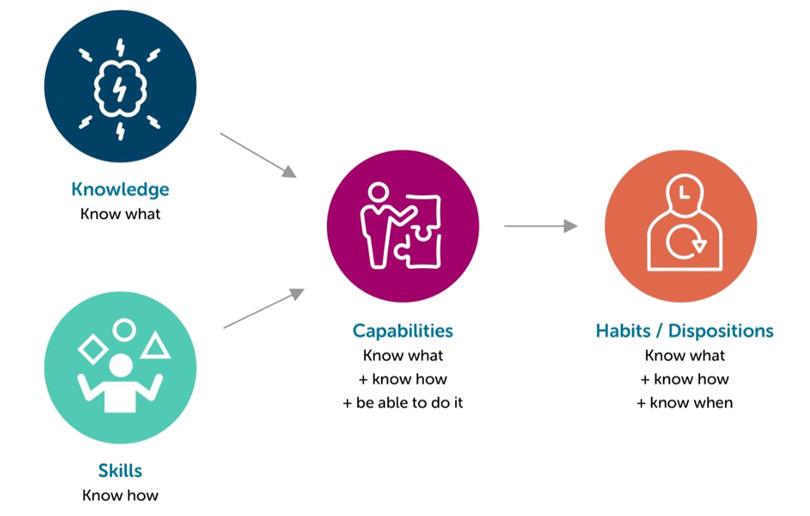
For two decades I have been working with various organisations in Australia where, in addition to knowledge and skills, the curriculum invites educators to think about ‘capabilities’, actually being able to combine knowledge and skills together to be able to undertake meaningful tasks. I suggest we might go one stage further and think not just whether a student ‘can’ do something, but whether they routinely choose to and are capable of doing it in a range of contexts. Whether, in short, they have developed the habits and dispositions necessary for a lifetime of learning.
Recently the Organisation for Economic Co-operation and Development (OECD) has offered a model of education for the decade ahead which seeks to show the relationships between knowledge, skills, attitudes and values, see Figure 2. In the OECD model, knowledge, skills, attitudes and values are seen as interconnected and interacting to produce competencies. Competencies are, in effect, knowledge, skill, values and attitudes in action.
2. The Future of Education and Skills: OECD Education 2030 Framework (OECD, 2016)
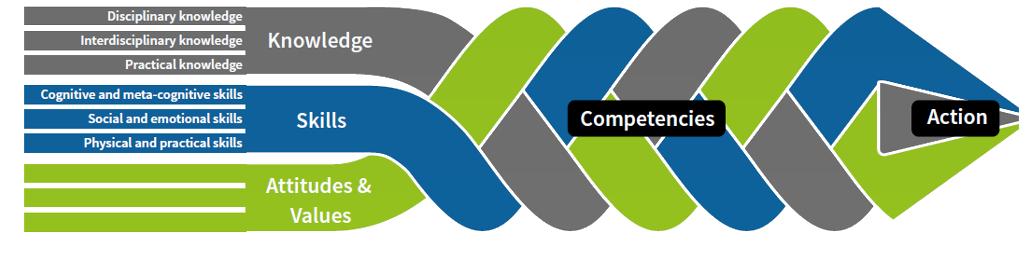
The OECD model helps us to appreciate that knowledge can be interdisciplinary as well as disciplinary; indeed many of the challenges we face as a society today will involve many different knowledge systems, if, for example, we are going to understand and reduce global warming. Skills are cognitive and metacognitive, that’s to say being able, for example, to focus our attention on a particular problem and being able to call on a range of learning strategies when faced with a novel challenge. They are social, working with others on a task, and emotional, managing our feelings as we do so. Both knowledge and skills have a practical component, something so easily overlooked in some schools where this is relegated to a second tier aspect of what it is to be human.
Employers and universities know all of this, regularly reminding us that schools are not preparing young people with the skills that they need. Parents know this, especially those who, like I did, choose Frensham for the education of their own children in search of a more expansive educational experience.
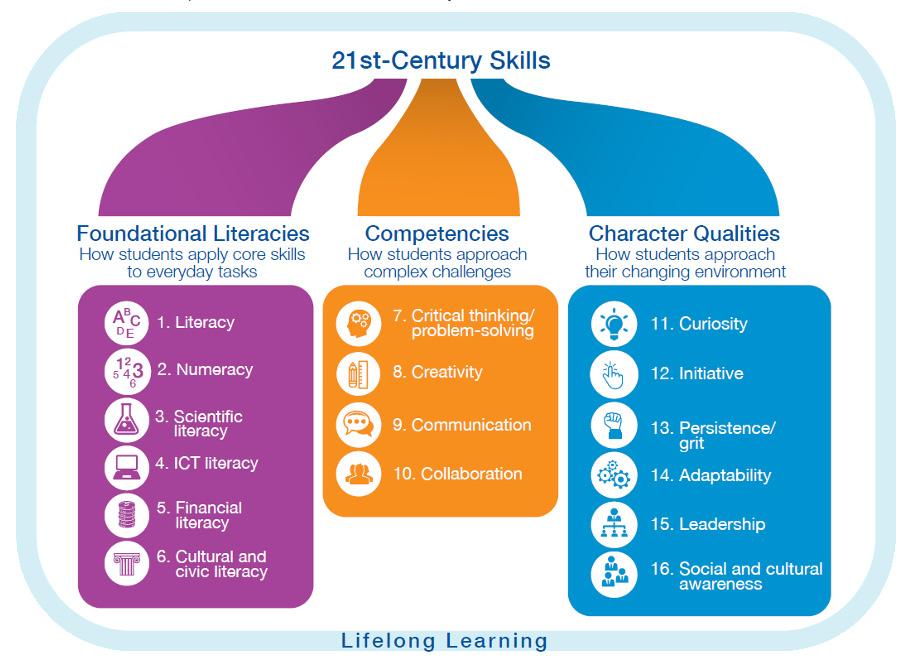
Mirroring the approach adopted by the OECD, the World Economic Forum suggests that there are a number of skills which learners will need in order to face the challenge of this century, see Figure 3.
Personally I find the idea of 21st Century Skills an unhelpful one, implying as it does a hundred year period in which our skill needs remain the same. Having lived through COVID and the invention of AI this seems ludicrously unbelievable. As a researcher, I would prefer to see evidence for any such listing of desirable skills. In a recent review (Lucas, 2019), I listed some of the evidencebased frameworks which have been developed over the past two decades, see Table 1.
• Communication in mother tongue
• Communication in foreign languages
• Digital competence
• Learning to learn
• Social and civic competences
• Sense of initiative and entrepreneurship
• Cultural awareness and expression
• Critical thinking
• Information literacy
• Reasoning
• Innovation
• Intellectual openness
• Work ethic
• Conscientiousness
• Positivity
• Communication
• Collaboration
• Responsibility
• Conflict resolution
• Motivation
• Perseverance
• Self-control
• Metacognitive strategies
• Social competencies
• Resilience and coping
• Creativity
• Perseverance
• Self-control
• Trust
• Attentiveness
• Self-esteem and self-efficacy
• Resilience to adversity
• Openness to experience
• Empathy
• Humility
• Tolerance of diverse opinions
• Engaging productively in society
• Critical thinking
• Creativity
• Metacognition
• Problem-solving
• Collaboration
• Motivation
• Self-efficacy
• Conscientiousness
• Perseverance
Drawing on these arguments and building on the traditions of Frensham’s approach to learning over a long while, the school has settled on six key skillsCreativity, Teamwork, Problem-solving, Communication, Independence and Commitment, see Figure 4.
Creativity is imagination and curiosity in action. It assumes that students can have a good idea when they need one while recognising that their first idea is rarely the best one. Phrases associated with creativity include ‘playing with possibilities’, ‘making connections’, ‘generating ideas’, ‘challenging assumptions’ and ‘focusing on improvement’.
Teamwork is the act of working together for a common goal. It assumes that almost all we do involves working with others and that this requires us to engage purposefully in shared tasks where different personality types interact. Phrases associated with teamwork include ‘cooperating appropriately, ‘giving and receiving feedback’, ‘valuing others’ ‘keeping track’ and ‘taking responsibility’.
Problem-solving involves identifying challenges and coming up with solutions to achieve a desired goal. Solving problems and thinking critically is what has helped human beings to survive and thrive. Phrases associated with problem-solving include ‘generating possible solutions’, ‘critical thinking’, ‘exploring and investigating’, ‘using intuition’ and ‘evaluating options’.
Communication is the verbal and non-verbal process of exchanging information, ideas, thoughts, and feelings. Effective communication builds trust, develops understanding and is at the heart of effective relationships. Phrases associated with communication include ‘conveying feelings and thoughts’, ‘adapting to different audiences’, ‘recognising purpose’, ‘organising thoughts’ and ‘checking understanding’.
Independence in learning involves proactively taking ownership and responsibility for your learning. Learners who are independent know how to motivate themselves and when to ask for help. Phrases associated with independence include ‘setting goals’, ‘reflecting on progress’, ‘knowing yourself as a learner’, ‘managing distractions’ and ‘talking about the learning process’.
Commitment in learning involves the dedication, focus and perseverance consistently to engage and achieve goals, even when faced with challenges. Increasingly this kind of commitment is referred to as ‘growth mindset’, believing that you can improve through effort and practice. Learning from mistakes and bouncing back from setbacks are key to success in life. Other phrases associated with commitment include ‘sticking with difficulty’, ‘practising deliberately’, ‘tolerating uncertainty’, ‘being absorbed’ and ‘managing distractions’.


In the four pieces of action research which follow you will see how teachers have deliberately asked themselves how best they can support learners to develop one or more of these Frensham skills as well as acquiring subject based knowledge.
In the next year Frensham Junior School will be exploring the best ways of ensuring that the Frensham Skills will be embedded in the curriculum and that teaching and learning methods give children the fullest range of experiences to learn how to practise these skills in a range of different contexts.
With the ARCH in place, we will be looking to evaluate everything carefully so that we can learn from the very best practices in the world.
European Commission. (2007). Key competences for lifelong learning: European reference framework. Luxembourg: Office for Official Publications of the European Communities.
Gutman, L., and Schoon, I. (2013). The Impact of Non-Cognitive Skills on Outcomes for Young People: Literature review. London: Institute of Education, University of London.
Heckman, J., and Kautz, T. (2013). Fostering and Measuring Skills: Interventions that improve character and cognition - NBER Working Paper No. 19656. National Bureau of Economic Research.
Lamb, S., Maire, Q. and Doecke, E. (2017). Key skills for the 21st century: an evidence-based review. Sydney: Centre for International Research on Education Systems.
Lucas, B. and Claxton, C. (2009). Wider skills for learning: what they are, how they can be cultivated, how could they be measured and why are they important for innovation. London: National Endowment for Science Technology and the Arts.
Lucas, B. and Smith, C. (2018). The Capable Country: Cultivating capabilities in Australian education, Mitchell Institute policy report No. 03/2018. Melbourne: Mitchell Institute.
Lucas, B. (2019). Why we need to stop talking about twenty-first century skills. Melbourne: Centre for Strategic Education.
Organisation for Economic Co-operation and Development (2016). Global competency for an inclusive world. Paris: Organisation for Economic Co-operation and Development.
Pellegrino, J. and Hilton, M (eds) (2012). Education for Life and Work: Developing transferable knowledge and skills in the twenty-first century. Washington: National Research Council.
World Economic Forum (2015). New Vision for Education: Unlocking the Potential of Technology. Geneva: World Economic Forum.
Bill Lucas is Professor of Learning at the University of Winchester, a well-known educational reformer and an international expert on curriculum and assessment. For a number of years he has been advising Frensham.
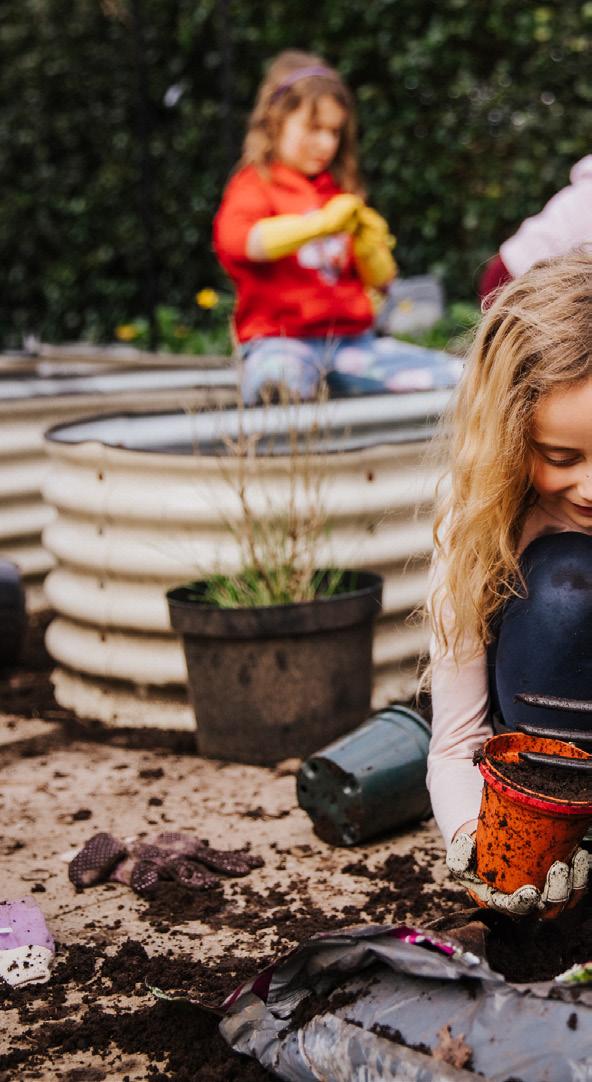
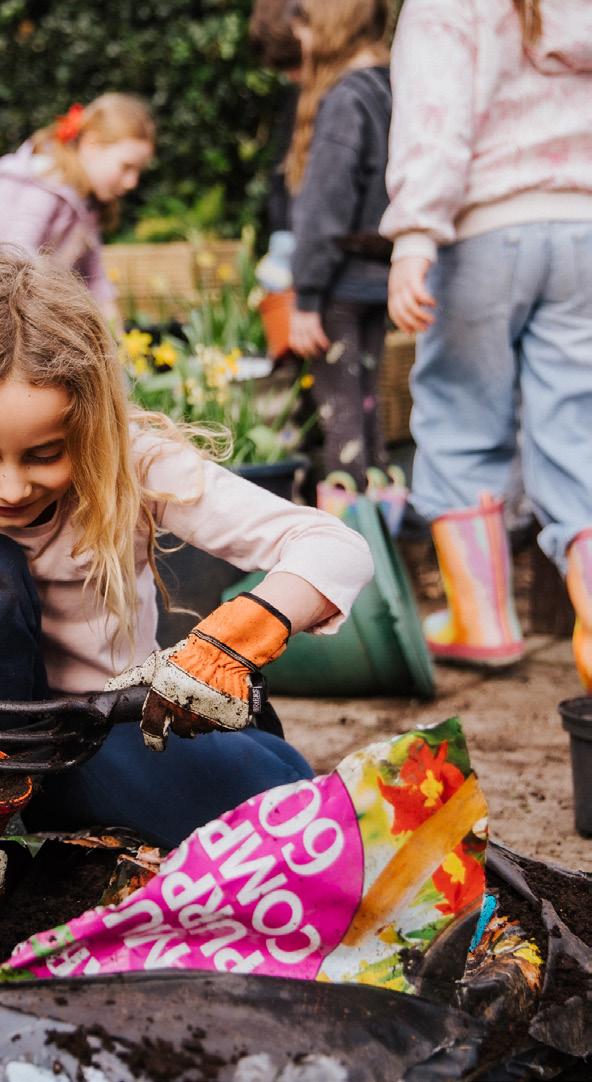
I am a Year 3 teacher at Frensham Heights Junior School. Year 3 are a cohort of 20 children supported by two teachers. This action research project was undertaken with a focus on developing the Frensham skill of commitment, alongside independence and creativity.
I have always been particularly interested in early childhood education and the idea that the foundations laid in the early years of schooling can have a lasting impact. There is a well-known belief that if we can support children in developing strong learning behaviours early on, we set them up for future success (Siraj-Blatchford et al., 2002). This project offered an opportunity to explore that idea more deeply within my own classroom practice.
Alongside this, there is increasing discussion in both education and the wider world about the skills children will need in the future (Lamb et al., 2017). With rapid technological change and growing awareness of children’s mental health and wellbeing, skills such as resilience, adaptability and independence are becoming ever more important. Within this, commitment stands out as a key driver, underpinning a child’s ability to engage, persist and ultimately succeed in their learning. If we can strengthen this at an early stage, there is a strong argument that any child can succeed across a wide range of areas.
Commitment stands out as a key driver, underpinning a child’s ability to engage, persist, and ultimately succeed in their learning.
Within my classroom, I had noticed that while students were capable, their responses to challenge varied. While some children were able to articulate growth-mindset ideas (Dweck, 2006), such as the importance of effort and perseverance, but did not consistently apply them in practice, others displayed a more fixed mindset at times, occasionally avoiding difficulty or giving up quickly.
the language of growth mindset and instead embed these behaviours into everyday classroom practice?
Drawing on a range of reading around resilience, mindset and early learning, it is widely suggested that one of the most powerful foundations we can give children is a growth mindset. Research by Carol Dweck (2006) highlights that when children understand that their abilities can be developed through effort, they are more likely to embrace challenge and persist when learning becomes difficult. In contrast, a fixed mindset can lead children to focus primarily on outcomes, where mistakes or struggle are seen as failure rather than part of the learning process.
Dweck argues that “the wrong kind of praise creates selfdefeating behaviour, [whereas] the right kind motivates students to learn,” (Dweck, 2007, p.34), reinforcing the importance of how adults frame effort and success. This idea is echoed in more recent research, which suggests that students who view intelligence as malleable are more likely to value effort and demonstrate greater engagement and perseverance in learning tasks (Blackwell et al., 2007; Dommett et al., 2013). A recent primary-based study further supports this, showing that when children develop more positive beliefs about effort, they are more likely to persist and engage with challenging learning (Dorgnier et al., 2025).
Research into effective classroom practice suggests that growth-mindset interventions are most successful when they move beyond passive messages and are embedded in everyday learning. A review of growth mindset in K–8 education (Yeager & Dweck, 2020; Haimovitz & Dweck, 2017) highlights the importance of providing students with concrete strategies and opportunities to actively engage with challenge, rather than simply being told to “try harder”. Approaches such as reflection, discussion and writing about learning have been shown to support students in internalising the connection between effort and improvement.
Across the class, there was also a tendency for students to rely on adult support, often seeking reassurance or help before fully engaging with a task. This is not unusual at this age, particularly as children are still developing the foundations of their learning behaviours. However, it prompted reflection on whether these behaviours could be strengthened further.
This led to a key question: how can we move beyond simply teaching
In addition, research emphasises the importance of creating a classroom environment where mistakes are normalised and risk-taking is encouraged. When teachers explicitly frame challenge as a positive part of learning, and use feedback that focuses on process rather than outcome, students are more willing to persist and take risks (Dweck, 2006). This includes establishing consistent classroom routines that reinforce these messages over time.
While much of this research spans a broad age range, there is comparatively less focus on how these approaches translate into practical, repeatable routines for younger primary students. This project, therefore, aimed to explore how these principles could be applied effectively within a Year 3 classroom, with a particular focus on developing commitment, independence and resilience through structured challenge.
If I introduce structured, repeatable challenge routines, will I see gains in commitment, resilience, and independence?
The primary focus of this project was commitment, with additional links to independence and creativity. These skills align closely with the school’s emphasis on developing well-rounded, resilient learners.
A range of strategies were explored, informed by research into growth mindset and classroom practice. Four approaches were identified: three were embedded regularly, while the final served as a culminating challenge to apply these learning behaviours.
A weekly “challenge time” was introduced, where children engaged in deliberately difficult tasks. Sessions focused on learning different knots, with a new knot each week to provide consistency and progression.
The class was split into two groups: one learned with guidance, while the other observed and then learned through peer teaching. Roles were swapped weekly, ensuring all children experienced both learning and teaching.
To support students further, broader skills such as resilience were broken down into small, achievable steps and presented visually through a simple progress ladder. After each session, the children reflected on where they felt they were on this ladder and identified next steps for improvement. Self-talk prompts were also introduced, with children selecting and ticking the strategy they intended to use in the following session (for example, ‘keep going’, ‘try a new way’ or ‘stay calm’). These small, practical tools were designed to embed habits that could help maintain focus and perseverance when tasks became difficult.
Teacher support was intentionally reduced to encourage greater student ownership and resilience when faced with challenge. A number of strategies were introduced, including “Ask Three Before Me” (Phillips & Chen, 2015), peer-coaching approaches, teacher modelling, and structured opportunities for students to give one another supportive and constructive feedback.
Alongside this, I made a conscious effort to explicitly model independent thinking and problem-solving across all areas of classroom life. This included verbalising thought processes, demonstrating positive self-talk, and showing students how to work through difficulties stepby-step. These approaches were modelled in a range of contexts, from learning to tie knots and spelling unfamiliar words to resolving disagreements between friends.
Together, these strategies encouraged students to attempt solutions independently, draw on peer support and persist for longer before seeking adult help.
Students were encouraged to slow down, think through tasks and plan before starting, rather than rushing or seeking immediate help. The phrase “Slow is Smooth, Smooth is Fast” introduced through discussion with my colleague Sam and commonly associated with military training and Special Operations environments (Morris, 2023), was used as a classroom mantra to reinforce the value of calm, deliberate thinking. This supported more thoughtful problem-solving and reduced the tendency to give up when work became challenging.
Drawing on Ron Berger’s work on critique, drafting and “an ethic of excellence” (Berger, 2014), students completed a final challenge involving drafting and revising a flat projection of the world map, linking to geographical mapping skills.
Through feedback, reflection and redrafting, students improved their work over multiple attempts. Students were encouraged to give clear, constructive feedback, drawing lightly on the idea of “radical candour” balancing honesty with care and support (Scott, 2017). Time was also spent explicitly discussing how to give and receive feedback positively.
The focus was on improvement over time, reinforcing that high-quality work is developed through persistence and revision.
A range of methods were used to collect data throughout the project. An initial student survey consisting of ten questions was used to assess attitudes towards challenge, resilience and learning behaviours (see Appendix 1). The same survey was then repeated at the end of the intervention period to help identify changes over time. In addition, student interviews and reflections were gathered (see Appendix 2), alongside ongoing teacher observations recorded during classroom activities and challenge sessions. Evidence from student work, particularly the Austin’s Butterfly style drafting task, was also used to evaluate progress and engagement.
A short parent questionnaire was also administered following the intervention period to gather parental perspectives on changes in children’s resilience, perseverance, confidence and attitudes towards challenge. This provided an additional qualitative data source and allowed comparison between school observations and experiences noticed at home.
Together, these methods provided both quantitative and qualitative insights into student development.
Students’ attitudes towards commitment developed positively over the course of the intervention. Baseline survey responses suggested three main areas for development: independence, willingness to embrace challenge, and confidence in seeking solutions without immediate adult support. While some children were able to articulate growth-mindset ideas, such as the importance of effort and perseverance, they did not always consistently apply them in practice; others displayed a more fixed mindset at times, occasionally avoiding difficulty or giving up quickly.
Table 1 presents the baseline questionnaire responses collected prior to the intervention.
Table 2 shows the post-intervention questionnaire responses, which indicate a positive shift in students’ attitudes towards challenge and learning. The number of children rating themselves highly increased across several areas, particularly in resilience, pride in completing difficult tasks, and willingness to undertake more challenging work. Students also showed greater confidence in using peer support before seeking help from the teacher.
When something is hard, I like to keep trying
2. If I can’t do something yet, I believe I will get better with practice
3. When I make a mistake, I try to learn from it
4. I like to find different ways to solve a problem
5. I
6. I feel proud when I work
7. I use “can-do” words (yet, keep trying, I can
8. I like it when work makes me think hard
9. When I finish something quickly, I like to make it better or try a harder version
10. I help others learn by giving kind feedback
Table 3 compares the pre- and post-intervention data directly and highlights the overall improvements across the ten survey areas.
Classroom observations supported these findings. During the first Hard Time Heroes session, many children found the task highly challenging. Some became frustrated or upset, with comments such as “I can’t do this” and “this is stupid.” This highlighted how unfamiliar sustained struggle was for some children. However, over the course of the term, many students began to look forward to these sessions. Greater excitement, encouragement and collaboration were evident, with students increasingly keen to help one another and celebrate success as a group.
Importantly, students appeared to take pride not only in successfully mastering a knot themselves, but also in teaching a classmate how to do it. This suggested growing confidence, patience and a shift towards valuing the learning process rather than simply the final outcome.
Students’ own reflections also illustrated this change. Comments included: “I feel happy and excited when I do hard work,” “I can do harder things,” and “I tell my brain to keep going.” These responses suggest that students were beginning to internalise the language and behaviours associated with growth mindset.
Parent feedback also suggested that these learning behaviours were beginning to transfer beyond the classroom environment. Several parents commented on increased perseverance, confidence and willingness to attempt difficult tasks at home. Parents also noted that children were beginning to use the language and routines from the project independently in everyday situations. One parent observed a “big uptick in taking on other challenges in home life and being less afraid to try new things,” while another commented on “less inward doubting, more pulling up of socks and giving it a go.” Others reflected on students’ growing pride in helping others and their ability to persist through difficulty, with one child reportedly saying that they “hadn’t mastered it
yet but… wasn’t giving up.” The phrase “Slow is smooth, smooth is fast” was also described by one parent as becoming “part of his everyday vocabulary in many contexts”. These responses suggested that aspects of the intervention may have had a wider impact on students’ attitudes and behaviours beyond the classroom.
The final Austin’s Butterfly challenge provided further evidence that these learning behaviours were transferring into curriculum work. Students were asked to draft and refine a flat projection of the world map through multiple attempts. Across the task, geographical knowledge clearly increased, particularly students’ recall of the names and positions of continents. The quality of peer feedback also improved, with greater emphasis on clear and specific “radical candour” comments to help others improve. Just as importantly, students showed an increasing willingness to revisit their work and try again.
This project highlighted that developing commitment and resilience requires more than simply teaching the language of growth mindset. Children benefited most when they were given regular, structured opportunities to experience challenge and practise positive learning behaviours over time.
One key lesson was the importance of consistency. Simple routines such as Hard Time Heroes, peer support and reflective language became more effective when repeated regularly. Over time, many children began to approach challenge with greater confidence and were more willing to persist when tasks became difficult.
Perhaps the most significant learning point from the project was the enthusiasm students developed towards both challenge and teaching others. Over time, Hard Time Heroes evolved from a difficult weekly task into something many students genuinely looked forward to. A noticeable shift occurred when children began taking pride not only in mastering a knot themselves,
but in successfully helping a peer to achieve it. For some students, this appeared to be a genuine “penny drop” moment, where resilience and perseverance became closely linked to confidence and belonging within the classroom community. The process of peer teaching deepened understanding while also building empathy, patience and ownership over learning.
Parent feedback further reinforced this. Several parents commented on increased willingness to take on challenge at home, greater perseverance, and children independently using the language and strategies introduced during the project. This suggested not only that the approaches were meaningful to children, but that there may also be a wider appetite amongst families for schools to explicitly develop these learning behaviours alongside academic outcomes.

Alongside this, the project reinforced the value of reducing immediate adult support. While some children initially sought reassurance quickly, many became more willing to think independently, draw on peer support and solve problems for themselves when clear routines were in place.
A further learning point was that emotional responses to challenge should not always be avoided. Early frustration during difficult tasks often became an important starting point for later pride, perseverance and success. Allowing students to work through manageable struggle within a supportive environment appeared to build confidence over time.
There were, however, limitations. Time within a busy school week made it difficult to sustain every strategy consistently, and not all students responded in the same way or at the same pace. Some children continued to need significant support when faced with challenge.
Going forward, several approaches from this project will continue to form part of classroom practice, including Ask Three Before Me and Slow is Smooth, Smooth is Fast. As a whole school, there is also growing interest in creating challenge activities at the start of the academic year, where children can experience productive struggle, collaboration and reflection from the outset. This project suggests that the most important factor may be giving children regular opportunities to practise these behaviours and reflect on their progress.
Overall, this project has reinforced my belief that when children develop commitment, resilience and independence early, these foundations can positively shape learning far beyond the classroom. Professionally, the experience has encouraged me to reflect more deeply on my own classroom practice and to question the routines, language and approaches used day to day. Being part of a research project beyond the immediate demands of classroom teaching has been both motivating and fulfilling, providing valuable space for reflection and professional growth. Perhaps most importantly, it reinforced the importance of creating classroom environments where children can increasingly take ownership of their own learning.
As Maria Montessori observed, “The greatest sign of success for a teacher is to be able to say, ‘The children are now working as if I did not exist’” (Montessori, 1967).
This
project suggests that the most important factor may be giving children regular opportunities to practise these behaviours and reflect on their progress.
Blackwell, L., Trzesniewski, K., & Dweck, C. (2007). Implicit theories of intelligence predict achievement across an adolescent transition: A longitudinal study and an intervention. Child Development, 78(1), 246–263.
Berger, R. (2014). Ethic of Excellence: Building a Culture of Craftsmanship with Students. Portsmouth, NH: Heinemann.
Dommett, E., Devonshire, I., Sewter, A., Greenfield, S., et al. (2013). The impact of participation in the Brainology programme on pupils’ mindset and attitudes to learning.
Dorgnier, R., Mazerolle, M., Maquestiaux, F., & Picard, L. (2025). Enhancing primary school learning through growth mindset and memory strategy interventions. The Journal of Educational Research, 118(1).
Dweck, C. S. (2006). Mindset: The New Psychology of Success. New York: Random House.
Dweck, C. (2007). The Perils and Promises of Praise. Educational Leadership, 65(2).
Haimovitz, K., & Dweck, C. S. (2017). The origins of children’s growth and fixed mindsets: New research and a new proposal. Child Development.
Lamb, S., Maire, Q. & Doecke, E. (2017). Key skills for the 21st century: an evidence-based review. Sydney: Centre for International Research on Education Systems.
Mindset Works. (2021). Brainology Programme. Available at https://sites.google.com/mindsetworks.com/ mindsetworks/
Montessori, M. (1967). The Discovery of the Child. New York: Ballantine Books.
Morris, D. (2023). Slow is smooth, smooth is fast: The role of deliberate practice and calm decision-making in performance environments.
Phillips, W. & Chen, B. (2015). ‘Use three-before-me as a communication strategy in a large class.’ In B. Chen & K. Thompson (Eds.), Teaching Online Pedagogical Repository. Orlando, FL: University of Central Florida Center for Distributed Learning. Available at: https:// topr.online.ucf.edu/three-before-me/.
Scott, K. (2017). Radical Candor: Be a Kick-Ass Boss Without Losing Your Humanity. New York: St. Martin’s Press.
Siraj-Blatchford, I., Sylva, K., Muttock, S., Gilden, R. & Bell, D. (2002). Researching Effective Pedagogy in the Early Years (REPEY). DfES Research Report 356. London: Department for Education and Skills / Institute of Education, University of London
Yeager, D., & Dweck, C. (2020). What can be learned from growth mindset controversies? American Psychologist, 75(9), 1269–1284.
Asking for help (Peers and Adults)
• When you’re stuck, how do you decide who to ask first?
• What feels easier about asking an adult than a friend?
• Is there ever a time you would ask a friend first? What makes that work?
• What do you worry might happen if you ask a friend for help?
• What does good help from a friend sound like to you?
Thinking hard and challenge
• What does ‘thinking hard’ feel like for you?
• How do you know when work is too hard versus helpfully hard?
• Can you think of a time when thinking hard felt good?
• What helps you stay with something when your brain feels tired?
• When thinking gets tricky, what do you usually do next?
Extending and improving work
• What do you usually do when you finish your work?
• How do you decide whether to stop or keep going?
• What makes you want to make your work better?
• Do you ever worry about making your work worse if you change it?
• What helps you feel brave enough to try the harder version?
Learning from mistakes
• What do you feel first when you make a mistake?
• What do you usually say to yourself in that moment?
• What helps you move on after a mistake?
• Are some mistakes harder than others? Which ones?
Self-talk and learning language
• What words help you when learning feels tricky?
• Do you say those words out loud, in your head, or both?
• Where did you learn those words?
• Are there any words that don’t help you?
I am a Year 5 teacher with five years of experience and currently coordinate Science at Frensham Heights School, giving me both classroom-level insight and responsibility for curriculum development. As part of my action research, I focused on planning and delivering Year 5 science lessons using a Project-Based Learning (PBL) pedagogy, in contrast to the traditional teacherled approaches that had previously characterised my practice. This inquiry was situated within a wider wholeschool shift in the Junior School towards a more projectbased curriculum, providing a timely opportunity to critically explore the rationale, effectiveness and practical implementation of PBL. The research aimed to evaluate its impact on student engagement, understanding and independence, while also supporting my own professional development as I adapted to a more student-centred, inquiry-driven approach to teaching science.
There is increasing interest within the school in adopting interdisciplinary and project-
based approaches
Within the current school context, there is concern that children are disengaging from subject-specific vocabulary, which is essential for progression in science. As identified in my action plan, “children lose interest in learning subject-specific vocabulary which impairs further learning in the subject area”. This suggests that traditional teaching methods may not be sufficiently engaging or relevant because, despite giving instructions for children to follow, it is hard to observe them generalise the vocabulary and understanding. Figure 1 is a representation of the traditional teaching method used in my teaching.
At the same time, there is increasing interest within the school in adopting interdisciplinary and project-based
approaches. Teachers recognise the potential of PBL to make learning more meaningful but express uncertainty about how to structure projects effectively.
To address this, this research draws not only on academic literature but also on established PBL models. In particular, the PBLWorks “Tiny House” project (n.d.) provided a useful example of how real-world challenges, student voice and structured inquiry can be combined. The project demonstrates how children can engage deeply with learning when they are tasked with designing solutions to authentic problems, supported by clear scaffolding and iterative feedback.
Current practice in my classroom has largely been shaped by teacher-led instruction, which provides clear structure and supports efficient curriculum coverage, but can limit opportunities for sustained inquiry, independence and deeper application of knowledge.
Guidance from PBLWorks promotes a model of highquality PBL centred on sustained inquiry, authenticity, and student voice, positioning the teacher as a facilitator rather than a transmitter of knowledge. While this framework is compelling, it can appear idealised and assumes significant teacher expertise, time for planning, and access to appropriate resources, which may not always be feasible in everyday classroom contexts.
Similarly, Lucas and Spencer (2017) emphasise the development of “habits of mind,” such as resilience and critical thinking, arguing for pedagogies that move beyond content acquisition. However, this raises a tension between fostering these broader competencies and ensuring coverage of prescribed curriculum content, particularly in subjects like science where conceptual knowledge is cumulative. Further evidence from the meta-analysis by Zhang and Ma (2023) suggests that PBL can have a positive impact on student learning, particularly in relation to higher-order thinking and retention. Nonetheless, the study also highlights
Think about science lessons you’ve had before. Tick what sounds most like your experience:
The teacher explains first and we write notes
follow instructions to do an experiment
answer questions from a book or worksheet
work on a project to solve a real problem
ask questions and investigate our own ideas
variability in outcomes, noting that poorly structured PBL can lead to misconceptions or superficial understanding if not carefully scaffolded. Taken together, the literature suggests that while PBL offers a valuable and researchinformed alternative to traditional practice, its success is contingent on thoughtful implementation, balancing inquiry with explicit instruction and maintaining a clear focus on both knowledge and skills development.
If Project-Based Learning is used to teach Science in Year 5, will it improve students’ creativity, as well as collaboration and critical thinking?
The intervention consisted of a Project-Based Learning (PBL) unit on Forces, delivered over a half-term in Year 5 Science. In contrast to traditional teacher-led instruction of vocabulary, the project was designed using principles from the PBLWorks framework, with a particular emphasis on student interest, authenticity and iterative learning.
Before planning the unit, students were asked about their favourite activities and hobbies to identify meaningful contexts for learning. Many students chose sports and playground-based activities, including football, netball, playground games and go-karting. These interests informed the overall design of the project and ensured that learning was grounded in experiences that were relevant and motivating for students.
Drawing on guidance from the PBLWorks framework, the unit was structured around a driving question: “How can understanding forces help players perform better?” This
question provided a clear purpose for learning and linked scientific concepts directly to real-world application.
The project began with an event in which students participated in their chosen activities. Photographs were taken during these sessions, capturing actions such as kicking, shooting, stopping, sliding and swinging. These images were later used as discussion prompts to help students identify and analyse the actions involved, see Figure 2.
Following this, students were introduced to key curriculum vocabulary related to forces, including friction, gravity, air resistance, balanced forces, and contact forces. Vocabulary was taught through a range of practical and visual approaches, including videos, demonstrations and science investigations. For example, students used Newton meters to measure the friction produced by different shoes on different surfaces. These practical investigations enabled students to experience forces directly before applying the terminology in context.
An important feature of the project was its iterative structure, influenced by exemplar PBL models such as the PBLWorks “Tiny House” project. After developing initial understanding through practical inquiry, students revisited the photographs from their sporting activities and identified the scientific forces taking place within them. This process of returning to prior experiences with deeper knowledge supported both conceptual understanding and vocabulary retention. The iterative approach also balanced student autonomy with structured guidance, allowing students to refine their thinking over time.
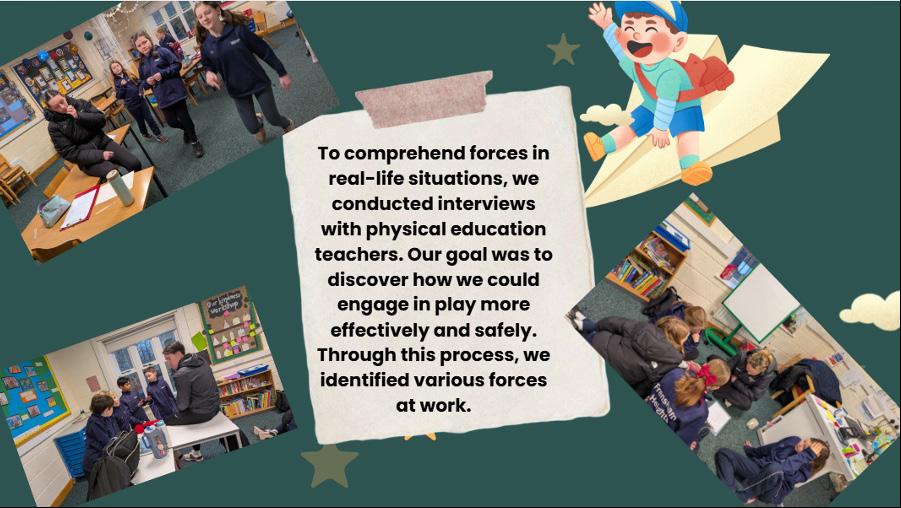
To further strengthen authenticity, students met with PE teachers to discuss how an understanding of forces could improve performance within their chosen activity. During
Figure 2. Identifying Forces in Children’s Activities
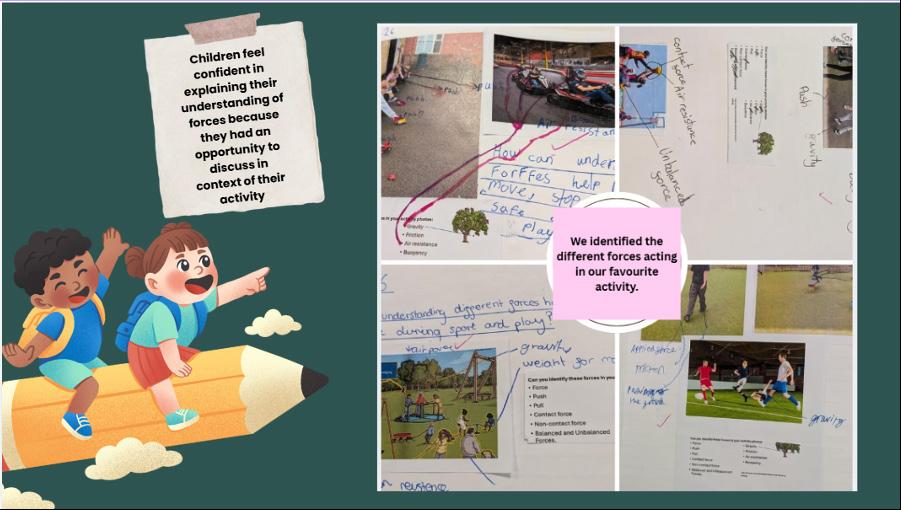
these discussions, students demonstrated increasing confidence in using subject-specific vocabulary to explain ideas and ask questions, see Figure 3. Informal observations of these conversations suggested that students were beginning to apply scientific language more naturally and accurately.
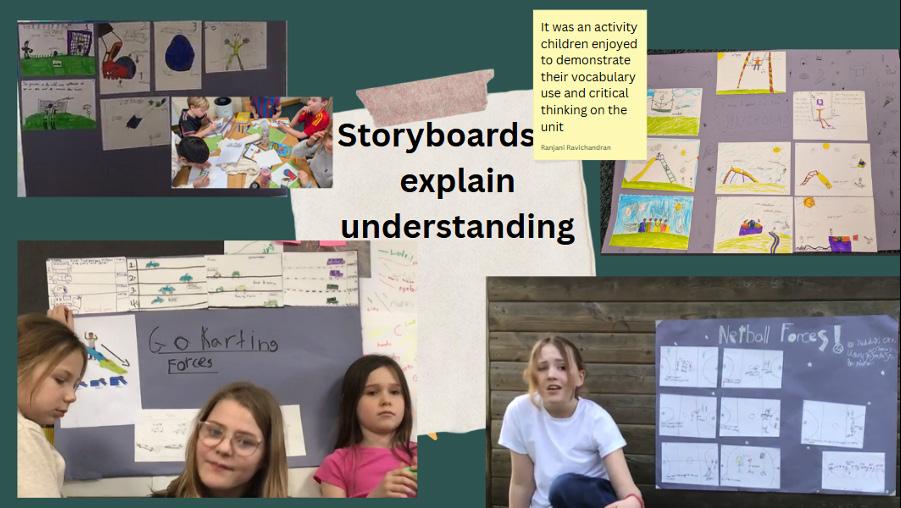
Students then applied their learning creatively by producing story boards explaining the forces involved in their chosen activity, alongside video presentations
designed to communicate their findings in engaging ways, see Figure 4.
Maintaining student choice and creativity throughout the process helped sustain motivation and ownership of learning.
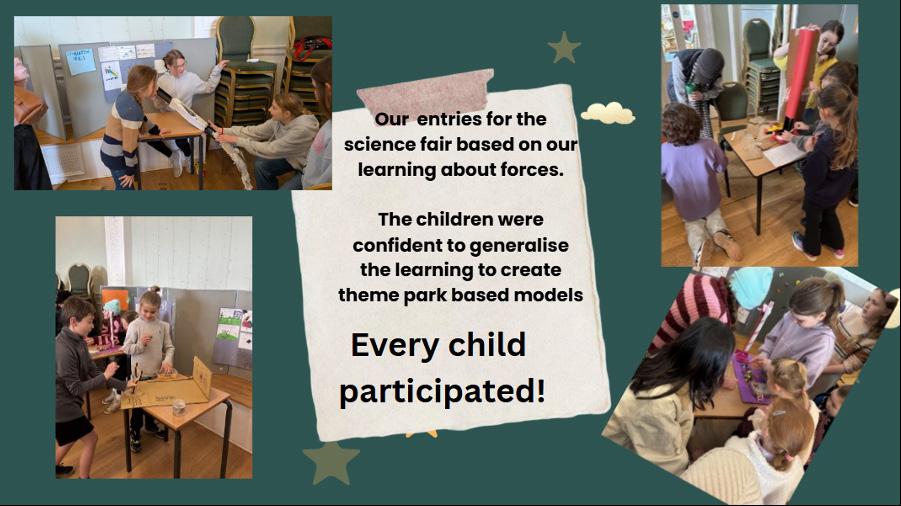
Finally, students transferred and generalised their understanding of forces by designing and creating theme park models for the school science fair, see Figure 5. Each model focused on a dominant force and required students to explain the scientific principles behind their design choices. These activities were completed collaboratively in groups, providing opportunities to develop teamwork, communication, and problem-solving skills alongside scientific understanding.
Data was collected using a mixed-methods approach. This included evidence of students’ work, their models and presentations, observational notes made by staff capturing engagement, behaviour and participation, students’ own reflections and interviews, pre- and postassessment of creativity via a questionnaire and feedback from teachers, students and parents.
Within only half a term it was possible to notice a number of positive benefits from the PBL approach adopted.
Students showed significantly higher levels of engagement compared to traditional lessons. The use of real-world contexts and personal interests seemed to make their learning more meaningful: engagement was noticeably higher than in worksheet-based lessons with students showing excitement towards real-world application and design opportunities. Like the “Tiny House” model, where students engage with authentic challenges, students in this study were motivated by the opportunity to create something unique and relevant to their lives.
Creativity, as evidenced by rubric scores and student work, improved across the class, students demonstrated engagement to understand the applied forces, creative application of scientific concepts to construct models and innovative presentation of ideas.
The open-ended nature of PBL, combined with structured guidance, allowed students to explore multiple solutions rather than seeking a single correct answer. One child remarked that, while I normally told them what to do, it was surprising that this time the children were telling me and asking questions to build their models for the science fair. Figure 6 shows the children’s response to whether they had the opportunity to be creative.
Feedback from other staff also highlighted the quality of student outcomes, noting that students produced “detailed and thoughtful work” and demonstrated increasing independence in developing their ideas.
I showed my learning in a creative way (drawings, diagrams, models, explaining)
Collaboration was a key strength of the project. Students worked together to plan investigations, share ideas and solve problems. This mirrors the collaborative nature of high-quality PBL projects, where student interaction is central to learning. This was reinforced by staff observations that “teamwork strengthened significantly as students worked together to plan, trial and refine their activities,” demonstrating effective communication and negotiation skills
Students developed stronger critical thinking skills by designing experiments to understand different forces, evaluating the outcomes and reflecting on their learning.
Staff noted that students applied their knowledge with increasing effectiveness over time, particularly as expectations were clarified and modelling supported their thinking. They demonstrated a deeper understanding of scientific concepts by applying them in new contexts.
PBL helped students use scientific vocabulary more confidently. By applying terminology in meaningful contexts, students were able to understand concepts more deeply, retain knowledge more effectively and communicate their ideas clearly.
In addition, staff identified that students developed a “clearer and more confident grasp of key force concepts, including friction, gravity and applied forces,” suggesting improved conceptual understanding alongside vocabulary development.
Overall, colleagues noted that the project seemed to support student independence, with learners becoming “more willing to take charge, test ideas and learn from mistakes”. This aligns with the principles of PBL and reinforces the importance of iterative learning structures. Staff also emphasised that the practical and student-led nature of the project made abstract scientific concepts more accessible, supporting deeper learning. However, they noted that clearer modelling and expectations earlier in the project could further enhance outcomes.
The project seemed to support student independence, with learners becoming “more willing to take charge, test ideas and learn from mistakes”.
How did your child respond to science learning last term (e.g. engagement, enthusiasm, curiosity)?
What impact, if any, did the project-based approach have on your child’s confidence, independence, or interest in science
A small number of parents (n=7) offered feedback, too. Parent responses were unanimously positive, with most indicating a very positive impact on their child’s engagement with science. Figure 7 summarises this feedback.
One parent responded negatively but additional comments in the review revealed that it was unrelated to the delivery of the lessons or classroom management.
This intervention, albeit a short and limited one, suggests that the use of a clearly defined driving question within a Project-Based Learning (PBL) framework can enhance student engagement, creativity and collaborative critical thinking. This aligns with guidance from PBLWorks, which emphasises authenticity and purpose in sustaining inquiry, as well as the findings of others (Lucas & Hanson, 2021; Zhang & Ma, 2023).
The influence of the “Tiny House” model was particularly significant in shaping the iterative nature of this project. The approach ensured that learning was developmental rather than linear, allowing students to refine their ideas over time. This aligns with both creative learning theory
and scientific practice, where understanding evolves through testing and revision.
PBL depends on careful structuring; where scaffolding was less explicit, there was a risk of reduced focus or superficial understanding. A key challenge encountered during the intervention was maintaining sufficient structure within an open-ended learning environment. Although the iterative nature of PBL encouraged creativity and independence, it also required very clear sequencing of tasks, ongoing modelling and explicit success criteria to prevent misconceptions or loss of focus. Supporting groups of mixed abilities undertaking their own inquiries simultaneously proved particularly demanding, as students required differing levels of intervention and scaffolding. This reinforced the idea that effective PBL is not simply “less teacher-directed,” but instead depends upon highly intentional planning, facilitation and responsive teaching. It highlighted the importance of a collaborative teaching approach, where teachers share a clear understanding of the sequencing, scaffolding and pedagogical demands of PBL in order to effectively support students throughout the learning process.
Overall, the findings suggest that successful PBL requires a balance between autonomy and guidance. Embedding PBL more widely could contribute to a more cohesive curriculum but will require refined scaffolding strategies and careful implementation to maintain both engagement and academic rigour.
A key area for future development would be to extend this approach beyond science to support cross-curricular learning, aligning with the wider curricular direction at Frensham Heights. While PBL promotes transferable skills, the implementation highlighted challenges in balancing student independence with effective collaboration, particularly within time and staffing constraints. This reinforces the need for structured collaboration and clear expectations to ensure conceptual understanding.
This action research suggests that PBL can be highly effective when structured and intentional, that iterative design is critical for developing creativity, linking learning to student interests enhances engagement, and evaluation must be embedded and varied to capture impact. It suggests that Project-Based Learning can be an effective approach for enhancing creativity in Year 5 Science.
Personally, this action research has inspired me to adapt my teaching, to base my planning to fit in with a reallife scenario and focus on a driving question to hook the children into learning. Hence, my next unit on Ocean sustainability and lifecycles in the sea was based on this question “What challenges do sea creatures face during their life cycles, and how can humans help?”
Lucas, B. & Spencer, E. (2017). Teaching creative thinking: Developing learners who generate ideas and can think critically. Carmarthen: Crown House Publishing.
Lucas, B. and Hanson, J. (2021). Reimagining practical learning in secondary schools: A review of the evidence. London: Royal Academy of Engineering.
Grossman, P., Hammerness, K. & McDonald, M. (2019). Redefining teaching, re-imagining teacher education. Boston: Teachers College Press.
PBLWorks (n.d.). Tiny House Project. Available at: https://my.pblworks.org/project/tiny-house
Zhang, L.& Ma, Y. (2023). A meta-analysis of the effectiveness of project-based learning on students’ academic achievement, Educational Psychology Review, 35, 1-28.
Kelly Hewitt
Junior School Head of Learning Support Frensham Heights School

I have worked directly with children in educational settings for almost thirty years and, throughout this time, I have observed many students struggle to access the curriculum for a wide range of reasons. Early in my career, I made a professional commitment to remain curious about how children learn and to reflect critically on the barriers that limit student progress. I have worked with a wide range of year groups throughout all key stages from EYFS to KS4 and have been able to observe the differences in selfregulation, student engagement and wellbeing across all ages. During my National Award for Special Educational Needs Training Co-ordination NASENCO training, this curiosity led me to question why so many children experience difficulty with handwriting.
What initially began as an enquiry into handwriting unexpectedly broadened into a deeper understanding of the writing process as a whole. This journey highlighted that writing is not simply a fine motor skill but is intrinsically connected to how the body processes sensory information. Factors such as posture, comfort, movement and sensory regulation play a crucial role in a child’s ability to focus, sustain effort and engage cognitively with writing tasks.
I have observed that some children find writing difficult, and that they respond to different seating options and arrangements. If students are given access to flexible seating options that are matched to their physical and sensory needs, then engagement, concentration and writing stamina will improve, as increased comfort and improved regulation will reduce cognitive load and enable students to sustain focus during writing tasks.
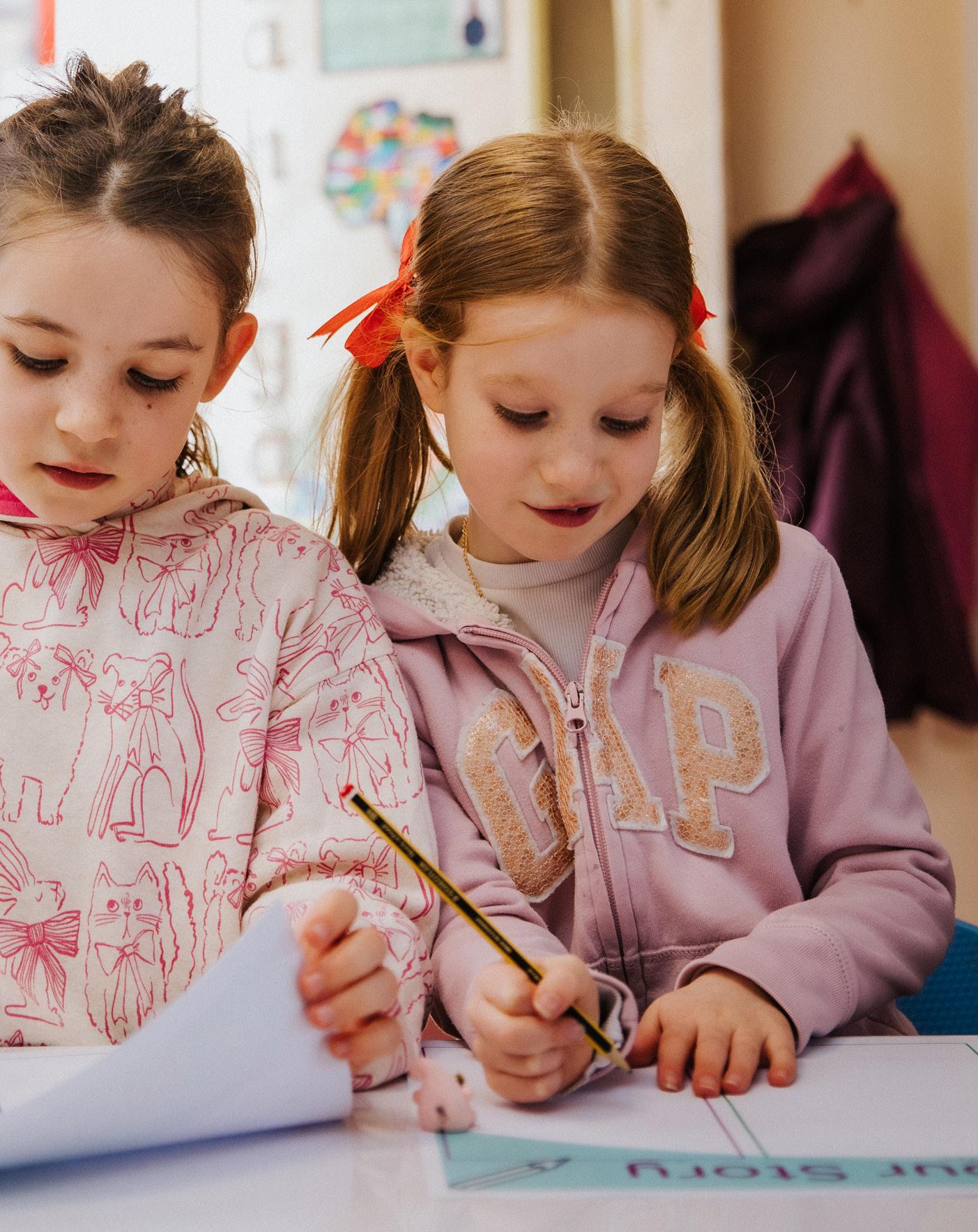
This project was heavily informed by contemporary occupational therapy research and literature on sensory processing and neurodiversity. Current research consistently highlights the relationship between movement, comfort and cognitive engagement. Studies such as The Impact of Flexible Seating on Academic Performance within an Elementary Classroom (2022), a Masters’ Thesis, suggest that flexible seating can significantly enhance academic progress. Students in flexible environments showed higher attainment gains than those in traditional seating arrangements, emphasising the power of choice and autonomy in learning environments.
I have observed that some children find writing difficult, and that they respond to different seating options and arrangements.
Contemporary research increasingly recognises that learning is not solely a cognitive process but emerges from dynamic interactions between the brain, body and environment. Traditional classroom models, which prioritise stillness and uniform seating may therefore be misaligned with how students regulate attention and sustain engagement. Flexible seating has consequently gained prominence as an approach designed to accommodate individual differences in sensory processing and self-regulation.
A growing body of research suggests that flexible seating can positively influence engagement, behaviour and attention, with students demonstrating increased focus, persistence and participation (Quigley, 2021).
A consistent finding is that physical comfort underpins sustained engagement; when students experience discomfort, attentional resources are diverted towards regulation, reducing cognitive capacity for learning. However, this evidence base is limited by small samples, reliance on observational data and a lack of longitudinal studies, restricting the generalisability of findings.
Ayres’ Sensory Integration Theory provides a key explanatory framework. Ayres (1979) argues that effective learning depends on the organisation of sensory input, particularly vestibular and proprioceptive systems. Dysregulation within these systems may manifest as fidgeting, movement-seeking or disengagement, representing attempts at self-regulation.
Neuroscientific perspectives further reinforce this relationship through executive function. Executive processes - including working memory, inhibitory control and cognitive flexibility - are essential for sustained attention and task completion (Diamond, 2013). These functions are highly sensitive to sensory and emotional states; where regulation is compromised, cognitive resources are redirected, limiting access to higher-order thinking.
Metacognition and self-regulated learning, identified as key drivers of attainment (Quigley, 2021), are dependent upon effective regulation and executive function. Students who experience sensory dysregulation may be less able to plan, monitor and evaluate their learning, limiting progress despite cognitive capability. Taken together, this supports a layered model of learning in which sensory regulation underpins executive function, enabling metacognitive processes.
This conceptualisation is further supported by established educational theory. Flexible seating aligns with Maslow’s hierarchy of needs (Maslow, 1943), as physical comfort and a sense of safety are prerequisites for learning. From a Vygotskian perspective (Vygotsky, 1978), improved selfregulation enables students to access learning within their Zone of Proximal Development. In line with Bruner’s concept of scaffolding (Bruner, 1966), flexible seating functions as a physical scaffold supporting engagement and task persistence. Additionally, it reflects Montessori’s principle of the prepared environment (Montessori, 1967), promoting independence and student choice, key components of developing metacognitive awareness. This layered understanding of learning is further reflected in the work of Taylor and Trott (2022), who conceptualise learning as a hierarchical process within their Pyramid of Learning, see Figure 1.
The Taylor and Trott model positions sensory processing and physical regulation as foundational, underpinning higher-order cognitive processes including executive function and metacognition. Taken together, these
frameworks reinforce the notion that learning is contingent upon foundational sensory and environmental conditions, supporting the view that flexible seating operates within a broader neurodevelopmental model of learning.
If I offer students flexible seating options, will their engagement improve when writing?
The intervention was implemented in a Year 4 classroom over one academic term. A range of flexible seating options was introduced, including rocking chairs, floor seating, low chairs, writing slopes, wedge cushions and weighted sensory supports. Students were encouraged to trial each option and reflect on which seating best supported their learning and writing.
This project focused on the impact of flexible seating on children’s writing, specifically exploring whether improving physical comfort could enable students to use their energy more effectively for learning rather than regulating their bodies. Year 4 was selected as the focus cohort as I was familiar with the class and aware that several students were likely to benefit from flexible seating adaptations. The project directly aligned with Frensham’s school development priorities - promoting student wellbeing and focused on the skills of communication and independence.
Figure 1. The Pyramid of Learning (DevelopLearnGrow.com based on Taylor & Trott)
Perpetual Motor
Sensory Motor
Learning (Academic)
Daily Living Activities
Auditory Language Skills
Eye-hand Coordination
Body Scheme
Postural
Security
Olfactory (Smell)
Behaviour
Visual Spatial Perception Attention Center Functions
Ocular Motor Control Postural Adjustment
Reflex Maturity
Awareness of Two Sides of Body
Ability to Screen Input
Motor Planning
Auditory Visual
Gustatory (Taste)
Development
Tactile (Touch)
Vestibular (Movement, Balance, Gravity)
Proprioception (Muscle & Joint Position)
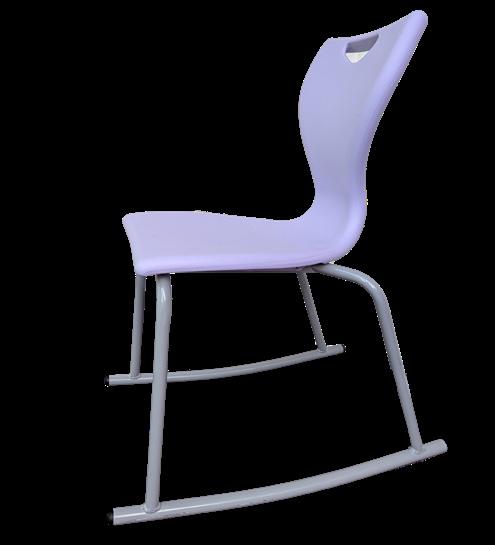
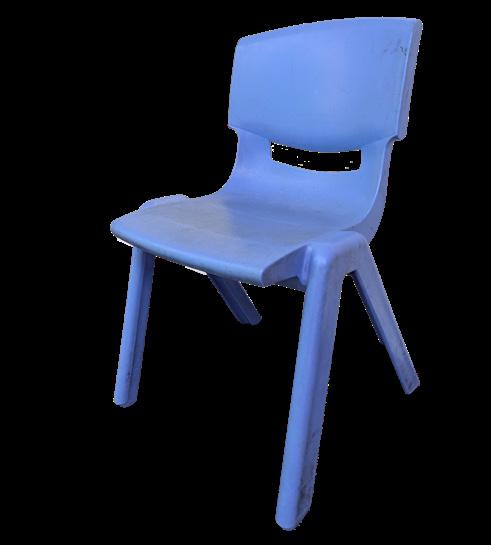
Students were first asked to design their “ideal classroom”, identifying features that would help them feel comfortable and support their reading and writing. They were then introduced to ten potential seating options and asked to rank them based on perceived comfort and helpfulness in the writing and reading process. From this, the six most popular options were selected and supplemented with a rocking chair and floor chair, resulting in eight seating options. The eight options are shown in the eight figures which follow.
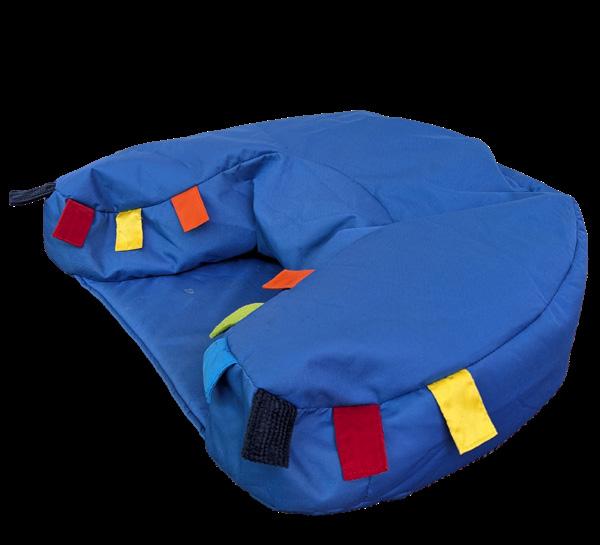



Figure 1. Beanbag Chair - can help provide deep pressure and gentle movement, supporting calmness and selfregulation, potentially improving focus and engagement
Figure 2. Floor Chair - can help provide proprioceptive and vestibular input through stable support and small movements, promoting calm and self-regulation, potentially enhancing focus and writing engagement
Figure 3. Wedge Cushion - can provide proprioceptive feedback and subtle vestibular input through gentle movement, supporting self-regulation and alertness, improving posture, focus and writing stamina
Figure 4. Ball Chair - can help provide proprioceptive and vestibular input through continuous micro-movements, promoting alertness and self-regulation and can improve focus and writing engagement
Figure 5. Weighted Lap Cushion - can help provide proprioceptive input through deep pressure, promoting calm and self-regulation and supporting focus and writing readiness
Figure 6. Writing Slope - can help provide proprioceptive feedback through stable arm support and reduce excessive vestibular demands by promoting upright posture, improving handwriting control and endurance
Figure 7. Rocking Chair - can help provide vestibular input through rhythmic movement and proprioceptive feedback from postural adjustments, improving focus and writing engagement
Figure 8. School Chair - can help provide stable proprioceptive input through firm support and minimise unnecessary vestibular movement, promoting selfregulation


Over a four week period, students evaluated different seating options during writing tasks. Each child completed a structured comfort questionnaire after 1, 5 and 10 minutes of writing. This process encouraged metacognitive reflection and provided valuable discussion opportunities around comfort, concentration and self regulation. During each session, students responded to the same image stimulus and completed a creative writing task for a minimum of ten minutes. Across the project, students completed up to five different pieces of writing using a different stimulus each time, with most completing four due to absence. At the conclusion of the project, students ranked seating options according to how effectively they supported their writing. Observational data showed improved writing stamina and focus for several students. Writing samples were analysed using Ros Wilson’s Big Write (2014) assessment framework, enabled through AI supported levelling, which indicated a correlation between seating choice, concentration and writing outcomes.
A range of mixed-methods approach was used, drawing on student voice, staff voice, classroom observations and comparative analysis of writing outcomes to evaluate the impact of flexible seating.
• Student voice was gathered to capture learners’ perceptions of comfort, wellbeing and concentration, providing insight into their lived experience.
• Staff voice, informed by professional observations, offered evidence of changes in behaviour, including increased focus, reduced fidgeting and improved stamina.
• Classroom observations enabled the real-time monitoring of engagement and on-task behaviour, while analysis of writing outcomes provided measurable evidence of progress in organisation, cohesion and idea development.
• Triangulation of these data sources strengthened the reliability and validity of the findings by identifying consistent patterns across perception, observation and attainment.
In addition, both children and staff feedback was used to evaluate implementation factors, such as novelty effects, availability of seating and spatial constraints, ensuring that any challenges were understood within the context of practical application rather than the effectiveness of the intervention itself.
Student voice responses were consistently positive. All children described feeling excited about the introduction of flexible seating and valued the opportunity to try different ways of sitting. Students reported that standard classroom chairs often caused discomfort, leading to restlessness, fidgeting and reduced concentration.
Students clearly articulated a link between physical comfort and learning. When uncomfortable, students reported that their writing slowed down or stopped altogether. When seated comfortably, students felt calmer, more focused and able to write for longer. Students identified rocking chairs, floor seating, wedge cushions, writing slopes, ball chairs and weighted items as particularly helpful.
Notably, students demonstrated strong self-awareness and reflective ability. They were able to explain which seating options supported their learning, how movement helped them regulate their bodies, and how specific seating reduced leaning, wiggling or distraction. This suggests that flexible seating supported both wellbeing and metacognitive understanding of learning needs.
The impact of this intervention on five children are summarised below.
For Child A, seating that improved postural stability had the strongest impact on writing outcomes. Floor and low seating reduced leaning behaviours that previously interrupted writing. Once this physical distraction was addressed, Child A showed improved writing stamina, clearer narrative focus and greater sustained engagement, particularly in imaginative and structured writing tasks.
For Child B, controlled-movement seating such as rocking chairs had the most significant impact. These seating options allowed movement without distraction, reducing restlessness and off-task behaviour. When paired with a writing slope, this resulted in noticeable improvements in writing voice, cohesion and humour, particularly in creative narrative pieces.
For Child C, seating that supported emotional and sensory regulation had the greatest effect. Comfortable, grounding seating enabled deeper focus and supported the development of emotional depth and narrative cohesion in extended writing tasks.
For Child D, a combination of rocking chairs, wedge cushions and writing slopes best supported both regulation and writing stamina. These adjustments correlated with consistently well-organised writing, controlled sentence structure and independent task engagement.
For Child E, they recognised which seating aids improved comfort, movement, and focus, demonstrating emerging awareness of what works for them. However, this awareness was not consistently applied to improve writing accuracy, structure and independence. Clear ideas were evident but their transcription skills were less secure.
Across all four out of the five children, a consistent pattern emerged. Seating that prioritised regulation
through movement, postural stability or sensory grounding enabled children to access higher-level writing skills. The strongest writing outcomes occurred when seating was intentionally matched to student need rather than applied uniformly.
More detailed reflections on each of the five children and their experience of different seating options are available on the ARCH website.
Staff feedback indicated that flexible seating had a positive impact on many students’ engagement and concentration once the initial novelty phase had passed. Teachers and teaching assistants observed that a significant proportion of students were able to focus for longer periods, particularly during writing and independent work. Writing slopes, rocking chairs and floor seating paired with appropriate writing surfaces were identified as especially beneficial.
Staff also reported reduced fidgeting, fewer movement breaks, and improved self-regulation for children who typically sought movement. Flexible seating was described as particularly effective for students with sensory or attention needs. Challenges identified were largely practical, including classroom space, sharing popular equipment and ensuring seating was appropriately sized.
Across student voice, observations and writing outcomes, flexible seating was associated with increased focus, reduced fidgeting and improved writing stamina when seated in ways that supported their sensory needs. Children consistently articulated links between physical comfort and their ability to engage in writing tasks, indicating emerging metacognitive awareness. This suggests that increased comfort and student choice reduce cognitive load and support sustained engagement and that flexible seating improves engagement and writing outcomes. By reducing physical and sensory barriers to focus, improvements in posture and sustained attention suggest that sensory regulation enabled greater executive function. Children were also able to reflect on seating choices, demonstrating engagement with metacognitive processes. This indicates that flexible seating not only supports engagement, but enables selfregulated learning.
At an individual level, outcomes reflected the
importance of matching seating to need. For example, Child A benefited from increased postural stability, resulting in improved stamina and narrative coherence, while Child B demonstrated enhanced engagement and writing voice through controlled movement. Child C’s outcomes highlighted the importance of emotional and sensory regulation in enabling extended writing and Child D demonstrated how combined approaches supported independence and organisation. These findings reinforce the study’s methodological focus on individualised, needs-based intervention rather than uniform implementation.
However, variation was evident. For Child E, although metacognitive awareness of seating was emerging, this was not consistently translated into improved writing accuracy or independence. This highlights a critical distinction between awareness and application, suggesting that environmental adaptations alone are insufficient without explicit teaching of strategy transfer.
Flexible seating can be costly. Funding was secured through the Support for Learning Department, alongside several trial seating items provided at no cost. This allowed additional seating options, including a rocking chair and floor chair, to be incorporated. Evidence gathering could have been accelerated with a larger number of each seating type.
Early observations suggested that flexible seating did not have a measurable impact on children’s comfort during reading tasks, and student feedback during reading tasks
showed minimal variation. As a result, the focus of the project was refined to concentrate solely on writing, where impact was more clearly observable and measurable.
A further challenge was the variability in how effectively children were able to apply this approach. For example, in one case, although there was emerging awareness of how different seating supported comfort, movement and focus, this was not consistently reflected in improvements in writing accuracy or independence. This suggested that developing awareness did not always translate into effective application, highlighting the need for additional support and explicit teaching to help chidren use these strategies more consistently.
This project reinforced my belief that traditional classroom layouts do not suit all learners. I would strongly advocate for learning environments that move away from uniform seating expectations and instead incorporate a range of high and low seating, soft furnishings and movement-friendly options. Providing access to flexible seating for all children normalises difference, supports inclusion and reduces the need for reactive interventions. When children feel physically comfortable and regulated, they are better able to engage creatively, sustain focus and produce higher quality work.
Flexible seating should be understood not simply as a classroom adaptation but as a strategic intervention that supports the neurocognitive conditions necessary for learning. By addressing sensory and physical needs, it enables access to executive function and metacognition, thereby supporting engagement, independence and higher-level learning. However, its effectiveness is contingent upon intentional implementation, individualisation and integration with explicit teaching of self-regulation and metacognitive strategies.
Flexible seating had a positive impact on engagement, regulation and writing across most students. When seating matched individual sensory and postural needs, students showed improved focus, stamina and quality of writing. Students demonstrated strong metacognitive awareness of what supports them, with notable gains in idea development, organisation and sustained writing, though transcription skills varied.
The research project suggests that flexible seating can meaningfully improve student engagement, concentration and wellbeing in the classroom. While practical considerations such as space and resourcing require attention, flexible seating emerges as a valuable and inclusive classroom strategy with strong potential for long-term impact when thoughtfully implemented.
Flexible seating had a positive impact on engagement, regulation
and writing across most students.
References
Ayres, A. (1979) Sensory Integration and the Child. Los Angeles, CA: Western Psychological Services.
Bruner, J. (1966) Toward a Theory of Instruction. Boston: Harvard University Press.
Diamond, A. (2013). Executive functions, Annual Review of Psychology, 64, 135–168.
Hendershot, A. (2022) The Impact of Flexible Seating on Academic Performance within an Elementary Classroom. Master’s thesis. Minnesota State University Moorhead. Available at: https://red.mnstate.edu/ thesis/739/
Maslow, A. (1943). A theory of human motivation, Psychological Review, 50(4), 370–396.
Montessori, M. (1967). The Discovery of the Child. New York: Ballantine Books.
Taylor, K. & Trott, K. (1991). The pyramid of learning [Unpublished model]. Cited in P. Williams & M. Shellenberger (1996), “How does your engine run?” A leader’s guide to the alert program for self-regulation. Madison, SD: TherapyWorks.
Quigley, A. (2021). Metacognition and Self-Regulated Learning. London: Education Endowment Foundation. Vygotsky, L. (1978). Mind in Society. Boston: Harvard University Press.
Wilson, R. (2014). Assessing Writing across the Primary School: The Big Write Approach. London: Andrell Education.
Paul Søgaard Head of Sociology & Psychology Frensham Heights School
I am Head of Psychology and Sociology at Frensham Heights and an International Coaching Foundation (ICF) accredited coach. I have used questioning techniques and coaching as part of my teaching toolkit to improve problem-solving skills in my students since 2008 and it has become a gamechanger in terms of how I have improved my delivery of the curriculum, ensured high levels of student engagement and enthusiasm for the learning process as well as developed independent and confident learners. In this research, I have focused on my eight Y12 Psychology students over a six-week period teaching Biopsychology and Issues and Debates.
The aim of this research project was to investigate how an intervention focused on developing questioning skills alongside coaching could support my students’ ability to problem solve when studying A-Level Psychology. I use the term ‘problem solving’ here as a cognitive process of identifying, analysing, and resolving obstacles to achieve a desired goal. In the context of this research project, the concept of problem solving could be applied to all aspects of studying A-Level Psychology. This could include; improving working memory capacity, structured essay writing with critical evaluation of psychological research, time management of independent study time, reflection of own progress, identifying barriers to learning and the application of strategies to overcome these barriers.
As a teacher, I have noticed that some of the reasons for students’ lack of academic achievements arise from the fact that they do not yet know how to learn. They may have a lack of self-awareness when it comes to understanding their own abilities as a learner or a lack self-confidence. Students also differ in their neurodiversity, meaning that they each have unique ways of thinking, learning, processing information and experiencing the world. Another reason can be poor working memory, a lack of time management skills and an inability to initiate tasks, collectively referred to as the executive functions of the brain (Dawson & Guare, 2012). Therefore, to support and challenge my students, my teaching style has developed an emphasis on ‘knowing how to’ instead of just ‘knowing about’. In many ways I would describe it as a process of action learning.

as a process that allows students to be creative in their thinking and discovery in a school environment that does not favour the ‘right answer’ and where only the teacher has authority, which is in line with the Frensham ethos to value independent thinking in our students. My use of open questioning techniques in lessons is an example of how I try to develop such a growth mindset in my students, (Shaftel and Shaftel, 1967). Similarly, researchbased evidence of the practical application of coaching in education has been well documented by Peg Dawson and Richard Guare. They point out that coaching can help students who are struggling to produce high quality work despite poor organisation and time management skills (Dawson & Guare, 2012, pp, 23 -24). My teaching has been particularly influenced by the research of Carol Dweck. She reminds us that teachers and students with growth mindsets believe that intelligence and ability are not fixed but can be developed (Dweck, 2006). Consequently, learners regard intelligence not as innate, but something that through dedication, perseverance, the right learning strategies and constructive feedback, you can develop over time.
If I focus on developing questioning skills alongside coaching as part of my learning and teaching, will my Y12 Psychology students’ problem-solving skills improve?’
The intervention was twofold. Firstly, instead of giving instructions, I used specific questions in the lessons to allow students to use prior knowledge and discussions as a means of problem solving. Secondly, students received a weekly coaching session with me where their entries in their goal diary formed the framework for a coaching conversation about their progress in problem solving in relation to studying Psychology.
For this project, I have read research into problem solving in the classroom and the use of coaching as part of the learning and teaching process. In Problem Solving in the Classroom (Henton et al., 1979) the authors state explicitly about the use of problem-solving in the classroom: “We search for innovations that will spark the student’s enthusiasm about a particular topic in an effort to stimulate thinking and encourage pursuits of new knowledge and skills’’ (p. 61). They reference research that describes problem solving
In addition, I also wanted to investigate students’ level of commitment to learning by analysing their entries in their goal diaries and classwork to see if their ability to study independently would increase. During the six weeks, we finished the topic Biopsychology and started the topic of Issues and Debates. Homework was essays based on past examination questions. Finally, they were asked to fill in a reflective questionnaire about how they viewed their Executive Functioning Skills (EFS), which we discussed in the first 1:1 session. This was repeated at the end of the project to see if there had been any changes in their EFS. The reason for this questionnaire was to enable the students to take a step back and reflect on their strengths and weaknesses in their EFS and link these to their problem-solving skills.
An example of a lesson that focused on problem solving and used coaching type questions was when they were learning about Nature vs. Nurture and Determinism vs. Free Will (Issues and Debates). A traditional pedagogical approach could have been for the teacher to explain and outline these two debates to the students (‘knowing
about’). What I did differently was to display the following questions on the white board at the beginning of the lesson:
What is it? (with reference to the two debates)
Why is it important to Psychology?
What does it tell us about human behaviour?
What are the strengths and weaknesses?
What do you know about it?
Using questions to find answers, instead of giving instructions, is a well-known method in coaching and it has the advantage of challenging students to think for themselves rather than rely on the teacher to provide the answers.
Students were divided into two groups, and each group were given one of the debates. They then went to one of the two big whiteboards at the back of the classroom and wrote up the name of their debate on the board. I then told them that they were not allowed to use textbooks or other means to gather information about their given debate. Instead, they had to problem solve as a group to come up with answers to the posed questions.
What followed was discussions amongst the two groups about what the debates meant in relation to Psychology as a topic and scientific discipline and the knowledge they had from previous lessons that could help them answer the questions. They considered previous studies and approaches and what they themselves knew might be useful to answer the questions. This then developed into a process of answering the questions from the board and writing these answers up.
During this part of the lesson, I mainly kept quiet and listened to their discussions. I only got involved when I felt that it was appropriate to check in with them as a measure of reassurance and support. I asked questions such as: ‘So, if you know this, how might that link to answering question x?’ Once this part of the lesson was completed, the students explained to the opposite group what their answers were to the questions and shared their experience of this process.
I praised the students for their efforts in problem solving to find answers to the questions, went through the two groups’ answers, elaborated on their answers and corrected misconceptions. In the final part of the lesson, they were given textbooks to see for themselves how similar/dissimilar their work was compared to the standard text. This gave them an opportunity to reflect on their problem-solving skills, ability to work independently and as part of a group and to think about how asking specific questions might help them in the process of problem solving.
I used a mixed methods approach to evaluation including the following.
The EFS questionnaire, see Appendix 1, provided a useful way to measure changes in students’ confidence, understanding and attitudes over the course of the intervention. However, responses were self-reported and may have been influenced by how honestly or accurately students reflected on their experiences.
Student comments and self-evaluations offered valuable qualitative insights into how students perceived their own progress. These reflections helped to capture changes in motivation, self-awareness and confidence that may not have been evident through numerical data alone. A limitation is that some students may overestimate or underestimate their progress, even though the data from homework and end of year examinations seem to back up their comments about progress and achievements.
Goal diaries allowed students to track their progress towards personalised targets over time. They encouraged regular reflection and helped students to recognise small successes and areas for further development. The effectiveness of this method depended on students completing their diaries consistently and thoughtfully and it provided me with a weekly 1:1 session with each student to discuss progress. A suggestion was made from a student to make the goal diary question more specific.
My observations provided direct evidence of changes in behaviours such as engagement, organisation, participation and independence. Observations were particularly useful for identifying improvements that students may not have noticed themselves. However, they were subjective and could be influenced by my expectations or interpretations. Notes from 1:1 sessions captured detailed information about students’ challenges, progress and responses to support strategies. They provided rich contextual data and helped to identify individual patterns of development.
Feedback gathered students’ views on the usefulness and relevance of the intervention. They helped identify which strategies they found most effective and highlighted areas for improvement.
Findings from this research suggest that using this kind of two part intervention, a focus on questioning combined with coaching, can be an effective method to support students in strengthening their problem-solving skills. This selection of students’ reflections makes the point eloquently:
‘
’My teacher’s coaching has helped me move past just “knowing” psychology to “using” it. By having 1:1 sessions, I’ve learned how to break down big problems into smaller pieces, and how to set manageable goals that I can accomplish step by step. I feel that I am now able to take things step by step instead of worrying and stressing about challenges all at once.’’
“The 1:1 sessions have helped me and my problemsolving ability in psychology by talking about what I have currently achieved and what is expected of me. For example, with being able to answer my exams within the time constraints it’s been made clear what I should focus on and put my attention to.’’
“It has helped me narrow down and target my weaknesses either when answering questions or when I am revising. Through feedback and guided practice, I have become more confident in analysing questions, planning responses, and recalling key information under pressure. These 1:1 sessions have also improved my confidence especially when going into my mock exam as I felt prepared, understood what was being asked of me and I knew what to expect when entering my exam.’’
“I have developed my psychology skills from just recalling information to using problem solving whilst answering questions. This growth in my exam skill set has led to the ability to answer questions well even if I don’t know all the details required. Where before I might have gotten stuck and lost my focus and train of thought, now I can manoeuvre around knowledge gaps and construct answers using other bits of information e.g. referencing other studies for a counter point.’’
“It has been extremely helpful and motivating. By listening to my teacher’s insight and perspective on my work and learning it has in many cases broadened my own perspective on my learning and question answering. This has been useful for me as I tend to have a narrow, tunnel vision way of working when it comes to answering questions, which can often lead to me missing obvious points. Another helpful factor of the 1:1 sessions was my teacher’s ability to understand my way of thinking and working which is useful for setting specific targets and goals and when giving advice. ‘’
In terms of measurements the student goal diary and essay grades were probably the most accurate data based on qualitative and quantitative data. The data from the students’ end of year examinations showed excellent results, in some cases, a high level of attainments such as A* - A grades.
As the project only lasted six weeks it is difficult to measure any long term effects on the students’ ability to problem solve. Nevertheless, even within this short time period, I observed students became confident in problem solving when analysing and evaluating research evidence as part of essay writing, students improved their ability to create individual strategies for overcoming obstacles such as how to use their study periods effectively and improved use of working memory when recalling psychological facts.
Students’ reflections provided me with valuable insight into how this intervention could have been even better: “I think the coaching would have been even more effective if our goal setting had been more specific rather than general.’’
Dawson, P. & Guare, R, (2012). Coaching Students with Executive Skills Deficits. New York: Guildford Publications, Inc.
Dweck, C. (2006). Mindset: The New Psychology of success. London: Random House.
Henton, J., Marotz-Baden, R., & Kieren, D. (1979). Problem Solving in the Classroom. The Family Coordinator, 28(1), 23-29.
Shaftel, F. & Shaftel, G. (1967) Role-playing for Social Values: Decision-making in the Social Studies. Englewood Cliffs, NJ: Prentice-Hall.
“Personally, to have improved my development in problem solving in regards to psychology it may have been more effective if it included talking about what I was going to do with my time and also what I had completed over the time. This would have made me being more accountable and more independent in developing my revision skills and in exploring different types of learning methods.’’
It would be interesting if more teachers at Frensham Heights used a similar approach as part of their teaching and then to compare student/teacher experiences across subjects. A longitudinal project would give us more data to work from and start discussions about how we develop problem-solving skills across the school. Knowing that Artificial Intelligence (AI) has implications for people’s lives and livelihoods there is an urgent need to debate and think about how we as educators prepare young people for a world that is changing at a faster pace than ever seen before.