Parasite SEO Course: Learn Authority-Led Search Visibility Strategies
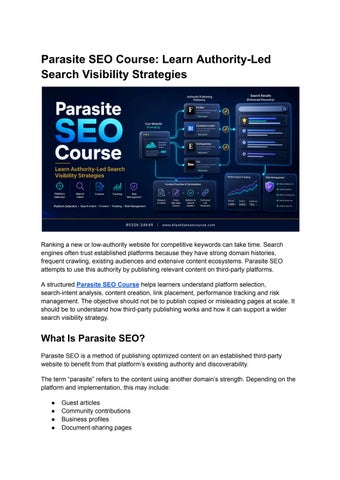
Ranking a new or low-authority website for competitive keywords can take time. Search engines often trust established platforms because they have strong domain histories, frequent crawling, existing audiences and extensive content ecosystems. Parasite SEO attempts to use this authority by publishing relevant content on third-party platforms. A structured Parasite SEO Course helps learners understand platform selection, search-intent analysis, content creation, link placement, performance tracking and risk management. The objective should not be to publish copied or misleading pages at scale. It should be to understand how third-party publishing works and how it can support a wider search visibility strategy.
What Is Parasite SEO? Parasite SEO is a method of publishing optimized content on an established third-party website to benefit from that platform’s existing authority and discoverability. The term “parasite” refers to the content using another domain’s strength. Depending on the platform and implementation, this may include: ● ● ● ●
Guest articles Community contributions Business profiles Document-sharing pages
● ● ● ●
Video descriptions Public resource pages News or editorial placements User-generated publishing platforms
Why Established Platforms May Rank Faster High-authority websites are usually crawled more frequently and may already have strong trust signals, backlinks and topical visibility. A newly published page on such a platform may therefore receive search-engine attention faster than a similar page on a new domain. Faster Indexing Does Not Guarantee Rankings Platform authority alone is not enough. Search intent, content usefulness, competition, page quality and platform rules still influence performance. No Parasite SEO course can legitimately guarantee first-page rankings.
What a Parasite SEO Course Should Teach Search-Intent and Keyword Research The first step is to understand what the user expects from a search result. Keywords can reflect different intentions: Informational Intent The searcher wants a guide, definition, comparison or explanation. Commercial Intent The user may be researching services, courses, tools or providers before making a decision. Transactional Intent The searcher may be ready to register, purchase, contact a business or request more information. A strong campaign matches the content format with the keyword’s actual intent.
Selecting the Right Publishing Platform Not every authoritative website is suitable for every topic. Platform selection should consider: ● ● ● ● ● ●
Relevance to the subject Publishing and moderation policies Page indexation Audience quality Content ownership rules Link permissions
● ● ● ●
Editing options Possibility of page removal Visibility in the target location Long-term accessibility
Relevance Is More Valuable Than Random Authority Publishing on a powerful but unrelated domain may generate little value. A contextually relevant platform with an active audience can provide better engagement, referral traffic and topical alignment.
Creating Useful Third-Party Content A Parasite SEO Course should teach learners to produce content that helps the platform’s audience instead of functioning as a thin promotional page.
Build a Complete Content Structure A useful page may contain: ● ● ● ● ● ● ● ● ●
A clear, specific title A short opening answer Logically arranged headings Practical steps or examples Original observations Supporting evidence Relevant internal platform links A transparent author or business reference A natural call to action
Avoid Duplicate Publishing Uploading the same article to many websites can create duplication and reduce usefulness. Each platform submission should have a fresh title, introduction, structure and audience angle.
A Practical Parasite SEO Workflow A controlled process makes performance easier to evaluate.
Step 1: Establish a Baseline Record current rankings, indexed pages, impressions, clicks, referral traffic and conversions before publishing.
Step 2: Match the Platform to the Keyword
Select a platform whose format and audience suit the search intent. A presentation platform, for example, may suit visual education better than a discussion forum.
Step 3: Create Platform-Native Content Adapt the content to the platform. A useful article, slide deck, video or community answer should feel natural within its publishing environment.
Step 4: Optimize Without Overloading Use the primary keyword naturally in the title, introduction and relevant heading. Include related terms where they improve clarity. Avoid keyword stuffing and repetitive exact-match anchors.
Step 5: Publish and Monitor Track indexation, ranking movement, referral visits, engagement and conversions. Recommended Testing Sequence Baseline → Platform selection → Publish → Observe → Compare → Document This sequence helps determine whether the placement created measurable value.
Linking and Anchor-Text Practices Links can guide readers to a relevant resource, service page or supporting article. However, the link should provide a clear benefit to the reader.
Use Descriptive but Natural Anchors A varied anchor-text profile may include: ● ● ● ● ● ●
Brand name Website name Page title Partial-match phrase Contextual call to action Plain URL
Avoid Repetitive Exact-Match Anchors Using the same commercial keyword repeatedly can look unnatural. Anchor text should fit the surrounding sentence and accurately describe the destination.
SEO, AEO and GEO Opportunities Parasite content can be designed for several discovery environments.
Search Engine Optimization SEO helps third-party pages compete in conventional search results through relevance, structure and authority.
Answer Engine Optimization AEO uses concise answers, definitions, FAQs and question-based headings to improve answer visibility.
Generative Engine Optimization GEO strengthens factual clarity, entity information and source credibility so generative systems can better interpret the content. Features That Improve Content Clarity ● ● ● ● ● ● ●
Direct answers Consistent brand details Accurate facts Descriptive headings Identifiable authorship Reliable citations Clearly labelled opinions
Risks and Limitations Third-party platforms control the published page. They may modify policies, remove links, restrict accounts or delete content.
Common Warning Signs Avoid strategies based on: ● ● ● ● ● ● ● ●
Mass-generated duplicate pages Fake reviews or identities Misleading redirects Purchased accounts Irrelevant link placement Keyword-stuffed articles Guaranteed rankings Unknown automation requiring sensitive access
Never Depend on One Platform Parasite SEO should support an owned website, not replace it. A business has limited control over content hosted elsewhere.
Frequently Asked Questions Is Parasite SEO Suitable for Beginners? Yes, if learners first understand keyword research, content quality, search intent and platform guidelines.
How Quickly Can It Work? Some pages may be discovered quickly, but ranking timelines vary according to competition, platform strength and content quality.
Is Parasite SEO Risk-Free? No. Pages can lose rankings or be removed by the host platform. Guideline-violating practices can create additional risk.
What Should Be Measured? Track indexation, impressions, rankings, referral visits, engagement, leads and conversions—not rankings alone.
Conclusion A valuable Parasite SEO Course should teach research, platform selection, original content development, responsible linking and performance measurement. Sustainable results come from relevance and usefulness rather than mass publishing or guaranteed shortcuts.
Learn Advanced Parasite SEO Strategies Explore structured SEO education, competitive research, AEO, GEO and risk-aware optimization at BlackHatSEOCourse.com. Contact: 89206 24649