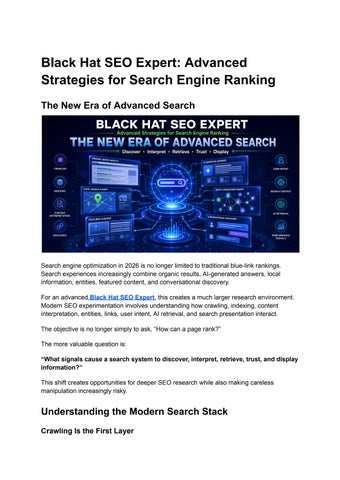
Black Hat SEO Expert: Advanced Strategies for Search Engine Ranking The New Era of Advanced Search
Search engine optimization in 2026 is no longer limited to traditional blue-link rankings. Search experiences increasingly combine organic results, AI-generated answers, local information, entities, featured content, and conversational discovery. For an advanced Black Hat SEO Expert, this creates a much larger research environment. Modern SEO experimentation involves understanding how crawling, indexing, content interpretation, entities, links, user intent, AI retrieval, and search presentation interact. The objective is no longer simply to ask, “How can a page rank?” The more valuable question is: “What signals cause a search system to discover, interpret, retrieve, trust, and display information?” This shift creates opportunities for deeper SEO research while also making careless manipulation increasingly risky.
Understanding the Modern Search Stack Crawling Is the First Layer
Before ranking can occur, search systems must discover and process information. Advanced Crawling Factors An SEO expert can investigate: ● ● ● ● ● ● ● ● ● ●
Crawl accessibility Internal linking pathways JavaScript rendering XML sitemap consistency Canonical signals HTTP responses Orphan pages Crawl efficiency URL structures Content freshness
A ranking problem can sometimes originate much earlier than the ranking algorithm itself.
Indexing Is Different From Ranking A page being discovered does not guarantee that it will become an important search result. Indexation Investigation Advanced analysis can compare: ● ● ● ● ● ● ● ●
Submitted URLs Crawled URLs Indexed URLs Canonicalized URLs Excluded pages Duplicate content Thin content Rendering differences
This creates an important diagnostic principle: Do not attempt to optimize ranking before understanding whether the search system can properly process the page.
Search Intent Is Becoming More Important Keyword matching alone is insufficient for modern search.
Intent Mapping A single keyword can represent several user objectives.
For example, a search may indicate:
● ● ● ● ● ● ●
Informational intent Commercial investigation Transactional intent Comparison intent Local intent Educational intent Problem-solving intent
Building Intent Clusters An advanced SEO expert can classify queries according to: 1. User problem 2. Expected answer 3. Content format 4. Search stage 5. Entity relationships 6. Conversion potential This allows SEO campaigns to move from individual keywords toward complete search-intent ecosystems.
AEO: Optimizing for Answer Surfaces Answer Engine Optimization is becoming an important part of advanced search strategy.
Answer-First Content Instead of hiding the primary answer deep inside an article, content can provide concise, independently understandable explanations. AEO Content Framework A strong answer section can contain: ● ● ● ● ● ●
Direct definition Supporting explanation Important qualifications Relevant examples Related questions Clear terminology
The goal is to make information easy to retrieve and understand.
GEO and Entity-Based Search Generative search systems increasingly depend on relationships between people, organizations, services, locations, topics, and concepts.
Entity Consistency An advanced SEO strategy should maintain consistent information across: ● ● ● ● ● ● ●
Website pages Author profiles Organization information Service descriptions Location pages Structured data External references
Why Entity Relationships Matter Search systems can understand a subject more effectively when important facts are consistent and clearly connected. This moves SEO beyond keyword density toward semantic identity and contextual relevance.
LLM SEO and Retrieval Readiness The future of search will increasingly involve systems that retrieve information before generating responses.
Creating Retrieval-Friendly Content Content can be structured around: ● ● ● ● ● ● ● ●
Clear entities Stable terminology Self-contained passages Question-answer relationships Explicit relationships Accurate dates Author information Evidence and references
The Retrieval Test An advanced SEO expert can ask: Could an AI system understand this passage correctly if it encountered the passage without the rest of the article? If the answer is no, the content may need stronger contextual structure.
Controlled SEO Experimentation One of the most valuable skills for an advanced SEO professional is experimentation.
Build a Baseline Before making a change, record: ● ● ● ● ● ● ● ● ●
Organic visibility Target queries Indexed URLs Clicks Impressions Conversion data Crawl information Existing content Backlink profile
Create a Hypothesis Every experiment should answer a specific question. For example: “Will improving the information architecture of a topic cluster increase discovery and organic visibility?” Change One Major Variable Changing multiple elements simultaneously makes results difficult to interpret. A controlled experiment should document: ● ● ● ● ● ● ●
Date Variable changed Expected outcome Observation period Actual outcome Unexpected effects Final conclusion
This methodology is more valuable than simply copying another website's tactics.
Advanced Link Intelligence Links remain an important area of SEO research, but modern analysis should go beyond counting backlinks.
Examine Link Context Useful signals include: ● ● ● ● ● ● ● ●
Topical relevance Source quality Editorial context Anchor distribution Referring-domain history Link placement Traffic relevance Link growth patterns
Link Risk Analysis An advanced practitioner should also investigate whether a link strategy creates: ● ● ● ● ●
Artificial patterns Excessive anchor concentration Low-quality source relationships Unnatural growth Dependency on controlled networks
The purpose of this analysis is to understand risk as well as opportunity.
Content Engineering for Competitive SERPs Modern SEO requires more than producing long articles.
Information Gain Content should provide something useful that competing pages do not adequately provide. This may include: ● ● ● ● ● ●
Original analysis Unique examples First-hand observations Better explanations Updated information Comparisons
● Data interpretation ● Practical frameworks Content Depth vs. Content Length A 2,000-word article is not automatically better than a 700-word article. The more important question is: Does the content completely satisfy the user's information requirement?
AI-Assisted SEO Workflows Artificial intelligence can accelerate research, but human verification remains essential.
Practical AI Applications AI can assist with: ● ● ● ● ● ● ● ● ●
Search-intent classification Topic clustering Content gap analysis SERP pattern analysis Entity extraction Internal-link suggestions Content quality checks Competitor research SEO reporting
Human Verification AI-generated conclusions should be checked against reliable evidence. An advanced SEO workflow should distinguish between:
Future-Proofing an SEO Strategy Search Is Moving Beyond Ten Blue Links Future SEO professionals should prepare for environments where users discover information through: ● ● ● ● ● ● ●
Traditional search AI-generated answers Conversational interfaces Local search Visual search Voice interfaces Entity-based discovery
The Future SEO Skill Set A future-ready SEO expert should understand: ● ● ● ● ● ● ● ●
Technical SEO Semantic SEO Entity SEO AEO GEO LLM retrieval Information architecture Search analytics
● Experiment design ● Content systems ● Risk management
Measuring What Actually Matters Ranking position alone is not enough to evaluate an SEO campaign.
Advanced Measurement Framework Track multiple levels of performance: Search Metrics ● ● ● ● ●
Impressions Clicks Query visibility Indexed pages SERP features
Website Metrics ● ● ● ● ●
Engagement Qualified traffic Landing-page performance Internal navigation Conversion behavior
Business Metrics ● ● ● ● ●
Qualified leads Lead acceptance Revenue contribution Customer quality Acquisition efficiency
This creates a connection between SEO activity and actual business outcomes.
Risk-Aware Black Hat SEO Research The term “Black Hat SEO” often creates an expectation of instant ranking shortcuts. In professional research, however, the more important skill is understanding cause, effect, risk, and reversibility.
Use Controlled Environments High-risk experiments should not automatically be deployed on critical commercial assets.
Establish Stop Rules Before experimentation, define: ● ● ● ● ●
Maximum acceptable traffic loss Maximum financial exposure Rollback conditions Monitoring frequency Recovery procedure
This transforms experimentation from guesswork into a documented research process.
The Future Role of a Black Hat SEO Expert The next generation of advanced SEO professionals will need to understand both traditional ranking systems and emerging AI-driven discovery systems.
From Tactics to Systems The strongest professionals will study: Crawling → Indexing → Interpretation → Retrieval → Ranking → Answer Generation → User Action Understanding this complete chain provides a more powerful perspective than focusing on a single SEO trick.
Conclusion The modern Black Hat SEO Expert is not simply someone who knows aggressive ranking techniques. The role is evolving toward advanced search research, technical diagnosis, controlled experimentation, semantic optimization, AI-search visibility, competitive intelligence, and risk management. As search systems become more intelligent, simplistic manipulation becomes less dependable. The competitive advantage will increasingly come from understanding how information is discovered, interpreted, connected, retrieved, evaluated, and presented. For SEO professionals preparing for the future, the most valuable approach is to combine technical SEO, AEO, GEO, LLM SEO, semantic search, entity optimization, experimentation, measurement, and responsible risk analysis. The future of advanced SEO belongs to professionals who can understand the entire search ecosystem—not just the ranking page.