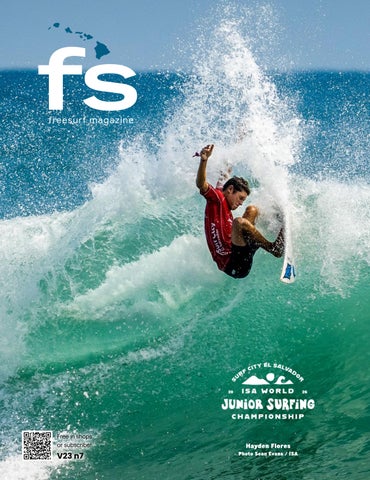
fs freesurf magazine
Free in shops or subscribe!
V23 n7
Hayden Flores Photo Sean Evans / ISA
When the surf is pumping...
Town & Country M Pro 2 5’10” x 18.5 x 2.25
Osa Peninsula, Costa Rica 9°36’50.17”N 85°08’41.01”W
When the fish are biting...
Flagship Boatshort Utility plier pocket 4 way stretch
Jacob Turner
GEAR MATTERS. When nothing else matters...
Home of the Right Surf Known as one of the top 10 waves on the planet, Punta Roca offers fast, hollow right-hand point breaks in warm waters. Located in the heart of Surf City, La Libertad, it's the ultimate tropical getaway for surfers chasing endless swells and authentic Salvadoran culture.
PHOTO: FRED POMPMAYER
Find Your Home Between Surf Sessions.
The right agent can lead the way. With the limited number of homes on the current U.S. market, you need an agent with the right connections, technology and strategies to achieve your home buying or selling vision. Whether you’re feeling overwhelmed and want someone to take the wheel, or you just need a second opinion and you have it covered, you can be rest assured a RE/MAX agent is the right agent for any level of service, in any market condition.
Local Heart. Global Expertise. Proven Results. At REMAX Hawai‘i North Shore, we combine deep local knowledge with the strength of a globally recognized brand to deliver results you can trust. Our team of dedicated real estate professionals brings the personalized service you know and value, now enhanced by REMAX’s worldwide network, innovative tools, and industry-leading resources. Stop by our North Shore Office at the Hale‘iwa Store Lots to learn how our agents can guide you confidently through every stage of your real estate journey. ©2025 RE/MAX, LLC. Each Office Independently Owned and Operated. Equal Housing Opportunity.
Sean MoodyRB-18228 REMAX Hawai‘i. ©2026 RE/MAX, LLC. * RB-21766 REMAX Hawai‘i North Shore. ** RB-22126 REMAX Hawai‘i West O‘ahu. Each Office Independently Owned and Operated.
Karin Moody
Meme Moody
Noel Marchan
Michael Pieklo
Founder, PB, Realtor, RB-19578 REMAX Hawaii North Shore karin-moody.remaxhawaii.com
BIC, Realtor, RB-22780 REMAX Hawaii North Shore meme-moody.remaxhawaii.com
Realtor, RS-73977 REMAX Hawaii North Shore NMHomes50.com
Realtor, RS-79930 REMAX Hawaii North Shore michael-pieklo.remaxhawaii.com
808.392.7410
Trish Kim Realtor, RB-24134 REMAX Hawaii North Shore TrishKimHawaiiHomes.com
808.221.4200
808.741.3835
808.282.0949
Aleks Husmann Mason Kahiapo Realtor, RS-79671 REMAX Hawaii North Shore aleks-husmann.remaxhawaii.com
808.979.5611
Karin Moody
Founder, PB, Realtor, RB-19578 REMAX Hawaii North Shore karin-moody.remaxhawaii.com
Meme M oody
BIC, Realtor, RB-22780 REMAX Hawaii North Shore meme-moody .remaxhawaii.com
Realtor, RS-86947 REMAX Hawaii North Shore mason-kahiapo.remaxhawaii.com
808.721.8005
Noel Marchan
Realtor, RS-73977 REMAX Hawaii North Shore NMHomes50.com
808.551.6740
Kate Walsh Realtor, RS-88082 REMAX Hawaii North Shore kate-walsh.remaxhawaii.com
808.352.8880
Michael Pieklo
Realtor, RS-79930 REMAX Hawaii North Shore michael-piekl o.remaxhawaii.com
Real808.741.3835 Estate Market Update | June 2026 Stats 808.551.6740 808.282.0949
808.392.7410
Trish Kim
Realtor, RB-24134 REMAX Hawaii North Shore TrishKimHawaiiHomes.com
808.221.4200
Aleks Husmann Mason Kahiapo
Realtor, RS-79671 REMAX Hawaii North Shore aleks-husmann. remaxhawaii.com
808.979.5611
Realtor, RS-86947 REMAX Hawaii North Shore mason-kahiap o.remaxhawaii.com
808.721.8005
Kate Walsh
Realtor, RS-88082 REMAX Hawaii North Shore kate-walsh.remaxhawaii.com
808.352.8880
808.637.1500 REMAXHAWAII. COM ©2025 RE/MAX, LLC. Each Office Independently Owned and Operated. Equal Housing Opportunity.
808.637.1500 REMAXHAWAII.COM
66-111 Kamehameha Hwy.,and Haleʻiwa, HI RB-21766 REMAX Hawaii North Shore. ©2026 RE/MAX, LLC. Each Office Independently Owned Operated
FREE PARKING Riding to Gold: Team USA's Jett Maughan launches a massive rooster tail on his way to securing the ISA World Surfing Championship title in Surf City El Salvador. Jett was solid the whole event and delivered a clutch performance to claim gold for the U18 division. Photo Sean Evans / ISA
EDITORIAL Editor / Publisher Mike Latronic Photo Director Brian Bielmann Art Director John Weaver Staff Shooters Brent Bielmann, Mike Latronic, Keale Lemos, John Weaver Staff Writer Kaea Latronic Contributing Writers Tor Johnson, Alexandra Kahn, Daniel Ikaika Ito, Nicole Nason, Amanda Blackwell Contributing Photographers Mario Amaya Christa Funk, Ryan “Chachi” Craig, Dooma Photos, Dayanidhi Das, Erik Aeder, Mark Rodrigues, Aaron Lynton, Kurt Steinmetz, Mike Ito, Tommy Pierucki, Sean Evans, Stu Soley, Tai Vandyke, Mitch McEwen, Sivar Films, Humanocine, Feistan Rivera, Samuel Rivera Distribution & Advertising Inquiries Mike Latronic mlatronic808@gmail.com Sales & Marketing Randall Paulson randallpaulson@gmail.com Business Administration Cora Sanchez corabooks@freesurfmagazine.com
Team Rider:Sheldon Paishon Photographer: John Bossian
Hawai'i Distribution & Sales Keola Latronic keolalatronic808@gmail.com West Coast Distribution & Sales Chuck Hendsch (619) 227-9128
FREESURF MAGAZINE is distributed at most fine surf shops and select specialty stores throughout Hawai‘i and Southern California. We do not accept unsolicited editorial submissions without first establishing contact with the editor. FreeSurf, Manulele Inc. and its associates are not responsible for lost, stolen or damaged submissions or their return.
808-947-7307
Hours: 8am - 8pm
1860 Ala Moana Blvd. #104 Honolulu, HI 96815 Free validaded parking while you shop!
One-way correspondence can be sent to P.O. Box 1161, Hale‘iwa, HI 96712 E-mail editorial inquiries to info@freesurfmagazine.com A product of Manulele, Inc. 2026
TABLE OF CONTENTS 16
Free Parking
24
Aloha Never Fails
22
28
44 54 62
70 76
Editor's Note
ISA World Surfing Championship Mario Amaya Seth Moniz Doug Silva
Reclaiming Makapu'u Industry Notes
Photo Jersson Barboza / ISA
MERRIK MOCHKATEL
La Bocana, El Salvador Hiper Model by Kerry Tokoro: 5’11” X 18.75” X 2.38” Photo: Freesurf
OAHU • MAUI • KAUAI • BIG ISLAND
STORE L O C AT I O N S
ED NOTE By Mike Latronic
Photo Lorrane Ramos
that country's surf culture for decades before the rest of the world started paying attention. Getting to sit with him, I recorded in Spanish and translated his very unique story to English.
There's a particular kind of pride that comes from watching our keiki represent Hawai'i on foreign sand. This issue, FSM follows this year’s Ambassadors of Aloha aka The Hawai’i Surf Team, as they traveled to El Salvador for the Surf City El Salvador ISA World Junior Championships. We'll check in on the journey, performances, heats, scores and results, but another key observation was watching these young surfers carry their dreams and aloha across an ocean and a continent and share that with some 45 other countries and territories. These international events always bring together people from different parts of the world with different ideologies, languages and practices, but out in the ocean, surfing is definitely the common language. With the ISA Juniors landing on the beach at La Bocana for the third time in just five years, Surf City is making a statement: Surf City supports the future of our sport.
Closer to our home in Hawai’i, we highlight one of surfing's “Most Interesting Men.” The Soldier of Speed himself, Doug Silva. He is a coach, mentor, and one of the more colorful personalities you'll find on any beach, anywhere. It just so happens Silva coaches one of Hawai’i's star athletes, Seth Moniz. Fresh off of a performance in Tahiti that had all of us glued to the WSL webcast, Seth put on a clinic at Teahupo'o. Moniz issued the kind of performance that reminds you why this sport, and the Hawai’ian Islands, keep producing surfers who shine brightest when the stakes are at their highest. Doug’s fingerprints are all over this and it felt like the perfect time to give both of them their due.
While team Hawai’i did not make it to the podium, they battled hard and proudly against the Australians, Mainland Americans, Brazilians, Peruvians and Japanese surfers who dominated the final days.
To round out the issue there’s our usual lineup: Stuff We Like, our environment section and industry notes, and the latest news and events from around the islands and beyond.
Having visited El Salvador multiple times in the past 15 years or so I have come to somewhat understand this country's amazing renaissance. What was once a war torn and gang afflicted land has truly evolved into the vibrant, secure and easy-access Surf City of today. Since I’m in El Salvador, it was more than appropriate to introduce one of the country's original surf photographers, Mario Amaya. Humble and soft-spoken, Amaya has quietly documented
Mahalo, as always, for picking this one up. Whether you're reading it courtside at a contest or on the beach between sets, we hope it makes you a little prouder to call these islands home. Aloha, and mahalo for reading - if you’d like to support our efforts subscribe with the QR code on the front cover! Makes a nice Xmas gift. 22
We’re here for the 100 duck dives on big, offshore mornings, for the suffering and reward. We’re dedicated to surfing and building gear that pushes the boundaries of what’s possible in the water. We do all this for the love of the ocean. We do it because it’s …
Too far inside, too far outside, too much in the channel or, worst-case scenario, too deep. O‘ahu, Hawai‘i. Photo: DANIEL RUSSO © 2026 Patagonia, Inc.
Worth it.
ALOHA NEVER FAILS The Russ K Mākaha Point Challenge Founded by Roark Revival brings big wave surfing back to its Hawaiian roots By Daniel Ikaika Ito Photos Ha'a Keaulana
The Russ K Mākaha Point Challenge Presented by Roark will bring invitational big-wave competition back to one of surfing’s most storied coastlines. The one-day contest will run when waves at Mākaha Point reach 20 feet or higher during a holding period from November 15, 2026, through March 31, 2027.
This event is the brainchild of Mākaha waterman and threetime world longboard champion and 5th place finisher in the 1999 Eddie Aikua Big Wave Invitational Russ Keaulana along with long-time family friend Clint Moncata. The Mākaha Point Challenge honors the generations of surfers who established Mākaha as an international center of bigwave surfing. Before Waimea Bay became widely regarded as the mecca of big wave surfing, surfers made annual pilgrimages to Mākaha.
An international and local field of 32 invited surfers will compete for one title. At the end of the day, one surfer will be crowned the inaugural champion of The Russ K Mākaha Point Challenge Presented by Roark.
Kealoha Kaio Greg Noll Peter Cole George Downing
24
Buffalo Keaulana José Ángel Felipe Pomar Paul Strauch
These influential watermen who rode mountains charged Mākaha Point–without leashes–and helped shape big wave surfing and surfboards. “Mākaha is sacred,” said Rusty Keaulana. “We were born and raised on this beach. It’s my backyard, and I’m proud to be from Mākaha.” Mākaha Point demands more than a committed takeoff. Surfers must read the contours of the wave, find the proper line and maintain control from the point through the bowl and toward the channel. The invitational field will feature surfers with the experience, skill and respect required to ride the entire wave. “Ride it big or go home. Simple,” Russ said. “When it’s firing, it’s one of the best waves in the world.” For Russ, creating the event fulfills a longtime dream of restoring Mākaha’s place on the international big-wave surfing community. It also gives the talent of the Leeward Coast of O‘ahu–home to the largest population of Native Hawaiians in the world– an opportunity to compete against the best big wave surfers.
This event will carry forward the legacy of Russ’s father, Buffalo Keaulana. Buffalo helped reintroduce Polynesian wayfinding to the world through the Hawaiian sailing canoe Hōkūle‘a. In addition, he created introduced the Mākahaʻs waterman lifestyle to an international audience with Buffalo’s Big Board Classic. The legacy of ‘Ohana Keaulana in big wave surfing continues with Russ’s nephew–and Brian Keaulanʻs son–Chad Keaulana. “The spirit of the Mākaha Point Challenge is legacy,” said Chad Keaulana. “It’s about paying homage to the people from the past, showcasing what we can do in big waves today and showing the next generation what’s possible.” Chad said Mākaha teaches surfers how to complete a big wave with control. The wave rewards those who find the deepest possible line, maneuver through its critical sections and finish safely in the channel. “The kuleana of the Mākaha Point Challenge is to regain that sense of pride for the future generation,” Chad said. “It will bring respect to Mākaha on a global stage and help people understand how big-wave surfing should be done.” Like his father and his uncle, Chad competed in the prestigious Eddie Aikau Big Wave Invitational at Waimea Bay. According to Chad, when the waves are huge the ability to surf Mākaha Point from takeoff to kickout is the key differentiator from Waimea Bay.
“Right now, we’re looking at Waimea Bay as, like, the mecca of big-wave surfing. But for Waimea, me being lucky enough to be invited, I can say from first-hand experience, it’s really just focusing on a drop,” explains Chad. “Mākaha really shows you that there are certain contours of the wave that you have to skillfully maneuver around to make it into safe water,” says Chad. “If someone can properly find the perfect spot, go as deep as they possibly can, ride in such a critical section and then kick out in the channel where it’s safe, that’s big-wave surfing.” At the center of the event is the guiding message: Aloha Never Fails. The promise that genuine love and respect travel with us wherever we go, no matter the circumstance. “We don’t care where you come from,” Russ said. “If your family needs help in the ocean, we’re going to help. That’s what we do here.” Organizers will closely monitor conditions throughout the holding period. The contest will be called for one day when waves at Mākaha Point are forecast to reach at least 20 feet. The contest was made possible by Roark, PVT, along with Chris Hinojosa and The Beal ‘Ohana.
Invitees Ikaika Kalama Bruce Irons Clark Abbey Billy Kemper Chad Keaulana Ezekiel Lau Jamie O'Brien Jamie Mitchell John John Florence Kelly Slater Koa Rothman Makuakai Rothman Mark Healey Mason Ho
Ross Clark-Jones Kala Grace Tiger Doerner Kaimana Beauford Jackson Hine Kamu ʻAuwai Nathan Florence Kamakani Froiseth Lucas Godfrey Koa Smith Kaʻohi Downing Keoni Watson Shane Dorian Kohl Christensen
TEAM HAWAI'I EL SALVADOR By Mike Latronic
& THE ROAD TO
Having been to nearly 20 of these ISA Junior events personally, I find my first thoughts go to the amazing youth talent that gathers from around the world, and especially from here in Hawaii. But traveling this much also means a front-row seat to the massive planning, prep, and logistics behind it all. Getting 12 kids, two coaches, and several assistant parents to El Salvador for the 2026 Surf City ISA World Junior Surfing Championship was no small task. Grueling, emotional tryouts, earnest fundraisers, and the mix of joy and heartbreak that comes with some kids making the cut and others not — it's a roller coaster, fast and sometimes scary, but somehow I always want to jump back in line and feel that special feeling again, because traveling with Team Hawaii is an honor I don't take lightly.
Team Hawai'i Photo Mike Latronic
There was no van this year. No pre-dawn fussing with roof racks, no windows fogging up on the drive to the beach. Instead, the team checked into the cozy, quaint, and well-positioned Papaya Surf Garden, right in front of La Bocana, and walked downstairs. The wave was already there. The hotel sat close enough to the contest site that watching the ocean and getting ready to compete in it were basically the same activity. Team Hawaii had landed nearly a week early to adjust, and so had almost everyone else. Fifty-six national teams and some 420 youth athletes had descended on Surf City, and by the time the opening ceremony rolled around, flags planted in the sand, it was clear this wasn't going to be a quiet trip. That showed the first morning: glassy water, the sky turning orange and blue at sunrise, and a lineup that looked less like the empty scene surfers dream about and more like an anthill descending on a spoonful of honey. The first session wasn't about peak performance. It was about getting wet, getting acclimated, and staying calm while honoring the Aloha spirit in a 420-surfer scrum for waves, exactly what the coaches reminded Team Hawaii most of all.
Merrik Mochatel Photo Sean Evans / ISA
Team Hawai'i Photo Sean Evans / ISA
Tiger Abubo Photo Sean Evans / ISA
MAKING THE CUT Each year, the Hawaii Surf Team invites boys and girls under 18 to try out for twelve spots on the team that represents Hawaii at the ISA World Junior Surfing Championship. It's essentially surfing's youth Olympics, and in Hawaii, that carries real weight. Hawaii's most iconic athlete, Olympic swimmer and surfer Duke Kahanamoku, first dreamed of surfing at the Olympics back in 1912. It took until 2016 for the International Olympic Committee to agree, and Tokyo 2020 to make it real. ISA President Fernando Aguerre spent decades pushing the case for surfing's inclusion, and his longtime strategic advisor Robert Fasulo, a veteran of the U.S. Olympic events helped him get it across the finish line. Long before that vote, though, the ISA had already built the road that gets a surfer there. The World Junior Surfing Championship, first held in 1980, has been the first stage for surfers who go on to rule the world tour and, now, the Olympics too. El Salvador has hosted three of the last five World Junior Championships. It's not lost on anyone here that Hawaii, the place Kahanamoku's dream actually started, still sends its own team to chase that dream, even though Hawaii itself will never get to compete at the actual Olympics. Here's the wrinkle. Hawaii is a state, part of the United States, and the Olympics only recognizes athletes through National Olympic Committees tied to sovereign nations. So when surfing lines up at the Games, it's Team USA that walks out, not Team Hawaii, no matter how much of the sport's history and soul traces back to these islands. What Hawaii does have is a different kind of recognition. The sport's own pro tour has treated Hawaii as its own surfing nation since 1976, and the ISA has carried that tradition forward at events like this one. It’s a highly competitive surfing territory similar to Tahiti and Puerto Rico and the inclusion pays homage to the Hawaiian Islands as the birthplace of the sport. Hawaii has made the most of it: gold in 2022, its first team title since 2014, then silver in 2023 and again in 2024. Fast forward to February 2026. This year's dozen made it through a selection camp that's its own small pressure cooker: two-day tryouts by division, every February on Oahu, open to any Hawaii-born or based junior willing to show up and be judged. Upwards of fifty kids showed up to fight for those twelve slots.
Kingston Panebianco Photo Mike Latronic
Nao Clifton Photo Sean Evans / ISA
For Given Goodwin, 18, of Kauaʻi, this year's trip is the payoff for a streak that would have broken plenty of kids: “I've been one or two spots off for the past four years now,” he said. “So it's a big accomplishment of mine, and I'm super excited to go represent Hawaii in El Salvador.” The Hawaii Amateur Surfing Association has been sending teams like this one long before this year's roster was born. Alumni include Carissa Moore, Andy Irons, and Coco Ho to list just a few. Program Director Jason Shibata, a 1998 HST alumnus himself, came back in 2022 to run the program that raised him. Assistant coach Barak Maor rounds out the staff.
MEET THE TEAM Dinner at Papaya Surf Garden
Papaya Surf Garden takes its name from its owner, a local legend everyone simply calls Papaya. His real name is Jaime Delgado, an old-time El Salvador surfer who runs a surf shop and a surfboard factory and is thoroughly embedded in the country's surf industry — something of a kingpin, though he carries it quietly and humbly. The Hawaii team enjoyed a traditional dinner, pupusas, ceviche, and other local delicacies, the kind of welcome that explains why this team keeps coming back. Some of this roster had been here before. Tiger Abubo, 18, of Haena, Kauaʻi, punched his ticket back with a bronze medal at last year's Worlds in Peru: “I was born and raised in Hawaii, so it's really special to me to represent Hawaii on a world stage and show where I'm from.” Merrik Mochkatel, back for his second trip, was honest about what changed since 2024: “I was just a little bit too immature and went a little too wild. But I'm back, and I'm ready, confident and focused now.” He's built a relationship with the wave itself: “I like to think of it almost like it's Rocky Point. I surf that wave every day, so I just go out there, surf it like Rocky's, and do my thing.” Skai Suitt, 16, on her third trip here, comes back as much for the team as the waves: “Surfing is normally an individual sport, but here at the ISAs, the whole team comes together and we support each other.” Leah Turner, 15, didn't pretend making the team was easy this year: “It's such a huge accomplishment to be here with the team.” Then there's a genuine wave of first-timers. Kingston Panebianco, 17, of Paia, Maui, arrives with a QS résumé most adults would envy — a third at the Sunset QS and back-to-back State and National titles — and no fear of sharing a heat with the sport's biggest names: “You're always the underdog, especially matching up against people like [Baron Mamiya] and John John [Florence].
Photo Mike Latronic
Leah Turner Photo Sean Evans / ISA
Skai Suitt Photo Pablo Jiminez / ISA
Zoey Kaina Photo Jersson Barboza / ISA
It's kind of a crazy feeling when you wind up beating them or advancing along with them.” Uilani Nakao, of Wailua, Kauaʻi, called making her first ISA appearance “probably the biggest I've gotten in my surfing so far.” Manalani Cazimero, the roster's youngest at 13, opened her interview in Hawaiian before talking about what representing home means to her: “We live in one of the most beautiful places in the world with some of the best waves.” Elliamna Grubbs, 16, came up surfing through her older brothers, who “always pushed me and challenged me to just spend long hours in the water.” And Hayden Flores, 15, on his first trip out of the country, period, wasn't shy about the team's chances: “I believe that Hawaii has some of the strongest surfers and will go up there and dominate.”
THE COMPETITION In the free surfing sessions, the crowd was intense, given the sheer number of competitors warming up. But there were moments of real clarity, when surfers had the room to showcase their skills and even after everything I've seen over two decades, my eyebrows still went up every few minutes. Crazy tail slides, creative rock-nroll floaters, aerial maneuvers, and hard-core rail work were on display from every corner of the planet, more than I've ever seen at this event. It was quite the visual precursor to what was to come when the horn blew. Uilani Nakoa Photo Sean Evans / ISA
The overall depth of the field has grown enormously, too. A few years back, a number of the smaller Latin American, Asian, and European federations were still building out their programs, often sending athletes who were there for the experience more than the podium. That gap has closed fast. Hawaii typically ranks among the sport's powerhouse teams, Australia, USA, Brazil but rising programs like Spain, France, Peru, Costa Rica, and Puerto Rico, to name a few, are now producing athletes who are a real threat. There were always great surfers from these countries, but now it seemed the whole team could be a threat. Add to that a wrinkle that's become more common across the sport: athletes who train and live in one place but compete under another country's flag, thanks to a parent's passport or family heritage. Zoie Zietz is a case in point. She grew up on Kauai in a well-known Hawaii surfing family, her uncle is Championship Tour surfer Sebastian Zietz, but she held dual citizenship through her parents and competed here for the Netherlands,
Given Goodwin Photo Mike Latronic
TEAM HAWAI'I
/ LONG ROAD TO EL SALVADOR it. I'll say this plainly, too. Team Hawaii represented proudly and surfed strong all week. Several of these kids were competing years younger than their division typically sees, and that's not an excuse. It's a promise. They're only coming back stronger next year. As Coach Batz said, “If you don't win, learn.”
advancing deep into the draw. She wasn't the only dualpassport surfer trained on Hawaii's own beaches but wearing another country's colors this year, and more than a few of them were quietly knocking out some of the event's bigger names. Kahlil Schooley from Maui did not make the final rounds but he’s another strong performer from Hawaii who holds a 2nd passport from Columbia.
FINALS DAY: AUSTRALIA'S RECORD, AND A REMINDER OF HOW FAR THIS REACHES
The first few days bore that out. On Day 1, Elliamna Grubbs put up the highest single-wave score of the entire day, a 9.00, on a series of long arcs through wideopen carves. Tiger Abubo, the reigning bronze medalist, cruised to a convincing opening-round win. Kingston Panebianco had the toughest morning of the bunch, a tight heat that came down to the final two minutes. Across the early rounds, the whole team held up well, with only one surfer needing the allimportant repechage round to stay alive. That was Kingston, who dropped into the repechage in a later round and fought his way right back into the main draw.
By September 13, three-to-four-foot surf was peeling across the same cobblestone peaks of La Bocana that Team Hawaii had been walking down to all week, and Australia made it official: a tenth team title, their third straight, and their most convincing yet with six individual medals, half of them gold. It's a run with a real history behind it. Australia's first team title came in 2004, in only the second edition of this event. Five more followed in a row from 2006 to 2010, then one in 2013, then a decade of podium finishes that never quite reached the top, until Dane Henry and Ziggy Aloha Mackenzie broke through in 2024 and Ocean Lancaster held the line in 2025. This year, Australia produced three new World Junior Champions at once.
THE DRAW TIGHTENS Team Hawaii peaked at 2nd in the team standings after Day 6, trading medal position with Australia the way it has since 2022. Day 7 is when the ground started to shift. Tiger Abubo, the reigning bronze medalist, was eliminated in a stacked heat that ended on a buzzer-beater from Portugal's Manuel Couto, and USA moved past Hawaii into 2nd. Merrik Mochkatel answered with one of the highest single-wave scores of the entire event, an 8.83, to win a four-way heat and keep his own run alive, only to be eliminated himself the very next round. Zoey Kaina, the team's returning copper medalist, kept surviving tight heats one after another. Skai Suitt, who'd opened the tournament with a tournament-best 9.00 back on Day 2, pushed into Round 5 before she and Uilani Nakao were both eliminated. By the time Finals Day arrived, no one wearing a Hawaii jersey was left to surf in
USA took the team silver, the same finish as a year ago. Brazil claimed bronze and Peru copper, also matching last year's order exactly. The individual finals were where the real history got made. Leihani Zoric, all of 13 and surfing up in the U/18 division on a wildcard entry she said she never expected to use, posted the highest heat total in her division for the entire event, a 16.00, to become the youngest-ever ISA U/18 World Junior Champion. “I put it up everywhere in my house,” she said afterward, “and my nana always told me I was gonna become the first Zoric world champion, and I did.” She's now the ninth Australian woman to hold an ISA World 37
TEAM HAWAI'I / LONG ROAD TO EL SALVADOR
Photo Mike Latronic Junior title, a list that includes Stephanie Gilmore, Sally Fitzgibbons, and Tyler Wright, and the first to take the U/18 crown specifically since Wright did it in 2010. The one crack in Australia's armor came in the U/18 Boys Final, where 17-year-old Jett Maughan of Cardiff, California, denied what was shaping up as a clean Australian sweep, edging silver medalist Ben Zanatta Creagh and reigning U/16 champion Ocean Lancaster by a combined 0.06 points between the three of them. Maughan built to it all event long, including a 9.00 in the semifinal for a backhand air reverse. “I just figured there's nothing to lose, I'm already in the Final, so I gave it my everything,” he said. Brazil's John Muller took the copper. Australia closed out the sweep in both U/16 divisions. Lucy Darragh, who'd finished a frustrated bronze in 2025, came back hungrier and became the third Australian woman to win the U/16 title, after Sierra Kerr in 2023 and Ziggy Aloha Mackenzie in 2024. Zoë Panettiere of the USA took silver behind her. Alani Morse's bronze was New Zealand's bestever individual result at this event and lifted the team to its best ranking since it hosted the Championship at Piha in 2010; Tahiti's Takihei Ellacott took copper in the same final. In the boys' final, 15-year-old Locana Cullen turned tricky onshore wind into an airshow, landing a full rotation worth an 8.67 on his way to a 16.44 heat total, ahead of Japan's Taro Matsuno and fellow Australian Rio Luther Barr. Peru's Lucca Barrientos took copper, the country's first WJSC boys medal since 2016.
Locana Cullen (AUS) Photo Sean Evans / ISA
Ocean Lancaster (AUS) Photo Sean Evans / ISA
Team Brazil Photo Sean Evans / ISA
Zoie Zietz (NED) Photo Pablo Jiminez / ISA
Victoria Munoz (ARG) Photo Sean Evans / ISA
Team New Zealand Photo Sean Evans / ISA
A handful of other results were milestones in their own right. Luara Mandelli's bronze in the U/18 Girls was only the second WJSC medal ever won by a Brazilian woman, the first since 2006, and Victoria Muñoz Larreta's copper made her the first Argentine ever to medal in the girls' division. And then there was the medal that landed closest to home without ever touching Team Hawaii's scoreboard. Zoie Zietz's run for the Netherlands ended in silver in the U/18 Girls Final, the first WJSC medal in that country's history.
John Muller (BRA) Photo Jersson Baboza / ISA
ISA President Fernando Aguerre closed the event by putting words to what the whole week had felt like from the sand: “In a world full of conflicts and difficult situations, sometimes it is very hard to have hope when you see so many problems. But we are a show and a proof that hope is possible. When people get together around a surfing competition, we are in peace.
Taro Matsuno (JPN) Photo Pablo Jiminez / ISA
Team Japan Photo Sean Evans / ISA Lucca Barrientos (PER) Photo Jersson Baboza / ISA
Jett Maugan (USA) Photo Pablo Franco / ISA
Leihani Zoric (AUS) Photo Pablo Jiminez / ISA Jett Maugan (USA) Photo Pablo Jiminez / ISA Leihani Zoric (AUS) Photo Sean Evans / ISA
Lucy Darragh (AUS) Photo Sean Evans / ISA
Photo Sean Evans / ISA
RESULTS Teams
Gold – Australia Silver – USA
Bronze – Brazil Copper – Peru U/18 Girls Gold – Leihani Zoric (AUS) Silver – Zoie Zietz (NED) Bronze – Luara Mandelli (BRA) Copper – Victoria Larreta (ARG)
U/16 Girls Gold – Lucy Darragh (AUS) Silver – Zoë Panettiere (USA) Bronze – Alani Morse (NZL) Copper – Takihei Ellacott (TAH)
U/18 Boys Gold – Jett Maughan (USA) Silver – Ben Zanatta Creagh (AUS) Bronze – Ocean Lancaster (AUS) Copper – John Muller (BRA)
U/16 Boys Gold – Locana Cullen (AUS) Silver – Taro Matsuno (JPN) Bronze – Rio Luther Barr (AUS) Copper – Lucca Barrientos (PER)
Team Tahiti Photo Sean Evans / ISA
Surf & Stay in Surf City, El Salvador
Steps from world-class point breaks. Comfortable beachfront accommodations.
k59beachhouse.com
El Salvador's Ultimate OG
Mario Amaya @quekasurfer
On the rocks above Punta Roca, in the coastal town of La Libertad, there is a man who has been quietly doing the same thing for over thirty years: watching the waves, waiting for the right moment, and pressing the shutter. Mario Amaya- known across social media as Quekasurfer is widely credited as the man who put El Salvador’s surf history on film, one roll at a time, long before anyone else.
A teenager in the mid-1980s, Amaya grew up near the coast, close enough to Punta Roca that he could watch foreign surfers ride one of the best right-hand point breaks in the world. He had no camera and no money to buy one. What changed his path was a small act of generosity when an American Catholic priest working in the area lent him a film camera so he could capture what he was seeing. Amaya had no training and no darkroom access- rolls of film were scarce in El Salvador at the time, and getting them developed meant sending them to a lab in San Salvador and waiting, sometimes for months, just to find out whether anything had come out at all. His first roll came back almost entirely black. He kept shooting. What makes Amaya’s archive remarkable isn’t just age, it’s what was happening around him while he built it. He was out on those rocks with a borrowed camera during El Salvador’s murderous civil war. This was a time when the entire country was living through profound danger and uncertainty. He kept shooting. In the years that followed, as the war gave way to a different kind of violence as the rise of the gangs reshaped daily life in Salvadoran communities. Through all of it, the surf never ceased, and Amaya kept shooting. His black-and-white images from that era are now considered a visual record that exists nowhere else. Amaya went on to work as a staff photographer for Salvadoran newspapers, starting in the sports pages in the early 1990s, where he pushed, by his own account, hard-to-get surfing coverage into a national media landscape entirely devoted to soccer. Over the decades he documented the country’s own surfers growing up, stills in real time, following athletes like Jimmy Rotherham, Bryan Pérez, and Amado de Jesús Alvarado from their earliest days in the water, then through their professional careers. His photographs continue to appear in Salvadoran outlets covering the sport today. When the Surf City initiative in El Salvador launched and began drawing international competitions to these same beaches, Amaya found himself photographing surfers he had grown up admiring from afar: Kelly Slater and Tom Curren to name a few. Through every stage of that arc, technology changed along with his country, analog to digital, war to a fragile peace then to Surf City. An unknown local shooting from the rocks to a name credited in national newspapers, Amaya has remained notably unassuming about it. He speaks about his career less as an achievement than as
Ethan Ewing, Punta Roca
a stroke of good fortune: a stranger who lent him a camera, editors who eventually gave surfing a chance, a country that finally noticed the waves it had all along. He still shoots the way he always has: by his own hand rather than a screen, for him the point was never the technology. It was always just being there, on the rocks, watching the wave that was about to break. And he keeps shooting. How did you first get into surf photography? I started going to Punta Roca around age 18, in the mid-1980s. I didn’t have a camera. I’d just go to watch. Foreigners would come to surf and the level of skill really caught my attention. I wanted to capture it, to have those memories printed, not just in my mind. But at first that wasn’t possible. I didn’t know the first thing about using a camera. Around the same time I met an American priest from a diocese in Cleveland who lent me a film camera. It didn’t have much reach, but I had fun with it. Developing the rolls was the hard part. There was no lab locally, so we sent them to the capital, which cost real money. I’d shoot a roll and not see it developed for two or three months, whenever there was money for it. Later I met another American photographer living nearby in Tamanique who had a darkroom in his house and developed a few rolls for me before he left again. That’s how I got my first surf photos, nothing I’d call quality work, but they were mine, shot on a fully analog camera with black-and-white film. What was it like shooting at Punta Roca during the civil war? Almost no one came to Punta Roca back then. It was a tense, dangerous time. We were in the middle of a war, though it didn’t hit La Libertad as hard as other places. Even so, I felt safe; people knew me. What worried me more was that the camera was borrowed. When I developed my first roll, almost everything came out black, badly exposed. That hit me hard, but I got another roll and kept going. Film was extremely hard to come by so I relied on people giving it to me as gifts. My friend the priest later gave me a photography book in English laying out exposure, shutter speed, ISO, but I struggled to connect it all. There was no internet, so I searched every magazine I could find for anything about photography. What was it like moving from film to digital? I started at my first newspaper in El Salvador in the early 1990s, still shooting film. Once I really understood the relationship between shutter speed, aperture, ISO, composition, and focus, it was like discovering another
world, no more photos that were too dark or blown out. The shift to digital itself was genuinely hard, though after so many years on analog, I wasn’t used to seeing results on a screen instead of printed paper, and it meant needing new resources, like a computer. Fortunately I’d always worked at local Salvadoran newspapers, and they provided the cameras, lenses, and computers, which made the adjustment easier. Today digital is the best thing that’s happened to this work. I compose in the camera, look for the right angle depending on whether a surfer is regular or goofy-footed, and if I don’t like a shot, I check it immediately and try again. Before digital tech that simply wasn’t possible. Back in the analog days, working the sports section covering soccer, I had no idea whether a shot had come out until we developed the negative. How would you describe yourself as a photographer today? I’m a surf photographer. I specialize in surfing. I’m a local of Puerto de La Libertad, and Punta Roca was one of the first beaches I ever visited, so I consider myself a local of Punta Roca too. I never imagined building a career out of it. When I started, there were no photographers specializing in the sport — I was practically the only one who sat on those rocks taking photos, often without knowing who most of the surfers even were. I do other kinds of photography too, but surf is my specialty, because I love it. Who were the first surfers you photographed? Mostly South Americans. The ones I got to know, mainly through language, were Martín Passeri, the Argentine, and Gabriel Villarán from Peru. There was also Magnum Martínez who was Venezuelan, very skilled, and Gary Saavedra, the Panamanian, among others. Those were practically the first surfers I learned to recognize when they came to La Libertad for competitions. What was surfing’s reputation in El Salvador when you started? The truth is, El Salvador is a soccer country. At first, surfing wasn’t seen in a good light. People called surfers bums, said it wasn’t a real profession, with no future. When I started working in the media, I pushed hard to get my sports editors to cover surf championships and not just soccer. Soccer was still what people cared about most, but that’s changed. Today there’s much more promotion for surfing, thanks to all the events being held. Kelly Slater
Mario Amaya @quekasurfer
How did the war, and later the gangs, affect life on the coast? The war left behind a lot of pain and instability but El Salvador managed to move forward. Then a new problem emerged: gangs, armed groups made up of Salvadorans harming their fellow Salvadorans. In some ways that was harder, because the threat could be a neighbor right next door. That created insecurity not just for those of us living here, but for the foreigners and tourists drawn by our waves. That’s different now. Very different! Like with the tech, what’s your approach to editing, and what are your thoughts about using AI? Even with how advanced technology is now, it’s become easy to pass off an AI-generated image as one actually captured on location. Personally, I don’t like that. I don’t use AI. I edit my own photos and put my own touch on them: the color, the style, the crop. On Instagram I favor vertical photography, since that’s what suits the platform, and I try to leave enough space in the frame for everything to fit. Beyond the maneuver itself, I like to highlight the size of the wave, the full context, not just the surfer in isolation. But no, I really don’t use AI. I haven’t learned it, and I don’t want to, for now. What did the Surf City initiative mean to you? When President Bukele announced Surf City, it genuinely surprised me. And it was a joy, I thought, finally, someone is going to put real emphasis on surfing. I had some doubts at first, but when he appointed Morena Valdéz as Tourism Minister, I felt reassured. I knew her and thought she was the right person for it. The beaches and the waves were always here; what hadn’t happened yet was Salvadorans recognizing them as a treasure. Foreigners had discovered our waves long before we did. Once Surf City got underway, more people started to realize the potential we had, genuinely world-class waves, good weather, and Salvadorans who are welcoming people, open to anyone who wants to come and enjoy the country.
Gabriel Medina
SETH MONIZ
THE TURNAROUND AT TEAHUPO'O By Mike Latronic
Photo Brian Bielmann
To know Seth Moniz is to know his family. In a word, this ohana is iconic. I've known the Monizes for decades, since I shared a heat with Tony at Sunset Beach as a wide-eyed sixteen-year-old, alongside Ken Bradshaw and Tom Carroll. I didn't advance. Tony did. Years later, when Freesurf Magazine partnered on the Town & Country Grom Contest in Waikīkī, I watched a young Seth, maybe seven or eight, tandem surfing on the nose of his father's longboard, an image I still think about. As Billabong's amateur team captain, I had a front-row seat to Seth's rise. He’d go on to qualify for the big league, got bumped off the Championship Tour, and requalified the way the whole family does everything: strength, resilience, showing up. Tony and his wife, Tammy, raised five kids (Micah, Kelia, Isaiah, Josh, and Seth) out of a surf school in Waikīkī that's still running today. Josh qualified for the tour himself, and Kelia became a world longboard champion. It's a big, warm family, door always open, and it's why Seth carries himself the way he does: steady, quiet, more interested in results than noise. Seth is the family's WSL focus now, but this year gave him almost nothing to be steady about. He didn't win a heat all season. Then, within weeks, his wife neared full term with their first child, and he flew to Tahiti not knowing if he'd make it home for the birth. He came back with both: his first Championship Tour win, at one of the heaviest stages in the sport, and, not long after, a daughter. I caught up with him once the dust had settled on both.
SETH MONIZ his heat. I gave him a thumbs up, hoping he was going to make it. It's so rare to be in a final with a friend.
Mike: Walk me through the days leading into Tahiti — did anything feel different, or did the result genuinely come out of nowhere?
About three days prior, during round three, Griffin and I had a beer at sunset over at his house. We talked about being on opposite sides of the draw and said how cool it would be if we both made the final. We always talk about that, but it rarely happens. For it to happen at Tahiti, one of the prized jewels of the tour alongside Pipe and Fiji, was special. When he made the final, I was right there to greet him. We gave each other a big high five, hugged it out, and got our game faces on.
Seth: Leading up to Tahiti, I was in a different mindset. I knew I wasn't doing well in the ratings. I hadn't won a heat all year long and was struggling to find rhythm while dealing with all the pressure that comes with being a professional surfer. Going into Tahiti, I was going there to win. I had one thing on my mind: I had a newborn coming, and being in Tahiti meant I was potentially going to miss the birth of my first child. That was huge motivation for me to win.
Mike: You've talked before about the roller-coaster nature of your results since your rookie year. Does this win feel like a turning point, or is it too early to say?
I let go of all the negative feelings I had from earlier in the year when I was down and sad about where my career was going. I had been confused about why putting in so much training and surfing well wasn't yielding opportunities. I went into Tahiti with the mindset of winning and not being happy with anything less. That showed. Even after every heat I won, I didn't celebrate; I stayed focused. I learned a lot from the journey of going from round one to the finals.
Seth: My career has been very up and down. When I've needed results, I've gotten them, and I've persevered through moments of questioning whether I'd stay on tour. I've been on tour for seven years now without falling off, which is something I'm proud of. There are so many amazing surfers who deserve to be here but don't get the chance. I try to pat myself on the back for being able to surf against the best, but I believe I can do better, not just in heavy waves, but winning events at Lowers and high-performance waves.
Mike: You hadn't finished better than 17th all season, then you beat the World No. 1 and one of your best friends back-toback. What actually clicked at Teahupo'o specifically? Seth: Going up against Yago, who was the world number one the previous year, he's a major threat and a really good competitor. But in waves of consequence, coming from Hawaii, I feel that's my strength. I was confident I could beat him. I woke up that morning, the waves were bombing, and I was excited because the bigger it was, the more of an advantage I felt I had. I wasn't worried or nervous; I was just excited to get some big waves.
This win in Tahiti was a huge experience and momentum shift. I learned what it takes mentally to win an event, including the energy and focus required. I put myself in a different frame of mind where I wasn't attached to results and wasn't satisfied with just making a semi or final. At the next event, I got ninth, but I went in confident, taking that same energy. In Fiji, I had a good performance in my first heat, but kind of lost to the waves. That happens a lot in surfing; I didn't have a bad performance, I just didn't get much opportunity. The best surfers adapt when the waves shut off, and I'm still learning that. I feel comfortable with
Mike: What was going through your head paddling out against Griffin in the final, given how close you two are? Seth: Leading up to that final, I made the semi before Griffin and caught eyes with him as he was paddling out for 56
T h e A r t o f S u r f i n g w i t h M a tt S co rri n g e
El Salvador Camps For surfers ready to see their surfing differently
A focused coaching week with Matt Scorringe and the Art of Surfing built around twice daily surf sessions, on land video analysis, coaching, and surf skate training. TAOS helps you make small, easy adjustments holding you back from progressing to your next level of surfing. You’ll stay at a vibey retreat where the food is made from scratch and the waves are steps away.
Hosted at Balancé in El Tunco, Surf City. l Oct 25 - 29 l Oct 31 - Nov 5 l 2026
Promo! 10% discount to FreeSurf readers Code: FreeSurfTAOS
@balancesurfyoga
Balancé: El Salvador's Best Surf & Yoga Retreat
www.BalanceSurfYoga.com
THE DOUGIE FACTOR
Young Seth and father Tony. Photo Mike Latronic
my surfing now and ready to push into the top ten and top five instead of just grinding it out in the top 20. My goal for the rest of the year is to win another event. Mike: You're newly married with a baby on the way — has becoming a father changed how you carry pressure in a heat like that final? Seth: Being newly married with a two-week-old baby girl has been amazing. It adds a whole new perspective to my life and what's important. In a way, it helps. I'm really focused and know what I need to do day-to-day. Everything is for my family to provide for them and make them proud. It doesn't add pressure; it actually takes pressure off. I feel super blessed to have a beautiful wife and baby girl.
" IT'S NOT ABOUT PERFECTION, IT'S ABOUT SHOWING UP." Mike:This win reshapes your back half of the season — second round seed at next event, better requalification position. How does that change your approach heading into Fiji and eventually Pipe? Seth: This win helped me so much to get out of that firstround cycle. The first round is brutal. You're matched against top surfers, and if you lose, you get basically zero points. It reshaped my year completely. Now I'm coming up against lower seeds rather than high seeds in peak form, which will really help for the rest of the season. Mike:The dynamics between you and your coach, Dougie are pretty epic. There must be a huge feeling of both
By the time Seth Moniz paddled out to “Chopes” this August, his season had given his coach, Doug Silva, plenty of reason to doubt the timing. Moniz hadn’t won a heat all year. But a few weeks earlier, Silva had gone through his own reset: a rough stretch on tour, and a near-miss with a falling tree in La Jolla that he says reshuffled his whole outlook on life. Not long after, he texted Moniz with a hunch. He had a great feeling about Tahiti, whatever the rest of the year had looked like. On August 13, 2026, Moniz beat Griffin Colapinto in the final for his first Championship Tour win. "That text, it turns out, was more than a pep talk," Silva says. Moniz describes the three years he’s worked with Silva in almost reverent terms. "With someone like Dougie, you either understand him or you don’t," he says. "To me, he’s a genius. If you process what he’s saying, he can really elevate your surfing." What he points to specifically isn’t a technical fix. Despite my previous results all year, he never lost hope for a second that I could win the next event," Moniz says. "He constantly gives me the confidence that I have the ability, while being honest about areas where I’m slacking and need to work harder." Silva, for his part, is careful about how he frames his own stake in it. "I just feel like I’m 100% behind my athletes, selflessly giving them the atmosphere to do great things." He doesn’t pretend the win means nothing to him personally, though. "The ultimate for a coach would be to win a title with your athlete," Silva says. "I’m having a great time. We’re surfing better, and we’re very, very blessed."
Your Spot Between Sessions
CHECK-IN
PADDLE OUT Free Coffee Every Morning. A Pool Made for Trading Stories After a Good Swell Day. Award-Winning Cocktails and Dining, Monthly Events, Live Local Music. Kamaʻaina Rates for the Ones Who Call This Home. Any Dog, Any Size, Stays Free.
BOOK NOW
BRING THE BOARD
412 Lewers Street | (808)923.8882 | Surfjack.com | @thesurfjack | @mahinaandsuns
SETH MONIZ camaraderie and vindication for both of you. Talk about Dougie and what you guys go through to prep for this event and heat by heat the energy between you two. Seth:The dynamic with Dougie and me has been amazing. Ever since we started working together about three years ago, I've loved his energy and unique coaching style. With someone like Dougie, you either understand him or you don't. To me, he's a genius. If you process what he's saying, he can really elevate your surfing. Through this event, we were completely connected. Despite my previous results all year, he never lost hope for a second that I could win the next event. He constantly gives me the confidence that I have the ability, while being honest about areas where I'm slacking and need to work harder. We're going to continue building our relationship and moving forward together. Mike:Coming from a family that's always said "let your surfing do the talking" — what does it mean to finally have a result this loud to back that up? Seth: Growing up, my dad always instilled in my brothers, my sister, and me to "let your surfing do the talking" and
Seth Moniz at the Fiji Pro. Photo Aaron Hughes/WSL
everything else, like sponsors, money, and trophies, would follow. That shaped our mindsets and personalities to not be overly cocky or expressive. When you win an event like this, you let your surfing speak for itself. It took a little longer than I wished, but the timing before the birth of my baby felt like God's timing. I'm just grateful for my family, my dad, and my mom for the lessons they've taught me, which prepared me to be a father, a husband, and the best person I can be.
Come see us for Pain Management & Bone Marrow Stem Cell/PRP Therapy With over 25 years of experience Dr. Rubin is one of the top interventional pain management specialists in the nation. While providing a minimally invasive approach towards the treatment of spine and joints without narcotics or surgical intervention.
www.spineoi.com
CA: 949.933.7012 NV: 725.666.5872
Sonny Rubin, M.D Interventional Pain Management Specialist
DOUG SILVA
"JUST GO FAST
AND BRING JOY TO THE WORLD"
THE SOLDIER OF SPEED
Part athlete, part strategist, part mystic, part camp counselor, Doug Silva is a force of nature with a vibrant profile in the upper levels of performance surf culture. I personally think he's like the Most Interesting Man in the World -- the Dos Equis guy -- but the surfing version. Bustling with surfing lore, you could spend a few minutes with Doug and be given a mini-lecture on lateral torque, maybe a story about a tree that once fell on him or a genuine pep talk. The energy is solid and the track is fast. He's a big advocate of speed. Far bBefore he was on tourknown ,as the colorful coach alongside Seth Moniz on tour, Silva was a six-year-old kid in a red Speedo at Steamer Lane in Santa Cruz. Doug launched onto his first wave on a '68 Eddie Talbert Eegg with a yellow wishbone fin, a board that came, fittingly, came from his mom's boyfriend at the time;, a transplant from Holland who caught young Doug jumping his surfboard across a swimming pool and decided the kid needed to be in the ocean instead. "He said, 'Oh my God, you're goofy -- I have to take you surfing,'" Silva recalls. "I had no idea what that meant, but it was pretty much excessively natural for me to surf, to catch waves." It stuck instantly. By the time his family moved down the coast, Silva was working through a progression of boards, stinger-tailed shortboards eventually giving way to his longtime sponsor, Nectar Surfboards. HisThat competitive engine showed up early and never really turned off. "I guess I'm hyper-competitive," Silva says today, with the tone of someone only half-apologizing for it. "I wanna win everything I do." It carried him to a decorated amateur career and a spot on the U.S. National Team. By his own account and everyone else's, Silva as an amateur was close to unbeatable, but it never fully translated to a pro career. Silva is disarmingly honest about why: he was a twobig-power-turn surfer riding into an era that wanted five tail slides. "I just didn't fit that mold," he says, pointing to Kelly Slater's ability to park his board in the pocket and let the tail skate as the template everyone else followedchased, whether they could pull it off with any real style or not. "It was absolutely my own undoing, for not making adjustments to my surfing to fit the criteria at the time." He frames it as a missed window. It reads more like an early data point in a coaching philosophy that has never stopped rewarding speed and power over chasing trends.
DOUG SILVA sunset a certain way. I'll just make your sunset glow more, make your clouds fluffier, but it'll still have your DNA." (It’s giving me Bob Ross vibes :) Then there's the story Silva tells about the six weeks that reset his whole approach. It came after a brutal stretch on tour -- his crew banged up and off the pace through Brazil, El Salvador, and South Africa, results just not coming together no matter how solid the preparation had been. Silva went to El Salvador to do some conservation and mentorship work, then home to California to decompress. Walking the beach in La Jolla during a moment of meditation, a tree literally fell on him -- he escaped, he says, only because of his speed -- and the near-miss became the jolt he needed. "I had to really shift some paradigms," he says, "and know that this was a God-given ability I have to share with people." Not long after, he texted Seth Moniz with a hunch: he had a great feeling about the upcoming event in Tahiti, regardless of whatwhatever the rest of a rough year had looked like. On August 13, 2026, at Teahupo'o, Moniz beat Griffin Colapinto in the final, his
Silva's running nickname, Soldier of Speed, is both his brand and his coaching mantra now. "I've always been a very fast surfer, and I teach speed and lateral torque," he says. "The faster you go, the bigger the spray -- the more dynamic things can happen. In Formula One, the fastest person wins. I'm a huge purveyor of speed." After his competitive career, Silva bridged into coaching, first teaching lessons and private tours around Waikiki in his 30s, then gradually building the client roster that now reads like a great start to a who's-who of Hawaiian surfing: Seth Moniz, Kai Lenny, and Koa Rothman among them. What sets Silva apart from more buttoned-up coaches is histhe persona -- the skullet, the showmanship, the reported use of EDM and storytelling to talk his athletes into a flow state., Bbut underneath the theatrics is a technical framework he's spent years building a vocabulary for: "apex surfing" and "lateral torque," the connection of upper and lower body through a turn, posture as the foundation of everything. He's careful to say the goal was never to make every athlete surf like him. "You're an artist," he tells them. "You're going to paint your clouds a certain way, paint your
Photo Brian Bielmann 64
n a c i x e M t s e B s ’ i i a Ha w
Restaurant & Margarita Bar Kieran Wooley Photo: @artofoto
Located in the North Shore Marketplace 66250 Kamehameha Highway Haleiwa, Hawaii 96712
808-637-3059 www.CHOLOS.mx
Authentic Mexican Favorites
Island Fresh Fish Tacos Refreshing Margaritas Open Everyday 10:30 am - 9:00 pm Happy Hour: 4-6 pm M-F - Food & Drink Specials
Dine-in or Take-out! Muchos Mahalos to all our loyal customers for your patronage!
DOUG SILVA
DINE LIKE A LEGEND Make timeless memories and enjoy Hawaiian-style dining at its finest at any of our iconic ocean-front locations.
Photo Brian Bielmann first career Championship Tour win, in heavy, sometimes massive and angry ocean barrels. Threading the needle with otherworldly tube talent and balls for the win, all this after spending most of the season buried near the bottom of the rankings. Silva's text, it turns out, was more than a pep talk. Seth Moniz himself has described the relationship warmly, saying Silva gets to live out his own competitive dreams vicariously through his athletes, with the emphasis on having fun as much as winning. Silva pushes back gently on the vicarious framing, "I don't feel like that," he says. "I just feel like I'm 100% behind my athletes, selflessly giving them the atmosphere to do great things" but he doesn't deny the fulfillment. "The ultimate for a coach would be to win a title with your athlete," he says. "I'm having a great time. We're surfing better, and we're very, very blessed." For the past decade or so, coaching has been Silva's primary focus, even as he's remained an accomplished surfer himself, still charging hard at 58. Add a serious strengthening regimen, good diet and more time in the water than any coach he knows, and you get the Silva philosophy in miniature: "Just go fast," he says, "and bring joy to the world."
INTERVIEW
Mike - What was the moment you realized your future in surfing was going to be about developing other athletes rather than chasing your own results?
OPENING SOON!
Doug - I realized I was moving toward coaching, guiding, mentoring, when I was in my early 30s. I was doing instructional work in the Diamond Head area, lessons, tours,
“The best way to bounce back from a serious injury is to have qualified medical staff on your side.” - Lucas Godfrey
Ali H. Mesiwala, MD, FAANS
Board Certified Neurosurgeon Pioneering Treatments in Disc Replacements, Motion Preservation, and Minimally Invasive/Complex Spine Surgery.
drmesiwala.com
Subscribe!
@freesurfmag
BOARD STORIES
Anytime on SPECTRUM TV® APP
DOUG SILVA
private lessons and realized I had an ability to communicate, to share wisdom and knowledge, to teach. Then I evolved into working with amateur kids, developing style and form, and it worked into other demographics clients heading out on surf destinations, making sure they paddled a little faster, more efficiently, with the correct equipment, really guiding and transcending their whole surf experience. Everyone has their own reason for being in the water -- decompressing, trying to get better, being with friends, sharing that magic dance. We're very blessed to have the surfing and the community that we share. Mike - You coach using concepts like "lateral torque" and "apex surfing" where did that technical framework come from, and how did you develop a language for it? Doug - Lateral torque is really about connecting the upper body and the lower body, posture is essential. It's a play on the word "torque," sharing the technique and the torque to create that seamless push-and-pull form that gets you through your turns with finesse. Joel Parkinson and Kelly Slater have this insane pull-torque, pulled torque, (pulled pork?) let's go. Mike - Does staying in the water as a peer change the trust and dynamic you build with the athletes you work with? Doug - I'm in the water more than probably any other coach, I think. I just really feel like being in the water, sharing the information right then and there, feeling the ocean, feeling the current, elevating the athlete at a high level of speed, power, style, movement, energy -- and being infectious without pissing people off in the water, which is delicate. Hopefully I've been doing that okay -- I don't have any apologies to anyone, haven't pissed off enough people. Just go fast and bring joy to the world.
EcoClean Hawaii
ENVIRONMENT Every acre of Makapuʻu is a burial ground. Beneath the concrete of Sea Life Park lies the record of three distinct eras: an ancestral balance rooted in reciprocity, a century of foreign extraction, and the current efforts in reclamation.
This story establishes a fundamental truth: when authority enforces arbitrary decrees over someone acting in true reciprocity with the living world, the collective defense of the land awakens.
Before foreign arrival, long before the Hawai’ian Lexicon Committee coined the word in 2016 to define an enduring state of sustainability, mauō governed the Makapuʻu coastline.
North of Makapuʻu Point, terraced loʻi once ran across the valley floor, fed by mountain springs and flowing streams. In a translation by Mary Kawena Pukui from Hōkū o Hawaiʻi, two waters nourished the area: Kupunakāne, “Grandfather” high in the cliffs, and Kupunawahine, “Grandmother” on the lowland plain. On calm days, their sound carried across the flats like a woman mourning. Aliʻi kept retreats throughout the valley, where grass houses stood among groves of breadfruit, mountain apple, kukui, and coconut. Along the shoreline, fishing communities worked nearshore waters, including the village of Kaupō on the rocky peninsula directly opposite Mānana Island—the exact footprint where Sea Life Park operates today. Here, Kānaka Maoli lived in direct symbiosis with the sea, knowing every reef pass, seasonal fish run, and limu bed.
Above the valley rises the ridge of Kalapueo, named for the pueo that perched along the heights. This ridge anchors ka moʻolelo o Kāpoi. When a man called Kāpoi found pueo eggs at Kewalo, he gathered them to eat. But when the mother pueo wept, he returned them unbroken, choosing compassion for an animal over his own hunger. That compassion collided directly with arrogant authority. When Kāpoi followed the owl's explicit command to build a heiau, High Chief Kākuhihewa ordered him executed for building a kapu before the king had. In response, pueo gathered from across the islands, darkening the sky over Kalapueo to break the execution. Kākuhihewa humbled himself before Kāpoi’s fearsome ʻaumakua, sparing his life and declaring the pueo to be revered.
Nearby is Pāhonu, a great stone turtle enclosure five hundred feet long and fifty feet wide, built directly into the intertidal reef flat. Aliʻi who loved turtle meat ordered the wall constructed to keep captured honu from swimming
FROM SPECTACLE TO STEWARDSHIP
RECLAIMING MAKAPU'U By K. Latronic
Photo Edmund Garman / Creative commons
www.overunder.fun for all of your favorite dive gear!
THE HAWAIIAN COUNCIL’S BLUEPRINT FOR MAKAPU'U
Rather than treating the acquisition as a simple change in corporate ownership, the Council for Native Hawaiian Advancement (CNHA) has proposed a phased, longterm master plan to transition the property from an extractive roadside amusement into a center for ecological restoration, education, and community gathering:
Photo J Weaver
back into open water. Eating that meat was reserved for aliʻi under penalty of death. Pāhonu remains the only known surviving structural example of early Hawai’ian aquaculture dedicated specifically to green sea turtles on all of Oʻahu. It was not a roadside menagerie; it was a physical manifestation of kapu, dictating how a sacred food source was controlled and consumed within an ordered social hierarchy. In November 1819, Liholiho and Queen Kaʻahumanu initiated the ʻai noa by eating together, deliberately shattering the kapu system. While intended to adapt to Western ideals and safeguard sovereignty amid foreign pressures, dismantling that ancient religious structure opened the door for foreign traders, missionaries, and commercial industry to turn spiritual conversion into economic leverage. Foreign extraction quickly reshaped the ahupuaʻa. In 1840, cattle, sheep, and dairy herds were introduced; by 1847, the land was leased to foreign business interests, leaving native tenants with small lots. Unfenced livestock trampled irrigation networks and crumbled loʻi walls to rubble. The Waimānalo Sugar Cane Company followed, stripping the topsoil. Mormon missionaries arrived to proselytize while disease devastated the population; the 1853 smallpox epidemic hollowed out the area, reducing church branches to just two surviving members. Commercial harvesting for restaurants and tourist markets caused honu populations to plummet until modern state and federal endangered species statutes stepped in to ban harvesting entirely. In 1964, that same extractive thinking poured concrete over the coastline. Sea Life Park pumped seawater into holding tanks, capturing wild dolphins to sell as roadside entertainment. For six decades, corporate owners treated
End Captive Breeding: The council committed immediately to halting all captive breeding programs, ensuring the current eleven resident dolphins represent the final generation held in the park's basins. Dignified, Long-Term Care: Recognizing that captiveborn animals cannot survive release into open waters, the council plans to convert commercial performance pools into quiet, dedicated habitats focused on veterinary husbandry, specialized nutrition, and end-oflife care for aging animals like Laka. Academic Marine Science with HPU: Leveraging the property’s master lease under Hawaiʻi Pacific University, the council will open the facility as an active field station for local students, scientists, and researchers studying nearshore reef ecology, water quality, and ocean health. Native Coastal Dune Ecosystem Restoration: The grounds will be rehabilitated with endemic and native coastal vegetation, re-establishing the natural flora needed to stabilize windward sand dunes and rebuild nesting corridors for native seabirds. Grounded Cultural Education and Moʻolelo: Replacing outdated, commercial tourist signage with native-led educational programming that centers the history of Waimānalo, the genealogy of the Kaupō coastline, traditional fishpond aquaculture, and Polynesian wayfinding navigation. Community-Centered Gathering Space: Reimagining the commercial park footprint as an accessible gathering place for island families, school groups, and cultural practitioners, including partnerships with local culinary leaders like Chef Roy Yamaguchi to transition away from standard amusement concessions. Workforce Stability and Local Employment: Protecting the livelihoods of the local workforce by executing the transition without employee layoffs while honoring existing park memberships and operational contracts during the redesign.
ENVIRONMENT / RECLAIMING MAKAPU'U marine life as inventory, overseeing more than one hundred dolphin deaths while extracting commercial profit. Now: Reclamation On August 11, 2026, the Hawai’ian Council, led by CEO Kūhiō Lewis, acquired Sea Life Park from mainland operator Herschend Family Entertainment—the first time Hawai’ian hands took control of the area. They inherited a 62-year-old facility and eleven bottlenose dolphins: ten born in captivity, and Laka, captured from the wild in 1979. The concern driving animal welfare organizations today mirrors the alarm that arose when honu populations plummeted: an understandable recognition that intelligent, social beings do not belong in concrete basins. Yet directing immediate ultimatums toward the Hawai’ian Council is fundamentally misplaced and logistically flawed. Captiveborn dolphins know only human care and cannot simply be released into open water.
Demanding an immediate transfer ignores the unyielding biology of animals who know only human care and would not survive in open water. More profoundly, it misjudges the relationship between the stewards and the site. Native Hawai’ian leadership did not build the tanks, capture wild pods, or profit from sixty years of ticket sales. They stepped forward to assume responsibility for an inherited liability that mainland corporations walked away from.
Under corporate ownership, that pressure was regulatory. Before the ink was dry on the transaction, mainland advocacy groups began issuing public ultimatums and abandoned that regulatory critique. PETA sent a letter directly to Kūhiō Lewis, demanding immediate relocation of the dolphins and wrapping their demands in the concept of aloha. Outside organizations had targeted prior owners for decades—filing USDA complaints, monitoring pool depths, and protesting along Kalanianaʻole Highway against operators like Palace Entertainment and Herschend. Kānaka Maoli understand ocean stewardship, they engineered sophisticated loko iʻa and sustained nearshore fisheries for centuries.
True kuleana cannot be rushed by performative urgency; it requires time, space, and trust to untangle a half-century of captivity on Hawai’ian terms.
Like Kākuhihewa’s decree against Kāpoi, this pressure misunderstands true Hawai’ian stewardship. As Dr. Marion Kelly documented it as one of the most sophisticated aquacultural traditions in the Pacific. Pāhonu was a past part of that system: food production embedded in a reciprocal relationship between people and the sea. The Dolphin Lagoon represents the opposite—animals captured for display, confined for profit, and managed by corporations with no ancestral ties to the water.
The council responded by breaking that extractive cycle:
• • •
Ending the Circus: Captive breeding is ceased: this generation of dolphins will be the last and tanks transition into quiet spaces of veterinary care. Coastal Restoration: Tossing corporate commercialism to replant native sand-dune vegetation and rebuild seabird habitats. Grounded Science & Education: Partnering with Hawaiʻi Pacific University to teach nearshore marine science and authentic moʻolelo on-site.
The transaction won't erase sixty years of concrete. It ends the pattern of exploitation, returning Makapuʻu to the principle established on Kalapueo: authority over this land must answer to reciprocity, true kuleana, and mauō.
74
Ride the Wave to
EINWECHTER & HYATT Strategic Representation
Serving the North Shore of Oahu and Southern California communities with a practice focused on:
• • • •
Athlete and Influencer Endorsements and Sponsorship Name, Image and Likeness Contracts and Collectives Business Governance and Succession Planning Trust Law, Estate Planning, and Wealth Protection
• • •
Real Estate Transactions and Litigation Civil and Criminal Litigation Divorce, Custody and Family Law
Call for a free consultation Hawai'i: 808-452-1390 California: (714) 604-4380 www.eandhlegal.com A Limited Liability Law Partnership
INDUSTRY NOTES ERIN BROOKS THREEPEATS
Erin Brooks made WSL Championship Tour history by securing three consecutive victories in Tahiti, Fiji, and California. The 19-year-old Canadian phenom began her dominant run at the Outerknown Tahiti Pro, conquering the heavy barrels of Teahupoʻo for her first full-time tour win. She carried that momentum to the Fiji Pro at Cloudbreak, dropping a Perfect 10 to claim back-to-back titles. Brooks capped her streak at the Lexus Trestles Pro in California, defeating top surfers Caroline Marks, Carissa Moore, Molly Picklum, and Gabriela Bryan in the final.
Photo WSL
By sweeping three straight events in a single season—a feat unseen on the women's tour since Stephanie Gilmore in 2008—Brooks vaulted to World No. 5, cementing her status as a top World Title contender.
CONGRATS MIGUEL
Brazilian veteran Miguel Pupo clinched the 2026 Lexus Trestles Pro title, defeating Kanoa Igarashi with a 14.77 score at Lower Trestles. After grinding for a decade on tour to secure his first career victory, the 34-year-old has now captured two Championship Tour wins this single season, forcefully thrusting himself back into the WSL world title conversation.
HAWAI'I TAKES BRAZIL
Gotta love it when two Hawaii boys end up first and second in a six star WSL event anywhere in the world, but since it was Brazil we'll just say the Hawaiian hurricanes are definitely grabbing headlines on the Brazilian storm! Big ups to Jackson Bunch and Luke Tema!
JUSTINE DUPONT WINS AGAIN
Justine Dupont won the Big Wave Challenge’s Women’s Surfer of the Year award for a second straight year in September. Her season included a Women’s Ride of the Year nomination for a wave at Mullaghmore, Ireland, and a Biggest Wave nomination for a ride at Nazaré, Portugal. The repeat award recognized her work across two major big wave locations. 76
Maldives
Pacifc Islands
808-667-6161 www.minitmed.com Urgent Care located in Kahului, Kihei and Lahaina, HI
Indo
and more! Handpicked surf adventures since 1997 Reservation Specialist
Sean Walker sean@worldsurfaris.com (877) 617-1328
www.worldsurfaris.com
INDUSTRY NOTES
Patagonia has launched its nonpartisan 11.2 Million Vote Project to boost civic turnout. Outdoor brand Patagonia is offering U.S. customers a $100 gear credit or an equivalent donation to the League of Conservation Voters f they help three friends or family members build a voting plan. The campaign targets the estimated 11.2 million registered environmentalists who skipped the 2024 election. Up to 112,000 customers can participate, committing up to $11.2 million toward turnout initiatives. MOKU rider Liam Ruan Photo: Sky Control Productions
RENTALS • LESSONS • SALES Now four convenient locations... Waikiki, Hale’iwa, Long Beach NY, Playa Jobos, Isabela, PR www.mokuhawaii.surf
SURF EXPO CELEBRATES 50TH ANNIVERSARY EDITION IN ORLANDO
Mentawai Islands Spots open for 2026 season! 11 nights $2000 john@odsc1.com wa 17606590867 oceandreamssurfcharters.com
The surf industry gathered at the Orange County Convention Center in Florida for the September edition of Surf Expo. Marking the second event of its 50th anniversary year, the trade show featured expanding apparel lines, new footwear collections, and surfboard hardware innovations. Industry leaders, retail buyers, and brand founders connected over three days to lay out market strategy and product distribution for the upcoming year. Jamie O'Brien, Kolohe Andino, Kekoa Cazimero and CJ Hobgood were on a panel together at Surf Expo's 50thanniversary show in Orlando. They talked about going from sponsored athlete to brand founder.
808.792.8333 “Get up, stand up, stand up for your rights!” – Bob Marley Text or call John Choi at 808-258-4985
Next issue of Freesurf BIG Winter kickoff Eddie Aikau Preview El Niño action!
Advertise! Deadline October 16!