The History of Online Card Games: From Traditional to Digital
Card games have entertained people for centuries, evolving from simple pastimes to a thriving digital phenomenon. The journey of card games from physical decks to online platforms highlights the adaptability and timeless appeal of this classic form of entertainment.
The Origins of Traditional Card Games
Card games are believed to have originated in ancient China during the Tang Dynasty (618–907 AD), with early forms resembling dominoes. These games spread to the Middle East and Europe through trade routes, adapting and diversifying along the way. By the 15th century, the modern card deck, complete with suits and court cards, became popular in Europe, laying the foundation for games like Poker, Bridge, and Solitaire.

Card Games in the 20th Century: Popularizing the Classics
The 20th century saw card games becoming household staples. Families gathered for games like Rummy and Hearts, while Poker gained fame in casinos and tournaments. Solitaire, a solo card game, became a favorite pastime due to its simplicity and accessibility.
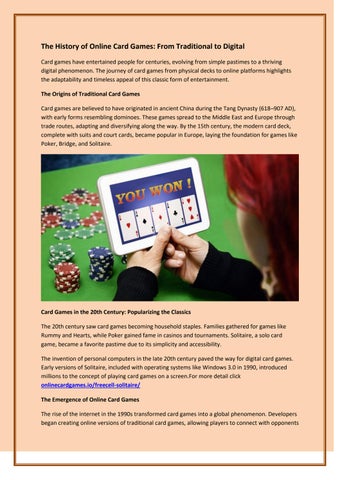
The invention of personal computers in the late 20th century paved the way for digital card games. Early versions of Solitaire, included with operating systems like Windows 3.0 in 1990, introduced millions to the concept of playing card games on a screen.For more detail click onlinecardgames.io/freecell-solitaire/
The Emergence of Online Card Games
The rise of the internet in the 1990s transformed card games into a global phenomenon. Developers began creating online versions of traditional card games, allowing players to connect with opponents
worldwide. Websites like Yahoo! Games and Pogo became hubs for playing card games such as Spades, Euchre, and Hearts.
Online Poker was a significant breakthrough. In 1998, the launch of the first online Poker platform, Planet Poker, marked the beginning of a lucrative industry. Players could now enjoy Texas Hold’em and other variations without visiting a casino.
The Evolution of Online Card Games
As technology advanced, so did the complexity and appeal of online card games. The early 2000s saw the rise of multiplayer platforms that offered real-time gameplay. Graphics improved, and features like chat options and leaderboards enhanced the gaming experience.
The introduction of mobile gaming further expanded the audience for online card games. Titles like Zynga Poker and Hearthstone became immensely popular, combining traditional elements with engaging narratives and strategic gameplay.
The Role of Social Media and Streaming Platforms
Social media platforms like Facebook introduced casual card games, encouraging players to invite friends and compete. Games like UNO and Crazy Eights gained a second life in the digital world.
Streaming platforms such as Twitch also contributed to the growth of online card games. Competitive card games like Hearthstone and Magic: The Gathering Arena became spectator sports, with players and fans gathering to watch tournaments and live gameplay.
The Impact of Technology on Online Card Games
Modern innovations like artificial intelligence (AI) and virtual reality (VR) have taken online card games to new heights. AI opponents provide challenging gameplay for solo players, while VR creates immersive environments where players can interact as if sitting at a real table.
Blockchain technology is also making its mark, introducing collectible card games with unique, tradable digital cards. This integration of cryptocurrency and gaming has opened new revenue streams for players and developers alike.
Online Card Games Today
Today, online card games cater to diverse audiences. Platforms offer everything from casual games like Solitaire to complex, strategy-driven games like Gwent. The accessibility of these games, combined with their ability to connect players globally, ensures their continued popularity.
Conclusion
The history of online card games is a testament to their enduring appeal and adaptability. From their humble beginnings as physical decks to the cutting-edge digital experiences of today, card games have successfully bridged the gap between tradition and innovation. As technology continues to evolve, the future of online card games promises even more exciting developments, ensuring their place in the world of entertainment for generations to come.