
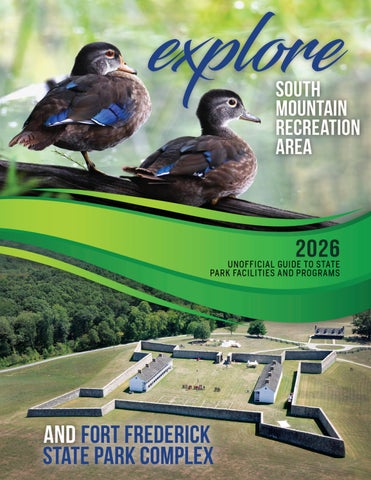
South Mountain & Fort Frederick State Parks Recreation Guide - 2026

Page 1


Fort Frederick State Park

Maryland State Parks

SOUTH MOUNTAIN RECREATION AREA

With five state parks in the midst of a 13,000-acre forest, the South Mountain Recreation Area is open for adventure year-round! Featuring boating, swimming, hiking, mountain biking, camping, and picnicking, Greenbrier State Park is the perfect place to get your blood pumping or just relax and unwind. Maryland’s approximately 40 miles of Appalachian National Scenic Trail follows the length of the South Mountain ridgeline, beckoning hikers for a day trip or an overnight excursion. Gathland State Park presents the unique history of the Civil War correspondent George Alfred Townsend, whose estate now houses two museums, and you can walk in the footsteps of soldiers who fought in the first major Civil War battle in Maryland at South Mountain State Battlefield. At Washington Monument State Park, climb to the top of the first monument honoring George Washington for unrivaled views of the mountain

and valley. Be sure you have necessary skills, knowledge and equipment for a safe, environmentally respectful visit, and enjoy your time in the great outdoors at the South Mountain Recreation Area!

FORT FREDERICK STATE PARK COMPLEX

We are very pleased to have you as our guest within the four parks that comprise this Potomac River heritage corridor. The park complex consists of Fort Frederick State Park, the Western Maryland Rail Trail (WMRT), Woodmont Natural Resources Management Area (NRMA), and Sideling Hill Creek State Park. The park complex is headquartered at Fort Frederick. Please join us for a historical interpretive program at the fort, a bike ride along the paved WMRT, and hunting and hiking at Woodmont Natural Resources Management Area (NRMA). At Fort Frederick State Park Complex, we hope that you will come for the history and stay for the day!

LEAVE NO TRACE

Enjoy the outdoors & Maryland State Parks responsibly

Enjoying the outdoors is something everyone should have the opportunity to do, but recreation always disturbs natural conditions. In order to help preserve the natural beauty along the trails and in park wildlands for your own enjoyment, please minimize your impact by following LEAVE NO TRACE outdoor ethics:

PLAN AHEAD AND PREPARE

• Prepare for extreme weather, hazards and emergencies. Call 240-260-8888 or 911 if you have an emergency.

• Schedule your trip to avoid times of high use.

• Be aware of hunters. Hunting is heaviest from late September through January, and April through May. Wear bright-colored clothing during hunting seasons.

TRAVEL AND CAMP ON DURABLE SURFACES

• Stay on designated trails and camp only on designated campsites.

DISPOSE OF WASTE PROPERLY

• Pack-it-in, pack-it-out. There are no trash cans in Maryland State Parks.

• Deposit solid human waste at campground privies, or in 8-inch deep cat holes.

• Dispense liquid waste (urine, dish water) at least 200 feet away from springs and privies.

• Trash should not be placed in privies.

• Pack out toilet paper and hygiene products.

• Repackage food to minimize waste.

MINIMIZE CAMPFIRE IMPACTS

• Campfires are prohibited at Annapolis Rock. At all other designated campsites, use established fire rings.

• Keep fires small

• Use only timber found on the ground. Do not cut live vegetation.

• Burn all wood or coals to ash, put out campfires completely, then scatter cool ashes.

RESPECT WILDLIFE

• Observe wildlife from a distance. Do not follow, approach or feed.

• Store food and trash securely. Black bears frequent South Mountain. Hang food in bear bags.

• Control pets. Dogs must be leashed.

BE CONSIDERATE OF OTHER VISITORS

• Respect other visitors and protect the quality of their experience. Avoid raising your voice and (making) loud noises.

• Be courteous. Yield to other trail users.

APPALACHIAN TRAIL SPECIFICS

• Use a map. The Potomac Appalachian Trail Club’s Maps 5 and 6 are ideal for traveling the Maryland portion of the A.T. Copies can be purchased at Greenbrier.

• Camping is allowed only at designated trail shelters and campgrounds.

• The Appalachian Trail is for foot traffic only.

• Follow official blazes. The A.T. is marked by white blazes, side trails by blue. Avoid bushwhacking your own trail or following abandoned roads.

• Shelters and campsites are intended for backpackers or hikers.

• Maximum of six people per regular campsite.

• Maximum of 10 people per group campsite.

• Travel in small groups. Avoid groups larger than 10 participants for over night trips, and groups larger than 25 participants for day trips.

• Overnight hikers will be limited to a maximum two-night stay at any shelter/campsite area.

LEARN MORE AT LNT.ORG

POPULAR APPALACHIAN TRAIL DAY HIKES

Amazing Views and Historic Sites Provide Great Destinations for a Day Hike

WASHINGTON MONUMENT

(elevation 1,500 feet)

Access Point: U.S. 40 parking lot, 1/4 mile east of Greenbrier. Follow blue-blazed trail from parking lot to white-blazed (A.T.) Turn left to go south (cross I-70 foot bridge).

Difficulty: Moderate

Distance: 3 miles (one way)

Return Options: Return by same trail to U.S. 40 or leave a second car at Washington Monument State Park. Highlights: The first monument to George Washington offers views to the east and west.

WEVERTON CLIFFS

(elevation 750 feet)

Access Point: Gathland State Park

Difficulty: Strenuous

Distance: 6 miles (one way)

Return Options: Return by same trail or leave a second car at Weverton Road (one mile south of Weverton Cliffs on A.T.)

Highlights: Weverton Cliffs offers a view of the Potomac Valley near Harpers Ferry, WV.

ANNAPOLIS ROCK

(elevation 1,700 feet)

Access Point: U.S. 40 parking lot, 1/4 mile east of Greenbrier. Follow blue-blazed trail from parking lot to white-blazed A.T. Turn right to go north. Difficulty: Moderate Distance: 4.4 miles (round trip)

Return Options: Return by same trail to U.S. 40 Highlights: Annapolis Rock offers a view of Greenbrier Lake and the Cumberland Valley.

Appalachian National Scenic Trail

Explore the Mountain’s Challenging, Scenic Terrain on this National Treasure of a Trail

THE APPALACHIAN TRAIL

A 2,194-mile footpath across Appalachian Mountain ridge lines from Georgia to Maine – was envisioned in 1921 by Benton MacKaye, a forester and self-styled philosopher. Thousands of volunteers, many legislators and the Civilian Conservation Corps made the trail a reality by 1937. Many hikers use the trail today for short day hikes or overnight backpacking adventures, and hundreds tackle the entire journey, which requires extensive planning and incredible physical and mental strength.

Maryland’s 40 miles are considered easy by A.T. standards, with only a 1,650-foot change in elevation from the low point at the Potomac River to the high

point at High Rock. Following the South Mountain ridge line, it offers plenty of challenges and impressive scenery. For beginning backpackers or those getting in shape, the entire A.T. in Maryland can be hiked in three or four days, with trail shelters and backpacker campgrounds spaced about a day’s hike apart.

GREENBRIER State Park

Discover the Full Range of Fun, All In One Great Park

Located in the Appalachian Mountains, with a portion of the Appalachian Trail passing through the park’s eastern edge, Greenbrier State Park is a multi-use park offering a range of recreational opportunities. The manmade freshwater lake offers swimming, sunbathing, boating and fishing opportunities, and hiking trails meander through a variety of wildlife habitats and spectacular views. Picnic tables, grills and playgrounds are available in the day-use area.

SWIMMING

A 1,000-foot beach and swim area that gradually reaches a depth of six feet leaves plenty of shallow water for children to play in Greenbrier’s 44-acre fresh water lake. Lifeguards monitor the beach and swim area daily from Memorial Day through Labor Day. Restrooms, shower and changing rooms are available.

PICNICKING

Greenbrier features hundreds of picnic sites with tables and grills. Sites overlook the lake and are convenient to restrooms. Rent one of our four lake-front gazebos for group picnics – they seat up to 32 people.

BOATING

Bring your own boat (electric trolling motors only) or rent paddleboat by the hour during the summer.

FISHING

With an appropriate Maryland fishing license in possession, you can fish for trout, bass or blue gill. Children 15 or younger do not need a fishing license. Free Fishing Days: first two

Saturdays in June and July 4. No license is required to fish in any of Maryland’s fresh waters on these days.

PETS

Pets on leashes are permitted in the day use and lake area year-round. Pets are not permitted on the sandy portion of the beach, in the lake, or the ash/birch loops.

WILDLIFE

The park is home to abundant wildlife. Bring your camera and guide books, but please respect the animals. Do not disturb!

HUNTING

Greenbrier has a 500-acre hunting area. A Maryland hunting license and knowledge of the Maryland hunting seasons are required. There is no hunting on Sundays. The Natural Resources Police monitor hunters closely so be sure your weapon is unloaded in the safety zones and near your vehicle. Remember that hikers may be unaware of hunting seasons.

ACCESSIBILITY

The Visitor Center and all restrooms in the beach area at

Greenbrier State Park are accessible to the mobility impaired. The beach plaza allows easy access to the beach and shower house. Beach wheelchairs are available at no charge on a first-come, first-served basis. Family restrooms are available at the Main Bath House.

METAL DETECTORS

Metal detectors are permitted on the sandy beach and in the swimming area only. From the Friday of Memorial Day weekend through Labor Day, metal detectors are prohibited from 9 a.m. to dusk. From Labor Day to the Friday of Memorial Day weekend, metal detectors are prohibited from 11 a.m. to dusk. Permission must be obtained through park management. Metal detectors may not be used elsewhere in the park.

VISITOR CENTER

Explore exhibits on South Mountain’s wildlife, history and the Appalachian Trail. Park staff will be happy to answer your questions. The Visitor Center is open weekdays year round.

DAILY ENTRANCE FEE SCHEDULE

OCTOBER – APRIL

Weekdays, Weekends & Holidays: $3/vehicle

MAY & SEPTEMBER

Weekdays: $3/vehicle

Weekends & Holidays: $3/person

MEMORIAL DAY – LABOR DAY WEEKEND

Weekdays: $3/person

Weekends & Holidays: $5/person

GAZEBO RENTALS

$106.25 per day, including non-refundable $6.25

*In state residents only. Out of state residents add $2

MARYLAND STATE PARK PASSPORT

IN STATE: $75 • OUT OF STATE: $100 (good at any Maryland State Park)

For more information visit: dnr.maryland.gov/publiclands

Plan your visit

Alcohol is prohibited in the park Greenbrier is a “Trash-Free Park.” Take your trash home with you; bring bags and plan accordingly to reduce waste.

Baptisms at the Greenbrier Lake are strictly prohibited between 10 a.m. and 6 p.m. every day from Memorial Day weekend through Labor Day. Written permission from park management is required prior to your visit.

Reservations are now required to visit the Day Use and Lake Areas of Greenbrier State Park on weekends and holidays. Reservations can be made online up to 7 days in advance at http://www.parkdayuse. maryland.gov

HIT THE TRAILS

at Greenbrier State Park

Mountain bikes are welcome on all Greenbrier State Park trails except on the face of the dam, on a section of un-blazed trail between the Rock Oak Fire Trail (blue) and the dam, and the Bartman Hill Trail. Bikes are NOT permitted on the Appalachian Trail.

Pets are welcome in developed areas and on trails in the park. Pets are not permitted on the sandy portion of the beach or in the lake.

Several Greenbrier trails are in public hunting lands. The most popular hunting seasons are SeptemberJanuary and April-May. Wear bright colors during these times.

BARTMAN HILL TRAIL

Blaze Color: Light Blue Distance: 0.6 mile

Difficulty: Strenuous. Steep trail connects Visitor Center to Appalachian Trail (A.T.) Turn left on the A.T. to go north or right to go south.

BIG RED TRAIL

Blaze Color: Red Distance: 4.5 miles

Difficulty: Strenuous. The longest trail in the park, Big Red is a complete circle with many access points

CAMP LOOP TRAIL

Blaze Color: Orange Distance: 1 mile

Difficulty: Moderate. Adding a short section of the Big Red Trail makes this 1.5 mile loop. Hilly by the lake.

COPPERHEAD TRAIL

Blaze Color: Green Distance: 0.4 mile

Difficulty: Moderate. Parallels a section of the Big Red Trail.

GREEN TRAIL

Blaze Color: Green Distance: 0.8 mile

Difficulty: Moderate. Loop trail starting at the Visit Center. Good for beginning hikers.

MARKED MILE

Blaze Color: Yellow Paw Prints Distance: 1 mile

Difficulty: Easy. Follow white arrows on the paved surfaces in the day use area for exactly a mile walk. Starts at the “X” near the Visitor Center.

ROCK OAK FIRE TRAIL

Blaze Color: Blue Distance: 1.5 miles

Difficulty: Moderate. Parallels Snelling Fire Trail. Includes one steep section.

SNELLING FIRE TRAIL

Blaze Color: Silver Distance: 1 mile

Difficulty: Moderate. Fairly flat; steep section in the middle.

YELLOW TRAIL

Blaze Color: Yellow Distance: 2.5 miles

Difficulty: Moderate. Runs from boat launch to the Red Trail.

CAMPING at greenbrier campground

Connect with Family and Nature Camping Under the South Mountain Stars

Greenbrier features 165 developed campsites in a mountain forest setting. The campground includes four loops, each with it’s own central shower building. Each campsite has a driveway, a space for trailers or tents, a picnic table, lantern holder, and a fire ring. Each campsite can accommodate up to six people. Ash Loop is closest to the lake. Cedar Loop includes electric hook-ups. The camp area has a central dump station and dumpsters. Camping is open from early April through late October. Pets

on leashes are permitted in the Cedar and Dogwood loops only.

Campsites allow for a maximum combined trailer and vehicle length of 30 feet.

CAMPSITE RESERVATIONS

Call 888-432-CAMP between 8 a.m. and 8 p.m. Monday-Friday, or reserve a site online anytime at parkreservations.maryland.gov. Campsite costs range between $26 and 40 per night; weekend, holiday, non-resident and electric premiums apply. Alcohol is prohibited in the campground and throughout the park. Quiet hours start at 10 p.m.; check out is 1 p.m.

During the week (Sunday after 1 p.m. through Friday before 3 p.m.) visitors are welcome to tour/preview the Greenbrier campground after registering their vehicles with the Camp Office staff. Campground previews are not permitted during a park capacity closure.

SOUTH MOUNTAIN STATE BATTLEFIELD

Visiting HALLOWED GROUND

The South Mountain Battlefield is a remarkable historic and natural resource. In addition to being the site of a major Civil War battle, it includes valuable farm and forestland and is home to diverse wildlife. The battlefield also serves as a shrine to the memory of the approximately 5,200 soldiers who were killed, wounded and missing that day. Although battlefield preservation at South Mountain is ongoing, nearly two-thirds of the battlefield remains privately owned. Because of this, please respect the property rights and privacy of our friends and neighbors when visiting and touring the battlefield.

A Crucial Battle Echoes Through the Mountain Gaps in the Lead-Up to Antietam

The Battle of South Mountain was perhaps the most decisive part of Confederate Gen. Robert E. Lee’s failed first attempt to invade the Union – and perhaps one of the most decisive events in the Antietam Civil War. A Confederate victory on northern soil might have compelled Great Britain and France to intervene on the South’s behalf, and persuade a war-weary North to negotiate a peace settlement. A Southern victory might have secured Confederate independence.

Following his victory at 2nd Manassas, Lee’s invasion of the Union (also known as the Maryland Campaign) began Sept. 4, 1862, when a portion of the Army of Northern Virginia crossed the Potomac River near Leesburg, Va., and advanced towards Frederick, Md. As the Confederates moved westward across South Mountain Toward Hagerstown, the Army of the Potomac under Union Gen. George B. McClellan left Washington D.C., in pursuit of the invaders.

Everything went according to Lee’s plan until Sept. 13, when the Federals reached Frederick and Union soldiers found a copy of Lee’s Special Order No. 191. The famous “Lost Order” revealed that Lee’s army was divided, with only a few regiments in Boonsboro watching the mountain gaps.

Fought Sept. 14, 1862, the Battle of South Mountain broke out in the Fox’s Gap and Tuner’s Gap areas after Confederate gunners opened fire on Federal forces moving toward the base of the mountain. Charges and counter-charges continued here throughout most of the day. Further south at Crampton’s Gap, Gen. William B. Franklin did not begin an attack by his Union VI Corps until late afternoon – a delay that cost the Union a chance at dividing the Confederate forces.

By nightfall on Sept. 14, 1862, the Maryland Campaign changed for Lee and the Army of Northern Virginia from an offensive incursion to a defensive withdrawal. Although the

Battle of South Mountain was a Confederate tactical defeat, the Union’s failure to lead a full-scale attack early in the day allowed Lee to summon reinforcements. On Sept. 15, Lee fell back to Sharpsburg to set up a defensive position along Antietam Creek.

The Battle of South Mountain had a profound effect on the war. It would cause Lee to abandon his plans for  the Maryland Campaign – an offensive movement – and take a defensive position at Sharpsburg, leading to the Battle of Antietam fought on September 17. The Union victory here, coupled with the victory at Antietam, would give President Abraham Lincoln the backing he needed to issue the Emancipation Proclamation.

1 2 3 4

points of interest

WASHINGTON MONUMENT STATE PARK

The Washington Monument Visitors Center features exhibits covering the history of the nation’s first completed monument to honor George Washington, a summary of the 1862 Maryland Campaign, and a fiber-optic map presenting an overview of the Battle of South Mountain. Visit the monument itself, which was used as a Union signal station during the Civil War.

TURNER’S GAP

A major thoroughfare in the area during the Civil War, the National Road crosses the mountain here, at one of the three major gaps involved in the battle. The Mountain House hugs the road and was a focal point during the battle. Wayside exhibits explain the battle around the gap, where the famous Iron Brigade earned its name.

FOX’S GAP

Wayside exhibits discuss the battle in this area. Monuments dedicated to the men who fought here include two devoted to generals killed during the battle; Union Major General Jesse Reno, commander of the Ninth Army Corps, and Confederate Bridadier General Samuel Garland, commander of a North Carolinian brigade.

CRAMPTON’S GAP (GATHLAND STATE PARK)

Two museums explore the literary career of George Alfred Townsend, War Correspondents, and the Battle of South Mountain. Interpretive wayside exhibits highlight points of interest from the battle. The War Correspondents Memorial, constructed by Townsend after the war, stands at the park entrance.

WASHINGTON MONUMENT STATE PARK

A Monument to Our First President Provides Stunning Views and an Activity-Packed Park

In 1827, the citizens of Boonsboro became the first to complete a monument in honor of George Washington. According to a period newspaper account, on July 4, 1827, at 7 a.m., most of Boonsboro’s 500 inhabitants assembled at the public square. Behind the Stars and Stripes and stepping spiritedly to the music of a fife and drum corps, they marched two miles up the mountain to the monument site. The citizens worked until noon and then held a dedication ceremony and lunch. They resumed work and by 4 p.m. the monument stood 15 feet high on a 54-foot circular base. The day ended with the reading of the Declaration of Independence and a three-round salute fired by three Revolutionary War veterans. The workers returned that September to complete the monument, at a finished height of 30 feet. During the Civil War, the Union Army pressed the monument into service as a signal tower. The monument fell into disrepair, and the Civilian Conservation Corps (CCC) restored it in 1936.

Visitors today can take in panoramic views of four states from the top of Washington Monument, which anchors a park

featuring hiking, picnicking, camping, bird watching, and a museum. Most of the Washington Monument’s hiking trail is part of the Appalachian National Scenic Trail. Hikers planning an overnight back pack outing can park at Washington Monument State Park for a few days (park in the lower lot only and sign the hiker log book). Day-hikers can trek north for 3 miles to Greenbrier State Park or go south to South Mountain State Battlefield and Gathland State Park. Pets on leashes are welcome on the Appalachian Trail and in Washington Monument State Park.

Picnic sites with tables and grills are available, and families or groups can rent the Fort Necessity Pavilion. The park includes a multi-purpose field for pickup games and a playground for children. The monument is an ideal site for spotting migratory birds like hawks, eagles and falcons; peak time is mid-September. The monument museum features historical artifacts related to the history of Washington Monument and the Battle of South Mountain.

FEES & RESERVATIONS

Entrance Fee: $2

Additional fees for out-of-state residents

Fort Necessity Picnic Shelter

$61.36/day (Capacity: 55)

Alcohol permits are available for this shelter through the reservation service for $35.

Youth Group Camping Areas: No charge with MPS Youth Group Pass

To reserve campsites or shelters, call 888-432-CAMP or visit parkreservations.maryland.gov. Call the park office at 301-797-4767 to help plan your visit.

MARYLAND STATE PARK PASSPORT

IN STATE: $75 • OUT OF STATE: $100 (good at any Maryland State Park)

For more information visit: dnr.maryland.gov/publiclands

WASHINGTON MONUMENT STATE PARK

The museum is open on weekends in Spring, Summer, Fall, and by request.  6620 Zittlestown Road Middletown, MD 21769

301-791-4767

dnr.maryland.gov/publiclands/Pages/ western/washington.aspx

SOUTH MOUNTAIN STATE PARK

Explore a Landscape Teeming with Wildlife, Scenic Vistas and History

South Mountain State Park is a 40-mile long multi-use state park weaving along the South Mountain ridge from the Pennsylvania line to the Potomac River. The park has no distinguishable boundary or entrance facility but is accessible at a number of locations. Most of the park is only accessible by foot.

South Mountain State Park’s 13,000acre forest is home to a wide variety of wildlife, including black bears, meadow voles, whitetail deer, raccoons, rat snakes and opossums. Please be respectful to the wildlife; keep your distance and do not disturb!

South Mountain is also along the Eastern Flyway, a migration route for hawks, eagles and owls.

Maryland’s portion of the Appalachian National Scenic Trail is situated along the ridge top of South Mountain

State Park. The A.T. is perfect for a variety of hikes and experience levels: You can make a simple day hike, an overnight backpack trip or a multi-night excursion part of your South Mountain adventure. Use a detailed Appalachian Trail map to plan your outing, available for purchase at Greenbrier State Park. South Mountain features several impressive scenic vistas, including High Rock, Black Rock, Annapolis Rock, White Rock and Weverton Cliffs, which are all accessible from the A.T.

South Mountain has also been influenced by several historic figures, including General Edward Braddock, George Washington, William McKinley, Rutherford B. Hayes, Robert E. Lee, George B. McClellan, and George Alfred Townsend.

SOUTH MOUNTAIN STATE PARK

The South Mountain State Park Office is located at Greenbrier State Park.

SEND MAIL: C/O SOUTH MOUNTAIN RECREATION AREA 21843 National Pike, Boonsboro MD 21713 301-791-4767

dnr.maryland.gov/publiclands/Pages/western/southmountain.aspx

GATHLAND STATE PARK

Nature and Architecture Combine in Mountain Estate Honoring Civil War Correspondents

While researching his novel, Katy of Catoctin, George Alfred Townsend –the Civil War’s youngest field correspondent and one of late-19th century America’s most important journalists and novelists – became captivated by beautiful Crampton’s Gap, the site of a September 1862 Civil War battle. He purchased 100 acres on the ridge of South Mountain and built his estate. Townsend often wrote under the pen name “GATH,” and the estate is now Gathland State Park.

During the Civil War, Townsend reported on the events from the Union side. He covered the Peninsular Campaign in 1862, then lectured in Europe before returning to report on the war’s end. A popular syndicated columnist and

novelist, Townsend fashioned himself as a Renaissance man and was unabashed self-promoter. Race horses, pocket knives, a line of cigars as well as a post office all bore his pseudonym.

In establishing his estate, he included a monument to honor war correspondents, artists and photographers. The War Correspondents Arch – 50 feet high and 40 feet across built in 1896 – is a national historic monument administered and maintained by the National Park Service. Two buildings from Townsend’s estate survive and now serve as Gathland State Park’s museum. The museum features many artifacts from Townsend’s life, career and estate, as well as artifacts from the Battle of South Mountain.

Gathland’s pavilion is available for reservation by calling 888-432-CAMP or visiting parkreservations.maryland.gov. Reservation cost is $76.36 per day. Alcohol permits are available for this pavilion and are available through the reservation service for $35.

GATHLAND STATE PARK

The museums are open on weekends in the spring, summer, fall, and by request.

900 Arnoldtown Road ı Jefferson, MD 21755 301-791-4767

dnr.maryland.gov/publiclands/ Pages/western/gathland.aspx

Hunting observe safety zones & respect private property

South Mountain State Park includes Black Rock Hunting Lands, Gathland Hunting Lands and Lambs Knolls Hunting Lands. A Maryland hunting license and knowledge of the Maryland hunting seasons are required. THERE IS NO HUNTING ON SUNDAYS. Access is limited, so be prepared to hike long distances.

To improve your hunting experience, scout out the areas prior to hunting season. You may use the Appalachian Trail to access the hunting areas, but the Appalachian Trail Corridor is a non-hunting area. You cannot hunt until you are 150 yards away from the Trail in either direction. Hunting is not permitted on Federal land.

Make sure your weapon is unloaded in the safety zones and also while hiking to your destination through non-hunting areas. Respect private property. Off-road motorized vehicle use is strictly prohibited.

Remember that many hikers using the A.T. may be unaware of hunting seasons. Boundaries are marked with yellow paint. A yellow line indicates you are looking into state property; a yellow dot indicates you are looking into private property.

To learn more about hunting on public lands, hunting licenses and education programs, visit dnr.maryland.gov/huntersguide/Pages/default.aspx.

For hunting maps of South Mountain Recreation Area, call 301-791-4767.

FORT FREDERICK STATE PARK

The centerpiece of Fort Frederick State Park is a unique stone fort that served as Maryland’s frontier defense during the French and Indian War. Built in 1756, the Fort’s stone wall and two barracks have been restored to their 1758 appearance. Historic exhibits are in the Fort, barracks, Civilian Conservation Corps (CCC) Museum, and Visitor Center.

The fort barracks are open Thursday to Monday from Memorial Day to Labor Day and on the weekends in the spring an and fall, when staff and volunteers dress in period clothing and occupy the fort, demonstrating daily life in the 18th century.

The 585-acre park borders the Potomac River and The Chesapeake and Ohio Canal passes through the park. The park also features a boat launch, campsites, camp store, fishing, flat water canoeing, hiking trails, a playground, a picnic area and small pavilion. Group tours are available seasonally.

GENERAL PARK HOURS: April 1-October 31 (8 a.m. - Sunset); November 1-March 31 (10 a.m.-Sunset); and Closed Christmas Day

FACILITY SERVICE CHARGE: $3 per vehicle for MD residents. $5 per vehicle for out-of-state visitors. Please pay at one of the honor boxes located in the picnic area or the store parking lot near the fort. You may also pay at the Visitor Center or Captain Wort’s Store.

CAMPING: Family camping at Fort Frederick State Park is available on 29 sites. Sites include: a picnic pad with stone dust surface; a picnic table; a fire ring with grilling grate attached; a lantern post with small wooden countertop area. There are no electric sites, and the restrooms in the vicinity are portable toilets. Flush toilets are located near Capt. Wort’s Sutlery and are available throughout your stay.

Tent camping is available May through October. Camping is available year round for self-contained units. Family campsites may be reserved through the reservation system, however walk-ins are also welcome on a first-come first-served basis. ALL CAMPING EQUIPMENT MUST BE PLACED ON THE STONE DUST PAD.

Four youth group campsites are available for organized youth groups aged 16 and younger. These sites must be reserved either online or through the park office. To obtain a two-year youth group pass, please apply online at dnr.maryland.gov and search “youth” group pass.

To make camping, shelter, or youth group camping reservations, call 888-432-2267 or make your reservation online at park reservations.maryland.gov.

FORT FREDERICK WALKING TOUR

1. STONE WALL

This wall is the fort’s main defense. It was built of local rock and is three layers thick. The outside layer is mainly limestone with a rubble layer between. It measures four feet thick at the bottom and tapers to two feet thick at the top. At it’s highest point, the wall measures roughly 22 feet high. British engineers designed the fort for the Colony of Maryland. As a guide, the engineers used the design of French engineer Sebastian de Vauban, His design was very popular in European forts and was modified for different environments in the colonies. Many American and English-built forts followed a similar design, but were built of logs and earth. Fort Frederick is designed as a large square with four diamond-shaped bastions used for defensive purposes. The wall is made of stone, rather than wood, which allows the fort to be very secure.

2. FORT GATE

Large wooden doors are the only entrance to the fort and were closed except when a supply wagon came through. Individuals were allowed to enter through a smaller door known as a wicket gate. This gate allowed the guard to watch people entering the fort. If an enemy was trying to get in, he could be pushed back, the door closed, and block anyone else from entering. The main gate had a row of spikes to discourage anyone from climbing over.

3. WEST BARRACKS

This building shows the life of the common soldier. Governor Sharpe set up the fort to house 200 men easily and 400 if needed. The barracks are large for the 18th century. Typically, frontier forts did not have two-story buildings, white clapboard siding, double porches and glass windows. The floor plan was open except for a sectioned-off area on each end for camp followers’ living space. The camp followers were women hired by the army to cook for the officers, do laundry, sew, clean and do nursing duties. The enlisted men would have done their own cooking in groups of 6-8 men. The Barracks were rebuilt in 1975 for the bicentennial. The barracks are open when staff in 18th-century clothes are present.

4. GOVERNOR’S HOUSE

This building, represented by the stone outline, was the officers’ quarters. Governor Horatio Sharpe stayed in this building several times as he supervised the construction of Fort Frederick and commanded the fort in the summer and fall of 1758. The large diamond shape in the middle of the east wing shows a central chimney with a fireplace in each room. It appears there were no fireplaces in the west wing and could indicate this side was used for storage. The middle rooms were used as the fort’s office and officers’ dining area. In May 1757, Wahachey of Keowee

(near Clemson, S.C.) and 62 Cherokee Warriors came to the fort. In a meeting held in the Governor’s House, the Cherokee agreed to help Maryland in the fight against the French and their American Indian allies.

5. PARADE GROUND

The parade ground between the fort’s buildings was used for troop inspection, drill and review. The area inside the fort encloses about two acres, a large size for a frontier fort.

6. EAST BARRACKS

This building and the one across the parade ground were the enlisted men’s quarters. This building now shows officers’ quarters, grand hall, armory, store house, laundry and kitchen on the first floor, which would have been in the Governor’s House historically. The second floor shows other areas, including a hospital and doctor’s quarters, Indian trade good storehouse and time-line museum.

7. WELL

By building the well inside the fort, the garrison’s water supply could be protected. Since the Potomac River was a half-mile south of the fort, a well supplied the men with water for drinking, cooking and laundry.

Fort Frederick was built during the French and Indian War in 1756 to protect the frontier and serve as a staging area for attacks against the French.

8. BASTION & CATWALK

The catwalk in the fort was built by the Civilian Conservation Corps (CCC) in the 1930s. It is not know what kind of defenses were inside Fort Frederick. There is no proof that there were ever catwalks inside the fort. There is evidence that two of the bastions had earth ramps. The bastion defenses allowed soldiers to ire over the wall at attackers. Each bastion had one six-pound cannon. Bastions improved the fort’s defenses by allowing the artillery to have a broad range of fire and by putting cross-fire on attackers who might attempt to attack the wall. There is some evidence that the northeast bastion had an earthcovered powder magazine.

9. CCC MUSEUM

The Civilian Conservation Corps (CCC) built this building in the 1930s for the park store and museum. The building does not look like any building from the 18th century. Today, it houses exhibits about the CCC.

10. CAPTAIN WORT’S STORE & OUTBUILDINGS

The Civilian Conservations Corps (CCC) built these buildings in the 1930s as the Park Superintendent’s Residence, which now serves as the park store. The outbuildings included a barn, carriage house and blacksmith shop.

1. VISITORS’ CENTER & KIOSK

At the visitors center, watch an orientation movie about the fort’s history and view an exhibit about the Williams family. The kiosk located in the parking lot features historical information on the fort and the Williams family. The visitors’ center is near the site of the Charles Williams farm. Charles was Nathan Williams’ son and a school teacher.

2. FIRST HOUSE SITE & CIVIL WAR TRAILS MARKERS

From about 1857 to 1909, the Williams family resided on this site. The restored foundation might be from the kitchen of the house. According to period sources, the house was conferred a “mansion.” A period image of the house contradicts that sentiment as the house appears to have two stories, no porch, and no more than six rooms. The house was destroyed by fire in 1909. During the Civil War, Union officers occupied the house for their quarters, and Ammy Williams cooked for them.

3. SECOND HOUSE SITE

On this site stood the second home built by the Williams family. It was built in 1909 and was raised by the Civilian Conservations Corp (CCC) in 1934. It was a two-story frame house with a wrap-around porch and had four to eight rooms.

4. CANNON HOLE

According to Nathan Williams, Union soldiers knocked a hole in the wall in 1861, to fire a cannon through at Confederates across the Potomac River in Virginia. Historical documentation places Union artillery at the fort in 1861 and 1862. In 1931, the Daughters of the American Revolution placed a Confederate Civil War cannon at the hole.

5. FORT

INTERIOR

Williams took advantage of the ruined walls of the fort and used the area inside for many

WILLIAMS FAMILY

African-American

Heritage Walking Tour

From 1860 until 1911, the fort was owned by the Nathan Williams family. The Williamses were free African-Americans The family had been enslaved until Nathan’s father, Samuel, purchased the family’s freedom in 1826. By 1847, Nathan would purchase his wife, Ammy from bondage. The Williamses made a prosperous farm on the site. In 1876, Nathan was named trustee of “Fort Frederick Colored School,” which operated off and on until 1909. Two of Nathan’s children served as teachers for the school.

purposes, including a pig sty, orchard and vineyard.

6. NORTHWEST BASTION / BANK BARN

Around 1860, Nathan Williams dismantled the northwest bastion and built a bank barn there, recycling a lot of the wall’s stone in its construction.

7. “FORT FREDERICK SCHOOL FOR COLORED’S”

In 1876, Nathan Williams was named trustee of the “Fort Frederick School for Colored’s.” This school was the second school built in Washington County for the education of African-American children. The school appears to have been in several buildings and locations, including Charles Williams’ house before the current building was built. The school consisted of three rooms, one classroom and two offices or closets. It has been altered several times during it’s life span. This building was built about 1899 and used as a school periodically until 1909. Two of the Nathan Williams’ children, Charles and Betty, were teachers at this school. The school building was sold by the county in 1914 and became a private residence.

8. OTHER POINTS OF INTEREST:

Western Maryland Railroad: This railroad crossing is part of the former Western Maryland Railroad, and is an active spur line for CSX today. The Western Maryland Railroad began construction in 1852 but did not reach Big Pool until 1882. It offered passenger and freight service and was an economic catalyst for local farmers.

C&O Canal: Construction began in 1828.By 1852, it was completed from Georgetown to Cumberland, Md. Some of the laborers used to build the canal were enslaved people. Tradition states it was part of the Underground Railroad. The canal opened up commerce, trade and travel both east and west.

This was accomplished by overcoming the mountain’s with a series of locks which raised and lowered canal boats. The Williams’ family would have been intimately familiar with the canal workers and using the canal as a source of trade.

Potomac River: The river was the original source of trade and travel for early settlers. By the 1800s, it was an obstacle to be overcome for north/south trade. Ferries were established along the river; the closest being at McCoy’s Ferry and Cherry Run. During the Civil War, the river would be the dividing line between two nations and the front line of that war. Nathan Williams, a Virginian by birth, knew and traded with people who lived in Virginia. He did not let the war stop him. He would take goods and cross the river with his wagon and trade with soldiers and civilians in the Confederacy. Upon his return to Maryland, he would give information to Union soldiers stationed around Fort Frederick.

Sideling Hill Creek State Park

Sideling Hill Creek State Park is 865 acres of mountainous forest land. The Potomac River Overlook provides a majestic view of the Potomac River valley and picnic tables to enjoy the wildlife and scenery. The park provides a haven for 30 species listed as rare in Maryland. These species include butterflies, freshwater mussels, bats, and numerous plants.

Sideling Hill Creek is a stocked trout stream that begins in Pennsylvania and runs 21.9 miles to the Potomac River. The park’s wealth of natural and cultural resources, and its geography and physical resources make it an ideal location for a variety of activities and outdoor recreation. Returned to the Maryland State Park Service’s stewardship in 2021, a master plan aims to minimize alterations to the appearance of the landscape.

GENERAL PARK HOURS:

April 1-October 31 (8 a.m.-Sunset) November 1-March 31 (10 a.m. Sunset) Closed: Christmas Day

POTOMAC RIVER OVERLOOK

AND TRAIL is accessible by a 1.2 mile return trail with a moderately strenuous rating. The overlook is not handicapped-accessible.

TABLER LODGE is named for Dr. Homer E. Tabler. Dr. Tabler was a well-known physician in the Town of Hancock and is part of the Town’s history. He built the lodge as a weekend getaway while remaining close to the community that he served.

STRAUS LODGE is named for Aaron and Lillie Straus. In 1945 they made a contribution to the Baltimore Area Council of the Boy Scouts of America. This contribution allowed for the purchase and establishment of the Lil-Aaron Straus Wilderness Area. It was “to be dedicated to high adventure experience for the boys of the Baltimore Area Council.” In 1956, the Aaron and Lillie Straus Foundation provided additional funds to further the development of the camp. The property was run as the Aaron Straus Boy Scout Camp until sold to the State of Maryland in 1991.

FRIENDS OF FORT FREDERICK

The Friends of Fort Frederick State Park Inc. sponsors, or provides financial and volunteer support, for the park complex and historic fort activities throughout the year, geared toward enhancing the visitor’s experience and providing educational and recreational opportunities at the fort and park. These events include:

• Hosting an 18th Century Market Fair

• French and Indian War Muster Reenactment

• School of the Ranger

• Historical and youthoriented weekend events

• Supporting Maintenance and Enhancement of assets and purchase of historical interpretive supplies and other equipment

For more details, please visit: friendsoffortfrederick. info/index.htm.

To contact the Friends, send email to info@friends offortfrederick.info.

JOIN THE FRIENDS

Membership is open to anyone, regardless of state or residence, who is interested in contributing to the preservation and interpretation of this historic and natural heritage site. Please complete the application found at friendsoffortfrederick.info/membership.htm and mail with the appropriate dues and/or donation to: The Friends of Fort Frederick 11115 Fort Frederick Road, Big Pool, MD 21711.

MEETINGS

General membership meetings are held every month on the second Monday of the month at 7 p.m. It is not necessary that you attend meetings to be a member. Plus, you’ll get a great monthly newsletter.

18TH CENTURY MARKET FAIR

At the end of April each year, the Friends host over 120 sutlers selling reproductions of period items including firearms, ceramics, clothing artwork, baked goods and much more. Hundreds of campers in period attire also take up residences in the park in a sea of tents. Day visitors can purchase handmade one-of-a-kind gifts, enjoy colonial entertainment and support the Clear Spring Lions Club and Historical Society at their food concession booths. For more details about this wonderful event, please go to: friends offortfrederick.info/market_fair.htm.

CURRENT FUNDRAISER PROJECTS

Your tax-deductible donations will directly support important preservation and historic interpretation at the park. Past projects have included the purchase of a complete 18th-century cannon with naval carriage used for public firing demonstrations at the Fort and a Skid Steer (a small bucket loader vehicle) crucial for the maintenance and cleaning of the Western Maryland Rail Trail.

FORT FREDERICK FLAG POLE FUND RAISING CAMPAIGN:

In August of 1755, his excellency Governor Horatio Sharpe of Maryland ordered “a Black & Yellow Flag 24 feet long and 16 feet broad

with the Union in One Corner” from Silvanus Grove, a merchant in London. This large flag was destined to fly over historic Fort Frederick during the French and Indian War.

In order to fly a copy of this wonderful flag at Fort Frederick again, the Friends of Fort Frederick State Park are undertaking a campaign to raise $60,000 to construct a 75-tall, authentically constructed flag pole in the fort’s northwest bastion. Imagine driving into the park and before your eyes this magnificence flag flutters in the wind, welcoming all visitors to this one-of-a-kind fort, Fort Frederick. You, your civic group or company can all help us make this dream come true by contacting the Friends of Fort Frederick to become a sponsor of the fort’s flag pole. The flag colors of yellow, black, red, white and blue symbolized the Calvert family’s proprietorship of the English colony of Maryland. During this campaign, they will serve as the levels at which you can contribute. Contact the Friends for details. You can also donate through the Flag Pole GoFundMe website: gofundme.com/f/flag-pole-fund.

ARTWORK

FOR THE FORT FREDERICK VISITOR CENTER EXHIBIT:

While designing the new Visitor Center Exhibit at Fort Frederick State Park it was realized that there were few good images to represent what the fort looked like during the 18th Century. Since the Cherokee Treaty of 1757 at Fort Frederick by Bryant White was to be used in the exhibit, we felt that having Pamela and Bryant White paint an additional seven images would create a unified exhibit design. You can play a role in helping the exhibit come to be by purchasing the artwork. You will own the original artwork to enjoy, while the Maryland Park Service and White Historic Art will retain the rights to the image. Please contact Bob Study at Fort Frederick State Park for details or to purchase the artwork at 301-842-2155 or bob.study@maryland.gov.

The Friends of Fort Frederick State Park Inc. is a 501c(3) organization and is always looking for new members to join auto help keep our heritage alive.

OPEN YEAR ROUND

A2A2 Dairy Products

Milk, Cheese, and Butter

Pork, Chicken, and Beef Products

10+ Ice Cream Flavors

3935 Bussard Rd • Middletown, MD 21769

• Sales • Service/Repairs • Shuttle Service

• Rentals: Bicycles, Canoes & Kayaks

• Pedal & Paddle Day Trips

• Experience riding a FAT BIKE or ELECTRIC BIKE on the historic C&O Canal trail.

Carman, Harsh, Sears, McPherson, Priest, Hoptak, Hartwig, Jordan, CivilWarTrails, American Battlefield Trust, Antietam Institute, and all others REFUTED!!

General J. D. Cox: “He [Hood] tells also of recovering the crest of South Mountain in the battle of 14th September 1862, after the Union troops had carried it. It has been abundantly demonstrated that the principal ridge south of the Hagerstown pike was never for a moment in real danger after the 9th Corps had gained it in the morning.”

This is a must-read. - Scott L. Mingus, Sr.

western maryland rail trail

The Western Maryland Rail Trail (WMRT) is a recreational, paved, linear trail opened to the public for walking, running, biking, and inline skating. The trail is suited to anyone seeking a pleasant, leisurely outdoor experience. The easy grade and paved surface make this trail ideal for families, the elderly, and persons with disabilities. The WMRT is wheelchair accessible. Pets are permitted on the trail. Please enjoy the trail and make sure to let us know if there are any concerns you may have. You may see one of our volunteer bike patrol rangers who are frequently out and about, if not, please contact Fort Frederick State Park at 301-8422155 with questions or concerns.

INDIGO TUNNEL BY-PASS

The Indigo Tunnel is home to eight different bat species. Due to the decline in the bat population the tunnel is closed to the public. Between Mile Markers 24 and 27, the tunnel is by-passed by using ramps to the C&O Canal Towpath. The by-pass is two miles long due to a bend in the Potomac River. The surface of the towpath is for the most part an even hard packed dirt trail. The towpath can be very muddy following heavy rain. For information regarding the C&O Canal Towpath, please visit: nps.gov/choh/index.htm

WOODMONT NATURAL RESOURCES MANAGEMENT AREA

Woodmont NRMA is a multiuse public land managed by the Maryland Park Service. Recreational opportunities include: hiking, hunting, mountain biking, bird watching, and horseback riding. 2,000 acres are open year round and an additional 1,400 acres are open seasonally. Please use the map for details or contact Fort Frederick State Park for more information at 301-842-2155.

From October 1st to March 31st each year, a private lease has exclusive use of the 1,400 acres and funds generated from their activities provide for the maintenance and operation of Woodmont NRMA. From April 1st to September 30th, DNR manages the public use of the 1,400 acres. The remaining 2,000 acres of the Woodmont property are open for public use on a year-round basis.

HOURS OF OPERATION

Woodmont Lodge is open by appointment only from April 1st through September 30th with a reservation made at least 14 days in advance.

CALENDAR OF EVENTS 2026

WOODMONT LODGE TOURS

June 20 • July 11

August 8 11am-1pm

Explore a well-kept secret of hunting and conservation history located in the woods of the Woodmont Natural Resources Management Area. 15 visitors will have the opportunity to tour Woodmont Lodge and see beautiful artifacts from the early days of the Woodmont Rod and Gun Club. Guests will need to wear shoe covers in the Lodge and use special flashlights to maintain the integrity of the building and artifacts. Pre-registration is required for this event and can be completed by contacting Fort Frederick State Park at fortfrederick.statepark@maryland.gov or by calling the office at 301-842-2155.

For more details, contact the park at 301-842-2155 or scan the qr code.

Events are subject to change.

18TH CENTURY MARKET FAIR

April 23-26

Th-Sat: 9am-5pm Sun: 9am-3pm

This event sponsored by the Friends of Fort Frederick State Park features artisans, craftspeople, and sutlers from across the country. Guests may explore the 18th-century encampment in modern-day clothes or period-specific clothing. Admission: $10 for adults, $5 for children aged 6 to 12, and 5 and under free.

YOUTH FISHING DERBY

April 9 • 8am-12pm

Come join us for a morning of fishing on the Beaver Pond. Open to kids aged 3-15 and must be accompanied by an adult. Please bring your own rod, tackle, and bait. Limited loaner rods and tackle available on site. Parking is at the Big Pool boat ramp and canal access lot. Prizes will be available to qualified fishers, as well as a grab bag of assorted lures for all participants.

“SACRED TO THE MEMORY OF...”

May 23-24 • 10am-5pm

Immerse yourself in the Civil War history of Fort Frederick and learn about how the Memorial Day holiday began as a Civil War tradition. Highlights include weapon demonstrations, cooking demonstrations, & an oral history of the holiday.

WESTERN MARYLAND RAILROAD HISTORY

June 6 • 8am-12pm

Join a ranger for National Trails Day to learn about the history of the railroad. Artifacts, photos, and memorabilia will be on display at our tent near the Church St. Rail Trail parking lot in Hancock, next to the bike trail.

“MARYLAND’S NOBLE TRAIN OF ARTILLERY”

June 13 • 10am-5pm

Experience military life during the American Revolution with the men and women of the Maryland Provincial Companies of Foot. Highlights of the event include cannon firing demonstrations, musket firing presentations, hearth cooking, & military and children’s drill.

“...AND ZEL FOR LIBERTY”

July 4-5 • 10am-5pm

It’s Independence Day and the United States of America turns 250 years old! Join our interpretive staff and volunteers as they portray the men and women of the American Revolution and learn about the role the fort played during the war. Includes musket firing demonstrations as well as military and children’s drill.

THE FRENCH IN NORTH AMERICA: 1752-1763

July 18 • 10am-5pm

To commemorate French-American Heritage Month, join park staff and volunteers for a living history program about French military forces in America from 1752 to 1763! Highlights include: musket firing demonstrations, cooking demonstrations, military and children’s drill.

“FOR THE DEFENCE OF THIS PROVINCE”

August 8

Experience military life during the French and Indian War with the men and women of the Maryland Provincial Companies of Foot. Highlights of the event include cannon firing demonstrations, musket firing presentations, hearth cooking, and military and children’s drill.

PERSEIDS METEOR SHOWER STAR PARTY

August 15 • 8:30-11pm

Join Maryland State Park Rangers and the TriState Astronomers at Fort Frederick for a night under the stars! The Tri-State Astronomers will provide a variety of demonstrations that highlight various celestial features and will answer questions about them, their organization, and equipment. Please try to bring a red-light flashlight instead of a regular white-light flashlight as white-light will hamper your and other visitors’ ability to view the night sky. Parking is at the fort parking lot.

“WHAT BRAVE FELLOWS I MUST THIS DAY LOSE”: MARYLAND & THE BATTLE OF BROOKLYN

August 22 • 10am-5pm

To commemorate the 250th anniversary of the Battle of Brooklyn and Maryland’s pivotal role in the battle, park staff and volunteers will host military living history programs focused on Smallwood’s Brigade and the saving of the American army. A tabletop war game of the battle will take place.

WOODMONT LODGE OPEN HOUSE

September 13

11am – 3pm

Showcasing the picturesque and historic Woodmont Lodge, the annual Open House invites you to explore memories of the early days of conservation in Maryland. Visitors will have the opportunity to speak with members

of the Maryland Department of Natural Resources and the Izaak Walton League about the history and importance of the Lodge. The Open House will be held at 11761 Woodmont Rd, Hancock, MD 21750. Directional signs for the event will be placed.

FRENCH & INDIAN WAR MUSTER

September 19-20

Sat: 9am-4pm; Sun: 9am-3pm

French, British, and American Indian reenactors assemble! Join us for two days of 18th century living history demonstrations and battle reenactments. Period crafts and a food vendor will also be available.

SP#1: THE CIVILIAN CONSERVATION CORPS

October 7 • 10am-5pm

Join Park staff and volunteers as they demonstrate life at Fort Frederick in the 1930’s for the “boy’s” of the Civilian Conservation Corps. Learn about the role the CCC played in the creation of today’s park.

“FITTED OUT FOR THE EXPEDITION” TRAPPINGS OF THE AMERICAN SOLDIER: 1753-1953

November 7-8 10am-5pm

Come to the Visitor Center and see displays of the basic arms and soldiers’ equipment used in American conflicts from the French and Indian War to the Korean War.

GEMINIDS METEOR SHOWER STAR PARTY

December 12 • 5-10pm

Volunteers from the Tri-State Astronomers will provide a variety of demonstrations that highlight various celestial features and will answer questions about them, their organization, and equipment. Visitors may also get a chance to view meteors from the Geminids Meteor Shower as it nears its peak. Please try to bring a redlight flashlight instead of a regular white-light flashlight as white-light will hamper your and other visitors’ ability to view the night sky. Parking is at the fort parking lot.

Cedar Cliff FARM SUPPLY

Charcoal •Lighters

“Your neighborhood har dwar eand feed stor e”

WILDLIFE IN THE PARK

Maryland State Parks are filled with numerous species of wildlife, including some species that can be harmful to humans. Negative interactions are rare, due, impart, to park policies regarding trash and pets. Millions of people will visit and enjoy Maryland State Parks each year without incident. Here are some tips for avoiding negative interactions with wildlife:

• Be aware of your surroundings

• Do not feed wildlife or keep food inside your tent that can attract wildlife

• Keep a clean camp. A messy camp can attract wildlife in the short-term and for future campers

• Take trash to dumpsters daily and store food securely in containers. Your vehicle is a good place to keep food away from wildlife.

• Wear bug repellent and check yourself for ticks frequently during your trip and upon departure. If you are bitten by a tick, make sure that the entire tick is removed and seek medical attention. Some ticks can carry diseases that are transmittable to humans.

• Stay on the path when hiking and when in the campground

• Wear sturdy footwear with closed toes

• Watch where you step and sit. Look before you reach.

Snakes are not generally aggressive, but will defend themselves if they feel threatened, It is illegal to kill snakes in Maryland.

• Please report any wildlife that is acting in an aggressive or unusual way. The concern is rabies infection. Wildlife should have a natural instinct to run from humans. Please report stray domestic animals. Call the duty ranger at 443-805-1759.

• Some potentially dangerous species of wildlife found within the park include: black bears, deer, raccoons, opossums, snakes (some venomous), snapping turtles, coyotes, ticks, mosquitoes, ants, bees, wasps, hornets and spiders.

• If you encounter wildlife while in the campground, don’t feed the animal. Scare it away by making loud noises. If you do not feel safe doing this, please call the duty ranger or Natural Resources Police at 410-260-8888.

Turn static files into dynamic content formats.
Create a flipbook
South Mountain & Fort Frederick State Parks Recreation Guide - 2026 by Frederick News-Post - Issuu