
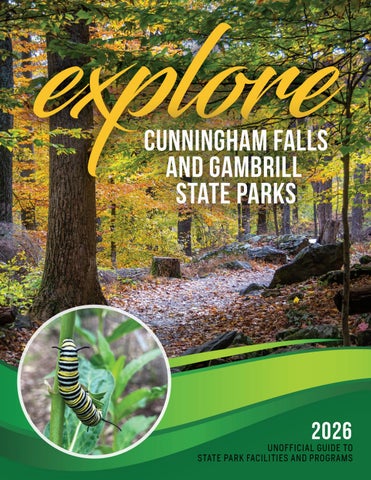
Cunningham Falls & Gambrill State Parks – 2026 Recreation Guide

Page 1


14039 Catoctin Hollow Road Thurmont, MD 21788 Office: 301-271-7574

Duty Ranger Cell: 301-712-6964

PARK WATCH: 800-825-PARK

DNR Communications: 410-260-8888

Central Reservation: 888-432-CAMP

General Information: 800-830-3974

TTY users call via the MD Relay dnr.maryland.gov

Park Manager: Sarah Rodriguez

Facts are not free.

Anyone can spout off on social media. Anyone can post their personal hot take on the issue of the day, free of facts, free of anything but their own opinion and bias.

Real news is different. Real news comes from experienced journalists who put aside their assumptions and talk to people on all sides of an issue.

Real news is hard. When you work for an organization devoted to real journalism, you are challenged daily by your editors. Hot takes don’t cut it – you have to do the work. That means talking to experts, mastering the issues, confirming every fact.

Real news rocks the boat. Sometimes, people don’t want you looking into what’s going on. They hide information. They clam up, they refuse to release documents. They even sue you. Real news organizations fight back.

Real news is not free. If we are going to work together to move our community forward, we need facts – and we need professional journalists to cover the news. That’s what we do – and we need your support, now more than ever.

Join us as a subscribing member today.

CALENDAR OF EVENTS 2026

MAPLE SYRUP FESTIVAL

March 14-15 & March 21-22

FISHING RODEO

April 18

EARTH DAY

April 22

MARYLAND IRON FESTIVAL

May 16-17

NATIONAL TRAILS DAY

June 6

FREE FISHING DAYS IN MARYLAND

June 6 & 13, July 4

NATIONAL PUBLIC LANDS DAY

September 26

FALL FEST

October 9-10

SPIRITS OF THE FURNACE

October 17

TRADITIONAL VILLAGE CHRISTMAS

December 5

Events are subject to change. Call the park at 301-271-7574 for details, such as location and time, or go to the website, dnr. maryland.gov, and click on the calendar link for event details.

Catoctin Furnace UNCOVERING THE HISTORY OF

The history of Catoctin Furnace represents, in microcosm, the history of the Industrial Revolution in America. From 1776 to 1903 iron companies mined the rich ore banks near Catoctin Mountain, smelted it in furnaces, and cast both raw pig iron and iron implements of every description. The earliest settlers to enter the Monocacy River Valley at the foot of Catoctin Mountain arrived in the 1730s. As is usual in pioneer societies, the settlers pursued agriculture as their primary livelihood. However, after the discovery of rich ore deposits, industrialization swept into the valley.

Four brothers, James, Baker, Roger and Thomas Johnson, began to capitalize upon the valley’s industrial potential on the eve of the American Revolution. They bought land at the foot of the Catoctin Ridge and began construction of an iron furnace. The Johnson furnace was in blast by 1776 and produced ammunition for the Continental Army including shells fired during the siege of Yorktown.

Following independence, Thomas Johnson became Maryland’s first governor. The furnace site grew into a village complex with a concentration of specialized workers. A charcoal house, casting house, foundry, forge, stables, wagon sheds, saw mill, store, and church were all necessary to the iron operation, not to mention housing for miners, colliers, furnace fillers, founders, forge men,

foremen, blacksmiths and other skilled workers.

Enslaved Africans provided a large part of the labor force at Catoctin Furnace in the early days. It was common for enslaved African laborers to be used in iron manufacture in the mid-Atlantic. The roles as well as first (and only) anglicized name of some enslaved individuals at Catoctin Furnace are clearly stated in the 1809 will of Baker Johnson. Johnson enslaved more than 80 people including men such as Collier Sam and Waggoners Henry and Harvey. Highly skilled and experienced, these enslaved craftsmen worked as blacksmiths, colliers, founders, and forge men. They in turn taught youths these skilled and valuable trades. In addition to their roles in the making of iron, members of the enslaved community toiled in the vineyard and at other agrarian tasks on large farms surrounding

the furnace. They also worked as domestic servants for the ironmasters and their families.

By the middle of the 19th century, the number of enslaved workers at Catoctin declined sharply as large numbers of European immigrant workers moved into the area. Hiring European immigrant labor was cheaper than keeping a large enslaved population to work at the furnace. Enslaved Catoctin Furnace workers may have been sold to buyers in southern states where the demand for and resultant monetary value of enslaved workers remained high. A similar scenario occurred at George town University in 1838 when 272 slaves owned by the Jesuit community were sold to plantations in Louisiana to finance the expansion of the University.

Throughout the 19th century, periods of instability, changes and modernization characterized the industry at Catoctin Furnace. In 1857, “Isabella,” a sophisticated new furnace powered by steam-operated machinery and a 33-foot-high furnace stack was added to the complex. “Isabella” was in continuous blast until 1893 and is still standing today. In 1873 a third stack was built about 140 feet south of “Isabella”. Named “Deborah,” this new stack was a steam- and water powered, coal fired furnace with a daily capacity of 35 tons of pig. It was built in hopes of reviving the failing Catoctin Furnace complex, but in 1903 Catoctin Furnace

was forced to shut down due to its unprofitability. “Deborah” was dismantled two years later. Catoctin Furnace was the victim of changing technology and transportation access.

Today, the stack known as “Isabella” is the focal point of the Catoctin Furnace remains. The 1858 casting shed has been reconstructed next to it. Running northward from the complex is a short tramway constructed in the mid 19th century to connect the furnace with ore banks a bit over a mile away just west of US-15. Just south of the furnace on Maryland Route 806 are stone and log houses originally occupied by company workers. An interpretative trail connects the furnace area to the Museum of the Ironworker and the center of the village. The majority of the village houses are now privately owned, and the privacy of the residents should be respected. The restored Collier’s Log House and the Museum of the Ironworker have been restored by the Catoctin Furnace Historical Society, Inc. and are open by appointment and during special events. The restored ca. 1821 Forgeman’s House is available for overnight rental. A cemetery containing the remains of some of the enslaved workers is located in the Catoctin Furnace area. Self-guided walking tour brochures for the furnace area and the village of Catoctin Furnace are available.

Plan your visit

The Iron Trail Walk through History

Thirteen interpretive panels guide the visitor along the 0.4 mile Iron Trail that links Cunningham Falls State Park Manor area with the historic Catoctin Furnace via a footbridge over US Route 15. The panels present the furnace operation within regional, national, and global events; the enslaved, free, and immigrant workers and their families; the role of the furnace in wartime and peacetime; the history of ironmaking; the ingredients for iron; and the establishment of the park. Stories such as children boating on Locust Pond in a leaky rowboat, United States Presidents Hoover, Roosevelt, and Eisenhower fishing in Little Hunting Creek, and the hidden labor of enslaved African Americans within the Ironmaster’s Mansion provide glimpses into the many uses of the greater Catoctin Furnace lands. The trail crosses Little Hunting Creek at grade on an 1872 bowstring arch bridge and U.S. Route 15 on a pedestrian bridge accessed via steep steps.

Visitors can tour the furnace site and hike on the newly installed African American Cemetery Trail that highlights the enslaved workers who lived, died and were buried in the area. For more information on the trail, the progress of the museum and other programs offered by the Catoctin Furnace Historical Society, go to catoctinfurnace.org.

Trail Tips

Pets are allowed on the trails, but must be kept on a leash at all times. Horseback riding is not permitted in the Houck Area which includes the lake and the falls. Bicycles are not permitted in the designated Wildlands Area.

HIT THE TRAILS

Cunningham Falls State Park offers miles of mountain trails, many leading to scenic overlooks.

The Cunningham Falls State Park trail system varies in terrain from short, flat hikes to steep and rocky ascents that will challenge even the experienced hiker.

AFRICAN AMERICAN CEMETERY TRAIL

Blaze Color: NO BLAZE

Distance: 0.5 mile

Difficulty: A self-guided trail with interpretive panels to learn the names and stories of those enslaved to work in the village. Parking is recommended at the Catoctin Furnace.

LOWER TRAIL

Blaze Color: RED Distance: 0.5 mile

Difficulty: This easy to moderate trail is the shortest and easiest access to the Falls. Return to the lake by this trail or Cliff Trail. This trail ends at the Falls.

CLIFF TRAIL

Blaze Color: YELLOW Distance: 0.75 mile

Difficulty: Rough terrain offers strenuous hiking past rock outcrops that lead to the Falls. Return to the lake by this trail or Lower Trail.

LADY SLIPPER TRAIL

Blaze Color: PINK

Distance: 2.5 miles

Difficulty: This moderate trail gives campers direct access to the Cliff Trail.

OLD MISERY TRAIL

Blaze Color: ORANGE/YELLOW

Distance: 2 miles

Difficulty: This steep, strenuous trail has many switchbacks and scenic views and connects with the Cat Rock Trail.

CAT ROCK TRAIL

Blaze Color: YELLOW

Distance: 3 miles round trip

Difficulty: This steep, strenuous trail leads to Cat Rock (elevation 1,560 feet) and scenic views. Trail connects to Catoctin Trail and Old Misery.

BOB’S HILL TRAIL

Blaze Color: YELLOW

Distance: 1.5 miles one way

Difficulty: This steep, strenuous trail leads to Bob’s Hill (elevation 1,765 feet) and two short spur trails with views north and south.

CATOCTIN TRAIL

Blaze Color: BLUE Distance: 27 miles

Difficulty: This strenuous trail leads from Gambrill State Park though the Frederick City Watershed, Cunningham Falls State Park and Catoctin Mountain Park. Nine miles of trails are in Cunningham Falls. Camping permitted only in designated campgrounds.

IRON TRAIL

Blaze Color: NO BLAZE

Distance: 0.25 mile

Difficulty: A self-guided trail which leads to Catoctin Furnace. Crosses US 15 via elevated foot path (46 steps up the stairway).

Cunningham Falls State Park

Located in the picturesque Catoctin Mountains, Cunningham Falls State Park is divided into two separate, but unique areas. The William Houck Area is located three miles west of Thurmont on Route 77 and has the 78-foot cascading namesake falls, a 43-acre lake, and a camping area. The Manor Area, off Route 15, three miles south of Thurmont, has the Scales & Tales Aviary, the historic Catoctin Iron Furnace, camping, a playground, and picnic shelter. With plenty to explore, natural outdoor activities abound at Cunningham Falls State Park: swimming, hiking, fishing, boating, camping and more.

SWIMMING

Sandy beaches welcome swimmers to three designated areas of Hunting Creek Lake. Lifeguards monitor the beach and swim area daily from Memorial Day to Labor Day. Swimming in the lake is permitted Memorial Day through Labor Day only. For your safety and the protection of the natural resource, swimming is not allowed at the Falls.

PICNICKING

Picnic tables and grills are available near the lake in the William Houck Area on a first-come, firstserved basis. There are no covered pavilions or shelters in the Houck Area. The Manor Area has first come, first served, picnic tables and a picnic shelter available by reservation only. Built by the Civilian Conservation Corps out of native stone, the shelter holds 150 people.

BOATING

A boat ramp for launching private watercraft onto Hunting Creek Lake is available for a service charge

of $3 for MD residents and $5 for non residents. Only electric motors are permitted, no gasoline motors. Boat rentals are available from a private vendor.

FISHING

Cunningham Falls State Park has several opportunities for fishing. A Maryland Freshwater Sport Fishing License is required for all fishermen 16 years and older. Hunting Creek Lake is a put and take area, meaning you can take home what you catch. An accessible fishing pier is located off Catoctin Hollow Road next to the boat ramp. Fishermen can fish for bass, bluegills, sunfish, crappie and catfish. Big Hunting Creek along MD Route 77, as well as its tributaries within Cunningham Falls State Park, are catch and release trout steams limited to artificial fly fishing only. Little Hunting Creek in the Manor Area is a catch and release trout stream limited to the use of artificial lures and flies only. Visit the MD Outdoors website to obtain a license and the fishing and boating guide for catch limits.

Plan to arrive early as the park regularly reaches capacity by mid to late morning on weekends and holidays. If the park reaches capacity, visitors will be turned away until the park can safely be reopened.

Alcoholic beverages are prohibited in all state park areas. The only exception is with an alcohol permit for the picnic shelters at Gambrill and Manor Areas.

Buses and vans require an advanced reservation by calling 1-888-432-CAMP. Buses and vans are not permitted on summer weekends and holidays.

Activities for all await in this mountain park

DAY OF SERVICES CHARGES

HOUCK AREA: Memorial Day-Labor Day, weekdays: $3/pp*

Memorial Day-Labor Day, weekends and holidays: $5/pp*; all other times: $3/vehicle*; Boat launch charges: $3/vehicle*

MANOR AREA: Year-round: $3/vehicle*

*In state residents only. Out of state residents add $2

MARYLAND STATE PARK PASSPORT

IN STATE: $75

OUT OF STATE: $100 (good at any Maryland State Park) For more information visit: dnr.maryland.gov/publiclands

Eastern Watersports:

Watercraft Concessions at Cunningham Falls State Park

Explore Hunting Creek Lake at Cunningham Falls State Park with Eastern Watersports! Get on the water and cool down while embarking on an adventure that treats the mind, body, and soul. Head out on your own with our kayak, paddleboard, and canoe rentals, or join us on a lesson or tour!

HOURS OF OPERATION:

May: Weekends Only (10:00am - 6:00pm*)

June - August: Daily (10:00am - 7:00pm*)

September: Weekends Only (10:00am - 6:00pm*)

*Please note: Last call for rentals is 1 hour and 15 minutes before close.

AVAILABILITY AND PRICING:

Eastern Watersports

Cunningham Falls: 410-999-4465

Eastern Watersports Main Office: 443-730-0300

C.W. Concessions is a local family-owned business that operates the food stand located beachside on South beach. We are open weekends/holidays from Memorial Day through Labor Day weekend as well as seven days a week during the time when schools are off for summer break (weather pending). We accept cash or cards and offer a variety of summertime food items ranging from hot dogs, french fries, and nachos to sweet treats like ice cream and funnel cake fries. Stop by and visit us for summer to cool off or to refuel after a hike to the falls!

AT cunningham falls state park Camping

Get away from it all to connect with family and nature

Cunningham Falls State Park has campsites in both the William Houck Area and the Manor Area, both of which are open from April through October. The William Houck Area campground has 107 basic sites and 33 sites with electric hook-up. The Manor Area has 21 basic sites and 7 electric hookups. All campsites have a picnic table and fire ring. There is a bathhouse with hot showers and flush toilets centrally located in the middle of each camping loop. Pets on leashes are allowed in Addison Run, Bear Branch, Catoctin Creek and the Manor Area camping loops.

The William Houck Area Campground has four six-person camper cabins. Each cabin site has a picnic table, fire ring and lantern post. All cooking must be done outside the cabin. Cabins have air conditioning, but no heat. Campers may bring an electric heater or fan. No propane heaters are allowed. Campers must provide their own linens. There is firewood, ice and other camping supplies available for purchase upon arrival at the Camp Office or Camp Store.

The operation of generators is prohibited during quiet hours. At times outside of quiet hours, they must not disturb other visitors and preserve the peace and tranquility of the park environment.

CAMPSITE

RESERVATIONS

Reservations are recommended for both the William Houck and Manor Area campgrounds since they often fill weeks or months in advance. Call 888-432-CAMP or visit parkreservations. maryland.gov and reserve online at anytime.

Campsites range up to $34 per night; service charges, weekend, holiday, nonresident and electric premiums apply. Camper cabins cost $65.49 for six-person; service charges apply. The Manor Area shelter can be reserved for $36.75 per day; 150-person capacity, service charges apply. Alcohol is prohibited in the campgrounds and throughout the park. Quiet hours start at 10 p.m.; check out is 1 p.m.

Bears do visit our campgrounds, and they will eat almost anything. Help park staff keep bears wild Garbage-trained bears associate food with humans and can lose their fear of humans. Because of this loss of fear, a bear might become a danger to park visitors.

Here are a few simple reminders to keep you and the bears safe and ensure that you have an enjoyable stay:

• Keep your campsite clean.

• Never keep food in your tent, and don’t cook or eat in your tent. Bears follow their noses to food.

• Store food and garbage securely in the trunk of your vehicle. Remember to secure your pet’s food also.

• Remove trash from your site daily and place in the campground dumpsters. If you’re just visiting for the day, remember Maryland State Parks are trash-free: take your trash home to be recycled and disposed of properly.

• Always clean utensils after each use.

• If a bear comes into camp, don’t feed it! Scare it away by making noise.

• See park staff for more detailed information on how to camp in black bear country or visit dnr.maryland.gov/wildlife.

WILLIAM HOUCK CAMPING AREA

DUMP STATION AVAILABLE ONLY AT HOUCK CAMPING AREA APRIL THROUGH OCTOBER

liarTnoitaerceRlanoitaN

Limited parking available at High Knob and Trailhead Areas. North Frederick Overlook and High Knob Areas closed to vehicular traffic during periods of inclement weather. All areas are open to foot traffic.

Pets on leashes are allowed on Gambrill State Park trails, the day-use area and in the campground if a registered camper.

Alcoholic beverages are prohibited in all state park areas except in rental facilities with permit.

Shelters are available by reservation for $41 per day, service charge applies. 35-person capacity.

The Tea Room is unreservable for the 2026 season due to renovations.

Call 888-432-CAMP

APRIL 1-OCTOBER 31

9am-8pm Mon-Fri 9am-3pm Sat-Sun (excludes holidays)

NOVEMBER 1-MARCH 31

9am-5pm Mon-Fri

Reserve online anytime at parkreservations.maryland.gov

GAMBRILL State Park

Challenging Trails, Scenic Overlooks and a Cozy Campground Combine in this Beautiful Park

Gambrill State Park is a beautiful mountain park, located on the ridge of the Catoctin Mountains in Frederick County. Its most popular feature is the 16 miles of trails for hiking and mountain biking.

The park is separated into two areas –the Rock Run Area and the High Knob Area. From the 1,500-foot High Knob Area, three stone overlooks offer breathtaking views of the Frederick and Middletown valleys. The High Knob Area offers wooded picnic areas, three picnic shelters, and a large stone lodge, called the Tea Room. The picnic shelters and the Tea Room are available for reservation only.

The Rock Run area offers a small family-style campground, a picnic area, and a small pond for fishing.

Gambrill State Park was named in honor of the late James H. Gambrill Jr., a well-known citizen of Frederick. Mr. Gambrill was a conservationist who first brought attention to the beauty of the area in the early 1900s. He believed that it was in the public’s best interest to develop the area into a park, and a group of local citizens, following his lead, joined together to purchase the land.

Most of the buildings and facilities within the park were built in the 1930s by the Civilian Conservation Corps (CCC), a Federal program created during the Great Depression to create jobs for young men and to help restore the nation’s struggling natural resources. The Corps built the park’s Tea Room, a native-stone building originally designed for community events and gatherings.

PICNICKING

Picnic tables, grills, restrooms, and playground facilities are available at Gambrill State Park. The High Knob area offers three rustic log picnic shelters, available for rent from April through October. Pets are allowed in the day-use area, but must be leashed at all times.

FISHING

A small pond is located in the Rock Run Area, a short walk from the campground. The pond has a population of large mouth bass, bluegill, and channel catfish. Swimming or wading is not permitted. The pond is a free fishing area; no license required.

NATURE CENTER

The Nature Center, located in the High Knob Area of the park, features information on the Civilian Conservation Corps, as well as information on native wildlife. The center is open on weekends (mostly); please contact the Park Office for more information.

state: $3/vehicle Out of state: $5/vehicle

in gambrill state park Camping

CAMP

HOSTS WANTED

The Rock Run Area of Gambrill State Park has a campground with 34 campsites. Each campsite has a picnic table, fire ring and lantern post. Some campsites have electric hook-ups. A dump station is available for sewage and potable water. A bathhouse is located at the center of the campground, with hot showers and flush-toilets. The operation of generators is prohibited during quiet hours. Outside of quiet hours from 10p.m. to 7a.m., they must not disturb other visitors or the peace and tranquility of the park environment.

HELP MAINTAIN THE PARK MAKE CAMPERS FEEL AT HOME HELP WITH SPECIAL EVENTS AND PROGRAMS

In exchange for 20 hours of volunteer work per week, camp hosts receive a free campsite with full hook-ups and a sense of community with Gambrill State Park.

Gambrill State Park Campground

Gambrill State Park Campground

FOR MORE INFORMATION: 301-271-7574

Four camper cabins with electricity are available in the Rock Run Campground. Camper cabins sleep up to four people, with one bunk bed and one full size bed. Linens are not provided. Each cabin site has a picnic table, fire ring and lantern post. All cooking must be done outside the cabin. Cabins have air conditioning, but no heat. Campers may bring an electric heater or fan. Propane heaters are not allowed.

CAMPSITE RESERVATIONS

Call 888-432-CAMP or reserve a site online at parkreservations.maryland.gov. Campsites range up to $18.49 and $24.49 per night plus reservation fee; weekend, holiday, non-resident and electric premiums apply. Camper cabins cost $50.49 per night plus reservation fee. Alcohol is prohibited in the campgrounds. Quiet hours start at 10 p.m.; check out is 12p.m. for cabins and 1 p.m. for campsites.

Pets on leashes are permitted in the campground and at cabin 18. Bears do visit our campgrounds. See page 8 for tips on how to keep yourself and the bears safe.

HIT THE TRAILS

Gambrill State Park offers miles of mountain trails, beautiful views from scenic overlooks

Trail Tips

Pets are allowed on the trails, but must be kept on a leash at all times.

All trails in Gambrill State Park are open to mountain biking, with the exception of the White Oak Trail, which is restricted to hiking.

Please plan accordingly before setting off on your bike.

Gambrill State Park has over 16 miles of trails, which begin at the Trailhead Parking Lot on Gambrill Park Road, between the Rock Run Area and the High Knob Area. Though the terrain is steep and rocky, hikers are rewarded with three scenic vistas of the Frederick and Middletown valleys. The park, including all trails, closed at sunset.

CATOCTIN TRAIL

Blaze Color: BLUE

Distance: 27 miles

Difficulty: This strenuous trail leads from Gambrill State Park through the Frederick City Watershed, Cunningham Falls State Park and Catoctin Mountain Park. Camping permitted only in designated campgrounds.

GREEN ASH TRAIL

Blaze Color: GREEN

Distance: 2 miles

Difficulty: Several steep slopes and little level ground.

WHITE OAK TRAIL

Blaze Color: WHITE Distance: 1 mile

Difficulty: This easy loop trail is a good choice for families with smaller children.

YELLOW POPLAR TRAIL

Blaze Color: YELLOW Distance: 7.1 miles

Difficulty: Loop trail features some steep and rocky sections and passes two stone overlooks built by the Civilian Conservation Corps.; considered one of the most “technical” trails in Maryland by mountain bikers.

RED MAPLE TRAIL

Blaze Color: RED Distance: 1 mile

Difficulty: One short steep section; connects to the campground.

BLACK ASH TRAIL

Blaze Color: BLACK ON WHITE Distance: 3.3 miles

Difficulty: Moderate difficulty with several steep slopes; shows off the beauty of the park with views of the Frederick Valley to the east and Middletown Valley to the west.

gambrill tea room

scales & tales

Cunningham Falls State Park is home to a Maryland Park Service Scales & Tales Aviary which houses non-releasable wildlife native to Maryland. From a bald eagle to a eastern box turtle, it’s animal ambassadors come in all shapes and sizes and have valuable stories to share. It is through these stories, or “tales” of how each animal came to live at the Aviary, that park staff educate patrons about protecting wildlife, climate change and how they can be good stewards of the environment.

The Aviary is open to park visitors at various hours throughout the year. Starting in April, the Aviary is open to visitors on the weekends. From Memorial Day to Labor Day, the Aviary is open every day from 10 a.m. to 4 p.m. After Labor Day, the Aviary returns to weekend hours only and closes for the season in November. Please note hours are subject to change due to recent upticks in HPAI, otherside known as avian flu. To adhere to state biosecurity protocal, it is possible access will be restricted at times.

The Scales & Tales program provides up-close animal presentations and displays that engage the public, are educational and fun for all ages. Scales & Tales is featured in many of the park’s programs. This environmental education program brings nature into classrooms, community centers, festivals, fairs and many other public locations.

Hunting

observe safety zones AND respect private property

Hunting is permitted on 4,400 acres of Cunningham Falls State Park Wildlands in accordance with statewide hunting regulations. A Maryland Hunting License and knowledge of the Maryland hunting seasons is required. There is NO HUNTING ON SUNDAYS in Cunningham Falls State Park. The hunting area consists of forested terrain with steep access routes. To improve your hunting experience, scout out the areas prior to hunting season. Hunters may enter and or remain on park property outside the regular posted hours provided they are engaged in legitimate, authorized hunting activity.

Make sure your weapon is unloaded in the safety zones and while hiking to your destination through non-hunting areas. Respect private property. Offroad motorized vehicle use is strictly prohibited.

Remember that many hikers using park trails may be unaware of hunting seasons. Park boundaries are marked with yellow paint bands; most hunting boundaries are posted with red and white “Managed Hunting Area” signs.

A reservation-only deer hunting area is available for hunters with a hunt from the vehicle permit. Reservations are required and can bemade beginning at 8 a.m. the day after Labor Day. Make reservations in person at the park Administration Office or by calling 301-271-7574. Reservations can be made for Deer Firearm Season and Muzzleloader Season.

To learn more about hunting on public lands, hunting licenses and education programs, visit dnr.maryland.gov/ wildlife.

LEAVE NO TRACE

Enjoy the outdoors & Maryland State Parks responsibly

Enjoying the outdoors is something everyone should have the opportunity to do, but recreation often disturbs natural conditions. In order to help preserve the natural beauty along the trails and in park wildlands for your own enjoyment, please minimize your impact by following LEAVE NO TRACE outdoor ethics:

PLAN AHEAD AND PREPARE

• Know the rules and regulations. Call the Park at 301-271-7574 if you have questions.

• Prepare for extreme weather, hazards and emergencies. Call 410-260-8888 or 911 if you have an emergency.

• Schedule your trip to avoid times of high use, or user conflicts

• Be aware of hunters. Hunting is heaviest from late September through December, and April through May. Wear bright-colored clothing during hunting seasons.

• Travel in small groups. Avoid groups larger than 15 participants. Use a map. Trail maps are available in this guide. Rangers will gladly answer specific questions at Cunningham Falls and Gambrill State Park headquarters.

• Cunningham Falls State Park trails are for hiking only. Gambrill State Park trails are open to hiking and mountain biking.

• Follow official blazes. Avoid bush whacking your own trail or following abandoned roads.

CAMP AT DESIGNATED CAMPSITES

• It is illegal to camp in undesignated campsites in Maryland. Call ahead and make a reservation.

DISPOSE OF WASTE PROPERLY

• Pack-it-in, pack-it-out. There are no trash cans in Maryland State Parks Day Use Areas.

• Remember to “go” before you go. Use the restroom facilities provided in the park.

• Dish washing stations are available next to the bath houses.

• Pick up after your pets and deposit waste in an approved receptacle.

LEAVE WHAT YOU FIND

• Preserve the past: examine, but do not touch, cultural or historical structure or artifacts.

• Leave rocks, plants and other natural objects as you find them.

• Avoid introducing and/or transporting non-native species.

• Avoid building structures, furniture or digging trenches.

MINIMIZE CAMPFIRE IMPACTS

• Use established fire rings at designated campsites.

• Keep fires small

• Use only timber found on the ground. Do not cut live vegetation. Pre-packaged firewood is available for sale. Contact park staff for assistance.

• Burn all wood or coals to ash, put out campfires completely, then scatter cool ashes.

RESPECT WILDLIFE

• Observe wildlife from a distance. Do not follow, approach or feed. Stay on the trail to reduce surprise encounters.

• Store food and trash securely. Black bears frequent Cunningham and Gambrill State Parks.

• Control pets. Dogs must be leashed.

BE CONSIDERATE OF OTHER VISITORS

• Respect other visitors and protect the quality of their experience. Avoid climbing on the falls. It is dangerous and disturbs other visitors.

• Be courteous. Yield to other trail users.

• Adhere to quiet hours in the camp grounds. Quiet hours begin at 10 p.m. in all camping areas.

• A dump station is available at the Houck campground and the Rock Run campground for trailers and recreational vehicles. Contact park staff for assistance.

LEARN MORE AT LNT.ORG

Discover

Catoctin mountain park

Visit the neighboring federally-run Catoctin Mountain Park. In the 1950s, the Catoctin Mountain area was divided into two parks, one managed by the State of Maryland as Cunningham Falls State Park, and one managed by the National Park Service as Catoctin Mountain Park.

Today, Catoctin Mountain Park preserves many resources and stories of national significance, including the site

of the first Job Corps Camp, the nations’ oldest camp for people with disabilities, the places used as secret training grounds for Office of Strategic Service officers during World War II, and evidence of the resiliency and diversity of Eastern deciduous forests.

Stop in the Catoctin Mountain Park Visitor Center and learn more about the history and natural beauty within its boundaries.

YOU ARE IN SNAKE TERRITORY

Cunningham Falls and Gambrill State Parks are home to a large diversity of protected wildlife, including many species of snakes. Two species found here are venomous; the northern copperhead and timber rattlesnake. Snakes are rarely aggressive. If you encounter a snake, maintain a safe distance and quietly move away from it.

SNAKE BITE PREVENTION MEASURES

• Be aware of your surroundings

• Stay on the path when hiking and in the campgrounds

• Wear sturdy footwear with closed toes

• Maintain a safe distance from any snakes that you encounter

• Look before you reach

• Watch where you step and sit

• Snakes are most active during warm weather (April-October)

DID YOU KNOW?

It is illegal to kill snakes in the state Maryland.

PET POLICY

In Cunningham Falls & Gambrill State Parks, pets must be on a leash and under control at all times. Under “voice” command” is not sufficient. Pets must be attended at all times. Excessive barking is not permitted. Pets are not permitted in park buildings.

Manor Area: Pets on a leash are permitted in the day-use area, campsites and trails.

Houck Area (Beach & Lake): Pets on a leash are permitted on all trails. Pets are allowed anywhere on land except for in the lake and the sandy portion of the beach from Memorial Day to Labor Day. Pets are allowed

on private boats on the lake. Pets are allowed in the water after Labor Day and before Memorial Day weekend.

If you are bitten by snake, remain calm and dial 911.

Report any potentially venomous snakes to the Duty Ranger at 301-712-6964

William Houck Campground: Pets on a leash are allowed in Addison Run, Bear Branch, and Catoctin Creek camping loops.

Gambrill State Park: Pets on a leash are allowed in all day-use areas, campsites and trails. Cabin 18 is pet friendly. Pets are not permitted in the Tea Room.

Camp Host & volunteer opportunities

CAMP HOSTS HELP MAINTAIN THE PARK.

• Welcome campers to the park.

• Clean and prepare campsites for incoming campers.

TRAIL STEWARD VOLUNTEERS

• Help park staff and other volunteers throughout Cunningham Falls and Gambrill State Parks by being the eyes and ears on the trail.

• Perform routine trail maintenance, provide park staff with trail reports, and help with special trail projects.

GARDENING/INVASIVE PLANT MANAGEMENT VOLUNTEERS

• Manage native gardens and plants throughout the parks.

• Plant native species, mulch, fertilize and pull weeds in the gardens, and remove invasive plants.

PARK MAINTENANCE

• Perform maintenance projects throughout the parks including trash pickup, weedeating, leaf blowing, and painting projects.

VISITOR CENTER/NATURE PROGRAMMING VOLUNTEERS

• Greet park visitors, provide accurate information, answer questions and be the happy face of the park.

Friends of Cunningham Falls and Gambrill State Parks

Email coordinator Claudia Padilla at claudia.padilla@maryland.gov or call 301-271-7574 to learn more about volunteering.

The mission of the Friends is to support and enhance the programs and recreational offerings of Cunningham Falls and Gambrill State Parks through charitable contributions and in-kind donations. Formed in 1995, this non-profit volunteer organization is dedicated to providing for the needs of the parks, but are not funded in the regular budget. This may include supplies for park programing and special events such as the Annual Maple Syrup Festival, funding for historical restoration projects, the care and feeding for the non-releasable animals in the Scales & Tales Aviary, and equipment such as UTVs and chainsaws. The Friends also advocate on issues of concern to the parks. TO

Turn static files into dynamic content formats.
Create a flipbook