IMPACT REPORT 2025
REPORTING BOUNDARIES
INDEX
The reporting period of the Fredericia Impact Report is January 1st 2025 – December 31st 2025. The results in this report do not include data from Snedkergaarden Them A/S. The company was acquired mid‑year and we did not have full operational or financial control during the full reporting period. Accordingly, no employee data, greenhouse gas emissions, or other related ESG data from Snedkergården are included in this year’s report. ESG data from Snedkergården will be fully integrated into our reporting from 2026.
2
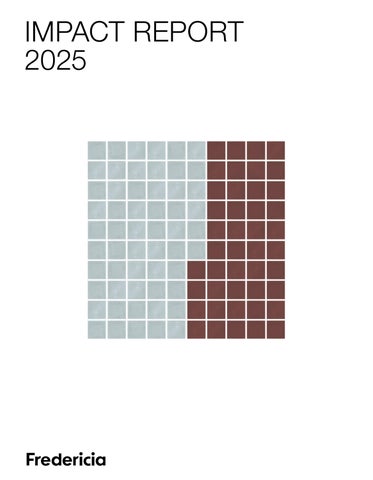
Frontpage: Table of gender diversity, all employees (female 56%, male 44%)
4 5 10 12
INTRODUCTION Message from the CEO ESG Achievements in 2025 Message from the Head of Impact
20 23 36 49
ENVIRONMENT Operation Zero Soil to Seat Circular By Design
60 63 73
SOCIAL Craft and Community Democracy Made
82
GOVERNANCE
3
MESSAGE FROM THE CEO
2025 has been a year in which global supply chains and the global trade system have once again been challenged by the consequences of what seem to be increasingly uncertain times.
Fredericia creates Scandinavian design that encourages human well-being wherever people live, work and connect. We strive to continue our heritage of purposeful and sustainable design. Crafted to last.
It is in times like these that the value of relationships becomes clear. Fredericia’s long-standing commitment to lasting relationships across our own production and craftsmanship culture, with our suppliers, and with our customers continues to make a difference. Our policy of maintaining a European supply chain, combined with the flexibility of our own production facilities in Denmark, allows us to respond effectively to the adjustments required. In 2025, we extended our commitment to local craftsmanship through the acquisition of the joinery Snedkergaarden Them A/S, a former subcontractor that is now part of the Fredericia Group. This reflects our ambition to preserve craftsmanship skills and create resilience in our supply chain. It also demon‑ strates how Fredericia remains, and will remain, an independent, family-owned design company.
Rasmus Graversen CEO and third-generation owner of Fredericia
As a manufacturing company, Fredericia’s greatest environmental impact is tied to our products, and in 2025 we made particular progress on source reduction within our Soil to Seat framework. With the introduction of the innovative material PaperShell for our Pato Chair collection, we are offering a 100% biogenic alternative to the carbon-based industry standard within this typology. Fredericia’s commitment to sustainability is embedded in our company ethos, from our products to our sourcing and company culture. In 2025, we further strengthened this ambition with the appointment of Mia Møgelgaard as Head of Impact and her inclusion in the executive management team, ensuring that our ambitions continue to be matched by strategy and action. Our commitment to improving our impact is closely connected to our role as a design furniture company in a rapidly changing world. Our message is one of hope for the future: that it matters enough for us to care about what we fill it with.
4
5
WE ARE A CERTIFIED B CORP
At Fredericia, we are proud to be B Corp certified since 2023. B Corp is an internationally acclaimed sustainability certification that sets high standards for verified environmental and social performance, accountability and transparency. To achieve certification, we measured and documented our positive impact across five key areas: Governance, Workers, Customers, Community, and Environment. Our efforts have been independently verified to ensure we meet these rigorous standards.
GOVERNANCE
6
Further, all certified B Corp companies make a legal commitment to not only serve their shareholders, but to act for the benefit of all their stakeholders, including workers, customers, local communities, and the environment. As a certified B Corp, we are part of a global movement of over 10 000 pioneering companies that uphold high standards for sustainable and responsible business conduct.
WORKERS
ENVIRONMENT
COMMUNITY
CUSTOMERS
7
B CORP ASSESSMENT OVERVIEW
IMPACT SCORES
SELECTED EXAMPLES OF OUR PRACTICES
Governance: 15.9 points
Diverse teams on board, management and employee levels. Publication of an annual impact report to ensure transparency.
Workers: 25.6 points
High employee satisfaction levels. Competitive employment conditions and benefits.
Customers: 2.6 points
High customer satisfaction. Safe products supported by up to 25-year warranty.
Community: 17.1 points
Local partnerships with socio-economic organisations. Local production to support the transfer of craft expertise.
Environment: 25.2 points
ISO 14001 certification supporting continuous environmental improvement. High share of certified materials and products. Circularity integrated into design principles.
Read more about our B Corp assessment and verified score at www.bcorporation.net.
LOOKING AHEAD
The B Corp movement emphasises continuous improvements, and so do we. In early 2026, B Lab launched updated certification standards designed to address the the environmental and social challenges facing our planet. In 2026, we plan to recertify in accordance with the new B Corp certification standards, which require even greater impact across our entire organisation.
8
9
ESG ACHIEVEMENTS IN 2025
HIGHLIGHTS IN 2025 1. LAUNCH OF PATO PAPER CHAIR
— A bio-based, innovative material made from craft paper (p.45).
In 2025, we continued to advance on our impact strategy and saw measurable progress in several areas. We strengthened local production, increased the share of certified products, and introduced innovative new materials to our product assortment.
2. 28% REDUCTION IN CO2E EMISSIONS (SCOPE 1) AND 26% (SCOPE 2) COMPARED TO 2024
— Measurable progress towards a lower environmental footprint (p.26). 3. ACQUISITION OF SNEDKERGAARDEN
— Preserving local craftmanship and ensuring generations of skilled furniture–making.
4. 100% PRODUCTION IN EUROPE
— Strengthening regional supply chains and reducing environmental impact (p.66). 5. ESTABLISHING A NEW ROLE – HEAD OF IMPACT
— Within our Executive Management team.
10
See the full overview of ESG KPIs on page 14
11
MESSAGE FROM THE HEAD OF IMPACT
At Fredericia, we believe that design carries responsibility – to the people who create it, the resources that shape it, and the customers who live with it for generations. Our customers expect more than beautiful design; they expect products made with consideration for both people and planet, and we see it as our responsibility to meet these expectations. Driven by curiosity and high ambition, we pursue new, impactful initiatives that can be both clearly measured and genuinely felt. For us, impact is reflected both in the products we create and in the people who create them. Real innovation can only happen when those behind our craftsmanship are thriving, valued, and empowered. In 2026 we will pursue B Corp recertification and assess our performance against the updated B Corp standards. The new requirements raise the bar for impact and accountability, and we welcome the opportunity to further embed responsibility into our governance, operations, and value chain.
Mia Møgelgaard Head of Impact, Fredericia
We remain committed to our core business: offering furniture crafted to last.
12
13
ESG KPIs ESG
Indicator
Unit
2021
2022
2023
2024
2025
Target
E
Scope 1
Tonnes CO2e
107
168
166
143
103
60% reduction in 2030 compared to 2023
E
Scope 2
Tonnes CO2e
39
47
31
27
20
60% reduction in 2030 compared to 2023
E
Scope 3
Tonnes CO2e
n/a
n/a
n/a
n/a
7.579
E
Energy consumption
MWh
281
351
299
278
301
E
Share of renewable energy
%
n/a
n/a
n/a
n/a
78
E
Waste
Tonnes
119.00
101.575
78.188
73.271
43.620
E
Share of recycled waste
%
77
75
70
E
Water
m³
474
443
503
335
260
E
FSC–certified products in wood based assortment
%
56
55
58
77
80
82% in 2026
Based on turnover from products sold
E
FSC–certified packaging
%
90
92
93
95% in 2026
Based on turnover from products sold
E
Share of certified textile options in standard assortment
%
85
E
Share of certified leather options in standard assortment
%
75
S
Number of employees
# FTE
S
Fixed contract
%
100
S
Temporary employment
#FTE
0
S
Gender diversity, executive management
% female/male
38/62
29/61
50/50
33/67
20/80
S
Gender diversity, all employees
% female/male
47/53
51/49
50/50
52/48
56/44
S
Overall employee satisfaction
Score
S
Average seniority
Years
S
Number of work related accidents
S
143
109
91
86
Comment
Calculated for the first time in 2025
+80% in 2026
75% in 2026
97
83/100 8
New calculation method in 2025
#
1
One minor accident
Minimum wage secured
Yes/No
Yes
S
Collective bargaining agreement
%
33
All production workers are covered by collective bargaining agreements
G
Gender diversity, Board of Directors
% female/male
20/80
20/80
0/100
40/60
60/40
Including employee representatives
G
Supplier Code of Conduct signed
%
51
83
89
97
98
G
Supplier average time of collaboration
Years
n/a
7
9
17
18
G
B Corp Certification
Yes/No
No
No
Yes
Yes
Yes
G
ISO 14001 Certification
Yes/No
Yes
Yes
Yes
Yes
Yes
G
FSC Company Certification
Yes/No
Yes
Yes
Yes
Yes
Yes
G
Net Promoter Score (Customers)
Score
84
N/A
90
G
Corruption and bribery – number of cases
#
0
G
Corruption and bribery – fines
DKK
0
14
7.2
8.5
8.9
9.1
New calculation method introduced in 2025
15
DOUBLE MATERIALIT Y ASSESSMENT
To ensure we focus our efforts on the ESG topics most material to our company, we have conducted a Double Materiality Assessment. The assessment covers our full value chain. Scoring is based on a combination of internal and external data sources, stakeholder input, desk research, and assumptions. The matrix on page 18 presents our identified material topics, ranked from low to high impact materiality (in accordance with ESRS topical standards) and low to high financial materiality. The process of developing the Double Materiality Assessment has provided our Executive Management team with a deeper understanding of which topics matter most and where we should direct our efforts going forward.
IMPACT MATERIALITY Company impact on the people and planet
Double Materiality
FINANCIAL MATERIALITY Sustainability and climate impact on your company
Figure 1: Double Materiality – a two–sided perspective
16
17
High
E5
MATERIAL TOPICS
MITIGATION ACTIONS AND TARGETS
Resource use and circular economy (E5)
As a production company working with valuable raw materials, we focus on longevity, repairability, and circularity to keep resources in circulation for as long as possible.
E4
In 2026 we plan to enhance our refurbishment offering for Trinidad chairs and explore additional circular business models.
E2 Biodiversity and ecosystems (E4)
Working with natural materials such as wood, textiles, and leather, we may affect local ecosystems and biodiversity. In 2026 we will further assess this topic to better understand our influence and identify the most impactful actions across our own operations and beyond.
S1
E1 Moderate
Financial Impact
G1
S4 Pollution (E2) S2
We maintain strict standards for harmful chemicals and adhere to EU Ecolabel and Nordic Swan Ecolabel to ensure safe products and reduce pollution from production. In 2025 we renewed our ISO 14001 certification, which provides a structured framework for preventing and controlling pollution.
S3
Own workforce (S1)
Low
E3
Our employees are our most valued asset, and their well–being is a top priority. In 2026 we will focus on work–life balance and strengthening our shared corporate culture across our four locations.
Low
Moderate
High
Business conduct (G1)
As a certified B Corp, we meet high standards for ethical business conduct, accountability, and transparency. In alignment with the B Corp philosophy, we are committed to continuous improvement and plan to recertify under the updated B Corp standards in 2026.
Climate change (E1)
As a production company, we have a significant environmental footprint, making climate change a material topic for us.
Impact on people and environment
E1
S1
Own workforce
E2 Pollution
S2
Workers in the value chain
E3
Water and marine resources
S3
Affected communities
E4
Biodiversity and ecosystems
S4
Consumers and end–users
E5
Resource use and circular economy
G1
Business conduct
Climate change
In 2025 we included Scope 3 in our carbon reporting to better understand our full climate impact. Scope 3, Category 1: Purchased goods and services represent our most material GHG category. In 2026 we aim to increase the share of product–level LCAs to identify the most impactful reduction opportunities across our assortment.
Figure 2: Fredericia Double Materiality Assessment
18
19
20
21
OPERATION ZERO
RESULTS IN 2025
As a manufacturing company with its own production facilities, Fredericia has direct control over part of its total manufacturing footprint.
– 28% reduction in Scope 1 emissions compared to 2024.
Our initiatives to manage our environmental impact are grouped under the headline Operation Zero:
– 26% reduction in Scope 2 emissions (location–based) compared to 2024.
– Working towards net zero emissions by 2035 (Scope 1 and 2).
– Extension of carbon reporting to include Scope 3 emissions for the first time.
– Waste reduction through recycling practices and circular design principles. – Improved building and facility management through more sustainable operational practices.
– ISO 14001 recertification of our production facility in Svendborg. – Updated company car policy limiting the fleet to electric vehicles only. – Updated purchasing policy for offices and showrooms, prioritising locally sourced and/or B Corp–certified products.
LOOKING AHEAD
– Explore opportunities to increase the share of renewable energy in our own operations. – Introduce improved waste sorting guidelines to increase recycling rates. – Repurpose surplus materials. – Continue transition to EVs. – Improve data quality and coverage for Scope 3 emissions.
22
23
CARBON REPORTING SCOPE 1 Direct emissions
Company facilities
Company vehicles
SCOPE 2 Indirect emissions
Purchased electricity
SCOPE 3 Indirect emissions
Purchased goods and services
Purchased heating
Upstream transportation and distribution
Purchased cooling
Waste generated in operations
Each year we calculate our carbon footprint to gain valuable insights into the environmental impact of our business activities. Until 2025, reporting focused on Scope 1 and 2 emissions; from 2025 onwards, we have included upstream Scope 3 emissions.
CARBON ACCOUNTING PRINCIPLES
We recognise that the vast majority of our emissions occur in Scope 3. By expanding our reporting boundary, we gain a clearer understanding of our emission hotspots and where to prioritise reduction efforts.
We apply the operational approach, meaning all entities over which Fredericia has operational control are included.
We measure our carbon footprint across Scope 1, 2, and 3 with the Greenhouse Gas Protocol*.
Please note that emissions from Snedkergaarden A/S are not included in this year’s reporting, as the entity was not under our operational control for the full reporting year. Snedkergården will be included in our carbon reporting from 2026 onwards. Our carbon footprint is calculated using a combination of supplier–specific data, activity–based data, and spend–based data. Going forward, we aim to increase the share of activity– based data, particular for Scope 3 categories, to improve accuracy and better reflect value chain emissions.
Business travel
Employee commuting
Figure 3: GHG categories included in our Scope 1, 2, and 3 calculations
24
*Our calculations are made through the Danish website www.klimakompasset.dk
25
SCOPE 1 EMISSIONS
SCOPE 3 EMISSIONS (UPSTREAM)
Goal for Scope 1 and 2 emissions
Emissions from our own facilities and company vehicles.
Scope 3 emissions cover upstream activities, including purchased goods and services, transportation, waste management, and business travel.
–60% by 2030
Tonnes CO2e
2023
2024
2025
Scope 1
166
143
103
–14%
–38%
Reduction compared to 2023 baseline
2030 Target
–60%
Tonnes CO2e
2025
Scope 3
7 579
Share of total emissions
98.4%
As expected, Scope 3 accounts for the vast majority of our emissions (98.4%), with manufacturing of our furniture being the largest contributor. Going forward, we aim to improve data quality by increasing the share of activity‑based data, especially for furniture production. This will support better identification of emission hotspots and enable more targeted reduction efforts.
In 2025, our Scope 1 emissions decreased by 28% compared to 2024 and by 38% compared to our 2023 baseline. This brings us closer to our long–term target of 60% reduction by 2030 (compared to the 2023 baseline). The reduction in Scope 1 emissions can be explained by our updated company car policy, which requires all new or replacement company cars to be electric vehicles.
In 2025, we calculated our Scope 3 emissions for the first time, focusing on our upstream value chain. The results are based primarily on spend‑based data to establish a baseline, recognising that this approach provides an indicative rather than precise estimate.
166
2023
SCOPE 2 EMISSIONS
31
Emissions from purchased energy (electricity, district heating, etc.) Tonnes CO2e
2023
2024
2025
Scope 2 (Location based) 31
27
20
Reduction compared to 2023 baseline
–13%
–36%
2030 Target
2024
143 27
103
–60%
In 2025, our Scope 2 emissions decreased by 26% compared to 2024 and 36% compared to our long–term goal of 60% reduction by 2030. The reduction is partly explained by an increasing share of renewable energy in the Danish energy grid.
2025
20 7 579
Tonnes CO2e 50
100
150
200 7 000
Scope 1
Scope 2 (location based)
Scope 3 (upstream)
Figure 4: CO2e–emissions 2023–2025
26
27
KEY RESULTS 2025
Scope 1: 103 tonnes CO2e ≈ 1.34%
Scope 2: 20 tonnes CO2e ≈ 0.26%
Scope 2: 20 tonnes CO2e ≈ 0.26%
Tonnes CO2e
Share of emissions
Scope 1
102.69
1.33%
Scope 2
20.38
0.26%
Scope 3
7 578.95
98.4%
Total (Location based)
7 702.02
100%
Total (Market based)
7 835.65
100%
LOOKING AHEAD
Our long–term target of 60% reduction in Scope 1 and 2 emissions by 2030 (compared to the 2023 baseline) remains unchanged. In the coming years, we will focus on: – Increasing the share of renewable energy in our own operations. – Exploring the potential of PPAs.
Figure 5: Share of emissions in Scope 1, 2, and 3
– Reducing waste and repurposing surplus materials. – Developing and implementing circular business models.
28
29
WASTE
The majority of our waste is generated in our production and office facilities in Fredericia and Svendborg. In Fredericia, we have full visibility of our waste volumes. In Svendborg, the municipality collects the majority of residual waste and biowaste. These fractions are therefore not included in our waste reporting. In our office and showroom in Copenhagen, as well as our international showrooms, waste is managed through landlord agreements and is not directly measurable. However, we apply internal waste sorting guidelines covering the following frac‑ tions: biowaste, paper, cardboard, metal, glass, hazardous waste, and residual waste.
2021
110 900
2022
101 575
2023
78 310
2024
73 271
2025
Waste Kg
43 615
20 000
40 000
60 000
80 000
100 000
120 000
Figure 6: Waste volumes 2021-2025
30
31
Our total waste volumes decreased by 40.5% compared to 2024. This reduction should be interpreted with caution, as it is partly influenced by a one‑off effect. In recent years, the Svendborg facility carried out a major clearance of storage space. This clean‑out activity generated unusually high waste volumes in prior reporting periods. As this process was completed in 2025, current figures more accurately reflect our normalised operational waste levels.
Type (tonnes)
2023
2024
2025
Handling method
Combustible
17.44
17.71
12.84
Incineration
Paper and cardboard
16.13
12.24
11.24
Recycling
Wood
29.7
26.9
14.2
Recycling
Iron
12.55
7.13
3.16
Recycling
Plastic
2.04
1.54
2.11
Recycling
Food waste
0.34
0.55
0.04
Recycling
Glass and bottles
0.11
0.16
0.04
Recycling
Bricks, concrete, and tiles
0.0
3.46
0.0
Recycling
Clean gypsum waste
0.0
3.6
0.0
Recycling
Total
78.31
73.27
43.62
Share of recycling
77.3%
75.1%
70.4%
We observe reductions across key waste categories, including combustible waste, paper and cardboard, and wood. However, the share of recycled waste has decreased compared to previous years. Based on our 2025 analysis, we have identified opportunities for improved waste sorting that will increase the recycling rate going forward.
LOOKING AHEAD
32
In 2026, we will update our waste sorting guidelines and implement improved routines for our production staff. Our aim is to achieve a recycling rate of 75% in 2026.
33
ENERGY USE
WATER USE
Our energy use remained at a relatively stable level in 2025. In 2026, we will explore opportunities to increase the share of renewable energy in our own operations.
Water consumption is currently measured only at our facilities in Fredericia and Svendborg. Overall water use remains at a relatively low level and decreased in 2025. Although our own operations are not water–intensive, our Double Materiality Assessment identifies water as a topic with Moderate impact (see page 18) through the use of textiles and leather in our product assortment, we recognise a potential impact on water use and water quality in supplier regions. In 2026, we will further assess this topic with our textile and leather suppliers.
351 299
281
278
474
301
466
503
335 260
MWh 2021
2022
2023
2024
Figure 7: Energy use (Mwh) 2021–2025
34
2025
M3
2021
2022
2023
2024
2025
Figure 8: Water use (M3) 2021–2025
35
SOIL TO SEAT
Soil to Seat describes our value chain approach, reflecting our responsibility from the origin of raw materials to the final product. We make considered decisions at every stage of the value chain to protect natural resources, avoid harmful chemicals, and lower the environmental impact of our products. Our approach include: – Traceability of key raw materials, including leather and wood. – Prioritisation of recognised product and material certification schemes.
LOOKING AHEAD
Traceability and transparency are key to improving product sustainability and enabling customers to understand the environmental impact of their purchases. In the coming years, we plan to launch a Digital Product Passport to further strengthen transparency and traceability across our product portfolio.
36
37
ENVIRONMENTAL PRODUCT CERTIFICATIONS
RESPONSIBLE WOOD SOURCING
We use third–party certification schemes to verify environmental performance and guide more responsible product development. At early stages of design, we evaluate material choices, chemical composition, and product functionality. Certification requirements help steer product development towards a more responsible assortment.
SHARE OF CERTIFIED PRODUCTS IN OUR ASSORTMENT* 2021
Performance 32%
2022
32%
2023
34%
2024
48%
2025
52%
2030 (Target) 85%
Wood is a central material in our furniture production, valued for its durability and natural ageing properties. We source wood with consideration for environmental impacts and ecosystem protection.
The FSC® standard verifies that a forest is being managed in an environmentally responsible manner by avoiding deforestation, preserving biodiversity, and benefitting the lives of local workers. Fredericia is an FSC® –certified manufacturer under license FSC–C151292.
We insist on using a premium selection of wood from responsibly managed forests in Europe. One way to ensure this is through the implementation of the FSC® standard.
Currently, Fredericia uses the following material and product certifications.
SHARE OF FSC ®-CERTIFIED PRODUCTS IN OUR WOOD BASED ASSORTMENT* 2021
2022
2023
2024
Target
OUR CERTIFICATIONS
Performance
MATERIALS
56%
55%
58%
77%
2025
2026
2030
75%
82%
95%
80%
In 2025, our joinery production facility was also certified was also certified under license FSC–C222092.
SHARE OF FSC ®-CERTIFIED PACKAGING** COMPANY
PRODUCTS
2023 BEL
NOR DI
Target
LA
C
2024
2025
2026
2030
95%
95%
100%
N SWA ECO
Performance
90%
92%
93%
Our 2025 result shows a slight increase in FSC® –certified packaging. We maintain our target of 95% for 2026.
*Calculated as share of models in our standard assortment with a certification
38
(FSC, EU Ecolabel and/or Nordic Swan Ecolabel)
*Calculated as pieces sold in our wood based assortment **Calculated as pieces produced with FSC ® –certified packaging
39
CERTIFIED TEXTILES
More than 85% of our standard textiles carry one or more environmental or health–related certifications, including EU Ecolabel, Greenguard Gold, OEKO–TEX® Standard 100, or Cradle to Cradle Certified®.
MINIMISING TEXTILE WASTE
EU ECOLABEL
OEKO–TEX STANDARD 100
The objective of the EU Ecolabel is to reduce the overall environmental impact of production and use of a product. The label looks at the entire product lifecycle.
OEKO‑TEX® Standard 100 is a globally recognised certification for textiles tested for harmful substances. To earn the label, a textile must meet strict chemical, safety, and testing requirements. These requirements apply to every component of the product, not only the main fabric but also sewing threads, prints, coatings, buttons, zippers, labels, and other components.
Criteria
Our standard textiles
– No presence of harmful substances – Sustainable production – No indoor climate effect – Durability
Connect, Re–Wool, Remix, Hallingdal, Steelcut Trio, Divina Melange, Vidar, Capture, Bardal, Foss, Fiord, Savoy
We work to optimise textile use in production; however, offcuts are unavoidable. Larger offcuts are reused in smaller products such as the Pioneer Stool, while smaller remnants are donated to local schools and childcare institutions for creative reuse.
Criteria
Our standard textiles
– No presence of harmful substances
Connect, Capture, Natural Linen, Linara, Grand Linen, Erik, Savoy, Grand Mohair
GREENGUARD GOLD The GreenGuard Environmental Institute is an industry– independent organisation aiming to protect human health and improve quality of life by enhancing indoor air quality and reducing human exposure to chemicals and other pollutants. Criteria
Our standard textiles
– No presence of harmful substances – No indoor climate effect
Re–Wool, Remix, Hallingdal, Steelcut Trio, Divina Melange, Vidar, Foss, Fiord, Sisu, Sunniva, Clay, Safire, Elle, Harald, Gentle
40
41
RESPONSIBLE SOURCING OF LEATHER
Leather is a natural material valued for its durability and ageing properties. At the same time, it presents environmental and ethical considerations related to animal welfare, traceability, and environmental impact. For this reason, we apply strict requirements in our sourcing practices. High–quality leather starts with healthy livestock. All leather is sourced from well–known sources with professionals trained to respect animals. Our entire leather collection comprises raw hides guaranteed to be sourced from European livestock, primarily from Germany, Sweden, and Denmark.
42
Leather tanning processes are carried out in Sweden and Italy, primarily in closed–loop systems designed to reduce environmental impact. We prioritise leathers that comply with relevant regulatory requirements on restricted substances and are tested for health and environmental performance. More than 75% of our standard leather range holds recognised environmental certifications.
BLAUER ENGEL
ORGANIC 100 CONTENT STANDARD
The ecolabel of the German Federal Government ensures that the material meets high environmental, health, and performance standards. The product is always evaluated across its entire life cycle.
Applies to non–food products containing 95–100% organic material. It verifies the presence and amount of organic material in a final product while tracking the flow of raw material from the source to the final product.
Criteria
Our raw hides
Criteria
Our raw hides
– No presence of harmful substances – Sustainable production – No indoor climate effect – Durability
Vice, Max, Nubuck, Vegeta, Omni, Primo, Cera, Trace
– No presence of harmful substances – Sustainable production – No indoor climate effect
Vice, Max, Nubuck, Vegeta, Omni, Primo, Cera, Trace
43
INTRODUCING PATO PAPER CHAIR
In 2025, we applied a more circular material solution to our Pato Collection with the introduction of Pato Paper Chair. In collabora‑ tion with Swedish material innovators PaperShell, this product represents a significant step towards a more regenerative approach to design.
Environmental characteristics of PaperShell include:
The chair shell is made from a bio–based composite material derived from FSC ® –certified paper and a bio–based binder. The material is sourced from biological residues generated by Nordic forestry and agricultural industries.
– Designed for durability and circular use.
– 100% bio–based material content. – 100% fossil carbon-free composition.
The material is designed for circularity and can, through controlled pyrolysis processes be converted into biochar, a carbon–rich material that can contribute to soil improvement.
“We are proud to finally launch our partnership with Fredericia. The introduction of Pato Paper Chair, crafted from PaperShell material, underscores our shared ambition to lead the industry toward a more sustainable future, where design, durability, and environmental responsibility go hand in hand.” Anders Breitholtz, Co–founder and CEO, PaperShell
44
45
CHEMICAL MANAGEMENT
We apply a systematic approach to chemical management to reduce hazardous substances in materials and production processes and to support safer products and healthier indoor environments. Our products comply with applicable EU chemical regulations. To ensure indoor air quality performance, we set limits for volatile organic compound (VOC*) emissions and conduct testing in accordance with recognised standards, including ANSI/BIFMA X7.1–2011 and ANSI/BIFMA e3:2019. VOC emission testing can be provided to customers upon request.
*VOC definition: VOC (Volatile Organic Compounds) are a group of chemicals, including solvents such
46
as formaldehyde, that can evaporate at room temperature and contribute to indoor air pollution.
47
CIRCULAR BY DESIGN
The design philosophy at Fredericia has always been to produce long–lasting furniture that ages with grace. High–quality materials, honesty of construction, and design integrity has allowed for our products to be passed down from one generation to the next. Today, we are extending our perspective on longevity by introducing circular business models and new initiatives that allow for our products to be refurbished, repaired and recirculated. We recognise that we must find new ways to produce and use furniture in a more sustainable manner. Circular by Design reflects our ambitions to rethink how materials flow through our business, and how we can engage our customers in new circular product flows.
Our initiatives aimed at reducing the overall environmental footprint of our product assortment is collected under the headline Circular by Design: – Life cycle assessments covering a growing share of our product range. – Commitment to durability, supported by extended warranties. – Customer access to care guides, spare parts, and repair and recycling instructions. – Circular business models, including refurbishment, resale, and take–back systems.
LOOKING AHEAD
In 2026, we aim to: – Conduct life cycle assessments on 50% of our product assortment. – Further develop our refurbishment programme and expand circular business initiatives in selected markets. – Increase the availability of spare parts to support repair, renewal, and product extension.
48
49
DESIGN PRINCIPLES: IN CONVERSATION WITH MARIA BRUUN
At Fredericia, we say that we design for longevity. In your perspective, what does that mean and how can it be seen and experienced in our products? To design for longevity means accepting responsibility for the entire lifespan of what we put into the world. It means that a product must justify the resources it consumes – not only at the moment of purchase, but across decades of use, repair, movement, and changing contexts. If it cannot do so, it becomes difficult to justify producing it. We need to adopt a life cycle perspective and consider circular loops: responsible material sourcing, efficient use of resources, responsible production, transportation, use, repair, refurbishment, and eventual disassembly. As a multi–generational company, we have existed long enough to see which designs endure and which quietly disappear. Longevity, for us, is not nostalgia or attachment to the past. It is structural durability, repairability, material integrity, and aesthetic relevance sustained over time. Sustainability is therefore not an additional layer in development; it is a condition that shapes which ideas deserve to move forward, and which do not.
How do you approach new designs? Every new design begins with a fundamental question: Does the world need this object, and do we have the right to produce it? If we cannot articulate a clear reason, be it functional, cultural, or structural, we do not proceed. In a time of material abundance, adding something new carries weight.
50
We work from a set of principles, but they are not decorative statements. They guide decisions and introduce necessary limitations. We also recognise tensions. Absolute efficiency can conflict with craftsman‑ ship. Repairability can require visible joints instead of seamless surfaces. Local production can limit scale and increase complexity. We accept these tensions. They are not weaknesses; they are consequences of taking responsibility.
In your opinion, how should we balance aesthetics, functionality, and sustainability in our assortment? Aesthetics, functionality, and sustainability are often described as if they pull in different directions. In practice, I experience them as deeply connected. A product that functions poorly rarely earns a long life. A product that does not age with dignity will sooner or later be replaced. And a product that disregards material responsibility ultimately undermines its own purpose. For me, the balance does not lie in compromise, but in integration. It is about designing with the understand‑ ing that these dimensions depend on one another. When they are conceived together from the outset, they strengthen each other. When they are separated, something essential is lost.
Maria Bruun, Head of Design, Fredericia
51
INTRODUCING GOMO – CIRCULAR DESIGN IN PRACTICE
Designed by Hugo Passos, the Gomo Collection is developed with a clear purpose: to endure. Every element is designed for longevity, repairability, and renewal. Removable covers allow fabrics and leathers to be replaced as needs change. Foam construction is engineered to reduce the use of glue and enable easy disassembly.
The design allows components to be separated, replaced, or recycled, supporting extended product life and reduced material impact. Circularity becomes part of its design language, offering furniture that is both lasting in form and lighter in footprint.
52
53
LIFE CYCLE ASSESSMENTS
As part of our impact strategy, we conduct Life Cycle Assessments (LCAs) across a growing share of our product portfolio. Our LCAs follow the EU Product Environmental Footprint (PEF) methodology and provide a standardised measurement of environmental impact expressed in CO2e. By calculating the CO2e footprint of our products, we provide customers with comparable information on environmental performance at product-level.
USING LCAS FOR FUTURE IMPROVEMENT LCAs provide a baseline for product–level environmental performance and support internal decision–making. They enable our design, product development, and procurement teams to make more informed choices regarding materials, production methods, and sourcing decisions.
GOMO LOUNGE CHAIR
PLAN WOOD CHAIR
Calculated environmental footprint: 79.4 kg CO2e
Calculated environmental footprint: 21.2 kg CO2e
End of life: –3.19 kg CO2e
End of life: –2.81 kg CO2e
Use phase: 1.89 kg CO2e
Use phase: 0.31 kg CO2e
Distribution: 6.49kg CO2e
Distribution: 2.53 kg CO2e
Manufacturing: 29.00 kg CO2e
Manufacturing: 10.9 kg CO2e
Material: 45.20 kg CO2e
Material: 10.2 kg CO2e
Product variant: Gomo Lounge Chair with fixed base and Harald textile.
Product variant: Plan Wood Chair, Oak lacquer.
LOOKING AHEAD
In 2026, we will continue expanding the number of products with LCAs. This will further support internal development processes and improve transparency for customers regarding product–level environmental impact.
54
55
EXTENDED PRODUCT WARRANT Y
To support long-lasting product use, Fredericia offers extended warranties ranging from 7 to 25 years depending on product category. The extended warranties apply to products purchased after 1st January 2023. Warranty coverage includes:
25 years
10 years
7 years
2 years
On the Spanish Chair, Ox Chair, Queen Chair, Corona Chair and BM 22 Collection.
On all sofas.
On armchairs, chairs, tables, coffee tables, and Complements Collection items (e.g. side tables).
On lamps, accessories, vases and spare parts.
56
57
FREDERICIA CIRCULAR – NEW BUSINESS MODELS
FREDERICIA REFURBISH – THE TRINIDAD CHAIR
Since 2023, we have developed circular business models focused on extending product life and reducing environmental impact.
One of Fredericia’s most iconic chairs is the Trinidad Chair designed by Nanna Ditzel. The chair has proven its worth through decades and is now included in our refurbishment programme.
Our circular initiatives include: – Refurbishment: restoring and updating selected products, including stackable chairs, with renewed warranty coverage. – Buy–Back: repurchasing used furniture for refurbishment or reuse in new projects.
We offer clients to renew their existing Trinidad chairs with new lacquer, new seat upholstery, and new spare parts if needed. A refurbished Trinidad Chair comes with a renewed warranty of 7 years. Environmental benefits of a Fredericia Refurbish:
– Re–Sell: offering pre–owned products alongside new furniture for project–based solutions with sustainability requirements. – Repair: providing spare parts and care instructions to support product maintenance and longevity.
NEW TRINIDAD CHAIR
REFURBISHED TRINIDAD CHAIR
58% recycled material
94% recycled material*
24 kg CO2e
11 kg CO2e
Refurbished Trinidad Chair
FREDERICIA REFURBISH – HOW IT WORKS CUSTOMER
Customer receives product with renewed 7–year warranty
REFURBISHING PROCES
Customer delivers furniture to Fredericia
FREDERICIA
Figure 9: Refurbishing proces
58
*Estimation based on virgin material reduction relative to new chair
59
60
61
CRAFT AND COMMUNIT Y
Our approach to social responsibility is grounded in maintaining and developing craft skills, supporting local employment, and strengthening long–term relationships with employees and partners.
CRAFT SKILLS AND KNOWLEDGE DEVELOPMENT By prioritising local production, we contribute to the preserva‑ tion and development of craftsmanship skills in Denmark and across Europe. These skills are essential to the production of high–quality furniture. We maintain long–term relationships with employees and external partners to support knowledge transfer and skill development across generations. Our Craft and Community initiatives include: – Training and education programmes to support craftsmanship skills. – Commitment to Danish and European production. – Partnerships with socio–economic organisations to provide employment opportunities for individuals with limited access to the labour market.
62
63
STRENGTHENING LOCAL PRODUCTION
Our production facilities are of great importance to us, and we take pride in honoring our history of local expertise and consistent quality. Fredericia was founded in the city of Fredericia, where we continue to maintain production for selected designs, alongside upholstery facilities in Svendborg. In 2025 we strengthened our commitment to local production even further with the acquisition of Snedkergården – a renowned, Danish joinery based in Them, known for their craftmanship and excellent woodworking skills. These facilities support skilled employment in woodwork, upholstery, and furniture production, and provide opportunities for trainees and students to gain practical experience in manufacturing and design processes.
64
65
MADE IN EUROPE
All Fredericia products are crafted in Denmark and in collaboration with selected suppliers. By prioritizing European production, we keep our value chain close to home, minimize transport distances, and significantly reduce the environmental footprint associated with long–haul shipping. Local and regional production also enables greater transparency, stronger collaboration with partners, and higher assurance of responsible working conditions. This proximity allows us to maintain consistent quality, support local craftsmanship, and ensure that sustainability is integrated at every step.
Denmark 41%
Latvia 11%
Belgium 3%
Lithuania 17%
Croatia 7%
Italy 2%
Poland 13%
Sweden 5%
Portugal 1%
Europe other 1%
Figure 10: Production countries by spend (outbound production)
66
67
A NEW GENERATION OF UPHOLSTERY: WHERE TRADITION MEETS THE FUTURE
Every piece of furniture begins with hands that understand the material. Experienced hands bring decades of skill, precision, and respect. New hands bring curiosity and care. Together, they reflect a shared dedication to craft that combines tradition and continuous learning. At Fredericia’s upholstery workshop in Svendborg, Denmark, experience meets new perspectives. Upholstery is built layer by layer, seam by seam, requiring precision, patience, and technical understanding achieved only through time. Among these skilled upholsterers is Sarah, 29, a newly trained upholsterer. She discovered the craft almost by chance but immediately recognised it as the right path. After four years of formal training and apprenticeship with Fredericia, she now works on technically complex sofas and iconic designs by Børge Mogensen and Hans J. Wegner. She represents a new generation sustaining and developing a craft rooted in tradition.
FROM CURIOSITY TO CRAFT “I spent my twenties exploring what I wanted to do. Over time, I realized that hands–on work suits me best. Using my hands and seeing tangible results has always drawn me in—and mastering a craft is highly rewarding.” Sarah began her foundational training in Rødovre before continuing her vocational education in Skive—the only school in the Nordic region offering training in furniture upholstery. The four–year program combines classroom learning with practical experience, and she quickly confirmed she had chosen well: “During my first apprenticeship at Fredericia, I was given responsibility, feedback, and recognition. That confirmed this was the right path.” In the workshop, Sarah sees how each step, cutting, sewing, assembly, contributes to the finished piece. Every hand matters, and understanding the full process gives her a deep respect for the craft. 68
Sarah Lahn, upholsterer
69
EVERY STITCH COUNTS Sarah quickly learned how demanding upholstery can be. While furniture can appear simple in its final form, it requires precision in material handling and finishing. Leather and textiles behave differently under tension, and even small adjustments can affect the final result. “Every seam and piping must be precise. The materials behave differently each time. Repetition and patience are essential to mastering the craft.” A highlight of her training was her final apprenticeship project, where she selected the BM2204 Wing Chair by Børge Mogensen: “It may look simple, but the back and upholstery must align perfectly. Even a millimetre off is visible. Completing my training with that chair felt like the culmination of everything I had learned.”
NEW HANDS, SHARED KNOWLEDGE Working alongside colleagues who have produced the same designs for decades could have been intimidating. For Sarah, it became a strength: “The collective knowledge in the workshop is enormous. There is always someone to turn to, and sometimes they even ask for my perspective.” One lesson from her experienced colleagues has stayed with her: “If you’re not satisfied, you remove the staples and start again. It takes the time it takes. There are no shortcuts. Getting it right requires focus and patience.” For Sarah, craft and durability are inseparable: “I like knowing that the furniture we create is designed to last. Sometimes I wonder where it will end up, and who will sit in it decades from now.” At Fredericia, craft continues through the meeting of experience and new expertise—not as nostalgia, but as an active practice. Every day in the workshop, Sarah and her colleagues create furniture with both tradition and the future in mind, ensuring the craft is carried forward to the next generation.
70
71
DEMOCRACY MADE
At Fredericia, our mission is to deliver designs that encourage human well–being wherever people live, work and connect. We are equally passionate about ensuring that the production of our designs is carried out under fair and responsible working conditions, regardless of country of geography.
SOCIAL RESPONSIBILITY IN THE SUPPLY CHAIN The fundamental democratic freedoms of everyone involved in our supply chain must be respected, and we are committed to uphold high standards of working conditions for both our own employees and workers in our supply chain. Our initiatives aimed at ensuring good and ethical working conditions for all workers are gathered under the headline Democracy Made, which includes: – Ensuring our supply chain adheres to our Code of Conduct, covering both human rights, labour conditions, and environ‑ mental responsibility. – Committing to fair compensation practices, including responsible wage structures, paid internships, and opportu‑ nities for skills development. – Continuously monitoring and improving our workplace to foster employee wellbeing.
LOOKING AHEAD
In 2026, we aim to: – Update our supplier Code of Conduct with strengthened sustainability requirements. – Introduce an annual employee satisfaction survey to improve structured feedback mechanisms. – Review employment terms to further support inclusion and work–life balance.
72
73
MEMBER OF UN GLOBAL COMPACT
CODE OF CONDUCT
Our Code of Conduct forms the foundation of our supplier relationships. It requires suppliers to comply with: – The UN Universal Declaration of Human Rights.
UN GLOBAL COMPACT
– The UN Convention on the Rights of the Child.
Since 2022, Fredericia has been a signatory of UN Global Compact.
– Applicable national legislation.
We commit to the Ten Principles covering human rights, labour standards, environmental responsibility, and anti–corruption.
– The Ten Principles of the UN Global Compact.
Through ongoing implementation and supplier selection processes, we work to ensure alignment with these requirements across our supply chain.
COST SPEND DISTRIBUTION FROM SUPPLIERS WITH SIGNED CODE OF CONDUCT
Performance
2021
2022
2023
2024
2025
51%
83%
89%
97%
98%
We monitor supplier compliance on an ongoing basis and have seen continued progress since 2021. In 2025, compliance levels increased slightly, and we aim to maintain a high level of adherence in 2026.
74
75
LONG-TERM SUPPLIER PARTNERSHIPS
Long–term relationships with key suppliers are central to maintaining quality, stability, and responsible production practices. These partnerships support continuous improvement in both operational performance and sustainability outcomes. Our analysis is based on 40 strategic suppliers, selected by procurement spend. Average supplier relationship duration:
18 YEARS
76
77
BUILDING A WORKPLACE FOR ALL
Our own workforce has been identified as a material topic in accordance with our Double Materiality Assessment (see p.18), as our structures, policies, and ways of working have a direct impact on people. The safety and wellbeing of our employees are a priority. We aim to create an inspiring and supportive workplace while maintaining high safety standards across our operations and production facilities. The people across our organisation play an important role in creating value. Employees in production apply the final craftsmanship to our furniture, while office employees support processes and customer relations across the business. Whether working in production or office environments, different roles can create physical strain. To support employee wellbeing, we provide:
WORKFORCE DIVERSITY AND INCLUSION We believe that a diverse workforce — across age, gender, ethnicity, nationality, educational background, and job functions — contributes to a high–performing and innovative workplace. We are mindful of this when hiring new people and onboarding them in our organisation. We consider diversity and inclusion throughout recruitment and onboarding processes. Beyond representation, inclusion remains equally important. We aim to create a workplace where employees can be themselves and have equal opportunities to contribute, develop, and grow.
– Ergonomic workstations for all employees. – Massage services during work hours. – Daily exercise initiatives in operations. – Health insurance for all employees.
LOOKING AHEAD
78
In 2026, we will explore initiatives to further strengthen work–life balance across the organisation. We also plan to implement a more structured employee satisfaction survey process to provide the Executive Management team with better insight into employ‑ ee experience and identify areas requiring attention.
79
DIVERSITY AND SENIORITY
We have a balanced gender distribution across the organisation and in individual teams. Currently our workforce consist of 56% females and 44% males.
SENIORITY
We acknowledge that gender identity is not limited to male and female. While our current workforce identifies within this binary, we remain committed to fostering an inclusive environment for all gender identities
8 years
WORKFORCE AGE PROFILE Our workforce spans employees from their twenties to mid–sixties.
Average seniority:
All employees, including management Similarly, we see a balanced distribution in employee seniority. Employees with shorter tenure contribute fresh perspectives, while longer–serving colleagues provide valuable experience and institutional knowledge.
Younger and newly educated employees contribute new perspec‑ tives and ways of working, while more experienced colleagues contribute knowledge and expertise. We aim to foster a culture of collaboration and knowledge sharing across generations.
GENDER DISTRIBUTION BY AGE GROUP All employees, including management
10
17
9
17
16
Female 56%
4
10
6
Age group
20–29
Male 44%
2 4
30–39 Female
40–49
50–59 Male
60–69
Figure 12: Gender diversity, all employees
Figure 11: Gender distribution by age group
80
81
82
83
GOVERNANCE
As a family–owned company, Fredericia is able to take a long–term perspective and make investments that support our mission and brand promise. Clearly defined roles, responsibilities, and decision–making structures established by the Board of Directors support a stable and reliable organisation. Our governance system strengthens accountability, supports ethical decision‑making, and promotes transparency and resilience. Selected governance structures include: – All members of the Executive Management team have responsibilities linked to our impact strategy. – Democratically elected employee representatives sit on our Board of Directors to ensure employee perspectives are represented at the highest level. – Our formalised whistleblower system enables internal and external stakeholders to confidentially report concerns related to unethical or unlawful conduct. – Annual reporting and internal communication processes support transparency regarding financial and sustainability performance.
Female 43%
Male 57%
Figure 13: Gender diversity, Extended Management team
84
85
Female 60%
Male 40%
Figure 14: Gender diversity, Board of Directors incl. employee representatives
86
87
88
89
HEADQUARTER FREDERICIA A/S Treldevej 183 7000 Fredericia Denmark +45 7592 3344 info@fredericia.com @fredericiafurniture fredericia.com
SHOWROOMS
90
COPENHAGEN
LONDON
Løvstræde 1, 4th & 5th floor 1152 Copenhagen
Unit 4, Compton Courtyard 40 Compton Street London, EC1V 0BD
STOCKHOLM
OSLO
TOKYO
Nytorgsgatan 23B, Södermalm 116 40 Stockholm
Drammensveien 120 N–0277 Oslo
Seizan Gaien 101 2–5–4 Jingumae Shibuya–ku
91
fredericia.com