MARKET OUTLOOK MACQUARIE PARK
Macquarie Park is located in North West Sydney with increased apartment development driven by proximity to the thriving business park, new transport infrastructure, the Macquarie Centre and Macquarie University.
01 Key Residential Demand Drivers 02 North West Sydney Overview 03 Midtown at Macquarie Park 04 Location & Accessibility 05 Infrastructure Investment 06 Population Growth 07 Demographics 08 Employment & Education 09 Rental Market Overview 10 Apartment Market Overview Prepared exclusively for
Frasers Property
May 2022
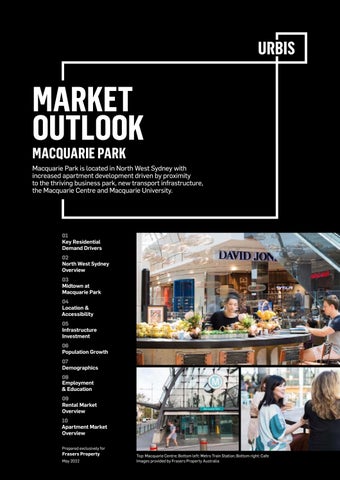
Top: Macquarie Centre; Bottom left: Metro Train Station; Bottom right: Cafe Images provided by Frasers Property Australia
01 KEY RESIDENTIAL DEMAND DRIVERS
02 NORTH WEST SYDNEY OVERVIEW
The key residential demand drivers have been identified by Urbis as comprising access to employment, public transport, services, recreation and social infrastructure.
INFRASTRUCTURE
SYDNEY
NORTH WEST SYDNEY
Locations supported by infrastructure and services improve the value derived from locational driven amenity.
Sydney is Australia’s Global City and is internationally recognised as an important financial and economic hub in Asia-Pacific. Sydney offers its residents excellent economic and lifestyle opportunities, making it one of the most liveable cities in the world (3rd in the world according to the 2019 Economist Intelligence Unit’s Global Liveability Index). Sydney Harbour, world renowned beaches, World Heritage Listed national parks and open space provide excellent amenity to residents.
The North West Sydney region has been identified by the NSW Government as a priority growth area with an important role in the future growth of Sydney. As a priority precinct, strategic planning aims to create vibrant and liveable neighbourhoods, provide jobs and housing and deliver critical infrastructure.
Long term value growth will be the most important motivator for buyers moving forward, and in today’s new market demand, those regions accommodating a unique formula will benefit the most in the long run. Urbis has investigated the trends that will deliver sustained and confident growth now and into the future. This involves recognising the key fundamentals that investors should seek to secure returns, as well as, identifying regions that will be the most desirable to live, work, and play. To help identify these locations, Urbis has concluded that the most desirable locations will be those which deliver ‘P.I.E.’ Population, Infrastructure and Employment growth. IN F
Access to good public transport and road infrastructure are important to potential purchasers and renters, particularly linkages to the CBD, airport and major employment centres. Future infrastructure projects can revitalise areas, improve connectivity and linkages, create new jobs and reshape the existing community. The Government is investing in several multi-billion dollar infrastructure projects in Sydney including the Western Sydney Airport, Metro Rail Network and WestConnex Motorway. Government investment in infrastructure is increasing as an economic stimulus following the impacts of the Covid-19 pandemic.
R A S T RU C T U R E
Sydney is a leading education provider, and is home to a number of globally recognised universities ranked in the top 1% of universities world-wide such as the University of Sydney, the University of New South Wales, and Macquarie University. These institutions attract students from throughout the world. NORTH WEST SYDNEY POPULATION GROWTH
I
900,000
EN EM
POPULATION Regions with strong population growth improve the potential demand for new residential development through access to a growing market and future household formation. The NSW Department of Planning, Industry and Environment forecasts that the population of Greater Sydney will increase by around 1.6% per annum over the next decade, which could drive demand for around 35,200 additional dwellings per year. Following the impact of the Covid-19 pandemic, population growth is projected to slow in the short-medium term as a result of a decline in international migration.
EMPLOYMENT Proximity and access to employment nodes is essential for strong residential growth. It supports a future population and opens a local labour market for residential developments as workers seek housing within easy transit to their place of work. The draft Greater Sydney Region Plan (2056) identifies a need for an additional 817,000 jobs by 2056, with a strong focus on economic corridors, health and education precincts and strategic centres. With a “30 minute city” as its vision, the NSW Government is planning to improve accessibility to strategic centres through new public transport so that residents can access jobs close to where they live. Employment in Sydney is rebounding following Covid-19, led by billions of dollars in government stimulus.
Total Population
T LA
N
OY M
PU IO
E
PL
PO
P
T
800,000 700,000 600,000
598,631
670,241
726,706
772,813
500,000 400,000 300,000 200,000 100,000 0
2021
2026
2031
2036
The Sydney Metro North West completed in 2019 was a major infrastructure project increasing connectivity from North West Sydney to major employment hubs such as Macquarie Park, Chatswood, St Leonards, North Sydney and the Sydney CBD. Stage two of the project is expected to open in 2024, connecting the metro at Chatswood Station directly to the Sydney CBD, bypassing the existing rail network. Furthermore, the increased transport provision also connects residents to universities, retail and amenity, with a metro train every four minutes during the peak. The North West is expected to record strong population in the future as high density living becomes increasingly accepted and new land is released for residential housing. The 2021 population of 598,631 is projected to grow to 772,813 in 2036, at an average annual growth rate of 1.7%. Population growth is projected to outpace that of Greater Sydney until 2031 when growth will stabilise. Macquarie Park has also been identified as a priority precinct by the NSW Government within North West Sydney. The strategic plan for Macquarie Park is yet to be finalised but initial objectives of the master plan are to increase employment capacity, improve urban amenity, improve public transport connections and achieve urban design excellence by upgrading public areas.
Source: Department of Planning and Environment; ABS; Prepared by Urbis
NORTH WEST SYDNEY REGION – EMPLOYMENT HUBS Macquarie Park
NSW
Chatswood
Parramatta
Sydney
St Leonards North Sydney
Sydney
2
Market Outlook Macquarie Park
Prepared exclusively for Frasers Property Australia
3
03 MIDTOWN AT MACQUARIE PARK Midtown at Macquarie Park is the transformation of a large 8.2-hectare site in Macquarie Park into a new residential community. The Masterplan for the precinct comprises:
Housing: A diverse mix of housing comprising approximately 3,300 apartments, including community and affordable housing. The housing is anticipated to attract a diverse range of residents creating a vibrant community.
Recreation: A state of the art community centre is located at the heart of the project, as well as a pay-as-you-go commercial pool and gymnasium, providing residents with access to health and recreation opportunities.
School: Plans for a co-educational K-6 primary school will make the community attractive to local families.
Retail: Local neighbourhood retail comprising specialty shops, services and cafes will provide residents with convenience retail onsite to complement the nearby regional shopping centre.
MIDTOWN AT MACQUARIE PARK MASTERPLAN
Source: Frasers Property Australia
Open Space: Approximately 27,500 sqm of public open space including a 3,300 sqm Village Green proposed at the heart of the community with bushland, cycle paths, nature based playgrounds and exercise stations located throughout the precinct creating an attractive outdoor lifestyle.
Childcare: Two childcare centres supporting families with direct access to childcare services.
AMENITY WITHIN WALKING DISTANCE Midtown at Macquarie Park Metro Station
Dining Precinct
Bus Interchange
Parks
Regional Shopping Centre
Medical Centre
University
Hospital
School
Cinema
Childcare
Gym
Swimming Pool
4
Market Outlook Macquarie Park
MIDTOWN AT MACQUARIE PARK WILL OFFER SIGNIFICANT ONSITE AMENITY WITH EMPLOYMENT HUBS, RETAIL, RECREATION AND EDUCATIONAL FACILITIES ALL LOCATED WITHIN WALKING DISTANCE. Prepared exclusively for Frasers Property Australia
5
04 LOCATION & ACCESSIBILITY SHOPPING Macquarie Park is home to Macquarie Centre, Sydney’s largest suburban shopping centre, comprising approximately 350 stores with anchor tenants including David Jones, Myer, Zara, Uniqlo, Woolworths, Coles, Aldi, Rebel Sport and JB Hi-Fi. The centre also has a large entertainment and leisure precinct comprising Timezone, Strike Bowling Bar, Macquarie Ice Rink and Event Cinemas. Other nearby shopping centres include Top Ryde City (276 stores), Chatswood Chase (202 stores) and Westfield Chatswood (257 stores). Midtown at Macquarie Park is also proposed to include a town square with a convenience retail offer.
06 11
07 05
Chatswood Station
Macquarie University Hospital is located within Macquarie University and comprises 182 beds and 12 operating theatres. Ryde Hospital is located 3.5km south-west of Macquarie Park and has 184 beds with an emergency department and Intensive Care Unit. Royal North Shore Hospital at St Leonards, is a major regional hospital with approximately 700 beds providing specialised medical services.
TRANSPORT CONNECTIVITY The Sydney Metro Northwest line connects Macquarie Park residents to Tallawong (in the West) and Chatswood (to the East) where they connect into the Sydney CBD. The completion of the City and Southwest Metro line in 2024 will provide direct access to stations in the Sydney CBD in under 20 minutes, reducing travel time by almost half. Macquarie Park is also serviced by a large network of bus routes with a bus interchange outside of Macquarie Centre. Residents are also well placed to travel by car on the nearby M2 motorway, which forms part of Sydney’s major arterial road network. 6
Market Outlook Macquarie Park
3.3kms
19
39
Midtown MacPark
03
Macquarie Park Station
M M2
ot
w or
ay
35
01
04
43
31
0.9kms
36
6kms
28
0.4kms
HEALTH
26 Marist College Eastwood
39 North Ryde Golf Club
01 Macquarie Centre
14 Macquarie University Hospital
27 Ryde Secondary College
40 Ryde Community Sports Centre
02 Woolworths Marsfield
15 Ryde Hospital
28 Arden Anglican School
41 Chatswood Golf Club
03 Ritchies IGA North Ryde
16 Royal North Shore Hospital
29 TAFE NSW Ryde
42 ELS Hall Park
04 Macquarie Centre Entertainment and Leisure Precinct
EDUCATION
30 TAFE NSW Meadowbank
43 Wilga Reserve
RETAIL & ENTERTAINMENT
05 The Concourse Chatswood 06 Chatswood Chase 07 Westfield Chatswood 08 Top Ryde City Shopping Centre COMMERCIAL 09 Macquarie Park Business Park 10 North Ryde Business Park 11 Chatswood CBD 12 North Sydney CBD 13 Sydney CBD
17 Macquarie University
PARKS & RECREATION
19 Truscott Street Public School
32 Shrimptons Creek
20 Kent Road Public School
33 Lane Cove National Park
21 Holy Spirit Catholic Primary School North Ryde
34 Waterloo Park
22 St Anthony’s Catholic Primary School Marsfield
36 Marsfield Park
24 Epping Public School 25 Epping Boys High School
5.6kms
30
20
3kms
15
0.2kms
37
0.8kms
22
0.1kms
02
3.5kms
26
1.2kms
23
1.2kms
24
25
31 Proposed Public School
18 Morling College
23 Eastwood Heights Public School
29
0.32kms
18
38
3.8kms
40
17 0.1kms
08
0.2kms
14
34
2.5kms
42
32
Macquarie University Station
0.6kms
27
21
Bus Services
09
PARKS AND RECREATION There are several parks and reserves throughout the area including Waterloo Park, Marsfield Park and ELS Hall Park. Other recreational areas include the TG Milner Sportsground, Macquarie University Sport and Aquatic Centre and the Macquarie Ice Rink. Midtown at Macquarie Park is also proposed to include a village green as well as indoor and outdoor recreation facilities to enhance amenity for residents.
10 North Ryde Station
Residents are well placed to access local primary and high schools including Epping Boys High School, Ryde Secondary College, Truscott Street Public School and St Anthony’s Catholic Primary School Marsfield. Macquarie University and NSW TAFE at Ryde and Meadowbank provide multiple tertiary education opportunities. Midtown at Macquarie Park is also proposed to include a K-6 primary school with capacity for approximately 400 students.
MEDICAL
41
33
EDUCATION
13
12
16
35 Cottonwood Reserve 37 Dunbar Park 38 Macquarie University Sport and Aquatic Centre
MACQUARIE PARK IS LOCATED 15KM NORTH-WEST OF THE SYDNEY CBD AND IS IN CLOSE PROXIMITY TO AMENITY, EDUCATIONAL INSTITUTIONS AND EMPLOYMENT CENTRES. Prepared exclusively for Frasers Property Australia
7
05 INFRASTRUCTURE INVESTMENT INFRASTRUCTURE
SYDNEY METRO – STAGES 2 & 3 $23 Billion (Stage 2 - Opening 2024) (Stage3 – Opening 2030)
Wilb erfo
rce Rd
Stage 2 of the metro line will improve connectivity to residents with direct access to Crows Nest, Barangaroo and Martin Place when it opens in 2024. It is expected to reduce travel time to Sydney CBD from Macquarie Park to under 20 minutes. Stage 3 is expected to open in 2030 and will extend to Westmead in the west. This stage will connect Macquarie Park residents to employment hubs such as Sydney Olympic Park, Burwood and Parramatta.
AMP Capital has lodged plans for a $1 billion redevelopment of the Macquarie Centre including 1,000 new apartments in four tower blocks. The proposal also includes 5,000 sqm of dedicated community space, including a library and public creative hub that would be open to local residents. AMP Capital is undertaking further consultation to inform the project with uncertainty regarding potential timing.
Construction of a 26 storey mixed use development comprising teaching space, innovation hub, 200-room hotel, conference facility and ancillary retail uses.
rR d
le
W in ds o
MACQUARIE GRADUATE SCHOOL OF MANAGEMENT $130 Million (Expected Completion 2026)
F wy
ay
Sydney Ne
a on
l Va
e
sor
d Win Rd
d
Rd
Hills
Betts Rd
ne
Chatswood Cov e
Rd
North Sydney
rn Opening 2024
e uth So
ng
Ki
Preside
nt Ave
s
ge or
Ge
Da v i es Rd
Sydney
ssDr Cr o
King
Roberts Rd
Joseph St
Mtwy M5
hWeste rn Mtw y
St rris Ha St ttle Wa
Centenary Dr
Liverpool
y Hw s ce tasD r Qan
Easter n Distributor
Dr
St
in Pr
ut
tary Mili
St Leonards
O ly m pi c
Opening 2030
So
Gore Hill
Tunl
y Fw
Ruse Dr
Parramatta
La
Spit Rd
es
Rd
m
Rd
d
y
en
Ja
sR
ien
Hw
rsd Ma
y Pk
t nan Pen
Br
M4 Western M tw y
y
Silverwater
illip Ph
s Mtw Hill
Wall Park A ve
Condamine S t
R yde
ific Pac
R
Poin t Rd
Future Metro Station
Metro Line
Future Metro Line
Al fo rd s
Metro Station
Rd
Prepared by Urbis ra
Market Outlook Macquarie Park
Ill aw ar
8
Opening 2024 (Under Construction)
New
H
Rd
Opened 2019
Construction of a new, purpose-built law school building to expand the academic facilities on campus. The project is currently in the early planning stage.
Construction of a new centre for excellence for the Royal Institute for Deaf & Blind Children, including a new preschool for up to 80 students and primary school for 120 students, with each school catering to 3 streams: Auslan, Cochlear and vision impaired, and supporting medical centres.
Rd
M
d er R Pittwat
Old
Opened 2019
Macquarie Park
MACQUARIE UNIVERSITY LAW SCHOOL – MICHAEL KIRBY BUILDING $80 Million (Expected Completion 2025)
NEXT CENTRE FOR EXCELLENCE $75 Million (Expected Completion 2023)
w ca st
SYDNEY METRO
Hume Hwy
Va lle y W
MACQUARIE CENTRE REDEVELOPMENT $1 Billion (Expected Completion 2034)
Opening 2030 (Development Approval) Future Metro Station Future Metro Line
MACQUARIE SQUARE $1 Billion (First Stage Completed) (Expected Completion 2027)
John Holland has acquired land in Macquarie Park to develop a commercial precinct comprising of five buildings. The first building, Glasshouse, was completed in late 2019 and is home to Transport for New South Wales. The remaining four buildings will include 75,000 sqm of nettable land area across commercial and retail uses. The precinct will act as a marketplace to bring technology, commerce, innovation, wellbeing, culture, events and nature together. MACQUARIE UNIVERSITY COMMERCE CENTRE $335 Million (Expected Completion 2026)
Proposed development of a commercial office precinct known as MQX4 near the Macquarie Park Station. The development comprises four towers with ground floor retail, adding almost 80,000 sqm of additional office space and 1,850 sqm of retail. MACQUARIE UNIVERSITY INNOVATION HUB $200 Million (Expected Completion 2025)
The proposed development comprises the construction of two new commercial buildings with total floorspace of 50,000 sqm. The buildings would expand academic facilities at the university to increase capacity.
06 POPULATION GROWTH
07 DEMOGRAPHICS
For the purpose of this profile, the Macquarie Park study area has been defined to include the suburbs of Macquarie Park and Marsfield. These two suburbs are subject to similar geographical and economic factors. The study area has been created to effectively assess the area’s population growth, demographic characteristics and property market.
The Macquarie Park Study Area is home to increasingly affluent residents who are primarily renters, well educated and employed in white collar jobs. Between 2011 and 2016, average per capita income in the study area grew by 3.0% per annum.
Transport for NSW has forecasted that the Macquarie Park – Marsfield area will grow by an average of 4.3% per annum from 2021 to 2036. This is significantly higher than the 1.6% growth per annum forecast for Greater Sydney and is equivalent to 1,450 new residents per year, bringing the total population to almost 46,800 residents by 2036. Population growth from 2021-2022 is anticipated to be lower than previously projected due to the impacts of Covid-19 on international migration. Population growth is then anticipated to increase as the Australian economy recovers and impacts of Covid-19 are alleviated. MACQUARIE PARK AREA POPULATION GROWTH
40,000
35,647
30,000 25,000
Macquarie Park Area
Greater Sydney
37
37
$55,584
$51,593
10.5%
11.5%
Residents Aged 20-39
45%
31%
Overseas Born
60%
39%
Couple Family with No Children
42%
33%
Proportion of Renters
52%
36%
Employed in White Collar Jobs
84%
75%
Managers and Professionals
52%
14%
Bachelor’s Degree or Higher
45%
28%
Undertaking Tertiary Education
22%
7%
Average Age of Residents Average Per Capita Income* Household Income Above $104,000
Prepared by Urbis; Source: ABS Census 2016 Note: * Excluding tertiary students
AVERAGE PER CAPITA INCOME 2011-2016
10,000 5,000
Macquarie Park Area
–
Greater Sydney
2036
Source: TfNSW 2019; Prepared by Urbis
MACQUARIE PARK AREA POPULATION GROWTH 2021-2036
4.3% 1.6%
$60,000 $50,000 $40,000 $30,000 $20,000
$51,593
2031
$55,584
2026
Average Per Capita Income
2021
$43,413
25,000
When tertiary students are excluded, Macquarie Park residents recorded an average income of $55,584 in 2016, above the Greater Sydney average of $51,593. This reflects the high proportion of white collar workers making up the majority of the labour force at 84% (vs 75% Sydney average), of which 52% are managers or professionals.
$47,919
20,000
Macquarie Park is an attractive location for students given its proximity to Macquarie University, with 22% of residents in 2016 undertaking tertiary education compared with 7% across Sydney. This is reflected by 14% of the population aged 20-24 (vs 7% in Sydney). Students living in Macquarie Park declined in 2020 as a result of the Covid-19 pandemic due to the closure of campuses. However, students are projected to rebound quickly once Australian borders are reopened and the Macquarie University campus reopens. Overall, the average age of residents in Macquarie Park is in line with the Sydney average at 37 years, with 45% of residents in Macquarie Park aged 20-39 compared to 30% for Sydney. The higher proportion of people aged 20-39 is offset by a lower proportion of children.
With growing incomes, a high proportion of renters and a relatively young and educated population, Macquarie Park is home to a large potential tenant pool underpinned by population growth and access to major employment centres.
25,010
Total Population
35,000
42,378
45,000
46,755
50,000
THE MACQUARIE PARK AREA IS PROJECTED TO EXPERIENCE SIGNIFICANT POPULATION GROWTH OF AROUND 4.3% PER ANNUM TO 2036.
WHO LIVES IN MACQUARIE PARK?
$10,000 0 2011
2016
Prepared by Urbis; Source: ABS Census 2016 Study Area
Greater Sydney
Note: * Excluding tertiary students
Prepared by Urbis; Source: TfNSW 2019 Note: NSW Government forecasts prepared prior to Covid-19 pandemic.
10
Market Outlook Macquarie Park
Prepared exclusively for Frasers Property Australia
11
08 EMPLOYMENT & EDUCATION
09 RENTAL MARKET OVERVIEW
EMPLOYMENT
EDUCATION
Employment growth is an important driver of residential demand with workers looking to live near where they work. Forecast employment growth in nearby employment centres has the potential to drive residential demand from new workers.
There are a number of public and private primary schools within the local area including Truscott Street Public School, Kent Road Public School, Holy Spirit Catholic Primary School North Ryde and St Anthony’s Catholic Primary School Marsfield. There are also a variety of high schools including Epping Boy’s High, Marist College Eastwood and Ryde Secondary College. Access to local schools will further improve with plans at Midtown at Macquarie Park for K-6 co-educational primary school.
Recently completed projects in Macquarie Park are achieving higher rents than the older existing stock, indicating there is strong demand for higher quality product. Prior to the Covid-19 pandemic, twobedroom units achieved rents of $710 a week.
Macquarie Park is the third largest commercial centre in NSW underpinned by the business park, Macquarie University and Macquarie Centre. The business park has attracted a large number of major businesses such as Optus, Johnson and Johnson, Fujitsu and Wesfarmers that have established corporate headquarters in the precinct. ARUP prepared the Macquarie Park Strategic Masterplan in April 2020 outlining the potential for the centre to be the northern anchor of Sydney's Eastern Economic Corridor and support 20,000 new jobs by 2036 and 22,500 new students by 2030. Macquarie Park is well connected to several commercial centres by road and rail, providing residents with excellent access to jobs. The Metro Rail provides direct access to Chatswood (~9 min by train), which is projected to provide up to 5,000 new jobs by 2036 and Norwest Business Park (~16 min by train), which is projected to provide up to 14,000 jobs. The Sydney Metro City is expected to open in 2024 and will provide a direct train link from Macquarie Park Station to the CBD every four minutes in peak periods, improving accessibility to the 122,000 new jobs in the CBD that are expected to be created by 2036. The new train line will also provide direct access with St Leonards and North Sydney, providing improved access to these employment precincts. EMPLOYMENT GROWTH WITHIN KEY SURROUNDING CENTRES 2016 to 2036 Norwest Business Park
+13,972
Residents are well placed to access Macquarie University, recognised internationally as a leading university. The institution has around 45,000 students with degrees specialising in Business, Arts, Medicine and Law. According to the 2022 QS World University rankings, Macquarie is ranked 13th in Australia and in the top 1% of universities globally. Macquarie University Hospital is one of the most advanced hospitals in the country and is also home of the Australian School of Advanced Medicine. The university is a major driver of the rental market in the area with students looking to live close to the campus. Students living in Macquarie Park declined in 2020 and 2021 as a result of the Covid-19 pandemic. However, students have started to rebound in 2022 as the Australian border reopens to international students. Other universities such as the University of Sydney, University of New South Wales, and University of Technology Sydney can be accessed by train/bus, with the completion of Sydney Metro in 2024 bringing down travel times. There are two NSW TAFE campuses located nearby. The Meadowbank campus is one of the largest in Sydney and offers an extensive range of courses including degrees in network security and finance. The Ryde campus, approximately 3.3km from Macquarie Park, is an internationally renowned specialist training centre for hospitality, tourism, horticulture and environmental management.
Macquarie Park
+18,858
Chatswood
+5,051
The Covid-19 pandemic impacted the rental market with demand falling due to students returning home and no inward migration. The Macquarie Park rental market was relatively harder hit due to the area being an attractive location for Macquarie University students and new migrants due to the proximity to amenity, transport and jobs. As the borders reopen and international students slowly return, rents for new apartment buildings in Macquarie Park have increase to a median of $650, which is 23% above median rents for older buildings. Rents are expected to further increase as flow of international students and migration return to pre-COVID levels. Over the last decade, median rents for two-bedroom units in the study area have grown at 3.3% per annum, significantly higher than the Greater Sydney average of 2.0%. Median rents have been volatile since 2017 as new apartment supply has come online, with rents spiking as new stock enters the market at higher rents before the market stabilises. Historically, the vacancy rate within Macquarie Park has generally fluctuated between 1% to 3%. In recent years vacancy rates have increased in Macquarie Park and most of Sydney due to the large quantity of supply that hit the market. As a result, the high vacancy rates have put downward pressure on rents. But, as the international borders reopen and new stock gets absorbed, the vacancy rates are expected to normalise. Between 2011 and 2016, the proportion of renters in Macquarie Park grew from 46% to 52%, compared to Sydney which grew from 32% to 36%. The high proportion of renters in the Macquarie Park is likely driven by the proximity to Macquarie University and the high level of amenity associated with transport connectivity and proximity to retail, jobs and entertainment. The growing number of potential renters reflects a large and affluent tenant pool in Macquarie Park.
MEDIAN WEEKLY RENT GROWTH – 2 BEDROOM UNITS March 2011 - March 2022
3.3%
2.0%
Study Area
Greater Sydney
Source: NSW Department of Housing; Prepared by Urbis
NEW APARTMENT RENTAL PREMIUM – 2 BEDROOM UNITS April-May 2020 Existing Apartments
Premium
$528
23%
New Apartments
$650
Source: Pricefinder; Prepared by Urbis
PROPORTION OF RENTERS 2011 to 2016 Macquarie Park Study Area
Greater Sydney
52%
46%
36%
32%
2011
2016
Source: ABS Census 2016; Prepared by Urbis
St Leonards
+21,412
Parramatta
+18,424
North Sydney
+18,282 Sydney CBD
+122,431
OVER THE LAST DECADE, MEDIAN RENTS FOR TWO-BEDROOM UNITS IN THE STUDY AREA HAVE GROWN AT 3.3% PER ANNUM, SIGNIFICANTLY HIGHER THAN THE GREATER SYDNEY AVERAGE OF 2.0%.
Prepared by Urbis; Source: TfNSW 2019. Note: NSW Government forecasts prepared prior to Covid-19 pandemic. 12
Market Outlook Macquarie Park
Prepared exclusively for Frasers Property Australia
13
10 APARTMENT MARKET OVERVIEW
14
Market Outlook Macquarie Park
Development Approval
670
Price to Income Ratio
2,835
TOTAL Prepared by Urbis; Source: Cordell Connect
MACQUARIE PARK AREA APARTMENT MARKET No. of Transactions Median Sale Price
902,000
$1,200,000
450 400 350
$800,000
300
$600,000
250 200
$400,000
150 100
$200,000
Sep 21
Mar 22
Mar 21
Sep 20
Sep 19
Mar 20
Sep 18
Mar 19
Sep 17
Mar 18
Mar 17
Sep 16
Sep 15
Mar 16
Sep 14
Mar 15
Sep 13
Mar 14
Sep 12
Mar 13
Sep 11
Mar 12
Mar 11
Sep 10
50 0
Period (Quarterly)
Source: Pricefinder; Prepared by Urbis Note: Sales from 2020 -2022 are likely under reported as off-the-plan properties not yet settled are not excluded
APARTMENT COMPLETIONS – INNER/MIDDLE RING Built
Presales
Under Construction
Pending
2021
21.1%
7.7%
0.5% Units
Macquarie Park Area
18,751
Prepared by Urbis; Source: Pricefinder
The maps below highlight the comparative pricing for off-the-plan apartments above current and future metro stations across Sydney’s lower north shore and Barangaroo. Midtown is generally a more affordable option when compared to these other markets, with prices ranging from $690,000 to $880,000 for a one bedroom apartment and $905,000 to $1.36 million for a two bedroom apartment. Midtown’s pricing is similar to that of Macquarie Park and North Ryde and well below that of Chatswood, Crows Nest and North Sydney. As a result of the significant increase in house prices over the last five years, housing affordability in Macquarie Park
has deteriorated significantly. The median house price in Macquarie Park in 2016 divided by the average household income resulted in a ratio of 15.6. This ratio has increased to 21.1 as house price growth has far exceeded household incomes. This has made house prices unaffordable for the majority of households in the region unless they have a large deposit. On the other hand, the unit ratio has actually declined from 8.5 in 2016 to around 7.7 in 2021, which has made apartments relatively more affordable for households. As a result of these trends, more households will be looking to buy apartments as they are priced out of the local house market.
PRICING FOR 1-BEDROOM APARTMENTS ABOVE CURRENT AND FUTURE METRO STATIONS 2022
PRICING FOR 2-BEDROOM APARTMENTS ABOVE CURRENT AND FUTURE METRO STATIONS 2022
4,451
5,808
Barangaroo
Macquarie Park
$672,000$940,000
$1,600,000$2,350,000
4,369
4,000 2,000
Greater Sydney
Source: Pricefinder, ABS, Urbis
$693,000$801,000
4,114
6,000
8.5%
North Ryde
9,173
8,000
2.2%
Midtown Chatswood
$905,000$1,360,000
$1,105,000$1,315,000
$940,000$1,500,000
13,147
10,000
3.9%
Unit
15.6%
$690,000$880,000
14,000 12,000
10 year
Macquarie Park
20,000
16,000
House
2016
Midtown
18,000
5.3%
5 year
500
$900,000
$0
MEDIAN PRICE GROWTH – UNITS
MACQUARIE PARK HOUSING AFFORDABILITY 2016 - 2021
1,369
Under Construction
9,368
Data from Urbis and Cordell Connect indicates that around 2,800 dwellings are currently proposed to be completed in the Macquarie Park area. The majority of dwellings are proposed to be developed in close proximity to Macquarie University and Macquarie Centre. Of the total development pipeline, 670 have received development approval with 1,369 apartments currently under construction. The remaining 796 apartments are in the development application stage with greater uncertainty regarding likelihood to proceed. The number of apartment completions in the Inner/Middle Ring of Sydney has slowed from 2018 to 2021 as a result of the apartment market slowdown. The COVID-19 pandemic has continued the trend of less projects commencing construction, which will flow through to relatively low completions in 2022 to 2024. The number of apartment completions is anticipated to be well below the historical average and what is required to meet population growth once migration ramps up.
796
10,997
After peaking at $1,027,000 in mid-2018, the median price fell as a result of lowered buyers’ confidence and tighter lending standards. Following the relaxation of lending criteria and an increase in buyers’ confidence after the outcome of state and federal elections, median sales prices increased to over $926,000 with 219 transactions in the last quarter of 2019. The Covid-19 pandemic impacted the market with prices dipping to $798,000 and transactions to 120 for the June 2020 quarter. Prices have recovered strongly into 2021 as a result of low interest rate with the median sitting at $938,400 at December 2021 quarter. The median price remained above $900,000 at the start of 2022.
Development Application
Number of Sales
The apartment market in Macquarie Park has experienced significant growth of 5.8% per annum in the last 10 years in line with broader Sydney trends.
Apartments in Macquarie Park have outperformed Greater Sydney over the last 10 years. In the last five years, unit prices have grown 2.2% per annum in Macquarie Park compared with 0.5% for Greater Sydney. Over the last decade, Macquarie Park has recorded significant price growth of 5.3% per annum compared to 3.9% for Greater Sydney.
Apartments
Mar 10
MACQUARIE PARK MARKET
Status
Median Sale Price
The Sydney residential market has recorded significant average price growth over the last decade as a result of strong demand from people looking to live in Sydney and benefit from the strong economy and attractive lifestyle. There has been a trend towards higher density living in Sydney as residents seek opportunities to live in close proximity to the city’s wide range of amenity and enjoy its unique lifestyle. In particular, middle ring areas such as Macquarie Park are undergoing significant urban redevelopment, and apartment buyers are looking to capitalise on this new infrastructure and amenity.
PROPOSED RESIDENTIAL DEVELOPMENT IN THE MACQUARIE PARK AREA
Apartment Completions
SYDNEY MARKET
Crows Nest
$810,000$1,150,000 North Sydney
$820,000$1,200,000
Chatswood
$1,650,000$2,236,000 North Ryde
$888,000$1,060,000 Barangaroo
$3,300,000$9,000,000
Crows Nest
$1,600,000$1,895,000 North Sydney
$1,800,000$2,040,000
– 2016 2017 2018 2019 Source: Urbis Apartment Essentials
2020
2021 2022
2023
2024
Source: Urbis
Source: Urbis
Prepared exclusively for Frasers Property Australia
15
P0018946/C
This publication is prepared on the instruction of Frasers Property Australia and is not suitable for use other than by the party to whom it is addressed. As the publication involves projections and assumptions it can be affected by a number of unforeseen variables. The forecasts and assumptions are a prediction and whilst Urbis has made every effort to ensure that the forecasts and assumptions are based on reasonable information, they may be affected by assumptions that do not necessarily eventuate or by known, or unknown, risks and uncertainties. It should be noted that past performance is not necessarily a reliable indication of future performance. The information in the publication does not represent financial advice and should not be regarded as such. It has been prepared without taking into account your financial situation or investment objectives. You should consider the appropriateness of the information in regards to your current financial situation or needs. Urbis accepts no responsibility for the accuracy or completeness of any such material. The information is subject to change without notice and Urbis is under no obligation to update the information or correct any assumptions which may change over time. This study has been prepared for the sole use of Frasers Property Australia and is not to be relied upon by any third party without specific approval from Urbis. This publication is subject to copyright. Except as permitted under the Copyright Act 1968, no part of it may, in any form or by any means (electronic, mechanical, photocopying, recording or otherwise) be reproduced, stored in a retrievals system or transmitted without prior written permission. Enquires should be addressed to the publishers.