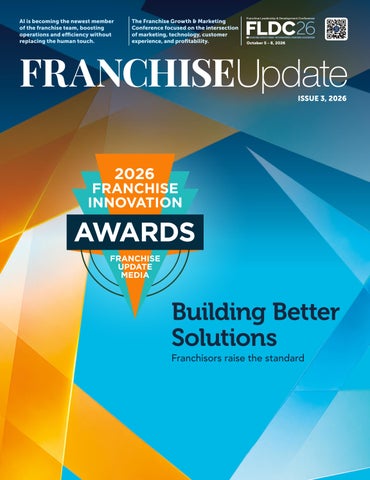
AI is becoming the newest member of the franchise team, boosting operations and efficiency without replacing the human touch.
The Franchise Growth & Marketing Conference focused on the intersection of marketing, technology, customer experience, and profitability.
October October55--8,8,2026 2026
FRANCHISEUpdate ISSUE 3, 2026
2026
AWARDS Building Better Solutions Franchisors raise the standard
Sponsored Content
Results lead to recognition Not the other way around
42%
average marketing qualified lead*
$224
average CPL* 36% below the industry average
500+
franchise brands served across every stage of growth
26+
years building franchise brands
See why franchise brands partner with Hot Dish Advertising. 612.341.3100 | info@hotdishad.com | HotDishAd.com *Agency-wide average June 2025 -June 2026 ©2026 Hot Dish Adver tising. All rights reser ved.
9 consecutive years as a Top Franchise Marketing Supplier
CONTENTS EDITOR’S NOTE 4
20
26
10
48
Anatomy of a Brand: Stratus Clean
CONSUMER MARKETING
Rebrand positions franchisees for the next stage of growth
28
CEO Profile: Amy Freeman, The Spice & Tea Exchange Leader builds a flavorful brand for franchisees and customers
36
54
Overall Winner
CMO Roundtable
CMO Q&A
Challenge the Pros “Why is the franchiseefranchisor relationship so important in the recruiting process?”
66
Sales Smarts Savvy development teams use AI purposely
68
At Tint World, Christy Johnson makes sure every campaign counts
Market Trends New franchise brands aim to change the game
2026
AWARDS
From AI to operations, 2026 winners set new standards for franchising
42
62
“In what ways are you using AI technology in the marketing department to enhance your data analysis of trends, performance, and more?”
A Conference Rebrand
8th Annual Franchise Innovation Awards
GROWING YOUR SYSTEM
Hand & Stone Massage and Facial Spa serves consumers and franchisees
52
Franchise Growth & Marketing Conference focuses on metrics that matter
CEO Profile: Mike Boyer, A Place At Home CEO brings a people-first approach to home care
14
IFA Report
Marketing Leadership Award Primrose Schools creates edutainment for children and adults
The American Franchise Act can help secure franchising’s future
LEADERSHIP 6
44
AI takes orders, coaches employees, and helps franchisees operate smarter
Beyond the Buzz Franchisors turn technology into practical innovation
Operational Intelligence
Operations and Technology Leadership Award
58
Social Media
70
Franchise leaders around the world embrace AI
Conferences create space for real conversations
60
Customers Count
International
71
Tech Beat Don’t let AI drain your operating budget
Build a culture where people actually care
72
It’s Closing Time In sports and franchising, success comes through execution
Little Caesars puts delivery robots to good use
Our Team DIRECTOR, EXECUTIVE EDITOR
MANAGER, EVENT OPERATIONS
CONTRIBUTING EDITORS
Gary Gardner
Kerry Pipes
Sharon Wilkinson
CO-FOUNDER
MANAGER, EDITOR
SENIOR MANAGER, GRAPHIC DESIGN
Christina Chambers Matt Haller Art Coley Dennis Leskowski John DiJulius Jack Monson William Edwards Paul Wilbur
CO-FOUNDER
Therese Thilgen
M. Scott Morris
Michael Llantin
VP, MARKETING AND CONTENT
MANAGER, EDITOR
MANAGER, MARKETING
Diane Phibbs
Kevin Behan
Taylor Williams
VP, BUSINESS DEVELOPMENT
DIRECTOR, TECHNOLOGY
Benjamin Foley
COORDINATORS, SPONSORSHIP BENEFITS
SENIOR MANAGER, WEB DEVELOPER
Alison Shelton
Matt Wing
Heather Stoner
MANAGER, WEB DEVELOPER
CONTRIBUTING WRITER
Barbara Yelmene DIRECTORS, BUSINESS DEVELOPMENT SALES
Krystal Acre Jeff Katis Hope Alteri
Don Rush COORDINATOR, DIGITAL
Juliana Foley 2 | Franchise Update | Issue 3, 2026
Colleen McMillar
ARTICLE INQUIRIES
editorial@franchiseupdate.com SUBSCRIPTIONS
subscriptions@franchising.com 408-402-5681 SUPPORTING PHOTOGRAPHY AND ILLUSTRATIONS SOURCED FROM STOCK.ADOBE.COM AND ADOBE FIREFLY
Editor’s Note
Beyond the Buzz
Franchisors turn technology into practical innovation
T
echnology? I know. It’s everywhere. You can’t escape it. If you’re like me, you’ve probably been bombarded with news about the latest breakthrough that’s supposedly going to change everything. Nothing generates more buzz than artificial intelligence and its seemingly nonstop evolution. So, we decided to look past the hype and examine how AI is changing the day-to-day operations of franchise businesses and how technology is driving innovation across the industry. One thing became clear: AI is no longer an emerging technology in franchising. It’s becoming part of everyday business. Contributing writer Colleen McMillar explores how brands are using AI to take drive-thru orders, forecast sales, optimize labor, manage inventory, create marketing content, and uncover new customer opportunities. As she discovered, the conversation has shifted from simply using AI to using it where it delivers the greatest value. Perhaps the most important finding is that the best brands aren’t using AI to replace people. They’re using it to eliminate repetitive tasks so that employees and franchisees can spend more time serving customers, leading teams, and making better decisions. When used well, AI makes people better at what they do. Technology also took center stage in Kevin Behan’s coverage of our 8th Annual Franchise Innovation Awards, which were announced at the newly renamed Franchise Growth & Marketing Conference in Atlanta. This year’s winners weren’t recognized for chasing the latest trend. They earned their awards by solving real business problems. They improved hiring, streamlined
4 | Franchise Update | Issue 3, 2026
operations, strengthened customer engagement, increased retention, and delivered measurable results. Whether through AI-powered recruiting, autonomous delivery, personalized digital experiences, or smarter use of data, the common thread was practical innovation that creates value for franchisees and customers alike. The conference itself reflected how much the industry has changed. Franchise Update Media and IFA reimagined the former Franchise Customer Experience Conference as the Franchise Growth & Marketing Conference to better reflect the expanded role of marketing. Today’s franchise marketers are expected to do much more than build brand awareness. They must drive profitable growth, use data and AI to make smarter decisions, and work hand in hand with operations, finance, technology, and franchisees. The new conference mirrors that reality. The buzz around technology isn’t going away anytime soon. But the brands that thrive won’t be the ones chasing every new tool. They’ll be the ones that solve real problems and improve the customer experience while never losing sight of the people who make franchising work.
Kerry Pipes KERRY PIPES Executive Editor
Anatomy of a Brand
A Clean Break Rebrand positions franchisees for the next stage of growth Written by DOUG FLAIG
T
hings are constantly changing at a fast-growing franchise with new franchisees, more territories, changes in technology, and AI. But a complete rebranding was our biggest change yet. Earlier this year, we transformed from Stratus Building Solutions to Stratus Clean. The rebrand is a way to reflect our rapid expansion better and show a more focused, service-first identity. We wanted to refocus on what our franchisees do well: commercial cleaning. With more than 5,100 individual franchisees across the U.S. and Canada, we knew this would be a massive undertaking. Every decision we made would impact thousands of business owners who represent our brand every day. The conversation started long before we announced anything publicly. As we’ve continued to grow, we spent a lot of time listening to our franchisees. They were having conversations with customers every day, and one piece of feedback kept coming up. They wanted more clarity. They wanted a name that immediately told people what their business does.
Once we committed to the rebrand, the real work began. We rebuilt both of our websites, redesigned marketing materials, created new graphics, updated uniforms, refreshed sales collateral, changed digital assets, updated signage, and coordinated countless small changes that most people would never notice. Every department touched the project in some way, and every change had to be rolled out across our entire franchise system. 6 | Franchise Update | Issue 3, 2026
Throughout those conversations, we also defined what we wanted the new Stratus Clean brand to represent. We kept coming back to approachable, modern, and excellent service. We wanted customers to see us as an easy-to-work-with, trusted partner. We wanted the brand to reflect the consistency, reliability, and quality of service we’ve built our reputation on. And we wanted a more current, digital-first look that matched where the business is headed. That meant refreshed colors, an updated design, and new investments in technology.
the updated look and are excited to represent a brand that clearly communicates who we are from the very first interaction. As we continue expanding into new markets, having a recognizable, modern identity gives us an even stronger platform to introduce Stratus Clean to new customers, attract future franchise owners, and continue building on the momentum we’ve created over the past several years.
I’m especially proud that the new brand still feels familiar. We didn’t want to lose what people already recognized about Stratus. We wanted to build on it. Even our updated logo tells that story. The three spires represent our unique three-tier franchise model and the buildings we clean. The spires also serve as a subtle nod to our previous logo. More importantly, they represent the strong foundation we’ve built over the past two decades and where we’re headed next.
We’re continuing to modernize our business by investing in technology, AI, and new tools that help our franchisees operate more efficiently. We’re also continuing to prioritize sustainability, including expanding our paperless initiatives and strengthening the environmentally responsible practices that have always been part of who we are.
The response has been incredibly encouraging. Franchisees have told us the new name makes conversations with prospective customers easier because people immediately understand what they do. Customers have responded well to the cleaner, more modern look, and we’ve heard positive feedback across the board on everything from the website to the updated branding. Beyond the positive feedback, the rebrand has created a renewed sense of energy across our entire franchise system. Our franchisees have embraced
Of course, the work doesn’t stop because the rebrand launched.
Everything we do is centered around empowering our franchisees to succeed. When they win, the system wins. The rebrand gives franchisees a fresh design and updated look to usher in a new era of growth. Twenty years after we opened our doors, Stratus Clean feels like the right name for the company we’ve become and for the company we’re continuing to build.
■
Doug Flaig is the CEO of Stratus Clean and is a seasoned executive with a strong franchising background with the likes of Dunkin’ Donuts, Burger King, and 7-Eleven.
Growth is the focus LEASE STRATEGY CRITICAL DATES RENEWALS & OPTIONS RENT ESCALATIONS ASC 842 COMPLIANCE REPORTING RISK MITIGATION
PORTFOLIO VISIBILITY
We manage what keeps it
afloat.
Underneath every location is a Lease Agreement governing complex obligations, fees, options, and opportunities. Quarem combines technology and expertise to ensure franchise leaders navigate lease obligations that lie beneath so you can stay focused on what's next.
25 YEARS OF MANAGING LEASES
PROUD SPONSOR OF FLDC ‘26
Booths #41 & #42
Discover how we help franchise leaders stay ahead. quarem.com
Sponsored Content
Scaling Smart Franchisees and franchisors require the right infrastructure Written by ANDREW SEID
M
ulti-unit ownership has become one of the defining growth strategies in franchising with more operators acquiring multiple locations within a brand and, increasingly, across brands and industries. The appeal is easy to see: economies of scale, a stronger local footprint, and revenue that isn’t tied to one location. Many brands seek to focus on multi-unit growth as their main development strategy before they are ready. That can be a death knell for any brand looking to enter the multi-unit space. A brand that pushes multi-unit development without building the infrastructure to support it isn’t setting franchisees up for success; it’s setting both sides up for a struggle.
The skills that make someone a good single-unit operator (hands-on, personally troubleshooting every issue) aren’t the skills that make a good multiunit operator. At scale, an owner must shift from doing the work to building systems that ensure the work gets done consistently: trained general managers, standardized training, and financial reporting that flags problems anywhere in the portfolio before they become crises.
managing managers, portfolio-wide reporting tools, field support attuned to multi-unit pressures, and a development pace grounded in what an operator’s leadership bench can absorb. Franchisors who skip this work often don’t feel it right away. The first unit or two can look fine propped up by an operator’s hustle. The strain shows up later, when growth outpaces the operator’s systems and the franchisor has no infrastructure to fill the gap. At this point, a struggling multi-unit franchisee is a far bigger problem than a struggling single-unit one.
DIFFERENCES
Franchisors often design one support model for a category that contains at least three distinct classes of franchisee:
THE FRANCHISOR SIDE
• The organic grower opens a single unit, proves it out, and expands as capital and confidence allow, usually building systems incrementally and learning documentation the hard way. They benefit most from franchisor-provided templates and field support that catches the moment they’re outgrowing informal management before the strain shows up at unit two or three.
Multi-unit operators tend to be better capitalized and more committed than single-unit operators. A smaller number of larger operators can be easier to support than a large roster of singleunit owners. That upside comes with obligations, including a training curriculum built for people
• The committed multi-unit developer signs a development agreement for multiple units on a schedule often before opening the first location. With no track record to lean on, the franchisor needs to front-load support: leadership hiring and reporting systems in place from unit one and
Franchisees can’t build all this alone. The training programs, reporting dashboards, and leadership pathways multi-unit operators need are, in large part, enabled by the franchisor. A brand pursuing multi-unit growth must ask whether it has built the systems to support operators managing several locations.
8 | Franchise Update | Issue 3, 2026
• The multi-unit, multi-brand operator owns locations across more than one brand. The challenge here differs in kind, not just degree. This operator often has a point-of-sale or back-office system already standardized across their portfolio, and a franchisor that insists on proprietary, incompatible technology creates real friction. Franchisors need integration flexibility, such as open APIs or data export options, to compete for these operators. The franchisee, in turn, must manage brand standards and training requirements that may pull in different directions and be honest with each franchisor about where a shared back office works and where brand-specific requirements need their own lane. Treating these three types identically, with the same onboarding and growth-pacing conversations, is a common and avoidable mistake. The organic grower needs a nudge toward formal systems. The developer needs those systems in place before the ribbon cutting. The multi-brand operator needs flexibility above all.
THE FRANCHISEE SIDE
The benefits are real: spread fixed costs, more leverage with vendors and lenders, and a more valuable, sellable asset than a single unit. These benefits are conditional on the operational backbone underneath them. Expanding without that backbone multiplies problems. A staffing issue that’s a minor headache at one location becomes a recurring fire drill across five.
a timeline realistic against the operator’s actual hiring capacity, not just their capital. These franchisees need to resist letting construction timelines outrun their leadership pipeline.
PACING
As with everything else in franchising, there needs to be a healthy balance between franchisee and franchisor. A franchisee who signs on for five units over three years needs a leadership pipeline that keeps up with that timeline. A franchisor approving that agreement needs the training, reporting, and field support infrastructure to keep up with it too. The franchisors doing this well vet multiunit candidates as carefully as they vet the systems behind them, and they treat the sale of additional units as the start of a support relationship, not the end of one.
THE PAYOFF
None of this should discourage multi-unit growth. Done well and supported well, it remains one of the most reliable paths to building wealth for franchisees and accelerating footprint for franchisors. The brands and operators worth emulating are the ones on both sides of the relationship who can point to the systems underneath the numbers: the training curriculum, the reporting dashboard, the leadership bench, and support built specifically for whichever class of multi-unit operator they are. The units are the visible result. The systems, on both sides of the agreement, determine whether that result holds up.
■
Andrew Seid is senior consultant at MSA Worldwide. Contact him at 860-604-9189 or aseid@msaworldwide.com.
WHERE REPUTATION MEETS GROWTH
STRONG BRANDS SELL THEMSELVES. When candidates and customers research your brand, reputation closes the deal. Consumer Fusion keeps it lfawless across every location you develop. REPUTATION
LISTINGS
SOCIAL
One platform, built for franchise growth.
See why 100+ franchise brands grow with us—book a strategy call. consumerfusion.com
Mike Boyer
“I’m more interested in being clear, building trust, and acting with integrity than I am in being impressive.”
Leading With Trust CEO brings a people-first approach to A Place At Home Written by KERRY PIPES
W
hen global home care provider Dovida acquired A Place At Home earlier this year, it secured Mike Boyer to lead its North American business. Boyer became CEO of Dovida North America following the acquisition, bringing decades of leadership experience in multiple sectors, including senior care franchising. Before joining Dovida, he spent seven years with Home Instead as chief operating officer, leading a $1 billion business with more than 500 offices in 12 countries. Today, Boyer is focused on helping A Place At Home build on the foundation established by founders Dustin Distefano and Jerod Evanich. Rather than reinventing the 77-unit (domestic franchise units) system, his goal is to strengthen it through better marketing, training, franchise support, and disciplined execution. “I’m more interested in being clear, building trust, and acting with integrity than I am in being impressive,” he says.
MIKE BOYER
CEO
Company: A Place At Home/Dovida North America Domestic franchise units: 77 Domestic company-owned units: 3 International company-owned units: 71 International franchise units: 22 Age: 50 Years in franchising: 12 Years in current position: 1
10 | Franchise Update | Issue 3, 2026
Boyer believes leadership is about helping others succeed. He sees his role as supporting the caregivers, franchisees, and local teams who deliver care every day. His goal is to remove obstacles so that team members can focus on serving clients and their families. He says he values honest communication and believes trust is earned through consistency, not titles. He gives his leadership team the autonomy to make decisions while holding everyone, including himself, to high standards. As Dovida expands into its seventh international market and its first in North America, Boyer is focused on building a scalable organization committed to quality care, strong local franchisees, and meaningful relationships with the families the brand serves.
LEADERSHIP
What is your role as CEO? The real work happens in homes. It’s delivered by caregivers and local teams. My role is to serve and enable them. Listen closely, remove obstacles, and build the conditions that enable consistently great care for our clients.
How has Covid-19 affected the way you have led your brand? Covid forced us to lead with more transparency and humility than ever before. We were all learning on the fly, and we didn’t always have the answers. My approach was to own that and focus on communication and clarity. Describe your leadership style. I try to stay deeply self-aware about what I’m bringing into a room: my energy, my blind spots, my ego. A leader who isn’t honest with themself about those things becomes a liability. I don’t get it right all the time. But I do try. What has inspired your leadership style? Before being ready to be a CEO, I had to look at the gap between the leader I thought I was and the leader I actually was. I’ve been influenced by several years of working with modern thinkers focused on embodied, grounded leadership. Real strength is about depth and presence. What is your biggest leadership challenge? First, moving fast without losing thoughtfulness. Second, merging two companies and cultures (Dovida and A Place At Home) without flattening either one. And, lastly, staying rigorous about my own development because the moment I stop doing that work, it shows up everywhere else. How do you transmit your culture from your office to frontline employees? I know we can’t do it through speeches and memos. We have to drive it through consistency: whom we hire, how we handle tough situations, how we show up when things go wrong (or right). We invest heavily in field visits and franchisee touchpoints. Culture lives within people, not in documents or speeches. How can a CEO help their CMO develop and grow? The best thing I can do for my CMO is make sure they understand where the business is going and trust them to figure out how marketing helps us get there. Where is the best place to prepare for leadership: an MBA school or OTJ? I studied political science and history, not business. I started at the bottom in a job that paid $22,000 a year. Many of the skills that matter most in the workplace can’t be taught in a classroom. I can teach someone to read a P&L. But you can’t MBA your way through a disagreement with a franchise owner at 11 p.m. on a Friday. Are tough decisions best taken by one person? How do you make tough decisions? The thinking should be collaborative with the right people in the room. I listen to the data and inputs, and then I trust my gut. Do you want to be liked or respected? I want people to genuinely enjoy working with me. But when it comes to the hard calls, I need the team to trust my judgment, and that requires earning their respect first.
Mike Boyer Advice to CEO wannabes: First, start at the bottom. No shortcut replaces that. Second, take jobs early in life that teach you to think critically and creatively. Third, find the best leaders you can and get close to them. Your leadership will largely become a composite of the people you surround yourself with personally and professionally. Lastly, practice meditation.
MANAGEMENT
Describe your management style. I set high expectations for myself first and my team. I give my team real autonomy and stay informed and available. I try hard not to micromanage, but I like to understand the details. My job is leading, not managing. What does your management team look like? Smart, driven, creative, and in it for the right reasons. We’re as comfortable crashing the whiteboard as we are having a beer. How does your management team help you lead? By keeping me focused, informed, and humble, and they have full license to do so. Favorite management gurus: Do you read management books? I don’t do gurus. I’ve seen too many poison teams by eroding original thinking and creating psychological dependence. What makes you say, “Yes, now that’s why I do what I do!”? When clients tell us how our care changed their lives. Or I hear a franchisee who built their business into a multi-million-dollar asset. Or a team member moves from caregiver to general manager.
OPERATIONS
What trends are you seeing with consumer spending habits in your stores? Families are making careful decisions when it comes to home care. They want to know how our service will improve their loved one’s quality of life and whether they can trust us. Consumers place great value on consistency, transparency, and compassion. In home care, the quality of the relationship matters more than just about anything.
Many see real opportunity to expand into adjacent territories or add locations. Our strongest operators understand that growth only works with the right leadership, caregiver teams, key players, and operating practices. Are commodity/supply costs any cause for concern in your system? Home care is fundamentally a people-driven business. Our primary cost pressures are caregiver wages and availability. We view that as manageable through disciplined pricing, strong recruiting and retention, and better scheduling. In what ways are political/global issues impacting the market and your brand? We are seeing change in the growing policy attention being given to aging, caregiver workforce shortages, affordability, and home-based care. That increased focus is encouraging and reflects the essential role the home care industry will play in the years ahead.
TECHNOLOGY
How much influence does your IT department have on your brand? Technology supports our brand but does not define it. Our brand is built on people, trust, and human relationships. How have your company’s tech tools changed over the past five years? They have become more integrated and more useful. The goal is simple: less administrative work, better visibility, and faster support for our teams. How does technology influence your decisions? It gives us better information and helps us respond more quickly. But data does not replace judgment, local knowledge, or listening to people. Are you using AI? How? Yes, mostly to reduce repetitive administrative work and help teams move faster. We are not building an AI-led care model. We are doubling down on human connection. How do you measure your ROI on technology investments? By whether it saves time, reduces friction, and helps our human teams serve clients better. If it adds complexity or takes away the human touch, it’s a fail.
How is the economy driving consumer behavior in your system? Families are more deliberate about how they purchase care. They are putting a premium on clear communication, dependable, high-quality service, and a strong local reputation and care delivery team.
How did/do you create a culture where use of technology advancements is welcome and used? Start with a real problem and introduce technology only when it clearly improves the work and service delivery.
What are you expecting from your market in the next 12 months? Demand for home care will continue to grow as more families look for ways to help aging loved ones remain safely and independently at home. Providers need to attract great caregivers, deliver quality care, and earn trust at the local level. There will still be pressure around labor and affordability, but the strongest operators are positioned for meaningful growth.
What time do you like to be at your desk? Between 7 and 8 a.m.
Are your franchisees bullish or bearish about growth and adding additional units? Bullish on growth but thoughtful about how they pursue it. 12 | Franchise Update | Issue 3, 2026
PERSONAL
Exercise in the morning? Wine with lunch? Yes. Only while on vacation. Do you socialize with your team after work/ outside the office? Yeah, it’s important. It’s not always easy because it means less time with my family. But real connection outside the office matters deeply. Last two books read: No Boundary by Ken Wilber and Inside Mercedes F1 by Matt Whyman.
What technology do you take on the road? Laptop. Phone. Earbuds. Power bank. How do you relax/balance life and work? I’ve spent 30 years in demanding environments. For too long, the work side thrived while the life bit suffered. Today, I try to find a balance that helps me show up as a better leader and a better person. Favorite vacation destination(s): Anyplace deep in the mountains or on the ocean. Preferably accessible only by foot or boat. No cell phone service is a plus. Favorite occasions to send employees notes: Milestones. Work anniversaries. When they’re wearing a cool pair of sneakers. When something they said makes me laugh or think differently. Favorite company product/service: I’m captivated by Patagonia and its founder, Yvon Chouinard. Iconoclastic, unapologetic, and obsessed with quality and customer service.
BOTTOM LINE
What are your long-term goals for the company? I want us to build the largest, most trusted home care company in North America. That means creating great local businesses, meaningful careers for caregivers and key players, and a company families can rely on at a vulnerable time in their lives. Growth matters, but how you build something matters just as much as what you build. How has the economy changed your goals for your company? Not a bit, other than as a reminder to always stay disciplined and focused. Where can capital be found these days? Capital is available for strong concepts that are built on sound fundamentals. It matters more than ever that investors and underwriters can be confident in our leadership team. How do you measure success? I look at whether clients and families trust us, whether caregivers feel valued, whether our local businesses are healthy and growing, and whether my team is inspired and focused. If all of that is happening, performance tends to follow. What has been your greatest success? I’m not sure success works that way. The things that matter most are rarely a single moment or achievement. They are the cumulative result of decisions and relationships that unfold over time. I try to reflect on whether the people and organizations I have touched are better off because I was there. Isn’t that what really matters? Any regrets? Only the years I spent focused on regrets. Life is short. Regret and uncertainty can consume it, or we can choose to live. What can we expect from your company in the next 12 to 18 months? You will see us grow, but you will also see us strengthen the foundation beneath that growth. We will invest in our local leaders, support franchisees more effectively, create better opportunities for caregivers, and make it easier for families to receive dependable care at home.
■
In the market for a media + creative partner? We’re Curious Jane, and franchise marketing is our jam. Our seasoned team knows what it takes to move the needle for your brand. Bold, eye-catching creative. Smart media buys. That’s how we win.
Welcome to FLDC in Atlanta. Let’s connect. Stop by Booth 19 and say hello.
THE AD AGENCY FOR FRANCHISE BRANDS | CURIOUSJANE.COM
Amy Freeman
“Talk the talk and walk the walk. Leadership isn’t about a title; it’s about credibility.”
Moments of Connection Leader builds a flavorful franchise brand Written by KERRY PIPES
The concept launched in 2008 in the middle of the Great Recession, a challenging time that helped shape its resilient, community-first culture. What began as a single store in St. Augustine, Florida, has grown into a national franchise with nearly 100 locations offering more than 140 handcrafted spice blends, loose-leaf teas, infused salts, specialty sugars, and gourmet gifts. Freeman believes the strongest franchise systems are built one relationship at a time. That’s why she has remained focused on the core priorities of supporting franchisees, protecting the guest experience, and preserving the entrepreneurial culture that fueled the company’s success from the beginning. She says it’s important to build a brand people want to be part of. She acknowledges growth is important and that the brand has its sights set on reaching 400 stores. But Freeman says growth only matters if it strengthens the franchise system without compromising what made the brand successful.
LEADERSHIP
What is your role as CEO? As CEO of The Spice & Tea Exchange, I guide the vision and long-term growth of the brand while staying focused on our mission of creating and sharing the experience of a more flavorful life. My role is focused on supporting our franchise owners, developing our team, and positioning the company for sustainable growth.
AMY FREEMAN
CEO
Company: The Spice & Tea Exchange Units: 98 Age: 59 Years in franchising: 21 Years in current position: 11 14 | Franchise Update | Issue 3, 2026
S
ome franchise CEOs measure success by store count and system sales. Amy Freeman also considers the success of franchise owners, the growth of her team, and the experiences guests have every time they walk into a The Spice & Tea Exchange store. As co-founder and CEO, Freeman has helped guide the specialty retail franchise through steady growth while preserving the entrepreneurial culture that has defined the brand since its beginning. The brand was founded to bring back the neighborhood trading post, a place where people could discover new flavors and connect over food and drink.
How has Covid-19 affected the way you have led your brand? Covid-19 reinforced one of the most important leadership lessons I’ve learned: When times are uncertain, you have to put people first. Throughout the pandemic, our primary focus was supporting our franchise owners and helping them navigate an incredibly challenging environment. We provided state-specific guidelines, hosted town halls with open Q&A sessions, and embraced virtual meetings to keep everyone connected and informed. The experience changed the way I viewed our relationship with franchisees. While we’ve always considered our franchise owners partners, Covid underscored just how important it is to lead with empathy, communication, and a true spirit of collaboration. Describe your leadership style. My leadership style is rooted in trust, empowerment, and accountability. I’ve always believed that great leaders don’t have all the answers; they build great teams and give people the confidence and support to do their best work. One of the things I value most is empowering those around me to make decisions, take ownership, and, sometimes, ask for forgiveness rather than permission.
AI FIRST FRANCHISE INTELLIGENCE PLATFORM
FRANCONNECT HELPS BRANDS BOOST PERFORMANCE AT EVERY LOCATION For over 25 years, FranConnect has been the sales, operations, and marketing backbone for 2,000+ brands and 1.3 million+ locations worldwide. Brands rely on FranConnect to expand faster, improve unit-level profitability, streamline operations, and strengthen collaboration across every location.
LEARN MORE WWW.FRANCONNECT.COM
Amy Freeman What has inspired your leadership style? My leadership style has been shaped by the people I’ve worked with and the experiences I’ve lived through. I’ve had the opportunity to work for incredible leaders, and I’ve always paid close attention to what made them effective. I’ve tried to replicate the qualities of leaders who were authentic, supportive, empowering, and willing to invest in the growth of their teams. I’ve also learned as much from difficult experiences and leadership styles that didn’t inspire me. What is your biggest leadership challenge? Managing growth while preserving what makes the company special. The Spice & Tea Exchange has experienced tremendous growth over the years. That growth comes with the responsibility to scale thoughtfully and intentionally. The challenge is making sure we continue to evolve without losing the entrepreneurial spirit that has always been part of our DNA. How do you transmit your culture from your office to frontline employees? Culture starts with how you treat people every day. If you want a culture of support, accountability, and passion throughout an organization, it must begin with leadership. Our team members and franchise owners need to feel valued, trusted, and empowered, and I work hard to make sure that message is reflected in every interaction. Because we’re a franchise organization, culture can’t simply live within the four walls of our corporate office. We must intentionally infuse it into every relationship, every conversation, and every decision we make. Where is the best place to prepare for leadership: an MBA school or OTJ? If I had to choose one, I’d say on-the-job experience. There is tremendous value in education, mentorship, and formal business training, but leadership is ultimately learned by doing. Leadership is about people, and people don’t come with a textbook. While an MBA can provide valuable knowledge and framework, there’s no substitute for being in the trenches. Are tough decisions best taken by one person? How do you make tough decisions? I don’t believe tough decisions should always be made by one person, but I do believe accountability ultimately rests with the leader. I’ve always valued collaboration and input from our team, mentors, and franchise owners because diverse perspectives often lead to better outcomes. However, there are times when a leader must make the final call, especially when the stakes are high or the path forward isn’t easy. When I’m faced with a difficult decision, I start by gathering as much information as possible and listening to the people who are closest to the issue. Do you want to be liked or respected? Respect, without question. While everyone appreciates being liked, I’ve learned that effective leadership 16 | Franchise Update | Issue 3, 2026
expertise while maintaining open communication and collaboration.
“When I’m faced with a difficult decision, I start by gathering as much information as possible and listening to the people who are closest to the issue.” isn’t about making the popular decision; it’s about making the right decision. Advice to CEO wannabes: Talk the talk and walk the walk. Leadership isn’t about a title; it’s about credibility. People are watching what you do far more than they’re listening to what you say. Most importantly, stay humble and stay curious. Continue learning, seek out mentors, and never assume you’ve arrived.
MANAGEMENT
Describe your management style. My management style is built on trust, empowerment, and accountability. I believe people do their best work when they’re given the freedom to make decisions, take ownership, and contribute in meaningful ways. What does your management team look like? I co-lead The Spice & Tea Exchange alongside our president, Penny Rehling, with a shared focus on growing and strengthening the brand. The team includes Tatum Crews, vice president of sales and franchise operations; Libby Breivogel, organizational efficiency director; Sal Golfo, supply chain manager; Tatum Gordon, director of project management and communications; Lynn Lawson, vice president of human resources; Kelly Heffernan, finance director; and Mark Bondurant, who is leading the development and operational strategy for our new warehouse and distribution center. Together, we are focused on supporting our franchise owners, strengthening our operations, and positioning The Spice & Tea Exchange for continued growth. How does your management team help you lead? My management team plays a critical role in helping me lead because each member brings unique expertise and ownership to their area of the business. I empower my team to lead within their areas of
What makes you say, “Yes, now that’s why I do what I do!”? Those moments are when I see our franchise owners succeed. There’s nothing more rewarding than watching someone take a leap of faith, invest in themselves and our brand, and build a thriving business in their community. I feel the same way about our team. Some of my proudest moments as a leader have nothing to do with sales or growth milestones; they’re the moments when a team member steps into a new level of leadership, accomplishes something they didn’t think was possible, or achieves a goal they’ve worked hard to reach.
OPERATIONS
What trends are you seeing with consumer spending habits in your stores? We’re seeing consumers become much more intentional about what they purchase, and one of the strongest trends we’re experiencing is continued growth in tea. People are becoming increasingly familiar with different tea varieties and the wellness benefits associated with them, whether they’re looking for relaxation, energy, immune support, or simply a flavorful daily ritual. Today’s consumer wants to learn, experiment, and discover new flavors. At the end of the day, consumers aren’t just buying a product; they’re looking for an experience. How is the economy driving consumer behavior in your system? The economy has certainly made consumers more thoughtful about how they spend their money, but we’ve found that people are prioritizing quality over quantity. We’re also fortunate to offer something that is both affordable and experiential. A customer can purchase a tea or spice blend that elevates dozens of meals or creates a daily ritual without making a major financial commitment. Are your franchisees bullish or bearish about growth and adding additional units? Our franchisees are extremely bullish about growth. From a system perspective, we believe there is significant white space remaining across the country, and our long-term vision is to grow to approximately 400 locations with roughly 50 ownership groups.
TECHNOLOGY
How much influence does your IT department have on your brand? Technology is playing an increasingly important role in our business as we continue to grow. One of our biggest areas of focus is supporting the transition into our new warehouse and distribution center. Our IT team is helping us streamline processes, improve visibility, and create systems that allow us to operate more efficiently and effectively. For me, technology isn’t about replacing people. It’s about giving our teams better tools to serve guests and support franchise owners.
C A S E
S T U D Y
TMart Dunkin’ Increases Repeat Visits & Captures over 5,000 Customer Leads with WIT PARTNER PROFILE TMart is a major franchise operator in the Midwest, operating more than 70 restaurant locations across Wisconsin, Minnesota and Michigan. Its fast-growing portfolio includes Dunkin’, Baskin-Robbins, Cousins Subs, A&W and Rocky Rococo units. Founded in 2010, it’s become one of Dunkin’s leading Midwest operators, earning Dunkin’ Franchisee of the Year 2020/2021, while continuing to expand its footprint through strong operations and community-driven marketing.
THE CHALLENGE
THE SOLUTION
TMart was looking to drive ROI by
TMart partnered with WIT to launch
increasing repeat visits and customer
interactive, gamified activations
acquisition across multiple locations
across Dunkin’ locations. This
in highly competitive local markets.
partnership included a Scratch-N-
At the same time, it lacked access
Win activation centered around the
to local first-party customer data,
Grand Opening of its Darboy location.
limiting its ability to run targeted
Customers unlocked instant-win
outreach and re-engage guests
offers, including: Free beverage
after visits. TMart also wanted to
rewards, money-off promotions, and
drive awareness and traffic ahead
bounce-back offers designed to
of the Grand Opening of its Darboy,
encourage return visits.
Wisconsin location.
THE RESULTS
5,000+ customer emails captured
6% to 30% increase
Redemption rates 6x higher
Increased guest spend
in email
than physical
through purchases
engagement rates
mailers
tied to rewards
A B O U T
wi t c o n te sts .c om
Supported lower-performing locations
W I T
Trusted by 200+ brands and franchise operators, WIT’s platform powers interactive customer experiences that are designed to outperform traditional promotions and digital campaigns and are tied to real business outcomes.
Amy Freeman
“We are using AI, and we’ve really embraced it as a tool to help our teams work smarter and more efficiently.” How does technology influence your decisions? Technology influences our decisions whenever it helps us become more efficient, more scalable, and better able to support our franchise system. We’re always evaluating new tools and technologies through a simple lens: Does it create a better experience, improve efficiency, or reduce costs without sacrificing quality? If the answer is yes, we’re willing to explore it. Are you using AI? How? Yes. We are using AI, and we’ve really embraced it as a tool to help our teams work smarter and more efficiently. Like any growing organization, we’re constantly looking for ways to create more capacity so that our people can focus on higher-value work. AI has helped us do exactly that. How do you create a culture where technology is embraced? Creating a culture that embraces technology starts with leadership. I’ve always believed that if leaders want an organization to adopt new tools and new ways of working, they have to lead by example. When the ownership team and leadership team actively use technology, talk about its benefits, and demonstrate how it improves the business, it naturally encourages others to do the same.
PERSONAL
What time do you like to be at your desk? I’m probably not the typical CEO when it comes to work hours. I tend to be more of an evening worker. That’s often when I do my best thinking. During the day, my focus is on people, meetings, supporting our franchise owners, collaborating with the team, and addressing the needs of the business. In the evenings, I can step back, think strategically, and spend uninterrupted time on planning and bigger-picture initiatives. Do you socialize with your team after work/ outside the office? Not really. That’s largely by design. I’ve always believed that strong relationships are built during the workday through collaboration, communication, and shared experiences. My focus is on being present, accessible, and engaged with our team while we’re working together to support our franchise owners and grow the business. 18 | Franchise Update | Issue 3, 2026
Last two books read: The last two books I read couldn’t be more different, but they both offered valuable perspectives. Lifeonaire by Steve Cook and Shaun McCloskey really resonated with me because it challenges the traditional definition of success. The book focuses on intentionally designing a life around what matters most rather than simply chasing milestones or achievements. The second book was 2026 Year of the Fire Horse: A Feng Shui Guide to Creating Your Best Year Yet by Ana Barreto. I’ve always enjoyed exploring different ways of thinking about personal growth, intention, and perspective. What technology do you take on the road? I’m pretty simple when it comes to technology on the road. My trusty iPhone and laptop go everywhere with me. How do you relax/balance life and work? Travel is probably my favorite way to relax and maintain balance. I’ve always enjoyed exploring new places, experiencing different cultures, and stepping away from the day-to-day routine to gain fresh perspective. Interestingly, that same curiosity is what drew me to the spice and tea industry in the first place. There’s so much to discover through food, flavor, and experiences. Favorite vacation destination(s): Italy, without a doubt. Italy has always been one of my favorite destinations because it brings together so many things I love: culture, history, incredible food, and, of course, amazing flavors. Whether it’s exploring a small town, enjoying a meal at a family-owned restaurant, or discovering regional culinary traditions, there’s an appreciation for craftsmanship and experience that really resonates with me. Favorite occasions to send employees notes: Birthdays and work anniversaries are my favorite occasions to send notes. I’ve always believed that recognizing people matters. In a growing organization, it’s easy to stay focused on goals, projects, and daily responsibilities, but taking a moment to acknowledge someone’s birthday or celebrate a milestone anniversary sends a powerful message: You matter, and your contributions matter. Favorite company product/service: I love so many of our products that I don’t really feel comfortable picking just one! With that said, if I really had to choose one, it would be our English Roast Rub.
BOTTOM LINE
What are your long-term goals for the company? We see a path to 400 stores nationwide, but growth is only meaningful if we do it with the right owners and in the right markets while preserving the culture, values, and entrepreneurial spirit that have defined our brand from the beginning. We have no plans to sell to private equity because we’re focused on building for the long term. Where can capital be found these days? One of the advantages we have as a company is that we’re
debt free. That position gives us flexibility and allows us to make decisions based on what’s best for the long-term health of the business rather than short-term financial pressures. We’ve been intentional about building a strong, sustainable company and maintaining a disciplined approach to growth. How do you measure success? I measure success in a few different ways, but first and foremost, it’s the success of our franchise owners. When I see a franchise owner achieve their goals, grow their business, create opportunities for their employees, and become an active part of their community, that’s the greatest measure of success for me. I also measure success by whether we’re building a company that’s positioned for the future.
“I measure success in a few different ways, but first and foremost, it’s the success of our franchise owners.” What has been your greatest success? Without question, my greatest success is my family and my children. As proud as I am of what we’ve built at The Spice & Tea Exchange, business accomplishment will never surpass the importance of the people I love most. Watching my children grow, supporting their dreams, and seeing the values of hard work, resilience, and kindness reflected in them has been far more meaningful than any professional milestone. Any regrets? I honestly don’t believe in regrets. I believe in lessons. Every challenge, mistake, setback, and success has contributed to who I am today. Looking back, there are certainly things I would do differently with the benefit of experience, but I don’t spend a lot of time wishing I could change the past. Instead, I try to understand what each experience taught me and how it helped me grow. What can we expect from your company in the next 12 to 18 months? You can expect continued growth and continued innovation from The Spice & Tea Exchange. The next 12 to 18 months will be about creating more opportunities for our franchise owners, introducing exciting products to our guests, and continuing the momentum that has fueled our success.
■
More Appointments. Less Chasing. Prospect attention is fleeting. Lumin.ai engages leads instantly, books more appointments, and keeps your team focused on what matters.
Turn More Leads Into Meetings. And More Meetings Into Growth. Scale your funnel
Stop wasting leads
Warm your prospect
Broker leads are well-qualified, but can't scale. Digital leads scale, but not with manual follow-up.
Digital leads are expensive and perishable. You may be paying hundreds to get each conversation.
When you catch your prospect off guard, quality drops. Before you meet, earn a commitment…
Let automation help.
Shift the economics.
...and nurture the relationship.
Overcoming Four Key Challenges Challenge #1: People aren't answering voice calls.
Hi, Jordan. Thanks for your interest in owning an Acme franchise location. I'm here for your convenience. (Text END to opt out anytime.)
You live it every day: a perfectly good lead doesn't answer; or the individual does answer, but is distracted by a day job, children, or meal preparation.
Nicole on our team would like a 15-min phone call to understand your goals and discuss the opportunity.
Challenge #2: "Speed to relationship" is critical. Most products automate only the outreach. Engaging means responding fast when the lead wants to engage. Your other responsibilities prevent that.
We can do today, tomorrow, or Thu 11/8. Does 1:00 PM EDT today work? Yes, that would be great. What times are you available on fri?
I'd prefer to do it earlier in the day, if possible. Can u do 12? It sounds like you'd like to talk on Fri 11/9 at noon. Did I get that right? Yep! Great. Nicole will call you Fri at noon. I've emailed you an invite. Until then, here's a video message from her!
Challenge #3: Many leads are just window shopping. Leads who are unqualified or not ready can swamp you with manual chasing, when you should be focusing on the hottest hand raisers.
I see several slots open on Fri 11/9, as early as 8:00 AM and as late as 5:15 PM Eastern. Is 3:00 PM ok?
Challenge #4: Even the best leads get busy or forget. Your hottest leads may be your busiest ones—they do say “if you want a task done, ask a busy person”. A no-show doesn’t always indicate a lack of interest!
Lumin.ai uses artificial intelligence (AI) driven text messaging to give your prospects control over when to respond and when to meet.
Try it!
Capture Every Lead. Book More Appointments. AI-powered lead engagement for franchise development.
Operational INTELLIGENCE AI takes orders, coaches employees, and helps franchisees operate smarter Written by COLLEEN McMILLAR
20 | Franchise Update | Issue 3, 2026
Technology
I
f you haven’t been introduced yet, meet Bo-Linda, Archy, and Patty. Big things are expected from them. Richard Del Valle Bojangles
They aren’t new franchisees or innovative general managers. They are among the custom-branded AI systems revolutionizing the quick-service restaurant industry. Bo-Linda takes drive-thru orders at Bojangles. Archy could soon be doing the same at McDonald’s if a testing phase goes well. Patty, a chatbot that coaches employees on everything from friendliness to food prep, is expected to be in Burger King headsets nationwide by the end of the year. From automating order taking and evaluating hospitality to forecasting labor needs and analyzing inventory, AI is being quickly and not-so-quietly incorporated into nearly every facet of franchising. The digital data aggregator World of Statistics compared the amount of time it took some past technologies to reach 100 million users worldwide: • The telephone, 75 years • Mobile phones, 16 years • The internet, seven years • Instagram, two and a half years • ChatGPT, two months Whether test piloting AI technology or aggressively scaling it, brands are betting that the tools will help them optimize network efficiency, labor, and accuracy. Those improvements won’t just affect bottom lines, franchisors say. They will lead to the ultimate goal: a better customer experience. Bo-Linda is currently holding down drive-thru windows at 452 of Bojangles’ 800-plus locations. And the AI-powered voice assistant is working with stunning accuracy. Human intervention is required only 1 to 2% of the time, says Richard Del Valle, the brand’s chief of staff and chief information officer. “It nails what I call the technology trifecta, which means it’s good for the employees, it’s good for the owners on a variety of levels, and it’s good for the guests. It’s pretty rare that you find something that can do all three things,” Del Valle says. “When we went into this, we weren’t 100% sure where all the wins were going to be, but the consistency piece of the experience, the no-delay at the drive-thru, the reliability piece of having something like this, those have all really been a game changer for us.” AI has gone from an experiment to an everyday business tool with staggering speed, says Kristin Kidd, chief operating officer at Head to Toe
Brands, whose portfolio includes 200 units across Frenchies Modern Nail Care, Bishops Cuts/Color, The Lash Lounge, and Delta Crown Extensions. “AI has gone from this future robot stage to something that everyone uses every day, whether it’s Claude or ChatGPT or Gemini, etc. People are using it in their regular lives, but also people are realizing how it could help them at work,” she says. “Everyone is coming of age at the same time with their understanding of how AI can be helpful to them.”
BOJANGLES
Del Valle views Bo-Linda almost like a skilled and knowledgeable extra employee who never leaves the customer idling at the drive-thru reader board. “She’ll take a guest through the order. If we’re featuring a product, she’ll recommend that to you as she welcomes you. She will ask every question that needs to be asked to ensure that you will get exactly what you want,” he says. “And she’s also capable of answering questions. You can say something like, ‘What kind of dipping sauces do you have?’ She’ll tell you. Or ‘What’s on a Bo’s Chicken Sandwich?’ She’ll describe the bun, the chicken, the mayonnaise, and the pickles, etc. So really, it’s a super powerful order-interaction tool. On top of everything else, Bo-Linda is fluent in conversational Spanish.” Customers like that there’s no delay when they pull up to the menu and there are no mistakes when they get their order, he says. Employees appreciate Bo-Linda because “we’ve taken 35% of the workload away from those drive-thru folks,” Del Valle says. They can focus on the hospitality that Bojangles is known for when customers pick up their orders. “Frankly, from an ownership perspective,
that kind of consistency is great for the brand,” he says. A lot of forethought went into fine-tuning Bo-Linda before the tool was widely rolled out in 2025. Del Valle and others at Bojangles headquarters describe the tool as an overnight sensation that was six months in the making. When guests are dealing with humans, they can ask an employee for anything. Seven pickles on that sandwich? Okay. A hollowed-out biscuit because they don’t want as much bread with their breakfast sandwich? No problem. However, it takes a great deal of planning for an AI agent to be able to do that. “It needs to have a PLU, a price look-up number, for anything that the guest might want. The biggest challenge for us in the initial testing phase was making sure that we captured every possible thing that a guest might want and then creating inside our point-of-sale system a corresponding item that the AI could call up,” Del Valle says. “We added, in the first month, something around 550 unique menu items just so that we could accommodate anything that a guest was going to ask for. The worst thing that can happen is our team members have to intercept or get involved in an order. We’ve worked super hard to minimize that.” Bojangles hasn’t mandated that every franchisee in its network implement Bo-Linda. Of the 452 locations where the technology is in use, 280 are brand-owned stores. The rest are owned by franchisees who can see its value. Some operators want to wait, and that’s fine, Del Valle says. The company invites not-yet-willing franchisees to see it in person, and within about 15 minutes, all concerns usually disappear, he says. Issue 3, 2026 | Franchise Update | 21
Technology Because the brand prides itself on being on the leading edge of technology, its use of artificial intelligence extends beyond the drive-thru. “We use an AI engine to do our sales forecasting for the restaurants. It’s very sophisticated. It looks at weather patterns. It understands the effect of, say, here in Charlotte, if the Panthers are playing at home or playing away. It’s actually learning what impact that has on sales flow for us and timing for us. It looks at historical trends. It does an absolutely fantastic job. We’re talking about accurate to within 0.5 to 0.75% on a weekly basis on what we are going to actually do for sales,” Del Valle says. “That’s super important because then another AI engine takes over and helps our managers build a perfect schedule that aligns with when we expect the business to come and where we expect it to come,” he continues. “So, for instance, it’s not as simple as we’re going to have $500 in sales between noon and 1 p.m. on Thursday. We actually are able to tell that $350 of that is going to come through the drive-thru, and $100 is going to walk into the dining room, and $50 is going to be third-party delivery. Then, the system is sophisticated enough to put the right people in the right place to deal with that breakdown of the sales.” Yet another AI system takes those sales forecasts and predicts what will be sold: how many chicken dinners, how many chicken sandwiches, and so forth. “AI is really backboning a tremendous amount of our operational infrastructure at the moment,” he says. “It doesn’t replace humans. We still have our GMs take those schedules that the system produces and look at them and massage them. The GM knows things that the system doesn’t know. For instance, some people work really well together, and some people don’t. On the food ordering, we tell our managers, ‘Scan it and make sure it makes sense to you. Never take anything for granted.’” De Valle knows there are limits to what the technology can do. And he wants to make sure that employees understand that. “Whenever we have a new user of an AI tool, like Claude or ChatGPT, we always tell them, ‘Listen, do me a favor. Pick a subject you’re 100% an expert on and ask the AI to tell you about it. If you get something back that you absolutely think is perfect, great. You can kind of start to feel a little bit of confidence.’ But what you will get back, most of the time, is something that’s slightly less than perfect. I think that grounds people in understanding AI as a tool. It doesn’t replace your brain. It can speed up analysis work or mundane work. But at the end of the day, we still need human interaction.”
LITTLE CAESARS
Long ago, Little Caesars cemented its reputation as a restaurant industry pioneer. Soon after Mike and Marian Ilitch invested their $10,000 life savings to buy their first pizza restaurant in a Detroit suburb in 1959, they started 22 | Franchise Update | Issue 3, 2026
Trish Heusel Little Caesars
rolling out groundbreaking ideas: two-for-one pizza deals, conveyor belt ovens developed to keep up with the massive demand, the mobile Love Kitchen to feed communities in need, and the franchise’s famous no-wait, Hot-N-Ready concept. Given that legacy, the brand’s decisive leap into AI isn’t surprising. “Little Caesars has always been rooted in innovation. Our founder, Mr. Ilitch, was the consummate innovator, and so AI is really a continued extension of that,” says Vice President of Innovation Trish Heusel. “We think about it from a whole operating system perspective. We’re in the stage where we’ve got some AI tools that are rolled out, some that are being piloted, and some that we’re considering. But all of them are focused on what the core of Little Caesars really is, which is convenience. How can we make things more convenient for our guests and for our team members in the restaurants?” Customers can now use ChatGPT to place an order, a new feature launched this summer. It can advise and make recommendations to ensure that customers get exactly what they want. “You could say, ‘I definitely need a meat pizza, but I’m having two vegetarians over, and I have six people total. How many and what should I order?’ It then links you directly to ordering that,” Heusel says. Depending on where customers live, pizza deliveries might come in unexpected ways. “In a number of our markets, we’re testing autonomous delivery with drones or with sidewalk robots or bike-lane robots,” she says. Inside the restaurants, Little Caesars, which is the third largest pizza franchise in the world,
has integrated AI to analyze and optimize its production sequencing for Hot-N-Ready pizzas. AI helps answer the question, “How many should we make given what’s happening in the world today?” Heusel says. “Maybe there’s a baseball game in the area. Maybe last year, there was a big county fair or a big game night, and we know that was a big night for us.” None of it is “AI for AI’s sake,” Heusel says. Little Caesars is intentional about using the technology where it can be most helpful. “It can really assist the managers so that they can spend time on things they need to spend time on,” she says. For franchisees, AI tools allow them to focus on their employees, training, and “delivering what we want the brand to be to our guests,” Heusel says. Because of that, restaurant operators have welcomed it. “Our franchisees are probably like most franchisees. They’re really looking for ‘How can you make our lives easier?’” she says. “We see AI doing that, and they’re happy to have us explore different solutions.”
HEAD TO TOE
The embrace of AI reaches across the franchise world. Home-repair franchises are employing AI technology to optimize dispatching, cost quotes, and sales coaching. Health and wellness-related brands are using AI tools to create personalized workout plans for customers and to improve member retention. Beauty brands are turning to AI while still prioritizing the artistry and human touch that their customers seek.
myHRcounsel
STRENGTHEN BRAND PERFORMANCE THROUGH SMARTER SUPPORT Franchise systems hand new owners a playbook for almost everything. myHRcounsel enhances franchise system compliance by providing franchisees with access to practical HR and employment guidance and solutions—without blurring operational boundaries.
From compliance updates and policies to realtime support and education, we empower franchisees to make informed HR decisions every day—allowing them to grow and operate with confidence.
Brand & System Support Reduce HQ Escalations Flexible & Scalable for System Needs Stronger Franchisee Value Proposition
HR & EMPLOYMENT SUPPORT FOR FRANCHISES
LEARN MORE AT MYHRCOUNSEL.COM/FRANCHISES
Visit us at FLDC
info@myhrcounsel.com
Technology
KEY TAKEAWAYS ► AI has moved beyond the pilot phase. Franchise brands are rapidly integrating artificial intelligence into day-to-day operations from drive-thru ordering and scheduling to inventory management and customer engagement.
Kristin Kidd Head to Toe Brands
AI tools are “never going to take over doing someone’s lashes. They’re never going to take over cutting your hair or coloring your hair. They’re never going to take over doing your nails. All of those are personal services that someone does because they want that me time,” says Kidd of Head to Toe Brands. “AI needs to fit in where you need it to fit in. Can it help you answer phones? Can it help you answer text messages? Can it help you with some marketing ideas or give you data quicker, so you’re not having to go to 10 different platforms? That’s where AI could fit into a personal services industry.” Head to Toe uses AI not only to expedite data, but to make it available on a single dashboard, which the company calls its Daily Actionable Real Time (DART) board. From there, the franchisor, field coaches, and franchisees can track sales data and other key performance indicators. The DART board “pulls in data from several key sources, such as marketing, point of sale, etc., and it helps our franchisees on a daily basis see the things that are very important to them,” Kidd says. Franchisees can see appointments on the books, whether a service provider has left notes, and information on those who haven’t rebooked, which helps with retention and win backs. “For example, we can see reviews that have come in that we need to deal with right away,” Kidd says. AI also gives operators insights into who might be considering their services. “If someone decides they’re interested in hair or nails or lashes, they might click on a Meta ad or search on Google, and it allows us to instantly call or text them. It puts it right there in front of franchisees on their dashboard as opposed to going to an email that someone might check once a day,” Kidd says. 24 | Franchise Update | Issue 3, 2026
From there, operators can track which potential clients they’ve reached out to and which ones have booked a service. AI can help brands in myriad ways. But it’s important to retain authenticity, Kidd says. The public is becoming more AI savvy. People can tell when an email, text, or marketing pitch is generated solely by a machine. It’s the job of business owners to make sure that their voice comes through and that the communication is genuine. Otherwise, Kidd says, potential customers easily dismiss it. “AI is really useful for helping formulate your thoughts. So, whether it is a post, an email, or responding to a negative review, it can help you put together those ideas. The goal, though, is to then take those words and rewrite them or edit them in your own voice,” she says. “Let’s say you get a negative review from a customer. As a business owner, that feels like a punch to the stomach. It’s so deflating and disheartening. You want to respond to them in a kind, appropriate manner that will help win them back. But if you’re not writing it in your own words or editing it in your own words, it’s not going to come across as authentic.” Some franchisors don’t have guardrails and best practices in place, so they’re reluctant to take the AI plunge. It’s easy to feel behind given the astonishing speed of technological advances ushered in by AI, Kidd says. “They see what it can do, and they’re kind of paralyzed in the sense of ‘How do I get this set up for my company and my team, so we’re all working off the same playbook?’” she says. “It’s so scary because it’s moving so fast.”
■
► The goal isn’t fewer employees. Brands are using AI to automate repetitive tasks so that team members can spend more time serving customers and delivering hospitality. ► Data drives better decisions. AI is helping operators forecast sales, optimize labor, manage inventory, and identify customer retention opportunities with greater accuracy. ► Customer experience remains the priority. Faster service, improved order accuracy, and personalized interactions are among the biggest benefits brands expect from AI. ► Human judgment still matters. Executives say AI works best as a decision-support tool, not a replacement for experienced managers or authentic customer relationships.
THE NEXT CHAPTER IN FRANCHISE DISCOVERY
Grow your footprint with better-qualified prospects. Franchise.com is the next chapter in franchise discovery — reimagined for modern buyers who are serious about ownership.
WHY ADVERTISE WITH US
Higher-quality engagement
Exclusive to franchises
Strong early results
A stronger brand presence
Benefit from a redesigned experience already showing stronger engagement and more intentional prospect activity.
Early advertisers are reporting stronger contact rates and more engaged prospects.
Stand out in a platform built exclusively for franchise systems and franchise buyers.
Showcase your franchise through a modern, mobile-first profile built to earn buyer confidence.
WHAT OUR CLIENTS SAY
“
“
We connected on the first call — they had already researched our brand.
Connected with the prospect and had a great conversation about the financials.
INXPRESS
BAZOOKA CHARLIE'S BARBER CO.
ROCKY MOUNTAIN CHOCOLATE
The lead was exceptionally engaged and serious about exploring a franchise.
Ready to connect with more qualified buyers?
“
franchise.com/advertise-with-us info@franchise.com · 1-800-898-4455
A Franchise Ventures Company Franchise.com FranchiseGator.com FranchiseOpportunities.com BusinessBroker.net FoodFranchise.com FranchiseSolutions.com SmallBusinessStartup.com FranchiseforSale.com
IFA Report
The Next 250 Years The American Franchise Act can help secure franchising’s future Written by MATT HALLER
A
nother Independence Day has come and gone, and one thing stood out to me: Americans are looking backward right now, but we’re also looking ahead. The kickoff of our nation’s 250th anniversary was certainly a celebration of history. But it was also a reminder of the values that have always driven America forward: opportunity, entrepreneurship, and the belief that anyone willing to work hard should get the chance to build something of their own. Those values are alive and well in franchising.
We saw brands bring back household favorites to mark the occasion, reminding us all that franchising truly is a part of our nation’s history. Franchising has been around since the days of Benjamin Franklin and Martha Matilda Harper. Today, franchise owners open their doors, create jobs, mentor employees, and invest in the communities they call home. That’s the message we’ve carried through IFA’s Franchise Means Local campaign. Through true stories from Maryland, Maine, Michigan, Arizona, and Virginia, we’ve met franchise owners who
make one thing clear: Franchising isn’t run out of corporate headquarters. It’s run out of Main Street. In this 250th year, franchising and these stories are having a real moment. And it’s up to all of us to keep that moment alive and ensure this business model stays strong for the next generation. The bipartisan American Franchise Act is the way to achieve that, and now is the time to get it done. This is the most significant opportunity in decades to give franchise businesses the long-term certainty they need to invest, grow, and create opportunities for the next generation of entrepreneurs. Momentum is building in Congress, but the clock is ticking as we head toward the end of the session. Legislation like this only moves when business owners make their voices heard, and this is our one opportunity.
SUMMIT
WASHINGTON, DC | SEPT. 14-16
So, I hope you’ll prioritize joining us Sept. 14–16 at the 2026 IFA Advocacy Summit in Washington, D.C., to get this bill across the finish line. This event is one of the most memorable trips you can make. We hope that brands will bring their largest numbers of franchisees, that franchisees will bring their teams and families, and that our loyal supplier community will be there to lend their voices every step of the way. This event is for everyone in franchising, and everyone in franchising should be there. We have announced top-name speakers, including former Speaker of the House Kevin McCarthy, the talent behind the “Ruthless Podcast,” and members of Congress. And this event will be different than in years past. We are taking advantage of the city around us and holding our programming at the historic Union Station. There also will be events at the new IFA office before we head to Capitol Hill for our final push as a franchise community to get the American Franchise Act passed into law. As we reflect on the ideals we celebrated this Fourth of July and look toward America’s next 250 years, we have both an opportunity and a responsibility to keep franchising one of the strongest pathways to entrepreneurship this country has. The American Franchise Act is the way to get that done. And it takes everyone in franchising to make it possible. The American dream isn’t preserved by chance. It’s strengthened by the people willing to advocate for it. I look forward to seeing you in Washington this September.
■
Matt Haller is president and CEO of the International Franchise Association. 26 | Franchise Update | Issue 3, 2026
Software & Analytic Solutions for Franchise Growth
Territory Management Software Configured to Your Business Model Optimize Your Territories
Select High Performing Locations 07735
Discover the Best Markets
07734 07732
07721
07758
07730
07718
07716
07737
07748 07751
07738 07746
07760
07704
07701
07733
07739
07750
07702 07703
07722
07757 07764
07724
07726
07740
07755 07712
07723
08535
07711
07728 07753
08555
07756
07727 07720 07717
08510
07719 08501 07731 08514
Optimal Territories / White Space
07762
08720
08750 08736
Location Analysis & Site Selection
Market Analysis & Evaluation
From detailed customer profiling to precise market analysis, Gbbis provides comprehensive support to help you achieve your growth objectives. • Tailor our powerful analytic solutions to meet your specific goals and challenges. • Maximize revenue and operational efficiency with our advanced territory management tools. • Identify and select the best locations for your franchise, ensuring each site reaches its full potential.
Ready to take your franchise to the next level? Contact us today and let’s discuss how Gbbis can help you achieve your goals.
+35 Years | 400 Franchise Clients | Developed in the USA Scan. Explore. Discover your solutions.
1-877-447-6277 | gbbis.com sales@gbbis.com
JUNE 2- 4 2026 INTERCONTINENTAL BUCKHEAD
A Conference Rebrand Franchise Growth & Marketing Conference focuses on metrics that matter Written by KERRY PIPES
Brought to you by
28 | Franchise Update | Issue 3, 2026
2026 FGMC Conference
2026 FGMC
BY THE NUMBERS
360
TOTAL ATTENDEES
182
FRANCHISORS
180
FRANCHISE BRANDS
153
T
he 2026 Franchise Growth & Marketing Conference (FGMC) arrived in Atlanta with a mission to help franchisors turn marketing strategy into profitable unit-level growth. Formerly the Franchise Customer Experience Conference, FGMC has evolved to focus on the intersection of marketing, technology, customer experience, and franchisee profitability. Franchise CMOs, brand leaders, marketing executives, and supplier partners gathered at the InterContinental Buckhead in early June for three days of learning and collaboration. Sessions explored local store marketing, loyalty programs, AI-powered marketing, data governance, organizational design, and unit-level economics. Speakers challenged attendees to move beyond the metrics and focus on the measures that matter most to franchisees: customer acquisition, retention, profitability, and same-store sales growth. As AI and marketing technology continue to reshape the industry, many sessions focused on how brands can use those tools to improve decisionmaking without overwhelming franchisees or field teams. Networking in the hallways was a key part of the event, and suppliers and vendors were on hand to talk with attendees in the networking area.
SUPPLIERS
This year’s event featured two keynote speakers. First up, Michael Koch, co-founder and CEO of HubKonnect, challenged attendees to get granular with their data. See page 32. On the second day, Jamie Siminoff, creator of the Ring video doorbell, shared lessons from his entrepreneurial journey. See page 30. The conference also featured the announcement of the 2026 Franchise Innovation Awards, which recognize the most forward-thinking initiatives in franchising. See page 36. This year’s conference chair was Shana Krisan, CMO at Goldfish Swim School. She addressed the crowd each day with fresh ideas on rethinking and enhancing the role of franchise marketing. “Growth doesn’t happen in a silo. It happens when all departments come together with franchisees,” she said. Marketing’s role has expanded beyond building brand awareness. Today’s franchise marketing leaders are expected to drive measurable business results and help franchisees succeed while leveraging technology to create sustainable growth. The conference provided a road map for doing exactly that. What follows is our team’s coverage of the event and highlights of some of the key moments.
PROFILE 20% CEOs, Presidents, Founders 35% CMOs, VPs of Marketing 20% Marketing Directors 8% COOs & Operations Directors 2% Development Directors 13% Marketing Managers 2% Other NUMBER OF FRANCHISE LOCATIONS 23% 1–50 13% 51–100 18% 101–200 46% 201+ Issue 3, 2026 | Franchise Update | 29
2026 FGMC Conference
CEO SUMMIT: Data, Decisions, Profitability
KEYNOTE: From Rejection to Ring
Written by KERRY PIPES
Written by KERRY PIPES
J
amie Siminoff knows what it feels like to hear “no.”
The founder and inventor of Ring reminded FGMC attendees in his keynote that his company started in a garage with a problem he wanted to solve, a product many people questioned, and, ultimately, a nationally televised appearance on “Shark Tank” that ended without a deal.
F
ranchise brands can track almost everything these days, but the challenge is figuring out what to do with the data.
That was the focus of a morning CEO Summit at FGMC. Franchisor executives asked, “How do you turn marketing data into decisions that improve franchisee profitability and grow enterprise value?” Franchise Update Media’s Strategic Advisor Therese Thilgen moderated the discussion with Susan Boresow, president of My Salon Suite; Kristen Pechacek, CEO and president of MassageLuXe; and Matt McCollum, CEO of Bodybar Pilates. “We’re here to close the gap between data and future decisions,” Thilgen said. The group discussed the metrics they said matter most, how CEOs use data to evaluate performance, and how brands can help franchisees translate information into action. When discussing metrics that help identify unit-level profitability and performance, Boresow said she tracks occupancy, revenue per occupied suite, conversion rates, and customer satisfaction. McCollum focuses on membership sales, retention, utilization, and conversion metrics. Pechacek emphasized cash flow and member conversions over raw lead volume. Another major theme was franchisee buy-in. Franchisees do not want more dashboards, attendees said. They want clear direction. Pechacek recommended narrowing the focus to three to five key performance indicators. McCollum encouraged brands to clearly demonstrate the relationship between spending and outcomes. Boresow shared how her brand pilots initiatives with a small group of franchisees before expanding across the system. The panel then switched to a franchisee perspective. Multi-unit operator Jesse Keyser, who has experience with Oxi-Fresh, Little Caesars, ValPak, Sport Clips, and Waxing the City, joined Thilgen for a one-onone discussion. Keyser said that franchisors need to tell a story that helps operators understand why the numbers matter. Franchisees are more likely to act when they understand the connection between the data and the outcome. “There are three buckets that help me grow my business,” Keyser said, “getting current customers to come back, getting existing customers to spend more, and finding new customers.” During roundtable discussions, participants discussed customer retention, referrals, online reviews, and organic social media engagement as some of the strongest indicators of profitability. Others emphasized helping franchisees better understand their P&Ls and benchmark performance. As the session ended, Thilgen brought the conversation back to its core message: Every metric should connect to money. There was broad agreement that franchisees need clearer answers about which actions will improve profitability. The brands that can make that connection stand the best chance of growing both unit economics and enterprise value.
30 | Franchise Update | Issue 3, 2026
At the time, the product was called DoorBot. It was a simple idea to add a camera to a doorbell so that homeowners could see who was at the door. Siminoff did not frame the Ring story as a straight line from idea to exit. He described the setbacks and decisions that helped turn a simple product into one of the most recognized brands in consumer technology. Siminoff said the mission was never just to sell video doorbells. It was to make neighborhoods safer. That mission gave the company focus and helped guide decisions as the business grew. “Stay authentic and stay focused on the mission,” he said. While most entrepreneurs want more money, people, time, and resources, Siminoff said constraints often force better thinking. “Constraints breed invention,” he said. He compared the idea to grapes grown on a hillside. The best grapes don’t come from perfect conditions. They come from the right amount of stress, water, and nutrients. In business, he said, constraints can work the same way. They force leaders to simplify, focus, and solve the most important problem first. Siminoff said people questioned whether a company could be built around a doorbell. His answer was to keep the idea simple. Consumers already understood a doorbell. Ring added a camera. Consumers understood a floodlight. Ring added a camera there too. He called it “leveraging pre-awareness.” Simplicity became another important part of the company’s growth. Siminoff told attendees that “a master uses the fewest motions required to fulfill their intention.” For Ring, less was often more. The company didn’t need to overcomplicate the product. It just needed to make the value clear. Ring’s real competition, he said, wasn’t just another product or another company. It was the customer’s perception of whether the product was worth the money. As DoorBot became Ring, Siminoff said the company worked to elevate that perception. He wanted customers to view Ring more like Apple—simple, useful, well designed, and worth the investment. Siminoff was Ring’s original customer service person. He has worked hard to stay connected to what customers are saying. His email address still appears on every product box. “I want to hear from customers what’s working and what’s not working,” he said. He closed by advising franchisors to stay close to the customer. Whether discussing product design, branding, or growth, he repeatedly emphasized the importance of understanding what customers value and building around those needs.
ONE PARTNER. EVERY FUNDING SOLUTION. MORE FRANCHISEES FUNDED. From startup to expansion, we simplify franchise and small business funding with flexible solutions that help more qualified candidates get to “yes” and across the finish line. FUNDING SOLUTIONS TO FIT YOUR CANDIDATES’ NEEDS
SBA 7(a)
SBA 504
CONVENTIONAL
EQUIPMENT FINANCING
HELOC / HOME EQUITY LOAN
UNSECURED TERM LOAN
The go to solution for new franchise ownership.
Low down payments and long-term, fixed-rate financing for owner-occupied commercial real estate.
Financing for experienced, existing franchisees operating under established and approved brands.
Financing for equipment with terms that match goals.
Leverage home equity for franchise fees, working capital, and other business needs.
Quick access to capital without collateral for qualified candidates.
S ROB
ROBS - ROLLOVER AS BUSINESS STARTUP
WHY FRANFUND?
The FranPlan® allows your candidates to use eligible retirement funds to invest in their business or meet equity requirements, tax and penalty-free. DEBT FREE
A TRUE EXTENSION OF YOUR TEAM
We act as your funding partner, advocating for your brand and candidates.
EXPERIENCED. SPECIALIZED. TRUSTED.
TAX & PENALTY FREE
We know franchising and the funding landscape better than anyone.
HELP MORE DEALS REACH THE FINISH LINE
DEDICATED TO YOUR SUCCESS
STRONGER TOGETHER. MORE FRANCHISEES FUNDED. When your candidates succeed, your brand grows. Let’s build more success stories together.
Our mission is simple: fund more of your qualified candidates.
Let’s Connect! Partner with FranFund and see how we can help more of your candidates get funded.
2026 FGMC Conference
PATHWAY SESSION: Rethinking the Modern Marketing Organization Written by KERRY PIPES
T
he franchise marketing organization is changing fast. According to the panelists at FGMC’s breakout session “Leading the Modern Franchise Marketing Org: The Growth Marketing Suite,” the challenge is redesigning organizations so that marketing, operations, technology, finance, and field support work together to drive franchisee performance. Jamie Izaks, president of All Points PR, moderated the session with Felicia Reeves, CMO of Empower Brands; Steve Schildwachter, chief people and brand officer at Interim HealthCare; and Kelly Crompvoets, president of ARCpoint Labs and Any Lab Test Now, to discuss the effects of rapid changes in technology, data, and AI. The panelists agreed that as marketing organizations evolve, traditional departmental silos have become a liability. “We were operating in silos,” Reeves said of Empower Brands’ portfolio of 10 franchise brands. “People weren’t talking to each other within the brands.” Over the past several years, her team has worked to create shared processes, align KPIs, and encourage collaboration among brand leaders. The goal is to create stronger support systems for franchisees. Schildwachter described a similar shift at Interim HealthCare, where marketing and operations have become increasingly intertwined. While AI dominated much of the discussion, none of the speakers viewed it as a replacement for people. They described it as a tool that can help organizations move faster, improve efficiency, and free employees to focus on higher-value work. “Speed to lead is critical,” Reeves said. At ARCpoint Labs and Any Lab Test Now, Crompvoets said AI has become part of everyday operations. But she stressed that technology remains only part of the equation. “We start with a human, and we end with a human. AI is in the middle,” she said.
Schildwachter shared how Interim HealthCare rebuilt its intranet using Microsoft’s Copilot platform, giving employees access to an AI-powered search tool while maintaining safeguards around sensitive healthcare information. As marketing organizations evolve, the panelists said they are looking for employees who combine technical skills with curiosity, creativity, and problem-solving ability. “I want people who want to connect the dots,” Crompvoets said. Reeves said strong communication skills remain essential. She also looks for people who can understand changing consumer behavior, identify emerging trends, and think creatively about solutions. The executives also discussed the growing role of agency partners and outside resources. Rather than viewing agencies solely as vendors, they’re increasingly seen as strategic partners that can help franchisees navigate a complex marketing landscape. Perhaps the most practical part of the discussion centered on franchisee adoption. New technology creates little value if franchisees don’t use it. Reeves said Empower Brands regularly surveys franchisees, measures adoption rates, and uses marketing advisory councils to identify gaps and opportunities. Schildwachter emphasized the importance of engaging franchisees early and demonstrating how new tools can improve business performance. “You want to engage negative franchisees,” he said. “Show them where you started and where you’re trying to go.” Technology is changing rapidly, but the fundamentals remain the same. For Crompvoets, that starts with understanding the brand and delivering on its promise. “Make sure your organization knows who it is,” she said. “It starts with humans and ends with humans.”
KEYNOTE: Hyperlocal Intelligence Starts With Better Data Written by M. SCOTT MORRIS
M
ichael Koch, HubKonnect co-founder and CEO, used his FGMC keynote to challenge franchise leaders to look beyond the hype and focus on the foundation that makes AI valuable in the first place: data. “AI is just a model that drives the decision processes in the way that you want. It’s truly about the data,” he said. Koch built his presentation around what he calls hyperlocal intelligence, the idea that the most valuable business insights come from understanding what is happening around each location. Instead of relying on broad trends, brands should focus on local customer behavior, demographics, traffic patterns, weather, and other local concerns. Before organizations can take advantage of AI, Koch argued, they need to get their data house in order. Too often, marketing, POS, customer, operations, and supply chain data live in separate systems that don’t communicate with one another. His solution is a centralized intelligence layer that collects information from across the organization and standardizes it into a common format. Once those systems can communicate with each other, brands can identify patterns and share insights across locations. “You need to be able to process that and learn to a point where it can move to a predictive state,” Koch said. To keep up today’s pace of business, he said organizations must break down
32 | Franchise Update | Issue 3, 2026
internal silos, improve collaboration, and align around a common data strategy. As AI tools become easier to use, business knowledge, adaptability, and decision-making skills may become more valuable than technical expertise alone. “IT departments are going to change,” Koch said. “The structures of organizations are going to change.” The brands that move fastest to connect their systems and learn from their data will gain an advantage that compounds over time. “The companies that win the next three years are going to win the next decade,” he said, “because intelligence compounds.” Even the most sophisticated technology has little value if operators don’t use it. Koch said tools must be simple, intuitive, and tied directly to outcomes franchisees care about. When operators can see how specific actions affect sales, transactions, and profitability, adoption follows. “What I know, after having 20 years with franchisees, is performance data is like catnip,” he said. For Koch, AI is simply a tool. The work lies in building the data infrastructure, organizational alignment, and operational discipline needed to make smarter decisions. Franchise systems that connect their data and understand their local markets will be better positioned to respond faster, operate more effectively, and create a lasting competitive advantage.
THE TEAM BEHIND YOUR ANNUAL CONFERENCE Full-service event planning for franchise brands Planning your annual conference shouldn't feel like a second fulltime job. Keep the parts you love. Hand off the rest. Venue Selection Contract Negotiation Sponsor & Exhibitor Management Registration Management Gift Sourcing Budget Management Audiovisual Production
SEE IF WE’RE A FIT
Bringing in a complete package like Utopia Experience was, without a doubt, the smartest decision we ever made. The Cvent registration platform alone would’ve been a full-time job to set up.
- Jennifer R., Lightbridge Academy
LEARN MORE: WWW.UTOPIAEXPERIENCE.COM
2026 FGMC Conference
BRAND CASE STUDY: A Data Dream Becomes a Real-Time Tool Written by M. SCOTT MORRIS
I
n a session titled “Brand Case Study Featuring Head to Toe Brands: Harnessing the Power of Data for Franchisee Action,” Kristin Kidd, COO of Head to Toe Brands, and Taylor Hulyksmith, vice president of brand strategy and design, shared a candid look at the journey to deliver actionable, real-time insights to franchisees. Eight years ago, Hulyksmith presented the vision to leadership and followed up with an email outlining the plan. “Then, crickets,” Hulyksmith said. The years that followed tested her resolve. The vision remained alive, but bringing it to life proved far more difficult than putting it on paper. Instead of waiting for a perfect solution, Hulyksmith and her team began identifying gaps, validating data between platforms, and building the infrastructure needed to centralize marketing information. The company gradually built a system that could bring lead and advertising data together in a format that Microsoft’s Power BI could use. By 2025, seven years after that initial proposal, Hulyksmith finally launched Marketing Dash. At the time, Head to Toe leaders were beginning to question whether Power BI could support the company’s future. Head to Toe had expanded into a multi-brand organization, and the cost and complexity of maintaining the platform had become increasingly difficult to justify. A franchisee with a background in data infrastructure and AI developed his own dashboard. “He built it faster, on real-time data, using multiple sources, KPIs, webhooks, data warehousing, etc. And it was just better,” Kidd said. They worked with the franchisee. The resulting platform was designed to bring data from multiple sources into a single view while focusing on the information franchisees needed to act on immediately. It stripped away many of the metrics that had accumulated over years of growth, leaving behind what Kidd described as the numbers operators needed. Kidd said successful reporting systems require structure, process, communication, and a willingness to distinguish between what users want and what they truly need. Dashboards need to be useful, not confusing. And the work to build the perfect dashboard continues. “We’re never done dreaming,” Hulyksmith said.
PATHWAY SESSION: Omnichannel Success Starts With Customer Needs Written by M. SCOTT MORRIS
C
ustomers don’t worry about channels. They think about solving a problem, booking a service, finding information, or getting help, and they expect the experience to be seamless.
That was the central message of “Winning Today’s Value-Driven Guest: Omnichannel CX Playbooks for Franchises,” a breakout session at FGMC featuring moderator Jayson Pearl, president of ServiceScore; Stephanie Hill, vice president of marketing at MassageLuXe; Kristen Risby, head of marketing and communications at Skiptown; and Karen Wenning, director of client partnerships at Suttle-Straus. Pearl said marketing professionals should ensure that technologies and tactics “all fit together so that the brand experience from initial discovery all the way through delivery of service and the product is consistent and effective.” Risby said Skiptown evaluates customer expectations before determining which channels to use. The company’s challenge has been balancing its digitally driven model with the needs of different customers. She said brands should meet customers where they are and build the experience around how they want to engage. For MassageLuXe, the customer journey begins long before a customer walks through the door. Hill described a process that starts with awareness through social media and search, moves to online booking and appointment reminders, continues through the in-spa experience, and extends to reviews, feedback, and referrals. “All of these things aren’t separate departments,” Hill said. “We want to make sure that they’re all flowing together.” Wenning said journey mapping should reveal where customers abandon carts, stop responding, or fail to return. The next step is to collect feedback and use it to improve the process. “Find where the gaps are,” she said. Wenning shared an example from Goldfish Swim School, where direct mail was combined with Meta advertising, email, USPS Informed Delivery, and retargeting to create multiple touchpoints throughout the customer journey. Wenning said channels are most effective when they work together. Risby cautioned against treating playbooks as static documents. She said that resources should be quick to find, easy to understand, and regularly updated rather than buried behind outdated links and documents. Risby also urged brands to be transparent about failures and lessons learned. “Transparency in franchising is so key,” she said. Hill said the goal of an omnichannel strategy isn’t generating a booking, a sale, or a visit. “It’s not just a transaction,” Hill said. “It’s becoming a habit for the consumer.”
■
34 | Franchise Update | Issue 3, 2026
MULTI-LOCATION
Marketing Solutions Drive leads, maximize results, and track return on investment with LocaliQ digital marketing solutions Specializing in corporate-owned multi-location businesses, franchise organizations, and more.
26.4M
leads delivered
20.6K
businesses served
699K
Let LocaliQ help move your franchise brand forward. Help Leads Find You • Premium Listings • Websites & Landing Pages • Search Engine Optimization • Social Media Marketing Find New Leads • Search Ads • Display Ads • YouTube Ads • Social Advertising • Targeted Email Marketing • Custom Promotions Turn Leads Into Customers • Dash by LocaliQ • AI Sentiment • ROAS Reporting • Live Chat & SMS • Live Voice Agent
campaigns run Let’s connect. Scott Szczekocki scott.szczekocki@localiq.com © USA Today Co., Inc. 2026. All Rights Reserved.
26 8TH ANNUAL FRANCHISE INNOVATION AWARDS From AI to operations, 2026 winners set new standards for franchising Written by KEVIN BEHAN
T
his year’s Franchise Update Media Innovation Award winners turned technological innovations and strategies into costcutting and time-saving efficiencies. They also developed new and creative ways to increase customer engagement. More than 100 entries were submitted by legacy and emerging brands. The contest recognized overall winners in two categories: Primrose Schools won the Franchise Marketing Leadership Award, and Little Caesars took home the Operations & Technology Leadership Award. New this year was an Overall Winner among all categories. Hand & Stone Massage and Facial Spa took top honors by scoring high in several categories, winning two, and becoming a finalist in the Operations & Technology category. A panel of expert judges evaluated each entry’s objective, the problem it solved, and the innovations required to achieve the stated goals. Winners in each of the five main categories and 26 subcategories are highlighted in the following pages. The main categories are: • Marketing & Branding. This category asked brands what innovative solutions they employed to grow consumer awareness, engagement, and loyalty. It includes everything from traditional advertising and PR campaigns to social media, rewards programs, new product launches, and local store marketing campaigns. • Operations & Technology. Repeatable and scalable systems and processes are essential for franchising success. Judges reviewed the most forward-thinking operations teams and how they improved and streamlined their processes and practices. • Human Resources. Growing a great brand requires the best people at every level. This category examined how brands employed new strategies and tactics to attract, hire, train, and retain employees who suit their vision and culture. • Products & Services. Franchise systems must evolve to provide the products and services that customers want. Brands are also changing their delivery methods to reach consumers in the ways they prefer. For many entrants, advances in technology change the way customers order, pay for, and receive their products or services. • Franchise Development. Winners in this category will be announced at the Franchise Leadership and Development Conference in October.
36 | Franchise Update | Issue 3, 2026
2026 Franchise Innovation Awards
MARKETING & BRANDING BEST PR CAMPAIGN
CLEAN JUICE Objective: Clean Juice set out to capitalize on one of the biggest cultural moments of the year, the day after the Super Bowl. By offering a free Berry Açaí Bowl, the brand aimed to increase awareness, drive traffic to participating locations, and introduce new customers to its organic menu. Overview: Instead of competing for attention on Super Bowl Sunday, Clean Juice focused on the recovery narrative the following day. The nationwide promotion gave guests a free Berry Açaí Bowl while introducing five new functional bowl offerings. The campaign generated buzz around the expanded menu, attracted new and returning customers, and leveraged the Super Bowl’s massive audience without the cost of a traditional advertising campaign. Results: The campaign reached an estimated audience of more than 530 million, generated 105 media mentions, and averaged 111 free Berry Açaí Bowls distributed per participating location. First-quarter sales also increased 7.8% over Q4 2025.
BEST DIGITAL CAMPAIGN
PRIMROSE SCHOOLS Objective: Primrose Schools launched the Primrose Friends YouTube channel on Oct. 1, 2025, featuring original songs, classic children’s music, and educational videos designed for parents and young children to enjoy together. Inspired by the first Primrose school, the channel aimed to increase national brand awareness, strengthen enrollment consideration among prospective families, and deepen engagement with current families. Overview: Recognizing YouTube as a key platform for reaching families, Primrose launched a national integrated campaign featuring weekly curriculum-based videos with tactile characters that encourage learning and imaginative play. Each episode connected to PrimroseFriends.com, where families could access videos, printable activities, and character content. Paid media placed episodes within trusted family programming while earned media, influencers, social media, email, and in-school launch kits extended the campaign’s reach and encouraged participation. Results: During its first 12 weeks, the campaign generated 17.8 million video views, 65.3 million impressions, and more than 13,000 YouTube subscribers. A brand lift study showed increased brand favorability and enrollment intent among parents of children ages 2–6. Among parents exposed to the campaign, 71% said they were likely to schedule a tour, and 76% wanted more information about Primrose.
BEST SOCIAL MEDIA CAMPAIGN
THE RED CHICKZ Objective: The Red Chickz used social media as its primary growth engine, creating bold, entertaining content designed to capture attention, spark conversation, and drive organic sharing. Rather than rely on traditional advertising, the brand focused on personalitydriven campaigns that could generate viral reach and build brand awareness.
Overview: The brand’s “CEO of Wasting Sauce” campaign featured a customer repeatedly dunking chicken tenders into a cup of sauce until it splashed everywhere. The video quickly went viral, inspiring similar content from other hot chicken brands. Another campaign showcased a giant hot chicken sandwich made with an oversized bun, about 40 chicken tenders, one pound of pickles, five pounds of coleslaw, and two gallons of sauce. The over-the-top creation generated widespread attention and earned television and other media coverage. Results: With just five locations, The Red Chickz grew its TikTok following to more than 1.2 million followers and 40 million likes. The viral campaigns increased brand awareness, drove traffic to stores, and boosted revenue. They also accelerated franchise development by attracting prospective franchisees and raising the brand’s profile in the competitive hot chicken category.
BEST LOCAL MARKETING LEADERSHIP
SNAP FITNESS Objective: Snap Fitness launched the Grassroots to Greatness athlete grant program across the United Kingdom and Ireland to strengthen community engagement while supporting emerging athletes and local sports clubs. The initiative aimed to provide financial assistance to athletes, give clubs a meaningful community outreach program, and share recipients’ stories through digital and social media. Overview: The Grassroots to Greatness program recognized athletes who demonstrated perseverance, ambition, and dedication to their sport. Snap Fitness awarded £25,000 in grants to 12 athletes to help cover coaching, equipment, training, travel, and facility costs. Clubs promoted the program locally, encouraged applications, and celebrated recipients within their communities. Snap Fitness shared their stories across its digital and social channels. Results: In its first year, the program provided direct financial support to 12 athletes across a variety of sports and age groups. It also strengthened connections between Snap Fitness clubs and their local communities by highlighting emerging athletes and demonstrating franchisees’ commitment to supporting local talent.
CAUSE MARKETING CHAMPION
PENN STATION SANDWICHES Objective: Penn Station Sandwiches launched Deals for Down Syndrome to transform its long-running charitable fundraising efforts into a more engaging, value-driven campaign. The goals were to increase customer participation, expand fundraising across its 320-plus locations, strengthen franchisee involvement, and generate greater awareness of Down syndrome organizations through earned media. Overview: Launched during Down Syndrome Awareness Month in October 2025, the monthlong campaign invited customers to donate $5 in exchange for a coupon booklet offering more than $20 in savings. Penn Station donated 100% of proceeds to Down syndrome associations in the communities it serves. Replacing the traditional round-up program with a value-based offer increased customer engagement while helping raise funds for family support, education, advocacy, camps, and other community programs. The campaign also gave the brand, which rarely offers discounts, an effective way to drive guest visits. Results: The inaugural campaign raised $348,820 through participation from franchisees and customers at more than 320 locations. The funds supported
education, advocacy, camps, and family services for individuals with Down syndrome. The promotion also helped drive fourth-quarter traffic and generated an estimated 2.4 million earned media impressions, expanding awareness of both Down Syndrome Awareness Month and Penn Station’s longstanding community commitment.
BEST LOYALTY APP
CICIS PIZZA Objective: Cicis launched its first loyalty program to modernize guest engagement and create a scalable digital marketing platform across nearly 300 franchise locations. The goals were to increase app downloads, build a robust email and SMS database, and generate immediate traffic and sales while creating a long-term customer engagement platform. Overview: Cicis Rewards debuted in November 2025 with a limited-time promotion that revived the original 1985 adult buffet price of $2.99. The offer drove app downloads and loyalty enrollments through an integrated national digital campaign. Consumer demand exceeded expectations, prompting the brand to end paid promotion after just five days with a 98% redemption rate. The program now serves as the foundation for Cicis’ ongoing loyalty strategy, combining everyday engagement with targeted promotional offers. Results: The launch propelled the Cicis app to the No. 1 spot in the Food & Drink category in both major app stores. Search interest increased 25% while traffic to the rewards page grew from 601 visits in October to 39,000 in November. Nearly 450,000 members enrolled during the first month, including more than 327,000 new email and SMS subscribers, giving the brand a significantly larger audience for future marketing efforts.
BEST LIMITED BUDGET CAMPAIGN (LESS THAN $1 MILLION)
GOLDFISH SWIM SCHOOL
Objective: After winning the 2025 Franchise Innovation Award for its 2024 Holiday Campaign, Goldfish Swim School set out to build on that success with a larger, repeatable holiday marketing program. The goals were to increase holiday package sales, attract new families by appealing to gift givers, and encourage existing members to commit to longer-term packages. Overview: The 2025 Holiday Campaign expanded on the previous year’s award-winning strategy by positioning swim lessons as a meaningful gift that builds confidence, creates lasting memories, and teaches life-saving skills. Through consistent messaging, multiple customer touchpoints, and a mix of package options, the campaign drove sustained demand rather than shortterm promotional spikes. The strategy attracted new families while encouraging existing members to choose longer-duration packages. Results: The campaign significantly outperformed the previous year. Holiday revenue increased 103% while holiday package sales rose 56% year over year. Landing page traffic grew 26% with first-time visitors increasing 98%. Social media engagement increased more than 10-fold, and six- and 12-month packages more than doubled their share of total holiday revenue, demonstrating stronger long-term customer commitment.
Issue 3, 2026 | Franchise Update | 37
2026 Franchise Innovation Awards BEST BIG BUDGET CAMPAIGN
FLOOR COVERINGS INTERNATIONAL Objective: Floor Coverings International (FCI) set out to become the most recognized flooring brand in the markets it serves. To achieve that goal, the company developed a scalable brand strategy that increased local awareness, respected its franchise co-op model, and encouraged voluntary franchisee participation while delivering measurable value. Overview: In March 2024, FCI launched a corporateled, co-op-funded Brand Plan focused on the markets where its franchisees operate rather than broad national advertising. The campaign combined display ads, online video, Meta, streaming audio, and Connected TV to build awareness among homeowners most likely to purchase flooring. Branded search and retargeting captured demand generated by the campaign and connected brand awareness to measurable business results. Results: The Brand Plan increased brand media investment by 89% year over year and raised co-op participation from 80 to 97.5%. Twenty-one co-ops increased their budgets and expanded into new marketing channels while nine launched Brand Plan campaigns for the first time. Since the program began, branded search volume has increased 73%, providing a strong foundation for continued brand growth.
OPERATIONS & TECHNOLOGY MOST INNOVATIVE OPERATIONS TEAM
CLUSTERTRUCK Objective: ClusterTruck developed its proprietary technology platform to eliminate the heat-lamp problem common in third-party food delivery while improving kitchen efficiency and profitability. The goal was to synchronize food preparation with driver arrival so that orders move directly from the kitchen to the courier, reducing wait times, improving food quality, eliminating third-party delivery fees, and increasing throughput. Overview: ClusterTruck built an integrated software platform that combines order management, kitchen operations, and courier dispatch. When an order is placed, the system calculates preparation time, tracks driver GPS locations, and releases the order to the kitchen only when a driver is the correct distance away. The platform eliminates the need to manage multiple third-party delivery apps, keeps kitchen production flowing efficiently, and ensures drivers spend little or no time waiting for orders, allowing restaurant teams to focus on food quality and operations. Results: The technology transformed both operations and unit economics. Average delivery time remains under 30 minutes from order placement with food spending less than 10 minutes in transit. By eliminating third-party delivery commissions of 20 to 30%, ClusterTruck retains higher profit margins. Drivers complete more deliveries per hour because they rarely wait for orders, improving earnings and retention, and the elimination of the heat-lamp stage has reduced remakes, refunds, and complaints about cold food.
38 | Franchise Update | Issue 3, 2026
MOST INNOVATIVE USE OF TECHNOLOGY
LITTLE CAESARS Objective: Little Caesars set out to improve delivery by reducing costs, minimizing driver-related delays, and delivering hotter food more consistently. To achieve that, the brand tested autonomous sidewalk robots as an alternative fulfillment model designed to improve speed, efficiency, and the guest experience. Overview: Little Caesars partnered with Coco Robotics and DoorDash to pilot autonomous sidewalk delivery in Los Angeles, Miami, and Chicago. Coco’s electric robots delivered orders directly to customers, providing a contactless experience without driver shortages or surge pricing. Each robot can carry up to four large pizzas, two two-liter sodas, and sides, making it well suited for typical Little Caesars orders. Restaurant employees load the robot outside the store, minimizing operational disruption. The system performs best within a five-mile radius, where it consistently achieved delivery times of less than 12 minutes. Results: The pilot delivered strong early results in guest satisfaction and operational efficiency. Customers rated the service a 4.9 out of 5, citing food quality upon arrival. The curbside loading process integrated smoothly into restaurant operations and required minimal employee training. Based on delivery performance, guest feedback, and operational results, Little Caesars is evaluating expansion of the autonomous delivery program into additional markets.
MOST INNOVATIVE USE OF DATA
SPORT CLIPS Objective: Sport Clips developed Pro Stats to replace fragmented reporting with a centralized performance-management platform. The goal was to give franchisees, store managers, and leadership consistent access to standardized dashboards covering profitability, recruiting, training, and customer experience, enabling them to set goals, track progress, and benchmark results. Overview: Launched as the franchise’s primary reporting platform, Pro Stats replaced manual reports with standardized dashboards and a consistent 10-metric scorecard across every location. Franchisees and managers can enter goals directly into the system, which automatically updates reporting dashboards. The platform also includes training videos and a centralized FAQ where users can submit questions and feedback. Results: Since launching in September 2024, average weekly unique users increased from 103 in Q4 2024 to 1,221 in Q1 2026, an increase of more than 1,085%. Average session duration rose 9% to 8.5 minutes, indicating increased adoption and engagement. The platform has improved transparency across the franchise system while bringing planning, performance tracking, and benchmarking together in a single, data-driven platform.
MOST INNOVATIVE FRANCHISEE SUPPORT
SAFESPLASH SWIM SCHOOL Objective: SafeSplash launched the S.A.F.E.R. Swimmer Promise on Jan. 1, 2026, to help children master essential water survival skills while creating greater accountability and consistency across its franchise system. The program combines measurable safety outcomes, technology, and operational standards to strengthen parent confidence and improve instruction.
Overview: The S.A.F.E.R. Swimmer Promise guarantees that swimmers ages 4 and older enrolled in beginner classes will master 10 essential self-rescue skills within one year, or SafeSplash will provide up to two additional months of lessons at no cost. Instead of measuring progress by lesson completion alone, the program evaluates demonstrated skills such as floating, breath control, rollover transitions, directional movement, and safe exits. A centralized dashboard allows franchisees and instructors to monitor swimmer progress, readiness, and test completion in real time, improving coaching, accountability, and instructional consistency across the system. Results: Since piloting the program in 2025 and expanding it across the system in 2026, more than 8,500 swimmers have passed the S.A.F.E.R. Swimmer Promise Test. Franchisees report improved accountability and more consistent instruction through the dashboard and real-time reporting tools. By tying measurable safety outcomes to daily operations, the program has strengthened both the customer experience and franchise performance.
MOST INNOVATIVE BUILDING DESIGN, REMODEL, OR PROTOTYPE
ANYTIME FITNESS Objective: As consumers increasingly seek personalized coaching, measurable progress, and a more holistic approach to fitness, Anytime Fitness launched its new club design and remodel program. The initiative reimagines the traditional gym by integrating training, nutrition, recovery, and technology to improve the member experience and drive franchisee performance. Overview: The new club design features updated layouts, expanded turf areas, dedicated recovery spaces, upgraded lighting and flooring, and technology for body composition scanning. Private coaching rooms allow trainers to review goals, track biometrics, and create personalized fitness plans. Heart rate monitors and body composition scans provide data that supports coaching and member engagement. Anytime Fitness completed 380 remodels in 2025, plans 500 more this year, and expects to modernize its entire system over the next four to six years. Results: Remodeled clubs outperformed the system average, increasing member growth by 3% while reducing attrition by 2%. Member satisfaction rose 16%, and willingness to recommend the brand increased 19%. The redesigned clubs also generated a 6% increase in personal training purchases, boosting franchisee profitability while reinforcing Anytime Fitness’ focus on personalized coaching and long-term member success.
HUMAN RESOURCES MOST INNOVATIVE EMPLOYEE RECRUITING
HAND & STONE MASSAGE AND FACIAL SPA Objective: Operating in a competitive, labor-intensive industry, Hand & Stone set out to modernize recruiting with conversational AI and automation. The goals were to help franchisees hire qualified employees faster, eliminate recruitment bottlenecks, reduce administrative work, and shorten time to hire through immediate applicant engagement and automated interview scheduling.
When local businesses thrive, we all win. We’re proud to be one of the top SBA lenders in the nation1. But what really makes us happy is helping people start and grow their businesses. Because we know when local businesses thrive, our communities thrive. So let’s get to work, together. Give Jelena Kuchar a call at (561) 777-0123 or visit your neighborhood branch.
1SBA oans subject to SBA eligibility. Loans subject to credit application and approval.
Member FDIC. Huntington, Huntington Bank and the Huntington Brandmark are service marks of Huntington Bancshares Incorporated. ©2026 Huntington Bancshares Incorporated.
2026 Franchise Innovation Awards Overview: Hand & Stone integrated conversational AI into its existing applicant tracking systems to automate the early stages of recruiting. Applicants receive outreach within minutes of applying, complete automated prescreening questions, and, if qualified, can immediately schedule interviews through calendar integration. By replacing manual follow-up with real-time engagement, the system significantly reduced delays between application, screening, and interviews. Results: Locations using conversational AI converted 69% of applicants into interviews, which is four times the rate of locations relying on manual outreach. The system cut time to first contact from 6.0 days to 1.17 days, time to interview from 5.15 days to 1.38 days, and time to hire from 26.28 days to 12.71 days. Nearly 300 locations have adopted the platform, delivering measurable improvements in hiring speed across the franchise system.
need for locally maintained materials. Leaders can focus on networking and member engagement rather than managing presentations and logistics. A comprehensive training and change management program supported adoption across the network. Results: Chapters using BNI+ reported smoother meetings, less preparation time, and fewer problems caused by outdated or missing materials. Net Promoter Scores among chapter leaders increased 10 points. The platform also improved leadership onboarding, created a more consistent experience for members and visitors, and gave both the franchisor and franchisees a direct communication channel during chapter meetings.
MOST INNOVATIVE EMPLOYEE TRAINING
Objective: MassageLuXe created the 30-minute Express Refresh Facial to remove the common barriers of time, cost, and uncertainty that keep guests from trying skincare services. The goal was to introduce massage members to aesthetic treatments, increase facial adoption among existing members, and attract new guests seeking a convenient, results-driven service. Overview: The Express Refresh Facial was designed as an entry point into MassageLuXe’s aesthetics offerings while maintaining professional treatment standards. The service aimed to bring more clients into the skincare pipeline, create new promotional opportunities without discounting core services, and improve treatment room utilization through a shorter appointment that fits more schedules. The strategy focused on converting first-time facial guests into long-term skincare clients. Results: The Express Refresh Facial quickly gained traction across the system. Total facial services increased from 10,538 in January to 12,678 in March, a 20% increase in three months. Within two months of launch, the new service accounted for 27% of all facials performed. The program generated 782 new memberships through Express Refresh consultations during its first four months. The share of nonmember appointments that included a facial increased from 16% to 21%, and retail sales tied to the service grew from $759 in January to more than $6,600 per month in February and March.
HOMEWATCH CAREGIVERS Objective: Homewatch CareGivers developed its Certified Person-Centered Dementia Care Program to transform how dementia care is delivered in the home. Rather than focusing on disease progression, the program emphasizes well-being, dignity, autonomy, and meaningful engagement. Its goal is to equip caregivers with the skills to help people living with dementia safely remain in their homes. Overview: The Certified Person-Centered Dementia Care Program trains caregivers to move beyond traditional, deficit-focused approaches and better understand the lived experience of dementia. Caregivers learn to identify unmet well-being needs, use advanced communication techniques, and apply practical strategies that support daily living. Training emphasizes preserving personal routines, gaining consent during care, creating meaningful rituals, and tailoring activities to each client’s preferences. Results: Since the program launched, more than 100 caregivers have enrolled with about 50% completing the training and providing enhanced dementia care in clients’ homes. Caregivers report greater confidence delivering relationship-based care, and clients benefit from personalized support that promotes independence, dignity, and aging in place. The program also provides families with a cost-effective alternative to institutional care while reducing emotional and physical stress for individuals living with dementia.
PRODUCTS & SERVICES MOST INNOVATIVE PRODUCT INTRODUCTION
BNI Objective: BNI developed BNI+ to modernize chapter meetings with a standardized platform that delivers a consistent member experience worldwide. The goals were to keep meetings on brand, simplify leadership transitions, reduce administrative work, and provide a scalable platform for its global network. Overview: BNI+ is a browser-based meeting platform that guides chapter leaders through every stage of the weekly meeting. Integrated with BNI’s core data system, it automatically displays current member information, leadership roles, and chapter details, eliminating the
40 | Franchise Update | Issue 3, 2026
MOST INNOVATIVE SERVICE INTRODUCTION
MASSAGELUXE
MOST INNOVATIVE USE OF CUSTOMERFACING DIGITAL TOOLS
HAND & STONE MASSAGE AND FACIAL SPA Objective: Hand & Stone set out to modernize the guest booking experience by moving more appointments to digital channels while improving conversion, personalization, and operational efficiency. The goals were to replace fragmented booking experiences with a unified digital platform, reduce front-desk workload, and create more personalized customer engagement. Overview: Hand & Stone built a proprietary booking platform on top of its existing systems and paired it with behavior-based email marketing. The brand consolidated individual location microsites into a single website with standardized pages that improved search visibility. A centralized CRM directs guests into personalized booking journeys based on their behavior and preferences, creating a seamless path from online discovery to booking and ongoing engagement. Results: Since launching the new booking platform in July 2025, Hand & Stone has increased revenue per user entering the booking flow by 25% and overall
revenue per user by 9%. Personalized email campaigns introduced in March 2025 generated a 16% increase in digital appointment sales. Direct monthly traffic to the centralized website also climbed steadily year over year, reaching 190% growth in November 2025.
MOST INNOVATIVE USE OF DATA
TWINKLE STAR DANCE ACADEMY Objective: Twinkle Star Dance Academy developed a system to measure student engagement during classes and turn that data into practical tools for franchisees. The goal was to help studios improve coaching, retention, and operational performance by tracking engagement without disrupting the classroom experience. Overview: Before and after each class, students answer a single question on a tablet: “How do you feel right now?” using a seven-point scale. The responses are linked to factors such as studio, instructor, class size, age group, date, and class time. They are displayed on dashboards that help franchisees identify trends and make informed coaching and training decisions. The data provides actionable insights into student engagement and supports efforts to improve retention. Results: Since launching in 2025, Twinkle Star has collected more than 20,000 paired pre- and postclass mood assessments. Students who begin class in a lower mood consistently show the greatest improvement, demonstrating the program’s impact when engagement matters most. The data also shows that frequent participants tend to arrive with higher baseline moods, reinforcing the connection between positive experiences and long-term retention. Franchisees can compare results across instructors and class settings, using the insights to refine coaching, strengthen engagement, and improve studio performance.
MOST INNOVATIVE USE OF TECHNOLOGY: PRODUCTS
ORANGETHEORY FITNESS Objective: As consumers increasingly expect personalized, connected fitness experiences, Orangetheory enhanced its proprietary OTconnect platform with the launch of OTconnect Beat in December 2025. The new performance monitor was designed to improve connectivity, comfort, and charging while delivering more accurate real-time biometric data. The goal was to strengthen personalization, improve member retention, reduce operational friction, and create a scalable platform for future technology enhancements. Overview: OTconnect combines the OTconnect Beat wearable with connected treadmills and rowers to deliver live performance data throughout each workout. Members can view heart rate, calories burned, and personalized training zones in real time, helping them adjust effort during class. Coaches use the same data to provide individualized guidance, creating a connected system that delivers personalized coaching at scale across the franchise network. Results: During the first two months after launch, U.S. performance monitor revenue increased 70% compared with the same period the previous year. Internal research also shows that members who regularly use performance monitors retain their memberships two to three months longer than nonusers. Together, these results demonstrate that the OTconnect ecosystem drives higher engagement, stronger retention, incremental revenue, and long-term value for franchisees.
■
2026
2026 Franchise Operations & Technology Leadership Award Winner, Little Caesars Written by KEVIN BEHAN
What was unique about this innovation within the pizza delivery industry? The pilot combines autonomous delivery technology with a simple operational process that fits naturally within the Little Caesars model. Our goal wasn’t innovation for innovation’s sake but rather finding practical solutions that enhance convenience while maintaining consistency. How is this initiative consistent with the service Little Caesars tries to offer its customers? Convenience has always been a core part of the Little Caesars experience. From Hot-N-Ready pizzas to Pizza Portal pickup and digital ordering, we’ve consistently looked for ways to make getting great pizza easier and more accessible for our guests.
T
he robots are here, and they’re delivering pizzas. That futuristic concept earned Little Caesars the Overall Award for Franchise Operations & Technology Leadership in Franchise Update Media’s 8th Annual Franchise Innovation Awards. Little Caesars piloted autonomous delivery in three major metro markets using electric sidewalk robots stationed near participating restaurants. The robots deliver orders directly to customers after restaurant employees load the robots at curbside. Each robot carries up to four large pizzas, two two-liter sodas, and sides in a single trip. The initiative was about more than novelty. Little Caesars wanted to shorten and standardize delivery times, improve food quality upon arrival, and reduce delivery costs and operational demands. Customers have embraced the service, and the brand is now evaluating expansion into additional markets. We caught up with Trish Heusel, Little Caesars’ vice president of innovation, about the brand’s collaboration with Coco Robotics and DoorDash on the program and the benefits autonomous delivery provides customers and team members. Briefly describe Little Caesars’ autonomous delivery platform. The autonomous delivery platform at Little Caesars is a pilot program developed in partnership with Coco Robotics and DoorDash that uses electric sidewalk robots to deliver orders in select markets. The program is designed to provide guests with another convenient delivery 42 | Franchise Update | Issue 3, 2026
option while maintaining speed, food quality, and operational simplicity. What were the goals and objectives in developing this technology? As off-premise demand continues to grow, we’re exploring new ways to improve convenience, delivery consistency, and the overall guest experience. The pilot also allows us to evaluate how autonomous delivery can support restaurant operations and long-term scalability. How long did it take to plan, build, and launch this program? The initiative required close collaboration among Little Caesars, Coco Robotics, and DoorDash. While the planning process took several months, our focus throughout was ensuring the technology could integrate seamlessly into existing restaurant operations and provide a positive experience for guests.
What kind of technology is involved with this service? The program utilizes Coco’s autonomous sidewalk robots alongside DoorDash’s ordering and delivery platform. The robots are designed to safely navigate short-distance routes while maintaining food quality and providing a reliable delivery experience. How does this benef it your customers? Ultimately, this pilot is about convenience. Guests have another fast, reliable option for receiving their orders while enjoying the same quality and value they expect from Little Caesars. What were some of the primary results you have seen with this initiative? We’ve been encouraged by the early results, including strong guest satisfaction, positive feedback on food quality upon arrival, and seamless integration into restaurant operations. The pilot has also provided valuable insights as we continue evaluating future opportunities. What was the impact on your franchisees? One of our priorities was ensuring the program could be implemented with minimal operational disruption. The loading process is simple for restaurant teams, allowing franchisees to participate in innovation while maintaining operational efficiency. What has been the response from your franchisees in those pilot cities and others hoping to get the Coco delivery service in their markets? The response has been very positive. Franchisees appreciate that we’re continuing to explore new technologies that support convenience and strengthen the guest experience. There has also been interest from operators outside the pilot markets who are eager to learn more as we continue evaluating the program.
■
Exclusively at Xpressdocs
Neighborhood Direct Mail
TM
EDDM is great, but NDMTM (Neighborhood Direct Mail), is better.
• Recipient Level Addressing • Informed Delivery® & QR Tracking • Demographic Targeting Insights • Fast, Reliable, In-House Fulfillment
Book A Demo Call Us Today!
1 (866) 977-3627
2026
2026 Franchise Marketing Leadership Award Winner, Primrose Schools Written by KEVIN BEHAN
an understanding of our values and approach to education before they’ve even stepped into a school. The early education landscape is increasingly competitive, and we saw this channel and content as a way to stand out while connecting with parents—not by selling to them, but by creating content they genuinely want. That’s especially important for today’s families, who are increasingly aware of screen time and are looking for content they can trust and feel good about bringing into their homes.
P
rimrose Schools’ creative and engaging Primrose Friends YouTube Channel won the top award for Franchise Marketing Leadership as part of Franchise Update Media’s 8th Annual Franchise Innovation Awards. Primrose’s YouTube channel featured a consistent cadence of weekly, curriculum-based videos with familiar puppets, original music, and character-building stories. Since launching the channel on Oct. 1, 2025, Primrose has generated 45 million video views and grown its subscriber base to more than 75,000. The channel has also served as an early introduction to the school for families considering preschool enrollment. Primrose’s research showed that 71% of parents who watched the channel said they would be likely to schedule a tour, and 76% wanted more information about Primrose after viewing. Franchise Update spoke with Mike Schatz, Primrose Schools’ senior creative director, about the planning and strategy that went into the channel and the successful results the brand has experienced since the launch. Briefly describe the Primrose Friends YouTube channel. Set on a cheerful farm inspired by the very first Primrose school, the Primrose Friends YouTube 44 | Franchise Update | Issue 3, 2026
Channel brings 12 lovable puppets into family homes with weekly video releases as an extension of our familiar and trusted Balanced Learning curriculum. Created by our in-house creative and education teams, the channel is a mix of original music, reimagined classic children’s songs, and characterbuilding stories that parents and families can enjoy alongside their children. Each episode was designed for co-viewing to help families turn screen time into shared moments that extend learning beyond the classroom. What were the original goals and objectives in launching the campaign? From a marketing perspective, the goal was to create something so fun and engaging that when families start thinking about preschool, Primrose already feels familiar. We want new parents to feel like they have
How long did it take to plan, create, and launch? In many ways, this idea has been 30 years in the making. The Primrose Friends were created by the chairwoman of the board and former CEO, Jo Kirchner, as hand puppets to support lessons and character building in the classroom. They are still a beloved part of the curriculum used by Primrose school teachers across the country each day. About five years ago, when I interviewed with Jo for the creative director role, I said I would like to give the hand puppets their own voices and feet. From there, we partnered with top puppet builders and performers who have worked with Sesame Street, Jim Henson Productions, and PBS Kids. We began developing the channel in 2022, and it officially launched on Oct. 1, 2025. We worked closely across teams to ensure everything felt intentional, using real puppets and real performers while staying true to Primrose’s values. What were the main results, impacts, successes, and ROI? Since launching last fall, the channel has surpassed 45 million video views and grown to more than 75,000 subscribers, putting us on pace with some of the most recognized new names in children’s entertainment when they were a year in. More importantly, we saw meaningful shifts in how families engage with the brand. Families aren’t just watching; they’re coming back for more. Brand lift studies showed that 71% of exposed parents were likely to schedule a tour, and 76% wanted more information about Primrose after viewing. We also saw a measurable increase in unaided awareness. Those results highlight something important: When content feels natural, valuable, and intentional, it builds familiarity and trust. That trust is essential to the Primrose experience.
Tired of paying for clicks but not seeing revenue? We help franchisors and franchisees understand exactly what’s working, what’s wasting budget, and where to invest for growth. Stop measuring marketing by impressions and clicks. Start measuring it by what matters. • • • • •
Qualified leads Phone calls Bookings Revenue Return on investment
Ready to see what’s actually driving revenue? Schedule a complimentary Digital Performance Review
ArkonGroup.net
2026 Franchise Innovation Awards storytelling and the experience they deliver locally. The channel helps extend their reach through high-quality, ready-to-use content that they can incorporate into tours, conversations, and ongoing parent engagement, making it easier to bring the brand to life in a consistent way. The channel also helps shift the starting point of the relationship with prospective families. Parents often arrive already familiar with the Primrose Friends and the values the characters represent, which allows franchisees to have deeper, more meaningful conversations from the start. That stronger foundation supports engagement, reinforces credibility, and helps create a more connected experience both before and after enrollment.
What role did digital media play in the success of the campaign? Digital media was really the engine that drove discovery and ongoing engagement. YouTube served as the primary streaming platform, but paid media helped us appear in the trusted family environments where parents are already spending time. From there, social channels, influencer partnerships, and a dedicated content hub created a connected experience that kept children engaged and families coming back for more. Why do you think this message resonated so strongly with your customers? What we are creating aligns with what modern parents are navigating every day. Families are making thoughtful decisions about how children spend their time, especially in the early years. There’s a real desire for options that feel safe, intentional, and developmentally appropriate. The channel is designed to help meet that need in a way that feels both practical and meaningful. It gives parents something they can feel confident about turning on while also creating moments they can share with their children. The Primrose Friends play an important role in that connection. That consistency helps learning feel connected across environments, from school to home and even into everyday conversations and play. Families are looking for content that does more than entertain; they want it to support how their children grow, communicate, and interact with the world. When content reflects values like kindness, empathy, and cooperation and presents them in a way children understand, it creates a deeper level of engagement. What we’ve seen is that this combination of familiarity, trust, and purpose doesn’t just capture attention; it builds a lasting connection. That’s what keeps families coming back. What ways did Primrose Schools market and promote the new channel? We went all in on the launch with a fully integrated, multichannel approach. Paid media helped us expand reach quickly while earned media and influencer partnerships added credibility and real storytelling. Social 46 | Franchise Update | Issue 3, 2026
media, email, and in-school activations extended that experience further, and having franchisees and teachers help bring it to life locally was a big part of what made it feel authentic. That combination of national momentum and local connection is really what made the difference. What was the impact on both existing customers and on reaching new audiences? For current families, the channel adds a meaningful extension of the classroom experience into everyday life at home. Children see familiar characters, songs, and themes show up in new moments. This reinforces what they are already learning in the classroom and creates more opportunities for connection with their parents. Designed as purposeful edutainment, it helps carry those lessons beyond the school day in a way that feels natural and engaging, strengthening both the learning experience and the emotional connection to the brand.
For new audiences, it creates a highly accessible introduction to Primrose. Families can discover and engage with the content on their own terms before they begin actively searching for a school. That early exposure builds familiarity and trust over time, so when they do enter the decision-making process, the brand already feels recognizable and relevant. It effectively creates a continuous entry point that brings new families into the brand in a more organic way. What was the impact on franchisees? Primrose franchise owners benefit from increased brand visibility and stronger alignment between national
How gratifying is it for a brand when a campaign not only meets your objectives but also far exceeds your expectations with its success? First and foremost, it’s validation for both the concept of the Primrose Friends that was conceived more than 30 years ago and for the families and children we serve. For decades, the Primrose Friends have been in our classrooms, shaping the early experiences of hundreds of thousands of children. Seeing that grow into the millions is exciting not just because it’s good for business, but because it means we’re reaching more children during one of the most formative and curious times of their lives. That’s what we’re responsible for, why it’s been so fun to work on creatively, and why it matters to so many. Knowing that is what makes this campaign and this brand so successful.
■
2026
2026 Franchise Overall Winner, Hand & Stone Massage and Facial Spa Written by KEVIN BEHAN
We then added centralized CRM infrastructure that drives personalized email engagement, guiding guests into relevant booking pathways based on their own behavior and preferences. How long did it take to plan, create, and launch? We approached this as a phased rollout, which let us refine the experience as real performance data came in. The personalized email engagement layer first went live in March 2025, and the redesigned digital booking experience launched in July of that year. Building in phases was intentional. Early results helped us optimize the booking flow, communication timing, and overall user experience. This way, our decisions were grounded in actual guest behavior rather than assumptions.
T
his year, the Franchise Innovation Awards introduced a new Overall Winner category, and Hand & Stone Massage and Facial Spa earned the inaugural honor. The brand impressed judges across multiple categories, winning awards for Most Innovative Use of CustomerFacing Digital Tools and Most Innovative Employee Recruiting. Hand & Stone created a new guest booking platform that incorporated existing infrastructure while activating personalized email engagement based on customer behavior and preferences. It consolidated individual location microsites into a central website, leading to a stronger online search presence. The new system has helped optimize Hand & Stone’s booking flow, efficiency, and user experience, resulting in increased revenue and organic website traffic. Looking to increase the speed of its hiring process, Hand & Stone sought to modernize recruitment through conversational AI and automation. This innovation allowed applicants to move from submission to a scheduled interview in near real time by answering prescreening questions and offering interview slots through direct calendar integration. Nearly 300 locations have implemented the automation program. Across several key metrics, the system has effectively cut hiring timelines in half. We caught up with two Hand & Stone executives about the thinking behind both innovations, the early results they’ve delivered, and the 48 | Franchise Update | Issue 3, 2026
impact they’re having on customers, employees, and franchisees. MOST INNOVATIVE USE OF CUSTOMER-FACING DIGITAL TOOLS
SIDDHARTH DESAI, CHIEF DIGITAL & TECHNOLOGY OFFICER Brief ly describe Hand & Stone’s new customer online booking platform. Rather than fixing one piece at a time, we redesigned the entire digital guest journey as a single, connected system. We consolidated hundreds of individual location microsites into one unified website with a standardized structure, which concentrated our SEO authority and made the experience consistent from a guest’s very first search. Once on the site, we built a custom booking flow layered onto our existing technology, so we control the customer experience while preserving operational continuity across every franchise location. Service selection, enhancements, and scheduling are presented the way guests naturally think about wellness services. Recommendations and timing suggestions encourage upgrades and completed bookings.
“Our personalized, behavior-driven email campaigns generated a 16% lift in digital appointment sales compared to prior control periods.” What were the main results, impacts, successes, and ROI? We’ve delivered measurable revenue and conversion improvement across the system. On the booking experience itself, since the July 2025 launch, we’ve seen a 25% increase in revenue per user entering the booking flow, a 15% increase in revenue per booking, and a 9% higher booking conversion rate. Our personalized, behavior-driven email campaigns generated a 16% lift in digital appointment sales compared to prior control periods. In terms of discoverability, the unified site architecture and SEO strategy produced significant gains for us. Organic search traffic grew 241% year over year in July 2025 and 339% year over year in November 2025. Total monthly traffic growth reached as high as 190% in November. Because each layer reinforces the others, the impact of this initiative compounds: Better discoverability feeds the booking experience, which feeds reengagement, which ultimately drives revenue.
2026 Franchise Innovation Awards human connection for the final interviews and hiring decisions. What were the original goals and objectives in launching the campaign? Hand & Stone operates in a highly competitive, labor-dependent industry where speed to hire directly affects revenue. Every unfilled licensed massage therapist or aesthetician position limits our booking capacity, which limits growth.
How did this platform benefit your customers? It simplified it for them. The experience is far smoother and more relevant than it used to be. Previously, guests were landing on inconsistent microsites and often had to book by phone. They received generic communications that ignored their preferences and appointment history. Now, guests can find us more easily, move through a booking flow designed around how they actually think about wellness services, and receive personalized recommendations and timing suggestions that make it easier to select a service. The personalized email engagement means the communication they receive is genuinely relevant to them rather than one-size-fits-all. How gratifying is it for a brand when a campaign not only meets your objectives but also far exceeds your expectations with its success? It’s huge, especially because we set out to do something harder than a simple technology rollout. Our goal was a true customer growth strategy with marketing and technology aligned from the very beginning. Seeing results like a 339% year-over-year jump in organic search traffic and a 25% increase in revenue per user tells us that the integrated strategy was the right approach. When the outcomes exceed what you projected, it’s validation, and it gives us a strong foundation to keep building upon. MOST INNOVATIVE EMPLOYEE RECRUITING
LISA ROSSMANN, CHIEF CORPORATE SPAS AND INNOVATION OFFICER Briefly describe Hand & Stone’s new employee recruiting platform. We set out to streamline hiring across the system and help franchisees secure top talent faster by eliminating bottlenecks in the recruitment process without increasing the administrative workload. To do that, we layered 50 | Franchise Update | Issue 3, 2026
conversational AI and automation onto the recruitment tools our franchisees already use. Now, when a candidate submits an application, they receive outreach within minutes rather than days. Each franchise owner determines a set of criteria, and automated prescreening instantly qualifies or disqualifies applicants against that. Qualified candidates are then offered real-time interview slots through direct calendar integration. The result is a workflow that moves a candidate from submitting an application to a scheduled interview almost in real time while maintaining
In this industry, it’s common for people to apply to several employers at once, and whoever responds first often wins that hire. Historically, our average time to contact a candidate was six days, time to interview exceeded five days, and time to hire averaged more than 26 days. These delays were costing us strong applicants and potential revenue. Our objective was to eliminate those bottlenecks by enabling near-immediate applicant engagement, speeding up interview scheduling, raising interview conversion, and meaningfully reducing time to hire across the system. What kind of technology is involved with this service? This innovation integrates conversational AI and automation into our existing recruitment platforms, CareerPlug and Paradox. Conversational AI handles immediate candidate outreach and automated prescreening, and the direct calendar integration lets qualified candidates self-schedule interviews in real time, which eliminates the backand-forth communication. What’s key is that this technology streamlines and speeds up the process rather than replacing the human element. It removes the administrative delay so that our teams can focus their time on the relationship-driven parts of hiring. What was the impact on employment applicants to Hand & Stone? The biggest impact was time. Instead of waiting days to hear back, candidates are engaging within minutes of applying. That immediacy completely changed our conversion rates. Locations using manual outreach converted an average of 16% of applicants to interviews, and locations using conversational AI automation converted 69%. What was the impact on your franchisees? For our franchisees, the impact has been positive for operations and finances. Across the system, comparing December 2024 to December 2025, we cut our hiring timelines in half. Time to contact dropped from 6.0 days to 1.17 days, time to interview from 5.15 days to 1.38 days, and time to hire from 26.28 days to 12.71 days. Faster hiring directly protects revenue by minimizing unfilled appointment slots and shrinking the gap between turnover and replacement. We also saw a reinforcing benefit in that locations actively engaging candidates through the system gained increased visibility on Indeed’s job board, which strengthened applicant flow even more. To date, nearly 300 locations have adopted the program, and it has measurably strengthened our franchisees’ ability to compete for licensed talent.
■
Hyper-local isn't a tactic. It's our mindset. For over a decade, we've helped franchise systems grow by understanding what makes each local market unique. The result? Marketing that stays true to the brand while speaking directly to the communities each franchisee serves. Because local relevance drives local results. That's the standard we hold ourselves to. That's the H2O difference.
CMO Roundtable
“In what ways are you using AI technology in the marketing department to enhance your data analysis of trends, performance, and more?”
A
t WellBiz Brands, we’re using AI in a few different ways, and honestly, the data piece (the thing everyone assumes is the whole story) is the less interesting part at this point. That’s practically table stakes. Start with the obvious one: bandwidth. Marketing teams are being asked to do more with a tighter headcount every year, and AI genuinely lets people get more done while freeing up hours for more strategic work instead of just grinding through the tactical stuff. That matters more than people give it credit for.
MICHELLE DEVORE
Chief Marketing Officer WellBiz Brands
The bigger unlock, to me, is what happens to a team’s mindset once they get comfortable working this way. AI is really good at helping you sort through a pile of data and get to an answer fast, so if you’ve got a hypothesis or a hunch you want to test, you’re not shelving it just because it would’ve taken someone hours to dig into. That changes how curious people are willing to be. And that curiosity feeds bigger thinking. Once a team trusts AI to handle the heavy lifting, ideas that used to get killed early (“That’s too much work”) start feeling possible again. The ceiling on what’s realistic moves. You get more blue-sky thinking, more willingness to just try things.
W
e’ve found AI can be incredibly useful, but we’re also careful about where and how we use it. We’re using AI to help our team work faster, uncover insights more quickly, and spend more time on the work that really requires experience and judgment. A lot of our AI applications are focused on improving the guest experience. In our online ordering platform, AI helps power suggestive selling and analyzes historical order data to provide more accurate order-ready times. We also use it to forecast weekly sales based on historical trends, which helps us make better decisions around promotions, inventory, and staffing.
JONATHAN MUHTAR
Chief Marketing Officer Captain D’s
52 | Franchise Update | Issue 3, 2026
We’re also using AI to help us listen to what our guests are telling us. We receive feedback from customer surveys, Google, Yelp, and other review platforms every day. AI helps us sift through all that information, identify common themes, and spot opportunities much faster than we could manually. Some of the ways we use AI aren’t customer facing at all. For example, our print partner uses AI to compare printer proofs against the original artwork we submit. It catches small discrepancies before
Then there’s data analysis, which again, is a baseline for us. Trend reporting and performance tracking are on track to be shifted to AI tools as much as possible. Where we’re headed next is from baseline into active, live monitoring (real-time visibility into promotions, guest behavior) so that we can adjust while a campaign is still running instead of doing the autopsy after it’s already over. We’re not fully there yet, but that’s the direction. If a marketing team is only using AI to analyze trends right now, they’re behind. This year is about pushing past that into real time and into more creativity and experimentation layered on top. Same story on creative: We’re not there yet either, but the plan is to reallocate more of the tactical production work (resizing one ad concept into a dozen formats, that kind of thing) to AI tools, so our creative team gets more time back in the dream space instead of spending their day producing versions of the same asset. Creative is still an art. The ideas behind our campaigns are going to keep coming from our team and our agency partners, not a machine.
anything goes to press, which saves time, money, and a lot of unnecessary back-and-forth. One area where AI has become a great brainstorming partner is product innovation. We use it to analyze menu data, consumer behavior, and emerging flavor trends to get a sense of where the market is headed. It helps explore ideas, pressure test flavor combinations, and think through different menu formats. We also use it to help validate preparation approaches and to think through how recipes may scale and perform operationally. That said, we’re careful not to confuse direction with answers. AI can tell you what’s trending, but it can’t tell you what’s right for your brand. If everyone is using the same tools and looking at the same data, there’s a good chance they’ll come up with similar ideas. That’s why every insight still gets filtered through our brand strategy, our talented culinary team, and real-world testing with guests. At the end of the day, AI is another tool in the toolbox. It helps us move faster and make betterinformed decisions, but the best marketing and the best menu ideas still come from our people who know the brand and understand our customer.
CMO Roundtable
A
t Neighborly, we’re leveraging AI to make our marketing smarter, faster, and more effective while keeping our focus firmly on helping franchise owners grow their businesses. Our approach centers on using AI within our Customer Engagement Platform to turn first-party data into action in ways that directly impact performance.
STACY LYNN BOURGEOIS
Chief Marketing Officer Neighborly
AI is transforming how we understand and engage customers. By connecting and analyzing customer interactions across brands and channels, we can uncover actionable insights that drive smarter decisions, more relevant experiences, and stronger customer relationships. This intelligence enables us to personalize engagement at scale, optimize creative and messaging, and deliver the right experiences to customers, ultimately improving conversion, increasing lifetime value, and accelerating growth. Rather than relying on a one-size-fits-all approach, we use AI-powered predictive models to identify and prioritize audiences based on their likelihood of engaging, converting, or returning. This enables us to tailor outreach to individual customer needs and behaviors, helping drive higher lead conversion, increase repeat business, and engage customers at the moments that matter most. Delivering this level of personalization manually would be nearly impossible, especially at the scale required to support millions of customer interactions across brands and channels.
AI
has become an important part of how our consumer and franchise development marketing teams operate at Home Franchise Concepts. It’s a tool that can meaningfully enhance our operations and future work, and it would be a missed opportunity not to put it to good use while still preserving the human element of how we communicate and connect with our target audiences.
HEATHER CATES
Chief Marketing Officer Home Franchise Concepts
Today, one of the many ways we are using AI tools is for analytics. AI can organize large volumes of data and identify trends that help us target prospective franchisees and consumers more effectively through paid media, public relations, SEO optimization, and more. Because these tools analyze information much faster, our teams can zero in on the key insights that surface and make informed decisions that drive leads and sales. This level of visibility can ensure every initiative contributes to reach, efficiency, and ROI. It also allows us to learn from past campaigns. AI highlights what drove success, where drop‑offs occurred, and what adjustments will maximize impact moving forward.
In addition, AI allows us to continuously optimize marketing performance. Campaigns are not static; they evolve based on real-time results. We’re constantly testing subject lines, timing, audience segments, and creative with AI helping us learn what works best. We apply those learnings across the system. This creates a cycle of continuous improvement. Another important benefit is the ability to identify cross-brand opportunities. AI helps us better understand customer needs throughout their journey across Neighborly’s portfolio of 19 brands in North America. We can make relevant recommendations that introduce customers to additional services they may need, creating value for both customers and our franchise owners. AI is also changing how customers discover our brands in the first place. As search evolves with AI-driven answers and recommendations, we’re using AI to monitor how our Neighborly brands appear in these new discovery channels, ensuring our marketing keeps pace with where customers are looking. Ultimately, AI is helping us move from reactive marketing to proactive engagement. It equips us with deeper insights, enables greater personalization, and ensures our marketing efforts are consistently improving. Most importantly, it allows us to deliver these benefits in a way that supports our franchise owners, helping them grow revenue while we handle the complexity behind the scenes.
Beyond analytics, we’re leveraging AI for organic visibility. The world of search has drastically changed, shifting from traditional SEO to a very dynamic and interconnected web between search engines and LLMs. Not only do we use AI to understand these constantly changing dynamics, but also to ensure we show up in the right channels and with the right message for consumers. At the same time, our team is constantly in search of ways to unlock innovation and new ways of reaching the consumer in a meaningful way, but this takes capacity. To build that capacity, our team is in a relentless stage of experimentation with AI tools to automate time-consuming tasks. Finally, we’ve been exploring new creative approaches to broaden our library of brand assets. This allows the consumer to expand their imagination of what’s possible while remaining true to the amazing options available within the Home Franchise Concepts portfolio brands.
■
Issue 3, 2026 | Franchise Update | 53
Every Campaign Counts Data-driven marketing powers franchise growth, says Tint World's Christy Johnson WRITTEN BY KERRY PIPES
C
hristy Johnson doesn’t judge marketing by catchy slogans or clever campaigns. She measures success by a simpler standard: Are franchisees growing their businesses? Johnson joined Tint World as chief marketing officer in May, bringing experience from Papa Johns, Kona Ice, and Dan-O’s Seasoning. Today, she leads global marketing, franchise support, customer engagement, and brand development as the automotive styling franchise continues expanding across the U.S. and internationally. Throughout more than two decades of helping franchise brands grow, Johnson has combined creative storytelling with a disciplined, data-driven approach. She believes every marketing decision should support measurable business outcomes, whether that’s generating leads, strengthening customer loyalty, or helping franchisees attract new business. It’s a philosophy that runs through every aspect of her leadership approach. She also views marketing as a team sport. Success, she says, comes from close collaboration with operations, franchise development, technology, and local operators to ensure national strategies translate into results at the store level. Curiosity, collaboration, and accountability are the qualities she believes define today’s most effective marketing leaders. Johnson discusses how marketing has evolved from intuition to analytics, why authentic storytelling still matters in an increasingly digital world, and how franchise brands can balance national consistency with local execution. She also shares her views on customer engagement, technology, AI, franchise recruitment, and the leadership lessons she’s learned from guiding some of franchising’s most recognizable brands. “At the core, I am a storyteller committed to telling Tint World’s story in constructive and unique ways,” she says.
54 | Franchise Update | Issue 3, 2026
Describe your role as CMO. As chief marketing officer for Tint World, my role is to strengthen the brand while creating marketing strategies that drive measurable growth for both the company and our franchise owners. Oftentimes, this means building national brand awareness, supporting local marketing efforts, using data to guide decision-making, and ensuring every touchpoint reflects the quality of the Tint World experience. What’s the most challenging part of being a CMO today? The biggest challenge is balancing speed with authenticity. Marketing moves faster than ever (new platforms, evolving algorithms, shifting consumer expectations), but franchise brands can’t chase every trend without diluting what makes
them trustworthy. My job is to make sure Tint World stays agile in execution while staying consistent in message, so franchise owners and consumers always know exactly what to expect from us. How has Covid impacted the way you have led your brand’s marketing efforts? Covid forced us to rethink how we connect with consumers and support franchise owners with fewer in-person touchpoints. We leaned harder into digital tools, local search, and community-based marketing so that our locations could stay visible and relevant even when traditional channels were disrupted. That period taught us the value of building marketing systems that are resilient regardless of what’s happening in the world around us.
MORROW HILL
THE HIDDEN WORK BEHIND OPENING DAY
WHY DESIGN + BUILD + MANAGE IS CHANGING WHAT HAPPENS AFTER THE LEASE IS SIGNED
Opening day is the moment everyone sees. The signage is installed, the team is ready, and the business opens its doors. What is less visible is everything required to get there. After a lease is signed, decisions involving site conditions, layouts, utilities, equipment, signage, and construction can directly affect cost and timing. Even a small oversight can lead to revised plans, vendor delays, and unexpected expenses. Morrow Hill has long helped businesses reduce uncertainty before lease execution through market intelligence, site analysis, trade-area insights, and deal guidance. In speaking with Jonathan Hill, Co-founder of Morrow Hill, he explained that one of the most common challenges often begins after the lease is signed. As architects, contractors, sign vendors, and permitting teams become involved, communication and timelines can become disconnected. Each group may be doing its part,
while the tenant is left responsible for connecting the pieces. Design + Build + Manage was developed to create greater continuity during this critical phase. The process begins with a detailed site evaluation to confirm square footage, assess municipal requirements, determine feasibility, and identify potential risks early.
coordinating contractors, vendors, budgets, timelines, milestones, and final close-out requirements. Vision Track connects the process through one centralized platform for communication, timelines, documentation, and accountability. Customers who begin with Morrow Hill’s real estate team remain in the same system as the project moves into design and construction.
... one of the most common challenges often begins after the lease is signed... communication and timelines can become disconnected. From there, space planning translates the business model into a functional environment by aligning layout, customer flow, workflow, equipment, and operational needs. Once the plan is established, your dedicated project manager keeps each phase moving forward by
By connecting evaluation, planning, and execution, Design + Build + Manage creates a more organized, transparent, and manageable path from lease signing to opening day.
CMO Q&A-Christy Johnson What are the three most important keys to being an effective CMO leader today? First, curiosity. Consumer behavior is never stagnant, so an effective leader never stops learning. Second, collaboration. Marketing doesn’t operate in a vacuum; it succeeds when it’s aligned with franchise development, technology, and the field. Third, accountability. Creative ideas are important, but they ultimately must drive measurable business results. How do you prepare a marketing plan and execute the strategies? Every plan starts with data. It’s vital to understand where our customers are, how they’re finding us, and what’s driving conversion at the store level. From there, I work with my team to set clear objectives and build out national and local campaigns that support those objectives with measurements built in before a single dollar is spent. Execution is a team sport; it requires tight coordination with franchise development, operations, and our vendor partners to make sure the plan translates into results in every market. How do you measure marketing results and effectiveness? We track everything from lead volume and cost per lead down to store-level conversion and customer lifetime value. Beyond the hard numbers, we also pay attention to brand health metrics like awareness and sentiment because a strong brand makes every other marketing dollar work harder. Ultimately, effectiveness comes down to one question: Is this driving measurable growth for our franchise owners? Discuss your core consumer marketing strategies and objectives. My goal is to build lasting relationships with consumers by combining compelling brand storytelling with measurable performance marketing. This encompasses creating engaging digital content, constantly strengthening consumer loyalty, supporting local franchise marketing, and ensuring every campaign underscores the premium Tint World experience. How do you go about creating a customer-centric marketing and brand philosophy? It starts with listening. We spend a lot of time understanding what our customers value (quality, trust, expertise), and we build our marketing around those priorities rather than around what’s easiest to produce. Every campaign and every customer touchpoint is measured against one standard: Does this reflect what the customer cares about? Describe your marketing team and the role each of them plays. Our marketing team is built to cover both the national brand and the local franchise level. We have specialists in digital marketing, content and creative, and marketing operations with each responsible for a piece of the customer journey. They work alongside team members dedicated specifically to supporting franchise owners with local marketing execution. Everyone plays a role in translating brand strategy into results at the store level. Why is it so important for the marketing department to have a personal touch when it comes to helping the brand connect with franchise 56 | Franchise Update | Issue 3, 2026
prospects? Franchising is ultimately about relationships. Prospective franchise owners want to know they’re investing in a brand that understands their goals and is committed to their long-term success. Marketing should tell an authentic story that properly demonstrates our culture, systems, and success.
platforms are essential for managing both the consumer and franchise prospect journey. We also rely heavily on analytics and reporting tools that give us real-time visibility into performance since that data drives nearly every marketing decision we make.
How does this help your franchise sales and development effort? When prospective franchise owners feel like they’re being sold to rather than understood, it undermines trust before the relationship even begins. A personal touch shows prospects that we see them as future partners, not just leads, and that authenticity carries directly into how confident they feel about investing in the brand.
How do you stay on top of changing technology? I make it a priority to stay curious by attending industry conferences, following trusted marketing publications, and staying close to our vendor partners who are often the first to flag emerging tools and trends. Just as important is building a team that brings diverse perspectives, so we’re never relying on just one point of view to spot what’s coming next.
What ways/tools do you rely on to do this? We rely on a mix of CRM and marketing automation platforms to nurture franchise prospects along with content and video to put a real face and voice behind the brand. Combined with direct conversations and events, these tools let us build a relationship with prospects long before they ever sign a franchise agreement. Do today’s prospects expect more from the franchise marketing department? What, and how do you provide it? Today’s prospects absolutely expect more from our franchise marketing department. They expect transparency, authenticity, and proof that a franchise system will deliver value. They want to understand the brand, hear directly from the franchise owners, and see evidence of strong consumer demand. Marketing can support that by providing meaningful content, clear communication, and real success stories. How is today’s consumer and marketing data helping you fine-tune your marketing initiatives? Data lets us move away from guesswork. We can see which channels are driving qualified leads, which content resonates with which audiences, and where our local franchise owners need more support. That visibility means we can make faster, smarter adjustments instead of waiting for a campaign to end before we know if it worked. Describe the evolving role of social media in your brand’s marketing efforts. Social media has evolved immensely in today’s landscape. What was once simply a communication channel is now one of the most important ways consumers experience a brand. It’s where storytelling, customer engagement, and community building all come together. It’s equally an incredible source of realtime customer feedback. How do you work with other internal departments, and does technology help? Marketing works closely with franchise development, operations, and IT. None of those functions succeeds in isolation. Technology plays a big role in that collaboration. Shared dashboards and systems keep everyone aligned and working from the same data, so decisions are aligned across the organization rather than siloed within one department. Which technology tools are most valuable to you and why? CRM and marketing automation
How do you manage costs and budgets for the marketing department? Budgeting starts with tying every dollar back to a measurable outcome, whether that’s lead generation, brand awareness, or franchise development support. We regularly review performance data to reallocate spending toward what’s working, and we stay disciplined about not investing in tactics just because they’re popular if they aren’t delivering results for our franchise owners. Do you see vendors as business partners? Why/ why not? Absolutely. The best vendors act as an extension of our team, not just a service provider. When a vendor understands our brand and our franchise owners’ goals as well as we do, they bring ideas and solutions we wouldn’t have found on our own. That kind of partnership only works when it’s built on transparency and shared accountability for results. How have marketing strategies and tools changed over the past decade? How have you adapted? Marketing has become significantly more data driven, digital, and personalized. Customers expect brands to communicate authentically and in real time. Throughout my career, I’ve adapted by embracing digital innovation while never losing sight of the fundamentals: strong storytelling, customer understanding, and measurable business outcomes. How is your marketing and branding strategy developed, and how does it flow through the system? Brand strategy starts at the national level with a clear understanding of what Tint World stands for and then translates into tools, templates, and guidelines that franchise owners can use locally. We work hard to make sure that flexibility doesn’t come at the cost of consistency, so every location represents the same trustworthy brand experience no matter where a customer walks through the door. What advice would you offer to aspiring CMO executives? Stay curious and stay close to the data, but never lose sight of the story you’re trying to tell. The best marketing leaders combine creativity with accountability. They’re comfortable pitching a bold idea and just as comfortable measuring whether it worked.
■
AI
OPERATING
SYSTEM
FOR
FRANCHISEE
SUCCESS.
Take the low‑value work off your coaches. Multiply their expertise across every location. Repetitive questions. Compliance chasing. Report building. EZee handles all of it, so a coach can build the plays once and every location runs them. Growth, not headcount.
Answers.
Actions.
Agents.
Operators ask. EZee finds
Ask EZee to do the work
Always‑on workflows you
system you've connected. In seconds.
anything connected. Executed in one turn.
running autonomously across HQ and locations.
the right answer across every
across CRM, ERP, scheduling,
describe in plain language,
LIVE ACROSS
70+
franchise brands
www.ezeeassist.com
5,000+ franchisees
250+
native integrations
Bring us your workflows →
Social Media
Live and In Per son Conferences create space for real conversations Written by JACK MONSON
I’m not saying that if you go to one event, you’ll make instant friends with whom you’ll do business for a decade. There are no straight lines or shortcuts in relationships. It’s a long-term build. Salespeople and marketing people may understand this better than most. If you’re newer to franchising, think about what you can do to get in-person face time (not FaceTime) with your franchise peers. And if you’re a seasoned franchise pro, you need to think about the next decade for your brand and your team. It’s our job (actually, our duty) to get our next generation of franchise executives away from their desks. Invest time and resources into their success both for your team and for their career goals. Here are a few ideas to help accelerate your in-person franchise game: • Go to local Franchise Business Network and/or Women’s Franchise Network events in your city or state. Not all regions have an active organization, but many do. These can be a cost-effective way to meet many people if you don’t have a travel budget to go to many national shows. • Coming soon: Franchise Leadership & Development Conference in Atlanta, Oct. 5–8. This is my favorite event each year! • Coming soon: IFA Emerging Franchisor Conference in Nashville, Nov. 16–18. This is another great conference with valuable content.
T
he 2026 Franchise Growth & Marketing Conference was a wild success. Attendance at the rebranded event beat the expectations of speakers and sponsors like me, and I assume the same for the attendees and organizers.
going on in the space. What channel is bringing your system the best leads? How much more are you spending on your ad budget this quarter? What agency or service is killing it right now? These were just a fraction of the actual conversations I heard.
Thanks to Franchise Update Media and the International Franchise Association for producing the best marketing-focused event in franchising in many years. Thanks also to Lauren Fernandez, a social media strategist, for co-presenting a marketing workshop with me on day one of the event.
Besides sharing transactional best practices, events like this are also where franchise professionals make lifelong friends. Relationship building is one part of marketing, sales, and franchising you can’t automate or do remotely.
I walked away from our session and the overall event thinking that this conference could not have been an email. It could not have been a LinkedIn post, an Instagram story, or a TikTok video. Sure, we saw lots of those online messages before and after the event. But the email blasts from exhibitors or interchangeable selfies on social media with long lists of people tagged don’t measure up to real conversations taking place live and in person. A thousand AI-written LinkedIn posts can’t equal the value of one 10-minute chat in the conference hotel lobby, exhibit hall, or hotel bar. This is where franchise marketers share what is really 58 | Franchise Update | Issue 3, 2026
Another observation I made recently is about relationships: The people I consider part of my closest circle were not met on a Zoom or Teams call. It’s true: All the long-term clients and partners I serve, all the trusted supplier friends with whom I brainstorm, and all my go-to podcast regulars are franchise pros with whom I developed a business relationship in the flesh, not on a video screen. Think about the people in your circle. You may do a lot of business with people you only know online. But the professionals you go to for advice, recommend for jobs, or call when you’re in trouble are likely peers with whom you’ve spent time in real life.
• Volunteer by joining an IFA committee. Beyond networking, these committees give you the chance to work side by side with franchise pros on various projects. Note: I currently serve as chairman of the IFA Marketing & Innovation Committee, and we will be accepting new members in early 2027. • Apply for the Certified Franchise Executive (CFE) program offered by the IFA or the Canadian Franchise Association. Besides gaining more industry knowledge, you’ll meet many franchise pros who are also serious about building relationships. So, send the email. Like the LinkedIn post. Watch the webinar. Just don’t confuse those things with building relationships. The franchise business has always been built by people who show up for each other. That’s still true today. And it probably always will be.
■
Jack Monson is the chief growth officer of franchise marketing agency Thunderly and has been working with franchise brands in marketing for nearly 20 years. He is also the chairman of the IFA’s Marketing & Innovation Committee and the host of “Social Geek,” the most popular franchise podcast.
Customers Count
Employees Before Customers
Build a culture where people actually care Written by JOHN DIJULIUS
H
ere’s a number I keep coming back to: Companies with satisfied employees achieve a 20% higher customer satisfaction rate than their peers. Not 2%. Not a rounding error. Twenty percent, according to a 2026 job satisfaction analysis that compiled data across thousands of organizations. And yet, when I walk into most companies, what do I see? Millions of dollars going into CX platforms, chatbots, AI tools, and customer feedback software while the people delivering that experience are running on empty. You cannot buy your way to a great customer experience. You have to build it from the inside out, starting with your people. Experience it forward. What employees experience, customers will. The best marketing is happy, engaged employees. Your customers will never be any happier than your employees.
doesn’t model the behaviors they’re being asked to deliver to customers. Gallup’s research makes the mechanism clear: 70% of team engagement is attributable to the direct manager. Manager engagement fell from 30% to 27% in 2024. When managers disengage, their teams follow, and customers feel it. A customer doesn’t know or care what your CX strategy says on paper. They only experience what your employees bring to the moment. For most companies, employees are bringing exhaustion, indifference, and quiet resignation. A good customer experience starts with a good employee experience. The CX will never be better than the EX.
THE 20% ADVANTAGE
Forrester’s culprit? Weaker employee experience. Not the wrong technology. Not pricing. Not market conditions. The number one driver of declining customer experience was a deteriorating employee experience.
A 20% lift in customer satisfaction is not a marginal improvement. Consider what customer satisfaction drives:
Companies spent years and enormous budgets investing in customer-facing tools and strategies. And the thing that actually tanked their results? How their employees felt showing up to work every day.
• Word-of-mouth referrals, the highestconverting marketing channel that exists
This is a pattern I see in virtually every organization that comes to us for help.
WRONG TRACK
When customers are unhappy, the obvious move is to focus on them with new loyalty programs, better response times, and upgraded software. It feels proactive. It feels like leadership. But here’s what those investments seldom fix: the employee who is disengaged, undertrained, underappreciated, or working inside a culture that 60 | Franchise Update | Issue 3, 2026
START HERE
If you’re reading this and recognizing your organization in it, here is where I’d begin: • Audit the employee experience before your next CX investment. Before you buy another platform or launch another customer initiative, walk a day in the life of your frontline employees. Where are the friction points? Where does the process make them feel powerless? Where do they get zero visibility into the impact of their work? The answers will tell you more about your CX gaps than any customer survey. • Invest in your managers, not just your leaders. Executives set the vision. Managers make it real or make it irrelevant. If your frontline managers don’t have the tools, language, and expectation to have meaningful conversations with their teams about purpose, growth, and performance, then your culture will always stall between the boardroom and the customer. • Make the connection explicit. Most employees have never been shown the direct line between how they show up and what a customer feels. When team members see how their energy, attention, and genuine care keep customers coming back, everything changes. People want to matter. Give them the evidence that they do.
TOUGH NUMBERS
In June 2025, Forrester released its global Total Experience Score index, and the findings were stark. According to the report, 25% of U.S. brands saw their CX rankings decline for the second consecutive year with only 7% improving. CX hit an all-time low in North America.
and USAA) are not there because of technology. They’re there because they have built cultures where employees are genuinely invested in the work. The mission isn’t just a poster on a wall, but something every person in the building can feel and act on.
• Customer retention, which is always cheaper than acquisition
• Reduced service recovery costs because fewer things go wrong in the first place • Premium pricing power because customers pay more when they feel genuinely valued Zendesk Benchmark data confirms that three in four consumers will spend more with businesses that provide a strong customer experience. Meanwhile, more than 50% will switch to a competitor after one bad experience. The math on employee investment is not complicated, but most organizations still treat it as a cost rather than a multiplier. The brands that consistently show up at the top of Forrester’s elite CX rankings (Zappos, Chewy,
THE BOTTOM LINE
The 20% advantage isn’t a mystery. It’s a choice. Companies that invest in their employee experience don’t just build happier workplaces; they build the only sustainable competitive advantage that cannot be copied: a culture where people actually care. Technology can be purchased. Processes can be replicated. But a workforce that is genuinely engaged, deeply purposeful, and proud of the experience they deliver? That takes years to build and is nearly impossible to replicate. The question isn’t whether you can afford to invest in your employee experience. The question is whether you can afford not to.
■
John DiJulius III, author of The Customer Service Revolution, is president of The DiJulius Group, a customer service consulting firm that works with companies such as Starbucks, Chickfil-A, Ritz-Carlton, Nestle, PwC, Lexus, and many more. Contact him at 216-839-1430 or info@thedijuliusgroup.com.
Sponsored Content
Issue 3, 2026 | Franchise Update | 61
Challenge the Pros
“Why is the franchisee-franchisor relationship so important in the recruiting process?”
A
BRAD FINK
Chief Growth Officer Christian Brothers Automotive
t Christian Brothers Automotive, we’ve spent more than four decades working to be a light in the auto service industry, and the franchisee-franchisor relationship isn’t peripheral to that mission. It is the mission made visible from the very first conversation.
means the recruiting process has to reflect the culture candidates are being invited into. We call it the “Nice Difference,” and it must show up before anyone signs anything. If we tell candidates they’re joining a family, the discovery process needs to feel like one.
Consider what makes our candidate profile unusual: More than 85% of our franchisees came to us with zero prior automotive experience. We’re not recruiting for technical knowledge. We’re recruiting for coachability, grit, culture fit, and the humility to lead a team well. Qualities like those can’t be verified on a balance sheet or a résumé. They only reveal themselves in relationship through how a candidate listens, how they respond to hard questions, and how they engage with existing franchisees during discovery. The quality of that relationship during recruiting is our most reliable signal.
There’s a practical dimension to this as well. At our Support Center in Katy, Texas, the support-tofranchisee ratio is 2:1. We make direct investments in land for new locations. We split net profits rather than net sales, so our success is genuinely tied to theirs. That level of commitment only works when both sides enter the relationship with full transparency and shared values. The recruiting process is where that alignment gets established or doesn’t. A mismatched franchisee isn’t just a business problem; in a faith-driven brand, it’s a culture problem that ripples outward into the community.
Our guiding principle comes from Matthew 22:39: “Love your neighbor as yourself.” That informs how we treat our guests, our team members, and our franchisee candidates. It also
T
he franchisor-franchisee relationship is one of the most important factors in the success of a franchise system because, at its core, it’s all about communication. Like any strong relationship, whether it’s between a parent and child, husband and wife, or business partners, strong communication equates to a trusting relationship.
CRAIG DUNAWAY
Chief Operating Officer Penn Station Sandwiches
At Penn Station Sandwiches, 99% of our stores are franchisee-owned. We are committed to the success of our owners and, ultimately, the brand. Our franchisees know that. As leaders, we sometimes must make unpopular yet strategic decisions for the greater good. We respect our franchisees and clearly communicate these decisions and tell them the why. We tell them they may not agree with all of our decisions, but those decisions are made not from a micro perspective, but from a macro perspective. That’s the key. We are thoughtfully supporting the long-term success of the system. But we take it a next step and invite feedback. We’ve found that one of the best ways to give them a voice is through the franchisee advisory council. This format allows franchisees to provide input and share feedback as stakeholders who are invested in the brand’s success. As a franchisor, it’s also important to address concerns quickly and directly. Some conversations
62 | Franchise Update | Issue 3, 2026
At the end of the day, we’re inviting someone into a long-term partnership built on trust, shared purpose, and care for one another. Getting the relationship right from the very beginning is what makes everything that follows possible.
are better held over the phone or face-to-face rather than through emails or text messages, where tone and intent can easily be misunderstood. Strong relationships are built through real conversations, especially when challenges arise. Sugarcoating problems or avoiding difficult conversations is one of the fastest ways to damage a relationship. The truth may not always be easy to hear, but it’s far better than leaving issues unaddressed. Franchisees respect honesty, transparency, and leaders who are willing to tackle challenges head-on. We carry these same values with our potential candidates in the recruiting process. We don’t just talk the talk. We walk the walk. We want them to understand before they make this large investment that we are always going to be truthful and transparent because anything less is not who we are. Our business is not sandwiches first; it’s people first. Whether we’re talking to a prospective franchisee in the recruiting process or a long-time owner, one thing is for certain: We establish a strong foundation with a relationship built through effective communication and transparency, building a trust that’s kept us in business for more than 40 years.
FRANCHISE VIDEO INFRASTRUCTURE
Make every location’s video local, measurable, and on-brand.
Parent Brand Franchise Locations
DRIVE LOCATION PERFORMANCE Expand brand reach with authentic, brand-compliant video delivered into the local markets where it matters most.
See how Videospan scales local video.
VIDEOSPAN.COM
Challenge the Pros
T
he franchisee-franchisor relationship is critical in the recruiting process because a prospective franchisee is not only making a strategic and financial decision. They are also making a relationship decision. If I were a franchisee prospect, I would want to know that I would be treated with respect, that I could trust the franchisor, and that there would be open communication on both sides. Those expectations are not complicated, but they matter deeply. In many ways, they come down to basic human decency.
MICHAEL KELLER
By the time a prospect reaches discovery day, they should have a strong sense of whether the potential exists for a productive, respectful, and honest relationship with the franchisor. If they do, that becomes central to their decision-making process and can become a real recruiting advantage for the brand.
A good franchisor should understand that recruiting is not just about proving the strength of the business model. It is also about showing the prospect what kind of partner they can expect the franchisor to be.
If I were a franchisee prospect, I would want to know that I would be treated with respect, that I could trust the franchisor, and that there would be open communication on both sides.”
President and Chief Executive Officer Jeremiah’s Italian Ice
W
BRIAN GARRISON
Chief Operating Officer and President, Buzz Franchise Brands President, Wonderly Lights
hen people think about franchise recruitment, it’s easy to focus on numbers like investment levels, territories, unit economics, and growth potential. Those things matter, but they’re only part of the equation. At the end of the day, we’re entering what we hope will be a relationship that lasts for decades, so the franchisee-franchisor relationship is one of the most important factors in the decision-making process.
organization as franchisee centric because our success is directly tied to our owners’ success. We spend as much time making sure that we’re the right fit for a candidate as they spend evaluating us. A successful franchise relationship isn’t simply transactional; it’s collaborative. We want owners who share our values, believe in continuous improvement, and understand that success comes from working together.
At Buzz Franchise Brands (Wonderly Lights), we’re building relationships, not selling franchises. When someone joins one of our brands, they’re trusting us with a significant investment, and we take that responsibility seriously. I often say that the real work begins after the franchise agreement is signed. That’s when our focus shifts from helping someone make a decision to helping them build a successful business. Our role isn’t to hand over a playbook and wish them luck; it’s to walk alongside them as a long-term partner dedicated to their success.
One of the greatest advantages of joining a franchise system is knowing you’re never building your business alone. Behind every franchise owner is an experienced team providing marketing, operations, technology, training, coaching, and strategic guidance. Just as valuable is the community of fellow franchise owners who openly share ideas, celebrate wins, and help each other navigate challenges. That collective experience is incredibly powerful and something independent business owners rarely have.
The best franchise systems are built on mutual trust, transparency, and shared accountability. Franchisees should expect a franchisor that provides more than a brand name or an operations manual. They deserve a franchisor who is invested in their success, provides meaningful support, listens to feedback, and continually evolves the system to help owners grow stronger businesses. At the same time, great franchisees embrace the system, stay engaged, and contribute ideas that make the entire network better. That’s why cultural fit is just as important as financial qualifications. We describe our
64 | Franchise Update | Issue 3, 2026
The recruitment process is just the beginning. Candidates should ask hard questions, meet the people they’ll be working with, and get to know the culture of the organization, including talking candidly with current and former franchisees. Likewise, franchisors should be just as intentional about finding owners who will thrive within their system. When both sides approach the relationship with honesty, trust, and a shared commitment to long-term success, franchisees build stronger businesses, franchisors build stronger brands, and together they create a system positioned to grow for years to come.
■
1-800-485-9570
frandata@frandata.com
find your Ideal franchise prospects Jumpstart your growth with better insights that focus your resources on ideal targets.
Fooow Us!
More than 450,000+ franchised unit locations in 230 industries 210,000+ franchisees and 44,000+ multi-unit operators Food and non-food, up to 236 sectors represented Search Nationwide or in your specific territories/regions.
“
The franchisee listings available for purchase from FRANdata are the pieces that complete our integrated recruitment strategies. They enable us to reach our ideal candidate in our target growth markets. Julie Mitchell Popeyes Louisiana Kitchen Franchising Manager
”
LEARN HOW FRANDATA CAN HELP YOU TODAY AT WWW.FRANDATA.COM
Sales Smarts
Where It Fits
Savvy development teams use AI purposely Written by CHRISTINA CHAMBERS
AI
isn’t coming to franchise development. It’s already here, and the gap between teams using it effectively and those that aren’t is widening. Some tools are brand new. Others have been quietly improving franchise development for years. They all serve the same purpose: eliminating the administrative work around candidate engagement so that development teams can spend more time building relationships. Here’s where leading teams are putting AI to work.
APPOINTMENT SETTING
Long before generative AI entered the conversation, companies like Lumin.ai and FranFunnel were already using earlier forms of AI to help franchise development teams become more efficient and more responsive. Appointment setting was one of the first proof points that AI could take real work off a recruiter’s plate without taking the relationship out of the process. Response times improved, and leads stopped falling through the cracks. What we had then was conversational AI doing the basics. It was useful—and felt revolutionary at the time— but it worked through fixed questions and preset responses. Generative AI took the same idea and gave it range.
NOTE-TAKING
This tool predates ChatGPT, but it remains one of AI’s most useful applications. As you’re speaking with candidates during the discovery process, use tools that record and transcribe your calls automatically, so you can fully pay attention and actively listen without worrying that you won’t have the right notes to remember everything later. Smart teams are taking this capability a step further: loading call transcripts into AI tools to analyze sentiment, track talking versus listening time for training purposes, and pull together executive briefs for candidate award decisions. What started as a simple transcription tool has become a real coaching and decision-support layer.
REPORTING
These days, when your CRM doesn’t have the exact report you need, you can use AI tools to build it. At DOXA, we pull two separate reports from our CRM and load them into our AI tool of choice along with the prior week’s report. The output is a pipeline movement report that gives us a clear 66 | Franchise Update | Issue 3, 2026
weekly view of advanced, stalled, and lost candidates. There's no more settling for whatever the CRM’s default reporting allows or waiting on a developer to build it. Take it one step further and build a weekly agent that sweeps your reports folder, creates the desired output, and emails it to your team. You have just saved hours of weekly administrative work. Those saved hours go back into revenue-driving activity: strategy planning, franchisee check-ins for validation, and additional candidate conversations.
PRESENTATIONS
Creating PowerPoint decks for intro webinars, broker pitches, or discovery days used to eat entire afternoons. Not anymore. If you’re not using AI tools to complete polished, final decks in 20 minutes, you’re wasting time. And if your process requires a final pass from the marketing team, AI gets you a solid draft fast. It will be specific enough to share exactly what you want and avoid rounds of back-and-forth. This is one of the most immediate, low-effort wins available to development teams right now, and there’s very little reason not to be using it.
RESEARCH
Whether you’re tracking the competitive landscape to determine how to position your brand
or studying candidates before a call, AI tools have become invaluable in the research step. Like everything involving AI, though, you have to remain the human in the loop. Don’t take results at face value. Check citations, review multiple sources, and make sure you’re relying on trustworthy information before it shapes a brand position or a candidate conversation. Faulty candidate research can especially be a relationship killer before it even starts. Mentioning an outdated role, wrong company, or misread background can signal to a qualified prospect that they weren’t worth your preparation time.
WHAT STAYS HUMAN
None of these tools replace the role of franchise development, which is to build relationships based on trust and judgment and determine the right candidates for awarding and growing your franchisee roster. AI tools take the friction out of everything that supports the role: the scheduling, the notes, the reports, the decks, the research. That frees up time and attention for the part of the job AI can’t do, which is sitting across from a candidate and helping them make one of the biggest decisions of their life. The teams getting ahead right now aren’t the ones with the most AI tools. They’re the ones who know exactly which parts of the job to hand off and which parts stay firmly theirs.
■
Christina Chambers is the chief franchise officer at DOXA Talent, where she leads strategy and franchise growth for the purpose-driven brand known for its “conscious outsourcing” model that helps entrepreneurs build recurring revenue businesses with integrity. Learn more at doxafranchising.com.
Get paid to shape the future of foodservice! Join Technomic’s Industry Influencer program and earn rewards for sharing your insights. As a foodservice operator, your expertise is invaluable. By joining our Industry Influencer program, you’ll participate in exclusive research opportunities, share your insights and get paid for your time. Help shape the future of the foodservice industry while earning rewards!
Scan the QR code to join!
Market Trends
Innovation’s Many Faces New franchise brands aim to change the game Written by PAUL WILBUR
T
his year’s Innovation Award winners at the Franchise Growth & Marketing Conference showcased some of the industry’s smartest advances in marketing, technology, and operations, proving that even the most established brands continue to innovate. But a brief look at many of the brands that just began franchising this year shows that the laboratory of the franchise marketplace is producing a variety of new ideas—often without a robot, app, or AI tool in sight. One of the most fun-sounding new concepts is the Game Show Studio. The business transforms the excitement of being a contestant on a television game show into a repeatable, interactive entertainment experience. The games themselves aren’t new, but the way the experience is packaged and delivered is. It’s a reminder that innovation can be as much about creating a memorable customer experience as it is about developing new technology. In fact, many new franchise concepts are focused on finding creative ways to meet customer needs. Backyard PE (physical education, presumably, not private equity) turns children’s parties, camps, and community events into organized, professionally managed activity experiences. Moves for Seniors helps customers navigate not only the physical act of moving, but also the downsizing, organizing, and
transition challenges that often accompany major life changes. New U Women’s Clinic & Aesthetics and P3 Recovery similarly bring multiple related services together under one roof, creating more complete solutions for their customers. Some concepts are broadening their offerings to capture more customer needs and create additional revenue opportunities. Pet-care concept Mo’Tail & Spaw combines grooming, daycare, boarding, memberships, retail sales, and transportation services in a single business model. Similar one-stop-shop approaches are appearing throughout wellness, beauty, and service sectors. At the same time, others are taking the opposite approach and becoming highly specialized. Dakota Bedbug Detection focuses on a single tiny niche. Flagship Maritime concentrates on maritime training and licensing. Nan Xiang Xiao Long Bao has built its identity around a distinctive culinary specialty. While the approaches differ, the goal is the same: creating a business that stands out in a competitive marketplace. My favorite new idea is less focused on the business and more on the community. Recently, Shipley Donuts announced a nonprofit franchise arrangement in South Dallas designed to generate jobs,
support neighborhood programs, and contribute to local economic development by donating a portion of its revenue. While this model may not become widespread, it’s nice to see from time to time. As we celebrate this year’s Innovation Award winners, it’s worth remembering that innovation rarely comes in a single form. Sometimes, it’s a new customer experience. Sometimes, it’s a new business model. Sometimes it’s a better way to solve a customer’s problem. And occasionally, it’s a new way to strengthen a community. The common thread is simple. Innovation is about creating value. The brands that find new ways to do that for customers, franchisees, and communities alike are the ones helping shape the future of franchising.
■
As COO of FRANdata, Paul Wilbur is instrumental in building the research and consulting framework at FRANdata. He plays an integral role in the strategic development of FRANdata’s suite of franchise solutions. Nearly a 20-year veteran at the company, he is the franchise business model expert and plays a key role in fostering strategic advisory relationships with some of FRANdata’s biggest clients.
Brands Starting To Offer Franchises in the U.S. by Year 500
470
450 400 350
372
359 287
300
327
407 358
355
389
360
357
292
250 200 150 100 50 0
2015
Source: FRANdata 68 | Franchise Update | Issue 3, 2026
2016
2017
2018
2019
2020
2021
2022
2023
2024
2025
(Est.)
2026
(Est.)
MEET MEET5000+ 5000+ 5000+ MEET FUTURE FUTUREFRANCHISE FRANCHISE FUTURE FRANCHISE
OWNERS OWNERS OWNERS
EVERY EVERY INVESTOR INVESTOR LEVEL LEVEL EVERY INVESTOR LEVEL FROM FROM ACROSS ACROSS ALL ALL INDUSTRIES INDUSTRIES FROM ACROSS ALL INDUSTRIES
COMPREHENSIVE COMPREHENSIVE COMPREHENSIVE SEMINAR SEMINAR SCHEDULE SCHEDULE SEMINAR SCHEDULE
HUNDREDS HUNDREDS OFOF LEADING LEADING HUNDREDS OF FRANCHISES, FRANCHISES, ALLALL INLEADING ONE IN ONE PLACE PLACE FRANCHISES, ALL IN ONE PLACE
SAFEST SAFEST WAY WAY TOTO SAFEST WAY TO START START A BUSINESS A BUSINESS START A BUSINESS
If you’re If you’re serious serious about about growing growing your your franchise franchise If you’re serious about growing your franchise network, network, there’s there’s nono better better place place to be. to be. network, there’s no better place to be.
International
A Global Force Franchise leaders around the world embrace artificial intelligence Written by WILLIAM “BILL” EDWARDS
I
have seen technologies reshape global business, going from telex machines and overnight couriers to email, the internet, and video conferencing. Each transformed communication and improved productivity. None has been adopted as quickly as AI. Over the past three years, AI has moved from being a technology discussed primarily by software companies to a tool being explored by businesses of every size and in virtually every industry.
Doug Downer with Franchise Ready notes that Australia has embraced AI but still lags in adoption. Within his company, two years of experimentation led to a dedicated AI Transformation Team charged with building AI-driven operational improvements across four business divisions. It affects everything from recruitment lead scoring to financial due diligence and buyer-matching tools. Downer believes AI will become integral to every successful business and that organizations investing now in structured AI transformation will gain a real competitive advantage. Michael Hulmes, co-owner of The Franchising Centre in the United Kingdom, is seeing franchisors move past AI-generated marketing content to train large language models on their operations manuals and policies, turning a rarely consulted document into a living knowledge base that franchisees can query in plain English. AI is also being embedded into CRM and business management systems, surfacing missed follow-ups, declining conversion, or under-target sales. Hulmes expects this to free consultants to spend more time coaching and less time interpreting data. AI-powered drive-thru ordering, predictive demand forecasting, and labor optimization systems are increasingly common. Retail franchises use AI to better understand customer purchasing behavior while service franchises explore ways to streamline administrative functions. Franchise systems are asking how quickly they should adopt and where it can create the greatest value. 70 | Franchise Update | Issue 3, 2026
Callum Floyd, managing director of Franchize Consultants in New Zealand, cautions that this shift is disruptive for large, established networks with heavy legacy technology investments, which must now fund both legacy system support and new AI customization simultaneously. New systems often cannot match every capability franchisees see available elsewhere. The gap can breed dissatisfaction among franchisees who feel their franchisor is not innovating fast enough.
THE RISKS
Data privacy concerns continue to attract attention globally, and regulatory frameworks differ from one country to another. AI-generated content is not always accurate, translation tools can miss cultural nuances, and automated systems occasionally require human review.
I reached out to international franchise experts for input on how AI is being used in franchising. It is a rapidly evolving landscape in which enthusiasm, experimentation, caution, and innovation exist simultaneously.
BEYOND EXPERIMENTS
Local innovation by franchisees can identify best practices for an entire system. Franchisors must ensure AI use remains consistent with brand standards, data security, and legal obligations.
UNEQUAL ADOPTION
AI acceptance appears to vary across countries and regions. Stewart Germann, a New Zealand-based franchise attorney, reports that AI is an integral force in franchising and that New Zealand’s isolated, innovation-driven market is especially fertile ground. The 2024 New Zealand Survey of Franchising found roughly 72% of franchises used or planned to implement AI. Germann predicts AI use in franchise systems will grow worldwide, driving greater efficiency and lower costs. Countries with strong technology ecosystems and supportive government policies tend to experiment more readily while privacy, regulatory, and cost concerns slow adoption elsewhere. A one-sizefits-all AI strategy may not be effective.
SECTORS MATTER
Quick-service restaurants, retail, and hospitality brands are among the most active adopters, generating significant customer and operational data. Home care, education, and coaching rely heavily on human interaction. Successful systems will use AI to improve efficiency while preserving the human relationships customers value.
CHANGING SUPPORT
Greg Nathan, founder and director of the Franchise Relationships Institute, sees AI increasingly reviewing unit-level metrics to help franchisees spot ways to improve KPIs and margins. AI outperforms field consultants at data analysis, he notes, but cannot motivate people to act, which remains the human consultant’s real value.
There are broader questions regarding workforce impact, intellectual property, and governance that grow more complex internationally. Most experts agree AI should be viewed as a tool, not a substitute for sound management judgment.
THE HUMAN ELEMENT
Franchising remains a relationship business. Technology can improve communication, accelerate analysis, and automate routine tasks. It cannot build trust. Successful international franchising depends upon strong relationships, effective support systems, and shared commitment to longterm success. The systems that thrive will use AI to strengthen communication and better support franchisees.
THE BOTTOM LINE
The AI adoption curve may vary by country and sector, but the direction is unmistakable. The technology will continue to evolve. The importance of trust, relationships, and collaboration will not. The best practitioners will use AI to augment their knowledge and experience, not as a replacement for staff.
■
William “Bill” Edwards, CFE AFS, is the CEO of Edwards Global Services (EGS) and a global advisor to international businesses on new country expansion and trade issues. He has helped more than 40 companies expand into new countries. Subscribe to Bill’s biweekly global business update newsletter at geowizard.substack.com. Download Bill’s latest 40-country GlobalVue™ country ranking chart at edwardsglobal.com/ globalvue/. Contact Bill at +1 949 375 1896 or bedwards@edwardsglobal.com.
Tech Beat
Hidden Costs Don’t let AI drain your operating budget Written by DENNIS LESKOWSKI
M
any companies are discovering that AI can create an unexpected problem: operating costs.
Consider a typical franchise workf low. A franchisee schedules an appointment. The CRM updates automatically, and a confirmation email goes out followed by a reminder text. A technician is assigned, the calendar updates, an invoice is generated, and the customer receives a thank-you message. The question isn’t whether AI can handle every step. It’s whether it should. For decades, software followed a simple economic model. Companies either purchased software outright or paid a subscription based on the number of users. Once it was running, the cost of performing another calculation or sending another automated email was essentially zero. AI changes that equation.
AD
Ever y prompt consumes tokens. Ever y document analyzed consumes tokens. Every conversation, every response, and every request has a cost attached to it. AI isn’t traditional software. It’s more like hiring a consultant who charges for every question you ask. One request is inexpensive, but one million unnecessary requests can become a significant operating expense. Managing those ongoing AI costs has become a discipline of its own, often referred to as “tokenomics.”
recurring monthly software expense while reducing cloud hosting costs.
That’s where many organizations make an expensive mistake. They’re asking AI to perform tasks that traditional software has already mastered. Calculating royalties, determining whether a store is open, updating a CRM, sending reminder texts, scheduling follow-up emails, or automating marketing campaigns are deterministic processes. The same input produces the same output every time. Existing software already performs these functions efficiently and at a fraction of the cost. Using AI for those tasks is like hiring an attorney to tell you today’s date.
Rather than abandoning AI, the company redesigned its approach. Routine sales and marketing communications were handled through traditional automation while AI was reserved for complex interactions such as warranty questions, customer complaints, and other conversations that required judgment. The result was lower operating costs, stronger customer engagement, and a more scalable technology platform.
One franchise system with more than 200 locations learned this lesson firsthand. The company set out to replace its existing customer communication platform with an AI-first texting and email system. On paper, the economics looked compelling. A one-time development investment would replace a
Fortunately, the operations and IT teams tested the platform at a single location before rolling it out across the system. Customer engagement improved dramatically, but so did AI usage. The pilot generated far more text conversations than anticipated, creating AI costs that would have erased most of the projected savings if deployed across the entire system.
The lesson wasn’t that AI was too expensive. It was that AI is too valuable to waste on work conventional software already knows how to do. AI delivers its greatest value where rules end and judgment begins. Here are tasks where AI can provide meaningful business value: • Writing a thoughtful response to an unhappy customer
• Summarizing a franchise business coach’s notes • Identifying unusual patterns across hundreds of locations • Helping a franchisee improve performance by analyzing months of operational data The strongest franchise systems won’t be the ones that use AI everywhere. They’ll be the ones that use it intentionally. Let software handle rules and automation handle repetitive tasks. Let AI step in where creativity, reasoning, and human judgment make the difference. Too many executives ask, “Can AI do this?” The better question is, “Should AI do this?” The franchise brands that understand “tokenomics” will gain more than lower technology costs. They’ll build AI systems that deliver measurable value today and remain economically sustainable as they scale for years to come.
■
Dennis Leskowski, CFE, is a frequent author, speaker, and advocate for technology in franchising. A former brand CTO, he is currently the chief product officer for ClientTether, a franchise-specific CRM with automated sales and marketing channels with judicious AI engagement. Issue 3, 2026 | Franchise Update | 71
It’s Closing Time
Scoreboards Don’t Lie
wants to win, how much money they’ve invested, or how many interviews they’ve given. It simply reflects the score. Business works the same way. Customers vote. Franchisees vote. Unit economics vote. The marketplace doesn’t award trophies for good intentions. It simply rewards those who can consistently create value.
In sports and franchising, success comes through execution
That’s why I’ve become such a believer in systems. Championship teams don’t rely on motivation. They rely on preparation, discipline, repetition, and execution. Just the same, the best franchise organizations operate in the same manner. They don’t wait until growth slows to recruit franchisees. Instead, they do the following:
Written by ART COLEY
A
s a lifelong soccer fan, or football if you ask the rest of the world, I was captivated by the FIFA World Cup. But it was not just the matches that caught my attention. Throughout the tournament, I kept seeing the same leadership lessons I see every day in franchising. The world’s most popular sport is also one of its purest competitions. The wealthiest nation doesn’t receive a head start. The biggest economy doesn’t get extra goals. Political influence doesn’t earn a better draw, and history doesn’t guarantee advancement. When the whistle blows, none of that matters. You simply have to play the match. The same is true in business. Every year, thousands of entrepreneurs pursue more freedom, more opportunity, and more financial independence. In fact, many choose franchising because it offers a proven model and a community of people who have already walked the path. America remains one of the greatest places in history to pursue that dream. But the dream itself doesn’t create success. Execution does. Watching the World Cup, I found myself thinking about the progression every team faces. Making the tournament, in and of itself, is an accomplishment. Advancing to the Round of 16 is another. Reaching the quarterfinals is a different level entirely, and making the semifinals means you’re now competing with the world’s elite teams. Winning the World Cup is another universe altogether.
• Build disciplined franchise development systems • Measure what matters • Coach their teams
WHAT CHAMPIONSHIP TEAMS ACTUALLY RELY ON • Preparation • Coaching • Repetition • Accountability • Continuous improvement • Mastering the fundamentals
• Awarding 51 to 100 franchises. You’re in rarefied company as only 11% of brands ever reach this level. • Reaching 101 to 500 locations. This is a remarkable achievement for brands in any industry, sector, or category. • Growing beyond 500 locations. This counts as a stunning success as fewer than 5% of franchise brands will reach this summit.
Launching a franchise system is difficult. The progression looks like this:
From this point on, growing to 600, 750, or even 1,000 locations is no longer just growth. It reflects extraordinary leadership, exceptional unit economics, an outstanding franchisee network, disciplined execution, and a culture capable of sustaining excellence over decades.
• Signing your first 10 franchises. It’s a small victory but a significant milestone.
The higher you climb, the more unforgiving the competition becomes.
• Reaching 25 to 50 units. It’s much harder to attain with only about 20% of brands ever achieving this goal.
But one of my biggest takeaways from this World Cup is that the scoreboard is completely impartial. The scoreboard doesn’t care how badly a team
Likewise, franchising follows a remarkably similar path.
72 | Franchise Update | Issue 3, 2026
• Refine their processes • Pursue continuous improvement • Master the fundamentals Year after year, the brands that excel in franchise recruitment are the ones that faithfully execute the fundamentals while the others search for shortcuts. There may be no better example of meritocracy than the World Cup: The opportunity to compete exists, but advancement must be earned. And that just might be the greatest lesson of entrepreneurship there is. Every franchise CEO dreams of building a championship brand, and every entrepreneur dreams of building a business that changes their family’s future. The opportunity exists for both, but neither business nor the World Cup hands out participation trophies. Every four years, the World Cup returns to remind us of that truth. Every day, the marketplace does the same. The American dream is real. Franchising remains one of the most powerful vehicles ever created to help entrepreneurs build wealth, create opportunity, and change their family’s future. But just like the World Cup, the dream alone doesn’t determine the outcome. Execution does. The scoreboard always tells the truth. Anyone can enter. Only those who perform advance.
■
Art Coley is the CEO of CGI Franchise. Using the proven Recruitment Operating System (ROS), Art and the ROS team help franchise companies implement and execute a predictable, repeatable, and sustainable franchisee recruitment program. The company is based in Temple, Texas, and works with brands worldwide. Contact Art at 281-6589409 or acoley@cgifranchise.com.
UPCOMING IFA EVENTS IFA ADVOCACY SUMMIT
Sept. 14-16, 2026 | Washington, DC
THE IFA WORLD FRANCHISE SHOW
Sept. 25-26, 2026 | Ft. Lauderdale, FL Partnership event with Business Show Media
FRANCHISE LEADERSHIP AND DEVELOPMENT CONFERENCE October 6-8, 2026 | Atlanta, GA
EMERGING FRANCHISOR CONFERENCE November 16-18, 2026 | Nashville, TN
IFA26 SCALE
November 18-19, 2026 | Nashville, TN
IFA27 ANNUAL CONVENTION
February 22-24, 2027 | Las Vegas, NV
INTERNATIONAL FRANCHISE SHOW LONDON April 16-17, 2027 | London, England Partnership event with Business Show Media
MULTI-UNIT FRANCHISING CONFERENCE
April 27-30, 2027 | Las Vegas, NV
Scan here to learn more about these events and plan your year with IFA!
franchise.org/events