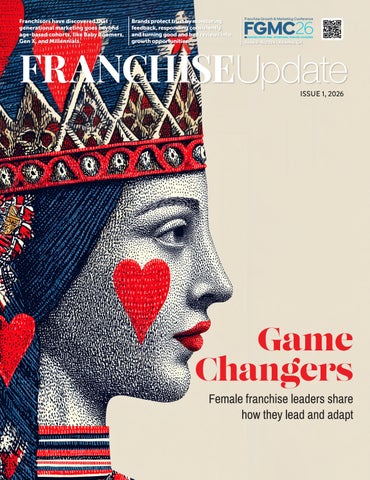
Franchisors have discovered that generational marketing goes beyond age-based cohorts, like Baby Boomers, Gen X, and Millennials.
Brands protect trust by monitoring feedback, responding consistently, and turning good and bad reviews into growth opportunities.
FRANCHISEUpdate June 2-4, 2026 | Atlanta, GA
ISSUE 1, 2026
Game Changers Female franchise leaders share how they lead and adapt
Real people answer, 24/7. 78% would choose a business where a human answers the call instead of AI.
Capture every lead, 24/7
Empowered franchise teams
Turn inbound interest into franchise growth by screening the hottest leads.
Free owners and staf from the phone so they can focus on growth.
Appointment scheduling
Brand consistency
Appointments booked directly into your calendar.
Deliver the same high-quality experience across every franchise.
OnePoll 2025
1/3
callers would hang up immediately if they reached an AI customer service agent.
Put people on your front line. Get in touch and set your franchise up for success. 888-822-2034
karen@answerconnect.com answerconnect.com/franchise
Book a consultation
Get this party started: We're #1 in category. Other agencies might try to fit into the franchising world, but Hot Dish has called it home for over 25 years. We have the insider expertise needed to build a franchise marketing system that delivers real, lasting impact. Simply put, we’re built for franchise brands. Because when marketing connects across customer, franchisor and franchisee, everyone wins.
Let’s build something best-in-class. 612.341.3100 | dkane@hotdishad.com | HotDishAd.com
©2026 Hot Dish Adver tising. All rights reser ved.
CONTENTS
57 EDITOR’S NOTE 06
Leading the Charge and Shaping the Future of Franchising
COVER STORY
47
08 Game Changers
50
LEADERSHIP
CEO Profile:
Gregg Majewski, Craveworthy Brands
52
Reputation Management Franchise brands protect trust, respond to criticism, and embrace feedback
2 | Franchise Update | Issue 1, 2026
56
IFA Report Pop culture spotlight meets policy debate
CONSUMER MARKETING 57
Multi-brand leader prioritizes purpose-driven growth
Anatomy of a Brand: The Spice & Tea Exchange Brand grows by focusing on flavor as experience
Rob Goggins, Great Clips New leader keeps the momentum rolling forward
15 female franchise leaders share how they forge ahead
45
CEO Profile:
The Message Stays the Same Today’s generational marketing breaks rigid boundaries
62
CMO Q&A Slim Chickens’ CMO Patrick Noone balances data, discipline, and guest connection
SPONSORED CONTENT
Franchise Update Issue 1, 2026
64
CMO Roundtable
Contents
73
“How do you manage brand reputation, and what role, if any, do your franchisees play in it?”
5 listening habits every franchise leader needs
74 67
68
76
Commit to developing your team’s soft skills
78
69
Challenge the Pros
International Changing demographics will redefine global franchising
Customers Count
GROWING YOUR SYSTEM
Market Trends Shifting consumer priorities are reshaping franchising
Social Media It’s time to rethink generational marketing in franchising
Sales Smarts
Tech Beat Meet your prospects where they are
79
It’s Closing Time Onboarding is the most critical phase in franchise growth
“How do you reach franchise prospects from different generations?”
52
Our Team MANAGER, EDITOR
MANAGER, EVENT OPERATIONS
CONTRIBUTING WRITERS
Gary Gardner
M. Scott Morris
Sharon Wilkinson
Colleen McMillar Helen Bond
CO-FOUNDER
MANAGER, EDITOR
COORDINATOR, EVENT OPERATIONS
Therese Thilgen
Kevin Behan
Leticia Pascal
VP, EVENT OPERATIONS
DIRECTOR, CREATIVE
MANAGER, GRAPHIC DESIGN
Sue Logan
Cindy Cruz
Michael Llantin
VP, MARKETING AND CONTENT
CO-FOUNDER
CONTRIBUTING EDITORS
Christina Chambers Art Coley
DIRECTOR, TECHNOLOGY
DIRECTOR, CUSTOMER EXPERIENCE
Diane Phibbs
Benjamin Foley
Chelsea Weitzman
John DiJulius Matt Haller Jack Monson
VP, BUSINESS DEVELOPMENT
SENIOR MANAGER, WEB DEVELOPER
MANAGER, MARKETING
Matt Wing
Taylor Williams
ARTICLE INQUIRIES
Barbara Yelmene DIRECTOR, BUSINESS DEVELOPMENT SALES
MANAGER, WEB DEVELOPER
COORDINATOR, SPONSORSHIP BENEFITS
Krystal Acre Jeff Katis
Hope Alteri
DIRECTOR, EXECUTIVE EDITOR
Kerry Pipes
4 | Franchise Update | Issue 1, 2026
Don Rush COORDINATOR, DIGITAL
Juliana Foley DIRECTOR, EVENT OPERATIONS
Katy Coutts
Alison Shelton Heather Stoner
William Edwards Dennis Leskowski Paul Wilbur
editorial@franchiseupdate.com SUBSCRIPTIONS
subscriptions@franchising.com 408-402-5681
SPONSORED CONTENT
MORE THAN A CONTRACT
Take a balanced approach to franchise agreement management
Written by ANDREW SEID
F
ranchise agreements represent more than legal documents. They are core documents that determine whether your brand thrives or struggles. While attorneys draft these agreements, business leaders bring them to life through consistent management, thoughtful enforcement, and strategic adaptation. Success requires understanding how provisions drive outcomes, balancing brand protection with franchisee partnership. KEY PROVISIONS Executives must recognize how core provisions impact operational performance, brand consistency, and financial sustainability. Territory provisions determine competitive dynamics and growth potential. Exclusive territories reassure franchisees but limit market penetration and are impractical in modern franchising. Nonexclusive or protected territories create flexibility while maintaining accountability. Operational standards protect the customer experience. When franchisees deviate from standards, they erode brand equity. Protect core attributes while allowing flexibility that keeps the system competitive. Financial provisions (royalties, advertising, or brand contributions) and technology fees directly impact franchisor revenue and franchisee profitability. These terms must balance fair compensation with franchisee unit economics. When franchisees struggle financially, the system suffers through reduced reinvestment, declining standards, and damaged reputation. Transfer provisions determine business continuity and exit strategies. Restrictive terms may protect standards but can trap franchisees or prevent them from realizing investment value. Experienced multiunit franchisees scrutinize these provisions when selecting brands. Overly restrictive covenants deter sophisticated franchisees and breed resentment while overly permissive transfers may introduce unqualified operators. COMPLIANCE CULTURE Compliance monitoring is about creating systems that help franchisees succeed. Effective compliance begins during recruitment by establishing trust and clear expectations. Fully informed candidates are more likely to comply with system standards. Robust monitoring processes begin with clarity. Franchisees should understand what’s expected, why it matters, and how they’ll be evaluated. Effective monitoring combines field visits, operational audits, financial reporting, and mystery shopping. Treat audit results as diagnostic tools. When franchisees fall short, ask “What support do they need?” not “What penalty should we impose?”
Technology enables continuous partnership. Cloud-based systems track KPIs in real time, identifying issues before they become systemic. Digital operations manuals ensure current information. Training platforms create accountability while providing resources. Position these tools as franchisee enablement.
ments, or evolved standards. Provide adequate notice because surprises create unnecessary conflict.
Implement tiered support: baseline resources for all, enhanced attention for early warning signs, and intensive intervention for struggling locations. Adapt support to a franchisee’s experience, capabilities, core competencies, and the goals of both the franchisee and franchisor regarding the markets involved. Support should be consistent but not identical across the network.
Terminations should be a last resort. They demoralize other franchisees, attract regulatory scrutiny, and damage the development reputation. Exhaust reasonable efforts to cure issues before terminating. When necessary, have clear documentation. Consider buybacks or facilitated transfers.
ADDRESSING BREACHES Even with excellent support, breaches occur. How franchisors respond determines whether they build accountability or resentment. Categorize breaches by severity and impact. Develop a graduated response framework: verbal counseling for first-time minor violations, written notices for repeated issues, and performance improvement plans for serious concerns. Show franchisees that the franchisor cares about their success. Don’t rely on default notices and other communication dictated by the legal department. Get them on the phone. Breaches are problems to solve together, not confrontations. Frame discussions around protecting brand equity and benefiting everyone. Many breaches stem from operational challenges or misunderstandings. Address root causes, not symptoms. Documentation ensures consistency and fairness. Franchisees compare notes, and word travels fast if support is seen as inappropriate. Different treatment for similar violations erodes trust. Maintain clear records of compliance issues, interventions, timelines, and outcomes. Flexibility can serve the brand better than rigidity. If franchisees fall short due to circumstances beyond their control (disasters, economic downturns, health crises), work through challenges. The agreement provides rights; wisdom determines when to exercise them. CRITICAL TRANSITIONS Renewals, transfers, and terminations represent inflection points, so balance contractual rights with strategic judgment. Renewals offer checkpoints to refresh commitments and update expectations. Use the renewal process to assess whether franchisees have maintained standards, invested in their business, and aligned with system evolution. Update agreement terms to reflect operational changes, technology require-
Evaluate exiting franchisee interests and successor qualifications. Exercise appropriate diligence, but avoid trapping struggling franchisees. Establish clear criteria, reasonable timelines, and fair processes that respect franchisee investments while protecting standards.
OPEN TO CHANGE Successful franchisors adapt operations while respecting agreement limitations and preserving franchisee confidence. Monitor regulatory changes, industry innovations, economic conditions straining resources, or shifting consumer expectations requiring operational adjustments. Establish environmental scanning and impact assessment. When changes require operational adjustments, communicate transparently about business rationale, expected benefits, and implementation approach. If changes fall within operating rights, exercise them thoughtfully with support. When changes exceed agreement authority, work collaboratively with franchisee advisory councils or system-wide votes. Agreement terms may need to evolve. Ensure consistency between new agreements and existing management or risk creating tension between legacy and new franchisees. Some franchisors offer existing franchisees opportunities to update terms during renewals, creating alignment. TOOLS FOR PARTNERSHIP Franchise agreement management succeeds when executives view these documents as frameworks for building successful partnerships. Understanding the effect of provisions enables strategic decision-making about enforcement and flexibility. By developing supportive compliance processes, enforcing standards consistently, managing transitions with wisdom, and adapting to change, franchisors protect brand equity while fostering franchisee confidence. This approach transforms agreement management from a defensive necessity into a competitive advantage, creating franchise systems where franchisors and franchisees thrive together. Andrew Seid is senior consultant at MSA Worldwide. Contact him at aseid@msaworldwide.com or 860-604-9189.
Editor’s Note
Leading the Charge and Shaping the Future of Franchising For decades, franchising has been built on strong leadership, resilience, and the willingness to challenge convention. Today, some of the most impactful change agents shaping the industry are women. You might call them game changers. You know the kind: someone who doesn’t just manage within existing rules, but actively reshapes how a business operates and grows. They challenge assumptions, question the way it’s always been done, and turn insight into action that creates lasting impact. Their goal is to build better brands. That’s why in this issue of Franchise Update magazine, we’re shining a light on female leaders who are shaping franchising in powerful ways. These women aren’t just helping to build successful businesses. They’re rethinking how leadership shows up and how brands can grow with intention. We had the opportunity to interview 15 women who are not simply participating in franchising; they are changing it. They are helping to build cultures rooted in accountability and empathy, helping scale systems with discipline and creativity, and opening doors for the next generation of franchise leaders and operators. We chose to focus on these women not just because their personal stories were great, but also because they reflect where franchising is headed. As the franchise world navigates evolving consumer expectations, rapidly changing technology, unpredictable economic forces,
6 | Franchise Update | Issue 1, 2026
and more, these women are helping lead the way forward with clarity and confidence. They are true changemakers, and their influence is shaping the future of franchising in ways that will be felt for years to come. We hope their stories inform, inspire, and spark new conversations across the franchise community. Elsewhere in this issue, you’ll find deep dives with Craveworthy Brands’ CEO Gregg Majewski, Great Clips’ new CEO Rob Goggins, and Slim Chickens’ CMO Patrick Noone. Our feature writers, Helen Bond and Colleen McMillar, have also put together in-depth looks at how franchises are handling the sticky issues around brand reputation management and how brands are using generational marketing tactics to better reach prospects and customers. All the other columns and departments you expect are here and filled with useful advice. Whether you’re a franchisor, supplier, or investor, we hope this issue offers perspective and insight you can apply immediately. Perhaps being changemakers is something we should all aspire to be.
Kerry Pipes KERRY PIPES Executive Editor
A Marketing Platform Purpose Built for Franchises Why Emma® Your franchise is growing. Your marketing shouldn’t be getting harder. Emma is built for organizations where email marketing happens everywhere, but accountability stays at the top. Our parent/child account structure bakes brand control directly into execution: Headquarters sets the guardrails with locked templates and approved assets, while franchisees market independently without going rogue. Emma also acts as a built-in Al strategist. With Al-powered features like Smart Send and Smart Segment, your franchise locations can optimize send times and segment audiences automatically. When you’re accountable for outcomes you don’t directly execute, you need a platform built for exactly that challenge.
BRAND CONTROL AT THE TOP Central teams set the guidelines while local teams execute confidently.
EMPOWER LOCAL TEAMS TO MARKET INDEPENDENTLY Local teams have the freedom to send email campaigns while operating within brand standards.
AI-POWERED MARKETING STRATEGY Smart Send and Smart Segment optimize timing and targeting automatically.
CONTACT US FOR MORE INFO
myemma.com
Game Changers Female franchise leaders share how they lead and adapt Written by M. SCOTT MORRIS
F
or franchise leaders, the challenge isn’t whether change is coming but how to lead through it without creating confusion, resistance, or drift. To better understand how experienced leaders navigate change, Franchise Update reached out to 15 female executive leaders from across franchising. We asked them to share their thoughts on leadership, change, resilience, culture, vision, and more. For many of them, franchising’s appeal begins with its balance of structure and opportunity. Kelly Gray, vice president and co-owner of Hot Head Burritos, traces her leadership path to that dual promise. “Franchising gives entrepreneurs the best of both worlds: a proven playbook paired with the flexibility to build an organization as big or small as they choose,” Gray says. “As a leader, I thrive on the fact that I’m not just building a brand; I’m helping others build their livelihoods. That responsibility inspired me to step into leadership because strong brands don’t happen by accident; they’re built through clarity, consistency, and people who believe in what they’re doing.” Leading change often means knowing when to shift from being the go-to person to building a team of go-getters. At Teriyaki Madness, Alison Satriana, vice president of development marketing, describes a pivotal realization that reframed how she approached growth. “A defining moment for me came when I realized that saying ‘yes’ to everything—and trying to be everything for everyone—wasn’t sustainable,” Satriana says. “As the brand grew, it became clear that my role wasn’t to personally
solve every challenge but to create the systems, strategies, and clarity that enable growth.” Even when necessary, change often meets resistance. Emily Schneider, vice president of franchise development at Tide Services, says it’s important to remain open to the possibility that the naysayers have a point. “If I’ve clearly articulated the ‘why’ and resistance remains, I treat it as a signal to listen,” Schneider says. “Resistance often highlights a consideration we’ve missed.” Brands that don’t make a profit go by the wayside, but no company succeeds without the people who show up to work every day. For Kim Hanson, CEO of LearningRx, leadership begins with how people feel inside the organization. “I start by genuinely seeing people not just for what they do, but for who they are,” Hanson says. “When people feel seen, they bring their best. I celebrate wins often and enthusiastically because recognition fuels motivation and reinforces that the work truly matters.” Looking ahead, leaders spoke less about disruption and more about staying anchored while adapting. Colette Bell, vice president of franchise development at Ace Handyman Services, framed the future in simple terms. “Culture, culture, culture,” Bell says. “Know your culture, talk about it often, and bounce all decisions against it.” Read on On the following pages, you’ll find snapshots of how these and other seasoned female leaders think about guiding brands through continuous evolution. They speak from experience and the heart.
“We are a people business, pure and simple.”
COLETTE BELL
VP of Franchise Development Company: Ace Handyman Services Years in franchising: 25 Number of units: 383
C
olette Bell is the co-founder and vice president of franchise development for Ace Handyman Services, a nationwide home repair franchise. She and her husband, Andy, launched Handyman Matters in 1998 in Denver, expanding to six locations before franchising the business in 2001. Under their leadership, the brand grew into a nationally recognized franchise and was acquired by Ace Hardware in 2019 and rebranded as Ace Handyman Services. Since then, Colette has continued to lead franchise development, growing the brand from 119 territories to nearly 400 across 48 states. A graduate of Colorado State University, Colette began her career teaching high school before venturing into entrepreneurship. She has built her career with a focus on people, culture, and consistent, high-quality service. Colette emphasizes finding the right franchisees and ensuring they are supported to succeed. She looks for those who are skilled, culturally aligned, and committed to excellence. She is known for her hands-on approach to franchise development, balancing national growth with attention to the individual franchisee experience and maintaining a culture rooted in professionalism, kindness, and accountability. Throughout her career, Colette has seen firsthand the generational impact of franchising from 10 | Franchise Update | Issue 1, 2026
franchisees’ families continuing their businesses to employees building long-term careers. She believes success comes from keeping business models simple, investing in people, and fostering strong relationships. Colette’s dedication to growing a family-oriented, nationwide brand while supporting franchisees and their communities makes her a respected leader in the franchising industry.
PERSONAL & LEADERSHIP JOURNEY What inspired you to pursue leadership in franchising/branding? When my husband and I franchised our handyman business back in 2001, it became obvious how few women were involved with franchising at a leadership level. I wanted to be an inspiration for other women who had a great business idea that could be franchised. I encourage them to pursue franchising as a growth opportunity for themselves. Can you share a defining moment that shaped your leadership style? I remember the first time my husband announced I was taking over as CEO. We were still both pretty young, and being a woman in a masculine industry, I was afraid all the franchise owners would revolt or leave the system. Of course, that didn’t happen. Many long-standing owners have been kind enough to share that they
loved the way I led as I worked to bring a different approach and perspective to the role. How has your personal background influenced the way you lead? I am a high school teacher by training, and I taught in a school for my first career. That experience deeply shaped my leadership style, which reflects my desire to communicate and explain my point of view and then understand someone else’s. It also informed my belief that we are all in this business together, franchisor and franchisee, which has led to meaningful collaboration and strong franchise owner input over the years. Who or what has most influenced your philosophy as a leader or changemaker? My husband, Andy Bell. He is the kindest, smartest, and most driven person I’ve ever met. He had the vision to be the “biggest handyman business in the world” when we were still a local handyman business operating out of our basement. Without him, I don’t think I would have ever seen myself as a business leader, but he believed I could do it.
DRIVING CHANGE & INNOVATION What significant changes or innovations have you led within your brand? One of our earliest innovations in the handyman industry was technology. This was back in 1998, when
Colette Bell technology was not as prevalent. We couldn’t find any product off the shelf that would work, so we actually created our own proprietary software that we used until 2017. How did you implement those changes, and what results did they bring? Change is hard— even good change. I’ve learned in franchising that you need to include franchise owners as early as possible in changes and then get some early adopters in the network to become your cheerleaders and supporters. What role have you had in adopting new technologies, including AI? AI is coming along. Our goal is to augment our employees in the business model, not replace them. We are a people business, pure and simple. But if we can have a great custom AI agent answering frontline phones and transferring true customers to the office manager, that speeds up their productivity. If we can have AI agents helping categorize calls and customers in our software, that leads to higher consistency. If we can utilize AI software to help our craftsmen estimate work that they aren’t familiar with inside the home, we are creating a more professional experience for customers. How do you identify when it’s time for a brand to evolve? You have to keep your eyes open and your ear to the ground. Stay ahead of industry trends, read everything you can, and watch and listen to your competition. Have you led similar change initiatives at other brands? I’m proud to say that this has been my only brand for 28 years! My husband and I founded the company in 1998, and it has evolved significantly over time. Leading change within the same organization for nearly three decades has taught me how to grow thoughtfully and adapt to new challenges while staying true to our core values. How do you communicate change effectively to franchisees? Start by bringing a group of them into the decision-making process and then utilize these early adopters to provide feedback through beta testing to ensure the change delivers the intended results. Finally, lean on those early adopters for training and support across your franchise system. Franchise owners often hear and absorb things differently when it comes from fellow franchise owners, which is why we formalize this group into a paid power team to help with training and support.
CHALLENGES & RESILIENCE What obstacles have you encountered while driving change, and how did you overcome them? One of the biggest obstacles in driving change is that sometimes you realize that even well-intended ideas don’t always produce the outcomes you expect. When that happens, you have to be willing to admit that your idea was flawed and figure out how to fix it or roll it back. You have to remember that while this change started as your idea, it directly impacts your franchise owners’ lives. It affects their ability to run successful businesses
“I wanted to be an inspiration for other women who had a great business idea that could be franchised.” and support their families. Never underestimate the potential negatives in a change that isn’t right. How do you maintain momentum when new ideas face resistance? You have to start by passionately believing in what you are doing. Passion will carry you quite a distance as long as your idea or change is valid. What lessons have you learned from an initiative that didn’t go as planned? Don’t take negative responses personally. That is easier said than done, especially if you are passionate about the initiative. How do you balance short-term pressures with long-term vision? Someone once told me, “Pressure is a privilege.” You can be stressed and negative, or you can be grateful that you sit in a position that allows you to build a business and navigate through difficult moments.
CULTURE & PEOPLE How do you build and motivate highperforming teams? Give employees a clear road map, hold them accountable, and then allow them to grow and rise in the organization. What practices help you connect with employees and franchisees at every level? I am a big believer in gratitude. My husband and I are very fortunate to have started this business ourselves before we franchised it. I still remember those early days of worrying about making payroll or wondering if a marketing tactic we just spent a bunch of money on was going to work. Having firsthand experience gives me true empathy for our employees and franchise owners. Empathy is the key. How do you mentor or empower the next generation of leaders or changemakers? You have to let go of the bottom to reach the top. Teaching the next generation of leaders to delegate is so important. No one is going to do what you do perfectly or exactly how you do it. But if you can allow them to find their own way of accomplishing the goal or task, it will allow you to focus on other things.
FUTURE & VISION What excites you most about the future of your brand or the industry? I am always surprised at how fractured the home improvement industry still is after being in it for 28 years. Our biggest competition is still individual “mom and pop” businesses. I can’t wait to achieve the goal of being a recognized name brand in the home services industry. How do you stay true to a brand’s core while still adapting for the future? Culture, culture, culture. Know your culture, talk about it often, and bounce all decisions against it. Where do you see the greatest opportunities for women in franchising? Everywhere! It is so much fun to attend the IFA and see more and more women participating at all levels, as franchise owners, in franchisor companies, and leading at the top. If you could give one piece of advice to your younger self, what would it be? Slow down to enjoy the ride. I still can’t believe it’s been 28 years. It went by in a flash. I was good about taking a worklife balance approach when my kids were young. I made myself take the flexible path and attend the school events and the sports events even though it made my schedule a bit more complicated. What advice would you give to leaders who want to create lasting impact? Make it your life’s work. Find the passion and be willing to work on it for however long it takes to grow your impact in whatever format that takes. The path will be difficult and filled with naysayers. Take many detours, but if you always stay in a spot of gratitude, you will make a lasting impact. And be kind. Kindness goes a long way.
Issue 1, 2026 | Franchise Update | 11
“Remaining calm in chaos is something I pride myself on.”
JANE CAMPBELL
VP of Marketing for Franchise Development Company: Empower Brands Years in franchising: 16 Number of units: 1,607
J
ane Campbell is the vice president of marketing for franchise development at Empower Brands, where she leads a dynamic team supporting Empower Brands’ portfolio of industry-leading service brands. With more than 15 years of experience in the marketing industry, she excels in leveraging data-driven and new marketing initiatives and opportunities to fuel business growth. Dedicated to sharing franchisee stories, she collaborates closely with senior leadership and the marketing and franchise development teams to ensure efforts align with growth goals. Jane is a graduate of the University of Richmond and is passionate about franchisee support and team development.
PERSONAL & LEADERSHIP JOURNEY What inspired you to pursue leadership in franchising/branding? I fell into franchising a few years after graduating from college. I knew I had a passion for messaging, branding, and small business, and I was lucky enough to find franchising as the perfect combination. Can you share a defining moment that shaped your leadership style? I learned the importance of acting when culture is at stake in a difficult way. I had a star player on my team who was the go-to person for their specialty. Unfortunately, during a challenging period at work, their frustra12 | Franchise Update | Issue 1, 2026
tion and stress permeated the team, creating a negative culture. I didn’t act quickly enough, and they ultimately quit. A few weeks later, a team member said to me that the energy of the team had shifted and was more positive despite the role not yet being filled. At that moment, I knew I would never let that happen again. Since then, I haven’t been afraid to make changes when they are necessary. How has your personal background influenced the way you lead? My grandmother would always say, “The proof is in the pudding,” and that’s something I’ve always leaned into. I was never going to be the loudest on the team, but I was going to be one of the hardest working and most reliable. If I said I was going to do something, I did it, and results followed. That became the foundation of my lead-by-example, servant-leader mentality. Who or what has most influenced your philosophy as a leader or changemaker? My dad has influenced my leadership philosophy the most. He was a small business owner who led teams through both good and bad times in the construction industry. His stoicism and unwavering integrity resulted in trust and respect from everyone he worked with, which is something I both recognized and aspire to emulate. Remaining calm in chaos is something I pride myself on, and that comes from my dad.
DRIVING CHANGE & INNOVATION What significant changes or innovations have you led within your brand? The rebranding to Empower was a task that fell primarily to a small team of us. It was a turning point for the company because it represented the official merging of two brands, Outdoor Living Brands and Lynx Franchising. Each had its own teams and processes. It was important to be thoughtful not only about the name and visual identity, but also about defining the who, why, and how of the company. How did you implement those changes, and what results did they bring? The rebranding was a six to eight-month process. Once everything was defined, the rollout, both internally and externally, was equally important. Internally, we held a leadership meeting that brought together teams from both legacy entities to form the new leadership team. This was a key step in uniting us as one team and aligning on future initiatives. Externally, the focus was on public relations and education. We partnered with Thunderly PR to introduce our new name to the industry and to our partners. It’s a relationship that continues today and has helped establish Empower as a leader in franchising. What role have you had in adopting new technologies, including AI? When we got
Jane Campbell serious about AI, Empower formed an AI task force, which I was part of. Our goal was to define how AI could make both the Empower team and our franchisees more efficient and effective. We developed use cases and plans, many of which have already been implemented or remain on the road map.
significantly. At Empower, we leverage franchise advisory councils and marketing committees to review initiatives early, ensuring alignment. Setting expectations that innovation takes time and clearly defining the desired outcome and road map also help maintain momentum.
Whenever a new technology is considered, we ensure marketing has a seat at the table because of its impact on how we support franchisees. For example, when Archadeck was evaluating new CRMs, I worked alongside its brand marketing manager to assess marketing capabilities: What existed, what was missing, and how we could best leverage the tool?
What lessons have you learned from an initiative that didn’t go as planned? Failure is both inevitable and important. Sometimes, you have to try something to learn it’s not right. Ideally, you fail fast, but there should always be a postmortem to capture learnings. One lesson I’ve been reminded of recently is never to assume someone is confident just because they aren’t voicing concerns. Asking clarifying questions like, “How are you feeling about this?” or “Do you have concerns at this stage?” provides invaluable insight.
How do you identify when it’s time for a brand to evolve? There are many factors, but the ultimate indicator is when a brand is not growing or not growing at the pace it should. When brands struggle to connect with their audience, face increased competition, or encounter market shifts, the numbers reflect it. That’s when we assess what we can control and take action. Evolution is also necessary to stay proactive and ahead of the curve. Are new services required? Do they fit the business? Is there interest in expansion? Are there future needs we must address now? These are critical questions when considering the next iteration of a brand. Have you led similar change initiatives at other brands? Two examples come to mind. The first is Mosquito Squad, a brand we had when I first joined Outdoor Living Brands. Initially, it focused solely on mosquito control, which was a new category at the time. As tick-transmitted diseases became more prevalent, we needed to expand services, build new content, and adjust messaging. The second is holiday lighting for Outdoor Lighting Perspectives. The seasonality of OLP’s residential services impacted franchisee sales. Holiday lighting presented an opportunity to expand services, keep teams working year-round, and increase revenue. It remains a key growth driver for the brand today. How do you communicate change effectively to franchisees? Proactive and clear communication is critical. Franchisees need to understand the reasoning behind a change, how it will be implemented, and how it will impact them. If they don’t understand those elements, you’ve missed the mark.
CHALLENGES & RESILIENCE What obstacles have you encountered while driving change, and how did you overcome them? Resistance to change is natural. Clear communication and expectations are essential. When you can test and prove impact, it becomes much easier for people to embrace change. How do you maintain momentum when new ideas face resistance? It depends on where the resistance is coming from: brand teams, other departments, or franchisees. Demonstrating positive impact and identifying advocates for change help
How do you balance short-term pressures with long-term vision? At Empower, we use the Entrepreneurial Operating System (EOS), which helps define our vision and road map. Senior leadership sets and communicates the long-term vision while quarterly and annual goals serve as steps toward it. Day-to-day tasks will always arise, but consistently reporting on goals ensures long-term priorities remain front and center.
CULTURE & PEOPLE How do you build and motivate highperforming teams? “Right person, right seat” is a core EOS principle we rely on. It starts with finding the right person in terms of skill and culture. From there, it’s about clarity of accountability and ensuring they have the necessary training, technology, and support to succeed. Proactive, clear feedback is also a key motivator. What practices help you connect with employees and franchisees at every level? At Empower, we have an open-door policy and a culture grounded in people and results. Each week, the entire team meets for 30 minutes to stay connected and informed. We also host social and community events that encourage open communication. With franchisees, it’s all about relationships. Those often begin with training and continue long after someone has sold their business. Through office hours, system-wide calls, in-person meetings, and oneon-one conversations, franchisees know support is always available. How do you build buy-in and bring others along when pushing for change? Our franchise advisory councils serve as the voice of the franchisees. I regularly lean on them for feedback on both large and small initiatives. Their support is essential. When concerns arise, it often reflects broader system sentiment that needs addressing. Transparency, even when views differ, strengthens franchisor-franchisee relationships.
achieve them is critical. Giving people space to take action fosters growth while gauging the right level of support helps prevent avoidable mistakes. Creating an environment where ideas are welcomed benefits both the company and the individual.
FUTURE & VISION What excites you most about the future of your brand or the industry? Providing opportunities for business ownership never gets old, so welcoming new franchisees will always excite me. From marketing and technology to sales and services, many of our brands are embracing change in meaningful ways in 2026. There is a tremendous opportunity across our service industries, and our franchisees are well positioned to succeed. How do you stay true to a brand’s core while still adapting for the future? Our brands have clear values and missions that guide daily operations. If a change doesn’t align with a brand’s values, it shouldn’t be pursued. If it doesn’t align with the mission, a deeper conversation is needed. Sometimes, that means revisiting or evolving the mission to meet future needs. Regular check-ins ensure the brand stays authentic while embracing innovation. Where do you see the greatest opportunities for women in franchising? In the words of Beyoncé, “Who runs the world? Girls!” In all seriousness, there are countless opportunities for women in franchising. Women-led franchise ownership now accounts for 30% of franchise units in the U.S., which is incredible. I’d love to see that continue to grow year over year. There is also a significant opportunity for women to lead operations teams across service industries. At Empower, many of our most successful franchise business coaches and directors of operations are women, which is exciting to see. If you could give one piece of advice to your younger self, what would it be? Curiosity is a superpower. Ask “why” and “how” until you understand something at its core, and don’t forget to ask, “Why not?” Asking thoughtful questions and seeking answers will make you a go-to resource and one of the most knowledgeable people in the room. What advice would you give to leaders who want to create lasting impact? Lasting leadership isn’t about the authority you project but the accessibility you provide. I learned this from my mentor, Scott Zide, Empower’s CEO. Over the past 15-plus years, he’s shown me that the most impactful leaders don’t talk at their people; they converse with them. They balance transparency and respect with the courage to make tough decisions. If you want to lead, open your door, answer the call, and remember that your team is your greatest asset.
How do you mentor or empower the next generation of leaders or changemakers? It starts with checking in and listening. Understanding their professional goals and what they need to Issue 1, 2026 | Franchise Update | 13
“Leadership is about presence, service, and connection to the mission.”
AMANDA CLARK
CEO
Company: WellBiz Brands Years in franchising: 12 Number of units: 240 Elements Massage, 206 Drybar,
168 Amazing Lash Studio, 82 Fitness Together, 58 Radiant Waxing
A
s CEO of WellBiz Brands, Amanda Clark’s role involves setting the strategic vision, driving growth across the portfolio, and fostering a culture of innovation and collaboration. She works closely with brand leaders to ensure the company is delivering exceptional experiences for both franchisees and their customers. At the heart of everything she does is a passion for building strong, purpose-driven businesses that make a positive impact.
PERSONAL & LEADERSHIP JOURNEY Can you share a defining moment that shaped your leadership style? Very early in my career, while working at Procter & Gamble, I had a moment that fundamentally shaped how I lead. At the time, I felt like the odd person out. I didn’t fit the traditional P&G model. I didn’t go to business school, I dressed differently, and my background was in psychology and theater rather than a traditional business path. To fit in, I started trying to emulate what I thought a typical leader at P&G should look and sound like. A former manager pulled me aside and asked, “What happened to the person we hired?” She reminded me that the very things I was trying to suppress were the reasons I had been brought onto the team in the first place. 14 | Franchise Update | Issue 1, 2026
That moment taught me the importance of embracing what makes you different instead of trying to turn every perceived weakness into a strength. It shaped my belief that leadership is most effective when it’s authentic. When you lean into your unique perspective, you create space for others to do the same. That lesson continues to guide how I build teams, support leaders, and drive change today. How has your personal background influenced the way you lead? Who or what has most influenced your philosophy as a leader or changemaker? My leadership style has been deeply influenced by my father, who was a public servant his entire career. He served as the CEO of a nonprofit children’s agency in Florida and modeled servant leadership in a very real, hands-on way. He didn’t just lead from behind a desk; he was in the field, talking with employees, families, and the children the organization served. He truly walked the talk. Watching that shaped my belief that leadership is about presence, service, and connection to the mission. He worked long hours, including weekends, not out of obligation but because he genuinely loved the impact of the work. That example has stayed with me throughout my career. In my role today, that mindset shows up in how I engage with our franchise system. I spend time
meeting directly with franchise owners and their teams through road shows and in-person visits, listening to their experiences, understanding their challenges, and celebrating what’s working. That proximity to the field helps ensure our strategies and decisions are grounded in real operational realities. I’ve always been drawn to mission-driven organizations, and when the work aligns with purpose, it never feels like just a job. That connection to people, impact, and mission is what continues to guide how I lead.
DRIVING CHANGE & INNOVATION What significant changes or innovations have you led within your brand? At WellBiz, innovation is a core capability, and we’ve focused on building the systems and processes that allow new technology to be implemented thoughtfully and at scale across our portfolio. One of the most impactful changes we introduced was a 12-month marketing and innovation calendar that integrates promotions, commercial innovation, and product and service innovation across our brands. This approach was driven directly by franchisee feedback and informed by insights from team members with diverse industry experience. By giving franchisees more advanced visibility and planning time, we’ve been able to improve execution quality across the system.
Amanda Clark From a technology and AI perspective, we’ve adopted AI-powered appointment booking tools. It started within the Radiant Waxing system and later expanded to approximately half of the Amazing Lash Studio locations. This technology has improved the guest booking experience while helping reduce labor demands at the studio level. Since I’ve joined WellBiz, we’ve launched innovation across the entire portfolio, tailoring it to each brand, including product and service innovation at Drybar, skincare innovation at Elements Massage, and commercially driven innovation at Fitness Together. Across all of this work, our focus has been on ensuring innovation is franchisee informed, operationally practical, and aligned with long-term growth. How did you implement those changes, and what results did they bring? We were very intentional about how we implemented these changes, starting with communication. One of our guiding principles was making sure we weren’t talking to ourselves internally but truly communicating with franchise owners in a way that kept them informed early and helped them understand the “why” behind the changes. Even when the rationale felt obvious internally, we knew it was important to clearly explain the purpose, anticipate questions, and address how changes would impact franchisees at the local level. As we looked at our existing processes, it became clear that franchise owners weren’t always being given enough lead time to execute with excellence. We used that insight, along with franchisee feedback, to reevaluate our approach. Drawing on the collective experience of a team with strong backgrounds in franchising as well as large consumer and retail brands, we asked a simple question: “If we were starting from scratch, what would the best possible system look like?” That thinking led to the creation of a 12-month marketing and innovation calendar designed to provide clarity, consistency, and adequate planning time. Throughout the rollout, we focused on building strong partnerships and trust, identifying internal allies, and listening carefully to areas of resistance so that we could address concerns directly rather than push past them. The result has been stronger alignment across the system and improved execution quality with franchisees better equipped to plan, staff, and deliver against initiatives with confidence. Ultimately, these changes have reinforced why we believe so strongly in franchising. When franchise owners are supported with clear communication, thoughtful planning, and the right tools, they’re able to take the brands further, and that’s the outcome we’re focused on driving. What role have you had in adopting new technologies, including AI? I’m not a technology expert by training, but I’m a strong advocate for finding solutions that work and thoughtfully applying them across brands where they can add real value. I work closely with our technology team
and senior leadership to evaluate opportunities and identify where tools can meaningfully improve both the franchisee and guest experience. A strong example is AI-powered appointment booking. At Radiant Waxing, AI-driven SMS booking was already in place when the brand joined the portfolio, allowing guests to book appointments without relying on front-desk labor. After seeing the impact, I partnered with our tech team and brand leadership to extend that same technology to approximately half of the Amazing Lash Studio locations. This helped improve the guest booking experience, increase appointment volume, and reduce labor pressure at the studio level. More broadly, I view AI as a practical enabler rather than a trend. By working cross-functionally and staying focused on evolving consumer needs, we’re able to adopt technology in ways that are scalable, thoughtful, and aligned with long-term brand growth. How do you identify when it’s time for a brand to evolve? Brand evolution is continuous, and it doesn’t always require a major change. More often, it’s about paying close attention to how consumers are changing and responding with intention. Consumer needs and expectations shift constantly, and each generation engages with beauty and wellness brands through a different lens. We look closely at where our target consumers are in their journey, how they want to be spoken to, what they value, and how they prefer to experience a brand. When we see those expectations shifting, it signals an opportunity to evolve our messaging, offerings, or experience in ways that feel authentic and relevant. The goal is always to meet consumers where they are and connect with them genuinely within our category while ensuring the brand continues to grow alongside them. How do you communicate change effectively to franchisees? My personal belief is that you can’t overcommunicate when it comes to change. Our approach is to communicate early, often, consistently, and clearly while recognizing that franchise owners prefer to receive information in different ways. We intentionally customize our communication channels to meet franchisees where they are. For those who prefer visual and live engagement, we host quarterly executive webinars that focus on system-wide priorities and strategic updates along with monthly operations webinars designed to support day-to-day execution. For franchisees who like to read and reference information on their own time, we provide a biweekly News You Can Use newsletter that highlights key updates, deadlines, and actionable insights. And for more independent information seekers, we maintain a centralized information hub on MyStudio, where franchisees can easily access the latest resources, announcements, and tools whenever they need them.
By offering multiple, consistent touchpoints, we ensure franchisees aren’t relying on a single channel or message to stay informed. This equity-based approach to communication helps improve understanding, reduce confusion, and build confidence during periods of change.
CHALLENGES & RESILIENCE What obstacles have you encountered while driving change, and how did you overcome them? One of the biggest obstacles is that people are naturally wired to be skeptical of change because change can feel like a risk, especially when it affects someone’s day-to-day work or business. Resistance often isn’t about disagreement with the idea itself; it’s about uncertainty and personal impact. A common mistake we’ve seen is assuming the change will land smoothly because it’s been discussed extensively internally. Leadership may have talked it through to the point where the “why” feels obvious, but for the rest of the system, it’s the first time they’re hearing it. That’s where misalignment and confusion can show up. To overcome that, we focus on clearly explaining the “why” for different audiences, anticipating the questions we know franchisees and teams will have, and addressing concerns directly, like the question everyone asks silently: “What does this mean for me?” Strong partnerships and trust are critical in those moments, and we also intentionally identify and engage internal allies who can help reinforce the message and support adoption. Ultimately, maintaining momentum comes down to understanding the root of resistance and responding with clarity, context, and consistency rather than simply repeating the decision. How do you balance short-term pressures with long-term vision? Having the advantage of working within a private company gives us greater strategic flexibility to stay focused on the long term rather than managing solely quarter to quarter. In public environments, it’s easy to lose sight of the bigger picture when near-term performance becomes the primary driver. That’s why creating a clear North Star is so important as a leader. We spend time defining where we want to be five years out and then mapping the interim steps that will get us there. That long-term vision provides direction and helps ensure short-term decisions are aligned with where the business is ultimately headed. At the same time, business realities don’t pause. When unexpected challenges arise, it’s important to assess what’s happening in the short term, identify gaps that may be getting in the way, and pivot thoughtfully. In those moments, we may adjust tactics without abandoning the strategy, evaluating whether a different short-term approach will better support the long-term goal. Balancing the two comes down to staying anchored to the vision while remaining flexible enough to adapt as circumstances change. Issue 1, 2026 | Franchise Update | 15
“Your talent is the most valuable asset you will ever invest in.”
JENNIFER DODD
CEO
Company: Main Squeeze Juice Co. Years in franchising: 30 Number of units: 25
J
ennifer Dodd is the CEO of Main Squeeze Juice Co., a restaurant brand offering nutritionist-designed, superfood-centric menus featuring raw, cold-pressed juices, handcrafted smoothies, organic acai bowls, juice cleanses, shots, and more. A seasoned branding and franchise executive, she is known for her ability to redefine brands, drive strategic growth, and deliver shareholder value. She’s led aggressive expansion and turnaround initiatives with a range of top-ranked franchise companies. Her experience includes more than 30 years as an executive for top brands across the food service industry. In previous executive roles, Jennifer led the successful execution of the brand redesign of Melting Pot. She guided innovative growth of the Tim Hortons U. S. franchise development and nontraditional development teams. In addition, she oversaw the expansion of one of Dunkin’ Brands’ top markets. Jennifer has guided numerous brand redesigns and new market entries to lead successful organizational development. She has applied her skills at a $400 million-plus multi-brand QSR franchise group, a $200 million-plus privately held global casual dining chain, a tuition-based international education franchise organization, and a 1,500-unit franchise-licensed chain with businesses in more than 10 countries. 16 | Franchise Update | Issue 1, 2026
Jennifer has cultivated talent-rich and servant-leadership cultures within organizations, empowering employees to harness their potential and foster organizational team collaboration and community while delivering exceptional results.
PERSONAL & LEADERSHIP JOURNEY What inspired you to pursue leadership in franchising/branding? Working for a franchisee at Wendy’s. I worked for a three-store franchise owner who maintained high standards, and I fell in love with the business. I respected the natural give and take between franchisee and franchisor that led to a winning venture. The franchisee worked hard and invested in the team, enabling us to maintain consistent brand standards. The mutual benefits of the franchise were clear to me, and I never looked back. Can you share a defining moment that shaped your leadership style? My leadership style was directly shaped by my first-grade teacher, Mrs. Montgomery, who recognized that I was not performing to the best of my ability when I was homeless and hungry. Mrs. Montgomery stepped in and modeled incredible servant leadership, influencing me to take the steps that eventually rescued my life. She encouraged me to look beyond my pain when I didn’t want to color in a sheet that exhibited a happy girl. I scribbled on the paper, and she held me accountable by giving it an F.
Then she walked me through a clean sheet. Without my knowing, she taught me visualization and affirmations by helping me imagine what the dream could be if I colored the sheet the way I dreamed it to be. What a glorious moment it was when my picture came back with an A. She planted seeds of hope that were watered by other teachers, mentors, and leaders, inspiring the mission statement I wrote in 1993: “to breathe life into others.” Mrs. Montgomery helped me to: • Help others see greatness in themselves even when they cannot yet see it. • Hold people accountable to deliver their best in a respectful and meaningful way. • Write and practice visualization and affirmations. • Celebrate the wins with your team, those you respect and care about. How has your personal background influenced the way you lead? In childhood, I faced serious adversity that was driven by my father’s substance abuse. It caused my siblings and me to face unimaginable hardships. Finding a way to rise from the ashes strengthened my resilience and grit as a leader. I developed my love for humanity and a commitment to pay it forward. My first job, serving as the Wendy’s girl mascot, taught me the power of disruption as a strategy to
Jennifer Dodd drive revenue. It also taught me that we can make the day brighter for the people we serve by delivering quality food with warmth and hospitality. I learned the importance of driving for results regardless of the obstacles, always keeping the top and bottom lines at the forefront. These lessons helped me develop the ability to drive exponential revenue and profits while making a difference in the lives of those we serve. Working for a multi-unit franchisee for the first 14 years of my career prepared me to lead franchisor brands and corporations with an indelible understanding that the franchisees are entrepreneurs deserving of our respect and support. They are the true heroes of capitalism. Who or what has most influenced your philosophy as a leader or changemaker? Early mentors like Mrs. Montgomery and Ray Biondi, a vice president and senior partner at RTM Restaurant Group, taught me to look for unique talents in others and help them develop. Edna Morris, a restaurant industry veteran and leader with more than 30 years of experience, is a champion of all people and a wise business advisor. Carin Stutz, president and CEO of Native Foods, modeled financial expertise for me as a young operations leader. Barbara Timm-Brock, CEO at eTrack Tech, served on my personal board of directors for years, and Julie Zucker, partner and CMO at Branded Strategic Hospitality, mentors me in next-generation reach and marketing strategy. Billy Boozer, a cutting-edge AI tech executive, advises me on AI strategy. My most important influencer is my husband, Jesse Dodd, who has been devoted to my personal growth since he asked me out in that Wendy’s drive-thru. He speaks truth to power, wrapped in love and candor, and makes the day great no matter the challenge I face.
DRIVING CHANGE & INNOVATION What significant changes or innovations have you led within your brand? I led the rebranding of Main Squeeze Juice Co. out of the starting gate, and the team worked hard to deliver a more than 30% sales trend change within four months of my arrival. We followed with the relaunch of our fast-casual restaurant brand that delivers a menu of real, natural ingredients. Through digital media, we told people how our delicious food and beverages help people power their day and fuel their wellness lifestyles. How did you implement those changes, and what results did they bring? I engaged trusted strategic advisors to support our incredible team, who are equally invested in the mission of Main Squeeze Juice Co. We enrolled supplier partners and drove profitable partnerships. Franchise owners trusted the brand’s strategic repositioning. Their faith was rewarded as we were able to invest in every franchise and affiliate store by supplying the equipment and installation of the new digital menu
“Working for a multi--unit franchisee for the first 14 years of my career prepared me to lead franchisor brands and corporations with an indelible understanding that the franchisees are entrepreneurs deserving of our respect and support. They are the true heroes of capitalism.” boards across the chain at no cost to the owners. This was the first time in the brand’s history that the franchisor paid for system-wide upgrades. This drove improved franchisee relations, and customers appreciated the upgraded digital experience. The net result was quarter after quarter of growth. What role have you had in adopting new technologies, including AI? We own our own tech stack at Main Squeeze Juice Co. and have used AI to lighten the burden of redundant work for our team. We’ve also applied AI to marketing and reputation management support. Most significantly, we’ve used it for code development, saving us considerable time and money. The advancement in AI has been transformative for updating frameworks, identifying bug fixes, and implementing optimizations. When our Android app had critical issues, we used Claude to diagnose the problems, develop solutions, and get fixes deployed quickly, which was work that previously would have required bringing in outside developers. We’ve also partnered with organizations like Spillover, Know, ChowAI, and LandedAI that deploy AI strategically, improving our partner relationships through more efficient, frictionless solutions. How do you identify when it’s time for a brand to evolve? Change is coming at lightning speed, but there are core tenets that can guide brand evolution: • Listen to the hum. You know the hum: It’s always there, like white noise, but your subconscious mind has learned to tune it out. Consumer trends and the voices of the future are always in the background. Merely listen to the hum. In today’s world, that can be accomplished
by leveraging AI to act as your agent for reporting emerging trends and heat maps of change. I have always read news channels, followed influencers, and looked for meaningful patterns. AI makes all three easier to do. • Engage your frontline team. They serve thousands of guests. They have their ear to the ground and deeply value being asked to weigh in. This also rolls up to the operators. It’s imperative to seek counsel from the franchise advisory council. • Test your insights quickly. Do it affordably so that you can keep running pressure tests to land on the right innovation to drive the brand with predictable outcomes. Have you led similar change initiatives at other brands? Yes! I have been blessed to work with giants in my career and support or lead rebranding efforts at Arby’s, Dunkin’ Brands, and Melting Pot. I had the pleasure of leading Melting Pot through its award-winning global brand evolution. How do you communicate change effectively to franchisees? Involve the corporate team early and listen to their ideas and feedback. Empower them to always be on the balls of their feet. They are invaluable partners in getting the message to the franchisees and their teams. Once the departmental leads are all in, share early and often with the franchise advisory council. An engaged advisory council process is invaluable. Franchisees get more engaged when you help them understand the “why, what, and how” undergirded by WIIFM (what’s in it for me). Franchisees Issue 1, 2026 | Franchise Update | 17
Jennifer Dodd invest in the dream you share of the brand’s future. When it comes to change, present a business case that is rich with data and insights that illustrate predictable consistency and then invite them to weigh in. Even when we disagree, I want them passionate and engaged. Coming together is always possible when both parties believe they are valued and heard. That buy-in drives adoption and fuels success.
• “Put first things first.” It is easy to allow lowerpriority needs to interrupt your flow and steal your time. If not managed diligently, you’ll lose track of crucial activities that will drive the organization forward. This is like the Entrepreneurial Operating System (EOS) model, which teaches us to work on “big rocks” that the team aligns around.
CHALLENGES & RESILIENCE
You want to “do the right thing at the right time for the right people for the right reasons.” If you do that and coach those around you to do the same, the short and long games are more likely to line up.
What obstacles have you encountered while driving change, and how did you overcome them? I have stepped in to lead where trust was fractured or even obliterated. These types of challenges are difficult and rewarding. With strong board and investor support, this is where I thrive. It’s hard work to rebuild trust because leadership is a heart business. We can lead most effectively if each person is willing to give us a little piece of their heart. They may not even realize it, but that’s a requirement for a unified purpose that’s focused on making a shared dream a reality. This takes time to develop. As a leader, you have to do the hard work. The first step is giving the franchisees a piece of your heart, showing up, and welcoming them to speak truth to power. Solve their problems quickly, always having their back, and stay in the fight. How do you maintain momentum when new ideas face resistance? Lay down the groundwork that addresses resistance. This involves listening to the hum, what is and is not being said by your internal and external customers, engaging the FAC and frontline operators often, and publishing test results with data and insights. These steps drive greater adoption and create brand ambassadors. It is tough to get 100% engagement, but franchisees who become allies drive success. What lessons have you learned from an initiative that didn’t go as planned? Failure is critical for a successful life. I believe in measuring everything, listening to the advice of business experts, and leveraging data to reach a predictable outcome. The flip side is I would rather be 90% buttoned up and moving forward than being too cautious. My definition of successful failure is: • Fail fast • Fail often • Fail cheap • Fail forward Whatever you do, just keep failing successfully! How do you balance short-term pressures with long-term vision? If you follow The 7 Habits of Highly Successful People by Stephen Covey, there are principles to keep in mind: • “Begin with the end in mind.” Understand your “why.” Why are you in the race, and what does it mean to cross the finish line with success? The finish line remains a constant goal underneath the daily grind, helping to drive the organization forward. 18 | Franchise Update | Issue 1, 2026
CULTURE & PEOPLE How do you build and motivate highperforming teams? I have spent my career devoted to the success of others. I work to live it authentically. I’ve been told that the sincerity of my commitment is evident, and the net result is that it drives trust quickly. Once I earn trust, I can use my superpower, which is identifying the natural, raw talents of others. When I help team members see their own talents, it almost always opens a door for them to apply their abilities with purpose. The genie is free from the bottle and never to return. That’s a beautiful sight to see! It’s super rewarding for me as a leader, mentor, and friend. What practices help you connect with employees and franchisees at every level? • Listen with an open mind and humble heart. • Recognize the unique skills and talents in others, whether they be franchisees or members of the team. • Spend quality time with people with no ulterior motives. • Keep the mission in front of all of us on the journey together. • Work to remove the barriers to success for others even if they are the barrier. How do you build buy-in and bring others along when pushing for change? I learned early on that people buy in when they have skin in the game. That’s not just equity; it’s allowing others to play a part in designing the platform, building the dream, and setting the goals. Once they help create the masterpiece, they will buy in at a whole new level. This is where the fun comes in for a leader. Your job is to cast the initial vision and support the team so that they can go all-in and apply their talents in a high-trust environment. It doesn’t matter if they are franchisees, team members, or supplier partners; all boats rise with this model. How do you mentor or empower the next generation of leaders or changemakers? The first step is spending time with them. Another principle from The 7 Habits of Highly Successful People is to “seek first to understand and then be understood.” Ask open-ended questions and assume you know nothing. Speak less and listen more. That
allows the other person to feel valued and respected. They will naturally ask you for input and advice. I have numerous junior mentors and find the lessons learned from the give-and-take of our relationships to be invaluable.
FUTURE & VISION What excites you most about the future of your brand or the industry? We are in the people business. We always have been and always will be. The advancement of AI and robotics is incredible as it will allow us to deploy humanity to do what we do best, which is serve others with sincere hospitality and grace. We do more than feed people in the restaurant industry. If done right, we are feeding body and soul. That is something AI will never replace. How do you stay true to a brand’s core while still adapting for the future? Keep your focus on the people you serve. Measure their satisfaction and remain open to the idea that brand building is never done. We are in a constant break-fix-rebuild mode, so leverage your talent and resources and use all the technology at your disposal to build effectively and sustainably. Where do you see the greatest opportunities for women in franchising? Women are brilliant and tenacious leaders with the hearts of lions, nerves of steel, and work ethics that cannot be matched. These natural skills will play to our advantage in franchising. As we adopt technology at a rapid pace, our humanity becomes more important. Whether as entrepreneurs, franchisees, or franchisors, women will rise to the occasion again and again. If you could give one piece of advice to your younger self, what would it be? Invest your talent wisely to be sure you get the return on your investment. Your talent is the most valuable asset you will ever invest in, so develop it, invest in yourself, and hone your craft. Plug yourself in with a team committed to a meaningful mission that you believe in. What advice would you give to leaders who want to create lasting impact? Think of yourself less and others more. If you do that, you’ll find your needs are taken care of, and you’ll be surrounded by passionate rainmakers! Never take credit for the work of others. Always give it away as that’s nitrous fuel for others, and they’ll return the fuel to the mission.
Amy Mosley Earp
“Trust is built through how you handle adversity.”
AMY MOSLEY EARP
COO
Company: DreamMaker Bath & Kitchen Years in franchising: 26 Number of units: 47
A
my Mosley Earp has been with Waco, Texas-based DreamMaker Bath & Kitchen since 2001. In her role as chief operating officer, she oversees franchise operations, marketing, technology, and business operations. During her tenure with DreamMaker, she led the marketing department and later moved into operations and franchise support. Most recently, she served as corporate vice president before being named COO. She was instrumental in bringing the Entrepreneurial Operating System (EOS) to the company, implementing the system in 2019 and serving the company in the integrator role.
spending time with her newly expanded family of six adult children and three grandchildren.
PERSONAL & LEADERSHIP JOURNEY What inspired you to pursue leadership in franchising/branding? Franchising found me! What began as a marketing role turned into a passion for serving others through opportunity that can change lives: franchisees, employees, and the clients they serve. Leadership gives me the ability to have an impact in the direction of the brand and ultimately affect others in positive ways.
Being passionate about board work and developing leaders, she has served as a board member and chairwoman for local nonprofits. She currently serves on the advisory board for her sorority’s Texas Tech University chapter.
Can you share a defining moment that shaped your leadership style? Early on, my boss said to me, “I know it’s difficult for you to ask for help, but let me help you.” I thought that I needed to have all the answers and be all things to all people. Up until then, I loved collaborating as a team but didn’t possess the humility to ask for help. It was a pride thing. That simple statement reshaped how I lead. It taught me that leadership isn’t about being the strongest, smartest person in the room. It is assembling a team that brings in expertise that I don’t have. It means I can be vulnerable.
A graduate of Baylor University, Amy recently married and makes her home with her husband, Johnny Earp, in Lubbock, Texas. She enjoys
How has your personal background influenced the way you lead? My faith is foundational. It drives how I treat people or aspire to treat
Amy has been a Certified Franchise Executive through the International Franchise Association for 12 years. She has served several terms as a board member and chair of various committees for the National Association of the Remodeling Industry and the National Kitchen and Bath Association.
them—I’m not perfect—as well as my approach to business. At the end of the day, the relationship is what is important. I want anyone I come into contact with to get a sense that I am authentic and trustworthy. I want them to know that I care about them as a person. Who or what has most influenced your philosophy as a leader or changemaker? Doug Dwyer, our company president and chief stewarding officer (CSO), has been tremendously influential. I have seen him lead with a servant’s heart and have learned significantly about leadership and franchising from him. Additionally, John “Johnny Franchise” Francis has had a significant impact by coaching me regularly. And I can’t leave out my networking group of women franchise founders and executives. They are my tribe.
DRIVING CHANGE & INNOVATION What significant changes or innovations have you led within your brand? Recently, I have led several initiatives, including the implementation of EOS among our corporate team and a formal succession planning program for franchisees. We are currently at the implementation phase of significant technology and marketing-related upgrades. These include new websites, SEO/AEO Issue 1, 2026 | Franchise Update | 19
Amy Mosley Earp strategy, and KPI dashboards. We are also transitioning from QuickBooks desktop provided in a hosted environment for our franchisees to QuickBooks online. How did you implement those changes, and what results did they bring? First and foremost, we have assembled an excellent team. Our leadership team meets weekly, and I also meet one-on-one weekly with the department heads. This provides clarity of vision, which leads to clarity of strategy and scope. We also enroll our franchisees through our franchise advisory council, committees, and task forces for feedback. Change is hard. You must involve franchisees in the refinement of the initiative as well as the implementation plan. Your team must be aligned and focused. By structuring initiatives this way, our changes are better received by our franchisees. What role have you had in adopting new technologies, including AI? We have several marketing tech initiatives rolling out to our franchisees this year, and I have been integrally involved with the teams working on these. Some were initiatives I pushed, and others were ideas brought to me by my team. Last year, I invited Stay in Your Lane to present at our annual Reunion (conference) for our franchisees. They led a workshop with the franchisees that was well received. Internally, working with the Stay in Your Lane team, we developed an AI policy. We also had intensive training on various AI platforms. This year, we are focusing on our internal team being further trained and supported in AI adoption and implementation. We want our team, me included, to develop more AI intuition. We have formed a relationship with Stay in Your Lane to function as a fractional chief AI officer. How do you identify when it’s time for a brand to evolve? We stay close to the client journey and listen closely to franchisees through formal research of our clientele and anecdotally with franchisees. We listen very carefully to what franchisees are experiencing with closing ratios, initial lead-to-contract timelines, and the contract price of projects. It may take us several weeks to close a sale due to the cost of full-service remodeling services (average contract value is just under $50,000). As we become aware of changes in consumer preferences, spending habits, and decision-making criteria, we evolve our systems and marketing to meet the needs of the client and franchisees. We pay close attention to economic indicators, looking at overall conditions and those specific to the remodeling industry. Involvement in the remodeling industry has been invaluable for our brand. I currently serve on the board of the National Association of the Remodeling Industry, and that intel helps us to stay up to date. In addition, Dwyer, our president and CSO, always attends the Home Improvement Insights Summit, which provides a deep dive into economic forecasts for the remodeling industry. 20 | Franchise Update | Issue 1, 2026
These indicators, as well as keeping a close eye on the competitive landscape, guide us as we lead the brand. How do you communicate change effectively to franchisees? I am always reminding my team that we have to market to our franchisees just as our franchisees have to market to their potential customers. Message consistency and frequency matter. We offer two in-person conferences a year, and these are well attended by our franchisees. These are held in January and June, so there are two key opportunities to meet with our franchisees in person to communicate change. Additionally, we use a three-step email communication system with a weekly Punch List of actions to take each week, a Monthly Messenger that keeps franchisees up to date on what’s coming, and a Quarterly Connection that is more of an electronic multi-page publication. We have also found that video announcements are important, and so is good, old-fashioned postcard mailing for key date reminders. Last, but certainly not least, we make sure our internal team is armed with talking points so that we all have a shared understanding of the change and deliver a consistent message.
CHALLENGES & RESILIENCE What obstacles have you encountered while driving change, and how did you overcome them? There are always budget and time constraints as well as change resistance. Sometimes, change means additional financial investment by the franchisees. Other times, it’s not a financial challenge, but it has been related to technology and the challenges of changing various platforms. I cannot say enough about having a healthy relationship with your franchise advisory council. Our FAC has been a key driver of change and helps to create clarity around why the change matters. Additionally, before any significant change, I make a point to have a clear strategic communications plan in place so that we aren’t thinking about how to communicate when we are ready to kick off the initiative implementation. How do you maintain momentum when new ideas face resistance? We have peer groups established for all franchisees, and many new ideas come from these groups. We also previously enroll our FAC members. One-on-one outreach may also be necessary. It takes quite a bit of time, but I have found one-on-one conversations to be extremely effective in managing resistance. Franchisees need to be heard, and they need to know they have been heard. Unfortunately, we can’t make every franchisee happy all the time, and we have to be sensitive to the needs of all franchisees and hear them out. What lessons have you learned from an initiative that didn’t go as planned? Be forthcoming; don’t hide out. Trust is built through how you handle adversity. We always try to under promise and over deliver. We set clear timelines that we know we can hit. We also need to be willing to admit that something isn’t working or didn’t work as planned. Just have a plan B ready!
How do you balance short-term pressures with long-term vision? Implementing the EOS system in our company has been a game changer for us and helps us to balance the competing demands of the short term and long term. Team alignment and clarity of vision, plus quarterly planning and “rocks” (clearly defined priorities in EOS), help us to keep moving the needle today to get to our vision tomorrow.
CULTURE & PEOPLE How do you build and motivate highperforming teams? We have an intensive recruiting process and take the time to recruit the right people based on culture and values fit, first with skills and experience second. We have a structured onboarding process. We are a team of remote employees covering several time zones, so we are very focused and intentional in creating a team. This helps to keep everyone engaged. All of the managers in our company hold quarterly conversations with their team members, which is a time to talk about what’s working and what’s not. We also talk about goals, personally and professionally. I enjoy these conversations with my team. I always want to hear from them how I can better support them, and it’s an opportunity to take time to connect and talk about what’s meaningful to them. What practices help you connect with employees and franchisees at every level? Consistency is key. With the internal team, we have a weekly Monday Focus meeting for all team members. Everyone shares their personal and professional best from the week prior, and this goes a long way in building a team. Managers also have regular oneon-ones with their team members, and departments have regular meetings. For franchisees, we hold two in-person conferences per year. Our franchisees are a very connected group, so they look forward to these events not only for the training we provide, but also for the informal peer-to-peer conversation and learning. Our franchise coaches are assigned no more than 20 to 25 franchisees, and most meet weekly with their assigned franchisees. This provides an invaluable connection and conduit for exchanging information. We engage annually with the Franchise Business Review survey of our franchisees. In recent years, we have also participated in FBR’s employee engagement survey for both our internal team and our franchisees’ employees. On an annual basis, we also do our own survey of our internal team to see how we are living our values. How do you build buy-in and bring others along when pushing for change? The FAC involvement is critical. Additionally, we will run ideas by other franchisees either through a formal task force or through individual conversations and surveys. Franchisees and our internal team need to understand the “why” for the change, and I strive to lead my team to provide a clear understanding of
Amy Mosley Earp
“As leaders, we all have business objectives for financial stability and growth, and yes, these are critical. However, what really matters is how you go about achieving profitability and growth. It’s about the people first.” what is causing this change, what the key benefits of change are, and what the cost to the franchisees is in both money and time. How do you mentor or empower the next generation of leaders or changemakers? At least once a year, we host an all-employee book club. I most often select a book that has both personal and professional applications, such as Atomic Habits by James Clear and The Gap and the Gain by Dan Sullivan and Benjamin Hardy. Patrick Lencioni is often a favorite of the team as well. The team really enjoys the conversations about the selected book, and learnings from these books often show up in conversations years down the road. I’ve often heard a team member say, “I’m trying to live in the gain right now, not the gap!” Almost our entire leadership team has their CFE, and the ones who don’t are working on theirs. Now, we are offering the opportunity for other team members to obtain their CFE. It is exciting to see how these team members have embraced education from the IFA and have shared their learnings with others on the team. This investment in the team helps to create loyalty as well as develop the next generation of leaders. Personally, as a leader, I strive to ask better questions, listen more than I talk, and help lead the team in learning to solve their own challenges.
FUTURE & VISION What excites you most about the future of your brand or the industry? I continue to be amazed and motivated by the positive impact we as a franchise brand and the franchising industry can have on people’s lives. It’s all about the people. This is why we do this. Our DreamMaker tagline is “Enhancing Lives. Improving Homes.” This is a shared commitment we have with our franchisees and their clients: Even if we don’t earn their business, we want them to have a positive interaction with us. How do you stay true to a brand’s core while still adapting for the future? DreamMaker has a code of values that is shared among the corporate team and the franchisees. We recruit staff and franchisees who are willing to aspire to uphold our values. Our franchisees, in turn, recruit team members who will also uphold the values. The code is our filter for any change or adaptation we may consider. How does the change fit within our values? Will the change allow us to still be consistent with our values? Will the parties involved in the change, even if they are third parties, support our values? If a proposed innovation isn’t consistent with our values, we either say no to it or collaborate on how to accomplish the same goal while working within our value system.
Where do you see the greatest opportunities for women in franchising? There is huge opportunity! Within our own brand, we are seeing more women becoming owners and leading their local franchises. Franchising is all about relationships, and women can really tap into their emotional intelligence to build strong relationships. This can show up in franchise ownership, executive leadership, and management. If you could give one piece of advice to your younger self, what would it be? Funny you should ask. At our annual leadership planning retreat, our facilitator had us write this same advice to ourselves, and he mailed it to us a couple of months later. My advice to my younger self? Don’t let your desire for perfection get in the way of having fun. Trust yourself. It’s okay not to have all the answers. What advice would you give to leaders who want to create lasting impact? As leaders, we all have business objectives for financial stability and growth, and yes, these are critical. However, what really matters is how you go about achieving profitability and growth. It’s about the people first.
Issue 1, 2026 | Franchise Update | 21
“You belong in the room, so stop questioning it.” Can you share a defining moment that shaped your leadership style? There wasn’t one single moment; it was a pattern. I repeatedly found myself being the only woman in the room. I was expected to contribute but not always invited to lead. That experience taught me to speak up, claim space, and eventually make sure others didn’t feel the same hesitation. Today, my leadership style is rooted in advocacy, clarity, and ensuring voices are heard before decisions are made.
MELISSA FRY
CMO
Company: Twin Peaks Years in franchising: 25 Number of units: 115
M
elissa Fry brings more than 25 years of restaurant and hospitality marketing experience to her role as chief marketing officer at Twin Peaks. Recognized among Ragan’s Top Women in Marketing 2024, she has built a career developing award-winning campaigns and leading high-performing teams that bring brands to life through experiential dining and large-scale activations. Before joining Twin Peaks, Melissa led national and local marketing strategy for globally recognized restaurant brand Hooters of America, overseeing brand storytelling, field marketing, influencer partnerships, and signature activations such as international pageants and creative collaborations that delivered measurable sales growth. Known for her creative vision, digital expertise, and people-first leadership, she is focused on advancing Twin Peaks’ position as the leader in delivering an unparalleled experiential dining experience.
PERSONAL & LEADERSHIP JOURNEY What inspired you to pursue leadership in franchising/branding? I was drawn to franchising because it’s one of the few models where leadership truly scales through people. Early on, I saw how strong brands could create opportunities not just for guests, but for operators, teams, and future leaders. Over time, that evolved into a personal mission: building brands while also creating space for others, especially women, to step into leadership with confidence. 22 | Franchise Update | Issue 1, 2026
How has your personal background influenced the way you lead? I didn’t follow a traditional or linear path. I had to learn to trust myself early and push past imposter syndrome. That’s made me a more empathetic leader, especially to highperforming women who may underestimate their readiness. I lead with transparency, high standards, and the belief that confidence is built through action, not perfection. Who or what has most influenced your philosophy as a leader or changemaker? The women who came before me and the women coming up behind me have shaped my leadership more than any single role or title. I was fortunate to have mentors who saw potential in me before I fully saw it in myself and were willing to pull me forward, advocate for me, and challenge me to take on opportunities I might not have pursued on my own. I’ve witnessed incredibly capable women hesitate, self-edit, or wait to be ready before stepping into leadership. Watching that happen repeatedly had a profound impact on me. It reinforced the importance of confidence, sponsorship, and representation, not just mentorship. That awareness drives how I lead today. I’m intentional about creating space, encouraging voices that might otherwise go unheard, and reminding emerging leaders that they belong at the table. Leadership isn’t just about driving results; it’s about leaving the door open wider than it was when you walked through it.
DRIVING CHANGE & INNOVATION What significant changes or innovations have you led within your brand? Beyond brand evolution and modernization, I’ve focused heavily on redefining marketing’s partnership with operations and franchisees. A specific example is restructuring how national marketing initiatives are built from being marketing-led to being truly cross-functional, bringing operations, IT, and franchise leadership into the process earlier. This shift reduced execution friction in the field, improved adoption, and ensured campaigns were operationally sound before launch. I’ve also been intentional about modeling leadership behaviors that prioritize accountability, inclusion, and adaptability because sustainable innovation isn’t about flashy ideas; it’s about systems and people who can support change.
How did you implement those changes, and what results did they bring? I start by building trust first because change only sticks when people feel respected, heard, and informed. That meant engaging franchisees, operators, and cross-functional teams early, setting clear expectations, and being transparent about both opportunities and trade-offs. From there, changes were implemented in phases, allowing for feedback, adjustments, and early wins. We focused on clear communication, consistent follow-through, and measurable outcomes so that teams could see progress, not just hear about it. The result was stronger alignment across the system and improved performance and execution. Teams felt more confident adopting change because they understood the purpose behind it and had support along the way. What role have you had in adopting new technologies, including AI? I view technology, and AI in particular, as a tool to enhance how teams work. It’s not there to replace people. My role has been to evaluate where new tools can genuinely improve efficiency, personalization, and decisionmaking rather than adopting technology for technology’s sake. I’ve led efforts to integrate AI into areas like marketing planning, performance analysis, guest communications, and content workflows. Real operational value is key. Equally important, I’ve spent time helping teams and franchise partners understand how and why these tools are being used, reducing fear and resistance by positioning AI as a support system that frees people up to focus on higher-impact work. Successful adoption is as much about change management and education as it is about the technology itself. How do you identify when it’s time for a brand to evolve? I’ve had the unique experience of working within a legacy franchise brand that was more than 40 years old. It experienced incredible domestic and international growth and, ultimately, faced significant structural challenges later in its life cycle. Early on, the brand was truly one of a kind and owned its space. But as casual dining evolved and competition increased, it became clear that what once made the brand distinctive wasn’t being intentionally modernized at the same pace as guest expectations, culture, and technology. In those moments, the signals are subtle at first. Internal teams begin spending more time explaining the brand than advancing it. Franchisees ask for clarity around positioning. Marketing starts working harder to justify decisions rather than confidently leading them. That friction is usually the first indicator that evolution is overdue. I’ve learned that brand longevity requires proactive reinvention, not abandoning what made the
Melissa Fry brand successful. Be honest about what needs to evolve to remain relevant. The brands that thrive are the ones willing to listen early, adapt intentionally, and evolve before change is forced upon them. Have you led similar change initiatives at other brands? Yes. When working across multiple brands and at different stages of growth, the scale and circumstances varied, but each experience reinforced that successful transformation isn’t about speed; it’s about sustainability and buy-in. I’ve led initiatives that ranged from brand repositioning and modernization to restructuring how marketing, operations, and franchise leadership work together. In every case, the most effective changes were the ones grounded in listening first to understand what franchisees, operators, and teams needed to succeed. Those experiences taught me that change only sticks when it’s practical, well communicated, and supported by the right systems and behaviors. When teams feel respected, informed, and part of the process, transformation becomes something they champion rather than resist. That lesson has consistently guided how I approach change, regardless of the brand or market. How do you communicate change effectively to franchisees? I start with honesty and respect for their investment. Franchisees don’t want buzzwords or top-down mandates; they want clarity, proof, and partnership. That means being transparent about why a change is happening, what problem it’s solving, and how it will impact their business at the unit level. I also believe timing and context matter. Communicating early, sharing data where possible, and acknowledging potential challenges build trust. When franchisees feel informed and included rather than surprised, they’re far more willing to engage and support change. Ultimately, effective communication isn’t about selling an idea; it’s about building confidence that leadership has thought it through and is committed to supporting execution in the field.
CHALLENGES & RESILIENCE What obstacles have you encountered while driving change, and how did you overcome them? Resistance, limited bandwidth, and legacy thinking are common obstacles, especially in established franchise systems. I’ve learned to overcome them by staying grounded, listening closely to concerns, and addressing issues head-on rather than pushing past them. Progress isn’t always fast, but consistency and credibility build trust over time. How do you maintain momentum when new ideas face resistance? I remind teams that discomfort often signals growth. Momentum comes from steady progress, clear communication, and reinforcing the long-term purpose behind the work, not from forcing an immediate need or idea.
What lessons have you learned from an initiative that didn’t go as planned? Failure isn’t final but formative. Every initiative that fell short taught me to plan more thoughtfully, communicate more clearly, and remain adaptable. Those lessons have made me a stronger, more resilient leader. How do you balance short-term pressures with long-term vision? Be intentional about priorities and stay disciplined around what truly matters. Short-term pressures are unavoidable, but they shouldn’t derail a long-term strategy. I focus on decisions that support both immediate needs and future growth.
CULTURE & PEOPLE How do you build and motivate highperforming teams? I focus on clarity, accountability, and trust. When people understand expectations, feel empowered to own their work, and know they’re supported, performance follows naturally. What practices help you connect with employees and franchisees at every level? Be present and approachable. I make time for conversations, site visits, and listening because leadership lives in relationships, not boardrooms. How do you build buy-in and bring others along when pushing for change? I involve people early and treat them as partners in the process. When individuals understand the rationale behind decisions and feel a sense of ownership, buy-in becomes organic rather than forced. How do you mentor or empower the next generation of leaders or changemakers? I mentor by helping people recognize their own readiness before they fully see it themselves. Too often, emerging leaders, especially women, wait to feel perfectly prepared before stepping into new opportunities. I actively challenge that mindset by encouraging them to trust their instincts, speak up, and take calculated risks even when they don’t have every answer. I also believe empowerment comes from exposure and ownership. I try to give emerging leaders opportunities, visibility, and real responsibility paired with honest feedback and support. By creating an environment where questions are welcome and mistakes are treated as learning moments, people gain confidence through experience. My goal is to help the next generation lead with conviction, not perfection, and to ensure they feel both capable and supported as they grow.
FUTURE & VISION What excites you most about the future of your brand or the industry? What excites me most is the opportunity to lead with purpose while still driving performance. I’m energized by brands that understand success isn’t just measured by shortterm results, but by the strength of their culture, the experience they deliver, and the people who bring the brand to life every day.
In the industry more broadly, I see tremendous opportunity for brands that are willing to be intentional about who they are and how they show up. These brands invest in people, elevate the guest experience, and create environments where teams feel proud to represent the brand. When performance, culture, and people are equally valued, brands become more resilient, more relevant, and ultimately, more sustainable. Those are the brands that will continue to grow and stand the test of time. How do you stay true to a brand’s core while still adapting for the future? It starts with clearly defining what should never change, the values, the promise to the guest, and the elements that make the brand distinctive. Those fundamentals become the guardrails for any evolution. Everything else should be flexible and open to improvement. Adaptation doesn’t mean erasing the past; it means strengthening the foundation, so the brand remains relevant in a changing landscape. When evolution is intentional and grounded in the brand’s core, it builds trust internally and externally while positioning the brand for long-term growth. Where do you see the greatest opportunities for women in franchising? I see the greatest opportunities for women in leadership, ownership, and influence across franchising. The industry is evolving, and there’s growing recognition that diverse perspectives lead to stronger brands, better decision-making, and healthier cultures. Women are increasingly stepping into executive roles, franchise ownership, and positions where they can shape strategy and operations at scale. That said, opportunity alone isn’t enough. Confidence, sponsorship, and visibility still matter. It’s important that women not only walk through the open doors, but also help hold them open for others by mentoring, advocating, and creating pathways forward. When women support women and lead with confidence and conviction, the impact extends far beyond individual success and strengthens the entire franchise system. If you could give one piece of advice to your younger self, what would it be? You belong in the room, so stop questioning it. Trust your instincts, speak up sooner, and don’t wait for validation to lead. Confidence isn’t about having every answer; it’s about believing in your ability to figure things out and grow along the way. What advice would you give to leaders who want to create lasting impact? Lead with intention and consistency, not ego. Focus on building people and systems that can thrive beyond your own tenure. The strongest leaders aren’t the loudest in the room; they’re the ones creating clarity, stability, and opportunity for others. Create space for people to grow, speak up, and lead in their own way even when it looks different from how you would do it. At the end of the day, real impact isn’t measured by titles or accolades; it’s measured by the leaders you develop, the trust you build, and the culture you leave behind. Issue 1, 2026 | Franchise Update | 23
“Keep chasing your dreams and take the leap.”
KATIE GILLBERG
Founder and CEO
Company: Hydrate IV Bar Years in franchising: 5 Number of units: 25
C
EO Katie Gillberg is a franchise leader and entrepreneur who founded Hydrate IV Bar and has grown it into a rapidly expanding national wellness brand. Hydrate IV Bar delivers IV therapy, NAD+ therapy, and vitamin injections in a spa-like environment. There are 25 locations open with more than 25 in development across the U.S. Katie is known for her people-first leadership and calls herself the “Keeper of the Culture,” emphasizing strong franchisee support, team development, and consistent client experience across all locations. She plays an active role in operational strategy, marketing, and national expansion while serving as a recognized voice for women in business and the future of wellness franchising.
PERSONAL & LEADERSHIP JOURNEY What inspired you to pursue leadership in franchising/branding? Shortly after opening our first Hydrate IV Bar spa, it was clear that our IV and injection services were being well received by the market. Franchising allows us to reach a larger population and bring proactive wellness into more communities nationwide. Treatments that were once limited to hospitals or elite athletes are now available in a relaxing, spa-like environment, and franchising has been the most effective way to meet that growing demand. Can you share a defining moment that shaped your leadership style? Covid-19 was absolutely defining. Our first franchise opened in September 2020 during a time of uncertainty. That experience shaped a hands-on, authentic leader24 | Franchise Update | Issue 1, 2026
ship style rooted in collaboration. I was heavily involved in our corporate units, navigating challenges alongside franchisees, and asking, “How do we solve problems and move forward together?” It reinforced a true “we’re in this together” mindset. How has your personal background influenced the way you lead? I feel as though I am a natural leader by background. As the oldest of five, a former sorority president, and a team captain in sports, leadership was ingrained early on. Those experiences shaped a culture and a values-driven approach focused on accountability, teamwork, and growth. Who or what has most influenced your philosophy as a leader or changemaker? My mother, Laura, has been my greatest influence. She instilled in me that leadership is a gift and that influence should always be used with integrity and purpose. Giving back, mentoring others, and leading with values are principles that guide how I lead the brand and support our franchise community.
DRIVING CHANGE & INNOVATION What significant changes or innovations have you led within your brand? Hydrate IV Bar has positioned itself as a responsible industry disruptor within the rapidly evolving health and wellness space. The global wellness economy has surpassed $6 trillion, and preventive health and IV therapy have become fast-growing segments. Our focus has been on innovation that balances growth with safety, credibility, and longterm sustainability.
How did you implement those changes, and what results did they bring? We prioritized building a strong medical foundation early on. That included assembling an experienced medical team and advocating for safety and compliance across the industry. Hydrate IV Bar is a founding member of the American IV Association, where we actively work to help establish standards and best practices as the category continues to grow. What role have you had in adopting new technologies, including AI? I am always open to learning and adopting new technologies, including AI, when they improve operational efficiency or guest experience. That said, our brand will always be based on client relationships. I believe technology should support the human element, not replace it. How do you identify when it’s time for a brand to evolve? We listen to our customers. Their feedback drives evolution, not competition. Staying aligned with our core values makes sure that we grow intentionally and avoid becoming a “jack of all trades, master of none.” Have you led similar change initiatives at other brands? Yes. Leading through growth, adaptation, and operational change has been a consistent theme throughout my leadership experience. How do you communicate change effectively to franchisees? Through open dialogue and collaboration. We work closely with our franchise advisory council and medical advisory board, host webinars, leverage our learning management system, and maintain personal follow-up with
Katie Gillberg
“I am always open to learning and adopting new technologies, including AI, when they improve operational efficiency or guest experience. That said, our brand will always be based on client relationships.”
department leads. All initiatives are tested in corporate locations before system-wide rollout to ensure clarity and confidence.
CHALLENGES & RESILIENCE What obstacles have you encountered while driving change, and how did you overcome them? Change naturally brings resistance. I always return to the “why.” When franchisees understand how a change ties back to profitability, compliance, or guest outcomes, alignment becomes much easier. How do you maintain momentum when new ideas face resistance? By reinforcing the value and staying focused on the mission. Clear purpose creates momentum. What lessons have you learned from an initiative that didn’t go as planned? I’ve learned that there will always be curveballs. The key is adaptability, preparation, and solution-oriented thinking. How do you balance short-term pressures with long-term vision? By keeping the big picture front and center while setting clear goals and boundaries with the team.
CULTURE & PEOPLE How do you build and motivate highperforming teams? Hydrate IV Bar strives to cultivate a feel-good, wellness-focused culture where people genuinely believe in what they do. Hiring the right people from the start is critical. When the culture is strong, performance follows.
What practices help you connect with employees and franchisees at every level? I try to always be present and approachable. That includes inperson meetings, spa visits, quarterly franchise advisory council feedback, annual summits, educational and social gatherings, and regular webinars. Connection is built by meeting people where they are. How do you build buy-in and bring others along when pushing for change? By speaking authentically and collaboratively. I aim to speak with franchisees, not to them. We are an emerging brand, and our franchise owners truly have a seat at the table. Their voices matter. How do you mentor or empower the next generation of leaders or changemakers? By investing in people. We prioritize professional and personal development across the brand, funding speakers, coaches, and continued education.
Where do you see the greatest opportunities for women in franchising? I am continually inspired by the number of women stepping into leadership roles. There is an incredible opportunity to continue leading, building, and inspiring the next generation to pursue their goals. If you could give one piece of advice to your younger self, what would it be? Keep chasing your dreams and take the leap. Whether you think you can or you can’t, you’re right. What advice would you give to leaders who want to create lasting impact? Fill your own cup first. Lead from an authentic place. Passion, integrity, and purpose naturally inspire others.
FUTURE & VISION What excites you most about the future of your brand or the industry? Being part of a larger wellness movement that is truly changing lives. People want to feel better, live healthier, and take a proactive approach to their health. We are proud to bring Hydrate IV Bar into more communities across the country. How do you stay true to a brand’s core while still adapting for the future? By staying grounded in our core values and understanding our limitations. We would rather do a few things exceptionally well than try to be everything to everyone. Issue 1, 2026 | Franchise Update | 25
“Trust your instincts sooner, and don’t wait for permission to lead.”
KELLY GRAY
VP and Co-Owner Company: Hot Head Burritos Years in franchising: 11 Number of units: 86
K
elly Gray is a vice president and part of the ownership team of Hot Head Burritos Franchising and a vice president and co-founder of Rapid Fired Pizza. Kelly oversees real estate for the Hot Head Burritos and Rapid Fired Pizza brands, handling new site selection, review, and acquisition in addition to lease renewals. She has been a licensed real estate professional for 15 years and is a Certified Commercial Investment Member of the Board of Realtors. Kelly has her bachelor’s degree in public relations from Capital University, Columbus, Ohio. She is also an adjunct professor at Sinclair Community College, where she teaches real estate investing.
PERSONAL & LEADERSHIP JOURNEY What inspired you to pursue leadership in franchising/branding? I was drawn to franchising through the influence of my childhood best friend’s family, who were involved in a franchise concept. Franchising gives entrepreneurs the best of both worlds: a proven playbook paired with the flexibility to build an organization as big or small as they choose. As a leader, I thrive on the fact that I’m not just building a brand; I’m helping others build their livelihoods. That responsibility inspired me to step into leadership because strong brands don’t happen 26 | Franchise Update | Issue 1, 2026
by accident; they’re built through clarity, consistency, and people who believe in what they’re doing. Can you share a defining moment that shaped your leadership style? A defining moment for me was realizing that leadership isn’t about having all the answers; it’s about creating alignment. Early on, I saw how confusion or mixed messaging could ripple through franchisees and teams. That experience shaped my focus on clear communication, transparency, and practical decision-making. How has your personal background influenced the way you lead? I’ve spent decades in business ownership, real estate, finance, and franchising, and I’ve seen both growth and challenge firsthand. My background and experiences keep me grounded. I lead with empathy for franchisees because I understand the pressures they face. I balance that with a strong expectation for accountability and brand standards. Who or what has most influenced your philosophy as a leader or changemaker? I’ve been deeply influenced by strong women leaders through organizations like the American Business Women’s Association. Seeing women lead with confidence, integrity, and resilience reinforced my belief that leadership is about service, not titles.
DRIVING CHANGE & INNOVATION What significant changes or innovations have you led within your brand? At Hot Head Burritos, I’ve been involved in strengthening brand consistency, modernizing marketing efforts, enhancing communications with our franchisees, and improving operational alignment between corporate and franchise locations. The goal has always been to make the brand easier for our franchisees to operate and impossible for our customers not to love. How did you implement those changes, and what results did they bring? We began with consistent communication through monthly operations calls supported by regular daily and weekly touchpoints. We also introduced a monthly newsletter that gives franchisees a single, reliable source for updates on changes and brand progress. These efforts have resulted in stronger brand clarity, improved marketing performance, and better adoption at the store level. What role have you had in adopting new technologies, including AI? I’ve supported the adoption of technology that improves efficiency, marketing insights, and decision-making while also being conscious of the cost to our franchisees. AI, in particular, has become a valuable tool for analyzing
Kelly Gray data, improving customer engagement, and helping teams work smarter, not harder. How do you identify when it’s time for a brand to evolve? When customer behavior shifts, costs change, or franchisees start asking new questions, that’s usually the signal. A brand that doesn’t evolve intentionally will eventually be forced to react, and I’d rather lead change than chase it. Have you led similar change initiatives at other brands? Yes. Across my career, I’ve helped guide businesses and brands through growth, repositioning, and operational changes with a focus on long-term sustainability rather than quick fixes. How do you communicate change effectively to franchisees? With honesty and respect. Because we also operate corporate stores, we test potential changes internally first, so by the time they reach franchisees, the process is as simple and operationally sound as possible. We believe franchisees deserve clear explanations, realistic timelines, and accurate cost projections along with opportunities to ask questions. When people understand how change benefits them, buy-in follows.
CHALLENGES & RESILIENCE What obstacles have you encountered while driving change, and how did you overcome them? Change often brings hesitation, particularly in franchising, where consistency and predictability matter. I address that by starting with thorough research, listening carefully to concerns, incorporating feedback that strengthens the outcome, and then leading with clarity and consistency once a direction is set. How do you maintain momentum when new ideas face resistance? I keep momentum by focusing on steady progress rather than perfection. Celebrating early wins builds confidence, and maintaining a consistent message helps reinforce trust and long-term commitment. A perfect example is when we decided to closely focus on building our catering sales, including catering through online ordering. While initially receiving resistance from the franchisees, we provided data that this extra revenue stream was profitable, evidenced by the experience of our 12 corporate stores. Now, we consistently celebrate the rise of catering sales across the brand as pushback faded and franchisees embraced the process. What lessons have you learned from an initiative that didn’t go as planned? We view every setback as a learning opportunity. During Covid, we rolled out curbside pickup out of necessity, and in hindsight, it wasn’t executed as effectively as it should have been. As operations stabilized, we returned to carryout, third-party delivery, and dinein options that we knew we could execute consistently and at a high level. How do you balance short-term pressures with long-term vision? By asking one key question: Does this decision strengthen the brand
“I wanted to be an inspiration for other women who had a great business idea that could be franchised.” five years from now? Short-term pressure is real, but long-term clarity keeps you from making reactive choices.
CULTURE & PEOPLE How do you build and motivate highperforming teams? By setting clear expectations, recognizing effort, and empowering people to own their roles. We often say, “People respect what you inspect,” because performance improves when expectations are clear and consistently applied. We actively solicit feedback from both corporate employees and franchisees, and that openness builds trust and accountability. What practices help you connect with employees and franchisees at every level? Being accessible, listening actively, and communicating regularly. We feel our monthly meetings are key to connection. They allow people to ask questions of leadership, get clear responses, and voice their concerns, opinions, and suggestions. We consider our franchisees and employees family, and family takes care of family. How do you build buy-in and bring others along when pushing for change? I start by involving people early in the process so that change never feels like something being imposed on them. I take time to clearly explain the purpose behind decisions, the “why,” the “how,” and the expected impact, so everyone understands not just what is changing, but why it matters. Most importantly, I attribute change to their individual success, showing how it can make operations stronger, improve profitability, or simplify their day-to-day. When people feel heard and can see themselves in the outcome, buy-in becomes a shared commitment rather than a mandate. How do you mentor or empower the next generation of leaders or changemakers? I mentor by encouraging continuous education, a strong work ethic, and open conversations about real-world experiences. I focus on not just the wins, but the challenges and lessons that come with them. I believe it’s important for emerging leaders to understand that growth often comes from setbacks
and uncomfortable moments. I also emphasize taking initiative and learning through action because leadership isn’t about being perfect or having every answer; it’s about showing up, making informed decisions, and being willing to learn along the way.
FUTURE & VISION What excites you most about the future of your brand or the industry? What excites me most is the momentum we’re seeing at Hot Head Burritos. We’re already on pace to outgrow last year’s performance, and that tells me our focus on brand clarity, operational discipline, and franchisee support is working. Looking ahead, the opportunity to combine strong, authentic branding with smarter technology and data-driven tools is incredibly energizing. When franchisees are empowered with better insights, streamlined systems, and clear direction, they can focus on execution and growth. The brands that will lead the industry are the ones that adapt thoughtfully, embrace innovation, and stay true to who they are. That’s exactly where we’re headed. How do you stay true to a brand’s core while still adapting for the future? You stay grounded in what matters most, great food and a consistently strong guest experience, while continually simplifying and improving operations. The commitment to quality never changes, but the systems, tools, and processes evolve to make it easier for franchisees and teams to execute that promise every day. Where do you see the greatest opportunities for women in franchising? In ownership, leadership, and influence. Franchising offers a scalable path for women to build wealth, lead teams, and shape industries. Our first franchisee was a woman, and she has grown with us and now has seven Hot Head Burritos locations. If you could give one piece of advice to your younger self, what would it be? Trust your instincts sooner, and don’t wait for permission to lead. What advice would you give to leaders who want to create lasting impact? Lead with clarity, listen with intention, and make decisions that serve people as much as profits. That’s where lasting impact lives. Issue 1, 2026 | Franchise Update | 27
“Innovation only works when there is strong support behind it.” PERSONAL & LEADERSHIP JOURNEY
KIM HANSON
CEO
Company: LearningRx Years in franchising: 21 Number of units: 170-plus
K
im Hanson is the CEO of LearningRx, the largest one-on-one brain training company in the world with 170-plus centers in more than 40 countries. She began her leadership role with the organization in 2004 as executive vice president and was named chief executive in 2017. Her career passion is to help professionals, educators, and parents learn more about cognitive skills training and the dramatic results it can have on real-life performance. Before her time with LearningRx, Kim worked in education with second and fifth graders at several inner-city schools in Nashville, Tennessee, and Minneapolis, Minnesota. Kim is a Certified Franchise Executive and a graduate of North Central University in Minneapolis. She is the proud daughter of Ken Gibson, founder of LearningRx, with whom she co-authored Unlock the Einstein Inside and the newly revised book for small business, The Purpose-Directed Business. Beyond the workplace, Kim currently enjoys mentoring high school and college students as they identify future career options. In addition, she is a vocal advocate for the civil rights of people with intellectual and developmental disabilities. Kim is married to Dr. Wayne Hanson, her husband of 30-plus years, and together they are busy raising their four children, Lily, Zac, Max, and Gracie. In her free time, Kim loves creating custom pottery for family and friends while also watching football on Sunday. She is a diehard Green Bay Packers fan. 28 | Franchise Update | Issue 1, 2026
What inspired you to pursue leadership in franchising and branding? My path into leadership was deeply personal. I was called into this role by my dad, Ken Gibson, the founder of LearningRx. I began working alongside him at a very young age. Our first business venture was when I was 4 years old! I learned the business, the mission, and the heart behind the work long before I ever imagined leading it. After years of walking together in that journey, he asked me to take the reins and continue stewarding the vision he had built. Since stepping into leadership, I’ve embraced a posture of continuous learning, collaborating with other CEOs, listening closely to our franchisees, and growing into the responsibility of guiding a brand that changes lives. For me, leadership has never been about a title; it’s about influence, trust, and faithfully carrying forward a mission that matters. Can you share a defining moment that shaped your leadership style? Becoming a mother profoundly shaped the way I lead. Raising my children has taught me how deeply people need to feel seen, heard, and believed in. Each child has unique strengths, struggles, and potential, and I’ve learned that the most powerful things a parent can do is listen well and call out the best in them. My children didn’t always listen to what I said, but they did watch everything I did. For that reason, I learned I needed to lead myself and be a person who had good habits, made good decisions, and did the right thing with kindness. That realization translated directly into leadership. People thrive when they know their leader cares, listens, and genuinely wants to help them grow. That mindset has shaped my commitment to leading with empathy, emotional intelligence, and encouragement. How has your personal background influenced the way you lead? My faith is the foundation of my leadership. As a follower of Jesus, I strive to lead with a servant’s heart, valuing integrity, humility, and genuine care for people over ego or authority. I believe leadership is about lifting others, empowering them to step into responsibility, and creating space for growth. I’m committed to continuous learning, self-awareness, and staying open to new ideas because strong leadership requires both conviction and adaptability. Ultimately, I want those I lead to feel trusted, equipped, and inspired to become leaders themselves. Who or what has most influenced your philosophy as a leader or changemaker? Jesus is my greatest influence. His example of servant
leadership, compassion, and purpose-driven living continually shapes how I show up each day. I’ve also been deeply influenced by leadership thinkers like John Maxwell, whose principles around influence, empowerment, integrity, and legacy resonate strongly with how I approach building teams and developing people. Craig Groeschel’s emphasis on emotional intelligence, authenticity, and vision has also shaped my leadership philosophy. But perhaps the greatest influence has come from listening to the people I serve: our franchisees, staff, families, and students. Their stories remind me that leadership is ultimately about people, not processes.
DRIVING CHANGE & INNOVATION What significant changes or innovations have you led within your brand? One of the most significant innovations we’ve introduced at LearningRx is virtual brain training. Traditionally, our model centered on in-person, one-on-one cognitive training in local centers. By developing a virtual training platform, we were able to continue serving families during Covid shutdowns. Even more importantly, we expanded our reach far beyond geographic boundaries. Today, families in rural communities or regions without a nearby center can access the same one-on-one, high-quality training and results. That innovation not only allowed us to meet urgent needs during a global crisis, but also opened new growth opportunities for our franchisees. How did you implement those changes, and what results did they bring? Innovation only works when there is strong support behind it. Our home office team walked alongside franchisees through every step of implementing virtual training, including technology onboarding, coaching, operations, and best practices. We also conducted comparative studies, and the results were remarkably similar. That validation gave our franchisees confidence and allowed us to scale the model responsibly. The outcome has been greater accessibility for families, expanded student pools for centers, and a more resilient business model overall. What role have you had in adopting new technologies, including AI? I personally use AI tools to help manage workload and increase efficiency. Recognizing the growing impact of AI in business, I brought in an AI company to help our franchisees explore practical, ethical ways to use AI for content creation, marketing, and workload management. I see AI as a tool that can offload some of the mental load required to run a business, freeing franchisees to focus on relationships,
Kim Hanson service, and growth. I encourage them to view AI as a starting point for creativity, not a replacement for human connection. How do you identify when it’s time for a brand to evolve? Growth requires both data and discernment. I’m fortunate to be part of a peer group of CEOs who openly discuss wins, challenges, and emerging trends. Those outside perspectives help me recognize blind spots and opportunities I might otherwise miss. Internally, our executive team closely measures results, sets goals, and evaluates performance to guide decision-making. And perhaps most importantly, we listen carefully to our franchisees, the people closest to families and communities. Evolution often begins with listening well to the wise voices around you. How do you communicate change effectively to franchisees? Clear communication builds trust. We involve our franchisee advisory board early when major changes are being considered and then provide consistent updates through town halls, regional meetings, and direct support channels. We anticipate questions, address potential roadblocks, and build step-by-step systems so that new initiatives roll out smoothly. Our goal is never to announce change and walk away; it’s to walk alongside our franchisees through implementation so that they feel informed, equipped, and confident.
CHALLENGES & RESILIENCE What obstacles have you encountered while driving change, and how did you overcome them? Change almost always invites resistance. When I stepped into the CEO role, there was initial resistance within my own family. In those moments, I leaned into what I believe I’m called to do both by my father, who entrusted me with this mission, and by God, who guides my purpose. That sense of calling gave me clarity and courage. The same is true when we roll out new initiatives across the brand. I return again and again to our mission and vision: Will this lead to more lives transformed? More students gaining confidence? More families served? When I anchor decisions in purpose, obstacles become part of the journey rather than the stopping point. How do you maintain momentum when new ideas face resistance? I keep the mission in front of me. At LearningRx, our vision is to transform lives through one-on-one brain training and to become the most loved, trusted, and recognized brain training program in the world. When resistance arises (and it always does with meaningful change), I remind myself and our team why we exist. Purpose creates momentum. When people understand the “why,” they’re far more willing to engage with the “how.” What lessons have you learned from an initiative that didn’t go as planned? I’ve learned that wise leadership is rarely solitary leadership. It’s essential to bring the right voices into the process at the right time. That’s why I rely on an executive
team, a franchisee advisory board, fractional advisors, and a peer network of CEOs. It’s why I continue reading, learning, and seeking perspective and why I pray for direction before making major decisions. I try not to get stuck with the fear of making tough decisions and stay focused on the greater good. I would rather make a decision and, if and when needed, change it later. I am okay with admitting and making mistakes. I don’t want to lead in a vacuum. The best outcomes come when people feel included, heard, and invested in the path forward.
things energize me more than walking alongside emerging leaders. Whether it’s new franchisees, directors, or CEOs just starting out, I love sharing what I’ve learned: what’s worked, what hasn’t, and what I wish I’d known earlier. My goal is always to encourage others to step into leadership with confidence, purpose, and integrity. If I can help someone recognize their own calling and capacity to lead, that’s part of the legacy I hope to leave.
How do you balance short-term pressures with long-term vision? I try to begin with the end in mind. Short-term pressures are real (daily operations, immediate needs, urgent decisions), but long-term vision is what keeps a brand healthy. I prioritize what aligns with our mission and long-range goals even when it would be easier to chase quick wins. Staying grounded in integrity, clear priorities, and a commitment to continuous growth allows me to make decisions that serve not just today’s needs, but tomorrow’s legacy.
What excites you most about the future of your brand or the industry? We often talk about how many brains we’ve trained, and we set a bold internal goal to metaphorically fill three football stadiums with students whose lives have been impacted through LearningRx. That vision energizes me. Cognitive training is still a relatively young industry, and we’re at the forefront of shaping what’s possible. The impact of when a child gains confidence, when an adult regains clarity, and when a family feels hope again ripples outward into schools, workplaces, and entire communities. Being part of that kind of transformation is deeply exciting.
CULTURE & PEOPLE How do you build and motivate highperforming teams? I start by genuinely seeing people not just for what they do, but for who they are. I want every team member (executive leaders, part-time contractors, franchisees, and trainers) to feel known, valued, and appreciated for their unique strengths. When people feel seen, they bring their best. I celebrate wins often and enthusiastically because recognition fuels motivation and reinforces that the work truly matters. At every level of our organization, I want people to know that what they do changes lives. What practices help you connect with employees and franchisees at every level? Our annual convention is one of my favorite moments of the year. It brings together our home office team, franchisees, directors, and trainers in one shared space to reconnect with our mission and with each other. We celebrate successes, learn together, and talk honestly about challenges. Most importantly, I get to hear their stories in real time: what’s working, what’s hard, and how we can grow together. That personal connection keeps our culture strong and our vision aligned. How do you build buy-in and bring others along when pushing for change? Buy-in begins with trust and clarity. I always start by sharing the “why” behind a change. I tell them how it connects to our mission, our vision, and the people we ultimately serve. When people understand purpose, they’re far more willing to engage in the process. I also believe in empowering others to take ownership, invite feedback, and listen well. Leadership isn’t about imposing change; it’s about inspiring people to move forward together. How do you mentor or empower the next generation of leaders or changemakers? Few
FUTURE & VISION
How do you stay true to a brand’s core while still adapting for the future? We stay anchored to our mission and vision and remain committed to our lane: top-quality, one-on-one brain training for children and adults. That clarity makes decision-making easier. If something strengthens our ability to serve families and transform lives, we pursue it. If it distracts from that purpose, it’s simply noise. Staying true to the core while evolving around it allows us to grow without losing who we are. Where do you see the greatest opportunities for women in franchising? I believe great leadership speaks for itself. I don’t spend much time thinking about whether I’m leading as a woman or simply as a leader. I focus on vision, integrity, capability, and results. That said, I’m encouraged by how many women are stepping into franchise leadership with empathy, courage, and determination. Women belong at every level of leadership, and I love seeing more of them recognize their capacity to build, lead, and grow meaningful businesses. If you could give one piece of advice to your younger self, what would it be? Don’t be afraid to step into your calling. Pay attention to the quiet nudge in your heart. You don’t have to be ready; just be willing. Trust that you don’t have to have everything figured out. You grow into leadership by walking forward with faith and confidence. What advice would you give to leaders who want to create lasting impact? Pay attention to people. Notice who is working hard, who is passionate, and who believes in the mission. Bring smart and passionate individuals close and build alongside them. Surround yourself with people who love the work as much as you do, stay united around a common purpose, and remain relentlessly focused on the mission. That’s how lasting impact is built together. Issue 1, 2026 | Franchise Update | 29
“Confidence is contagious, and motivated teams do extraordinary things.”
STEPHANIE JOHNSON
VP of Marketing
Company: Fortidia U.S. Years in franchising: 7 Number of units: 450-plus
S
tephanie Johnson, vice president of marketing at Fortidia U.S., is a growth-focused marketing and brand executive with more than 15 years of experience leading multi-brand, multi-unit organizations through transformation, scale, and sustained performance. She oversees enterprise marketing strategy across three national franchise brands, AlphaGraphics, PostNet, and World Options, supporting more than 450 locations as part of Fortidia’s U.S. portfolio. Her scope includes brand strategy, demand generation, digital services, product marketing, communications, and long-term strategic planning with a focus on connecting marketing performance to meaningful business outcomes. Stephanie is known for building high-performing teams, modernizing marketing ecosystems, and aligning marketing, sales, technology, and operations to drive measurable revenue growth, franchisee adoption, and brand differentiation. She thrives in complex environments where clarity, collaboration, and execution matter. For her, marketing plays a critical role in growth strategy, not just awareness. She values thoughtful leadership, curiosity, and momentum, and she is energized by opportunities to build scalable systems, develop people, and help organizations grow with intention. 30 | Franchise Update | Issue 1, 2026
PERSONAL & LEADERSHIP JOURNEY What inspired you to pursue leadership in franchising/branding? What drew me to franchising is the opportunity to help people achieve their dreams and become the best version of themselves. I’m deeply motivated by encouraging, supporting, and guiding people as they build businesses and pursue some of their greatest aspirations. Having a clear “why” behind my work is incredibly important to me. I’ve always been fascinated by how branding and marketing sit at the intersection of art, science, and psychology. It’s creative, data driven, and constantly evolving. When done well, branding builds confidence, clarity, and connection. This work is exciting because I can apply that discipline in a franchise environment where strong brands can meaningfully impact both owners and customers. Can you share a defining moment that shaped your leadership style? Being a helpful leader isn’t the same as being effective. Early in my leadership journey, I tried to accommodate every request and solve every problem. That approach wasn’t scalable, and in some cases, it created confusion. I became more focused on building strong systems, setting clear expectations, and empowering
others rather than stepping in as the solution. Today, my leadership style centers on being direct, aligned, and transparent while still deeply human. How has your personal background influenced the way you lead? I grew up deeply involved in team sports and group activities. I credit my coaches for teaching me that excellence isn’t achieved individually; it’s built through trust, accountability, and a shared commitment to something bigger than yourself. I believe high-performing organizations are rooted in encouraging mutual respect, assuming positive intent, and supporting one another while still holding high standards. I value teams that can have hard conversations, work through conflict productively, and always resolve in the best interest of the brand and the broader mission. My leadership philosophy is about alignment over ego. When people feel loyal to one another, connected to the purpose, and clear on what they’re building together, extraordinary things happen. I’m intentional about creating that culture and protecting it. Who or what has most influenced your philosophy as a leader or changemaker? Early in my career, I was deeply shaped by Dolores Suarez Svachula, a strategic marketing and communications
Stephanie Johnson
“Early in my leadership journey, I tried to accommodate every request and solve every problem. That approach wasn’t scalable, and in some cases, it created confusion.”
leader who saw potential in me before I fully saw it in myself. She embodied a true growth mindset and showed me what it means to intentionally develop people, not just manage them. She taught the importance of training and empowering your team so well that they could replace you. Great leadership, she said, isn’t about insecurity or control; it’s about building others up. She also reinforced that the easiest path and the right path are often not the same. Doing the right thing, even when it’s hard, builds lasting trust and credibility. More recently, I’ve been influenced by Ryan Farris, executive vice president of Fortidia, and his belief that when you help people see the best in themselves, it brings out their best performance. His leadership has reinforced for me the power of compassion, vulnerability, and belief in others as a performance driver, not a weakness. Together, these influences shaped my view that strong leadership is about developing people, doing the right thing consistently, and creating environments where individuals feel supported, challenged, and trusted to rise.
DRIVING CHANGE & INNOVATION What significant changes or innovations have you led within your brand? I’ve led the
strategic vision and planning process for Fortidia’s U.S. brands. I’m fortunate to work within an organization that invests in innovation intentionally. We look outside of ourselves by conducting research to understand the unmet needs of customers, franchise owners, and teams. That work has helped us evolve not just our offerings, but the people, processes, and systems that make the entire network stronger. We developed a national B2B e-commerce and enterprise solution for AlphaGraphics. What began as a way for customers to purchase print online and route orders to their local center has grown into a full enterprise platform. Today, AlphaGraphics serves multi-location brands as a single point of contact, producing and distributing print, signage, and marketing materials consistently across the entire footprint. This allowed us to meet growing customer expectations while creating new revenue opportunities. We also created an in-house marketing agency to support franchisees across AlphaGraphics and PostNet. We recognized that external agencies and vendors were not delivering the performance, consistency, or service levels our system required. Building this capability internally required more than hiring talent; it meant designing scalable systems, investing in advanced technology, and im-
plementing automation so that we could deliver high-quality results at scale. The outcome has been stronger performance for franchisees and a more aligned, responsive marketing engine overall. How did you implement those changes, and what results did they bring? For the B2B e-commerce and enterprise platform, we launched an initial solution, learned quickly from usage and feedback, and then expanded the model to support multi-location clients at a national level. This allowed us to grow capabilities without overwhelming the network. In building our in-house marketing agency, execution required both structural and cultural change. We invested in the right talent, modern technology, and automation while also establishing clear service models, performance metrics, and accountability. This approach improved speed, quality, and transparency. Across both initiatives, the results have been increased adoption, stronger alignment between headquarters and the field, and more consistent performance outcomes. They have helped franchise owners focus on running their businesses because operators know they’re supported by systems designed to scale with them. Issue 1, 2026 | Franchise Update | 31
Stephanie Johnson
“Excellence isn’t achieved individually; it’s built through trust, accountability, and a shared commitment to something bigger than yourself.” What role have you had in adopting new technologies, including AI? Technology adoption has become an increasingly important part of my role, particularly as product management and new product development sit within my organization. As customer expectations evolve, innovation in print, signage, and marketing isn’t just about the end product; it’s about how accessible, seamless, and intuitive the experience is. While the products themselves may be familiar, the way customers interact with them continues to evolve. By integrating technology thoughtfully, we’ve been able to improve the customer experience, simplify ordering, and support scalable growth for both franchise owners and enterprise clients. We also have additional initiatives and research currently in flight that will further shape how our brands evolve, and I’m actively involved in guiding those innovations. Fortidia has established a dedicated AI task force to ensure we’re leveraging these capabilities responsibly and effectively. Within marketing, my team has tested and adopted AI tools that help us work more efficiently, enhance data analysis, and support content development while remaining intentional about preserving brand voice, authenticity, and human oversight. AI is an accelerator, not a replacement. Our focus remains on using it in ways that create real value for franchisees and customers. How do you identify when it’s time for a brand to evolve? It’s always time to think about evolution. Brand relevance requires staying close to what’s happening around you and being intentional about listening. That means consistently having an ear to the ground. It includes conducting research, investing in studies that look beyond current performance, and creating franchisee committees focused on innovation and the future. Trying something new that doesn’t perform exactly as planned doesn’t mean it failed. When brands create space to test, learn, and refine, evolution becomes a strength instead of a risk. That mindset allows organizations to move forward with confidence. Have you led similar change initiatives at other brands? I’ve led and supported change 32 | Franchise Update | Issue 1, 2026
initiatives across multiple brands within the Fortidia portfolio, including AlphaGraphics and PostNet. While each brand has its own identity and operational realities, the underlying approach remains consistent: listen first, define clear objectives, build scalable systems, and execute with discipline. How do you communicate change effectively to franchisees? Change communication in franchising requires both structure and empathy. Over my seven years at Fortidia, we’ve learned a great deal about what works, which is why we’ve intentionally built an internal communications function within my team. We involve franchise owners early by identifying beta testers, forming franchisee committees around new initiatives, and using those voices to help validate, refine, and champion the program across the network. Franchisees are often credible spokespeople when it comes to influencing adoption. Equally critical is intentional communication. That means a clear message delivered through multiple channels and repeated consistently over time. While a leadership team may feel they’ve communicated something thoroughly, franchisees are balancing day-to-day operational demands. Approaching communication with compassion and an understanding of their reality helps ensure messages truly land. When franchisees feel informed, respected, and supported, change becomes far more effective and sustainable.
CHALLENGES & RESILIENCE What obstacles have you encountered while driving change, and how did you overcome them? One of the biggest obstacles is balancing diverse perspectives and realities across the network. What makes sense strategically at a national level doesn’t always feel immediately practical at the center level, especially when owners are navigating day-to-day pressures. By engaging franchisees early, validating concerns, and being clear about the purpose behind the change, resistance often turns into collaboration. How do you maintain momentum when new ideas face resistance? When new ideas face resistance, I don’t believe in ignoring them or dismissing
them. My first instinct is to lean in, seek context, ask questions, and understand what’s driving the pushback. In many cases, resistance comes down to a communication gap rather than disagreement. When concerns run deeper, it’s important to address them directly. I prioritize open, constructive conversations with franchisees, especially those who are the most vocal, so they feel heard and respected. Town halls have been an effective way to address concerns head-on, clarify intent, and dispel misinformation. Momentum is sustained through intentional communication. For each initiative, we build a proactive communication plan tailored to the complexity of the change and pressure tested with franchisee committees before rollout. As initiatives go live, we continue gathering feedback through committees and structured input, adjusting where needed. That combination of listening, clarity, and adaptability allows us to keep moving forward while bringing the network along with us. What lessons have you learned from an initiative that didn’t go as planned? I’ve learned not to assume you know how franchisees will think or feel about an initiative even when the intent is positive. Perspective matters, and what seems clear or logical at a leadership level can land differently in the field. When franchise owners are part of shaping an initiative, not just reacting to it, the outcome is stronger alignment, better execution, and greater trust across the network. Peer involvement also creates credibility. As franchisors, our success is directly tied to whether franchisees understand, trust, and adopt what we build. Investing in thoughtful, wellplanned communication is essential to driving meaningful change. How do you balance short-term pressures with long-term vision? There will always be urgent needs, but not everything urgent is strategic. I try to avoid quick, Band-Aid solutions that may relieve pressure but don’t align with the long-term direction of the brand. One of the most important skills I’ve had to develop is learning how to say “no” or “yes, but.” We
Stephanie Johnson can support this initiative, but to do it well, we need to be clear about trade-offs, priorities, and what success actually requires.
feedback, and offering encouragement. It creates an environment where stepping outside of comfort zones is supported and learning is celebrated.
When the long-term vision is clear and consistently reinforced, decision-making becomes easier. It helps focus on what moves the organization forward.
I start each year with a team goal-setting session that focuses on personal and professional growth. It creates space for reflection, connection, and encouragement. We learn about one another, cheer each other on, and build a shared mindset around growth.
Women bring a natural strength in nurturing people and relationships, which is incredibly valuable in franchising. Supporting franchisees, developing teams, building trust, and creating environments where people can grow are all critical to long-term success.
I’m a mentor in Fortidia’s global mentorship program. I help emerging leaders recognize their strengths, build confidence, and learn from both successes and setbacks. I created a safe, open space where people feel comfortable asking questions, sharing challenges, and growing without fear.
When women see other women leading brands, building systems, and driving performance, it expands what feels possible. Creating space for women to lead authentically and supporting them through mentorship and sponsorship will continue to strengthen the industry.
FUTURE & VISION
If you could give one piece of advice to your younger self, what would it be? Trust your instincts sooner and don’t confuse discomfort with failure. Growth often feels uncomfortable, especially when you are stretching into new leadership territory. Clarity and confidence come with experience. You do not have to have every answer right away. What matters are curiosity, integrity, and a willingness to keep learning.
CULTURE & PEOPLE How do you build and motivate highperforming teams? When communicating an initiative or leading change, I ensure it speaks to my team and connects to their individual “why.” People are far more motivated when they understand how their work matters and how it contributes to something bigger. I build culture through team connection, shared experiences, and moments that remind us that we’re human. High performance requires trust, encouragement, and knowing you’re supported. Celebrating wins, especially small ones, helps teams feel seen and acknowledged for the effort they put in every day. Momentum is built by reminding people that progress is happening even when the work is challenging. Finally, I believe in the power of encouragement. I love setting the tone before starting something new or difficult, reminding my team of our strengths, what we’ve already overcome, and why we should be proud of what we’re building together. Confidence is contagious, and motivated teams do extraordinary things. What practices help you connect with employees and franchisees at every level? I lead by assuming positive intent, setting ego aside, and listening first. People want to feel respected and understood. Compassion is also essential. Employees and franchisees are navigating real pressures every day, and acknowledging that reality creates stronger relationships. At the same time, I believe deeply in “being the brand.” Every decision should be made in the best interest of the brand and the network as a whole. When franchisees see that leadership is equally invested, that we truly care and “bleed the brand,” it builds credibility and alignment. How do you build buy-in and bring others along when pushing for change? Buy-in is built through inclusion and clarity. I involve teams and franchisees early through pilots, committees, and feedback loops. Trust is built through steady communication, follow-through, and transparency. When people see that leadership is consistently listening, adapting, and staying aligned with the stated vision, buy-in becomes more natural and sustainable. How do you mentor or empower the next generation of leaders or changemakers? I’m deeply passionate about developing leaders by helping them see their own potential and giving them the tools and trust to grow into it. That means presenting stretch opportunities, providing constructive
What excites you most about the future of your brand or the industry? I’m excited by what we’re building at Fortidia and how intentionally we’re evolving our approach to franchisee support and development. One size does not fit all, and we’re designing programs that meet franchisees where they are, providing the right level of structure, guidance, and opportunity based on their needs and stage of growth. I’m confident these new programs will not only elevate performance and drive adoption of best practices, but also bring our network closer together literally and figuratively. I’m energized by how this more tailored, collaborative approach will strengthen alignment, trust, and shared success across the system. I’m also deeply invigorated by the strategic studies currently under way as part of our long-term vision planning. I know we’re going to uncover meaningful opportunities, and I’m excited about translating those insights into clear, actionable plans. We’re building toward that future together. How do you stay true to a brand’s core while still adapting for the future? Staying true to a brand’s core starts with clarity, being very clear about who you are and what you stand for. When evaluating new products, platforms, or ways people experience the brand, I often ask, “Does this feel like a natural extension of who we are?” History has shown that when brands stretch themselves into spaces that don’t feel authentic, trust erodes quickly. The most effective evolution happens when you focus on improving systems, experiences, and tools in ways that remove friction and increase relevance while protecting what made the brand trusted in the first place. When evolution is intentional and anchored in purpose, brands can move forward confidently, modernizing how they show up without losing their identity. Where do you see the greatest opportunities for women in franchising? Franchising presents tremendous opportunities for women across leadership, ownership, and functional expertise. There is growing demand for strong operators, strategic
leaders, and collaborative changemakers, all areas where women often excel.
I learned the importance of being intentional about the inputs that shaped me as a leader. I became more thoughtful about the content I consumed and the routines I built. By clearly defining the kind of leader I wanted to be and designing my environment to support that growth, leadership became something I practiced daily rather than something I hoped would happen naturally. What advice would you give to leaders who want to create lasting impact? Technology, sales, marketing, operations, processes, and procedures all matter, but you cannot achieve the highest levels of performance without the people who bring those things to life. People are the foundation on which everything grows. Lasting impact is built by creating shared goals and building toward them together. That requires a clear, shared vision paired with deep investment in people. Leaders who make the greatest impact lead by example with integrity, empathy, and resilience while empowering others through coaching, trust, and open communication. Be a good person. When leaders lift people up and help them see what they are capable of, performance follows. Fear and authority may produce compliance but rarely produce passion, ownership, or pride in the work. People do their best work when they feel connected to the brand and to their own purpose. Finally, understand that leadership is a long game. Lasting impact comes from consistent actions over time that build trust, confidence, and momentum. That commitment turns leadership into legacy.
Issue 1, 2026 | Franchise Update | 33
“You are here to serve your franchisees and your team, not the other way around.”
KRISTIN KIDD
COO
Company: Head to Toe Brands: The Lash Lounge,
Frenchies Modern Nail Care, Bishops Cuts/Color, Delta Crown. As a franchisee, 2 School of Rock Years in franchising: 17 Number of units: 200
K
ristin Kidd, COO of Head to Toe Brands, is a versatile, thoughtful, and creative executive with deep experience in scaling emerging franchise systems. Her early background in the creative industries makes her a well-rounded and inspiring leader, driving teams to success through strategic vision and positive, effective coaching. Since joining The Lash Lounge, she has led the brand through the opening of 130-plus locations, navigated the challenges of the pandemic, and helped establish the brand as a leader in the beauty franchise industry. Following The Lash Lounge’s acquisition by Riverside Private Equity, Kristin played a key role in forming Head to Toe Brands from the ground up, building the right team, structuring the platform, and positioning it for long-term growth. Today, Head to Toe Brands encompasses The Lash Lounge (130 locations), Bishops Cuts (40 locations), Frenchies Modern Nail Care (28 locations), and Delta Crown (new!). As a franchisee, Kristin and her husband own two School of Rock locations, which they opened in 2019 and 2021. Before that, they developed years of hands-on experience by working for a School of Rock franchisee, launching and operating 27 locations across the country. They developed best practices that have since been adopted at the corporate level. 34 | Franchise Update | Issue 1, 2026
Kristin is a dynamic and impactful speaker, blending her on-stage presence as a musician with her high-energy, engaging approach. She’s an outgoing and direct leader who thrives at inspiring audiences with insights on culture, business growth, and leadership. Outside of work, she enjoys going on walks with her dog, spending time in the gym, and performing with her band.
PERSONAL & LEADERSHIP JOURNEY What inspired you to pursue leadership in franchising/branding? My mom is an educator, and my father is a professional speaker and entrepreneur, so I was born with a love for teaching, coaching, and speaking. My early jobs were coaching and managing. I started working for a School of Rock franchisee in 2009. That’s where I learned my love for operations, opening new stores, growing, managing staff, and building repeatable, scalable systems. In addition to being a franchise owner with my husband, I found a career with The Lash Lounge, which led to Head to Toe Brands. I knew that my skill set was transferable, and my love for operational leadership naturally progressed on the franchisor side. Can you share a defining moment that shaped your leadership style? ADHD is my challenge and my superpower. I’ve always been hy-
peraware of how I interact with others. I want to make sure that what I’m saying is what you are hearing. You can have the best ideas in the world, but if you’re not communicating them well or executing on them, they are effectively meaningless. Early on in my role at The Lash Lounge, I learned that working with multiple franchisees means working with the full spectrum of personality traits, learning styles, and communication styles. It was a lightbulb moment that reminded me that my job is to learn to communicate effectively with them. It’s what they expect, and what they deserve. How has your personal background influenced the way you lead? As a franchisee’s employee first, I understand the importance of having a good owner who cares about the well-being of their staff. Franchisees should support their people. That means coaching them, teaching them, and helping them grow. When you take care of your staff, they take care of your customers. You have to lead by example. I remember what it’s like inside the four walls of the business. And I want every owner to understand how important it is to nurture their staff and create a great culture. This is what sets great businesses apart from good ones. Who or what has most influenced your philosophy as a leader or changemaker? Meg Roberts, CEO of Head to Toe Brands, was the first
Kristin Kidd female boss/mentor I ever had. Over the past nine years of working together, she has shown me how consistently real she is. She leads with her heart, caring deeply for every one of her franchisees. She knows the importance of making hard decisions necessary for the health or growth of the brand and working hard to make sure everyone sees the “why” behind them. She loves her team, knows how to make things fun, and leads with integrity. I couldn’t ask for a better mentor, friend, or boss.
They love us, come to conventions, and serve as brand champions. We also have the angry or disengaged franchises with whom we end up spending much time and mental energy. What about the middle group? What about the quiet majority who never really speak up? How do we engage them? Excite them? Motivate them? Our job in leadership, whether it’s to effect change or simply grow as a system, is to engage our middle group, one by one, and get them into our top.
DRIVING CHANGE & INNOVATION
How do you maintain momentum when new ideas face resistance? It’s usually when they don’t understand the “why.” Why are we doing this when XYZ works fine? Why are we doing this now? Why are you charging me for this? Communication is so important in franchising. We’ve all heard some iteration of the phrase, “Once you’ve said it 10 times, they’ve heard it once.” In franchising, that’s absolutely true. You have to say it 100 times. I’ve recently been loving the idea that you have to tell them what you’re going to tell them, tell them, tell them you told them, and then remind them, remind them, remind them.
What significant changes or innovations have you led within your brand? I’ve changed POS systems, created and taught educational business training, and reinvented memberships—you name it. My career runs the gamut from technology to education to services. How did you implement those changes, and what results did they bring? You scope it out. You get everyone on board with the timeline and deliverables. You have regular check-ins. You bring franchisees in early for pilot/beta tests to get buy-in. And you communicate early and often with people in the system. What role have you had in adopting new technologies, including AI? I wrote our internal ChatGPT rules for our home office team. How do you identify when it’s time for a brand to evolve? Are things not working, or are we slipping? Can things be better? Can XYZ drive meaningful change? Improve sales? Improve customer experience? Improve staff satisfaction? Then it’s time to change. Have you led similar change initiatives at other brands? Yes! As I write this, we are actively undergoing a complete POS change for Bishops. It was months of research, setup, data validation, and pilot testing. Zenoti has been an incredible partner with us. How do you communicate change effectively to franchisees? Over and over and over!
CHALLENGES & RESILIENCE What obstacles have you encountered while driving change, and how did you overcome them? Angry or disengaged franchises can be your biggest obstacle. Every system has them. We have a saying in School of Rock: 10-80-10 (better known as the bell curve). Ten percent of your students/ parents are there for life. They love you, bring you Starbucks, and write great Google reviews. Another 10% hate it. Nothing makes them happy. The kids don’t want to be there, and they take up a lot of your time and mental capacity as you try to do anything and everything you can to make them happy. Then there’s the 80%, kids who come regularly, and their parents are quiet. It’s our goal to move all of those into the top 10%. That’s where our focus and our energy are spent. From the franchisor side, we know there’s a bell curve as well. We have top performers. They’re the members of our FAC, and they’re the validators.
What lessons have you learned from an initiative that didn’t go as planned? We learned to listen. We wanted one of our brands to transition to another POS system. We thought it would work better than the one they were on, and we had it all planned out. While we went through all the due diligence, we started to see it was not the right fit. At the same time, another brand was telling us quite directly that they were not happy with the POS they were on, and things needed to change. We tried everything to convince them, but as these two things converged, we sat down and said, “Why are we pushing this? We need to listen to what we are hearing from the franchisees and stop assuming we know what’s best.” So, we did. Since then, sentiment has shifted from frustration to trust, and technological enhancements have grown leaps and bounds. How do you balance short-term pressures with long-term vision? One of my work superpowers is that I can zoom in and out easily. I can jump down into the weeds and then back out to the skydiver’s view. It helps me keep priorities in check.
CULTURE & PEOPLE How do you build and motivate highperforming teams? I have a few books that have made a great impact on my leadership style, and I love to share them with my teams and my franchisees. First, I love to recommend the book Soup by Jon Gordon. It’s short, sweet, and all about building a culture. Secondly, I love recommending Surrounded by Idiots by Thomas Erikson. This book goes deep into the DiSC personality ideology, how each color sees themselves, sees others, and is seen by others. It’s incredibly insightful when you learn your strengths and weaknesses. I’ve said it before, but I fully believe that what you say doesn’t matter; it’s what they hear. You have to speak and communicate to be heard and understood.
What practices help you connect with employees and franchisees at every level? Knowing my communication style and personality traits and actively working on my shortcomings. I seek to be understood. How do you build buy-in and bring others along when pushing for change? Franchising and leadership are about influence. The ability to influence for positive change is so important. If people don’t believe in why you are doing something, they won’t want to come along for the ride. You have to build trust first. How do you mentor or empower the next generation of leaders or changemakers? I believe strongly that knowledge is power. The more you know and learn, the better equipped you are to grow and then lead.
FUTURE & VISION What excites you most about the future of your brand or the industry? Every brand we have makes people feel more confident, beautiful, or happy about themselves. We are in the business of beauty, and that means something so personal to every person who walks through our doors. People want to treat themselves or enhance their natural beauty, and all of our brands embody this. How do you stay true to a brand’s core while still adapting for the future? You have to stand for something, or you’ll fall for anything. Having a strong mission, vision, and values for your brand defines your North Star. Everything you seek to do now or in the future should align with that North Star. Where do you see the greatest opportunities for women in franchising? Knowing where to find the resources to open a small business. How do you get a small business loan? What do you need to qualify? What brands fit your goals, experience, and lifestyle? So many people want to become business owners, but they don’t know where to start. I have a passion for helping people take that next step. That was me! When I wanted to open a School of Rock, I had no idea what to do. I believed in the concept so strongly but wasn’t wealthy. I didn’t come from money. Thankfully, my family invested with me, and we got an SBA and learned every step along the way. I want to help young people who love a brand learn how to open their own stores. If you could give one piece of advice to your younger self, what would it be? Don’t wait so long to go after your dreams! What advice would you give to leaders who want to create lasting impact? Work on your own shortcomings, and try to do better for your team every day. When you mess up, own it. Don’t ever stop learning or trying to get better. You are here to serve your franchisees and your team, not the other way around.
Issue 1, 2026 | Franchise Update | 35
“When you invest in people and build them up, they grow, and so does the business.”
TONYA MCCOY
VP of Marketing
Company: Angry Chickz Years in franchising: 28 Number of units: 34
T
onya McCoy, vice president of marketing for Angry Chickz, is a dynamic marketing leader with more than 28 years of expertise in food service marketing, franchise growth, and development. Known for transforming sales performance, Tonya has driven a 63% increase in territory unit sales through strategic, data-driven marketing approaches. She’s managed multi-million-dollar marketing budgets, overseeing the successful execution of campaigns across thousands of restaurant locations and fostering collaboration with franchisees and stakeholders to ensure brand consistency and profitability. Tonya has been recognized with multiple industry awards for innovative marketing strategies and operational excellence. Her deep understanding of the food service landscape and commitment to building strong partnerships continue to fuel longterm success in the industry. Personal & Leadership Journey What inspired you to pursue leadership in franchising/branding? I’ve always been drawn to people, strategy, and growth. Franchising is powerful because when it’s done right, you’re not just building a brand, you’re helping entrepreneurs build businesses and lives they’re proud of. 36 | Franchise Update | Issue 1, 2026
Can you share a defining moment that shaped your leadership style? Early in my career, I had mentors who reinforced one core truth: People come first. When you invest in people and build them up, they grow, and so does the business. When you don’t, everything suffers. How has your personal background influenced the way you lead? I was raised on honesty, work ethic, and respect. I lead with empathy, but I also believe in accountability. The two aren’t opposites; they work best together. Who or what has most influenced your philosophy as a leader or changemaker? I’ve worked with leaders who balanced confidence with humility and others who didn’t. I learned a lot from both, especially from seeing firsthand the kind of leader I never wanted to be.
DRIVING CHANGE & INNOVATION What significant changes or innovations have you led within your brand? I’ve focused on foundational initiatives that support brand growth and franchisee success, including digital menu boards, updated brand standards, new food photography, digital and social media strategy, the launch of catering, and a comprehensive guest feedback program.
How did you implement those changes, and what results did they bring? Success came down to alignment and execution. We partnered closely with operations, rolled initiatives out with clear training, timelines, and support. Then we stayed focused on adoption. The results included stronger brand consistency, improved guest engagement, better insights, and more tools for franchisees to drive sales. What role have you had in adopting new technologies, including AI? I view AI as a decision-support tool, not a replacement for judgment. We use AI-driven insights and workflows to increase efficiency and clarity, allowing our teams to spend more time on people, creativity, and strategy. How do you identify when it’s time for a brand to evolve? I listen closely to guest behavior, franchisee feedback, and cultural shifts. When execution becomes harder, experiences feel out of sync, or feedback becomes consistent, that’s usually a signal it’s time to evolve thoughtfully and intentionally. Have you led similar change initiatives at other brands? Yes. At Subway, I worked on menu innovation, new product launches, local store marketing, and franchisee support initiatives across thousands of locations.
Tonya McCoy
“I listen closely to guest behavior, franchisee feedback, and cultural shifts. When execution becomes harder, experiences feel out of sync, or feedback becomes consistent, that’s usually a signal it’s time to evolve thoughtfully and intentionally.”
How do you communicate change effectively to franchisees? With transparency and respect. Always explain the “why,” listen to concerns, and involve franchisees in the process. When people understand the purpose and feel heard, execution is far more successful.
CHALLENGES & RESILIENCE What obstacles have you encountered while driving change, and how did you overcome them? Resistance usually comes from uncertainty, fatigue, or lack of clarity. I focus on listening first, simplifying execution, and showing how the change supports long-term goals. Trust is built through consistency and follow-through. How do you maintain momentum when new ideas face resistance? Progress over perfection. Small wins matter. Once people see something working, momentum naturally builds. What lessons have you learned from an initiative that didn’t go as planned? Two words: not yet. Timing, training, and context matter. I’ve learned to slow down, recalibrate, and bring in the right voices before pushing forward. How do you balance short-term pressures with long-term vision? By setting clear priorities. In a world full of distractions, I constantly
ask, “Does this align with our strategic goals?” If it doesn’t, it’s not a priority right now.
CULTURE & PEOPLE How do you build and motivate highperforming teams? By creating clarity, trust, and psychological safety. People do their best work when they feel supported, challenged, and heard. When people feel valued, seen, and heard, they’ll move mountains. What practices help you connect with employees and franchisees at every level? Authenticity. How you show up and treat people sets the tone for every relationship inside and outside the organization. How do you build buy-in and bring others along when pushing for change? I share the vision, tell the story, and invite people into the journey. I respect their experience and clearly connect the change to outcomes they care about. How do you mentor or empower the next generation of leaders or changemakers? Through coaching, honest feedback, and opportunity. I’m a DiSC-accredited trainer because understanding people is critical. Help individuals identify their strengths, trust their voice, and step confidently into leadership.
FUTURE & VISION What excites you most about the future of your brand or the industry? The intersection of technology and human connection. The brands that win will make things easier for guests and operators without losing their personality. How do you stay true to a brand’s core while still adapting for the future? Staying true to who you are: your values, voice, and purpose. You know where you can be flexible and where you need to stand your ground. Where do you see the greatest opportunities for women in franchising? Leadership, ownership, and influence. Women bring perspective, collaboration, and empathy that strengthen the industry. If you could give one piece of advice to your younger self, what would it be? Enjoy the journey. Not everything has to happen at once. The setbacks and detours often shape you the most. What advice would you give to leaders who want to create lasting impact? Have a people-first mentality. Always take care of your people. Never stop learning. And just because you’re busy, it doesn’t mean you’re making progress. Have fun. If you’re not, you’re in the wrong place. Issue 1, 2026 | Franchise Update | 37
“Technology can’t replace leadership or relationships.” KRISTEN PECHACEK
President and CEO
Company: MassageLuXe Years in franchising: 14 Number of units: 104
K
risten Pechacek, CFE, is the president and CEO of MassageLuXe, a premium massage and facial franchise that surpassed 100 units in 2025. Kristen joined MassageLuXe as chief growth officer in 2020 and is now entering her third year of leading the brand through a period of disciplined growth, operational modernization, and long-term brand building. Kristen has been recognized as one of Entrepreneur magazine’s Top 50 Game Changing CMOs, named a Top 50 Era Defining Women to Watch by Global Franchise, and listed as one of the 100 Most Influential Women in Franchising by Business Women Magazine. Her leadership is grounded in a practical, people-first approach that balances performance, accountability, and trust across franchise systems. Prior to MassageLuXe, Kristen held leadership roles at Self Esteem Brands, now Purpose Brands, where she supported franchise and consumer marketing strategies for more than 5,000 global locations. Earlier in her career, she worked with the Minnesota Vikings, gaining experience on the franchisee side of one of the most recognized brands in the world. Kristen has also served as an adjunct professor of marketing at the University of Wisconsin-River Falls. Outside of work, Kristen lives on a family farm in Wisconsin. She is a proud girl mom, an unapologetic overachiever, a lifelong hockey player, and someone who finds as much joy in muddy boots, cows, and dogs as she does in building strong brands and meaningful relationships.
PERSONAL & LEADERSHIP JOURNEY What inspired you to pursue leadership in franchising/branding? I fell into franchising early in my career without realizing that’s what it was. I started my own business focused on social media and brand building right when Facebook launched, back when no one really knew what to do with it yet. One of my clients ended up being the Minnesota Vikings, and that eventually turned into 38 | Franchise Update | Issue 1, 2026
a full-time role. It was my first real exposure to franchising. At the time, I didn’t call it that. I was on the franchisee side of the NFL. It wasn’t until my time at Self Esteem Brands, now Purpose Brands, that it really clicked for me. I fell in love with franchising. I think most people don’t know they want to be in franchising until they’re in it, and then they get it. Being entrepreneurial myself, there’s no better role for me than helping other people bring their entrepreneurial journeys to life. Can you share a defining moment that shaped your leadership style? There wasn’t one big cinematic moment. It was a bunch of really hard ones: sitting across from franchisees when things weren’t working, realizing that leadership shows up most in the hard moments, and learning that avoiding tough conversations helps no one. Early on, I learned that leadership isn’t just about being liked; it’s about being trusted. That realization changed everything for me. How has your personal background influenced the way you lead? I’ve always held myself to really high standards. I played hockey growing up and learned early how to push limits, work through discomfort, and keep going even when things aren’t easy. That mindset stuck with me. I get energy from accomplishment not just professionally, but in my personal life too. Progress matters to me, and many family members helped instill that. Who or what has most influenced your philosophy as a leader or changemaker? Honestly, the people around me. My amazing franchise family, the franchisees who took real risks, and the team members who challenged me. Also, it’s worth noting that I have seen plenty of organizations fail because leaders were too afraid to evolve. I’ve learned just as much from what not to do as from what to do. I pay attention, probably obsessively, and I adjust.
DRIVING CHANGE & INNOVATION What significant changes or innovations have you led within your brand? We’ve made
significant investments in modernizing the business, positioning MassageLuXe as a premium, operationally disciplined brand by upgrading our technology across the system. That includes smarter online scheduling, better data visibility, and rolling out AI-driven tools that help franchisees make clearer decisions faster. But I’m very clear that technology can’t replace leadership or relationships. You can’t hide behind dashboards or automation. Real progress still comes from real conversations, especially when things aren’t perfect. We’ve paired tech with a renewed focus on how we show up for franchisees. The goal has always been to use technology to strengthen the human side of the business, not distance ourselves from it. How did you implement those changes, and what results did they bring? We didn’t roll out change all at once or from a distance. We tested, listened, adjusted, and communicated constantly. Change only sticks when people feel included, not surprised. The result has been stronger operators and a more resilient brand. Franchisees have better visibility into their businesses, and teams are more aligned. We’re making smarter decisions faster. Just as important, trust has grown. What role have you had in adopting new technologies, including AI? I’ve been very hands-on in how we approach technology and AI. We’re using AI built into our systems to help fill open appointments, support guest communication, and move more quickly internally through tools like chat and automated responses. At the same time, AI is a tool, not a crutch. It can support the business, but it can’t replace leadership, culture, or accountability, and it definitely can’t replace strategic thinking. How do you identify when it’s time for a brand to evolve? If you’re identifying it all at once, you’re probably already too late. Evolution shouldn’t be a reaction to a crisis; it should be happening continuously. Brands that wait for a big moment to change have usually waited too long.
Kristen Pechacek Have you led similar change initiatives at other brands? Yes, throughout my career. When social media first came on the scene, I started my business, Above Mainstream, helping brands figure it out before there was a playbook. When the Minnesota Vikings began using digital content to better engage fans, I was part of that shift. Later, at Self Esteem Brands, now Purpose Brands, I helped move marketing from traditional approaches to performance-driven, digital-first strategies.
just solve today’s problem? The balance comes from zooming out before you zoom in.
I’ve always been drawn to moments of change. I tend to run toward what’s next, not away from it. That’s where growth happens.
I’m also willing to roll up my sleeves when it’s needed. I don’t ask anyone to do work I wouldn’t do myself. At the same time, I’m careful not to micromanage. I trust people to own their roles and make decisions. When people feel supported, challenged, and trusted, they tend to do their best work.
How do you communicate change effectively to franchisees? I share the full thought process. That means the upside, the downside, the tradeoffs, and the reasoning behind the decision. I don’t believe in spinning change or selling it like a pitch. Franchisees are smart and experienced, and they can feel when something is being glossed over. I’m honest about what we know, what we don’t know yet, and why we’re still moving forward. I also remind them that perception matters. Two people can look at the same decision and experience it very differently.
CHALLENGES & RESILIENCE What obstacles have you encountered while driving change, and how did you overcome them? Honestly, I’ve had change blow up in my face more than once—ha ha! Not every idea lands the way you expect it to, and not every rollout goes smoothly. I’ve learned the hard way that even good change can fail if timing is off, communication isn’t clear, or people don’t feel ready for it. The way through it has always been to own it, adjust quickly, and keep the conversation open. How do you maintain momentum when new ideas face resistance? If the pushback is thoughtful, I listen closely and adjust. If it’s coming from discomfort with change, I don’t let that stall progress. Not every good idea feels good at first. What lessons have you learned from an initiative that didn’t go as planned? I’ve learned that a good idea isn’t enough. Timing, communication, and readiness matter just as much. When something doesn’t go as planned, it’s usually not because the vision was wrong; it’s because the path to get there wasn’t clear enough for others to see. I’ve also learned not to get defensive. If something misses the mark, the fastest way forward is to own it, listen, and adjust. How do you balance short-term pressures with long-term vision? I don’t think you ever truly nail this. It’s a constant tension, not a destination. There are always short-term pressures pulling at you, and the challenge is not letting them quietly dictate decisions that were meant to serve the long term. I try to stay disciplined about asking one simple question: Will this help us three years from now or
CULTURE & PEOPLE How do you build and motivate highperforming teams? I think a lot of it comes down to how I show up. I’m very relationship driven, and I genuinely care about the people I work with. I spend time building trust, understanding what motivates them, and creating real connections.
What practices help you connect with employees and franchisees at every level? I stay close to the people and the work. That means real conversations, not just scheduled updates or polished reports. I ask questions, listen, and pay attention to what’s being said and what isn’t. I also try to meet people where they are. Every franchisee and every team member experiences the business differently. When you acknowledge that and treat people like individuals instead of roles, connection happens naturally. How do you build buy-in and bring others along when pushing for change? I bring people into the thinking, not just the decision. I explain the "why," the trade-offs, and what we’re trying to solve. I listen to concerns without immediately trying to win the argument. At the same time, I’m clear about direction. Buyin doesn’t mean consensus. It means people understand the decision, feel respected in the process, and trust the intent behind it. How do you mentor or empower the next generation of leaders or changemakers? Mentorship has always been important to me. I’ve been involved with the Flaherty Family Foundation, which helps high school students. I also taught as an adjunct professor for five years and spent a lot of time focused on leadership development and mentorship outside of my day job. The franchise community is amazing for flexing this muscle!
expectations for what a wellness franchise should be, and that’s the part I find energizing. How do you stay true to a brand’s core while still adapting for the future? For me, staying true to the brand means being clear about what matters most and being flexible everywhere else. When you know your “why,” adapting the “how” becomes a lot easier and a lot less scary. The core of a brand shouldn’t change, but the way you express it probably should. Markets shift, technology changes, and people’s expectations evolve. Where do you see the greatest opportunities for women in franchising? Franchising sits at the intersection of brand, operations, data, and human relationships. That combination creates incredible opportunities for people who enjoy building systems, solving problems, and working closely with others. For people working inside the franchise industry, there’s a lot of room to grow. If you work in franchising, you are not just building a job; you are building a career because of the incredible network we have. If you could give one piece of advice to your younger self, what would it be? Face it until you make it. Confidence doesn’t always show up before the challenge. Sometimes, it shows up because of it. I spent too much time early on wondering if I was ready instead of trusting that I’d figure it out by doing the work. You don’t need every answer up front. You need to be willing to step into uncomfortable rooms, ask smart questions, and keep showing up. What advice would you give to leaders who want to create lasting impact? Don’t let the work outshine the relationships. Results matter, but relationships are what sustain those results over time. If people trust you, they’ll stay with you through change, challenges, and growth.
FUTURE & VISION What excites you most about the future of your brand or the industry? I’m excited about the shift from wellness being treated like a luxury to being seen as an essential. People are being more intentional about their physical and mental health, and the industry is finally starting to reflect that in a real way. For MassageLuXe, I’m excited about building the brand thoughtfully, not just quickly. We’re focused on creating stronger operators, smarter systems, and a model that holds up over the long term. There’s a real opportunity right now to raise Issue 1, 2026 | Franchise Update | 39
“Franchising allows you to change lives at scale.”
ALISON SATRIANA
VP of Development Marketing Company: Teriyaki Madness Years in franchising: 10 Number of units: 200
A
lison Satriana is the vice president of development marketing at Teriyaki Madness (TMAD) and has more than 10 years of industry experience. Her role includes supporting all franchising marketing strategies and initiatives for TMAD while also working with franchisees to ensure alignment across all locations. Alison has proven her franchising chops for a fast-casual restaurant concept that has produced exponential growth with 41 new shop openings in 2025 alone. TMAD has also seen a system-wide sales jump of 22% through Q3 of 2025. Alison is a major contributor to the brand’s success.
Can you share a defining moment that shaped your leadership style? A defining moment for me came when I realized that saying “yes” to everything (and trying to be everything for everyone) wasn’t sustainable. As the brand grew, it became clear that my role wasn’t to personally solve every challenge but to create the systems, strategies, and clarity that enable growth. That shift reframed my leadership approach, moving from execution to empowerment. I learned that strong leadership isn’t about being the answer but about building frameworks and teams that allow people and the brand to thrive long term.
PERSONAL & LEADERSHIP JOURNEY
How has your personal background influenced the way you lead? I’ve always been deeply relationship driven, valuing people, connection, and the communities around me. That perspective naturally shapes how I lead. I genuinely care about the success and happiness of others, and I bring that same energy into my work. One of my greatest motivators is watching people win, whether it’s a franchisee achieving a long-held dream or a team member stepping confidently into growth. Leading with empathy, trust, and support has always felt authentic to who I am.
What inspired you to pursue leadership in franchising/branding? My franchising journey wasn’t planned, but it quickly became a passion. I was introduced to Teriyaki Madness through a friend and joined as an office manager. I was immediately drawn to the development side of the business. What inspired me most was the ability to help people step into ownership and opportunity. Franchising allows you to change lives at scale. We welcome people into the Madness and support them as they pursue first-time business ownership, build family legacies, or grow multi-unit portfolios. Being part of that journey and helping a brand grow through the success of its franchisees is what ultimately inspired me to step into leadership. 40 | Franchise Update | Issue 1, 2026
Who or what has most influenced your philosophy as a leader or changemaker? Throughout the majority of my career at Teriyaki Madness, I’ve had the opportunity to learn directly from
exceptional leaders. Working closely with CEO Michael Haith and CMO Jodi Boyce has been especially influential. Each brings a distinct leadership perspective (strategic vision, brand storytelling, and people-first decision-making) that has shaped how I approach leadership. Their guidance reinforced the importance of clarity, consistency, and culture and helped me grow into a more intentional and confident leader.
DRIVING CHANGE & INNOVATION What significant changes or innovations have you led within your brand? I’ve played a key role in leading several foundational shifts that modernized how we operate and scale. One of the most impactful was implementing a multifaceted CRM early on, moving us away from outdated, manual processes to a fully integrated system for email, text communication, lead tracking, and reporting. This created visibility and consistency across the development funnel. I also helped guide a strategic shift in our franchisee focus, expanding beyond primarily first-time entrepreneurs to intentionally attract experienced, multi-unit operators while still ensuring we maintained accessible pathways and support for firsttime owners. Additionally, I’ve been a strong advocate for company-wide AI adoption. While we’re still evolving
Alison Satriana our use cases, I’ve pushed for practical, everyday AI integration within our department to support decision-making, increase efficiency, and make our roles more effective and scalable. How did you implement those changes, and what results did they bring? Each initiative was approached with intentional planning, crossfunctional collaboration, and thorough testing to ensure adoption and long-term success. I worked closely with internal teams and leadership to align on goals, map workflows, and roll out changes in a way that felt supportive rather than disruptive. As a result, we significantly improved operational efficiency, gained clearer insight into our development pipeline, and refined how we identify and attract the right franchise candidates. These changes strengthened both our internal processes and the overall quality of franchisees entering the brand. What role have you had in adopting new technologies, including AI? I’ve been directly involved in evaluating, adopting, and implementing new technologies that support franchise development and growth. Most recently, I helped lead our transition to Salesforce, which has allowed us to more effectively engage prospective franchisees and leverage data to better understand our ideal candidates. Beyond CRM implementation, I’ve championed the practical use of AI tools within our department, encouraging experimentation, education, and adoption to streamline workflows, enhance communication, and support strategic thinking. My focus has been on using technology not just for innovation’s sake, but to create smarter, more sustainable ways of working.
CHALLENGES & RESILIENCE What obstacles have you encountered while driving change, and how did you overcome them? One of the most common obstacles I encounter is resistance to change, particularly when it involves updating long-standing systems or processes. I’ve learned that resistance usually isn’t about the change itself but about uncertainty or fear of disruption. Rather than pushing through it, I focus on understanding the “why” behind the pushback. When concerns are valid, I’m willing to adapt and pivot so that the solution truly works for the team. That balance of listening first and then refining has helped us implement changes that are both effective and embraced. How do you maintain momentum when new ideas face resistance? Perseverance plays a big role, and so does credibility. I prioritize showing proof of concept as quickly as possible, whether through a pilot, early data, or real-world examples so that the team can see the impact for themselves. When people understand how a new idea directly supports our goals, especially around attracting and awarding the right franchisees, momentum builds naturally and resistance tends to fade.
What lessons have you learned from an initiative that didn’t go as planned? One of the biggest lessons I’ve learned is that overplanning can sometimes slow progress. Early in my career, I believed every detail had to be perfect before launching. I’ve since learned that too much up-front work can actually limit agility. Often, it’s more effective to start, learn quickly, and evolve in real time. Building as you go allows for faster results, better feedback, and smarter adjustments. How do you balance short-term pressures with long-term vision? In a fast-paced environment, it’s easy to get caught up in everything that needs immediate attention. I stay grounded by asking myself and my team whether what we’re prioritizing will support the long-term health of the brand. If an initiative doesn’t move us closer to sustainable growth and attracting the right franchisees, it needs to get reevaluated. That constant alignment between daily actions and future goals helps us stay focused even amid short-term pressure.
CULTURE & PEOPLE How do you build and motivate highperforming teams? I build high-performing teams by creating an environment of trust, clarity, and accountability. I give people the space to execute their roles confidently while making it clear that support is always available when they need it. Strong systems and processes are also essential. They remove friction, set expectations, and allow the team to focus on doing their best work rather than navigating ambiguity. When people feel supported and set up for success, motivation follows naturally. What practices help you connect with employees and franchisees at every level? At my core, I’m a relationship builder, and that drives how I connect with both employees and franchisees. I want people to genuinely know that I care, personally and professionally. Regular one-on-one conversations are a priority for me not just to discuss work, but to check in on how things are going and how I can help them grow or remove obstacles. With franchisees, I stay connected through thoughtful, direct communication, whether it’s a quick text or email to recognize a win, congratulate them on a milestone, or let them know something made me think of them. Those small, consistent touchpoints help build trust and long-term relationships. How do you build buy-in and bring others along when pushing for change? I focus first on listening. By asking questions and understanding frustrations or concerns, I can address what’s really holding people back. From there, I work collaboratively to find solutions that align with both the goal and the team’s reality. When people feel heard and see their input reflected in the outcome, buy-in becomes a shared commitment rather than a mandate. How do you mentor or empower the next generation of leaders or changemakers? I believe empowerment starts with access to tools, knowledge, and opportunity. I make a point to
equip team members with resources that help them learn and grow while also encouraging them to bring forward their own ideas. Everyone has the potential to contribute meaningfully, and it’s important to create space for employees to test ideas that can help move the brand forward, especially when it comes to finding the right franchisees for Teriyaki Madness. That combination of trust and accountability helps develop confident, capable future leaders.
FUTURE & VISION What excites you most about the future of your brand or the industry? What excites me most is seeing how far Teriyaki Madness has come and knowing how much opportunity still lies ahead. When I started, the brand had fewer than 25 open locations. Today, we’ve surpassed 200! Across every department, we’ve intentionally built systems, support, and culture that truly meet franchisees where they are. The future excites me because we’re no longer just growing in numbers; we’re growing in sophistication, alignment, and impact. That positions both the brand and our franchisees for long-term success. How do you stay true to a brand’s core while still adapting for the future? At its core, Teriyaki Madness is about creating opportunity for franchisees, corporate team members, and shop-level employees. That mission acts as our filter for change. As we evolve, we continually ask whether a decision supports shared growth and long-term opportunity. I truly believe that a rising tide raises all ships, and staying grounded in that belief allows us to adapt, innovate, and grow without losing who we are. Where do you see the greatest opportunities for women in franchising? One of the greatest opportunities for women in franchising is the ability to lead at every level from ownership and operations to brand leadership and strategy. Franchising creates pathways for women to build businesses, scale impact, and balance entrepreneurship with collaboration and support. As the industry continues to evolve, there’s real momentum behind elevating women’s voices, creating mentorship opportunities, and opening doors for women to step into leadership roles with confidence and credibility. If you could give one piece of advice to your younger self, what would it be? You don’t have to be everything to everyone. Focus on what you do best, lean into your strengths, and trust that clarity will lead to growth. The more you own your lane, the more impactful and fulfilled you’ll be. What advice would you give to leaders who want to create lasting impact? Listen to your team. The people closest to the work often see opportunities for improvement that leadership may overlook. Fresh perspectives can challenge long-standing norms and elevate programs, processes, and systems to the next level. Leaders who create space for those voices (and act on them) build stronger teams, better brands, and lasting impact. Issue 1, 2026 | Franchise Update | 41
“I believe in HOT leadership: honest, open, and transparent.”
EMILY SCHNEIDER
VP of Franchise Development Company: Tide Services
(Cleaners & Laundromats) Years in franchising: 6 Number of units: 283
A
s vice president of franchise development, Emily Schneider is driving transformative growth across the Tide Cleaners and Tide Laundromat brands, redefining what’s possible in the garment care and essential services industries. Under her leadership, Tide Services has accelerated nationwide expansion with high-impact development in California, Florida, Texas, and the Midwest, pushing the combined system past 200 locations. Emily has led the brand’s strategic approach to acquisition and adaptive reuse, modernizing legacy dry cleaners and transforming them into technology-driven, community-centered hubs. By fostering partnerships with sophisticated multi-unit operators and family offices, she’s built a scalable franchise model that blends local ownership with the power of Procter & Gamble’s trusted name. With a robust development pipeline, strong investor interest, and a clear vision for the future of fabric care, Emily is positioning Tide Services as the undisputed category leader and one of the most dynamic growth stories of 2026 and beyond.
PERSONAL & LEADERSHIP JOURNEY What inspired you to pursue leadership in franchising/branding? I’m drawn to franchising because of its ability to create generational wealth and long-term opportunity for families. It’s also one of the most collaborative industries I’ve experienced; people are open, generous with insight, and genuinely invested in helping one another succeed. That spirit makes it exciting to be part of. Can you share a defining moment that shaped your leadership style? About 18 42 | Franchise Update | Issue 1, 2026
months into my role at Tide, I brought an idea to our then-CEO, Katie Kool-Wray, for a strategic partnership pitch. She used her network to secure a meeting with the partner’s CEO. When the meeting began, their CEO turned to Katie and said, “So, what are you thinking?” Without hesitation, Katie responded, “This isn’t my meeting; it’s Emily’s,” and handed it over to me. That moment showed me what great leadership looks like: trust, advocacy, and making space for others at the table. How has your personal background influenced the way you lead? I lead with honesty and transparency because that’s how real trust is built. I didn’t grow up with shortcuts, and I learned early that credibility is earned, especially when the truth is uncomfortable. The leaders who impacted me most were direct and open, and that’s the environment I strive to create: one where people feel respected, informed, and empowered to do their best work. Who or what has most influenced your philosophy as a leader or changemaker? I believe in HOT leadership: honest, open, and transparent. My philosophy has been shaped by experience. I’ve seen ego-driven leadership that avoided hard conversations, and I’ve experienced leaders who championed me, pulled me into rooms I wasn’t “supposed” to be in, and believed in me before I fully believed in myself. Both shaped who I am and who I choose not to be.
DRIVING CHANGE & INNOVATION What significant changes or innovations have you led within your brand? I helped shift
our organization from reactive growth to intentional expansion, which has resulted in a record number of franchise signings over the past 28 months. How did you implement those changes, and what results did they bring? I brought stakeholders along at every stage: strategy, process, and goal alignment. When people understand the “why” and see their role in the outcome, change becomes energizing rather than intimidating. As a result, we signed 236 units for development compared to just 18 units in the prior 28 months. What role have you had in adopting new technologies, including AI? I’m thoughtful about where AI fits, especially in franchise sales where major investment decisions still require human connection. That said, I strongly advocate for AI as a productivity and efficiency tool. I use it to summarize complex materials, capture meeting insights, and pressure-test ideas by identifying risks or scenarios I may not have considered. How do you identify when it’s time for a brand to evolve? When growth stagnates. A profitable franchisee is a growing franchisee, and growth across the system requires innovation. If growth slows, it’s often a signal that systems, offerings, or strategy need to evolve. Have you led similar change initiatives at other brands? Tide is my first franchised brand, which has made the learning curve fast and incredibly rewarding. How do you communicate change effectively to franchisees? I start with the “why” and lead with transparency. Purpose creates alignment, and transparency builds trust. We also engage our
Emily Schneider
“People are open, generous with insight, and genuinely invested in helping one another succeed. That spirit makes it exciting to be part of.”
franchise advisory council early to gather feedback and ensure franchisees feel part of the process, not surprised by it.
CHALLENGES & RESILIENCE What obstacles have you encountered while driving change, and how did you overcome them? The most common challenge is “We’ve always done it this way,” and it’s the most dangerous mindset in business. I emphasize that we can respect what got us here while remaining humble enough to know it won’t get us where we’re going next. How do you maintain momentum when new ideas face resistance? If I’ve clearly articulated the “why” and resistance remains, I treat it as a signal to listen. Resistance often highlights a consideration we’ve missed. I maintain momentum by addressing concerns directly and encouraging candid, respectful conversations. What lessons have you learned from an initiative that didn’t go as planned? Fail fast, talk openly about what worked and what didn’t, and apply the lessons immediately. Then move forward smarter. How do you balance short-term pressures with long-term vision? By anchoring the organization to shared guiding principles and having the confidence to say no to projects, partnerships, or opportunities that don’t align with the longterm vision.
CULTURE & PEOPLE How do you build and motivate highperforming teams? By creating an environment
where people can be authentic, feel supported, and see a future for themselves. When teams know you have their back, they take more ownership, think more creatively, and perform at a higher level. What practices help you connect with employees and franchisees at every level? Focused, intentional time. I make it a priority to understand their business or role without distractions. When people know you’re fully present, trust and openness follow. How do you build buy-in and bring others along when pushing for change? I identify key stakeholders early and meet with them one-on-one to understand their perspective. One of my go-to questions is, “If you could wave a magic wand, how would you do it?” Their input helps shape better solutions and stronger alignment. How do you mentor or empower the next generation of leaders or changemakers? I’m open about my mistakes, my learning curve, and my nontraditional path. Growth doesn’t look the same for everyone. I enjoy meeting people where they are and helping them design a path forward that feels authentic to them.
FUTURE & VISION What excites you most about the future of your brand or the industry? There is so much opportunity in our industry, and we are just getting started. On the consumer side, our Tide Laundromats are creating these clean, safe, and comfortable environments for our guests to do their laundry, which is something that is lacking in a lot of communities across America. Our Tide Cleaners brand
delivers the most convenient out-of-home laundry and dry-cleaning experience through our 24/7 access and delivery services. For multi-unit operators, it can be a powerful diversification play and a way to balance their portfolio with a category that isn’t as volatile as food. With laundromats and dry cleaners being a very fragmented industry, it is ripe for consolidation. How do you stay true to a brand’s core while still adapting for the future? By anchoring every decision to what the brand stands for. For Tide, that’s trust, superior clean, and dependability. Any innovation must reinforce that promise. For more than 75 years, if it’s got to be clean, it’s got to be Tide. Where do you see the greatest opportunities for women in franchising? In multi-unit ownership and leadership. I love seeing more women building teams, creating wealth, and reshaping what franchise leadership looks like for the next generation. If you could give one piece of advice to your younger self, what would it be? Understand the power of saying no. Every yes that doesn’t align with your values takes time and energy away from what truly matters. What advice would you give to leaders who want to create lasting impact? Be relentlessly consistent; your values, behavior, and decisions should always align. That consistency is how real culture is built and sustained.
Issue 1, 2026 | Franchise Update | 43
Anatomy of a Brand
FLAVOR AS EXPERIENCE The Spice & Tea Exchange grows through sensory retail Written by AMY FREEMAN
A
t The Spice & Tea Exchange, everything we do begins with one guiding belief: Flavor has the power to bring people together. That belief has shaped our brand from day one, and it continues to guide how we grow, innovate, and connect with our guests and franchise partners today.
act as flavor guides, helping guests understand how to use ingredients, pair flavors, and experiment with confidence.
The brand was founded in 2008 to create and share the experience of a more flavorful life. What began as a single specialty shop in St. Augustine, Florida, quickly became something much more. From the moment guests stepped inside, it was clear that this wasn’t a typical retail experience. They weren’t simply shopping; they were discovering.
Our proprietary spice blends and teas are handcrafted and exclusive to our brand, offering flavor profiles that cannot be found in mass retail. But products alone aren’t what set us apart. Education plays a crucial role in how we serve our guests. At the Tea Bar, that education comes to life as guests open jars, explore aromas, and watch loose-leaf teas unfurl in real time, gaining confidence to recreate the experience at home. Our teams are trained to
One of the most rewarding parts of leading this brand has been watching how deeply our stores become woven into the fabric of their communities. From cooking classes and tastings to holiday events and local partnerships, our locations are gathering places. They are spaces where people come not only to shop, but also to connect, learn, and be inspired. When guests walk through our doors, they feel welcomed, supported, and excited to explore something new. As we look ahead, our focus is on strengthening the brand for the future while staying true to our roots. We’re enhancing our digital and e-commerce capabilities to support modern shopping habits and provide franchisees with additional tools to serve their guests more effectively across the board. We’re also continuing to prioritize sourcing transparency and ingredient quality, values that matter deeply to today’s consumers. At the same time, we’re exploring new partnerships, collaborations, and creative product lines that allow us to tell richer flavor stories and reach new audiences nationwide.
As demand grew, so too did interest in bringing the concept to new communities. Franchising became a natural evolution, allowing us to partner with owners who shared our passion for flavor, hospitality, and education. What truly differentiates The Spice & Tea Exchange is our commitment to experience. Our stores are intentionally designed to be interactive, welcoming environments where curiosity is encouraged. Instead of simply browsing shelves, guests sample, ask questions, and learn. Many locations also feature in-store Tea Bars, where guests can experience freshly brewed loose-leaf tea made to order—hot or iced—transforming tea from a packaged product into a hands-on, sensory moment of discovery.
Guest loyalty has been one of our strongest drivers of growth. The in-store experience, combined with repeat-visit products and community engagement, has helped us build lasting relationships that go beyond a single purchase.
What’s next?
Our earliest stores were designed to be immersive and sensory driven. Guests were encouraged to smell freshly ground spices, taste handcrafted blends, and explore teas and seasonings from around the world. The excitement was immediate and noticeable. People lingered longer, asked more questions, and left inspired to try something new in their own kitchens. That enthusiasm told us we were onto something special.
An immersive approach
seasonal offerings, limited-time flavors, and innovative products that reflect evolving culinary trends. This balance of tradition and evolution allows us to honor what makes the brand special while continuing to surprise and delight our guests.
Growing with intention
Our growth has been steady, intentional, and rooted in partnership. In 2025, that disciplined approach helped the brand surpass $50 million in systemwide sales, reflecting strong unit performance and sustained demand for experiential specialty retail. Through our franchise model, we’ve attracted owners who are deeply invested in their communities and aligned with our mission. We support them with robust training programs, operational systems, and marketing resources to ensure consistency across locations while still allowing each store to feel uniquely local. As of the end of 2025, The Spice & Tea Exchange operated 98 locations nationwide across 38 states with plans to continue expanding thoughtfully in 2026.
In store, we’re innovating around experience design, merchandising, and seasonal programming to ensure each visit feels engaging and inspiring. Behind the scenes, we’re strengthening franchise support systems, including marketing platforms, training resources, and custom request tools, to help our owners succeed at every stage of growth.
Built on connection
More than anything, The Spice & Tea Exchange is about connection: connecting people to flavor, to culture, and to each other. Growth is important, but protecting the experience that made the brand special to begin with matters even more. As we continue to evolve, our mission remains unchanged: to create and share the experience of a more flavorful life—one blend, one cup, and one conversation at a time. Amy Freeman is CEO of The Spice & Tea Exchange.
Staying relevant has also been key to our continued success. While our core blends and guest favorites remain foundational, we regularly introduce Issue 1, 2026 | Franchise Update | 45
UPCOMING IFA EVENTS MULTI-UNIT FRANCHISING CONFERENCE
March 24-27, 2026 | Las Vegas, NV
INTERNATIONAL FRANCHISE SHOW - LONDON April 17-18, 2026 | London, England Partnership event with Business Show Media
IFA LEGAL SYMPOSIUM
May 17-19, 2026 | Washington, DC
IBA/IFA JOINT CONFERENCE May 19-20, 2026 | Washington, DC
FRANCHISE CUSTOMER EXPERIENCE CONFERENCE June 2-4, 2026 | Atlanta, GA
IFA ADVOCACY SUMMIT
Sept. 14-15, 2026 | Washington, DC
THE IFA WORLD FRANCHISE SHOW
Sept. 25-26, 2026 | Ft. Lauderdale, FL Partnership event with Fortem International
FRANCHISE LEADERSHIP AND DEVELOPMENT CONFERENCE October 6-8, 2026 | Atlanta, GA
EMERGING FRANCHISOR CONFERENCE
November 16-18, 2026 | Nashville, TN
2027 IFA CONVENTION
February 22-24, 2027 | Las Vegas, NV
Rob Goggins
“My focus is and always will be continuous improvement, pushing myself and our team to learn and grow.”
An Experienced Hand Great Clips CEO keeps the momentum rolling forward Written by KERRY PIPES
designed to modernize the system, improve operational performance, and better support franchisees, stylists, and customers. Under his leadership, the brand launched its ReadyNext text alerts, an improved mobile app with more than 25 million downloads. He also expanded virtual training options for stylists and rolled out a refreshed salon design across the U.S. and Canada. “My leadership style is rooted in clarity and accountability,” he says. That means a focus on continued improvement and an emphasis on strategy, people, and culture. All are important when leading a brand that has more than 4,400 salons throughout the U.S. and Canada. The system has roughly 600 franchisees who employ more than 30,000 stylists. Goggins honed his knowledge of the brand over nearly 20 years by serving in leadership positions such as chief operating officer, senior vice president of real estate and development, and vice president of development. He says Great Clips will stay focused on intentional, franchisee-driven growth. That includes using the brand’s size and bargaining power to serve franchisees, and high-profile sports partnerships with the NCAA and NHL to keep the brand top of mind with customers. He also highlights the brand’s value, convenience, and digital innovations. “Ultimately, our focus is on sustainable growth that strengthens the brand, supports our franchisees, and drives long-term customer demand,” he says.
LEADERSHIP
ROB GOGGINS
President & CEO
Company: Great Clips, Inc. Units: 4,442 Years in franchising: 22 Years in current position: Since Jan. 1
J
an. 1 marked a new start for more than just the year for Rob Goggins. It’s when the longtime Great Clips leader stepped into his new role as president and CEO of the Minneapolis-based brand. He replaced Steve Hockett, who retired after more than 35 years with the brand. Goggins says, “As CEO, I’m passionate about protecting and growing our culture at Great Clips by living our values and removing obstacles, so our teams can stay focused on franchisees and the work that drives growth and strengthens the Great Clips brand for the long term.” During the past seven years as president of Great Clips, Inc., Goggins helped guide the brand’s growth while overseeing operations, technology, business intelligence, talent, learning and development, legal, finance, and marketing and communications. He was behind a series of initiatives
What is your role as CEO? As I step into my new role as president and CEO at Great Clips, Inc., it is my responsibility to set the strategic direction and continue to grow Great Clips’ position as the world’s largest salon brand. Achieving this requires a focus on strategy, people, and culture. My focus is and always will be continuous improvement, pushing myself and our team to learn and grow. Describe your leadership style. I focus on building strong relationships, asking thoughtful questions, and listening carefully so that I can fully understand the people and the data behind the decisions that need to be made. I’m also deliberate in how I lead. I gather relevant information and think before acting. I’m willing to address difficult issues directly rather than avoid them. Finally, transparency matters to me, and I believe it is an important part of being a leader, especially when decisions are hard or unpopular. What is your biggest leadership challenge? In a franchise system with more than 30,000 people, there are naturally many voices and perspectives. Issue 1, 2026 | Franchise Update | 47
CEO Profile-Rob Goggins That diversity of input is so valuable, but it also means it’s usually impossible to satisfy everyone. The biggest leadership challenge is making thoughtful decisions while ensuring people feel heard. I’ve found that when people know their input was considered and they understand the reasoning behind a decision, it builds trust, alignment, and belief in our vision. Where is the best place to prepare for leadership: an MBA school or OTJ? I’d say on-thejob experience. While formal education is valuable, I place far more emphasis on work ethic, critical thinking, listening and relationship-building skills, willingness to challenge the status quo, and a proven ability to deliver results. For me, leadership is earned through action and impact, not the letters after your name. Do you want to be liked or respected? I don’t spend much time worrying about being liked or respected though ideally both come naturally. What matters most to me is working with smart, dedicated people who aren’t afraid to challenge one another in constructive and respectful ways so that we can achieve our objectives. Advice to CEO wannabes: It’s too early for me to say! What has worked for me personally shows up in my previous answers to questions. While I’m assuming those same skills and traits will serve me well in the new role, feel free to call me in a few years when I’ve been in the CEO role for a while. Maybe I’ll have some other insights.
MANAGEMENT Favorite management gurus: Do you read management books? I enjoy reading management books, and when I read, I generally reach for nonfiction. A few of my favorite management books include: • It Worked for Me by Colin Powell • The 7 Habits of Highly Successful People by Stephen Covey • Execution by Larry Bossidy • How to Win Friends and Influence People by Dale Carnegie (The title is a bit off-putting, but the principles are priceless and timeless.) What makes you say, “Yes, now that’s why I do what I do!”? It’s when I see anyone in the Great Clips system work hard and achieve an ambitious goal. Recently, a franchisee of ours shared a heartwarming story of one of his employees buying her first home after working her way up to a leadership role in his organization. I sent her a personal congratulatory note. Those kinds of stories are extremely inspiring. OPERATIONS How is the economy driving consumer behavior in your system? Like many franchise systems, our franchisees continue to navigate sustained cost pressures in their organizations, including labor, rent, utilities, insurance, and ongoing technology investments. Over the past several years, 48 | Franchise Update | Issue 1, 2026
this has resulted in haircut price increases across the system, which consumers are noticing as they more carefully evaluate how and where they spend their discretionary dollars. Through our conversations with customers, they largely understand why prices have risen, but they are increasingly focused on receiving clear and consistent value in return for the higher prices. In response, our focus as a system is on strengthening the Great Clips brand and delivering on the elements of the haircut experience customers tell us matter most. These elements include a welcoming salon environment and staff, the ability to save time and money, and confidence that they’ll get the haircut they want every time they visit a Great Clips salon. In today’s economy, value, convenience, and consistency aren’t “nice to haves”; they’re essential, and that’s where we will continue to invest to give consumers confidence in choosing Great Clips for their haircuts. Are your franchisees bullish or bearish about growth and adding additional units? Our franchisees are decidedly bullish on growth. As Great Clips, Inc., continues to strengthen the brand and support long-term expansion, franchisees are investing meaningfully to bring the brand to life in their local communities. This includes opening new salons and upgrading existing locations to our new Greenlight design, making technology investments, signing new leases each year, relocating salons when appropriate, and paying strong multiples of earnings to acquire neighboring salons from retiring franchisees. This level of investment reflects real belief in the brand and the model. As a result, the Great Clips system continues to grow across the U.S. and Canada, including increases in the number of stylists, active leases, and the net number of open salons. Most importantly, that growth is being supported by rising comparable customer traffic across the system.
TECHNOLOGY How have your company’s tech tools changed over the past five years? At Great Clips, Inc., we continue to innovate around our core offering of convenient haircuts, so we are in a constant state of evolution and revolution when it comes to technology in our system. In the past five years, this evolution has led to a new consumer-facing website and app along with a new customer database platform and investments in AI, data privacy, and salon scheduling tools. Technology and data have become incredibly important in the Great Clips system, and I don’t see that diminishing in the future as it’s foundational to our business. Are you using AI? How? We are actively using AI across the business both through our vendor partners and within Great Clips, Inc., to improve decision-making, efficiency, and outcomes for our franchisees. Today, AI supports several areas of the business, including real estate, marketing, recruiting, operations, and business technology services for franchisees. We also use AI tools to support our internal technology and development teams.
We’ve added Headcount at Great Clips, Inc., to strengthen our AI expertise and ensure we’re investing thoughtfully and strategically. On a personal level, I stay closely engaged on the topic by working with an AI consultant on a quarterly basis to inform our long-term strategy and actively read up on AI developments and test new tools, so we stay practical, not theoretical, in how we apply the technology. How did/do you create a culture where use of technology advancements is welcome and used? You have to lead by example and recognize those who are on the cutting edge and doing things that add true value for the Great Clips brand. For instance, we have an AI Explorers internal group that tests and deploys different tools at Great Clips, Inc. This group presents to the executive team so that we can learn from them and implement their recommendations.
PERSONAL What time do you like to be at your desk? If I’m not traveling, I’m typically in the office by 8 a.m. However, I like to keep my schedule flexible due to the significant number of meetings and travel that are required of my role to connect with the Great Clips system of roughly 600 primary franchisees. Because of this, I regularly stay engaged beyond standard hours, often working evenings and weekends as needed. I’m lucky that I enjoy what I do and the people I work with, so it rarely feels like work in the traditional sense. Exercise in the morning? Yes. Four to five times a week. Last two books read: The last two books I read were A People’s History of the United States by Howard Zinn and Insanely Simple by Ken Segall. I’m currently reading my way through Atlas Shrugged by Ayn Rand. It’s fiction, which is unusual for me, but people have been telling me for years that I need to read it due to its themes of capitalism, economics, and societal structures. So far, so good! What technology do you take on the road? I like to keep it to just the essentials: a laptop and my phone. It’s enough to stay connected and productive but not so much that it distracts me from being fully present with the people and conversations that matter most when I’m on the road. How do you relax/balance life and work? I’ve always enjoyed my work, so it’s never felt like something I need to escape from. For me, balance comes from being intentional about how I spend my time outside of work, and that is usually focused on my wife and our adult kids. I also make time to stay active, read, travel, and occasionally hunt. I’m also in a constant state of trying to learn how to play the acoustic guitar. It’s a very slow process, but I’m up to five songs. Favorite vacation destination: My family and I love to travel and explore new places, so we rarely visit the same destination twice. There’s simply so much to see. However, the one exception to that
CEO Profile-Rob Goggins for my wife and me is Door County, Wisconsin. Nearly every year, after wrapping up the Great Clips Convention in the fall, we make the five-hour drive there to relax and reconnect. It’s become an important tradition for us.
BOTTOM LINE What are your long-term goals for the company? At Great Clips, Inc., it is our vision to work together with our franchisees to build the most profitable salons by delivering the most powerful and enduring brand. Achieving that requires investing in our people by developing and inspiring our employees, recognizing those who live our values, and creating an environment where teams can do their best work. From a performance standpoint, the entire system is aligned around the clear, measurable objective of growing weekly customer counts. How has the economy changed your goals for your company? The economy hasn’t changed our goals at Great Clips, but it has sharpened how we pursue them. The reality is that there will always be external forces beyond our control. Some-
times the wind is at your back, and sometimes it’s in your face. It doesn’t matter. It’s our responsibility to deliver results for our franchisees. I’ve never been in the military myself, but I love the Marines’ motto of improvise, adapt, and overcome as a leadership mindset. What has been your greatest success? I don’t view success as an individual accomplishment. It’s the outcome of collective effort, trust, and shared accountability. I would say that my greatest successes so far have come from building teams that work together to tackle major challenges or opportunities to deliver real results. Overall, what I find most rewarding is when smart, committed people align around a clear goal, collaborate effectively, and ultimately meet or exceed what they set out to achieve. And while I’m proud of the team’s accomplishments, I tend to focus more on what’s ahead and how we can continue to build on that momentum versus spending time thinking about the past. Any regrets? As previously mentioned, I prefer to look ahead to opportunities, so I don’t spend much time reflecting on regrets. However, I do still wish I’d convinced my dad to hang on to his 1963 Cor-
vette convertible long enough for me to buy it from him. I still think it’s the most beautiful car design I’ve ever seen! And while I wouldn’t trade the path that led me to where I am today, I wish that I had realized sooner in my career the enjoyment I get from helping others achieve their goals and watching them succeed. Once this realization hit me, it helped shape how I lead today. What can we expect from your company in the next 12 to 18 months? You can expect continued growth that is intentional, impactful, and designed to drive results for our franchisees. Over the next 12 to 18 months, we’ll continue to leverage the scale of the Great Clips system to keep our brand top of mind with customers across the U.S. and Canada. We’ll also build on the momentum of our major sports partnerships, including the NCAA, NHL, and the College Football Playoff, to connect with fans in authentic, relevant ways. Those platforms allow us to showcase what differentiates Great Clips: our value, convenience, and innovations like online check-in and Clip Notes, reinforcing the consistency customers expect every time they visit.
Issue 1, 2026 | Franchise Update | 49
Gregg Majewski
“I focus on long-term strategy while staying close to the day-to-day realities of the business.”
Built on Fundamentals
Craveworthy Brands’ leader prioritizes purpose-driven growth Written by KERRY PIPES
Currently, the Craveworthy Brands portfolio includes Wing It On!, The Budlong Southern Chicken, Krafted Burger Bar + Tap, Taffer’s Tavern, HCT: Southern Chicken (formerly Hot Chicken Takeover), Genghis Grill, BD’s Mongolian Grill, Flat Top Grill, and Taim Mediterranean Kitchen. Majewski’s leadership philosophy emphasizes operational excellence and hospitality. He prioritizes building systems that support franchisee success, and he’s never too far from the helm. “I focus on long-term strategy while staying close to the dayto-day realities of the business,” he says. Culture is more than a buzzword or slogan. It has to show up in daily work, he says. Majewski and his team communicate frequently to keep the corporate office and the front lines aligned around the same values. The company also invests in the future through Crave University, a leadership development program designed to prepare restaurant leaders that moves shift workers toward the C-suite. Ultimately, he measures success not just by unit count, but by the leaders developed, the franchisees supported, and the lasting impact Craveworthy Brands creates across its portfolio.
LEADERSHIP What is your role as CEO? My role is to set the vision, build the right leadership team, and create the systems that allow our brands, franchisees, and team members to grow sustainably.
GREGG MAJEWSKI
Founder & CEO
Company: Craveworthy Brands Units: 20 brands, 200-plus locations Age: 50 Years in franchising: 30 Years in current position: 3
O
ver his three decades in franchising, Gregg Majewski’s approach to leadership has remained grounded in the fundamentals that first drew him to the restaurant business: people, process, and purpose. Majewski grew up in restaurants and later played a key role in helping scale Jimmy John’s during a critical period of expansion, helping the brand grow from 33 restaurants to more than 300. He helped implement key operational systems that supported the brand’s rapid growth. He says those experiences continue to influence his leadership style today, which he says is “people first, data informed, and hands-on.” As the founder and CEO of Craveworthy Brands, Majewski leads a rapidly growing multibrand restaurant platform encompassing 20 brands and more than 200 locations.
How has Covid-19 affected the way you have led your brand? Covid-19 reinforced the importance of determination, transparency, and resilience. It forced industry leaders to move faster, communicate more clearly, and never lose sight of the people inside the four walls of the restaurant. Describe your leadership style. I believe in empowering leaders, holding teams accountable, and staying close enough to the business to understand what is really happening on the ground. What has inspired your leadership style? Growing up in restaurants and scaling Jimmy John’s shaped how I lead to this day. I learned early that great brands are built by strong operators, clear processes, and leaders who show up consistently. What is your biggest leadership challenge? Balancing agility with pure discipline across a multi-brand platform. Growth is important, but thoughtful growth requires real focus, patience, and the right foundation. How do you transmit your culture from your office to frontline employees? Through in-depth training and leadership development
CEO Profile-Gregg Majewski programs like Crave University, clear values, and frequent communication. Culture only works if it shows up every day in operations. How can a CEO help their CMO develop and grow? By trusting them, challenging them, and tying creativity to measurable business impact. The best CMOs are strategic partners, not just brand storytellers. Where is the best place to prepare for leadership: an MBA school or OTJ? On the job— always. Education is extremely valuable, but leadership is learned by making hard decisions, owning the outcomes, and adapting in real time. Are tough decisions best taken by one person? How do you make tough decisions? Tough decisions should be informed by many but owned by one. I listen closely, analyze the data, and then commit fully to the decision. Do you want to be liked or respected? Respected. Respect builds trust, and trust builds strong teams. Advice to CEO wannabes: Bet on yourself, surround yourself with people who are better than you, and never forget that leadership is about service, not titles.
MANAGEMENT Describe your management style: Collaborative and accountable. I believe in clear expectations, ownership at every and any level, and leaders who are empowered to make their own decisions. What does your management team look like? A diverse group of operators, marketers, technologists, and financial leaders with different perspectives but shared values. How does your management team help you lead? They own outcomes, challenge assumptions, and help turn strategy into execution across the organization. Favorite management gurus: Do you read management books? I read selectively and learn just as much from my peers, team members, and real-world experience as I do from books. Practical insight matters more than theory. What makes you say, “Yes, now that’s why I do what I do!”? Watching team members grow into true leaders and seeing franchisees build their American dream (businesses) to last. OPERATIONS What trends are you seeing with consumer spending habits in your stores? Guests are increasingly value conscious but still prioritize quality, convenience, and consistency. They are spending with intention. How is the economy driving consumer behavior in your system? Economic pressure has made operational discipline more vital than ever. Brands that execute well continue to win. What are you expecting from your market in the next 12 months? Steady, disciplined growth
driven by smart expansion, flexible formats, and strong unit economics. Are your franchisees bullish or bearish about growth and adding additional units? Overall bullish, especially among operators who see the strength of our systems and support. Are commodity/supply costs any cause for concern in your system? They remain something we monitor closely, but the Craveworthy platform is built for scale. Our centralized supply chain and strong national vendor relationships create efficiencies that help stabilize costs and give our operators confidence even in potentially volatile environments. In what ways are political/global issues impacting the market and your brand? Uncertainty reinforces the need for nimbleness, local community relevance, and operational excellence.
TECHNOLOGY How much influence does your IT department have on your brand? A significant one. Technology is deeply integrated into operations, guest experience, and overall decision-making.
Do you socialize with your team after work/ outside the office? When it is organic. I value authentic connection but also respect boundaries. Last two books read: I rotate between leadership, business, and personal development books with The One Minute Manager by Ken Blanchard and Spencer Johnson as a longtime favorite for its people-centric leadership lessons. What technology do you take on the road? Tools that keep me connected, informed, and efficient. I rely on my iPad because it keeps me close to the business, letting me review performance in real time and make decisions wherever I am. How do you relax/balance life and work? Getting as much family time as possible, watching football, and trying new restaurants. Favorite vacation destination: Anywhere that allows me to recharge with family. Disney is a favorite for us and a constant reminder of the power of immersive experiences and world-class hospitality. Favorite occasions to send employees notes: Milestones, promotions, standout leadership moments, and personal achievements.
How have your company’s tech tools changed over the past five years? We have moved toward more back-of-house automation, greater data visibility, and AI-enabled systems that improve efficiency and accuracy.
Favorite company product/service: Every brand and every menu offering across our portfolio is special in its own way. What matters most is when the food creates connection, brings guests back, and builds opportunity for our people.
How does technology influence your decisions? Technology provides real-time insights that help us make faster, smarter, and more informed decisions, but it never replaces humanity. Hospitality is built on that. Data guides us, people lead us, and exceptional guest experiences are still built on genuine connection inside the restaurant.
BOTTOM LINE What are your long-term goals for the company? To build a sustainable, hospitality-first restaurant platform that creates lasting value for all stakeholders.
Are you using AI? How? Yes. We use AI in industry forecasting, pricing optimization, inventory management, and operational efficiencies. How do you measure your ROI on technology investments? We measure ROI through cost savings, stronger operational performance, and improved guest experience. Most recently, our partnership and investment in Vistify reflect how we approach technology as a platform, giving our teams real-time visibility, improving menu execution and consistency at scale, and allowing operators to move strategically behind the scenes, so hospitality stays front and center. How did/do you create a culture where technology advancements are welcome and used? By making technology practical, intuitive, and clearly tied to better outcomes. Not change for the sake of change.
PERSONAL What time do you like to be at your desk? Bright and early. I like to start the day prepared and focused. Exercise in the morning? Wine with lunch? I prioritize staying active and balanced in all aspects of life. Everything in moderation.
How has the economy changed your goals for your company? It has reinforced the importance of controlled development and smart capital deployment. Where can capital be found these days? With valued partners who believe in shared fundamentals, transparency, and long-term value creation. How do you measure success? Our restaurants’ success stories. By the leaders we develop, the brands we strengthen, the operators’ lives we change, and the impact we make. Our goal is to reach 100,000 restaurant success stories in the next 10 years. What has been your greatest success? Building Craveworthy from the ground up during uncertain times, trusting my instincts, and betting on myself when others doubted it could be done. Any regrets? Never. Every challenge taught me a valuable lesson, heightened my approach, and made us better. What can we expect from your company in the next 12 to 18 months? Continued thoughtful expansion nationally and internationally, deeper investment in team members, and more second chances for deserving brands full of heart.
Issue 1, 2026 | Franchise Update | 51
Franchise brands protect trust, respond to criticism, and embrace feedback Written by Colleen McMillar
Brand Reputation Management
B
y a large margin, Google reviews overflow with praise for Handyman Connection of Phoenix. Customers gush over drywall repairs, paint jobs, window replacements, shower remodels, and other services provided by the Arizonabased business. “Truly a fantastic company from start to finish,” wrote one reviewer. “We could not be happier customers,” said another. “I would recommend them to anyone,” raved yet another. Handyman Connection of Phoenix, which was awarded the franchisor’s Brand Experience Award in March 2025, averages an impressive 4.8-out-of-5 rating out of 382 reviews on Google, a go-to platform for businesses seeking to attract customers and enhance their credibility. But nestled among the glowing reviews are complaints about prices, delays, and ill-fitting doors. Some franchisors might be content if their franchisees acknowledged the good reviews and brushed off the bad but not Handyman Connection. Positive review or negative review, Handyman Connection responds. “It’s really good for us to show that we actively care about our customers, whether they have a good experience or a bad experience,” says Angelique McMillan, Handyman Connection vice president of marketing. “Our goal is to be the lifetime home improvement project specialist for our customers, so we want to maintain that relationship for life. The way we do that is by being actively engaged with them at every step of the way, which includes a response to an online review.” The emotional stakes are high when it comes to home repairs and improvements, so Handyman Connection’s reputation is critical to its success. It’s a reputation that the brand fiercely guards. All franchisors know this: You can’t buy a good reputation. The core of a franchise system is shared identity, and that makes reputation management crucial to the success of the brand. Negative reviews at one location can have an impact on all locations. It’s a given that you can’t earn a good reputation without good service or products. However, build-
ing and maintaining consumer trust also requires strategy, consistency, and coordination between corporate teams and local operators. Brands and franchisees must track what customers are saying about them on Google, Yelp, and social media. They have to respond to feedback and the concerns of customers, who should be able to expect a consistent experience, regardless of which franchise location they patronize. Because a unified brand voice is essential, franchisors and franchisees must be on the same page when it comes to tone and messaging. Keeping close tabs on ratings, sentiment trends, and other key metrics and then responding effectively to feedback builds continuous improvement.
Taking action
Handyman Connection has long understood the importance of responding to online reviews. But years ago, busy franchisees were following up only about 25% of the time. The franchisor partnered with WebPunch, one of a number of companies that monitor customer reviews and help craft responses. Handyman Connection found two benefits of using a third party, says McMillan. It relieved busy franchisees of the burden of tracking reviews and took out the emotion that comes with seeing a negative review. When a bad review darkens the business profile of one of Handyman Connection’s 68 franchisees, a response is written that explains to the customer some of the factors that contributed to their lessthan-ideal experience. Mitigation might be offered. Occasionally, it’s necessary to push back on how a situation is portrayed. Handyman Connection gave clear guidelines to WebPunch to make sure that responses aligned with the brand’s voice. “There was definitely a lot of prework that was done in coordinating with WebPunch to ensure that they were able to act on behalf of our Handyman Connection brand and our Handyman Connection owners,” McMillan says. The franchisor made sure that WebPunch used terminology and language familiar to Handyman Connection customers. For example, it emphasized that workers should be called craftsmen.
“The most common thing we hear is price. But sometimes, we’ll hear things like, ‘I never got an estimate.’ That’s important for the owners to know,” she continues. “Maybe their craftsmen aren’t doing a very good job of getting these estimates out in a timely fashion. So, it’s a way for them to improve operational inefficiencies by reviewing the customer sentiment and the feedback that comes by way of those Net Promoter Score surveys.” NPS surveys are also used to identify satisfied customers who might be willing to write reviews. In addition, Handyman Connection uses a monitoring service to review phone interactions with customers. “We listen to our phone calls to ensure that we’re putting our best foot forward at all times with the customer,” McMillan says. That allows the brand to identify if additional training might be useful to franchisees. Handyman Connection leverages as much technology as possible to review and analyze every customer interaction “so that we can improve our processes and performance as a brand,” she says. McMillan accepts that there will be occasional bad reviews. “We know that nobody’s perfect. Everybody makes mistakes,” she says. “One or two negative reviews are not going to break you as a business owner. If anything, it validates all the positive reviews that you have. “We all have a bad day here and there, and there are times when things happen that are out of our control. We do our best to try to mitigate them at the time,” McMillan continues. “But there are times when we aren’t able to do that. If there’s a coaching opportunity or an area to increase operational efficiencies or performance or output from a location, I’ll absolutely pick up the phone and have that conversation with the owner to offer advice and additional support for the craftsman involved in that situation.”
Guarding the narrative
In 2006, Chris and Jenny McCuiston opened the first Goldfish Swim School in Birmingham, Michigan. The husband-and-wife team had traveled the country researching the swim-school industry and decided that Michigan needed a swim school
“We use the term ‘craftsman’ because we do hold ourselves to a higher standard in the level of quality craftsmanship that we perform,” McMillan says. Reputation management is more complicated than simply monitoring online reviews. All customer interactions are scrutinized at Handyman Connection, which has been in operation for more than three decades.
Angelique McMillan Vice President of Marketing Handyman Connection
“We basically start with a Net Promoter Score survey to every single customer as well as every single lost prospect,” she says. “We want to know what we did well or what we didn’t do so well on our projects. But we also want to hear from potential customers—why they didn’t book with us.
Jenna Giragosian
Digital Marketing Manager Goldfish Swim School Issue 1, 2026 | Franchise Update | 53
Brand Reputation Management
“ Reviews are a great place to look for honest feedback as long as you’re willing to address it and make changes for positive impact." focused solely on children and water safety. They started with more than 500 students, and the number quickly ballooned to 2,000. That successful business grew into a flourishing franchise that today has more than 200 Goldfish Swim School locations in North America. Brand leaders understand the value of a good reputation and nurture it. Goldfish responds to online reviews promptly, usually within 24 to 48 hours. Listening to customer feedback and acting on it shows Goldfish cares about the people who use their services, says Digital Marketing Manager Jenna Giragosian. “Something an operator may see as a nonissue could be a common area of concern to consumers leaving reviews, and seeing that consistently brought up on Google, Yelp, and social media should raise the red flag that it needs to be addressed at the local or brand level,” Giragosian says. “For example, if we see an influx of reviews expressing displeasure with the length of our classes, that tells us that we need to better educate our audience on why our classes are as long as they are to mitigate those concerns,” she continues. “If we see frequent complaints about class availability, that tells us that we need to take a look at our schedule and staffing to accommodate the demand. Reviews are a great place to look for honest feedback as long as you’re willing to address it and make changes for positive impact.” Beyond online reviews, the brand uses a number of other tools to gauge how satisfied its customers are and how it is perceived by the public. “Goldfish Swim School takes a multifaceted, datadriven approach to brand reputation,” says Genevieve Coulson, director of social media and part-
nerships. “In addition to tracking online reviews, we monitor social media metrics like engagement, sentiment, and share of voice to understand how families are interacting with our brand in real time. “We also use a media-monitoring platform to track traditional press mentions and sentiment,” she continues. “With real-time alerts and comprehensive reporting, our team can stay ahead of emerging narratives and monitor brand perception as we grow. Combined with NPS data and franchisee feedback, these insights allow us to measure reputation across markets and proactively shape our brand story.”
Director of Social Media & Partnerships Goldfish Swim School 54 | Franchise Update | Issue 1, 2026
The goal is to show that Goldfish’s mission extends far beyond the pool and making a buck. Those stories don’t just build trust with the public. They energize those in the franchise network. “We believe that when one school makes a positive impact, it inspires others to do the same,” she says.
Community voices
There are 200 Workout Anytime locations in the country. They’re mainly clustered in the Southeast. In terms of numbers, the brand is far from being the biggest player on the fitness scene, but it has an aggressive goal to grow to 400 locations in the next five years.
Social listening allows Goldfish to “keep a real-time pulse on the conversations happening around our brand both at the national level and within local school communities,” she says. When common concerns and questions crop up, the brand and its growing number of franchisees are able to align on how to address them and quickly respond. Strong collaboration, clear messaging frameworks, and training allow the network to speak in a unified voice. “We provide franchisees with robust tool kits and playbooks that include everything from social media guidelines and brand best practices to customizable local marketing materials. But more importantly, we maintain open lines of communication,” Coulson says. “That level of partnership ensures that, while each school’s personality shines through locally, the voice of the Goldfish brand remains clear, consistent, and connected at every touchpoint.” Should a serious issue arise, one with the potential to damage Goldfish’s reputation, the brand has a protocol in place to guide the response. “This ensures that franchisees know their exact point of contact, and vital time is not wasted on simply starting the conversation,” says Rachel Wolthusen, public relations and communications manager. Goldfish also works with a reputation management firm that provides 24/7 support to offer recommendations on next steps and suggestions for avoiding similar situations in the future.
Genevieve Coulson
Franchisees are actively encouraged to share stories of their community involvement and philanthropic efforts to “spotlight the heart behind our brand,” Coulson says.
Keeping tabs on customer sentiment, social media mentions, and online reviews can be beneficial beyond addressing concerns. “It also helps us uncover untapped opportunities to celebrate milestones, highlight positive experiences, and strengthen trust with families,” Coulson says.
Larry Brayman
Chief Marketing Officer Workout Anytime Leadership plans to do that, in part, by embracing the brand’s reputation as the locally owned hometown gym and “making sure that families feel like Workout Anytime is the place where my parents can work out; my children can work out; my grandparents can work out,” says Chief Marketing Officer Larry Brayman. Workout Anytime has a clientele that comes in all shapes, sizes, and ages. In its current social media push, “we like to showcase older people who are working out and taking care of their health,” Brayman says. “Those are great community stories, and it lets the community know we’re a part of them.” As another way to demonstrate that the brand cares about the communities it serves, the franchisor has partnered with the American Cancer Society on a fundraiser. Members and nonmembers can drop into any of the brand’s locations to take part in the Battle Ropes Challenge. In return for donations, they test how long they can wave and maneuver the heavy ropes. Participants are then highlighted on social media. While the Workout Anytime team understands the importance of maintaining one brand voice from a marketing perspective, it also understands that “every community has a unique voice,” Brayman says.
Brand Reputation Management ply their trades, began pursuing other entrepreneurs who also might be interested in setting up shop in one of their facilities. “Any independent service provider can lease a suite,” Sullivan says. “Chiropractors, acupuncturists, massage therapists, tutors, mental health counselors—really, anyone who has a one-on-one, appointment-based service.”
Jill Sullivan
Director of Marketing My Salon Suite “So we provide our franchisees every month with a tool kit of social media creative, and these are videos and artwork that they can use and modify,” he continues. “Also, we give them an LGM, or Local Gym Marketing book. In that book, every single month, we provide local ideas on how to engage more in the community. Having a gym in Fort Lauderdale, Florida, or a gym in Savannah, Georgia, is going to be very different. People want to hear about experiences locally, so we tailor our local gym marketing to local efforts and getting involved in the community. We believe in authenticity.” The brand uses AI to monitor franchisees’ social media posts. It also uses AI to track online reviews to make sure everyone’s messaging is on point and respectful. It provides training to franchisees to emphasize the importance of responding to reviews within 24 hours and offers guidance on how to handle positive and negative feedback. “A reputation is something that’s built over a lengthy time,” Brayman says. “For us, obviously, it’s incredibly important to have a positive community relationship, and we protect it very carefully. We are owned by franchisees, individual people who buy into the business model, and we want to protect the businesses that they bought into.”
Investing in lives
A steady stream of customers flows into My Salon Suite’s 370 locations for haircuts, hair coloring, manicures, pedicures, and other services. When those customers are moved to write online reviews, they usually want to talk about the services received within those walls, not about the walls themselves. Franchisees serve as landlords leasing space to a host of entrepreneurs. When stylists and other members’ customers have something to say about the facilities, the brand urges franchisees to listen closely. “Our reputation has always been that we are the premier salon suites in the industry. Our facilities are luxurious; our facilities are beautiful; our facilities are high-end,” says Jill Sullivan, director of marketing. In June, My Salon Suite, a brand historically focused on providing space for beauty professionals to
To attract that wider clientele, both the brand and its franchisees understand that their facilities must stand out from competitors. A year ago, My Salon Suite partnered with Eulerity to aid with its digital marketing and to make it easier for franchisees to respond to online reviews from people who have businesses in their facilities. The brand has a guide to help franchisees better interact with customers who leave reviews. To the general public, it’s not always clear that My Salon Suite franchisees provide the space, and their members provide the service. My Salon Suite owners want to know what its members and their customers think about the condition of the facility: Is it clean and in good shape? In addition, franchisees want to show their members that they care about them. The brand works with the Professional Beauty Association to give back to the professionals housed in their suites. There are relief funds for those who live in areas affected by natural disasters and those undergoing medical emergencies. Scholarship funds for continuing education are awarded every quarter. Those initiatives “position us as a leader in our industry,” Sullivan says. “We are one of the only brands in the salon-suite category that has that type of program, and I think it positions us to show that we truly care about our community. We want our members to be successful, especially through that scholarship initiative, and we are investing in their future and in their lives.”
Protecting Public Trust • Reputation management is a system-wide responsibility. In franchise systems, customer perception at one location can impact the entire brand, making coordinated reputation strategies essential. • Leading franchisors respond to every review—good or bad. Brands like Handyman Connection see review responses as a critical touchpoint for maintaining long-term customer relationships and trust. • Consistency of brand voice matters as much as speed. Clear guidelines, training, and alignment between corporate teams and franchisees ensure responses reflect brand values and tone. • Technology enables scale, but strategy comes first. Monitoring platforms help track reviews and sentiment, remove emotion from responses, and support franchisees but only when paired with strong brand standards. • Reputation management goes beyond online reviews. Best-in-class brands analyze Net Promoter Scores, phone interactions, social sentiment, and lost-customer feedback to identify operational gaps and improvement opportunities. • Negative feedback is treated as insight, not noise. Brands use recurring themes in reviews to adjust training, staffing, scheduling, and customer education at both the local and system level. • Timely responses signal care and accountability. Goldfish Swim School prioritizes responding to reviews within 24–48 hours, reinforcing trust and showing customers their feedback matters. • Social listening strengthens brand alignment. Monitoring engagement and sentiment allows franchisors to stay ahead of emerging issues and guide franchisees with unified messaging. • Local authenticity and national consistency must coexist. Workout Anytime and other brands provide structured tool kits that allow franchisees to reflect their community while staying on brand. • Reputation is built over time and protected deliberately. Strong franchise systems treat reputation as a long-term asset, investing in processes, training, and support to safeguard trust for franchisees and customers alike.
Issue 1, 2026 | Franchise Update | 55
IFA Report
Franchise Means Local Pop culture spotlight meets policy debate Written by MATT HALLER
P
op culture has a way of revealing truths long before policymakers catch up.
Lately, franchising keeps showing up in cultural moments not because it’s trendy, but because it’s already embedded in everyday American life. From reality television to headline-making celebrities, these moves highlight that franchising isn’t abstract, corporate, or distant. It’s local. That especially matters as policymakers debate the future of the franchise model. Cultural moments When Angie Katsanevas, founder of Lunatic Fringe Salons, told a castmate on “The Real Housewives of Salt Lake City,” “You do french fries; I do franchise,” the line went viral. It was funny, sharp, and revealing. The moment resonated because it captured something real: Franchising is ownership. She was talking about building businesses, employing people, and investing locally. Her story wasn’t scripted for TV or policy debates; it landed because it reflected the passion behind a lived experience. The same is true when Megan Thee Stallion made headlines not just as an artist, but as a franchise owner, opening a Popeyes restaurant in Miami Beach, Florida, and partnering with Dunkin’. Those stories don’t register as corporate news. They register as cultural moments because they’re about ownership, opportunity, and local presence. Viral moments don’t invent franchising’s relevance, but they reflect it. They resonate because franchise businesses are already part of how Americans experience work, entrepreneurship, and community. The big names help remind America of what franchising is all about. Local impact What culture reveals, data confirms. Franchising works because it combines the scale of a trusted brand with the independence of local
56 | Franchise Update | Issue 1, 2026
ownership. Most franchisees, about 82%, operate a single location. New IFA research further reveals the local impact and community value of franchised businesses. IFA’s new “Value of Franchising” report shows that nearly all franchise owners employ fewer than 50 people. Sixty-four percent are first-time business owners, and another 30% say they would not own a business at all without the franchise model’s training, systems, and support. This is the reality behind the logos. Eighty-five percent of owners live where they work. They hire locally. They source locally. They give back locally. That’s not a marketing message; it’s how the model is designed to function. Our research shows how franchise businesses deliver stronger wage growth, greater access to benefits, and clearer career pathways for employees. They are more resilient and more rooted. They have expanded access to entrepreneurship for veterans, women, and people of color, groups historically underrepresented in business ownership. This is why “Franchise Means Local” isn’t just a campaign; it’s a description of how franchising operates. Restoring clarity As labor and employment debates intensify, franchising is increasingly misunderstood in policy conversations. Too often, franchise relationships are treated as loopholes rather than what they are: legitimate, time-tested structures that enable local ownership at scale. When policymakers blur the line between franchisor and franchisee, they don’t just create legal uncertainty; they undermine the incentives that make local investment possible. If franchise owners are no longer recognized as independent small business operators, risk shifts upward, growth slows, and opportunity contracts. The consequences fall not on corporate headquarters, but on local owners, workers, and communities.
The American Franchise Act is about restoring clarity. It recognizes franchisees as the independent small business owners they are and ensures that labor policy reflects reality, not assumptions. Protecting franchising isn’t about defending brands. It’s about protecting a model that has enabled millions of Americans to build businesses, create jobs, and invest locally. If policy is meant to reflect how people live and work, then franchising deserves to be understood and protected for what it truly is: local, entrepreneurial, and essential. STORY TO TELL On Jan. 22, Katsanevas testified before Congress about the franchise business model: what it enables, how it works, and why clarity matters for local owners like her. Katsanevas didn’t go to Washington, D.C., as a reality TV personality. She went as a small business owner with a story to tell, as an employer, and as someone who understands firsthand how franchising creates opportunity while keeping decision-making rooted locally. Her testimony underscored what data and culture have already made clear: Franchising succeeds because it empowers independent owners, not despite it. That’s why the American Franchise Act matters now. At a moment when policymakers are reconsidering how work, ownership, and responsibility should be defined, they must hear from the people operating these businesses, not just the headlines or the assumptions. When pop culture collides with franchising, it’s not an accident. It’s because franchising already sits at the intersection of work, ownership, and community long before lawmakers debate it in hearing rooms. Culture shows it. “Franchise Means Local” proves it. The American Franchise Act protects it. And as Congress hears directly from franchise owners themselves, the case for protecting this uniquely local, entrepreneurial model has never been clearer. Matt Haller is president & CEO of the International Franchise Association.
Today’s generational marketing breaks rigid boundaries Written by Helen Bond
Generational Marketing
F
or years, franchise marketers relied on agebased cohorts, like Baby Boomers, Gen X, and Millennials, to guide generational marketing strategies. The framework made sense at the time, offering a predictable way to decide where to advertise and how to communicate. But as digital channels multiplied and life stages became less linear, age by itself stopped explaining how people make decisions. Today’s customers often move easily across touchpoints, scanning a QR code, checking reviews, and seeking in-person reassurance within a single visit. Generational lines still exist, but the paths to discovery and decision increasingly intersect.
Reeves’ perspective aligns closely with findings from Ipsos, which warn that an overreliance on generational labels can lead to false assumptions and missed opportunities. In the 2025 Ipsos report, “Generational Marketing: Breaking Free from Stereotypes,” the global research firm argues that while age can be a useful starting point, life stages, needs, and situational context often shape attitudes, values, and behavior more powerfully than the year someone was born. Stephanie Hill, vice president of marketing for MassageLuXe, has seen that shift play out within her growing franchise system.
For franchisors, that overlap creates a central challenge. Generational marketing is no longer about crafting different messages for different age groups; it’s about delivering one clear, consistent brand promise wherever customers and prospects choose to connect. “Your brand promise needs to be generation agnostic,” says Felicia Reeves, chief marketing officer at Empower Brands. “It’s really your North Star. What changes isn’t the ‘what,’ but how you prove it. The key is maintaining that brand truth while also being channel flexible to cascade that message in a way that’s really going to resonate with your consumer and where they’re searching.” As a result, franchisors seeking a competitive edge are shifting away from long-held preconceptions, using behavior, context, and engagement signals to understand how trust is built, how decisions are made, and where to show up authentically in those moments.
From age to attitude
Generations still matter, of course, but research reveals that age alone is no longer a reliable guide for how people buy, book, or recommend.
Chief Marketing Officer Empower Brands
“I think where franchisors really need to pay attention today, and all marketers, is treating generation as the only variable when it comes to marketing,” Reeves says. “The smartest approach is going to couple those generational insights with behavioral triggers as well.” 58 | Franchise Update | Issue 1, 2026
Changing channels
Generational differences still exist, but they are most evident in how people find and interact with brands. Digital-first generations, including Gen Z and Gen Alpha, often discover brands through shortform video, creators, and peer content. Millennials tend to blend social media, search, and reviews, expecting mobile convenience and consistency. Gen X consumers are typically more research driven, relying on search, Facebook, YouTube, and email to evaluate value and reliability. Boomers prioritize clear information, personal recommendations, and the chance to talk to someone, often building trust through conversation and community reputation. No matter someone’s age or income, price and value are important to everyone. A recent campaign for one of Empower’s service brands illustrates how those fundamentals can travel across generations.
Stephanie Hill Vice President of Marketing MassageLuXe
“When we think about generational marketing, it’s evolved from age-based segments to a more nuanced understanding of attitudinal behaviors, life stages, and also psychographics,” Hill says. “A 50-year-old consumer could be a grandparent with grown children, or they could be raising a 6-yearold. Chronological age alone doesn’t really tell you where someone is in life. It’s really the pressure they’re navigating and what they value most at that moment.” MassageLuXe focuses instead on what its customers prioritize: time, money, wellness, and convenience. Those factors often look similar whether someone is 32 or 52.
Felicia Reeves
The campaign delivered a three-times return on ad spend. “The brand promise never changes,” Hill says. “It stays in the center of all of our marketing. Empathy is really what makes that connection work.”
Hill used that approach to shape the spa company’s recent holiday campaign. For younger audiences, the brand leaned into visual, price-focused messaging on platforms like Instagram, highlighting limited-time offers and a sense of urgency. The content was designed to be scrolled, shared, and acted on quickly. Older audiences were reached through a more traditional, localized approach. Franchisees received physical marketing kits with drive-by signs and other community-facing materials that emphasized self-care, thoughtful gift giving, and wellness during the busy season, rather than discounts. “We had different channels and the tones that were very different, but the promise and the messages, as far as accessible wellness with the premium experience, stayed the same,” Hill says.
Reeves’ team developed a straightforward installation guide. It was clear, practical, and value driven. For TikTok, that content became a 30-second transformation video, optimized for speed, visuals, and scroll behavior. For email, it reappeared as a detailed PDF with cost breakdowns and ROI calculations. Each format had a different purpose but supported the main message of quality and value. In practice, customers switch easily between platforms, devices, and decision modes. They might be scrolling one moment, searching the next, and then talking to a store employee. For franchise brands, the challenge and the opportunity are not picking one generation to focus on but ensuring marketing messages are placed in the right context to reach people with a matching mindset. No matter the channel, the Ipsos study finds one constant remains: “People crave connection. They want to feel seen, understood, and valued by the brands they like.”
Nostalgia as a bridge
If digital habits highlight generational differences, marketing experts say nostalgia can bring people together. Few brands illustrate generational storytelling better than A&W Restaurants, the first American chain restaurant to reach the 100year milestone. “Brand heritage and nostalgia are foundational to who we are as A&W,” says Amanda Potts, vice president of marketing and innovation for the iconic Lexington, Kentucky-based brand with more than 900 restaurants around the world. “We leverage the deep emotional connections our older customers have, memories of frosted mugs, drive-in experiences, and family moments, to help reinforce brand loyalty.”
Generational Marketing on their brand to know what works at scale. It’s a balance that marketers must manage in a digital culture that shifts quickly. Potts recalls a conversation with an A&W franchise owner who had seen a TikTok from the brand featuring a root beer float set to trending, frenetic audio. “I got a call from a franchisee saying, ‘I don’t get it,’” recalls Potts. “My response? ‘I know, but everyone on TikTok does.’ That willingness to take calculated risks is essential.”
Amanda Potts
Vice President of Marketing & Innovation A&W Restaurants In the process, A&W discovered that connecting the past to the present reaches younger audiences as well. “That same nostalgia resonates powerfully with younger generations,” Potts says. “Gen Z, despite being the digital generation, craves authenticity and simpler times. They’re drawn to brands with genuine heritage and real stories. We call this ‘newstalgia,’ honoring our 106-year-old legacy while staying culturally relevant today.”
The best-in-class systems have learned to trade rigid control for what Reeves calls “freedom within the framework.” Guardrails protect the brand while giving owners room to localize authentically. Franchisors provide the tools, templates, and guidance through content libraries, campaign themes, and partnerships. Franchisees then adapt those materials, using their local know-how to decide what works best.
“Same product but different meaning,” Potts says. Meredeth Jones, vice president of franchise sales and design for A&W Restaurants, says the brand’s emphasis on what she calls “modern heritage” also shapes franchise development. Along with modernizing technology and operations, the quick-service brand plans to introduce a new store look in 2026 and redesign its franchise development website to appeal to its emotionally driven franchise candidates. “We’ve got multiple generations frequenting our stores, and we have to appeal to everyone,” Jones says. “It’s not just about making the older generation feel comfortable and welcome. It’s also about integrating technology and new store designs to attract younger candidates as well.”
In the field
Generational marketing in franchising lives or dies on local execution. A national brand promise may define purpose, but it’s the neighborhood operator who proves it every day. “Local expertise plays a critical role in generational marketing,” Hill says. “In a franchise system, there aren’t really two markets that look exactly alike.” Franchisors must trust and empower operators with some creative control while franchisees count
Older generations often rely on traditional signals such as institutional credibility and community reputation. But in moments of urgency or importance, age differences fade, notes Reeves. When a roof is leaking or a basement floods, customers want the same things: speed, clarity, reliability, and reassurance. “Urgency has become the great generational equalizer,” Reeves says.
Digital infrastructure
Behind the scenes, franchise marketing is increasingly powered by data and automation. Consumers expect relevance (offers, timing, and channel) but push back when personalization feels intrusive. Potts says A&W’s tech approach is to design for the least tech-savvy user while still offering advanced options for those who want them. Ordering should be simple, whether someone walks up to the counter, uses the app, or orders delivery. Loyalty points add up automatically with as few steps as possible between hunger and a meal.
Potts says that the generation-spanning sweet spot where timeless brand values meet modern relevancy has become a remarkably adaptable framework for the brand. The frosted mug that once signaled a carefree Saturday night now doubles as a retro Instagram icon. Boomers remember it from childhood; Gen Z discovers it as something novel to them.
a bunch of reviews in a couple of minutes, they’re going to go to social media, they’re going to check for that visual evidence, and then they are going to make a decision. It’s really crowdsourced confidence, and they’re doing it really quickly.”
“We’re mapping these experiences carefully right now to ensure accessibility for all of our customers,” Potts says.
Meredeth Jones
The brand’s streamlined experience is built on a complex tech system, including a unified POS and first-party data strategy. The goal is to understand frequency, order patterns, and responses to offers, so menus and messages fit different groups.
Trust signals
MassageLuXe follows a similar path. “We don’t want to do one size fits all,” Hill says. “Different people relate to different marketing messages, so we’re really using AI to make smarter decisions.”
Vice President of Franchise Sales & Design A&W Restaurants Local search visibility and review ratings have become universal trust signals. Younger customers might find a brand on social media, but they still check reviews before deciding. Older buyers may start with a Google search or phone call, but they also look for recent, detailed feedback from other customers. Reeves notices the same trends with automation. Younger consumers are usually comfortable with chat tools and AI support while many older customers still prefer talking to a person, especially for important services. For A&W, protecting the brand’s reputation at each restaurant is a daily operational priority. “We support franchisees with a consolidated platform for review management,” Potts says. “Many franchisees want to respond directly to customers, which we encourage, but we monitor and fill gaps when responses are needed.” Trust is important across all generations, but people look for it in different ways. “Younger consumers are operating on that social proof velocity,” Reeves says. “They’re going to scan
Automation helps determine which message to send, through which channel, and when. But Hill makes it clear that technology does not replace human connection. “The relationships end up closing the deal,” she says. “People want to know, no matter what age they are, who they’re partnering with.”
Franchise development
Franchise development has become one of the clearest tests of modern generational marketing. While consumer marketing often emphasizes impulse and convenience, franchise recruitment requires deeper trust, longer timelines, and higher stakes. Prospective owners don’t just want to like a brand; they want to believe in it. “The franchise development journey is becoming increasingly omnichannel,” says Reeves with Empower Brands. “Younger prospects are starting their research at unconventional hours. They may be sending a DM on LinkedIn at midnight or watching YouTube testimonials.” Issue 1, 2026 | Franchise Update | 59
Generational Marketing Many prospects across age groups conduct extensive research before ever filling out a lead form. They read reviews, watch videos, explore franchisee forums, and scan social channels to get a sense of culture and credibility. Older professionals are adopting many of these behaviors but still value a phone call to confirm what they’ve learned. “Today, the best-in-class approach is building infrastructure for both,” Reeves says. Jones sees that split daily. “Older generational candidates—their first line of communication is phone calls, second is email, and text messaging is last,” Jones says. “The younger generations are the reverse order.” For younger prospects, discovery often happens through social media, podcasts, short-form video, and day-in-the-life content from existing franchisees. They expect quick responses and flexible next steps, often preferring text or direct messages. Mid-career buyers, including older Millennials and Gen X, tend to rely more heavily on search, LinkedIn, franchise portals, and referrals. They want clear unit economics, transparent investment details, and efficient follow-up. Boomers often look for proven systems, track records, and human conversation. Events, trade
media, referrals, and direct outreach remain important, especially for those considering franchising as a second act or transition. Modern brands are responding by building lifestage playbooks rather than age-based personas, recognizing that a Gen Z entrepreneur and a Gen X executive may share motivations, such as control, flexibility, and purpose, while requiring different proof points. “I always end every single call or communication with someone with, ‘Let me know how you prefer to communicate, and I will follow your lead,’” Jones says. “It’s important to be flexible and understand that different candidates want to communicate in different ways.” Brand clarity remains essential. “At the end of the day, we all try to go after the same fish in the pond,” Jones says. “But if you don’t know your reasons to believe, what differentiates you, it’s going to be hard.”
Across all generations, potential franchisees research extensively by reading reviews, watching videos, exploring social media and podcasts, and scanning forums and testimonials to understand a brand’s culture, performance, and credibility before making direct contact. But there are some distinct differences: • Communication preferences vary, but context matters more than age. While younger prospects often prefer text, DMs, or digital channels and older candidates may favor phone calls or email, the strongest signal is how a prospect initiates contact. • Younger prospects expect flexibility and speed. Gen Z and younger Millennials often discover brands through short-form video, social platforms, and day-in-the-life content. They expect quick, informal responses. • Mid-career buyers want structure and clarity. Older Millennials and Gen X candidates prioritize clear unit economics, transparent investment details, and efficient, professional follow-up. 60 | Franchise Update | Issue 1, 2026
The answer, say franchise marketers, isn’t choosing one generation over another. It’s building systems flexible enough to serve them all. Reeves describes it as “flexible infrastructure.” “Build systems that recognize both generational tendencies and also the individual needs,” Reeves says. At its core, modern generational marketing is about earning trust across generations without dividing audiences. “The future is not just about generational marketing; it’s about behavioral marketing at scale,” Reeves says. “The winning brands will be the brands that can both recognize and respond to those individual needs in real time, regardless of when somebody was born.”
Flexibility
Franchisors today are navigating a generational crossroads. Gen X represents the largest group of franchise prospects, according to Franchise Insights. Millennials are entering their peak ownership years.
Generational Marketing in FranDev Franchise development is a high-trust, longcycle sale that differs significantly from consumer marketing. That’s why recruiting franchisees requires credibility, transparency, and sustained engagement over time rather than impulse-driven messaging or convenience-based offers. In this environment, discovery often happens well before a prospect ever fills out a lead form.
Gen Z, with Gen Alpha’s buying influence waiting in the wings, is reshaping discovery and evaluation while Boomers remain influential as customers, franchisees, and sellers planning succession.
• Boomers value proof and personal connection. Track records, proven systems, referrals, events, and direct conversations remain important, particularly for second-career or transition buyers. • Life stage matters more than generational labels. Modern brands are shifting from age-based personas to life-stage playbooks, recognizing shared motivations like control, flexibility, and purpose across generations. • Best-in-class systems are omnichannel. Successful franchisors build infrastructure that supports phone, email, text, social, video, and digital engagement and then follow the prospect’s lead. • Brand clarity cuts across every generation. Regardless of age, prospects need clear reasons to believe: differentiation, values, and evidence of franchisee success. • The future is behavioral, not generational. Winning franchise brands focus on responding to individual behaviors and preferences in real time rather than relying solely on generational assumptions.
What Matters in Franchise Consumer Marketing Today Franchise consumer marketing doesn’t look the way it used to, and that’s a good thing. The old age-based playbooks that told brands where to advertise and how to talk to customers don’t go nearly far enough anymore. Today’s consumers jump easily from Instagram to Google reviews to a QR code on the counter—sometimes all in the same visit. How people discover and choose a brand has far more to do with behavior and context than the year they were born. What really matters now is showing up with a clear, consistent brand promise wherever customers decide to engage. The “what” doesn’t change, but the “how” does, depending on the channel, the moment, and what the customer is looking for. The smartest franchisors are paying less attention to age brackets and more attention to what customers value most: saving time, feeling confident in their choice, and knowing they can trust the experience. That balance keeps the marketing relevant without making it feel scattered. At the end of the day, great franchise marketing is about empathy and consistency, meeting customers where they are while staying true to what the brand stands for.
1-800-485-9570
frandata@frandata.com
find your Ideal franchise prospects Jumpstart your growth with better insights that focus your resources on ideal targets.
Fooow Us!
More than 450,000+ franchised unit locations in 230 industries 210,000+ franchisees and 44,000+ multi-unit operators Food and non-food, up to 236 sectors represented Search Nationwide or in your specific territories/regions.
“
The franchisee listings available for purchase from FRANdata are the pieces that complete our integrated recruitment strategies. They enable us to reach our ideal candidate in our target growth markets. Julie Mitchell Popeyes Louisiana Kitchen Franchising Manager
”
LEARN HOW FRANDATA CAN HELP YOU TODAY AT WWW.FRANDATA.COM
CMO Q&A-Patrick Noone local relevance in marketing. It reinforced the importance of digital engagement, data-driven decision-making, and empowering restaurants to connect authentically with their communities, which continues to shape how we approach marketing today. What are the three most important keys to being an effective CMO leader today? First is clarity of vision, so the brand always knows who it is and what it stands for. Second is adaptability, using data and insights to adjust quickly as consumer behavior changes. Third is collaboration, making sure marketing, operations, and development are aligned, so strategies work in the real world, not just on paper. How do you prepare a marketing plan and execute the strategies? We start with business objectives and guest insights and then build an integrated plan across paid, earned, and owned channels. Instead of locking budgets by channel, we treat marketing spend like a portfolio, shifting dollars in real time based on what is performing best in each market. That flexibility allows us to stay efficient while maximizing impact. How do you measure marketing results and effectiveness? We focus on results that matter to franchisees, including traffic, transactions, sales lift, and guest engagement. Using advanced analytics and visualization tools, we track performance at the trade-area level and optimize in real time. This ensures our marketing investments are driving measurable returns, not just impressions. Discuss your core consumer marketing strategies and objectives. Our core strategy is to highlight craveable food, strong value, and Southern hospitality in ways that feel culturally relevant and shareable. We focus on driving trial, frequency, and loyalty while making sure Slim Chickens shows up authentically in both national campaigns and local communities. How do you go about creating a customercentric marketing and brand philosophy? Customer centricity starts with understanding how guests actually interact with the brand. We use transaction data, digital behavior, and in-restaurant insights to guide decisions, but we always apply a human lens. Quantitative data helps us understand how guests use the brand, and qualitative surveys help us develop a deeper understanding of what positive emotion it evokes so that we know how to make more of it. Describe your marketing team and the role each of them plays. We’ve built a performance marketing agency that’s focused on driving customers, not clicks. Our focus is on understanding the customer journey with precision and creating the massive amount of carefully curated content that performance marketing requires. A lot of brands talk about creating an internal agency; we’ve actually done it. And the win there is for our franchisees who enjoy commission-free media and, most importantly, attribution that gives them confidence that
their ad spend is generating real, measurable traffic in their restaurants. Why is it so important for the marketing department to have a personal touch when it comes to helping the brand connect with franchise prospects? Franchise prospects are evaluating more than a concept. They want to understand the culture, creativity, and support behind the brand. A personal approach builds trust early and shows that Slim Chickens values partnership, not just growth for growth’s sake. How does this help your franchise sales and development effort? When prospects see a clear brand vision and feel supported from the start, it leads to stronger alignment and better long-term outcomes. Personal, transparent marketing helps attract the right partners and sets the foundation for successful multi-unit growth. What ways/tools do you rely on to do this? We leverage a mix of proprietary digital platforms, real-time performance dashboards, and a digital local marketing platform to support franchise development and day-to-day operations. These tools help us identify growth opportunities, streamline campaigns, and equip franchisees to act quickly and authentically. They ensure brand consistency while giving operators flexibility to engage their communities in meaningful ways from targeted local promotions to grand opening activations. Do today’s prospects expect more from the franchise marketing department? What, and how do you provide it? Yes. Today’s prospects expect transparency, sophistication, and proof. They want to see how marketing drives traffic, how data informs decisions, and how the brand supports them locally. We provide that through clear storytelling, real performance insights, and tools that show how Slim Chickens supports franchisees before and after they sign. How is today’s consumer and marketing data helping you fine-tune your marketing initiatives? Data allows us to move from intuition to precision. We use guest behavior, transaction trends, and digital engagement to optimize media spend, refine messaging, and improve menu presentation. This ensures our marketing is not only creative, but effective and measurable at the market level. Describe the evolving role of social media in your brand’s marketing efforts. Social media has evolved from being just an awareness tool to a dynamic platform for storytelling, engagement, and traffic generation. We lean into a fun, bold voice, partnering with influencers to showcase our culture, food, and local moments in authentic, shareable ways. It’s both a brand-building and performance channel, and we continuously optimize content and spend based on what resonates most in each market. How do you work with other internal departments, and does technology help? Marketing works hand in hand with operations, development,
culinary, and franchise sales. Technology helps create alignment by sharing data, insights, and performance metrics across teams. This collaboration ensures that what we promote externally matches the experience guests and franchisees see on the ground. Which technology tools are most valuable to you and why? Our most valuable tools are those that provide real-time insight and flexibility, including data visualization platforms, location-based analytics, and proprietary digital marketing systems. These tools allow us to optimize media spend, empower local teams, and make faster, smarter decisions across the system. How do you stay on top of changing technology? We stay curious but disciplined. My team continually evaluates emerging platforms and tools, but we only adopt technology that clearly improves guest engagement or franchisee performance. It is about progress with purpose, not chasing every trend. How do you manage costs and budgets for the marketing department? We manage budgets with accountability and flexibility. By monitoring performance in real time, we can reallocate spend toward the channels and markets delivering the strongest returns. This ensures every dollar works harder for both the brand and our franchise partners. Do you see vendors as business partners? Why/why not? Absolutely. The best results come from vendors who understand our brand, share our goals, and act as extensions of our team. Strategic partnerships allow us to move faster, innovate smarter, and scale more effectively. How have marketing strategies/tools changed over the past decade? How have you adapted? Marketing has shifted from static plans to dynamic, data-led ecosystems. Today, success depends on real-time optimization, personalization, and integrated storytelling across channels. We have adapted by building flexible strategies, investing in analytics, and empowering teams to respond quickly to guest behavior. How is your marketing/branding strategy developed, and how does it flow through the system? Our strategy starts with brand clarity and guest insight and then flows through national campaigns, local marketing tools, and franchise support systems. The goal is consistency with flexibility, ensuring every market feels unmistakably Slim Chickens while still connecting locally. What advice would you offer to aspiring CMO executives? Don’t follow the industry playbook. There will always be another brand that can outspend you or find a more efficient way to get to market with a predictable strategy. Use data to guide decisions and confirm you’ve hit your mark, but surround yourself with people who are driven by a genuine connection to the brand and each other.
Issue 1, 2026 | Franchise Update | 63
CMO Roundtable
How do you manage brand reputation, and what role, if any, do your franchisees play in it?
F
or us at K9 Resorts, brand reputation is built one dog, one pet parent, and one interaction at a time. I’ve always believed you can’t spin your way into a great reputation. You have to earn it. That is especially true in pet care. Owners are trusting us with a family member, so empathy, consistency, and transparency are really important. At the brand level, our job is to set clear expectations about what K9 Resorts stands for: safety, cleanliness, expertise, and genuine loving care. That shows up in everything from our wellness programming and facility design to staff training and guest communications. Actively monitoring reviews, social feedback, and guest sentiment helps us identify patterns and opportunities to continually improve that experience across the system. That said, franchisees play the most important role in protecting and strengthening the brand. They’re the face of K9 Resorts in their communities. They greet the pet parents, take care of their pups, and create the day-to-day moments that ultimately define how the brand is perceived. And just as a great national brand can’t compensate for a poor local experience, a great local operator can elevate the entire system.
DAN WHEELER
Chief Marketing Officer K9 Resorts
64 | Franchise Update | Issue 1, 2026
That’s why we’re so deliberate about whom we award franchises to. We look for franchisees who genuinely care about dogs, take pride in hospitality, and are willing to follow the playbook. They need to understand the importance of gathering guest feedback and making sure they and their local team think like brand ambassadors. That means being active in the community, responding thoughtfully to reviews (good and bad), and understanding that transparency builds trust. We’d rather acknowledge a miss and explain how we fixed it than pretend it didn’t happen. At the end of the day, brand reputation isn’t just owned by marketing. It’s the collective responsibility of our entire system. We give our franchisees the road map, tools, and support. Their job is to deliver on K9’s brand promise. With a national Net Promoter Score of 91, I’m incredibly proud of how they do that every single day.
“
CMO Roundtable
When you pair hard insights with a brave brand voice, you build a reputation that’s positive and resilient.
R
eputation isn’t some abstract sentiment that can be managed with PR; it’s the outcome of consistency. It’s the gap between the promise marketing makes and the reality the guest experiences. If those two things don’t align, you don’t have a reputation; you have a trust problem. At Dave’s, we simplify that alignment through F.A.N.S. (fresh food, accurate orders, neat restaurants, “say-yes” service). It’s a basic mnemonic, but it’s critical. If we nail those fundamentals, the reputation takes care of itself. My job is to use data to find the friction points and then use blow-theirminds creative to stay culturally relevant. When you pair hard insights with a brave brand voice, you build a reputation that’s positive and resilient.
Franchisees aren’t just partners; they are the brand’s front line. We can post the best TikTok or Instagram in the world or buy the perfect media plan, but we can’t market our way out of a bad guest experience. The magic of Dave’s is that our franchisees bought into the culture before they even flipped a sign to “open.” They understand that authenticity is our currency. Whether it’s Dubai or Los Angeles or Cincinnati, the guest expects that same bold, no-holding-back energy. My role is to listen to the operators and ensure our national programs actually support the reality of their four walls. When marketing and operations lock together, the brand becomes an unstoppable force!
BRANDON RHOTEN
Chief Marketing Officer Dave’s Hot Chicken
Issue 1, 2026 | Franchise Update | 65
“
CMO Roundtable
It’s shaped by the decisions you make about how a brand shows up, how closely you listen, and how consistently the experience is delivered across the system.
B
rand reputation isn’t something you react to; it’s something you lead. It’s shaped by the decisions you make about how a brand shows up, how closely you listen, and how consistently the experience is delivered across the system. At its core, brand reputation lives at the intersection of intention and experience. Managing it starts with clearly defining what uniquely differentiates the brand and ensuring those distinctions show up consistently across messaging, behavior, and the customer experience. But reputation isn’t built through messaging alone; it’s earned through experience. That’s why listening is critical. By monitoring customer feedback, reviews, and sentiment, we can understand where perception aligns with intent and where it doesn’t, allowing us to respond authentically and continuously improve how the brand is experienced.
AMANDA MOORE
VP of Marketing and Communications Hounds Town USA
66 | Franchise Update | Issue 1, 2026
In a franchise system, brand reputation is both centralized and local. Franchisees play an essential role because they are the brand in their markets, shaping the experience that builds trust and consistency. I manage by providing clear direction, tools, and training while fostering a culture grounded in communication, accountability, and shared purpose. When franchisees understand the standards and the brand’s purpose, execution becomes more consistent and genuine.
Social Media
Cut Through the Noise It’s time to rethink generational marketing in franchising Written by JACK MONSON
O
n this year’s Social Geek New Year’s Day podcast, I asked 26 franchise professionals about their goals for '26. Many franchisors on this mega-panel shared goals that included being more intentional with their actions, being more focused on specific outcomes, and filtering out the noise to spend more time on the signal. Don’t you think the potential franchisees we’re all trying to reach might be thinking the same thing? We will soon be at a saturation point with the amount of noise, distractions, and media disruptions that are taking us off task. The amount of junk messages and AI-generated slop in the form of blogs and social media posts increases every day. There is now 1,000 times more content reaching audiences with only the same 24 hours per day in which they can consume. Your audience is tuning out anything that isn’t completely relevant to them. I’m not a fan of putting too much emphasis on labels like Gen Z, Millennial, or Gen X. Painting any group of 80-plus million people with the same brush is lazy. There are, however, generational changes in marketing content consumption that we must recognize. For instance, newspapers, direct mail, and online portals may still have occasional relevance, but it may not make sense to spend many resources there to reach your best future franchisees. Here are some ideas to help you capture the attention of the right prospects in this generational shift to share your compelling opportunities.
Stop overspending on ads
Stop paying for eyeballs that will never own a business, let alone yours. How many dollars are you
• TikTok. Speaking of replacing Google, millions of people now go to TikTok first to find answers that are most relevant to them. If you can’t answer their questions in a short-form video, they will find someone who can. • Podcasts. This is now “the news,” and it’s where people who value authenticity the most are spending many hours per week.
Focus on strategic targets spending on audiences that consider you irrelevant? How much of your budget goes to targets who will never be interested in your franchise opportunities? In 2026, you’re not looking for mass numbers of tire kickers and the same old franchise shoppers. That’s for portals and maybe search ads. Social media outlets, specifically TikTok, Meta, and LinkedIn, are now all about showing your value to people who are qualified and then engaging with them. They may not know what they’re looking for, and they may not even know that they’re looking.
Don't create AI slop
AI-generated ads and posts are easy, cheap, and fast. Sure, it sounds like a no-brainer for marketing, but messages seen as inauthentic will be the first ignored by your best prospects. How many times will a great potential candidate see a phony or insincere ad before they block you on the platform or in their mind? The next generation of business owners wants to hear, see, and read authentic stories by brands with whom they would want to partner.
Approach new channels
Most brand marketers with whom I speak have been creating shared content or paid content on Google, Facebook, and blogs for one or two decades. Those channels alone will no longer cut it. Make sure you’re telling your stories on these platforms: • Reddit. Users are telling you every day what they need and how to speak to them. My team now has multiple brands not only searching and engaging on Reddit, but also advertising to millions for whom Reddit has replaced Google.
Too many marketing departments and their agencies are still building target lists that don’t reflect the strategies the sales team and executive leadership team have developed and agreed upon. It’s easy to convince themselves that the old lists still matter. Another distraction is your old group of personas. As discussed in a Franchise Update magazine article last year, the age of personas is coming to an end. Replace personas with situations and intent. Let go of the old lists, targeting, and personas. All of the platforms have developed more effective ways to reach the candidates you need. Let them do it! Let them put their AI magic to work and find the targets most likely to engage with you.
Amplify and integrate
Some brands will say that paid media works for them, but earned media does not. Or they might say that PR helps them grow, but ads are not worth it. This is shortsighted and two-dimensional at best. In this saturated and fragmented landscape, brands must have their messages in as many places as possible. To serve the large language models now, all messages in all those places must integrate the same key messages. Without clear, concise, and consistent messages about your brand and opportunities, the next generation of candidates will perceive your efforts as noise and quickly move on. Jack Monson is the chief growth officer of franchise marketing agency Thunderly and has been working with franchise brands in marketing for more than 15 years. He is also the chair of the IFA’s Marketing & Innovation Committee and the host of Social Geek, the most popular franchise podcast.
Issue 1, 2026 | Franchise Update | 67
Customers Count
Deliver on Experience Commit to developing your team’s soft skills Written by JOHN DIJULIUS
A
recent study found that 66% of consumers are ready to walk if a brand breaks a promise. When the customer experience (CX) bar is low, brands can stand out and make the experience they deliver their most significant competitive advantage. According to a Wall Street Journal report, 86% of 800 C-suite members surveyed expect CX to become a top-tier investment priority. A key reason why CX quality among brands has plummeted is the lack of soft skills among customerfacing employees. We live in the digital disruption era. Technology has brought unprecedented advances in information, knowledge, instant access, and entertainment. As convenient as these advances are, they have changed how we communicate, behave, and think, dramatically declining our people skills. While these skills seem like basic expectations of individuals in the workforce, one study showed that nearly 60% of leaders in the U.S. believe it’s challenging to find candidates with soft skills. In the age of AI, it is still the responsibility of companies to continually develop these skills in their employees. Microlearning The days of having employees watch hours of talking heads or training videos are gone, and nobody’s reading training manuals. The way employees learn, retain, and consume information has undergone significant evolution. Microlearning is an educational approach that delivers content in short, focused segments, typically lasting less than five minutes (think TikTok, YouTube Shorts, or Instagram Reels). These concise learning units are easily digestible and accessible at the learner’s convenience. The big KPIs Businesses that only measure Net Promoter Score or customer satisfaction survey results are falling significantly behind. Today, customers have survey fatigue. Customer surveys are a dinosaur and bro-
68 | Franchise Update | Issue 1, 2026
ken. As I write this, I have six surveys sitting in my email inbox and three others in my text messages. Brands are asking for my feedback, but I won’t be responding. Today, survey response rates have never been lower. The two most undervalued KPIs business leaders can track, obsess over, and build awareness around are customer retention and customer referrals. The best measure of a brand’s customer experience is Earned Sales Growth (ESG), which measures the revenue growth generated by returning loyal customers and their referrals. Your revenue comes from bought sales (advertising) and earned sales (repeat and referrals).
high, and your turnover would be extremely low. Every leader’s goal should be to build a culture where people are excited about the work they do. As leaders, we need to build companies that help employees be proud of the work they do. We want them living their best lives. That requires training your people. Top concerns Too often, employee training happens in their first few years. According to LinkedIn’s Workforce Learning Report, 94% of employees say that they would stay at a company longer if it simply invested in helping them learn. This interest in learning and development is strong among younger workers. LinkedIn’s research found that roughly a quarter of Gen Zers and Millennials say learning is the number one thing that makes them happy at work. More than a quarter (27%) of Gen Zers and Millennials say the number one reason they’d leave their job is that they didn’t have the opportunity to learn and grow.
Imagine a law firm’s earned sales growth over the past seven years. In the first few years, it has an ESG of 30%, meaning that 70% of its new clients came from advertising (bought sales). Believe it or not, that's an excellent ESG for injury attorneys. However, as the firm trained its people in CX soft skills, its ESG grew to nearly 65%. This is a massive decrease in advertising dollars as customers return and refer friends and family based on the care they received.
Human touch The AI revolution is reshaping how organizations approach customer experience. Leaders are rushing to automate more, cut labor costs, and reduce customer-facing roles. In doing so, they risk losing the human touch that drives customer loyalty. Most current AI tools focus on efficiency while overlooking the emotional connection that customers crave. AI excels at making business easier, but humans still create the experiences customers remember.
Ready for Monday I love the following question to measure employee morale:
AI is not intended to replace human agents. By combining AI with human expertise, businesses create meaningful engagement and foster loyalty. In this changing environment, brands must invest in technology. There’s no other option. And if leaders want to deliver a standout customer experience, they need to commit to teaching the soft skills that elevate human expertise.
• On a scale of 1–10, how do you feel on Friday at 6 p.m.? • On a scale of 1–10, how do you feel on Sunday at 6 p.m.? The most common answer I get from MondayFriday workers is an 8 or higher on Friday night. It’s lower than 3 on a Sunday night. I know people who have told me they start to get a knot in their stomach around Sunday night, and they dread Monday mornings. What if your employees averaged 6, 7, or 8 on Sunday night? Your morale would be incredibly
John DiJulius III, author of The Customer Service Revolution, is president of The DiJulius Group, a customer service consulting firm that works with companies such as Starbucks, Chick-fil-A, Ritz-Carlton, Nestle, PwC, Lexus, and many more. Contact him at info@thedijuliusgroup.com or 216-839-1430.
Challenge the Pros
How do you reach franchise prospects from different generations?
R
eaching franchise prospects across generations begins with understanding where they are in how they consume information and in what motivates their decision-making. For younger audiences, that often means meeting them on digital-first platforms like TikTok and social media, which offer quick, authentic insight into what franchise ownership looks like in practice. These channels are effective for building early awareness and helping prospective owners visualize the dayto-day realities of running a business. That said, Phenix Salon Suites typically appeals to more experienced candidates mainly because of the investment level and the semi-absentee nature of the business. The semi-absentee model allows our franchisees to keep their day job or run multiple businesses. Many of our most qualified prospects are established professionals or existing multi-unit operators who view franchising as a long-term business opportunity rather than an entry-level career move. This audience tends to prioritize financial transparency, unit-level performance, and a clear understanding of how the brand supports owners over time.
PHILIP WATSON
sions, in particular, are often a deciding factor as experienced operators want to hear firsthand about support, scalability, and long-term potential before making a significant investment. Our development strategy blends modern awareness building with relationship-driven follow-up. Digital platforms help introduce the brand and generate interest across a broad range of prospects while personalized conversations and education ensure that serious candidates move through the process with clarity and confidence. This approach allows prospects to self-qualify and engage at the level that aligns with their experience and goals. Ultimately, regardless of generation, the fundamentals remain consistent. Successful franchise development is built on trust, transparency, and alignment between the brand and the prospective owner. When those elements are in place, we’re able to attract candidates who are not only interested in the brand, but positioned for long-term success within the system.
For all candidates, direct engagement is essential. In-depth conversations with our development team, detailed discovery materials, and meaningful validation from existing franchisees play a critical role in the evaluation process. Peer-to-peer discus-
VP of Global Development Phenix Salon Suites
Issue 1, 2026 | Franchise Update | 69
“
Challenge the Pros
Ultimately, reaching franchise prospects across generations comes down to a brand’s ability to demonstrate relevance and credibility.
R
eaching franchise prospects from different generations requires focusing less on age and more on alignment. Whether someone is investing in their first brand or stepping into leadership of a multi-generation portfolio, the questions are usually the same: Does this concept perform? Can it adapt? And will it still make sense five or 10 years from now? At Slim Chickens, we’ve been intentional about building a brand that answers those questions clearly. That’s why we offer multiple development formats, freestanding drive-thrus, conversions, smaller footprints, and drive-thru-only restaurants. This flexibility allows operators to grow in dense, competitive markets without sacrificing throughput or operational discipline. For experienced operating groups, that means smarter, more controlled scaling. For next-generation leaders, it’s a model designed to stay relevant as real estate, labor, and consumer habits continue to evolve.
JACKIE LOBDELL
VP of Franchise Development Slim Chickens
70 | Franchise Update | Issue 1, 2026
What we see across every generation of franchisees is a shared focus on convenience. Guest expectations around speed, access, and off-premise dining are now the baseline. All operators want concepts that can keep up without constantly reinventing the playbook. That reality shapes how we grow Slim Chickens and how we talk to prospects by showing that our formats and operations are built to protect performance as consumer behavior shifts. Where generations often differ is in how they evaluate opportunity. More established operators tend to focus on unit economics, operational controls, and long-term market density while
next-generation leaders are often looking closely at flexibility, technology, and how well a brand aligns with future consumer trends. Our role is to meet both perspectives, sharing real performance data, explaining how decisions are made at the brand level, and showing how our system supports operators at every stage of growth. That combination of strong fundamentals and practical innovation is especially compelling for multi-generational groups. Operators like DHR Chicken bring decades of experience running drive-thru brands, and under second-generation leadership, they’ve successfully added Slim Chickens to their portfolio. By leaning into efficient layouts, thoughtful drive-thru design, and operational technology, they’ve shown how the brand performs at scale while meeting today’s guest expectations. Ultimately, reaching franchise prospects across generations comes down to a brand’s ability to demonstrate relevance and credibility. When a brand delivers solid unit economics, real operational flexibility, and a leadership team that stays closely connected to franchisees, the opportunity speaks for itself, regardless of who’s leading the conversation. Those fundamentals are what matter most right now, and they’re what continue to bring strong operators to the Slim Chickens table.
“
Challenge the Pros
Another tactic that I’ve found to be effective in reaching prospects across generations is sharing relevant success stories that allow individuals to see themselves in the opportunity.
O
ne of the most rewarding aspects of franchising is working with entrepreneurs who bring different perspectives, experiences, and motivations to the table. Over the years, I’ve learned that connecting with franchise prospects across generations requires understanding communication preferences and identifying the success stories that resonate with each individual. Early communication decisions directly impact momentum. Matching your communication style to a prospect’s preferences can help eliminate delays and misalignment early in the process, which has proven to be a key factor in keeping candidates engaged. Generationally speaking, I’ve seen a trend where younger entrepreneurs often respond well to quick, direct touchpoints such as text messages to schedule introductory calls. They often prefer a concise, high-level overview early on to determine interest. Entrepreneurs from older generations are more inclined toward email communication, phone calls, and a more structured, relationship-building approach from the outset. Aligning the channel, pace, and depth of information with these preferences ensures that the right style of communication builds trust and momentum.
MIKE NORCUP
Another tactic that I’ve found to be effective in reaching prospects across generations is sharing relevant success stories that allow individuals to see themselves in the opportunity. For example,
our Denver-based franchisees are a younger couple with a multi-generational connection to franchising through their family’s prior work with Sharon Arthofer, our founder and CEO. Their journey reflects how early exposure and hands-on understanding can translate into successful franchise ownership. Sharing their story with younger prospects, who may be in a similar position as they were, helps make the path feel tangible and attainable, showing what is possible at an earlier stage in one’s career. Recognizing and sharing these real-world examples helps tailor conversation, spark interest, and make the opportunity feel more achievable and relatable. Sip Fresh’s position in the specialty beverage space also helps bridge generational interest as our concept has been able to adapt quickly to changing consumer preferences while remaining accessible from an operational standpoint. That flexibility makes the opportunity easier for prospects to envision fitting into their long-term goals. Ultimately, reaching franchise prospects across generations is about combining adaptability with storytelling. By tailoring communication, understanding each prospect’s background, and leveraging experiences that illustrate different paths to success, I’m able to connect with entrepreneurs of all ages and present Sip Fresh’s franchise opportunity in a manner that is meaningful and aligned with how they envision their franchise journey.
Director of Franchise Development Sip Fresh
Issue 1, 2026 | Franchise Update | 71
“
Challenge the Pros
For this audience, credibility comes from what has happened and not what could happen.
F
ranchisors shouldn’t assume that generational differences are just about age. Prospects enter the funnel at different moments in their lives, which shapes their tolerance for risk, financing strategies, and definition of success. At Hand & Stone, reaching them effectively starts with understanding why they are evaluating us and how our value proposition aligns. Established prospects bring franchise experience and some skepticism. They’ve owned franchises before and have navigated economic ups and downs. For this audience, credibility is earned through data. They want clear unit-level economics, a proven and repeatable revenue model, and a view of operational efficiencies as well as trust and excitement in the brand. Marketing that feels too aspirational can work against you. We leverage earned media, educational webinars, speaking engagements, and in-depth discovery days because they support deep data-driven evaluation.
MATT STANTON
Chief Development Officer Hand & Stone Massage and Facial Spa
72 | Franchise Update | Issue 1, 2026
Franchisees with less tenure evaluate through a scalability lens. They are focused on systems, infrastructure, and long-term potential. For them, we use digital channels such as targeted LinkedIn, Google, and Meta campaigns, portals, virtual discovery days, and lead-nurturing marketing campaigns. Our messaging must clearly demonstrate Hand & Stone’s differentiation and the ability to evolve with changing consumer behavior. These prospects want to understand the franchise opportunity and how the brand plans to grow and evolve.
Younger or first-time franchise prospects apply a different filter. Brand purpose, culture, and community impact are foundational considerations. They deeply care about how a brand treats its people, how it shows up locally, and whether ownership aligns with their personal values and goals. Platforms like Instagram, YouTube, TikTok, podcasts, and owned video content play a larger role but only when the content is authentic. We also share franchisee and human-interest stories, which resonate as strongly as financial projections. For this audience, credibility comes from what has happened and not what could happen. What remains consistent across generations is an awareness of when they are being sold versus informed. Strong franchise development marketing adapts tone and channel without diminishing the core investment opportunity. Unit economics, operational support, and leadership alignment matter to every prospect, but the prioritization order differs. Reaching across generations is about addressing prospective franchisee concerns and staying on message while identifying the right platforms to help share the brand story. We must communicate the value of our franchise model authentically in a way that reflects where each prospect is in their investment journey, not just how many years they’ve lived.
Sales Smarts
Two Ears, One Mouth
Layered “why” questions can help you uncover what is driving the decision at a deeper level.
5 LISTENING HABITS EVERY FRANCHISE LEADER NEEDS
Candidate: “I want more freedom.” You: “Tell me what freedom looks like to you.” You may hear:
Written by CHRISTINA CHAMBERS
• “Not worrying about layoffs.”
W
e were born with two ears and one mouth for a reason. In franchise recruiting and support, many professionals flip that ratio, but the best franchise leaders use listening as a power skill. When you spend most of a conversation listening instead of talking, you earn trust, uncover real concerns, and turn curious prospects into committed partners. To stand out in a crowded market, start with these five listening habits that change the way you connect with candidates and franchisees. 1. LISTEN BEFORE YOU PITCH Most development teams say they are consultative. The real test is whether your candidate would describe you that way. Listening first means walking into each conversation focused on fit and understanding what is right for them. Before you jump into slides, the founder story, or unit economics, slow down and get curious. Ask questions that open the door: • What is driving you toward business ownership right now? • What does success look like in three years? • What worries you the most about making a change? Candidates relax when they feel heard, and relaxed people tell the truth. That is how you determine fit and award franchises with confidence. 2. USE REFLECTIVE LISTENING Reflective listening is one of the most underrated habits in franchise development. You restate what you heard in your own words and check that you understood correctly: “I heard you say that leaving corporate life excites you, but replacing your income in year one is a concern. Is that right?” It sounds simple, but it shows respect, clears up misunderstandings early, and encourages candidates to go deeper. A brief recap email that captures their goals, concerns, timeline, and next steps reinforces that you were truly listening.
• “Not missing my kids’ events.” • “Owning something I can build.”
3. HEAR WHAT ISN’T SAID Great franchise leaders listen between the lines. Silence, hesitation, and tone often reveal more than the spoken words. If someone pauses when you talk about investment levels or they suddenly get vague about family support, pay attention. If a franchisee says they are “fine, just busy,” but laughs a little too quickly, you may have work to do. Name what you notice in a kind, direct way: “It sounds like the investment number gave you pause. What is on your mind?” or “I hear you say you are busy. On a scale of one to ten, where is your stress level?” When you surface what is unsaid, you move the conversation to a deeper level. That is where trust lives. 4. VALIDATE CONCERNS Investing in a franchise is a major life decision. Candidates might be leaving a long career, investing their life’s savings, or shifting their family’s entire future. A certain amount of fear, uncertainty, and doubt will show up, especially near final decision time. This is the moment when leaders often rush to reassure and accidentally shut people down: • “Don’t worry; those feelings are normal.” • “You will be fine once you get going.” The intent is good, but it can make candidates feel dismissed. Say, “It makes complete sense that you are nervous; this is a big move,” and then share real stories of other candidates who felt the same way and how they moved forward through it. When people feel heard and understood, they stop defending their anxiety and start processing it. The same applies in franchisee support. Owners will call with frustrations about staffing, marketing, or cash flow. Before solving anything, validate the stress. You are preserving trust, not just providing answers.
Each definition of freedom points to a different motivation and a different support plan. You can’t position your brand well until you know what is really driving the initial answer. A simple pattern works every time: Ask an open-ended question, listen fully without jumping in, reflect back what you heard, and then ask one more “why” or say, “Tell me more about that.” When a franchise owner says, “Marketing is not working,” that is only the headline. Why do they feel that way? What expectations did they have? What data are they watching? You don’t know until you peel back the layers. COMPETITIVE ADVANTAGE In an industry overflowing with brands, tools, and noise, listening is one of the few skills that can’t be copied. Your manual can be duplicated. Your marketing plan can be studied. But your listening habits are unique to you. When development and operations teams listen more than they speak, several things happen. You attract better fit franchisees. You uncover red flags early. You build loyalty that lasts through the messy middle of the franchise life cycle. Two ears, one mouth is not just a catchy line; it is a discipline. If you want stronger results in your development and support efforts, you might just need to talk a little less and listen a lot more. Christina Chambers is the chief franchise officer at DOXA Talent where she leads strategy and franchise growth for the purpose-driven brand known for its “conscious outsourcing” model that helps entrepreneurs build recurring revenue businesses with integrity. Learn more at doxafranchising.com.
5. ASK “WHY” IN LAYERS Most candidates say they want freedom, control, or more income. Those answers are surface level.
Issue 1, 2026 | Franchise Update | 73
Market Trends
FROM DEMAND TO DEVELOPMENT
Shifting consumer priorities are reshaping franchising Written by PAUL WILBUR
Health & Fitness Diet and Weight Control Center Fitness Centers Health - General Health Care Equipment Home Health Care Medical/Dental Products Optical Products and Services Pet-Related Products/Services Pet-Related Products/Services Child-Related Baby Sitting/Home Care Child Care Centers Child-Related - General Children's Educational Program Clothing, Toys, Accessories Fitness and Amusement Centers Education-Related Dance/Fitness Schools Education - General Education Courses Education Related Services Vocational Training Sports & Recreation Campgrounds Golf Related Leagues/Associations Recreational Facilities Sporting Goods Sports - General
156 6 66 56 4 19 2 3 43 43 64 2 13 4 26 2 17 28 2 16 7 1 2 43 1 6 4 20 2 10
C
onsumer trends don’t change overnight, and franchising tends to be somewhat behind new trends generally. Franchising is a model used to scale a business, not an experiment, which means new consumer behaviors tend to appear only after they’ve been tested and validated in the market. This causes a lag between where a new business responds to a new demand and the time it takes to build and develop a franchise program for that new concept. Since Covid-19, there has been an unprecedented number of new franchise brands beginning to sell and operate. Many concepts reflect changing consumer values: 74 | Franchise Update | Issue 1, 2026
• New health, wellness, and preventive care offerings from niche nutrition services to mental health support • Sustainable retail and eco-conscious models responding to rising environmental awareness • Pet wellness and specialty services driven by heavy consumer spending on pets • Content and experience-driven formats, particularly in children’s education and specialized services From 2023 through 2025, FRANdata has identified 1,296 new brands that have begun franchising. While food, particularly QSR, continues to account for a meaningful share of growth, the most telling signal is the volume and diversity of nonfood concepts entering the franchise space. Of these new brands, 61% (786 concepts) operate outside of food, many aligning closely with these consumer priorities. HEALTH AND WELLNESS We estimate that the health and fitness industry has been adding locations by 2–3% over the past five years with approximately 95,000 franchised businesses operating at the end of 2025. Health and fitness also represents the largest single category among newly franchised non-food brands, accounting for 156 concepts since 2023. What is notable is not just the size of the category, but how broadly wellness is now being defined. The new concepts offer multiple wellness services in a single location, blending movement, recovery, mindfulness, and technology-enabled treatments. This mirrors broader consumer data. Global consumer research consistently shows that wellness spending continues to grow faster than overall consumer spending with a majority of consumers reporting that they actively invest in physical health, mental well-being, and preventive care as part of their regular routines. Surveys also show growing willingness to pay for services that combine physical activity, recovery, stress reduction, and longevityfocused benefits. PET SPENDING Pet-related products and services account for 5% (43 brands) of newly franchised non-food concepts. U.S. pet industry spending continues to reach record levels, driven largely by services rather than basic necessities. Consumer research consistently shows that pet owners prioritize spending on care,
enrichment, and wellness even when cutting back in other areas. This emotional attachment makes pet-related services less discretionary than many traditional retail categories. New franchise concepts increasingly focus on premium care and experiential services, reflecting expectations that pet owners will continue to invest in quality, not just convenience. EXPERIENTIAL LEARNING Education-related concepts account for one of the largest numbers of new franchise formations. More than a quarter of newly franchised non-food brands fall into adult, vocational, or non-age-specific education with an additional 8% focused on childrelated products and services. This aligns with consumer research showing that parents and adults alike are prioritizing experiential learning. Families increasingly value programs that build practical skills, confidence, and social development. Adult learners gravitate toward education that feels immediately applicable and outcome driven. Childcare and enrichment models increasingly incorporate outdoor exploration, movement, and experiential learning rather than passive classroom-based formats. Similarly, adult education concepts emphasize flexibility, real-world relevance, and community-based engagement. IMMERSIVE FUN New recreational franchise models often blend physical activity with immersive elements such as technology-enabled gaming, interactive environments, or creatively themed play spaces designed to appeal to both children and adults seeking shared experiences. Sports and recreation concepts represent 5% of newly franchised non-food brands, a category that reflects broader shifts in discretionary spending. Consumer research shows that spending is increasingly directed toward experiences that are social, interactive, and difficult to replicate digitally. WHAT IT MEANS Taken together, new franchise concepts and broader consumer research tell a consistent story: Health, wellness, education, pet care, and experience-driven services are not fringe categories; they reflect how consumers are allocating discretionary spending today. As we move deeper into 2026, expect more brands to reflect these changing consumer values. As COO, Paul Wilbur is instrumental in building the research and consulting framework at FRANdata. He plays an integral role in the strategic development of FRANdata’s suite of franchise solutions. Nearly a 20-year veteran at the company, he is the franchise business model expert and plays a key role in fostering strategic advisory relationships with some of FRANdata’s biggest clients.
Scan code to check out our Media Kit and learn more
Put Your Franchise in Front of Ready-to-Act Buyers Franchising.com connects your brand with entrepreneurs, investors, and multi-unit operators who are actively researching their next franchise opportunity. These are highintent buyers comparing options, evaluating opportunities, and preparing to invest. Promote your franchise with us to boost visibility, build credibility, and drive motivated buyers directly to your website, putting your brand front and center where serious franchise buyers are looking. Why Franchising.com Works: • High-intent audience – connect with buyers who are ready to act. • Trusted industry platform – an established voice in franchising. • Targeted exposure – your brand in front of the right prospects. • Content that builds credibility – positions your franchise as a top choice. • Direct website links – connect motivated buyers straight to you.
Entry Franchise Visibility
Enhanced Franchise Visibility
Premium Franchise Visibility
5,500 • 6-month franchisee recruitment campaign • One featured article (submit a press release for us to convert or provide a ready-topublish article) • Consistent exposure to active franchise buyers • Ideal for emerging and growing franchise brands
$
7,500 • 6-month franchisee recruitment campaign • Two exclusive newsletter sponsorships • One featured article (submit a press release for us to convert or provide a ready-topublish article) • Increased reach through direct audience engagement
$
$
9,500 • 6-month franchisee recruitment campaign • One dedicated email blast • Two featured articles (submit a press release for us to convert or provide a ready-topublish article) • Highest level of visibility and lead-generation opportunity
*Pricing good through June 30th, 2026
Turn Visibility into Franchise Growth.
Ask us how Franchising.com can support your franchise recruitment goals.
Barb Yelmene VP, Business Development 414-651-8312 barbaray@franchiseupdate.com
Hope Alteri Director, Business Development 615-495-8034 hopea@franchiseupdate.com
Jeff Katis Director, Business Development 770-364-1002 jeffk@franchiseupdate.com
Krystal Acre Director, Business Development 702-493-1181 krystala@franchiseupdate.com
International
A DIFFERENT WORLD Changing demographics will redefine global franchising Written by WILLIAM EDWARDS
G
lobal franchising is entering a period in which demographic forces can no longer be treated as background context. Declining birth rates, aging populations, and shrinking working‑age populations are now determining where franchise systems can grow, how shops and restaurants must operate, and what types of investments will be required to sustain expansion over the next five to 10 years. Let’s look at some statistics and some solutions for franchisors to plan for change. For decades, franchisors have had a powerful demographic tailwind. Populations expanded, urban centers grew, and labor markets largely replenished themselves on their own. Market selection focused on income levels, real estate availability, regulation, and the financial strength of local partners with demographics assumed to support growth. That assumption no longer holds. Today, more than two‑thirds of the world’s population lives in countries with fertility rates below replacement level. This is a sharp reversal from the demographic conditions that supported many of the most successful global rollouts of the past generation. Across much of the developed world, and increasingly in middle‑income markets, birth rates have fallen below replacement levels. Population growth is slowing, and labor markets are becoming tighter and less forgiving. These shifts are gradual, but over time, they influence demand patterns, labor availability, unit economics, and ultimately, the sustainability of global expansion strategies. For franchisors planning international growth, the question is no longer whether demographics matter. The real issue is whether demographic real76 | Franchise Update | Issue 1, 2026
ity is being translated into development and operating decisions that will still make sense three, five, or 10 years from now. THE NEW CONTEXT The stories on the evening news are familiar: Population growth is slowing around the world, especially in advanced economies. Even where total population is still rising, the working‑age share is flattening or about to decline. A few examples illustrate the trend: • In Japan, the population has been declining for more than a decade, and the share of people over 65 is already above 30%. • In Western Europe, fertility rates are far below replacement in most markets with many countries hovering between 1.3 and 1.6 children per woman. • In China, the working‑age population has begun to shrink, and the long‑term aging trend is baked in by prior decades of low fertility. At the same time, a smaller group of countries in Asia and parts of Africa still enjoy relatively young populations and growing labor pools. These markets often present greater operational, financial, and regulatory challenges, but they may offer a longer demographic runway for franchise growth. For franchisors, the implication is clear: Demographic conditions are diverging. Some markets are entering a prolonged phase of demographic headwind while others still provide tailwind if brands are prepared to work through the complexity that comes with them.
MARKET SELECTION Declining birth rates quietly undermine global franchise plans. What new countries should we take our franchises into? Many markets still look attractive on the surface: GDP per capita is strong, infrastructure is modern, and real estate is plentiful. Beneath those headline indicators, however, the demographic engine may already be weakening. The working‑age population may be shrinking, household formation slowing, and labor supply increasingly dependent on migration or temporary workers. These conditions rarely stop development outright, but they frequently slow it sooner than anticipated and introduce operational friction that was not visible at the outset. A more robust market‑screening approach now needs to include: • Working‑age population trends and projections • Urbanization patterns and household formation rates • Labor participation rates and reliance on migrant or temporary workers From an expansion perspective, ignoring those demographic undercurrents is equivalent to signing long‑term development commitments against a shrinking runway. LABOR CONCERNS Demographic shifts show up most immediately in labor markets. As the working-age share of the population shrinks, competition for frontline employees intensifies, and wage levels tend to rise faster than sales in many consumer‑facing sectors. Franchise models built on abundant, low‑cost
International
labor are particularly exposed. Operators in aging or low‑fertility markets are already reporting: • Chronic difficulty recruiting and retaining hourly staff • Rising labor costs eating into margins even when sales remain solid • Greater reliance on part‑time, migrant, or older workers, requiring adjustments to scheduling, training, and operations These issues are not simply cyclical. In markets where fertility has been below replacement level for many years, tight labor conditions are likely to persist and intensify. To succeed, franchisors and their partners will need to: • Design operating models and formats that require fewer staff per unit of revenue. • Use technology selectively to improve productivity from ordering and payment systems to back‑of‑house processes. • Develop stronger employment value propositions, including clearer pathways for advancement, to compete for a smaller pool of workers. UNIT ECONOMICS Demographics also influence unit economics in ways that are easy to underestimate. Slower population growth can dampen same‑store sales growth over time, particularly in segments that rely on younger consumers and families. At the same time, rising labor costs and regulations in tight markets can compress margins, especially where menu price increases are difficult
to implement. When these dynamics are not fully reflected in initial pro formas, units that looked attractive at the signing stage can underperform once the demographic reality asserts itself. Franchisors can benefit from these trends by: • Stress‑testing store‑level financial models under different demographic and wage scenarios • Calibrating royalty and fee structures to maintain sustainable economics for both franchisor and franchisee in tighter labor environments • Considering more flexible formats such as smaller footprints and modular equipment packages that can deliver acceptable returns even with higher labor costs In many cases, the right answer will not be to avoid demographically challenged markets altogether. Instead, it will be to enter them with more realistic expectations, more conservative rollout plans, and operating models explicitly designed for a tighter labor world. STRATEGIC ADVANTAGE The demographic shifts now under way are slow but highly predictable. Birth rates, age structures, and working‑age population projections change over decades, not quarters. That gives franchisors an opportunity. Those who systematically incorporate demographic analysis into their international strategy can gain a durable edge over competitors who continue to rely mainly on headline economic indicators. In practice, this means:
• Aligning development schedules, partner commitments, and format strategies with the demographic trajectory of each market • Regularly revisiting assumptions as new demographic data and projections become available BOTTOM LINE Global franchising has always been about matching strong brands and proven operating systems with the right markets and partners. In the next decade, the right market will increasingly be defined not only by income and real estate, but by whether its demographic fundamentals can support sustainable growth in demand, labor, and unit economics. Franchisors who treat demographics as a core strategic input will be better positioned to choose countries wisely, support their country franchisees, and build brands that thrive in a world with an aging, slower-growing population. William (Bill) Edwards, CFE, is the CEO of Edwards Global Services (EGS) and a global advisor to international businesses. With five decades of experience, Bill has helped more than 40 companies expand internationally. Contact Bill at +1 949 375 1896 or bedwards@edwardsglobal.com.
• Making demographic metrics a standard part of country-screening and prioritization tools Issue 1, 2026 | Franchise Update | 77
Tech Beat
Follow the Signal Meet your prospects where they are Written by DENNIS LESKOWSKI
R
ing. Ring. You call a plumber to schedule an appointment. It goes to voicemail. Then you get a text. What?
You fill out the website’s Contact Us page. It asks your preference: text, call, or email? You click text. Then you get an email. What is happening? Customer interaction is a relationship business. Yet many franchise systems miss how prospects actually want to connect. The result is friction: missed conversations, slower momentum, and qualified leads quietly moving on.
Many franchise systems unintentionally scale this mistake through policy. I see this often. The brand CEO says, “Every prospect should get a personal phone call back.” Yet the franchise salesperson was reached by text and wants to respond using text. Of course, the contact won’t pick up because they prefer texting. Now, it’s a voicemail from franchise sales. But, hey, the franchise salesperson did their job and checked the box!
The future of franchise development and franchise sales isn’t about forcing prospects into a preferred workflow. It’s about meeting people where they are.
• “Boomers prefer email.” • “Gen Z only wants text.” • “Millennials hate phone calls.” Instead, research from the Pew Research Center shows that communication preferences vary widely within generations, often influenced more by context and urgency than age alone. Similarly, a McKinsey & Company study on customer engagement found that consumers overwhelmingly prefer to communicate through the channel they initially chose, regardless of demographic group.
Preferred channels But there’s another, more subtle trap. Personally, I’ll admit it: I dislike email. If I owned a franchise and someone reached out via email, my instinct would be to call or text them instead. It feels faster. More efficient. More me. And that’s exactly why it doesn’t work. Responding in your preferred channel instead of theirs introduces friction at the most fragile moment in the relationship. The prospect didn’t email because they wanted a phone call. They emailed because that’s where they were, mentally and physically, at that moment. By switching channels, you’re asking them to reengage on your terms, not theirs. 78 | Franchise Update | Issue 1, 2026
I know of franchise systems that proudly tout this kind of automation. But the real question isn’t “Can we do this?” It’s “Is this how the customer wanted to engage?” When someone initiates contact, they are often waiting by their phone, computer, or inbox for a response on that same channel. Switching modes introduces cognitive friction and breaks momentum at the exact moment interest is highest. Speed and context Speed to lead has long been a franchise development mantra, and it still matters. But speed without alignment is just noise. Responding quickly in the wrong channel is like knocking on the wrong door because it’s closer to the street. The real goal is speed to connection, responding quickly and in the way the prospect expects. That’s how trust begins to form before the first real conversation even happens. The AI effect This is where modern technology can fundamentally improve franchise sales without removing the human element. Let’s pretend that you hate email like I do. AI can suggest message drafts that feel human and on-brand. If a rep or franchisee is busy with another customer and the phone rings, an AI partner can answer inbound calls, qualify the prospect, and schedule an appointment without losing the conversational thread. If a prospect goes quiet, AI can help determine when and how to follow up without over automating or spamming. AI doesn’t replace human connection; it translates between preferred modes of communication.
The trap Generational marketing has value, but only when it’s applied thoughtfully. Too often, it becomes shorthand for assumptions:
In other words, the strongest signal isn’t someone’s age. It’s how they reached out to you.
A lead submits a web form and receives a phone call. A prospect sends an email and gets routed into a call queue. A website chat is automatically converted into a text conversation without anyone ever asking if that’s what the customer wanted.
A simple principle Gary Chapman, author of The 5 Love Languages, says that we are most likely to communicate love in our preferred language of receiving love. Likewise, many franchise leaders tend to dictate modes of communication that their locations or franchise sales should use when responding to potential sales. Here’s a simple principle that too many franchise systems violate: • If a customer emails you, they want an email back. • If they text you, they expect a text. • If they call you, they’re waiting for a call. This sounds obvious, yet it’s routinely ignored. Franchise operating procedures are often shaped by internal convenience instead of customer intent.
Human moments The most effective franchise systems allow for multiple entry points (web, phone, email, text, chat, etc.) and, more importantly, rapid response in the originating channel. Ultimately, franchise sales still close the same way it always has: trust, clarity, and connection. Discovery days, video calls, and in-person meetings remain irreplaceable. But prospects won’t get there if early communication feels inconvenient. Winning over franchise prospects isn’t about generational stereotypes or shiny tools. It’s about making the connection in their own preferred communication love language. Dennis Leskowski, CFE, is an author, speaker, and advocate for technology in franchising. A former brand CTO, he is currently the chief product officer for ClientTether, a franchise-specific CRM with automated sales channels and AI engagement.
It’s Closing Time
From Signing to Stability Onboarding is critical for franchise growth Written by ART COLEY
M
ost franchise executives believe growth comes from selling more franchises. More awards. More initial fees. More momentum. While that approach may generate short-term cash flow, it often ignores the single phase that determines long-term value: onboarding. To understand why onboarding matters so much, start with the math. For most franchise companies, the real value is not in the first ten units. It is in the next ten. By that point, the franchisor’s infrastructure is built. The team is in place. Systems, technology, training, and support costs are largely fixed. When new units open and perform, the royalties fall directly to EBITDA. Here is how that math typically works: • Ten new units mature into strong performers. • Each produces $800,000 to $1 million in annual revenue. • Roughly $10 million in new system-wide sales is added. • About $1 million flows to the franchisor through royalties and fees. • With expenses already covered, that contribution flows directly to EBITDA. At a seven to 10 times EBITDA multiple, those 10 units create $7 million to $10 million in enterprise value. That is not theoretical. It is how franchise valuation is calculated. Now consider the other side of the equation. In many franchise systems, the majority of new units underperform early. They miss ramp-up targets, struggle to gain traction, and never reach model economics. When that happens, the franchisor loses short-term royalties and fails to create enterprise value that should have been there. The cost of poor onboarding shows up quietly but powerfully: • Slower ramp-up and delayed royalty flow • Units that never achieve model performance
• Millions in enterprise value that never materialize Across 10 to 20 underperforming units, the lost value can easily reach $15 million to $20 million or more. The smart question Most franchisors are focused on the wrong metrics. Too many executives fixate on collecting initial franchise fees, marginal candidate fit, or short-term cash flow instead of EBITDA and the enterprise value those decisions are meant to create. The smarter question is straightforward: Are you more concerned about the initial fees from the next 10 signings or the EBITDA and enterprise value those units should generate over time? How you answer that question determines how you approach onboarding. True onboarding is not a checklist or a training event. It is not something that happens on the side while the franchisor moves on to the next sale. It should be viewed as the period between signing a franchise agreement and the business being truly stable. I describe onboarding as intensive care, a phase where expectations, standards, and involvement must be at their highest. The goal is not comfort. It is survival, stability, and momentum driven by a clear and deliberate onboarding progression.
Only after those steps does a unit move into the hard opening phase, when lead generation ramps up, sales efforts scale, and the focus shifts to profitability, cash flow, and long-term performance. Within each phase, minimum standards must be clearly defined. Onboarding goals should never be left entirely to the franchisee. Franchisors should establish expectations at key intervals such as the first 30 days, 90 days, six months, and one year. Franchisees who want to exceed those standards can invest accordingly, but the minimums are nonnegotiable. Onboarding also plays a critical role in recruitment. High-quality candidates want clarity around how a franchisor takes new units from signing to stability, including expectations, benchmarks, and data, not promises. Franchisors that can clearly articulate their onboarding process gain a competitive advantage in recruiting experienced, high-performing franchisees.This conversation should happen early and often, including during discovery day. At the end of the day, onboarding is a leadership decision. Franchisors that invest in onboarding understand that successful units do not happen by accident. They are designed, supported, measured, and guided with intention. If onboarding is not treated as a core driver of performance and enterprise value, growth becomes a volume game. And volume without performance does not scale. It erodes. The brands that win over the long term focus less on selling franchises and more on building successful units from day one. Let’s go to work!
The business is built during the foundational phase when fundamentals are established: • Entity formation and capitalization • Licensing, registrations, and compliance • Business, sales, and marketing plans • Staffing plans and organizational structure Shortcuts in this phase are paid for later and will show up in unit performance. Next comes the soft opening phase where the business operates but under controlled conditions. The focus is on execution, not scale. Franchisees work with real customers, systems are tested, and operational gaps are identified before pressure increases.
Art Coley is the CEO of CGI Franchise. Using the proven Recruitment Operating System (ROS), Art and the ROS team help franchise companies implement and execute a predictable, repeatable, and sustainable franchisee recruitment program. The company is based in Temple, Texas, and works with brands worldwide. Contact Art at 281-658-9409 or acoley@cgifranchise.com.
• Missed EBITDA from the next 10 locations
What Strong Onboarding Protects EBITDA GROWTH FROM THE NEXT 10 UNITS
LONG-TERM ENTERPRISE VALUE, NOT JUST INITIAL FEES
FASTER RAMP-UP AND EARLIER ROYALTY FLOW
STRONGER UNIT PERFORMANCE AND BRAND STABILITY Issue 1, 2026 | Franchise Update | 79
CONFERENCE CALENDAR
CONFERENCE CALENDAR
March 24-27, 2026
Caesars Forum, Las Vegas, NV www.multiunitfranchisingconference.com
June 2-4, 2026
InterContinental Buckhead Hotel, Atlanta, GA www.franchisegrowthmarketingconference.com
October 6-8, 2026
2026 For more information on becoming a conference sponsor, contact (800) 289-4232 x202 or sales@franchiseupdatemedia.com ©2025 Franchise Update Media. All rights reserved.
InterContinental Buckhead Hotel, Atlanta, GA www.franchisedevelopmentconference.com
For more information on becoming a conference sponsor, contact (800) 289-4232 x202 or sales@franchiseupdatemedia.com
Produced by
The annual Multi-Unit Franchising Conference (MUFC) is the premier event attended by leading multi-unit franchisees in the food, hospitality, retail and service sectors – along with developers, chain store operators and private investment groups looking to build and expand multi-unit operations. This is the ultimate dealmaking event for Franchisors, Multi-Unit Franchisees and Service
Providers. Our exhibit hall is the central meeting place for Multi-Unit Franchisees to explore new brands and supplier services. With worldclass speakers and timely learning sessions, this is the must-attend event every year for Multi-Unit Franchisees looking to grow their operations and expand their portfolios.
Produced by
Customer acquisition costs are rising. AI is moving faster than teams can adapt. Martech is expensive and underutilized. Franchisees want proof of ROI. And too often, corporate marketing strategy doesn’t show up as unit-level profit. The Franchise Growth and Marketing Conference (FGMC) exists to close that gap. FGMC brings together franchisor CMOs, C-suite leaders, brand presidents, and marketing, field ops, CRM, loyalty, and martech teams to focus on one thing: profitable growth at
the unit level. Built from the unit P&L up, the conference connects marketing spend, technology, and execution directly to location-level performance. Through Growth Pathway workshops, learning labs, and real-world case studies with franchisors and supplier partners, attendees get practical, data-driven insight into what actually drives traffic, optimizes spend, and scales results. Team-friendly pricing allows leadership teams to align, learn, and attend the conference together.
Produced by
The Franchise Leadership & Development Conference (FLDC) is the premier networking event for franchise growth and development. Only FLDC brings together leading franchisor executives and their teams to learn, collaborate and network to deliver fresh ideas and insights to drive growth. FLDC is where franchising leaders network and learn best practices to drive growth at every level of the organization. Exclusive to FLDC is the full day CEO
Summit, the Annual Franchise Development Report review and the Annual Star Awards Extravaganza, where the brightest stars in franchise development are acknowledged. If you are a supplier looking for growth in the franchise industry you don’t want to miss this annual event. Exclusive to franchisor attendees and supplier sponsors. Scan the QR code for more details.
THE ONLY FRANCHISE EXHIBITION IN THE USA
SEPTEMBER 25 & 26
SHOWCASE YOUR BRAND TO OVER 6,000 QUALIFIED PROSPECTIVE FRANCHISEES THE LARGEST FRANCHISE TRADE SHOW IN NORTH AMERICA.
ATTENDEES FROM 49/50 STATES AS WELL AS 15 COUNTRIES
91% OF EXHIBITING BRANDS REBOOKED FOR 2026 ALREADY
OVER 60 HOURS OF CONTENT FROM INDUSTRY LEADERS
Book your booth at the IFA Franchise Show email: ifainquiries@fortemexpo.com or visit ifafranchiseshow.com IN PARTNERSHIP WITH
20% OFF EXHIBITION COSTS