



The IFA 2026 Marketing, Development, and Technology Toolkit is your resource for staying ahead in an increasingly competitive and AI-driven franchise landscape. Inside, you’ll find practical insights, proven strategies, and expert guidance from supplier companies on topics including AI in recruiting and marketing, local area marketing, franchisee performance coaching, and grand opening PR. Whether you’re focused on driving growth, improving franchisee engagement, or strengthening your brand’s visibility, this toolkit is designed to help you make smarter, more effective decisions across your system.
Copyright©2026. International Franchise Association. All rights reserved. For more information about the International Franchise Association, visit www.franchise.org. Carly Wooley, Senior Director, Advertising, IFA, can be reached at 202/662-0788 or email cwooley@franchise.org This content is sponsored and does not reflect the views of the International Franchise Association. We do not endorse or verify the content, claims or representations made. Readers should conduct their own research before acting on any information provided. For inquiries, contact the sponsor directly.
Three out of four franchise marketers report using AI at least monthly, according to ActiveCampaign’s survey of more than 250 franchise professionals. But adoption alone doesn’t explain why some franchise systems are accelerating while others aren’t. The difference is where AI sits in the workflow.
BY ACTIVECAMPAIGN HQ
COMPANY BIO
ActiveCampaign HQ enables franchises and multi-location brands to manage intelligent marketing automation and Fran-Dev from a single dashboard. Create and send personalized email and SMS campaigns across locations while maintaining brand consistency. Automate interactions to boost growth, efficiency, and profitability. With multi-account access, users can quickly deploy both corporate and localized campaigns at scale—saving time and money. This centralized platform empowers brands to control messaging and tailor communications for local audiences in just a few clicks.
Three out of four franchise marketers report using AI at least monthly, according to ActiveCampaign’s research, surveying 250+ franchise professionals. That sounds like meaningful progress. By itself, it isn’t.
AI adoption is a binary metric. Either your team uses it, or they don’t. What that 73% figure doesn’t tell you is whether AI use is making franchise marketing more effective or just shifting manual work into a different interface. For most franchise systems right now, it’s the latter.
Most franchise marketing AI use is isolated and task-level: rewrite this subject line, generate social captions, sharpen a campaign brief. The output lives outside the systems that actually run your marketing. It gets copy-pasted, used once, and never compounded. That matters because franchise marketing has a scale problem that task-level AI doesn’t address. A well-written email still needs to be adapted for 50 locations, sent at the right local time, and tracked against location-level revenue. If AI is generating content that your team then manually routes through that coordination process, you haven’t accelerated franchise marketing. You’ve accelerated the drafting step while the real bottleneck stays.
ActiveCampaign’s survey of more than 1,000 marketers on AI adoption found that early-stage teams describe isolated, task-level AI use: tools that assist individual outputs but don’t connect to the campaigns or systems.
Higher-maturity teams describe something structurally different. AI triggers automations, feeds personalization logic, and produces reusable infrastructure. The franchise marketing AI gap isn’t random. It follows a predictable curve, and most teams are earlier on it than they think.
Among franchise marketers who rated their cross-location personalization as “very effective,” those using automation were twice as common as those who weren’t. The most effective marketers focus on automation, not AI.
That difference is the whole ballgame. Automation is what makes AI-generated content repeatable at scale. A subject line written by AI and pushed down via template sync reaches 300 locations simultaneously, with each version localized to that store’s address, phone number, and manager name. A subject line written by AI and manually copy-pasted into 50 accounts is expensive content production with a new coat of paint.
The franchise systems pulling ahead aren’t using AI harder. They’re using it earlier in the workflow, so their efforts compound.
Three markers distinguish franchise teams where AI produces durable results. They:
1. Use AI to build templates vs. individual emails, so every output becomes reusable infrastructure,
2. Connect AI-generated content to automation triggers, so campaign performance gets measured against behavior and revenue instead of open rates, and
3. Use platforms where AI is integrated into workflows (not layered on top).
ActiveCampaign HQ’s Brand Kit is a practical example here. AI scans your website for logos, colors, and brand assets, then automatically generates branded email templates ready to deploy across your entire network. That’s AI working at the infrastructure level, which means no per-location manual builds.
The franchises closing the gap between AI adoption and AI results are applying AI where it feeds automation, and they’re measuring whether campaigns change customer behavior rather than whether they went out on schedule.
73% adoption is a baseline, not a benchmark. The franchise systems worth watching are the ones building AI into the workflows that scale.
Where does your franchise marketing team sit on the AI maturity curve? ActiveCampaign’s AI Marketing Maturity assessment takes five minutes and scores your team against the same framework built from 1,000+ marketers. Most teams are surprised by where they land. Take the assessment: autonomous.activecampaign. com/quiz. n

ActiveCampaign HQ is an email marketing and marketing automation platform built specifically for franchise and multi-location businesses. Learn more at activecampaign.com/franchise
1 N Dearborn St, 5th Floor
Chicago, IL, 60602
Email: achq@activecampaign.com
Website: www.activecampaign. com/franchise
BY BRIAN M. LOWE, BML PUBLIC RELATIONS
BML Public Relations is an award-winning agency specializing in consumer-focused campaigns for franchisors and multi-unit franchisees. In 2025, BML launched Unveil, a 3-month strategic grand opening PR package designed to generate maximum local market buzz through print, online, and broadcast media coverage, increasing brand awareness, driving traffic, and cultivating consumer loyalty. Starting at $3,000 per location, Unveil is the ONLY PR package in franchising designed to maximize publicity, creating a lasting impression and setting each location up for long-term success.
A grand opening should be more than a ceremonial ribbon cutting—it’s your chance to make a strong first impression, educate the market, generate buzz, and attract customers from day one. Public Relations (PR) has the power to turn an ordinary launch into a headline-worthy event—amplifying your reach through earned media, influencer collaborations, and authentic community engagement that drives real visibility and momentum. This white paper will outline how strategic PR can turn grand openings into powerhouse brand moments—fueling sustained momentum through a multi-wave approach that blends high-impact earned media, precision-targeted influencer collaborations, and strategically paid amplification to ensure each launch is a catalyst for long-term success.
PR is about more than just getting press—it’s shaping perception, building anticipation, and fostering meaningful connections between a brand and its audience. With Unveil by BML, we approach grand openings with tactics that maximize your brand visibility through:
X Generating quality earned media coverage across local, regional, and national platforms
X Creating shareable moments that amplify messaging and reach through traditional and social media
X Engaging story-driven campaigns that capture interest beyond just an announcement
X Attracting influencers and community leaders to build credibility and awareness
X Driving foot traffic through strategic messaging and promotional tie-ins
Grand openings should have a strong hook well beyond simply "new business in town." Whether it’s a groundbreaking product, a mission-driven focus, or an unexpected experiential twist, we build narratives that make openings feel like a can’t miss opportunity. Before pitching to the media, identify what makes the opening newsworthy. Is it a first-of-its-kind business? Does it offer something
unique to the community? Is there an interesting founder story? A strong narrative ensures media and local influencers see a reason to cover your opening beyond just a standard announcement.
Earned media refers to publicity that a brand receives organically through news coverage without directly paying for placement. Earned media is a powerful tool for shaping perception and expanding reach. Create and distribute a compelling press release to local media highlighting the grand opening date, brand offerings, promotions, and why it matters to the local audience. Offer exclusive interviews, experiences or behind-the-scenes content to reporters to facilitate in-depth coverage. Earned media validates a brand’s presence in the market and, when leveraged strategically, fuels buzz, customer excitement, and establishes category leadership.
Partner with local influencers to showcase sneak peeks before the grand opening. Conduct research to find influencers who best connect with your target consumer. Community involvement—through collaborations with local charities, giveaways, or invitations for city officials—adds credibility and fosters goodwill. Rather than relying on a single influencer event, layering multiple waves of engagement ensures ongoing media momentum.
4. Host a Memorable, Social-Media-Optimized
Your grand opening must be visually and experientially engaging. Consider photo-worthy installations, interactive demonstrations, or live performances. Implement social media-friendly hashtags and provide branded merchandise or incentives for attendees to share their experience. Solid visuals paired with a great experience can ripple across social in your local market.
While earned media is critical, supplementing your efforts with paid social campaigns and digital ads targeted at local audiences will boost visibility. Additionally, ensure that the tone and voice of your website, email marketing, and direct communications reflect a consistent PR narrative, reinforcing your brand's presence ahead of the event.
A grand opening isn’t just a one-day celebration—it’s a multi-phased brand moment that shapes consumer perception. PR-driven openings utilize earned, paid, and owned channels to create ongoing pulse points of engagement that reinforce messaging long after launch. From securing media buzz to orchestrating immersive experiences, Unveil by BML ensures that every launch feels bigger than just an opening—it becomes a milestone people remember, talk about, and act upon. When executed strategically, PR doesn’t just make an opening successful—it sets the pace and makes a brand unforgettable. n

Email: info@bmlpr.com
Website: www.bmlpr.com

AI may seem mysterious or intimidating, but the reality is simpler. AI is here to anticipate your needs and simplify your workload. It won’t solve all your problems or run your business for you, but it can make operations more manageable, giving you more free time and reducing errors.
• Artificial intelligence (AI) enables computers to perform tasks that typically require human intelligence, like recognizing patterns, making decisions, and learning from data.
• Machine learning is a type of AI that improves automatically through experience, getting better at tasks the more it processes data.
• Automation means setting up a process to run independently without constant monitoring or manual input.
AI isn’t about replacing human judgment or personal service; it’s about eliminating time-consuming tasks so you can focus on growing your business and serving your customers.
Running a small business is challenging enough without spending hours on administrative tasks. Paychex offers AI-powered solutions designed specifically for small businesses, from automated payroll and tax compliance to AI-assisted recruiting and HR analytics.
Learn more about how Paychex can support your franchise at go.paychex.com/toolkit.

BY MATT EVANS, COREBRIDGE
CoreBridge is the all-in-one business management platform for franchise systems. From estimating and scheduling to workflow tracking, customer communication, and unit-level reporting, CoreBridge gives every location and every franchisor a single, connected view of the business. It is the operational foundation modern franchise systems need to unlock real AI value, support multi-unit operators at scale, and turn data into decisions that compound across the system.
Every successful business runs on information. The best franchise systems today see what is happening across their locations as it happens, and act on it the same day. That is the standard worth building toward, and getting there is simpler than you might expect.
Most franchisors work from data that is weeks or months behind. A royalty report shows up 30 days after the month closes, sales data arrives a month behind, labor numbers come too late to adjust staffing, etc. A real read on any location means requesting it directly or auditing on-site.
None of that is wrong; it is simply late. Modern tools have closed that gap, and the data already exists at every location. The opportunity is to get it centralized, current, and in front of decision-makers. Here is the path we see, and how each stage builds on the last.
Everything starts here. You cannot use data you have not captured, so the first step is getting every location collecting it in one place: sales, labor, leads, accounting, customer activity. Most operators do this well in pieces. The goal is to bring it together into a single system instead of scattering it across locations. Get this right and every stage after it becomes possible.
Every brand already reports. The question is how current the reporting is. When your data updates in real time, reporting stops being a monthly look back and becomes a live view of the business. You see sales, revenue, and labor as they happen, not 30 days later. Same reports, current data. That change separates a system you react to from one you can steer.
Collection and reporting are things every brand can do today. Benchmarking and prediction are different: they only work when the data underneath them is live. This is where real-time visibility stops being a convenience and starts unlocking the next phase of growth.

Now you can compare. Location against location, region against region, this week against last. Across the systems CoreBridge analyzes, the gap between top and bottom performers on the same core metric routinely exceeds 70%. Real-time benchmarking surfaces it immediately, while you can still act.
This is where the strongest brands operate. Revenue rarely falls off a cliff. The early signs show up quietly: leads soften, labor creeps up against sales, repeat customers slow down, cost of goods erodes margins, etc. Catch those signals as they happen and you can step in while it still matters. The brands that reach this stage are not guessing about the future. They are reading it.
The thread tying it together is simple: benchmarking and prediction are only as good as the data beneath them. When operators make decisions daily instead of monthly, they move faster and with more confidence. With modern tools, every franchisor can run on current information instead of last month’s lookback.
1. Ask how you would find out today if a location’s sales dropped. The answer tells you how current your visibility really is.

2. Pick your most important number and check how old it is when you see it. The closer to real time, the faster you can act.
3. Choose one metric, like sales, labor, or leads, and get it flowing from every location into one place. It is the foundation everything else builds on.
Every brand is generating data. The ones that win the next decade will see it as it happens, and act before the moment passes. n
BY KEITH GERSON, CFE, GERSON ADVISORY SERVICES
Keith Gerson, CFE, brings more than 50 years of franchising experience to the brands he serves. As founder of Gerson Advisory Services and co-founder of The Franchise Consortium, he helps franchisors strengthen field coaching, lift franchisee engagement, and translate operations data into measurable performance gains. A Certified Franchise Executive, Keith has worked on every side of the franchise relationship — operations, training, development, and franchisor leadership — and is a frequent speaker, author, and advisor on franchisee engagement and field operations.
Franchisors don’t get paid for what they personally do — they get paid for what their franchisees do. That single truth reframes the entire role of a franchise leader. Your job isn’t to operate the business; it’s to make sure every franchisee can. Coaching is the most underused, highest-leverage tool you have to drive franchisee performance, yet most franchisors invest more energy in onboarding new owners than in the ongoing coaching that determines whether those owners ever reach their potential.
The numbers leave little room for debate. Engaged franchisees are *3.7 times more profitable than non-engaged ones. Franchisees who see themselves as active participants are 6 times more likely to be engaged. Forty-six percent of non-engaged franchisees will not recommend their franchise system, producing a 127% swing in Net Promoter Score between engaged and non-engaged groups. These aren’t soft morale numbers — they translate directly into royalty growth, system stability, and validation calls from prospective franchisees.
Underperformance rarely stems from a lack of effort. It comes from four predictable gaps the franchisor controls: unclear expectations, missing feedback, a lack of positive consequences, and no followthrough. Performance has two ingredients — ability (knowing what to do and how to do it) and willingness (knowing why it matters). Annual business reviews and sporadic field visits address neither. Structured, recurring coaching does. Every month a struggling franchisee goes uncoached, the gap compounds and the cost of fixing it doubles.
1. Coach behaviors, not attitudes.
“You don’t take pride in the brand” is an attitude judgment: vague, subjective, and easy to dispute. “Your last three mystery shop scores were below 80%” is a behavior: specific, observable, actionable. Document what happened, not what you assume motivated it.
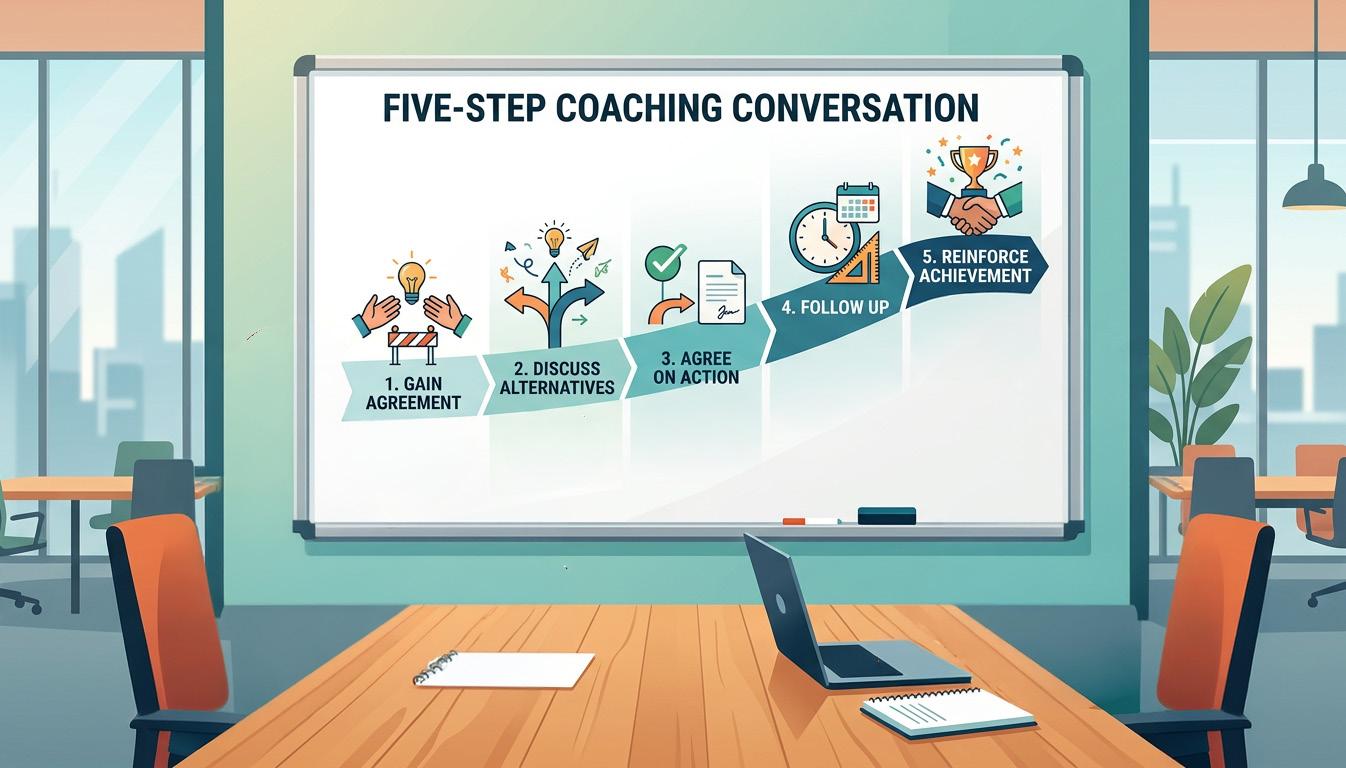
2. Run the Five-Step Coaching Conversation.
Every coaching call follows the same arc: (1) gain agreement that a problem exists; (2) mutually discuss alternative solutions; (3) mutually agree on the action to take; (4) follow up to measure results; (5) reinforce the achievement when it occurs.
3. Prepare before every visit or call.
Walk in with four answers: What is the behavior gap? Who or what is impacted by it? What happens if it continues? What does “right” look like? Improvised coaching produces improvised results.
4. Reinforce deliberately.
Positive reinforcement is the most underused tool in the franchise relationship. Recognize specific behaviors quickly and publicly. Use timely feedback — not quarterly business reviews — to shape what franchisees do next week, not last quarter. For every problem you flag, find two specific wins to celebrate.
5. Measure engagement, not just compliance.
Run a simple NPS pulse with your franchisees twice a year: “How likely are you to recommend our franchise to a friend or colleague?” Sort responses into promoters, passives, and detractors. Track the trend over time, and act on what it tells you.
Coaching is not a soft skill — it is a system. Franchisors who treat it as bridge-building (engineered, repeatable, grounded in cause and effect) consistently outperform those who treat it as personalitydriven inspiration. Whether your franchisee operates one unit or twenty, the discipline is identical: prepare, observe behavior, agree on action, follow up, reinforce. Build that habit across your entire field team and you will move the only two numbers that ultimately matter — franchisee profitability and franchisee advocacy. Start this quarter: pick five franchisees, run the five-step process, and measure the lift. n
* Ingage Consulting & Franchise Business Review Study


Keith Gerson, CFE President & CEO
Gerson Advisory Service 2679 Fairwood Drive New Braunfels, TX 78132
Email: keith@gersonadvisory. com
Website: gersonadvisory services.com
BY PAYCHEX
Paychex, Inc. (Nasdaq: PAYX) is the digitally driven HR leader that is reimagining how companies address the needs of today’s workforce with the most comprehensive, flexible, and innovative HCM solutions for organizations of all sizes. Offering a full spectrum of HR advisory and employee solutions, Paychex pays 1 out of every 11 American private sector workers and is raising the bar in HCM for nearly 800,000 customers in the U.S. and Europe. Paychex is proud to be a preferred vendor of the International Franchise Association. Visit the Paychex Marketplace to shop their expanding API library and start sharing data between Paychex Flex and your other favorite HR tools.
AIin recruiting has moved from an innovative concept to a competitive reality. It can allow small and medium-sized businesses to keep up. The Paychex 2026 Business Leaders report shows voluntary separations rising from 42% to 51% year over year, and turnover costs now average $10,200 to $23,012 per employee.
This guide explores the fundamentals of artificial intelligence and recruitment, uncovers the pros and cons of AI in recruitment, and helps you understand how to incorporate AI solutions into a hiring strategy.
Artificial intelligence recruitment means using AI to help you find, screen, and manage candidates faster. It supports various stages of the talent acquisition process and relies on specific technologies: Machine Learning, Natural Language Processing (NLP), and Predictive Analytics. AI recruiting is not a replacement for the expertise, experience, and education of trained human resources professionals.
AI in talent acquisition can help by automating repetitive tasks, but data-driven recruiting isn't automatically accurate or fair. AI requires significant human oversight—your staff must review, question, and verify AI outputs. AI systems can scan larger pools and help engage candidates sooner.
AI can make your hiring process more efficient, from finding and assessing candidates to screening and onboarding. However, legislation continues to evolve around AI use in hiring, with new boundaries and requirements proposed regularly. The goal isn’t to "automate hiring" but to reduce manual work.
Here's a practical look at how companies can use AI for recruitment:
X AI in Candidate Sourcing and Attraction: AI sourcing and screening tools find prospects who match what you're looking for, freeing up time for evaluation.
X AI in Resume Screening and Assessment: AI assessment tools offer advanced insights. Certain AI use in recruiting and screening may have compliance requirements, like sending notice to applicants.
X AI in Interview and Evaluation: AI-enhanced interview platforms stay in contact with applicants and can handle scheduling and feedback in one place.
X AI in Candidate Engagement: AI-powered chatbots answer
candidate questions, send reminders, and update candidates on next steps.
Even the best AI recruiting software for small businesses won't replace human talent professionals anytime soon. Artificial intelligence hiring tools are excellent for analyzing data and 24/7 availability for time-consuming tasks. AI isn’t a threat but an opportunity to give recruiters back time for more high-impact work.
Small businesses can tap into AI in recruitment to compete with larger organizations:
X Efficiency: AI screening and scheduling can qualify applicants in minutes. HR teams often spend several hours a week on administrative tasks.
X Quality: HR tools with AI analytics can predict candidate success based on skills, experience, and job requirements.
X Cost: Reduced costs and shorter hiring cycles are the major benefits of artificial intelligence in recruitment.
X Competitive: Real-time data on applicant interactions and response rates help make strategic decisions.
AI systems can perpetuate bias, leading to serious consequences. Transparency about AI use is legally required in some jurisdictions. Regular oversight can improve success in AI-supported recruitment. Ethical Considerations and Fairness in AI Recruiting Bias can affect AI recruiting through training data or scoring rules. Some jurisdictions require bias audits to verify that AI tools don't discriminate. Transparency and human accountability are crucial.
Success with AI for talent acquisition starts with a clear implementation strategy:
1. Assess Recruiting Challenges
2. Build Internal Buy-In
6. Measure Return on Investment and Optimize Recruiters should focus on critical thinking to ask better questions of data and building authentic relationships.
With Paychex Recruiting Copilot, in partnership with Findem, you get modern technology to help find and engage qualified people while keeping your process aligned with hiring goals and candidate experience.
To read the full article, visit paychex.com/worx . n
Paychex 911 Panorama Trail S Rochester, NY
Phone: 844-846-7824
Website: go.paychex.com/IFAtoolkit
BY JONI EKOVICH, POINTS4PURPOSE
Points4Purpose is a fully customizable loyalty marketing platform designed to help franchises increase revenue and strengthen customer loyalty. Built to drive repeat visits and higher lifetime value, the program empowers franchises to create personalized, purpose driven rewards that resonate with their local communities. By combining tailored incentives with meaningful engagement, Points4Purpose help franchises deepen customer connections, stand out in competitive markets, and grow their bottom line.
Local Area Marketing (LAM) is the strategic practice of tailoring marketing to specific communities to build meaningful, lasting connections with customers. It’s how a franchise becomes part of the rhythm of everyday life in its communities. It’s the fundraiser at the local elementary school, the sponsorship of a high school team, or the neighborhood organization your customers already trust. These moments may feel small on their own, but together they shape how people perceive, and choose where they spend time locally. National campaigns drive awareness; LAM brings relevance, connecting your brand to everyday lives, values, and priorities in each neighborhood.
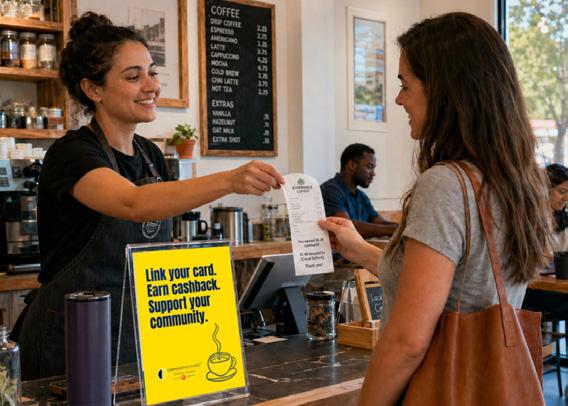
When you support the causes and passions that matter locally, you move beyond generic campaigns into personalization at scale, grounded in real community impact.
LAM plays a critical role in a balanced franchise marketing mix. And as stated in FSE Digital, “Franchise marketing is all about balance. A unified brand creates trust and recognition, while local adaptation builds connection and engagement.”
At a practical level, LAM:
X Activates store-level engagement that reflects both the brand and the local area.
X Strengthens relationships between franchisors, franchisees, and local partners.
X Opens new, sustainable fundraising streams for schools, clubs, and community groups.
When done right, LAM lets you move past one size fits all campaigns and into locally relevant programs that still scale across a franchise system. The impact is tangible: customers know exactly how supporting your brand also supports something they care about close to home.
LAM used to mean flyers, local print, and sponsorships. LAM now operates with the data and digital tools your teams are familiar with, including social media, CRM, marketing automation, and location-based targeting. As Franchise expert Fiona Simpson states, “Franchisees should identify where their ideal customers congregate locally—whether in online community groups, at events, or in local media—and ensure their presence there.” Therefore, these tools help franchise brands engage customers with more precision while keeping local activity on brand.
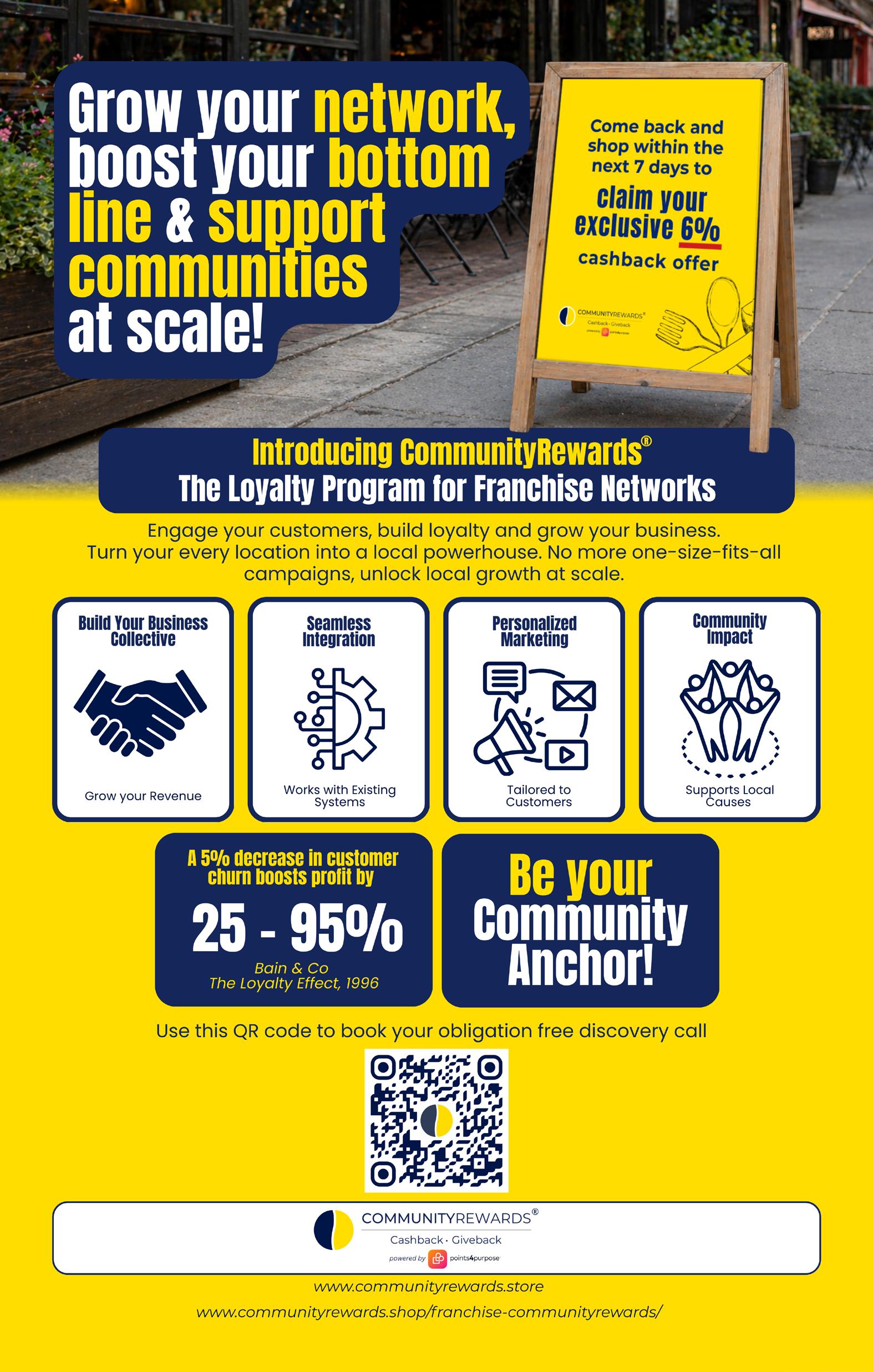
CommunityRewards uses technology to connect everyday purchases with local causes customers already care about. The result is a simple loop: customers support a cause, local locations earn their loyalty, and the brand reinforces its values in a way franchisees can sustain.
When LAM is intentional and consistent, it delivers measurable returns. Strong local programs can:
X Increase visit frequency by giving customers a clear reason to choose you.
X Drive bottom line growth through higher repeat visits fueled by emotional connection.
X Enhance brand trust by proving your values show up locally, not just in national ads.
But don’t take it from us, Steve Wolfe (Multi-unit Franchisee) wrote that “modern franchise growth depends on creativity, consistency, and the ability to connect with local communities.”
Customers are more likely to support brands that actively contribute to their communities, which over time translates into higher lifetime value and stronger franchisee performance.
High-performing franchise systems treat LAM as a structured discipline, not a set of random local activities. They provide clear guardrails and ready-to-use campaigns, so franchisees can activate quickly without reinventing the wheel.
Common pitfalls include fragmented local efforts, “shotgun” promotions that don’t build lasting relationships, and leaving franchisees either overwhelmed or unclear on what’s allowed. According to Elite Franchise Magazine, “Franchises that prioritize community engagement gain a competitive edge. They create meaningful connections with customers, generate authentic publicity, and turn community involvement into measurable growth.”
As data, technology, and purpose come together, franchise brands can finally see, and prove, how local engagement drives measurable results. Franchises that get this right turn local marketing from a cost center into a growth engine, one transaction and one community at a time. n

Points4Purpose
667 Madison Avenue 4th Floor New York, NY 10065
Email: jonie@points4purpose.com
Phone: 812-327-7271
Website(s): www.points4purpose.com and www.communityrewards.store
BY SCORPION
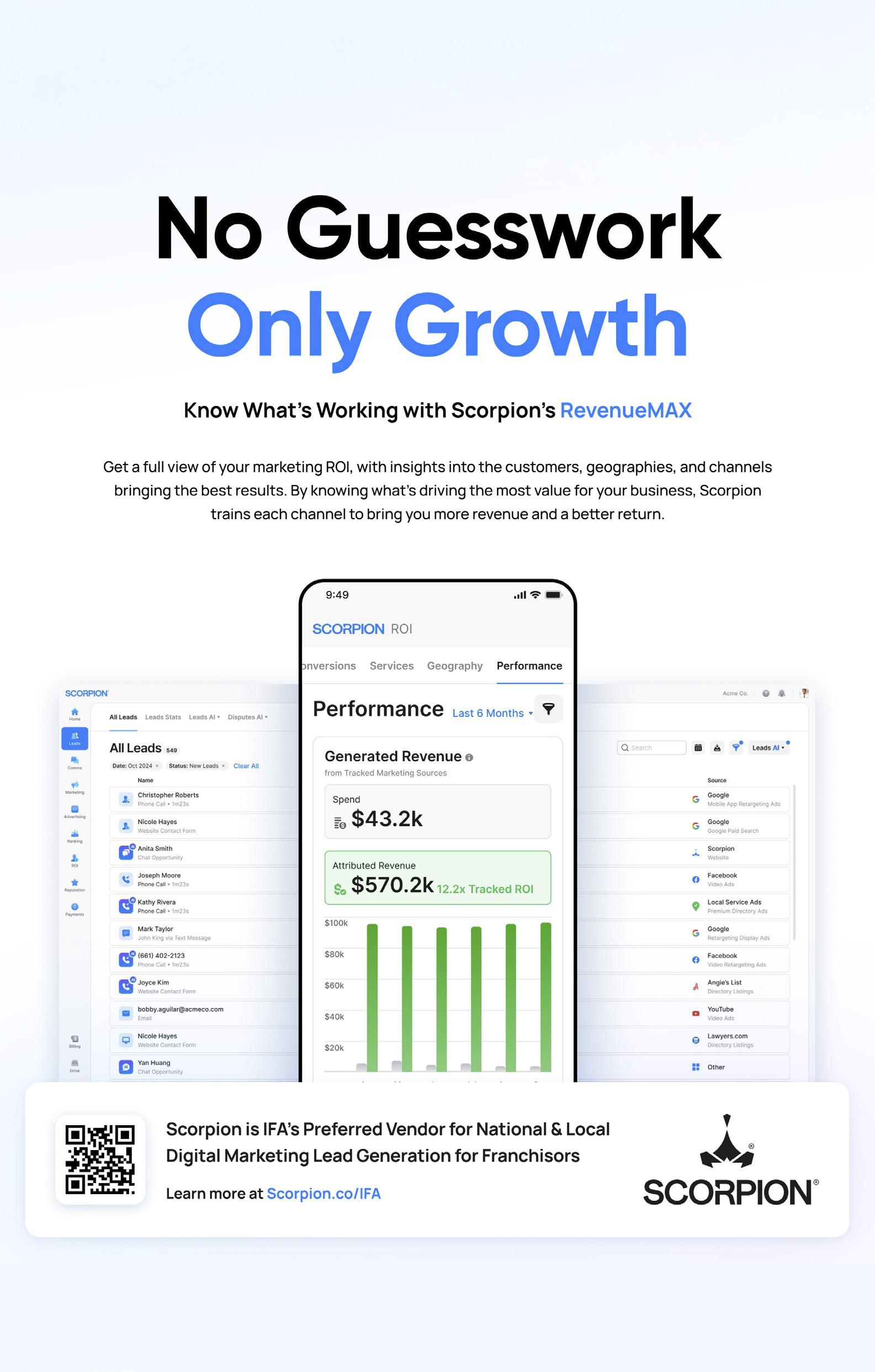
Scorpion is the leader in helping franchise businesses drive revenue through digital marketing solutions. With technology focused on maximizing results at every step of the client journey, Scorpion is pushing the industry forward past a focus on leads, and toward a focus on what truly matters: revenue growth. Backed by award-winning AI, unmatched data, and more than 20 years of marketing expertise, Scorpion helps local businesses win more customers and more revenue. With Scorpion, there’s no guesswork, only growth. To learn more, visit Scorpion.co
The gap between a franchise brand that grows and one that stays flat is rarely a mystery. It shows up in unanswered leads, inconsistent local execution, and marketing budgets with no clear line back to revenue. And yet, nearly half of all franchise brands give themselves a C or lower when asked to grade their own marketing.
So what separates the brands that improve from the ones that don't? In most cases, it comes down to one thing: infrastructure.
Most franchise brands that struggle are typically trying too many things without the right foundation. When there’s no defined value proposition, clear KPIs, and shared visibility into performance data, even well-funded marketing programs leave revenue on the table.
A few numbers that illustrate the problem:
X 1 in 3 franchise brands report needing to improve internal marketing alignment.
X 1 in 4 say they struggle with data-driven decision-making.
X 80% of brands fail to respond to leads within 30 minutes.
X Brands with a 30-minute or faster speed-to-lead are 66% more likely to report meaningful same-store sales growth.
That last stat is worth sitting with. Speed-to-lead isn't a marketing tactic. It's an operational standard. And it's one of the clearest examples of how marketing performance and business performance are the same conversation.
A marketing playbook is an operating framework that connects national strategy to local execution at every franchisee location. When it's working, it answers three questions at any given moment: What should each location be doing? How is it performing? And what happens when it falls short?
Each of those questions gets answered across five areas:
X Brand Standards define what every location must have in place before a single dollar is spent on advertising. This includes a verified Google Business Profile, omnichannel communication tools, AI-enabled intake, and clear review standards. With 83%
of consumers starting their buying journey online and 61% never scrolling past the fifth search result, local online presence isn't a nice-to-have. It's the baseline.
X New Franchisee Onboarding sets each location up to perform from day one. A pre-launch checklist, a 90-day campaign cadence, and a KPI walkthrough give new franchisees a clear path to their first profitable customer instead of a steep learning curve. Brands that shorten that ramp time grow faster.
X KPI Frameworks make performance visible and comparable. Marketing spend as a percentage of revenue, speed-to-lead time, lead-to-appointment conversion rate, and attributed ROI by channel should be tracked at the territory level, not just systemwide. Aggregate numbers hide problems. Territory-level data surfaces them early.
X Governance Cadences turn data into action. Weekly reviews with field coaches, monthly corporate performance audits, quarterly strategy sessions with franchise advisory councils, and annual full-system reviews create a rhythm that keeps performance from drifting. Without a regular cadence, even good data gets ignored.
X Escalation and Accountability Protocols are where most playbooks fall short. When a franchisee's conversion rate drops, the instinct is often to push more marketing spend. But the first question should be whether marketing is generating leads or operations is losing them. Those require different fixes, and mixing them up wastes time and money.
Brands that evaluate marketing performance at least monthly are nearly nine times more likely to grade themselves a B or higher than those that don't. Regular evaluation forces the kind of iteration that actually improves results over time, but only if there’s a system to capture and apply it.
That’s what a living playbook provides. A playbook that gets built once and never touched again becomes a historical document. The market shifts. Consumer behavior evolves. Platforms change. The brands that treat their playbook as a living system, something to be updated based on data, customer feedback, and field input, are the ones that close the performance gap for good. n
Scorpion
27750 Entertainment Drive Valencia, CA 91355
Email: Gabriella.Ferrara@ Scorpion.Co
Website: www.Scorpion.co/ Franchises
The Franchise Marketing Playbook was developed in partnership between the International Franchise Association and Scorpion. It draws on surveys of 2,000 consumers, 1,000 business owners, and hundreds of IFA Convention attendees. IFA members will be able to access it through the IFA Resource Center in June.
IFA ADVOCACY SUMMIT
Sept. 14-16, 2026 | Washington, DC
THE IFA WORLD FRANCHISE SHOW
Sept. 25-26, 2026 | Ft. Lauderdale, FL
Partnership event with Business Show Media
FRANCHISE LEADERSHIP AND DEVELOPMENT CONFERENCE
October 6-8, 2026 | Atlanta, GA
EMERGING FRANCHISOR CONFERENCE
November 16-18, 2026 | Nashville, TN
IFA27 ANNUAL CONVENTION
February 22-24, 2027 | Las Vegas, NV
INTERNATIONAL FRANCHISE SHOW LONDON
April 16-17, 2027 | London, England
Partnership event with Business Show Media
MULTI-UNIT FRANCHISING CONFERENCE
April 27-30, 2027 | Las Vegas, NV