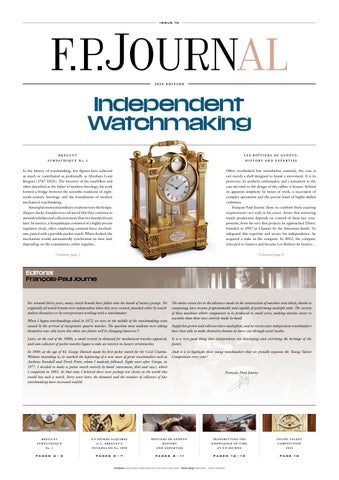
In the history of watchmaking, few figures have achieved as much or contributed as profoundly as Abraham-Louis Breguet (1747-1823). The inventor of the tourbillon and often described as the father of modern horology, his work formed a bridge between the scientific traditions of eighteenth-century horology and the foundations of modern mechanical watchmaking.
Among his most extraordinary creations were the Sympathiques clocks, timepieces so advanced that they continue to astonish scholars and collectors more than two hundred years later. In essence, a Sympathique consisted of a highly precise regulator clock, often employing constant-force mechanisms, paired with a portable pocket watch. When docked, the mechanism would automatically synchronise its time and, depending on the commission, either regulate...
Continue page 2
Editorial
François-Paul Journe
LES BOÎTIERS DE GENÈVE: HISTORY AND EXPERTISE
Often overlooked but nonetheless essential, the case is not merely a shell designed to house a movement. It is its protector, its aesthetic ambassador, and a testament to the care devoted to the design of the calibre it houses. Behind its apparent simplicity lie hours of work, a succession of complex operations and the precise hand of highly skilled craftsmen.
François-Paul Journe chose to confront these exacting requirements very early in his career. Aware that mastering watch production depends on control of these key components, from his very first projects he approached Elinor, founded in 1957 in Clamart by the Simonnet family. To safeguard this expertise and secure his independence, he acquired a stake in the company. In 2012, the company relocated to Geneva and became Les Boîtiers de Genève...
Continue page 8
For around thirty years, many watch brands have fallen into the hands of luxury groups. Yet originally all watch brands were independent when they were created, founded either by watchmakers themselves or by entrepreneurs working with a watchmaker.
When I began watchmaking school in 1972, we were in the middle of the watchmaking crisis caused by the arrival of inexpensive quartz watches. The question most students were asking themselves was: why learn this when our future will be changing batteries ?!
Later, at the end of the 1980s, a small revival in demand for mechanical watches appeared, and soon collectors of pocket watches began to take an interest in luxury wristwatches.
In 1969, at the age of 43, George Daniels made his first pocket watch for Sir Cecil Clutton. Without intending to, he marked the beginning of a new wave of great watchmakers such as Anthony Randall and Derek Pratt, whom I modestly followed. Eight years after George, in 1977, I decided to make a pocket watch entirely by hand (movement, dial and case), which I completed in 1983. At that time I believed there were perhaps ten clients in the world who would buy such a watch. Forty years later, the demand and the number of collectors of fine watchmaking have increased tenfold.
The main reason lies in the advances made in the construction of machine tools which, thanks to computing, have become programmable and capable of performing multiple tasks. The variety of these machines allows components to be produced in small series, making watches easier to assemble than those once entirely made by hand.
Supply has grown and collectors have multiplied, and in recent years independent watchmakers have been able to make themselves known at lower cost through social media.
It is a very good thing that independents are developing and enriching the heritage of the future.
And it is to highlight these young watchmakers that we proudly organise the Young Talent Competition every year !
François - Paul Journe
Breguet Sympathique No. 1 The Making and Return of a Masterpiece
BY OSAMA SENDI
THE GENIUS OF BREGUET
In the history of watchmaking, few figures have achieved as much or contributed as profoundly as Abraham-Louis Breguet (17471823). The inventor of the tourbillon and often described as the father of modern horology, his work formed a bridge between the scientific traditions of eighteenth-century horology and the foundations of modern mechanical watchmaking.
Among his most extraordinary creations were the Sympathiques clocks, timepieces so advanced that they continue to astonish scholars and collectors more than two hundred years later. In essence, a Sympathique consisted of a
highly precise regulator clock, often employing constant-force mechanisms, paired with a portable pocket watch. When docked, the mechanism would automatically synchronise its time and, depending on the commission, either regulate its rate or wind its mainspring.
(For detailed technical explanations of these systems, George Daniels’ The Art of Breguet remains the definitive reference.)
Because of their immense complexity, production was extremely limited. Historical records and scholarship suggest that only thirteen Sympathiques are confirmed, with a possible fourteenth debated. These were never intended for public sale ; instead, they were destined for royal courts and aristocratic patrons, each
piece unique to its commissioner. In Breguet’s day, his creations were the ultimate symbol of prestige, and they remain among the most coveted treasures in horology.
The motivation behind the Sympathique, like many of Breguet’s inventions, lay in his twin pursuits of chronometry and commerce. At the time, portable watches were severely affected by poor lubricants, often derived from animal fats, which degraded rapidly and contributed significantly to their inferior accuracy compared with stationary clocks. The Sympathique allowed a watch to benefit from the superior chronometry of its master clock, correcting the shortcomings of portable timekeeping. Yet Breguet was also a shrewd businessman who recognised that timepieces had to be more than precise instruments : they also had to inspire awe. Just as the tourbillon was both a scientific breakthrough and a captivating spectacle, the Sympathique combined technical ingenuity with an aura of ultimate luxury.
FROM INSPIRATION TO ASPIRATION
Nearly two centuries after Breguet conceived the Sympathique, another French watchmaker would follow in his footsteps: FrançoisPaul Journe. His formal post-diploma entry into horology began under the guidance of his uncle, Michel Journe, a respected restorer of antique clocks in Paris. From the late 1970s through the 1980s, as a young apprentice, François-Paul was immersed in a world of historic masterpieces and the scholarly figures who studied them. It was during these formative years that he developed a profound admiration for Abraham-Louis Breguet, who became one of his greatest personal idols.
By the mid-1980s, this passion had sharpened into ambition. In 1985, François-Paul Journe began to toy with the idea of recreating Breguet’s lost “ Marie Antoinette ” pocket watch No.160, a commission that had been stolen in the 20th century and remained missing at the time. In 1986, he shared the idea with George Daniels who advised him instead to pursue original ideas.
That advice left a lasting impression. It redirected his thinking, steering him away from re-creation and toward original invention – a principle that would define his entire career. Instead of pursuing the Marie Antoinette project, he drew inspiration from it for his
own fifth creation in 1986, an automatic chronometer pocket-watch with fusée and chain, fitted with a Remontoir d’Égalité and a detent escapement. With a touch of humour, François-Paul Journe would later remark that it was just as well he abandoned the plan: the original Marie Antoinette was eventually recovered years later.
THE ASPREY SYMPATHIQUES
Next to the Marie Antoinette, François-Paul Journe soon turned his attention to what he considered Breguet’s second most fascinating creation : the Sympathique clocks. For his seventh creation, he set out to build a modern interpretation of the Sympathique, deeply inspired by Breguet’s concept, yet reimagined and adapted to contemporary times. His goal was to sell the clock through Asprey in London, whose clientele was perfectly suited for such a marvel.
François-Paul Journe prepared a full-colour sketch of the design, envisioning the case decorated with striking red coral marquetry. Then, in a moment of hesitation, he drafted a second proposal with green jade marquetry. Both designs were sent to John Asprey through a mutual acquaintance, who called François-Paul Journe a few days later with a memorable message : “ I have good news and bad news. The good news is they ordered it. The bad news is they want both ! ”
To realise the Asprey clocks, François-Paul Journe undertook the entire mechanism himself, working by hand while his friend, the jeweller Gilles Royaux, executed the exterior embellishments. The project proved extraordinarily demanding : each component was sketched, designed and painstakingly fabricated by hand, often consuming an entire day per part. Adding to the challenge, FrançoisPaul Journe had never examined one of Breguet’s original Sympathiques in person. Instead, he relied on diagrams from George Daniels’ The Art of Breguet to grasp the principles before adapting them to his own taste. For example, where Breguet had used a single balance spring, François-Paul Journe implemented two, simply because he found it more pleasing.
The clocks also incorporated a Remontoir d’Égalité constant-force mechanism and, most notably, an extended eight-day power reserve compared with Breguet’s originals that required daily winding. The first of the
Breguet Pendule Sympathique No. 1 by François-Paul Journe x THA, 1991. Clock in 18K yellow gold with moon phase, equation of time, thermometer, and month, day and date indications.
Asprey clocks was finally completed in 1987, when François-Paul Journe was just 30 years old. In total, he produced three examples for Asprey.
FROM ASPREY TO BREGUET
By 1989, François-Paul Journe had co-founded THA (Techniques Horlogères Appliquées), a specialist workshop that developed complicated mechanisms for other brands. Functioning almost as a horological contractor, THA allowed him to take on projects with the support of a small, talented team. Unlike the first two Asprey clocks, which he had built alone, THA gave him the structure to execute more ambitious work on a larger scale.
It was during this period that François Bodet, then director of Breguet, encountered François-Paul Journe’s third Asprey clock at the AHCI booth in 1990. Deeply impressed, he commissioned a Sympathique from François-Paul Journe. The original idea was for a single clock, but François-Paul Journe, thinking pragmatically, proposed producing a series instead : once the complex mechanism was developed, it made more sense as a business plan to spread the effort across multiple examples. Bodet agreed, and after the first piece, No. 1, crafted entirely in solid gold and reserved for Antiquorum’s The Art of Breguet auction in 1991, the project expanded into a series of twenty.
While developing the series, François-Paul Journe also envisioned taking the Sympathique a step further by pairing the clock with a wristwatch, something never attempted before. For the clock’s presentation drawings, he collaborated with illustrator David Penney, best known for illustrating George Daniels’ books. The wristwatch, however, was designed entirely by François-Paul Journe himself, and it was nothing short of groundbreaking : a tourbillon with a Remontoir d’Égalité delivering one-second impulses, mirroring the clock’s five-second constant-force remontoire. Its movement, was envisioned entirely in gold,
already hinted the elements of his emerging stylistic identity.
After Breguet reviewed the design, however, they declined the proposal, preferring to use one of their own calibres instead. FrançoisPaul Journe kept the wristwatch for himself, developing it independently, and it would soon take on a life of its own. It became the foundation of the Tourbillon Souverain, his very first wristwatch known as the 11/ 91, completed and unveiled at the 1991 BaselWorld fair, coinciding with the sale of the Breguet Sympathique No. 1 clock at Antiquorum’s historic auction.
The clock itself was equally remarkable. Weighing 4.5 kilograms and standing 255 millimetres tall, No. 1 featured an 18 K yellow-gold case and an array of complications including moonphase, equation of time, thermometer and a full calendar. Its detent escapement was regulated by a five-second Remontoir d’Égalité and, when paired with the 36 mm yellow-gold wristwatch, it could automatically wind and set the watch when docked.
At Antiquorum’s The Art of Breguet auction on April 14, 1991, the Breguet Sympathique No. 1 achieved an extraordinary CHF 1,546,250, purchased by Asprey on behalf of one of their clients – an enormous sum at the time that underscored the clock’s historical significance and cemented the prestige of François-Paul Journe’s contribution.
From there, the remaining nineteen clocks in the Breguet series each received unique treatments : some skeletonised, others equipped with tourbillons, minute repeaters or distinctive aesthetic flourishes. Thanks to the detailed notebooks that François-Paul Journe had prepared, his team at THA could follow his highly precise sketches and notes, records he still preserves today. This systematic approach made the Breguet Sympathiques far quicker to produce than the earlier Asprey examples.
ken, and traces of oxidation marked its years out of service. Even so, his reaction was immediate. He knew he wanted to acquire it by any means possible, determined to restore the masterpiece and finally bring it into the F.P. Journe Le Patrimoine collection, one of the crowning highlights of his career.
Leading up to the auction, François-Paul was determined to go all-in for the lot. When the bidding finally opened, he was relentless as the price quickly climbed past his own forecast of CHF 2.5 million, until finally, with a decisive bid, he secured the clock for CHF 4.5 million, or CHF 5,505,000 with fees.
THE RETURN OF N o . 1
Following the sale of the Breguet Sympathique No. 1 in 1991, the clock vanished from public view – yet it never truly left FrançoisPaul Journe’s thoughts. Decades later, while curating the F.P.Journe Le Patrimoine collection, he embarked on a personal quest to find it. Convinced he knew which collection it had entered, he reached out in hopes of borrowing it for display, but the clock could not be found.
Then came an unexpected call one morning from Aurel Bacs of Phillips auction house: “I have something in the office I think you’ll be thrilled to see.” Such calls from Aurel are rarely a disappointment.
When François-Paul Journe walked into Bacs’ office, he was stunned to find himself face to face with the Sympathique he had created 35 years earlier, the very piece he had recently tried, and failed, to track down. The reunion was both unexpected and deeply personal. It was as if the clock had found its way back to him.
Although the clock still retained its imposing presence and visual grandeur, its mechanism had suffered : several components were bro-
Speaking afterwards, he explained why this acquisition mattered so deeply. Although several collectors had offered to purchase the timepiece and loan it to the Manufacture, he felt it was important that only pieces owned outright by F.P.Journe be displayed at Le Patrimoine. He also noted that the acquisition carried a strong symbolic meaning for the Manufacture, reflecting its independence and long-term vision, regardless of the final price. Most of all, he emphasised that this was a creation he had made with his own hands and, in bringing it back, the clock had finally been returned to its true maker.
In parting words, François-Paul Journe expressed his humble joy. To him, Sympathique No. 1 stands as the greatest object produced by Breguet since the time of Breguet himself. Though one of a series of twenty, it is the first and most important, entirely unique and encased in solid gold.
18K yellow gold pocket watch holder, 18K yellow gold mesh bracelet, and set of adjustment keys.
The clock is accompanied by a tourbillon wristwatch in 18K yellow gold.
Original drawing by David Penney, 1990.
Tourbillon wristwatch with moon phase and power reserve, fitted on a mesh bracelet. 18K gold movement.
Remontoir d’égalité : from Jost Bürgi to François-Paul Journe
BY VINCENT DAVEAU
The timepieces designed by François-Paul Journe are unique and singular among their kind, since they essentially incorporate at least one technical element intended to improve the precision of the regulating organ. Here we offer a detailed analysis of the remontoir d’égalité, a system found in all of its tourbillon watches, those regulated by an original escapement, in the Vagabondage II and Vagabondage III, and in the latest generation of Chronomètre à Résonance models.
Thanks to its design, the remontoir d’égalité is an essential mechanical component, intended to ensure the accuracy of a timekeeping instrument powered by a spiral-shaped spring. Owing to its shape and according to the principle of degradation of forces stored in an elastic component subjected to progressive deformation, the energy transmitted by the latter to the gear train is non-linear once the spring is released.
In the case of a timepiece, whether a watch or a clock, this torque is inconsistent because it is too strong when the spring starts to unwind and too weak at the end of the de-tensioning process. Between these two periods, which may vary depending on the length and strength of the spiral-shaped blade, there is a median time during which the spring provides the gear train with a virtually constant force, provided that the regulating assembly is not subject to runaway.
In order to smooth out the force of the spring and prevent the oscillations of clocks or watches equipped with a balance wheel and a wheel escapement from speeding up or slowing down depending on the tension of
European patent — EP 03405772.9 Remontoire and deadbeat seconds
the mainspring, watchmakers have designed mechanisms to reduce the effects of these differences in torque on the regulating organ.
The “ stackfreed ”, a type of mechanical brake that acts by applying pressure to the barrel, was used for a time but later replaced by a more efficient and sophisticated mechanism called the “ fusée-and-chain ”. This assembly, comprising a conical element with a variable pitch similar to a bicycle cassette, is connected to the barrel by means of a solid but deformable link designed to transmit the force from the spring to the gear train. The drive belt was originally made from catgut, which was known for its strength. Due to its elasticity, which varies depending on the moisture in the environment, watchmakers preferred to use a flexible link formed of a series of tiny flat links identical to those found on a bicycle chain. Complex to manufacture, relatively fragile and sensitive to oxidation, the so-called fuséeand-chain mechanism was associated with the recoil escapement with verge escape wheel and a few precision mechanisms equipped with special or precision escapements such as detent or English lever escapements integrated into marine chronometers or deck watches (officers’ pocket chronometers).
At the same time, as far as we can gather, certain watchmakers led by Jost Bürgi (1552 - 1632) developed remontoirs d’égalité ; different mechanical systems that were, crucially, less complex than the fusée-and-chain assembly, and whose role was also to transmit a constant force to the regulating assembly, regardless of whether the mainspring was fully wound or almost unwound. These ingenious systems, which took various forms, were
A storage device comprises a first second wheel (2), engaging with a mainspring, and a second seconds wheel (5), a setting wheel (4) for connecting the two seconds wheels (2, 5), a yoke (6) on which said setting wheel (4) is pivotably mounted, the pivot axis of this yoke (6) and that of the second seconds wheel (5) being coaxial, a stop wheel (3) kinematically linked with said first seconds wheel (2), a finger (6a) fixedly connected to said yoke (6), a storage spring (7) for exerting upon said yoke (6) a force tending to separate said finger (6a) from said stop wheel (3), whereas the force exerted upon said setting wheel (4) by said mainspring serves to press said finger (6a) against said stop wheel (3), so that the latter is wound to the point where a tooth of said stop wheel (3) abuts against said finger (6a).
often used in precision clocks, tower clocks, and sometimes in portable timekeeping instruments. However, these disappeared with the development by Jean-Antoine Lépine of the calibre bearing his name, and did not reappear – as François-Paul Journe pointed out – until George Daniels was commissioned by a collector to produce a watch equipped with a remontoir d’égalité, the third he had ever made.
With his perfect knowledge of the history of watchmaking techniques and his expertise as a fine restorer, acquired during several years spent with his uncle in Paris, François-Paul Journe, who is known for his commitment to the chronometric precision of his creations, could not fail to take an interest in the remontoir d’égalité mechanism. Convinced of its utility, he incorporated it for the first time in the third pocket watch he produced between 1983 and 1984. Building on his momentum and certain of the merits of this mechanism, he fitted one in the first Sympathique clock in 1987, as well as in the three others produced later. This mechanism was then used in the prototype 11/ 91 Tourbillon à Remontoir d’Égalité, designed in 1991, and in the Tourbillon Souverain wristwatch released in 1999.
REVEALING THE INVISIBLE
The operation of the remontoir d’égalité as a regulator of the torque from the gear train to the regulating assembly integrated in a tourbillon is impossible to discern, since the movements are so rapid and of such low amplitude, but can be explained as follows : the mechanism comprises a mobile yoke whose fixed point is located at the pivot of the tour-
Tourbillon with remontoire - 3 84
Detent tourbillon with remontoire, power reserve and thermometer, case in gold, double caseback, diameter 70 mm, engraved sapphire dial and Breguet blued steel hands. Engraved FAIT POUR LE D r E. GSCHWIND, completed in 1984.
billon cage. This component comprises an arm at the end of which the large drive wheel is mounted by means of an applied bridge. At this end is a jewel bearing on which rests a spring blade with programmed deformation, delivering a defined and constant force.
At the end of the second arm of this yoke is a jewel stop lever, whose purpose is to alternately rest on the side of one of the ten teeth of the star wheel equipped with a fly regulator
comparable to the chime governors found in traditional clocks. This wheel, connected to the dead second wheel, must lock and release the primary gear train to allow the spring blade, which is integral to the main plate, to be re-tensioned every second.
Once the blade has been tensioned and the primary train wheel stopped by the jewel stone carried by this yoke, which rests on the edge of one of the ten points of the star wheel, it transfers the stored energy via a lever effect that stops as soon as the stone escapes from one of the points of the star wheel. Once released, this allows the freed primary gear train to rotate by one-tenth of a turn of this wheel and one-sixtieth of a turn of the dead second wheel.
The energy transmitted to the great wheel engaged with the dead second pinion and the tourbillon pinion induces a movement that forces the yoke assembly to pivot back by a fraction of an arc. The effect of this movement is to re-tension the blade spring while continuing to transmit force to the tourbillon pinion and lowering the tooth designed to block the star wheel.
Once the latter has stopped, the energy transmitted to the tourbillon cage comes solely from the blade spring, which pushes the yoke to execute the next stroke. However, this could not occur without the concomitant rotation of the tourbillon cage pinion. Its movement is maintained by the oscillations of the balance wheel, which are themselves sustained by the force from the spring transmitted via the lever effect obtained by the combined action of all the components of the remontoir d’égalité
The purpose of such an assembly almost defies the limits of technical explanation but, essentially, it ensures the best possible chronometric accuracy for the regulating organs. Similar-
ly, in the Astronomic Souveraine, for example, the remontoir d’égalité, which is clearly visible through the transparent case back due to its position above the cage, smooths out the force transmitted by the springs housed in the two parallel-mounted barrels. It uses a fraction of the energy to tension a secondary spring whose bending torque is calibrated so that the balance wheel always oscillates with an optimal amplitude of 270°.
However, in this specific case, and as its creator pointed out : “ the remontoir d’égalité was fitted in this timepiece in order to isolate the tourbillon from disturbances that might be caused by the presence of the numerous complications ”
THE VARIOUS USES OF THE REMONTOIR D’ÉGALITÉ
The story of this technical component could well end there. However, that would be to ignore François-Paul Journe’s talent for exploiting its capabilities for purposes other than limiting the effects of friction caused by the tourbillon cage during rotation by making them constant throughout the watch’s operation.
He has also used it to regulate the force transmitted to the regulating assembly of the Chronomètre Optimum, whose escapement is inspired by the Natural escapement attributed to Abraham-Louis Breguet. And its role here is essential because this high-performance regulating assembly uses components whose lightness and manufacturing precision require the torque transmitted to them for their movement to always be identical. The remontoir d’égalité helps to ensure their perfect operating efficiency and the chronometric precision of the timepiece as a whole.
The inclusion of a remontoir d’égalité on each of the gear trains of the hand-wound calibre 1520 in the new generation of Chronomètres
Vagabondage II and Vagabondage III
In the Vagabondage II, the remontoir d’égalité regulates the energy required for the jumping digital hours and minutes. In the Vagabondage III, this principle is taken further to drive the jumping digital seconds, a world first for a mechanical wristwatch.
à Résonance stems from the same desire to ensure that both balance wheels receive the same calibrated force from the barrel. Purists will say, once again, that the purpose of the remontoir d’égalité is to equalise the force transmitted to the regulating organ. However, François-Paul Journe knows that this mechanism can also be used as a torque sequencer. In other words, a time switch that allows energy to be stored and then released at regular intervals ranging from seconds to several minutes.
It was in this configuration that he used it to ensure the operation of the jumping minutes on the Vagabondage II watch. The mechanism rearms the remontoir d’égalité for one minute and releases the stored energy to drive the jumping minute mechanism without affecting the timepiece’s accuracy.
In the case of the Vagabondage III, the remontoir d’égalité was designed by FrançoisPaul Journe to release its energy every second, thereby turning the seconds disc while smoothing the force transmitted to the regulating assembly.
Undoubtedly, François-Paul Journe will again call on this extremely useful device in future creations, both to guarantee optimal accuracy and to manage operations requiring a certain amount of force to be stored and then distributed at once to a specific function. To be continued...
Louis XVI table regulator clock in gilt bronze, with equation of time and constant force, made by Robert Robin, Horloger du Roi, with an enamel dial by Joseph Coteau dated 1781.
On 9 November 2025, François-Paul Journe acquired a historic Abraham-Louis Breguet pocket watch for his private collection, “ F.P.Journe Le Patrimoine ” : the No. 1890.
In conversation, François-Paul Journe explains why he was determined to purchase this piece at any price and what he owes to the master watchmaker. Without Breguet, he might not be the artist he became...
On 9 November 2025, François-Paul Journe acquired at auction the Abraham-Louis Breguet pocket watch No. 1890, a four-minute tourbillon regulator with a natural escapement, dated 1890, for the sum of CHF 1,880,000. This acquisition took place during the A Celebration of Breguet’s 250th Anniversary sale, held by Sotheby’s in Geneva.
In the eyes of François-Paul Journe, who was in the room and bid until he won the lot, this model represents “ the most beautiful Breguet tourbillon ”. The No. 1890 features two major innovations: the natural escapement and the tourbillon regulator. By combining the advantages of the natural escapement, designed to transmit the force of the barrel with minimal friction, and the tourbillon’s ability to compensate for timing errors due to positioning, Breguet created a watch of unparalleled precision for its time.
Delivered to Frédéric Frackmann in 1809, Breguet’s agent for Russia, the watch was sold to Count Alexei Razumovsky, a member of the Imperial Court and Minister of Public Instruction under Tsar Alexander I. In 1954, it
was acquired by Sir Cecil Clutton, the British historian and watch collector who participated in the 20th century watchmaking revival.
The No. 1890 now joins the F.P.Journe private collection and will be exhibited in the future “ Le Patrimoine ” gallery which will bring together all of François-Paul Journe’s creations since his very first pocket watch, as well as some historical pieces that have contributed to the writing of his history.
After acquiring Abraham-Louis Breguet pocket watch No. 1890 from Sotheby’s, you stated, “I am proud to have acquired the most beautiful Abraham-Louis Breguet.” What makes this the most beautiful Breguet tourbillon ?
François-Paul Journe : Abraham-Louis Breguet had created a series of three gold tourbillons. One is in the Breguet museum collection, with floral engravings on the back of the case, which is not to my taste. There is the piece that was made for George IV of England and which was auctioned a few years ago, and finally, the one I acquired, which is in absolutely perfect condition. This is the
most beautiful tourbillon he has ever created, except, of course, from his first tourbillon, which is in the private collection of the Sultan of Oman.
In terms of watchmaking mechanics, what does this tourbillon represent ?
This calibre brings together the best that Breguet produced at that time. A 4-minute tourbillon with a natural escapement. Everything is just so balanced : the dial, the case, the movement. Everything is perfect. He made other series afterwards, but they were not the same calibre. I believe he had Jacques-Frédéric Houriet make the ébauches at the time. I wanted this tourbillon because I knew that it is not possible to acquire others like it. The dial is engraved with an invisible, secret inscription indicating the name of the client at the time.
Are you referring to Alexei Razumovsky, a member of the Imperial Court of Russia under Tsar Alexander I ?
Yes. And I was also contacted by his greatgrandson, who told me he had in his possession letters written by his ancestor to Breguet, of which I am hoping he will provide me with photocopies.
In what condition is this watch, which is over 200 years old ?
It is in extraordinary condition and has not been damaged, because old pieces have often been restored. If the dial had been retouched, the secret signature would have been erased, because it was engraved with a pantograph using a drypoint needle, and is therefore very light. It disappears with the slightest sign of wear on the dial.
This watch is also believed to have belonged to the British collector Sir Cecil Clutton. Did you know him ?
Yes, I knew Cecil well. His name was Sam. He was the treasurer to the Queen of England. He owned a very fine collection of watches and cars. He participated in vintage Bugatti races and, when he visited Paris, he played the organ at Notre-Dame. He wrote a short book about his watch collection, after selling almost all of it except for around thirty of the most beautiful and innovative watches from each era. It was he who commissioned George Daniels to make his first watch. Before that, George restored timepieces, but he didn’t manufacture them.
What happened to that first watch created for him by George Daniels ?
After his death, it was auctioned off and acquired by David Saul Landes, a charming gentleman whom I knew well, a professor of history at Harvard and a specialist in modern European economic history. He was one of Jimmy Carter’s advisors, and wrote a book on watchmaking called “ Revolution in Time : Clocks and the Making of the Modern World ” which has just been reissued by Les Belles Lettres. And it ’s funny, because in his book, he mentions the Tuesday lunches in Paris, with Jean-Claude Sabrier and his entire clique, which took place at Michel Journe ’s.
How did you meet Sir Cecil Clutton? When he came to Paris, he often visited the restoration workshop of my uncle Michel, with whom I worked. He was an elegant gentleman who passed away in the early 1980s.
Did meeting him have an impact on you? Absolutely. A major impact. When he came, he always wore a three-piece suit with a watch in each waistcoat pocket: In one there was a Breguet, which he often changed, and in the other a George Daniels. I was 17 or 18 years old, I was still at watchmaking school and I wasn’t yet thinking about making a watch, but seeing him with his pocket watches planted the seed in
my mind. Meeting him was one of the things that motivated me to start my career. In 1977, I was 20 years old and, since I thought I would never be able to afford to buy a tourbillon, I decided to create one for myself.
How did you create your first tourbillon ?
I had never seen one, apart from Sam’s, and I had no idea how it worked. I learned how it worked through David Penney’s drawings in The Art of Breguet. His sketches are very informative. In the 1970s, tourbillons were like the story of the man who saw the bear: the watch sellers had never actually held one in their hands.
Were tourbillons really that rare at the time ? They were extremely rare ! And subsequently, apart from George Daniels and myself, nobody made tourbillons. Collectors at the time were interested in antique clocks, not modern pieces. They were buying pieces from the 16th, 17th, 18th century, sometimes pieces from the early 19th century relating to chronometry. That was the history that interested them.
It's extraordinary to have been able to recreate a tourbillon based on drawings ! This is the first Breguet tourbillon, and the first in the world, which is in the collection of the Sultan of Oman. It’s a tourbillon with a double barrel, which inspired George Daniels in his early days, as well as myself. It’s a source of inspiration for many watchmakers. We’ve all dreamt about this watch. It has defined more than 200 years of watchmaking. Breguet was a visionary.
Have you had a chance to see this watch ? Yes. I’ve actually held it. I was one of ten guests invited by the sultan to visit his private museum. I was there with John Asprey and Sebastian Whitestone who established this museum.
You knew the plans for this tourbillon by heart. Were you surprised when you saw it ? No. It’s magnificent. To set up the museum, John had purchased multiple splendid pieces: Napoleon’s perpetual watch signed by Breguet, a Breguet watch that belonged to the Duke of Wellington, Prince Anatole Demidov’s Breguet Pendule Sympathique - pieces with important provenances. And the only wristwatches on display in this museum are my own : including a Sonnerie Souveraine and also the Pendule Sympathique that I made in the 1980s.
Were you actually in the room for the auction? Yes. There were other potential buyers offering up to a million, then we were down to just two, and finally I got it.
Did you purchase Abraham-Louis Breguet’s No. 1890 pocket tourbillon to display in your future museum, which is due to open soon ?
I did. It’s a tribute I’m paying to the inventor of the tourbillon. Also, it won’t be a museum in the strict sense but a private collection that won’t be open to the public. Visits will be by appointment. The building will be called “ Le Patrimoine ”. The collections will be located on the ground floor. On the first floor, there will be all the after-sales service and training. And finally, I will also be able to exhibit my “ Steel Time” collection (a collection of historical steel pocket watches dating from 1850-1910, editor’s note). I have 220 of them, and the last time they were exhibited was at the Forbes Gallery in New York in 2012.
The subscription is directly linked to your story : that’s how you sold your first models, by subscription ?
Breguet had the idea of the subscription after the Revolution, because he had lost money. He created this model which is “ one of the first watch designs ” as Jean-Claude Sabrier said. Before Breguet, a watch consisted of two main plates with pillars that enclosed the gear train, with the balance wheel on top. Later, JeanAntoine Lépine invented bridges, which made it possible to dismantle the movement piece by piece, but he never designed his movements like Breguet designed the subscription. The idea of
“ Was the acquisition of the Breguet tourbil lon particularly emotional for you ? Certainly. I had decided to buy it at any price.
”
Will there be a space dedicated to Breguet ?
I plan to present four Breguet watches, including the one I have just acquired. There will also be the Pendule Sympathique No. 1 from 1991. I was glad I purchased it because I think it is the most beautiful creation that was made after Breguet’s death. Nothing better was ever done. There will also be a small Breguet portable clock that I acquired from Antiquorum, as well as a subscription.
launching a small subscription of 20 pieces in 1999 came to me from Breguet, and you had also written an article on the subject.
What is the concept behind this future exhibition space ?
We will primarily exhibit our heritage, i.e. all the zero numbers, the prototypes of our models since the creation of the “ready-to-wear” watches (the models which were not entire-
ly handmade by François-Paul Journe from 1999 onwards, editor’s note). As well as some old pieces that I was able to recover and that I had entirely made in the 1980s, including my first watch. And around that, contemporary art and pieces that have advanced the history of watchmaking, for example a clock by Jost Bürgi - the inventor of the “ remontoir d’égalité ” - which is currently being restored and which dates from late 16th century. I also bought some table clocks from the late 16th - early 17th centuries. At that time, the watch did not yet exist. It arrived just after that. I’m missing a watch from that very early period to make the link between watchmaking before watches, and us. The watchmaking industry is a great wall that has existed for 600 years, and on which I have placed two stones.
Where does the Breguet tourbillon fit into it ? It will certainly be displayed with the other Breguet pieces that I have purchased. We will be exhibiting antique timepieces that have a connection to my work. I made my first tourbillon between 1977 and 1982 and, if Breguet had not existed, I might never have made one at all. We must pay tribute to the reason for the existence of F.P.Journe.
Breguet No. 1890 24-line movement with a four-minute tourbillon, natural escapement and fusée-and-chain system.
Les Boîtiers de Genève: History and Expertise
BY AUDREY HUMBERT
Often overlooked but nonetheless essential, the case is not merely a shell designed to house a movement. It is its protector, its aesthetic ambassador, and a testament to the care devoted to the design of the calibre it houses. Behind its apparent simplicity lie hours of work, a succession of complex operations and the precise hand of highly skilled craftsmen.
François-Paul Journe chose to confront these exacting requirements very early in his career. Aware that mastering watch production depends on control of these key components, from his very first projects he approached Elinor, founded in 1957 in Clamart by the Simonnet family. To safeguard this expertise and secure his independence, he acquired a stake in the company.
In 2012, the company relocated to Geneva and became Les Boîtiers de Genève. In 2023, a new milestone was reached: the move into a modern building in Meyrin and the transition to F.P.Journe’s sole ownership.
This article offers an immersive look into the heart of the workshop, exploring the craftsmen, the production stages and the technical and aesthetic details that make the case a fundamental pillar of contemporary watchmaking.
LES BOÎTIERS DE GENÈVE
The story of Les Boîtiers de Genève begins in Clamart, in the Paris region, in 1957 with the founding of Elinor by Louis Simonnet. After overseeing the watch case workshop at the Jaeger-LeCoultre manufacture, he specialised in the production of watch cases.
In 1988, the company reached a decisive moment. Louis’s son, Francis Simonnet, accepted an unexpected challenge: to collaborate with François-Paul Journe on the creation of a Sympathique clock exterior – a project outside of Elinor’s core business. By taking on this challenge, he secured a lasting collaboration with François-Paul Journe, which was strengthened in 2007 when M. Journe acquired a stake in the company. In 2012, at his request, the company moved to Switzerland. It was then renamed Les Boîtiers de Genève, and began supplying F.P.Journe exclusively. In 2023, Les Boîtiers de Genève moved to a new site in Meyrin. The workshops were designed, under the exacting eye of François-Paul Journe, entirely to meet the specific needs of the business.
THE ROLE OF THE CASE
The watch case plays a crucial role in defining a timepiece’s identity. The guardian of its calibre and ambassador for its aesthetic, it protects the mechanism from external influences such as shocks, dust and moisture. By fulfilling this vital role, it ensures the watch’s reliability and longevity. Its construction therefore
demands flawless technical precision as well as a refined aesthetic.
TRADITIONAL CASE MANUFACTURING
The traditional method used to manufacture cases has changed little since its beginnings. It is based on a sequence of operations including stamping and rolling, before moving on to the finishing stages. Each component of the case is finished separately before being assembled to the others by soldering. Soldering requires extreme precision, as it must remain both invisible and undetectable to the touch of the watch’s future owner.
Brazing. At Les Boîtiers de Genève, traditional expertise is preserved and called upon whenever modern techniques do not make it possible to achieve the desired results. Brazing illustrates this pragmatic and exacting approach. Preferred when the conveyor furnace cannot be used, it allows the artisan to monitor the work visually in real time.
Drawing of the case of François-Paul Journe’s first Tourbillon wristwatch with remontoire, 1990.
The
A traditional watch case manufacturing workshop is typically structured as follows : three lathes of varying sizes, two rolling mills, a drawplate, a hydraulic press and a fly press, as well as a workbench equipped with a soldering station, pliers and a piercing saw.
It all begins with a metal sheet, called a plané, from which the craftsman cuts the desired shape. Stamping the material generates structural stresses that must be mitigated through heat treatments known as annealing. Successive rolling operations are used to achieve the desired case thickness.
Two types of press are used in this process. The hydraulic press applies a powerful yet gradual pressure. It is used for thicker metal sheets. As with stamping, the pieces must be annealed so that the metal regains the ductility lost under pressure. Without this, the material, having become too hard, would risk breaking.
The fly press, which is operated manually, works differently : it delivers a sudden impact that causes the material to spring outwards. Its use remains indispensable for working with specific metals, such as tantalum, and for achieving certain types of relief.
While the tools have evolved, the basic principles – mastery of materials, understanding metal stresses and precision of hand – remain at the heart of even the most contemporary methods today.
THE NOBILITY OF RAW CRAFTMANSHIP
The manufacture of watch cases involves working the material, where successive operations inevitably produce metal shavings and
Polishing noble and complex metals.
dust. This is why these workshops are usually separate from those dedicated to movement production, which require environments similar to a cleanroom.
ical to the success of all the production stages. These parameters allow the cases to meet, with unparalleled precision, the specifications of the movements they will house.
However, true to his uncompromising standards, François-Paul Journe chose to apply the same criteria to Les Boîtiers de Genève as he does to his entire operation.
Thus, a production process typically characterised by oil and metal shavings is elevated to a rare level of cleanliness, comparable to that of a movement workshop.
CNC MACHINES FOR PRODUCING UNIQUE COMPONENTS
The production approach applied at Les Boîtiers de Genève is far from ordinary. Here, the CNC machines, designed for exceptional production capacities, are repurposed for small series, and even for the creation of unique, one-off parts. This distinctive approach is perfectly aligned with the exacting standards for which François-Paul Journe is renowned. Thanks to these state-of-the-art machines, engineers can push the boundaries of design. For each component and depending on the material, they meticulously set the tool, the rotation speed and the tolerances.
The hardness of the material directly influences the machining process : a harder material requires a reduced rotation speed, extending the time needed to produce each part. In this regard, the role of the technical office is crit-
AT THE FOREFRONT OF TECHNOLOGY
One machine stands out in the case machining workshop of Les Boîtiers de Genève. Nicknamed the “ five-axis ”, this centrepiece can perform a complete sequence of cutting and shaping operations, ensuring ultimate precision in the execution of the parts. Its programming, however, requires the expertise of highly skilled technicians who pay meticulous attention to every detail.
Far beyond performance alone, this machine is also configured with a focus on sustainability. It collects the most minuscule metal shavings and filters the oil for closed-loop reuse, thereby significantly reducing its environmental impact.
the polishing of a platinum case middle and a tantalum case back from the
for its hardness and distinctive behaviour.
At Les Boîtiers de Genève, specific expertise has been developed in working tantalum. It relies on a precise balance between the rotational speed of the tools, the choice of polishing compounds and the controlled movement of the artisan.
Above,
Chronomètre Furtif. This material stands out
work of polishing alone requires mastery of several techniques and the use of a variety of tools. Achieving a perfect finish is particularly delicate, as each surface, each edge and each material calls for a specific approach, both in the choice of abrasives and in the artisan’s gesture.
Above, lapidary work on a platinum buckle, a controlled abrasion technique that makes it possible to achieve remarkably sharp finishes. Whether mechanical or manual, this polishing requires absolute artisanal mastery of pressure and angle in order to reveal the intrinsic quality and exacting standard of the piece.
EXAMPLE: THE CHRONOMÈTRE FURTIF
The Chronomètre Furtif and its tungsten carbide case provide a particularly striking illustration of this expertise. Due to the extreme hardness of this material, drilled holes with an insert were preferred for the screw locations, as opposed to the countersunk holes used for softer materials.
But significant research work was undertaken long before this solution was adopted. It was necessary to find partners capable of supplying tools suitable for machining this material and to carry out multiple tests to calibrate production, all while meeting the high standards of the Manufacture. This challenge, initiated by François-Paul Journe, is fully in line with his philosophy of continuing to make a new contribution to watchmaking.
The ambition for technical mastery also extended to the bracelet which – made from the
same material – represented another major achievement. For the bracelet to retain its full flexibility, it must be made of extremely fine links, which significantly increases the challenge of machining tungsten carbide. Despite these constraints, each link must display a flawless sandblasted finish, thus ensuring the aesthetic coherence and quality of the watch as a whole.
ONLY WATCH EXCEPTIONAL PIECES
For the 2024 ONLY WATCH charity sale, François-Paul Journe drew on the full breadth of expertise offered by his Manufactures to create a unique and exceptional watch, the Chronomètre Furtif Bleu. Like all the watches he has offered to ONLY WATCH, he not only equipped it with a tantalum case, for the first time housing the new Calibre 1522, but also with a bracelet made entirely of tantalum links, a material which is particularly challenging to work with.
Much more than a mere aesthetic variation, the Chronomètre Furtif was unveiled in 2025 with its tungsten carbide exterior.
2. Polished case back, prepared for the subsequent engraving and machining operations.
Faced with this additional challenge, the teams had to conceive and test unprecedented solutions, adapting the production tools to the pace of experimentation and validation of each new component in order to arrive at a perfectly executed timepiece.
1. Case middle blank in its raw state, before machining and finishing.
2. CNC machining of the case middle The shapes, drillings and functional surfaces are produced before the manual finishing operations.
3. Fully polished case middle The surfaces are completed and ready to receive the bezel.
1. Case back in its raw state.
3. Finalised case back with engravings, hallmarks, complete polishing and satin-finishing of the crystal ledge.
1. Bezel as machined, without finishing, in its raw state.
2. Fully polished bezel, revealing the final surfaces before assembly.
3. Case middle with soldered bezel, fully polished, revealing the satinfinished inner crystal ledge.
THE INFLUENCE OF MATERIAL CHOICE
The choice of materials is at the heart of François-Paul Journe’s unique philosophy, a vision of watchmaking defined by the highest technical and aesthetic standards and a path off the beaten track. Although he prefers gold for his movements, he offers cases in titanium, platinum, gold, steel and tantalum. Titanium is chosen for its strength and lightness, while tantalum is selected for its anti-corrosive properties and its suitability for various atmospheric conditions.
The technical achievement lies in the handling of these materials. While tantalum is a tough material to machine (Vickers hardness of 873 HV compared to 549 HV for platinum and 216 HV for pure gold), F.P.Journe pushes the boundaries of innovation even further by producing cases in tungsten carbide, whose Vickers hardness is around 1300 HV. Having succeeded in mastering the machining of these extreme materials, he also allows him-
EXCLUSIVE BRACELETS WITH A FORGED AESTHETIC
Another luxury François-Paul Journe affords himself: the in-house production of metal bracelets that he designs specifically for his timepieces. Their creation requires several specific components, from the bracelet head and the left and right starting links to the clasp attachment. Each component is first machined individually before going through the finishing stages, a long and meticulous process that involves several craftsmen.
Combinations are used in the construction of the bracelets to take advantage of the intrinsic qualities of each material. Hence, the folding clasp of the tungsten carbide bracelet is made from titanium, while its cap is crafted from tantalum. This additional complexity requires great skill to achieve perfect harmony of colour and finish across all the materials used.
In this deep dive, we have seen that the case, which embodies François-Paul Journe’s technical and aesthetic ambition, is far more than a simple protective shell. From artisanal tradition to the challenges of machining tungsten carbide, the journey of Les Boîtiers de Genève, now fully integrated into the Maison Journe, reflects an unceasing pursuit of excellence.
Today, the artisanal work is supported by state-of-the-art technology, paving the way for greater creativity and possibilities. In 2023, these prospects were further enhanced by the merger of Les Boîtiers de Genève with Les Cadraniers de Genève, creating multiple synergies and a valuable exchange of expertise between the two workshops.
Preparation of bracelet finishes. Each component of the case receives the same level of attention. Before reaching the final finishing operations, the links of the platinum lineSport bracelet are patiently prepared by hand.
Right : Application of brazing alloy to an 18K 6N gold folding clasp, in preparation for flame fixing of the nut according to a traditional technique.
self the luxury of creating bold combinations, as demonstrated by the Chronomètre Furtif with its tungsten carbide case and tantalum inserts. Only the craftsmen of Les Boîtiers de Genève hold the secret to polishing these materials, which are widely considered impossible to polish.
The assembly of the Chronomètre Furtif case requires a level of precision comparable to that of assembling the movement. Although apparently simple, its bi-material construction increases the complexity of the case, here in tungsten carbide adorned with polished tantalum elements. The whole must display perfect harmony despite the diversity of materials and surface treatments.
Assembly of the tantalum inserts on the case middle of the Chronomètre Furtif.
Chronomètre Furtif case - Ref. CF Materials : tungsten carbide and tantalum inserts
Transmitting the knowledge of time at F.P.Journe
BY ISABELLE CERBONESCHI
ven. In the silence of the Manufacture’s workshops, watchmakers learn the language of the master so that they can in turn transmit it in every movement bearing the motto Invenit et Fecit. We meet the men transmitting the heritage of François-Paul Journe.
Behind the precision of F.P.Journe calibres lie hands, voices and experience that weave a single story : that of a unique Manufacture where the art of watchmaking is a language that is learned and transmitted.
Spending a few hours with the watchmakers who work at the Manufacture, you start to understand the fascination that the master watchmaker inspires, not only among collectors but also among those who work alongside him. You need to hear from those who bring François-Paul Journe’s calibres and dreams to life day after day to really appreciate what it means to work for and with him. And to understand what “ transmission ” means here.
The affection and admiration that everyone feels for him stems from the work of the master watchmaker himself, a unique oeuvre that reads like a novel composed of powerful chapters centred around a particular calibre.
Whether young or more seasoned, they are all passionate, admiring and, sometimes, moved when talking about the man some still call “ Monsieur Journe ”. Through their words emerges a portrait of a rare Maison, where the beauty of the approach is coupled with a promise: to contribute to the creation of a watchmaking heritage, without ever betraying the spirit of the master. From the youngest person to arrive at the workshop to the experienced watchmaker transmitting his knowledge, each has a story that connects to another story. When put together, these stories reveal the soul of the Manufacture.
THE ORIGINS OF FRANÇOIS-PAUL JOURNE
Before discussing transmission, it’s worth looking back a few decades at the training of François-Paul Journe, who was born in Marseille in 1957. After studying at the École d’horlogerie de Paris (Paris watchmaking school), he trained in his uncle Michel’s watch restoration workshop. There, the young watchmaker restored antique timepieces and discovered the spirit of the great masters who would become his role models: Antide Janvier, Abraham-Louis Breguet and Ferdinand Berthoud, to name a few. It was in this Pari-
sian workshop that he immersed himself in a watchmaking culture and style inherited from the 18th century, and which would influence him when he produced his first hand-made wristwatch in 1991: the F.P.Journe Tourbillon à Remontoir d’Égalité 11 91.
In 1999, he unveiled his own collection of watches under the F.P.Journe brand, bearing his Latin motto : Invenit et Fecit (translation : invented and made). The idea was to design and produce his own movements, completely independently. His work is defined by technical innovations that have influenced the history of watchmaking, such as the Tourbillon Souverain (1999), the Chronomètre à Résonance (2000), the Sonnerie Souveraine (2006) and the Astronomic Souveraine (2020), among others.
IT BEGAN WITH ADMIRATION
For many employees at the Manufacture, François-Paul Journe is much more than a “ star ” of watchmaking; he is a gifted and discerning creator. According to Louis, 24, a watchmaker at F.P.Journe since October 2023, “ François-Paul Journe is the Picasso of watchmaking. What he has achieved in twenty-five years, no one else has matched. His creations are not just mechanisms, they are works of art ”
The young watchmaker studied in Marseille, where François-Paul Journe was born. “There were posters of his watches hanging on the walls of our classroom”, explains Louis. “It was inspiring to see his work and to think : he came from here and he achieved that ! The first time I opened an F.P.Journe movement, I thought it was magnificent. Even a seemingly simple model such as the Chronomètre Souverain contains some surprising technical choices : the train wheel is not made like that of other movements. Sometimes I wonder why he has designed things the way he has. What was he looking to add ? Assembling the movements he invented is a way of getting inside his mind. You sense the power of his talent, his ability to reinterpret the fundamentals of traditional watchmaking to create something really unique. Working at the Manufacture is both an education and a source of pride”
“ For me, François-Paul Journe is a genius watchmaker, but also a visionary entrepreneur ”, explains Sylvain, a watchmaker at F.P.Journe since 1 September 2006 and head of training. “ Fifteen years ago, I wondered
From left to right : Assembly of the movements of the FFC and the Quantième Perpétuel. These stages involve assembling, positioning and regulating the various movement components in order to ensure proper functioning and reliability.
about his direction, but the results we have today have proved him right. Working with him means playing a small part in the chapter of watchmaking history he is currently writing. It’s uplifting. I’m certain I would never have reached this level anywhere else ”
F.P.JOURNE AND NOWHERE ELSE
Listening to the watchmakers talk about their professional experience, you discover that their ultimate goal was to work here. “ My dream as a student was to work for Monsieur Journe ”, reveals Antoine, a watchmaker at F.P.Journe since 1 June 2017. “ In 2008, when I finished my studies, I sent my first application but was not successful. Years later, after returning from a trip, I tried my luck again and this time I was accepted. Had I not been, I would have continued until I was hired. It was my goal. I’m grateful to be able to contribute to this collective endeavour, even if, on a day-to-day basis, we don’t always appreciate the significance of what we’re doing. I am proud to be able to say that I don’t work for just any watchmaker: I work for F.P.Journe”
Their first day remains etched in their memories. “One of my most memorable moments at F.P.Journe was my first day at work”, recalls Marc, a watchmaker at F.P.Journe since 2014. “I came in through the main door and into the showroom. It was quite unsettling because you find yourself face-to-face with Constantin-Louis Detouche's astronomical clock, which is an impressive piece. But I was welcomed warmly like a part of the family. I’m proud to wear the blue jacket bearing my boss's name”, he continues. “Sometimes I forget that it's a privilege, because it's my dayto-day life. But as soon as I meet the collectors and see their reactions, I remember how fortunate I am. What strikes me most is not only my own career journey, but that of our boss and the entire team. Because success, in watchmaking as elsewhere, is a human adventure”
LEARNING A HOROLOGICAL LANGUAGE
When you join F.P.Journe, it’s not just about assembling or adjusting movements, but about joining a certain culture : you become part of a vision.
This spirit is palpable in the workshops, where both young and experienced watchmakers gather around the calibres, discussing and observing them. Antoine recalls : “ Over the years, I have had the opportunity to work on all the Résonance models and watch them evolve. I feel privileged to be part of the history of this Manufacture. I see my role first and foremost as a responsibility to the collectors. Each piece must be flawless ”
“ The biggest challenge for me at first was getting used to the Maison’s high standards ” Louis explains. “ We work on very high-quality movements with quite strict tolerances. I was previously employed by another company, but here there is a much greater focus on the details. You can feel the difference in quality. But I’ve got used to it: it’s just a question of practice. It is a profession built on experience ”
THE TRANSMISSION OF ETHOS AND TECHNIQUE
In an environment where independence demands rigour, high standards and trust, inhouse training is vital. In this context, transmission is not just about teaching techniques; it means sharing an ethos, a way of thinking about time and understanding the creator’s choices. It means learning to remain humble, patient, curious, to look for the “ why ” behind every movement. It means following a unique path : that of the master watchmaker.
“ Training a young watchmaker just out of school is not so much a question of technical difficulty : above all it’s about teaching them organisation, patience, and thinking about
each and every one of their actions. Assembling a movement without really understanding what you are doing is pointless. A watch maker needs to know why he’s doing things ” , explains Sylvain.
This focus on transmission is reflected in the structure itself : first, the watchmaker learns, then in turn becomes a transmitter of knowledge. “ This profession is a chain: you receive, you transmit. Sometimes we give technical advice, sometimes it’s just a simple everyday tip. It’s these exchanges that make our job so rewarding ”, says Marc.
This link – between the watchmaker and his environment, between expertise and creation, between the young apprentice and the master – is one of the real treasures of this Manufacture. The watchmaker is not merely an executor : He is an actor, a witness, a transmitter.
If there is only one lesson to be learned, it is humility ”, reveals Sylvain. “ Here, you need to be always questioning yourself. Just because you’ve succeeded at one thing doesn’t mean you can do everything. You have to remain open-minded and try to understand. And with François-Paul, every detail has meaning. Even after all these years, I still go and see him to ask: “ Why did you decide to do it like that ? “. And he will tell me. I often realise that the ideas he had three or four years ago are only coming to fruition today. Nothing is left to chance. Everything is constructed, logical and coherent ”
“ Working at F.P.Journe means becoming part of a tradition, embracing a vision and agreeing to play a part in the history of a watchmaker-creator.
”
Loyalty is forged through admiration for the founder, the quality of the approach, a spirit of independence and, above all, through transmission. Because what is transmitted here is not merely technique : It’s a way of thinking about time, a quest for excellence and an art form.
Assembly of the balance and its bridge on the Chronomètre Optimum movement. The watchmaker can then adjust the regulating organ, the balance point of the movement, in interaction with the EBHP escapement.
Positioning and adjustment of the seconds disc during the assembly of the Astronomic Souveraine movement.
Fitting of the equation of time cam on the back of the Astronomic Souveraine movement.
François-Paul Journe for the love art
BY ISABELLE CERBONESCHI
The master watchmaker is an art lover who is always keen to support events. In 2013, he created the Prix Solo with the artgenève fair.
Since 2024, he has been supporting MAZE, the new constellation of exhibitions initiated by Thomas Hug. He has had a taste for beauty since his teenage years, when he first picked up a brush and oil paints.
We know very well François-Paul Journe’s taste for fine watchmaking pieces : those of the masters he admires and his own, which he has
always designed himself, without the help of a designer. what is less well known, however, is that he learned to paint as a teenager. He produced figurative works that he has kept in Marseille.
His taste in art remains fairly traditional, and while he is moved by the classical masters and modern art, he admits to having less affinity for contemporary art. That’s why, when he decided to support the first edition of artgenève, founded by Thomas Hug, by creating the Prix Solo, he appointed a jury of experts to select what they considered the best solo exhibition presented at the fair. One or more works were thus acquired and donated to a museum institution, either the MAMCO (museum of modern and contemporary art of Geneva) or the City of Geneva Contemporary Art Collection. He did the same thing with the Prix artmonte-carlo.
In 2024, he chose MAZE, the new constellation of art fairs launched by Thomas Hug, supporting MAZE Art Gstaad as well as Particolare Vienna, Mira Paris, and Loop Barcelona. The following year, this presence ex-
panded to MAZE Design Basel. In 2026, the Maison is present at MAZE Art Gstaad, MAZE Art St. Moritz and MAZE Design Basel, each time with an exhibition space.
What made you want to create awards for artists, such as the Prix Solo during the artgenève fair, which you presented for 12 years ?
One day, one of my friends, the art expert Marc Blondeau, suggested that I meet Thomas Hug, who was then the founder of the artgenève
Because the quality of the 2024 edition was very poor : there were only about twenty exhibitors, and some of those had been offered stands in order to fill the space. Galleries are not keen to head to Monaco at this time of year (7 to 9 July, editor’s note). For artgenève, our contract was due to expire in 2024, and the condition for the continuation of our partnership was that we also support artmonte-carlo. We would have liked to keep artgenève, but not artmonte-carlo. Since I’m not involved in the contemporary art world, I have no regrets having left.
Which art fairs are you currently involved with ?
We are currently involved in Thomas Hug’s new art exhibition constellation, MAZE, with Art Gstaad and Art St. Moritz. We support them through a financial partnership, and the first MAZE / Art Awards F.P.Journe was presented in Paris in November 2025 to the Brazilian artist Victor Fidelis for his work “ No limit do privado ” (2025, Galerie Verve, São Paulo), during MIRA. We also have a presence at the MAZE Design Basel fair, which takes place in the magnificent Offene Kirche Elisabethen church. There are not many exhibitors, but they are of a very high standard.
What does this offer you?
A certain atmosphere. Furthermore, I consider myself to be creating contemporary art, even though watchmaking is something of a fossil-
Today, watchmaking is more akin to pageantry and jewellery, even though we are serious watchmakers. I consider it contemporary art because my career in “ ready-to-wear ” watchmaking took off in 1999, at the very end of the 20th century.
fair. Thomas was looking to establish a partnership with a watch brand. But one that could be aligned with the art world, rather than an industrial brand. I met him and he suggested that I organise the Prix Solo. The idea was for a jury of experts to select a work from among the artists ’ exhibits at the fair, and for us to purchase it in order to donate it to a museum. Since our collaboration began, a dozen works have been donated to MAMCO and the City of Geneva Contemporary Art Collection. Alongside this, we did the same thing with the Prix artmonte-carlo. The works were allocated to the New National Museum of Monaco (NMNM).
You didn’t hold the Prix artmonte-carlo in 2025. Why not ?
ised art form. It ’s not like in the 18th century, when inventions served a purpose.
The face of your watches is unique : you have designed them all since your very first creation. Do you consider them to be works of art ? I try to make sure they are, but it’s really for others to judge that, not me. I mainly try to produce things that I like, in the hope that someone else might also like them. In 1991, I presented my first tourbillon with a remontoir d’égalité in Basel, but it was not a success. Fortunately, one of my Parisian friends had written an article about me in a magazine and put my watch on the cover. That led to private clients ordering models from me. I was planning to produce 12, but I got tired of doing the same thing over and
The work “ No limit do privado” by Brazilian artist Victor Fidelis receives the first MAZE/Art Awards F.P.Journe during the MIRA fair in Paris, 2025.
Below:
The F.P.Journe stand beneath the Festival-Zelt canopy, at the heart of the Gstaad village.
Right :
The F.P.Journe stand installed in the Offene Kirche Elisabethen, Basel’s emblematic Neo-Gothic church.
over again. So I created two watches, which I delivered in 1994. One was sold at auction in 2024. But even though it took time for this aesthetic to catch on, I didn’t really want to question what I wanted to do and what I liked. I waited for my moment, and it came. I have never tried to create something for a specific audience. Sometimes clients ask me to customise models, but I usually decline because it doesn’t add anything to the watch. Designers have offered me their services, but I want to make my watches entirely on my own. The Manufacture may need a designer in 30 years, but for now, we’re fine as we are.
You have a sense of harmony that is akin to that of an artist. Did you draw before you started designing watches?
When I was 10 years old, I drew and painted. My grandmother used to take me to visit the museums in Marseille : I have always been immersed in art. When I arrived in Paris, I worked in the Carré Rive Gauche with my uncle Michel. We were working in an environment of antique dealers and museums. In the early 1980s, Catherine Cardinal took over the watchmaking, automaton and astronomy collections at the Musée des Arts et Métiers in Paris and entrusted both of us with the collections as watchmakers.
From 1985 onwards, I took care of them on my own after my uncle moved to Aix-en-Provence. I have always been interested in painting and architecture, and when working on antique pieces, I would try to analyse why a particular watchmaker worked in a certain way, how they achieved a particular result, what the correct proportions were, etc. There are rules in classical art: when you look at a painting, your eye follows the directions and architecture intended by the painter. We can draw parallels with watchmaking.
Did you keep the paintings you made when you were a teenager?
Yes, they are in Marseille. I painted the city’s rooftops, still lifes, figurative scenes. When I was 13 or 14, I took a trip to Spain and came back with pictures of bullfighting. These were copied from posters I had seen there, not original creations. In fact, when I saw the Chardin exhibition, I told myself that I would never be able to afford one, so I painted a picture “ in the style of Chardin ”.
In the same way that you created a tourbillon because you couldn't afford a Breguet watch? Exactly ! I made myself a Chardin (laughs).
Did you learn the technique of oil painting?
I had painter friends who taught me how to produce my own colours, use turpentine, pigments, etc. Compared to a professional, I’m extremely slow: it will take me 20 times longer than them to finish a painting. The last one I painted is still unfinished. I couldn’ t finish it because I started painting at 9 pm, stopped at 4 am and had to go to work the next day. You have to be able to make good choices and, since I couldn’t make a living from my painting, I carried on with watchmaking (laughs)...
Are you an art collector ?
No, I’m an enthusiast but not a collector. I buy things I like, that catch my eye. I also purchased some works at the last edition of artgenève.
Works by the artist Baya exhibited by the Richard Saltoun Gallery, winner of the Prix Solo ?
No. Most of the time, I don’ t agree with the jury that selects the winners, which proves how little I know (laughs).
Authenticity, Rarity and Talent : these are the values you have championed since you
founded your company, and the first letters of these words also form the acronym “ART”. It ’ s a word that comes up a lot... This slogan was created by my teams, but it sums up the work we do very well. To find all these qualities in modern watchmaking is quite rare, but they abound in historical watchmaking, including among the watchmakers who have not influenced me. There are masters I revere, even though they were not my inspiration.
Can you give examples ?
One example is Louis Berthoud, the nephew of Ferdinand Berthoud, the inventor of modern chronometry. He did an extraordinary job, even though it has nothing to do with what we do today, because a chronometer from the 18th century or even the early 19th century is an archaic mechanism.
And when it comes to aesthetics, what inspires you ?
Ferdinand Berthoud’ s aesthetic is always very beautiful. It influenced me because it resembles industrial gas meters. In watchmaking at the
time, if you wanted to position the hour, minute and second hands in the middle of the dial, you had to use gears that produced friction. But when you create a chronometer, the arbor that rotates in one minute is here, the one that rotates in one hour is there, and the one that rotates in one second occupies another position. Ferdinand Berthoud was very pragmatic: he placed the correct hand on the corresponding arbor. There was no need to bother with gears that would create unnecessary friction, hence the presence of counters placed anywhere and everywhere. Their position, and therefore the appearance of the dial, depended on the mechanism, and not on an aesthetic choice.
It ’ s an aesthetic that pleased you.
The first tourbillon I made and unveiled in 1991 paid tribute to five things: the dial placed directly on the main plate was inspired by Ferdinand Berthoud, the tourbillon and hands by Abraham-Louis Breguet, the tourbillon cage was designed in the style of Ernest Guinand, in a nod to the tourbillons from the second half of the 19th century in Switzerland, and I produced a remontoir d’égalité because it is the Holy Grail of watchmaking. Then I created two entirely by hand, one of which was sold at auction in 2024. And then when you and I first met, I had just launched the ready-to-wear versions of my tourbillons, which were a little more restrained : They were made in the same spirit, but industrially rather than by hand. I am inspired by historical watchmaking but not by 20th century aesthetics, because I was not especially receptive to the art of that era.
Are there any antique timepieces whose appearance you particularly like ?
The design of Louis XVI’ s guilloche lathe ( 1) , which is in the Musée des Arts et Métiers and is exceptionally beautiful, for example. When you look at the architecture of a Breguet watch, or a work by Antide Janvier, you realise that they were probably the first mechanical designers in watchmaking. Two or three years ago, I purchased a Josiah Emery watch from Antiquorum. There was a time when people were clamouring to get hold of them, whereas now they’re not worth much. Josiah Emery watches have a certain aesthetic that I like.
Did you buy this watch for its beauty ?
I bought one of his watches 45 years ago, but I had to sell it to finance THA (Techniques Horlogères Appliquées, the workshop created by François-Paul Journe in Sainte-Croix in Switzerland in the 1980s to develop watch movements). Josiah Emery watches are magnificent. Perhaps not quite as magnificent as those by Breguet, Lépine, or Janvier, but they are still works of art.
Tourbillon Souverain No. 11 / 91
The first wristwatch with tourbillon and remontoire.
Introduction_
Young Talent Competition 2025
Alexis Fruhauff Pendule à Seconde
29 years old - Paris - France - Graduate of Lycée Diderot, Paris, France - June 2022
This project was born in 2022 during my final year of DNMADe (National Diploma of Arts and Design Crafts) at the Paris watchmaking school, where I discovered high-quality masterworks made by students in the late 19th century. After graduating, I refined and enhanced the project by incorporating inspiration from the work of French watchmaker Antide Janvier, whose atypical and distinctive creations I particularly admire.
Design and crafting_
The Pendule à Seconde was conceived from a blank page : no component was reused from a previous project, and even the tools themselves were entirely designed and manufactured to create the various parts. The work extended over a three-year period, in parallel with my training. The regulator was built in a traditional way, mixing modern and classical techniques : hand-filing, turning on a Schaublin 102 and an 8 mm watchmaker’s lathe, milling on an Aciera F3, and machining on a Hauser 2BA jig borer. All components are removable, making maintenance, transmission, or future decoration easier.
Horological architecture_
The movement, suspended on a bracket, operates with a pivoted detent escapement with lost beat, inspired by the work of French watchmaker Paul Garnier, combining teeth and pins. Only the right pallet delivers the impulse; an opposing pallet ensures safety. The pins are machined from a modern alloy, Hardiall ® , which is self-lubricating, lightweight, and highly wear-resistant. The pendulum, mounted on an Invar stem, is removable. It features a system of screw-in lenses and a finepitch dead point adjustment, allowing for extremely precise regulation. Power is supplied by two symmetrical barrels with Maltese Cross stopworks, echoing the philosophy of Breguet’s marine chronometers, avoiding the fusée-andchain mechanism and delivering constant force required for a detent escapement. Each barrel includes a screwed cover with isostatic repositioning, an ex-ternal hook, and hardened steel shafts, ensuring perfect concentricity and controlled wear. The gear train was entirely hand-crafted. The pinions are cut, hardened, blued, polished with boxwood, then turned “between centers” to guarantee concentricity. Lateral oil sinks and choked conical pivots help retain oil. The wheels, screwed to the arbors, are oversized like in school calibres, enabling future repairs or decorative finishes. The ratchets and clicks were slightly redesigned for greater comfort during unwinding, while preserving the “school” spirit. Their surfaces are softened and undersides hollowed out to prevent plate abrasion.
Case and dial_
Two options were explored for the case: one in gilded bronze, and one in solid cherrywood, which was ultimately chosen. Inspired by the clock cases crafted by cabinetmaker Jean-Ferdinand Schwerdfeger for Antide Janvier, it was designed after graduation with the help of Stéphane Girardot – a Parisian antiques dealer specialised in historic horology –to respect the proper proportions of late 18th-century French clockmaking. The entire case can be disassembled into three parts (base, frame, hood) and includes a secret door. The hand-engraved silvered brass dial is mounted via an invisible fixing system - a genuine technical challenge. It is accompanied by a hand-engraved amplitude measurement plate for the pendulum allowing for a precise visualisation of its operation.
Technical specifications_
Dimensions : 55 × 32 × 23 cm / Weight : approx. 7 kg / Escapement : pivoted detent with lost beat, steel and Hardiall ® pallets / Pendulum : Invar stem, screw-in lenses, fine metric thread adjustment / Barrels : double barrels with Maltese Cross, screwed covers, hardened steel shafts / Pinions : boxwood polishing, blued, hand-cut and finished / Wheels : oversized thickness, screwed / Ratchets and clicks : redesigned, hollowed, hand-machined / Case : solid cherrywood, dis-mountable, secret door / Dial : hand-engraved silvered brass, invisible mounting / Finishing : traditional hand-finishing, Schaublin 102, Aciera F3, Hauser 2BA.
Since 2015, the Young Talent Competition helps discover the next generation of most talented young watchmaking apprentices in the world and supports them in their route to independence by identifying their achievements and putting them under the spotlight.
F.P.Journe organises the Young Talent Competition with the support of The Hour Glass, luxury watch retailer in the Asia Pacific region. Both Maisons aim to perpetuate and support the art of haute horology and cultivate the appreciation of extensive horological craftsmanship.
François-Paul Journe says: “ It is imperative for me, not only to discover the horological talents of tomorrow but also to secure the continuation of independent haute horology and pass on my savoir-faire with over 40 years of expertise. It is also a real honor to
Alexis Fruhauff , 2025 winner and creator of the Pendule à Seconde .
encourage these young talents by sharing my authentic horological knowledge, my passion and my determination on a daily basis. And also to support them as I received support at their age.”
The 2025 winner, Alexis Fruhauff, received his award on April 1st at the F.P. Journe Manufacture. He received a diploma and a 50,000 CHF grant from The Hour Glass Singapore and F.P.Journe which allows him to purchase
watchmaking tools or finance a horological project. The jury of the Young Talent Competition is composed of key personalities from the international horological scene : Philippe Dufour, Giulio Papi, Andreas Strehler, Marc Jenni, Michael Tay, Elizabeth Doerr and François-Paul Journe. Their selection criteria are based on the originality of the concept, the technical complexity, the elegance of the design as well as the quality of the finishing and of the craftsmanship.
Man of the Hour
A look at the work of François-Paul Journe
INVENIT ET FECIT
Presented and conceived by Wei Koh, founder of Revolution Watch, the first episode of the documentary series Man of the Hour, broadcast by Warner Bros. Discovery HBO, explores the career of François-Paul Journe. From his origins to decisive encounters and periods, we gradually discover how this path shaped his creative approach.
The story begins in Paris. Years of training with an uncle who was a restorer, followed by responsibility for the maintenance and restoration of the watch collection at the Musée des Arts et Métiers, gave him direct access to the masterpieces of the 18th century. This proximity to regulators, marine chronometers and constant-force mechanisms nurtured a philosophy. To carry a story forward, one must first know and understand it.
In Geneva, the camera pans across the Manufacture and its workshops. The motto Invenit et Fecit can be understood in terms of the verticalisation of expertise : 18K rose Gold
movements designed and made in-house, dials crafted by Les Cadraniers de Genève and cases produced by Les Boîtiers de Genève, two entities owned by the brand. This oversight of each stage reflects a conviction that designing only makes sense in the context of production. The attention paid to finishes and precision assembly speaks to an ecosystem in which all artisans work together.
Numerous testimonials reveal the clarity of the vision and the strength of the bonds forged over time. We gain a better understanding of what connects the idea to the watch, and the watch to the person who will wear it : something that must be shared by all, and at every stage of its creation.
This episode offers a new interpretation of a universe, from its Parisian roots to its independence in Geneva, from the legacy of the masters to the day-to-day operations of a Manufacture that, piece by piece, assumes the responsibility of inventing and making.
Installation of the RnD Unit
F.P.Journe Charity Fund plaque at the Paris Brain Institute
PARIS
On 30 June 2025, the “ R&D Unit F.P. Journe Charity Fund ” plaque was unveiled at the Paris Brain Institute, located at the Pitié-Salpêtrière Hospital in Paris. This event marks the continuation of a partnership be-
tween F.P.Journe and the Institute that has lasted more than twenty years. Since 2008, the Institute has received 30% of the profits from the sale of each Centigraphe, based on a shared commitment : to place innovation at the service of neuroscience research.
Since its creation in 2022, the R&D Unit has been supporting scientific teams, other platforms at the Paris Brain Institute and incubated start-ups in the invention of bespoke tools. Initially focused on a limited number of projects, it has gradually structured its missions around four key areas : mechanical design, electronic development, programming and design.
The additional support has accelerated this development by providing the unit with strategic skills and tools. The appointment of a firmware engineer specialising in real-time embedded development, combined with the acquisition of a CNC machining centre, a laser cutter and a gantry milling machine, has
significantly expanded its scope of activity. These resources now enable the team to progress more quickly from idea to implementation, providing researchers with bespoke solutions that are ready to be integrated into their protocols with the required reliability.
During the ceremony, Professor Gérard Saillant and François-Paul Journe were accompanied by the R&D Unit team : Charly Rousseau, Scientific Director, Pierre Tissier, Operations Manager, Zenneddine Ajili, Firmware Engineer, Lucile Lebègue, Mechanical Design Engineer and Pierre Pavlov, Electronics Engineer.
After a tour of the facilities, the plaque was unveiled in front of the workshop. This event is both symbolic and future-oriented, formalising the key role of the R&D Unit in supporting scientific projects and marking a new stage in F.P.Journe’s long-term commitment to working alongside it.
Plaque of the “RnD Unit F.P.Journe Charity Fund” at the Paris Brain Institute.
François-Paul Journe and Wei Koh in the streets of Geneva.
F.P.Journe partner of the MB Polo Brunei team
SPAIN
SOTOGRANDE
Every summer, Andalusia becomes the focus of the polo world. The 54th Sotogrande International Polo Tournament, one of the most prestigious events on the calendar, attracts the best teams in the world to the impeccable grounds of the Ayala Polo Club. For the Copa de Plata Terralpa 2025, in the top High Goal category, MB Polo Brunei has turned its ambition into results, securing its place in the elite circle of semi-finalists.
Alongside His Royal Highness Prince Mateen Bolkiah, the team fielded three of the most respected talents in the discipline : Pablo Mac Donough (handicap of 9), a true legend of the sport, Lucas Monteverde (8), a reference of the Argentine school, and Rosendo Torreguitar (5), a tireless and creative player. With a total handicap of 22, MB Polo Brunei was positioned as a serious contender for the title. From the outset, the team secured a close vic-
tory against the Black Bears (9-8), confirming its commitment, cohesion and ability to handle moments of tension. This momentum carried them to the semi-final against Amanara, one of the most feared opponents in the tournament, where they lost 11-14. Beyond the result, MB Polo Brunei confirmed its evolution with another step forward for a team that continues to build and progress. In attendance at Sotogrande, François-Paul
Journe presented Prince Mateen with an Automatique Réserve Titane from the lineSport collection, which he opted to wear in his next matches.
For the Prince and his teammates, this 2025 edition is a milestone. MB Polo Brunei confirms its place among the top stables, already demonstrating the determination to go further in the upcoming competitions.
F.P.Journe Le Restaurant
A look back at the
GENEVA
highlights
Opened in November 2023, F.P.Journe Le Restaurant was born from a meeting between François-Paul Journe and chef Dominique Gauthier. A place where Haute Gastronomy meets Haute Horlogery, in the carefully restored historical setting of the former Bavaria brewery.
In less than a year, the restaurant was awarded a star in the Michelin Guide and a score of 16 20 in the Gault&Millau guide. In March 2024, Dominique Gauthier also received the Swiss Culinary Merit Award, recognising his career and commitment to Swiss cuisine. This momentum continued in 2025. In May, F.P.Journe Le Restaurant joined the prestigious circle of Grandes Tables Suisses, bringing together establishments that consistently
uphold quality, creativity and the transmission of culinary expertise. This new recognition further consolidates the restaurant’s position on the local and international gastronomic scene.
Supported by a close-knit team, with Pascal Brault’s service and Bogdan Tand’s wine selection enhancing the experience, the place impresses with its clear and assertive identity. Signature dishes, such as scampi wrapped in kadaif with citrus and basil, have become emblematic of this identity. The awards received and the guests’ enthusiasm testify to a success built through high standards and passion, confirming the solidity of a project that is becoming an enduring part of the Maison’s identity.
Dominique Gauthier and François-Paul Journe in front of the restaurant entrance, member of the Grandes Tables Suisses since 2025.
From left to right: Lucas Monteverde, Amélie Lefévère, François-Paul Journe, HRH Prince Mateen Bolkiah, Rosendo Torreguitar, Pablo Mac Donough and Shawn Mehta.
HRH Prince Mateen Bolkiah wearing the colours of MB Polo Brunei.
François-Paul Journe and HRH Prince Mateen Bolkiah.
Kevin Rabin, winner of the Asian Le Mans Series 2026
SEPANG - DUBAI - ABU DHABI
Passionate about motorsport from an early age, Kevin Rabin began karting competitions at the age of 12. Over four years, he took part in numerous events in both junior and senior categories, including the Swiss Championship, the Euro Series, Champions of the Future, WSK, as well as the IWF Warrior 2022, world championships held at the Le Mans circuit. He won several races and competitions on karting tracks across Europe, in Switzerland, Belgium, France, Spain, Italy and Portugal.
Kevin devoted 2023 to refining his driving skills in Formula Renault, Lamborghini Trofeo and Nova Proto NP02. As he was not yet 16, he was unable to obtain a racing licence. His FIA categorisation was nevertheless already established and, as soon as he became eligible to compete, he would enter in the Silver category. He opts for endurance racing in prototypes.
Shortly after his 16th birthday, a first opportunity arose to enter the world of endurance racing. Competing in the Prototype Winter Series, consisting of eight 50-minute races, which he contested solo at the wheel of a Nova NP02 on the circuits of Estoril, Portimão, Aragón and Catalunya, Kevin won the 2024 championship in the NP category and finished 2nd overall across all categories. He then continued his season, called up by new teams, and notably stood out during a qualifying session at the Hockenheim circuit, where he secured pole position in heavy rain with a lead of more than two seconds.
Ambassador of the lineSport collection, Kevin is the son of Philippe Rabin, partner of François-Paul Journe and co-founder of Montres Journe SA. At 18, he proudly carries the colours of F.P.Journe onto international podiums. He has just won the 2026 Asian Le Mans Series championship, a competition contested by teams of three drivers and
comprising two four-hour endurance races on each of the three circuits. The championship began with a victory in Sepang, Malaysia, followed by several podium finishes in Dubai and at Yas Marina in Abu Dhabi, which secured him the title.
Following this major victory, Kevin will continue his season driving his LMP3 on several major European circuits that have hosted Formula 1, including Barcelona, Le Castellet, Spa-Francorchamps, Silverstone and Portimão. He will once again race on the Le Mans circuit in the prologue to the 24 Hours, a race he hopes to compete in one day.
His progress can be followed live or on replay on the YouTube channels @LeMansCup and @AsianLeMansSeries, while his latest news can be found on his Instagram account and YouTube channel :
F.P.Journe supports the Cultural Foundation of the Barbier-Mueller Museum
FOR THE MEMORY OF ENDANGERED CULTURES
For more than fifteen years, the Musée Barbier-Mueller Cultural Foundation has been working to preserve endangered cultures. By supporting field research, it documents societies where oral traditions and ritual practices are being weakened by profound transformations. The books resulting from these investigations preserve their memory and help transmit their knowledge.
In 2025, the Foundation dedicated its work to the Kanak people through two publications. “ Les Kanak de Nouvelle-Calédonie. Cosmologie et échanges en pays Paicî-Cèmuhî ” presents the research of Dr Claude Grin, initiated with Professor Alban Bensa,
and highlights the role of cosmology and rituals in social organisation. “ Toé, la monnaie sacrée et le cachalot géant ” offers younger readers an accessible introduction to stories from Kanak culture.
These publications were accompanied in Geneva by several events, including an evening at Théâtre Les Salons on 18 November with Dr. Claude Grin and two Kanak representatives, TrotroYmeResh and Hiandjing Pagoubanehote. Conferences, readings and demonstrations at the Barbier-Mueller Museum then provided an opportunity to discover different expressions of Kanak art.
Ritual dance performed on stage by TrotroYmeResh.
Opening of the evening by pianist Paloma Manfugas.
Kevin Rabin with his 2026 Asian Le Mans Series Champion trophy.
The winning team, consisting of Paul Lanchère, Kevin Rabin and Alexander Jacoby, with Nicolas Lapierre, Team Principal of CLX Motorsport.
Kevin Rabin at the wheel of the #17 CLX Motorsport LMP3.
A remarkable 2025 vintage
F.P.Journe around the world in 365 days 2025
F.P.Journe Monthly Aperitifs Boutiques and Maisons F.P.Journe
Every first Tuesday of the month, the Boutiques and Maisons F.P.Journe welcome collectors and enthusiasts for a shared moment of discovery. These meetings, held simultaneously around the world, allow attendees to discover the latest news and engage freely with the teams on subjects close to the Manufacture’s heart.
MAZE Art Gstaad
Gstaad / 14 — 16 February
For its second edition, MAZE Art Gstaad brought together 35 international galleries within the Festival-Zelt, in the heart of the Bernese village. The art fair offered a dialogue between modern, contemporary art and design, with names including Pace, Mennour, Landau Fine Art and Galerie De Jonckheere. As a partner of the event, F.P.Journe has confirmed its support for this gathering where eras and disciplines meet.
Collectors’ Journey LATAM
Geneva / 5 7 May
Conceived as bespoke journeys, the Collectors’ Journeys bring together collectors around the F.P.Journe universe. In May, a group from Brazil discovered the Manufacture, Les Cadraniers de Genève and Les Boîtiers de Genève as well as the Boutique, while enjoying events with a Swiss cultural theme, from gastronomy to local heritage. Three days of immersion that brought them into close contact with the expertise and spirit of the Maison.
F.P.Journe Le Restaurant
Grandes Tables Suisses
Geneva / 11 May
F.P.Journe Le Restaurant has been welcomed into the Grandes Tables Suisses, joining a selection of iconic Swiss gastronomy establishments. At the helm, chef Dominique Gauthier champions a cuisine defined by precision, ever attentive to the seasons and local produce. This distinction confirms the restaurant’s place in the Genevan landscape, transposing to the world of gastronomy the exacting standards that characterise the Manufacture.
Prix Solo artgenève – F.P.Journe
Geneva / 29 January
At the 13th edition of artgenève, the Prix Solo artgenève - F.P.Journe was awarded to the Richard Saltoun Gallery, selected from among the 26 stands in the Solo section. The London gallery presented an exhibition dedicated to the Algerian artist BAYA (1931-1998), a figure who left an indelible mark on 20th century art with her vibrant, dreamlike universe. The award-winning work, The Dawn and the Fish (1976), was acquired by F.P.Journe and donated to MAMCO Geneva.
Chronometric Trilogy
Miami / 21 — 22 February
New York / 16 18 May
Los Angeles / 10 11 October
The Maisons F.P.Journe of the United States brought their community together around the Chronometric Trilogy, a series of events dedicated to the three models that express F.P.Journe’s pursuit of precision : the Chronomètre à Résonance, the Chronomètre Souverain and the Chronomètre Optimum. Each Maison contributed a chapter to this trilogy, presenting unique timepieces loaned by enthusiasts. Some pieces had never been shown together before, and probably never will be again.
Huntsman Dinner - The tailor’s art
London / 14 May
The London Boutique invited its guests to Huntsman & Sons, at 11 Savile Row, for an evening celebrating the tailor’s art. Founded over 175 years ago, this legendary brand embodies a wealth of expertise passed down through generations, from the royal courts to Hollywood. After a presentation in the historic showroom, a dinner was held in Notting Hill, in collaboration with The Fat Badger restaurant.
F.P.Journe Golf Cup
Geneva / 15 June
The 12th F.P.Journe Golf Cup was held at the Geneva Golf Club, with 148 players following the Greensome Stableford format. The event had the air of a summer party, enlivened in particular by the presence of chef Dominique Gauthier, who was stationed at the turn where he was serving one of his signature dishes, as well as by the participation of collectors from the United States with the team from the New York Maison. The day ended with an awards ceremony hosted by François-Paul Journe.
Weekend in Burgundy
Beaune / 27 29 June
A group of collectors of the Paris Boutique travelled to Burgundy for a programme of private tours of several renowned estates. From Beaune to Meursault, they tasted exceptional wines at Domaine Felettig, at Michelot and at Clos du Moulin aux Moines. The highlight was the exceptional access to Henri Boillot’s cellars, which are usually closed to the public.
MAZE Design Basel
Basel / 24 June
F.P.Journe contributed to the launch of Maze Design Basel, held in the neo-Gothic Elisabethen church. The art fair brought together some of the most innovative international design galleries, from Thomas Fritsch (Paris) to Thomsen Gallery (New York), Kreo and Gastou. Between iconic pieces from the 1950s and contemporary creations, visitors were able to discover works by Philippe Hiquily, Pierre Charpin and Philippe Starck.
F.P.Journe Summer Party
Geneva / 11 July
The Hotel President Wilson hosted the teams from the Manufacture, the Geneva Boutique, Les Cadraniers de Genève and Les Boîtiers de Genève for the traditional Summer Party. The 2025 edition celebrated the company’s 25th anniversary and highlighted the importance of these shared occasions, where all employees come together to mark the year’s highlights.
On the Road
Vancouver / 27 August
The Los Angeles Maison travelled to Vancouver for a stage in its On the Road programme. This initiative, designed to connect with collectors around the world, was making its first stop in western Canada. Hosted by the El Santo restaurant, the guests discovered the latest F.P.Journe creations and discussed the history and philosophy of the Manufacture.
F.P.Journe Ladies Golf Cup
Geneva / 23 September
For the first time since its creation, the traditional F.P.Journe Ladies Golf Cup, held at the Golf Club de Genève in the municipality of Vandœuvres, had to be interrupted due to bad weather. In the presence of the fifty participants, the prizes were awarded by means of a draw at the end of the afternoon, followed by an apéritif.
Christmas celebrations
Hong Kong / 9 12 December
On the occasion of the year-end festive season, the F.P.Journe Hong Kong Boutique brought together its collectors for a series of gatherings, including lunches, dinners and a reception at the Boutique. These meetings provided an opportunity to strengthen ties with collectors in a discreet setting, conducive to exchanges around the universe and the craftsmanship of the Manufacture.
Royal Charity Polo Cup
Windsor / 11 July
F.P.Journe was present at the Royal Charity Polo Cup, held at the Guards Polo Club in Windsor, as a partner among the sponsors of this charity event. The day featured the U.S. Polo Assn. team, in which the Prince of Wales and other guest players took part in a tightly rotated tournament. The proceeds of more than a million pounds were donated to ten charities supported by the Royal Family.
HSNY watchmaking workshops
New
York / 12 July
The New York Maison offered two watchmaking discovery workshops in partnership with the Horological Society of New York. Led by Steve Eagle, HSNY’s Director of Education, participants disassembled and then reassembled a movement, discovering step by step the logic of a traditional mechanism.
WatchPro USA Awards - Chronomètre Furtif
New York / 10 September
The Chronomètre Furtif won the “Best Independent Watch” award at the WatchPro USA Awards 2025, held in New York in the presence of the specialist press and numerous industry players. Presented a few months earlier, this model introduced tungsten carbide, a new material for F.P.Journe, and the new hand-wound Calibre 1522 in 18K rose Gold with a central second hand.
Paris / 14 November
F.P.Journe inaugurated the first MAZE/Art Awards F.P. Journe during MIRA Paris, held at the Latin American Maison, awarding a prize to the Brazilian artist Victor Fidelis for “No limit do privado” (2025, Galerie Verve, São Paulo). This new prize, which is part of the MAZE constellation, marks a new milestone in F.P.Journe's commitment to artistic creation.
National Gallery of Modern and Contemporary Art
Rome / 1 December
Continuing its support of the arts, F.P.Journe acquired a work by the Swiss artist Philippe Cramer and donated it to the National Gallery of Modern and Contemporary Art in Rome. Entitled Aeternus Eternus II, this impressive granite bench joined the museum’s permanent collection during its annual gala. Both sculpture and functional object, Philippe Cramer’s work, inspired by the Möbius strip, evokes eternity and the cycle of life while inviting the public to engage in a contemplative and interactive experience.