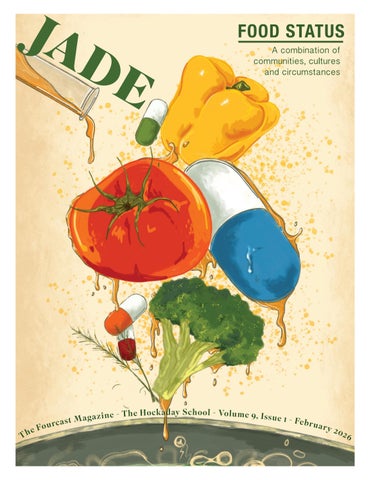
JA D
FOOD STATUS
E
Th
ga ast Ma c r u e Fo
A combination of communities, cultures and circumstances
z i n e - T h e H o c k a d ay S c h o o l - Vo l u m e 9, I s s u e 1 -
Fe b r u a
ry 2
02 6
2
ABOUT JADE
In 2017, The Fourcast added a new magazine to its traditional coverage. Named for the stone set in the ring of all graduating seniors, which was designed by Tiffany & Co. in 1917, JADE offers an in-depth look at the most pressing issues to the Hockaday community. Former Hockaday Dean of Upper School Ed Long once remarked that Ela Hockaday chose the jade stone because she considered it to be a symbol of wisdom. In honor of the stone’s legacy, JADE hopes to help inform the community and foster knowledgeable conversations about challenging topics.
The Hockaday School 11600 Welch Road, Dallas, TX 75299 (214) 363 6311
COVER ART COURTESY OF CECILIA CHEN
Table of Contents Serving Size Vol 9, Issue 1
ARTICLE
PAGE
Fasting for Faith vs. Fitness Meatless Matters A World of Flavor Problems with Preservatives What Can We Really Believe? The Fight for Food Access Cookbook Consumerism Savoring Memories More Than a Meal
4-5 6-7 8-9 10 - 11 12 - 13 14 - 15 16 - 17 18 - 19 20 - 21
Anya Aggarwal
Editor-in-Chief
Lang Cooper, Melinda Hu, Leyah Philip
Assistant Editors-in-Chief
Juliette Friguletto, Aria Knepler-Pearl, Aneeka Tansen, Alina Zheng
Section Editors
Tanvi Cherukuri, Mia Frary, Brooklyn Friesen, Claire Gicheru, Haniya Khowaja, Lucy Pigott, Staff Writers Bella Portera, Savannah Simon, Sara Vijay JADE is a magazine supplement to The Fourcast, The Hockaday School’s student newspaper. JADE Magazine is written primarily for students of the Hockaday Upper School, faculty and staff. JADE has a press run of 350 and is printed by Midway Press. It is distributed free of charge to the Hockaday community. Businesses who wish to advertise in JADE should contact Anya Aggarwal (aaggarwal26@hockaday.org). We reserve the right to refuse any advertising which is deemed inappropriate to the Hockaday community. Opinions are clearly marked and are the expressed opinion of the author and do not necessarily reflect that of The Fourcast staff, its adviser or any member of the Hockaday community. Any questions of concerns should be addressed to Anya Aggarwal (aaggarwal26@hockaday.org).
4
Fasting for Faith vs. Fitness Religious fasting differs from modern dieting Aria Knepler-Pearl | Staff Writer
L
Ritual Restraint ong before fad diets and weight loss trends existed, religious communities engaged in fasts to encourage self-discipline, reflection and spiritual connection. Intentional religious fasting began around 1500 B.C.E., and today it is a widespread practice across faiths like Islam, Judaism, Buddhism, Christianity and Jainism. Around 21 percent of American adults participate in religious fasts during holy times, according to the Pew Research Center. Sophomore Amel Taima fasts for Ramadan, a month of the Islamic calendar during which Muslims abstain from food and drink during daylight hours. “Ramadan teaches you how to make healthy balanced meals for yourself that keep you full for a very long time,” Taima said. “When you’re not eating for 12-ish hours, you start to realize that you’re going to need these healthy meals to keep you full throughout the day.” During Ramadan, Taima and her father wake up before dawn to
eat a filling meal, trying to avoid carb-heavy food that only provides shortterm energy. At sunset, they drink tea, eat dates and break their fast with a full dinner after praying. “It can clear your mind when you’re not thinking
“
[fasting], so it’s definitely a community thing.” This sentiment is echoed by sophomore Caroline Fleiss, who fasts for Yom Kippur. The 25-hour “Day of Atonement” marks the holiest day on the Jewish
IT TEACHES ME HOW TO BE MORE CONCIENTIOUS ABOUT WHAT I PUT IN MY BODY AND HOW TO FORMULATE HEALTHY MEALS FOR MYSELF. AMEL TAIMA
about food that much,” Taima said. She said fasting is difficult at the beginning of Ramadan, especially when it falls during her tennis season, but she appreciates the benefits once her body adjusts to the rhythm of fasting. Taima said that she feels calmer during Ramadan, and meal-planning for the fast helps her make informed choices about food consumption. The shared ritual of daily fasting connects her with others. “It leads you to bond with a lot of people,” Taima said. “Everyone is brought together by
”
calendar and designates a time of repentance for sins. “I feel closer to my religion because everyone in the room [at Temple] is also fasting and feeling the connection to God,” Fleiss said. “It feels really good to be together as one on such a holy day of the year.” Fasting is tiring for Fleiss, especially in addition to standing for long stretches of time during Yom Kippur services. Fleiss said she concentrates on the spiritual growth that the holiday facilitates.
“Although the services are long, they give me a chance to connect to God, and that’s really rewarding,” Fleiss said. “Sometimes it takes my mind away from food and water.” Both Taima and Fleiss highlight the importance of proper hydration prior to fasting. “I drink a lot of water the day before,” Fleiss said. “Yom Kippur has taught me that I really appreciate water.” Sacred or Self-Image? Far more people diet than participate in religious fasts: an estimated 45 million Americans diet each year, and almost half of U.S. adults resolved to start a new diet in 2025. A major difference between religious fasting and modern diet trends is the intention behind them. “I think that fasting is really meaningful,” Fleiss said. “It’s very different from modern day dieting and
ALL STATS REPORTED BY PEW RESEARCH CENTER
intermittent fasting because they have really separate purposes.” A 2024 survey found that 13 percent of American adults tried intermittent fasting in the past year. Intermittent fasting is an eating plan that cycles between periods of eating and fasting, with time limits varying by the specific method. Like Fleiss, Taima distinguishes dieting from religious fasting by their distinct goals. “A lot of secular diets are focused on mainly losing weight,” Taima said. “The ones you see on social media that aren’t fact-checked by doctors might promote
unhealthy forms of eating.” Digital diet culture popularizes eating trends that often go viral despite the lack of research and medical evidence to back them up. According to a MyFitnessPal survey, only around two percent of nutrition content on TikTok is accurate, but 57 percent of Millennial and Gen-Z TikTok users reported being influenced by or frequently adopting nutrition trends from the platform. “Fasting can be very
helpful to your health, but you shouldn’t go into it with the focus of trying to improve how you look or the way your body looks,” Taima said. “Go into it with the focus of getting healthier and developing better healthy habits.” Taima notes that physical appearance was never an aim of Ramadan, which she said is intended to
simulate the experience of people without access to sustenance and increase empathy for those less fortunate. “[Ramadan] helps me take new perspectives into account and understand how other people might feel,” Taima said. Similarly, Fleiss said that Yom Kippur reminds her to be grateful for everything she has, from the necessities to the luxuries of life. “The significance of fasting is so that you can appreciate everything,” Fleiss said. No matter which religious fasts students observe, they feel a sense of victory afterwards. “I feel very accomplished,” Taima said. “I can’t believe that I had the self-restraint and the composure to do this.” Breaking her fast with her mom’s kugel (a traditional Jewish baked casserole) at the end of Yom Kippur, Fleiss feels the same way. “It’s the best feeling ever,” Fleiss said. Though the fast is challenging, she sees the value in it. “Fasting on Yom Kippur relates to spirituality because I feel very connected and close to God,” Fleiss said. INFOGRAPHIC COURTESY OF ARIA KNEPLER-PEARL AND GRAPHIC COURTESY OF MELINDA HU
5
Meatless
6
GR AP HI C
CO UR TE
SY OF CA RO LY N
MI
TC H
EL L
A
Students push for sustain
s meat prices rise and environmental concerns grow, students are pushing for expanded dietary options and strengthened sustainability efforts from Sage Dining Services. The meat industry has become increasingly expensive, causing school providers like Sage to think carefully about resources for plant-based options and environmentally ethical choices. This financial pressure contributes to the limited variety of vegetarian, vegan and gluten-free foods, resulting in fewer options for students with dietary restrictions. Sophomore Magic Cather has been gluten-free and vegetarian for most of her life, leading her to acknowledge the disparities in meals offered to students with food restrictions. “There are options, but they’re not
By Haniya Khow
equal,” Cather said. “The staff is amazing and they’re always trying to help, but there’s always a meat entree while the backup option is something that’s not really appealing.” Cather said she feels her dietary needs are secondary compared to other students. “By the time I get through the line, there’ll be no gluten-free things left and I have to wait a long time,” Cather said. “Sometimes lunch is basically over by the time I sit down.” Cather’s experience reflects the concerns of many students with dietary restrictions. In response, the Sage Food Board is actively working on increasing the variation of food options, especially for students with food restrictions. Senior Sophie Zhan, Sage Food Board Chair, said the board’s overall mission is to make Sage’s menu more accessible. “We mainly focus on making sure the food is inclusive to all students,” Zhan said. “This year, we wanted to focus on dietary restrictions. Specifically, we’ve been trying to work on
w
s Matters
nable, inclusive dining at Sage
waja Staff Writer
brainstorming protein options for vegetarians and vegans.” Zhan said the frequency and abundance of certain items is limited because of varying prices. “The increase in meat prices have definitely affected Sage,” Zhan said. “From my observations at lunch, there’s a lot more chicken in comparison to red meat, which is more expensive.” The meat industry also has significant environmental consequences. According to the Food and Agricultural Organization of the United Nations, livestock accounts for a notable share of greenhouse gas emissions, most of which are due to released methane from cow digestion, the decomposition of manure and the energy required to grow and transport feed. Senior Mimi Davison, president of the Environmental Board, points out that meatrelated environmental issues extend beyond carbon emissions. “The environmental impact of meat is so extensive,” Davison said.
“Livestock is one of the biggest contributors to deforestation in the Amazon and extinction.” To address environmental concerns, the Environmental Board is planning to implement Meat-Free Mondays, where students take a voluntary pledge not to eat meat. “When most students at our school eat meat every day and don’t really think about it, it’s hard to reduce Sage’s meat usage without receiving any consequences or negative feedback,” Davison said. “Increasing plantbased meals gives more visibility to people who don’t eat meat, and the environmental benefits that come with it.” Although meat options present sustainability challenges, Davison points out that Sage implements sustainable practices in other areas of daily operations. “Sage often works with local and the Lower School farms to source vegetables and fruits,” Davison said. “Right now, we’re working with Sage to create more of a sustainabilityfocused
background for meat.” Davison said solutions such as Meat-Free Mondays and increased plantbased foods can be more inclusive and environmentally friendly. “Making not eating meat an integral part of the school environment gives more visibility to the people who don’t eat meat and [increases] the environmental benefits,” Davison said. “It’s important that we all make choices that are more reflective of that.”
7
8
O
nce considered niche, cultural foods like ugali, kimchi and chicken tikka masala have become popularized on social media and placed in mainstream culture worldwide. Their rich flavors capture the attention and hearts of people globally. Senior and President of Asian Student Association (ASA) Savannah Chun enjoys the traditional Korean dish sundubu-jjigae. “It’s like a tofu stew and there are a lot of different flavors and spice levels that you can choose to go along with it,” Chun said. “The flavors are super warming and comforting and it tastes delicious, especially with rice and egg.” As ASA president,
A World of Flavor By Tanvi Cherukuri Staff Writer
Chun helps organize the Lunar New Year event, which features booths of various Asian countries offering traditional food. “I think one year, we made tteokguk which is a type of Korean soup that you eat when it’s someone’s birthday or the New Year,” Chun said. “All the booths were serving different types of food and that’s kind of how the cultural, traditional foods of Asia spread at Hockaday.” As cultural foods spread, many people often experiment by combining flavors and cuisines in many different ways. “I saw someone make a butter chicken sandwich and I thought it was really interesting how they try to make
new types of food,” Chun said. “I thought it was interesting how they tried to combine American cuisine and Indian cuisine.” Experimenting with different foods also helps people connect with dishes from other cultures. Senior Jada Muhia, president of the African Student Union (AFSU), observes how people discover different dishes. “I think it has to do a lot with people’s familiarity with the actual food itself and the similarities between foods from different cultures,” Muhia said. “Like how Western European
culture is more popularized in America.” Influencers on social media platforms like TikTok and Instagram boost the popularity of cultural dishes through short reels and videos. This attention is reaching Muhia’s own cultural dishes, such as ugali and mandazi, which are gaining traction in restaurants and social media. “If there’s already a version of that food in Western media, then the likelihood that a lesser-known food will become popular
becomes greater,” Muhia said. “I feel that people just need to sort of step out of their comfort zones a little more and eat more lesser-known dishes.” However, social media exposure to traditional foods is not always positive. “Sometimes I watch videos where the influencer will go out of their way to sort of make it seem as if the culture surrounding the dish is lesser
Cultur
than that of Western culture,” Muhia said. For senior Sara Gupta, she finds that the journey of these foods is tied to the people who carry them from one place to another. “Many people who open traditional restaurants, for example, serving
Chinese or Vietnamese food, carry the cultures and traditions of their home,” Gupta said. “Other times, it’s through word of mouth, and you see it online.” However, Gupta believes that social media both positively and negatively affects the culture behind the food. “It’s like playing Chinese whisperers [Telephone], as sometimes when they spread the food, influencers add misinformation to it just because they
al f ood
because that’s another way to appreciate other cultures.” Sophomore Ellie Tran explained that trends become popular if the internet receives it well. “If a food gets noticed by followers and influencers, it can really blow up from there,” Tran said. “Once it starts trending, more people see it, try it and share it, and that’s how a dish can go from being niche to popular super quickly.” Sometimes, a cuisine’s popularity rises alongside trends in pop culture as people become interested in the media and entertainment
very popular country, and people are really interested in its culture through music and film, especially with K-pop and K-dramas,” Tran said. “I think with that interest in the Korean entertainment industry comes an interest in its food.” As cultural foods rise in popularity, it is even more important to honor them. “I think it’s extremely important to respect the culture behind the food you’re making, because there’s often so much history in a dish and it means a lot to many people,” Tran said. “If that is disregarded, all of that significance is lost, and it shouldn’t be.”
s ar eo n th e ri s
might not know as much about it,” Gupta said. “But on the other hand, I think it’s great that it spreads to other countries and more people get to enjoy it,
PHOTO COURTESY ELLIE TRAN
associated with that culture. “Like Korea, for example, has become a
9
e
10
Problems with
P
Chemicals and additives shape our diets reservatives. Additives. Chemicals. Red Dye 40. Debates surrounding what ingredients belong in foods have remained in question for years. Online platforms with health influencers who claim to be experts or doctors describing perfect lives from their new diet or vitamin demonize carbohydrates and processed foods. In the whirlwind of dietary information constantly circling students and adults, it is challenging to decipher what is truth and what is myth. Melanie Jenkins, Upper School Health and Physical Education teacher, believes that critical thinking is extremely important when choosing whether a source is accurate and reliable. In the social media unit of her Form IV health class, she reminds students
not to trust everything they see online. “We were talking about social media and influencers promoting supplements or things like that,” Jenkins said. “That is something that’s driving profit, so you have to critically
how to recognize which diets may not be healthy. Fad diets, those which promise quick weight loss without scientific evidence to back them up, are especially important to look out for online.
“
IF A FAD DIET IS SAYING THAT YOU SHOULD CUT OUT A MAIN FOOD GROUP OR MACRO OR MICRONUTRIENT, THAT’S A RED FLAG. MELANIE JENKINS
think about that. What is the creator getting out of content like that? Are they being commissioned? How does that play into their reliability?” In addition to teaching students how to evaluate the truthfulness of online material, Jenkins educates them on
”
“If a fad diet is saying that you should cut out a main food group or macro or micronutrient, that’s a red flag because we need all of our macro and micronutrients,” Jenkins said. Jenkins also spends a unit in her Form I health class discussing nutrition. While she
r
By
ott
Lu
ig cy P
ite Wr taff
S
teaches her students the importance of eating a healthy diet with less processed foods, she also believes it is important to form a sustainable diet. “I often tell students in my class, sometimes we want a cookie, and that is a highly processed food,” Jenkins said. “But it is okay to have that every once in a while because that is going to make us more sustainable on our diet.” Upper School Science teacher Carol Taylor uses her scientific knowledge to explain her idea of a good diet. She spent the last semester teaching her epidemiology class about healthy and unhealthy microbiomes. “I think diet raises the question of, if I am having more processed foods, how is that affecting the health of the microbiome,” Taylor said. “I think there is absolutely
In order to maintain a good diet, Taylor focuses on the balance of her meals. “I try to make it so that the meat is not the star,” Taylor said. “A quarter of my plate is for meat, another quarter is for carbohydrates and vegetables take 50 percent.” Hockaday nurse Katie Barnes has found that there is no perfect diet. The most important parts of diet are getting enough protein, eating high quality food and minimizing highly processed foods. “I think the most important thing to having really good health and nutrition is to eat whole foods, mostly plants and food that has not been processed,” Barnes said. Barnes believes
AG GA RW AL OF AN YA CO UR TE SY
that preservatives and additives have a less direct effect on health. “I don’t know that the particular additives are necessarily so bad,” Barnes said. “I think a lot of the hype about them being dangerous or bad is kind of overblown. But if someone’s eating food with a lot that’s processed and has a lot of additives and preservatives, then that means they’re not eating the fresh food and that’s really more of the problem.” As a whole, dietary information provided online is more often than not incorrect. “People end up restricting their diet in ways that aren’t necessary and aren’t helpful,” Barnes said. “If they could keep it simple and mostly eat plants and simple preparations then they’re probably going to be okay.” While consuming highly processed food with preservatives and
PH OT O
an association with the health of the microbiome and susceptibility to disease.”
additives is detrimental to health, the best diet is often simpler and more personalized. “To me, a good diet means you have all your macro and micronutrients,” Jenkins said. “You have protein, you have carbohydrates, you have healthy fats, vitamins and minerals. You’re feeding yourself sufficiently given the activity you’re doing.”
11
12
What Can We Really Believe?
Readers question medical advice in the media
W
By Claire Gicheru Staff Writer
e’re told to flee from aluminum deodorant, Tylenol and even vaccinations. TikTok, Instagram and Snapchat users can easily publish anything, and people will believe it is true. Health misinformation has become more common. Amid this constant flow of inaccurate information pushed over social media, what can we believe? Board certified physician and social media medical personality Dr. Mikhail Varshavski, also known online as Doctor Mike, is a primary care physician at Catham Family Medicine in New Jersey. He reacts to pieces of health “advice” on social media and confirms if it is true or not. For years, the idea that aluminum deodorant is harmful has circulated
the media. Dr. Tarek R. Pacha, who claims to be a functional urologist and surgeon, posted a TikTok video that called social media users to stop using aluminum deodorants for “health reasons.” “Conventional brands like Dove, Old Spice and Secret contain aluminum, which is a known neurotoxin,” Pacha said in a video post. “A natural and cheap alternative? Take a lemon, cut it in half. Rub it under your arms. A half a lemon can last up to a week. A bonus tip, if you eat cleanly, you won’t have as much of a body odor.” Varshavski clearly debunked the misinformation propagated in this video. TikTok videos like this can easily affect impressionable social media users. In his YouTube video, Dr. Mike
“ Dr. Varshavski
showed himself searching on Google to see if aluminum deodorant is a neurotoxin, is real. A quick search and look at reputable sources proved that this is a myth. “It’s so easy to just, before you make the little, short clip, Google it,” Varshavski said. “See if deodorant has aluminum in it. It doesn’t. It’s that simple of a Google[search].” Another piece of misinformation spread on social media involves hydration. Varshavski reacted to a TikTok video where a creator stated that drinking tap water will not adequately hydrate the body. “If you are drinking plain water, then you are probably not properly hydrated. Often, if you are just drinking tap water, you can deplete your body of electrolytes
and minerals,” the creator said. “Tap water can be “filled with a lot of extra added weird stuff.” In his YouTube video, Varshavski responds to the video by calling out its lack of evidence. The creator of the video is not medically trained but is presenting information as if she is and further spreading medical propaganda that is already very prevalent on TikTok especially. “We have organs to clean out ‘weird stuff,’” Varshavski said. “Unless you’re sweating a lot, you don’t need significantly added electrolytes. In fact, most people are overconsuming electrolytes, AKA sodium, in their diets.” Varshavski points out to his viewers that the idea of social media creators pushing unnecessary “medical
IF THEY SAID THIS IS DELICIOUS AND TASTY, THAT’S ONE THING, BUT THEY’RE MAKING HEALTH CLAIMS THAT ARE UNTRUE. DR. MIKHAIL VARSHAVSKI
”
PHOTO COURTESY OF TIKTOK
“
I HAVE A MEDICAL DEGREE, BUT INSTEAD OF PATIENTS SEEING ME AS AN EXPERT ON MEDICAL ISSUES, SOCIAL MEDIA BECOME THE SO-CALLED EXPERT. DR. MILDRED MCAFEE
PHOTO COURTESY OF BAYLOR SCOTT & WHITE
than medical expertise. “I had one patient who stopped all of her medications, diabetes, thyroid, blood pressure medicines because, as she told me, they say that these medicines are bad for her,” McAfee said. “She couldn’t tell me where she read it.” Misinformation can have serious effects on health. McAfee’s patients who stop taking their medications often see labs change for the worse. “Oftentimes, when their lab results come back and are out of control, I will show them these things they have been doing clearly have not been working because their diabetes, cholesterol or thyroids are out of control,” McAfee said. Supplements that are not approved by the FDA are also frequently promoted on social media. The idea that something is “natural” attracts interest. “I have patients that will trust what they see on TikTok
Dr. McAfee
over something that’s been FDA approved because they feel like it’s ‘natural’,” McAfee said. According to a study by the National Library of Medicine, 90 percent of Americans use social media for health information and facts. McAfee said vaccinations are a frequent point of disagreement. “[Misinformation about] vaccines hurt me the most,” McAfee said. “Vaccinations are how we overcame many diseases in this world, yet now we are going backwards. How are measles on the rise again in Texas?” McAfee urges her patients to critically think about what they see on social media. “My dad always told me: ‘they always lie’,”
McAfee said. “That’s what I try to 86% misinformation]. If you can’t tell me who they are, they are lying.” McAfee attributes susceptibility to believing these medical myths to the theory of confirmation bias. “Most times people are looking for an excuse on social media to agree with what they already believe or what thwey want to believe,” Dr. McAfee said. “People who already have decided that ‘I’m not going to take that medicine’ are looking for something [to prove that]. I have a medical degree, but instead of patients seeing me as an expert on medical issues, social media has become the so-called expert.”
86%
OF PHYSICIANS SAID THEY’D ENCOUNTERED MORE MISINFORMATION AMONG PATIENTS IN THE LAST FIVE YEARS. 13
AS REPORTED BY NBC NEWS
practices” as necessary can bring much more bad than good. Influencers ultimately will always influence others, but we must Doctor McAfee pictured on her hospital’s website ” tell my patients [about creators spreading remain incredulous about the “health tips” they recommend and examine their qualifications to give us “advice” that could potentially hurt us. “I don’t want to be mean, but this is just so inaccurate and terrible,” Varshavski said in a recent video post. “If they said this is delicious and tasty, that’s one thing, but they’re making health claims that are untrue.” Dr. Mildred McAfee, a Dallas internal medicine physician, has similar concerns about medical misinformation in social media spheres. As a board-certified internist working at Baylor Scott & White’s Dallas Diagnostic Association, she sees patients daily who seem to trust social media more
”
14
The Fight for Food Access The truth behind food deserts and food insecurity
I
By Sara Vijay and Isabella Portera Staff Writers
n Dallas, food insecurity and food deserts are pressing issues that affect a wide range of citizens. For Laura Day, Director of Innovation and Collaboration, and Melanie Robinson, Director of The Institute for Social Impact, these challenges are something they confront daily in their work with students and local communities. “A food desert is a community or area that lacks access or easy access to food,” Robinson said. Although definitions vary, food deserts are generally defined as areas where fresh food is unavailable within three miles. Many other factors, such as environment, development and transportation, influence where grocery stores are built, who they serve and which neighborhoods are overlooked. “Some of the factors that contribute are
intentional,” Day said. “Some are consequential.” Robinson explains that as jobs and new housing developments move to different parts of the city, grocery stores follow, leaving behind communities that no longer fit the economic profile retailers want. “In Dallas, especially as the city grew and changed, development left a lot of areas and followed where jobs went,” Robinson said. “So, communities that were vibrant and had access to groceries no longer do.” Robinson also notes that there are many misconceptions about food deserts that distract from the problem. “One of the biggest misconceptions is that people who are experiencing food insecurity are super impoverished or unhoused, when really they are just workingclass Americans,”
Robinson said. Robinson also shared how in Dallas, a household needs to earn around $90,000 to live comfortably. Many jobs fall short of this threshold, creating additional strain. More so, the high cost of healthy food further worsens food insecurity. Encouraging others to get involved, Hockaday has founded programs to help local communities with food insecurity. “The Fine Arts Board had been tutoring at Marcus Elementary and learned that the kids were facing food insecurity,” Day said. “They decided they were going to create Marcus Mart, a whole pantry that we would support.” Food insecurity is also a recurring theme in social impact classes across grade levels, with Thirdgrade Lower School teacher Paloma Gomez and Lower School science teacher Amy Banks coteaching one of them. “In third grade, we have a theme,” Gomez said. “We discuss food insecurity and incorporate nutrition and what food deserts are.” In order to introduce such a complex topic to young students, Gomez and Banks use a variety of strategies to
maximize engagement and understanding. “First, we read a story about children who are food insecure, and we have a lot of discussions,” Gomez said. “And we have different guests come in and talk.” Gomez also helps organize many of the hands-on experiences the students get during the class. “We recently went on a field trip and talked about how Hockaday is involved in Joppy Momma’s Farm,” Gomez said. Joppy Momma’s Farm is a community farm, located south of Dallas, and a garden that provides affordable, healthy food options to underserved communities. Implementing Hockaday’s values, Gomez tries to empower her students through community service activities like this. “Our school emphasizes a lot of empathy,” Gomez said. “And I think that’s why, even at a young age,
our third graders can understand that food is a necessity and is something we all need and deserve.” At the end of the semester, students apply what they’ve learned through a project, working in small groups to design possible solutions to food insecurity. Past projects have included community gardens, drone delivery systems, wellness centers and redesigned supermarkets. “This year, Ms. Robinson will come in and teach the girls how to create meaningful projects,” Gomez said.
“The girls pivot from the design aspect to actually executing and building it.” Both Gomez and Banks hope that students carry these lessons well beyond third grade. They believe that this early foundation shapes students as they further their education. “What I love about Hockaday is that from a young age, you learn about being active in the community,” Gomez said. Above all, Gomez and Banks are delighted to teach their students and see them begin to participate in social impact projects. “I am proud of seeing all the girls work together and seeing their minds filled with curiosity and hearing the intellectual conversations they have about the subject,” Gomez said. PHOTO ILLUSTRATION COURTESY OF CAROLYN MITCHELL
15
o o
k o o kb
“I think it’s a different experience. I like cookbooks to inspire me, to see the pictures and sometimes there is a history behind it,” Upper School French teacher and the Cookbook Club sponsor Madame Berryman said. “It’s a pleasure for me to read cookbooks and if I need a recipe it’s easy for me to find them in cookbooks.”
r
y rar ia F
Sta
rite ff W
sm
C
16
Market analysis shows that cookbook sales have remained strong over the past couple of years and celebrity made cookbooks are among the bestsellers, like the Fat + Flour cookbook, by Nicole Rucker. n “I also just bought the cookbook, Ready for Desert a world by David Lebovitz, he is an American chef who where moved to Paris to work in restaurants and bakeries,” social media has Berryman said. “Cookbooks do provide background become prominent, many traditions on the recipes where you can learn how the chef are changing quickly. With food influencers and social experienced that recipe. That is why I love cookbooks, media celebrities publishing cookbooks, cookbook because there is a history behind them.” consumerism and the question of what is considered Cookbooks seem to offer an idea of stability. With healthy eating is on the rise. information constantly changing online, cooking is Influencers are creating cookbooks that are lifestyle a matter that is real and in person. Cookbooks are symbols, and their social media trends are completely tactile and offer nostalgic pictures and aesthetics. In a reinventing what world where trends are people think constantly changing, about wellness. are a secure and A LOT OF PEOPLE ON SOCIAL MEDIA Consumers are sustainable thing that buying their WILL TALK ABOUT HEALTH WITHOUT stays constant today, products to make tomorrow and forever. ACTUALLY KNOWING ANYTHING connections to “I definitely think that influencer’s lifestyle. ABOUT IT, WHICH SOMETIMES cookbooks give a sense “For example, of traditionality,” INFLUENCES UNHEALTHY IDEAS. Alex Snodgrass, she Junior and Cookbook does the Defined MARGARET LEWIS Club member, Sara Dish cookbooks, Sakamoto said. “My and she has become so associated with an aesthetic family is from Japan, and I wouldn’t have all of the that I think having her book is you associating yourself recipes that my grandparents cooked if my mom hadn’t with that aesthetic,” Middle School history teacher recorded them. I think that is something that makes Ryan Hobby said. cookbooks and saved recipes so special sometimes.” Snodgrass focuses on easy-to-make recipes Psychologists have discovered that physical books compliant to dietary restrictions. But, with all recipes offer the reader comfort and a sense of control. Buyers easily accessible online within seconds, this raises the are relying on something like a cookbook to give them question, why are people still buying cookbooks at all? structure and motivation to cook for themselves. They
i r e m u s n o C By
I
M
“
”
also can show thought and love put into the dish. Buying a cookbook and then searching for a recipe to make rather than just clicking the first thing they see online can feel so much more rewarding. “Cookbooks are a good way to preserve recipes from a long time ago,” sophomore and Cookbook Club member Margaret Lewis said. “We
Buldak ramen are just some of the many crazes that social media users have obsessed over. Health and nutritional value is often overlooked by their popularity. “Girl dinners” and snacking plates have also been on the rise, influencing people to focus on the quickness and pleasing presentation of the food, creating low effort and low reward meals that fit right into our modern world. Snacking plates have introduced the idea that eating little snacks can replace the value of eating hearty meals; a tradeoff that disrupts hunger cues and cannot fully suffice for good nutrition. Viewers are so influenced by what they see online that they forget the true value of eating. Popular fad diet meals as are also getting pushed to people through social medial with things like instant weight loss meals and two ingredient dinners making people believe that a balanced lifestyle is still use recipes achieved differently than it really is. from my great grandmother “Influencers might post a video of what they and cookbooks allow that, giving you eat in a day, which might be great for them, but connection to tradition.” depending on the viewer it may be unrealistic or be The thoughtfulness of cookbooks gives people a detrimental to their health because it may not fulfill sense of traditionality that may otherwise be lost in their needs,” Sakamoto said. our modern world, like a glimpse into how people lived Influencers are taking a trade of social media before everything was online. engagement and virality for people’s wellbeing and “I feel like because cookbooks have to be what they are putting into their bodies; it published you know they have tested the does not just reshape what people eat, recipes many times, whereas online but it redefines what health is. anyone can post anything they “For social media it is all about want,” Lewis said. the likes, the follows, and all of Influencers promote their that and so since most people cookbooks and other recipes will scroll within a couple of social media users online, and while this has a big seconds the food needs to consume online cooking affect on viewers, social media look good first,” Lewis said. recipes trends seem to be also taking “Different from cookbooks the web by storm. Social media where you can see the trends like “girl dinner” and food nutritional value of the recipe, kits have also changed how food is social media just cares about viewed. With food aesthetic becoming the appearance.” more prominent than nutritional content, presentation and popularity food has sometimes become more important than the actual nutritional value of what people are eating. “I think that social media really has had a big impact GRAPHIC AND ILLUSTRATION COURTESY OF MELINDA HU on food, now it just has to look pretty,” Berryman said. INCLUDES ADOBE STOCK PHOTO BY OLEKSANDR YASHCHUK Things like Chamoy pickles, frozen honey and STATISTIC COURTESY OF EMARKETER
51%
17
18
Savoring Memories
Dinner connects families throughout the community
N
By Savannah Simon Staff Writer
o matter the In her family, shape of the table, sometimes everybody the plates or the eats something different. portions, meals connect However, she does not people. Food is a direct mind, believing that being product of ancestry, together as a family is the bridging families to their actual connection. cultural roots. Whether “We eat together 95 dinner is made special for percent of the a holiday or prepped for time.” just another day of the week, it holds meaning. Upper School Math teacher Dr. Shulamit Moed sees dinner as the main time of day to catch up with her family. They make an effort to eat together, because her kids have busy schedules and activities after school. “It’s the wrapping of the day for us, because after is the time to shower, study or relax,” Moed said. “Food is family, but it’s [also] life.” For Moed’s family, the kitchen is a space of joy. Davis’ freshly cooked pelmeni Her family’s ancestry is Eastern European Moed said. Ashkenazi Jewish and Her sixteen year old cultural food is a staple son, Shalev, loves his of every holiday. She mother’s cooking. cooks their meals mostly “I love the matzah by herself with tedious cake she makes,” Sher precision and care. said. “I eat the whole She accounts for every thing. Food is such an nutritious building block, important part of my life, ensuring every food and her love just group is accounted for. elevates it.” “It’s kind of like an art,” Sophomore Ellison Moed said. Gonzalez comes from a
large family where food is also a sign of love. She typically eats with her sisters and parents every day of the week. “We’re all usually very busy, so I like it when we sit down and eat together,” Gonzalez said. “We talk
about each other’s days.” Her parents’ nationalities play major roles in her food at home. Her dad is from Mexico, and her mom was born in America. For Thanksgiving and Christmas, her family alternates between visiting her mom and dad’s side of the family. “We get the best of both worlds.” Gonzalez
said. “Some years, when we travel to Mexico, we have a lot of Hispanic food. When we stay in America, we get a lot of what you would expect. Food is something that can unify people.” Sophomore Katya Davis finds herself culturally connected to food. Her stepdad is Turkish, and her mom is Belarusian, giving her family dinners variety. She loves the fermented carrots her mother buys at the Russian store. The carrots are paired with radishes and ginger and served as a side for dinner. She also likes kvass, a fermented rye drink that tastes similar to soda. “I don’t get to see my stepfather a lot, but when he cooks Turkish food, it gives my family something to talk about and bond over,” Davis said. Most of all, she enjoys eating the borscht her babushka makes. “Whenever I eat my babushka’s cooking, I think of her house in Belarus,” Davis said. “I can almost smell the place.” She recalls being in her home in Gomel, sitting PHOTO COURTESY OF KATYA DAVIS
at her kitchen table, stuffing the pelmeni while her babushka cuts the dough. Every time the dish is made for dinner, she thinks back to those memories. Another sophomore, Olivia Pearson, helped run the Filipino booth at the International Festival in November. Their festival booth featured lumpia, a kind of egg roll. Additionally, they had bibingka and coconut mochi rice pastries. Of all Filipino food, Pearson is drawn to one in particular. “I love pancit because I’ve always been a fan of noodles,” Pearson said. “I love it also because you can have chicken pancit, lemon and lime pancit and so many different kinds.” . April Burns, an avid traveler and Upper School Spanish teacher, finds similar connections to food. She believes that family dinners have nurtured her personal
joys family en The Moed er. their dinn
relationships her whole dinner table. meats. I tried pork head life. She grew up in a “My husband is half as well as rabbit.” Southern home with a white and half black, so Chen said. mom from the North, we eat a lot of soul food,” Though some of the bringing different sides of Burns said. “He loves to foods she tried were not America to cook because it’s a way for her favorite, she learned the table. from indulging them. In her 20s, she moved to Mexico, which further expanded her palette. “I had a taco stand that I called the Yummy Yummy Taco Stand that I would walk to often,” Burns said. “Not savoring The Pearson family far from my a family meal apartment, there was Gonzalez enjoys Mexican a fruteria, him to show which had a beautiful food as a baby. his love for me.” thing called a bionico, Regardless of the freshly cut fruit with kind of food, dinner is a “Some foods haven’t crema and granola.” meaningful part of daily made it into pop culture Now, she lives in Dallas life for tons of families; it for good reason, like with her husband, who is a connection between rabbits, because they are brings food from his culture and people. so gamey,” Chen said. own background to their Whether the meal is “Also, a lot of cultural ordered in or made from customs surround food, scratch, the unity it brings so eating a big family is the essence of family. meal means sharing from “Food gives me multiple plates.” comfort, and it gives me energy,” Moed said. “Really well-cooked food can just make your day.” Junior Miranda Chen visited China over holiday break and learned a lot PHOTOS COURTESY OF SHULAMIT MOED, OLIVIA PEARSON AND about cultural food. ELLISON GONZALEZ “I ate unconventional
19
20
n a h t e r o M elp h s t n de
stu Writer y a d a taff sen S Hock ie lyn Fr
ook By Br
nity mmu
co s a l l a eD
th
l a e M a
ss
cce a d o o nf
gai
ODSON
EN D OF GW Y S E T COUR PHOTO
M
arcus Mart is a social impact recurring program led by Hockaday students that supports the food pantry at DISD’s Herbert Marcus Elementary School. Founded by Olivia Park ‘23, Marcus Mart was created to increase access for local families to healthier food options. One of the current leaders, junior Gwen Dodson, realizes the importance that the food pantry has. “[Marcus Mart] has opened my eyes more,” Dodson said. “It’s only 10 minutes away from school, and none of the families at Hockaday are relying on food donations, so it’s really shocking to see how close the school is to us.” By building a relationship with one of the teachers who works at Marcus Elementary, Hockaday students are able to provide specific foods families need. “The families are wanting more meals like Hamburger Helper and mac and cheese,” Dodson said. “Communicating with [the teachers] helps us focus more on getting the types of donations that we need.” The relationships between the student
volunteers and the Marcus families also bring the communities closer together. “I love getting to see the kids there because it’s their families that we’re helping,” Dodson said. “Building connections with the kids and families is really nice.” Wanting to empathize with the families at Marcus, Dodson sees the resources students have at Hockaday can be shared to the surrounding area of Dallas. “I hope that we can help these families
“
very grateful when we give them the food.” Even a small gesture can go a long way at Marcus Mart. For kids who might not have the privilege of small snacks every day, the littlest acts of kindness that Hockaday students provide for the kids are worth it . “When we give the kids snacks, they get so happy,” Vranich said. “I realize that they don’t always get snacks and I love seeing their reactions.” Realizing the impact
JUST SHOWING UP EVERY WEEK AND GIVING THEM THE FOOD THEY NEED IS MAKING AN IMPACT AT HOME. TATUM VRANICH
and provide for them,” Dodson said. “We have so many resources [at Hockaday], and I think we need to share these resources to people who are less fortunate.” Junior Tatum Vranich also enjoys helping the families get what they need to eat for dinner. “I love seeing the smiles on the parents’ faces when we hand deliver the food we packed for them,” Vranich said. “The kids love it and always wave to us. The parents are always
”
that food has on each individual family, Vranich knows that helping with food pantries also helps Marcus students. “Just showing up every week and giving them the food they need is making an impact at home,” Vranich said. “I want to be able to eliminate hunger for the children and families, so they can focus more on their schoolwork rather than them focusing on their hunger.” Sophomore Elizabeth Atkinson enjoys visiting
the school while also working to help families. “It has made me realize that people that go [to Hockaday], including me, are in a bubble, and we don’t realize that there are a lot of issues surrounding us,” Atkinson said. Atkinson now sees the greater importance that Marcus Mart has and its impact on the families . “We’re the ones packing the food but being told that the food we pack could contribute to a family dinner or birthday really helps us connect with the families,” Atkinson said. “I want to figure out the best way for me to utilize what I love to do. I want to be able to help a broader community and eventually the world.” Atkinson reflects on how using her skill of organization can help while working at Marcus. “Working at Marcus Mart is a way that I can help the broader community and utilize what I love to do to help people,” Atkinson said.
21
Dear Readers,
A
s we brainstormed ideas for this issue, we wanted to explore food from every angle, not only how it appears in our own lives, but how it exists across communities, cultures and circumstances. Food Status is a theme that stretches far beyond recipes and cafeteria meals; it encompasses insecurity, access and tradition while also highlighting the quiet inequalities that often go unnoticed.
Searching
With this issue, our staff made a conscious effort to look outward: to listen, to learn and to consider how food reflects larger social and economic systems. Equally important to us is the idea of social impact. Understanding the world around us deepens when we take time to help others and engage with issues beyond ourselves. Through these pages, we hope readers are invited into that same reflection, not with guilt or blame, but with curiosity, empathy and awareness. Food is something we all share, yet not everyone experiences it the same way. By examining its many forms and meanings, we hope this issue encourages thoughtful conversation and a broader understanding of the role food plays in shaping our world. So, after flipping through the pages of this volume, we hope this issue invites curiosity and perhaps the chance to open up the conversation at your own dinner table. Anya Aggarwal ‘26 Editor-In-Chief
- Anya Aggarwal Editor-In-Chief
g for...
23