Taking a Shot at Cancer

Page 1


Taking a Shot at Cancer

Vaccines were created to protect the body against viruses by training the body’s immune system to recognize an foreign invaders. Today, scientists hope to that same process and are researching w use vaccines to protect the body against i such as in the case of cancer. According t Centers for Disease Control, cancer is the second leading cause of death in the Unit States. Yet, there is no preventative treatment for cancer because the immune system currently cannot identify and destroy all of its own mutated cells before they multiply and spread throughout the body. This is where new vaccine research can fill the gap. Scientists hope to create a vaccine that can train the body’s own immune system to recognize these corrupt cells as if they were foreign viruses.

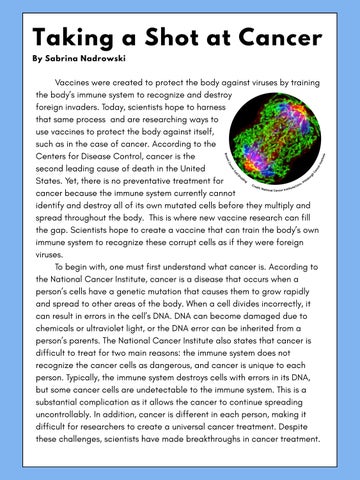
To begin with, one must first understand what cancer is. According to the National Cancer Institute, cancer is a disease that occurs when a person ’ s cells have a genetic mutation that causes them to grow rapidly and spread to other areas of the body. When a cell divides incorrectly, it can result in errors in the cell’s DNA. DNA can become damaged due to chemicals or ultraviolet light, or the DNA error can be inherited from a person ’ s parents. The National Cancer Institute also states that cancer is difficult to treat for two main reasons: the immune system does not recognize the cancer cells as dangerous, and cancer is unique to each person. Typically, the immune system destroys cells with errors in its DNA, but some cancer cells are undetectable to the immune system. This is a substantial complication as it allows the cancer to continue spreading uncontrollably. In addition, cancer is different in each person, making it difficult for researchers to create a universal cancer treatment. Despite these challenges, scientists have made breakthroughs in cancer treatment.

Currently, researchers are creating cancer vaccines. Unlike traditional vaccines that prevent someone from developing a disease, such as smallpox, cancer vaccines are designed to treat someone who already has the disease. For common types of cancers, the American Cancer Society notes that researchers have made vaccines from cells with the same type of cancer or from a person ’ s immune cells. The personalization of the vaccine solves the problem created by the uniqueness of cancer. In addition, the vaccine works by training the immune system to identify cancer cells. This solves the second problem because once the cancer cells are identified, they can be destroyed by the immune system.

Even though these are major breakthroughs in the field, there are still problems with cancer vaccines. An article by Duke Health explains that, in certain individuals, side effects such as chills, fevers, pains, and even organ damage may occur. Additionally, most cancer vaccines are still undergoing clinical trials, and their efficacy is still unproven. Furthermore, the current vaccines are not able to treat cancer on their own and must be combined with other treatments like radiation and chemotherapy.

While more research is needed to prove their safety and efficacy, cancer vaccines are a promising advancement in the treatment of the disease. They can address the two biggest challenges of immune evasion and individual variation, and their side effects are less severe than those caused by traditional treatments. Vaccines may not be able to cure cancer on their own (at least today), but they can help increase the life expectancy and quality of life for cancer patients.

References

American Cancer Society (2025, July 7) Cancer Vaccines and Their Side Effects Www cancer org https://www cancer org/cancer/managing-cancer/treatment-types/immunotherapy/cancer-vaccines html CDC (2025, June 26) Leading Causes of Death Centers for Disease Control and Prevention https://www cdc gov/nchs/fastats/leading-causes-of-death htm Geiger, D (2026) Understanding Cancer Vaccines: What Are They and How Do They Work? Duke Health https://www dukehealth org/blog/understanding-cancer-vaccines-what-are-they-and-how-do-they-work National Cancer Institute (2021, October 11) What Is Cancer? National Cancer Institute; National Institutes of Health https://www cancer gov/about-cancer/understanding/what-is-cancer

Turn static files into dynamic content formats.

Create a flipbook