Changing the Space: Roots of Racism Run Deep
Local students of color address the presence of subtle-bigotry, which is linked to a history of racism reminiscent in modern day society.
WrittenbyEmmaQuintana
PublishedonJanuary30th, 2026

“I know my worth and do not base it off of my skin color or hair texture”
- A Student at Foundation Academy, Florida
Laughter amongst friends is a good thing, yet it becomes different when it's about the color of your skin.
As of the 2020 Census, 42% of Americans are people of color. Although in my experience, many students are regularly minimized by their peers, with their attributes overlooked because they are seen as “just a minority.” I interviewed classmates who fall in that percentage of Americans about specific experiences they’ve faced in our community, and how it affected them (They wished to remain anonymous). My aim is to unveil the unspoken obstacles of my generation’s representation, as well as provide knowledge about the history of these insults and how it is seen in society today.
Classmate #1:
“One experience I had in class was when someone made a joke about me and another student, and he said, “I don’t date that color.” Everyone in the class started laughing, and there were some people agreeing. This made me feel super embarrassed and sad because even my friend was laughing. After that moment, I stopped talking to him. I didn’t want to be in the class anymore because I didn't like anyone there after that. So many people at our school hate on black women, and it's so normalized even though we haven’t done anything There are people who make racist comments and jokes, but I stay friends with them because I don’t want to look dramatic. If they aren’t saying things, then they’re laughing at it even if I’m not laughing with them.”
Classmate #2:
“In class we were reading TheCrucible, and being the type of person I was, I wanted to have a part that would read a lot. So after the teacher gave out the characters, I chose Tituba, the slave from Barbados. I had no problem with it initially because it was doing me no harm. Yet once the students saw that a black person was reading for the slave, the jokes started to roll in. There were comments like “Getting flashbacks,” “Where you belong,” and a whole assortment of whip sounds and attempts at slave songs and hymns. It all threw me off, and for someone that usually doesn’t let things get to me, when a whole
class was just going at it with the racist jokes, it really broke my peace. In the long term, it made me stop engaging in the activities due to me thinking it would just be a recurring problem.”
Classmate #3:
“There have definitely been times where I’ve felt like someone has only seen my race instead of me as an actual person Little things like asking for “the pass” (the excuse to say the n-word) or obnoxious comments on my hair type all make me second guess whether they view me as me or just a black person. At the moment, I tend to brush off comments like these. Most of the jokes are meant to not be taken seriously, and I don’t really take them to heart. I know my worth and do not base it off of my skin color or hair texture. In the long run, I feel comfortable in my own skin. Truly understanding who you are overpowers the shallow comments. Yes, being around someone who constantly makes racial remarks about you is uncomfortable, but I am not in my race alone. If the person does not want to get to know me, that’s honestly fine with me.”
This is the reality for many youths in the Orlando area and nationwide as well. When people are gifted with privilege, it often numbs them from the repercussions of their inexperience According to the National Center for Education Statistics, private schools consist of 65% white students, with 12% being hispanic, 9% black students, and 6% Asian or two or more races as of 2021. This is a very small percentage of a large margin of minorities being represented in classrooms that are fortunate enough to be given a seat there. While the best decision is to represent your culture with pride, the lack of diversity is still evident. Even so, as slurs are being thrown around commonly, perpetrators are setting a clear boundary of superiority and normalizing destructive behaviors by making others too uncomfortable to correct them. Saying jokes and comments seems harmless, but in retrospect its nature is still divisive. The environment becomes separated by races, which echoes the history that our country previously spent years trying to erase.
What is the result of this behavior?
Many of these jokes are targeted at appearance, accent, or culture. Because of this, they tend to feel nonthreatening. When analyzing the core of these teases, it often seems to fall in the category of systemic racism. Systemic racism is the form of racism deeply embedded in unwritten policies or entrenched beliefs that condone or perpetuate unfair treatment of people of color. In simpler terms, it is long established prejudice that is absorbed at home, and organizes the framework of societal norms A comment simply pointing out differences of hair texture, skin, or cultural stereotypes in a derogatory way is evidence of etiquette that is learned or uncorrected, which inevitably places someone else as “less than” or even “nonhuman.”
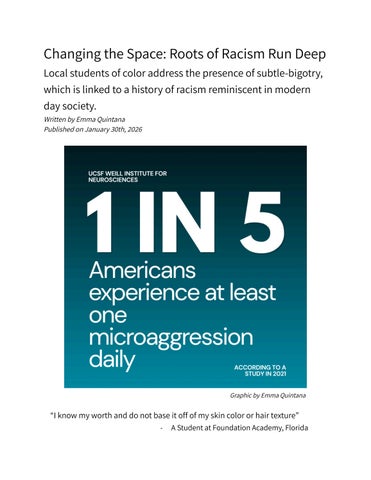
Unfortunately, as children grow up with their acquired beliefs, they take their mindset to adulthood and continue to carry a legacy of animosity. In recent years, there has been evidence of distinct microaggressions in the workplace. The PubMed Central reviewed several studies, finding that the overall prevalence of microaggression in the workplace was 73.6%. Microaggression, defined by nonverbal or unintentional insults, degrades the identity of its victim by marginalized groups. In other words, societal unrest will continue in offices, healthcare, digitally, and in schools as long as this percentage holds true.
How far can racism go?
Recently, with the heavy enforcement of deportation, the Supreme Court has allowed ICE agents to racially profile people using race, ethnicity, language, and occupation. This verdict allows immigration agents to stop anybody they guess might be here illegally, targeting suspects (specifically Latinos) and demanding for their papers. Justice Sonia Sotomayor stated her dissent and warned that this decision risks turning Latinos into second class citizens.
“We should not have to live in a country where the Government can seize anyone who looks Latino, speaks Spanish, and appears to work a low wage job. Rather than stand idly by while our constitutional freedoms are lost, I dissent.”
-Justice Sonia Sotomayor
As of September 2025, this order was not final. Yet as the months have elapsed, this “temporary” decision has not been revoked. While ICE Agents are emboldened to target persons of color, it has influenced anti-immigrant sentiments and blatant Xenophobia (i.e. hatred of people from other cultures) from those who feel more comfortable to speak on it. If this behavior is excused federally, an increase of resentment will overtake the voices of its victims.
Changing the Space
During our nation’s current disputes, the easiest thing to do is hide and observe. While that’s convenient, it is a privilege to be sheltered. When we choose empathy over prejudice, we’re choosing a better future for generations to come, raising the standards of our own identity. Introspective reflection is the only remedy for the external afflictions. Combatting bigotry starts with a voice, an action, and a community. It is not too late to recognize separation in schools and jobs locally. The ability to make change lies in our hands, so let's grab onto one another despite the color that divides us. When we speak up, we speak for the possibility to experience “liberty and justice for all”, paving a better life ahead for every American.