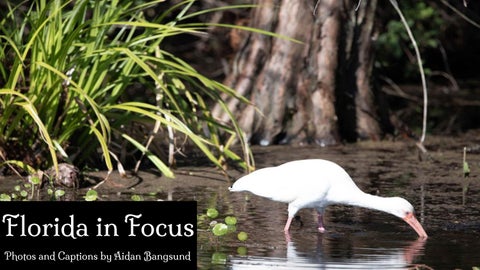
Florida in Focus
Photos and Captions by Aidan
Bangsund

Florida is one of the most biodiverse states in the US. No matter where you turn to: the Keys, the Everglades, Central Florida’s woods and wetlands, or many of the other unique ecosystems, there is bound to be plentiful and divergent wildlife. While on a walk, you may see some of these incredible species native to the Sunshine State

REALLYREALLYROSY:
ARoseate Spoonbill stands in a tree, where they breed and nest in the winter months.
The Roseate Spoonbill is the only spoonbill native to the Western Hemisphere, and can be found in Tampa Bay and other wetland areas in Florida. Roseates are commonly confused with a flamingo due to their pinkish color, however, their spoon shaped bill used for scooping food into their mouth differentiates them from other pink birds.
The winter months when water is lowest are the peak times to see these magnificent birds in Florida, although they can be tricky to come by.

ON THE BOARDWALK:
A Green Heron peeks its head out from the boardwalk as it takes a stroll.
Green Herons are inquisitive, small herons found in wetlands and other heavily vegetated small bodies of water around Florida. These birds can be hard to spot, as they like to hang around the reeds and plants waiting for food to swim by. They can be identified by their pointed beak, fierce eyes, red feet and legs, and the green on top of their heads.
Green Herons can often be found getting close to hikers or interacting with park infrastructure, but they are harmless to humans.

SURFING THE WEB:
A female spider spins her stablementum.
The Black and Yellow Garden Spider, also called a banana spider or a golden orb weaver spider, can be found in wooded areas all around Florida, especially in the late summer months. While these arachnids are known for their bright colors and large bodies, they are harmless to humans and their gardens. A Garden Spider only eats small insects and other materials that fly into their web and can’t get out. These spiders will also eat their own zig-zagged webs, called stablementum, which are a distinct feature of these 8-legged creatures.

ALL SPREAD OUT
: An Anhinga stretches its wings way out to dry them in the sun while calling for a mate.
The Anhinga is a year-round resident ofFlorida’s marshlands and other bodies of water. Anhingas are known to bask in the sun with their wings spread way out. Because of their feathers, these birds are able to swim quickly underwater, often puncturing small fish with their beak before resurfacing, tossing the fish into the air, and swallowing it whole. Anhingas have grown to become quite comfortable around hikers, and may appear that they are posing for photos by spreading their wings.

BRAND NEW NESTERS:
New born baby gators rest together in the swamp.
A pod of baby American Alligators can be spotted in marshlands and wetlands all across Florida from late August to early September. Females incubate 35 eggs on average for 65 days before hatching, but only 4 hatched eggs will grow up to become adults. Babies hatch from their mothers eggs at about 6-8 inches in size. Don’t let the tired eyes and small mouths fool you though, these hatchlings will be around 2 feet long in 10 months. A good rule of thumb when encountering baby gators in Florida is that mama is always close by.

EVERYBODY LOVES DIAMONDS:
A rattlesnake slithers in front of the camera while crossing the path.
Found mainly in the longleaf pine savannas and turkey oak habitats ofFlorida, the Eastern Diamondback Rattlesnake is the heaviest and longest rattlesnake in North America. These multi-talented rattlers are excellent swimmers and camouflagers, using their diamond skin pattern to blend into pine needles on the ground while they wait for prey to wander by. While these snakes will usually coward away from human encounters making them hard to come by, seeing one of these amazing reptiles on a Florida trail puts into perspective how beautiful they really are.

STARE
DOWN: A Brown Pelican shoots a menacing glare while gliding across the water.
The Brown Pelican, known for their brownish feathers and pouched beak, is the smallest of the pelican species. They inhabit beaches, inlets, mangrove islands, estuarine islands, and docks along the Florida Gulf Coast. Brown Pelicans hunt small fish on the surface of the ocean by slamming their heads into the water very quickly. These beautiful birds are very active and can be an amazing animal to watch while on a walk.

IN THE TREES: This Great Blue Heron sits in its nest among the treetops enjoying the breeze.
The Great Blue Heron is one of the largest and tallest of the heron species. It is a year-round resident to Florida’s wetlands, coasts, lakes, banks, marshes, and swamps. It can be identified by its size, grayish blue feathers, and dark blue strip atop its head. It stalks its prey by wading slowly in the water waiting to swiftly strike. This species of heron is a common Florida sighting, but a beautiful one nonetheless.

SAY CHEESE: An American Alligator regulates his body temperature by laying with his mouth open.
If you’re on a walk in Florida, you’re bound to see an Alligator. These large reptiles live in ponds, lakes, glades, creeks, springs, swamps, marshlands, wetlands, inlets, rivers, and pools. Basically, if you touch water in Florida and it’s wet, there is a gator. Alligators are territorial creatures, and can grow up to 13 feet long. Gators are not a threat to hikers who keep their distance, and are just as intriguing when viewed from a safe distance.

PRETTY IN PINK:
This Caribbean Flamingo is grooming itself with its beak.
These social birds are known for their distinct pink color caused by eating shrimp and other crustaceans. Caribbean Flamingos are found all over the Caribbean, Cuba, the Everglades, and are starting to make a return to other wetlands around the state. Although hard to miss, these large birds can be an incredibly rare, yet beautiful sighting when out walking in their habitats.

WISE EYES: A Great Horned Owl on a low branch looking off into the distance.
The Great Horned Owl is found in any open grassland or wooded area in Florida. Part of the common owl group, horned owls live in trees and birdhouses. They can be heard from several hundred feet away and make a low, drawn out “HOO” sound. These storybook owls are silent flyers that prey on small rodents, birds, frogs, and even animals larger than itself. They do not move their eyes in their sockets, and instead turn their heads up to 180 degrees. Although they are primarily nocturnal, they will sometimes perch on low branches or hunt during the day.

SUNTANNING:
APainted Turtle caught in the act of drying itself off on a rock.
The Painted Turtle can be found basking in the sun or swimming in any freshwater area with plenty of vegetation. These omnivorous reptiles eat plants and small fish, and often hang with large groups of other turtles. Painted Turtles are known for their red, green, and bright yellow stripes that appear to be painted across their body. Growing to be about 6-8 inches long, these unique reptiles also make great pets.

SPOTTED IN PLAIN SIGHT:
This osprey catches sight of the camera while sat atop a telephone pole.
The American Osprey is native to North America, and can be found in nearly every habitat in Florida. Ospreys have a wingspan of up to 6 feet, dark brown wings, a white fluffy body, and sharp yellow eyes, making them commonly confused with the Bald Eagle. These birds of prey are professional anglers and incredibly gifted with their talons, and will eat about any small to medium sized fish they can catch. Although being very common to see on a nature walk, these birds are still incredible to capture.