3
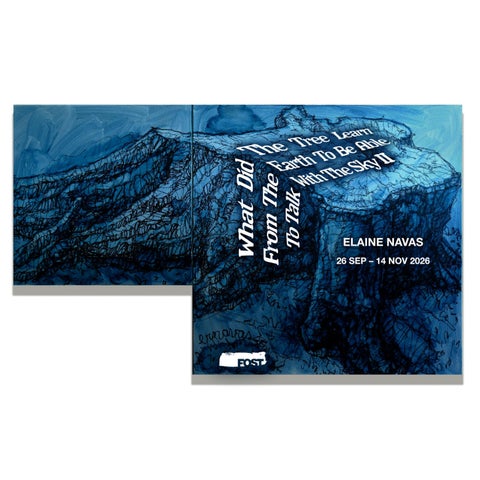
What Did The Tree Learn From The Earth To Be Able To Talk With The Sky II Elaine Navas FOST Gallery, Singapore
2
Exhibition Text
Essay by Cocoy Lumbao Jr.
In 2022, while the world was still reeling from the effects of a global pandemic, Elaine Navas decided to put up a quiet yet inquisitive show in a gallery in Makati, Philippines, bearing the same title: What did the tree learn from the Earth to be able to talk with the sky? It was borrowed from a line written by the Chilean poet, Pablo Neruda, in one of his verses. It struck a chord with Navas, in the same way the uncertainties and precarities brought upon by the pandemic had struck a permanent notion to all those who had lived through it. And through Navas’ own way of coping, she had chosen to meditate on this line from the poem along with the image of trees — to draw them, in one of the most introspective shows she had ever come up with. These drawn paintings, as Navas would like to refer to them when it was first shown, were made by applying oil bars on canvas. They appeared as achromatic portrayals bearing polyptych frames that evoked simplicity and purity — a sincere representation, where instead of being rendered as colorful spectacles, the trees’ forms were presented as tedious sketches, while never losing their gravitas. It was through Navas’s attentive depiction of branches and crowns, marked by grittiness, as well as their seemingly resolute and gnarly trunks, from which we could sense the bond that the artist had forged with these forces of nature while drawing them. This affinity with ‘trees’ that Navas has developed while withstanding a period of great introspection is carried over into this present year. In its second iteration, one could say that the trees are still amassing significant lessons from earth. Most of them had to do with the belligerent teachings of humankind that were sown from new environmental threats, new wars, new artificial intelligence machinery, and new forms of corrupting lands. 3
Nevertheless, these trees continue to serve as a countermeasure to the bleakness of our current state — where we have been exposed to the vulnerabilities of humanity — as well as to its ability to continue and survive. Like trees that are old and worn, sturdy and stubborn, the desire to create and be useful have never left the minds of artists like her. These trees, for Navas, while some have withered and have lapsed, serve as a reminder of our fortitude and self-determination. In the same way that the act of drawing them has provided a new challenge for Navas. She considers drawing as more intimate, more in contact, and more susceptible to a kind of dialogue with the subject. Also inspired by David Hockney’s ideas on drawing as a steady engagement with something as fundamental as a line, particularly in trees, as Hockney states in one of his interviews: “Trees don’t follow the laws of perspectives, or don’t seem to, because they are so complicated, with lines going in so many directions.” This is similar to Navas’ view that drawing poses more difficulty than painting. That is why she has always tried to avoid it as much as she could. But when she is able to do it, she admits that it is also more gratifying. For Navas, a work of drawing is more ‘naked.’ It cannot possess the accouterments of paint for it to easily come to life. And acknowledges that sometimes, through their nakedness, there is value in the discomfort brought about by the process and in presenting oneself as vulnerable. She invited Bernardo Pacquing to be one of her collaborators in this new series of trees, who is mainly responsible for plotting the images’ arrangements in their panels. The models for the trees were taken from different places, ranging from campus parks in Portland, Oregon to gardens near her studio in Singapore. She sends the pictures to Pacquing, who is a celebrated artist himself, to come up with his suggested constructions for the panels and their combinations. One significant piece for the show depicts a large olive tree — sprawled inside one of the gallery rooms in a landscape view connected by horizontal panels. This perhaps best demonstrates the different time from which they were drawn and exhibited. Whilst the earlier version portrayed the resiliency of trees to parallel it with the mindset needed navigating through a global pandemic, the current olive trees redirect our attention to the many forests of their kind across the Palestinian border — uprooted, looted, and even burned as an extension of the acts of violence that men have indulged themselves in within the present war.
5
In this exhibition, it is the ‘life of trees’ that Elaine Navas has turned her attention to — from mere symbols, to actual collaterals resulting from the conflict of men, in different scenarios and on different occasions. For her and through her art, these staples of nature should be looked at with steady contemplation, and their states and contexts should demand our careful attention. Which could lead to the ultimate performance and task by an artist — which had led Elaine Navas to utter these words during her silent meditation of trees, as a form of confession: I’ve been thinking about the act of drawing a lot more lately. The first exhibition was held in Silverlens, Manila, Philippines, 30 June – 30 July 2022.
About the Writer Cocoy Lumbao Jr is a writer, curator, and visual artist based in Manila, Philippines. He has regularly curated shows and written for several galleries’ catalogues and exhibition notes. His artworks, which are primarily in the form of video, have also been shown both locally and abroad. His writings have also appeared in the form of essays in several publications like art magazines, artist’s monographs, journals, and a book on selected contemporary Filipino artists. He was the 2017 Filipino artist-in-residence to Gasworks, London, UK; was a writing fellow for the 18th Ateneo National Writer’s Workshop; and cofounder of Lost Frames, a screening platform for discussing artists’ moving image. He currently teaches at UP College of Fine Arts in Quezon City. 7
Artist Profile
Elaine Roberto Navas’ (b. 1964; Manila, Philippines) works are deeply rooted in the sensuality of surface and material. She employs rich, impastoed strokes to capture texture and form –– a primal engagement with the medium that reveals the brilliant luminance and tactile suppleness of paint. Navas’ portraits and depictions of everyday objects reveal an intimate connection with her subjects that imbue them with a visceral presence, memorialising their banality. Navas completed her BA in Psychology from Ateneo de Manila University in 1985, before taking up a Bachelor of Fine Arts (Painting) from the University of the Philippines College of Fine Arts in 1991. Navas lives and works in Manila, Philippines and Singapore. 9
Elaine Navas Milagro 2026 Oil stick on canvas H227 x W244 x D7.5 cm H89.4 x W96 x D3 in 12
Elaine Navas Abot Langit 2026 Oil stick on canvas H274.5 x W183 x D2.5 cm H108 x W72 x D1 in 14
Elaine Navas Breakdance 2026 Oil stick on canvas H91.5 x W153 x D4 cm H36 x W60.2 x D1.6 in 15
Elaine Navas Tango 2026 Oil stick on canvas H213.5 x W153 x D3.5 cm H84 x W60.2 x D1.4 in 16
18
Elaine Navas Utang na Loob 2026 Oil stick on canvas H244 x W213.5 x D3.5 cm H96 x W84 x D1.4 in 19
Elaine Navas Kasintahan 2026 Oil stick on canvas H213.5 x W381.5 x D3.5 cm H84 x W150.2 x D1.4 in 20
22
24
Elaine Navas Chacha - Chachacha 2026 Oil stick on canvas H122 x W91.5 x D7.5 cm H48 x W36 x D3 in 25
Elaine Navas Susmaryosep! 2026 Oil stick on canvas H122 x W91.5 x D3.5 cm H48 x W36 x D1.4 in 26
Elaine Navas Kembot 2026 Oil stick on canvas H122 x W91.5 x D3.5 cm H48 x W36 x D1.4 in 27
Elaine Navas Pandanggo sa Ilaw 2026 Oil stick on canvas H122 x W91.5 x D3.5 cm H48 x W36 x D1.4 in 28
Elaine Navas Boogie-Woogie 3 2026 Oil stick on canvas H122 x W91.5 x D3.5 cm H48 x W36 x D1.4 in 29
30
32
Elaine Navas What Did The Tree Learn From The Earth To Be Able To Talk To The Sky II 26 September – 14 November 2026 FOST Gallery, Singapore Installation views Lavender Chang
Telephone E-mail Website
FOST Gallery 1 Lock Road #01-02, Gillman Barracks Singapore 108932 65 6694 3080 info@fostgallery.com www.fostgallery.com © FOST Private Limited © All artwork images copyright Elaine Navas © All installation views copyright FOST Gallery ISBN 978-981-18-0521-9
This catalogue is copyright. Apart from any fair dealing for the purposes of private study, research, criticism or review as permitted under the Copyright Act, no part may be reproduced by any process without written permission. Cover: Breakdance | 2026 | Oil stick on canvas | H91.5 x W153 x D4 cm | H36 x W60.2 x D1.6 in