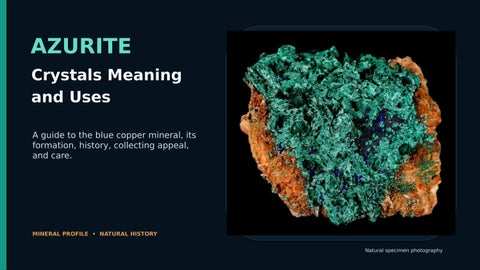
AZURITE Crystals Meaning and Uses A guide to the blue copper mineral, its formation, history, collecting appeal, and care.
MINERAL PROFILE • NATURAL HISTORY Natural specimen photography
What Is Azurite? A copper-bearing mineral recognized for its vivid blue color.
Azurite is a naturally occurring mineral that forms in copper-rich environments. Its rich blue shades and varied textures make it a favorite for mineral collections, educational displays, and decorative specimens.
• Collected for color, crystal form, and geological interest • Found in individual crystals, rounded masses, and rock coatings • Sometimes occurs alongside green malachite
AZURITE • MINERAL PROFILE
02
Meaning, Formula & Color The mineral’s name reflects its most recognizable feature: blue.
CHEMICAL FORMULA
COMMON FORMS
Cu₃(CO₃)₂(OH)₂
• Individual crystals
Azurite is a copper carbonate hydroxide mineral. Its name is linked to a word for blue, fitting its signature azure-to-deepnavy color.
• Crust-like coatings on rock
• Rounded or massive forms • Blue azurite with green malachite
Each specimen varies with the conditions in which it formed. AZURITE • MINERAL PROFILE
03
How Azurite Forms A mineral shaped by copper deposits and near-surface chemistry.
Azurite commonly develops in the oxidized zones of copper deposits. Near Earth’s surface, copper minerals interact with water, carbon dioxide, and other substances, producing new mineral formations. • Often found with malachite • May occur with cuprite and limonite • Its texture and color reflect local formation conditions
AZURITE • MINERAL PROFILE
04
Key Physical Properties Its beauty comes with a need for gentle handling.
COLOR
HARDNESS
COMPOSITION
Bright azure blue to deep navy
About 3.5–4 on the Mohs scale
Copper carbonate hydroxide
Because azurite is relatively soft, crystal surfaces can scratch or chip more easily than those of harder minerals. AZURITE • MINERAL PROFILE
05
Common Uses of Azurite From historical pigment to modern collections and learning.
01 Mineral collections
Collected for deep blue color, crystal form, and natural patterns.
02 Decorative displays
Shown on shelves, desks, or in glass display cabinets.
03 Historical pigments
Ground azurite was used to create blue pigment for artwork.
04 Geological education
Helps explain copper deposits and mineral formation.
05 Jewelry & ornaments
Used in some decorative pieces, though softness limits everyday wear.
AZURITE • MINERAL PROFILE
06
Collector Appeal & Symbolism Specimen quality matters; spiritual meanings are cultural beliefs.
WHAT AFFECTS A SPECIMEN’S VALUE?
MODERN CRYSTAL TRADITIONS
• Color intensity and consistency
Some people associate azurite with wisdom, communication, and selfreflection. These ideas reflect personal or cultural traditions and are not scientifically established effects.
• Crystal quality and formation • Size, condition, and overall appearance
AZURITE • MINERAL PROFILE
07
How to Store & Care for Azurite Protect delicate surfaces and avoid unnecessary exposure to moisture or chemicals.
HANDLE GENTLY
KEEP IT DRY
Avoid drops, pressure, and rubbing crystal surfaces.
Avoid excessive moisture and unsuitable storage conditions.
SKIP HARSH CLEANERS
LIMIT STRONG SUNLIGHT
Do not use strong chemicals or abrasive materials.
Avoid prolonged exposure to intense direct sunlight.
DISPLAY SECURELY
Use a stable stand or case to prevent falls.
Dust carefully with a soft brush. Keep azurite away from harder minerals that could scratch it.
AZURITE • MINERAL PROFILE
08
Important Safety Notes Keep mineral specimens for display and study—not for consumption.
Azurite contains copper. Do not use it to prepare drinking water or crystalinfused water, because mineral material may enter water that is swallowed. Keep specimens away from children and pets who might put them in their mouths. Care needs can vary with the specimen’s condition and mineral mix.
AZURITE • MINERAL PROFILE
09
EXPLORE THE NATURAL WORLD
A small specimen. A deep geological story. Azurite brings together vivid color, mineral chemistry, geological history, and collecting appeal. Learning how it forms and how to care for it helps preserve its natural character.
Discover fossils and minerals at
www.fossilageminerals.com FOSSIL AGE MINERALS • AUTHENTIC SPECIMENS & NATURAL HISTORY 10