Sound
A Champion for All Gaited Horses
Volume 8, Issue 4, 2025
Sound Advocate
Friends of Sound Horses, Inc. 6614 Clayton Rd. #105 St. Louis, MO 63117 info@fosh.info * www.fosh.info
Board of Directors
President - Teresa Bippen Missouri Tbippen1957@yahoo.com
Secretary/Treasurer-Gina Vehige Director at Large-Bill Coon VP IJA Program-Dianne Little Missouri Utah Alberta, Canada gvehige115@gmail.com wbotis@gmail.com ddlittle@telus.net
VP Programs/Gaited Sport Horse Director at Large-Anita Dunham VP HIO/DQP-Lisa Harris Dianne Little Missouri Tennessee Alberta, Canada dunhamanita@gmail.com ddlittle@telus.net
Executive Advisory Committee
Keith Dane Patti Potts Pauline Stotsenberg Hawaii Missouri California pottspa@gmail.com ps@yesteryearfarms.net
Editor Stephanie J. Ruff Florida editor@fosh.info
FOSH Mission Statement
To promote all “sound,” naturally gaited horses, with a specific emphasis on Tennessee Walking Horses. (In this context, sound means not “sored”.)
Importance is placed on education in regards to the humane care for the emotional, mental and physical wellbeing, training, and treatment of all gaited horses.
FOSH will only support flat shod or barefoot horses and will never endorse any event that uses stacks and/or chains as action devices, or any mechanical, chemical, or artificial means to modify the natural gaits of the horse.
To these ends, FOSH focuses on three areas for gaited horses:
1) educating people about sound horse training principles;
2) supporting sound shows, events and activities;
3) working to end soring.
FOSH is a 501(c) (3) non-profit organization. All donations are tax deductible to the extent permitted by law. Your donation to support the FOSH mission is needed to advance the goals set forth by FOSH in conjunction with its formal mission statement.
Publication Guidelines
The Sound Advocate is a digital magazine published quarterly by Friends of Sound Horses, Inc. Reproduction of any article is prohibited without the express written permission of FOSH.
FOSH accepts unsolicited submissions, but reserves the right to edit any and all submissions for content, style and space constraints. FOSH further reserves the right to refuse advertising for any reason.
At no time shall the publisher’s liability exceed the total cost of the revenue from advertising in the issue involved in any dispute.
All show suspensions and show results are printed as they are received from the reporting agencies. FOSH does not guarantee their accuracy.
FOSH does not endorse the content of any advertisement in this publication, nor does it warrant the accuracy of any advertisement.
Readers are urged and cautioned to use due diligence and to thoroughly research, including asking for references, before following through with any transaction.
FOSH does not endorse any trainer, educator, clinician, style of natural training, tack, or horse equipment to the exclusion or preference of any other. Each horse is an individual and may respond differently to particular methods.
Articles published by FOSH reflect the views and opinions of the writers and do not reflect, necessarily, those of FOSH.
Publication Information
Subscribers: The Sound Advocate is a benefit of membership. To ensure that you receive your issues, be sure that your e-mail address is current. To change an e-mail address, contact gvehige115@ gmail.com.
Submission of Articles, Calendar Dates, News and Photos: Send to tbippen1957@yahoo.com. Photos may not be embedded in text and must be submitted as jpeg format, minimum of 300 dpi. The deadline for each issue is the 15th of the preceding month when the issue is to be released. Submissions will not be accepted after the deadline, but may be carried over to another issue. Submissions will not be returned to the submitter.
Member’s Advertising Rates
Back Cover $300
Inside Front Cover $275
Inside Back Cover $275
Full page $125
Half page $75
Quarter page $60
Business Card $25
Directory $25
Discounts for Multiple Issues
2 issues - 10% off total fee
4 issues - 20% off total fee
6 issues - 30% off total fee
Ads will be accepted in pdf, tif or jpeg formats. Text and photos must be e-mailed separately by the 10th of the month when the issue is released. Photos must be 300 dpi. Camera-ready ads are emailed at 300 dpi. Materials should be emailed to editor@ fosh.info.
All advertisements must be paid in advance by check, money order, or credit card. Payments should be made out to FOSH and mailed to:
6614 Clayton Rd. #105 St. Louis, MO 63117
More FOSH information can be found online. Find us at www.fosh.info.
Like us on Facebook.

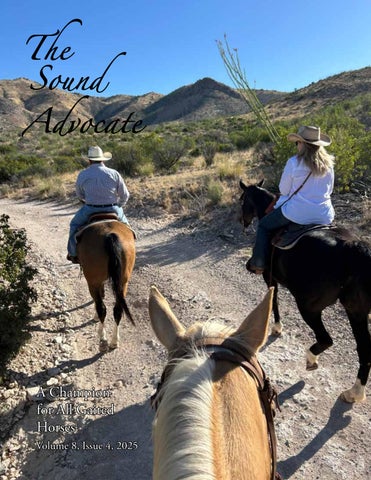
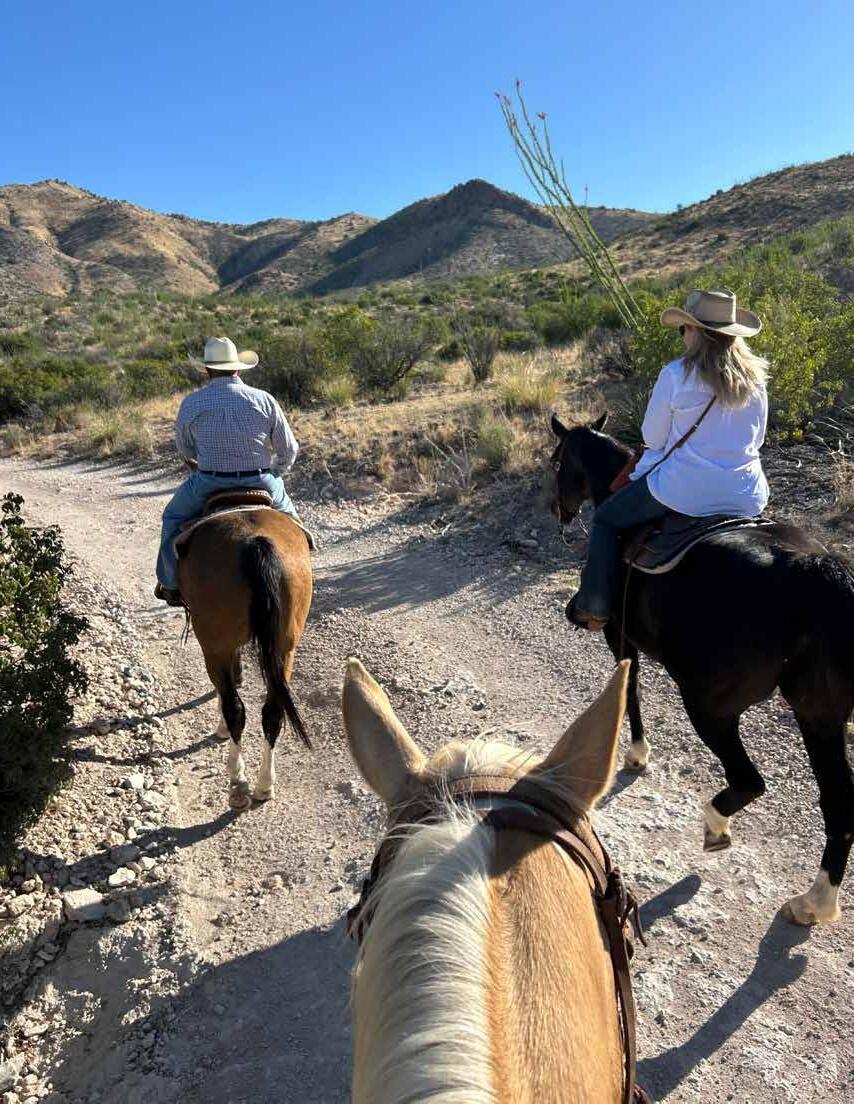
On the cover: Dragoon China Camp Trail in southeast Arizona. China Camp rides are given by Regi Richter Basinger and Tyler Basinger. Photo credit Regi Richter Basinger.
TABLE OF CONTENTS
From the President...
Dear FOSH Friends and Supporters,
I hope this finds you well and looking forward to 2026 and all it has to offer. All of us at FOSH were saddened to learn of the passing of FOSH founder, Cherie Beatty in December. Cherie’s heroic and independent streak is how FOSH came about – to fight soring and provide a show ring for Tennessee Walking Horses who competed naturally and soundly. With Cherie’s efforts, opinions about Tennessee Walking Horses were universally changed. Before FOSH, TWHs were viewed by many as freaky moving, show ring monstrosities. Cherie’s work at building a sound horse show ring shouted to the world that TWHs are beautiful, graceful, talented, smooth equines that can excel! What a wonderful future Cherie created for thousands of Tennessee Walking Horses that were no longer sentenced to the big lick
torture. We will cover more on Cherie in our next issue.
As I think back over FOSH history, I am aware of how much our equine world has changed since joining. Twenty years ago, we looked forward to growing the number of FOSH sound shows, and we eventually reached over 40 shows annually with regional and national championships. Today, horse owners are not as interested in showing and several large horse show circuits closed such as Pony Express and the Missouri Horse Show Association. I recall our attempts to schedule shows that would not overlap on the weekends which was difficult as venues became increasingly expensive and exhibitors chased points in one or two circuits. Exhibitors today like to be individually judged which is why I continue to be excited about Working Equitation. What a wonderful discipline for knowing your horse and learning his strengths. Gina Vehige recently attended a clinic in Missouri, and you can read all about it and decide if it is your cup of tea.
With most of us enduring cold weather, I appreciate Wendy Murdoch’s article on the importance of warming up as our muscles become creaky with age. Thank you, Wendy, for reminding me that I am not alone as my muscles rebel when I climb into the saddle.
Happy riding, and wear your helmet!
From the Editor...
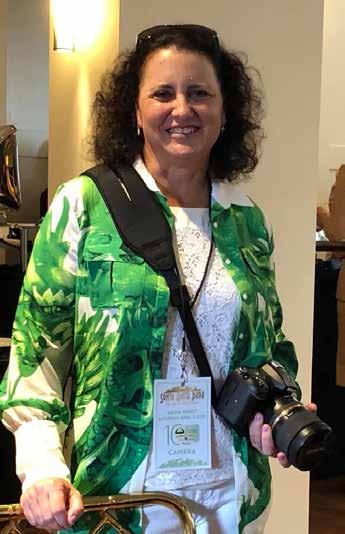
Hello FOSH Friends.
Here we are wrapping up another year. They say time goes faster as you age, and I think they are right! I’ve been helping with The Sound Advocate for about six years now. It really doesn’t feel like it’s been that long! I mostly work with Teresa Bippen, Dianne Little and Gina Vehige— all fantastic ladies who are so dedicated to the flat-shod gaited horses.
This issue debuts a new writer for The Sound Advocate, but not a new writer for me. I met Janet de Aceve-
do Macdonald through the American Horse Publications, and she was a regular contributer to Arabian Horse Life, the magazine I managed at the Arabian Horse Association. Janet has a wonderful writing style and tells a good story. In this issue she talks about winter trail riding opportunities in Arizona. She will be contributing an article to each issue next year. This is a great addition to the magazine, and I hope you enjoy reading her contributions as much as I do.
Also in this issue is another nutrition article from our friend “Jim the Feed Guy” along with general information about equine herpesvirus (EHV). The gaited industry has been spared exposure to the most recent outbreak of EHV-1 in Texas, but an outbreak can happen any time, anywhere. It is best to be informed and vigilant about this and other transmittable diseases. Signing up for alerts from the Equine Disease Communication Center is a great way to do that.
I know it’s winter and brutally cold for many people who read this. They’re heading into January and February with gray and snow. But I live in Florida, and winter is the best season of the year. No humidity, no bugs, just sunshine and warm temps. I love winter now. Stay safe, be well, and here’s to a great 2026.
Stephanie Stephanie J. Ruff Editor, editor@fosh.info


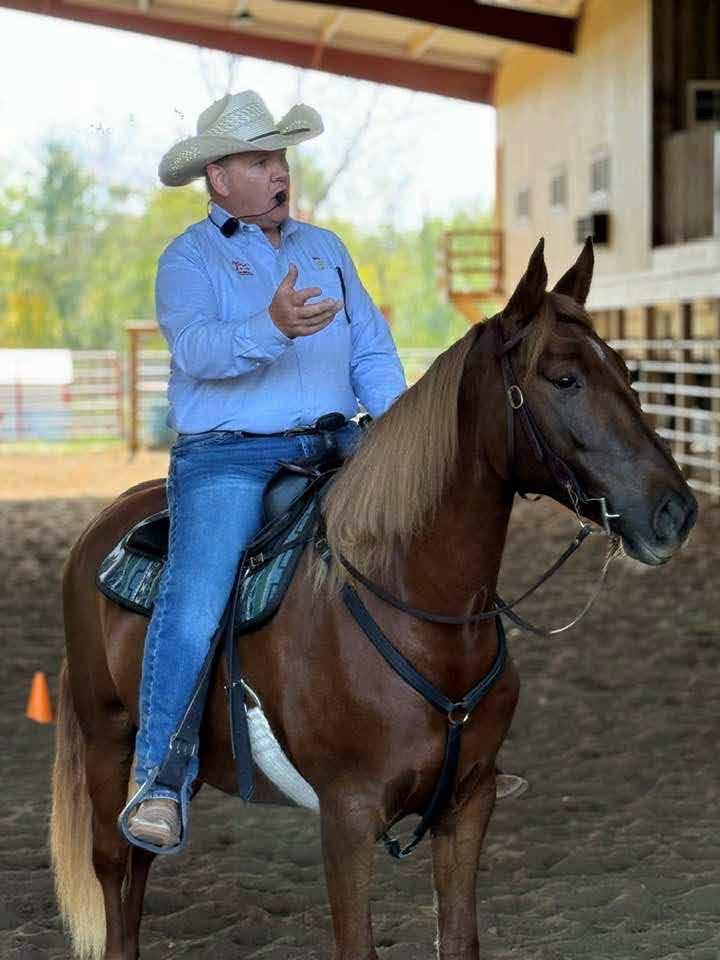
Working Equitation Clinic Brings Growing Enthusiam to Missouri
Photos by Caitlin O’Toole
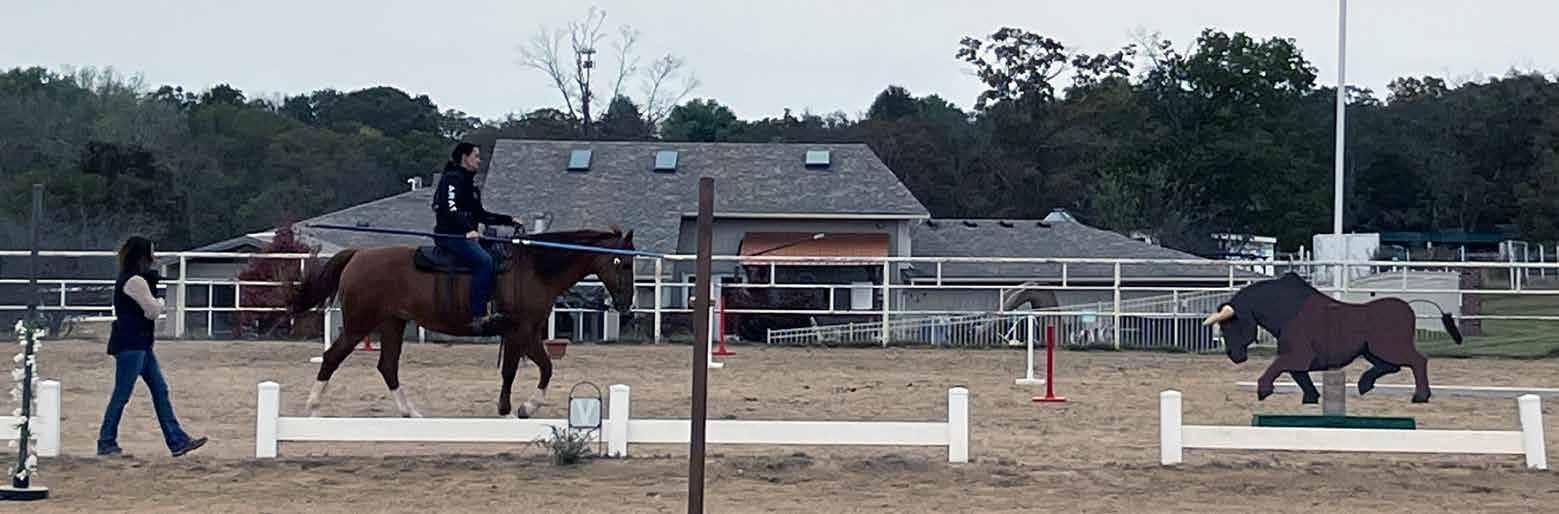
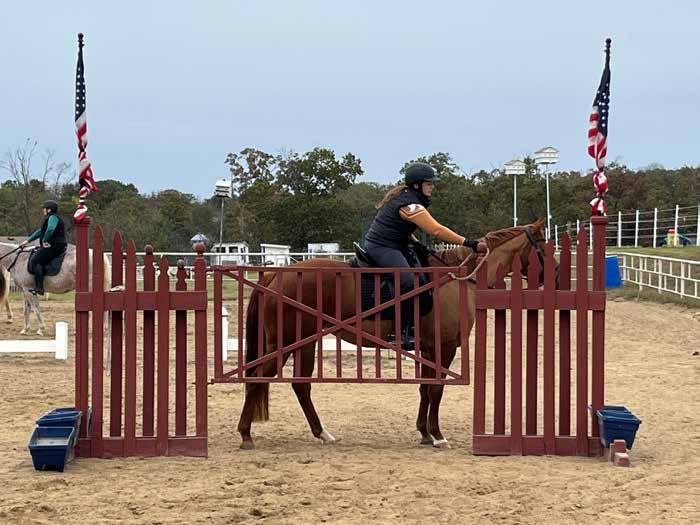
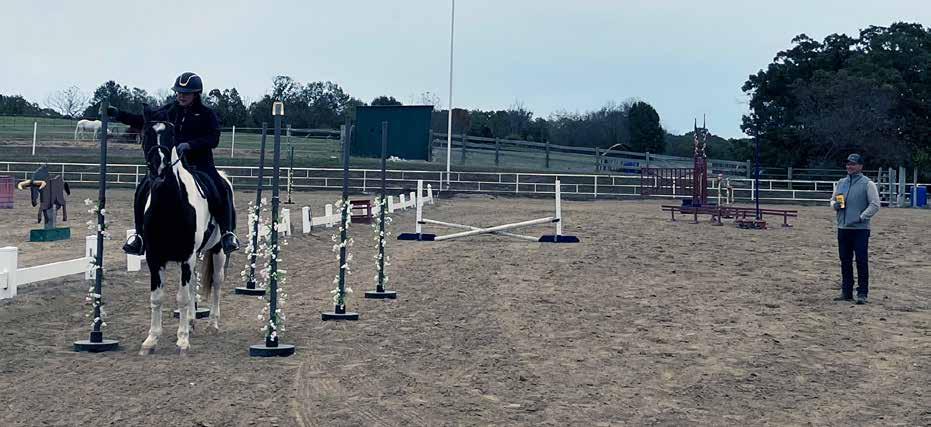
On October 25–26, 2025, Rockin’ Horse Ranch in St. Clair, Missouri, hosted a Working Equitation (WE) clinic led by Erica and Howard Peet, offering riders and auditors an in-depth look at this increasingly popular equestrian sport. Despite some challenging, damp weather outdoors, the clinic was a success thanks to excellent indoor footing, engaged participants, and a strong sense of momentum for the discipline in the region.
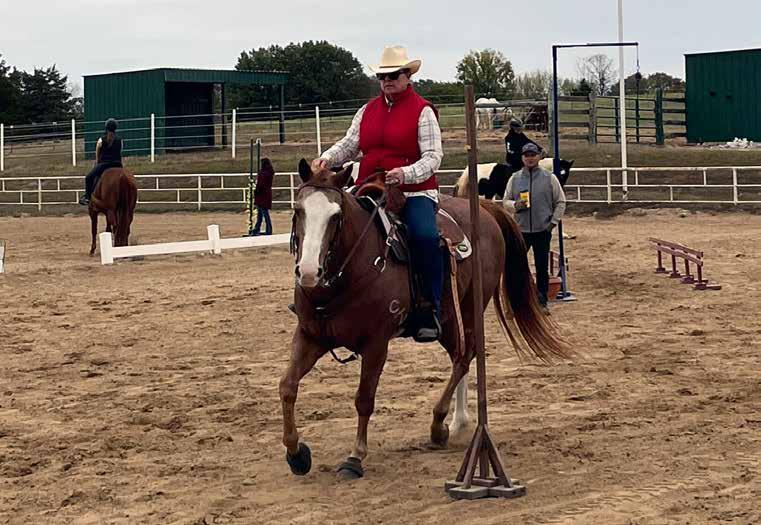
Attendance reflected that growing interest. The clinic welcomed 14 riders and eight auditors—an increase of roughly 40 percent over last year’s event. Adding to the diversity of the group, three riders participated with gaited horses, underscoring Working Equitation’s inclusivity across breeds and riding backgrounds.
Erica Peet, a USAWE-rated judge, and Howard Peet guided participants through a comprehensive overview of the sport. The weekend began
with a discussion of Working Equitation’s history and purpose, giving riders context for how tradition, practicality, and horsemanship come together in modern competition.
From there, the focus shifted to two of the sport’s core phases. During the Ease of Handling portion, riders navigated obstacles appropriate to their experience level, receiving individualized critiques and feedback from Erica and Howard. The Dressage phase followed, with riders
performing tests suited to their level and again benefiting from thoughtful, constructive evaluation. Throughout the clinic, the emphasis remained on correct basics, clear communication, and building confidence for both horse and rider.
Sunday’s lunch was generously sponsored by FOSH, and the attendees appreciated a brief presentation by Gina Vehige (FOSH’s treasurer), who provided an informative overview of the organization and its mis-
sion. The sponsorship added a welcome sense of community and support to the weekend.
Looking ahead, organizers are enthusiastic about the future of Working Equitation in the area. Plans are underway to establish a local WE chapter or club, with winter and spring “play dates” already being discussed to allow riders to practice obstacles in a relaxed, social setting. One, and possibly two, additional clinics are planned for next year, and with continued participation, the group hopes to eventually host a schooling show.
As interest continues to build, organizers emphasize that growth will be driven by participation. The more riders who get involved, the more opportunities there will be to expand events, education, and competition in the region—making this clinic not just a successful weekend, but a meaningful step forward for Working Equitation locally.
Pamela Gibson (left) on the Arabian KK Al Mudtaji and Leahe Daby (right) and Lucy leaving Robinson Flat at 36 miles.

Courtesy Equine Disease Communication Center (EDCC)
Equine herpesvirus (EHV) is a family of equine viruses named by numbers including EHV-1, 2, 3, 4 and 5 with EHV-1,3,4 posing the most risk for domestic horses. EHV is a common DNA virus that occurs in horse populations worldwide. The two most common species are EHV-1 and EHV-4.
EHV-1 and EHV-4 most often cause a respiratory disease which is usually mild and self-limiting, and both can cause abortion. EHV-1 and EHV-4 (very rare) can cause the neurologic form of the disease (equine herpesvirus myeloencephalopathy (EHM)) which creates damage to the spinal cord and can be fatal. EHV-3 causes coital exanthema, a venereal disease which affects the external genitalia. Horses can be carriers of EHV with no clinical signs and can spread the disease to other horses. Testing and quarantining affected horses in isolation is the primary way to control the disease. Vaccines are available but do not completely prevent any form of the disease.
Clinical
EHV-1:
Signs
• Fever
• Nasal discharge
What is Equine Herpesvirus?
• Lethargy/Depression
• Neonatal death
• Late-term abortion
• Neurologic disease
EHV-4:
• Fever
• Nasal discharge
• Lethargy
• Neonatal death
• Late-term abortion
• Rarely neurologic disease
Diagnosis: EHV-1 and EHV-4 are diagnosed through PCR testing by nasal swab, buffy coat sample (centrifuged blood), virus isolation from blood, or a significant increase in antibody titer in serum samples collected 2-3 weeks apart.
Treatment: Supportive care and rest are the chief treatments. Non-steroidal anti-inflammatory medications, such as phenylbutazone (Bute) or flunixin meglumine (Banamine) are used to control fever, pain, and inflammation. In some cases, antivirals and heparin are used.
Prevention: Vaccinations are available to help prevent the respiratory and abortive form of EHV-1 and EHV-4; there is currently no vaccine labeled for the prevention of the neurologic form of EHV-1 (EHM). The best method of protection is always
to maintain current vaccinations on all horses on your property and to follow correct biosecurity protocol when bringing new horses onto your premises or when travelling with your horse.
Biosecurity: EHV is spread via aerosol particles from nasal discharge or from contaminated surfaces including people, clothing, feed and water, implements, and stalls; isolation is critical to preventing spread of the virus. Proper biosecurity measures include extensive disinfection of surfaces and equipment that come in contact with affected horses.
USEF Webinar on EHV-1 and Biosecurity: In light of the recent EHV-1 outbreak, horse owners have a lot of questions about biosecurity, EHV-1, and USEF biosecurity policies. Dr. Katie Flynn, USEF senior staff and EDCC veterinarian, and Dr. Sally Anne DeNotta, board-certified internal medicine specialist and member of the clinical faculty at University of Florida, were on hand to answer member questions on these crucial topics.
This webinar was recorded Dec. 1, 2025. It can be found here: https:// youtu.be/ObB8Zp7kOjM.
Cadence in Arizona’s Sky Islands: Winter Riding with Gaited Horses in Cochise County
Winter in Southern Arizona is riding season at its finest. The morning air carries a crisp edge, but by midday the sun warms the foothills into a tapestry of gold grasses, grey-green oaks, and endless blue sky. Hooves strike a steady rhythm on rocky soil, the smooth cadence of a gaited horse carrying you comfortably across miles of trail. As riders move through these high desert trails, they’re not just tracing hoofprints— they’re crossing into stories etched into the land itself.
Legends in the Land of Cochise
In Cochise County, Arizona’s southeastern edge, the Huachuca Mountains rise to the south and the Chiricahuas to the east—ranges that seem to float above the desert like islands in a sea. This is a land where history and landscape are inseparable. Named for the Chiricahua Apache leader Cochise, the county carries his legacy in both name and spirit. The county was carved from Pima County, home to Tucson, in 1881 and quickly became a stage for frontier drama. Tombstone was first established as a silver mining town in the late 1870s, before it became famous for its gunslingers, the infamous Gunfight at the O.K. Corral, and other frontier conflicts.
Threading through it all is the historic Arizona Highway 80, once known as the “Broadway of America.” Beginning in Benson at Interstate 10, the highway carried travelers southeasterly through Tombstone, Bisbee, and Douglas, linking Cochise County’s mining camps and frontier towns to the broader world, echoing the same paths of migration, commerce, and adventure that shaped the American West.
From the saddle, each horizon promises discovery: quail darting across the path, deer slipping through the brush, and hawks circling high above. Every stride feels like a passage through shifting worlds, where horse and rider move in harmony with landscapes that change as quickly as the light.
The Sky Islands
Southern Arizona’s Sky Islands are mountain ranges that rise abruptly from desert basins, creating a vertical journey through multiple habitats. In a single ride, you can pass from desert scrub into oak woodlands and pine forests, each layer offering its own rhythm and surprises. The Huachucas, Chiricahuas, and other ranges form an ecological crossroads where the Sonoran and
By Janet de Acevedo Macdonald
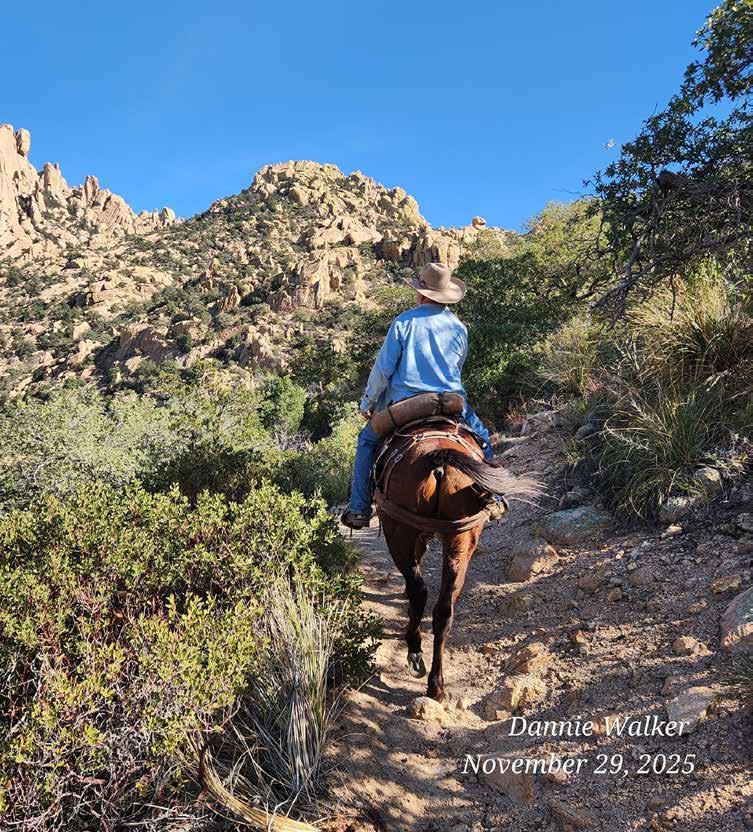
Climbing up the trail on the Chiricahua Monument Ride.
Chihuahuan deserts meet the Rocky Mountains and Sierra Madre, making this one of the most biodiverse regions in North America.
Winter is the season when these trails truly shine. The air is not only crisp and clear but also free of bugs that might bother the horse or rider. The snakes most people associate with Arizona are tucked away in hibernation, and nothing allergenic is floating around to irritate eyes or lungs. Instead, riders breathe easy, enjoying the cool clarity of the season and focusing on the rhythm of the ride.
Why Gaited Horses Shine Here
For those who ride gaited horses, the Sky Islands feel like they were made for them. Long climbs, rocky descents, and endless grassland stretches become a showcase for what these horses do best. Their natural four-beat gaits don’t just smooth the ride—they turn miles into moments, each stride a reminder of why we fell in love with them in the first place.
Owners know the joy of settling into that rhythm: the way a horse’s sure-footed confidence carries you up a switchback, or how their stamina makes a full day in the saddle feel like a gift instead of a test. Out here, every trail is an invitation to let them shine—whether it’s the steady climb into oak woodlands or the sweeping glide across open country.
There’s a kind of poetry in watching
a gaited horse adapt to the land. They don’t just move through it; they belong to it. Riders feel that partnership in every stride—the relaxed posture, the easy breath, the sense that horse and rider are perfectly matched to the terrain. In the Sky Islands, our horses aren’t simply companions; they are the reason the ride becomes unforgettable.
Sierra Vista
The U.S. Army founded Fort Huachuca in 1877 to protect settlers and serve as a base during the Apache Wars. Its presence became the cornerstone of Sierra Vista’s growth, providing jobs, commerce, and stability in the population. “Sierra Vista” means Mountain View in Spanish, chosen to reflect the panoramic backdrop of the beautiful Huachuca Mountains.
Today, Sierra Vista is recognized as the “Hummingbird Capital of Arizona” because up to 15 species can be observed across the year—more than anywhere else in the U.S. The
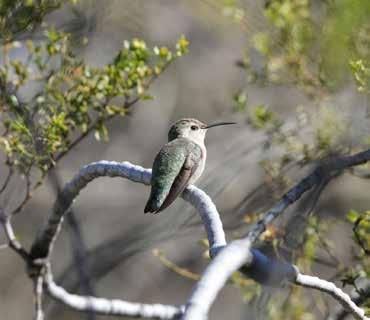
winter visitors won’t be able to see the whole migration spectacle (which peaks in late summer), but they will encounter resident species that thrive thanks to the mild climate and reliable food sources— Anna’s Hummingbird and other resident hummingbirds remain active and visible, offering flashes of color against the crisp desert landscape.
Brown Canyon Trail
Roughly eight miles south of the city of Sierra Vista, a turn onto Ramsey Canyon Road will bring you to the entrance of Brown Canyon Ranch, a historic site tucked against the Huachuca foothills. Its weathered adobe walls and windmill stand as reminders of the area’s ranching past. From here, riders can access a network of trails, including the Brown Canyon Trail and the Brown Canyon Loop, both of which are horse-friendly.
The ride begins in rolling grasslands, where winter light paints the blades gold, and the air feels sharp but clean. Riders strike a steady rhythm as the trail winds into oak, manzanita, and alligator juniper, climbing toward the canyon’s upper reaches.
Formally listed as Brown Canyon Ranch Trail #115, the trail map shows options to explore a spur to the historic Pomona Mine, or a longer loop that connects to neighboring Ramsey Canyon. Elevation shifts add variety: the canyon’s open floor is at 5,585 feet, with the turnaround point for circling back down around 6,255 feet. The footing changes from
grassland to rocky singletrack, demanding sure-footed horses and attentive riders. The trail crest overlook stretches for miles, with views of the Dragoon Mountains’ west-facing cliffs, the Chiricahua spires to the east, and Whetstone and Galiuro Mountain ranges faintly seen off in the distance.
Brown Canyon Ranch Trail offers day-use amenities, such as picnic areas and trail access, but does not provide overnight horse camping facilities. Riders looking to extend their stay will find private options searching online resources such as Hipcamp listings and small campgrounds that cater to horse owners with amenities such as corrals and feed storage.
One popular Hipcamp mention is the Cold Bore Ranch near the Chiricahua National Monument, with RV hookups and horse facilities. Owners Jeff and Lona Jean are also Rocky Mountain Horse enthusiasts, well-versed in what Cochise County has to offer to anyone who wants to enjoy flatshod rides in its foothills.
The U.S. Forest Service is always a good resource for learning what’s available for horseback riding throughout the country. It lists five horseback riding trails and three horse camping locations in the greater Sierra Vista area.
Chiricahua National Monument
Known as the “Wonderland of Rocks,” Chiricahua National Monument
The Annas Hummingbird in Sierra Vista. Photo credit Anish Lakkapragada.
offers riders an unforgettable journey through surreal rhyolite pinnacles and forested canyons. From the saddle, the views are panoramic—stone spires rising like sentinels, shadows deepening in narrow canyons, and sudden overlooks that stop riders in their tracks.
The ride begins near Faraway Ranch, a historic homestead where trailers can be parked at the designated horse area. Saddling up here feels like stepping into history, with the ranch’s weathered buildings offering a glimpse of early frontier life. Trails carry horses into oak woodlands and pine forests, where wildlife adds its own surprises: white-nosed coatis moving in curious bands, mule deer slipping through the brush, and a chorus of birds thriving in this ecological crossroads.
While Chiricahua does not allow
overnight horse camping within its boundaries, riders have several nearby options:
• Coronado National Forest—the closest designated equestrian camping area, with access to forest trails.
• Playa Dispersed Campsite (BLM) – free camping with ample trailer space, though no corrals or facilities.
• Fort Bowie Horse Camp—about 30 miles away, offering daily, weekly, and monthly rates for extended stays.
These options make it easy to plan a weekend or longer adventure, combining day rides in the Chiricahuas with overnight stays in the surrounding Sky Islands.
Riding in the Tombstone Area
Tombstone may be best known for its frontier legends, but for horsemen and women, it’s also a gateway to unforgettable rides. Here, the ride is more than scenery—it’s a living connection to the frontier spirit, where every hoofbeat echoes the legends of Tombstone.
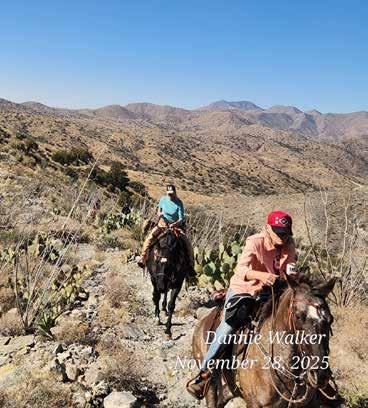
From Tombstone, guided rides venture into the Dragoon Mountains, where granite domes and hidden canyons tell stories of Apache There are options for all levels of trail riding in Arizona.
strongholds and pioneer camps. One highlight is China Camp, a historic site tucked deep in the Dragoons, where riders can pause to imagine the lives of miners and settlers who once carved out an existence in this rugged terrain.
Adding to that sense of living history, husband-and-wife team Tyler Basinger (a Certified Journeyman Farrier) and Regi Richter Basinger offer private guided experiences that blend trail riding with rich storytelling about Tombstone’s past. Their base at The German Barn, just an eight-minute drive from downtown, provides limited dry camping facilities—perfect for riders who want to stay close to their horses while immersing themselves in the lore of Cochise County.
More Hooves, More History, More Cochise
From Brown Canyon’s historic ranch to the rhyolite spires of Chiricahua and the storied streets of Tombstone, Arizona’s Cochise County offers riders a tapestry of landscapes and legends. Yet these trails are only the beginning—there are far too many more places to ride, stories to uncover, and sights to take in than one article can hold.
To keep exploring the county’s rich history, diverse trails, and endless adventures, visit ExploreCochise.com to enrich this trip, and let your next journey begin. Whether you ride for rhythm or for story, Cochise County offers both—woven into every trail.
Just outside town, Tombstone Livery Stable and RV Park welcomes travelers with RV hookups and horse accommodations, making it a convenient base for exploring the region. Saddling up here means you’re riding in the shadow of history, with the O.K. Corral only a short drive away.
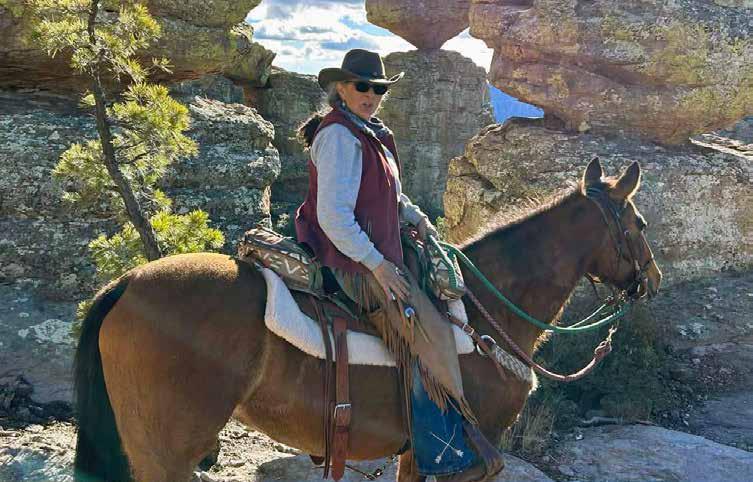
Riding at the Chiricahua National Monument. Photo courtesy Dannie Walker.
Take it from an owner of very easy keepers…there is nothing easy about them! I would much rather try to put weight on a horse than keep it off.
Basic nutrition is the easy part, just add the appropriate amount of ration balancer to their diet and that box is checked.
The real problem is forage since forage should comprise the overwhelming bulk of the equine diet it is the primary source of calories.
The solution sounds simple enough, limit their forage, limit their calories. Unfortunately, it is not always that simple because limiting forage can create problems.
Large gaps in their chewing time can cause stomach ulcers while the lack of available forage creates food anxiety and aggressive behavior. Hangry horses can be really scary!!
Full-Time Forage for Fatties!
In order to understand the theory behind each of the strategies we must first look at what our ultimate goal is for the process.
Forage is very important in a horse’s diet. Forage is what a horse evolved to thrive on so it should make up the majority of his diet.
Feeding Your Easy Keeper
Easy peasy, buy a big hay feeder, plunk it in the pasture, fill it with lovely hay and forget about it, the horses are satisfied and healthy. Oh, if only it were that simple.
The very first solution owners look to is to restrict the amount of hay for their easy keepers. There’s one big problem with this is that all horses benefit from a full-time supply of forage. Keeping the conveyor belt filled with fiber and the system producing saliva to buffer stomach acids are key components for a healthy horse.
The real goal we should be shooting
By Jim Fiorini, aka “Jim the Feed Guy”
for is to CONTROL the CALORIC intake of our easy keepers. Meaning we don’t necessarily want to restrict hay consumption but more so CALORIE consumption.
Here are some ideas to consider.
Find Low Calorie Hay
Without a hay analysis it is difficult to say how much digestible energy is in a particular hay, but if we go by the averages we can assume the following statements to be true most of the time.
Grass hay will have fewer calories
than legume hay like alfalfa. Clover is also a legume so if you have grass hay with a large amount of clover it will have higher calories.
Mature first cutting grass hay will have fewer calories than earlier first cutting or second and third cuttings.
When hay shopping for easy keepers look for the last first cutting you can find. Around my area I typically look for hay mowed during the first two weeks of July. It is easy to spot. If you are trying to decide if it is hay or straw you are on the right track Slow the Rate of Consumption
Sometimes just feeding low calorie hay will be enough to maintain a healthy weight on your horses. Other times you will still need to control the rate of consumption to help maintain a healthy weight.
Slow Feed Systems
There are many different slow feed systems for hay available. Some of them slow the rate for a bulk hay feeder or round bales while others are simple nets to stuff with some hay and hang in a convenient spot.
Pick your favorite system that will meet the needs of your horses as well as your schedule and put it to use.
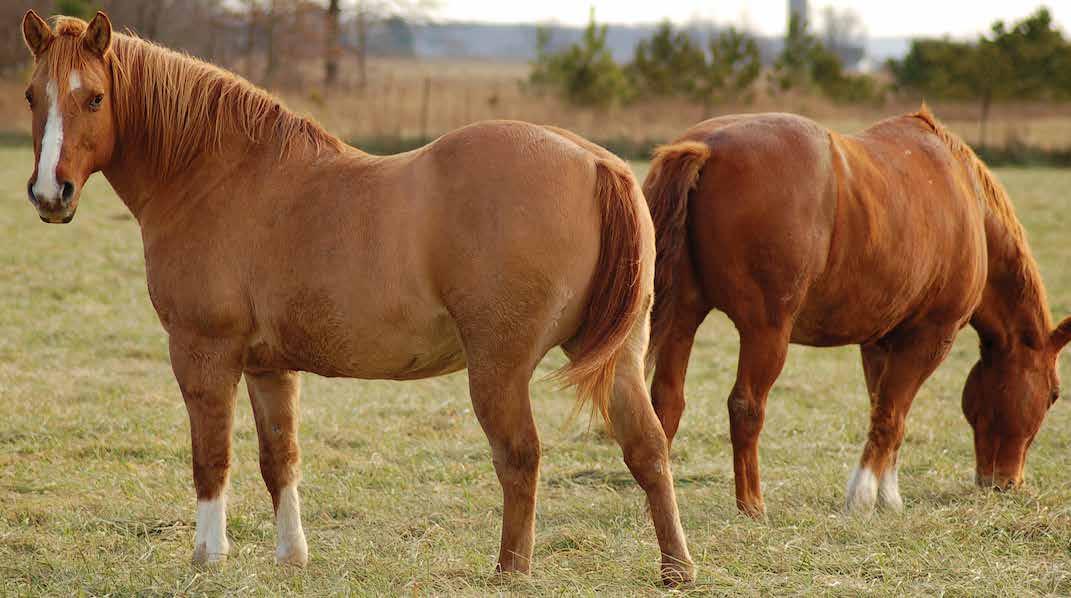
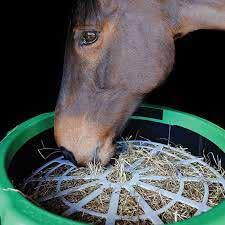
Easy keepers need calorie restriction more than hay restriction. Photo credit: Photo by MelissaAnneGalleries/istockphoto.com
Feed “Busy Hay”
You can also use the hay itself as a slow feed system.
If you are buying mature first cutting grass hay, not only will it be low in calories but it will also contain a considerable amount of heavy stalks that are almost straw.
We call this “busy hay” because a horse will have to negotiate around the heavier stalks to find the softer leaves. Many nutritionists caution against the use of “busy hay” because overall it has low digestibility and can cause gastric issues and even colic.
When fed properly “busy hay” is an easy solution to use alone or along with other slow feed systems. The proper method of feeding “busy hay” is to simply feed much more of it than softer more palatable hay.
“Busy hay” is the only type of hay
I feed to my easy keepers, and I feed about 25% more than I would of a better hay. For example, if my 1,000-pound horse should have 18 pounds of hay daily I will feed around 20 to 25 pounds. This ensures that the horses will be able to find sufficient palatable hay to meet their dietary needs.
When feeding this type of hay in their stalls I make up for the “waste” by using the stalkier material as bedding since it is virtually straw.
Soaking Hay
Soaking hay for thirty minutes in cold water and pouring off the water will drop the calories in the hay by 15% to 20%.
Soaking hay is a time killer, messy, heavy and in the winter ranges from inconvenient to virtually impossible. I only suggest soaking hay when dealing with a severe case of obesity or a horse that is experiencing metabolic laminitis.
Feeding Intervals
If you have the luxury of setting your own barn schedule you can offer hay at various intervals. While it is best for horses to have full time access to hay, having a gap of two or three hours is not the end of time.
dedicated owner that you will set an alarm for 2:00 a.m. to feed hay you will need to come up with a strategy or compromise for overnight hay.
Strategy is the Key
Because all horses and situations are individuals the typical hay feeding solution is a combination of some or all these methods to reduce calories.
Let’s start with the most challenging of all situations.
Mixed Herds
Feeding all easy keepers or all hard keepers is simple. It’s when we put them all together that trouble starts.
In a perfect world we could have a field for easy keepers and a field for the rest of the herd but keeping horses is never perfect. There’s always one or two that refuse to cooperate. Laurel must be with Hardy otherwise it’s bedlam.
The only way to work this out is that at some point for some length of time the horses must be separated for an extended period like turn in.
During turn out the easy keepers will have access to full time hay but during turn in they will be restricted by a slow feed bag.
Turn In is Your Friend
Turn in can make a big difference when managing weight in an easy keeper because slow feed systems are most effective when we can keep an individual horse away from access to the free choice hay of the rest of the herd.
In my case my mares will gain weight over the winter since I am quite liberal with access to free choice hay to help keep them warm and occupied. Come springtime they are already a bit on the heavy side and will really start to gain as the weather eases.
The other challenge I have is probably shared by most owners and that is the “hay bully”. If hay is limited my sorrel will keep her pasture mate
If you are feeding busy hay and your target for your horse is 30 pounds you can do the math and spread that out over the course of the day.
Of course, unless you are such a
Another option is to use slow feed systems for everyone to accommodate the easy keepers and provide additional concentrated feed or forage replacement to the hard keepers when they are turned in.

Slow feeders will help stretch out a horse’s feeding time. Photo courtesy Haygain.
from the hay and eat both shares. This mare also wants nothing to do with heat and bugs so fairly early in the season she will decide that her stall is the best place to be anyway.
Beginning in early May she and her BFF are locked in their stalls and the sorrel gets about 4 pounds of hay in a slow feed bag with very small openings at 6 AM. At about 1 PM she gets another 4 pounds. Of course at night she has free access to hay.
Since most owners do not have the luxury of a flexible schedule or they are boarding I would stuff a slow feed bag with about 8 pounds and toss an additional flake of free choice on the floor.
My Example
I currently feed three easy keepers and a thoroughbred, and I use a combination of the methods listed above.
The thoroughbred would easily maintain weight if she had access to good, high calorie forage. Since she is outnumbered by the Quarter Horses, she is on the diet hay, and I supplement her with five pounds of concentrated feed daily.
As I mentioned earlier, I shop for late season first cutting grass hay for my herd. It is the busiest of busy hay as most goats would turn their noses up at it. The hay is clean and weed free, but there are quite a bit of thick stalks in it.
During the cooler weather I will feed about 30 pounds for each horse during a 24-hour period. I will space this out at 5 pounds at 6:00 a.m., 5 pounds at 12:00 p.m. and 20 pounds at 6:00 p.m. They will usually finish their 6:00 a.m. hay by about 10:00 a.m. so they have a two-hour window with no hay but they will pick at the stalky stuff and whatever nubs they find around the pasture.
My herd has access to their stalls as they choose so I also hang a slow feed bag stuffed full which averages about 8 pounds of hay. The small holes coupled with the coarse hay means that they have to work for it.
If they run out of hay during the day and are feeling hungry they can go into their stall and pick at the hay in the slow feeder. Overnight I top up their feed bags.
Get Creative
The key to forage strategies for weight management is to be creative when combining feeding methods. I have offered an idea or two based on my experience but there are many variables and many situations so there are many possible solutions.
Unfortunately there is almost never a perfect solution so just do what you can to work with your particular “easy” keeper!
Learn more about Jim the Feed Guy and schedule a personal consulation at jimthefeedguy.com.

Murdoch Minute
No. 81: Reach for your horse’s tail
By Wendy Murdoch
in one hand. Reach back with your other hand and see how far down your horse’s flank you can go without leaving the saddle. If you have a mare (or any sensitive horse) you want to make sure she is not ticklish about her flanks! Do not brace against your stirrups. If your horse is quiet enough you can drop them to ensure that you are not pushing.
horse’s body for exercise and helps to avoid injuries. Not only will this exercise help to warm you up it will also improve your symmetry and flexibility and always remember to enjoy the ride!
Is it cold where you live? Do you feel stiff when you mount up? Have you been sitting at a desk or driving your car for hours before riding? Are you still wound up from your day? Before you ask your horse to move it would be a good idea to consider spending a few minutes warming up your body in preparation for your ride. Here’s a simple exercise to get you going.
Next time you ride notice if it is difficult for you to get your leg across the saddle. Are your shoulders tight? Do you feel stiff in your hips? Riding when you are stiff will have a direct effect on your horse’s ability to move and runs the risk of injury for both of you. It is important for you to be limber enough for him to respond correctly so take a few moments to warm up. This will benefit both your and your horse. Warming up is important for many reasons. When you are cold your blood concentrates toward the middle of your body leaving the extremities, your fingers and toes. A few minutes of warm up increases blood flow to your tissues. This makes the muscles more pliable, increases the amount of oxygen reaching
your muscles and at the same time prepares you mentally for your ride. In addition it improves coordination and reaction time meaning that you will be able to respond to your horse much more quickly than when you are cold.
In the winter months a good grooming begins the process. I take my horse for a brisk walk on a loose rein around the outside of the hill field before heading to the arena. This allows him to warm up at his own pace. The increase blood circulation warms his muscles, and the ligament/tendon/fascial system, which has very little blood supply. This system becomes pliable from the body heat generated. Once the ligament/ tendon/fascial system is warm it is like a stretchy elastic system. If you ask your horse to work hard before this is warm you take the risk of tearing and damage because this system is stiff an unpliable when cold. Even in warm climates warming up is important but takes less time.
To warm you up and improve your pliability in the saddle start with your horse standing still, both reins
How far toward your horse’s stifle can you go easily? Come up and repeat the motion several times without straining, as this will only increase the tension in your body. Where do you have to let go in order to reach further? What is happening in your ribs, neck, shoulder and hips? If you are careful not to force this movement you may find that by repeating it a few times you will go further with less effort. Reach toward your horse’s hip joint and return. Repeat several times. Again pay attention to any holding or tension you may discover as you do this movement. You can make a series of rays each time by returning to the starting position and changing the angle slightly going from the flank to your horse’s dock. Repeat with the other hand and find out if it is harder or easier on this side. Once you have the idea you can also practice this exercise at the walk and trot.
Use this Murdoch Minute as a reminder that it is important to warm up before your ride. It is equally important to cool down afterward. The warm up prepares you and your
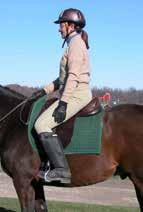
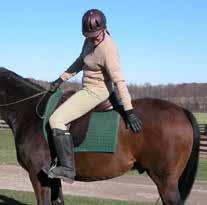
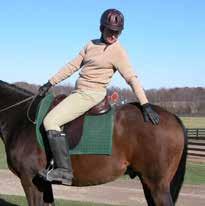
Photo 1 (top): The rider starts at the halt with both reins in one hand.
Photo 2 (middle): She reaches toward your horse’s flank and stifle. Be careful if you have a sensitive mare.
Photo 3 (bottom): The rider is reaching back toward the horse’s hip joint. Notice she is looking toward her hand and her foot is quietly resting in the stirrup.
Horizon Structures Presents: Time Saving Techniques for the Busy Barn Owner
Time is a precious commodity for the busy horse owner and mastering time management is key to building a successful business. Any shortcuts implemented in the completion of daily chores need to be ‘smartcuts’. Here are a few techniques that horse barn owners can utilize to make best use of their time when running an equine facility.
Think Production Line Tasks such as grain and hay feeding, tack cleaning and mucking out can be set up in production line fashion to save time. Here are some examples, and some are obvious but surprisingly often overlooked.
Organize the feed room with a wide table that has ample space to place grain buckets in a line and supplements or additives behind them. Label buckets with each horse’s name and if you have a long aisleway with 10-20 horses each side set them up in order of ‘go’ based on their location Label supplements by horse name if an individual only supplement or ‘all’ if the supplement is for everyone.
If you buy feed buckets with the lid option it will save accidents of spillage and allow stacking of feeders for distribution on a wheelbarrow or
UTV. With the high price of grain and supplements it is always upsetting when the ‘apple cart’ becomes inadvertently upset.
If you use haynets or slow feeders consider buying extra and doubling or even tripling the number up. This allows you to prefill each haynet and have a ‘ready to go’ supply for those early mornings when you have to get to work or late evenings when you arrive home late. Ideally prefilling haynets will also allow an option for 2 people to set about it together which saves much time as one person can stuff the hay in while the other person holds the net.
If you use pasture feeders, opt for equine hay feeders that are easy to open and close and have good access for filling, clean out and are reachable to remove string/twine/ netting. For safety be certain to buy a hay feeder specifically designed for horse use, not a cattle or regular livestock feeder. Here is a helpful article on how to make the right selection.
Barn design greatly influences efficiency and front stall walls with pullout hay and grain feeders saves time stepping in and out of stalls and retrieving mangers. These features in
a barn also offer a kid-friendly environment for extra help from smaller hands.
A tack cleaning production line for the semi-annual deep clean is an efficient way to manage care for expensive riding gear. Line up the wash/soap/oil/dry cloths etc. and disassemble each bridle or item before passing each piece along the line and finally reassemble. The daily wipe down at the end of every use
By Nikki Alvin-Smith
for each piece of tack, particularly the bit, should be implemented to minimize the need for deep cleaning. Investment in laundry machines at the barn is almost a necessity if you run a performance horse training facility or large lesson barn. Saddle pads should be washed daily (as should leg wraps), to prevent skin conditions occurring in the horse due to dirt and sweat accumulation on the equipment.
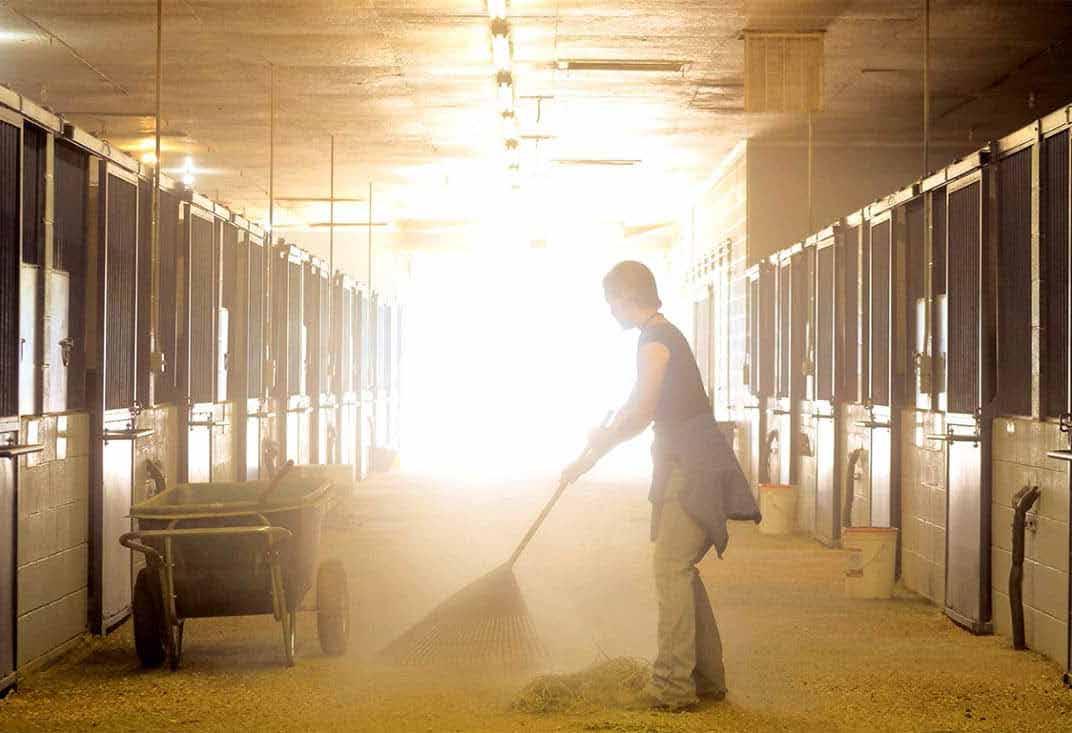
Having the right equipment on site to complete tasks saves time carrying and sorting stuff to the house. And that extends to having a bathroom in the barn. Repeat trips to and from the house by staff and visitors usually causes extra housework and costs time. A barn will likely have hot water for a horse bathing stall, so why not also extend that line to incorporating a shower in the barn bathroom as well as a washing machine and dryer.
Where You Site What Matters
Where the barn is sited in relation to pastures and turnout or training arenas makes a huge difference in how much to and fro will be needed to complete regular daily tasks. For example: An indoor arena built adjacent to the horse barn will alleviate the need for snow plowing between the two spaces in winter if the equestrian facility is located in colder climes.
Similarly consider where to site the supply of hay and bedding. While keeping flammable products out of the barn as much as possible can be a good idea, heavy supplies like dry forage and bedding stored far away from the barn or at a higher level such as in a loft space will require extra time to transport. Storing hay and bedding in a loft can also involve extra effort to store up high in the first place.
Drop down hatches above stalls can aid in reducing workload for hay distribution for barn owners that use
loft storage. Consider purchasing an electric hay conveyor if your hay supplier doesn’t bring one to save time stocking hay in the loft, but be aware a hay conveyor is not useful for bales of bedding as the teeth on the belt designed to hook the hay will puncture paper or plastic bags of shavings etc.
The installation of automated drinking water supply systems for horses when they are stabled and when they are out at pasture will eliminate a lot of bucket carrying and tank-filling. Frost-free faucets set inside the barn rather than outside can also save the horse caregiver time and effort.
Even where you choose to stable specific horses can save time and effort. With a long aisleway or shedrow barn at a facility where mucking out is done with a muck bucket or wheelbarrow, consider putting the largest and messiest horse residents at the end of the barn where the distance required to travel the manure is less.
Auto-Fill Supply Cycles
While auto-fill services for feed supplies and horse supplements etc. can be useful for replenishing supplies be careful not to waste money by over-ordering. Not all companies notify you before refill and even if they do these reminders are easy to overlook in the glut of spam and email An option to help manage supplies and the associated expenses is to operate an inventory system. See
below in the notes on managing administrative tasks for more details.
Go Pony Club On It
For my fellow pony clubbers you probably remember that everything you took with you to attend a Pony Club event had to be clearly labelled with your name and that of your horse. If you attended boarding school it was the same story minus the horse tack and equipment. All your clothing had to have your name sewn in for laundry sorting. Tag. Tag. Tag. It was a lot of sewing as I recall. Poor Mom.
As a busy barn owner you probably spend an undue amount of time sorting through which blanket is which. And not just by horse’s name but also by blanket weight. When you are switching between a medium or heavy weight blanket due to temperamental weather changes it can be difficult to read washed out product labels that identify the fill.
In a large equestrian facility the quantity of not just blankets, sheets, coolers and saddle pads but also halter, bridles, boots, saddles etc. is massive. Much time can be saved by adding a tag or label to each item. If it is a multi-horse use item, such as bell boots, it can be helpful to organize them in baskets by size and pair them up after each use to save sorting through looking for that somehow always missing 2nd partner. Horse boots seem to have a similar propensity for disappearing as Tupperware lids and socks in the laundry.
Switching blankets and taking care of our human perceived horse needs when it comes to adding to the horse’s own winter coat and natural protection is always a topic up for a hearty discussion among horse owners. But if the horse is not clipped, not in heavy work and not truly at performance during winter months then going without can actually save much time.
If you opt for keeping a horse through cold winters with his own fluffy coat for warmth and not utilizing blankets it can save a lot of time (and money). With plenty of high quality hay available and some form of shelter from truly monsoon conditions or nor’easters horses are in general perfectly content.
For horse owners who live and work in warmer climates, the protection of the horse (and themselves) from bugs and hot summer sun rays makes headlines when it comes to time management. Frequent bathing of horses being bad for their skin and coats and the annoyance and associated medical issues that can occur with flying biting insects and the like offer a different set of time management challenges.
In this case time management extends to riding or training during the cooler early morning hours of the day and figuring out airflow and methods to cool the horses or keep them comfortable during humid and/ or hot conditions.
The marketplace is full of cooling products including sheets and leg wear for the equid, as well as fly sprays and protective potions for the horse to alleviate discomfort. Horses do get used to their climate and conditions but again shelter from the sun and a stress-free space for the horse to relax during his downtime is essential. As most horse owners can already attest, horses use run-in sheds more in summer than in winter.
Horse owners can offer a communal equine shelter with multiple sides to shelter from the sun at all times of day. This communal living can cut down a significant amount of individual stall time needed and save time (and expense) with needs for mucking out chores though the paddocks will still need some form of manure management.
Think Safety Not Numbers
Tempting as it may be to lead horses two by two or three by three, or worse drag them along behind an ATV/UTV or tractor with a long ropes connected to halters, or even worse lead horses with each horse tied to its compatriot traveler. Don’t!
When things go wrong, and they inevitably will at some point, the mayhem and possible injuries that can result to horse and/or human can be significant.
If you do have an established group of horses that you prefer to turn out in a herd setting all at once and the
pasture is a long way from the barn, it is safer to fence out a wide track (8-10′ minimum) that can act as a chute that horses can use to make their own way back and forth. If this method is adopted for turnout, then be certain to gate each end to avoid unexpected returns or escapes to and from the pasture.
Again good barn design can help minimize the time and effort involved in turnout chores. Exterior wall Dutch doors that open to a run or small paddock offer an in/out option in all weathers for the horse and can save handling time. This arrangement is also a cornerstone of horse-friendly lifestyle.
The Inevitable Admin
While going completely paperless may not be your style the use of online services and software available specifically designed for the horse industry can significantly lessen the time spent at the desk or on the phone/tablet.
A good software program that is user-friendly and can be set up with or without help of an accountant or other business savvy person can streamline tasks like managing the medical timeline for vaccinations, deworming and health checks as well as show entries, collecting boarding revenues, booking lesson schedules and marketing programs. Interactive modules built into your website where clients can book a lesson or securely make a payment
are useful tools that can save both time and ease stress.
Managing time effectively by using software may require an initial set up period for rosters, accounting programs etc. but ultimately can save both time and money. It’s no good saving time if you are not also saving money. So beware of buying subscription programs that require ongoing expenses for use unless you are certain they fulfil a need that will benefit the business and that will actually be regularly utilized for productivity.
Security and Supervision
Keeping a weather eye on everything going on at a horse facility takes time. Between walking fence lines to look for damage; horses wellness checks; supervision of staff and student activities; and receiving barn visitors or taking in deliveries much time can be spent on oversight. Installation of a video/camera system can save time and worry. When cameras are placed in optimal viewing locations and the right sort of equipment is employed, it is simple to see what is going on where with a simple tap on your smartphone screen. Motion sensor lighting and driveway alarms can also be installed to alert barn owners of the arrival or presence of persons/vehicles or wildlife on the property.
These technologies can save barn owners a lot of time looking out the window wondering whether the vet or hay delivery folks have arrived
and offer peace of mind as to who or what is where, doing what, and when.
Regularly Review Horse Facility Needs
As time passes and business progresses, the needs of the horse facility may change.
The bigger the equestrian facility grows the more need there will be for motorized equipment to complete the heavy lifting workload of manure removal and management of supplies. Plus the tack room may become cluttered and in need of an overhaul or security needs may have increased due to neighborhood development. Paddock gates may need replacement or repair as they are hard to lock or close or perhaps stall doors are sticking and the barn needs a renovation.
While some tasks may take more manpower hours than others where possible the implementation of useful equipment can be a huge time saver for many. Take for example the time-consuming aisle barn sweep or leaf-blower exercise that mostly moves contaminants exactly where we as performance riders don’t want it for our horses’ respiratory well-being – into the air. Instead invest in a barn vacuum. It can clean the floor effectively in minutes and doesn’t simply move dust and detritus from one place to another.
It is a good idea to regularly review the needs of the horse facility and
take a hard look at the daily task list and see if there are ways to improve efficiency and safety.
Time as they say is money. And most barn owners would rather be spending time with the horses training or teaching investing their talents in their beloved horses and bringing their equids to reach their full potential than sitting at a desk, answering emails or walking about casting an eagle eye on all and sundry on the property.
As a barn owner it pays to take a
good look at how time is spent every day and figure out protocols and routines to minimize the hours required to complete them. Even doing a bit of extra horse housekeeping every day that is outside of the usual regime are all good ways to stay on top of the horse barn ownership business. Use these tips to help make more time to ride!
For additional information about Horizon Structures or their product line, please visit their website at horizonstructures.com.
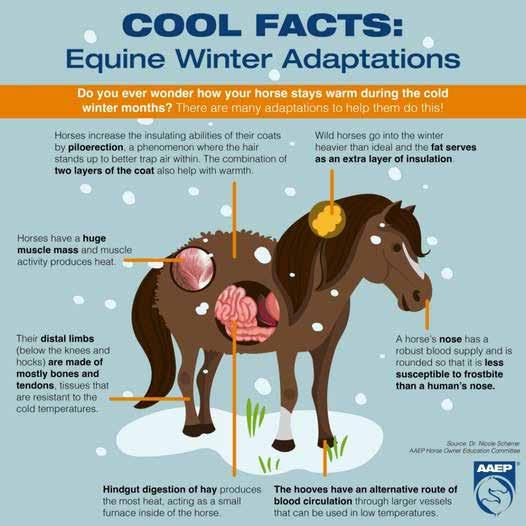




FOSH Lifetime Members
Jo Anne Behling, Wauwatosa, WI
Esther L. Bell, TN
Pamela Brand, Carlisle, PA
Sarah Bushong-Weeks, Denver. CO
Julie Church, Pagosa Springs, CO
Mary & William Church, Pagosa Springs, CO
Luella DeBono, Eden Prairie, MN
Beverly Foster, St. Augustine, FL
Nancy Gillespie, Pullman, WA
Cristine Holt, Dubuque, IA
Jane Howlett, Pocatello, ID
Marjorie Lacy & Walking Horse News, Edson, Alberta
Sue De Laurentis, Dripping Springs, TX
Bobbie Jo Lieberman
Dianne Little, Calgary, Alberta
Debbie Locke, Mack, CO
Ann Loveless, Ashtabula, OH
Patricia Mayer, East Aurora, NY
Janelle T. McCoy, Prague, OK
Frank Neal, Nashville, TN
Lori Northrup, Ellicottville, NY
Anne Northrup, Ellicottville, NY
Shellie Pacovsky, Bainville, MT
Denise Parsons
Anita Rau, Catlett, VA
Debbie Rash, Chino, CA
Southern Comfort Gaited Horse Club, ID
Bucky & Nancy Sparks, Cortez, CO
Marcy Wadington, Canon City, CO
Leslie Weiler, Pagosa Springs, CO
Laura Wyant, Chesire, OR
An Anonymous Donor
Yankee Walkers of New England
Soring
Soring
“Without the chains, there would be no need for a scar rule.”
“Without the chains, there would be no need for a scar rule.”
– humane acTivisT,
may 2011.
– humane acTivisT, may, 2011.
ho W t o d ete ct
ho W t o d ete ct
d a ta s h eet
• Palpation
• Palpation
“That
Chemical Soring
Chemical Soring
W h at i s s oring ?
W h at i s s oring ?
Soring is deliberately inducing pain to exaggerate a gaited horse’s movement for the show ring. A variety of devious and cruel methods have been devised over the years. Soring violations also include many methods used to avoid detection. Soring is against Federal law and is subject to fines and penalties if detected at a public show or sale.
Soring is deliberately inducing pain to exaggerate a gaited horse’s movement for the show ring. A variety of devious and cruel methods have been devised over the years. Soring violations also include many methods used to avoid detection. Soring is against Federal law and is subject to fines and penalties if detected at a public show or sale.
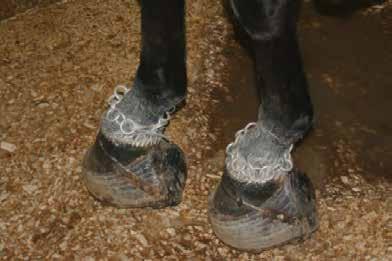
Chemical soring is the application of painful, caustic liquids to tenderize the horse’s pastern area (ankle), so the repeated strike of a chain is painful and causes the horse to snatch his foot higher with each step. The chain, a crucial part of this show horse style, is termed an “action device,” and the exaggerated gaits cannot be created without this chain.
ho W i t ’ s d one
ho W i t ’ s d one
ho W t o d etect
ho W t o d etect
Observations:
Observations:
• Horse lies down in stall and groans in pain.
• Horse lies down in stall and groans in pain.
• Horse is crampy and unwilling to move.
• Horse is crampy and unwilling to move.
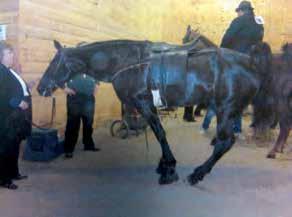
“That just looks wrong.”
Chemical soring is the application of painful, caustic liquids to tenderize the horse’s pastern area (ankle), so the repeated strike of a chain is painful and causes the horse to snatch his foot higher with each step. The chain, a crucial part of this show horse style, is termed an “action device,” and the exaggerated gaits cannot be created without this chain.
• Gas chromotography or “sniffer”
• Gas chromotography or “sniffer”
• Thermography
• Thermography
10-year-olD boy while waTching viDeo of a “big lick” horse shown in sTacks anD chains, June 10, 2011.
• Blood or saliva tests
just looks wrong.” 10-year-olD boy while waTching viDeo of a “big lick” horse shown in sTacks anD chains June 10, 2011.
• Blood or saliva tests
• Drug-detection trained dog
• Drug-detection trained dog
• Horse warms up into motion with a “praying mantis stance,” with abnormal weight thrown on his hind quarters to avoid front end pain.
• Horse warms up into motion with a “praying mantis stance,” with abnormal weight thrown on his hind quarters to avoid front end pain.
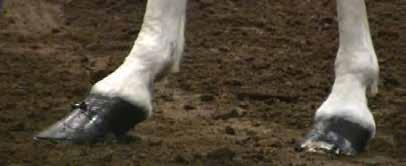
• Horse stands in classic “standing in a bucket” pose to alleviate pain in front legs (photo above).
• Horse stands in classic “standing in a bucket” pose to alleviate pain in front legs (photo above).
• kerosene
• kerosene
• diesel
• diesel
• croton oil
• croton oil
• GoJo hand cleaner
• GoJo hand cleaner
• WD40 oil
• WD40 oil
• mustard oil
• mustard oil
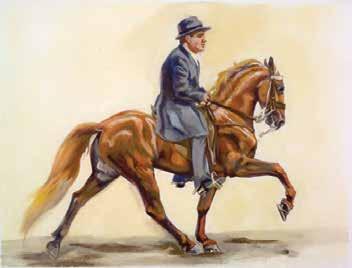
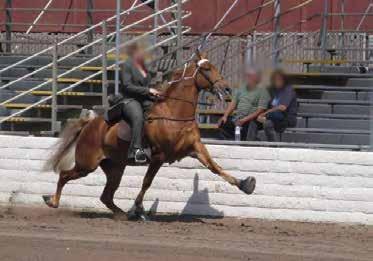
Soring includes the abuse of chains, foreign substances and chemicals, illegal shoeing to change the natural hoof angles, length of toe, weighted shoes, pressure shoeing, as well as the insertion of blocks and other devices between the hoof and the shoe stack to place pressure on the frog and sole of the foot to create pain in the front end of the horse. These methods all cause the horse to attempt to avoid the pain by picking up his front feet faster and higher, and shifting his weight back onto his hocks. Slang for an obviously sore-going horse is “going too deep.”
Soring includes the abuse of chains, foreign substances and chemicals, illegal shoeing to change the natural hoof angles, length of toe, weighted shoes, pressure shoeing, as well as the insertion of blocks and other devices between the hoof and the shoe stack to place pressure on the frog and sole of the foot to create pain in the front end of the horse. These methods all cause the horse to attempt to avoid the pain by picking up his front feet faster and higher, and shifting his weight back onto his hocks. Slang for an obviously sore-going horse is “going too deep.”
With the increased scrutiny of soring-related scars, another cruel practice is used to remove the telltale scarring. The horse’s legs are covered in a chemical stripping agent, which burns off old scar tissue through a very painful process.
Wh Y is t h is a b use d o ne?
• Visual inspections for:
Wh Y is t h is a b use d o ne?
• Visual inspections for:
Soring is practiced to get gaited horses to artificially enhance their step to win in shows. A winning image is rewarded with ribbons, cash, recognition, future breedings and training fees.
Soring is practiced to get gaited horses to artificially enhance their step to win in shows. A winning image is rewarded with ribbons, cash, recognition, future breedings and training fees.
en F o
– scarring and inflammation, signs of soring insults.
– scarring and inflammation, signs of soring insults.
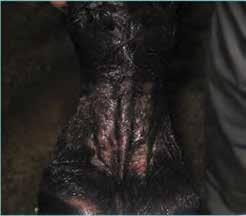
– wavy, rippled, curly hair on the front legs, an indicator of repeated chemical soring with leg wraps.
– wavy, rippled, curly hair on the front legs, an indicator of repeated chemical soring with leg wraps.
en F o rcement
rcement
t o e nd s oring
t o e nd s oring
Chemicals are applied to the horse’s lower legs, then the leg is wrapped in plastic for days. This causes the chemicals to “cook” into the flesh. This creates highly sensitized front pasterns that are painful when the chain strikes with every step. Examples of soring chemicals used:
Chemicals are applied to the horse’s lower legs, then the leg is wrapped in plastic for days. This causes the chemicals to “cook” into the flesh. This creates highly sensitized front pasterns that are painful when the chain strikes with every step. Examples of soring chemicals used:
There is a federal law called the Horse Protection Act, which prohibits soring at shows and sales, enforced by the USDA. However, most inspections are selfregulated by HIOs (horse industry organizations licensed by the USDA.)
With the increased scrutiny of soring-related scars, another cruel practice is used to remove the telltale scarring. The horse’s legs are covered in a chemical stripping agent, which burns off old scar tissue through a very painful process.
There is a federal law called the Horse Protection Act, which prohibits soring at shows and sales, enforced by the USDA. However, most inspections are selfregulated by HIOs (horse industry organizations licensed by the USDA.) d a
“The
– cording, a type of scarring caused by the plastic wrap sliding down and tightly bunching around the pasterns.
– cording, a type of scarring caused by the plastic wrap sliding down and tightly bunching around the pasterns.
– checking for application of foreign substances, by walking the barns and trailers at a show.
– checking for application of foreign substances, by walking the barns and trailers at a show.
Pressure Soring
Pressure Soring
Pressure soring causes pain in a horse’s front feet, so when each front hoof hits the ground, the horse will “snatch” the foot off the ground, resulting in an unnatural, high, dramatic step.
Pressure soring causes pain in a horse’s front feet, so when each front hoof hits the ground, the horse will “snatch” the foot off the ground, resulting in an unnatural, high, dramatic step.
ho W i t ’ s d one
ho W i t ’ s d one
• Grinding the hoof sole down so thin “beads of blood show” and the sole gets spongy and super-sensitive.
• Grinding the hoof sole down so thin “beads of blood show” and the sole gets spongy and super-sensitive.
• Taking the hoof wall down slightly shorter than the sole, so it provides no supporting protection, called “rolling the sole.”
• Taking the hoof wall down slightly shorter than the sole, so it provides no supporting protection, called “rolling the sole.”
• Inser ting hard objects between the shoe or pad and the tender sole, such as bolts (removable for inspections), half a golf ball, hardened epoxy, or a dried piece of hoof.
• Inser ting hard objects between the shoe or pad and the tender sole, such as bolts (removable for inspections), half a golf ball, hardened epoxy, or a dried piece of hoof.
• Response to hoof testers (ideal if shoes are pulled first).
• Response to hoof testers (ideal if shoes are pulled first).
• Digital radiography (x-ray will show extreme thinness of sole, any foreign objects, or excessive coffin bone rotation).
• Digital radiography (x-ray will show extreme thinness of sole, any foreign objects, or excessive coffin bone rotation).
• Thermography to detect hot spots from pain.
• Thermography to detect hot spots from pain.
Methods Used to Avoid Detection at Inspection
Methods Used to Avoid Detection at Inspection
• numbing agents that wear off between inspection and show time (such as injected anesthetic, “the shot,” or surface application of Lidocaine).
• numbing agents that wear off between inspection and show time (such as injected anesthetic, “the shot,” or surface application of Lidocaine).
• “stewarding”: teaching the horse at practice inspections that flinching or reacting will cause worse pain, such as a beating or using a “hot stick” or electric prod.
• “stewarding”: teaching the horse at practice inspections that flinching or reacting will cause worse pain, such as a beating or using a “hot stick” or electric prod.
topical samples from Tennessee Walking Horses had the highest incidences of positives (of illegal substances from gas chromatography samplings)
that I’ve ever seen in my life.”
“The topical samples from Tennessee Walking Horses had the highest incidences of positives (of illegal substances from gas chromatography samplings) that I’ve ever seen in my life.”
— Dr Tomas Tobin leaDing veTerinarian in Drug conTrol anD Toxicology in compeTiTion horses, november 5, 2010 www.thomastobin.com
— Dr. Tomas Tobin, leaDing veTerinarian in Drug conTrol anD Toxicology in compeTiTion horses november 5, 2010 www.thomastobin.com
Fixing … Touching … “putting them in a bucket” … Soap ‘em … Fly spray (a term owners use so they can avoid admitting knowing that an illegal substance has been used on their horse) … getting them right … brushing them … square ‘em up … head shake in a bottle … dropping them … Mojo (commonly used by people referring to GoJo hand cleaner) …
Fixing … Touching … “putting them in a bucket” … Soap ‘em … Fly spray (a term owners use so they can avoid admitting knowing that an illegal substance has been used on their horse) … getting them right … brushing them … square ‘em up … head shake in a bottle … dropping them … Mojo (commonly used by people referring to GoJo hand cleaner) …
• “Blocking,” which is standing the horse for hours on wedges duct-taped to the hoof.
• “Blocking,” which is standing the horse for hours on wedges duct-taped to the hoof.
• Purposely foundering a young horse (called “the natural fix” and “nature’s way of soring”).
• Purposely foundering a young horse (called “the natural fix” and “nature’s way of soring”).
• “Road foundering” the horse by riding fast on a hard surface such as a paved road.
• “Road foundering” the horse by riding fast on a hard surface such as a paved road.
• Extreme tightening of metal hoof bands to cause pain from excessive pressure on the hoof.
• Extreme tightening of metal hoof bands to cause pain from excessive pressure on the hoof.
• distraction devices: a nerve gum cord, bit burr under the saddle, hand twitch, alligator clips on sensitive genital tissue, or surgical staples under the mane, applied just before an inspection to cause distracting pain elsewhere during the inspection.
• distraction devices: a nerve gum cord, bit burr under the saddle, hand twitch, alligator clips on sensitive genital tissue, or surgical staples under the mane, applied just before an inspection to cause distracting pain elsewhere during the inspection.
• horse switching: providing a substitute horse for inspection under false paperwork, and then switching and putting the sored horse into the show ring.
• horse switching: providing a substitute horse for inspection under false paperwork, and then switching and putting the sored horse into the show ring.
fixing … pressure soring … “putting the fever in the foot” … pressure shoeing … “pinching the toes” … bolting … blocking … “under pressure” … “in a bind” … quicked … hot nailed … “tightened up” (for bands) … cranking …
“fixing below the pastern” … going too deep … concussion foundering … “peak point” describes the maximum pain point in the weekly soring process …
fixing … pressure soring … “putting the fever in the foot” … pressure shoeing … “pinching the toes” … bolting … blocking … “under pressure” … “in a bind” … quicked … hot nailed … “tightened up” (for bands) … cranking … “fixing below the pastern” … going too deep … concussion foundering … “peak point” describes the maximum pain point in the weekly soring process …
USDA scar rule violation photos, 2009
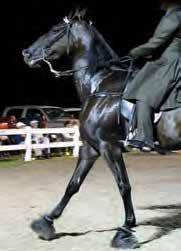
Horse in pain at a May, 2010 horse show.
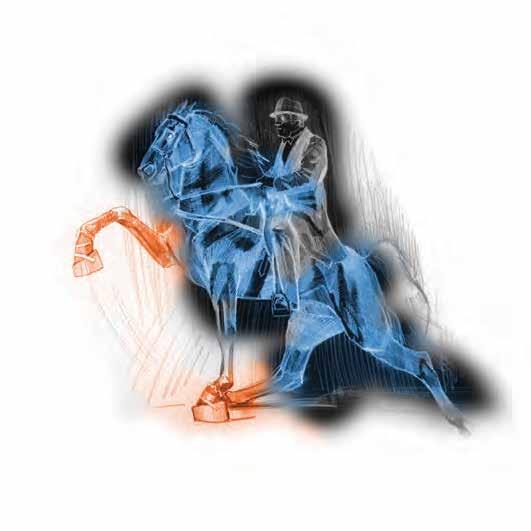
Artwork by Victoria von Kap-herr www.vonkapherr.com
Artwork by Victoria von Kap-herr www.vonkapherr.com
Chemical Soring
Chemical soring is the application of painful, caustic liquids to tenderize the horse’s pastern area (ankle), so the repeated strike of a chain is painful and causes the horse to snatch his foot higher with each step. The chain, a crucial part of this show horse style, is termed an “action device,” and the exaggerated gaits cannot be created without this chain.
ho W i t ’ s d one
Chemicals are applied to the horse’s lower legs, then the leg is wrapped in plastic for days. This causes the chemicals to “cook” into the flesh. This creates highly sensitized front pasterns that are painful when the chain strikes with every step. Examples of soring chemicals used:
• kerosene
• diesel
• croton oil
• GoJo hand cleaner
• WD40 oil
• mustard oil
With the increased scrutiny of soring-related scars, another cruel practice is used to remove the telltale scarring. The horse’s legs are covered in a chemical stripping agent, which burns off old scar tissue through a very painful process.
“Without the chains, there would be no need for a
–
scar rule.”
humane acTivisT, may 2011.
ho W t o d ete ct
• Palpation
• Gas chromotography or “sniffer”
• Thermography
• Blood or saliva tests
• Drug-detection trained dog
• Visual inspections for:
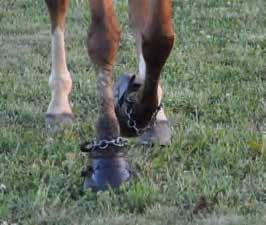
– scarring and inflammation, signs of soring insults.
– wavy, rippled, curly hair on the front legs, an indicator of repeated chemical soring with leg wraps.
– cording, a type of scarring caused by the plastic wrap sliding down and tightly bunching around the pasterns.
– checking for application of foreign substances, by walking the barns and trailers at a show.
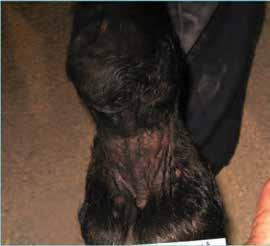
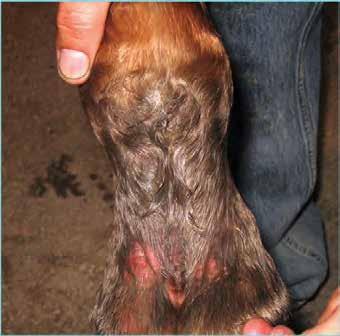
Fixing … Touching … “putting them in a bucket” … Soap ‘em … Fly spray (a term owners use so they can avoid admitting knowing that an illegal substance has been used on their horse) … getting them right … brushing them … square ‘em up … head shake in a bottle … dropping them … Mojo (commonly used by people referring to GoJo hand cleaner) …
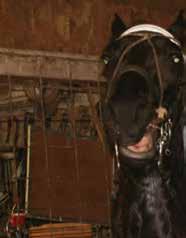
Observations:
etect
• Horse lies down in stall and groans in pain.
What Can Be Done to End Soring?
What Can Be Done to End Soring?
What W o uld have the biggest impact on eliminating soring?
What W o uld have the biggest impact on eliminating soring?
Pressure Soring
Pressure soring causes pain in a horse’s front feet, so when each front hoof hits the ground, the horse will “snatch” the foot off the ground, resulting in an unnatural, high, dramatic step.
positions who has had soring violations within recent years.
• Horse is crampy and unwilling to move.
• Join FOSH or the HSUS.
positions who has had soring violations within recent years.
• Horse warms up into motion with a “praying mantis stance,” with abnormal weight thrown on his hind quarters to avoid front end pain.
• Volunteer for FOSH projects to end soring.
• Join FOSH or the HSUS.
Voice Your Concerns
• Volunteer for FOSH projects to end soring.
Voice Your Concerns
• Horse stands in classic “standing in a bucket” pose to alleviate pain in front legs (photo above).
3q More money allocated to the USDA’s enforcement. At present, USDA’s inspectors attend only 7% of the shows, due to budget constraints. Relying on “self-policing” with industry inspectors has not been effective over the past decades.
3q More money allocated to the USDA’s enforcement. At present, USDA’s inspectors attend only 7% of the shows, due to budget constraints. Relying on “self-policing” with industry inspectors has not been effective over the past decades.
ho W i t ’ s d one
• Tell your Congressmen that you demand full enforcement of the law and adequate HPA funding.
• Tell your Congressmen that you demand full enforcement of the law and adequate HPA funding.
• Response to hoof testers (ideal if shoes are pulled first).
• Inform traditional show venues and their sponsors that you will not suppor t them because these shows encourage soring.
• Inform traditional show venues and their sponsors that you will not suppor t them because these shows encourage soring.
• Digital radiography (x-ray will show extreme thinness of sole, any foreign objects, or excessive coffin bone rotation).
3q Severe penalties for those guilty of soring. Substantial fines and mandatory, serious suspension periods for trainers and owners, including lifetime bans and prison time, would deter soring.
• Grinding the hoof sole down so thin “beads of blood show” and the sole gets spongy and super-sensitive.
3q Severe penalties for those guilty of soring. Substantial fines and mandatory, serious suspension periods for trainers and owners, including lifetime bans and prison time, would deter soring.
• Demand t hat the USDA and the industry inspectors enforce the law effectively.
• Demand t hat the USDA and the industry inspectors enforce the law effectively.
• Thermography to detect hot spots from pain.
Report Soring to the USDA, HSUS, and FOSH:
• Document soring incidences observed at barns or shows with photos or video and submit personally or anonymously.
Report Soring to the USDA, HSUS, and FOSH:
Methods Used to Avoid Detection at Inspection
3q Federal ban on “pads and action devices,” commonly termed “stacks and chains.”
3q Federal ban on “pads and action devices,” commonly termed “stacks and chains.”
W h at c an Y o u d o t o h elp e nd s oring ?
• Taking the hoof wall down slightly shorter than the sole, so it provides no supporting protection, called “rolling the sole.”
Learn More
W h at c an Y o u d o t o h elp e nd s oring ?
Learn More
• Inser ting hard objects between the shoe or pad and the tender sole, such as bolts (removable for inspections), half a golf ball, hardened epoxy, or a dried piece of hoof.
• Document soring incidences observed at barns or shows with photos or video and submit personally or anonymously.
• Report barns and trainers engaging in soring practices.
• Report scheduled “outlaw shows” organized without licensed HIO inspections.
• Report barns and trainers engaging in soring practices.
• numbing agents that wear off between inspection and show time (such as injected anesthetic, “the shot,” or surface application of Lidocaine).
• www.StopSoring.com for latest news and facts on soring
• www.SoundHorseConference.com for presentation lectures on soring
• www.StopSoring.com for latest news and facts on soring
• www.SoundHorseConference.com for presentation lectures on soring
• United States Department of Agriculture (USDA) on Horse Protection www.aphis.usda.gov/animal_welfare/hp
• “Blocking,” which is standing the horse for hours on wedges duct-taped to the hoof.
Friends of Sound Horses, Inc. (FOSH)
• Report scheduled “outlaw shows” organized without licensed HIO inspections.
Lori Northrup, President 6614 Clayton Road #105, St. Louis, MO 63117 716-474-7580 • Lori@Northrup.com
Friends of Sound Horses, Inc. (FOSH) Lori Northrup, President 6614 Clayton Road #105, St. Louis, MO 63117 716-474-7580 • Lori@Northrup.com
• “stewarding”: teaching the horse at practice inspections that flinching or reacting will cause worse pain, such as a beating or using a “hot stick” or electric prod.
The Humane Society of the United States (HSUS)
The Humane Society of the United States (HSUS)
• United States Department of Agriculture (USDA) on Horse Protection www.aphis.usda.gov/animal_welfare/hp
• Purposely foundering a young horse (called “the natural fix” and “nature’s way of soring”).
• Humane Society of the United States (HSUS) http://www.humanesociety.org/issues/tenn_ walking_horses
Get
• Humane Society of the United States (HSUS) http://www.humanesociety.org/issues/tenn_ walking_horses
Involved
• “Road foundering” the horse by riding fast on a hard surface such as a paved road.
Get Involved
• Extreme tightening of metal hoof bands to cause pain from excessive pressure on the hoof.
• distraction devices: a nerve gum cord, bit burr under the saddle, hand twitch, alligator clips on sensitive genital tissue, or surgical staples under the mane, applied just before an inspection to cause distracting pain elsewhere during the inspection.
• Run for a Board of Directors’ position with the Tennessee Walking Horse Breeders & Exhibitors Association (TWHBEA) and effect change from within.
• Run for a Board of Directors’ position with the Tennessee Walking Horse Breeders & Exhibitors Association (TWHBEA) and effect change from within.
Keith Dane, Director of Equine Protection 700 Professional Drive, Gaithersburg, MD 20879 301-258-3076 • kdane@hsus.org
Keith Dane, Director of Equine Protection 700 Professional Drive, Gaithersburg, MD 20879 301-258-3076 • kdane@hsus.org
United States Department of Agriculture, APHIS (USDA)
Dr. Rachel Cezar, Horse Protection Coordinator Dr. Chester Gipson, Deputy Administrator 4700 River Road, Suite 6D03, Riverdale, MD 20737 301-734-5784 • Rachel.Cezar@aphis.usda.gov
United States Department of Agriculture, APHIS (USDA)
• horse switching: providing a substitute horse for inspection under false paperwork, and then switching and putting the sored horse into the show ring.
• Propose changes to the TWHBEA bylaws that preclude anyone from holding leadership
• Propose changes to the TWHBEA bylaws that preclude anyone from holding leadership
Dr. Rachel Cezar, Horse Protection Coordinator
Dr. Chester Gipson, Deputy Administrator 4700 River Road, Suite 6D03, Riverdale, MD 20737 301-734-5784 • Rachel.Cezar@aphis.usda.gov
“Call it what it is. This is torture.” — inTernaTionally-renown clinician february 2011
fixing … pressure soring … “putting the fever in the foot” … pressure shoeing … “pinching the toes” … bolting … blocking … “under pressure” … “in a bind” … quicked … hot nailed … “tightened up” (for bands) … cranking … “fixing below the pastern” … going too deep … concussion foundering … “peak point” describes the maximum pain point in the weekly soring process …
FOSH Sound Principles
Principle #1
All FOSH events adhere to the requirements of the Horse Protection Act.
Principle #2
Horses are to be treated with dignity, respect, and compassion.
Principle #3
Horses must be presented as sound in both body and mind.
Principle #4
The preferred way of going is natural, correct, and without exaggeration.
Principle #5
Shoeing is intended only for the protection of the foot and its structure. Where practical, barefoot horses are both welcomed and encouraged.
Principle #6
Handlers and riders are expected to use training techniques and equipment that conform to the highest humane standards as recognized by the general equestrian community.
Principle #7
Exhibitors have a duty to conduct themselves in an orderly, responsible, and sportsmanlike manner.
FOSH is a national leader in the promotion of natural, sound gaited horses and in the fight against abuse and soring of Tennessee Walking Horses. For more information about FOSH or to become a member, please visit www. fosh.info.
Gaited Clubs
FOSH Directory
Southern Comfort Gaited Horse Club
Southern Comfort promotes activities highlighting the smooth ride and versatility of all gaited breeds. Pursuits include trail riding, competitions, shows, exhibitions, clinics and many other equine activities. The club promotes horse safety and friendship for all that are interested in horses. Owning a horse is not a requirement. SCGHC is based in southwestern Idaho and is a flat shod exclusive club with members contributing and supporting various interests using sound, natural horses. www.gaitedhorseclub.com
Chesapeake Plantation Walking Horse Club
The Chesapeake Club is celebrating over 25 years of promoting the versatile, naturally gaited, horse. As a member of the Maryland Horse Council, we have been the voice of the gaited community and through demonstrations, clinics and guest speakers, a resource for other disciplines to learn about the gaited breeds in our region. Members enjoy monthly trail rides, newsletters, parades, clinics, social gatherings, and friendly help. We welcome all breeds, riding styles, and experience levels from beginners to professionals. Cpwhclub. wordpress.com or jacquiecowan@comcast.net
Breeders
Summerwind Marchadors and Future Foal Breeders
Plan for your next lifetime partner! Come breed with us! Offering frozen semen (12 stallions in 2020) or reservations for Future Foals “do Summerwind” The Marchador is Brazil’s national horse, harking from Iberia, but bred there for 200 years. Expect to be impressed! http:// futurefoal.net or call Lynn @ 602-999-3915
Missouri Morgans
Easy gaited in color. Rare gaited Morgans located in the Heart of America near beautiful Lake of the Ozarks; for photos, videos and available horses. Talk to Jim or Vali Suddarth at 417-286-4720 or gaitedmorgans@missourimorgans.com
Friends of Sound Horses, Inc. Sound Show / Event Support Form
Please print or type information below
Name of Event:
Event Description: ______________ ____________ (show, clinic, expo, etc.)
Breeds Included: ____________________________________________________
Date(s) of Event:
Location of Event: ____________________________________________ (street)
__________________ (city) __________ (postal code) _____(state or province)
___________ (country)
Principal Contact Person: ______________________________(name)
Principal Contact Person Email: __________________________________
Principal Contact Person Phone: ______________________________
Name of Organization to RECEIVE Support Check: (check will be made out to…)
ADDRESS to where support check should be sent: ___ (street)
__________________ (city) ____________ (postal code) (state or province)
___________ (country)
If your event is approved, you should receive your support check within 30 days.
Please EMAIL this completed form to: president@fosh.info (faster) or mail to:
FOSH 6614 Clayton Rd., #105 St. Louis, MO 63117
For FOSH use only… Amount provided: _______________
Friends of Sound Horses, Inc. Scholarship Request Form
Please print or type information below
Student Applying: _________________________________(name) Age: ____ (yrs)
Student Email:
Student Phone: _____________________________________________________
Student Address: ______________________________________________ (street)
____________________ (city) __________ (postal code) _____(state or province)
___________ (country)
School Name:
Major: _ ____________
Date of Last FOSH show participation *:
Attach copy of acceptance letter and note date on letter here:
School Address: ____________________________________ (street) _____ (city) __________ (postal code) _____(state or province)
___________ (country)
Note: Checks will be made out to [Institution Name] for the benefit of [Student Name] and will be sent to the attention of the Financial Aid department. If you are chosen to receive a scholarship, you will be notified within 90 days of applying
Please EMAIL this completed form to: president@fosh.info (faster) or mail to:
FOSH 6614 Clayton Rd., #105 St. Louis, MO 63117
For FOSH use only… Amount provided: _____________ Date sent: ____________
Scholarship Guidelines are on the following page (and do not need to be submitted with this form).
2025
Please consider adding FOSH to your list of worthy causes in making a taxfree charitable deduction or help us to promote legislation, education, and training that protects and helps gaited horses, simply by renewing your own membership or giving a gift membership to a kindred spirit.
We know you have many choices when it comes to giving. Thank you for considering FOSH.
FOSH Membership Application and Order Form
All annual memberships include a digital, bi-monthly issue of the Sound Advocate & educational packets. Mail to: FOSH 6614 Clayton Rd. #105, St. Louis, MO 63117
Type of Membership (check one)
Annual: Single ___$30 Annual Family ___$50 Annual Youth <18 ___$20 Lifetime__$600 Organization Membership (for your gaited horse club or association) ___ $50
Please print neatly.
Name: _______________________________________________________________________
Enclosed: $____________________
How did you hear about FOSH?