The Advocate Sound
Sound Advocate
Friends of Sound Horses, Inc. 6614 Clayton Rd. #105 St. Louis, MO 63117 info@fosh.info * www.fosh.info
Board of Directors
President - Teresa Bippen Missouri Tbippen1957@yahoo.com
Secretary/Treasurer-Gina Vehige Director at Large-Bill Coon VP IJA Program-Dianne Little Missouri Utah Alberta, Canada gvehige115@gmail.com wbotis@gmail.com ddlittle@telus.net
VP Programs/Gaited Sport Horse Director at Large-Anita Dunham VP HIO/DQP-Lisa Harris Dianne Little Missouri Tennessee Alberta, Canada dunhamanita@gmail.com ddlittle@telus.net
Executive Advisory Committee
Keith Dane Patti Potts Pauline Stotsenberg Hawaii Missouri California pottspa@gmail.com ps@yesteryearfarms.net
Editor Stephanie J. Ruff Florida editor@fosh.info
FOSH Mission Statement
To promote all “sound,” naturally gaited horses, with a specific emphasis on Tennessee Walking Horses. (In this context, sound means not “sored”.)
Importance is placed on education in regards to the humane care for the emotional, mental and physical wellbeing, training, and treatment of all gaited horses.
FOSH will only support flat shod or barefoot horses and will never endorse any event that uses stacks and/or chains as action devices, or any mechanical, chemical, or artificial means to modify the natural gaits of the horse.
To these ends, FOSH focuses on three areas for gaited horses:
1) educating people about sound horse training principles;
2) supporting sound shows, events and activities;
3) working to end soring.
FOSH is a 501(c) (3) non-profit organization. All donations are tax deductible to the extent permitted by law. Your donation to support the FOSH mission is needed to advance the goals set forth by FOSH in conjunction with its formal mission statement.
Publication Guidelines
The Sound Advocate is a digital magazine published quarterly by Friends of Sound Horses, Inc. Reproduction of any article is prohibited without the express written permission of FOSH.
FOSH accepts unsolicited submissions, but reserves the right to edit any and all submissions for content, style and space constraints. FOSH further reserves the right to refuse advertising for any reason.
At no time shall the publisher’s liability exceed the total cost of the revenue from advertising in the issue involved in any dispute.
All show suspensions and show results are printed as they are received from the reporting agencies. FOSH does not guarantee their accuracy.
FOSH does not endorse the content of any advertisement in this publication, nor does it warrant the accuracy of any advertisement.
Readers are urged and cautioned to use due diligence and to thoroughly research, including asking for references, before following through with any transaction.
FOSH does not endorse any trainer, educator, clinician, style of natural training, tack, or horse equipment to the exclusion or preference of any other. Each horse is an individual and may respond differently to particular methods.
Articles published by FOSH reflect the views and opinions of the writers and do not reflect, necessarily, those of FOSH.
Publication Information
Subscribers: The Sound Advocate is a benefit of membership. To ensure that you receive your issues, be sure that your e-mail address is current. To change an e-mail address, contact gvehige115@ gmail.com.
Submission of Articles, Calendar Dates, News and Photos: Send to tbippen1957@yahoo.com. Photos may not be embedded in text and must be submitted as jpeg format, minimum of 300 dpi. The deadline for each issue is the 15th of the preceding month when the issue is to be released. Submissions will not be accepted after the deadline, but may be carried over to another issue. Submissions will not be returned to the submitter.
Member’s Advertising Rates
Back Cover $300
Inside Front Cover $275
Inside Back Cover $275
Full page $125
Half page $75
Quarter page $60
Business Card $25
Directory $25
Discounts for Multiple Issues
2 issues - 10% off total fee
4 issues - 20% off total fee
6 issues - 30% off total fee
Ads will be accepted in pdf, tif or jpeg formats. Text and photos must be e-mailed separately by the 10th of the month when the issue is released. Photos must be 300 dpi. Camera-ready ads are emailed at 300 dpi. Materials should be emailed to editor@ fosh.info.
All advertisements must be paid in advance by check, money order, or credit card. Payments should be made out to FOSH and mailed to:
6614 Clayton Rd. #105 St. Louis, MO 63117
More FOSH information can be found online. Find us at www.fosh.info. Like us on Facebook.

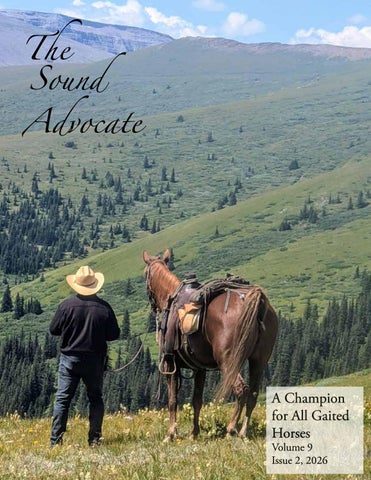
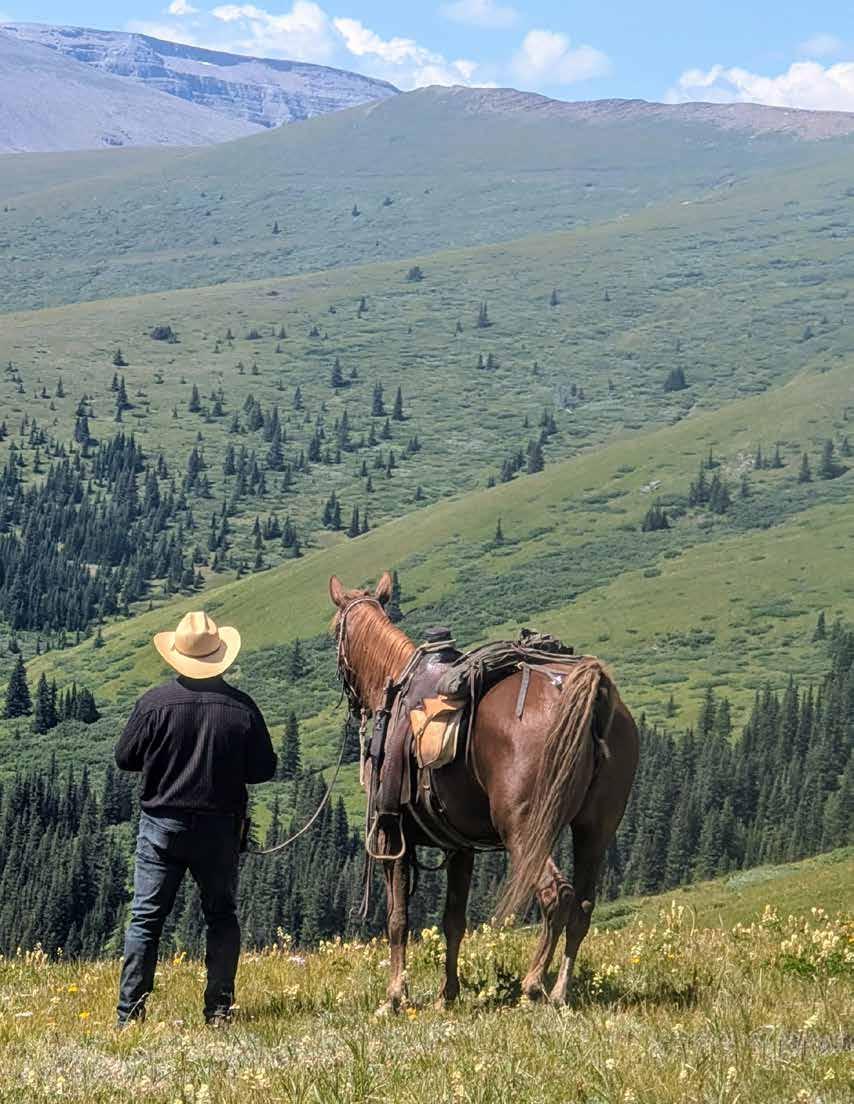
On the cover: Rick Collins and his Canadian-registered Tennessee Walking Horse LL’s Scarlet Sunset in the YaHa Tinda in Alberta, Canada. Photo credit: Jesseca Johanson
TABLE OF CONTENTS
From the President...
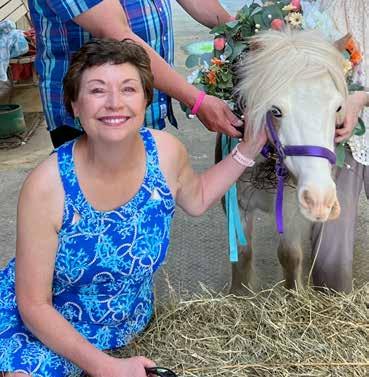
Dear FOSH Friends and Supporters,
I hope you’re enjoying some wonderful riding weather wherever you live. I was lucky enough to enjoy a few days in Victoria, British Columbia, last week, and I understand why there are so many retirees who live there. What comfortable weather and beautiful scenery.
Speaking of scenery, I love our articles and photos in this issue about trail riding. If you’re one who does not get to do much trail riding, I think this issue is the perfect one to give you a taste of getting out of the arena or even to relive memories of when trail riding was easy and doable for you and your equine pal.
Regarding our antisoring efforts, we are still involved and keeping track.
Although not much is being undertaken in Congress in any area, the United States Department of Agriculture submitted new regulations to the Office of Information and Regulatory Affairs after losing in the 5th Circuit Court of Appeals. We have no idea what these new regulations say and will be on the lookout.
At this year’s DQP training, the focus was on identifying horses that were drugged and for the first time ever, examining the rear legs. Unfortunately, the USDA is no longer enforcing the scar rule, and the Humane World for Animals and Humane World Action Fund filed a lawsuit against the USDA for this horrible setback. For those of you who have followed the cruelty of soring over the decades, you know that disallowing scarred horses in the ring is imperative if this practice is ever to end. It is blatant evidence that soring has taken place with that horse.
For those of you wishing to enjoy a great educational weekend with gaited horse owners, please take a look at the clinic with Carl Bledsoe (page 12) happening in September. You won’t believe how much you will learn from Carl and how you and your horse will become a better, healthier team. You will have a lot of FUN in the process too.
From the Editor...
Hello FOSH Friends.
I never had the good fortune to meet Larry Whitesell in person, but I did work with him early on with The Sound Advocate as he was still writing columns for it. He was a humble man and continually wondered if people wanted to hear what he had to say. I assured him that they did.
I enjoyed reading his columns. While they often were written as he would have spoken (requiring a little editing to make them correct for reading) the information was genuine and solid. I could tell from what he said that he was an experienced, knowledgable horseman who always had the horse’s best interest in mind.
We offer a brief memorial to him in this issue. We thank him for his years of devotion to the horse and know he will be missed by many.
Another excellent horseman, Carl Bledsoe, will be doing a FOSH-supported clinic in September in Mora, Missouri. If you are thinking about riding or auditing, we have a great article on the surrounding area. It looks fabulous. Come to the clinic, but stay for a vacation!
We also have a story about a stunning trail ride in Alberta, Canada written by Jesseca Johanson. From the pictures and the words it is absolutely amazing. I imagine it’s even more impressive in person. But for many of us, we will have to ride it vicariously through the others.
FOSH is still looking for people to help shape the future of the organization. If you ever wanted to help, now’s the time to step up. Find out more on pages 8 and 9. I can personally vouch for the people already involved. They are wonderful to work with.
Do you have a trail ride, show, or other story to tell about your time with gaited horses? Please reach out to me. We’d love to include it in a future issue.
Good Old Days, LLC Awards Banquet
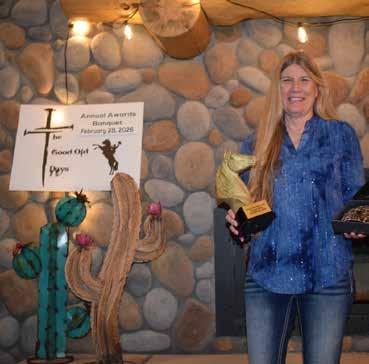
The Good Old Days, LLC horse show organization held their awards banquet on February 28, 2026, at the beautiful Lodge at Boulder Creek in Troy, Missouri.
The Good Old Days organization holds six horse shows per year at the Lincoln County Missouri Fairgrounds and has enjoyed the generous support of Friends of Sound Horses (FOSH).
As the only horse show with specific classes for liteshod/barefoot gaited horses in the area, this organization provides a valuable venue to the sound gaited horse supporters in Eastern Missouri.
In 2025, the show added year-end high points awards, many of which were generously provided by Lucy Rangel from her extensive collection. With some minor modifications and re-badging by Gina and Darryl Vehige, these awards provided valuable recognition for the hard work of the dedicated gaited exhibitors.
Two notable FOSH members were recognized as high points winners for 2025 year; Chris Beasley and Josie Evans. Congratluations! More shows and a high-points series are planned again for 2026.
Stephanie Stephanie J. Ruff Editor, editor@fosh.info
Classes are offered for all breeds of horses and with Gaited Model as well as Country Pleasure and Trail Pleasure classes specifically for gaited horses. Versatility classes such as poles, barrels, a different fun class for youth, juniors, and adults are offered each show as well.
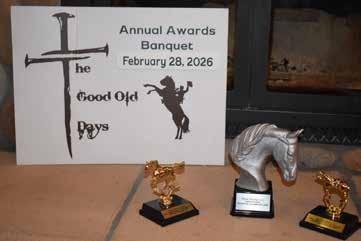
Top left: Chris Beasley accepting her high-point award. Above: Josie Evans’ high-point awards.
Interested in a Leadership Position in FOSH?
Do you have a passion for supporting sound gaited horses? Friends of Sound Horses (FOSH) needs you! In 2027, the FOSH board will have three openings. The nominating committee is reaching out to FOSH members to see who may be interested in filling the role of President and the role of Secretary/Treasurer. The role of Secretary/Treasurer may be combined or separated at the discretion of the board.
The nominating committee consists of Lucy Rangel, Anita Dunham, and Gina Vehige.
Duties of the President
• The President schedules and presides at meetings of the Board and consults with Board members on meeting agendas.
• The President votes in the case of a tie vote by the Board.
• The President represents the Board in conducting the day-to-day management of FOSH business and performs other duties delegated by the Board.
• The outgoing President serves as a nonvoting advisory member of the Board for one year after the term ends (unless elected to serve a new term as a Board member).
• The President serves as the chief spokesperson for FOSH.
• Takes minutes at all meetings and distributes them to Board members.
• Performs duties customary to the office and other duties assigned by the Board.
Duties of the Treasurer
• The Treasurer maintains all financial records of FOSH.
• Accounts for all funds and keeps financial records.
• Issues monthly financial statements.
• Performs other duties customary to the office and as assigned by the Board.
The board will vote on filling these key officer positions at the November/December meeting. Board positions are strictly volunteer (unpaid). The current president and secretary/treasurer will assist with the transition to newly appointed officers.
Meetings are generally monthly when there is business to conduct and are held via teleconference. Per the bylaws, no individual employed as a trainer or the spouse of a trainer may serve as a member of the FOSH Board.
Duties of the Secretary
• The Secretary maintains the business records of FOSH.
In Memoriam
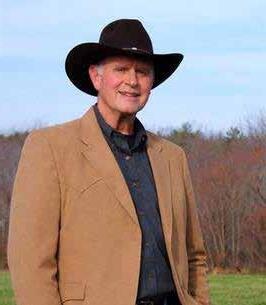
Larry Whitesell, 76, a devoted family man, passed away peacefully on Tuesday, March 17, in his home surrounded by family and friends.
He was born July 20, 1949, in Staunton, Virginia, to Bill and Jeanne Whitesell.
He was a graduate of James Madison College and spent the early years in his career as a high school teacher and coach. He married Connie Street in 1979.
He left teaching high school and entered the equestrian world in 1981. He started as a trainer for show horses, where he won numerous awards, including trainer of the year
in the Paso Fino Association. Teaching was ultimately his passion, and later became a horse clinician. He traveled the United States, Dominican Republic, Canada, and all over Europe, teaching students. He was known for his talents: he loved cooking, gardening, and spoiling Kait and Tay. He was an avid North Carolina basketball fan.
He is survived by his wife Connie, his sisters Lynn (and Jim) White and Eleanor Whitesell, and his “adopted” family of Jennifer and Josh Bauer, Jodi and Seth Powell, and the 2 lights in his eyes, Taylor and Kaitlyn Bauer.
Larry touched so many lives, teaching riders how to create a relationship with their horse. His devotion went above and beyond, creating memories that will live on. He will be missed by many!
Whitesell’s apprentice Jennifer Bauer posted the following on Whitesell’s Facebook page Gaited Horsemanship: “It is with a heavy heart that I share that heaven gained another horseman last night. Larry Whitesell passed peacefully in his sleep at home, surrounded by those who loved him. Larry had an amazing ability to not only work with horses but the extra talent of being able to teach people how to work with their
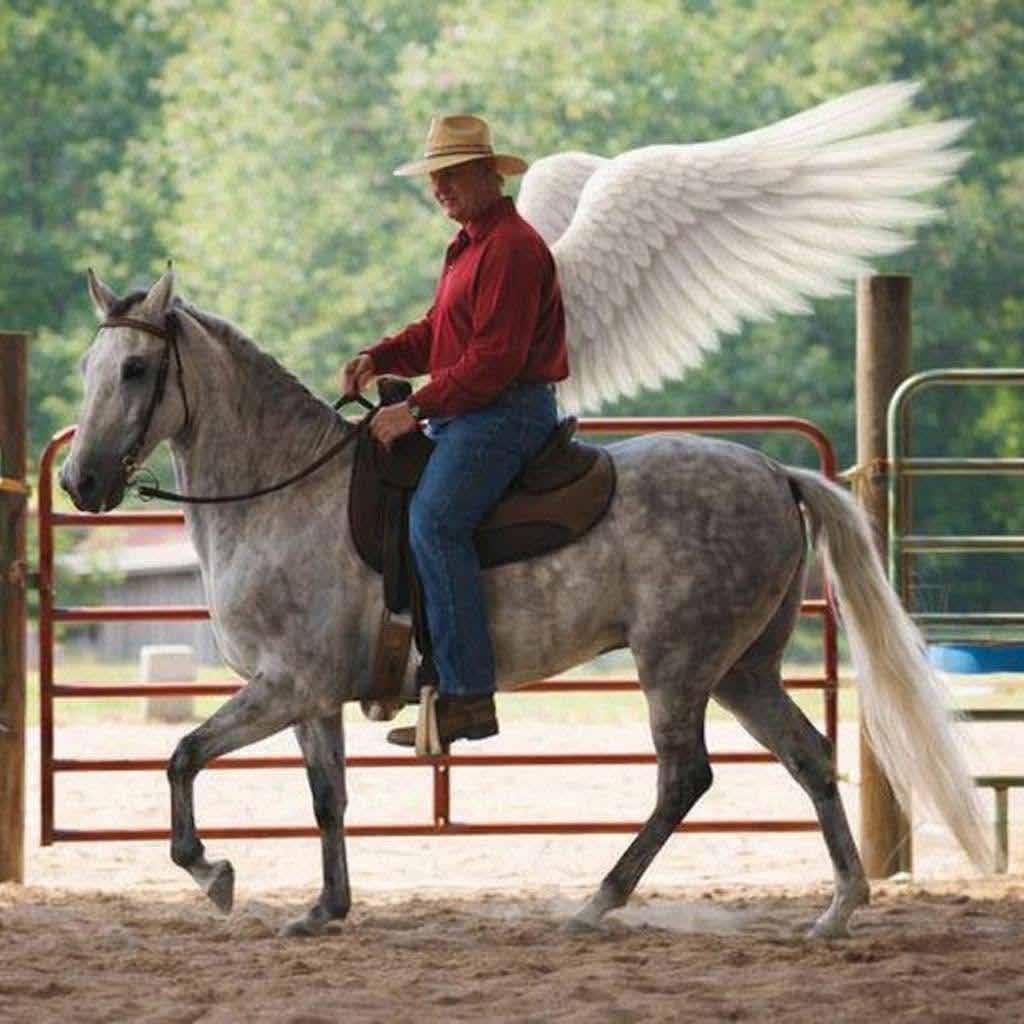
horses. Him and his wife Connie didn’t have any children but always felt like my extra set of parents. If you ever were around Larry and my daughters Kaitlyn or Taylor were brought up you could see Larry’s eyes light up. He was their world, and they were his.
“His ideas and his work with horses will continue on through those he
worked with. Trust me, you will hear his voice when you ride; or remember him chasing you with a flag; or just saying some of his simple phrases like ‘it’s so simple,’ or ‘ride the horse not the saddle,’ or possibly ‘stop looking at your horse, I’ll let you know if he disappears,’ oh and how could I forget ‘ride forward!
“He will be dearly missed.”
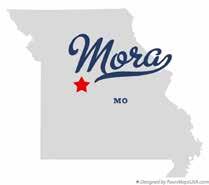
A Gaited Horse Weekend in Mora, Missouri
There’s something special about loading up the trailer, pointing the truck toward a small town you’ve never visited, and knowing you’re headed for a weekend built entirely around good horses and good people. Mora, Missouri—a tiny community tucked into the rolling countryside between Kansas City and St. Louis—is exactly that kind of place. It’s quiet, rural, and unhurried, the sort of landscape where a gaited horse settles into its rhythm, and a rider can finally exhale.
For the FOSH-sponsored gaited-horse clinic taking place September 25–27, Mora offers a simple promise: come as you are, bring your horse, and enjoy a corner of Missouri that’s easy to overlook but surprisingly rich once you arrive. This isn’t a destination with neon signs or curated tourism districts. Mora is the kind of place where the land does the talking—open pasture and wooded pockets of oak, hickory, maple, walnut, and sycamore, the mixed hardwoods that give Missouri its soft, rolling character, winding county roads, and a sky that feels bigger than it should. It’s a setting that invites riders to slow down, connect, and enjoy the
By Janet de Acevedo Macdonald
kind of horsemanship that thrives in wide-open spaces.
Mora, Missouri: Small Town, Big Horse Country
Mora itself is little more than a crossroads—the kind of rural community where everyone knows everyone, and the local stories run deeper than the population numbers suggest. It’s the birthplace of country singer Leroy Van Dyke, whose lightning-fast “Auctioneer” song still turns heads, and billionaire Stan Kroenke, whose family once ran the local lumber company. But beyond those bits of trivia, Mora’s real identity is shaped by the land: rolling hills, hayfields, cattle pastures, and the kind of quiet that makes you realize how loud the rest of the world has become.
For riders, this landscape is a gift. The footing is generally forgiving—a mix of grass, dirt, and gravel—and the terrain offers gentle elevation changes that keep a horse engaged without overworking them. It’s classic Missouri countryside: green in summer, golden in late season, and always framed by the soft rise and fall of the Ozark borderlands.
Because Mora is small, most visitors will base themselves in nearby Warsaw, Cole Camp, or Sedalia, each offering its own flavor of small‑town hospitality. But Mora is the heart of the weekend—the gathering point, the riding hub, and the place where the rhythm of gaited horses will echo across the fields.
Benton County and the Sur‑ rounding Area—What Riders Will Find Nearby
Warsaw, about 15 minutes from Mora, is the natural hub for visitors. It’s a friendly, practical town with everything riders need: groceries, fuel, restaurants, hardware stores, and a relaxed pace that makes you feel welcome the moment you pull in. The historic downtown sits on a hill above the Osage River, with brick storefronts, antique shops, and a few local eateries that serve hearty, no-nonsense meals.
Mora may be the gathering point, but the wider Benton County region is where visiting riders will find the amenities, scenery, and small-town charm that make a late-September clinic feel like a getaway. This part of Missouri sits at the meeting point of prairie, woodland, and lake country—a landscape shaped by rolling hills, winding creeks, and the broad waters of Truman Lake, one of the largest reservoirs in the state.
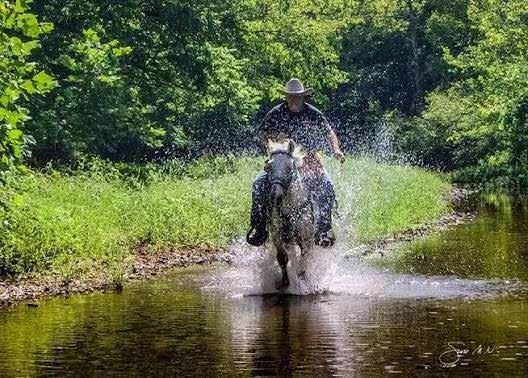
Hitting the trails in Mora, Missouri. Photo credit: Robert Scott McNair.
To the north, Cole Camp offers a different flavor—a small town with strong German heritage, tidy streets, and a handful of cafés and shops that feel like they’ve been there forever. It’s quiet, walkable, and a pleasant place to unwind after a day with your horse.
Farther east, Sedalia provides the most options for lodging, dining, and supplies. It’s home to the Missouri State Fairgrounds and has a long agricultural and equestrian history. Riders who prefer a wider range of hotels or need last-minute tack or feed will find Sedalia an easy, reliable base—and at just 25–30 minutes from Mora, it’s a convenient
choice for the clinic weekend. The Fairgrounds themselves are also a practical place to stay, offering year-round RV sites at the Public Main Campground and rentable horse barns with covered stalls and wash racks, making them an excellent overnight option for riders hauling in with horses.
The surrounding countryside is classic central Missouri: green in summer, dotted with hayfields and cattle pastures, with long views that open unexpectedly as you crest a hill. It’s peaceful, practical horse country— the kind of place where a gaited horse feels right at home.
Local Highlights and Where to Find More Information
For riders who want to explore beyond the clinic grounds, the best starting point is Benton County Tourism & Recreation in nearby Warsaw. They’re the official visitor center for the entire region, including Mora, Warsaw, Cole Camp, and Truman Lake, and they maintain a robust library of images, maps, and local recommendations.
Benton County Tourism & Recreation
181 W Harrison St, Warsaw, MO 65355
Phone: 660-438-2090
Executive Director: Lynette Stokes Email: lstokes@visitbentoncomo. com
Instagram: @visitbentoncomo
Facebook: BentonCountyMo TikTok: @visitbentoncomo
Their staff can point riders toward scenic overlooks, lake access points, historic sites, small-town shops, and seasonal events.
A Must‑See: Truman Lake & His‑ toric Warsaw
If there’s one place every visiting rider should make time for, it’s Truman Lake and the historic district of Warsaw. The lake is known for its sweeping views, quiet coves, and abundant wildlife, while downtown Warsaw offers brick storefronts, antique shops, cafés, and a relaxed, walkable atmosphere. It’s the perfect place to unwind after a day with your horse.
Nearby Natural Areas
The Mora Conservation Area, just outside town, offers a peaceful slice of Missouri habitat—a nice spot for a morning walk, birdwatching, or simply enjoying the quiet before the clinic begins.
What Riders Should Know Be‑ fore They Go Weather & Season
Late September in central Missouri is warm and pleasant, with daytime highs in the 70s and 80s. Evenings cool off nicely. Afternoon showers are possible, so pack light rain gear.
Terrain & Footing
Expect rolling hills, grassy fields, gravel roads, and mixed woodland. The footing is generally forgiving, but shoes or boots are recommended for horses working on gravel or rocky patches.
Supplies
& Services
Warsaw and Sedalia offer the nearest full-service grocery stores, fuel stations, pharmacies, and agricultural supply shops. Both towns are an easy drive from Mora.
Veterinary & Farrier Care
Sedalia and Warsaw both have established veterinary clinics, and the region’s agricultural base means farrier services are readily available.
Cell Service
Coverage is generally reliable along main roads and in towns but can be spotty in low-lying rural areas. Download maps ahead of time.
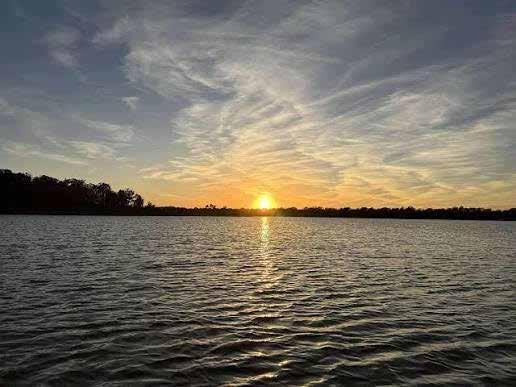
Sunset on Truman Lake. Photo courtesy of US Army Corps of Engineers.
Come for the Clinic, Stay for the Quiet Magic of Missouri
A gaited-horse weekend in Mora is the kind of trip that stays with you. You come for the clinic—for the learning, the camaraderie, the chance to deepen your partnership with your horse—and you end up discovering a corner of Missouri that feels both grounded and quietly memorable. The rolling countryside, the easy pace of Benton County, the lakes and small towns that dot the landscape. It all adds up to a place that invites you to slow down and settle in.
This isn’t a destination built on spectacle. It’s built on authenticity—on rural roads, friendly faces, and the kind of wide-open spaces where a gaited horse can stretch out and move. Whether you’re exploring Warsaw’s historic district, watching the sun drop over Truman Lake, or simply enjoying the hush of a Missouri evening with your horse settled nearby, Mora offers a sense of place that lingers long after the trailer is loaded for home.
Come for the clinic…
Stay for the landscape, the history, the small-town charm — and the reminder that some of the best riding weekends happen in the quietest corners of the map.
Where to Stay—Rider & Horse‑Friendly Options
Because Mora itself is tiny, most riders will stay in nearby towns or at equestrian-friendly facilities. The re-
gion offers a wide range of options, from simple motels to full-service horse camps.
Warsaw—15 minutes southwest of Mora. The closest and most convenient base. You’ll find:
● locally owned motels
● small inns
● lakeside cabins
● RV parks and campgrounds
● easy access to groceries, fuel, and restaurants
Some cabin rentals around Truman Lake offer space for trailers and quiet surroundings ideal for traveling with horses.
Sedalia—25–30 minutes east of Mora. A good choice for riders who prefer chain hotels or need more amenities. Sedalia offers:
● multiple hotel options
● larger restaurants and stores
● agricultural supply shops
● proximity to the State Fairgrounds
For riders traveling with horses, the Missouri State Fairgrounds adds an extra layer of convenience. The Public Main Campground offers year-round RV sites with electric and water hookups—a reliable, horse-friendly option for riders who like staying close to their animals. The Fairgrounds also maintains rentable horse barns, providing covered stalls, wash racks, and easy trailer access. These facilities are designed for equestrian events and can be a practical choice for riders needing
Carl Bledsoe Clinic
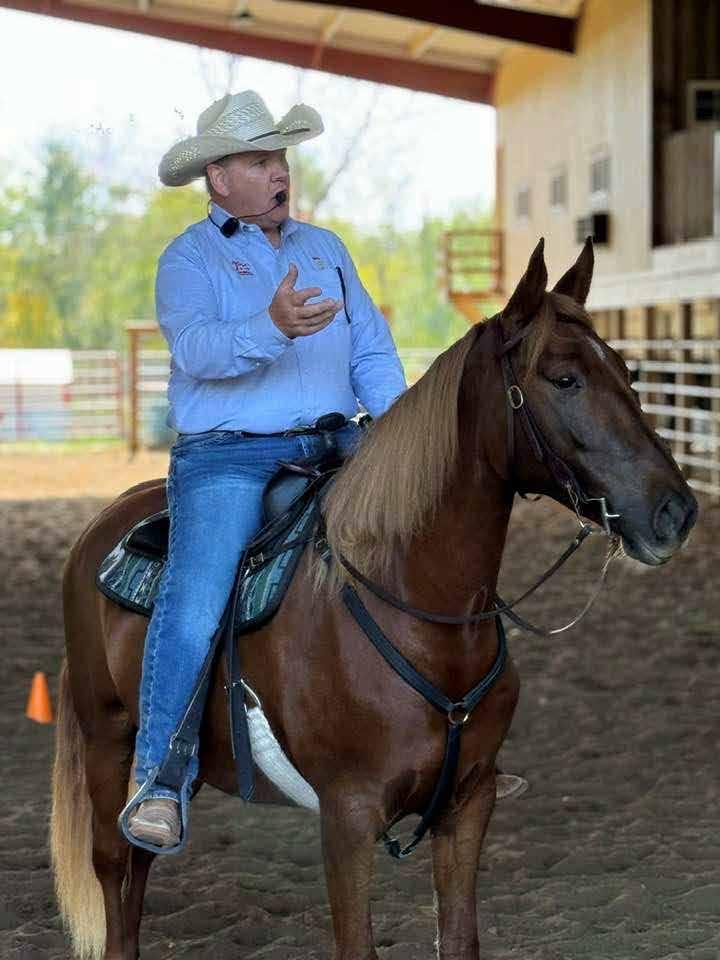

overnight stabling or a secure place to settle horses during the clinic.
Public Main Campground: mostatefairgrounds.com/facilities/public-main-campground/
Horse Barn Rentals: mostatefairgrounds.com/facilities/horse-barns/
Cole Camp—20 minutes north of Mora. A charming, quieter alternative with:
● small inns
● historic buildings
● a slower pace
● easy access to rural roads and scenic drives
While lodging options are fewer, the atmosphere is warm and welcoming.
Horse‑Friendly Facilities
For riders who want their horses
close by, or prefer to stay at a dedicated equestrian property, several excellent options are within easy driving distance of Mora.
Von Holten Ranch–Mora, MO
A well-known equestrian destination with miles of trails, full-service facilities, campsites, cabins, and a strong reputation for hosting clinics and horse events. Riders will find clean barns, roomy stalls, and a friendly, horse-savvy staff.
Website: vonholtenranch.com
Easy E Horse Hotel & Bunkhouse–Sedalia, MO (25–30 minutes east)
A practical, rider-focused overnight option offering stalls, turnout, and simple bunkhouse accommodations. Ideal for riders who want a quiet place to settle their horses after a long haul.
Facebook: Easy E Horse Hotel & Bunkhouse
Circle B Ranch–Near Warsaw, MO (15–20 minutes southwest)
A peaceful, rural setting offering horse-friendly lodging, RV hookups, and access to scenic riding areas. A great fit for riders who enjoy a quiet, country atmosphere with their horses close by.
Website: circleb-ranch.com
Airbnb & Vacation Rentals—15–35 minutes from Mora (depending on town and lake location)
Riders who prefer a more private or home‑style stay will find several Airbnb options within easy driving distance of Mora. Most are located around Sedalia (east), Marshall (northeast), and the Warsaw/Truman Lake area (southwest), offering everything from cozy lake cabins to pet-friendly homes and family-friendly rentals. See individual listings for horse accommodations.
Stays near Truman Lake are especially appealing for their quiet surroundings and easy access to outdoor activities when you’re not at the clinic.
Understanding Senior Horse Feeds
by Jim Fiorini, aka “Jim the Feed Guy”
Originally published on Facebook.
Probably the most confusing segment of the market is “senior” horse feed. When is my horse a “senior”? Which feed is best? What is important in a “senior” feed? To add to the confusion there are two distinct types of “senior” feed; a complete feed and a concentrated or performance feed. I’ll get to that in a minute.
Let’s begin with “When is my horse a senior?”
The answer is simple once you understand that “senior” is a condition, not an age.
I have an AQH mare in her 30s and she looks and feels much younger, but I have worked with horses much younger than she on “senior” feeds. Most of the feed company help desk folks will throw out “20” as the age to begin feeding a “senior” product but they can’t tell you why.
Let’s take a look at some of the common characteristics of senior feeds.
Like humans, older horses will benefit from higher protein so most senior feeds are between 13% and 16% protein.
Most concentrated and some complete feeds will have higher fat, in excess of 8% some as high as 12% or even 14%.
Most senior feeds are designed to break down more easily when soaked or chewed because even “good” teeth on a senior aren’t great.
Any senior feed can be fed to younger mature horses and many seniors should be on a performance feed designed for horses under the age of 20. The biggest difference is between a complete feed and a performance feed.
In the article last week I discussed a complete feed being used for horses with poor teeth because a complete feed is designed to replace most or all of a horse’s forage.
Senior “performance” feeds are designed to be fed in addition to a full load of forage. The truth is that there really is not much difference between a “senior” performance feed and a “regler” (Philly dialect for “regular”) performance feed which is why they are perfectly suited to use with younger horses.
Senior performance feeds are typically a bit higher in fat as well as
less zoom juice making it a great alternative feed choice.
The reverse is also true when you have a 22-year-old, 1,650-pound warmblood still in work six days a week. There is no reason to switch this animal to a senior feed simply because it has turned 20.
Senior performance feeds are a great all-around feed for horses in general and many of the commercial lesson barns I work with use a senior performance feed as their main feed because it works with everything and keeps feeding simple. So, simply because your horse turns 20 doesn’t mean it needs to be on a “senior” feed and because your horse is younger doesn’t mean it shouldn’t. These feeds are simply another tool in our box.
digestible fiber, so they are pe rfect for that 8-year-old OTTB that needs some additional calories without the energy of some nutrient dense performance feeds.
Ultium Competition is extremely calorie dense but is also packed with energy and amino acids so it can sometimes make your daughter’s 8-year-old OTTB a little terrifying.
Purina Senior Active is slightly less calorie dense but delivers a skosh
The biggest difference that matters is whether or not the feed is a complete feed or a performance feed because if you feed a complete feed like a performance feed you are going to get poor results and vice versa.
“Senior” is simply a marketing ploy to help owners migrate to a desired product. “Goldie turns 20 this year so put her on our stupendous senior feed.”
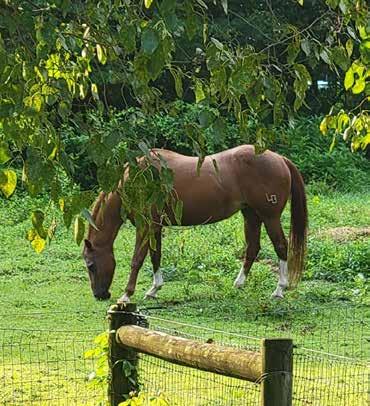
According to Jim, pictured here is “Skippy the Wonder Mare” a few years ago at age 28 and still on forage and a pound of ration balancer per day. She still looks this good but she is now getting some complete feed because her teeth are getting a little smooth.
Riding from the Bighorn to Ice Lake and Back Again
By Jesseca Johanson
Every year my friends and I head into the mountains for two weeks. Normally we spend those two weeks deep in the Willmore Wilderness, in Alberta, Canada with our pack string, but in the summer of 2024, the four of us found ourselves camping at the Bighorn in the Ya-Ha Tinda, also in Alberta, instead.
Our tents were traded in for living quarter trailers with heat, air conditioning, fridges and running water. What a luxury! It wasn’t just cozy for us; our horses had it made too. Instead of wearing hobbles and finding meals in the wild pastures, they were fed high quality hay, soaked alfalfa cubes, and supplements. Perhaps the horses would have preferred to graze on the summer grass, however even deep in the wilderness the grass isn’t always as thick and nutritious as one would expect.
One member of group, Alyssa, was flying to Mongolia in less than two weeks to ride in the Mongol Derby. She had brought all her gear to test out and carry as if she were in the Derby. Not only that, but she had also sacrificed her well worn, much loved slick fork saddle for a Pandora endurance saddle to once again emulate more closely what she would be riding 1,000 kilometers in.
The other members of our group included my husband Steeve and myself, and our long-time traveling partner and friend, Rick. Between the three of us we had four Canadian registered Tennessee Walkers and two Missouri Fox Trotters. Alyssa had brought her Quarter Horse, who is called the “Wonder Horse” by vets at our Competitive Trail Rides.
One night around our propane fire pit, the guys pulled out a map and started to make plans. The year before, Steeve, Alyssa, and I had ridden up to a set of peaks called the saddle. While up there, we spotted a trail that ran along the edge of the mountain and disappeared around the other side. It was our guess based on directions from other riders and what was on the maps, that this was a rideable loop.
Much discussion over the map led us to agree that not only should we be able to do a loop, but maybe we could even make it to Ice Lake. None of us except for Rick, had ever been to Ice Lake, although when he had been there, he had accessed it a different way (30 years ago). Rick had also ridden from the Bighorn, but the trail that he had used was now impassable due to bog.
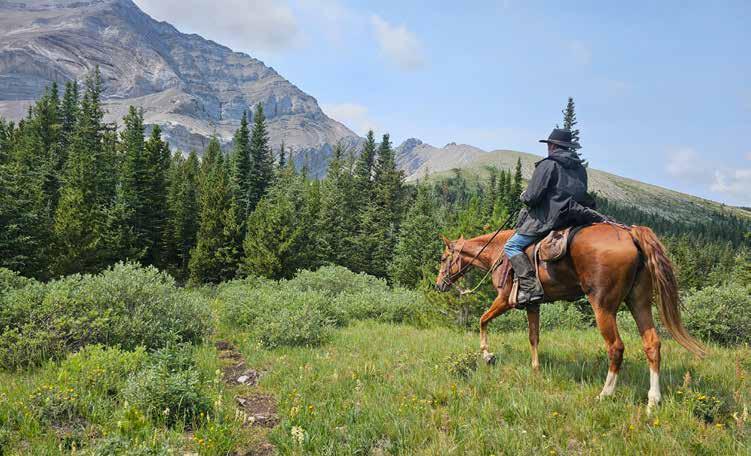
Accessing Ice Lake is easily done from another area called the Panther, where there is another campsite that most riders and wagon drivers start from. This dramatically reduces the mileage and makes it an enjoyable day ride. In fact, Rick met another rider after this adventure, who also rode from the Bighorn campsite to Ice Lake, but they brought a pack horse and did it in two or three days.
The Ride Day 1
On July 25, the four of us struck out on our strongest horses; Rick rode his Fox Trotter mare, Porsche; I rode
my Fox Trotter gelding Magnus; Steeve rode his Walking Horse gelding, Tiberius; and Alyssa rode her Wonder Horse, Echo.
The first part of the climb is through thick forest and switchbacks. It is a lot of elevation gained on a relatively easy trail. Once we broke through the forest though and began the actual climb to the bridge between the two peaks, you better get used to being exposed. This part is all grassy mountain side with a narrow trail. The trail is good though, easy for a horse to follow and stick to.
Riding to Ice Lake in Alberta, Canada involves climbing through thick forest, switchbacks, and grassy meadows. Photo courtesy Jesseca Johanson.
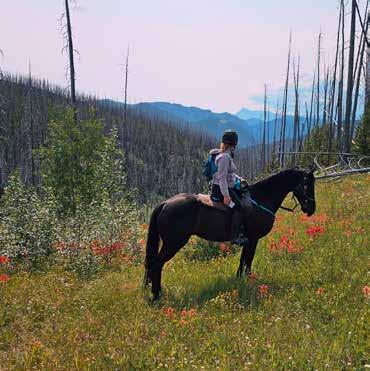
The view at the top is breathtaking. Mountains everywhere, the bodies of burned trees below. I’ve always loved riding through burns. There’s something haunting about it. The trail takes off from this flat area between two peaks and rides around the edge of a mountain. It used to be a road, and it is crazy to think that miners drove along these edges. By now it’s only a one-track trail, with lots of shale and loose rocks on it. Below are the burned trees with lots of stabby sticks waiting to stop your fall, should you and your horse tumble off the trail.
It takes 10 to 15 minutes to traverse this part, and if you make it, the rest of the ride is a breeze.
This trail crested over a rocky point and onto a flat expanse of grass, rock and trees. Flat enough that Steeve pulled to a stop and the flask was passed around, all of us breath-
ing a sigh of relief. Our GPS showed a trail; however, the terrain was extremely rocky so whatever slip of a trail was there was almost impossible to see. Thankfully, someone had been there before us and had flagged the trees with orange ribbon.
Our group wound around the backside of the mountain. The landscape was much less severe and the slope more gradual. The peaks were jagged and tall to our left, and a carpet of forest spread out below to the right. This led us around to a much more visible trail that cut up and down around rocky outcroppings and little creeks until we came to a very important junction. One way would take us back to where we started along an old fire or mining road. The other way would take us into the Panther and towards Ice Lake. The problem was that we didn’t know the state of the trail heading home, and the weather was turbulent to say the least. If the trail turned out to be impassable and we had to turn around, getting stuck on top of the mountain was not a risk anyone wanted to take.
Our group decided to take the road heading back to camp. Almost immediately we came upon freshly cut trees. Some of these trees were quite large and had been cut with a chainsaw and dragged off the trail. This trend continued for most of the way back to the Sheep Cliffs junction. Towards the end, the trail was crowded with the trees growing high and tight along the trail. Otherwise,
it was clear and easy to navigate. As expected, this trail deposited us at the base of the climb up to the saddle and not far from the Sheep Cliffs junction.
Over another campfire meeting that night, it was decided that we would strike out for Ice Lake the next day and use the fire road both ways. This meant avoiding the arduous climb up to the saddle and the narrow trail around the mountain. It was more direct and easier traveling.
The Ride Day 2
With fresh horses, we hit the trail early on July 26. It was going to be a big day, even if everything went according to plan.
Our horses that day were three chestnut CRTWH mares and one black AQHA mare (the Wonder Horse). Rick was riding LL’s Scarlet Sunset (JJ for short); Steeve was riding MGW Handcuffs for Harriet; and I was riding MGW Full Throttle Freda. Alyssa was riding Echo, her very talented long-distance mount. She was also riding in her Pandora saddle with everything she would need strapped to her back, as if she were riding in the Mongol Derby. The rest of us had the usual gear, slickers, saddle bags, wide-brimmed hats, a rifle, and bear spray.
The beginning of our ride was relaxed since we were traveling on a trail we knew, that is until we came to the junction. One way would take us back to the saddle, the other way
to Ice Lake. Our horses carried us over the invisible border onto new trails.
This trail took us up over another incline, this one covered with another old burn. The trees screeched and wailed constantly in the wind. Alyssa said it sounded like the souls of the trees screaming. There was also a lot of bear signs, making this forest even creepier.
At the bottom there was the most beautiful, lush meadow. A perfect place for the empty hunting camp tucked against the treeline–a corral made of felled trees, a campfire ring with stumps for chairs around it, and even some handmade tie rails buried in the trees with a creek winding around the base of the camp.
And then, while feeling like we were in the middle of nowhere, we started seeing very nicely made signs indicating we were on a wagon trail. I think at this point, we were officially in the Panther and on what Rick called a “high traffic area.” This was the wagon trail heading in from the Panther campsite.
It really was a high traffic area. The trail followed a big river, and along the river were canvas camps that looked like little towns. This highway eventually brought us to another sign that indicated our turn to Ice Lake.
It was here that Steeve elected to stay at the base and let his horse
Signs of an old burn were apparant on the trail. Photo courtesy Jesseca Johanson.
rest while he ate lunch. Although I didn’t like leaving one of our party behind, there was no changing his mind. So, Rick, Alyssa, and I started the big climb up.
It was beautiful, an idyllic forest to ride through, albeit with an incredibly steep incline. The going was slow. My back was starting to get sore. I could tell Freda was tired. Up and up we went. I thought we must be getting close.
And then I saw a sign. And it said 4 more kilometers to the top.
I told my friends, “I’m going to turn around and wait with Steeve.”
Now Rick is an old-fashioned kind of guy, and he said, “There is no way I’m letting you go down on your own. You either come up with me, or we all go down.”
I know Rick well. This meant I was also aware that there would be no arguing with him about this. Then we all heard hoofbeats from the trail below us. Coming around one of the switchbacks was Steeve and Harriet. He said she made such a fuss when everyone left that he figured he might as well be riding with us. She wasn’t going to rest anyway!
With the group back together, we took our time climbing, giving the horses lots of breaks. At one point after gaining some serious altitude, I decided to get off and walk Freda.
The long, slow climb was hard on my back (not to mention Freda’s), so I used my own two feet to get the rest of the way up.
We came upon a tie rail at the base of another steep climb (this was the mountain that kept on giving). Here our horses waited while us four humans continued up to the lake. Even at the top of that, I saw that we had to walk a bit further before reaching the lip that led down to the lake. We all took a seat on the edge and took in the view. The lake is nestled in a big bowl, surrounded by mountain peaks. There were fish in the lake, and they were jumping like crazy. Steeve was scouting goat trails on the mountain top across from us, saying things like “I’m sure we could get back that way.” I promptly ignored him.
It was already 2:00 pm at this point, maybe a little after, and everyone felt the press of time. We passed around a celebratory drink, had some snacks, and then boogied back down to our horses.
The five kilometers down went much faster than the climb up to Ice Lake. By the time we reached the base of the mountain, it was clear at this point that our horses were splitting into two groups. Echo and Freda timed up automatically, after doing so many training rides for CTR together. They had also just finished a 50-mile competition in June, so they truly were in sync. Harriet and JJ timed up well together and had the same steady, slower pace.
This time the group agreed to split, each of us with a Garmin Inreach and bear spray.
On our way back we crossed paths with a wagon train heading in. It was like a scene from the old west. A beautiful, matched pair of black draft horses pulling a wagon with a stream of riders on horses and mules, their dogs trailing alongside. It was the only moment on the way back that Alyssa and I took time to enjoy the moment.
I kept looking back as we continued, trying to spot the guys. Eventually the distance and the terrain blocked my view of the two red mares and their riders.
Alyssa and I didn’t see anyone or anything else until we crossed the river into the Bighorn campsite at 6:30 pm.
I checked my watch and started my timer to see how far behind the guys were. Meanwhile, each of us went about our own tasks of taking care of our hard-working mares and then tending to the other horses that had hung out at camp during the day. Steeve and Rick were 45 minutes behind us. Rick rode up first. He told me to turn the heater on in the trailer, that Steeve had gone for a swim in the river. I looked down the road and could see Steeve walking Harriet. Both appeared fine, other than being soaked head to toe. As Steeve drew closer, I could hear his boots squish with every step. I ran over and told him to give me Harriet so he could go change in the trailer. He looked at me and gave me a big
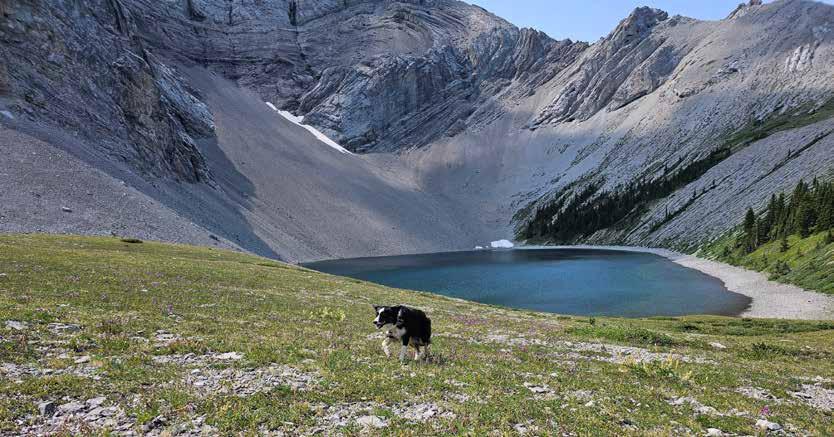
Stunning Ice Lake in Alberta, Canada. Photo courtesy Jesseca Johanson.
stupid grin and said, “No thank you, I will finish my walk of shame, and I’ll take care of my horse.” Since he is a very stubborn Frenchman, I didn’t argue but I also stuck close and helped peel the tack off a very unhappy looking red mare.
Steeve said that after the first river crossing before camp, he could feel Harriet swaying underneath him with the current. At the second river crossing, he stuck close to Rick and JJ, but Harriet just couldn’t keep her balance in the current and went down. Luckily both were able to get back to their feet, although Harriet crossed on her own with Steeve slogging across behind her. Some campers on the other side caught Harriet for him.
Strava tracked our distance at 64 kilometres. Our total moving time was nine hours and eleven minutes. Our horses all recovered quickly and enjoyed some well-deserved time
off. Sixty-four kilometers may seem like a lot to some people, but when these animals are conditioned and fed properly, us riders are really the weak spot. These horses are amazing athletes with incredible hearts and absolutely zero quit. Keep in mind a typical long-distance competition is 50 miles, and our ride that day was only 40 miles. (CTR and ERA track distance in miles, so we usually track our rides accordingly).
Alyssa left us a few days later to ride Mongolian horses across the steppe. The rest of us spent another week there riding and exploring as much as we could before we were forced back into cell service.
Murdoch Minute
No. 98: Seat to Hand Connection
Do you pull back on your reins, or do you let your arms go too far forward? Have you heard the term “ride back to front” but find yourself riding “front to back”? Do you have difficulty feeling that your seat is connected to your hands? This lesson will help you find the connection between your seat to your hands.

Next time you ride notice how much your arms are moving. Do you throw away the contact to give your horse a “release” the moment your horse does something correctly? Do you shift your body forward or your seat backward as you do this? Or do you stop moving in your seat as you take your arms back when stopping?
In order to ride “back to front” your hands must maintain a relationship to your seat and your seat needs to move forward with the horse, not against his movement. Otherwise your seat could be giving your horse one signal while your hands are doing something completely different causing confusion for your horse.
Riding “back to front” means that the horse is moving from his
By Wendy Murdoch
hindquarters into your hands. Your hands and arms must move in sync with your pelvis. But very often riders are unaware that the seat is moving in the opposite direction or not at all. In these instances the hands will automatically conflict by moving opposite to the seat and/or pulling back, which causes the rider to ride “front to back”. Front to back will shorten the horse’s neck and put the horse on the forehand while blocking the hindquarters.
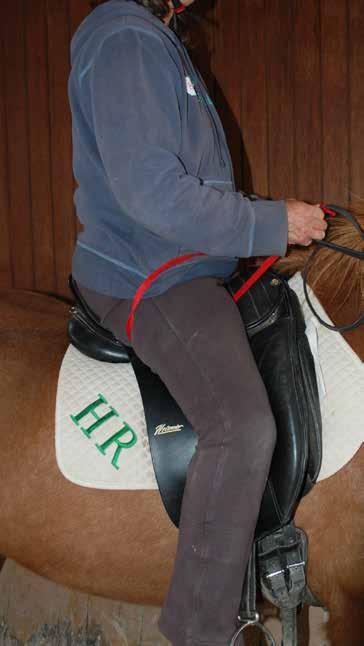
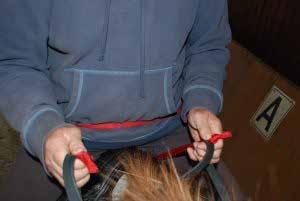
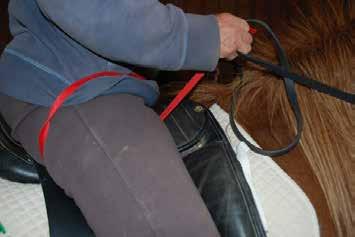
To help you find this “back to front” connection take a long thin strap and tie a small knot in each end. While mounted place the strap over you lap, around the outside of your thighs then wrap it around your thighs, between the saddle and your legs, bringing the ends toward the pommel. Hold one end with each hand along with your reins. You have now connected your seat to your hands and the horse’s mouth through the reins.
Ride at walk until you get used to the strap. Remember to let it slip through your hands or let go completely if your horse becomes
hands back to your seat instead of your seat moving toward your hands. Practice until you can keep an even tension on both sides of the strap while riding on straight lines and large circles.
Test yourself by riding walk/halt/ walk transitions. Do you lose the connection or feel restricted by the strap? When your hips remain free you will be able to keep an even tension without feeling restricted and ride your transition to halt. When ready ride at the trot (sitting rather than rising will be easier at first).
Use this Murdoch Minute to test your ability to ride “back to front”, from seat to hand. When you keep an even tension on the strap your hips will be unrestricted. This allows your seat to move toward your hands while maintaining a soft, yet clear rein contact so that your horse is unrestricted by your seat so that you both enjoy the ride!
nervous or excited or you feel anxious due to the restriction.
You may feel very limited at first especially if you are used to moving your hands around. If you feel like your hands are pulling against your pelvis expand your chest forward and upward to alleviate the tension. Feel how this expands your lower ribs and allows your seat to
move forward to your hands. Be careful not lift the chest too much or this will hollow your back causing your seat to move opposite to your hands.
Practice in short segments the strap becomes less awkward. Notice if it stays slightly taught as you ride or becomes loose and floppy. Floppy indicates you have pulled your
Photo 1. Place the strap over the front of the pelvis, around the outside of the thighs.
Photo 2 (top). Place the strap between the thigh and the saddle and hold the ends with each hand.
Photo 3 (bottom). The rider’s back is flat with chest expanding forward/up. This connects the arms to the seat. Notice the hands are slightly higher than normal to keep an even contact on the strap while maintaining a even contact with the reins.
What Your Equine Veterinarian Wants You to Know for Summer
Courtesy Equine Guelph
June 18 is Veterinary Appreciation Day. Your vet enjoys seeing you, but they would rather see you for routine appointments than emergencies. Equine Guelph is sharing free resources on TheHorsePortal.ca to help you communicate with confidence for both scenarios.
After all, an ounce of prevention is worth far more than a pound of cure, especially when it comes to summer horse care. From hydration and heat stress to parasite control and pasture management, small day to day decisions can have a significant impact on your horse’s health. If you want veterinary visits to stay routine rather than urgent, there are practical steps you can take now to set your horse up for a healthy season. Gradually building conditioning programs helps reduce the risk of lameness, while knowing your horse’s baseline vital signs is fundamental to spotting health concerns early and supporting your veterinarian with the information they need to deliver the best possible care.
Baselines
A key part of prevention is knowing what is normal for your horse, which is not always obvious as horses are very good at hiding early signs of a problem.
Regularly performing a quick and easy 16-point Horse Health Check helps you establish baseline values such as temperature, pulse, respiration, hydration, and soundness, making it easier to detect subtle changes early.
This knowledge allows you to be a confident advocate for your horse’s health while also supporting your veterinarian. Clear, accurate information helps your veterinarian assess whether a situation is urgent or can safely wait, leading to better decisions, more efficient care, and a stronger working relationship. It is exactly the kind of partnership veterinarians value most.
Hydration and Heat Management
Hydration and heat management are key as temperatures rise. Provide constant access to clean, fresh water, adequate shade, and consider electrolytes for horses in regular work or heavy sweat. Pay attention to early warning signs such as increased breathing rate, dullness, or reduced appetite, and adjust workload before problems develop.
Hydration and heat management are key as temperatures rise. Provide constant access to clean, fresh water, adequate shade, and ensure horses have access to salt at all times, to help maintain proper hydration. Horses in work may require electrolytes to help replenish
the fluids and electrolytes lost while sweating. Reduce the risks of dehydration, muscle issues, and heat stress with careful management. There are many do’s and don’ts when it comes to electrolyte use including ingredients and the timing and method of delivery.
Parasite Control
Parasite control should focus on prevention and long-term effectiveness. Work with your veterinarian to build a targeted deworming program based on fecal egg counts. This reduces resistance and keeps your program effective for the future. Your veterinarian wants you to know how to properly collect manure for a fecal egg count, rather than awkwardly waiting around making small talk until a sample appears.
Pasture Management
Pasture management is another important component of parasite control as well as overall equine health and well-being. Picking up the poop can reduce parasite populations and the amount of flying pests on your property.
Ticks are on the rise and letting horses graze in overgrown pastures can provide an inviting environment. Getting rid of brush piles and trimming the grass around paddocks can also make your facility less attractive for ticks.
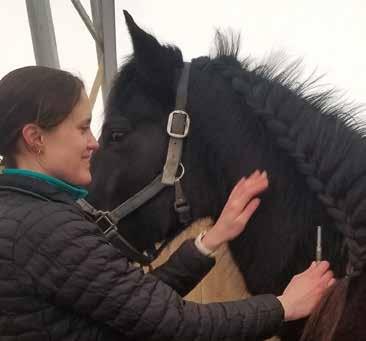
Rotational grazing, avoiding overgrazing, and monitoring for toxic plants help support nutrition and reduce health risks.
If laminitis is a concern, a grazing muzzle may be part of your prevention program. Laminitis is a vet emergency everyone dreads!
Lameness Prevention
Lameness prevention starts with a thoughtful, progressive training program. Avoid doing too much too quickly, especially when bringing horses back into work or increasing intensity. Gradually build fitness so bones, joints, and soft tissues can adapt. Include proper warm-up and cool-down and allow adequate recovery time between efforts. Recognizing subtle changes such as stiffness, uneven movement, or changes in performance and addressing them early can prevent
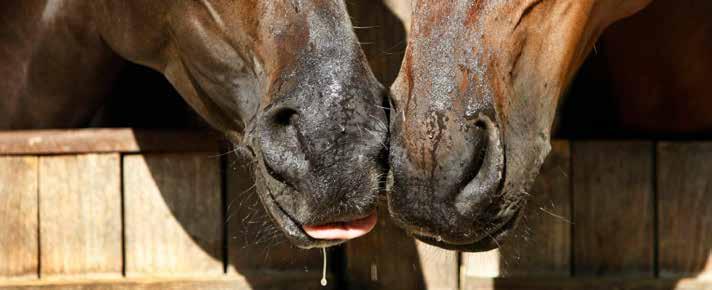
more serious injury. Your vet wants you to know it is easier to accurately diagnose lameness with an early call rather than waiting for more compensatory patterns to develop.
Biosecurity
Summertime is prime time to get out and enjoy activities with your horse. To avoid bringing anything home with you there are 14 top tips including bringing all of your own supplies, not sharing equipment and being up to date on vaccinations. Hang a free sickness prevention poster in your barn to let everyone know expectations at home and use Equine Guelph’s Biosecurity Risk Calculator for more steps on how to reduce the risk of infectious disease.
Across all of these areas, prevention and early recognition are key to keeping horses healthy and reducing the likelihood of emergency calls. Building good daily habits means your veterinarian becomes a partner in maintaining health, rather than responding to avoidable crises because the best way to cel-
ebrate your vet is to need them a little less urgently.
Want to dive deeper into recognizing risks and make informed decisions?
This September, Dr. Ev Post leads Equine Guelph’s online Equine Health & Disease course, designed to help horse owners build confidence in recognizing, preventing, and responding to common health concerns.
In this course, you’ll explore:
· Early warning signs of illness every horse owner should know
· How management choices influence disease risk
· When to monitor—and when to call the vet
· Practical strategies to support long-term horse health
Whether you’re looking to sharpen your eye for subtle changes or make more informed care decisions, this course connects everyday management with veterinary insight.
OUR FOREVER FRIENDS
FOSH Lifetime Members
Jo Anne Behling, Wauwatosa, WI
Esther L. Bell, TN
Pamela Brand, Carlisle, PA
Sarah Bushong-Weeks, Denver. CO
Julie Church, Pagosa Springs, CO
Mary & William Church, Pagosa Springs, CO
Luella DeBono, Eden Prairie, MN
Beverly Foster, St. Augustine, FL
Nancy Gillespie, Pullman, WA
Cristine Holt, Dubuque, IA
Jane Howlett, Pocatello, ID
Marjorie Lacy & Walking Horse News, Edson, Alberta
Sue De Laurentis, Dripping Springs, TX
Bobbie Jo Lieberman, Chicago, IL
Dianne Little, Calgary, Alberta
Debbie Locke, Mack, CO
Ann Loveless, Ashtabula, OH
Patricia Mayer, East Aurora, NY
Janelle T. McCoy, Prague, OK
Frank Neal, Nashville, TN
Lori Northrup, Ellicottville, NY
Anne Northrup, Ellicottville, NY
Shellie Pacovsky, Bainville, MT
Denise Parsons
Anita Rau, Catlett, VA
Debbie Rash, Chino, CA
Southern Comfort Gaited Horse Club, ID
Bucky & Nancy Sparks, Cortez, CO
Marcy Wadington, Canon City, CO
Leslie Weiler, Pagosa Springs, CO
Laura Wyant, Chesire, OR
An Anonymous Donor
Yankee Walkers of New England
Soring
Soring
“Without the chains, there would be no need for a scar rule.”
“Without the chains, there would be no need for a scar rule.”
– humane acTivisT,
may 2011.
– humane acTivisT, may, 2011.
ho W t o d ete ct
ho W t o d ete ct
d a ta s h eet
• Palpation
• Palpation
“That
Chemical Soring
Chemical Soring
W h at i s s oring ?
W h at i s s oring ?
Soring is deliberately inducing pain to exaggerate a gaited horse’s movement for the show ring. A variety of devious and cruel methods have been devised over the years. Soring violations also include many methods used to avoid detection. Soring is against Federal law and is subject to fines and penalties if detected at a public show or sale.
Soring is deliberately inducing pain to exaggerate a gaited horse’s movement for the show ring. A variety of devious and cruel methods have been devised over the years. Soring violations also include many methods used to avoid detection. Soring is against Federal law and is subject to fines and penalties if detected at a public show or sale.
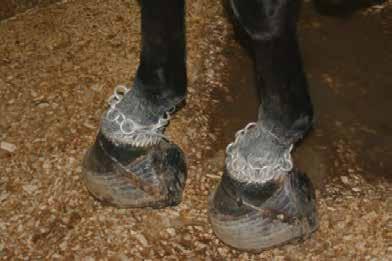
Chemical soring is the application of painful, caustic liquids to tenderize the horse’s pastern area (ankle), so the repeated strike of a chain is painful and causes the horse to snatch his foot higher with each step. The chain, a crucial part of this show horse style, is termed an “action device,” and the exaggerated gaits cannot be created without this chain.
ho W i t ’ s d one
ho W i t ’ s d one
ho W t o d etect
ho W t o d etect
Observations:
Observations:
• Horse lies down in stall and groans in pain.
• Horse lies down in stall and groans in pain.
• Horse is crampy and unwilling to move.
• Horse is crampy and unwilling to move.
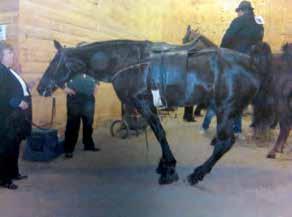
“That just looks wrong.”
Chemical soring is the application of painful, caustic liquids to tenderize the horse’s pastern area (ankle), so the repeated strike of a chain is painful and causes the horse to snatch his foot higher with each step. The chain, a crucial part of this show horse style, is termed an “action device,” and the exaggerated gaits cannot be created without this chain.
• Gas chromotography or “sniffer”
• Gas chromotography or “sniffer”
• Thermography
• Thermography
10-year-olD boy while waTching viDeo of a “big lick” horse shown in sTacks anD chains, June 10, 2011.
• Blood or saliva tests
just looks wrong.” 10-year-olD boy while waTching viDeo of a “big lick” horse shown in sTacks anD chains June 10, 2011.
• Blood or saliva tests
• Drug-detection trained dog
• Drug-detection trained dog
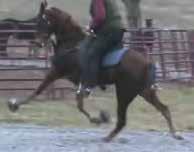
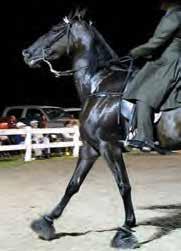
• Horse warms up into motion with a “praying mantis stance,” with abnormal weight thrown on his hind quarters to avoid front end pain.
• Horse warms up into motion with a “praying mantis stance,” with abnormal weight thrown on his hind quarters to avoid front end pain.
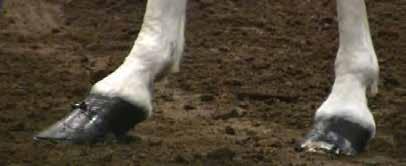
• Horse stands in classic “standing in a bucket” pose to alleviate pain in front legs (photo above).
• Horse stands in classic “standing in a bucket” pose to alleviate pain in front legs (photo above).
• kerosene
• kerosene
• diesel
• diesel
• croton oil
• croton oil
• GoJo hand cleaner
• GoJo hand cleaner
• WD40 oil
• WD40 oil
• mustard oil
• mustard oil
Soring includes the abuse of chains, foreign substances and chemicals, illegal shoeing to change the natural hoof angles, length of toe, weighted shoes, pressure shoeing, as well as the insertion of blocks and other devices between the hoof and the shoe stack to place pressure on the frog and sole of the foot to create pain in the front end of the horse. These methods all cause the horse to attempt to avoid the pain by picking up his front feet faster and higher, and shifting his weight back onto his hocks. Slang for an obviously sore-going horse is “going too deep.”
Soring includes the abuse of chains, foreign substances and chemicals, illegal shoeing to change the natural hoof angles, length of toe, weighted shoes, pressure shoeing, as well as the insertion of blocks and other devices between the hoof and the shoe stack to place pressure on the frog and sole of the foot to create pain in the front end of the horse. These methods all cause the horse to attempt to avoid the pain by picking up his front feet faster and higher, and shifting his weight back onto his hocks. Slang for an obviously sore-going horse is “going too deep.”
With the increased scrutiny of soring-related scars, another cruel practice is used to remove the telltale scarring. The horse’s legs are covered in a chemical stripping agent, which burns off old scar tissue through a very painful process.
Wh Y is t h is a b use d o ne?
• Visual inspections for:
Wh Y is t h is a b use d o ne?
• Visual inspections for:
Soring is practiced to get gaited horses to artificially enhance their step to win in shows. A winning image is rewarded with ribbons, cash, recognition, future breedings and training fees.
Soring is practiced to get gaited horses to artificially enhance their step to win in shows. A winning image is rewarded with ribbons, cash, recognition, future breedings and training fees.
en F o
– scarring and inflammation, signs of soring insults.
– scarring and inflammation, signs of soring insults.
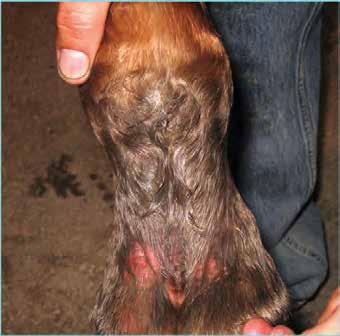
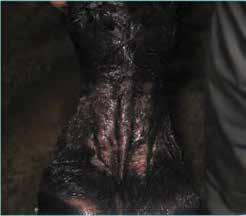
– wavy, rippled, curly hair on the front legs, an indicator of repeated chemical soring with leg wraps.
– wavy, rippled, curly hair on the front legs, an indicator of repeated chemical soring with leg wraps.
en F o rcement
rcement
t o e nd s oring
t o e nd s oring
Chemicals are applied to the horse’s lower legs, then the leg is wrapped in plastic for days. This causes the chemicals to “cook” into the flesh. This creates highly sensitized front pasterns that are painful when the chain strikes with every step. Examples of soring chemicals used:
Chemicals are applied to the horse’s lower legs, then the leg is wrapped in plastic for days. This causes the chemicals to “cook” into the flesh. This creates highly sensitized front pasterns that are painful when the chain strikes with every step. Examples of soring chemicals used:
There is a federal law called the Horse Protection Act, which prohibits soring at shows and sales, enforced by the USDA. However, most inspections are selfregulated by HIOs (horse industry organizations licensed by the USDA.)
With the increased scrutiny of soring-related scars, another cruel practice is used to remove the telltale scarring. The horse’s legs are covered in a chemical stripping agent, which burns off old scar tissue through a very painful process.
There is a federal law called the Horse Protection Act, which prohibits soring at shows and sales, enforced by the USDA. However, most inspections are selfregulated by HIOs (horse industry organizations licensed by the USDA.) d a
“The
– cording, a type of scarring caused by the plastic wrap sliding down and tightly bunching around the pasterns.
– cording, a type of scarring caused by the plastic wrap sliding down and tightly bunching around the pasterns.
– checking for application of foreign substances, by walking the barns and trailers at a show.
– checking for application of foreign substances, by walking the barns and trailers at a show.
Pressure Soring
Pressure Soring
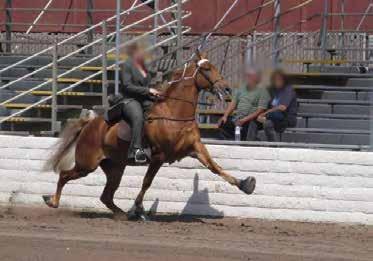
Pressure soring causes pain in a horse’s front feet, so when each front hoof hits the ground, the horse will “snatch” the foot off the ground, resulting in an unnatural, high, dramatic step.
Pressure soring causes pain in a horse’s front feet, so when each front hoof hits the ground, the horse will “snatch” the foot off the ground, resulting in an unnatural, high, dramatic step.
ho W i t ’ s d one
ho W i t ’ s d one
• Grinding the hoof sole down so thin “beads of blood show” and the sole gets spongy and super-sensitive.
• Grinding the hoof sole down so thin “beads of blood show” and the sole gets spongy and super-sensitive.
• Taking the hoof wall down slightly shorter than the sole, so it provides no supporting protection, called “rolling the sole.”
• Taking the hoof wall down slightly shorter than the sole, so it provides no supporting protection, called “rolling the sole.”
• Inser ting hard objects between the shoe or pad and the tender sole, such as bolts (removable for inspections), half a golf ball, hardened epoxy, or a dried piece of hoof.
• Inser ting hard objects between the shoe or pad and the tender sole, such as bolts (removable for inspections), half a golf ball, hardened epoxy, or a dried piece of hoof.
• Response to hoof testers (ideal if shoes are pulled first).
• Response to hoof testers (ideal if shoes are pulled first).
• Digital radiography (x-ray will show extreme thinness of sole, any foreign objects, or excessive coffin bone rotation).
• Digital radiography (x-ray will show extreme thinness of sole, any foreign objects, or excessive coffin bone rotation).
• Thermography to detect hot spots from pain.
• Thermography to detect hot spots from pain.
Methods Used to Avoid Detection at Inspection
Methods Used to Avoid Detection at Inspection
• numbing agents that wear off between inspection and show time (such as injected anesthetic, “the shot,” or surface application of Lidocaine).
• numbing agents that wear off between inspection and show time (such as injected anesthetic, “the shot,” or surface application of Lidocaine).
• “stewarding”: teaching the horse at practice inspections that flinching or reacting will cause worse pain, such as a beating or using a “hot stick” or electric prod.
• “stewarding”: teaching the horse at practice inspections that flinching or reacting will cause worse pain, such as a beating or using a “hot stick” or electric prod.
topical samples from Tennessee Walking Horses had the highest incidences of positives (of illegal substances from gas chromatography samplings)
that I’ve ever seen in my life.”
“The topical samples from Tennessee Walking Horses had the highest incidences of positives (of illegal substances from gas chromatography samplings) that I’ve ever seen in my life.”
— Dr Tomas Tobin leaDing veTerinarian in Drug conTrol anD Toxicology in compeTiTion horses, november 5, 2010 www.thomastobin.com
— Dr. Tomas Tobin, leaDing veTerinarian in Drug conTrol anD Toxicology in compeTiTion horses november 5, 2010 www.thomastobin.com
Fixing … Touching … “putting them in a bucket” … Soap ‘em … Fly spray (a term owners use so they can avoid admitting knowing that an illegal substance has been used on their horse) … getting them right … brushing them … square ‘em up … head shake in a bottle … dropping them … Mojo (commonly used by people referring to GoJo hand cleaner) …
Fixing … Touching … “putting them in a bucket” … Soap ‘em … Fly spray (a term owners use so they can avoid admitting knowing that an illegal substance has been used on their horse) … getting them right … brushing them … square ‘em up … head shake in a bottle … dropping them … Mojo (commonly used by people referring to GoJo hand cleaner) …
• “Blocking,” which is standing the horse for hours on wedges duct-taped to the hoof.
• “Blocking,” which is standing the horse for hours on wedges duct-taped to the hoof.
• Purposely foundering a young horse (called “the natural fix” and “nature’s way of soring”).
• Purposely foundering a young horse (called “the natural fix” and “nature’s way of soring”).
• “Road foundering” the horse by riding fast on a hard surface such as a paved road.
• “Road foundering” the horse by riding fast on a hard surface such as a paved road.
• Extreme tightening of metal hoof bands to cause pain from excessive pressure on the hoof.
• Extreme tightening of metal hoof bands to cause pain from excessive pressure on the hoof.
• distraction devices: a nerve gum cord, bit burr under the saddle, hand twitch, alligator clips on sensitive genital tissue, or surgical staples under the mane, applied just before an inspection to cause distracting pain elsewhere during the inspection.
• distraction devices: a nerve gum cord, bit burr under the saddle, hand twitch, alligator clips on sensitive genital tissue, or surgical staples under the mane, applied just before an inspection to cause distracting pain elsewhere during the inspection.
• horse switching: providing a substitute horse for inspection under false paperwork, and then switching and putting the sored horse into the show ring.
• horse switching: providing a substitute horse for inspection under false paperwork, and then switching and putting the sored horse into the show ring.
fixing … pressure soring … “putting the fever in the foot” … pressure shoeing … “pinching the toes” … bolting … blocking … “under pressure” … “in a bind” … quicked … hot nailed … “tightened up” (for bands) … cranking …
“fixing below the pastern” … going too deep … concussion foundering … “peak point” describes the maximum pain point in the weekly soring process …
fixing … pressure soring … “putting the fever in the foot” … pressure shoeing … “pinching the toes” … bolting … blocking … “under pressure” … “in a bind” … quicked … hot nailed … “tightened up” (for bands) … cranking … “fixing below the pastern” … going too deep … concussion foundering … “peak point” describes the maximum pain point in the weekly soring process …
USDA scar rule violation photos, 2009
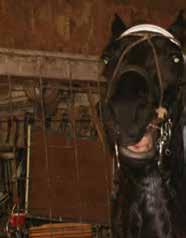
Horse in pain at a May, 2010 horse show.
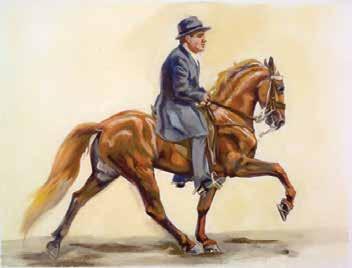
Artwork by Victoria von Kap-herr www.vonkapherr.com
Artwork by Victoria von Kap-herr www.vonkapherr.com
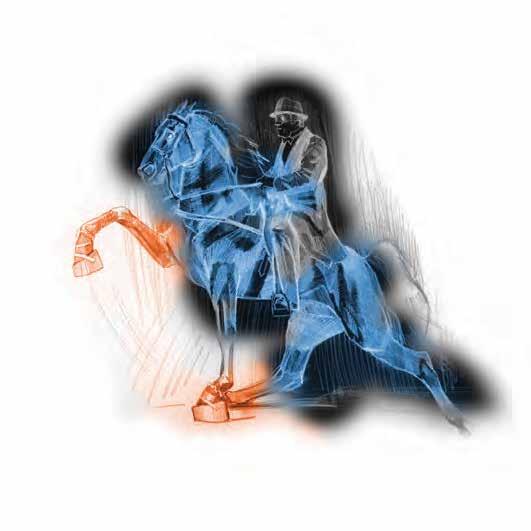
Chemical Soring
Chemical soring is the application of painful, caustic liquids to tenderize the horse’s pastern area (ankle), so the repeated strike of a chain is painful and causes the horse to snatch his foot higher with each step. The chain, a crucial part of this show horse style, is termed an “action device,” and the exaggerated gaits cannot be created without this chain.
ho W i t ’ s d one
Chemicals are applied to the horse’s lower legs, then the leg is wrapped in plastic for days. This causes the chemicals to “cook” into the flesh. This creates highly sensitized front pasterns that are painful when the chain strikes with every step. Examples of soring chemicals used:
• kerosene
• diesel
• croton oil
• GoJo hand cleaner
• WD40 oil
• mustard oil
With the increased scrutiny of soring-related scars, another cruel practice is used to remove the telltale scarring. The horse’s legs are covered in a chemical stripping agent, which burns off old scar tissue through a very painful process.
“Without the chains, there would be no need for a
–
scar rule.”
humane acTivisT, may 2011.
ho W t o d ete ct
• Palpation
• Gas chromotography or “sniffer”
• Thermography
• Blood or saliva tests
• Drug-detection trained dog
• Visual inspections for:
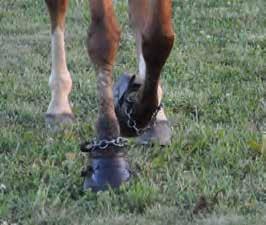
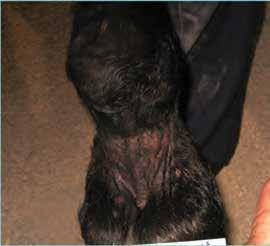
– scarring and inflammation, signs of soring insults.
– wavy, rippled, curly hair on the front legs, an indicator of repeated chemical soring with leg wraps.
– cording, a type of scarring caused by the plastic wrap sliding down and tightly bunching around the pasterns.
– checking for application of foreign substances, by walking the barns and trailers at a show.
Fixing … Touching … “putting them in a bucket” … Soap ‘em … Fly spray (a term owners use so they can avoid admitting knowing that an illegal substance has been used on their horse) … getting them right … brushing them … square ‘em up … head shake in a bottle … dropping them … Mojo (commonly used by people referring to GoJo hand cleaner) …
Observations:
etect
• Horse lies down in stall and groans in pain.
What Can Be Done to End Soring?
What Can Be Done to End Soring?
What W o uld have the biggest impact on eliminating soring?
What W o uld have the biggest impact on eliminating soring?
Pressure Soring
Pressure soring causes pain in a horse’s front feet, so when each front hoof hits the ground, the horse will “snatch” the foot off the ground, resulting in an unnatural, high, dramatic step.
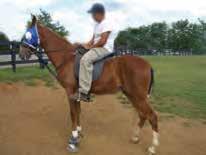
positions who has had soring violations within recent years.
• Horse is crampy and unwilling to move.
• Join FOSH or the HSUS.
positions who has had soring violations within recent years.
• Horse warms up into motion with a “praying mantis stance,” with abnormal weight thrown on his hind quarters to avoid front end pain.
• Volunteer for FOSH projects to end soring.
• Join FOSH or the HSUS.
Voice Your Concerns
• Volunteer for FOSH projects to end soring.
Voice Your Concerns
• Horse stands in classic “standing in a bucket” pose to alleviate pain in front legs (photo above).
3q More money allocated to the USDA’s enforcement. At present, USDA’s inspectors attend only 7% of the shows, due to budget constraints. Relying on “self-policing” with industry inspectors has not been effective over the past decades.
3q More money allocated to the USDA’s enforcement. At present, USDA’s inspectors attend only 7% of the shows, due to budget constraints. Relying on “self-policing” with industry inspectors has not been effective over the past decades.
ho W i t ’ s d one
• Tell your Congressmen that you demand full enforcement of the law and adequate HPA funding.
• Tell your Congressmen that you demand full enforcement of the law and adequate HPA funding.
• Response to hoof testers (ideal if shoes are pulled first).
• Inform traditional show venues and their sponsors that you will not suppor t them because these shows encourage soring.
• Inform traditional show venues and their sponsors that you will not suppor t them because these shows encourage soring.
• Digital radiography (x-ray will show extreme thinness of sole, any foreign objects, or excessive coffin bone rotation).
3q Severe penalties for those guilty of soring. Substantial fines and mandatory, serious suspension periods for trainers and owners, including lifetime bans and prison time, would deter soring.
• Grinding the hoof sole down so thin “beads of blood show” and the sole gets spongy and super-sensitive.
3q Severe penalties for those guilty of soring. Substantial fines and mandatory, serious suspension periods for trainers and owners, including lifetime bans and prison time, would deter soring.
• Demand t hat the USDA and the industry inspectors enforce the law effectively.
• Demand t hat the USDA and the industry inspectors enforce the law effectively.
• Thermography to detect hot spots from pain.
Report Soring to the USDA, HSUS, and FOSH:
• Document soring incidences observed at barns or shows with photos or video and submit personally or anonymously.
Report Soring to the USDA, HSUS, and FOSH:
Methods Used to Avoid Detection at Inspection
3q Federal ban on “pads and action devices,” commonly termed “stacks and chains.”
3q Federal ban on “pads and action devices,” commonly termed “stacks and chains.”
W h at c an Y o u d o t o h elp e nd s oring ?
• Taking the hoof wall down slightly shorter than the sole, so it provides no supporting protection, called “rolling the sole.”
Learn More
W h at c an Y o u d o t o h elp e nd s oring ?
Learn More
• Inser ting hard objects between the shoe or pad and the tender sole, such as bolts (removable for inspections), half a golf ball, hardened epoxy, or a dried piece of hoof.
• Document soring incidences observed at barns or shows with photos or video and submit personally or anonymously.
• Report barns and trainers engaging in soring practices.
• Report scheduled “outlaw shows” organized without licensed HIO inspections.
• Report barns and trainers engaging in soring practices.
• numbing agents that wear off between inspection and show time (such as injected anesthetic, “the shot,” or surface application of Lidocaine).
• www.StopSoring.com for latest news and facts on soring
• www.SoundHorseConference.com for presentation lectures on soring
• www.StopSoring.com for latest news and facts on soring
• www.SoundHorseConference.com for presentation lectures on soring
• United States Department of Agriculture (USDA) on Horse Protection www.aphis.usda.gov/animal_welfare/hp
• “Blocking,” which is standing the horse for hours on wedges duct-taped to the hoof.
Friends of Sound Horses, Inc. (FOSH)
• Report scheduled “outlaw shows” organized without licensed HIO inspections.
Lori Northrup, President 6614 Clayton Road #105, St. Louis, MO 63117 716-474-7580 • Lori@Northrup.com
Friends of Sound Horses, Inc. (FOSH) Lori Northrup, President 6614 Clayton Road #105, St. Louis, MO 63117 716-474-7580 • Lori@Northrup.com
• “stewarding”: teaching the horse at practice inspections that flinching or reacting will cause worse pain, such as a beating or using a “hot stick” or electric prod.
The Humane Society of the United States (HSUS)
The Humane Society of the United States (HSUS)
• United States Department of Agriculture (USDA) on Horse Protection www.aphis.usda.gov/animal_welfare/hp
• Purposely foundering a young horse (called “the natural fix” and “nature’s way of soring”).
• Humane Society of the United States (HSUS) http://www.humanesociety.org/issues/tenn_ walking_horses
Get
• Humane Society of the United States (HSUS) http://www.humanesociety.org/issues/tenn_ walking_horses
Involved
• “Road foundering” the horse by riding fast on a hard surface such as a paved road.
Get Involved
• Extreme tightening of metal hoof bands to cause pain from excessive pressure on the hoof.
• distraction devices: a nerve gum cord, bit burr under the saddle, hand twitch, alligator clips on sensitive genital tissue, or surgical staples under the mane, applied just before an inspection to cause distracting pain elsewhere during the inspection.
• Run for a Board of Directors’ position with the Tennessee Walking Horse Breeders & Exhibitors Association (TWHBEA) and effect change from within.
• Run for a Board of Directors’ position with the Tennessee Walking Horse Breeders & Exhibitors Association (TWHBEA) and effect change from within.
Keith Dane, Director of Equine Protection 700 Professional Drive, Gaithersburg, MD 20879 301-258-3076 • kdane@hsus.org
Keith Dane, Director of Equine Protection 700 Professional Drive, Gaithersburg, MD 20879 301-258-3076 • kdane@hsus.org
United States Department of Agriculture, APHIS (USDA)
Dr. Rachel Cezar, Horse Protection Coordinator Dr. Chester Gipson, Deputy Administrator 4700 River Road, Suite 6D03, Riverdale, MD 20737 301-734-5784 • Rachel.Cezar@aphis.usda.gov
United States Department of Agriculture, APHIS (USDA)
• horse switching: providing a substitute horse for inspection under false paperwork, and then switching and putting the sored horse into the show ring.
• Propose changes to the TWHBEA bylaws that preclude anyone from holding leadership
• Propose changes to the TWHBEA bylaws that preclude anyone from holding leadership
Dr. Rachel Cezar, Horse Protection Coordinator
Dr. Chester Gipson, Deputy Administrator 4700 River Road, Suite 6D03, Riverdale, MD 20737 301-734-5784 • Rachel.Cezar@aphis.usda.gov
“Call it what it is. This is torture.” — inTernaTionally-renown clinician february 2011
fixing … pressure soring … “putting the fever in the foot” … pressure shoeing … “pinching the toes” … bolting … blocking … “under pressure” … “in a bind” … quicked … hot nailed … “tightened up” (for bands) … cranking … “fixing below the pastern” … going too deep … concussion foundering … “peak point” describes the maximum pain point in the weekly soring process …
FOSH Sound Principles
Principle #1
All FOSH events adhere to the requirements of the Horse Protection Act.
Principle #2
Horses are to be treated with dignity, respect, and compassion.
Principle #3
Horses must be presented as sound in both body and mind.
Principle #4
The preferred way of going is natural, correct, and without exaggeration.
Principle #5
Shoeing is intended only for the protection of the foot and its structure. Where practical, barefoot horses are both welcomed and encouraged.
Principle #6
Handlers and riders are expected to use training techniques and equipment that conform to the highest humane standards as recognized by the general equestrian community.
Principle #7
Exhibitors have a duty to conduct themselves in an orderly, responsible, and sportsmanlike manner.
FOSH is a national leader in the promotion of natural, sound gaited horses and in the fight against abuse and soring of Tennessee Walking Horses. For more information about FOSH or to become a member, please visit www. fosh.info.
Gaited Clubs
FOSH Directory
Southern Comfort Gaited Horse Club
Southern Comfort promotes activities highlighting the smooth ride and versatility of all gaited breeds. Pursuits include trail riding, competitions, shows, exhibitions, clinics and many other equine activities. The club promotes horse safety and friendship for all that are interested in horses. Owning a horse is not a requirement. SCGHC is based in southwestern Idaho and is a flat shod exclusive club with members contributing and supporting various interests using sound, natural horses. www.gaitedhorseclub.com
Chesapeake Plantation Walking Horse Club
The Chesapeake Club is celebrating over 25 years of promoting the versatile, naturally gaited, horse. As a member of the Maryland Horse Council, we have been the voice of the gaited community and through demonstrations, clinics and guest speakers, a resource for other disciplines to learn about the gaited breeds in our region. Members enjoy monthly trail rides, newsletters, parades, clinics, social gatherings, and friendly help. We welcome all breeds, riding styles, and experience levels from beginners to professionals. Cpwhclub. wordpress.com or jacquiecowan@comcast.net
Breeders
Summerwind Marchadors and Future Foal Breeders
Plan for your next lifetime partner! Come breed with us! Offering frozen semen (12 stallions in 2020) or reservations for Future Foals “do Summerwind” The Marchador is Brazil’s national horse, harking from Iberia, but bred there for 200 years. Expect to be impressed! http:// futurefoal.net or call Lynn @ 602-999-3915
Missouri Morgans
Easy gaited in color. Rare gaited Morgans located in the Heart of America near beautiful Lake of the Ozarks; for photos, videos and available horses. Talk to Jim or Vali Suddarth at 417-286-4720 or gaitedmorgans@missourimorgans.com
Friends of Sound Horses, Inc. Sound Show / Event Support Form
Please print or type information below
Name of Event:
Event Description: ______________ ____________ (show, clinic, expo, etc.)
Breeds Included: ____________________________________________________
Date(s) of Event:
Location of Event: ____________________________________________ (street)
__________________ (city) __________ (postal code) _____(state or province)
___________ (country)
Principal Contact Person: ______________________________(name)
Principal Contact Person Email: __________________________________
Principal Contact Person Phone: ______________________________
Name of Organization to RECEIVE Support Check: (check will be made out to…)
ADDRESS to where support check should be sent: ___ (street)
__________________ (city) ____________ (postal code) (state or province)
___________ (country)
If your event is approved, you should receive your support check within 30 days.
Please EMAIL this completed form to: president@fosh.info (faster) or mail to:
FOSH 6614 Clayton Rd., #105 St. Louis, MO 63117 For FOSH use only… Amount provided: _______________
Friends of Sound Horses, Inc. Scholarship Request Form
Please print or type information below
Student Applying: _________________________________(name) Age: ____ (yrs)
Student Email:
Student Phone: _____________________________________________________
Student Address: ______________________________________________ (street)
____________________ (city) __________ (postal code) _____(state or province)
___________ (country)
School Name:
Major: _ ____________
Date of Last FOSH show participation *:
Attach copy of acceptance letter and note date on letter here:
School Address: ____________________________________ (street) _____ (city) __________ (postal code) _____(state or province)
___________ (country)
Note: Checks will be made out to [Institution Name] for the benefit of [Student Name] and will be sent to the attention of the Financial Aid department. If you are chosen to receive a scholarship, you will be notified within 90 days of applying
Please EMAIL this completed form to: president@fosh.info (faster) or mail to:
FOSH 6614 Clayton Rd., #105 St. Louis, MO 63117
For FOSH use only… Amount provided: _____________ Date sent: ____________
Scholarship Guidelines are on the following page (and do not need to be submitted with this form).
Please consider adding FOSH to your list of worthy causes in making a taxfree charitable deduction or help us to promote legislation, education, and training that protects and helps gaited horses, simply by renewing your own membership or giving a gift membership to a kindred spirit.
We know you have many choices when it comes to giving. Thank you for considering FOSH.
FOSH Membership Application and Order Form
All annual memberships include a digital, bi-monthly issue of the Sound Advocate & educational packets. Mail to: FOSH 6614 Clayton Rd. #105, St. Louis, MO 63117
Type of Membership (check one)
Annual: Single ___$30 Annual Family ___$50 Annual Youth <18 ___$20 Lifetime__$600 Organization Membership (for your gaited horse club or association) ___ $50
Please print neatly.
Name: _______________________________________________________________________
Enclosed: $____________________
How did you hear about FOSH?