ON THE MOVE THE OFFICIAL STUDENT PUBLICATION OF THE UNIVERSITY OF SAN JOSE-RECOLETOS VOLUME 19 | A.Y. 2025-2026 FIRST SEMESTER ISSUE
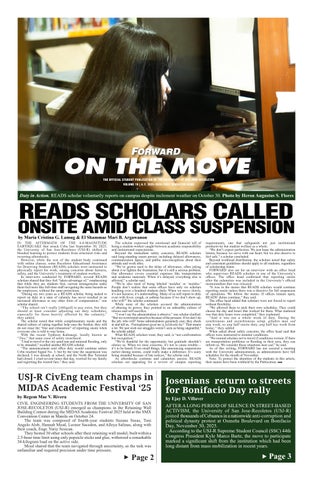
Duty in Action. READS scholar voluntarily reports on campus despite inclement weather on October 30. Photo by Heron Augustus S. Flores
READS SCHOLARS CALLED
ONSITE AMID CLASS SUSPENSION by Maria Cristina G. Lamug & El Shammae Mari B. Argawanon
IN THE AFTERMATH OF THE 6.4-MAGNITUDE EARTHQUAKE that struck Cebu last September 30, 2025, the University of San Jose-Recoletos (USJ-R) shifted to blended learning to protect students from structural risks and recurring aftershocks. However, while the rest of the student body continued with online classes, some Recoletos Educational Assistance for Deserving Students (READS) scholars were instructed to physically report for work, raising concerns about fairness, safety, and the University’s treatment of student-workers. In interviews conducted by FORWARD, several READS scholars shared that they feel “taken advantage of,” emphasizing that while they are students first, current arrangements make them feel more like full-time staff navigating the same hazards as the employees, without the same protections. “During my two years as a READS scholar, being tasked to report on duty in a state of calamity has never resulted in an increased allowance or any other form of compensation,” one scholar shared. “The school isn’t really [obliged] to pay extra, but they should at least consider adjusting our duty schedules, especially for those heavily affected by the calamity,” they added. The scholar noted that while complimentary meals and the shared culture of eating together help ease the burden, they still do not erase the “fear and exhaustion” of reporting onsite when everyone else is told to stay home. With the recent Typhoon Kalmaegi, locally known as “Tino,” that same issue of safety resurfaced. “I had to travel to the city amid rain and minimal flooding, only to be stranded,” recalled another READS scholar. “The announcement said office duty would continue unless Cebu reached Signal No. 3, but by the time the suspension was declared, I was already at school, and the North Bus Terminal had closed. I cried several times that day, worried for my family and regretting the wasted fare,” they said.
The scholar expressed the emotional and financial toll of being a student-worker caught between academic responsibility and institutional expectations. Beyond the immediate safety concerns, READS scholars said long-standing issues persist, including delayed allowances, communication lapses, and public misconceptions about their attitude and work ethic. “We’ve grown used to the delay of allowance, often joking about it to lighten the frustration, but it’s still a serious problem. Our allowance covers essential expenses like transportation and academic materials. When it’s delayed, everything else is affected,” a scholar said. “We’re also tired of being labeled ‘maldita’ or ‘maldito.’ People don’t realize that some offices have only six scholars handling over a hundred students daily. When we move slowly, it’s not laziness; it’s understaffing. Many of us still report to duty even with fever, cough, or asthma because if we don’t show up, who will?” the scholar continued. While none of the scholars accused the administration of abusing its power, they pointed to an unhealthy culture of silence and self-sacrifice. “I won’t say the administration is abusive,” one scholar clarified. “But we overextend ourselves because of the pressure. If we don’t do the job, who will? Some administrators genuinely care; they check in and tell us, ‘Paningkamot gyod mo’g [e]skwela ha?’ That means a lot. We just wish our struggles weren’t seen as being ungrateful,” the scholar added. What READS scholars want, they said, is “not confrontation but recognition.” “We’re thankful for the opportunity, but gratitude shouldn’t silence us. When we raise concerns, it’s not to cause trouble— it’s to be heard. Even small things, like announcing suspensions earlier during storms, could really make a difference. It’s scary being stranded because of late notices,” the scholar said. As aftershocks continue and calamities persist, READS scholars are appealing for a review of campus reporting
USJ-R CivEng team champs in MIDAS Academic Festival ‘25 by Regem Mae V. Rivera CIVIL ENGINEERING STUDENTS FROM THE UNIVERSITY OF SAN JOSE-RECOLETOS (USJ-R) emerged as champions in the Retaining Wall Building Contest during the MIDAS Academic Festival 2025 held at the SMX Convention Center in Manila on October 24. The team was composed of fourth-year students Suzane Susas, Toni Angelo Alob, Hannah Misal, Leonor Sacedon, and Alleya Salinas, along with their coach, Engr. Yuriy Sesican. They bested 30 other schools after their retaining wall model, built within a 2.5-hour time limit using only popsicle sticks and glue, withstood a remarkable 34-kilogram load on the active side. Misal shared that the team navigated through uncertainty, as the task was unfamiliar and required precision under time pressure.
Page 2
requirements, one that safeguards not just institutional productivity but student welfare as a whole. “We don’t expect perfection. We just hope the administration listens, because we serve with our heart, but we also deserve to feel safe,” a scholar concluded. Beyond workload distribution, the scholars noted that safety and consistent guidelines should apply to all students, regardless of scholarship status. FORWARD also sat for an interview with an office head who supervises READS scholars in one of the University’s offices. The office head confirmed that reporting onsite after the calamities was included in the University’s official memorandum that was released. “It was in the memo that READS scholars would continue reporting onsite unless there was a directive for full suspension of operations. We follow the memo. If offices remain open, READS’ duties continue,” they said. The office head added that scholars were not forced to report without flexibility. “We allowed them to pick their own schedules. They could choose the day and hours that worked for them. What mattered was that duty hours were completed,” they explained. “And it was not a whole week of duty. During the synchronous and asynchronous setup, gibahin man sad ang week, so ang half onsite duty, ang half kay work from home,” they added. When asked about safety concerns, the office head said that offices were instructed to monitor conditions. “We remind scholars not to travel if conditions worsen. If there are transportation problems or flooding in their area, they can inform us. We consider those situations man sad,” he said. As of this writing, FORWARD has not secured a meeting with the University administration, as administrators have full schedules for the month of November. Note: To protect the identities of the students in this article, their names have been withheld by the Publication. FWD
Josenians return to streets for Bonifacio Day rally by Ejay D. Villaver
AFTER A LONG PERIOD OF SILENCE IN STREET-BASED ACTIVISM, the University of San Jose-Recoletos (USJ-R) joined thousands of Cebuanos in a nationwide anti-corruption and political dynasty protest at Osmeña Boulevard on Bonifacio Day, November 30, 2025. According to the USJ-R Supreme Student Council (SSC) 44th Congress President Kyle Marco Barte, the move to participate marked a significant shift from the institution which had been long distant from mass mobilization in recent years.
Page 3
02 | NEWS
USJ-R grad earns Top 1 in BLEPP by Kristian John V. Wahing
Number 1. Dandean Bernabe poses after his topnotcher speech at the Oath-taking Ceremony. Photo Courtesy: Dandean Bernabe
DANDEAN BERNABE, AN ALUMNUS OF THE UNIVERSITY OF SAN JOSERECOLETOS (USJ-R), topped the September 2025 Board Licensure Examination for Psychologists and Psychometricians (BLEPP) with a rating of 90.00% as released by the Professional Regulation Commission (PRC) on October 2. The University achieved an 89.09% overall passing rate, with Bernabe named as the highest scorer among 12,416 passers nationwide. Bernabe shared that he had only four months to prepare for the exam, emphasizing discipline and consistency as his guiding principles. “I committed to studying at least 6–8 hours a day without rest days…I believe that diligence and consistency are not only keys to passing the board exam, but also essential principles in real-world practice, especially in our profession,” he said. He added that his greatest motivation came from faith, gratitude, and the people who stood by him throughout the journey.
“I am deeply grateful for the support system I had throughout the review season, and most especially, I entrusted everything to the Lord,” he said. Meanwhile, Bernabe credited his mentors at the USJ-R Department of Psychology and Library Information Science (DPLIS) for molding him into “a better version” of himself. “Looking ahead, I hope to pay it forward. If given the opportunity to share my knowledge, I would be more than willing to help future board passers,” he said. He also offered words of encouragement to future examinees. “May we remember that the knowledge we gain is not only for ourselves, but for the service of the community. Let us move forward with the attitude of contributing to society and making a lasting impact,” he said. Further, two other Josenians, Angelica Lynn Apog and Pierre Anjun Gemelga, ranked 4th and 10th, respectively. FWD
USJ-R CivEng team champs in MIDAS Academic Festival ‘25 from page 1
“During the competition, everything went smoothly based sa among plans. The challenge was the drying time sa popsicle sticks, but teamwork was never a problem,” she said. Alob affirmed the same observation, noting that material restrictions and time constraints tested their strategy and composure. “The challenge was more [with] the drying time since we were only allowed to use Elmer’s glue. Even without a mock model, we trusted our plan and each other,” Alob expressed.
This marks USJ-R’s third participation in the MIDAS Academic Festival and their first championship in the national level, qualifying alongside Cebu Institute of Technology - University (CIT-U) as the only Cebu-based schools in this year’s competition. Additionally, the MIDAS Academic Festival is an annual national event that gathers top civil engineering schools across the Philippines to test students’ mastery in structural design, innovation, and teamwork. FWD
Winning Champs. Champions of the MIDAS Academic Festival hold tokens and cash prize. Photo Courtesy: Toni Angelo Alob
Josenian earns PH Most Outstanding CE Student title by Regem Mae V. Rivera
Top Win. Suzane Susas (middle) smiles in victory as she receives the prestigious award. Photo Courtesy: Suzane Susas
FOURTH-YEAR BACHELOR OF SCIENCE IN CIVIL ENGINEERING (BSCE) STUDENT Suzane Susas received recognition as the Most Outstanding Civil Engineering Student (MOCES) of the Philippines 2025 after a two-day national evaluation organized by the Philippine Institute of Civil Engineers (PICE) in Quezon City on November 25. Susas, who competed against nominees from the country’s top CE schools, shared that receiving the award felt surreal and deeply humbling.
“When one of your dreams comes true, it plays out better than anything you could imagine. Ang mo-sulod [ra gyod] sa akong utok ato nga time are all the people that supported me, especially during the times when I doubted myself,” Susas said. She also recalled the challenges she faced prior to the assessment, including difficulties securing documents due to the recent earthquake and typhoon. “I kept praying kay lisod makakuha sa papers from [the] offices. If para gyod nako, maabot ra ang kailangan nako to win it,” she added.
Susas highlighted the role of her mentors and her department in shaping her confidence and leadership, noting that her communication classes helped her handle unexpected questions during the event. She also credited her experience being part of the team that won the national Retaining Wall Building Contest last October to her recent recognition. MOCES is an annual national award conferred by PICE. Across its 243 student chapters, each chapter may nominate one candidate for the distinction. FWD
NEWS | 03
Josenians return to streets for Bonifacio Day rally from page 1
Strong Front. Josenians stand in solidarity against corruption. Photo by Yasu M. Al-dawood
“It’s a first na nibalik ta og join og mga mass mobilizations and its actually a great achievement na for how many years USJ-R has long [been] in the sidelines and we were able to at least have them on the streets to speak up about corruption,” he said. Barte added that although the protest centered on the general issue of corruption rather than specific political figures, it remained “an important step” for the institution as it slowly rebuilt a culture of civic participation. USJ-R’s return to street protests coincided with larger actions across Cebu. Earlier in the day, demonstrators burned effigies of President Ferdinand “Bongbong” Marcos Jr. and Vice President Sara Duterte, demanding accountability amid corruption controversies linked to the administration. Within the University, discussions continue on how the mobilization may shape future student actions. Barte said further involvement is possible, but change will come gradually due to long-standing campus policies that restrict organizing. “...For the longest time USJ-R culture has known it. You’ll be reprimanded for organizing these certain events, it’s already embedded
in our student manual and we look forward to modifying it in order to fit what students’ rights is basically like: the right to organize, the right to freedom of speech, the right to operate as a student council not bound by administrative restriction,” he said. Despite these challenges, Barte remains hopeful. “Although we are bound by certain cultures here in USJ-R where not all the time we get to express what we want. It’s still a step for the Josenian[s] that they can participate in this mass mobilizations to go back who we were once as a student council because before when student councils were disbanded, USJ-R was one of the first to rally around the streets and it makes me proud in some way were going back to that way,” he added. For him, the recent mobilization shows that USJ-R students are ready to reclaim that legacy and refuse to remain on the sidelines. The rally, organized by the Archdiocese of Cebu, calls for the end of corruption and political dynasties, while promoting for accountability and truth amidst the corruption scandals plaguing the country. FWD
Josenians secure top spots in 2025 RBP exams
by Khara Angelique R. Davis
THREE JOSENIAN ALUMNI EARNED TOP SPOTS in the recently concluded Registered Business Professionals (RBP) examinations as released by the Professional Regulation Commission (PRC) on October 8, 2025. Jhen Valerie Propongo, a graduate of Bachelor of Science in Business Administration major in Operations Management (BSBA-OM), ranked 3rd, while Bachelor of Science in Entrepreneurship (BS-ENT) graduates Jovit Earl Sawal and Arvynn Charles Yap ranked 8th and 9th, respectively. In an interview with FORWARD, Sawal shared that the “driving force during moments of pressure and doubt” was his family. “Their unwavering support and belief in me gave me strength when I felt like
giving up. I always [remind] myself that my hard work wasn’t just for me, but for the better future I wanted to give them,” he added. Sawal also emphasized that doing his best guided him to becoming resilient and disciplined despite the unforeseen challenges. “Despite being a shiftee and being way behind my batchmates, I not only achieved success but also grew stronger and more confident in my abilities,” he added. Meanwhile, Yap expressed his gratitude towards the people who helped him in his academic career. “Coming all the way from Leyte to Cebu just to study at one of the best schools in the Philippines was not an easy journey. I always remind myself that I am capable. I’m also deeply thankful [to] my parents. They are my biggest sources of strength and motivation,” he stated.
Photo Courtesy: Arvynn Charles Yap & Jovit Earl Sawal
He then recalled how his mentors became his “second parents,” who guided him whenever he was clouded in self-doubt. “My mentors and the academic environment at USJ-R really played a big part in my growth…They pushed me to do better not just in school, but also as a person, and I will always be grateful for that,” he added. The Junior Achievement (JA) Philippines conducts the RBP examinations twice a year, typically in May and November. FWD
USJ-R clinches overall champ at Cebu Goes Culinary ‘25 by Maria Cristina G. Lamug
Now Serving. Representatives showcase baking skills in the cookout. Photo by Hannah Vanessa O. Mondilla
JOSENIANS FROM THE BACHELOR OF SCIENCE IN HOSPITALITY MANAGEMENT (BSHM) stole the spotlight after bagging the Overall Champion title in the Cebu Goes Culinary 2025 Student Category at SM Seaside Cebu on September 27. From cocktail and mocktail mixing, wedding cake making, cake decorating, potato dish contest, to coffee concoctions, the Josenian team proved their mastery across categories, earning multiple awards that sealed their title. For Le Cercle Culinaire (LCC) President Ray Kristian Dela Calzada, the journey was both challenging and fulfilling. “Every day was a challenge. We gave our all in every session, and through the guidance of our supportive mentors, we were able to execute our
vision. This is where we realized that the Josenian spirit is alive,” he said. Further, Dela Calzada also shared that winning was never the team’s ultimate goal. “We joined not to win, but to prove that USJ-R (University of San Jose-Recoletos) is capable of competing. Winning became a bonus to our sacrifices. What mattered most was gaining real culinary experience, and in the end, those seeds of hard work led to our winning moment,” he shared. Among the participants in this year’s culinary tilt were Waterfront Hotel and Casino, Bai Hotel, Radisson Blu Hotel, Seda Central Bloc, Savoy Hotel, University of San Carlos (USC), and University of Cebu (UC). Cebu Goes Culinary is a premier culinary competition that gathers aspiring chefs and hoteliers to showcase their talent in various categories. FWD
04 | EDITORIAL
F
Plan Now or Pay Later
or far too long, disaster preparedness in the Philippines has been framed as an issue that begins and ends with the environment—climate change, global warming, and rising ocean temperatures. Although valid and urgent, the uncomfortable truth remains: disasters are not just natural, but they are also political, structural, and entirely predictable. As cities balloon in population without proper planning and informal settlements proliferate in hazardous zones, they continue to construct homes and infrastructure in areas that are already known to be unsafe, such as riverbanks, coastal areas, and landslide-prone slopes. For instance, Cebu has seen this pattern unfold recently—how hillside projects like the Monterrazas amplify landslides and run off risks, the displacement caused by floods during storms along the Mananga River in Talisay, the need for slope protection projects in Sirao, and the mishandling of flood control projects in different parts of the country. The storm does not create the tragedy; it only exposes what is already there. Although existing laws and local government mandates could have prevented these incidents, enforcement remains sporadic and influenced by politics. It is not as if the Philippines is without talent or technological capacity. In fact, an internationally recognized model for disaster forecasting and community-level risk mapping, Project NOAH (Nationwide Operational Assessment of Hazard), was previously
EDITORIAL BOARD AND STAFF Ava Donalie A. Ferolino Editor-in-Chief Krisha Faye A. Gascon Associate Editor Kimberly G. Capuyan Managing Editor-Administration John Kherwin A. Pansacala Managing Editor-Finance Narvie Klaryzze B. Borja Creative Director
utilized by the country to provide advanced and real-time data for disaster readiness. However, since promising initiatives often hinge on the priorities of whoever holds office, rather than on a sustained national strategy, it was defunded in 2017 due to being deemed “too costly.” The problem here is that our disaster management system reacts knowledgeably during a crisis, but prepares inadequately before it. Every time we rebuild from these disasters, we are confronted with the same reality: disasters are expensive because we have never learned to prevent them. After the damage assessments, media soundbites, and official site visits, no one asks the hard questions: Why were people living in a floodplain area? Were scientific warnings heeded, funded, and acted upon? Did urbanization follow long-term development plans or short-term political interests? Climate change may intensify storms, but governance determines who survives them. Suppose we want fewer tragedies, fewer casualties, and fewer communities washed into history, we must reform not just our environmental policies, but the political and developmental structures that make natural hazards deadly. True reform requires shifting from heroics to system-building. From blame to accountability. From reacting to anticipating. The Philippines does not need more stories of resilience—we need fewer reasons to keep proving we are resilient. FWD
THE OFFICIAL STUDENT PUBLICATION OF THE UNIVERSITY OF SAN JOSE-RECOLETOS VOLUME 19 | A.Y. 2025-2026 FIRST SEMESTER ISSUE Lylle Antonette A. Flores News Editor Ceraley S. Cabiltes Jr. Opinion Editor Trixcy D. Clar Co-Opinion Editor Ma. Ehla Fatima C. Inanod Features Editor Kristianna Amor M. Tagsip Literary Editor Louise Lambiquit Sports Editor Raghnall P. Cena Broadcast Manager / Videographer Ms. Cindy R. Limalima Publication Adviser
FORWARD On The Move is the official newsletter of FORWARD Publications and is printed every semester. FORWARD Publications is located at Ground Floor, San Agustin building,
Kimberly O. Tumilap Maria Cristina G. Lamug Online Editors Sharry M. Cuizon Property Administrator / Writer Gabrielle Marie R. Paradiang IT Administrator / Photographer Hannah Vanessa O. Mondilla Art Director / Illustrator Ejay D. Villaver Writer Ayn E. Nazareno Photographer
Khen B. Fernandez Karina Adel A. Vestil Sienna Rio E. Young Heron Augustus S. Flores Illustrators Krista Marie B. Yaoyao Therese Margarette A. Racaza Layout Artists Yasu M. Al-dawood Regem Mae V. Rivera Vince Praxie C. Nuñez Kristian John V. Wahing Allyza Nicole I. Marimon Rheiz Janae P. Montecillo Khara Angelique R. Davis El Shammae Mari B. Argawanon Probationary Staff
Rev. Fr. Vicente L. Ramon, Jr., OAR Moderator
University of San Jose-Recoletos, Magallanes Street, Cebu City. FORWARD Publications welcomes contributions (informal/personal essays, poems, short stories, news articles, artworks, and photographs).
All rights reserved. No part of this newsletter shall be used for any purpose, except when allowed by the law, without prior explicit permission from FORWARD Publications.
femininomenon
OPINION | 05
Opinion
AVA DONALIE A. FEROLINO
LUISA
KRISHA FAYE A. GASCON
Unfiltered spaces, Unseen harm
A
How Much for Our t 13, I had unrestricted access to the internet. channel features make these groups difficult to track. No filters, no supervision, no idea what lived Some groups delete themselves and reappear hours Future This Time?
behind the apps I thought were harmless. Tumblr and Twitter became my first “worlds,” and from there I slipped into messaging platforms that promised anonymity. Those spaces felt liberating at first—private, quiet, and far from the adults who always warned us about danger without ever explaining what it looked like online. It was in those corners of the internet where I learned how predators operate. They do not wait. They search and test boundaries, then reward compliance. Curiosity becomes vulnerability. Vulnerability becomes exploitation. This is how many stories begin—not with crime syndicates or large trafficking rings, but with a teenager who logs in without knowing someone is already watching. A 2021 study conducted by the United Nations International Children’s Emergency Fund (UNICEF) and the Department of Social Welfare and Development (DSWD) revealed that in 2021 alone, two million children in the Philippines were subjected to online sexual abuse and exploitation. Only 4% reported the abuse, and just 3% knew how to report to police or helplines. Nearly 44% had no idea where to seek help. Online sexual exploitation thrives because predators understand the behavior of young people better than most adults do. They know anonymity lowers defenses; they know platforms rarely verify ages, and they insert themselves exactly where those desires and weaknesses meet. But today the problem expands far beyond one-on-one grooming. It has industrialized, transforming into an organized digital economy. Telegram group chats, Discord servers, and private channels have become active marketplaces for stolen intimate photos and videos—many taken from hacked accounts, private messages, cloud drives, or ex-partners. Users upload explicit materials without consent, trade folders, and even organize “drops” where hundreds of files are released at once. Some channels openly accept payments for access; others charge for “premium” packs categorized by age, school, city, or physical traits. In 2024, police uncovered a Telegram network in Cebu distributing private videos of more than 80 women without consent. Months earlier, a similar Manila-based channel with over 10,000 members was exposed for selling “packages” of stolen content sourced from minors and young adults. In these spaces, individuals become products. Their bodies become files. Their trauma becomes income. Victims rarely know their faces circulate among thousands of strangers. Telegram’s encryption and
Eris
later under new names, while others use bots to distribute content automatically. This is not “sharing.” This is a digital marketplace built on violation. The people profiting from these channels do not need to meet their victims, groom them, or interact at all. They simply collect stolen materials, package them, and sell them. The ease of profit motivates more theft, more leaks, more exploitation. Many victims spend years trying to take down files that resurface over and over. Platforms remove content only after receiving reports. By then, the files already exist in countless backups and private folders. Survivors describe this experience as a “permanent digital hostage situation,” where a single moment of vulnerability becomes a lifelong threat. And yet, conversations around online sexual exploitation often focus only on morality or blame. Few discuss the systems that facilitate exploitation easily: weak platform regulation, lack of age checks, rapid-growth messaging apps, algorithmic amplification, and an economy built on clicks and shares. Online prostitution links to this structure. Some individuals are groomed or manipulated into producing explicit content, often by partners or people they trust. When relationships turn sour, the same content appears in Telegram groups. This ecosystem creates a pipeline: grooming leads to sextortion; sextortion leads to coerced content; coerced content enters resale groups. Teenagers are the most vulnerable targets because they are online the most yet are protected the least. Many have parents who do not understand the digital world. Schools rarely teach digital boundaries. Predators find the gaps and slip through them. Addressing online sexual exploitation means naming the real problem: people and systems that turn human beings into currency. Technology did not invent exploitation, but it accelerated and scaled it to a degree that communities are not prepared for. The Philippines’ Anti-Online Sexual Abuse or Exploitation of Children (OSAEC) law is a strong step, but it requires consistent implementation and digital forensics support. We need accountability, regulation, and education that match the speed of harm. We need accountability from platforms, stronger reporting systems, digital education in schools, and parents who understand the online world their children live in. We need a justice system that keeps pace with technology. Because behind every file traded in those Telegram groups is a real person who never agreed to be turned into someone else’s pleasure. FWD
Trigger warning: Mention of suicide
KRISTIAN JOHN V. WAHING
Thoughts, Prayers, and No Progress
W
e are a religious nation fluent in grief but illiterate in empathy. The Philippines has perfected the choreography of mourning—candles lit, tributes posted, promises made, followed by silence. We cry for the dead but ignore the living who are quietly suffering. At 19, Emmanuelle “Emman” Atienza, the daughter of television host Kim “Kuya Kim” Atienza, became the nation’s latest symbol of sorrow. Her death by suicide drew condolences and blacked-out profile pictures, yet attention came only after her pain turned fatal. For a fleeting moment, the country seemed to care, but the concern was shallow. When the living’s sorrow is met with silence or backlash, we must ask: What is grief if it never moves us to act? Grief should turn sorrow into awareness and awareness into action. In this country, mental health only matters once someone succumbs to it. Headlines and hollow promises replace real intervention, and compassion is loud online but silent where it counts, in schools, workplaces, and communities, unequipped to help those struggling. In response to the incident, Sen. Joseph Victor “JV” Ejercito proposed the “Emman Atienza Bill,” also known as the strengthened Anti-Online Hate and Harassment Act. It promises faster takedowns, harsher penalties, and coordinated psychosocial support from the Department of Health (DOH), the Department of
Social Welfare and Development (DSWD), and the Department of Justice (DOJ). But its urgency exposes a deeper national failure: it sidesteps mental health education and chronically underfunded school-based services, support that should protect young people long before online abuse reaches them or turns them into its agents. The Philippine Mental Health Act o f 2 0 1 8 promised accessible care and early intervention, yet seven years later, it remains more slogan than system. The 2023 DOH-World Health Organization (WHO) Mental Health Strategic Framework reports that per 100,000 Filipinos only 2 mental health workers are available, a staggering imbalance. We may post thoughts, prayers, and updates on our progress. But they are not solutions—they could not save a single life. Mental health services must be available everywhere, not as optional extras, but as urgent necessities. Funds must be redirected to sustainable programs, and counselors must be properly compensated for their training, for safe spaces to exist even online. And faith or moral judgment must never override real care. Grief can open our eyes, but only accountability ensures we do not repeat the same tragedies. Until empathy takes shape in deeds, we will remain a nation trapped in mourning, losing those who could have been saved. And no amount of prayer can redeem that. FWD
E
ven as the Philippines reels from a state of calamity—roads washed out, communities displaced, hospitals overwhelmed—our leaders remain more invested in trading insults than in prioritizing the people struggling to survive. The public feud of the Marcos siblings, along with senators and congressmen hurling barbs across social media, is only the latest reminder that our politics has long ceased to be about governance. And the most painful truth lingers: We allowed this. We enabled this. Too often, we sold our future for a few pesos. A 2025 United Nations Development Programme (UNDP) report revealed that 94% of Philippine provinces are dominated by political families, with an average of 2.3 dynasties per province. This is why House Speaker Faustino “Bojie” Dy III’s pledge to support an Anti-Political Dynasty Act on November 11, 2025, is striking. Ironically, the message would have carried weight if it had not come from a man who openly acknowledges having at least 16 relatives currently in public office. Still, even a dynasty scion calling for reform must be held accountable so his words do not dissolve into mere lip service because we need change now more than ever. Section 26, Article II of the 1987 Constitution mandates a ban on political dynasties “as may be defined by law,” yet Congress has refused for nearly four decades to define it because doing so means cutting their own bloodlines off from power. Pressure is mounting through the Makabayan bloc’s House Bills 209 and 4784, alongside Akbayan’s House Bill 5905, which prohibit relatives up to the fourth degree from holding or running for office simultaneously. The prohibition also extends to spouses, common-law partners, and those in de facto relationships. House Senior Deputy Minority Leader Edgar Erice has even challenged President Ferdinand Marcos Jr. and Vice President Sara Duterte to prove their commitment against corruption by backing an anti-political dynasty bill. “Siguro kung talagang mahal ni Vice President Sara ‘yung bayan natin, kung mahal ni President Marcos…ano ba ‘yung pinaglalaban nila—ang kapakanan ng bayan natin o kapakanan ng kanilang mga political dynasties?” he said. At this point, it is both absurd and dangerous that many Filipinos still convince themselves that the Philippines’ next great leader must be the daughter, son, or relative of someone already in power. If anything, let the Marcos administration be the last time people fall for the illusion that political bloodlines guarantee progress. News flash: They never have, and the facts bear that out. Studies by economist Ronald Mendoza consistently show that fat dynasties—families with multiple members in power at once—are linked to higher poverty, weaker institutions, and stagnant development. But even with public pressure and proposed legislation, laws alone cannot dismantle what culture and circumstance have normalized. Dynasties flourish where the state fails because patronage fills the gaps that the government should meet. It became evident during the 6.9-magnitude earthquake and Typhoon Tino that struck Cebu, when relief goods arrived plastered with smiling faces of politicians—faces paid for by taxpayers themselves. Yet people still glorify them as though the aid were an act of generosity rather than a right. Unfortunately, a 2018 study on vote-buying among the poor found that many Filipinos no longer view small cash offers as corruption, but as informal welfare that they should have received from government services that never came. In the process, Filipinos perpetuate the very structures that keep them dependent, regardless of who offers it. That is why the burden also lies on us. Change demands the collective will of voters who choose long-term progress over short-term relief. And the plea to the citizens must be unmistakable and unwavering: Never forget the sufferings the country has endured. Never let the anger fade into silence. The next leaders we elect must not come from fat dynasties, not because every dynastic politician is incapable, but because democracy cannot breathe when power is concentrated in a few families. A future where taxpayers’ hard work is used responsibly begins with refusing to glorify, much less exchange, our votes for a small sum today. We owe ourselves, and the generations that follow, nothing less—especially in a nation that has weathered disaster after disaster, both natural and man-made. FWD
06 | NEWS
Josenian quizbowlers triumph in Cebu Taxation Quiz Bee
by Ma. Ehla Fatima C. Inanod
Taxation Victory. Josenian quizbowlers pose with their medals and certificates. Photo Courtesy: Sheardy Lim & Yener Cabalida BACHELOR OF SCIENCE IN ACCOUNTANCY (BSA) STUDENTS from the University of San Jose-Recoletos (USJ-R) emerged as champions in the Cebu Taxation Quiz Bee held at The Company Cebu in Mandaue City on September 30, 2025. The winning team consisted of fourth-year students Sheardy Lim and Jude Francis Tadios. As first-timers competing for the quiz bowl, Lim acknowledged the pressure that came with their preparations for the competition. “Quite challenging pod siya on our end. Our strategy was really [the] assigning of tasks, since the coverage was the entire BIR (Bureau of Internal Revenue) website. And aside from our personal sessions, we also had training with our coach,” she said.
Lim also shared external and internal factors that became hurdles amid the training process, such as the overlap in academic requirements and other competitions. “We were also preparing for other competitions during that time, like case study competitions plus acad[emics] pa gyod,” Lim said. “The coverage was new for us, so we really had to familiarize ourselves with new concepts, [and] new topics,” she added. Tadios further commented on the importance of overcoming such difficulties. “We really wanted to do the best that we can, especially in representing our school. And with that pressure, [it] also somewhat became a motivation for us to do better,” he said.
Subsequently, Tadios expressed how claiming the top spot affirmed that their labor had come into fruition. “Not only efforts in preparation specifically for the competition itself, but our efforts that have panned back to the first time that we learned about taxation,” Tadios said. “I think we have a better grasp na kung asa mi mo-focus gyod. We really have to review and master the relevant topics,” he added. Moreover, both students expressed gratitude towards their coach, USJ-R Junior Philippine Institute of Accountants (JPIA) Adviser Yener Cabalida, for appointing and training them. The pair will represent the University and compete in the Visayas Taxation Cup scheduled in 2026. FWD
Clutch Finish. Jaguar aims to score in the closing minutes. Photo by Kimberly O. Tumilap
IN A COMMANDING VICTORY, the University of San Jose-Recoletos (USJ-R) Jaguars defeated the University of the Philippines-Cebu (UPC) Fighting Maroons with a 3-0 sweep in the 2025 V-League Visayas Men’s Volleyball at the Recoletos Coliseum on July 6. The first set commenced with a powerful blow by Jaguars’ Karlu Reste Anito, who fended off the team with a dominating debut. In their neck-and-neck battle, both teams exchanged points in a relentless rally. The Jaguars strategized to pierce through the blocks while the Fighting Maroons focused on sharp positioning, anticipating bumps and strikes. Nearly catching up to a tie in the score tally, USJ-R clinched the set after successive strikes UPC failed to dig, 25-23. Compelling hits from Jaguars’ Ryan Enojo captivated the crowd’s attention during the succeeding set as his plays established a continuing momentum that led the team to a decisive win, 25-22.
Subsequently, the Jaguars manifested strategic speed and effective decoy plays, resulting in a challenging reception for the Fighting Maroons. Throughout the third set, the latter tried to recover but later found themselves overwhelmed, 25-13, by the former’s pace and unpredictable attacks. Jaguars’ Team Captain Francis Gabuay expressed both words of gratitude and sentiment after the match. “Grateful mi sa mga supporters, pero overwhelmed pod sa kadaogan namo ron kay nag-adjust pa man gyod mi sa first game namo,” Gabuay expressed. “Wala man mi nahatagan og chance maka-practice diri [sa court] maong nabag-ohan mi. Pero okay ra, first game pa man pod. Mag-review mi sa among errors kay ang scores sa kontra, amoa ra man pod na mga sayop,” he added. Further, the Jaguars’ victory marked the first-ever win in the 2025 V-League Visayas Men’s Volleyball.
THE UNIVERSITY OF SAN JOSERECOLETOS (USJ-R) JAGUARS returned to the court with renewed grit, securing a 63-47 victory over the Cebu Institute of Technology-University (CIT-U) Wildcats at the Cebu Coliseum on November 21, 2025. The Jaguars started strong, edging out the Wildcats at 16-14 in the first quarter through steady ball movement and disciplined defense. USJ-R’s momentum carried into the second frame, stretching the lead to 34-27, with key contributions from Jaguars’ Fritz Gonzales, Eljohn Lacaya, Christian Carl Sollano, and Samuel Melicor steering the scoring. Tightening their hold in the following quarter, the team widened the margin to 52-39 and eventually built the game’s largest lead at 20 points.
Despite the Wildcats’ intense defensive pressure, the Jaguars maintained their composure and control throughout the game. A brief stoppage in play occurred late in the concluding quarter, but the Jaguars remained focused and sealed the game with by Regem Mae V. Rivera a convincing 63-47 finish. Meanwhile, Lacaya reflected on returning to the competition after the typhoon postponement and shared how meaningful the victory felt for the team. He added that they were inspired to play for the people in Talisay who suffered severe damage, dedicating the win to those affected by the storm. “Gihatag pod namo para nila ang kadaogan karon,” Lacaya expressed. As of this writing, the Jaguars improve to a 6-4 slate, augmenting their chance to enter the Grit. Jaguar prepares to shoot a free throw. Photo by Yasu M. Al-dawood finals, which will be held at the same venue.
Jaguars rout Fighting Maroons in straight sets by Kristianna Amor M. Tagsip
FWD
Jaguars dominate Wildcats in Cesafi Men’s Bball clash
FWD
NEWS | 07 VOX POPULI by Lylle Antonette A. Flores & John Kherwin A. Pansacala
In light of the recent calamities in Cebu, the University of San Jose-Recoletos (USJ-R), together with other schools, imposed synchronous/asynchronous learning. With this, we asked the Josenians, “How did the difficulties brought about by the recent calamities affect your online learning experience?” School of Arts and Sciences
Royet John Abellana BA Communication - 2
“During the online classes, I had to deal with a lot of disturbances when it came to the Wi-Fi signal and overall environment, such as my house. There was one instance where our Wi-Fi connection was cut off, and I couldn’t attend my online classes as they were cut off midday. One obstacle was also the background noises that were coming from my house, like the TV volume, conversations behind me, and outside noises. All in all, it wasn’t the smoothest of experiences I had, but I still do appreciate the efforts put into those classes.” School of Business and Management
Reine Alessandra Agas BS Accountancy - 2
“The most difficult hurdle during these trying times would be worrying about our safety. I personally was not greatly affected by the calamities, but I feared for the safety of my family. The earthquake, followed by the typhoon, cut off our electricity and water supply, which was a challenge since these constitute our basic needs. Instead of listening and focusing during the online classes, I was restless instead because what if another earthquake happened? What if there was a heavy downpour?” School of Computer Studies
Adrian Lacson BS Information Technology - 2
“Whenever I feel even a slight shaking, I immediately check the PHIVOLCS (Philippine Institute of Volcanology and Seismology) website to confirm whether an earthquake actually occurred or if it was just a false alarm on my part, especially after the 6.9 magnitude earthquake. This affected my studies because I would become hyper-focused on verifying what I felt instead of paying attention in class. I could feel my heartbeat rise during these moments, and this constant need to double-check disruptions broke my focus and made class participation harder.” School of Education
Daniel Pielago
BSEd major in Mathematics - 4
“One major challenge I faced during online classes was the emotional struggle of being physically present in the city while mentally caught up in the disaster area where my family lives. It’s hard to think gyod about lesson plans when your mind is planning possible emergencies back home, hoping nga unta safe ra sila tanan and fearing the uncertainties each day may bring. The reality was that the calamity forced me to operate in survival mode, pero padayon gihapon because showing up was the only thing I had control over.”
School of Engineering and Architecture
Erica Rheamee Doroy BS Industrial Engineering - 2
“I faced challenges during online classes, mostly personal issues rather than related to the calamities. Luckily, my family and I are safe pagkahuman sa earthquake and typhoon. My main struggles were internet connection, lack of motivation, and worrying about loved ones in affected areas. Online classes never really work for me, I can’t focus or put in much effort since it’s not in person, and I don’t have a structured routine.”
School of Allied Medical Science
Desiree Jabonero BS Nursing - 1
“[The] struggle was even heavier for nursing and medtech students. Our courses demand so much from us mentally, physically, and emotionally. The workload, the competencies, and the pressure to keep performing despite everything added to the weight we were already carrying. [However], we also understand that it’s a difficult reality…we’re expected to be trained under pressure. It’s just a tough and heartbreaking balance to face.”
CROSSWORD PUZZLE ACROSS 1. Complete destruction 2. Place for trains or buses 4. Nature’s angry surprise 7. Improper way of using something (e.g., funds) 10. wax, typically offered during November 12. Finale 14. Trick or ____? 15. Coliseum or stadium
16. Against the pros; negatives 17. Part of a circle 19. Cyclone in Asia 20. Keen or enthusiastic 21. To find 22. Act of rebellion 26. Build again 29. Group in great numbers 30. Pride 31. Petaled plants 32. Everlasting
DOWN 1. Wreck or 10. Calamity impair 11. Court order, 2. Morse code legal call for help 13. Police spy 3. To ___ is 18. Comfort after human stress 5. Rumbling 23. Grain seed beneath the (like corn) surface 24. A plant that 6. Act of might hold a selflessness family? 7. Spellcaster 25. Icon 8. Exchanged for 27. Buzz money 28. Positive or 9. Temper negative particle
NEWSLETS Josenians stand against corruption
In partnership with the Catholic Educational Association of the Philippines (CEAP) Region VII, the University’s commitment to advocating for truth, justice, and good governance encourages students to take an active role in national issues. Further, students, faculty, and staff were encouraged to wear white as a symbol of solidarity on September 22, 2025, a day after the National Day of Protest.
Viva artists serenade Josenian crowd Andres Muhlach and Ashtine Olviga serenaded the audience with their movie’s official theme song, “Minamahal,” at the Recoletos Center for Arts and Culture (RCAC) on September 12, 2025. As part of their Cebu campus tour to promote the romantic comedy drama film, “Minamahal: 100 Bulaklak Para Kay Luna,” the two shared a glimpse of their characters and story in the movie.
USJ-R installs newly-elected religious admins for A.Y. 2025–2026
Marking a pivotal period in the University’s ongoing mission, USJ-R officially announced the newly elected esteemed friars from the Order of Augustinian Recollects (OAR), bringing years of pastoral and academic leadership, poised to steer the University with a faithdriven vision, academic excellence, and community-oriented transformation.
USJ-R Flag Football Club launches Adelante Cup The University of San Jose-Recoletos Flag Football Club (USJ-R FFC) hosted its first-ever Adelante Cup at the Adventist Academy on August 31, 2025. The mini tournament is one of the pioneering events of the organization, aimed at serving as an avenue for Josenian Flag Football enthusiasts to play the sport without having to join external leagues outside the institution.
USJ-R trio champs MAFBEX Cebu 2025 cook-off Three Josenians from the Bachelor of Hospitality Management major in Food and Beverage (BSHM-FNB) claimed the championship in the Cebu 2025 Manila Foods and Beverages Expo (MAFBEX) Pasta Live Cookery Competition on September 11. The competition strengthened the team’s camaraderie, describing it as a brotherhood that pushes them to grow together inside and outside the kitchen.
ACROSS 1. DEVASTATION 2. STATION 4. DISASTERS 7. MISUSE 10. CANDLES 12. END
14. TREAT 15. ARENA 16. CONS 17. ARC 19. TYPHOON 20. EAGER 21. SEEK
22. PROTEST 26. REBUILD 29. HORDE 30. EGO 31. FLOWER 32. ETERNAL
DOWN 1. DAMAGE 2. SOS 3. ERR 5. EARTHQUAKE 6. SACRIFICE 7. MAGE
8. SOLD 9. ANGER 10. CATASTROPHE 11. SUMMONS 13. NARC 18. RELIEF 23. EAR
24.TREE 25. IDOL 27. BEE 28. ION
ON THE GO
First Semester Highlights and CESAFI ‘25 Special Coverage Piercing Blocks. Lady Jaguars spike through the defensive stand of Lady Warriors. Photo by Narvie Klaryzze B. Borja
Lady Jaguars nab first-ever V-League Visayas title by Louise Lambiquit THE UNIVERSITY OF SAN JOSERECOLETOS (USJ-R) LADY JAGUARS reigned in the championship match of the 2025 V-League Visayas Women’s Volleyball, sweeping the University of San Carlos (USC) Lady Warriors, 3-0, at the Recoletos Coliseum on July 27. The Lady Jaguars came with grit, proper positioning, and seamless coordination, catching the Lady Warriors off guard with their sudden aggressiveness in the first few minutes of the game, cruising to an 8-2 early lead. However, the Lady Warriors never backed down, meeting the Lady Jaguars with offensive strikes and incredible receptions from their backline, narrowing the gap, 10-11. They capitalized on precise cross-court shots to level the score. With both teams trading points in a tight exchange, the Lady Jaguars’ micro-errors, such as net touches and failed let serve attempts,
allowed the Lady Warriors to clinch free points, tying the game at 19-all. Discerning their opponent’s offensive strategy, the Lady Jaguars slightly moved on to where the hits have regularly landed and launched a blazing counterattack led by Open Spiker Rachel Ann Tecson, sealing the initial set, 25-22. Subsequently, the following set allowed the Lady Warriors to assert dominance as they charged strong and quick attacks, and later on, made the Lady Jaguars falter, trailing behind at 9-4. The same strategy resurfaced, but the Lady Jaguars had already decoded the Lady Warriors’ play. Despite the latter’s powerful spikes and clever decoys, the Lady Jaguars desperately kept the ball in play, 17-all, and burst through with decisive kills to take the set, 25-23. One set away from locking the victory, the Lady Jaguars proceeded with service aces and well-executed feints, 11-5, leaving the Lady Warriors overwhelmed.
Hopeful for a comeback miracle, the Lady Warriors managed to breathe, trimming the deficit to 13-15. But the Lady Jaguars remained composed, which allowed them to anticipate and neutralize the opponents’ approaches with disciplined defensive stands, seizing the convincing win, 25-15. Tecson looked back on their defeat against the Lady Warriors in the regular season, a loss that ended their undefeated run in the league. “[Although] ni-fight mi sa among best gahapon (referring to their match versus USC on July 26) pero mura’g kulang pa gani so nag-meeting, nagreplay, and ga-review mi and then amoa ra’ng giingon kay ‘bawi ta ugma’ kay since this is the first V-League [Visayas],” Tecson expressed. “Mao to niana mi na kuhaon namo karon ang [title] para sad sa mga gasuporta,” she added. The Lady Jaguars are among the participants in the Cebu Schools Athletic Foundation, Inc. (Cesafi) Season 25 competition. FWD
Josenian swings to victory in 2nd SEA Deaf Games by Khara Angelique R. Davis ELLA VENICE PUNAY BAGGED THREE MEDALS, competing as a representative of the Philippine National Deaf Team in the Table Tennis category during the 2nd Southeast Asian (SEA) Deaf Games held in Jakarta, Indonesia, from August 20 to 26, 2025. Punay, a fourth-year Bachelor of Science in Information Technology (BSIT) student at the University of San Jose-Recoletos (USJ-R), clinched one of the first gold medals for the Philippines in the competition. Over the course of the tournament, she secured a three-medal feat, ranging from gold to bronze. Punay bagged notable achievements in the said competition as she clinched the gold medal in Women’s Doubles, silver in Women’s Singles, and bronze in Mixed Doubles. In an interview with FORWARD, Punay admitted that she felt anxious at the start of the six-day tournament. Yet, as the games progressed, she saw the tension as an opportunity, the way towards a “memorable and rewarding experience.”
Adelante x Crimson Jaguars detonate REL Apex Bombers
Dominating Clashes. USJ-R Adelante x Crimson Jaguars raise the trophy together on the AcadArena stage. Screengrab from Alliance Games Facebook Page
by John Kherwin A. Pansacala
IN THE HARD-FOUGHT BEST-OF-FIVE SERIES that ended 3-2, the University of San Jose-Recoletos (USJ-R) Adelante x Crimson
“All the hard work and sacrifices during training were worth it. I was able to showcase my skills, learn from every match, and grow as an athlete,” she said. Additionally, Punay shared that the competition was more than simply winning medals; it was about experiencing growth along the way. Despite the tough situations in which she had to “control her mindset” or “adjust to a partner in a short period of time,” she emphasized that these challenges helped her improve. “Each medal carried its own story: one of teamwork, one of growth, and one of resilience. Together, they represent not only victory but also the lessons I will bring with me moving forward,” Bringing Pride. Ella Venice Punay poses on the she stated. podium after bagging three medals across various Moreover, Punay offered words of encouragement categories. Photo Courtesy: Ella Venice Punay to the aspiring athletes aiming to compete in future matches, saying that they should never doubt their not just about medals—it is about the journey and abilities and simply work hard and stay dedicated. the effort you put in,” she expressed. “Learn from every match, win or lose, and keep Further, Punay is set to compete in the 2027 SEA pushing yourself forward. Remember, success is Deaf Games. FWD Jaguars blazed their way to Nationals of Season 5 of AcadArena Alliance Games in Mobile Legends: Bang Bang (MLBB) after outlasting t h e Rizalian Esports League (REL) Apex Bombers at The Global Tower, BGC, Taguig City on August 23, 2025. Starting the match with discipline, the Jaguars immediately seized control in the first few minutes of the game by securing key objectives and converting their early gold lead into a steady advantage over their opponents. However, the Bombers quickly retaliated in the second game through a decisive tower lock. Trading pick-offs and dominating clashes across the next matches, both teams forced the series to a do-or-die finale. But it ended with a near-total wipeout of the Bombers, cementing the championship title for the Jaguars. Jaguars’ gold laner Harold Dave Perez, “IShowSpeed,” earned the Most Valuable Player (MVP) recognition in Games 1 and 4, while jungler Klevince Mariquit, “CELIBOURGE1,” claimed the MVP title in the deciding game.
Perez shared that their biggest hurdle came off the battlefield as they met the challenge of the delays in processing necessary paperwork, which resulted in the Jaguars’ “last-minute” trip announcement to Manila. Nonetheless, he expressed his gratitude to the Josenian community for their unwavering support. “Thank you for the love and support you have given us. I encourage the future Josenians who will join the team to balance their academics [with] their [passion] for gaming,” Perez said. Meanwhile, Jaguars’ roamer Jericho Chua, “Kazuki,” shared that their preparation was far from ideal. “Nag-chill ra mi, team bonding ra, ‘nya wala mi nagpa-stress. Wala mi ka-practice due to [academics] and lain-lain mi og schedule sa class,” he said. Accordingly, he also expressed his hopes that Esports players will be granted scholarships in the future. The championship marked a comeback for the Jaguars, who secured a podium finish as 3rd placers in Season 3 of the same tournament. FWD