CTRL+ | VOLUME 78 | SECOND SEMESTER A.Y. 2024-2025
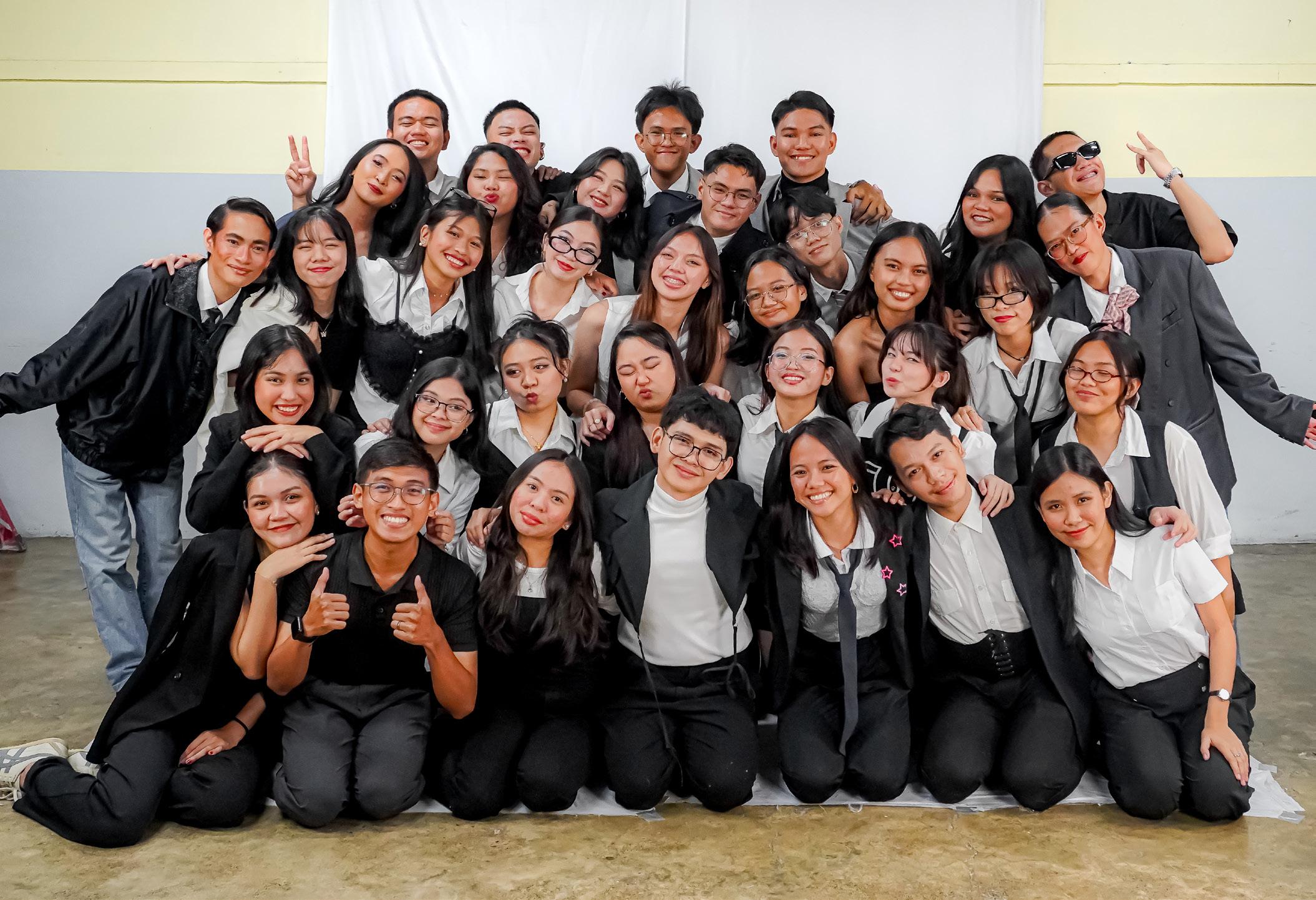
EDITORIAL BOARD AND STAFF
Editor-in-Chief
Rufino Rico L. Jamisola
Associate Editor
Ejay D. Villaver
Managing Editor-Administration
Krisha Faye A. Gascon
Managing Editor-Finance
Trixcy D. Clar
Creative Director
Christian A. Mananguite
News Editor
Kimberly G. Capuyan
Opinion Editor
Sharry M. Cuizon
Co-Opinion Editor
Samantha Mae A. Murillo
Literary Editor
Ava Donalie A. Ferolino
Features Editor
Ashleah Mae Y. Villono
Sports Editor
Lylle Antonette A. Flores
ABOUT THE COVER
Online Editor / Photographer
Gabrielle Marie R. Paradiang
Co-Online Editor
Ma. Ehla Fatima C. Inanod
Broadcast Manager / Layout Artist
Krista Marie B. Yaoyao
IT Administrator / Illustrator
Heron Augustus S. Flores
Property Administrator / Illustrator / Graphic Artist
Hannah Vanessa O. Mondilla
Art Director / Layout Artist
Narvie Klaryzze B. Borja
Co-Art Director / Illustrator
Khen B. Fernandez
Writers
Rey Martin B. Rio
Louise Lambiquit
Ceraley S. Cabiltes Jr.
Maria Cristina G. Lamug
Juan Enrique D. Reboquio
Kristianna Amor M. Tagsip
John Kherwin A. Pansacala
Illustrators / Graphic Artists
Sienna Rio E. Young
Karina Adel A. Vestil
Jane Frances P. Latorza
Photographer / Videographer
Astrid Niña T. Vidal
Photographers
Ayn E. Nazareno
Kimberly O. Tumilap
Videographer
Raghnall P. Cena
Layout Artists
Kirsten Leanne P. Roble
Therese Margarette A. Racaza
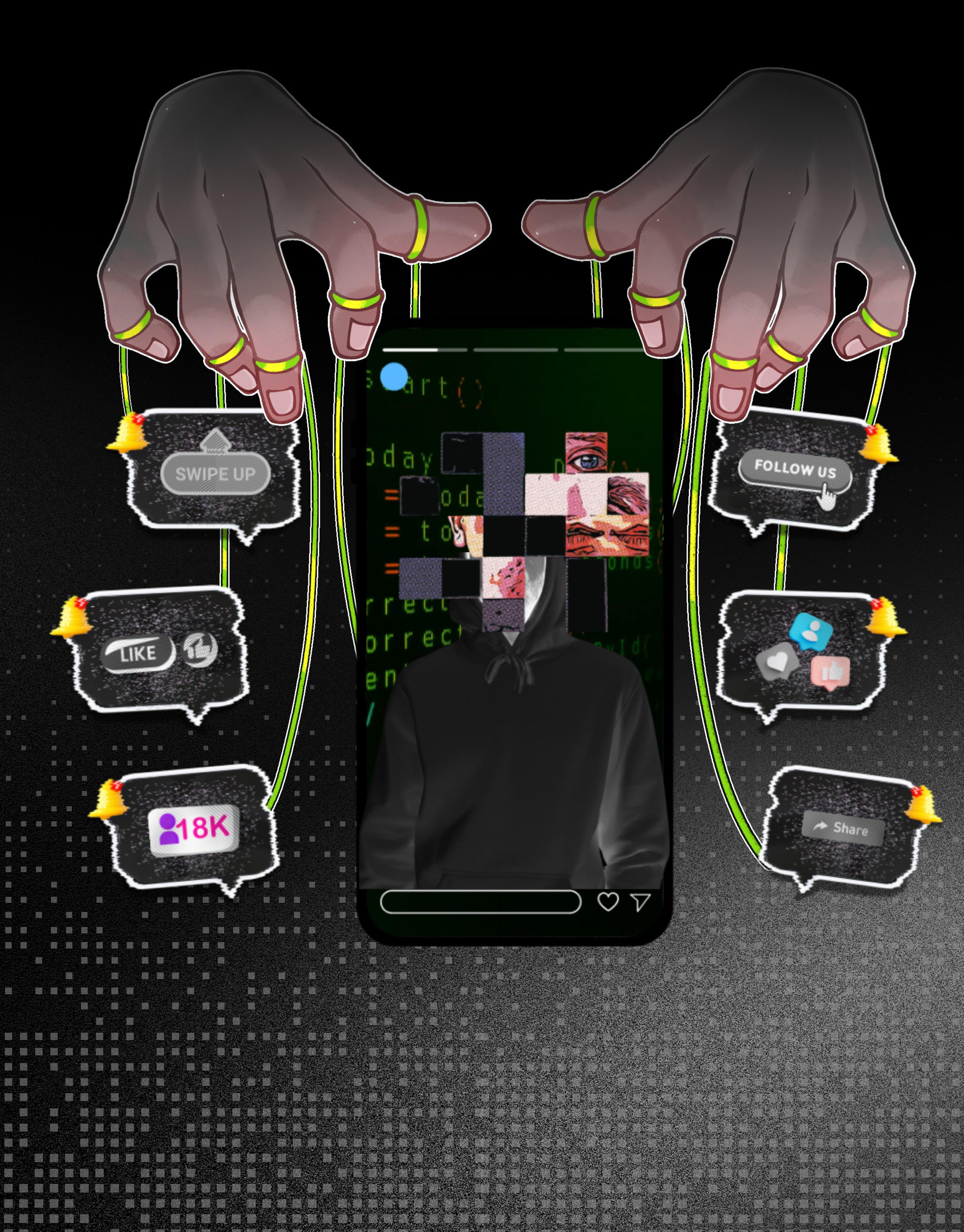
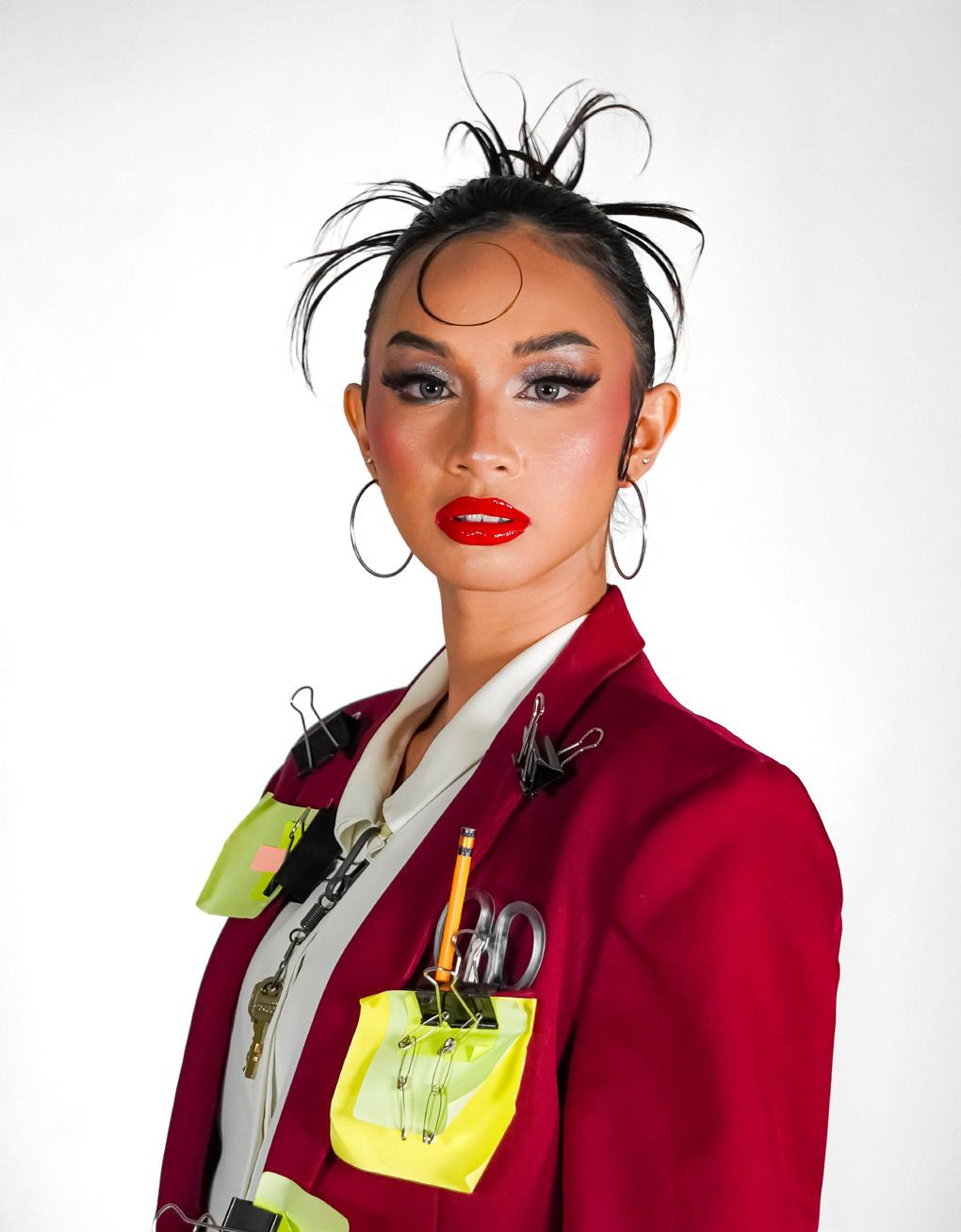
In pursuit of every ambition, one must take CTRL+ of the chained system that binds everyone. presents you the next big thing that defies societal norms in the face of pressure.
ABOUT US
The Magazine is printed every semester and once every summer under the name SOLSTICE. It is managed and published by Publications, Ground Floor, San Agustin Building, University of San Jose-Recoletos, Magallanes Street, Cebu City.
welcomes contributions from Josenians such as formal/informal essays, poems, short stories, artworks, and photographs.
Read the latest Magazines and Folios online at www.issuu.com/usjrforward
All rights reserved. No part of this magazine shall be used for any purpose except when allowed by the law without prior explicit permission from the Publications.
The Uncritical Click
We are a generation of digital natives. Many of us grew up with a bulky, beige computer at home, and we have used it for either research or leisure.
For sure, we even made it a means for learning our favorite artists’ songs back then. We would write down the lyrics in our notebooks because printing costs too much, and we did not know how to copy and paste— awful yet nostalgic!
But then, we learned computer keyboard shortcuts, making our tasks more manageable. and shortcuts we knew.
Beyond these common time savers, we have mastered using through the years. It is a simple command that grants us a sliver of power. But what happens when that desire for control, or conversely, the relinquishing of it, enters into the deeper aspects of our lives?
Dear reader, in its final magazine for the Academic Year 2024–2025, presents CTRL+, unraveling the wheeling cycle and dealing with societal issues.
We delve into the scratching out of
As you flip through the pages of this magazine, we desire that you dare to press other combinations that will bend what has been the usual. We challenge you to question the authority that controls your actions. We urge you to be self-aware so that no one
We exist in a culture where loyalty and devotion are muchly adhered to. These are colorful temperaments that unite and identify specific communities. However, a perilous happen within this rich landscape.
This real-life command blurs the line between reverence and blind idolatry. We see it in many Filipinos’ fervently uncritical allegiance to political figures, celebrities, and social media influencers. Whether they say it or not, they have been controlled by these individuals.
Being die-hard supporters of these superiors, these citizens forget their morals, principles, and rationality. They continue to back them up despite their anomalies and crimes, creating a double standard that impedes justice and accountability. This loses sight of the common good. Only the people in power attain more finesse.
For instance, partisans often throw personal attacks at the opposition rather than reasoned arguments during heated political debates online. Meanwhile, criticism addressed to celebrities, no matter how constructive it is, is perceived by fandoms as an insult.
and-grind?” this mindset has since infiltrated global work culture, thriving in the age of social media.
This #grindset mentality equates sacrifice and exhaustion with success, but in doing so, it strips away the joy and balance essential to a fulfilling life.
Even rest is no longer sacred. Leisure is reframed into productivity, with TikTok trends like “CEO Grinds” and “Study with Me” reinforcing the pressure to hustle harder, achieve more, and be “better.”
This exhaustion epidemic is worsened by influencers who promote hustle while concealing the financial privileges, support networks, and resources that enable their so-called success.
Students are introduced to the grind long before entering the workforce— pulling all-nighters, running on caffeine, and navigating overloaded schedules in pursuit of achievement.
Success should not come at the expense of mental health and emotional well-being, especially when the pursuit
ability to build a more compassionate and humane world.
challenges its readers to reclaim control and break free from the false ideals and rigid formulas of success.
Stop chasing personas crafted for the screen. Stop believing that mimicking someone else’s life leads to being the next big thing. The time has come to reject the tyranny of hyperrealistic standards.
Step back. Hit reset. Build something real. FWD
Election Rerun: The Typical Midterm Skit
by Ava Donalie A. Ferolino and Ashleah Mae Y. Villono graphic design by Astrid Niña T. Vidal and Kirsten Leanne P. Roble
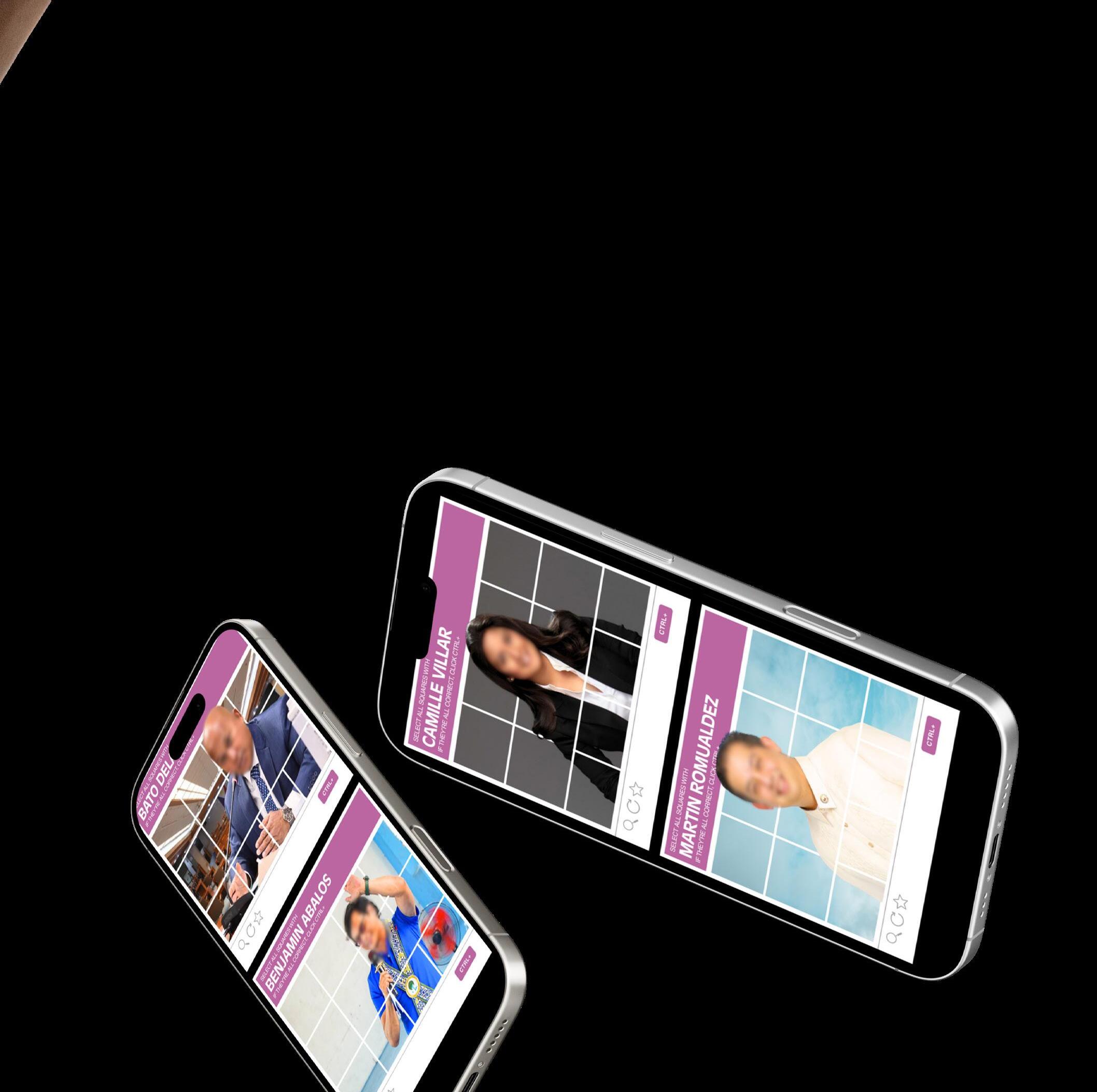
The show had begun early—again. Premature campaigning, though technically illegal, became in full swing even in 2024. Camille Villar, Ronald “Bato” dela Rosa, and Benjamin “Benhur” Abalos Jr. practically hosted a nationwide meet-and-greet, thinly veiled as “public service announcements.”
Premature campaigning here, filing of the certificates of candidacy there (unsurprisingly, being approved despite being convicted of a crime), and the same surnames gracing the ballots like an overplayed teleserye rerun.
Heartwarming commercials about their deep concern for the Filipino people, which mysteriously resurface only every election season, flood our screens. But do not worry, it is not technically electioneering—it is just “creative marketing!”
The race for power has never been subtle, and every election proves there is little these candidates would not do to secure a seat.
Despite premature campaigning being expressly prohibited in the Omnibus Election Code of the Philippines, it does not stop candidates from plastering their faces on commercials and billboards. This year, they are making TikTok videos with prominent influencers to boost visibility.
Nothing says “qualified for office” like a viral dance challenge and a paid endorsement from someone whose political knowledge starts and ends with engagement metrics.
A Lineup For The Gods
The Philippine ballot is not for the weak of heart. It is a comedy, a tragedy, and a horror show all rolled into one. Year after year, election after election, the same pattern is seen.
With names more often recognized in scandals or television gigs, it is undoubtedly bizarre to find the same ones imprinted in flyers, pins, and signages distributed to the masses. These forked tongues promise “progress” and “growth” despite the unruly behavior that trails them where they slither.
And it is not just the usual names making a return— this election season welcomes an even more baffling lineup.
Apollo Quiboloy, the self-proclaimed “appointed son of God” and international fugitive, is now running for office—because why settle for a church cult when you can have an entire country at your command?
Then there is Wilfredo “Willie” Revillame, a man whose hosting noontime shows was once his main selling point, but has now pivoted to a full-fledged political career, as if governance was as simple as giving cash prizes and jackets. Remember when he said he did not need to be a candidate to help? Cat got your tongue, Willie?
These are only a few of the choices before us.
And what a buffet it is!
Somehow, the most problematic personalities rise to the top, like cockroaches surviving a nuclear blast: they have mastered the art of reinvention.
Caught in a corruption scandal? No problem— just donate sacks of rice while the cameras roll.
Ah yes–elections. The time when politicians shed their skins, and the thickest-faced among them remain unfazed by controversies. Elections have always been a spectacle, and the 2025 midterms are proving to be no different.
Filipinos Hold the Power (Really Though?)
Accused of human rights violations? Easy fix—just shed a few tears in a live interview and say, “Ako po’y nagmahal lang sa bayan.”
No legislative experience? Who cares! As long as you have relatability, a viral soundbite, or a famous last name, you are good to go.
It is not that these figures have any real intention to govern. Their platforms are as flimsy as their ethics. They run not to serve but to solidify their interests—because why settle for being rich when you can be rich with immunity from prosecution?
Do You Get Déjà Vu?
Filipinos are experts in hindsight. Every election cycle, cries of “Never again!” and “Tama na, sobra na!” are heard. Yet, when the ballots are counted, guess whose names are sitting pretty at the top?
Political dynasties reign supreme.
Take House Speaker Martin Romualdez, who ran unopposed due to his opponent’s disqualification. Democracy means choices, except in some districts where the choice is…well, him or no one at all.
The system is rigged in favor of the same families who have hoarded power for generations, and yet Filipinos still act surprised.
It is like watching someone repeatedly stick their hand into a flame, scream in pain, and then do it again for fun.
We know our politicians are corrupt. We know they lie, steal, and cheat. Yet, every election season, we line up, ballots in hand, and give them the keys to the treasury. Again.
Is it a habit? Stockholm Syndrome? Or do we simply enjoy the chaos?
No one has the power to change this act but us. The Constitution grants every Filipino the right to vote. But a right is useless when exercised without thought.
The Commission on Elections (COMELEC) could tighten election rules, disqualify candidates with pending criminal cases, and ban those who blatantly treat politics as a personal business empire. But even with the strictest laws, if voters continue electing the same crooks in different costumes, nothing will change.
Filipinos complain, rant, and post Facebook statuses about “corrupt officials ruining the country.”
And yet, when election day arrives, they are chosen anyway—because of nostalgia, because of a catchy jingle, because “Ay, kilala ko ‘yan, anak ‘yan ni Mi-ar, apo ‘yan ni Josie.”
The Philippines is heading toward a future from which it may never return. We live in a present that mocks our past accomplishments, trapped in a cycle that should have long been abolished.
Democracy is not a Netflix series where we can binge-watch disasters unfold and then move on with our lives. Every vote has consequences. Every misplaced vote guarantees years of regret.
So, before casting ballots, here is a question to ponder: Do we want another season of the same horror-comedy-drama? Or is it finally time to take control and cancel this show for good? FWD
Disclaimer: Mentions of drugs, rape, and suicide.
ALL CAPS: Making Out of People’s
In the race for views and viral moments, is there still a space for dignity, nuance, and respect for those lives that have been shattered?
Some ghosts are never laid to rest, not because they refuse to leave but because they are dragged back into the spotlight for the world to gawk at, repackaged, and resold as entertainment.
Their stories are no longer their own; they become scripts for filmmakers, headlines for newspapers, and viral clips for online spectacles.
This cycle of wheeler-dealing resurfaced yet again in the wake of the new year, as controversial director Darryl Yap released the teaser for his latest film, “The Rapists of Pepsi Paloma.”
The clip sent shockwaves through social media, not just because it revisited one of the darkest scandals in the Philippine entertainment industry but also because it named one of the country’s most potent television figures, Marvic Valentin “Vic” Sotto, as a perpetrator.
Pepsi Paloma, born Delia Dueñas Smith, was a young actress from the famed “Softdrink Beauties” of the 1980s—a trio symbolizing boldness and allure, each adopting a stage name from a soda brand.
Paloma quickly became a recognizable figure in Philippine cinema, but despite garnering attention from a handful of films, the Showbiz promptly trampled her shining light.
In 1982, she accused prominent show hosts Vic, Joey de Leon, and Ricardo “Richie D’Horsie” Reyes of drugging and raping her—an accusation vehemently denied by the accused, with Vicente “Tito” Sotto III stepping in to defend his brother Vic.
Paloma was allegedly threatened into signing an Affidavit of Desistance by Tito Sotto. She would later be abducted, rescued, and betrayed again by the same industry that had once welcomed her with open arms. Tragically, Paloma took her own life at the age of eighteen.
With the young starlet’s story at the heart of this project, the lingering question remains: Will it bring her the justice she deserves, or will it be another case of sensationalism disguised as storytelling?
Yap’s track record suggests the latter. His past films have repeatedly drawn criticism for historical
revisionism and offensive portrayals, which raised doubts about his intentions.
That skepticism deepened on February 3, 2025, when Yap announced the postponement of “The Rapists of Pepsi Paloma.” His production team failed to meet the screening requirements set by the Movie and Television Review and Classification Board (MTRCB), unable to complete the necessary documents.
His previous film, “Maid in Malacañang,” was no exception. Marketed as a retelling of the Marcos family’s last days in
Making Business People’s Trauma
by Trixcy D. Clar and Ma. Ehla Fatima C. Inanod graphic design by Krista Marie B. Yaoyao and Hannah Vanessa O. Mondilla
Malacañang Palace before being exiled to Hawaii in 1986, the film attracted much negative feedback, as it failed to address the major issues the country was facing during the People Power Revolution.
Yap is just one of many filmmakers who blur the line between shedding light on a story and using it for their own ends His case underscores a larger issue: When does true crime storytelling serve the pursuit of justice, and when does it simply commodify tragedy?
This question has only grown more urgent as true crime surges in popularity in the country. What was once a
niche genre has become a cultural force, with audiences devouring stories of real-life crimes, disappearances, and courtroom battles.
Podcasts anatomize the latest high-profile cases with the same enthusiasm as entertainment news, and social media creators, specifically TikTok influencers, blend horror with the mundane—discussing gruesome homicides while doing their Get Ready With Me (GRWM) sessions or ranking their “favorite” criminals over a casual mukbang.
These videos tap into humanity’s deep-seated curiosity about the darkest aspects of society, offering both shock and a sense of justice when offenders are held accountable.
The entertainment industry has quickly capitalized on this interest by producing television series with darker and more chilling themes.
Additionally, many content creators claim their work spreads awareness, educates viewers on red flags, and even gives voices to victims who might otherwise be forgotten.
The line between storytelling and exploitation is growing increasingly thin, with sensationalized narratives often overshadowing the real victims behind these tragedies.
Creators turn crime scenes into clickbait, milking every horrendous detail for engagement, while audiences binge these stories as if they were scripted dramas rather than real, ravaging events.
Some even romanticize killers, elevating them to the status of celebrities rather than criminals—similar to the case of Cameron Herrin, who hit and killed a mother and her daughter.
Where does artistic license end and ethical responsibility begin? Does raising awareness justify monetizing someone else’s trauma?
As the overconsumption of this content looms over one’s mind with each swipe and repost, it’s easy to forget that these cases are not just numbers adding to a statistic but real stories of heartbreaking losses of loved ones—many of which have not been given the justice they deserve.
Some say these stories must be told, that they serve as cautionary tales, reminders of injustices that must not be forgotten.
But when the voices of the burdened are drowned out by the clamor of ticket sales and streaming numbers, we must ask: Who really benefits from their suffering? Is it the victims and their families or the filmmakers and influencers who capitalize on their tragedy? FWD
Fear the Female Rage
by Ejay D. Villaver and Kristianna Amor M. Tagsip illustration and graphic design by Khen B. Fernandez and Therese Margarette A. Racaza
No one likes a mad woman, but the world made her like that.
Oppression is not new.
Women have been silenced, underestimated, and crushed under the weight of patriarchal societies for centuries. But history tells us one thing: Hell hath no fury like a woman scorned.
They have been burned as witches, beaten into silence, and erased from history books. For centuries, women have endured, endured, and endured. The question must be asked: Why aren’t we more afraid of what happens when women reach their breaking point?
Unloading of File Memories
The oppression of women in this world has never been hidden— always happening in plain sight. The evidence is everywhere, from legal systems that deny women their basic human rights to cultures that normalize violence against women.
Countries such as Iran and Pakistan are unfortunately still beneath the toxic patriarchy embedded in their nations’ structure. With this, the women in both countries have been robbed not only of their fundamental human rights but also their individualities as people.
In May 2024, Iranian demographer Shahla Kazemipour reported that approximately 30% of teenage girls in Iran do not go to school, resulting in forced child labor. Moreover, if not compelled to look for a livelihood, their families expect these young girls to marry at the early age of 13.
Renaming the Folders
“Women look out for one another. Women know what is best for their own kind.”
However, such a statement remains futile if data presents that, just like in Pakistan, less than 5% of leadership roles for women are accounted for.
The governmental network revolved only around men and their ways of ruling a country, and the countless opportunities women could bring to a function were dismissed. In that case, societies do not evolve—they stagnate.
Let us not also forget the cruel abuse they have been enduring. The Islamic Republic of Iran has been noted for its 66% of domestic abuse against its women.
Based on the analysis conducted by the World Health Organization (WHO), around seven categories contribute to this emergence of exploitation, one of which is “behavioral and cultural challenges in men.”
Remember, these statistics are not mere numbers; they represent lives stunted by systemic misogyny.
The clash between women’s thirst for justice and men’s atrocious hunger for power is a never-ending war; both the worlds of Iran and Pakistan have been agonizing.
If we do not change the discriminatory web now, this matrix will continue to prosper for the succeeding generations after us.
Just like any other human being, women are born to have rights of their own—it is encrypted underneath their skins. Despite having limited access to justice and equality due to the contempt and hatred laid upon them, women must be granted the freedom to encode their paths and choose the lives they want for themselves.
These recorded acts of misogyny have been rampant for years; however, the fight for freedom and equality has long been served in many parts of the world. While many in the present are living peaceful lives, there are still those who struggle under the unlawful administration of their countries.
It is no wonder that both Iran and Pakistan are still considered to be developing countries. The control they press against their women, mugging them of their civil liberties to basic human rights such as access to education, job employment, and independence, has led to such a strong demotion.
These women have always been constantly placed in an extreme, unrealistic expectation by their societies. Since then, they have been denied the virtue of living a comfortable life.
From the start, they are obliged to work and provide the necessities for their families. The number of children, especially girls, who dropped out of school and were forced to work is undeniably high. Thus, a significant number of uneducated individuals were found.
Hitting close to home, Filipinos should know better the weight misogyny carries, for our own country walked through the same torment. Our Filipino women have been under the dirty hands of countless tyrants, both in government and in the household. As unfortunate as this may sound, to this day, we still do.
“Be the change you wish to see in this world,” we always say. However, uttering such phrases is not what must only be done.
The vitality of also bearing in mind that for us to grab this “change” that we so eagerly desire, we must also take action. Our plans should not only end at the tip of our tongues. If we do not do something about men and their misogynistic ways now, then when?
Patriarchy thrives on the belief that women will always endure, always submit, and always obey. But that belief is a dangerous delusion.
Women’s anger is not something to be dismissed— it is something to be feared. Because when women fight back, they do not fight alone. They bring entire movements, entire generations, and entire revolutions with them.
To those who continue to suppress women: be afraid. Be very afraid. The world is changing, and the voices you have tried to silence are growing louder. The rage you have ignored is turning into action.
And soon, the reckoning will come. FWD
A Digital-Walled Garden
by Louise Lambiquit and Juan Enrique D. Reboquio graphic design by Narvie Klaryzze B. Borja and Raghnall P. Cena
As we remain inclined toward our comfort spaces, confined by devices that isolate us from reality, do we actually take control of what we consume online, or is it the other way around?
Technology connects the world, people control it. In an era where digital media is accessible, our everyday lives are more convenient.
Today’s generation has become dependent on innovative gadgets such as mobile phones, laptops, and computers. These devices create a “smart society,” helping get jobs done more efficiently—whether in communication or industry.
They are no longer a luxury but a necessity. But what happens if the practice itself exceeds its purpose?
Pinning Tabs
It is a universal experience, especially for Generations Z and Alpha, to be engrossed in social media and mobile games. According to an article published by the social media management site Sprout Social, these apps are not just for leisure but are more about public lifestyles.
As per Statista, a global data and business intelligence platform, around 89.59 million phone users—more than half of the Philippine population— have been recorded, with numbers expected to surge by the end of the decade.
From what used to be a niche, this digital realm now serves as a one-stop hub for anything and everything.
It is not only a source of information or entertainment but also an income generator, especially during the height of the COVID-19 pandemic, which caused a significant shift in our culture.
addiction, highlights how these predatory algorithms are particularly harmful to vulnerable sectors, like teens, exposing them to excessive and damaging content.
Over time, this use of technology alters who we are. People are becoming passive consumers instead of active participants in their own lives.
To regain autonomy, users must recognize the hidden dangers and take steps to limit the influence of media’s addictive design.
Alt + F4 + F5
When tabs start to multiply, they mirror chaos. A refresh is needed to begin anew and prevent ourselves from becoming too locked in our cubicles.
Subscribing to Bradley Busch’s study, a chartered psychologist from the British Psychological Society, suggests a step towards eradicating phone addiction: limiting notifications to keep us away from things that could divert our concentration.
Now, this introduces the tail—similar to a corrupted file that entirely impedes productivity. Swivel chairs rotate for a reason, and that is to prevent us from being too occupied by our respective monitors.
While it undeniably brings forth advantages in society, the other side of the coin is concerning and continues to manifest serious problems regarding health and productivity.
Supposedly, the latter was one of the reasons for technology’s propagation. At present, it is wielded differently, creating an imaginary boundary between the false narratives presented online and what reality tells us.
What begins as a mere misdirected habit—where notifications dictate emotions and virtual acceptance and recognition define self-worth—slowly becomes an unconscious dependency.
#fyp #fyp:) #fypppppppppp
The magic of this media lies in the potency of its algorithms as they deliver personalized content designed to trap users.
What starts as harmless scrolling can lead to bed rotting and procrastination, draining energy and weakening real connections.
Platforms prioritize engagement over well-being, often leading users down a deep chasm of endless content that fosters compulsive use.
While short breaks can aid with burnout, too much screen time does more harm than good.
Health, a publication site, says that bed rotting is truly complex when it becomes habitual and leads to laziness. This means that constant digital distractions push goals further away, trapping people in a consumption cycle rather than action.
Only in the end does one realize they are no longer themselves but have become their digital version.
When the transformation is complete, individuals are no longer in control. They are conditioned to remain distracted and eventually lose touch with what truly matters.
Furthermore, another article published by Meadows Behavioral Healthcare, a treatment center specializing in mental health and
With people reduced to mindless content consumers, does this mean society is doomed to be ruled by screens? Not necessarily.
Breaking free from these cycles is possible— but it requires conscious effort.
It starts with small but intentional steps, like setting devices aside and embracing moments without screens. Many smartphones now offer built-in tools to track and limit screen time.
To scale the walls of this misleading comfort zone, simple habits like setting tech-free hours or replacing an active status with recreational and outdoor activities can make a huge difference.
Technology indeed connects the world, but it also controls the people. In times when digital media is powerful, prioritizing oneself must come first, and practicing healthy cyber citizenship follows suit.
I Like The Views
In this digital world, views matter more than value, and influence outweighs truth. But when passive clicks come before clarity, are we really watching or just blindly following?
by Sharry M. Cuizon and Ma. Ehla Fatima C. Inanod
graphic design by Karina Adel A. Vestil and Krista Marie B. Yaoyao
The algorithm of our digital landscape becomes the stage for what we see online, pushing the most engaging—often the most controversial—content to the forefront. It is the breeding ground for sensationalized content where influencers hold more sway over public opinion than experts in their fields.
Under immense pressure to chase views, likes, and shares, many content creators today prioritize virality as the indisputable goal, and to achieve it, they sacrifice authenticity in exchange for attention-grabbing headlines and clickbaits.
As gossip becomes the norm and the ethical obligations of content creators get swept under the rug, identified how certain issues are commonly dealt with within the Josenian community and even beyond the greater society by asking: How do you react to controversial issues from influencers you follow online?
Hooked and Hyped, But Not Hijacked
A third-year Bachelor of Science in Education major in Mathematics shared, “Just because I idolize someone does not mean I should ignore their flaws or tolerate harmful behavior. I believe that admiration should not cloud judgment, so I always seek out credible sources and verify the facts before forming an opinion.”
In the same manner, viewers of long-time YouTube vlogger Ruby Franke figured out the truth that was hiding behind the screen.
Since 2015, Franke and her husband, Kevin, have run a family vlogging channel based in Utah, United States, with 2.5 million subscribers. The “8Passengers” channel features how they managed their daily routine with six children.
Although people hyped up their incredible parenting method on screen, public opinion has split between those who see Franke’s strict approach as disciplinary and those who view it as overly harsh and concerning.
Franke and her supporters often dismissed these concerns, labeling the viewers as “haters” and “critics” who did not understand her family’s values.
In August 2023, when authorities learned about Franke’s children being subjected to severe abuse, including malnourishment, maltreatment, and physical restraints, Franke and her business partner, Jodi Hildebrant, were arrested and charged with multiple counts of felony child abuse.
Who would have thought that millions of views would lead straight to a mugshot?
Confirming, Not Confronting
A contrasting response from a second-year Bachelor of Science in Civil Engineering student opened another perspective on the matter.
“Admittedly, I do not usually pay attention to issues online unless [they] catch my attention or they concern me. But generally, wala ra ko’y reaction kay kapoy man gud unya maka- drain sab siya og energy ba, ” he said.
“Usually, igo ra jod ko mobasa gamay sa context unya scroll na pod, ” he added.
Living in a world where reality is optional and personal responsibility is just a suggestion must be nice.
This passive approach to online issues reflects a broader reality—one where audiences consume content without much scrutiny, allowing influencers to shape narratives with little resistance and confrontations.
The Netflix series “The Influencers,” featuring 77 figures from South Korea, offers a dramatic but strikingly accurate depiction of this phenomenon.
Just like how Franke curated an illusion of ideal parenting, influencers in this reality show went beyond measures to expand their influence, much like puppeteers; they control the narrative, deciding how much truth to reveal and what stories to tell.
Viewers, in turn, become complicit—either knowingly or unknowingly, by engaging without question.
Shifting
Keys: Which Side Did You Click?
When it comes to celebrity scandals, a Bachelor of Science in Information Technology freshman stated, “ Di man ingon ga -defend ko nila, pero kung di gani kaayo dako ang sala, if they can still resolve it, then dapat tagaan pod og chance. ”
Furthermore, the feud between R&B singer Denise Julia and celebrity photographer BJ Pascual over a collaborative project easily became a hot topic online during the holidays.
Online disputes erupted after Pascual lamented his frustrations with Julia’s team in a podcast by content creator KillaKush , who also had a similar experience with the rising artist.
Thousands of netizens were constantly clicking, refreshing, and waiting for either party to release a statement or post another Instagram story about the issue.
No matter how many screenshots were provided, it was clear that people believed whoever appeared on their screens first, jumping from one bandwagon to the next without ever minding where it would stop.
As consumers of online content, our opinions come in huge waves; we hold the ability to demand quality before quantity and condemn creators who use their platforms to distort the truth continuously.
Influencers will only have the power if we give it to them.
They may shape the narratives, but we choose whether to accept them or not. They create illusions, but we decide how to see beyond them. They may seem in control, but we are handing them the power.
The internet rewards engagement and views, but we must reward accountability. FWD
Good Boys Don’t Cry
Tranquil Recollections
by Rufino Rico L. Jamisola
graphic design by Gabrielle Marie R. Paradiang and Therese Margarette A. Racaza
I never teared up when my father passed away, but it was not because I did not care.
At the age of nine, I saw the most heartbreaking phase that our family experienced—losing my father. From the moment he bid his farewell until his funeral, no one sighted me crying.
Everyone knew that, among my siblings, I was the closest to him because I experienced his fatherhood the longest, as I was his eldest son. Seeing my mother, siblings, and relatives sobbing, would I still weep?
It was that early when I realized I needed to be strong because someone just had to be. If it is not me, who? Life has been different since then. I felt the pressure of growing up instantly and helping my family in every way I could. I have always aimed to become independent and responsible, with a reminder etched in stone: I should never be a liability to the people around me.
I could not even remember how being vulnerable felt because everything appeared okay for me, especially the various problems that came my way. “Okay” in the sense that I did not feel the need to react to the issues at hand but instead seek immediate solutions.
For many years, I thought being resilient at all times was always an accomplishment. But as I grew up, the burdens became heavier—in academics, career, and relationships—and it has become quite strenuous.
This has never been an isolated case. I have wondered why the world glorifies this “strong Filipino” complex. It could be because we have withstood typhoons, economic crises, political commotions, and personal struggles with an unwavering spirit. But this deeply rooted cultural norm is also a source of hidden pain, one that has been repetitive and numbing.
Suppression of emotions is deemed to be a damaging consequence of this complex. We are taught to bottle up our emotions to spare other people from our troubles. Even when we are far from okay, the instinctive reaction, “Okay ra ko ,” takes over.
The setback of this resilience is the speed by which we transform trauma into acceptance. Instead of entirely solving problems, we simply cope with or wait for the issue to pass. When piled up, our well-being is at stake.
A variety of mental health problems, ranging from anxiety and depression to more serious disorders, can result from this emotional repression. Constantly denying our suffering does not make it go away; instead, it festers, getting worse and more challenging to control.
A study on barriers to mental health care in 2023 identified affordability and stigma as significant barriers to accessing mental health care in the Philippines. Despite a perceived decrease in stigma since the COVID-19 pandemic, these barriers remain substantial.
This emphasizes the low utilization of mental health services among Filipinos regardless of their locations, with mental health stigma as the primary barrier. Resilience and self-reliance are common coping strategies among Filipinos.
Moreover, this focus on strength is another major obstacle to getting aid. We often dread being judged, called “weak,” or described as “dramatic” when we ask for help, whether from friends, family, or mental health specialists. This continuously feeds cycles of pain and intergenerational trauma, which could lead to the passing down of untreated wounds to future generations.
While overworking has been a key indicator of my baneful resilience, others may turn to different modes of dealing with stress, such as substance abuse and self-destructive behaviors. Although these coping strategies offer short-term respite, they worsen the underlying issues.
Openly discussing this silent-killing concern does not imply that resilience is a bad quality—not at all. The Filipino spirit is genuinely amazing, but being strong does not mean denying our feelings or acting as if nothing is wrong.
Looking back to when my father departed, it breaks my heart to think that I was not able to mourn enough and burst through all the pain only because I had the wrong notion of what it means to be a strong human being— I was just a kid.
It took me many years to realize that recognizing our weaknesses, embracing our limitations, and having the guts to ask for help when necessary are all components of true strength.
In life, it is totally okay not to be okay.
This is not just for the good boys but also the girls and everyone in between: though not easy, it is always a good alternative to gradually face our pains, heal our emotional scars, and develop a new strength that considers well-being, embraces vulnerability, and allows us to thrive and control our desires in life.
As we continuously move forward from our hardships, let us be the young generation that clearly redefines “strong”— not as an absence of tears but as the courage to heal. FWD
Jane Frances P. Latorza
Disclaimer: Bullseye is an issue-based open letter containing sentiments that may express sarcasm, irony, and exaggeration. No bulls were harmed in the making of this article.
Everything is Under CTRL
Back at it again with glitches and lags! With services stuck in an endless loop, when will the system finally optimize?
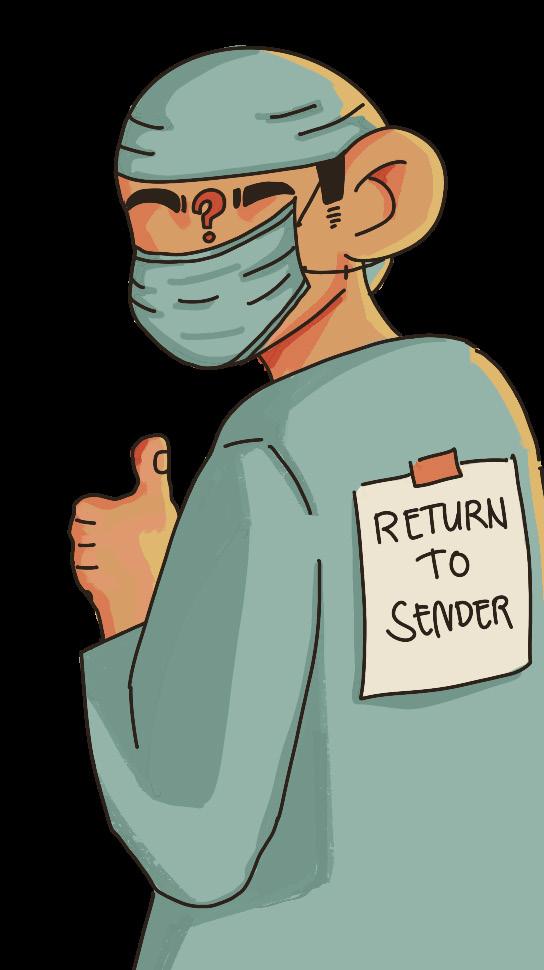
Emergency! Paging Dr. Beat!
Like scattered files on the desktop, waiting to finally be placed in their own folders, the pain participants of the Band-Aid Center are nothing short of a case of watchful waiting! But worry not, there’s space for you—perhaps on another PC.
“ Balik lang ‘nya ,” a phrase not so foreign to your ears. As students wrestle with the system, only one in every ten gets what they’ve requested.
What an unfortunate case for those who believe marathons only exist on the streets because, if you zoom in closer, some are running them in well-air-conditioned facilities.
It might come off like a one-click wonder of reversing responsibilities, but you need an upgrade, not just a mere reboot. If we may say, you are supposed to possess the heart for service.
The question is: Is there a possibility that a virus can be cured without fixing the bug on the site? Or are we stuck in the tracks of updates due to the understaffed glitch?
We might fear we’re trapped in a loop of endless waiting for services to be available. Have these services truly been “offered,” or have they long since faltered and archived in the recycle bin?
Here come the newcomers, who have yet to discover the extended chain of torment. Careful! You might start resenting them. Better check the FAQs (Frequently Asked Questions) for easier access to these services. You might end up somewhere!
Another disappointing bug lingers as the system results make us look like fools. For some, going there is akin to getting help, only to meet the crowd’s favorite duo— unavailable and dead-end services.
Let’s look at the brighter side. You’re not forever stuck on the sidelines, silly. There’s actually a way or two to become a priority!
First, prove you’re about to pass out (or away)—that’s their golden philosophy. Unless you’re showing the most active signs, they’re never gonna act with urgency.
“Sure ka nga sakit ? Basin nag-in-oa ra ka !”
Flu? Fever? Fainting? Here, have a band-aid.
Shuddering? Swelling? Shortness of breath? Here, have a bigger band-aid.
Finally! They might call an ambulance… but maybe a little later.
But it’s okay—the response team says everything is “under control.” “Patience is power” has been their motto since time immemorial. How progressive!
And when does this patience become a weakness? Emergency, emergency! Where’s the accountability?
Yes, most of them are part-timers, but courtesy should be full-time.
As fear creeps in, the question, “What is wrong with me?” suddenly arises. And what do you get in exchange?
A remarkable presentation of a pill and a side of “Please message us if the pain persists” at the end of the conversation.
Side effects may include anticipated frustration in the modern world.
As others say, the majority wins, as we agree that these consultations that aren’t deemed “emergencies” are just too off the charts.
Shouldn’t all pain be attended to immediately, and shouldn’t a response be catered to not only through screens?
Consultations may not be the only thing that is hard to get from their screens, but so is accountability. Other than being part of the semestral payouts, to what extent do their services offer?
Apparently, doubt comes along even with flashing red lights, as they will remain uninterested in our needs. This leaves the people at the Band-Aid Center stuck in the push-and-pull waiting line—slowly turning into a passiveaggressive dialogue of both sides. Are we paying for service, or are we paying for inconvenience?
It seems like AI can serve me more— with feelings!
Despite the repetitive complaints, services are becoming more disconnected from those trying to access them. We might end up overthinking the results on our screens while trying to get our virus checked.
It seems we’re stuck in an endless loop, playing catch with them; playing our part should suffice for them to play theirs.
And again, even after all the feedback, we’re still left with no long-term response or solution— just absence.
Better act on it as the virus spreads. And bring the system up to code.
Until then, we are forced to “wait” and hold on to their promise. After all, “everything is under control.” FWD
As society constantly reforms, we are trapped in molds we never chose. The pressure to fit in weighs heavy, yet the resolve to free one’s accurate self tips the scales.
Do you wish to stay within the line or carve your own path?
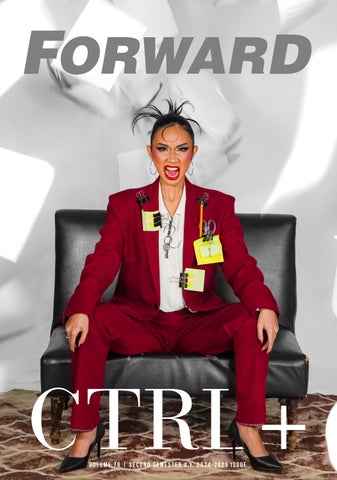
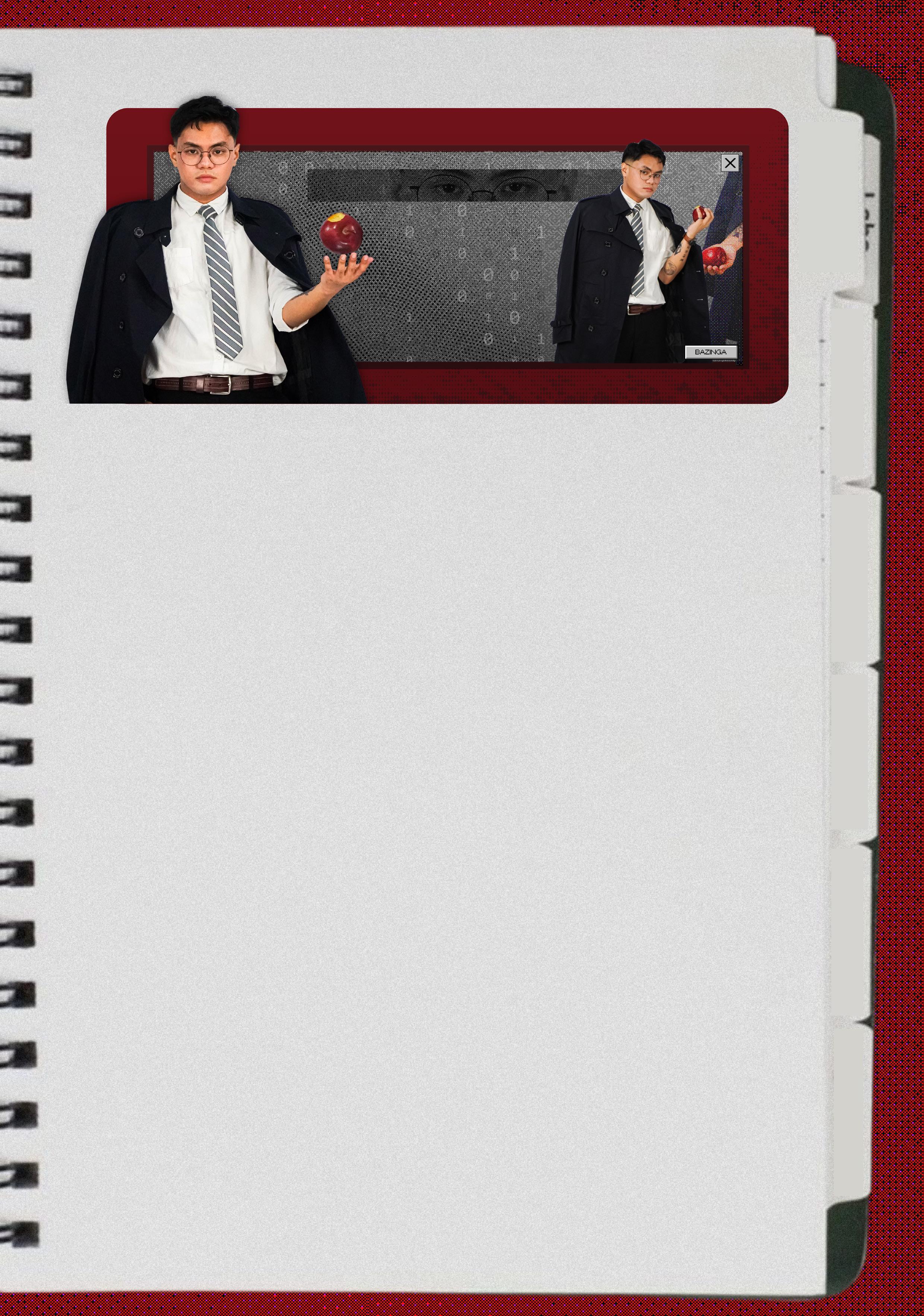
This second semester, presents a tri-cover story that embodies the tension— the battle between structure and liberation and the pursuit of ambition.
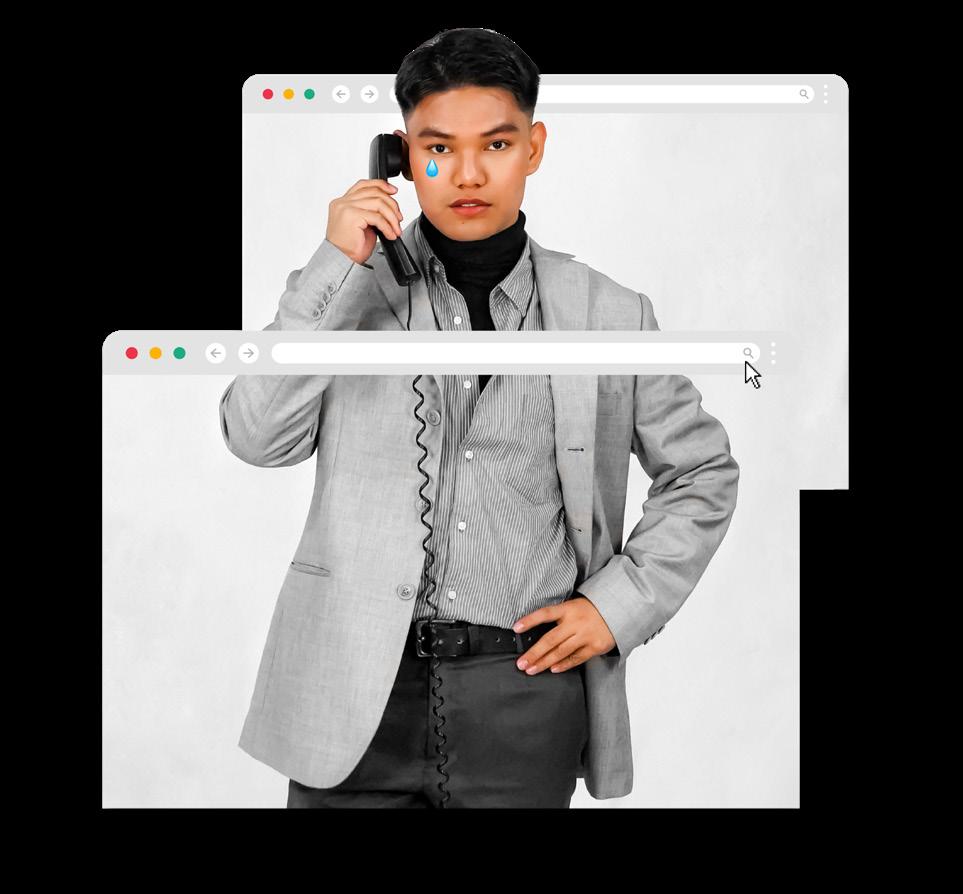
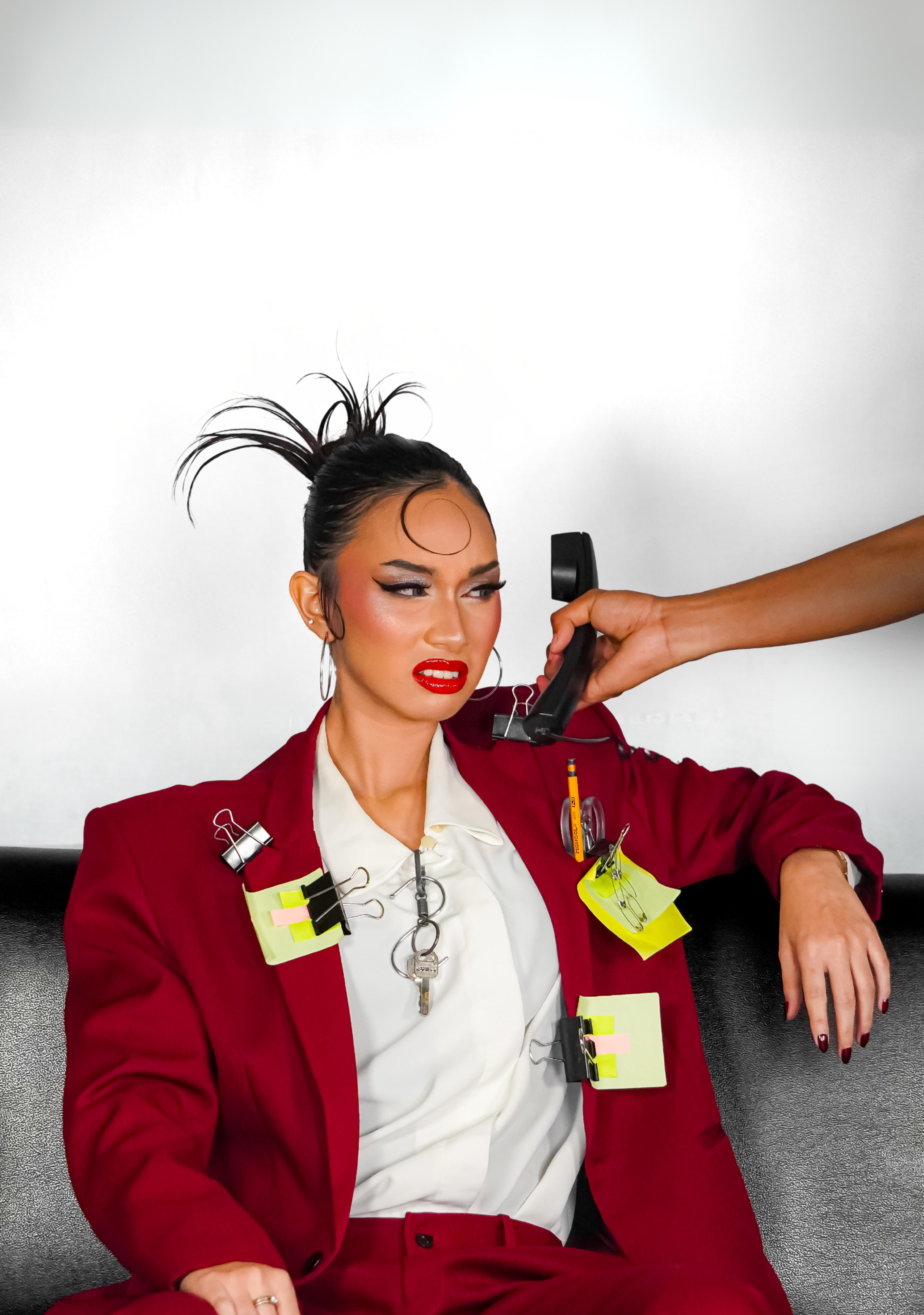
The second cover SHIFTs the perspective on survival. The model stands at an office table, answering a call, visibly busy and caught in the relentless pace of life. This is the act of persevering through expectations, navigating the system, and playing the part society expects.
COVER STORY
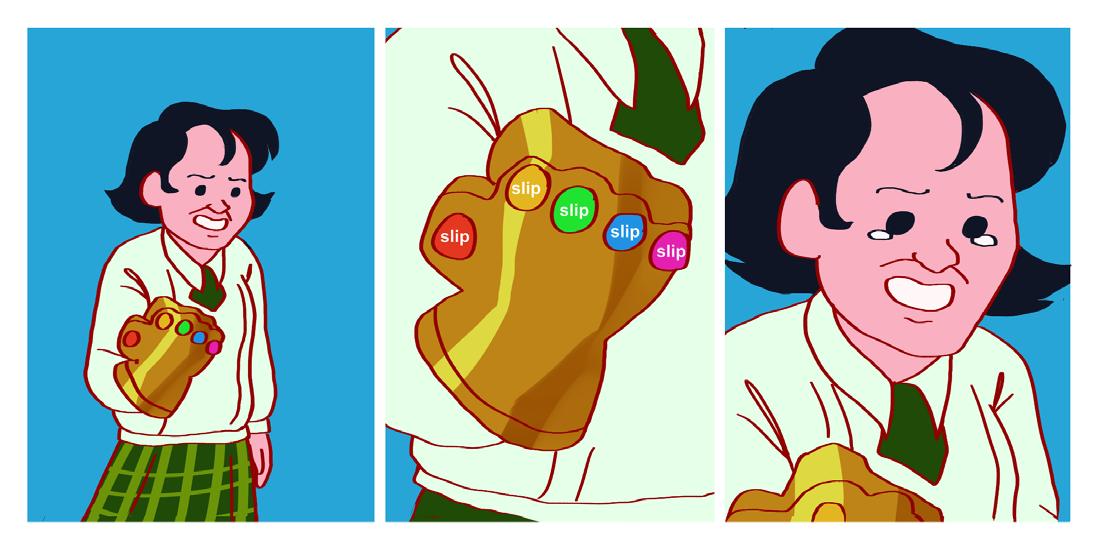
The first cover shows COMMAND— the breaking point. The model sits on a couch, shouting, as papers fall chaotically around her. It is the weight of expectations, the overwhelming push to keep up, and the feeling of being buried under an endless cycle of deadlines and demands.
Then comes the third cover—the ESCape. The table is gone, the papers are not in line, and the model lies on the floor, staring directly at the camera. It is not defeat but a reckoning, a realization that true power comes not from chasing expectations but from shattering them.
Get ready to take CTRL+ and be the next big thing . FWD
The F rbidden Knowledge
If your faith can be undone by education, let me submit that the problem lies not with learning itself. After all, if Eve’s bite opened the door to knowledge, why is understanding our own bodies still forbidden?
In the beginning, there was ignorance. A proposed bill aimed at preventing teen pregnancy in the Philippines has ignited heated debates, with staunch conservative groups claiming that its provisions encourage sexual activity among young children.
Philippine lawmakers backing the Prevention of Adolescent Pregnancy Bill argue that mandating Comprehensive Sexuality Education (CSE) in schools would help combat the country’s ballooning cases of unplanned pregnancy, particularly in its predominantly Catholic society.
Yet, the mere discussion of sex education is met with resistance, with moral and religious beliefs constantly closing the door to its acceptance.
Religious leaders and conservative groups such as Project Dalisay have spread rampant misinformation online, alleging that the bill promotes early sexualization by teaching children about masturbation as young as four and introducing six-year-olds to bodily pleasures— claims that Senator Risa Hontiveros, the bill’s author, has strongly denied as baseless fabrications.
It is no surprise that conservatives are critical of sex education. What is unacceptable, however, is that they resort to blatant lies about the bill to spread fear and moral panic.
One of the issues raised by the opposition is that children are too young to learn about sexuality. However, the numbers tell a different story: victims are getting younger and younger.
Citing data from the Commission on Population and Development (CPD), pregnancies among those under 15 years old increased by 35.13% from 2021 to 2022. In 2023, 3,343 individuals under 15 had already become mothers, while 38 girls under 15 had experienced multiple pregnancies.
Beyond unintended pregnancies, the Department of Health (DOH) reported that nearly half (47%) of new Human Immunodeficiency Virus (HIV) infections in 2024 occurred in individuals aged 15-24, making the Philippines one of the fastest-growing HIV hotspots in Asia.
Given the situation, CPD Executive Director Lisa Grace Bersales is reiterating CPD’s call to its governmental partners and stakeholders to strongly support the agency’s call for the legislative branch to prioritize the passage of the Adolescent Pregnancy Prevention Bill.
It cannot be denied that these alarming statistics underscore a systemic problem, one that calls for the urgency of early, age-appropriate education that can equip young people with the knowledge to protect themselves.
Despite overwhelming evidence of its necessity, the bill remains stalled, caught in the chokehold of religious dogma. While our Filipino Christian values may push abstinence-only narratives, we must recognize that teenagers will explore their sexuality— whether educated or not. Without proper guidance, the dangers they face are even greater.
With CSE in place, there is an assurance that young people are equipped to make informed decisions about their bodies. It helps prevent misinformation, curb unintended pregnancies and sexually transmitted infections, promote consent and respect in relationships, and create a more open discussion about reproductive health.
Most importantly, it teaches them that sex is not some forbidden, sinful act but an essential aspect of human life.
We have painted the word “sex” to be vulgar; it sounds indecent, and by extension, so are those who engage in it. As a result, this stigma leaves people unprepared and vulnerable, often burdened with unnecessary shame over something entirely natural.
Even for those who are not sexually active, understanding the changes happening to their bodies is vital to protect their health and well-being.
The consequences of early pregnancies and the prevalence of HIV cases are contained by addressing their root causes, not by blocking sex education curriculums that explain how and why they happen.
Much like the forbidden fruit, if protecting young people is truly the goal, it cannot be achieved by keeping them ignorant. Fear of being educated has never saved anyone. It only armed them with confusion, shame, and silence. FWD
by Ejay D. Villaver
graphic design by Raghnall P. Cena and Kimberly O. Tumilap
Boss Babe Beats: An Office Baddie’s Playlist
by Ava Donalie A. Ferolino and Kimberly G. Capuyan
graphic design by Narvie Klaryzze B. Borja and Kirsten Leanne P. Roble
Welcome to your power era! Being a diva is a state of mind; whether you’re strutting into the office like it’s your personal runway, shutting down boardroom nonsense with a single glance, or manifesting a six-figure pay, nothing fuels that energy more than the right playlist.
This is not just a collection of songs; it’s an attitude. It’s the soundtrack of a woman who knows what she wants and isn’t afraid to claim it. Whether you’re leading meetings, getting that raise, or simply reminding everyone who’s the boss, these tracks will have you walking, working, and winning like the powerhouse you are. Plug in, press play, and let’s werk!
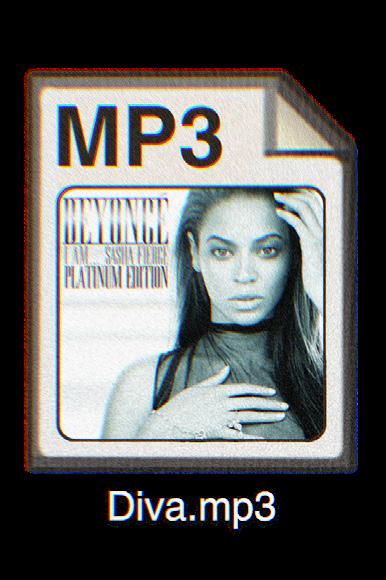
1. Diva by Beyoncé
Because let’s get one thing straight—you are that girl. Beyoncé’s Diva is your personal hype track, reminding you that you’re the boss, the moment, and the standard.
It’s not just a song; it’s an entire mood, an energy shift, and a personal reminder that you are here to run things. The heavy bass, the unapologetic lyrics, and the sheer confidence radiating from every verse make this the ultimate anthem for the woman who knows her worth.
2. Hall of Fame by The Script
You’re not just here to clock in and out—you’re here to make herstory.
Hall of Fame is for the woman who wakes up every morning with ambition running through her veins. The lyrics scream perseverance, reminding you that no matter what obstacles come your way, you are built on rising above.
Some days, work is all-consuming. The to-do list is endless, deadlines are looming, and everyone suddenly needs something. That’s when IT GIRL by Aliyah’s Interlude comes in.
Whether you’re grinding for that promotion, pushing through a tough project, or simply trying to survive yet another Monday, its hypnotic beat keeps you going even when your inbox is overflowing.
Shake off the stress, sip that overpriced iced coffee, and stand on business like the queen you are.
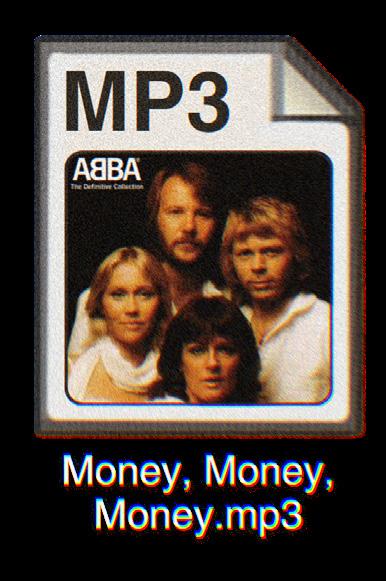
4. Money, Money, Money by ABBA
It’s giving “luxury” mindset and “I deserve nice things because I work my butt off ” realness, because let’s be real, if hard work isn’t leading to a softer living, what’s the actual point of going through all that?
ABBA’s Money, Money, Money isn’t just a song—it’s a financial manifesto. It’s for the dreamers,the go-getters, and the ones making sure their next vacation is first-class only. If you’re working hard, you better cash ‘em checks.
5. These Boots Are Made for Walkin’ by Nancy Sinatra
Some people talk the talk, but you, on the other hand, walk the walk. There’s something about this classic that just screams power move. The bold, cheeky lyrics, the driving beat, the sheer attitude—it’s everything an office siren needs when she’s on her way to the top.
Someone underestimates you? Someone tries to question your authority?
Babe, these boots aren’t just made for walking—they’re for stomping out any doubt in your path.
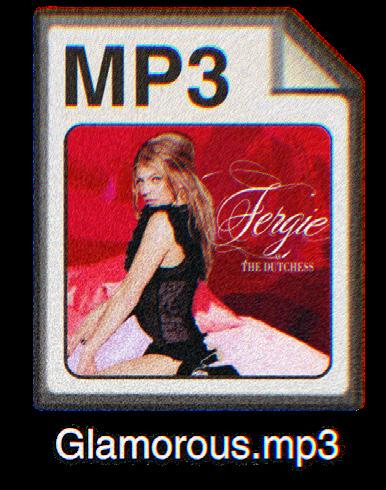
6. Glamorous by Fergie
Because being a baddie isn’t just about the hustle—it’s about looking good while doing it.
Fergie’s Glamorous is your reminder that success doesn’t mean sacrificing style. A little luxury? A little indulgence? You’ve earned it, babe.
Nothing beats walking into the office knowing you look expensive, and this song reminds you of that.
7. Shut Up and Drive by Rihanna
There is no backseat energy here—you’re in control, always.
Shut Up and Drive is for those days when there’s too much distraction. You’ve got places to be, things to do, and no time for nonsense.
Its sharp lyrics and confident beat make it the perfect track for walking into a tough meeting, handling an office challenge, or simply reminding yourself that you control what you want.
Turn this up, block out the noise, and focus on the road ahead. Because you? You’re definitely going places.
8. Tomboy by Destiny
Rogers
This is a little reminder that men think they run things—until a woman walks in and does it so much better Destiny Rogers’ Tomboy is the anthem for the quiet but deadly moves you make in the office. It’s the song for the woman who doesn’t need to yell to be heard, the one who lets her work do the talking while everyone else scrambles to catch up.
Ever been in a meeting where you’re the smartest person in the room, but some guy with half your expertise insists on explaining your own job to you? Turn this up. It’s the soundtrack for every time you prove them wrong, exceed expectations, and walk away with the recognition (and paycheck) you deserve. The best part? You didn’t even have to try that hard.
This playlist isn’t just some background noise—it’s the soundtrack to your success. So, put on that sleek suit, fix that red lipstick, and get ready to dominate the office. You didn’t come this far just to blend in. You came to lead. Now go out there and be the next big thing! FWD
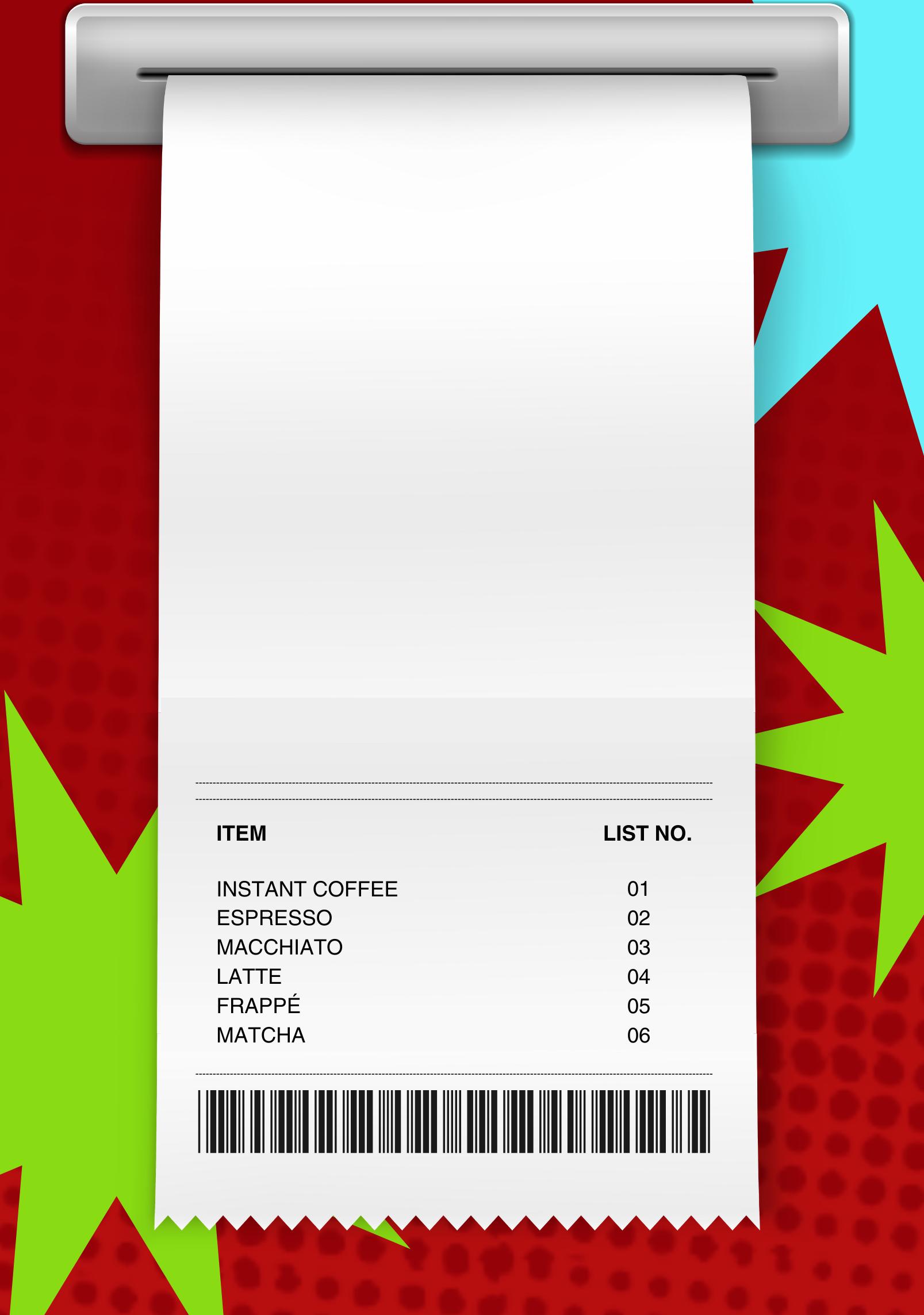
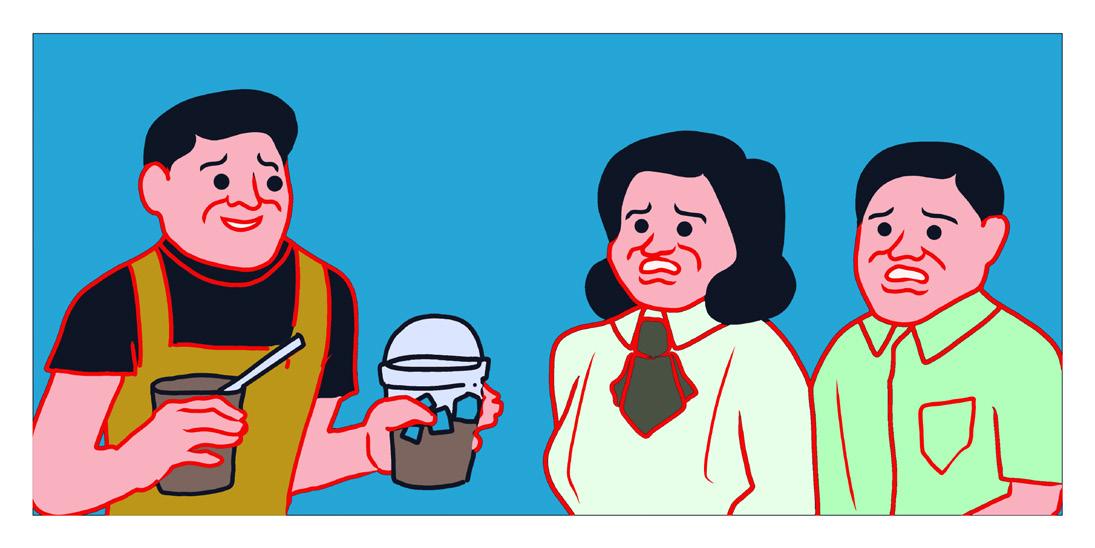
The Joes Behind the Cup
by Maria Cristina G. Lamug and Ashleah Mae Y. Villono illustrations and graphic design by Karina Adel A. Vestil and Jane Frances P. Latorza
Breezing through our routines, we often have a cup of joe for company. But have you ever wondered about the Joe behind the cup?
Whether rushing to a 7:30 a.m. class, trying (and failing!) to conceal those eye bags, or eagerly reading their horoscope for the day, these Joes’ characters are blended in every brew. After all, if you are what you eat, then you might be what you drink, too.
This list is just some lighthearted fun, but if it feels too accurate…well, we don’t make the rules. So, take a look at that cafe menu before ordering because here’s what your coffee says about you.
Instant Coffee – The Minimalist
Let’s be real—you’re not here for the fancy flavors or aesthetic foam art. You just need caffeine, and you need it now. You drink instant coffee because, in your opinion, “coffee should taste like coffee”—no syrups, no milk, no nonsense.
You’re the kind of person who values efficiency over extravagance, function over flair. While others waste time debating over caramel or vanilla, you’ve already taken the first sip and moved on with your day.
You live life as simple as the instant coffee granules you stir into your cup, and you probably have the same morning routine every day—why fix what isn’t broken? You don’t get why people would spend hundreds of pesos on a single cup when a three-in-one sachet does the job just fine.
Practical, unbothered, and always on the go, you’ve mastered the art of “Okay na ‘to, basta may kape.”
espresso, or are you just on the SabrinahypeCarpenter train?
Whether or not you’re working late (‘cause you’re a singer), it is true that you are a workaholic who enjoys diving deep into the night or giving up sleep to start up projects due weeks ahead. Not only do you walk in, dream-come-true it, and leave quite an impression the morning after, but you also do everything with more in mind.
Driven, high-energy, and faster than anyone can imagine, many wonder—how do you keep up the pace? (The secret: a shot of espresso.)
Your coffee isn’t just a drink—it’s an experience, a statement, and most importantly, an Instagram-worthy moment.
You’re the type to spend a solid five minutes capturing the perfect shot of your macchiato before even taking a sip. After all, what’s the point of coffee if it doesn’t make it to your IG feed?
Trend-savvy and chronically online, you know the latest café openings before anyone else and have a mental list of places with the best lighting for coffee photos. Your phone is practically an extension of your hand, and your screen time report would probably scare most people.
Whether you’re a full-fledged content creator or just someone who enjoys curating a visually pleasing feed, one thing’s for sure—your macchiato isn’t just a coffee; it’s a lifestyle.
Latte – The Chill Friend
People who enjoy the little things in life are, more often than not, latte lovers. There’s no going wrong with those who order a simple latte— although that might be because you’re a people pleaser at heart, going along with the flow and saying “okay!” to everything, no matter what you actually want.
You tend to tag along with whatever “laag” that comes up, whether it’s a late-night study session for upcoming exams or an impromptu hang out during those dragging vacant hours. There’s no doubt that you’re a fun one who enjoys a work-life balance above all.
Besides, you have to make it clear that you’re going for the chic, minimalistic vibe wherever you end up going. Be it in manicured nails, a clear phone case, or a plain white tee, you have to establish that on-fleek brand of yours, right?
Frappé – The Sweet Tooth
If your go-to order is a frappe, you’re the type who enjoys a little bit of everything, whether it’s extra whipped cream, caramel drizzle, or just the thrill of trying every flavor at least once.
Life’s too short for plain coffee, so why not make it sweet?
Fun, bubbly, and never the boring one in the group, you bring the energy wherever you go. Your wardrobe is as bright as your personality, and your playlist probably has a lot of Taylor Swift on repeat (because being soft and romantic is totally your thing). You love a good laugh, a spontaneous adventure, and a dessert that doubles as a drink.
Matcha – The Parental Guidance
“We’re not like the others; we’re different,” says the matcha drinker. You like to think your drink screams “unique,” but let’s be real… is it the matcha, or is it just the acid reflux?
Jokes aside, many might consider you as the “parent” in the friend group, constantly checking up on your steps per day, carrying a decorated hydro flask full of ice-cold water, and acting as the resident therapist for messy rants.
It doesn’t help that you’re dressed head-to-toe in earthy-toned layers, soft cardigans, and baggy jeans. Your cozy vibes only draw people into you, catching glimpses of onlooking passersby.
But it’s not like you notice their stares anyway, lost in your own little world.
Some may say you’re a little extra, but hey, what’s wrong with making life a little sweeter?
As you take another sip of that caffeine fix— be it in line at the Espressa cart or slumped over major deadlines— you might learn a thing or two about yourself.
Whether it’s the simplicity of an instant coffee, the trendy flair of a macchiato, or that short ‘n sweet espresso, each cup complements the Joe that you are.
Next time you order that go-to brew, remember: it’s more than just a drink; it’s a lifestyle. FWD
At Command: A Scholar’s Struggles Behind the Desk
by John Kherwin A. Pansacala and Samantha Mae A. Murillo
by Christian A. Mananguite
The READS are like an optimized system: always running, always available. Are they scholars, workers, or something else entirely?
The Recoletos Educational Assistance for Deserving Students (READS) scholars of the University of San Jose-Recoletos (USJ-R) are widely regarded as the institution’s backbone, balancing rigorous academic schedules with demanding administrative duties.
However, beneath this facade of indispensable support lies a burden that these working students quietly bear—one that spoils their academic progress and overall well-being.
This article sought to shed light on the concerns about the demands placed on READS scholars, alongside a stack of resignations.
Holding All Keys at Once
Being a READS scholar comes with benefits: free tuition, waived enrollment fees, a monthly allowance, and even invitations to exclusive events.
As long as they perform well in their assigned offices and maintain the 2.5 cutoff grade, they can continue to enjoy these privileges.
While many appreciate the opportunity, some have raised concerns about the blurred boundaries between academic responsibilities and office duties.
In an interview with FORWARD, READS scholars confided their struggles in managing workload and academic responsibilities.
“ Naglisod jod ko’g adjust. Naa na’y times di ka katuon kay ma -consume sa duty. It’s either makatuon ka gabii, pero ig duty, mawala imo gitun-an kay focus imo mind sa work. Ma -late sad ‘sahay kay wa pa naabot ang mopuli, maka-affect jod sad siya sa imong grade,” they shared.
photo
Meanwhile, READS Adviser Dolores Baba told FORWARD that it is the READS scholars’ responsibility to balance their academic, office, and social activities.
“It has to be embedded in the person. It’s more [about] the realization sa imong self if kaya ba nimo i-give up ang other personal activities,” Baba said.
However, the scholars emphasized that they struggle to juggle these activities due to their extended working hours and duties.
Beyond the Clock
Despite being required to render only five hours of duty per day, some scholars are frequently asked to extend their hours—sometimes up to nine hours or post office hours.
These extended duties are not always limited to administrative tasks but also personal errands for their superiors.
A former READS scholar in 2006 shared that even during their time, extending hours and performing unrelated tasks were considered “normal.”
“ Nindot ang exposure, and thankful jod ko . Usahay kapoy na lang jod kay overtime na sad , sugo nga wa diri, wa didto, ” they recalled.
While scholars shared that they feel compelled to stay past their working hours due to the lack of manpower in the offices, Baba emphasized that working overtime is voluntary.
“Dili na siya ipugos sa READS if dili siya Amo sad nang gi-orient nila kana bitaw’ng serving without minding, mura ba og serving beyond what is needed of you. But definitely, if mo-overtime na sila, they are being taken cared [of] man pod [by] their department,” Baba explained.
However, in cases of misconceptions regarding the “voluntary overtime” where READS are left with no other option but to comply, the scholarship office intends to communicate this with the scholars.
“Then we can address the concern if ingon ana , to encourage them at the assembly [because] we also want to iron out things kung asa man jod dapita —mostly ba sa inyoha and how many of you, ” Baba added.
Moreover, the READS said they are generally willing to run errands, such as buying food for office staff, but some expressed that these requests have occasionally crossed the line.
“Papaliton food. Usahay pa ig abot didto, di sila ganahan sa food, naa pay daghang tabi. Okay ra siya sahay nga sugo pero naa may faculty [members] sad na moadto sa office then [manugo] dili na mao iyang READS-in-charge or lain na siya nga department tas niadto lang sa ilang office then gisugo siya,” a scholar explained.
“Stop treating READS as [though] they were personal maids of some [faculty members],” they added.
Meanwhile, Baba said that buying lunch should not be an issue since the READS scholars also receive “free meals.”
“For those complaints it will be held at utmost confidentiality. It will definitely be investigated,” Baba replied to concerns about the unrelated tasks.
Let’s Decode: Who’s Responsible?
Baba revealed that around 12 scholars resigned during the first semester of the Academic Year 2024–2025, the highest number since the breach of contract policy was implemented in 2016.
“ Dili jod nimo mapugngan . Whenever I told them not to resign, kasagaran na reason [kay] financial. Then sa call center, they are receiving daw P20,000 for two weeks; dala naman daw na overtime,” Baba said.
Further, she reiterated that the READS scholars can relay their concerns to the Scholarship Center if they feel overwhelmed by their workload.
“If you really do feel exhausted, you can go to the Scholarship Center para i-assess nato. The Scholarship Center is only asking you 30 hours a week, and that has already been proven nga kaya ra gyod,” Baba said.
“When we [tried] to reach out to the department to investigate, they reasoned nga ‘Ma’am, the scholars are well-taken care of. They were given remuneration, mga [honoraria], gipakaon na sila, ginatagaan,” she added.
However, a scholar confided that whenever they voice concerns such as heavy workload, limited units (18 units per semester), and exhaustion from overtime, they are met with dismissal: “If you can’t handle it anymore, then just resign.”
“There are times man god nga si READS ma-overwork na gani unya ingnon lang kay kabubut-on ni READS nga mag-overtime,” they said.
“Sa among part, masakitan pod mi kay we don’t have any choice anymore, unya ingnon lang mi og ingon ana,” they added.
In response, Baba clarified that before confronting the departments, they need to consult the READS first and discuss it with the scholarship director.
“You could always write a letter para atong ipaabot [to the administration], so if you’re interested and feel nimo grabe na jod kaayo na sila, we always accept formal complaints, and it will be held with utmost confidentiality,” Baba explained.
Prepping the Pens
Semestral evaluations are conducted to determine whether READS scholars can retain their scholarships, based on criteria set by the READS-in-charge of various departments.
Meanwhile, the READS are calling for an online platform or evaluation system—one where they can anonymously voice their concerns and assess their workplace environment without fear of judgment or dismissal.
To address this, Baba proposed an online survey for the scholars, offering them a safe place to share their concerns without the risk of exposure.
“Mag-develop mi ana nga survey to help the READS before mi mag-conduct sa assembly. So when we will be having the assembly, naa nami information about these matters, and we can present this to the administration,” she emphasized.
As READS scholars continue to hold USJ-R’s administrative framework together, their plea remains clear: recognition, fairness, and a sustainable balance between duty and education. FWD
…And Cut!
by Kimberly G. Capuyan and Lylle Antonette A. Flores
As the spotlight gets dimmer, budding artists at USJ-R are left questioning the institution for cutting the act it configured.
Carving its niche at the forefront of producing multi-talented students, the University of San Jose-Recoletos (USJ-R) proved it has built not only a home for topnotchers to grow but also a playground for the artists in the making.
For the past years, the University has been welcoming of the students’ artistic talents, as seen in the organization of dancing, singing, and acting groups.
However, with the re-establishment of the school’s theater group in February 2024, Josenians in the arts have expressed concerns about the support they have received from the administration.
Debugging the System
In an interview with FORWARD, former General Director of Teatro de Recoleto (TDR) Brams Albarote revealed that students were promised a scholarship of up to 100% if they joined the theatre ensemble.
Further, a second-year Journalism student said the scholarship was stated in a Facebook post of the Center for Music, Arts, and Culture (CMAC), calling for TDR applications.
“Pagkakita nako nga naa’y scholarship sa post sa CMAC, I grabbed the chance to audition. Ang giingon [sa post] kay full scholarship. Most of us kay mao gyod [ang] nakit-an,” they said.
At first, the students were skeptical of its legitimacy due to a lack of concrete groundwork from the concerned administration.
Notwithstanding, they joined TDR believing that the CMAC, which handles them, offered scholarships to the members under its umbrella.
Albarote explained that TDR Adviser Ian Jarabelo also introduced them to the scholarship, as relayed from the CMAC.
photo by Astrid Niña T. Vidal
“Nag-announce sila og ing-ana and naa’y ing-ana nga incentives pero wala’y provision, wala’y basis. So, ang nahitabo is ni-join mi nga wala’y assurance,” he added.
FORWARD reached out to Jarabelo to seek clarification but was unable to secure an official response. Instead, he referred the Publication to CMAC Director Rev. Fr. Glynn Ortega, OAR.
In a separate interview, Fr. Ortega confirmed there was no memorandum for the establishment of TDR but only a manual of the supposed functions and privileges of its members.
“Naa didto [ang] mga functions and privileges supposed to be. [But,] the manual is to be edited,” Fr. Ortega said.
As of March 20, 2025, the copy of the CMAC manual has not been propagated as revisions are still underway.
Moreover, Albarote said they expected the scholarship to be in effect after their debut performance during the Intramurals 2024 in March, as announced to them.
However, they were later given a notice that their scholarship would be funded from the proceeds of the Hugyaw shows in November 2024.
“We didn’t know nga ang kuhaan sa scholarships were the proceeds of the [Hugyaw] show. We were hoping [nga] naa na’y nakalaan daan [nga] funds sa amoang scholarship,” a member said.
They said the highest share given to the members only covered 50% of their tuition, while others received as low as an amount only enough to pay the enrollment fee.
Fr. Ortega clarified that the scholarship percentage will be fulfilled only if they have reached the projected amount of the said show.
“Siguro kung na-reach ang quota, possible [pod] na-reach ang percentage. So di gyod siya mahimo nga percentage, pero amount nalang jod to be divided accordingly,” he said.
Far from the projected total income of P2 million, Albarote shared that the shows had only accumulated proceeds of less than a million.
Shifting Pockets
Aside from the unkept scholarship promise, the TDR members lamented that they also subsidized the preparations of their shows from their own pockets.
“Ang production [committee] and execom (executive committee) ato na time mao’y nigasto sa pag-produce kay dugay man nahatag amoang money,” they said.
The TDR was notified to perform for the Intramurals amid their preparations for the Hugyaw show, leaving them to cover some of the expenses to move forward with the preparations.
They also confided that this is not the only instance that the members financed the group’s operations due to the delay of budget releasing on the side of the Accounting office.
“Nagpasalig ko’g pahuwam og money. Naa sad cases nga nakatapal ang TDR members kay wala pa mi’y budget,” Albarote shared.
Albarote covered P10,000 of their expenses for their Intramurals show but was reimbursed in the succeeding semester in November 2024.
“Na-reimburse pero nadugay lang. Dili [mi] matagaan sa Accounting [Office] og money kay wala’y name ang organization, wala gi-endorse, wala gi-register,” he continued.
According to Fr. Ortega, the reimbursement and incentives of the TDR members were also sourced from the gross income of their shows.
However, unlike TDR, another organization under the CMAC, which is PAS, has not experienced similar funding issues.
“Technical jod kaayo when it comes to ing-ana [Pero] wala ra mi naka-get from our own pockets,” a PAS member confided.
Meanwhile, the ADT has declined to give a statement on this matter.
Troubleshooting the Glitch
Albarote expressed concern about the obscurity of where they stand in the priorities of the University.
“Lingaw man unta. Pero lagi, makalaay. Makawala siya’g gana because of the management. Daghan ang nakaingon nga ‘nindot man unta ni, Direk, pero ing-ana,” Albarote shared.
Albarote further stated he would not entice Josenians to join TDR if there were no improvements in its management.
“Dili ko mamugos [nila] nga mu-join if mao ra gihapon ang treatment sa CMAC. As the [former] director, naa sad raba ka’y residual guilt bitaw nga ikaw ang nagpasulod ani niya,” he said.
On the side of the CMAC, Fr. Ortega said he hoped to address the concerns of TDR with the other coordinators and iron out the difficulties internally.
“As much as possible, ma-handle na [og] dili siya magawas kay internal [ni] na concern. We can sit down, discuss, and resolve the issue,” he said.
Fr. Ortega also shared their plan to discuss the source of the TDR’s scholarship with the rest of the administration.
“Hopefully, we can plan out sa source sa ilahang scholarship. Kung ari gihapon sa ticket, maglisod man pod ta kay yearly ra man na. At least, naa’y kausa maka-present ta outside [USJ-R],” he said.
On April 6, 2025, the administration released a memorandum on the proposed tuition and miscellaneous fee increase (TAMFI) for the Academic Year 2025-2026.
The memo introduced new fees to support the scholarships and cultural activities for the scholars under the CMAC.
As the scenes continue to roll, USJ-R must jump into action for the show to go on. FWD
Aw, Snap! Update the Labs
by Krisha Faye A. Gascon and Ceraley S. Cabiltes Jr.
by Gabrielle Marie R. Paradiang
With laboratory fees ranging from P2,000 to P5,000, Josenians voice concerns about whether they are paying for quality education or underutilized facilities.
As a private Catholic institution, the University of San Jose-Recoletos (USJ-R) takes pride in its state-of-the-art facilities that support its mission of providing the highest level of Quality Christian Community-oriented Education. However, for many students, this claim does not always hold up when it comes to laboratory fees.
In this article, FORWARD attempts to shed light on some of USJ-R’s facilities and whether these fees translate into wellmaintained laboratories—or if students are merely paying for resources they rarely get to use.
Ca$he Not Found
Students’ feedback reveals mixed experiences, with many lamenting limited access to laboratory equipment despite paying high fees.
A second-year Psychology student shared that while some equipment is helpful, access remains an issue, recalling having to purchase materials for hands-on exercises in their Zoology lab.
Similarly, students taking English and Communication courses noted that speech labs are sometimes used for lectures rather than practical activities.
photo
Others mentioned that their classes are being used at half-capacity or even held in standard lecture rooms, raising concerns about why they are required to pay laboratory fees for laboratories that are not even being utilized properly.
“ Naka -realize [ mi ] nga naa mi laboratory, pero dili tanan meetings [ namo ] sa laboratory. Ila gitunga ang block without giving us notice, and na -shock na lang mi pag meeting namo na lahi-lahi na mi og offer code sa block,” an Accountancy major shared.
Hygiene and maintenance issues were another concern, with students citing non-functional computers, unsanitized headphones, and disruptive noises from other classes.
Meanwhile, a second-year Medical Technology student acknowledged improvements in equipment but noted challenges in laboratory sharing between departments.
“The fees are high, so I expect good equipment and enough materials. But sometimes, the medical technology laboratories lack some materials, so we have to borrow [equipment] from the School of Arts and Sciences (SAS) Department of Mathematics and Sciences (DMS) laboratory,” they added.
System Update in Progress
FORWARD sought clarification from the office of the Vice President for Finance about the budget allocation surrounding the school labs but was unable to secure an interview.
However, the DMS and the Department of Communication, Languages, and Literature (DCLL) provided insights into laboratory maintenance, upgrades, and budget allocation.
DMS Chairman Dr. Julius Dequillo addressed the issue of foggy microscope slides, stating that some slides were student-made rather than professionally manufactured.
“[If naa’y slide nga] gihimong reference ba ron sa faculty kay binuhat sa mga estudyante as product output, then it is expected that they don’t have a good quality for that,” Dr. Dequillo said.
“Pero the one that we are purchasing sa Manila, mostly nindot jod na siya nga slide kay mahal mana siya, tag-P1,000 to P1,500 each,” he added.
Dr. Dequillo also confirmed that resource-sharing between departments is allowed by the University to maximize existing equipment.
“As mandated by the University President, if ever affected ang budget ba ron ana nga department as long as pwede siya nga makapa -borrow ta sa ubang department, gi -allow na sa University President,” he said.
DCLL Chairman Ethel Luz Medado shared that upgrades for the speech labs of their department are being implemented in phases.
“The [upgrading for the] speech [labs] will have two to three phases; what we have now is the equipment because of the classes. There was already a proposal for soundproofing, but as of the moment, because of the classes, that cannot be done in one setting,” she said.
Medado also clarified that equipment use depends on the teacher’s lesson plan, and retooling sessions for faculty concerning equipment use will be conducted upon request by the faculty themselves.
“In terms of justifiability, justified gihapon siya. But of course, the [students] have not [experienced being in the lab] for the full-length [of their course]. Pwede ra man na nato siya ma-ask sa Accounting nga lesser ang price in terms of how often they do have the alternating kay naa may record for alternate classes,” she said.
The alternate setup was introduced to accommodate more students and prevent the course from being dissolved, as Room 404 is the only designated laboratory for the course.
“We tried to meet halfway with the needs of the students and tried to have a win-win solution for them in terms of justification and at the same time sa school pod nga making use of the available facilities for the time being nga wala siya,” she said.
Loading… Please Wait
Dr. Dequillo and DMS Laboratory-in-Charge Lance Ylanan revealed that recent renovations in chemistry laboratories alone cost approximately P1.7 million. However, laboratory fees collected do not always cover all upgrades.
“Although naa mi laboratory fee diri , it does not suffice [for] everything,” Dr. Dequillo admitted.
Medado added that for DCLL, all fees go toward upgrades, but operational costs and maintenance must also be considered.
“You have to remember there are also operational costs and maintenance. You don’t purchase, and you don’t upgrade yearly. We have funds set there for operational expenses for the laboratories and the department,” Medado said.
Previously, Dr. Dequillo mentioned that unused laboratory fees were returned to the University’s trust fund instead of being saved for future laboratory improvements.
“Long before, ang mga kwarta saunang panahon , everytime dili magamit, mabalik ra sa trust fund sa University. Ang mahibilin, ma-amoa Matugpa didto sa University maong dili matigom so if we need more money intended for the equipment, of course, mabalaw pa mi’g raise sa amount,” he added.
Despite financial limitations on the department, Dr. Dequillo reassured that the students’ laboratory experience remains a priority.
“Basta ang main namo nga purpose that the stakeholders, ang mga estudyante , can use the facility nga mahikap nga di pareha sa ubang public school nga for your eyes only,” he said.
While acknowledging that not all issues about laboratory accessibility can be resolved immediately, both DMS and DCLL emphasized that continuous improvements are being made.
Moving forward, greater transparency in budget allocation and more efficient facility management could help align student expectations with the University’s available resources. FWD
A Survival Guide to Maneuver the 10 People You Meet at Work
by Rey Martin B. Rio and Sharry M. Cuizon illustrations by Sienna Rio E. Young and Hannah Vanessa O. Mondilla
They say college prepares you for the real world, but what they fail to tell you is how to prepare for a melting pot of personalities that can either make or break your corporate life.
In any workplace, you’re sure to encounter a variety of personalities that can brighten your mood or drag it to an all-time low. From the excessively zealous cheerleaders to the cunning backstabbers, each character adds t heir unique flavor to the office environment.
Here, brings you a quick guide to the 10 kinds of colleagues you will encounter at work for you to navigate the professional setting without losing your sanity.
2. Gossip Guru
1. Buddha Wanna-be
Starting strong with the office rabbi, always eager to burst into philosophical maxims at anyone who’s willing to listen—or forced to.
Often doubling as self-appointed life coaches, they offer unsolicited advice on everything from career growth to relationships.
They can be overwhelming, right? So, make sure to steer conversations back to work-related matters when they veer too far into personal territory.
With eyes on the lookout and a knack for eavesdropping, the Gossip Guru thrives on knowing everyone’s business, constantly tuning in to who’s dating who, who got a raise, and who might be on the chopping block.
Nod along to their stories with just the right amount of interest, and listen to how they dramatize someone’s business like it’s a soap opera. Regardless, always remember: Anything you say can and will be used against you in the court of office fiasco.
3. Typo Terminator
Also known as the “perfectionist micromanager,” these workaholics are meticulous about every detail.
They wield their red pens like swords, correcting even the tiniest typo or formatting inconsistency as if it were a national emergency.
Avoid getting caught in their nitpicking cycle! If they start crawling around your neck, remind yourself that their fixation on details is just their way of showing they care— deep, deep down.
4. Borrow-and-Bail Houdini
Stay alert for the Houdinis! They have mastered the art of charming their way into loans, advances, and “I’ll pay you back Friday” deals, only to pull a disappearing act when payment is due.
Working with them means dodging sob stories and conveniently timed “emergencies.”
Make sure to get everything in writing! Because once they vanish, all you’ll be left with is regret and an empty wallet.
5. Breakroom Bonnie & Clyde
If there’s an unspoken rule about keeping things professional, Bonnie & Clyde surely missed the memo (or ignored it).
They move through the office like a rom-com on fast forward—stolen glances, whispered jokes, and scheduled “meetings” in the supply closet. PDA isn’t just a habit; it’s their love language! Be sure not to get caught in their love bubble, and brace yourself for a subplot worthy of a telenovela.
6. Smooth Operator
Watch out for the Smooth Operator, as they are brimming with surefire business ideas that sound too good to be true.
Slithering around the office, they peddle get-rich-quick schemes and slippery investments with hypnotic charm. They’ll go to great lengths to get you to partner with them in their hustle, always ready with a pitch.
Be sure to decline any offers from this slick promoter immediately; your wallet will thank you later (winks).
7. Flatterific Diva
Meet the Flaterric Diva, always hovering around the workplace, armed with compliments and flattery that could make anyone blush or roll their eyes.
Their terrific hobby—aside from being self-important—is sucking up to those in rank. They are not secretive about their desire to climb the corporate ladder, making it sound like a genuine mission.
Keep your distance from their bootlicking and focus on your work…or, if you don’t, you might as well stay out of the break room unless you want to hear the Gossip Guru’s
8. Hallway Honeys
If you spot a couple besides Bonnie and Clyde, chances are, you’ve met the Hallway Honeys
Whether it’s a stolen kiss or lingering glances, these lovebirds can’t keep their hands off each other—with gestures ranging from sweet to downright cringeworthy, juggling romance amidst deadlines (werk!).
Even their fights happen in public, making this pair impossible t your headphones ready if these lovebugs start to distract you.
9. Throwback Supervisor
Presenting the Throwback Superior, who never misses a chance to remind you that “back in their day,” things were done differently.
They’re nostalgic but can sometimes (or most of the time) come off as dismissive, particularly toward younger colleagues. And if you fail to acknowledge their experience, don’t be surprised if you find yourself on the blacklist from company afterparties.
10. Workplace Vulture
Bringing up the rear of the list is the Workplace Vulture, the credit grabber who swoops in at the last minute to claim credit for your hard work.
You should know by now that they’re masters at making themselves shine while leaving you in the dust, completely unfazed by their atrocious behavior.
Here’s a pro tip: Document your contributions so your name is front and center when recognition rolls around. Careful, or else you’ll become their prey.
Have you taken a good look at this guide, grasped the quirks and tactics of your office mates, and taken it all into mind? Then, better get ready as you clock in for the next day because the corporate jungle’s cast awaits. FWD
HIT ‘N RUN
DISCLAIMER: The issues presented are solely from the Josenians. It does not reflect the views and opinions of the publication.
ChatGBesti e
Kasayon na lang jod sa kinabuhi karon, sa? Special thanks to my certified bff! Mga lisod nga essay, position paper, ug uban pa? Andam ka niyang tabangan! Imong score sa outputs, perfect lamang, plus butangan pa’g note sa imong prof nga “well done!” o “very concise.” Ayaw mo kalain nako, ha, kay in a world woven with hardship, we yearn for a tapestry of ease—a seamless thread of solace to guide us through the intricate trials of life. Mura’g korek, sa? Gi-CTRL+C ug V ra nako na gikan kang bff, oy! Dili ko magsaba kinsa siya, kay imo pa lang amigohon, masakpan niya ta. Bleh!
Expressa, asa ang Hustisya?!
Labara sa ulo aning tuon life sa Sanjo, oy. Hays! Sige lang gud, naa bitaw kape na mosalbar kung moaksyon ang atong duka sa klase. Among kape diri kay daghan og flavor nga kapilian, nga ang kaisog moangay sad sa imong ganahan. Unique pod siya kay usahay, wa siya’y takob pero naa’y straw—adto supsupon aron di ka mayab-an. Pero kung naa’y takob, ang straw mao’y wala. Aw! Tangtanga nalang ng takob kay imo ra man gihapon nang tungabon! Magtarong gud ta, Expressa; gamay nalang moshift na jod ko’g kapehan ba. Kung di pa lang hitsuraan ang inyong mga barista, dugay ra ko ni-let go ha.
Operation 101: ESCaping the Guards
Ang mga mata sa guards sa Sanjo mura’g agila, so sa mga lalaki nga maglisod og paputol sa ilang choy-choy nga buhok kay “it’s part of the fashion” daw, gamiti ra na og gel o pomade, ‘nya ipasaka ang imong bangs aron di maklaro nga nilapas na diay na sa kilay. Sa mga babaye pod nga wala kabantay nga dili na diay kasigo ang sinina nila, hala, pag jacket, dzae! Pwede pod sa back gate ka agi kay mura’g ngitngit ‘tong dapita. Sekretong malupet, pwedeng pabulong ra ta diri’ng dapita, ha, kay basin naa’y snitch—lisod na.
Tag-ana akong Password
Paita sad intawn aning password nga “Temp_123,” unya para na sa tanan, oy! Ay joke, gi-ingnan naman diay mi daan nga temporary password ra ni, ‘nya kami na ang bahala’g ilis, hehe. Pero, bahala’g gisultian na mi nga kinahanglan namo usbon kay mag-tinapulan gihapon. Kapoy man gud mag-ilis og password oy! Unya ang sunod diay ani ron kay ma-usa sad ta’g ka-hack tanan. Huhu, kahadlok, simbako! Ilisdan na lagi ko ni kay mura’g uwaw man sad hunahunaon nga naay makasulod sa imong SIS tapos makakita dayon sa galaray nimo nga tres. I-delete ta ni, bi, ilisdan nato’g “ilovemyhoneybunchsugarplum.”
Lahat Gagawin
para Sa’yo
Usahay ba, maglibog jod ko kung ang school event ang gimata nato sayo sa buntag or ang attendance slip sa Sanjo nga mura’g walay kahumanan? Bitaw, pag-sure daw mo dihang dapita kay mura’g daghan raba intawn mi’ng mga lagyo kaayo’g balay. Gilaliman ka, among plete lapas singkwenta padulong pa na sa eskwelahan, nya akong points madawat kay baynte ra. Wa gabae! If ma-CTRL lang jod nako ang oras ba, para mopaspas og padagan ang drayber sa jeep, dili unta ko mo reklamo ron! Lagi mo-attend ko kay lisod na ma-INC nya ta sa Guidance ani, hihi.
illustrations by Khen B. Fernandez and Heron Augustus S. Flores
Bachelor of Science in Management Accounting Associate Editor (A.Y. 2023-2024) Staff Writer (A.Y. 2021-2025)
Bachelor of Science in Accountancy Feature Editor (A.Y. 2023-2024, 1st Semester) Staff Writer (A.Y. 2022-2025)
Rey Martin B. Rio Bachelor of Arts in Communication News Editor (A.Y. 2023-2024, 2nd Semester) Staff Writer (A.Y. 2022-2025)
Christian A. Mananguite Bachelor of Arts in Communication Creative Director (A.Y. 2024-2025) Staff Photographer (A.Y. 2022-2025)
Rufino Rico L. Jamisola Bachelor of Arts in Journalism Editor-in-Chief (A.Y. 2024-2025) Staff Writer (A.Y. 2022-2025)
Bachelor of Science in Psychology Creative Director (A.Y. 2022-2024) Staff Illustrator / Graphic Artist (A.Y. 2021-2025)
Astrid Niña T. Vidal Bachelor of Arts in Communication Art Director (A.Y. 2024-2025, 1st Semester) Staff Photographer / Videographer (A.Y. 2022-2025)
Loveleine Led Marie A. Lambatan 2nd Year Bachelor of Arts in Communication Magazine Model