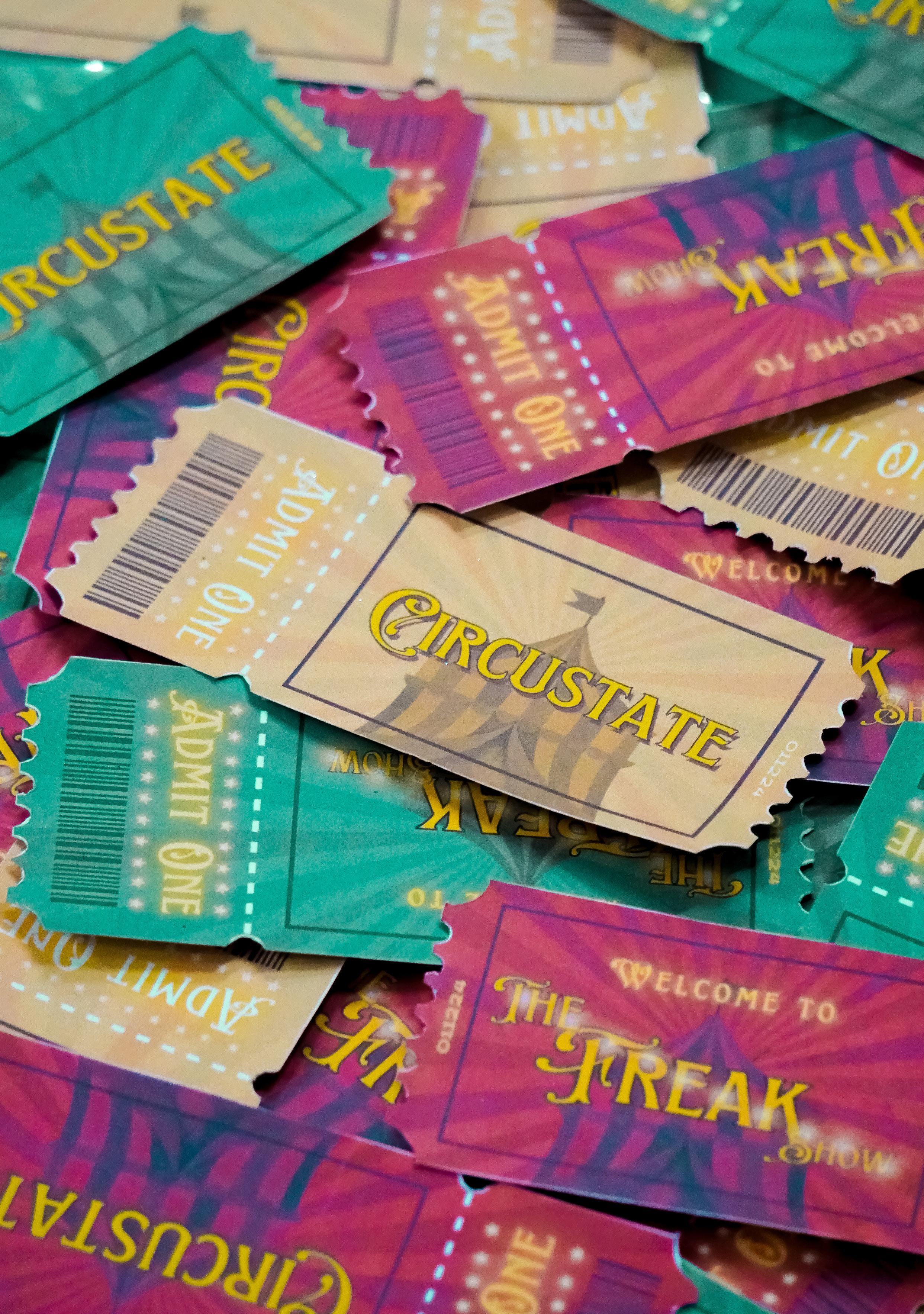
There’s a realization in every absurdity. In this semester, FORWARD welcomes you to the freak show. Circustate allows readers to unpack the variant forms of mockery that continuously permeate the society.
ABOUT US
The FORWARD Magazine is printed every semester and once every summer under the name SOLSTICE. It is managed and published by FORWARD Publications, Ground Floor, San Agustin Building, University of San JoseRecoletos, Magallanes Street, Cebu City. FORWARD welcomes contributions from Josenians such as formal/informal essays, poems, short stories, artworks, and photographs.
VOLUME 77 | A.Y. 2024-2025
THE OFFICIAL STUDENT PUBLICATION OF THE UNIVERSITY OF SAN JOSE-RECOLETOS
BEHIND THE COVER
Producers
Louise Lambiquit
Karina Adel A. Vestil
Krista Marie B. Yaoyao
Photographer
Gabrielle Marie R. Paradiang
Assistant Photographers
Ayn E. Nazareno
Christian A. Mananguite
Hair and Makeup
Carls Stephen Marande
Model
Erica Anne G. Bolo
Probationary Staff
Ma. Ehla Fatima C. Inanod
John Kherwin A. Pansacala
Ceraley S. Cabiltes Jr.
Kimberly G. Capuyan
Ashleah Mae Y. Villono
Lylle Antonette A. Flores
Raghnall P. Cena
Hanzrei Nikolai T. Encabo
Kimberly O. Tumilap
Marian Lhoyn B. Autida
Hahn V. Lili
Sienna Rio E. Young
Kirsten Leanne P. Roble
Therese Margarette A. Racaza
Kristianna Amor M. Tagsip
REACH US e-mail: forwardpublications@usjr.edu.ph facebook: facebook.com/usjrforward instagram: @forwardpublications
For comments, reactions, suggestions, and contributions, contact us at:
READ FORWARD ONLINE!
Read the latest FORWARD Magazines and Folios online at www.issuu.com/usjrforward
All rights reserved. No part of this magazine shall be used for any purpose except when allowed by the law without prior explicit permission from the FORWARD Publications.
illustration by Khen B. Fernandez
Editor’s Note A Circus All Along Editorial Now you see me, Now you don’t Discussions
SONA 2024: Re-yal or Fa-ke? I Bet on Losing Odds The Doom in Stardom Society A Party of Many, A Burden of One I Laugh, Therefore I Think News
Have you ever witnessed a circus? I have not, and I have longed to experience it.
From the movies I watched as a kid, I have known that the circus is where magic and wonder come alive. As I grew up, my friends positively influenced my concept of the circus, enthusiastically telling me that as you enter the big top, what seems “extraordinary” turns out to be just “ordinary,” and a vibrant spectacle gradually unfolds.
While performances involving animals may seem magical and wondrous, the behind-the-scenes reality often involves mistreatment; I did not know it was animal exploitation.
These harsh truths forced me to reconsider my once-idyllic view of the circus. It presents us with a facade of perfection that glosses over real problems. I realized that the circus is not far from the society we live in today.
In the 77th volume of FORWARD Magazine, I, together with the Publication’s staff, am proud to present Circustate, a reflection on the messy reality we often try to hide through glitz and glamor.
There, you see how acrobats defy gravity, twisting and turning their bodies in ways you never thought possible. The bizarreness of clowns as they tumble and juggle fills the arena with genuine giggles from kids and adults alike.
As much as you are entertained by the skills that human performers show off with sheer joy, you will also be in awe of how animals, trained for years, perform incredible tricks, accompanied by dynamic lights and music. Everything is not only for the eyes, as the smell of popcorn and cotton candy pervades the atmosphere inside.
Listening to my friends, who would not feel a sense of excitement and amazement? I felt like I was brought to a dream I would not want to wake up from.
But from the circus dreams I have always thought of, I began to question the reality behind the curtain as time passed by.
While we open the stage curtains for our first semester’s magazine, we delve into the complexities of our society—this time, no filters on: the circus-like atmosphere in Philippine politics as the 2025 Midterm Elections draw near; the debunking of the accomplishment claims of Marcos Jr.’s Administration; the dark side of social media influencers and the entertainment industry; the toxicity of “utang na loob” culture; and the dangers of just laughing at our situation and not making an action for resolution.
We also take you on a fun ride as we tackle the history of clowns, the Josenian circus personas, and the experiences we can remember inside a theme park, along with the satirical articles about university concerns.
From my friends’ circus experiences, there were scenarios I never highlighted during my younger years. There were kids behind the stalls, following the commands of their bosses, like lifting heavy objects; I did not know it was child labor.
While people see dangerous yet eye-pleasing performances from acrobats and clowns, behind them lies the truth that they were not paid sufficiently; I did not know it violated labor rights.
It is through this magazine that we are reminded that even in the most fantastical of worlds, the human condition remains constant. Hence, I hope that by exploring our articles and creative works, we can spark conversations and inspire action.
With all these reflections said, I never thought I had long been exposed to the circus—not the one that my friends ardently told me about but, sadly, the complicated society around me.
Let me bring you to the freak show because you and I are welcome there—do you mind pulling the curtains down? FWD
Now you see me, Now you don’t
There is no denying it: Filipinos love to laugh. To ease our frustrations, we engage in viral social media content and delve into the latest celebrity gossip.
Memes like “Where did she Guo? Paano siya naka Alice?” and posts such as “Tigil muna tayo maghanap ng jowa, hanapin muna natin si Quiboloy,” in reference to his 10-million bounty, made rounds on social media.
However, when high-profile figures like dismissed Bamban, Tarlac Mayor Guo Hua Ping, alias Alice Guo, and Kingdom of Jesus Christ (KOJC) leader Apollo Quiboloy suddenly “disappear” right under our noses, it is alarming that many respond with amusement.
Where is the outrage? Why are we not concerned?
On July 18, 2024, it can be recalled that Guo left the country undetected amid ties to the illegal Philippine Offshore Gaming Operators (POGO) operations involving financial fraud, money laundering, human trafficking, kidnapping, torture, and murder.
Quiboloy, on the other hand, went off the radar after the Senate sought his arrest for repeatedly refusing to appear in the committee hearings on charges of sexual molestation and child abuse. He is also wanted in the United States for conspiracy to engage in sex trafficking by force, fraud, and coercion, as well as the sex trafficking of children and bulk cash smuggling.
The fact alone that they can go underground despite facing such cases should be reason enough for the entire country to be on high alert. But in typical Filipino fashion, we resort to humor.
We laugh it off and then move on to the next ridiculous act, treating grave issues like a joke.
By turning them into a laughingstock, we not only trivialize serious crimes but also silence the voices of the victims. The pain and suffering of those abused by Quiboloy and those exploited by Guo’s POGO operations are drowned out by our laughter.
Our entertainment should not come at the expense of their justice and dignity.
Moreover, these disappearances reflect an alarming trend in our society. Powerful individuals—those with deep political or religious influence—can shield themselves from the teeth of the law, turning our justice system into a mere mockery.
This vanishing act is a wake-up call we cannot afford to ignore any longer. We must hold our government and ourselves to higher standards. Otherwise, if we prefer a temporary distraction over holding them accountable, the joke will inevitably turn on us.
And this is the only clownery that is not funny. FWD
illustration by Jane Frances P. Latorza
DISCUSSION
SONA 2024: Re-yal or Fa-ke?
by Krisha Faye A. Gascon and Louise Lambiquit graphic design by Narvie Klaryzze B. Borja and Therese Margarette A. Racaza
When we hear the word “circus,” an idea that comes to mind is those who perform tricks, using their specialization to entertain the horde. On the other hand, Philippine politics does not even wish to separate itself from the absurdity and hilarity the former provides.
New characters with funny connotations, by leaps and bounds, continue to surface, and as we unveil the comedic contentions behind the curtains, let us put President Ferdinand “Bongbong” Marcos Jr.’s (PBBM) speech into a lie-detector test and pick out what is somehow true and what made the sign language interpreter in the State of the Nation Address (SONA) struggle to convey his speech with flying colors accurately.
So for now, let us pose this question: can we possibly trust a leader who has ascended to office primarily through the dissemination of misinformation and malinformation?
Re-yal or Fa-ke: Agriculture’s downgrade is influenced by world affairs
As PBBM stood on the podium, he immediately tackled the agricultural aspect, the sector he superseded as head in 2022. He highlighted the huge problem of continuous augmentation of the price of goods, especially rice, which he promised to cap its cost at P20 per kilo during the campaign period of the 2022 national elections.
Now, numerous concerns, such as climate change and wars, are piling up, causing inflation. The question lies in the circus: can we still recover from this preposterous state?
“Sa ating bansa at maging sa buong daigdig, ang siyang nagdidikta ng presyo, bunsod ito, halimbawa, ng giyera, problema sa supply, at puwersa ng kalikasan, tulad ng El Niño na naranasan din sa ibang bansa,
As per a fact-checking article from the Inquirer, the President’s claim on attributing the problem to the world and societal affairs is “inaccurate.” It is a repudiation of the fact when PBBM tries to solely and peremptorily blame it on man-made or natural catastrophes rather than holding accountability for his office.
Not to mention the poor local farmers who suffered from the reduced tariff on imported rice to 15% from 35% following his Executive Order No. 62. Despite adversities, PBBM remarked on the feat of agriculture for harvesting more than 20 million tons of rice, the highest since 1987.
Filipinos just witnessed a political subject washing his own hands on national television.
While some portions of his speech, if not inaccurate and incomplete, may sound Re-yal, they need more context. It is difficult to identify what is factual from what is not, primarily if that person is known for his unfulfilled promises.
Re-yal or Fa-ke: War on Drugs is now ‘bloodless’
Boldly, PBBM declared that his administration’s approach to the war on drugs was “bloodless.”
For many families who endured the blood-soaked streets under former President Rodrigo Roa Duterte’s (PRRD) extrajudicial killings, this statement seemed like the only light in a dark tunnel.
However, in a circustate like ours, it is
The reality is that the cycle of violence spins on behind the promises.
Carlos Conde, a senior researcher at the Asia Division of Human Rights Watch (HRW), called out the illusion; despite claims of a gentler anti-drugs policy, the same blood-stained scripts from PRRD’s presidency remain.
“Mr. Marcos has not abolished those, so it should really make you wonder what he’s talking about when each time he says the drug policy of his administration is different,” he said.
The implementation of this freak show also has its “regional variations,” as per Joel Ariate, the lead researcher of the Dahas project.
According to Ariate, in Davao City, where PRRD’s son, Sebastian Duterte, reigns as Mayor, 99% of drug-related deaths involve police or anti-narcotics agents. The violence has not vanished—it remains front and center.
So, what has really changed? Unfortunately, not much.
PBBM may try to wash off his estranged ally’s legacy with sweet talk, but the stain of thousands of deaths won’t be erased so easily, especially with the looming shadow of the International Criminal Court’s (ICC) investigation into Duterte’s extrajudicial killings.
The claims may be flashy, but the numbers? Well, they tell a different story.
The verdict? Oh, no! Fa-ke!
In a nation where clowns run the show, PBBM’s third SONA compels separation of facts from exaggerations. Was any of it Re-yal, or was it all just Fa-ke?
Re-yal or Fa-ke: Infrastructure projects remain ‘sustained, strategic, and on schedule’
PBBM painted a promising picture of the country’s infrastructure development when he claimed that projects are “on schedule.” Yet, beneath the surface, his portrayal may be more smoke and mirrors than actual progress.
In fact, on June 5, 2024, PBBM acknowledged that the show was not going as planned, citing “massive delays due to right-of-way issues.”
The MRT-7 line, which started in April 2016 and should have been operational by 2020, has been repeatedly delayed. Now, the Bulacan stations won’t see the light until 2027, and the Quezon City segment may finally get moving by 2025.
The P7.4-billion Panguil Bay bridge project, intended to connect Tangub City in Misamis Occidental to Tubod City in Lanao del Norte, opened on September 27, 2024. Yet, it remains behind the original target completion date of December 2023, highlighting the persistent struggles in execution.
As of July 2024, there were 185 infrastructure flagship projects under the National Economic and Development Authority (NEDA).
However, despite the government’s commitment to completing 12 more projects by the end of 2024 and an additional 10 in 2025, many remain stuck in the early stages of approval or preparation.
With these delays, completing these projects by the end of the President’s term in 2028 seems unlikely. Both planning and execution will need a significant boost, but the current pace suggests we’re still circling the same problems.
Re-yal or Fa-ke? Obviously, Fa-ke!
While PBBM can confidently twirl his baton and promise the moon, the reality is we are still stuck in a loop of half-finished and delayed acts. FWD
I Bet on Losing Odds
by Samantha Mae A. Murillo
graphic design by Krista Marie B. Yaoyao
They’re losing, and they’ll pay for their place. Influencers will tell risk-takers that losing multiple times means they are probably closer to winning—and no one wants to be a loser.
So what do they do? They keep playing until they no longer can.
In the gambit of gambling, people do not pay just to play; they pay to win. Like dealers asking them to pick a card, endorsers will encourage them all the way to just unfold them all and get that bigger bag. Did they get that bag, though?
On July 17, 2024, Philippine Amusement and Gaming Corporation (PAGCOR) Assistant Vice President Jessa Mariz Fernandez stated that the proliferation of illegal operators and online casinos are among the most urgent concerns of the agency.
Operators are illegal when they do not possess a license from PAGCOR to either become an Internet Gaming Licensee (IGL), a service provider, or a special class of Business Process Outsourcing (BPO).
“These illegal game offerings, which look legitimate but have no protection for their players, contribute nothing to the government and have no customer verification system, but attract the youth,” Fernandez said.
Further, the agency reported 7,747 illegal gambling websites, including e-sabong, mobile apps, offshore sites, and chat rooms. Of this number, around 5,793 have already been blocked over the past two years, while the remaining 1,954 are still active.
Betting the Farm
Despite the action against illegal gambling sites, Fernandez said that companies have employed “countermeasures to mask illegal activities” and used the popularity of some social media influencers.
Netizens might have come across through Facebook, TikTok, or YouTube where such personalities would include advertisements in their videos and encourage their followers to bet their luck on these illegal platforms, capitalizing on their influence.
Digital Pinoys, a digital advocacy network, asked the National Telecommunications Commission (NTC) to ban several PAGCOR-unregistered websites, such as Philwin and Tapw1n.
Among Philwin’s consistent endorsers are influencers such as Whamos Cruz, with over 800,000 YouTube subscribers, and AwitGamer, with over 3 million followers on Facebook. The latter even claimed that he had bought cars, a house, and a lot because of it. Fellow YouTubers and netizens have exposed his false pretense, saying that the money he acquired was not from winning the actual gamble but from his endorsements.
This deceit, however, was not known to all. Imagine the financial sacrifices of those who actually followed their instructions only to find themselves at a loss. Imagine the other social media influencers with huge following counts promoting other illegal games.
Their viewers are the general masses, who cannot help but be entangled in the allure of “easy get-rich-quick schemes,” especially with the compelling wit and gregariousness of their ever-reliable idols’ promotional schemes—or scams.
Trusting someone merely because they are known and familiar is one of the first steps of falling into the losing fool hole. Remember, scammers do not have a face.
While PAGCOR has already flagged identified influencers and is already working with local digital payment gateways such as GCash and Maya to block payments to illegal gambling websites, this process can still be ineffective as they can easily “reincarnate” into a different website.
All Bets are Off
For people to take a leap in the dark, it does not always have to be through illegal means. Although PAGCOR-licensed gambling apps are technically approved, however, it does not stop them from ending up in cashless bits.
Accredited online casinos such as BingoPlus endorsed by Piolo Pascual and Maine Mendoza, Bet88 by Ivana Alawi, and Casino Plus by Alden Richards and Julia Barreto are some sites people only invest in because of the promoters.
One might already think their money is safe since these are, no doubt, legitimate sites. However, online gambling, in general, is already a frightfully risky act, where realistically, there is
almost no such thing as losing fair and square when it is designed as a rigged-off system from the start.
Yes, all the game operators, the influencers, and PAGCOR itself play a huge role in how this game of bets goes, but mainly, it all depends on the players and their decisions.
Down to the Wire
Regardless of whether gambling sites are PAGCOR-registered or not, this should not stop anyone from being extremely cautious in betting their stakes. Sure, the point of gambling is risking your cards and praying that the gods are in your favor—but the gods in charge should not be able to make questionable millions out of it, should they?
People should care enough to research the gambling platform they are interested to invest in despite it having a famous promoter, a seemingly legitimate logo or a neatly structured website.
Gamble with due diligence.
It is a lose-or-lose situation, with only the influencers reaping the benefits. Influencers get paid for their fake reviews and positive testimonials, while the followers either gain nothing or, worst comes to worst, lose everything.
And just when they thought that they hit the jackpot, it is another “better luck next time” sign. Gamblers are no longer betting on genuine chances but on losing odds, an apparent defeat from the beginning.
Fortune favors the bold, but he who hesitates is saved. FWD
The Doom in Stardom
by Diane Rose G. Baynos and Juan Enrique D. Reboquio graphic design by Astrid Niña T. Vidal
Trigger Warning: Mention of drugs, sexual harassment, abuse, rape, and suicide
Imagine your face adorning billboards, magazine covers, and the screens of every device—a constant presence in the public eye. Picture millions of fans eagerly awaiting your next move, hanging onto your every word.
This is the life of a celebrity, a seemingly glamorous existence that many aspire to. But behind the glitz and glamor lies a complex reality filled with challenges and hidden dangers.
Often, the unexplored scenes are those of harassment experiences and victim-blaming tendencies.
In the guise of professional undertaking, sexual advances are overlooked and excused because, yet again, they are actors, right? They are supposedly just doing their “job,” especially when it comes to intimate scenes.
There is truly no business like show business, and there is no better way to look at it than our very own booming entertainment scene, warts and all.
With a plethora of open secrets lurking beneath the surface, is the allure of fame truly worth the price? Or maybe it’s about time to keep up with the times?
The Silent Cries
Sexual harassment and abuse are issues no longer foreign to most of us. In fact, an independent United Nations expert described the sexual abuse in show business, colloquially called showbiz, as “widespread,” especially among children.
Victims can be found anywhere, even in other industries.
However, the horror of falling prey to these sexual misconducts in the context of Philippine showbiz, is that the victims often have to relive their traumatic experiences before the public. Worse, they will be associated with the issue for the rest of their lives— carrying its burden as if it’s part of their identity. As if it’s their second skin. As if they wanted it to happen.
In particular, the infamous case of Pepsi Paloma is among the many cold cases of sexual abuse in the Philippine entertainment industry. Pepsi once filed a rape case against “Eat Bulaga!” hosts Vic Sotto,
Joey de Leon, and Richie D’Horsie on June 21, 1982, which she then retracted in September 1982.
Shortly after, Pepsi took her own life on May 31, 1985, fueling the drive of the masses to confront showbiz’s darker side in the open.
Just as we thought things could not get any worse, the victim-blaming card is being pulled.
In August 2024, Vivamax star Angeli Khang stepped forward and admitted in an interview with Filipino media personality and host Toni Gonzaga that she felt she was “taken advantage of,” and there were “a lot of times she felt violated” while filming love scenes, as her fellow actors tend to cross boundaries, going beyond the script.
The thin line between professionalism and exploitation becomes blurry with each passing take.
It requires a lot of courage to air out one’s harassment experiences. Yet, Gonzaga downplayed Khang’s revelation by excusing her co-workers’ actions, saying it is natural for guys to be “carried away” in filming the scenes.
Further, it is quite ironic and downright disappointing that such a mentality still exists in today’s time, even after years of proving that victims are called victims for a reason.
There is no one to blame but the perpetrators; their behavior is inexcusable—may anyone with the same mindset as Gonzaga keep this in their minds.
Jokers as Predators
With a seemingly endless list of victims spanning the industry’s history, the prevalence of sexual abuse has become a glaring issue that can no longer be ignored.
A collaborative study by the Lloyd’s Registry Foundation and pollster Gallup in 2022 presented data from the Philippine workforce showing 22% of women and 18% of men reporting instances of harassment and violence in the workplace.
It is worth noting that these are reported cases. More is unknown, especially with unreported incidents. Some of these cases are often dismissed or swept
under the rug due to decades of political influence and power play that silences the voices of survivors.
Aspiring artists often feel compelled to keep traumatic experiences a secret, fearing that exposing such practices could jeopardize their careers. Additionally, there’s an unspoken understanding that sexual favors may be required for advancement, with many young talents coerced to trade their bodies for opportunities.
This further perpetuates the destructive cycle. In every glamorous facade of a celebrity, a darker reality often dwells.
A notable example is the ongoing court case involving Sandro Muhlach, who was allegedly raped by two independent contractors employed by the GMA Network.
Muhlach claimed he was lured under the pretenses of future projects. He was then enticed with alcohol and what was described as “white powder” before being sexually assaulted.
Do the soulless eyes and fading smiles of these victims bring enjoyment for the world to see? This ladder for fame and success has come at such an exorbitant cost.
For decades, the Philippine entertainment industry has kept its fair share of skeletons hidden in its star-studded closet, and now, they are slowly being unearthed for the world to see.
The Industry as a Stage
With the growing dangers and menacing jesters continuously entering the scene, the call for a stricter set of laws protecting the stars on the stage must be made. This open secret of abuse and impunity should have no space in the entertainment industry—or any sector—for that matter.
We must demand accountability from the showrunners in positions of power, dismantle the toxic culture that enables such abuse, and create a safe and supportive environment for all artists.
The time for silence is over.
The entertainment industry must shed its mask of perfection and confront the demons that haunt its corridors. After all, the future of Filipino showbiz, a once-grand circus of talent and creativity, depends on it.
Turn the lights off and tear the tickets apart—the doom in stardom must fall on the fate of the oppressors who continuously manipulate the show that only they enjoy. If there is one thing about entertainment, it is supposed to be amusing, not abusive or silencing. FWD
A Party of Many, A Burden of One
Behind the spotlight on Carlos Yulo’s Olympic triumph, a family’s tangled web of “utang na loob” unravels, exposing the dark side of Filipino family dynamics.
In Filipino culture, family celebrations often conceal the strain of obligations and expectations behind the blinding stage curtains. Just as one begin to feel proud, the cultural weight of “utang na loob,” or debt of gratitude, makes one feel like riding a unicycle on a tightrope—one tug and everything comes crashing down.
From what was supposed to be a victory party for the Filipino gymnast Carlos Edriel Yulo, who brought pride to the Philippines after securing two gold medals in the Paris 2024 Olympics, an ear-splitting social media clamor shifted the nation’s attention to another individual—Angelica Yulo, the gymnast’s mother, who snatched away the spotlight, making the post-triumph moment a boisterous Filipino circus.
The mother-son rift already started along Carlos’ journey to the competition, as Angelica was said to have misspent her son’s savings. Posts have shown that the mother even wished that her son would not win in the Olympics.
While Carlos is savoring his hard-earned rewards and privileges from various brands, his immediate family has been playing along with the attention, exposing how they live challenging lives, a tactic to get sympathy from the masses.
Besides this, many spam jesters directly called out Carlos and said that whatever grievances he had, he should not have made such harsh statements against his mother.
Nanay mo pa rin siya, so share your blessings with her,” netizens have asserted.
But was it not the mother who put her son in shame first? Society expects kids to forgive their parents at an instant whenever the latter hurt them, but when otherwise happens, some parents even hold grudge and invalidate the feelings of their children.
It could also be that both were at fault, but no one can blame Carlos for resenting his mother. Mothers should take the high road and be good examples to their children, not the other way around.
Not all mothers are good, just as not all children are good.
This publicized familial issue exposed how Filipinos have a terrible mindset of “utang na loob” to family members. Children being obliged to pay back to their parents no matter how cruelly they were treated by them is unjust.
While it has been the responsibility of the parents to raise their children well, it has never been their right to ask anything in return.
With the persistence of the toxic culture of “utang na loob” up to this day, FORWARD asked Josenians: Do we owe everything we have to our parents?
The Sober Star
“I have witnessed my parents’ highs and lows [which] made me realize how much I owe them. They have never encouraged us to give back; there was [no] expectation or demand to prioritize their needs above
our own future [and] it’s something every family is not lucky enough to experience. While we are not obligated to repay our parents or owe them anything, their guidance and efforts ought to be appreciated and respected,” a third-year Bachelor of Elementary Education expressed.
The Helpful Service
“Yes, I think they were just trying to parent us the same way [they were raised]. It’s a choice man [to] give back, you’ll feel it someday. Even [if] wala nimo gipangayo imo life, but because of them, you were able to see the world. We owe our parents kay gibuhi ta nila, naa’y times nga bisa’g wala na’y para ilaha kay ipalabi sa atoa, they could’ve had it and be selfish pero wala nila buhata. Maong naa jod part sa atoa nga mo-give back kay ganahan ta makaginhawa pod sila sa life,” a third-year Bachelor of Arts in Political Science student said.
The Diplomatic Spectator
“Giving back is really an option. It’s high time that parents need to be open-minded na there are other ways for them to sustain themselves without obliging [their] children [to] give back. They’re growing up, and they need to look after themselves; they are not retirement plans, so they do not owe their lives to you. [They] should stop guilt-tripping children because of ‘utang na loob’ because it’s not applicable to everyone,” a second-year Bachelor of Arts in International Studies student said.
While “utang na loob” is a valuable cultural trait, it should not be used as a justification for exploiting others, especially children.
One fact is that a lot of kids are fortunate enough to be delegated to a family where affection and dedication towards them are purely seen in the deeds of their parents. They are given formal education, sufficient food for each day, and a decent life. It could be that they are thankful enough to pay back the hard work of their parents.
Moreover, this culture could blur the boundaries of ownership among children who are still in the process of figuring out their own careers. These types of intervention from parents may give them challenges in attaining independence, may it be financial or in other aspects.
At the end of the day, children will grow up and know how to reflect on the kind things their parents have done to them. A lot of them will, at least, share what they have possessed in life. Maybe parents could also learn how to wait and not demand too much.
Children have the right to their own resources and decisions. Parents should also learn to acknowledge what their kids have been through to attain success.
By then, they will be reminded that the parent’s role should be to guide and support the preparation of the successful banquet, not to take advantage or even sneak in. FWD
I Laugh, Therefore I Think
by Ava Donalie A. Ferolino graphic design by Karina Adel A. Vestil and Therese Margarette A. Racaza
Does satire merely entertain, or can it also awaken a nation’s conscience?
Filipinos love to laugh—the Philippines is where laughter flows as freely as rice at a fiesta. We are people who can find amusement in anything: traffic jams, typhoons, and the national broadband deal.
Our comedians are national treasures; our memes are international exports, and our political scandals? Well, those are just long-running sitcoms at this point.
But more than the entertainment, satire, that clever little devil of social commentary, is not only exposing the absurdity of our world but also lighting the fuse of revolution.
Satire as the Trojan Horse
Satire has long been the underdog of social uproars, sneaking into the public consciousness under the guise of humor and wreaking havoc on the status quo.
It is the Trojan horse of political discourse: you think you are getting a laugh, but in the jokes are bombs of truth that expose hypocrisy, corruption, and the ridiculousness of those in power. Our satirical jabs at politicians? They have become the background noise to the circus that is Philippine politics.
And once people start seeing the truth, they cannot unsee it, and that is when things begin to shift.
In the Philippines, satire has evolved from simple jokes to complex, cutting critiques of our most deep-seated problems. From the punchlines on television shows like Banana Sundae to the snarky memes that fill our social media feeds, it allows us to laugh at the
very systems that oppress us—and, more importantly, to recognize those systems for what they are: broken.
When Bubble Gang parodies the everyday foolishness of bureaucracy or when Goin’ Bulilit pokes fun at the incompetence of politicians, it is not just for laughs. It is a mirror held up to our society, reflecting the ludicrousness of it all. And in that reflection, we see the need for change.
Punchlines of Revolutions
Humor is disarming. It does not come at us with signs and protests (though those have their place, too); it sneaks in through our screens and our everyday conversations.
Sure, we chuckle first, but it is the kind that sticks with you; it gnaws at the back of your mind, nudging you to think, “Wait a minute, this is not right.”
Once people start thinking critically, they start questioning. And questioning is dangerous. It is the first step toward action. Revolutions, after all, do not start with content people—they start with dissatisfied people who see the reality of their situation and refuse to stand by quietly.
Satire taps into that dissatisfaction, allowing people to engage with it without feeling overwhelmed. It lets us laugh at the mess we are in while simultaneously planting the seeds so that we can do something about it.
Think of it this way: satire is like a well-aimed stone thrown at the glass house of the establishment. It cracks the facade just enough for us to peer inside and see the rot. And once we see it, we cannot unsee it.
That is the power of humor—it chips away at the walls of complacency, one laugh at a time, until the house comes crashing down.
From Mockery to Movements
Satire has played a pivotal role in revolutions around the world, proving time and again that it is more than just a source of entertainment—it is a weapon.
During the French Revolution, satirical pamphlets mocked the monarchy and stoked the flames of rebellion. In Nazi Germany, underground satirical cabarets subtly undermined the regime, providing a space for dissent. In the United States, the civil rights movement was bolstered by satirical cartoons and comedians who exposed and mocked segregation and racism.
And here in the Philippines? Comedians like Willie Nepomuceno and Jon Santos used humor to criticize the state of our politics, sneaking in commentary that would have otherwise been censored. These satirists took great risks, but their work helped awaken the nation’s conscience at the facade of invincibility that the powerful often wear.
Currently, satire continues to play a critical role in political discourse. Satirists like Jade Mark Capiñanes, Kartunista Zach, and Tarantadong Kalbo carry on the tradition, using humor to point out the flaws in our political systems and leaders. And in the age of social media, it has only grown more potent.
Even student journalists have found a way to let lampooning handle the issues that slither their way into educational institutions. And the funniest part? Satirical segments or articles often garner more attention from the student body than traditional commentary ever could. It is yet another testament to how humor has the power to engage people and spark collective dissent.
The internet is filled with sharp-tongued jokes that spread like wildfire—mocking government officials, dissecting policy failures, and shining a light on the things we often overlook. Memes, parody accounts, and spoof videos are not just funny; they are fuel for the fire of public consciousness.
Laughter is the Revolution’s First Cry
Satire gives us something invaluable in the face of oppression: hope. It reminds us that we are not powerless and that we can see through the lies and deceit. And while it might not bring about change overnight, it is the spark. It is the nudge that encourages people to take that next step—to go from laughing at the absurdity to doing something about it.
As the late satirist Molly Ivins puts it, “Satire is traditionally the weapon of the powerless against the powerful.”
Satire is the revolution’s first cry—not of war but of laughter. It disarms the powerful by turning them into the punchline, and in doing so, it flips the script. The oppressed become the audience, and the corrupt become the clowns.
So the next time we see a satirical post or be amused at a skit that skewers a corrupt politician, remember this: laughter is the beginning. It is the recognition that things are not right, and it is the first step toward demanding that they be made right.
Filipinos love to laugh, but perhaps what we really love is the possibility that our laughter— sharp, pointed, and relentless—might just change the circustate. FWD
Burdens of the Flimsy Tranquil Recollections
by Rufino Rico L. Jamisola
graphic design by Narvie Klaryzze B. Borja and Hannah Vanessa O. Mondilla
Have you ever heard the innocent giggle of a child enjoying the whirling of a carousel in a carnival? Or the echoes of their voices while casually conversing with friends in a classroom?
For many children around the world, these simple joys are distant memories, replaced by the struggle of child labor.
From the life I was accustomed to in the province, I went to a buzzing city to study, believing that the opportunities there were myriad and diverse. For my convenience, I rented a small room in the heart of the city, on which the ground floor lies a teeming karinderya.
I do not usually eat there, but it bothers me to pass by and observe minors, around 14 to 17 years old, working for the restaurant’s management. While the girls cater to the customers’ needs, the boys lift bulks of ingredients for the restaurant’s menu, among other tasks.
The first time I witnessed those scenes, I knew it was exploitation.
In the Philippines, the number of working children continues to rise, with an estimated 1.48 million children aged 5 to 17 working in 2022, as per the Philippine Statistics Authority (PSA) in 2023. Among them, 49.5% worked in the service sector, like those in small restaurants, while 43.2% were in agriculture and 7.3% in the industry sector.
Imagine how millions of children are blatantly robbed of their childhood and potential. Families struggling to make ends meet often decide to send their children into the workforce, sacrificing their education and well-being to help them put food on the table.
They should have been attending school, making memories with friends, and simply being children. However, it is unfortunate that they are helpless to their situation’s deep-rooted causes, such as economic inequality and a lack of educational opportunities.
True enough, the city offers a variety of job possibilities for adults, and sadly, even kids are desperate to get one. Considering their miserable situations, we cannot blame them.
But why do I feel demoralized when some people say I should be thrilled that they can provide for their families at a young age?
I had a casual conversation with one of the minors and discovered that despite the long list of responsibilities expected of them, they receive only around P300, half of the daily minimum wage in the country. Meanwhile, the teenagers receive enough for each day. But for the management, you and I know it is a big save for them.
There. I feel downhearted to know about it because I see exploitation—and young minds as those workers are, they do not know enough about what being abused looks like; what they know is that they should be obedient to their bosses and be grateful for the “rare opportunity” to earn money.
Evidently, child labor exposes children to abuse and dangerous working conditions. Its consequences are, in general, devastating. Children who work are more likely to suffer from physical injuries, illnesses, and mental health problems—and they do not deserve these in the first place.
How greedy and terrible can these establishments be if they take advantage of the kids’ naivety and ignorance to serve their interests? If they are genuinely concerned about the welfare of the children who “first asked” for their help, not paying them enough is far from their point.
Businesses are morally required to treat all their employees, including their children laborers, with dignity and respect; paying them right is the least they can do. They must ensure that all activities abide by ethical norms.
The Philippine government has never set aside this issue. Along with the law protecting minors from the worst forms of child labor, Republic Act No. 9231, the country made some progress toward ending the most severe forms of child labor in 2023. The government established the Child Labor Knowledge Sharing System to monitor such instances, including commercial sexual abuse.
A lot has been done to alleviate this issue, but the reality remains: the increase of children being engaged in any form of labor exploitation skyrockets day by day. I have seen one of them in the karinderya under my room.
The world cannot resolve this issue overnight; we should collectively strive to make education and vocational training accessible to all children. Investing in these training programs can provide children with the hope, skills, and opportunities they need to escape the cycle of poverty and child labor.
Suppose today is not the right time for many kids to happily ride on a carousel, at least let them finish their studies and be involved in colorful prospects. By then, they will have enough resources to experience how it is to be at a carnival and accompany their future children on different rides while they simply enjoy themselves.
Children do not deserve to carry weights like those horse statues on carousels but to be whirled around in the gentle breeze of childhood, free from the burdens that would weigh them down like spinning horses. FWD
illustration by Heron Augustus S. Flores
Disclaimer: Bullseye is an issue-based open letter containing sentiments that may express sarcasm and irony. Names, events, and incidents are products of the writer’s imagination. Any resemblance to actual persons, living or dead, and actual events is purely coincidental, as no bulls are intended to be harmed in the making of this article.
Here Comes Professor Clown!
Pack your things and leave once you encounter these clowns in the academic arena. Run free while you still can and adjust the schedule if possible because if you think your remaining months inside will be filled with laughter and unforgettable memories, you’re sadly mistaken, as it will be a far cry from amusement.
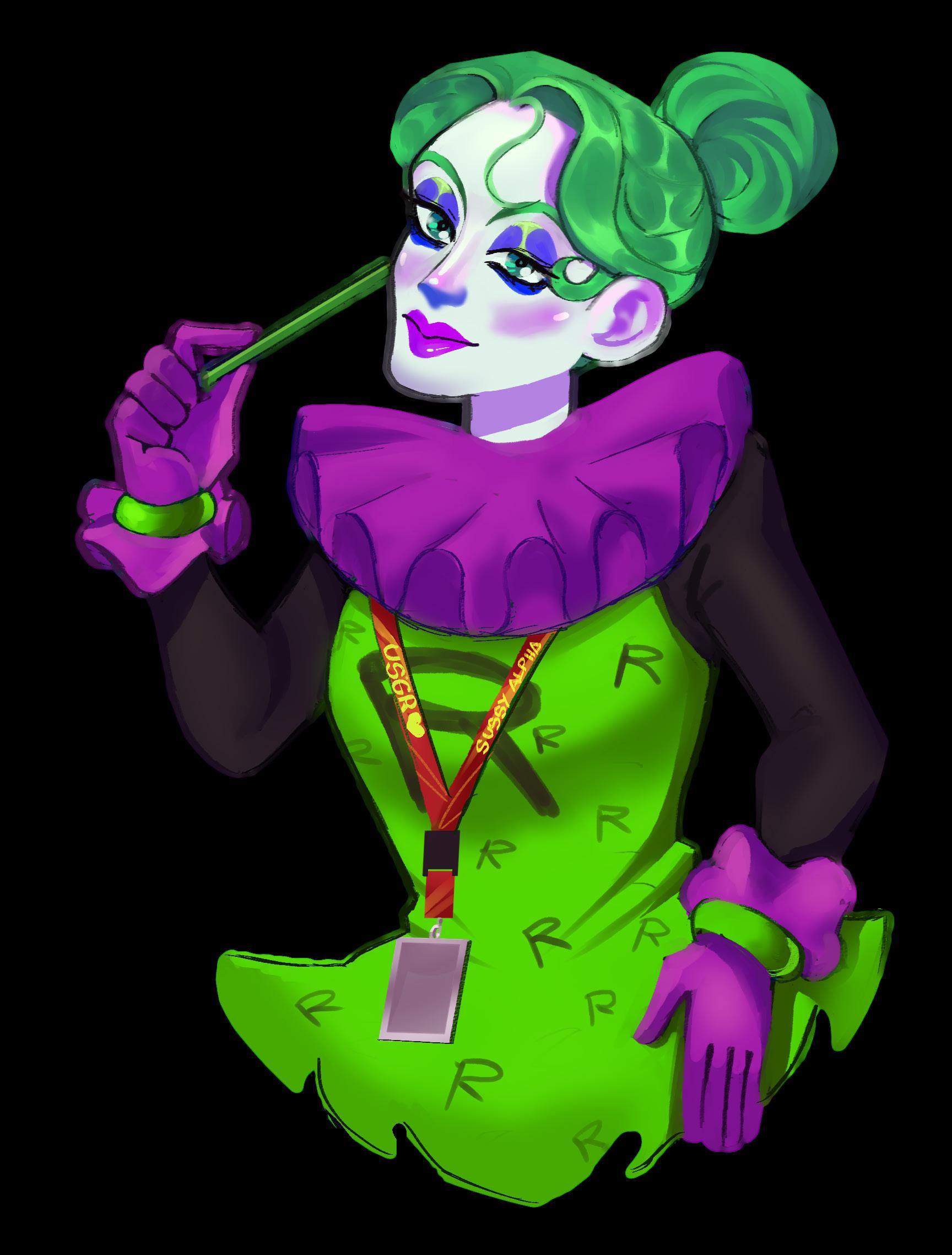
In the tents of the University of Sigma, Gyatt, and Rizz (USGR) lurk masters who do not just steer the circus ship but also sidekick bias, place bets, and hold a grudge against their unwanted pets.
Don’t try to show off any gimmick to prove your worth to those who wield the whip because once they land their condescending gaze on you—like a puppet master controlling the strings of your fate—your mark for this term is in their sleight of hand.
Meet Omega Chad, a Sigmanista who vented over the mistreatment suffered during his residency at the hands of his master.
“Katong highest ko sa iyang exam, mura siya og gaduda nako. Unexpected tali para niya nga dako akong score. After ato, iya kong gipabilin sa klase tapos nag-answer na pod ko’g balik. Maayo gani na-perfect na nako sa second take, nihilom siya oy,” he said.
After the ceremonies, with the thought of doing well, one would be left flabbergasted with the grade they procured: a 2.0 on the Security and Information of Sigmanistas (SIS), which would make them mouth an exaggerated “Huh?”—a type of reflex when one is in a denial stage.
So, hide your tears and frustration, as this highest form of being doesn’t show any count of guilt for what he’s done. Personal feelings over objectivity, that’s how he describes it.
Ever thought of quitting the show? Wait, here’s more!
Another Sigmanista, who wished to remain anonymous, reported Professor Maria Esther, also known as “The Rizzler”, to Unfair Animal Treatment, accusing her of giving her favorite pets higher marks than others who perform at the same level and quality.
This crime is punishable under the provision stipulated in Article 3 Section 4, which provides that “Such acts shall be deemed unethical and punishable by suspension, fines, or termination of duties, depending on the severity of the offense.”
“Ambot niya pareha ra man unta og output nga gipang-pass since groupmates ra man intawn mi pero mas dako man lagi siya’g gihatag sa isa,” another Sigmanista expressed.
Reports from The Rizzler’s students say that she is kind to trainees close to her, nurturing them like children and speaking to them like they are in the same circle of friends. It is no shock that her faves ace another examination she scheduled herself as if the future is embedded in their cards.
The Rizzler meticulously cherry-picks who gets the extra tutoring sessions for complex routines when they don’t grasp the lessons well while leaving the unwanted ones on a
humiliation spree because she expects them to balance numerous requirements, like an acrobat that trudges in a tightrope.
Teaching is an art, but definitely only some are masterpieces in their eyes. So, next time, just a piece of friendly advice: Be a leech or use mechanisms to survive their dirty play.
Be interested in their childhood stories, give side comments on their miserable experiences, and let out an exaggerated laugh at their corny jokes. Make yourself known in the class and be that Jollibee even if everyone will despise and officially label you as their pet peeve. After all, it’s that straight uno we are trying to achieve—the least we can do when our grades hang by a thread.
So, if you’re lucky enough to survive the circus, good for you! But if you are experiencing it, it’s time to lay your cards on the table.
Or perhaps, be somebody that can match their freak, because if you can’t beat them, join them! FWD
Ladies and gentlemen, step right up! The circus is about to start.
But one fair warning: this is no ordinary show.
This is Circustate, a combination of the words “circus” and “state,” symbolizing the chaos that ensues when clowns run the government—turning the state into a circus.
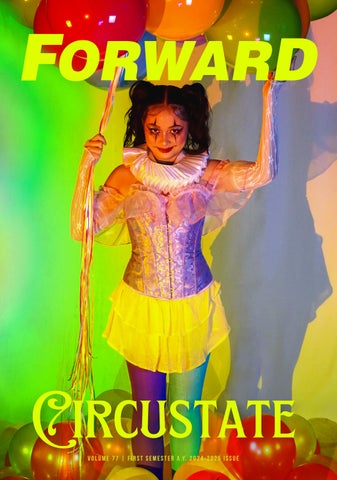
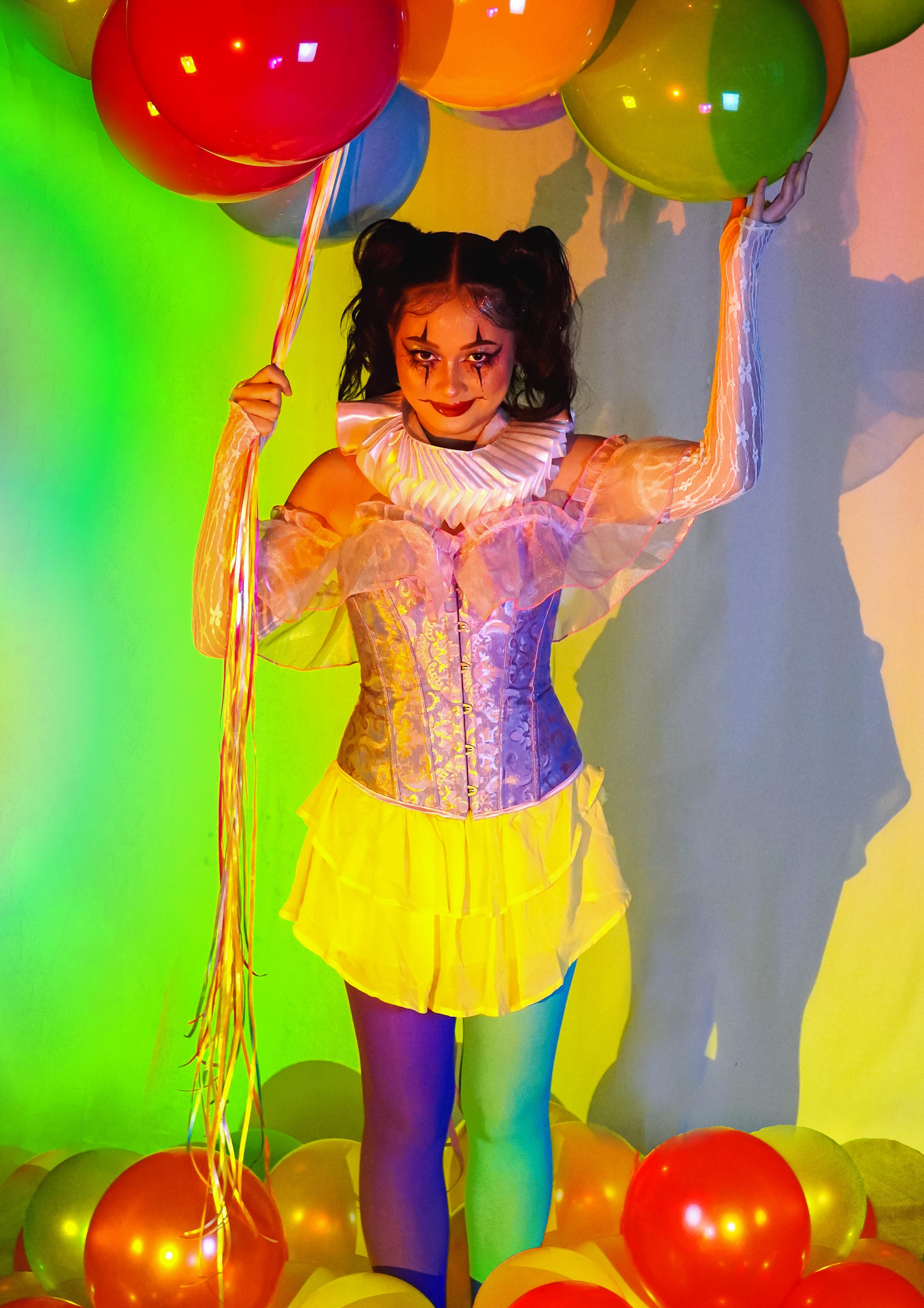
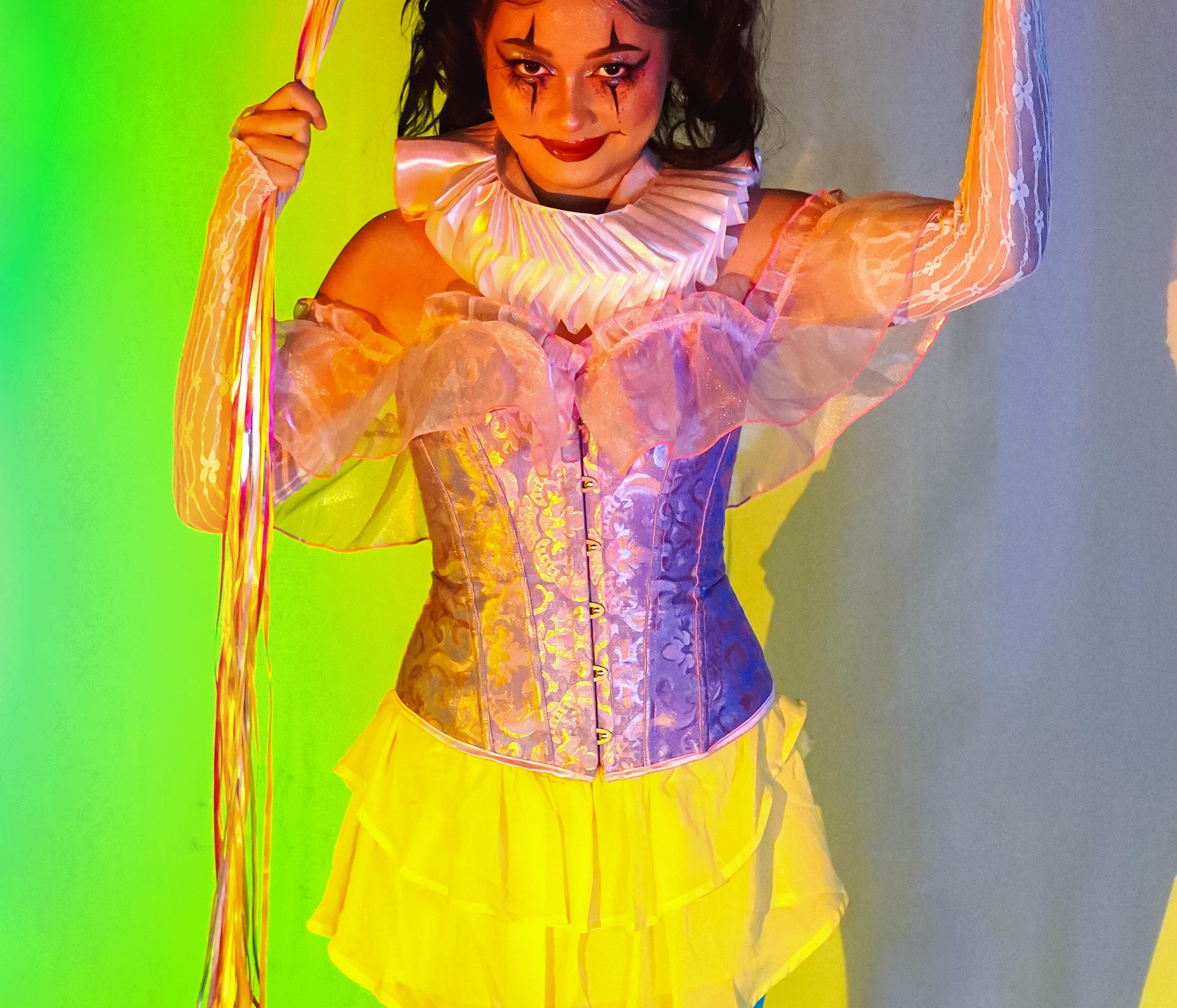
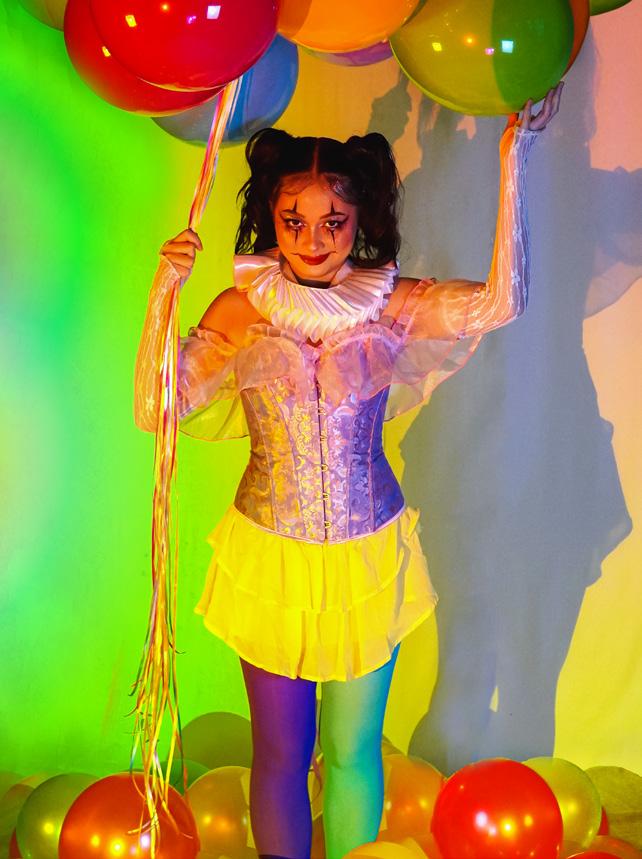
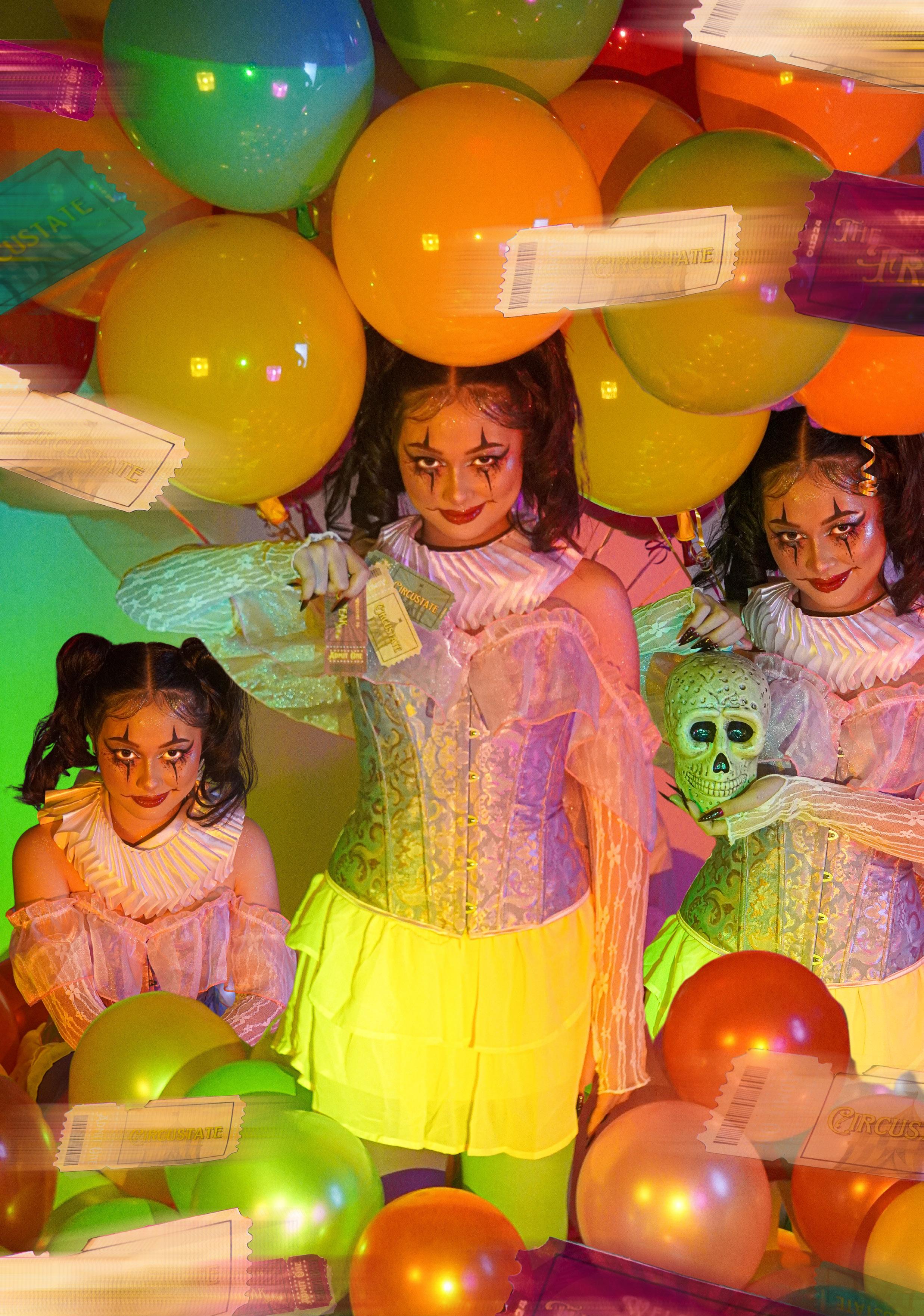
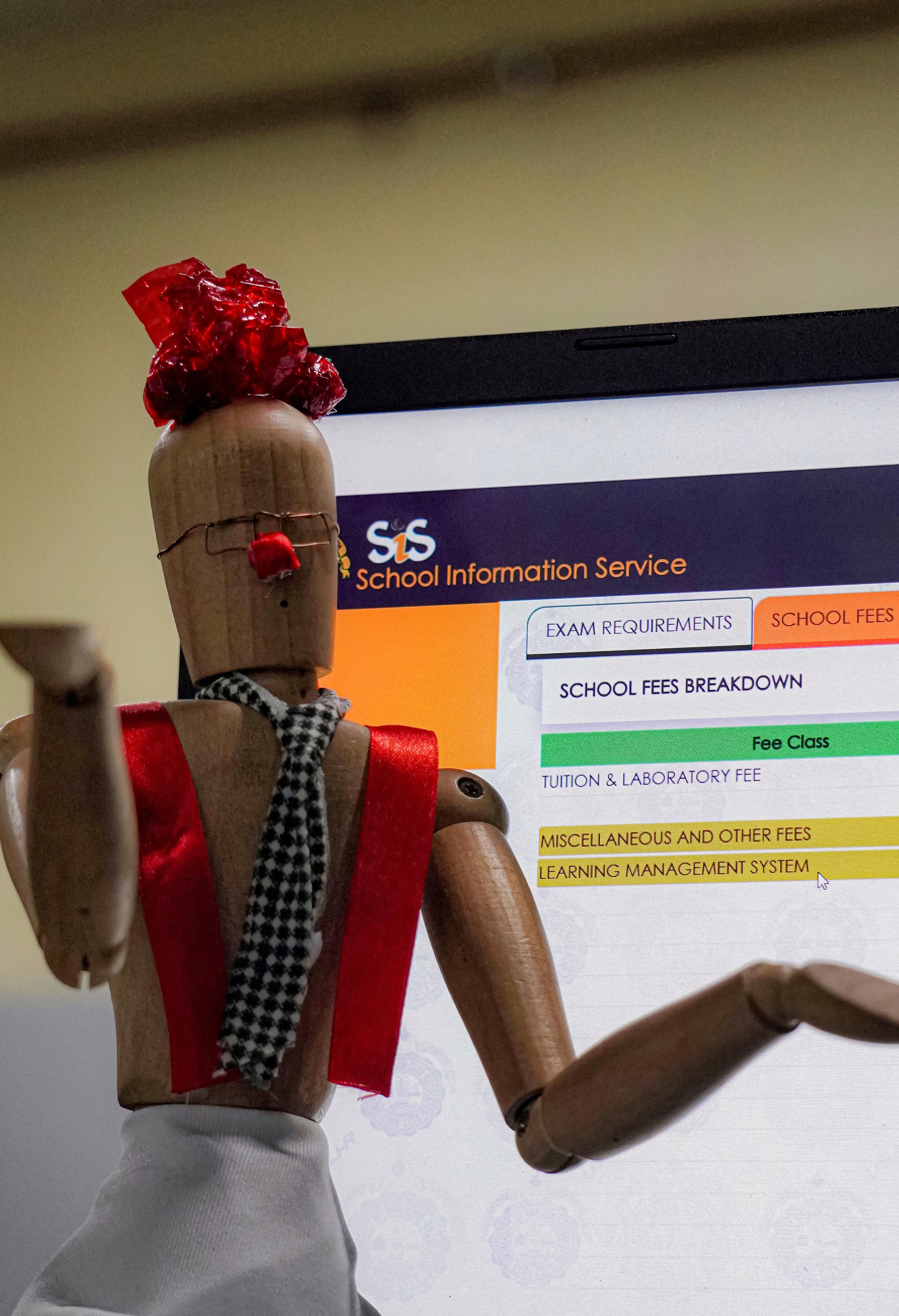
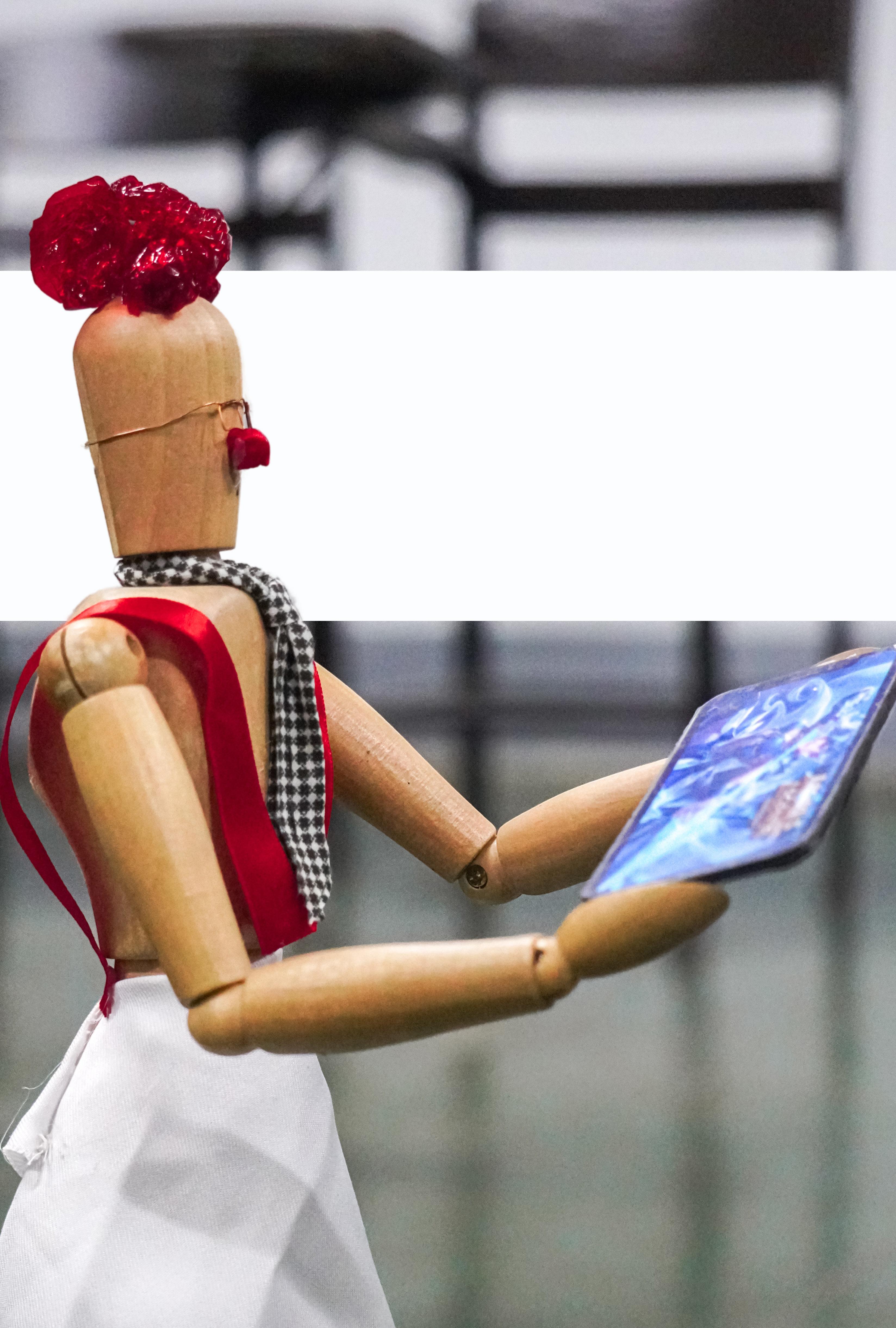
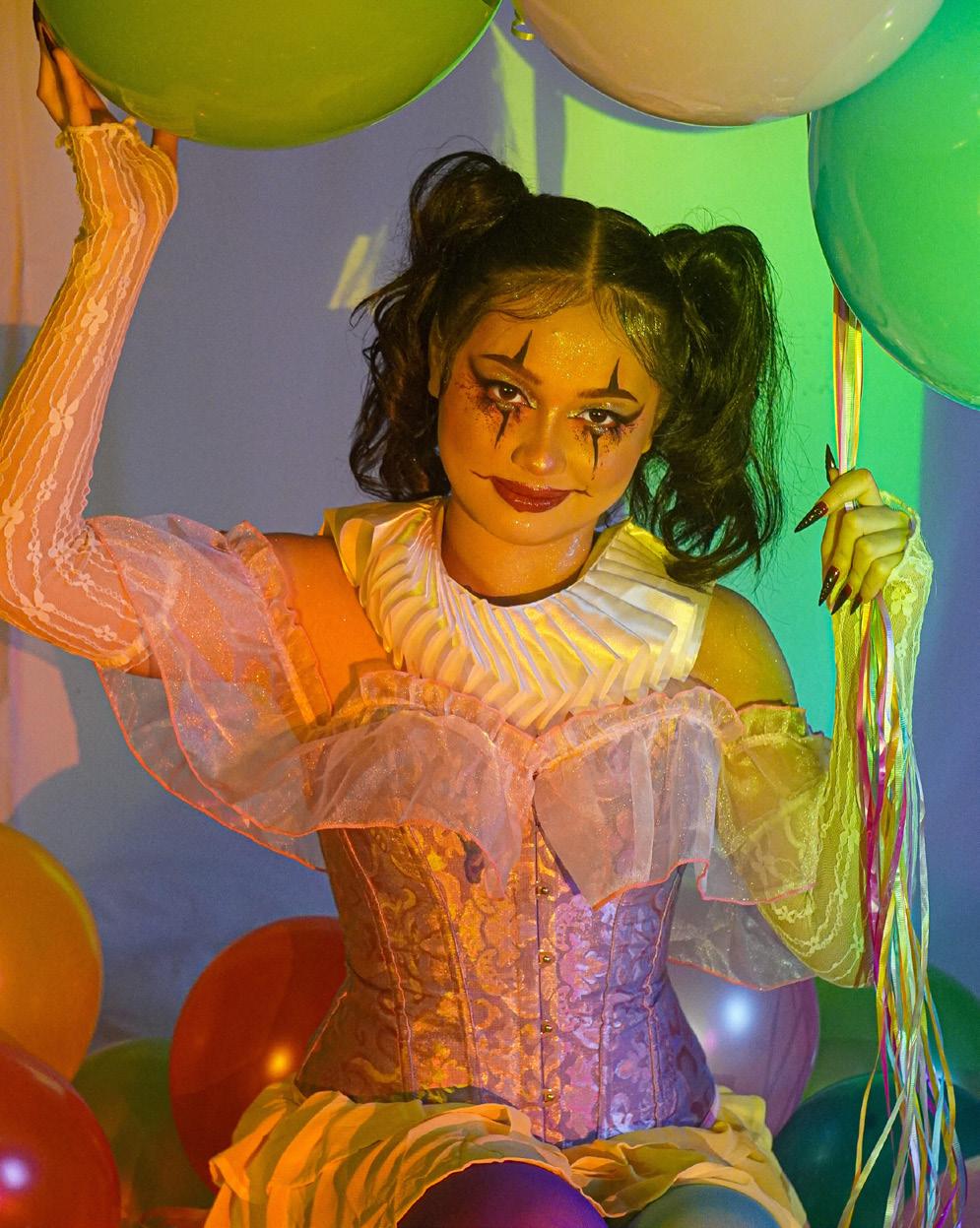
Adorning the cover, the model is dressed in whimsical mismatched elements that mirror the paradox of humorous slip-ups and offbeat behavior of the showmen. With her bold makeup that incorporates theatrical lines, this is much like how figures in the public sphere put on faces and a show of theatrics and gimmicks that feature bizarre antics for their audiences.
Striking a pose amid the colorful array of balloons that shadow inflated promises, brightly colored yet ultimately hollow, meant to lift the nation’s hope only to let them down when they pop. She stood amidst the shambles, lost in the trance of baffling statements and band-aid solutions to actual problems, turning everyday struggle into a series of circus acts as if it were a grand performance of mockery.
Albeit more vibrant than ever, contemporary society is still plagued with the issues of its dark, monochromatic past.
In this magazine, FORWARD highlights the absurdity of today’s reality that has been pushed to the side as society falls prey to staged clownery.
Sift through the pages and learn that not all parties are fun. FWD
A Circus in My Mind
by Ejay D. Villaver
graphic design by Krista Marie B. Yaoyao and Kirsten Leanne P. Roble
I have a confession: there’s a circus in my mind. Every day feels like walking on a tightrope, precariously balancing between keeping my composure and spiraling out of control—always one misstep away from falling to my doom. Or, like a strongman, under the pressure of holding it all together, making the heaviest burdens seem as light as a feather.
It’s a never-ending act, with zero breaks and no room for pity parties. After all, people don’t want to see a sad clown—they want to be entertained.
For five years, I personally wrestled with my mental health, yet only two of those years were spent ACTUALLY getting help.
In the Philippines, where mental health is often overlooked, the pressure to be “okay” is immense. The stigma runs so deep that many would rather suffer in silence than be judged for trying to heal.
In the summer of 2023, I made the difficult decision to take a break from school. The previous semester had pushed me to the point of burnout. I would wake up in the middle of the night feeling like there was a car parked on my chest, and by morning, I no longer recognized myself. I felt dissociated most of the time, merely going through my day on autopilot.
It. Was. A. Snore.
I instinctively knew that if I forced myself to take summer classes right after, whatever thread was holding me together would snap.
To be honest, admitting that something was wrong with me was hard; it felt like defeat. However, convincing my parents was even harder. They argued, “We’ve provided you with everything you need. What could you possibly be feeling sad about?”
Though, at the time, I understood their worry about me falling behind, their question left me stunned.
It’s ironic, really. I can write articles on the go, but when it’s my turn to speak—to admit how I really feel—I struggle to find the words to describe the circus happening inside my brain.
In that defining moment, I realized that language is inadequate in the face of pain. No amount of simile or metaphor can encapsulate my suffering, just as I can never really know the anguish of another.
Somehow, pain is a bitter reminder that we are alone.
This is how it was for me and how I think it is for most people: we are afraid of being misunderstood. My parents were unaware of the signs and symptoms, making it difficult for them to recognize or validate my struggles. I can’t blame them; they simply weren’t taught about it.
Looking back, did I regret choosing to rest when I needed it most? No. I would do it all over again, to be honest. I refused to subscribe to the notion that we must always “keep it together.” That’s the problem with us; we don’t believe in falling apart (not publicly, at least). We believe that the show must go on.
However, even the happiest clowns need a moment to step out of the spotlight and rest their painted smiles.
Having gone through it myself, accepting that I needed help led me to the care I needed. If you find yourself in the same situation, silently hoping that you won’t have to carry the burden alone anymore, the first thing to do is be honest with yourself.
We are allowed to admit that we are not okay, and we seek the support of others.
To my Mom and Dad, you did not fail me. Your love and support have always been felt, even in the moments of silence. You have taught me that to be a good parent, you don’t need to have all the right answers.
More often than not, the key to healing a circus mind is letting ourselves be present—no acts, no tricks, no masks. You just have to listen. You just have to be real.
Because sometimes, believing in someone’s pain can be the best medicine. FWD
illustration by Sienna Rio E. Young and Heron Augustus S. Flores
Not a Jest, Do We Need Clowning Zest?
by Rey Martin B. Rio
They were once beacons of joy and laughter but have now become a rarity, overpowered by fear and negativity.
Whatever happened to birthday parties filled with tearful eyes of joy and aching stomachs from laughter? Where are those who wore exaggerated painted-on smiles, floppy shoes, and garish red wigs? Have they become mere comedic figures, found only in the stories we read in comics or see on screen? If you’re wondering what we’re talking about, it’s none other than clowns!
Typically, clowns are depicted in bright, baggy suits designed to fit irregular body proportions—think long stilt-like legs, big fannies, and almost always a pair of white gloves. This ensemble characterizes the grotesque whiteface style that has gained popularity in mainstream media.
While you may envision clowns with squirting flowers and balloon animals or associate them with a certain fast-food chain, many varieties exist, from medieval court jesters to tramp clowns inspired by homeless individuals in the late nineteenth century.
The question remains: Why has the presence of clowns dwindled? Is negative media representation— such as Tim Curry’s Pennywise in “It” or Joaquin Phoenix’s portrayal of the “Joker”—the primary reason for their decline? Or was it inevitable that they would be labeled as sinister figures?
While not everyone views clowns negatively, many do. Some argue that the fearful view of clowns stems from a desire to conform to the majority opinion or to jump on the hate bandwagon. They even go so far as to claim that children are naturally afraid of clowns’ faces. Meanwhile, others would say that it’s not their
scariness that makes them so unfavorable in people’s eyes, but rather their off-putting, intense smiles or laughter that cause goosebumps and an inability to tolerate them—more so the clowns we see in politics.
Being a clown is not something to be proud of in many contexts. Yet, in some parts of the world, clowns are respected and admired. In France, clowning is associated with high art, exemplified by icons like Marcel Marceau. In the United States and the United Kingdom, figures like Charlie Chaplin and Rowan Atkinson—famous for his role as Mr. Bean—have become household names.
In our local scene, the gracioso—a clown figure—stands out as a captivating character in Linambay (or Moro-moro), an elaborate traditional play in Cebu’s Carcar City. This character frequently ad-libs lines while performing comical antics and gestures, showcasing the enduring charm of clowning in cultural expressions.
Today, alongside a few circus clown trade groups performing globally, it’s also common to see clowns in hospitals and care homes bringing joy to the sick and elderly as medical clowns.
So why do we maintain this love-hate relationship with clowns? Much of it stems from our ignorance about the essence of clowning. To understand what it truly means to be a clown, we must look beyond the makeup and costumes.
For millennia, clowns have offered unique perspectives across cultures. Native American tribes regard figures like the Nunamala and Heyoka as sacred beings with shamanic healing powers essential for community well-being.
Similarly, the clowns in Eastern cultures serve as social commentators and entertainers—like ancient Chinese jesters and Indian Vidushakas—blending humor with wise counsel to convey deeper societal insights.
How do they actually bring healing? Their comedic skills provide relief from suffering by encouraging us to confront our fears and imperfections in a supportive environment. Through their antics, they create spaces where we can accept our whole selves and recognize that vulnerability is a shared human experience.
Life can be challenging and filled with anxiety and stress that often leads us to seek escapism through social media or alcohol. However, these avoidance tactics can disconnect us from our loved ones and ourselves.
Clowns then offer a different kind of relief through connection and laughter; unlike comedians who make us laugh at their jokes, clowns often become the butt of the joke themselves, embodying humor that resonates with our own experiences of failure or embarrassment.
Whatever garb or seemingly outlandish attire we may see clowns wear, we ought to remember that they often have something serious to convey beneath their antics. The true essence of clowning lies not in appearance but in an attitude that transforms darkness into light and difficulty into joy. This potential exists within each of us; anyone can become a clown if they dare to share their beautiful absurdity with the world.
As we mourn the decline of clowns as symbols of genuine fun—unfortunately reclassified as dangerous or creepy figures—we must recognize that their disappearance reflects our loss of connection to our own inner voices in this grand circus of life.
By embracing the spirit of clowning, we can reclaim our joy and creativity, reminding ourselves that everyone has the potential to be their own clown, right? FWD
Anjo World: The Thrill Capital of the South
by Trixcy D. Clar and Samantha Mae A. Murillo photos and graphic designs by Gabrielle Marie R. Paradiang and Ayn E. Nazareno
Avail your tickets now with your ride-or-die because here in Anjo World, the concept of fun is redefined!
If you’re seeking an adrenaline-pumping experience, waste no time—make your way to Anjo World Theme Park, located at Barangay Calajo-an in Minglanilla, Cebu. This theme park is considered the largest one in Visayas.
Thus, FORWARD presents its countdown of the Top & Tough 5 rides that are guaranteed to leave you breathless (in a good way)!
Expect pulse-pounding free-fall drops and intense twists and turns that will have you laughing uncontrollably one moment and praying for your life the next. These rides are not for the faint-hearted; they’re designed to knock you off your feet and give you the thrill that lingers long after the ride.
Top 5: Anjo Eye
If there’s one ride you shouldn’t miss at Anjo World, it’s the Ferris wheel—the iconic Anjo Eye. This towering attraction offers more than just stunning views; it provides countless romantic moments and an awe-inspiring perspective of the surrounding landscape. Whether you visit during the day or night, the experience is an undeniable allure, though we highly recommend taking the ride after sundown when the city lights twinkle in the distance.
While it may not match the intensity of a roller coaster, it provides its own kind of magic. You’ll feel the gentle pull of gravity as you ascend, marvel at the 200-foot-high view at the top, and enjoy the stomach-flipping lightness as you descend. If you want to take a breather from the thrills, this should be your go-to.
In just a few minutes, the Anjo Eye gives you an unforgettable glimpse of the beauty surrounding you—making it an experience you’ll cherish long after.
Top 4: Hip Hop
Ah, Hip Hop—this ride means business. If you’re a true thrill-seeker, this octopus-shaped ride should definitely be on your bucket list. Its wild, unpredictable movements make it an unmissable experience for anyone chasing an energy surge.
At first, it seems like a calm, playful ride. But as the pace quickens, you’ll find yourself questioning your decision. What started as a fun ride quickly transforms into a wild battle as the mechanical “octopus” grabs hold, swinging you high into the air with sudden, dizzying force. The dash of excitement mingles with anxiousness as you’re hurled up, down, and sideways, unsure of the next move.
In the end, it’s an electrifying mix of fun and fear that will leave you wanting to ride again—if your nerves can handle it!
Top 1: Boomerang
Ever imagine how a yo-yo feels when it’s flung out and yanked back just as fast? Or think of how a shuttlecock might feel in the middle of an intense rally, flying across the court only to be slammed back again. Referencing the ride’s namesake, this attraction lets you reimagine yourself as a boomerang, flying through the air in one direction, only to suddenly be pulled back to where you started. The Boomerang promises you an unexplainable exhilaration and a weird yet satisfying sense of disorientation as you get tossed forward and backward across the vast sky. Trust us, it’s a must-try!
Top 2: The Pharaoh
No list is ever complete without mentioning the classic amusement ride, Anjo’s The Pharaoh— the country’s first spinning coaster! If you’re looking for a short n’ sweet trip, well, keep looking! The Pharaoh is one relatively short ride. But sweet? You rather buy an ice cream from one of their stalls.
With the twisted tracks, gut-wrenching glides, and seemingly death-defying drops, you’ll get why the ride finishes in one blink; it will have you hold on for your dear life for what seems like an eternity! There are so many unanticipated teases you wouldn’t miss catching, even the nonreligious adventurers pleading the heavens and naming infinite names of never-heard-before saints. For every acceleration, you start to overthink, “Is this going up?” (spiritually).
Top 3: Tower Drop
Every time the Tower Drop plummets, your stomach instantly drops, too. Standing 25 meters high, this ride is a must for adrenaline junkies looking for the ultimate thrills.
As you reach the peak, the tension builds. Then, without warning, gravity pulls you downward in a heart-stopping free fall, and for a few exhilarating seconds, you are suddenly weightless. The powerful drop repeatedly leaves you flabbergasted, making you want to exit the uneasiness midway through!
Truly, it’s a daring stunt that delivers pure stimulation, guaranteed to give you that electrifying rush you’re craving for. So, scream your lungs out until it pops in that one heck of a tower drop!
And to be tossed around relying only on belts and straps is no walk in the park, it’s horrifying! Even one of the gatekeepers scored its scariness a 9 out of 10—a rating where you’d know it’s the real deal. But we all have different levels of gut tolerance and mental toughness. Who knows, what’s an almost perfect rate is just a rate of 6 for a brave soul like you!
But to know that, you just have to line up for the ride, take a deep breath, and let yourself be madly ricocheted. It doesn’t matter whether you’re a boomerang veteran, a casual amusement visitor, or a new timer; you CANNOT leave Anjo without experiencing the Boomerang!
Screams—both of joy and terror—wave through the park, and soon, yours will be heard among the echoes, too! So, make sure to schedule your Anjo World trip on a sunny day and carry all the bravery and self-assurance you can fit in your bag because an unforgettable adventure awaits!
We guarantee you that Anjo World will give you the post-ride euphoria, the kind where you can’t help but ring your friends after a while and ask, “Shall we go again?” FWD
The Vanishing Act
by Ava Donalie A. Ferolino and Krisha Faye A. Gascon
photo by Marian Lhoyn B. Autida
In a state where education feels like a circus, teachers are the acrobats constantly switching stages, leaving students in USJ-R to wonder whose act will be the next to vanish.
By the start of the Academic Year 20242025, the departure of a couple of teachers from different departments of the University of San Jose-Recoletos (USJ-R) has left a noticeable gap.
While this trend could be attributed to chance, many Josenians are left questioning the validity of the rumors surrounding these departures and how their respective departments will recover.
As the student population at USJ-R continues to grow, the demand for faculty who can accommodate this increasing number of students must be addressed.
In this article, FORWARD sought answers for Josenians looking for these educators and how their disappearances have affected the students’ quality of education.
The Strings Behind the Curtain
Case in point, a third-year Bachelor of Science in Accountancy student pointed out that the resignation of some departments’ teachers has affected their learning experience.
“Their departure has truly affected the morale of the students upon knowing that most of the ‘best’ accounting professors have left the institution,” they said.
The Publication reached out to the Chairman of the Accountancy and Finance (AccFin) Department for comments but was unable to secure an official response.
H owever, concerns about the loss of key faculty members continue to loom over the department,
particularly in terms of how these departures may affect students’ overall academic experience.
“With the new set of teachers being employed, we can really see the difference in the teaching style and as to mastery of the subject topics,” an Accountancy major lamented.
In addition to the AccFin, the Department of Psychology and Library and Information Sciences (DPLIS) has also experienced the resignation of fulltime faculty.
In an interview with FORWARD, Dr. Maryjun Delgado, former department chair and current dean of the School of Arts and Sciences (SAS), provided insight into the reasons behind the faculty resignations, which have been ongoing for the past two semesters.
Delgado explained that the reasons for the resignations varied but were primarily related to the inability of some faculty members to meet the University’s requirements.
“The first resignation happened because the teacher was not able to comply with the requirements for her to become a full-time teacher. She did not finish her master’s degree, and [she] was already almost eight years in the University,” she shared.
The teacher had been granted multiple extensions but ultimately chose to resign when the University enforced its policy.
A second resignation involved a respected professor who, despite being highly regarded by students, could not adhere to an unspecified University policy.
“But you know, no matter how good [you are] as a teacher, if you cannot follow a rule as an example for your students, what you are becomes nothing. And I take that from Fr. Celiz mismo,” Delgado said.
“Fr. Celiz said that no matter how good you are, no matter if you are at the top, but if you cannot follow [the] rules, that’s something else. So the teacher decided to resign,” she added.
The departure was amicable, as the professor recognized the importance of following institutional guidelines.
The Teacher Carousel
A fourth-year Psychology student voiced their concern, stating that the resignation of these teachers affected their experience.
“It’s hard to adjust to new teachers in the middle of our academic journey. We relied on our professors for guidance, especially in our practicum and major subjects,” they said.
Despite the challenges posed by these resignations, Delgado reassured students that the University is actively working to address the gaps left by departing faculty.
“Are we short of teachers? No, we are not. I hired part-timers right now who are excellent, let’s say, good in their practice,” she said, noting that the University has brought in several new part-time instructors who are qualified in their fields.
maintain the high standards expected by students.
“The new teachers are good, but there’s always that learning curve,” another student added.
While the resignations of faculty members in the AccFin and DPLIS have drawn significant attention, some students and faculty believe that the issue may be symptomatic of a larger problem within the University.
Rumors of dissatisfaction among teachers, particularly regarding administrative policies and workloads, have been circulating for months.
“Before their resignation was confirmed, there were already rumors following the alleged conflict among faculty teachers,” a third-year Accountancy student remarked.
“It can be noticed that they are somewhat divided when it comes to how they want the department to lead,” they added.
Changing Tents
Moving ahead, the University plans to hire two more full-time faculty members for DPLIS while continuing to assess the status of part-time instructors.
“For Psychology, we are eyeing at least two [full-time hires],” Delgado said.
Delgado emphasized that the students’ performance and learning should not be solely attributed to a few teachers but to the collective effort of the entire department working toward the students’ improvement.
Further, she explained that the lack of classrooms and the growing student population contribute to scheduling conflicts, which may create the perception of shortage among the faculty staff.
“The problem there is that when we transfer the schedule to a time where there is an available classroom, the teachers slotted for that was not already [or] is not anymore available for the time,” Delgado said.
“That’s why it’s like we have [a] shortage of teachers—no, we have a problem with classrooms and the time allotment for that. So, mao na ang na-problema, dili about teachers,” she added.
Meanwhile, she also mentioned that the University is working to bring in more experts to fill the remaining gaps in the faculty, indicating that the University is committed to maintaining a high standard of education despite the recent challenges.
Delgado expressed confidence that the department is fully staffed with qualified professionals who are more than capable of maintaining the quality of education that Josenians have come to expect.
“If it is found out by the Professional Regulatory Board (PRB) that the persons manning major subjects and even internships are not qualified, it can be a very, very bad thing to the department. And right now, all are qualified,” she assured the Josenians.
As the curtains close, USJ-R must act swiftly—before more educators vanish from the stage. FWD
The change in faculty has also raised questions about continuity and the ability of new instructors to
Off-loading the Financial Toolbox
by Rey Martin B. Rio and Sharry M. Cuizon
photo by Christian A. Mananguite
As tuition fees continue to rise at USJ-R, Josenians share their sentiments on how these funds are allocated and whether they enhance educational quality.
Branding itself as a provider of quality Christian, community-oriented education, the University of San Jose-Recoletos (USJ-R) is one of the leading private Catholic institutions not only in Cebu and the Visayas but throughout the Philippines. This is reflected in its consistent top-notch graduates across various fields and its high academic standards.
In recent years, the University has been among the private higher education institutions in Cebu that have increased their tuition and other school fees. For both the Academic Year (A.Y.) 2023-2024 and 2024-2025, USJ-R implemented a 10% increase in tuition fees, with the latter applying only to freshmen, transferees, and returnees for that year.
However, as this tuition hike persists, Josenians have expressed growing concern about how these funds are being justified. This includes the effectiveness and value of the Canvas Learning Management System (LMS), the appropriation for certain miscellaneous fees, and issues
surrounding outdated equipment or facilities on campus. To shed light on the financial transparency of the University, FORWARD reached out to the relevant offices to address these concerns.
Mysterious Apparatus
Since 2005, the School of Computer Studies (SCS) Dean and LMS Administrator Dr. Jovelyn C. Cuizon explained that USJ-R had been utilizing a self-hosted Moodle-based LMS to complement traditional face-to-face learning, but the school board decided to subscribe to the D2L Brightspace LMS for A.Y. 2020-2021 as the former encountered “frequent downtime issues caused by heavy server load.”
However, the system also encountered its limitations with regard to customer support and functionality and transitioned to Canvas LMS, which was primarily motivated by the need for a more reliable and user-friendly platform for both faculty and students.
“While Brightspace offered solid LMS features, we often faced challenges with their customer support,” Dr. Cuizon said.
She then noted that, unlike the previous Brightspace LMS, the Canvas LMS from Instructure, which officially took effect in the second semester of A.Y. 2023-2024, is widely used by other prominent universities like the De La Salle University (DLSU), Ateneo de Manila University (ADMU), University of the Philippines (UP), and University of San Carlos (USC).
Despite the implemented upgrade, students have lamented their worries over the minimal usage of Canvas in their courses, and that professors struggle to utilize the system effectively, as many professors face difficulty adapting to the new system, often resorting to traditional teaching methods or utilizing alternative platforms like Google Classroom and Microsoft Teams.
Fourth-year Communication student Retchel Daño said that although the Canvas LMS could be useful in the teaching and learning process, “it’s not utilized much by all the students.”
“Based on my experience for this semester, we didn’t totally use the Canvas and only [a] few teachers accessed it to [merely] upload their teaching materials. Hence, I totally [do] not agree that the fees for LMS [are] justified,” she elaborated.
On a deeper note, a fourth-year Management Accounting student shared how she had not used the Canvas LMS.
“I haven’t experienced using Canvas. This should be re-evaluated if Canvas or any online learning platform is still [necessary] since we are already in a face-to-face setup and most asynchronous activities are submitted on the next scheduled meeting or via Google Drive. Paying a fee that is equivalent to the number of units enrolled doesn’t give justice if we don’t even use it at all,” Omania said.
She pointed out that, for her, “the fees aren’t justified as some students are not even aware that they are paying such a fee,” while commenting that ever since Canvas was introduced, it didn’t have any “beneficial aspects to [her] degree program nor learning benefits.”
These sentiments reflect just a portion of the broader Josenian community regarding the LMS, for which students are left questioning the purpose of paying for a supposedly advanced LMS with little to no usage.
Meanwhile, Dr. Cuizon revealed that while the professors were provided with relevant training and ample resources to help them navigate and fully utilize the LMS, “some professors who were resistant to adapting to new technology continue to rely on traditional teaching methods, limiting their use of the platform’s full potential.”
Showman’s Budget
In an interview with the Vice President for Finance Rev. Fr. Leopoldo Estioko, OAR, and University Comptroller Dexter Joseph Cuevas, it was disclosed that the utilization and monitoring of the usage of Canvas falls under the purview of the Vice President for Academics and Research.
“We would like to believe the VP Academics has its own monitoring purposes, because the faculty is under that office, so I think the VP Academics also has the right really to tell our faculty to make use of the LMS,” Cuevas noted.
FORWARD reached out to the said office to seek clarification on matters regarding the LMS, however, the office forwarded the correspondence to Dr. Cuizon.
Further, Cuevas expounded the nature of the student’s miscellaneous fees to ease the “confusion” and “doubt” of the Josenians.
“By nature, our miscellaneous fees are fixed, but there are some components that are semi-fixed, or we call it mixed fees. For example, LMS, that’s a [mixed] variable because that is based on the number of units to be taken by the students. For [the] Library [fee], that’s fixed in nature. Regardless of how many units you are taking, you have to pay [its] fixed cost,” he explained.
Cuevas also detailed that students’ miscellaneous fees vary, depending on the degree program and the number of units taken by each student.
“There are some that [also have] different fees tailored to their program, for example, affiliation fees from the School of Arts and Medical [Sciences]... there are fees [that] are really tailored to [them],” he said.
Cuevas then went into detail about the other fees that were confusing for some students: the separate fees for Wi-Fi and Internet, as well as the Cultural fee, among others.
“For the Wi-Fi fee, that’s for the general students. Meaning to say, regardless of what [program] you are, you have to pay for the Wi-Fi fee. But for the Internet fee, these are students enrolled in Computer Science, Information and Technology, [and with] computer laboratory subjects,” he said.
“[As] for the Cultural fee, if [there is] a departmental or a University [event] initiated, we have the Cultural fee as a source of funds. But for the student activity fee, normally that is [to] support student-related activities, if there is sub-representation outside school, so we can make use of that fund,” he added.
A One-time Spectacle?
Furthermore, concerns pertaining to outdated equipment on campus have been raised by some Josenians, particularly in the service offered by the Instructional Media Center (IMC).
A fourth-year Journalism student confided her experience with borrowing equipment from IMC.
“I borrowed a laptop from IMC for an event and it didn’t have any Microsoft apps available, so I had to resort to using Google Docs for the writeup that I did. Also, in on-the-spot occurrences like class presentations or reportings, having these applications [could] guarantee a smooth-sailing experience for the Josenians,” she said.
“Since the IMC fee is 800 pesos, I think that the students should be able to enjoy at least a laptop with Microsoft subscription since there are only a few laptops available for us to use,” she added.
The concerns expressed by Josenians highlight the need for the institution to strike a balance that ensures students feel their tuition is justified. As tuition costs persist, growing apprehension continually surrounds how these funds are being allocated, particularly regarding the effectiveness and value of the Canvas LMS, the appropriation of certain miscellaneous fees, and issues related to outdated equipment and facilities on campus. It is essential for the University to uphold its standards to avoid confusion and prevent a state of disarray. FWD
Stars Without Spotlight
by Louise Lambiquit and Maria Cristina G. Lamug
photo by Kimberly O. Tumilap
Aside from dribbling balls, some athletes now play using smartphones and computers yet still excel. Is USJ-R ready to open doors to welcoming these emerging athletes?
Sports that are traditional are known to be a concession to amusement. This includes student-athletes from basketball, football, volleyball, or any other sportrelated activities which are usually granted significant financial assistance, tuition discounts, and support on different campuses.
However, is this case the same as how the University of San Jose-Recoletos (USJ-R) treats the Esports industry as it gains growing recognition in Cebu?
Behind the Applause
After the Cesafi Esports League (CEL) Preseason Finals, USJ-R Adelante Esports (ADL) nabbed the championship in the Mobile Legends: Bang Bang
(MLBB), beating the representatives from the University of San Carlos (USC) Warriors, 2-0, sweeping the series.
On November 19, 2023, the same happened when the ADL Valorant Team claimed their first-ever victory in CEL Season 2 by defeating the University of Cebu (UC) Webmasters, 2-1.
These are the achievements ADL recently attained; amid the rising fame of the organization, which has brought the name and prestige to the University, ADL MLBB has not only allegedly received insufficient funding but also acknowledgment.
Klevince Marikit, proclaimed the Most Valuable Player (MVP) in the previous season of Cesafi, admitted that they had received nothing when he started representing the institution in various competitions since May 2024.
“So far, mura’g wa pa mi nakadawat og budget ug pagkaon gikan sa [ADL],” he expressed.
Further, he also emphasized that they shouldered the cost of their jerseys, amounting to P200, including other expenses, on the day of the Preseason Finals held at SM Seaside and were only given packed meals after the championship matches, which Cesafi sponsored.
“Kato nga day kay amo ra jod tanang kaon ato [ug] amo tanang gasto ‘Nya pagkakinalasan na sa event paghuman na pagka-champion na namo adto nami gitagaan og packed meal,” he continued.
With these grievances, FORWARD has reached out to Supreme Student Council (SSC) 43rd Congress President Zed Avalon Diaz, who claimed that “there have been instances where the University provided some support to the team, such as covering expenses for meals or refreshments.”
“However, this support is dependent on the enhancement fee allocated by the Office of Student Affairs and Services (OSAS), with the approval of the budget being at the discretion of that office,” he stated.
Another player from ADL, who wished for anonymity, voiced a similar concern to the SSC for they had expected a budget allotted for them, yet they only received a bottle of water on the day they competed in the Preseason Finals.
Other players later clarified that they had, in fact, received a budget for food from the organization. However, the money wasn’t used for its intended purpose because their ADL Commissioner, Joshua John Santos, believed that one of the sponsors at Cesafi would be providing food. He attributed the issue to a “misunderstanding and miscommunication.”
“My mistake there which I admitted to the team man sad, kay nipalit na lang unta ko ato regardless kung naay kaon para later,” Santos admitted to the confusion of when to purchase the meals for the players but highlighted that “it was never [his] intention” to starve them.
Further, the supposed money allocated for their food was later returned to the SSC with a liquidation report.
Meanwhile, Diaz took into account the sacrifice of the players when it came to bringing pride to USJ-R and has addressed the aforementioned issues.
“Despite their achievements and pride, one of the challenges is that some players feel they haven’t received sufficient support from the University, despite their efforts to raise USJ-R’s profile as a powerhouse in Esports,” he said.
“There were some instances that players had to fund themselves [to] join tournaments nationwide. To address this, we are actively communicating with the ADL officers and players to listen to their concerns and relay these to the administration,” the SSC President stated.
After the Show
For years, ADL has not been allowed to participate in the University’s long-standing tradition of calling its athletes ”Jaguars,” the official mascot for varsities representing the institution in various sports competitions.
It was not until recently that ADL began to see signs of institutional acknowledgment.
On September 3, 2024, the USJ-R Office of the President invited the ADL MLBB and Valorant teams for a courtesy call, congratulating them on their recent accomplishments.
“Nigaan-gaan [akong] paminaw kay [first time] pa namo, maong nakaingon ko nga, ‘Daghan na ‘guro ni’g mabag-o. Nindot na [siguro] ni kay naka-courtesy call na man,’” Marikit shared.
During the courtesy call, the recipients turned over their trophies to the President’s Office and discussed the organization’s plans.
Diaz discussed the future improvements of ADL and actively uttered that it is high time to recognize their efforts by also acknowledging that “these players are athletes and that Esports is indeed a sport.”
“Currently, there are discussions about transitioning ADL to ‘Jaguars Esports’ for the upcoming Cesafi tournament, specifically for the MLBB and Valorant teams. This marks a significant step in recognizing Esports as an official sport [in] the University,” Diaz mentioned.
With the long-awaited recognition from the administration, he further stated that there is a need to clarify the benefits the ADL players will be getting, such as the expenses for jerseys and transportation fees or “other necessary expenses.”
Moreover, the context of providing scholarships is still a blur because the University reportedly has no budget to cover their tuition fees.
“Out na daw sa topic ang scholarship kay wala na daw budget ang eskwelahan,” Marikit divulged.
Meanwhile, Joseph Burgos, one of the main five of the ADL MLBB team, expressed his gratitude that USJ-R has finally recognized their hard work and dedication. He hopes, but does not expect, to be one of its tuition fee grantees.
“Wala ra man mi ga-expect na ma-scholar, but thankful mi kay na-recognize nami nila Labi na karon medyo okay na nahatagan nami [og] attention naa na mi budget and room labi na if naay [tournament],” Burgos shared.
For now, ADL continues to explore on different competitions nationwide bringing the name of USJ-R with the hope of giving honor to their University. FWD
10 Josenian Circus Freaks
by Diane Rose G. Baynos and Trixcy D. Clar illustrations by Khen B. Fernandez and Hahn V. Lili
It is easy to spot a classic clown when they’re clad in their usual outlandish costumes, exaggerated makeup, and distinctive wigs. But when they camouflage themselves in a crowd of Josenian college students, it’s almost impossible to notice them—especially with the sneaky tricks they keep up their sleeves.
To detect these circus freaks easily, FORWARD has shortlisted the different types of Josenians who may lead a double life—in the circus and on the campus!
Circus freaks are characterized by their comedic routines, slapstick humor, and absurd stunts, but be careful—their likes often hide in the form of a classmate or an orgmate!
1. Magician
Let’s start with the classic one: magicians. They’re the ones with their peculiar habit of claiming that they hadn’t studied at all (spoiler: they spent countless hours poring over textbooks and notes).
For every “Dae, nagtuon ka?” is a robotic response of “Nah, nakatug ra ko ditso gabii dae,” (they didn’t sleep a wink) or the usual “Wa lagi, nabalaka nako dae” (they’re certain they’d ace the exam).
Beware of this type—they might not be able to pull rabbits out of hats or make doves appear from thin air, but the “Wa ko nagtuon” routine matched with consistent top marks is an academic prowess worth dreading!
2. Ringmaster
Who would even forget about the student leader/org devotee who seems to have multiple hands as they juggle more balls than a circus ringmaster? On top of their organizational responsibilities, they quickly perform academic tasks without breaking character!
You’d often see them clutching their org-related papers in the hallway chasing signatories, or donning their org tees in the Main Lobby hosting events. Rarely do you see them staying put because they’re always on the go (wink).
And when you ask how they multitask, their answer is simply predictable: time management (they’re awake 24/7) with a little bit of caffeine (like, an absurd amount of it).
3. Clown
You know the saying that it’s better to be late than to arrive ugly? That’s the mantra of these student clowns—never mind the points deducted as they join the class a little late. The important thing is their faces are painted with a colorful assortment of makeup!
Put them in any situation; they shall not be shaken! Earthquake drill? Eyebrows on fleek! Surprise fire alarm? You mean lip gloss charm! Spontaneous fun run? Blush blindness amid the sun!
These clowns may look high maintenance at first glance, but they’re also the ones often always ready to spread some cheer whenever, wherever—holding pom-poms in one hand and face powder in the other.
4. Strongman
Gone are the days when the only thing that we carried to class was our backpacks. In college, some students carry the laziness of their groupmates, too!
The strongman, a.k.a. the official group carrier, is the one who is forced to bear the weight of their groupmates’ projects. From minor group works to hefty research manuscripts, the strongman is the recipient of their classmates’ incompetence. While they stay up late every night for the group projects (which seem individual at this point), their groupmates are busy posting IG stories of the cafes they visited and clubs they went to (monthly dump aesthetic, I fear!).
All hail, strongman! May you build the courage to say no and drop useless groupmates.
6.
5. Tightrope Walker
We always have that one classmate who has a knack for finding ways to bend (or break!) the school rules, thinking they’d get away with it—as if there’s anything that the guards of San Jose could not see through!
These tightrope walkers rarely go to their classrooms anymore; they spend more time in the Office of Student Affairs and Services (OSAS). They write letters as if it’s their second nature, and no, they’re not the kind that makes your heart pound with romance. These letters are addressed to the disciplinary officers who constantly shake their heads in disbelief, asking, “Ikaw na pod?”
The next time you see these types of students looking a little nervous, don’t mind them. They’re simply trying to avoid another detention. But fret not; as tightrope walkers, they’re pretty good at keeping a balance on the edge (before they carry their last violation slip).
Lion Tamer
There’s always that one student who has a secret language with teachers. You know, the type who can somehow convince even the grumpiest prof to extend deadlines or cancel classes on a whim. We call them the Lion Tamers—because every class needs one.
“Answer mo sa poll sa gc, everyone, kung unsa atong iregalo kang miss, buwak ba or cake?” These brave souls face the ferocious moods of teachers. They’re armed with well-timed jokes, soothing words, and the ability to defuse any teacher meltdown. These students are peacekeepers who transform classrooms from roaring jungles into serene oases.
So, next time you see a student calmly dealing with a teacher’s storm, remember: they’re not just students; they’re Lion Tamers rescuing us all!
7. Juggler
Next up in the Josenian Circus: the Jugglers—those students who seem to defy time itself. While most of us can barely manage one deadline, they handle school, work, and extracurriculars like it’s a casual stroll.
“Una lang mo’g uli, naa pa mi’y buhaton sa org,” or “Hala! Alas singko na, shift na nako.” These multitasking wizards effortlessly complete jungle assignments, part-time jobs, and org duties, which leaves the rest of us wondering how they do it. Thriving in the chaos, they show us that with enough grit and a good sense of humor, you really can keep everything in the air.
8. Fortune Teller
Meet the Fortune Tellers, the mystical presence that every class seems to have. These students possess an almost supernatural ability for predicting the future—often to the delight or relief of their friends.
“Dili lagi na mosud si Ma’am karon, pag-chill ra mo,” or the classic, “Ayaw nalang mo pagtuon oi, dili lagi na madayon ang quiz.”
There is no crystal ball in sight, but subtle signs only they seem to notice. They’re the go-to oracles for any student seeking guidance on hitting the books or catching a nap. Just note that even the best fortune tellers can’t predict the future with 100% accuracy, so don’t bet your grades on their words!
9. Contortionist
We have the students who twist and stretch every rule and deadline to their advantage. Whether it’s convincing a teacher to extend a submission or hoarding plus points to raise their grades, they stop at nothing to meet the cut-off.
They navigate loopholes and tight schedules, making last-minute miracles happen to keep their academic performance intact. Their flexibility isn’t physical but mental—always bending but never quite breaking, as they’re at the wheel of their way to the grades they need.
10. Audience
No circus is complete without its audience, and in the Josenian Circus, these are quiet, low-key students who sit back and focus solely on their studies. While mess unfolds around them—deadlines, drama, and all—the audience remains steady, absorbing knowledge like spectators watching a well-rehearsed performance.
They don’t seek the spotlight or are involved in the whirlwind of classroom politics. The next time you see a student buried in their books, note that they might be the quietest member of our circus, but they’re also one of the most powerful.
Next time you spot a Josenian juggling tasks like a pro or taming a professor’s temper, don’t be surprised—you’re witnessing a circus act in full swing! After all, in the grand show of college life, everyone’s got an act, whether they realize it or not. FWD
DISCLAIMER: The issues presented are solely from the Josenians. It does not reflect the views and opinions of the publication.
Rest on my shoulder instead
Nganong limited gihapon kaayo ang space diri’s campus? Moadto’g study lounge, wala na’y kalingkuran, mga ga- ML man hinuon ang mga kanahan. Adto’g library, dagha’g gaduko-duko, kunohay gastudy—hastang punoa! Kon sa canteen pod, naa man hinuo’y gamay nga space, apan manimaho pod ka og bawnanan nga mura’g wa nahugasa’g pila ka-buwan. Kuwang na lang siguro sa lobby ka magyaka, apan apil ang open spaces, halinon kaayo! Lord! Asa naman tawon ko makapahuway samtang taas ang vacant? Maayo unta if sa shoulder na lang ko ni crush mag- rest, comfortable pa. Hays, eskwelahan ni o prisohan?
Diumano’y University of Ungo?
Usahay, maka- wonder jod ko ba: naa ba’y magbantay sa mga office sa Sanjo? Naa ba kaha’y pwede nimo maistorya o mga ungo na sila kay maglumbaanay man og pang-ghost? Naa ra gani ta’y kinahanglan o i-pangutana ba, mas paspas pa man sila ni “ The Flash” kon maka-dili. Nganong dili mo available, mamser? Next week na lang apan ini’g balik, dili na sad daw pwede. Okay ra unta if kausa ra i- reschedule, pabalik-balikon man pod ta! Kinahanglan pa ba nako mopalit og ticket ani para lang magka- slot? Abi nako’g school office ni, dili haunted house! Juicecolored, ka-scary I-KMJS na ‘yan!
Hello, Love, Again and Again and Again
Nagkita daw sila sa simbahan, unya nagtanan pag-abot nila og duha ka-buwan kay tutol man daw ilang mga ginikanan. Unya, loyal daw kaayo iyang bana kay mahadlok daw makigstorya og lain nga baye. Sige Ma’am, gaurrr lang jod! Padayona ang story hantod sa climax! Total ga-storytell naman hinuon ka sa imong lovelife Joke lang bitaw, Ma’am, balik na ta sa lesson, jebal! Magmidterms na lang, naa gihapon ta sa Chapter 2 sa prelims! Stop na po tayo sa trilogy mo, please. Kyut raba ka mongisi if imong hubby ang imong i-story, apan kon ting-grado na, halos di nimo maduol kay dali ra sapoton.
I-stipleran ko na inyong baba ron!
Okay ra man jod maglingaw-lingaw kuyog barkada, apan nganong kinahanglan man mosyagit? Hoy, dzae! Pati ang nangutang sa imong mama nga si Marites, nadungog na nako! Grabe, kusoga pod ninyo’g mga tingog, one table away na gani na ha, apan nganong abot man sa pikas baryo? Kon apil pa lang mo sa “A Quiet Place,” pagnganga pa lang ninyo, gikaon na mo sa monster. Pag-chika lang god mo diha pero minimize your voice lang and observe basic human decency. Maayo lang mo magkisaw sa inyong baba, apan di kahibaw manawas sa inyong ilok nga makabungog!
What’s in my closet?
Kanus-a man intawon nahimo’g grado ang pagpalit og t-shirt? Murag kada sem na lang, kada course, ug kada buwan na lang naa’y paliton. Unya, mandatory pa daw na ha! Tsk. Niana nga “required” pero ka-usa ra god magamit! Maayo unta’g istitik na kay ma-pambalay o ma-panglakaw. Human og gamit, bulingon, nya og malabhan, sa aparador na dayon. Sulayi og gamit og balik, ingnon jod ka’g jejemon Maayo raba’g barato. Apan, pila?! 350?! Mga tulo na lang ka subject, pwede na jod mahimong t-shirt museum akong dorm!
1st Semester 2024-2025
illustrations by Sienna Rio E. Young and Hahn V. Lili
dont mind the f logo
2nd Year BS Management Accounting Model
Erica Anne G. Bolo
Carls Stephen Marande 3rd Year BS Tourism Management Hair and Makeup Artist