BON APPETIT | VOLUME 76 | SECOND SEMESTER A.Y. 2023-2024
EDITORIAL BOARD AND STAFF
Editor-in-Chief
Diane Rose G. Baynos
Associate Editor
Samantha Mae A. Murillo
Managing Editor-Administration
Rufino Rico L. Jamisola
Managing Editor-Finance
Jonalyn V. Omania
Creative Director
Jane Frances P. Latorza
News Editor
Rey Martin B. Rio
Features Editor
Trixcy D. Clar
Opinion Editor
Jonathan M. Ricardo
Sports Editor
Ava Donalie A. Ferolino
Literary Editor
Krisha Faye A. Gascon
Online Editor
Louise Lambiquit
Online Editor / Layout Artist
Narvie Klaryzze B. Borja
Broadcast Manager
Ejay D. Villaver
IT Administrator
Juan Enrique D. Reboquio
Property Administrator / Photographer
Ayn E. Nazareno
Art Director / Photographer Christian A. Mananguite
Writers
Maria Cristina G. Lamug
Sharry M. Cuizon
Photographer/Videographer
Astrid Niña T. Vidal
Photographer
Gabrielle Marie R. Paradiang
Illustrators
Hannah Vanessa O. Mondilla
Karina Adel A. Vestil
Khen B. Fernandez
Heron Augustus S. Flores
Layout Artist
Krista Marie B. Yaoyao
Publication Adviser / Technical Guidance
Mr. Robert Pongot
Assistant Moderator
Rev. Fr. Glynn C. Ortega, OAR
Moderator
Rev. Fr. Persiuz Joseph M. Decena, OAR
VOLUME 76 | A.Y. 2023-2024
THE OFFICIAL STUDENT PUBLICATION OF THE UNIVERSITY OF SAN JOSE-RECOLETOS
ABOUT THE COVER
We are shaped by what we consume. This semester, FORWARD serves a luscious issue which urges readers to reexamine every information they devour. BON APPÉTIT will cleanse the palates and redefine the standards.
ABOUT US
The FORWARD Magazine is printed every semester and once every summer under the name SOLSTICE. It is managed and published by FORWARD Publications, Ground Floor, San Agustin Building, University of San Jose-Recoletos, Magallanes Street, Cebu City. FORWARD welcomes contributions from Josenians such as formal/informal essays, poems, short stories, artworks, and photographs.
BEHIND THE COVER
Producers
Gabrielle Marie R.
Paradiang
Ava Donalie A. Ferolino
Krisha Faye A. Gascon
Photographer
Astrid Niña T. Vidal
Assistant Photographers
Christian A. Mananguite
Jane Frances P. Latorza
Hair and Makeup
Shanly Nicole M. Basilla
Kent Lorenz Garbo
Models
Caseylene Bridgette C. Amorado
Gian Carlo A. Lugto
REACH US
For comments, reactions, suggestions, and contributions, contact us at:
Read the latest FORWARD Magazines and Folios online at www.issuu.com/usjrforward All rights reserved. No part of this magazine shall be used for any purpose except when allowed by the law without prior explicit permission from the FORWARD Publications.
illustration by Heron Augustus S. Flores
Food for Thought
illustration by Karina Adel A. Vestil
Since the beginning of time, food has been embedded into our rich history—tangled in decisions, consequences, and unfortunately, even regret.
Much like the forbidden fruit story of Adam and Eve, some of our consumption choices are not nourishing; others are destructive, noxious, or corrupting.
This time, a different Apple plagues our world—one among the many fruits that may disrupt our mental appetite in a digital cuisine.
After one seemingly inconsequential bite, there lingers a bitter aftertaste when the food we enjoy is rotten on the inside. After one sip of an unhealthy drink, there spreads bits of toxins unknowingly rampaging through our bodies.
With this, we welcome you to the most flavorous magazine issue that FORWARD has produced just yet: BON APPÉTIT, where recipes are redefined and consumption habits are reanalyzed.
The Discussion and Society articles of this magazine bring you to a feast filled with opinionated dishes, spanning from watered-down and abusive provisions we need to be wary of, fashion choices we are yet to design again, misogynistic jokes we must chew out, the superficiality of a standardized recipe, and gadget exposures that entice us away from healthy content.
Or perhaps you may want to have a taste of delightful desserts with fun and light ingredients—read through the feature articles starting with 10 hungry monsters of the canteen, “Eat the Rich” movie reviews, and Josenian icons who ate!
Or maybe you want to have a good laugh while munching through our hors d’ouvres? Bullseye’s “The Hunt Begins” and our Hit ‘N Run sections will surely satisfy your cravings.
Of course, this issue is not without its main courses: the News Feature and Investigative Reports that shed light on the recent add-ons to the University’s menu of pressing matters.
This magazine’s food-filled theme not only talks about our physical health; it is also centered on our mental diet, which suffers equally from the things we consume.
Whether a starved pauper, typical bystander, or enthusiastic connoisseur, this production is cooked to perfection to suit varied palates.
Grab some snacks and brew your coffee while flipping through the pages—because this semester’s magazine brings you issues that will give you food for thought.
Dear reader, I say, “Bon Appétit!” and have a delectable culinary adventure of different consumption flavors. Cheers!
We Are What We Eat
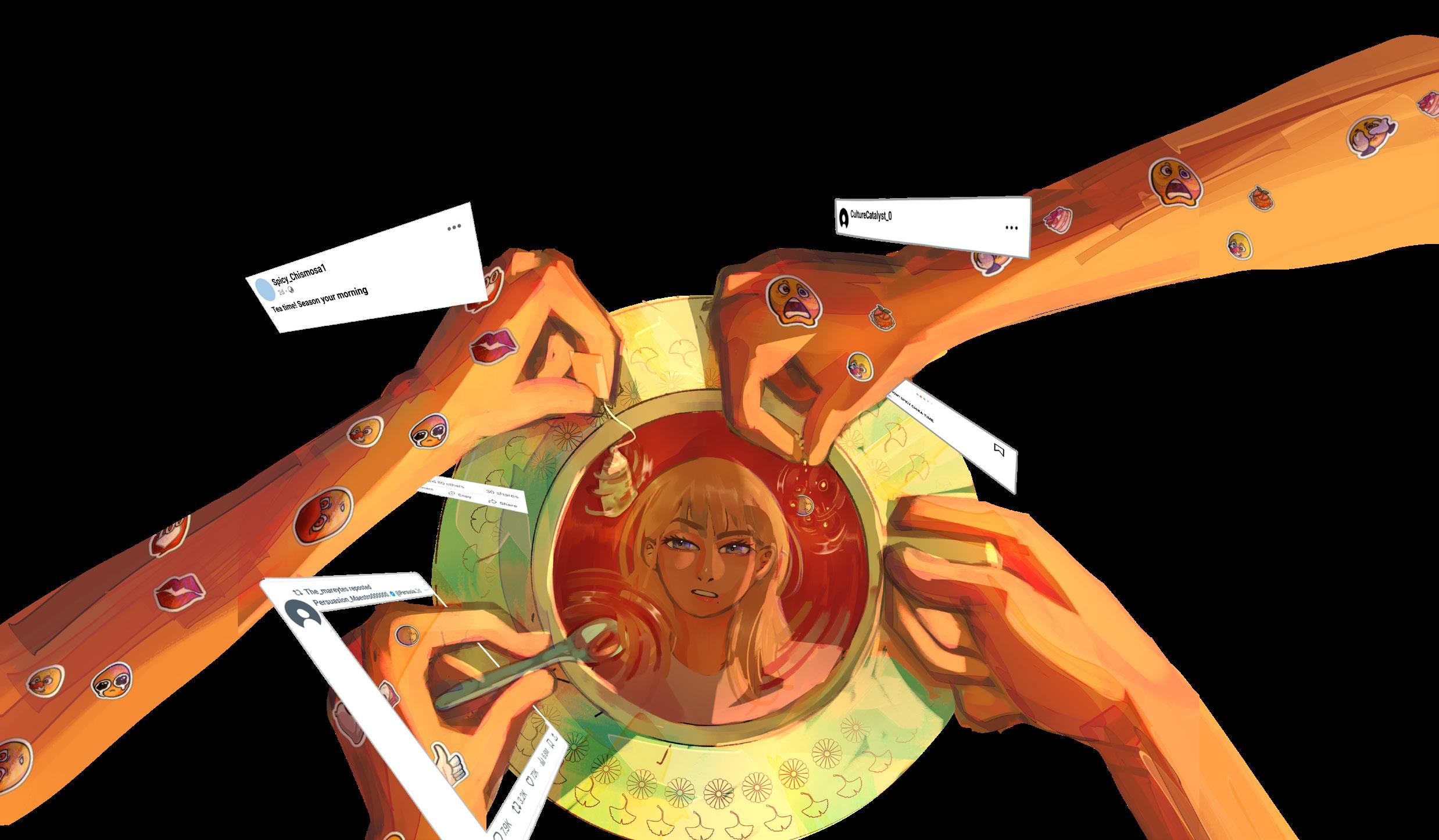
The satisfaction after taking in our hot “tea” cravings from the online world is always at its peak. However, this satisfaction leads us to acidic burps, which eventually become outlines of what we transpire sooner or later.
From the latest rumors-to-confirmed Filipino celebrity breakups of long-time couples, like Kathryn Bernardo and Daniel Padilla, as well as Kim Chiu and Xian Lim, to the empirical rifts of personalities in the show business industry, like that of Heart Evangelista and her glam team, followers have nowhere to go but on the social media pages of the so-called “ online Marites” in this digital era.
With the gravity of concentration that netizens show towards those showbiz fiascos, it seems that they are giving more attention to these supposed shallow issues than to societal problems that need more concern.
As people scroll through their feeds, algorithms introduce them to content based on their past behaviors and preferences, creating what some refer to as an “ echo chamber. ” This can lead users to only accept ideas that align with their existing beliefs, reinforcing them while potentially isolating them from opposing perspectives.
With algorithms at hand and with the celebrity controversies occurring in recent months, people are more likely to attach themselves to online Marites
From the traditional tsismosa, who knows and spreads household-to-household juicy stories about someone else ’ s personal life, they now have gone digital. They throw hateful comments and express pieces of malinformation, influencing people ’ s minds.
Some of the renowned online Marites who have garnered the trust of the masses are the following: Ogie Diaz, an actor and talent manager; Xian Gaza, a businessman and internet personality; and Cristy Fermin, a talk show host.
Like an owner whispering, “Bon Appétit,” as he gives his dog its daily kibbles, these manifestations of Marites feed the masses with gossip and rumors of prominent figures; most are crunched mindlessly upon by the people. Oftentimes, they bark louder to satisfy their needless hunger. They are paid to do these detestable acts, not only perpetuating a cycle of hate but also greed.
With this, people are easily bewildered. They would vicariously devour similar contents redundantly. They do not seem to give importance to the information they consume, and it negatively affects them gradually.
But this delight does not end by the moment netizens experience these acidic burps.
The netizens gradually become what they consume. They have a harsh tendency of becoming toxins. As they are fed by Marites on social media, they do not notice, but they mirror these personas in society. They become the ones who cascade unverified information, causing harm to others.
Worse, they become the ones inflicting toxicity on themselves. Yet again, they are oblivious to how often they enact the cause, which, many times, is due to their social media consumption.
Sherri Gordon, a published author and certified professional life coach, cited in her 2020 article “ Understanding the Impact of Rumors and Gossip ” that gossip and rumors can destroy a person’s self-confidence and affect their self-esteem; they can also lead to depression, suicidal thoughts, eating disorders, anxiety, and a host of other issues.
Meanwhile, Makati Medical Center ’ s (MMC) study revealed that participants were happier to hear positive gossip about themselves but were not as upset when hearing negative stories of others; the case would be different when the act is prolonged.
In people ’ s daily consumption of Gaza ’ s or Fermin ’ s overflowing freshly boiled hot tea and mouthful feedback to showbiz personalities ’ influential servings on their public social media platforms, there’s no wonder why netizens ’ minds feel bloated with bitter emotions, affecting how they thrive throughout the day.
Moreover, the alarming spread of information disorders in the Philippines opts to remain a pressing issue that we need to collectively improve media and information literacy among netizens.
FORWARD Publications does not tolerate these Marites personas, which can be the roots of hatred through social media.
Alter the virtual algorithms to pieces of information that help people say in the end, “Merci, ” that was a delicious consumable.” FWD
illustration by Khen B. Fernandez
Small Bites, Big Bytes
by Trixcy D. Clar and Juan Enrique D. Reboquio graphic design by Gabrielle Marie R. Paradiang and Narvie Klaryzze B. Borja
From screen time to societal shifts, the early use of the internet and gadgets is inevitable, but does the allure of immediate convenience outweigh the potential for unforeseen long-term consequences?
Like indulging in a quick, calorie-laden meal, the initial appeal of technology’s immediate convenience is undeniable. From the endless scroll of glowing screens to the effortless access provided by gadgets, our early digital consumption is often instinctive, like reaching for that extra slice of pizza.
The 21st century has witnessed a digital renaissance. Gadgets and the internet, once viewed with suspicion, have become prevalent tools. Throughout education, healthcare, commerce and communication, their pervasive presence has been felt, revolutionizing countless sectors.
When Algorithms Meet Appetites
This new age has redefined communication and relationships. Gone are the days of geographical and temporal constraints, as media gadgets now offer a plethora of accessible features. What used to be devices limited to communicating or sending messages have now evolved into means of information and entertainment.
Children of today, often referred to as Generation Alpha, are born into the digital world and exhibit a heightened level of tech-savviness.
Technology can empower young minds to become independent learners. Once they learn how to access digital information sources safely, they can explore the topics that interest them, fostering a deeper understanding of the importance of building communities and interacting with people in social situations.
Having gadgets for children can be beneficial; their usefulness and convenience allow the surge of creativity to peak via mobile games and provide the needed stimuli for their senses and imagination to improve.
Bitter Aftertaste of Overusing Tech
Just as overindulging in fast food can lead to long-term health issues, the fascination with this revolutionary piece also masks potential consequences for our well-being and the overall societal fabric.
Despite the benefits that these innovations bring, the early exposure and excessive use of technology in children are a growing concern, potentially leading to various problems.
This ease of access has bred a new generation of children dubbed “iPad kids.”
These screen-time-hungry little monsters will do anything to satisfy their needs for digital content. Taking unsupervised use of gadgets and an endless array of content available on the internet together, it is best to say these kids are unresponsive to the physical world, only caring about the one that exists virtually.
How about the parents? Efforts have been made, right?
Nor Azah Abdul Aziz, a researcher from Universiti Teknikal Malaysia Melaka, highlighted that children as young as one year old are surrounded by gadgets, and incentivized by their parents, to behave well in public.
It is the parents themselves who introduce the gadgets to their children, and due to a child’s innate curiosity, they develop a crippling addiction over time.
The COVID-19 lockdown further exacerbated this issue, with screen time skyrocketing for activities like watching YouTube videos, streaming movies, listening to music, and playing games.
Using mobile devices to settle down a young child may seem like a harmless, temporary tool to reduce stress in the household, but there may be long term consequences if it’s a regular go-to soothing strategy. This is according to Jenny Radesky, MD, a developmental-behavioral pediatrician at the University of Michigan Health C.S. Mott Children’s Hospital.
To name a few, it has been observed that children would exhibit aggressive and ill-mannered tendencies–attached only to the machines in front of them.
Inculcation of these practices shows another facet of how unchecked gadget use in kids affects daily routines. This ushers in inconsistent eating patterns and irregular sleeping schedules, contributing factors to anxiety, focus issues, and even heightened sensitivity to simple matters. Unsurprisingly, most parents would agree that this excessive reliance affects their child’s quality of life.
The dangers of this unstable portal extend beyond the personal, which leads us to what type of content is being viewed online.
Generally, the surface content seen on the face of the internet is meant for all. This goes in line with the internet’s tenets of eased access to information and communication. Although the existence of the tip of the iceberg presents uncharted depths that must be navigated responsibly.
When children spend more time interacting with screens, it presents fewer opportunities for face-to-face interactions. Sure, this may prevent them from the threats brought upon by the real world, however, this does not spare them from the perils lurking along the infinite shadows of the digital space.
Young children are more susceptible to grooming, pedophilia, and exploitation as they have little to no control over the media they are exposed to online.
A report made by the Wall Street Journal, a reputable news outlet, presented that even apps such as Instagram house networks of sexual predators, using the guise of anonymity to wait for unsuspecting victims to fall into their traps.
It is also worth mentioning the abundance of explicit content that is readily available just a few clicks away.
Is the vulnerable mind of a child ready to comprehend sensitive information without repercussions? Certainly not.
The irony deepens when considering that the internet, envisioned to connect and unite society, has resulted in division and fragmentation. This paradox is evident in its misuse as a platform for disseminating sexual content and pornography, aggravating risks among children.
Balanced Diet in Technology Usage
The average attention span, once surpassing that of a goldfish at nine seconds, now hovers at a mere eight seconds, as per a recent Microsoft Corporation study. This decline, observed since the 2000 mobile revolution, underscores the impact of an increasingly digitized lifestyle on humans.
This emphasizes the importance of parents, guardians, and educators to diminish children’s reliance on gadgets by limiting their screen time. Simultaneously, closely involved parents and guardians should monitor their children to ensure they are not excessively overly absorbed in their devices.
An effective strategy involves restricting technology use when children focus on other tasks. This includes banning smartphone usage during homework, promoting conversation and interaction during meals, and switching off the TV while kids are reading.
Encourage children to unplug by spending time outdoors, interacting with others, and engaging in screen-free activities like board games, books, and puzzles. These approaches can enhance their cognitive, affective, and psychomotor skills.
Just as with nourishing our bodies with balanced meals, nurturing young minds requires a mindful approach to technology consumption. Establishing positive habits early on acts as a “digital diet,” ensuring children absorb the benefits of technology while safeguarding them from its potential pitfalls. This empowers them to become responsible and discerning consumers of the ever-present digital buffet. FWD
What’sSmellsCooking? Like Power Grabbing!
by Louise Lambiquit graphic design by Krista Marie B. Yaoyao and Christian A. Mananguite
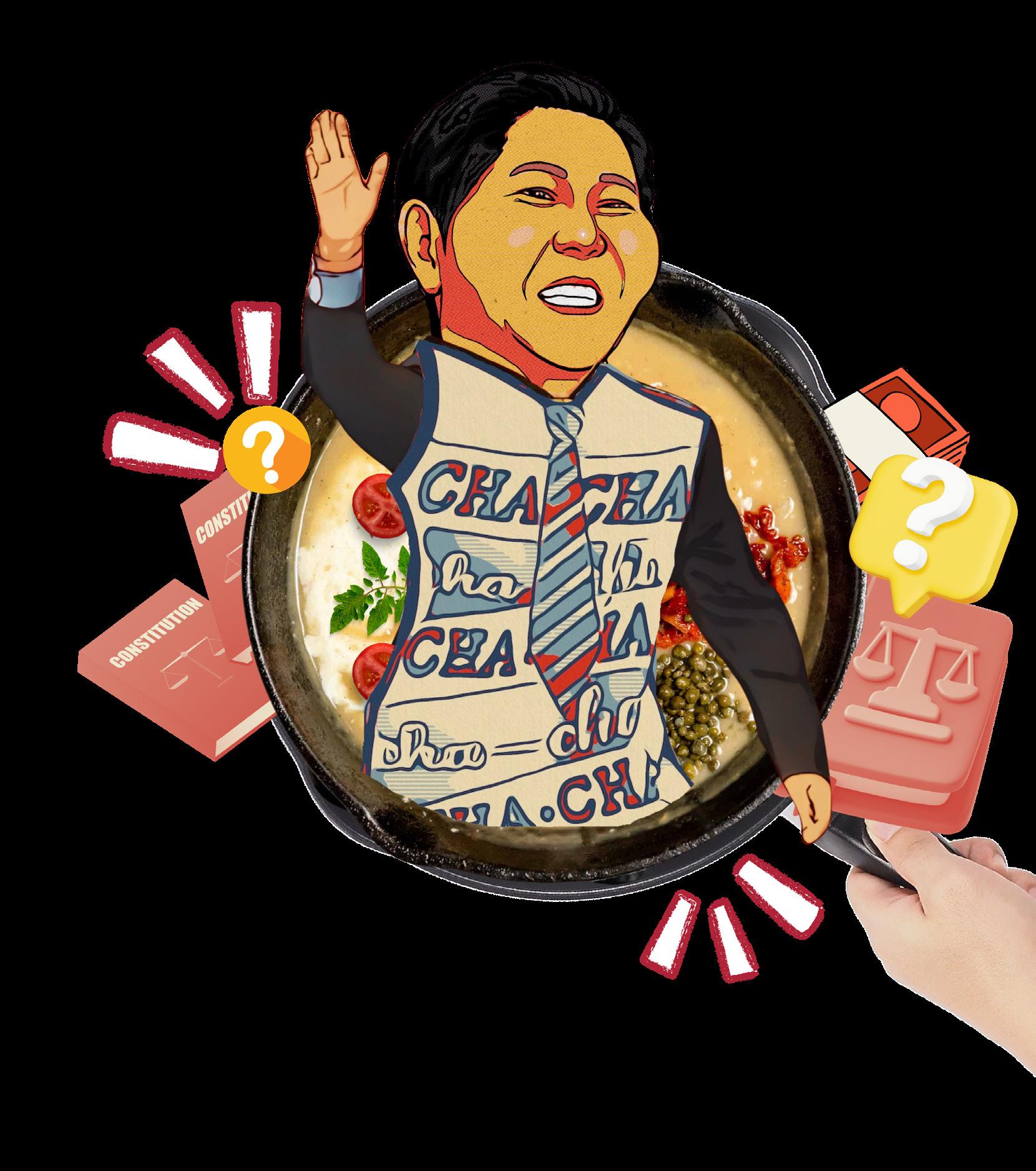
The “lower-makers” had tactically prepared something in the kitchen, a delectable and fine cuisine secretly concocted by this conniving group of chefs— but one thing is for sure, the food that they are stirring in the pot is not something fresh on the table.
The Philippines, a country battered with continuous injustices, meets yet another existential threat to democracy. In the guise of the pretext of extending one ’ s term as a public official—this time, “People’s Initiative ” (PI) seems to be one of the ingredients in the recipe.
With two years under the presidency of Ferdinand “ Bongbong ” Marcos Jr. (PBBM), what’s this danger that Filipinos must be wary of?
Choking Hazard: Reingesting Cha-cha
The current constitutional reforms, also known as Charter change, colloquially called “ Cha-cha, ” have once again resurfaced and dipped into a new controversial flavor in the incumbency of PBBM.
Recently, in a silent hustle, a mysterious campaign drive was conducted in Davao City to gather signatures from registered voters in the country to launch the PI in an attempt to amend the present constitution, as reported by GMA News Online.
It took everyone by surprise, even the upper chamber, which is the Senate, that the lower chamber, the House of Representatives (HoR), silver-plattered a different plan to propose the Cha-cha without the need to undergo constituent assembly and constitutional convention.
The two houses are supposed to work together since they are co-equal regardless of being independent of one another. Yet, the recent commotion showed the exact opposite.
The HoR cannot bite off more than they can chew. Unlike PI, going forth with these other modes will put them in a difficult situation as it will require a heavier workload if either of the two methods is to be conducted—opting for a more convenient PI.
After its ratification in 1987, the Philippine Constitution, being the supreme law of the land, has been the framework of how our government functions and has also been the basis for checking the constitutionality of crafted public policies in the country.
Moreover, the process of changing some of its provisions to “ meet the needs of contemporary society ” is already a spoiled script that we are tired of hearing to blanket the true intention of the government.
They often cloak their actions with an apron of pursuit of the national interest when in fact what is more important to them is their cronies and how to retain their position.
Throughout the years, aside from seeing them in a wheelchair with a neck brace right after their terms ended, we encountered presidents who tried to, if not amend, but revise the entire constitution just to gain machinery and more power over their constituents.
It works like a heritage dish that was passed down from one administration to another. Hence, it is not surprising for us to notice that the current regime is playing this strategy again.
For typical politicians, we cannot exonerate reproaches to people reacting this way to Cha-cha— imagine having this movement under the presidency of the late dictator ’ s son.
After the macabre history that traumatized us, which resulted in the suspension of civil liberties and widespread human rights abuses, we must prevent history from repeating itself.
This dish was something we once swallowed; why would we regurgitate it?
Wrong Order, Where’s the Manager?!
The PI is one of the three modes of reforming the constitution. For it to proceed, it must collect the equivalent of “ at least 12 per centum of the total number of registered voters ” in the country.
However, the lawmakers have to design their very own foundation as a law that properly lays down the implementation of PI. According to the 1987 Constitution Article 17 Section 2 paragraph (2), “the Congress shall provide for the implementation of the exercise of this right,” so as long as there is no enabling law, the PI will never succeed.
The suspicion stems from the fact that the signatures gathered by each district were bought and not factual.
In a TV5 News report, a leaked video showed a volunteer giving an orientation to urban poor residents, saying that once Cha-cha is approved, they will be given cash aid. The news eventually crept smiles on their faces, thinking that the financial assistance they would receive was sufficient to bring food onto their table.
Meanwhile, in a Philstar article, signatories were collected from voters, who were then compensated with a mere hundred pesos in Albay.
It is their bread and butter to be bargaining a small amount to acquire the inherent prerogative of Filipinos. Also, it is an evident manifestation of the disgusting chutzpah of these brazen politicians.
As per a Rappler article, there were reports that some Congressmen were bribing the people using Assistance to Individuals in Crisis Situation (AICS), a government subsidy program of the Department of Social Welfare and Development (DSWD), in exchange for their signatures.
Hence, this so-called initiative to amend the constitution is not ordered by the Filipinos themselves. It is not a true initiative when the populace is deceived.
While other departments have denied their association with the incident, it is saddening how these lawmakers took advantage of the marginalized—holding them hostage with social benefits at gunpoint to maneuver and pursue their gluttony for power.
House of Representatives, do not let them cook!
In an official Facebook page post of the Senate, a photo has been published of their manifesto “rejecting attempts to exploit the Philippines’ democratic processes.” It is rare to see all members of the upper chamber join together to convey a unified opposition.
Under PI, the Senate and HoR would be treated as one body. However, with the Senate’s 24 compared to the HoR’s 315 representatives, the lower chamber could easily overthrow the upper house since they could be voting jointly, making the former inconsequential in the process of Cha-cha.
The PI is never easy to pull off, but how do these chefs make it look like a piece of cake without even sweating?
It is not stipulated in our constitution that a single house can manipulate and discredit the doctrine of checks and balances. This directly battles bicameralism and disrespects what the framers of the 1987 Constitution have envisioned.
This insatiable thirst of corrupt politicians for extended term limits must not be quenched.
Risk of Menu Redesigning
During the speakership of Ferdinand Martin Romualdez, who also happens to be the first-degree cousin of PBBM, PI is seen as crucial to remedying the current “ restrictive economic provisions ” in the constitution.
In an interview with GMA News Program “Saksi,” PBBM admitted that the 1987 Constitution “was not written for a globalized world” as it limits foreign ownership of public utilities.
This Cha-cha, reckoned to be open arms in accepting foreign investors to feast on the nation’s wide open economy, will always boil down to one question: Are we certain that it stops there?
Out of the frying pan: Into the fire, the greed of lawmakers may demand changes—plating an extension of term limits, tandem voting, or any other schemes that could satiate their avarice, simply because they have the leeway to do so.
After all, the Resolution of Both Houses (RBH) No. 6 did not state their limitations or just how many reforms they could propose.
The joke is on them; they must be having an entire circus for breakfast.
Although it is undeniable that our economy is struggling as inflation continues to prevail, let this reason not be an excuse for opportunistic and corrupt officials to further plumper their bloating privileges just to survive in the realms of the political arena.
While it is early, we must quash their hunger for power and stop this PI that, ironically, does not serve the people ’ s will to begin with.
Let not even a single Filipino dance with them in this Cha-cha. FWD
Jokes We Need To Chew Out
by Sharry M. Cuizon
graphic design by Jane Frances P. Latorza
While humor remains a powerful tool in social commentary and critique, it has also become a weapon to reinforce harmful stereotypes and perpetuate discrimination.
The world witnessed an unprecedented transformation in the entertainment industry, where social media platforms like Facebook, TikTok, YouTube, Instagram, and X (formerly known as Twitter), have not only revolutionized the way we connect with each other but have also transformed the way we consume and engage in entertainment content online.
Comedy as entertainment has been so popular these days that it has also become a podium for unbecoming bits of inequality, discrimination, and oppression masked under the facade of jokes to blanket themselves away from the prying eyes of their audience.
Despite the significant progress in raising awareness of the harmful impacts of such humor, it seems that the world still struggles to grapple with these issues being joked about.
There is a delicate balance between wit and offense— after all, jokes should make their audience laugh, not huff, right?
Tasteless Teasers
One common trait we hear among comedians and influencers is how they blend humor with hate speech that downplays prejudice, obscures underlying hatred, and normalizes hostile beliefs.
We’ve seen many of these before, but here we go again.
The “Barbenheimer” tandem with Greta Gerwig’s “Barbie” and Christopher Nolan’s “Oppenheimer” reached the 2024 Golden Globe Awards, which earned online buzz from fans across borders for being “the total opposite of each other.”
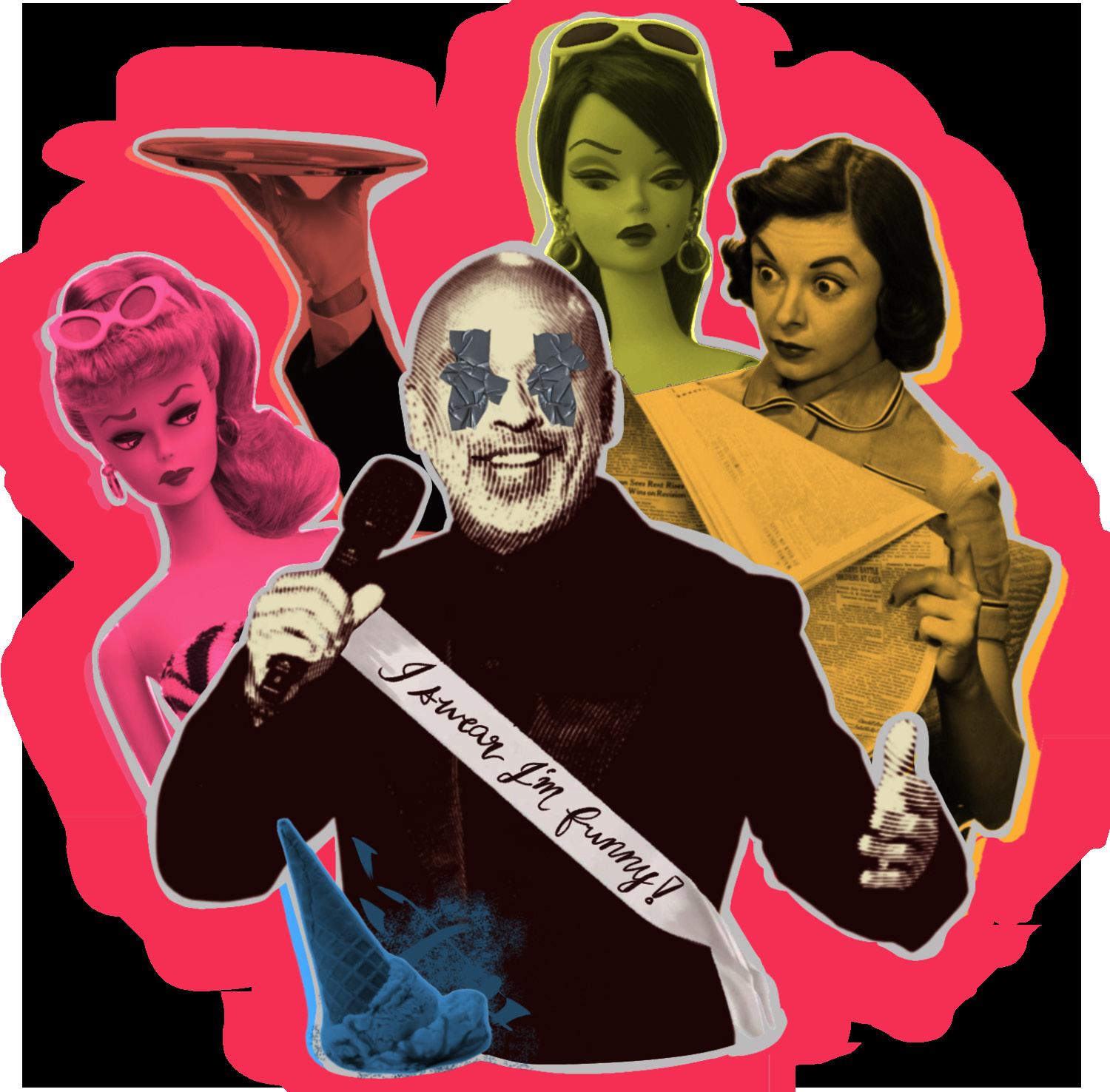
However, the anticipation drained the audience as the host, Joseph Glenn “Jo Koy” Herbert, poked fun at the runtime of Oppenheimer and praised its backstory, all the while taking a jab at Barbie that depleted the meaning it had for viewers.
“Oppenheimer is based on a 721-page Pulitzer Prize-winning book about the Manhattan Project. And ‘Barbie’ is on a plastic doll with big boobies!” Jo Koy stated.
Adding unsolicited insults to a supposed harmless humor is not anymore new. However, belittling others to feel superior cannot be excused by simply saying, “It’s his job” or “He only had 10 days to prepare.”
Although numerous content analyses reveal the prevalence of hate speech behind humor—cases like Jo Koy prove that further tolerance and consideration will foster destructive consequences.
Sometimes, jokes like these just age like milk.
Mockery Misfires
In today’s time, there have been more than a few encounters that exhibit heavy sexism all around the globe, and it is still utterly baffling to see individuals enabling and defending people who come and joke around and normalize these behaviors.
The case of American kickboxer turned professional misogynist and business influencer, Andrew Tate, serves as a prime example of why humorous hate speeches should not be normalized and tolerated.
For context, in hopes of putting high stead on his network in X, Tate directed a tweet towards Greta Thunberg, a female 21-year-old climate activist, in which he wrote, “Please provide your email address so I can send a complete list of my car collection and their respective enormous emissions,” to mock the efforts of the environmental organization Thunberg was currently working with.
It accumulated several backlashes, primarily from peers, until the online community got involved, crashing his hopes to enhance his status, which then led to the suspension of all of his social media accounts.
In a situation closely similar to this that happened in the Philippines, a Filipino content creator and self-proclaimed “motivational speaker,” Rendon Labador, faced doom when all of his social media accounts were reported as a result of his recent activities of mansplaining and hate speech against known personalities in the country.
The media outlet One News asked Labador about his motives and process when presenting his statements unabashedly online, which caused a ruckus because of how “problematic” and “over the board” it was for an influencer with almost 500,000 followers that consists of people from different walks of life.
Despite the negative feedback, Labador remained stern on his outlook of being nonchalant about his actions, “Basta ‘pag may nakita akong mali ikocorrect ko kahit sino, wala akong pakialam sa‘yo, denying the allegations of cherry-picking the personalities he aims his tirades at.
Not long after, the situation prompted intervention from the authorities; several social and civil organizations filed a complaint against the influencer, and a petition for the declaration of persona non grata in the country was filed.
Moreover, Tate and Labador’s cases were a bold move to trigger the lingering inequality and embedded long-lasting effects of patriarchy and misogyny in a country that went through harsh colonization, even mocking the progressive movements made by women, children, and even men for decades, who have long been the center of unwanted attention.
Humor may not always be a means of evoking amusement, and it is a known fact that it has been the venue for humorous hate speech to propagate hostile views that benefit perpetrators, as audiences are more likely to tolerate this behavior.
The consideration that these so-called professional comedians, influencers, and personalities get from making their way out of their “humorously communicated prejudices” just because it’s their job explicitly shows that most of the time people fail to understand the underlying disparaging remarks and what makes them problematic.
More so, spreading derogatory humor that strengthens pre-existing prejudices, which may trigger social values and moral principles, cannot be justified by simply saying, “It should be taken as a joke.”
At times, extreme communication of incivility commonly appears as jokes that mean no harm, whereas hostility that cannot be phrased directly can be safely and subtly expressed by humor.
In this regard, centuries-old initiatives against patriarchy, sexism, misogyny, discrimination, and inequalities in all forms are laid open and often used as implicit or covert ways of fostering unlawful hate speech.
It is high time to learn the simplest way to be sensitive and careful enough not to choke on what we chew. FWD
OOTD is Life, But What Lies Behind The Closet?
by Jonathan M. Ricardo and Maria Cristina G. Lamug graphic design by Karina Adel A. Vestil and Ayn E. Nazareno
We take our mirror shots, pose, click, and show off our outfits on our feeds; but are we even aware of what goes behind what we wear?
When you pick through your wardrobe choices for your next OOTD (Outfit Of The Day), have you ever wondered how the threads you wear ended up there? Or did you wish to have the same tasty getups your favorite runway models flaunted on the catwalk?
If you’ve ever bought cheap clothes that look haute couture, whether from high-end or overrun shops, then you have already likely bitten into fast fashion. The practice of producing large volumes of runway imitations to take advantage of maximum demand, fast fashion is the product of the decadent, comfortable, and certainly flashy lifestyle we all aspire to live.
But behind each new purchase you make, whether fresh off the shelves of your favorite retailer or even thrifted, lies a deep tangle of
consumerist-driven greed, strangling and trampling, all involved for the sake of the few.
All-Consuming Couture
The speed at which people consume clothing has only accelerated since the introduction of fast fashion in the late 20th century. And, just like how people’s preferences and wants rapidly changed, the fashion industry continues to ebb and flow to the unceasing tides of demand.
Shein, Primark, H&M, Zara, Shopee, Instagram, and TikTok are just some of the biggest names that people look to for their fashion choices, and they also readily use fast fashion. For instance, Shein employs the core fast fashion strategy of marketing nothing but the latest trends to tickle a buyer’s fancy.
Thus, it follows that it remains one of the biggest clothing businesses, the fourth most frequented in the United States and the leading brand in China, despite notorious reports of child labor, forced labor, and unjust employment conditions.
In an investigation from the Swiss watchdog group Public Eye in 2021, laborers from Shein claimed that they worked 12 hours a day, 75 hours a week, and were only given one day off every month.
According to Chinese labor laws, overtime cannot exceed 36 hours per month and work weeks cannot exceed 40 hours. Additionally, employees must have one day off each week.
It is also concerning that fast fashion is environmentally damaging, especially evident in the practice of mass disposability, where pieces of clothing are quickly discarded after just few uses, and the addition of toxic chemicals for faster production leads to mass fabric waste.
In 2021, Marketplace commissioned Miriam Diamond’s study, which examined 38 sets of adult and children’s clothing and accessories. Concerning concentrations of lead, perfluoroalkyl and polyfluoroalkyl substances (PFAs), and phthalates were present in one in five of the samples. And Shein was among the worst violators, with some pieces of children’s clothing displaying more than 20 times the recommended amount of lead.
Ultimately, it is the norm that prominent figures in the industry both locally and globally endorse it, and other giants in the industry are complicit in such practices, reducing workers to raising such plaintive pleas for help in the face of their own suffering. And yet, no one even bats an eye to such damning practices.
The Questionable Retail Shops
In contrast, we have some fashion brands that support sustainability, such as Veja, Mango, Wholesome Culture, Uniqlo, Patagonia, and Everlane. However, costs associated with sustainability may be significantly greater than those of items offered by fast fashion brands.
Biodegradable materials made from natural or recycled fibers are used in sustainable fashion and clothing. The entire carbon footprint of these companies is decreased because these materials grow without the need for pesticides or fertilizers, use less energy and water, and do not undergo chemical treatment.
Nevertheless, there are other, far less expensive methods for people to support sustainable fashion, such as thrifting at ukay-ukay shops and stalls, recycling your mother’s old clothing, styling your father’s baggy jeans, and shopping at second-hand stores.
However, some shrewd business owners have taken advantage of this strategy as online retail stores have grown in popularity among online shoppers, such as Lazada and Shopee’s rise in the mid to late 2010s.
These days, sellers frequently manipulate their prices and overcharge for their goods; items that were once thought to be inexpensive and “kaya ng budget” are now comparable or even more expensive to fast fashion names.
They even purchase large quantities of recycled fast fashion items and resell them to their pages at significantly higher costs.
In the pursuit of sustainability, are we not attempting to encourage less detrimental effects? Yet, it appears that people can twist this noble cause for their own selfish desires.
Unweaving the Tangled Knots
With all this said, it would be easy to claim that customers can simply ignore these grave ills for the sake of their own convenience. Granted, fast fashion remains a very reliable option for troubled shoppers. However, this is far from the case.
Fast fashion is, at its core, the byproduct of extreme capitalism. The weekly release of new trends, mass consumerism that values quantity above quality, and people’s obsession with accumulating more clothing all contribute to the meteoric rise in production, consumption, and wastefulness.
Ultimately, it is a system that preys upon the basic human need to look presentable and attractive. After all, it’s not a crime to look sick in your drip, heck no. Everyone wants to look good in their outfit.
However, while it is most reasonable to demand consumers make conscious choices with regard to what they wear, what truly must be exacted is accountability from producers. After all, these giants are the ones who mislead their core audiences with promises of social marketing and sustainability, building their empires of gold upon pillars of suffering from laborers who get nary any rightful reward nor recognition for their rigors.
In every step, what we wear must be made with love and care, not soulless disregard for those who make it, neither the sole pursuit of pure profit nor the destruction of our common home for a quick buck. And, idealistic as that may sound, we must demand such standards that even from money-making giants whose sole goal is profit above all, no matter the cost. FWD
The Perfect Recipe for a Standard
by Rufino Rico L. Jamisola and Rey Martin B. Rio illustration by Jane Frances P. Latorza
Trends and other things considered “in” are just mere seasoning of a sizzling social media standard, skillfully plated by the master chefs of online presence—the influencers.
When people encounter influential couples like Slater Young and Kryz Uy, who are affectionate with each other and exchange luxurious gifts are expression of their love, it is easy for netizens to conclude that they are the standard couple.
“Sana all,” they say.
When a former student leader publishes their academic achievements on the internet, knowing that they also have various extracurricular activities alongside, they would be inferred as the standard.
“‘Yan si lodi,” they say.
When a celebrity does a weird dance trend on the screen, viewers would react hysterically and claim that they are cute. Popularity is a big factor in why people are still praised unapologetically.
“Nakakapanghina ang cuteness,” they say.
No matter what these popular people do, people do not cringe. Just because they are influential, they are perceived as the standard.
Let their ordinary friends do it first, and they would be called “jejemon. ”
The so-called influencers are popular online figures who wield significant power, establishing themselves as the standard by virtue of their influence and widespread reach. They specialize in various domains like travel, fitness, beauty, fashion, and entertainment, captivating audiences with seemingly delectable yet potentially harmful content and information.
They have become key players today in shaping consumer behavior as trendsetters in their respective fields. Collaborating with businesses, they produce strategic marketing campaigns aimed at appealing to audiences, leveraging their status as industry authorities.
However, it is essential for digital content consumers to approach influencers with discernment rather than blind trust in order to recognize the probable risks associated with this very culture.
The unattainable and often unhealthy standards that these influencers impose on social media make ordinary people feel incapable, rather than inspired.
What if the influencer culture never emerged to stir the pot of human existence? Would individuals still find themselves challenged to whisk their unique flavors into these undercooked social standards?
We questioned Josenians: If they were given the chance to craft the perfect recipe for a standard in certain aspects of life, namely beauty, intelligence, love, and success, what would the ingredients be?
The Apple of Many’s Eyes
Beauty is not only seen through the physicality of someone but also through how they carries themselves in front of other people.
“Here is my recipe of beauty: two teaspoons of a glint in the eyes, two teaspoons of a clean hairdo, one tablespoon of a good eye color, two tablespoons of tallness, three tablespoons of a great smile, one cup of sweetness, two tablespoons of optimism, two cups of confidence, three cups of positivity, a dash of creativity, and a dash of warmth.
“I do think that the most important ingredients are having confidence and positivity; that’s why I added more of it than the other ones, having such confidence in oneself is important in a way to conquer the world without hesitations and just showing who you are as a person, and having that positive energy [can also influence other people to also stay positive].”
- Neill Mithras Malinao, BS Tourism Management
- 1
The Cream of the Crop
Intelligence does not only revolve around the high marks obtained at school or the number of medals received at the end of the academic year; it also covers the way someone thinks rationally for them to thrive in their daily living.
“If I would make a recipe of the standard of intelligence, it would be two tablespoons of curiosity, two tablespoons of empathy, two cups of problem-solving skills, two cups of critical thinking skills, two cups of social skills, three cups of self-awareness, four pinches of motivation, and six pinches of confidence.
“For me, the most important ingredient for intelligence is self-awareness because, in knowing oneself—imperfections, flaws, capabilities, and character, then one can be the best version of yourself, which is why it is the largest ingredient.”
- Johanna Cassandra Sumalinog, BA Journalism - 3
Love, Life’s Special Ingredient?
Being single does not exempt one from desiring an ideal relationship, nor does it prove that one is incapable of loving another person, as love ultimately begins from within.
“I haven’t tried being in a relationship, but I think if I ever have one, my recipe for it would be one tablespoon of risk-taking, two cups of courage, one liter of trust, two cups of open communication, one cup of understanding, and two liters of faithfulness or loyalty.”
- Rhaven Mae Ando, BA English Language Studies - 3
Tasty Success Equals Happiness
Success, as seen readily online, is not solely about abundance. Regardless of the intent of some who flaunt their luxurious cars or grandiose homes, this type of content has quietly become an unspoken indicator of a status symbol.
“I would like to highlight that there is never a shame to want financial stability more than anything else, not to the extent of being avaricious, but for security. If I were to create one, I would have a concoction of immeasurable happiness, incalculable kindness, and an unfathomable amount of integrity.”
- Xienderlyn Trinidad, BA Communication - 3
Consuming an influencer ’ s content is not inherently wrong. However, this only serves as a myopic viewpoint of what life looks like when, in reality, a lot of things happen outside our screens.
Behind the polished presentation of social media influencers lies the unshared slices of their lives. True fulfillment is found in our nurtured relationships infused with personal growth, reminding us to savor authenticity amid lingering standards in the digital world.
We must all be meticulous with the narratives we devour online. Take everything with a grain of salt, and don’t settle for what’s already plated. Be the master chefs of your own lives, crafting your destiny rather than relying on the recipes served by social media influencers. FWD
2nd Semester 2023-2024
Serving Truth: Media Literacy Amid False Information Buffet
by Rey Martin B. Rio graphic design by Astrid Niña T. Vidal
Living in a post-truth era reinforces the pressing need for an empowered consumer of digital information— one that adheres to what is true.
Alongside the height of the COVID-19 pandemic in the Philippines came the pervasive online dissemination of false information, as revealed by a 2021 Social Weather Stations (SWS) survey indicating that 51%, or more than half, of Filipinos grappled with discerning the truth across various platforms.
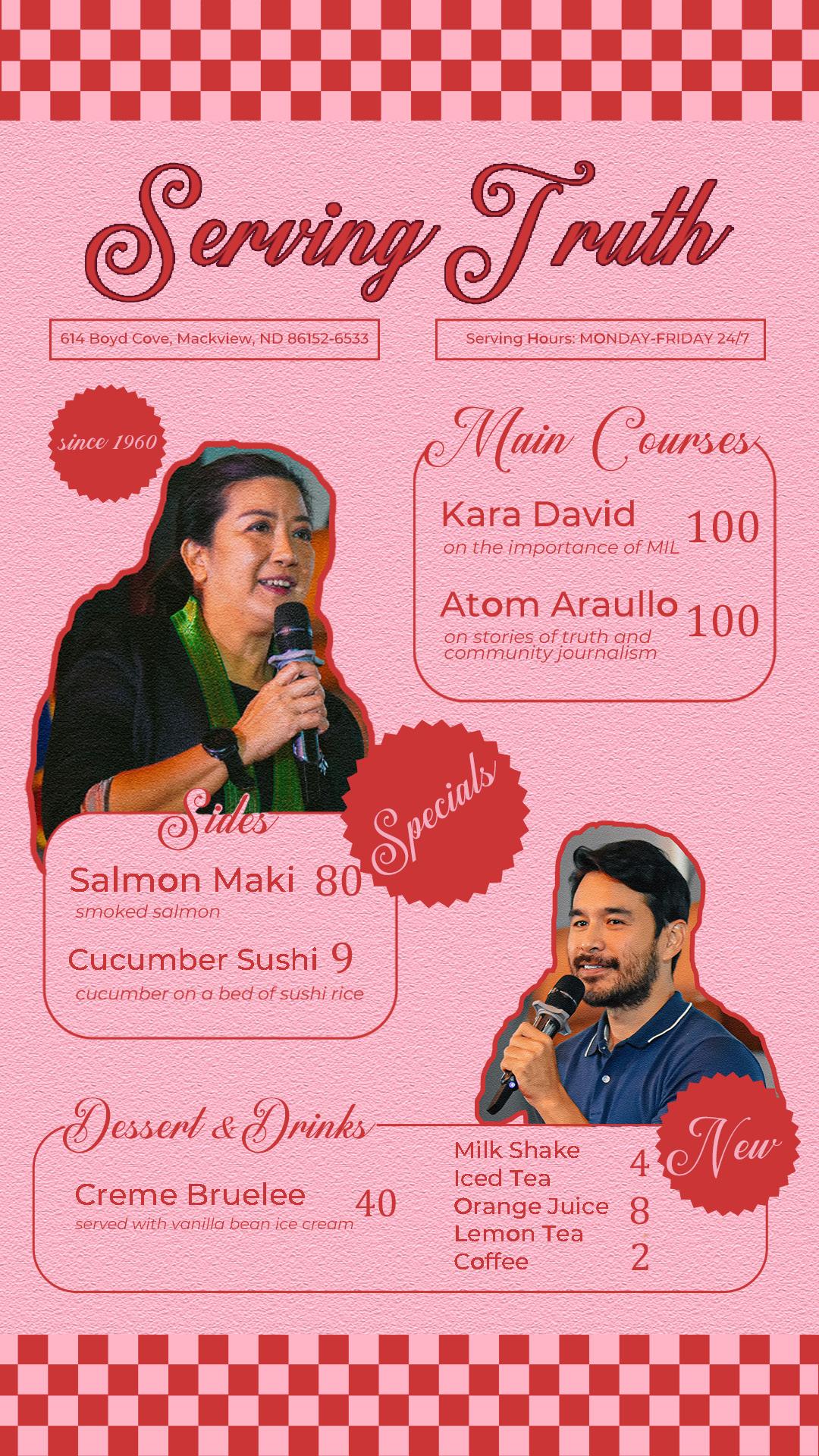
To combat the heightened need for media and information literacy (MIL) in the country, Kara David and Atom Araullo, renowned GMA Public Affairs broadcast journalists and documentarists, took center stage for “Pagtuki: Atong Hisgotan ang Istorya sa Sugbuanon” on February 5, 2024, at the University of San Jose-Recoletos (USJ-R) Recoletos Center for Arts and Culture (RCAC).
The media literacy forum brought together students and student council leaders, student publications, and community journalists, as well as media practitioners and educators from over 50 institutional and independent organizations.
Kara David on the Importance of MIL
Chairman of the University of the Philippines College of Mass Communication’s (UPCMC) Department of Journalism, Kara David, set the discussion off with her opening keynote speech on “The Importance of Media Information Literacy in the Era of Digital Disruption and Disinformation.”
David highlighted the significance of media literacy in empowering citizens to discern the information they encounter and reminded them of the looming danger of treating social media as the only news source.
“If social media is your only news source, you don’t get the whole picture. Alam n‘yo ba, na ‘yong nababasa n‘yong balita sa Facebook, ito lang ‘yong recommended sa‘yo ng algorithm because of your friends,” she said.
David noted the loss of the Philippine-bet Michelle Dee in the Miss Universe 2023 pageant as an example, demonstrating why her fans and supporters lamented the results as questionable as they had only read what was being fed to them by the platform and ended up not getting the “whole story.”
She also mentioned the importance of reading the entire news articles before sharing the information, citing a study by Columbia University and the French National Institute indicating that 59% of online users share article links without fully understanding them.
David then addressed the deficiency in skills training and resources among teachers handling MIL subjects in senior high school (SHS) as she shared their collaborative effort between seasoned journalists from various major news organizations, showcasing the UPCMC’s eight-part MIL Project on YouTube.
Along with David and Araullo, the MIL video lecture lineup of journalists also includes Howie Severino, Connie Sison, Mariz Umali, Ivan Mayrina, Zen Hernandez, Karmina Constantino, and Jeff Canoy.
Moreover, the said project was implemented by Internews Philippines (IP) and funded by the United States Agency for International Development (USAID) to produce free and accessible educational materials, tutorials, and modules on YouTube.
Atom Araullo on Stories of Truth and Community Journalism
Meanwhile, Atom Araullo, the co-founder of FYT, a community-oriented independent media outfit, delivered his talk titled, “Call to Action: From Stories to Solutions, from Issues to Impacts.”
Araullo stressed that journalists need not only to be tellers of truth but also to become storytellers of truth, saying that “Stories are more powerful than facts. Stories are more powerful than numbers.”
“It is not enough to just gather information [and] to verify the facts, but it is also important to find the truth behind those facts. Ang mga [fact] on their own hindi ‘yan magbibigay ng katotohanan,” he said.
However, he also cautioned against the misuse of telling stories for misinformation and disinformation by “malign actors” or “bad people” online for personal gain and furthering polarization.
Araullo further expressed the vitality of community journalism in amplifying truthful stories, especially in the digital age of information.
“Mahalaga na nag-uusap tayo, nagpupunta tayo sa mga communities at ini-empower natin ‘yong community to do something about disinformation, and to encourage you to become advocates and champions of the truth vis-à-vis community journalism,” he said.
During the panel discussion, USJ-R Department of Communications, Languages, and Literature (DCLL) Chair Julit Jainar, IP Digital Engagement Specialist Giano Libot, and MyTV Cebu News Editor Angelica Fay Saniel answered queries from students and educators on journalistic practices and combating false information.
The forum was the third leg of the MIL roadshows across the country dubbed as “BarangayHub,” which started in Cagayan de Oro City, then in Baguio City, before being held at USJ-R in Cebu City, with its culmination taking place in Bacolod City.
Subsequently, it was organized by Lyf.PH in collaboration with FYT, MyTV Cebu, USJ-R, USJ-R DCLL, and the USJ-R Supreme Student Council (SSC).
The event garnered approximately 1,000 registered attendees, comprising both in-person and virtual participants, each equipped with a renewed commitment to discerning the truth amid the feast of falsehood in our digital spaces. FWD
2nd Semester 2023-2024
Farmers, Rice and Its High-Time Price
by Diane Rose G. Baynos graphic design by Krista Marie B. Yaoyao
Our food providers are food beggars of their own—how much irony can this get?
The Philippines has done it once again! Like a cherry on top, our country topped the rankings worldwide—only that this time, it came with a bitter aftertaste after being hailed as the world’s largest importer of rice.
This came after a report from the United States Department of Agriculture (USDA) stated that the Philippines is expected to retain its top position as the world’s leading rice importer for the year 2024. This prediction has been influenced by the rise in local rice prices, which reached a record 14-year high of 19.6% in December 2023, the fastest growth since March 2009’s 22.9%.
Whatever happened to the promise of improving the country’s agricultural sector and reducing the price of rice to P20 per kilo? I have no ounce of an idea.
According to poverty incidence data by the Philippine Statistics Authority (PSA) in 2021, fisherfolk had the highest poverty incidence, accounting for 30.6%, followed immediately by farmers at 30%, children at 26.4%, and individuals residing in rural areas at 25.7%.
These figures are not anymore unfamiliar, as these are also the same sectors that recorded the highest poverty incidences in 2015 and 2018, as per PSA.
But it does not make it any less disheartening.
The militant farmers ’ group Kilusang Magbubukid ng Pilipinas (KMP) or Peasant Movement of the Philippines expressed dismay over the poverty incidence, noting that conservative data from surveys never truly captures the reality of minorities living in far-flung areas.
“ Farmers [are] born and die in poverty, and it’s inhuman, ” said KMP in a statement following the release of the PSA data back in 2023.
Perhaps the biggest irony in this country is how it is dubbed an “agricultural” and “archipelagic” state with rich resources, only for our fishermen and farmers to end up being the poorest, unsupported, and most neglected.
Behind every munch and every chew of rice and fish, there is a looming hunger that envelops our local farmers and fishermen.
Every grain of rice on our plate symbolizes the farmers’ hard work, and yet they are left begging for alms and settling for what little they have, when they’re in an unending cycle of
sowing, reaping, and harvesting to provide food for their families and ours.
Yet again, they barely eat anything—not by choice, but due to the lack thereof.
While the rich complain over the lack of options on the menu, the poor fill their stomachs with leftovers.
Some experts stressed that the Philippines’ long history of dependence on food imports has impoverished Filipino farmers and even burdened ordinary people due to increases in food and fuel prices.
Instead of relying on imports, why not invest in our domestic agriculture by giving the support it direly needs and safeguarding the livelihoods of our farmers and fisherfolks?
What we demand are lasting initiatives that will significantly address the nation’s agricultural challenges through sustainable farms, irrigation systems, and financial help, rather than loans that will drown them in debt.
It is high time to reconstruct and reinvest in Philippine agriculture to turn the table in the farmers ’ favor and not just settle for a band-aid solution that only patches the outside layer when the entirety of the sector has been gravely wrecked.
This perennial problem may be attributed to events in recent years beyond our control, such as the COVID-19 pandemic, the Russo-Ukrainian war, and unpredictable climate patterns, but it is nevertheless—and even more so— our responsibility to urge the government to prioritize our agriculture, which has long been left behind and to make reforms that actually benefit the people at the grassroots.
The privilege we enjoy is another person ’ s luxury. Basic necessities should not work that way.
When every grain of rice remains exclusive for those at the top, our call remains stern for those at the bottom of the economic chain.
Unless all stakeholders take collective action in crafting policies that support the marginalized and carry out proactive interventions to improve the lives of the ones responsible for our meals, the food we eat will continue to be the hardest to swallow.
After all, it carries the blood, sweat, and tears of our local food providers. FWD
illustration by Hannah Vanessa O. Mondilla
Disclaimer : Bullseye is an issue-based open letter containing sentiments that may express sarcasm and irony. No bulls were harmed in the making of this article—but they were definitely eyed on.
It’s hard to digest lessons when the ones imparting them look at you like a snack. It’s not lunchtime yet, but they are ready to have their meal. What must be done to these wolves in sheep’s clothing that are rotten to the core?
Spotted! It’s not a bird! It’s not a plane! But people say he’s fly! It’s the freshmen flesh-eater!
Here he comes, clad in his signature sleep polo sleeves, sporting eyes redder than the devil’s wrath, scanning the horizon for his next unsuspecting victim—a wide-eyed newcomer clueless to the treacherous tactics of this apex predator.
Behold! Students in the hallway break their backs as they crane their necks to take a glimpse of this enigmatic head-turner, whose charms go beyond classrooms and outside school premises, too!
You might see him with those who ball, and sometimes, with those who dissect organisms! Downing on liquor, jamming to the latest party songs, and even indulging in the sacred art of “sadboi” posting on social media—just like a real Gen Z! Ain’t he a baddie?
When attending his class, you’ll start to realize that what he preaches is far from what he really practices, so do not be deceived. Witness as this cunning hunter prowls the digital world with skills akin to that of a serpent, slithering into DMs here and there, asking to hang out. And if you decline? Keep an eye out for his next shared post; you might get lucky, and it might be about you!
What, pray tell, is the allure of these duplicitous devourers?
Sermons that are mere facades—concealing their true nature is what they thrive at. Yet, the next thing you know, they’ve shifted into a monster ready to relish their “dream prey.” You read that right! They shamelessly describe the prey they want to guzzle down while looking straight into your eyes, hoping you’ll get the hint.
Careful! There are cautionary tales of the chameleon hiding beneath; these predators can easily shapeshift and color-change. It is not the easiest to spot them, but they are always there, lurking close by, waiting for you to let your guard down. May it be in the dark hallways, four-corner walls, or bathroom stalls, they can unexpectedly lunge at you with a malicious “hello” or a flirty “goodbye.”
“I can’t wait to see you tomorrow,” one would eagerly remind you, not giving the same treatment and enthusiasm towards the rest of the flock. If these anticipating words came from the college lovey dovey you would typically see in movies and books, your world then instantly spins, everything slows down, and the butterflies in your stomach go crazy—only except that this is not a fictitious amour but a real-life huntsman attempting to catch its dinner.
The moment you respond, smile back or make eye contact, he traps you in his never-ending roundabout. Like a hunter eyeing its subject for the season, he waits for you to take the bait and bite, so that he could hungrily devour you all night— all to his own. He wants his freshmen, fresh in the flesh. No MSG needed!
But just like a serpent with its fangs spitting venom at its cornered prey, you’ll taste their bitter sting! Is it really worth the trouble? This predator thinks so. Even going as far as liking your stories faster than you can say “blocked.”
They sidle in the shadows, salivating at the thought of their next Little Red Riding Hood, craving the taste of innocence freshly plucked from the vine. Their exploitation knows no bounds, taking pleasure in using the power dynamics to their advantage and shattering innocence in their wake.
We need to put an end to these predators’ insatiable appetite for fresh meat. But how can we? When the rangers who are supposed to keep the peace are mindlessly being bystanders, somehow being accomplices to the injustice constantly occurring.
And so, they continue to cruise the halls of academia, preying upon the vulnerability of the newcomers. It’s a perverse game of cat and mouse, with the predators holding all the cards—and the prey paying the price.
What happens next? The burden falls on the prey to keep their senses keen—relying on survival instincts to not have the predator sink its teeth into them like they’re his next meal.
But the sad fact remains that the prey can only do so much against the fearsome predators who imprint on them, uninvited.
We can only hope that the rangers will take action and the predators will get a taste of their own venom.
And if you happen to be the next target, don’t think for a second that you’re safe under his wings when
The Hunt Begins!
In the bustling restaurant of life, our choices serve as a mirror of our mindset. Much like selecting dishes from a menu, scrolling through social media platforms involves curating our digital diet, and choosing what we want to consume. Whether we opt for visually appealing photos, thought-provoking articles, or bitesized snippets of information, each shapes our online experience.
The menu isn’t just about food—it’s about decisions.
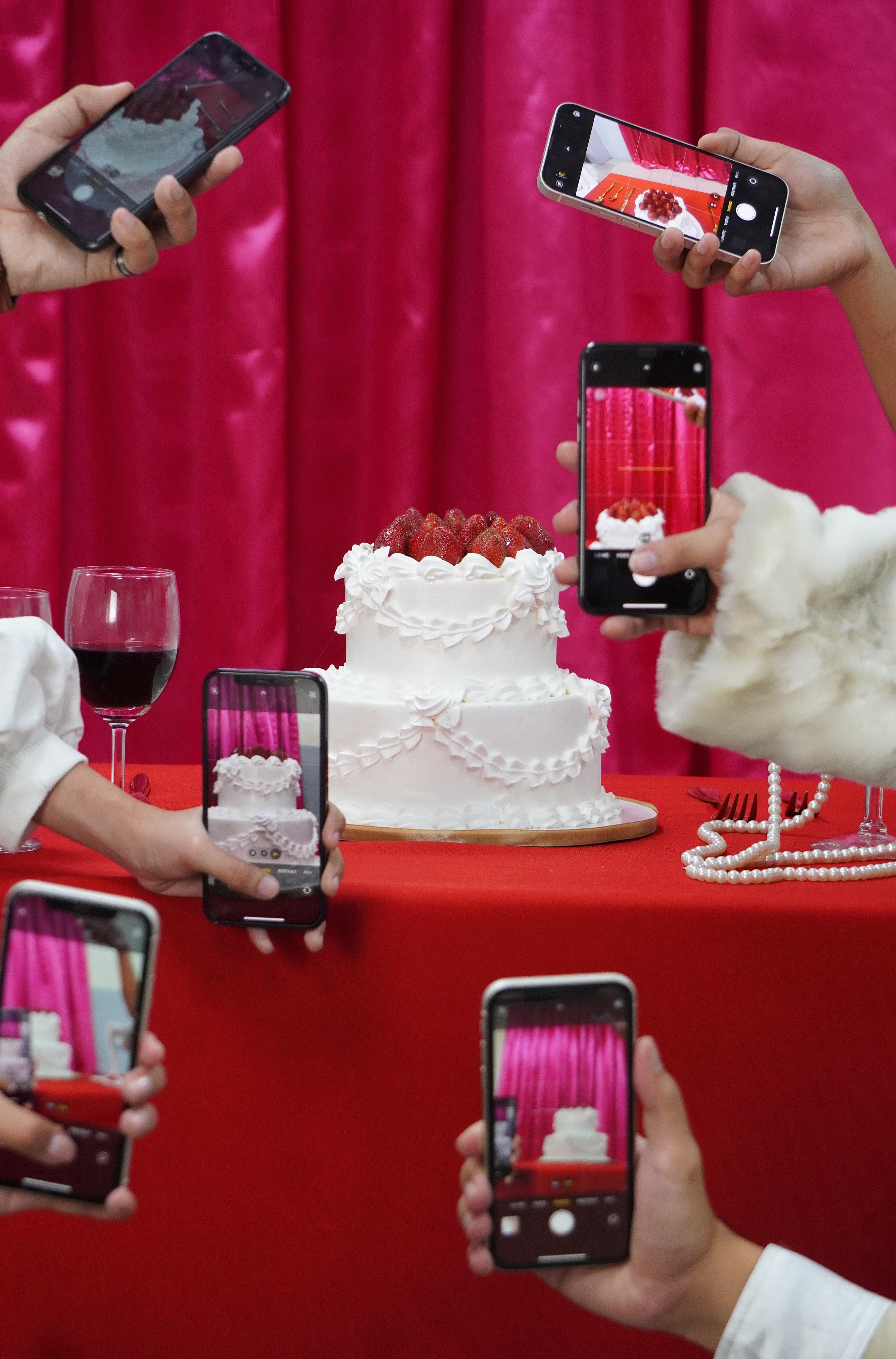
In this issue, prepare for drool-worthy delights presented through a prom-themed dual cover. These covers not only capture diverse perspectives but also create a compelling visual connection with the readers, leaving them satisfied until they’re ready to burst.
On the first cover, a man in a scrupulously tailored pink suit presents a towering cake adorned with spun sugar strawberries. Yet, beyond the grandeur of the cake lies his true masterpiece—the carefully modeled facade he dons, where he feels compelled to conceal his authentic self for the illusion of prescribed masculinity. Behind him, concealed beneath layers of white polka dot tulle, stands a woman intimately acquainted with the pursuit of perfection.
In the second cover, roles are reversed. This time, it is the female model who cradles the cake, its delicate tiers threatening to crumble. She has devoted years to refining herself—dieting, contouring, and practicing the art of being wanted and desirable.
Among the playful and colorful palette, a dark contrast lurks beneath the icing. Once a symbol of joyous celebration, the cake now bears the weight of expectation. Its presence feels burdensome, which elicits a longing for authenticity and vulnerability amidst its sugar-coated exterior.
Meanwhile, on the back cover, the digital banquet continues. Pixels replace plates, and status updates replace silverware. As social media becomes allpervasive, we devour experiences, filter memories, and garnish our lives with captions and hashtags.
But scroll carefully; the virtual buffet distorts reality.
Prom, with its shimmering gowns and crisp tuxedos, promises a night of magic. It’s the culmination of high school years, a chance to shine and be crowned royalty (at least for a night). But this relentless pursuit of a predetermined standard can be detrimental. We consume endless media, social pressures, and expectations in the process, forgetting that these are the very things shaping who we are.
We unknowingly consume anxieties about fitting in, pressures to impress, and the constant comparison game. This unseen menu, filled with insecurities and the desire for validation, subtly changes us.
Thus, FORWARD brings forth BON APPÉTIT, which sheds its usual culinary focus for deeper exploration: the truth behind “you are what you eat.” But here, the feast extends far beyond the plate. Just because it looks good or is appetizing doesn’t mean it’s nourishing.
The crown rests heavily on our heads. We chase after unattainable standards, believing that perfection will validate our worth. We consume diets of approval, scrolling through filtered lives, sipping on validation, and feasting on likes. Yet, with each bite, we swallow fragments of our true selves.
Although the menu may be vast and the choices are endless, it’s the quality, not the quantity, that truly satisfies.
This semester, BON APPÉTIT challenges you to rewrite your “prom diet.” We explore cultivating your authentic self, celebrating your unique flavor profile, and learning to savor the experience, not just the image. After all, your true essence is far more captivating than any carefully curated persona. In this digital diner, every byte counts.
So go ahead, dear reader, have a byte! FWD
Bottom’s up, Body Shamer
Samantha Mae A. Murillo graphic design by Krista Marie B. Yaoyao
As we uncork the bottles of times people define and reduce someone by and to their size, the toxicity just overflows. Let’s raise a glass to body shamers who are yet to meet shame— one sip at a time.
on social media, a local hotel received hot, piping backlash when one of its managers called a female intern applicant “gasul,” commenting on the height and body type of the interviewee. The said manager even added salt to the wound by saying, “Mag-reduce ka!”
She didn’t get the intern position. Instead, she got frustrated, disappointed, and unmotivated. This case is not isolated: it is only one of a million cases of the effects of body shaming.
According to a mental health information and news website, Psych Central, potential mental health consequences associated with body shaming include low self-esteem, emotional distress, anxiety, and eating disorders.
In spite of the world slowly learning to celebrate body positivity, an evident huge chunk of it consists of self-proclaimed body critics who still continue to judge and comment on the different sizes and shapes of beauty.
They say you’re beautiful, but maybe if you stopped being lazy, hit the gym, and slowed down on carbs, you could be even more attractive.
They say you’re a good fit, but maybe wear sleeved blouses from now on and hide those hideous-looking arms.
They say you’re hot, but only if your breasts weren’t so flat and you weren’t all bones.
The list goes worse and on. Whether skinny, fat, short, or tall, either way, you don’t miss a moment in society’s daily chatter. You will always be the main course on their mockery menu and the cherry on top of their contempt cake.
How many more family gatherings do you have to miss because Tita Susan will purposely mistake your belly rolls for a baby bump? How many chuckles will you have to fake whenever Tito Lito likens you to the centerpiece lechon on the table? It’s not your birthday, but somehow, you’ve become the star.
Or will you schedule an “unexpected fever” again for an upcoming batch reunion because your high school circle managed to stay in youthful shape while you’ll
be made fun of for having a dad bod? Your “fever” is made up, but it does not stop you from feeling so sick inside.
And everyone loves the beach except you. Dearest friends would applaud you for being “confident” and not giving a care towards what others might think about your weight. One might think it’s a compliment, but deep down, you know it’s a sugar-coated insult.
Reminiscent of every mojito you’ve downed, people’s words burn your already seared throat. Once more, it is hard to swallow, and the limes don’t help at all. Like this classic highball liquor, the shameful ridicule punches you hard right in your stomach. Once more, you want to vomit so bad and the chasers don’t kick in.
And you can’t help it. Shots were poured and you were made to get drunk. Your shame tolerance has suddenly disappeared. You end up laughing it off because society is cruel by nature. But just like how a bittersweet hangover stings in the morning, you could only hope that the pain and shame would go forth anytime soon.
I am tired of witnessing and hearing people go through such a hard time by simply existing in their bodies. Criticizing another’s physique might feel like a fleeting buzz—a second of self-assurance. However, the impact of your words goes beyond the moment; they take a toll for a long, long time.
Shame on you, body shamer.
Whether it is intentional or inadvertent, or subtle or crude, body shaming is body shaming.
Bodies are diverse, strong, and beautiful in their uniqueness. Diversity should be celebrated, not scrutinized.
Let’s create a community where all body types are loved, valued, and accepted, and cultivate a culture where unsolicited opinions, backhanded compliments, and unkind words wouldn’t stand a chance.
Stop blending your villainy with concern. Stop chugging down your destructive mentality for early breakfast.
Bottom’s up, body shamer. FWD
Josenian Icons Who ATE!
by Jonathan M. Ricardo graphic design by Narvie Klaryzze Borja and Ayn Nazareno
In achieving greatness, whether on faces, films, or finals, let’s relish and revel as our fellow Josenians serve up a fine feast worthy of their Alma Mater’s legacy!
It has always been such a treat and inspiration for us Josenians to see our idols serve—and indeed, they have served—in all the realms of excellence out there that we know of. Whether they grace the credits of your favorite series, dazzle us with their art, or impress us in the academe, we just love to savor their success stories, don’t we?
Scene-Setting Storyteller
Have you ever seen the award-winning short film “Just Woke Up” during CINEX’s 2022 film showcase? Or perhaps you’ve binged every episode of Kapuso Mo, Jessica Soho (KMJS) on Sunday evenings?
These marvels can only be possible in great part with the mind and mettle of filmmaker and program researcher Prex Niño Laroco, a Bachelor of Arts in Communication graduate who has dedicated his life to telling stories through film.
Now working at the prestigious GMA News Network, Prex recounts always envisioning himself telling stories on the big screen, even when he was young.
“It turns out that what I wanted from the very beginning was storytelling—to tell stories of people, to inspire them, to help them tell their stories,” he expressed.
He considered his status of working in the industry and learning from some of the Philippine media’s all-time greats as his crowning achievement rather than any awards, titles, or positions. However, a shot at the stars of directorship is always in his sights.
Despite this, he considers “Just Woke Up” as the most meaningful story he has ever told, as it resonates not only with himself but also with many fellow youths new to the world of adulting.
“I realized later on that you can end a story in a different way—not by telling them something, but [by] helping them realize something. And that’s the kind of story that I want to tell,” he told FORWARD.
Nowadays, you can watch Prex’s work come to life on every episode of KMJS at 8:15 p.m. every Sunday.
Scaling the Summits of Summa
Throughout her entire graduating batch, Angel May Flores, stands alone as the honored summa cum laude last January 2024.
A Bachelor of Science in Business Administration with a major in Operations Management (BSBA-OM), Angel has certainly proved that the standard for excellence of the University of San Jose-Recoletos (USJ-R) remains upheld.
Although her degree program may not be her first choice, her unwavering drive to succeed and consistently produce nothing but the best certainly remains the defining point of her character.
Nevertheless, she humbly attributes her achievement not merely to her feat of strength but to a bounty from the Lord Himself.
“Rather than getting the summa, I remembered I manifested for a magna and wrote it in my journal four years ago,” she reflected, remaining firmly grounded in humility, a characteristic emblematic of the quality Christian education of USJ-R.
At present, Angel makes waves in the industry as a brand associate at the renowned International Pharmaceutics Incorporated (IPI), and recently scored a Top 5 placement on the November 2023 Registered Business Professional (RBP) Examination.
Shading Sublime Splendour
All it takes is one Josenian to elevate the humble act of makeup into an art for the community they hold dear.
With an unrivaled passion for beauty, Jeorg Antonni Salutillo began her career as a freelance makeup artist at the height of the COVID-19 pandemic, drawing inspiration from the Queen Mother RuPaul, makeup artist Pat MgGrath, the movie “Paris is Burning,” and the series “Pose” and “Euphoria.”
Jeorg confidently makes a statement in her makeup, treating each of her clients as not only art but also as a way to show that makeup can be enjoyed by all—an art that is “messy, political, free, but also fun.”
“I believe makeup is, or has always made, the statement of being a medium for people to be seen…When I do my makeup, I want it to carry the message of ‘She’s doing this, not just to put something on!’ or ‘This isn’t just something for show!’ It’s actually a message for people that ‘This is just makeup! Anyone can wear makeup!’” she shared.
Despite the challenges of time crunches and routine, Jeorg always continues to find inspiration in her craft.
“Continue what you’re doing because, at the end of the day, a lot of people are going to judge you for it. But it doesn’t matter because you are here. Your artistry is valid, and there’s a space for it... wherever you may be,” she encouraged.
For those interested in getting the makeup experience of their lives, Jeorg can be reached for her services on her Instagram account: @jeorginanini.
These are but a few of the inspiring Josenians who, through their diverse achievements, have shown us the tenacity, dedication, and passion required to reach our full potential. May their stories of success ignite within us the drive to excel, not just in our grandest pursuits, but in every aspect of life, no matter how small.
It’s almost our turn at the pass, so let’s step up to the plate and serve, Josenians! FWD
Who’s On The Menu?
by Ejay D. Villaver
graphic design by Gabrielle Marie R. Paradiang and Astrid Niña T. Vidal
If there’s one thing “eat the rich” films have served over the years, it’s this: If you can’t beat them, eat them.
The moviegoers are hungry, and the rich are on the menu.
In a world where rich people wield all the cards, from exploiting the working class every day to evading accountability for their contribution to toxic carbon emissions, this power imbalance perpetuates a cycle of oppression. The minority has grown accustomed to this harsh reality, “all too well.”
In response to this persisting disparity, we are entering a new era of TV shows and movies where the theme “eat the rich” takes center stage, offering audiences a taste of rebellion and justice.
Finding pleasure in watching the wealthy suffer is a trend that’s a little sadistic, sure. But for those of us who have been starved by the growing dissatisfaction with a world that revolves around the rich, giving them a taste of their own medicine can be a satisfying delicacy.
In honor of this rage, FORWARD has carefully curated a selection of films where the ruling class faces their reckoning and pays the ultimate price.
So, raise your forks because going outside and touching grass isn’t enough anymore. We need to eat the rich!
Parasite (2019) by
Bong Joon-ho
At its core, Bong Joon-ho’s 2022 Best Picture film, “Parasite,” is a beautiful blend of dark comedy and a biting social commentary on the South Korean class divide. As the title implies, the film centers around the Kim family, lying their way to infiltrate the lives of a wealthy household like parasites. This intricate plot serves as a satirical feast, revealing the tensions and absurdities that arise when two families from opposite ends of the socioeconomic spectrum collide.
Described by its creator as “a comedy without clowns, a tragedy without villains,” this film distinguishes itself from other “eat the rich” narratives by portraying the upper family not as caricatures of evil or heartless millionaires but as apathetic individuals—a common crime among the privileged by demonstrating an indifference towards the lives and rights of the marginalized.
With twists and turns that keep viewers on the edge of their seats, Parasite refuses to let “nice” rich people off the hook.
The Menu (2022)
by Mark Mylod
Mark Mylod takes the “eat the rich” theme to a literal extreme in his 2022 film, Menu.” Set on a remote island, the story unfolds in Hawthorne, a one-of-a-kind restaurant owned by celebrity Chef Slowik, where only the pretentious elite indulge in fine dining at a jaw-dropping price of $1,250 per person (seriously, what are they eating?).
Among the selected diners are tech moguls, a washed-up actor and his assistant, a discerning food critic, a magazine editor, and Tyler (Nicholas Hoult), an Instagram foodie accompanied by his girlfriend, Margo (Anya Taylor-Joy).
This dine-and-death dark comedy highlights how the insatiable demand for such high-end exclusive dining experiences has spoiled the art of cuisine with a bitter taste, making it accessible only to the elite. Except for Margo, the sole working-class individual in the group, everyone at the table views the cuisine not as sustenance but as a badge of class. Instead of savoring the flavors, they analyze, criticize, or simply flaunt their meal as a status symbol.
Saltburn (2023)
by Emerald Fennell
Triangle of Sadness (2022)
by Ruben Östlund
Finding flaws in Director-Writer Ruben Östlund’s latest film is no easy task. His award-winning masterpiece, “Triangle of Sadness,” takes a no-holds-barred approach to exposing the flaws of the elite. Set aboard a luxurious cruise ship, the movie follows a celebrity couple with several loaded guests. However, when rough seas disrupt their dinner, it turns the fancy feast into a disgusting vomit extravaganza (heed my warning: eat lightly before you watch).
As the ship sinks, the survivors find themselves washed ashore on a deserted island, setting the stage for a shift in power dynamics. The once-privileged guests, devoid of survival skills, now depend on the expertise of the lower-class cleaning staff, Abigail (Dolly De Leon).
As the story unfolds and tensions escalate, it exposes the superficiality of wealth and the ignorance of those who have lived in
Known for her razor-sharp storytelling in “Promising Young Woman,” Emerald Fennell took the TikTok community by storm with her sophomore film that explores the dark facets of desire. Set in a small coastal town, “Saltburn” follows Oliver (Barry Keoghan), a scholar student at Oxford University, who becomes entangled in the lives of the wealthy Catton family, particularly with Felix Catton (Jacob Elordi).
As Oliver’s infatuation with Felix and his fascination with the privileged lifestyle became an obsession, he manipulated his way into gaining control of the Catton family ’ s estate and fortune through a series of lies and manipulations, ultimately leading to their tragic end.
The film exposes the superficiality of its characters, offering a sharp critique of how people have to resort to extreme measures in order to obtain wealth and power. Amidst all the TikTok buzz surrounding this movie, one of the few that actually lives up to the hype.
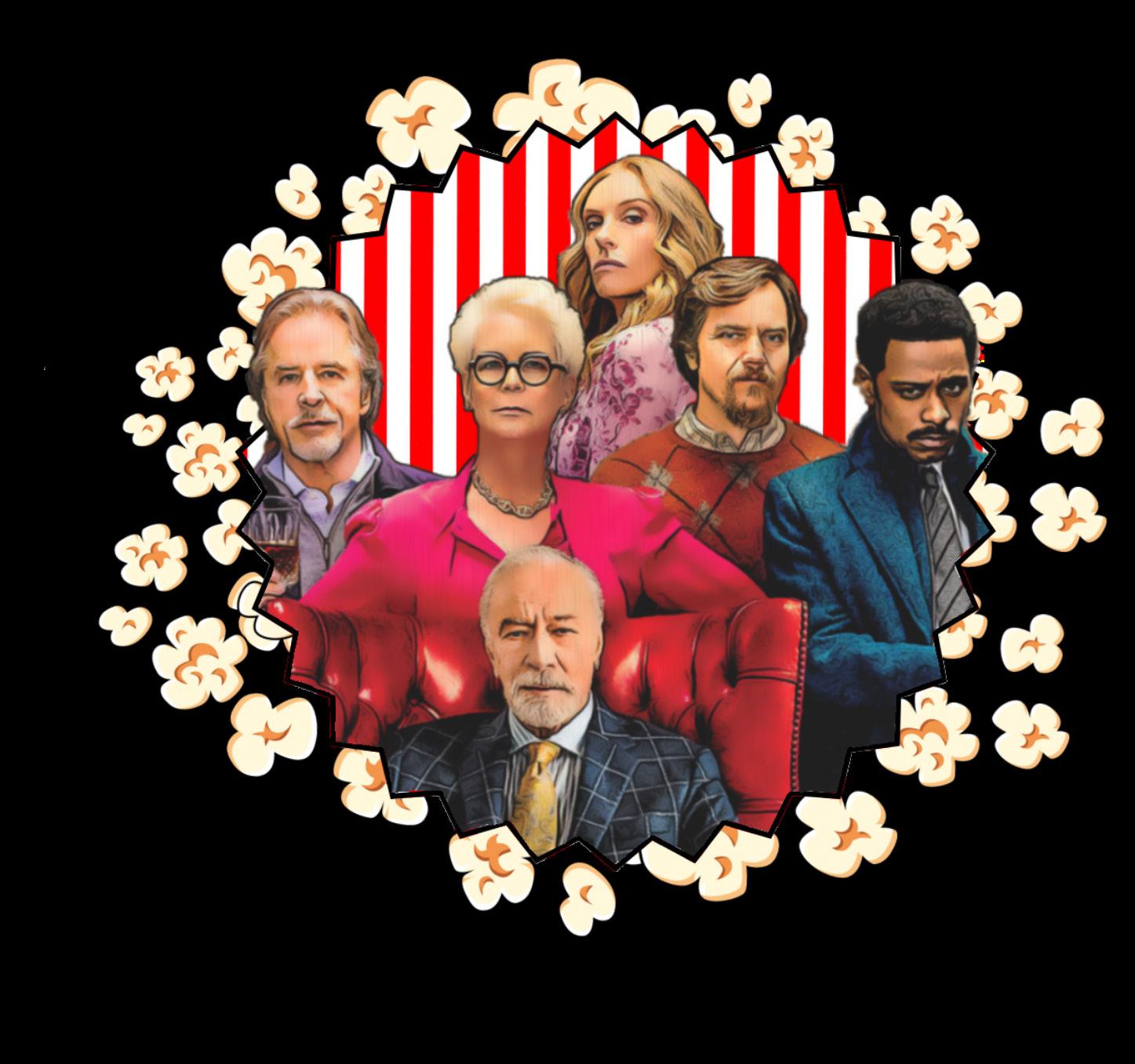
Knives Out (2019)
by Rian Johnson
The same shift in power dynamics can be seen in Rian Johnson ’ s “Knives Out.” With a stellar ensemble cast led by Daniel Craig as the detective Benoit Blanc, this modern twist on the classic murder mystery genre follows the investigation into the death of Harlan Thrombey. When Blanc interviews each member of the Thrombey family and their staff, he uncovers a web of secrets, lies, and motives for murder.
The shift in dynamics happens after the Thrombey family hears Harlan’s will stating that he left everything he owned to his nurse, Marta (Ana de Armas). As a result, the remaining Thrombeys are wrathful, ready to pounce on anyone who threatens their greedy acquisitions.
In the end, Marta comes to hold a place of power over the Thrombeys, turning the tables in this murder mystery with a sociopolitical tint. The film ends with Marta standing on the balcony of the family’s mansion, looking down on the Thrombeys, a mirror image of the inequality she experienced at the beginning of the film when she worked for the family.
“Knives Out” is the first of Johnson’s saga, with a sequel, “Glass Onion,” already released and a third installment currently in the works. FWD
Unsafe Bites
by Sharry M. Cuizon and Jonathan M. Ricardo photo by Astrid Niña T. Vidal
There’s no flavors to savor when the menu’s main course is foul odors with sides of grime.
Since the canteen resumed full operation with the return of face-to-face classes at the University of San Jose-Recoletos (USJ-R), many have been grateful for its continued service to the Josenian studentry. It is common to see it packed, especially during lunchtime, as hungry students eagerly line up for their meals prepared by hardworking staff at different stalls.
The canteen has always been a reliable option for most Josenians, even with cheaper alternatives outside and the emergence of competitors like The Barracks across the University.
However, whether pre-COVID, as detailed in a previous Investigative Report in FORWARD’s First Semester 2019-2020 issue, or at present, there remain problems
that demand solutions in order for every Josenian to receive their money’s worth with each filling meal in these halls.
In this spread of concerns, many key flavor points melded towards a singular debacle: sanitation.
Entrees of “Ew”
From slippery floors to foul odors, cramped spaces, loud surroundings, broken chairs, and stinky tables, one of the problems reported by students is their encounters with food spoilage.
A first-year Bachelor of Arts in Communication student mentioned how they suffered gastroenteritis after eating food bought at one of the food stalls inside the University canteen.
“Nagpalit ko’g steamed siomai nga three [for] 25 pesos. After sa first bite, naa jod siya’y weird feeling para sa akoa tapos nagsakit og taman ako tiyan,” they expressed.
They added that they were not able to attend school the next day due to severe stomach pain, which led them being checked by medical professionals.
“Nagka-infection akong tiyan ato, ana ang doctor [nga] nagka-gastroenteritis ko agi sa food [nga] ako gikaon,” they added.
Meanwhile, two Nursing students who opted to remain anonymous asserted that the CLAYGo (Clean As You Go) policy has not been effectively implemented recently.
“Sometimes students leave their leftover food on the tables as if wala na’y mogamit ana sunod,” they said.
They stressed that it had been a tiring cycle of cleaning after other students’ mess and found it impossible to change because of how normalized it has been around the canteen.
“It’s either limpyohan sa mosunod or ipadaplin na lang pod, [kaysa] wala’y magamit nga table,” they added.
Moreover, these matters not only affect students, but also put pressure on the vendors who experience the same discomfort despite “diligently conforming to the process of sanitation.”
A vendor from one of the stores in the canteen, who declined to reveal their identity, stated that despite their effort to clean their designated area, support is still needed from the administration when it comes to the overall maintenance of the facility.
It has also been known that there is a quarterly inspection from the Department of Health (DOH) in Cebu City; however, what the vendors want is close monitoring from the University administration.
“Bahala unta twice a month mi nila tabangan og maintain diri ba, pareha anang mag-provide unta sila og spray ba kaha para sa mga uk-ok ug ilaga kay pagkaon baya ni among baligya,” they said.
“Manglimpyo man mi kay kinahanglan man aron makapadayon mi diri, pero di jod malikayan nga naa gihapon mga ilaga, uk-ok, ug langsa sa basura,” they added.
Where’s the sauce?
To shed light on the uprising concerns of both students and vendors, FORWARD interviewed the Health Services Department’s nurses, Janet Chiong and Pamela Ann Alfarero, on how they would address the adversities mentioned by students and the vendors.
In particular, while addressing these complaints, Chiong expressed her desire for due process in addressing matters raised by concerned parties.
“Supposedly, kung naa’y mo-complain nga pan-os ang [food] sa canteen, they should file a letter of complaint
para naa ta’y evidence ba,” she said, emphasizing the need for concrete proofs such as photos and records to verify the allegations.
Further, while it is the University’s maintenance and cleaning personnel, or PACUBAS’ responsibility to sanitize the canteen before and after use, Chiong also stated that it is the vendors’ duty to request pest control materials from the Property Administrator’s Office (PAO) and Accounting Office for their stalls.
They also stated that inspections, while led quarterly, are conducted randomly, unseen, and unannounced to maintain the anonymity and confidentiality of the inspectors and to ensure that the results of the inspections are valid.
“Kay siyempre, if we announce it, mag-ready na sila tanan,” Alfarero expressed.
Finally, while the terms and conditions of operation for the stalls—and health requirements thereof—are contained within the contracts drawn up and signed by the owners of said stalls, Chiong added that these could not be disclosed to the public for legal reasons.
She added that they did have an action plan in place to attend to stalls with inadequate requirements for operation or other problems.
“We made the report, amo gyod nang gi-submit sa accounting. Ang accounting na’y mohatag nila og warnings depende sa among report,” she explained, stating that there was a warning system prior to the three-day suspension, which was applied during the 2023 visit of the Philippine Accrediting Association of Schools, Colleges and Universities (PAASCU) when certain stalls were noted to be closed.
With the current status quo, it has to be acknowledged that there are definitely systems in place to ensure our continued safe feasting in the canteen.
However, despite these, the troubles plaguing our canteen must be addressed. It is always given that anything that may harm the health of any member of the community should not be tolerated.
While the USJ-R community continues to seek more concrete responses from the authorities involved, Josenians as a whole must perform their part in keeping the canteen a clean place instead of normalizing the state that it usually finds itself in.
As soon as there is decisive action, then can Josenians dine with assurance that the canteen is a sanitary place where unsafe bites are no longer served. FWD
Bill Out, Please!
by Louise Lambiquit and Jonalyn V. Omania
by Krista Marie B. Yaoyao
USJ-R envisions producing competitive students capable of global success, necessitating the institution to ensure satisfactory services. With the recent tuition and miscellaneous fee increase, can Josenians attest that their needs are consistently met?
As Josenians roam around the University of San Jose-Recoletos (USJ-R), enjoying the fully air-conditioned rooms and facilities, with personnel ensuring the cleanliness of the University premises, these become familiar and ingrained .
However, with the growing Josenian population, the demand to improve its resources and the overall learning experience has come to light.
Proposed 2023 TAMFI
In early 2023, USJ-R proposed a Tuition and Miscellaneous Fee Increase (TAMFI), which was approved by the Commission on Higher Education (CHED) effective the same year, with a 10% increase for tuition in response to the current inflation in goods and services, primarily due to the onset of the COVID-19 pandemic.
With the approved increase, a second-year BA Political Science student expressed their sentiments over the growth of the tuition, saying that they have not noticed any change when it comes to the services offered.
“Nakabantay jod ko [nga] ang atong tuition fee karon kay ni-increase and if maka-ask ko, unsa nga matter gali ang naka-pataas sa tuition kay in terms of facility and services, same ra man gihapon like unsa gani’y na-add [nga] something [nga] worth ana nga money,” they said.
University Comptroller Dexter Joseph Cuevas, CPA, expounded on why there is a need to have an increase in fees.
“Historically, if you look at the records, it was every two years [that] there was an increase. There is no definite
photo
timeline for the increase, but we are bound to look at our financial standing, the inflation rates, and also according to our needs,” Cuevas said.
“In 2023, we implemented the proposed increase effective 2023, so what was deliberated at that time, what was cascaded to the parents, [and] what was consulted to the students sa SSC (Supreme Student Council) was approved by CHED,” he added.
On the other hand, a first-year BS Accountancy student raised the same concern about the miscellaneous fee being “too expensive.”
“Dako na kaayo siya nga amount and I think dili kaayo siya justifiable. [Regarding] sa Wi-Fi, dili tanang students, like me, makagamit ana and then same sa library nga naay gibayran pod, not all students can use the library,” they said.
However, Cuevas clarified that not all miscellaneous fees have an increase.
“[We] can never get rid of inflation, year on year, we really have felt the increase of prices escalating. For the Library fee, if you can compare the fees of the past and the fees in 2023, there are no increases,” he said, highlighting how the Chief Librarian maintained that the current fee is enough to sustain its operations.
As for the medical services, Cuevas said that the prices of the medicines have also increased, affecting its fees.
“You can get medicine, but not unlimited because it’s not a pharmacy,” he added.
Moreover, he shared the current status of the Wi-Fi, noting that the huge number of Josenians accessing it affects its bandwidth and speed.
“Before the Wi-Fi, according to our IT (Information Technology) Administrator, you can access the internet connection for only two hours but today it’s unlimited so that explains as well,” he said.
Why do we need an increase?
Around February 2024, the USJ-R Office of the President issued a memorandum dated February 27, 2024, that the University will be adjusting the tuition fees for the Academic Year (A.Y.) 2024-2025, which will only be applicable for freshmen, transferees, and returnees.
USJ-R Vice President for Finance Rev. Fr. Leopoldo Estioko, OAR, elaborated on the reasons for the proposed increase.
“We already have approved the proposed increase for the upcoming school year, the increase will be 10 percent for the incoming first year, returnees, and transferees, so ang mga dating estudyante ay walang increase. Ang reason ana is we will adjust the status of the faculty and employees, adjusting for the increase of commodities. The increase [in] commodities by now is 5.10 percent. We need to justify our increase before CHED [approves],” he explained.
“Second is that we have to recalibrate. It means the adjustment of the salary of employees, and also increase the number of scholarships [e.g. READS (Recoletos Educational Assistance for Deserving Students)]. So these are the three important reasons why we have an increase,” Fr. Estioko continued.
According to Fr. Estioko, the electricity bill of the institution has skyrocketed ranging from P4 million to P6 million a month. With this, the Property Administrator’s Office (PAO) wishes to lessen the utilities’ expenses and plans to “computerize” the University by making the classrooms a “smart room.” These smart rooms will allow centralized control over electricity usage, making significant cost savings a reality.
“We find out that sometimes rooms which are not utilized, nag-andar ang lights and ga-on ang aircon [for a span of time]. How much would we pay the electric bill?” he emphasized.
Fr. Estioko further said that lessening the electric bill would allow them to use the money to maintain other facilities in continuously providing the University’s “dream” of offering the Josenians a well-maintained and comfortable learning environment.
“It is the desire of the institution of the school board to raise the bar in matters of the educational system, facilities, and services, we always want to improve,” Fr. Estioko said.
Reviewing Academic Scholarship Discount
In a FORWARD article published in early 2022, many students have raised concerns about the academic scholarship discount criteria, wondering if there is a possibility to revert to the old one before the onset of the COVID-19 pandemic as the physical setup is now back in the University.
Cuevas said that re-establishing the criteria for the academic scholarship discount is still subject to review.
“We have promised the SSC that we will review again, but for now it is still the same mechanism, the same grants and discounts. The University has also promised to the students to review the granting of the discounts. There is a need to review [the criteria] but as to when, hopefully, a year from now, but no commitment,” he said.
The reason for setting the standards high is because of the “significant increase” in the number of academic scholarship grantees in the University during the pandemic which is seen as the prime reason for changing the percentage of the academic scholarship discount.
Moreover, the augmentation in the number of grantees is due to the leniency performed by teachers and faculty in terms of academic workload and deadlines, as instructed by the administration.
As USJ-R strives to provide quality Christian community-oriented education, it currently thrives as one of the most prestigious universities in Cebu. According to EduRank, an independent metric-based ranking, the University ranked second in the Top 10 Best Universities in Cebu City for 2024.
As of this writing, the proposed increase for A.Y. 20242025, which will only be applicable for freshmen, returnees, and transferees, is yet to be approved by CHED. FWD
The Rotten Apples of Teacher Evaluations
by Krisha Faye A. Gascon and Maria Cristina G. Lamug photo by Christian A. Mananguite
USJ-R’s teacher evaluations aim for improvement. However, does the current evaluation system truly improve teaching, or is it just a formality?
At the University of San Jose-Recoletos (USJ-R), a mandatory teacher evaluation through the School Information Service (SIS) has become a familiar semester-end ritual for students. While the administration touts it as a way to gather students’ feedback, a crucial question lingers: Do these evaluations translate to positive change, or do they simply fade into administrative obscurity?
As the Josenian population continues to grow, the need to reexamine the current teachers’ evaluations’ efficacy has been raised among students.
A BS Psychology student who spoke on condition of anonymity initially expressed enthusiasm but later found parts of the “lengthy” questionnaire as “unfavorable,” adding that “the evaluation process may be more of a formality than a genuine stimulus for teacher improvement.”
Meanwhile, a BS Business Administration major in Financial Management student recounted an instance where their class assessed a part-time instructor. Despite their efforts to highlight areas for improvement, they stated that there seems to be “little to no response or follow-up from the administration.”
In response to these concerns, FORWARD delved into the teacher evaluation process at USJ-R.
Fruitless Harvests
According to a second-year Accountancy student who shared their experience and assumptions regarding teacher evaluations, “Bisan pa’g unsa ka tinuod siguro ana imong gipang-comment ug gi-rate sa instructors, if that teacher is being valued unya wala’y gibuhat na against sa school siguro kay wala ra gihapon na’y ganap.”
Former chairman of the Department of Social Sciences and Philosophy (DSSP) for the Academic Year (A.Y. 2014-2018), Richard Fernandez, offered insights into the teacher evaluation process in acknowledgement of the aforementioned assumptions.
According to Fernandez, faculty members are assessed based on various parameters, such as classroom performance, mastery of the subject matter, and rapport with students.
Contrary to popular belief, teacher evaluations are not simply collected and forgotten. In fact, three different evaluations exist: one from the dean, another from the department chair, and the students.
Once all evaluations are completed and analyzed, the results are communicated to the faculty members. This ensures transparency and allows them to understand their strengths and weaknesses as perceived by various stakeholders.
Fernandez emphasized the chair’s responsibility to identify areas of improvement for the professors, likening its role to that of a “Chief Executive Officer.”
“The chair, upon evaluating or looking [at] the results of the evaluation, will identify the weak points of the teacher and will have to see to it that these weak points [are] subjected to some sort of intervention scheme or any program that is viable, accessible, and practicable for teachers’ improvement,” he said.
Moreover, he explained that during his time as chairman, he would sometimes initiate developmental interventions for certain teachers based on their evaluation results. These interventions involved practices like classroom observation, wherein the targeted teacher observes colleagues in action to learn and potentially integrate effective practices into their teaching methods.
“I think [I had] three teachers [that were subjected to interventions] during my time. They observed classes of other fellow teachers and [were] able to incorporate in their classes the best practices of these teachers,” he said.
Following the evaluation analysis, the chair informs teachers about potential intervention to identify areas for improvement through a memorandum.
However, Fernandez pointed out that the effectiveness of these interventions ultimately depends on the teacher’s willingness to address their weaknesses.
“Sometimes some of the teachers will take it personally. And you know, there are people who are quite
unreasonable. They don’t abide [by] reason or logic; they take everything personal,” he stated.
Fernandez further emphasized the limitations of the evaluations. Although he acknowledged its usefulness, he did not consider them “accurate” in measuring effectiveness but rather “a work in progress.”
Bad Apple, Bad Tree?
Regarding terminating a teacher based solely on a negative evaluation, a third-year financial management student remarked, “Firing them just because we are not satisfied with how they teach, I think not enough reason ra pod siya and might be as an individual ing-ana lang imo na perceive but to some students effective ra ilang way of teaching.”
Meanwhile, when asked about instances of firing a teacher due to a poor evaluation, Fernandez could not recall any such cases. He expressed a reluctance to terminate someone based on the evaluation per se, citing the institution’s ethos of providing hope and chances.
“I think that would be quite too much. Because this is a Catholic institution, we always give hope to people; we give them [a] chance, and that is the essence of Christianity in the first place,” he said.
However, he addressed that in extreme situations where a teacher’s behavior or beliefs become a clear and present danger to students, the institution may need to take more decisive action. This includes measures such as termination or demotion, noting the need to balance the commitment to improvement with the responsibility to ensure a safe and conducive learning environment for students.
Another critical concern regarding the evaluations is the potential tension between the safety and anonymity of the students providing feedback. However, Fernandez assured that the feedback remains confidential.
The names are intentionally kept anonymous in order to uphold the evaluation’s purpose, emphasizing a commitment to “respect and recognize one’s privacy.”
Spoiled Fruit?
Fernandez recognized the shortcomings in the current approach and said he could not recall the last time the evaluation format, including the questions and scale used, had been updated.
He further added that the bureaucratic hurdles to changing the existing system require time and effort.
Just like how a single rotten apple can spoil the whole bunch, a flawed evaluation system can hold back the potential of excellent educators. Only by overhauling the current system can we ensure that it yields the fruit of a truly enriching learning environment for all. FWD
University Canteen’s 10 Voracious Monsters
by Krisha Faye A. Gascon illustrations by Heron Augustus S. Flores and Hannah Vanessa O. Mondilla
Forget the clock striking twelve. Forget Cinderella’s vanishing carriage. In the University of San Jose-Recoletos (USJ-R) canteen, the real magic happens at noon! No fairy godmothers, just rumbling stomachs.
1. The Parasitic TikTik of the Shared Plate
Behold the enchanting transformation as the student body ’ s hunger takes center stage in its most ravenous and occasionally monstrous manifestations!
The splurge of creatures of legend, each with their own pangs and peculiar habits, will slowly but surely populate the University Canteen. But fear not, for I, your seasoned canteen-walker, shall guide you through the ten tribes of culinary creatures that lurk within its walls.
Cloaked in the guise of friendship, these creatures hover near your plate, eyes scanning for unguarded morsels, while long tongues drip in hunger, emitting a tick-tick-ticking noise from the vast hollows.
These cunning creatures, ever-ready to snatch a french fry or a spoonful of mango float, possess an uncanny superpower: an innocent request of “Pwede motilaw?”, “Unsa’y lasa ana?”, or “Lami?” followed by a slow, strategic migration of your self-paid (or self-made) food onto their own platter.
A stray chicken wing? Gone. A half-eaten lumpia? Vanished! They are lost to sight too, melting back into the crowd, leaving you bewildered and your lunch lighter.
2. The Scholarly Sigbin
Sure, you might dream of sizzling sisig, but this beast’s intellectual hunger burns hotter than a thousand chili peppers, which propels it on a quest for endless learning. Hunched over laptops, textbooks, and yellow papers, these creatures are the scholars of Canteen University.
Spotting them is easy—their eyes, red and bloodshot. Perhaps from caffeine, and maybe because they kept themselves awake during the night, hunting—studying, rather.
They mutter incantations of complex terms: “Cephalic-Cranial, Frontal, Facial…” or “XYZ purchased a two million debt instrument last 2022. What is the 2019 net income?” Their voices, a hushed chorus, drowning out the rumbles of your empty stomach.
Woe betide ye who disturb their rituals of rote memorization; a mere request for a seat could unleash a verbal firestorm worse than any spice.
3. The Duwendes of the Queue
These malicious dwarves are masters of the passive-aggressive queue; they count your steps and glare at your phone.
They sigh dramatically when you take “too long” to order, their disapproval seeping into your pores. “Dugaya moirog aning linyaha gud?” they coo, their sugary voice dripping with fake concern.
The next thing you know, they’ve already infiltrated the line right before you, but their practiced apologies are dripping with saccharine deceit.
Beware of their sly smiles, for they feed on frustration, reminding you of your place at the bottom of the food chain.
4. The Easily Disheartened Bakunawa
These colossal serpents possess appetites that could swallow seven moons whole. Yet, the mere sight of the endless line and jam-packed canteen sends shivers down their mighty spines.
Hunger gnaws at their bellies, but patience wears thin. With a sigh that echoes through the crowd, these creatures turn tail and retreat, surrendering their lunch dreams to the queue monsters.
However, in moments as fleeting as a blue moon, you might catch a muttered, “Barracks na lang ta na,” accompanied by a face etched with dismay as they opt for instant, albeit pricier, sustenance.
The fearsome beast might intimidate you, but fear not too deeply. For hunger, as easily appeased by convenience as it is ignited by delay, would rather choose the path of empty stomachs than the queue’s embrace.
5. The Kapre with a Case of
Borderline Delulu
These lovelorn beings, drawn by an invisible thread to their crush’s ethereal presence, enter the canteen in borrowed human skin.
Their friends can’t help but chuckle at the muttered, “Dae, adto ta sa canteen na, basin makit-an nako siya—huiiiee!” followed by a telltale shiver and a laugh fueled by pure, unadulterated kilig.
As they enter the canteen, their gaze sweeps the room like a laser, searching for the beacon of their affection. They meander past food stalls—not just to quell the butterflies in their stomachs but also to ensure they’ve scoured every inch and left no corner unexplored.
Each plate of siomai with rice becomes a nervous offering, each sip of gulaman is a silent prayer, and each bite of waffle is a whispered plea: “Lord, tagai ko’g sign, please!”
Food is merely a prop, a reason to linger near the counter, hoping for a serendipitous encounter. Just a fleeting glance across the table, and their hearts are full for the day, nourished by the elixir of delusion.
6. The Loquacious Bungisngis
Keep your ears to the ground and observe the echoing laughter that bounces off the walls! For these creatures flit between tables like gossipy bees.
Their arrival is announced not by sight, but by sound. A boisterous guffaw, loud enough to turn heads, or the dreaded, “Mhie, naa ko’y chika!”
Juicier than any adobo, gossip flows from their lips like a well-rehearsed script, neglecting anyone’s plea for a seat.
Inside the campus walls, no secret is safe, and no drama escapes their notice. The Bungisngis are the engines of the rumor mill, fueled by the latest tidbits and hushed confessions even in the most crowded and busiest of times.
7. The Mischievous Tikbalang
Look before you leap for the one who waltzes through traffic with the grace of a drunken horse might catch you off guard. This, my friends, is the master of the canteen’s labyrinthine paths.
One moment they’re entering through the exit, the next, vanishing out the entrance, leaving you bewildered if they passed through at all. Their blatant disregard for foot traffic is legendary, and their mischievous grin is a constant test of your patience.
Their path is a chaotic ballet, a whirlwind of misplaced elbows and hurried apologies: “Ay, sorry!” they chirp, already dashing outside for their next class or scrambling in for a hunger-fueled sprint.
Perhaps next time, as the rumor whispers, wear your shirt inside out. It might just be the charm that breaks their playful curse and keeps the canteen’s flow unhindered.
2nd Semester 2023-2024
8. The Manananggal of Reserved Seats
Of course! Wherever you go, you can never escape these territorial creatures by virtue of a “reserved” sign, wielded like a flag!
They claim tables as their kingdom, deploying backpacks and bags like sentinels while their upper halves roam free. Their hunger isn’t for flesh but for exclusivity, a haven untouched by the uninitiated masses of the canteen.
So, before you ask, “Excuse me, naa’y naglingkod diri?” Just follow the trail of abandoned belongings, and you’ll know the answers.
Outsmarting them is tricky—they’ve mastered the art of claiming space before anyone else. Perhaps the only way to beat them is to be them.
But maybe you could also try garlic, salt, and prayer—maybe that could also ward them off.
9. The Sleepy Nuno sa Punso
Think twice before you sit next to the gentle slump, the head resting on a table turned into a makeshift pillow because you might just have to cover your ears from their snoring! This nuno is a master of transforming the bustling canteen into its own punso—a haven of slumber.
Lulled by the rhythmic clatter of trays and chatter, they find solace in the fluorescent glow.
Do they dream of rice mountains, or perhaps rivers of iced tea? The answer remains a mystery.
One thing is certain: their weary sigh, “Dukaa oi,” accompanied by a sleep-laden gaze, is a clear message of what they’re truly hungry for.
10. The Multo by the Aircon
Ah, the classic refrain, “Ayaw diha. Diri lang ta lingkod kay bantang sa aircon, ” announces their arrival.
On sweltering days, the air condition becomes their oasis, a sanctuary from the sun-baked quad.
These aren’t hungry souls seeking sustenance, but comfort seekers drawn to the cool embrace of the canteen’s air conditioning.
An ice candy becomes a mere formality, a small price to pay for a sweet relief from the heat.
But be wary, these aircon admirers can be persistent.
They might linger long after their meal is finished, basking in the cool air.
So, the next time you enter the University Canteen, remember: It ’ s not just a place to eat. It’s a vibrant stage where mythical creatures of hunger and habit play out their daily dramas.
Observe, be amused, and maybe—just maybe—find your own hunger satisfied amidst the chaos.
Just be sure to keep your food close, your wits sharper, and your patience thicker than a bowl of burger steak. Happy eating (or surviving), Josenians! FWD
DISCLAIMER: The issues presented are solely from the Josenians. It does not reflect the views and opinions of the publication.
An Attendance A Day Keeps the Mental Illness Away
Kanang malipay na unta ka kay makapahuway na human ang makabogo nga exam—mao man siguro na pagsabot sa tanan sa Mental Health Day? Pero nganong gibutngan man ni ninyo’g attendance, mamser? Nindot man ang idea nga mag-mingle-mingle mi sa among schoolmates noh, pero mas nindot kung nagpabilin lang siya nga idea! Naa baya’y uban nga mas kailangang matulog, mopauli, o molaag para malimtan ang score. Dili kay ipriso na lang sa eskwelahan tungod sa attendance!
Ang midterm naa na, ang prof duha-duhaan pa
Hay, kanindot sa pamati nga wala pa’y prof sa first week—‘matic vacant! Unta hasta second week, noh? Chillin’ like a villain lang sa ta diri ba. Hmm, abot man hantud fourth week, G lang kay way buhatonon hehe. Pero basin mosud na si mam next week oy, grabe na sad. Prelims na baya! Taymsa, naabot na man og midterm, wa man gihapon mi na-learn?! Vacant subject pa ni o vacant prof? Sa kadaghan og estudyante, mao sad kanihit og maestra! Ah, paeta!
Maot, taronga imong gisuot!
Mas daghan pa man siguro ko’g attendance sa OSAS kesa sa akong klase. Alangan man sad, mura man og matanglawin ang mga guards sa San Jose! Gamay’ng kihol, goodbye ID na dayon! Bisa’g di makita atong pusod, paisahon jod ta sa kamot aron mangita’g bikil! Pero bisan ingon ana, nganong daghan man japon ang way puangod maglaroy-laroy sa campus nga mas mubo pa og gisuot? Klaro kaayo ni ilang pattern: mga gwapa, hamis, way tatsa. So kung chada og itsura, wa’y silot, pero kung maot, “taronga imong gisuot?”
Ambi imong kwarta, hatagan tika’g librong di magamit
Naa ju’y mga libro nga ipa-require sa maestra kay kinahanglanon daw sa subject. Pero himan-himan diay to, kausa ra magamit! Mura baya’g barato, pang-gold ra ba kaayo’g presyo! Basin gatuo mo’g nagkalibang mi’g kwarta ha (Sakto gyod diay si mama). Kung mag-require man gani’g libro, unta basehan jod sa syllabus para ang among gibayran naa sa’y pulos. Naa man unta ni gamit, pero di magamit!
Di sad ta kaingon nga makaskwela ta kay nahutdan man og slot
Gatuo ko’g sa mismong klase ra ko magkandalisod karong college, apil pod diay enrollment?! Wa man ko na-inform nga pahutdana’y diay ni’g slots! Usa ka- refresh nimo sa SIS, hala tuara, wa na dayo’y available nga offer code! Mapa- block section o nonblock, ma- stress! Kulang nalang magparesita ta’g neobloc! Unya, naa pa’y online website nga mokalit lang og ka-lag–ma-logout pa gyod maskin gibyaan lang nimo’g pila ka-minuto. “Due to inactivity” sa imong mata! Mao diay gitawag nga SIS atong EDP, kay she’s not MOTHERing!
2nd Semester 2023-2024
illustration by Khen B. Fernandez
Shanly Nicole M. Basilla
Kent Lorenz Garbo
Caseylene Bridgette C. Amorado
1st Year Bachelor of Science in Psychology Magazine Model
Gian Carlo A. Lugto
3rd Year Bachelor of Science in Hospitality Management Magazine Model
Jonathan M. Ricardo Bachelor of Library Information Sciences Staff Writer