ALL IN THE FAMILY
Two generations, one shared vision
MID-CAREER RESET
Rethinking your second act WHO REALLY BENEFITS FROM AI?
Not who you think NEW TAX BREAKS HIDING IN BILL C-15 ON
COVER PHOTO I ASHLEY FRASER
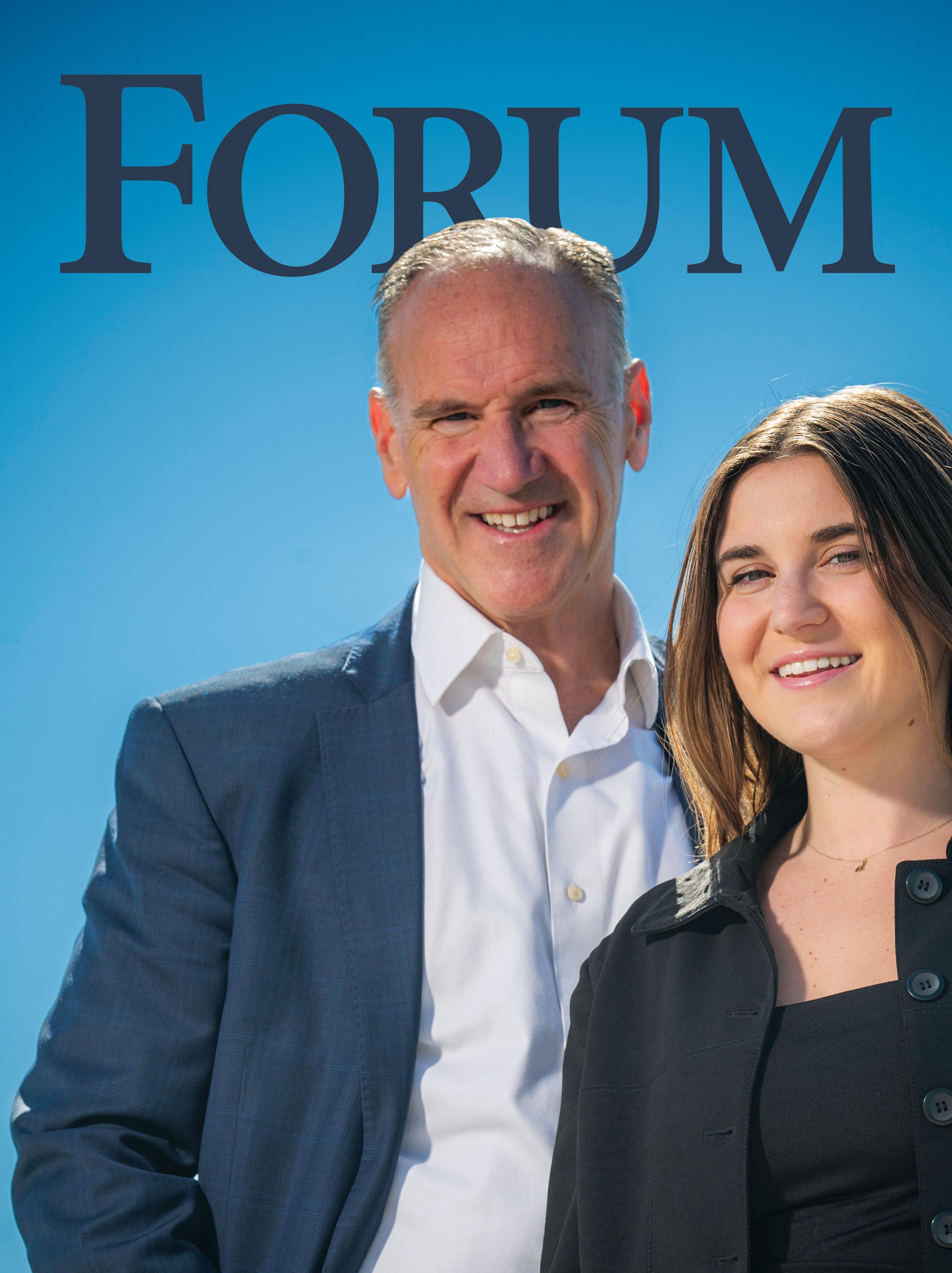
David and Dalia Feldberg
Two generations, one shared vision
Rethinking your second act WHO REALLY BENEFITS FROM AI?
Not who you think NEW TAX BREAKS HIDING IN BILL C-15 ON
COVER PHOTO I ASHLEY FRASER
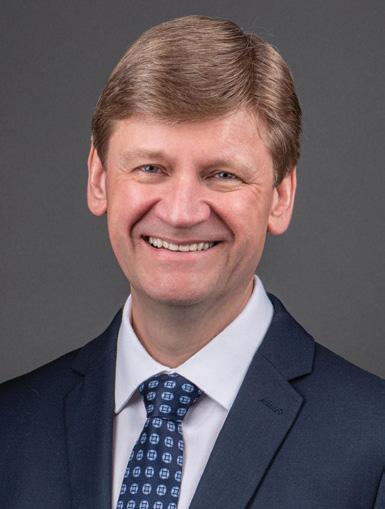
Congratulations to Stacy Hnatiuk who has been inducted into the Sun Life Hall of Fame.
Sun Life is pleased to congratulate Stacy Hnatiuk for his induction into our Hall of Fame, our highest honour recognizing outstanding personal success.
Stacy Hnatiuk is respected across Sun Life, the industry and his hometown of Saskatoon for his ability to build bridges, offer practical wisdom and give back to those around him. A 31-year industry veteran, Stacy is a valued mentor in Sun Life’s advisor community and a leading voice throughout the company.
Stacy has been an Advocis member for over three decades and holds life member status with Million Dollar Round Table’s Top of the Table. A former Vice Chair of the Insurance Council of Saskatchewan, he’s a longtime speaker on financial matters and continues to grow his skills through regular professional development. In his community, he’s a celebrated coach, volunteer and supporter of numerous charities and service groups.
In honour of his induction, Sun Life will make donations in Stacy’s name to KidSport Saskatchewan and the Saskatoon Friendship Inn.
Stacy
Hnatiuk B.A., CFP® Financial Planner, Sun Life
Castlegate Financial Solutions Inc. 1016 8th Street East Saskatoon, SK, S7H 0R9
306-955-7526
stacy.hnatiuk@sunlife.com
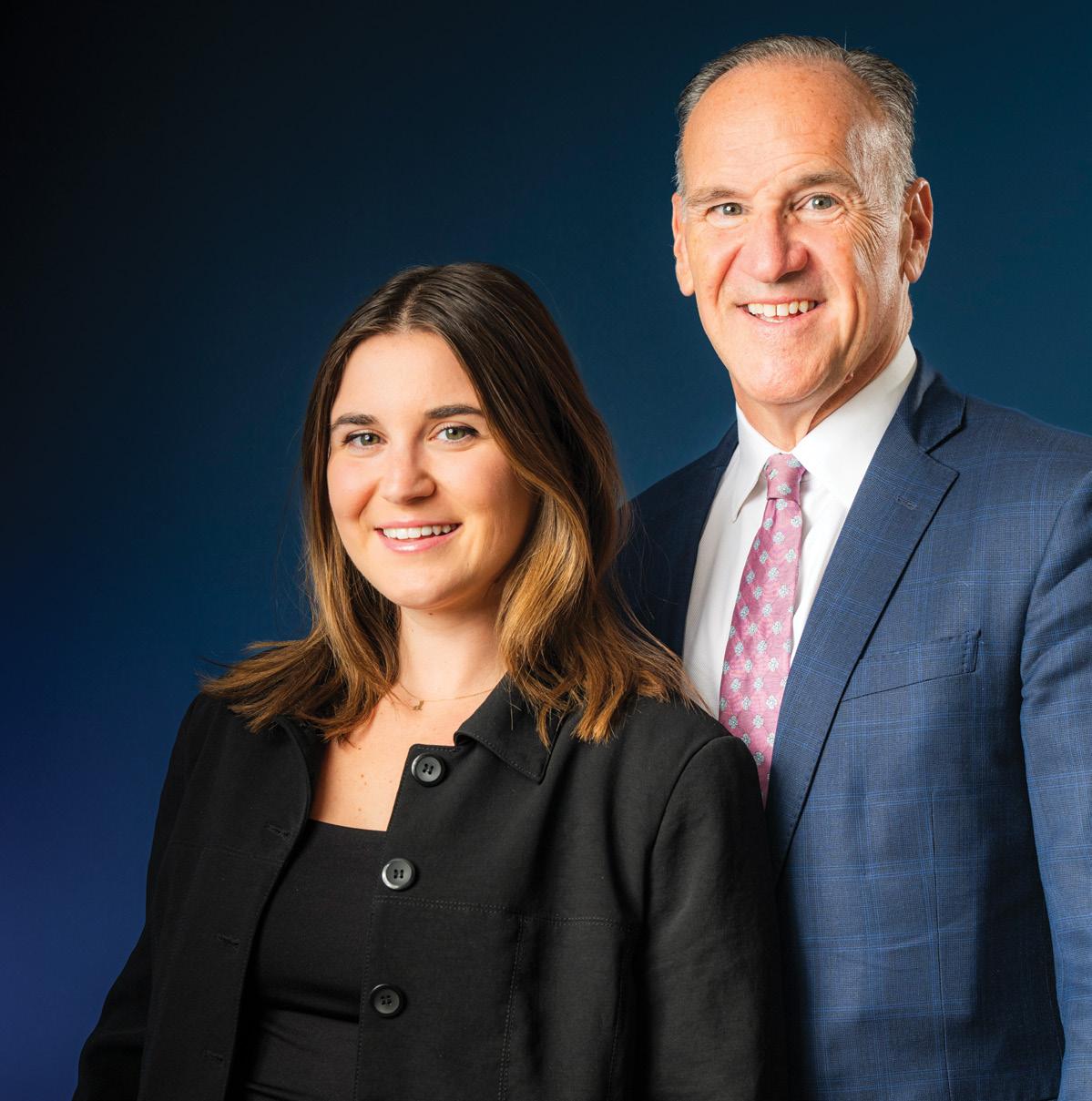
Meet the advisors who have decided to bring loved ones into their firms. Diane Peters explores the rewards and risks of merging bloodlines and bottom lines

After years in the industry, some mid-career advisors are reigniting their passion for work in unexpected ways, finds Rosalind Stefanac

As Alex
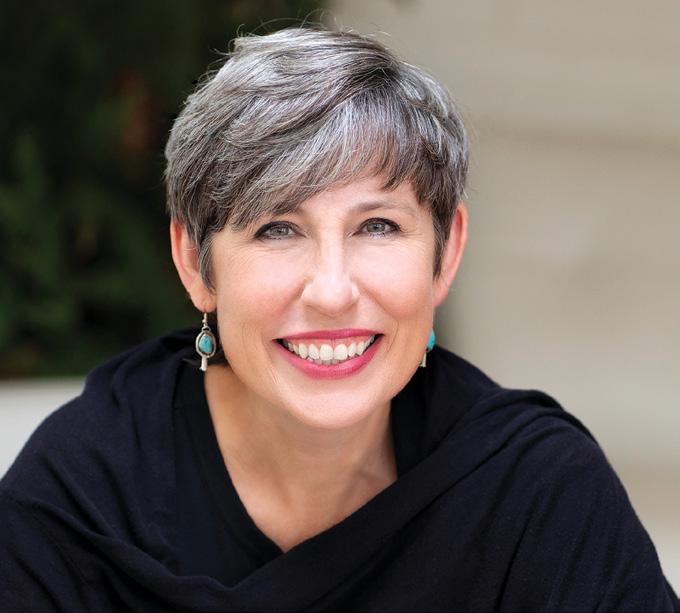
By Kira Vermond
Iremember the day I first heard of FORUM. I was 25, only a few years out of journalism school and a newly minted freelancer, which meant saying “yes” to any assignment that came my way. So when then-editor Kristin Doucet called and asked if I would write a feature, I agreed.
She walked me through industry basics, throwing around terms such as “securities”, “asset protection” and “custodians acting in a fiduciary capacity.”
I had no clue what she was talking about.
Had I really just agreed to write a 1,000-word article for security guards and building custodians? And why would they care about selling insurance and generating leads? Something felt off. So I did what any crackerjack ’90s reporter would do: I fired up my 56k modem and went looking for answers on the Information Superhighway.
It was the start of a long career writing about personal finance— across newspapers, magazines and books— and I have also been writing for FORUM ever since. And in that time, I’ve interviewed more than a hundred Advocis members. Here’s what I have learned: you are open, generous with your time and expertise and are fabulous storytellers. What’s more, you seem to take real satisfaction in helping newer advisors succeed.
Perhaps that’s because so many of you — like me — are in midlife, the years between 40 and 60, and what many would consider mid-career: well beyond the early foundational stage, but not yet ready to think about retiring.
Think midlife means over the hill? Time to reconsider. Research is showing midlife comes with strengths. One 2025 study found people tend to hit their overall peak around age 60— decades
later than many assume. Processing speed may slow, but older adults score higher across a range of measures, from reasoning speed to emotional balance. Experience and judgment skills increase with age too.
While a 27-year-old may excel at abstract problem-solving, older adults are often better suited for high-stakes decision making roles. In that same study, those in midlife were roughly twice as likely as younger adults to avoid the sunk cost fallacy: the tendency to throw good money after bad based on past investments.
So what does that midlife advantage look like in practice? In this issue, we explore three answers. In our cover feature on page 8, Diane Peters examines how advisors are bringing their children into the firm, translating experience into continuity. On page 14 , Rosalind Stefanac looks at the mid-career moment itself — how advisors can use it to reassess, reset and move forward. Then on page 18, Alex Dashefsky explains why the real winners of artificial intelligence are not always younger, tech-savvy advisors, but mid-career professionals with established client bases.
Taking on this role as FORUM editor feels like a full-circle moment. I began my career by telling the stories of this profession and now I have the privilege of helping shape them. So let’s keep doing that important work together. F
EDITOR: Kira Vermond kira@vermond.ca
COPY EDITOR & PROOFREADER: Kat Tancock
ART DIRECTOR: Michael Mariano mic.cruzmar@gmail.com
ADVERTISING: Andy Cameron bd@advocis.ca
TFAAC BOARD OF DIRECTORS
CHAIR
Curtis Kimpton, CFP, CLU, CIM
PAST CHAIR
Al Jones, CFP, CLU, ICD.D
TREASURER
Tannis Dawson, CPA, CA, CFP, TEP, FEA, CLU, RRC.
DIRECTORS AT LARGE
Arun Channan, MASc, MBA, P.Eng., CSP, CFP
Kelly Ho, CFP, CCS
Ejaz Nadeem, MA, CFP, CLU
Tina Tehranchian, CFP, CLU, CH.F.C., CIM
CHAPTER LEADERSHIP COUNCIL CHAIR
Chris Hudson, CFP, CLU, CHS
THE INSTITUTE CHAIR
Sara La Gamba, CHS, CFP, CLU, TEP
FORUM is published two times annually by The Advocis Publishing Group, 10 Lower Spadina Avenue, Suite 700, Toronto, Ontario M5V 2Z2
Tel: 416-444-5251 or 1-800-563-5822
Fax: 416-444-8031
FORUM is mailed to all Association members, the subscription price being included in the annual membership fee. Address changes can be made through info@advocis.ca or by calling member services at 1-877-773-6765.
The opinions expressed in articles and advertising are those of the authors/advertisers and not necessarily those of FORUM or the Association. Material of a technical or semi-technical nature may become invalid because of later changes in law or interpretation. The Association is not responsible for obsolescence of FORUM articles whose content should be checked by the reader before implementation.
Requests for permission to reprint articles are to be addressed in writing to the editor of FORUM. ™ Trademark of The Financial Advisors Association of Canada carrying on business as Advocis.
This is your magazine. If there are topics you would like us to cover or conversations you think we should be having, please reach out. kira@vermond.ca
Whether you’re starting out or sharpening your edge, the PFA equips you with the skills, structure, and support to succeed in today’s competitive landscape. It’s the ideal next step after licensing, and a powerful foundation if you’re on the path toward advanced designations like the
• Practical, real-world training in practice management, technical knowledge, compliance, and ethics
• Complete the program in just one year
• Flexible, fully online and self-paced
• Builds trust and credibility with clients
• Strong foundation for future credentials like the CLU ®

• A nationally recognized credential from The Institute™
• 4 focused online courses
• A final comprehensive exam
• A modern learning experience with intuitive tools and video-based content

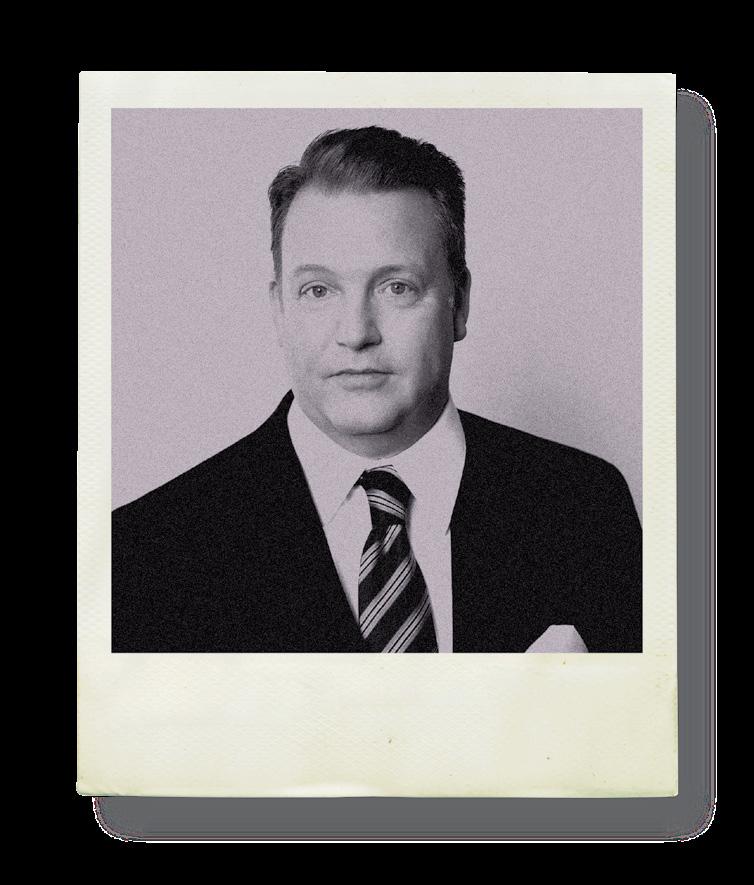
Scott Grant
This year, the Advocis Banff School is celebrating its 70th year of delivering learning, networking and growth opportunities. Held from August 16 to 20, the 2026 session will once more feature a stellar lineup of faculty as well as events including a ’70s-inspired dinner. (Don’t forget to pack your bell-bottom trouser suit.)
FORUM editor Kira Vermond spoke with chairperson Scott Grant about what makes the school special and what attendees can expect.
The 70th anniversary is coming up. When it started in 1956, Banff would have been a true retreat. And what a legacy for it to be there still.
Absolutely. Some people have been going for 40 years. It’s changed a lot, obviously — it’s much more modern now than it ever used to be.
What can people expect from Banff this year?
Almost every single person says, I didn’t realize it was so beautiful. Just being there is overwhelming because of these ginormous mountains springing out of the earth. You’re just in the middle of nature.
People get quite taken by how friendly the people who attend are. One woman a couple of years ago said she’d been thinking about quitting the industry, but a friend talked her into coming and she was so impacted she decided to stay. She reported back a year later that her business had flourished and she was so happy.
There’s something about being away from the daily grind that does a lot for somebody’s ability to find inspiration.
So many good things come from being away from the office.
What are some highlights this year?
We’ve been asking Alvin Law, the keynote speaker, for 10 years if he would come. We pay transportation, meals and lodging, but you’re volunteering your time. He decided that because it’s the 70th, he would come. Our closing speaker, John Nicola, volunteered to speak and said, “Now that I’m in my 80s, I just want to give back.”
Who is Banff best for?
I can tell you 35 per cent of the attendees last year were first-timers. It is so impactful on them and most come back. Older people are put on a bit of a pedestal for their experience, and younger people value that and want to talk to them.
It sounds like you have a lot of less structured time as well. There’s time to mingle and talk and laugh and dance and sing — or just sit in a quiet corner and chat. We live in a society where people work 60 or 70 hours. You might be exhausted. Then here you come to a place where yes, we value education, but we really value association, enjoying yourself and being a human being.
What are some tips for people to get the most out of their time at Banff?
Allow yourself to be present in the moment and be open to talking with different people you might not otherwise talk to. There’s so much to learn and most are blown away by the value they find.
What are you most looking forward to this year?
I am really looking forward to celebrating. Last year was amazing — we had an unbelievable conference. This year there’s even more excitement. I can’t wait to be there when it all happens.
This interview has been edited for brevity and clarity.

1. Arrive with a goal
Before you pack your bags, decide what success looks like. Do you want fresh ideas for your practice? New referral relationships? More confidence with AI or client onboarding conversations? One or two clear goals will shape your week.
2. Get out of your comfort zone
Don’t spend every meal or session with people you already know. Sit beside someone new and join conversations. Or sign up for the baseball game and raise a pint on pub night.
3. Pace yourself
That being said, Banff School is a marathon, not a sprint. Sleep, hydrate and resist the temptation to overdo late-night socializing if you want to stay sharp all week.
4. Put the phone away
You’re at Banff to learn and network, so be fully present rather than distracted by emails or texts. They can wait an hour.
5. Follow up at home
The real value of a retreat happens after the lanyard comes off. Send LinkedIn requests and follow up with people you clicked with. Jot down ideas before they’re lost in the deluge of email. Most importantly, act on what you learned before the day-today grind takes over. Turning an idea into a solid practice will give you something tangible to work on until the next Advocis School rolls around.

Stepping away from daily routines boosts creativity, strengthens professional relationships and helps people return to work energized and focused.

• With its awe-inspiring view of towering Mount Rundle, the Banff Springs Golf Course is more than a century old and arguably one of the most beautiful places in the world to tee off.
• Hike, walk, run or bike the more than 1,600 kilometres of local trails, all offering jaw-dropping mountain and valley views.
• Want something a little less, er, taxing? Ride the gondola to the top of Sulphur Mountain, breathe deeply and take it all in.


Meet the advisors who have decided to bring loved ones into their firms. Is it a smart succession strategy or does it introduce unnecessary complications? Diane Peters explores the rewards and risks of merging bloodlines and bottom lines
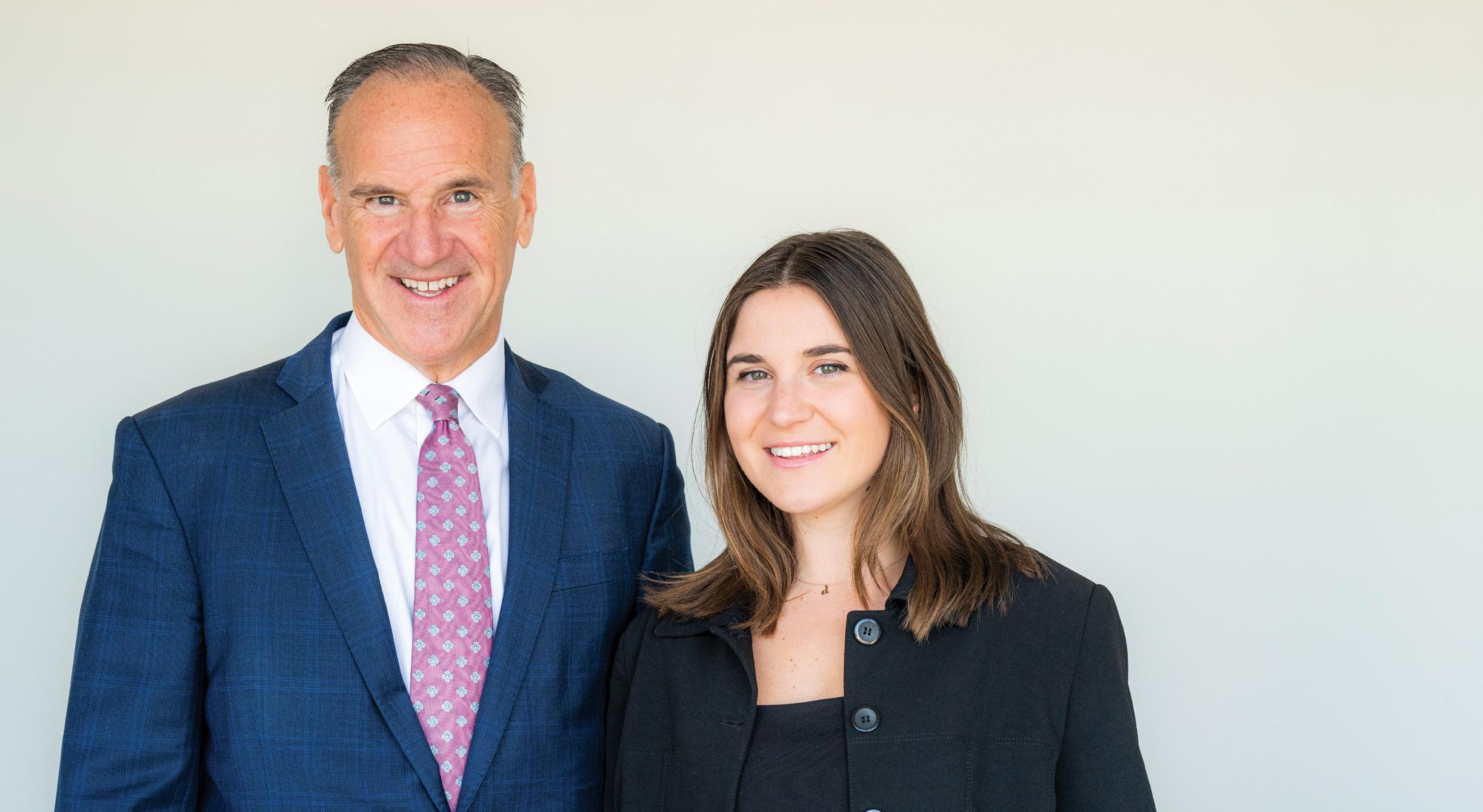
About two years ago, Dalia Feldberg told her father she wanted to become an advisor at his Ottawa office, part of the Desjardins Financial Security Independent Network. He assumed she was joking.
“When she told me that she wanted to come into the business, I thought she was pulling my leg, to be frank,” says David Feldberg, a 35-year industry veteran. He admits he’d never thought either of his two daughters would join him. Sure, Dalia once attended a professional conference with him in Hawaii and was able to speak at a professional level with other attendees. She seemed like a natural networker, but was she genuine about joining the family business?
After finishing a master’s degree in sustainable business and innovation, Dalia travelled and, upon her return, confirmed she was dead serious.
“I did a lot of school,” she says. “After graduating, I realized that everything I like, I can actually do with my dad, have him be my mentor and help me start out.”
By the summer of 2025, Dalia had joined the company and jumped right into building her career.
“She has done probably five years of learning and developing experience in less than one year in the business,” her father explains, sounding more than a little proud.
Dalia has already connected with a young female insurance advisor who is also a trained lawyer, and together they’re marketing their financial services to other women lawyers.
Despite their close working relationship — not to mention the fact that Dalia is currently living with her parents — the father-daughter duo has come across few challenges on the job or even at home. But they know that could change.
“I’ve had many advisors who have brought family members into the business. I’ve been fortunate to learn from their mistakes along the way. It’s not always perfect. It doesn’t always work out,” says David.
Working with relatives is more common than one might think. According to Family Enterprise Canada, family-owned businesses account for approximately 63 per cent of Canadian private firms. It’s common for children, adult siblings, in-laws and other extended family members to join the family business over time. Advising firms are no different. And although there are many advantages, working together while navigating this complex industry does not always go smoothly.
Jeff Thorsteinson, a partner at Advisor Practice Management in Vancouver, has watched advisors hire family members, train them well and excel together. He’s also observed things going belly up.
“I’ve seen situations where parents bring in the kid, and they didn’t have enough experience or realize how hard the parent worked. They squander [the business] after they take it over. Or they leave the industry. It’s really sad when that happens.”
His top rule when hiring a loved one: “Family should never be a substitute for fit,” he says. “You have to make sure you’d hire the family member even if they weren’t family.”
David says he knows hiring someone so close to you can blind you to their strengths — and faults. If they don’t suit their role, other employees may be reticent to say something, impacting overall morale. To understand her skill set, David put his daughter through the same human resources psychometric testing he asks all new employees to complete.
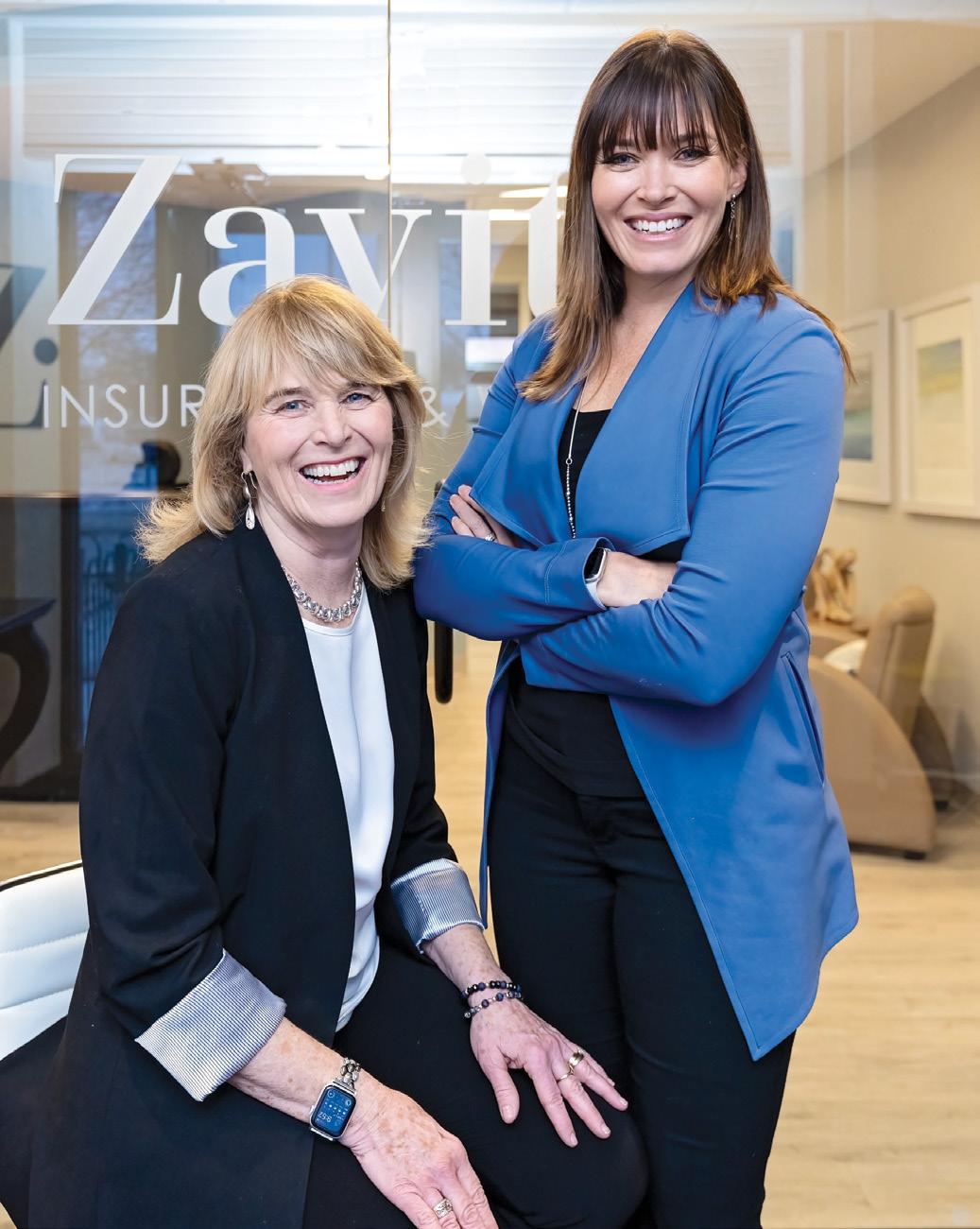
Terry Zavitz, who founded Zavitz Insurance & Wealth in London, Ont., in 1983, has since successfully brought two of her children into the business. She has found that each of them needed very different things: they both fit, but differently.
“I’ve always felt they should chart their own path,” says Terry, who sold the business in 2023 to HUB International and remains on the team, as do her children.
Two decades ago, daughter Justine had just completed her business degree and needed a Plan B when an overseas teaching trip fell apart. She began working as a receptionist for the company, then developed interest in an advising career. Terry suggested Justine take some college-level insurance courses. Justine raced through those and soon learned more about advising.
“We called her ‘VP of special services,’ which meant she did everything,” says Terry. “She was a natural.”
Meanwhile, youngest son Jarrett was working in the sports industry and looking for a change. At Terry’s suggestion, he learned about insurance and got a job with one of her contacts in B.C., where he lives. Early talk about him joining the firm stalled due to distance. Then came the pandemic and the rise
When you’re looking to pass a firm on to a family member, even if they know the business, it’s best not to move too fast. “Handing the keys over and saying goodbye doesn’t work,” says Jeff Thorsteinson, a partner at Advisor Practice Management in Vancouver.
He suggests the family member taking over build credibility with top clients by sitting in on meetings. They can start by listening and learning first, then gradually ramp up to running them.
They also need to learn all aspects of the business before taking over, from administration to finance and, most importantly, knowing how to advise and attract new clients.
“If they’re not good at production, the business will fail,” says Terry Zavitz in London, Ont. If that’s the case, ownership should be shared with multiple successors, so the company can endure and people thrive in their roles.
Terry was once told by another advisor that succession planning can also move too slowly. She still remembers what this person said of her daughter Justine: “If you want her to take over, let her take over.”
Since Terry has sold her company, her succession plans have changed. She’s now scaled back to three days a week, but she’s senior vice-president. Justine, meanwhile, is vice-president, but is busy with a full roster of clients plus leadership duties. It’s a slow exit, Terry admits, but it’s working. Everyone is still satisfied with their roles.
No matter how you step away, there needs to be a systematic approach that is communicated to family members and the wider team well in advance.
As Thorsteinson says, “It has to be a planned exit.”


of remote work. He joined the firm about four years ago and now flies regularly to Ontario. “He’s doing a bang-up job,” says Terry, noting that even though he joined the business when he was older and had more insurance experience, his business acumen is the same as his sister’s. “Both are very conscientious, work hard and are very social.”
As far as Gregory Bonnell is concerned, his daughter Amy has the potential to take on an advising and leadership role at Merestone Financial Planning in Halifax, where he’s managing partner and CEO, but it must make sense for her too.
Amy, who is 20, is studying business administration and helps in the office on a casual basis.
“She has to find her way,” says Gregory. Developing life and professional experience beyond the family boardroom is important. He has seen other advisors’ kids join their firms before having any training at all. “They’re coming in straight out of high school with very little in the way of post-secondary schooling, which I do not believe in.”
Fostering success doesn’t end with onboarding, Thorsteinson says. Once the right person is in the right role and properly trained, the real work begins.
“It always comes down to communication,” he says. “You have to be able to communicate through disagreements.”
Terry and Justine developed a foolproof approach to communication that still works today.
“I was straight-up with her, and she was straight-up with me. We had a rule that if something wasn’t going right, you

couldn’t complain behind their back,” says Terry. Instead, they’d call a meeting, figure out a solution, write the new plan down on a piece of paper and sign it.
Thorsteinson also advises families to learn to separate work from personal life.
“You do not want to be talking about business at the dinner table on family holidays. It cannot creep into your personal lives,” he says.
Back at the office, David Feldberg hopes that strong workplace processes, training and careful team management will keep his firm running smoothly and help everyone, including his daughter, thrive. But if things go badly, he knows where his priorities lie.
“No matter what, your child is still your child, and you want to maintain that family relationship. To me, that’s number one,” he says.
Gregory Bonnell, similarly, hopes his daughter will someday do well in the industry, particularly by working at his firm, as they share much in common.
“My daughter and I are extremely close,” he says, mentioning that when they take trips, the destination isn’t the point. The real highlight is spending time together. He loves that she embraces the same values as the rest of his extended East Coast family: put others first and foster community. “She’s the one bringing people together.” F
“Family should never be a substitute for fit. You have to make sure you’d hire the family member even if they weren’t family.”
Jeff Thorsteinson
By obtaining the CLU® designation, you have demonstrated exceptional commitment to your career and clients, and have elevated your practice to a level that distinguishes you among your peers.
Parth Parasar
Wei Dai
Wei Ye
Yuanxia Gao
Xuwei Chen
Joseph Betlehem
Li Qin
Kelso Beggs
Gary Lotey
Haixia Chen
Mariano Ferrara
Alex Au-Yang
Jinluan Han
Billie-Jane Bolton-Rojo
Lei Cao
Chi Mun Philip Wong
Lin Tang
Lei Zhang
Terasa Rausch
Deborah Williams
Yogesh Sheta
Yaping Zhu
Robert Baker
Manny Grewal
Yan Wu
Kamaljit Chauhan
Alexander Liber
Kaitlyn Berg
Hao Li
The Institute congratulates 2025 John A. Tory Award Winner
Parth Parasar, Wei Dai For attaining the top mark in Canada.
The Institute specially recognizes the 2025 Dunstall Prize Winners for attaining top marks in their respective provinces:
AB - Yogesh Sheta
BC - Chi Mun Philip Wong
ON - Parth Parasar
ON - Wei Dai
Amrithal Bachra
Siera Lombardo
Andrew Fowler
Mitchell Silber
Himanshu Bhawankhel
Yvonne Larner
Hong Zhu
Zizhi Liu
Nilufar Alizadeh
Jeffrey Severson
Amit Sharma
Corey Borgh
Ernest Pau
Trina Noseworthy
Kimberly Redmond
Ann Mac
James Dempsey
Philip Razon
Debebe Abayre
Institute CHS
Special Congratulations to Amrithal Bachra
On achieving the 2025 CHS Award for the highest mark in the Advocis CHS education program.
Chibesa Mumba
Nicolas Lafleur
Daniel Weatherall
Calista Lyons
Guillermo Nafarrate
Courtney Lardizabal
Michelle Taylor
Amanda Reynolds
Anurag Bhatia
Chad Gordon Ken Lee
The Institute PFA
Special Congratulations to Michelle Taylor
On achieving the 2025 PFA Award for outstanding PFA examination performance.
Bhatt
Abbey Boardman
After 15, 20 or 25 years in the industry, what does it take to move past the daily grind and rediscover motivation? As Rosalind Stefanac discovers, some mid-career advisors are reigniting their passion for work in unexpected ways


Twenty-two years ago, Carmela Lombardi entered the financial services industry looking for flexibility. With a newborn and a two-year-old at home, she wanted a career that would allow her to be available for her young family.
What she quickly discovered, however, was that building a practice from scratch was anything but flexible.
“Those early years were quite a grind,” says Lombardi, who is based in Newmarket, Ont. “I built [my business] client by client, relationship by relationship.” In the process, she was learning the industry, building credibility and constantly searching for her next opportunity.
Over time, the intensity of her work began to ease as her client base and experience grew. The business was stable, but the momentum that had once driven her slowed.
“That sense of urgency isn’t fuelled in the same way because you’re more settled,” she explains.
For some advisors, that shift toward comfort marks the beginning of a mid-career plateau, when growth slows, routines take hold — and questions about what comes next begin to surface. Some call this professional era, which usually hits after accumulating 15 to 25 years of experience, the “marathon stage.” Others term it “middlescence,” the time when people consider ways to avoid career stagnation.
“There are definitely moments that can beg us to re-evaluate,” says Lombardi.
In her case, that reassessment meant building on the relationships she had already established. Early on, Lombardi was focused on Registered Education Savings Plans (RESPs) and helping families prepare for their children’s education. But as those relationships deepened, conversations expanded to broader questions around financial security, protection
and long-term planning. “That was the point that I essentially began to expand my scope,” says Lombardi, who launched her current venture, The Financial Boutique, in 2023. “I took on a more holistic approach, which allowed me to support my clients in a much more meaningful way…and brought me a renewed sense of purpose.”
Feeling as though your career has plateaued isn’t unusual, says Brenda Rigney, a Vancouver-based business coach who works with midlife professionals. In her experience, the sense often emerges not from lack of success, but from a growing disconnect between day-to-day activities and longer-term goals.
“We’re saying yes to a lot of things and doing a lot of busywork,” she explains. “But when we look back over the last year, the progress we’ve made isn’t actually in line with what we want.”
Without taking time to reassess, many professionals continue operating on the goals that defined their early careers — even when those priorities no longer fit. For instance, an advisor might focus in the early years on building a big book of insurance clients but decide later to offer holistic planning for multi-generational families. The move reflects a new interest in building relationships with clients. Whatever has changed, Rigney encourages her clients to think more intentionally about what comes next.
Start by picturing yourself in three years, she advises, focusing on where you want to be professionally and personally. Then work backwards to identify the smaller steps that will move you toward that vision. By being clear about what you truly want, you’ll be less tempted to jump at whatever ill-fitting opportunity arises.
“If you don’t have that vision in place, it’s really easy to just keep saying yes to things that don’t move you forward,” she says.

“If you don’t have that vision in place, it’s really easy to just keep saying yes to things that don’t move you forward.” Brenda Rigney
For Steve Meldrum, that shift toward a clearer sense of direction came at a pivotal point in his career. A financial planner based in Medicine Hat, Alta., he became interested in more complex planning work, particularly how life insurance could be used within estate strategies. He also saw untapped potential for clients and the business. It seemed like a natural step. But when he raised the idea of expanding his focus with his firm, they turned him down.
Meldrum made the decision to move on.
It was ultimately a good one. In 2014, Meldrum launched his own practice, Swell Private Wealth, focused on high-networth insurance planning. While he lost some clients who he’d expected would follow him, he was pleasantly surprised by those who chose to stay. And he’s earning substantially more money.
“You have to go after what you want because it’s not going to be handed to you,” he says.
The move prompted a different kind of career growth for Meldrum, too. Seeking to deepen his expertise and better engage with accountants on complex cases, he joined the Conference for Advanced Life Underwriting (CALU), where he later served on the board (and still actively participates). He also completed a three-year in-depth tax program typically taken by accountants and penned the ninth edition of Estate Planning with Life Insurance, a reference guide widely used by advisors.
By investing in knowledge and specialization, Meldrum has shaped both his client work and his professional trajectory.
Not every shift is driven by a single turning point. For some advisors, change comes more gradually through ongoing refinement of their client work.
Wendy Brookhouse, founder of Black Star Wealth in Halifax, built her career without a predefined model from the outset. Entering the profession independently nearly 20 years ago, she developed her approach by focusing on what clients said they needed to succeed.
“I always thought there was a gap [as] people would tell you what to do, but they wouldn’t show you how,” she says. “What good is a consulting project that just says you should export to the U.S. without details on how to do that?”
That perspective still shapes how she works with clients. She first helps them understand what to do and then follows through with practical spending plans that connect her advice to their day-to-day decisions.
As Brookhouse’s practice has evolved, her focus has shifted toward scale. “How do you build something that can live beyond you?” Part of the answer, she says, lies in technology — which has become a source of renewed energy rather than disruption. “I can solve my client problems in such a different way,” she says.
But beyond new tools, mindset still plays a critical role in navigating mid-career challenges. Her advice is to take a step back, not only to reassess the business but to focus on personal sustainability. That can mean refining your client base, delegating tasks that drain energy or simply creating more space to think.
“If you can spend more time in your zone of genius, that’s what energizes you,” she says. “And that’s where you make the biggest difference.”
Ultimately, whether advisors respond to mid-career uncertainty by expanding their scope, redefining their business or simply recalibrating their focus, the common thread is intentionality. As Rigney puts it, the key is not to avoid the plateau, but to use it as a turning point.
“If you don’t stop and ask where you’re going, it’s very easy to keep moving without actually moving forward,” she says. F

Thirty-three years ago, at only 21, Rehan Bhanji had already lost both of his parents and found himself navigating insurance issues, a will and an impending eviction notice. Unsure what to do next, he answered a newspaper ad for a financial advisor role in Toronto and drove across the country from Vancouver for the interview. The job would set his career in motion.
Today, as National Best Practice Leader at Desjardins Insurance, his work has evolved from advising clients directly to helping other advisors refine how they engage with clients and approach their practice.
Through the Discovery Series webinars and “Unplugged” podcast he hosts with colleague David Lee, Bhanji brings advisors together to share real-world experiences. What began during the lockdowns of the recent pandemic as a means to reconnect has grown into a national platform, with webinar audiences now reaching some 1,500 advisors and the podcast heard in more than 60 countries.
Q: What has kept you so engaged this long?
A: Honestly, the work gives me so much energy and sense of purpose. Being able to share my story and help other advisors — who then go on to help their own clients — has been a big part of that.
Q: When did your career begin to shift?
A: While I started as an advisor, over time I realized I really loved presenting, storytelling and educating. I was doing financial literacy sessions, and eventually a mentor encouraged me to train other advisors. That led to a wholesaling role and, later, to what I I do now: coaching and helping advisors refine their approach.
Q: What advice would you give advisors who feel stuck mid-career?
A: Find a mentor — or become one. Mentoring others can reconnect you with why you entered the profession.
Rosalind Stefanac is a Toronto-based journalist covering personal finance, business and healthcare, with bylines in leading Canadian publications.
12, 2026
The future of financial advice is being shaped. Be in the room.

Join us at the InterContinental Toronto Centre and, for the first time Symposium will connect audiences nationwide through a live national broadcast.
Registration opens Summer 2026
Scan the QR code to register your interest and stay connected to all things Symposium 2026 Presented by Advocis
Interested in sponsorship opportunities?
Contact: bd@advocis.ca
Artificial intelligence is going to reward the practice you’ve already built
By Alex Dashefsky

If you’ve been scrolling LinkedIn lately, you can be forgiven for assuming artificial intelligence (AI) is primarily a productivity feature. Minutes saved per meeting. Some new dashboard the dealer or managing general agency wants you to log in to. Something the next generation of advisors will use to outpace the senior generation.
That is not entirely accurate.
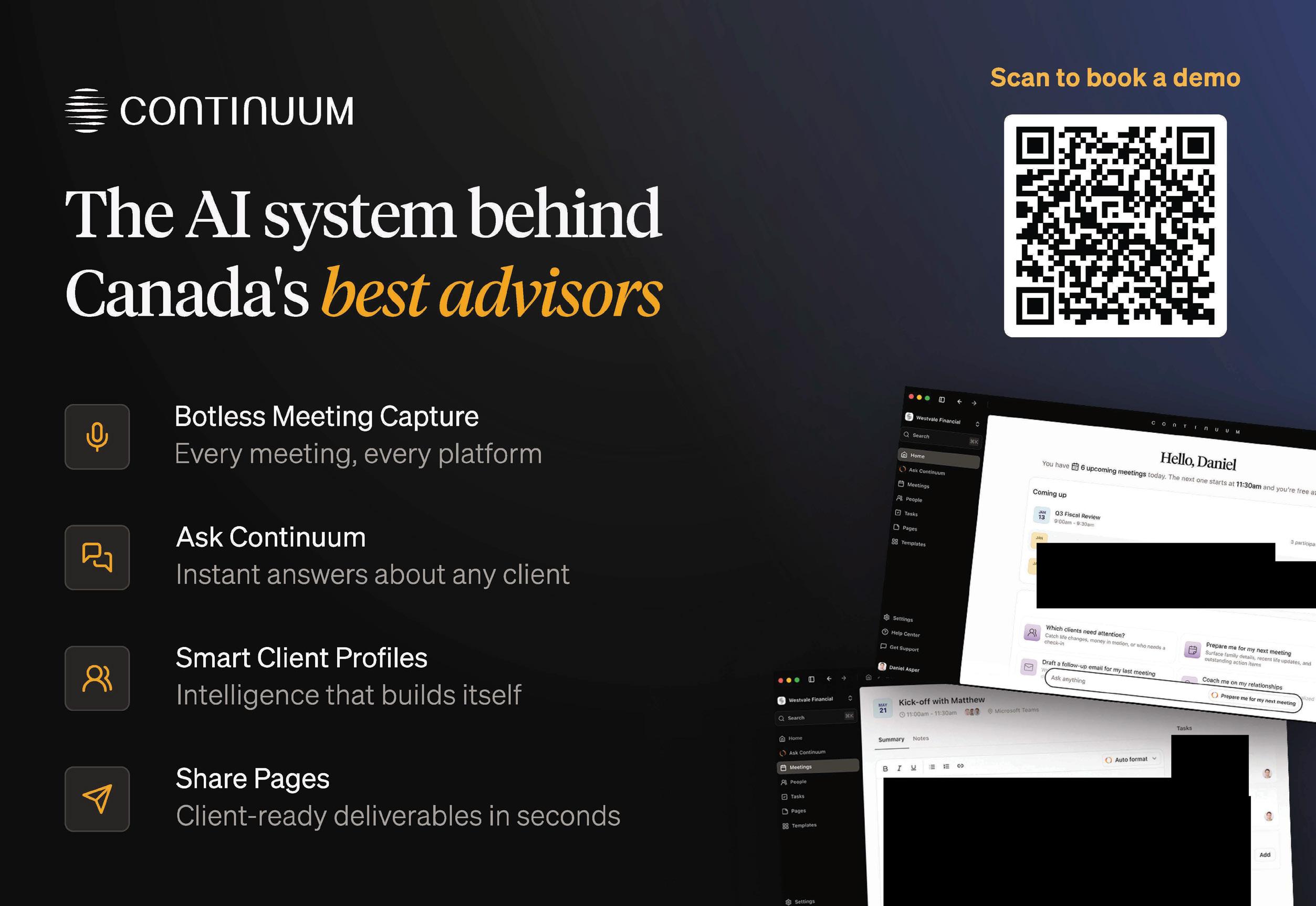
My company, Continuum, is the AI system used by some of Canada’s best independent advisors. We’ve worked with some 100 firms these past 18 months, and the pattern that has emerged is almost the inverse of what shows up in your feed.
The advisors getting the most out of AI are not the ones you would expect. They’re not their firms’ early adopters or tech people. Instead, they are the senior advisors with deep books, the ones who have always been a bit stubborn about software, who scribble notes by hand and keep half of every client relationship in their own heads. Put a useful AI tool in their hands and they do not save 12 minutes per meeting. They start doing things they have never had the time to do at scale.
This shift in how senior advisors work is arriving at the most consequential moment of their careers. More than a trillion dollars will move between generations of Canadians over the coming decade. Roughly four out of five inheritors leave their parents’ advisor within a year of receiving the inheritance. Nearly half of Canadian advisors are over 50. The practice you spent decades building is, statistically, not the practice your top clients’ children intend to use.
This is usually framed as a marketing or relationship problem. But it’s neither. It is an operational problem that has shadowed Canadian independent advice for years.
The next generation of clients wants more than a bettercurated investment portfolio. They want holistic advice that addresses their entire financial picture: context across multiple accounts, a side business, equity compensation, real estate and estate planning. They want their advisor to know what they said six months ago and follow up before they ask. They were raised on apps that integrate everything they own. They notice when their advisor cannot.
To deliver that level of service to 150 households, a senior advisor would need to track far more information about each client, follow up more often and engage with parts of clients’ financial lives that have historically sat outside the engagement letter. Doing this work manually is not feasible.
The industry’s instinct has been to specialize: narrow the book, raise minimums and accept that the next generation will go elsewhere. But that is less a long-term strategy than a slow exit. It is also pulling advisors away from the average Canadian. Each time minimums get raised, another household is priced out of real advice and pushed toward a bank channel or robo-advisor. The clients who would benefit most from holistic advice become the least able to access it.
Another alternative used to be to industrialize the practice: build standardized processes, hire associates and push more of the work to operations. That is how large firms have long operated, and why many feel much like utilities to the people they serve. You can deliver consistency that way. You cannot deliver intimacy. The next generation can tell.
But now for the first time, there’s a third option. AI addresses types of advice that have historically been difficult to scale, such as good judgment and attention to detail. It works
best in practices where those qualities are already central. Senior advisors with deep books have, almost by accident, built exactly the kind of practice AI compounds. The advisor who scaled by process has not.
The pattern is consistent across the firms we work with. The advisors who change most are not the ones running pilots on new technology. They are running their practices differently within weeks of starting.
One senior advisor in Ontario trialled Continuum for two weeks last year and called to say it had fundamentally changed how he ran his practice. A month later, he rolled it out to his entire branch. The shift was about what he could suddenly do seamlessly: capture every client meeting without taking notes, draft a compliance-ready proposal in seconds or even answer a question such as “What did the Singhs say last December about the cottage?” in another meeting months later. The practice he built over decades finally had the operational capacity it had always lacked.
Today’s reality? Advisors who built quiet, judgment-heavy practices have long been seen as the smaller, more vulnerable end of the industry. But that was not accurate. In many ways, they were the model others were trying to emulate — just with-
out the scale. Now, they are positioned to pull ahead in ways larger, structure-driven firms struggle to match.
The coming wealth transfer will not be won by the advisors with the biggest books. It will be won by the practices that can serve the next generation at the same level their parents’ generation received. AI makes that possible.
Canadian senior advisors with deep books and a stubborn bias toward intimacy over process are in a stronger position today than they have been in years. The decade ahead does not mark the end of this kind of practice. It marks the beginning of its most interesting chapter — but only for advisors who realize that the technology has finally caught up with the way they have always wanted to work. F
Alex Dashefsky is co-founder of Continuum (oncontinuum.com), an AI platform built for Canadian independent financial advisors.
Want to discuss any articles that appear in FORUM? Write to me at kira@vermond.ca and we’ll keep the dialogue going.


The 2025 GAMA Global Canada Management Awards recognize the highest leadership achievements in Canada’s financial services industry.
This award represents the very pinnacle of management excellence among GAMA Global Canada members.
Adriana L. Rogic
Al Roissl
David Feldberg

Darren Rosenberger
Greg Miskiman
Jimmy S. Nijjar
Karl Krokosinski
Scott Grant
Sonia Wu
Steven Ollson
Ted D. Girard
This award recognizes outstanding achievement in agency-building, production and field development.
Adrian Fung
Al Roissl
David Feldberg
Darren Rosenberger
Geoffrey W. Keleher
Greg Miskiman
Jason Poulton
Jimmy S. Nijjar
Karl Krokosinski
Scott Grant
Sonia Wu
Steven Ollson
Ted D. Girard
This award recognizes outstanding achievement in agency-building, production and field development.
Kayo Guan
Yukun (Simon) Xiong
This award honours achievement in agency management, particularly increases in production.
Al Roissl
David Feldberg
Greg Miskiman
Joseph E. Kheirallah
Jason Poulton
Karl Krokosinski
Scott Grant
Sonia Wu
Ted D. Girard
By Doug Carroll
Powers of attorney are important tools in estate planning, allowing a grantor to name an attorney to step in and make decisions about their personal care and property if incapacity strikes. They provide comfort and certainty, knowing an attorney can act proactively before complications appear and reactively as unexpected events call for adjustments.
When it comes to property, an attorney can generally do anything the grantor could do, except make a testamentary disposition — meaning a change that takes effect on death but can be revoked during life. The most familiar example is a gift in a will, and many courts have extended this reasoning to registered plan beneficiary designations.
Yet while an attorney is a fiduciary who is required to act in the best interests of the grantor, that power may at times be abused. As a result, limitations make sense. Unfortunately, those limitations can create practical challenges if they prevent an attorney from making beneficial changes that would ultimately be in the best interest of the grantor.
Here are some situations where an inability to revisit a beneficiary designation could be problematic.
Retirement income:
Registered Retirement Savings Plans (RRSPs) are usually transferred to Registered Retirement Income Funds (RRIFs) once the grantor needs the income, something that is more likely if there is incapacity. The transfer is also mandatory at age 71. If funds remain in RRSP form, withholding tax is higher on withdrawals and there’s no ability to reduce tax with the pension credit or pension income splitting.
Change of financial institution: The attorney may wish to consolidate assets to simplify oversight, or to revisit
portfolio risk given the incapacitated person’s likely lifestyle needs and life expectancy changes.
Pre-deceasing beneficiary:
The interest of a pre-deceasing beneficiary is distributed proportionately among all other beneficiaries. While contingencies are possible, financial institutions will not allow complex rules. There could also be probate tax and creditor exposure in the eventual estate if no beneficiary remains on the plan.
Change of province:
If a person moves to another province, their assets will preferably move with them. This will be especially helpful if moving to a province that provides lifetime creditor protection on RRSPs and RRIFs.
What an attorney can and can’t do depends on the province where the POA was executed. The relevant legislation should always be consulted to confirm what is permitted. In general, three categories apply:
Renew, replace or convert:
If applicable, the attorney may designate the same person(s) on a new replacement plan of the same type executed by the grantor on the originating plan.
Make, change or revoke: With court approval, the attorney may make a change to a designation that does not have to be a carryover of a former designation.
Change to estate:
An attorney, without having to seek
court approval, can change the designation from whatever it is presently to the estate of the grantor.
Some actions are sufficient if an attorney is validly appointed, while others require that the POA explicitly authorize beneficiary changes. Ideally, the attorney should obtain legal advice before taking any action. F


By Kevin Wark
Bill C-15, the Budget Implementation Act, 2025, No. 1, received royal assent on March 26, 2026. The large omnibus bill includes new legislation, Budget 2025 tax proposals and previously announced changes. Buried within its many pages are a number of golden tax nuggets for private business owners and their professional advisors.
Although the federal government abandoned its 2024 proposal to increase the capital gains inclusion rate, it followed through on increasing the LCGE to $1.25 million. As a bonus, the increase will apply to share dispositions after June 25, 2024, with indexation of this limit resuming in 2026.
The Income Tax Act (Act) permits a graduated rate estate (GRE) of someone who has died to carry back capital losses incurred in its first taxation year. It’s designed to offset capital gains reported on the deceased’s terminal return. This provision is commonly used in post-mortem planning for small business owners to eliminate “double tax” on a deceased’s shares.
Now, to increase flexibility, the carry-back has been extended to capital losses realized within the first three taxation years of the estate, for deaths occurring after August 11, 2024.
Stop-loss rules can deny the capital loss carry-back described above, when losses arise from share redemptions from the
deceased’s GRE, combined with tax-free capital dividend payments. A special rule reduces the denied loss amount by 50 per cent, when shares are transferred to the deceased’s GRE and redeemed within the estate’s first taxation year.
This 50 per cent stop-loss reduction now applies within the first three taxation years of the estate, effective for deaths after August 11, 2024. The extension further supports the use of corporate-owned life insurance to redeem shares on death.
The Act permits owners of eligible small business corporations to dispose of shares and defer taxation of capital gains if proceeds are reinvested in another eligible corporation within a specified period. This rollover has been expanded by extending the time allowed to reinvest the proceeds as well as the types of shares that qualify. The changes apply to share dispositions on or after January 1, 2025.
Rules introduced in 2024 encourage the sale of private businesses to employees through an EOT, including a shared $10 million capital gains exemption for the selling owners. The exemption is available for dispositions between 2024 and 2026, and has been extended to sales to workers’ co-operatives. In addition, the potential clawback of the exemption is now limited to 10 years from the time of the sale.
Many small business owners use trusts to hold property for family members. The new trust reporting rules will result in an additional layer of tax reporting for such trusts.
There was previously an exception when the trust held less than $50,000 of assets throughout the year and invested in specific vehicles. Under Bill C-15, those investment restrictions have been removed. A new exemption also applies to trusts holding qualifying assets of up to $250,000 in the year, where all trustees and beneficiaries are related individuals. As a bonus, the list of qualified investments includes exempt life insurance policies issued by Canadian insurers, with a policy’s fair market value deemed its cash surrender value. F
Kevin Wark, LLB, CLU, TEP is managing partner of Integrated Estate Solutions and a tax advisor to CALU. He is the author of the popular consumer book
The Essential Canadian Guide to Estate Planning (3rd Ed.), as well as tax guides on corporate-owned life insurance, life insurance transfers, insured buy-sell agreements, and income-splitting strategies, available through Amazon.ca.

By Patrick Uzan
Some new legislative and tax case updates may be of interest to life insurance advisors dealing with corporate clients.
Insurance advisors dealing with private corporation clients that have corporate-owned life insurance on a shareholder’s life may be familiar with a common post-mortem “capital loss carry-back” strategy whereby the receipt of insurance proceeds can make the strategy more tax-effective.
In implementing the strategy, a post-mortem redemption of shares held by the estate of the deceased shareholder, or a post-mortem winding-up of the corporation, creates a capital loss in the estate that may be used to offset capital gains reported on the shareholder’s terminal return arising from the deemed disposition of the shares.
Prior to recently enacted legislation, the capital loss (arising from such redemption or winding-up) had to be generated within the first taxation year of the estate for the strategy to work as intended. The new rules, effective for deaths occurring after August 11, 2024, allow this strategy to be executed for capital losses generated within the first three taxation years of the estate. This is welcome news for complex and/or contentious estates.
In the recent Federal Court of Appeal case Canada v. Vefghi Holding Corp. (“Vefghi”), a dividend received by a trust and designated by the trust to a corporate beneficiary was deemed to be received by the corporate beneficiary on the trust’s year-end date, not the date the dividend was received by the trust. Although the case did not deal with taxfree capital dividends, under the Income
Tax Act (the “Act”), similar mechanics apply to a trust designating a capital dividend to a beneficiary of the trust.
For example, assume Corporation A receives life insurance proceeds and therefore obtains an addition to its capital dividend account (CDA), which permits Corporation A to pay tax-free capital dividends. A family trust holds common shares of Corporation A and a capital dividend is paid on the shares owned by the trust on June 30, 2026. In its December 31, 2026 taxation year tax return, the trust designates the capital dividend to a corporate beneficiary, Corporation B. Pursuant to the calculation of CDA under the Act, Corporation B gets an addition to its CDA equal to the amount of the dividend.
Using the same reasoning as that in Vefghi, the addition to Corporation B’s CDA occurs on December 31, 2026 (i.e., the last day of the trust’s taxation year). If Corporation B elects to pay capital dividends to its shareholders based on a misconception that the addition to its CDA occurs on June 30, 2026, this could result in an over-election and a special 60 per cent tax on the excess amount would be applicable. However, there may some potential relief under another election available under the Act to treat the excess as a separate taxable dividend.
Two recent cases, Pyxis Real Estate Equities Inc. v. Attorney General of Canada (Ontario Court of Appeal) and Keystone Enterprises Real Estate Ltd. et al. v. Attorney General of Canada (Saskatch-
ewan Court of King’s Bench), involved miscalculations of the CDA resulting in excessive elections.
Many tax articles and presentations assume that the capital dividend a corporation can pay immediately after the receipt of life insurance proceeds equals the death benefit received minus the policy’s adjusted cost basis. Clients should be warned that although this amount may contribute to the calculation of the corporation’s CDA, it does not necessarily represent the amount of the CDA available, as prior transactions can also affect the CDA calculation.
Corporate owned life insurance can materially improve post mortem outcomes, but the recent developments highlighted here reinforce one practical message for insurance advisors: work alongside the client’s tax advisors to ensure beneficial tax rules are taken advantage of to ensure planning is aligned and properly executed. F
Patrick Uzan, CPA, CA, TEP, CLU is vice-president, planning services at PPI Advisory in Calgary, where he supports advisors in developing and implementing estate and tax planning strategies in the high-net-worth market.
LinkedIn: linkedin.com/company/advocis
Facebook: facebook.com/advocis
Instagram: @advocis.tfaac
X: @advocis
By Phillip Ackers
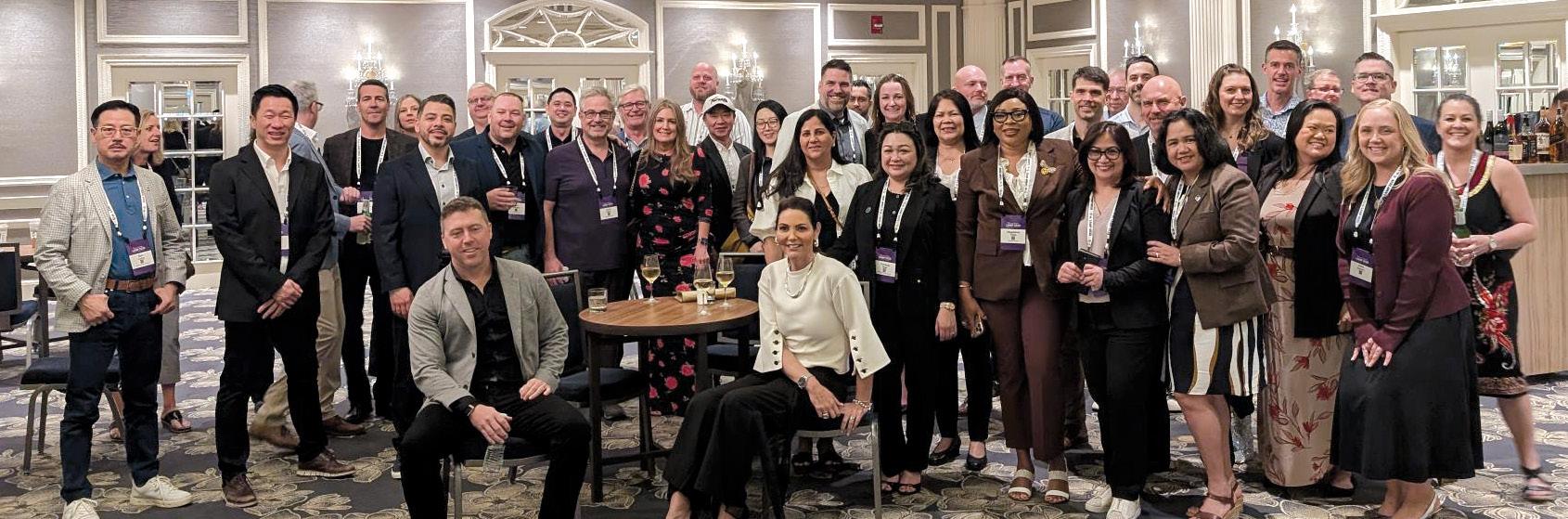
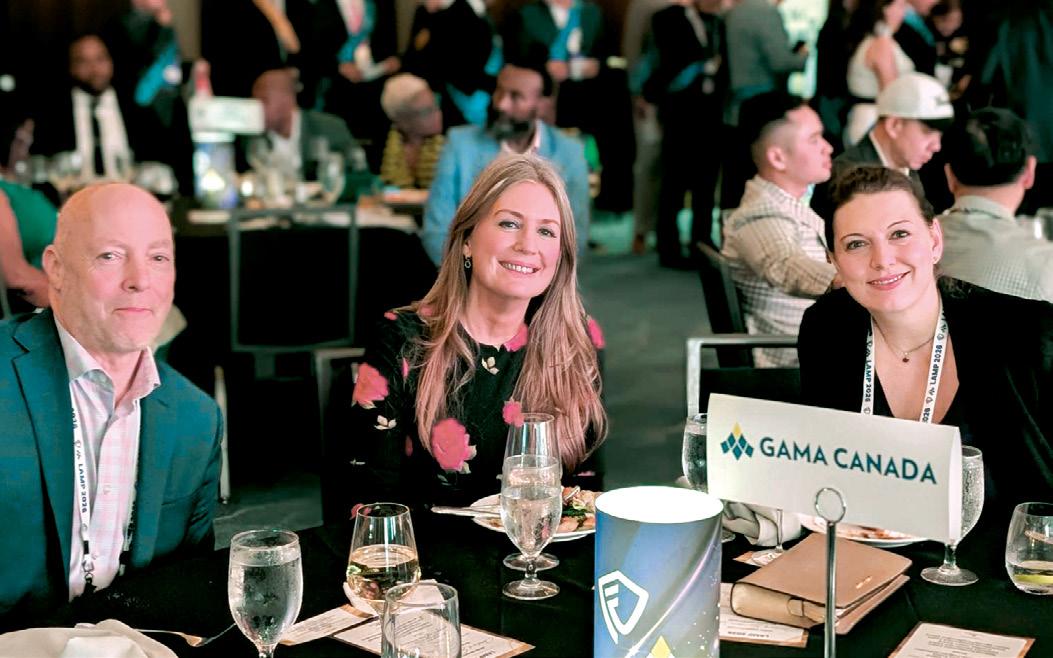
At the recent GAMA LAMP conference in Nashville, Tenn., Canadian financial leaders gained fresh insight into today’s rapidly changing advisory and leadership landscape. Growth no longer hinges on isolated expertise. Instead, leaders thrive by developing systems, engaging in conversations and taking intentional action.
“The Octopus Organization” explored how an organism-like business model can prosper amid relentless change by being flexible rather than depending on rigid management hierarchies. Attendees discovered how firms can use this model to reframe their approach to AI adoption. Rather than relying on top-down directives or polished presentations, the session emphasized that real intelligence already exists within teams.
The key is unlocking it through structured dialogue. Here’s the simple but powerful three-question framework:
Q: How are you using AI?
Q: What challenges are you facing?
Q: What support do you need?
Asking these questions creates immediate clarity and momentum. The real differentiator is understanding the role AI should play at every level of the firm. In other words, replace passive meetings with discussion-driven sessions, establish clear ownership through an AI passport and build ongoing communication channels where teams can share insights and accelerate learning.
That same theme — structure enables success — carried into the planning-driven financial advisory session. The focus shifted to building scalable advisory businesses through consistent processes and disciplined training. High-performing firms are not leaving development to chance. They’re implementing formal mentorship programs, structured onboarding and standardized client engagement models.
Under this model, new advisors are guided through defined meeting stages, supported by templates and tools and encouraged to specialize in niche markets. The action items are clear: firms must codify their processes, invest in training (including AI tools) and create repeatable client experiences that build both confidence and long-term revenue. Despite the potential for success, many firms still struggle with inconsistent adoption, often filtered through individual advisor preferences rather than firm-wide standards.
Other sessions offered a more human perspective, reinforcing that alignment and trust often come before execution. Through structured dialogue and affirmation, they demonstrated how connection and shared identity can create momentum — even without a fully defined plan.

For leaders, the implication is clear: when teams feel uncertain, intentional conversation can bridge the gap and move groups forward.
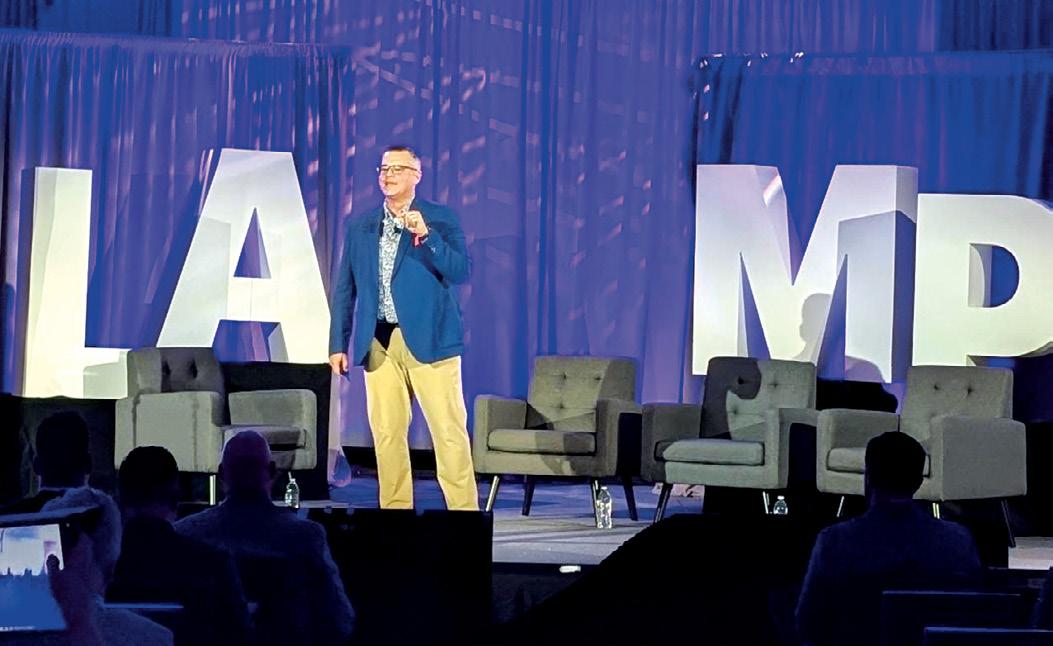
Energy and inspiration peaked during American entrepreneur Jesse Itzler’s keynote session. His engaging talk, “The Spiritual Billionaire,” expanded the conversation beyond business mechanics and toward purpose-driven leadership. According to Itzler, sustainable success requires equal focus on relationships, meaning and personal discipline.
With only 8,760 hours in a year — and only a fraction available for mean-
ingful work — his call to action was urgent. Advisors and leaders need to prioritize relationship-building habits, such as handwritten notes and short video messages for clients, while also challenging outdated playbooks. When execution is combined with authenticity and purpose, results multiply.
Does it make more sense to become a generalist or a specialist today? Canada’s own Brent Swatuk weighed in with his “Niching Wins” session. According to Swatuk, in today’s competitive landscape, generalists struggle and specialists win. Real success comes from going narrow and deep. While counterintuitive for newer advisors, specialization drives long-term efficiency and credibility. What’s more, leaders play a critical role in helping advisors identify their niche so they can position themselves as the go-to expert within that market.
Finally, “The Case for Volume Recruiting” session with Karan Chainani challenged the belief that great advisors can be identified early. Instead, talent is developed, not discovered. By increasing recruiting volume and implementing structured onboarding, firms can surface high performers who might otherwise be overlooked. The shift is clear: build systems that reveal potential over time, rather than relying on instinct.
Consistent themes emerged across all sessions: Conversation drives progress. Systems outperform individual brilliance. Culture and accountability enable scale. But perhaps most importantly, action matters more than theory. F
Your hub for on-demand courses, industry insights, event recordings, best practices, and leadership development content exclusively for GAMA Global Canada members.

Advocis Greater Vancouver brought members together in February for a Lunar New Year luncheon celebrating connection, culture and community. The event gave advisors a chance to learn about the traditions and significance of the holiday while building stronger relationships with peers.
Hosted by the chapter’s fellowship committee, the luncheon created a welcoming space for conversation and shared learning, underscoring the importance of community within the profession.
Then on March 19, Advocis Greater Vancouver launched its Fellowship Happy Hours series, an informal evening of networking for members and guests. They met at Strange Fellows


Brewing, located in the heart of East Vancouver.
Organized by the chapter board and fellowship committee, these bimonthly gatherings create a relaxed space for connection and conversation. Planned to be held across Vancouver and Langley, the events are designed to bring more members together to connect, network and participate in chapter events.
Advocis Durham members played a key role in the Empower Me Women’s Day Summit 2026 held on March 7 at the Scarboro Golf and Country Club. The event brought together women entrepreneurs, professionals and community leaders for a day focused on financial empowerment, personal growth and building long-term wealth strategies.
Led by Advocis members Suzette Chambers, Carmela Lombardi, Stacy Brooks and Tracy Tronchin, the summit featured inspiring speaker sessions and valuable networking opportunities.
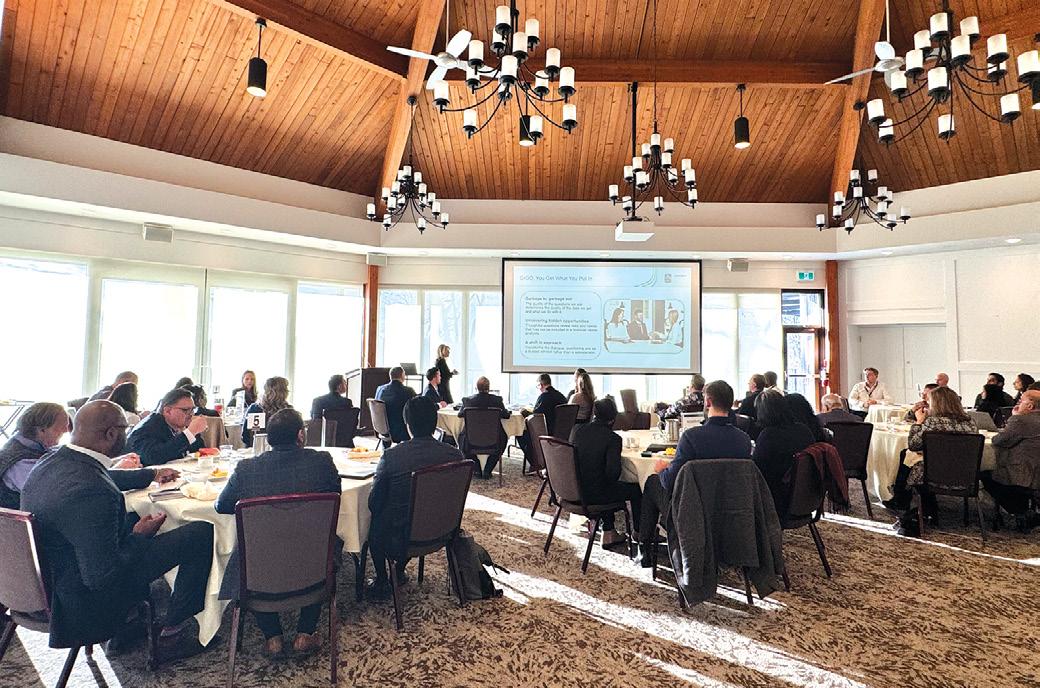
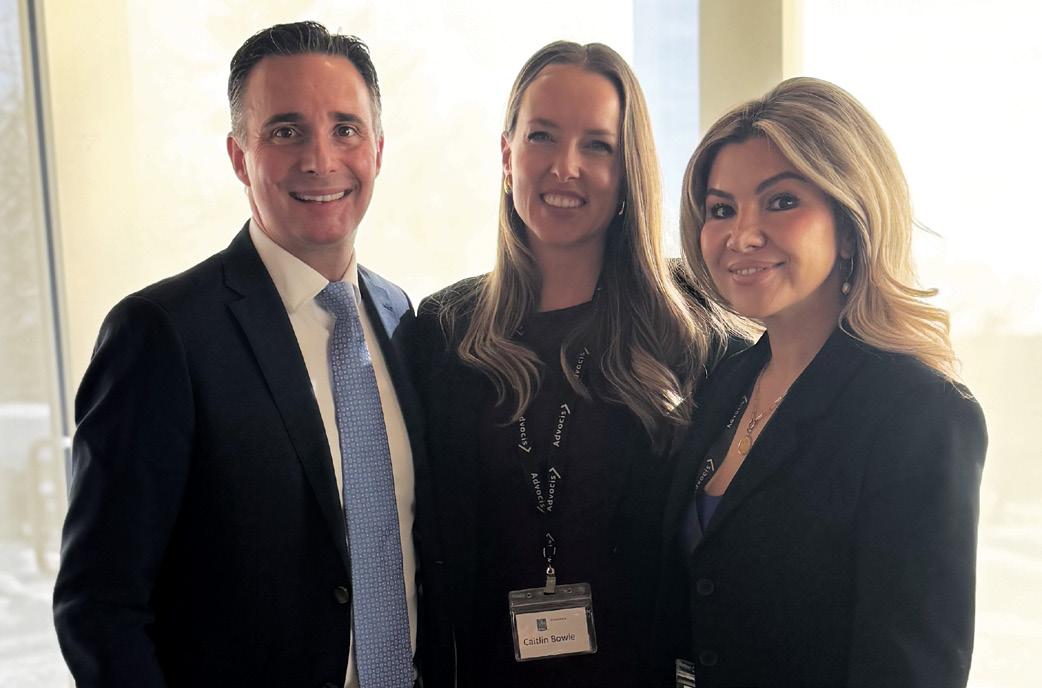
Advocis Peel-Halton kicked off its first event of 2026 with an RBC business development workshop at the Credit Valley Golf and Country Club. The event brought members together to explore strategies for delivering insight-driven advice and creating more meaningful client conversations.
Attendees heard from RBC Insurance speakers Anna Tsepelis, Caitlin Venner (Bowie) and Jonathan Schjott, who shared practical approaches for uncovering client needs and leading meetings with confidence.

The Annual General Meeting (“AGM”) of Members of The Financial Advisors Association of Canada carrying on business as Advocis (“the Association”) will be held exclusively online on June 30, 2026.
Members must register in advance to attend the AGM. An email will be sent to members with details on when voting opens and instructions on how and where to register.
The Annual General Meeting (“AGM”) of Members of The Institute for Advanced Education (“The Institute”) will be held exclusively online on June 30, 2026.
Members must register in advance to attend the AGM. An email will be sent to members with details on when voting opens and instructions on how and where to register.
The Annual General Meeting (“AGM”) of Members of GAMA Global Canada will be held exclusively online on June 30, 2026.
Members must register in advance to attend the AGM. An email will be sent to members with details and instructions on how and where to register.
Advocis Calgary returned to Lethbridge, Alta., in February with its first Tap Talks event in more than five years. Held at Garden Court Restaurant and sponsored by the Canada Pension Plan, the industry gathering brought together a strong turnout of local advisors for an afternoon of networking and discussion.
The event’s success marks a strong re-engagement with the Lethbridge community and sets the stage for future chapter events in the region.
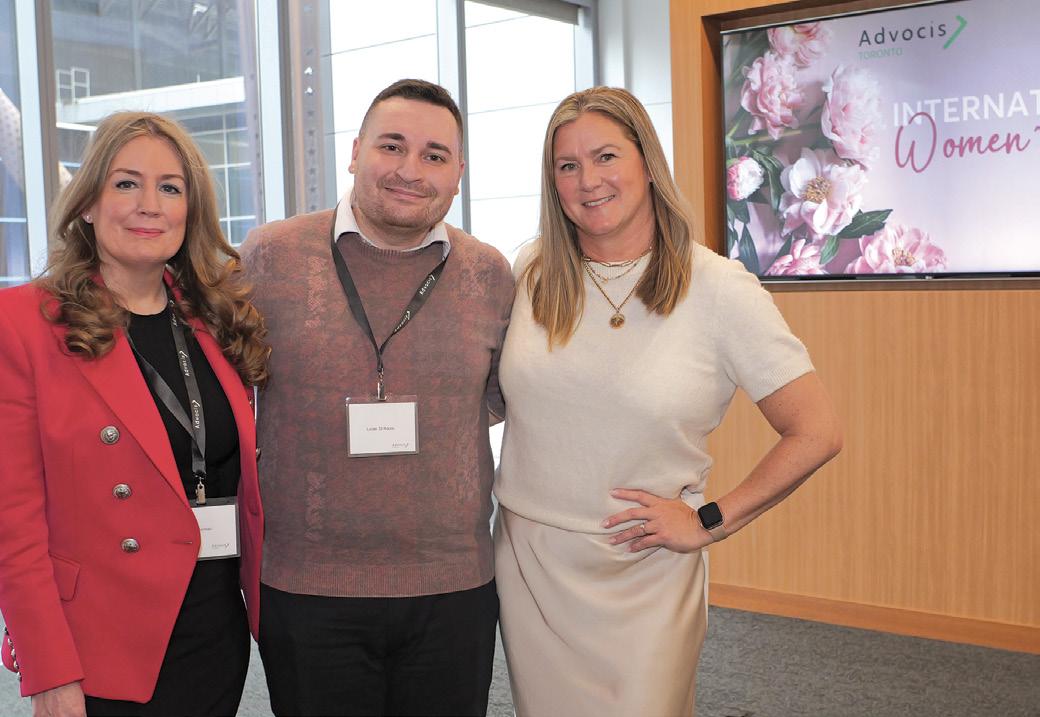
Advocis Toronto hosted its 8th Annual International Women’s Day Celebration on March 5. Sponsored by Desjardins Insurance, the sold-out event brought together members and industry leaders for an afternoon dedicated to celebrating women’s leadership while fostering meaningful connections across the financial services profession.
Attendees heard from an inspiring lineup of speakers including Helena Ruken, Marilyn Horrick, Lindsay Stollery Jephcott, Dr. Woganee Filate, Jen Peacock and Rachel Healey. The event also featured networking opportunities, a boutique marketplace of female-owned vendors and a closing cocktail reception, highlighting the strength of community within the Advocis network.


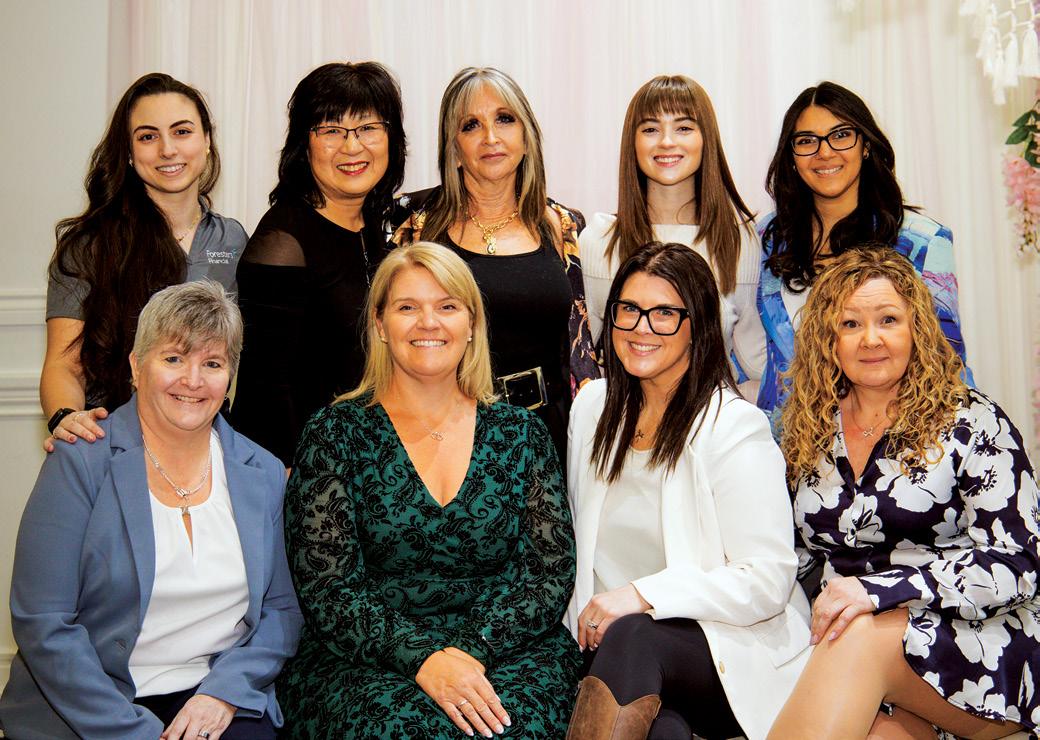
Advocis Greater Hamilton hosted a sold-out 4th Annual International Women’s Day Celebration on March 5 at the Oakville Convention Centre. Designed by women, for women, the event brought together members and guests for a morning focused on celebrating women’s leadership and impact across industries and communities.
The program featured speakers Caryn Maxwell-Smith, Emily Arthur, Jesi Bennett, Baye Kler, Sarah Harper and Melanie Wong, who shared personal insights and experiences. The event also included local vendors, networking opportunities and meaningful discussions that reinforced the importance of mentorship and women supporting women.
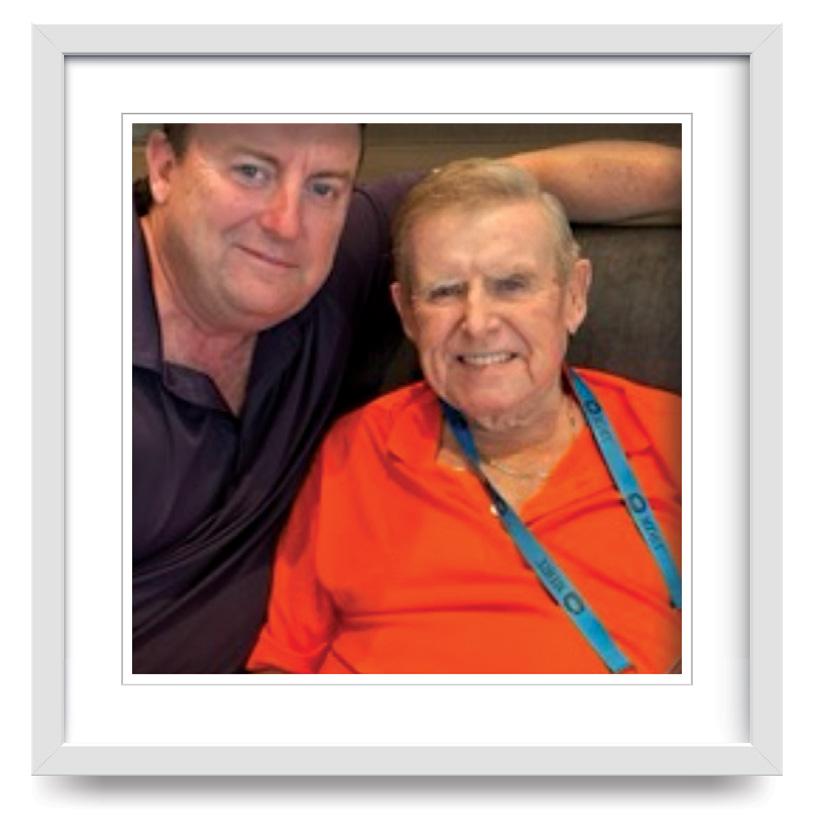
Advocis is saddened to share the passing of Herbert Braley Sr. on January 4, 2026, at the age of 83.
Herbert began his career more than 60 years ago and quickly became known as a pioneer in business succession and continuity planning, ultimately acquiring more than 25 advisor practices across Canada. A respected leader and mentor, he built Braley Winton Financial Group into a thriving firm and helped guide the next generation of advisors, including his son, Herbert Braley Jr. His dedication to excellence earned him recognition across the industry, including 50 years of MDRT membership and Lifetime Top of the Table status.
Herbert’s influence extended far beyond his business success. He was known for his deep charitable commitments, supporting numerous causes quietly and consistently throughout his life. Friends, colleagues and fellow Advocis members knew they could always rely on him for advice, mentorship and a listening ear or helping hand. Over the decades, Herbert left an unmistakable mark on the people he worked alongside, and his dedication to professionalism embodied the values Advocis stands for.
Above all, Herbert was devoted to his family. He is survived by his beloved wife, five children and several grandchildren and great-grandchildren.
Herbert Braley Sr.’s legacy will be felt across the advisory community for years to come. Advocis is proud to honour his memory, his contributions and the lasting imprint he leaves on our profession.
Advocis honours the memory of Edmund H. Warburton, CLU, TEP, who passed away on February 24, 2026. An Advocis member since 1970, Edmund served on the Advocis Toronto Chapter board as past president.
Born in Orillia, Ont., in 1940, Edmund built a successful insurance and financial services practice in Toronto, later co-founding First York Financial. His leadership, generosity and deep commitment to his clients and colleagues earned him wide respect across the profession.
Edmund is remembered for his integrity, warmth and unwavering dedication to the people he served. He leaves behind his beloved wife, Elizabeth, their children and extended family, and the many friends and peers whose lives he enriched.
The Advocis community honours his legacy and extends heartfelt condolences to his family. His contributions and impact will be long remembered.

By Kelly Gorman
As we move through 2026, I’m encouraged by how much progress we’ve made and how clearly it reflects the strength of our members, chapters and volunteers who power this association.
One of the most significant developments has been the progress on the Financial Services Regulatory Authority of Ontario’s proposed Life & Health MGA Rule. Advocis leadership and members, along with other industry participants, expressed concerns over its unintended consequences. The Ontario government has now paused the planned June 1, 2026, implementation date to allow for further review. The decision reflects the importance of industry advocacy and shows how collective effort can shape regulatory outcomes in meaningful ways.
At the same time, we continue to push forward one of our profession’s most important long-term reforms: national title protection. In April, Advocis released a comprehensive title protection white paper, outlining a clear path toward harmonized standards for the use of “financial advisor” and “financial planner” titles.
The paper emphasized key elements of a credible system: consistent rules, simple public verification and transparent enforcement.
We’re seeing encouraging signs of alignment. New Brunswick fully implemented its title protection framework on January 1, 2026, joining Ontario in establishing clear credentialing standards and oversight structures. This growing provincial commitment to the implementation of title protection signals momentum toward a pan-Canadian approach, one that, if implemented, would benefit and protect Canadian consumers from coast to coast to coast.
None of this work happens in isolation. It is powered by our grassroots advocacy network, including our Government Relations Committee (GRC) and our Legal & Regulatory & Policy Committee (LRP). Across the country, members are working hard to ensure that regional perspectives inform national priorities. This work forms the front line of our advocacy voice.
And, of course, our volunteers are at the heart of everything we do. Whether they’re mentoring new advisors, organizing
Continuing Education (CE) opportunities, contributing to regulatory consultations or helping to deliver community outreach, our volunteers bring passion, expertise and generosity to Advocis. We could not operate without them. The progress we’ve made this year reflects their contributions, and we are deeply grateful for the time, energy and leadership they provide.
Looking ahead, our focus remains clear: build a professional environment where advisors can thrive. That means advocating for regulatory approaches that strengthen consumer protection without unnecessary barriers. It means delivering CE, designations and digital tools that support our members’ growth. And it means ensuring that Advocis continues to show up as a credible, solutions-focused voice that shapes the future of financial advice.
We are entering a defining period for our profession. With the MGA rule under review, progress on national title protection and the growing importance of trusted financial advice in a complex economy, our work at Advocis has never mattered more. But what gives me optimism is not only the policy progress — it’s the people behind it.
To the TFAAC board, our members, chapters and especially our volunteers, thank you. Your commitment strengthens this profession every day. And together, we’re just getting started. F