NOVEMBER 2025 • $5.50
The Magazine of Influence for Financial Advisors
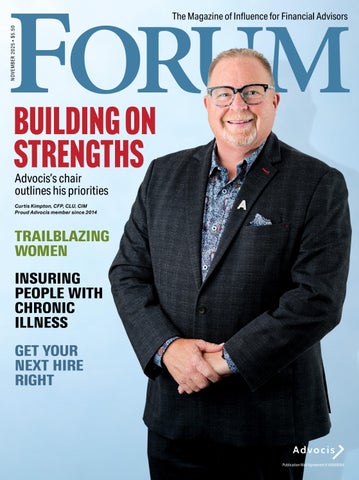
Building on STRENGTHS Advocis’s chair outlines his priorities Curtis Kimpton, CFP, CLU, CIM Proud Advocis member since 2014
TRAILBLAZING WOMEN INSURING PEOPLE WITH CHRONIC ILLNESS GET YOUR NEXT HIRE RIGHT
Publication Mail Agreement # 40069004
Navigate the Complex World of Insurance The Advisor's All-in-One Tool is Here
Download this free tool today:
www.insurancecompass.ca
FORUM
VOLUME 55, 2 | NOVEMBER 2025 | ISSN 1493-826X
FEATURES Open to Opportunity
10
Advocis Chair Curtis Kimpton has a strong track record of stepping up to new challenges. Here, he tells Alison MacAlpine why he is passionate about his career, community, industry, and professional association
DEPARTMENTS
COLUMNS
4
24 TAX UPFRONT 10 ways to save clients taxes if you act before year-end
6
EDITOR’S JOURNAL Champion clients in precarious times OPENERS Hire right the first time; volunteer spotlight; have you talked to clients about your succession plan?; do the people who say they need life insurance the most actually own it?
COVER PHOTO: ROBERT MAURIELL
28 ADVOCIS NEWS Association updates and events 34 FINAL WORD One year in, and just getting started BY KELLY GORMAN
BY JAMIE GOLOMBEK
14
Breaking Through Barriers
Women pioneers in the industry and at Advocis share their experiences with Diane Peters
25 ESTATE DILEMMAS Death and taxes for small business owners BY KEVIN WARK
26 CORPORATE INSURANCE High cash surrender value, low concern BY PATRICK UZAN
27 LEADERSHIP & GROWTH As the industry evolves, so do the skills needed to succeed BY RANDY LIT TLE
Publication Mail Agreement # 40069004 Return Undeliverable Canadian Addresses to FORUM Magazine Circulation Department, 10 Lower Spadina Avenue, Suite 600, Toronto, Ontario M5V 2Z2
20
Ill and Uninsured
People with chronic illness need insurance advice, but product options are limited, finds Allison Dempsey NOVEMBER 2025 FORUM 3
EDITOR’S JOURNAL
BY ALISON MACALPINE
Championing Clients y passion is making a difference in people’s lives … I love being able to problem solve and work with clients to get them to a better place in their life,” said Advocis Chair Curtis Kimpton when I interviewed him for our cover story on page 10. That echoes what I’ve heard from many financial advisors across Canada in my work as a journalist: a rock-solid commitment to prioritizing clients’ best interests to improve their circumstances. And while some, like Kimpton, initially join the industry thinking they might use it as a stepping stone to another career, many find fulfillment in being an advisor, serving clients’ needs to the best of their abilities, and, again like Kimpton, never leave. In fact, leading professionals in this business tend to be laser-focused on helping clients succeed even when some of their energy has to be directed toward breaking through barriers, like the advisors Diane Peters profiles on page 14. Rhona Konnelly, Lydia LaPointe, and Melissa McRae faced challenges as women carving out careers in what remains a male-dominated industry. Nevertheless, they persevered, prioritized clients, and succeeded alongside them. This commitment to clients includes finding ways to meet the needs of people with chronic illnesses, who often struggle to find affordable insurance coverage, as Allison Dempsey explores on page 20. On page 22, Lisa Machado shares her experience living with a chronic illness, and provides insight into the financial expenses advisors can help clients better manage. Machado learned she had chronic myelogenous leukemia at age 36. As more people are diagnosed with chronic illness at younger ages, conversations about appropriate insurance coverage may need to happen earlier. After all, as one advisor put it to Dempsey, “The takeaway here is always get insurance when you’re as young and healthy as possible.” 4 FORUM NOVEMBER 2025
PUBLISHER: Peter Wilmshurst advocisforum@gmail.com EDITOR: Alison MacAlpine alison@amcommunications.ca COPY EDITOR & PROOFREADER: Alex Mlynek
M
“
FORUM
ART DIRECTOR: Giselle Sabatini gisellesabatini@rogers.com ADVERTISING: Peter Wilmshurst advocisforum@gmail.com Tel: 416-766-4273 Fax: 416-760-8797
TFAAC BOARD OF DIRECTORS CHAIR Curtis Kimpton, CFP, CLU, CIM PAST CHAIR Al Jones, CFP, CLU, ICD.D. TREASURER Ejaz Nadeem, MA, CFP, CLU DIRECTORS AT LARGE Arun Channan, MASc, MBA, P.Eng., CSP, CFP Tannis Dawson, CPA, CA, CFP, TEP, FEA, CLU, RRC Kelly Ho, CFP, CCS Tina Tehranchian, CFP, CLU, CH.F.C., CIM
ADVICE IN PRECARIOUS TIMES In an outtake from the cover story, Kimpton said, “What really has resonated with me for 29 years now is the ability of advisors to help people and families through the good times and the tough times — and we’re even more important to them in those tough times.” Abacus Data has described the current moment as an “age of precarity.” Even demographic groups that previously felt relatively secure, including those aged 45 and older and those earning $100,000 or more, saw significant increases in high and extreme precarity scores between March and August 2025 in the Abacus Data Precarity Index. Furthermore, in August, close to half of respondents expected things to get worse, not better, in the next five years in such areas as cost of living (59%), housing affordability (50%), climate risks (47%), job security (46%), and Canada–U.S. relations (45%). In these tough times, double down on taking good care of your clients. Over the years, many advisors have told me the most valuable thing they give clients is an understanding and confidence they will be OK financially. Today, more than ever, people you advise need you to champion them and provide reassurance backed by solid financial planning and trackable progress toward their goals.
CHAPTER LEADERSHIP COUNCIL CHAIR Chris Hudson, CFP, CLU, CHS THE INSTITUTE CHAIR Sara La Gamba, CHS, CFP, CLU, TEP
FORUM is published two times annually by The Advocis Publishing Group, 10 Lower Spadina Avenue, Suite 600, Toronto, Ontario M5V 2Z2 Tel: 416-444-5251 or 1-800-563-5822 Fax: 416-444-8031 FORUM is mailed to all Association members, the subscription price being included in the annual membership fee. Address changes can be made through info@advocis.ca or by calling member services at 1-877-773-6765. The opinions expressed in articles and advertising are those of the authors/advertisers and not necessarily those of FORUM or the Association. Material of a technical or semi-technical nature may become invalid because of later changes in law or interpretation. The Association is not responsible for obsolescence of FORUM articles whose content should be checked by the reader before implementation. Requests for permission to reprint articles are to be addressed in writing to the editor of FORUM. ™ Trademark of The Financial Advisors Association of Canada carrying on business as Advocis.
FORUM EDITORIAL ADVISORY BOARD LEONY DEGRAAF HASTINGS, CFP, EPC deGraaf Financial Strategies NICHOLAS LANDRY, CEBS, CHS, RCIS BFL Canada - CSI IZUMI MIKI-MCGRUER, CFP, CLU, CH.F.C., CHS Freedom 55 Financial MICHAEL SUSKA, CFP, CHS Helkie Financial & Insurance Services Inc.
Together, we’re making a difference. A Big “Thank-You” to all our 2025 corporate partners and sponsors. C O R P O R AT E PA R T N E R S
F I N T E C H PA R T N E R
C O R P O R AT E S P O N S O R S
Everything we do for financial advisors, and their clients, is made possible through your support. Your partnership with Advocis strengthens a national community of professional advisors, ensures they have access to continuing education, and helps Canadians receive trusted guidance to make confident financial decisions. For information on the Corporate Partnership Program, or to become a partner or sponsor, please contact Business Development at bd@advocis.ca
OPENERS Fodder for the Water Cooler
HIRE RIGHT THE FIRST TIME BY KIM POULIN AND APRIL-LYNN LEVITT
I
Know when it’s time to grow There are many signs it’s time to bring someone on board. Some are easy to spot, such as a retiring assistant or the advisor or team members feeling overwhelmed. Others are subtler but just as urgent. You might notice your job satisfaction has dipped, that your calendar is so full of administrative tasks you no longer have time to meet clients or grow the business, or that you’re constantly catching up on compliance notes. You may even realize you’ve outgrown doing it all yourself. Remember: Do what only you can do and 6 FORUM NOVEMBER 2025
delegate the rest. If your day is filled with tasks someone else could handle, that’s a red flag. Your team can also be your biggest indicator. Maybe they’re stretched so thin they’re starting to make mistakes or work late every day. When they express stress or burnout, when they tell you they need to work overtime, or when they start avoiding tasks, it’s time to listen. The same is true if they say, “We could really use another set of hands.” Trust their insight. Sometimes, hiring is about futureproofing. Mentoring an associate advisor now gives more time to build trust with clients and ease the eventual transition, and hiring before someone retires allows for smoother onboarding and knowledge transfer. Still not sure if you need to hire? Consider cost-effectiveness. Hiring someone to take on tasks at a lower hourly rate than yours builds profitability. To do a rough calculation, divide your annual salary or revenue by 2,000 hours — approximately the average hours worked in a year. So, if you’re earning $200,000, your hourly rate is $100. Someone else may cost less and even enjoy tasks you dislike. The key is
to use freed-up time for more productive tasks in your areas of greatest strength.
Understand why hiring can fail A common mistake we see advisors make is hiring someone they “click” with but who doesn’t meet the business’s needs. Liking someone is not enough. Hiring right means making sure that person can thrive in the role you actually need filled. Before posting the job, define what your business truly requires. Make sure you’re clear on the tasks, responsibilities, and characteristics that matter. Don’t assume a good resumé or positive energy will compensate for a significant skills gap. A useful exercise is to keep a time log for two weeks (your team members can do this, too) and identify specific tasks that could be delegated. One of the most powerful tools is a clearly written job description for the new hire and for every person on your team. This can eliminate overlap, clarify responsibilities, and make onboarding smoother. If you’re a solo advisor, talk through your thoughts with a coach or trusted colleague. If you work on a team, involve them. Invite each team member to help
PHOTO: ISTOCK.COM / VIOLETASTOIMENOVA
n a coaching call after the long weekend in September, Darren, a successful advisor, admitted he came back from vacation feeling “blanketed by overwhelm.” With a full email inbox and client appointments already booked into October, he felt frozen and did not even know where to start. Ideally, it’s better not to wait until that point before adding to your team. Advisors don’t always realize it, but recruitment is one of the most important business decisions they’ll make. Whether you’re planning for growth, backfilling a retiree, or simply trying to get back to doing what you enjoy, building the right team is essential. In today’s environment, with increasing administrative and compliance burdens, client demands, and competition for top talent, hiring is about more than filling a seat. It’s about making intentional decisions that keep you focused on what you do best and allow your business to thrive.
define what’s needed. That inclusion creates clarity and buy-in from the start. Here’s something else many leaders forget: Don’t hire another version of yourself. Unless you’re bringing on a partner, hiring a clone won’t expand your team’s capabilities. Instead, hire someone with different strengths. Bright, energetic individuals who know how to do things you don’t will help your practice grow. And don’t get caught up in experience alone. Hire for attitude and aptitude. Skills can be taught. But a willingness to learn, openness to new ideas, and dedication to helping the team? That’s harder to find.
Make the process efficient With the new role defined, your goal should be to keep the process moving. Use written pre-screen questions to weed out unqualified applicants. Schedule interviews quickly, since candidates are usually applying elsewhere as well. Take notes, follow up, and communicate clearly. Great candidates are assessing you just as much as you’re assessing them. Make a strong impression by being orga-
nized, responsive, and transparent about expectations. When you find the right person, onboard with purpose. Have them meet each team member. Let existing staff walk through their job descriptions so the new hire sees how the pieces fit together. Provide mentorship, not just training. And give them space to ask questions, offer ideas, and feel part of the team.
Learn what today’s top candidates want Gone are the days of employees staying in a role just because it pays well. Today’s top talent is looking for three things: 1. Growth opportunities — This might mean expanding responsibilities over time, earning certifications, or learning new parts of the business. People want to feel like their role matters and that it’s going somewhere. 2. Strong leadership — Candidates want clear expectations, honest feedback, and to feel trusted. Leaders who know their strengths and delegate effectively attract and retain great people.
3. A meaningful culture — Financial services are already rooted in purpose. Helping people with their money, future, and families has real emotional value. Remind staff of that purpose every day. Bonus: Flexibility matters. We’ve found that remote or hybrid roles attract three times as many applicants. You don’t have to be fully remote to compete. Just offer what you can, and be clear about expectations.
A final thought The hiring process is an opportunity to build a team that supports your vision, reduce burnout, and unlock growth. Most importantly, it’s a chance to reclaim your time so you can do more of what you love and what your clients value most. Hire right the first time. Your business will thank you. KIM POULIN and APRIL-LYNN LEVITT provide customized business coaching and programs for financial advisors and their teams through The Personal Coach. Poulin, BA, FLMI, CLU, CH.F.C., is a team productivity & hiring coach, and Levitt, BComm, CFP, is a business coach.
The PFA More Than a Designation TM
It’s Your Business-Building Advantage
The PFA™ More Than a Designation It’s Your Business-Building Advantage Whether you’re starting out or sharpening your edge, the PFA equips you with the skills, structure, and support to succeed in today’s competitive landscape. It’s the ideal next step after licensing, and a powerful foundation if you’re on the path toward advanced designations like the CLU®.
Why Earn Your PFA™? • Practical, real-world training in practice management, technical knowledge, compliance, and ethics • Complete the program in just one year
• Flexible, fully online and self-paced • Builds trust and credibility with clients • Strong foundation for future credentials like the CLU®
Learn more: advocis.ca/pfa-designation The PFA is an approved designation for use of the title ‘Financial Advisor’ in Ontario.
OPENERS
I
“ volunteer for Advocis Durham because I want to see advisors getting involved in their industry and communities. Through my volunteer work, I’ve gained invaluable relationships with peers, insight into the issues Advocis advocates for, and appreciation for the work that goes into running a professional organization that offers advisors the tools they need to be successful and reputable. I’ve especially loved witnessing the collaborative nature of this organization. This year, I had the opportunity to get more hands-on with our chapter’s leadership, which was rewarding because it gave me the chance to better connect with our chapter’s members. Volunteering is a great opportunity to meet new people and make a difference, as a board member or part of a committee. Also, business and office culture has changed a lot, and your local Advocis chapter could be a great place to find a collaborative environment again.”
“ volunteer for Advocis Peel-Halton because I strongly believe in continuous learning, contributing toward supporting advisors’ growth, and raising professional standards in our industry. In the context of the industry’s evolving needs, raising the bar for competence and professional standards is the need of the hour. Volunteering with Advocis has given me the platform to connect with inspiring peers, share ideas, and create meaningful learning opportunities. One rewarding highlight of this year was co-facilitating UPDATE 2025, because it allowed me to engage directly with advisors and leaders across the industry on emerging trends and practical strategies that can be effectively implemented in their practices. I’m passionate about curating programs and frameworks that encourage innovative thinking and empower advisors to deliver exceptional value to clients, leading to meaningful advisor and client experiences. My volunteer work with Advocis allows me to pursue this. For me, volunteering is not only about giving back — it’s also about personal growth, furthering leadership development, and being part of shaping the future of our profession. Be the change that you wish to see in the world. To anyone considering it, I’d say: Take the step. The experience will broaden your perspective, strengthen your network, and leave you with a real sense of impact.”
BRITTANY HUDSON, Financial Advisor, B & C Financial and Estate Planning Services Ltd., Peterborough, Ont., and Public Awareness, Communications, and Advocacy Chair with Advocis Durham.
AMRITA PAUL, Business Growth and Transformation Leader in Ontario, and Professional Development Chair and Co-GAMA Chair with Advocis Peel-Halton.
VOLUNTEER SPOTLIGHT Advocis volunteers explain why they generously share their time, skills, and energy with their professional organization.
I
T hank You ADVOCIS MEMBERS This year has reminded us of the strength of community. Across Canada, financial advisors have worked tirelessly to guide clients through change and opportunity alike, always putting their financial well-being first. As 2025 comes to a close, Advocis thanks you for your commitment, professionalism, and the trust you build every day. Together, we are building a more resilient profession for tomorrow.
DID YOU KNOW? HAVE YOU TALKED TO CLIENTS ABOUT YOUR SUCCESSION PLAN?
M
ore advisors are taking succession planning seriously, according to a survey released in July 2025 by Investment Planning Counsel (IPC), with 65% having started to create a formal plan or having a rough idea of what they will do, up from 53% in 2021. But clients may not be aware of your intentions. In fact, 83% of investors who work with advisors admit they have concerns about their advisor’s succession plan. Within that group, the top worries are: Lack of advance communication New advisor won’t be trustworthy
53%
36%
This suggests an opportunity to prepare clients by addressing the elephant in the room and talking to them about your succession plan well ahead of time. Introducing the topic also gives you an opening to reassure clients that you will make sure their new advisor is someone they can trust, and then to introduce your successor and ease the transition as you get closer to your retirement date.
SOURCE: “NEW IPC RESEARCH SHOWS FINANCIAL ADVISORS NOT READY FOR RETIREMENT, RISKING CLIENT TRUST AND CONTINUITY OF ADVICE.” INVESTMENT PLANNING COUNSEL INC. NEWS RELEASE, JULY 7, 2025.
DO THE PEOPLE WHO SAY THEY NEED LIFE INSURANCE THE MOST ACTUALLY OWN IT?
Y
PHOTOS: ISTOCK.COM / (TOP) ANDREYPOPOV; (BOTTOM ) KALI9
ounger adults in the U.S. are the most likely to say they need life insurance, but the least likely to have a policy in place, says the 2025 Insurance Barometer Study from LIMRA and Life Happens. What’s holding them back? Many think it’s too expensive (37% of Gen Zs and 46% of Millennials) — but their best guess of how much a $250,000, 20-year, level-term policy costs may be too high by a factor of 10 to 12. Making sure your clients know the true cost of an appropriate policy is a simple way to nudge them closer to the coverage they know they need.
Self-reported Life Insurance Need and Ownership by Generation
46%
44%
42%
42%
49%
51%
56%
27%
Needs (more) life insurance Gen Z
Millennials
Gen X
Owns life insurance Baby Boomers
SOURCE: 2025 INSURANCE BAROMETER STUDY, LIMRA AND LIFE HAPPENS.
NOVEMBER 2025 FORUM 9
COVER STORY
10 FORUM NOVEMBER 2025
Open to Opportunity Advocis Chair Curtis Kimpton has a strong track record of stepping up to new challenges. Here, he tells Alison MacAlpine why he is passionate about his career, community, industry, and professional association
T
wo insurance professionals walked into a bar in Saskatoon — and it wasn’t the start of a joke. They were regulars, there for after-work drinks, and their bartender was Curtis Kimpton. He’s now chair of Advocis, but back then, in 1995, he was a student, studying finance and marketing at the University of Saskatchewan. And he was intrigued when they asked, “Why aren’t you working with us?” Both were division directors at Investors Group (now IG Wealth Management), and he agreed to meet one of them at his office the next morning. Hours later, he hopped out of his dilapidated blue 1968 International Harvester Corporation pickup truck and sat down with Rick Floer, who told him, “You need to get into this industry. You’re talking to everyone every night. You already have a natural market.” Over the next couple of weeks, Kimpton became increasingly interested — though Floer said firmly, “The first thing you’ve got to do is get rid of that truck!” Kimpton joined Investors Group immediately after graduating. He laughs that he went straight from being a “starving student” to being a “starving advisor.” But despite the struggles of the early
years, he learned quickly and built his client list. “In no time, I was really enjoying the industry … and I had an amazing 20 years with Investors Group.” In 2018, he joined Wellington-Altus Private Wealth as a senior wealth advisor, still based in Saskatoon. “My passion is making a difference in people’s lives every day … I love being able to problem solve and work with clients to get them to a better place in their life,” he says. “And the profession itself has enabled me to go out and do one of my other passions — getting involved and volunteering in the community.” Specifically, Kimpton helped launch the Saskatoon Walk, in support of Cystic Fibrosis Canada, and the Saskatoon Zoo Foundation. He chaired the Saskatoon Community Foundation, which works with individuals, families, and organizations to fulfill their philanthropic interests, and is today the longest-serving board member and chair of the organization’s finance committee. He also chaired Kin Canada and helped launch the Kin Canada Foundation, which spearheaded the 2011 Portraits of Honour cross-country tour of a hand-painted mural depicting 158 Canadian soldiers who lost their lives serving in Afghanistan.
PHOTO: ROBERT MAURIELL
NOVEMBER 2025 FORUM 11
COVER STORY “We had thousands and thousands of people turn up at events and show their respect for those soldiers, and that was just an amazing feeling,” he says. Working with the Canadian Armed Forces, Kimpton helped start the Saskatoon Vimy Dinner, now in its fifth year, which raised $80,000 in funds for soldiers in 2025. Partly in recognition of these efforts, Kimpton was named an honorary colonel of the Canadian Army in 2023.
GETTING INVOLVED WITH ADVOCIS Clearly, the “yes” that launched Kimpton’s career was far from the last — and his enthusiasm for contributing to worthy causes has spilled over into his professional life. A little over a decade ago, he was chatting with another Investors Group financial advisor, Mike Carey, who told him Advocis needed local help with its advocacy work. Kimpton had contacts in the provincial government and, fatefully, asked, “What do you need help with?” It was the start of a long relationship with the professional organization. Advocacy work on title protection led to an invitation to chair Advocis’s provincial advocacy committee for Saskatchewan, which led to encouragement to work on advocacy with the local chapter, which led to the suggestion that he chair Advocis North Saskatchewan (2021–2023). “Chairing a chapter is truly special because you are at the grassroots of the organization, working with all the advisors in your area and trying to help them,” Kimpton says. “You’re a sounding board. You’re the person they will call to pass something by you … That was a wonderful time.” The next “yes” was to join Advocis’s Finance and Audit Committee at the national level. After two years, he was invited to sit on the national board of directors (2023–present). Unlike this year, with new governance principles implemented, there was no competition for his seat. Fast forward to 2025 and, like all other board members, he stood for re-election, with more candidates than seats. “I love that it is an open, transparent process,” Kimpton says. “Our membership deserves to have their say, [and] we represent our membership in a better, truer form than somebody shouldertapping you.” Under the new process, the board struck a nominations committee that sent a call out to the entire membership welcoming people to put their names forward. The nominations committee reviewed every submission against a matrix of needed skill sets and diverse representation for the board as a whole and various committees. Members voted and the new board came into being. Kimpton says his involvement with Advocis has given him “amazing hope” because it introduced him to professionals across the country dedicated to making a difference in people’s lives. It has expanded his perspective and knowledge, brought him friendships across the country, and reinforced the importance of ethical practice that helps Canadians through good and tough times. 12 FORUM NOVEMBER 2025
“We need to take the time to listen intently to our members and understand what they’re asking of us … [and] we have to be willing to be open and honest with our membership. That’s absolutely something I want to do and will push forward. They need it and they deserve it,” Kimpton says.
PRIORITIES AS ADVOCIS CHAIR Beyond continuing to modernize governance and stabilize financial foundations, Kimpton wants to refocus the organization on efforts to advocate for a brighter future for members and the industry, including through regulatory harmonization. He is also committed to rebuilding trust with Advocis’s members, sponsors, and partners after several challenging years. “We need to take the time to listen intently to our members and understand what they’re asking of us … [and] we have to be willing to be open and honest with our membership. That’s absolutely something I want to do and will push forward. They need it and they deserve it,” he says. The best opportunities for Advocis, looking ahead, aren’t brand new, he adds. They’re about building on strengths that are already there — including reigniting the network of local chapters doing important work across the country. The last several years have seen chapters amalgamated, and he’d prefer them to grow and spread. “We need to empower our chapters,” he says. “They’re the ones on the ground in every community. They’re hearing what members truly want.” He adds, “Being part of Advocis has meant everything to me — the friendships, the camaraderie, the learnings. People who join Advocis are very open and willing to help and share their ideas. It’s also an organization that has positioned itself for the future, looking to advocate on your behalf to make sure that your voice is heard across this nation.” ALISON MACALPINE is a Toronto-based writer and FORUM’s editor.
INDUSTRY
“It took us paving the way for the industry to start to embrace the fact that women are excellent for this industry.” Rhona Konnelly
Breaking
Through Barriers
I
Women pioneers in the industry and at Advocis share their experiences with Diane Peters
n the late 1970s, when recent college grad Rhona Konnelly was working at a restaurant in Victoria, a former college classmate stopped by. He told her the financial services industry was offering equal pay for equal work under the newly passed Canadian Human Rights Act and that she should consider becoming an advisor. After she took a job at Sun Life, Konnelly learned equality was a loose concept. “They didn’t think women would survive. They told me this, and that, ‘We’re doing this because we have to.’” Meetings routinely began with a sexist joke. At conferences, she’d be the only woman who was not a secretary or someone’s 14 FORUM NOVEMBER 2025
wife. When male advisors would make inappropriate comments, everyone would turn to see if she’d react. Behind the scenes, Konnelly’s family doubted her career choice and she had to scour boutiques in Vancouver to find appropriate work clothing. But she had many supportive male mentors and enjoyed getting involved with the Life Underwriters Association of Canada (LUAC), which later became Advocis. Colleagues grew to admire her work ethic and results and started asking her to assist with interviews when hiring women. She got promoted to sales management, the first woman at her company in such a role.
“I worked in sales management for six and a half years, and during that time you started to see women getting more respect,” Konnelly recalls of the 1980s. “It took us paving the way for the industry to start to embrace the fact that women are excellent for this industry.” Nevertheless, there came a time when her team booked a leadership meeting at the Union Club of British Columbia, an all-male club in Victoria that relegated female guests to a separate entrance. “If you want me to attend this meeting, I’m going in the men’s door with you. I’m not going in that other door by myself,” Konnelly told the regional sales manager, who complied. Early-days female advisors such as Konnelly — who went on to serve as one of the first female LUAC chapter presidents in 1987 and now runs Konnelly Consulting in Parksville, B.C. — regularly dealt with such challenges and indignities. But they also found workarounds and opportunities. As Advocis welcomes three new women to its national board, with women comprising 41% of chapter presidents across the country, and as the industry keeps striving to be more gender diverse, it’s an apt time to meet some of the pioneers.
DODGING IN-JOKES AND OTHER PEOPLE’S ADMIN WORK In the early 1980s, trained teacher and parent of young children Lydia LaPointe returned to her native New Brunswick from Quebec and found no teaching jobs — but she saw an ad for an insurance advisor. “My children were in elementary school and it said, ‘flexible hours.’ I wanted the flexible hours more than I wanted the job.” She was hired and later worked at a brokerage.
It turned out she was one of just a handful of female advisors in the entire province. While one she knew was dealing with overt sexism and male colleagues taking credit for her work, LaPointe faced little outright discrimination. But she didn’t enjoy true acceptance, either. “In my office, it was all men in suits. They barely gave you the time of day. They had in-jokes.” As just one example, she found out after the fact that her colleagues had flown to Montreal to see a hockey game. “I thought they could have at least asked. But they didn’t want to in case I said ‘yes,’” says LaPointe who, like Konnelly, joined LUAC early in her career and served in many executive positions, including as president of the Fredericton chapter (which no longer exists), and as program chair and membership chair of Advocis New Brunswick. She has now semi-retired from a local consulting company in Fredericton. By 2009, when Melissa McRae joined the industry, things had changed. The mother of a friend — an advisor — suggested she give it a try, and she began working as a wholesaler before joining a wealth management bank in Calgary. In 2014, she moved back to her native Winnipeg, where she started a boutique investment firm with a partner before going solo in 2021. “I wasn’t the only woman in the room as a professional. Even in my first role, there were a few women that were professionals, and they were wonderful mentors. But we were absolutely the minority. In a group of 30, there would be three of us,” recalls McRae, who has served as president of Advocis Winnipeg and today runs McRae Wealth. Despite progress in the decades after Konnelly and LaPointe joined the industry, McRae says people often assumed she had administrative duties. “People would say things like, ‘Can you check his schedule?’” She’d reply that she did not have access — even when she did.
“In my office, it was all men in suits. They barely gave you the time of day.” Lydia LaPointe
NOVEMBER 2025 FORUM 15
INDUSTRY
“I had to make it clear that even though I’m helpful and efficient and I could get this done, it’s better suited to someone else’s time.” Melissa McRae
“I had to make it clear that even though I’m helpful and efficient and I could get this done, it’s better suited to someone else’s time.” She’d also tell others that her meticulous note-taking skills were not up for grabs — someone else could serve as secretary, as her notes were simply too difficult for others to read. McRae says constantly putting up guardrails to protect her professional reputation is exhausting, so she reframes situations. “You have to view these moments as an opportunity.” When someone told her she had a “mama bear vibe,” she was affronted at first. But then she embraced the concept. “Who doesn’t like their mom? I’ll lean into this.” If her clients found her caring and willing to fight for them, that worked for her. 16 FORUM NOVEMBER 2025
DEVELOPING A PROFILE IN THE INDUSTRY For women struggling to get a foothold in a male-dominated industry, membership in a professional association can be an important leg up. McRae joined Advocis as soon as she became an advisor and says she learned so much from her volunteer positions and from other members. “I started in the role of treasurer [for Advocis Winnipeg]. That’s tremendously valuable in any organization, to know where the money’s coming from.” She went on to be vice president, then president and served on the chapter’s leadership council.
More recently, she served on a national committee. Konnelly took on the top job at her LUAC chapter right around the time that brokerages began setting up shop in Canada. She was called radical for recruiting her board from a wide array of professionals, including brokers. Then again, Konnelly was a born trailblazer. For example, she also developed a reputation as an innovator when she developed her own direct mail marketing program within her first year in the industry — something no one else was doing at the time. “Within three years, 70% of my client base came from that direct mail program.” For LaPointe, who had to fight to be noticed at work, being an active Advocis member and serving on the chapter executive afforded her instant trust and freedom to get things done. “They were so glad somebody was taking the job. They just said, ‘Good, Lydia’s in charge, everything’s fine,’” she recalls, noting there was a lot of cooperation among advisors from different companies. She adds it helps that female advisors tend to stick together. They even learn together, with a senior colleague joining her to earn certifications in synch. “I believe in mentoring and coaching, and those things count for a great deal.”
LOOKING INTO A BRIGHTER FUTURE These industry veterans have seen the gender landscape change for the better, but there’s still much room for improvement. McRae says too few young women are being recruited into the industry, and women with families find advisor roles tough. “You need to produce quickly and grow quickly and become successful in a short period of time in order for it to be sustainable financially. That does not lend itself well to work-life balance,” she says. However, LaPointe thinks women joining financial services can carve out great careers, and that includes newcomers to Canada who are much needed to bring true diversity. “I always tell women it’s a great career for them,” she says. “It’s great because it requires brains, not brawn.” DIANE PETERS is a Toronto-based writer, editor, and teacher.
WOMEN’S VOICES ARE STRENGTHENING THE NATIONAL BOARD Four out of nine Advocis national board members are women, including three out of four new board members elected in 2025.
“
I
feel privileged to be in a position where I can give back to the profession I love. I enjoy learning about the inner workings. I have started to think about the future of our profession and how to educate younger Canadians about the industry. Considering that women make up half the population of Canada, it is vital for leadership roles to reflect this. I am eager to help elevate corporate governance and, most of all, I look forward to working alongside fellow board members and learning from their varied perspectives.” KELLY HO, Partner, DLD Financial Group Ltd., Vancouver, B.C. Advocis member since 2008.
M
“
y goals as an Advocis board member include ensuring a well-balanced approach to planning to meet the needs of all clients and a high level of training for advisors and planners to maintain this profession’s high standards. It’s also critical to educate clients on the difference between advisors and planners and what they should look for when dealing with their investment, tax, and estate needs. Seeing women in leadership roles encourages other women to join this industry. That’s important because women bring different life experiences and perspectives to the industry and are looked at to be inclusive, approachable, and trustworthy — all qualities clients look for in this area.” TANNIS DAWSON, Vice President, High Net Worth Planner, TD Wealth, Winnipeg. Advocis member since 2022.
“
I
joined Advocis in 1991, as soon as I started my career in the financial services industry. Being involved at the board level has given me a closer look at challenges and opportunities and allowed me to be involved in industry matters. There is still a noticeable lack of women leaders, particularly in senior leadership and executive roles. Continued visibility, support, and institutional commitment to equity are essential to ensure younger women have inspiring leaders to look up to and pathways to follow. My goal is to help improve the level of public respect for financial advisors through increased professionalism and high ethical standards.” TINA TEHRANCHIAN, Senior Wealth Advisor, Assante Capital Management Ltd., Toronto. Advocis member since 1991.
NOVEMBER 2025 FORUM 17
LONG-STANDING CLU
DESIGNATION HOLDERS
The Institute for Advanced Financial Education honours longstanding CLU® holders – those who have held their designation for 25 years or more—demonstrating a longtime commitment to excellence in financial advice. We are honouring CLU designation holders who are celebrating 25, 30, 35, 40, 45, 50, 55, 60, 65 & 70 year increment milestones in 2025. 25 YEAR
CLU DESIGNATION HOLDERS Diane Everett, CLU,TEP,LL.B Patrick Fitzgerald, CFP,CLU,CHS Sarah Holland, CFP,CLU,CIM Debbie Hartzman, CFP,CLU,CDFA, TEP Christopher Hayter, CFP,CLU Kristen Hamm, CFP,CLU Michael Kidney, CFP,CLU,CHS, Mike Juurlink, CFP,CLU,CHS Dave Hawryluk, CFP,CLU,RHU Mark Murano, CLU,CFP James Hughes, CFP,CLU,CHS Paul Di Rinaldo, CFP,CLU Michael Davis, CFP, CLU,CHS Gordon Engel, CFP,CLU,CHS George Donkor, CFP,CLU Stephen Ste. Croix, CLU,CHS Kurt Rosentreter, CA,CFP,CLU,TEP,CIMA Matthew Pomeroy, CHS,CLU Mitchell Reynolds, CFP,CLU,CHS,MBA Aaron West, CFP,CLU,CHS Jasvir Gill, CFP,CLU,CH.F.C.,RHU Richard Irwin, CFP,CLU Brenda Penner, CFP,CLU,CHS
30 YEAR
CLU DESIGNATION HOLDERS Anthony Windeyer, CFP,CLU,CHS,CIM,FSCI Ana Martinho, CLU,CHS Stephen Kulyk, CFP,CLU Annette Mrva, CFP,CLU Archana Kansra, CLU,CHS Viresh Mathur, CLU Rodney Power, CLU Misty Tait, CFP,CLU,CHFC,CHS,TEP Brian Weatherdon, CFP,CLU,CPCA Sherry Miller, CFP,CLU,CHS Michael Finer, CFP,CLU,RHU,REBC Edward Sinnott, CLU,CFP Jennifer Kirby, CFP, CLU,CHS Michael Barichello, CFP,CLU,CHS,FMA Robert Cheung, CFP,CLU David Yurich, CFP,CLU,R.F.P.,TEP
Philip Soukoroff, CFP,CLU Bruce Hancock, CFP,CLU,CH.F.C.,CHS Daniel Sember, CFP,CLU,CH.F.C.,CHS James Deakin, CFP,CLU Michael Wellman, CFP,CLU Alicia Leblanc, CLU,PFA Lee Fitzsimmons,CLU Larry Owen, CFP,CLU,CHS Monica Ly, CFP,CLU,CHS Todd Babcock, CFP,CLU,CHS
35 YEAR
CLU DESIGNATION HOLDERS Anthony Sverdrup, CFP,CLU,CH.F.C.,CHS Paul Tompkins, CLU Barry Twerdun, CFP,CLU,CH.F.C. David Cechini, CFP,CLU,CH.F.C. Jennifer Hamilton, CFP, CLU, CH.F.C. Dean Owen, CLU, CH.F.C. Jurgen Rudolph, CFP,CLU Steve Cutt, CFP, CLU, CHFC, FMA Brian Shumak, B.Sc., CLU, CFP, CHS Bradley Charlton, CLU,CH.F.C.,CHS Bilhar Bachra, CLU Howard Murphy, CLU,CH.F.C. Charanjeet Sidhu, CFP,CLU,CH.F.C.,CHS Mark McMillan, CFP,CLU,CH.F.C. Robert Crawford, CLU Jack Di Nardo, CFP,CLU,CH.F.C. Brian Burlacoff, CFP,CLU,CHS Perry Sellars, CLU,CH.F.C. Gary Regel, CFP,CLU,CH.F.C.,CHS Garry Roberts, CLU,CH.F.C. Scott Weldon, CFP,CLU,CH.F.C. George Ranisau, CLU, CH.F.C. Chris Dietz, CFP, CLU,CH.F.C.,CHS Nick Devere-Bennett, CLU,TEP Damian Borges, CFP,CLU,CH.F.C. Wade Lawrence, CFP,CLU,CH.F.C.,CHS Michael Wong, CLU,CH.F.C. Jeanette McPherson, CFP,CLU,CH.F.C.,TEP Danielle Genier, CFP,CLU Peter Izzio, CLU Jonathan Sinnatamby, CLU,CHS Ainslie Winter, CFP,CLU,RHU Michael Keyes, CLU
Vivian Saunders, CFP,CLU,CH.F.C. Angelo Venetsanos, CFP,CLU,B.Comm Robert Kimel, CLU Michael Camacho, CFP,CLU,CH.F.C.,CHS, Sudhir Punjabi, CLU Anthony Bosch, CFP,CLU,CH.F.C.,CHS G. Scott Calcutt, CFP,CLU,CH.F.C.,CPCA Daniel Peacock, CFP,CLU Yves Roy, CFP,CLU Robert Romas, CFP,CLU,CH.F.C. Jane Trentini, CFP,CLU Ashok Sharma, CLU,CFP Izumi Miki, CFP,CLU,CH.F.C.,CHS Robert Whiton, CLU,CH.F.C. Gordon Maikawa, CFP,CLU,CH.F.C. Emeli Yacoub, CFP,CLU Ejaz Nadeem, MA,CFP,CLU David Robinson, CFP,CLU,CH.F.C. Joaquim Diogo, CLU Armando Cordova, CLU Martyn Hall, CFP,CLU Joe Lopes, CFP,CLU,CH.F.C. Gerold Haukenfrers, CFP,CLU,CH.F.C. Maurice Walch, CFP, CLU Kevin Dube, CFP,CLU,CH.F.C.,CHS Thomas Cooney, CFP,CLU, R.F.P. Janusz Siembida, CLU,CHS,TEP
40 YEAR
CLU DESIGNATION HOLDERS Michael Cowhig, CFP,CLU,CH.F.C. Howard Haskings, CFP,CLU,CH.F.C.,CHS Nandini Roy, CFP,CLU,CH.F.C. Linda Moulin, CLU,CH.F.C. Ian Johnson, CFP,CLU Barbara Brady, CLU,CHS T. Geoffrey Hull, CLU Dale Berg, CFP,CLU,CH.F.C. David Franklin, CFP,CLU,CH.F.C. Gordon Schellenberg, CFP,CLU Kathryn Bennett, LL.B,TEP,CLU Stuart Libin, CFP,CLU,CH.F.C. Gregory Gies, CFP,CLU,CH.F.C.,CHS Jane Simpson, CLU Daniel Wong, CFP,CLU,CH.F.C. Paul Mowbray, CFP,CLU
The Institute for Advanced Financial Education (The Institute™) is the leading designation body in Canada for financial services practitioners in the specialty areas of Advanced Estate and Weatlh Transfer, and Living Benefits. The Institute provides a platform of standards and advanced knowledge through designation programs and accreditation services.
TO
Holding a CLU designation is proof of commitment to higher standards. Even under the most difficult economic circumstances, longstanding CLU designation holders have continued to help Canadians build and preserve their wealth.
Lola Macanowicz, CLU,CHS,CFP,CIP T. Crossgrove, CFP,CLU,CH.F.C.,CHS David Terpening, CLU,CHS Raymond Matt, CLU,CHS Duane Snow, CLU,CH.F.C. Tom Kirdeikis, CLU,CH.F.C. Michael Thorne, CFP,CLU,CH.F.C. David Ho, CLU,CH.F.C. Brian Hammond, CLU Douglas Medley, CLU,CH.F.C. Murray Biggar, CLU,CH.F.C. Jay Daley, CFP,CLU,CH.F.C. Atiya Ahsan, CLU,CH.F.C. Richard Benson, CFP,CLU,CH.F.C.,CHS Michel Lemaire, CLU,CH.F.C.,CHS Richard Tomalty, CFP,CLU,CH.F.C., CHS Russell Thompson, CLU,RHU Alda Bouvier, CLU James Wilson, CFP,CLU,CH.F.C. Bonnie McPhail, CFP,CLU,CH.F.C. Christine Joly, CFP,CLU David Neale, CFP,CLU,CH.F.C. Brian Stuebing, CLU,CH.F.C. William Yeung, CFP,CLU,CH.F.C. Michael Rigato, CFP,CLU,CH.F.C. David Krahn, CLU James Matson, CLU,CH.F.C.,CHS
45 YEAR
CLU DESIGNATION HOLDERS Ralph Fege, CLU, CH.F.C.,CHS Stephen Campbell, CFP,CLU,CH.F.C. Larry Green, CLU,CH.F.C.,CFP Robert Long, CFP,CLU,CH.F.C. Paul Walker, CFP,CLU,CH.F.C. Andrew Wilkin, CFP,CLU,CHS,CH.F.C. Robert Rowe, CFP,CLU,CHS Rodney Phillips, CFP,CLU,CH.F.C. J. Mccreary, CLU,CH.F.C. Robert Edge, CFP,CLU,CH.F.C. Donna Harrison, CFP,CLU,CH.F.C. Thomas Liska, CLU,CH.F.C.,CFP,RFP Susan Creasy, CLU Gregory Holben, CLU John Hamilton, CLU,FEA Steven Hisey, CLU,CH.F.C.
C. Elvidge, CFP,CLU,CH.F.C. Brian Zufelt, CLU,CH.F.C. Terrence McBride, CFP,CLU Robert Adams, CFP,CLU,CH.F.C.,RFP Brian Henley, CFP,CLU,CH.F.C. Neil Harris, BComm,CLU,CH.F.C. Donald Walmsley, CFP,CLU,CH.F.C. Richard Erven, CFP,CLU,CH.F.C. Nelson Hoe, CLU,CFP,CH.F.C. Raymond Black, CFP,CLU,CH.F.C. David Stinton, CFP,CLU,CH.F.C. Timothy Paziuk, CFP,CLU,CH.F.C. Kevin Dunphy, CFP,CLU,CEA Michael Mott, CLU,CH.F.C. James McDonald, CLU Carl Eppstadt, CFP,CLU,CH.F.C., C.H David Ryckman, CLU,CH.F.C. Brian Hein, CFP,CLU,CH.F.C.,RFP Peter Legere, CFP,CLU Daniel Blais, CLU David Faulkner, CFP, CLU
David MacFadyen, CFP,CLU,CH.F.C. Paul Greene, CFP,CLU,CH.F.C.,CHS
50 YEAR
CLU DESIGNATION HOLDERS
CLU DESIGNATION HOLDERS Michael Slota, CFP,CLU,CH.F.C. Roger Janke, CLU David Johnston, CLU Rodger Johnson, CLU Randy Chevalier, CFP,CLU,CH.F.C. Donald Smith, CLU,CHFC,FEA,TEP Robert McNary, CFP,CLU,CH.F.C.,CHS Paul Virgin, CLU Deborah Sutter, CFP,CLU, CH.F.C.,CHS Vincent Murchie, CFP,CLU,CH.F.C. Leslie Canavan, CLU,CHS,CPCA,MFA-P Hal Couillard, CFP,CLU,CH.F.C. John Talerico, CFP,CLU,CH.F.C. Ralph Neumann, CFP,CLU,CHFC David Chalmers, CFP,CLU,CH.F.C. Dominic Ierullo, CFP,CLU,CH.F.C. W. Callery, CFP,CLU,CH.F.C. David Gray, CFP,CLU,CH.F.C. Robert Fowler, CLU John Wahl, CFP,CLU,CH.F.C. Kerry Southorn, CLU,CH.F.C.,CHS Michael Lecky, CFP,CLU,CH.F.C.
55 YEAR
CLU DESIGNATION HOLDERS Stephen Pascal, CLU,CH.F.C. Rhett Abarquez, CLU Ralph Munchinsky, CLU, CH.F.C. James Lackner, CLU Gerry Parent, CFP,CLU,CH.F.C. Edmund Warburton, CLU,TEP John Dean, CLU,CH.F.C. Terry Tymchuk, CFP,CLU,CH.F.C. William Waddell, CFP,CLU,CH.F.C. Gailand Poapst, CFP,CLU,CH.F.C.,RHU Douglas Planche, CLU, CH.F.C. James Anderson, CLU Carson Thistle, CLU,CH.F.C.,CHS,TEP
60 YEAR
Robert Cowan, CFP,CLU,CH.F.C. Zachariah Panampunna, CLU Bruce Etherington, CFP,CLU,CH.F.C. William Harris, CFP,CLU,CH.F.C. James Brownrigg, CFP,CLU,CFC Hugh Arrison, CFP,CLU,CH.F.C.
65 YEAR
CLU DESIGNATION HOLDERS John Kingsley, CLU,CH.F.C. Donald Glover, CFP,CLU,CH.F.C.
70 YEAR
CLU DESIGNATION HOLDERS Thomas Hull, CLU Paul Sabourin, CLU
For more information on the CLU designation, please visit www.iafe.ca/clu The Institute for Advanced Financial Education™ (The Institute™), CLU® and CH.F.C.® are trademarks of The Financial Advisors Association of Canada (TFAAC). The Institute is a wholly owned subsidiary of Advocis®. Copyright © 2025 TFAAC. All rights reserved.
INSURANCE
Ill and
People with chronic illness need insurance advice, but product options are limited, finds Allison Dempsey
Uninsured S ourcing and procuring affordable, effective insurance is challenging enough when your clients are healthy, but add in the complications of long-term conditions such as diabetes, Crohn’s disease, high cholesterol, heart issues, asthma, or cancer, and the search can be downright daunting. Yet, according to a 2024 Sun Life report, 45% of Canadians are managing one or more major chronic illness, and in the five years between 2019 and 2023, drug claims related to chronic illness saw the most rapid rise among people under the age of 30.1
1 Sun Life, “Chronic disease in the workplace: new insights and strategies to support employee health,” October 2024.
20 FORUM NOVEMBER 2025
So, chances are you have many clients with chronic illnesses, including people in their 20s, 30s, and 40s who received a diagnosis before they considered buying life, disability, or critical illness insurance. Certainly, chronic illness — generally defined as an issue that necessitates continuous medical care and can’t be completely healed or prevented by limiting everyday activities — can restrict insurance choices and result in higher premiums, but there are solutions, and it’s important to become familiar with them. The Edge Benefits, for example, offers guaranteed issue life insurance with coverage up to $50,000 and guaranteed issue critical illness insurance with coverage up to $75,000 (with a second tier available up to $125,000 after answering simplified
medical questions). If the insured hasn’t had an episode in the past 24 months, it’s possible to cover cancer, heart attack, or stroke, says Dror David, senior executive director at Experior Financial Group in North York, Ont. “It’s difficult to get covered if you have chronic illnesses, for sure,” he acknowledges. “The insurance company is saying, ‘If you’re unhealthy, and the likelihood of you claiming is significantly higher than someone who is young, a non-smoker, healthy, and with no family history, then we’re taking on a lot more risk.’” While products for people with a disability and chronic illness are out there, their availability depends on where that individual lands after the underwriting process, says Marc Gabriele, a financial planner with Kingswood Financial in Vaughan, Ont. It may be an uncomfortable conversation to start, but advisors doing insurance planning need to know about clients’ chronic illnesses and the medications they’re taking, he says. With that information, an advisor can consult with the insurance company’s underwriting department or their carrier’s insurance representative to gain insight into whether the application is likely to be approved, declined, or rated. Then the advisor can make an informed decision about whether to recommend a policy to the client and proceed through the application process. In part, this is about setting reasonable expectations and reducing the chances of a negative surprise for the client. While a guaranteed issue product is a viable option, it’s essential that it fits a client’s needs, he adds. Sometimes, it makes more sense to invest the amount that would have been the monthly premium in a Tax-Free Savings Account (TFSA) or another type of savings account instead. “The takeaway here is always get insurance when you’re as young and healthy as possible,” says Gabriele. “It’s something many young people don’t think about until they start a family or buy a house. If they already have a chronic illness, they could be declined or pay a lot more.” Another challenge is that many clients don’t know what qualifies as a chronic illness, he adds. “Someone could have diabetes that’s well controlled with no flare-ups or issues. They take medication, they’re thin and healthy, they don’t drink or smoke, and they think they’re good — but that’s still a chronic illness.” Echoing Sun Life’s findings, Ken MacCoy, an independent insurance broker and owner of RitePartner Financial Services in Chilliwack, B.C., has seen an increase in the number of people with chronic illnesses in his practice, especially among people in their 30s and 40s. In fact, he had more life, disability, and critical illness claims cross his desk in the 18 months between
PHOTOS: ISTOCK.COM / (LEFT) EMILIJA MILENKOVIC; (RIGHT) SKYNESHER
“It’s difficult to get covered if you have chronic illnesses, for sure,” David acknowledges. “The insurance company is saying, ‘If you’re unhealthy, and the likelihood of you claiming is significantly higher than someone who is young, a non-smoker, healthy, and with no family history, then we’re taking on a lot more risk.’” mid-2023 and the end of 2024 than in the previous five years combined, including disability claims related to anxiety and depression — serious medical conditions with numerous emotional, physical, and behavioural symptoms that can result in extensive missed work time. Guaranteed issue coverage is certainly an option, he says, but it comes with a surcharge. Ultimately, staying as healthy as possible by taking medication and treatment as prescribed is one of the best defenses for people living with chronic illness. They’re likely insurable regardless of their ailment as long as it’s managed with medicine, diet, lifestyle changes, or surgery — but it’s for advisors and their clients to work out together whether the cost of premiums is reasonable. A knowledgeable advisor can add tremendous value by helping people with chronic illnesses navigate the complexities of insurance coverage and overall financial planning. David’s advice to those struggling with insurability is to talk to a professional and ask for a few quotes to see if there’s a solution within the constraints of a budget that’s often burdened by other costs associated with having a critical illness. “Think about why you need it, how much you need, and what you need covered. I typically cover at least a year’s worth of gross income and go from there — but get a full needs analysis done and see what your needs are.” ALLISON DEMPSEY is a freelance writer based in Burlington, Ont. NOVEMBER 2025 FORUM 21
The Cost of Chronic Illness:
How Much is Life Worth?
I
was diagnosed with a rare blood cancer in 2008. Fortunately, it was a kind of leukemia that could be treated with an oral drug. The price of life? A cool $4,500 each month. Just three years earlier, I had traded a full-time writing career for parttime consulting gigs that would fit in between caring for my two children, who were one and three years old. My then-husband was a marketing executive with an insurance company. There wasn’t a whole lot of extra money lying around, certainly not the $54K I would need that year to survive cancer. And, if the medication worked, I would need it for the rest of my life. I was 36. The first step was to figure out if our private health coverage would pay for my treatment. The medication reimbursement specialist at the cancer centre was a tremendous help. She handled reams of paperwork and countless calls with the insurance company while I was at appointments and undergoing tests, and though she was positive we’d figure out a way to pay for the medication I needed to save my life, I couldn’t help wondering what would happen if we couldn’t. It took a couple of months, during which I received “bridge” medication from the hospital, but our insurance company agreed to cover a portion of the medication. The rest was paid for by the drug manufacturer’s patient support program. I have since had to figure out how to pay for my medication a couple of times after losing coverage because of a divorce and then a job loss. In both cases, my doctor, the medication reimbursement team, a pharmacist, and community organiza-
22 FORUM NOVEMBER 2025
tions like patient groups were critical to making sure I had a continued supply of treatment. There were other financial issues tied to my diagnosis as well, such as setting up life insurance to cover child care if I were to get sick or die. While it’s generally more difficult (and expensive) for people with cancer to get private life insurance, my thenhusband was able to get coverage for me with no waiting period. And though the decision made financial sense, it was difficult to contemplate the possibility that I might not survive.
My own experience, plus that of the patients who I have helped navigate the world of illness, has taught me three things: figuring out health care is not for the faint of heart; when you are at your most vulnerable is often when you are required to advocate for yourself the most; and educating yourself by connecting with those who share your experience is critical to getting what you need to get better. LISA MACHADO is a Toronto-based healthcare consultant, writer, and patient advocate. She has been living with chronic myelogenous leukemia for almost two decades.
2025
THANK YOU TO OUR SYMPOSIUM 2025 SPONSORS P LATIN UM SPO N SO R
GOLD SPO N SO R S
ME DIA SPO N SO R S
TO OUR SYMPOSIUM 2025 BOOTH EXHIBITORS
TAX UPFRONT
BY JAMIE GOLOMBEK
Tax Tip Time
10 ways to save clients taxes if you act before year-end 1. Consider tax-loss selling Tax-loss selling is the practice of selling investments that are in an accrued loss position to offset capital gains realized either in the current year or in the previous three years. If clients had capital gains in 2022, this year is their last chance to realize a capital loss and carry it back to that year to claim a refund of any capital gains tax paid in that year. 2. Accelerate withdrawals under the HBP If first-time homebuyers have signed a written agreement to buy or build a qualifying home they will move into within the next year, they can consider withdrawing funds from their Registered Retirement Savings Plan (RRSP) through the Home Buyers’ Plan (HBP) before December 31, 2025. A first-time homebuyer and spouse or partner can each withdraw up to $60,000 from their RRSPs for a qualifying first home purchase. Withdrawn amounts must be repaid in future annual instalments, based on the year when they were withdrawn, generally starting the second year after the year of the first withdrawal. Under a special rule, however, temporary repayment relief is available to defer the start of the 15-year repayment period by an additional three years for participants making a first withdrawal between January 1, 2022 and December 31, 2025. Accordingly, the 15-year repayment period would start the fifth year following the year in which a first withdrawal was made. So, if clients made their first withdrawal in 2025, their first year of repayment won’t be until 2030! 3. Take TFSA withdrawals If clients will need funds from a Tax-Free Savings Account (TFSA) over the next 12 months or so, they can consider making a withdrawal before December 31, 2025, 24 FORUM NOVEMBER 2025
and an equivalent amount of TFSA contribution room will be restored the following calendar year. By making the withdrawal this year, they can begin recontributing that amount starting in January 2026, rather than having to wait until 2027.
4. Pay investment expenses Investment-related expenses for nonregistered accounts, such as interest paid on money borrowed for investing and investment counselling fees, must be paid by year-end to claim a tax deduction in 2025. 5. Move some RRSP funds to a RRIF after turning 65 If clients are at least age 65 but don’t have any pension income, they can consider moving $14,000 ($2,000 per year × 7 years) of their RRSP to a Registered Retirement Income Fund (RRIF) in the year they turn 65. That way, it will be ready for them to withdraw $2,000 each year to take advantage of the fact that RRIF withdrawals count as pension income for the purpose of the $2,000 annual pension income credit. 6. Convert an RRSP to a RRIF or buy an annuity after turning 71 If clients turn 71 in 2025, they have until December 31 to make a final RRSP contribution before converting the plan into a RRIF or purchasing an annuity. If they have earned income in 2025 that will create RRSP contribution room for 2026, they can consider making a onetime overcontribution to their RRSP in December before conversion. They’ll pay a 1% penalty tax on the amount of the overcontribution (above the $2,000 permitted overcontribution) for December 2025, but they can then deduct the overcontributed amount on their 2026 (or a future year’s) tax return.
7. Contribute to an FHSA Starting in the year they open a First Home Savings Account (FHSA), clients who are qualifying first-time homebuyers can contribute a total of $8,000 plus any carryforward available from the previous year, up to limits of $16,000 in any year and $40,000 during their lifetime. They can claim a tax deduction for 2025 for contributions within these limits that are made by December 31, 2025. 8. Take RESP withdrawals for students If a client’s (grand)child is a Registered Education Savings Plan (RESP) beneficiary and attended a post-secondary educational program in 2025, consider making payments from the RESP before the end of the year. Although the income, grant, and bond portion of the payments will be taxable, the student may pay little or no tax by claiming personal tax credits. 9. Make a charitable donation To get a donation tax credit for 2025, clients must make donations to registered charities or foundations by December 31, 2025. If they gift publicly traded securities, including mutual funds, they will receive a tax receipt for the fair market value of the donated securities and also eliminate capital gains taxes on the appreciated value of those securities. 10. Plan for potential changes in tax rates Finally, if you anticipate that clients’ income tax rates will be substantially different in 2026, it may be worthwhile to shift income and expenses between 2025 and 2026, where feasible. If clients expect their income (and taxes) may be lower in 2025 than in the future, they can consider triggering income in 2025 and deferring expenses to 2026. Look for income and expenses where you may be able to control the timing, such as bonuses, capital gains, or employee stock options. JAMIE GOLOMBEK, FCPA, FCA, CFP, CLU, TEP, is managing director, tax & estate planning, with CIBC Private Wealth in Toronto. He can be reached at Jamie.Golombek@cibc.com.
ESTATE DILEMMAS
BY KEVIN WARK
Corporate Planning Death and taxes for small business owners
O
ne of the valuable services advisors can provide for their older and/or wealthier clients is helping them understand the scope of taxes and other liabilities that can arise on their death. In turn, this can lead to a fruitful discussion about the benefits of life insurance to help fund these liabilities on a cost-effective basis. However, any discussion of death and taxes can become more complicated when dealing with clients who own shares in private corporations. This article highlights some of the planning considerations for those clients and discusses related life insurance planning opportunities.
THE TAX BASICS
The federal tax rules deem an individual to have disposed of all capital property owned on death (including shares in a private corporation) at fair market value. Combined with other deeming rules applicable on death, the resulting taxable capital gains (half of the actual capital gains) will typically be taxed at top marginal rates of more than 50%. Fortunately, other rules may help mitigate this tax bill. First, the transfer of capital property to the surviving spouse (through a will or joint ownership) will take place at the cost base of such property, deferring taxation until a subsequent disposition or the death of the survivor. A planning point here is that joint second-to-die life insurance may be the most cost-effective way to fund the tax liability that arises on the death of the survivor. Another important consideration is whether your client has access to the lifetime capital gains exemption (LCGE). The LCGE can shelter up to $1.25 million (2025) of capital gains arising on the disposition (including a deemed disposition on death) of qualifying shares in a “small business corporation.” A discussion with the client’s accountant is critical to
determine if the shares currently qualify for the LCGE and, if yes, whether the client has claimed any of their exemption in the past, reducing the amount available for the future. As well, tax projections on death should contemplate the exemption not being available at that time.
FACT FINDING IS CRITICAL
Business owners have remarkable memories when it relates to details of their business operations. However, they are often less aware of the particulars of their share structure and estate/business succession planning arrangements. Therefore, it is important to speak directly with a client’s professional advisors to confirm information the client has provided. Often, the recollections of the client’s advisors may also be incomplete and it may be necessary to review the corporate share register, buy-sell agreements, trust documents, and wills to obtain the complete picture. In particular, it is important to confirm what type of shares the client owns. For example, the owner of a family business may claim to own all the shares in the corporation. However, upon further investigation, you may learn your client implemented an estate freeze that results in them owning voting fixed-value preference shares and other family members owning common shares representing the future growth of the business. In this case, the job of determining the potential tax liability for your client on death becomes easier. On the other hand, the other family shareholders may require life insurance coverage to fund their growing tax liability. In situations where there are several shareholders, there will typically be a buysell agreement that governs the purchase and sale of shares on death. The buy-sell agreement may preclude the transfer of the client’s shares to the surviving spouse,
resulting in the loss of the spousal rollover discussed earlier. The buy-sell agreement may also have provisions to determine the purchase price of shares on death, which will be relevant for determining the “deemed disposition value” of the deceased’s shares. The terms of the buy-sell agreement also need to be reviewed both to determine if the buyout on death must be funded with life insurance and to confirm the tax consequences that will arise from the buy-out structure. Life insurance is an effective means of funding the buyout on death, and the use of corporate-owned life insurance creates a credit to the corporation’s capital dividend account that can facilitate the payment of tax-free capital dividends as part of the buy-sell structure.
THE BENEFITS OF TAX ADVICE
As a final planning point, involving a tax specialist is often critical to optimizing the tax results on death. This person can map out the tax implications of various succession structures/insurance funding arrangements from the perspective of the deceased, the deceased’s estate, and surviving shareholders. For example, where corporate-owned life insurance is in place to fund a redemption of shares on death, the “best” tax result, particularly in family-owned businesses, may involve the deceased (and/or their estate) paying more taxes to preserve some of the capital dividend account (created by the life insurance) for the benefit of the surviving family members/shareholders. KEVIN WARK, LLB, CLU, TEP, is managing partner of Integrated Estate Solutions and a tax advisor to CALU. He is the author of the popular consumer book The Essential Canadian Guide to Estate Planning (3rd Ed.), as well as tax guides on corporate-owned life insurance, life insurance transfers, insured buy-sell agreements, and income-splitting strategies, available through Amazon.ca. NOVEMBER 2025 FORUM 25
CORPORATE INSURANCE
BY PATRICK UZAN
High CSV, Low Concern
Corporate-owned life insurance with a high cash surrender value isn’t always cause for alarm
W
ith certain exceptions, the Income Tax Act (the Act) deems capital property held by an individual, such as shares of a private corporation, to be disposed of immediately before death for proceeds equal to the property’s fair market value. This can trigger a significant capital gain on the individual’s terminal tax return. Under certain circumstances, the Act specifies that the cash surrender value (CSV) of a policy owned by a corporation is to be used in determining the overall value of shares held by the deceased shareholder for income tax purposes. This has led some advisors to believe that owning a high-CSV life insurance product in a corporation is not ideal. However, there are situations where the CSV of a policy has a minimal or no effect on the valuation of shares on death for tax purposes, or the impact is less significant than expected.
FIXED-VALUE PREFERRED SHARES The deemed proceeds of disposition associated with fixed-value preferred shares held by a business owner will typically be limited to their aggregate redemption value at that time and are therefore not directly affected by the CSV of any life insurance policy held by the corporation.
SURVIVING SPOUSE If, within 36 months after the death of the shareholder, the shares vest indefeasibly in a surviving spouse or a spousal trust, the shares are deemed disposed of immediately before the death of the shareholder for proceeds equal to the adjusted cost base of the shares. As a result, no capital gain is triggered to the deceased shareholder. 26 FORUM NOVEMBER 2025
POST-MORTEM PLANNING
A common post-mortem strategy involves, within the first taxation year of the estate, redemption of the deceased’s shares or the winding-up of the corporation. This creates a capital loss in the estate that can be transferred to the deceased’s terminal tax return to offset the reported capital gain. Certain “stop-loss” rules in the Act may limit the amount of the capital loss, so it is not sufficient to completely offset the capital gain on the terminal return. However, as a rule of thumb, where a shareholder holds common shares, these rules will only reduce the loss by 50% of the excess of the policy’s CSV over the value of the corporation’s other assets at the time of death. If the value of the corporation’s other assets distributed to the shareholder on the share redemption or winding-up of the corporation is greater than the CSV of the policy, the stop-loss rules will generally have no impact. Another common post-mortem strategy, the “pipeline” strategy, effectively crystallizes the value of the deceased’s shares immediately before death into a promissory note(s) or high paid-up capital shares issued by a corporation to the estate (and ultimately to the heirs). The tax cost of creating the note(s) or paid-up capital is based on capital gains tax rates. However, potential future tax savings to the heirs are based on dividend tax rates, since future corporate earnings from the corporation can be extracted in the form of tax-free principal repayments against the note(s) or tax-free returns of capital, rather than taxable dividends. A higher CSV creates a larger promissory note or higher paid-up capital. For example, for individuals earning income at the highest marginal tax bracket, a CSV of $1 million
may contribute $250,000 to the deceased shareholder’s terminal tax bill, but generate potential future tax savings of $350,000 to $450,000 to the beneficiaries of the estate.
LIFE INSURANCE SHARES Life insurance shares are typically nonvoting and redeemable by the corporation for a nominal amount. If the shares entitle the holder to an amount equal to the CSV of the policy on the death of the life insured, the Canada Revenue Agency (CRA) has indicated it is reasonable to allocate the CSV of the policy to those shares. Therefore, before issuing a policy on the life of a common shareholder to the corporation and designating the corporation as beneficiary, these types of life insurance shares may be issued to children or a family trust. Pursuant to CRA’s interpretation, the CSV of the policy should not be included in the determination of the capital gain associated with the common shares on the death of the common shareholder.
HIGH-CSV ADVANTAGES In addition to the benefit provided on death, high-CSV policies may be advantageous during the lifetime of the life insured. For example, the CSV of a participating whole life policy can be used as collateral for a third-party loan. Leveraging a policy can create an injection of capital to expand operations or invest in new projects, ultimately enabling the corporation to generate higher profits. High-CSV advantages may outweigh any unfavourable tax impact on death. Although there may be situations where a high-CSV product can cause tax issues (e.g., potentially affecting the ability to claim a capital gains deduction), certain circumstances and planning strategies can eliminate or significantly reduce the impact the CSV of a corporate-owned policy will have on the valuation of a deceased shareholder’s shares and support other important business goals. PATRICK UZAN, CPA, CA, TEP, CLU, is vicepresident, professional services, at PPI in Calgary, where he supports advisors in developing and implementing estate and tax planning strategies in the high-net-worth market.
LEADERSHIP & GROWTH
BY RANDY LITTLE
Learning to Lead As the industry evolves, so do the skills needed to succeed
PHOTO: ISTOCK.COM / PIXELFIT
H
ello out there in GAMA world! It’s nice to reach you from the seat of the role of president of GAMA Global Canada. I view this role as one of volunteer service. As such, I look forward to seeing how I can support the efforts of leaders in financial services in some small way over the coming months. My journey with GAMA has been a long one. My first LAMP conference was in 2013 in San Diego, Calif. I was new to a leadership team and learning from mentors who would prove to be instrumental in my growth. They were committed to lifelong learning. A few years earlier, they had attended their first LAMP and came back convinced to never miss another. I don’t convince easily so I was muted in my excitement at first. However, I returned from that conference with such a different understanding about what leadership means and how to effectively coach highperforming advisors. My notebook was full. We debriefed as a team and some of the ideas we pulled from conferences in those early years laid the foundation for successes that we still enjoy today. One of those mentors is a past president of GAMA Global Canada, Shawn Bellefeuille. He and my managing director, David Feldberg, pushed me to join the board of directors with the goal of further learning and for the opportunity to rub elbows with other people who are smarter than me. That’s what I’ve found to be the biggest benefits. I’ve met so many people from all over the world who have tried and succeeded, tried and failed, and are still trying. What’s more, I found everyone to be so generous in sharing their “secrets,” so to speak. This willingness to promote excellence in our industry has resulted in the tides lifting all boats. We all get better at what we do if we share. However, things aren’t what they used to be. The landscape has shifted significantly over these years. We used to be
an industry of solopreneurs, in many respects. There were large middle management teams in all organizations. Much of that is gone. Now, advisors who started out thinking like solopreneurs are running large multi-faceted teams of four or more people. They’ve accidentally become managers, HR specialists, and business owners. The needs of the lead advisor have changed. I feel GAMA can help with this very effectively. Advocis members can simply add the GAMA registration and immediately have access to like-minded leaders who are eager to share their strategies and their wisdom. And the LAMP conference (in March 2026, we’ll be in Nashville!) is a plug-and-play solution to get out of the routine of the office, network together, and get some of the best training available. If we’re going to grow in a new reality, it will take collaboration. Jason McMahon is the outgoing president, and I want to thank him for his guidance as we transition the role. More than that, I want to thank Jason for the motivation he’s provided over the years.
We’ve spent meaningful time together brainstorming the needs of our peers and planning initiatives that will have an impact for the coming months and years. I’m grateful, Jason. I encourage all of you who have a leadership role in financial services, and anyone who affects others in their day-to-day work, to jump into the GAMA world. And if you’re already here, be engaged. Become a chapter representative so you can address the needs of the people in your region. That will help us all take action to achieve the greatest impact. See you all soon, hopefully at LAMP. I’ll be there. RANDY LITTLE, CFP, is associate director of training and development with Desjardins Financial Security Independent Network, as well as president of GAMA Global Canada.
CONNECT WITH US
X: x.com/advocis FACEBOOK: facebook.com/advocis LINKEDIN: linkedin.com/company/advocis NOVEMBER 2025 FORUM 27
Advocis News ASSOCIATION UPDATES AND EVENTS
CHAPTER NEWS Advocis Durham held its A Day at the Races event on July 16 at Ajax Downs. Members earned CE credits from gold sponsors Equisoft and HomeEquity Bank, followed by lunch, networking, and live racing. Sponsors included Desjardins, the Gryphin Advantage, and Sun Life. On August 12, the chapter’s board returned to Ajax Downs for its annual planning meeting, setting the course for 2026 programming and strategy.
Advocis Edmonton’s Annual Golf Tournament brought together members, sponsors, and supporters for a day of connection and community impact. A highlight of this year’s event was a heartfelt speech delivered by the step-daughter of chapter administrator Jolee Kerr. Her journey living with type 1 diabetes resonated deeply with attendees, and by sharing her story she helped raise more than $2,000 in support of her Breakthrough T1D Walk Campaign, where she proudly served as an event ambassador.
Advocis Kingston held its fall kickoff for financial advisors in September, including a financial literacy townhall featuring guest panellists Kelly Gorman, Advocis president and CEO; Ted Hsu, MPP for Kingston and the Islands; and Rob Popazzi, vice-president of retail distribution at Empire Life.
28 FORUM NOVEMBER 2025
Rob Popazzi, Ted Hsu, and Kelly Gorman.
Advocis Kingston board celebrates recipients of membership milestones.
Advocis Ottawa’s Annual Charity Golf Tournament took place on July 28 at Kanata Golf and Country Club, raising funds in support of the Ottawa Network for Education. Everyone enjoyed a day of friendly competition, including a putting contest, long drive challenge, and numerous draws, capped off by a social barbecue and awards ceremony. Generous contributions from sponsors, volunteers, and attendees will help provide breakfasts to local children in need, showcasing the power of community and collaboration within the Advocis network.
Advocis Toronto’s annual sponsor luncheon on August 6 celebrated the sponsors who play a vital role in the chapter’s success. Sponsors are key to supporting professional development, networking, and advocacy efforts that are shaping the future of the financial services community across Canada. During the luncheon, Advocis president and CEO Kelly Gorman thanked both sponsors and chapter volunteers, while attendees reflected on meaningful impacts over the past year and looked ahead to future initiatives.
Advocis Greater Vancouver’s fifth annual Financial Planning Summit on April 3 brought together financial planners and advisors for a high-energy, in-person experience designed to inspire, educate, and elevate professionals for the road ahead. Attendees engaged in a dynamic take on professional development themed around preparation meeting possibility. Sessions covered key areas including estate, tax, retirement, and risk planning, while thought-provoking speakers from outside the industry offered fresh perspectives to help advisors think beyond the conventional.
NOVEMBER 2025 FORUM 29
Advocis News Among many other Advocis Greater Vancouver events in 2025, two fellowship luncheons hosted by the chapter — From Exit to Legacy featuring Canada Life’s Richard Chang on April 8 and Advocis & Best Practices headlined by chapter chair Suzanne Durnan on June 18 — mixed community, insights, fun, and networking. At a 2SLGBTQI+ fellowship event on August 28, speakers Parissa Pajooh, from Diverse Wealth, and Karley Cunningham, from Surefire Accelerator, talked about the underdiscussed aspects of serving 2SLGBTQI+ clientele in the financial planning landscape.
Advocis & Best Practices fellowship luncheon.
From Exit to Legacy fellowship luncheon.
TFAAC AND THE INSTITUTE ANNUAL GENERAL MEETINGS
T
he 2025 TFAAC Annual General Meeting took place via Zoom on June 27. It provided Advocis members with voting results and updates on the association’s strategic priorities, financial performance, and governance progress, reinforcing Advocis’s continued commitment to strengthening the profession and serving the advisor community. The Institute’s Annual General Meeting also took place via Zoom on June 27. It featured voting results, along with updates on designation oversight.
30 FORUM NOVEMBER 2025
2SLGBTQI+ fellowship event.
ADVOCIS ATLANTIC SCHOOL 2025
S
et in stunning Digby, N.S., this year’s Advocis Atlantic School brought financial advisors together for a week of learning, connection, and professional growth. Held at the Digby Pines Golf Resort & Spa, the event featured advisor-driven content on such topics as leadership, tax strategies, and holistic planning, all complemented by East Coast hospitality and waterside charm.
Protect Your Practice
Save Up to 30% on Individual E&O Insurance! As an Advocis member, you gain exclusive access to savings of up to 30% on individual Errors & Omissions (E&O) insurance through Advocis Broker Services (ABS). Your Exclusive Member Advantage:
Save up to 30% on individual E&O insurance Specialized coverage designed for financial advisors Protection against legal, cyber, and professional risks
Don’t leave your practice exposed. Secure your coverage today! * Discount applies to policies issued on or after May 10, 2025. The Advocis membership discount for individual E&O insurance cannot be combined with other discounts.
Advocis News ADVOCIS BANFF SCHOOL 2025
C
elebrating 69 years of learning and connection, the Advocis Banff School gave financial advisors an unforgettable experience in the heart of Alberta’s Rockies. Held at the Banff Centre for Arts and Creativity, the event featured impactful sessions on industry trends and professional development. Highlights included a national update from Advocis president and CEO Kelly Gorman and networking opportunities in the stunning mountain setting.
32 FORUM NOVEMBER 2025
ADVOCIS PACIFIC SCHOOL 2025
F
rom May 25 to 28, Advocis Pacific School welcomed financial advisors to the Four Points by Sheraton Kelowna Airport. Continuing its tradition of excellence, the 2025 program delivered a focused agenda under the theme “Lead with Clarity. Execute with Confidence.” Sessions took place against the backdrop of the beautiful Okanagan Valley.
IN MEMORIAM Sam Stephenson
A
dvocis honours the life and legacy of longtime member Sam Stephenson, who passed away on July 7, 2025, at the age of 96. Based in Thunder Bay, Ont., Sam remained active in the life insurance profession until age 89. Over the course of his remarkable career, he not only served clients with dedication and care but also played a key role in educating future advisors as an instructor for the required life insurance courses in his region. Sam’s commitment to the profession and to mentorship left a lasting impression on countless colleagues and students. He will be fondly remembered by all who had the privilege of working with him.
William Kirkup
A
dvocis is saddened to share the passing of William R. (Bill) Kirkup on March 17, 2025, just shy of his 91st birthday. A long-standing member of Advocis and a dedicated life insurance professional since 1958, Bill co-founded Kirkup Agencies with his wife, Sheila, serving clients in Manitoba for more than six decades. He was also a respected community leader, serving as a school board trustee, Elks Lodge member, and sports advocate, and earning induction into the Manitoba Baseball Hall of Fame in 2000. Bill’s contributions to the profession and his community leave a lasting legacy.
LAMP 2026 Master the Art of Leadership To be the best, you must learn from the best! Join the world’s top leaders and managers at LAMP 2026 to unlock your potential, gain proven strategies, and elevate your leadership journey.
FINAL WORD
One Year in, and Just Getting Started BY KELLY GORMAN
A
s I mark my first year as president and CEO of Advocis, I’ve spent time reflecting on the incredible people I’ve met across the country, and on the tangible work we’ve done together to move this profession forward. Advocis is more than a professional association; it’s a vibrant, mission-driven community dedicated to building a stronger, more respected financial advice profession in Canada. Over the past year, I’ve attended more than a dozen Advocis events and chapter engagements across the country. At Advocis Schools, chapter AGMs, and meetings with regulators and stakeholders, I saw that our members care. Deeply. You care about doing what’s right for your clients, holding yourselves to high standards, and giving back to the communities you serve. That’s not just admirable — it’s powerful. We’re matching that commitment with action. We’ve launched a national initiative to safeguard the integrity of our professional designations. It’s critical that credentials such as the CLU, PFA, and CHS are used only by those who uphold the standards they represent. That’s why we’re strengthening our monitoring and enforcement efforts to ensure that those who earn these designations continue to be recognized as trusted, qualified professionals. We’re also building new ways to connect. Our digital communities initiative is underway, creating modern spaces for members to collaborate, share knowledge, and support one another regardless of geography. This platform w ill help us become a more accessible and inclusive association, where expertise and mentorship can flow freely. In parallel, we’re investing in the next generation of advisors. The industry is grappling with a talent shortage, particularly within the insurance sector. We’re tackling it head-on by building student outreach, engaging with post-secondary institutions, and championing financial services as a rewarding, values-driven career. If we want high standards tomorrow, we must cultivate and support new talent today. We will release a white paper on barriers and opportunities in the Canadian insurance sector. It explores such challenges as interprovincial regulatory inconsistencies and proposes actionable solutions to strengthen the profession. It’s one more way we’re bringing a thoughtful, policy-based approach to advocacy on behalf of our members. As we close out 2025, Advocis has made progress on advocacy and member engagement. A standout milestone this year was
34 FORUM NOVEMBER 2025
Symposium 2025, which brought together advisors and secured 17 media mentions and articles, reaching an audience of more than 26.5 million Canadians. This unprecedented visibility underscored the importance of financial advice in today’s uncertain economy and positioned Advocis as the trusted voice of the profession. It’s a success we’ll be highlighting as we gear up for Symposium 2026. At the same time, our advocacy efforts around title protection continue to move in the right direction. To advance consumer protection while elevating the profession, Advocis is pushing for consistent, credible standards that reflect the complexity and responsibility of the work advisors do. Together, our success in advocacy and in convening the profession through the Symposium demonstrates what can be achieved when we pair policy leadership with visible, memberdriven events. Both are essential pillars of our mission, and both will be central to our work in 2026. In the background, we’re pushing forward with technology upgrades, streamlining our member experience, expanding continuing education options, and strengthening relationships with regulators, insurers, and industry partners. Behind every Advocis initiative is a singular goal: to empower our members to thrive. As we move through the 2026 renewal season, I want to underscore the value of staying connected. Membership in Advocis is more than access to CE credits or designation support; it’s being part of a national movement that is actively shaping the future of our profession. The stronger our network, the louder our voice and the greater our impact. We also know membership must continue to deliver real value, in words and action. That means expanding our CE offerings, supporting advanced designation pathways, and helping members thrive in a digital-first world. It means advocating for the issues that matter to you, ensuring your voice is heard, and working alongside our chapters and volunteers to strengthen grassroots engagement. Above all, it means showing up — for our members, the profession, and the future. This has been a remarkable first year. I’m proud of what we’ve accomplished together, and I’m even more excited for what’s next. The future of financial advice in Canada is ours to shape, and with your continued engagement I know we’ll do just that. KELLY GORMAN, CPA, CA, ICD.D., is president and chief executive officer of Advocis.
Give your business a boost. Get the personalized strategies, services and expertise to stay ahead of the curve and on your path to success.
Ready to launch? Talk to our experts today.
financialhorizons.com
The more things change… The better they get!
You know us as ivari. And now we are part of something bigger. We are part of the Sagicor family and that means offering more products, enhanced online tools, and service that is second to none. As part of the Sagicor group, we’re making it even easier to do business with us.
ivari® and the ivari logos are trademarks owned by ivari Holdings Inc.
Check out all the changes at ivari.ca/stronger-together