FORM acknowledges the Traditional Owners and Custodians throughout Western Australia both past and present, whose enduring connection to this Country and ongoing contributions to our collective culture and communities we respect and honour. We appreciate and are deeply grateful for the privilege of working on these lands.
@scribblersfest scribblersfestival.com.au
@formwa form.net.au
Level 4, 99 St Georges Terrace Perth, Western Australia, 6000
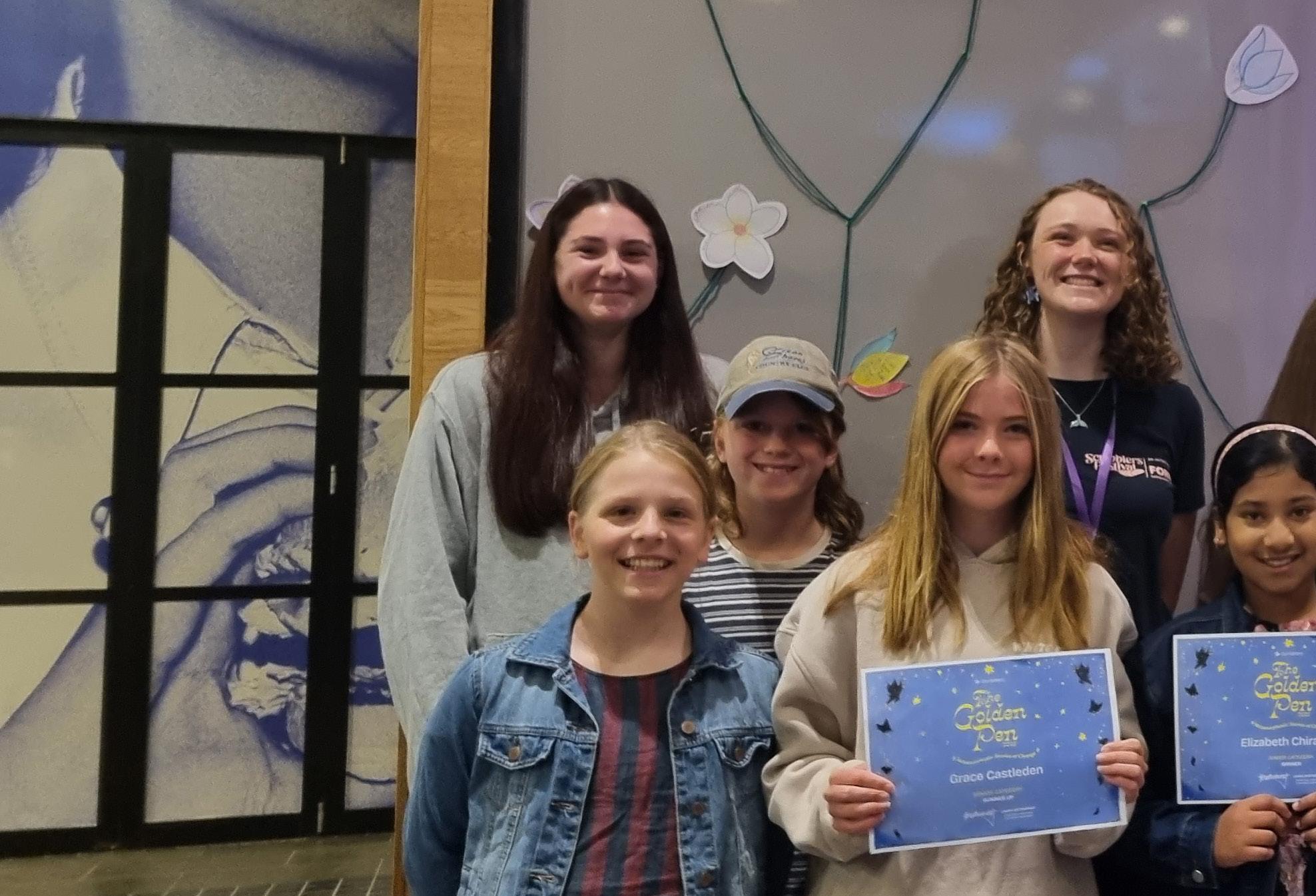
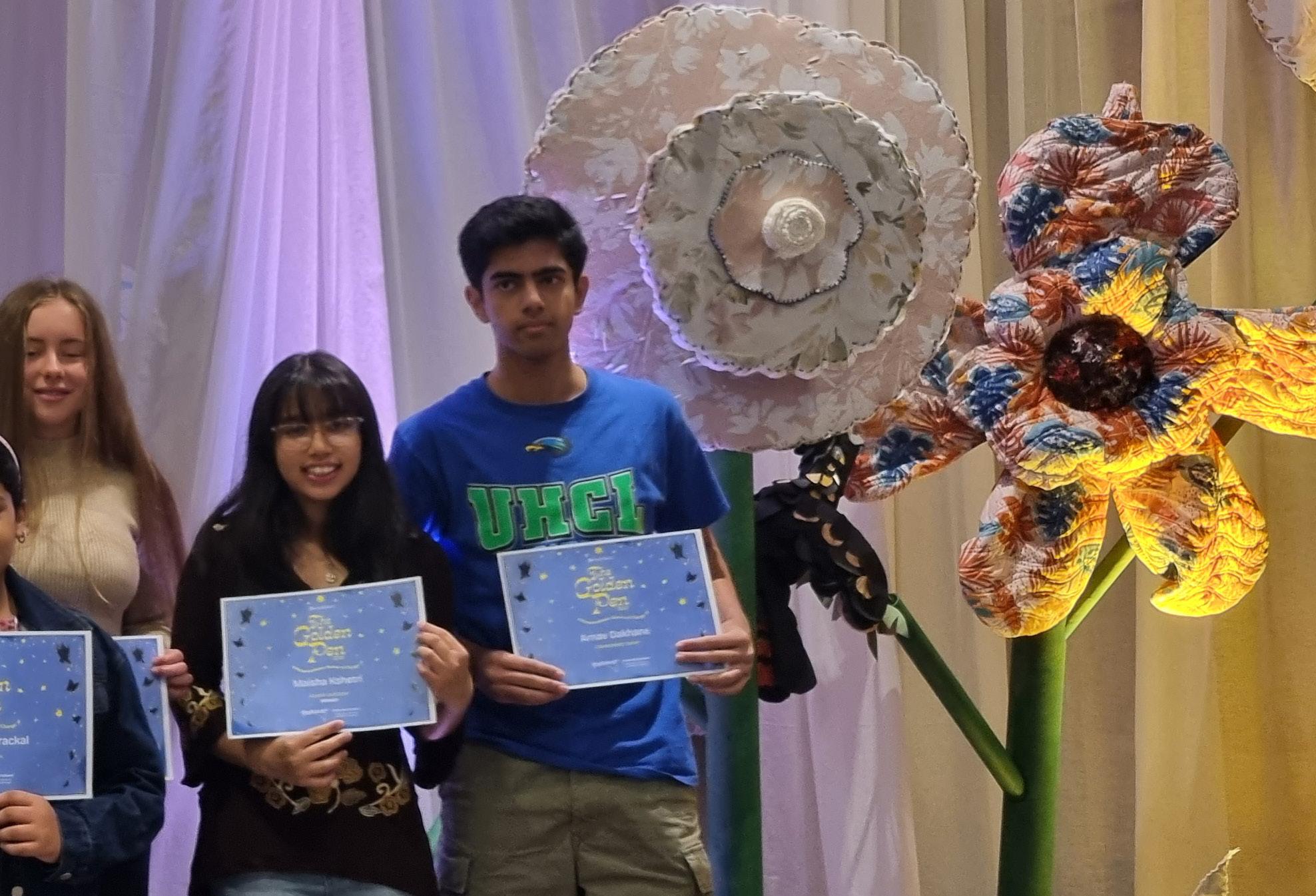
The Golden Pen Runner Ups & Winners at FRONT, Perth WA, 2026. Photo by FORM.
We had many amazing entries to the Golden Pen competition in 2025 and 2026. We asked writers to explore the magic of transformation, growth and new beginnings when exploring our theme of Metamorphosis.
We received over 200 entries, by turns enchanting, hilarious, whimsical, poignant, nerve-wracking, sombre and beautiful, but all imaginative and delightful to read.
The Scribblers Team and our Golden Pen Judges, Isobel, Ivy and Amanda would like to extend a huge thank you and congratulations to everyone who entered. We loved reading every single entry and we can’t wait to see what you write next. We would also like to thank CBH Group for their valuable support of this initiative.
Happy Reading!
Scribblers
A Spark Too Far
Elizabeth Chirackal
Junior Category Winner
Golden light stretched across the sky like paint on a canvas, spilling through the giant windows of Alisha's bedroom and soaking everything in a soft, honey glow. Her eyelids fluttered open as the warmth kissed her face. It was still early, too early for anyone else in the Smithsons estate to be awake. The only sound was the quiet ticking of the antique clock on her shelf. Even the house seemed to hold its breath, wrapped in a calm silence that almost seemed magical. Alisha's heart raced with excitement. This was it. It was the day she had been dreaming about all night.
Downstairs, in the driveway of her family's mansion, a brand new Audi RS7 gleamed beneath the faint morning light. It sat there like a sleek, powerful, silver predator. It was her eighteenth birthday gift from her parents just a few days before. Its metallic surface reflected the rising sun like a blade, looking so sharp and tempting. She had remembered their serious faces as they handed her the keys; "No road trips. Not alone, not now." But Alisha smiled sweetly, nodded, and tucked the keys into her purse anyway. She had never been one to follow rules.
She moved through the house like a shadow, careful not to make a sound. Her suitcase, already packed with clothes, snacks, and a heaped pile of chocolate, was waiting by the door. She could almost taste the sweet and wild freedom in the air. As she opened it, the cool morning breeze rushed in, brushing against her skin like a warning whisper. Alisha ignored it. This was her moment.
The engine hummed to life beneath her fingers, smooth and quiet like a promise. The vibration travelled up through the steering wheel and into her hand. As she pulled out of the driveway and onto the empty road, her excitement bubbled up like soda in a shaken bottle. Alisha's eagerness grew as she started munching snacks to her heart's content. She drove on. The city faded behind her and trees grew taller. Roads turned narrower, and the sky stretched wide above, filled with soft clouds and morning light. She opened the window and let the wind rush through her hair as her music blasted through the speakers. Chocolate wrappers flew in the back seat like confetti.
Hours passed. The road twisted through the countryside. Alisha's smile grew as the last bits of city disappeared in her rear view mirror. Alisha was astonished but pleased she hadn't grown tired yet. For once, she wasn't surrounded by bodyguards, housekeepers, or nagging voices. It was just her, the open road, and miles of freedom. Every turn of the wheel felt like Alisha was rewriting who she was. The world felt like hers.
Then, suddenly, something changed. The dashboard blinked and the headlights flickered. The engine coughed, and then let out a sound like a dying breath. Before she could react, the car rolled to a stop in the middle of a narrow, deserted road surrounded by endless trees. Silence dropped around her like a curtain. The sudden stillness seemed unnatural, as if the world itself was waiting for her to realise the flaw she had made.
She stared at the fuel gauge. It was empty! "No. No!" she groaned, hitting the steering wheel with exasperation. Her hands trembled as she grabbed her phone. Nothing, only a black screen and dead battery. Alisha's eyes widened and she bit her bottom lip. She looked around. No buildings, no cars and no signal were anywhere nearby, just trees swaying in the wind and the sharp smell of dry leaves. The loneliness compressed her from every direction. The weight of what she'd done crashed over her like cold water. She was alone, stranded in the middle of nowhere with no help and no one knowing where she was. Her stomach twisted and her throat felt tight. Regret gnawed at Alisha. For the first time that day, fear crept into her chest.
As the sun dipped lower, filling the sky with orange and pink, long, finger-like shadows stretched across the road. Alisha hugged herself tightly, wishing she never left her cozy, comforting bed back at home. The deafening silence surrounded her, making her feel small. Alisha stepped out of the car. The wind tugged at her hair. She searched for anything that could help, but there was nothing but silence and wilderness.
Then, just past the ditch, something caught light. She observed it closer. A glass bottle, half buried beneath dried grass and leaves. She picked it up and sniffed it. Alcohol. I don't think it's the kind you'd drink, probably something stronger, she thought. Her eyes scanned the roadside. Dry leaves and twigs lay, useless. "Maybe... just maybe," she quietly told herself as an idea stirred into her mind.
She rushed to gather everything she could; sticks, leaves, anything dry enough to burn. Her hands shook as she built a small pile, then poured the alcohol over it. Her heart pounded in her chest, with an unsteady, frantic beat. With one match, the fire erupted, climbing high into the darkening sky. Orange and yellow flames crackled and hissed like an angry animal. Smoke poured out in thick, grey clouds, rising fast.
For a moment she felt proud, like she had solved the problem. But the pride rapidly turned into panic as the flames grew bigger than she expected. She stepped back, coughing as the smoke stung her eyes and throat. The air thickened. Her lungs screamed for fresh air and her legs wobbled. Somewhere, far away, she thought she heard something, a loud, low thudding in the sky. Was it a helicopter? A hint of hope flickered inside her. But the smoke was everywhere. Her vision blurred. Her knees buckled. Everything went black.
When Alisha opened her eyes, everything was blurry and too bright. The ceiling above her was white, and harsh lights glared down at her. Soft beeping echoed around the room, steady and slow, matching the rhythm of her own weak heartbeat. Her throat was dry and sore, her chest tight with every breath. The smell of disinfectant filled her nose, and a cool, damp cloth rested gently on her forehead. The world seemed distant and muffled.
As her vision cleared, Alisha turned her head slightly and saw her mother sitting beside the hospital bed. Her eyes were puffy and red, fingers wrapped tightly around Alisha's hand as if afraid to let go. Her father stood at the edge of the bed, arms crossed, his expression unreadable but his eyes full of something heavy; a mix of anger, worry, and disappointment. The silence in the room was a thick blanket that wrapped around her. It felt like it weighed more than words ever could.
"Alisha," her mum whispered, brushing a strand of hair off her daughter's forehead. "You're awake. You're okay." Alisha blinked, confusion and dread rising in her chest.
"What... what happened?" she croaked.
"You passed out from smoke inhalation," her mum said, barely holding her voice together. "A rescue helicopter saw the fire. They got to you just in time. You're lucky to be alive."
Memories came flooding back of the fire, the crackling branches, the smoke that swallowed her lungs, and the dizzying heat. She remembered the moment her legs gave out, the sound of distant blades slicing the sky, and then... nothing.
"I'm sorry," she whispered, her throat tight. "I just... I didn't know what else to do. I thought a fire would help someone find me." Her father stepped closer, his voice low and controlled.
"You didn't think, Alisha. That fire spread into the trees. It destroyed three homes. Families lost everything. You could've killed someone."
Alisha stared at him, frozen. Her breath hitched, and her stomach twisted. She hadn't thought about where the fire might go. She hadn't seen any houses nearby and she hadn't imagined it would hurt anyone. And yet now, people, real people, had lost their homes because of her. The tears spilled before she could stop them. They slid cold and fast, carrying guilt she couldn't keep in anymore.
"I didn't mean to," she whispered, her voice crackling. "I just wanted to be found. I wasn't thinking. I was too selfish. I was stupid." She looked down at her hands, trembling in her lap. " I should've never gone. I thought I could handle it, but I couldn't." Her mother didn't speak. She just looked at her, eyes tired and shiny with tears. Her father's expression softened, but only slightly.
After the long silence that hung in the air, Alisha suddenly spoke up, "I want to fix it." Her voice was soft but firm. "That's what I will do. The money, from my bank account, is not for me anymore. It's not for shopping, or for holidays now. I want to give it to the families... the families that lost everything to a fire I caused." Alisha paused, and then continued, "All of it goes. It won't bring their houses back, I know, but... I want to, I need to help." Her parents exchanged a long look. Her mother gave a slow nod, and her father's arms slowly dropped to his sides. There was something that changed in their eyes, not only sadness but hope.
In the days that followed, Alisha kept her word. She met with each family. She walked through the blackened remains of what used to be kitchens and bedrooms, stepping carefully over the charred wood and melted belongings. The smell of smoke still lingered in the air, clinging to everything. She saw toys that had turned to ash, family portraits crumbled to dust and the walls that had once held laughter and memories now rubble. She listened to every story of how the children felt, and even cared for them.
One little boy showed her his burnt teddy bear, the limbs and parts barely holding on together. Alisha's heart shattered to pieces like broken glass, seeing the big, innocent, sad eyes of the boy. She promised him a new one, but she knew it would never replace the old. She apologised repeatedly, with genuine regret. She handed over cheques, enough for the reconstruction. She knew it wouldn't erase what she had done, but it was a good start.
As the days passed, Alisha gradually changed. She no longer cared about her wealth, car or fancy gifts. Those things were small now, almost meaningless to her. Some evenings, Alisha would stand at the edge of the rebuilding site and watch the glow of the new homes slowly take shape. She ran her fingers over the fresh, cool brickwork, imagining future memories that would be cherished at those houses. The guilt still pressed on her chest, but now it pushed her forward instead of pulling her down. She felt proud, because she knew that the girl who had driven off at dawn without a second thought had changed to someone who had learnt what careless choices could do, and made things better. Her parents never told her to, she did it because her heart told her it was the only way forward.
Soon, the families settled in new homes, with new furniture and equipment. They thanked Alisha and her family for supporting them, and decided to forgive her. Alisha's heart melted in their kindness, since she knew she didn't deserve forgiveness. In the end, her parents turned to Alisha and embraced her into a proud, joyful family cuddle. "Sweetie, we're so proud of you, you've grown up a lot. We love you no matter what." her parents told her. Alisha treasured those words but still remembered what she had done at the start, her reckless decision.
She would carry the guilt of what she caused, possibly forever. But she would also carry the lesson it taught her, because sometimes, it takes a fire to burn away the old version of yourself so that something better can grow from the ashes.
Slushy Sprinter
Rohan Rebello
Junior Category Runner Up
The living room was as dark as a moonless night. The blinds were drawn shut, and not a sliver of light penetrated the space. The eerie silence was punctuated by the shrill, ear-piercing sound emanating from the large display screen, which cast a strange orangish glow on the two occupants who crouched restlessly on the edge of the lounge chairs.
“Oh man, seriously!” Alex shouted angrily as he tried to deflect the imminent attack. ”Help Alex, quickly!” screamed John, with a sense of urgency.
Suddenly, a howling Enderman - a fearsome baddie from the Minecraft worldteleported behind Alex and knocked him straight into the unending abyss.
The Ender Dragon, in the meantime, had cornered John and engulfed him in flames with his searing, fiery breath. John slammed his console, admitting defeat. As he was preparing to leave, he informed Alex about his intention to participate in the upcoming city marathon. Alexander, who had ripped open another bar of Snickers, wasn’t interested; his thoughts already turned to the next Minecraft session. Although they were the thickest of friends, they were quite unlike each other in many ways; John was a tall, sporty boy with blue eyes and blonde hair, while Alexander was short with green eyes and brown hair. John loved field sports and would spend hour on end jogging in the park; Alexander, on the other hand, hated any physical activities and had devoted hours upon hours of his life to online gaming. John always ate healthily, whilst Alexander could eat junk food every day. And yet, strangely enough, the boys would hang out every single day… most people agreed that the duo were inseparable. Yes, they were best mates for life!
“Got to go, mate, I’ve got an early start.” Announced John as he got up to leave.
“Where are you going now?” Alexander asked impatiently, his gaze fixed on the screen as he loaded the next game, hoping his friend would stay for another round.
“I’m going to go and practice at the park.” Answered John,” I’ve got three months left until the half-marathon. Every day counts.”
“Bro, twenty-one kilometres is an insane distance to run. Why are you putting yourself through so much agony?” Alexander asked, sighing dramatically.
“Setting higher goals as we get older, Alex,” John replied.
He added as an afterthought, “By the way, would you mind helping me prepare for the race?” “Yeah, sure...” Alex replied, “…you know how much I love getting up at five in the morning to run around and tire myself out”, he finished half mockingly.
But turn up he did, and not just for that day but for every day that John trained. That was what true friends did. He was John’s timekeeper, water bearer, cheerleader… and on days when John struggled, he was his chief motivator. With just two months to go, and the training progressing well, Alexander knew that John would successfully complete the race. But then tragedy struck! Alex got the news from his mum on a lazy Sunday afternoon. He realised something was wrong when he saw his mum's lips quivering as she placed the phone down on the table.
“What’s wrong, mum?” he asked in a concerning voice “It’s John.” His mother said, stifling a sob. “His family has met with a car accident, and John is in the hospital.”
The hospital room was dark; the only light in the room was the neon green glow of the monitor bathing John’s face in a dim light as he lay semiconscious, tubes running the entire length of his body. Tears welled in Alexander’s eyes as his gaze moved from John’s runners, which were lying on the hospital floor, to John’s heavily bandaged legs, which were propped on the elevated hospital bed.
“Hey buddy, thanks for visiting,” John said, putting up a brave front. “I guess my marathon plan is off the table”, he said in a sad tone, his voice trailing into a sob as he looked down at his crippled legs.
“You can always do the marathon next year, John, but for now, let’s focus on getting you better,” Alex whispered reassuringly in a warm tone.
“After all of this training, if I don’t run this time, I don’t think I will ever want to run a marathon ever again,” John said dejectedly. Tears streamed down his face, and his whole body was slumped in defeat.
Something moved within Alex when he looked at his friend lying helplessly on the hospital bed. There was nothing that Alex could do about his friend's broken body, but he took it upon himself to fix his spirit. Alex would run the race for his friend and to honour his commitment. Alex threw his sugar-loaded slushy in the bin with disgust. He had been a lazy sloth and a slave to sweets for far too long; he was going to end this addiction once and for all. It was game on!
Chapter 3
The high-toned pitch of the alarm roused Alex from his deep slumber at five o’clock in the morning. He groaned as he rolled off his bed in the predawn darkness. Still half asleep, he shuffled into his living room to grab running gear. Although he had started training a fortnight ago, he was still not used to the physical exertion. With just a month to go until race day, Alex was still barely able to push past 5 kilometres, and even that was a struggle. How would he run twenty-one kilometres, he thought to himself, a shadow of fear and doubt clouding his mind. The biggest challenge for him, however, was not the exercises but suppressing his extreme craving for sugar. The first few days were the most difficult to endure as his body went through a withdrawal syndrome. Indeed, he went for days on end in a delirious state, his entire body trembling and shaking uncontrollably, his thoughts swirling around giant glazed doughnuts, buckets of crispy fries and towering glasses of sweetened strawberry slushies. But resist he did.
With each new dawn, Alex felt a change coming over him. His body became stronger, his desire to eat sugar diminished, and his health started to improve. And then one fine day, as if by magic, Alex was able to run six kilometres without pausing. Not just that, his diet had completely transformed as well; he had begun eating healthily and had almost eliminated all sugar from his diet. Even John was surprised to see the change in Alex the day he was being discharged from the hospital. Frail and immobile, and still bearing a heavy heart, John was nevertheless overjoyed to meet Alex, and they chatted away incessantly as Alex deftly moved the wheelchair across the hospital corridor. A change had come over his friend - a sort of transformation that was clearly evident in the way he looked and held himself.
When Alexander told him about his decision to run the half-marathon, John was speechless. The roles had been reversed. The reluctant volunteer had become the lead athlete, and John couldn’t be prouder.
Chapter 4 –
The race day dawned crisp, bright and clear. The forecast was for mild sea breezes and below-average temperatures - perfect running conditions. But this did not help quieten the butterflies in Alex’s stomach as he woke up with the pre-race jitters. Part excited, part nervous, he lined up at the starting point nevertheless, huddled up amongst the runners - some first timers, some veterans and some athletes who were clearly only there to win the top prize. The crowd of excited onlookers, the lively music thumping from the loudspeakers, the buzzing coffee stalls and the colourful cheerleaders created a vibrant carnival-like atmosphere that helped soothe Alex’s nerves. And as the mayor gave a rousing speech on the loudspeaker on the podium and declared the race open with the firing of the pistol, Alex took one deep breath, and he was off running in his first ever marathon event.
Twenty-one kilometres was a long distance by any measure, even for a regular runner, let alone a kid who, a few months earlier, couldn’t even walk a flight of steps and whose diet consisted chiefly of chocolate and lollies. But two months of rigorous training had strengthened not only his body but also his spirit. As the race drew on, he found himself enjoying the experience. And although his body started revolting a few kilometres from the finish line, he smiled through the pain, visualising his family and John at the finish line. As he rounded the corner and reached the final stretch of the race, his energy fully depleted and barely able to walk, he saw John in his wheelchair, cheering excitedly at the finish line. With a surge of adrenaline and overcoming his exhaustion, he sprinted across the finish line and collapsed into John’s open arms, who hugged him tightly with a mixture of pride and admiration.
The boy who had entered the hospital room and had seen his friend lie helpless and crippled was not the same boy who crossed the finish line. Alexander’s transformation was now complete.
The Final Blow
Levi Graham
Junior Category Runner Up
One of my earliest memories was of my mother’s loving branches wrapping safely around me. Water trickled down her trunk giving my thirsty roots a drink. Sunlight filtered through her leaves helping me grow. She gave me life, until she had no life to give.
It all started when cars came skidding into the clearing. Then people got out of the cars. Loggers. They were suspiciously walking around inspecting the trees. They stopped in front of my mother. I leaned in close to my mother’s loving arms. They lingered around her. A man took out an axe and suddenly thrust it into my mother’s side. She screamed in pain. Sap flowed out of the deep cut. That first blow struck deep into my heart too. I had never heard my mother scream like this. The man swung back his axe to inflict another blow. I tried to stop him, but I was rooted to the ground. My trunk quivered. The next blow struck deeper.
“Stand strong my son,” she said in her soft whispery voice. I was sobbing uncontrollably.
The last blow thundered through the air. I heard a tremendous cracking noise and my mother smashed into the hard ground. The earth shuddered out of sorrow as yet another beautiful mahogany tree fell to the forest floor. The next few days were ones of sorry and grief. Every time I looked at my mother’s stump I burst into tears. Pounding water washed away the dirt exposing my roots. The scorching sun dried up my leaves. I had given up for lost when the boy came.
He saw me from a distance and ran to me. He clambered up my branches and looked around. The boy cried in delight and swung down to the ground. I immediately bonded with him. The happy day flew by with the boy climbing all over me and resting in my shade until the sun sunk into the hills and the kookaburras were laughing their night call. That was the sign the boy had to return home to his family. All that night I was longing for the boy to come. I was still grieved by my mother ’s death. To my delight, the boy came again the next morning trailing two ropes and a piece of wood. I held down my strongest limb for the boy, and he looped rope around it and then the other rope went over. He tied the ropes to the piece and the swing was finished. Another happy day was spent with the company of a friend as he delighted in my branches and shade. Swinging, resting and climbing - in this fashion, we would enjoy our time together.
One day as the birds were happily chirping in the branches and the light breeze rustled the leaves, the boy arrived with his father. They were carrying tools and some pieces of timber. Together they worked hammering, sawing and nailing until the sun began to sink behind the hills. They returned the next day with a few short hours of work. At last they stood back to admire their handiwork. A strong wooden tree house sat nestled secure in my branches.
As the sun was setting the boy ran off home. I started to settle in for an early sleep but, to my surprise and joy he returned lugging blankets, a torch and other camping items. He climbed up into my embracing branches, hauling all his gear into the newly built treehouse. He laid out all his blankets and snuggled in. He lay, staring up at the stars glittering through my leafy canopy. We spend the night together. That was one of my most special memories with him.
The days stretched into weeks then months and years. I had grown as tall as my mother. The boy had grown too, now he was a young man, but he still came everyday mostly writing in the shade or climbing my well worn limbs to the old treehouse. I still kept a watchful eye out for loggers, still fearing them. I tried to push the thought to the back of my mind, but a fearful inkling kept peeking out.
One dreaded day, the loggers came in their big trucks and jumped out. Their noisy boots thumped upon the ground. They walked towards me axes in hand. I could do nothing to stop them. I tried to hide but I could plainly be seen. I could only hope that they would go away, but they did not.
They talked and pointed at me. They got their axes out to fell me. One of them shouted and pointed up at the treehouse. They had seen the boy! He could protect me! The boy (now a young man) climbed down from the tree house. He argued for a bit then lunged at one of the men’s axes, but the other two men yanked him back shouting. The young man was strong but not strong enough against two men.
The first axe blow was more painful than I ever imagined. I sharp pain cut deep inside me. I thought of my mother. The next hit stuns deeper. The sap flowed forcefully down my trunk making a pool on the ground. The young man screamed. The last blow wrecked me. I looked desperately at the face of the young man. He was frozen in disbelief, his eyes stared wide at me with a single tear welling up in the corner. He was defeated.
My body cracked and I fell with a tremendous thump to the ground. My world went black.
The young man sat on the stump, the remains of his friend. He slumped his shoulders. How could this happen? How was he not able to help? How could he fail against his faithful friend? He felt something soft brush against his arm. He looked down. There beside him growing up out of the stump was a small green tender shoot. The beginning of new hope.
The Butterfly Collection
Eve Modra Middle Category Winner
Dad kept thousands of dead butterflies in our garage. They lined the shelves in glass cases, each one pinned through the middle, its wings spread out as if it were still flying. Labels underneath indicated where they came from and what they were called—Latin names I couldn’t pronounce. He called it his collection, but to me, it looked like a cemetery with pretty headstones.
“Metamorphosis is the coolest thing in nature,” Dad would say, holding up a bright blue butterfly to the light. “Imagine completely changing who you are—going into a cocoon as one thing and coming out as something totally different. Like getting a do-over.”
I would nod and pretend to care, but really, I just wanted to go back inside where it didn’t smell like chemicals and death.
Dad got sick in the second term of Year 7. Cancer. That word changed everything overnight. He stopped going to work at the university, and Mum began working extra shifts. I had to take care of the butterfly collection—dusting the cases and checking for bugs that might eat them.
“Don’t let them get damaged,” Dad said before his first treatment at the hospital. His voice was tired. “Promise me.”
“They're already dead, Dad.”
“But they can still be ruined. That’s different.”
I promised because what else could I say?
The treatment changed him. His hair fell out, he became fragile, and his skin turned pale. He couldn’t climb the stairs anymore, so I’d bring butterflies up to show him. He would hold them carefully and share facts I didn’t really want to know.
“This one’s called a glasswing butterfly,” he said one afternoon, showing me a specimen that was see-through. “Its wings have no color at all. You can see right through them.”
“Why are you telling me this?”
“Because metamorphosis isn’t always pretty. When a caterpillar turns into a butterfly, it doesn't just grow wings. It basically dissolves itself, turns into goo, and then rebuilds itself from scratch."
He looked at me with eyes that seemed too big for his face.
"That's how I feel—like I'm dissolving."
"You're not," I replied.
"Maybe. But maybe I need to. Maybe I need to turn into goo before I can become something new."
I didn’t know what to say to that. He died on a Tuesday in March.
The funeral was small. His work friends came and talked about how smart he was and how much he loved butterflies and science. Nobody mentioned the garage full of dead insects. Nobody talked about how obsessed he'd been.
After everyone left, I went out there.
The butterflies were exactly where he'd left them—perfect, dead, and pointless. All that transformation, all that change, and for what? To end up pinned in a box with a label?
I grabbed Dad's hammer from the workbench. I didn’t really know what I was going to do. Maybe smash them all. Break every case and let the wings scatter everywhere like the world's saddest confetti.
But when I lifted the hammer over the first case—a bunch of small blue butterflies from Australia—I noticed something. The pins weren't just sticking through dead things; they were holding them in place, showing the exact moment when the transformation was finished. Each butterfly was frozen at the point where it became completely itself.
Dad hadn't collected dead things. He'd collected proof that change was possible.
I put the hammer down and started looking up information about metamorphosis. Not because I suddenly cared about butterflies, but because I wanted to understand what Dad had been trying to tell me.
The science was gross. Inside the chrysalis, the caterpillar doesn't just change —it destroys itself. It literally melts into liquid. Everything dissolves except for tiny clusters of cells called imaginal discs, which carry the instructions for building the butterfly—wings, eyes, antennae, everything. The caterpillar has the butterfly inside it the whole time; it just has to dissolve first to let it out.
I went back to school two weeks after the funeral.
Everyone treated me strangely. Teachers gave me extensions on homework, friends didn’t know what to say, and the counsellor wanted me to come for appointments, but I never went.
I felt like a ghost. Like I was see-through, like that glasswing butterfly. Hollow. In science class, we learned about life cycles. Mr. Patterson drew a circle on the board: egg, caterpillar, chrysalis, butterfly. Round and round.
"But what about the chrysalis part?" I asked. "What's actually happening?"
"Metamorphosis. The caterpillar transforms into a butterfly." "Yeah, but what does it feel like? Is the caterpillar still conscious when it's melting?"
Everyone stared at me. Mr. Patterson's face changed. "I don't know," he said quietly. "Maybe it's terrifying. But it happens anyway. Somehow, the butterfly remembers what it's supposed to be."
I started spending time in the garage again, but differently—not cleaning or checking for damage. Just sitting, looking, trying to see what Dad saw.
Each butterfly had been something else first—something that crawled on the ground and ate leaves. Then, it built a chrysalis, melted, and didn’t know if it would ever be anything again. And then it came out with wings.
Dad had collected proof that you could be one thing, turn into nothing, and then become something completely new.
Three months after the funeral, I opened the first case.
My hands shook as I carefully removed a green and black butterfly Dad had collected the year I was born. I held it gently and took it outside to our backyard.
We had a jacaranda tree that dropped purple flowers every spring. I stood under it with the butterfly in my hands.
"You should've gotten to fly more," I told it. Then I opened my palms.
The wind caught it, and the wings reflected the light one last time before it tumbled into the garden.
I went back for another one.
It took me all summer to release them all. I did it the way Dad would have done it —carefully, one at a time. I took photos of each butterfly before I let it go. Some I placed in our garden, while others I took to parks or the beach. A few I released near the river, where the wind carried them away.
Mum asked what I was doing. I told her I was finishing Dad's collection. She didn’t really understand, but she didn’t stop me.
The garage is empty now—just shelves and patches of dust where the cases used to be.
The Girl Who Wasn't There
Joanna Ma
Middle Category Runner Up
They found my shoes on the bridge before they found me.
White, size 6, the laces knotted twice because Mum always said double knots meant safety.
She was wrong.
Three days earlier, I stopped recognising my own reflection.
Same brown eyes, same chipped tooth, but it looked like someone pretending to be me — practising my face.
That’s when I started writing everything down.
So when people said she changed, I’d have proof that it didn’t happen overnight.
It started with the noise in my chest.
Not a heartbeat — a flutter.
Soft at first, like paper wings brushing the inside of me.
Then stronger. Louder.
Like something trapped.
Mum said it was anxiety.
Dad said it was “too much screen time.”
The doctor said nothing was wrong.
But every night, the flutter grew.
By Friday I couldn’t sit still.
I walked to the bridge that crosses the dark part of the river — the bit that doesn’t shine even when the moon begs it to.
There was a boy there, drawing something on the railing with chalk.
A circle, then a line, then another.
It looked like a cage.
“Nice art,” I said. He didn’t look up.
“It’s not art. It’s a map,” he said. “To where?”
He smiled. “Out.”
He stepped onto the railing like it was solid ground. The river moved slow beneath him, thick as oil.
I opened my mouth to tell him not to, but he was already gone — just air and ripples.
The chalk circle stayed.
That night, the flutter in my chest turned into scratching. Like claws on glass.
I pressed my fist against my ribs and whispered, “Stop,” but the sound only got hungrier.
When I looked down, my skin was pulsing. Something underneath shifted — not pain, just wrong. I wanted to unzip myself and let whatever it was out. By morning, the mirror showed a crack across my collarbone
— faint, silver, like lightning that didn’t finish.
I traced it with my finger. It was warm. It moved.
Mum knocked.
“Breakfast,” she said through the door.
I said, “I’m not hungry,” and for once it was true. My hunger was for something else. For the air outside. For escape.
At school, the lights were too bright and the voices too sharp. Everyone looked fake — painted smiles, glass eyes. I wondered if I looked that fake too.
Toby whispered something to Liv and laughed, and I wanted to peel my skin off just to prove there was something real underneath.
When the bell rang, I didn’t go home. I walked to the bridge again. The chalk map was gone, but the mark of it remained — faint white dust in the wood grain. The river waited. I took off my shoes because heavy things sink faster. The water was colder than I imagined, but not angry. It wrapped around me like it had been expecting me. The sound inside my chest became wings — hundreds of them — tearing, opening, breaking free. It didn’t hurt. It felt like relief.
People say when you drown, your whole life flashes before your eyes. Mine didn’t.
I saw one thing: the crack on my collarbone, widening like a door. Light spilling through. And then quiet.
When I woke up, the world had changed. Or maybe I had.
I was lying on the riverbank. The air smelled clean, electric. My skin was smooth — no scar, no crack. But the flutter was gone.
They found my shoes that evening and said, “She must’ve jumped.”
They told the papers I was lucky.
But I don’t feel lucky.
I feel hollow, like I left something behind in that water — the part that used to care about fitting in, following rules, pretending to be human. Now, sometimes, when it rains, I stand by the window and listen.
The drops hit the glass like fingers tapping from the other side. I tap back.
Mum thinks I’m better.
Dad says I’m “back to normal.”
They don’t notice that my shadow moves before I do.
People talk about metamorphosis like it’s beautiful — butterflies and sunshine and freedom. But they forget that to change, something has to die first. The girl they lost on the bridge wasn’t me anymore. And the one who came back?
She’s still learning what she’s become.
Frog and Fly are Friends
Zoë Testa
Middle Category Runner Up
Chapter 1 –
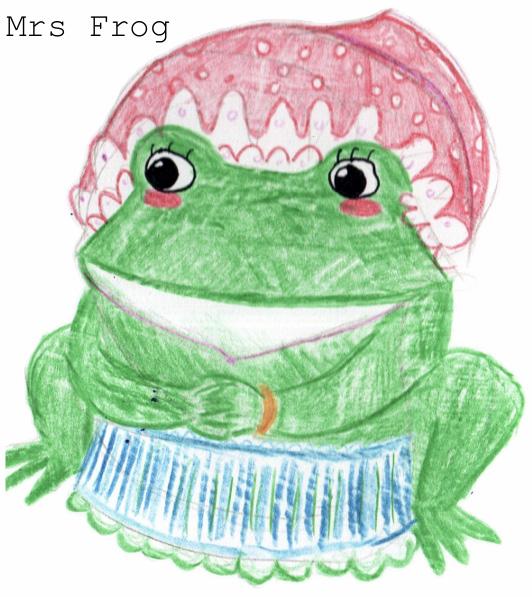
Mr and Mrs Frog sat under the bullrushes, on a cool rock by the water’s edge, next to their clutch of eggs that were squirming in the sunlight.
It was a special day for them. They had been waiting patiently for their tadpoles to hatch. Then suddenly, one after another, they popped out of their glassy cases, and began to swim wildly around in the water. Mr and Mrs Frog joyfully hopped into the water and began to show their offspring how to use their tails and fins properly. They were very proud of their brood and the happy family swam down the stream, parents croaking as they went.
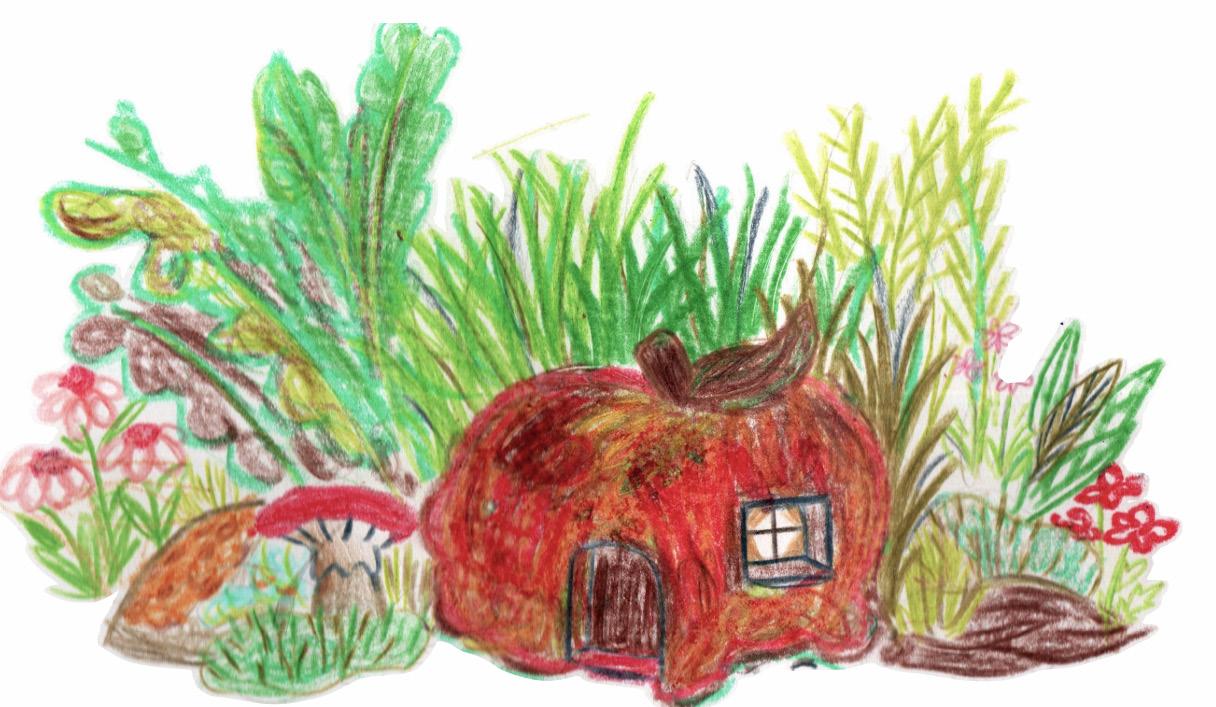
Meanwhile, next to the stream in an old decomposing apple, Maggot was just emerging from his egg, a little chubby white grub, while around him his six brothers and sisters squirmed under the loving gaze of their parents, Mr and Mrs Fly.
The Frogs lived in a small cave at the bottom of the stream. The entrance was in between two large stones, preventing the stream’s fish, and water birds from reaching it. In the cave was a rocky ledge that was next to the water, where Mr and Mrs Frog would sit, while their children would swim beside them.
Every now and then Mrs Frog would drop a fly into the water and it would quickly be gobbled up.
One afternoon, while the Fly children were playing by the water's edge, Maggot happened to lean out too far, overbalanced and plunge into the cold stream.
He’d had no experience with swimming and his short chubby segments were of no of use. Sinking deeper and deeper, he tried to call for help, but his words turned into bubbles as they came out.
“Hlp! Hbllp!” he bubbled.
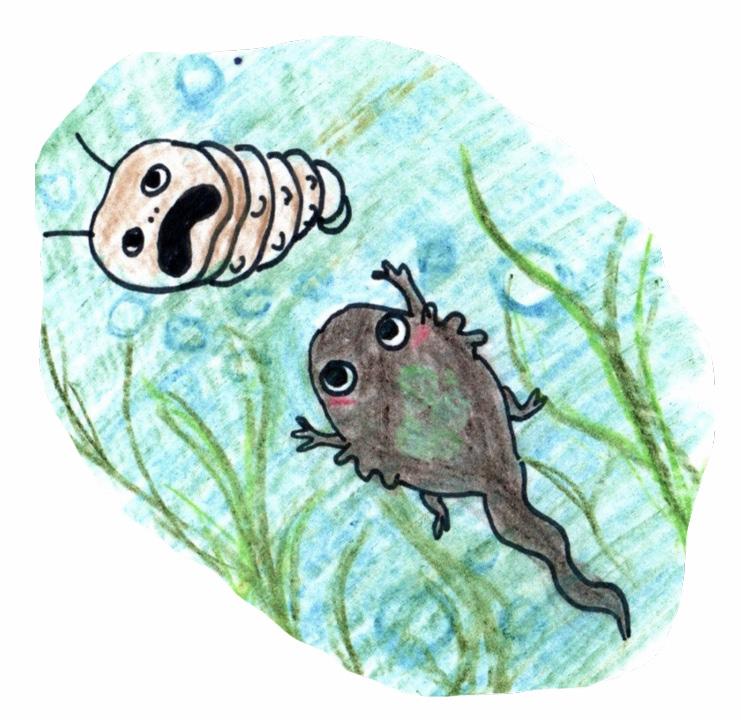
Tad had just swam out of the cave. He was bored that day because his friend, Toby Newt, was on holiday downstream. He was getting some seaweed for his mother to make seaweed and fly stew, when, just as he was turning back to go into the cave, he noticed the commotion in the water.
He dropped the bunches of seaweed he was holding and swam over to the spot where Maggot had fallen in.
“That is not how you swim,” he commented, as he watched Maggot’s futile attempts at trying to reach the surface.
Tadpole swam underneath Maggot’s wriggling body, and propelled him to the surface, where he deposited him on the rock, coughing up water, with his brothers and sisters watching.
“Woof, you’re heavy!” he said, catching his breath.
“Thank you for saving me,” said Maggot happily. “I thought I was a goner! My name is Maggot by the way, and these are my brothers and sisters. We live in that old apple over there; my father hollowed it out himself!” he added proudly.
“You’re welcome,”said the tadpole. “I am Tad and we live at the bottom of the pond in a small cave.
If I teach you to swim, maybe you can come and meet my parents, Tadpop and Tadpap.”
“Children, lunchtime!” called their mother.
Chapter 3 –
That summer, Maggot and Tad became best of friends. After much labor, Tadpole succeeded in teaching Maggot how to swim. He brought Maggot to some of his favorite underwater places and hideouts. Maggot was introduced to Tadpole’s siblings, and once he saw his mother, Mrs Frog, who looked rather meaningfully at him from around a rock.
The Fly family were having dinner in the Old Apple. Mrs Fly had cooked some moldy tangerine peel that they had found in an old boot, and had served it with fresh rabbit droppings.
“Now children,” said Mr Fly, pushing away his empty plate. “You must always remember not to make friends with frogs, they are a bad example, and when a frog and a fly pursue friendship, it always ends in someone getting eaten!”
This was one of Mr Fly’s life lectures which he often gave to his grubs.
“Your Uncle Jerome was friends with a frog, and look at him now!” put in Mrs Fly.
His father had repeated this lecture so many times that Maggot often glazed over.
All the children looked at Maggot who gulped, and quickly took a bite of orange peel, and coughed.
Mr Fly and Mrs Fly were ignorant of the friendship between their son Maggot and Tad. Mr Fly was very confident of the effect of his lectures.
The next day, while the grubs were playing by the stream, out popped Tad.
He had grown since they had last seen him and he had a pair of miniature, amphibious legs.
Maggot’s siblings began to nudge each other and whisper. His brother, Magotty, came and whispered in his ear, “Remember what Mamma and Pappa said, Maggot! When he grows bigger he will eat you up, if his parents don’t before him!”
Chapter 4 –
The summer had passed and it was now autumn. The leaves of the trees around the stream gradually turned golden and fell to the ground. Maggot didn’t go swimming anymore, because the water was too cold.
He hadn’t seen Tad for a while, and he assumed that he had gone to hibernate with his family. The apple was cold, and there were a few holes, from where hungry bugs had bored in. Most of the animals and bugs had moved south in search of more food.
One evening, Maggot went outside, to watch the last of the geese fly away to warmer regions.
He shivered with cold. He was in his third grub stage and he and his brothers and sisters were going to go into their pupas that night, to emerge in spring as a fully grow flies.
He turned and went inside.
It was spring. The snow had melted and the buttercups and daisies danced in the sunlight.
The last of the ice over the stream had long since floated away. Birds sang in the trees and squirrels fought over the nuts they had hidden.
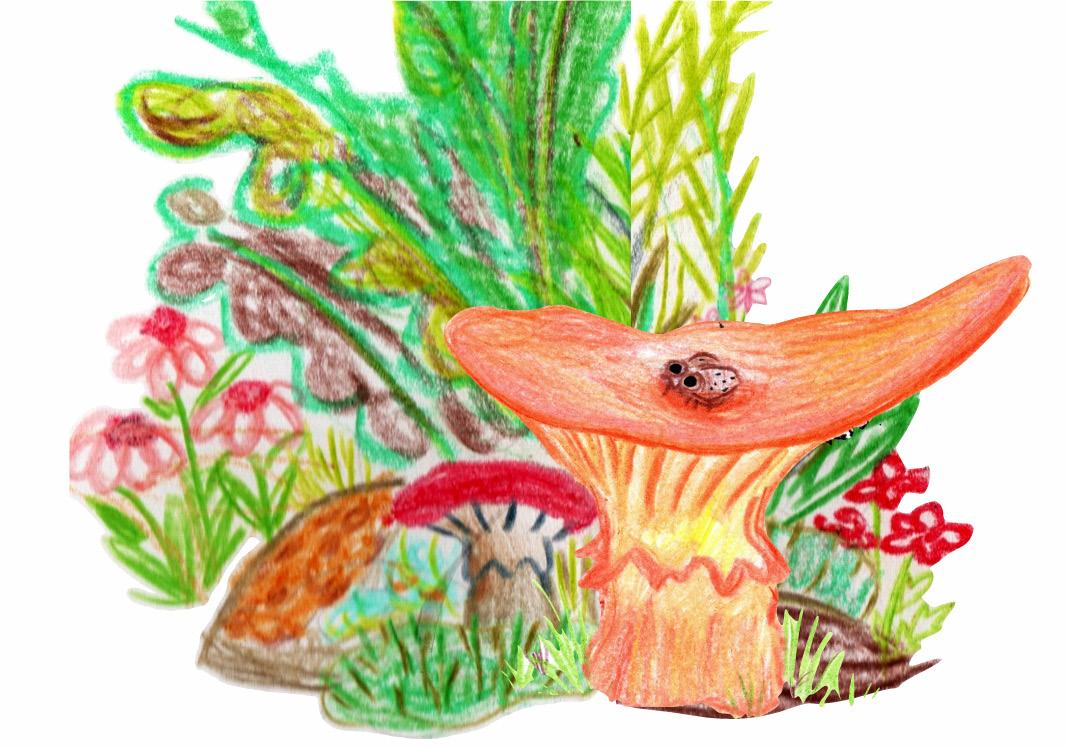
The apple was gone now. It had decomposed into the riverbank during winter. In its place there was a large orange mushroom. Maggot was cleaning himself on top of it. He was a fly now and his brothers and sisters buzzed happily around him. He decided to go for a short walk, when around the corner he came face to face with a large green frog.
“Hey! Tad it’s me remember, Maggot! Your friend Maggot!”
Tad made a lurch towards him and his tongue partly came out, but he recovered himself, and controlled his froggy impulses.
“Oh Yes! Um, Maggot!” he said uncertainly.
Maggot invited Tad to come and have lunch with him and his brothers and sisters.
With great restraint, Tad greeted his old friends, and was heartily welcomed.
Only Maggoty was wary.
“I think I’ll go for a short walk, you can have lunch without me,” Maggoty said, glancing at Tad’s large form.
They sat underneath the orange mushroom, enjoying their squashy apple sandwiches. Maggot noticed that Tad didn’t seem very interested in his lunch.
“Is anything the matter?” he asked.
“Oh no, I’m fine, I'm just not very hungry, that’s all,” he said.
He was slowly drooling on the grass, and his tongue roved around his mouth, eager to shoot out and catch the appetizing dainties that were before him.
“Tad, are you ok?” said Maggot, starting to feel that something was not right.
Tad squinted at him, and then, unconsciously, out shot his long tongue.
“Slwishurp!”
Tad blinked.
“Maggot?”
citrus trees
Maisha Kshetri Senior Category Winner
how can you miss yourself after only thirteen springs? how can you long for the good old days when you’re still writing your prologue? every candle feels like a knife digging into my birthday cake. sweetness splitting open, bitterness seeping in. we used to walk in the orchard, mum’s hand engulfing mine, searching for daffodils between the citrus trees. there were so many. we’d twist their stems together, crowns tilting on our heads, queens of a kingdom no one else wanted. the lemons hung low, bruised and heavy.
oranges blushed a strange red, ashamed to still be there.
yet, despite all appearances, they were sweet and fresh, easy to juice, swallow, pick.
so, who could abandon something so alive?
trees full of gifts, yellow suns bending through leaves. but crowns wilt, petals crumble, fun wears away. somewhere between four and now, i stopped admiring the trees and their gifts, only hungry for the results. citrus trees
that birthday, i wished to be older. sharper. less small. who wants to be four? i think that’s when the fruit began to fall. soft thuds in the grass, sweetness splitting open. no one there to gather it, no one happy to see the outcome. if this were a different orchard, one that was not mine, or if i were kinder, i’d scoop the citrus up, pat it into shape, taste the oranges anyway, no matter the splotches, ants,
holes. but this orchard was mine, and i could grow whatever i wanted, plant any seed, water it with what i liked. i knew the basics, yet i didn’t know how to tend to it, sing when the lemons sobbed, cup its face and whisper it’ll be okay, teach oranges box breathing, tell their nasty thoughts to be quiet. i didn’t know how to do anything. i changed. the sun burns harder now, the oranges thin, still bright but bruising. i stand at its edge, smacking my trembling fingers,
citrus trees the same who yearn, yearn to braid daffodils again, to crown myself, be on top, be powerful, significant, even if it won’t last.
i’m the perfect age, i’ve glowed up, changed my personality, became less obnoxious. why can’t i just be fine? but my arms have dulled, a pastel highlighter now, no longer neon yellow. hands ache from the bugs, ones who won’t stop chewing, asking for more and more. i don’t like this.
i don’t want this. i don’t want another grade, entering my orchard, spraying it with poison. i don’t want a friend, deciding i’m not good enough, not worthy to join her orchard. i don’t want any of it. none. at. all. but the girl in the orchard, the one who once braided daffodils, she hasn’t changed. she still reaches for the sun. she thinks it will make the fruit sweeter. little does she know, she is both the orchard and the cause of rot- she has no idea citrus trees that the sun she reaches for
will burn, scorch her skin, from root to blossom. just like a butterfly, last stage of metamorphosis, ready to face the world. only this time, it should’ve stayed in its cocoon, hidden among the citrus trees.
METAMORPHOSIS
Ava Lewis
Senior Category Runner Up
The morning of my metamorphosis was like any other.
The winter wind cut through my jacket as I weaved through the busy streets of Phillabugia, hurrying to make it to the train on time. The station platform was teeming with bugs, their antennae wiggling. I cringed as a beetle scuttled past me, slipping through the morning crowd. The sky was drab grey, and black storm clouds rolled over the city. My face settled into a frown as bugs kept scurrying across the platforms, shielding themselves from the sudden downpour of rain. The train pulled into the station with a gust of wind, blowing my hair flat onto my forehead. As I stepped into the train car, I had an unpleasant feeling of pressure on my skull. My face contorted with pain, eyes scrunched closed. The wave of pain passed, and my face relaxed as I thought about calling in sick. I needed this job though, and I couldn’t just take the day off for a headache. The sky over the city darkened, and I sighed as the train drew closer to my stop.
The rain was still bucketing down at midday, so I had to venture to the loading dock for my smoke break. That meant I had to walk through the bugs’ area of the office. My skin crawled just thinking about it. I hurried past the partition, glancing behind me to see if anyone was around. To be seen in the back of the office was like a social death wish, and I wasn’t prepared to throw my social life away for a cigarette.
The loading dock was deserted. I leant on the wall, lighting my cigarette. Lightning bloomed across the sky. The door behind me swung open, and a bug stepped out. He was taking a call, his metallic voice echoing in the open space. I felt my lip curl in disdain. His voice rose unexpectedly, making me fumble with my cigarette. Suddenly, his head snapped around, and his glassy eyes were on me. He stared for a minute, head tilted in confusion. It was clear he didn’t realise someone else was out here. I felt bile rise up in my throat. He mouthed something, probably an apology, and hurried back inside. My cigarette was ruined and my finger was burnt. I groaned, flicking the stub into the gutter. If I was quick, I could make it back to my desk before anyone noticed I had been close to the bugs’ office area. I pushed open the door, noticing my hands looked grey and waxy. “Maybe all those cigarettes are catching up to me”, I thought to myself, frowning.
I sat in the darkest corner of the office, hidden from sight by a large pillar. People usually forgot I sat there, which came in handy when the bug approached me. My face twitched involuntarily as he began to talk. “Sorry for startling you earlier”, he said, wringing his hands. I pursed my lips, refusing to talk. Just being near this insect was enough to ruin my reputation. “I feel bad, you know?”, he carried on, ignoring my obvious displeasure, “I mean you dropped your cigarette”. I nodded. The bug tilted his head, a confused expression spreading across his face. “Say, what’s going on with your face?”, he asked. I felt heat rise to my cheeks. This insect had ruined my lunch break, was well on his way to ruining my social life, and now he was insulting me. I jumped up, making the disrespectful insect shrink back, before scurrying away to the men’s room. I followed, imagining what I would do when I got my hands on him. I burst through the bathroom door, stopping cold when I caught a glimpse of myself in the mirror. My eyes had bugged out slightly, I had two tiny antennae sprouting from my forehead and worst of all, my skin looked tough and waxy. I was a bug I screamed.
I kept on screaming until the bug came out the stall he was hiding in. I spun around and started towards him. “What did you do to me?”, I said, voice rising. The bug shook his head frantically, saying “Nothing, I did nothing”, before running past me and out the door. I stood frozen in front of the mirror. I was a bug. I wanted to vomit. Just then, the bathroom door swung wide open, and my boss, of all people, strolled in. His face hardened the second he saw me. “This isn’t your bathroom”, he said, voice dangerously low. “It’s me sir, I sit in the corner, I’m a salesman”, I tried to protest. It was no use. His face darkened with anger, and he boomed, “Get out”. I scurried out, head hung low. I felt everyone’s eyes on me. I couldn’t go back to my desk, but I couldn’t go to the bugs’ area of the office. I wasn’t one of them. I had to leave the office, get some air, figure out what to do. I rushed back to the loading dock, then slipped through the fence. I was out on the street now, alone, a bug
“I can’t sell you these man”, the teenage cashier said, rolling his eyes. I had walked the 10 blocks to my local smoke shop, since every taxi had driven straight past me. Unfortunately, I had forgotten that bugs couldn’t buy cigarettes without an ID, and mine was somewhere in my apartment. I slammed the box of cigarettes on the counter and stormed out. I walked the few blocks to my apartment, struggling against the torrential rain that had started up again. My antennae wiggled as thunder rang out. Strangers jostled me as I hurried across an intersection, almost knocking
me over. People shot me dirty looks as I scurried into the lobby of my apartment building. I took the stairs up to the 5th floor. Nobody had held the elevator for me, even when they saw me running. I collapsed onto my couch. “How do I fix this?”, I wondered. I couldn’t be a bug. I couldn’t live like one of them.
I ended up falling asleep on the couch, the morning sun waking me up. I felt bile rise up my throat when I looked in the mirror. The face staring back at me wasn’t mine. My eyes were still bugged out, my skin was a greenish grey, and my antennae were sticking out of my hair. I couldn’t go back to work, so I called the office to say I was ill. The receptionist, upon hearing my voice (which was now raspy, and metallic), was belligerent, and hung up before I could say goodbye. I sat on the couch with my head in my hands. I was a bug. I hated bugs. I thought of them as less than, a nuisance, a plague on the people of Phillabugia. I had treated them as pests, but now I was the pest. I got up off the couch and made myself some coffee. I found my ID on the kitchen table and scratched out the photo. I made an appointment to get a new one. Rain tapped against my windows as I looked down to the street below, watching bugs scurry along the pavement.
I took a week off work. Nobody called to check if I was okay, or when I was coming back. I spent hours on my computer, trying to find out what was wrong with me. I found the answer on an online chatroom called Metamorphosis Support. Sometimes, people can metamorphosise in adulthood with no warning. I couldn’t find any medical reason for it, nor could I find anyone that had changed back. That meant I was stuck in this bugs body until I died. “The day couldn’t come soon enough”, I though bitterly.
When I came back to work, I was put in the bugs of the office. My desk was near enough to the partition that I could hear the conversations from the front of the office, and the remarks they made about bugs I tried to join on the conversations sometimes, but all I got were disdainful looks. After one particularly awkward conversation where I said bugs were disgusting, my boss approached me. His face twitched with repulsion as he stood at my desk. “You need to stay in your area and stop coming up front”, he said, “It’s making my salesmen uncomfortable”. My face burned with embarrassment as I nodded, eyes on the floor. It was then, that I realised something. They would never accept me now. I looked and sounded like a bug. In their eyes, it didn’t matter that I had been like them all my life because now, I was a bug and nobody likes bugs.
The Collapse
Grace Castleden
Senior Category Runner Up
My phone rings. Mum. I answer it. Try not to look at my reflection on the phone screen. "Sweetie?" Her voice is tight and crackly. She never calls me 'sweetie' either. "Yeah?"
She chokes. "Sorry," she sniffles. "I'm at the hospital," she sniffs again. My heartbeat quickens.
A tear slides down my cheek and I don't know why. I know something is wrong though.
"I'm so, so sorry honey," and then she tells me that my friend has died. Starved herself to death. Because she needed to be good enough. She tells me that the skinny girl with the pretty eyes and the pretty skin and the pretty body is gone. Because even she needed to be better. She tells me she is driving home, that she will be here soon. I hang up.
The phone clatters to the ground. Shock, confusion. Emptiness drains through me. Me. The killer. I deserve no comfort; I deserve no pity. If only they could see.
The blood on my hands. Dripping onto the sheets.
That girl I thought was perfect that dead girl — is here. Sitting on my couch.
Legs crossed, long and tanned. Screaming. Screaming at me for not seeing. For not helping. For being a naive little baby. I see her sitting on my couch. Golden hair flowing.
She looks at me with her beautiful eyes and says she is ugly. And I say nothing.
The door crashes open. Mum walks in, eyes glassy, arms wide. I look at the couch. The girl is gone. My hands are clean and soft, like they should be. I feel my Mums arms wrap around me. I cry silently into her shoulder. She holds me tight and doesn't let go. "I love you." She whispers in my ear.
Time fades into a blur. The girl is gone. She grew smaller and smaller and smaller until she just... ceased to exist.
Years before, the girl and I were in the bathroom, looking in the mirror.
"Why do I look so tiny?" I asked. she said I am just standing too far away. "I'm too big." She said.
She picked at her eyelashes. I observed myself. "Why is my skin so red?" I asked. She shrugged. "Mines just yellow." I looked at her suspiciously.
"YOUR SKIN IS TAN!" I said.
She shrugged again. "Yellow." She muttered, picking at her fingers. I didn't notice the red.
I examined my eyes. "Hey! I think I can see the difference between our eyes," I said.
"It's because my irises are bigger than yours and my eyes are more almond-shaped so there's much more white in your eyes than mine," I paused, looking at her eyes.
"And also, your eyes are so much bigger than mine" She glanced across at me.
"Your eyes probably just look small because they're blocked by your humongous lashes" I frowned and leaned closer to the mirror, flicking up my eyelashes with my finger. "They're not THAT big," I said. "Yours are better."
She looked at me in shock. "Are you kidding me? You can barely even see mine!" I didn't notice the tears in her eyes.
Months before, we were at the beach. I picked nervously at my bikinis. I felt the cold air wrap around my waist and felt self-conscious. I felt naked. She shook out her towel and lay down; the sun casting golden lines across her taut skin.
Her long, elegant fingers curled around the arms of her sunglasses. The skin on her fingers was ripped and red.
"What happened to your fingers?" I asked,
"The dog," she replied. Her voice sounded like a robot. I looked at them again; they didn't look like anything a dog could do, but I decided to let it drop. She grabbed a strand of her hair and coiled it around her fingers.
"I'm too big." She said.
"So am I." I looked across at her. Saw her ribs, swell lines under her skin. Her entire torso just looked like a ribcage.
"You're so skinny." I sounded like a whining child. I wanted what she had. Not the stupid rolls that appeared in my stomach every time I bent over. A flush of shame washed over me. Everyone else was skinny, like her, or curvy.
I'm not either.
She sat up. I could hear her rummaging through her bag. I craned my neck and saw her holding up her phone, its glittery case sparkling in the sun.
I instinctively leaned in as her phone flashed to a reel of a woman in a skimpy bikini. I took everything in. Her tiny pinching waist, her flat, toned stomach, her full bee sting lips, her full, curvy silhouette. Her beautiful eyes, her beautiful hair. Her long, long legs and her golden bronze skin.
"She's so pretty." The skinny, pretty girl right next to me whispered. I agreed. I wanted to look like her.
Weeks before, I stood in the canteen line, craving ice cream. I saw Marvin, the chubby kid walk away with one, grinning smugly, double chins flashing. I recoiled and bought a protein shake instead. It cost me twice as much. It tasted like spinach and blood and it kind of curdled on my tongue. I took one big gulp of it and then threw the rest out. The bell rang and I went to class hungry. I arrived late; spent too long obsessing over my too-big-thighs and my too-flat-chest and my too-thick-waist. The teacher barked at me as I walked in, and I came up with some excuse I didn’t remember. What I did remember, though, was the teacher giving me a lunchtime detention, punishing me for being 'unreasonably late.' What I did remember, was being so hungry, all I could think about was food and hating myself for not eating breakfast or dinner the night before. What I did remember was scolding myself for being gluttonous because skinny girls don't get hungry. I did remember thinking, I'm too big. And then peeled off the skin around my fingernails until they bled. I remembered seeing her on the way to my next class. She didn't notice the red on my fingers.
I didn't notice she looked more like a skeleton than a girl.
Days before, my mum called me. She told me the skinny, pretty girl I admired so much is in hospital. She told me it was bad but she didn't know anything else. She told me she was knocking off work early so she could be with me. She told me everything was going to be okay. Children always believe everything their mothers say.
Hours before, I hadn't eaten in five days. I wanted to, but I couldn't. The pretty, skinny girl on the phone says you must fast for a week every month if you want to look like her. I wanted to look like her. Meanwhile, my fingers bled onto the sheets, and no one noticed. Not even me. I thought about the girl. Once she gets out of hospital, we can try to do that together. It could be our challenge. Then I realized I should probably text her. I thought that's what friends are supposed to do. I thought. I worried about seeming nosy and upfront. But if I didn’t text her, I'd be ignorant and a bad friend. I thought. I picked up my phone and opened messages. The last thing I sent her was that fasting video. It was unopened.
'Heiyh' I groaned. Stupid fat fingers. I deleted it and restarted. Hey, u ok? Mum said u were in hospital... what happened??? Txt me back!! I clicked send.
Minutes before, I was still on my phone. I felt kind of guilty. I couldn't count how many reels of skinny girls in bikinis I've seen, how many 'What I Eat In A Day' videos I have filed into my brain. Right now, I was watching cat videos. Because I was too tired to do anything else. I thought I was hungry, but I didn’t really know how that felt. Because It's become so normal. And I couldn’t eat now. Not now. I was so close. I have nearly fasted for six whole days. And I could see it was working. It was working. I was smaller than I was before. I could see.
A small smile spreads across my lips because I think I might be catching up to her. I'm closer to her than I have ever been. And I like it. I barely even notice when the phone rings. I pick it up.
Mum. I answer it. Try not to look at my reflection on the phone screen. "Sweetie?" Her voice is tight and crackly. She never calls me 'sweetie' either. "Yeah?"
She chokes. "Sorry," she sniffles. "I'm at the hospital," she sniffs again. My heart beat quickens. A tear slides down my cheek and I don't even know why. I know something's wrong though. "I'm so, so sorry honey," And then she tells me that my friend has died.
Starved herself to death. Because she needed to be good enough.