
Forest Ridge Middle School Curriculum Guide 26-27

Page 1


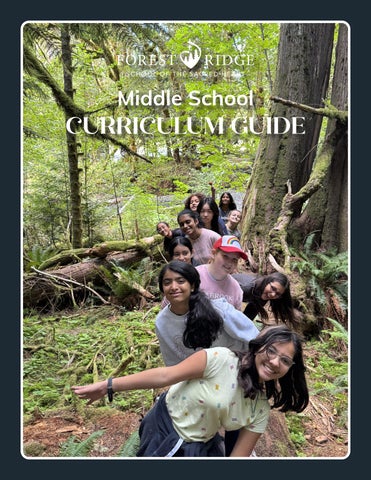
Middle School CURRICULUM GUIDE

MISSION

The mission of Forest Ridge School of the Sacred Heart is to educate young women to think critically, embrace challenges, model resilience, confront injustice, seek equality and lead globally in the pioneering spirit of our foundress. Our alumnae change the world.

VISION

We are a leader in educating girls to be competent, confident and courageous women, ready to lead lives of purpose in a rapidly changing and increasingly complex world.

ACADEMIC PHILOSOPHY

Forest Ridge educates all students to the highest academic standards, while challenging students intellectually through a curriculum that values curiosity, inquiry and investigation. In order to educate students who are ready to meet the ever-changing needs of our world, we commit ourselves to the following program pillars.

INTELLECTUALLY INVIGORATING

Forest Ridge teaches our students not what to think but how. As a Sacred Heart School, Goal Two calls us to educate to a deep respect for intellectual values. Inspiring curiosity and joy through a curricular program that empowers our students to explore new intellectual horizons, delve deep into their academic interests, and take ownership of their learning, our students gain an understanding of themselves and their place in the world. Our girl-centered learning environment fosters inquiry-driven and independent research, providing student choice, while ultimately cultivates an authentic love of learning in our students. Through their learning, our students develop the sense of purpose needed to make a positive impact on their world.

INTERCONNECTED

Relationships are central to learning at Forest Ridge. Whether student to student, one course to another, or classroom to their outside world: education at Forest Ridge is interconnected. Our multidisciplinary curriculum, rich with integrated and collaborative learning opportunities, pushes our students to apply their knowledge and skills in a variety of crossand extra-curricular ways. Through service learning, our students step out of the classroom and into the community, gain awareness and compassion for others and their circumstances, and foster a true sense of reciprocity in service. The international Network of Sacred Heart Schools, made up of over 150 schools, provides our students with the opportunity to attend school anywhere in the United States or around the globe, introducing them to a variety of perspectives as they experience the interconnectedness of the world firsthand.

EXPERIENTIAL

Girls learn best when their learning is relevant to their interests and their world. Through a collaborative, hands-on approach, our students take an active role in their learning, applying academic concepts to real-world experiences. Students are engaged intellectually, socially, emotionally, and physically, as they investigate areas of interests and passions. Putting the theoretical into practice, students are able to apply what they’re learning to make a tangible difference. Experiential learning at Forest Ridge comes to life through our signature programming, promotes the cultivation of confidence, competence, and courage, spurring our students to become change-makers in an everevolving world.

FOREST RIDGE MIDDLE SCHOOL

Our middle school curriculum is thoughtfully designed to challenge and inspire students, encouraging them to explore diverse subjects and develop critical thinking skills, while building a strong foundation that prepares them for the success in the Upper School and beyond.

Students are required to carry a full course load of core academic classes, which includes the following disciplines: English, social studies, religion, math, science, and physical education. As part of our commitment to global citizenship and cultural competency, students are also required to pursue studies in an international language for all four years of middle school, unless they are participating in Learning Support Services. Additionally, our students in the seventh and eighth grades must engage in a specialized writing course, which further hones their written communication skills.

All Forest Ridge Middle School students are required to participate in one of our highly regarded Immersive courses, which take place each spring. This weeklong program is designed to challenge students in new ways, promoting collaboration, leadership, and experiential learning.

GRADE-LEVEL ADVISORIES

In the grade level advisory program, various activities, conversations, and reflections enable girls to explore and develop their natural leadership abilities. Through these activities, students have the chance to practice both personal and collaborative leadership skills in various situations and settings. Some of the leadership-focused advisory activities include student reflection and goal setting, which occurs at every grade level. These reflections facilitate great conversations around personal leadership and growth, allowing girls and their advisors to brainstorm proactive strategies for development. Additionally, team challenges serve as a practice field for collaboration and problemsolving skills, providing an opportunity to observe personal behaviors and interactions. Before starting a team challenge, participants attend a pre-challenge meeting to review strategies for successful group work and identify areas of focus. The team then engages in the challenge and concludes with a debrief and reflection period.

ADVISORY PROGRAM

The Forest Ridge Middle School Advisory Program supports the school community in living out the Sacred Heart Goals and Criteria. Advisory meets twice a week to provide a structured opportunity to develop social, academic, and leadership skills for students in middle school. Through a variety of activities, grade-level teams of adults empower students to create solutions to problems, to develop responsibility for their learning, to communicate openly, to serve others, and to better understand what it means to be part of a Sacred Heart community through open discussion of our school values and goals. Advisory provides students the opportunity to learn to work and play together, to talk and listen together, and to learn to be self-directed. Advisory is one of many ways that the faculty at Forest Ridge come to know the unique and special gifts each child contributes to the class and school environment.

At the fifth and sixth-grade levels, the homeroom teacher is the academic “advisor” to the students assigned to her/ his homeroom. In the seventh and eighth grades, a student’s advisor serves as her academic advisor and leads her advisory group of ten to fifteen students. The advisor helps promote a sense of community and trust among students in his or her advisory group or homeroom, members of the class, and the entire middle school. The advisor takes an active interest in the student’s academic and social-emotional experience, tracking ongoing progress through the year. When appropriate, an advisor may contact parents with progress updates or concerns. The starting point for parentstudent-teacher conferences in October is with the student’s advisor, and parents are encouraged to get to know their daughter’s advisor early in the school year.

SERVICE LEARNING

One of the essential goals of a Sacred Heart education is to graduate girls who are “educated to a social awareness which impels to action.” This entails a significant emphasis on service learning throughout a student’s experience at Forest Ridge. Service learning is precisely that: integrating teaching and learning through meaningful interactions in our community that are relational and incorporate intentional reflection as part of the educational experience. Through these opportunities, Forest Ridge hopes to foster empathy, promote civic engagement, teach the skills of building community, and instill a willingness to step out of one’s comfort zone to learn across all manner of perceived boundaries.

The overarching objective of service learning at Forest Ridge is to educate to a critical consciousness that leads students to analyze and reflect on the values of society and to act for justice. The program is thoughtfully designed to engage our students in making the world a better place. It is approachable, reasonable, and achievable. Thus, the service program and opportunities at Forest Ridge are developmentally and thematically based opportunities which vary by year. At every grade level, emphasis is placed on direct service and advocacy, social justice education, and reflection.

GRADING & ASSESSMENT

Grading System: Standards-Based Grading

Standards Based Grading supports a rigorous curriculum by clearly defining the learning objectives for each course and reporting on student progress on those objectives. All assessments align with specific learning targets, and the gradebook reflects progress on those targets. This approach encourages a growth mindset, where students are empowered to engage in continuous improvement rather than focusing solely on grades. The Standards Based Grading system improves communication between school and home, and also focuses on support and extra challenge opportunities for students.

Grading Scale

Middle school teachers use the following grading language: Exceeding Standard, Meeting Standard, Approaching Standard, Beginning Standard, and No Evidence. Formative work (daily practice, most homework) is practice towards the goal of meeting a standard and may or may not receive a grade. The language below is a general definition for each level and might be altered for each department, grade level, or course.

Student work does not yet show evidence of progress toward meeting the grade-level expectations for this standard.

Student work is beginning to show progress towards meeting the gradelevel expectations for this standard and/or the student required significant teacher support to meet the standard.

Student work is independently approaching the grade-level expectations for this standard.

Student work independently meets grade-level expectations for this standard.

Student work shows depth of thought and/or creativity above and beyond the grade-level expectations for this standard.

The Exceeding Standard level is an opportunity for students to seek or accept challenges beyond what is taught in class. It is not the same as earning an “A” or 100% in the traditional grading system and will be reached when a student is particularly curious or motivated to advance beyond a skill or concept as covered in class. Teachers will also present opportunities for students to earn an E grade. Students are expected to work towards Meeting Standard, which is a good grade and indicates that the student has met the teacher’s high standards on most skills and concepts. Not all assessments will have opportunities for Exceeding.

Academic independence refers to a student’s ability to take ownership of their learning journey. It involves the capacity to manage one’s time effectively, engage critically with material, and seek out resources autonomously to deepen understanding. When students require support meeting standards well beyond what a teacher typically provides to all students, we communicate that by marking the standard as “Beginning Standard.” This will be clearly communicated with students as they receive support.

Understanding Formative and Summative Work

Students will be expected to complete work to develop their skills and knowledge, called formative work, and work during or at the end of a unit to demonstrate their learning, called summative work. Formative work is considered practice towards a goal of understanding and is not included in a student’s grade reports; only summative work will be included. Courses will have one standard assessed in the first month of each semester and at least two summative assessments per quarter.

LEADERSHIP DEVELOPMENT

Our signature leadership program is built upon four fundamental pillars that serve as the bedrock of our integrated and intentionally scaffolded learning experiences. Firstly, we place great emphasis on fostering a deep understanding of personal strengths and style in our students, allowing them to recognize and cultivate their unique qualities, thereby developing a keen sense of self-awareness. Secondly, we offer numerous opportunities for collaborative problemsolving and tackling challenges, recognizing that effective teamwork and collaboration are essential components of true leadership. Thirdly, we teach our students proven strategies for effective collaboration, communication, and creativity, equipping them with the critical skills necessary for successful leadership in the 21st century. Lastly, we provide ample opportunities for our students to give and receive constructive feedback, facilitating deep reflection on their strengths and areas for growth, fostering a growth mindset that enables them to strive for continuous personal and professional development.

Students who take full advantage of the Forest Ridge Middle School leadership opportunities enter the Upper School as:

• Personal leaders who have a strong sense of their strengths and values and are able to motivate themselves to set goals and persist through challenges.

• Inclusive leaders who understand, value and appreciate differences and are able to bring the best out in others.

• Ethical leaders who look out for the good of all and understand that their actions have impact.

• Innovative leaders who believe problems have solutions and work to use their gifts and the talents of others to find solutions.

• Globally-minded leaders who understand that their actions and choices have impact beyond themselves and that the resources of our world need to be cared for and shared.

SEVENTH-GRADE ROPES CHALLENGE

As part of the leadership program, seventh-grade students participate in an exhilarating full-day experience on a high ropes course. This challenging and dynamic activity offers our students a unique opportunity to push themselves beyond their limits and build their personal leadership skills in a supportive and nurturing environment. With a focus on taking appropriate risks and working collaboratively to achieve a common goal, our girls are empowered to step out of their comfort zones and embrace new challenges with confidence and determination. Through this experience, students develop essential leadership qualities such as resilience, adaptability, and teamwork, which will serve them well both in and outside of the classroom.

EIGHTH-GRADE GLOBAL DAY LEADERS

Eighth grade students have the opportunity to develop their leadership skills during Global Days, a middle-school exploration of a topic with global implications. Through a variety of leadership roles such as Global Guides, Teacher’s Assistants, Community Art and Awareness Team, and Prayer Service Leaders, students are able to practice and enhance their leadership skills in a real-world setting. Student leaders participate in workshops leading up to Global Days, which help them identify leadership skills they want to practice during their Global Days work. Faculty members provide coaching and feedback to students throughout the two-day event, allowing students to refine their skills and become confident, effective leaders.

SELF-DIRECTED LEADERSHIP

By providing a wide range of leadership opportunities spanning various activities and topics, students are empowered to select experiences that align with their inherent strengths while also recognizing the value of pushing themselves beyond their comfort zones to take on new challenges that promote continued growth. With immersion in an environment that prioritizes leadership development, students can develop a deep understanding of their personal leadership style and how it can be leveraged to make a positive impact in the world. Whether through leading clubs, facilitating classroom discussions, organizing events, or serving as mentors, students have ample opportunities to apply their leadership skills in real-world contexts and develop the confidence and competence needed to succeed in future leadership roles.

SACRED HEART NETWORK EXCHANGE

Eighth Grade Students can participate in the Sacred Heart Network Exchange. Through this program, students can stay with host families and attend other Sacred Heart Schools across the United States while immersing themselves in the school culture, community, and academic curriculum. The exchange program allows students to practice and develop their leadership skills in a novel setting. Students have the opportunity to share their own experiences and perspectives with their exchange school community while building connections and community. This unique opportunity allows students to expand their horizons, build relationships with students from different backgrounds, and hone their leadership skills in a supportive and enriching environment.

STUDENT SUPPORT

The Forest Ridge Student Support Team is comprised of administrators, teachers, school counselors, and learning support specialists in each division who take a collaborative, holistic, and research-based approach to supporting students and families on student wellbeing and academic needs.

Our Student Support Team strives to provide a balanced level of support to students where students can access success while continuing to cultivate personal growth and in an atmosphere of wise freedom in alignment with our Sacred Heart Goals & Criteria. We believe students grow in courage and confidence as they discover new abilities, learn from mistakes, cultivate strengths, and develop empathy and exercise resilience in meeting challenges and therefore aim to create student-led learning environments and supports that foster these experiences. When appropriate, Forest Ridge will connect families with outside resources for additional learning or therapeutic support.

LEARNING SUPPORT

Learning Support at Forest Ridge is an accommodations-based program supporting students with disabilities who qualify under the Americans with Disabilities Act (ADA). Accommodations at Forest Ridge provide access to our academic program but do not alter or modify curriculum nor do they change what a student is expected to master in the class content.

Forest Ridge is a culture that expects intellectual curiosity, flexible thinking and critical reasoning from all members of our community. Our learning support specialists seek to assist students to realize their potential in an environment that promotes self-awareness, self-motivation, and self-advocacy in a comprehensively accessible environment.

SCHOOL COUNSELING

We have two School Counselors on staff who provide services for students and parents navigating the challenges and changes in adolescence. Our counselors, Hannah Moskat and Laura Boismenue, support and grow the socialemotional health of all students through brief, individual counseling, psychoeducation, and consultation with parents and professionals. While School Counselors do not provide treatment or therapy, they are specialists in mental health in the school setting, drawing from experience in independent schools, public schools, and private practice.

ENGLISH LANGUAGE LEARNING SUPPORT

Forest Ridge welcomes students from around the world to immerse themselves in speaking, reading, writing and learning in English. Our English Language Learners (ELL) program provides differing levels of support in each division during student’s transition into our English-taught curriculum.

Based on their English proficiency, students entering fifth through eighth grade will engage in either a formalized English Language Learning (ELL) curriculum as a separate class, or they will receive support from a specialist pushing into their English-taught classes. The level of support is determined by the school administration through a variety of information, including teacher recommendations, previous coursework, WIDA Screener ®, and TOEFL® scores and is evaluated on an ongoing basis. The goal of the middle school ELL program is to grow students’ confidence in both interpersonal communication skills and academic success. Students with low or emerging English proficiency may be encouraged to complete a Forest Ridge approved summer course prior to enrollment.

HOMEWORK

All schoolwork is given with a purpose – to enhance learning and work on skills – and is an essential component to meeting the standards of the course. Families can support students by providing a quiet place to complete schoolwork and setting aside time each day to focus on work completion. Most homework is formative or preparation for the coming day’s lesson.

While we do not have time limits on homework because each child is different, families should let the student’s teacher or advisor know if students are struggling to complete homework or there are concerns about how much time is being spent on homework. This information allows teachers to better understand each child’s learning and adjust.

Assignments will not be assigned to students over Christmas, Mid-Winter, or Spring Breaks. However, students might need to work on long term assignments over long weekends or singular holidays.

PARENT/GUARDIAN AND ADVISOR CONFERENCES

The Middle School has two conference days, one in the fall and one in the spring. Along with progress reports, the conferences are meant to provide additional insight into the school day and make sure that parents/guardians see work done in class. Conferences are not a time to meet with individual teachers, but parents/guardians are welcome and encouraged to request a meeting with any teacher at any time.

Fall conferences are required and are presented by the student and advisor. This allows students to review their own work and articulate their success and challenges with the help of their advisor. Parents are always welcome to arrange to meet with individual teachers outside of the conference day. The spring conference day is optional, but parents may be invited to meet with teachers.

From time to time, teachers or the Director of Middle School might request that parents/guardians meet with teachers and the advisor outside of the conference time to address academic or social concerns. Others who might be present are the school counselor, the learning support specialist or the Assistant Head for Academics.

ACADEMIC INTEGRITY

A student who misrepresents their academic work violates the trust among students and teachers that is vital to a learning environment in which we are genuine and fair with one another. When a student violates this trust, we have the responsibility to acknowledge the behavior and provide understanding and appropriate consequences that we hope will guide them to better decisions in the future. We believe that it is through understanding and owning mistakes that trust is rebuilt.

Plagiarism

• Plagiarism is offering as one’s own work the ideas, words, expressions, or thesis of another. Plagiarism includes, but is not limited to:

• Using the words of others without appropriate citation this includes internet sources and Generative AI

• Paraphrasing another’s work, internet sources, or Generative AI without appropriate citation

• Adopting, without appropriate citation, the thesis and line of reasoning from another source including internet sources or Generative AI, even when the student restates these in their own words

• Using another artist’s work for inspiration without giving proper credit

Cheating

• Cheating is sharing, copying, or taking credit for the work of others. Cheating includes, but is not limited to:

• Copying the work of a peer, an internet source or Generative AI

• Sharing work with a peer

• Discussing the content of a test with a student who has not yet taken the test

• Changing answers to previously graded work and/or forging scores on work

• Not contributing fully to a group project and claiming credit for doing so

• Bringing unauthorized resources into a test setting

• Being dishonest about turning in work or technology issues to avoid consequences of not completing work Academic integrity is an extremely serious matter.

5TH GRADE

HUMANITIES

• English: Reading focuses on an exploration of active reading skills and evaluation of literary elements. Students are encouraged to build habits toward becoming life-long readers, and read fiction and non-fiction books as a class, in small groups, and individually with an emphasis on a variety of genres. Writing in fifth grade focuses on developing a commitment to the full writing process. Through various projects, students explore brainstorming, prewriting, drafting, revising, editing, and publishing. Emphasis is placed on engaging in the entire writing process and working through multiple steps of revision. Vocabulary and grammar skills are learned in the context of literature and writing and through the online resource, No Red Ink.

• Social Studies: America’s Past: In our first unit, students review and practice basic geography and map skills, including labeling features on maps, determining absolute location using latitude and longitude, and identifying physical features of the United States. Students then explore the vibrant and diverse cultures of Native American tribes throughout different regions of North America. Students discover how and why Europeans came to the New World. The students analyze the actions of the British and the colonists in the 1700s, and factors that led to the American Revolution. The students discover the main ideas in the Declaration of Independence, and later they will uncover how the unlikely victory of the colonists in the American Revolution unfolded. Students also spend time exploring and interpreting the remaining freedom documents, the Constitution and the Bill of Rights.

MATH

Foundations of Mathematical Practices: Our Foundations of Mathematical Practices course features a differentiated instructional approach that supports and challenges all students. Before starting each unit of study, students complete a pre-assessment to identify areas where they have already mastered the content and areas that require further development. Our coursework is carefully designed to provide extensive exposure to real number operations and a strong foundation in practical problem-solving techniques. Using a hands-on, problem-solving approach, students gain both conceptual understanding and operational fluency in key topics such as fractions, decimals, and percentages, as well as the application of order of operations to write and execute solutions to complex problems. The Foundations of Mathematical Practices course empowers students to become confident, reflective learners who are well-prepared to excel in math and beyond.

RELIGION

In this course, students are introduced to the Bible as a sacred text and the word of God with a special emphasis on the study of Hebrew scripture. Our year concludes learning about the origins, beliefs, and practices of the major world religions, including Judaism, Christianity, Hinduism, Buddhism, and Islam. Forest Ridge is a rich and diverse faith community, and students are invited to share and celebrate their own faith traditions, as well as being welcomed into the celebration of Catholic traditions. Students also learn what it means to be a Child of the Sacred Heart as we explore the history and traditions of a Sacred Heart education.

SCIENCE

Experimental Science: 5th grade experimental science curriculum revolves around the nature of science, and students learn content from life, earth, and physical science domains by using scientific skills. Students begin to develop skills in three major categories: scientific inquiry, scientific communication, and engineering. The goal for every student is to engage with content in a variety of learning experiences that align with the National Science Teachers’ Association recommendations for middle school science, including use of “hands-on, minds-on” inquiry-based science instruction in which at least eighty percent of instructional time is spent on investigations. Units preview content from the next three grade levels, including life, earth, and physical science.

PHYSICAL EDUCATION

5th grade physical education is fun. Cooperation and learning to work with new classmates are most important. Many activities are offered to develop basic movement skills, hand-eye coordination, sportsmanship, teamwork, and the ability to assess and accept gifts and limitations. Emphasis is on class participation, cooperation, and individual effort. A positive learning environment is established by participating in cooperative activities. Non-competitive games reinforce good sportsmanship, teamwork, support of teammates, and respect for classmates.

INTERNATIONAL LANGUAGE

French Foundations: This class introduces students to the basics of the French language and culture. The course emphasizes fun, interactive activities to build confidence in using French for everyday communication.

STUDIO ART

Students will be introduced to a wide variety of art materials and techniques, from drawing and painting to ceramics and more. Along with learning practical skills, students will also study design concepts and global art history. Through experimentation and exploration, students will develop their observation and imagination skills, make creative choices, and learn from their mistakes. Students will also reflect on their work, with the goal of evolving their artistic abilities throughout the semester.

PERFORMANCE

Students delve into the world of music and discover the fundamentals of vocal techniques. Our comprehensive curriculum includes instruction on proper breathing, enunciation, singing habits, a basic understanding of music theory, and personal presentation strategies. Through practical application, our students hone their skills and create captivating spoken and sung performance art, showcasing their newfound abilities to the world.

DIGITAL MAKERS AND CREATIVE CODERS

This hands-on course empowers students to explore the world of creative coding, digital design, and physical computing using the BBC micro:bit. Through engaging projects robotics programming, interactive pets, smart devices, and AI experiments, students learn to program with block-based tools, prototype with cardboard and 3D pens, and collaborate using the design thinking process. The curriculum fosters foundational skills in coding, logic, and digital fabrication, while encouraging imaginative problem-solving and responsible technology use.

6TH GRADE

ENGLISH

Read. Write. Reflect. Listen. Synthesize. Discuss. Grow! In 6th grade, learners will actively participate in the practice of analyzing literature, crafting dynamic written works, and applying their knowledge to their leadership and enriching their community. Throughout the year, our study will focus on the exploration of the hero’s journey. Using a variety of text types and genres, our class will dive into the ways that individuals are impacted by their societal context, as well as how an individual can change their community. We will begin the year by reading and analyzing short narratives to use the diverse stories told in the anthology to explore the diverse identities in our own classroom. Our second unit ignites imagination as we study myths and the path of a hero, particularly with the backdrop of ancient civilizations. In our third quarter, students will participate in a cross-curricular unit with science, developing research and literary analysis skills to build empathy alongside scientific understanding of the plight of orca whales in the Salish Sea. Our final quarter will explore nonfiction texts around change-makers who have had a significant impact on their communities. Students will research and present their findings to our class community.

SOCIAL STUDIES – ANCIENT CIVILIZATIONS

Our three themes for this course are: Identity, community, and civilization. Throughout the year, students investigate civilizations including Egypt, India, China, and Greece. We begin each unit by exploring maps to identify physical features of each region and seeing how geography influenced the location of early settlements. Students explore the culture and achievements of each civilization. Students develop an understanding of different types of government and begin to compare different civilizations. Activities, projects, and historical fiction immerse students in the cultures and civilizations studied. Students practice a variety of academic skills including developing and supporting claims, presentation, note taking, study strategies, researching, and citing sources.

MATH – BEYOND NUMERACY

Featuring a differentiated instructional approach designed to challenge and engage students at every level. This course builds on students’ prior knowledge and introduces new topics that will expand their understanding and problemsolving skills. Topics of study include scale drawings, proportional relationships, percentages, geometry of circles, angles, triangles and prisms, operations with positive and negative numbers, equations and inequalities, and data analysis with probability and sampling. Students seeking additional challenge can work on optional Algebra Readiness extension standards. Mastery of the 6th Grade Mathematics course standards prepare students to take Pre-Algebra in 7th Grade, and mastery of the Algebra Readiness extension standards prepares students to take Algebra 1 in the 7th grade. Our Beyond Numeracy course is designed to foster a love of learning and a deep understanding of mathematical concepts that will stay with students for years to come.

SCIENCE

The curriculum revolves around the theme of life science, and students learn content using scientific skills. Students continue developing skills in three major categories: scientific inquiry, scientific communication and engineering. The goal for every student is to engage with content in a variety of learning experiences that align with the National Science Teachers’ Association recommendations for middle school science, including using “hands-on, minds-on” inquiry- based science instruction in which at least eighty percent of instructional time is spent on investigations. Units of study include astrobiology, cellular biology, plant processes, ecology, genetics, and evolution.

RELIGION

In this course, students are introduced to the Bible as a sacred text and the word of God with a special emphasis on the study of Hebrew scripture. Our year concludes learning about the origins, beliefs, and practices of the major world religions, including Judaism, Christianity, Hinduism, Buddhism, and Islam. Forest Ridge is a rich and diverse faith community, and students are invited to share and celebrate their own faith traditions, as well as, being welcomed into the celebration of Catholic traditions. Students also learn what it means to be a Child of the Sacred Heart as we explore the history and traditions of a Sacred Heart education.

PHYSICAL EDUCATION

The emphasis of 6th grade physical education is to develop good fundamental motor skills, sound fitness skills, basic sports skills, knowledge of rules, and simple strategies for games. The level of intensity and skill is adjusted according to the abilities of the class. A positive, playful learning environment is established as students participate in cooperative activities and team sports. Some of the activities offered during the sixth-grade year may include various noncompetitive games, soccer, basketball, floor hockey, badminton, track, pickleball, tennis, rock climbing, and volleyball.

INTERNATIONAL LANGUAGE

• French: Beginning French introduces students to the fundamentals of the French language and culture. Students will engage in fun, hands-on activities to build confidence in communicating in French, with an emphasis on everyday conversations and cultural exploration. This grade level includes focus on academics and language skills, helping students develop a deeper understanding of vocabulary, grammar, and sentence structures.

• Spanish: Our approach to this introductory Spanish course is to foster the enjoyment of learning a new language. This introductory year will familiarize students with the language to better prepare them for the rigor of the academic courses provided in the 7th and 8th grade. Students will be introduced to expressions, vocabulary, and basic grammatical structures. This is a project-based course which includes artwork, videos in Spanish, student created skits and projects.

ELECTIVES

• Strategic Games: An engaging and educational elective designed for 6th graders to develop critical thinking, problem-solving, and decision-making skills through the exploration of classic and modern board games. In this class, students will dive into strategic games such as Chess, Settlers of Catan, Ticket to Ride, and Pandemic. Through individual and group play, students will learn to plan, manage resources, and collaborate effectively. By analyzing game tactics and participating in friendly competitions, students will enhance their strategic thinking and have fun in a supportive, interactive environment. This class provides a unique blend of learning and entertainment that sharpens the mind and fosters camaraderie.

• 6th Performance: Students will study theatre, spoken word, music theory, and learn effective singing, speaking, and dance techniques. Our class will explore all aspects of performance from the perspectives of performer, director, producer, and costume designer while learning to be creative individuals within a strong ensemble. We will also celebrate our work by performing in a required Holiday Concert in the chapel.

• Studio Art: Art is about having fun with art and exploring a variety of mediums and techniques including clay, charcoal, watercolor and acrylic paint, yarn, ink and more. Classes are about exploring different ways of making art and understanding its place in our lives, in history and in the world around us. Each student has their own sketchbook to work in as well. Some pages will be free choice, and some will be more directed. While we play with materials, we constantly circle back to the basic elements of art and design and how they fit into what we’re working on.

7TH GRADE

ENGLISH

Read. Reflect. Listen. Discuss. Learn. Grow. Have Fun! By actively participating in the learning process, students will unlock their potential as excellent readers, writers, and future leaders. Our goal is for students to develop their own beliefs and values and for them to be able to truly listen to one another. Students will grapple with the gray to better understand nuance, become comfortable with the idea of many “right” answers, and celebrate multiple perspectives. Our year together has the following themes: Identity, Society, Heroes, and Storytelling. Students begin the year with an introduction to poetry and book clubs focusing on novels in verse. Then, we investigate the dystopian genre by reading Lois Lowry’s The Giver and analyzing choice texts. Our next unit focuses on research and argumentative skills where we analyze people of significance to determine what makes a hero. We end the year with an interactive study of A Midsummer Night’s Dream, analyzing several adaptations and preparing our own performance.

WRITING

This course demystifies the use of the basic building blocks of powerful writing and helps students harness the power of a well-crafted sentence alongside thoughtful word choice. Students write about themselves in a variety of structured and creative ways. Throughout the semester, students will write personal narrative essays, thumbprint memories, seven-word memoirs, and many quick writes focused on sentence construction, sensory details, and vocabulary choice.

SOCIAL STUDIES: MODERN GLOBAL ISSUES

This class is focused on educating students to be global citizens in an increasingly interconnected world. Together, we will ask and answer challenging questions such as: “How do I fit into the world?” “What challenges is the world facing?” “What impact can I have on a personal level?” “How can we all work together to solve global issues?” Throughout the year students will create digital media, give formal presentations, and collaborate as part of a team as they explore our world and how we can all be global citizens.

MATH

• Pre-Algebra: Students engage in an investigative approach to develop their abstract reasoning and mathematical discourse skills, while building a strong foundation in algebra readiness. Through inquiry-based activities, students will extend their understanding of mathematical concepts and apply broader, more abstract mathematical thinking to solve real-world problems. The curriculum covers a range of topics, including a review of ratios, percents, proportionality, introducing variables, equations, and expressions. Students will practice evaluating and solving equations and exploring mathematical concepts such as simple roots and powers, and the use of the Cartesian coordinate plane. The collaborative problem-solving approach in this course is designed to equip students with the necessary skills and mindset for success in Algebra I.

• Algebra: In this rigorous high-school level Algebra 1 course, students will delve into the foundations of algebra and hone their problem-solving skills through an investigative approach. Building upon a solid understanding of Pre-Algebra concepts, students will explore patterns and develop algebraic methods for solving increasingly complex problems. Topics covered include the modeling of linear, quadratic and exponential functions, the manipulation of polynomials, systems of equations and inequalities, exponents, and the use of rational and irrational numbers. By the end of the course, students will have gained a mastery of algebraic expression manipulation, function analysis, and advanced problem-solving techniques, positioning them for future success in higher-level mathematics courses.

SCIENCE

The course content revolves around the theme of earth sciences, and students learn content through mastery of scientific skills in three major categories: scientific inquiry, scientific communication and engineering. The goal for every student is to engage with content in a variety of learning experiences that align with the National Science Teachers’ Association recommendations for middle school science, including using “hands-on, minds-on” inquiry-based science instruction with most of the instructional time spent on laboratory investigations. The majority of the year will focus on an in-depth study of the Earth, including these units in Geology:

• Earth’s Building Blocks (minerals, the rock cycle, weathering/erosion, crystal formation)

• Forces in the Earth (Earth’s layers, Pangaea, seafloor spread, plate tectonics, convection currents)

• Earth’s Disasters (volcanoes, earthquakes, tsunamis)

• Geological History (fossils and dating methods, extinction theories, evolution theories)

We then move to a comparative unit of Astronomy in the spring, where we explore the formation and contents of the solar system, Milky Way galaxy, and the wider universe.

RELIGION

The seventh-grade religion course explores the person of Jesus as encountered through the Gospels. Students learn about the historical context into which he was born and use this information to dig more deeply into his parables and gain a deeper understanding of Jesus’s mission and deep love for the people who are most vulnerable in society. They begin exploring pertinent themes in their own lives, including service and resurrection. Through the Gospels and personal reflection, students come to understand the attitudes of the heart of Jesus (generosity, compassion, respect, and forgiveness) expressed in Goal One of a Sacred Heart Education. The course also examines the concept of kinship. Students learn about people who, like Jesus, seek to create authentic and compassionate relationships with those historically on the margins of society. In class throughout the year, students will notice an emphasis on written reflection, class participation, clear and respectful communication, small group discussion, and project-based learning.

PHYSICAL EDUCATION

Physical Education emphasizes the development of sound fitness practices and habits, traditional and lifelong sports skills, knowledge of rules, and simple strategies for games. A positive learning environment is established by reinforcing good sportsmanship. Basic principles of fitness and their relationship to one’s health and lifestyle are explored. Students learn individual skills and game rules for many different sports, which may include soccer, football, basketball, floor hockey, volleyball, badminton, pickleball, tennis, softball, and golf. We also use the Forest Ridge fitness center as we continue to promote lifelong fitness.

INTERNATIONAL LANGUAGE

• Spanish: Our approach to learning Spanish is grammar and syntax-based, situational, and cultural. The theme of each unit encourages immediate use of practical expressions and introduces new grammatical structures, including subject-verb adjective agreement and the present tense. The textbook, Auténtico, is tailored to middle-school students. Supplementary activities include viewing videos in Spanish, student created skits and projects, listening comprehension, and writing activities.

• French: French 1A helps students expand their vocabulary, improve pronunciation, and strengthen their understanding of grammar. Students actively engage in conversational French through dialogues, roleplaying, and interactive activities that promote speaking and listening comprehension. The course introduces more complex sentence structures, verbs, and tenses, enabling students to communicate in a wider variety of everyday situations. Cultural exploration of French-speaking countries plays an important role, fostering both linguistic and cultural awareness.

• Mandarin: Mandarin 1A is designed to introduce the language to learners with little or no proficiency in Chinese. Students will begin to develop communicative competence in listening, speaking, reading, and writing skills at the elementary level with an emphasis on mastering the essentials of pronunciation (using the Pinyin system of Romanization), the writing system (simplified characters), and basic grammatical patterns. Simple sentence structure, short paragraph writing, and basic tenses will be introduced. Learners develop an understanding of Chinese culture and way of living as well.

• STEAM: In STEAM class, seventh and eighth-graders use elements of science, technology, engineering, the arts and mathematics as access points for exploration and creativity. This project-based class encourages students to connect with the world around them, develop and create innovative solutions to problems, think deeply, work collaboratively, and communicate their ideas clearly. The design-thinking process is used as the basis for work sessions, and the cycle of planning, prototyping and responding constructively to feedback and failure is key in this class. Projects will include creating “Rube Goldberg” style inventions, upcycled fashion design, and more. Students will have the opportunity to use a variety of tools, technology, and materials in the FR Shop, as well as develop new collaborative and personal habits of learning.

• Theatre: Monologue Writing and Performance: In this course you’ll learn the art of the monologue from two sides: the performer and the playwright. We’ll start by building your acting toolbox with fun, focused lessons designed to boost your confidence on stage. You’ll master everything from silent monologues to full 30-second performances. Next, you’ll transition from performer to writer. Through engaging journaling prompts and writing exercises, you’ll learn how to craft your own original monologue. You’ll also receive valuable feedback from both your teacher and peers, helping you shape your unique voice. We’ll celebrate the end of the semester with a performance showcase where you can bring your original piece—or a classmate’s—to life on stage.

• Dance: Throughout this course, students will learn the fundamentals of dance through various dance combinations, progressions, and technique exercises. By the end of the semester, students will have a firm understanding of Ballet and Jazz technique as well as a basic knowledge of choreography and choreographic concepts and ideas.

• Studio Art: Studio Art is about having fun with art and exploring a variety of mediums and techniques including clay, charcoal, watercolor and acrylic paint, yarn, ink and more. Classes are about exploring different ways of making art and understanding its place in our lives, in history and in the world around us. Each student has their own sketchbook to work in as well. Some pages will be free choice, and some will be more directed. While we play with materials, we constantly circle back to the basic elements of art and design and how they fit into what we’re working on.

• Robo Challenge Studio: This challenge-based robotics course empowers students to become inventive problem solvers through hands-on engineering and programming. Using VEX IQ robotics kits, students engage in real-world design challenges inspired by themes like environmental sustainability, accessibility, and disaster relief. Through block-based programming, sensor integration, and iterative prototyping, learners build and code autonomous robots to address authentic community and global needs.

8TH GRADE

ENGLISH

Students begin the year with a survey of short stories with a focus on analyzing the use of literary devices and elements in discussion and writing. They then extend these skills to novel, drama, and non-fiction study. Students also engage in year-long vocabulary and conventions practice. Throughout the year, a thematic focus on identity, rights, and power offers opportunities for cross-curricular explorations with social studies and religion.

WRITING CLASS

8th grade writing prepares students for success in academic writing for upper school and beyond. Students develop their academic voices by tackling three major essay styles that they will encounter again and again in their academic career: argumentative, analytical, and the ever-daunting research paper. We will focus on the building blocks of rhetoric and persuasion, literary analysis, and author choice, exposing students to foundational genres of academic writing. This course will also focus on the mechanics and “nitty-gritty” of academic writing that can be a challenge point for students, including embedding direct quotes and MLA citations/formatting.

SOCIAL STUDIES

8th grade social studies focus is on the U.S. Constitution, Washington State history, and United States history. Through class activities, group projects, essays, and presentations, students develop critical skills such as understanding varied perspectives, analyzing primary and secondary source material, forming oral and written arguments, implementing annotation strategies, and research.

MATH

• Algebra 1: In this rigorous high-school level Algebra 1 course, students delve into the foundations of algebra and hone their problem-solving skills through an investigative approach. Topics covered include the modeling of linear, quadratic, and exponential functions, the manipulation of polynomials, systems of equations and inequalities, exponents, and the use of rational and irrational numbers. By the end of the course, students will have gained a mastery of algebraic expression manipulation, function analysis, and advanced problem-solving techniques, positioning them for future success in higher-level mathematics courses.

• Geometry: This advanced course in geometry builds upon fundamental algebraic concepts and introduces students to the logical reasoning and development of both formal and informal proof methods of Euclidean geometry. Students will develop a deep understanding of geometric concepts and their real-world applications through an investigative approach. Topics of study include points, angles, polygons, circles, the properties of lines, congruence and similarity of triangles, and right-triangle trigonometry and its applications. Students will be challenged to think critically and abstractly while mastering the fundamental concepts of geometry.

SCIENCE

This course revolves around the theme of physical science, and students learn content through the use of scientific skills. Students demonstrate proficiency in three major categories: scientific inquiry, scientific communication, and engineering. The goal for every student is to engage with content in a variety of learning experiences that align with the National Science Teachers’ Association recommendations for middle school science, including using “hands-on, minds-on” inquiry-based science instruction in which at least eighty percent of instructional time is spent on laboratory investigations. Units of study include energy, physical and chemical properties of matter, motion, force, electricity, and magnetism.

RELIGION

This class is rooted in Goals One and Three of a Sacred Heart education: to educate to a personal and active faith in God, as well as a social awareness which impels to action. In the first semester, students develop an understanding of creeds by definition and explore a variety of creeds, completing an illustration and written exercise expressing their own creed and/or faith traditions. Throughout the year, students also continue to develop a deeper understanding of Catholic beliefs and practices. In the second semester, students learn about Catholic Social Teaching and related topics, such as the dignity of the human person, poverty, homelessness, rights of workers, and global issues.

PHYSICAL EDUCATION

Physical Education emphasizes the development of sound fitness practices and habits, traditional and lifelong sports skills, knowledge of rules, and simple strategies for games. A positive learning environment is established by reinforcing good sportsmanship. Basic principles of fitness and their relationship to one’s health and lifestyle are explored. Students learn individual skills and game rules for many different sports, which may include soccer, football, basketball, floor hockey, volleyball, badminton, pickleball, tennis, softball, and golf. We also use the Forest Ridge fitness center as we continue to promote lifelong fitness.

INTERNATIONAL LANGUAGE

• French 1B: Expands the communication skills already acquired and broadens awareness of history and culture in the Francophone world. Through texts, discussion, partner work, games, Internet resources, audio files, and videos, all four language skills- reading, writing, listening, and speaking- are practiced daily. Our program offers in-class opportunities for students to engage in communicative activities as they work towards mastering instructional objectives.

• Mandarin 1B: This course develops and expands the fundamental skills introduced in the first year as a transition between basic and lower intermediate levels. Students will continue to build communicative competence in listening, speaking, reading, and writing skills with an emphasis on consolidating their knowledge for pronunciation, basic grammar rules, sentence structures, communicative skills, and different writing formats. Students will keep expanding their learning on topics related to everyday life. In this second year of continued learning, students are expected to build up their confidence and fluency when communicating in Mandarin.

• Spanish: Spanish in the 8th grade is the second half of a level one high school Spanish course. Students start the year reviewing the material covered in Spanish 1A. Main grammar instruction includes verb structures in the future tense, present progressive and past tense, and an introduction to direct and indirect objects. Supplementary activities include viewing short videos and creating skits based on the themes in each unit. Investigations of cultural events, history, and geography are also incorporated. During December, the students participate in the celebration of Las Posadas in which they learn traditional songs and prepare traditional foods. Themes for this year are family, home, leisure activities, birthdays, restaurant dining, and travel.

ELECTIVES

• STEAM: In STEAM class, seventh and eighth-graders use elements of science, technology, engineering, the arts, and mathematics as access points for exploration and creativity. This project-based class encourages students to connect with the world around them, develop and create innovative solutions to problems, think deeply, work collaboratively, and communicate their ideas clearly. The design-thinking process is used as the basis for work sessions, and the cycle of planning, prototyping, and responding constructively to feedback and failure is key in this class. Projects will include creating “Rube Goldberg” style inventions, upcycled fashion design, and more. Students will have the opportunity to use a variety of tools, technology, and materials in the FR Shop, as well as develop new collaborative and personal habits of learning.

• Dance: Throughout this course, students will learn the fundamentals of dance through various dance combinations, progressions, and technique exercises. By the end of the semester, students will have a firm understanding of Ballet and Jazz technique as well as a basic knowledge of choreography and choreographic concepts and ideas.

• Theatre: Monologue Writing and Performance: In this course you’ll learn the art of the monologue from two sides: the performer and the playwright. We’ll start by building your acting toolbox with fun, focused lessons designed to boost your confidence on stage. You’ll master everything from silent monologues to full 30-second performances. Next, you’ll transition from performer to writer. Through engaging journaling prompts and writing exercises, you’ll learn how to craft your own original monologue. You’ll also receive valuable feedback from both your teacher and peers, helping you shape your unique voice. We’ll celebrate the end of the semester with a performance showcase where you can bring your original piece—or a classmate’s—to life on stage.

• Studio Art: Middle School art is about having fun with art and exploring a variety of mediums and techniques including clay, charcoal, watercolor and acrylic paint, yarn, ink and more. Classes are about exploring different ways of making art and understanding its place in our lives, in history, and in the world around us. Each student has their own sketchbook to work in as well. Some pages will be free choice, and some will be more directed. While we play with materials, we constantly circle back to the basic elements of art and design and how they fit into what we are working on.

• Robo Challenge Studio: This challenge-based robotics course empowers students to become inventive problem solvers through hands-on engineering and programming. Using VEX IQ robotics kits, students engage in real-world design challenges inspired by themes like environmental sustainability, accessibility, and disaster relief. Through block-based programming, sensor integration, and iterative prototyping, learners build and code autonomous robots to address authentic community and global needs.

Turn static files into dynamic content formats.
Create a flipbook