The mild temperatures through the winter and into spring have resulted in the invasive emerald ash borer maturing faster and emerging weeks earlier than usual, the Oregon Department of Forestry says.
Emerald ash borers have been in the state since at least 2022. As their name suggests, they infest and kill ash trees; they’re also known to attack olive trees.
Similarly, Colorado’s top forest health concern is a mountain pine beetle outbreak on the Front Range that has expanded by nearly 150 percent from 2024 to 2025, according to a Colorado State Forest Service report.
The report shows the continued spread of mountain pine beetles and other forest insects during the second consecutive year of above-average temperatures and belowaverage precipitation. Trees in forests across Colorado are stressed following a record warm winter and low snowpack, and infestations of bark beetles and western spruce budworm are expected to intensify and expand.
Environmental Groups Halt Oregon Logging Projects
Environmental groups have stopped a series of logging projects in coastal Southern Oregon after scoring a win in federal court.
A U.S. District Court judge ruled the U.S. Bureau of Land Management broke environmental laws when it approved a plan to log about 2,400 acres of forests near Yoncalla in Douglas County. The ruling came a few days after environmental groups requested a restraining order on logging in this area.
The court ordered BLM to throw out the entirety of the logging plan it called the Blue and Gold project. If the bureau wants to log this area in the future, it will need to come up with a new plan — and it will have to study these forests more closely to assure the public that it won’t kill large, ancient trees.
Studies Point to Benefits Of Forest Fuels Treatments
A study estimated that forest fuels treatments, such as forest thinning and prescribed burns, prevented $2.8 billion in losses, reduced wildfire spread and fire severity.
The researchers analyzed the nearly 300 wildfires that intersected U.S. Forest Service fuel reduction treatments in 11 states between 2017 and 2023.
The study is the first to evaluate the
economic value of Forest Service fuel treatments across the West at a large-scale using data from wildfires that encountered fuel treatments rather than relying on wildfire simulation models.
Another report says prescribed burns and thinning projects save money, longterm, highlighting new peer-reviewed economic research on wildfires.
The report by the Property and Environment Research Center draws heavily on two economics papers looking at fire suppression costs and damages, which say every $1 invested in fuel treatments in Pacific Northwest national forests yields between $5 and $6 dollars in reduced firefighting expenditures
Additionally, the research states that across the Western U.S., each dollar invested in national forest fuel treatments “yields an average of $3.73 in expected benefits through avoided damages from smoke and property loss.”
Weyerhaeuser Buys Land From Roseburg Subsidiary
Weyerhaeuser continued to branch out from its Pacific Northwest base of operations with last year’s purchase of 117,000 acres of timberland in North Carolina and Virginia, a $364 million transaction.
Weyerhaeuser acquired the property from Roanoke Timberlands, a subsidiary of Oregon-based Roseburg Forest Products, which is owned by the heirs of Kenneth Ford.
Weyerhaeuser described the property as having “81 percent planted pine acreage, strong site productivity, and favorable allweather logging operability.”
Calif. Wildfire Damage Mounts
Wildfire-driven deforestation rates in California are now among the highest in the world, according to new research highlighted by Phys.org.
Researchers found California lost 6-11 percent of its conifer forests between 1991 and 2023. The pace of forest loss accelerated sharply after 2000 and surged again following the catastrophic fire years of 2020 and 2021.
The study found annual deforestation rates climbed as high as 0.47 percent per year during some periods. That exceeds the global average and places California alongside some of the world’s most heavily fireimpacted regions.
(continued on page 6)
Editor: Tim Cox, timcox@forestnet.com
Contributing Editors: Mary Bullwinkle, Tim Flowers, Dawn Killough
Send both OLD and NEW Circulation information to: TimberWest Magazine Attn: Subscriptions P.O. Box 9058, Fargo, ND 58106 subscribetw@forestnet.com
CEO, Advertising Sales: Anthony Robinson – arobinson@forestnet.com Phone: (778) 991-3500
PUBLISHER’S EDITORIAL STATEMENT: TimberWest reports on the logging and lumber segment of the forest industry in the Western United States with emphasis on the states of AK, WA, OR, ID, MT and CA, providing current information on timber harvesting techniques, sawmill operations, news, legislation, events, people and products pertinent to this market.
TIMBERWEST (USPS #024858) is published bi-monthly (Jan/Feb, Mar/Apr, May/Jun, Jul/Aug, Sept/Oct, Nov/Dec) by TimberWest Publications, LLC, 1934 E Rose Creek Pkwy S, Fargo, ND 58104. Periodicals postage paid at Fargo, ND and at additional mailing offices. Copyright 2026. All rights reserved. Subscription rates to qualified subscribers are Free and all non-qualified subscriptions in U.S. are $22 per year payable in advance. Canada $35 (U.S.). Other $60 (U.S.). Single copies paid in advance $4. Company affiliation, title, date and signature must appear on subscription forms. Publisher reserves the right to refuse non-industry subscriptions and advertising. All other advertising is accepted at the discretion of the publisher. Publisher does not assume any responsibility for the contents of any advertisement and all representations or warranties made in such advertising are those of the advertiser and not of the publisher. Back issues, if available, $4 each. Directory and Calendar issue $10 each.
Advertising created by TimberWest Publications, LLC is the sole property of TimberWest Publications, LLC and may not be copied or reproduced without the express written permission of the publisher.
Canadian Publication Mail Product Sales Agreement #40740074. Return Undeliverable Canadian Addresses to P.O. Box 86670 Stn. Main, North Vancouver, BC V7L 4L2
The crisis has become so severe that Gov. Gavin Newsom waived portions of the California Environmental Quality Act in 2025 to accelerate vegetation management projects, mirroring efforts pursued by the Trump administration to speed up active forest management on federal lands.
Most of West Most Facing Above-Normal Fire Risk
Most of the U.S. West will face abovenormal wildfire risk this summer.
A warm, dry spring has set the stage for above-average significant wildland fire risk across much of the West and South. No part of the U.S. will have below-average fire potential through the end of August.
The predictions are part of a 4-month outlook produced monthly by the National Interagency Fire Center (NIFC), a group of wildland fire experts from eight federal agencies that coordinates wildland fire resources across the country.
Lag in Logging Revenue Spurs Agency Cash Crunch
A regional timber industry group warns that Washington’s Department of Natural Resources is headed for deep budget trouble that will result in state worker layoffs and force taxpayers to foot more of the bill to keep the agency running.
Counties that rely on logging revenue from land the agency manages could be at financial risk, too, argues the American Forest Resource Council.
While it’s become common for the group to clash with the department, they’re not the only ones complaining. Foresters inside the agency are pointing to Public Lands Commissioner Dave Upthegrove’s decision to pause some timber sales for eight months as a reason for the looming deficit in a key operating account, which covers many of the department’s expenses for managing timberland. The account is on track to go negative by mid-summer.
Forest Service Increases Firefighting Capacity for ‘26
U.S. Secretary of Agriculture Brooke L. Rollins issued a memorandum directing the U.S. Forest Service to increase national readiness and accelerate community risk reduction for the 2026 fire year.
“This fire season we are prepared to continue our full suppression strategy to
suppress fire starts quickly to protect our forests and rural communities,” said Rollins.
“This memorandum ensures the entire Department is aligned, prepared and focused on responding quickly and effectively to protect communities and the natural resources Americans depend on.
However, the Forest Service is going into the season having done far less work than in recent years to manage the dry, flammable vegetation that can fuel catastrophic fires.
In 2025, the Forest Service reduced vegetation on almost 1.5 million fewer acres than in 2024, according to an analysis of the agency's data by NPR and firefighting experts. It marks a significant drop from the more than 4 million acres of hazardous vegetation work done in the last year of the Biden administration.
The biggest decline was in prescribed burns, the low-grade fires intentionally set to clear dense underbrush, helping reduce the intensity of future wildfires. In 2025, the Forest Service burned only about half of the acreage that it did in both 2024 and 2023, according to an NPR analysis of agency records.
DEI Conditions Could Hold Up Wildfire Grant Funds
A new effort to force states to affirm the Trump administration’s views on DEI, transgender athletes and immigration when signing contracts with the U.S. Forest Service is threatening millions of dollars in wildfire grant funding and fire reduction projects on federal lands
Some liberal states can’t sign the documents because the policies clash with state law, forestry experts say. Already, at least one state is reporting that the new rules have stalled work to reduce wildfire risk and assist with projects on national forest lands.
Other states say the requirements are so vague that they don’t know how to follow them. And some timber industry leaders believe the standoff could cut into their revenues.
“We’re kind of at an impasse,” said Washington State Forester George Geissler. “It’s already starting to slow down or shut down work.”
Study Shows Fire Risk To Communities in NW
A new wildfire risk assessment tool that takes social vulnerability into account indicates more than 400 communities in the Pacific Northwest are at greater risk than previously thought. However, researchers at
Oregon State University and The Nature Conservancy say their assessment tool could inform fair distribution of risk reduction resources.
Andy McEvoy of the OSU College of Forestry led the creation of the tool, which integrates social vulnerability with factors such as structure density and environmental hazard and was presented in Environmental Research Letters.
The researchers found that Northwest communities with both high wildfire hazard and high social vulnerability tended to be small – having fewer than 5,000 buildings – and were mainly in the drier portions of the region
Owl Habitat Under Scrutiny
The northern spotted owl’s designated critical habitat of 9.4 million acres would shrink by 3.5 million acres if timber interests and local counties prevail in U.S. District Court in Washington, D.C.
The 3.5-million-acre removal was ordered during the first Trump administration, then reversed under President Joe Biden.
The American Forest Resource Council argues in part that critical habitat designation restricts forest management tools that reduce severe wildfire risk. Settlement discussions do not bode well for the owl, say conservation groups intervening in the case.
New Fire Service a Key Partner for Colorado
The newly created U.S. Wildland Fire Service is now a key federal partner in Colorado’s wildfire response, officials said, as the state prepares for an elevated fire season.
The agency, established in January under the Department of the Interior, consolidates wildland firefighters and programs from four DOI bureaus into a single unified organization as part of a nationwide reorganization of wildfire fighting assets.
Paul Hohn, geographic area fire chief for the Rocky Mountain region of the U.S. Wildland Fire Service, said the combined services staffing remains stable. “Staffing levels are the same as they were last year,” Hohn said. “Deferred resignation programs did not affect firefighters and support personnel, and budgets are similar as well.”
OREGON FAMILY Finds Success with Total Control from Felling to Trucking
By Mary Bullwinkel
BEND, Oregon – If there is one phrase that truly and literally describes Boulder Ridge Trucking and Logging, it is ‘all in the family.’
With 20 employees plus three owner-employees, all ground-based logging and trucking is done in-house. Using all company-owned equipment for everything done in the woods to trucking operations is what sets them apart from others in the industry.
The three owners of Boulder Ridge are a partnership between a father, Sean Mahoney, and his two sons, Matt and Tyler. The family connection contributes to the success of the business, said Matt, who spoke with
TimberWest for this article. With the main focus on logging and a goal of producing 130-plus loads of wood per week, the business had revenue of $7 million last year.
The ability to have total control over all the operations – cutting, skidding, processing, loading and trucking – is an advantage that translates into efficiency and cost savings.
Boulder Ridge continually upgrades equipment to newer models with lower hours. In particular, owning trucks is important for hauling logs to mills that are a minimum of one hour away. “The cost of trucking is what can really handcuff you at different times,” said Mahoney. “That’s why we have made it important to run our own trucks.”
Boulder Ridge was recently named by the Oregon Department of Forestry as the 2025 Eastern Oregon Operator of the Year. The company was recognized for a thinning project on Shanda Asset Management property on the eastern slopes of the Cascades.
The department called the company’s logging of overcrowded ponderosa pine and white fir “exemplary.” Multiple benefits of the project were reducing the risk of catastrophic wildfire and improving the health of the stand by carefully removing trees infested with dwarf mistletoe, which can kill or weaken trees and can spread more easily in crowded stands.
The company does a variety of logging. “We really do it all,” said Mahoney. “We
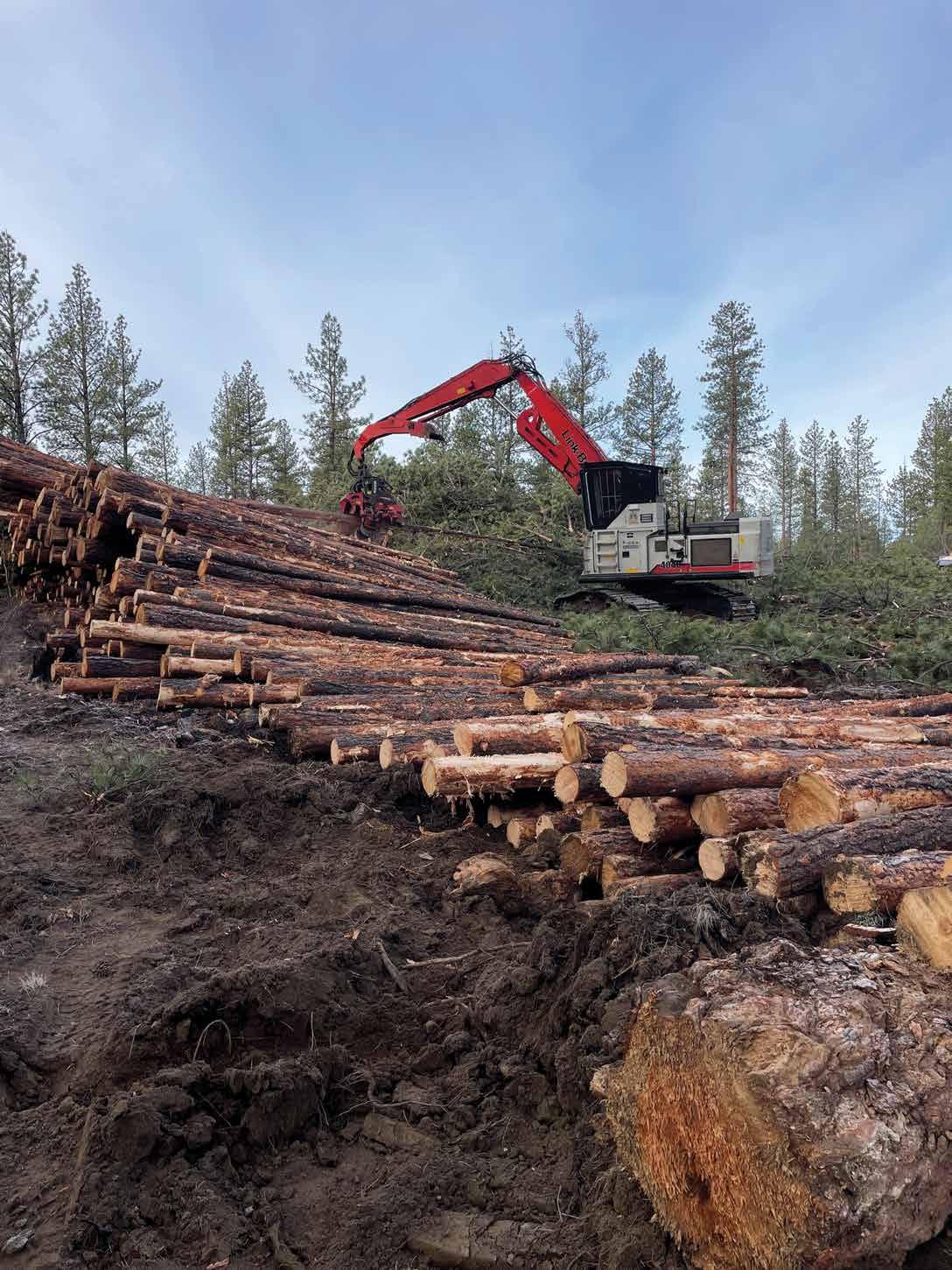
Link-Belt 4040 with Waratah 623C danglehead attachment processes ponderosa pine on a U.S. Forest Service stewardship project.
have multiple standing timber contracts that we have purchased from the Forest Service, we do contract logging for the local mill and local private land owners. We have sold timber by both the ton and the board foot. I like the ease of selling it by the ton, but I feel that selling by the board foot is more fair for both us and the mill.”
Jobs vary quite a bit in terms of acres. “Some of the private stuff we’ve done has been as small as a couple hundred acres,” said Mahoney, “and Forest Service and mill contracts normally are a couple thousand acres.” The dominant tree species in the area is Ponderosa pine. The terrain allows them to do ground-based logging. “We have worked on some steep ground, but everything
has always been done with ground-based equipment.”
Boulder Ridge runs three crews. They usually are split up but sometimes work together. Each typically is equipped with a Komatsu or Timbco feller buncher, a Cat skidder, and a John Deere or Link-Belt machine paired with a Waratah processor. “Each individual side is self-sufficient and self-contained,” said Mahoney. Beside a Timbco feller buncher it has three Komatsu feller bunchers and four Cat skidders. In addition the company has four John Deere shovels, two Cat dozers, and two Dresser graders.
The company also owns a fleet of eight Peterbilt log trucks, six long-log and two
short-log trucks, and a handful of other Peterbilt trucks and brands of trailers.
The company’s most recent investment in equipment was a 2022 Link-Belt 4040 shovel with a 623 Waratah danglehead processor attachment. At the time Mahoney talked with TimberWest, it was working on a U.S. Forest Service stewardship project, a commercial thinning fuels reduction job at a site on the urban interface of Bend.
The stewardship project is an effort to reduce the risk and danger of wildfire. It includes a major logging component of about 15 million board feet. The tract is 95 percent
(continued on page 10)
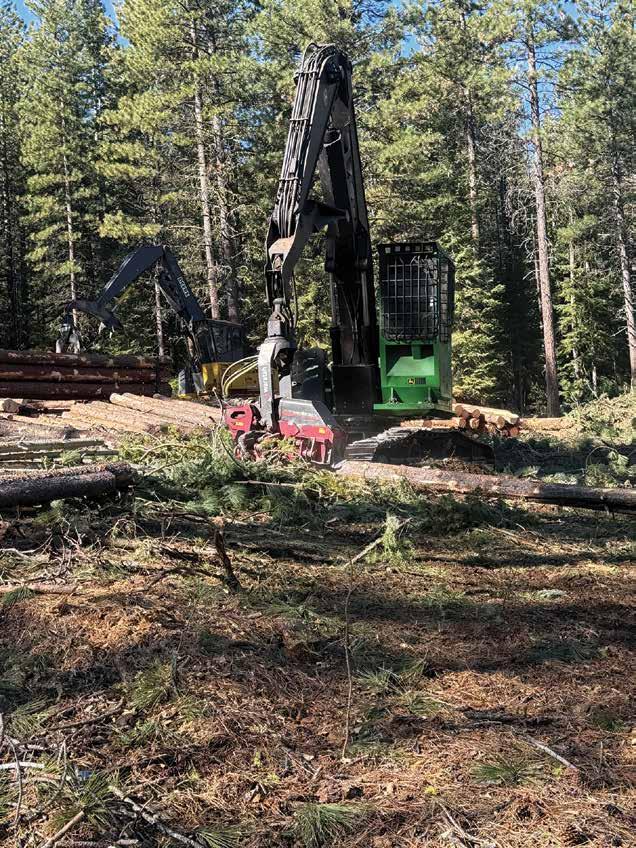
John Deere 2954 with Waratah 623C danglehead attachment processing ponderosa pine on a U.S. Forest service timber sale.
ContractorProfile
(continued from page 9)
Ponderosa pine and 5 percent lodgepole pine. “It’s very overstocked, tree-wise and brush-wise,” said Mahoney.
The Link-Belt has “been really good, worked every day, minimal issues with it, and the operator – who has been with us for years – loves the machine,” said Mahoney. The engine has proven durable and more economical when it comes to fuel consumption.
The Link-Belt was purchased in used condition from Crowley Equipment in Eugene. “We are not committed to any one dealer but have purchased multiple pieces from our local Papé Machinery dealer here in Bend,” said Mahoney.
The company is subcontracting for mastication on the 7,000 acres. “Mastication is the one thing so far that is still a subcontractor item for us,” said Mahoney. “We have not endeavored into that yet, (but) I don’t think
it will be long before we do because there’s a lot of these stewardship projects in the upcoming future.”
Not every project will be a “home run,” noted Mahoney. Logging contractors need to know if they can work for less than their normal rate when things get tight or slow and what they really need to still make a dollar. “On the flip side,” he added, “you need to know how much you may be making and what you can do with that profit, whether it be buying new or upgraded equipment or paying off debt.”
Boulder Ridge has its own service truck to get to the woods to maintain equipment. The other Mahoney brother, Tyler, is a mechanic for the company; he also can operate equipment and drive trucks and often tows a lowboy when equipment is being moved to a new site.
“We fix or repair 95 percent of our equipment breakdowns and do 100 percent of our
truck maintenance,” said Mahoney. “The only thing we don’t do in-house truck-wise is major engine repair.”
“Its not uncommon for any of the three owners to work late either repairing something or gathering needed tools or parts to keep the crew running the next day,” he added.
Each day, “We all wear whatever hat is needed,” said Mahoney. “No two days are the same for any of us owners.”
His father normally runs a self-loading log truck. When he’s not running the selfloader he stays busy picking up or delivering parts to the shop or the woods or running other errands as needed. When they move to a new job site he can drive a truck and haul a lowboy.
Mahoney stays busy multi-tasking, too. “I try to spend at least one day a week in the office reviewing items. I also do the majority of the planning for the timber operations
LOGGER'S TIP
‘Create and maintain good relationships. It is the backbone of our industry. You’ve got to make sure you have a good relationship with your customers, your vendors, and your employees.’
Matt Mahoney
Boulder Ridge Trucking & Logging
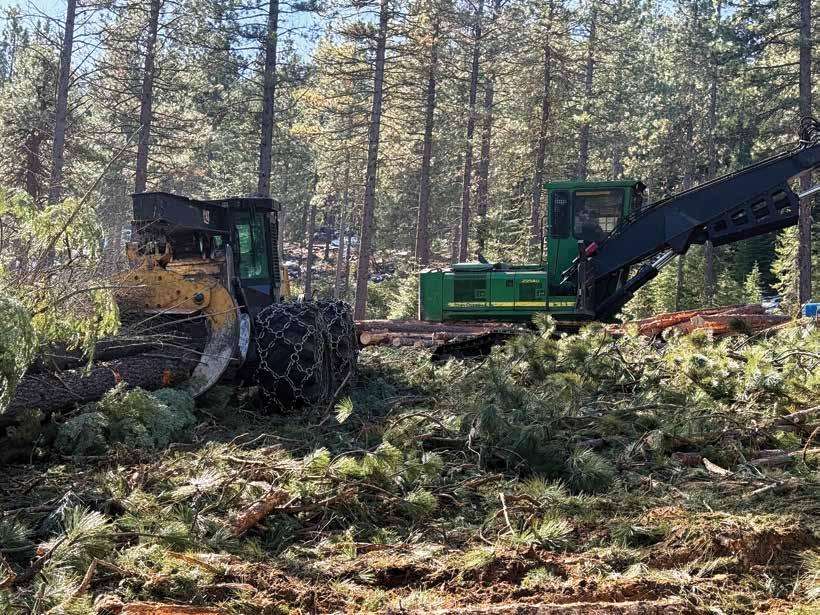
Caterpillar 525D skidder brings in a turn of ponderosa pine to a landing on a U.S. Forest Service timber sale; partly shown is John Deere 2954 machine.
and truck dispatching. My passion, however, is being in the woods to some degree. I fill in running a shovel when we are shorthanded or hauling logs if we have extra loads available.”
The family partnership and the employees are the two factors that Mahoney emphasized have led to the company’s success. “We’re a partnership between my brother and dad and I, and we’re a family-owned, family-based company,” he said. “We pride ourselves in being family-run and that our families are involved in the company. That’s how we set this up and how we’ve built it.”
The Mahoney wives are in the business, too. “All of our wives are involved on varying levels. My wife, Christie, works full-time in the office. Tyler and I both have kids, and all three of them are always happy to lend a helping hand. My son, Sean, has helped the last couple of summers in the woods and really enjoys the work.” The company has an annual Christmas celebration, and Tyler’s wife, Shelly, is instrumental in gathering prizes for all the employees. Their mother, Lisa, steps in when she is available, too.
Mahoney was quick to credit Boulder Ridge workers for the company’s success, too. “None of what we’ve built could be done with the great employees that we’ve been able to hire and keep,” he said.
The Boulder Ridge staff includes 12 equipment operators and seven truck drivers. The company enjoys a low attrition rate. “Which we pride ourselves on,” said Mahoney. “We’ve had several guys with us from early on, since when we first started adding employees.”
The company started doing firefightingrelated work. “We still do contract fire work,” said Mahoney, “but it’s not nearly the priority it was in the beginning.”
Market conditions have been a bit soft lately “with lots of logs on the market. We feel very fortunate to have a strong working relationship with the local mill, which has allowed us to keep moving in a soft market.”
Loggers and anyone else who drives a vehicle are dealing with fuel prices that spiked after the U.S. began military action against Iran. “Fuel prices are through the roof and having a very negative effect on the bottom line,” said Mahoney. It is frustrating as this industry does not have large margins to begin with, so a major change in fuel expenses shows up very rapidly.”
The best part of being in the logging business is working outdoors,” said Mahoney “A lot of people want to recreate outdoors… there are entire industries built around just being outdoors, and we get to do it for a living. We’re out here every day. Not every day is awesome, but we are in the woods every day, and that’s pretty hard to beat.”
Proudly investing in American Manufacturing
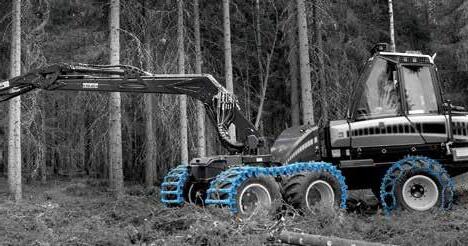
Heavy Duty Tracks and Case Hardened Forestry Chains
pewag tracks deliver superior grip with innovative Starwave® studs and self-cleaning performance. pewag forestry chains power through snow and mud with case-hardened alloy construction. Available in multiple sizes and configurations.
• 33mm link system
• Larger Starwave® stubs
• Bigger, stronger plates
High-strength grapples featuring twin cylinders and professional cutting solutions delivering precision-engineered guide bars, chains, teeth and accessories. All trusted for unmatched durability, performance, and reliability.
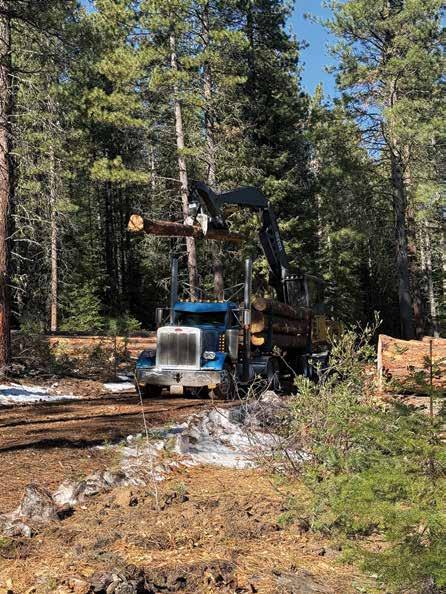
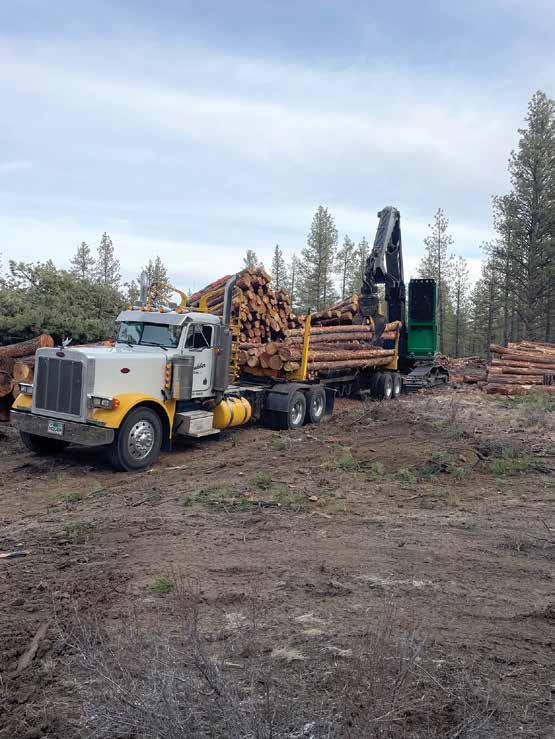
John Deere 3156 log loader filling a truck with wood.
Market Watch
LUMBER PRICING, MARKET TRENDS
As of May lumber futures fell below $600 per thousand board feet, settling around $560-580 (U.S.), driven by weak consumer sentiment and sluggish demand. While prices remain volatile, this represents a moderation from earlier in the year.
Lower than anticipated single-family construction is causing weaker lumber demand. The National Association of Home Builders (NAHB) says high tariffs on Canadian softwood continue to constrain supply and raise costs. Lumber demand is muted, and North American wood product producers are experiencing overall weak sawmill utilization (around 64 percent).
U.S. plywood markets in March and April experienced a strong, early-season surge, with prices rising 10–15 percent over four weeks starting in mid-March. This upward trend, driven by tightened supply, defied typical, slower early-spring market patterns.
The U.S. Department of Commerce completed the expedited first sunset review of the antidumping duty order on wood mouldings and millwork products from China and determined that revocation would likely lead to continuation or recurrence of dumping, with weighted-average dumping margins up to 231.60 percent.
EQUIPMENT AND MACHINERY SALES
The U.S. forestry and logging machinery market is experiencing strong, price-driven revenue growth despite potential volume challenges. Major manufacturers are pivoting toward technology-driven, high-efficiency equipment.
While new equipment sales have shown signs of softening in volume, revenue for manufacturers remains high due to 3-4
percent price increases, partly driven by supply constraints. Dealers report high inventory levels of new equipment, which may lead to aggressive, “deal-making” scenarios later in the year.
Caterpillar reported a very strong first quarter. Its construction industries segment, which includes many forestry applications, saw a 38 percent revenue increase to $7.2 billion. John Deere introduced AI-enabled harvesting systems specifically designed to improve logging efficiency and lower fuel consumption.
While new equipment sales are expected to be flat or slightly down, used equipment sales are projected to be stable or stronger, especially for high-hour, late-model units, as contractors manage capital expenses.
Machinery and equipment sales for the Western U.S. lumber industry have been driven by a need for automation and efficiency upgrades despite a volatile, constrained market. While sawmill capacity is contracting in some areas, key investments focus on specialized, high-value production, with technology, such as automated kilns, seeing demand to boost efficiency. Highefficiency sawmill machinery, including automated sawing and digital drying technology, is in demand to offset rising labor costs and maximize output.
NEW PROJECTS
Family-owned Stimson Lumber Co. is investing $50 million to build a new sawmill, replacing its operating plant near Gaston, Oregon. The new sawmill would triple current annual lumber capacity to 300 million board feet, focusing on 4- to 16-inch top diameter logs. It is expected to be operating by the end of this year.
So far this year, new sawmill projects and investments in the Western U.S. are heavily focused on California, supported by over $60 million in federal funding aimed at wildfire reduction, forest restoration, and high-priority timber processing. Key projects involve establishing new, specialized facilities and upgrading existing operations to improve efficiency in Washington and California. Key California projects include a new sawmill for Alpenglow Timber (Lake Tahoe Area) and improving capacity for Sierra Forest Products
FOREST POLICY, TIMBER HARVESTING CONDITIONS
The U.S. Department of Agriculture announced a major overhaul of its Forest Service division. The move is an effort to transfer control of federal lands to states
“Moving the Forest Service closer to the forests we manage is an essential action that will improve our core mission of managing our forests while saving taxpayer dollars and boosting employee recruitment,” said U.S. Secretary of Agriculture Brooke L. Rollins.
U.S. House Republicans from Western states laid out a figurative welcome mat for the U.S. Forest Service as its chief pitched plans to whittle down the agency’s budget, move its headquarters to Salt Lake City, and rely more heavily on states to manage millions of acres. A subcommittee ranking Democrat, Rep. Chellie Pingree of Maine, said she’s deeply worried. “I guarantee you, my state is not prepared to take over all of the things that the federal government is currently doing.”
Business leaders in the outdoor recreation sector are allying with recreationists and conservationists to push back.
A long-brewing battle over converting wood to energy is resurfacing in Congress. Forest owners are pushing lawmakers to make leftover material from logging projects and lumber milling a bigger part of the federal renewable fuel standard, which encourages alternatives to petroleum to power vehicles and airplanes. The effort faces opposition from pulp and paper companies that use similar materials.
ECONOMY, SUPPLY CHAIN
April’s reported U.S. home builder optimism for single-family home demand fell four points from the prior month to a score of 34, according to the National Assoc. of Home Builders. Economic uncertainty, rising building costs, and flat interest rates resulted in declining April builder sentiment.
However, the association projects that 2026 U.S. single-family housing construction should see a modest, stabilizing rebound, with housing starts expected to rise approximately 1.3-6 percent. Multi-family housing construction is expected to stabilize or drop slightly in 2026.
The Remodeling Market Index (RMI) slipped two points from the prior quarter to a score of 62, remaining in positive territory, as reported by National Assoc. of Home Builders. A leading use of structural softwood, home remodeling is a key measure of Oregon wood demand. On a scale of 0 to 100, an RMI score over 50 indicates that more remodelers report “good” market conditions than poor. “Ongoing positive remodeler sentiment is consistent with the NAHB outlook, given an aging housing stock and the lock-in effect of elevated mortgage rates keeping owners in their homes,” said NAHB Economist Robert Dietz.
Don’t feel forced to buy foreign tariffed products. Especially when you can invest in a U.S. company to build your purpose-built machines, and save a bundle!
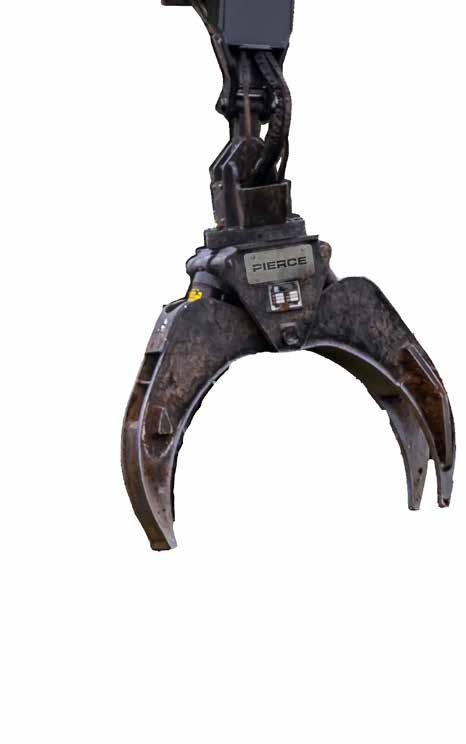
We know strength and durability are paramount to any successful logging operation. That’s why Pierce has responded with an unprecedented extended warranty - 24 months, 4,000 hours.
That’s what “Pierce Built, Pierce Backed” is all about.
4,000
Staton Forestry Searching For ‘Best Niche There Is’
Oregon Company Offers Diverse Services
By Dawn Killough
EUGENE, Oregon – Staton
Forestry offers a unique mix of services for a forestry business. While the company has done a few small logging jobs, most of its recent work has been restoring floodplains and relocating riverbeds. “We’re dabbling in everything we can in the forestry world,” said Michael Murphy, a partner and manager.
Staton Forestry’s Jason Kunkle received a merit award from the Oregon Department of Forestry for its work on a Gilchrist State Forest project near La Pine in 2025. After several fires in the area, the project focused on fuel break maintenance, creation, and pre-commercial thinning to remove small lodgepole and ponderosa pine trees that were densely packed due to 1970s planting
practices. The work also reduced drought stress among the remaining trees and improved habitat for deer and elk while protecting neighboring communities from wildfire risk.
Recent floodplain work includes a job in Neskowin, along the coast. The company removed two culverts and replaced them with small bridges to make it easier for salmon to migrate from the ocean up the Sutton Creek to spawn.
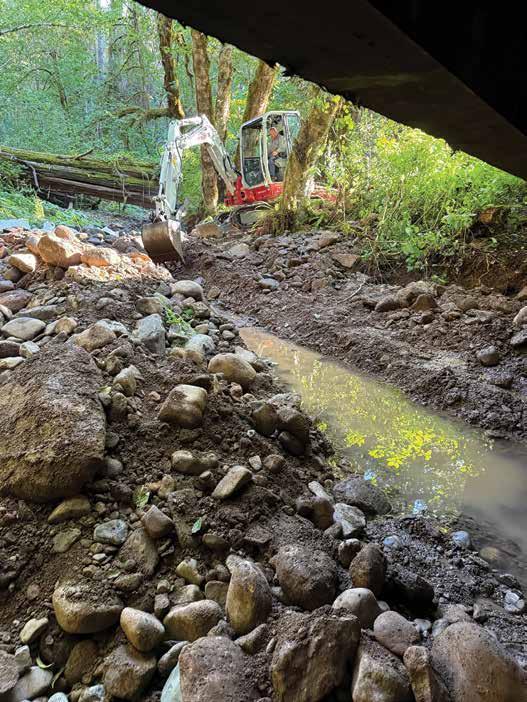
Another recent job was restoring Herman Creek near Oakridge. The creek bed was full of debris, and the flow had moved under a bridge pier. Staton Forestry’s job was to dam up the river to divert the water away from the pier, build up the stream channel to move the flow back under the center of the bridge, make repairs to the pier, and then return the flow back under the center of the bridge.
When Murphy talked to TimberWest, the company was clearing debris and downed trees on property owned by Los Angeles Chargers quarterback – and former University of Oregon star – Justin Herbert and his family. The property, in Springfield, suffered damage in an ice storm in 2021.
Staton Forestry is part of Staton Companies, which started as a demolition business in 1971. Staton Companies continues to provide demolition services for large and small projects across the Western U.S. Murphy began working for Staton Companies while attending the University of Oregon, working in the yard and in the field during school breaks. (He had grown up with brothers Sam and Dan Richey, now owners of the Staton Companies with their father, Ron.) He worked with the company for almost 10 years, mostly on bridge
demolition projects. However, he started a family and wanted to reduce travel for work, so he took a job with NessCampbell Crane and Rigging in Hillsboro. During his eight years working for NessCampbell he became a project manager and eventually led the southern division.
The Richeys bought out a small forestry company owned by Jason Kunkle in 2022 and started Staton Forestry, retaining Kunkle as a partner. They hired Murphy three years later to manage the company and brought him in as an additional partner. Although separate and distinct business units, State Companies and Staton Forestry often trade personnel and equipment as needed. The forestry unit works mainly in Oregon, Washington, and Idaho; it also has done some work in California.
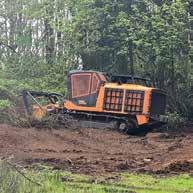
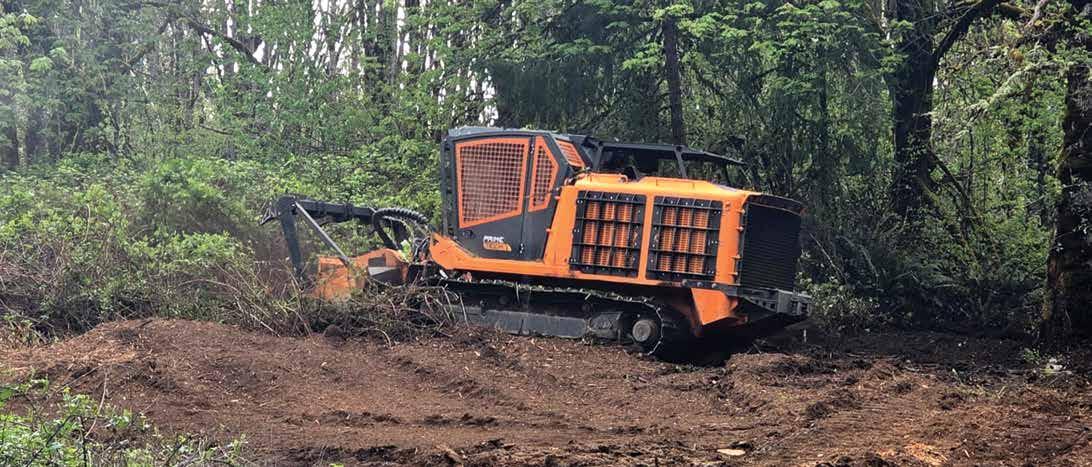
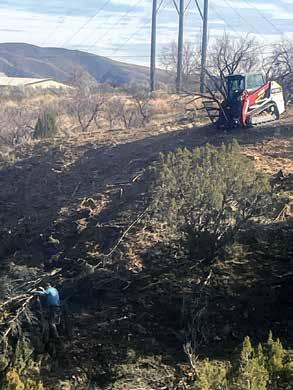
Staton Forestry has an assortment of equipment. The most recent equipment purchase was a Prime Tech PT300 masticator, which mulches about 2-8 acres per 8-hour shift, depending on the terrain and conditions. It was purchased from Papé Machinery in Eugene in order to help Staton Forestry diversify services to include firebreak creation and mastication. The Prime Tech
(continued on page 16)
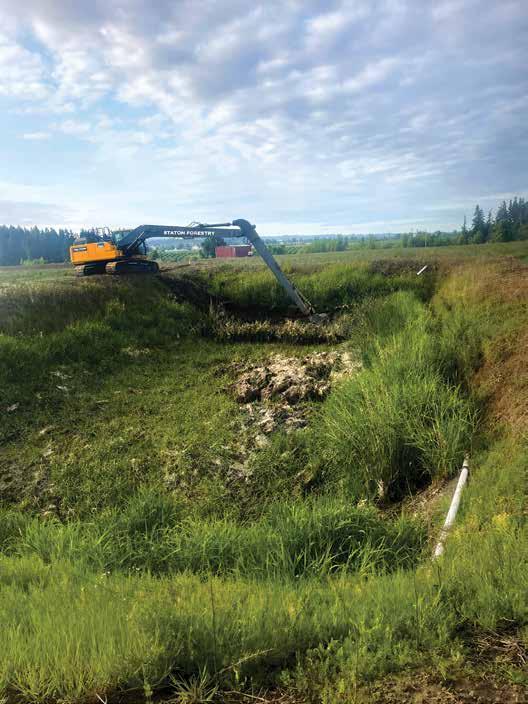
Staton Forestry rented this Komatsu PC210 shovel with a long reach boom to help rehabilitate a pond; company usually turns to Papé Machinery for rental machines.
recent job was
A
restoring Herman Creek near Oakridge; the creek bed was full of debris, and the flow had moved under a bridge pier.
Staton Forestry is equipped with two Takeuchi machines, the TL12R2 skid steer shown above and a TB370 miniexcavator; attachments include FAE masticating heads.
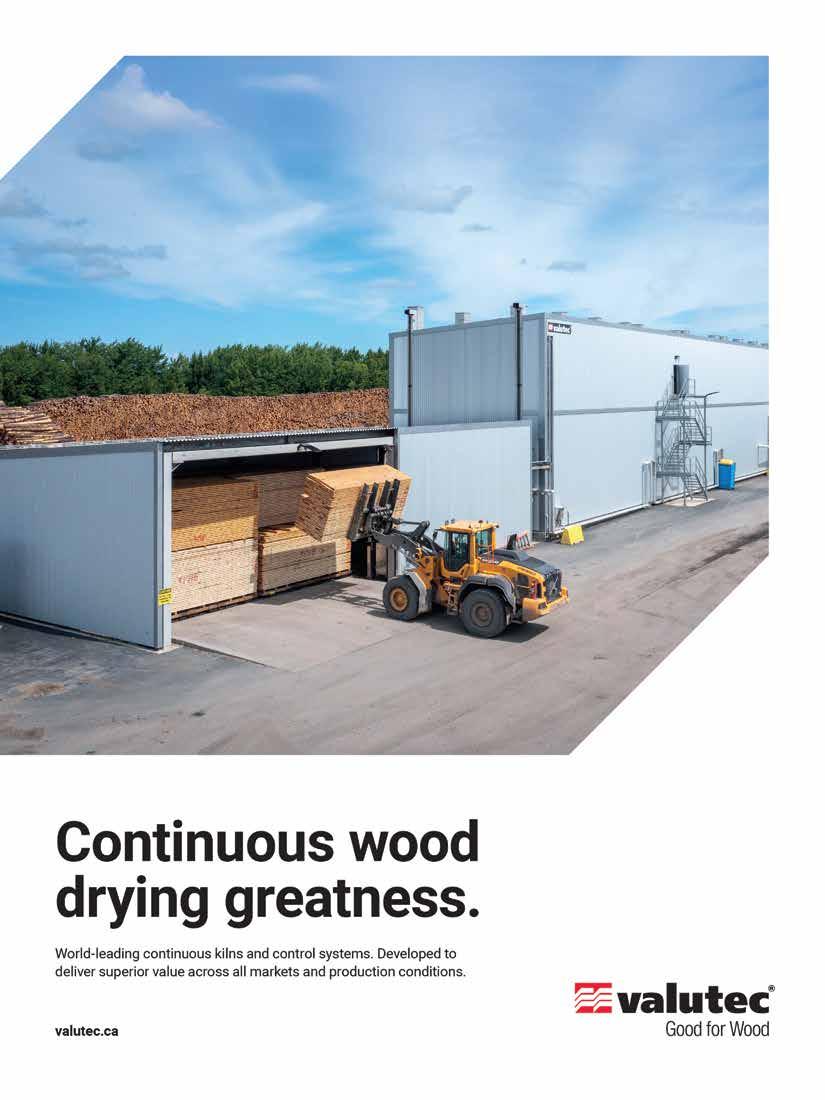
CUSTOMIZED SOLUTIONS FOR ALL DRYING PROCESSES
(continued from page 15)
PT300, a track machine, has a fuel-efficient CAT C7 Acert 7l turbocharged and aftercooled six cylinder engine producing 302 hp.
Murphy has been impressed by the Prime Tech machine’s work. “Its production is like no other,” he said. “That’s just how they’re designed. You’ve got the reverse fan to keep them clean, the big head, and the high horsepower. The more horsepower you have, the more production you have.”
“We rarely have it in the shop,” he added. “It’s always working out in the field, always busy.” The company also has ordered a Prime Tech PT175 masticator.
Masticating vegetation comes with a challenge that can play havoc with equipment, noted Murphy. “I did not know rocks were the devil when it comes to mastication. They will destroy teeth, and you can’t see them when the brush is thick. Or if you have a couple of inches of earth and think you’re fine, and you hit them, you just start shredding teeth. It’s like demolition work but a little less predictable, I would say. You don’t know what a tree’s going to do. You kind of know what a bridge is going to do.”
Staton Forestry also is equipped with Link-Belt 210 with an masticating head and forestry grapples and two Takeuchi
machines, a TL12R2 skid steer with a bucket, winch, forestry grapple and masticating attachments, and a Takeuchi TB370 min-excavator with a masticating head and forestry grapple; all the masticating attachments are FAE brand. If a job needs a larger piece of equipment or one they don’t have, Murphy can borrow it from Staton Companies. The company also has a couple of fire trailers and a dump truck. It can use Staton Companies trucks if available or contracts Oakridge Sand & Gravel for hauling.
The company does not have traditional logging equipment, but usually will turn to Papé Machinery for rentals as needed, including shovels, skidders, and bulldozers.
Staton Forestry has been operating with six employees and works up to three jobs simultaneously. The six are Ken Lane, Hiram Hartness, Mike Burton, Jason Kunkle, Mike Murphy, and Morgan Marney. The company recently added Travis Collins and Donovan Bennett for a project.
When discussing the type of work the company performs, Murphy said, “We’re just trying to find what the best niche there is, and it seems like floodplain restoration is where all the government money is flowing right now.”
“Floodplain restoration is new in Oregon,” added Murphy. “So, we’re always learning what the equipment can do and how fast it can do it, and what the terrain is like.”
The company’s next project, along the lower south fork of the McKenzie River in Oregon, will entail moving 200,000 cubic yards of soil to help disperse the river’s flow. Staton Forestry will build wood and logjam structures to assist with the dispersion.
Staton Forestry does not perform much traditional timber harvesting. Most of the wood is processed into chips or grindings. Some low-grade logs are donated to people who need firewood.
Murphy credits the company’s success to the other owners and his crew. “If you were to take a course on how to be an owner or a boss, it would be Ron Richey,” he said. “There’s no one better. I want to treat people as I’ve always seen him treat people.”
He has a good crew of workers. “A company can’t be productive without the guys,” said Murphy, “and we have a solid core group that basically does anything, can operate anything, and doesn’t question. They know what needs to be done.”
Having a good crew makes life easy for him, observed Murphy. “My job is the easiest. All I have to do is put numbers on a piece of paper and find a job here and there. Your operators and workforce give you the name, not the guys in the chairs at the office.”
THEO LEONOV Agent for North America Area
Italian Drying Group Montebelluna (TV), ITALY
John Deere Returns More Employees at Three Plants
John Deere brought nearly 50 additional employees back to work in April across its Dubuque Works and Davenport Works facilities in Iowa and Coffeyville Works in Kansas. The callbacks support growing production needs in construction, forestry, and drivetrain component operations.
Earlier this year the company announced multiple rounds of employee callbacks at several U.S. factories, reflecting improving market conditions and increased production demand across several product lines. With this latest round, approximately 324 U.S. employees have returned to work at John Deere since January.
Both Iowa plants manufacture forestry and construction equipment while the Arkansas factory produces drivetrain components.
McDonough Mfg. Names Marrs Sales Representative
McDonough Manufacturing has appointed Ryan Marrs as a sales representative, adding more than two decades of hands-on industry experience to its team.
Marrs has 22 years of experience in the hardwood lumber industry. His background includes logging, lumber inspection, headsaw and resaw operations, sawmill and plant
management, engineering, capital projects, and multi-site operations. He has worked his way up from the production floor to management, giving him a well-rounded understanding of how mills operate.
Marrs also attended the NHLA Lumber Inspection School and completed a project management course through Syracuse University.
“We’re really excited to have Ryan joining our team,” said Matt Tietz, vice president of McDonough. “He understands how mills operate and what it takes to keep them running efficiently. That kind of practical knowledge makes a difference, and we’re looking forward to the impact he’ll have working with our customers.”
Takeuchi-US Appoints Four Regional Business Managers
Takeuchi-US has named Dylan Hendricks, Scott Erickson, Jacob Vaughn and Scott Hinman as its newest regional business managers. Each will cover different Takeuchi regions, with Hendricks serving the South-Central U.S., Erickson handling the Central-Midwest, Vaughn managing the Midwest, and Hinman supporting the Northeast.
The four will lead sales and business development activities across their regions and work closely with Takeuchi dealers to
Oregon Loggers Set Fall Board and Committee Event
Associated Oregon Loggers will hold its fall board and committee event Sept. 25-26 in Bend.
It will include meetings of the board of directors and standing committees. All AOL members are welcome to participate.
The event will be held at the Newberry Hotel.
For more information visit the AOL website at www.oregonloggers.org.
Oregon Group Joins Lawsuit Challenging Climate Rule
Associated Oregon Loggers was among a number of plaintiffs filing a lawsuit in April to challenge Oregon’s Climate Protection Program Rule. AOL was joined by member Zuber & Sons Logging as part of a coalition of employers, labor unions, and trade associations.
AOL is participating in the challenge because it contends that over the next decade
the program would illegally increase the price of gasoline and diesel fuel to surpass the nation’s most expensive. Excessive fuel costs would put forest businesses at a competitive disadvantage compared to other Oregon employers and forestry companies in other states, according to the organization.
The 29 organizations participating in the lawsuit seek to strike down the rules, which are projected to cause the costliest greenhouse gas emissions program in North America. The coalition contends the Oregon Department of Environmental Quality lacked authority to create the rules.
American Loggers Council Sets Annual Meeting in Virginia
The American Loggers Council will hold its annual conference Sept. 28-Oct. 1 in Williamsburg, Virginia. The theme of this year’s meeting is ‘250 Years of Logging: Timber, Tradition, Tomorrow.’ The event is being hosted by the Virginia Loggers Association.
grow market share, support retail sales, and strengthen the company’s dealer network. They will also collaborate with dealers on sales planning and performance goals while providing market insights and supporting key accounts.
Takeuchi manufactures an extensive line of compact track loaders, compact excavators, compact wheel loaders, and skid steer loaders.
NWH Distributes 30,000 Alder Seedlings in Northwest
NWH, in partnership with the National Hardwood Lumber Association, successfully distributed 30,000 alder seedlings during its March pickup events, with participants gathering at the company’s facilities in Oregon and Washington.
The annual initiative by the hardwood manufacturer and distributor, now in its third year, continues to support reforestation efforts across the Pacific Northwest. It has reached a total of 100,000 seedlings, all planted by a growing network of landowners, partners, and community members.
The program reflects a shared commitment to sustainable forestry and responsible resource management, with alder playing a key role in forest regeneration and ecosystem balance.
The conference will feature two days of programming for education, industry engagement, and networking. Attendees will have the opportunity to participate in tours and professional seminars addressing current challenges, emerging technologies, and the policy issues shaping the future.
For more information or to register, visit the council website at www.americanloggerscouncil.com.
Montana Loggers Plan Annual Meeting in May
The Montana Loggers Association will hold its annual membership meeting May 15-16.
This year will mark the 50th anniversary of the organization.
The meeting will be held at the Copper King Convention Center in Butte.
For more information, visit the association website at www.logging.org.
ITALIAN DRYING GROUP a Global Supplier of Lumber Drying Tech
Italian Drying Group, with two brands of lumber kilns and drying systems, Incomac and Nardi, has more than 50 years of experience supplying technology for drying, steaming, and heattreating wood. Based in Montebelluna in northern Italy, it has more than 25,000 kilns installed and supplies service and remote support to customers on five continents, including North America, Australia, Canada, South Africa, Brazil, and Japan; service and support is provided by an affiliated business
unit, Incotech. In North America the company has 75 customers.
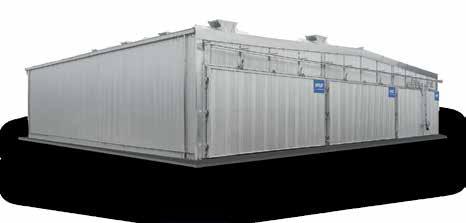
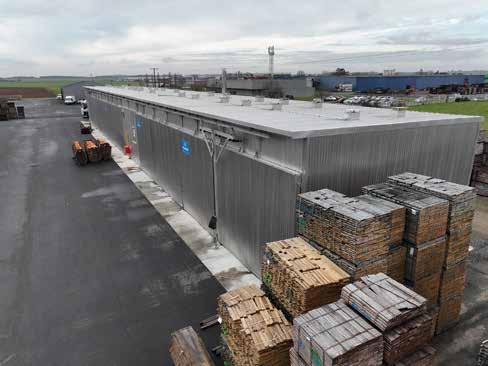
The company’s new DK201 dry kiln reflects synergy between Incomac and Nardi. It features walls with an enhanced thickness of 140 mm, insulated with rock wool, that significantly reduces energy consumption. The suspended ceiling is equipped with movable flaps, an engineering solution designed to ensure uniform heat distribution, essential for lumber quality and to reduce cycle times. The air recirculation system, enhanced by
circular-section ducts and ducted fans, significantly improves heat exchange, ensuring efficient and constant circulation across the entire load.
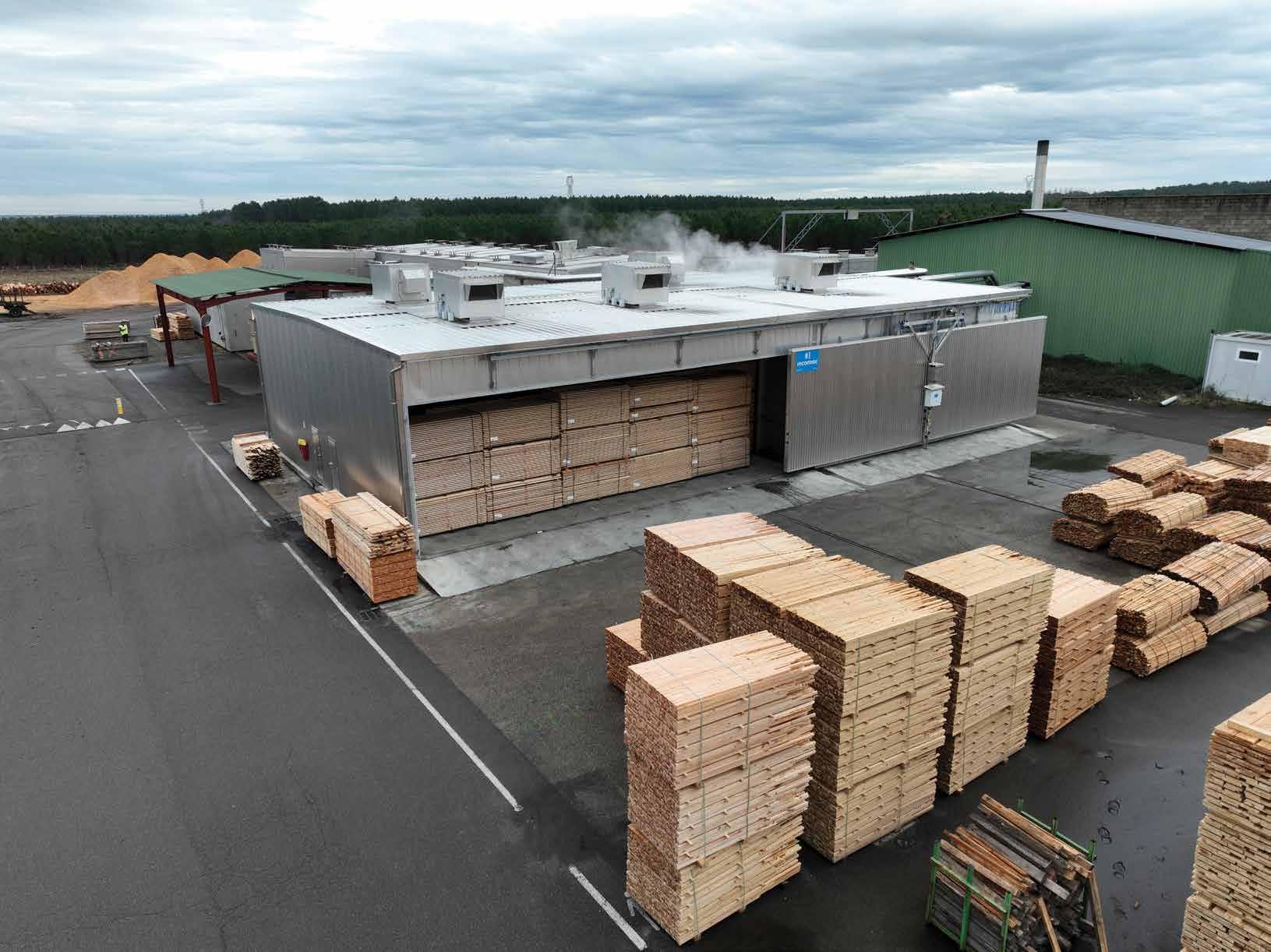
Italian Drying Group offers conventional drying kilns, powered with heat transfer fluid from a biomass boiler or gas or diesel heating, heat-pump condensing plants, powered 100 percent by electricity, and hybrid drying systems that combine a heat pump with conventional systems. Kilns can be customized – front loading, tunnel
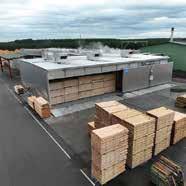
Italian Drying Group has two brands of lumber kilns and drying systems, Incomac and Nardi. It has more than 25,000 kilns installed and serves 75 customers in North America.
Above, an Incomac drying system powered by thermal fluid.
type, or movable chambers – and can treat every type of wood, including pallets. They are also supplied completely turnkey and equipped with technologies to optimize the drying process, maximising performance and minimising energy consumption. Every kiln is designed and made for high structural and functional strength, reducing extraordinary maintenance, spare-part replacement and ensuring long life.
One of the group’s North American clients is a long-established family-owned
company specializing in the production of posts, round timber, and laminated wood products. The company chose Italian Drying Group for the drying of Southern Yellow Pine and Douglas Fir, recognizing that the Italian group offers technologies and engineering solutions not commonly available on the North American market.
According to Giancarlo Bontempo, Italian Drying Group export area manager for North America, the client particularly appreciated the combination of advanced
engineering, build quality, and customization capabilities. “Our approach focuses on providing premium drying technologies, with particular attention to energy efficiency, process reliability, and long-term durability,” he explained.
The proposed solution included a series of tunnel dryers equipped with indirect gas burners. The tunnel dryers are specifically designed to reduce loading and unloading
(continued on page 20)
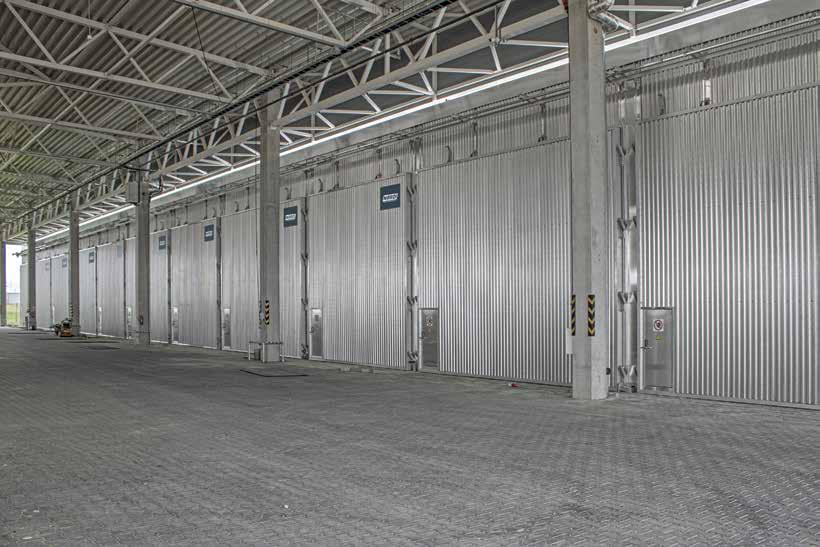
An installation of 12 Nardi kilns for drying softwood.
(continued from page 19)
times: the stacks of lumber are placed on carts that slide along tracks, making the system particularly suitable for drying large volumes of lumber and for drying pallets.
“We are also able to customize smallcapacity systems,” added Bontempo. “Many of our solutions incorporate technical features rarely found in North America, such as indirect gas heating systems and tubular fan technology designed to improve airflow uniformity and thermal efficiency.”
The wood drying process must necessarily take into account the differences of species, especially their physical-mechanical properties: strength, hardness, stiffness, and density. Understanding the properties is essential for optimally controlling all the drying parameters, including temperature, humidity, and ventilation. Optimal drying conditions are essential to ensuring satisfactory results:
preserving the wood’s structural and aesthetic characteristics.
Italian Drying Group offers various types of kilns and drying systems under the Nardi brand. Nardi was founded in 1974 and has installed over 14,000 systems, including kilns, vaporizers, and pre-dryers.
The DK201K dryer is powered by a thermal fluid heated by special heat exchangers with bimetallic finned tubes. The DK201B model is powered by natural gas, LPG, diesel, or renewable energy, a system that features a burner providing direct heating, eliminating the need for an external boiler. The DK201T tunnel dryers are designed to reduce loading/unloading times. The DK201M dryer features mobile cells that represent a technologically advanced solution: the cells move directly above the wood, thus speeding up loading and unloading operations.
adjusts fan operation in real time during the drying cycle. The system can reduce electricity consumption by up to 50 percent without increasing drying times and, with certain wood species, can even shorten the overall cycle duration. Advanced monitoring and automation features allow operators to improve process efficiency while maintaining consistent drying quality.
Italian Drying Group integrates the iDry STOP&GO software into its systems, which
Incomac, which specializes in dehumidification kilns, has installed more than 10,000 kilns in 95 countries. They refer to the systems as condensation kilns, which operate based on the principle of the internal air recirculation and dehumidification. This process takes place thanks to the refrigeration circuit inside the machine that reduces the necessary thermal consumption by a third, working in combination with the heat pump. They are mostly powered by electricity, but heating batteries with thermal fluid may also be used as support power.
The company’s latest technology, mac EVO, represents the new generation of high-efficiency heat pump dryers. Designed to reduce environmental impact while maximizing performance, mac EVO incorporates inverter technology, optimized heat recovery, and advanced airflow management to improve drying efficiency and process stability. The system was developed with a vision focused on long-term sustainability, including the ability to retrofit existing units and extend their operational lifespan. According to Italian Drying Group, mac EVO concretely embodies the company’s commitment to energy efficiency, durability, and sustainable industrial innovation.
For more information about Italian Drying Group and its brands, visit the websites, www.incomac.com and www.nardi.it, or contact the North American agent, Theo Leonov, at theo.leonov@bellnet.ca or (613) 297 2261.
Heat recovery systems can generate
Loggers Gather for Redwood Region Conference at New Site
FERNDALE, California
– The Redwood Region Logging Conference put its mark on a new location this year that generated positive feedback. The 88th annual event featured displays of logging and trucking equipment, a log loader competition, professional logger classes, historical displays, including a train locomotive, logging sports competitions, and many social events.
The conference, held in late March, was put on at the Humboldt County Fairgrounds in Ferndale, California. In most recent years the conference alternated between Eureka in Humboldt County and Ukiah in Mendocino County.
The theme of this year’s conference was ‘From Dugouts to Decking: Teamwork Builds Timber’s Future,’ a reference to the historic connection between baseball and local timber companies. Conference
president Jesse Crosswhite said the teamwork aspect of the timber industry is as important today as it was historically.
In the 1920s through the 1950s and a bit beyond, it was common for local lumber companies to sponsor men’s baseball teams.
The Humboldt League was formed in 1895 and included four baseball teams; many more semi-professional teams were added when the Redwood Empire League was established.
The Redwood Region Logging Conference recognized two people with its Achievement and Shining Star awards.
The Achievement Award was presented to David Walters of Pacific Timber Contracting Inc. and WW Trucking. Walters has worked in the timber industry for 35 years, mainly as a timber faller. He was recognized for a lifetime of dedication to the timber industry and the people who make it great.
“My key to success in life and business
(is) be honest no matter what,” said Walters.
“And I learned really, really quick that you are only as good as your crew,” he added.
The recipient of this year’s Shining Star Award was Laurie Ervin, a longtime truck dispatcher, first with Joe Costa and now with Bettendorf Trucking, in Arcata, California. Ervin has 43 years of keeping trucks rolling and dispatching more than 5,000 loads every year. The Shining Star award was presented to Ervin as someone who works behind the scenes to keep the industry moving forward and whose dedication rarely seeks the spotlight but absolutely deserves it.
The well-attended conference was a testament to the support for and impact of the logging industry on the north coast of California.
The 2027 Redwood Region Logging Conference is scheduled to take place in March in Mendocino County.
The Art of Felling Timber
Author, Trainer Teaches Safe Manual Felling
By Dawn Killough
GRANTS PASS, Oregon --
According to the Bureau of Labor Statistics, there were 67 deaths and 41 injuries related to forestry and logging occupations in 2024.
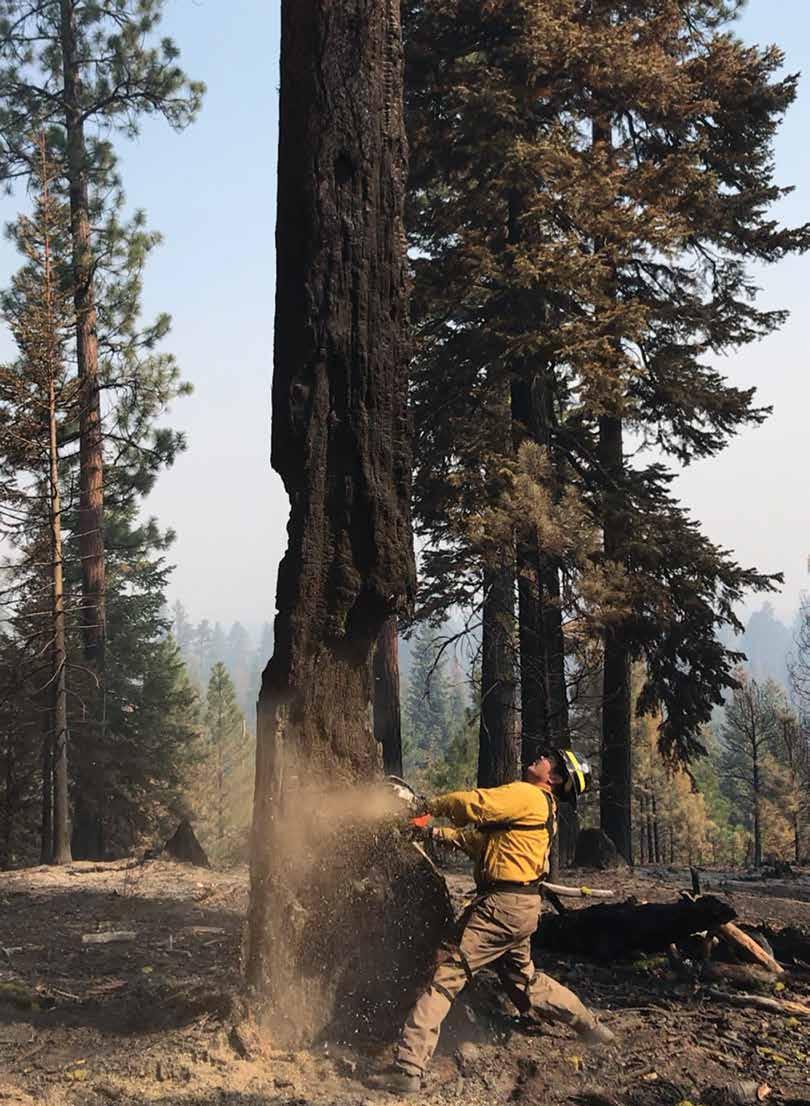
In an effort to improve safety in the industry and bring back a dying art, logger Roy Hauser wrote a book called The Art of Felling Timber, and he teaches workshops based on his book.
Hauser’s book and his workshops are gaining national attention from fellers, forestry and land experts, and hotshot fire teams. In the last 11 years his team of trainers has taught for 22 seasons, educating participants from CalFire, the federal Bureau of Land Management, the U.S. Forest Service, and more than 70 elite firefighting crews.
Hauser has worked in the forest industry for over 20 years, managing private timberlands for wildland fire prevention. He also has worked as a timber feller on many wildland forest fires all over the Pacific Northwest.
Hauser started his felling career with the U.S. Forest Service in 1987, working in chainsaw operations. In the late 1980s he was a saw boss for the Zig Zag Interagency Type 1 Hotshot crew based in Mount Hood, and he first noticed a lack of instruction in operating chainsaws. Over his almost 35year career, Hauser has worked with elite firefighting crews in Florida, California, Washington, and Oregon. In 1992 he wrote an excerpt for the S-212 chainsaw course, a segment pertaining to fire-weakened timber.
Hauser currently consults on phase 2 fire and hazard tree felling projects in Oregon.
The art of felling timber is dying out, said Hauser, and he is trying to revive it. “It’s a
Roy Hauser, above, wrote The Art of Felling Timber and he teaches workshops based on his book.
lost art that used to be passed down through families or mentors,” he said. “We’re passing on the foundational knowledge, training, and skills that professional fellers need, including safety and the knowledge of when to walk away from a dangerous situation.”
Hauser started writing The Art of Felling Timber in 2009. He completed it in 2014 and began teaching workshops in 2015. He and his team of instructors currently offer three classes: an intermediate/advanced chainsaw operators class, a double-cut seminar for advanced fellers, and a fire-weakened timber felling course.
The goal of the book and workshops is to teach timber felling teams alternative methods of safely felling trees in various situations, including hazard trees and fireweakened timber.
The book teaches a three-step process: size up, mechanical applications, safety and escape routes and planning for a cut; Hauser teaches the process in his intermediate/advanced felling workshop. The first step is to size up the tree and its surroundings, including noting the species, the locations of surrounding trees, soil conditions, topography, and identifying problems with the tree or other potential hazards. Fellers are coached to walk away if there’s a problem with the tree or its surroundings or if they feel the cut is above their skill set.
Next, the team plans the cut, which involves closely inspecting the tree’s interior and exterior and taking core samples to identify potential rot, fungus, or other defects. The plan also includes detailed instructions on the location and depth of wedging or jacking, if required.
The third step is the development of a safety plan, including escape routes and contingencies if something goes wrong. The team then rehearses the cut, following the plans developed during the process,
assessing their success, and making changes before cutting. Communication between the feller and spotter is a key part of the process, as is humility. Hauser counsels loggers to always be a student in the art of felling. Those who have this attitude both understand and own their mistakes, which they can then learn from.
The full-length book includes three specialized sections: fire-weakened timber, hazard tree mitigation, and production felling, which includes double cutting. These sections are also available as single abridged editions of the book.
The fire-weakened felling course is designed for hotshots and those who fight wildland fires. Hauser presents the same three-part plan as in his other workshops, providing additional background information on the philosophy behind making fire cuts and removing hazard trees. Fire cutting requires speed, accuracy, and limiting exposure while working in ever-changing circumstances. In these dangerous situations, thoughtful planning becomes even more important, and it’s imperative that fallers know
(continued on page 24)
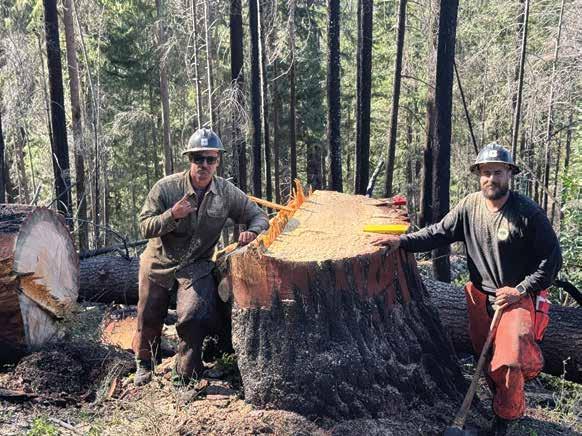
From left, Ryan Veenstra and Eddie Ramos, members of the Laguna Hotshot Crew from San Diego, California, attending a workshop in April.
ForestManagement
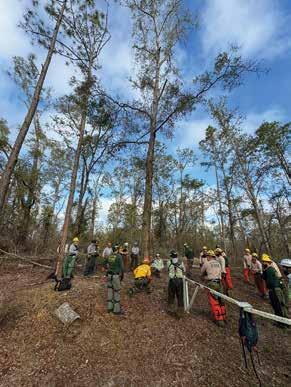
Workshops include a day of classroom instruction and two days of training in the field.
(continued from page 23)
when to flag a tree and walk away if it cannot be felled safely.
Double cutting is a precision task that also requires detailed planning. Hauser focuses on understanding the timber species and how it will lean as it’s cut. The course highlights the
process for mapping out cuts to ensure the kerfs align correctly and are level, and covers both directional and face cuts.
Hauser stresses that fellers who complete his workshops are not professional timber fallers. He provides the foundation for the skills and knowledge that professional fallers need, but becoming a timber faller requires
an 8-10-year internship with an experienced mentor.
His book and workshops have earned praise in the industry. They’ve been promoted by the federal Bureau of Land Management, the Winema Hotshot Crew, CAL-FIRE, Wyoming Hotshots, Nevada Division of Forestry, and Washington Department of Natural Resources.
A forest manager in Grants Pass said, “I feel that Roy does the best job of breaking everything down, starting with proper sizeup, developing a safe plan, creating clear collaborative teamwork, adequate swamping, and finally the mechanics of felling, or not felling, a tree.”
A Hotshot superintendent said, “Ideal instructor-to-student ratio allows for optimal observation, instruction, and guidance, providing students with ample opportunity to practice what they have learned.”
In Nevada, Hauser’s book and workshops have been used as source material for a Saw Operations Guide, agency-specific Faller Taskbooks, refresher training, and a Faller Academy that started in 2020. A supervisor said, “The efforts of Roy Hauser and his team have benefited the Division of Forestry and Nevada immensely.”
The workshops take place over three days, one in the classroom and two in the field. Participants review the book, watch real-life scenarios, and perform two-dimensional exercises in the classroom. The field days are spent on hands-on training and testing.
Hauser, a Class C (FAL1) or Advanced Faller, has a small team of instructors assisting him. He credits his wife, Diane, and daughter, Victoria, who holds the Class C (FAL1) Faller certification, with providing behind-the-scenes support, assisting with registration, putting together classroom materials, and videoing students during the field class. He regularly assesses workshop participants for potential new instructors. Candidates complete a one-year apprenticeship before becoming instructors; with three to four years of experience, they can become lead instructors.
Workshops cost $650, which includes a hard copy of The Art of Felling Timber. Scholarships are available to help defray the cost. Workshops normally are held in southern Oregon although Hauser will travel to put on workshops.
The full-length book and three abridged versions are available only through Hauser’s website, www.theartoffellingtimber.com. The complete edition costs $120 but is free with workshop registration. The abridged sections are $65 each.
The tagline on Hauser’s website seems to say it all: “A good cut can save a life. A bad cut can take a life.”
NEW PRODUCTS
Tigercat Adds Saw Option for Two Loader Grapples
The Tigercat LG4053 and LG5057 grapples are offered on Tigercat 234C and 250E series track and subframe-mounted loaders. Both grapples now are available with an optional Tigercat grapple saw. The bar length is 45 inches with 0.75-inch chain pitch.
The new grapple saw offers several benefits and advantages. The bar oil reservoir is integrated
advanced rotating crawler carrier.
It is the first to feature Prinoth’s PowerForce undercarriage, a breakthrough design underpinning more than 20 patent applications, delivering unmatched terrain performance and operational efficiency.
The Panther T23r carries the largest payload at 22.5 short tons while maintaining compact dimensions of 9.8 feet wide, 10.8 feet tall, and 40 tons total weight. Its continuous 360-degree rotating upper structure and rounded Hardox® steel dump box with telescopic cylinder enable precise material placement in confined spaces where conventional haulers cannot operate.
The PowerForce undercarriage represents a fundamental advancement in crawler carrier design. It absorbs terrain variations while maximizing power transfer to the ground. The result is a machine that works harder, travels faster, saves fuel and significantly
For more information visit www.prinoth-crawlercarriers.com.
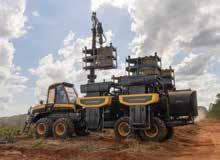
Ponsse, a manufacturer of forest machines, has introduced the Buffalo Planter, a tillage and planting unit mounted on the frame of a forest machine, enabling mechanised and automated planting. This is the first tree-planting innovation in the company’s history.
“The Buffalo Planter is Ponsse’s solution for mechanised forest regeneration, with the entire planting process carried out by a single
SOLUTION BUILDER
the primary market for the planting machine is South America, where its benefits are most evident on plantation sites.
The Buffalo Planter improves productivity and cost-efficiency of forest regeneration, according to Inberg. The automated planting process also ensures a high-quality and consistent planting result, creating good conditions for seedling growth and reducing the need
Outside the planting season, the machine can be converted back
Digital systems support the monitoring, reporting and documentation of work. To ensure the high quality of the work, the cameras installed on the planting device transmit information about groundlevel events to the operator in the cabin. Only one person is needed
With spot mounding, the working rate is around 750 seedlings per hour, while without tillage, the machine can plant around 1,300
For more information, visit www.ponsse.com.
Waratah Offers New Directional Felling Head
Waratah Forestry Equipment has launched the all-new FL90 directional felling head, purpose-built to deliver strength, agility and intelligent performance in a size class that fits a wide range of applications.
Designed for 20-plus metric ton carriers, the FL90 provides
loggers with a high-per forming, mid- to large-sized directional felling head engineered for demand ing operations without the added weight of larger-class models.
“The FL90 is exactly what many operators have been asking for – a head that’s powerful, durable and smart, in a size that gives them flexibility to their carrier size class and applications,” said Brent Fisher, product marketing manager for Waratah. “It delivers the strength and capacity crews expect, while maintaining the agility and responsiveness needed to stay productive.”
Opticom Tech Introduces Troubleshooting Kit for Mills
Opticom Tech, a leader in industrial video monitoring solutions, has developed the new MRV-80C2E-WRTS Wireless Troubleshooting Kit designed specifically for sawmill environments. The portable system gives mill teams a fast, flexible way to gain temporary visibility in problem areas without permanent installation or infrastructure changes.
Sawmills operate in constant motion. When an issue arises, maintenance teams need immediate visual insight in locations where cameras, power, or networking may not exist. The Opticom Tech Wireless Troubleshooting Kit provides a simple solution: shortterm, temporary camera placement exactly where it’s needed.
The FL90 has a maximum grapple opening of 51 inches and a maximum sawing capacity of 38 inches. It is built for shovel logging, steep slope conditions, late or final thinnings, topping, storm damage cleanup and clear felling applications.
The FL90 utilizes Waratah’s TimberRiteTM X-26 control system, which provides production reporting and intelligent features designed to give operators greater visibility into performance and output, helping crews make informed decisions and maximize daily production. The FL90 felling head also incorporates reinforced structural components and proven Waratah engineering to help support long service life.
For more information visit www.Waratah.com.
The kit includes either two or four wireless cameras and one monitor, creating a self-contained viewing system that can be deployed quickly anywhere in the mill. Magnetic mounts allow cameras to be attached securely to equipment or structural components without drilling. A portable battery pack powers the system, eliminating the need to run new cables that could introduce hazards, especially for short term video monitoring
For mills that prefer or require a wired setup, the system also comes in a hardwired option to offer additional flexibility depending on the application.
The Wireless Troubleshooting Kit allows sawmill maintenance and operations teams to make faster decisions based on real-time visuals, without waiting for a full system installation.
For more information visit www.opticomtech.com.
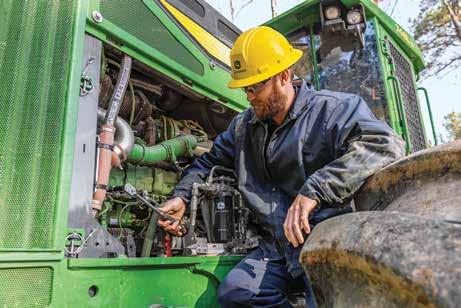
Spring Into Readiness: A Practical Guide to Forestry Machine Maintenance
By Tim Flowers
Forestry work does not slow down for long, but spring often forces a pause. Thawing ground, heavy moisture, and unpredictable access can delay production across many regions. While these factors can be frustrating, they also enable one of the most valuable maintenance windows of the year.
A well-executed spring service routine can prevent costly downtime later and set your machines up for a productive season. Before starting, always refer to your operator’s manual for machine-specific service intervals, fluid specifications, and recommended procedures. What follows is a fieldproven approach to getting your equipment ready for spring and summer conditions.
1. Start with a Thorough Clean
In the spring begin with a full machine wash. Winter leaves more behind than cold temperatures, and mud, salt and debris can accumulate in places that can accelerate corrosion and increase fire risk if left unchecked. Focus on cooler cores, the engine compartment, belly pans, articulation joints and the undercarriage. These areas tend to trap material that restricts airflow and holds moisture. Be cautious around sensitive components and avoid direct pressure washing on electrical connectors and control modules.
Packed mud in tracks and bogies should be removed manually before washing. Once the machine is clean and dry, re-grease all exposed pins and pivot points, including entry doors. This step is often overlooked but critical for machine longevity.
2. Conduct a Full Walk-Around
Follow the wash with a detailed walkaround inspection, looking closely at structural components including the frames, booms, arches, tongs, grapple boxes, axles and guarding. Identify loose or missing hardware and any damage that may have developed over winter.
For skidders and wheeled feller bunchers equipped with pressurized water systems, confirm the reservoir is filled and the system charge pressure is correct. Also, take time to clear debris from around exhaust and
hydraulic components to reduce potential damage or hazards.
Finally, inspect all cylinders, including boom, stick, grapple, head and stabilizers. Look for rod pitting or seal leaks and address light corrosion early before it becomes a sealing issue in the future.
3. Check Fluids Before They Check You
Cold weather and idle periods can quietly degrade fluid quality. Spring is the right time to verify everything is in proper condition and fills appropriately.
Start by taking oil and coolant samples and sending them to your dealer for analysis. This provides early insight into wear, contamination and potential system issues.
Inspect hydraulic oil closely. A milky appearance often indicates water contamination caused by condensation during winter. If present, drain or replace the fluid and inspect the reservoir for further issues.
Check coolant levels and inspect for leaks or contamination. If oil and filters were not changed before winter storage, replace them now. This includes engine oil, air filters, fuel filters, axle filters, DEF filters and OCV filters on 6.8L engines.
Spring is also a practical time to change hydraulic and final drive oils if they are
nearing service intervals. In some regions, switching to a warmer viscosity grade may be appropriate. If the machine has been idle for an extended period, test DEF quality before returning it to service.
4. Inspect Hydraulics, Undercarriages and Tires
Hydraulics do the heavy lifting, so any weakness here will show up quickly in production.
Inspect all hoses and steel lines for abrasion, cracks, loose clamps and damaged fittings. Even minor leaks or weeping lines should be addressed before the machine goes back into the field. Small issues tend to become large failures under pressure and heat.
Next, check for loose wheel bolts, axle bolts and any visible leaks. For wheeled machines, verify tire pressure, sidewall condition, tread wear and rim integrity before getting to work. Cold temperatures often leave tires under-inflated, which can lead to premature wear or failure under load. If your machine uses tire chains or tracks, inspect them thoroughly. Look at connections, wear points, and proper fit. On bogie axle machines, confirm track sag and inspect links
(continued on page 30)
Guest Tech Column
(continued from page 28)
and mounting points. For tracked machines, examine shoes, rollers, idlers, and sprockets. Look for flat spots, excessive wear, and correct tension. Replacing worn components before the season starts is far less disruptive than dealing with failures in the field.
5. Confirm Electrical System Health
Electrical issues tend to surface at the worst possible time, so it is worth addressing them early. Test batteries and verify the charging system is functioning correctly, and clean and secure battery terminals to prevent intermittent faults.
Inspect the engine drive belt, lighting systems, work lamps, and warning beacons. Visibility and signaling are critical for safe operation. Remember to check the backup alarm: it is a small component with a big safety impact.
6. Refresh the Cab Environment
A clean and functional cab improves both operator comfort and performance. Remove debris and clean all interior surfaces, as well
as wash windows thoroughly and refill the windshield washer system if equipped. Use only approved cleaners to avoid damaging surfaces.
Next, verify that the HVAC system is operating correctly. Seasonal temperature changes can expose issues that were not noticeable in winter. Check for any active or stored diagnostic codes and resolve them before returning to work. Also confirm that fire extinguishers are fully charged and inspections are up to date.
If your machine is equipped with a dieselfired coolant heater, set it to run and purge every two weeks. This keeps the system ready for the next cold season.
7. Optimize Machine Settings for the Season
Once the machine is up to operating temperature, verify that hydraulic pressures are within specification. Consult with your dealer or technician if adjustments are needed.
Listen for abnormal sounds, check for leaks, and confirm all fluid levels again after warm-up.
—OR— if your existing
CALENDAR
June 27-30
Assoc. of Consulting Foresters of America National Conference, Baton Rouge, LA 703-548-0990, www.acf-foresters.org
June 27-28
Buckley Log Show, Buckley, WA 360-829-0474
www.cityofbuckley.com/logshow
June 28-July 4
Sedro-Woolley Annual Logger Rodeo, Sedro-Woolley, WA 360-770-8452, www.loggerodeo.org
Spring is also the time to update machine settings for warmer conditions. Adjust engine elevated idle settings, configure reversing fan behavior for increased dust and debris and update operator codes if new team members are joining. For machines equipped with solutions like John Deere TimberMatic Maps, ensure maps and software updates are properly uploaded and ready. Having accurate data in place can improve efficiency and decision-making throughout the season.
8. A Strong Start Leads to a Strong Season
Spring equipment maintenance is not just about checking boxes; it is about setting the tone for the months ahead. Forestry machines that are cleaned, inspected, and properly serviced now are far less likely to interrupt production when conditions improve. A few days of focused attention can save weeks of downtime in the woods.
(Tim Flowers is the lead Instructor for the forestry division of John Deere.)
July 10-12
Amboy Territorial Days Logging Show, Amboy, WA 360-247-5101, www.tdays.org
July 14-17
Forest Products Society International Conference, Eugene, OR 608-231-1361, www.forestprod.org
July 16-18
Lumberjack World Championships, Hayward, WI 715-634-2484
www.lumberjackworldchampionships.com
July 17-19
South Fork Loggers Day Festival, South Fork, CO 719-873-5512, www.southfork.org