Visit LSJ’s website at www.forestnet.com!
October 2016
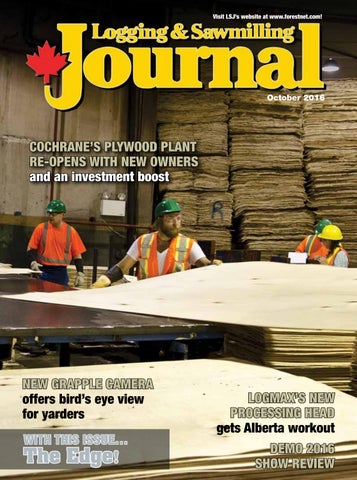
COCHRANE’S PLYWOOD PLANT RE-OPENS WITH NEW OWNERS and an investment boost
NEW GRAPPLE CAMERA offers bird’s eye view for yarders WITH THIS ISSUE… The Edge!
LOGMAX’S NEW PROCESSING HEAD gets Alberta workout DEMO 2016 SHOW REVIEW
October 2016 Volume 47 • No. 6 Editor Paul MacDonald Contributing Editors Jim Stirling Tony Kryzanowski George Fullerton Tech Update Editor Tony Kryzanowski
Publisher Rob Stanhope E-mail: stanhope@forestnet.com Phone: (604) 990-9970 Fax: (604) 990-9971 Sales Associates James Booth (604) 990-9970 E-mail: jbooth@forestnet.com Perry Rosehill (604) 613-3001 E-mail: rosehill@forestnet.com
Circulation Manager Maureen Cole (905) 201-0853 Fax: (905) 294-8645 E-mail: mcole@idirect.com Design & Art Production Manager Sheila Ringdahl E-mail: artwork@forestnet.com Office Manager Betty Rosales E-mail: brosales@forestnet.com
Office PO Box 86670, 211 East 1st Street North Vancouver, BC V7L 4L2 Phone: (604) 990-9970 Fax: (604) 990-9971 Website: www.forestnet.com Subscriptions: Canada $58 a year; two years $70; three years, $85. Group accounts, six or more subscriptions, $25 per subscription per year. Outside Canada, $95 per year. Airmail $165. Single copy, Canada $6; elsewhere $10. Reproduction prohibited without permission of the publisher. ISSN 0226-7572. Indexed in the Canadian Magazine Index by Micromedia Ltd. Back copies from 1996 onward are available through our website www.forestnet.com and in microform from Micromedia Ltd., 416-362-5211. Publications Mail Agreement No. 40064045 Return undeliverable Canadian addresses to CIRCULATION DEPT. PO Box 86670 Stn Main North Vancouver BC V7L 4L2 e-mail: mcole@idirect.com POSTMASTER: Send US address changes to LSJ Publishing Group, PO Box 610, Edmonds, WA 98020-0610 Published October 2016 Printed in Canada on 20% recycled paper. We acknowledge the financial support of the Government of Canada through the Canadian Periodical Fund of the Department of Canadian Heritage. Logging & Sawmilling Journal is a member/associate member of the following industry organizations:
FEATURES On the Cover:
The re-opening of the plywood plant in Cochrane has brought 125 jobs back to the northeastern Ontario town. In addition to the plant facilities, the deal to re-open the plant includes a guaranteed wood supply, with a provincial allocation of 200,000 cubic metres annually of veneer quality aspen logs. (Cover photo courtesy of Rockshield Engineered Wood Products)
4
Spotlight – Seeking more balanced timber allocation in the B.C. Interior
B.C.’s Interior Lumber Manufacturers’ Association is encouraging the provincial government to consider a more balanced approach to timber allocation, where commodity dimension lumber sawmills and value added wood product manufacturers each have access to the fibre flow they require to succeed.
10 New Grapple Camera offers bird’s eye view
A new Grapple Camera from B.C.’s T-Mar Industries is allowing loggers to achieve safer and more productive grapple yarding operations, offering a bird’s eye view of choker settings—in high def, no less.
16 Coffee-powered plywood
The re-opening of the plywood plant in Cochrane, Ontario has brought a good number of jobs and economic activity back to the community—and it all started over a cup of coffee.
Logging & Sawmilling Journal - October 2016
24 Double win: more production and uptime
Alberta logger Ted Freake is looking for more production per shift and uptime, and he’s confident he can achieve both with his new LogMax ProCut 2330 processing head—the first such head in Canada.
29 The Edge
Included in this edition of The Edge, Canada’s leading publication on research in the forest industry, are stories from the Canadian Wood Fibre Centre, Alberta Innovates - Bio Solutions and FPInnovations.
34 What was new at … DEMO 2016
Logging and Sawmilling Journal was there at the most successful DEMO show in years, held in Maple Ridge, B.C. in September. We highlight what was new in logging equipment and services in this issue.
50 The Last Word
The forest sector could contribute more to GHG reductions—and make money— with an aggressive plantation program, says Tony Kryzanowski.
DEPARTMENTS
Calendar............................................ 8 Ad Index / Subscriptions.................. 48 Classifieds....................................... 49 3
spotlight
SEEKING MORE BALANCED TIMBER ALLOCATION in the B.C. Interior
B.C.’s Interior Lumber Manufacturers’ Association is encouraging the provincial government to consider a more balanced approach to timber allocation, where commodity dimension lumber sawmills and value added wood product manufacturers each have access to the fibre flow they require to succeed. The Interior Lumber Manufacturers’ Association and the B.C. government are exploring mechanisms and incentives to manage a consistent fibre flow to support a more diversified allocation of the publicly owned forest resource.
By Jim Stirling ll trees are not created equal—but too often they’re being processed as if they were. The Interior Lumber Manufacturers’ Association (ILMA) membership would like to see that situation change. The association is encouraging British Columbia’s Liberal government to consider altering the status quo in favour of a more
balanced approach to timber allocation. The association advocates a scenario with a mix of wood processing options, where commodity dimension lumber sawmills and value added wood product manufacturers each have access to the fibre flow they require to flourish. The ILMA members recognize the complexity of the issue. Timber supply is under increasing pressure from insect infestation losses, wildfires and a variety of
4
Logging & Sawmilling Journal - October 2016
A
competing land uses. But the association argues that those factors alone are a persuasive reason to direct higher quality logs for processing into higher value products, rather than conversion to commodity lumber products. By doing so, twice the number of jobs are created per cubic metre of wood consumed. to page 6
FREE SATELLITE PHONE
KEEP YOUR
BUSINESS
CONNECTED The most affordable satellite voice and data solution for your business. Manage your business from remote work sites that are beyond cellular service. Coordinate operations and remain connected to co-workers and family without breaking the bank.
$499 SAT PHONE
FREE
*
Visit Globalstar.com/FREELSJ3 today to take advantage of the FREE SATELLITE PHONE OFFER.
*Limited time offer. Terms and conditions apply.
spotlight from page 4 The economic vibrancy of small communities in southeastern B.C.—where the association’s higher value operations are located—is protected in the process. The ILMA and the provincial government are exploring mechanisms and incentives to manage a consistent fibre flow to support a more diversified allocation of what is a publicly owned forest resource. “We started about six months ago in talks with the assistant deputy (forests) minister and staff. At this point we’re cautiously optimistic,” reports Ken Kalesnikoff, chairman of the ILMA. “We’re looking at pilot projects within the British Columbia Timber Sales program (BCTS),” he says. “We need to be creative working through the BCTS. We’ve asked for an economic benefit analysis of our sector and we’re working on the terms of reference for that.” The ILMA is willing to discuss with government any method that might effect positive change for its membership. “No issue is off the table,” adds Kalesnikoff. The ILMA has been hosting a series of informational meetings with local and regional governments to explain its message and help ensure the survival of its member mills. The association representative has met with mayors and councils and the regional districts in East Kootenay; Columbia-Shuswap; West Kootenay/ Boundary and Central Kootenay. A meeting with the Thompson-Nicola Regional District had also been scheduled. The support is there, asserts Kalesnikoff. “More people are getting it. We can do more with less logs through the value added side of the business.”
Southeastern B.C. has a similar corporate concentration of fewer and larger forest company licencees as other parts of the B.C. Interior. As a result, timber supply and flow is controlled by a few large forest industry corporations. The ILMA, by contrast, is very much in a David and Goliath situation. “The ILMA has nine member companies—we recently lost one to a large licencee,” explains Kalesnikoff. The association members are, typically, independent, family-owned, well-established and unconcerned about corner offices. They’ve survived the economic peaks and valleys physically reflective of their operating areas by being adaptable and versatile.”We’re a very diverse group,” continues Kalesnikoff. The ILMA membership includes pole manufacturing plants, veneer production facilities and sawmills and plants characterized by extracting the maximum value from each tree, rather than high value production. Kalesnikoff Lumber is a good example.
6
Logging & Sawmilling Journal - October 2016
It’s a specialty lumber producer in the Kootenay wet belt that’s been under the same family management for four generations. The company has the flexibility within its plants to produce a plethora of products from different sized lumber to siding, panelling and specialty products for customers as far away as Japan. The ILMA membership reflects a more European model of taking every piece of wood further up the value added chain. Reinforcement of the ILMA’s call for more timber supply balance and diversity within B.C. Interior forest industry was received from an unexpected source. An independent Simon Fraser University (SFU) research team studied the Columbia-Kootenay area of the southern interior forest region and drew conclusions similar to the ILMA’s. They had no idea
to page 8
SOLVE YOUR MOST PUZZLING BUSINESS CHALLENGES. RAM PROMASTER AND PROMASTER CITY.
Look up flexible in the dictionary and you‘ll see a picture of the 2016 Ram ProMaster.® Offering up to 15 configurations, this spacious vehicle helps any business reduce costs with an available 3.0L EcoDiesel I-4 engine that puts out 295 lb-ft of cargo-hauling torque; and gets surprisingly good fuel economy while doing it. It’s also the only cargo van out there to offer front-wheel drive, which improves control and eliminates a transmission hump to maximize cargo floor space. No matter how you look at it, Ram ProMaster just adds up to better business – for any business.
CLASS-EXCLUSIVE
BEST-IN-CLASS
9-SPEED PAYLOAD
1
AUTOMATIC TRANSMISSION
862 KG (1,900 LB)
BEST-IN-CLASS
CARGO
CAPACITY UP TO 3,729 L 1
(131.7 CU. FT.)
BEST-IN-CLASS STANDARD
BEST-IN-CLASS TURNING
BEST-IN-CLASS STANDARD
CAPACITY* UP TO 13,108 L
AS SHORT AS 11.1 M*
CEILING HEIGHT* 1,651 MM
CARGO RADIUS INTERIOR (462.9 CU. FT.)
fleet.fcacanada.ca
1 800 463-3600
Based on Class 1 Small Cargo Vans. *Based on WardsAuto Large Van segmentation.
1
(36.3 FT)
(65 IN)
spotlight from page 6 this paper had been produced, assures Kalesnikoff. The SFU research team, based in Vancouver, published its report in 2013. It found that specialty mills operating in the study area were more resilient to economic downturns than commodity mills, as measured by operating days. The recession of 2007-9 was included in the study period. The report’s authors credit the resilience of specialty mills to higher levels of flexibility, diversity and orientation. That in turn they attributed to four main characteristics within the specialty mills’ composition. First among these, according to the SFU analysis, was a willingness and ability to run their operations more flexibly and below their capacity during economic downturns. Secondly, specialty mills have the ability to produce a greater diversity of products, allowing the targeting of more and different markets. Specialty mills have the ability to produce higher valued products while supporting more than twice the number of jobs per cubic metre of wood consumed—and
more than three times the jobs per million board feet of wood produced. Fourthly, the SFU research team found specialty mills have the ability to sort many grades in the bush. They have the opportunity to trade among themselves, ensuring each log ends up in the processing stream that can maximize its value and potential. In that way, regional specialty mills operate as an industry cluster. The SFU research team concluded the combined advantages it found allowed the specialty mills to extract more value from the publicly owned timber base. The SFU study findings echo key points the ILMA is making during its discussions with the forests ministry. “We’re seeking a solution that’s beneficial to everyone,” says Kalesnikoff “We’d like to help make the forest industry as a whole the economic driver of the province again.” He says there’s a groundswell of support of the ILMA’s position that he hasn’t witnessed before in his 40-odd years working in the industry. “I really believe it’s our time and our story is solid. We need the balance and diversity that will truly add value to our forest resource.”
CALENDAR November 7-9
Pacific Logging Congress 107th Convention, San Diego, CA 425-413-2808, www.pacificloggingcongress.org November 10-12
26th Tree Care Industry Expo, Baltimore, MD 603-314-5380, www.tcia.org January 18-20
74th Annual Truck Loggers Association Convention, Vancouver, BC 604-684-4291, www.tla.ca January 26-27
Forest Products Association of Nova Scotia 83rd AGM, Halifax, NS, 902-895-1179, www.fpans.ca January 30-February 3
Western Silviculture Contactors’ Assoc. Conference & Trade Show, Victoria, BC 604-736-8660, www.wsca.ca
Continuous wood drying greatness by Valutec Valutec’s continuous kilns combine extremely high capacity with game changing flexibility. Still, the end products impress with exactly the quality that you and your customers expect.
Valutec is one of the world’s largest suppliers of drying equipment for the sawmill industry, with more than 4 000 lumber dry kilns delivered during nearly 100 years. As a driving force behind the wood drying industry’s technical advances, Valutec aims to be a symbol for modern lumber kilns, now and in the future. The Valutec Group includes Valutec Wood Dryers Inc, North America, Valutec AB, Sweden, Valutec Oy, Finland and Valutec LLC, Russia. Total sales amounted to approx. CAD 35 million in 2014. www.valutec.ca
8
Logging & Sawmilling Journal - October 2016
REBATES! Brandt is celebrating $1billion in annual revenue and we’re thanking our customers by offering special rebates throughout the year. Visit thanksabillion.ca for details.
STEADY INCOME. THE ALL NEW DEERE M-SERIES.
The new M-Series Tracked Harvesters and Bunchers redefine the meaning of uptime, productivity, and low daily operating cost. Forty-five percent more tractive effort and a longer, wider undercarriage makes negotiating steep or difficult terrain safer and easier. The significantly improved powerplant produces 25-percent more power for superb multifunction performance. The M-Series are Deere’s strongest, and most productive forestry machines to date. And best of all, it’s backed by Brandt – the best trained and most committed after sales support team in the business. That’s Powerful Value. Delivered. YOUR DEMO DEMO ATSCHEDULE BRANDTPROMO.CA
brandt.ca 1-888-227-2638
CUSTOMIZED, FLEXIBLE OPTIONS OUT MORE 1-855-711-4545 FINANCING FIND
loggingequipment
New Grapple Camera offers bird’s eye view A new Grapple Camera from B.C.’s T-Mar Industries is allowing loggers to achieve safer and more productive grapple yarding operations, offering a bird’s eye view of choker settings—in high def, no less.
T-Mar Industries’ Grapple Camera (inset photo) allows loggers to continue to operate on foggy days in poor visibility, and offers increased safety and productivity, virtually eliminating the need for spotting when using a grapple yarder. 10
Logging & Sawmilling Journal - October 2016
loggingequipment
By Paul MacDonald
V
ideo cameras seem to be everywhere these days. With the development of small, rugged consumer cameras such as the GoPro, cameras can be mounted on the fenders of cars racing in NASCAR—or on your mountain bike. And they are now being used in the forest industry, thanks to a new product from B.C. company, T-Mar Industries. It recently introduced a Grapple Camera that allows loggers to continue to operate on foggy days in poor visibility, and offers increased safety and productivity, virtually eliminating the need for spotting when using a grapple yarder. It offers faster grappling in blind spots and over long distances, and a bird’s eye view—in high def—of choker settings. And it’s already proving its effectiveness with a B.C. coastal logging contractor, and forest company TimberWest. Developing a grapple camera was a good fit for T-Mar since it is a leader in cable logging with its Log Champ yarder lineup and its well-known hydraulic grapples. Tyson Lambert, forestry sales and support with T-Mar, which is based in Campbell River, B.C., explained that they saw a need for the Grapple Cam in B.C. logging operations. “But we knew that we would have to develop something specific for the industry—we could not just use GoPro cameras. We needed something way beyond that,” says Lambert. “A GoPro will survive anything a person can do, or maybe on a race car, but it won’t survive the rigging on a grapple yarder in British Columbia—not even close.” Last year, they developed a prototype Grapple Cam, and started doing some testing at the T-Mar shop. “The camera worked fine on the prototype, but it wasn’t consistent—so if you stood between the camera and the receiver, the picture would cut out,” says Lambert. “So we started looking for more advanced camera and transmitter components.” Lambert relates that it took some time to get there, but they now have a solid production Grapple Camera unit. Among its features is a rugged T1 steel housing that is CNC machined, a replaceable, scratch resistant Margard lens protector, a sealed electronics compartment with separate battery compartment, and a vibration/shock mounted electronics module. The battery run time is 12 hours, and its range in normal conditions is 1500 feet, with a range of 3,000 feet in direct
line of sight. The Grapple Cam weighs 63 pounds. Lambert emphasized that the system features HD digital video. “The operator is going to be looking at the monitor a good part of the day, and we wanted high def. Most of the security and machine cameras out there are standard definition video—which can be like watching something on an old tube-type TV. We did not want that.” The camera uses a frequency which is good for going around and through obstacles—like trees. “And it doesn’t require any kind of exotic antenna,” explained Lambert. “You can just use a whip antenna.” The first Grapple Cam unit went out in the field, for testing, last year, with Vancouver Island logging contractor, Fall River Logging. “The operator was really excited about getting it—he had seen grapple cameras used in New Zealand,” says Lambert. And the concept proved itself from the get-go, even in field trials. “Normally, on foggy days, the logging crew would pack it in and go home. But they were able to log all day in the fog. That was something they weren’t able to do before.” Early in the process, the realization just how tough the entire package would need to be was brought home, though, says Lambert. “We opened up the camera case, and literally poured the contents into a bucket. That was version one.” The really encouraging part, he
explained, was that the grapple yarder operator for Fall River Logging wanted to know how quickly they could have the Grapple Cam back—they wanted to get working again with it as soon as possible. “They were calling us every day, asking when they could get it back. They were hooked on the Grapple Cam. “We did a number of iterations, and each time it lasted longer,” Lambert explained. “We discovered a way to measure the shock that the camera and case were getting. Once we had some hard numbers to work with we were able to design the components to withstand the job. “That was really the turning point, because once we could actually calculate and determine what was going on in the housing, then we knew what we were up against, and what we had to do.” It was tough to determine the destructive force the Grapple Cam had to withstand, he explained. Most measuring systems that would be used in an application like this would, in fact, be destroyed in the measuring process. “The conventional thinking,” he said, “is not to put electronics in this kind of situation. We were essentially trying to put electronics where it should not go—and it took a while to do that. “Like all new technologies, it wasn’t cheap to do, and there were times that we thought about stopping. But with our
Logging & Sawmilling Journal - October 2016
11
to page 12
loggingequipment from page 11 work, the Grapple Cam was getting better and better with each version. And we saw there was a lot of interest in what we were doing, and kind of knew that it would be successful if we were able to build it. “We saw that customers really needed something like this, and we kept going.” T-Mar is fortunate, he added, in that it has very resourceful employees, from their design engineers to their machinists. “We have a very capable team of people who aren’t afraid to get a bit out of their exact field of expertise, and learn.” T-Mar was able to design a system, and all the electronics are mounted to that system, and it is designed to move, to withstand the tough working conditions. The first production Grapple Cam has been out with contractor, Fall River Logging of Courtenay, B.C., since late last year—and it has not had to come back to the shop once. “They’re logging with it every day,” says Lambert. Fall River is using the Grapple Cam in logging it does for TimberWest, on Vancouver Island. Lambert says Fall River Logging has even developed some additional uses for the Grapple Cam. “They’re using it for yarding back and forth, but they wanted to get a look back up the hill, where the yarder was. So they laid the rigging across the ground, so the camera was pointing back, so they could see the hillside.” But Lambert noted the number one advantage of the Grapple Cam is that it is able to virtually eliminate the hooktender having to come up and spot the grapple yarder. “Hooktenders can get injured—there have even been fatalities—doing the spotting. It’s a dangerous part of the job. They might be too close to the grapple load to get out of the way if something goes wrong.” Added to that is the complication of relaying communications. “When you are
operating blind on the yarder, such as on a steep hillside or around some rock, the hooktender usually talks the operator on to getting on the logs. So you can imagine what that is like—someone on the radio telling you to move forward, back, close up. It can be a slow process. “The Grapple Cam allows the operator to see what they are doing, what is going on, where the logs are. It speeds up the process quite a bit.” And in terms of productivity, it frees up the hooktender to do other things related to the operation. And it has proven to be dependable—and rugged. “The signal quality is good, the picture the operator receives in the cab from the Grapple Cam is good, and it survives west coast logging, which says something,” noted Lambert. “If you happen to fly it into some rocks, it will bounce off, and just carry on.” Some of the knocking around the Grapple Cam gets comes from the rigging itself, he added. “Being attached to a heavy piece of cable like that, it is subject to being flung every which way. The rigging sees a lot of abuse—there is a reason the rigging looks like it does after a few years of working on the coast.” Reports from the field on the Grapple Cam have been positive. If there is a learning curve with the system, it is short. “It doesn’t take too long for the operators to get used to it,” says Lambert. They kind of divide their time between looking out the windshield at where the rigging and grapple is at, and then watch the monitor when they are ready to pick up the logs.” Adam Wunderlich, President of Fall River Logging, said the Grapple Cam is delivering benefits in both safety and operational efficiency. “It’s working great for us.” It’s allowed them to reduce the risks for hooktenders, and provides greater opportunities to work in lower light and
fog conditions, he says. It required some patience and commitment from the grapple operator and crew, he added, especially at the beginning of the development process, but the end result has been well worth it. “It’s a really good example of collaboration between the supplier, the contractor and the landowner,” he says. Because of the potential of the Grapple Cam, Vancouver Island forest company TimberWest partnered with T-Mar on developing the system. They, like logging contractors, could see the safety advantages, and the efficiencies of a Grapple Cam. “We were real happy about that,” says Lambert. “TimberWest was good to work with.” TimberWest was very interested in working with T-Mar in developing the Grapple Cam, and having their contractor Fall River Logging, try it out, says Aaron Racher, Contract Manager - North Island Operations, with TimberWest in Campbell River. The company’s highest priority with the camera is reducing injuries, Racher emphasized. “It seems like there is a hooktender injured every year in spotting wood. In my mind, the camera should eliminate the need to spot for the yarder.” In addition, there should be some solid production gains, as well. “It’s going to have a big impact,” said Racher. “We have lots of days on the Island when it is fogged right out, and you can’t see the wood. It means either the crew goes home, or you have someone spotting logs, with the hooktender talking the grapple operator on to the logs. But that can be a safety issue, because sometimes the hooktender might not be in the clear after doing the spotting.” Being able to work more in the fog is a huge advance. “That alone is a big productivity win,” Racher said, that will be measured in more operating days per year. “In situations with poor deflection, where the operator can’t see the wood, it’s going to mean a big increase in productivity. And on early shift in the fire season or in the middle of winter, when you have fewer daylight hours, it will make a difference—the camera can really see well in low light.” Use of the camera should result in less log breakage because the operator will have a better idea how best to grab the logs. One improvement Racher says TimberWest would like to see is some kind of to page 14
12
Logging & Sawmilling Journal - October 2016
loggingequipment from page 12 line distance counter with the system, so the amount of line out could be displayed on the screen. “In New Zealand, they do it with GPS. But whether it is GPS or a simple counter, it would allow the operator to be more efficient, and just run the line out to where they last picked up logs with the grapple.” He said there are still some minor technical details to work out, such as getting better video reception by locating the antennas up on the booms, rather than on the cabs. “With the antenna on the cab, if there is too much ground between the antenna and the camera, the picture can be glitchy. But overall, I think it’s working pretty good for us.” And it is now working for a total of six TimberWest contractors on Vancouver Island. Now that the Grapple Cam is in production mode, it has generated a lot of interest in the wider industry. It had kind of an unofficial unveiling at the Truck Loggers convention this past January. “The interest was instant at the Truck Loggers,” said Lambert. “Everyone who looked at the Grapple Cam wanted one. They had only two questions: Will that
live in the bush, and when can I get one?” And this spring, they were working on their production run of a dozen Grapple Cams—some of which are headed to New Zealand on their own, and some with T-Mar’s Log Champ yarders. New Zealand is a major market for the company’s yarders and grapples. “It was interesting to see what they did with grapple cameras in New Zealand,” said Lambert. “But we decided to go our own way and designed ours differently, for the abuse that our rigging sees here in B.C. “ The logging in New Zealand is generally on less adverse ground than the B.C. Coast, meaning yarders are not subject to quite the same tough conditions. “We are pretty hard on our rigging here in B.C.,” says Lambert. “Our yarding settings are pretty tough. You can get the odd real nice one with good deflection and a big bowl—but a lot of the settings are straight up the hillside, with not much lift, and the grapple is going to be bumping into stuff along the way. And when you get there, you might have to fling the rigging a bit to get on the logs. “At T-Mar, we know well from our production of grapples what equipment has to withstand in the bush. The camera has
Legendary Performance
to be designed so it can go along for the ride, and survive that.” And it has to be able to do that day in, day out. “It’s a work tool,” explains Lambert. “So every morning, you have to be able to plug it in and have it work—the picture has to come up and stay up until the operator turns it off at the end of the day.” With efficiency improvements, everyone always looks at how much something costs, and how soon it will earn back its investment. With the Grapple Cam, the payback is, well, pretty darn quick, says Lambert. “The first foggy day you’re able to work will pay for the camera a few times over. That is why logging contractors are so interested. On those foggy days, they would normally be getting zero production. It would be a situation of getting in the pickup, and heading home.” And if the Grapple Cam is able to prevent injuries, or save a life, then that, as the saying goes, is priceless. “We might never know that, but it would be nice to think that the work we’ve done and the Grapple Cam will have done that, somewhere down the line,” says Lambert.
From Grapples that are the Industry Standard
FOR FORWARDERS AND LOG TRUCKS • Over 30 years of grapple manufacturing experience - proven in the forest • High strength robotic welded construction • Cushioned cylinders offer durability with high gripping force and fast cycle times, maximizing loading performance • Available in a wide range of grapple sizes and boom mounts • Patented tapered sleeve pin design • 1,000 hour greasing interval • Grapple saw option available on all models
Get a Firm Grip on Productivity See us on
For more information, visit us at:
www.hultdins.com contact: Hultdins Inc. Tel: (519) 754-0044
14
Fax: (519) 754-1569
info@hultdins.com
Logging & Sawmilling Journal - October 2016
OUTRUNª LIMITATIONS. TAC K L E T HE B I G G E ST T I M B E R WI T H A N I M P RE SS I V E S H OW O F F O R C E . JohnDeere.com/SwingMachines Forward and process timber. Load trucks. Build roads. Our new G-Series Swing Machines are purpose-built to flourish in a variety of jobs. More power and hydraulic flow. A larger, more durable cooling system. An improved electrical system. A redesigned cab with expansive windows and more room. And a beefier undercarriage. Every detail has been addressed to help you win the day.
engineeredwood
Coffee-powered ply The re-opening of the plywood plant in Cochrane, Ontario has brought a good number of jobs and economic activity back to the community—and it all started over a cup of coffee. By Paul MacDonald he re-opening of the plywood plant in Cochrane, Ontario—which brought 125 jobs back to the northeastern Ontario town—started over a cup of coffee. Though the process towards starting up the plant had started some time before, it was a coffee between Marc Cernovitch of venture capital firm Rockshield Capital and forest industry veteran Tom Scott that really solidified the deal. “Our background in venture capital has been on the resource side, but mostly in mining and oil and gas,” explained Cernovitch, talking about Rockshield Capital.
“But that said, we were firm believers in the resurgence of the U.S. housing market—and we had been looking at forestry opportunities.” One of the opportunities they saw was a shut down plywood plant formerly owned by Norbord, in Cochrane. An advisor to Rockshield, and one of their board members, Derek Cathcart, is a forest industry restructuring specialist— and he knew the plant well. “I showed Derek the Cochrane plant, and he said that it was a good opportunity,” said Cernovitch. “So Derek and I spent a couple of days in Cochrane.” The two went through old financials for
16
Logging & Sawmilling Journal - October 2016
T
the plywood plant, and built a quick business model of what it would take to get it going again. “I came away quite intrigued,” said Cernovitch. “But it was a little bit more that we were willing to bite off financially—and I don’t know the first thing about making plywood.” Meanwhile, the clock was ticking for the entire plywood plant to be sold off at auction. All buildings were going to be knocked down, and the site turned into a parking lot. Cernovitch talked to the town’s economic development people, and said Rockshield would be willing to fund a portion of buying the plant and getting it up and going—but they needed an operating partner. Enter Tom Scott, who through his Oregon-based equipment company, Lewis and Clark Machine, was looking to purchase the Cochrane plant’s equipment
engineeredwood
Below: Rockshield Engineered Wood Products worked on refurbishing the plant for about three months, until January 2015. Along the way, the company’s investment in the business has grown to $13 million.
ywood
at auction. Scott has plenty of industry experience, having run Louisiana-Pacific’s plywood and engineered wood products division for a number of years. He then started his own business, building and refurbishing plywood plants. Scott attended the auction, with the goal of purchasing the equipment for clients as far afield as South America. “After the auction, people from the town talked with Tom, and explained they had an investor for the plant,” explained Cernovitch. “They asked whether he would consider talking with us about leaving the equipment there, and running the plant.” Scott said, sure, he would have a meeting with Cernovitch, over a coffee. They went over the details, and both Cernovitch and Scott committed to re-starting the plant. “Tom and I literally cut a deal on the back of a napkin. By the time we got to
the plant, trucks were starting to line up at the gate to rip out the equipment, some of which was critical to making the plant work.” It was Go Time. So Cernovitch called his partners, and said he would need to make a major financial commitment—on the spot—to the business. “After saying I was bloody nuts, I explained the business. And they said, well, we are in the venture capital game. “We said that nothing is leaving the plant, and went out to the trucks and told the drivers to call their bosses—that we’re buying it all. And that’s how Rockshield Engineered Wood Products all started.” Today, working from the plant in Cochrane, Rockshield Engineered Wood Products ULC produces aspen core hardwood plywood for domestic and international markets. In addition to the plant facilities, the
deal includes a guaranteed wood supply, with a provincial allocation of 200,000 cubic metres annually of veneer quality aspen logs. “That guaranteed, fixed cost, wood supply was a major attraction for both of us, given the state of the North American wood market,” says Scott. “That’s really what makes this opportunity work—we are in the middle of this boreal forest, and it has the largest aspen resource in the world.” The core blanks of plywood are made with aspen logs from sustainably managed forests in Northern Ontario. To a multilayer core, Rockshield adds a purchased hardwood veneer such as oak, cherry, maple, birch or other exotic hardwoods as an overlay, to produce ready-to-use specialty, high value panels for cabinetry and furniture for a growing, mostly U.S., market.
Logging & Sawmilling Journal - October 2016
17
to page 18
engineeredwood from page 17 “It’s not a commodity product,” says Scott. “It has some commodity attributes, but a lot of the attributes of the plywood we produce are specialty. “And it’s all done to order—we’re not making product for inventory and then selling out of inventory. “We are essentially making a specialty product, to order. It makes the business and the plant a little unique that way. There are other companies that do it, but it probably only represents about 10 per cent of the market. The other 90 per cent is commodity product.” Scott notes that hardwood plywood is viewed as a premium core product in the market, and is in demand. “It cuts better, it’s more flat—there was a lot of excitement from the customer base to have access to the aspen-based plywood product, over the Douglas fir product.” Panels are typically 4 ft. by 8 ft. and range in thickness from ¼” to 1” (with a high percentage being ¾”). There are literally hundreds of different products given the various combinations of panel thickness, surface type (front and back species and grades) and finish quality. Rockshield’s production facility is located within the town of Cochrane on approximately 15 acres of industrial zoned property. The property includes a log storage yard, several utility outbuildings and the main production building of approximately 155,000 square feet. The town lies along the TransCanada highway in the heart of the boreal forest in Northeastern Ontario. Their location provides good access to highway transportation to southern Ontario and Quebec, and into the primary markets on the U.S. East Coast. In addition, the mill is served by the Ontario Northland Railway which interchanges with both CN Rail and CP Rail and provides economical rail access across North America. The mill, built in 1963, originally produced aspen plywood sheathing, a commodity product used in building construction. Since the supply of aspen around Cochrane was abundant, the plant produced aspen veneer plywood for the next 30 years. Historical production was approximately 76 million sq. ft. (3/8 basis) annually. Over this period, the construction of larger, low cost mills on the West Coast, the growth of the oriented strand board (OSB) industry and the increasing pressure on forest lands gradually eroded the mill’s profitability—and it shifted its production
into hardwood overlay panels for interior uses such as cabinetry and furniture. Aspen excelled at meeting the properties of these market segments. A $13 million plant modernization occurred in 1996 under Norbord ownership and the mill enjoyed a period of very good profitability and a reputation for very high quality products. However, the mill was considered a non-core asset to Norbord and little capital investment occurred after 1996. The mill also began to struggle as the wood products industry felt the first signs of the recession in 2007, and due to its non-core status was spun-off into a joint venture with Kruger Inc. Management difficulties, coupled with the extended recession and the U.S. housing downturn, resulted in the mill closing in 2010. Those involved in the forest industry are only too familiar with the numbers: U.S. housing starts fell from over two million in 2005 to 554,000 in 2009. “The housing crisis was worse than anyone expected, and the plant was shut down,” said Cernovitch. In 2012 the mill was reopened by group of regional investors. But lack of operational experience and inadequate capitalization caused the mill to cease operations again in December 2013. Following the purchase of the majority of the plywood processing equipment, Rockshield resumed operations in April 2015. Scott says the company invested significant funds in preparing the mill for operations, and is also planning capital improvement projects to increase veneer production, drying capacity, and panel production, Ultraviolet light Cured Varnishing system (UV), as well as implementing automatic grading and stacking of dry veneer. These projects, when completed, will
18
Logging & Sawmilling Journal - October 2016
Core blanks of plywood are made with aspen logs from sustainably managed forests in Northern Ontario. To a multilayer core, Rockshield adds a purchased hardwood veneer such as oak, cherry, maple, birch or other exotic hardwood as an overlay, to produce ready-to-use specialty, high value panels for cabinetry and furniture for a growing, mostly U.S., market. improve manufacturing efficiencies and market penetration. In terms of the production process, veneer quality aspen logs are delivered to the mill site by truck and stored in the log storage yard located east of the mill building. Using two Volvo L80 loaders, the logs are delivered in 8 foot lengths (plus trim) and stored in rows of piles in the yard. Storage inventory varies with the seasons and regulatory restrictions on road haulage, with peak inventories occurring around mid to the end of March at the beginning of the annual hauling restriction period. Inventories are lowest during the summer months. The target peak inventory is 35,000 cubic metres. Once logs are delivered to the infeed deck, they pass through a water vat to remove loose dirt and debris. In the winter months, the water is heated to thaw the wood. Logs are conveyed out of the vat and then passed to a slasher saw where they are trimmed to the required length and then passed to the 30” ring debarker. Logs are then fed to one of the seven conditioning log vats. From the log vats, the logs are chain conveyed to the two parallel Coe (now part of USNR) lathe lines. Enroute, the logs pass through a second slasher saw where selected logs are cut to 4 ft. lengths (this is done to increase recovery from logs that have defects and are not suitable for the 8 ft. lathe). The two lathes reduce the logs to a thin continuous sheet of veneer. The logs are held in a spinning chuck while a long blade is moved against the spinning log with the resulting sheet of veneer conveyed to mechanical clippers where the sheet is cut to individual sections. to page 20
We see the whole picture. Not every application can be solved with plastic cable carriers!
Whatever the application, we have a solution.
Presenting plastic and steel cable and hose carriers populated with continuous bending high flex cables from Kabelschlepp. Cable and hose carriers are the lifeblood and backbone of countless modern machinery. Based on their importance, it only makes sense to trust the industry leader. One supplier, one quick lead time, guaranteed quality. It doesn’t get easier than that!
Just what you’d expect from KabelSchlepp. Plastic • Hybrid • Tube • 3D Line • Steel
To receive your no obligation quote visit
kabelschlepp.ca
engineeredwood from page 18 The logs are X/Y charged for best positioning on the spindles, for maximum recovery. The operation peels about 3,000 blocks a day. Unsuitable material from the lathe is rejected and conveyed to a chipper located nearby. Aspen cores from the lathes are either faced on a small sawmill and sold as landscape timbers or are chipped along with the scrap veneer and trimmings. Approximately 80 per cent of throughput is processed on the 8 ft. lathe while the remaining 20 per cent is handled on the 4 ft. lathe. From the lathes and Raute clippers, the thin sheets of wood veneer are taken to one of the two parallel/independent gas-fired Coe M72 veneer dryers where moisture content is reduced to approximately seven per cent. From the dryers the veneer sheets are graded, sorted and stacked; there are various sorting stations, quality control steps and veneer repair stations along the process flow including a Raute veneer composer, and patchers. There is a relatively high manual labour involvement in the process. The final stage of the manufacturing process involves lay-up of the dried aspen veneer sheets with application of glue and finish layers of thin decorative hardwood veneer on the front and back of the mat, using a Globe glue spreader. “Most of the product is hand laid-up,” says Scott. “With hardwood plywood, it’s almost impossible to have a completely automated lay-up. We need that attention to detail because one little piece of knot that sticks under a sheet will cause a piece of plywood to have a defect when we go to sand it. “It seems like a simple process,” he says, “but there are lots of details involved. We want keep the grades up and the defects very low.” The assembled mats are delivered to the Raute 30-opening steam heated hydraulic press where they are subjected to pressure and heat to produce finished plywood panels. In addition to the 30-opening press, there is a second smaller 24 opening press. The smaller Raute press is very similar to the larger unit (steam heated with hydraulic pressure) and can handle the same product range. But it is manually fed which allows it to produce some products that the larger press cannot, such as thin plywood sheets (1/4”). Finished panels are discharged from the presses, cooled; trimmed, stacked, puttied and sanded. A Globe skinner saw does the trimming, 20
At the plant, Rockshield Engineered Wood Products produces aspen core hardwood plywood for domestic and international markets. In addition to the plant facilities, the deal includes a guaranteed wood supply, with a provincial allocation of 200,000 cubic metres annually of veneer quality aspen logs. and then each piece goes through a Timesaver sanding line. Scott says the plant equipment was in fair condition when they took over. Much of the equipment he had his eye on—to buy and sell in foreign markets—he would have refurbished, he says. And despite their best efforts, some of the equipment sold at auction was committed to go. “One of the pieces of equipment that left was a composer,” explained Scott. “This eight foot composer was sold to one of our bigger competitors—and they did not want to sell it back to us. But we were able to find a high quality used composer that was in better shape, and installed it.” There was some new equipment installed, such as the veneer robot system that Scott’s company, Lewis & Clark Machine Inc, produced. They worked on refurbishing the plant for about three months, until January 2015. This kind of work is second nature to Scott—he’s rebuilt and refurbished a number of plywood plants in his career. Along the way, their investment in the business has grown to $13 million. “That is what’s involved in bringing something like this back to life,” says Scott. “It’s mainly PPE—plant, property and equipment—and working capital, and funding some of the initial start-up costs.” The business received a $2.5 million jobs grant from the Northern Ontario Heritage Fund, which requires them to meet certain employment targets. There was also funding of FedNor money through North Claybelt Community Futures Development Corporation. They have also been able to access funding through the Export Development Corporation. Logging & Sawmilling Journal - October 2016
Scott says there are some essential elements to bringing a plywood plant back to life. “There are really three components— but they all have to happen concurrently,” he notes. “You need to get the key employees who are going to operate the plant, and since it was a union plant, we needed to work with the union to come up with an interim contract that we could operate under. Another key component is log supply. “We bought logs for three months prior to start-up,” he explained. “When we started up the plant that January, we wanted to have roughly six weeks of capacity in the log yard—that would get us through break-up. “But probably the biggest challenge of all is getting customers to buy your product in confidence again—convincing them that you are going to be around.” This was especially the case because the previous effort to get the plant re-started left customers high and dry when it did not succeed. “We had a lot of discussions with our customer base, to assure them.” A surprise for Scott, who is used to doing plywood start-ups in the U.S., is the First Nations involvement with Canadian forestry operations. “I did not know about that. But we have a First Nations agreement with the Taykwa Tagamou First Nations near Cochrane. They were very supportive of us getting the wood supply, which was very helpful.” A number of their employees used to work at the old plywood mill. But Scott
to page 22
†
YOU’VE GOT AN AXE TO GRIND WITH THIS TREE. YOU CAN’T CALL IT A DAY UNTIL YOU CONQUER IT. ITS ROOTS RUN DEEP BUT YOUR DETERMINATION RUNS DEEPER. ONE OF YOU IS GOING DOWN. AND IT AIN’T GONNA BE YOU.
YOU ALWAYS POWER THROUGH. WHICH IS WHY YOU NEED A TRUCK THAT’S
MEET THE ALL-NEW 2017 SUPER DUTY®. BEST-IN-CLASS MAX. TOWING 32,500 LBS *
BEST-IN-CLASS PAYLOAD 7,630 LBS **
FORD.CA/SUPERDUTY
BEST-IN-CLASS 440 HORSEPOWER ***
BEST-IN-CLASS 925 LB-FT OF TORQUE ***
Vehicle(s) may be shown with optional features. *On F-450 DRW with 6.7L-V8 diesel engine. When properly equipped with available factory-installed equipment. Class is Full-Size Heavy Duty Pickups over 8,500 lbs. GVWR vs. 2016 competitors. **On F-350 DRW with 6.2L-V8 gas engine. When properly equipped. Class is Full-Size Heavy Duty Pickups over 8,500 lbs. GVWR vs. 2016 competitors. ***On F-250/F-350 with 6.7L-V8 diesel engine with automatic transmission. When properly equipped. Class is Full-Size Heavy Duty Pickups over 8,500 lbs. GVWR vs. 2016 competitors. †F-Series is the best-selling line of pickup trucks in Canada for 50 years in a row, based on Canadian Vehicle Manufacturers’ Association statistical sales report up to 2015 year-end. ©2016 Ford Motor Company of Canada, Limited. All rights reserved.
engineeredwood From the lathes and clippers, the thin sheets of wood veneer are taken to one of the two parallel/independent gas-fired veneer dryers where moisture content is reduced to approximately seven per cent.
from page 20 emphasized that it was not business as usual for the new company. Their goal, he says, is to make the mill more efficient, and they are a good part of the way there. “We’ve been investing money pretty much all the way through the first year of operations. We are doing things differently than when it was run by Norbord. The most significant part of it is to have all the people working together and implementing best practices for hardwood plywood manufacturing—we’ve made some big changes in the mill, and how it operates.” The mill is currently operating at about 60 per cent capacity, on a 1.5 to two-shift basis. The company’s strategy is to put on a full two shifts later this year, and 2.5 to three shifts in 2017. “We are slowly finding our niche,
and having the product quality drive demand,” says Scott. “There are other players in the market, and you’ve got to differentiate your product with good quality and service. We see ourselves as a customer driven, niche player.” And while the plant is enjoying the benefits of a relatively low Canadian dollar—80 per cent of its sales are to the U.S.—it is also ready for a rising dollar, if that occurs. “We want to be battle-ready,” says Cernovitch. “We want to be ready for
22
Logging & Sawmilling Journal - October 2016
a par Canadian dollar, to be ready with the right product mix for the market and to be a very good and efficient converter of round wood. That’s why our target is to install an updated veneer processing line, that will allow us to be even more efficient. “That’s what we are doing now—getting the company battle ready so we’ll make good money during the good times, and we’ll be feeling good if we break even when the market is not so good.”
Albertalogging
Double win:
more production and uptime
Alberta logger Ted Freake is looking for more production per shift and uptime, and he’s confident he can achieve both with his new Log Max ProCut 2330 processing head—the first such head in Canada. By Tony Kryzanowski
L
ogging contractors know that a welldesigned equipment fleet can open doors to new business opportunities. That’s one reason why Alberta logger Ted Freake recently purchased the first Log Max ProCut 2330 processing head sold in Canada, as part of his plan to take on more volume in the coming year. Headquartered in Whitecourt, about 180 kilometres west of Edmonton, Freake’s company, Triple F Logging, harvests about 100,000 cubic metres of softwood for West Fraser Timber. Freake has let the company know, however, that he’d like to take on more volume. Triple F’s cutblocks typically consist of spruce and pine, but also host a healthy volume of incidental aspen hardwood, which is shipped to Millar Western’s pulp mill in Whitecourt, as well as West Fraser’s pulp mill in Slave Lake. The softwood logs go to West Fraser’s Blue Ridge sawmill. The log diameters can vary anywhere from 6” to 40” or more, with about 10 per cent hardwood and the rest softwood. The hardwood is typically in the 25” and smaller range. The softwood is processed cut-to-length from 10’ 4” to 16’ 4”, while the hardwood is shipped tree length. They also produce peeler logs in 17’ 3” dimensions. So Freake needs an equipment fleet— and specifically, versatile and robust processing heads—to handle this diverse log diet, while delivering consistent uptime to provide him with that extra window of opportunity to deliver more volume. Watching it work recently in his log decks, Freake says he is impressed with the Log Max ProCut 2330’s performance. “In bigger wood, the smaller heads have a harder job taking the big limbs off,” he says. “This head seems to handle just about anything we put through it. We
The Log Max ProCut 2330 provides logging contractors with some interesting features— the most obvious being three steel feed rollers.
24
Logging & Sawmilling Journal - October 2016
put some big, ugly aspen through it—and it just ate it up.” Freake adds that they also encounter fairly high volumes of larger diameter spruce and pine. So by dedicating the ProCut 2330 to larger wood, even though it also has the capability to process logs down to a 3” diameter, they are hoping to save wear and tear on their smaller processing heads. Overall, Triple F Logging has four processors in its fleet, two Log Max heads, and two from a competing brand. In many instances, Freake says contractors typically opt to use delimbers instead of processors for heavy hardwood. But one main difference between the two is that a delimber works on the road while a processor works beside the road, making it easier to maneuver to let log trucks pass by. This results in less downtime and better traffic flow. It is common knowledge that the combination of a properly-sized and durable processing head with a quality operator can make or break a logging season. In most logging operations, the situation is very much felling-for-show and processing-fordough. A good operator/reliable processing team must not only push volume, but also consistently achieve a high degree of accuracy. Typically, there is also a considerable amount of ‘picking’ through the piles to sort, process, and deck logs according to customer requirements. Contractors can usually expect anywhere between three and 10 log sorts at the deck, so to pay the bills, both the processor and the operator have to be at the top of their game every shift. This picking process can also significantly influence wear and tear on the head and volume per shift. That is why selecting a processing head brand and size can be the main cause for contractors to lose sleep at night, not to mention trying
Triple F encounters fairly high volumes of larger diameter spruce and pine. By dedicating the Log Max ProCut 2330 to larger wood, even though it also has the capability to process logs down to a 3” diameter, they are hoping to save wear and tear on their smaller processing heads.
to find and keep good operators; the efficiency and productivity of log processing has a direct influence on a company’s bottom line. Freake was already familiar with Swedish-built Log Max processors, having purchased a Log Max 7000XTreme processing head a couple of years ago, mounted on a Komatsu PC200 carrier. It provided him with an opportunity to not only evaluate the Log Max product, but also the service support behind the product. Because processing has such a direct influence on a company’s finances, having access to
good service support from the supplier is a strong consideration in any processor purchasing decision. Freake says that service support was a major determining factor in his decision to add the Log Max ProCut 2330 processing head to his fleet, as he says that Log Max has provided him with quick response and reliable aftersales support. So he was comfortable putting Canada’s first Log Max ProCut 2330 to work, knowing that the company had
Logging & Sawmilling Journal - October 2016
25
to page 26
Albertalogging from page 25 his back if he encountered any issues. “Log Max as a company are easy to deal with,” says Freake. “They get back to me quickly, and if I have an issue, we get the head fixed in a hurry. If I call them, within a half hour, they call me back and if we can’t troubleshoot the issue over the phone, they are on their way.” Weighing in at 6140 lbs, with a maximum knife opening of 32”, and with a 36” sawbar, the ProCut 2330 provides logging contractors with some interesting features—the most obvious being three steel feed rollers. Triple F Logging’s head is mounted on a Komatsu PC290 carrier. The recommended size carrier for the head on all makes is in the 25 to 30 tonne range. Triple F Logging chose Komatsu because of their positive experience with this brand in the past. Freake says the head needs a bigger carrier to provide for the oil flow it requires. Mike Nasadyk, Western Canadian general manager for Log Max, says that although the head can both harvest and process, it really is suited for processing— and is particularly well-suited for logging environments where logs are processed from the deck, rather than at the stump. The company’s two-feed-roller heads, with their smaller profile, are well-suited
for standing trees, whereas the ProCut 2330, with its more robust frame and design, is better suited for processing from the deck. By robust, he points to the materials used in the head’s construction, which is Scandinavian steel. “We are able to provide extreme endurance on the frame because this steel is so high quality, while keeping the weight down,” says Nasadyk. “It is comparable in weight to our competition. But realistically, it is a heckuva lot stronger because of the quality of the steel.” In the case of Triple F Logging and why the head was a good match for their operation, Nasadyk said that because Freake is processing hardwood along with softwood, and given the strength of the head, he expects that the head will simply last longer. “That’s been an issue for all dangling processing heads today, because processing hardwood just beats the life out of the heads,” says Nasadyk. Freake says he has noticed the value of the steel used on the Log Max processing heads. “I have 8000 hours on my Log Max 7000XT processing head and I don’t have one crack on that head,” he says. Also, compared to the Log Max 7000XT, the ProCut 2330 is designed for larger diameter wood. Nasadyk says that having three feed rollers not only provides the operator with a better grip on logs, but also
reduces wear and tear on the head because it is easier to pick trees out of the deck. “What having three feed rollers does is it changes the configuration of the head so that the rollers are tucked into the frame,” says Nasadyk. “So when the operator is processing out of a pile, there is a lot of clearance between the head and the logs in the deck. He is able to pick into the pile easier.” The feed speed on the head is rated at 5 metres per second (16’4” per second) with a feed force of 40kN (9000 lb/f). “This head does have a lot more feed force than the competition, which translates into more versatility and more production,” Nasadyk says. He added that many heads will be set up for a certain wood profile, so that when the logging company encounters wood outside that wood profile, there is a slowdown in production. “With the ProCut 2330 head, when they use it for oversized logs, it has a lot of torque to pull, yet it still has a high feed speed for small wood,” he says. Optimally suited for processing wood in the 23” diameter range, the Log Max ProCut 2330 also comes with extended front delimbing knives, which Nasadyk says results in both easier handling of large timber and log processing. Operators already familiar with using the Log Mate 500 computer control system on other Log Max heads will have no problem adapting to the ProCut 2330, as it uses the same control system. Freake likes the Log Mate 500 computer control system, describing it as operator-friendly, with the ability to rectify any issues that crop up. “Log Max is getting set up where they can just punch into the computer on my machine and fix it without them being there,” says Freake. Also, Nasadyk says that the hydraulic system on the head offers good serviceability. Freake concludes that the bottom line is that he is aiming for more production per shift and more uptime by purchasing his Log Max 2330 processing head—and he’s confident he will achieve both.
Triple F Logging’s Log Max ProCut 2330 head is mounted on a Komatsu PC290 carrier. Triple F Logging chose Komatsu because of their positive experience with this brand in the past. The recommended size carrier for the head on all makes is in the 25 to 30 tonne range. 26
Logging & Sawmilling Journal - October 2016
100% Forestry PC290LC-11 High and Wide Processor Carrier SMS has released the new PC290LC-11 Processor Carrier. This machine is built for maximum performance. Clean Fix Reversible Fan and HD Components for forestry applications. This processor has been built on Komatsu’s PC360 track frames to ensure you have the high-wide advantage. Key Details: • Plumbed hydraulically for any processor • Engine horsepower increased for maximum performance • Tier 4 Final Engine to meet Emission Standards @ 196HP • Forestry cooling package (Auxiliary Hydraulic Cooler w/2 Fans) • HD forestry cab and riser • Additional fuel tank (Grand total of 1100L) • LED lighting package • Komtrax – Satellite machine monitoring system • Komatsu CARE services to 2000 hours at NO CHARGE (some exclusions apply) • Additional storage and forestry guarding package • Full length HD rock guards
1 866-458-0101
smsequip.com
October 2016
The Edge The cost of construction initiated landslides
R
oad construction initiated landslides have been a persistent issue on the B.C. Coast and to a lesser degree within other areas of the province. According to recently collected data, there have been at least 26 such incidents on the coast over the last three years (2012-2014). Slide events have been associated with unidentified site conditions, improper execution of plans, inadequate water management, pioneering ahead, and over-blasting. Nine of these incidents involved an excavator sliding down slope from the road prism during road construction activities. The incidents have been very serious in nature, with considerable human, environmental and operational costs. In looking at these costs, there is a range of potential outcomes: anything from a short interruption to an indefinite shutdown of the road construction project and the potential abandonment of road and harvest plans. The information presented below is a typical event based on current incident data and reflects a range of potential direct costs of a construction initiated landslide in central mainland coastal B.C. resulting from full shutdown of road construction for five days:
The numbers provide a sobering look at the potential costs associated with a construction initiated landslide, without exploring the potential personal and social costs to workers and their families associated with such events. All these factors point to the need for industry members to continue to ensure the tools, resources and processes are in
place to avoid construction initiated slide incidents. The Construction Initiated Slides Working Group (CISWG) was formed in late 2014 to address a trend in logging road construction initiated landslides on the coast. The group is focusing on: • Engagement of workers and resource professionals • Education and awareness • New ways to identify sensitive zones and safely build road; and • Options for monitoring and enforcement of road construction standards. For more information, please contact Clayton Gillies, Senior Scientist of FPInnovations’ Roads and Infrastructure group, and FPInnovations’ representative for the CISWG.
Logging & Sawmilling Journal - October 2016
29
The Edge
Report on energy intensity reduction studies: improving energy and equipment efficiency
E
arly this year, during the month of March, FPInnovations’ Transport & Energy department published the findings of various studies on energy intensity reduction. These findings are summarized below.
Full power mode versus econo mode of a log loader
A study comparing the impact—on both energy intensity and productivity—of econo mode versus full power mode in operating a log loader made it possible to note that in econo mode, the energy intensity (L/m³) diminished 30 per cent without negatively affecting the loader’s productivity in so doing. Although productivity was slightly higher when the engine was in full power mode, it didn’t compensate for the higher fuel consumption. The use of econo mode should therefore be given priority.
Engine power and energy efficiency of roadside log processors
Another study was carried out to evaluate the impact of engine power on fuel consumption and energy intensity. To do so, four models of roadside processors were observed to assess the impact of various parameters. The study made it possible to note that the two least recent pieces of equipment (2004 and 2007) demonstrated better energy intensity (L/m³) than the two more recent ones
(2013). In addition, it was noted that engine power had no direct impact on energy intensity. While the study produced interesting findings, longer-term observations should be made in order to better understand the links between power, type of processing head and energy intensity. The scientists moreover mentioned, as a reminder, that the operator’s skills would also play a major role in the productivity of the machine.
more efficient if they were equipped with heat exchangers to cool them. The scientists found that opting for less energy-guzzling equipment may make the high capacity of some generators unnecessary, which, in return, affects their energy performance. By reducing the power required, a smaller capacity generator can be more efficient when working in its optimal range.
Tridem drive - quad-axle Energy supply at remote semi-trailer configuration camps: saving by replacing outperforms 8-axle semiReplacing equipment rather than trailer for energy intensity repairing it would be preferable in order to reduce the fuel needs of stationary generators at remote camps. Based on the scientists’ observations, LED lighting, new generators and modern electric household appliance models would help significantly reduce energy consumption at logging camps. Oil-fired boilers would also be
When compared to the Super B-Train and Tridem B-train, the Tridem drive quad-axle semi-trailer configuration demonstrates the best energy intensity (L/t-100 km). On-board computers displaying the fuel consumption on the electronic control module were installed on the trucks. These values were calibrated with the fill-up data at the pump. The data could then be compared in order to identify the 8-axle configuration with the poorest energy intensity performance. For further information on these studies, please contact Vincent Roy (vincent.roy@fpinnovations.ca or 514782-4522), Scientist, and Cameron Rittich (cameron.rittich@fpinnovations.ca or 604-222-5740) Senior Scientist in FPInnovations’ Transport and Energy Group.
30
Logging & Sawmilling Journal - October 2016
The Edge
Resource access roads and wetlands: how to minimize impacts caused by operations BY CAROLINE VENTÉZOU
W
etlands, such as fens, bogs, swamps, and marshes, are integral components of forested landscapes. They provide many vital ecological functions and play a pivotal role in regulating local and regional forest hydrology. Often, resource access roads pass through these wetlands which create environmental and operational challenges for road managers. The health and continued hydrologic function of wetland crossings are becoming an increasing concern for Canada’s forest industry, other resource-based industries, governments, and conservation organizations. Dead and dying trees as well as ponded water are common visual clues that the hydrology of a site may have been affected by a road that blocked surface and possibly subsurface flow. Maintaining wetland flow is critical for many aspects of a wellfunctioning wetland. “A road can be located to minimize the impact on the wetland while still meeting operational, economic, and safety requirements,” explains Mark Partington, Senior Researcher at FPInnovations. “Although it is the preferred planning scenario, avoiding wetlands is not realistic in various locations in Canada because of the vastness of wetlands across the landscape.” To address these challenges, FPInnovations, along with Ducks Unlimited Canada, is playing a key role in developing and implementing industry management best practices to minimize negative impacts on wetlands caused by operations. With careful planning, knowledge of the various wetlands and associated wetland functions—and the development and use of best management practices (BMP)—it’s anticipated that both wetlands and resource roads can function as anticipated (Partington and Gillies 2010). The results can be cost effective, ecologically sensitive (Rummer 2004), and not necessarily excessively restrictive to forestry operations (Sheeby 1993). “The need for a practical applications guide focusing on building resource roads across wetlands was apparent once the
initial literature search was conducted and it was shown that there was a real lack of operational guidance,” states Clayton Gillies, Senior Researcher at FPInnovations. As a result, FPInnovations and Ducks Unlimited Canada released in June 2016 a guide targeted to field practitioners entitled “Resource Roads and Wetlands: A Guide for Planning, Construction, and Maintenance.” It focuses on two primary issues: ensuring that resource roads that cross wetlands function at the required design and performance levels to allow forest access and hauling operations in a cost-effective manner, and reducing the impacts of resource roads on the flow characteristics of wetlands. “Providing flow characteristics for the four primary wetland types helps to ensure that the chosen BMP will be compatible with the long-term health of the wetland,” explains Gillies. “It is a unique and innovative advancement for the protection and maintenance of wetland crossings.” Planning for water management where roads cross wetlands has become an additional focus among road practitioners who have historically been challenged with the poor bearing capacity of these sites. To address these challenges, FPInnovations and Ducks Unlimited Canada recommend the use of corduroy sections which, by laying logs parallel to each other and in alignment with the flow, allow water to pass through the numerous voids between logs and provide the hydrologic connectivity for the wetland. Additionally, other BMP include the use of culverts, with spacing distances correlated to wetland type and their flow requirements, and a rock or aggregate mattress that is built to promote flow through a designated seam. The guide also describes practices aimed to improve the poor bearing capacity of typical wetland soils. This guide is directed at road managers, planners, and construction crews who are engaged in the planning, construction, and maintenance of resource roads across wetlands. It aims to bring awareness to
the interactions between resource roads and wetlands. It may also be of interest to those involved in implementing practices that support wetland protection and management. The characteristic of a wetland can be subtle and require careful attention. Roadplanning and road-building practitioners need to understand wetlands and their hydrologic functions in order to better manage water movement; training and knowledge transfer are critical for successful uptake and implementation.
Logging & Sawmilling Journal - October 2016
31
NOTE: The guide “Resource Roads and Wetlands: A Guide for Planning, Construction, and Maintenance” was funded by Natural Resources Canada and the Sustainable Forestry Initiative Conservation and Community Partnerships Grant Program. It also received support from project partners and review committee members. For more information about the guide, please contact Clayton Gillies at clayton.gillies@fpinnovations.ca or visit www.fpinnovations.ca. REFERENCES: Partington, M.; Gillies, C. 2010. Resource roads and wetlands: opportunities to maintain hydrologic function. FPInnovations, Pointe-Claire, Quebec. Internal Report IR-2010-11-01. Rummer, B. 2004. Managing water quality in wetlands with forestry BMPs. Water, Air, & Soil Pollution: Focus 4(1):55–66. Sheehy, G. 1993. Conserving wetlands in managed forests. North American Wetlands Conservation Council (Canada). Ottawa, Ontario. Issue Paper No. 1993-2. Caroline Ventézou is a senior communications specialist for FPInnovations. She previously worked at the Association for the Development of Research and Innovation in Quebec as communications manager. Caroline has a degree in communications and journalism from University Jean Moulin Lyon 3, France.
The Edge
CWFC provides solutions to Agrium for reclaiming accumulated stacks of fertilizer byproduct
t’s hard not to notice the large stacks of phosphogypsum, a byproduct of the phosphate fertilizer manufacturing process, that many fertilizer plants accumulate near their facilities. The challenge for fertilizer producers is how to successfully reclaim these stacks while mitigating any environmental risk, such as the long term management of water run-off and infiltration while deriving some benefit from them. Typically, gypsum stack reclamation involves contouring the piles, covering them with soil and seeding them to a grass mixture. But the Canadian Wood Fibre Centre (CWFC) has demonstrated a solution to these challenges by working with fertilizer giant, Agrium, to apply its short rotation woody crop (SRWC) system to establish a typical, mixedwood, boreal plains forest on two, large phosphogypsum stacks—as well as a reclaimed retention pond filled with phosphogypsum in Fort Saskatchewan, Alberta. The project takes in a total of 15 hectares. By successfully establishing a forest on these sites, Agrium will reduce water infiltration into the stacks while saving money on long term mowing and weed control costs as the forest will typically be established within three to five years. It also provides Agrium with a marketable biomass crop that can be harvested for bio-energy or a variety of bio-products, while also creating an opportunity for the company to benefit from the carbon credits that the woody biomass crop could generate. Last year, the company partnered with the CWFC and the University of Alberta on a two-year project to test the CWFC’s
proven, short rotation woody crop system in an industrial site remediation application. This is likely the first time ever that a forest has been planted on a rehabilitated phosphogypsum site in the world. So far, the trees, consisting of short rotation willow, hybrid poplar and white spruce are growing even better than researchers expected. To date, all of the test species have survived the winter, flushed in spring, and grown to impressive heights. The site is a testing ground for Agrium to possibly apply this same remediation method to phosphogypsum stacks at other fertilizer plants, like its large facility near Redwater, Alberta. “There are so many benefits to an afforestation approach to gypsum stack reclamation instead of the industry standard practice of seeding a grass mix,” says Agrium Environmental Research Scientist, Dr. Connie Nichol. “I am beyond excited watching the success of the tree trials. Without the CWFC, this innovative approach to reclamation would never have happened. They provided both the concept and the expertise to make it happen.” University of Alberta researchers are testing the chemical composition of the woody stems and leaves, and preliminary findings show that the new forests are just as safe for wildlife browse as any natural boreal plains forest. For its part, CWFC is conducting focused research on growth and yield, carbon sequestration, site suitability, and short rotation wood crop systems application. CWFC provided Agrium with solutions for applying SRWC systems in an industrial site by creating a suitable growing environment through site preparation treatments to mix topsoil
32
Logging & Sawmilling Journal - October 2016
BY TONY KRYZANOWSKI
I
with the upper layer of the phosphogypsum which becomes very hard when stockpiled. They also provided design and management system solutions on how to establish the woody crops for best results. Two willow and five hybrid poplar clones, interspersed with white spruce seedlings, were planted on the site to evaluate how these species would respond. Tim Keddy, CWFC Wood Fibre Development Specialist, says that successfully applying CWFC’s short rotation woody crop system on this site shows that growing trees on phosphogypsum stacks is a viable option. Furthermore, it also demonstrates that it could be applied to mitigate risk on other industrial sites. “From the experience that we’ve gained from our short rotation woody crop research, we are now able to transfer that knowledge onto industrial sites for reclamation,” says Keddy. “We can provide options and solutions for revegetating industrial mine sites. This is the first time that we have really got involved with working closely with a large scale mine reclamation project.” Keddy adds that CWFC has considerable expertise in silvicultural practices and bio-energy solutions, and feels that extending this knowledge to an industrial reclamation and revegetation setting has great potential.
For more information about the Agrium project, contact Tim Keddy at tim.keddy@canada.ca, or CWFC Regional Coordinator and Program Manager Derek Sidders at derek.sidders@ canada.ca.
The Edge
Alberta becomes nexus for prefab, modular all-wood building system research with new university chair BY TONY KRYZANOWSKI
F
ive years ago, presenters at the Modular and Offsite Construction (MOC) Summit in Edmonton were hard-pressed to show actual photographic evidence that novel building materials such as mass timbers and prefabricated, modular, all-wood components were being used in construction. But at this year’s recent MOC Summit, presenter after presenter provided copious images of prefabricated engineered wood and building systems being used in mid-rise residential buildings all across Canada, for the construction of bridges, and even for an 18-storey highrise student residence at the University of British Columbia. The summit, which brings together academics, industry and others, has been hosted annually at the University of Alberta and co-sponsored by Alberta Innovates Bio Solutions. AI Bio, a government research and innovation agency, has long supported research that has paved the way to more prefabricated engineered wood and building systems being used in Canadian building construction. No less than seven projects supported by AI Bio were highlighted at this year’s MOC Summit. Recent changes to the National Building Code of Canada (NBCC), availability of new mass timber products such as cross laminated timber (CLT), and successful promotion of prefabricated engineered wood and building systems with architects, building designers, and developers is resulting in significantly more wood use in new applications. According to the Canadian Wood Council, there are currently more than 250 all-wood, midrise residential building projects up to six storeys that are planned, design-approved or under construction in Canada. Alberta is fast becoming a focal point for ongoing research aimed at even greater uptake of prefabricated engineered wood and building systems. Among the highlights at this year’s summit was the introduction of Dr. Ying Hei Chui as the
proposed Industrial Research Chair in Engineered Wood and Building Systems within the Nasseri School of Building Science and Engineering at the University of Alberta. Dr. Chui was formerly the Scientific Director of the NSERC Strategic Research Network, NEWBuildS, based in New Brunswick. NEWBuildS played an influential role in the recent development in mid-rise and tall wood building construction in North America. NEWBuildS researchers conducted some of the technical work that led to changes in the NBCC last year, allowing for all-wood, mid-rise residential building construction in Canada up to six storeys, and greater use of prefabricated engineered wood products in tall building construction. “There is a lot of interest in using wood in tall wood buildings,” says Dr. Chui. “Although research and technology have allowed us to get to this point, there are still a lot of challenges. We still have issues in building codes and design standards that need to be addressed to make the construction and design of tall wood buildings more economical and more efficient.” Steve Price, CEO of AI Bio, says recruiting Dr. Chui to Alberta will yield huge benefits, not only for local primary and engineered wood producers, but also for the province’s building design and construction industry, as the knowledge transfer process related to novel ways to use more wood products in building construction continues. Logging & Sawmilling Journal - October 2016
“I think having Dr. Chui here working with the Department of Civil and Environmental Engineering will create a whole new building system that can be used to meet the growing needs of Alberta, such as replacement housing and structures in places like Fort McMurray, and meeting market needs in Calgary and Edmonton,” Price says. “We see other jurisdictions moving into the realm of multi-storey wood buildings. We’d like to see the same thing happen in Alberta.” Among the biggest challenges to more wood use in tall buildings is that this technology is so new. Dr. Chui says that there is a lack of performance history, and designers tend to be conservative in their approach to building design. A lot of the research work that will be done at the U of A’s new Program in Engineered Wood and Wood Construction led by Dr. Chui, slated to begin in early 2017, will be to continue technical work to provide science-based assurance that wood-based systems will perform to design specifications. The program will also support local wood product developers with their product and R & D testing needs. Dr. Chui says one of the program’s goals will be to promote greater wood design content in university curricula, so that the next generation of builders will be more comfortable prescribing wood in novel applications. “We need to train students in environmental management and civil engineering schools in the country to do this design,” says Chui. “Practicing engineers who were probably brought up or trained so that they are more familiar with steel and concrete, will also need to be upgraded in order to produce designs of wood structures.”
For more information about AI Bio’s support of engineered wood and wood construction programs, contact Julia Necheff at Julia.Necheff@albertainnovates.ca 33
DEMO 2016
DEMO RETURNS TO B.C. —and it was great!
I
n what can rightly be described as one of the largest and most important forestry equipment events in Canada in years, the much-anticipated DEMO International 2016 show held September 22-24 in Maple Ridge, B.C. did not disappoint. More than 7,300 visitors attended DEMO, much to the satisfaction of the wide variety of forest industry exhibitors, as well as service, research and development agencies, who took the opportunity to gather in one place, at one time, which delivered excellent value for DEMO participants, and for visitors. At a time when time is money and money is tight within the forestry sector, the value of an event like DEMO to help those actively engaged in the industry to work more efficiently with today’s best tools cannot be understated. DEMO International is an “all live and in action, in-woods” equipment show, which features the latest technologies in equipment, products and services covering all
Logging and Sawmilling Journal would like to thank the Tigercat crew (above) who built a wooden bridge to our exhibit area. 34
aspects of woodlands operations. It is the flagship event of the Canadian Woodlands Forum and takes place every four years in a different location. This year, it returned to B.C. for the first time in 16 years, and was hosted by the Faculty of Forestry at the University of British Columbia (UBC), at the UBC Research Forest in Maple Ridge. “It’s was a lot of hard work and planning,” says Mark Cusack, National Show Manager with show organizers, Master Promotions Ltd. “We had close to 150 exhibitors all moved in and set up around a 3.2 km loop of roadway that was specially built for the show.” In addition to many Canadian participants, visitors registered from New Zealand, Australia, Finland, Brazil, the United Arab Emirates, India, the U.S., the United Kingdom, and France. As is tradition with DEMO, the show itself and exhibitors generously carried out fundraising for a number of very worthy groups. The DEMO Conference silent auction raised $18,000, which was evenly divided between the Log a Load for Kids Foundation and Forests without Borders. John Deere donated an additional $2,300 for Log a Load, and Cat dealer Finning raised $1,150 for Log a Load. Quadco/ Southstar made a $4,087 donation to the Malcolm Knapp Loon Lake Canadian Cancer Society Camp Goodtimes. Quadco/ Southstar matched every dollar donated for the camp. The Ritchie Bros. auction brought in a total of $33,000 for the UBC Faculty of Forestry Field School Scholastic Award. Here is a sample of the type and quality of exhibitors seen at this year’s DEMO International.
Logging & Sawmilling Journal - October 2016
Cat
The Caterpillar booth at DEMO International was judged by UBC students participating in a pre-event technical conference as the booth that best portrays sustainable forest practices. The students used six criteria, including worker safety and ergonomics, as well as carbon emissions, fuel economy and energy efficiency, as part of their display evaluation criteria. Caterpillar brought visitors up-to-speed on two new Cat forest machine models, the 538 and the 558. They are the first models in the 500 series to meet US EPA Tier 4 Final emission standards. Both machines were unveiled at DEMO International and feature outstanding fuel efficiency and optimized work tools while increasing horsepower and swing torque, says the company. Like other Cat Forest Machines, the 538 is available in a general forestry version for road building, stroke delimbing, grapple to page 36
CLEAN ENERGY, PURE POWER Renowned for their superior fuel economy, minimal emissions and extensive battery life, Hyster forklifts set the bar for sustainability worldwide. From fuel cells and compressed natural gas, to hybrid and SCR/EGR technology—Wajax’s selection of Hyster equipment will curb your energy consumption while boosting your productivity. Visit your nearest Wajax dealer to find the right fit.
DEMO 2016
from page 34 applications, site preparation and processing. Both the 538 and the 558 are available in a log loader configuration for log loading, shovel logging, butt-n-top/power clam applications, and millyard activities. The Cat 538 and Cat 558 feature a new machine design, new engine, and optimized components and work tools to provide exceptional fuel savings and also excellent productivity. Machine and hydraulic performance are boosted by increased engine horsepower. Both models boast rock-solid stability, and the 538 features a wider track gauge and heavy-duty counterweight to maximize stability and operator experience in diverse logging conditions. Application versatility is enhanced with a purpose-built boom and stick arrangements and new grouser options. www.cat.com
Ponsse H8HD is also available with a top saw for processing curvy trees with a lot of branches. A full range of new Ponsse machines were in action at DEMO International, including the Ponsse Bear harvester, a powerhouse for demanding logging sites, and the Ponsse ElephantKing forwarder demonstrated working on slopes. www.ponsse.com
3754G and 3756G machines place more track on the ground, offering increased stability and operator comfort, boosting lift capacity and extending roller and track life. Additionally, the 3756G machines are now available with integrated hydraulic plumbing for Waratah processing heads, offering loggers a factory-installed solution across both models. www.johndeere.com
John Deere
Waratah
Setting a new industry standard for the swing machine market, the highly anticipated John Deere 3154/3156G and 3754/3756G swing machines shown at DEMO offer operators increased productivity, durability and reliability.
Ponsse
Ponsse had a strong presence at DEMO International, demonstrating their new Ponsse model series harvesting solutions for steep slopes and Ponsse H8HD, which is a completely new harvester head model for big timber. The new Ponsse H8HD harvester head is specifically designed for harvesting and processing big timber in demanding conditions. It continues the success of the smaller Ponsse H7HD harvester head and can be installed on the Ponsse Bear harvester and on over 20-tonne, track-based machines. Ponsse says that this new harvester head model offers superior performance considering its size. A powerful feed,
combined with its geometry which firmly supports larger trunks on feed rollers, guarantees extreme productivity and fuel economy. Thanks to the Opti automation system, it has excellent cutting precision, and trees are always fed directly to the specific length at maximum speed.
From loading to processing big wood, the G series swing machines help loggers efficiently power through jobs. The most notable improvement on the G-series swing machines is the completely redesigned cab, which is equipped with features to increase operator comfort. The larger side-entry cab and the elevated rear-entry, climate-controlled cab are more spacious than their predecessors and include fatigue-reducing features, such as excellent window clarity, ergonomic controls and isolation mounting to boost operator productivity throughout long days. In addition to the redesigned cabs, the new G-series swing machines offer a host of features designed to improve machine uptime and performance. The 3154G and 3156G models feature a larger hydraulic pump and hydraulic cooling package, along with a 9.0-litre engine, improving multi-functioning performance and providing better reliability, durability and productivity in big wood applications. The G-series machines also offer significant undercarriage improvements, including larger lower rollers and a longer track frame option on the 3754G and 3756G machines. The updates to the
36
Logging & Sawmilling Journal - October 2016
The Waratah HTH 623C 4X4 shown at DEMO International is described as a good match for big wood or small wood. The high torque, four wheel drive system provides outstanding performance in any application. Multi-tree processing features, such as dual diameters, independent log shuffling and Waratah’s dual laser find-end system with auto stem alignment help with productivity, while eliminating trim waste. Easy maintenance features such as bolt-on datum plates, drive arm stoppers and centralized greasing stations provide simple field serviceability and overall component longevity. Turn it, place it, load it with the Waratah HTH 624CW (Control Wrist) built from Waratah’s HTH 624C. The control wrist option provides versatility along with complete control of the processor. There is no requirement for a heel rack when loading or shovel logging as the carrier’s tool
cylinder provides the power and control to turn, place and load those stems. The dedicated power grapple top, configured with single or dual rotate motors, provides high quality rotate torque to address any situation. Depending on application, Waratah offers two delimb-arm options that will meet specific needs for processing, loading and shovel logging. www.waratah.com to page 38
PURPOSE BUILT PERFORMANCE
558 LL Forestry Machine Our goal is to help you move more loads at a lower cost. The all-new 558 LL is redefining forestry machine performance, through improved power, efficiency, operator comfort and an optimized work tool system. Key features include: • Increased engine horsepower and swing torque add power and boost performance under load • Component layout, back-to-back main hydraulic control valves and engine speed control maximize efficiency • New premium rear entry cab and side entry cab enhancements improve operator experience • Machine optimized for integration with Cat® grapples and SATCO work tools Look to your Cat dealer for financing and all the machines you need for sustainable harvesting and land management, forestry road construction, hauling and millyard. Find out more about how Cat Forestry is redefining logging at cat.com/forestry
© 2016 Caterpillar. All Rights Reserved. CAT, CATERPILLAR, BUILT FOR IT, their respective logos, “Caterpillar Yellow”, the “Power Edge” trade dress as well as corporate and product identity used herein, are trademarks of Caterpillar and may not be used without permission.
DEMO 2016
from page 36
Tigercat
Tigercat made the most of the unique opportunity that DEMO International offered to unveil four new products: two new skidders, a new harvesting head, and forestry carrier.
They also offered a draw for a new 2016 Dodge Challenger, and the winner was Shawn Nicholson from Kaatza Logging Ltd. DEMO offered a close look at Tigercat’s new 632E skidder and its 625E, sixwheel skidder. Tigercat says that the 632E takes the capabilities of its skidders to a whole new level with larger rear axles, hydraulic cylinders and main pump. The 632E features the largest grapple available in the industry today and sets a new standard for extreme productivity in timber extraction in the toughest conditions. The 632E can be equipped with grapples with an
enclosed area up to 23 square feet (2.1 square meters). This is the largest grapple offered on any four wheel skidder. Tigercat continues to evolve its six wheel skidders with the introduction of the 625E. It combines the front-end of the large 620E four wheel skidder with the back end of the small, nimble 615E six wheel skidder. The result is a six wheeled skidder suited to soft or steep terrain with excellent traction and low ground pressures. It gives loggers a “medium-sized” option with the agility of the 615E but the higher pulling power of the 620E. Tigercat’s new 570 is the latest addition to its harvesting head line-up. It is a twowheel drive harvesting head best suited to in-stand harvesting with an optimal range of 6”-20” diameter using Tigercat’s H845series, H822-series, H855-series carriers or a 20-25 tonne forestry excavator. With independent knife arms, the 570 harvesting head excels in tough timber with large limbs and poor stem form. The 570 uses a two-wheel drive system incorporating many features that provide the utmost in performance and durability. The wheel arms, pins, bushings, cylinders and motors are the same as the larger Tigercat 575 head for strength and long life. The hydraulic hoses are larger than similarly sized competing heads to increase performance and reduce losses. The 880D logger from Tigercat is a heavy duty, purpose-built forestry carrier
SPAN
INSTALL A CROSSING IN HOURS, NOT DAYS. • Lightweight, stackable modules • No fasteners required • Strong and adaptable • Temporary or permanent • Removable and reusable • Clean, environmentally responsible • Far less expensive than conventional arch culverts
FILL
DRIVE
that can be configured for multiple uses including loading, shovel logging and roadside processing. High horsepower and robust construction mean it can handle the toughest jobs with ease. The 880D stands out from converted excavators in durability and productive capacity. The 880D now shares a common, high-reliability manifold with all Tigercat 800 series machines to enable common service parts across models. The modular design simplifies maintenance. www.tigercat.com
Olofsfors
The display sponsored by Olofsfors at DEMO was a good example of the excellent tech transfer opportunities the event offered.
The company says replacing tire chains with Olofsfors ECO-Wheel Tracks means that equipment owners can say goodbye to unnecessary hours taken up by maintaining chains, adding that ECO-Wheel Tracks provide superior traction with reduced spin and grab, less maintenance and less ground disturbance, and are a very economical alternative to conventional tire chains. KOVAX, described as an all-around track, provides good traction, good flotation, and is suited for most operating conditions. It is the company’s newest track model and fits most machines. KOVAX is available with cured cross members for additional flotation on sensitive ground and easier machine turning, and is available in three different link systems to fit any size machine. www.eco-tracks.com
Iggesund Forest
Iggesund Forest, an Olofsfors company is one of the world´s largest manufacturers
envirospan.ca Or call us at (615) 649-3700
38
to page 40 Logging & Sawmilling Journal - October 2016
DEMO 2016
from page 38 of harvester bars. They have designed and produced harvester bars in their factory since 1986 and offer a new range of 3/4” harvester bars that are manufactured from the highest quality steel for maximum durability. These bars are mostly fitted to large harvesting heads or grapple saws for demanding conditions. The company says its Blue Line series is the result of more than 30 years of development, testing and manufacturing harvester bars for the logging industry. Its .404” solid harvester bar uses a unique metal alloy and improved tempering process to make them stronger and tougher. It also features lubrication holes and a specially hardened nose sprocket for optimal performance. The R9 is a new and improved 3/4” pitch solid harvester bar. It also features a high quality metal alloy in the bar and nose sprocket for increased wear and life. It is available in many different motor mounts and features a unique, wide tapered, replaceable, HD nose tip. www.iggesundforest.com
Doosan
The biggest Doosan log loader yet, shown at DEMO International, the DX380LL-5 creates new opportunities for shovel logging and log loading operations. Designed to provide high swing torque and impressive reach at ground level, the DX380LL-5 comes standard with a forestry cab with excellent all-around visibility, including a standard rearview camera.
Boom, arm and heel cylinder guards and machine guarding help to minimize damage and machine downtime. The engine is rated at 318 gross horsepower, operating weight is 113,500 lbs., and the working reach is 44’. Doosan’s new and improved DX225LL-5 log loader features a Tier 4-compliant, non-DPF Doosan engine. It is enhanced with robust heel, arm and boom cylinder guards and an auto-shutdown feature. The engine delivers 167 gross horsepower, it weighs 68,123 lbs., and the working reach is 36’1”. www.doosan.com
Axis Forestry
Axis Forestry provided DEMO International visitors with an introduction to its new X25 Rebel processor. The company describes this head as a turning point in the industry that challenges all conventional standards and forces change.
the right tool, which is why DEMO International represents such a valuable resource. Among the tools presented was the KTI TreeKing processor. Manufactured by Kaymor Machining and Welding, the processor is described as having a unique design that increases productivity by decreasing fibre damage and downtime, allowing multi-stemming, all the while raising the bar with incredible accuracy and reliability. Kaymor says the KTI TreeKing is able to decrease downtime with less moving parts, simplified construction and interchangeable components. It has up to an eight stem processing capacity, up to 30” processing capability, and delivers up to 18,000 ft/lbs of delimbing force. www.ktiforest.com
Great West Equipment Falcon Winch Assist
Here is another example from DEMO International of new tools to assist loggers, offered by Great West Equipment. Practical and versatile, the Falcon Winch Assist system can to be fitted to any excavator over 27 tonnes.
With its lightweight frame, the X25 Rebel features high torque hydraulics and a state of the art Cypress Controller. Among its prominent features are: 360 degree continuous rotation; enclosed oil lines; thru-hose stick adapter; high flow simple hydraulics; 3/4” or .404” top saw with auto-tension and auto-chain release; patent pending direct drive measuring; and bolt-on delimber knives. www.axisforestry.com
Kaymor-KTIForest
Loggers know that every job requires
The single drum 1-1/8 “ rope provides continuous traction support for felling and shovelling machines on slopes up to 50 degrees/110 percent. The Falcon Winch Assist has the option of 500 to 650 metres of rope length. Multiple safety features and operating alarms give the operator the safety and security to concentrate on the task at hand. Designed to be a multi-purpose machine, the Falcon Winch Assist can be used effectively for digging, loading and shovelling. The Falcon Winch Assist allows crews to page 42
40
Logging & Sawmilling Journal - October 2016
GROUND UP
PURPOSE-BUILT FROM THE
GET THE DETAILS ON WHY YOUR NEXT LOG HANDLING MACHINE SHOULD BE A SENNEBOGEN
Only SENNEBOGEN
log loaders are purpose-built one machine at a time to meet your goals.
Stack higher • Move faster • Work safer Think of the possibilities! See how SENNEBOGEN can purpose-build the right machine for you at
www.sennebogen-na.com/forestry www.sennebogen-na.com | +1-704-347-4910
• Diesel and electric-drive machines from 44,000 to 750,000 lbs. • Full range of rubber tired, tracked and stationary models with customized boom & stick configurations.
DEMO 2016
from page 40
Hitachi
to attach the winch system to either a new or a used machine. It can be used to extend the lifespan of a used machine to ensure the lowest cost of capital. www.gwequipment.com
Bandit
The next big thing in forestry will likely be biomass production. DEMO International featured the Bandit Industries, Beast Model 4680XP Track unit, described as the ultimate self-propelled grinding solution for high-production, no-compromise projects, where wheeled units simply can’t reach.
efficient yarder ever built. It features a regenerative 7/8” winch with same speed reversing, 1800’ mainline capacity, 3800’ haulback capacity, 4500’ strawline capacity, new generation 136 Wichita water cooled slip clutch, Lebus style lagging on all drums, and 100,000 lbs. line pull. It comes equipped with a Cat 475 horsepower C15 engine with direct gear drive, Cat CX31 powershift transmission with five forward speeds and reverse, no chain case, automatic shifting, automatic progressive hydraulic cooling fan, and a fan reverse option. www.tmarequipment.com
Four new Hitachi Foresters were introduced at DEMO. These included the ZX210F-6, the ZX260F-6, and ZX310F-6, and the ZX370F-6. Available as either a forestry excavator or a log loader, Hitachi says these new Foresters feature completely redesigned cabs, new FT4 engines, excellent uptime, improved durability along with reduced cost of operation, and improved productivity. A new machine control system allows the machines to be factory ‘tuned’ to increase productivity while reducing fluid consumption.
Heavy Equipment Repair - TracBuster It is available with engine options up to 1200 horsepower and a 45” X 60” mill opening. The machine’s Cat 325 EL steeltrack undercarriage is said to be perfect for rugged terrain or big processing yards where debris and other material makes wheeled vehicles virtually impossible to use. Whether turning large piles of waste wood into larger mulch piles, processing bulky chunk wood, or cleaning up storm damage and debris after natural disasters, the Model 4680XP is a good option. Key features include: 2-speed folding discharge; hydraulically activated screen that opens to reduce damage to the mill from debris; numerous tooth/screen combinations; radio remote control with tether backup; and, a dust suppression system. www.banditindustries.com
T-Mar Equipment
Swing yarding is common practice on the West Coast, and it too was well represented at DEMO International. T-Mar Equipment featured their Log-Champ 650 yarder. Jim Mantle, Ed Hughes and their engineering staff have drawn on their years of experience in yarder design to create what they say is the safest, most productive and most 42
More new and interesting technology from DEMO International—especially for those annoying equipment track issues. Tracbuster, offered by Heavy Equipment Repair, may be your portable track pin repair solution. It is a tool that evolved from a need. The need is for a contractor
to be able to remove, repair, and install pins and assemble links in crawler tracks. Its compact size, ease of operation, and safe design make it a preferred choice in the field. It’s been said that 50 per cent of operating costs of track-driven equipment come from the undercarriage. Tracbuster is an investment in a tool that will minimize downtime and improve the bottom line, says the company. www.tracbustertrackpinpress.com Logging & Sawmilling Journal - October 2016
Processor configurations are designed for seamless integration and optimization with Waratah heads, a feature that is available on all four models. Operators will quietly go about their business with less fatigue in larger, isolation mounted stations that feature increased size and 3” of additional leg room. Ground level access to all filters and test ports on the two smaller models, and a tilt down service door on the two larger models, make servicing easy. The ZX210F-6 has a net horsepower of 164 hp, the ZX260F-6 a net horsepower of 177 hp, the ZX310F-6 a net horsepower of 249 hp, and the ZX370F-6, a net horsepower of 271 hp. www.hitachiconstruction.com
Nokian Tyres/Kal-Tire
Nokian Tyres has been a world leader in forestry tires for decades. It keeps on leaning forward with new innovations, developed with machine manufacturers, tested and proven in rough forests. Nokian Logger King LS-2 is a new skidder
to page 44
The Toughest Jobs Need
THE TOUGHEST TRACKS
Introducing KovaX PREMIUM All Around Track
New generation of curved cross members provide increased flotation, less ground disturbance and easier machine turning
There are no limits for operators with the right Tracks. Olofsfors offers a wide range of Track models and linkage systems for various machine configurations and ground conditions. Superior quality and performance for increased productivity. Where the road ends, ECO-TRACKS take over. No matter the conditions – WE HAVE THE TRACKS.
ECO-TRACKS, the name you can trust Olofsfors tracks carry your machine FORWARD, regardless of terrain. UPWARDS, regardless of grade. ONWARDS, regardless of obstacles.
A PROVEN TRACK RECORD FOR PERFORMANCE & DURABILITY Visit www.eco-tracks.com to see our complete line of track models. All engineered to match your conditions.
Contact: Olofsfors Inc. Tel: (519) 754-2190 Fax: (519) 757-1100 Email: info@olofsfors.com
DEMO 2016
from page 42 tire made for the hardest conditions and the biggest machinery. It has the ruggedness to offer a long, trouble free service life as well as some clever features to speed up daily work. Its ultra-durable, high-strength multilayer textile carcass with wide steel breakers
lifting area and fuel tank placement on counterweight. Heavy-duty components built for the woods include house doors, covers, protective guards, reinforced boom foot revolving frame, thicker undercarriage, and a factory-fabricated attachment with optimized heel. www.lbxco.com/forestry.asp
strong demand for suitable, high performance machinery that operates with as little ground damage as possible on sharp gradients at risk of erosion. In recent years, HSM has spurred on steep gradient technology for wheel ma-
Ecoforst GMBH
offers excellent puncture resistance, also in the shoulder area. Nokian Logger King LS-2 features an aggressive tread design with excellent self-cleaning properties. This ensures good grip even on mud and wet surfaces. Its special rubber compound in the bead area minimizes rim slip and unique single wire bead construction makes on-site assembly easier. www.nokiantyres.com
A young, dynamic and highly motivated team can be found behind the name Ecoforst, represented at DEMO International. It focuses on simplifying timber harvesting in steep and difficult-toaccess terrain. Based on the team’s own experiences of working many years in tree felling, a solution-orientated approach has been at the centre of the construction of the company’s T-WINCH. The idea of the construction of an innovative traction winch was born for work safety, while keeping tree damage to a mini-
Link-Belt Company LLC
Link-Belt Forestry brought its new Link-Belt 5040 forestry machine to DEMO International. This purpose-built unit features a powerful, fuel-efficient Final Tier 4 engine that doesn’t require a DPF, matched to a larger fuel tank that helps operators work longer. The 5040 forestry machine offers im-
proved cycle times, more swing torque, and better fuel economy. More specifically, it features 30 per cent faster boom-down/arm-in, 4 per cent faster boom up/swing, and up to 7 per cent bonus lifting capacity due to wider 44
mum. It allows access to rough terrain while considering all necessary ecological values. In all places where unsecured operations lead to increased risk for human and machine, the solid T-WINCH traction winch assistant can be used. Not only is the application of the traction winch a considerable cost saving for equipment owners because of the verifiable reduction of fuel consumption, but the use of T-WINCH also represents an environmentally-conscious approach in the field of timber harvesting. The winch’s construction, together with the functional design, ensures approved and reliable operation, says the company. www.ecoforst.at
HSM
Until recently, fully mechanized short timber technology was not available for steep slopes. As a result, there is now a Logging & Sawmilling Journal - October 2016
chines with several innovative solutions and invested further in this technology to satisfy the growing demands of its customers and to contribute towards their success. The “Force Synchro Drive” from HSM has helped HSM to make enormous strides forward. It was introduced for the first time in 2010 with the HSW-15 auxiliary traction winches. The increased cable capacity, the higher cable pulling forces and the more powerful drive system with optimized efficiency facilitate safe and quick manoeuvring on steep gradients This drive system was presented at DEMO with HSM’s 208FC20 slope forwarder. It features a 6.7 litre, Iveco NEF 6-cylinder Common Rail/EuroMot Tier 3 engine, rated at 238 horsepower at 2200 rpm. It also features a hydrostaticmechanical transmission. www.hsm-forest.com
Weldco-Beales
At DEMO, Weldco-Beales Manufacturing (WBM) introduced its new HCL (Horizontal Cylinder and Linkage) Clam Grapples, designed to handle high volume cut-to-length wood in loading and unloading applications. The company says this grapple is the first in the industry to combine the performance and versatility of a basket style (bunching) jaw arrangement with the proven efficiency of a “power tilt/ controlled head” excavator grapple. The jaws are designed to lift and roll the load into a tight round bundle, minimizing stem crossing to achieve faster fill times. Its single, 5000 psi, high pressure horizontal to page 46
DON’T MISS OUT, RESERVE YOUR SPACE TODAY! For more information about this premier event, please contact: MARK CUSACK National Show Manager • mcusack@mpltd.ca Toll-Free: 1.888.454.7469
DEMO 2016 from page 44 cylinder and timing linkage (HCL) keeps the jaws synchronized at all times, and delivers power to the jaw that needs it most during the loading cycle. The HCL Clam Grapple features
Weldco Flexdrive, a new configurable 360 degree continuous high torque rotation system. Customers can mix and match components to generate the desired speeds and torques. It is available in five standard chassis sizes to match the machine class and six motor configurations per class for optimum torque requirements. www.weldco-beales.com
.404” pitch harvester bars, along with their chainsaw bars and examples of repair work done under their bar repair program. Cannon Bar Works Ltd. has been an industry leader in innovation and quality since 1955. All Cannon Bars are manufactured in Langley, B.C., with repair work done in Langley, as well. Cannon Bars are individually made by skilled craftsmen to ensure all quality standards are met and exceeded, says the company. www.cannonbar.com
Peterson
At Peterson’s DEMO booth, show attendees were able to talk with company staff about Peterson horizontal grinders, chippers, flails, blowers and screening/
Komatsu
Komatsu’s PC390LL-10 Log Loader drew lots of attention from loggers at DEMO 2016 with its impressive shovel logging (hoe-chucking) performance with large diameter logs on sloped terrain. The
PC390LL-10 features a highly productive 42-foot reach live heel logging boom and a rugged high and wide undercarriage. Its swing and final drive systems use components from larger-size Komatsu excavators for higher performance, durability and reliability. www.komatsuforest.ca
Cannon Bar Works
conveying equipment. The company featured the Peterson 5000H whole tree chipper, 4810F chain flail debarker, a 4310B drum chipper and 5710D horizontal grinder at the show. “We had a great show with attendees visiting us from all around the world,” said Michael Spreadbury, Marketing Manager for Peterson. “Demo International was an outstanding opportunity for us to show off our worldclass equipment in a rugged and challenging environment.” www.petersoncorp.com
Rotochopper
At DEMO, Cannon Bar Works Ltd. displayed their full line of ¾” pitch and
At its DEMO display, Rotochopper featured its industrial grinding equipment that turns waste materials into engineered fibre products like colored landscape
46
Logging & Sawmilling Journal - October 2016
mulch, animal bedding, and compost. With its equipment, the company opens new opportunities for low grade resources like wood waste, agricultural residue, sorted construction debris, yard waste, and forestry slash with practical equipment solutions. It designs grinding equipment with one simple goal—maximizing the value of raw materials. Its formula for long-term customer success is equally simple: supply the grinding equipment that produces engineered fibre products at the lowest operating costs. www.rotochopper.com
Pierce Pacific
Pierce Pacific’s state-of-the-art Grapple Processor (GP) combines grappling and processing features into one innovative work tool. The Pierce GP, featured at the Demo show, is said to be a revolutionary new way for loggers to gain utility and productivity from a single machine. The patented innovation is the only one of its kind to sort, load and shovel like a grapple—and delimb, measure and cut like a processor. The Pierce GP allows a single unit to accomplish tasks that normally tie up two machines, offering loggers significant savings in time, fuel, labor and maintenance costs, not to mention radically improved equipment utilization. The Pierce GP represents the company’s pioneering spirit, innovative engineering
and state-of-the-art technology, and is a significant industry advance to loggers large and small. www.piercepacific.com
Autolog gains top marks for knot detection
Autolog’s advanced visual defects detection technology, the TBS-2, uses tracheid data to detect knots, including low contrast knots, as well as unsound wood, with minimal false detection. The first laser emits a series of dots which are spaced at ¼” and the second laser emits a solid line spaced at ½” from the dotted line. The first laser line provides information on the direction of the fibre and the second laser line provides information on the tracheid effect in the fibre. By combining this data, they can identify these defects with a very high level of accuracy and with minimal false detection. The main advantages provided by the TBS-2 defects detection technology are identification of difficult to detect defects, improvement to high grade ratios, reduction in trim loss and increases in profits per MFBM produced. This sensor is the first in Autolog’s new series that can operate up to 4000 ft/min. The operating speed of the sensor allows for readings at 1/8” (0.125”) at 4000 ft/ min. The system can also operate at a speed of 1/10” (0.100”) at 3000 ft/ min. www.autolog.com 48
INDEX ADVERTISER PAGE Bell's Machining..................................... 22 Brandt Tractor.......................................... 9 Caterpillar.............................................. 37 CNRE..................................................... 45 Dodge RAM............................................. 7 Ecoforest / Woodland Equipment............ 13 Enviro Span............................................ 38 Ford Super Duty..................................... 21 Globalstar................................................ 5 Hultdins Inc........................................... 14 John Deere............................................ 15 Log Max................................................. 27
#
Nokian Tyres............................................ 2 Olofsfors................................................ 43 Peterson................................................. 23 Sennebogen........................................... 41 SMS Equipment...................................... 28 Tigercat.................................................. 52 Tracbuster.............................................. 25 Tsubaki KabelSchlepp............................. 19 Valutec Wood Dryers................................ 8 Wajax Equipment................................... 35 Waratah................................................. 51 Wood-Mizer........................................... 22 Woodland Equipment............................. 39
OCTOBER 2016
NAME:________________________________ TITLE/POSITION:__________________ COMPANY NAME:_______________________________________________________ ADDRESS:____________________________________________________________ PHONE: ______________________________
FAX:___________________________
EMAIL:______________________________________________________________ WEBSITE:____________________________________________________________
Logging & Sawmilling Journal - October 2016
#
Correction: An incorrect version of this Autolog product item ran in September Logging and Sawmilling Journal. LSJ regrets the error.
classified
Logging & Sawmilling Journal - October 2016
49
thelastword
Forest sector could contribute more to GHG reductions—and make money with aggressive plantation program By Tony Kryzanowski
J
ust to be clear, I am on the side of forest companies helping to fight climate change AND making money. That’s why I responded to the Forest Products Association of Canada’s (FPAC) recent announcement about the industry’s pledge to remove 30 megatonnes (MT) of carbon dioxide per year by 2030 with a healthy dose of skepticism. FPAC’s document, “30 by 30 - Climate Change Challenge”, has value as a primer to our politicians who will be setting some fairly meaty climate change policies over the next six months. The federal government has committed to reducing greenhouse gases (GHGs) by 30 per cent—or the equivalent of 225 MT of carbon by 2030. FPAC says the forest sector’s goal represents a 13 per cent contribution toward that national goal. A read of the document is essentially a reminder of what the forest industry has been doing by way of research and development and investment for the past 20 years. To some extent, it asks politicians not to pick on the forest sector in its upcoming deliberations, as there is strong evidence that it already is doing its part. But if this is what the industry has accomplished to date, why not do more? The bar has been set way too low, in my opinion, especially with so many opportunities that could create new income and cost savings for forest companies while contributing even more toward Canada’s GHG reduction target. That said, it’s crucial for a more aggressive target to have a potential financial payback to industry. History has shown time and again, that if forest companies see no opportunity to make or save money in any climate change venture, don’t count on the sector’s participation. I agree with that. One area that has never been explored seriously by industry, provincial govern-
ments, or the federal government—despite a considerable amount of R & D spending—is the role that carefully-managed forest plantations on private land can play as part of a forest company’s fibre supply management program, for creating carbon sinks to help governments meet GHG reduction goals, and for maintaining healthy forests. Rather than simply rehashing what the industry is doing already, developing a practical, national, and aggressive forest plantation program should be a big part of the industry’s discussions with federal politicians as they develop a plan for Canada to meet its GHG reduction goal. Industry needs to show leadership on this issue, because there should be no expectation that politicians making important climate change policy decisions actually understand how the forest sector functions. In fact the opposite should be assumed—that they know little to nothing about it. While tree farming is common practice in many other parts of the world, rarely has it ever been discussed seriously in Canada as a potential economic opportunity and tool to battle climate change. It should be. The payback is more than just the potential for an expanded fibre supply for industry and creation of carbon sinks. Canada has a problem. Our forests are becoming unhealthy. Because of more intensive forest management over the past 40 years, we are losing considerable biodiversity in our natural forests. FPAC says that current forest management practices have resulted in only a 0.02 percent rate of deforestation. While Canada’s policy of planting at least one tree for every tree harvested is admirable, what it doesn’t consider is how intensive forest management is actually changing Canada’s forests. That’s where a well-developed plantation
50
Logging & Sawmilling Journal - October 2016
program can deliver additional benefits. As a starting point, the federal government’s GHG reduction strategy should provide financial incentives that encourage development of more partnerships between forest companies and private landowners to plant trees for use in forest operations. A few suggestions include development of formulas to reduce a company’s stumpage fee based upon the percentage of natural forest it leaves intact within its Forest Management Area (FMA) by partnering with private landowners to establish plantations. Rather than paying a stumpage fee, the company would simply transfer that saving to the cost of purchasing the wood from the private landowner in regular installments or at maturity. The federal government could make changes to the tax code where private landowners could claim a tax credit for partnering with forest companies on plantation projects. There is also the potential for the private landowner and/or the forest company to engage in selling the carbon credits derived from the plantation. Forest companies benefit from much easier harvesting and reforestation of wood fibre compared to a natural stand, and opportunities to better manage the age, quality and growth trajectory of the wood fibre. The private landowner benefits from a new source of income. The government benefits by the creation of new carbon sinks to meet its GHG goals and helps to preserve natural forests for biodiversity. If such a policy is actually adopted, a complaint should be expected from the agriculture sector that putting arable land back into trees will reduce food production. That can be controlled by placing a percentage limit on how much of a farmer’s land can be seeded back to trees to maximize the tax benefit.
THE TIGERCAT 855D PLATFORM.
PURPOSE BUILT FOR ALL YOUR HARVESTING NEEDS. 855D SERIES FELLER BUNCHER
A powerful, efficient feller buncher well suited to disc saws, bunching shears, as well as the Tigercat 5185 fixed felling saw.
S855D SERIES SHOVEL LOGGER
A multi-purpose machine suited to felling, pre-bunching and shovel logging in steep terrain. It can be equipped with a grapple or the Tigercat 5195 directional felling saw.
H855D SERIES HARVESTER
A durable, high performance machine for at-the-stump harvesting and roadside processing in tough terrain. Best matched with Tigercat’s 575 harvesting head.
Contact your nearest Tigercat dealer today to learn more.
PHONE
519. 753.2000
comments@tigercat.com
WEBSITE
www.tigercat.com
SOCIAL
www.facebook.com/tigercat