Visit LSJ’s website at www.forestnet.com!
August/September 2015
Logging ‘n lobsters for New Brunswick logging contractor Drew Conley Resolute’s new wood pellet plant in Thunder Bay New headrig and optimization improvements for Tolko Lavington With this issue… The Edge!
Special Insert: Canadian Mill Location Map
Vancouver Island’s Fearless Contracting: Not afraid of diversifying its logging operations
The proof is in the product Nothing opens more opportunities for your wood waste than a Rotochopper grinder. Whether you need to turn forestry slash to fuel, pallets to animal bedding, or slabwood to colored mulch, nothing offers a lower cost per ton or cubic yard.
Follow Rotochopper on
320-548-3586 www.rotochopper.com
• Unmatched versatility
• Minimal downtime
• Superior particle size control
• Electric or diesel
• Portable, stationary, or track
• 250 - 950 Horsepower
How can a Rotochopper grinder maximize the value of your wood waste? Contact us today to learn more.
FEATURES August/September 2015 Volume 46 • No. 5
On the Cover:
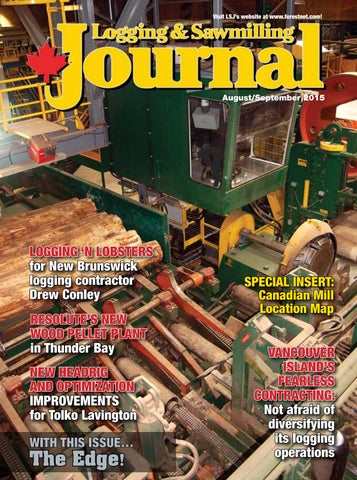
Tolko’s Lavington, B.C. sawmill has recently seen a major upgrade that positions the operation well as lumber markets move in a healthy direction, with increased lumber demand, both in North America, and overseas. Read about the major improvements at the Lavington mill beginning on page 14 (Photo of Tolko mill by Paul MacDonald).
Editor Paul MacDonald Contributing Editors Jim Stirling Tony Kryzanowski George Fullerton Tech Update Editor Tony Kryzanowski
Publisher Rob Stanhope E-mail: stanhope@forestnet.com Phone: (604) 990-9970 Fax: (604) 990-9971 Sales Associates James Booth (604) 990-9970 E-mail: jbooth@forestnet.com Perry Rosehill (604) 613-3001 E-mail: rosehill@forestnet.com
28 Logging ‘n lobsters
10 Re-start for Resolute
44 Resolute’s wood pellets
Canada’s forest industry will have to implement various approaches to attracting, recruiting, developing and retaining a skilled workforce—and it can learn from other industries and companies, from Apple to Telus, on how to do this.
Circulation Manager Maureen Cole (905) 201-0853 Fax: (905) 294-8645 E-mail: mcole@idirect.com Design & Art Production Manager Sheila Ringdahl E-mail: artwork@forestnet.com
sawmill
Resolute Forest Products recently restarted its Ignace, Ontario sawmill, having invested $10 million on improvements, with a strong focus on the infeed area so that the mill can now receive cut-to-length logs exclusively.
Office Manager Betty Rosales E-mail: brosales@forestnet.com
Office PO Box 86670, 211 East 1st Street North Vancouver, BC V7L 4L2 Phone: (604) 990-9970 Fax: (604) 990-9971 Website: www.forestnet.com Subscriptions: Canada $58 a year; two years $70; three years, $85. Group accounts, six or more subscriptions, $25 per subscription per year. Outside Canada, $95 per year. Airmail $165. Single copy, Canada $6; elsewhere $10. Reproduction prohibited without permission of the publisher. ISSN 0226-7572. Indexed in the Canadian Magazine Index by Micromedia Ltd. Back copies from 1996 onward are available through our website www.forestnet.com and in microform from Micromedia Ltd., 416-362-5211. Publications Mail Agreement No. 40064045 Return undeliverable Canadian addresses to CIRCULATION DEPT. PO Box 86670 Stn Main North Vancouver BC V7L 4L2 e-mail: mcole@idirect.com POSTMASTER: Send US address changes to LSJ Publishing Group, PO Box 610, Edmonds, WA 98020-0610 Published August/September 2015 Printed in Canada on 20% recycled paper. We acknowledge the financial support of the Government of Canada through the Canadian Periodical Fund of the Department of Canadian Heritage. Logging & Sawmilling Journal is a member/associate member of the following industry organizations:
4 Spotlight
14
New headrig and optimization improvements for Tolko Lavington Tolko Industries’ Lavington, B.C. sawmill has undergone a significant upgrade— involving installing a new headrig from Salem Equipment and associated controls from USNR—that has delivered a solid improvement in recovery.
New Brunswick logging contractor Drew Conley juggles running a logging operation—with most of the wood going across the line, to Maine—with helping out in the family fishing outfit, catching lobster.
now generating power for Ontario
Resolute Forest Products recently completed construction of a $9 million wood pellet plant in Thunder Bay to supply Ontario Power Generation’s power plant in Atikokan with wood pellets as a fuel substitute.
54
Fearless Contracting: not afraid of diversifying
Vancouver Island’s Fearless Contracting is finding the best business approach is diversification, and as part of that, it is increasingly doing logging work on B.C. Timber Sales, for other larger logging contractors, and for log brokers on the Island.
22 Rain Forest Sawmill … 65 The Edge
in the rainforest
Dale Crumback has recently moved from sawyer to company owner at B.C.’s Rain Forest Sawmill, and things are hopping these days with a wide range of customers looking for a variety of wood produced from their biodiesel-powered Wood-Mizer LT 70 sawmill.
Included in this edition of The Edge, Canada’s leading publication on research in the forest industry, are stories from the Canadian Wood Fibre Centre and Alberta Innovates - Bio Solutions.
74 The Last Word
With the federal election coming up, Jim Stirling says there may be a mood shift underway with voters, which could yield some surprising results.
DEPARTMENTS
Calendar.........................................................................................................8 Suppliernewsline..........................................................................................68 Classifieds / Employment Opportunities.......................................................72 Ad Index / Subscriptions...............................................................................73 Logging & Sawmilling Journal - August/September 2015
3
spotlight
Learning from others
on how to recruit—and hang on to— employees for the forest industry Canada’s forest industry will have to implement various approaches to attracting, recruiting, developing and retaining a skilled workforce—and it can learn from other industries and companies, from Apple to Telus, on how to do this. By Kit Tam
S
A Tradition of Leadership
ince the ‘War for Talent’ became a business catch-phrase in the 1990s, and through subsequent ups and downs in market cycles, the competition for talent has continued unabated. So how is Canada’s forest industry performing on its various approaches to attracting, recruiting, developing and retaining a skilled workforce? One area where it has excelled is in adopting best practices in people management from within the sector.
4
Looking at, and learning from, best practices locally and in other geographic regions within the forest industry is nothing new. It has been practiced for years. For larger scale multi-national firms, this often was a case of mills learning the best or most promising human resources practices from each other. Smaller firms quickly caught on. Importantly, many smaller and mid-sized firms became innovative leaders in productivity improvement and retention. Immigrant entrepreneurs from Europe, for example,
introduced ‘Old World’ craftsmanship and HR development values—epitomized by well managed family firms and loyal employees—into Canadian operations. Apart from these ‘imported’ HR best practices, historically some of the most innovative workforce development initiatives for the forest products industry originated through industry, education and government leadership in B.C. In the mid-1990s, Forest Renewal BC
Logging & Sawmilling Journal - August/September 2015
to page 6
FREE SATELLITE PHONE
KEEP YOUR BUSINESS CONNECTED
The most affordable satellite voice and data solution for your business. Manage your business from remote worksites that are beyond cellular service. Remain connected to co-workers, family and loved ones without breaking the bank.
$499 SAT PHONE
FREE
Visit Globalstar.com/lsjFREE05 to take advantage of the current FREE SATELLITE PHONE OFFERS. *Limited time offer. Terms and conditions apply. For offer details, visit Globalstar.com/lsjFREE05.
spotlight On sustainable jobs for First Nations peoples: “We have to stop thinking about what we can’t do, and start thinking about what we can do; then act on it.” Chief George Miller, Chair, Kaska-Dena Council from page 4 funded start-up of an industry-education partnership called WoodLINKS that developed a certification-based curriculum, delivered through high school shop programs. Its purpose was to attract students into the industry and prepare them with the skills needed for entry level positions in wood products manufacturing operations. Certification could also be eligible for academic credits at the post-secondary level. The program was recognized internationally, and is now under the auspices of the Wood Manufacturing Council. In 2007, BCIT introduced its online
There when you need it, growing when you don’t.
1.15%
*
Business Savings Account
Bundle it with an operating account and get even more benefit. Find your nearest branch at cwbank.com and start earning today.
*Rate is subject to change without notice. Interest is calculated on the daily closing balance based on the portion within each tier and paid monthly. Interest is paid as follows: 1.10% on deposits up to $250,000, 1.15% on deposits between $250,000.01 to $15 million and 0.25% on deposits above $15 million. Available in-branch only.
6
diploma program (‘Industrial Wood Processing and Management’), which greatly improved manufacturers’ access to postsecondary education and training, but fell victim to budget cutbacks and insufficient enrolment as the impacts of the global economic recession hit home. These are just a few examples of B.C.’s leadership in this area. More recently, industry associations such as the Council of Forest Industries of B.C. continue to promote forest sector careers through their respective education programs. Other groups such as the B.C. Coastal Forest Industry Workforce are implementing a human resource strategy to address critical skills shortages and meet the industry’s long term HR requirements. Canada’s forest products sector can, again, be a global leader on workforce development, where others look to us for best practice examples. Our failure to attract sufficient numbers of new recruits to the industry is rooted in a well known image problem. On this, we can learn from other industries and business sectors that treat recruitment like a marketing function and nurture strategic relationships before they need them.
Lessons from Other Business Sectors
Increasingly, Canadian forest products manufacturers are looking at, and adopting, HR best practices from other industries. Technology companies are amongst the best at marketing—whether it’s a company or its products and services. Look at Telus, for example. Their front line staff is well trained and empowered to deliver a flexible and positive customerfocused experience, supported by a highly competitive pricing strategy and creative marketing team. Who can deny the fun factor depicted by the Telus critters in the company’s ads—reinforcing its ‘Future Friendly’ branding and made more powerful by
Logging & Sawmilling Journal - August/September 2015
spotlight inviting consumers to engage in the creative process? We may not remember the details of the sales pitch (and these are constantly evolving anyway), but the fun factor goes a long way to helping consumers remember the company’s name when choosing a TV, phone or Internet package— or a future employer. How many consumers can name a forest products manufacturer—even when pulp, paper and wood products are a part of their everyday lives? Globally, Apple is the epitome of creative and marketing brilliance. Consumers want to buy their products. Competitors copy them. Developers want to work for them. Few brands embody ‘fun and cool’ better—not to mention creative passion and excellence. These are clues to Apple’s commercial success and ability to attract talent.
Introducing the Pierce Grapple Processor. It hoe chucks, sorts and loads like a grapple. And delimbs, measures and cuts like a processor. Six-plus functions. One game changing attachment.
your Pierce rep to tell you more about the PROCESSING? LOADING? Ask Pierce GP today. It works twice as hard, so you CHECK AND CHECK. don’t have to.
GP
Educators are Vitally Important Front-Line Influencers
MARK SHUKLA 250.826.5218 mshukla@piercepacific.com
Apple also understands the importance of investing in strategic relationships for the long term—and providing value to educators has been vital to their success. Early investment in generations of students using discounted Mac Classics and Apple II’s in school libraries and computer labs have nurtured generations of passionate consumers of iPhones, iMacs, iPads and other ‘i’ products. Apple just recently committed another $100 million in the form of iPads, MacBooks and other products for low income schools in the U.S.—along with technical expertise to support their use. A fascinating case study, they have succeeded in nurturing long term relationships in the education system when business giants in other sectors are often viewed with suspicion. Google was a quick learner of this strategy. Their Connected Classrooms initiative collaborates with educators to provide experiential learning for K-12 students— virtually bringing the world and global experts into the classroom. Their MBA Product Management Summit is a twoday workshop designed to give students a taste of what product management is like at Google. Their Teacher Academy is a two-day professional development experience designed to help teachers realize the potential of Google technologies as teaching tools. A recent count revealed thirty-six creative education initiatives offered by Google—all delivering value to to page 8
™
US Patent No. 8,992,159 B2 NZ Patent No. 605379
WWW.PIERCEPACIFIC.COM
TOLL FREE: 800.760.3270
Logging & Sawmilling Journal - August/September 2015
PORTLAND, OREGON JACKSON, MISSISSIPPI EDMONTON, ALBERTA
7
spotlight from page 7 educators and their students. Boeing is a more traditional ‘corporate’ business. But they, too, have a long history of nurturing strategic relationships in the education system. In 2013, Boeing invested $176.3 million in community initiatives—more than half of which was directed to education programs around the world. The programs are designed to develop a globally competitive workforce and strong communities through experiential learning, mentoring and partnerships that inspire students and help prepare them for successful careers in the 21st century workforce. They also are aligned with Boeing’s business interests. The relationships outlined above are not traditional ‘fee for service’ models. Nor are they philanthropic examples of corporate social responsibility—not really! What they point to is a clear vision of long term business goals and the role of the education system, from kindergarten to post-graduate studies, as front line connectors to future consumers and the future workforce.
recruitment targets live, work, shop and play. What motivates them? How to get on their radar—so we have a chance of ‘capturing their hearts and minds’? Using the full array of Internet technologies, social media and more traditional methods of primary and secondary research, such as demographic mapping, companies can identify and assess which networks present the best probable return on investment on their HR recruitment dollars. Data mining can be a powerful tool to guide talent strategies, gauge performance and develop opportunities to attract, recruit, nurture and retain both the ‘best and brightest’ and other talent needed for a well rounded workforce. ___________________________________
CALENDAR
Kit Tam is a senior associate at Woodbridge Associates Inc., with focus on research, strategy and planning. This is the second in a two-part series she has written for Logging and Sawmilling Journal. The first part ran in the December/January 2015 issue of LSJ. She can be contacted at kt@woodbridgeassociates.com
Alberta Forest Products Assoc. 73rd AGM, Jasper, AB 780-452-2841 www.albertaforestproducts.ca October 7-9
National Hardwood Lumber Assoc. Annual Convention, Nashville, TN 901-377-1818, www.nhla.com November 4-6
NAWLA Traders Market, Dallas,TX
800-527-8258, www.nawla.org November 8-11
106th Pacific Logging Congress Convention, Big Island, HI 425-413-2808 www.pacificloggingcongress.org November 12-14
Tree Care Industry Expo, Pittsburgh, PA
603-314-5380, www.tcia.org November 18-20
ExpoCorma 2015, Concepciòn, Chile
56-688-7978, www.expocorma.cl
Thinking Outside the Box on First Nations Relationships
Private timberlands aside, there are only two owners of fibre in Canada—the Crown and First Nations. The latter’s influence will only increase, reinforced by positive role models and recent Supreme Court decisions. First Nations employment in Canada’s forest industry traditionally has been limited to forest and woodland operations. But, looking ahead to the future forest economy, companies are increasingly recruiting and integrating Aboriginal and First Nations talent into manufacturing operations, marketing and sales and other non-traditional roles. On First Nations employment, conventional preconceptions box in the ability of manufacturers and HR professionals to be creative in finding solutions. As Chief George Miller, Chair of the Kaska-Dena Council, says on creating sustainable jobs for First Nations peoples: “We have to stop thinking about what we can’t do, and start thinking about what we can do—then act on it.”
Data Mining to Guide Talent Strategies
Knowledge is power. And data mining can help to identify where company 8
September 23-25
Logging & Sawmilling Journal - August/September 2015
THERE’S ALWAYS GOING TO BE SOMEONE
BIGGER, STRONGER,
p
MEET ALL OF THEM.
p
and MORE CAPABLE. 2015 ram HEAVY DUTY
The 2015 Ram Heavy Duty is no one-trick pony, thanks to brilliant engineering throughout the truck. Case in point: its two rear suspension systems. Both the standard 5-Link Coil Spring Rear Suspension1 and the available Auto-Level Rear Air Suspension 2 are exclusive to Ram. They both use heavy-duty advanced components to achieve unparalleled handling under heavy loads. This contributes to best-in-class towing, beating F350 by 2 tonnes2 , and also gives Ram Heavy Duty best-in-class payload of up to 7,390 lb 3 . With a Legendary Cummins ® Turbo Diesel or HEMI ® engine, Ram out-measures the others, no matter how you size them up.
BEST-IN-CLASS
TOWING up to 31,210 LB
2 TONNES more than f-3502
torque up to 900 lb-ft2
LONGEST LASTING
LINE OF trucks in canada4
highest
customer
loyalty
of any pickup5
RAMTRUCK.CA Based on 2500/250 class pickups. 2Based on 2500/250 and 3500/350 class pickups. 3Based on 3500/350 class pickups. Up to 3,352 kg. 4Longevity based on IHS Automotive: Polk Canadian Vehicles In Operation data as of July 1, 2014, for MY 1988-2014 for the entire Ram large pickup segment compared to all competitive large pickups that have been on the road since 1988. 5Based on third-party Canadian competitive ‘trade-in’ data for MY2008 to MY2013 new full-size pickups.
1
q
q
BEST-IN-CLASS
Ontariosawmilling
Re-start
for Resolute sawmill
Resolute Forest Products recently re-started its Ignace, Ontario sawmill, having invested $10 million on improvements, with a strong focus on the infeed area so that the mill can now receive cut-to-length logs exclusively.
A First Nations company, Dallan Forestry, has been contracted to provide all the equipment and employees to conduct yard work at the Resolute Ignace stud mill.
By Tony Kryzanowski
I
t took a while, but the residents and mayor of the town of Ignace, Ontario have gotten their wish: a successful re-start of the Resolute Forest Products stud mill near their community in the northwestern corner of the province. Even better news is that the sawmill is also in hiring mode, as they are in the process of adding a third shift. Some background: Resolute purchased the sawmill in 2000 and spent about $30 million to completely rebuild it, with construction completed in 2004. At that time, all of its lumber drying and planing
10
was done in Thunder Bay. Resolute then placed it in idle mode in 2006 because as a new entrant into the Softwood Lumber Agreement with the United States, it did not have a quota to ship lumber to the U.S. at that time. Then, the industry as a whole experienced a severe downturn with the collapse of the American housing market. However, local residents and politicians lobbied hard to ensure that the stud mill would re-open some day, and they got their wish at the beginning of this year. Lee Kennard, Ignace Mayor and a veteran of the forest industry himself, says the mill closure in 2006 was a surprise
and an economic shock to the community, considering that 150 jobs were lost in a town of just 1200 people. However, he always believed that the sawmill would re-open some day and is confident that the sawmill has a strong future. Kennard’s only concern is with environmental organizations like Greenpeace which has been lobbying hard for greater restrictions on logging in the area, which is also home to a designated species at risk, the woodland caribou. He feels there needs to be a balance between preserving caribou habitat and providing economic opportunity for the region. Forestry is a major economic driver in the area, and he
Logging & Sawmilling Journal - August/September 2015
Comact was the main supplier of both scanning and processing equipment at the Resolute Ignace stud mill. Between a major upgrade in 2004 and most recently when the stud mill was recommissioned, a total of $40 million has been spent on the mill. hopes that continues. Ignace is a couple hours northwest of Thunder Bay and is located along the Trans-Canada Highway— a region noted for its hunting and fishing experiences. The sawmill, however, is the largest employer in Ignace. “I think the sawmill is here to stay,” says Wayne Nyberg, Resolute Ignace sawmill manager. “This part of Ontario from Thunder Bay west is a big part of Resolute’s plans. We want to be here and we have shown that by the significant investments that we have made in northwestern Ontario. I think there is a very good future for both the Ignace and Atikokan sawmills." Nyberg said a number of developments made the re-opening of the stud mill possible including the availability of quota to ship Ignace lumber to the U.S., long term forecasts for healthy lumber prices, the ability to supply chips to Resolute’s paper mill in Thunder Bay, partnering with the new Atikokan sawmill to plane their lumber, and Resolute’s overall investment plan for its facilities in northwestern Ontario. Lobbying by local residents paid off in that the Ignace stud mill became part of a massive investment that Resolute Forest Products has made into that area of Ontario. In addition to re-opening the Ignace stud mill, the company is currently commissioning a brand new dimension sawmill about an hour-and-a-half south
of Ignace near Atikokan, has upgraded its dimension sawmill in Thunder Bay, and has constructed a new wood pellet plant attached to its Thunder Bay sawmill (see story on this new wood pellet plant beginning on page 44 of this issue of LSJ). A considerable amount of this wood pellet production is being sold to Ontario Power Generation (OPG) for use as fuel as part of its conversion to wood pellets at some of its formerly coal-fired power plants. Resolute Forest Products has spent an additional $10 million on the Ignace facility, particularly on the infeed area so that it can now receive 9’ cut-to-length (CTL) logs exclusively, as opposed to the tree length logs that the sawmill was originally designed to slash and process. It has also installed two refurbished Nicholson debarkers and two new Wellons dry kilns, each with a capacity of 280,000 board feet. The drying system includes a wood
shavings-fueled heat generation system, equipped with direct-fired, McConnell Sales and Engineering Corp. burners. The wood shavings will come from the Atikokan planer mill. Resolute worked with Edmonton-based CLLB Consulting as the engineering, procurement and construction (EPC) contractor on its latest $10 million capital project. The 115 million board feet of 9’ stud material from 2” X 3” to 2” X 6” being produced annually at the Ignace stud mill is nearly 30 per cent more than the 85 million board feet originally targeted by the company when the mill was built. This volume increase is being achieved through greater operating efficiency and the addition of a third shift. Their wood fibre is spruce, pine and fir, sourced to page 12
Wayne Nyberg (far right) was on the team that oversaw the construction of the Resolute stud mill in Ignace in 2004 and has returned to manage the operation now that it is back in production. Logging & Sawmilling Journal - August/September 2015
11
Ontariosawmilling from page 11 anywhere from less than a half-hour away from the mill to two hours away. The average log diameter is about 7”. While the studs are being manufactured and dried in Ignace, they are being planed at the new Atikokan sawmill. Resolute’s investment in northwestern Ontario has gone hand in hand with a greater partnership with the area’s First Nations communities. For example, a First Nations company called Dallan Forestry has the contract to provide all yard services in four of Resolute’s northwestern Ontario facilities, including the Ignace facility. This includes unloading log trucks, decking the logs, and moving logs to the sawmill infeed as needed. They also transport stacks of lumber from the sawmill to the kilns, from the kilns to the storage yard, and load lumber on trucks for shipment to Atikokan. Nyberg was part of the team that oversaw the original replacement of the entire sawmill near Ignace, and has returned to manage the sawmill after stints with the company in places like Mississippi, Alabama, and Thunder Bay. The power to re-start the stud mill was turned on last September and the mill was back in production by December. Nyberg says Resolute did an excellent job of keeping the stud mill in standby mode so that they were able to return to production in short order. Nyberg says that local residents can’t be blamed for having a bit of a “show me” attitude when it comes to believing that the sawmill is back to full production with a strong future. Prior to the new stud mill being built, the privately-owned sawmill, operating on the same site west
A third shift is being added to Resolute’s stud mill in Ignace, raising its production by about 37 percent from 85 million board feet to 115 million board feet per year. of town, had a history of stops and starts. When Resolute constructed the new sawmill and then promptly placed it in mothballs, it seemed like history was repeating itself to many local residents. “The general feeling in the community is now pretty good,” says Nyberg. “They are happy we are here and they are happy we are back. There was a lot of apprehension as to whether or not we were going to re-start. The people are coming around and they are starting to believe.” Resolute is adding a third shift at the stud mill, raising the full staff complement to 70 employees. It is focused on hiring local residents and some former employees were rehired. It has also provided an opportunity for local men and women to acquire valuable new skills working in an industrial setting. Nyberg says that while there is still a manual labor component to working at the sawmill, the fact that it is a fully modern stud mill with considerable automation has been a bonus for attracting
A major part of the further $10 million that Resolute has spent at its stud mill in Ignace was to install two new Wellons dry kilns, each with 280,000 board foot capacity. Previously, the studs produced at Ignace were dried in Thunder Bay.
12
employees with little or no experience. On the flip side, however, there are more technical requirements on employees, so there is a considerable amount of job shadowing. Training began last December, and the stud mill was operating on a twoshift basis by January. The stud mill has attracted some skilled tradespeople, but like so many other forestry companies, the recruiting effort is ongoing. “We try to hire as many people from Ignace as possible, to provide jobs that are close to home and to support the community,” says Nyberg. At present, the stud mill operates two 10 hour-shifts from Monday to Thursday, and when the third shift comes on board, it will work three 12 hour shifts, Friday, Saturday, and Sunday nights. The logs are placed at the mill infeed into two infeed decks leading to two Nicholson debarkers and then to four sort bins. Production is organized on a species basis to achieve greater consistency in the dry kilns. Logs in the sort bins are processed through a single line, featuring a Comact optimizing scanner and a Comact DDM6 SBP breakdown unit, which features a canter quad at the front end. Nyberg says the SBP profiling feature gives the stud mill the ability to optimize its sawing solutions based on the log scan. The sideboards proceed through an edger while all the lumber is processed through a manual trimmer and then stacked for drying. All this equipment was provided by Comact. One of the consequences of the shutdown in 2006 was the loss of several local logging contractors, but with logging contracts now available for both the Ignace and Atikokan sawmills, that is ramping up again and providing additional jobs.
Logging & Sawmilling Journal - August/September 2015
w e N millupgrade
Headrig and optimization improvements deliver the goods for Tolko Lavington
Tolko Industries’ Lavington, B.C. sawmill has undergone a significant upgrade— involving installing a new headrig from Salem Equipment and associated controls from USNR—that has delivered a solid improvement in recovery.
By Paul MacDonald
T
olko Industries’ Lavington, B.C. sawmill has a rich heritage. A planer mill on the Lavington site was actually the first forest industry operation started up by Vernon, B.C.based Tolko Industries, whose sawmill, OSB and pulp mill operations now span B.C., Alberta, Saskatchewan and Manitoba, with sales to more than 30 countries. Company founder Harold Thorlakson established the Lavington mill back in 1956. These days, the third
generation of the Thorlakson family, Brad Thorlakson, heads up the company, as president and CEO. The Lavington sawmill drew upon that heritage—and the resourcefulness of its employees—to make it through the most recent industry downturn. “We were really no different than any other sawmill—it was looking within the mill and trying to figure out how to be more efficient and extract more lumber,” explained Dave Gillespie, who was acting manager of Lavington, but now heads up Tolko’s sawmill in High Level, in northern Alberta.
Lavington employees got very creative and resourceful with maintenance practices, from looking closely at area-based maintenance and machine centres, to partnering with suppliers to ensure equipment performance levels were reached. “The next step was taking the existing equipment and looking at how to utilize it to produce more—recover more lumber and improve grade outturns,” says Gillespie. “We did a lot of work on that. The guys really hunkered down to figure out
The major improvement at the Lavington sawmill involved installing a new headrig from Salem Equipment, and associated controls.
14
Logging & Sawmilling Journal - August/September 2015
to page 16
The MillExpert solution fits a board within available fiber around the defect. Actual LASAR scan data is shown in red.
millupgrade from page 14 how to weather the storm, and we came out stronger than when we went in.” The results were impressive. The Lavington mill came out of the downturn being able to produce in two shifts what used to take three shifts. One of the key values of Tolko is that it seeks to be progressive in its operations, and that includes working to keep their mills productive, with up-to-date machinery. The Lavington sawmill has recently seen a major upgrade that positions the operation well as lumber markets move in a healthy direction, with increased lumber demand, both in North America, and overseas. And along the way, they were able to help out two other Tolko lumber mills improve their operations. The major improvement at Lavington involved installing a new headrig, and associated controls. “We knew it was time for a change at the mill,” explained Gillespie, who oversaw the project at Lavington. The operation has two primary break-
down lines: the typical double-length infeed line, and the headrig line. The Lavington mill has a Nicholson A7 ring debarker and a Comact double-length infeed two-faced canter twin band combination. The mill has two USNR gangs. On the large log line, the headrig, which was bought used at an auction in nearby Grand Forks, has more than paid for itself over the years. “It has been running for many years, and was an effective machine, and very versatile,” said Gillespie. “But we needed to update the technology. “Looking at our timber profile going forward, we could see that our log size in the region was increasing, and we needed to make changes so we could effectively utilize the larger logs that we would be consuming at Lavington. We knew that we needed to increase the throughput and recovery on that piece of equipment.” The timber profile in the region is changing. With the reduction of mountain pine beetle kill wood, there is now higher elevation spruce, and Douglas fir, both of which are larger dimensions. It was time for a major change—and the change came in the form of a new
headrig from Salem Equipment, and significant controls and optimization improvements from USNR. Around the same time, and on a broader basis, Tolko was looking at making mill improvements at two other operations. “Tolko operates three headrigs in its
A Wholly-Owned Subsidiary of
16
Logging & Sawmilling Journal - August/September 2015
millupgrade The timber profile in the region where Tolko Lavington operates is changing. With the reduction of mountain pine beetle kill wood, there is now higher elevation spruce, and Douglas fir, both of which are larger dimensions.
eight sawmill operations, and all three were of an age that the company was looking at different variations of improvements,” explained Gillespie. The two other operations with headrigs are the Nicola Valley Division in Merritt, B.C. and the Lakeview Lumber operation in Williams Lake.
But Lavington was the first to make the improvements—and started doing some legwork on their new headrig first. “When you’re talking about headrigs, there really isn’t a long list of suppliers any more—you’re starting with a pretty short list,” says Gillespie. “It did not take long for us to shorten the list based on products and service. And then we went to tour operations, to see different headrigs in operation.” The tour included sawmill operations in Canada and the U.S., and lots of discussion that followed, to arrive at the decision on what equipment, controls, and optimization would best suit Lavington. A cross-functional team of mill employees was formed to review the equipment, and how it might fit with the Lavington mill. Gillespie points out that the Lavington
mill is quite different from most B.C. Interior mills; the headrig operates more like a coastal B.C. mill that cuts to grade. “We’re not the standard interior headrig operation that utilizes the oversized wood from the timber profile. We’re taking that wood and cutting vertical grain clears, posts, free of heart centre products, timbers, beams, customer grade and tally.” Essentially, they want to extract the maximum margin out of that larger timber profile. “We look at the headrig and associated controls as our margin machine,” says Gillespie. One of the must-haves for the new headrig was that it had to be good fit, literally, at Lavington—there wasn’t a lot of room for making adjustments at the existing sawmill facility. “With our project, we were doing the headrig replacement in location—we were not looking at setting up a new building. We were looking for something that would fit into the existing spot where the headrig was already—essentially in the middle of our mill.”
Logging & Sawmilling Journal - August/September 2015
to page 18
17
millupgrade
Vernon, B.C.-based Tolko Industries, whose sawmill, OSB and pulp mill operations now span B.C., Alberta, Saskatchewan and Manitoba, now has sales to more than 30 countries. Tolko’s Lavington, B.C. sawmill has a rich heritage. A planer mill on the Lavington site was actually the first forest industry operation started up by the company. from page 17 The replacement of the headrig was a major project. “We took the roof off around that part of the sawmill,” says Gillespie. “And we took it right down to the slab and the dirt. “The old headrig was a dual circular saw, and the new one is a double cut bandsaw, so we had to build a new structure from the basement all the way up.”
18
Oregon-based Salem Equipment built the headrig, the carriage and all the associated iron—the infeed deck and the outfeed deck. Salem also provided a Key Knife slabber. Using drawings supplied by SKS Engineering, the TEBO Group of Delta, B.C. installed the headrig, and Summit Electric did the electrical work. To take advantage of the usually fine weather in the B.C. Okanagan region, they scheduled the work for the middle of the
summer of 2014. They planned for a 23day shutdown, and it came in at 27 days due to some additional work that had to be done around the project. “With any large project in an older mill, there are a few surprises with a major shut” says Gillespie. The new headrig itself was important. But so were the upgraded controls and
Logging & Sawmilling Journal - August/September 2015
to page 20
The Mycostat difference
MYCOSTAT TREATED
d l o m
iron s tain e d a r g n dow
Ask about Mycostat, our innovative mold growth prevention spray.
PREVENT MOLD AND IRON STAIN WITH MYCOSTAT ANTI SAP STAIN CONTROL PROGRAM. Another innovation from the labs of Diacon.
For more information go to our site
www.diacon.com or call
888.290.2299
millupgrade from page 18 optimization that would deliver the improved speed and flexibility the mill wanted. “To give us the optimization capabilities to do that, USNR, we believe, had the best flexibility for us.” It’s also a good fit with the operation since they already have USNR’s MillExpert optimization systems on their gangs, trimmer and board edger, and they have USNR’s Lineal High Grader system in their planer. “It’s technology that we are familiar with, and we’ve been happy with its performance.” The upgrade has been very good at keeping logs moving in the mill, says Gillespie. “Depending on where they are loading the log, they can be just 18 inches away from making contact with the first cutting tool—we didn’t want the operator to be waiting.” There were not a lot of equipment changes required to the mill to handle the upgrade, says Gillespie. “We had planned to make some upgrades to our large gang saw to handle the extra volume of the larger material. But the other changes involved the way the overall mill operated, more than anything—how material flowed within the mill. The guys were very good at getting together and determining how to operate the mill differently.” Mill employees were a huge part of why the upgrade was so successful, Gillespie said. The focus throughout the project was on better recovery. “We weren’t trying to consume more volume, though that did occur—our goal was to improve recovery.”
20
With the upgrade, they have realized a material improvement in recovery. Through the late summer and early fall of 2014, some tweaking was required, which is not surprising with new equipment and controls. “There was an expected start-up curve both in terms of recovery and throughput. Part of it was our people getting familiar with the optimization, and working with a bandsaw vs. a round saw—but the equipment suppliers and our people worked well together.” To get a head start on that, a group of employees—including sawyers, electricians, production and quality control people—went down to the USNR office in Eugene, Oregon, for training. “They were able to get training on the controls so they could get familiar with what the system was capable of doing, and how it could meet our needs, and
what we might be able to do prior to the installation. The guys were very familiar with what we were getting.” And what they were getting was state-of-the-art mill control and optimizer systems. The project was successful, and much of that was due to the people involved— the equipment selection team, the project planning team, the construction team and the start-up group, says Gillespie. There was a core group of people involved with all of these teams. “Like a lot of projects, its success was due to the right decisions being made, and having benchmarks in place to ensure the equipment achieved the levels of performance.” What they were able to learn throughout the process was shared with the Tolko operations in Merritt and Williams Lake, which were undergoing similar optimization and control upgrades. “That is part of Tolko’s approach of sharing best practices between the mills, which allows us to leverage the innovations at all the Tolko operations,” says Gillespie. For Gillespie, being involved with the upgrade—and what it is now delivering—was very fulfilling. “It’s a big project, challenging and rewarding—it’s not often you get the chance to be involved with a major project such as installing a new headrig at a mill. And we’re very pleased with the result.” Now that Gillespie has moved over to Tolko’s mill in High Level, he has turned the reins at Lavington over to Stephane Bouchard, the new plant manager. Bouchard is enthusiastic about the new headrig, and the controls and optimization improvements. All the ingredients are in place—the people and the equipment—for it to deliver the goods, big time, he believes. “It’s very exciting,” he says.
Logging & Sawmilling Journal - August/September 2015
Mycostat is the leading Antistain in North America - preventing mold on over 8 billion board feet of lumber last year!
M y c o s tAt
TM
Non-Treated Lumber
DiAplex
TM
sMArtFlow
TM
Diacon Treated Lumber
Stop mold, iron stain and checking before it starts! We can help. Retrofit your mill with our state of the art systems and see the savings with every board foot you process. Ask about how we can provide better ROI throughout the entire supply chain with our turnkey solutions.
For more information go to our site
www.diacon.com or call
888.290.2299
smallsawmilling
Rain Forest Sawmill … in the rainforest
Dale Crumback has recently moved from sawyer to company owner at B.C.’s Rain Forest Sawmill, and things are hopping these days with a wide range of customers looking for a variety of wood produced from their biodiesel-powered Wood-Mizer LT 70 sawmill. By Paul MacDonald
D
ale Crumback has a very short commute to work—from his home, he walks down a path to his small sawmilling operation on acreage in Black Creek, on B.C.’s Vancouver Island. After years of being on the road as a certified utility arborist doing work for companies such as BC Hydro, it’s a welcome 22
change for Crumback, who has also worked as a carpenter and run his own hardwood flooring business. In short, this is someone who knows wood, from the timber side right through to the milling side. Over the past five years, Crumback was working as a sawyer for Tim Fairbank and Blacktail Sawmills, in Black Creek, in the Comox Valley on the Island. But last year, he took over the business and the
mill, and has re-christened it Rain Forest Sawmill, an appropriate name considering their location smack in the middle of the rainforest of B.C.’s West Coast. Crumback reports that his background as an arborist is sometimes an asset when producing wood on the sawmill. “It definitely comes in handy,” he says. “You can look at a log and understand a bit more about the species type, the limbs and if it
Logging & Sawmilling Journal - August/September 2015
smallsawmilling
Rain Forest Sawmill uses a special biodiesel fuel mix from Columbia Fuels of Nanaimo, B.C. to run their Wood-Mizer LT 70. The biodiesel is a cleaner burning alternative to fossil fuels, and is produced from renewable resources such as vegetable oils and fats which meet engine specifications. Columbia Fuels’ biodiesel is made from North American soybean oil.
has rot, where it’s located in the tree." For those five years, Crumback was running the Wood-Mizer LT70 mill, and Tim Fairbank was dealing with the customers. But Crumback has now made the transition to dealing with customers, and is overseeing production on the mill, with trained staff now producing the wood. And it now falls to Crumback to source wood for the mill, which is a huge challenge in itself. “Before, I was the guy handling the timber once it came in the millyard—now I’m the guy who is going out and buying logs,” he says. As much as possible, he has been trying to work his contacts. “I got to know a few of the woodlot guys when I was doing tree trimming, and have used those contacts for the odd bit of fir and second growth cedar.” Rain Forest Sawmill cuts mostly Douglas fir and cedar, and some white pine.
Dealing with the large forest companies and sawmills on Vancouver Island for wood is a huge challenge, he says. The industry is not really set up to deal with small sawmills on the Island. “It seems to be more of a hassle for the big companies—they don’t want to just sell you a truckload of logs. “If I’m looking to buy old growth Doug fir, they want you to buy 250 cubic metres. Well, we’re just a little operation—I can’t even think of buying volume like that.” One option he’s working on is going in with other small sawmills to jointly purchase larger volumes of wood from the mills. That said, through a number of different sources, such as woodlots and purchases from log haulers, Crumback is able to get Rain Forest Sawmill supplied with a steady amount of wood—though more wood would be welcome, he says. They mill a variety of species, but they go through a truckload of logs about every two weeks—more, if they’re busy. “It really is hard to find the wood,” he says. “With the private woodlots in the area, they want to do a little bit of logging here, and a little bit there—it’s not a
regular thing. They’ll get in there, get the wood out, and call it a day until next year. We can’t rely on them for a truckload of logs every month or two.” And getting wood now is even more important because this year the Rain Forest Sawmill operation has been busy. Two other small operations in the area are no longer operating, so this has, in part, created extra work. And how has it been for Crumback, going from operating the mill to managing the overall company? “I like dealing with the customers,” he says. “I always have. And I don’t mind the paperwork. But it’s a bit unnerving stepping away from the milling—you lose that control. It was a little hard to let go of that part of the business. “You have that feeling that if the mill isn’t running, you’re not making money.” Production on the Wood-Mizer was initially down a bit, since he had to train someone new to run the mill, but it has since picked up. Crumback will still get in there sometimes, to mill on the weekends.
Logging & Sawmilling Journal - August/September 2015
to page 24 23
smallsawmilling from page 23 And it’s clear that he still likes getting on the mill with a challenging log, taking a look at what can be made with it, and how it should be cut. “There’s a certain pleasure in doing that. Sometimes you can’t tell until you cut a log open how you are going to cut it—a log can sometimes be full of surprises.” And unlike his previous work as an arborist around power lines, where there was plenty of stress—if you made a mistake, it might cause an injury or death— the stress has definitely been dialed down. “If you make a mistake with a cut on a log, you just make something different with that piece—it’s not the end of the world. It’s not like you’re throwing it away, you’re just making something else.” Crumback has been working with a diesel-powered Wood-Mizer LT 70 for a number of years, and before that worked with a LT40 mill. He’s happy with the LT 70, though he finds they sometimes have to replace parts—like bearings—more often than he’d like. With the work they do, he has tuned the 55 hp LT 70 motor way down.
24
That saves on wear and tear, and fuel consumption. “When the motor comes on, we’re probably not even using one-third of it. We’ll go through about 20 litres of fuel every two-and-a-half days.” They use a special biodiesel fuel mix from Columbia Fuels, of Nanaimo. They also use a biohydraulic oil. “Everything is biodegradable,” he says. “It’s very expensive, but it’s worth it.” Biodiesel is a cleaner burning alternative to fossil fuels, and is produced from renewable resources such as vegetable oils and fats which meet engine specifications. It actually contains no petroleum, but can be blended in any amount with petroleum diesel or used at 100 per cent concentration. Biodiesel is non-toxic, biodegradable and virtually free of sulphur. Engines powered with biodiesel have shown similar torque, horsepower and fuel efficiency as petroleum diesel powered engines, says Columbia Fuels. “We don’t see a difference in performance,” noted Crumback. Since biodiesel is made from renewable resources, on a full lifecycle basis it reduces greenhouse gases by 78 per cent. Columbia Fuels’ biodiesel is made from
North American soybean oil. Saw maintenance is a big focus for Rain Forest Sawmill. “People sometimes comment about the wavy look of bandsaw-cut wood,” Crumback says. “But we sharpen our blades about every 90 minutes—the maximum we will do on a blade is two hours. And we regularly set them. If you take care of doing that, and not rush your cutting,
Logging & Sawmilling Journal - August/September 2015
smallsawmilling Customers for the products from Rain Forest Mill range from local homebuilders to folks with DIY projects. On the cut sheet recently were fence orders, beveled siding, flooring, mantles—and lots of custom cut beams.
you get nicely cut wood, fairly true and even—wood that is nice to work with.” Small sawmillers really need to stay on top of their game when it comes to their saw blades, Crumback believes. “I think some people may put way too many hours on their blades, going all day and only changing out the blades once. If you do that, you’re going to get fuzzy, marked-up wavy wood.” He figures he
gets about 10 to 14 uses out of every blade. Crumback sharpens his own blades, which he says gives him more control. “It’s not just about cutting the wood—it’s the blade and the quality of the blade, how it’s sharpened and set. It can make a big difference in what you produce. “You can still get a nice smooth cut with a bandsaw—it’s rough cut, but it’s
smooth and there are no marks as long as you’re careful.” If someone is looking for a circular saw cut with their wood, he’ll work with a local circular saw mill to get that done. “We work together. He’s cut wood for me that needs to be cut with a circular saw, and I’ve cut wood for him that needs to bandsawn. And we sometimes help each other if we’re looking for a particular log.” One of these other mills had a large order for re-sawing yellow cedar clears. “They made the cants, and we made the boards, and it worked out well for both of us,” says Crumback. Taking the logs down to a manageable size for the Wood-Mizer is a locally-made split saw. “We used to cut our logs in to page 26
Bank Trust Wealth Management
Part of your crew.
CWB Equipment Financing gets what you do and what it takes to get things done. And because we’re local, we work when and where you do. Need equipment? Make us your first call.
Call Michael, our crew leader, at 1.855.761.0060. CWBequipment.com CWB Group
Logging & Sawmilling Journal - August/September 2015
25
smallsawmilling
from page 25 half with a chainsaw, and that could take hours. Now, we set the log up on the split saw, and it’s cut in 10 or 15 minutes.” With the split saw, they can flip a log over after the first cut, and cut it again, into quarters. It was designed and put together by a local steel fabricator, Tom Benson. They’ve got an old mill carriage on the site, from a bandsaw operation, that they are looking to put on the split saw, so larger logs could be positioned and clamped. “Getting the carriage set up will make things more versatile, and make it easier to set up a log.” Now, they often put their Bobcat 873 or Hitatchi 120 excavator into service, to help position the log on dunnage under the split saw. The Hitachi is equipped with a grapple from T-Mar Industries of Campbell River, to help do the log sorting. With their current pace of work, Crumback has thought about getting a second, slightly larger, mill. The thought is that a second mill could make cants, and their current mill could do the re-sawing. “It’s definitely a thought in the back of my mind,” he says. Customers for Rain Forest Mill range from local homebuilders to folks with DIY projects. On the cut sheet recently were fence orders, beveled siding, flooring, mantles—and lots of custom cut beams. An interesting initiative these days is that Crumback is looking at producing some door stock for the export market. He’d like to obtain some standing orders, without firm timelines, so he could produce the doorstock on an ongoing basis. It would also fit well, in terms of using up some of their byproduct wood, left from 26
Rain Forest Sawmills will try to set up operations so when they are milling for one order, they will try to take byproduct off right away for another order, rather than putting it into stock. If they are cutting a beam, for example, they might also be able to take off some one or two-inch wood for another order.
doing big cutting, such as beams. “We try to set things up so when we are milling for one order, we try to take byproduct off right away for another order, rather than putting it into stock.” If they are cutting a beam, for example, they might also be able to take off some one or two-inch wood for another order. They might be cutting for up to six orders at a time. He notes, though, that they do have a supply of stock, and it moves reasonably quickly. “We have enough people contacting us looking for a couple hundred feet of wood, or some wood for small projects, to keep it moving.” Smaller pieces are used in a wood-fired boiler for the two home-made kilns that are on site. Two shipping containers, one 14 foot and the other 20 foot, have been sheeted and insulated; they are equipped with pumps and fans, and are temperature and humidity controlled. “Using
wood as a fuel source is time consuming, but it’s well worth it because we can use our waste materials. We just ran some thick wood in the kilns—it took some time to dry, but it works nicely.” They also have a DeWalt True Cut portable edger on site, for doing some trimming, and a Geetech 20" planer. Sawdust is packaged, and sold for horse bedding and riding arenas. There has been talk about a wood pellet operation being built down the Island, in Nanaimo, and there is the possibility of two new local hospitals using wood waste for their boiler systems. “I’m not sure the hospitals are going that way, but it would a great way to use our waste material,” says Crumback. Using wood waste—from Rain Forest Sawmill and the B.C. rainforest—to provide energy for a local health care facility that helps people would be quite fitting, says Crumback.
Logging & Sawmilling Journal - August/September 2015
VINCENTRIC LOWEST FLEET COST TO OWN
VINCENTRIC BEST
2015
2015
IN CANADA
FLEET VALUE
IN CANADA
MAKE LIGHT WORK OF EVERY TOW. WITH ITS BEST-IN-CLASS TOWING* AND DIESEL HORSEPOWER,** AND 860 LB.-FT.^ OF STANDARD DIESEL TORQUE, SUPER DUTY MAKES EVEN THE TOUGHEST JOBS SEEM EASY. NO WONDER F-SERIES IS CANADA’S BEST-SELLING WORK TRUCK 49 YEARS STRAIGHT,† AND THE TRUCK CANADIANS TRUST TO GET THE JOB DONE. BEST-IN-CLASS: 31,200 LBS. TOWING *| 440 HORSEPOWER ** | FUEL EFFICIENCY ‡
FORD.CA
Vehicle may be shown with optional features. *With F-450, when properly equipped. Class is Fu Full-Size Pickups over 8,500 lbs. GVWR vs 2015 competitors. **440 HP with 6.7L V8 Diesel. Class is Full-Size pickups over 8,500 lbs. GVWR vs 2015 competitors. †F-Series is the best-selling pickup truck in Canada for 49 years in a row based on Canadian Vehicle Manufacturers’ Association statistical sales report up to 2014 year end and YTD May 2015. ^860 LB.-FT. of torque with 6.7L V8 Diesel. Class is Full-Size pickups over 8,500 lbs. GVWR vs 2015 competitors. ‡The 2016 Super Duty with 6.7L Power Stroke diesel has best-in-class fuel consumption. Class is Full-Size Pickups over 3 856 kg (8 500 lbs) GVWR. Diesel fuel efficiency claim based on Ford -simulated city-suburban drive-cycle tests of comparably equipped 2016 Ford and 2015 competitive models, consistent with SAE Standard J1321. Actual fuel consumption will vary ©2015 Ford Motor Company of Canada, Limited. All rights reserved. Based on the Vincentric 2015 Canadian Fleet awards analysis, Full-Size Heavy Duty ¾-Ton Pickup and Full-Size Heavy Duty 1-Ton Pickup segments and the F-250 Super Duty XL Reg Cab 2WD and F-350 Super Duty XL Reg Cab SRW 2WD.
eastcoastlogging
Logging ‘n lobsters New Brunswick logging contractor Drew Conley juggles running a logging operation—with most of the wood going across the line, to Maine—with helping out in the family fishing outfit, catching lobster. By George Fullerton
D
rew Conley is something of an anomaly in the harvest contracting picture in New Brunswick. Conley is under 40-years-old, and he actually grew his operation through the most severe downturn in forest industry history. Conley was born to and continues to take an active role in his family’s fishing enterprise on Deer Island, and he continues to work, seasonally, alongside his father in the Bay of Fundy lobster fishery. His harvest contracting operation is based on Deer Island, but extends further, to service private woodlots on other
islands in the Fundy archipelago and throughout the southwest mainland of New Brunswick. Conley also does some land clearing for highways, and residential or agriculture development. The timber Conley harvests is marketed primarily to mills in Maine, and, quite naturally, he sees the strengthening U.S. dollar as a positive business indicator. He looks forward to increased demand for building products as the U.S. economy strengthens, and residential construction requires more wood building products. Logging always held an attraction for Conley. Prior to his 20th birthday, poor fishing, poor prices for fish and poor fishing
weather inspired him to buy his first cable skidder, a Timberjack 207, and to try on harvesting for a winter season. Conley confessed that while he had the ambition to make a go of harvesting, he lacked a basic understanding of how harvesting with a cable skidder was done. To gain a basic knowledge of harvesting, Conley began his woods career volunteering for several days with an experienced crew working on Deer Island, and learned the basics of how to lay out cut block trails and set up the wood yard. The Timberjack 207 was soon traded for a larger Timberjack skidder, and Conley began picking up stumpage blocks on Deer Island. The cable skidder was eventually supplemented by a second cable skidder, and then by a rail delimber. Conley then began hiring a feller buncher, and eventually bought his own Timberjack buncher, and then traded up to grapple skidders as the harvesting business grew. Drew’s current equipment line includes a Timbco buncher with Quadco head, two John Deere 648 grapple skidders and a ProPac stroke delimber on a Samsung carrier. This tree length team is supplemented with a cable skidder assigned to small blocks and partial cut operations. A Prentice 325 loader on a Freightliner truck, with a ProPac tag-a-long slasher, usually stays with the cable skidder operation. Trucking is a key part of the harvest operation and Conley gives high marks to General Logging and Trucking, operated by father and son John and Tom Donahue, who have provided years of service. Conley notes that all his gear is purchased used, and sourced both in New As if the logging gear and crew— interspersed with fishing—might not seem enough to keep Drew Conley (right) fully occupied, he also carries on a small firewood operation. Conley has also planted some 75,000 trees on woodlots he owns.
28
Logging & Sawmilling Journal - August/September 2015
eastcoastlogging
Trucking is a key part of the harvesting operation and Drew Conley gives high marks to General Logging and Trucking, operated by father and son John and Tom Donahue, who have provided years of service. Tom Donahue (below) with a load of poplar waiting for the ferry.
Brunswick and Maine. Pointing to the ProPac delimber, Conley admits that while they have become fairly rare in New Brunswick forestry operations, they remain very popular in Maine and he can readily source any required parts. And if the logging gear and crew—interspersed with fishing—might not seem enough to keep Conley fully occupied, he also carries on a small firewood operation. Conley has also planted some 75,000 trees (and other silviculture) on woodlots he owns. The Deer Island economy is deeply rooted in the fishery, and Conley continues to crew for his father, Gary, when he needs extra hands. While Gary has dropped some fishing licenses, Drew and at least one of his woods crew don their wet weather gear twice a year and head out to the bay in Gary’s boat, ‘The Second Echo’, to set and tend lobster traps. The spring fishing season runs April through to end of June. The autumn season, the most productive and most demanding on crews, begins in November and runs through to the end of December. While Drew and one (or two) of his operators are busy fishing with Gary, the mechanical harvest crew is cut back and the buncher and the delimber operators each take turns to operate one of the skidders to keep the operation balanced. While several fishing villages and fish processing operations dot the Deer Island coast, the interior of the island is completely wooded, and the moist and cool maritime climate provides good growing conditions for the wood resource. Deer Island also has a vibrant summer tourism
industry, and a good bit of real estate development, most often for vacation homes. Conley’s stumpage comes both from island resident landowners and nonresident people buying and developing
recreational and vacation homes. “My clients are looking for a variety of harvest types and we operate to the best
Logging & Sawmilling Journal - August/September 2015
to page 30
29
eastcoastlogging from page 29 of our ability to achieve exactly what they want,” he explained. “We do both clear cuts and partial cut harvests.” Conley added that a good number of his clients are looking for a harvesting system that removes brush and debris from the harvested land. He says that sort of request could be a reflection of urban sensibilities, requiring a ‘tidy’post-harvest site rather than maintaining residual slash to provide nutrients and other biological benefits for future forest. Slash removal options also extend to land clearing projects for highways, blueberry development and residential developments. Through the late summer and autumn of 2014, Conley’s harvesting team picked up a good deal of salvage harvesting resulting from tropical storm Arthur, which knocked down a lot of wood across the province in early June. Recently, Drew’s mechanical logging team was working on a non-resident land owner’s land, generating some stumpage revenue, while also maintaining a good deal of forest cover to enhance future
30
Drew Conley feels positive about the future of his forestry operation and readily recognizes the value of a dedicated crew with great mechanical skills and team focus. vacation home development. The operation’s results pay tribute to the skills of buncher operator, Allan Knowles, who did a remarkable job harvesting mature trees and maintaining a good element of immature stocking, which suffered very little residual damage. Conley and Knowles concurred that partial cutting with a buncher requires a lot of backing up and turning with the cut stems, to get the bunches properly oriented so skidders can head to the main trails without unnecessary damage to residual trees.
On their return trip to the woods from the delimber, the grapple skidder was taking a full load of brush, essentially to bandage wet spots on the trails. “There is quite a bit of rock on Deer Island, and it is not at all surprising to step off a piece of ledge right onto very wet ground,” explained Conley. “The brush helps us to limit rutting those wet spots. When we finish this block, we will make sure the skidders travel on the edge of their trail to smooth any ridges down in the wheel tracks.” While the forest industry in New Brunswick is decidedly moving to cut to length, Conley says there is still a place for tree length harvesting systems and adds that because he is close to the U.S. where most mills handle tree length wood, his operation supplies a lot of wood to those mills. He added that the U.S. mills are more competitive for his wood compared to New Brunswick mills, and are happy to see tree length, tree section as well as cutto-length wood.
Logging & Sawmilling Journal - August/September 2015
to page 32
CATERPILLAR PAYS YOU BACK WE’RE SO SURE OF WHAT YOU CAN DO WITH OUR NEW MACHINES, WE’RE PUTTING MONEY ON IT.
Now until December 31, 2015, you get more when you purchase or lease a Cat® Skidder, Forest Machine or Feller Buncher, equipped with a Cat approved attachment. Our fuel consumption guarantee pays you back if fuel consumption rates exceed the guaranteed rate. Our parts availability guarantee ensures you get the parts you need in 48 hours—or shipping is free. And complimentary EMSolutions™ reports let you track machine and operator information to make data-driven decisions. Learn more! See your local Cat dealer or visit cat.com/payback
© 2015 Caterpillar. All Rights Reserved. CAT, CATERPILLAR, BUILT FOR IT, their respective logos, “Caterpillar Yellow,” the “Power Edge” trade dress as well as corporate and product identity used herein, are trademarks of Caterpillar and may not be used without permission. www.cat.com www.caterpillar.com
eastcoastlogging from page 30
Drew Conley notes that all his gear is purchased used, and sourced both in New Brunswick and Maine. Talking about the ProPac delimber (above), Conley admits that while they have become fairly rare in New Brunswick forestry operations, they remain very popular in Maine and he can readily source any required parts.
32
“There is very little competition in the wood markets in New Brunswick,” said Conley. “There is one major softwood consumer in the south of the province and they seem to have plenty of Crown wood at an attractive price, so they do not compete very hard at all for private land wood at all. “On the other hand, there is lots of demand from U.S. mills, and most of them handle tree length. We’ve seen the exchange rate improve for selling to the U.S.—and lower fuel prices are providing us with a lot of optimism. “From my perspective, there is simply no money in producing pulpwood to NB mills. The prices are so low that after production and trucking costs, there is no stumpage money for the landowner. I have talked to producers from the central part of the province who are simply leaving pulpwood in the woods, because it creates a net loss for them to handle it.” Conley admits that it is a sad practice to see quality fibre go to waste, but the economics demonstrate that operators are further ahead to leave the pulp wood in the woods. Conley says that producing tree length wood to the Dover-Foxcroft mill in central Maine means the pulp stays on the stem. It is slashed out at the sawmill and then chipped and marketed by the mill, eliminating concerns about producing and handling pulp wood. Hardwood pulp either goes to the Flakeboard MDF mill (through the TAC wood yard) in St. Stephen, or just across the border to Woodland Pulp. Poplar is delivered to the FM Carson wood yard and then on to the Louisiana-Pacific mill near Houlton, (northern) Maine. Cedar goes to small local portable sawmills, and to Devon Lumber in Fredericton, NB. Conley feels positive about the future of his forestry operation and readily recognizes the value of a dedicated crew with great mechanical skills and team focus, and especially a couple of operators who are willing and able to switch from skidder seat to pulling lobster traps for several weeks every year. “If I was to say what my ambition for my harvesting business is, I would hope that one day I would see the forest industry provide me with the confidence and financial stability to buy a new piece of gear. But for now, we get along with a lot of attention to maintenance, and we get the wood delivered.”
Logging & Sawmilling Journal - August/September 2015
Advertorial
From Left: Duncan Miller P.Eng, Scott Sutherland and Jamie Hull Picture taken August 2015
Wolftek: Resourceful problem solvers for the sawmill industry I f there’s a defining feature of Wolftek Industries, it’s probably the ability to connect and listen to the customer. And then promptly respond to what’s been said. Wolftek’s people have racked up 40 years of experience doing just that. It’s the company’s way of providing good services to the Canadian wood industry and natural resource industries of western Canada. More recently, Wolftek has offered an added dimension, a valued variation to the original theme. The company has accumulated the experience and support of forest industry partners, all experts in their own fields. The result is that a customer visiting Wolftek today can tick all items on the shopping list. Everything from a planer knife … to a turnkey log breakdown line. Wolftek’s story began in 1985. That was when Bruce Sutherland joined Gerry Bergeron in his business, Prince George
Mill Supplies, in the central B.C. city. The process of listening to and having time for customers began then too. It was especially evident during the regular service calls to sawmills and other customers throughout B.C. and Alberta. “We’d be living in our pick-ups,” smiles Scott Sutherland, Wolftek’s director of sales and business development. Sutherland has been with the company since 1994 and is part of the ownership group. “We’d pick up parts for canters, chippers and planers and drop off what we had re-chromed, built new or rebuilt,” says Sutherland. Wolftek doesn’t hesitate to make trips to customers on weekends and holidays so a mill can avoid downtime. In other regards, too, Wolftek’s idea of a service call is a little different from others. “We talk with our customers and their maintenance staff about improvements
to their operations. They might ask ‘How can we do this?’ or ‘Can we make that better?’ We might talk about how we can help achieve faster operating speeds for a particular machine or a whole production line without incurring large capital outlays,” explains Sutherland. “For example, mills might want to increase planer production by tweaking ageing planers. “They have unique ideas and need our assistance to make them real. We are the perfect fit. We try to become the problem solvers.” Wolftek remains a problem solver but
Logging & Sawmilling Journal - August/September 2015
to page 36 35
Advertorial
from page 35 with access now to a wider resource of solutions through its industry partners. Wolftek’s new company structure was recently formalized. “In August, 2014, we completed the company purchase after a five year process during which we were the primary people running the operation,” explains Sutherland. Those primary people are Sutherland; Jamie Hull, sales manager/ director and Duncan Miller P.Eng engineer/director. “We bring three different dynamics into one company,” points out Sutherland. “Between the three of us there is more than 40 years of experience with the company.” Wolftek is ably assisted with about 35 valued employees between its headquarters in Prince George, where Gord Gallop is general manager, and a strategically located branch location in Edmonton. Canada’s resource industries have always been susceptible to the peaks and
A technological vision for the lumber industry
Turnkey project done for Foothills Forest Products, Grande Cache, Alberta.
valleys in demand for their exports. But the perfect storm which engulfed the forest industry around 2008 was unprecedented in its depth and persistence. “The recession hit our customers hard, forcing them to cut back daily shifts,” says Sutherland. “We were barely running, too, but we kept our people employed, the doors
open and we survived.” Survival requires resilience. “I think Wolftek actually came back stronger,” he adds retrospectively. “We’ve become more focused on our customers and their needs to prosper in the new business environment that’s emerging.”
PLANER MILL GRADER-OPTIMIZER • Most accurate • Easiest to operate • Easiest to install Congratulations on 30 years in business!
VAB’s Canadian Western representative
36
Logging & Sawmilling Journal - August/September 2015
T
Wolftek helps solid wood industry meet challenges —today and in the future
he future for Wolftek Industries lies in synchronizing technical sophistication with traditional service. “Our customers will help indicate the direction we need to go as a business to service their needs,” believes Scott Sutherland, of Wolftek Industries. An example of how that works was evident in the aftermath of the horrific sawdust-triggered explosions and fires at Babine Forest Products and Lakeland Mills sawmills in 2012. Mills and wood processing plants had to quickly find effective solutions to prevent sawdust accumulations in their plants. Wolftek created a partnership with Engart Global to supply industrial mist fans and dust extraction systems. They subsequently became valuable products for all planer mills running both green and beetle killed lumber. Dry sawdust accumulations can also be mitigated by Wolftek’s in-house designed suction hoods for planer feed tables. Wolftek’s in-house engineering team has also developed a thermal camera system to monitor heat in bearings, motors and wear components, creating both a safety benefit and a valuable preventative maintenance tool. Some planer personnel also use this tool for increased throughput by maintaining set up alignment, creating an unintended spin-off and benefit. The solid wood industry is being driven by finding cost-efficient ways to increase production with less downtime and lower maintenance costs. Meeting these types of challenges is where the strength of Wolftek’s partnerships come into play. “Just like we did 30 years ago when we helped bring out the grade mark reader, Wolftek is still on the cutting edge,” says Sutherland. He cites as examples the automatic lumber paper wrapper from DO2, essentially a robot; high recovery debarking solutions from Johnson Enterprises; pitch removal systems from Super Saul; high speed planers from Newman Machine and VAB Solutions’ full grading
planer optimizer. “Working side by side with our customers we have grown into a company known to be the place to call for planer and sawmill needs. Wolftek offers a full parts department with everything from lumber crayons through planer knives,
grinding wheels to cutting heads,” says Sutherland. And he predicts this relationship with customers will remain the foundation for Wolftek’s future growth and prosperity.
Logging & Sawmilling Journal - August/September 2015
37
Advertorial
The Wolftek edge:
Fully loaded rebuilt planer coming out of Wolftek shop.
engineered products and an attention to detail
F
ew businesses can afford to stand still, yet remain relevant to their customers. Wolftek Industries has refined ways to stay loyal to their traditional customer base while expanding its range of services to appeal to new ones. That ability is reflected by the range of recent projects undertaken by the diversified Prince George-based forest industry supply company. “Over the last 10 years Wolftek has expanded and taken on more as a company than just being a planer specialist and
38
parts rebuilder/supplier,” says Duncan Miller P.Eng, who has been engineer director with Wolftek Industries Inc., since 2009. Miller is also a partner in Wolftek along with Jamie Hull and Scott Sutherland. “As a company, we have taken on complete turnkey projects combining the efforts of our entire company along with the efforts of our industry partners,” says Miller. These industry partners include DO2; Carbotech International; VAB
Solutions; Z-Tec Automation Systems; Rawlings Wastewood Recovery Systems; Newman-Whitney Machine and Johnson Enterprises. “Wolftek acts as a project management team, bringing all involved parties together while supplying its products, manpower, shops and manufacturing facilities to create successful conclusions to the
Logging & Sawmilling Journal - August/September 2015
Carbotech Trimmer & Fence System available through Wolftek.
projects. We all act like one large company,” explains Miller. Recent examples of such collaborative projects include supplying and building a new planer mill for NorSask Forest Products Inc., in Meadow Lake, Saskatchewan. The project included the installation of a new Carbotech International lug loader, fence, trimming, sort stack line including DO2 controls, a new to page 40
Logging & Sawmilling Journal - August/September 2015
39
Advertorial from page 39 sorter and a new VAB grade optimizer. At Boucher Bros Lumber at Nampa, Alberta, the challenge was again to supply and build a new planer mill including the installation of a new Carbotech fence, lug loader, trimmer with DO2 contributing the automation and a VAB grade optimizer. The Wolftek team was heavily involved at West Fraser Mills’ planer upgrade projects in Williams Lake, B.C. and Edson Alberta, rebuilding their planers with tensioning systems on both, and a new feedtable at Williams Lake. Wolftek was involved with Tolko Industries’ major upgrade to the planer at its Soda Creek operation, also in Williams Lake. The joint venture supplied and constructed a new Carbotech lug loader, fence, trimmer, bin sorter and stacker trim line and a new sorter building, says Miller. Along with Tolko Soda Creek, Wolftek has done extensive upgrades at Tolko Lakeview and Tolko High Level. This
40
work includes upgrades to stackers, trimmers, sorters, fencing, and bin sorter conversions. Wolftek has also been instrumental in bringing recent sawmill improvement projects on stream. At Foothills Forest Products in Grande Cache, Alberta, for example, the Wolftek team designed, built, installed and project managed a new cut-to-length infeed system. Installations included two new CTL infeed decks, new CTL debarker infeed conveyors; used 22 and 27 inch Nicholson debarkers; log sort conveyors on both lines and a re-en-
try deck. Wolftek was also responsible for all the project’s foundations and structural steel elements; the electrical work including MCC and VFD cabinetry, cable trays and associated work plus the installation of a new control Logix PLC. Wolftek’s versatility is reflected further by recent projects in OSB plants and pulp and paper mills. “I believe the key to Wolftek’s edge is our engineered products and our attention to detail.” Miller adds an example of the latter characteristic: “Ensuring that when a job is complete, it looks finished.”
Logging & Sawmilling Journal - August/September 2015
Wolftek Industries a partner for your planer mill
M
aximizing planer life has been at the heart of Wolftek Industries’ services to the forest industry for
30 years. The scope of Wolftek’s expertise extends from repairing and rebuilding planers to manufacturing parts for planers. In short, doing whatever it takes for a customer’s planer to perform better, faster and for longer. “Wolftek’s advantage is the whole product line we can offer to planer mills in our region,” points out Jamie Hull, Wolftek’s sales manager/director and a partner in the company. “We have many products and services to offer from our industry partners and Wolftek’s own engineered manufactured components and retrofits.” The result is Wolftek has the abilities to breathe new life into old planers. Up to 3000 feet a minute is being achieved from older planers rejuvenated by Wolftek,
VAB warp module measuring twist, bow and crook.
notes Hull who has been with Wolftek and its predecessor company for 18 years. Older planers upgraded by Wolftek also routinely perform better on dry beetle killed wood with less breakage and downtime, adds Hull. He believes Wolftek’s in-house engineering of components and retrofits offers several advantages to planer mills
around the world. Wolftek has rebuilt machines for customers in Chile and delivered retrofits and components from Australia to the U.S. “This is what sets us apart from our competition and provides the service that customers are looking for,” continues Hull. “It’s because we can offer a wide range of retrofits, new machine designs, trouble shooting services and preventive maintenance solutions.” Innovation is a Wolftek trademark. In 2005, Wolftek advanced its Dynamic Tensioning System for planers to control
to page 42
Logging & Sawmilling Journal - August/September 2015
41
from page 41 the position of the roll and the pressure it places on the wood. The company’s cornerstone product has been improved during the intervening years thanks to advances in automation and the experience of Wolftek’s key personnel, says Hull. Now the reaction time of the rolls makes less impact, while helping solve the thin board and frozen wood problem experienced with most planers. “Add to this an all-electric setworks system for fast opening and accurate resetting; electric motor retrofits; top and side head chip breaker retrofits and older planers in many cases can now be run as pull-through or minimal speed differential machines,” he explains. Ground zero for the in-house capabilities are Wolftek’s machine and fabrication shops in Prince George. The machine shop has milling, lathe and grinding capabilities plus in-house chroming. The fabrication shop contributes shearing, forming and rolling capacity with an eight foot by
42
24 foot Plasma Table. A skilled work force of around 30 keeps the shops humming. Hull says the shops offer customers a valuable training and teaching opportunity. The young planermen from customers can assist Wolftek’s crews with the rebuilding and while doing so, they gain invaluable knowledge of the machine
they will be helping run. The company offers on-site training for new planermen and also offers in-house Control Logix training and planerman courses. “We have some of the best planermen available with knowledge of all types of machines including the new high speed planers,” concludes Hull.
Logging & Sawmilling Journal - August/September 2015
Logging & Sawmilling Journal - August/September 2015
43
residualwood
Resolute’s wood pellets
now generating power for Ontario Two Andritz 400 horsepower pelletizers are the backbone of Resolute’s wood pellet plant in Thunder Bay. Maxime Langlais (below, left), Resolute Pellet Mill general manager, says the Thunder Bay facility is the first one built by Resolute in Canada and is a test case to see if it makes economic sense for the company to build more plants.
Resolute Forest Products recently completed construction of a $9 million wood pellet plant in Thunder Bay to supply Ontario Power Generation’s power plant in Atikokan with wood pellets as a fuel substitute. By Tony Kryzanowski
O
ntario’s environmentally-motivated policy to phase out coal-fired power generation is proving to be a boon for the province’s forest industry. Resolute Forest Products recently completed construction of a $9 million wood
44
pellet plant in Thunder Bay to supply Ontario Power Generation’s (OPG) power plant in nearby Atikokan with wood pellets as a fuel substitute. Resolute has a 10-year agreement to supply OPG with 45,000 tonnes annually for the power plant, located two hours west of Thunder Bay.
Logging & Sawmilling Journal - August/September 2015
By using an almost exclusive diet of green softwood sawdust collected from its dimension lumber sawmill located under the same roof as the wood pellet plant, Resolute is now producing a valuable commodity from a waste product that previously was used for fuel at the company’s nearby paper mill. Maxime Langlais, Resolute Thunder Bay sawmill manager, says the pellet plant attached to the company’s dimension lumber sawmill is the first one constructed by Resolute in Canada. He adds that it began supplying OPG with wood pellets in October 2014. It represents both a test case and a learning experience for the company. Resolute is carefully monitoring the entire operation from both a business case and manufacturing performance standpoint. Langlais says that the company’s sawmill employees were given first opportunity to train for the 10 new jobs created by the pellet plant, and there was huge interest with many job applicants. Staff received training on how to produce a consistent supply of wood pellets with calorific value, durability, density and moisture content within what he described as a tight tolerance range required by OPG for its wood pellets.
About 200 tonnes per week of wood shavings from the company's planer mill is now being added to the sawdust for pellet production to ensure that Resolute has enough raw material to maintain its supply commitment to OPG. Langlais says that Resolute tested this new recipe extensively and it meets OPG’s standards. “It’s nearly just-in-time wood pellet production because within maybe an hour-and-a-half of the sawdust being created on the saw line, it is transported here for conversion to wood pellets,” he says. The sawdust and wood chips from the saw line are collected on one conveyor belt, with the sawdust separated from the wood chips through a shaker. The wood chips are collected and transported to Resolute’s adjacent pulp mill, while the sawdust is conveyed to the pellet plant. Langlais says that there was quite a lot to learn about producing consistent pellets. The end quality can change significantly depending on the time of year that the logs are processed through the sawmill, as moisture content varies and the temperature at which the logs are processed in winter versus the summer is also different. It took some experimentation to find the right heads for their Andritz pelletizers
so that they would produce consistent pellets no matter what time of year the sawdust and shavings are collected. The wood pellets are tested in-house, as well as weekly by a third party, and by OPG on a regular basis to ensure that the product manufactured by Resolute meets OPG’s specifications. The pellet plant is doing well at meeting OPG’s requirements, but Langlais says they expect that it will take a couple of years of fine tuning, based upon
Logging & Sawmilling Journal - August/September 2015
to page 46
45
residualwood from page 45 the wood supply entering the mill at various times of the year, to feel completely comfortable about producing a consistent end product. Construction of the pellet plant started in May 2014 and was completed four months later using Resolute’s own engineers and labor force. The sawdust and wood shavings are collected in storage bins near the pellet plant. To manufacture the wood pellets, the raw material first encounters a dryer supplied by TSI Inc. which is equipped with a Wellons 30 million BTU burner to dry the wood material down to 4.5 percent moisture content. Langlais says that moisture content is one of the critical factors to produce quality wood pellets. The raw material is then processed into wood pellets in one of two Andritz, 400 horsepower pelletizers capable of producing between four and five metric tonnes of wood pellets per hour. The pellets are cooled in an Andritz/ LMX cooler, and then placed in short-term storage in one of three bins. The wood pellets are shipped in bulk by truck using an OPG contractor. OPG
Resolute Forest Products spent $9 million building a wood pellet plant to supply Ontario Power Generation with 45,000 tonnes of wood pellets annually. It has a 10 year contract with OPG. has two wood pellet suppliers for its power plant in Atikokan, Resolute and Rentech, each supplying 45,000 tonnes. Langlais says that given the cost of harvesting and transporting wood from the
bush, Resolute aims for utilization of all its wood fibre, with the wood pellet plant being one more example of a wood residue finding a new home while creating a new revenue source for the company.
PREMIUM
The value of ‘tried and true’, is what you get with our strong range of professional sawbars. The competitive edge for the harvester operator, isn’t just our 30 years of design, manufacturing and global distribution, it’s the strength of Swedish steel and your know-how.
Unbeatable
Holes instead of slots for firm fastening without play, increasing the lifespan of the sawbar Special alloy in R-Series for exceptional strength Unique heat treatment makes sawbar extremely rigid and durable Nose sprocket has 12 teeth reducing its R.P.M. for less friction and wear Hardened shims guide and protect nose sprocket bearings
Get The Competitive EDGE with IGGESUND Sawbars – Contact:
Olofsfors Inc. Tel: (519) 754-2190 Fax: (519) 757-1100 Email: info@olofsfors.com
46
Logging & Sawmilling Journal - August/September 2015
www.olofsfors.com
WHEN YOU’RE UP TO YOUR AXLES IN DEBRIS,
YOU WANT AXLES THAT ARE UP TO THE CHALLENGE. We’re changing the logging game. Stumps, logs, rocks and other debris on the forest foor can wreak havoc with forestry machines. That’s why our new Outboard-Extreme™ axles are a big deal — literally. Standard on the new 848L and 948L Skidders (and an option on the 748L), it’s the biggest, most rugged axle we’ve ever put in the woods. L-Series machines also feature a new pressurized, continuous-lube system and independent axle flters, which improve durability and extend life up to 15,000 hours. To learn more, see your dealer. At John Deere, We’re For Loggers.
Learn more about our game changing machine lineup at JohnDeere.ca/GameChangers.
industryassociations
Busy woodlot
a welcome sign Just off the Trans-Canada Highway in northwestern New Brunswick, it’s getting busy at the Carleton-Victoria Wood Producers Association woodyard—and that is a very welcome sign following a downturn that hit wood producers, logging contractors and mills.
Linda Bell, general manager of the Carleton-Victoria Wood Producers Association (CVWPA).
By George Fullerton
I
t’s getting busy at the Carleton-Victoria Wood Producers Association (CVWPA) woodyard in New Brunswick—and that is very welcome. Linda Bell, general manager of the CVWPA, commented that wood deliveries and activity at their woodyard at the Florenceville-Bristol exit from the Trans-Canada highway, in northwest New Brunswick, has picked up markedly over the past year. “We are seeing a lot more product being delivered to our yard,” says Bell. “We are realizing a lot more competition for wood products, especially from mills on the U.S. side of the border. “Those American mills—just like mills in Canada—suffered through the long downturn in the lumber and housing industry,” says Bell. “Just like on the Canadian side, those mills cut back on production and wood procurement, and just like on the Canadian side, they lost production capacity. “Many contractors and wood producers downsized their operations and many workers, contractors and truckers left the industry—and even the region—to find employment. Now as the demand for lumber and building products picks up, the forest industry on both sides of the border is scrambling to get wood through the gates and keep their mills operating at capacity.” Bell took on the position of general manager with the CVWPA after serving 48
One of the primary motivations in establishing the CVWPA woodyard was to diversify wood product production and, in turn, supply diversified markets. more than a year as acting general manager. Bell’s career with the association began in 1999, when she started work there as an accountant. The CVWPA was established in 1975 by a group of woodlot owners, contractors and truckers. Their motivation: establish a working organization to secure balanced access to forest products markets and negotiate supply contracts. The organization represents the geographic region contained by Carleton and Victoria counties. The region contains the most northerly representation of tolerant hardwood forest on the eastern seaboard and also represents the agriculture land base for New Brunswick’s potato production and the global headquarters of McCain Foods. In 1978, the CVWPA conducted a plebiscite to establish the Carleton-Victoria Forest Products Marketing Board which provided legislative authority to carry out negotiations with New Brunswick mills. Throughout their history, the CVWPA organizations have developed numerous services to support land owners and wood producers and truckers. In addition to
providing comprehensive silviculture and forest management programs, they have provided extensive leadership and capacity to help producers merchandize logs for highest value and established their woodyard which allows producers to deliver wood locally, any size load, and be assured it will eventually be delivered to a mill that will return best value to the producer. While the 50-acre woodyard and business offices, conveniently located just off the Trans-Canada Highway, was built in 2005 and opened for business in early 2006, there was a lengthy lead-up. One of the primary motivations in establishing the woodyard was to diversify wood product production and, in turn, supply diversified markets. Prior to building the woodyard, the association conducted more than half of their total business with one single hardwood pulp mill. The CVWPA was concerned about the possible economic impact to producers if that major market ran into difficulties, or closed completely.
Logging & Sawmilling Journal - August/September 2015
to page 50
Eaton’s new Hydre-MAC low-speed, hightorque motor features a cam lobe design and is perfect for variable speed applications that use less energy to deliver more power when needed. With its low-speed efficiency, the Hydre-MAC motor is ideal for offshore, marine, metal recovery, mining, pulp and paper and offhighway stationary applications. Displacements range from 12,000 cc/rev to 50,000 cc/rev at operating pressures up to 350 bar. And, you can find Eaton’s new Hydre-MAC motors at your local Motion Canada location. Our local sales and service specialists are experts in application and technical support, providing the parts and the know-how you need to stay up and running.
Call. 800-526-9328 Click. www.motionindustries.com Visit. Over 550 Locations
The brands you count on from the people you trust…that’s Eaton and Motion Canada.
Call. 800-526-9328 Click. www.motioncanada.com Visit. Over 50 Locations
©2015 Motion Industries, Inc.
industryassociations from page 48 The association saw the woodyard as a means to increase their business, through stockpiling wood and having it available when mill demand peaked. Add to that the potential for small producers to deliver their wood locally and compile it into large volumes for wood buyers was a major attraction. Bell recalls another incentive to building the woodyard, and it was simply all about space. “In the 1980s, we operated the association from an office building a few kilometres down the road. The association was expanding its high grade hardwood sawlog and veneer markets and offered a high grade bucking service that went into operation, but had some producers delivering tree sections to our office parking lot.” CVWPA technician Brian Richardson would handle stems with a skid steer loader and buck timber with a chainsaw to get the highest value logs and sort products for individual mills. As his work proceeded and the size and number of product piles increased, he would come into the office and get people to move their cars so his work could continue—and if there was
A Rotobec loader unloads wood at the CVWPA woodyard (above). The woodyard handles all commercial species, which allows operators to find a market for just about any species. Having a variety of markets means operators have complete utilization potential and can operate woodlots to their best potential. a lot of product to handle, there was the chance cars would have to be moved a few times through the day, explained Bell. “The entire office staff and visitors to our offices were delighted when the wood yard opened and Brian had a specific and large area to continue the merchandizing work. We even retained a stand of trees specifically to allow high grade veneer
logs to be piled out of direct sunlight, which can have a serious degrading effect on these valuable logs.” The woodyard still operates with a philosophy of accepting any marketable wood product from regional producers and making timely payment for the product, regardless of the volume. “We have a range of producers, from complete mechanized stump-to-dump operators right through to a horse logger who has recently re-started his operation,” says Bell. “We handle all commercial species, so that allows operators to find a market through our yard for just about any species. Having a variety of markets means operators have complete utilization potential and can operate woodlots to their best potential.” The yard accepts single and multiple product loads, so if an operation encounters high value hardwood sawlog and veneer trees, they can be added to a load of pulp and OSB wood, and segregated at the yard. Those products are directed to high value markets in New Brunswick, Maine and Quebec that will provide the greatest economic value to land owner and the producer. “Our woodyard also contracts to purchase pile down wood for mills,” says Bell. “Currently our major contract is with Woodland Pulpwood, near Calais, Maine, and we are piling down mixed hardwood pulp as tree length and tree section. We are situated a little beyond their traditional wood basket for direct trucking, but the yard provides the opportunity for them to purchase and store wood at our location, to page 52
50
Logging & Sawmilling Journal - August/September 2015
industryassociations from page 50 and then haul it out when mill demand calls for it.” Commenting on the business relationship with Woodland Pulpwood, Bell said “they are great to work with.” CVWPA’s woodyard and the association’s background in merchandising stems for high value logs naturally converged with the addition of a Hood tag-a-long slasher to their loader fleet. A Hood loader, on a Western Star truck, takes the slasher on the road and into harvest operations and processes tree length and tree section timber to merchandize saw logs, primarily for the Groupe Savoie mill in St. Leonard. When demand for the slasher service peaked late in 2014, CVWPA double shifted the operation and had to bring a former employee out of retirement to run the Rotobec loader serving the woodyard operation. “Our loaders and slasher have had a long service life, but served us through the downturn,” says Bell. “We have a shop on site which is critical for servicing the equipment. We have been parking the old loader inside overnight when the weather gets cold and that goes a long way to get things started and getting to
work on cold mornings. With the pick up in our business, I like to think we will soon be able to upgrade our loaders.” When CVWPA installed their Avery Weigh-Tronix truck scales, they set it up so truckers could make round the clock deliveries. But because of the predominance of tree length production, and subsequently very few self-loading trucks, the yard typically operates with only a good long day shift. In addition to being federally inspected, the scales also get periodic inspection from the New Brunswick Department of Natural Resources to ensure it is in compliance with the Scalers Act. The DNR is required by the Scalers Act to inspect and confirm the operation of scales. Because of the assortment of wood products in the yard and available loaders, CVWPA also contracts with DNR to host scaling courses and testing. CVWPA’s wood product specification list identifies eight New Brunswick mills and two U.S. mills purchasing spruce and fir as tree length, and stud and longlogs. Hemlock and tamarack is in demand by five New Brunswick markets and one American mill. For hardwood sawlogs, there is a handful of NB mills as well as sawlog and veneer markets in Maine and
Quebec. The list offers one major market in NB for white pine sawlogs, but the list has potential to expand seasonally. Red pine lists two NB markets and one U.S. buyer. Cedar products are in demand from three NB mills and two U.S. markets. For hardwood pulpwood and OSB pulpwood shipped as tree length and log length, there are two NB markets and five U.S. mills competing for CVWPA production. Bell points out that as the Canadian dollar has declined in relation to the U.S. dollar, shipping to mills paying in U.S. funds has gained a lot of interest, not surprisingly. She adds that the decline in the cost of diesel fuel has been an added bonus for producers and they are seeing better margins for their operations. Bell explained that contractors in her region are looking for talent to fill the seats in their equipment. But the contractors looking for financing for timber harvesting and trucking gear are not exactly tripping over welcome mats at their financial institutions. “Financing for forestry equipment is very difficult to obtain and that is having a certain impact on the ability for the harvest sector to gear up to meet the market demand,” she said.
Flail
DeBaRKiNG ChaiN Over the last 30 years Wallingford's has developed and delivered oval link design flail chains that have set the standards for long life and consistent quality. Rigid quality control and exact steel and hardness specifications have given contractors clean chips at an affordable price. Most recently Wallingford's introduced a square link design that provides for even longer life, often times upwards to 45% as compared to other manufacturers. This unique design and larger chain diameter allows for the contractor to reduce flail rpm's which result in longer chain life and less fuel consumption, while maintaining a low bark content. Another benefit of the design is there is no need to flip or rotate the square link flail chain, thus reducing downtime.
Call 800-323-3708 or visit us online at www.wallingfords.com/Flail.php
for more information.
52
Logging & Sawmilling Journal - August/September 2015
contractorprofile
Fearless
Contracting: Not afraid of diversifying
Vancouver Island’s Fearless Contracting is finding the best business approach is diversification, and as part of that, it is increasingly doing logging work on B.C. Timber Sales for other larger logging contractors, and for log brokers on the Island. By Paul MacDonald
Y
ou can understand how using the self-loaders on logging trucks for tossing cars at the local speedway could almost be viewed as therapeutic, considering the state of the forest industry over the last half-dozen years. But for Vancouver Island’s Fearless Contracting, supplying their self-loader equipped logging trucks for the car tossing competition at the Saratoga Speedway is really all about entertaining race fans, supporting a local racing facility—and supporting a customer. Ken Fear of Fearless Contacting does
log hauling for Paul Hargraves, who operates a small sawmilling operation— Speedway Sawmills. Hargraves also owns and operates Saratoga Speedway in Black Creek, B.C., just south of Campbell River, which on a Saturday night will feature everything from drag racing to drift cars to, of course, the Fearless Contracting car tossing competition. “There’s usually a good turnout for the car tossing,” says Fear, who despite his last name is a friendly guy. There’s a bit to choose from in terms of which trucks do the car tossing—Fearless Contracting has three Kenworths and four Western Star trucks.
Pun intended, but logging contractors had to be fearless going through the downturn—and for many contracting companies, the rebound in the forest industry has yet to be fully shared with an increase in logging rates. Many contractors diversify, and will get into doing some construction work. Fear has also diversified the business, including purchasing and operating a local ministorage facility and a contract firewood operation. Fearless Contracting’s Tigercat 860 buncher was recently doing some nimble work in a tough spot, which included some rock bluffs, about an hour outside of Campbell River, B.C. With this operation, they were getting 400 cubic metres to roadside, daily.
54
Logging & Sawmilling Journal - August/September 2015
contractorprofile
Though he manages Fearless Contracting, and is always on the move, Ken Fear (on the right, in photo) still gets in the cab and does some hoe chucking, when needed. "If there is a piece of equipment without anyone in the seat, I'll get in there," he says. The crew includes Ken's 22-year-old son, Brendan (far left, in photo), who operates their Tigercat 860 buncher.
“You have to be diversified—you just don’t know what is going to happen tomorrow,” he says.”I’ve seen the market go up and down so many times, and you have equipment payments to meet.” The banks, he says, can offer to defer payments, but that really comes down to just postponing payments. “It’s not really helpful.” The association that Fearless belongs to, the Truck Loggers Association, which represents logging contractors on the B.C. coast, says that a lot of the problems in the contractor sector could be eased by increased rates. The major forest companies in B.C. lowered their logging rates during the downturn—and they’ve yet to share the better times the industry is seeing now, the association says. The TLA also says it can be difficult for logging contractors to line up consistent amounts
of work, and not enough effort is being put into advance planning to allow for a smooth logging workflow, all of which has an impact on a contractor’s finances. The coastal contractors who have Bill 13 replaceable wood harvesting rights can contest proposed logging rates from the licencees, but it can lead to extremely costly arbitration, with the end result uncertain. Considering the situation on the coast, you can understand why contractors such as Ken Fear are involved with other businesses. As part of the diversification effort, Fearless Contracting did some logging road construction, but that kind of spread their equipment a bit too thin, so these days they focus on building road only in areas where they are logging. Fearless has a Bill 13 logging contract with Western Forest Products, the major licencee on the B.C. coast. Increasingly, it is also doing logging work on B.C. Timber Sales, for other larger logging contractors, and for log brokers. “That’s really our meat and potatoes work these days,” he says. Fear started out logging for industry icon MacMillan Bloedel on Vancouver Island, doing salvage work with a couple of trucks and a hoe. Things developed from there to loading and hauling work, and these days also includes harvesting work. Fear works hard to keep his logging
crew—which peaks at 15, when things are humming—busy. “In the winter, we take on jobs on some of the islands to keep the crew working—your crew is your most important asset,” he says. They kept operating through much of this past winter. “As much as possible, you want to keep your crew intact,” he says. “And we seem to be able to do that, for the most part. Between all the different people I work for, there always seems to be something happening.” He notes they work hard to do a solid job, and have a good name in the industry. “You have to do a good job for the calls to come, and the work to come in,” he says. As much as possible, they try to work with people who understand, and accept, that loggers have a lot of costs to deal with. “They realize that as a logger, you face certain costs, and they don’t want you to go broke working for them,” he says. “Right now, there are people out there that are trying to take advantage of an overcapacity in the logging sector, trying to get loggers to agree to a rate that is not reasonable.” Among these individuals, there is little acknowledgement of the fixed equipment costs contractors face, and the high costs of labor and parts. The numbers have to work. And if they don’t, the impact can be quick, and immediate, he noted. “If you agree to do 50,000 cubic metres, and you are a couple of dollars low per cubic metre, that is $100,000 out of your pocket,” Fear says. “You have to be experienced and know your numbers before you get locked into a contract—with the wrong deal, you can lose more money
Logging & Sawmilling Journal - August/September 2015
to page 56 55
contractorprofile from page 55 than you could ever make.” Fear is truly hands-on with the business, even reviewing invoices before they go out. “We go by the time cards in doing the invoicing, but we don’t want to be charging someone for the time spent on a blown tire.” Lately, when it comes to purchasing heavy equipment, the focus at Fearless Contracting has been on used equipment and auctions, such as Ritchie Bros., he says. “We’re looking for deals, and there are usually some deals to be found.” Equipment auctions are held on Vancouver Island, and on the B.C. Mainland. But there could be some deals in the offing a bit further afield, in Alberta, with the drop in oil prices, and the ripple effect that has had on contractors there. In April, Ritchie Bros sold more than $37 million of equipment at an auction in Grande Prairie, in northern Alberta, a record amount for that site. And in late-April and early May, Ritchie Bros held its largest Canadian equipment auction ever, in Edmonton, featuring close to 8,000 pieces of equipment and trucks. But lower equipment prices that a downturn in the oil patch might be expected to bring could be offset by the lower Canadian dollar, and interest from American buyers. “We might see some equipment deals coming up,” says Fear. “But you really have to know what you’re looking for in any of the auctions or when equipment is being sold. “I’m always looking for a deal. If I could pick up something up in Alberta for 30 per cent undermarket, use it for a year, and then sell it at market price when the market improves, we essentially get the use of the equipment for free for a year.” And they shop carefully. With a major dispersal, it’s not just someone getting rid of equipment because it needs some work. It’s best to look for multiple equip-
56
Fearless Contracting had a Link-Belt 350 carrier with a Waratah 624 processing head (photo below), which they recently sold to operator Jason LaRush (above). “Jason was looking to buy some processing equipment, so we made a deal with him for the Link-Belt/ Waratah, and he continues to do processing for us, and for other people,” says Ken Fear. ment sales vs. a one-off sale of a piece of equipment that has seen better days in the bush, Fear says. “You want to be careful or you can end up with something that could cause you problems. “You can look at a piece of equipment and sometimes know how much it is going to cost to make it good again—and whether that makes sense to do. We can’t afford to take on equipment that is going to cost us big money to repair.” On their shopping list recently was a new-er log trailer, and a grader. “We could hire a grader, but they aren’t necessarily available when you need them, and when you look at the numbers, it makes more sense to do it ourselves.” Through auction houses such as Ritchie Bros, Fear is able to bid online, which can save a lot of time travelling to auctions elsewhere on the Island, or on the Lower Mainland. When they bought their Tigercat buncher, which was purchased used, they were able to talk with the machine’s operator, who gave them the lowdown on the shape of the buncher. “He had been operating it two weeks before. Depending on the operator, if you can talk with them about the machine, that might be all you need. It’s actually better than a mechanic going somewhere and doing a bunch of oil tests on a machine. You can spend a day going over a machine, and still not know for sure if there is a problem with it. And there are a lot of costs in doing that.” With a Madill loader they picked up at auction, the grapple rotation motor was a bit loose, and it was quickly tightened.
“If that is the biggest issue on a piece of equipment, I can deal with that,” says Fear. “We sent it out to work the next day, and haven’t had any problems with it.” Most of the maintenance and repair work at Fearless Contracting is done in the bush. The main support vehicle is an International service truck picked up at an auction in Las Vegas—when the Canadian dollar was a lot higher when it is now. “The service truck has been excellent. It’s was used in the mining industry, and the welder on the truck has more hours on it than the truck itself.” While Fear works hard to keep things busy, if there is any downtime, the equipment will go into a shop the company has in Campbell River, for preventative maintenance and the big work. “We’ve got a Kobelco 350 log loader, and we put a new engine in and new tracks on the loader when things were a bit slow. The Kobelco was getting a bit tired.” They are looking to set up a larger shop in Campbell River’s industrial park in the coming years. Though he manages Fearless Contracting, and is always on the move, Fear still gets in the cab and does hoe chucking, when needed. “If there is a piece of equipment without anyone in the seat, I’ll get in there,” he says. The crew includes Ken’s 22-year-old son, Brendan, who operates their Tigercat 860 buncher. “Brendan is young, and he’s a really good operator on the buncher and the loader.”
Logging & Sawmilling Journal - August/September 2015
to page 58
REBATES! Brandt is celebrating $1billion in annual revenue and we’re thanking our customers by offering special rebates throughout the year. Visit thanksabillion.ca for details.
MORE POWER TO YOU. Brandt is the world’s largest privately held John Deere Construction and Forestry dealer, so to us - logging means business. The John Deere 953K Tracked Feller Buncher, with easy access to components and compartments, keeps maintenance time and cost to a minimum. It packs a powerful punch with the proven technology of the Tier 3 330hp engine, along with lower maintenance costs and lower exhaust heat. We’ll keep you up and running with our 24/7 Product Support Centre staffed with John Deere certified technicians. With 27 locations nationwide, we’ll always be there when you need us. That’s Powerful Value. Delivered.
brandt.ca 1-888-227-2638
contractorprofile from page 56 The non-tilting Tigercat 860 buncher was recently doing some nimble work in a tough spot, which included some rock bluffs, about an hour outside of Campbell River. With this operation, they were getting 400 cubic metres to roadside, daily. Their senior heavy duty mechanic, Art Bowbrick, can often be operating equipment, as well. “It gives Art a break from all the monkey-wrenching. It’s also handy to have a heavy duty mechanic right there. If there is a little maintenance to be done, he’s right there.” They had a Link-Belt 350 carrier with a Waratah 624 processing head, which they recently sold to operator Jason LaRush. “Jason was looking to buy some processing equipment, so we made a deal with him for the Link-Belt/Waratah, and he continues to do processing for us, and for other people,” says Fear. The Link-Belt was originally purchased from dealer Parker Pacific to do roadbuilding, but they added the Waratah head, and switched it over to doing processing work. “It’s been a good machine
During the summer months, Fearless Contracting supplies their self-loader equipped logging trucks for the car tossing competition at the Saratoga Speedway in Black Creek, B.C., just south of Campbell River, on Vancouver Island. A Saturday night at the speedway will feature everything from drag racing to drift cars to the Fearless Contracting car tossing competition. for us, and it will be a good machine for Jason.” They also have a Kobelco SK370 excavator, a Link-Belt 210 excavator, a Cat 980B wheel loader and a Volvo rock truck—and, of course, the seven logging
trucks equipped with a variety of Profab and Peerless trailers, which once again were tossing cars this past summer at the Saratoga Speedway.
GET A HANDLE ON OPERATING COSTS Terex® Fuchs Logging Handlers
Purpose-built for your mill yard, Terex® Fuchs logging handlers help you get a handle on your business with: An average 11% reduced fuel consumption versus competitive logging handlers An average 45% lower cost of ownership at 1000 hrs versus competitive logging handlers The Terex Fuchs Telematics System for real time fleet and equipment metrics to manage it all Plus you can always rely on your local Terex Fuchs distributor to keep your logging handlers operating at peak efficiency, with Terex certified parts and trained service technicians. For more information on Terex Fuchs logging handlers, contact your local Terex Fuchs distributor or visit us at terex.com/construction.
© 2015 Terex Construction. Terex, the Terex Crown design, Terex Fuchs and Works For You are trademarks of Terex Corporation or its subsidiaries.
58
Terex Fuchs half horz LSJ Feb 2015.indd 1
Logging & Sawmilling Journal - August/September 2015
1/21/2015 8:32:09 AM
forestfires
Fighting forest fires with satellite communications Satellite Machine-to-Machine (M2M) communications are revolutionizing fire management in Canada, with fire managers now adding images from satellite-connected cameras to their tool kit to enhance operational effectiveness and performance. By Jim Mandala
H
igh temperatures and parched weather conditions have led to an unprecedented number of wildfires across British Columbia and Western Canada this summer. According to the Canadian Interagency Forest Fire Centre (CIFFC), there had been 6,118 forest fires nationally as of August, well above the 10-year average of 4,580. The expectation among academics
60
such as John Innes, Dean of the University of British Columbia’s Faculty of Forestry, and B.C. Premier Christy Clark is more of the same: longer wildfire seasons and the need for more resources. In an interview with CBC News, Clark stated the budget for dealing with wildfires was $63 million, but by July 2015 the province had already spent $163 million fighting wildfires—a number that could easily jump to $400 million. That’s up from $297.9 million in 2014.
The challenge facing fire agencies such as BC Wildfire Service is how to do more with less, while meeting a mandate of delivering effective, innovative and costefficient wildfire management services and keeping workers and the public safe. Increasingly, the answer is satellite Machine-to-Machine (M2M) communications systems. These networks are already
Logging & Sawmilling Journal - August/September 2015
to page 62
Biomass Producers: Bandit Builds Your Bottom Line.
MODEL 3680
p le Chi Multip ptions Size O
Biomass users require a variety of product sizes. That’s why Bandit’s larger equipment easily produces the sized product to best fit your specific market, from ¼-inch chips to 2-inch chips.
MODEL 2290
Many Beast® recyclers from Bandit are already producing desirable, profitable biomass fuel from wood and agricultural waste all over the world. We know size and quality of the end product is critical. That’s why we offer many setup options for your Beast to produce the product you need. With four models to choose from, portable or stationary, you can find a Beast to fit your application.
Bandit whole tree chippers produce the highest quality chips with the best fuel economy in the industry, averaging 3 tons of chips per gallon of fuel. And with Bandit’s new Clean Feed System you can increase your yield by up to 5 percent while eliminating the mess below the infeed. Choose from six portable models, from 22-inch to 36-inch diameter capacities. Contact us and lets us show you why your next whole tree chipper or Beast Recycler should be a Bandit®. 1-800-952-0178 or visit us online at www.banditchippers.com
forestfires from page 60 transforming the way resource sector companies operate, and collect and access data, in Canada’s eight million square kilometres outside the range of traditional cellular and GSM networks. In the forestry sector, fire managers are adding satellite-powered M2M communications to their tool kit to enhance operational effectiveness and performance. “In the past, there simply wasn’t connectivity,” says Wayne Carlson, president of Nupoint Systems Inc., which has developed a portable, affordable and satellite-driven IP-based Remote Viewer camera for fire managers. “With satellite technology, it’s a brand new day for forest management.” For most of the 20th century, the objective was to put out forest fires or suppression. In the 1990s, forest managers realized that fires are a natural and necessary part of forest ecology, eliminating underbrush and making room for new growth. Today, fire managers employ modified response monitoring and prescribed burns to maintain forest health and prevent severe out-of-control forest fires. To that end, fire managers are constantly evaluating forests and the immediate dangers: Are there towns/homes in
Remote monitoring by satellite
T
he Nupoint Remote Viewer satellite camera has been successfully installed in some of the harshest most isolated environments in Canada and the U.S. It’s rugged, portable, lightweight and includes a two-way satellite data transceiver (SD200-G) built around the Globalstar GSP-1720 satellite modem. The device is connected by Globalstar’s data network and Low Earth Orbit (LEO) satellite constellation— the only complete next generation LEO system in operation today, says the company. Using the satellite-powered Remote Viewer, fire agencies such as the BC Wildfire Service no longer need to physically fly out to isolated locations to monitor the status of modified response fires or prescribed burns. They now have access to real-time data
the fire’s path? Are there old growth trees that need to be protected? Depending on the situation, they will observe the fire characteristics to determine a course
and images from the field on demand, so that fire management crews can be deployed as required. Features include: ► The Remote Viewer draws very little power and can run for several months at a time on a battery or indefinitely on a battery with a solar panel, saving costs and maximizing operational efficiencies. Maintenance resources are used only when needed. ► The Remote Viewer has near infrared capability, so that images taken at night can pinpoint the perimeter of fires. Managers can use the images to monitor status from one night to the next and determine whether the fire is expanding. Without this capability, crews would have to fly in the middle of the night to gather the same images.
of action. For the most part, this involves flying by helicopter over areas identified for modified response or prescribed burns to visually monitor what’s happening on the ground. Each flight can range in cost, averaging anywhere from $2,000 to $5,000 depending on the distance. As a result, aviation services account for about 50 per cent of wildfire costs. This includes both the actual fire-fighting as well as deploying aircraft to fly to locations to determine what a fire may look like and how it may behave. Satellite-connected cameras can now be deployed instead of deploying resources by air monitoring a fire or high risk area, to determine whether or not any intervention is needed. Each day, images of the fire are captured and e-mailed over a satellite network to fire managers who know exactly what’s happening without having to physically fly over the area. Having that advance knowledge helps better prepare fire crews when they are needed. “It allows them to be more effective and productive while saving money,” says Carlson. “The opportunity for satellite technology is enormous.” –––––––––––––––––––––––––––-–––-–––-Jim Mandala is Vice-President and General Manager of Globalstar Canada Satellite Co., a leading provider of satellite voice and data services. He can be reached by email at JMandala@globalstar.ca.
62
Logging & Sawmilling Journal - August/September 2015
Purpose-built
from the ground up Log Loaders from SENNEBOGEN – 44,000 lbs. to 750,000 lbs. Simple design… Lift more. Move faster. Save fuel. Run longer. www.sennebogen-na.com Tel: +1-704-347-4910
August/September 2015
The Edge Innovative site rehab operations maximize establishment of crop tree species By Tony Kryzanowski
T
he Silviculture and Afforestation Group (SAG) has now set its sights on demonstrating various site rehabilitation techniques and tools to bring a variety of previously productive forest lands—such as mountain pine beetleinfected stands as well as oil and gas sites and roads—back onto a successful commercial forest recovery trajectory. This is the next step in a successful partnership with industry to demonstrate innovative and systematic harvesting techniques to economically recover wood from small parcels of mountain pine beetle-infected stands. Potential target sites for rehabilitation treatments are sites that previously had productive forest lands and are now being reclaimed, as well as forestlands severely impacted by the beetle. Ultimately, application of these demonstrated rehabilitation strategies will benefit the Canadian forest industry by bringing more of the land base back into commercial forest production. SAG has partnered with forest company Canfor and the Forest Resource Improvement Association of Alberta (FRIAA) on a 350 hectare rehabilitation project in Alberta. It also has a rehabilitation project in Ontario. Both projects demonstrate innovative site rehabilitation operations that maximize the establishment of crop tree species. A key component to the site preparation techniques being demonstrated are the tools being deployed to bring about the best rehabilitation results. “The whole focus here is to take a look at adapting best practices that have evolved over time to meet the needs of today as it relates to our different land
management practices,” says Derek Sidders, SAG leader. “As priorities have changed, we have to become a bit more selective and specialized when it comes to rehabilitation technology.” The tools being deployed by SAG can be mounted on an excavator using a quick attach, with the goal that the use of these tools and techniques should be quick and easy, using prime movers readily available in day-to-day forest industry operations. Based on long term growth response studies where the selected tools for this project were deployed back in the 1990s, they delivered impressive results. “Long term growth response studies associated with use of these tools have shown 20 to 30 per cent increases in growth and survival,” says Sidders. A high speed, horizontal mixing, site prep technique was applied on the Alberta demonstration site north of Spirit River, using a hydraulically-powered, 1.4 metre wide mixer called a Meri Crusher mounted on an excavator. The Meri Crusher tool was tested and demonstrated in the mid-1990s by SAG and its partners across Canada. The tool has been adapted for use in this SAG rehabilitation project to minimize vegetative impacts on crop trees, to enhance the growing environment, and to reduce costs of actual planting. An elevated bed mixing tool called the Grizz, which was also developed in the 1990s, is now being redeployed as part of this project for selective use for both rehabilitation and application in shelter wood systems. Sidders says the advantages of using these innovative tools and techniques is that they can create selective patches of various sizes to meet local ecological
CWFC - SAG leader Derek Sidders stands beside 15-year-old white spruce growing in an area site prepped using a Meri Crusher tool. conditions and spacing requirements on sites that are either under partial harvest or have unique characteristics associated with displacement of soil materials resulting from resource extraction. The goal is to re-establish native crop trees, primarily tolerant softwoods, while maintaining or enhancing the integrity of the local environment. In future, the techniques will be demonstrated on oil and gas disturbed sites and sites disturbed by other land uses, such as road access and industrial development. “We want to enhance the growing environments on sites being rehabilitated and to selectively place the environments on the landscape to maximize the potential for establishment success as well as the continuity of growth response,” says Sidders. “The concept is to put the site back onto a consistent growth trajectory, and in the case of rehabilitated beetle-infected stands, minimize the risk of future impacts of the mountain pine beetle.” The next SAG Edge article will take a more detailed look at the rehabilitation tools and site preparation techniques used as part of this project.
Logging & Sawmilling Journal - August/September 2015
For more information about this project, contact Derek Sidders at (780) 435-7355 or Derek.Sidders@NRCanRNCan.gc.ca. 65
The Edge
Edmonton's Blatchford Redevelopment: An opportunity to showcase innovative wood products and construction that shares the vision for Blatchford in terms of the environmental and social objectives we have,” says Hall. he Municipal Airport was a fixture The city is using an “energy intensity” north of Edmonton’s downtown code for the development, challenging for nearly a century. Now the builders to design residential units that 217-hectare former airport site is being only consume a set maximum amount of transformed into one of the world’s largenergy per metre per year. It will be up to est sustainable redevelopment projects. the developers how they choose to meet Once completed, the Blatchford that objective and what building materiRedevelopment Project will be home for als they use. Hall says that will 30,000 people. be a topic of discussion with Mark Hall, the project’s the developers once they are executive director, presented selected. an overview of this unique The Northern Alberta Instidevelopment to about 300 tute of Technology (NAIT) is attendees from 19 countries located next to Blatchford. Part at the Modular and Offsite of the overall plan is for NAIT Construction (MOC) Summit to expand and consolidate its held recently in Edmonton, presence onto the site’s southan event co-sponsored by east portion, Hall says. He adds Alberta Innovates Bio Soluthat there are opportunities tions (AI Bio). to integrate NAIT’s trades and Using more wood as a alternative energy program with building material and conthe Blatchford redevelopment structing highly energy efproject down the road. ficient buildings will help the “There is probably 20 years’ City of Edmonton achieve its Planners for the Blatchford Redevelopment project are worth of construction that will green building goals for the be occurring on the Blatchford site, and create a smaller envi- creating opportunities for more wood use in multi-residential ronmental footprint, says Hall. housing on the Edmonton site. (Rendering - City of Edmonton). site in one form or another,” says Hall. “Having the largest The city is constructing all polytechnic on our doorstep, literally, “The Blatchford Redevelopment the “horizontal” infrastructure at Blatchmeans there are obvious advantages for us Project may provide an opportunity to ford and intends to sell fully-serviced to look at operating partnerships in terms demonstrate the use of a few innovations sites to private developers. Edmonton we have financially supported,” says Steve of the trades training programs that they recently joined Calgary in allowing sixoffer.” Price, CEO of AI Bio. “New construcstorey, all-wood building construction for Hall has toured the Blatchford site tion materials from wood such as crossmulti-residential buildings, and Hall says with representatives from Alberta Wood laminated timbers and new approaches this change will likely have a significant WORKS! and the Alberta Forest Products to building systems such as modular, impact on how much wood is used in the Association, initially to discuss recycling all-wood, multi-unit building construction overall project. opportunities for wood buildings being are innovations that will decrease conHe says the city is aware of innovastruction costs and environmental impact, demolished on the airport site. This has tive new wood products now available opened the door to an ongoing discuswhile increasing wood product sales.” to builders. With recent code changes to sion on how innovative wood building Hall says the project is moving forward permit six-storey, all-wood construction, products could be used in the Blatchford quickly. The city is issuing a request for he expects that some will take place at redevelopment going forward, he says. proposals (RFP) this fall, asking residential Blatchford. developers for building proposals framed “We know that there is a price adaround its environmentally friendly critevantage of wood over concrete or steel, ria. A similar process will take place for especially going up to six storeys, on a For more information about the commercial and retail development at a per-square-foot basis,” he says, adding Blatchford Redevelopment Project, visit later date, for approximately 1.5 million that developers have responded positively www.edmonton.ca/blatchford.aspx. square feet of commercial/retail space to the decision to allow taller wood buildFor more information about AI Bio, planned for the site. ings. The city has designed some of the visit bio.albertainnovates.ca. “We will put out an RFP for builders zoning in the Blatchford redevelopment
By Tony Kryzanowski
T
66
to align favorably with six-storey, all-wood construction. AI Bio—whose mandate is to help increase economic activity in Alberta’s agriculture, food and forest sectors through research and innovation—is investing in the research and development of innovative materials and building systems that promote new ways of using Alberta’s renewable forest resources.
Logging & Sawmilling Journal - August/September 2015
SUPPLIERNEWSLINE Finger Scraper takes on carryback
Infinity Belting Ltd.’s Finger Scraper is said to be carryback’s worst enemy on cleated or textured conveyor belting. Conventional brush cleaners are prone to material buildup, causing the bristles to clog and as they are unable to turn freely, they eventually break off, effectively eliminating the brushes effectiveness.
By Tony Kryzanowski
The new plant will house production of swing machines and cut-to-length attachments including the 200 series loaders and the 800 series track feller bunchers, harvesters and loggers. www.tigercat.com
Cat bunchers/harvesters upgraded for faster, smoother harvesting
Cat’s track bunchers and harvesters have been upgraded to boost efficiency, performance and productivity. The upgraded line consists of two near-zero tail swing feller bunchers, the Cat 521B and 522B, and two full tail swing machines, the Cat 541 Series 2 and Cat 552 Series 2.
The Finger Scraper has been purposely designed to keep the conveyor belting and conveyor system free and clean of carryback. It is light and compact by design, is driven by the conveyor belt and has dual rows of self-cleaning tough urethane fingers that effectively eliminate the carry-back with their “flicking” motion. www.infinitybelting.com
Major new investment in Tigercat production facility
Several hundred people, including Tigercat employees and their families, recently toured the company’s new $12 million, 11,800 square metre production facility in Paris, Ontario, about 100 kilometres southwest of Toronto.
They have been upgraded with the new Cat PRO (Parallel Reach Operation) System. It gives operators the ability to complete a smoother, more fluid harvesting motion. One joystick either extends or retracts the work tool by combining both the main and stick boom functions. For feller buncher configurations, the head is kept level as well. By combining these functions in one joystick, the operator can efficiently move the head in a parallel motion relative to the ground. “The Cat PRO System makes operation much easier, especially for new and less experienced operators. They can learn the machine more quickly and boost their speed and productivity because of the simplified joystick movements needed to fell a tree,” says Jared Dunn, product application specialist for Caterpillar Forest Products. The machines also have new enhanced power management software tailored for the unique engine-hydraulic interactions in a forestry application. www.cat.com
Williams Engineering Canada handles combustible dust safety standards “Tigercat is a growing global company and this investment to expand our production capabilities is a great testament to the commitment we have to our customers and to serving them better,” said Tigercat President, Tony Iarocci, at the open house. Tigercat now has nine southern Ontario locations, a large parts distribution and training centre in Georgia, a sales and distribution facility in Sweden and a dealer network that spans the globe, covering the forestry regions of North America, South America, Australasia, Africa, Europe and Russia. 68
Disasters such as explosions and fires in wood milling and manufacturing facilities in British Columbia have focused the province’s attention on sites where combustible dust is generated or handled. Williams Engineering Canada says that due to these disasters, employers will be required to upgrade any dust collection systems that handle combustible dust to meet current safety standards, which have not been enforced until recently. Williams Engineering Canada can assist clients by providing a full inspection and hazard assessment of the job site. In addition,
Logging & Sawmilling Journal - August/September 2015
suppliernewsline laboratory services can be provided to determine the properties of the dust. The company can also provide full site airflow and velocity testing of the dust collection system in order to ensure that minimum standards are met, and act as the owner’s technical and compliance adviser for new or retrofit projects. After a gap analysis and mitigation plan are developed, the company can assist by providing detailed design services as well as annual compliance inspections that are recognized by regulators and worker advocacy/safety groups. Williams Engineering Canada is committed to providing exceptional services and solutions to its clients by establishing effective communication throughout the duration of any project and bringing depth, innovation, sophistication, and engagement to all of its projects, the company says. www.williamsengineering.com
Madill expands product offering
Madill Equipment, a Nicholson Manufacturing company, has completed the first Madill 124 swing yarder manufactured in Canada since 2007. “Completing the 124 swing yarder is a significant milestone for us as a local manufacturer and employer, and also for the forest industry as a whole as the focus has increased on creating safer working environments in steep slope harvesting operations,” says Doug Jeffrey, President of Nicholson Manufacturing. Jeffrey added that in addition to the 124 swing yarder, manufacturing is underway on a new Madill 172 tower yarder, the last one having been manufactured in 2006. www.madillequipment.com
Southstar launches Startrax satellite communications and data collection system
Logging attachment manufacturer Southstar has developed Startrax, a satellite communications system designed specifically for sending and receiving production reports, grades, assortments, and machine information or instructions in remote areas, regardless of cell services. This is an added safety benefit when working in remote destinations, as Startrax allows for constant communication from the office to the entire logging fleet. Cutting instructions can be sent to operators in the field from any location. In addition to the safety and communications features of twoway messaging, Startrax can be set for automatic reporting of production reports or as needed, with no need for printouts or a memory stick. Equipment can be located and managed through GPS. www.southstarequipment.com
B.C. Interior forest volunteers recognized A public advisory committee working with Tolko Industries Ltd. on sustainable forest management in the Cariboo region of B.C.’s Central Interior for nearly a decade has been recognized with the CSA Sustainable Forest Management User Group Chairman’s Award for its leadership and personal commitment to the public participation process as well as ongoing continuous improvement. The Advisory Group has helped ensure local forest management meets strict on-the-ground tests required by CSA for each of the biological, environmental and social criteria under the sustainable forest management standard. “This is well deserved recognition of the ongoing efforts and continued support of the Cariboo Woodlands Public Advisory Group,” says Bryan Jakubec, Area Supervisor – Planning at Tolko Industries Ltd. “I continue to be impressed by the range of interests that the Advisory Group represents and the technical expertise that they bring to the table during discussions on a wide range of subject matter. It is great that these committed volunteers are being recognized for their efforts— definitely well deserved!” http://csasfmforests.ca/news.htm
Komatsu launches new high capacity final felling head
Komatsu now offers a new S132 harvesting head, the second model in its new S-series family of ‘squeezestyle’ harvesting heads. The S132 harvesting head is a high capacity head suited for a wide variety of final felling applications including those with crooked trees and tough branches. Weighing 2965 lbs, the S132 has a recommended DBH working range of 6” to 17” diameter and a maximum cutting diameter of up to 28.3”. It is available installed on Komatsu 931.1 and 941.1 harvesters, and can be installed on other carriers as a loose head. Komatsu says the S132 is built on a robust frame design that provides excellent durability, reliability and protection of key components. The 360 degree rotator, a 128 degree tilt link angle and an effective swing damping/braking system ensures fast feeding performance and reduces head frame stress when harvesting and/or reaching on downhill slopes. Standard protective covers on the tilt link and between the tilt link and the hood help protect the S132 from snow packing or debris accumulation. The S132 is designed on the principle that the delimbing knives carry the trunk. The head is equipped with four moveable delimbing knives, three of which are hydraulically controlled. The fourth knife is an automatically pressure-controlled floating top knife with a sensor to manage Komatsu’s Flex Friction Control System. The S132 SuperCut cutting unit system has a 29.5” long saw bar with a 15 mm bar slot and a 19 cc saw motor. It can achieve a maximum cutting diameter up to 28.3”. www.komatsuna.com to page 70
Logging & Sawmilling Journal - August/September 2015
69
suppliernewsline from page 69
John Deere celebrates 50 years of skidder manufacturing
In 1965, John Deere introduced the 440 skidder, and has continued to change the game for loggers with safer, more reliable and more productive machines ever since, says the company. John Deere says this customer-inspired commitment to quality lives on in 2015 through the introduction of the L-Series—a celebration of John Deere’s 50th anniversary manufacturing and designing skidders. The skidders are built based on the company’s 178 years of groundbreaking innovation, backed by over a half-century in the woods and designed with proven components to withstand the toughest environments. “The 50th anniversary of our first skidder is a major milestone that demonstrates John Deere’s unmatched commitment to developing equipment solutions for the types of challenges loggers face in the woods every day,” says Marty Wilkinson, Vice President, Worldwide Forestry & Business Development, John Deere Construction & Forestry. “We are proud of the legacy we’ve built in the skidder business since 1965, but it doesn’t stop here,” added Wilkinson. “We will continue to listen to loggers, innovate and respond with machines that deliver on the most important features to our customers.” www.johndeere.com
Yale material handlers offer more efficient PSI engines
Yale Materials Handling Corporation has a new line of industrial engines from Power Solutions International Inc. (PSI) for its 3000 to 7000 lb Class IV and V lift trucks. Featuring Yale Flex Performance Technology, the company says that the new engines offer exceptional fuel efficiency and power coupled with reduced maintenance requirements, enabling operators to move more loads with less downtime. Yale Flex Performance Technology is an advanced feature that comes standard with the new PSI industrial engines. This innovative technology provides selectable performance modes that allow the truck’s performance to be tailored to operational demands, allowing operators to maximize fuel economy or enhance performance based on fluctuating demand. Designed with productivity in mind, the new PSI engines also offer extended service intervals and reduced periodic maintenance requirements, helping decrease maintenance and downtime. www.yale.com
70
Crush protection device ‘Quad bar’ is introduced to Canada
The Quad bar is fairly new to Canada. This crush protection device is manufactured by Quadbar Industries of Australia, with a branch of the company in British Columbia. “Injuries can occur as a result of a quad roll over or flip. The Quad bar device appears to offer the rider a fair chance of surviving serious injury,” says Don Peters, ATV training instructor. “I acquired a quad bar in the spring of 2014 in time for the ATV training season.” Peters adds that the quad bar he has is attached to the back luggage rack and the toe bar between the back wheels of the quad. “I can turn corners with a trailer and back up, and the bar does not interfere with either operation,” he says. “I can also open or close the back box lid without the bar getting in the way. The configuration of the bar and the way it attaches to the quad looks like it will fit many different makes and models of quads, which shows it is versatile.” Peters says that he rides on some very rough terrain at times and is glad that he has a quad bar mounted on his quad, adding that he wouldn’t be without it. “This crush protection device deserves some serious consideration for any riding enthusiast,” he concludes. www.quadbarsafety.com
Hanging linkage designed into new T-MAR yarding grapple
The new T-MAR yarding grapple is designed for excellent balance and good wear with its unique hanging linkage. The leg design has a small closed width and pronounced curvature for hanging on to slippery tops and for bundling several stems. It performs incredibly well at both these functions, says the company. T-MAR says this is the first grapple designed from a 3D model, making it possible to predict the balance and behavior of logs in the grapple to optimize the design more than would be possible with traditional design techniques. This also allowed T-MAR to identify and correct line wear points early in the design. The grapple can be both single and double reeved. www.t-mar.com
Logging & Sawmilling Journal - August/September 2015
classified EquipmEnt For SalE Patrick AR12 2400 lbs. Diesel Fork $ Lift c/w Spare Motor & Snow Plow ....... 10,000 Morbark 75” Portable Chipper (18” Log Capacity) Powered by GM-8-71 $ c/w Infeed Conveyor & Spare Parts ...... 10,000 Cambio 30” Debarker c/w Tire Rolls......... 9,000 $
L-M 72” 75 Hp Cut Off Saw c/w $ Small Log Clamp & 2 Spare Saws ............ 5,000
WWW.LOGGINGENCODERS.COM (707)722-7899
Lumber Package Roll Case $ 26’ long with 10 – 8” x 54” rolls .............. 1,000 GE Elec TEFC Motor 150 Hp $ 575 Volt 1800 RPM 445T ......................... 1,000 Asea TEFC Motor 300 Hp $ 575 Volt 1800 RPM 587T ......................... 1,000
Check out Logging & Sawmilling Journal at www.forestnet.com
LOGGING DUTY SENSORS FOR CUT-TO-LENGTH HARVESTERS • WARATAH • VALMET • RISLEY • FABTEK ... AND MANY MORE, CONTACT FOR INFO. NEW - RISLEY INDEPENDANT WHEEL MEASURE PACKAGE REPLACE DUAL PROXY SWITCH
SYSTEM WITH A SINGLE SENSOR Made in the USA
(707)722-7899 LOGGINGENCODERS.COM
72
Logging & Sawmilling Journal - August/September 2015
Call: 250.542.9318
classified
INDEX Ac# Advertiser
# August/september 2015
NAME:________________________________ TITLE/POSITION:__________________ COMPANY NAME:_______________________________________________________ ADDRESS:____________________________________________________________ PHONE: ______________________________
FAX:___________________________
EMAIL:______________________________________________________________ WEBSITE:____________________________________________________________
#
Logging & Sawmilling Journal - August/September 2015
Page
Bandit Industries................................61 Baum/ Airtek Pneumatics....................76 Brandt Tractor....................................57 Brunner Hildebrand...........................45 Brutus Truck Bodies............................30 Canadian Western Bank.................6, 25 Carbotech International......................41 Caterpillar..........................................31 Cleanfix NA........................................25 Diacon Technologies....................19, 21 DK SPEC............................................43 DO2 .................................................38 Dodge Ram..........................................9 Ford...................................................27 FPInnovations.....................................17 Globalstar............................................5 Hangzhou Qirui Tools Co...................24 Hodgson Saw.....................................20 Infinity Belting....................................32 James G Murphy................................71 JoeScan..............................................52 John Deere........................................47 Johnson Enterprises............................38 LINCK................................................13 Log Max.............................................33 Motion Canada/Eaton.........................49 Newman Whitney..............................40 Olofsfors Iggesund..............................46 Pacific Logging Congress.....................62 Peterson.............................................64 PFERD Canada...................................59 Pierce Pacific Mfg.................................7 Pro Pac...............................................29 Quadco.............................................24 Rawlings Mfg......................................37 Rotochopper Inc..................................2 Salem Equipment...............................16 Sennebogen.......................................63 SKS Engineering..................................18 Steep Slope Conference......................67 Summit Electric..................................18 SuperSaul...........................................39 Terex Fuchs........................................58 Tsubaki..............................................51 USNR.................................................15 VAB Solutions.....................................36 Wajax Equipment...............................34 Wallingford’s Inc................................52 Waratah.............................................75 Wolftek Industries..............................42 Wood-Mizer.......................................50 Woodland Equipment.........................53 Z-Tech Automation Systems................39 Canada Wide Mill Map Liebherr Allied Blower Northern Andritz Iggesund Plastics Can-Am Chains Peterson Comact HMT Machine Tools Rawlings Rosta Canada
73
thelastword
A mood shift underway among voters? By Jim Stirling
B
y the time you read this, the federal election campaign will be entering its final phase toward the October 16 vote. Many Canadians will have long since tuned out, yielding to the unrelenting sniping, the partisan half-truths and the hype. And while that’s understandable, it’s more than unfortunate because beyond all the blather lies four years of uncharted Canadian history for us to navigate. It’s a sound bet that amongst all the campaign rhetoric, the words “forest industry” haven’t been garnering headlines across the country. The forest industry is off the radar of the major political parties and the majority of the public, which is no surprise. Forestry has long been a hohum subject for the federal government. To Ottawa, forestry is a sunset industry. Hydrocarbons are the new timber baron. The Softwood Lumber Agreement with the United States expires this October. The federal government has ignored the fact, publicly at least. And, it should be noted, the U.S. has officially been pretty blasé about the whole subject too. The Canadian forest industry, on the other hand, fully recognizes the importance of negotiating an equitable deal with the U.S. It would like a continuation of the present agreement between the two countries. The forest industry here has made its official position clear—for months. The industry understands the importance of a new deal to the economic future of usually small forestry-dependent communities across the country. Despite what the federal government may think, there are lots of these communities—and they’re filled with eligible voters. Regrettably, the senior government’s view of forestry is being reflected in the general population. Many of them, too, view forestry as yesterday’s economic mainstay. Today, forests are things that get
74
eaten by bugs and burn in the summer. How the industry has ended up encumbered by this public and government perception—and apathy—is a subject for another day. But October’s election results may begin to change attitudes, with emphasis on the cautionary “may”. From this outpost in central British Columbia, it appears there is a mood shift underway. Like many moods, it’s taken it’s time to foment. It’s a feeling formed of many factors that’s leading to a level of discomfort and uneasiness about the directions our provincial and federal governments are leading us. The headlong rush to develop is one issue, especially with the focus on the export of oil and gas in various forms to offshore markets. It’s worrying people. They’re beginning to ask more about the implications and who will benefit most from it all. The multinational energy project developers will benefit, should they choose to proceed, by getting access to the resource they seek at fire sale prices. (Doesn’t anyone remember the results when the senior governments led the rush to export coal to Asia in the 1980s, the promises never kept with that grand scheme and the bills for infrastructure dumped on the public?) The provincial and federal governments will collect royalties from exporting oil and gas. A few permanent jobs will be created while specialist crews will be imported to do most of the major construction. It’s been ever thus. But—and this is where the groundswell is growing—what about the other side of the development equation? What happens when there’s an oil spill? Who and what sustain the long term consequences? Many First Nations in B.C. and elsewhere have dug in their heels on this issue. They believe the risks from a huge increase in hydrocarbon movements on the coast are too high and the benefits too low. The long-term uncertainties surrounding global
warming are another issue. Whether you subscribe to the phenomenon or not, it’s a factor on the minds of many people. More people are feeling uneasy about our consumption of and cavalier attitude toward our natural resources. Water, for example. All of a sudden that ubiquitous stuff that comes out of the taps isn’t so ubiquitous anymore. Welcome to California North. It’s beginning to dawn on more people that the most fundamental element for life can no longer be taken for granted here. We certainly can’t afford to be profligate with water (fracking in the oilfields?) while welcoming thousands more immigrants to enjoy the good life. All of this stuff is contributing to this uneasiness about where we’re going as a society—and the motives of those who wish to lead us. More people are beginning to question whether a robust export-dominated national economy is compatible today with adequate environmental protection and preservation. And there’s that word “environmental”. It has been co-opted enough by so many for so long to become almost meaningless, especially when close coupled with its cousin “sustainable”. But it is under that “environmental” umbrella that forests shelter. And, by default, they become something in the natural world that’s worth preserving and nurturing. Again. If more people questioning the present economic orthodoxy reflect that in their votes on October 16, the result may be surprising. And if that were to happen in time for this election, the new government could demonstrate more understanding about the forest industry across the country. A process might begin to recognize the value of the forests and developing a cogent policy toward them. That, in turn, would help re-invigorate responsible stewardship of Canada’s invaluable renewable resource.
Logging & Sawmilling Journal - August/September 2015