Visit LSJ’s website at www.forestnet.com!
June/July 2014
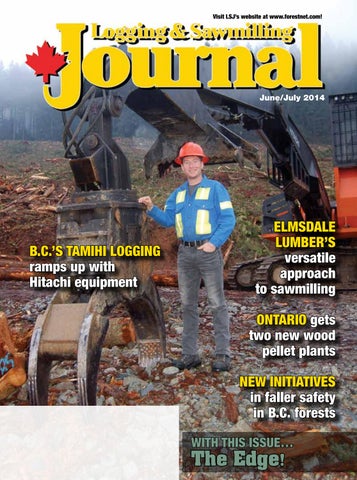
B.C.’s Tamihi Logging ramps up with Hitachi equipment
Elmsdale Lumber’s versatile approach to sawmilling Ontario gets two new wood pellet plants New initiatives in faller safety in B.C. forests With this issue… The Edge!
More Information? Action Card #100
FEATURES June/July 2014 Volume 45 • No. 4 Editor Paul MacDonald Contributing Editors Jim Stirling Tony Kryzanowski George Fullerton Tech Update Editor Tony Kryzanowski
Publisher Rob Stanhope E-mail: stanhope@forestnet.com Phone: (604) 990-9970 Fax: (604) 990-9971 Sales Associates James Booth (604) 990-9970 E-mail: jbooth@forestnet.com Perry Rosehill (604) 613-3001 E-mail: rosehill@forestnet.com
Circulation Manager Maureen Cole (905) 201-0853 Fax: (905) 294-8645 E-mail: mcole@idirect.com Design & Art Production Manager Sheila Ringdahl E-mail: artwork@forestnet.com Office Manager Betty Rosales E-mail: brosales@forestnet.com
Office PO Box 86670, 211 East 1st Street North Vancouver, BC V7L 4L2 Phone: (604) 990-9970 Fax: (604) 990-9971 Website: www.forestnet.com Subscriptions: Canada $58 a year; two years $70; three years, $85. Group accounts, six or more subscriptions, $25 per subscription per year. Outside Canada, $95 per year. Airmail $165. Single copy, Canada $6; elsewhere $10. Reproduction prohibited without permission of the publisher. ISSN 0226-7572. Indexed in the Canadian Magazine Index by Micromedia Ltd. Back copies from 1996 onward are available through our website www.forestnet.com and in microform from Micromedia Ltd., 416-362-5211. Publications Mail Agreement No. 40064045 Return undeliverable Canadian addresses to CIRCULATION DEPT. PO Box 86670 Stn Main North Vancouver BC V7L 4L2 e-mail: mcole@idirect.com POSTMASTER: Send US address changes to LSJ Publishing Group, PO Box 610, Edmonds, WA 98020-0610 Published June/July 2014 Printed in Canada on 20% recycled paper. We acknowledge the financial support of the Government of Canada through the Canadian Periodical Fund of the Department of Canadian Heritage. Logging & Sawmilling Journal is a member/associate member of the following industry organizations:
On the Cover:
Tamihi Logging’s Jesse Dorman is keeping busy these days, operating in the Fraser Valley, east of Greater Vancouver. With the help of some new Hitachi equipment, Tamihi Logging will harvest around 400,000 cubic metres this year. (Photo by Paul MacDonald).
4
Spotlight Private—and productive— B.C. forestlands
29 The Edge
10 Tamihi Logging
38 From mothballed...
Though they may not be high profile, B.C’s privately managed forests are quietly going about contributing to a sustainable—and productive—forest land base in the province, but they still face their own set of challenges.
ramping up
B.C.’s Tamihi Logging is one busy operation these days—harvesting upwards of 400,000 cubic metres a year—and it has made some significant investments in new iron the last several years, including four Hitachi ZX290 Forester log loaders.
16 Elmsdale’s engaged
employees
Nova Scotia’s Elmsdale Lumber has been around for close to 100 years, and their focus on employee involvement and engagement, as well as running a versatile sawmill, is a big part of the reason for that longevity.
24 A modest beginning
in logging
Darrell and Robert Ophus started out modestly in logging equipment with a single skidder, but the brothers now have 19 pieces of equipment to harvest 280,000 cubic metres of mostly beetle wood for forest company Canfor in the B.C. Interior.
Included in The Edge, Canada’s leading publication on research in the forest industry, are stories from the Canadian Wood Fibre Centre, Alberta Innovates – Bio Solutions, Alberta Agriculture and Rural Development, FPInnovations, Woodlands Operations Learning Foundation (WOLF) and Alberta Innovates Technology Futures.
to pellet producer
Rentech Inc. has invested $90 million to convert two mothballed Ontario forest products plants to produce wood pellets using a state-of-the-art stationary flailing and microchipping system from Continental Biomass Industries.
44 Fallers: Keeping
your head in the game
New initiatives are being taken to increase the safety of fallers in the woods, but some of B.C.’s longest-working fallers— who have achieved incident-free 40-plusyear careers—say one of the major things a faller can do is simply keep his head in the game, and stay focused on the job at hand.
62 The Last Word
Sustainability and biodiversity as they relate to forest management are heads and tails of the same coin, says Tony Kryzanowski, and forest sustainability is an environmental dead-end without biodiversity.
DEPARTMENTS
Calendar.........................................................................................................8 Tech Update: Harvesting/Processor Heads ...................................................50 Suppliernewsline..........................................................................................57 Classifieds / Employment Opportunities.......................................................60 Ad Index ......................................................................................................61 Reader Service/Subscriptions.......................................................................61 Logging & Sawmilling Journal - June/July 2014
3
spotlight
Private—and productive—
B.C. forestlands Though they may not be high profile, B.C’s privately managed forests are quietly going about contributing to a sustainable—and productive—forest land base in the province, but they still face their own set of challenges. By Jim Stirling
P
rivate managed forests in British Columbia tend to be forgotten. That’s probably because about 95 per cent of the land and forests in B.C. are publicly owned. But despite their tiny share of the land base, private forests have a larger than commensurate impact. In 2012, 3.94 million cubic metres of timber was harvested from 823,582 hectares of private managed forest lands, contributing more than 3,000 direct jobs to the B.C. economy, estimates the Private Forest Landowners Association of B.C. (PFLA). “B.C.’s private forests are some of the best managed and most productive forests you’ll find anywhere,” says the PFLA.
to page 6 4
While the markets for forest products such as lumber have improved significantly, the domestic price for logs in B.C. remains flat, due to log export restrictions, says the Private Forest Landowners Association of B.C.
Logging & Sawmilling Journal - June/July 2014
JOHN DEERE FORESTSIGHT.™
YOU’LL NEVER SEE YOUR FLEET THE SAME WAY AGAIN.
With John Deere ForestSight, you can see through the woods, inside your machines, and straight into the future. Its true next-generation technology lets you remotely see exactly where your entire feet is any time of day, and also what’s happening inside each machine. Only John Deere ForestSight proactively suggests solutions to potential problems and allows technicians to diagnose and sometimes even repair machines from afar. Best of all, John Deere ForestSight is included in base on all our forestry equipment.
JohnDeere.ca/ForestSight More Information? Action Card #101
spotlight
In 2012, 3.94 million cubic metres of timber was harvested from 823,582 hectares of private managed forest lands, contributing more than 3,000 direct jobs to the B.C. economy, estimates the Private Forest Landowners Association of B.C. from page 4 Private forest landowners share some issues with their counterparts operating on public lands but each also have their own suite of challenges and issues. High on that list for the private forest sector is the
lack of good healthy competition for logs on the B.C. coast, suggests Rod Bealing, PFLA spokesman and the manager of a private forest on Vancouver Island. At the root of that lack of a market are log export restrictions, he says. The federal government’s log export permitting surplus test
More Information? Action Card #102
6
allows domestic mills to obtain logs from private forests at domestic rather than international prices. The domestic prices can be only half the international price for the logs, explains Bealing. So while the other forest products markets for lumber and veneer are improving,
More Information? Action Card #103
Logging & Sawmilling Journal - June/July 2014
spotlight the domestic price remains flat. “Some of our members are on life support. We’ve been promised a resurgence in the domestic prices but we’re still waiting,” he says. The PFLA has been hammering away at this issue with the senior governments for about 15 years and vows to keep at it, he adds. The mountain pine beetle epidemic has completely changed harvesting patterns and intensity on public forest lands in the province. The impacts of the beetle for private forest operators have generally been less dramatic, says Bealing. “A number of our association members in the southeast of the province have been affected (by the beetle epidemic) but they’ve kept on top of it and responded quickly,” he explained. “We tend to manage our forests more intensively and there’s not many over-mature stands.” Bealing says private forest managers are results oriented and that has helped them deal with natural events like beetle epidemics. “We take the view that we’ve paid for our lands and pay property taxes on them (more than coastal stumpage) and we need to maximize our returns as in any other well-run business.”
Private forest managers do not have to manage for the same range of issues as on Crown land and have a simpler regulatory regime and approach, but still must pay close attention to protecting water quality, and sustaining wildlife habitats, continued Bealing. Visual impacts of harvesting operations are another consideration for private forest managers. “We might have to modify our harvesting plans or maintain smaller openings,” he explains. “What we think we’re good at on private land is reforestation,” says Bealing. “We tend to be aggressive with reforestation and aggressive with using improved planting stock. It’s purely a matter of incentive. You don’t have to remind a farmer to plant his corn. We just get on with it,” he says. The PFLA says more than 100 million trees have been planted on B.C.’s private forest lands in the last 10 years. Bealing says using fertilizers to boost tree growth is another common practice among private forest managers, especially when fertilizer prices are competitive. “It can provide some certainty of the landscape.” The fertilizer is typically applied five to 10 years before the final harvest. It can boost a
tree volume and wood quality at harvest. “It just makes sense business-wise. It’s another way we can manage our working forest base more intensively.” When the slopes, the riparian zones, visual management areas and wildlife habitat areas are removed, what’s left is the working land base. “And that’s what we try to intensively manage.” A further example of accomplishing that is through a detailed understanding of what it is you’re managing. “On private lands, we do an inventory on about 10 per cent of the land base each year. As a business, we have to know our growing stock,” continues Bealing. The practice allows better planning to supply future customer needs. Periodically, concerns are voiced about the numbers of European and Asian investors especially looking to acquire private forest land in B.C., during a stuttering and uncertain global economy. But to Bealing the situation represents nothing new. He points back to the 1960s when Europeans
to page 8
Eliminate engine overheating and operator downtime with a Flexxaire engine-cooling fan.
Variable Airflow | Saves fuel AutoReverse | Cleans the radiator
flexxaire.com
More Information? Action Card #104 Logging & Sawmilling Journal - June/July 2014
7
spotlight from page 7 seeking a better life looked to B.C.’s forests for a new start. When they got here, they applied the same stewardship ethic and high level of care they’d learned and practiced in their homelands, he outlines. Private forest managers are also required to observe the specifications as laid out in legislation like the species at risk and migratory bird acts. More than 85 per cent of the PFLA membership operate managed
forest lands under the B.C. Assessment Act and maintain a balance between harvesting and protected areas. Sometimes federal regulations are based on old information and don’t jibe with reality. The federal government has called for 900 hectare reserves around goshawk nesting sites. “Goshawks thrive in managed second growth forests and raise their chicks even when there’s industrial activity nearby,” notes Bealing. This type of issue is shared with forest managers on
TALL ORDERS TAKEN DAILY.
KEEPING YOUR OPERATION ON TRACK AND ON SCHEDULE.
Crown land and First Nations. “We recognize we have public values on our lands and we manage for them,” he adds. Bealing reckons catering for a range of values is part of doing business and sound management practices of private forest lands. It ties in with doing what makes sense “One thing is for certain,” he concludes, “we are all passionate about our lands.”
CALENDAR August 10-12
Forest Products Society 68th International Convention, Quebec City,QC
608-231-1361, www.forestprod.org August 10-14
World Conference on Timber Engineering, Quebec City, QC 418 658-6755, www.wcte2014.ca August 28-30
FinnMETKO, Jämsä, Finland +358 40 9009 410 www.finnmetko.fi September 5-6
69th Annual Lake States Logging Congress, Oshkosh, WI 715-282-5828, www.timberpa.com September 18-20
Pacific Heavy Equipment Show/ Truxpo 2014, Abbotsford, BC 1888-454-7469 www.pacificequipmentshow.com September 25-27
Pacific Logging Congress 7th In The Woods Show, Molalla, OR 425-413-2808 www.pacificloggingcongress.org
Work with North America’s finest forestry equipment and count on the parts you need, when you need them. No matter where you are. Sure, it’s a tall order. But it’s one we’re equipped to handle like never before.
September 26-27
InterSaw / Bio Masse Expo Montreal, QC 1-888-454-7469 www.intersawscie.ca
The full line of service parts and maintenance items for Pierce and Denharco forestry products are available to you without borders, without customs, without delay. Guaranteed.
October 8-11
106th Canadian Institute of Forestry AGM, Salt Lake City, UT 705-744-1715, www.cif-ifc.org
Talk to us today. For our Parts Sales Department call 800.824.3637. We’re ready to live up to your high expectations. www.PIERCEPACIfIC.COM 800.760.3270
October 6-9
Alberta Forest Products Assoc. 72nd AGM, Jasper, AB PORTLAND, OREGON EDMONTON, ALBERTA JACKSON, MISSISSIPPI
More Information? Action Card #105
8
Logging & Sawmilling Journal - June/July 2014
780-452-2841 www.albertaforestproducts.ca
NOT ALL
ARE CREATED EQUAL.
THE FULL LINE OF RAM COMMERCIAL VEHICLES CHASSIS CAB WITH BEST-IN-CLASS TOWING (29,600 LB) HEAVY DUTY WITH BEST-IN-CLASS 30,000 LB TOWING
1
2
CARGO VAN WITH BEST-IN-CLASS CARGO CAPACITY 4,403 L (155.5 cu ft)
PROMASTER TM WITH BEST-IN-CLASS PAYLOAD 2,009 kg (4,430 LB)
3
4
RAM 1500 ECODIESEL WITH THE BEST FUEL ECONOMY OF ANY PICKUP EVER. UP TO 40 MPG/HWY PLUS 420 LB/FT TORQUE 5
RAMTRUCK.CA Based Bas edd onn Cla Cl ss s 3-5 3 pi 3picku ckupp base cku base as d conv nvent ention ent ional ion al Cha Chassi ssi siss Cab. si Cab. 2Bas B ed on 250 500/F 0/F /F-25 -2550 and 350 3 0/F 0/F-35 -3 0 full -35 full ull-si -si size ze picckup u s. s Spe pecif cif ific ic mod m els an mo a d oopti ptiona pt pti onall equi on ona quippme qu ment may bee reeqqui u red re to ac achie hieve hie v max ve maximu imum im imu m rati rati ati t ngs. ngs gs. Pllea leea e se s see s yo y ur de ler dea err foor ffull u de ull detai etai ta ls. s. 3Bas ased e on Cla ed Class ss 1 Smal m l CCarg argoo Vans arg Vans ans.. 4Bas Based edd on 201 0144 Ward’s War ard’s d s La Large rge Va Vann segm egment entati ent ation. at ati on Ba on. B sedd on ssttand andard arrd GV ard GVWR. WR 5Bas WR. Based edd onn 201 20144 Ener 20 Ener ner Gui Guide hig Guide highwa hwayy fuel hw hwa fuel ue co consu nsumpt nsu mption mpt ion on ra ratin tings. ti gss Go gs. Gover vernme ver n nt of nm nme o Can Canad ada tes est meth est etthodss us used. used. d. Yo Your urr act ac ual uaa fuuel con co sum mpti pttion on wil will i l vvary ary ry based based ba edd on dr drivi ivi ving ng hab habits its an a d othe othe th r fact fact actors ors rs. 110.2 0 L/ 0. 0.2 L/100 100 km (2 (288 mpg) mpg pg) g) ci city ty and 7. 7 1 L/10 L /10 1000 km km (400 mpg mpg)) high ighway way on Raam 1500 1500 500 4x 4x22 m mode odeel w with i 3.0L 0LL Eco Ec Die D sel e V66 an andd 8-s 8-spee -sspe pee eeed aauto uto tomat matic. mat ic. ic c. AAssk you our ur re r tai taailer fo forr EEner nerGui ne ner Guide Gui de infform o mati ati tion. on. on 1
More Information? Action Card #106
contractorprofile
Tamihi Logging ramping up
B.C.’s Tamihi Logging is one busy operation these days—harvesting upwards of 400,000 cubic metres a year—and it has made some significant investments in new iron the last several years, including four Hitachi ZX290 Forester log loaders.
By Paul MacDonald
A
fter a period of years of just plain hunkering down to keep equipment and people busy, logging contractors in B.C. are now ramping up to take part in the recovering markets for both lumber and logs. Tamihi Logging, based in the Fraser Valley east of Greater Vancouver, knows what that is all about. Over the last two years, they’ve invested in iron—a lot of iron. This year, Tamihi Logging will harvest around 400,000 cubic metres, about 210,000 of that through the company’s forest licences and woodlots, and the rest from bids on B.C. Timber Sales. In addition, they do logging and forest management work for five First Nations bands in the Fraser Valley. At any one time, the company will be logging in up to 11 different areas in the region, producing 40 to 50 truckloads of logs a day. They run two log sorts, and three sorts in the summer months. Tamihi Logging is owned by Brian Dorman, who started up Dorman Logging on southern Vancouver Island right out of high school, in the 1970s. “When we started out, I was complaining to the contractor that he wasn’t moving the logs we’d harvested from the landing fast enough for us to make any money,” recalls Dorman with a laugh. “So things went round and round, until they said I could do the loading and see if I could do better than them. Turned out I did do better. By the next summer, we were double shifting and I owned a logging truck.” That was a Mack truck, affectionately nick-named 10
Tamihi Logging has 26 highway trucks, five off-highway trucks, two lowbeds, 16 log loaders, three bunchers, two processors and three grapple yarders. The equipment fleet includes a fair bit of Hitachi equipment, from B.C. Hitachi dealer, Wajax.
Logging & Sawmilling Journal - June/July 2014
contractorprofile
Jesse Dorman (above, left), woods foreman and dryland sort supervisor at Tamihi Logging, and Tamihi operations manager Rick Delves at the company’s shops. Tamihi Logging took over an existing maintenance shop, and they have since expanded the shop to five service bays.
“Thunder-Momma”, with a Poclain loader “That was 40 years ago, and I’ve haven’t slowed down since,” says Brian. In recent years, Brian has moved operations over to the B.C. Mainland, to take advantage of better opportunities, in the timber-rich Fraser Valley, with Tamihi Logging, which is named after a local creek. Today, Tamihi Logging has a large array of logging equipment, and three of Brian’s sons are in the business. His oldest son, Jesse, 27, is a woods foreman and dryland sort supervisor, and Justin is a scaler at their sort in Harrison Bay and Jordie works with their engineering department. Twins Justin and Jordie are 25-years-old. Jesse used to run a buncher for the company on Vancouver Island, when it was doing work for Island Timberlands and TimberWest. He moved over to the B.C. Mainland about three years ago, to be woods foreman. These days, Tamihi has 26 highway trucks, five off-highway trucks, two lowbeds, 16 log loaders, three bunchers, two processors and they run three Madill grapple yarders. In the equipment fleet is a fair bit of Hitachi equipment, from B.C. Hitachi dealer, Wajax. Included in this are four new Hitachi ZX290 Forester log loaders, a ZX290 Forester road builder, a 210 road builder and a 290 Rock Drill. “We’ve picked up seven pieces of new Hitachi equipment in the last two years alone,” says Jesse, as part of a general equipment upgrade/ramp up. And the Hitachi iron is working out
well for the operation. “The current series of Hitachi machines seem to be bulletproof,” says Brian. “We’re running them hard, yet we’ve had no warrantable items fail whatsoever. We change the oil and air filters, wash the machines, and they just run and run.” Hitachi and Wajax put together an attractive equipment deal for them, says Jesse. “Equipment pricing and financing are always a big item, and the financing package was attractive. And the Hitachi equipment gets the job done at a good cost. The machines are good on fuel, with their Isuzu four cylinder engines.” The Hitachi’s are a good fit working with a grapple yarder, a mini-tower operation or just plain loading, he says. “And they do some solid hoe chucking. We’ve got a good operator doing hoe chucking on one of the Hitachi machines, and he’s getting good production numbers, even in some big wood.” Tamihi Logging also has a fair bit of Madill equipment, including eight log loaders—a combination of 2800, 2850 and 3800 machines. “The 3800s are just plain workhorses”, says Jesse. “For hoe chucking, you can’t beat them. They have such good swing power uphill.” They also have three Madill grapple yarders—two 120 machines, and a 122 unit—three Madill 071 mini towers and
Logging & Sawmilling Journal - June/July 2014
11
to page 12
contractorprofile from page 11 two older 90-foot Madill yarders. They have two Madill bunchers, a 2250 tilter with a 24-inch Quadco head and a 2250 flat bottom, with a Madill head. Also fairly new to the operation is a Tigercat 870 buncher, with a Tigercat head, and a massive Tigercat 635D skidder, from B.C. Tigercat dealer, Inland Kenworth Parker Pacific. “That 635D is a monster,” says Jesse. “It can move a lot of wood. The Tigercats are working out great—we’re happy with them, and the operators love them.” Just prior to their purchase of the Hitachi equipment, they bought three Cat 325 machines, two of which are doing processing work, and the other is a log loader. The 325 machines have Waratah 624 heads. Also new in the last few years are two Cat 320 machines, and a John Deere 210. Also in the equipment line-up at Tamihi Logging are some Link-Belt loaders, and a Hyundai loader with a power clam in one of their log sorts. Tamihi Logging’s large number of loaders gives them flexibility in the bush, and at their log sorts, says Jesse. “We have some spare equipment that we can rotate in if a loader needs to come in to the shop or needs some maintenance out in the bush. We just had one of the Madill 2800s in for some work—but that wasn’t a problem.” Some years ago, Tamihi Logging took over a maintenance shop and office building from forest company Canfor, which used to have operations in the region, and
At any one time, Tamihi Logging will be logging in up to 11 different areas in the Fraser Valley, producing 40 to 50 truckloads of logs a day. They run two log sorts, three sorts in the summer months. they have since expanded the shop to five service bays. On the maintenance side, equipment reports are issued every week, showing operating hours and what equipment is due for servicing. They also have an annual capital project plan. “It deals with major repairs, such as equipment rebuilds and undercarriages, that kind of work,” says Tamihi operations manager, Rick Delves. Rick adds that the plan is flexible, however, so if something pressing comes up on the repairs side, they can
More Information? Action Card #107
12
Logging & Sawmilling Journal - June/July 2014
re-allocate the capital and manpower in the shop. One of the more recent changes at Tamihi was the installation of a weigh scale at the sort at Hatzic. “That was a big step in the right direction,” says Jesse. “We get a lot of big beautiful fir, but we also get some smaller hemlock, too, which means a lot of pieces. The weigh scale sure saves us time vs. the guys doing manual scaling.” The company now also has its own in-house log broker, Daryl Rouleau, which helps maximize revenue for the mix of species and log sizes. “Daryl is very hands on—he makes the bucking cards for the guys, goes out to the field to talk to the processing operators and goes down to the log sorts, to talk with them about what the markets are looking for.” Because of their proximity to urban areas—they are fairly close to the communities of Mission, Abbotsford and Chilliwack, and sometimes to major roads— with their logging operations, Tamihi has had some problems with equipment damage, and even arson. Several years’ back, a dump truck, excavator and rock drill owned by the company were destroyed by a fire that had been deliberately set. Tamihi now uses the services of a security firm to monitor its logging sites, log sorts,
to page 14
More Information? Action Card #108
contractorprofile from page 12 offices and shop, using hidden cameras and patrol vehicles. Anyone looking to do further mischief is going to pay the price. Jesse notes that they recently discovered someone looking to steal some tools from equipment in the bush, on an early morning. “Rick was out there with the RCMP, and the RCMP officer had their gun drawn on the guy. The guy was arrested and charges are going to be laid.” But their location also works favourably for Tamihi, too, in that it’s close to home for a lot of their employees. Experienced people are hard to come by in the B.C. forest industry these days. “We’re probably the biggest logging company operating in the Lower Mainland, and it’s a desirable place to live and work vs. operating up the B.C. Coast, which is more remote. If guys have options, they’d rather be home with their families at night,” says Jesse. Jesse, for example, lives in an eastern suburb of Vancouver, and commutes to the Tamihi operations. Jesse says the move from running a
buncher to managing operations in the woods for Tamihi has been a good one for him. “I enjoyed running buncher— ever since I was a kid, I loved machines,
More Information? Action Card #109
14
Logging & Sawmilling Journal - June/July 2014
and I’d be out there with my Dad every chance I got. But I like managing, too, and being busy, and making sure things are going as best as they can in the bush.
“But I do miss running equipment a little,” he admits. “I hopped on a buncher the other day for a couple of hours, and it was nice to only have to worry about what’s going on right in front of you, at least for an afternoon.” Jesse’s Dad, Brian, thrives on getting out in the bush. He enjoys the challenge of figuring out the engineering and logistics of how to successfully harvest trees on a particular block— since, of course, no two are the same. “Figuring out what timber there might be on a mountain side, walking it and then figuring out how you’ll build the roads and landings to maximize the harvest with minimal impact— that’s exciting to me,” says Brian. Brian also works closely with the First Nations bands in the area, offering to help out with business plans and strategy. They also offer engineering services, since Tamihi has its own engineering department. In fact, Tamihi pretty much does it all—from the planning and engineering right through to overseeing the tree planting. While Tamihi will be busy with its own tenure, the company is also looking to do more Timber Sales in the future, says Jesse, and it’s well equipped to do that. “There are smaller companies that can do Timber Sales, but a lot of the sales are high lead and mechanical, so that fits us quite well, since we can do both.” They are also looking for further opportunities to do more work with local First Nations bands, to help the bands increase their forest management capabilities.
It’s a family affair at Tamihi Logging. Jesse Dorman, 27, (above) is a woods foreman and dryland sort supervisor. Justin Dorman is a scaler at their sort in Harrison Bay and Jordie Dorman works with their engineering department. Twins Justin and Jordie are 25-years-old.
More Information? Action Card #110
Logging & Sawmilling Journal - June/July 2014
15
E
millprofile
lmsdale’s engaged employees
Nova Scotia’s Elmsdale Lumber has been around for close to 100 years, and their focus on employee involvement and engagement, as well as running a versatile sawmill, is a big part of the reason for that longevity. By George Fullerton
E
lmsdale Lumber is looking forward to celebrating an important milestone in just a few years. The sawmill enterprise was established in 1917 by the Wilber Family in the community of
Elmsdale, Nova Scotia, just east of Halifax, and was incorporated as Elmsdale Lumber Company in the 1950s. Elmsdale has operated continually since then, as a long lumber mill, with current annual production around 28 million board feet.
The current management team is led by third generation owner and current president, Robin Wilber, and his son, Mark, sits in the vice-president position. Controller Gennie Himelman and General Manager Stephen Thompson complete the management team. Right from the front gate and business office, Elmsdale Lumber strikes visitors as being a very orderly operation. Even in early spring, with snow banks giving up their very last vestiges, the operation is neat and clutter free. The orderly status extends into the office environment, which is simultaneously very welcoming and business focused. The pavement around the mill and lumber piledown area adds to the orderly appearance, and
to page 18 16
Logging & Sawmilling Journal - June/July 2014
Samuel Strapping Systems
SAVINGS AT THE SAWMILL & KILN THE BENEFITS OF USING STRAPPING IN SAWMILL AND DRY-KILN APPLICATIONS Deformation of stacked green lumber during kiln drying costs sawmills significant amounts of money in degraded material and labour. Solutions have been put forward to resolve this, such as concrete slabs or hydraulically actuated kiln-mounted plates, but the former is dangerous and time consuming and the latter is only limited to certain facilities. However, these solutions are not ideal for high-capacity continuous dry-kilns. While effective and efficient, continuous dry kilns present their own unique fire and safety hazards--especially from boards that fall off during the continuous drying process. Polyester strapping is a much more practical and cost-effective solution. It is much safer and maintains package integrity even when the load is being moved around the yard. This eliminates fallen pieces and the resulting safety issues and labor costs. It also helps prevent fires at the continuous kiln by ensuring each load maintains its integrity throughout the drying process. Other benefits include: Q
Reduce downgrading due to twisted, crooked and warped pieces (can provide up to a 4% increase in kiln yield)
Q
Secured package right after stacking
Q
Helps maintain stickers in place
Q
Reduced labor costs and increased workplace safety
Q
Increases fire safety by preventing boards from falling into the kiln
Samuel Strapping Systems
More Information? Action Card #111
Packaging and Unitizing Solutions
www.samuelstrapping.com
U.S.A. - 1-800-323-4424 Canada - 1-800-607-8727
www.youtube.com/samuelstrapping
millprofile from page 16 that organizational effort extends to the well graveled log yard. While the industry downturn led to shutdowns and a number of mill closures across Nova Scotia, Elmsdale managed to keep operating without layoffs or extended shutdowns. Gennie Himelman points to three critical elements that allowed the mill to weather the downturn. “We have dedicated owners and managers who work in the operation every day, we have a versatile mill that can adapt to just about
any customer request for dimensional lumber and we have developed a very skilled and engaged workforce who are focused on the business and the success of this company. “We take a team-based approach to production and business every day,” she added. Elmsdale Lumber starts the work week with a Monday morning supervisor’s meeting that brings together all the mill and yard supervisors—and their assistants—along with the management team and, notably, their lumber broker. “We have around twelve people in the boardroom and we start off with a report from our lumber broker,” says Himelman. “Our broker goes over markets from a global perspective, as well as our order book for the week and the near future. Having all supervisors keenly aware of our near term lumber production goals is a powerful tool.” Following the lumber broker’s report, the meeting expands into operations and the current order file, and any weather, machinery, delivery or safety issues. In addition to Monday morning management meetings, Elmsdale also conducts a pair of Wednesday meetings that engage the entire staff, Himelman explained. “We review our order book and general lumber markets, then open the meeting up to
Elmsdale General Manager Stephen Thompson (left) says that the company’s high level of employee engagement is a result of building skills and the knowledge capacity of their staff. Elmsdale endeavors to cross train all their employees for at least two stations in the mill and yard operations.
18
Logging & Sawmilling Journal - June/July 2014
any subject, including safety, that employees want information about. These meetings give employees first-hand knowledge about what they are working on today, this week and in the future. “We know the goals that we are aiming for, we all know what the challenges are, and we have a plan we work on together to achieve the goals.” Elmsdale has a formal safety committee, and it conducts quarterly safety audits of the entire operation. Safety committee members are selected from among the entire staff and are assigned to the committee for two years. The audits are guided by a comprehensive checklist and noted deficiencies or concerns are acted upon quickly. Himelman and General Manager Stephen Thompson both agree that their high level of employee engagement is a result of building skills and the knowledge capacity of their staff. Elmsdale endeavors to cross train all their employees for at least two stations in the mill and yard operations. It encourages their employees to switch stations at least once a day. Thompson explained: “Having people cross trained is an operations strategy. Production is never down or slowed for lack of a trained person to operate a station in the mill or in the yard. Secondly, cross training has a productivity payback. We find that our mill productivity is maintained at an optimum level when people switch stations. Our research shows if a person works just one station all day, productivity generally falls off toward the end of the day.” Elmsdale has utilized employee surveys to measure job satisfaction and other work related matters. One question,
specifically, asked what work station each individual employee would like to be trained for. With one survey, the work station training preference was followed by an open-ended question: What other training would you like to have? This led Elmsdale to a particularly interesting exercise. “About one quarter of our employees replied that they would like to complete a General Equivalent (High School) Diploma,” Robin Wilber explained. They were surprised with that response, but it really reflects that a lot of employees grew up and entered the workforce in a time when a High School education was not as important as it is today. “It was remarkable to see that a good percentage wanted the opportunity to achieve the goal of getting that level of formal education,” said Wilber. “We considered those results for just a short time before we contacted the Department of Education and gained their support to set up a program to work with our employees. The Department arranged for a teacher, and we set our boardroom up as a classroom and arranged for scheduled classes immediately following the work shift. “It was remarkable to see the enthusiasm and commitment that our workers put into their studies—and their graduation day was a celebration for all our employees and their families.” Himelman added that Elmsdale has an ongoing vocational education program, focusing on employee knowledge about machines and processes, equipment
to page 20
Taking place at the internationally renowned Olympic Stadium in beautiful Montreal, this show will focus on the full spectrum of sawmilling equipment and technology. And don’t miss... See the latest biomass equipment, including grinders, pellet mills, fibre dryers, boilers, conveyors, silos, packaging, mill yard equipment, and more! • See equipment not found at other industry events • 200,000 sq. ft. of Exhibit Space • Seminars on hot industry topics (see website for full details)
For more information, please contact:
Shawn Murphy • smurphy@mpltd.ca
Toll Free: 1.888.454.7469
ONLINE REGISTRATION NOW OPEN!! Your show badge gives you admission to all events AND all seminars! More Information? Action Card #112 Logging & Sawmilling Journal - June/July 2014
19
millprofile from page 19 operating procedures and even communication skills, both verbal and written. This even extends to effective (proper grammar) texting and e-mail communications. Employee engagement is also supported by a monthly newsletter, which includes a column written by their lumber broker, and columns by various supervisors and workers. Beyond the mill, family and events get included as well. Elmsdale has also built a succession plan into the supervisory and management positions in their business. Every supervisor and manager has an identified protégé, who is being trained and or groomed to step up to or into the position when the senior person retires. Each protégé shadows a senior person to gain a clear understanding of the responsibilities of the job. They get assigned ‘learning’ tasks, discuss issues and systems with their mentor, and get challenged with special projects or tasks. The succession plan will make the transition to a new generation of managers as seamless as possible. Elmsdale’s log supply is 90 per centplus spruce, and is mass-scaled using onsite scales in the paved yard. Truckers are provided with a security gate code, which allows 24 hour delivery. Most of the log trucks delivering wood are centre mount loader equipped, and the driver/operators know the log piles are sorted by length, and place their loads accordingly. Elmsdale has a Fuchs MHL460 grapple loader and triaxle yard trailer, in addition
Elmsdale Lumber has a Fuchs MHL460 grapple loader and triaxle yard trailer, in addition to a couple of loader-equipped tandem trucks, for unloading other log trailers. The Fuchs also feeds logs to the mill.
to a couple of loader-equipped tandem trucks for unloading other log trailers during operating hours. The Fuchs also feeds logs to the mill. “We have operated the Fuchs for about nine years, and it has given us good service. It provides versatility, visibility, reach and power. It has been a good machine for us,” commented Thompson. The Fuchs operator keeps in radio contact with the debarker operator, to make sure the right proportion of large and small logs are supplied to the infeed decks to supply the mill’s twin saw lines.
On most mill runs, Elmsdale assigns a lumber grader after the trim saws to identify lumber that will make their (long and short) clears, and other specialty products. After the trim saws, lumber proceeds to a Carbotech 98-bin lumber sorter. 20
Logging & Sawmilling Journal - June/July 2014
The Forano debarker is a twin rotor design, that slides sideways in a frame lining up the log infeed with one of the two Cambio debarker heads. The smaller side handles diameters up to 18 inch and the larger side handles log diameters up to 30 inch. The large logs feed a Cardinal carriage and single cut PHL band saw. Small logs are handled by a PHL twin saw with 40 inch saws. Elmsdale staff have added top saws to the twin, which Thompson pointed out allows the twin to handle larger diameter logs, making the mill a little more efficient. Lumber from both saws feed to a nine-inch Valley Industries combination bull and board edger, which runs 26 inch saws. The edged lumber proceeds to a manual pull station, where trim and waste is directed to the chipper and low grade lumber (wane, defect) is sent back to the edger for remanufacturing. On most mill runs, Elmsdale assigns a lumber grader after the trim saws to identify lumber that will make their (long and short) clears, and other specialty products. After the trim saws, lumber proceeds to a Carbotech 98 bin lumber sorter that went into operation in November 2010. A 150 horsepower KMW boiler provides steam to a pair of American Wood Dryer kilns that were installed in 1995. Each kiln has an 80,000 board foot capacity. The planer is a Yates model
to page 22
More Information? Action Card #113
millprofile from page 20 A15SK with hydraulic feed drives and electric heads that was installed in 1999. The planer mill also hosts a vintage Yates resaw. “The resaw is old, but works great and it provides critical versatility to the mill, allowing us to produce a wide range of lumber sizes and even clapboards,” Thompson explained. “The planer mill has a precision trim saw which allows us to break down lumber length to supply specific length lumber to different specialty markets, including residential fence boards.” Planer shavings are fed to the KMW boiler and excess supply is marketed to the Shaw Manufacturing pellet mill. Elmsdale markets are primarily domestic, in Nova Scotia and the Atlantic Provinces, and some in to the U.S. as their housing construction recovery gains strength. Elmsdale owns some 28,000 acres of woodlands, which Gennie Himelman describes as an important strategic asset. “The woodland was a critical asset that helped us to weather the lumber industry
downturn. When our fibre supply tightened up and lumber prices were very low, we were able to harvest more from our woodlands, but still within a reasonable level, to help keep the mill supplied. “It’s critical that we keep our harvesting in a sustainable window. We can’t exploit the wood supply too hard, or the resource will not there—and be available, when we need it,” emphasizes Himelman.
More Information? Action Card #114
22
Logging & Sawmilling Journal - June/July 2014
Forest Technician Jason Casey and Operations Supervisor Greg Grant handle Elmsdale’s own woodlands management, in addition to the silviculture program they provide to wood suppliers. Beaver Dam Enterprises, a full range harvest contractor, operates Elmsdale woodlands and the stumpage contracts Elmsdale arranges with woodlot owners.
Baldor’s Dodge® Motorized TorqueArm II® offers a beltless, AGMA rated solution for areas where standard belt driven reducers won’t fit. Combining high power capacities with a narrow profile, this line of C-face reducers includes harsh duty features as standard and delivers the highest power ratings, longest life, ease of installation, maintenance and removal in the industry. And, you can find Baldor•Dodge Motorized Torque-Arm II reducers at your local Motion Canada location. Our local sales and service specialists are experts in application and technical support, providing the parts and the know-how you need to stay up and running.
Call. 800-526-9328 Click. www.motionindustries.com Visit. Over 550 Locations
The brands you count on from the people you trust...that’s Baldor and Motion Canada.
Call. 800-526-9328 Click. www.motioncanada.com Visit. Over 50 Locations
More Information? Action Card #115
Téléphone 800 526-9328
A
contractorprofile
modest beginning in logging
Darrell and Robert Ophus started out modestly in logging equipment with a single skidder, but the brothers now have 19 pieces of equipment to harvest 280,000 cubic metres of mostly beetle wood for forest company Canfor in the B.C. Interior.
Darrell (left) and Robert Ophus of Sob Lake Contracting, working in an area to the southwest of Canfor’s Isle Pierre sawmill, earlier this year.
By Jim Stirling ushing the rump of the winter logging season in the Central Interior of British Columbia is frequently a necessity, but always a risky day-to-day venture for logging contractors and truckers. Most often the capricious pre-spring
weather deals a joker and frustrates logging plans. But sometimes the weather gods smile. The side roads remain frozen. New snow is light or non-existent. Temperatures remain a few degrees below zero, good for machines and production. Logging trucks can get in and back out safely and the mill
24
Logging & Sawmilling Journal - June/July 2014
P
receives the log volumes it requires, when it requires them. Such was the brief but welcome scenario for Sob Lake Contracting and its crews deep into March of 2014. The off-highway loads of cut-to-length sorts they produced were bound for Canfor’s Isle Pierre sawmill west of Prince George
contractorprofile on the Nechako River, where most of the volume was scheduled for hot loading into the mill. Sob Lake Contracting runs mainly Caterpillar equipment and operates off the Bobtail Forest Service Road and its feeders to the southwest of the Isle Pierre mill. It’s home turf and very familiar territory for brothers Darrell and Robert Ophus who run Sob Lake Contracting. They grew up in the area and run cattle raising operations there. “That’s one of the reasons why we were interested in this licence when it became available,” recalled Robert Ophus. That was about nine years ago. “It’s worked out very well for us over the years. There’s a Finning field mechanic based in (nearby) Vanderhoof and the Cat service for us has been unbelievable. We can simply get a replacement machine if something goes down,” he said. “Canfor has been good keeping us in wood and help us plan ahead with our logging phases.” Sob Lake has a 280,000 cubic metre annual allowable cut with Canfor and operates about 19 pieces of major equipment to produce it. That’s quite the measure of progress since 1985, when Robert Ophus bought a Clark 666 skidder. (The machine’s still around, doing service as a water truck.) He went logging with the Clark, primarily in private wood. Around 1988, the Ophus brothers acquired a Cat 215 with a Steyr processing head. (The 215 is still contributing, too, working around the farm equipped with a bucket: “Just hit the key and it keeps on running”) When the 20-something brothers went shopping for their processor, they were fortunate to have an astute local banker; he listened to the Ophus’ business plan, recognized it had merit and they were in business. “We just gradually grew from there.” They worked on private wood, acquired cuts and bought timber sale licences in their preferred operating area, a practice Sob Lake continues. The region has been hit hard by the mountain pine beetle epidemic and Robert reckons 90 per cent of their present cut is in beetle killed wood. It’s characteristically small volume, with average piece sizes around .25 cubic metres. It’s the type of logging that requires more machines to produce the volumes required to compensate for the small piece sizes. Three Tigercat 870 feller bunchers are responsible for the falling phases along with a John Deere 903J. The 870s have
22 inch heads with full rotation wrists. Despite the predominantly small wood sizes, Robert said the larger 870s are used because they work well within themselves, last longer and command a better re-sale price. Sob Lake operates two Cat 535 skidders and a 545 and six Cat 320B processors with Waratah 622B heads. There’s also a Hitachi 200 butt n’ top. On the bulldozer side, Sob Lake runs a Cat D7R, a D8 and a D6D. The company operates one dedicated logging truck and another that’s predominantly used as a low bed. Moving equipment around is a constant, often to access small patches. Part of that is reflected by the approximately 70 kilometres of block roads Sob Lake builds each year “We go with new harvesting equipment rather than used,” confirmed Robert. “New equipment has worked really well for us. It keeps downtime minimal and you know your costs. Nowadays,
operators want newer equipment,” he added. The bulldozers are the exception to the “buy new” credo. “You can still get parts for old Cats like the D8,” he noted, and their re-sale value is more steady than high. Sob Lake enjoys very little turnover within its operator ranks. Each operator has his own main piece of equipment to run and be responsible for day-to-day maintenance like greasing. But there’s a built-in versatility by design. “All our crew can pretty much run anything.” As a rule, Sob Lake doesn’t double-shift its logging equipment and maintains a full time mechanic. There’s a strong family involvement in the company’s operation, including the brothers’ wives. Robert’s wife, Vicki, is Sob Lake Contracting’s secretary and manages the payroll while
to page 26
More Information? Action Card #116 Logging & Sawmilling Journal - June/July 2014
25
contractorprofile
Sob Lake Contracting operates mostly Caterpillar equipment in its logging operations in B.C.’s Central Interior. It has a 280,000 cubic metre annual allowable cut with Canfor and operates about 19 pieces of major equipment to produce that volume. from page 25 Roseanne, Darrell’s wife, is safety co-ordinator. Sob Lake is a certified SAFE company, under the BC Forest Safety Council. Both the partners have sons working with the company.
An interesting feature at Sob Lake’s cut-to-length operation is the layering of the main wood sorts, with 12-foot material on the bottom, then the 24-foot and two sorts of 36-foot lengths. The decks are built slightly back from the immediate road side to help the butt n’ top load the incoming logging trucks. Robert reports the loadermen appreciate the system and
26
Logging & Sawmilling Journal - June/July 2014
so do the truckers who can get their load on and turn around faster. Machine operators get used to dealing with the steady diet of small bug killed wood. Any new developments in material handling are of interest, though. Equipment that can multi-stem small wood is an example. “We’ve been looking at it for sure,” confirmed Robert. Maintaining quality standards is a top focus for the outfit. Canfor, like most licencees, has tight specifications governing the wood it requires, including precisely measured lengths. But appraising the different options is part of the logging contractor’s oxygen: it’s why they’re out in the bush using the appropriate equipment for them to get the job done cost efficiently whatever the circumstances—or the weather—throws at them.
Purpose-built
from the ground up Log Loaders from SENNEBOGEN – 44,000 lbs. to 750,000 lbs. Simple design… Lift more. Move faster. Save fuel. Run longer. www.sennebogen-na.com Tel: +1-704-347-4910 More Information? Action Card #117
And to prove it, we’ll give you a
FREE SATELLITE PHONE. At Globalstar, we’re so confident that our crystal-clear calls can help you do your job even better when you’re beyond cellular, we’ll give you a free phone.* THAT’S AN OFFER THE COMPETITION WON’T MAKE.
Call now to get your free phone or visit Globalstar.com/getfreephone
THE NEWEST, MOST MODERN NETWORK OFFERS: Clearest satellite voice quality Most affordable airtime plans Fastest mobile handset data service Canadian-based phone number
(844) 655-4562
*Additional terms and conditions apply. For offer details, visit Globalstar.com/getfreephone or call (844) 655-4562. ©2014 Globalstar.
More Information? Action Card #118
The Edge
June/July 2014
FPInnovations introduces Steep Slope Initiative at Safety by Design Symposium
F
PInnovations unveiled its new Steep Slope Initiative at the recent Safety by Design Symposium held in May in Vancouver, B.C. The symposium was organized by WorkSafeBC and the Association of Canadian Ergonomists. The new Steep Slope Initiative is a multi-year program to improve access to timber on slopes. It will expand FPInnovations’ steep slope related work, and its focus is on technology and innovation for maximum safety and minimal environmental impact. FPInnovations researcher Brian Boswell gave a presentation on the current develop-
ments in FPInnovations’ Steep Slope Harvesting Research Program and presented results from recent machine stability tests. The machine stability tests compared the stability of tilting and non-tilting feller-bunchers for working on slopes. The results showed that the tilting machine’s stability on a 50 per cent slope was equal or better than the non-tilting machine’s stability was on a 40 per cent slope. FPInnovations’ steep slopes harvesting research program helps its members improve safety and reduce costs when operating on the steeper terrain common to many areas in British Columbia.
Current research topics include development and validation of a static stability testing protocol, evaluation of a tilt-cab loader-forwarder, linkage of LiDAR-based ground mapping to as-experienced machine inclination, and the application of six-wheel skidding systems to steep slopes. Future projects will extend the learnings from the recent feller bunchers tilt-table testing into real-world application.
Logging & Sawmilling Journal - June/July 2014
29
For more information, please contact Brian Boswell at brian.boswell@ fpinnovations.ca or (604) 222-5734.
The Edge
FPInnovations receives funding for the development of wetland roads field guide
C
anada’s forested landscapes feature numerous wetlands, such as fens, bogs and swamps, which present environmental and operational challenges during the planning, construction and maintenance of resource roads. Since 2010, FPInnovations has been developing solutions to guide road managers in planning and building roads across wetlands. This ongoing work has produced numerous reports, articles and presentations at workshops, many of which are now available on the FPInnovations website at: http://wetlands.fpinnovations.ca. The most recent publications include: • An update on the performance of geogrid for foundation improvement on small culverts. • A profile of the construction techniques used for an all-season access road in Alberta. • An update on proposed design concepts for improving foundations for small culverts.
• Proposed wetland best practices for crossings across wetlands with stagnant, lateral and fluctuating subsurface flows. FPInnovations is now focused on bringing together the knowledge gained in recent years in the development of a national field guide to aid in the planning, construction and maintenance of resource roads across wetlands. This work will begin in the summer of 2014 and plans are to have the field guide available by late 2015. In support of this work, FPInnovations recently received a Sustainable Forestry Initiative Conservation Grant to aid in the development of this national field guide (http://www.sfiprogram.org/media-resources/news/sfi-invests-in-forest-conservationresearch/). The submission for this funding opportunity was supported by many project partners including FPInnovations
30
Logging & Sawmilling Journal - June/July 2014
members J.D. Irving Ltd., Resolute Forest Products, Weyerhaeuser and the Ontario Ministry of Natural Resources. In addition to the development of the field guide, FPInnovations will continue to support the monitoring of ongoing study sites, as well as the establishment of possible new study sites.
For further information on research efforts by FPInnovations on resource roads and wetlands, to propose new research study opportunities, or to discuss applications of this work in your operations, please contact Mark Partington at mark.partington@fpinnovations.ca / 514-782-4525 or Clayton Gillies at clayton.gillies@fpinnovations. ca / 604-222-5674.
The Edge
Alberta stumpage fees collected by FRIAA help support WOLF training programs By Tony Kryzanowski
B
y tapping into a portion of the stumpage fees collected from Alberta forest companies, the Woodlands Operations Learning Foundation (WOLF) is providing an invaluable service to Alberta’s forestry sector by providing training and learning resources to produce a pool of well qualified potential employees, and more knowledgeable current employees. Forest Resource Improvement Program (FRIP) fees are collected from industry by the Forest Resource Improvement Association of Alberta (FRIAA). It consists of over 30 forest industry members, including all the major Forest Management Agreement holders, as well as quota holders and smaller operations. FRIAA has been delegated responsibilities—by the Minister of Environment and Sustainable Resource Development (ESRD)—to promote and initiate projects that enhance Alberta’s forest resources using the FRIP funds. In addition to FRIP, the association also manages the Community Reforestation Program, the Mountain Pine Beetle Program, the Mountain Pine Beetle Forest Rehabilitation Program, the Wildfire Reclamation Program, and the FireSmart Program. Since 2005, FRIAA has provided WOLF with over $1 million in FRIP funds to provide learning resources and program delivery in the areas of pre-employment programs that introduce and promote forestry as a career choice. It also provides continuing education in forest resource and environmental management for the industry’s existing workers, which helps industry retain workers. “FRIAA is a very big player in our world,” says Dave Blackmore, WOLF executive director, adding that its financial support has been crucial to helping to sustain the foundation’s learning resource development and delivery over the years. He adds that through FRIP-supported programs such as EDWood, Forest Resource Environmental Education (FREE),
and the Public Involvement, Education and Awareness Project (PIEAP), WOLF has provided over 5,000 days of student training as well as built and maintained 20 one-day courses. Though FRIAA paid the tuition for these courses through WOLF, the cost of the time and travel for the students is a better reflection of how much these courses are valued by the subscribers. Todd Nash, FRIAA general manager, says the association is very pleased with the partnership it has developed with WOLF, emphasizing that the industry as a whole benefits from this relationship as the financial support for the training programs developed and delivered by WOLF is for the overall benefit of the industry. Supporting WOLF allows FRIAA to fulfill its mandate to help the public improve its understanding and management of forest resources. “The programming that WOLF provides is very valuable,” says Nash. “It has a high degree of industry member support. I think what WOLF has provided is exactly what the industry needs in terms of giving forestry workers greater awareness of forest management issues and environmental protection strategies. It really fills a gap that was largely unmet before WOLF.” He adds that FRIAA appreciates that WOLF’s learning resources appeal to both young people deciding on a career as well as more experienced individuals perhaps wanting to upgrade their knowledge and skills. Overall, WOLF has developed and can offer over 45 training programs. Among these are Woodland Harvest Block & Road Layout; Woodland Water Quality, Erosion Control & Crossing Construction; Woodland Stewardship; Woodland Road Construction; an Introduction to Equipment Maintenance and Service; a Log and Fibre Haul Professional Driver Improvement Course; and Woodland Contract Management. Most courses can be delivered either online or faceto-face. A complete listing of programs is Logging & Sawmilling Journal - June/July 2014
available on the WOLF website (https:// www.w-o-l-f.ca). FRIAA supports only those programs related to environmental protection and awareness, as well as forest management practices. New courses developed directly as a result of FRIP financial support are Careers in Forest Management (including a list of Alberta forest education institutions’ programs); An Introduction to Forest Management; Integrated Land Management Principles (cumulative effects, tools and strategies, and public engagement); Species at Risk; and, Archeological Resources. Curriculum design and maintenance is managed by WOLF’s Curriculum Design Committee, which consists of a group of experienced forest managers. “Training delivered through FRIAA programs strengthens the pathways to all WOLF programs, including the operational training programs,” says Blackmore. “It also develops pathways for rural, under or unemployed youth, aboriginals and others as a place to start thinking about forest employment opportunities.” The courses developed by WOLF through FRIP funding have also been made available to organizations like Northern Lakes College and the Alberta Distance Learning Centre as part of their Career and Technology Studies course. For more information about WOLF, and its resource-related curriculum and services, see the website, https:// www.w-o-l-f.ca, and for more information about FRIAA, visit their website at www.friaa.ab.ca. 31
The Edge
AI Bio-supported research identifies wood-based polymers as cheaper and lighter alternative By Tony Kryzanowski
participated in Phase I of this project to test the use of their wood fibres ood-based polymers to produce wood-based polymers may soon have widefor industrial applications. spread use in automoSteve Price, AI Bio Executive tive components but it’s their Director for Advancing the Biopotential as a replacement building Economy, says the findings from material for packaging products Phase I are very encouraging and like wood pallets that has Alberta he senses a strong desire among the Innovates Bio Solutions (AI Bio) research partners to accelerate the excited for local forest product production of wood-based polymers manufacturers. in high volumes and at commercial That’s why AI Bio has agreed to scale for use in the auto industry. William Harney (above), Executive Director for Reinvest a further $500,000 to supHowever, the reality for Alberta’s search and Development at Magna Exteriors and Inte- forest companies is that the autoport Phase II of a research project riors, speaks to the large audience at AI Bio’s Impact in addition to the $600,000 it has motive industry is based in central Innovation 2014 event held recently in Edmonton. already invested to investigate the Canada, making the shipment of the industrial applications of woodraw material from the West more based polymers not only in the expensive than forest industry supauto industry, but also in other industries. companies like Magna are also feeling pliers closer to the automotive industry. Also supporting this research are auto pressure from its customers to help them He believes the lower hanging fruit for component manufacturer Magna Exteriors meet regulations related to fuel economy. Alberta’s forest industry is to potentially and Interiors Corp., the Centre for ReIn North America, new vehicles must embrace the production of wood-based search & Innovation in the Bio-Economy comply with the Corporate Average Fuel polymers in-house with the goal of (CRIBE) and the Ontario Bio-Auto CounEconomy (CAFE) mandate for a 54.5 miles supplying other industries like pallet cil (OBAC). Magna Exteriors and Interiors per gallon fleet average by 2025. manufacturers. Corp. is part of automotive supplier giant While working to help its customers “In these days of phyto-sanitation, it Magna International which has sales in meet that standard, Harney said that auto makes a lot of sense to have a pallet that the billions and 315 manufacturing opcomponent manufacturers are challenged can be cleaned up and washed down, erations around the world. because big petrochemical companies can withstand the toss and tumble associWilliam Harney, Executive Director that supply petrochemical-based polymers ated with international transportation, of Research and Development at Magna to the auto industry don’t see their issues and have integrated identifiers built right Exteriors and Interiors, brought those atas a priority since the auto industry repin, as opposed to paper tags stapled to tending AI Bio’s highly successful Impact resents only about one per cent of their them,” he says. “There are existing pallet Innovation 2014 seminar—held recently total business. So as an alternative, commanufacturers in Alberta, so you could in Edmonton—up to date on the findings panies like Magna have turned their atten- see something like that happening.” of the project’s Phase I. Impact Innovation to the potential use of wood-based He adds that the size of the pallet intion is an annual event hosted by AI Bio polymers in auto components. Based on dustry globally is staggering and that there that provides industry and the public with the findings of Phase I of potential indusare companies whose sole income is palupdates on some of the most exciting trial applications of wood-based polymers, let rental for those who want to research supported financially by AI Bio. they have good reason to feel optimistic. ship material. During his presentation entitled, “InAccording to a report delivered by novation in Automotive Biocomposites”, Magna to AI Bio at the recent conclusion For information on all Impact InHarney said that “we’re trying to go right of Phase I, wood fibre offers two very novation 2014 presentations and this from the forest industry to car parts” as it significant advantages over the use of wood-based polymer project, contact relates to the development and commerstandard E-glass fibres. One is that woodMarie Cusack, Communications Direccial application of wood-based polymers. based polymers are about 40 per cent tor, Alberta Innovates Bio Solutions, In addition to feeling pressure globlighter and the second is that wood-based (780)-638-4060 or marie.cusack@ ally to develop automotive components polymers are about 50 per cent cheaper. albertainnovates.ca that are more environmentally-friendly, Four Alberta forest products companies
W
32
Logging & Sawmilling Journal - June/July 2014
The Edge
Teleforest cable yarding system gets a B.C. tryout
D
eveloped in Québec during the 1980s, the Teleforest cable yarding system has been used successfully in eastern Canada, and in other countries. However, it had never been tried in British Columbia until a logging contractor purchased and started yarding with the Teleforest in the fall of 2013. FPInnovations recently observed the Teleforest operating near Quesnel in the B.C. Interior. The main components of the system were two excavators and two yarding towers supporting a standing skyline and a self-propelled (motor-driven) radiocontrolled carriage. A yarding tower was installed on the stick of each excavator. Skyline tension was controlled by a winch installed on the excavator’s tail. Two choker-setters and a landing worker set and released chokers, controlled the carriage through handheld radios, and moved the towers. Starting a new yarding corridor was fast and simple as it only required partially lowering the skyline and moving the towers. The contractor estimated the yarding productivity at the site was 170–200 m3 in a nine-hour shift. Average stem size was approximately 0.7–0.9 m3. Carriage
fuel consumption was estimated at 30 litres per day.The Teleforest system is sold as a complete unit for $450,000 which includes two used excavators for the yarding towers.
Logging & Sawmilling Journal - June/July 2014
The contractor using the Teleforestsystem thought that it worked well and was satisfied with its performance. For more information, visit the TeleforestWeb site. www.teleforest.com
33
The Edge
CWFC introduces Gyro-Trac Bio-Energy Biomass System to Canada By Tony Kryzanowski
M
ulching and vegetation control contractors, equipment dealers, forestry representatives, government representatives, and scientists were recently treated to the first of a series of biomass harvesting and collection system demonstrations hosted by the Canadian Wood Fibre Centre (CWFC). The first demonstration was the patentpending, Gyro-Trac Bio-Energy Biomass System (BBS) all-in-one wood fibre mulching and baling system. Tim Keddy, CWFC Wood Fibre Development Specialist, says the demonstrations of the Gyro-Trac BBS system—conducted at various locations from Ontario to Alberta—were meant to introduce individuals to the type of biomass harvesting and collection systems that are available. Three other systems, the Fecon BioHarvester, the AAFC biomass harvester prototype and the Anderson Bio-Baler, will also be demonstrated at various locations throughout Canada this summer. These demonstrations are part of CWFC’s program to develop and evaluate different mid-supply chain options for harvesting and delivery of woody biomass in Canada. “We’re showing what different options are available at demonstrations throughout Canada and hoping that industry will find a system that works for them and begin to apply it commercially,” Keddy said to the group gathered at a demonstration held at the University of Alberta Ellerslie Research Station in Edmonton. Wayne Gradwell, Brushing Supervisor with ACE Vegetative Service, says they already use a Gyro-Trac mulcher in their business. The company’s interest in attending the demonstration of the GyroTrac BBS system was to investigate how the unit collected, processed and packaged the material once it was mulched. “A lot of our clients are requesting that we remove the mulch from control sites and so what we are doing right now is burning it on the right-of-way or taking it to a different facility or location,” says Gradwell. “So this way if it is baled, there is less volume to transport and it doesn’t require the use of other equipment for the baling.”
He adds that the equipment did work as advertised, with the only caveat being that he would like to see a bit more speed in the production of each round bale. However, he says if ACE Vegetation Service is able to earn $50 from the sale of each 800 - 1000 kilogram bale, then it would make the effort financially worthwhile. While the technology works, he says it still remains to be seen where markets can be developed for the bales once they are produced. The Gyro-Trac head office is located in Summerville, South Carolina, although the technology was developed in Quebec. The company has five units that have been working in Florida for about a year. It was the crew from the company operating the equipment in Florida, Oliver’s Bush Hogging, who toured with the Gyro-Trac 270 HP BBS unit across Canada; they had experience working with the equipment in a commercial application and could answer questions from demonstration attendees. Gyro-Trac also produces a 350 HP BBS system. The prime mover and baling unit can be purchased as a package or separately. The unit was put to work in a variety of environments during its tour, processing both hardwood and softwood as well as wood infected with the mountain pine beetle. What’s different about the Gyro-Trac
34
Logging & Sawmilling Journal - June/July 2014
Rather than spewing mulch on the ground, the Gyro-Trac BBS system gathers it and compresses it into a round bale ready for shipment. BBS system vs. its standard mulcher is that the cutting head shoots the mulch to a conveyor, instead of on to the ground. The conveyed mulch is processed through a chipper that further reduces the material to between 3” and 4” in diameter before it collects in the BBS tensioning and compacting round baling unit. The system can process any size diameter wood and in fact works most productively on larger logs and trees because it can process more wood fibre and create more bales without moving. Each unit requires about one hour of maintenance per shift, and in Florida they were able to produce one bale every six minutes on average. Because the mulch is compacted into 800 - 1000 kilogram bales, it adds about 30 per cent more capacity per load when transported vs. non-baled mulch.
For more information about upcoming biomass harvesting and collection demonstration events, contact CWFC Wood Fibre Development Specialist Tim Keddy at (780) 435-7212 or tkeddy@NRCan-RNCan.gc.ca or Derek Sidders at (780) 435-7355 or Derek. Sidders@NRCan-RNCan.gc.ca For more information about the GyroTrac BBS, check out www.gyrotrac.com.
The Edge
Alberta Ag partners with recycling group to help landfill operators profit from wood waste By Tony Kryzanowski
A
huge amount of wood waste in various forms shows up at Alberta landfills every day. But Alberta Agriculture and Rural Development has partnered with the Alberta Wood Waste Recycling Association (AWWRA) to help landfill operators understand the potential this wood resource has to generate new income or cost savings for both municipalities and private landfill operators. For example, it can be processed into landscaping materials or into fuel for bio-energy production. There is also the potential for landfills to collect additional tipping fees by accepting more wood waste for conversion into these products. Toso Bozic, Agroforester with Alberta Agriculture and Rural Development, says the Alberta government wants municipalities in particular to consider developing bio-energy systems where processing the vast amount of wood waste they collect within their landfills could become the hub for these systems. Local farmers could also benefit by growing and marketing woody biomass to a municipality to supplement any shortfalls that municipalities could experience from processing their landfilled wood waste. They could also partner with the municipality as bioenergy investors. While many municipalities and landfill managers are keen to make better use of the high volume of wood waste left on their doorsteps, Bozic says the question is how to develop a total and economically viable bio-energy project from raw material to the production of heat or electricity. That’s where AWWRA fits into the picture, as a resource to work with individual municipalities and landfill owners to develop their renewable wood waste and
biomass waste management systems. Its membership includes municipalities, consultants, and related industry suppliers. Alberta Agriculture and the AWWRA recently collaborated with the Athabasca Regional Waste Management Services Commission to hold a one-day wood waste and biomass waste management workshop engagement event. The focus of the event was to identify business opportunities and constraints for recycling and re-using wood waste and biomass materials in Athabasca County, about 150 kilometres north of Edmonton. Jim Donaldson, Chairman/Founder of AWWRA, created the association about three years ago; he recognized that many Alberta municipalities do a good job managing landfills and their accompanying transfer stations. But he believes that with the right kind of assistance and some capital expenditure that municipalities and private landfill operators can develop methods to sort and process their wood waste materials and biomass, so it could be used to generate new sources of income. When asked how many landfills have currently developed a wood waste and biomass management waste management recycling program, Donaldson said that of the approximately 160 municipalities operating landfills and transfer stations, “between 15 and 18 facilities have operational wood waste and biomass programs and are up and running. It’s in its infancy.” Not all landfilled wood waste and biomass can be used as bio-waste to energy fuel. Part of AWWRA’s education resource service is to help landfill operators identify what are acceptable wood and biomass waste materials for potential reuse. Acceptable wood wastes are trees and branches, pallets, crates, rig mats,
This article was sponsored by Growing Forward, a federal-provincial-territorial initiative. Logging & Sawmilling Journal - June/July 2014
small and large wooden cable spools, mill wood residue, sawdust, plywood, wood furniture and lumber. Unacceptable materials are creosote treated wood products, painted wood, and creosote utility poles. Most landfills already have some method of material sorting. What would be required is to take current methods of wood waste sorting a step further to set aside acceptable materials from unacceptable materials, for possible daily reuse in biowaste to energy production at both transfer sites and primary landfill locations. “Making use of wood waste and biomass in this way is do-able, environmentally sound and economically viable,” says Donaldson. The reason is simple: if landfill operators fill up their landfills with these reusable materials, then they will run out of landfill space. In terms of financial support for developing potential wood waste and biomass management systems, Bozic says that the Government of Canada has endowed the Federation of Canadian Municipalities with $550 million to create the Green Municipal Fund (GMF). It offers funding and knowledge to municipal governments and their partners for municipal environmental projects.
For more information about the AWWRA and upcoming engagement events, contact Jim Donaldson at (780) 239-5445 or jdonaldson@awwra.ca and www.awwra.ca. For information on the Green Municipal Fund, please visit the website, http://www.fcm.ca/ home/programs/green-municipal-fund. htm, and for information on developing wood bioenergy projects, contact Toso Bozic at toso.bozic@gov.ab.ca
35
The Edge
AITF welcomes partners in lignin and cellulose nanocrystals research By Tony Kryzanowski
A
lberta has a well established pulp and paper industry with the main commodity being wood pulp. But what about the commercial potential of other valuable parts of the tree, such as lignin and cellulose nanocrystals (CNC) extracted as part of the kraft pulping process? Alberta Innovates Technology Futures (AITF) has established two leading edge research programs that include both the technical expertise and equipment to pursue commercial applications for lignin and CNC. It welcomes both industry and research partners anywhere in the world who want to find new uses and markets for these valuable commodities. Keith Luo is the lead research scientist in AITF’s lignin research area and Frank Tosto is the senior technologist engaged in operating and promoting AITF’s CNC production and research capabilities. AITF operates one of the world’s few high volume CNC pilot plants, capable of producing up to 100 kilograms of CNC per week. The Alberta plant is unique in that it can provide CNC as a spray-dried material. CNC is well documented as having huge potential as both a product enhancement and a more environmentally friendly alternative to inorganic nanomaterials. Its future commercial use could have the same type of impact that carbon fibres and titanium had as enhancements for many commercial products. Liyan Zhao, a research scientist who has been working on the AITF program related to CNC since it began in 2008, says while CNC as a material has been known for some time, Canada has only recently pioneered methods to produce it in large quantities. For the Canadian forest industry, CNC is a high value, marketable bio-product that can be manufactured by the pulp and paper sector. CNC has been shown as having potential commercial applications in paints, industrial coatings, automotive components, building materials, plastics and packaging. Tosto says the key is not to push CNC as a commodity into the market at present, but to work with end users to develop markets, which will then pull production from the forest sector. 36
AITF can produce high value cellulose nanocrystals (CNC) from wood fibre at a rate of up to 100 kilograms per week. “What we want to do is create the conditions of reducing the risk of a pulp mill deciding to try to produce CNC,” says Tosto. “Hopefully, AITF can put itself in a position where we can engage end users to facilitate discussions with the potential manufacturers and reduce the risk in that way. If we identify and understand the properties of CNC well, then we can direct it to certain applications and engage companies to generate some potential applications.” AITF also has a relatively new extraction, purification, characterization, and modification research program related to lignin, established as part of the Government of Alberta’s lignin strategy. It has the equipment to consistently extract lignin with a purity of up to 99 per cent from black liquor at a rate of one kilogram per day as well as research tools to investigate and evaluate economical methods to convert lignin into high value, designer chemical compounds. Lignin can comprise up to 25 per cent of woody biomass, and currently is primarily burned with the black liquor mixture at most Canadian kraft pulp mills. AITF researchers are working with industry partners to develop economical methods to give lignin extracted from the kraft pulping process water solubility properties as well as investigating ways that it can be converted into an environmentally friendly resin replacement for oriented strandLogging & Sawmilling Journal - June/July 2014
board production. The AITF lab location of this research is well-situated since AITF also has a panelboard pilot plant located in the same facility to test and demonstrate these lignin-based resins. Luo adds that there is a direct relationship between the volume of black liquor produced and burned by a pulp mill and its pulp mill production capacity. If pulp mills precipitate lignin from their black liquor and develop marketable products from it, this will also improve the mill’s pulp production potential. Both Luo and Tosto say that a primary focus they have regarding potential downstream use of both these commodities is within the oil and gas sector, given Alberta’s prominence as a petroleum producer. They are working actively with the petroleum research and development group at AITF to develop, for example, a lignin product as a flotation aid to enhance bitumen recovery and CNC use in the production of more environmentally friendly drilling muds and fracking fluids with enhanced performance attributes based on CNC’s properties. For more information about AITF’s CNC and lignin research programs and capabilities, contact Frank Tosto at (780) 450-4617 or frank.tosto@ albertainnovates.ca, and Keith Luo at (780) 450-5265 or keith.luo@albertainnovates.ca.
“I’ve been running the SATCO head really hard, even processing much larger diameter wood than the rated 22”. It’s definitely built strong and built to last just like the 320D FM it’s mounted on. The machine has great power and is super stable even on rolling steep slopes.”
Gary Anderson, operator Hansen Logging LLC Chewelah, WA
You need equipment that will hit the ground running. And stay running. The Cat® 320D FM with SATCO 322T processor head is fully supported by Caterpillar with Cat parts. The beefy three-roller head has the reliability and durability to match the Cat 320D FM. Hoses from the carrier to the head are routed through the linkage protecting them from damage. The main valve is rated at 6100 PSI and easily handles carrier pressures, reducing wear on the hydraulics and seals. The drive motors are equipped with a heavy-duty bearing hub that absorbs the loading from the weight of the tree, so the motors last longer. Complete, durable harvesting systems — that’s what we’re built to deliver. Join us Sept. 25-27 in Mollala, Oregon, for the PACIFIC LOGGING CONGRESS 7TH IN THE WOODS SHOW.
Gary Anderson
www.cat.com/forestry
© 2014 Caterpillar. All Rights Reserved. CAT, CATERPILLAR, BUILT FOR IT, their respective logos, “Caterpillar Yellow,” the “Power Edge” trade dress as well as corporate and product identity used herein, are trademarks of Caterpillar and may not be used without permission. www.cat.com www.caterpillar.com
More Information? Action Card #119
woodpellets
From mothballed… to pellet producer Rentech Inc. has invested $90 million to convert two mothballed Ontario forest products plants to produce wood pellets using a state-of-the-art stationary flailing and microchipping system from Continental Biomass Industries. By Tony Kryzanowski entech Inc., a new entry in Canadian wood pellet manufacturing, is investing about $90 million to acquire and convert two mothballed wood processing facilities in northwestern Ontario to produce wood pellets to supply customers in both the domestic and international markets. Rentech has a history primarily as an American nitrogen fertilizer producer. But
the California-based company has became a major player in wood processing and wood pellet manufacturing as a way to diversify its business so that is it is not so dependent on the highly competitive and seasonal fertilizer business. In May 2013, it acquired Georgiabased Fulghum Fibers, which provides wood chip processing services in the U.S. and South America. Following that acquisition, Rentech acquired the mothballed oriented strandboard plant in Wawa,
38
Logging & Sawmilling Journal - June/July 2014
R
Ontario from Weyerhaeuser for $5.5 million, and an idled particleboard plant in Atikokan, Ontario from Atikokan Renewable Fuels for about $3.8 million, with the intention of converting them both into wood pellet manufacturing facilities. “Beginning with the Wawa pellet facility, which will be our largest pellet plant, and together with our Atikokan project, Rentech is on track to become the largest producer of wood pellets in Eastern Canada,” says Hunt Ramsbottom,
Rentech President and CEO. They are grateful to have the backing of Ontario and the province’s Ministry of Natural Resources to support their investments, he added. Rentech has secured Crown fibre supplies for both the Wawa and Atikokan plants from the Ontario government and anticipates that it will consume about 180,000 tonnes of fibre in Atikokan and another 880,000 tonnes at its Wawa facility. The Wawa plant will produce about 450,000 metric tonnes of wood pellets annually with full commissioning expected this fall. It has a 10-year
contract with Drax Power Limited in the United Kingdom to deliver 400,000 tonnes of wood pellets annually beginning at the end of 2014. The power company produces about 4000 megawatts of power at the largest coal-fired power plant in the UK, where it is currently converting three of its six generating units to burn woody biomass fuel. The Atikokan plant will produce 90,000 metric tonnes of wood pellets annually with commissioning expected this summer. Rentech has a 10 year contract to supply Ontario Power Generation (OPG) with 45,000 metric tonnes of this production, with the option that OPG can increase its demand to 90,000 metric tonnes. OPG is in the process of converting its Atikokan power station from coal to wood pellets, and will require about 100,000 tonnes of wood pellets per year. All told, the Wawa plant is expected to create 30 full-time jobs and create or support 150 forest industry jobs within surrounding communities. The Atikokan plant will create 25 full-time jobs and support 50 jobs in the forestry sector. The company is finding synergies between its two wood processing-related businesses as two 170’ electric radial log cranes were purchased for $8 million from to page 40
More Information? Action Card #120 Logging & Sawmilling Journal - June/July 2014
39
woodpellets from page 39 Fulghum Industries for use at the Wawa pellet plant for wood yard management. Locally-based Canadian companies have been contracted for the construction work in both Wawa and Atikokan. One investment that Rentech has made is in a state-of-the-art, stationary flailing and microchipping system developed by New Hampshire-based Continental Biomass Industries (CBI) that will eliminate a step in the wood pellet manufacturing process. Typically in the past, a pellet plant used a drum debarker, followed by a disc chipper and then hammer mills to manufacture properly-sized material for consistent drying. CBI says that its system consistently produces higher quality material at substantially lower capital expenditures, maintenance and total power consumption costs with its microchip system. Steve Roberts, Managing Director for Rentech Canada, says they worked with AgriRecycle to investigate various options for their front end operations. AgriRecycle, a developer and owner of several pellet plants themselves, had first-
hand knowledge of CBI’s systems, having operated one of the company’s 6400 machines with a microchip rotor that fed its Ozark Hardwood pellet plant for years. “We had the chance to see the CBI front end in operation at other facilities,” says Roberts. “It offered what we felt was the most efficient way to get the size breakdown required at the front ends of our projects. We believe that the front end, with the CBI system and particularly the way that we have arranged our larger Wawa facility, will be a very efficient front end.” He says Rentech’s two Ontario plants will process primarily unmerchantable hardwoods—specifically, aspen and birch, but will also accept small diameter, higher value softwood species and lesser used softwoods such as balsam fir, cedar, and tamarack. The system developed by CBI will consistently produce six to eight millimetre microchips that can be fed directly into the dryer. It eliminates the need for a hammer mill step after the debarker, which typically is used to reduce the green wood fibre to a size that optimizes dryer efficiency and leads to high quality wood pellets.
While the system developed and manufactured by CBI for Rentech is customized, Matt Skinner, Stationary Systems Manager at CBI, says it has potential applications in many other similar wood pellet facilities and is a type of microchipping technology that the company has been “preaching” about for quite some time because of its ability to eliminate a costly step in the pellet manufacturing process. “By building a machine upfront that can size that material really precisely into a small size, it keeps the capital expenditure down on the whole line and keeps the power consumption down from doing an added grind before you dry it,” says Skinner. He added that the Rentech contract is CBI’s first opportunity to really demonstrate its microchipping technology in a large scale application, proving that it can be accomplished without a power consuming, hammer mill step. The system consists of a feed conveyor, two-roll flail debarker, and a 1200 horsepower CBI Magnum Force 8400 stationary
to page 42
CBI Magnum Force Flail Debarker & Microchipping System Custom Built with Pride for Rentech
CBI Equipment • Outproduce • Outperform • Outlast Continental Biomass Industries, Inc. • 22 Whittier Street, Newton, NH 03858 USA • (603) 382-0556 • www.cbi-inc.com More Information? Action Card #121
40
CBI_LSMJ_2014_Ad.indd 1
Logging & Sawmilling Journal - June/July 2014
7/10/2014 9:33:38 AM
More Information? Action Card #122
woodpellets
Continental Biomass Industries says operating its equipment in cold climates such as northwestern Ontario is not a concern; CBI has a number of its units operating in northern Scandinavia, and the system in some aspects actually works better processing frozen logs, says the company. from page 40 chipper with five-pocket microchip rotor. It is capable of producing about 120 tons of microchipped material per hour. Two CBI flail and microchipping systems will be installed in Wawa and one in Atikokan. The company is also supplying a Grizzly mill to grind bark at the Atikokan plant to the proper size for use as boiler fuel. Skinner says CBI has developed similar
portable, diesel-powered flailing and chipping systems that are currently operating in places world-wide, but they have a maximum horsepower output of about 1000 hp. The dual electric drive units that are being installed in Wawa and Atikokan can run at up to 1200 hp, or deliver net about 25 per cent more power than the portable units. He adds that the company’s experience operating its portable flailing and
When construction is complete and it is commissioned this fall, Rentech’s Wawa plant will produce about 450,000 metric tonnes of wood pellets annually. The Atikokan plant, which is expected to be commissioned this summer, will produce 90,000 metric tonnes of wood pellets annually. 42
Logging & Sawmilling Journal - June/July 2014
chipping units in other installations proves that the stationary systems developed for Rentech will deliver the chip consistency required by the company in its pellet plants. A 50’ feed conveyor outside of the buildings feeds individual 50’ to 60’ logs through the flailing and microchipping units, which are stationed inside the pellet plant buildings. This conveyor system is considerably longer than typically used with CBI’s portable units. The system is capable of processing wood from 3” to 30” in diameter. “The key is to make a uniform size chip with even lengths that dries evenly, and that allows everything else downstream to become more efficient and more cost effective,” says Skinner. He says operating the equipment in cold climates is not a concern as CBI has a number of its units operating in northern Scandinavia, and the system in some aspects actually works better processing frozen logs. In terms of the surplus pellets that Rentech will produce at both Wawa and Atikokan, it will look for buyers and is depending upon independent industry reports that predict that global demand for wood pellets will reach 50 million tonnes by 2020. That is three times the current global demand.
t n e s
f o pro
l
a v o r pp
a d e ne
More Information? Action Card #123
safety
Keeping your head in the game New initiatives are being taken to increase the safety of fallers in the woods, but some of B.C.’s longest-working fallers—who have achieved incident-free 40-plus-year careers— say one of the major things a faller can do is simply keep his head in the game, and stay focused on the job at hand. By Paul MacDonald oggers might choose to work with a variety of bunchers, processors and loaders, or other types of equipment in their operations, but there’s a particular type of logger who works with only one type of equipment: power saws. These
are, of course, the hand fallers who work in varying terrain, including steep slope wood, much of it in B.C. Safety-wise, staying focused on the job is important for everyone who works in the forest industry—but this is even more importantly the case for fallers, due to the inherent hazards of the job.
44 44
Logging & & Sawmilling Sawmilling Journal Journal -- June/July June/July 2014 2014 Logging
L
At a recent presentation, Peter Sprout, the BC Forest Safety Council’s falling manager, said that the most important thing to ensure safe outcomes in the bush was recognizing the need to stay focused on the job—and understanding how hard that can be. Sprout says no one has the perfect
safety answer to faller safety. But the industry has come a long way from simply saying “get 10 feet away from the stump”. Sprout said fallers can learn from current understandings including: • The experiences and opinions of 40year plus career fallers who have not had a single incident. • Managing the impact of transitions from old growth to second growth blocks, given the perception that second growth is easier, with less hazards creating an environment where a faller may relax and let his guard down. Some of B.C.’s longest-working fallers who have achieved incident-free 40-plusyear careers have shared with Sprout the most important thing they believe has kept them safe: chiefly keeping their head in the game, staying focused and leaving home appreciative of how good life really
is before heading out to the bush. Showing a series of slides of photographs of different terrains, he asked audience members to consider what they would anticipate would be more challenging days for fallers and less challenging days. The point he was making was there was a perception that there were a higher number of incidents in the more challenging blocks (old growth) versus less challenging blocks (second growth). In reality, though, incidents can happen in any type of timber. He was saying supervisors need to recognize that they might have to spend as much or more time walking through blocks that appear easy—because when fallers get in the mindset that it is “easy”, that’s when many incidents happen. Sprout said five falling incidents in 2013 were only inches away from being another five potential fatalities. All five
incidents involved small diameter trees (six inches or less at the base but 50 feet or taller) striking the worker from behind while they were falling other trees. All occurred in second growth that most would accept as an easy day at work. Two of the industry’s safety working committees, the Coast Harvesting Advisory Group and Falling Technical Advisory Group, have identified some key areas to help support further improvements in safety performance in falling: • Switchback training – Understanding what’s going on in the brain when in an upset condition and how fallers can gain control over negative thoughts. A happy worker is a team player and team players create safe work cultures. • Fit to fall – Dr. Delia Roberts of B.C.’s Selkirk College is working to observe fallers and their nutrition and hydration habits to provide the industry with the best recommended practices that ensure stable blood sugar levels for fallers. This is very important as it is often when blood sugar levels are low that impacts on the mind and body are negative and poor decision-making occurs or muscle fatigue sets in. Keeping consistent blood sugar levels can mean up to a threequarter of a second increased response time—for fallers, the difference potentially between life and death.
to page 46
The BC Forest Safety Council administers faller certification in B.C., and emphasizes that falling trees by hand requires highly specialized skills and a commitment to working safely every day. In the bush (above) are Peter Sprout (left) and Jeff MacKenzie of the BC Forest Safety Council.
SAFER offers faller videos The United Steelworkers is involved in the Coast Harvesting Advisory Group (see accompanying story) and is also involved with another industry safety initiative, SAFER. The mission of SAFER (the Safety Advisory Foundation for Education and Research Council) is to assist workers and employers in the B.C. forest industry to improve accident prevention and create a healthy environment, both on and off the job.
While the B.C. forest industry has successfully renewed its commitment to combating faller fatalities through its forestry certification and training programs, SAFER recently teamed up with Western Forest Products Timberlands in an effort to improve the way fallers access day-today hazards. With production assistance from Western Forest Products’ Timberlands division, SAFER has produced timber falling related
videos that deal with unexpected events and quarter management. The result of these efforts is the professional production of three videos filmed in Western Forest Products Timberland operations—Unexpected Events, Quarter Management, and Hand Falling Second Growth Timber. The videos can be viewed at www.safer.ca
Logging & & Sawmilling Sawmilling Journal Journal -- June/July June/July 2014 2014 Logging
45 45
safety from page 45 • Degraded imagery – Research has shown that not everyone can look at something, a forest scene for example, and see the same things or identify potential hazards. 3-D image training can help people see more clearly what they haven’t seen before, the benefit being biggest for new fallers as part of their new faller training, but also of benefit to established fallers, to literally see the forest and each tree with new eyes. • Fatigue management – In-field testing is happening with wrist bands that can measure body functions and rate fatigue levels, informing the wearer of a need to rest, eat, drink, or stop work. Sprout talked about the culture of safety and the most important roles of falling supervisors and falling partners. He said falling supervisors can help their fallers “keep their head in the game” by: • Talking to their fallers regularly • Building trust • Checking workmanship weekly • Knowing when things are off for their faller • Providing confidential support • Reviewing problem trees • Being available to discuss any home issues He also talked about the role of the falling partners. “If fallers can get to the point that they look out for each other, showing concern for each other when one recognizes something is off, it will go a long way towards preventing falling incidents.” Sprout added that the one person who sees the faller on a regular basis is his partner, who will be the first to notice if he is cutting corners, or if there are any workmanship issues. “He is the one who can talk to the faller in a timely manner and ask if he needs help.” The supervisor can encourage this culture. On the B.C. Coast, mechanized logging has gained a good foothold in coastal logging—and provided great efficiencies, especially in second growth—but there will always be a place for the faller as long as there are big trees and steep slopes. The job of faller on the B.C. Coast has always carried risks inherent to the tough conditions, but the industry is working to better manage those risks—and the drive to do that is now coming from forest company head offices. The CEOs of the major forest companies on the coast set up the Coast Harvesting Advisory Group (CHAG) in late-2012.
In addition to the major licencees operating on the coast, CHAG includes contractors—through the Truck Loggers Association—and representation from the United Steelworkers. Falling contractor Steve Venus of Blue Thunder Contacting, of Campbell River, B.C., was asked to join CHAG, and ably represents the falling sector with the group. He knows falling inside and out, having grown up with it—it’s truly been a family affair. Both his father and grandfather were fallers, and worked their way up through forest company MacMillan Bloedel to become camp managers. “I spent a lot of time in logging camps—I grew up in logging camps, really, and have always had a passion for the woods,” says Venus. When he was 15, Venus was setting chokers on a long line logging operation at a Holbrook Dyson Logging camp at Woss, on northern Vancouver Island. “That was my first taste of logging work.” Having worked on the contractor side as a faller, and for MB himself, Venus and fellow faller Peter Sprout decided to set up an all-falling contracting outfit in 2003, Blue Thunder Contracting. Sprout later moved on to the BC Forest Safety Council. Blue Thunder Contracting takes a very professional approach to falling, with safety as a top priority, says Venus. “Our work focuses on planning, and executing the plan,” says Venus. “Most of our operations around this area of Vancouver Island are quite seasonal, with a limited window for the loggers to get in, and we need to communicate to work safely and effectively.” As part of the working safer effort, Venus noted that one of the areas that CHAG has been working on is “phase congestion”. “Phase congestion is when you get the different phases in a logging operation
46
Logging & Sawmilling Journal - June/July 2014
trying to work in the same area, and negatively impacting each other, in terms of being able to work safely and efficiently,” he explained. “Phase congestion might be when you’re falling on a side hill in a block, and you’ve got the road crew in there trying to do some work, and there is a yarder wanting to come in. Everyone is kind of stacked on top of each other.” Phase congestion became more common during the downturn, as operations were running very tight. But there has been a conscious effort to reduce congestion. “There are times when you have to accommodate other phases, but it shouldn’t necessarily be happening all the time. We’ve seen some huge improvements in this with the work that CHAG has done.” Speaking of his own particular phase of logging, Venus notes that the most important thing going on for any faller is his mental state. “Does he have a clear mind? Is he focused on his job? Is he identifying the hazards that could get him hurt? When we start adding things to that with other phases of logging—stopping a faller so equipment can get through his signs or if there are other people working in the block—we’re taking away something very important, and breaking his concentration. “Fallers fire up their power saw and enter a zone,” explains Venus. “The guys with 30-plus years of safe falling will tell you the most important thing wasn’t necessarily always getting 10 feet away from the stump of every tree—the most important thing is that their mind was clear and focused every day.” Right now, things have almost swung 180 degrees for the coastal industry from
to page 48
More Information? Action Card #124
safety from page 46 a few years’ back, with many contractors being very busy, and finding it hard to get skilled people to keep logs on the move. Through Blue Thunder Contracting, Venus oversees the work of about 40 hand fallers who are taking down wood on northern Vancouver Island. It can be hard to find fallers who fit their crew, says Venus. So what does he look for in a faller? “I’m looking for someone who has a passion for the work,” says Venus. “You are out there in the elements, the wind, the rain—and the bugs. You want the guy who wants to be a faller so bad that he’s banging on your door.” In recent years, he’s hired two guys who have gone through the faller certification training program of the BC Forest Safety Council, and two more guys are now getting trained through the BCFSC. Under WorkSafeBC rules, you need to be certified by a recognized agency, such as the council, to work as a faller in the woods. There are some positives to the training program, but also some challenges, says Venus. A challenge can be the training cost: approximately $17,000 for tuition, $2,700 for tools, plus additional out of pocket expenses for food, accommodation and travel. “A positive is you are getting 30 days of training from highly skilled individuals with the program,” he added. Venus favours a two track training system, which would involve maintaining the current training program. “I’d also like to see a training model where a
contractor could apply to the council and WorkSafeBC, show them who the trainee is going to be, who the trainer is going to be, their safety plan—and be given the goahead to do the training under the watchful eye of the council and WorkSafeBC.” Venus added that the working relationship the falling sector has with WorkSafeBC is a lot better, and more collaborative, than it was even five years ago. “The way everyone is approaching safety now is so much better than the finger pointing that had been going on.” Training really is the key to being a good, and safe, faller, says Venus. “You can have the best training applicant, but if he doesn’t have the right training, he’s only going to be so good. An average guy with excellent training is going to be better than an excellent guy with bad training—that’s just a fact.” Over the years, the forest industry has seen huge advances in technology, with the development of mechanized logging. Power saws are more advanced, productive and reliable. But due to its nature,
More Information? Action Card #125
48
Logging & Sawmilling Journal - June/July 2014
falling really hasn’t changed that much. “But our overall approach to the job has changed a lot,” says Venus. “What we are doing is utilizing the people who are going in there ahead of us more. The people in the engineering department of the forest companies are advising us of things they might be seeing. The engineers are a very good resource for faller safety. Years ago, there would not have been that communication between the fallers and the engineers—but it’s there now.” It’s part of that team effort, he says. These days, Venus does not get out to the woods to fall as much as he would like—and he misses it. “I still fall as much as I can. I love falling. It’s who I am.” But managing Blue Thunder Contracting, and keeping its fallers busy, from Oyster Bay through to Nimpkish, on Vancouver Island, takes up most of his time. And that brings its own set of challenges. “My goal is to align myself and Blue Thunder with the licencees and the majors,” he says. And that includes being involved with efforts to move the industry ahead, with initiatives such as CHAG—especially when it receives the backing of the heavy hitters in the industry. “Changes get made from the top, from the CEO level,” Venus says. “The CEOs are not in the field on a daily basis, but they are leaders, and they are prepared to make changes. “Safety is about a number of things, including leadership. It’s about the guy with the power saw being a leader, and the bullbucker who is responsible for that faller being a leader. It’s about leadership all the way through, from the CEO through to the faller.” And safety goes way beyond simply a good business practice, says Venus. “I feel privileged that I have the opportunity to employ fallers. I take great pride in that, and want them to come home safely every night. I take that personally. These are my guys, my friends, and in some cases, my family.”
IN FULL SWING. As the world’s largest independent John Deere Construction & Forestry dealer, Brandt knows that forestry means business. We have the best service support in the industry, and our strength starts with our equipment – like the John Deere 2154D Forestry Swing Machine. With greater reach and lift for more control, and a hydraulic system designed to provide maximum attachment performance and speed – it’s a harvesting package that’s tough to beat. And with 27 branches located across Canada, Brandt’s uncompromising commitment to after-sales support is tough to match. That’s Powerful Value. Delivered.
brandt.ca 1-888-2BRANDT More Information? Action Card #126
REBATES! Brandt is celebrating $1billion in annual revenue and we’re thanking our customers by offering special rebates throughout the year. Visit thanksabillion.ca for details.
TECHUPDATE
By Tony Kryzanowski
Harvester/Processor Heads Waratah
Waratah has introduced a new four-roller processing head—the HTH622C 4x4. This new multi-stemming model is approximately 800 lbs heavier than the company’s popular 622B three roller model and has many new innovative and productive features punctuated by Waratah’s proven 4x4 drive system. The HTH622C 4x4 is designed for both single and multi-stem applications, including Waratah’s new on-demand hydraulically synchronized drive for positive traction. The 622C 4x4 is capable of automatically and independently shuffling multiple logs for fast find end alignment, minimizing waste, and reducing operator processing time. Other features include a higher flow hydraulic valve design providing improved fuel efficiency, faster feeding, and faster saw cuts. It is extra efficient when coupled with Waratah’s new larger 3/4 pitch auto chain tensioning saw unit. A new proportional soft clamp control provides superior log traction either single stem or multi-stemming, and Waratah’s standard 360 degree continuous rotation boosts operator productivity while reducing operating costs. The Waratah TimberRite system boosts operator accuracy in multi-stem applications with new innovations in diameter and length measuring as well as a new find end design. www.waratah.net
Hakmet
Hakmet distributes AFM harvester/processors in North-America. AFM has 12 harvester/processor heads, two combi heads, an energy wood head and a felling head. With the combi head, operators can harvest, process, sort and load logs with just one head and base machine. AFM heads are designed for demanding operations, with a low maintenance cost due to reliability and universally used components. They work with all harvester bases and most measuring systems with solutions for softwood and hardwood species for harvesting or processing. Feed speeds up to 20 ft/s and force mean high production. They are equipped with high-strength steel delimbing knives. The three-roller, non-sliding feeding system with proportional pressure on roller arms and knives reduces fibre damage and timber-friendly steel rollers conserve the quality and structure of the timber. They achieve accurate measuring by constantly centering the stem and the diameter, with measurement from 50
rollers or knives. Simple and long-lasting block-type hydraulics are well-protected and centrally located. The heads are said to be easy to install and service due to simple, service-friendly construction. www.hakmet.com
Ponsse
Ponsse recently introduced its new harvester head models, Ponsse 10 and Ponsse H8 with a top saw. The harvester heads are designed for the demanding harvesting conditions of North America. The H10 is a heavy-duty processing and harvesting head for track-based machines weighing over 25 tonnes. With the new size class of harvester heads, Ponsse is responding to the harvesting needs of local harvesting operations. The Ponsse H10 processing head has also been tested in North America. Its durable body structure, good grip and powerful feeding ensure good productivity and a long service life, the company says. Thanks to the Opti control system, the H10 is dimensionally very accurate. The product development work performed in cooperation with customers has focused on the easy controllability and maintenance of the harvester head. The Ponsse H8 with a top saw is designed for harvesting and processing difficult deciduous and coniferous trees in North America. The product family of Ponsse harvester heads has been totally revised over the last few years. All harvester heads in the different size categories are well suited for thinning, regeneration felling and multi-stemming. Multi-stemming with Ponsse harvester heads is possible without any additional equipment. www.ponsse.com
Southstar
Southstar Equipment is a Canadian-owned and operated company based in Kamloops, B.C. Southstar offers a full line of four-roller processors: the QS450, QS500, QS600 and the QS630. The QS series with their multi-stemming capabilities is changing the game in the processing world, says Southstar. These processors give the contractor the best of both worlds. When processing in small diameter tree stands,
Logging & Sawmilling Journal - June/July 2014
to page 52
More Information? Action Card #127
techupdate from page 50 contractors can see up to a 70 per cent increase in production without effecting lengths and quality, and when put into large diameter wood, the head’s robust low friction four wheel design, with high feed speeds, makes Southstar processors one of the most productive processors on the market, says the company. With their partnership with DASA control systems, Southstar gives operators one of the most advanced control and measuring systems in the market, while being very operator friendly. Features of Southstar processors include: four roller drive system; maintenance-free find end system; hydraulic traction control for feeding large diameter trees; side stepping feature, allowing operators to independently feed one tree while holding the other when multi-stemming; hose through design; wide frame design for multi-stemming capabilities while giving added strength to the head; Southstar extreme duty 3/4 main saw with saw limiting; and valve and hose layout with almost no exposed hoses. www.southstarequipment.com
Rottne
The Rottne SP 761 LF is a new compact and heavy duty harvester head designed to handle a variety of different demanding applications. It reaches top productivity in tree sizes ranging from 10”-20”. With a weight of 1600 kg, it’s said to be a perfect choice
for large wheel based carriers, 20-25 ton excavator carriers and mid-size to large purpose-built tracked harvesters. It is designed according to the LF principle of minimum friction during feeding, resulting in maximum productivity as well as lowest possible energy consumption on the carrier. Topping saw and specially designed processor knives are available options for increased performance and productivity when processing decked wood out of a pile. Other important features are special expander pins for the longest possible life and low maintenance, and computer controlled proportional pressures on knives and feed rollers with different settings available per species. www.rottnecanada.com
Tigercat
The Tigercat TH575 harvesting head is specifically designed to match the high performance capabilities of Tigercat track carriers in harvesting, processing and debarking applications. Most recently, Tigercat engineers have developed the Tigercat D5 control system, which is now available on all new TH575 orders, and can be retrofitted on to existing heads for customers wishing to upgrade. The Tigercat D5 control system combines robust, industry-leading Dasa-5 hardware and bucking control with a Tigercat-developed simple and intuitive operator interface. The Tigercat D5 control system is available in multiple levels of bucking control, from simple diameter and length priority to full value optimization. The measuring screen provides a very clear indication of critical measurement, species and production data. The control handle button functions can be made operator specific, allowing customized operator controls that are automatically adjusted upon login. www.tigercat.com
Komatsu Forest
Komatsu has introduced a range of new harvesting and processing heads including the C93, C144, S92 and S132. The model C144, a robust and powerful “carry-style” head features four hydraulic motors and feed rollers. Weighing 3086 lbs, it is equipped with five delimbing knives to handle large logs and difficult limbs. This head’s ideal DBH range is an 8”-20” diameter with a maximum cut of 28”. The head is matched to the big Komatsu 931.1 and 941 harvesters and sold as a loose head for non-Komatsu harvesters. The C144 also features a 40 degree rear tilt angle for effective harvesting downhill. The high performance feed system provides firm contact without damage. It has feeding force of 6654 lb/f and feed speeds of 16.4 ft/sec. The new ‘Constant Cut’ saw control maintains chain at130 ft/sec through the cutting cycle. It also has the new MaxiXplorer 3.1 head control and monitoring system. www.KomatsuForest.ca
More Information? Action Card #128
52
Logging & Sawmilling Journal - June/July 2014
to page 54
p a d ee
n f roo
p t n se
l a v pro
More Information? Action Card #129
techupdate Quadco
from page 52
Pierce Pacific
The state-of-the-art Pierce GP combines grappling and processing features into one innovative work tool. The Pierce grapple processor is a revolutionary work tool that offers loading utility and processing productivity in one tough machine, says Pierce Pacific. It is a one-of-a-kind piece of equipment that shovels, sorts and loads like a grapple—and delimbs, measures and cuts like a processor. The unique grapple arms offer unprecedented versatility, the company says. Built to handle big timber up to 53” in diameter, the GP is ideal for picking up individual stems as well as handling multiple logs without criss-crossing. Other groundbreaking features on the Pierce GP include integral feed wheels that allow users to increase the distance of each shovel turn and thus reduce the number of turns to the landing. Plus, the full scale measuring system calculates log length and diameter, making it easy to process and merchandize logs with precision. The GP’s innovative design makes it possible to also reposition long logs, handle bundles of short wood and distribute brush. It can be used with both new and pre-existing log loaders, making it economical as well as efficient. www.piercepacific.com
Quadco offers two types of harvester heads, the fixed mount 5660 and the dangle mount Keto. The 5660 features the intermittent swing-out disk saw with a maximum cutting capacity of 24”. This head is bestsuited for hardwoods and controlled-fall applications. Quadco is the North-American distributor for Keto harvesters and processors. Keto comes in several model sizes; the 51, 100, 150, 660B and 870B. All are equipped with a bar saw with from 16”-32” cutting capacity. The key feature is a very powerful dual-track feed with a very accurate dual-track length measuring system, says Quadco. The latest update from Keto is the constant torque tilt system offering optimized log handling and sawing in position. Both the 5660 and Keto use the state-of-the-art Technion xLogger computer system offering modern options including: freely selectable, operator-based handle programming; manual or fully automated operating modes; ample number of species and pre-sets with preferred choices; back-ups; and, data transfers. www.quadco.com
Caterpillar Forest Products
l
a v o r pp
Downie Timber Ltd. (part of the Gorman Group of Companies) located in Revelstoke BC is requesting proposals from qualified “stump to dump” Cable Logging Contractors. The proposal is for the harvesting and delivery of approximately 60,000 m3 annually within the Revelstoke Timber Supply Area.
f o o r tp
sen
d e e -n
a
Potential contractors must possess a strong safety record and be “Safe Certified” with the BC Forest Safety Council. The contractor will be required to dedicate a full-time crew located in the Revelstoke area. Strict adherence to environmental and log quality standards along with efficient operating practices are mandatory. Please forward proposals with detailed company information including equipment compliment, safety records and references to: Mike Johnson Woodlands Manager PO Box 70, Canoe BC V0E 1K0 mjohnson@canoefp.com
Caterpillar Forest Products is the exclusive distributor for SATCO brand processing and felling heads designed to be matched with Cat track machines. The versatile 3 Series medium capacity processors handle wood up to 23”. SATCO’s “DEAD-LOCK” pin retention system on the knife arms (2.36” diameter) and the roller arms (3.15”) prevent them from moving, improving bushing life and extending service intervals. The large diameter pins locked in place through both sections of the head also add strength to the chassis. The SAT323T features the “TRI-KNIFE” system, a double and single knife combination that centers the log in the head every time when grappling trees out of a pile. Together with the Poclain MS11 drive motors, the system has been proven to withstand rigorous processing applications. All SATCO heads are built with the same reliable control valve and easily handled carrier pressures, eliminating the heat caused by reducing system pressure. www.cat.com/forestry
More Information? Action Card #130
54
Logging & Sawmilling Journal - June/July 2014
to page 56
More Information? Action Card #131
techupdate
Log Max
from page 54
FORTEC
B.C. equipment manufacturer NWFORTEC Technical says that the proven performance of its FORTEC timber processors, historically operating at more than 25,000 hours in the field across Canada, results in lower operating costs in timber harvesting. The FORTEC processor lineup includes the F930, F920-2, and F920-4wd fixed head models, all capable of processing hardwood or softwood in up to 30” diameter stems, meeting short or long log production requirements. The F920-4wd multi-stem model encapsulates the load to be processed on top, bottom, and both sides for maximum positive grip and measurement accuracy. All FORTEC processor models meet the extreme demands of heavily limbed hardwood processing with unparalleled service life, says the company. FORTEC timber processors maximize productivity in either a manual butt plate short log cut or a full computer controlled long log measuring application, providing a large range of stem processing options. Log loading capability is an additional benefit of FORTEC processors in space constrained applications. www.nwfortectechnical.com
The new rugged and compact Log Mate 500 control system from Log Max is built from high quality components. The stateof-the-art control system on the Log Mate 500 is ready to meet the future of logging, according to the company. It’s said to be the perfect match for getting the most out of all Log Max products and accessories. Running features such as Active Friction Control and Four Point Measuring, or having the ability to test and control all I/O, are just some of a long list of features the Log Mate 500 has to offer. Operators can have multiple settings per species and diameter. This gives operators the best control in all species of trees, improves log quality and increases production, says the company. The overall goal with the Log Max positioning system is to reduce friction so all the feed power is used for delimbing, instead of holding the tree. The Log Max head doesn’t care what size of tree an operator may be holding; it manages each stem the same way. As the computer is Windows-based, it allows the operator to install programs, such as GPS and an Internet connection. Also thanks to the system being Windows-based, it makes it easier to manage and update/upgrade the Log Mate 500 system. www.logmax.com
More Information? Action Card #132
56
Logging & Sawmilling Journal - June/July 2014
More Information? Action Card #133
SUPPLIERNEWSLINE New Trelleborg tire size in TM3000 range Trelleborg now offers a new size in its TM3000 line, the IF800/70R38TL CFO 184A8. This line, specifically designed for cyclic field operations (CFO), is Trelleborg’s answer to the requirements of the latest generation of harvesters and combine machines. A new tread pattern, along with an advanced casing design, maximizes the load capacity of the tires at low inflation pressure, helping to preserve the soil and the environment. “The TM3000 line has been designed according to Trelleborg’s BlueTire technology to ensure low soil compaction, high load index and improved resistance to stable damage and impacts. The TM3000 is the right choice to maximize harvesting productivity,” says Emiliana Vesco, Product Manager of Agricultural Tires at Trelleborg Wheel Systems. With this new release, Trelleborg’s TM3000 line is now available in three sizes: IF800/65R32, IF800/70R32 and IF800/70R38TL. More sizes will be added to this line in the future, the company says. www.trelleborg.com/wheelsystems_us
Brunette Whole Log Chipper delivers reliability, quality chips
The Brunette Whole Log Chipper is an extreme-duty, horizontal feed chipper with a powered upper press roll and powered lower bedroll to control the feed of the logs, providing a quality chip. It can be configured to produce pulp chips or microchips. The Whole Log Chipper features a swing-away anvil to help protect the rotor from metal contamination. Knife pocket hardware and screen inspections are made simple with a large oversized rear access door, and knife changes are quick and easy with the Brunette Quick-Change Knife system. Millwrights can easily check the knife-to-anvil clearance through the access panels mounted on each side of the chipper frame. The Brunette Whole Log Chipper includes a common subframe to tie the feedworks, chipper, motors and HPU together for rigidity and one-lift installation. The Whole Log Chipper is available in various sizes and model configurations to suit each operation’s needs for reliable whole log chipping. www.brunettemc.com
John Deere introduces ForestSight to help loggers better manage equipment
Loggers need solutions, not just data, and John Deere ForestSight provides answers, says the company. Now available exclusively from John Deere, this integrated suite of technology solutions brings the machine, technology and the dealer together to help loggers better manage their equipment and operations. With John Deere ForestSight, loggers can save time and money, and have a healthier equipment fleet and bottom line, according to the company. “Loggers demand more uptime,” said Jena Holtberg-Beng, director, John Deere WorkSight and ForestSight. “With the support of a dealer, the technology solutions available under the ForestSight umbrella work together to help loggers automate their business processes and stay on top of their machine health.” John Deere ForestSight delivers three primary benefits. First, it optimizes machines by letting loggers and dealers see 58
By Tony Kryzanowski
machines that are idling excessively, inactive, running at high loads for long periods of time, or moving when it shouldn't be. It also optimizes uptime by integrating machine data, prognostics and remote diagnostic tools combined with dealer support. Finally, John Deere ForestSight optimizes jobsites. From nearly any location, loggers and dealers can see when and where machines are working, how many cycles they are completing and how much time operators spend out of the cab. This up-to-the-minute data ensures an operation is as efficient as possible. ForestSight brings together the most advanced technology into one seamless package, says John Deere. The primary components include: • JDLink – Provides remote access to fleet location, fleet utilization and unparalleled diagnostic data. Owners can see which machines are earning and which are idling, all while keeping preventative maintenance tabs on each piece of equipment. • Machine Health Prognostics – A John Deere exclusive that analyzes data from JDLink, fluid analysis, and machine inspections, and then e-mails the dealer and customer with recommended solutions to avoid costly downtime. These actionable solutions help loggers keep their equipment in peak condition and avoid more costly downtime in the future. • Remote Diagnostics and Programming – Also a John Deere exclusive, this technology enables dealers to read and reset diagnostic trouble codes, record machine performance data, and even update software without a technician visit to the jobsite. When service visits are required, technicians can often arrive with the right parts in hand to make the repair. www.JohnDeere.com/ForestSight
New features in Cat D series wheel skidder means boost in production, lower costs
Building on Caterpillar’s 40+ years’ experience designing and manufacturing skidders, the company’s new Cat D series wheel skidder increases productivity while reducing operating costs. Major improvements from the C Series include a six-speed transmission with more gears in the working zone, lock-up torque converter and independent front and rear differentials for more pulling power and control, high capacity cooling system and reversing fan, a roomy, quiet and cool operator station and tilting cab for servicing. “The D Series outpulls other skidders. It is also more
Logging & Sawmilling Journal - June/July 2014
suppliernewsline stable and agile and gives the operator a smoother ride because we optimized the wheelbases and the component layout,” said Matt McDonald, product specialist for Caterpillar Forest Products. “The customer has a more versatile machine that is highly effective in sensitive applications such as first thinning while maintaining the stability for working in tough conditions.” The new D Series cab is roomy, quiet and cool with great visibility, especially out the back. The line has four models to provide loggers with options to match their application and business needs: the 203 hp Cat 525D, 225 hp Cat 535D, 250 hp Cat 545D, and the 275 hp Cat 555D. The 555D will have a Tier 4 engine, and the other models will have Tier 3 engines. “The D Series was developed over the course of 4 ½ years with extensive input from loggers and Cat dealers. At every stage of the machine’s development, they provided feedback so we could be sure the skidder was going to do what they need it to do,” McDonald said. The high capacity cooling system and on-demand hydraulically driven reversing fan keep the machine running at the proper operating temperature, optimizing performance, durability and fuel efficiency. “The system was engineered to meet the cooling requirements of the largest model, but we have the same system in all models, which will boost fuel efficiency and capacity in the smaller models,” McDonald explained. The cross-flow configuration and compartmentalization of the engine and cooling system maximize efficiency and reduce debris collection. Cool ambient air is pulled in from the side—not from the engine compartment. Air is exhausted out the opposite side. This prevents hot air from circulating and debris from collecting in the engine compartment. The oversized fan spins at a slower speed, only as fast as needed to maintain proper operating temperatures, and automatically reverses every 20 minutes of run time to blow out debris. The D Series has a six-speed transmission with gears more evenly distributed in the working zone to maximize efficiency on any terrain and ground conditions. The torque converter allows the machine to ease smoothly into a start when the skidder has a heavy load in the grapple, and then the lock-up clutch automatically engages and the transmission goes into direct drive for high efficiency hauling and up to 15 per cent faster travel speeds in the same gear. The D Series is easy to maneuver even
in dense woods and slippery or steep conditions, says the company. In normal operation, all four wheels move independently. In poor ground conditions, the independent front and rear differential locks can be engaged separately for better pulling and maneuverability. The locks are hydraulically actuated and can be engaged on the go. Heavy-duty Cat axles approved for dual tires up to 30.5L-32 inner and 24.5L32 outer and wide floatation tires up to 73-44 with chains are standard on all D
Series skidders. In terms of serviceability, the tilting cab with field proven tilting pins provides access to components under the cab. Bolt-on panels around the base of the cab and removable steps provide even more access. All components of the cooling system are easily accessed. The engine radiator and coolers for hydraulic oil and fuel are stationary, and a swing-out hinged panel houses the air conditioner condenser and air-to-air after cooler (ATAAC). www.cat.com
More Information? Action Card #134 Logging & Sawmilling Journal - June/July 2014
59
classified
FOR SALE Upcoming Industry Events
September 19 & 20, 2014 TRADEX – Abbotsford
www.truxpo.com
HEAVY
September 19 & 20, 2014 TRADEX – Abbotsford
BC’s BIG-IRON SHOWCASE
www.pacificequipmentshow.ca
HEAVY BC’s BIG-IRON SHOWCASE
May 29 & 30, 2015 CN Centre – Prince George
www.cnre.ca
www.MasterPromotions.ca
60
Logging & Sawmilling Journal - June/July 2014
classified
FOR SALE
Ac# 122 125 126 120 119 121 102 114 124 106 130 104 118 110 112 101 127 116 115 107 129 131 113 105 108 133 100 111 117 132 136 134 109 135 103 123 128
Advertiser Page Baxley Equipment.........................41 Blue Thunder Contracting.............48 Brandt Tractor..............................49 Brunette Industries.......................39 Caterpillar....................................37 CBI..............................................40 Cleanfix NA....................................6 Comact........................................22 DK Spec.......................................47 Dodge Ram....................................9 Downie Timber............................54 Flexxaire.........................................7 Globalstar....................................28 Integrated Environmetal................15 Intersaw.......................................19 John Deere....................................5 Log Max.......................................51 Metal Detectors...........................25 Motion Canada............................23 Multitek North America................12 NW Fortec...................................53 Olofsfors Iggesund........................55 Peterson.......................................21 Pierce Pacific..................................8 Ponsse.........................................13 PrimeTech....................................57 Rottne Canada...............................2 Samuel Strapping.........................17 Sennebogen.................................27 Southstar.....................................56 Tigercat........................................64 Trelleborg.....................................59 Wajax Equipment.........................14 Waratah.......................................63 Wood-Mizer...................................6 Woodland Equipment...................43 Woodland Supply.........................52
June/July 2014
100 101 102 103 104 105 106 107 108 109 110 111 112 Logging & Sawmilling Journal - June/July 2014
113 114 115 116 117 118 119 120 121 122 123 124 125
126 127 128 129 130 131 132 133 134 135 136 137 138
139 140 141 142 143 144 145 146 147 148 149 150 151
#
#
Check out Logging & Sawmilling Journal at www.forestnet.com
INDEX
61
thelastword
Forest sustainability: an environmental dead-end without biodiversity By Tony Kryzanowski
S
ustainability and biodiversity as they relate to forest management are heads and tails of the same coin. Neither can exist or be achieved without the other, which is why we have to believe that Canada’s forest management practices on Crown land—though not perfect—are the best in the world. We need to understand that fact, embrace it, and promote the heck out of it because of the destruction and forest management mistakes being made in other parts of the world. It’s no secret that forest companies would like nothing better than to harvest a cutblock and then replant that block in as efficient a ‘plantation’ as possible with the highest value commercial crop and with the least amount of competing vegetation. It makes harvesting in future that much easier and cost effective. Mixed stands with a wide variety of stem ages and species competition are expensive to maintain and harvest—but there is no doubt in my mind that this is the price that we Canadians must pay if we want a healthy and sustainable forest environment. I read an interesting article recently about what the United Nations Food and Agriculture Organization (FAO) discovered about reforestation practices in places like China, India and Vietnam. What they found is that while loss of natural forest continues—with areas such as Mekong in China having lost a third of its natural forest in 35 years—the actual vegetation coverage in the region is increasing. That should be good news because deforested land is being replanted, right? Not necessarily so. What they discovered is that biologically diverse forests were replaced with single species planted for commercial purposes, specifically palm oil and rubber plantations. This practice has been blamed for a four-year drought in what
has traditionally been a rain-rich area. And because these plants are more water -intensive species than native trees, they are consuming a large amount of the area’s water resources. This practice has also no doubt had a significant negative impact on the area’s native animal and plant species. I have witnessed similar practices in New Zealand, Sweden, Brazil and the U.S. What’s different about these forest product competitors is that it is common for large land tracts in all these countries to have private ownership. So, while privately-held, deforested lands are usually planted back into forest, they tend to be monocultures of intensively managed, high value species like southern yellow pine, Radiata pine or eucalyptus. The planting of these trees is highly controlled in terms of relative planting distance, stand age, and vegetation control. In other words, they are plantation monocultures with little or no biodiversity. While Canada has much better environmentally-sensitive forest management practices on its largely publicly-owned forest land base, there are still areas of concern. We are benefitting from the foresight of our forefathers to maintain a more balanced land base of Crown land to privately-held land. Because of that balance, I applaud the many initiatives to encourage the establishment of plantations on private land, which does and will deliver positive environmental dividends such as establishing carbon sinks in the fight against greenhouse gas emissions. In many cases, they also provide cover for wildlife, nesting habitat for birds and land erosion control. However, when it comes to managing Crown land, we need to pay close attention and not become overzealous with vegetation control, particularly in the management of mixed stands in those
62
Logging & Sawmilling Journal - June/July 2014
zones where the parkland forest transitions into the boreal forest and the Great Lakes hardwood forest transitions into the boreal. These represent some of the most bio-diverse forests in Canada because of their mix of both hardwood and softwood species, enhanced with a highly diverse understorey. These highly complex environments support thousands of plant and animal species and should be maintained as much as possible. We have to be careful and vigilant that in pursuit of profit, we do not significantly impact the biodiversity of these forests, particularly with our reforestation practices. One practice I believe should be avoided is replacing coniferous stands in mixed forests with coniferous seedlings. I understand that suggesting that we should be doing more to follow the natural succession of these sites is controversial because a company that makes its living producing 2 X 4’s is going to want to harvest those seedlings that they have planted into more 2 X 4’s once they mature. However, we have to learn from the hard lessons that others have demonstrated. We have to be extremely careful in the management of our Crown forest resource to ensure that biodiversity is maintained and that we are not turning what would naturally have been a mixed forest into coniferous monocultures strictly for financial gain. While the Canadian forest industry is generally doing a good job in its forest management practices, in some cases it has to put biodiversity ahead of profit because it is critically important to the entire health of the planet. We also have to understand that we are the best on the planet in this area—and not be afraid to tell the rest of the world and our customers.
More Information? Action Card #135
880 LOGGER
For extreme duty processing, consider the Tigercat 880. It is purpose designed and built from the ground up to address the specific requirements of big wood applications. With high horsepower, efficient hydraulics and Tigercat’s unique energy recovery swing system, performance and fuel efficiency are unmatched in the industry. The 880 is an operator’s dream with clear sightlines, smooth, precise, responsive controls and well thought out component layout for quick and painless maintenance routines. Contact your Tigercat dealer today to find out more about the efficiency and performance of the 880 logger.
519.753.2000
comments@tigercat.com
www.tigercat.com
www.facebook.com/Tigercat More Information? Action Card #136